Immersive experiences: but is it art?
Immersive experiences: but is it art?
Shon Faye on TRACEY EMIN’s bed
SCHIAPARELLI and the invention of shocking pink
How to spot a MICHAELINA WAUTIER
PLUS: Frank Bowling, Lubaina Himid, José Pizarro, Lotte Wubben-Moy and more…
44
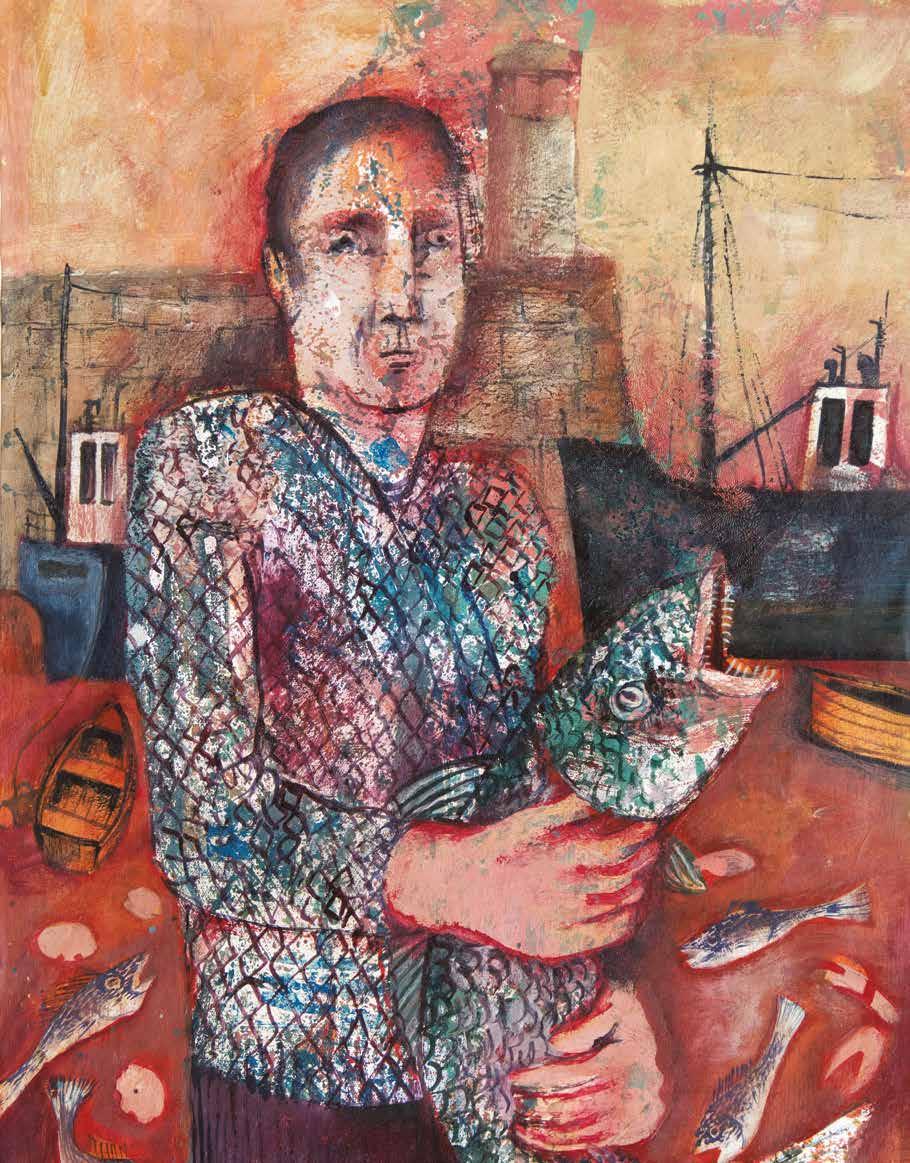
Rose Wylie at the RA Alastair Sooke visits the inimitable painter at her home and studio in Kent, plus Lioness Lotte Wubben-Moy on her love for Wylie’s football paintings
56
Michaelina Wautier
Imogen Savage charts the rediscovery of the forgotten Baroque painter, while Emma Dabiri explains how to spot a Wautier masterpiece
66
Lubaina Himid
The Academician, professor and Turner Prize winner, who this year represents Britain in Venice, meets novelist Caleb Azumah Nelson
8 The shows to see at the RA this spring, plus booking opens for ‘Painting the French Riviera’ 10 Introducing the issue Artist View
12 Ten quick-fire questions for Frank Bowling RA
15 Rosalind Jana on Schiaparelli’s ‘Shocking Pink’ and its explosive impact on culture
16 Rosanna McLaughlin meets Flo Brooks, whose works revisit teenage life in a show about ageing
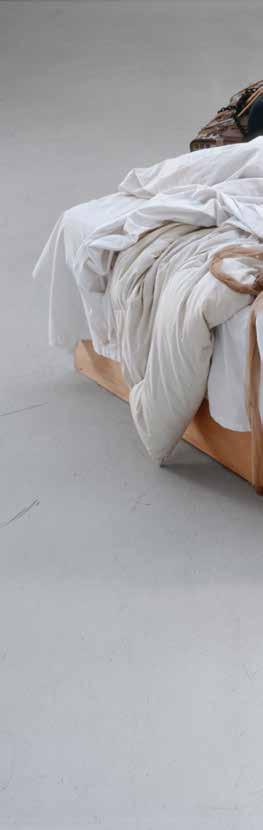
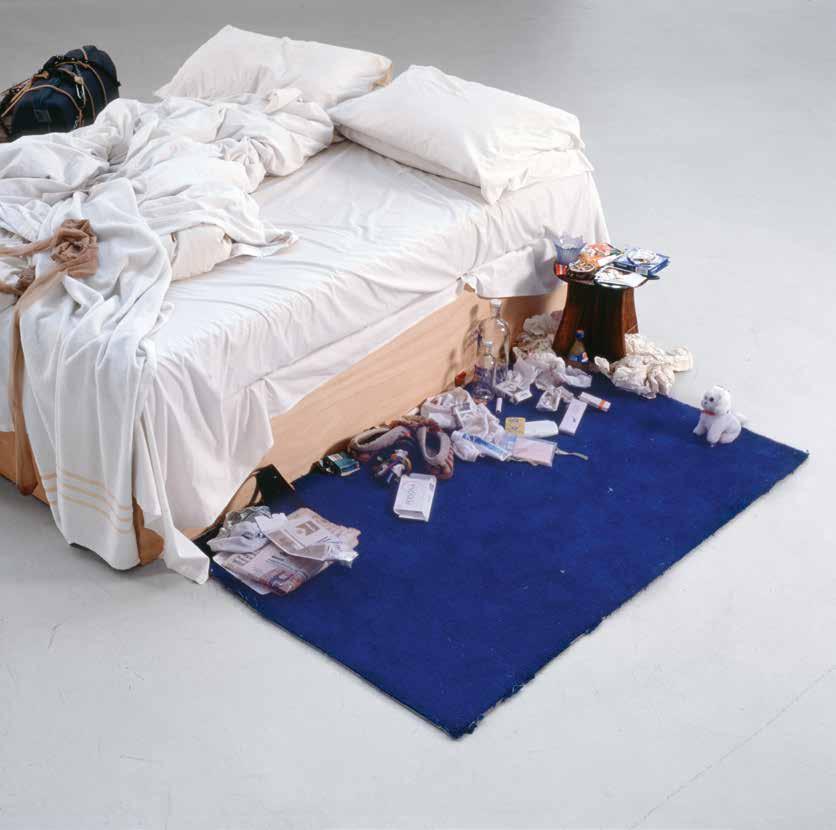
18 Shon Faye on her first encounter with Tracey Emin RA’s bed
21 Lewis Hammond pays homage to the symbolic art of Zurbarán
23 Thomas W Laqueur picks three artists’ depictions of dogs
27 Imogen Greenhalgh visits Marthe Armitage, doyenne of hand-crafted wallpaper
31 Ziyue Huang records life behind the scenes at the RA Schools
39 Owen Hatherley uncovers a history of nationalism at Vanbrugh’s Blenheim Palace, plus new books on artists’ lives
42 A new short story by Makenna Goodman, inspired by a Paula Rego RA drawing Out and about
70 A guide to this year’s Venice Biennale by Isabella Smith, plus shows to travel to around the UK
36 The big question: do immersive experiences trivialise art?
75 Royal Academicians’ news, plus the pioneering architecture of Maggie’s Centres
79 Top chef José Pizarro talks food and art, as his new Keeper’s House menus stir the appetite
80 A chance to buy works by Patrick Caulfield RA in a new selling display at the Academy
82 Talks, workshops and courses at the RA, plus news about the Keeper’s House and a special month for RA Members in May
85 Exhibition listings
90 Adele Ghirri on how she plans to keep the spirit of her father Luigi Ghirri’s art alive
Opening Hours: The RA is closed on Mondays. The rest of the week, it is open 10am to 6pm, and until 9pm on Fridays
28 February to 19 April – Main Galleries
Supported by David Zwirner and the Rothschild Foundation. With additional support from Christian Levett and Musée FAMM and Jake and Hélène Marie Shafran and The Magic Trust
Michaelina Wautier
Two era-defying women artists take over the RA this spring, as contemporary painter Rose Wylie and 17th-century trailblazer Michaelina Wautier go on display in stellar shows
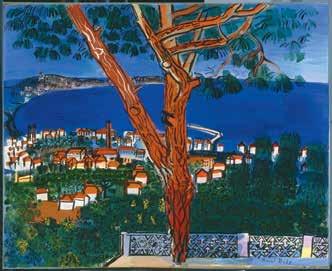
Below: Golfe Juan 1927, by Raoul Dufy
27 March to 21 June – The Jillian and Arthur M. Sackler Wing of Galleries
Supported by the Rothschild Foundation. With additional support from the Athene Foundation, Katherina Minardo Macht (Barrett) and William Strong Barrett, and the Delegation of Flanders to the UK and Ireland
Painting the French Riviera
2 October to 31 January 2027
To Monet, it was like ‘swimming in blue air’. To Braque, a ‘joyful revelation’. Derain compared its cerulean hues to ‘sticks of dynamite... primed to discharge light’. The radiance of the French Riviera left an indelible mark on the imaginations of some of the greatest painters of the
19th and 20th centuries – among them Picasso, Matisse, Cézanne, Renoir, Dufy and Klein – as well as giants of literature, cinema and fashion.
This autumn, the RA tells this sun-kissed story via more than 160 works. Booking has opened and while Friends’ access is prioritised, we advise booking ahead, particularly for our Friends preview days (29, 30 Sep and 1 Oct). Book at roy.ac/exhibitions Supported by Kenneth C. Griffin and Griffin Catalyst, The Idan & Batia Ofer Family Foundation, the Huo Family Foundation, Christie’s, and David and Molly Lowell Borthwick
Much has already been said about Rose Wylie and her later-in-life success. ‘For a long time,’ the nonagenarian painter says in her interview with Alastair Sooke (page 44), she was ‘not noticed: nobody listens to a word you say.’ She’s not resentful, you understand. ‘I’m used to being marginalised,’ she says, ‘I’m the seventh child. I didn’t mind: it gave me a certain freedom. It made me make my own world.’
As Sooke found when he visited her in her paint-splattered home-slash-studio in Kent, this is exactly what Wylie is still doing in her art: making her own world. And it’s a marvellous one (her favourite word), which is about to be showcased in a comprehensive survey of her art – some 50 paintings, plus 42 works on paper – opening in the grand galleries of the Royal Academy’s Burlington House this month. Wylie is the first female British artist honoured with a full retrospective in the principal galleries at the RA (‘And the first woman painter!’ she notes). So why now? Wylie’s work hasn’t changed – energetic, bold,
anarchic – but the way it is received has. As Sooke points out, a mix of motifs and witty takes on everyday life will be on display – footballers, film stars and food (specifically a chocolate biscuit). As he sums up: ‘ Wylie’s artistic eye is all-seeing – transforming sundry contemporary phenomena that take her fancy into things only she could have perceived that way.’
On the subject of footballers, Lioness and Arsenal defender Lotte Wubben-Moy shares her joy in Wylie’s football paintings, and how the artist captures the mood of the North London derby (page 54).
Alongside Wylie, rounding out a season of remarkable female artists on show at the RA this spring, is 17th-century Flemish painter Michaelina Wautier. Until recently, many of her works were wrongly attributed and, on page 56, Imogen Savage traces her rediscovery, while Emma Dabiri sheds new light on the clues that help identify a Wautier (page 64).
Turning to the future, it’s never too early to think about summer. Which is why we’re
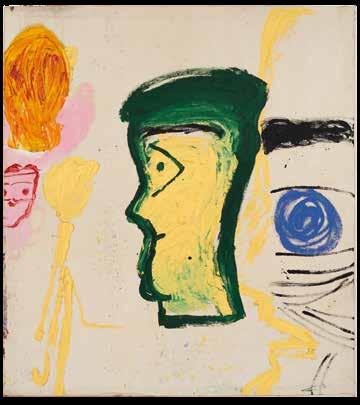
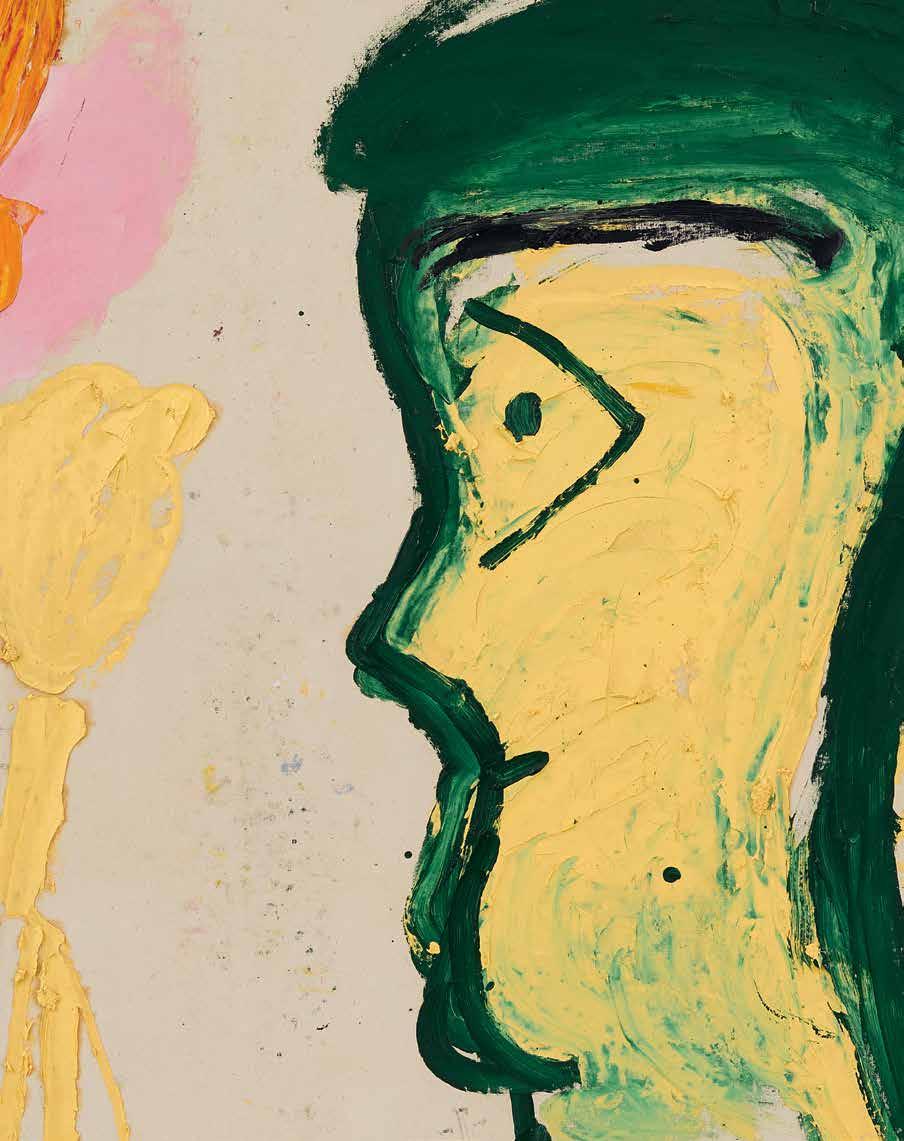
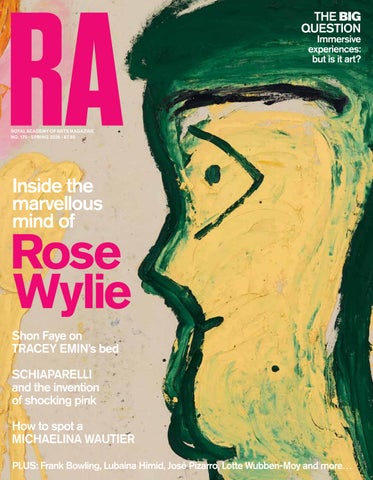
on the cover Yellow Henry 1996, by Rose Wylie RA
popping this year’s Summer Exhibition Preview Party on your radar now (Wednesday 10 June). Book your ticket now to the event that kicks off the season, where you can expect Champagne, canapés, fellow art lovers, some starry names and the chance to be among the first to view and buy art from the 2026 Summer Exhibition.
For more information and to book tickets, visit roy.ac/sepp26 or call 07590 245125. It’s one not to miss. And if you are in the market to acquire some art, turn to page 80 to find out how you can buy works by Patrick Caulfield RA, in a new selling display at the Academy. Hope you enjoy this issue. Terry Barbrook, Editor
RA MAGAZINE
RA Magazine is the quarterly publication of London’s Royal Academy of Arts.
Established in 1983, it is one of the most widely read art magazines in the UK, with a circulation of around 80,000 copies.
RA Magazine is published in March, May, September and November, and mailed to Friends and members of the Royal Academy of Arts as part of their membership. It is also mailed to patrons and other supporters of the RA, and can be purchased from the RA Shop, newsstands and on subscription.
The opinions in this publication do not necessarily reflect the views of the RA. Paper used in RA Magazine is sourced from responsibly managed forests and other controlled sources.
EDITORIAL
Head of Editorial Content
Terry Barbrook
Deputy Editors Imogen Greenhalgh and Rosanna McLaughlin
Design and Art Direction
Catherine Cartwright
Sub-Editor Gill Crabbe
Editorial Advisers
Eliza Bonham Carter, Michael Landy RA, Goshka Macuga RA, Fiona Mahon, Tarini Malik, Níall McLaughlin RA, Kira Milmo, John Shevlin, Simon Wallis
RA Magazine Digital
Georgiana Ashworth, Tom Hutton, Charlie Murray, Cristina Ricci
RA Magazine Digital is supported by Paulo and Caroline Pereira
SUBSCRIBE TO RA MAGAZINE
To subscribe, visit roy.ac/shop or contact the RA Shop (details right)
EDITORIAL ENQUIRIES ramagazine@royalacademy.org.uk
ADVERTISING AND LISTINGS ENQUIRIES
Advertising & Partnerships Manager Tamsin Luck tamsin.luck@royalacademy.org.uk
Colour reproduction by Dawkins Colour. Printed by Walstead. Published 3 March 2026. © 2026 Royal Academy of Arts. ISSN 0956-9332
EU Authorised Representative: Easy Access System Europe – Mustamäe tee 50, 10621 Tallinn, Estonia, gpsr. requests@easproject.com
CONTACT THE ROYAL ACADEMY
Burlington House, Piccadilly, London W1J 0BD 020 7300 8090 friends@royalacademy.org.uk tickets@royalacademy.org.uk
JOIN AND SUPPORT THE RA Membership starts from £70. Find out more at roy.ac/join
RA SHOP 020 7300 8090 (select option 2). Visit roy.ac/shop or email raonlineshop@royalacademy.org.uk
All reasonable attempts have been made to clear copyright before publication. Registered charity number 1125383
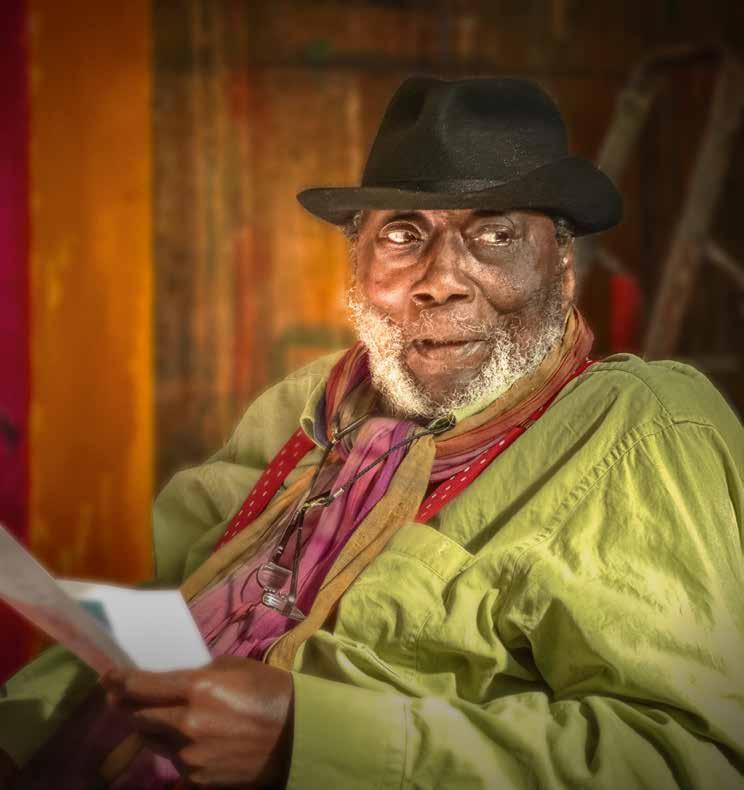
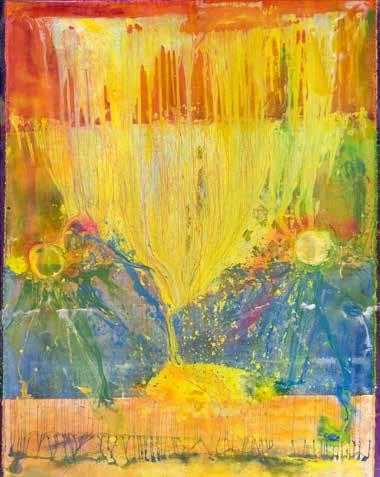
We ask the celebrated painter some quick-fire questions about his life and art, ahead of his Cambridge show
When did you know you were an artist? On arrival in London in 1953, after doing National Service in the Royal Air Force. After sitting as a portrait model for students at the Royal College of Art, I got the urge to do it myself.
Who has been your greatest teacher? I could claim the critic Clement Greenberg, who I first met in 1971. But I hesitate to do that because I think he was a great teacher and influence on modernism itself. What guides me is modernist aspiration.
What gets you up in the morning? The desire to paint.
What keeps you up at night? Explaining myself to myself.
What’s your biggest vice? Ambition.
When you look in the mirror, what do you see? Tomorrow.
What has been your proudest achievement? Recognition.
Which other artist do you most admire? I had made up my mind that Titian was the best for a long time but modernist artists can start anywhere.
What do people misunderstand about your work? Its thrust! The burden faced by modernism is taking on old ideas in new ways.
Advice for your younger self? Be brave.
Frank Bowling: Seeking the Sublime is at the Fitzwilliam Museum, Cambridge, from 27 March to 17 Jan 2027
Aspects
Oloya
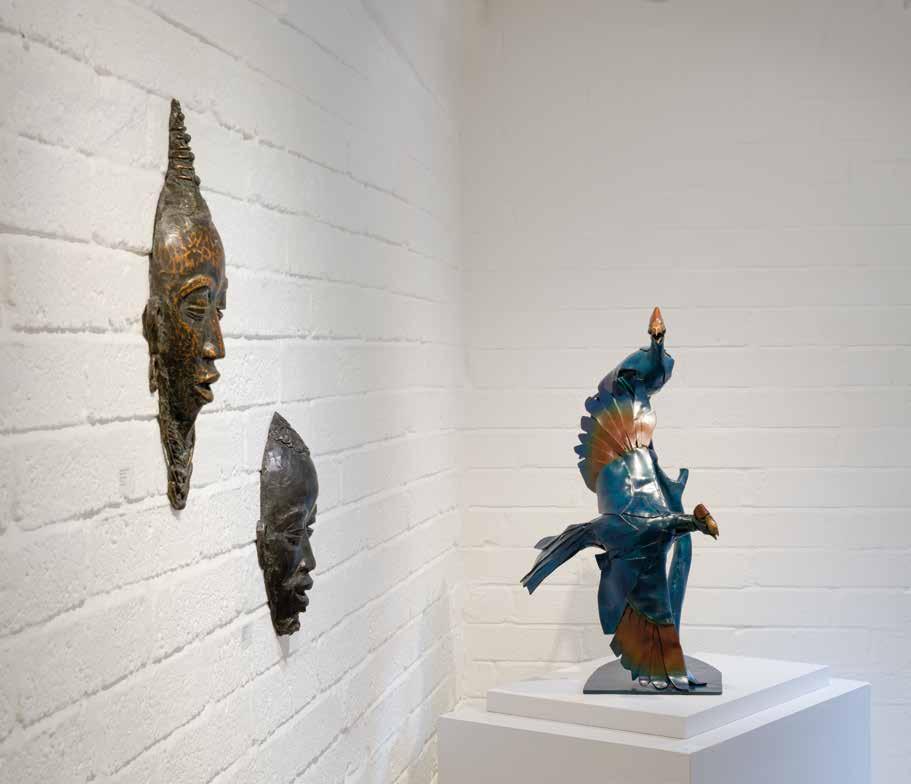
An exhibition of sculpture by Ugandan artists Isaac Okwir and Peter Oloya
Centenary
28th March - 30th May
GALLERY PANGOLIN
9 Chalford Ind. Estate
Chalford, Glos GL6 8NT 01453 889765 www.gallery-pangolin.com
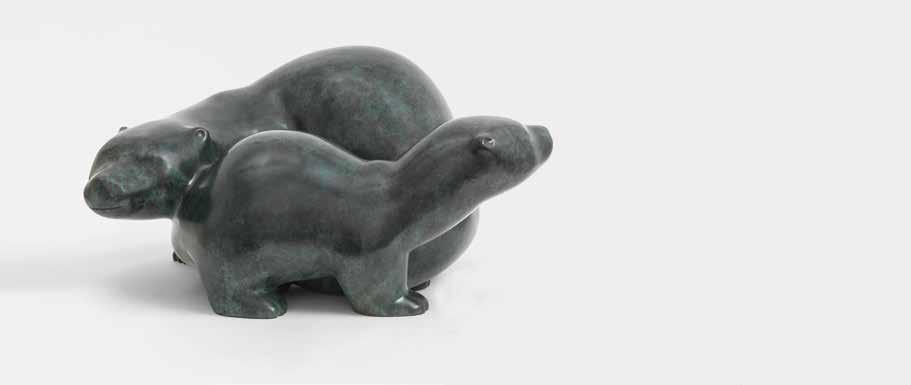
Otter and Cub 2018, Anita Mandl
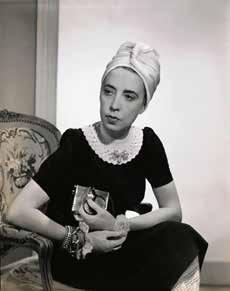
The story behind the fashion designer’s eye-popping hue is steeped in glamour and myth, writes Rosalind Jana
By the late 1930s, Elsa Schiaparelli had reached an inflection point. A decade or so into her career, she had evolved from tongue-in-cheek knits and clever sportswear to full-blown Surrealism. Her collaborations with Jean Cocteau and Salvador Dalí on garments not only blurred the boundaries between art and fashion but helped to create a whole new genre of clothing that audaciously married imagination and intellect. Schiaparelli’s reputation was secure, yet she sensed the need for a more cohesive identity – a signature that was unmistakably hers.
The catalyst arrived in miniature: one afternoon, her trusted collaborator Roger Jean-Pierre placed before her a tray of Jean Clément’s new button designs. Most were in conventional shades of rose. One was not. It was incandescent. In her biography of the designer, Meryle Secrest describes it as ‘strident, blazing… hot’. Schiaparelli stared at it, jolted into delight. ‘Oh! Roger,’ she declared, ‘I am going to take this one and we are going to call it Shocking Pink.’
While one origin story begins here, others circulate. Some curators have linked the hue
to the flushed tones of Pavel Tchelitchew’s 1925 painting Basket of Strawberries, which Schiap, as she was known, saw in Gertrude Stein’s Paris apartment. Others point to the 17.47-carat pink diamond ring owned by friend and devoted client Daisy Fellowes. These colliding myths feel appropriate. Shocking Pink, a colour the designer described as ‘bright, impossible, impudent’, was never a single inspiration. Instead, it was a chromatic exclamation mark intended to punctuate the overlapping spheres – artistic, social, commercial – from which the designer ceaselessly drew.
Schiap was a magpie, avaricious for ideas, voracious in collaboration and uncannily attuned to what modern women wanted. From the designers, artists, illustrators and embroiderers she worked with to the socialites and Hollywood stars she dressed, she had an instinct for assembling the minds and hands (as well as the bodies) that could bring her visions to life. But her provocations were always grounded in practicality: the trompe-l’œil jumpers that launched her career, infinitely copied and as wearable as they were playful; the evening gowns with matching jackets devised for women moving briskly between engagements; Second World War-era coats with huge pockets (no need to pick up a handbag during an air raid). Surrealism gave her an uncanny, and often very funny, sartorial language; she returned the favour by proving that its ideas could live not only on gallery walls but in a woman’s wardrobe. »
» All of this culminated in ‘Shocking’, the perfume Schiaparelli launched in 1937. Packaged in a box in the eye-catching hue, its name and identity formed a direct extension of the colour itself: Shocking Pink translated into a heady, animalistic scent, with clean and honeyed top notes giving way to a deep, musky blend of civet, sandalwood and amber. In an era when fragrance had become fashion’s most potent form of cultural expansion – Chanel had revolutionised the field with No 5 and Patou had several bestsellers – Schiap saw perfume as a new stage for her imagination.
This was not her first scent, but it would prove to be her most enduring. The bottle, modelled on Mae West’s memorable hourglass torso, was crowned with a bouquet of flowers.
Nestled in Shocking Pink satin and packaging, it became a defining icon. ‘The success was immense and immediate,’ she recalled 15 years later. ‘The perfume, without advertising of any sort, took a leading place, and the colour “Shocking” established itself forever as a classic.’
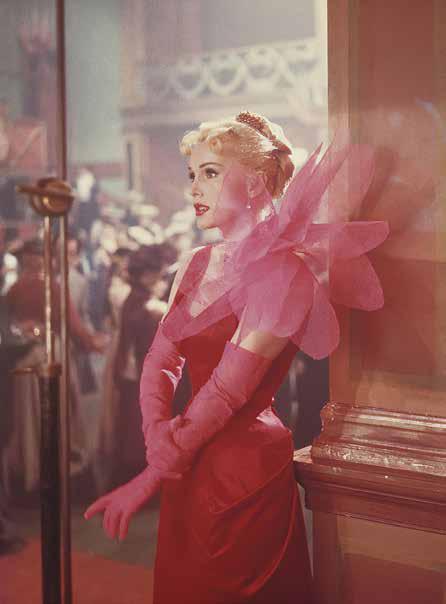
The hue spread quickly. Women’s Wear Daily noted at the time ‘entire hats or hat trimmings’ appearing in its petunia-pink glare. It turned up in the costumes Schiaparelli designed for Zsa Zsa Gabor in Moulin Rouge (1952; page 15). It graced Dalí’s lips sofa, itself riffing on Mae West’s mouth. It lent theatrical weight to all sorts of occasions, not least Elsie de Wolfe’s Circus Ball at the Villa Trianon in 1939, where horses trotted in pink satin and the hostess, as Schiaparelli recounted, ‘walked between the legs of the elephants… draped in a long floating cape of shocking pink and brandished a whip’.
The afterlife of this spectacular colour was just as vivid. When Kay Thompson burst into song with Think Pink! in the film Funny Face (1957), issuing the command to ‘banish the black, burn the blue, and bury the beige’, the satire landed because pink already carried the weight of an established fashion decree. Several years after Schiaparelli had closed her house, this Hollywood missive made it clear that she had written the script for how a colour might leap from couture into the wider culture – making its own, unruly way.
Rosalind Jana is a fashion and arts writer Schiaparelli: Fashion Becomes Art is at the V&A, London, 28 March to 8 Nov
Rosanna McLaughlin meets the artist Flo Brooks, ahead of a show challenging our perceptions of ageing
How many times do we get to be a teenager? More than once, according to artist Flo Brooks. While transitioning in 2016, Brooks left London for Devon to live with their parents. ‘Big things were happening in my life. I’d started taking “T” [testosterone], and my dad had also had a stroke, so I became one of his carers.’
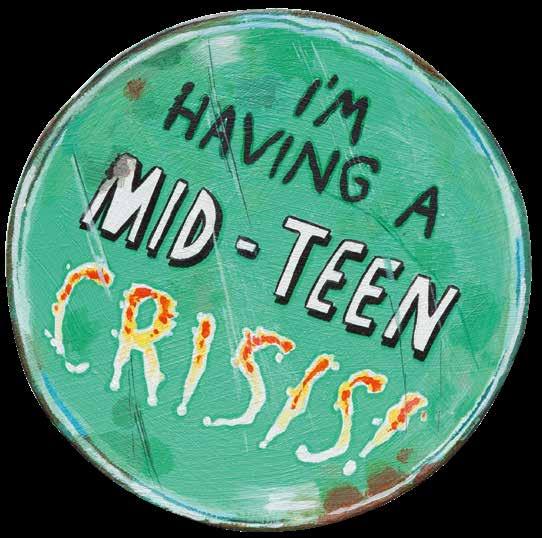
Back at home, Brooks began making a series of large-scale paintings based on badges they had collected in their childhood (I’m having a mid-teen crisis, 2018; above). These paeans to teenage paraphernalia were made at a time when Brooks’s own identity was again in flux. ‘It was a very intense and strange time,’ says Brooks. Becoming a carer for their father was a role reversal of the child/parent dynamic. ‘I was also navigating a second puberty,’ their sense of self changing and reforming as part of their transition. ‘The
badges helped connect me again to being a young person.’
This spring, Brooks’s paintings go on show at the Wellcome Collection as part of ‘The Coming of Age’, which explores changing perceptions of ageing. The exhibition includes scientific artefacts as well as artworks, and considers a broad range of experiences, from the menopause to those of queer people and the elderly. While ageing may be a biological reality, it’s also a social construct that places limits on who we get to be and when. Yet as Brooks’s paintings show, those states of profound personal transformation so often associated with youth can be experienced throughout our lives.
Rosanna McLaughlin is Deputy Editor of RA Magazine
The Coming of Age is at the Wellcome Collection, London, 26 March to 29 Nov
When first shown in 1999, Tracey Emin RA’s My Bed caused a furore, and shot her to stardom. Shon Faye muses on the legendary work as it returns to Tate
There are a handful of cultural moments in British public life I can remember clearly from my childhood in the late 90s. Some will be obvious, like the emergence of the Spice Girls, New Labour’s election victory, the death of Diana. The nomination of Tracey Emin’s My Bed (1998) for the Turner Prize in 1999 is a landmark. Not because I grew up in a household where modern or conceptual art was ever discussed (I didn’t know what the Turner Prize was and I didn’t visit the Tate, where the bed was exhibited, until I was an adult), but because I remember the massive, largely negative media reaction to the work. And I recall the derisory comments from adult family members in response to it: ‘That’s disgusting’, ‘How is that art?’ and ‘Anyone could do that’. Emin’s work was provoking and cut through the rarefied discourse of the art world to reach houses up and down the country. It encouraged my 10-year-old self to ponder, for the first of what would be many times: what is the nature and purpose of art?
For four days in 1998, Emin lay in bed in a near catatonic state consuming nothing but alcohol and cigarettes following a devastating relationship breakdown. When she got up for the toilet and returned to the filthy bed, she saw a profane relic of her agony and decided to repurpose it as art. Emin’s bed, festooned with dirty tights, cigarettes, bloodstained underwear, a pregnancy test and lube was called disgusting because it is disgusting. Heartbreak is, in my experience at least, often disgusting. Sorrow isn’t always a discreet, beautiful tear skimming a cheek; it’s fag ash and filth and lying with a tight, full bladder and gum disease from forgetting to brush. When I told a close friend I was writing about Emin’s bed, she said she had always thought it wasn’t messy enough, quick to remind me that she and I both have made far worse mess in our own rooms in various states of drunken and dissociated grief.
‘My Bed confronted the public with a display of one woman’s depression, presented without apology’
In 1999, mental illness was considered so shameful it was still largely hidden from view. Yet My Bed confronted the public with an unabashed display of one woman’s depression, presented without apology or justification. To me, there is even something mind-blowing about the fact that, in subsequent exhibitions of My Bed, Emin’s original bed and the accompanying detritus must be reconstituted as a valuable sculpture: the condoms unzipped from their vacuum packing, the old knickers laid out once more. I love this elaborate coping mechanism, the detachment from private pain by offering it up for public consumption. The woman who once lay in My Bed no longer exists; she is but a phantom. Yet the rest remains: a mausoleum for the kind of experience most people are keen to forget. In the 2020s, we are living through an era of renewed public misogyny. Social media, which initially seemed to promise a widespread rollout of the kinds of self-disclosure that once made Emin controversial, has regressed into promoting a varnished conservatism about women’s appearance and behaviour. Women are encouraged to disclose and share but only in the service of marketing. The trends literally have names like ‘clean girl aesthetic’, to insist that women must always appear in public young, poised and polished – or else. The woman who belongs in Emin’s My Bed is grimy, filthy and dissolute. She is unfeminine. She doesn’t give a fuck what anyone thinks of her: she is too broken to spare you the unpleasantness of beholding her at her lowest. I think that’s punk. And I think it is something we need as much in this age as we did back then.
Shon Faye is the author of two Sunday Times bestselling books. Her most recent book, Love in Exile (Penguin), is out now in paperback Tracey Emin: A Second Life is at Tate Modern, London, from 27 Feb to 31 Aug
21 Cork Street, London, W1S 3LZ
T: 020 7493 7939 E: info@osbornesamuel.com
Monday - Friday | 10:00 - 18:00 www.osbornesamuel.com
Painter Lewis Hammond is inspired by the subtle depth of emotion evoked in a work replete with symbolism
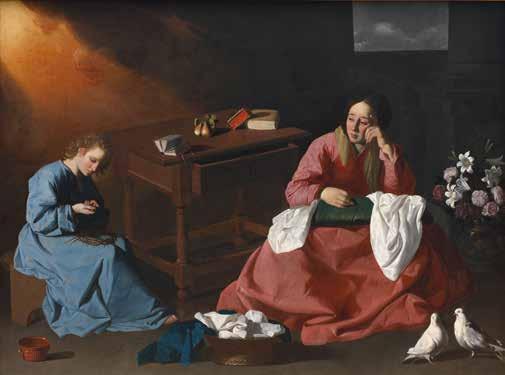
As an artist, it can be difficult for me to articulate what I value most in an artwork. I often hesitate when speaking about painting in particular, perhaps because I remain too close to the act itself to find an objective perspective. Yet the prophetic vision of Francisco de Zurbarán’s Christ and the Virgin in the House at Nazareth (c 1640; below) resonates with my belief in painting’s capacity to convey emotional depth, and to do so with absolute sincerity. Interestingly, Zurbarán’s scene is seemingly born entirely of the imagination, an invented moment rather than a depiction of any known biblical narrative.
Jesus is shown as a teenager pricking his finger on a crown of thorns he is weaving, the very crown he will later wear on the Cross. Nearby, the Virgin Mary sits mourning this future suffering. Her tears are shed not only for her son, but for herself and for all humanity. The painting moves with remarkable fluidity: from the sensual, sculptural naturalism of the figures’ garments to the cavernous space that opens between them, drawing in the viewer through its quiet narrative foreshadowing.
Above the Virgin, a grey, clouded landscape appears through a window; less a firmament than something resembling a fuzzy medical scan, intensifying the heavenly light that radiates from the upper left corner of the room, where cherubs bathe in its glow. The light itself seems blood-tinted, and the use of red – on the edge of the book, the blush of the figs, even Mary’s dress – foreshadows death. The painting is dense with symbolism: doves, fruit, Annunciation lilies and the table that separates the figures all subtly infuse this domestic scene with an air of foreboding. Zurbarán’s interior feels unsteady, with scarcely any paint used to delineate its spatial boundaries. Christ and the Virgin appear as if hovering within the composition and barely register a connection to solid ground.
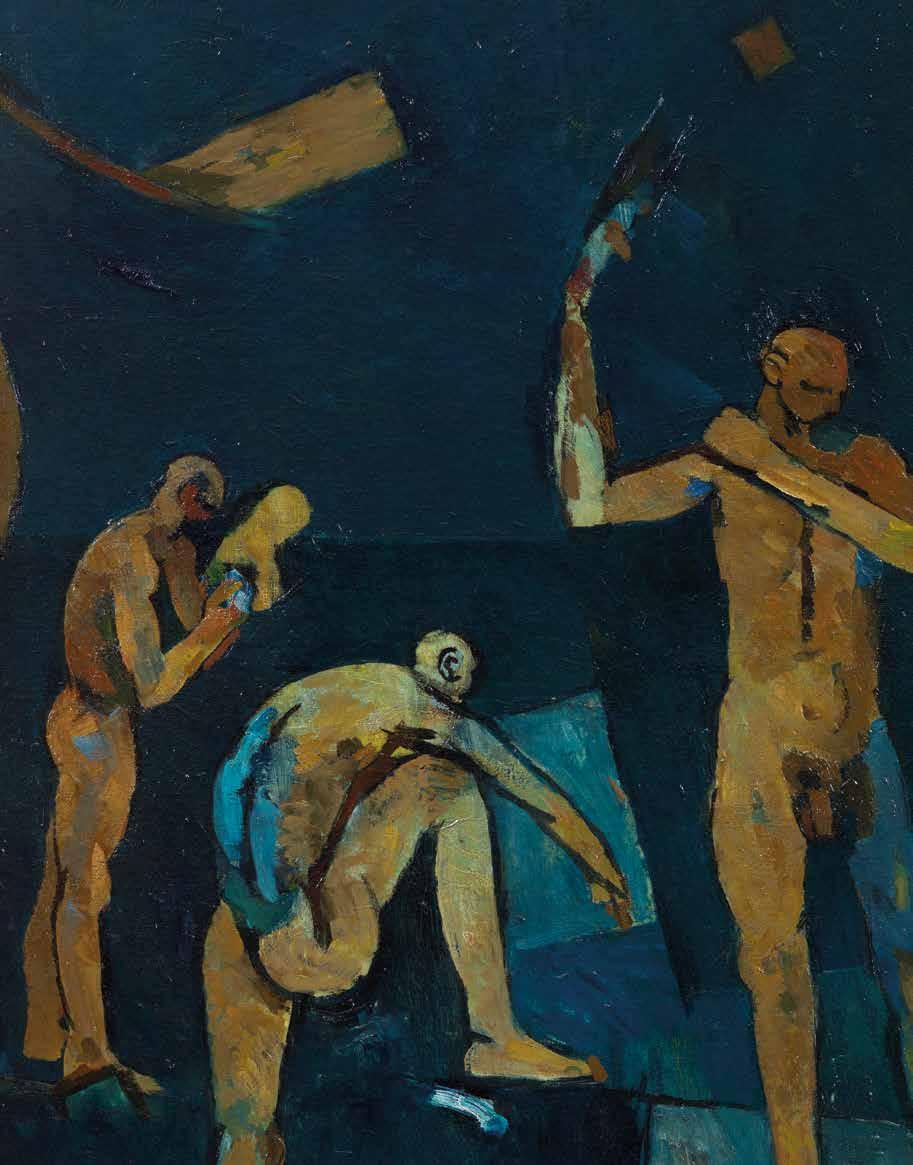
I have long admired Zurbarán’s ability to imbue his subjects – whether figure, fruit or flower – with an elegant earnestness. It is a quality I have sought to explore in my own work, particularly through an ambiguity of mood and atmosphere that might resonate with our contemporary
moment (Untitled, 2025; below). In an era of knowingness and irony, I often find myself longing for sincerity within the culture I engage with. Time and again, Zurbarán’s paintings provide it.
As with many artists, writers and musicians I return to, it is Zurbarán’s ability to move seamlessly from the hyper-specific to the universal, probing and illuminating the human condition along the way, that continually draws me back to his work. The complexities of the world we inhabit only underscore the necessity of such artistic reflection. Paintings, as physical objects, possess a unique power to stir our inner lives through an endlessly complex interplay of form, colour and composition. Without them, I would feel more adrift – they act as an enduring and welcome port in the storm.
Lewis Hammond is an artist and former student at the Royal Academy Schools. His solo exhibition is at the Hepworth Wakefield from 23 May to 1 Nov Zurbarán is at The National Gallery, London, from 2 May to 23 Aug
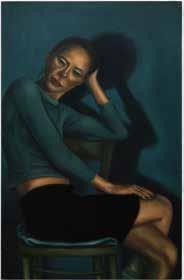
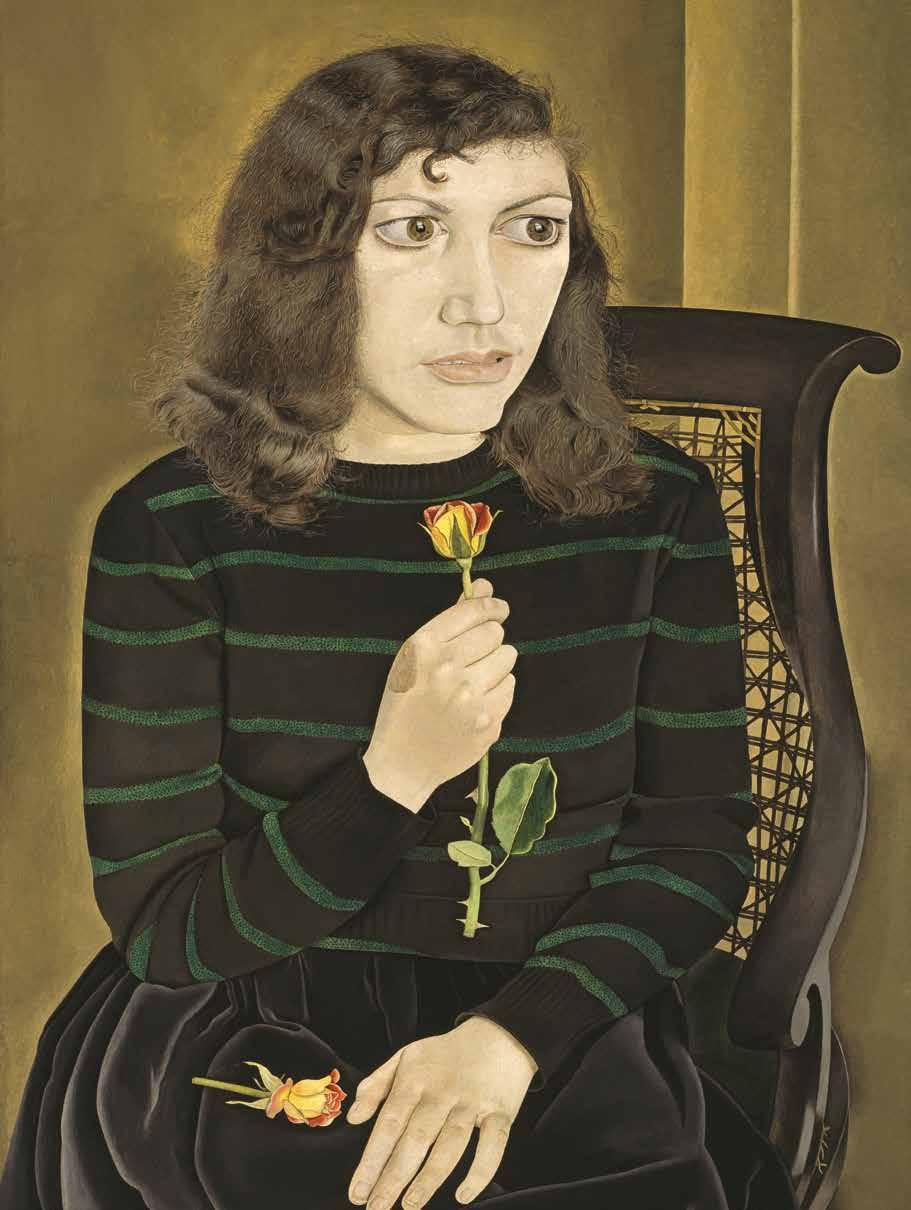
As he publishes a visual history of dogs in art, Thomas W Laqueur selects three works that reveal how our trusty sidekicks have also been vital muses
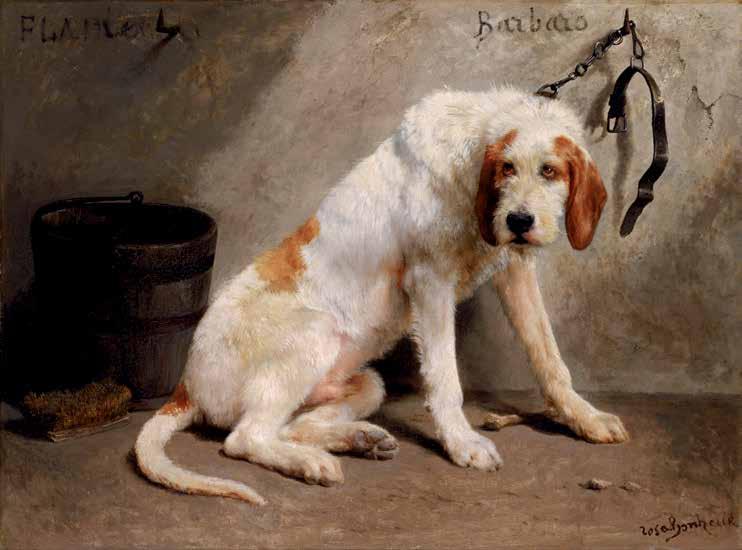
Rosa Bonheur’s hunting dog
Bonheur is one of the greatest animal painters in the Western tradition. Her dog portraits are unmistakably individualised yet at the same time they evoke an almost magical cross-species intimacy. In Barbaro After the Hunt (c. 1858), Barbaro’s fur shines with luminous white pigments mottled with patches of lighter brown; fine brushstrokes define details down to the pads of his feet. He has just had a bath having returned dirty from the hunt. But it is his tired, expressive and demanding eyes that compel our attention. Humans and animals may lack a common language, but the dog’s gaze in Bonheur’s work hints of the possibility of understanding another creature. Barbaro, his name above his image, his body poised to come to us once released, reaches across the chasm. »
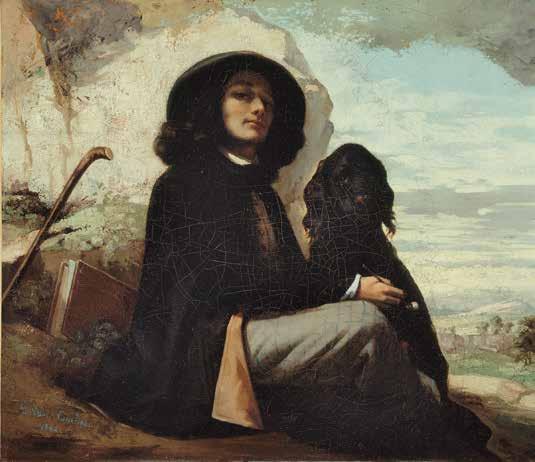
A young man in bohemian style – the painter Gustave Courbet in 1842 – poses ostentatiously on a rock out in nature, alone, except for his carefully presented dark brown spaniel with a shiny coat. Man and beast in Self-Portrait with a Black Dog (1842-44) are colour coordinated. Caught in a moment of quiet contemplation, Courbet has put down his sketching pencil and holds a pipe in his right hand. Brightly lit against the dog’s dark fur, it visually connects the two. His dog is sitting by his side as if sharing a quiet smoke: a patient, intimate companion, a canine alter ego. The man is looking up, his face lit with a knowing smile; the dog, backlit by the sky, is looking straight ahead at us and at where the painter would be standing to make this picture. A curl on its left ear matches the whiff of hair sticking out from Courbet’s hat above his right ear. Among the qualities that make the dog an ideal candidate for friendship is that it is very good at waiting. At least when not waiting for a walk.
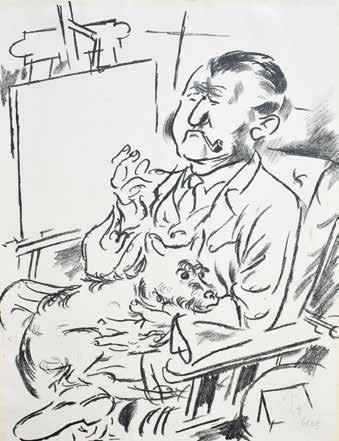
Grosz is best known for his ferocious social satires of Germany in the 1910s and 20s, and more generally for his representations of the civilisational collapse wrought by the Great War. Hungry dogs roam among abandoned bodies in his horrific and garishly painted Suicide of 1916. The same year a dejected, sickly blue dog accompanies the cadaverous self-portrait The Love Sick. These are apocalyptic, portentous dogs. They are dogs of death in the midst of the war. A decade later, in 1926, the animal in the famous lithographic Self-portrait with dog in front of the easel is of an entirely different character: a dog of life reaffirmed. Grosz is relaxed, sitting in front of his easel smoking a pipe. The dog, nestled between his hand and crooked knee, its eyes wide open and its eyebrows raised, looks outside the frame as if someone is about to disturb their peace. With great economy of line Grosz has created an intimate double portrait of two beings merged.
Thomas W Laqueur is Fawcett Professor Emeritus of History at the University of California, Berkeley. His new book, The Dog’s Gaze: A Visual History (Allen Lane), is out in May
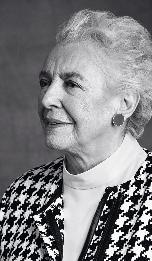
From her house in Chiswick she became the doyenne of British wallpaper. By Imogen Greenhalgh
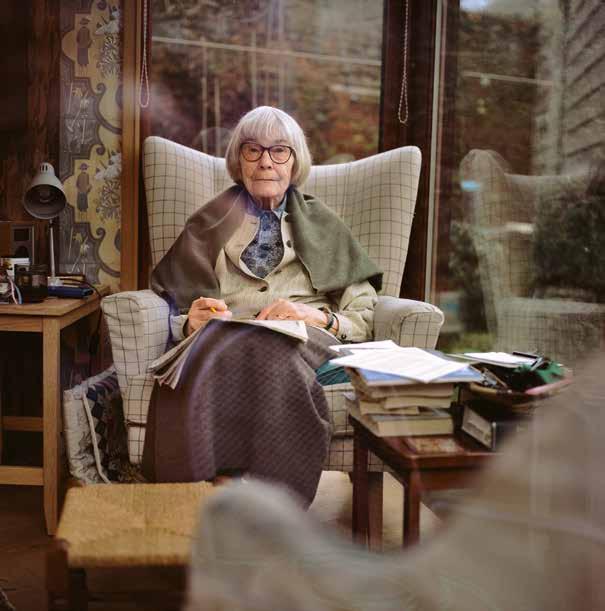
For more than eight decades, Marthe Armitage has stepped out of her front door and onto the banks of the Thames. The renowned maker of hand-printed wallpaper has lived in Strand on the Green, on the edge of the river in Chiswick, virtually her whole life, even helping to set up the local sailing club in 1946. ‘I was nine when we moved here,’ she explains, when we meet on an overcast January morning, the tide outside her house low enough to allow dogs and metal detectorists to revel in the mud. Now 95, she lives in a modern outhouse in the garden of No 1 Strand on the Green, once her marital home. Members of her family reside in that and a neighbouring house, some working
on their own projects in a warren of adjoining buildings converted into studios. A back garden, dotted with fruit trees, connects the lot. The set-up has a happily anachronistic feel, befitting a small patch of London that appears immune to the creep of the ubiquitous coffee shop chains found everywhere else.
Once home to one of the RA’s founders Johann Zoffany (who lived at No 65), Strand on the Green is almost indivisible from the river, only a footpath separating its higgledy-piggledy stretch of historic houses from the water’s edge. Flood guards on front porches testify to the river’s habit of breaking its banks in spring and autumn to lap against residents’ doors.
Armitage’s work has the same slightly improbable storybook appeal. Since the 1960s, she has created wallpaper by hand, featuring delicate drawings, many rooted in this local environment. West London landmarks such as Chiswick House feature, as do plants that grow wild along the riverbank, the contours of both captured with the same soft-edged precision, and just the subtlest hint of whimsy. She stepped back – not so long ago – from the making process, but is still part of the day-to-day goings-on via her daughter Jo Broadhurst, who has taken the reins and still prints with Armitage’s original blocks on her old press.
This remarkable legacy is soon to be celebrated at Pitzhanger Manor & Gallery, as it explores Armitage’s mastery of pattern, that ‘mysterious’ thing that, in her words, ‘underpins everything’. Armitage had aspired to be a practising artist. ‘I trained to be a painter. I wanted to be a painter,’ she recounts, in a voice that is quiet but clear and emphatic, her slight form dwarfed by her favoured armchair, which looks over the garden. ‘But I married, and immediately, there were babies. Babies and painting do not go together.’ Wallpaper, she explains, proved less ‘antisocial’. »
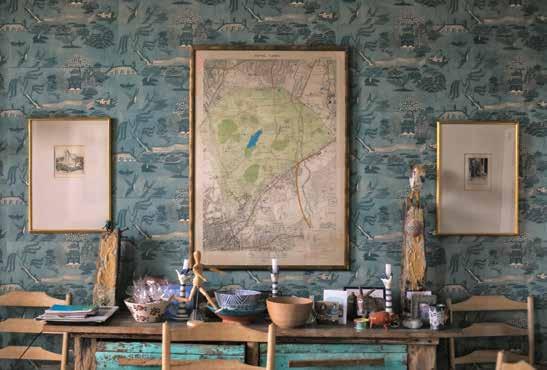
» Marthe married Edward Armitage, the architect son of another Strand on the Green family, and plunged into motherhood at 22, following a degree at Chelsea School of Art, from where she had graduated in 1951. Women, she says, ‘weren’t taken very seriously, but it was a serious place, with great teachers. They were always looking for “a sense of form”, though nobody ever quite knows what that sense of form is, but I really learned to draw.’ It is drawing that is integral to the expressive originality of Armitage’s designs. The craft of wallpaper printing requires precision and a command of negative and positive space, yet what has made her designs so distinct and so covetable is their apparent freedom, each one lively with movement and detail that seems not to repeat rigidly, but to unfurl.
In her living room, her ‘Gardeners’ design adorns the walls, printed in soft hues of peach and slate blue (photograph; right). It shows an urn of flowers, blooms bursting outwards towards a man and woman either side, the titular gardeners, who attend to the space beyond. ‘That’s the joy of wallpaper,’ she smiles, ‘you forget about literalism.’ But if freedom is wallpaper’s joy, Armitage’s first forays into making it sprung from constraint. She began to block print in 1964, in a chink of free time that opened once her children started school. The house, she recalls, was ‘a tip’, so, to do it up cheaply, she decided to turn her hand to making wallpaper. An earlier stint in India – her only period away from Strand on the Green other than a wartime evacuation and terms at boarding school – had seeded a curiosity about block printing, after she had
28 royalacademy.org.uk
young, I suppose’ – working out how best to execute them on the 30-inch-wide rolls of paper without creating blocks too heavy to manoeuvre. Ink proved an issue, as it was prone to picking up dust and other rogue ‘foreign matter’. ‘I thought a press might help, but I couldn’t work out how, until a friend, a printing expert, said “offset is the answer”.’
Before long, Armitage had purchased an antique offset lithographic printing press from a dealer in Brixton. Over 100 years old, the machine is still used by Armitage’s studio to print wallpaper today. Weighing almost a ton, it was dropped off by delivery men on the pavement outside the house. ‘My husband was terribly busy, but he did think we better strengthen the floor if it was going upstairs. That was useful advice. My brother was a mechanical engineer… He brought a spanner and took it all apart.’ Once it was reassembled, she says, she was ‘in business’ – though with ‘only a trickle of orders’ coming in. But she kept at it. ‘I suppose I had a belief that what I was doing was good.’
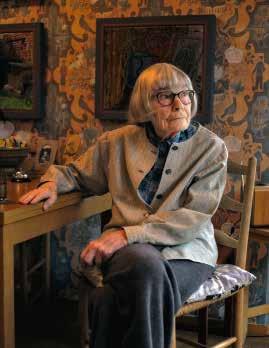
Above and previous page: Marthe Armitage, at home in west London, in January 2026. On the walls are her wallpapers ‘Gardeners’ (above) and ‘Willow’ (top)
spotted men making textiles at a market.
‘I’d been interested in pattern since primary school, and I’d done lino cutting at art school,’ she says. She bought rolls of paper from a hardware store, some inks and some lino. For her first design, she drew an angelica plant, growing in abundance on the towpath outside.
This DIY experiment led to a few commissions, which she would print on her landing, bent over her designs on the floor – ‘you have a lot of energy when you’re
It is her collaboration with Jo – the youngest of the three children who had earlier conspired to keep Armitage from her paints – which helped transform the business into a thriving enterprise. ‘She brought it all to life,’ Armitage explains. ‘At the turn of the millennium, things also changed, as people realised they wanted things that were handmade.’ Her designs have been stocked by wallpaper specialists Hamilton Weston since the early 2000s and, with a 2005 profile in The World of Interiors, they were soon coveted by interior designers and home decorators around the world. In 2014, when Armitage was 84, the New York Times featured her under the headline ‘Hot New Thing’, blue-chip recognition some five decades after she began.
Was there ever a point when she wished to devote herself fully to the practice of painting, as her younger self had planned? ‘It’s not only babies who can’t bear you to paint. If you get into a painting, you remove yourself. You get cut off from the world,’ she says, whereas drawing and printmaking have proved easier for her to interpolate into family life. Plus, she is captivated by pattern, which she has come to believe is something ‘spiritual’, an exquisite balance emerging from chaos. At Pitzhanger, the show concludes with her most recent design, a chess game, from 2023. After a life on the foreshore has there never been a tribute to the sinuous bends of the Thames? ‘Rivers are difficult to put into a pattern,’ she replies, matter-of-factly. ‘Good for boats, though.’
Imogen Greenhalgh is Deputy Editor of RA Magazine
Marthe Armitage: Pattern Maker
Pitzhanger Manor & Gallery, London, 19 March to 19 July
34 Bury Street, London, SW1Y 6AU Tel: 020 7734 7984 art@browseanddarby.co.uk www.browseanddarby.co.uk
2 FOR 1 TICKETS
Use code R-RA-241 at affordableartfair.com or scan the QR code*
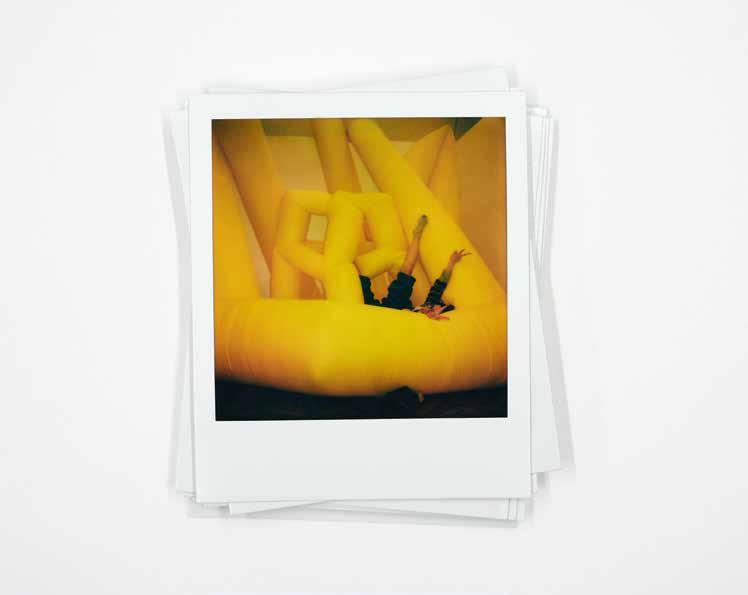
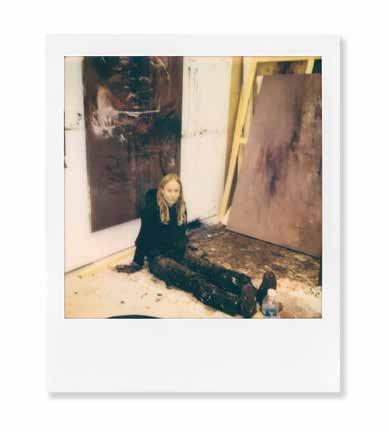
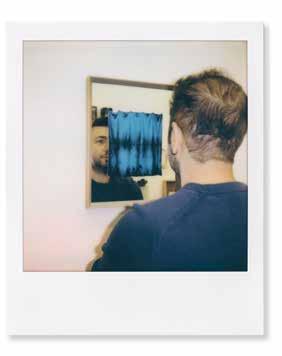
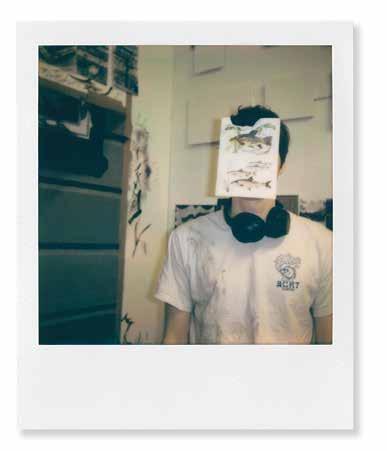
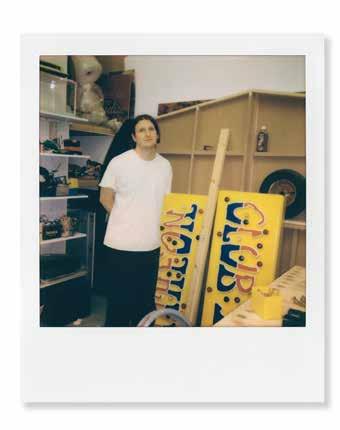
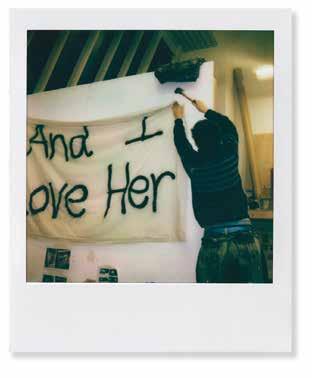
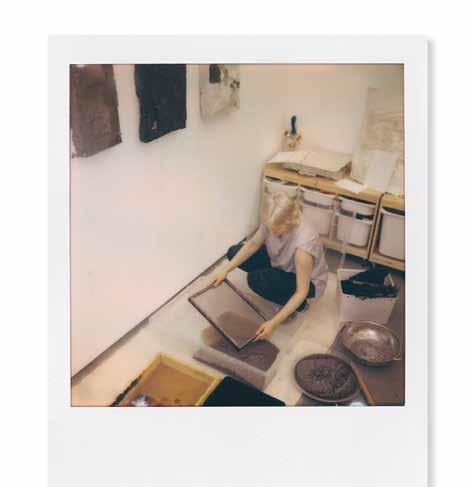
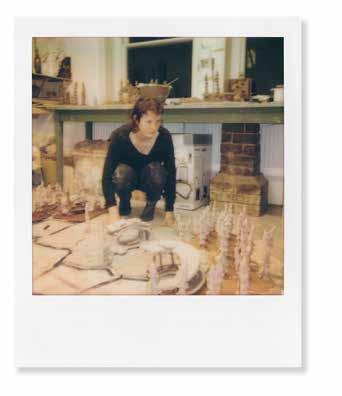
We gave second-year student Ziyue Huang a Polaroid camera to document life at the Royal Academy’s art school, ahead of her year group’s interim ‘Premiums’ exhibition. The resulting photographs tell the story of a world of inflatable giraffes, pomegranate peel and welding machines, where students are family and the studios are a second home...
Ziyue Huang (previous page)
In the photo I’m lying on an inflatable giraffe, part of a video installation I’m making for ‘Premiums’. At the Schools, everybody treats it like a sofa and lies on it. It’s a small community here and we all help each other. If I need to move something heavy there will be someone to help me. If I’m feeling sad someone will be there to talk to me. It’s been an
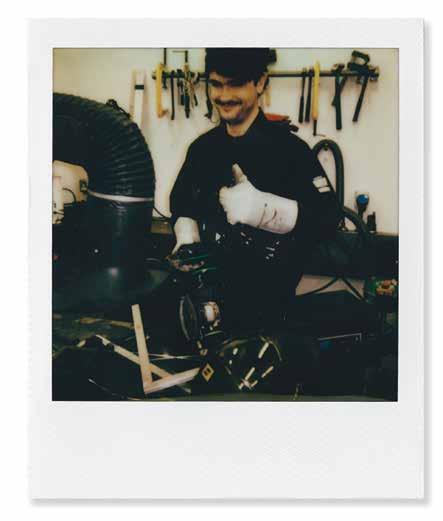
Jacob Bullen (above)
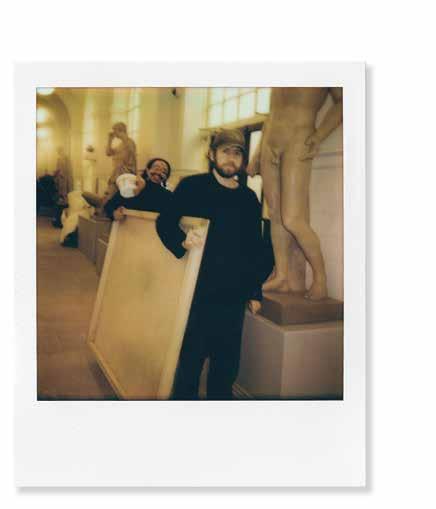
While being at the Schools I’ve started welding – I welded aluminium frames as part of the work I’m showing. It’s something I’ve always wanted to do but the cost stopped me in the past. I like to dabble, I like to mess around, so it’s great to be able to drop in and out of different workshops.
Heja Rahiminia (right)
For ‘Premiums’ I’m showing prints from a series about curtains in Iran, and how they are used to hide things – especially about women. The Schools is like a family. You see the other students and staff more than you see your own family, or your partner. Every day we talk together, and we all have different skills and knowledge. I can learn from others and others can learn from me.
A typical day in the studio starts with coffee. I like to do half a day of drawing and half a day of painting, and I read on my commute in. You can’t tear people away from this place. It’s really nice to have so many people committed to their practices. Everyone is focused and takes their time here so seriously, it’s a privilege to be able to share that.
The best thing about this course is the time it gives you. Last summer, after I’d had a year to settle in, my work really changed. I feel quite
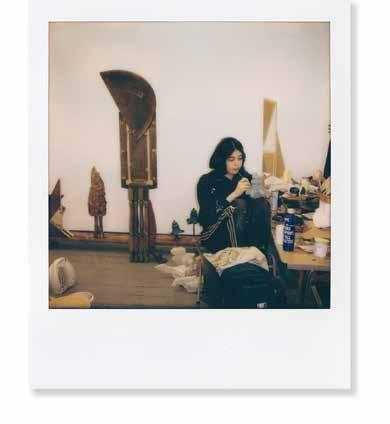
Anaï Salem
I work intuitively, and I like using materials that were objects before. I’ve been making sculptures from a cabinet I found in the garbage, and from pomegranate peels that I dehydrated in a drying machine.
‘Premiums’ is a great opportunity to show work with my classmates. It will be so interesting to see how people present their work outside of the studio.
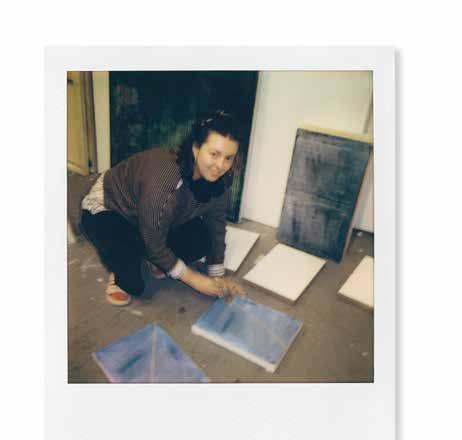
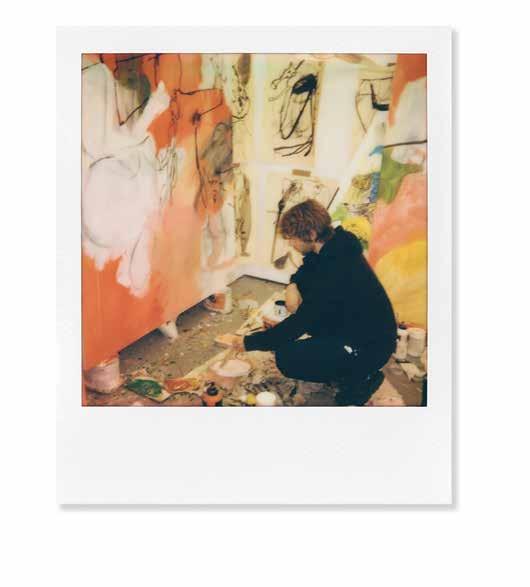


My second year here has been about focusing on what’s important and working out what my priorities are. During my first year I experimented with lots of different mediums, but I realised that I needed to set aside more time for painting. My paintings may look gestural, yet while parts of them are made really quickly it takes a while for me to build up the layers.
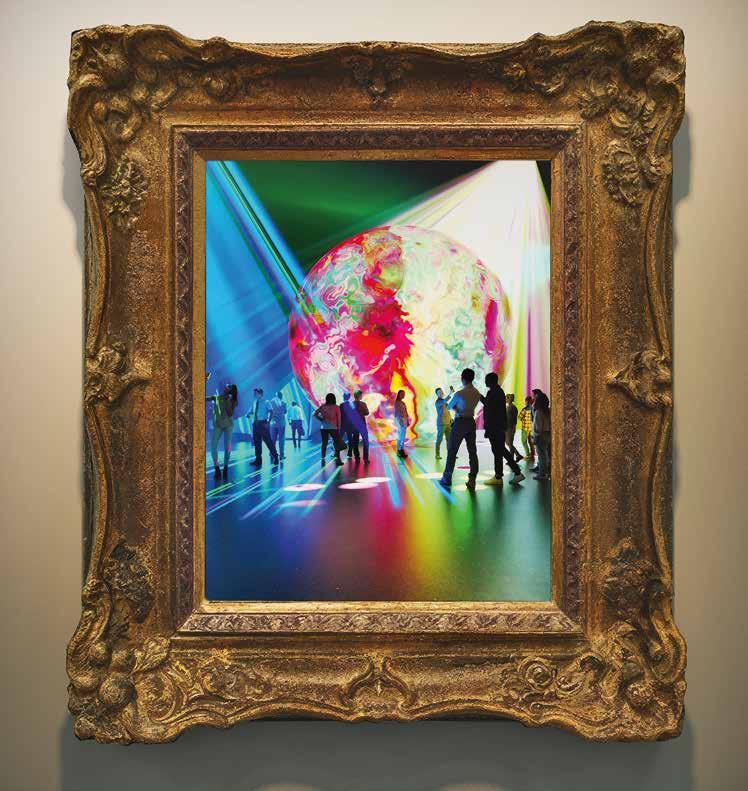
Yes... says art critic JJ Charlesworth. They may wow the crowds but, due to their overwhelming nature, there’s no room to reflect on art’s deeper meanings
What’s so bad about wandering around darkened warehouse galleries, as video projections or LED screens cover walls, ceilings and floors in shifting digital imagery – then losing yourself in all-encompassing light and movement, while lolling on a beanbag?
‘Immersive’ art may be a lot of fun. Venues like London’s Frameless pull big crowds for spectacular reworkings of the oeuvres of long dead (and conveniently out-of-copyright) art legends. Undoubtedly there’s a wider public keen to see the iconic art they admire in these new and accessible formats, away from the old-fashioned spaces of the museum and public gallery. But repurposing older art to suit a more distracted form of attention does little for the art or for us, the audience.
Of course, the history of art is full of works devised to wow us and take us ‘out of ourselves’. It’s not surprising that monarchs,
religious prelates and politicians have used big, overwhelming art to assert pomp and authority. Western art has been fascinated by how an artwork can provoke sensations of awe, ever since philosophers like Edmund Burke and Immanuel Kant explored the distinction between the ‘beautiful’ and the ‘sublime’. Modern artists too have seen the power of immersion. Monet’s super-wide Water Lilies series at Musée de l’Orangerie, in Paris, curving around the perimeter of its oval galleries, could count as the first modern immersive paintings. Being dazzled can produce a hazy euphoria, but today’s immersive art says more about our culture’s taste for escapism. Digitally rendered immersive art reconfigures the works of great painters into virtual wallpaper, with little regard for how those artists intended their work to be seen. The experience of art taking you ‘out of yourself’ is one part of what
makes it important. But in their emphasis on total physical absorption, the immersive experiences of today tend to encourage only the passive side of that fascination. They emphasise the ‘wow’ factor – an amazement with what new technology is capable of – but that novelty obscures the bigger question about the kind of spectator it’s trying to turn us into. By overwhelming us with space, light and sound it denies us the ability to be active; to step back, think and reflect on what we’re seeing. Ultimately, it’s an atomising, lonely experience and, paradoxically, not a collective or public one. In the white cube space of a traditional gallery, you gather, look, discuss what you think with those around you. In the rainbow-kaleidoscope of the immersive, it’s just you, disappearing.
JJ Charlesworth is an art critic and editor
No… argues experiential art producer Helen Marriage. They open up a world of connection and possibility – despite the disdain of traditionalists
It’s all too easy to decry ‘immersive experiences’ in art since they’ve become synonymous with the tawdry commercial exploitation of great artworks through technological trickery. Art critics decline to review technically innovative light art events like the biennial festival Lumiere, which as director of the arts charity Artichoke I help to produce. Perhaps it’s because non-gallery events are not considered serious enough, despite contributions by international contemporary artists such as Chila Kumari Singh Burman and Ai Weiwei Hon RA. But immersive doesn’t mean tasteless, nor does it have to mean a high ticket price in a commercial setting. In May 2006, Guardian theatre critic Michael Billington confessed to being relieved to see the back of The Sultan’s Elephant (Artichoke’s first project), the legendary four-day outdoor extravaganza by
French wizards Royal de Luxe, even though it brought London’s streets to a standstill for a million-strong audience that flocked to see it. He got short shrift from his readers, who begged to differ.
This is not to say that the opinions of critics are entirely invalid. I’d be the first to defend the desire for high standards of artistic quality with more commitment from producers. I too dislike those meretricious experiences centred around digital reproductions of great art that don’t add to an understanding of the craft, skill or intent of the artist.
But why reject the emotional kick in favour of the determinedly cerebral? Why decry the popular simply because it lacks exclusivity? Why assume that great, or even good, work only exists within the conventional gallery? Last year, I was in Calais to see the amazing Le Varan de Voyage, in which
monumental animatronic reptiles moved through the streets spitting fire, smoke and steam. Thousands of people became part of a performance that transformed the city into a dreamworld. These events cost a fortune and yet are free for anyone who wants to bear witness.
Immersive shows are popular for a reason. The thrill of the unforgettable shared experience; the feeling that you’re audience and participant; the transformation of a world you thought you knew. And integral to it all is setting free artists’ imaginations to roam where they will, reshaping buildings, streets and landscapes, immersing the public in an experience that changes their world and their opinion about art, and those they share the moment with, forever.
Helen Marriage is director of Artichoke





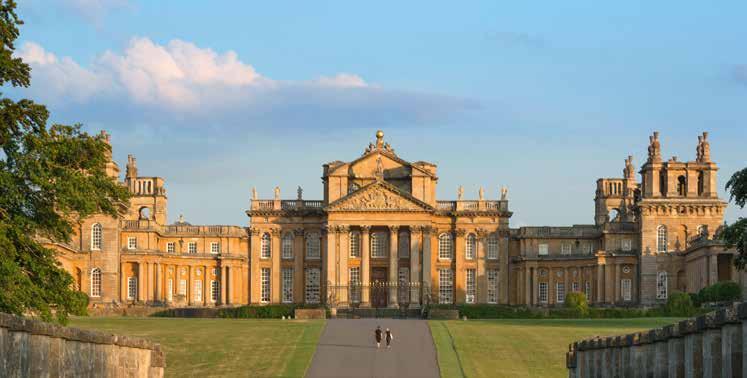
As the baroque architect’s tercentenary is celebrated across the UK, Owen Hatherley visits Blenheim Palace and explores its chequered legacy
One explanation for the sheer aggression of John Vanbrugh’s architecture is the influence of the Bastille. The thick stonework, the castellated skylines and the frisson of terror in the playwright/architect’s designs plausibly derive from the four years he spent in French jails in the late 17th century, as an English spy plotting on behalf of the ‘Glorious Revolution’ against the French ally and Catholic King James II. Vanbrugh also saw the new continental architecture on his clandestine travels – the massive, paradoxical classicism of the baroque, which distorted the rational proportions and Greek and Roman motifs of the Renaissance into deliberately spectacular, spatially extravagant forms.


The baroque was devised in Catholic, absolutist states such as France and Spain, but Vanbrugh’s rich, forthright architecture pointedly incorporated ideas from England’s overseas enemies for the purposes of celebrating English Protestant power and, in his largest house, Oxfordshire’s Blenheim Palace, the victory of English arms over French.
Vanbrugh’s work’s heaviness, menace and theatricality was derided by the English Palladians of the later 18th century. Their polite classicism, based around the idea of the lightweight, mathematically proportioned villa, has dominated most English classical architecture since the 1920s. Accordingly, Vanbrugh’s work has often been a modernist’s enthusiasm, as befits an architect who preferred novelty and thrills to classical ‘correctness’ and repose. Jonathan Meades has described him as the first Brutalist of English architecture, with baroque palaces such as Blenheim, Seaton Delaval and Castle Howard the unacknowledged progenitors of the National Theatre or the University of Essex.
Vanbrugh’s plays, too, combine erudition and vulgarity in a manner that can be startlingly modern. The stormed-fortress metaphors for sexual conquest that recur in the likes of The Relapse (1696) and The Provoked Wife (1697) point towards his later career in architecture.
Like a 19th-century railway station, Blenheim is named after a battle, not a place

or a family – one which took place in 1704 during the War of the Spanish Succession. Then, an English-led coalition defeated the French king in a field in Bavaria under the command of General John Churchill, who was rewarded by the Crown with the Dukedom of Marlborough, and a new palace. In evocation of the battlefield, the spiky towers and bastions, the endless portals and gates, the crushing vastness and heft, are intended to intimidate and disorientate. Blenheim is the closest English analogue to the absolute »
» power embodied in Versailles – far more than the Windsors’ dull Edwardian pile in London – but its Francophobia is everywhere, from the plundered bust of Louis XIV over the pediment of the rear façade onwards.
Vanbrugh clashed regularly with Sarah Churchill, the Duchess of Marlborough, who understandably wanted to live in a pleasant house, not in a militaristic palace-castle. As the Crown cut funding to the Palace in 1712 and costs spiralled, Vanbrugh was barred from visiting his masterpiece; he watched its completion 10 years later through the fence around the estate. The General, however, was paid the highest honour for a subject in this country – he was turned into an aristocrat, with a hereditary title and estate.
Vanbrugh’s architecture’s originality and power can be hugely exciting, but it is inextricably connected with English nationalism. The twelfth Duke, and present resident of Blenheim Palace, James Spencer-Churchill (currently awaiting trial, accused of controlling or coercive behaviour and strangling his ex-wife) is a public supporter of Reform UK; Nigel Farage recorded his new year message at Blenheim a year ago. Blenheim at Christmas reveals something about how Englishness is marketed in the present day. When I visited in December 2025, Vanbrugh’s freakishly gigantic, almost Ancient Egyptian East Gate had a Costa Coffee attached to it, while inside, the tapestries and canvases celebrating the first Duke’s victories were covered with clear plastic. An animatronic exhibition based on The Wizard of Oz ran through the palace. In the toilets were advertisements for tiny, ‘traditional’ new houses, the sort of thing that gives classicism a bad name, culs-de-sac in which you, too, can live on the Marlborough estate. Anything that can plausibly extract profit is ruthlessly exploited at Blenheim; tickets to this baroque monument to Englishness over Frenchness cost £41. If you tried this in Versailles, it would probably cause a revolution. Vanbrugh was always playing a dangerous game, plundering the continent’s architecture to celebrate this island’s uniqueness, but today, his houses can resemble monuments to the self-love of a deluded and mean little country.
Owen Hatherley’s latest book is The Alienation Effect: How Central European Emigrés Transformed the British Twentieth Century (Allen Lane)
New books offering fresh insights into the lives of artists
Love Magic Power Danger Bliss: Yoko Ono and the Avant-Garde Diaspora
Paul Morley (Faber, £25, out 12 March)
Music journalist Paul Morley sets out to tell the story of the avant-garde through the lens of a single figure: Yoko Ono. Discover her escape from Second World War Japan, her life as an artist in exile in New York and her engagement with radical movements. Artist, activist, muse and revolutionary, Ono is often cast in a supporting role to her husband, John Lennon. Here, Morley places her firmly in the spotlight.
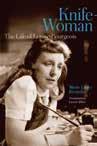
Knife-Woman: The Life of Louise Bourgeois
Marie-Laure Bernadac, translated by Lauren Elkin (Yale, £30)
Want to know what made the grande dame of modern art tick?
Then look no further than Marie-Laure Bernadac’s erudite illustrated biography of the inimitable French sculptor Louise Bourgeois. A former curator at the Louvre, Bernadac delves into Bourgeois’s previously unpublished letters and diaries to reveal a complex and agile thinker. Covering everything from childhood memories to her love affair with psychoanalysis, this book presents a modern titan in a new light.
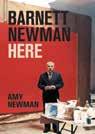
Barnett Newman: Here
Amy Newman (Princeton University Press, £35)
Decades of research have gone into Amy Newman’s comprehensive biography of a key founder of Abstract Expressionism, Barnett Newman (the two are not related). Barney, as he was known, was the child of Jewish immigrants, a ‘dapper, avuncular’ man who dressed in tweeds. He also made risk-taking, rule-breaking paintings capable, the author reflects, of making viewers feel they are in the presence of ‘a colossal remnant of an ancient civilisation, or an individual soul in meditation’.
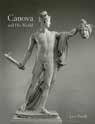
Canova and His World
Livio Pestilli (Lund Humphries, £60)
In this generously illustrated reappraisal of the master of Neoclassical musculature and fig leaf, Prof Pestilli carves a steady line between the academic and the accessible to explore Antonio Canova’s life and work. This kaleidoscopic study finds new angles on the sculptor’s contemporary critics, reveals his genius in carving gravity-defying limbs in unforgiving marble and lauds his work to return Italian art treasures plundered by the French.
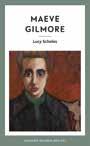
Maeve Gilmore
Lucy Scholes (Eiderdown Books, £12.99)
A surrealism grounded in the realities of the domestic world is how Lucy Scholes sums up Maeve Gilmore’s art in this concise book. Scholes weaves stories about Gilmore’s fascinating life – the wife of Mervyn Peake, she moved in bohemian circles in mid-century Britain – with sensitive appreciation of her paintings. In doing so, Scholes suggests how Gilmore’s sharply rendered depictions of her family – children playing, cats by a window, onions hung on a kitchen wall – manage to strip away any easy sense of comfort.
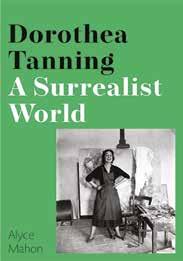
by Alyce Mahon
‘In this long-awaited, enthralling study Alyce Mahon shows how Dorothea Tanning brought a new and necessary Surrealism to a war-ravaged world and offers stunning analyses of Tanning’s very rich and varied oeuvre.’ – Dawn Ades
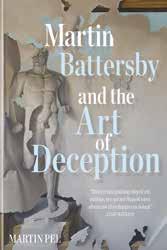
by Martin Pel
This is the first publication to fully examine Martin Battersby and his important contribution to the arts and society of the twentieth century. Explores the life and career of this forgotten yet significant artist who influenced not only art and design but was a pioneer of queer art and aesthetics.
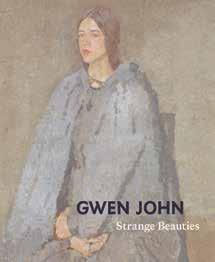
Edited by Rachel Stratton and Lucy Wood
The first comprehensive survey in 40 years brings new scholarly attention and a feminist perspective to the Welsh painter. Accompanies a major exhibition.
Published by the Yale Center for British Art in association with Amgueddfa Cymru–National Museum Wales
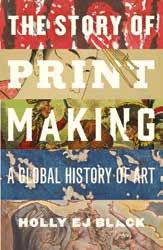
by Holly E J Black
‘Printmaking is art’s most accessible medium and this book is destined to be the go-to guide for anyone interested in its global history. Exciting, informative and beautifully illustrated, it’s a classic in the making.’ – Charlotte Mullins
Find out more & buy direct from the publisher at yalebooks.co.uk
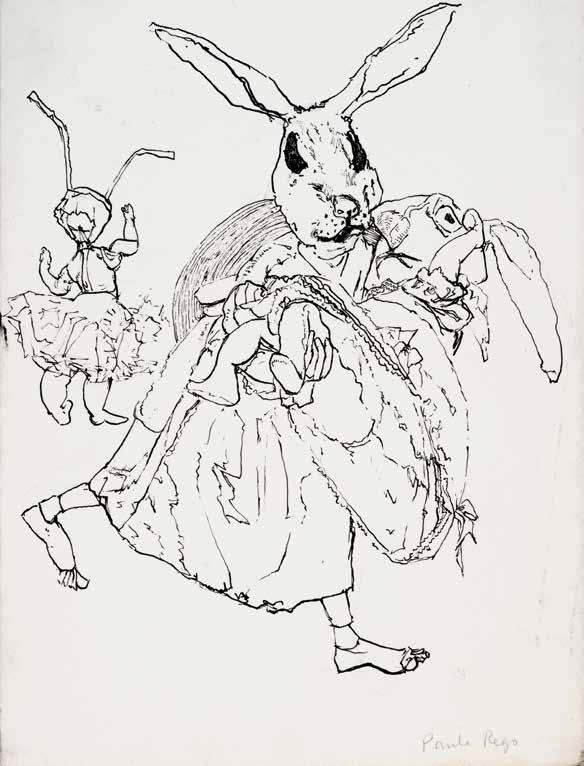
By Makenna Goodman. Written especially for RA Magazine in response to Paula Rego RA’s drawing of the same name (2003; below)
One morning before dawn, bombs go off in the central village, killing twelve bunnies.
All their bunny belongings are ob-lit-er-ated.
Only one bunny is found alive, and everyone calls her a miracle. She has grey dust in her mouth, in her eyes, in her ears, and fur.
This bunny lives for thirty-one days, until the fourth bombing after the fifteen that follow.
• This is how I set up their tea. Little cakes and everyone is wearing little britches.
You can fall asleep in the wrought iron bed with the tiny coverlet, darling.
But first, it’s a bath for all the bunnies.
• The king of the bunnies has died.
Actually, he’s only partially dead. He dies, then he comes back. He’s a ghost!
The queen of the bunnies has a soft, pink gown. Her favourite food is ice cream and she sleeps on a velvet pillow.
This young bunny with the spotted tie, is, in fact, a movie star. He went to war because he wanted to fight a big enemy. When he came back, all the people surrounded their war hero.
When will you make a movie about war, they ask him. Now that you are a real hero, you won’t have to act.
But the bunny said he would never make a war movie. Everyone was sad, because they thought he was sad. How many people did you kill, they want to know.
This bunny has a spotted apron and a little red watering can.
She’s an oral his-tor-i-an. People who are sad or sick or desperate or dying tell her stories and she listens and writes down everything they say.
Bombs at five, and all the heads come off.
• To think of the feeling of a house on top of your body.
To think of the feeling of a mother and father and brother and bunny, under stones, alive.
To think of laughter and cans of tuna.
Inside all the boxes are heads. And we pass the boxes around, pulling heads out by the hair.
But really, the boxes hold interesting projects, hand-printed shirts and gardening gloves, pink glassware in which to drink wine.
You go to get a glass of water, and when you rush back, there is nothing but open air, and below you, the sea.
• To think sentences, if compounded, could save them.
Or not at all, like a fallen child with her eyes rolled back, a part of Nature, with one dangling arm.
To think of being terribly cold in an elevator, pulled out of bed, without socks.
To wear socks every night, to sweat in bed, thinking of the elevator.
Sirens, sirens, the sound is a lullaby.
• To not know anything at all about war.
To be afraid of your own double, dark on the snow like a snake.
To read a weighty book that’s been stacked by the bed lamp. To wear a sweatshirt and slippers and eat a fig bun with cold butter. To sit around, discussing festivities.
Far better to read on the chaise, with a fig bun and butter, the basketball game on the big TV, the soothing muttering of men.
Far better to eat hot buttered rice, an omelette with soy sauce and brown sugar cut into strips and rolled into wheels, with cucumbers sliced like freshly minted coins, crisp in their vinegar.
And the smallest whisk for the miso.
Far better to eat while warm by the stove, than to cower in the ice storm.
Far better than walking without socks from the shelter, draping a child’s body over your two arms.
Far better to froth milk and rip off pieces of a grapefruit peel and shove a wire through it to make a wreath.
And to spend an afternoon in the snowy woods on skis, to see an owl fly from a tree and the wind whip up the powder, to fly down the side hill over brambles now dead and cold and cropped and buried.
• Tonight, we enjoy the act of unwrapping objects.
And to stab at wool to form a shape, from the wool of a sheep with the sharpest of needles, and every so often to stab your flesh, such voltage.
Far better to stab and stab and stab at the wool while talking about all the beautiful cut flowers and the bots and their babies coming for everyone’s jobs and the endless divinations and massages and polyamorous rigmarole.
To knit a vest one stitch at a time, out of one long snake.
• And all the people who died and were killed and survived ate fig buns with butter and their children learned to make hats and took care of the rabbits so the weasel wouldn’t bite off their heads.
But still, they did, and the snow around the bunnies turned bright like pomegranate blood.
And all the fables and sweet songs couldn’t prevent the day death rang for your village.
And all the myths combined couldn’t prepare you for the sight of that child.
And no amount of soup could quench the hunger, because the hunger had become a long grey hallway, and at the end of it our hearts gave out.
We could sit and stab some wool about that.
Stab it to oblivion and remake it into wonderful shapes, like swords for the bunnies.
Little shields, my children. And a sack with which to carry the heads.
• Far better to have a fig roll spread with cold butter.
To exchange an old chaise for a hot coffee, to see a friend’s new living room.
To sit around and stab at wool for hours and not know the horrors of war.
And the cats and dogs lay behind the stoves, so that we can remake them again, in miniature, from little bits of cloudlike wool.
Each one gets a hat and glasses, and the hours press on us like houses.
— Makenna Goodman’s new novel Helen of Nowhere (Fitzcarraldo Editions) is out now Paula Rego: Story Line is at Victoria Miro, London, 17 April to 23 May
“
I’ve been going for a long time.
I’ve stuck with it. I paint
”
With her eclectic motifs and witty takes on everyday life, nonagenarian painter Rose Wylie RA is an artistic force to be reckoned with. Alastair Sooke meets the indefatigable artist as her solo show opens in the RA’s Main Galleries
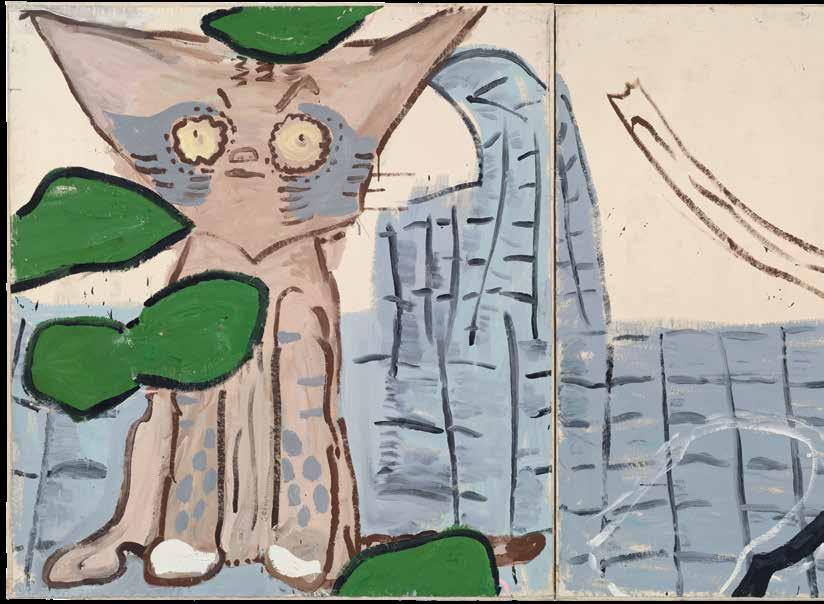
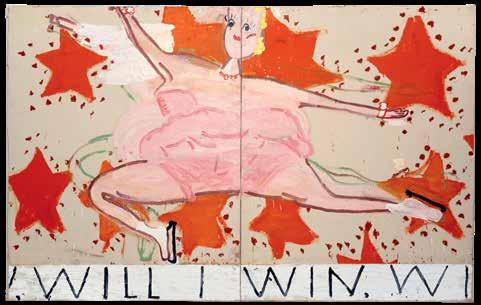
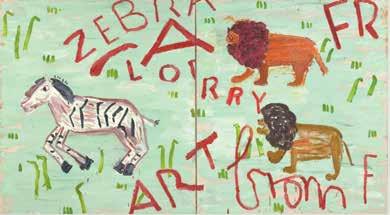
‘It was very funny,’ says the 91-year-old British artist Rose Wylie, recalling when one of her paintings was slammed by the late art critic – and dyed-in-the-wool traditionalist – Brian Sewell. It was 2013, and Sewell was reviewing the annual Summer Exhibition at the RA, to which Wylie had submitted Lorry Art (2010; opposite), a characteristically exuberant, two-panel oil painting, almost 11ft across, in which two lions appear to be chasing a zebra. Wylie’s charismatic works – which, according to former Tate director Nicholas Serota, ‘appear childlike at first glance but slowly disclose many layers and references’ – synthesise various sources, from pop culture and film to folk art and art history. In this case, her inspiration was the vibrant murals that often decorate vehicles in West Africa. Nevertheless, Sewell dismissed Lorry Art as ‘a daub worthy of a child of four’. Shortly afterwards, it was acquired by Tate. ‘I just loved his comment,’ continues Wylie, sitting, as dusk descends, at the kitchen table in her 17th-century
home in Kent, where she has lived and worked for almost six decades. ‘For me, anything he liked wasn’t going to be particularly good, anyway. So, the fact he didn’t like it was a plus.’
Besides, Wylie is about to have the last laugh. This month, a comprehensive survey of her work, featuring more than 50 paintings, as well as 42 works on paper (like her boisterous canvases they are witty and anarchic, as well as direct), opens in the Academy’s grand galleries of Burlington House. Does she feel vindicated? ‘One in the eye for you!’ says Wylie, as if addressing Sewell directly. Wylie – who, when we meet, is dressed in black leather boots and a baggy striped V-neck jumper – is the daughter of a civil engineer who served as the director of ordnance in India, where she spent her earliest years. Although some of her vocabulary may sound old-fashioned (‘marvellous’ is a favourite adjective), her paintings – bold, unfettered, indelible – are contemporary, through and through.
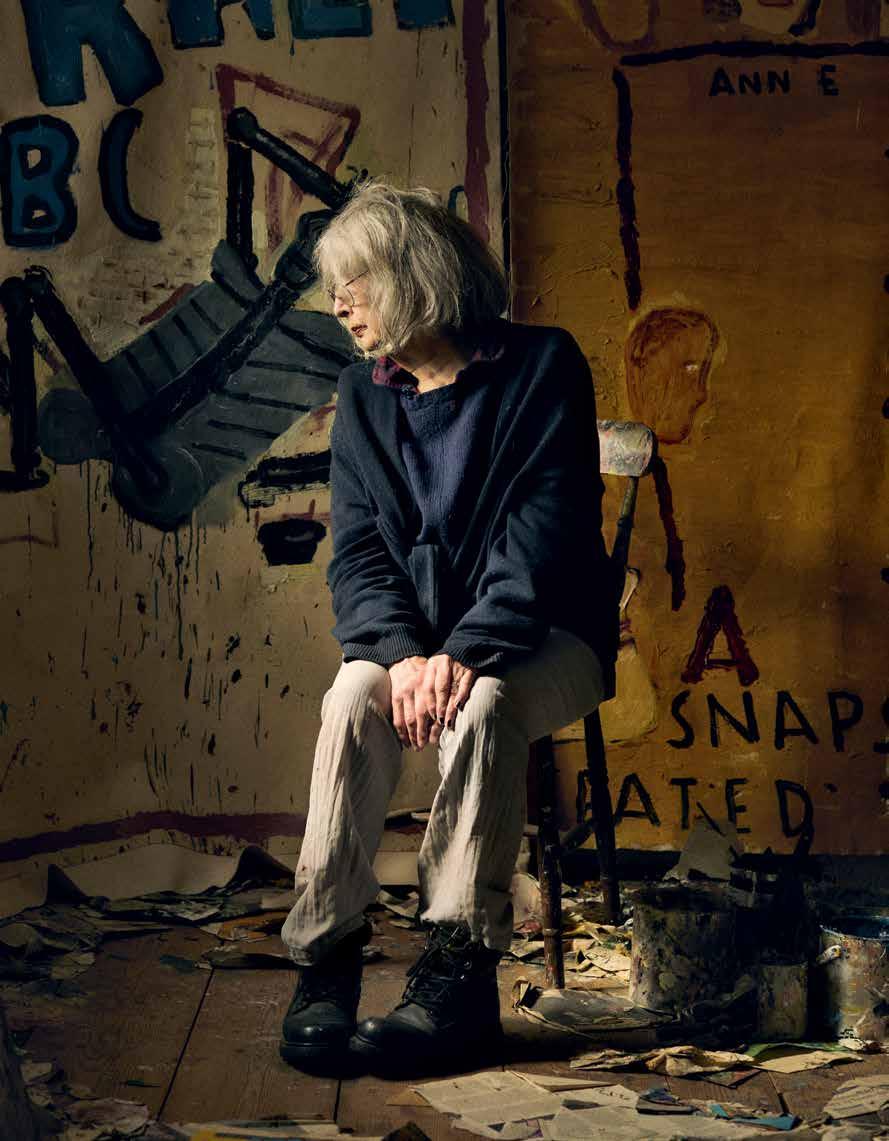
Previous spread: Rose Wylie in her Kent studio in 2025, photographed by Elena Heatherwick
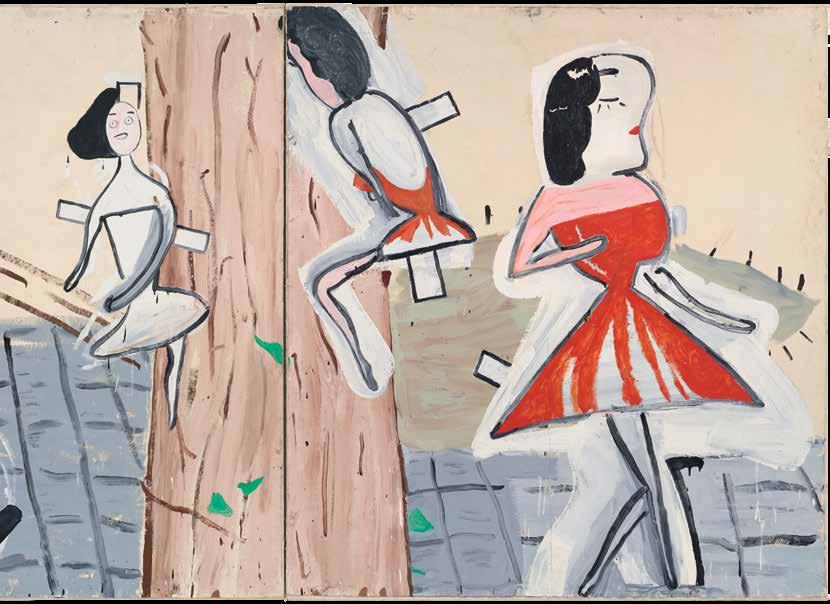
Above: Red Twink and Ivy 2002, by Wylie
Opposite: Lorry Art 2010 (not in exhibition)
A Senior Academician since 2014, Wylie is uninhibited in her opinions, too. When I ask how it feels to be the first female British artist honoured with a full retrospective in the principal galleries at the RA (‘And the first woman painter!’ she chips in, of any nationality), she snorts.
‘Historically, it’s a very poor position. I mean, it’s terrible! Obscene! Well, isn’t it?’ She smiles. ‘Why they picked on me, I don’t know – but I’ve been going for a long time. I’ve stuck with it. I paint.’
It’s true: almost three-quarters of a century have elapsed since, encouraged by her mother (an accomplished amateur pianist), Wylie enrolled as a fine art student at Folkestone and Dover School of Art; she also worked as an artist’s model and in 1956 her portrait was used in an advertising campaign for Aero chocolate bars. After graduating, she embarked on a teacher training course at London’s Goldsmiths College, where she fell in love with the painter Roy Oxlade (who died in 2014). It was Oxlade’s »
‘For a long time,’ says Wylie, evoking what it was like to be a woman in a ‘very male’ art world, ‘you are not noticed: nobody listens to a word you say’
» appointment, in 1968, as head of Sittingbourne College of Education’s art department that motivated the move to the Kentish village of Newnham. ‘One thing follows another,’ Wylie says now, looking back.
Yet, the story of her career is more complicated than this might suggest. This is because, while bringing up her three children (the eldest of whom, Luke John, was born in 1958), she stopped painting altogether. It was only in the late 1970s that she took it up again, winning a place as a mature student at the Royal College of Art. The 1980s and 1990s were Wylie’s wilderness years, when she struggled to attract attention. ‘For a long time,’ she says, evoking what it was like to be a woman in a ‘very male’ art world, ‘you are not noticed: nobody listens to a word you say.’
Surprisingly, perhaps, she doesn’t seem resentful about this. ‘I’m used to being marginalised: I’m the seventh child,’ she explains, of her relationship to her siblings.
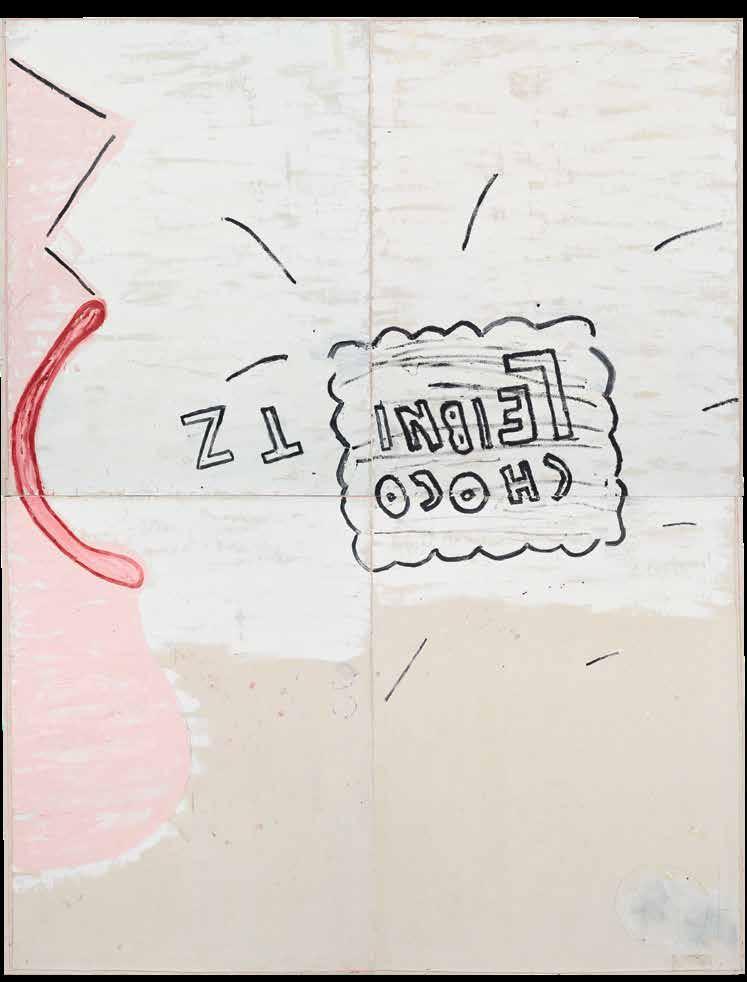
Opposite: Choco Leibnitz 2006
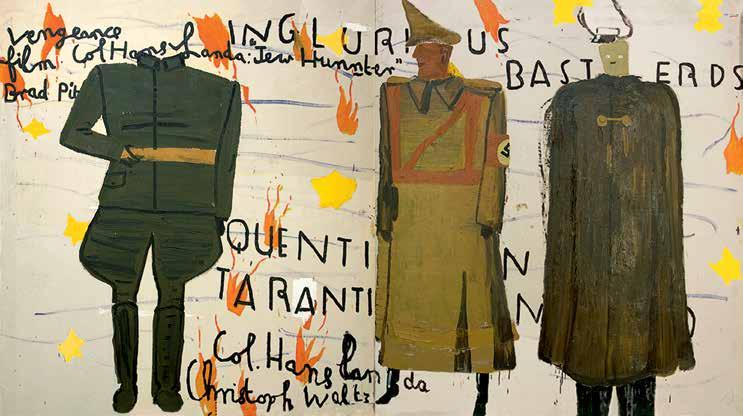
Above: Inglourious Basterds (Film Notes) 2010
‘I was very happy. They were all more important – let me put it that way – but I didn’t mind: it gave me a certain freedom. It made me make my own world.’ This, I reflect later, is what she’s still doing, in her art.
Wylie also rejects any notion that her years as a stay-at-home mother were wasted. ‘Children are hugely important,’ she tells me. ‘I like children. I like interruption. Some men, when they paint, don’t want to be interrupted. They are “gods”. I never thought I was a god.’ She also says that, ‘although I wasn’t painting for a gap, I was going to exhibitions, I was talking to artists, I was looking and reading. So, I wasn’t isolated from the art world – not for a moment. But I wasn’t doing it. And then later I came back to it but it was very hard to be included and… nobody paid the slightest attention.’
Things picked up around the turn of the millennium, when Wylie created a group of paintings for the Tunbridge Wells Arts Centre, including Red Twink and Ivy (2002; page 46), which depicts three paper-cut-out dancing girls and a gigantic staring cat. In 2004, these compositions, which will be an important part of her exhibition at the RA, were selected by the German artist Neo Rauch for the open-submission exhibition ‘EAST’, in Norwich. It was only, though, in 2010 that things, as Wylie puts it, ‘came together’: this was when she was included in a prominent group exhibition in Washington DC, and feted in The Guardian by the Australian feminist Germaine Greer. Since then, she has had numerous shows, including a display at Tate Britain and a solo show at the Serpentine Gallery. ‘Rose Wylie: Flick and Float’ has only just closed at »
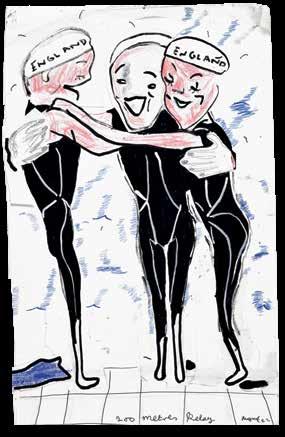
» the Zentrum Paul Klee in Bern. She’s also been represented since 2017 by David Zwirner, the international commercial gallery, which has ensured a steady stream of shows in their spaces around the world, including in Hong Kong, Los Angeles and New York, as well as London.
What’s it like to taste success so late in life? ‘Nice!’ she shoots back, laughing. ‘You know, I was not regarded as anything, but suddenly’ – she snorts again, as if signalling the fickleness of fortune – ‘I am. It’s very peculiar, quite funny.’ There hasn’t been a ‘huge change’ in her work, she points out: ‘I have not gone in for sticking on bus tickets or twigs or flickering lights,’ says Wylie, who feels an affinity with the American artist Philip Guston (whose paintings have a similar rough eloquence, as it were).
‘The apperception, the way my work is received, has changed. I don’t know why.’
What about the financial reward that comes with acclaim – that must be nice, too? ‘You mean the money?’
Another laugh. ‘The thing is, money doesn’t excite me. It’s just an extra… People say to me, “Why don’t you move into something a bit better or bigger?” I like it here! This is where I used to work. And this is where I work now.’ Really, she explains, ‘what I would like is being included in major museum shows’. So, when the RA offered her a solo show in its main spaces, ‘it was just like a boon from heaven’.
Wylie enjoys being an Academician, but admits, ‘I’m not very active as a member. Since Covid, I’ve stopped going to meetings. I don’t go anywhere unless a car comes and
‘I
have not gone in for sticking on bus tickets, or twigs or flickering lights... the way my work is received has changed’
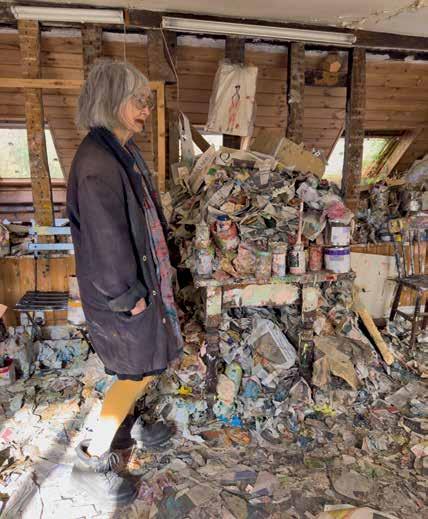
picks me up, because I don’t drive, and public transport is a bother.’ Doesn’t she ever get lonely, rattling around the house by herself? ‘Oh, I see tons of people,’ she replies. ‘I’m not a hermit!’ Her assistant, Olivia Evans, a local art student, is in and out most days.
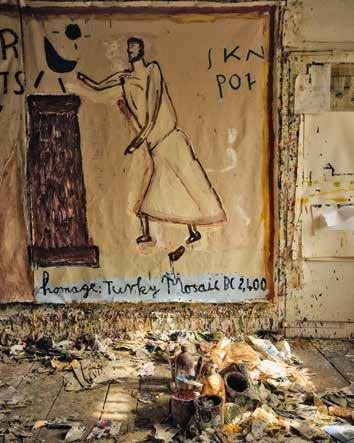
Wylie paints upstairs, in what used to be the marital bedroom, now a cluttered space beneath the eaves, reminiscent of a building site (photograph from 2024; above). Almost every inch of her studio is covered with layers of paint-splattered newspaper. ‘People take a lot of time getting things neat and tidy,’ she tells me. ‘I just come in here and I start. A point will come when I’ll say, “Look, Olivia, I can’t manage any more. You’ve got to put this in bags and get rid of it.” It soon comes back. The build-up just happens. It’s not an affectation.’
Often, Wylie paints late into the night, working ‘obsessively’ on whatever un-stretched and unprimed canvases she has on the go. Now she’s in her nineties painting can be, she says, ‘physically quite hard’, especially when it comes to reaching the top of a canvas. (She doesn’t use a ladder: ‘I quite like jumping.’) When I visit, a new painting is draped across a corner, as if trying to escape from a window. Destined to be part of a diptych, it depicts an ancient mosaic of a skeleton, discovered in southern Turkey in 2012, and seems full of life, like all Wylie’s work, despite its mortal theme.
Yet, she says, people overly fixate on her ‘subject matter’, which she concedes can appear ‘disparate, sort »
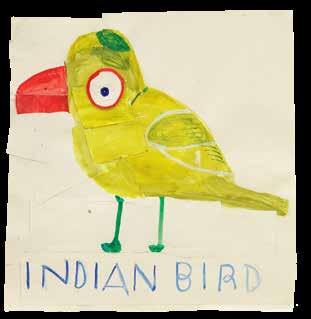
» of unhinged’. At the Royal Academy, a welter of motifs will be in evidence: food including a chocolate biscuit (Choco Leibnitz, 2006; page 48); footballers such as the former England international John Terry (Wylie used to watch Match of the Day with her husband); movie stars, including Penelope Cruz and Nicole Kidman, from her ongoing ‘Film Notes’ series (Inglourious Basterds, 2010; page 49).
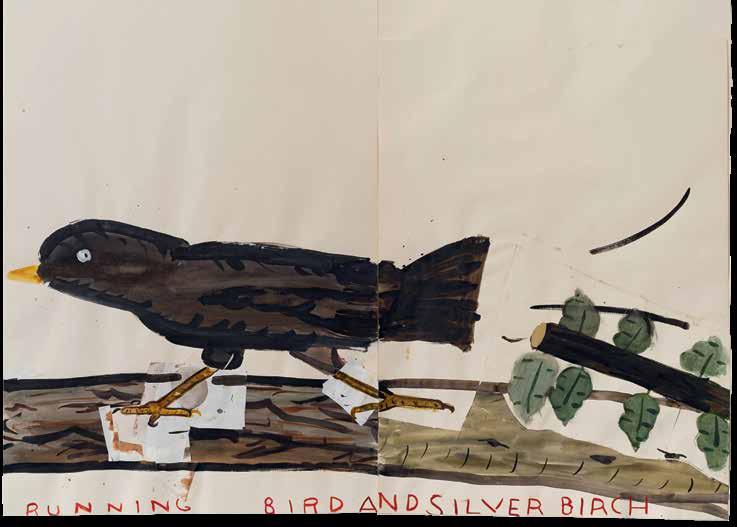
Animals are another preoccupation: expect to encounter a bee, a worm, a silhouetted black rat caught by her pet cat Pete, and an exotic, yellow-feathered ‘Indian bird’ (Indian Bird 2013; page 51). ‘Birds, I think, are marvellous,’ Wylie tells me. ‘You go to catch one, they fly away.’ She also enjoys painting planes. ‘I like flight,’ she explains. How come? ‘Escape.’
For Wylie, everything is, potentially, ‘source material’. A motif ‘can come from anywhere’, even the nightly news she still watches on TV (‘it keeps you in touch’) – she once
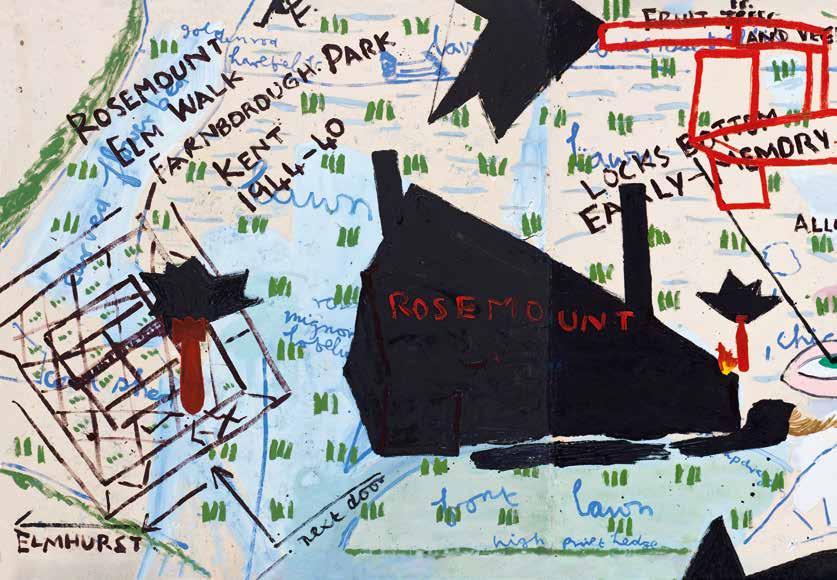
‘In Rosemount (Coloured) Wylie represents her younger self as a gigantic disembodied eye, scanning the heavens for bombs’
depicted the former Newsnight presenter Emily Maitlis. The only criterion is ‘quality’. ‘If it’s an exciting visual thing, I think, marvellous, I’m going to make a drawing of it.’ She smiles. ‘I work from anything. That’s the whole point.’
Defining ‘quality’ is tricky, but, she says, she knows it when she sees it, ‘and it can turn up in surprising places.’ She senses it, for instance, in the ‘marvellous’ portraits of French Neoclassical painter Jean-Auguste-Dominique Ingres.
‘Why do I like Ingres’s portraits? I don’t know. It’s a mystery. I’m conflicted. But the world is conflicted, and people are conflicted. Very certain people are often a bother.’
What about ‘quality’ in her own work? ‘It’s terribly difficult to tell,’ replies Wylie, before adding: ‘“Quality” sounds like a big-arsed word.’ Rather, she says, she’s striving for ‘okay’: she’s content if a painting simply ‘looks all right, because, a lot of the time, when you’re making it, it doesn’t look all right. Either it looks like something by another artist, or it looks too banal. It looks uninteresting. It looks as if nothing has happened.’ For Wylie, a work of art must ‘transform’ its subject, rather than merely replicate appearance.
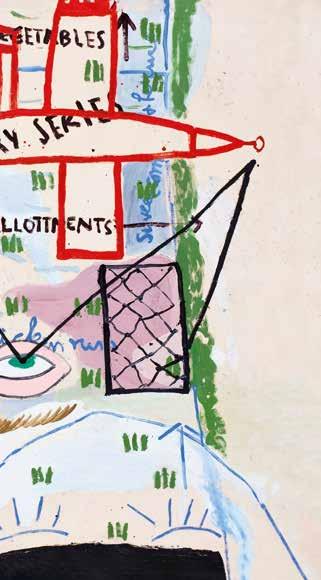
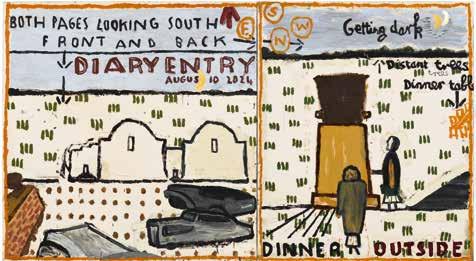
According to Katharine Stout, the curator of her RA exhibition, ‘Wylie’s paintings can all be seen as a form of diary, collectively an ongoing historical record of what the artist has done and seen.’ In Rosemount (Coloured) (1999;
above left), which evokes her memories of living near Bromley during the Second World War, Wylie represents her younger self as a gigantic disembodied eye, scanning the heavens for bombs. In a sense, her artistic eye is similarly all-seeing – transforming sundry contemporary phenomena that take her fancy into things only she could have perceived that way.
Alastair Sooke is The Telegraph’s Chief Art Critic Rose Wylie: The Picture Comes First Main Galleries, Royal Academy of Arts, 28 Feb to 19 April. Supported by David Zwirner and the Rothschild Foundation. With additional support from Christian Levett and Musée FAMM and Jake and Hélène Marie Shafran and The Magic Trust Limited-edition print In conjunction with the show, Wylie has created a limited-edition print for sale through the RA. For details, visit roy.ac/artsales For related events see page 82
Arsenal defender and Lioness Lotte Wubben-Moy on how Rose Wylie evokes the thrill of the North London derby
My first steps carry me over the white lines and onto the pitch, into the derby and into my element. The stadium is full to the rafters with fans, air thick with their chants and expectations. I squint to make out individual bodies among the thousands of limbs flying up and down, a sea of red surrounds me. Bang. A firework goes off, and with it, the pre-game festivities are almost over. A green carpet lays ahead of me, ahead of us. Each blade of grass as perfect as the last. The stage is set.
Heavy on my skin, this Arsenal shirt brings with it a weight of expectation, a weight of history. I represent the famous red and white. There’s a cannon on my chest, poised and ready to go, and it’s been there ever since I was born. I’m a lifelong Gooner, but despite many of those flailing limbs belonging to my family, my friends, right now there is no time to reminisce. It’s time to work. The whistle blows.
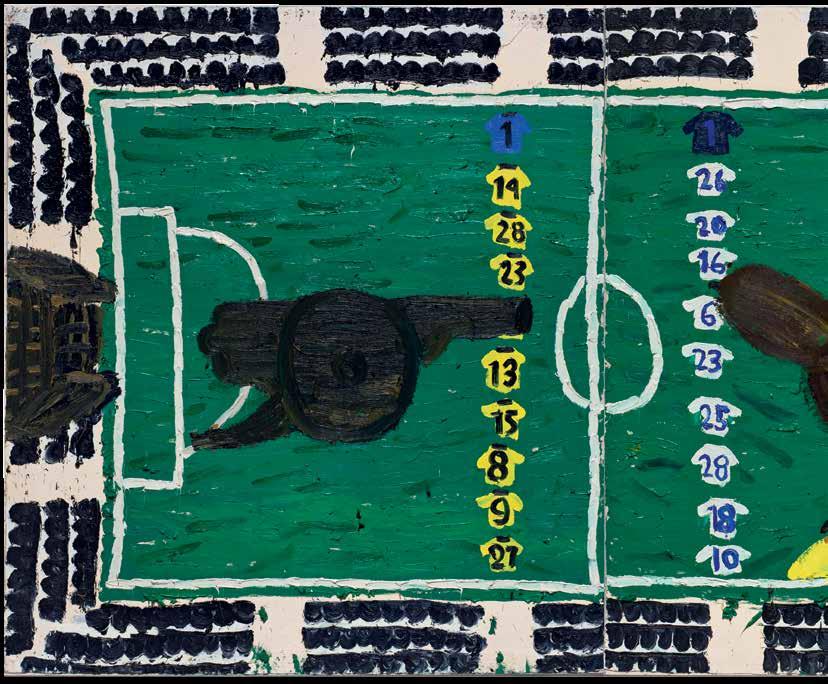
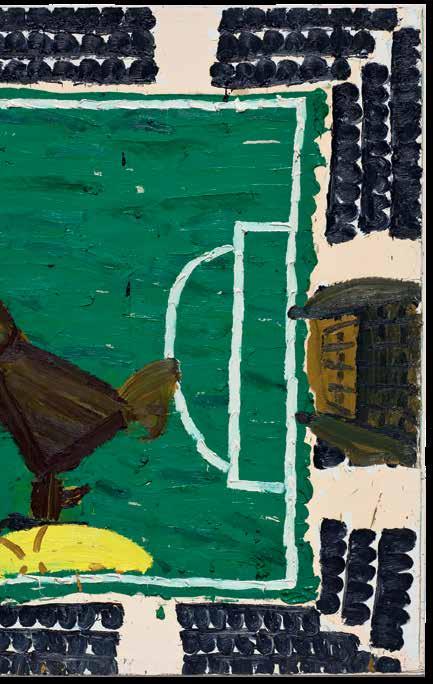
We will do anything to win. North London is on the line and our focus narrows ever further as the outside noise falls away. This isn’t just another game of football; it’s the North London derby. The most important game for a Gooner. Today, I feel privileged to say that I have played in multiple North London derbies. At the time Rose Wylie painted Arsenal & Spurs (above) in 2006, it would still be 11 years before the first women’s edition of the fixture would be played (in 2017), almost 100 years after the first men’s edition in 1921. The feeling of playing in this fixture can’t be bottled, but I think Rose’s painting is the next best thing. In Arsenal & Spurs there is a familiar Colosseum-like intensity, created by a border of seats that highlights Rose’s characteristic blades of grass at the centre. Through the exaggeration of the club badges – the cannon and the cockerel – Rose communicates the belief that no
‘Through
the exaggeration of the cannon and the cockerel, Rose communicates the belief that no player is bigger than the team’
Above, left: Arsenal & Spurs 2006, by Rose Wylie
Above, right: Lotte Wubben-Moy in action for Arsenal

player is bigger than the team. It’s a belief that has come to divide modern day football, and define my relationship with Arsenal. Former captain Tony Adams once said, ‘Play for the name on the front of the shirt and they’ll remember the name on the back.’ That simple sentence has always resonated with me. When I collaborated with Rose on an exhibition about art and football in 2025, it surprised me to hear that she had never watched a full game. This is something I am keen to change. I hope she will come to the derby, the most important game of the season.
Lotte Wubben-Moy is a professional footballer who plays for Arsenal Women and the England Women’s national team. Arsenal Women play Tottenham Hotspur Women at Emirates Stadium, London, on 29 March Art and football event for details, see page 82
Until recently art historians deemed it unthinkable that this monumental Triumph of Bacchus could be the work of the 17th-century Flemish painter Michaelina Wautier. Yet keen detective work reveals her as a remarkable artist of the Baroque period. Imogen Savage pieces together the evidence as Wautier’s paintings come to the Academy
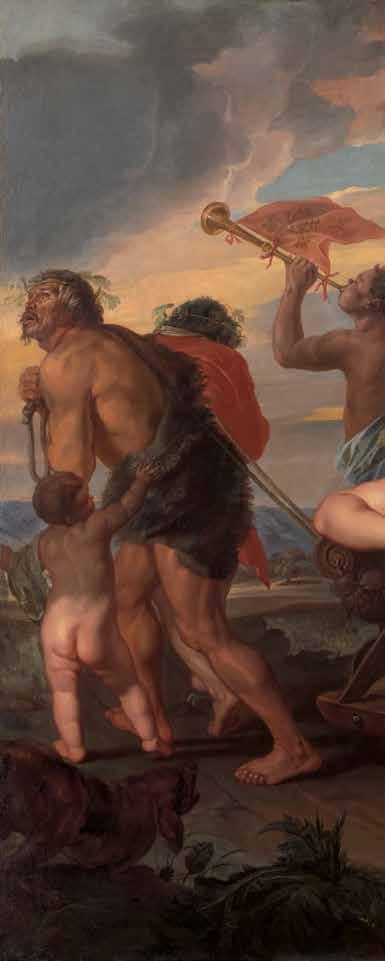
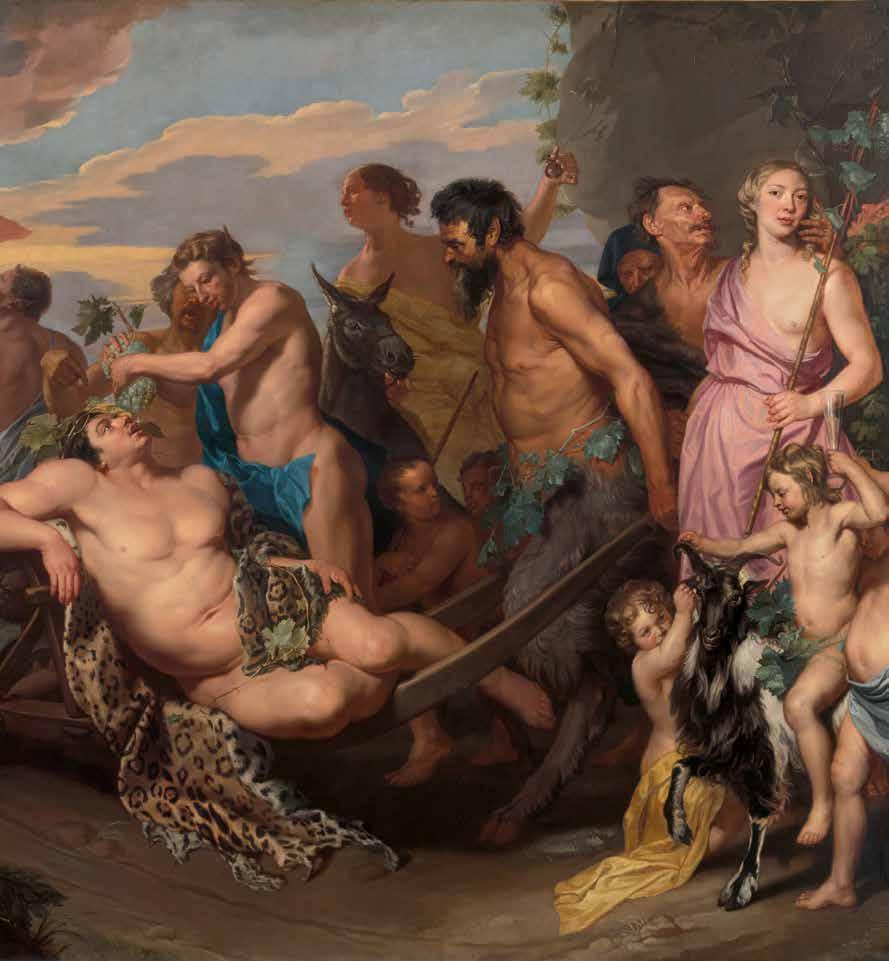
Michelle Wautier chose her Latin name, ‘Michaelina’, to be remembered by. It was the name with which she proudly signed many of her broad-ranging and exquisitely rendered paintings nearly 400 years ago. On some she played with her signature’s placement, anticipating where the eye of the viewer would be drawn across the work, to land as a finale upon her name with a clash of cymbals. But remembered, she was not. Despite enjoying grand commissions from important patrons, the odd bubble has risen to the surface only to pop. With so little known archival documentation about Michaelina Wautier and her work, an absence of historical commentary and seemingly very few threads to pull at and weave together, her paintings were all but buried in museum storage, obscured in private collections and her name silenced.
The upcoming exhibition at the Royal Academy, which travels from the Kunsthistorisches Museum in Vienna, is the culmination of the rediscovery, over the last two decades, of Michaelina Wautier – her painting practice, her biography, her networks, her techniques and materials. For the majority of us who had never heard of her, it feels as if she has suddenly emerged from nowhere, fully formed, almost as a fictional woman artist rediscovered. But behind the scenes, the work of piecing the fragments together, of finding her works, has taken time and effort, chance and luck, as though Michaelina were throwing her researchers titbits from wherever she might be.
In 1993 the Belgian art historian Katlijne Van der Stighelen was perusing the storage facility of the Kunsthistorisches Museum in Vienna, when she had a fortuitous encounter with an impressive history painting on a huge canvas, showing the god Bacchus with his followers. Van der Stighelen is known for her scholarship on Rubens and Van Dyck. The curator who had accompanied her explained its mysterious provenance. The artist was a woman, recorded in the historical ledger as ‘N. Woutier’. Van der Stighelen knew that if a woman had painted this Triumph of Bacchus (c 1655-59; page 56-57), such a learned mythological theme in a genre never practised by women, everything she thought she knew about 17th-century artistic production would change.
The painting led her to other paintings, and soon she had entered into a decades-long trawl through archives and collections in different countries, twitching at the vague sighting of a Wautier at auction and the few clues that lay glinting in the artist’s wake. Some works she found were unsigned, others wrongly attributed. Eventually, Van der Stighelen was able to convince the city of Antwerp to show Wautier’s paintings in an exhibition in 2018. However, we
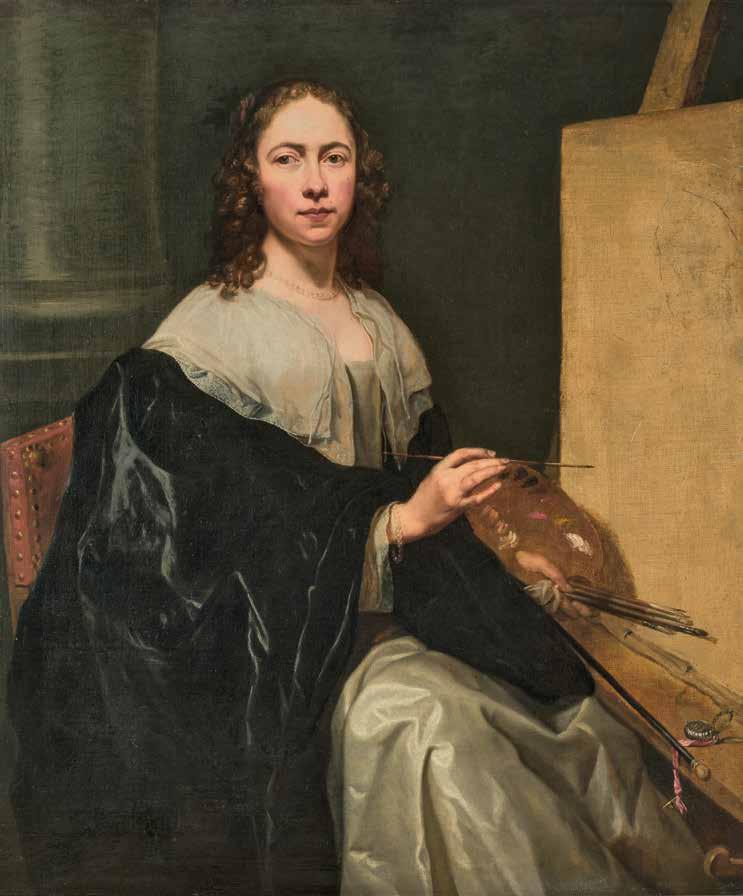
‘The artist is depicted at work, paintbrush in hand, sitting before her easel, in a genre started by women in the 16th century but soon adopted by men’
Previous spread: The Triumph of Bacchus c 1655-59, by Michaelina Wautier. All artworks by Wautier unless otherwise specified
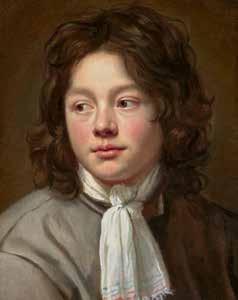
Opposite page: Self-portrait c 1650
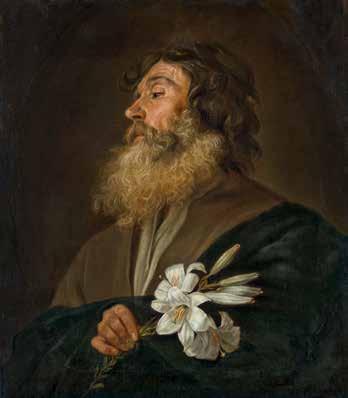
Above: Saint Joseph c 1655
still know little about the woman who painted these works. The field of Wautier studies has expanded, the questions have multiplied and, somehow, time has slowed down in the realisation that the surface has only been scratched. From what we do know, a vague biographical sketch can be made. She was born around 1614, probably in Mons like her other siblings, into a wealthy family. Her father died when she was an infant and her mother in 1638, when Michaelina was a young woman. She moved to Brussels in the mid-17th century (nobody knows the exact date), where she lived and shared a studio with her older brother Charles, also a painter, and likely her teacher earlier in her career. With their parallel professions, shared space and joint investments, it appears the siblings were close. Neither of them married or had children. From their accomplished hands, and the artistic connections they nurtured, it seems they dedicated their lives instead to painting.
At the time of Van der Stighelen’s discovery in the 1990s, a new but expensive research discipline was finding its feet: technical art history, then reserved for analysing artworks by very famous – usually male – artists such as Rubens and Van Dyck. The new interdisciplinary field centred on analysing the physical art object. Kirsten Derks, a technical art historian, began her PhD in 2019 (with Van der Stighelen as a supervisor), looking into the artists and their networks in Brussels. By this time, the techniques were becoming more affordable. She has been investigating Wautier’s work since then. Despite the careful work of historians in the archive, she says there is still ‘very little documentation on Wautier’s life and art, with most of the information being indirect… What we do have, are her paintings. They need to tell Wautier’s story’.
In 14 of the roughly 35 known works in Wautier’s hand, Derks has analysed brushstrokes, technical measurements, »
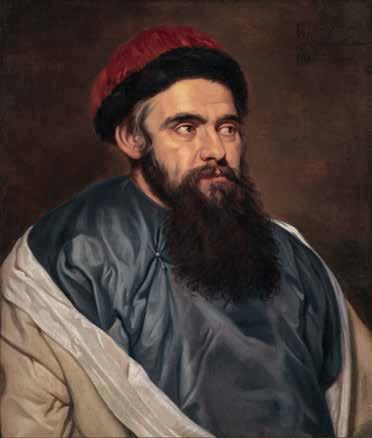
» imaging data, canvas cusping (a distortion at the edge of the canvas), entire paintings – observed from afar, or through the lens of a microscope. She then looks at the archival research and joins the dots. ‘We don’t have her early works,’ says Derks, ‘or her later works. All that is there is Wautier as a highly accomplished artist.’ Moreover, only half of her works are signed, her studies and self-portraits among them, and for possibly different reasons. Those that are signed are marked with the words ‘invenit et fecit’ (invented and made) to note her authorship in both concept and execution – possibly because she wanted to stake her claim boldly as an anomalous woman artist, and possibly because she wanted there to be no mix-up with her brother’s work.
There is one formal self-portrait by Wautier, painted around 1650 (page 58), which Derks and the paintings conservator Alice Limb have scoured for insights into how, says Derks, ‘Wautier wanted to present herself to the outside world’. It follows the tradition of the artist depicted at work, paintbrush in hand, sitting before her easel, which was a genre started by women painters in the 16th century, but was soon adopted by men. Wautier sits still and solid on a chair, looking at the viewer, wearing a lace collar and voluminous black cape. Her face holds an earnest expression though her mouth shows, as Van der Stighelen writes, ‘the hint of a smile… in a manner suggesting a sense of triumph rather than submissive charm’. The palette she holds up is simple with a reduced range of colours, demonstrating her skill at producing the optical effects she needed. Derks found evidence of Wautier expanding the size of her cape and an original placement of herself at the
‘Through her brother Charles, Michaelina was able to acquire the skills and networks she needed, which otherwise would have been out of reach because of her gender’
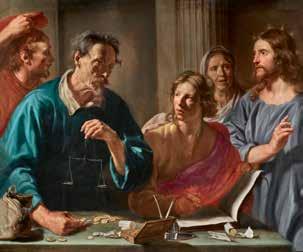
centre of the canvas, as opposed to her current left-side position. There is a faint outline on the canvas in front of Wautier, which Derks analysed using imaging techniques, to help delineate it more clearly. A saintly figure emerged, eyes cast upwards, and possibly in prayer. Wautier presents herself to the viewer, or whoever the commissioner was, as the painter of mythological subjects, part of the history-painting genre held as the highest art form at the time. She boldly takes up her rightful and equal position as a master of her craft.
‘Often a woman artist would marry and that would mark the end of their artistic career,’ says Julien Domercq, Curator at the Royal Academy. ‘Michaelina was in that “sweet spot”, of being wealthy enough so that her family didn’t require her to marry in order to guarantee her a livelihood, but she also wasn’t so wealthy that she had to be married in order to ensure the fortune would be passed on.’ She was therefore able to choose a life for herself, which relied on her close relationship with her brother, who had access to a guild and training opportunities. There is no evidence that there were artists in the family before them, nor any after them. Through Charles, Michaelina was able to acquire the skills, materials and networks that she needed, which otherwise would have been out of reach because of her gender. She soon secured a name for herself on her own terms.
Around the time Wautier is thought to have arrived in Brussels the city was part of the Spanish Netherlands, ruled by the Spanish Habsburgs. The Flemish masters Rubens and Van Dyke had died in the early 1640s, leaving their mark. The art-loving Archduke Leopold Wilhelm of Austria »
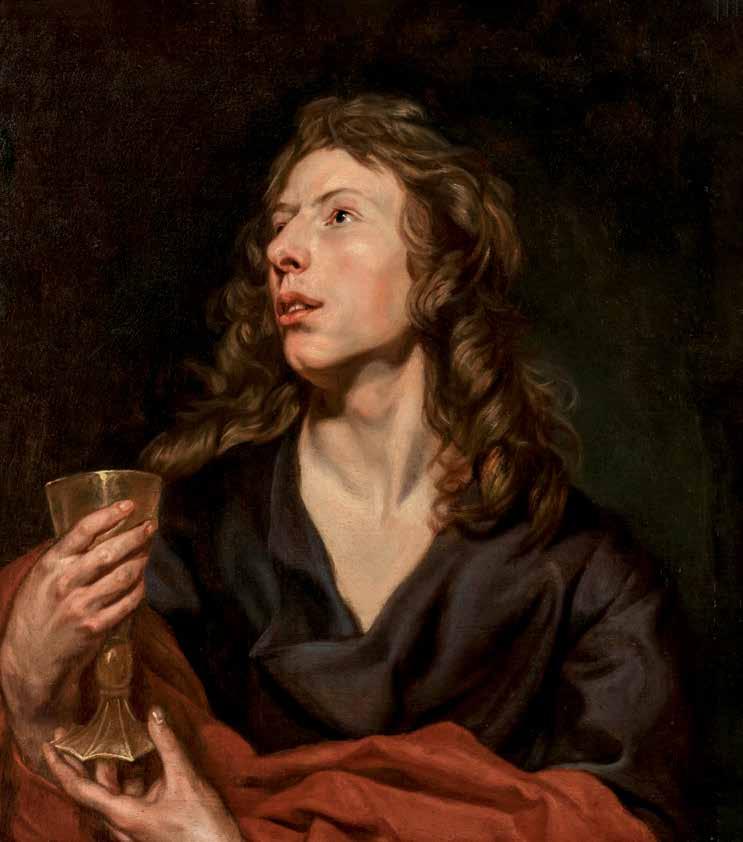
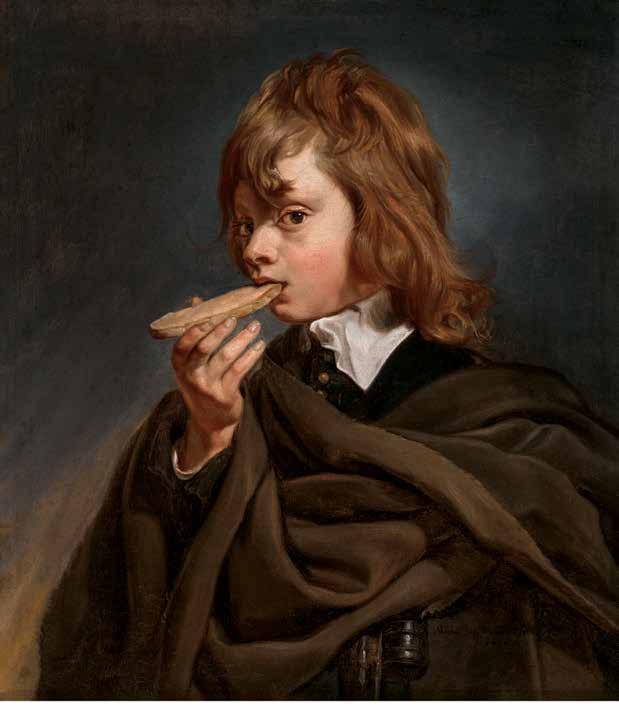
» had just taken over as Governor in 1647. As the Thirty Years’ War was ending and the Franco-Spanish war was raging on, the Archduke took to spending vast amounts on his art collection. Some of it – it seems – he spent on paintings by Wautier. There were four found in his collection.
In both The Triumph of Bacchus, one of the most impressive works found in the Archduke’s collection and the first discovered by Van der Stighelen, and a series of five portraits titled ‘The Five Senses’, which were recently discovered at auction, Derks and Limb found incredible optical effects (Taste from ‘The Five Senses’, 1650; above). These reminded them of the reduced palette Wautier depicted in the self-portrait. When Derks analysed the blue areas on these paintings, while searching for information on which pigments had been used, she was astonished to find that no blue pigment was used in ‘The Five Senses’ series – it was an optical effect. The same was true of certain blue areas of The Triumph of Bacchus, in which, for some reason, other areas contained the expensive blue pigment azurite. This was not Wautier skimping on materials in paintings
commissioned by wealthy patrons. This was her having fun with her skills.
Derks, along with Limb, who had conserved Wautier’s
‘The Five Senses’ when the series was shown at the Museum of Fine Arts, Boston in 2020, analysed the edges of the canvases. They found the fabric cusped, indicating that Wautier stretched the canvases over the frames in her own studio rather than purchasing them ready-made. This gave her control over her work from the very beginning.
There are other tantalising insights and intriguing mysteries. Wautier produced two flower garland paintings in 1652, which, had they not been signed and dated, might have been overlooked. Since there are only two known works by her in this genre, and they are different in style and technique and contain different materials to her other works, they do not fit neatly with the rest of her oeuvre (Gerlinde Gruber, curator at the Kunsthistorisches Museum, Vienna, suspects there are more). Derks analysed Flower Garland with Butterfly (1652; opposite), using the imaging technique XRF (X-ray fluorescence),
Opposite page: Taste from the series
‘The Five Senses’, 1650
Below: Flower Garland with Butterfly 1652
which bounces X-rays off the paints to map the elemental composition of the pigments. She found that Wautier used materials and techniques specific to flower paintings and still lifes that she did not apply to her other works. For example, she used orpiment, an arsenic-based pigment of rich shimmering yellow, which continued to be used to depict flowers despite its known propensity to discolour.
The use of wood panel as the support, too, was also specific to these works – it gave a smoother finish than the canvas she used for her other pieces. In employing the materials and techniques that were true to the genre, Wautier must have had access to circles of influence and exchange beyond her brother, who did not paint flowers.
The underpaintings in the flower paintings reveal how she planned the work, using circles of colour, a technique Derks found had been used in other flower paintings of the period. From the evidence, this method of underpainting, specific to the genre, began with the Antwerp-based painter Daniël Seghers. Derks constructed a timeline that showed Wautier was early to incorporate it into her practice. She therefore wonders, as sometimes a historian must, if Wautier didn’t accompany the Archduke on his visit to Seghers’s studio in 1648, and see the technique in use.
There are many more clues to be found through looking deeply into Wautier’s works: how she varied
her brushstrokes to suit the subject; how she made so few changes, with such confidence and surety of hand, compared with those artists with a looser style. The leaps and omissions that span her vast and varied output can only be filled with informed guesswork and speculation. But this building of a picture from the snippets of evidence Michaelina has left us, is, in itself, a fascinating way of carrying out research, as painstaking as it is creative, the results both veritable and mythologising. We might never be able to piece together fully Michaelina Wautier’s life story. What we do have, in her rediscovered works of art, however, is a remarkable mosaic of material evidence of the Baroque titan she undoubtedly was.
Imogen Savage is a writer based in Berlin Michaelina Wautier The Jillian and Arthur M. Sackler Wing of Galleries, 27 March to 21 June. Exhibition organised in collaboration with the Kunsthistorisches Museum, Vienna. Supported by the Rothschild Foundation. With additional support from the Athene Foundation, Katherina Minardo Macht (Barrett) and William Strong Barrett, and the Delegation of Flanders to the UK and Ireland Friends Previews 25 March, 10am to 9pm; 26 March, 10am to 6pm
For related events including a curator talk, see page 82
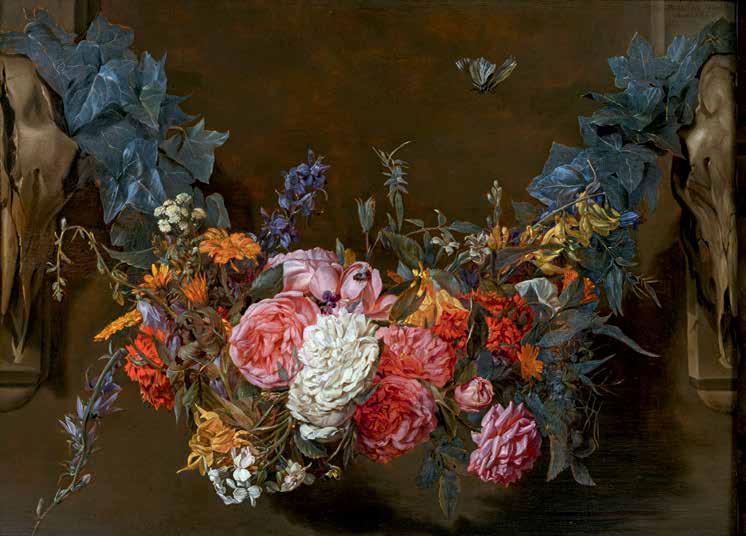
In museums across the world many treasures languish in storage rooms, their narratives, ripe with potential to help us reimagine the past and expand our understanding of the present, overlooked. Worse still, works on show can uphold widely held but erroneous, even destructive, assumptions about race and gender.
It is because of this that the unseen detective work that goes on in museum storehouses and backrooms is so essential. Only through this work can we dismantle the assumptions, biases and errors of the past.
Michaelina Wautier, many of whose works were posthumously attributed to men over the centuries, is a brilliant example of how such fictions – in her case, around the capabilities of women artists – are constructed. It is art history’s prevailing patriarchal logic that meant Two Boys Blowing Bubbles (1650; right) was previously attributed to the Baroque Flemish artist Jacob van Oost, suggesting how difficult it once was to countenance the idea that a female artist might be capable of producing such a painting. However, thanks to the scholarship of the University of Leuven’s Katlijne Van der Stighelen, Wautier has been reclaimed as the rightful creator of this work, with reattribution following in 2007.
There are many telltale signs that point to a work as being by Wautier – here, Emma Dabiri highlights some key clues
MEMENTO MORI
A fascinating breaking story about this painting is the revelation of a skull on the left of the composition, nestled between a book, a candle and a sand timer. This key feature was only recently detected during conservation work and is believed to have been overpainted in the 18th century. The discovery compounds the effect of a memento mori. The objects, alongside the eponymous bubbles, work together as a sombre reminder of the ephemeral nature of life and the certainty of death, but also as an encouragement to live a life of intention and purpose.
Broadcaster and historian Emma Dabiri takes a close look at Two Boys Blowing Bubbles (1650; below), a work of Michaelina Wautier’s wrongly attributed until recently
Two Boys Blowing Bubbles is a painting that highlights Wautier’s technical abilities. Light and shadow are skilfully applied to animate the boys’ faces, as well as to highlight the key objects in the painting which emerge dramatically in the foreground from the dark abstraction of the background. Wautier’s manipulation of light demonstrates her subtle but masterful use of chiaroscuro, searing an almost sculptural imprint of the boys into the mind’s eye.
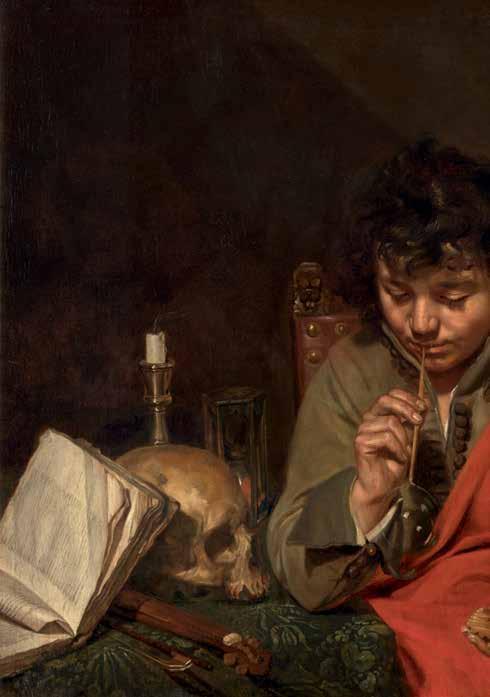
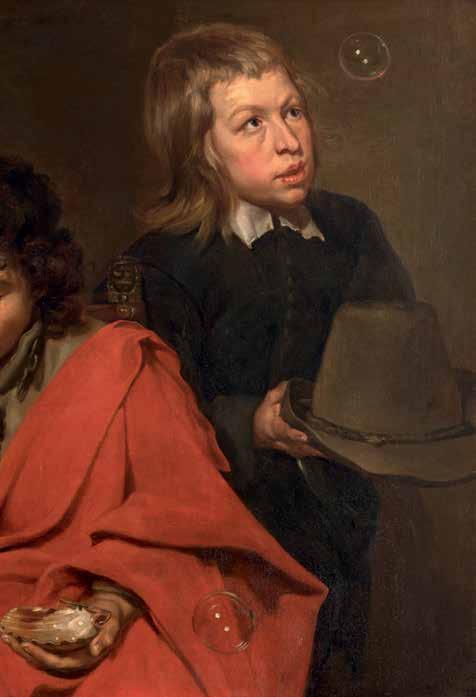
One boy stands, transfixed by the path of a bubble which floats towards the edge of the canvas, while his friend, head bent and gaze downcast, is intent on conjuring more of the ephemeral spheres through the thin wooden tube in his hand. The boys featured in the painting can be found elsewhere in Wautier’s works, such as her series ‘The Five Senses’, another recent discovery which was painted around 1650, the same year she is thought to have started this work. Across her output, we see the same subjects reappear and, from the specificity and sensitivity of their likenesses, we can infer these were real people rather than idealised composites. The boys’ faces are animated by detail and a delicacy that makes them appear vividly lifelike, another feature of the artist’s skill. We could, perhaps, describe Wautier’s work with male subjects as evidence of a ‘female gaze’. Rather than inviting desire (as can often be the case with female allegorical representation) or moral judgement, Wautier encourages identification between the viewer and her subjects, bringing necessary but perhaps neglected insights. Her tender evocation of children creates a sense of wonder and joy that in turn emanates from the painting.
Once you start to appreciate Wautier’s paintings, you notice her striking use of colour, such as the brilliant red fabric in the foreground here. Indeed, red accents were a favourite of Wautier’s, and are one way to spot her work. But as the technical art historian Kirsten Derks has shown, her palette as a whole was sophisticated, and more elaborate than some of her contemporaries. It included use of pigments such as lead-tin yellow, ultramarine, azurite, smalt and orpiment in her paintings. This may have been dictated by her patrons. As Derks writes, ‘Wautier seems to have worked mostly on commission, and it is likely that the person who commissioned the work either provided Wautier with the pigments or paid for them separately.’
—
Emma Dabiri is a writer and broadcaster who previously co-presented Britain’s Lost Masterpieces on BBC Four. Her next book, Born to Be Blue, will be published in 2027
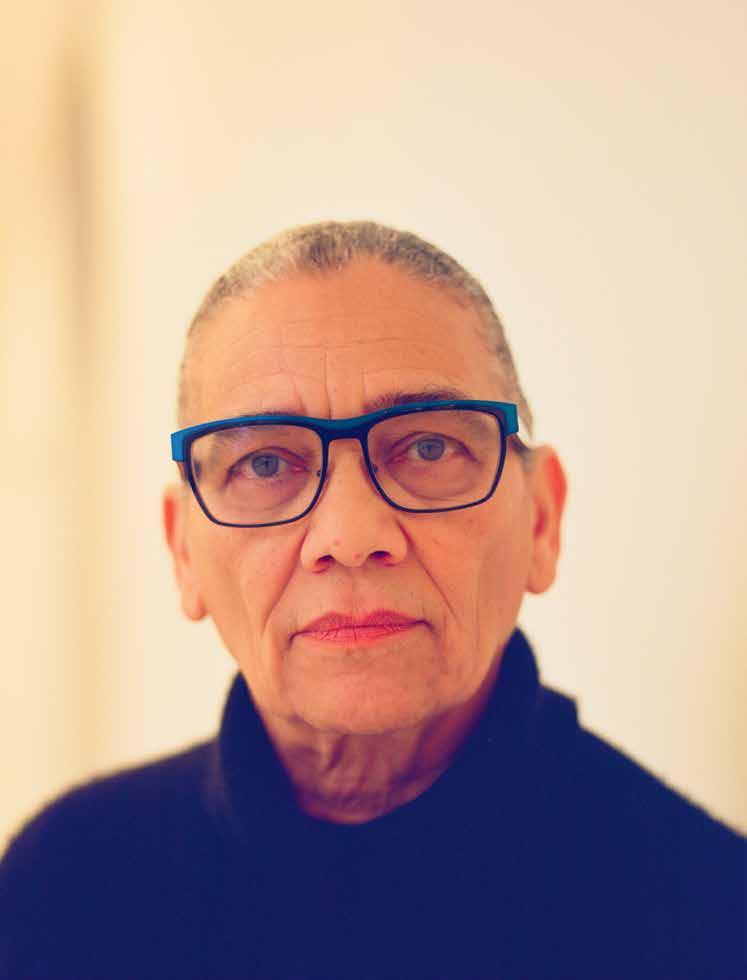
As the curtain is set to raise on Lubaina Himid RA’s career-defining exhibition at the Venice Biennale, this pioneer of the British Black Arts Movement takes a walk around the V&A with photographer and writer Caleb Azumah Nelson, and shares what makes her tick
Lubaina Himid is early, and in hindsight, with good reason. Not just because the threat of rain looms large on this early January day, but because meeting at the V&A in west London was her choice. I spot her darting across the main hall of the museum, moving with purpose and excitement. When I reach her, she’s warm and effusive, delighted to be taking the morning to wander around the collections. I ask her why she picked this place, and she gestures to the walls, saying that it’s reminiscent of a town square, a place to gather, the winding corridors and passageways like streets which might lead you to a surprise.
This is the case as we wander into the Cast Courts – a collection of plaster reproductions, ranging from
Michelangelo’s David to a replica of Trajan’s Column, all housed in an enormous room flooded with natural light descending through the glass ceiling. It’s a room she clearly loves, because, she says, ‘it opens up access to art’, allowing us to experience copies of artworks ‘without being at the original site’ where they were installed. As we walk, she continues, smiling: ‘Isn’t it nice for someone to visit and see this room exists; that all this work has been brought here for you.’ While standing among the cast collection Himid casually mentions her new work, which isn’t casual at all. This year, the artist will be the British representative at the Venice Biennale, delivering a new major solo exhibition at the British Pavilion. The Biennale is another honour in an »
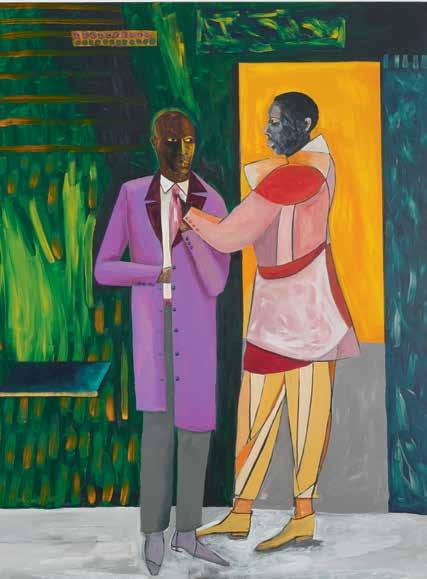
» already illustrious career. Himid has curated pioneering exhibitions platforming the work of Black women within the British Black Arts Movement, such as ‘The Thin Black Line’ at the ICA in 1985 – a show reprised in ‘Connecting the Thin Black Lines 1985-2025’, featuring work by all the artists from the original exhibition, including Sonia Boyce RA, Claudette Johnson RA and Ingrid Pollard. As well as being shown internationally, Himid had a major show at Tate Modern in 2021, in which new and existing work unfurled in the galleries like a theatre. And in 2017, she was the first Black woman to win the Turner Prize.
Art runs in Himid’s blood and was fostered from early in her life. Her mother, a textile designer, ensured weekends were spent in museums and galleries, often in the halls of the V&A. When they weren’t visiting museums they headed to department stores such as Selfridges and Liberty, where the young Lubaina would feel the weight of material, explore patterns and textures, always looking, always seeing. Her childhood inspired a potential career in theatre
design, which she studied at Wimbledon College of Art, graduating in 1976.
While she pivoted to making art, clothing has always been – and continues to be – of interest to her. In her paintings and installations, Himid often renders figures in clothes that cross time, occupying a kind of hybrid, suggesting that we are formed of past as well as present and future, as in Favours For Years To Come (2025; left). Here two figures – one dressed in a modern purple overcoat, the other wearing an outfit composed of geometric shapes that wouldn’t have been out of place in previous centuries – are linked by the intimacy of one tucking his hand in the other’s shirt. She’s as interested in how we feel inside clothes as she is in what they look like and what the clothes are saying to each other.
As our interview continues, it becomes more of an exchange (which speaks to her generosity). She asks where I’m from and when I tell her Ghana, she tells me she was born in Zanzibar and moved to the UK when she was young. For nearly 35 years, she didn’t go back, worried that the chasm between the versions of herself had grown too wide. She didn’t speak enough of the language and her family had moved to other countries after the revolution of 1964. Like many of us in the diaspora, Himid is speaking to the idea of the fracture that occurs when people move from one place to another to make a home. It’s this business of belonging that preoccupies her, the questions of, as
‘For her Venice show Himid wants the audience to feel like they’re “performing in the space”.’
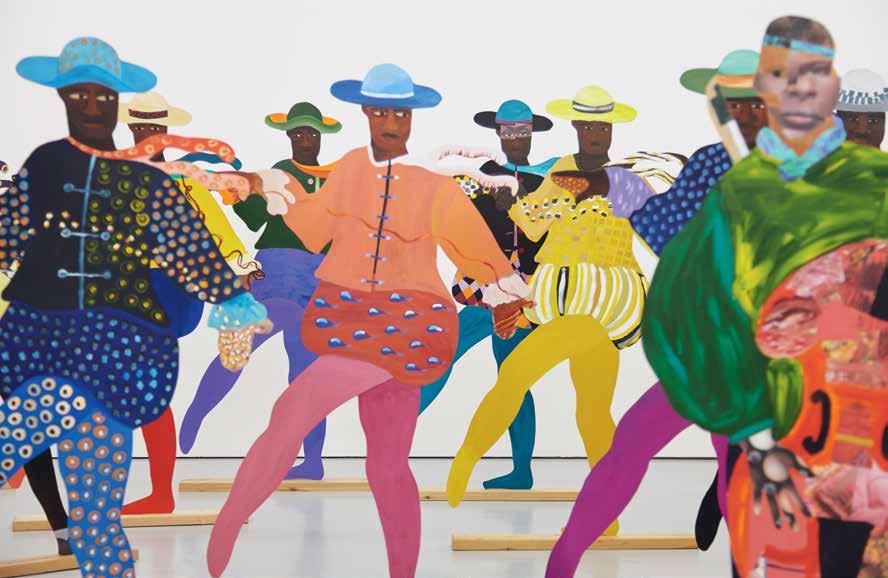
she puts it, ‘what a home is and what it means to build a home’, which is central to her thinking around language, food and clothing – all of which feature in her work. She doesn’t have the answers – that’s what the work is for – but she does think having a real sense of yourself in relation to your origin point allows you to be yourself wherever you go: ‘Knowing where home is inside you allows you to make home anywhere.’
Our walk brings other preoccupations to the fore. She eyes the camera swinging from my shoulder and, after remarking on its shape, its beauty, she speaks of the moment an image is made, which she thinks of as ‘a slender moment, somewhere between a question and answer’. Himid’s paintings often feel like time is folding in on itself.
She explains that she’s ‘trying to create a set of works that isn’t fixed… where abstraction and elements from different time periods can cross’. She’s trying to make time ‘leaky’.
After we leave the Cast Courts we spend time gazing at the jewellery and tapestry collections, where it becomes
Opposite: Favours For Years To Come 2025, by Himid
Above: Installation view of Naming the Money (detail), 2004, at Spike Island, Bristol, in 2017
clear that Himid is pulled towards the domestic, the everydayness of certain objects. Whether it’s an ornate silver brooch or the scale and stitching of the tapestries, she loves being close to detail, too. She also enjoys the feeling of being part of an active exchange with objects: ‘Things don’t come to life unless someone’s engaging with them.’ It’s an effect Himid is aiming for with her Venice show.
While the specifics of her Biennale outing must remain secret for now, Himid does share that she wants the audience to feel like they’re ‘performing in the space’.
The possibility of making work ‘you can be in’ has been a focus for this new show, something she employed with her installation, Naming the Money (2004; detail, above), which was exhibited in ‘Entangled Pasts’ at the RA in 2024.
This incredible gathering of 100 cutouts of historical Black people takes them out of the context of the European homes they might have occupied and brings them together as artists and dancers, their stories retold via a soundtrack.
It’s this feeling that Himid is aiming to recreate at the Biennale – that we as visitors can be in and among the work, that we might recognise these people as a version of ourselves, or those we know.
As our visit draws to a close, we come to a work of hers: Birdsong Held Us Together (2020), a beautiful lithograph. In its stillness you can almost hear the call from the robin perched on its nest at the heart of the image. It’s fitting that the museum she loves holds something of hers, a full-circle moment as our own loop closes. As we head towards the exit, she announces that she’ll stay a while longer. Himid’s eyes light up with the same excitement she had when she came into the gallery. She’s as determined as she is in her work to fold time in on itself, to start the loop once more.
Caleb Azumah Nelson is an award-winning writer and photographer
61st Venice Biennale Lubaina Himid’s British Council commission is on show at the British Pavilion, 9 May to 22 Nov
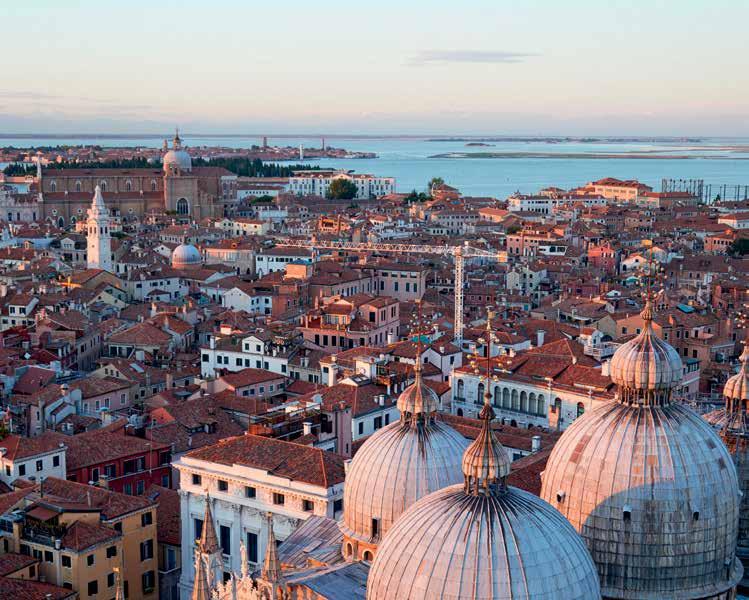
Isabella Smith gives the lowdown on the world’s most spectacular art event, plus what to spot
The vision of a trailblazer
Every Biennale is defined, at least in part, by its main exhibition, for which an invited curator puts together an ambitious group show, as an attempt to sum up the cultural zeitgeist. This year it comes touched with tragedy. In 2024, Koyo Kouoh (below right), then executive director and chief curator of Zeitz Museum of Contemporary Art in Cape Town, was named as artistic director of the exhibition – one of very few women, and the only African woman, to have received this honour. In May 2025, days away from announcing its theme and programme, Kouoh died of cancer aged 57.
The exhibition that the Swiss-Cameroonian curator had prepared, ‘In Minor Keys’, is taking place in line with her vision. Kouoh used this title as a metaphor for the overlooked and, perhaps, the unspectacular. In her words: ‘The minor keys refuse orchestral bombast and goose-step military marches and come alive in the quiet tones.’
Making waves
The phrase ‘minor keys’ has a geographical (as well as a musical) significance. As Kouoh put it: ‘The minor keys are also the small islands, worlds amid oceans with distinct and endlessly rich ecosystems.’ As the former centre of global trade and locus of extraordinary wealth and power, Venice may not register as ‘minor’, yet the archipelago is facing existential threats from rising sea levels and increasingly severe storms and floods, alongside the damage caused by over-tourism. Biennale artists responding to these stark realities include the boundary-pushing choreographer Florentina Holzinger (Tanz; top),
whose project for the Austrian Pavilion, ‘Seaworld Venice’, includes participatory performances taking place across the city and its lagoons. It’s an exciting chance to catch work by a rising star, whose daring works seem to mesmerise and horrify audiences in equal measure.
Beyond the Biennale proper, in a Baroque marble palace on the Grand Canal, ‘Hernan Bas: The Visitors’ at Ca’ Pesaro International Gallery of Modern Art is a new series of paintings about tourists, a pointed subject in one of the world’s most over-visited sites (7 May to 30 Aug).
Showstoppers
As ever, the city will be awash with collateral exhibitions. Highlights include ‘Marina Abramović: Transforming Energy’, at the Gallerie dell’Accademia, which places her performance work and interactive objects in dialogue with Renaissance art (6 May to 19 Oct). Abramović is the first living female artist to enjoy a solo show at the museum. It’s a strong year for institutional exhibitions of work by women: Ca’ Pesaro is hosting a new cycle of paintings by Jenny Saville RA inspired by Venice (28 March to 22 Nov), while Punta della Dogana shows Lorna Simpson (29 March to 22 Nov). Simpson’s exhibition of paintings, which made its debut at the Metropolitan Museum of Art in New York, will be the American artist’s first major show in Europe.
The art of politics
In moments of geopolitical upheaval, the Biennale’s role in cultural diplomacy becomes more apparent than ever. This year the selection of sculptor Alma Allen to represent the US has provoked debate around patronage and »
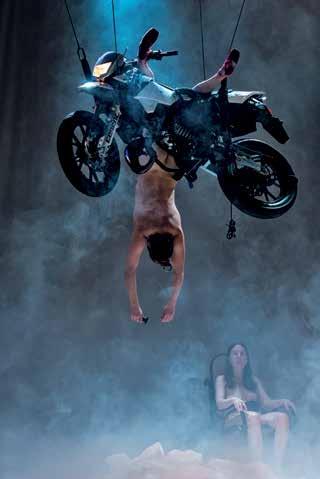
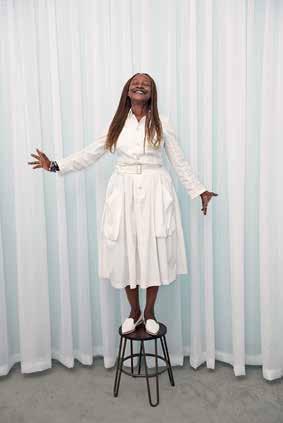
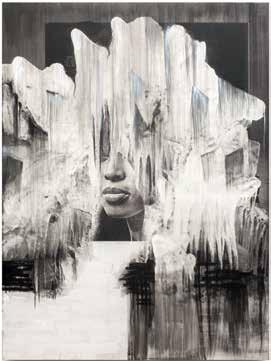
» ideology in the arts. This year’s US Pavilion is funded by the American Arts Conservancy: an organisation led by allies of President Trump, who sought a proposal that promotes what they call ‘American values’, explicitly distancing itself from diversity, equality and inclusion initiatives dissolved under the Trump administration. In the wake of the announcement, several galleries formerly representing Allen have severed ties with the artist.
Elsewhere, the Australian Pavilion has been marked by controversy. Artist Khaled Sabsabi and curator Michael Dagostino were initially dropped, then reinstated, amid scrutiny of Sabsabi’s 2007 film You, which features the late Hezbollah leader Hassan Nasrallah.
The South African government’s plans to cancel a pavilion, designed to commemorate the deaths of women and children in Gaza, have resulted in accusations that it is violating the right to freedom of expression.
Meanwhile, calls to boycott Israel’s participation in the Biennale continue, while Russia remains absent from the event following its 2022 invasion of Ukraine. By contrast, Ukraine is set to return, with a project by Zhanna Kadyrova, titled
Not travelling abroad? Here are some shows to see around the UK this spring
Gwen John in her homeland Fans of the painter should pack their bags for Wales, as a landmark exhibition devoted to John opens at the National Museum Cardiff (until 28 June). Celebrating 150 years since her birth, the show is a chance to see the quiet beauty of John’s art evolve, from early realist portraits to her later flattened, almost abstract works.
A land art luminary in Sussex Once overshadowed by her husband Robert Smithson, Nancy Holt is now rightly revered as a key member of the land art movement. The Goodwood Art Foundation pays tribute to her ambitious vision in the first major UK outing of her work (2 May to 1 Nov).
Off the beaten track
There is much to see beyond the pavilion-hopping and churn of previews. For those seeking respite from the Biennale, there are neighbourhoods such as the eastern side of Castello to explore, with its quiet trattorias and squares, or look further outwards still. On the small island of San Lazzaro degli Armeni, home to an Armenian monastery, monks tend a museum of manuscripts and make rose petal jam. Take a vaporetto to the island of Murano, where glass has been made since the 13th century, and visit the Murano Glass Museum and the ateliers of artisans. Or to Burano, known for its long tradition of lacemaking. Torcello, once the historic heart of the Venetian lagoon, is now a tranquil island with just a handful of restaurants and bars; its cathedral and basilica are renowned for their Byzantine mosaics. Wherever you are in the city, evenings are best spent canal-side, lingering over seafood cicchetti (Venetian-style tapas) washed down with prosecco.
Isabella Smith is a writer and editor
61st Venice Biennale 9 May to 22 Nov
Photography giants in the West Country Few figures have influenced contemporary photography as much as Don McCullin and Martin Parr, making two shows in the West Country a worthy trip. In Bath, at the Holburne Museum, dramatic images drawn from across McCullin’s career go on display (until 4 May), while Parr, who died last year, is celebrated at his foundation’s gallery in Bristol, which shows his iconic series ‘The Last Resort’, one of his first projects in colour (until 24 May).
Pride and joy of Plymouth Beryl Cook’s adopted hometown marks the centenary of her birth at The Box (until 31 May), with an extensive survey of her work, including rare loans from the Cook family archives.
One to watch in Manchester Catch a star on the ascent at the Whitworth Gallery, as it unveils the first institutional UK show of Michaela Yearwood-Dan, whose dazzling abstract paintings are earning her a reputation as one of the nation’s most exciting young artists (17 April to 18 Oct).
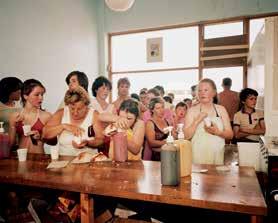
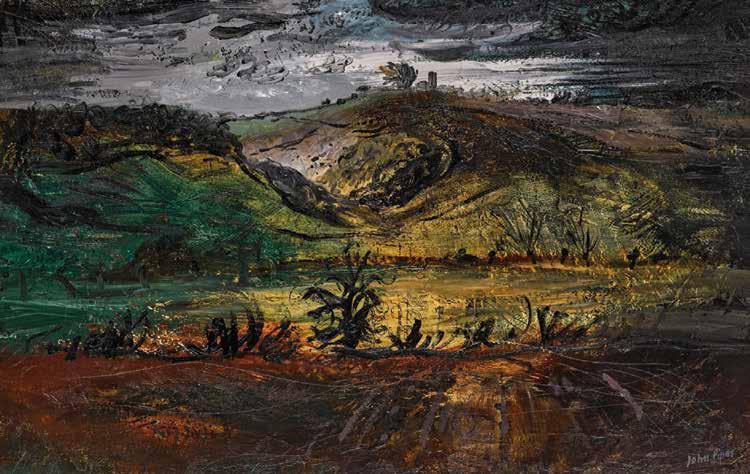
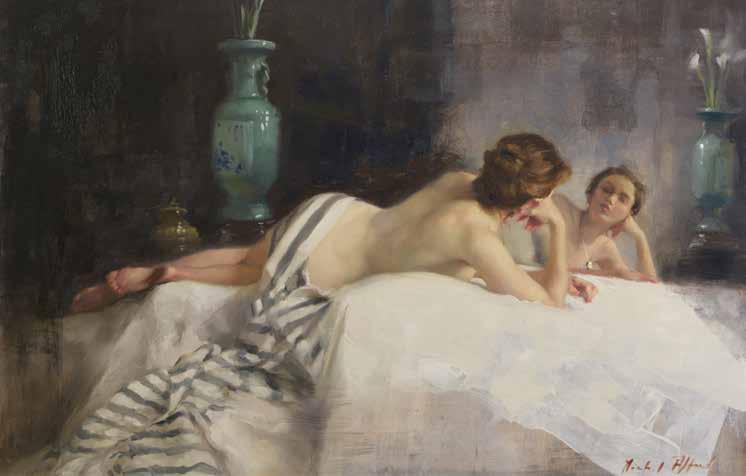
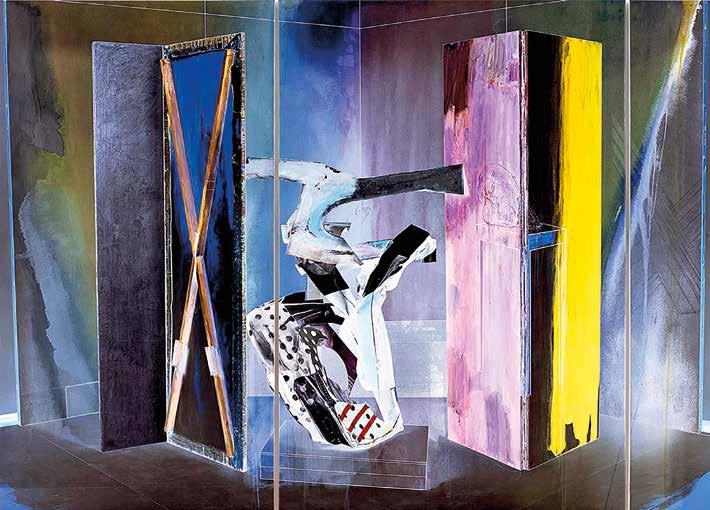
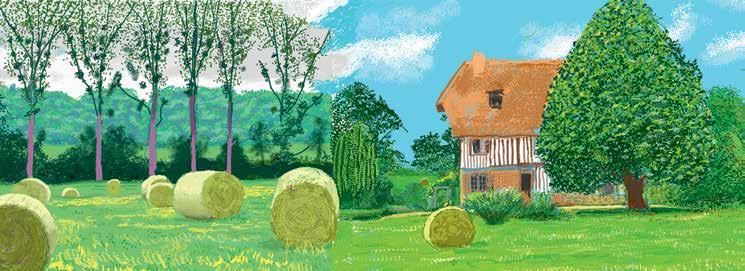
LONDON CALLING
Dive into Hurvin Anderson’s colour-drenched paintings at Tate Modern, where a major solo show celebrates the artist’s career, from his student days to the present (26 March to 23 Aug). At Whitechapel Gallery, an expansive solo show of Veronica Ryan contains more than 100 pieces including works across textile, metal and works on paper, showcasing her diverse practice (1 April to 14 June; Multiple Entry Points, 2022, right).
Ahead of the British Museum’s historic loan of the Bayeux Tapestry this autumn, an exhibition of recent works by David Hockney at Serpentine North includes the epic A Year in Normandie (2020-21; detail, above), a 90m-long frieze made using an iPad and inspired by the Tapestry (12 March to 23 Aug).
Immerse yourself in a sensory installation at the Guildhall Art Gallery in Moorgate, where Jock McFadyen teams up with musician Jem Finer of The Pogues to explore the London Underground (27 Feb to 20 Sep).
Head to Annely Juda Fine Art, on Hanover Square, to see a solo show of work Nigel Hall made
from the 1960s onwards (12 March to 25 April). At Hampstead’s Freud Museum, catch the final days of Cathie Pilkington’s exploration of the figure of Paula Fichtl, the Freud family’s live-in housekeeper (until 1 March). Eileen Cooper has a solo show at Oliver Projects Gallery in East Dulwich (1 May to 30 May). Mali Morris participates in the Drawing Biennial at the Drawing Room, in Bermondsey (16 April to 30 June), while at Tiwani Contemporary on Cork Street, Sikelela Owen exhibits in a group show exploring the figure (until 21 March).
Rebecca Salter has been give the Freedom of the City of London, in recognition of her ‘outstanding contribution to the arts and contemporary art’. Chris Orr is a judge for the Covent Garden Art Competition, with winners announced on 4 March.
At the Gallery at No 1 Royal Crescent, in Bath, works by Cornelia Parker go on show alongside examples of historic glass (until 10 May). In Winchester, at the Arc, Yinka Shonibare exhibits works made over the past 20 years, including
40 woodblocks and screenprints, and the large-scale sculpture
The Crowning from 2007 (until 3 June). At Kettle’s Yard in Cambridge, a group exhibition celebrates the depiction of flowers in artworks made from 1900 to the present day, including works by Hurvin Anderson Lubaina Himid and Clare Woods (25 April to 6 Sep).
Anne Desmet has been named Printmaker of the Year for the annual Printfest at The Coro in Ulverston, Cumbria,
a fair dedicated to the sale of handmade prints. Desmet will show new works from a residency there, inspired by the surrounding landscape (1 to 3
ALL ABROAD
At 447 Space in New York’s Chelsea, Hughie O’Donoghue stages his first solo show in the Big Apple. Formerly the studio of painters Sean Scully and Liliane Tomasko, the gallery is now dedicated to hosting exhibitions by artists aged 50 and over. »
» On the Grand Canal in Venice, at Palazzo Grassi, a solo exhibition by Michael Armitage brings together works made over the past decade, exploring themes of sexuality, migration and mythology (29 March to 10 Jan 2027).
Head to Belgium’s Royal Museum of Fine Arts Antwerp to see works by Antony Gormley, in a major exhibition made in collaboration with celebrated curator Carolyn Christov-Bakargiev (23 May to 20 Sep).
At Institut suédois in Paris, Rana Begum takes part in in an exhibition that places artists exploring geometry and abstraction today in conversation with post-war abstract Swedish painter and sculptor Olle Bærtling (20 Feb to 19 July).
BUILDING BLOCKS
Níall McLaughlin has been awarded the prestigious 2026 Royal Gold Medal for architecture by the Royal Institute of British Architects (RIBA), one of the highest honours in the field.
In Amsterdam, a new sculpture garden at the Rijksmuseum includes three brick pavilions renovated by the studio of Norman Foster, Foster + Partners, which will serve as exhibition spaces.
Across the pond, in New Jersey, a major expansion of the Princeton University Art Museum is now open – designed by David Adjaye’s firm David Adjaye Associates.
In Dublin, construction work is under way on the Commemorative Bridge, a pedestrian and cycle bridge across the River Liffey, designed by Ritchie Studio, the architecture studio of Ian Ritchie.
WRITTEN ON THE STARS
Read Tracey Emin in her own words in My Heart is This: Tracey Emin on Painting, in conversation with critic Martin Gayford (Thames & Hudson).
Antony Gormley’s drawing practice is celebrated in Drawing: Antony Gormley, with contributions by Merlin Sheldrake, Jeanette Winterson and more (out on 23 April, Thames & Hudson).
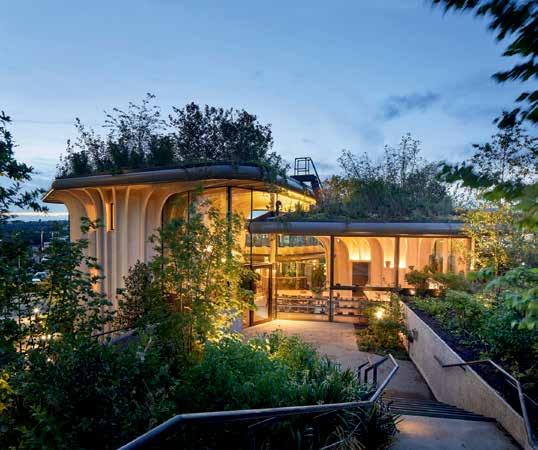
Above:
Thirty-three years ago, the Scottish artist, writer and gardener Maggie Keswick Jencks discovered that her cancer had returned. Aware of the impact that environments can have on people living with cancer, she dreamt of a space of support and sanctuary for patients and their loved ones, a building that could be ‘a place of their own’ beyond the hospital ward. Jencks’s vision has since become a reality. Across the UK and beyond, more than 30 Maggie’s centres have now been built, in collaboration with an impressive roster of globally celebrated architects. Among their number are Royal Academicians Norman Foster, Thomas Heatherwick, Amanda Levete and Níall McLaughlin. The first centre opened at Edinburgh’s Western General Hospital in 1996, a year after Jencks’s death. Today, her legacy lives on in an array of extraordinary buildings that combine architectural innovation with visitors’ needs.
This spring, an exhibition at the V&A Dundee marks the 30th anniversary of that first centre, bringing together the visions of the architects who shaped the buildings, alongside contributions from the centres’ visitors and staff. Among the buildings featured is Maggie’s Yorkshire (above), in Leeds, designed by Heatherwick Studio in 2019. Heatherwick’s building features a rooftop garden, and a kitchen that sits at the heart of the building, in order to give visitors the feeling of a home away from home. Throughout, natural, tactile materials and gentle lighting are favoured, and there are spaces for socialising, as well as quiet areas for contemplation – design decisions in keeping with Jencks’s enduring philosophy of care.
Maggie’s: Architecture that Cares is on show in the Michelin Design Gallery at the V&A Dundee, from 6 March to 1 Nov
Rose Wylie's large works on unstretched, unprimed canvas appear bold at first glance, but close inspection reveals them to be subtle meditations on the nature of visual representation. She regularly combines unexpected imagery, creating visual rhymes and resonances that coalesce into unified compositions.
This new book, the catalogue of the RA’s 2026 exhibition, includes new texts by Jennifer Higgie, Frances Morris and Katharine Stout and a host of Wylie’s unmistakeable imagery.
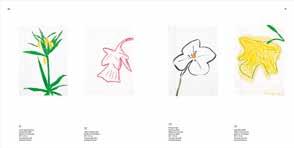
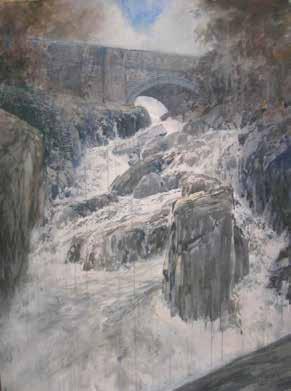


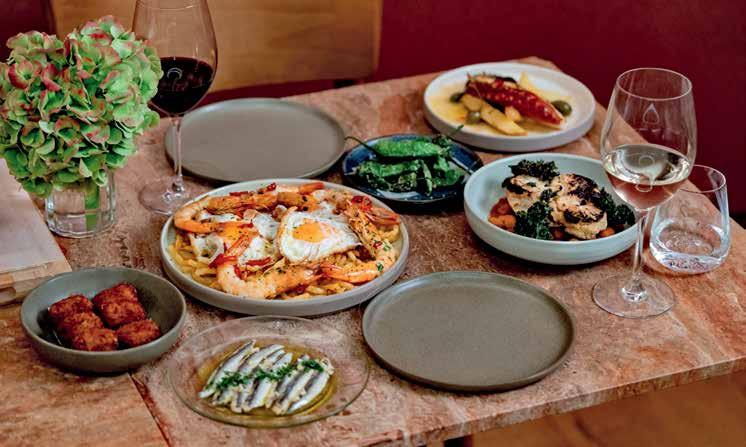
As he takes the reins at the Academy’s members-only restaurants in the Keeper’s House, the Spanish chef talks ham and eggs
What’s a must-order dish on the Keeper’s House menus?
Huevos rotos, which means broken eggs, will always be a favourite of mine. One of my earliest memories of eating it comes from family meals in Spain. It was never about presentation, it was about flavour and togetherness. Breaking the eggs at the table and letting the yolk run into the potatoes was always part of the ritual, especially around Christmas time. That moment has stayed with me.
I’ve cooked huevos rotos for many years and it feels completely at home in the restaurants here. It invites you to relax, share and enjoy the moment. That sense of warmth and informality really reflects the spirit of the place and how I like people to feel around the table.
Food and art have always been linked. Do any artists inspire you?
The 17th-century Spanish painter Francisco de Zurbarán, for the way he treated simple, everyday things with seriousness and respect. His work is quiet and deeply human.
The late Norman Ackroyd RA was a friend, a neighbour and also a great cook. We shared many long conversations about food, art and landscape, often around the table, and I miss that hugely. His way of looking patiently and thoughtfully taught me about paying attention.
I’ve also enjoyed spending time cooking with David Chipperfield RA. With him, conversations move naturally between food, space, proportion and simplicity. He has a very calm way of seeing things.
Dream dinner party guest list – living or otherwise… Dolly Parton, for her warmth and humour. Tracey Emin RA, for her honesty and energy, the way she brings emotion and truth into everything she does. Salvador Dalí, because of his very personal and theatrical relationship with food and presentation, turning the table into a kind of performance. Camarón de la Isla would be there with a guitar, filling the room with flamenco, and Maria Callas would be singing, bringing drama, beauty and intensity to the evening. I’d also invite Andy Warhol into the kitchen. I imagine him helping in his own way, curious, amused, turning the act of cooking into something playful and unexpected.
And to open the wines, the artist Harland Miller. We share a very similar taste in wine, and I love the wit and intelligence in his art. His bold, text-led paintings are playful but thoughtful, and I can imagine him opening bottles, reading labels, sparking conversation and laughter, setting the tone for the night.
No one’s kitchen should be without…
Extra virgin olive oil. Everything starts with good olive oil.
Every chef has a foodie guilty pleasure. What’s yours? Plenty of jamón ibérico, preferably shared, but not always.
Bad news: it’s the end of the world tomorrow. What’s your final meal tonight?
A simple bowl of lentils with chorizo. Honest, comforting and full of flavour, just how I like it.
Booking ahead for José Pizarro at the Keeper’s House is strongly recommended. To view menus and book, visit roy.ac/keepershouse
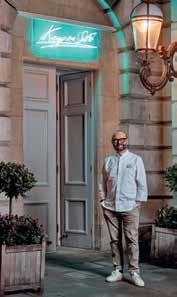
Collectors take note: a series of the artist’s posthumous prints, ‘The Laforgue Four’, is at the heart of the RA’s art sales show
Jules Laforgue was an aspiring art historian and French poet who befriended Stéphane Mallarmé, shared editors with Paul Verlaine and spent the last five years of his short life in Berlin, as reading companion to the German Empress Augusta. He was also a noted dandy with a melancholic disposition, depicted in a brown jacket and jaunty cap in Renoir’s Luncheon of the Boating Party (1880-81).
The British artist Patrick Caulfield RA, once lauded for his own romantic melancholy, found in Laforgue’s fin-de-siècle free verse a kinship of sorts, as a new selling exhibition of his prints and never-before-seen drawings, sketches and paintings at the RA reveals. The prints originated from a commission in 1969 by Petersburg Press, which approached Caulfield to make images in response to a poet of his choice. He chose Jules Laforgue. In 1973 the book was finished and would garner rave reviews for its elegiac qualities and vibrant stillness. A posthumous grouping of screenprints known as ‘The Laforgue Four’, which were not included in the book, are a highlight of the RA’s display. Caulfield came across Laforgue’s work as a student. When his first wife, artist Pauline Caulfield, asked their son Arthur whether his father had mentioned what drew him to his poems, he replied that it was the Frenchman’s clarity and straightforwardness. Laforgue’s poetry ‘didn’t try to hide itself’. Caulfield liked that.
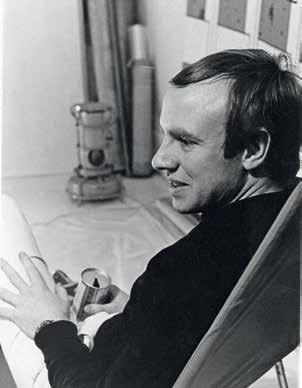
When Pauline first met Patrick, he was a tutor at Chelsea School of Art and she a student. She remembers him being shy and somewhat uncomfortable. In their early days she also recalls him reading Beckett aloud to her: ‘He liked Beckett a lot.’ He’d had a brilliant English teacher at the school he and his friends attended in Acton, in the late 1940s. ‘They were all working class boys,’ says Pauline. ‘They came from homes where there weren’t any books, and they read poetry. They went for walks on the South Downs.
I love the mental image of them doing that.’
Caulfield could be very funny and he was a big drinker, which made him more voluble, but, says Pauline, he was always precise about what he said, ‘never flowery’. He never discussed what he was working on. When they went on family holidays, he would have a room where he ‘would work in the morning, and I would take the children to the beach, and then he would join us. At the end of the holiday we would have a little private view to see what he’d done.’ But many works remained a mystery: the
first she saw of his Laforgue works was when she accompanied him to Germany to sign the books and prints. ‘I don’t think he wanted people’s opinions.’
The subjects in ‘The Laforgue Four’ series are a red handbag and yellow glasses (2022; opposite page); a shattered window; pebbles on a beach and a girl hiding behind her fringe. ‘Patrick was very keen not to be the sort of painter that painted his own life,’ Pauline says, explaining that the sources of his references often remained obscure. He did, however, sometimes paint things from the house – a plate, a postcard or a leg of lamb bought from the butcher’s – and in some works he used her as a model. For a long time, the original paintings Caulfield made for ‘The Laforgue Four’ lay in storage under the bed. ‘He intended them as part of the original portfolio,’ says Pauline. Since they were not in the book, they were never made into prints. Doing so now means the public can, for the first time, see them as Caulfield intended.
Written by Dale Berning Sawa, freelance arts writer
Patrick Caulfield: And all your mundane complexities
The Sir Hugh Casson and Belle Shenkman rooms in the Keeper’s House, 10 March to 23 Aug. Visitor access Everyone is welcome to view this exhibition. Please note that the Keeper’s House is a Members and Friends space. If you are not a member, please enquire at the membership desk to view. For sales enquiries, contact artsales@royalacademy.org.uk
Untitled Laforgue Print 26 – Sunglasses 2022, by Caulfield. This posthumous screenprint measures 61.2cm x 55.7cm and is available to buy from the RA in an edition of 100 for £1,200
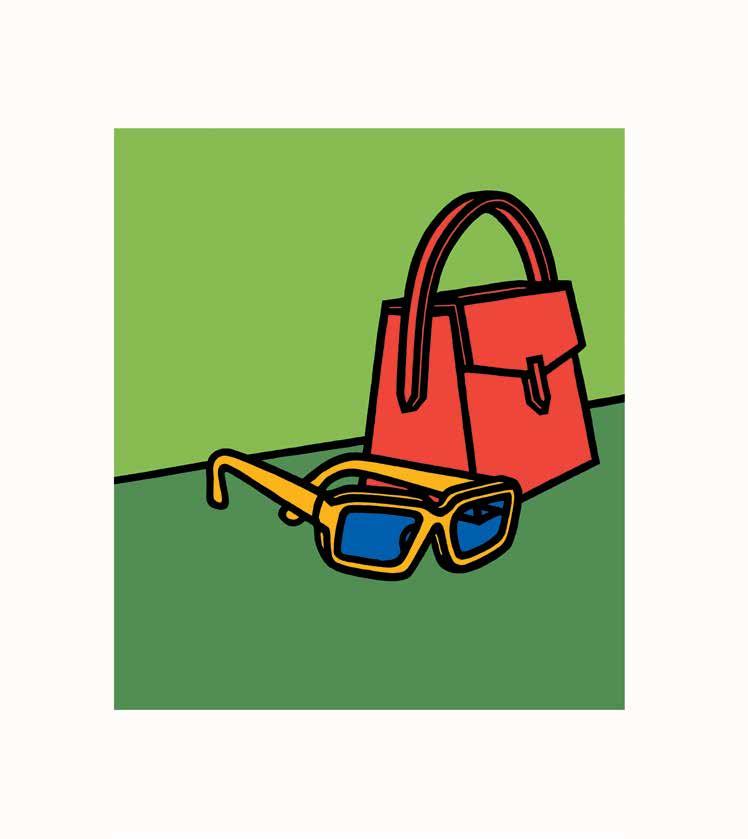

A selection of RA talks, workshops and other events. Visit roy.ac/events for full listings. Book online, in person at the RA box office or by telephone on 020 7300 8090
SAVE THE DATE
Members’ Month returns from 1 to 31 May with an array of special offers and events for supporters of the RA. Take part in an afternoon of life drawing, delve into the history of the Royal Academy or make the most of our contemporary Spanish menus in the Keeper’s House, created by José Pizarro (see opposite, and interview on page 79).
Full details about the programme will be released in April; to receive information and be notified when tickets are released, sign up to receive our email newsletter at roy.ac/account
CONTACT US
The Membership Team is here to help. We’ve been dealing with a high volume of calls, so please bear with us. During this busy period, the best way to reach us is at friends@royalacademy.org.uk
THANK YOU FOR YOUR SUPPORT
We’re an independent charity, so your membership makes everything we do at the RA possible. Thank you.
HOUSE MEMBERS’ BREAKFAST AND PRIVATE VIEW, ROSE WYLIE
6 March
House Members and one guest can enjoy an early morning private view of ‘Rose Wylie’, followed by a complimentary breakfast in the Academicians’ Room. Keeper’s House, 9am to 10am; Rose Wylie, Main Galleries, 8am to 10am. Booking required
FRIENDS AND MEMBERS LIFE DRAWING, AFTERNOON SESSION
11 March
A second chance to join Mick Kirkbride as he guides participants through a life drawing session, in this afternoon event exclusive to Friends and members. All practical materials are provided.
Dunard Fund Life Drawing Studio, Burlington House, 2pm to 5pm; £65
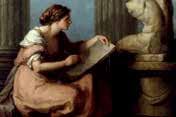
MAKER, MATRIARCH, MUSE: WOMANHOOD AND ART
18 & 19 April
Catherine McCormack convenes this weekend art history course, inviting leaders in the field, including Griselda Pollock, to explore how women have inhabited, resisted and defined femininity in art.
The John Madejski Fine Rooms, Burlington House, 10am to 5pm; £420
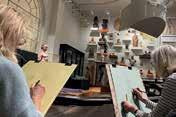
FRIENDS AND MEMBERS LIFE DRAWING, MORNING SESSION
11 March
Members and Friends of the RA can enjoy an exclusive morning of life drawing in the Academy’s historic life room, led by experienced teacher and practising artist Mick Kirkbride. All practical materials are provided. Dunard Fund Life Drawing Studio, Burlington House, 10am to 1pm; £65
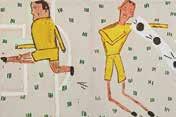
THE BEAUTIFUL GAME: FOOTBALL, ART & NOSTALGIA
20 March
Inspired by Rose Wylie’s football paintings, a panel of speakers reflect on the overlapping role that football and art play in shaping society and identity.
The John Madejski Fine Rooms, Burlington House, 6.30pm to 8pm; £15/£9

CURATOR TALK:
MICHAELINA WAUTIER
24 April
Julien Domercq, curator of the RA’s ‘Michaelina Wautier’ exhibition, discusses the research that has led to the remarkable rediscovery of Wautier’s trailblazing paintings.
The John Madejski Fine Rooms, Burlington House, 11am to 12pm; £15/£9
FIGURE STUDIES: AN ANATOMICAL FOCUS
21 & 28 April, 5, 12, 19 May
Join artist Adele Wagstaff in the RA’s historic Life Room for this figure drawing course, exploring structure in the body. Draw from life and study bones and muscle groups to discover how they shape the human form.
Dunard Fund Life Drawing Studio, Burlington House, 6pm to 9pm; £500
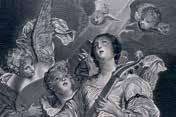
THE ART OF THE BAROQUE 16 & 17 May
Gain insight into how the Baroque emerged in Europe at this weekend art history course. True to the interdisciplinary nature of arts in this period, the course includes a musical performance by baroque harpist Aileen Henry.
The John Madejski Fine Rooms, Burlington House, 10am to 5pm; £420
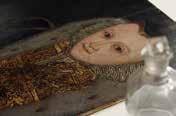
CONNOISSEURSHIP SUMMER SCHOOL
23 to 27 June
Renowned art historian Bendor Grosvenor leads a team of curators, dealers and conservators in this week-long workshop on the art of authenticating and dating paintings. Benjamin West Lecture Theatre, Burlington Gdns, 10am to 5pm; £1,900
SATURDAY SKETCH CLUB: DRAWING VENICE
9 May
As the 61st Venice Biennale opens, join us for this artist-led online workshop and explore ways to capture the city’s world-famous waterways, reflections and distinctive architecture.
Livestreamed online, 10.30am to 11.45am; £10/£8
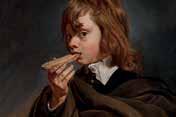
ART THROUGH THE SENSES
16 to 20 June
Taking Michaelina Wautier’s series
‘The Five Senses’ as a starting point, this art making and art history summer school combines artist-led workshops with lectures by curators and academics to discover how the senses are used and evoked in art.
Clore Learning Centre, Burlington Gdns, 10.30am to 5.30pm; £1,900
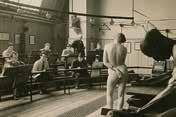
LIFE DRAWING SUMMER SCHOOL
14 to 18 July
Working with professional life models, you’ll study the structure and movement of the body, exploring proportion, light and form. Sculptor Marcus Cornish guides you in finding a personal approach to figure drawing.
Dunard Fund Life Drawing Studio, Burlington House, 10.30am to 5pm; £1,900
Keeper’s
November.
where you’ll see the most change with lighter, warmer spaces, designed to offer members more ways to unwind…
• The Shenkman Bar and Garden offers a place for post-exhibition relaxation with a fresh new look and a selection of José’s celebrated tapas dishes.
• The Dining Room (above) is a new dining space ideal for special occasions and long-awaited catch-ups.
• The Reading Room is a refreshed lounge and workspace that can now also host private celebrations for a group of up to 20 people.
• The Sir Hugh Casson Room café on the ground floor will soon feature a twist of Spain, with a few of José’s bestsellers appearing alongside the usual pastries, hot drinks and light snacks.
Whether you’re enjoying a light bite after an exhibition, a catch-up over a glass of wine or a leisurely dinner with friends, the Keeper’s House by José Pizarro is the perfect place to relax at the heart of the RA.
DINE WITH FRIENDS
Friends and Members have exclusive access with up to three guests, including evening opening hours until 9pm, from Wednesday to Saturday.
The Dining Room downstairs will offer all-day dining from 11.30am, so you can visit whenever suits you. Booking ahead is strongly recommended Walk-ins are welcome but are subject to availability.
To view menus and to book a table, visit roy.ac/keepershouse

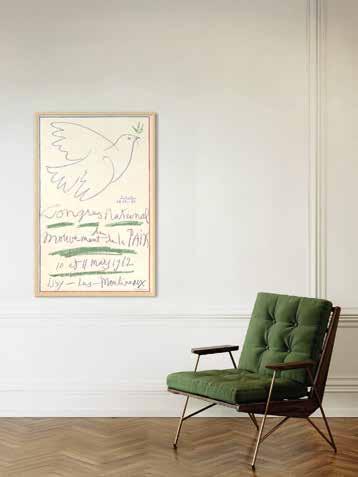
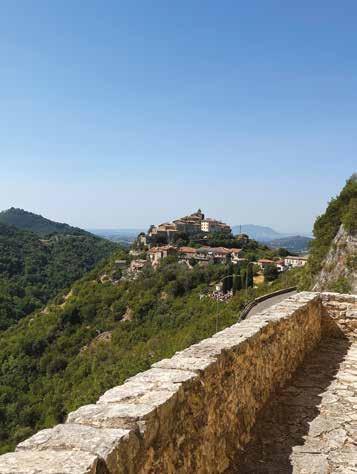
For inclusion in RA Magazine’s paid listings section, email catherine.cartwright@royalacademy.org.uk
London Public
BARBICAN ART GALLERY
Barbican Centre, Silk Street EC2, 020 7870 2500, barbican.org.uk
Encounters: Giacometti Works by contemporary artist Lynda Benglis and renowned 20th-century sculptor Alberto Giacometti are displayed together for the first time, until 31 May. Beatriz González until 10 May.
THE BRITISH MUSEUM
Great Russell Street WC1, 020 7323 8181, britishmuseum.org
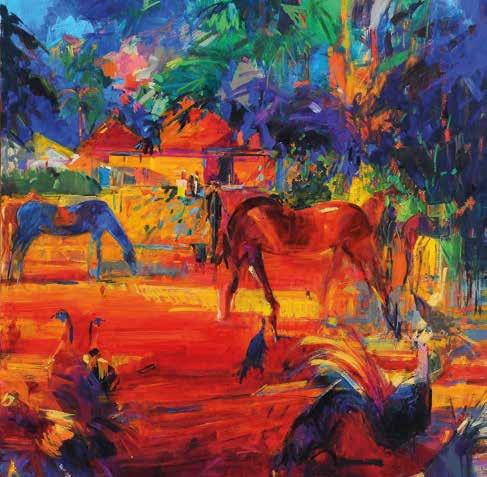
tel: 07575 866772 gallerystandrews.com
of Tahiti oil on canvas, 137cm x 129cm By appointment at Studio Mare Vivimus 8 West Shore, St Monans Kingdom of Fife, KY10 2BS (12 miles from St Andrews)
Hawai‘i: A Kingdom Crossing Oceans until 25 May. Samurai until 4 May.
THE COURTAULD GALLERY
Somerset House, Strand WC2, courtauld.ac.uk/gallery
Seurat and the Sea until 17 May.
A View of One’s Own: Landscapes by British Women Artists, 1760-1860 until 20 May.
DULWICH PICTURE GALLERY
Gallery Road SE21, 020 8693 5254, dulwichpicturegallery.org.uk
Anna Ancher: Painting Light until 8 March. Konrad Mägi 24 March to 12 July.
ESTORICK COLLECTION OF MODERN ITALIAN ART
39A Canonbury Square N1, 020 7704 9522, estorickcollection.com Alessandro Mendini until 10 May.
FOUNDLING MUSEUM
40 Brunswick Square WC1, 020 7841 3600, foundlingmuseum.org.uk
A Grand Chorus: The Power of Music until 31 May.
HAYWARD GALLERY
Southbank Centre, Belvedere Road SE1, 020 3879 9555, southbankcentre.co.uk/ venues/hayward-gallery
Chiharu Shiota: Threads of Life until 3 May. Yin Xiuzhen: Heart to Heart until 3 May. Samuel Laurence Cunnane: Blue Road until 3 May.
THE NATIONAL GALLERY
Trafalgar Square WC2, 020 7747 2885, nationalgallery.org.uk
Wright of Derby: From the Shadows until 10 May. Stubbs: Portrait of a Horse 12 March to 31 May. Zurbarán 2 May to 23 Aug.
NATIONAL PORTRAIT GALLERY
St Martin’s Place WC2, 020 7306 0055, npg.org.uk
Lucian Freud: Drawing into Painting until 3 May. Catherine Opie: To Be Seen 5 March to 31 May.
THE QUEEN’S HOUSE
Royal Museums Greenwich, Park Row SE10, 020 8312 6608, rmg.co.uk/queenshouse Permanent Collection open daily.
SERPENTINE
Kensington Gardens W2, 020 7402 6075, serpentinegalleries.org
David Hockney: A Year in Normandie and Some Other Thoughts about Painting 12 March to 23 Aug. Cecily Brown: Picture Making 27 March to 6 Sep.
TATE BRITAIN
Millbank SW1, 020 7887 8888, tate.org.uk/visit/tate-britain
Turner and Constable: Rivals and Originals until 12 April. Hurvin Anderson 26 March to 23 Aug. James McNeill Whistler 21 May to 27 Sep.
TATE MODERN
Bankside SE1, 020 7887 8888, tate.org.uk/visit/tate-modern Theatre Picasso until 12 April. Nigerian Modernism until 10 May. Tracey Emin 27 Feb to 31 Aug.
V&A
Cromwell Road SW7, 020 7942 2000, vam.ac.uk
Marie Antoinette Style until 22 March. Schiaparelli: Fashion Becomes Art 28 March to 8 Nov.
THE WALLACE COLLECTION
Hertford House, Manchester Square W1, 020 7563 9500, wallacecollection.org Caravaggio’s Cupid until 12 April.
155A GALLERY
155A Lordship Lane SE22, 07930 340092, 155agallery.com Spring Show by appointment, please see website.
BROOKE-WALDER GALLERY
2nd Floor, 15 Duke Street, St James’s SW1, 07770 477661, brookewalder.com
Neo-Romanticism: Origins & Evolution 4 to 26 March.
BROWSE & DARBY
34 Bury Street SW1, 020 7734 7984, browseanddarby.co.uk
Kieran Stiles: Headland 10 April to 1 May.
CRICKET FINE ART
2 Park Walk SW10, 020 7352 2733, cricketfineart.co.uk
Shirin Tabeshfar: Solo Exhibition 5 to 22 May.
CRISTEA ROBERTS GALLERY
43 Pall Mall SW1, 020 7439 1866, cristearoberts.com
Sol LeWitt 6 March to 18 April. Julian Opie 24 April to 23 May.
HANINA FINE ARTS
21 Woodstock Street W1, 020 7243 8877, haninafinearts.com
Post-War Perspectives until 2 May.
HOMMAGE ART
322 Kings Road SW3, 07721 128796, hommage-art.com
Original art exhibition posters and lithographs, opening February.
MALL GALLERIES
The Mall SW1, 020 7930 6844, mallgalleries.org.uk
Royal Society of British Artists Annual Exhibition 2026 26 Feb to 7 March. Society of Graphic Fine Art 105th Annual Open Exhibition 9 to 14 March. Royal Institute of Painters in Water Colours 214th Exhibition 25 March to 11 April (closed 5 & 6 April).
Royal Society of Portrait Painters Annual Exhibition 2026 7 to 16 May.
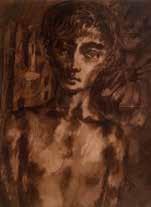
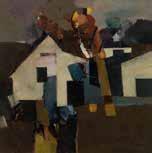
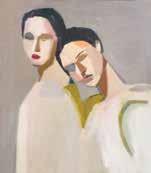
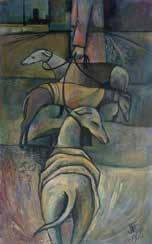
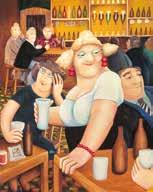
OSBORNE SAMUEL
21 Cork Street W1, 020 7493 7939, osbornesamuel.com
Keith Vaughan: States of Tension 4 March to 2 April. TEFAF Maastricht 14 to 19 March. TEFAF New York 15 to 19 May.
PITZHANGER MANOR & GALLERY
Ealing Green W5, 020 3985 8888, pitzhanger.org.uk
Howard Hodgkin: In a Public Garden until 8 March. Marthe Armitage: Pattern Maker 19 March to 19 July.
ROYAL DRAWING SCHOOL
19-22 Charlotte Road EC2, royaldrawingschool.org
Drawn Together An exhibition showcasing the versatility of drawing in artistic practice, with works from alumni of the School’s postgraduate programme, 9 March to 2 April.
THACKERAY GALLERY
18 Thackeray Street W8, 020 7937 5883, thackeraygallery.com
Simon Pooley: Solo Show 10 to 25 March. Charters Brown: Charity Show 16 to 18 April. Vanessa Gardiner: Solo Show 28 April to 15 May.
VARVARA ROZA GALLERIES
Gallery 8, 8 Duke Street, St James’s SW1, varvararozagalleries.com
Paul Hodgson: Zot 27 Feb to 27 March.
ASHMOLEAN MUSEUM
Beaumont Street, Oxford, 01865 278000, ashmolean.org
In Bloom: How Plants Changed Our World 19 March to 16 Aug.
THE BOWES MUSEUM
Barnard Castle, County Durham, 01833 690606, thebowesmuseum.org.uk
Vivienne Westwood: Rebel –
Storyteller – Visionary 28 March to 6 Sep.
THE BOX
Tavistock Place, Plymouth, Devon, theboxplymouth.com
Beryl Cook: Pride and Joy until 31 May. Journeys with Mai until 14 June.
CAROLINE WISEMAN AT THE ALDEBURGH BEACH LOOKOUT & ARTHOUSE
31 Crag Path, Aldeburgh, Suffolk, 07808 723309, aldeburghbeachlookout.com
The Easter Show Royal Academicians including Eileen Cooper, Peter Randall-Page and Alison Wilding 3 to 6 April, by appointment. Art on
the Beach Including Phillipa Warden Hill, Nicola Tyler, Joanna Harling
Vandy Massey, Karin Christensen
Sara Sayer and Ali Peet April and May. Aplomb Sculpture inspired by the body, by Tesni Bornemann 1 to 4 May.
CCA GALLERIES
Greenhills Estate, Tilford Road, Tilford, Surrey, 01252 797201, ccagalleries.com
The Eye of the Storm A unique exhibition showcasing the works from Storm Studios, opens 2 March.
CCA Galleries Emerging Artist Award works on show from 26 March (award date to be confirmed).
CHARLESTON IN FIRLE
West Firle, East Sussex, 01323 811626, charleston.org.uk
Roger Fry until 15 March.
CHARLESTON IN LEWES
Southover Road, Lewes, 01323 811626, charleston.org.uk
Robert MacBryde and Robert Colquhoun: Artists, Lovers, Outsiders until 12 April.
THE FITZWILLIAM MUSEUM
Trumpington Street, Cambridge, 01223 332900, fitzmuseum.cam.ac.uk
Made in Ancient Egypt until 12 April.
War Craft until 23 Aug. Frank Bowling: Seeking the Sublime 27 March to 17 Jan 2027.
GALLERY EAST LIMITED
24 Church Street, Woodbridge, Suffolk, 07836 325497, galleryeast.co.uk
Trembling Waters – East Anglian
Waters Run Deep Featuring Mary Blue, Alex Curry Emma Green, Martin Laurance, Caroline Mackintosh 28 March to 9 May.
GALLERY PANGOLIN
9 Chalford Ind. Estate, Chalford, Glos, 01453 889765, gallery-pangolin.com / clearwellcaves.com
Out of Africa: The Ugandan North An exhibition of sculpture by Ugandan artists Isaac Okwir and Peter Oloya until 14 March. Anita Mandl: Centenary A solo exhibition featuring many previously unseen original stone sculptures, alongside her more familiar bronze and silver works, 28 March to 30 May.
GALLERY ST ANDREWS
St Monans Studio, 8 West Shore, St Monans, Kingdom of Fife, Scotland 07990 595643, gallerystandrews.com
Tahiti: The Society Islands – Peter Graham 3 April to 27 May.
GOLDMARK GALLERY
14 Orange Street, Uppingham, Rutland, 01572 821424, goldmarkart.com
Charlie Collier: Ceramics
Hand-thrown stoneware, 21 March to 19 April. Sid Burnard: Sculpture Driftwood and found objects, 25 April to 17 May. John Farrington (1933–2025) Paintings & Drawings 23 May to 21 June.
HASTINGS CONTEMPORARY
Rock-a-Nore Road, Hastings, East Sussex, 01424 728377, hastingscontemporary.org
Sophie Barber until 15 March.
Michael Landy: Look until 15 March. Isabelle Rock until 15 March. The Open: Odyssey 28 March to 31 May.
THE HEPWORTH WAKEFIELD
Gallery Walk, Wakefield, West Yorkshire, 01924 247360, hepworthwakefield.org
Kira Freije: Unspeak the Chorus until 4 May. Playing with Fire: Edmund de Waal and Axel Salto until 4 May.
THE HOLBURNE MUSEUM
Great Pulteney Street, Bath, 01225 388588, holburne.org
Powder and Presence: Pastel
Portraits in the Eighteenth Century until 4 May. Don McCullin: Broken Beauty until 4 May 2026. Zandra Rhodes: A Life in Print until 10 May.
ISLAND FINE ARTS LTD
56 Melville Street, Sandown, Isle of Wight, 01983 405397, islandfinearts.com
Michael Alford Adam Ralston and Susan Bower 6 March to 9 April.
KEVIS HOUSE GALLERY
Lombard Street, Petworth, 01798 215007, kevishouse.com
Tuëma Pattie: Looking Backwards, Looking Forwards A celebration of 88 years with recent and earlier paintings from Ireland to the South Downs, 1 April to 2 May. See the ever-changing collection including graphite and ink drawings, watercolours, oils and wood engravings with both 20th-century and contemporary works available.
NORTH HOUSE GALLERY
The Walls, Manningtree, Essex, 01206 392717, northhousegallery.co.uk
Isabella Dyson: Paintings 7 March to 4 April. Gill Robinson: Nothing Permanent 13 April to 9 May. Earth
Now: Invited artists 16 May to 27 June.
ORIEL M Ô N
Rhosmeirch, Llangefni, Anglesey, North Wales, 01248 724444, orielmon.org
Groundwater An exhibition of paintings by Keith Bowen and Jeremy Yates 2 May to 28 June.
PALLANT HOUSE GALLERY
8-9 North Pallant, Chichester, 01243 774557, pallant.org.uk
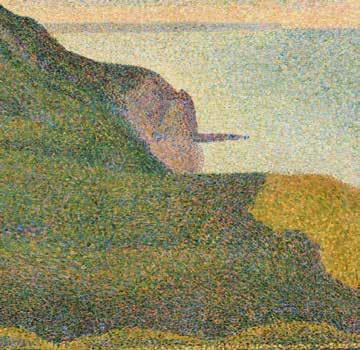
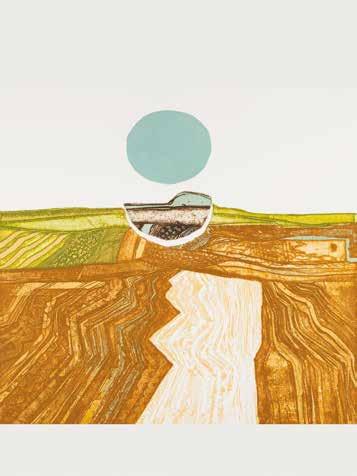


William Nicholson until 10 May.
Caroline Walker: Mothering until 26 April. Rana Begum: No 1367 Mesh until April.
SLADERS YARD CONTEMPORARY
ART AND CRAFT GALLERY
West Bay Road, West Bay, Bridport, Dorset, 01308 459511, sladersyard.co.uk
Journey: Clare Trenchard New sculpture and drawings. Binny Mathews paintings of the studio, until 7 March. Sally McLaren RE Retrospective: A Passion for Printmaking 14 March to 2 May.
Alex Lowery recent paintings, Yo Thom recent ceramics, Petter Southall furniture, 9 May to 11 July.
TATE LIVERPOOL + RIBA NORTH
Mann Island, Liverpool, tate.org.uk/ visit/tate-liverpool
Artist Rooms: Ed Ruscha until 4 June.
Ugo Rondinone: Liverpool Mountain until 6 Sep 2028.
TATE ST IVES
Porthmeor Beach, St Ives, Cornwall, 01736 796226, tate.org.uk/visit/tate-st-ives
Emilija Škarnulytė until 12 April.
Aleksandra Kasuba 2 May to 4 Oct.
VANESSA POOLEY FRSS
9 The Crescent, Norwich, Norfolk, 01603 663775, vanessapooley.com
Sculpture Open Studio For the first time, original ceramics are for sale, as well as limited-edition bronzes, 14 to 17 May (11am-6pm).
WADDESDON MANOR
Waddesdon, Aylesbury, Buckinghamshire, 01296 820414, waddesdon.org.uk
Four Seasons: Bruce and Tink Munro
Light art exploring time and place, and the influence of nature, landscape and the environment, 27 March to 29 Nov.
WATTS GALLERY ARTISTS’ VILLAGE
Down Lane, Compton, Surrey, 01483 810235, wattsgallery.org.uk
Women of Influence: The Pattle Sisters until 4 May. Lines & Lineage: Three Wood Engravers until 12 April.
WELLS & MENDIP MUSEUM
8 Cathedral Green, Wells, Somerset, 01749 673477, wellsmuseum.org.uk / martinbentham.com
Martin Bentham RWA: Paintings 30 May to 6 June.
YORKSHIRE SCULPTURE PARK
West Bretton, Wakefield, West Bretton, 01924 832631, ysp.org.uk
William Kentridge: The Pull of Gravity until 19 April. LR Vandy: Rise 14 March to 27 Sep. Louise Lockhart: Cake Crumbs and Lemonade 7 March to 28 June.
Equilibrium;
2021,
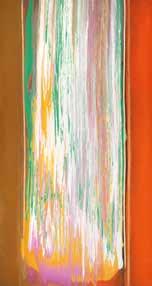
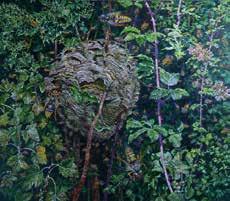

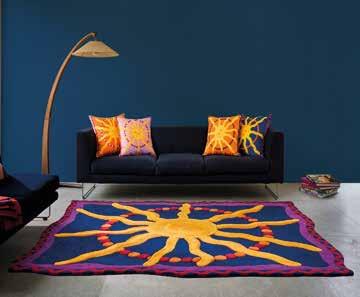

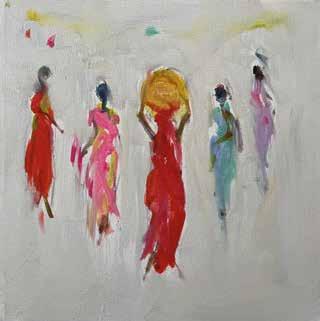
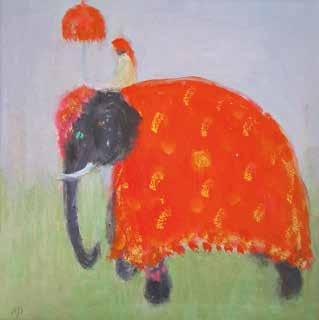
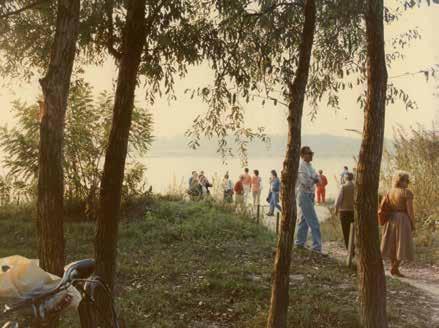
Adele Ghirri, on the poignant task of managing her artist father Luigi’s photography foundation
My father, the Italian artist and photographer Luigi Ghirri, took around 144,000 photographs in his lifetime, only a small portion of which have been printed. They are typically pictures in which, on one level, things might look ordinary, but they also appear marvellous at the same time. Places often overlooked, such as the Italian provinces, suddenly arouse wonder. In 1990, my parents moved to Roncocesi, on the outskirts of Reggio Emilia in Italy, to a big old villa with pink walls and green windows and a garden, which my father loved. It was
here that he kept some of his own works, as well as his books, records, letters and artworks that had been given to him by artist friends. While all of his slides and negatives are kept in the local library, part of his archive is still housed in the home where I live with my husband. Recently I started a foundation to promote his work in Italy and abroad.
My father died two years after moving to Roncocesi. He was 49 and, since I was not yet two years old, I was too young to have memories of him. In some senses, this allows me to work more freely on his legacy. He never left any instructions for how his archive should be managed. At first my mother, who was an illustrator and graphic designer, preserved it, and after she died in 2011 I picked up the responsibility.
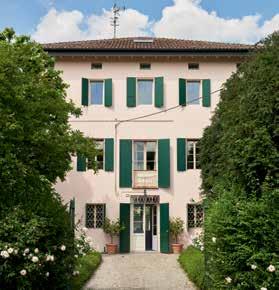
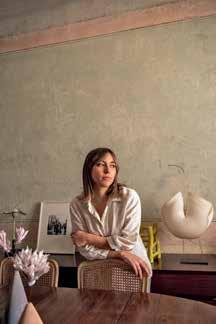
Clockwise, from left: Verso la foce 1988-89, by Luigi Ghirri; Adele Ghirri; Luigi Ghirri’s former home in northern Italy, where the archive is housed
visual artists, designers and directors consider my father’s work as a reference. Among them is the celebrated film director Luca Guadagnino who, along with the artist Alessio Bolzoni, co-curates a solo show of Luigi’s work in London this spring. The foundation is not yet open to the public but this year we aim to organise some guided visits.
There are so many ways to build an archive. You can create collections that inspire new ways of reading an artist’s work. Archives are not just about preserving the past; they are about changing perceptions, and looking to and working with the future. It’s hard for me to say what Luigi would have liked. But I try, in my own way, to bring his work to life.
An archive should be about more than just conservation; it should also be about sharing. Too often, only scholars are allowed access to material. But Luigi had a huge range of friends. Our house was what we call a porto di mare, a harbour, for all sorts of people. My father was always open and curious. Allowing others to explore his archive, to propose new and unexpected readings of his work, is therefore fundamental. Many contemporary
Luigi didn’t believe in hierarchies; he didn’t think that his most famous works were the best and the rest were secondary. Everything was interesting to him. To advertise the exhibition at Thomas Dane Gallery we chose a photograph he took of a piece of ripped newspaper lying in a puddle. The word ‘felicità’ (happiness) is written on it. That’s the sort of thing that my father would stop and pay attention to.
As a daughter, managing this archive is a very privileged way of getting to know Luigi, and of keeping my father’s memory alive.
As told to Rachel Campbell-Johnston Adele Ghirri is the director of the Estate of Luigi Ghirri
Luigi Ghirri: Felicità Thomas Dane Gallery, London, until 9 May
Protect the future of the Royal Academy with a gift in your Will
For over 250 years, the Royal Academy of Arts has given art lovers a sense of wonder; artists a chance to create. Together we’ve been absorbed in past masterpieces and inspired by future marvels. As a working Academy with no government funding, our community is our lifeline. With a gift in your Will, you could help the Royal Academy to make, debate, and exhibit art for years to come. To find out more about how you can support, please contact us –