•
•
President :
Revo. PHILIP WRIGHT, M.B.B., Hon.C.F., Roxwell Vicarage, Near Chelmsford, Essex.. Tel.: Roxwell 644.
1'ic:c-/>re.side,rt:
ARTllllH. NAPPEK, FsQ.
Chairman.-
ANTHONY HEAi, EsQ., Baylin!i Farm, Knolly G rct!n, ncacmisficld.
Vice-Chairman and Editor :
J. CRAWLEY, EsQ., Field House, Turvey, Bedford.
General Secretary :
E. A. FILLMORE, ESQ., 34 Northwick Park Road, Harrow, Middx.
Membership Secretary (including ties and badges):
J. R. BONSP.R, EsQ., 6 Rokcby Gardens, Woodford Green, Essex.
Treasurer:
H. ORR-EWIN0, EsQ., 8 Robert Close, Randolph Avenue, London, W.'J
'/'ECHNICAJ, St;RVICl:'S AND SPAIU:'S SECTION
BRIAN Oi<AM, F.so., Aournc Hous~. SL Mary Bourn~, Andover, Hanrs. (rcl.: SI. Mary Bm1rnc 2'10).
CO!vfMJTTEE
P. G. BARBEK, Eso., Hayestield, Stonehenge Road, Amesbury, Salish11ry, Wilts.
P. R. BARKcn, EsQ., Hatch Gate Farm, Hurst, Reading, Berks.
J. R. BEERY, EsQ., Wymcswokl, Rempstonc, J.oughborough, Leics.
A. E. DEANS, R'iQ., London Road, Baldock, Herts, A. FENSOM, EsQ., 28 P·arkfield, Markyate, St. Albans, Hcrts.
J. T. FENSOM, EsQ., Friar's Wash, f'lamslea<.J, St. Albans, Hcrts.
G. R. HAWTHOltNii, EsQ., Cleveland, Bridge Path, Woodcotc, Reading, Berks.
A. S. HEAL, EsQ., Baylins Farm, Knotty G rccn, Beacnnstield.
1. S. HrnoNs, EsQ., Croft Close, Hailey Road, Witncy, Oxon.
I. 0. HUNT, 205 Adel Lane, Leeds, 16.
A. C. NAPPf:R, EsQ., Bridge Farm, Appleford, Abingdon, Ocrks.
S. NEVILLE, EsQ., 37 Landscape View, Saffron Walden, R'!sex, T. B. PAISI.EY, RSQ., Manor Farm, Ho]ywell, Huntingdon.
I. D. RussEI L, "Kylemore," Mcllinv; l.ane, Maghull, Liverpool.
M. B. Tt1FxroN, (Co-opted}, 43 Perrys Lane, Wroughton, Swindon, Wills.
F. G. UPTON, EsQ., 24 Windsor Road, Maidenhead, Berks.
S. J. WHAKION, EsQ., Southern Down, Minster Lovell, Oxford.
As lhosc members who hav•e atlenue<l recent Annual General Meetings will know, the Club has bcl.!n growi11,g steadily in :size over the y.oars and as a re.suU ,.,;\•twy so, orten i1t h;As been nrn<?-cssin~, to sc~k a l~r:gc·rvenue.. Since it is 1i.(>W H,e cuskm1 to follow the meetmg with a, danner m the cvemng. and the C'nmmillcc has fdL Lhal both sh<:>uldlCake pla,caeofl l'he same pretnise:s, it has not been easy to find suitable accommodation. This year saw such a move and I feel our new venue at Bush House, Aldwych, London, was a great improvement and proved most suitable and convenient.
As most members will know, our Chairman, Revd. Philip Wright has moved his liv.ing during Lhe past year lo Chelmsford wh,ich move has brnt.1ghl with il onurous dul1es p,art,ic~larly al the week-end. One or thtse, which was. p.ully ·inheriticd from his pr.edccts-sor. r,rccluded _ him h'nm aUending tho mceUnt this year. Conse:quenily hhc chak ,.,,·as L~1kC!1'1 by l'Hlr our most able Vicc-Cl:1_airrn.an.Mr. John Cra\:i.•lcy who was sup_port~dl by 127 members ,of the Club.
Th.c meeting opcm.e,diwith ,, 1arm wc:lc0mc from I.he hainmrn lo an thos-c prnse,ni.; apolo(!ics f,or 1mn-auc111da.11ccfrnm ten members were givc-11, i\ solcm,11·mome111L followed during whi-ch alt present stood fot a. mninufe in silence in rnemory of ail members who had died durini! lllie previous yearthe company of vclel'-an men of .c;,tea'mgrows c,1er smaller.
The M111uCe!iof the 1964 Annual Ge111era,IMeeting were then r.cad ot11, appr,oved by those present and duly signed. Amon,g,st maller's arising from lhal meeting thrae are WO'rlh·nH!fl_lioning,. Some consideration was given lo Lht:::que.~tion of trailers behfr1d en:g~m:s OllJ lhe mad and the outcome of cnouirics was given in the T_eg.<11.St1mnlary ftppoaring in the Au'tum:n~ 1965 edition of SrrJ<1mi,1,;.
A Code of Praclke for lhe better organisation of Steam Trnctioni Erigine Rallies has been clravl11 up. This cod-.: was accepted by ihis me.etans and. would o,c>w be circ~1lated amongst and discussed with lhe clubs affiliated lo us. many of whom had alrea<lv indicated a general acceptance of its principles.
Lastly, a list of members is being prepared and would be distributed to members shorL1y.
In his review of the Club activities <lurin~ the past vear the Chairman drew special attention to the administration of the Club affairs which had inclu<led implementing the new Constitution adopted in J964. The year too had been succ-essful financially.
The full Commitlee had met on seven occasions and had dealt with a ,1-::rcatrange of topics inc'l1uding lcga'~ Rlld insurance matters, obsolete drawin~s, proposed new lc1?islatio111as it m:AIV a:fl'ed traction engine own,ers and the crrnouragcmcnt of the l!rowlh of the movement gcne1':ally and particularly through our various affiliated clubs.
For the first time for some years the Cluh had been concerned directlv in rnnning a Rally. This was at Longleat, Wiltshire, over the August Bank Holiday.
_Tn do.sinJ?, Mr. Crawlcv rcfc.irrcd lo Lhc 1mavoida.bh:i,:abti:Cl1c,(Jof Revd. Philip Wright from scvetal rmiclilH}SNl \vhk:h oc.mtsi:011 he: hitd :been called upon to co1,t1ucrt the businoss of the Club oflen wilhoull much prior.. warning. In ihis. much help aind ·as~isl;.Jnce:had been p;ivcn by the othe.r Otlkcr.s,and Cummittoc mcmT,cr.s:. ln this t,;om1cctinn 'the lrcmendous amount of. work 1111t.lcrtakc11and time freely ~iven by the Sccrclarv, the Trcasu1·cr and the Mcmbcrshin Sccrctary---all or whom were honorary otliccrs, was commended to lhc Ctub.
Mr. Bonser suhmiHed a rcporl whi~h convcvccJ good news of a subslanlial rise in membership; the number paid un during the past year was 1,4g4, which was an increase or 268 over the p1,evious vear. This was tempered bv the fact that althoul?h some wastage can h~ anlicioate<l, too many members fell into arrears with their subscrir,tion. This caused considerable extra work and he appealed for more prompt payment-the membership card gave the <late of expiry-and the use of the existing arr.an,g,cment for payment by hanker's order would obviate any overlooking.
Sales of the excellent ran~c of ties and badges continued to be brisk which lkmonslralcd their conlinucd popularity.
Brief reports were submitted by Mr. Barber of the a<.:livities of the Rall) 1 Suh-Committee a11CJby Mr. Oram for th-e T,uchnical Services Section. Much work was bein~ achic,,ed by thc~c ~eclions who were gi\!ing as wide a range of assist:mce to members as possible wilhin their respeclive fields.
Mr, Orr-Ewing sul>mill~cl the r~por& of l11comc and Expenditure a11d hi::Ual1anc~ Shecl. f11 general the Ciub fhia:nt.'J.s wl:!re hc~Lllhy a111dan cxc,cs,s M in~omc over c:,pcndilw·c of a lillle o,vcr £120 was exhibited. Th~ general llH'novcr ,,•~s hi,ghor an,l a sub.s.lanlial rise in ir1come from membership subscrip1krns wa.s. ample evidence of the growth o[ the Club, Suilable ,c:,.:plarrntious were given where necessary and n,e ,·p<Ht a11d hccount ,vl!re ia<loplcd lllll'l 11i 1110LISIV.
Since thi~ is lhe close of the first year of operation un<ler the "New" Cu11stit11iio11, for ihe firsi Um~ the Ciub was in a position to elect both a l1 rr.~idt·nt an<l a Viec-Prosidi.;nt R1.:vd. PhHip Wrrgh! h~d inr.licl\totl lhal Im wishe{I to rclinqui$h Charrm.anship o[ lhc ChJh :md he was ch:<.'ted 11mmimously as 011r first P'rcside,11 with Mr. Arthur Napocr as crnr firsl Vicc-Pr~sidcnl. Mr. Anlhony l-foa'I is the new Chairman of the Club and, as with other Ollicers ~rnd Committee, was elected unanimouslv. New CommiHce mcmbcr1; 111•.: Mr. T. 0. }lunt of Leeds and M 1·. 1. D. W. RILls~ellof Li\·crpool.
Then foll'owcd a period dudn,f? which members wo.,·~ aMe: tL"> ,·:i.isc ~nr points. A rL1II and livdv discL1ss1011le 11k pince dcnling w1lh m~n)1 .:uq,ei.:ltur our activities .rnd pti.r!ic11larlv Urnse ccnrnccled with the: rail)' !icld.
The mccling closad wiih votu of UH1~ks tn rho Clrnirnum for his handlini; ,uf lhc meeting.
'l'IIF. Annual ninner of the Club seems to have hecomc one of the main events of the TrJlction Engine World ju<l~in~ hv tl1c nllmh;::r which attend each year.
Followi11}! the A rrnual General Meetin!! a reception was held at whkh members, their guests and friends were abk; lo mc~l and to chat with suitable rdrcshmcnt: this affords an e.xcellcnl opportunity to rncet others from all parls of the country.
At 7.30 p.m., 249 sat down to an excellent meal provided by our hosts, the Bush House Restaurant T,tcl., who did their best to make us welcome an<l comforlahlc on our first visit. We are much in<leble<l lo them for the .!,!rta! success. of lhc C\lc111ing. Al lhc cnHI or the dinner Mr. Aiilhony Heal pror,osccll the loyal toa~t fr(m1 lh1.,:Chair; lhis wm; foliowcct by lhc: {orcsl lo !he fulmc :prospc1rii~1of 1hc c:111hwhich w~., iTIOSf kindlv a11d grae:ioi1:;ly given hv Rob..:rl AcJ1rrnm~.Esq., ll:1eChairman of the Thnmcs Valley TracLion Engirn1.: Club. Aflc,· a S\rit~blc rcpl)• hy lhc haimllln (his maiden sr,ecch for tile: Club) the toast to the ladies and the guests was given hv our Vice-Chairman. John Crawlcv. Esq., to which a witty reniy was givt:n hy Mr. F. H. Roope. Esa., M.A., Gencrnl Sccrelary of the .Showmen's Guild of Great Britain.
T'ollowing the dinner th•ere was a oerio<l <lurin~ which alJ nresenl were able to mix freely an<l to eniov the cxccllenl bar facilities provided for u~. Later a film show was provided for those who wished to watch which depiclcd ,·idly scenes rmd mml)' other in!Cr!.!s!in~ F~alttff~ or lra1.:lion engine ::1c(ivity ihrouihout lhc cow1try. 1\1 lhe close or lhe film show ample. opportunily wax ~tgain ::tfforclcd lo mcmhers ,rni'il m1csts to cnfoy oaoh olhcrs cornpany :rnd many in(crestinl! lime~ ~nd cxr;,ct·ic.11c.-'<!c!lwc1·c J'clalctl.
Good company and good wine in fin•e new surroundings were the ingrc<licnl:,; l)f a mosl successful evening. Particularly gralifvin_u: lo the or~aniscrs is the incPcasin~ly large number of ladies at these functions. Jud,1.!ing by lhcir anrcarancc and the time and trouble that mut have been spcnl lo achieve lhcir cxccllcnl turn-out, lhey are proving lo be more than a malch (or our hclov·cd engines!
ML:MIIEHS may like to lake early 11olc lh;;it following the success or lhc move lo tlrn premises of Bush House R~\:-;lauranl Ud;, AldwVL:h, London, these pt·cmi.s\:s havi: again b~cr, , csc1 vcd rol' lhc 11c:\\ A11rH1al Uc11cn1l Medi rrg ~,11d DiJJncr whi~h wil I he hdd 011 ~atmday, l 9lh November, I %<i.
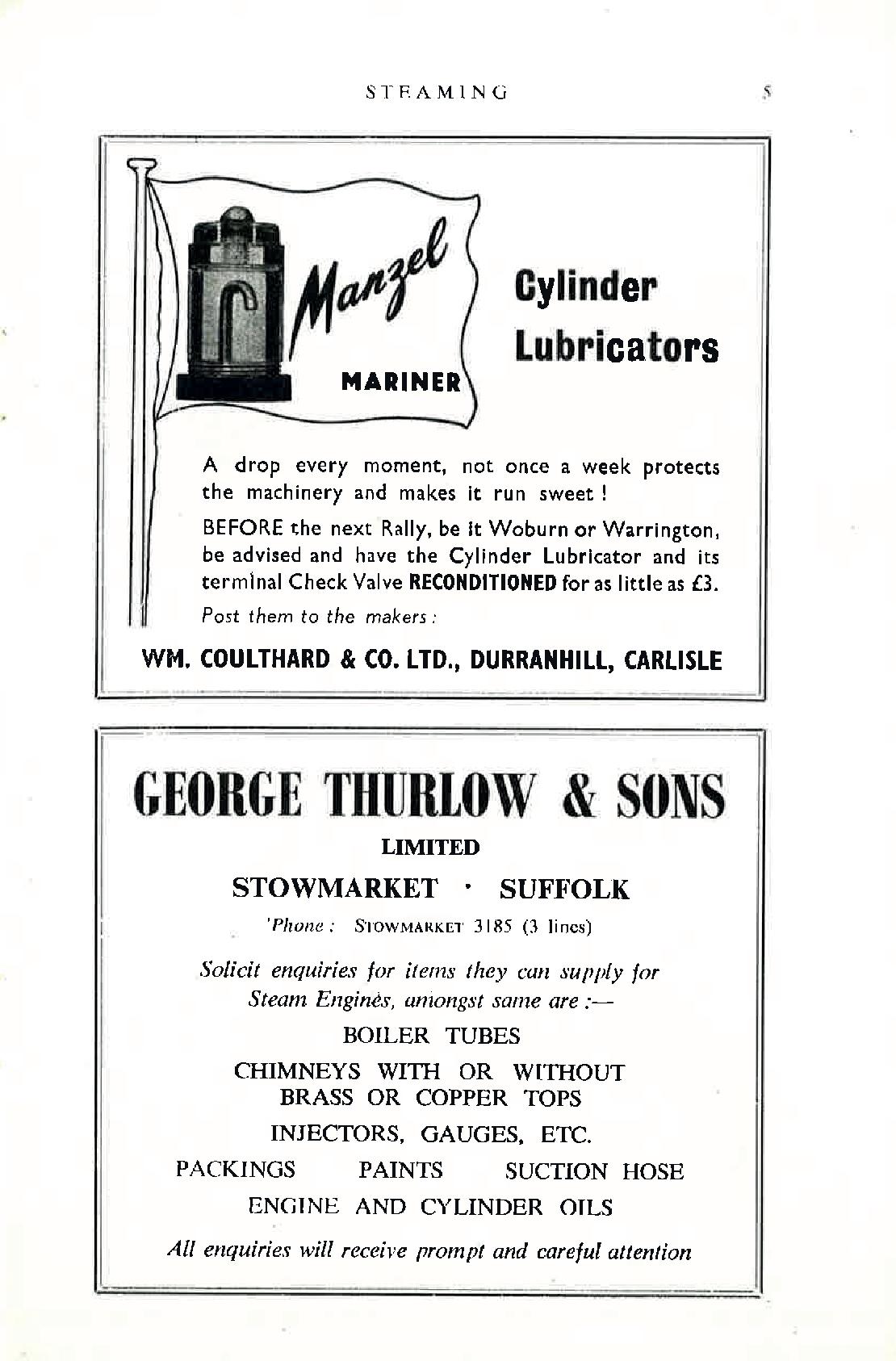
A drop every moment, not once a week protects the machinery and makes It run sweet !
BEFORE t;he next Rally, be It Woburn or Warrington, be advised and have the Cylinder Lubricator and its terminal Check Valve RECONDITIONED for as little as £3.
Post them to the makers:
'Plwne : STOW MARKET 3185 (3 Ii ncs)
Solicit enquiries for items they can supply for Steani Engints, amongst sa,11e are:-
BOILER TUBES
CHIMNEYS wrrn OR WllHOUT
BRASS OR COPPER TOPS
INJECTORS, GAUGES. ETC.
PACKINGS PAINTS SUCTION HOSE
ENGINE AND CYLINDER OILS
All enquiries will receive prompt and careful attention
Pickfo,;ds Fowler's No. 16263 "Ta!is,:1(1,l ., al!(f No. 17105 "Atlas" en mule lo Beckton Gas Works. Ji,,ex. from A1111an.Scotland.
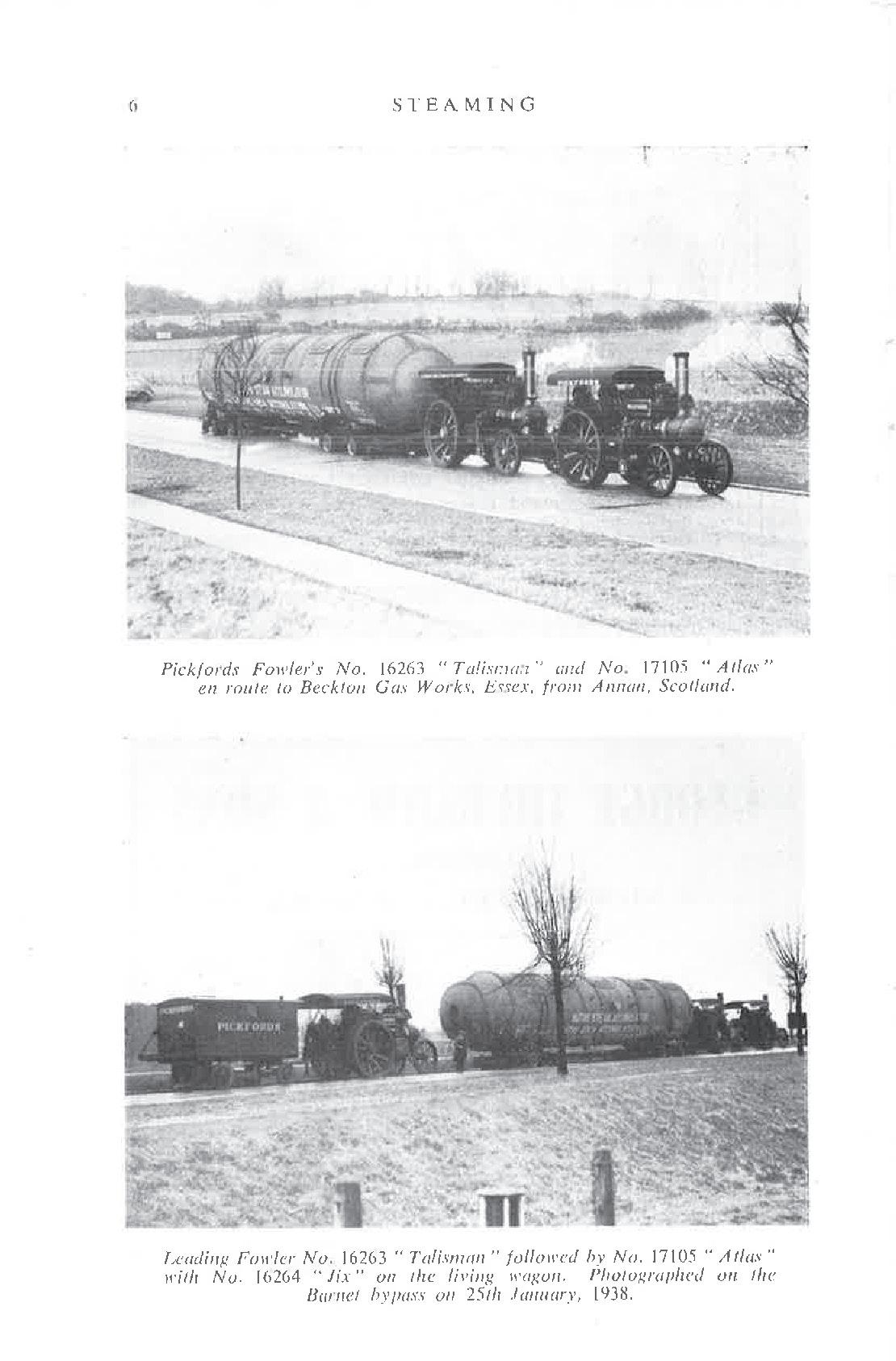
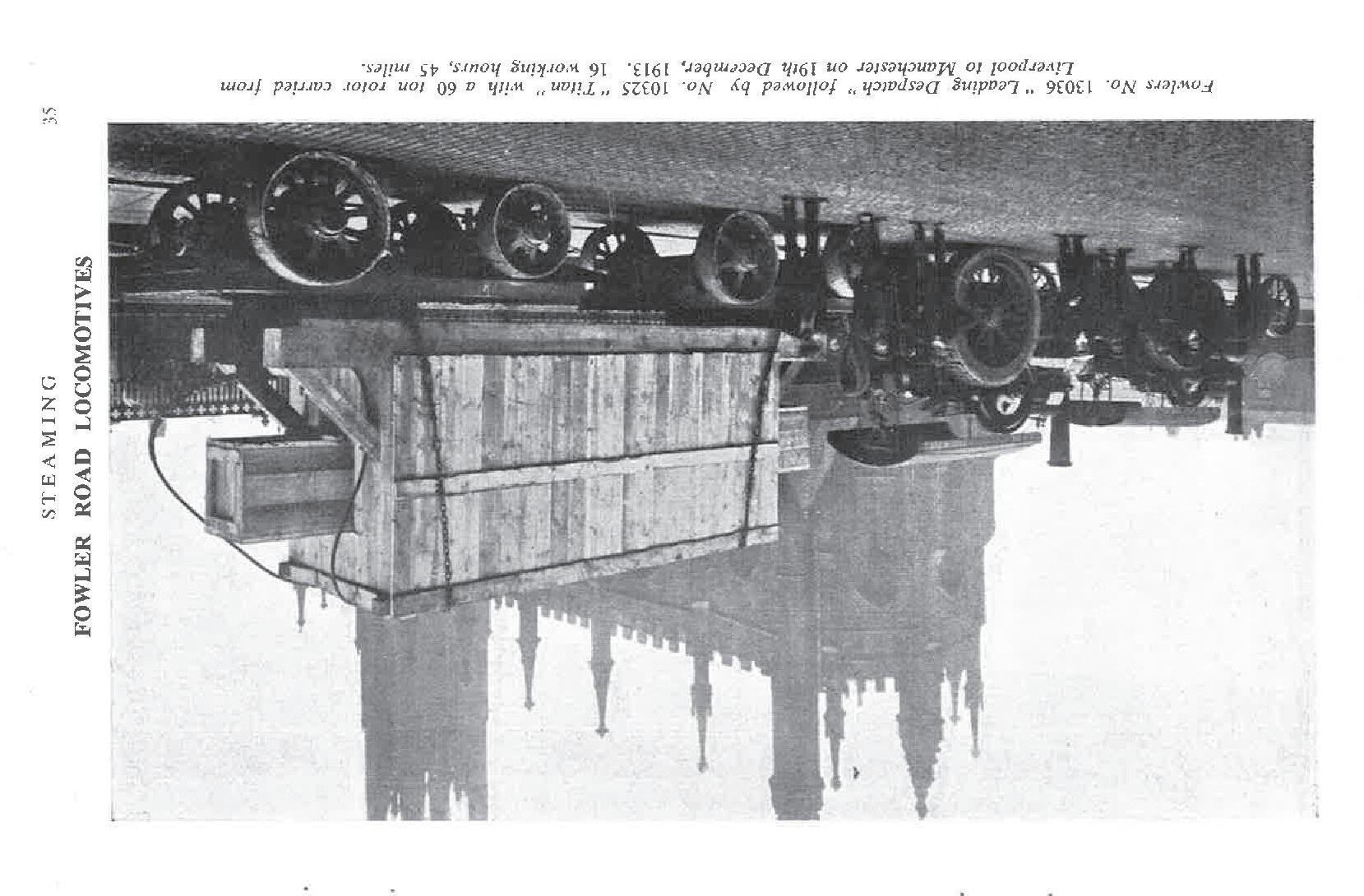
T.tl'mli11!,!Foll'ler No. 16263 "Talismm1" fulloll'ed by No. 17105 "Atlas" witlr Nu. 16264 '• Jix" 011 the living 1,·aKufl. Phu101,:ra1,hcd un llte /Jamel hypa.rs 011 25th .la,ruary, l 938.
(Reprinted from "The Conm,cr.chll Motor", Felmwry 4th, 1938)
I u1_,s.lory bd1inJ the co•h•uyai11.:()• of a' :ikam act:11mui.alor, weighing over !Jlbtuns and n1l.!a~t1riug 10 n. in lcugtth mrd I:? rt.i111dic1metcr. from ohe wol!'ks or 1hc builders in A11111am,Sco~land. lo ~he Gas Light ,Hld Coke Co.'s Hecklon AH,'iwol'ks in Esst:~. rank~ i:ts a tri1111111ohfo1· r01,d ir:rnsport an<l for Pickfords I td.. whit:h concern w~1srl?-spm,sabk for the dirncuah task.
Al1lrn11J!h hcavh;r lo:i.ds have been s11cccssfu1lycarried by this concern. die 1ui.::sc11linstnnce a'l.:Drcscnts 1he higg,cs1 hulk load-a fact which added i111m,.;as11ralil)• 'lo 1h~ ,,linicutties of transport
Some idea of the immense task which the safe c:trria~e of this hu_ge oiece of l'.l(lli!t1n'lc.1'11t rcprt:cs~nt.cd ma~1 hi! 11,urngcd from the fact lhai pli'clliminary \'\Ork l.'()i111'\lcilt:•l.!d nc1ul~ IK munths ago. Jlrnclicnlly ever)' mile: <.>f the ::.elected rmu..: had to be :rnbjc,ctcd lo a cumr>l'l.':tc:\n<I rhomugh survey, 111o't ,,nlv once, b11l ~t second L·ime, j11:Ho.-ior lo the: ac1ual iourney being 11.mdcrt.1kc11. This w.l'1~ a nccc..-..sc1ryprcc;c\ulion in1 view of possible mnleri~l changes which might have taken place in the condition of the roads .
.I 11stwhat this survey meant can be gal he red from an enumeration of some ot' the obstacles which had to he surmo11ntcd, by-passed or even removed. These inclu<le<l bad hills, overhead ohstruclions, narrow and weak bridges, one-way streets, islands. especiaHy acute turns and even lamp-posts.
Evt?r}' mad and hride:c R11lhoriLv 011 the mute had lo bo ~ivcn two clear tJayi;' nuticc and. r11rlher, llw various amharinies had lo be indemnified af!.airn:ilrm!)siblc dq11H\~8 It') roads and bridges. Similar 1mtilicaliot1 had to be givun 10 the: Jmlice ihroL1t?!mul the r<n1lc in order thal arrnngcr11cn1s c,,l!Jllcl, if necessary, b~ made to divert traffic.
It wilf be appreciated that any s~rious departure from schedule would cnlail considerable inconvenience, in view of i-uch arranacments having to he rnadc. In lflOi11l of facl, aH lhc prcli111inarv 11otif1calk>11s wont by Uhc hua!l"d bc,c,rnsc, ,nwina;::lo a scvcm snowstorm in uhc mourntaimrns: region of :-lh,u1 synchra11Jizir1~with ~.h~ ~trrival ,nr Ilic lhruc steam (raclorrs on their' wav l•O Annam. f11rlhcr pro~rc~s was imr,n:i;;~il?h:;[ll'll<l, as lhc.se cne.i1H~"6were 11cqnr11(.!df,ur <1-1thcrlll'a:!(!l1l work of u simil>Lr nalill'c, lhev Wiil:rc 1ah11 b~tck to lhcir b,1!:ic nt M.\11chcslcf. 'I h:11'1.w:1s before Chrislmas.
The second attempt howcv~r. was succcssfuf an<l. 011 Janirn.ry 6th, the Jong craw1 south commenced. Tht~ iourncv over Shari c1-1u1;ed a delay of from two lo tlwce days, the snow on this ot:casioq b~ing: :, moderate 9 ins. <leep. The a<'tua1 iourncv of 325 miles wa~ conlrlctc<l withnut any untoward inci,icnl, but some details relative to it ,~ill be of interest. ,
From slarf to finish, the trin took 21 ..-lavs. of which 18 were occupi,ed in travelling. The average speed to the n11Cskirtsof' lhc Me[rcrno1itan Police ar~:i. w:-i~ 2 m.p.h .. ::tnd thcr~lft<::r. :-.lra.mu: a°' ii m~\I seem. the nvcra1!C w~ul up to ) m.n.h. This is accom1tc.d for bv lhl.l!facl that it was essential to ensure that the load was cle-ai-pf 1he:slrcets before 1.he normal now of traflic commenced. This was made r,ossihfc onlv by the co-operation of the police, who gave every essistance with road patrols and radio vans.
On this section, a 3,000 gallon tank wagon was added to the column. in order lhat the steam tractor~ could be replenished with a minimum or delay. 1 hl.l tn1c1ivc 1.1rti1comprised ihree Fowler tO n.h.p. engines, which belween them, c:ou1su1111cdac,pro:dmatclv 20 tons of coat for the whol~ .iom·11uy, the water ievHporalcd by t'hc trio bcintt at. lh_c rah.~ of 3,000 gallons. per da11•
B~1iltbv Crnncs (Dcrehiun) Ltd., of Dcreham. the troHey used consisted of lwo, 16-whcelcd 32-s(>lid-lyrcd bogies, the whole ""'cighing 30 tons ; the
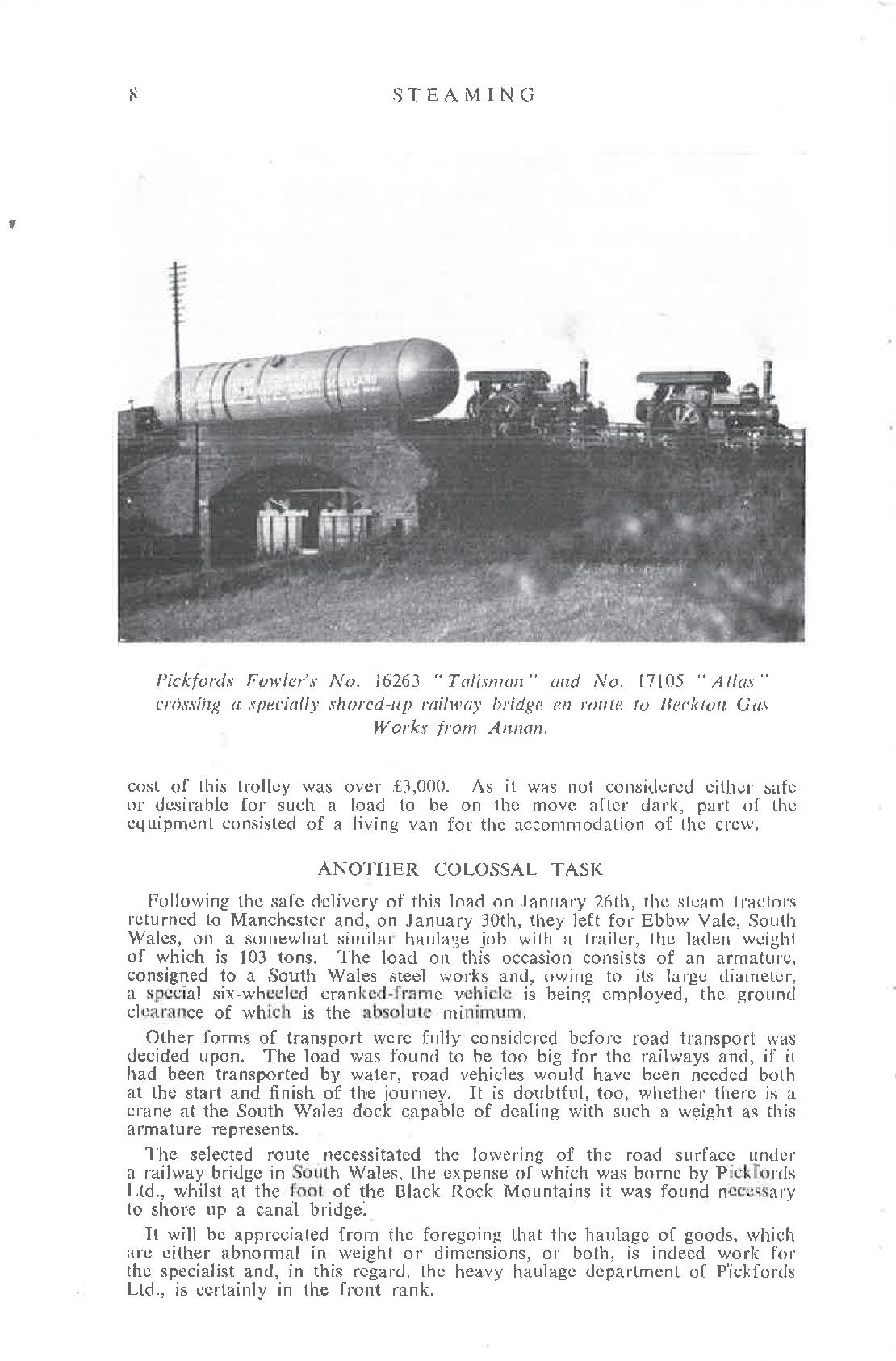
Pickford.,· Fowler'.,· No. 16263 "Tafi.rnwn" and No. 17105 "Atlas" crv.,·.,·iiiRa specia{ly shored-up railway !>ridge en route tu Uccl<tvfl (jas Works from Anmm.
cosl of lhi.s trolley was over .0,000. As il WHS 1101 con.sidcn:<l cith~r safe or desirable for such a load to be on the move after dark, purt of lhc c4uipmcnl <..:onsisledof a living van for the accommodation of the crew.
Following the :-;afe <l·eliver~r of thi.c;lo::i<l on I:rn11::iry 7.6th, the slc:-im I nu:lors returned lo Manchester and, on January 30th, they left for Ebbw Vale, South Wales, on a somewhat si111ila1haula•~e job wilh a lrailcr, Lh1.:laden wl.!ight of whi<.:h is 103 tons. The load on this occasion consists of an armature, consigned to a South Wales steel works anti, owing to its large diamelcr, a i,pccial six-wheeled cranked-frame vchit:1,c is being employed, the ground clearance of which is the absolulc minimum.
Other forms of transport wcr·c fully consid~rcd before road transport was decided upon. The load was found to be too big for the railways and, if it had been transported by water, road vehicles wou1d have hcen needed both at the start and finish of th,e journey. It is doubtful, too, whethct· there is a crane at the South Wales dock capable of dealing with such a weight as this armature represents.
The selected route necessitated the lowering of the road surface under a railway bridge in So~1th \1/aleR, the expense of which was borne by PickfonJs Ud., whilst at the root of the Black Rock Mountains it was found n-cc1::ssary to shore up a canal bridge:
It will he appreciated from the foregoing Lhat the haulage of goods, which arc either abnormal in weight or dimensions, or both, is indeed work for the specialist and, in this regar<..I,lhc heavy haulage tfopartmcnl of P'ickfords LLd., is ccrlainly in the front rank.
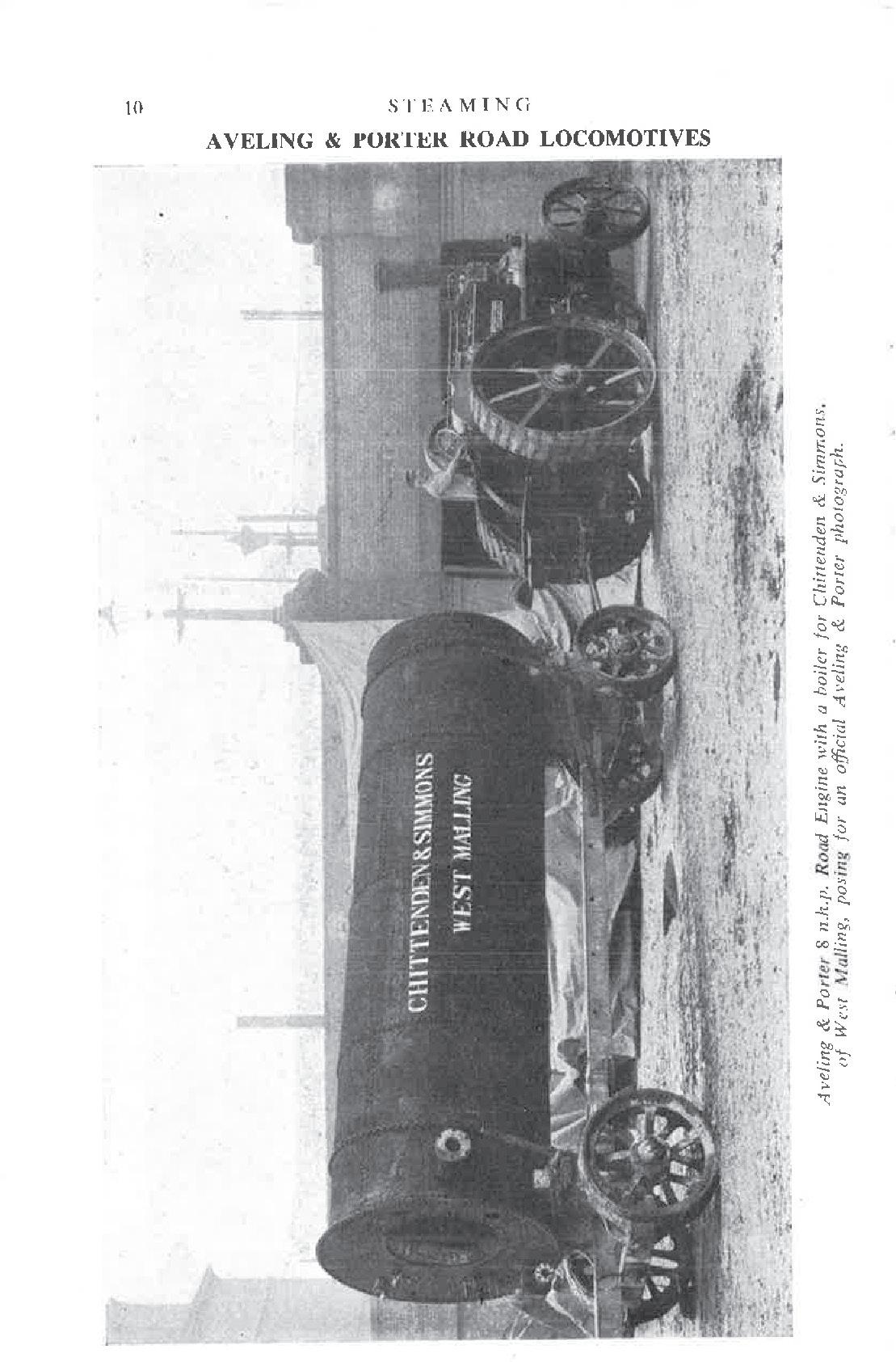
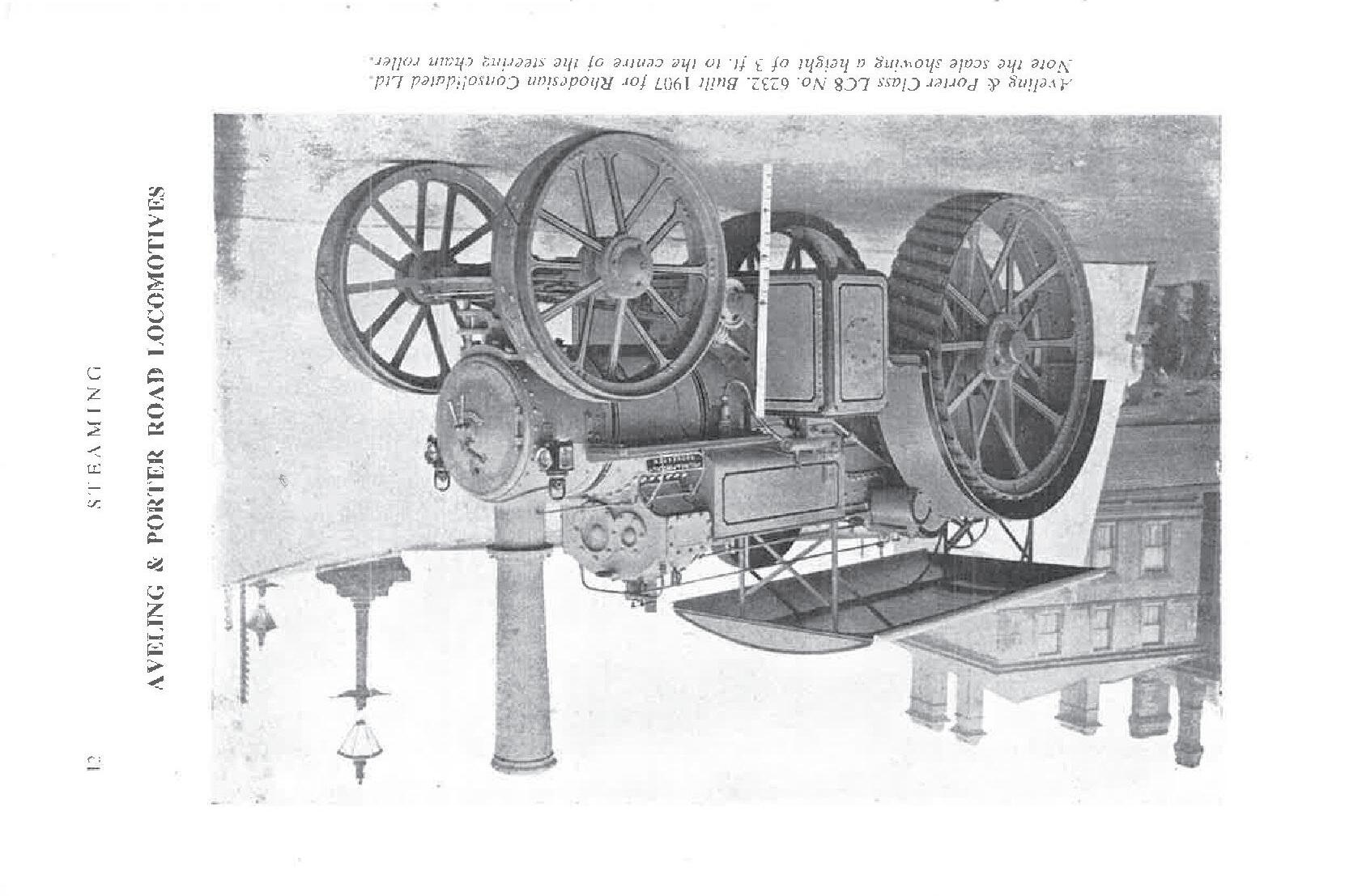
A veling & Porter Class LC8 No. 6232. Built 1907 for Rhodesian Como!•dured Ltd .Vore the scale sho,i·in[( a height of .?, ff. to th~ centre oj tile sreer;n~ <:h:J.mroller,
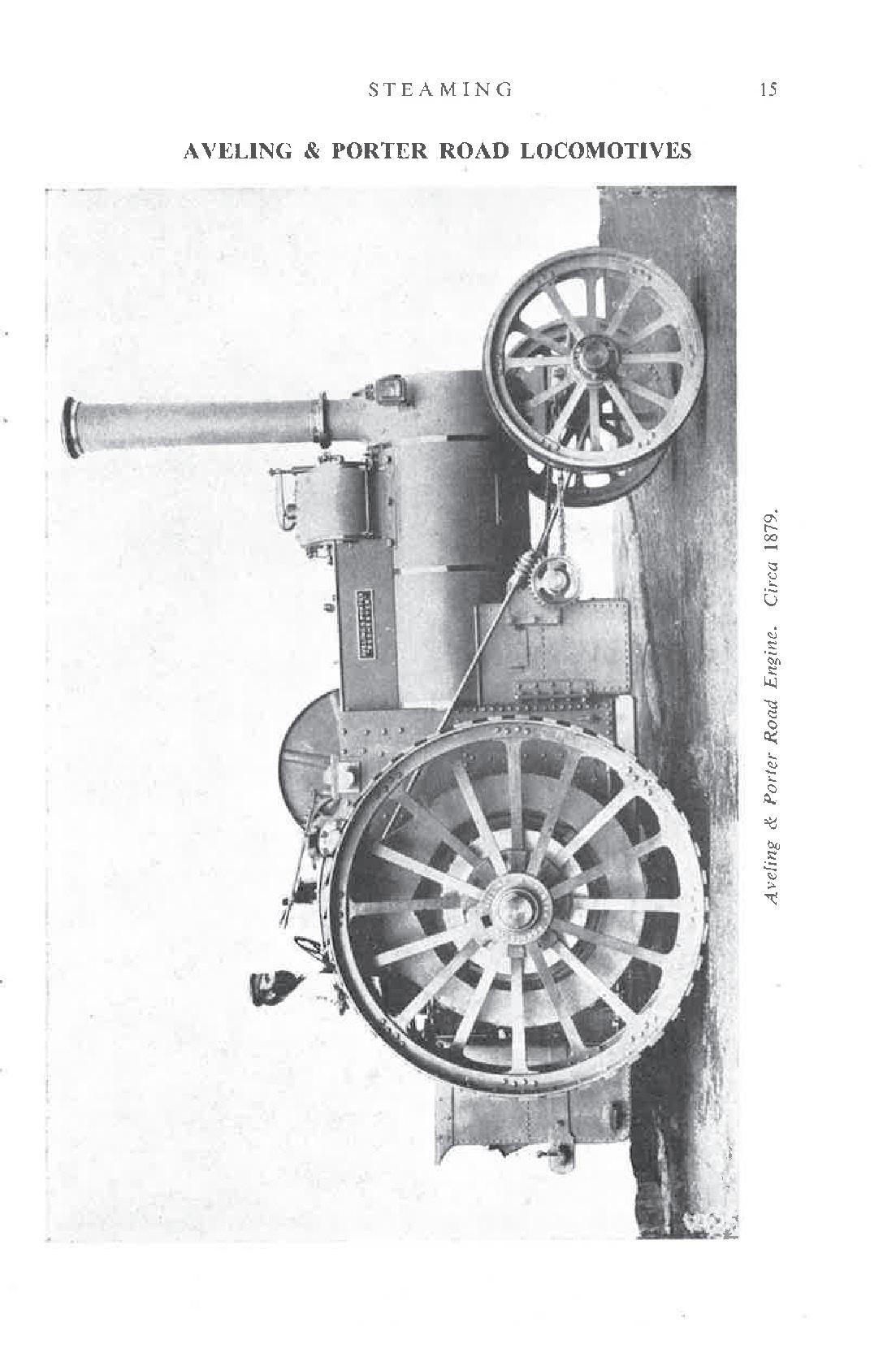
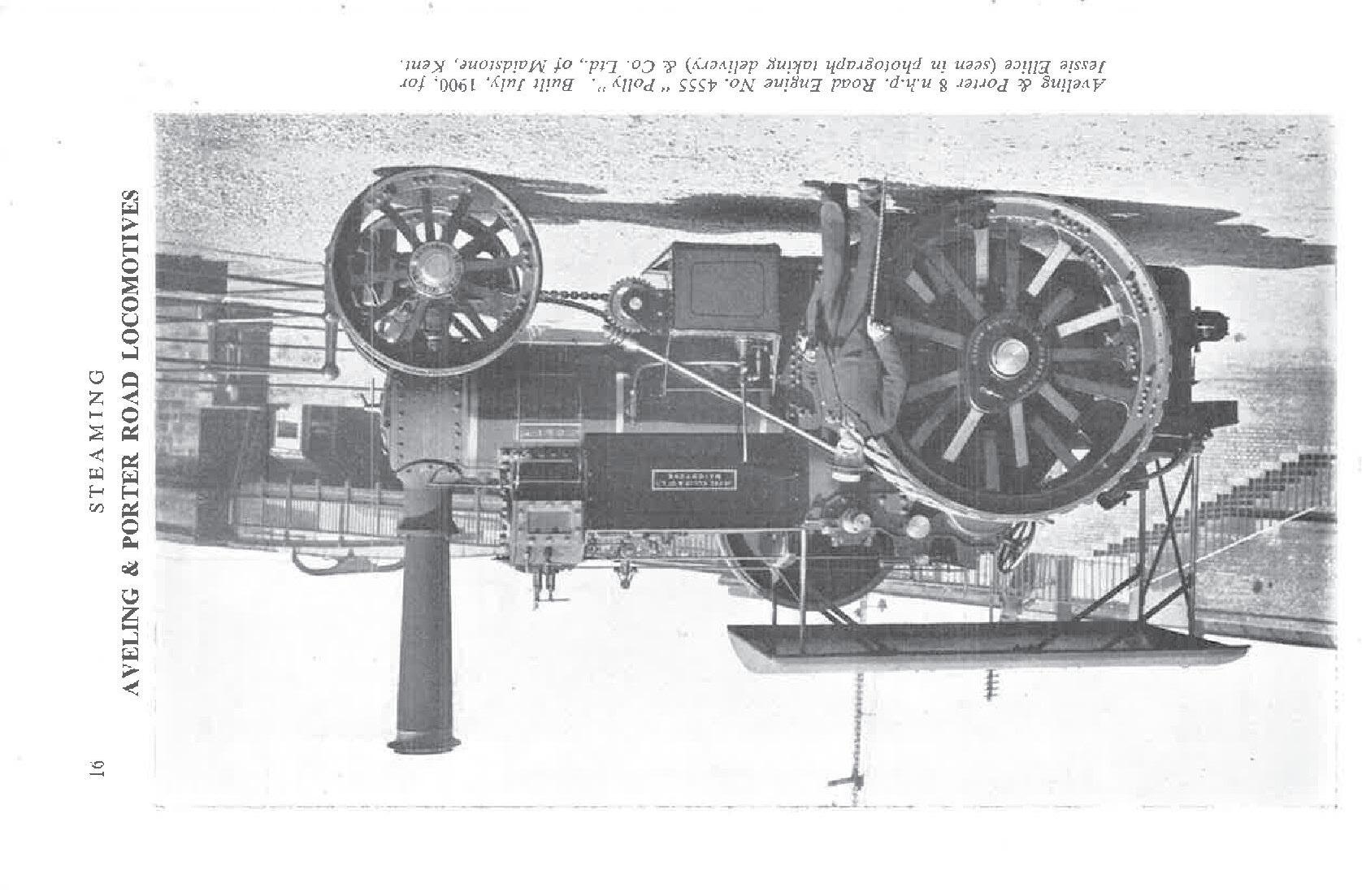
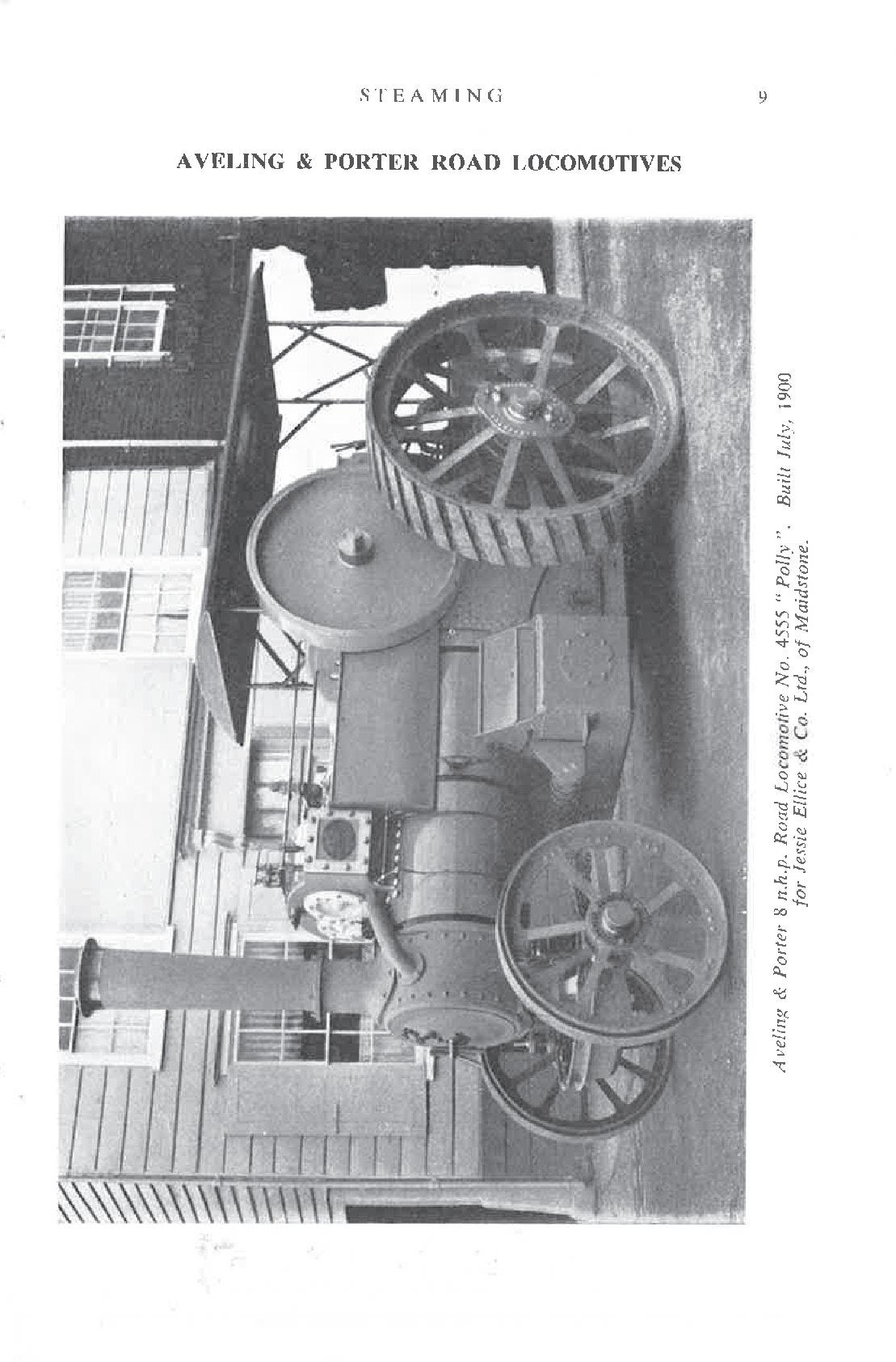
Aveling & Porter 8 n.h.p. Road Engine No. 4555 "Polly". Built July. 1900, for Jessie El/ice (seen in photograph taking delivery) & Co. Ltd., of A1aidstone, Kent.
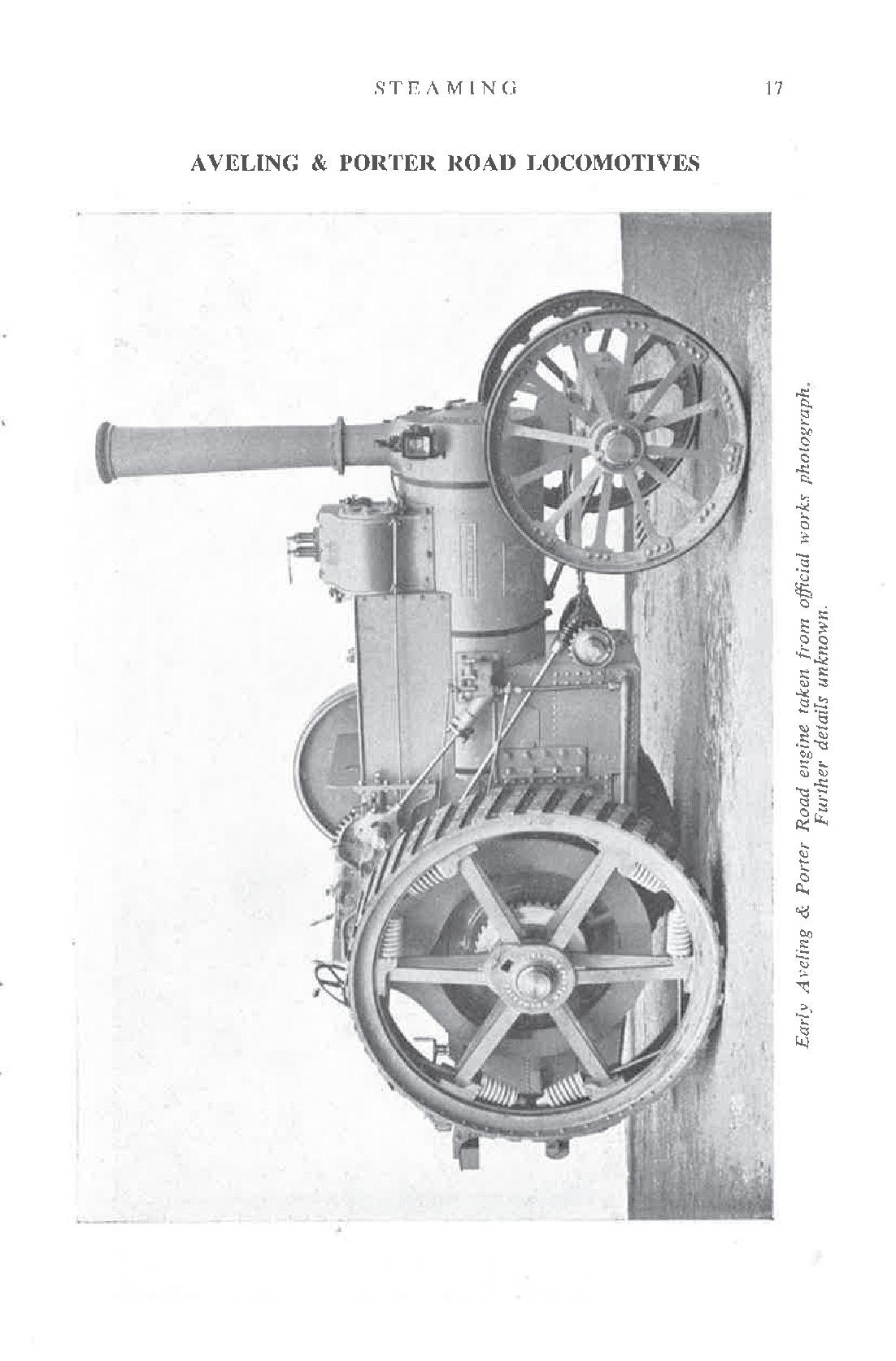
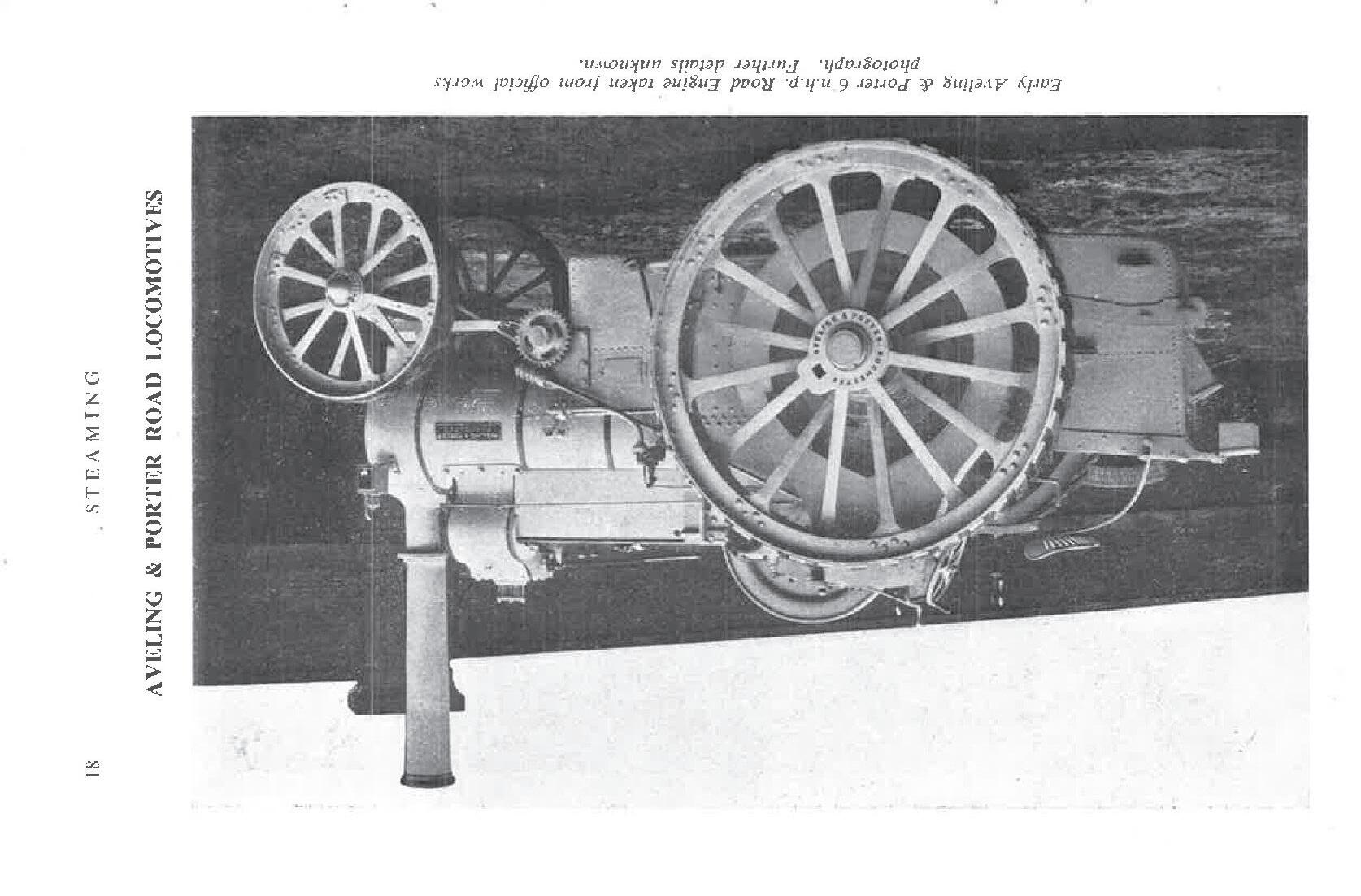
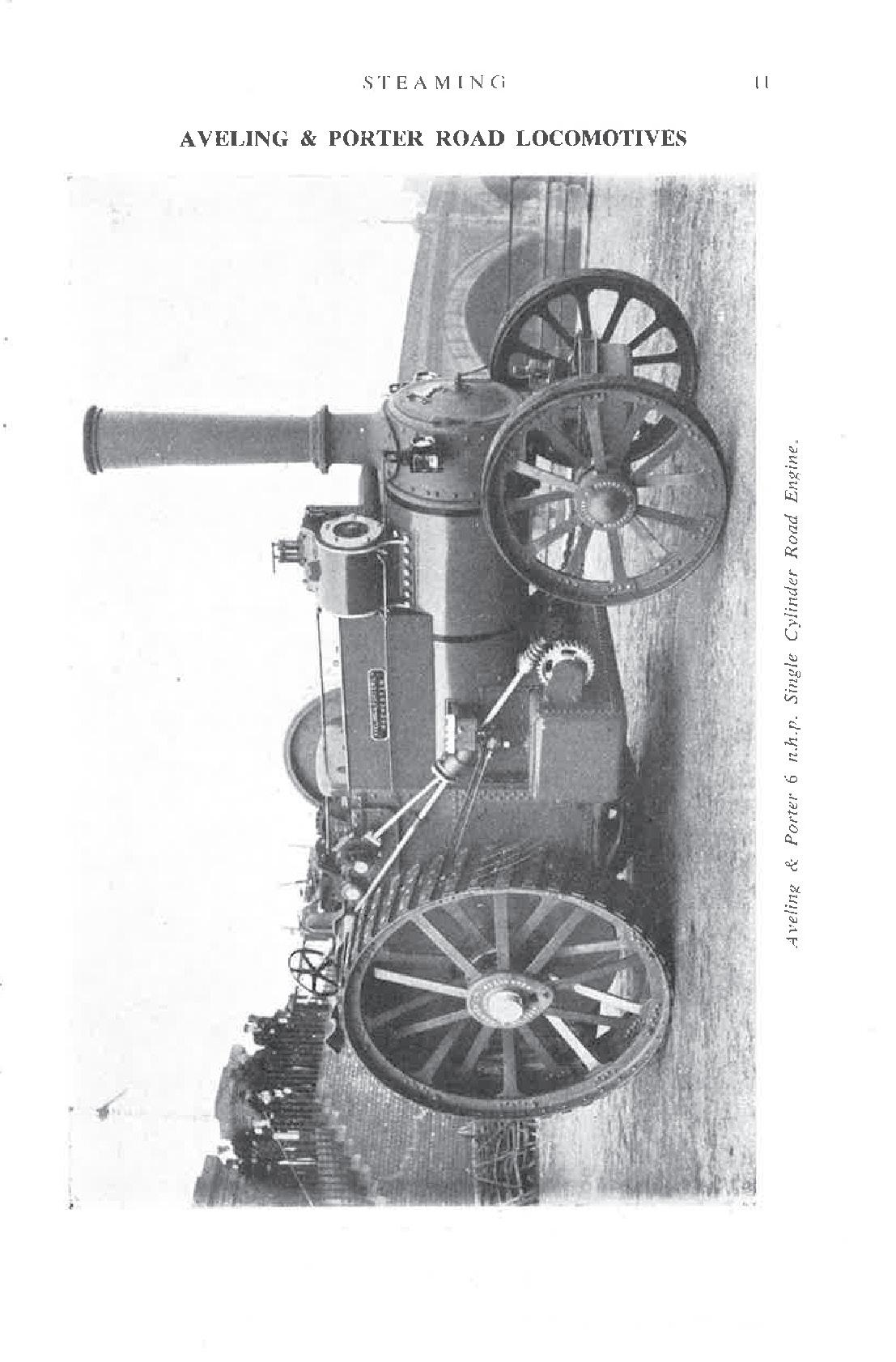
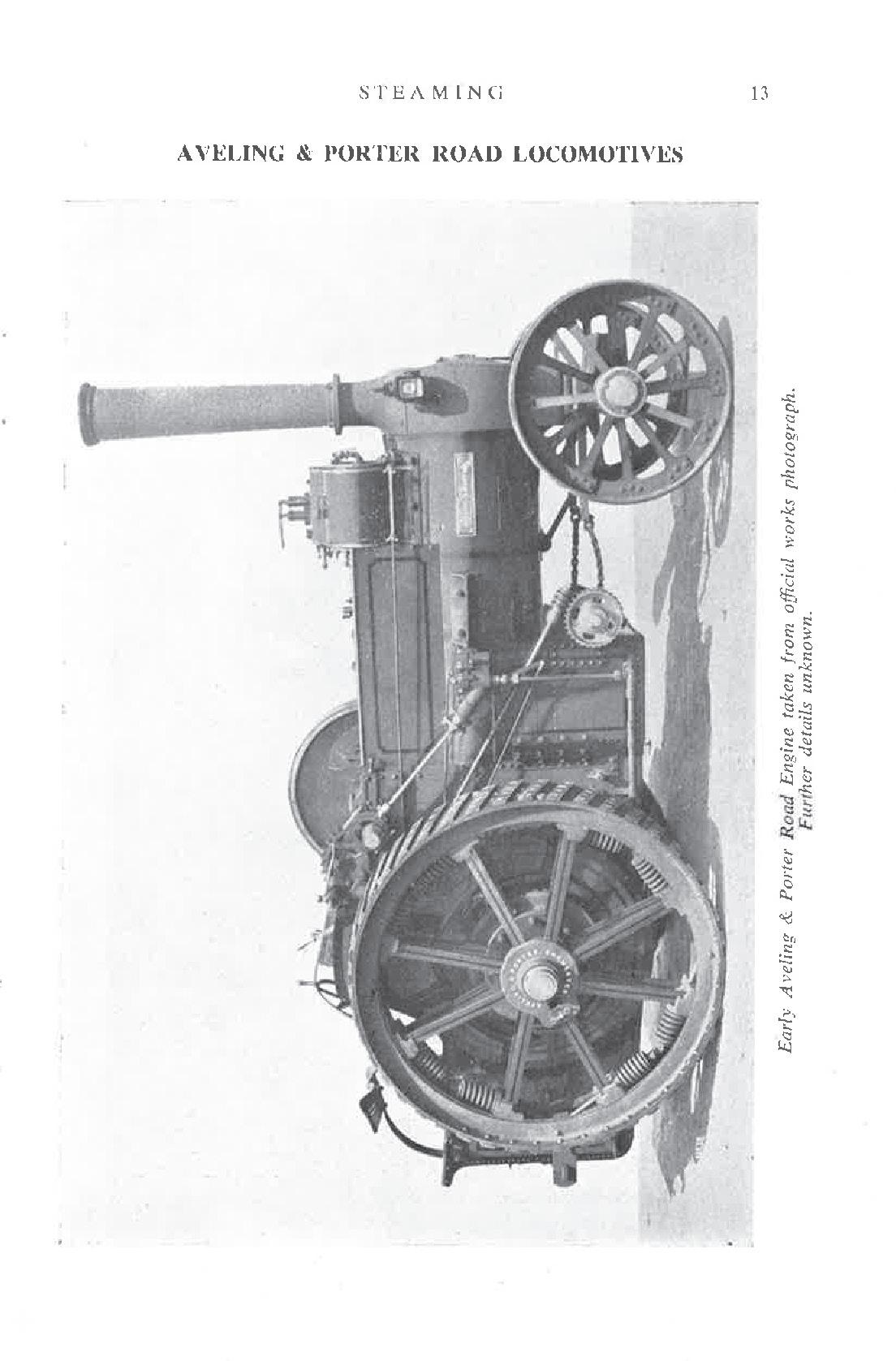
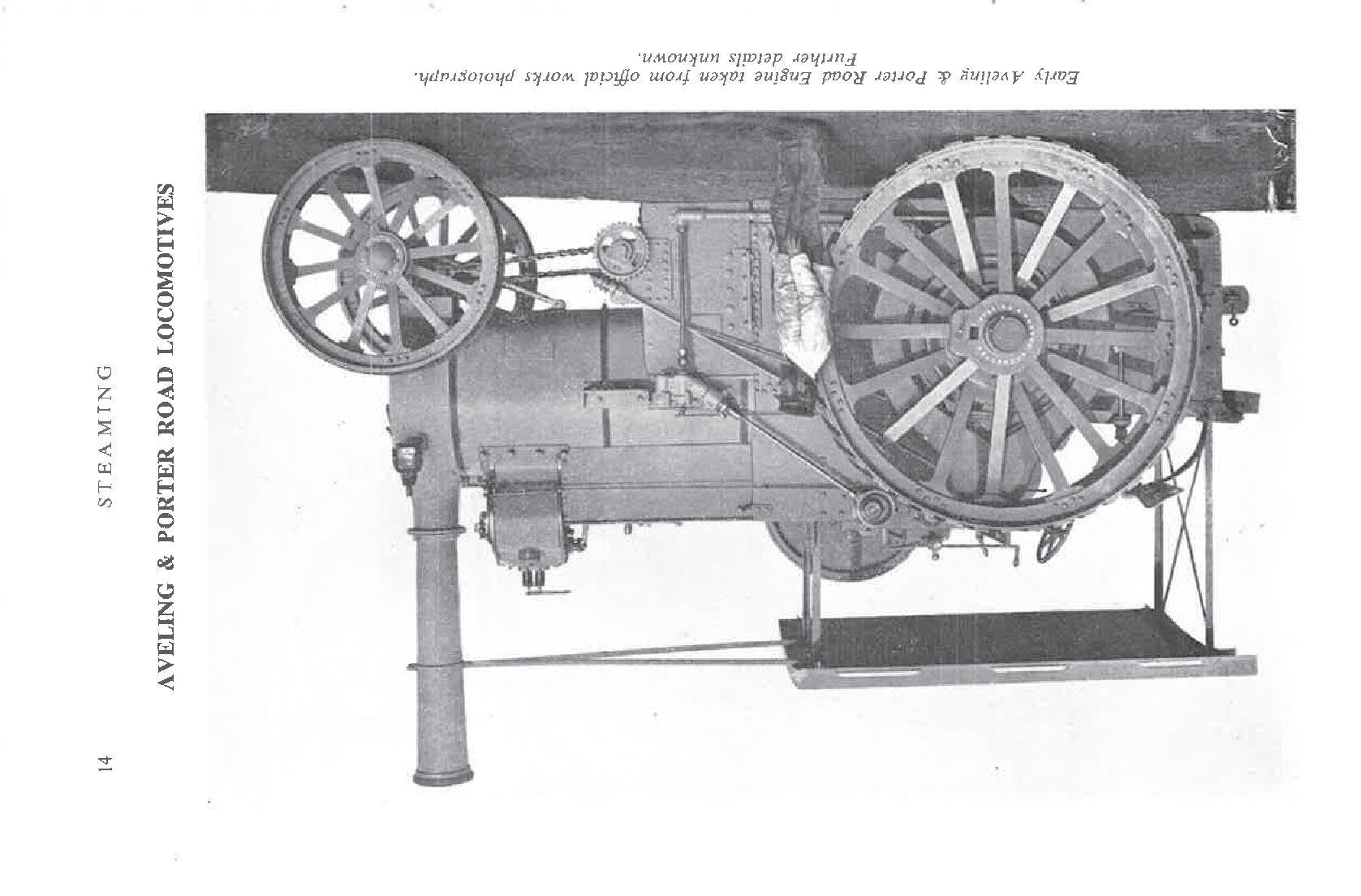
Early A veling & Porter 6 n.h.p. Road Engine raken from official wcrks phoTograph. Further details unkncrwn.
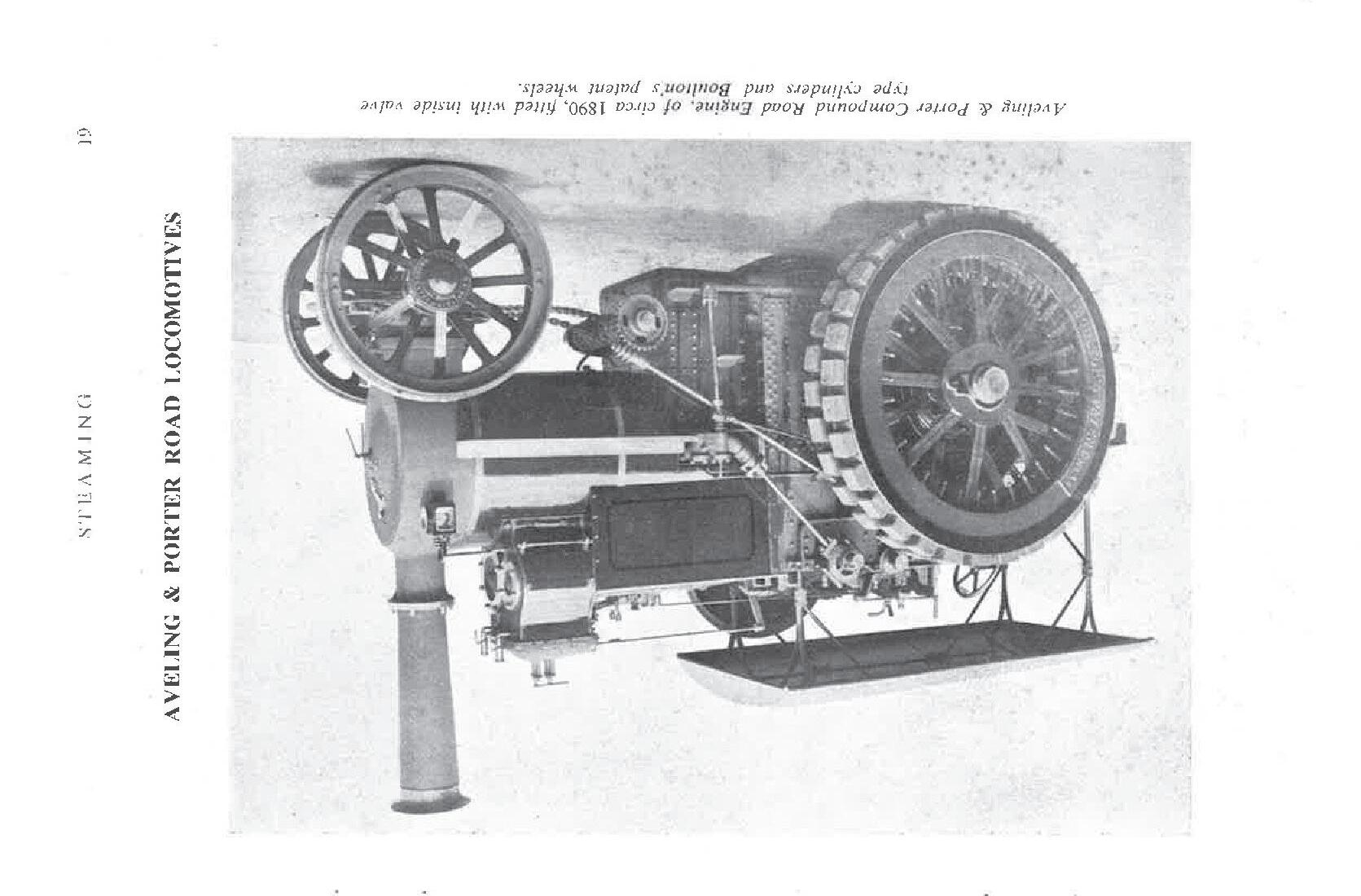
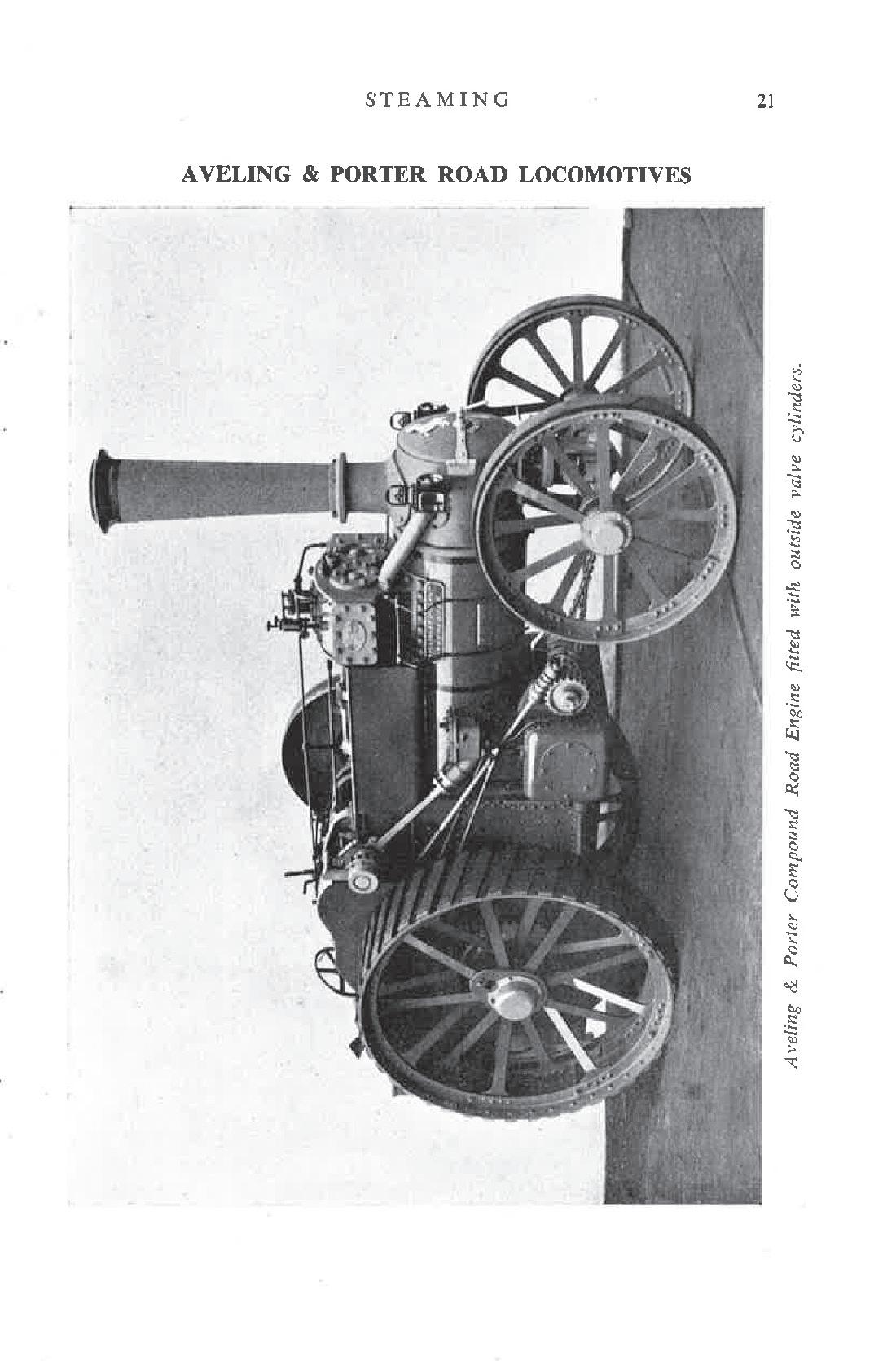
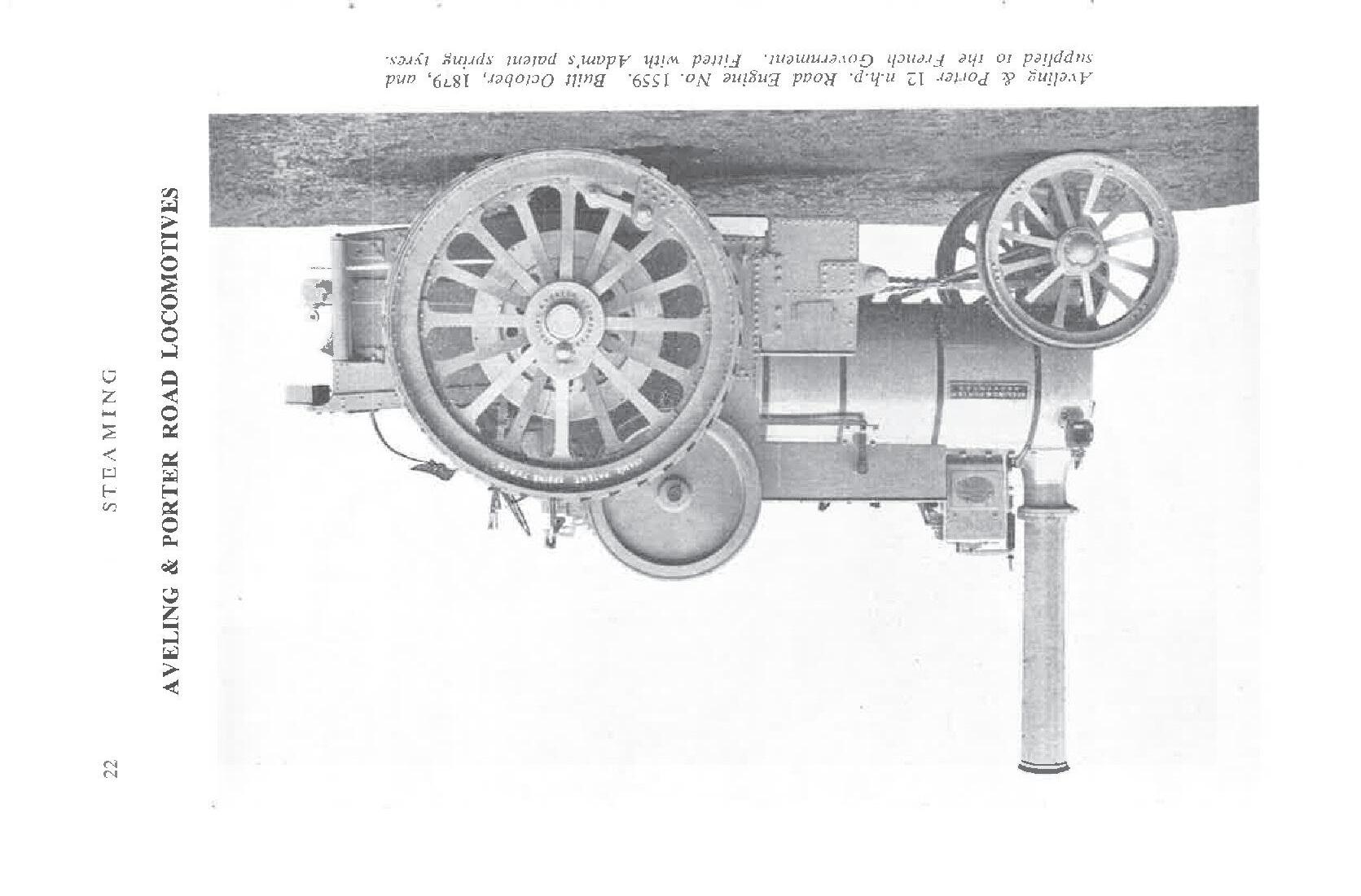
A vding & Porter Compound Road Engine. qf circa 1890, fjl{ed with ins;de valve type r.ylinders and Boui1011·s patent wheels.
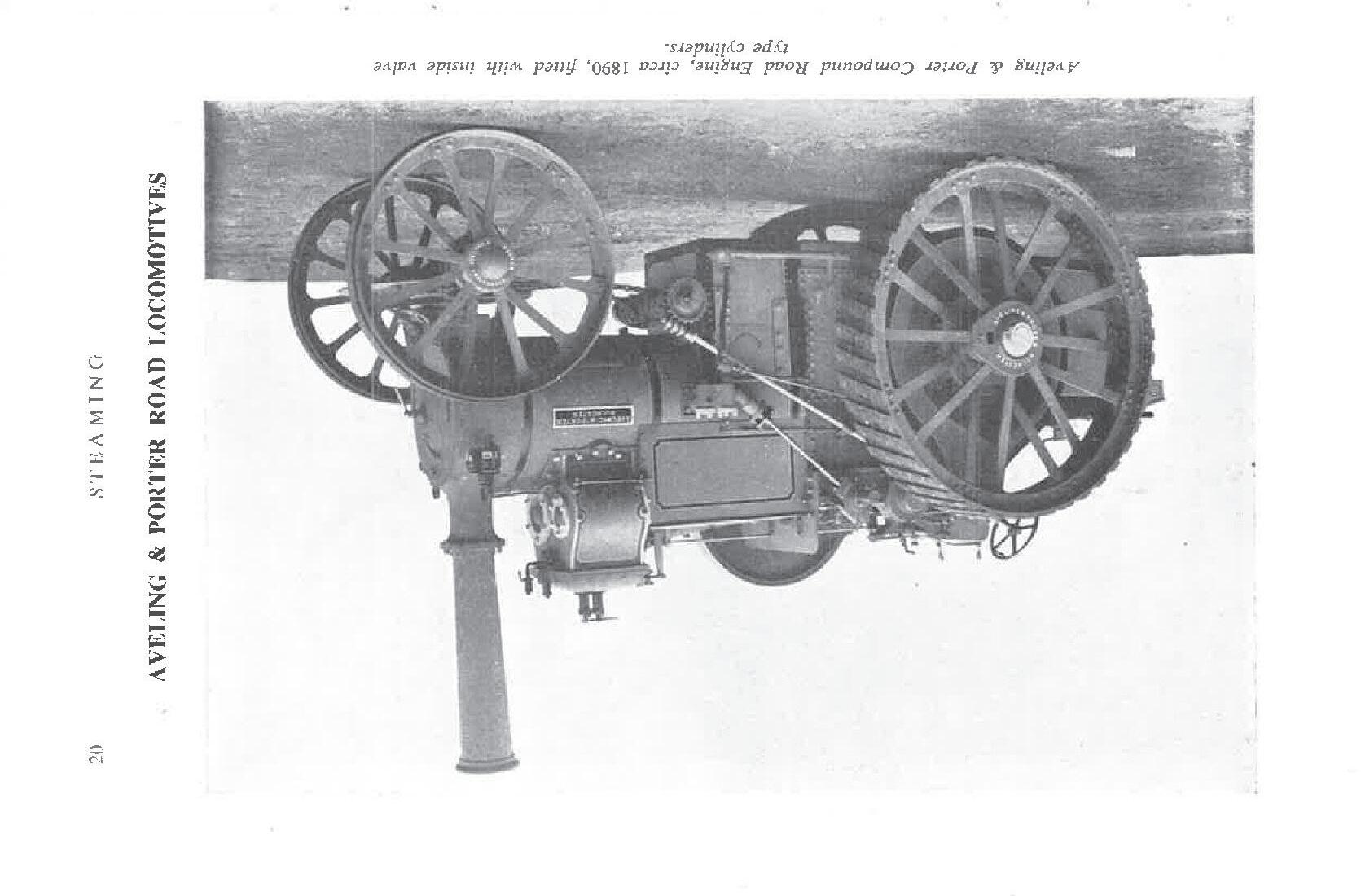
Aveling & Porter Compound Road Engine, circa 1890. fitted with imide valve type cylinders.
Horse Powel'
Diameter of Cylinder
of Stroke
of Flywheel
of Flywheel
of Front Wheels
of Rear Wheels
Weight of Engine
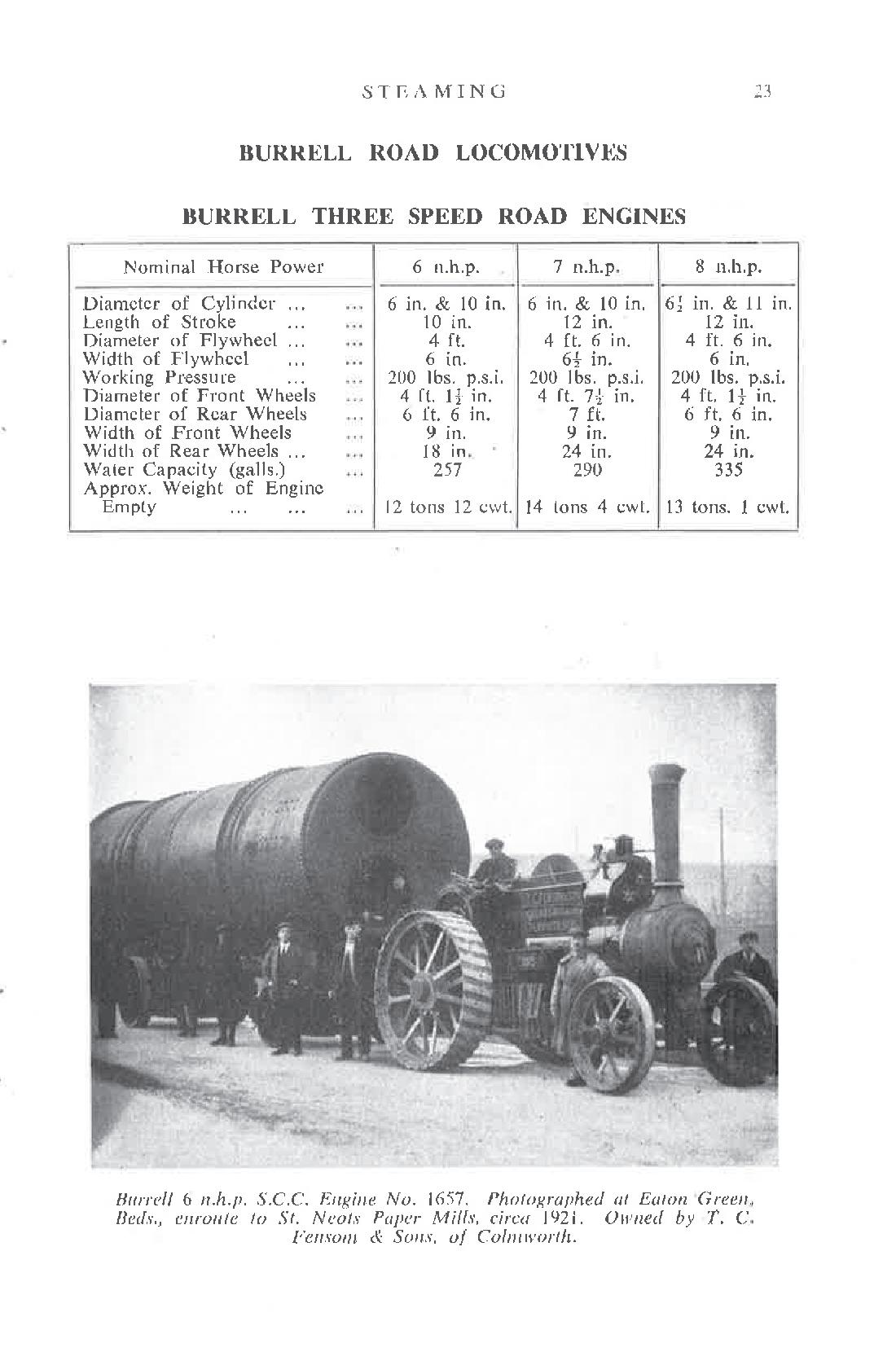
Hurrell 6 n.h.p. S.C.C. ~1tgi11e Nv. 1657. I'hofographed at Euton Green, !Jed,\·,, enroute lo Sr. N(•ols Paper Mill.\', circa J92i. 011 1 1wd by f. C. Fenwm & Sons. u/ Colmworth.
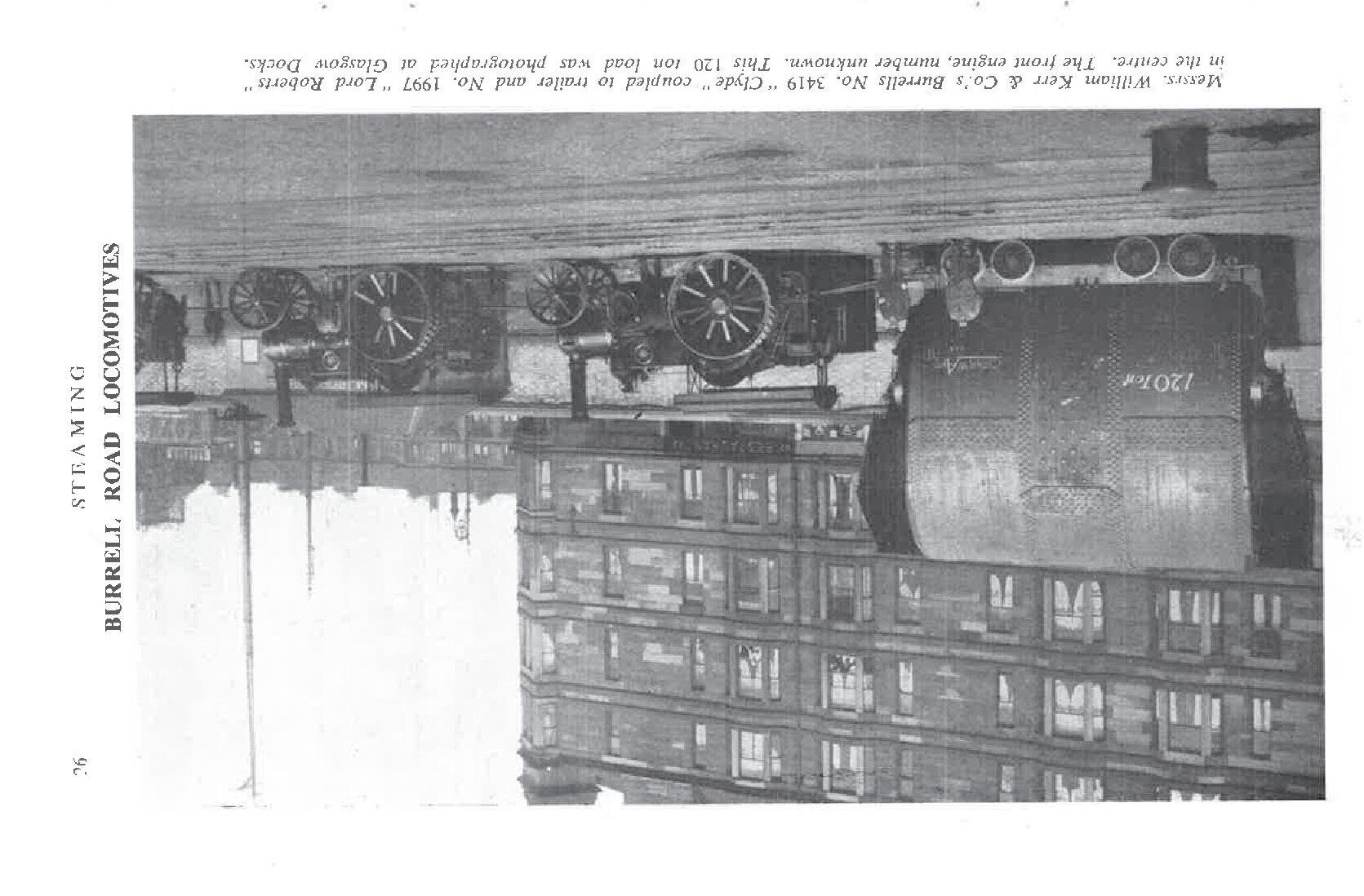
\iJessrs. William Kerr & Co.'s Burrells No. 3419 "Clyde" coupled to trailer and No. 1997 "Lord Roberts" in rhe centre. The .fronc engine, number unknown. This 120 ton load was photographed at Glasgow Docks.
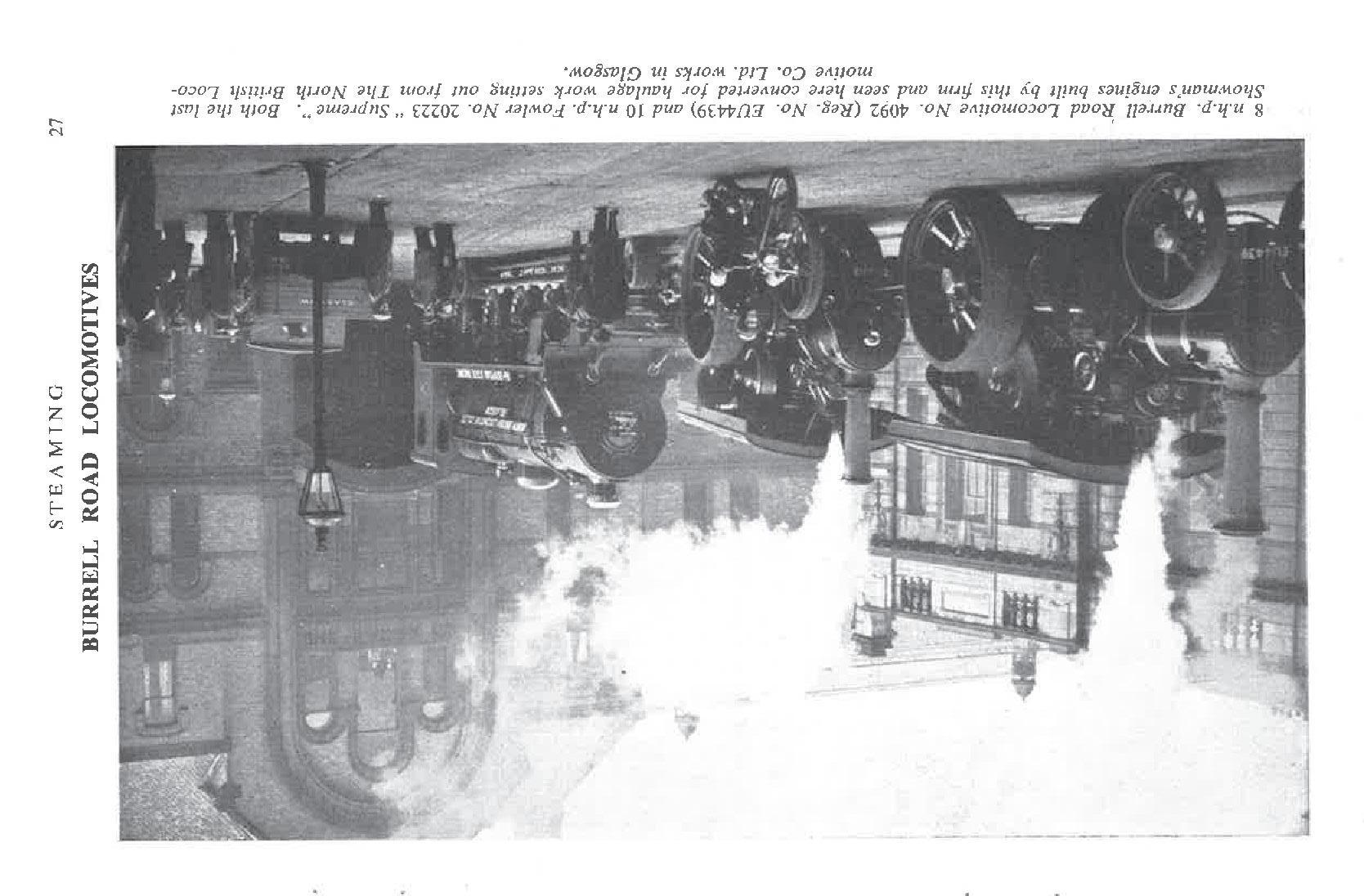
n.h.p. Burrell Road Locomotive No. 40?2 (Reg. No. EU4439) and JO n.h.p. Fowle·r No. 20223 "Supreme". Both tlze last Showman's engines built by this firm and seen here converted for haulage work settin~ out from The North British Locomotive Co. Ltd. works in Glasgow.
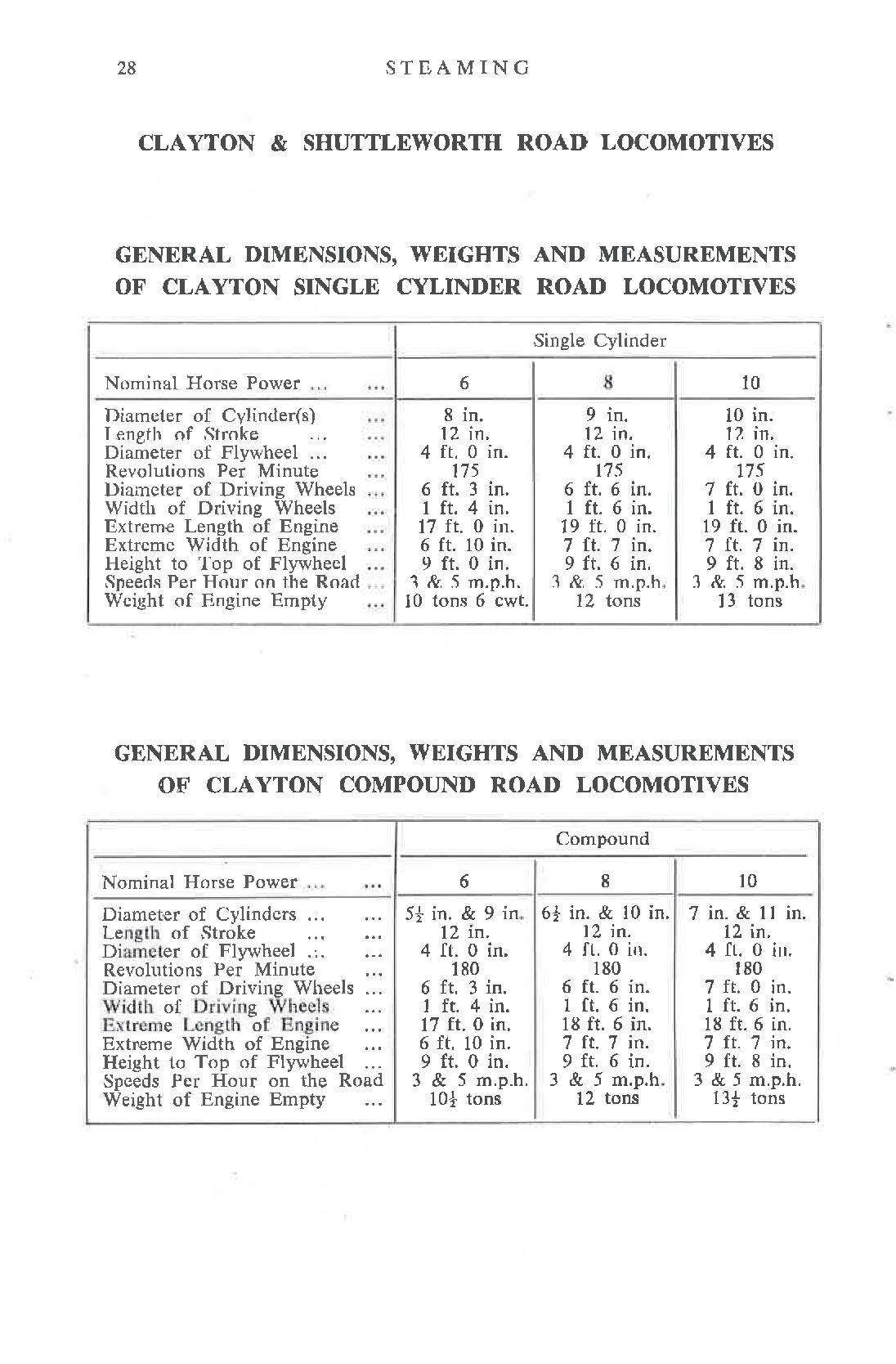
GENERAL DIMENSIONS, WEIGHTS
MEASUREMENTS
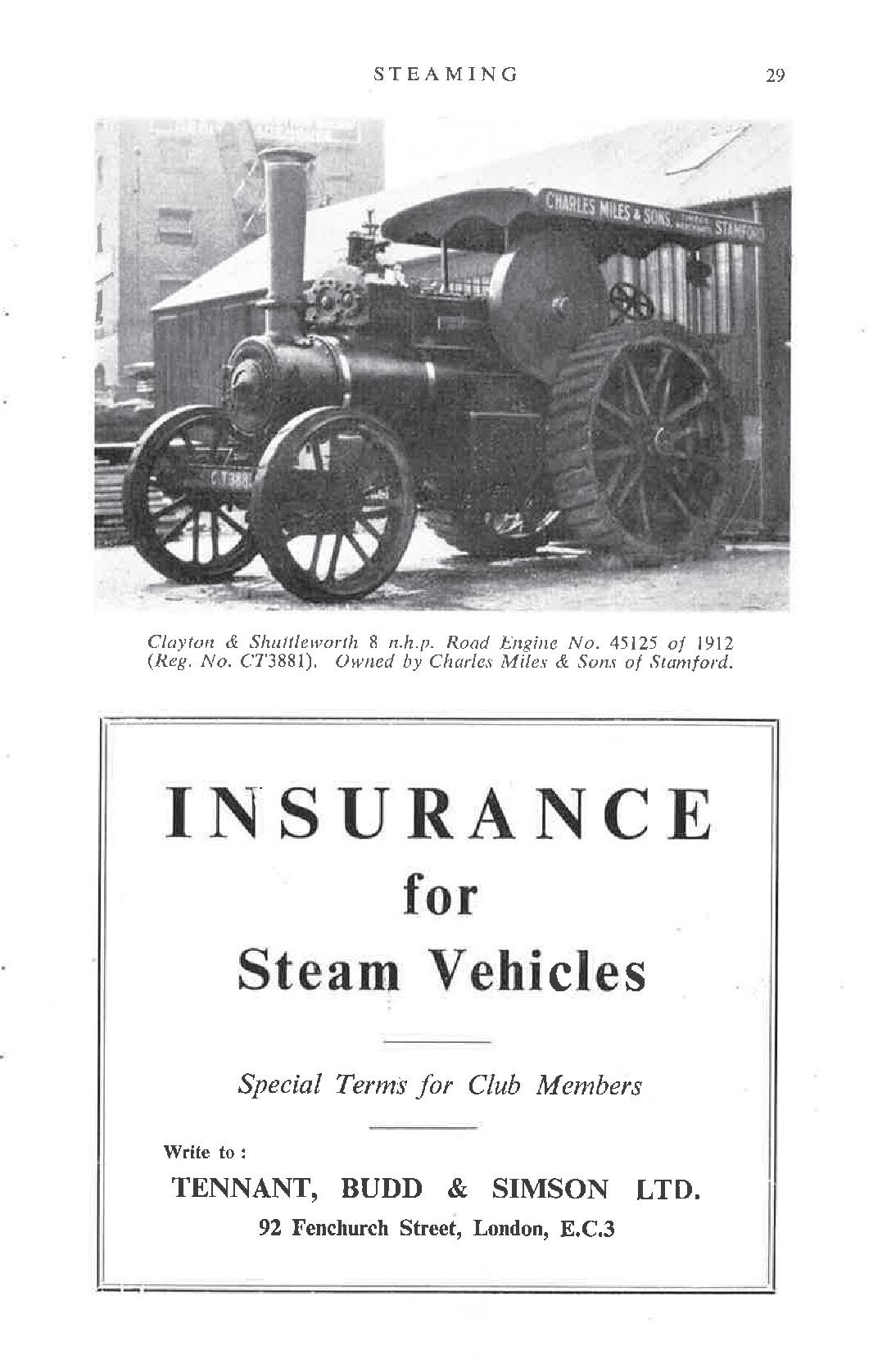
Clayton & Shuttleworth 8 n.h.p. Road 1:)igine No. 45125 of 1912 (Reg. No. C:1'3881). Owned by Charles i'.1ile.,·& Sons of Stamford.
FOSTER CLASS " LR ,, ROAD LOCOMOTIVES
APPROXIMATE POWERS AND DIMENSIONS " LR '' Class of Road Locomotive
Continuous Economical Horse Power .. .
Continuous Maximum Horse Power
F.rne1gcm:y Maxi111wn Hmsc Powt::r
Dinmctcr of Cylinder3
Length of .Stroke
Diameter of Flvwhcel . . .
Widlh of Flywheel
Diameter of Driving \Vhccls
Width of Driving Wheels .. .
Speeus Per Hour at Normal Revs.
Maximum Speed under I .ocomotivc
Extrcmo Lcn_gth of Engino ...
Height to Top of Awning ...
Extreme Width of Engine ...
Weight Empty (approx.)
\Vcight \Vorking Order (approx.)
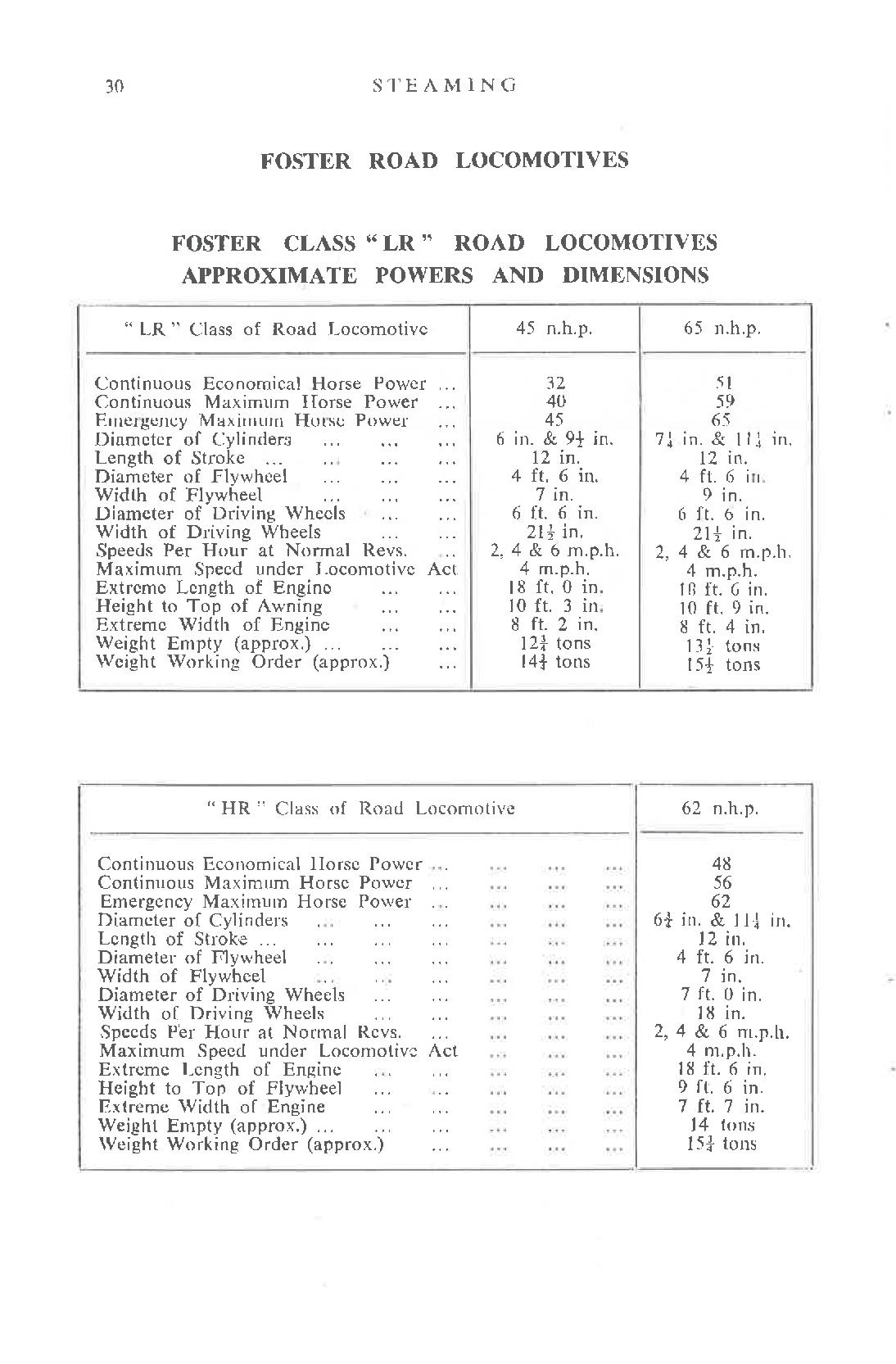
in.
2 in. 12¼ tons 14¾tons " HR " Class of Road Locomotive
Continuous Economical llorsc Power
Continuous Maximum Horse Power
Emergency Maximum Horse Power
Oiamcter of Cylinders
Length of Stroke ...
Diameter of Flywheel
Width of Flywheel
Diameter of Driving Wheels
Wi<lth o( Driving \Vheels
Speeds P'er Hour at Normal Revs.
Maximum Speed under Locomoliv-;:: Act
Extreme Length of Engine
Height to Ton of Flywheel
Extreme \Vidth of Engine
Weight Empty (approx.) ...
Weight Working Order (approx.)
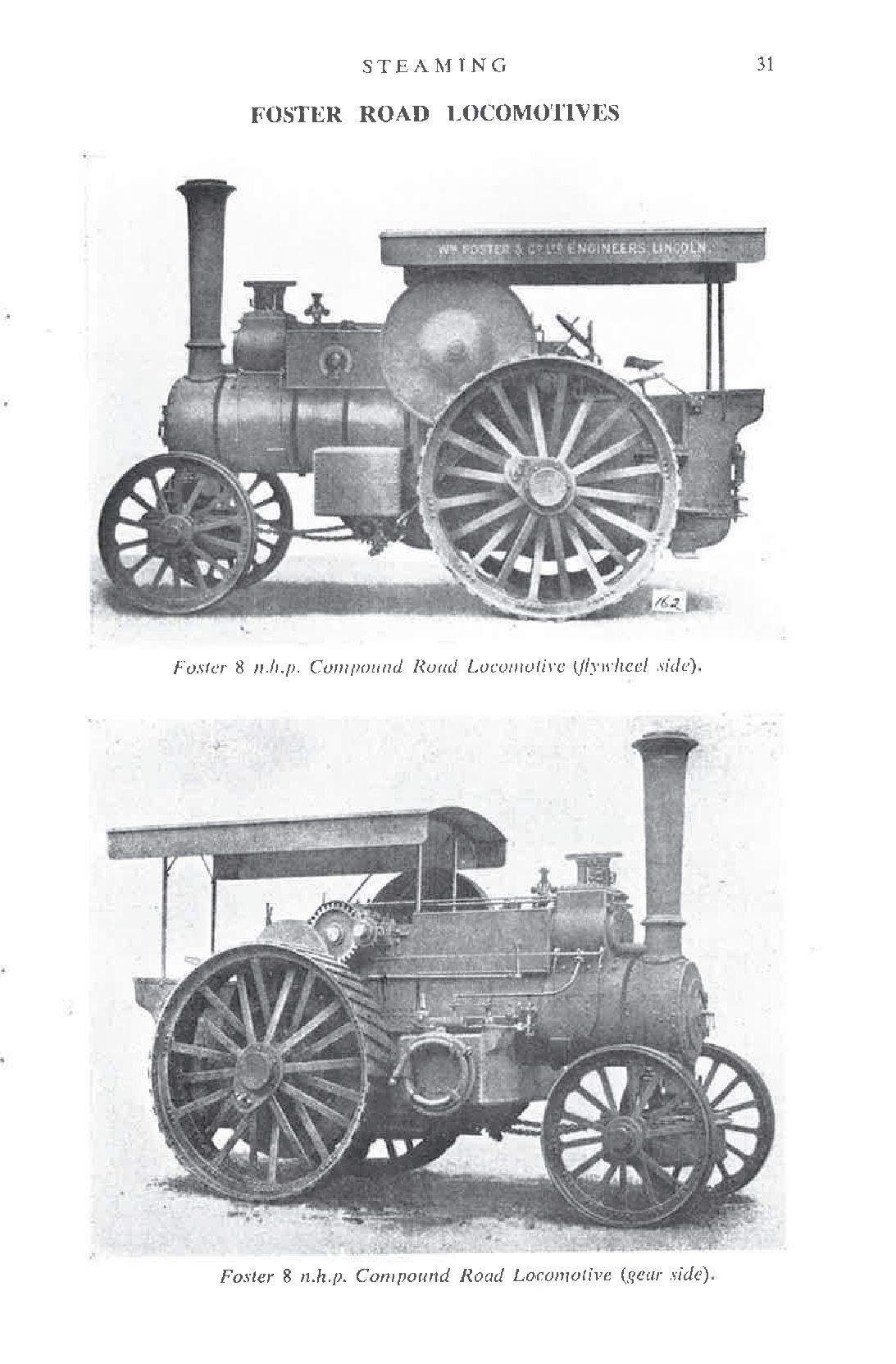
Fu.~fer 8 11./1.p.Cum1101111dRu(l(l Lvcv111vfi1·eVlywhcd side).
Fo.,·ter 8 n.h.p. Compocmd Road Lo,c:omotive (gear side).
Nominal Horse Power
Boiler Pressure
Continuous I.H.P.
Maximum T.H.P. for Short Periods
Diameter of Flywheel
Width of Flywheel ...
Governing Speed, R.P.M.
Belt H.P. with above Flywheel and Speed
Lenglh of Engine
\Vidth of Engine
Height to Top of Flywheel
Height to Top of Chimney
Diameter of Hind Wheels
Width of Hind Wheels
Widest Hind Wheels ...
Diameter of Front Wheels
Width of Front \Vhee!s
Road Speeds on Good Level RoadsSlow Gear ..
Road Speeds on Good Level RoadsFast Gear
Bunker Capacity
Oil Tank when Supplied
Standard Water Capacity
Maximum Water Capacity
tength of Rope on Winding Drum
\1aximum Length of Rope on Winding Drum
Diameter of Rope on \Vinding Drum
Approx. Weight of Engine Empty
Approx. Weight in Working Order
Commercial Load on good level dry roads over inclines not exceeding l in 12
No. of Wa1,?ons Recommended
Weight of Same
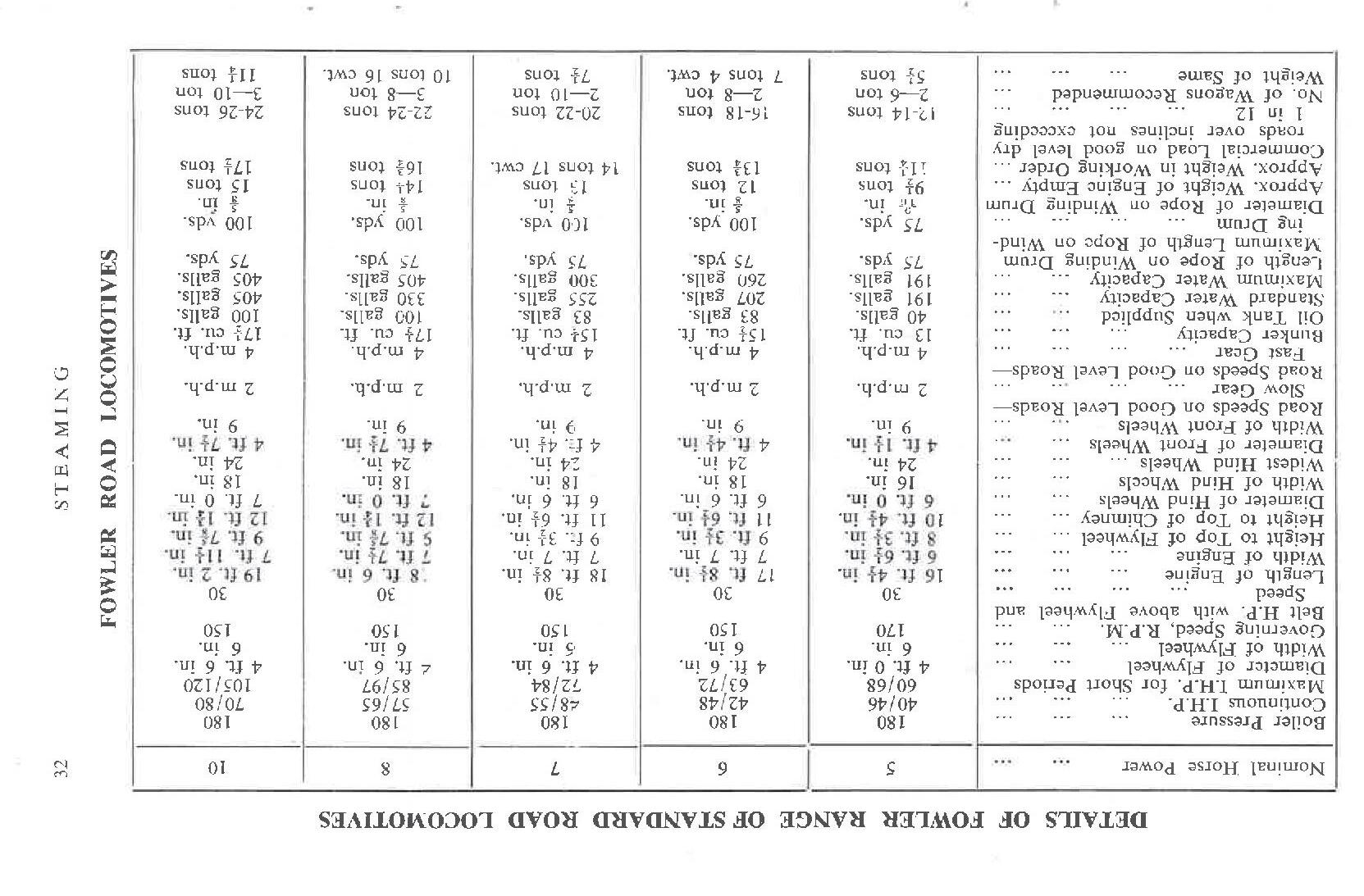
galls. 207 galls. 260 galls. 75 yds. 100 yds. ¾in.
12 tons 13¾ tons 16-18 tons 2-8 ton 7 tons 4 cwt.
7 180 t..8/55 ,2/84
4 ft. 6 in. ,5 in. 150
J8 ft. 8½ in.
7 ft. 7 in.
9 f:. 3l in. 11 ft. 61-in.
6 ft. 6 in.
[ 8 in. ~4 in.
4 f:. 4½ in. '! in.
2 m.p.h. 4 m.p.h. 15f cu. ft.
83 galls. 255 galls. 300 galls. 75 yds.
tC-0 vds.
¾ in.
l tons l4 tons t7 cwt.
20-22 tons 2-10 ton 7{-tons
ft 6 in. 7 fL 7-½in. 5 fl. 7¾ in.
12 fr:. H· in.
7 ft. 0 in. 18 in. 24 in. 4 ft. 71' in, 9 in . 2 m.p.h. 4 rn.p.h. 17·} cu. ft. 100 galls. 330 galls. 405 galls. 75 yds. 100 yds.
5 • • 1n.
4 ft. 6 in. 6 in. 150 30
19 'fl. 2 in.
7 ft. 11t iin.
9 ft. 7¾ in.
12 ft. Hin. 7 ft. 0 in_ 18 in. 24 in. 4 ft. 7½ in. 9 in. 2 m.p.h. 4 m.p.h. 17J cu. ft. 100 galls. 405 galls. 405 ga11s. 75 yds. 100 vds. s .• :i' m.
I 5 tons
17½ tons 24-26 tons 3-10 ton
11¾ tons
J4-~ tons 16¾ tons 22-24 tons 3-8 ton t O tons 16 cwt. 10 180 70/80 105/120
...
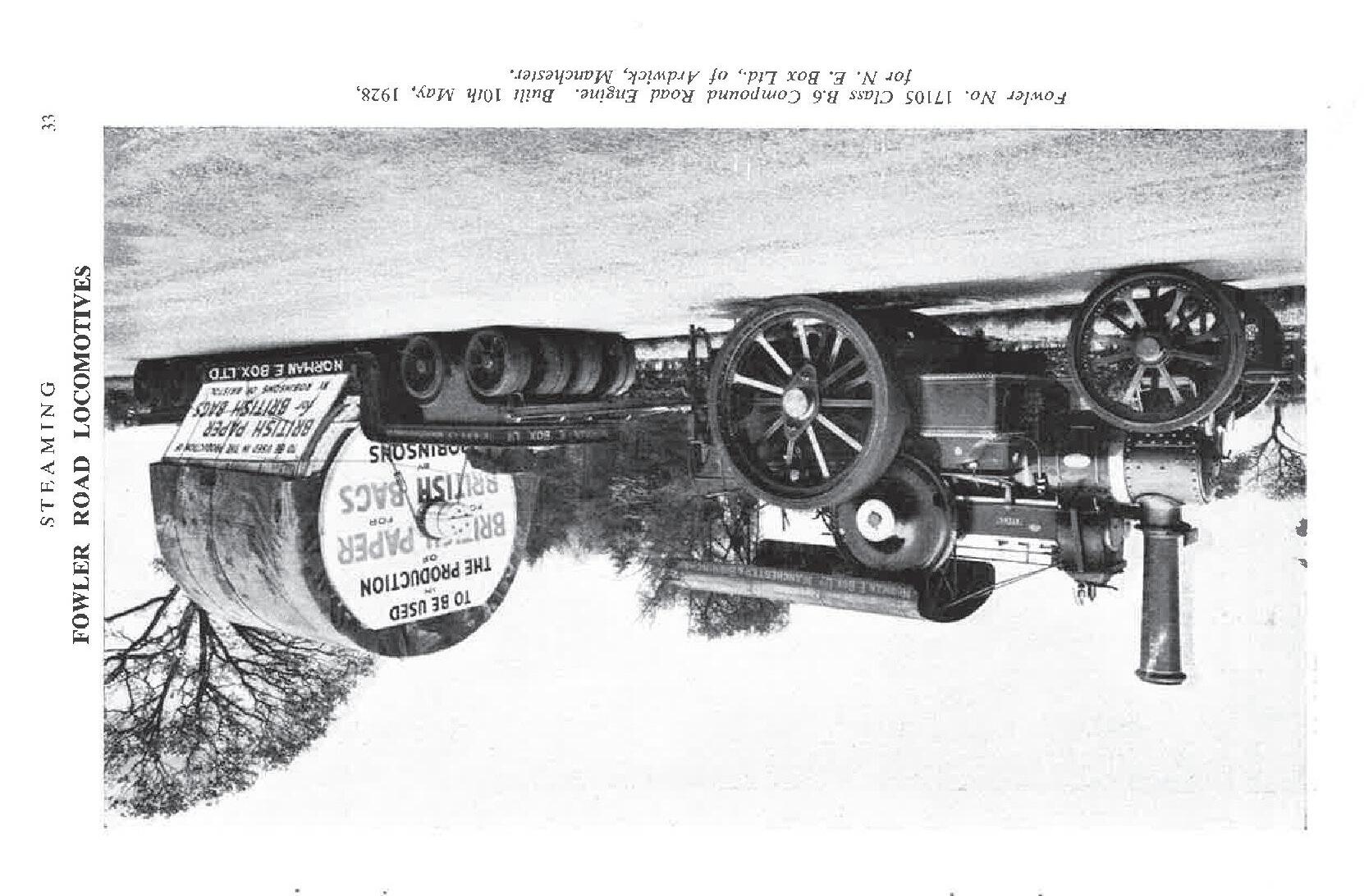
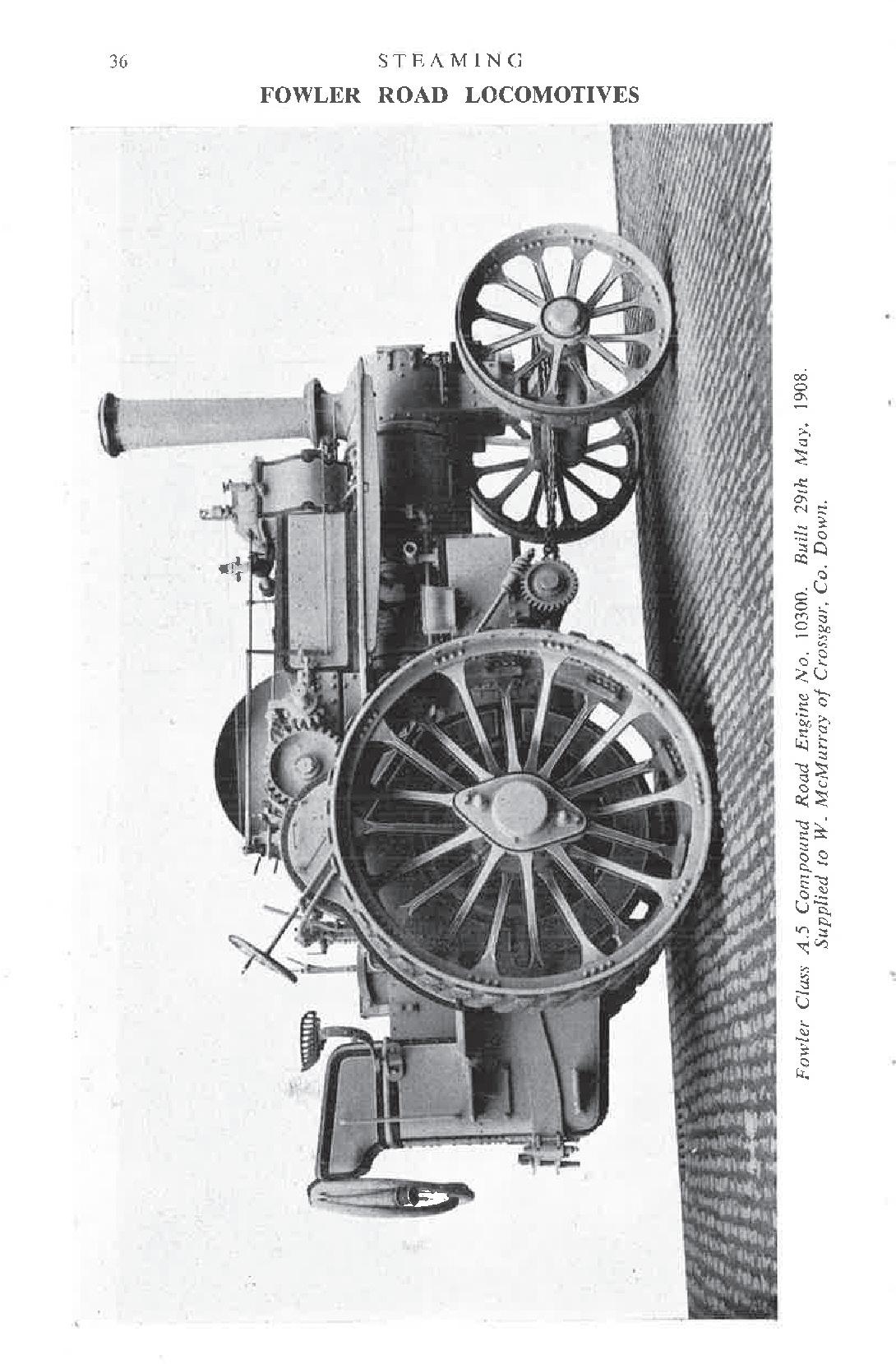
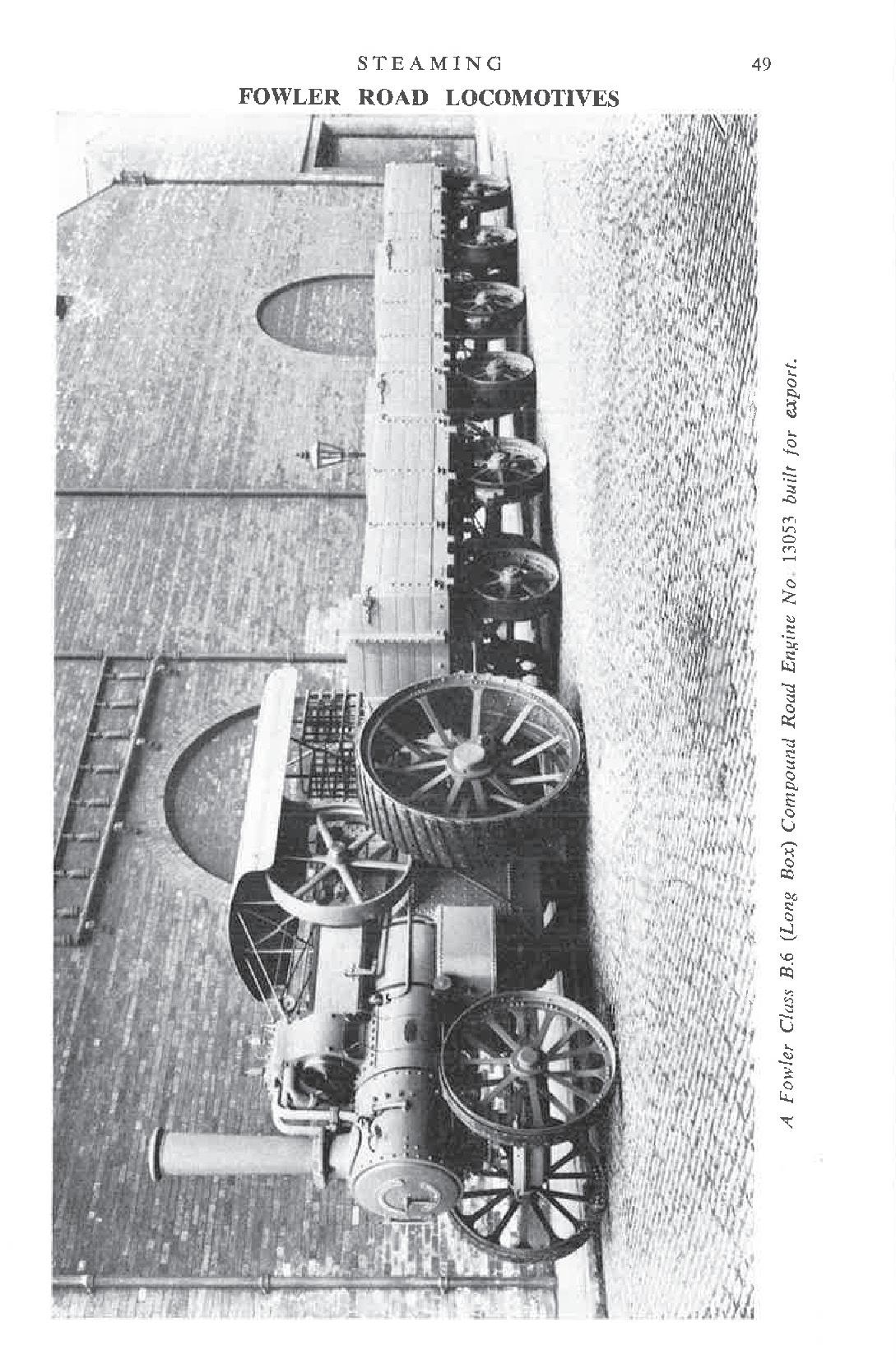
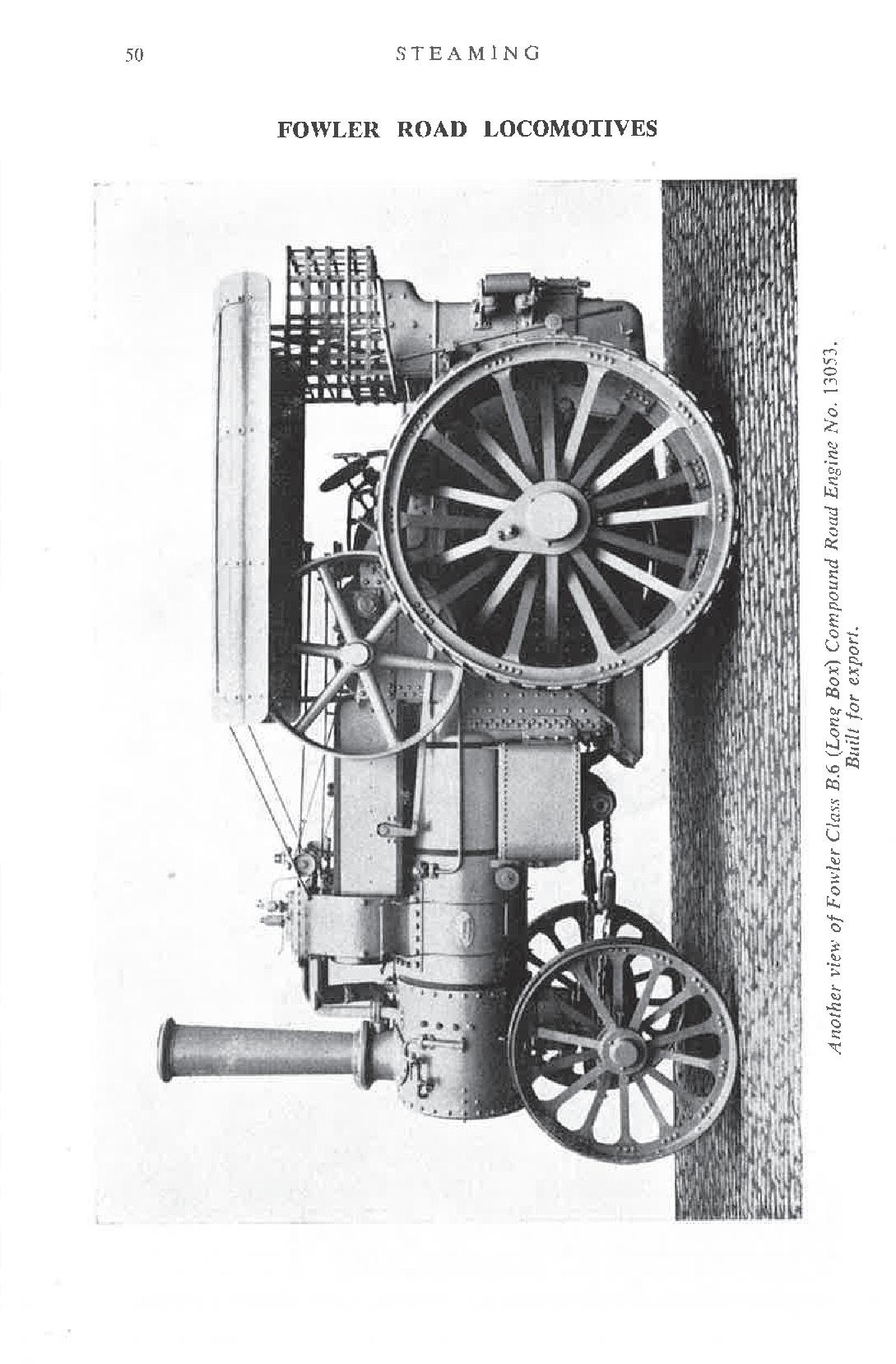
Fowkr No, 17105 Class B.6 Compound R.oad Engine, Bui// 10th May, 1928, for N. E. Box Ltd., of Ardwick, Manchester.
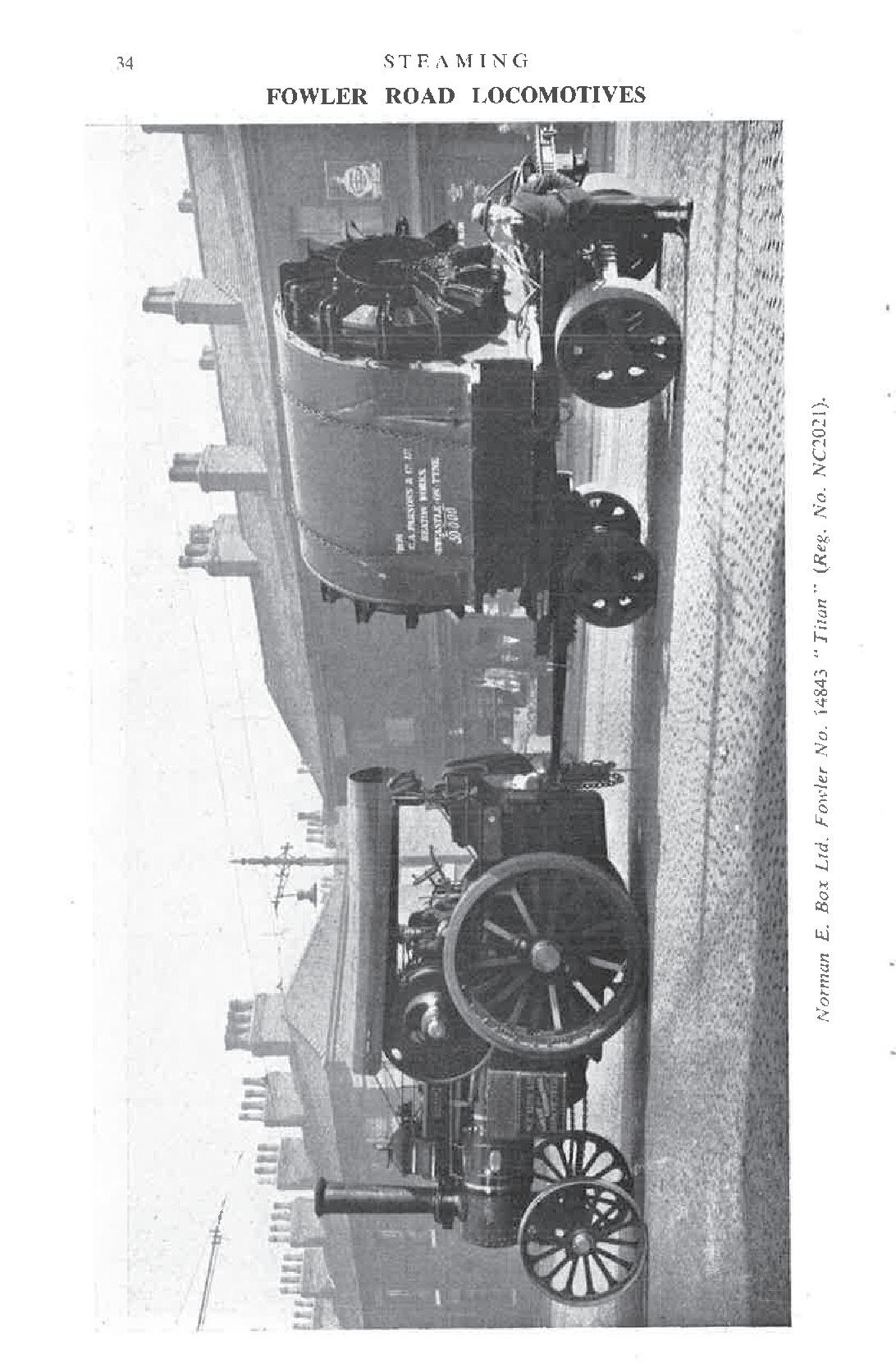
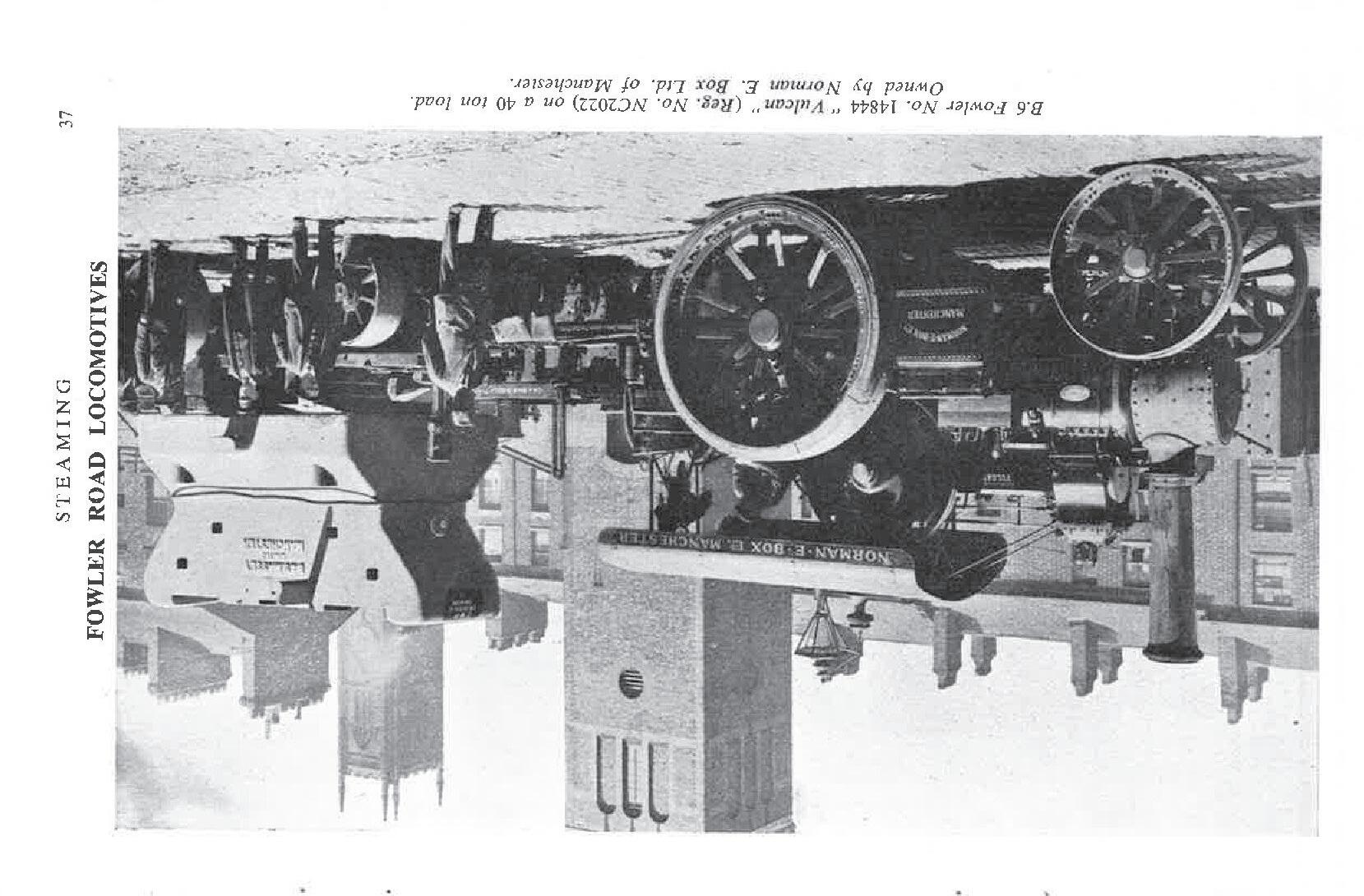
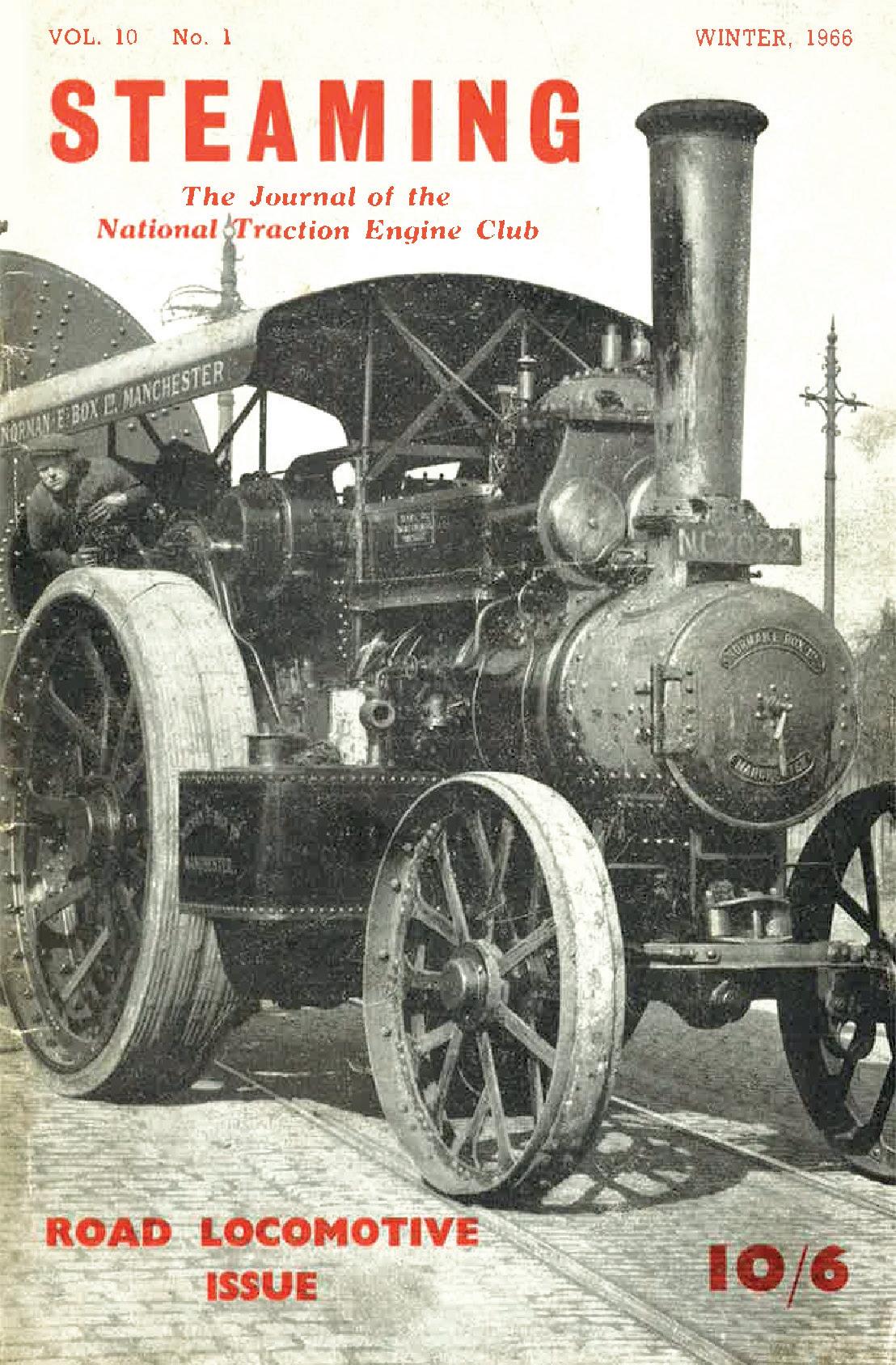
B.6 Fowler No. 14844 ''Vulcan" (Reg. No. NC2022) on a 40 ton load. Owned by Nomu111 E. Bo.,: Ltd. of Mancheszer.
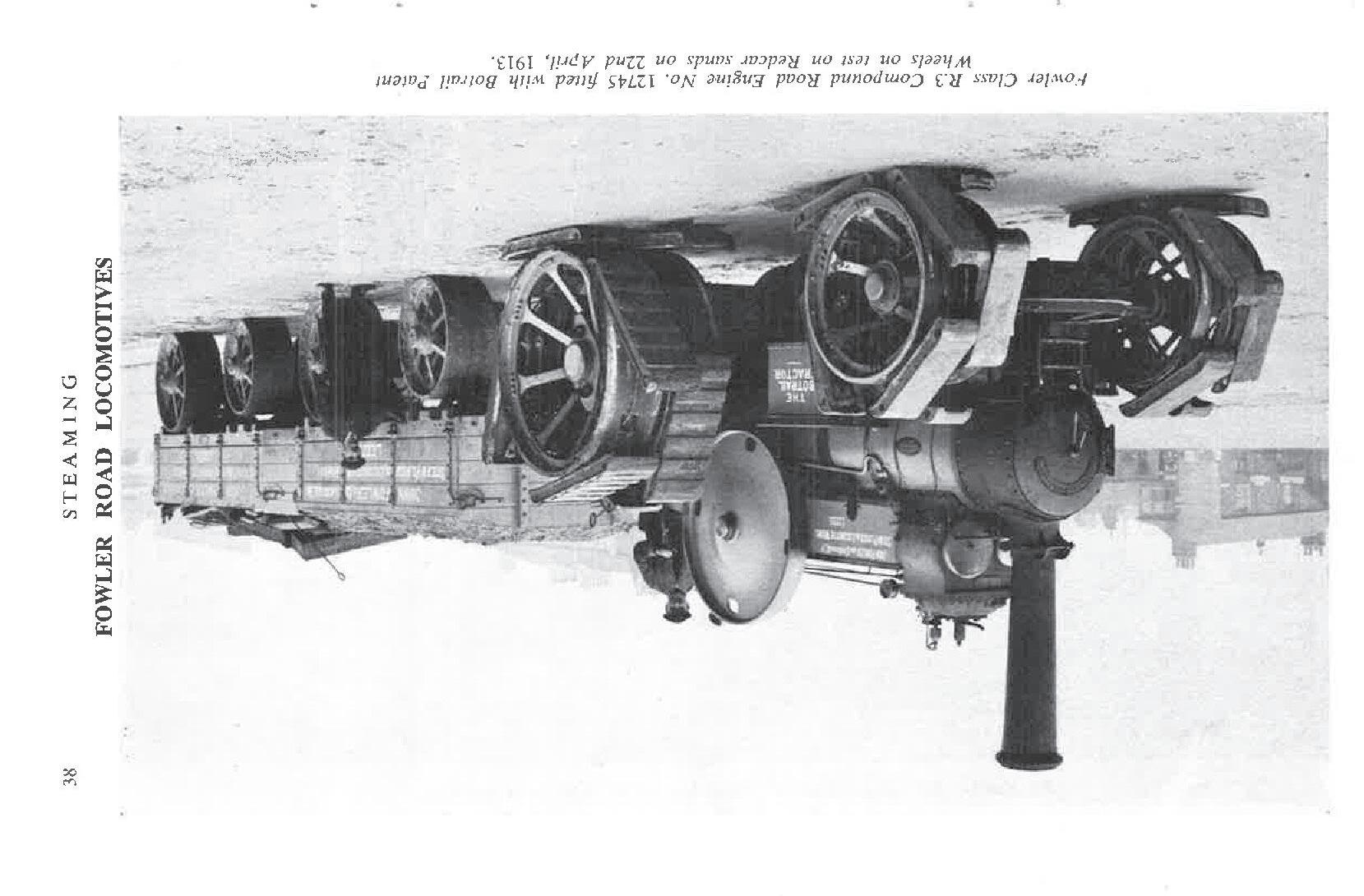
l-'0t1,•/erClass R.3 Compound Road Engin•e No. 12745 fitted wilh Botrail Patent Wheels on test on Redcar sands on 22nd A;wil, 1913.
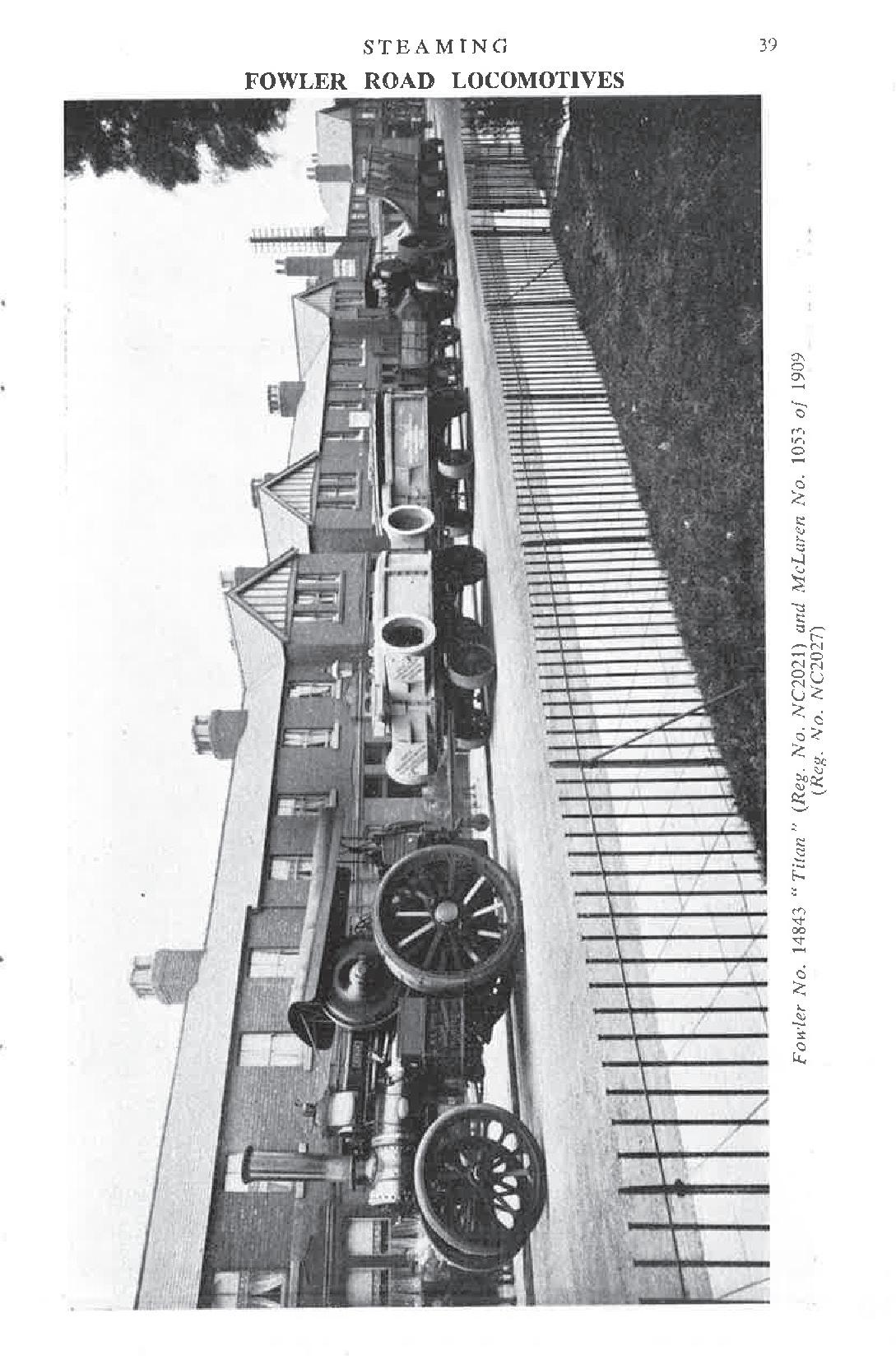
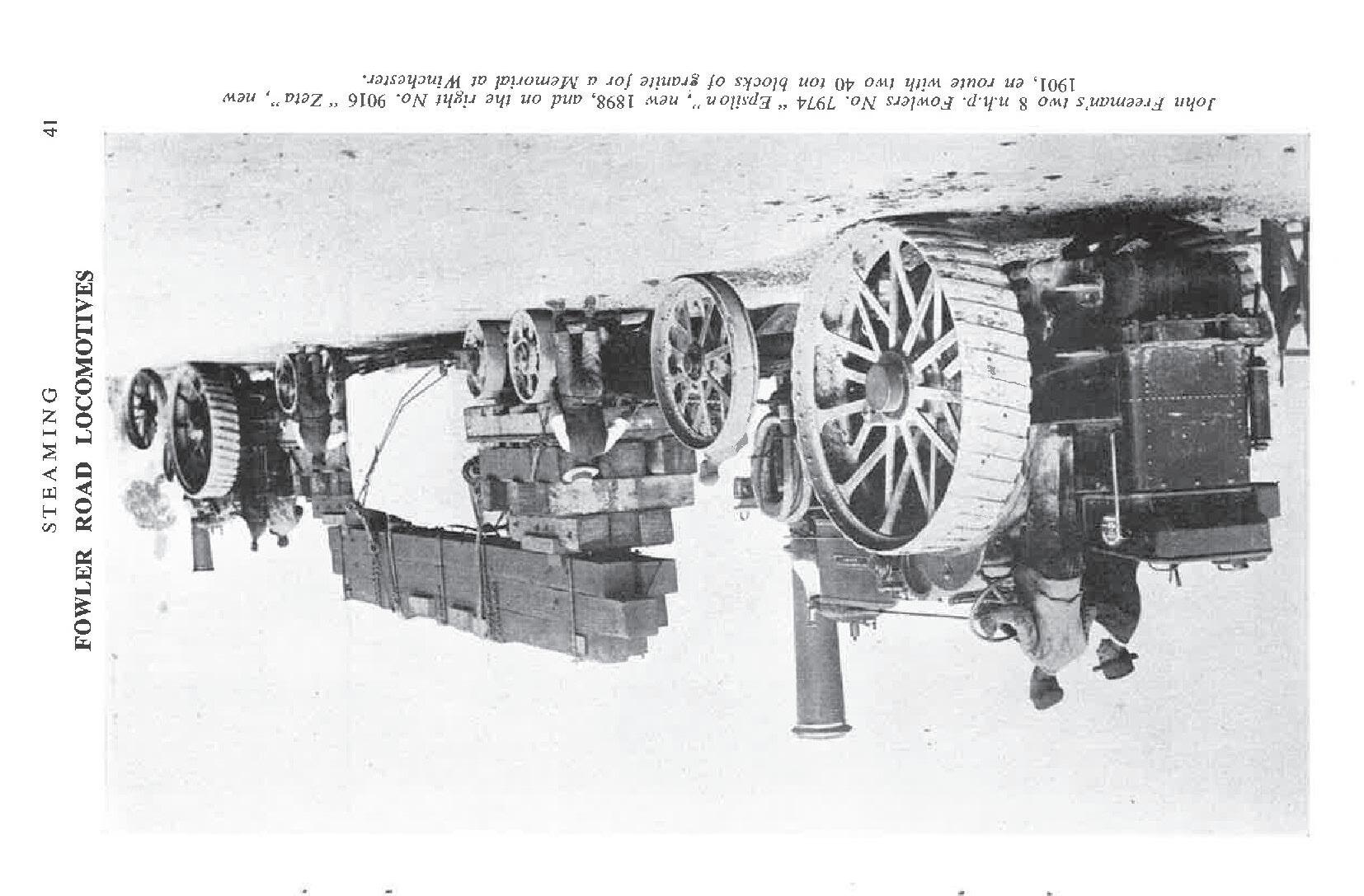
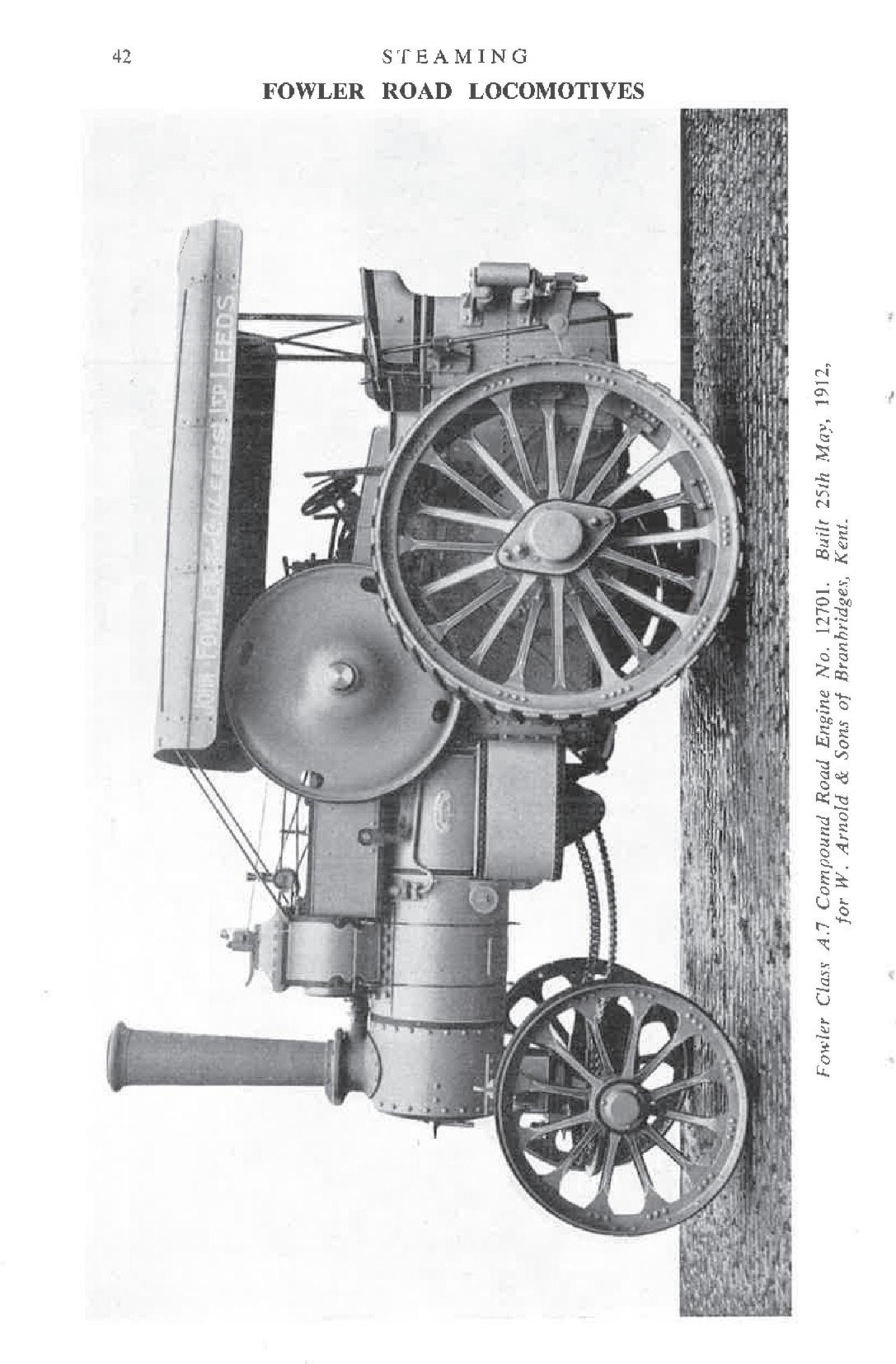
Johll Freeman's two 8 n.h.p. Fowlers No. 7974 "Epsilon", new 1898. and on the right No. 9016 "Zeta", new 1901, en route with two 40 ton blocks of granite for a ,Memorial at Winchester.
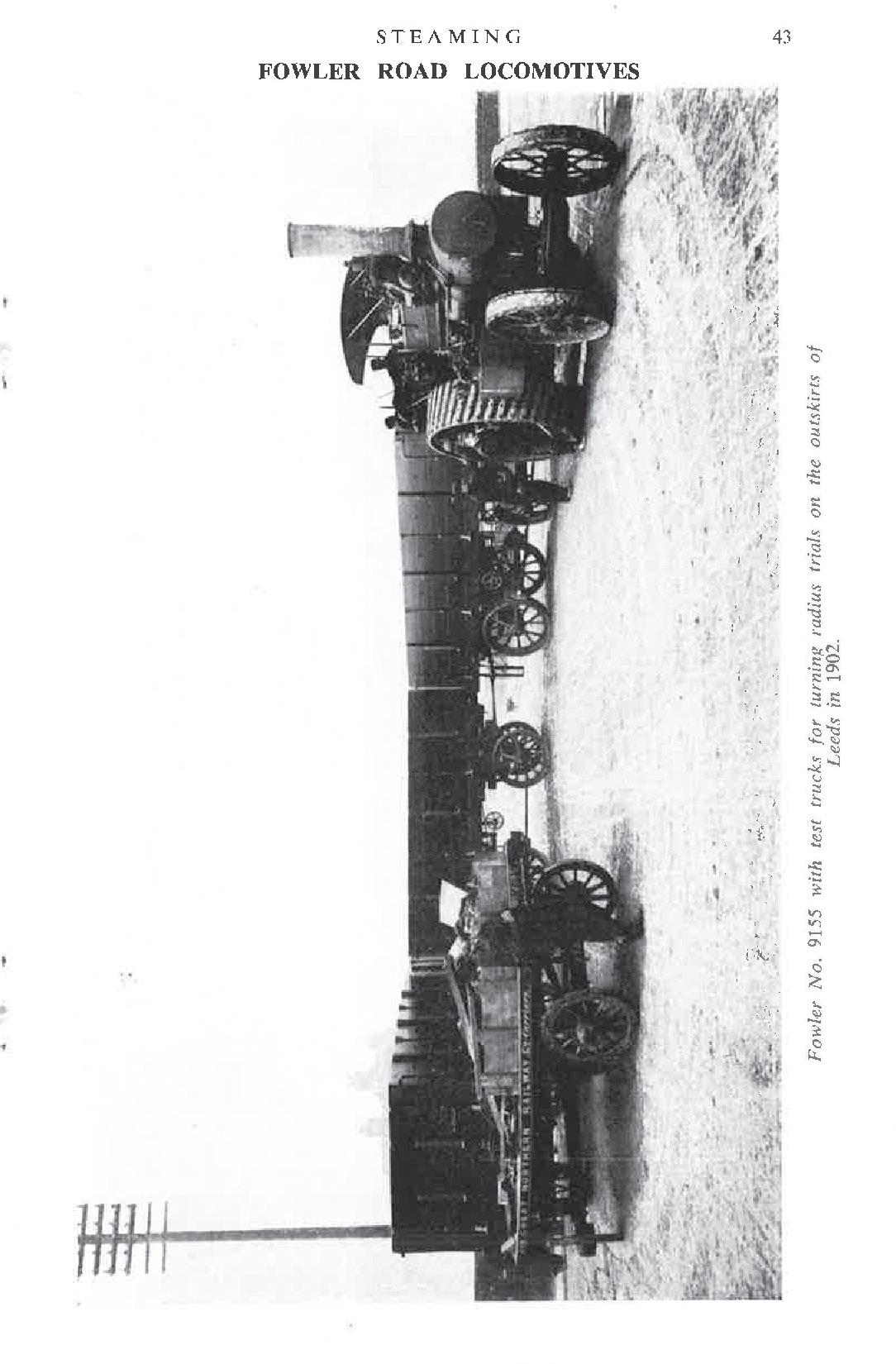
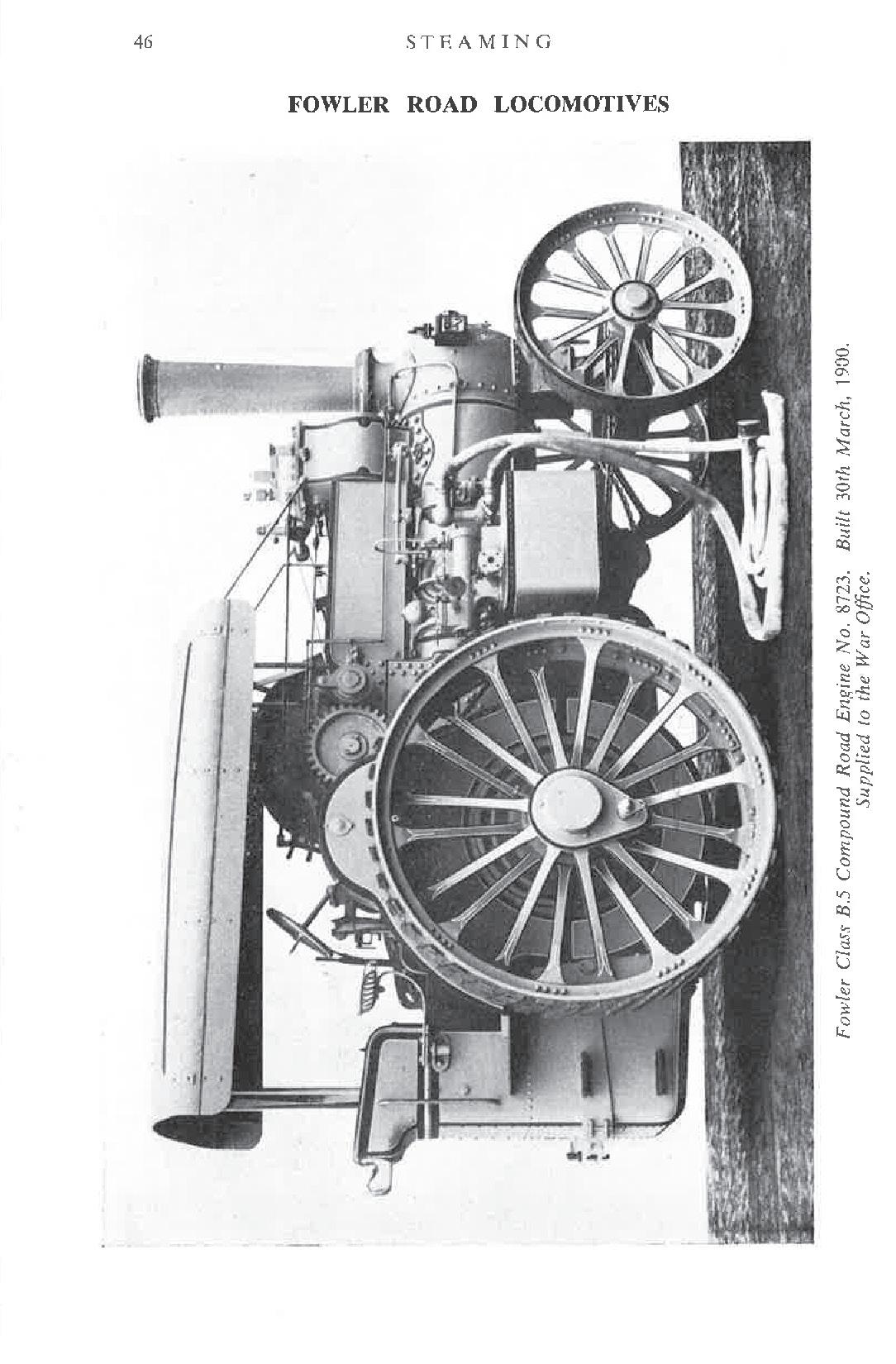
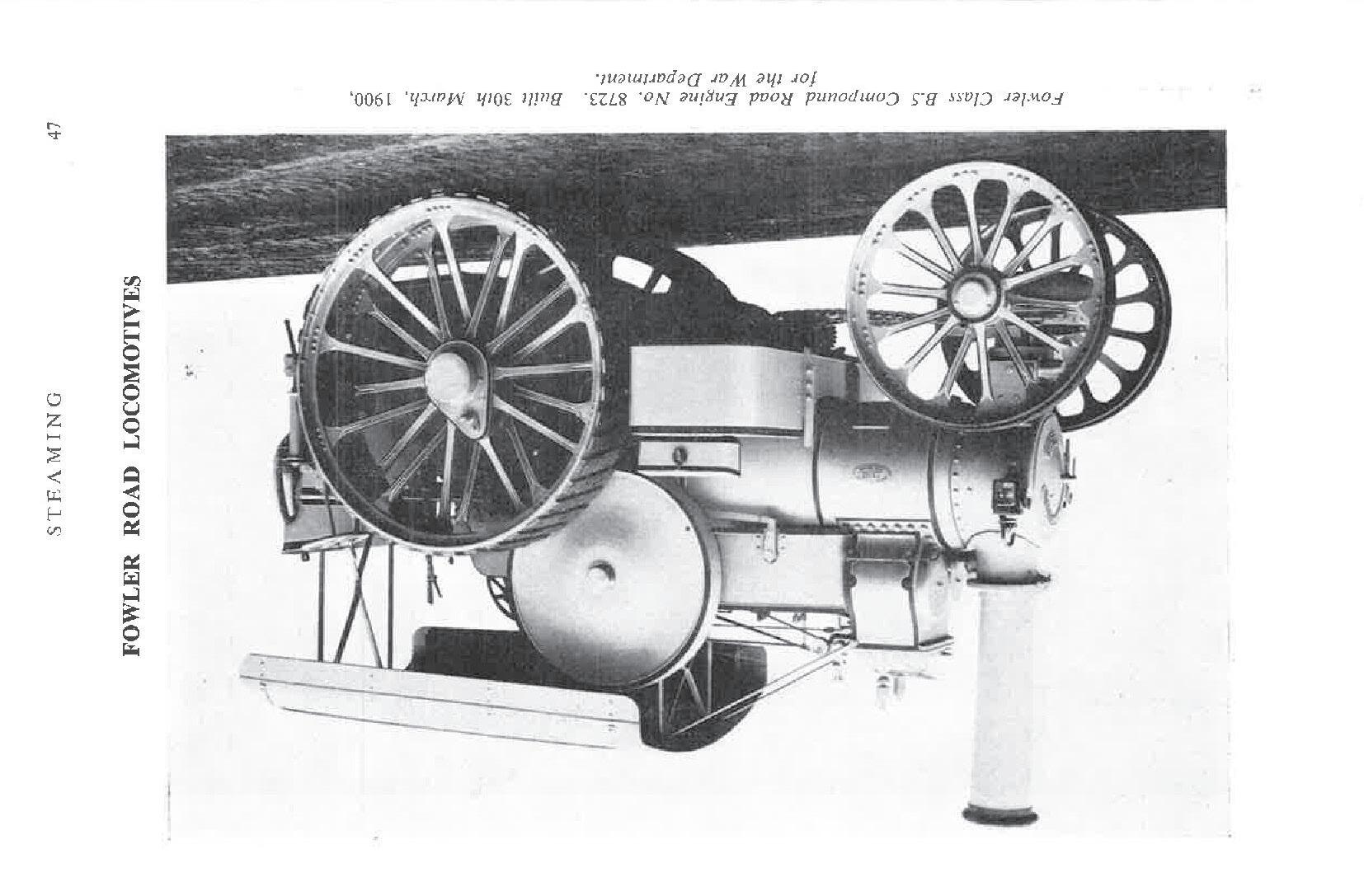
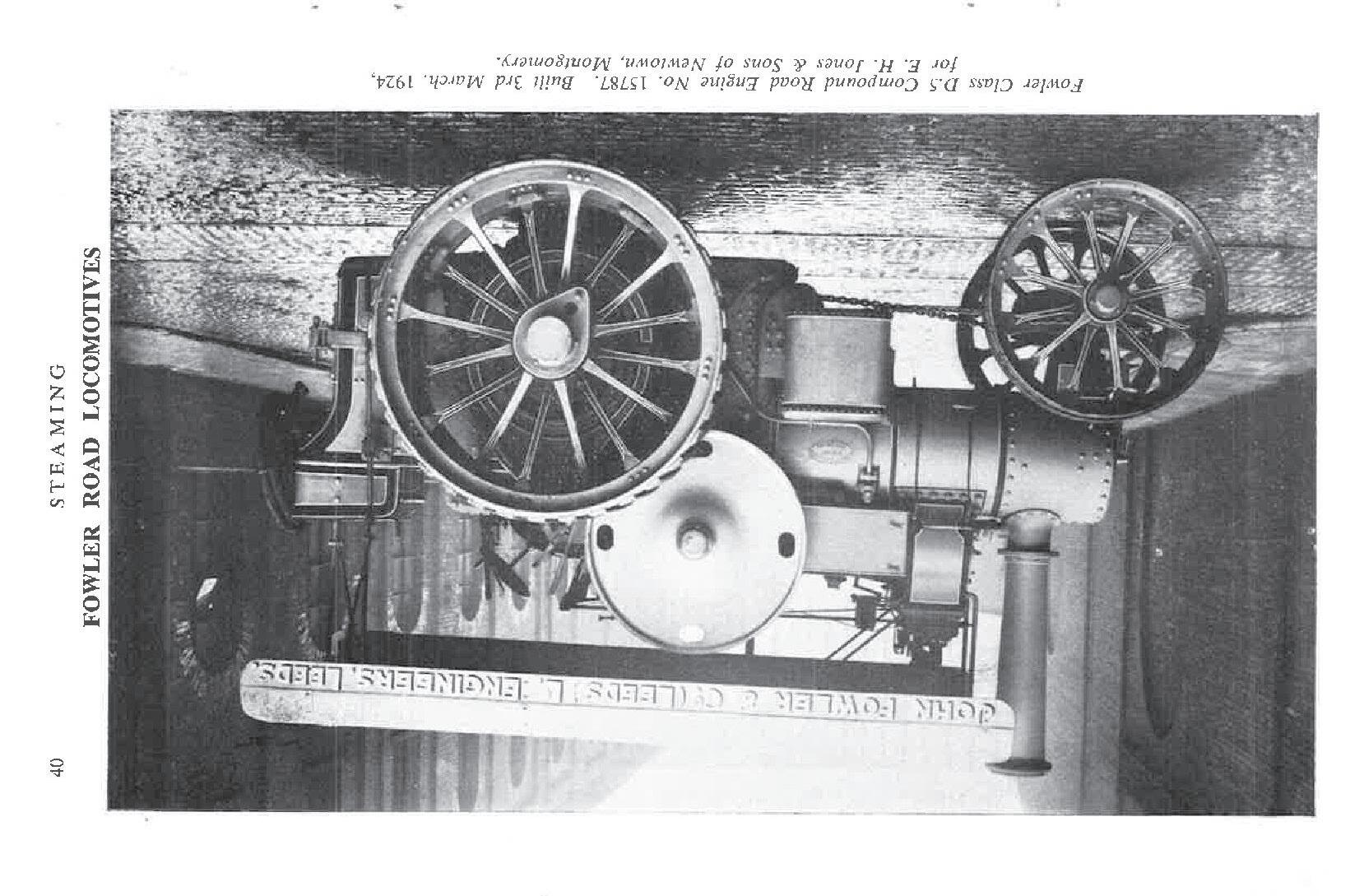
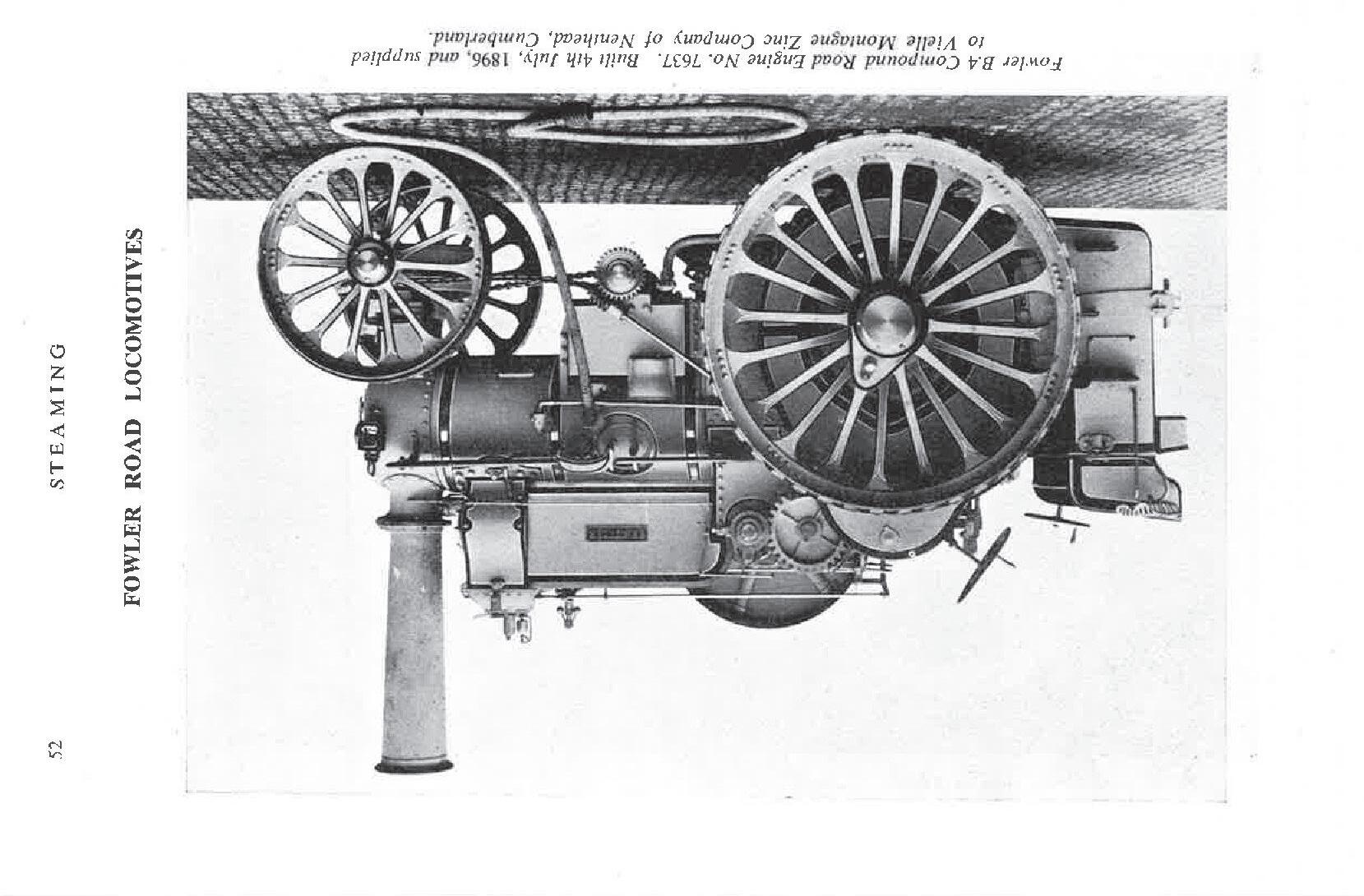
FoYt·Jer Clas.,· B.5 Compound Road En1<itze No. 8723. Built 30th .March. 1900, for the War Department.
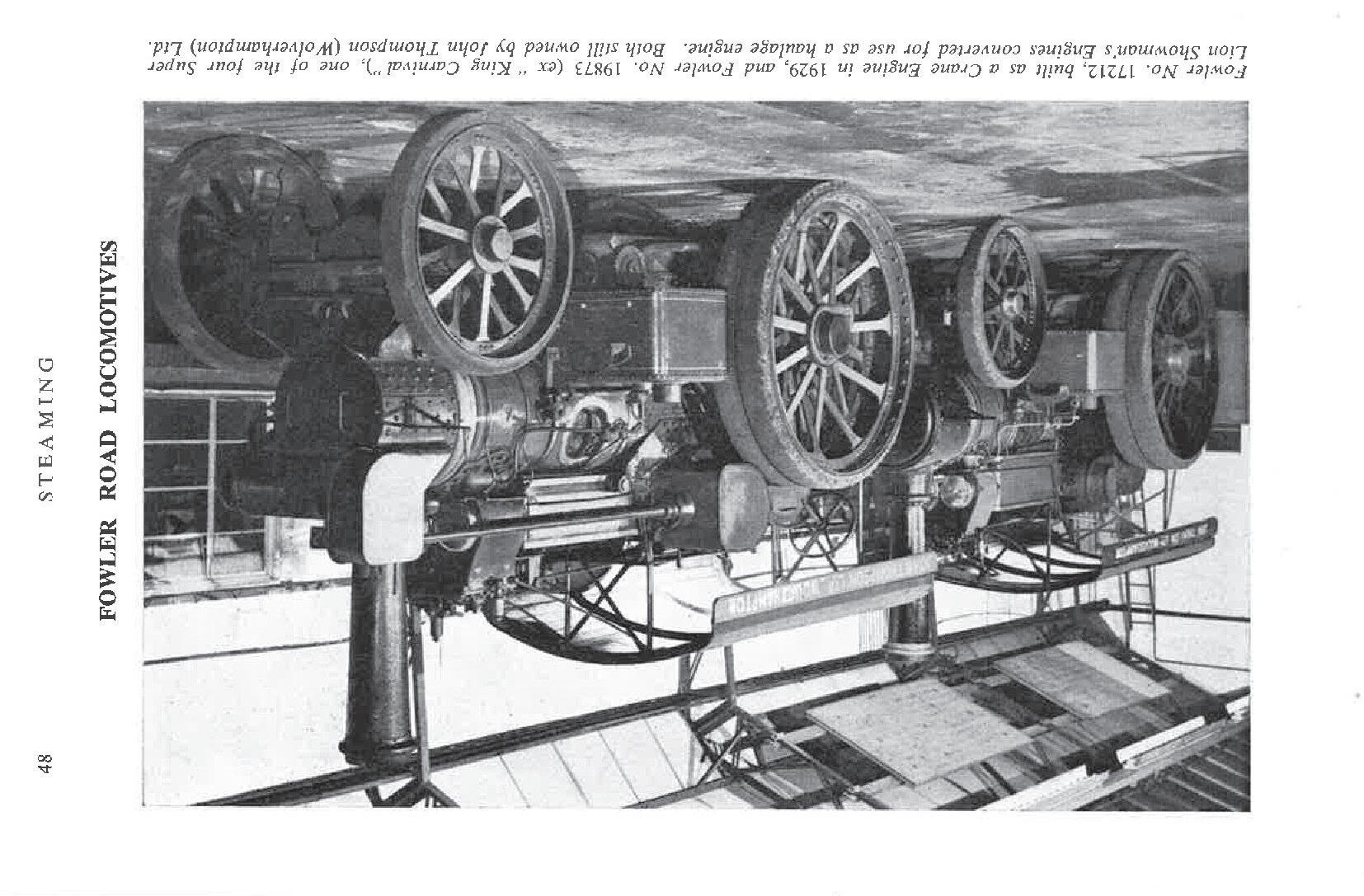
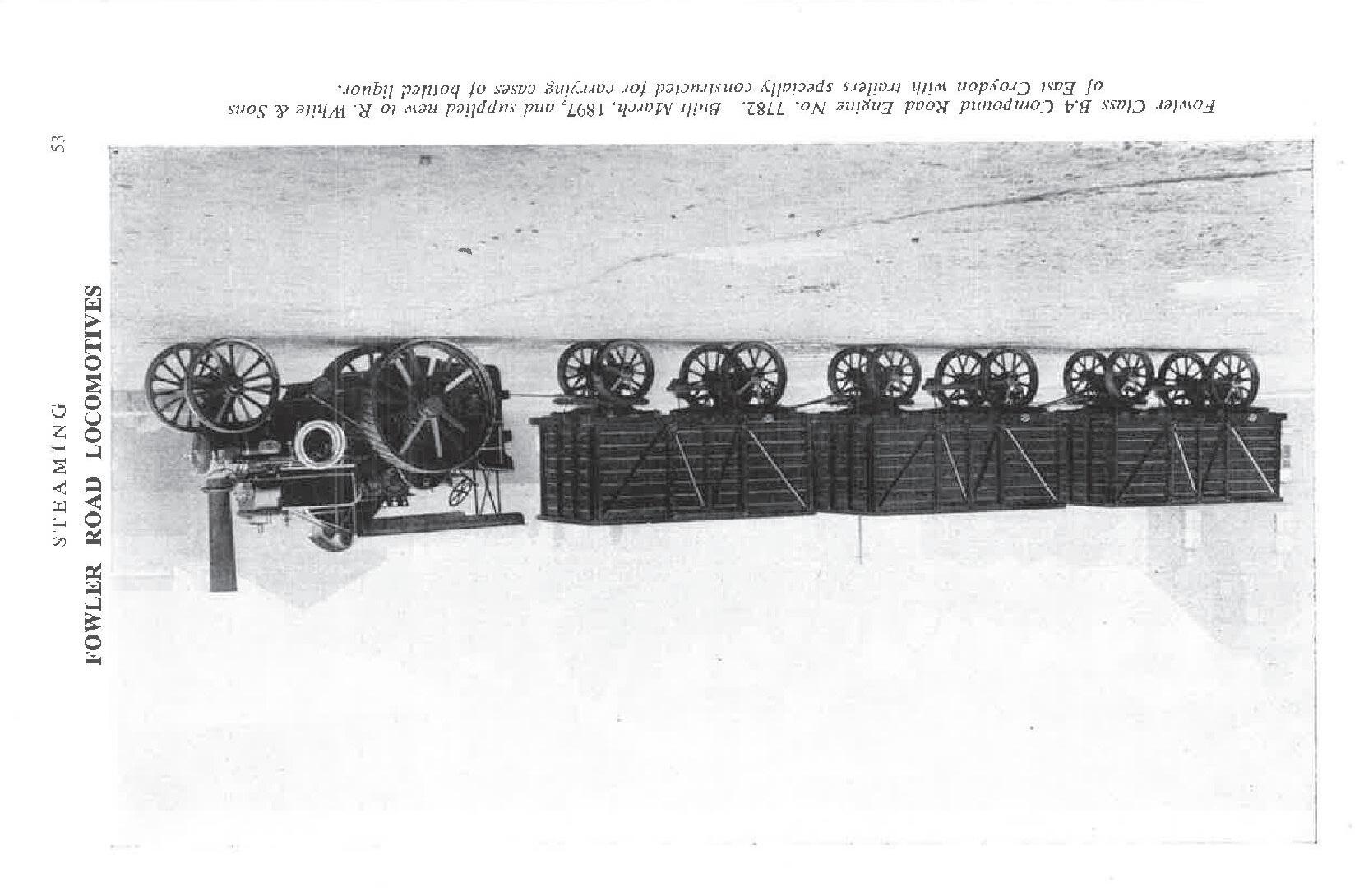
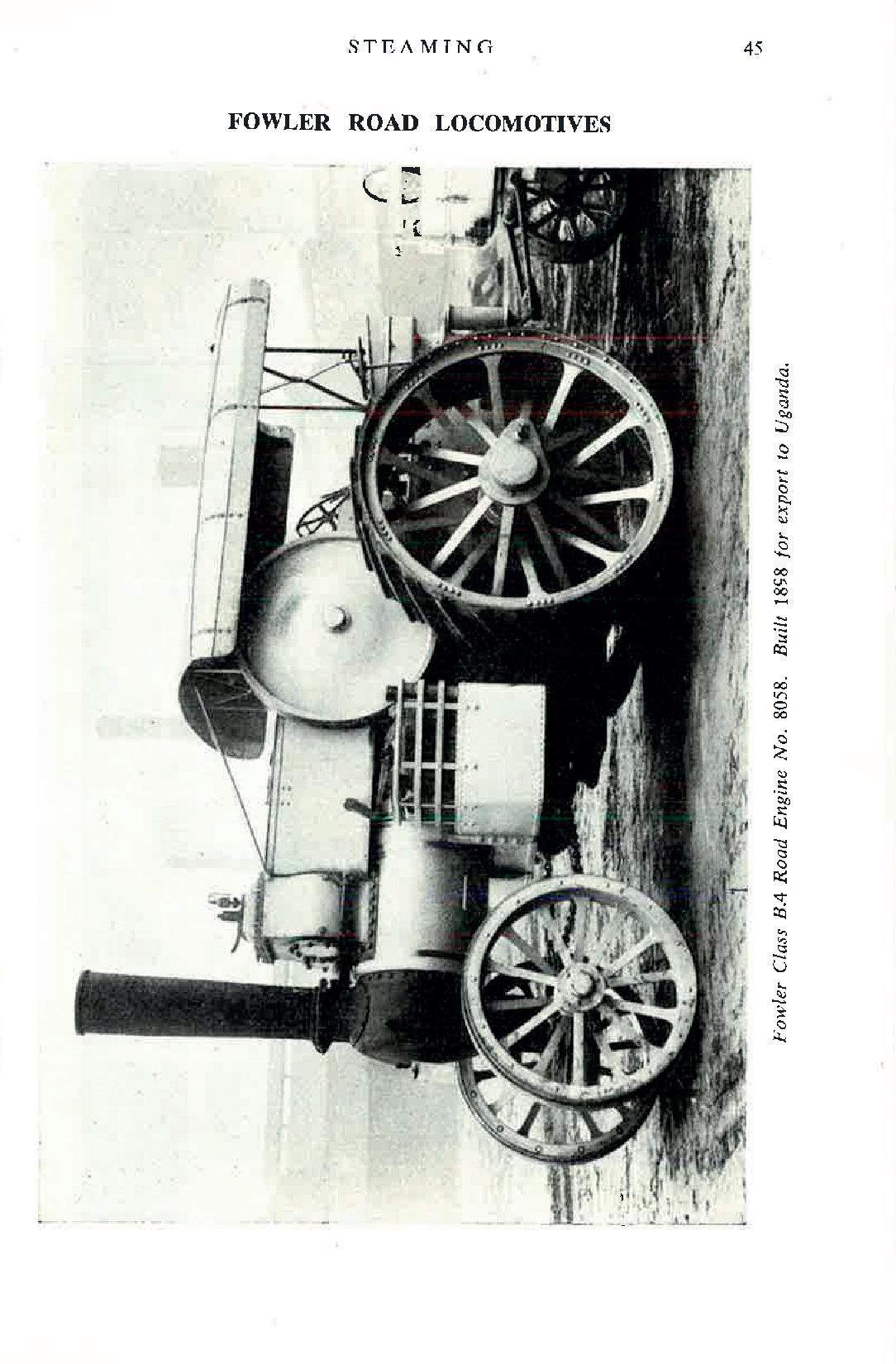
Fowler Class B.4 Compound Road En~in~ Nu. 7782. Built A1arch. l 897, and .1upplied new lo R. White & Sons of East Croydon with trailers specially constructed for carr:;ing cases of boaJec.! liquor.
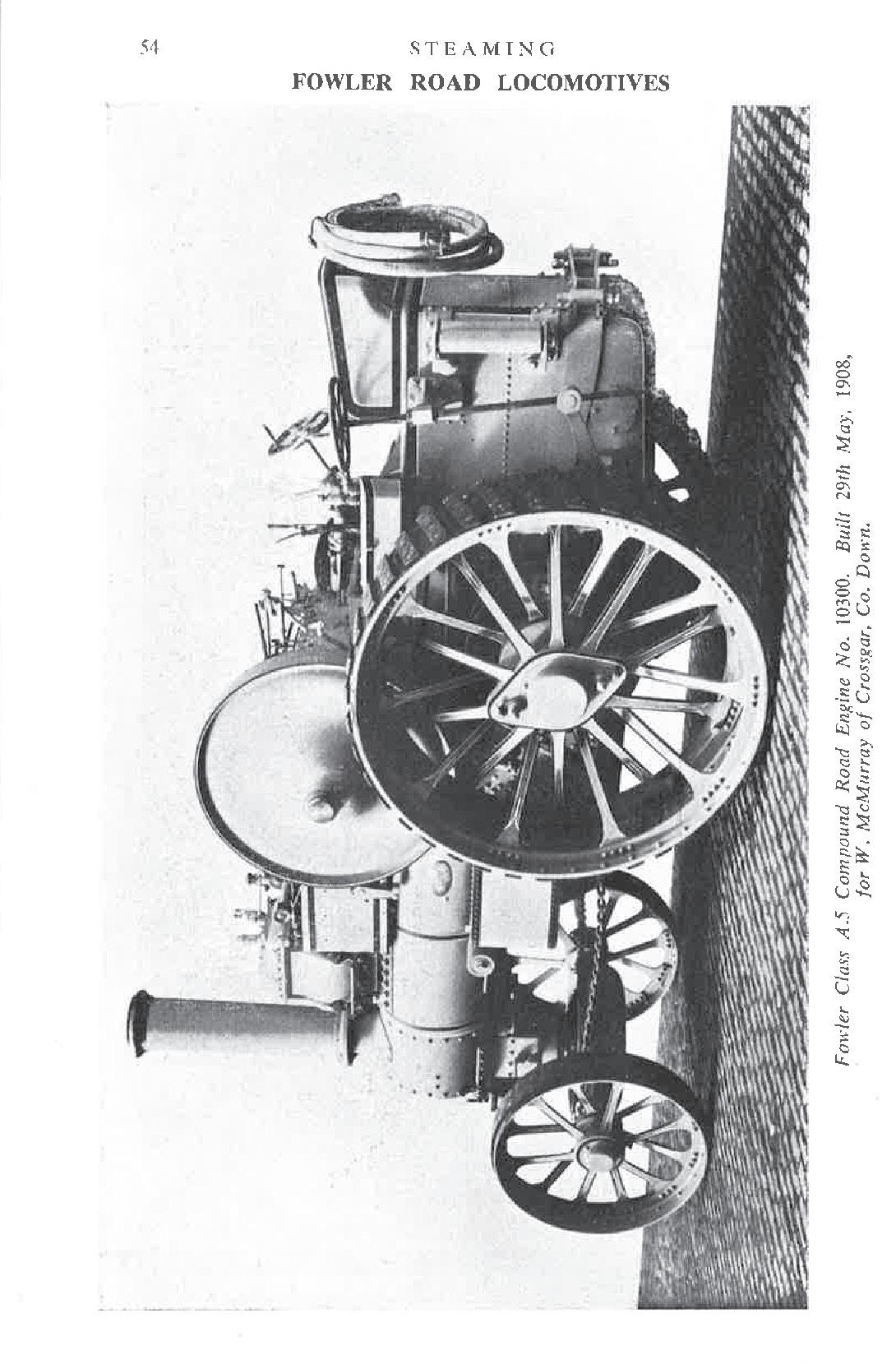
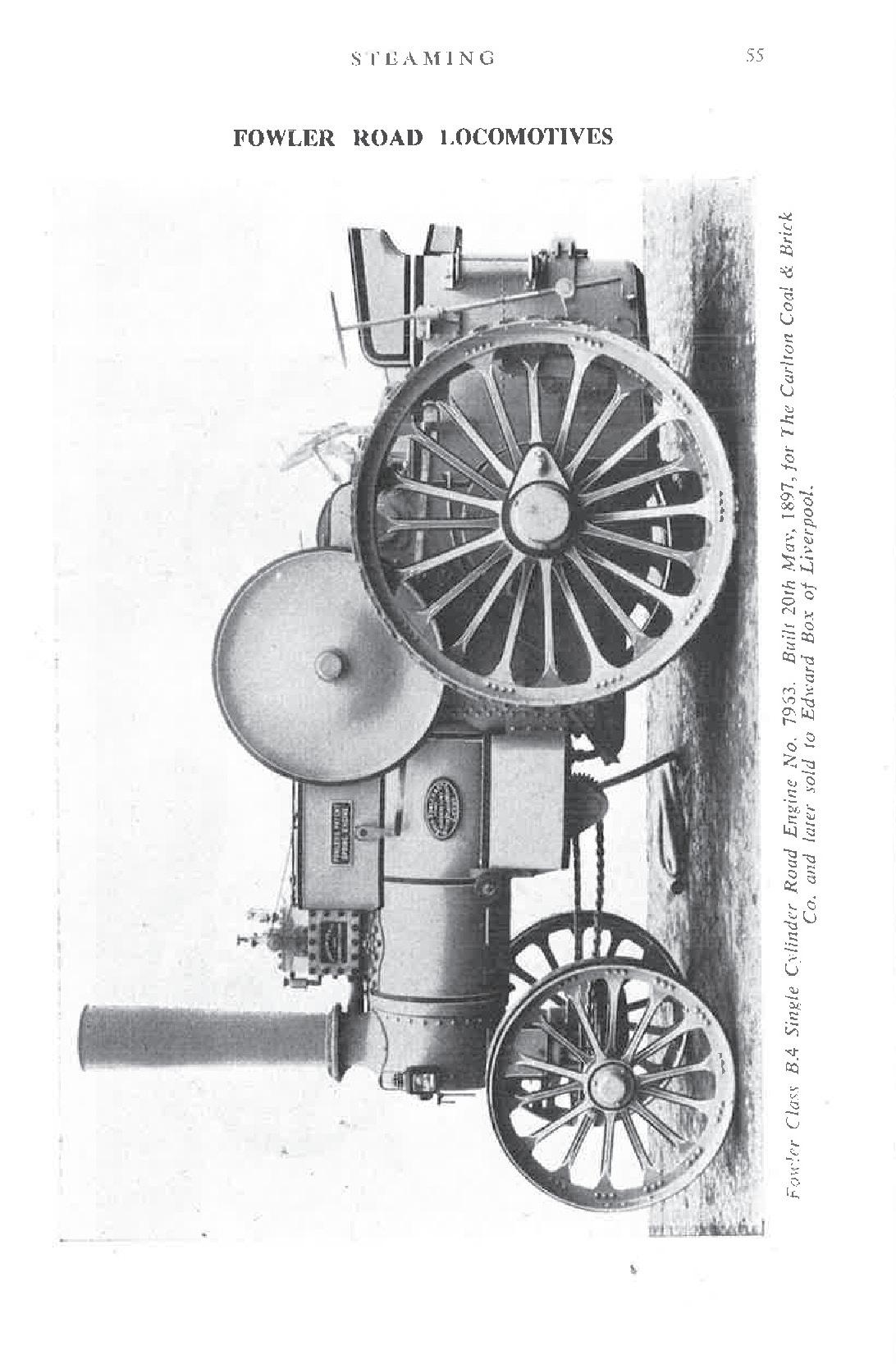
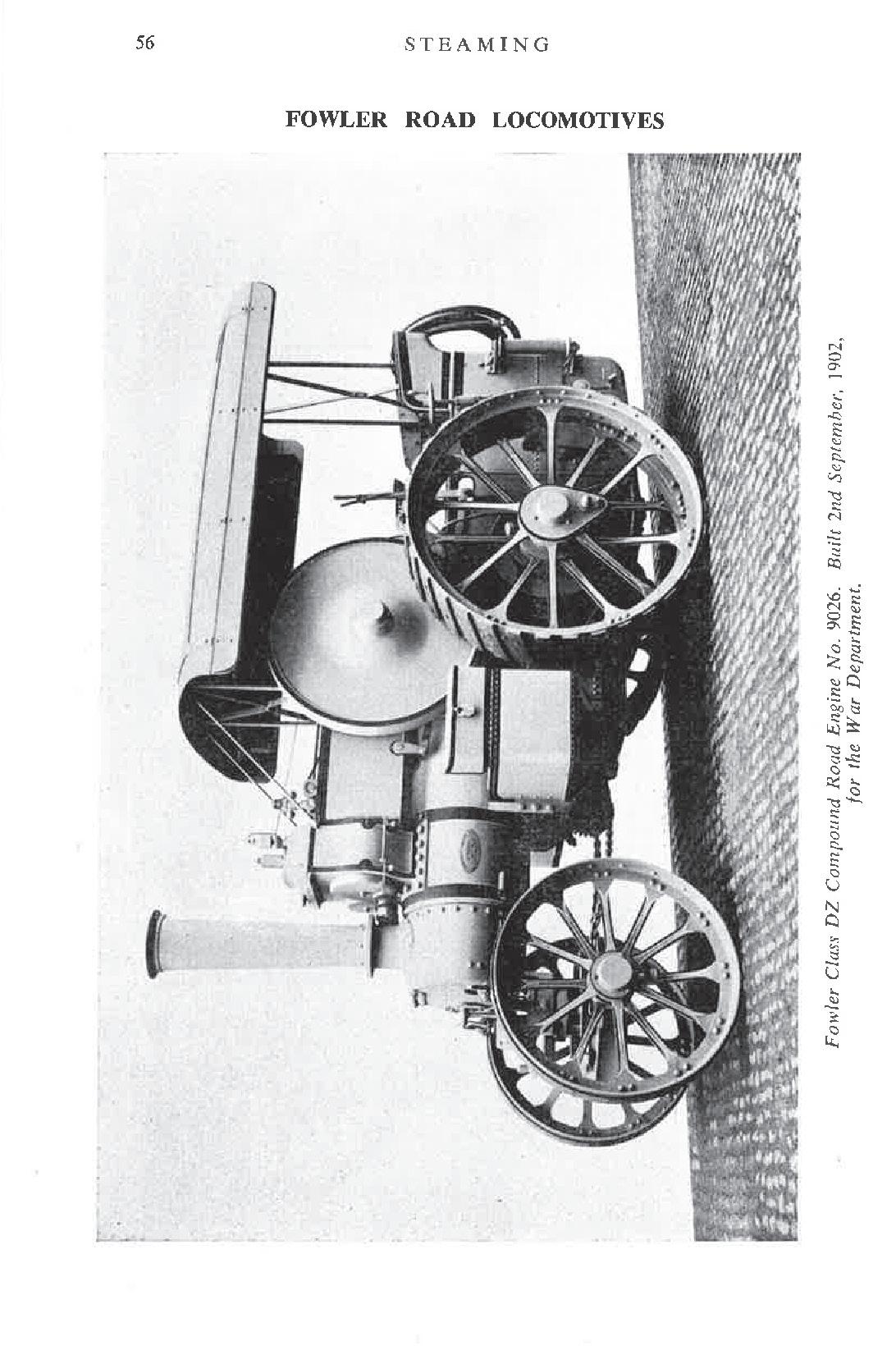
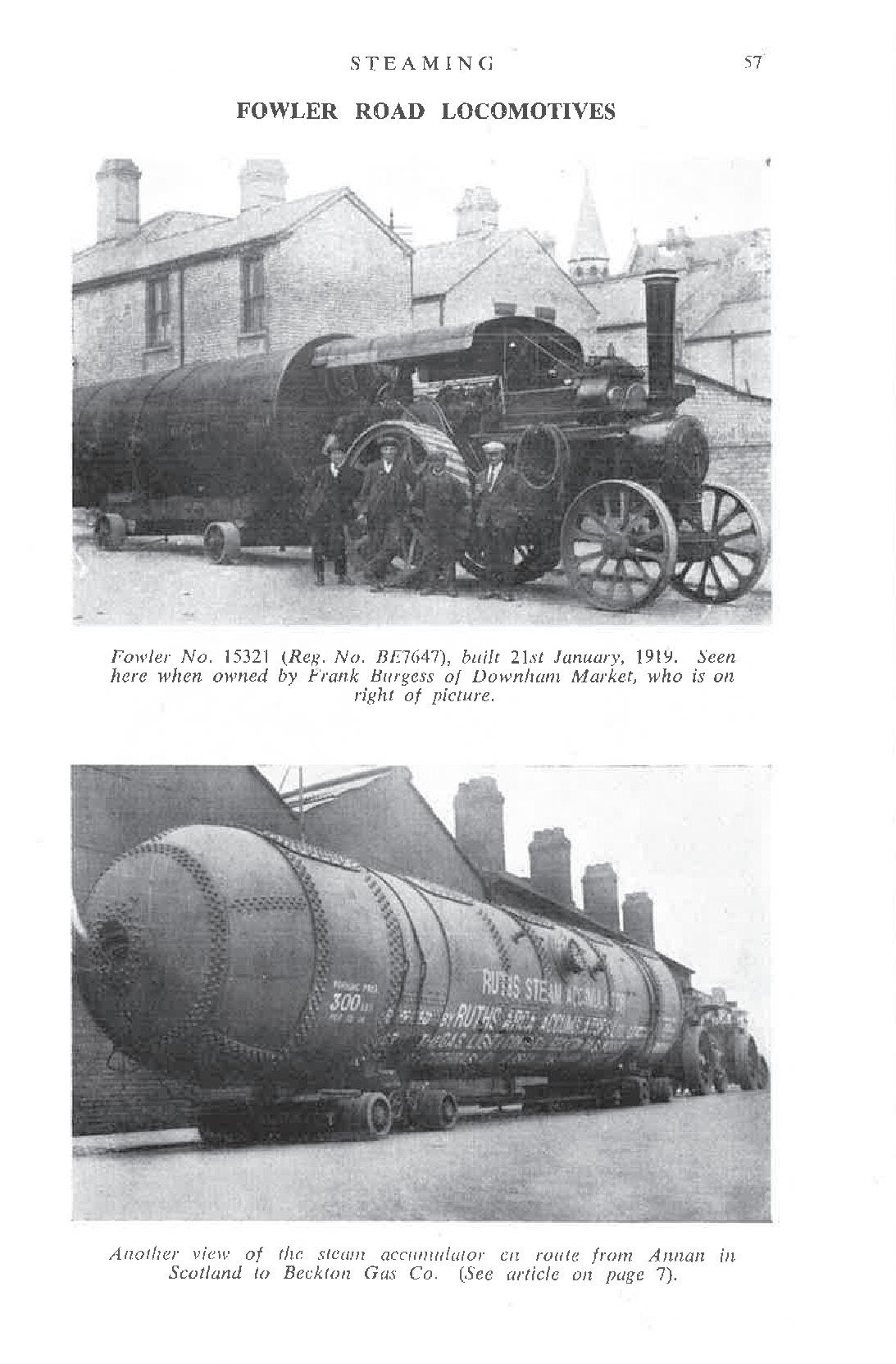
Fowler No. l 5321 (Re,t. No. BE7647), built 21st January, 1919. ~een here when owned by Frank Burgess of Downlwm Market, who is on right of picture.
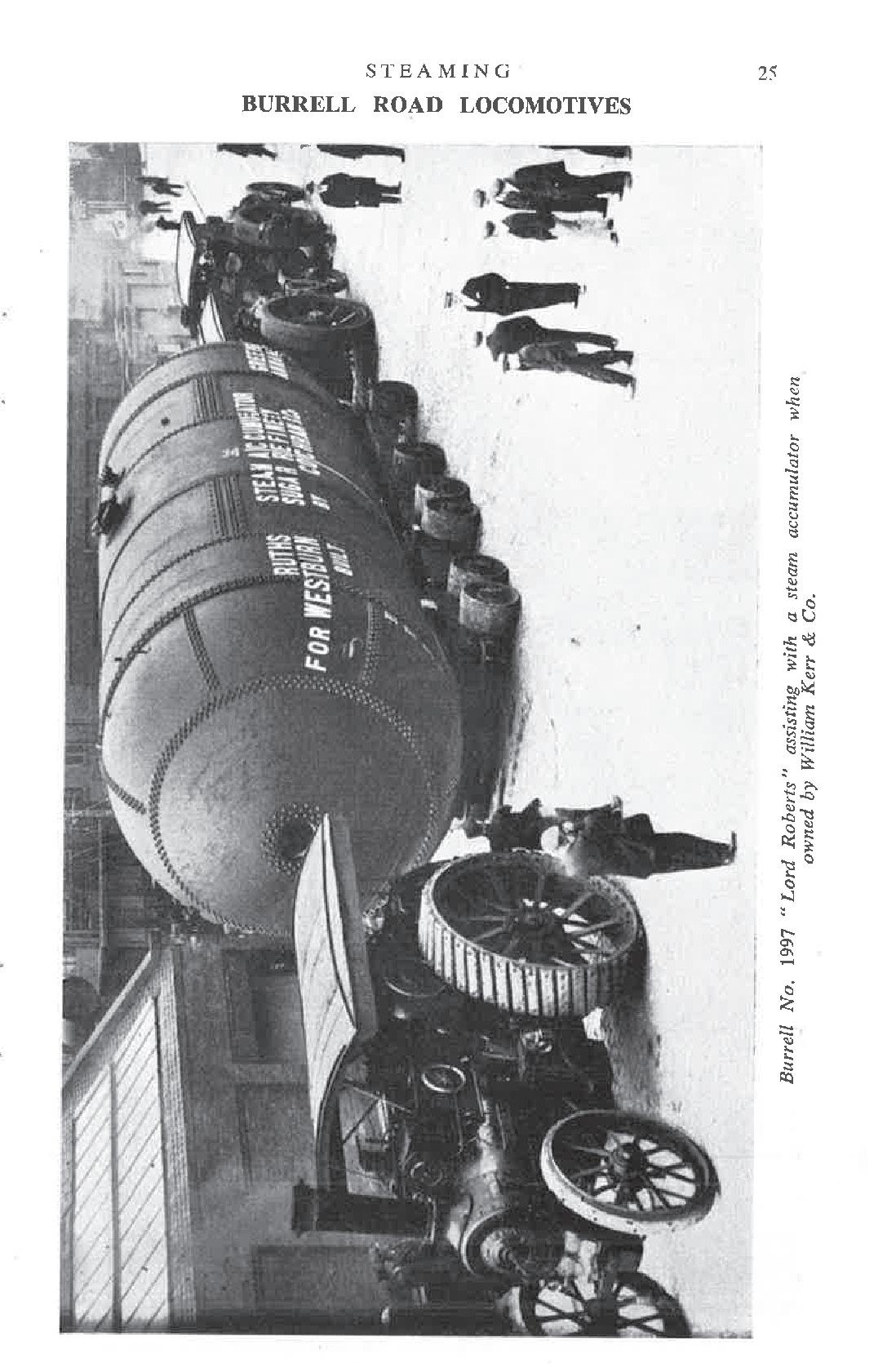
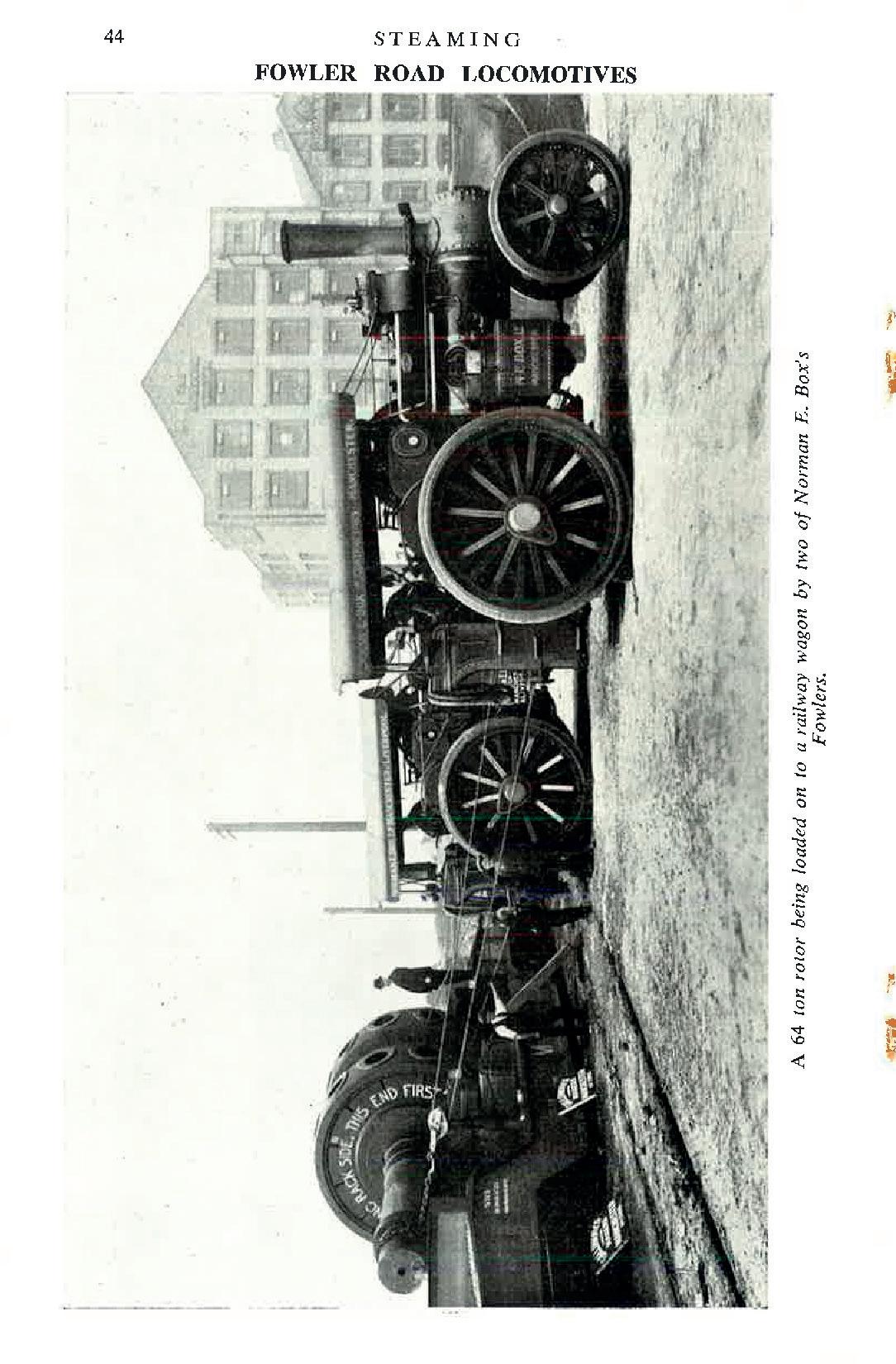
Aoother view of rh.r. steam acc111Hula1or Cll route from Annan in Scotland to Beckron Gas Co. (See article on page 7).
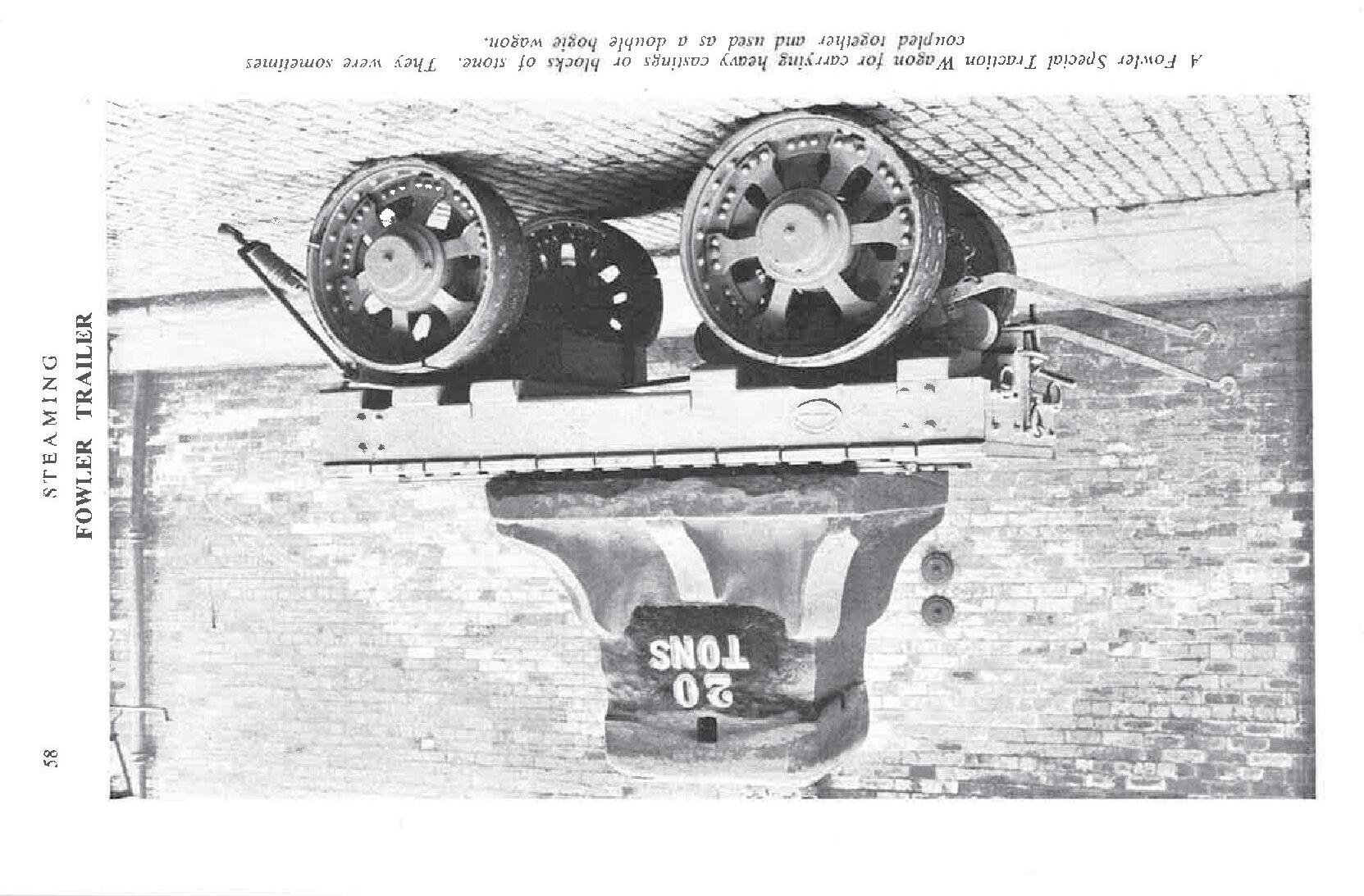
A Foll'/er S('ecial Traction Wa!ron for carryiug heavy ca.1·tinr:s or hlock.f of .'itone. They were sometimes coupli!d ro.~ether mrd U'icd as a douhle boieie waf?Oll.
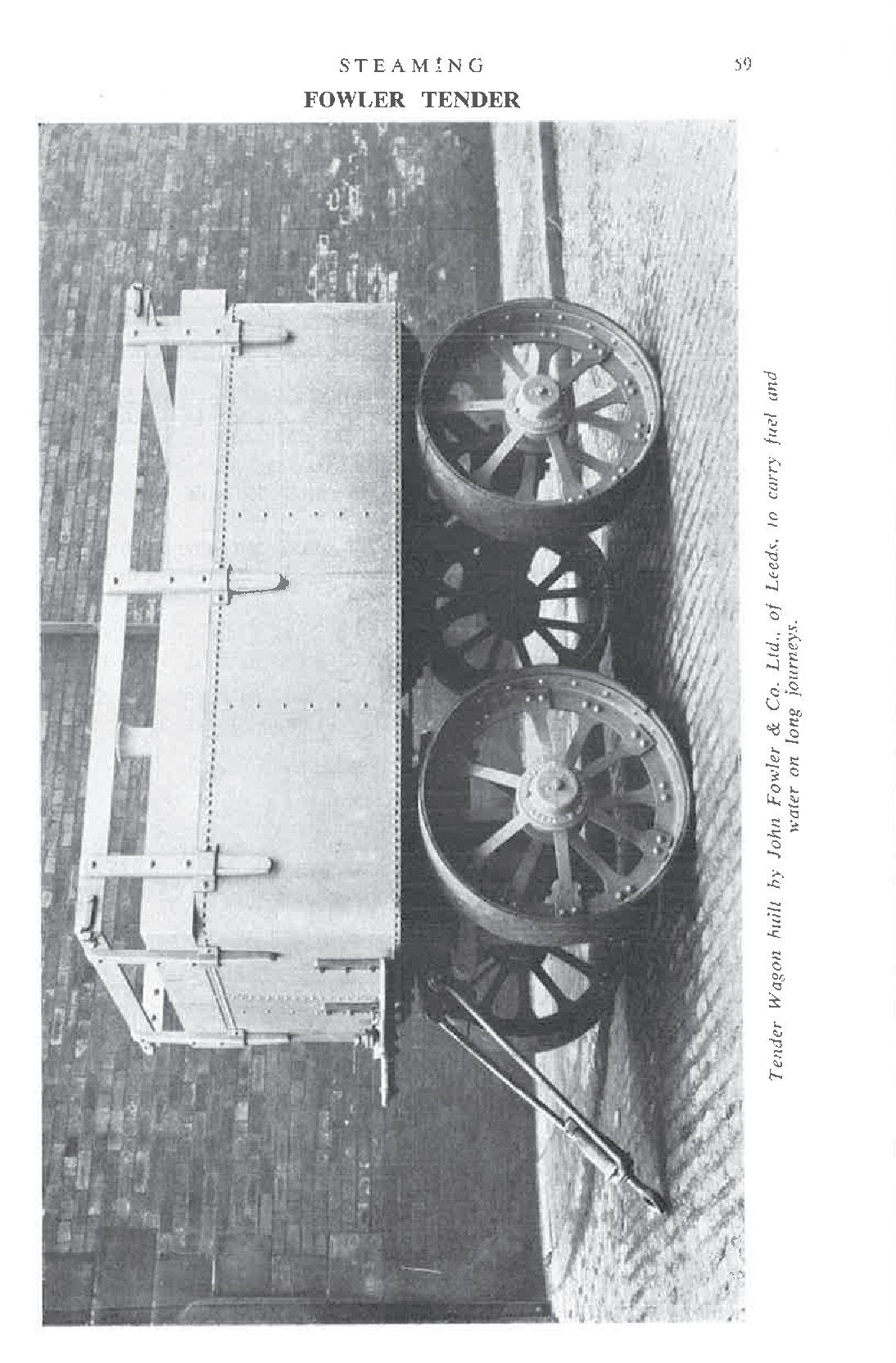
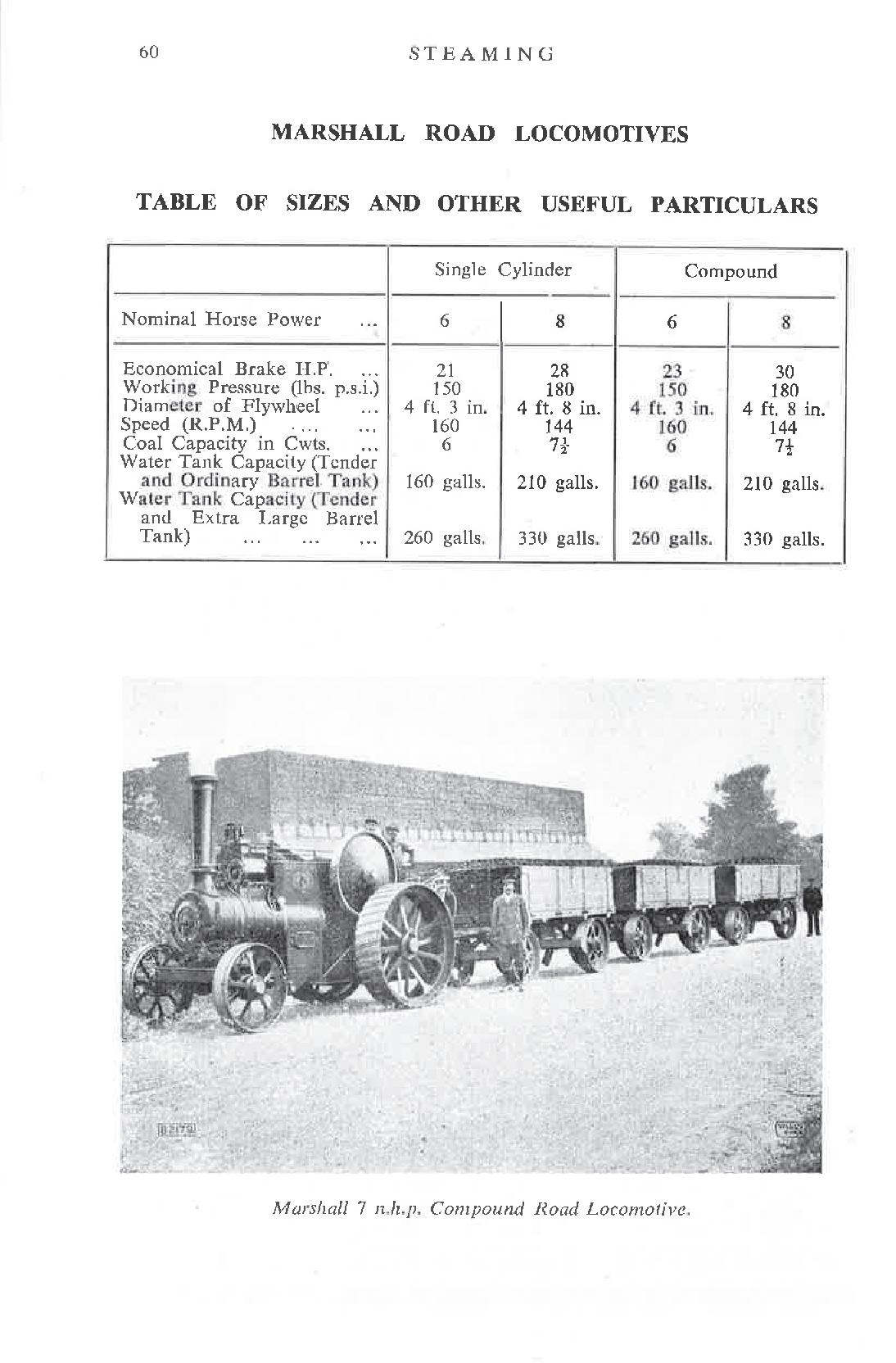
(Tender and Ordinary Barrel.
Tank Capacity (Tcndeli and Extra Large Barrel Tank)
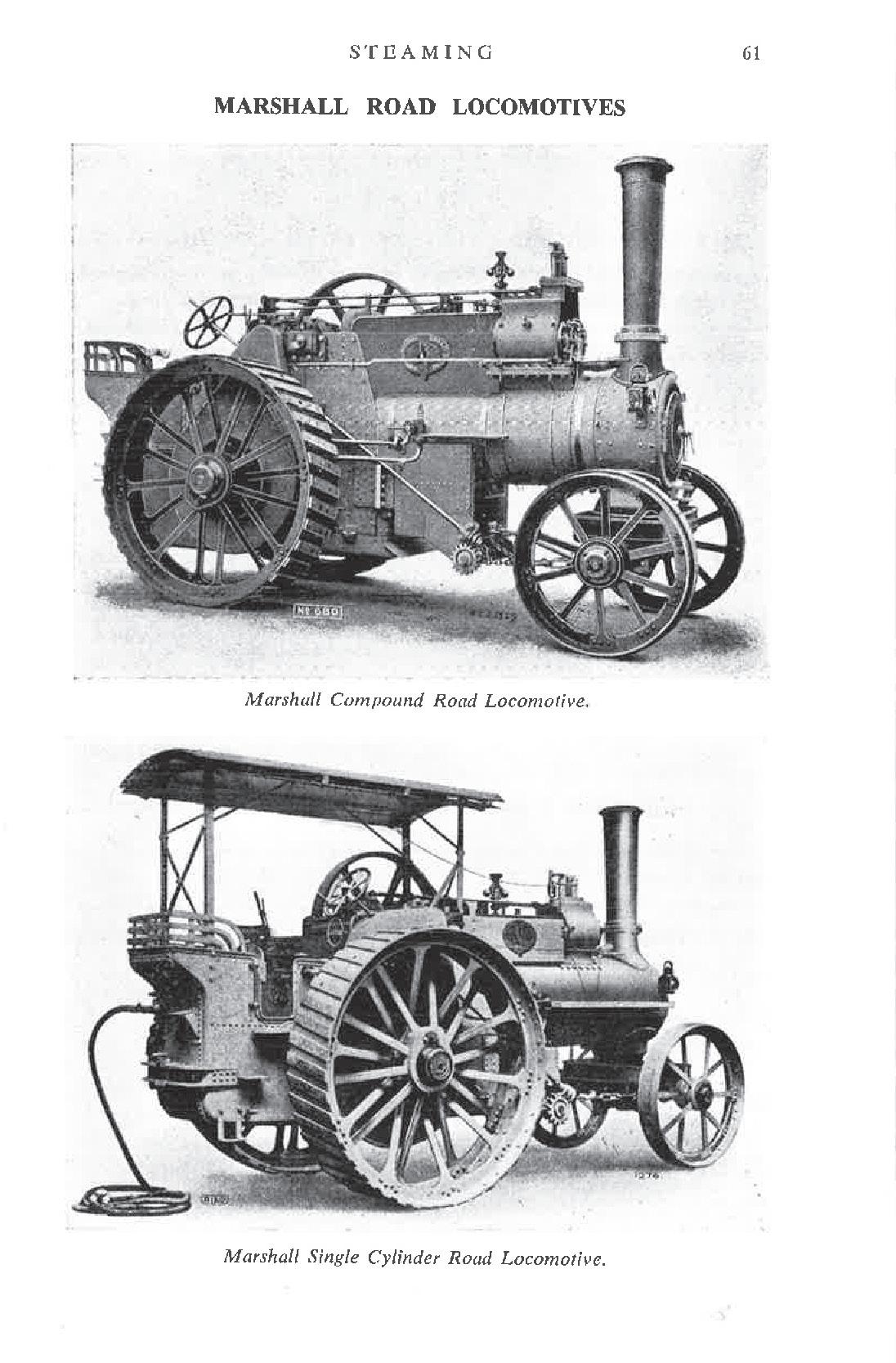
Approximate performance figures of engines working on macadamised roads with steam being cut off at about three-quarters stroke
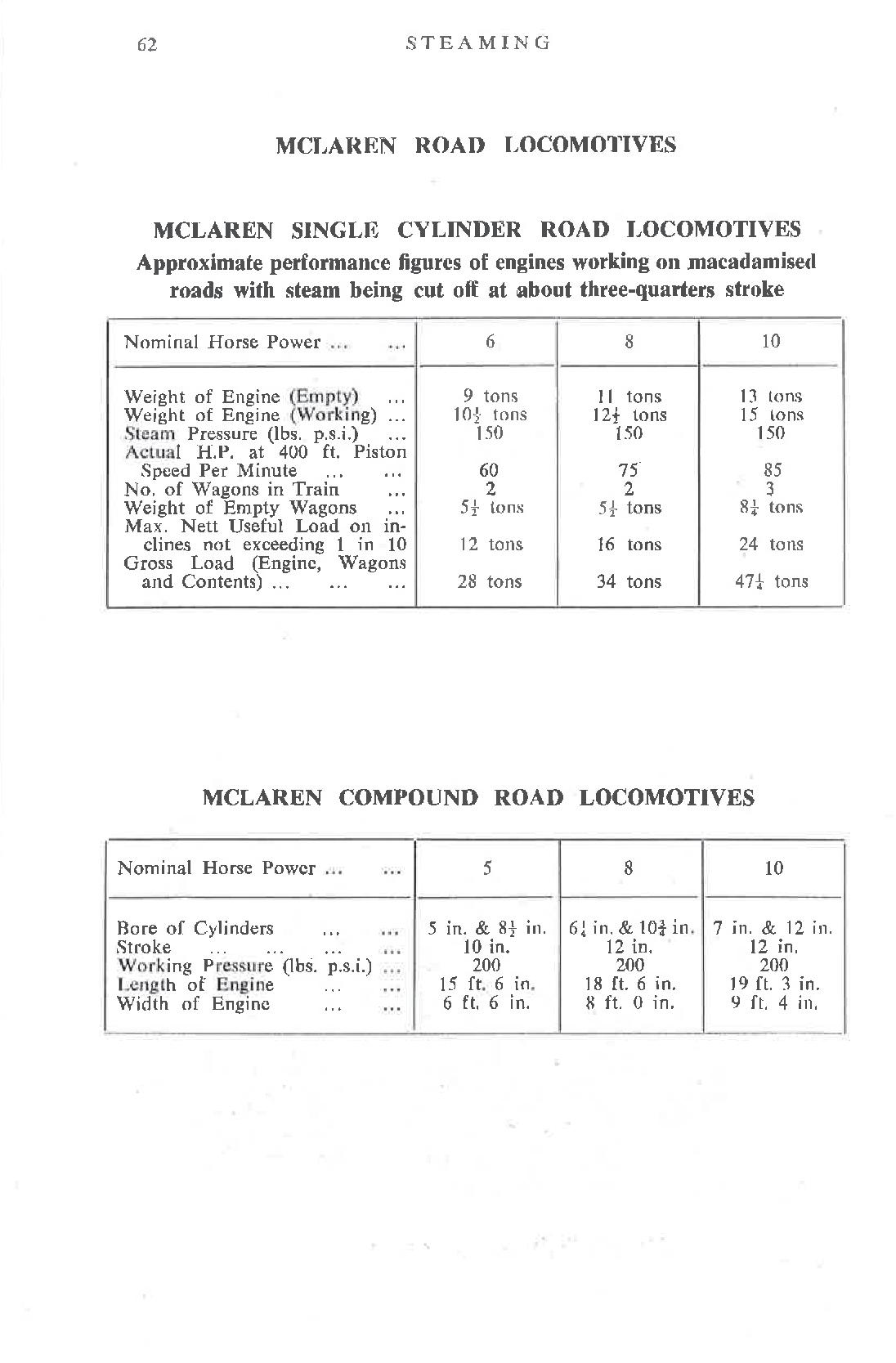
Messrs. A lieu KniKht's Mcf,aren Road EnKines No. 775 "The Conqueror·• and No. 776 " Yorkshire Bob" about to start on a journey in June, 1916.
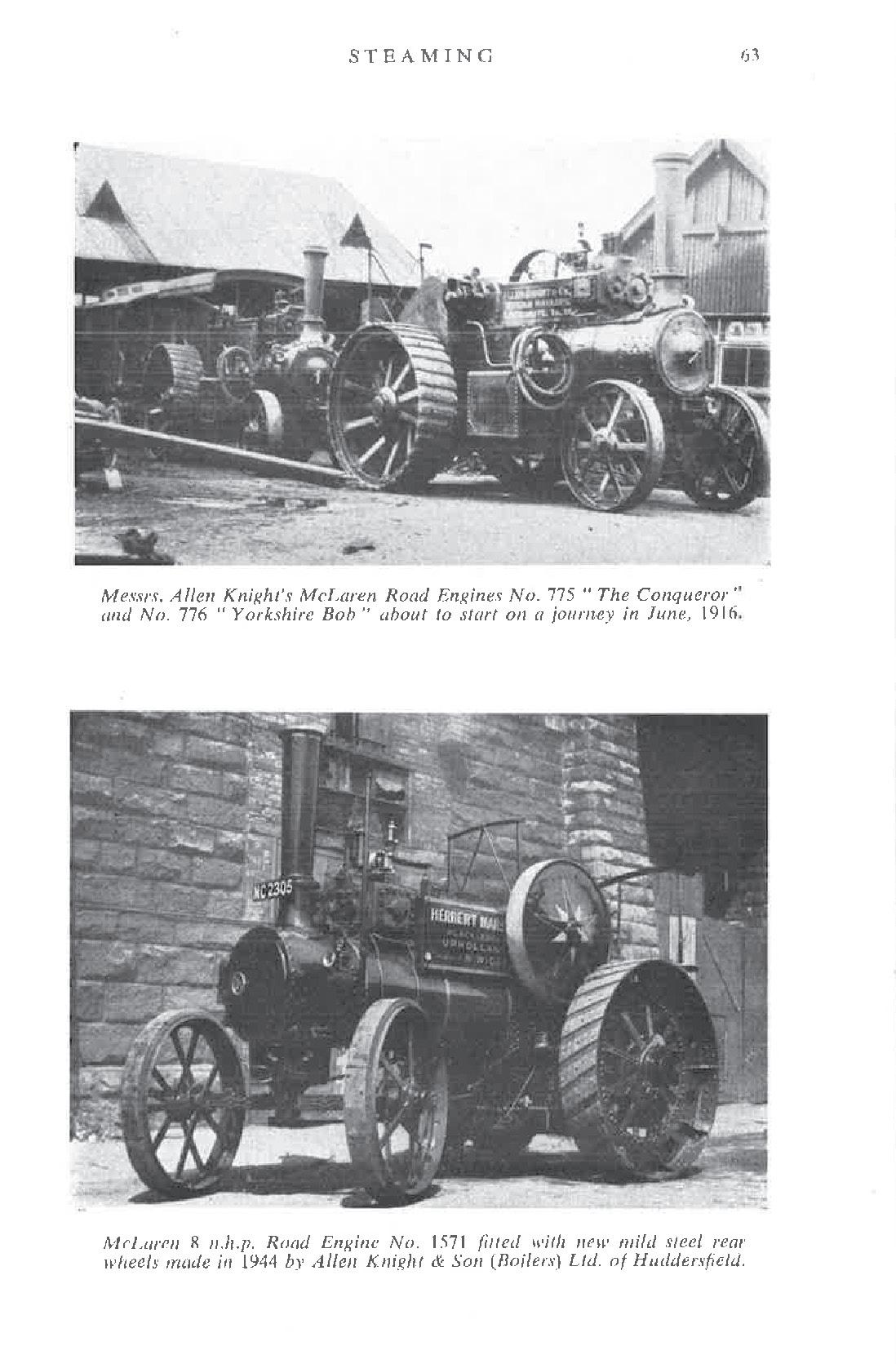
f\,fr/,arr.n R 11.h.p.Rm1d En,:inc No. 1)71 fined with new mild steel rem· wfteels ,mule it1 1944 by
Mcl,aren Road Engine No. 569 "Powerful" photographed in 1933. Built 1892. Cul up in June, 1934.
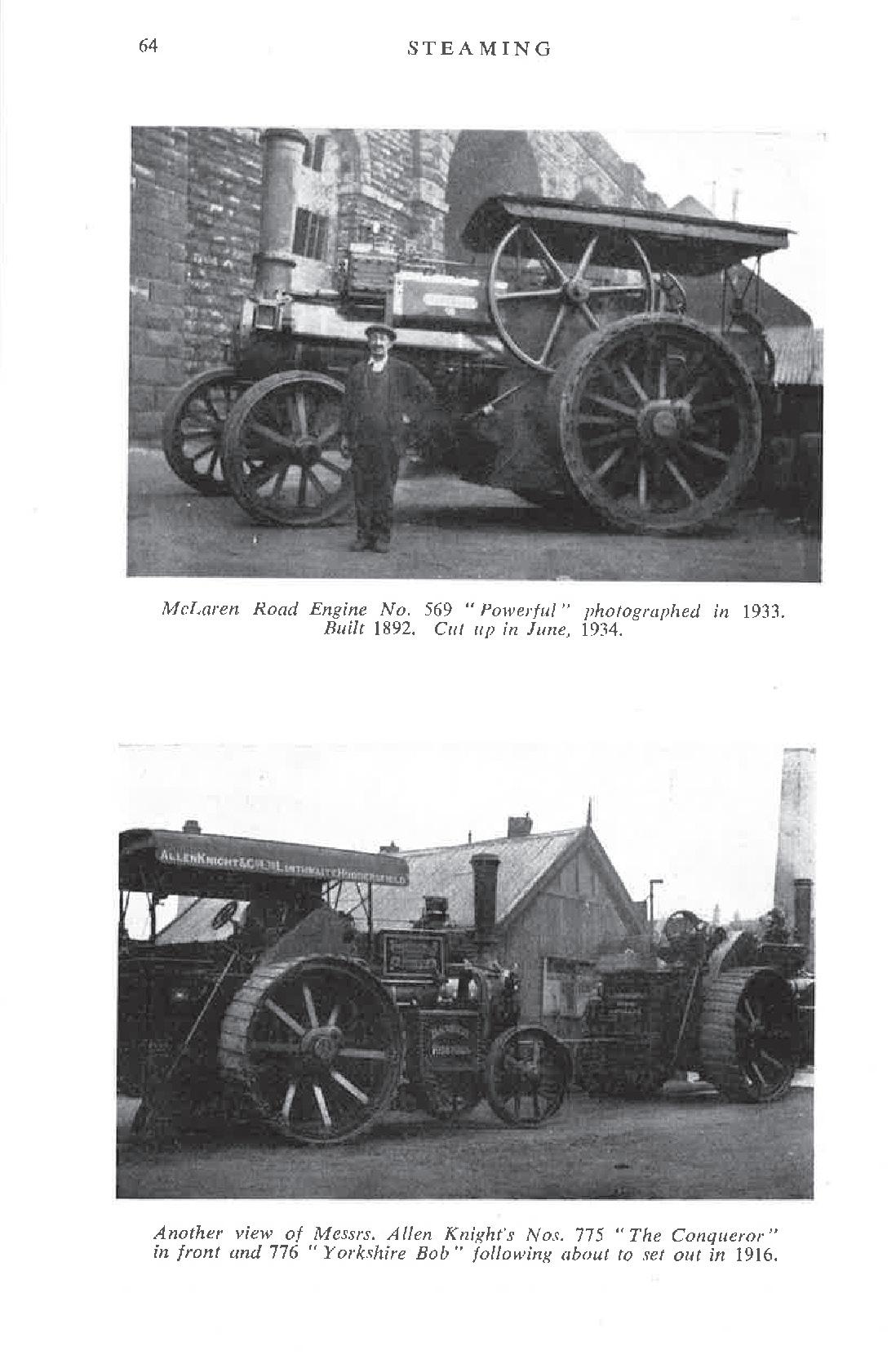
Another view of Messrs. A lien Knixht's Nos. 775 "The Conqueror" in front und 776 "Yorkshire Bob" followinx about to set out in 1916.
25th and 26th I une
Rally
SecretarJ
:
JOHN CRAWLEY, FIELD HOUSE, TURVEY, BEDFORD
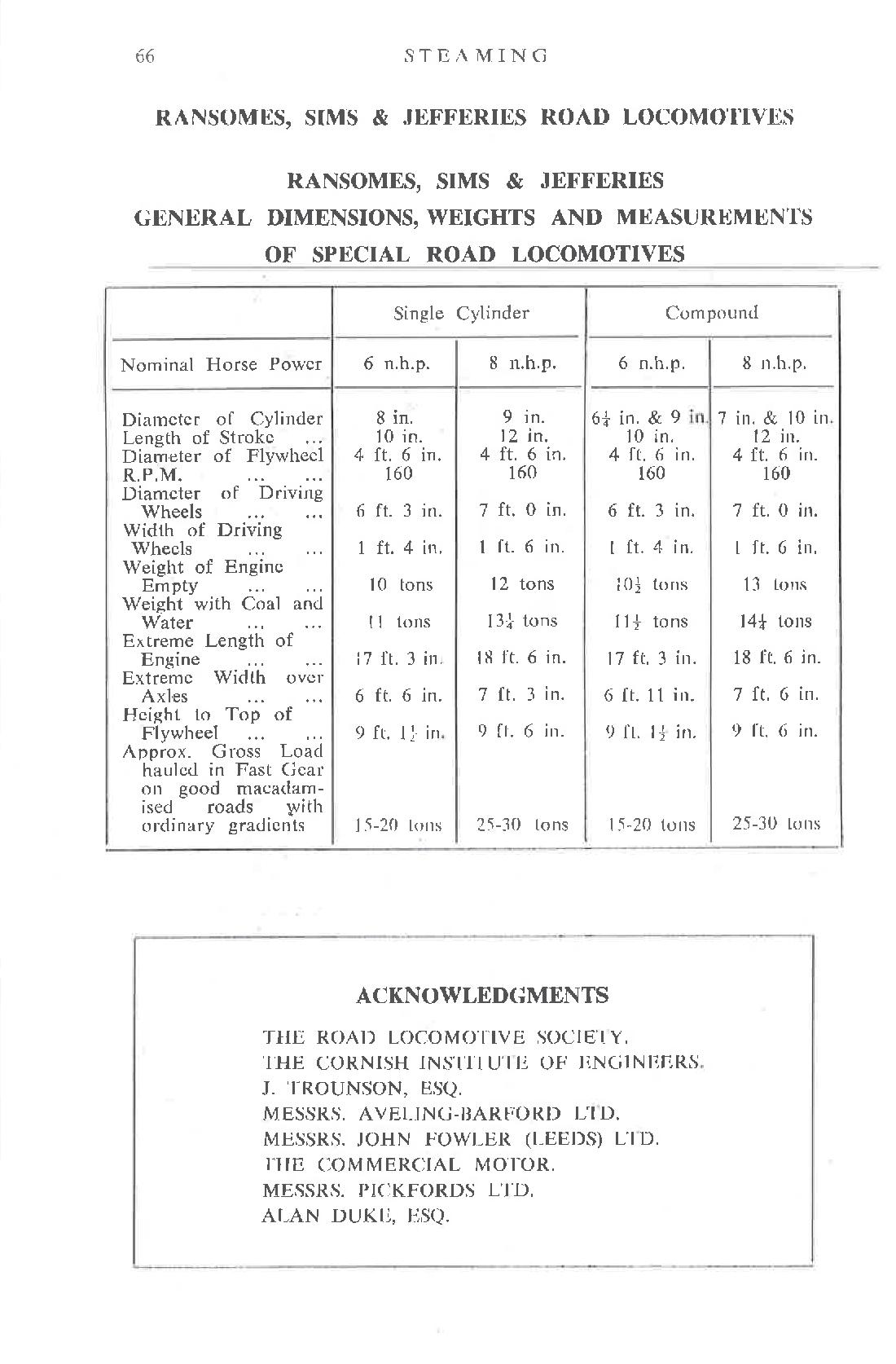
RANSOMES, SlMS & .JEFFERIES ROAD LOCOMOTIVES
GENERAL DIMENSIONS, WEIGHTS AND M~ASUREMENTS OF SPECIAL ROAD LOCOMOTIVES
Nominal Horse Power
Diameter of Cylinder
of Stroke
of Flywheel
Diameter of Driving Wheels
Width of Driving Wheels
Weight of Engine
with Coal and Water
Extreme Length of Engine
Extreme Width over Axl·es
Height Lo Top of Flywheel
Approx. Gross Load haulc<l in Fast Gear Oil good macadamised roads y.,ith ordinary gradients J
THE ROAD LOCOMOTIVE SOCIE'I_Y. THE CORNISH 1N~Tl'l U'I E OF ENGlNEERS.
J. TROUNSON, ESQ.
MESSRS. A YEl..lNG-BARFORD L'I D. MESSRS. JOHN FOWLER (LEEDS) L'I D. nrE COMMERCIAL MOTOR. MESSRS. PICKFORDS LTD. ALAN DUKE, ESQ.
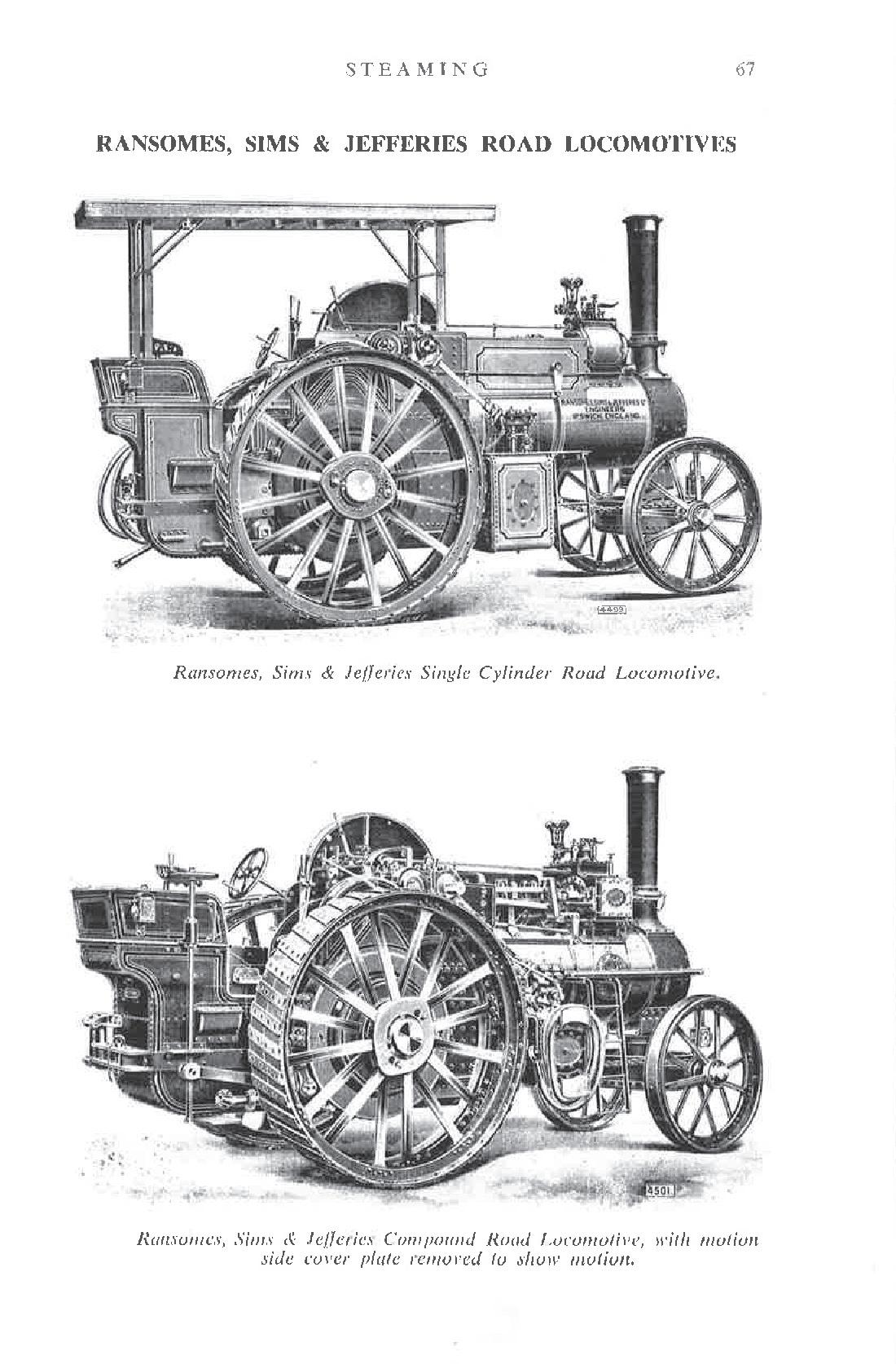
Ransomes, Sims & .le{Jel'ies Si11~le Cylinder Road Locomotive.
Raflrn111cJ,Sims & .f<!.j!e,ic!.,Comf)ound Rood /,vrnmulii'l', with mutiun side cuver plate rcnwl'ed fu slww mutiu,r.
GENERAL DIMENSIONS OF
Diameter of H.P. Cylinder
of Flywheel
of Flywheel ...
of Driving Wheels
Approx. Weight of Engine (Empty) ..
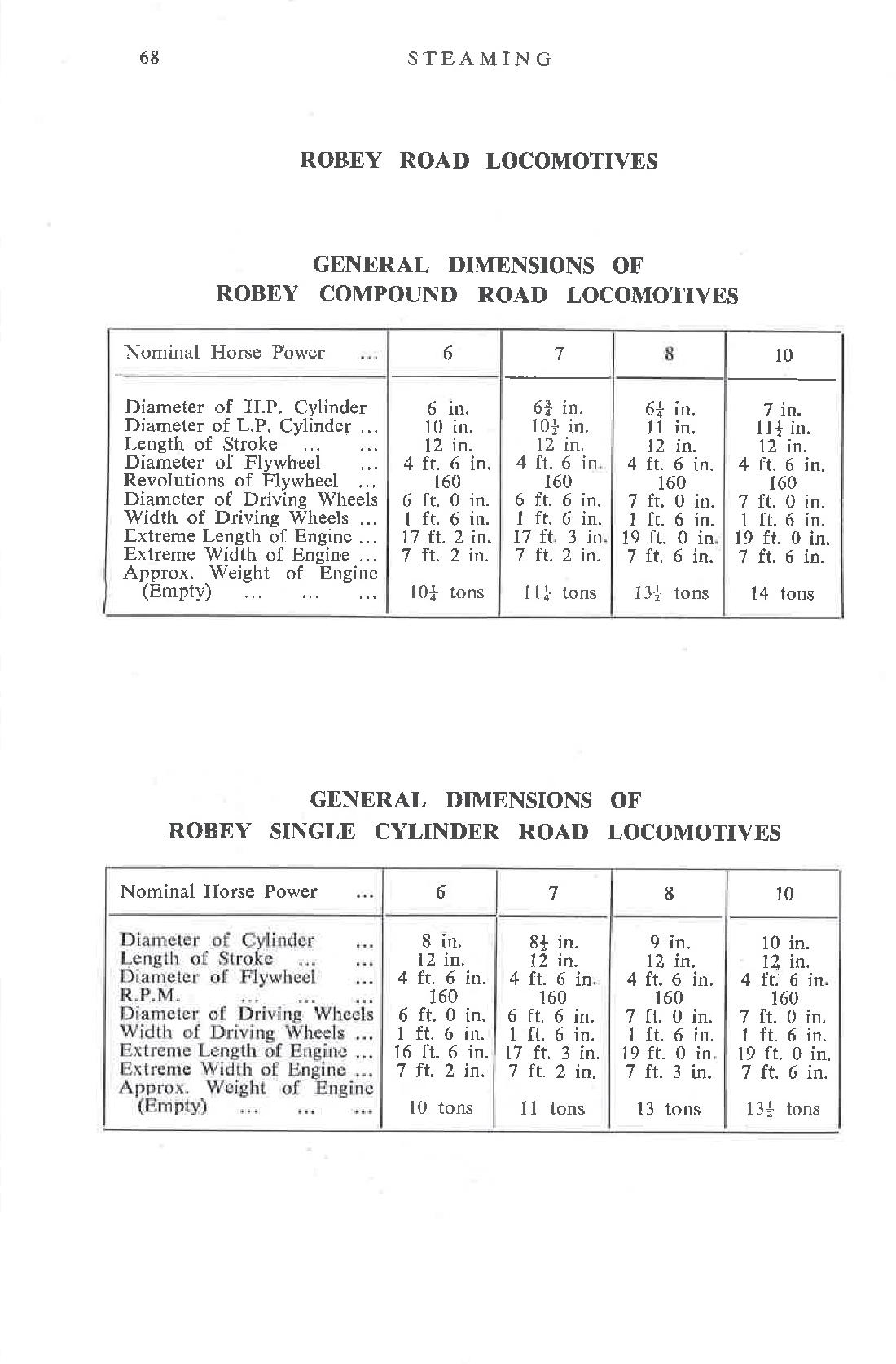
of Cy[indcr
Approx. Weight oI Engine (Empty)
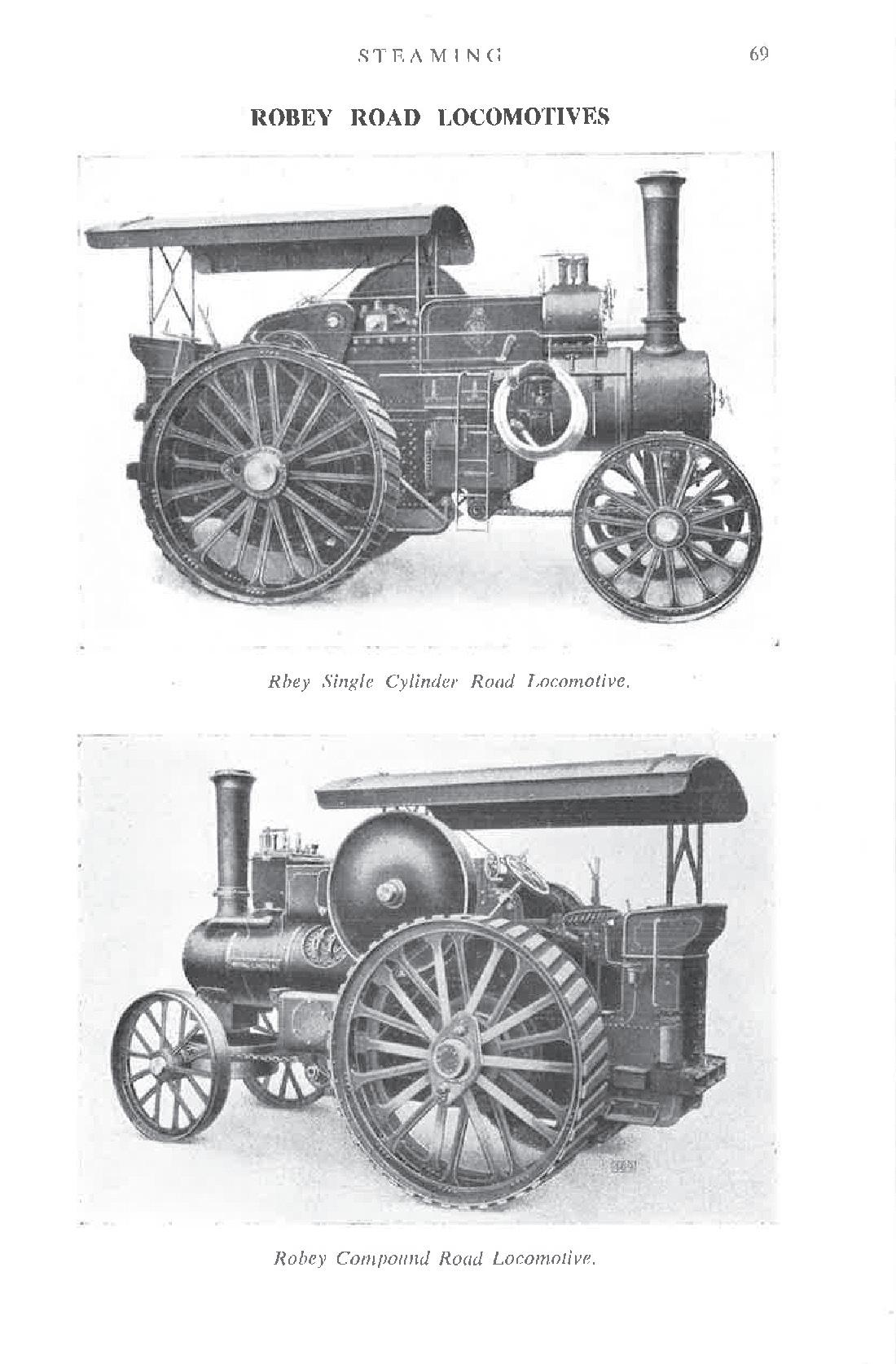
Rbey Single Cylinder RotJd l,or:t,motive
Robey Compo11ncJRoad locomn1ive.
Diameter of High Pressure Cylinder 5! ill. <;.~ in. • 4
Diameter of Low P'r~ssurc Cylinder 9f in. 9¾·in.
1.cngth of Stroke '' . . ... 10 in. 10 in.
Boiler Pressure .. . 180
Diarneler of Rear Wheels .. . ... 6 ft. 0 in . 6 fL 6 in.
Diameter of Front Wheels ... 3 ft. l 1 in. 4 f L 6} in.
Appro:,;. Weight of Engine ... 10 tons 19 cwt. 12 Lons cwl.
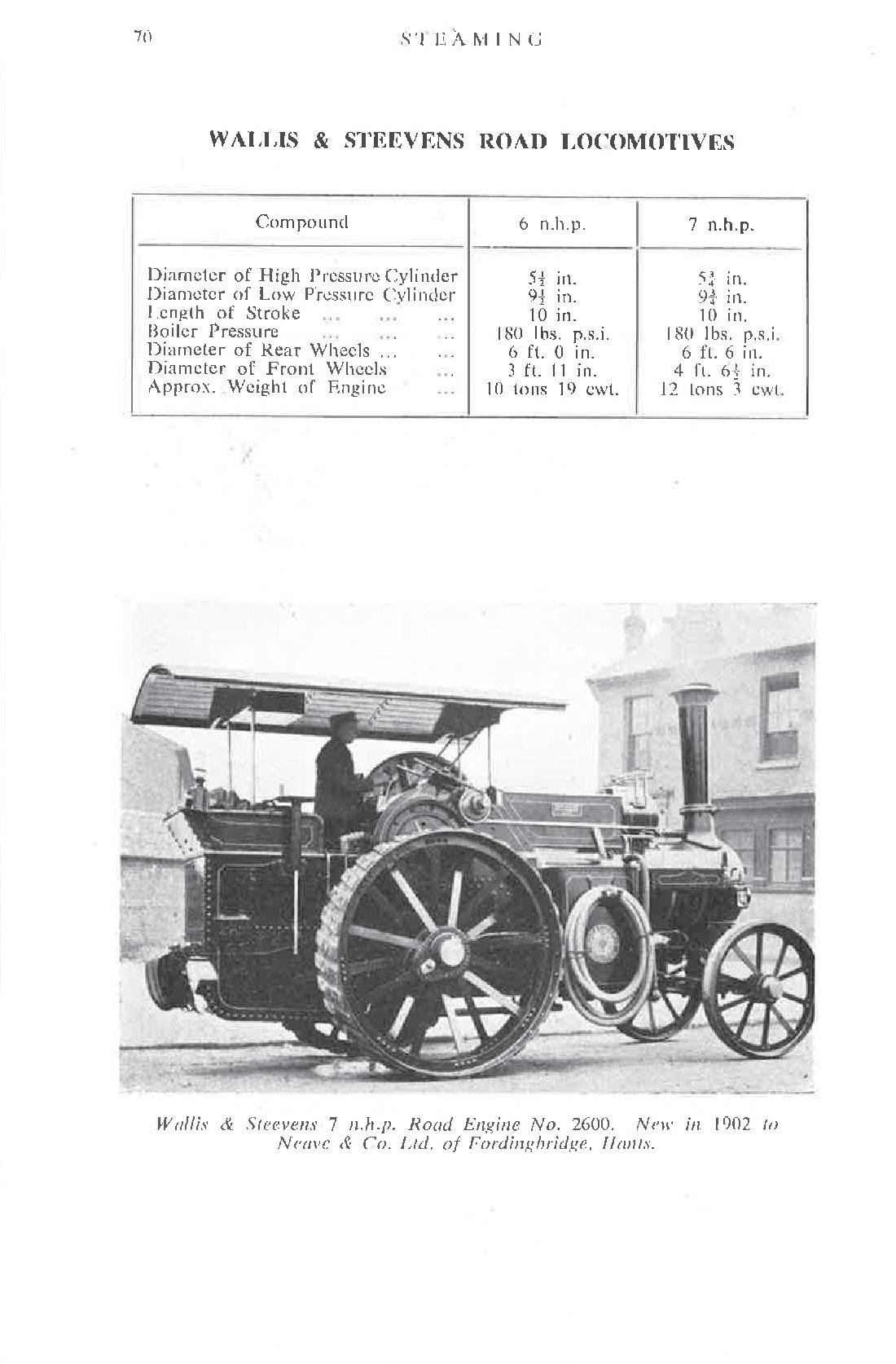
Wallis ,~ Sreeve.n.,· 7 11.>t.p. Road t:ngine No. 2600. N,•w in 1902 lo N('(svc & ro. /,id. of Fordin1-:hridg<', llmlls.
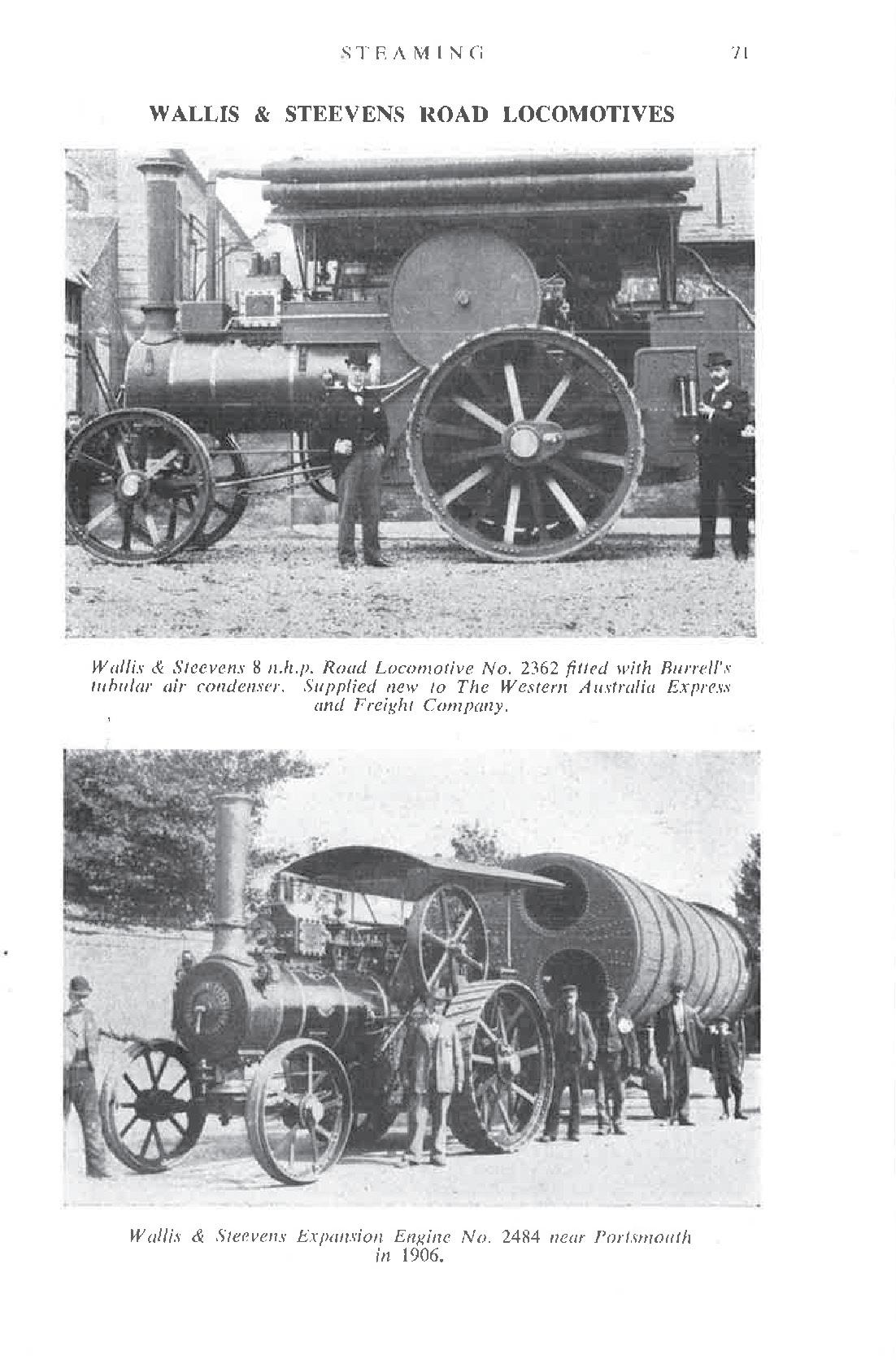
Wallis & Stcevens 8 11.h.p. Road Locomotive No. 2362 fitJed with Rurrdl's t11hu/ar <Jir conden.w'r. Supplied new 10 The Wesrem A1utralie1 Expr('Js and Freight Company.
Wal/fa & Ster.vens Elpani;ion En>:inc No. 2484 near Portsmouth in 1906.
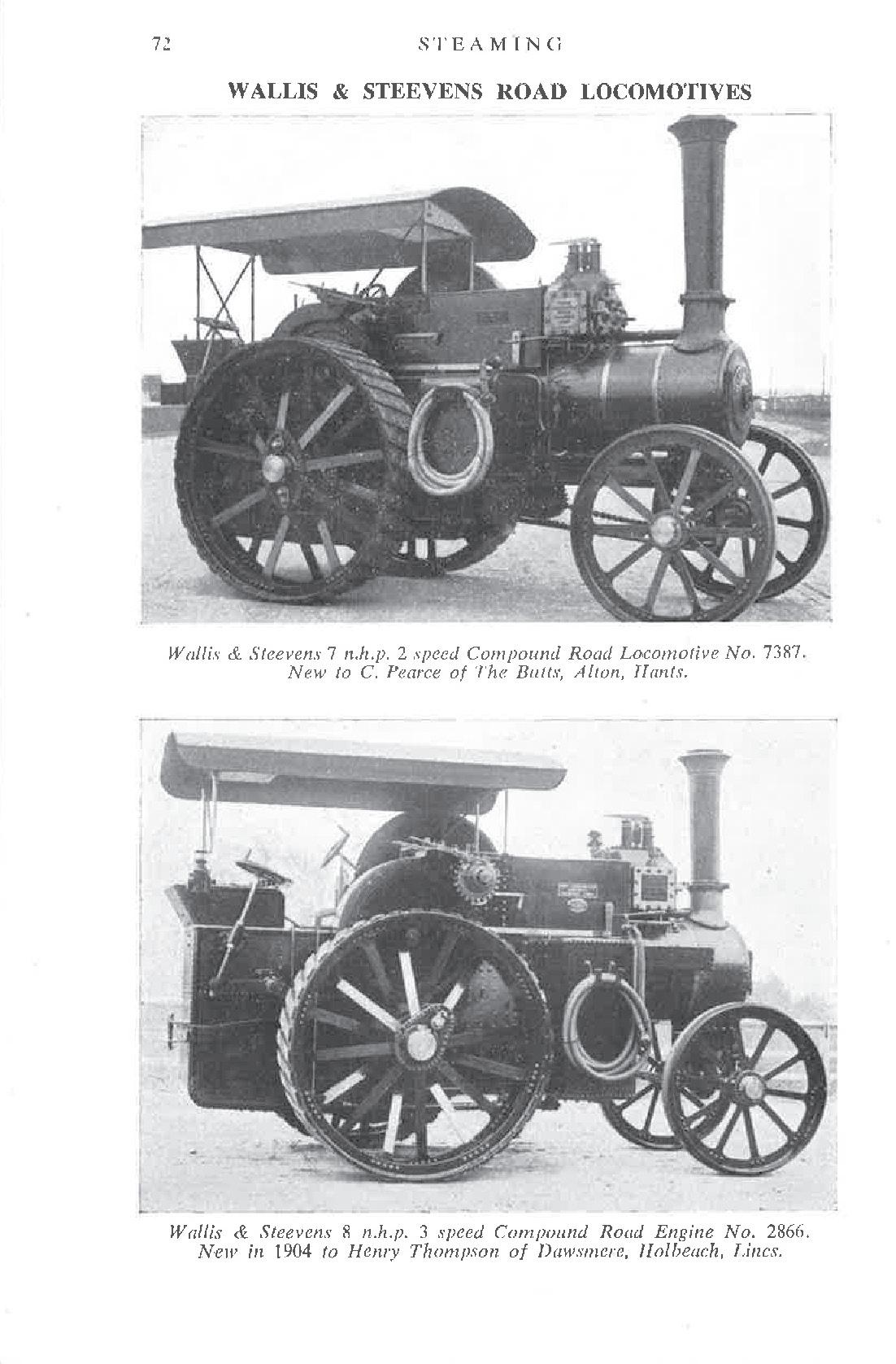
& Steevens 7 11.lt.p.2 speed Compound Road Lo.co,notive No. 7387. New to C. Pearce of The Baus, Alton, llants.
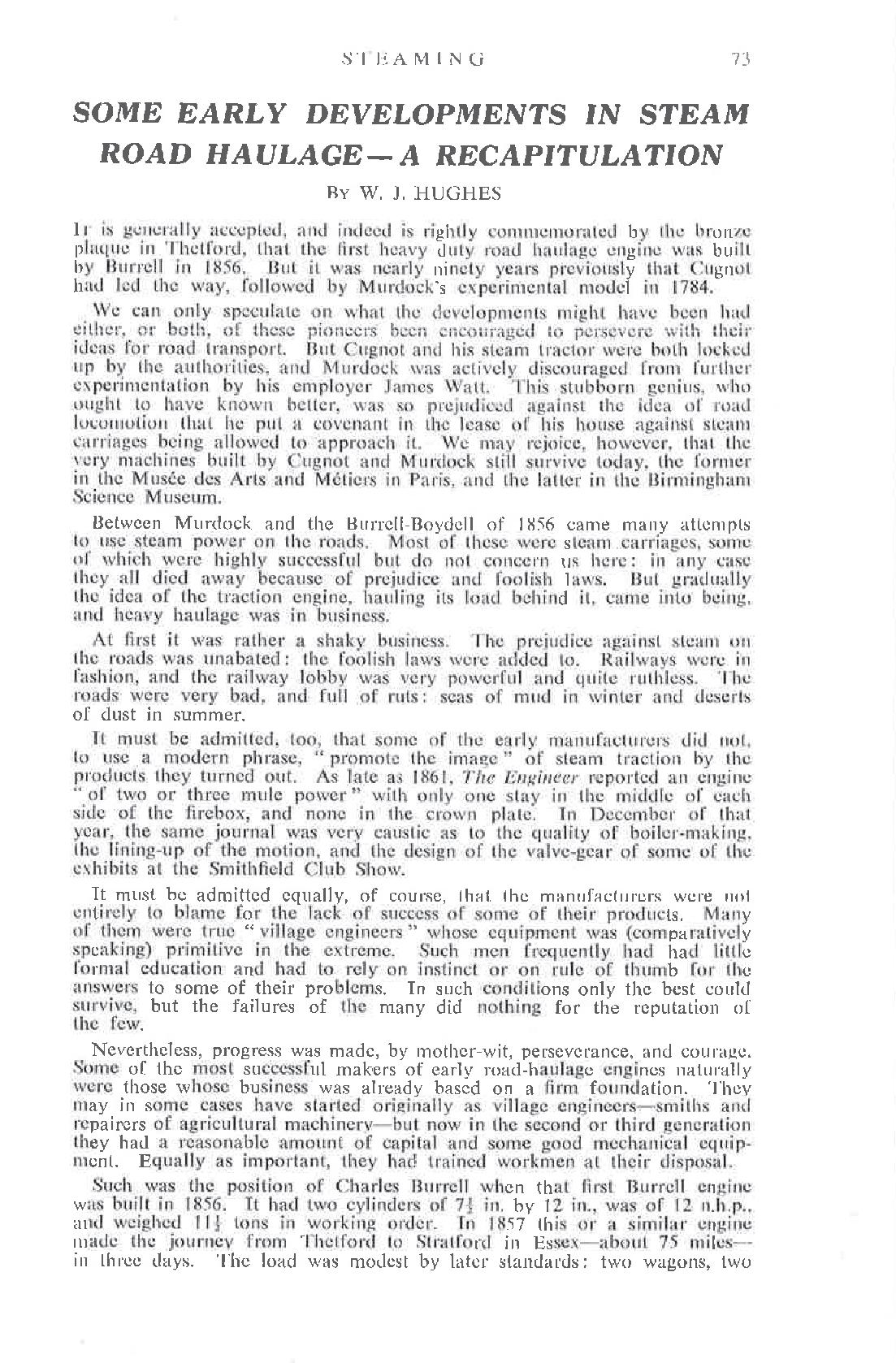
LWallis & Steevens 8 n.h.p. 3 speed Compound Ro(ld Engine No. 2866. New ;,i 1904 to Henry Thompson of J)awsmcre, llnlbear:h, l,itzcs.
Rv '\1/, J. HUGHES
l I i:i ~..::11-..:r,alll:ya~~-.:pliutl, i111dindeed is righlly CLH1HU\.!tnornl!JJ b)' 1he brorr.rc pltLq111: i11 'I hclford. llwt the firsL lrnavy July ri)atJ IH11th1gl) 1.rnginuW(IS built h)' B111·r~li in 18~6. B11l il ,, as 11cRrly nin~ty )1C:H11pr~vhrni::ly 11ml Cl1g1llll lrnJ l.:ll Lhc \WI,~'. i\,llowcd h)' M11rdoc:k's \!,xpcrimcnlal model i11 1784.
We tnn rmty spi.:culatl! un whH~ the dcv,ulop1mrnls rnight have; bcc.:n h:\1.I !!il11r.:t·. '1r bo!I.:. of these pfom.!.Cl'S bi.:c1; ..::h:<i::ragcd :o p~rJ;iC,1~;· with :heh· idcqi; for road lransrml. 011LCuguot t111dhit- st~am Lnu:tl'lI1· wcr..::hmh 1m:k-t:l 1 I uro hy Hw :u.11h1,,·t1ie!:i,~riJ Plhm.lock ,ms acLivclv dlscouragcu from further ~\pcrimc111atio11 by his ,cr11ploycr James w~11. ··11·hisst111lobom gcni11s. who u11ghl lo have k11ow11 bctlc1\ was RO pr,l!Jtndk\!LI against tho idt?a of l'•L>all lui.:u1u11utfo11tharl he.:p1H :i covcrnrnl in lhc lease ~,rhis hms.~e againsl slcarn (;irriagcs hcfog nli,>wcd lo ..crprmu::11it \Ve rn::1y rcjoi<:c. howcv~r. iha1 lhc , ~ry nrnrltine_" built h)' (\ugnot a11d l'VI1mlm:k :Hill .srn·,•~vclodny. lhc f'omH:r i11 lhc Mns(:e d..:s Arts and Mctiurs in P<tris,and th~ lnll,cr in lhc Uirmingharu f)('icnci,; Muscum.
Between Murdock and the Burrcll-Boydcll of 1856 cam~ many atlcmpls lo 115,cstcum power on lhc tr>.i,ds. Most or llwsc were slcm11 Ci;irri~g,cs,sumc. n/' whid11 'Were highl.v Nucccssfu'I hut do 1101 ,conc:~rn u~ Imm: i11 11ny case they ail died away hecniusc of prejudice 1rnd fooli:;h laws. lhtl gnuluaHy tho idem or the traction engine. ha,iling il$ !ond bchi11d ii, came inlo bdu!;, :rnd llca\·y haulage w:u: i111husiness.
At flr:it il \\)as- rather a shaky business. The prcimlic:c ;1gainst ~lcu111un lhi.; ro.uJs ,vas unabated: lhc foolish !laws wc:f..:: added k,. Raihvars. were: i11 l'ashim,, :md ih<: r.aiiway lobb)' was v~.-y f"ll),Vci'flll Hhc.l llllilc i'lllhic.lis. 'I hll roads were ver)• b.ad, Hml full of mls: sc:iis of mud irn wintl!r ~rntl di!sl.'rls of dust in summer.
11 m11~1be admiHccL too, ihM some nf lhu ct1dy nikl1Hlf~1l.'Wr,1,:rs 11fo.l 11of, 10 use moucrn phrase. "prnmoic lhc im::11?:e"or slcam ti'acl ion by lhu p1·oc;h1dsthey l.urncd 01.1t. As fate a., 1861. The l~n,1ti1u:er r,cportcd a11c11gim; " or two or lhrnc liiitillc pawe.r., with 011ly c'.>ncslny i11 the m1ucl!dfi:uf c::ic:h ~itlc of the firebox, and none in ihe crown rl~1lc:. 111 Dcc:cmhcr ur IhaI year, lhe. same joiirnal was very causli<: liS le> lhi.: c1m1H~yof h(>ih.:l'-n'rnl-.f11g. lhu lii11i11g~upof the mu1im1. :md lhc design or the v~tlvcwgc-aruf some of lhi.:: c.,hibils al the Smillll'i~ld Club Show.
1t must be admitted equally, of course, lh~C. lhc m:rn11facl11rcrs were 1101 cntin.:lly l,1 bhunc Cor lhe lack of s11cc:ess or some of their prodm:ts. Ma11y 1)f 'lhcli, ,vere; trt1c "village i;rngim:cr.s" whose equipment was (currnparalivdy speaking) primitive in the extreme. Such 111cn fri.cqu1:inll)1 lrnd hall tiH!c l'nrma! education anu had to raly cm im:1ilu:t Oi" on rule (•f n,11mb fo,· th<.i .11,swer~ to some of their probk:ms. In such c:ondiltons only the best could smvivc. but the failures of lhc many did r~othring for the reputation of lhc few.
Nevertheless, progress was made, by mother-wit, perseverance, and courn.l!.c. ~ornc of the mosl sm:cc.«.sfulmak•crs of early road-haulage t:ngincs naturally wl!rc those whose business was already based on a rirm foundation. Thcv may in some: ca~es have slaried ori!!inally a~ village cn1gin1<:crs-s111itl1s aml repairers of agricuhurnl rn.achincrv-bL1l now in the scco11dor lhfrd gcr1~ralion they ha<..1~h 1·t,%\so1tablo~mottnC of cl'lpilal and some goad mccha11ical ~quipmcnl. Equally as impori:uu, they hari Lr•aincd \vork1tu.rn :r1t their disr10..,t\l.
Such wa:s the posilno11 nf Charle~ mlurrcll' when thal I1r'st Burr,L!H c11gi11c was ht1ilt in 1856. n had {WO cyiimlcr."i of 7{ i11.by 12 in., WHS or 12 11.h.p aml weighed 1111lons in wo.-king ordci·. f1) I ri.'i7 this ,or a .similar -.:ngi1u..: nu1dc lhc:.:jcrnrncy from Tlll!lford h> .S1ra1ronl in Es~~.'(-aboul 75 111il~-i11 llircc days. The load w.-s modest by later slanclat·ds: two wagons, lwu
threshing machines, and a portable engine weighing about 17 Lons in all, but the 3-lon portable was dropped off at Newmarket. Travelling speed averaged over 3 m.p.h.
Roa<l ~urfaces were more had than good. and gradients of l in t '.' were encountered. Ncvcr·thclcss lhcrc wa:s littl·c trouble, and this led lo another lone-distance journey abollt thr(_~e months later by a rather heavier engine. Th load this lime was fiv,c oak log;; wcighin~ nearly l~± tons, which were ~arrkd 011 four heavy timber carriages; a vrin-load of tools and coal brought the total load hauled lo neal'ly 29 tons. The lotal lcnglh of the train was 1~2 feet.
lhis jo11rncv was of nearly 100 milc3 Lo Woolwich Arsenal. under suncrvision of its Machincrv Sup:~rintendcnt, and again was relatively uncvcrHl'ul, with an avcra~e lravcllin!~ speed of over J 111.p.h. Fmthcr tests were conducted later, at the Arsenal, including hauling a lo:-id of 43 lons (four 8 in. guns) up an incline of I in l 3.
Al aboul this period the Royal Arsenal was very inkr~slt:d in sh ..·1H11 haulage, and was C'arrying out tests with the engines or other makers. Hray·s lraction engine was one of them: in 011c C.\Pt::l"iment it haule<l 20 tons up a "t:onsid-crablc incline., past the Royal Artillery Barracks. The Admirahy too was inlcrcstcd, and paid Brny fiftv pounds :t month for the c:--perirncnlal use of his engine in Woolwich Dockyard. Thr1t the trials were successful is cvi<lenced h~· the fad thal by Fchruary, 1959, Hray cngin·es were being constructed at New Cross for the Woolwich and Keyham Dockyards.
Other users of Bray engines were the wcll-know·1 cn~in-:::•:;rsMaudslcy Suns and Field, and Venn's. Loads rcr,orled in conlt::mporarv journals include a truck loaded with heavy cases of "several tons., total weight. a 22~ Ion mainshafl for the br1Ulc-;hin Ho11·,·. and a 30 ft. by 8 ft. boiler weighing 22 tons and mounted on a 5-ton truck.
!fray's engine of 1861 was one of the first ever lo be lllted with a dcrrid crane. ln 1862 on~ of these engines was not only c,hibitcd at the Great Exhibition. but anolher was used in bringing loco·motives, marine engines, anu other heavy machincrv to the Exhibition. These were loads of up to 4S tons. Another Bray iob, illustrntcd in A Ce11turv of Traction /:'Jlf,(ilW'i, was the haula~-c of a bridge-girder 74 ft. lon~. 5 ft. 8 in. high. and weighing :20 lons, throt1gh the heart of 1.ondon hy night.
:James Taylor of Birkenhcarl w:i.s ::\ well-established engineer al ready known for the manufacttzrc of steam-winches an<l other <lock and ship machiner}'. He entered the tield in 1859 not only as one of the buiklers of Bray engines, bul. as designer and builder of his own "Steam Elephant ". This loo was highly· sncccssful in Admiralty tests, though unfortunately the exploits of Taylor's engine arc not very well doc1.1mc11tcd. We do know howcv•er llrn( it pulled easily two loaded wa•!ons carrying 11 tons, an<l on slow speed a timber baulk which had taken twelw horses lo move.
Thomas Avcling's name was well to the fore in those pioneering days, bul mainly for agricultural cngilll~S. However, he could and did build heavier engines especially for road haulage., a renowned example being s~weral in I 862 for copper rnin:!s in S'olllh Australia. They were designed Lo haul regular gross loa<ls of 36 tons or more over I 20 miles of rough country. Other /\vcling engines were working concurrently in South America, a11d we know thal on test one of these hauled a load or 28 tons up a gradient of I in 12.
Many Boycldl engines also went ahroad, to Cuba, Spain, and South America, built variously by Burrell. Clayton & ~hultlcworlh, and 'I uxl'on.l. Bul the Hoy<lell wheels were nol the ~ucccss that had been daimeu, and Wl)l't: 1:>0011 k nockcd to pieces in constanl US!.:!. Their failure caused lhc scrapr,i11g of some engines, and lhc conversion of others lo stalion:try engines: others had orthodox wheels suhslitutetl for lhc Roydcll ones. /\nd in 1862 the Bovddl experiment ended ::tt the Urcat Exhibition with a 7-ton Umrcll Llesigncd to haul up lo 20 Lons.
During the l860s there musl have been lllany c.xrloits, lly machin~s of , arit)llS make, similar lo those already rc<.:011nlcd,'h11\ the 11c,l great 11aml.! to app~ar w.is R. W. ·rho111so11 with hi:s thr-.!~•\v)luulc<l roaJ steamers on
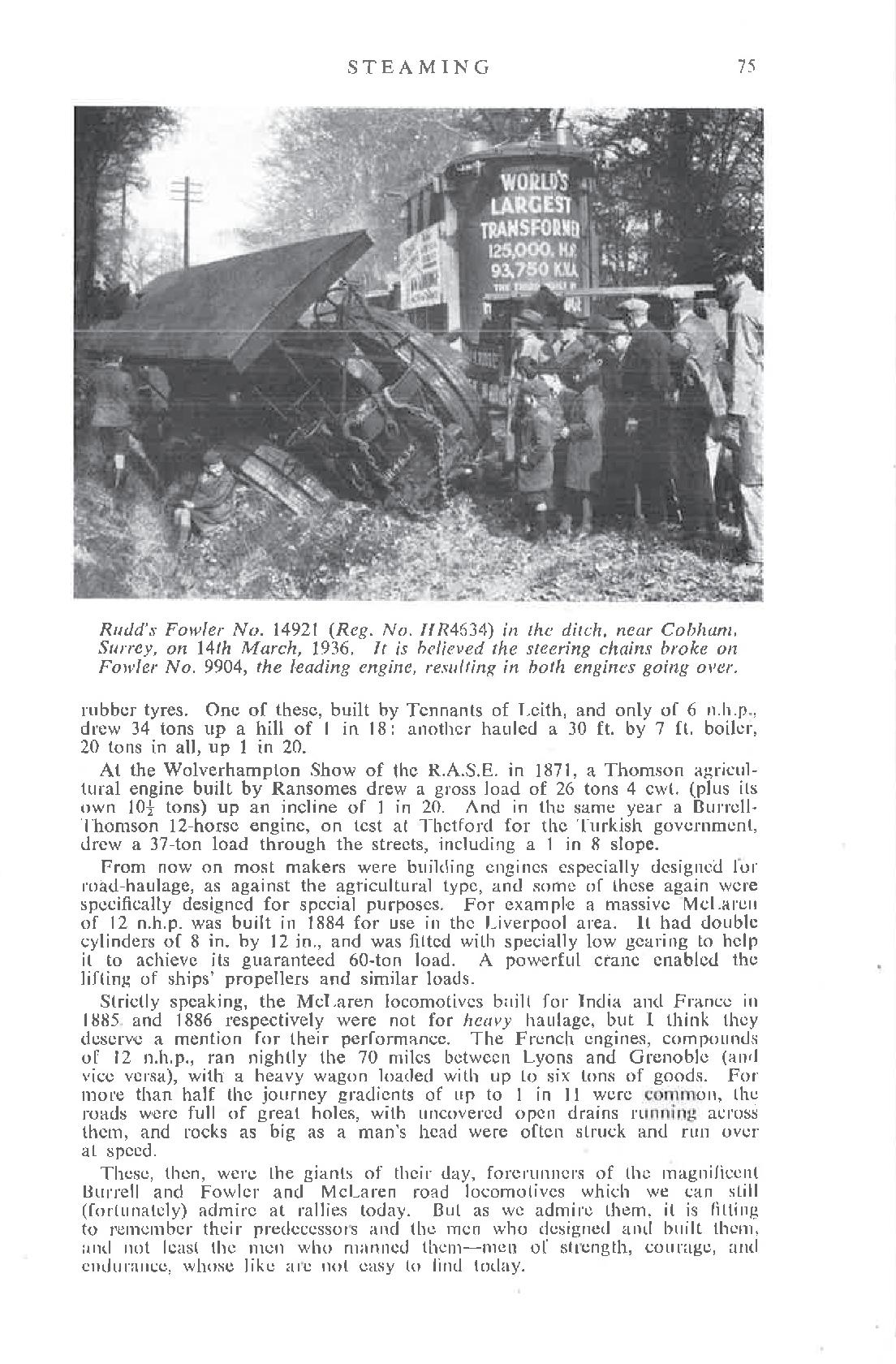
Rudd's Fowler No. 14921 (Reg. No. II R4G34) in the ditch. near Coblwm, Surrey, on 14th ll1arch, 1936. It is helieved the steering chains broke on Fowler No. 9904, the leading engine, re.,;u{tili1rin both engines going over,
rubber tyres. One of these, built by Tcnnants of Leith, and only of 6 n.11.p., drew 34 tons up a hill of I in 18: another hauled a 30 ft. by 7 fl. boiler, 20 tons in atJ, up 1 in 20.
At the Wolverhampton Show of the R.A.S.E. in 1871, a Thomson <1gricultural engine built by Ransomes drew a gross load of 26 tons 4 cwt (p)us its own 10½ tons) up an incline of l in 20. And in the same year a BurrellThomson 12-horsc engine, on test at Thetford for the Turkish govcrnmcnl, Jrcw a 37-ton load through the streets, including a 1 in 8 slope.
Prom now on most makers we.re building engines cspe.cially dcsignt~<lfor roa<l-haulage, as against the agricultural type, and some of lhcse again were spccifkalty designed for special purposes. For example a massive Mcl.arc11 of 12 n.h.p. was built in 1884 for use in the Liverpool area. ll had double cylinders of 8 in. by 12 in., and was fitted wilh specially low gearing to help it to achieve its guaranteed 60-ton load. A powerful crane enabled the lifling of ships' propellers and similar loads.
Strictly speaking, the McLaren locomotives bail! for India and Fram;c in 1885 and 1886 respectively were not for heavy haulage, but l think they deserve a mention for their performance. The French engines, compo11n<ls or l2 n.h.p., ran nightly the 70 miles between Lyons and Grenoble (and vice versa), with a heavy wagon loaded with up Lo six lons of goods. For mo1·e than ha1f the journey gradients of up to I in J l were comm,011, the roads were full of great holci;, with uncovered open drains rn11ning a1:rnss them, and rocks as big as a man's head were often slruck an<l run over al speed.
These, then, were lhe gianls of their <lay, forerunners of lhc magnificent Uurrell and Fowler and McLaren road locomolivcs whkh we 1-:an slill (forlunah.::ly) admire at rallies today. But as we admire lhem, il is fllting to remember their predecessors and the men who designed and built them. and 1101 lcasl the men who manned them-men or strength, courage, and c11dura111.:c, whose like a1c nol easy lo lind today.
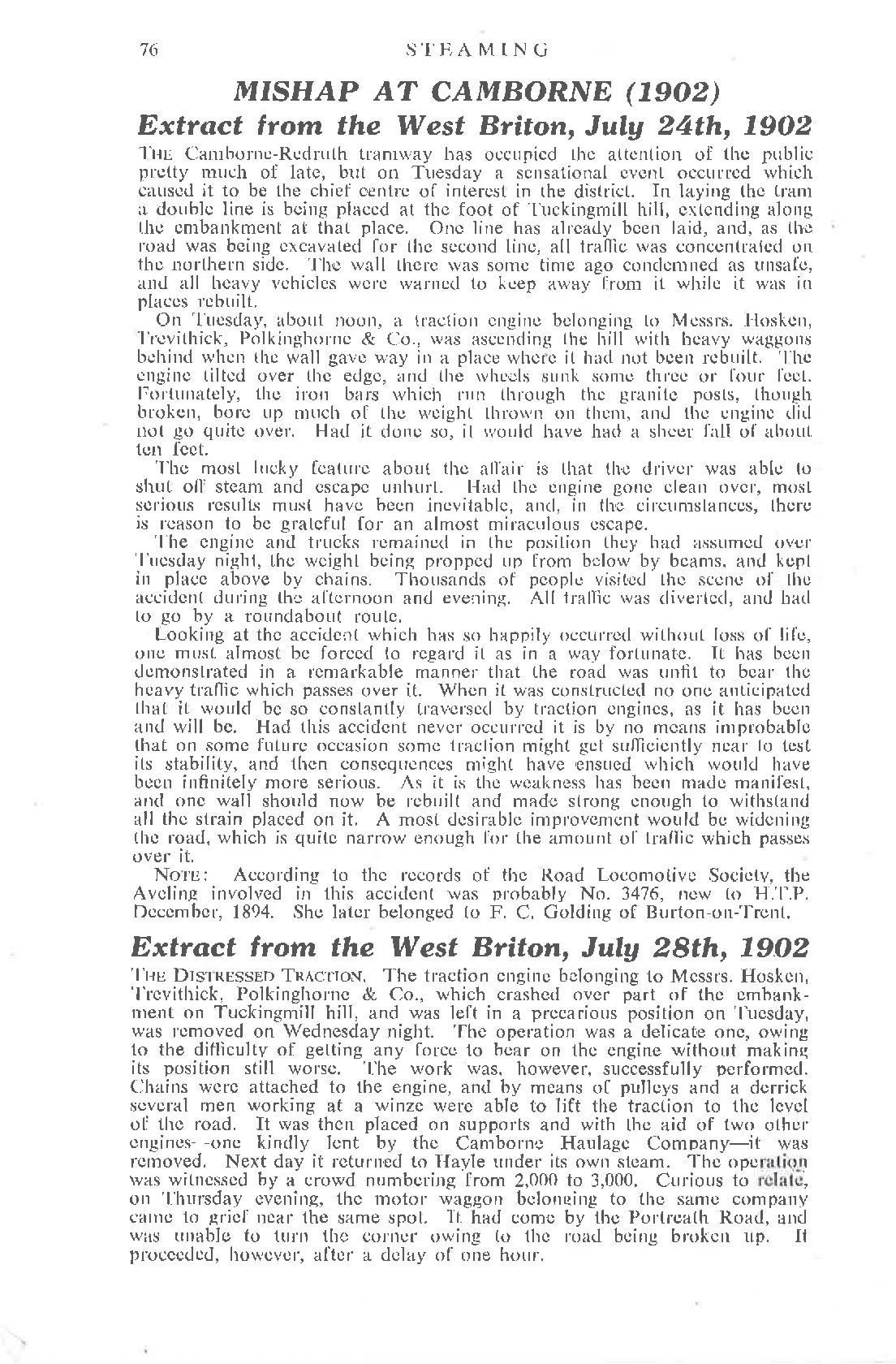
THE Camburnc-Rcdruth tramway bas occupied the attention of the public pretty mw.:h of late, but on Tt1esday a sensational cvcnl occurred whid1 caused it to be the chief ocnlrc of inlerc.st in lhe distrid. In laying the lram a <louhlc line is being placed al the foot of Tuckingmill hill, extending along I.he embankment at thal place. One line has already been laid, and, as l11~ road was being excavated for the scc.:ond line, all traflk was conccnlralcd on the northern side. Th-e wall there was some time ago conckmncd as unsafe, anti all heavy vehicles were warned to keep away from it while it was in places rebuilt.
On Tuesday, about noon, a lra!..'.lion engine belonging lo Messrs .1-loskcn, Tr~vithick, Polkinghorne & Co., was ascending lhc hill with heavy wag~o111; b~hind when the wall gave way in a place where il had not been rebuilt. The (:llginc lilted over the edge, and the whcds sunk some three or four l'ccl. Fortunately, the iron bars which n1n through the granite posls, though broken, bore up much of the wcighl thrown on them, anJ the engine did nol go quite over. Had it dune so, ii would have lrnd a sheer fall of about ten feet.
The most Indy feature about the affair is that th·c driver was able to shul off steam and escape unhurt. Had the engine gone clean over. mosl serious resuJL., musl have hccn inevitable, and, in th•~ c.:ircumslam.:cs, lhcn.: is reason to be grateful for an almost miraculous escape.
The engine and trucks remained in the position they bad assumed over Tuesday nigh1, the weight bcin~ propped up from below by beams. and kepi in place above by chains. Thousands of people visit·ctl the sccrH.i of the ,H.:..:id<.~ncduring lh0 al'tcrnoon an<l eve:iin~. All trallk was diverlcd, am! had lo go by a roundabout. route.
Looking at the acci<lc:1( which has so happily occurred wilhoul loss of life, one must almost be forced lo regard it as in a way fortunate. ll has been <lcmonslrated in a remarkable manner that lhe road was until to bear the heavy tramc which passes over it. When it was conslruclcd no one anlil:ipatcd lhHI iL would be so constantly trav-crscd by traction engines, as it has been an<l will be. Had this accident never occurred it is by no means imprnbablc that on some fulurc occasion some trnc.:lion might gel sufficiently m:ar lo test its stability, and then consequences might have •ensued which would have b~cn infiniteh' more serious. As it is the w,~akncss has hccn ma<lc manifest, and one wall should now be rebuilt and m::tdc strong enough lo withs(an<l all the strain placed on it. A mosl <ksirable improvement would bti widening lhc road, which is quite narrow enough for lhe amount or lraHic which passes over it.
NOTE: According to the records of the R<>ad Locomolivc Sociclv, th~ Avclin_g involved in this accident was probably No. 3476, new (o H.T.P. Occcmbcr, 1894. She later belonged (o F. C. Golding of Burton-on-Trent.
THE D1s·rn1::sse:nTRACTION. The traction engine belonging to Messrs. Hoskcn, Trevithick, Polkinghornc & Co., which crashed over part of the cmhankme.nt on Tuckingmi11 hill, and was left in a precarious position on Tuesday, was removed on \1/ednesday night. The operation was a tlelicat•c one, owing to the ditlicultv of getting any force to hear on the engine without making its position still worse. The work was. however, successfully performed. Chains were attached to the engine, and by means o[ pulleys and a derrick several men working at a winzc were able to Tift the traclion to the level of the road. It was then placed on supports and with the aid of two other engines- -one kindly lent by the Camborn~ Haulage Company-it was removed. Next day it rcturn•cd lo Hayle under its own steam. The opcrnli91~ was wilncs.scd hy a t.:rowd numbering from 2,000 to 3,000. Curious to rcl:tll!, on Thursday evening, the motor waggon bclon1dng to the same company (;amc lo ~ricf near the same spol. Tt. had c;omc by the Porlrca(h Roa<l, and was tmablc to turn the corner owing Co the roa<l being broken up. It proccc<lc<l, however. after a delay of one hour.
A i·r.:li,rg<~ l'nrtcr No, J-~7(1 Sec anide op/,rHile •• Mishap ,11Cmnhomr •• (1902.).
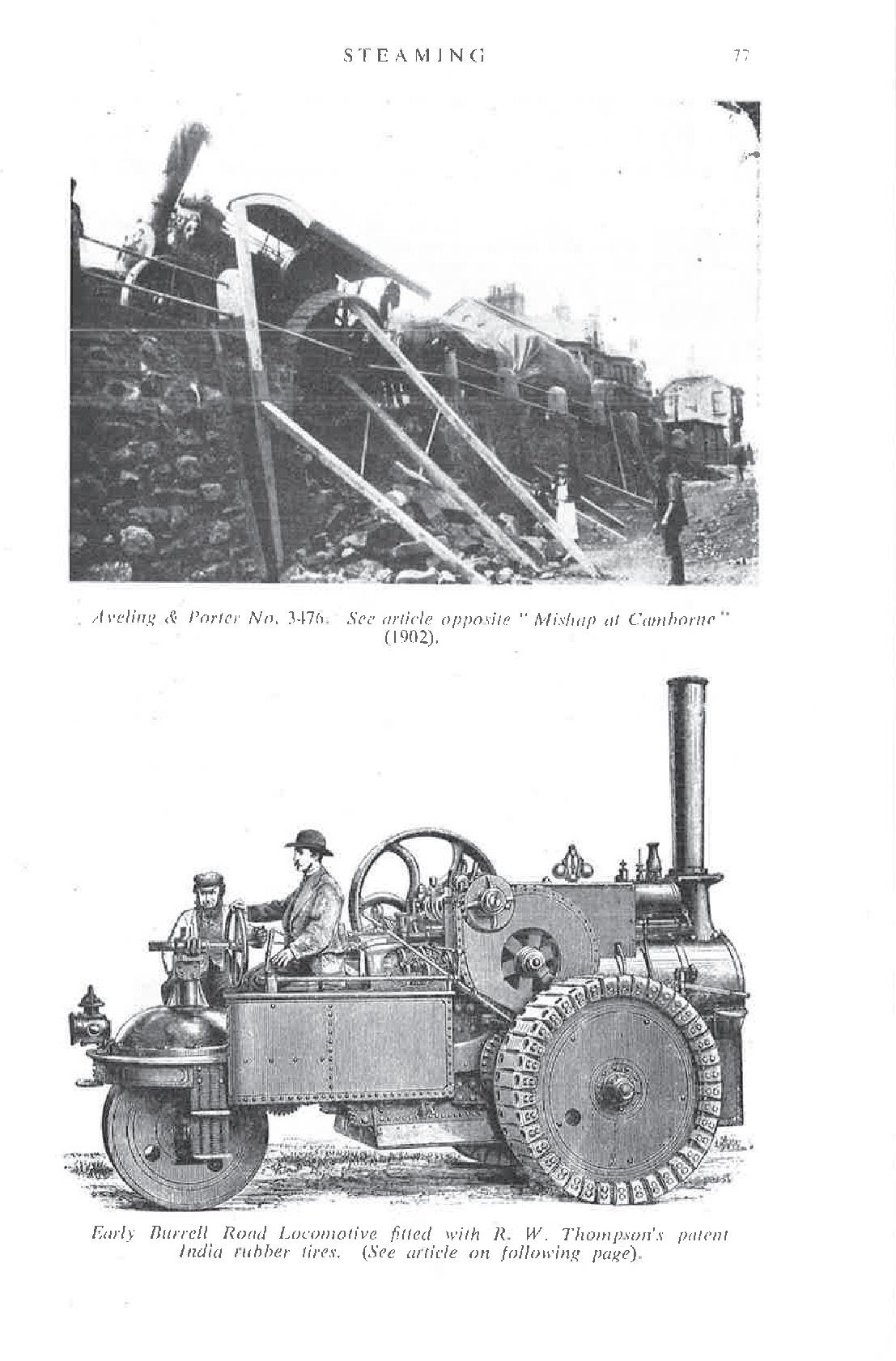
nurrell Road Locomotive {itfed with R. W. Thomp.wm·.~ f)(tl<'nt India
tir<'s. (Sl'e article mi .fo/lml'ing {'aKe).
THESE road locomotives are built with horizontal multi-tubular boilers of lhe most approved locomotive pattern. The barrel plates are of best bcsl Staffordshire iron, and the fireboxes of lowmoor, extra stayed to bear a working pressure of l 20 lbs. to the square inch. The crankshafts arc of best forge<l scrap iron) the count~rshafts are steel, and all th,e gearing is of steel or patent malleable metal. The brackets are all of wrought iron, and so constructed that no strain is thrown on lhe boiler. The engines are fitted wilh single and double gearing, to obtain two speeds when travelling, and are provi<led with flywheel and governors lo drive .stationary machinery. The driving wheels are fitted with India rubber tires, protected by Burrcll's patent steel clip shoes, which entirely do away with the previous objection to the use of India rubber tires, viz., the trouble and expense of the <.:hain shoes, which are continually getting loose and coming off. The front wheel when not fitted with India rubber tire. is provided with a spring over the axle. Experiments have prove<l that engines with India rubber tires, will draw one-third more weight than those with rigid wheel tires, and they are especially valuable for hilly countries. The rubber tire acts also as a cushion hctween the wheel and the ground, an<l takes off all jar an<l vibratio,,, and admits of speeds altogether unattainable with traction engines with rigid wheel tires ; it is therefore applicable for passenger traffic.
These engines arc very strong and light, being almost entirely of wrought iron, and the workmanship and material is as good as can be. They arc. made with either singl,e or double cylinders. They are fitted with water tank and coal bunkers, and will carry water supply for three hours an<l coal for a whole day,
Charles Hurrell also manufactures these engines with rigid wheels ; and from their construction) being mounted on thr-ee wheds, they are very much superior, for road work, to the ordinary type of traction engines on four wheels. They arc handier and more manageable, and will turn in their own length.
'fhe driver and sloker are placed logcther at the leading end of the engine) and the driving and steering is managed by one man, who has complete control over the engine. •
Many of these engines arc now at work in En.gland and different parl:i of the world, and they give great satisfaction, having proved more ecor:mmic:al than horses.
Up inclines of lip inclines not I in 14 exceeding 1 in :10 H I lorsc Power Engine will draw 12 tons 20 tons 10 12 )l )) " .. 15 tons 25 tons ., " " " 18 tons 30 tons
Send a stamped addressed envelope to the Editor, Field House, Turvey, Bedford, for a list of availahle hack issues.
WlLLIAM .JELOERT, A.M.J.Mi:,11.F.
(lfrprmlur,ul hy t'tntrrc .... )' of Ilic· Comi:-./1 /ns1itutr oJ l~11gim·<·rs) Nm r!; Thou,gh the lirst of lhc hyn, journey., dl.!!tcribctl t'Hlll:i1k:d t,:1vcllir1~~ nlHmL M) mi'les, the f111thorwalked by lhc side of the Lrnii11 every y:ud of th~ w:·Iy ! The cn~ine which t'..:~lhin.:s 111Urn sc<.'ond slory ,vas an nli.J to: h.p. ~uni;lc icy'lindcr J"(ammrnc whi,ch nobauy could sLc~U'irl 1,;\<.:cpt 1hc dl'1111kei,1 •• Allf'" (who kept a sct.:ri,:I j1:mmy •• in 1hc blai.t pipe!}.
I 'W\!111t lo ·llrn Phocni'.\ M i11c sallc and lmught a JU h X t) f1. L:rnc:ishiri.:: boiler. After lhc s:ik 1 saw a man who had l1o~ugl1t !\01111.: mncl1,incr)1 Uwri.:. nn:tl he wa.s taking a winch and uliller gear there to lake il t)\!ll., so I ask'l:d hirn If he wmJMta~i:: out our bonh.:r ~s ii w01Jld .save:us 1hc 1roubl,4;or ~1.:11ding 1111.rnmull g~ar 11p there, 1-1~agn~~d lo do .so, .ami I lhcn g.ol in touch with :i lraclion cn1gine owner and gav~ him a coinirac1 w bring U1',,!bc>ik:rdow11. Wl1cn lhcy were rCitdy lor lm1di11gthe boilar thoy asked rnc t.o comc 1up :rnd 'load it whi.eh l did. After loading tlu: boiler. lhe c11gine driver wound 1n nh~ rope 1oos!i:on the drum, :rn<l when he went lo wind ciul !he boiler. !he rope wcnL down between lH'll<l split tha drum of. his i.:ngine. They sent 11.1 the ieflgi11~ rnaikors for a new unm1~ ilrnt lhc)r could noL S:UJPplyit a!i Lhc Firi.l Wo,rld Wa:r was. (,)11, and au work!:i we.,.;:engaged in making munilions. Afl.cr waiting. some wi.:cks Lhcy managed to g~t a s~condhand d1·t11ti ,vhtCh 1hcy l!uc,l on lh~ engine, and the)' :senl for rm; lo come up again which I did mi Mondayj a11d we brought !he boiler as for as Liske.an! wh.crc we stayed the night. The next morning we found the back axle of the back hoilcr carriage wns. beril. As we could not do a.nything :i.bout il i11 the stric.~I wa wan[ down the hill until: we cnme lo level grol1ml. and thcr,c we slopped :Hu.I borrowed a ja.ck from lhl.! lr;comoL1vc sh~iJs and lined 11.hcboik:r a1id look ouL the waggon. We found the wood axle tree was rotten and il was no use having th·e axle straightened unless we. had a new wood axle tree. We sent the axle to a smith in I .iskeard and had it straightened. We also went lo a sawmill, obtained a piece of oak and ma<lc the axle tree. We took lhem down and put them together, puL the waggon back and lowered the boiler on lo it. We then w;.:nt back to Liskeard again for the. night.
The next morning we started off again, and got as far as Lanivct where we drove in otf the road in rroiH of the public house where we stayed the night. We had two traction engines, one httd the boiler and the olhcr two waggons of s<.:rap iron. We had two engines so that we could double up m'~li steep hills.
We started from htrc the nexL morning, and cvcrylhing went all right until coming up over a shorL steep hill we met a gipsy caravan ~nd several loose l10rscs straying alll over the r,oad. Tint gipsy put up. his ha.rid lo sl~1'p,but jhc engine driver kept going. ·rhcn he came after me swearing and thrca1,,,ming me. saying, " Yoo , you b , you IJ , why (lidn't you stnr> '! " l s::i.ill. " Ask lhc driver, ii has nothing .lo do wi(h me.'' He said, 1 • Oo ymi ~now I have. my wife in chat caravim C!tlpccling le>be confined an 1 1 minmc 'I •· II ~~iid 1ha1 thal wa$ nr>t my fault,
Ry that time the other engine was coming up the hill, and he left me and nm back lo look after lhc horses. WTJ urivad in Tmro that night il!ld slopped in Tntral,gar Squar~. ] w·enl to the polic,e sia1.ion to sea if rrhe po'lkc woukl give me pennission le) stay for Lhe.night Al .firs1they said no. lrnt iL was not safe !o go up, Slation Hil I whh the. two rmginc.c:µ.rawing lhe boiler in lhc dark, and ir a11y accident happened I would holcf them respo1,slblc. Tl1cy sniid Llrny vouid not be. responsible and when [ asked then, whal wi.:· should do, they said that we could slay in Trafnlgar Square if we pul lights on them and leave a man on watch all night to \\•hich I agreed.
Th~ next morning we ldt T1u1u auu gul up ov~r lh~ hill, an<l when \W Wl;!fC opposite the County Hall a man came out after us and wanted to know whu,·c Lhc baHcr ''-'iiS i!oing and what was the weigh! of il. I iold him we wcr~ laking H to, IIJasset M:ine.,;, but whaL the ,,.,eight w.as I did nol .k~ow. There were: no ruhber tyres on the nracdon engin.;;s ~rnd w:1gg,ms in nlto~c days, ,\11cl we had ,fama!,!cd the road. The man saiu Iha( we had done score,s. of pounds worth of damage to the road, and J agree that we did a considerable amount.
We arrived on the Bassel Mines that aflcrnoon and unloaded the boiler. Uy now it was Fl'id<1) 1 • so we had been from Monday mort1ing to Priday aflernoon coming from p'hoenix Mine at Linkinghornu to thi.: Basset M in-.:s.
l huL•c,:.hln (\m1i:s!1 boiler for Lcv:rnl Mine. from l~~Jrnth l"tHU1d1·y \.\rn1pany. Some •i101cafter, they sent 1hcir trnclion c11g.in1Z11p lo i~1kc il th,rn.11. When the. drh,cir ~~,rrh: t<'l the foi'!l7Yry yard he lelcphom;d 11111::ami ;-1ski.:d if t woukl conrn Hi and krn,d tlrn boiler l'oir him, whicl1 I did. After we lo:u.kd ii, he asked me if I would go as far a.s Cambomc with him as h~ Jiu 111otlike lhc ham rails and meeting the trnms, so l went and saw him through. Camboni,e.
rhc ncxi day t had a 1.clcphcrnc-t:ail f 11'(>rnl1im ~ayin~ h..: had brok,en llow111. One of his ~,des was l>roken ~nd ha \W~s dow11 at th~ hottom or Rosewnrthy nill. He had a spRre waggo11and asked if I wo11ld come down. brinig a jad a11c.lsome blocking, 1:ak,eout. 'the waggo~1 with lhc broken axle and p11t lhc h'1il~1· o,n lo lhc. olhcr w11ggu11. l oblain1.:d tl horse. and earl, so1111c hlocki11g :tnll a jack, and we111down with two men. When going Huough C'ambornc I saw Alf the driver, a1nd [ lo1d lrnn to oornc and by lhe lime he got up steam we should be re.ady for him. He said al! ,·ighl. he \Vould he dt"m11,.an1d h;1vl! snc~tl"l'lup rcadt for 11:;, W<:.,vcni down and lifted lilt boiler :re~dy roir taking mut Lhc_wnggo11bm Air had riot arrived. 111stthc11 a Lraction crn,rinc:drniwi11J! a threshing machine came down the MII. and r asked tliem ir !hcv wot!ld oblige me: by drawing out one waggon and p11.Hlang1hc other in, which !hi;!)' did. \':Ve lowei'ccl the boilor down and made everything secure., read}' fo.r him1 lo Sllclrl; th(!n we loaded up our gear and started for home. Wlrncn we go! to Camborne T wcmil to the Plough ]nn and ask.cd'.ir they had sl!on ihc drivGr. The l'andlord said lhaU he had. and ihal he had broken down am.I had borrowed lc:n shillings from him to bn)' foQd, bt1l he had not sc:;e11him ~rncc. I wenl ~n to other public- houses hut could li10L A:nd him. A day (>i' lw(> after, Luvan1. scnl tip and l,(,mk.the bfidlcr down, bul we did no~ sec Alf the driver. Some time after that he w~nt lo work on Gccvor Mine and ti;vunt Company put olher drivers on lho lrnction en,l!i11cbut they could nol ste~nn her. Then the companv adverli:scd for a traction engine driver, and ;1 ma11 t":mie down from up the countrv, but he coulcl mH steam her, nml he collld never make the jcrnrrl~)· to, Penzance and back wilh a loud in oni,; day.
One c,fa!' Alf !he driver was al Trewclla rcl lalkin_g to one or the l.twm111 sharc.hofdcl's, and the lractio11 w~s 11p al Trewcllard Hill al the lime trying lo r,1.i'se:slcann. Aff s::i.kl that he hcl he could go ur, and take the l!n&:inc 11uw mul g~1 to Pcm::anc:c.and bring bad two 1n1cks of eo~'I and deliver ii :,it I .cva,rH Mine in ~1 ,ccrt-.11nlvme. The shareholder bc:t him he cm1ld 1ml. s<t, Al( went up and took the c11,gine and \•.nenl lo Pcffia111oc and brought the.: l!m~I !back lo !he mine, put away the engine ::,;ml was up in tha Trcwell,u·cl Hole) drinking beer in under ihe lime.
He was llte or11yone. whc'>could steam her and Levant Company a:skcd him to t:0111c back which h~ did, as he was also a good driver. However, you could 11ol dcpc1HI on him.
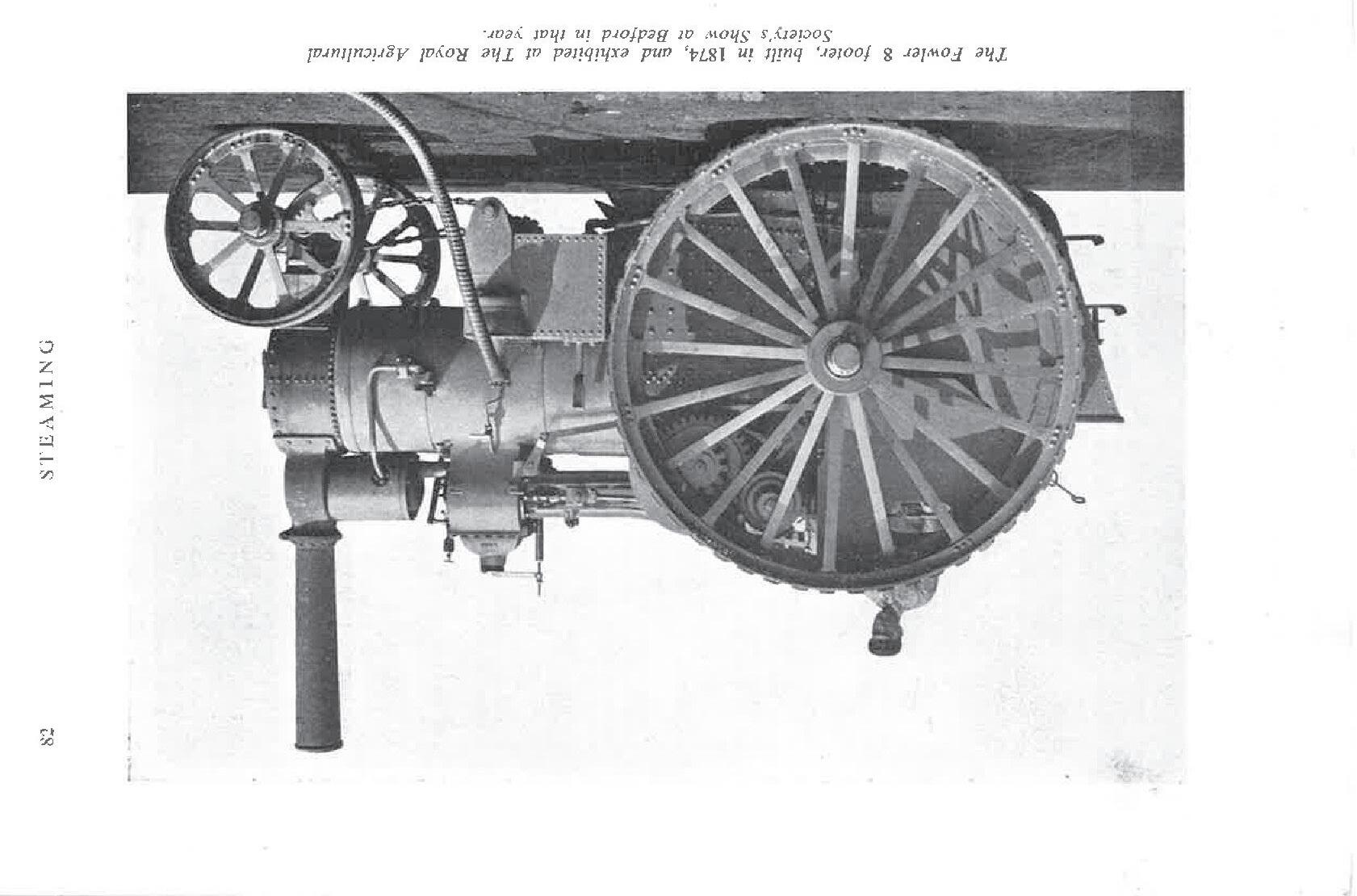
ONE of the mosl striking exhibits at this Show will be found on lhc stand ul' Messrs. John Fowler & Co. of Leeds. This en1?.inc has two cylinders and is provided with oul a very small flywheel, which is completely hid<lcn behind the left hand driving wheel. The driving wheels are 8 ft. in di:rn1~lcr. am] arc driven by pinions on the second motion shafl gearing into internal annular racks fixed to the wheels. The ,vhecls themselves have tires each made up of two T-irons place<l si<lc by si<le, these T-irons being co1H1ccl~d u1ily l,y llic uuliquc ~lt ip~ phu .."(.!J 11.H'IH.l llu; wlt~c..:b, a11J tlie11; L,1;i11g lh) covering plate. such as was formally employed.
The ~nginc is provided with gcating fot two :;p\!cJs, either of which l·:111 be brought into action by a clutch moved by a hand lever. The brak..:. is lilted to the second motion shaft and is operated by a screw acting at the cn<l of the lever. The steering gear is plac-~d on the left-hand side of the cnJ,?inc. and is operated hy a hand wheel, having fixed to it a hcvel wheel, which gears inlo :rnoth·:.!r bevel wheel on an individual spindle carrying a worm which drives the shaft for the steering chains, situated under the barrel of the hoilcr.
The feed water is carded in two tanks, one behind anll one in front of th·~ firebox casing, while on the top of the boiler between the cylimier :md chimney, a feed water heater is fixed. This heater consists of a cylindrical casing traversed from end to end by wroug:ht iron tubes. through which lhc exhaust steam passes on its way to the blast nozzle. The fee<l water circulates about these tubes, it being pumped through the heater on its way to the boiler. Messrs. Fowler's are now applving these healers to nearly all the traction engines made by them, and they are found to serve the purpose of softening the noise of the exhaust as well as healing the feed water.
The •engine described was built in a great hurry, there not even being time lo paint it. before sending it to Bedford. During the short trial made of it, however, it has worked exceedingly well and we believe that Messrs. Fowler's <.:ontcmplatc constructing other engines of a sin1ilar tvpe with still largl.!r wheels. Dy the use of such large wheels the frictional resistances will, 110 doubt, be reduced, and hence an increase in the effective haulini? power or the engine may be expected. At present, however, the data available respecting the internal resistances of various tvpes of traction en~ines are too fow lo cnabJ.c us to establish, with even annroximatc accuracy, the proportionate reduction effected bv increasing the Jiamctcr of the wheels. and the value of this iru;rl!.ase is, lhcreforc, a mailer which must b~ lcl'l to be decided by c:,;pcrimcnt.
SUBSCRLPTJONS ARE NOW OVERDUE. PLEASE CHECK--IF IN ARREARS, SEND YOUR £1 TO THE MEMBERSHf P SECRETARY. NO MORE COPIES OF STEAf\,f!NG WILL BE POSTED TO MEMBERS IN ARREARS . --
WHITSUNDAY & MONDAY
29t'h&30th Mra,y
REFRESHMENTTENT
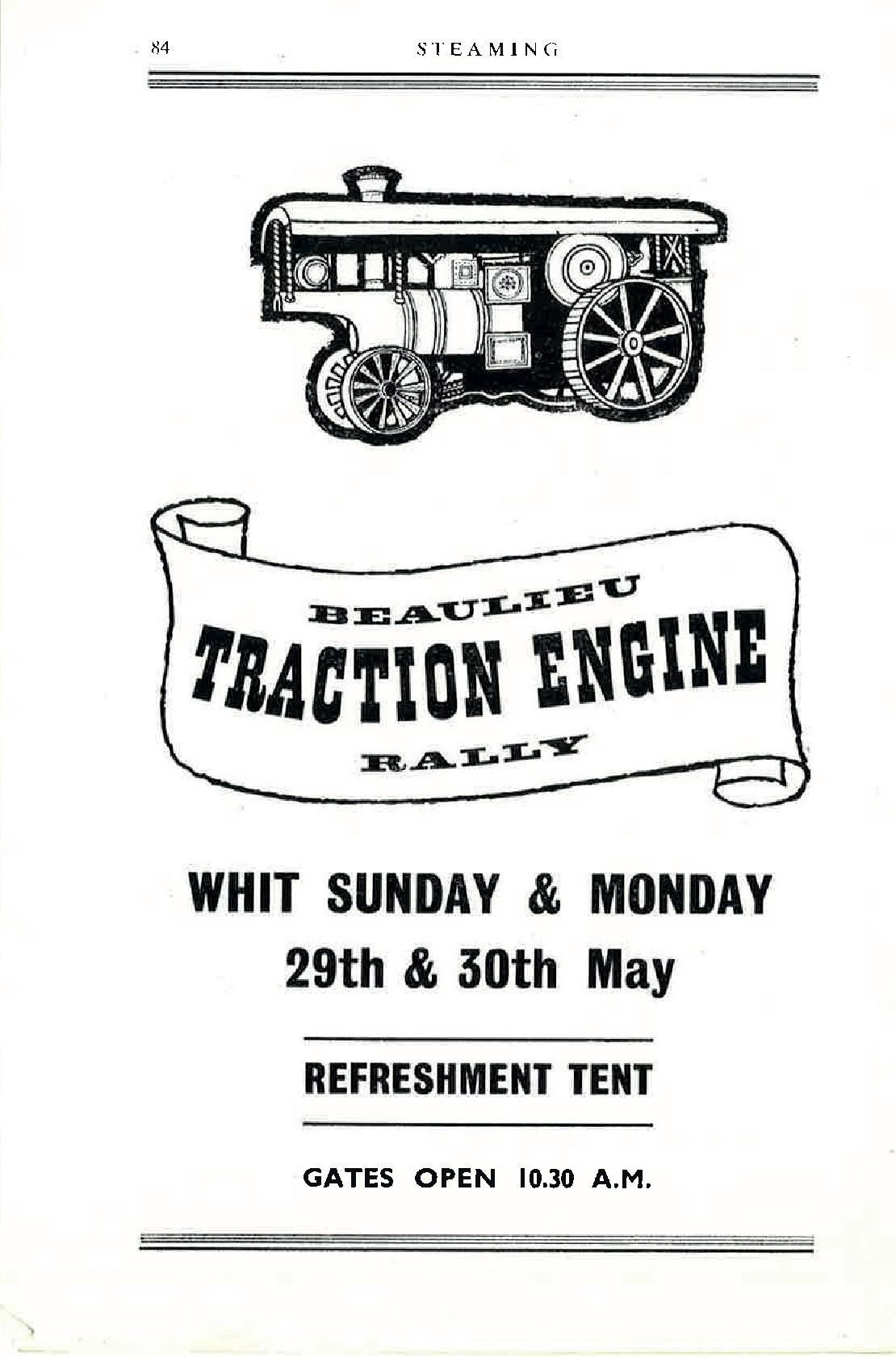
GATESOPEN 10.30 A.M.
BY W. N. SALMONS
T111; Jillkulty in controlling very large teams of horses, csrecially in eonlincd spaces anu whtm the load to be moved hau sunk lo some e\tcnL led lo the 11s.cof stca:rn enginc,1t l"ot •he: fiauiage ,of llc.:aV)l indivisible loads nt a very ~Hdy stage. /\ hor.sc can cxcrl a ver)' high 1111.cliveforce for a shMI li1-t1~. bill only n rclalively low one for the durnti:ori of a journey. Hcrnce one mighl hai'11c.~~ 20 horse:; lo a load to take tt on 11,i:road ammugh 10 of lh~m would be able 10 st:ii_rtil t1:11d pcat~aps six: o·r eight keep it moving for a shorl distance. lf, how.ever. Lhc iond was in,crcased 11ntil ic rcquir.cd 1hc fun po,.,vor on d1c 20 horses lo stan iL. 11mirn1g Wi">llid mo\ 1c, for ll was virtualiy impossibl~ to .gm. r.o n'H'll'i)' hornes. to :.tnrt pulling nt c·rnclly Lile .:;.nm!,,!Cinni.:. Some. would S.11;\l<.:hand rear and givt.: w1 before olhcrs \\'Cl'c l'~ad)I. Th11:-;. ,\11 l,l11ginc whicl1 <:OL1ld be controlled prcci:selrv lni tinl! m~rn had l'!rcal adv1rnt.agcs, for c.:ven,1hc <lcn1ands on rw.d and water of 1he earliest cnp.incs. \\'Cl'C 1m greater than lh~ gr~aL teams c>Utmimal 1•cqutrcd for the same work. E'wn draug:h! tJ.-.:~n could be baller than horses for hc;1vy ,.,,ork as th.c:~•wo11ld j1.1st lean on the lo,1d unLil U:H!whole lean, was "in drnught •• when t:i1hcr lhc: 1load ,,,ovcd or more oxen were flddcd.
ny 1858 Bray en_gini! wm:; hauling load in ,~,o~l1i'l!J1'isl~r' "'hich hall pre• vi<H•sly requlrcrl J6 hor,;;cs. whi:le in IR62 a l1r:.1vengine delivered :i 20 ilrn gfrdcr for (he L.C. & D, Raihvar in D11hvicll. !iO CQm•incing u t:on,rH,ulPI'
In 'f'lu: Lo11do11lfhwrmecl Ne11•.,; of its abilflv 10 draw ·• PorHlernu~ loads a!mo-sl impraclablc l,o horses". As 1hc size and wcittht of ~irdcrs. boiler:--, fncLoty m::whinc:i-)• ~nd later. clc,ctrical plal"ll. incnrnscd :m c1id lhc capacity or the steam road engines Lo handll? thec.e loads. Eve,, a[ the extreme c1id or lhc steam era single lo~ds of much over f on L<H1~ w,o,re sWI tpai'le LH1111s1rnL but this repre:scr11t:.:d1e11 limes Lhi.: i,rattur:il limil for ol~cr forms of r,,,wcr av~1ilablc: 0\ 1cr :1. p~riod of mor~ lhan half a ce,nu,·y. long al"leli the sltU='!n1 wa,gon, and la1ter lhc petrol !orr:.1• h<ld la1'.cn over from the 1rair.s ()f fraction wagons the divh;ihlc loads such as bricks, road stone, fuel and furniture, the rUgJ!ed and versatile road locomotive was still very much in command of tbe big loads whkh usually required In be loaded ::111·dunloaded by tbc engines, and whose speed was nece~sawily li11r1itedbv their weight and size.
The capa1bililics of stca111 engine~ for lhi~ \voirk w~$ rcc.:o,gnis.c::dovcn;l.);1s aud engines liLiilt to Thomson'.~ llc.i;ign,;;wara sent to A.marica wh~rc olhcrx were built to lhc same designs. By 1871 one of lhese was in use hauling the columns for the new State Capitol al Sacramento. Illustrations show lhat even at that date it required three of these great stone columns to make up a lund for {he engine.
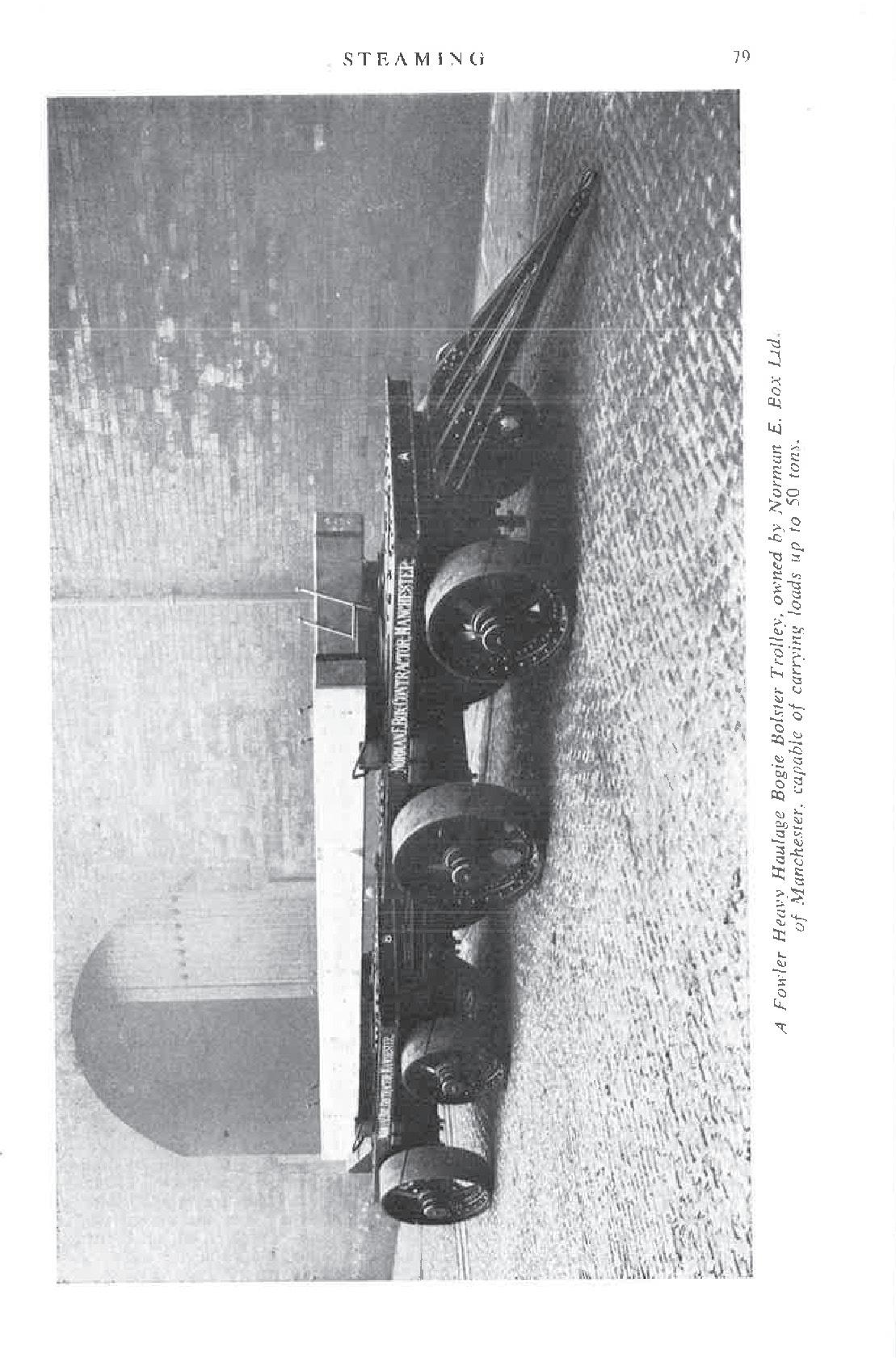
A curious feature of heavv road haulage. however seems to he lhal the lrailers or bogies used for th•c ~C(tlal can:iagc of the' loads did nol dcvclon with the engines. Pneumatic tv1·es for really heavy loads did not come unlil dics:ds were well established, bul ri~ht un to the l930s stccl-tvrcd trolleys without stwings were stilt in use. Tow:1rds the end of the steam era some line multi-wheeled trailers were buill bv Fowlcrs with so1id rubber tvrcs and a well frame carried hy cirtht-wh.celcd bogies with provision for equalisation on uneven j!round. Some Eagle trailers used with !.lc:am road locomotive~ wcr·c cquallv advanced, and a fine Oat trailer for 40 tons was built usin~ l.wo Scntind rear bogies on soHd tyres. This was right at the end tho11.1..?.h. and for half a century big roull locomotives s(raincd and winched at rn11,?h trolleys on four great iron wheels without ~r>rings and often wilhoul even a proper lock. These had to be coaxed round comers hy skidding them 011 slcel plates laid down for them. a slow and labo1·iiolls Process. Al thot1/.!h usually very wide the wheels of these lrnc'ks were small in diameter, ai1d having plain bearings of large diamct-cr their rolling 1·csis:tancc,even on a h:.lrd road, must have been terrific. This must be anp1'et:iRkd when looking al pictures of steam cng,inc.c; assislin~ each other in proups of three an<l l'our on a load which wo11ltl be commo1rnlnoe todav. The same weigh! on :1 moJcrn lrailcr woutJ be an easv load l'or one c11.1.dne,alwavs provided lh\.!rc was some means or stonr>in).! it. Vvilh pncumntic tyres anJ modern bcarin!?.S brakes become more important than great motive powt!r.
An example of the :sort of thing Ith.al hap,pcncd is an ac:ddcnl 1·~cair!cdby Lhc \.\•riler about 1926. A double helical _gear intended for a (actoir.v i11 South Am~rica was despatched from, the Power Plant Co. Ltd. or W.cst Drayton to file loca·i station ·whc.re:ii w;1!\ 10 be loaded cm r~ll en route f.or londori Docks. h is saiMI Lo hm1e ,vcighcd 28 lons~nolhing oUl or this wtwltd-but it. was loaded oi, the works O\l/ 1n trailer ,vhich had fotir whc~ls and no sp1·irigs. 'ro pull th~s the iim\°&o,.v,nroad locomoti'\'c w.as sLcamed. Sb,(,lwas. O1\yton & ShlJll11.'lworth No. 45997. n 6 l!il.h.p. of tt>ll, rarted by her makers lo hau~ 22 l-ons so not seriously ovcrtoaded. f n the course of 3 iouniev of less than two miles she icame lllpon .fi Lrench whach had hccn ba:dty lla,ck-flllcd~nd !'~CCi'1tly topped with tarmne. foftl• this ·wa.llowcdLhc load.cd ·1railec1·,and! sl1Uck fas!. Over the Chtyton's. umrn.cccssful:attempts to extricate it ·we will draw a discreet veil, but it haPDCl'ted lhat iha f.a.fr was open in the next village-Yicws,1-~y-and l!iie Fosters H Marvel " and '' MarvcilolfS" w1J1:c c:ominp:into steam ready to drive iiJ?hts. One of lhes~ WS'lS sent for and ;i,rrived in the ca.pablci hands of" o!.d 'Bill S~ev.l.!m;.Jvet.~ran ,of Allrl-:haulag~ in Fra~·ce and la·rer to ·ttor,ca.r ir, a lfibn ·wiH1 the l"a(e Wm. Beach·s Uurr.ell No., 2:116 HConquorm '\ He: s<mn had lhc Foster w,e1l blocked up. th.c wir,c ('111l, ftrld lhc road cleared or the hundreds or spec·lalOl"S who ha.cl gatheroo. He womu~1 the: load. oul coupled to iL f'trid look it on to 1hc :stalron without a lot of trouhle, while the Claylon went off home on her own. 28 tons todav would hardlv he calle<l an abnormal load. h11t ,,,c woulrl expect lo distribute it over at least ten tvres. an<l how horrified we would be if it sank to the axles in lhe middle of a nnin road! S11ch though were the conditions 'lhc cnp;ine.~ and their crewi;; knew a.., ,commonolace. less 1ha11 forty years ago. You can see Lhc: scene ftlr yourself now. The ·Post 0r1ic-c is onlv com,Te of miles frc'>ni l.(Htdon Airoort. The lmt:rl i.ank near the Elm Tree: and 1he chi!Jne s(ood bv GnttermDlc.""·Corner. A1wo,,e wm show you where these hndnnrks were, unless he ln!")pcns to be a newcomer.
W.M.S.
For Salc.-Wallis & Steevcns smokchox door nameplate, in hrass, for tractor. £8.-Jessctt, Hadlow Down, Sussex. ror Sale.-Postcard size nbotoj!ranhs are availabe of the illustralions on f"Hl(!'.CS 9, IO. 11, 12, 13, 14, 15, Hi. 17. IX. 19. 20, 21, 22, 36, 38, 40, 41, 42. 43, 45, 46. 47, 49. 50, 51, 52, 53, 54, 55, <i6 and 82. Price ls. 3<l. each. minim~1m quantity half~clozcn, or 40s. per complete set.- -From .T.Crawley, Field House, ·r11rva.y, Uedford.
F'or Salc.-Rcproduclion of Ten.u11t;cC11n~o·J');\inli11g~howinl!. thu rp.slnrcd FIYinE! Scotsrr:-ia,,, No. 4472. crn~~.ing,ilrn Fo,rUi Bridµc. Si1.c 2-li in. X 20 in. Silitablr:. For fr.amin,J. ,,rice £1 2s. Od incltuding ooslagc :=i.odpacking. Prom The Cura:toli", Historical' Museum, Tt'iangle P"l'ac~.Cl~triham, London, S.W.4.
For Salc.-Sel or four !Col:olu'edr,riru:;, ~i,1.c:9·} in. X 5,) in., pl11:sa. 2 i11. htlrdcr. "Those have boon spucially pri1itud ro,· lraming with ~.-nccia.laUcnti,111 t,, lhc cmlour acourac\l. 17,e c,,gincs dcrii'cted a.re: Fowler .~howr:11rn1i'g,Rn~im: ·• 'I( ik:hcner '' (The Iron Maiden),. "Powlcr ~int!l~ Cvlindor PlouJ?hing 'Bn~im.: al work, Thonwcroft Steam 'IL(u·rv, an:d Mar.s.h;\l)HTl'~~tion E.nl!im, at wod; crn the dnm1. Each set irnnnlied' in cnvelorie with ~:ardh.oard:stiffener. P'l"icc 15s. (post pai<l).-From J. Crawl~y, Field House, Turv-cv, Redford.
For Sale.- -Powler Traclion Eiwinc and S1eam Roller Spares Calalu~11c. Size 15 in. X I l in. Contains 27 large ilhrstralions of c,rnines a11<l oarts. Vcrv J,!oo<l condition. Offcrs.-Uox 1,· "Steaming," Ficl<l House, Turvey, lk<lford.
Wantcd.-Fully restored Showman's Tractor.-]. C. Tennant, Camms House, AskrigL?, T,cyhurn, Yorks.
Wanted.-Ronald H. Clarke's "Chronicles of a Coun1ry Works" and L. M. Mcyrkk-Jroncs 1 u Steam Road Vehicles", Se1,d ([Cl.tailsto: Charles 11. 1)1,'l:rn,330 Acklam Road, Middlcsbromih, Yorkshir<i.
Want-ed.~Photo~rnphs (for coo,yin~) <),r Durrell 6 11.h.p. ,S.C.C. ,No. 3'(H7 (lfog, No. l<E2739) when worl:im! in Shcppcy o:r 'Wio1?h.:m1(C}l.1Uoi'bt11·) 1 ) area.-: <>I'Kcnt.-J. R. E. Driscoll. 32 St Charles. Road. Brn11h:vood,Es.:;~:,:. Vor Sa~c.-.~c·I or two col(Jurcd prints. si-zc 4~ in. X "3{ in ptus a I-A in. hot·d~'r.r:o~lei· Shtlwana,11TsTnrcuor :a1uJCl~·vion 'l!'nu.:CionUnuinc. l,dcc 5s. Gd. (im:lu<ling postag~).-J. Crawl~y, Fid<l House, Turvey, Hc<lfor<l.
Fo.r Sale.-Plon!;!:hing Engine Photographs. Phot.ot?raphs of postcard si.1.c are avail.able of illustmtrnoit on the fo.l1~1wir1gpngc~ ol' Lh~ "John Fowler Memori'at •• issue of Stec,ming: 20: 22J 24: 32. :n, 34, 36, 3~. 40, 42:t 4(), 4~. 50, 52, '.~3,56! 57, 58 1 6() 1 61, 62, 65. 66 :and 7-Y.. I~. ~d. ,each po~I p:iiid..1. Crawl~y, F~cld House, 'nirvey, Jkllfonl.
Por Salc.-Marshall 4 ft 6 in. Thre:..~hcr No, IJ675 (UN7); has in no way bec1J1alter~d. and in V~f')' good cofidttio,r,. I 940 1-fornsby ·rrnssc1i in ~ood work•ing. order~ aH belts. 1917Titan Tracu:n wilh 191.\ Tractor Ridiog Pfough. hotih in useful condition. Soma e1r1gincspares and Scnlinel spares. Ali t•n be. sohJ by am:tion on I 9t.h Maroh ~l !1lnck1'lcs,1Farm, Camcky. Tcmpic Cloud, B"risl•ol.
Wan.tcd.-Front wheels for a Foster Tractor (Wellington), 3 ft. 4 in . . diameter X 5 in. widc.-D. B. Weston. "Honcvsucktc." Bunts Common Road, Leigh, Nr. Reigate~ Surrey. •
t·«u ~aic-.-Fmm fork i'or Avciing & i·oncir i1 itm Slc;am Ru1l11.:,. a,·u:l rnriou:. other, fin in;;::. One pair of f ro111,vhl)cls wh.ich. coului be adnpl.•.•dfM a tractor, lWo 54 in. threshing machi111cs,Ransome, Sims &. Jefl"eric~ and M:ir~hiill, a'lso Lim7. low dc11s1tv straw baler. Two Ma:;sey 1-lrtr!'i~ tiers. All suitable for preservation. • • - •
Wanled.-Chimncy and base easting i]nd bn1s.s tq1p for Marshall 7 Lon "S type Road Roiler.-J. T. Ileehy, W}tmes\v(')ld Road. lkmpstonc. louihborot1gh.
Wanl:cci,-Cromplem brake bnnd gear to 1i.t fl:lsler 8 n.h.p. Single Cyli11{lcr 'l'r,\ctfon En~im.: No. i115 (1903). Paris. from 6 or 7 ii.h.p. engine wouhl In:: suifablc.-M. A 13urr, 10, Woodside Av-1rnucj Killamarsh, N r. Sheffield.
For S.;ilo.-Ki~g G.ecwg~V Royal Arms transfer, full colOL1r,13 in. X 12 i,, .. ot1 green skol pnJtcl (a[P_plicableFodlcn's). brilliant. perfect, :B IO!i.OJ. ca.rrriag!I! paid. Avcling alloy hellrnldic horse ai1id i,wficta,, polished., omi red shield. £3 5s. Od. carriage paid. Rally <?nginc.photographs. my own, 61 111.X 41 in .. good prin1s1 N()s./Namcs. IOs. ror six. l 8s. foi: l.weh1e. p,.p. My sok:{"licm 011ly.-A11thony lkaumonl, "Waynel'Ieea:· Sot1th Woouon, King's Lynn.
For Sak~.-" Saga or the Sneam Plough.'~ Aulllor·s a:ulographec:I copiei;wailablc H)' N.T.E.C. members, post free. Sl!n~J 011.ly42s. lo Harold l}oiin1ct1, .l lHdge Side, 'Haw !Lane. Blcdlow Ridge, Nr. High Wy~ornb~, Bucks. Wnnh:d.-Copies of "'l111plcm~nl and] Machinery Review'"'. \.Vould ~rny,,11c who krw,ws where copies or volumes for' HJ75, 187()and 1877, a.ml then rrmn 188.' 10 19116nrc available for sale, please wri1lcto H~rnld B(llH\t.:,Ll, '.\ Ridgo Sid~, Bledlow Rfdgc, Nr. Hig!, W~combe, D~1cks, _ s1·eam P!@1t1ghClub.~Anry<rnc 11Hern."llc<lan .a smnijl dub 10 s1~cc1~t!1s,c111 Ploughing Eriginc m~rne:r.sshould ..,,•1rilc:io H..im!d BrnrncH, :\ Ridge Side. Ma.w,Lane, R!cdlow Ridge, Nr. High Wycomb~. Ducks.
For Snle.~f>afr or lamps l;,y Joh111Fow!i.:r & Co. of L•::cds. with rcvolvi11g rcnccrLors,one r(HlruJ l~n~ i1\ fr()1H nnd p!a.in glass on one sit;e. Sprit11gsoc'k:ct!'i to fit <)111 lmtck~ls :-ll'l chc sklu. Black iro11 with brighl metal ri'ms. with oil con.tairncirs,compl,clc. :£20 for the pair.-1:l. Btirdgc., R.D.C. Ollkes. Tcmrk Clom_lj Nr. Br1slal.
For Sale or Exchnnge.-Mukcrs· ~aiU~l()gues(large sel:ac1iQ111)!c)nc pk1tc. pressure g11111gc.oddrnonts, steam books, old photographs. S.A.E. roir li~t -P. G. Gledhill. "lloswonh," l 3 ViMier.s Avcnlll!, Ncwlakc. Newlon A,Mmt. Devon.
Por Sale.-" A Hundred Ycf\fii. of Road Rollers·· ,(Avcling-lli1rfonl), tl ; ·' lltnl!.y Trac1ic1n Engimi.c;,''' 50 plrnoiogr•nphs, I Os.; "G~rrctt~ t'>f I ci~101,:· 4Js. '>.d.; " A Pietoria! Hislory of Uie f'arom,el." F. rricd. HlRs. (id. AH p1)Sl pnld. Postcard si:o: pholO,g.ra;!')hS:S<:ll't on apprm,nl,, Is. each. S'lntc rc,quircmeriL<L-<1. R Hrnv1hornc1 - 19 Bliidle: P='\lh. Wooclcolc. Reading. W~ntcd.-Nameplatc F'owlcl:' with ·11-ceds.inscl in the r.:c,111\). Would c~changc anolhcr phlle for an origin,,). or cMh for .- ranthf111lrep:roduc1ion.O. ft. Mnw:lhornc, t 9 Bridle Palh, Woodco,tc, Reading.
W~1ncd.-Fowlcr Compound Plm:il,!hing Engine, BO Type. Mi1~t lrnve good Arcbo.\".,111ibc.1iH:nd.~molk:ebox. Good pt,ic<.:for fur.-iiclris!<icn~inc. ;\iso Roller Driver's Living Van.
Wanted.-Garrctt Tractor rear wheels or right hand wheel, differential bevel whec~ (!oosc), governor, cr0.ss spindle complete with bracket, chimney hase and chimney, boiler feed pipes. Will purchase .scrap cnAinc for sr,ares. All rcp1ie-~noswured.-L. J. I.am he, 1:1 Highfield Rone!, Bromsgrove, Worcs. Telephone: Rromsgrnvc 1398.
Wo.1/i,, ,~ Steevens lO 11.h.f>. 3 8petd Compound Road EnKine No. 2644 "(;eneral Hfllla ".
Whether he is 'nursing' a boiler of an Ocean Liner, or a Power Station, for a living, or tending a traction engine for a hobby:
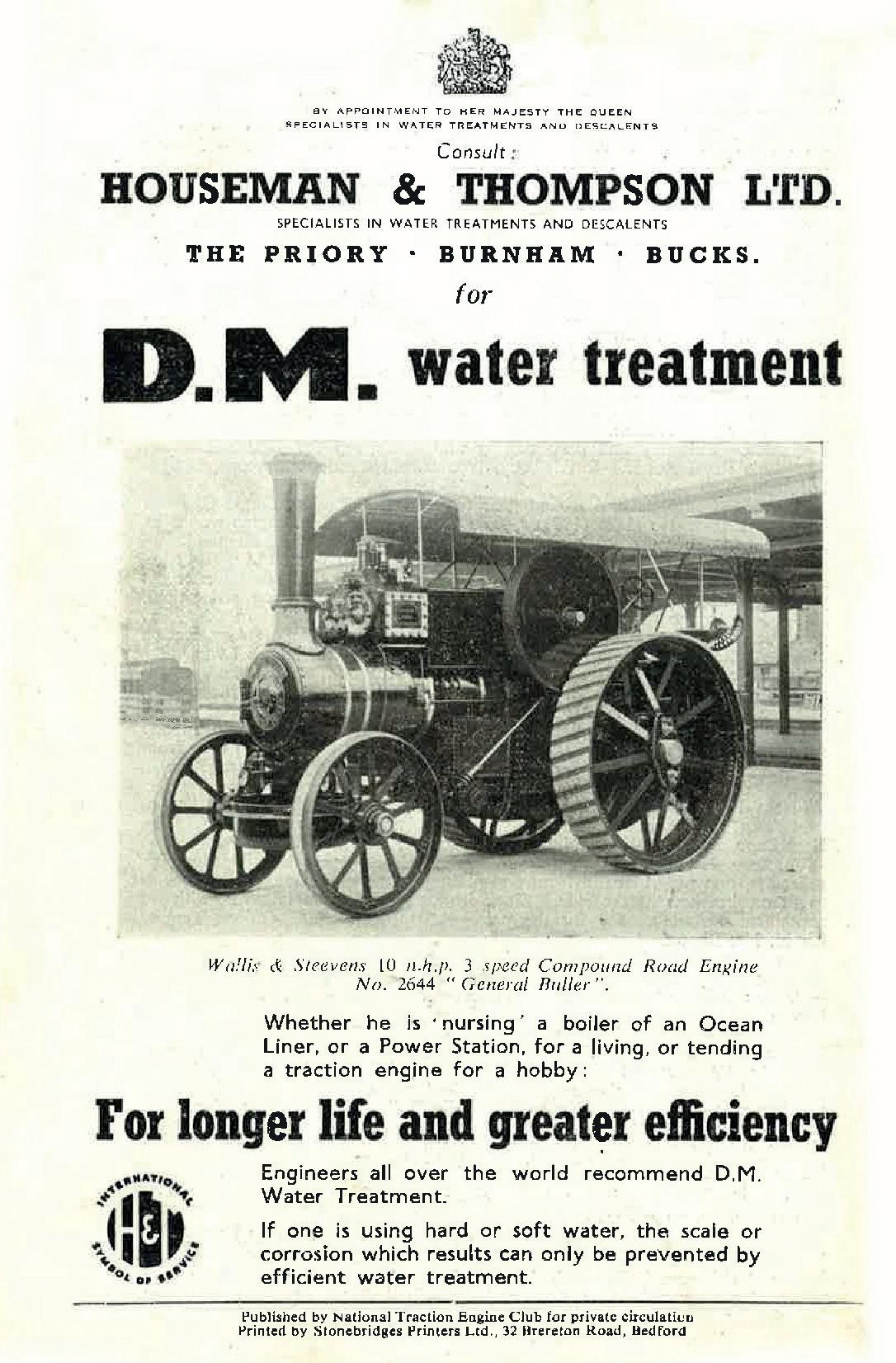
Engineers all over the world recommend D.M. Water Treatment.
If one is using hard or soft water, the. scale or corrosion which results can only be prevented by efficient water treatment.