STEAMAPPRENTICECLUB
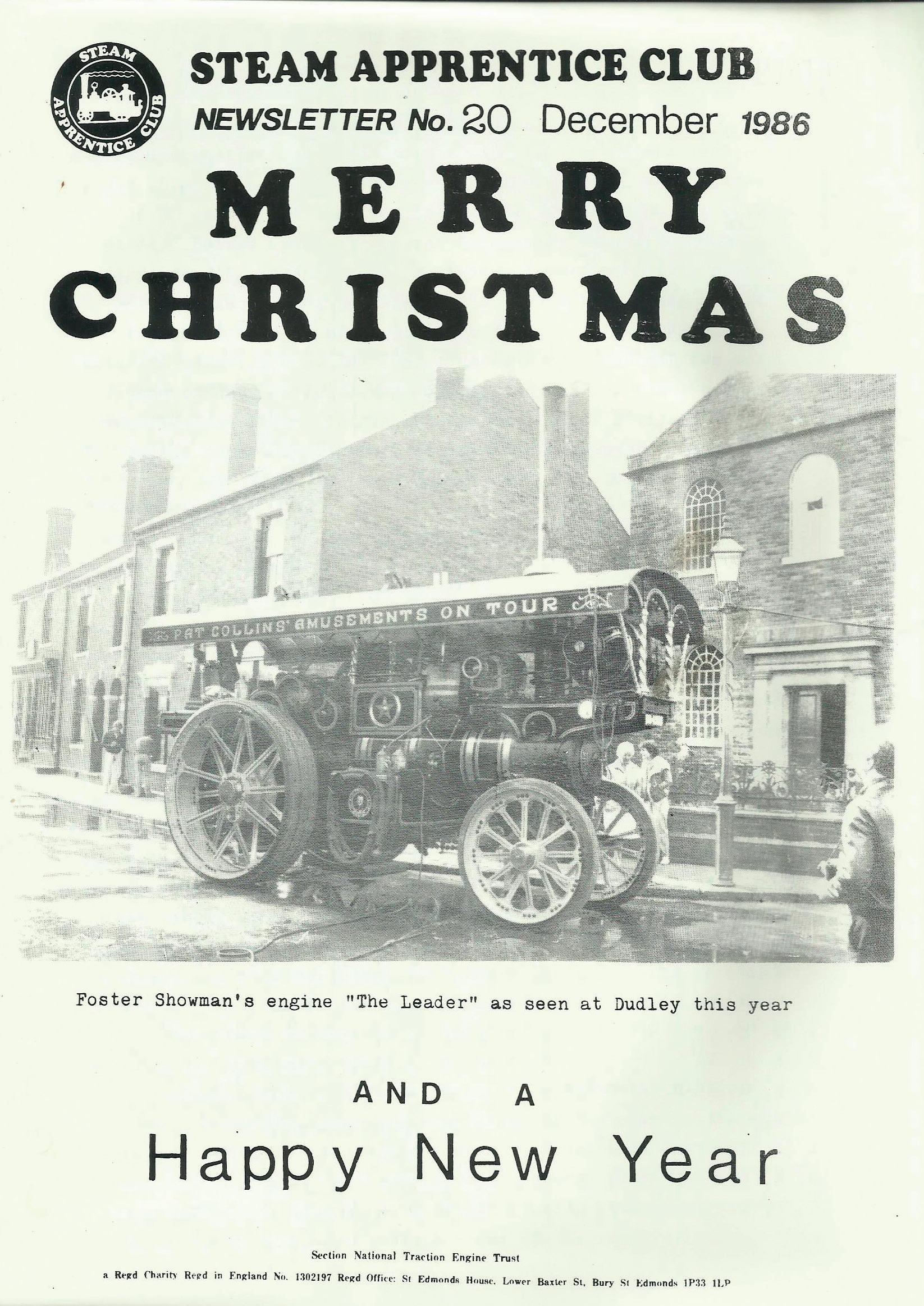
Now that the rallies have finished, the hard work really begins, last weekend I help drain, clean up, oil and greese the engin~ which I drive during the summer. I expect many of you nave also been doing this during the last few weeks. In this nev.sletter I have introduced one new feature, called "Little Known Makers" it is about engine manufacturers who only built afew engines, anct I hope any of you who know of such a firm will write and tell me about it. I would like to thank all the members who have written to me, but we still need articles so now tnere are no rallies, now about putting pen to paper. Lastly I would like to congratulate David Duffill, our membership secretary on becoming a committee member of the National Traction Engine Trust.
Richard Hurley
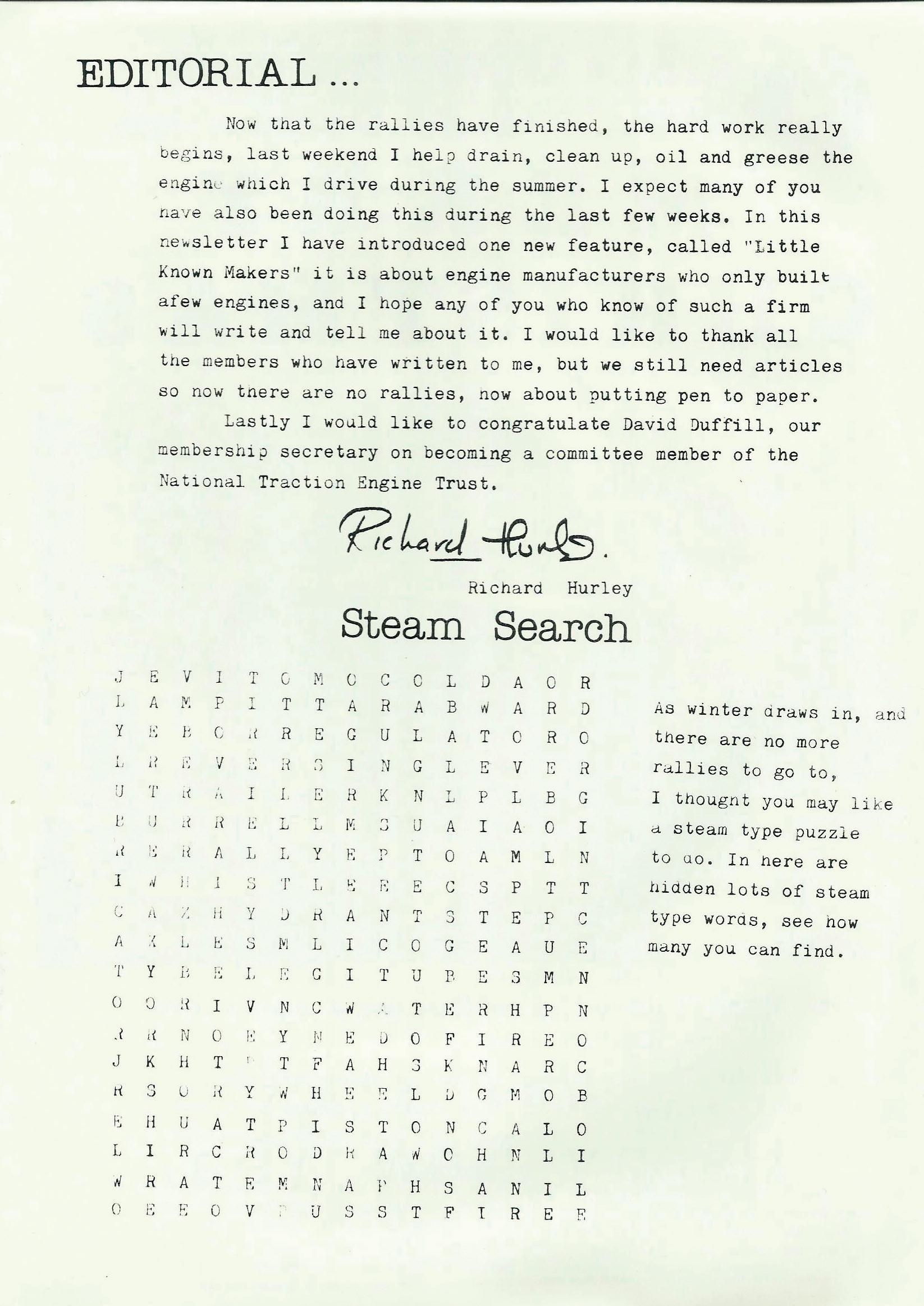
As winter draws in, ana there are no more rallies to go to, I thougnt you may like a steam type puzzle to ao. In here are hidden lots of steam type words, see how many you can find.
This firm was established by Charles Lack in the 1360s in a small engineering shop in Cottenham, Cambridgeshire. The first engine which they built was an interesting
road engine havine its drivine; wheels at the front ar.,i ste-E::-1ng wheels at the rear. It was a single cylinder a~d had a chai~ final drive.
It is believed that no engines cf tnis make fiave s~rv1vei but it is known tnat they produced soffie :1orizontal steam e~gines in later years.
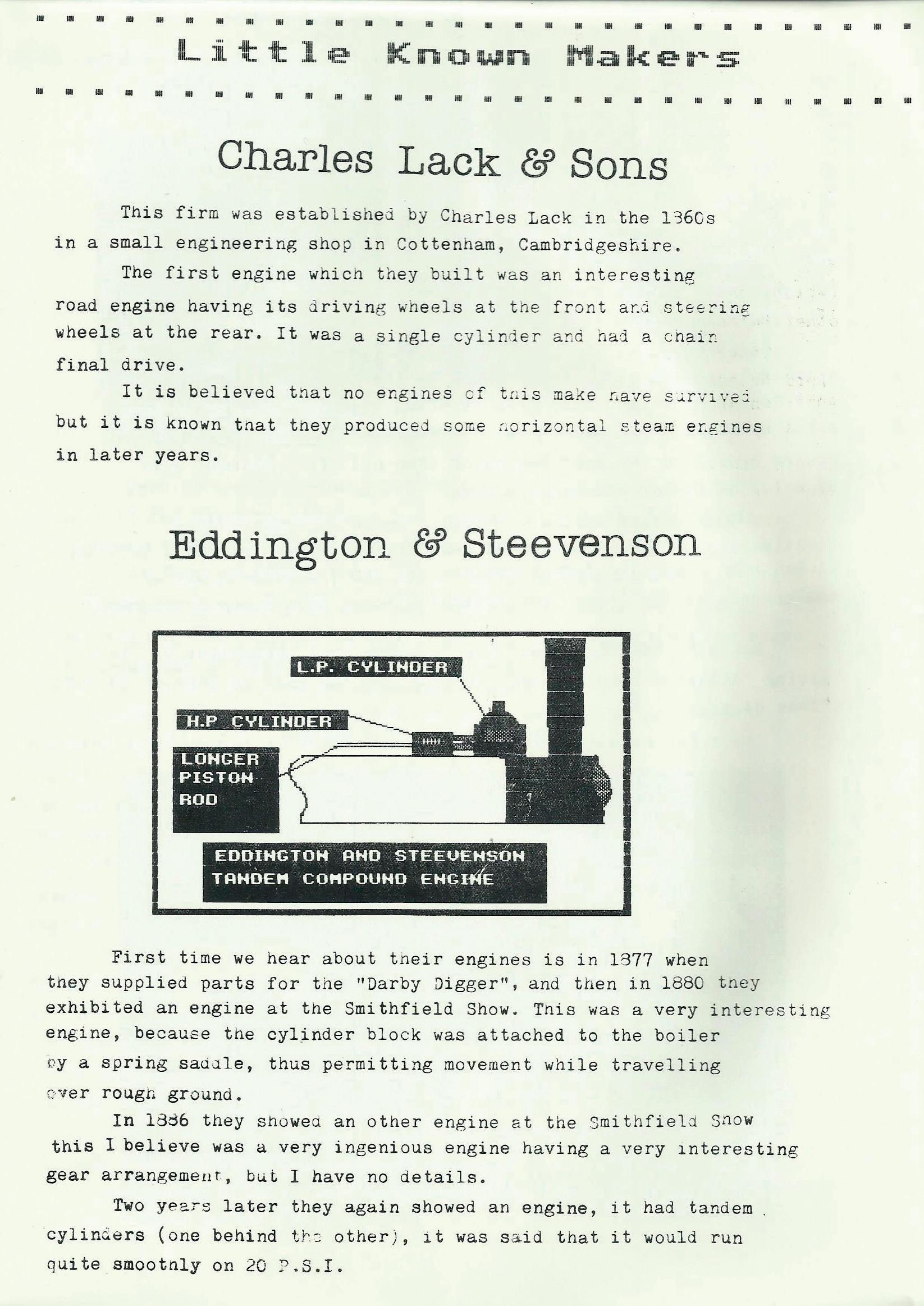
First time we hear about tneir engines is in 1377 wher.
they supplied parts for the "Darby Digger", and then in 1880 tney exhibited an engine at the Smithfield Show. This was a very interesting engine, because the cyljnder block was attached to the boiler QY a spring sadale, thus permitting movement while travelling over rough ground.
In 18d6 they showea an other engine at the Smithfield snow this I believe was a very ingenious engine having a very interesting gear arrangeme11r, b~t I have no details.
Two years later they again showed an engine, it had tandem cylinders (one behind t~c other), it was said that it would run quite smootnly on 20 P.S.I.
For t11e second year running, I found the weather at Stourpaine dry, and not the usual foot ~eep mud; which we have become used to. Although I must say it was cold and windy at times.
As usual the number and standard of engines was high, with over 100 steam enteries, 34 of them being showmans. These included my two favorites; "Ex-Mayor", the Burrell Scenic Showmans number 4000 owned by the Saunders family from Herts. Also there was what I consider the greatest showmans ever built "Quo Vadis" ( which means ''wither goes t thou" or "where are you going''), an other Burrell Scenic Showmans.
Otner showmans included the National Motor Museums Burrell "Lord Nelson", which was once owned by the amusement caterers Anderton and Rowland. Also present after some time was "Earl Haig" owned by S. Burgess. The immaculate showmans "Renown 11 owned by Howard Bros. and the most famous of them all "Iron Maiden" were examples of Fowler showmans present.
An interesting engine was Fowler No.16006 "The Puddock" firstly because it had travelled down fror.. Aberdeen, secondly because it had been converted from a roller, and thirdly because one of toe members of the team who brought it down is a steam Apprentice.
--------------------
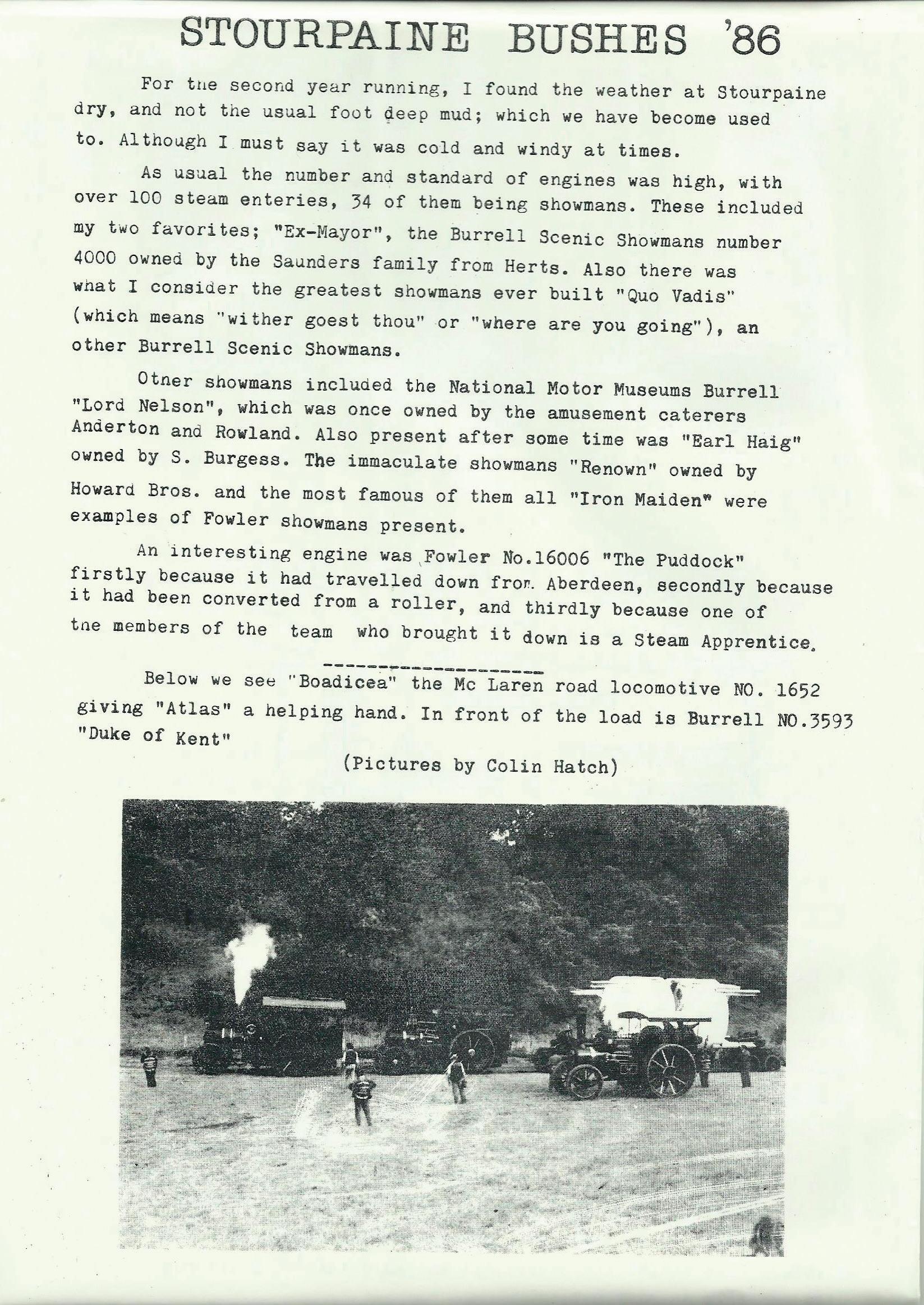
Below we see •·Boadicea'' the Mc Laren road locomotive NO. 1652 giving "Atlas" a helping hand. In front of the load is Burrell N0.3593 "Duke of Kent"
{Pictures by Colin Hatch)
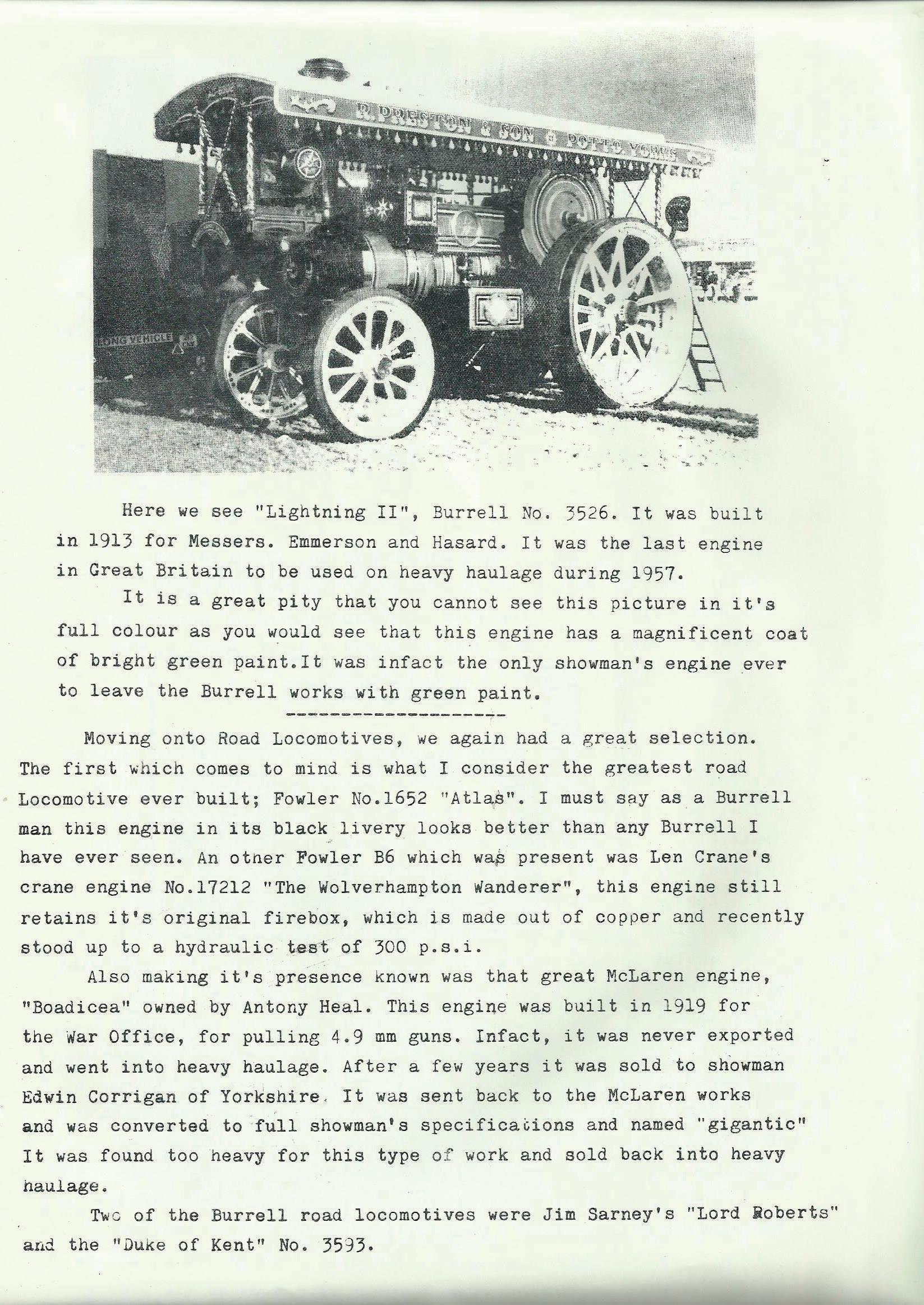
Here we see "Lightning II", Burrell No. 3526. It was built in 1913 for Messers. Emmerson and Hasard. It was the last engine in Great Britain to be used on heavy haulage during 1957. It is a great pity that you cannot see this picture in it I 5 full colour as you would see that this engine has a magnificent coat of bright green paint.It was infact the only showman's engine ever to leave the Burrell works with green paint.
Moving onto Road Locomotives, we again had a great selection. The first which comes to mind is what I consider the greatest road Locomotive ever built; Fowler No.1652 ''Atlas". I must say as a Burrell man this engine in its black livery looks better than any Burrell I have ever seen. An otner Fowler B6 which wa~ present was Len Crane's crane engine No.17212 "The Wolverhampton wanderer", this engine still retains it's original firebox, which is made out of copper and recently stood up to a hydraulic te.st of 300 p.s.i.
Also making it's presence known was that great McLaren engine, "Boadicea" owned by Antony Heal. This engine was built in 1919 for the War Office, for pulling 4.9 mm guns. Infact, it was never exported and went into heavy haulage. After a few years it was sold to sh·owman Edwin Corrigan of Yorkshire. It was sent back to the McLaren works and was converted to full showman's specifica~ions and named ''gigantic" It was found too heavy for this type of work and sold back into heavy haulage.
Twc of the Burrell road locomotives were Jim Sarney's "Lord Roberts" arid the "Duke of Kent" No. 35--33.
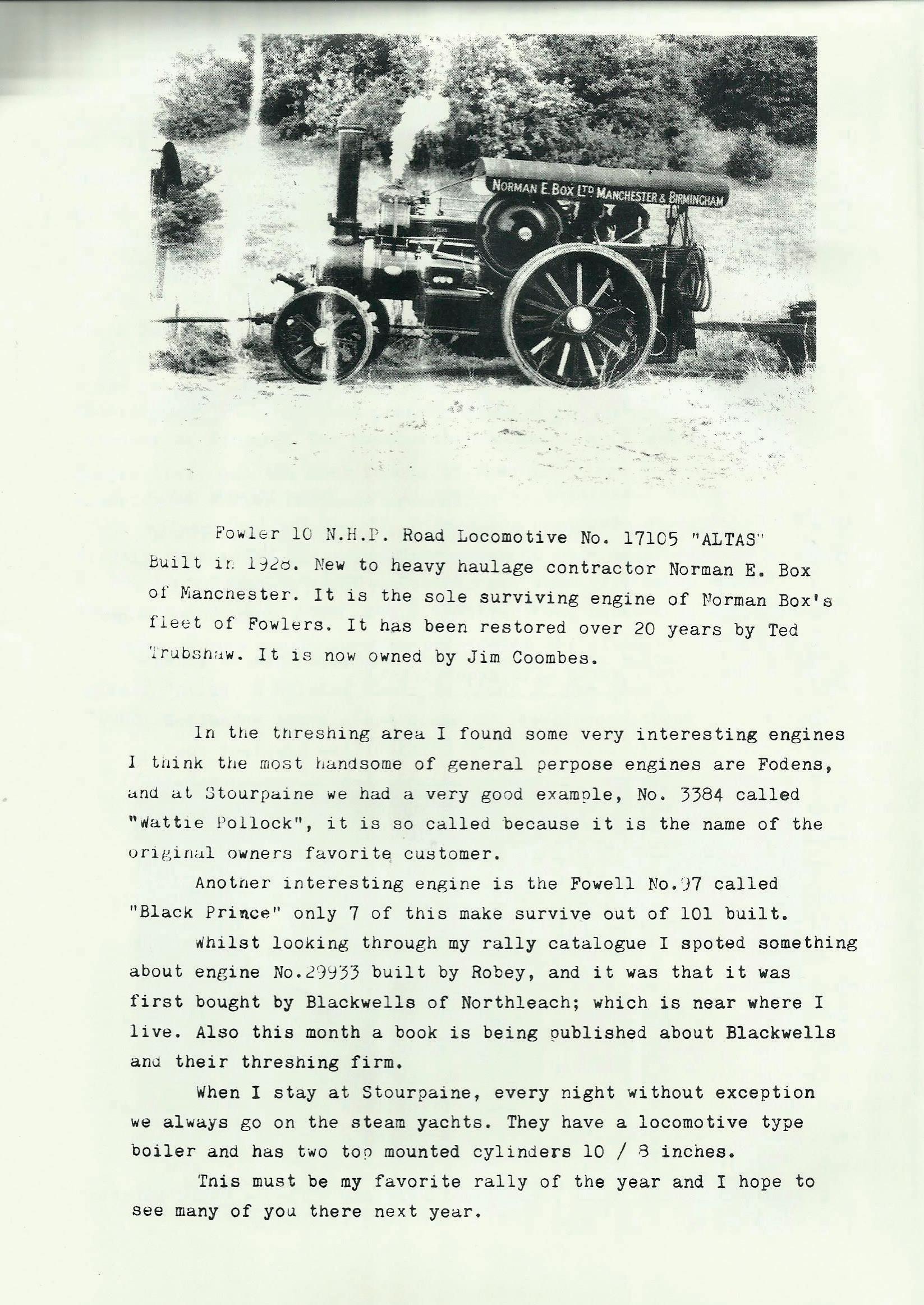
Fowler 10 N.H.P. Road Locomotive No. 17105 "ALTAS''
built ir. 1920. New to heavy haulage contractor Norman E. Box 01· Mancnester. It is the sole surviving engine of Vorman Box's fleet of Fowlers. It has been restored over 20 years by Ted 'l'n.ibsh:iw. It is now owned by Jim Coombes.
ln tte threshing area I found some very interesting engines l think the most handsome of general perpose engines are Fodens, and at 3tourpaine we had a very good example, No. 3384 called "wattie Pollock'', it is so called because it is the name of the uri~inal owners favorite customer.
Another interesting engine is the Fawell No.J7 called "Black P ri nee'' only 7 of this make survive out of 101 built. whilst looking through my rally catalogue I spoted something about engine No.29~33 built by Robey, and it was that it was first bought by Blackwells of Northleach; which is near where I live. Also this month a book is being published about Blackwells and their threshing firm.
When I stay at Stourpaine, every night without exception we always go on the steam yachts. They have a locomotive type boiler and has two top mounted cylinders 10 / 8 inches.
Tnis must be my favorite rally of the year and I hope to see many of you there next ye~r.
I woula like to thank Mr. Snodin very much for his article, I am sure you will all enjoy it as much as I did, as it gives us an insight in to the past.
I do not tnink you wil1 reme~ber or even heard of the age about the turn of the century wnen all transport he2vy 2nd ~ight was done by horse.
The need for progress started enlightened oeoale t: for some means of moving neavy loajs. The steam en~i~e ~time was being developed for Jse on farm~ and traction enri~es could pull heavy loads, when not wanted foe tareashing or Jriv1nF machinery for which they were made ( nence the spepd governo~ ). The steam engine could also wor~ at night as well as day if ne~ded where a horse had to rest. ihere a horse was being used on har1 reacts for any length of tiwe it was also prone to injury.
The landowners and horsemen of the day deteste<1 steam engines and fo~nd every excuse to have them removed even to aassing by-laws preventing their use in country towns during daylight r1ou.rs.
Following t11e s te,srn roaa locorpoti ve came the ~,team or:1pe:: ltc. wagon, an example of which can be seen in the Birmingham r~~eum of Science and Tecnnology, wi ti. my name on it dS owner. It w;.1s n,.n:: t LD lj(3 and sold to a gentleman in Devon for general naula.i t was the first of a fleet of 5 TC?: wagons wr,ich orovea Vt' ~· b~ccessful for tne owner.
s~~sl traction engine type wneelR, and sp9nt its life on tc~~ puil:ng a 3 TON trailer alao on iron wheels. One of its ~ee~!ar journeys was from Barnstable to Torquay and back with ccr~ sacKs from sailing shies in the small harbour.
The rubber tyres were fitted recently to help tne o:d lacy' : r.rOUi> r:ts: declining years.
By~:a~s d~so controlled the size of engine inrelation to the:i.1 traveling speed, in rr.any parts of tne country tte roads were not strong ecough Lo carry steam vehicals, as a resu:t small tra~i.,L~ were developed oy most makers, Taskers of Anucver being rrne of tne :108 L ;:-;ucccssful with their ?<:! model fo1..lo .;ed. bj a chain drive version towards the end of the ~ra.
The B2 Tasker tractor in my possession is the first one belonging to the company whose name is on the canopy "Midland Rolling and Haulage Co. LTD". The company was formed to carry road making materials from local station yards onto the section of road wnere the council men would spread it by hand, and roll it with a 10 TON steam roller. Prior to this, horsedrawn carts hired from local farms were used for haulage. But 10 railway wagons each with 10 TONS of cooling tarmac made road making very slow work, wnen one horse could only carry 1 ton at maximum fo 2 miles dt walking pace.
Hence tne 5 TON tractor with 2 trailers wnich could cope with a tons per trailer, one trailer being loaded in the station yara while the otner drawn by the engine was unloaded on the Job and returned empty, to change over in the station yard. Then back on the road after oiling round, cleaning out the fire an~ filling t~e water tank, if necessary. Most engines would do 20 to 30 miles on 120 gallons of water (one full tank).
Four and six wheeled wagons were faster on the road than a tractor and more manoeuverable but had to stand idle while bei~g loaiea, 10 to 1: miles per hour wo~ld be considered good in 1.~vel country.
The iriver and nis mate wor~ed vfry hard from daylight to cark and made a living wage Jf about £2 to £3 a week which incluied overtime.
rierry :hristrnas fro'.11 the NTE~ and ~ales Dept /. spe'."ial gift to all SAC memners is enc1 osed with this Newsletter. • ':-JER.~Y':'.HRISffAS' to the SAC
Tne Eaitor, Richard Hurley, 2 Reaburn Close, Cheltenham, Glos. GL52 6NL
1.-,embershi p 3ecre tary, David Juf fill, 181 Foden Road, Great Barr Birmingham B42 2EH
Tte Chairman, Sylvia Dudley, 42 Russell Street, Woburn Sands, Bucks. MK17 8NX
If your membership is due for renewal now or in the near future send your membership card with £2.00 and an S.A.E. to the Membership Secretary; address above.
Steam Threshing in the Cotswolds by Micheal Thexton, Normal Price £:7.50 The story of three generations of the Blackwell family from their first engine in 1875. Specail offer for NTEI' and SAC members price £6.25 Order-through NTEC sales don\forget enclose your membershipcard with the order and get post free. Unfortunatly they can not guarantee delivery before christmas.