STEAMAPPRENTICECLUB
NEWSLETTER 19 SEPTEMBER 86
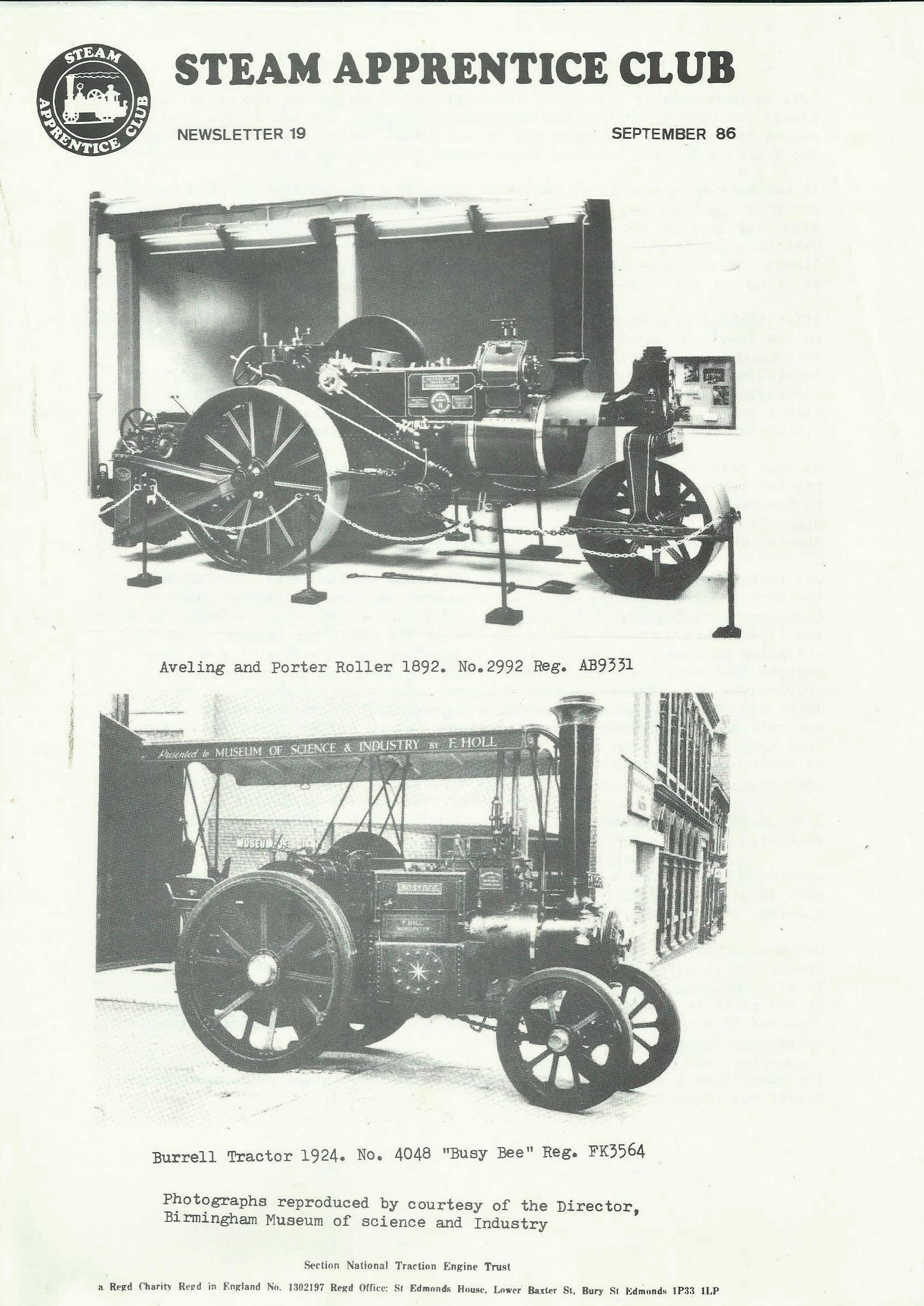
P~ot~graphs reproduced by courtesy of the Director, Birmingham Museum of science and Industry
Well we have come to the end of this years rally season and the winter work starts for many a Traction Engine owner. The S.A.C. has had a very good season this season with our visit to the Parrot family and friends at Weeting, the S.A.C in Holland and many a new member joining our club.
It has been some time since our last bumper size Newsletter the problem for this has been work load. I have been rallying wi11h an N.T.E.C. sales stand and have had my car stolen never to return, while other sales stands have lost their car in a fire and the other rolled his car and caravan. Stuart our editor has been very involved with Elsa (See cover of last issue) rallying her and maintaining her (Why are Engines always called she?).
After talking with Stuart he has decided to step down as editor his involvement in the Traction Engine world is very time consuming. I would like to take this opportunity to thank Stuart for all his hard work in producing the Newsletter often working with very little material. It is felt by many that the last Newsletter was his best perhaps in the future he might like to have a go at editing 'Steaming'. We have not seen the last of Stuart and I will try and get him to write more for us in the future.
So that left us one editor short, then I bumped in to our Newsletters most regular contributor no doubt many of you have read his articles often used in the Newsletters. His name of course Richard Hurley and I would like to wish him luck he will need it to get articles out of some members is impossible. Richard will tell you more about himself else where in the Newsletter.
Our Weeting event this year as those of you who went or read about it in the Worlds Fair was a bit wet, those who went enjoyed themselves greatly. There was wood sawing, Threshing, Polishing (Yes we joined in the hard work too!) and videos in the evening, The video was about the rescue of the Z7 ploughing engines from Mozambique with some very interesting film of many engines that were left behind perhaps one day they will go back. The only problem was the temperature very cold, the cows, cats, pigeons, chickens and ducks did not mind though (we were in the barn). I would love to go back and hold a similar event again perhaps the Parrot family will invite us back again. If you know anybody that would allow us to hold a similar event at their place please please contact us we need to hold more events for our members.
I would like to thank Kathryn Parrot and family and their Friends for a great weekend.
0ylvia Dudley visited a rally in Holland as they want to start a similar club to us in Holland. I will be going over to the rally next year with a sales stand so we will see how they are doing.
Our membership fee is £2.80 and it costs about 60p to 70p per issue of the Newsletter to print and send. So you can see we are subsidised by the N. T.E. T. To help us keep our costs down we would like to make one simple request. If you write to any of our club organisers please send a stamped addressed envelope if a reply is required.This simple thing would help to keep our membership fee at its amazing low level.
Its abou~ ~ime I stopped going on and leave the Newsletter to Richard don't forget our requests above.
-2-
Dear Apprentices,
My name is Richard Hurley and I live in Cheltenham. I am 17 years old and I have been interested in Traction Engines for the past 9 years. Soon after I caught the "Steam bug : 11 I started to help Ted Haggard on his Burrell Single Crank Compound, which during the summer we take to many rallies in the south west. In 1979 I joined the Steam Apprentice Club and became its 100 th member.
In April 1980 I went to the Proficiency Tests at Minster Lovell; which I must say I enjoyed vecy much.
I try to visit as many rallies as possible during the summer, and you will always find me at Fairford, Holton, Headington, Ross-on-Wye and of course Stourpaine.
I would like to hear from any member on any steam matter. Please do not hesitate to do so. My address is below.
A Date to Note
The next steam day at the Birmingham Museum of Science and Industcy is on 18th and 19th October. Outside the museum there will be a demonstration of a steam fire engine ( conditions permitting) and there will be stationacy steam engines running inside. Future details are available from the museum, Newhall Street Birmingham B3 lRZ or Tel 021 236 1022.
'Steaming'
Here we are reviewing the Birmingham Museum of Science and Industry and for those who have access to Steaming note the section 'steaming Around' by Derek Rayner West Midland section. This is in the Autumn 1986 issue with its striking black cover. (and note)
The Birmingham Science Museum rally took place in mid May and some twenty steam exhibits including the Walkers' 1914 Garrett showrnans tractor 32122 (BH8900) THE GREYHOUND; a long distance visitor from Cornwall in the shape of Richard Sandercock's 1924 Burrell road loco 3996 (E9597) and Neville Melhuish's 1909 Fowler general purpose 11699 (AB9028); Also there were R; Plumridge's Marshall traction 41151 of 1904 (BH7607), Jack Marshall's 1903 Ransomes traction 15012 (N04034) and R. Rearson's 1923 Fowler 15977 (1112621). ('Steaming Aut.1986 Vol 29.No.4).
Important Address
The Editor, Richard Hurley, 2 Reaburn Close, Charlton Kings, Cheltenham, Glos. GL52 6NL. Membership Secretacy, David Duffill, 181 Foden Road, Great Barr, Bi nni~ham B42 2EH.
The Chairman, Sylvia Dudley, 42 Russell Street, Woburn Sands, Bucks. MK178NX.
Museum Visit David Duffill
Well as we are asking members to write in about their local museum I thought it was best that I go and visit mine.
Birmingham Museum of Science and Industry
The museum is situated just off the main centre of Birmingham and is in a business/ area bordering on the famous Jewellery quarter. It is in an atractive building next to a canal that has just been renovated and this makes the whole museum look good. '!he museum i.s owned by the city council and is Free t.o visit. There are no near by bus routes but is in easy walking distance of the city centre bus routes. Opposite is a large multi-storey car park or parking meters outside.
The museum is based in several halls some of them specially built.Each hall has a specific theme_ .• Aircraft, Industrial machinery,Science,Locomotive Halls. As you enter you are first met by the Engineering hall and the souvenir shop, one thing I did not likejno guide booklYou can purchase a hearing device,using this you can,at special plugs,listen to a commemi"ary. There is a wide range.of very interesting exhibits. The Aircraft section is in an old part of the museum and looks it, but I prefer the old effect that this gives. This shows off the Spitfire and Hurricane very well but the display boards around them are very crude. The car section and especially the bicycle display seem to be getting smaller each time I go and I always visit my old favourite the Tram (Birmingham corporation No.395).
The museums main pride 1 or used to be its Locomotive 'City of Birmingham' No.46235.ex LMSPrincess Coronation. Class. This loco is moved with help of hydraulics every hour along a very small section of track. Total movement about 5 feet. '!he loco was placed in the museum and then the hall was built around it. What steam is there? The museum houses the worlds oldest steam engine that still works. 'Ibis is a Boulton and Watt Smethwick Engine of 1779, see over.
I first saw this engine not long after it was first installed at the museum. I had to go out a fire exit to what seemed like a demolition site with this engine in the middle. To my surprise I found it in a brand new hall specially built to house it, the engine was spoilt in my opinion by large pillars around it holding the roof up.
The engineering hall holdsseveral steam run engines but ther was no example of the boilers. In there.are two Traction engines that are steamed but only where they stand. Large pipes out of the chimneys take away any smoke.
The first on is an Aveling and Porter Roller No. 2992 Reg. AB9331 fitted with a scarifier no.97. The other a Ruston portable No.18188 12hp. In the locomotive Hall are the museums other Two Traction Engines both again regularly steamed. The Difference being that these are not static and are allowed to move.
The first Burrell Tractor No.4048 'Busy Bee' Reg. FK~564 •. 'l'ne second is a 1904 Foden Steam Wagon No.848 Reg. DD.
The museum holds its own mini rally outside in the street in May and is attended by most local engines. The other problem with this event is it always clashes with a transport rally in near by West Bromwich although there is no steam there is always a decision to be made which to go to, its a rush to do both. A few years ago one of them moved dates so the other followed you can't win. Gererally the museum is well worth visiting with some very interesting exhibits. Its great fun going round pressing all the buttons and listening to the commentry or watching the exhibits vork my favourite is the science section for this. There are several practical exhibits demonstrating some simple scientific principles ie Binary numbers and electric C1lrrents.
If you have tirne~go for a long walk down the side of the Museum along the canal to Gas Street basin the renovation work on this 1 from a very run down area to its present state is very pleasing to the eye.
Now you lot I have done a review of my local museum I want to see some out of you. David
The Worlds Oldest Working Steam Engine Boulton and Watt's Smethwick engine of 1779
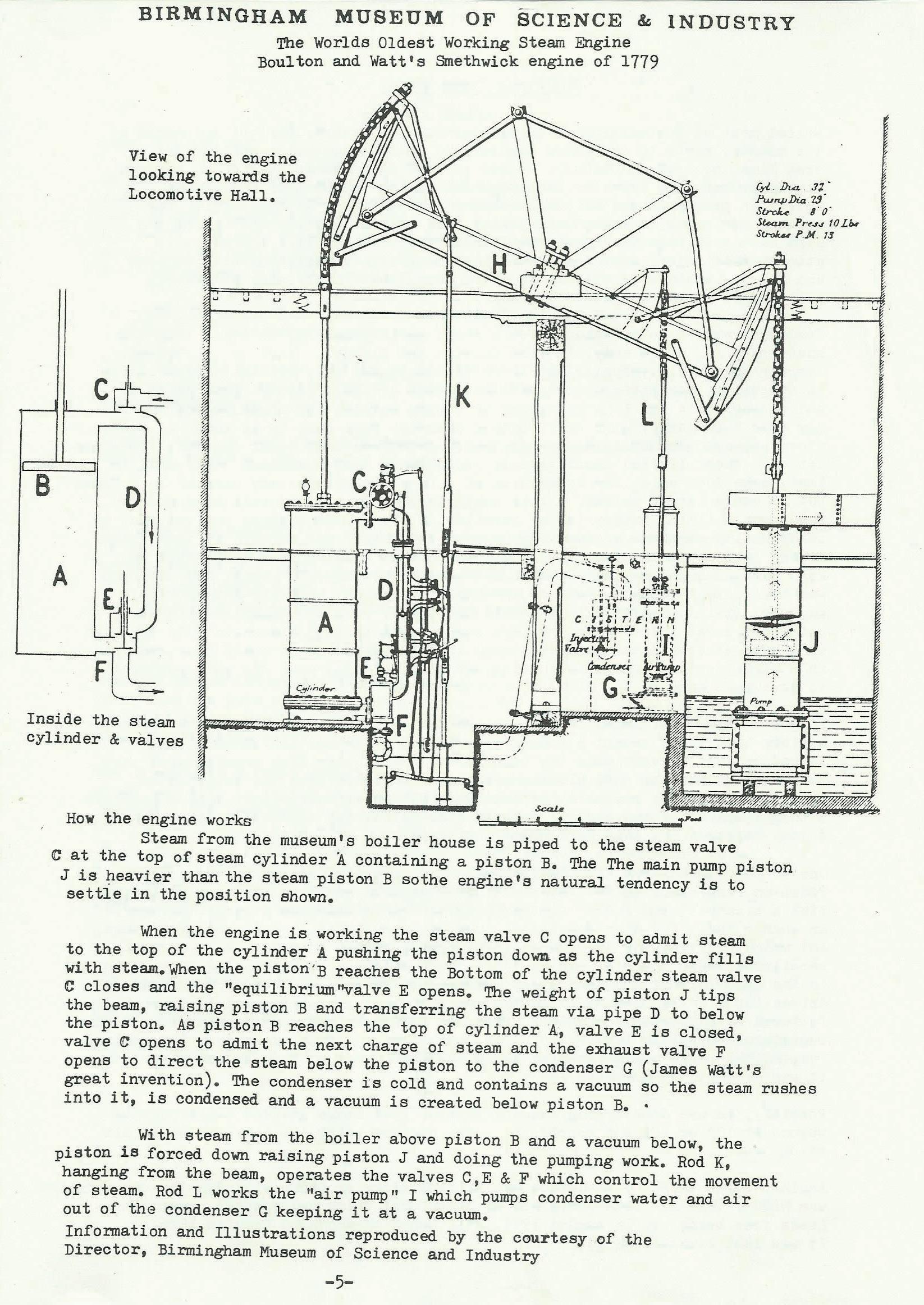
View of the engine looking towards the Locomotive Hall.
Inside the steam cylinder & valves "
How the engine works
Steam from the museum's boiler house is piped to the steam valve Cat the top of steam cylinder A containing a piston B. The The main pump piston J is ~eavier than the steam piston B sothe engine's natural tendency is to settle in the position shown.
When the engine is working the steam valve C opens to admit steam to the top of the cylind~r A pushing the piston down as the cylinder fills with steam.When the piston'B reaches the Bottom of the cylinder steam valve C closes and the "equilibrium'~alve E opens. The weight of piston J tips the beam, raising piston Band transferring the steam via pipe D to below the piston. As piston Breaches the top of cylinder A, valve Eis closed, valve C opens to admit the next charge of steam and the exhaust valve F opens to direct the steam below the piston to the condenser G (James watt's great invention). The condenser is cold and contains a vacuum so the steam rushes into it, is condensed and a vacuum is created below piston B. •
With steam from the boiler above piston Band a vacuum below, the piston LB forced down raising piston J and doing the pumping work. Rod K, hanging from the beam, operates the valves C,E & F which control the movement of steam. Rod L works the "air pump" I which pumps condenser water and air out of the condenser G keeping it at a vacuum.
Information and Illustrations reproduced by the courtesy of the Director, Birmingham Museum of Science and Industry
Whilst most of Worcestershire is agricultural in nature, part of the north of the county, close to the Black Country, is quite industrial, and in that area lies the town of Oldbury. There in 1862 Edwin Danks started on his own having broken away from the family boiler making business of H.T. Danks (still in existence and known as Danks of Netherton). At the turn of the century Edwin was taking a less active part in his business and handed the firm over to a relative, Frederick Danks. Then, about 1910 the business attempted to enter the water-tube boiler market in competition with Babcock and Wilcox (another relatively local concern), but fairly soon afterwards were bought up by the latter company.
Frederick stayed on as manager for a short period, leaving to start his owm business a few miles away, between Quinton and Oldbury. Work up to 1910 had largely been boiler repairs and Frederick continued this line-with very little in the way of facilities-until the late 1920s or early 1930s. Just prior to and during World War l he undertook to supply boilers for steam wagons and it may have been these, when built into a chassis, that came to be known as Danks steam wagons. The boilers however, could have been made under contract elsewhere, for with those limited facilities it is unlikely that Frederick Danks did, in fact, make them all. The:appearance of a Danks wagon was very similar to a Foden but it had a larger boiler. It is possible that Frederick could have started hi~Fwagon building enterprise by reboilering older Fodens going on from that to constructing complete wagons from parts. One theory put forward is that Fodens at one period were so inundated with orders that their boiler shop could not keep pace with the capabilities of the rest of the Elworth works, and the firm was thus able to supply parts to an outside party for assembly into complete wagons. It is not proved that Fodens did supply parts to Danks in this way but if this ,.,as the case and boilers were bought in from elsewhere (and the finn of Abbott at Newark has been mentioned in this respect), it could have resulted in a highly priced wagon, accounting for the fact that only six were reported to have been made.
Fodens that were produced in the earlier part of the century had larger diameter boilers than the standard 5 tenner made during World War 1. It would appear therefore that whoever made the boilers for the Oldbury finn manufactured them to the older design, thus clearly distinguishing them from the later Foden product. The Danks boiler is Sn.id to have had eleven more tubes than a standard 5 tanner and since the earlier Foden 5 stay boiler had 63 tubes against the later 4 stay boiler's 52, this fa~t seems confirmed.
One of the Danks firms at Oldbury used an example of these wagons-or a reboilered Foden-on local work in the area. Arthur Wedgewood recalled seeing it "looking like a bloated 5 ton Foden" and carrying a chain of massive proportions, maybe an anchor chain for an ocean liner. One wagon definitely confirmed as a Danks, and which confinns the existence of the breed, rather than it merely being a reboilered Foden chassis, was No 106. There exists a photograph of this wagon in the ownership of Woodhead Bros, haulage contractors of Leeds. The wagon was driven for a while by a Mr Bargh who recorded that a plate marked 'F Danks Oldbury' followed by engine and chassis numbers was fitted to the chassis member. It was registered CW1531 in January 1916 for John Riley and Sons of Hapton, Lancashire. They sold it four years later to Woodheads who licensed it up to September 1927; it was scrapped by November 1933.
Possibly, as was done by many manufacturers, Fred Danks started numbering his wagons at 100 or 101 and therefore the picture being 106 might point to six being 'made' .
Another wagon owned by Woodheads was alleged to be by Danks although the registration was M6803. This has been confirmed as Faden 4742 which had various owners in Leeds from being new in August 1914 until owned by Woodhead Eros in 1926. It was last licensed in 1932.