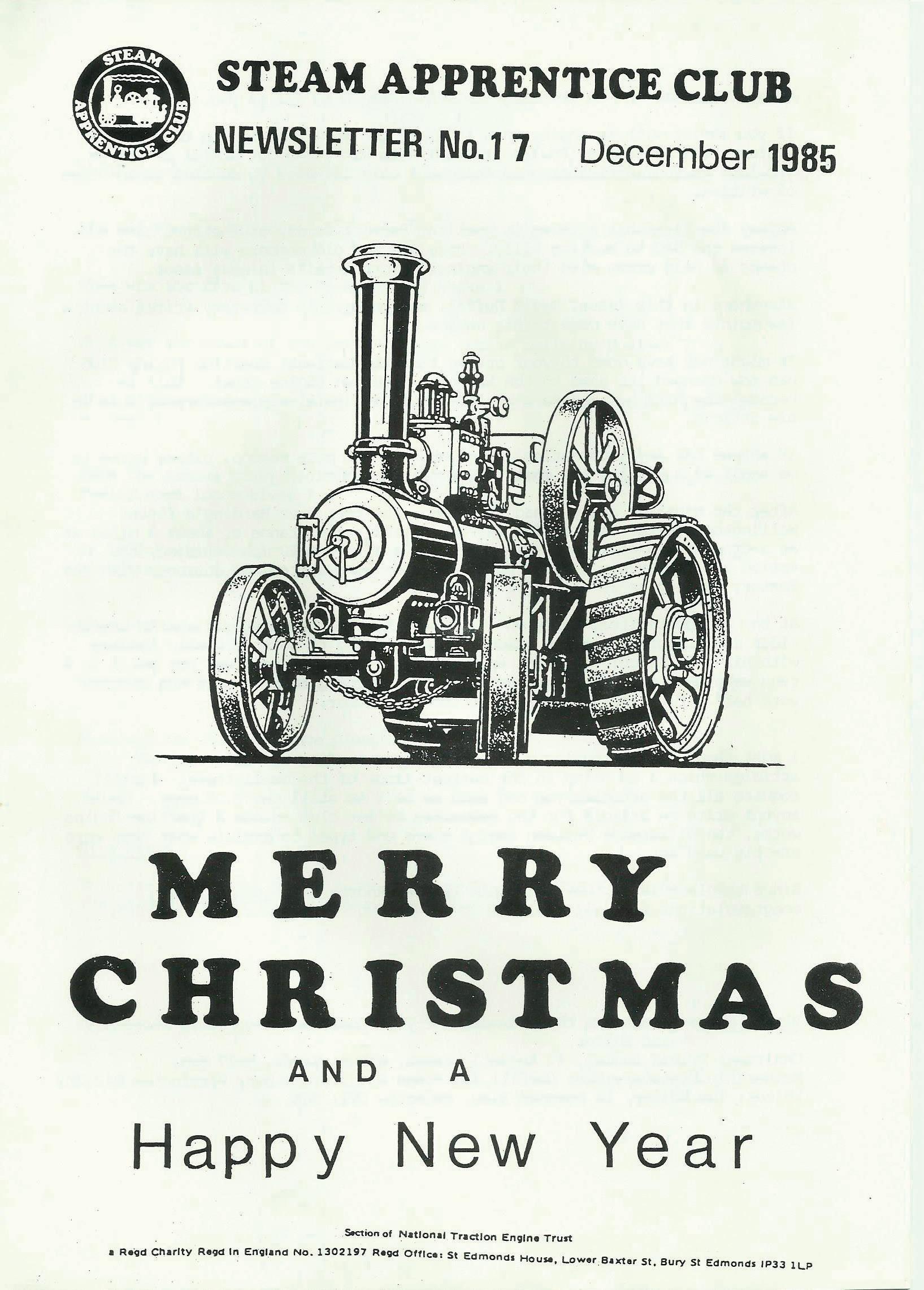
Happy Christmas and an e~citing new rally se.;lSon to all of you.
If you assist with an engine this is where the work begins -in the cold wet winter. Ted Sansome's 'F<Mler' which I help with, has got a list of things (as long as your arm) that need doing and only 19 weeks to do this at the time of writing.
-'Anywaythe first bit of news is that the Parrott family at Thetfor~ have invited the SAC to Weeting Rally. Here new and old members will have the chance to help crews with their engines. More details in next issue.
Elsewhere in this issue, David Duffil, our merrbership secretary writes about a few points that have come to his notice.
It might not have come to your notice that the National Traction Engine Club has now changed its name to the National Traction Engine Trust. This is because the NTEI' has become a charity, but David will explain irore of this in his article.
If anyone has·any interesting experiences in the past season, please write to me and I will publish the most interesting articles.
After the Hinckley Rally I had the chance to steer Dave Harding's Foster Wellington Tractor back to Ted Sansome's yard -a distance of about 3 miles at an average speed of 16 mph. The Foster can do about 20 mph cruising, the motion was not even a blurr. Dave has done some incredible journeys with the Foster, the engine is called 'I Kanodit'.
At the Caldecote Stearn Party on the Sunday morning, we were g1v1ng the trailer rides and Arthur Heaton was asked if I would like to do some Double Heading with his 1903 Allchin Traction Engine. After the push pole was put on, 7 or 8 runs were made with both engines pulling or holding back to make the other work hard. Pity the load wasn't 30 tons of timber.
I must thank Richard Hurley of Glotrester for sending me quite alot of articles which I am using in the current issue of the newsletters. I still require all the articles you can send me as I am still short of copy. Could anyone write an article for the newcomers to our club on how a Traction Engine works, the difference between engine makes and types to explain what they were exactly used for.
Since the last issue, David and his fiancee Andrea have got married, congratulations from all the SAC!
Please Note:- These are the addresses of your Chairman, Mernbership Secretary and Editor.
Chairman: Sylvia Dudley, 42 Russell Street, Woburn Sands, MK178NX. Mernbership Secretary:Dave Duffil1Jl81 Foden Road, Great Barr.Birmingham B42 2EH Editor: The Editor, 18 Burnham Rise, Nuneaton CVll 6HA.
MEMBERSHIPNEWS
At present, the new membership card is being designed and will be printed as soon as possible. It is hoped that all members will receive new membership cards before the.start.of the new rally season, so that at some rallies you can claim your free admission. A list of these rallies should be produced in the next newsletter~ Members may be aware that the new Nl'EI' membership card has been printed in Blue the same colour as our cards. This is a mistake which we are hoping to correct. The SAC's membership card were printed in Blue to avoid confusion with the NI'EC cards which were Green.
A letter of complain_t has been sent to the new secretary of the NI'ET - Mr David Pugh - former organiser of the Quorn event.
For those of you who are confused by Nl'EC and NI'ET; the explanation is simple. The SAC eas formed as a junior section of the National Traction Engine Club last year the club applied for charity status and had to adopt the name Trust. They were not allowed under EEC rules to call themselves a National Club so the name National Traction Engine Trust was agreed upon, hence the NrEC is now the NI'ET. As you will see from the enclosed leaflet of sales offers, on which the members can order itern:; and by enclosing their SAC membership card, can obtain free postage, the sales side is called National Traction Engine Club (1984) Ltd. This is because a charity (the NI'ET) is not allowed to trade so a separate company was formed in order to trade and give its profit to the Trust. The sales side could not really call themselves a Trust as they are not a charity. As.I will not get another change before Christmas, I would like to wish all apprentices a Merry Christmas and a Happy New Year. If your membership is due now or in December renew it now!
SPECIALN'.)TE
In the past 2 years, 'the SAC.newsletter and events have been very few and far between. Therefore, as new membership secretary I will make amends.
All members whose subscriptions are paid up or renewed by 31st January 1986 and were paid up registered members of the SAC during any part of 1983 or 1984 wil.l receive with the next newsletter a voucher which can be exchanged for l years free membership of the SAC the next time they renew their membership in 1986.
HELP EACH. aI'HER D DUFFILL
As you are all aware. we try to put apprentices in. tooch with owners of engines to help them.learn more about them. Perhaps one day to own and care for their a,..,n Engine.
At present we are short of engine-owners _\'lhowould like·to take an apprentice. Secondly we wish to increa:se_our range of events-we hold and attempt to hold events where we have previously noL
We are asklng for yoi:lr help if you know an engine ·a,..,ner_whois_wi~ling to take an -apprentice, let us _kn<Mif anapprentice_cprnes t<? llgl1.t, we will put them in tooch. . If they hate _each other well perhaps we. will try sc:m1e~neels~- To answer our second·problern, doyoukn~ aown~r or rally organiser whow1ll organise an event for us at his rally or home. Yo~may h':'ve ':'lready read elsewhere in the newsletter about a,n event-at Weetmg, this kind offer coming from the Parson's family. If you can help us in any way, please contact the Membership Secretary.
TRACI'OR
In the 1920's Sentinels of Shrewsbury, the well-known builders of undertype steam wagons, produced a very interesting tracklaying 'Sµper Sentinel' steam tractor.
The original illustrations of this vehicle are not suitable for reproduction ·so Harold Lt.Urbyhas kindly r·e-drawn the vehicle to illustrate the layout and detail.
The tractor had steel wheels at the front mounted on stub axles for Ackerrran steering, the front axle was 1rounted via a transverse leaf spring giving three point chassis suspension. Front axle 1roverrent was constrained to a vertical plane by hornplates. Steering was by worm and nut all enclosed in a casing partly filled with oil. The drop arm ball joints were spring loaded. Steering was described as 'relatively light' and it was claimed that the tractor could be steered without the more usual expedient of providing variable speed to each track separately for steering.
The tracks were of steel link ch~in with hardened pin and bush joints and were shod with rubber. The main track passed round a front track wheel and was kept in contact with the ground by two rubber covered idler wheels no matter what contour was encountered. The track was designed to give a ground pressire of lOlbs. per square inch. It was clairred that the tractor could work over 'fairly loose ground without sinking in'. It was further claimed that the track gave 'a progressive smoothing of the ground'.
The boiler was of normal Sentinel type with a working pressure of 230 lbs. p.s.i. A superheater heated the steam to 150 deg F above saturation terrperature.
The engine was desighed to give 60-65 b.h.p. It consisted o:f,a two-cylinder double-acting, totally enclosed crankcase-cylinder unit horizontally disposed. The two high pressure cylinders were 6.25" diameter by 9." stroke, the postons had two. stuffing boxes each and cylindrical crossheads. The two throw crankshaft had cranks at right angles to avoid dead centres. The crankshaft incorporated a differential ·gear system for accamnodating the varying torques of the two tracks. A pair of friction clutches prevented the differential from functioning until there was a difference of 10 to 15 per cent between the torques on the two ends of the crankshaft.
Steam admission and exhaust was controlled by poppett valves, operated off two camshafts that had three cams which gave two forward speeds with cut-offs of about 37 per cent and 75 per cent and one reverse speed. A neutral position on the camshafts kept both inlet and exhaust open at the same tine enabling cylinder condensed water to be drained.
Cylinder lubrication was by a positive feed pump while a splash system looked after the crankshaft, connecting rod and cam shaft bearings.
The boiler feed pump was driven off the intermediate gear (which drove the cam shafts}.
Cont'd
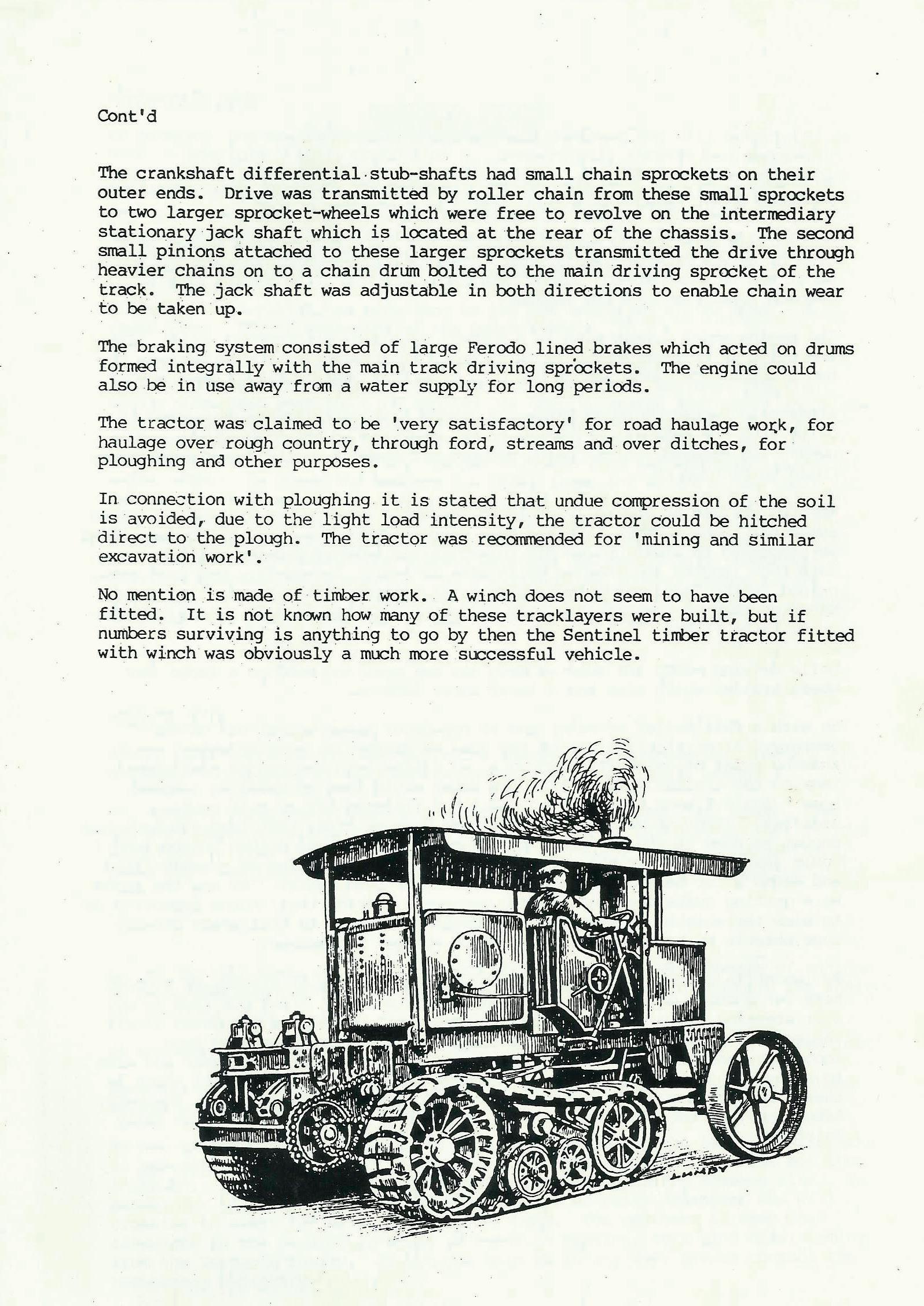
The crankshaft differential-stub-shafts had small chain sprockets on their outer ends~ Drive was transmitted by roller chain from these small sprockets to two larger sprocket-wheels which were free to_ revolve on the intermediary stationary jack shaft which is located at the rear of the chassis. The second small pinions attached to these larger sprockets transmitted the drive through heavier chains on to a chain drum bolted to the main driving sprocket of the track. The jack.shaft was adjustable in both directions to enable chain wear to be taken up.
The braking system consisted of large Ferodo.lined brakes which acted on drums formed integrally with the main track driving sprockets. The engine could also be in use away from a water supply for long periods.
The tractor was claimed to be 'very satisfactory' for road haulage wo~k, for haulage over rough country, through ford~ streams and over ditches, for· ploughing and other purposes.
In. conne-::tion with ploughing it is- stated that undue compression of the soil is avoided,- due to the light load· intensity, the tractor could be hitched direct to the plough. The tractor was recorrurended for 'mining and similar excavation ·work'.
~o mention ·is made of timber. work. A winch does not seem to have been fitted. It is riot known how many of these tracklayers were built, but if nllrilbers surviving is anything to go by then the Sentinel tirrber tractor fitted with winch was obviously a moch more soccessful vehicle.
SWIF:rr..Y TO SWIN!X)N
BYRICHARDHURLEY
In modern days when road traffic has increased and expenses have risen less and less engine owners take their engines to rallies by road.
But lockily some engine owners still do, and I'm locky to be a merooer of the crew of an engine which still does. This is a short piece to tell you how we do it and to describe our latest journey from Calne in Wiltshire back to Swindon (where we keep the engine).
The engine which I help with is a Burrell single crank compound number 2426, and built in 0:::tober 1901. (This is quite an interesting engine because it has a ~ound front axle and as you will know most engines have a square one).
After being woken up by my Father at around half past five we proceeded to drive from our home in Cheltenham to Swindon, and to the home of the engine owner, Ted Haggard. After being·dropped off there I waited for the co-driver Colin to pick us up.
When we arrived at the rally field we proceeded to up sheet the engine and to sweep the tubes. After this had been completed and the ashes had been removed we proceeded to light up (we did this with old telegraph poles which are cut into foot lengths and then we split with an axe). A good fire was soon going helped by the fact that telegraph poles are coated with creosote. Unfortunately we had nearly a full ooiler of water so it took a long time for steam to be raised.
While driving along the road.we keep all our coal and wood on a large four wheel trailer which also has a large water tank on.
So with a full boiler of water and 80 pounds of steam we set off on our. journey. After steering out of the gate we stopped to pick up water, we do this by means of using fire hydrants, we filled both the tender tank and the tank on the trailer full so that the water would last us until we reached home. Again I took the steering wheel and finished off my half hour steering. (Each of us does half and hour because after that long you have had enough as some of you may know, for those who have never driven on the road I would just like to say that it is a lot harder than driving on a rally field and needs a lot more care because of the other road users). By now the roads were getting quite busy and all the cars were honking their horns expecting us to blow the whistle in reply, what they don't realise is that after blowing your whistle back for the first 50 times you get a headache.
By lunchtime we were at Avebury where they have a ring of stones, we stopped here for a quick drink and to give the engine a rest. After our stop I took over steering again and then later I drove until we reached Wroughton (where the science museumstore is, incidentally they have a large Foden road locomotive and also a steam wagon). There we stopped to change gear and also to allow Ted to take over driving while we descended the large hill which is there, we were now near Swindon and in half an hour we were back in the yard. After sheeting the engine up we left it until we drove it to our next rally - Fair ford.
•
RICHARDHURLEY
What was the name of John Fowler's first traditional showman's road locorrotive?
Why did Fowlers build an engine with 12 foot diameter hind wheels?
When was the fire at The Steam Plough Works?
What was the class of the last showmans engine built by Fowlers?
What is the alternative name for the showman's road locorrotive 'The Iron Maiden'?
Name the famous heavy haulage firm based in Manchester which mainly used Fowler road locomotives?
In 1870 Fowlers built special 12 n.h.p. duplex cylinder vertical boiler ploughing engines, who were they for?
When did John Fowler die?
What was the name of the last Patent filed by John Fowler before he died?
When was the first balence plough built? Stop :Press
Vol·1 r--:eer wenten ir.. 'Eure!l lleath, '.:,urrey' to hP-Jp with 2n cngi.ne during the winter.Contact Sylvia nu<lley for netailR.
BY RICHARD HURLEY·
Because of the holidays I had a lot of time on my hands and so I decided to read through some. of: my traction. eng_ine 'oooks ·which I hadn It looked at for a while. 'As I was reading through one of these, I came across the fact that _only 411 •showmans engines hai:l been built, this interested me greatly and I wondered how many engines there still were. After counting up I found there to be 150. Considering the number of engines which had been scrapped I found this very high arid so ina9e out the follav,,ing table. •
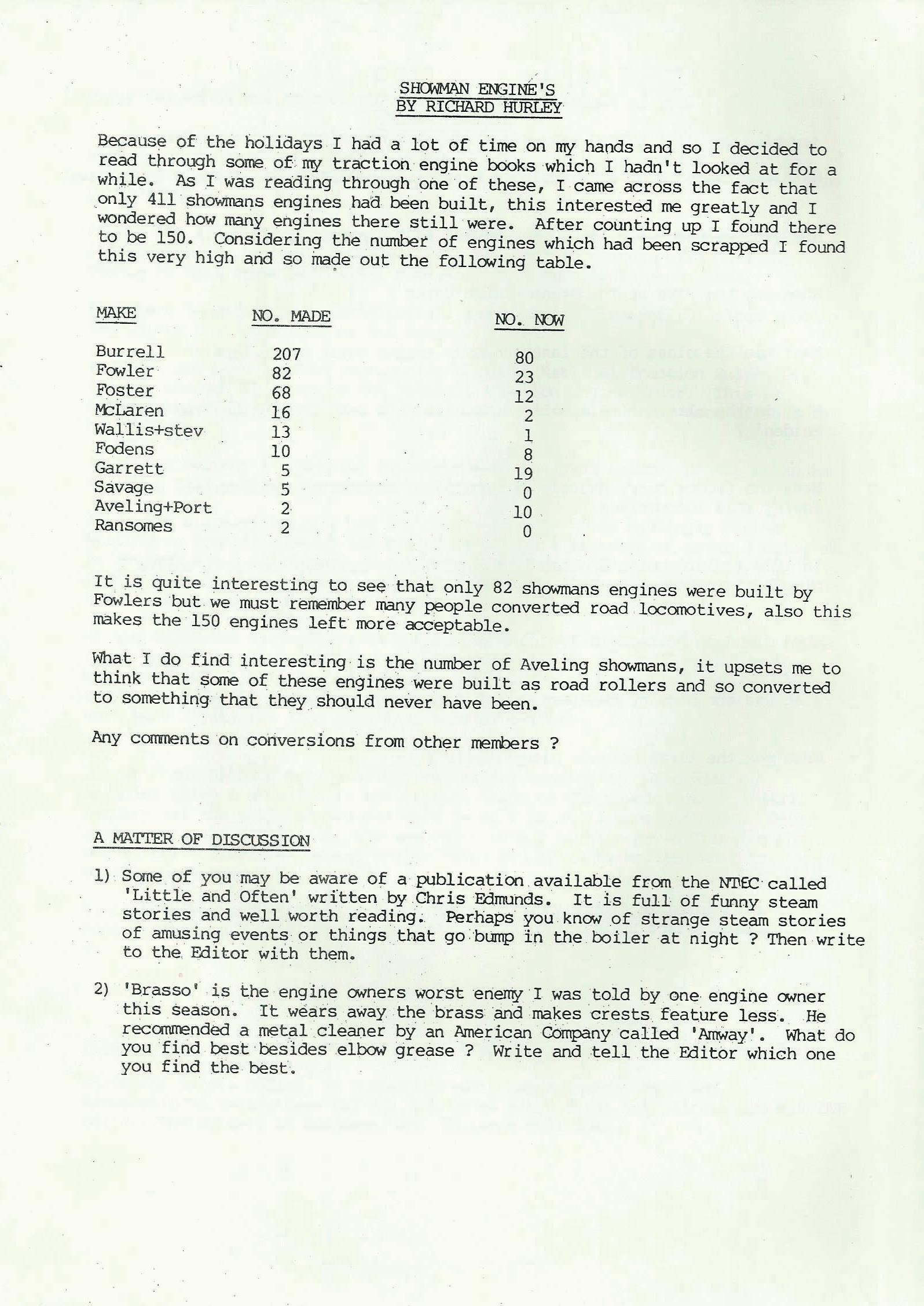
It is quite interesting to see ·that ~::mly82 showmans engines were built by Fowlers ·but we must remember rriany people converted road locomotives, also this makes the 150 engines left more acceptable.
What I do find interesting-is the number of Aveling showmans, it upsets me to think that some of these engines were built as road rollers and so converted to something- that they.should never have been.
'Any cornnents on conversions from oth~r members?
A MA.TIER OF DISO.SSION
l} Some of you may be aware of a publication.available frpm the N'1'£C·called 'Little and Often' written by.Chris -Edmunds. It is full of funny steam stories and well worth r·eading Perhaps· you knav,,.of strange steam stories of amusing ev~nts-or things.that go:bump in theboiler at night? Then write to the. Editor with them.
2} 'Br~sso' is the engine av,,ners worst ·en:errrr·rwas told by 0ne• engine av,,ner this season. It wear·s away the brass ·Md ma)<es·crests feature less. He recanmended a metal cleaoer by an American Companycalled •~ay'. What do you 'find best ·bes-ides .elbcM grease ? Write and tell the Fditor which one you find the best.