STEAM APPRENTICE CLUB
NEWSLETTERNo.16 August1985
EDITORIAL
Well after many months here it is, the S.A.C. Newsletter. I know that it is late, but it is due to reasons beyond my control that publication is late.
One of the main reasons for this is due to lack of support, I have been trying to get articles for the last year, I have had some success but no member has sent me an article. So if you can send me anying on traction engines, stationary engines or even railway engines, can you please, please do so. Remember without your support I cannot organise any engine events and visits.
I do not know how many of you work on engines, but I am fortunate in being able to work on an engine which is owned by a well known engine man, John Sansome of Hinckley. The engine is a Fowler Agricultural, No. 12761 of 1911. If any of you would like to crew an engine, please write to me and give me a few details about yourself and I will see what I can do.
The major change is the new appointment of Dave Duffil as new membership secretary, who replaces Mark Waltham. We would like to thank Mark for his hard work in this post.
Another major event is an award presented to a member for his work for the club. The award was given by the club to Jack Beeby of Rempstone. Jack Beeby has had a full working life with steam ploughing engines and I hope that we can carry on receiving the benefit of his great knowledge and experience.
I hope that you find the rest of the Newsletter interesting, but please send me articles for future issues.
Please Note: These are the addresses of your Chairman, Membership Secretary and Editor. Chairman: Sylvia Dudley, 42 Russell Street, Woburn Sands, MK17 8NX.
Membership Secretary: Dave Duffil, 181 Foden Road, Great Bar, Birmingham B42 2EM. Editor: The Editor, 18 Burnham Rise, Nuneaton CV11 6HA.
MESSRS. ALLEY AND MACELLAN AND THE SENTINAL WAGGON WORKS LTD.
This is a small article written for the newsletter about the Sentinal vehicles. The full story has already been condensed into two 360 page books, so a short article is a tough request.
Messrs. Alley and Maclellan Ltd. of Polmadie, Glasgow had since 1875 been Scotland's leading firm of engineers building steam winding engines for ships anchors and and cranes, donkey engines, compressors, generating plants, small stationary steam engines, shallow draught river steamers, flat bottomed side and rear paddle driven steamers, ships steering gear engines, paddle steamer engines, screw steamer engines and a host of other things too.
We do not know how or why_young Stephen Alley became interested in the building of steam waggons, but the date was certainly 1903. Nor do we know how he became involved with Daniel Simpson, but he would have seen an advertisement in a large book 'The Port of Manchester' published in 1901 with a photograph of a Simpson and Bibby standard 5 ton lorry as supplied to the Table Bay Harbour Board. Daniel Simpson was fortunate that an uncle H.E. Simpson was managing Director of the Horseley Iron Works near lronbridge in Shropshire a few miles east of Shrewsbury.
At Horseley worked a young apprentice of great promise, George Woodwine, who became Simpson's cheif aide. Not only did he assist in building 'th lurries' but in test driving them and in helping to solve the problems that inevitably arose.
To cut a long story short Stephen Alley sent for Daniel Simpson and George Woodwine to come up to Glasgow and the outcome was he offered them a disused foundry to continue their experiment experiments in. Many pages in my book now cover the following period giving full details of many experiments but sufficient to say that the Sentinel Steam Waggon Catalogue of 1905 (and another of 1906) is in my possession.
These Standard 6 Ton lorries in 1906 cost £660 ready for running but a roof over the driver was an extra £15. In the years 1907 - 09 eleven 3 ton lightweight waggons had been built and also a tipping 5 ton version of the 6 tanner.
When George Woodwine went to Glasgow he took his three year old son Reginald with him. In 1914 largely because of natural expansion of all their other manufacturing activities as well as an ever increasing demand for the world's best steam waggon the Sentinel works at Polmadie was becoming very pushed for space. Alley and Maclellans decided to make their production of steam waggons a separate enterprise and because of delivery problems to set up a new factory in England for that purpose.
By now George Woodwine, the erstwhile apprentice at Horseley, had risen to the position of works manager at Polmadie and he was sent south early in 1915 to find a suitable site. It was perhaps natural that he should gravitate to his home county, Shropshire, which was within reasonable distance, delivery wise, of all the large potential markets. After some investigation George Woodwine chose a freehold site of 16 acres on the west side of Whitchurch Road, Shrewsbury, with a 50 acre site on the opposite side of the Whitchurch Road for a workers' steam heated housing estate.
Work began on the new factory in March 1915, which was prefabricated in Glasgow and it is remarkable that the first Shrewsbury built Sentinal Steam Waggon left the new works in July the same year, 4 months later.
This extremely brief resume of the Sentinel Waggon Works products must continually miss out important facts, but sufficient to say that in mid 1923 some 4426 Standard Model Sentinel waggons had been sold.
Meanwhile from 1920 onwards experiments had been carried out on a Super-Sentinel model with many improvements, but Sentinels being the firm they were, would not put an article out for sale until they themselves were thoroughly satisfied with it. Hence several Super-Sentinel waggons had been out on test in places where they could undergo the most strenuous work and it was not until June 1923 that the first Super-Sentinel was sold. This was No. 5001. Both the original Standard and Super models were plain single speed waggons (2 g's in waggon if it is a Sentinel)you turned the steam on and she moved, shut it off and she stopped, so to speak.
Experiments were being carried out on a double geared or two speed model to be known as th DG and the first of these was sold in 1927,No. 7162
Meanwhile Sentinels had also been building Steam road haulage and timber haulage tractors with winding drums and they had, also, commenced the manufacture of steam railway shunting engines, which could also be used for branch line work and were very popular abroad.
At the same time Sentinels in conjunction with Metropolitan -Cammell began producing steam rail cars and even a few normal looking railway locomotives, but the drive of these was not similar to normal rail locos. The rail cars varied from slatted sealed models for use abroad to some of the most luxurious passengercarrying coaches ever built in many various rail gaugesfor countries all over the world. Our own LN ER used dozens of them and dozens of Sentinel Rail locos ..
When the new DG (double geared) model road waggon came on the market,. production of the old Super-Sentinel waggon by no means ceased and it continued to be built right up until shortly before the 'S' or shaft driven model was introduced.
The DG 4 wheeler was a 6 ton vehicle and with the introduction first of a large heavy rigid six wheeler and later a rigid 8 wheeler the tare became so heavy (the weight of the vehicle empty) that that Sentinels had to introduce a Lightweight Super Single Geared Waggon again as the S.G.L.W. for people who did not need the heavyweight DG models.
Incidentally the Sentinel Waggon Works Cheif Designer Mr. A.C. Hutt designed and patented 4 wheel steering, so all eight wheelers seen today stem from his invention, this was patent No. 306733 of 22nd March 1928. When Mr. Hutt designed the 4-cylinder shaft driven 'S' model, first 6 wheeler, then 4 wheeler, the 8 wheeler he slightly altered the 4 wheel steering and took out another patent for this, No. 393219 of January 4th 1933.
Until the first 'S' model (No. 8798) was sold on May 31 st 1933 all the Sentinel lorry engines had been two cylinders slung between chassis members behind the cab and chain driven to the back axle. The 4 cylinder (S) model was also but with the cylinder head facing the off side, so that a shaft drive could be taken via suitable gearing in line to the back axle differential.
In writing the history of Sentinels, unlike other authors of histories of other firms I had no access to works records as Rolls Royce destroyed them all when they took over, all that they wanted was the shell of the building, but by years of contacting old Sentinel users and my freindship with the late Reginal Woodwine, son of the founder George, I acquired the largest collection of Sentinel literature in the world and hence could write the history.
Joseph Thomas 'The Sentinel'
THE STEAM VEHICLES OF THE SCUNTHORPE & FRODINGHAM U.D.C.
by NEIL SMITH
This article is not intended to be highly technical or contain terminology only understood by the avid Traction Engine enthusiast, which in general I do not beleive members are, but to provide an insight to those people who travel many miles to see a 'steam engine' that although gone, the steam road engine was once very much part of our society.
As might be imagined, information on the subject is a little scarce, but which was added to by the minute records of the Urban District Council, accessto which was very helpfully arranged by Mr. T. Mills of the Civic Centre.
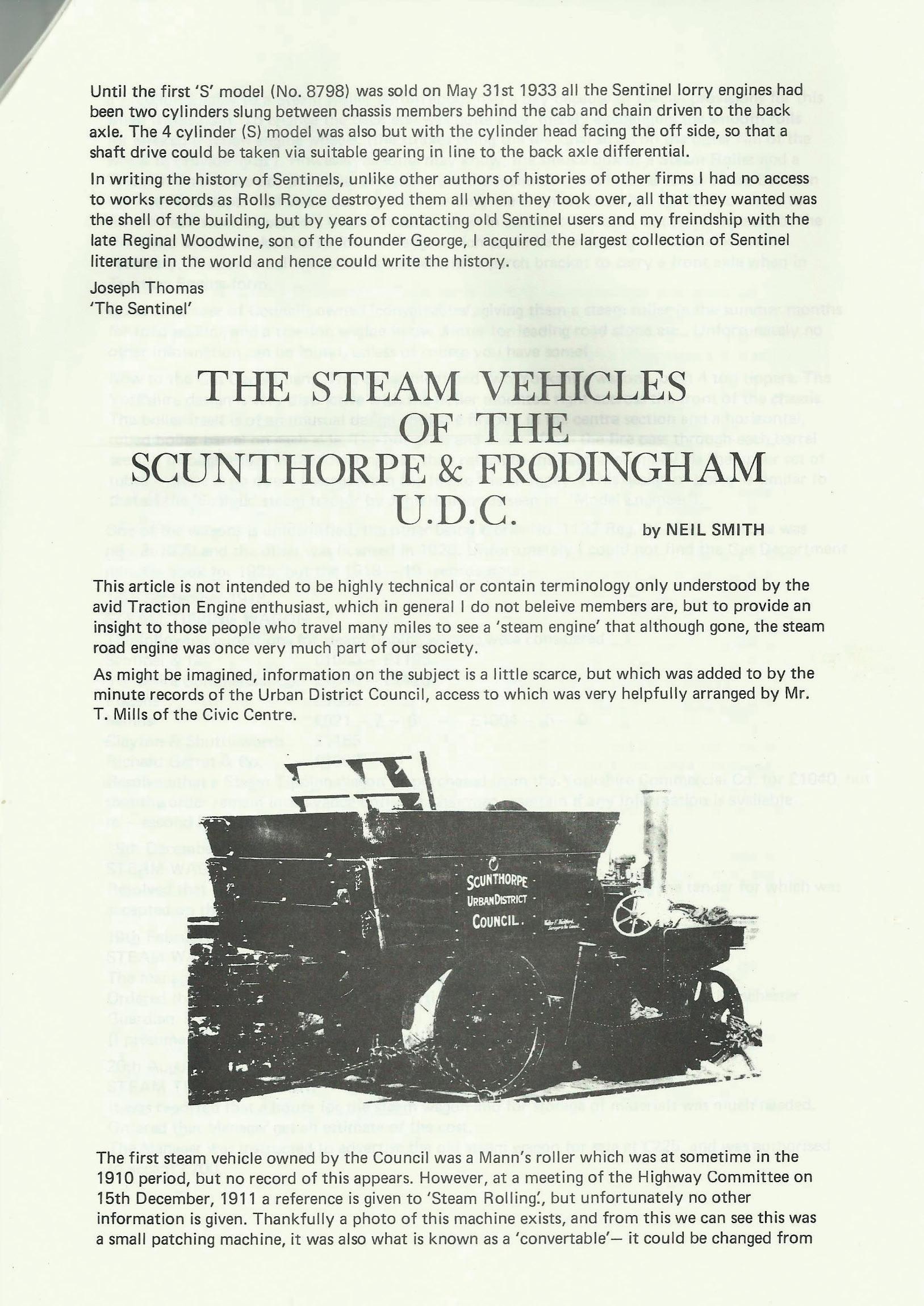
The first steam vehicle owned by the Council was a Mann's roller which was at sometime in the 1910 period, but no record of this appears. However, at a meeting of the Highway Committee on 15th December, 1911 a reference is given to 'Steam Rolling'., but unfortunately no other information is given. Thankfully a photo of this machine exists, and from this we can see this was a small patching machine, it was also what is known as a 'convertable'-it could be changed from
a Traction Engine to a Steam Roller within about half a day because of special provisions for this when it was built. To change the back end was quite easy, merely exchanging the smooth rolls for straked traction engine wheels, (the strakes being the diagonal strips on the outer rim of the wheel to provide 'grip'). However, as some may know, the smoke-box of a Steam Roller and a Traction Engine are not the same, and therefore the manufacturers made a compromise between the two. The upper half was a casting incorporating the chimney base, but did not continue to form a head stock to support the front forks when in steam roller form, but was truncated at the front end of the smoke box to form a flange which could be mated with a headstock when necessary. The lower half was a rolled barrel with a perch bracket to carry a front axle when in Traction Engine form.
Quite a number of Councils owned 'convertables', giving them a steam roller in the summer months for road making and a traction engine in the winter for leading road stone etc .. Unfortunately no other information can be found, unless of course you have some!
Now to the Gas Department. This department had two Yorkshire wagons, both 4 ton tippers. The Yorkshire design is very distinctive with the boiler mounted right accross the front of the chassis. The boiler itself is of an unusual design with the firebox in the centre section and a horizontal, tubed boiler barrel on each side. The hot gasesand smoke from the fire pass through each barrel section through tubes in the lower half an then return to the central chimney via the upper set of tubes - there is no direct passagefrom the fire to the chimney. (This design of boiler is similar to that of the 'Suffolk' steam tractor by John Haining as seen in 'Model Engineer').
One of the wagons is unidentified, the other being Works No. 1132 Reg. BE3946. This one was new in 1919 and the other was licensed in 1925. Unfortunately I could not find the Gas Department minutes book for 1925, but the 1918 - 19 records state:-
18th September 1918.
STEAM TIPPING WAGON
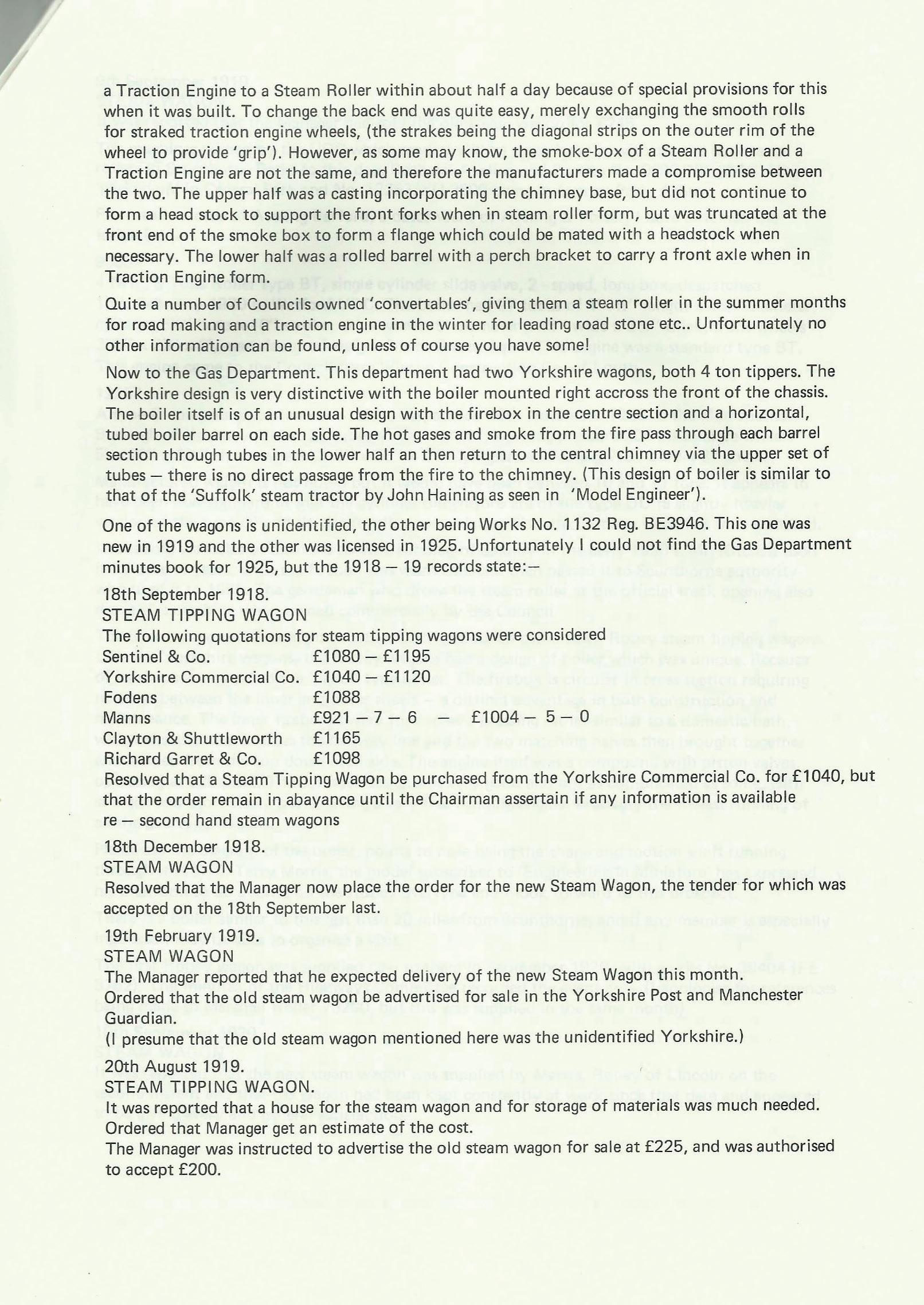
The following quotations for steam tipping wagons were considered
Sentinel & Co.
Yorkshire Commercial Co.
Fodens
Manns
Clayton & Shuttleworth
Richard Garret & Co.
£1080 - £1195
£1040 -£1120
£1088
£921 -7 - 6 £1004 -5 - 0
£1165
£1098
Resolved that a Steam Tipping Wagon be purchased from the Yorkshire Commercial Co. for £1040, but that the order remain in abayance until the Chairman assertain if any information is available re - second hand steam wagons
18th December 1918.
STEAM WAGON
Resolved that the Manager now place the order for the new Steam Wagon, the tender for which was accepted on the 18th September last.
19th February 1919.
STEAM WAGON
The Manager reported that he expected delivery of the new Steam Wagon this month.
Ordered that the old steam wagon be advertised for sale in the Yorkshire Post and Manchester Guardian.
(I presume that the old steam wagon mentioned here was the unidentified Yorkshire.)
20th August 1919.
STEAM TIPPING WAGON.
It was reported that a house for the steam wagon and for storage of materials was much needed.
Ordered that Manager get an estimate of the cost.
The Manager was instructed to advertise the old steam wagon for sale at £225, and was authorised to accept £200.
9th September 1919.
STEAM WAGON.
It was reported that the Manager had sold the old steam wagon for £245.
The machines owned by the UDC which readers will be most familiar with are the two steam rollers in Scunthorpe Parks to this day. Both are Aveling and Porters No. 9093/NK 9344 being 'parked-up' in Central Park and No. 12257 /XU 3509 being in Everest Park, Ashby.
From the records of Aveling Barford, a descendant of Aveling & Porter, I have obtained the following:- • • 9093.
4 NHP, 8 Tons Roller type BT, single cylinder slide valve, 2 - speed, long box, despatched 16th February 1920 to Watford UDC. The boiler had 27 tubes of 4' 1½" length x 1¾" diameter, cylinder 6½" bore x 10" stroke, drive wheels 5' diameter x 15" wide x 2¾" thick, front wheels 3' 6" x 2½' x 2', manufactured weight 9 tons 3 cwt. 1qtr .. This engine was a standard type BT. This engine came to the Council from Winton Construction Co. of Louth. 12257
A type D compound, piston valve roller, despatched 19th November 1928 to the Metropolitan Borough of Hackney. Boiler 28 tubes 4' 1½" X 1¾", working pressure 200 p.s.i., drive wheels 5' x 20" x 2¾", front wheels 3' 9" x 26" x 2". Cylinders 4½" and 6 7/8" bore x 8" stroke. Manufactured weight is not noted but it wou Id have been between 10 and 11 tons. It appears to have been non-standard in that the cylinder dimensions are of the type DD {a slightly heavier version of the type D) and the front rolls were of larger diameter but less thickness than standard. It was sold via Coles of Sleaford to Wm. Kitchen of Saxilby in the early 1950's. Mr. Kitchen used it for several years, until the firebox was worn thin and then passed it to Scunthorpe authority who used it to 1955. The gentleman who drove the steam roller at the official track opening also drove this machine when owned commercially by the Council.
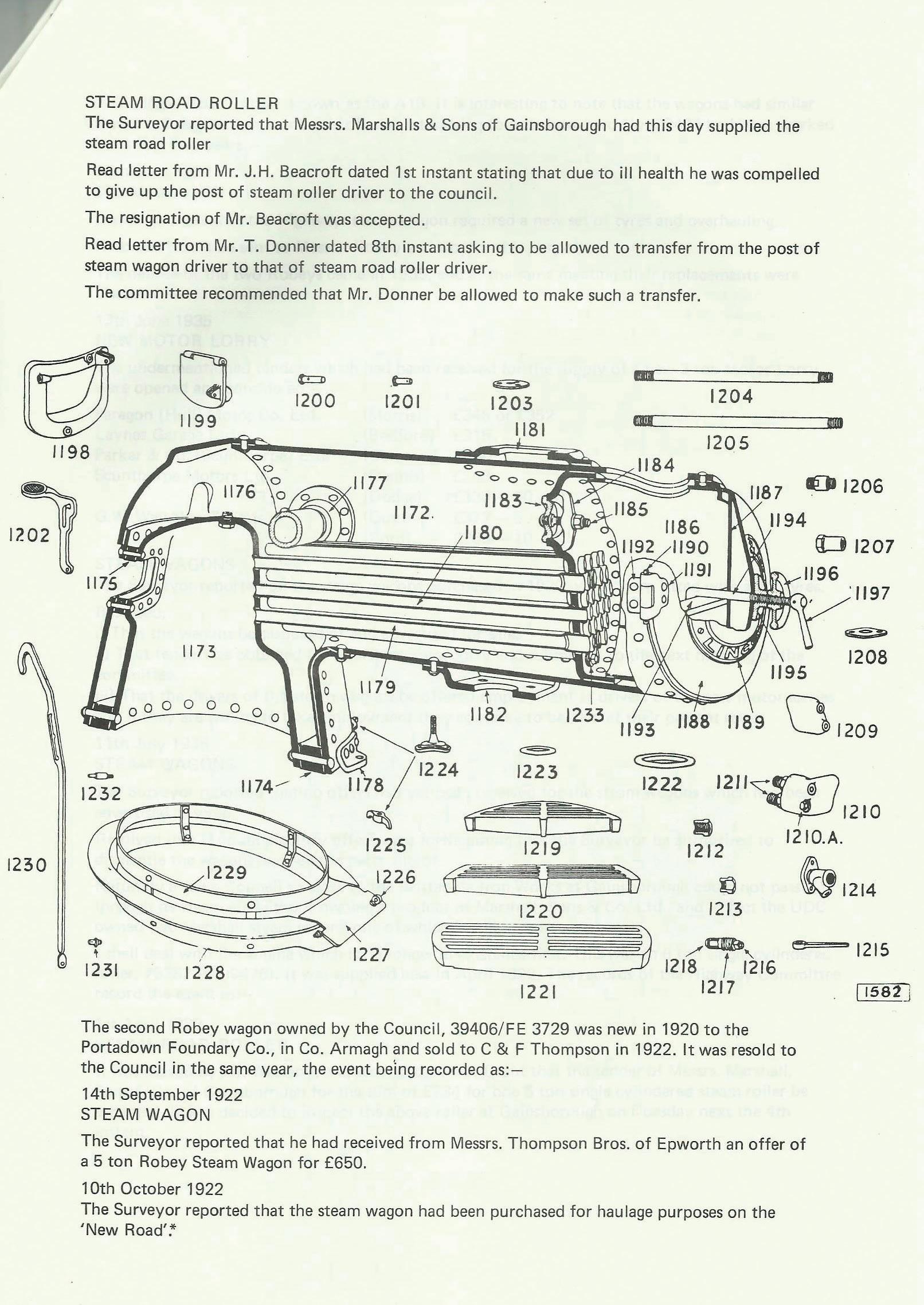
The Scunthorpe and Frodingham Urban District Council owned two Robey steam tipping wagons. Like the Yorkshire wagons, the Robey wagons had a design of boiler which was unique. Because of its shape it was called the 'pistol' type boiler. The firebox is circular in cross section requiring no stays between the inner and outer sheels - a distinct advantage in both construction and maintenance. The inner fireboxes were formed as a pressing rather similar to a domestic bath, which was then cut accross the halfway line and the two matching halves then brought together and welded from the top down each side. The engine itself was a compound with piston valves, operating at 225 p.s.i .. The cylinder design was very good and not as complicated as some, with straight and short steam ports, giving a very free running engine. Probably the freeest running of all the overtype wagons.
Pleasesee the diagram of the boiler, points to note being the shape and motion shaft running through it {1177). Terry Morris, the model subscriber to 'Engineering in Miniature' has expressed his intention to do a series on the Robey overtype and I look forward to this prospect.
There is a boiler similar to this less than 20 miles from Scunthorpe, and if any member is especially interestd I may be able to organise a visit.
The first Robey wagon was supplied new to them in September 1920, with works No. 39404 {FE 3752}. The minutes of the Highways Committee recorded the event as:-{I apologise for references being made to Marshall Roller 73290, but this was supplied in the same month)
10th September 1920
STEAM WAGON
It was reported that the new steam wagon was supplied by Messrs. Robey of Lincoln on the second instant and that the wagon had been kept constantly at work since that date and appeared to be giving every and general satisfaction.
STEAM ROAD ROLLER
The Surveyor reported that Messrs. Marshalls & Sons of Gainsborough had this day supplied the steam road roller
Read letter from Mr. J. H. Beacroft dated 1st instant stating that due to ill health he was compelled to give up the post of steam roller driver to the council.
The resignation of Mr. Beacroft was accepted.
Read letter from Mr. T. Donner dated 8th instant asking to be allowed to transfer from the post of steam wagon driver to that of steam road roller driver.
The committee recommended that Mr. Donner be allowed to make such a transfer.
The second Robey wagon owned by the Council, 39406/FE 3729 was new in 1920 to the Portadown Foundary Co., in Co. Armagh and sold to C & F Thompson in 1922. It was resold to the Council in the same year, the event be'ing recorded as:-
14th September 1922
STEAM WAGON
The Surveyor reported that he had received from Messrs. Thompson Bros. of Epworth an offer of a 5 ton Robey Steam Wagon for £650.
10th October 1922
The Surveyor reported that the steam wagon had been purchased for haulage purposes on the 'New Road't
* The 'New Road' is now known as the A 18. It is interesting to note that the wagons had similar works and registration numbers. It is also interesting to note how hard No. 39404 had been worked in its first two years:-
16th June 1922
STEAM WAGON
It was reported that the Highways steam wagon required a new set of tyres and overhauling.
Resolved that it be sent to Messrs. Robey and Co. for this purpose.
The demise of the two Robeys came in 1935, and at the same meeting their replacements were discussed:-
13th June 1935
NEW MOTOR LORRY
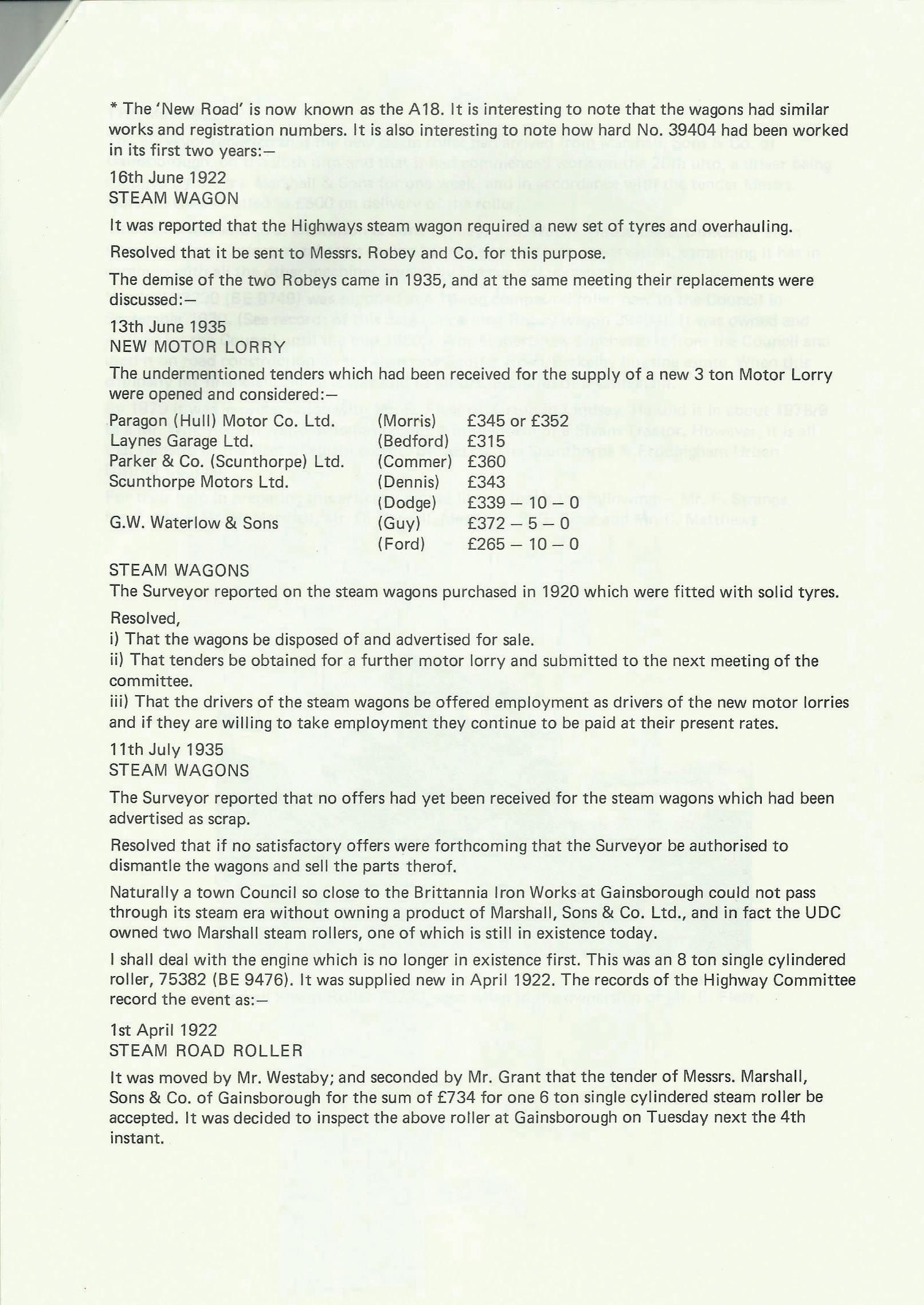
The undermentioned tenders which had been received for the supply of a new 3 ton Motor Lorry were opened and considered:-
Paragon (Hull) Motor Co. Ltd.
Laynes Garage Ltd.
Parker & Co. (Scunthorpe) Ltd.
Scunthorpe Motors Ltd.
G.W. Waterlow & Sons
STEAM WAGONS (Morris) (Bedford) (Commer) (Dennis) (Dodge) (Guy) (Ford)
£345 or £352
£315
£360
£343
£339 - 10 - 0
£372 - 5-0
£265 -10-0
The Surveyor reported on the steam wagons purchased in 1920 which were fitted with solid tyres.
Resolved,
i) That the wagons be disposed of and advertised for sale.
ii) That tenders be obtained for a further motor lorry and submitted to the next meeting of the committee.
iii) That the drivers of the steam wagons be offered employment as drivers of the new motor lorries and if they are willing to take employment they continue to be paid at their present rates.
11th July 1935
STEAM WAGONS
The Surveyor reported that no offers had yet been received for the steam wagons which had been advertised as scrap.
Resolved that if no satisfactory offers were forthcoming that the Surveyor be authorised to dismantle the wagons and sell the parts therof.
Naturally a town Council so close to the Brittannia Iron Works at Gainsborough could not pass through its steam era without owning a product of Marshall, Sons & Co. Ltd., and in fact the UDC owned two Marshall steam rollers, one of which is still in existence today.
I shall deal with the engine which is no longer in existence first. This was an 8 ton single cylindered roller, 75382 (BE 9476). It was supplied new in April 1922. The records of the Highway Committee record the event as:-
1st April 1922
STEAM ROAD ROLLER
It was moved by Mr. Westaby; and seconded by Mr. Grant that the tender of Messrs. Marshall, Sons & Co. of Gainsborough for the sum of £734 for one 6 ton single cylindered steam roller be accepted. It was decided to inspect the above roller at Gainsborough on Tuesday next the 4th instant.
11th May 1922
The Surveyor reported that the new steam roller had arrived from Marshall, Sons & Co. of Gainsborough, on the 25th ulto and that it had commenced work on the 26th ulto, a driver being supplied by Messrs. Marshall & Sons for one week, and in accordance with the tender Messrs. Marshall were entitled to £500 on delivery of the roller.
This roller was sold to J. Dickinson & Sons (Emley) Ltd, Watch House Lane, Doncaster at an unquoted date. Unfortunately this engine has not survived into preservation, something it has in common with all the other machines owned by the council, except:-
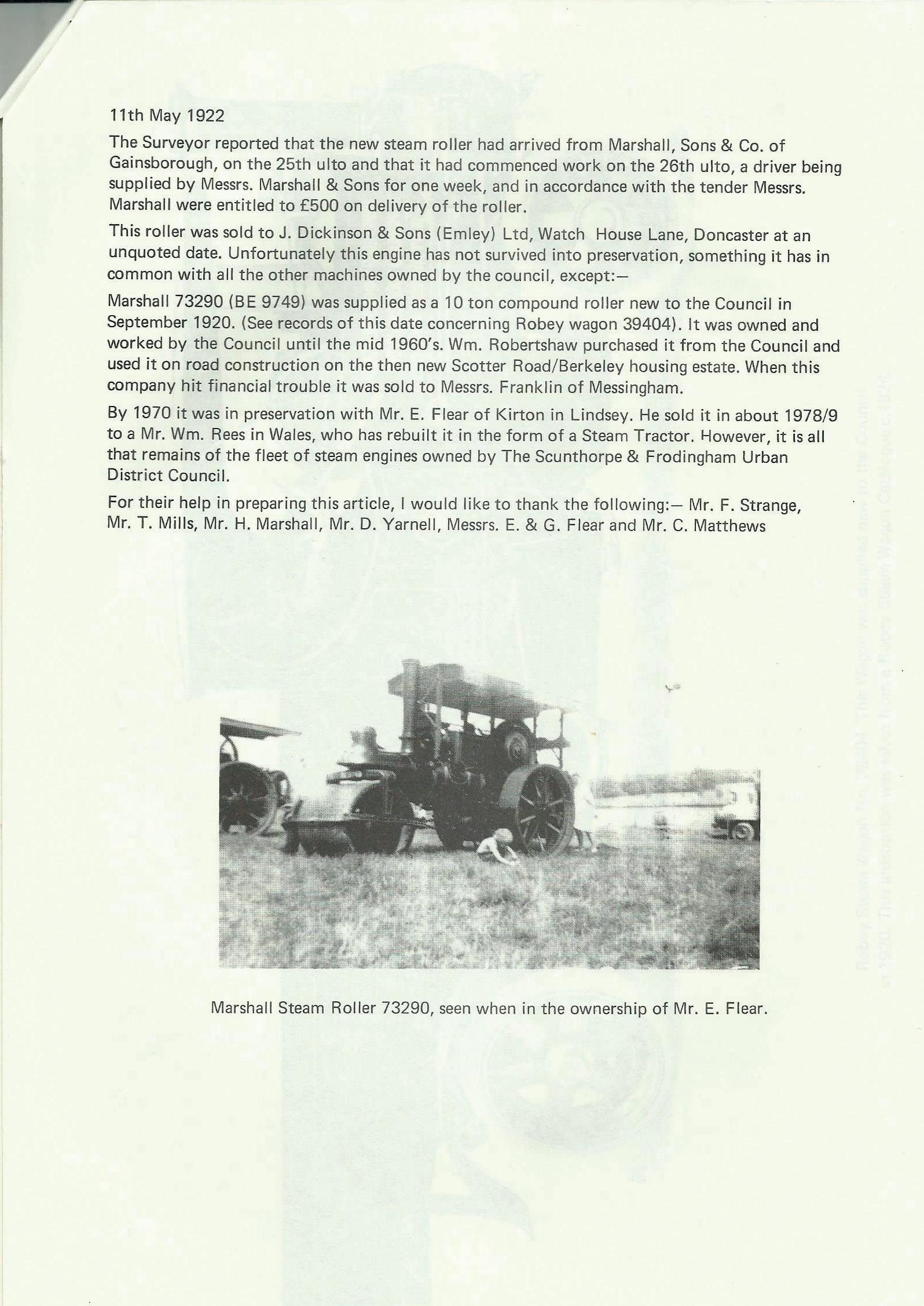
Marshall 73290 (BE 9749) was supplied as a 10 ton compound roller new to the Council in September 1920. (See records of this date concerning Robey wagon 39404). It was owned and worked by the Council until the mid 1960's. Wm. Robertshaw purchased it from the Council and used it on road construction on the then new Scotter Road/Berkeley housing estate. When this company hit financial trouble it was sold to Messrs. Franklin of Messingham.
By 1970 it was in preservation with Mr. E. Flear of Kirton in Lindsey. He sold it in about 1978/9 to a Mr. Wm. Rees in Wales, who has rebuilt it in the form of a Steam Tractor. l-lowever, it is all that remains of the fleet of steam engines owned by The Scunthorpe & Frodingham Urban District Council.
For their help in preparing this article, I would like to thank the following:- Mr. F. Strange, Mr. T. Mills, Mr. H. Marshall, Mr. D. Yarnell, Messrs. E. & G. Flear and Mr. C. Matthews
Marshall Steam Roller 73290, seen when in the ownership of Mr. E. Flear.
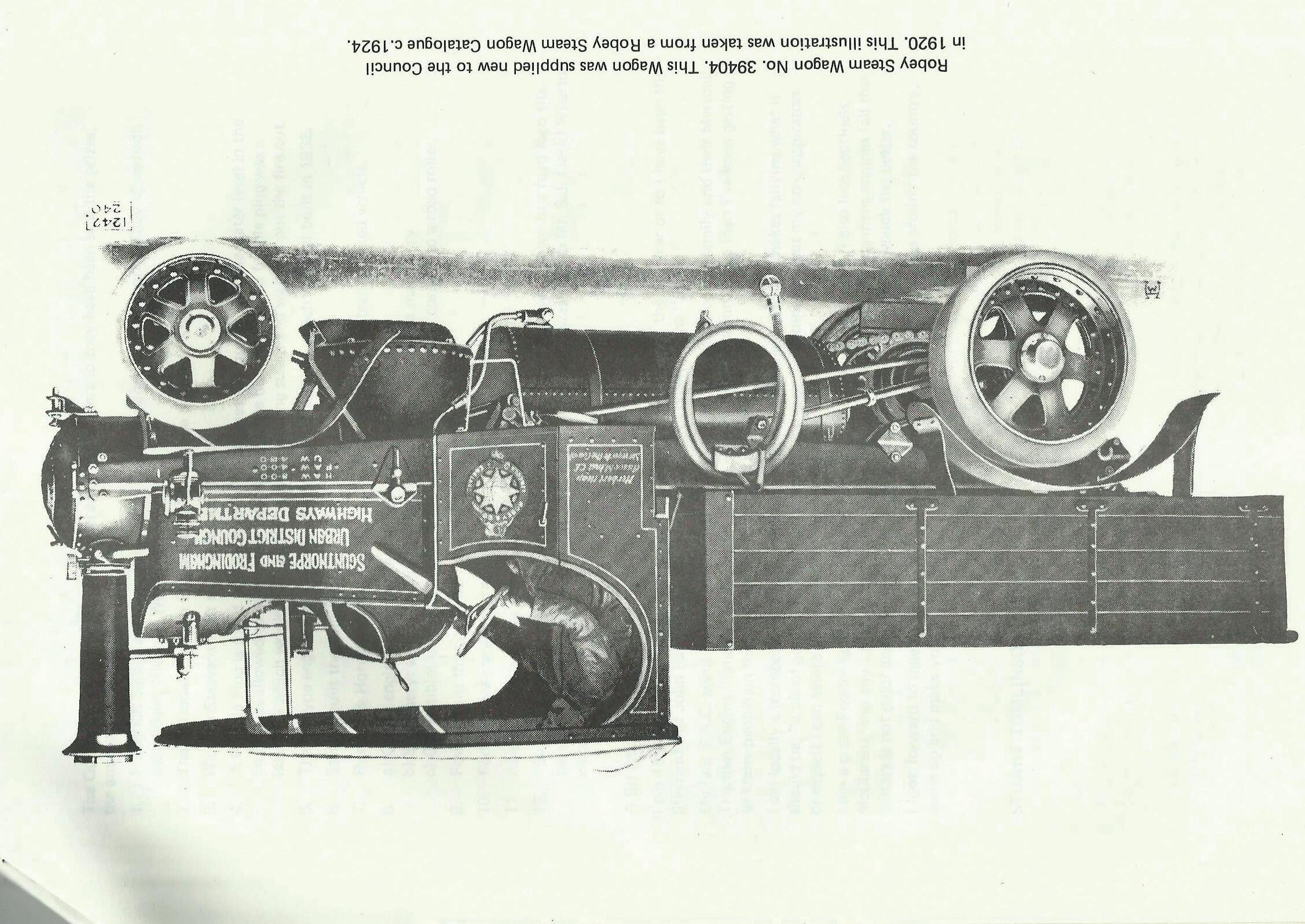
Robey Steam Wagon No. 39404. This Wagon was supplied new to the Council in 1920. This illustration was taken from a Robey Steam Wagon Catalogue c.1924.
The Quiz ·n me last issue was only entered by 2 members so they have been sent the prizes, the answers are as follows:-
1. Frederick Savage and Chas Burrell had the same name for their works. They were both called Saint Nicholas Works.
2. The National Traction Engines Club's magazine is called "Steaming";
3. Wallis & Steevens built the" Advance Roller"
4. A Fusible Plug is fitted in the crown of an engines fire box in case the water level in the boiler was allowed to go too low exposing the fire box crown. The fusible plug was a lead core which would melt allowing the remaining steam and water to put the fire out.
5. The 'S' type engine was a highly advanced steam waggon which Sentinel built in 1933.
6. Savagesbuilt the Annular Cylinder Engine.
7. Rustom & Hornsby with the help of Foster's built the first steam tracked vehicle.
8.
a) Centre engine: used to drive fairground gallopers
b) Stationery: an engine fixed in one position to drive various machinery
c) Convertible: used as a normal traction engine which could convert to a road roller.
9. Fowler built the Gyrotiller mainly for export.
10. Fodens were manufactured in Elsworth, Sandbach, Cheshire.
11. Alley & Mclellen were later called Sentinel.
12. "Supreme" was first owned by Mrs. A. Deakin, and then it was cut down to a road loco (its better form) and used by Kerrs Road Engines Ltd Then it was sold to Mr. S.J. (Jack) Wharton who restored it.
A Bit About Myself
I am 18 years old and have been rallying for about 4½ years. For the last year or so I have been the Steersman of John Sansome of Hinckley on his well known engine "Elsa'.
My first S.A.C. event was at Ouorn Station where I first met the Froggatt family and their Marshall Traction Engine "Smokey" which they let me steer on that occasion. Since thei1 I've been getting to know people on the rally fields and steering engines.
I am locally a member of the Burbage Steam Appreciation Society which makes rallying what it should be, "a bit of good fun". So if you ever have the good fortune to meet my co-conspirators or myself I can assure you you are in for a good time.
I am a great Fowler fan and consider the Fowler engine the best ever built. I also like Sentinels, McClarens, and any Lincoln built engines. I am not keen on Burrells or Showmens engines (all that glitters is not gold) and I do like to see a good road loco, if it's a Fowler so much the better.
I look forward to meeting many of you over the next few years at the rallies around the country, come up and make yourself known.
STUART TOMLINSON.