STEAMAPPRENTICECLUB
NEWSLETTER No.14 September1983
Dear Apprentice's
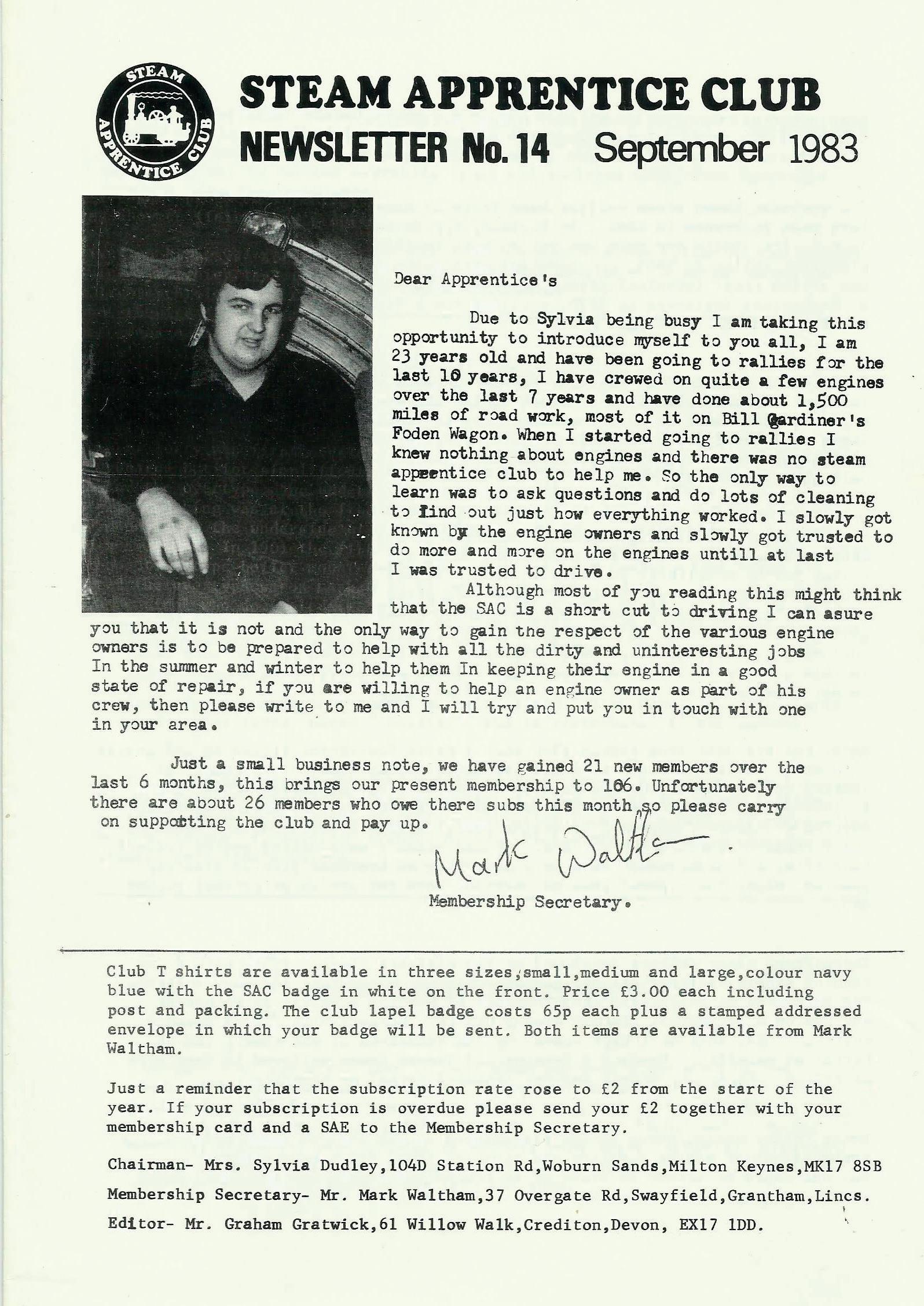
Due to Sylvia being busy I am taking this opportunity to introduce myself to you all, I am 23 years old and have been going to rallies for the last 16 years, I have crewed on quite afew engines over the last 7 years and have done about 1 1 500 miles of road work., most of it on Bill lardiner •s Foden Wagon. When I started going to rallies I knew nothing about engines and there was no steam ap,Pl!ent ice club to help me• So the only- way to learn was to ask questions and do lots 0£ cleaning • t'J find ·Out just how every-thing worked. I slowly got kn'.)WUbJJ the engine owners and sl:>wly got trusted ·to do more and m'Jre on the engines untill at last I was trusted to drive.
Although most of you reading this might think that the SAC is a short cut t::, driving I can asure you that it is not and the only way to gain the respect of the various engine owners is to be prepared to help with all the dirty and uninteresting jobs In the summer and winter to help them In keeping their engine in a good state of repair., if y'Ju are willing to help an enp:ine owner as part or his crew, then please write. to me and I will try and put y:iu in touch with one in your area.
Just a small business note, we have gained 21 new members over the last 6 months, this brings our present membership to 166. Unfortunately there are ab~ut 26 members who owe there subs this moJ!th~.o please carry on suppcmting the club and pay up. /4 ·
µcl .c v
Membership Secretary.
Club T shirts are available in three sizes,small,medium and large,colour navy blue with the SAC badge in white on the front. Price £3.00 each including post and packing. The club lapel badge costs 65p each plus a stamped addressed envelope in which your badge will be sent. Both items are available from Mark Waltham.
Just a reminder that the subscription rate rose to £2 from the start of the year. If your subscription is overdue please send your £2 together with your membership card and a SAE to the Membership Secretary.
Chairman- Mrs. Sylvia Dudley,104D Station Rd,Woburn Sands,Milton Keynes,MK17 8SB
Membership Secretary- Mr. Mark Waltham,37 Overgate Rd,Swayfield,Grantham,Lincs. I
Editor-Mr. Graham Gratwick,61 Willow Walk,Crediton,Devon, EX17 lDD.
ROADROLLERS
by Derek A. Rayner, C.Eng. M.I.Mech.E., Chairman -Road Roller Association.
The earliest known steam rollers were those of Messrs. Lemoine and Ballaison, both made in France in 1860. In England, W.F.Batho designed a roller for use in Calcutta, India and this was set to work in 1863. Thomas Aveling produced his first roller in 1865, co-operating with Batho for a few years from 1867. One of the first technical papers given on this subject was to the Institution of Mechanical Engineers in 1870, entitled 'On a Steam Road Roller' by Mr. Batho and Mr. Aveling.
Experiments continued in England, France and the U.S.A. and by 1880, the familiar three-wheeled form of steam roller had evolved. Many steam engine builders later took up roller manufacture, so similar were the products. These included T.Green of Leeds in 1874, J.Fowler of Leeds in 1887, C.Burrell of Thetford and Wallis & Steevens of Basingstoke in 1891 and Marshall's of Gainsborough in 1895.
Many rollers were directly owned by Councils or contractors but similarly, many were bought by firms who hired them out. The first recorded hire of a roller was by M.Gellerat in Paris in 1865. It was this gentleman, incidentally, who had Manning-Wardle, the Leeds based locomotive builders, construct a steam roller to his design in 1869. Hiring grew to great proportions in England, giving rise to such large firms as Eddison's, Allen's and Buncombe's but always including smaller firms and owner-drivers. The last steam rollers were built in this country in 1950, for export and rollers are still to be found working in parts of India and China today, powered by steam.
Motor rollers date from around 1900 when a Paris Contractor fitted an oil engine to a steam roller in order to avoid expensive boiler repairs. A number of similar rollers were made and sold by W.C.Allen & Co. of Belfast about 1902. In 1904 Barford & Perkins of Peterborough, a firm of agricultural engineers, adopted a different approach by making petrol engine powered rollers based on their range of horse-drawn rollers. Thomas Green's were making petrol rollers soon after and experiments also were made with an overhead pick up electric powered roller and a pedal powered version, both for garden or cricket ground use.
Thereafter, motor rollers developed on two distinct lines. Those with a low running single cylinder oil engines were simple, economical and very reliable and were made in relatively large numbers by Aveling & Porter at Rochester and Ruston & Hornsby at Lincoln amoung others. Rollers with" High Speed" multi-cylinder engines (''high Speed" by the standards of the time), ran on petrol or paraffin. Barford & Perkins and Thomas Green believed in this type of roller. Later on, diesel engines replaced petrol or paraffin.
Motor roller design never became stereotyped as did that of steam rollers. Combinations of engine position and types of final drive were numerous. Engines could be either in front of or behind the driver and the final drive either by gear, shaft or chain.
The Second World War became a turning point, with makers introducing new or updated models. Chain drive more or less disappeared and plate clutches largely displaced cone clutches. In more recent years, gear and clutch transmissions have given way to various hydraulic types and enclosed cabs, with hydraulic steering, are almost universal.
The modern road roller is a far cry from the humble steam roller of the earlier years and is a most sophisticated and powerful machine:-A worthy successor to its vintage steam and motor roller forebears.
ROADROLLERASSOCIATION
The Association was formed in 1974 by a group of people who had a common interest in rollers - powered both by steam and internal combustion engines and also in the equipment associated with road making and the science of same. No organisation existed up to that time to protect the interests of those associated with the special peculiarities of rollers. One of the prime objects of the association is to help encourage the preservation of rollers, living vans, water carts, tar boilers and other equipment used for road construction. Not all members are roller owners and it is not necessary to be so to become a member. The Association welcomes all with an interest in road making in all its various forms and trusts that all who join will be able to further their knowledge and perhaps also help the Association at the same time.
Besides organising various social activities and roller workings, a quarterly journal is published, named " Rolling " and is distributed to all members.
If the brief history of the road roller by Derek Rayner has taken your interest why not write to the Road Roller Association's membership secretary seeking further information and a membership application form. Her name and address is Mrs. M. Knight, 22 Rowditch Avenue, Derby. Please don't forget to enclose a stamped addressed envelope.
I thought that you might like to hRar what haprened after most of the people went home from Avon Dassatt. As you can recall, the engines were resting at the side of a ba.rn in the middle of a mud pool. ThE>Z7was closest to the barn, then "Ajax", BB1 and her sister "Achilles". On the Saturday, while th,: Road Locomotive Society were there "AChi l les" disgraced herself by blowing a tube; as she could not move under her own power, therR arose the problem of put·ing her into the shed.
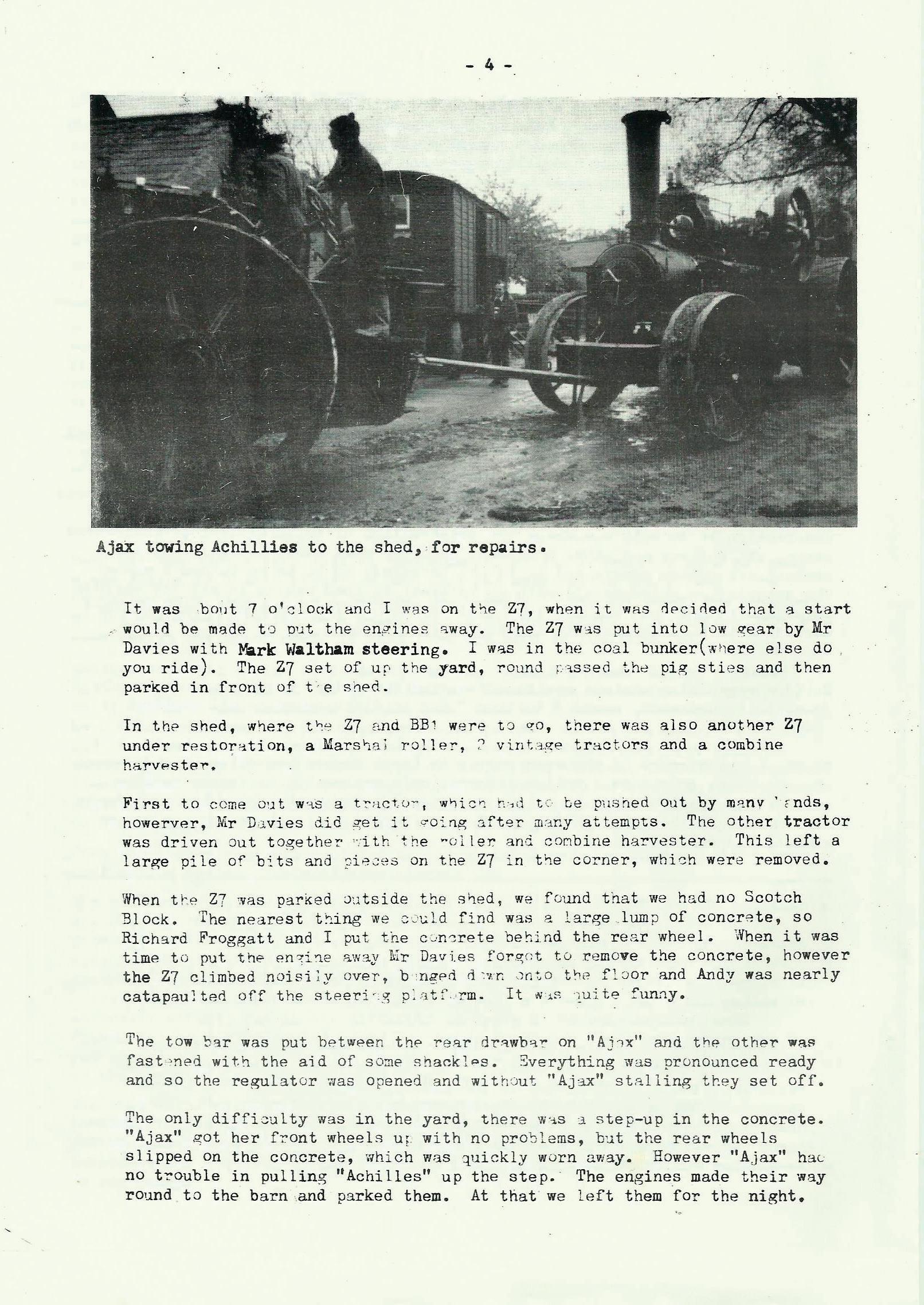
Ajax towing Achillies to the shed,·for repairs.
It was bout 7 o'clook and I WBS on tl-ie Z7, when it. vrns r]pcj~ed that a start would be made t·:i out the en,;,ines -::i.way. The 27 W:iS put into low .;,ear by Mr Davies with MirkWalthamsteering. I was in thf: coal bunker(;\·tiere else do you ride). The Z7 set of ur the yard, round ;:1.ssed the pig sties and then parked in front of t·e s0ed.
In thi? shed, w'lere th~ Z7 £md BB1 were tc:i q-o, there was a_lso anotl-)er Z7 under restor'ition, a Marsl;n; rol 1er, :1 vinta.qe tractors and a combine h;.;.rvPs te-r-.
First to come 0•1t w·-1.s a t:-,tcur·, w'iic>: r,·,d t,· te p11sr1ed out by m~nv 'rnds, howerver, .Mr D-wies ,iid get it c-oing ::;.ft~r ;rnr.y at tempts. The other tractor was driven out togethe~· ,-·ith the ~ol ler and ~oribine ha'!'.'vester. This left a large pi le of' b~ ts and on the 27 in t-ie corner, whir.:h were removed.
When th> Z7 was parirnd Jutside the S'l.ed, we found that we had no Scotch 31 ock. The nearest t'.'"!ing we c~,t:.ld find was a large lump of concrP.te, so Richard Froggatt and I put the c:,.,n-::rete be~:i:.d the rear wheel. When it was time to put the enCci~e P.way Mr Dw.ri.es for.'\nt to remove the concrete, however the Z7 climbed noisi ;y over, b :ngPd ii '.·1:r: ,1r.~,J tl,p f:c>or and Andy was nearly catap8.u;ten off the steer:i·y, p:atf' ..rm. It wis ·1_uite funny.
The tow ~'3r was put bP.twP.en the reA.r d't"~Wb'l'!"on "Aj7x" and thP. other Wl'\S fast·ned wit~ the aid of so~e shack1Ps. Sverything was pronounced ready and so the regulator was opened and wi thuut "Aj,u" st:=;,l ling tr.ey set off.
The only diffi~u l ty was in the yard, there W''iS J. step-up in the concrete. "Ajax" .q;ot her front wheels u;. with no pro·::ilems, b:1t the rear wheels slipped on the concrete, which w::is :iuickly worn away. However ''Ajax" ha.c. no t-::-ouble in pulling II Achilles" up the step.· The engine_s made their way round to the barn and p3.rked them. At that we left them for the night.
"What time are you expected home?" "Does not matter", replied Richard.
5"We11, how would you like to put the new tube in?" "0.K."
I would like to thank Mr Davies and his crew, MrWharton,JohnCrawleyand many thanks to Sylvia.
AVONDASSETTSAC VISIT 22nd May 1983•
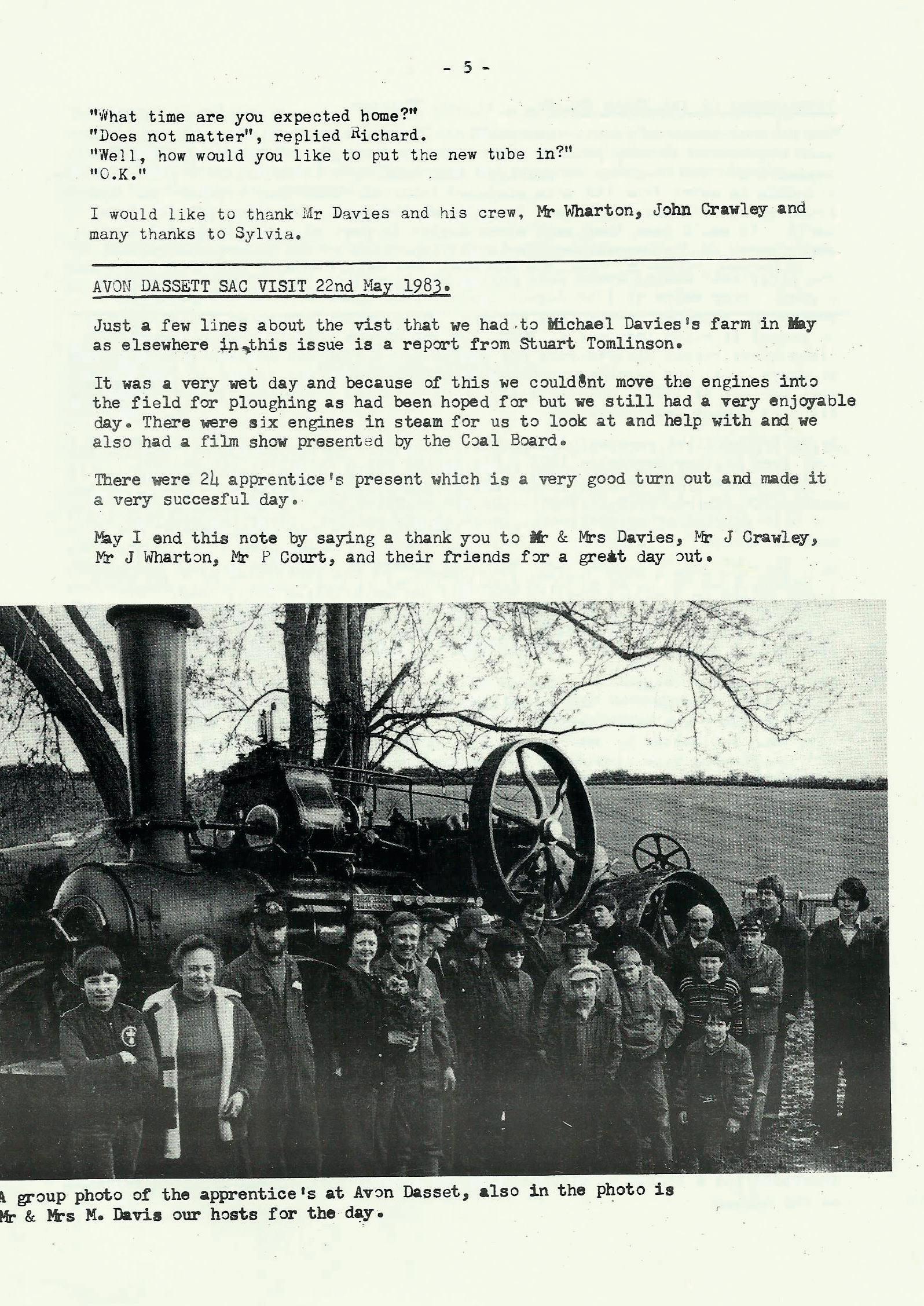
Just a few lines about the vist that we had.to Michael Davies 1s farm in Hay as elsewhere JJ.1-,.this issue is a report from Stuart Tomlinson.
It was a very wet day and because of this we could~nt move the engines -into the field for ploughing as had been hoped for but we still had a very enjoyable day. There were sjx engines in steam for us to look at and help with andwe also had a film show presented by the Coal Board.
There were 24 apprentice's present which is a very good turn out and made it a very succesful day
&y I end this note by saying a thank you to ifr & Mrs Davies, Mr J Crawley, Mr J Whart::m, Mr P Court, and their friends f ::>ra gre•t day out•
group photo of the apprentice 1s at Avon Dasset, also in the photo is lfr- & Mrs M. Davia our hosts for the d~y.
DEVELOPMENTOF THE STEAMENGINE.
-by John Wharton.
The lure of steam is really indefinable. There are however, many factors that seem attractive to many people. The colossal strength generated by steam is impressive. The handsome proportions that make up a steam engine's individuality, , standing it apart from its mass produced internal combustion successors. The aroma of hot oil and burnt coal is to some, the most exclusive perfmne in the world. It would seem that each steam engine is part of a heritage or a family, whose background and preservation is all important to the ardent enthusiast.
The first self moving steam road engine was pioneered by Frenchman, Nicholas Cugnot. From Paris in 1769 Cugnot demonstrated his three-wheeled vehicle powered by a copper kettle typE boiler. The pressure generated was sufficient to propel it along the road at 2mph, but the volume was not enough, as running times above twenty minutes were not possible. A stop was necessary to build up pressure. All the teething problems of this vehicle were solved in Cugnot's next vehicle of 1770. Unfortunately on negotiating a corner, it overturned and Nicholas Cugnot was imprisoned.
Possibly the first successful design of steam engine for agricultural purposes, came from Matthew Murray in 1802. His engine was a portable. It was not self-propelled, but had wheels and could consequently be hauled by horses or oxen. The engine had a flywheel, the rim of which was designed to be utilised for belt-driving other machinery, (such as saw benches, threshing machines and corn mills).
What may now seem a very logical development, of the conversion of a portable steam engine to a self-propelled one, did not materialise until 1842. The inovation came from J.R. & A.Ransome, who simply linked the power and movement of the crankshaft to the back axle, incorporating a chain, (asimilar, but more substantial design of chain to that type now used on the bicycle).
Another traction engine of interest was the 'Willis Farmers Engine'. Robert Willis was a designer at the Leeds Railway Foundry in Yorkshire. The engine built in 1849, was exhibited at the Royal Show at Norwich. The design seems to have been influenced by previous developments made on the railways. The boiler and the firebox were similar to George Stevenson's design, as used on his famous "Rocket" of 1829. This type of boiler and firebox, later known as the 'locomotive' typE boiler, was adopted for the majority of traction and railway engines. The undermounted cylinder and motions of the Willis engine was similar to Edward Bury's design, as used on his earlier railway locomotives.
From the humble beginnings of the traction engine made by Ransome, there were what may be called, 'natural developments'.
The problem o·f cultivation in the fields was a great one. Today all implements are used by the direct method. The ploughs, cultivators, etc., are pulled directly behind the internal combustion tractor tractors. Prior to the steam age, the direct method of cultivation was used, firstly with oxen and later with horses, because of their greater speed and strength. On heavy land, up to ten horses have been known to be necessary to pull a plough. The steam engine was extremely strong, but it was difficult to apply it to cultivating land. Primarily the direct method could not be used because the steam engine was heavy and compacted the ground. The steam engine also had trouble gaining the adhesion to the ground to pull a plough on heavy land.
The first real attempt to apply steam to ploughing was made by John Heathcoat in 1837. His method required three parallel roadways to be rolled in a field, one on either side of the field and a third down the middle. The steam engine incorporating a system of winches stood on the centre roadway, and anchors stood on the others.
-7 -
Two ploughs, one on either side of the steam engine were pulled to and from the anchors. The idea was ingenious, but failed to work for chiefly one fundemental reason, steel wire rope as we know it today, did not exist and Heathcoat's flexible iron rope kept breaking.
John Fowler, (with an improved design of flexible iron rope), in 1865 invented the twin engine, single cable system of cultivation. This method involved two steam engines, with winches or winding drums, mounted horizontally under the boiler. The engines stood on either side of the field and they simply pulled the respective implement between them. The steam engines moved forward in turn, so the field was eventually cultivated. Although this method seems -primative, Fowlers dominated the steam cultivation market, virtually unopposed. Many experts in agriculture consider that cable ploughing should once again replace the direct method. With the cable method, the area cultivated is about the same, and the yield of crop would be higher because the ground is not compacted. Fowlers single cable,twin engine system of cultivation could only be improved by the change in power source.
Many people of today do not realise the difference between one steam engine and another, terming them all under the heading of 'steam rollers'. This misuse of terminology is probably due to the fact that the last steam engines, used commercially on our roads, were the rollers.
There was a time that roads were not rolled at all. The road making materials were simply scattered on the surface and left for anyone using the road to compact and consolidate it. Rollers, like huge garden rollers, have in our history, been hauled by so many sources of power including men, oxen and horses. Even today in the construction of new roads these rollers are to be seen being hauled by huge caterpillar-tracked crawlers. Before the advent of the steam roller, the early traction engines pulled the outsize garden· rollers.
Possihly the first steam roller, was that of Frenchman, Lemoine in 1860. In England the first steam roller produced was from a design by Messrs. Batho and Clark. It was constructed by Messrs. Worsdell & Evans of Birmingham in 1862. Aveling & Porter of Rochester in Kent, built a steam roller in 1867, that was an improvement of the 'Batho & Clark' design. This thirty ton machine was supplied to Liverpool Corporation.
Aveling & Porter Ltd from the pioneering days went on to be the most successful steam roller manufacturer. However many steam engine makers entered the road roller market and those worthy of note include; Fowlers, Marshalls and Willis & Stevens.
The self-moving traction engine was developed with agriculture in mind. On the roads, the transportation of goods was being powered by horse. To gain traction to the ground, in the fields and on the rough roads, the rear wheels of the traction engines had strakes fitted to the outside of the rims. The strakes were generally strips of metal, three inches wide and half an inch thick, riveted on the rim of the wheel obliquely, with a three inch gap between them. Many hauliers used these engines on the road. Their strength outclassed the horses.
The roads were soft before the use of the steam roller, consequently to drive a traction engine on a road, was not too uncomfortable. However as the roads got harder, the drivers had a rougher ride. The steam engine manufacturers saw the difficulties of the steam haulier and the road locomotive was gradually developed,
The facility of springing was fitted to both front and rear axles. The front spring was usually a transversely mounted leaf spring. As far as the rear spring is concerned, practically all manufacturers had their own designs.
-8 -
Rubber tyres were eventually fitted to the rims of the wheels of some road locomotives to cushion the roughness of the road even further. The range of the road locomotive was increased by the fitting of a tank underneath the boiler (known asa belly tank), thus giving extra water carrying capacity. Special road locomotives were produced for special markets, such as those manufactured for travelling showmen (fairground proprietors).
The 'Locomotives on Highways' act of 1896 lifted many restrictions on selfp.ropelled vehicles weighing less than 3 tons and drawing not more than one trailer. The light vehicles were allowed to travel at speeds not exceeding 14 mph and did not require a person to procede it carrying a red flag. Many steam engine builders took advantage and built small traction engines or steam motor tractors to comply with this act. The 3 ton tractor was made obsolete by the 'Heavy Motor Car Order' of 1904 which raised the critical weight to 5 tons. Thus the builders of steam engines were given the means to build a more practical motor tractor.
The steam wagon or lorry was first developed in the late nineteenth century. Many designs appeared but for simplification they can be split into two types, the undertype and the overtype. The undertypes were the first on the roads. The boiler, generally speaking was at the front of the vehicle. The engine (or the motions) were mounted to ·the underside of the chassis, roughly midway between the front and rear axles. In 1901 the first overtype wagon was produced by Fodens. The locomotive type boiler mounted at the front carried the motions. Fodens dominated the overtype wagon market until it ended. Fodens were continually competing with Sentinel who dominated the undertype market. In comparison, the overtypes were liked by the old steam men. The mechanics were simple and easily maintained. However, the boiler and cab generally took up half the length of the chassis leaving a small platform for the goods to be carried on. The undertype was not so logically maintained but had a larger platform for goods to be carried upon. It should be said that Fodens and Sentinel were by no means the only producers of steam lorries but they certainly did shine above their hundred or so competitors in this market. Fodens and Sentinel were forced to go into the production of internal combustion lorries by an act referring to road tax and the unladen weights of vehicles.
This change in the law very soon forced many steam engines off the roads and into the scrap yards. In the post war years (the late 1940's), the internal combustion machines had all but won tht day. A handful of pe0ple tried desperately to continue to use steam engines, even until the 1960·~, but un1-0~itability eventually tipped the balance.
1be preservation of steam engines came by accident. Two farmers argued who had the faster traction engine. The consequence was that in 1950 at Bridge Farm in Appleford, Ber',-s., a race was held for a measure of beer. Arthur Napper with his Marshall engine, named 'Old Timer' beat Miles Chetwynd-Stapleton on his Aveling & Porter engine, named 'Lady Grove'.
This race aroused much interest. More races were held. Challenges came from many other people. The traction engines that were lying behind the barn, disused, forgotten, overgrown by brambles, were pulled out and saw glory again.
In 1954 the National Traction Engine Club was formed. The club seeks to aid, guide and protect the owners, enthusiasts and spectators of steam engines.
Perhaps, as petroleum and diesel is so expensive, steam will eventually come back onto our roads.The lumpy coal of the previous steam age will not be the answer. Possibly the use of pulverised coal has a chance to succeed the oil age?