NEWSLETTER Nol2 June 1982
Dear Apprentices,
All being well this newsletter should be in your hands towards the end of May, or shortly afterwards, and by that time the rally season should really be beginning to get underway. The list of rallies offering, free entrance to SAC members is quite impress.ive and hopefully you will be able to make good use of the various rally organisers ·generosity, and find at least one such rally near to where you live.
Throughout the season at various rallies, special Steam • Apprentice events will be taking place and if you can possibly let Sylvia know beforehand if you plan to ·attend, it will help her when making any arrangements. Before the next newsletter is produced, ev·ents are scheduled to take place at Banbury on June 27th and at Rempstone on July 11th. These Sunday morning events for the club begin. from 10. 30 am and ~nyone going is reminded to bring suitable clothing. A full list of rallies with a SAC presence was included on the list sent out with the last newsletter, but activities are not a certainty at all of the rallies mentioned.
A few more ideas regarding a club poster would be welcome. The plan is to produce a poster advertising the club and its activities and· aims, and this poster would be displayed at steam centres and other appropriate locations. Your ideas about the content and design of the poster and suggestions for display places will be gratefully received.
In. this issue of the newletter several members ·have reported on rallies they have visited or even helped to run. It is always interesting to hear about what other people have been doing, especially when it is something a little different from the usual. Any contributions, however brief, are always welcome, particularly at present as the stock of material for future use· is beginning to look a little thin! The printing process we use enables us to make use of black and white photographs so if you have any you would like to offer for inclusion,please send them in as well.
Have a pleasant sunnner rallying and I look forward to meeting some of you during the coming months.
SUBSCRIPTIONS TO THE S.A.C.
It has become necessary due to increases in postage costs to put up our subscription. As from 1st January 1983 the new subscription rate will be £2.00. I hope you will still find this good value for money and continue with your membership.
Every new member enrolled helps to spread our costs and this is one of the best ways of keeping increases at bay. Do you know anyone who might like to join us ? ,
The current subscription is £1.50 and if yours is now due for renewal, please send your remittance plus a stamped addresse·d envelope to the Membership Secretary, 101 Mill Lane, Sawston, Cambridge, CB2 4HY.
Colin Nessfield has contributed a different type of rally report and although he doesn't admit it, I suspect he and his friends had a very enjoyable weekend helping to run the rally.
THE DARKERSIDE OF THE QUORNby Colin Nessfield.
The East Midlands Branch of the S.A.C. were informed that their assistance would be appreciated in helping set up and run Quorn Rally, and so being ever helpful, we agreed. The first wave of attack arrived on Thursday afternoon in the form of myself and Richard Froggatt, with a tractor and living van. The van was innnediately connnandeered for use as rally control, due to someone forgetting to book a caravan. During the first two days, the van churned out well over 50 cups of coffee a day. Thursday night saw the arrival of our third man, Andrew Lowles.
The same day things began to turn funny. The rally organiser David Pugh, was wandering harmlessly about, organising, when up rolled a Rover with a camouflaged person inside who uttered a few words to David Pugh and then took off. David looked around nervously and found Barry Nurcombe, took him into the office and had words. When Barry re-appeared he was the newly installed rally organiser, the previous one had been connnandeered by the army and had to be in Portsmouth by that evening to mend an item of equipment and instruct other people on how to use it before the ship sailed. If this was not managed he was to sail with it. He completed the job in good time, and since he did such a good job he had to go to Exeter and mend something else, effectively ruling him out of nearly a_ll organising.
Everyone got busy, and by Saturday night everything was ready. Sunday saw a catalogue of disasters. The BBC came along and spent the whole afternoon filming and interviewing. After they had gone, they found out that the camera battery was flat, and so they had to come again the next day. Sunday saw the parade taking place with one roller performing some highly unorthodox manoeuvres, which I will not describe. J. Crawley and Sons newly acquired Foden overtype wagon was looking very nice, and another Foden present was that of William Gardner.
Monday saw the return of the hapless BBC crew, who promptly ran out of film as soon as the Grand Parade started, and it had to be re-run inorder to get the correct results. Barry Nurcombe had to escort the cameramen about, as he had a fetish for panoramic shots of approaching rollers front rolls.
We all went to bed rather tired and woke up next morning to find that someone had been in during the night and pinched our rally, it was all but gone, only 3 rollers and a small number of cars and living vans were left. The organisers kindly gave us a ride on one of the Great Central Railways trains. Then came the usual situation of people diagonally opposite each other trying to find something to talk about. Myself, Dave and Bill talking about girls and Richard and Andy about collecting posters. Most ears in the carraige were concerned with the former subject, when Richard piped out loudly, "Me and Colin h~ve a system, we both grab whatevers going, and argue about who gets what later." This left the carraige laughing their socks off, lying on the floor, whilst Richard sat trying to work out something funny in what he had said.
This was a very fitting end to a very different rally.
A FEW RANDOMTHOUGHTSON THRESHING,
by Neil Smith
The coming of the traction engine made a lot of difference to the. threshing trade and the most noticeable matter was that' horses were no longer needed to shift the tackle. True the stack-yar.ds we~e no better to: get in and out of, and of course there was just as much hard and dirty work to be done, but an engine could wind the tackle in with its winding drum and this step forward is frequently overlooked'in present times. Compounding had come in the 1880's and although it was more economical in running, it was never widely favoured by threshing men. A compound engine cost more to buy and there was more maintenance to be carried out. In most circles it would be a single cylinder engine of 7 nhp that was considered to be the best, and some owners might go one step higher ·and buy an 8 just to be on the safe side.
Drum speed for threshing was hard to maintain in the early days and the old fashioned type of governor with its slowly revolving heavy balls was far too slow for accurate speed correction. Later on engine builders perfected their own designs of ''high speed cross arm" types and they were rather better, but the greatest step forward in this field was the Pickering type with its three balls and a much higher speed of rotation. Engines so fitted could keep a regular and constant speed on the belt and the Pickering was so sen?itive that it could control the whole operation to very fine limits. Another equally good governor was the Gardner-type. Again a high speed type, but inverted and with only two balls, but very effective and usually found on Ransomes engines.
Lubrication on early engines had always been a problem too and the displacement lubricator which supplied fat or heavy oil to the cylinder by way of the steam chest was never quite as successful as it should have been. By the early 1900's mechanical types were often to be found with ratchet operation and feeding oil by way of a check valve which prevented any blowing back. The most popular and least complicated was from Foster of Lincoln and was known as the "Connnonsense" lubricator. Later .on more advanced patterns were to be bought such as those by Manzell or Dunbar&· Slater. Some builders, Marshall for example, designed and built their own lubricators, but they were always optional.
Boiler feeding was another area in which progress was made. The humble,portable had always been fitted with a feed pump running from the crankshaft and this method was to continue on traction engines right through until the last was built. Some people preferred to use injectors. The early examples had been rather less than useful and were difficult to set. In later years the much more reliable Penberthy was to be found on many engines and like the Pickering governor it had come from America. Again like the Pickering governor, it became a very popular fitting and very reliable in service. On our own side one could find plenty of British made injectors, Premier and Shaffer & Budenburg to name but two.
The perfection of the threshing machine was probably accomplished in rather less time than it took to do the same with the power unit. Drums built by 1890 were little different to those built some forty years late.r although there were alterations and quite a number of modifications which improved performance. Even so it was many years before the self feeder became popular. In present times one may stand on the staging of the old fashionep open feed type and wonder how many men got caught up in the drum· and concave. Happily it was rare and there was a safety device which closed the feed hole if a man should fall against it, but occasional accidents did happen. The self feeder was safer of course and what was more importa.nt at the time, it dispensed with having to have a man to cut the sheaf bands. On the self feeder the man who fed cut the bands himself. It is often said that this was one of the most important pieces of progress in threshing machine design.
Of drums built after the last war and up to the end of their building, Fosters offered drums with a conveyor from corn stack to drum, but few were ever built and fewer still are extant today.
As with the engines, lubrication was an early problem and the first designs of drums all had plain bearings with oil cups which had to be filled twice a day when at work. Later on the ring oiler appeared and this was possibly a more important step forward than the self feeder. Even so,the ring oilers only applied oil to the bearings on the shafts and such matters as shaker cranks still needed their daily fill, but at least it saved some of the mucky work. Final designs were offered with 37 sets of ball bearings and grease cups, and although this was one of the best ideas invented there was little enthisiasm for it. Only amongst the very progressive could such an inovation be found. Certainly expense came into it but there was a saving of about 3 bhp and also a vast saving of preparation time before starting work in the cold light of a winter's dawn.
A TRIP TO IRELAND, by Sally Robinson
Last year I decided to take my cardboard model steam roller to a selection of rallies in different areas. I included Upton in my list when I discovered that a friend was going too. It seemed rather far to go on one's own.
Upton is fifteen miles south west of Cork. Due to heavy rain over night the engines were having problems unloading onto soft ground. Mine was the only model road vehicle and I ended up showing it in the sales arcade. It was hard work fending off all the inquisitive would be buyers. Whilst I was thus occupied, Melvin was able to converse with some engine crews. The engines are steamed on turf (peat). Each morning the drivers were given as much turf as they felt they needed. There were three Ransomes, Sims & Jeffries traction engines, several compound Fowlers, some Marshalls and an Aveling & Porter "coffee pot" vertical boilered tandem roller. This last is a double crank compound with piston valves and a geardrive on the offside. I have heard since that these engines have power steering. This example,No. 11363, was steered by a second man running alongside ! There was also a Clayton & Shuttleworth, No. 43173, which is gradually being converted into a single cylinder showmans engine. All the engines are in good working order but some owners have an engaging disregard for appearance. There is a lot of l" wide lining out and one engine turned out in red, green, white, lemon yellow and aluminium primer but still appeared smart.
The owner of Marshall portable No. 7OO87,which was driving a saw bench, explained to us about Upton rally. Saint Patrick's, Upton, where the rally is held,is a home for mentally handicapped men set in its own arable lands. The residents cultivate the land and make articles ranging from pullovers and cushions to tools under the supervision of volunteers and the clergy. All the proceeds from the rally fund St. Patricks where work is in progress to replace the institution type home with a village for the mentally handicapped.
Both Melvin and I were impressed by the generous and easy going nature of the people we met. There was food as well as fuel with everybody remotely connected with the rally being given a good lunch and supper on both days. When we went to the bar in the evenings everybody was taking turns to sing to music from a fiddle, an accordian and a kind of hand held drum played with a stick held between the fingers. The floor was cleared and a girl danced. The second night I sang! I have been invited back to Upton rally so I promised them that when I returned it would be with a working model.
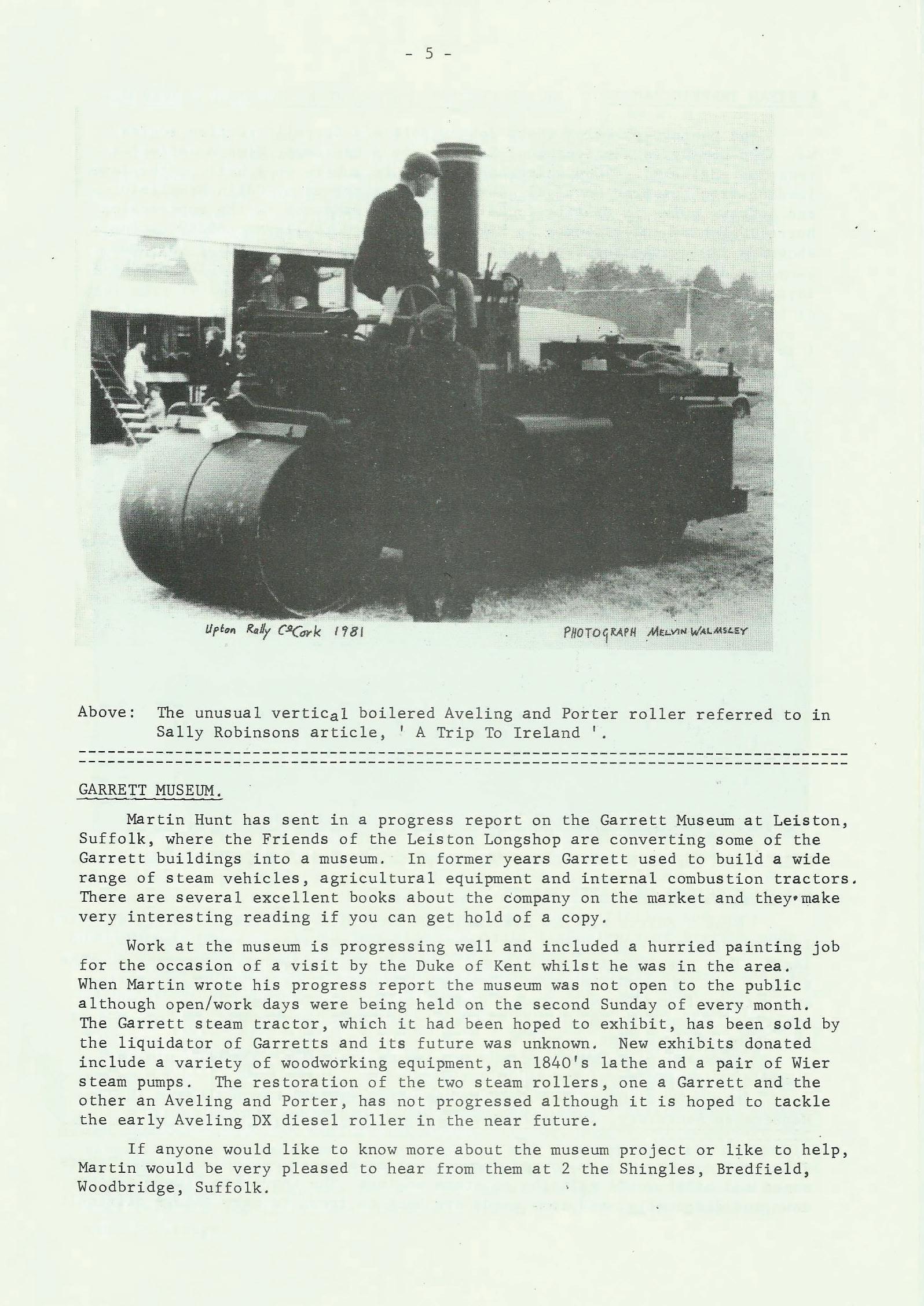
Above: The unusual vertical boilered Aveling and Porter roller referred to in Sally Robinsons article, 'A Trip To Ireland '.
GARRETTMUSEUM.
Martin Hunt has sent in a progress report on the Garrett Museum at Leiston, Suffolk, where the Friends of the Leiston Longshop are converting some of the Garrett buildings into a museum. In former years Garrett used to build a wide range of steam vehicles, agricultural equipment and internal combustion tractors. There are several excellent books about the company on the market and they•make very interesting reading if you can get hold of a copy.
Work at the museum is progressing well and included a hurried painting job for the occasion of a visit by the Duke of Kent whilst he was in the area. When Martin wrote his progress report the museum was not open to the public although open/work days were being held on the second Sunday of every month. The Garrett steam tractor, which it had been hoped to exhibit, has been sold by the liquidator of Garretts and its future was unknown. New exhibits donated include a variety of woodworking equipment, an 1840 1 s lathe and a pair of Wier steam pumps. The restoration of the two steam rollers, one a Garrett and the other an Aveling and Porter, has not progressed although it is hoped to tackle the early Aveling DX diesel roller in the near future.
If anyone would like to know more about the museum project or like to help, Martin would be very pleased to hear from them at 2 the Shingles, Bredfield, Woodbridge, Suffolk.
A STEAMTRAFFIC JAM ?
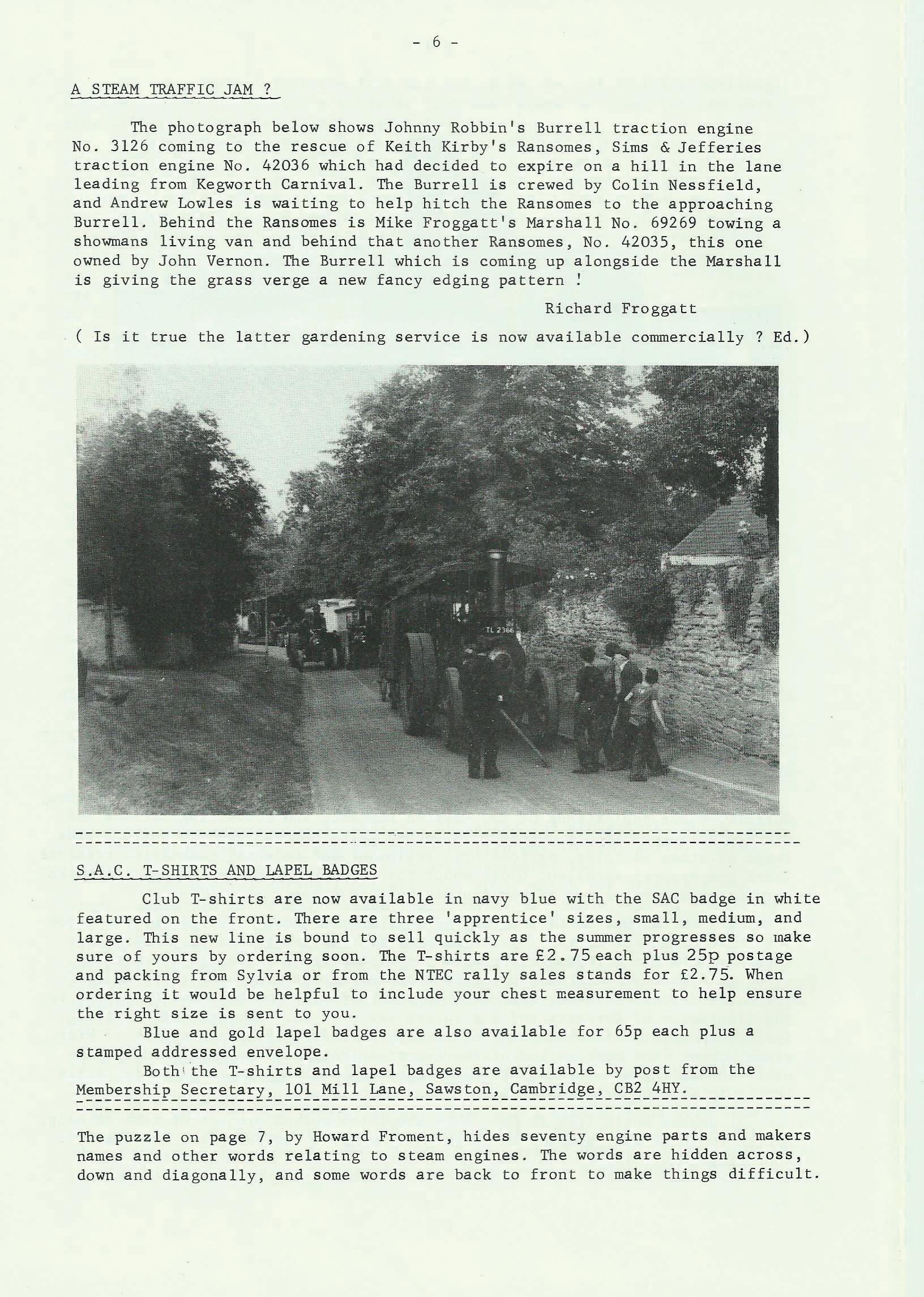
The photograph below shows Johnny Robbin's Burrell traction engine No. 3126 coming to the rescue of Keith Kirby's Ransomes, Sims & Jefferies traction engine No. 42036 which had decided to expire on a hill in the lane leading from Kegworth Carnival. The Burrell is crewed by Colin Nessfield, and Andrew Lowles is waiting to help hitch the Ransomes to the approaching Burrell. Behind the Ransomes is Mike Froggatt's Marshall No. 69269 towing a showmans living van and behind that another Ransomes, No. 42035, this one owned by John Vernon. The Burrell which is coming up alongside the Marshall is giving the grass verge a new fancy edging pattern!
Richard Frogga tt
( Is it true the latter gardening service is now available commercially? Ed.)
S.A.C. T-SHIRTS AND LAPEL BADGES
Club T-shirts are now available in navy blue with the SAC badge in white featured on the front. There are three 'apprentice' sizes, small, medium, and large. This new line is bound to sell quickly as the summer progresses so make sure of yours by ordering soon. The T-shirts are £2. 75 each plus 25p postage and packing from Sylvia or from the NTEC rally sales stands for £2.75. When ordering it would be helpful to include your chest reeasurement to help ensure the right size is sent to you.
Blue and gold lapel badges are also available for 65p each plus a stamped addressed envelope.
Both' ·the T-shirts and lapel badges are available by post from the Membership Secretary, 101 Mill Lane, Sawston, Cambridge, CB2 4HY.
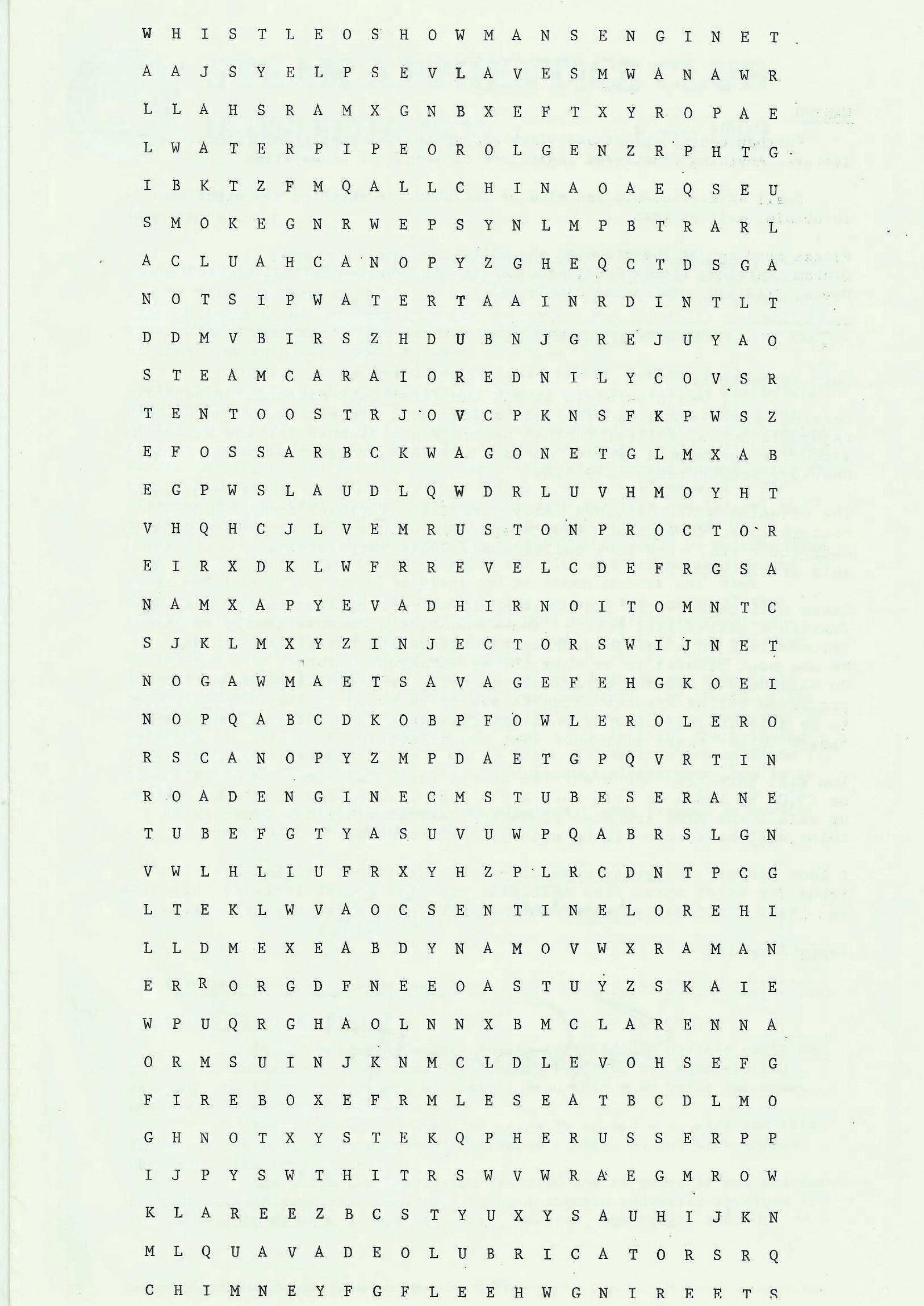
The puzzle on page 7, by Howard Froment, hides seventy engine parts and makers names and other words relating to steam engines. The words are hidden across, down and diagonally, and some words are back to front to make things difficult.
LLAHSRAMXGNBXEFTXYROPAE
SMOKEGNRWEPSYNLMPBTRARL
NOTS IP WATER
DDMVBIRSZHDUBNJGREJUYAO
S TEAMCARA IOREDN ILYC OVSR
TENT O OST R 1·0 V
EFOSSARBCKWAGONETGLMXAB E
NAM X A PYE VA D HIRN O ITO MN TC
SJKLMXYZINJECTORSWIJNET
N OPQABCDKOBPFOWLEROLERO
RSCANOPYZMPDAETGPQVRTIN
LTEKLWVAOCSENTINELOREHI
ERR ORGDFNEEOAS TUYZSKAIE
IJPYSWTHITRSWVWRAEGMROW
KLAREEZBCS TYUXYSAUHIJKN
WANTED
Further contributions and black and white photographs for future news letters. Anything. considered regardless of length or handwriting.
Small advertisements can ·also be included for anything you might want to obtain, sell or swap.
Please send any Graham Gratwick, Devon, EX17 4BD. of the above to the editor; Little Coddiford, Coddiford, Telephone 036-36 693
Cheriton Fitzpaine, Crediton,
Dear Apprentices
I was pleased to attend the first East Midlands Branch meeting where we had an excellent slide show, a useful chat and an enjoyable cup of coffee, further meetings are planned for the Autumn so watch for the notice here or contact Richard Froggatt at Knoll !Iouse Charley, Loughborouch LE12 9YE.
The Or~anisers at the ~uorn ~ally were full of praise for the SAC members t~ere as I gather they stepped in with the early arrancement3 when the normal crew were called away. Colin very modestly writs about this in his report.
There will be a report from ~eeting in a later edition but we had FINE ':::CATHER-unlike last year -and as usual Le Parrott family and t;1eir friends laid on a splendid array of engines and activities for us. ie are most pleased to be a~le to say thankyou to them. On Saturday we had the experience of being f~lmed by AnGlia TV for a programme called Bygones which is due to be shown in t~e I hope to be able to let you kno~ when later so that those of you who didn't manage to get there will know what you missed~
You will have read abo·:1t our Tee shirts (at ;;.: 2.75 from me at I/allies or £3.00 by Post) I~ told they are a g~od Quality and Al;in's ha2 w~shed up well. ihe NTEC are also producing several other new lines which I think will be to our liking such as cloth badges.
I look forwara to seeing some of you at the su~mer ~a~lie~ 8ee l~st issue for whic~ ones. You will find your nally list included t~is ti~e and the NT~ C Rally Stand Staff will be pleaGed to say Eello too.
~appy .St teming