The Editor welcomes any contributions of articles, shorter items or photographs for inclusion in future issues. All material submitted is voluntary and payment cannot be made for any material published.
The opinions expressed in the magazine, with the exception of Club announcements, are those of the contributors and do not indicate the views of the Club as a whole. All items are held copyright by the contributor and the NTET. The Editor reserves the right to amend or refuse contributions. The magazine is normally published during January, April, July and October. The Club accepts no liability for failure to meet intended publication dates.
The Steam Apprentice Club is a section of the National Traction Engine Trust. NTET is a Registered Charity, No. 291578. Registered in England No. 1302197. Registered Office: 4 Church Green East, Redditch, Worcestershire B98 8BT.
www.ntet.co.uk general.secretary@ntet.co.uk
Have you got an image or story you’d like to share? Why not send it to sac.raisingsteam@ntet.co.uk!
Follow us on Instagram www.instagram.com/SteamApprenticeClub Find us on Facebook www.facebook.com/SteamApprenticeClub Follow us on Twitter @SteamTeamSAC Follow us on TikTok @steamapprenticeclub
Thoughts from the Editor
Jim Huntley
Hello and welcome to the winter 2023 edition of Raising Steam. A happy new year to you all! I’d like to start by apologising for this edition getting to you late, we were still awaiting confirmation of driving day details and figured it best to hold back from publishing until we had the dates, knowing how important these are to you all!
Just like last year I’m glad to see we’ve got a full calendar of driving days and events planned, so you’ll have plenty of opportunity to get out on engines. We’re hoping to have the miniature playpen that was first trialled at Dorset out and about this year, so please come and use that. Keep an eye out on our social media pages and email newsletters to find out exactly where we plan to be.
I’m sure you’ve all heard and were as disappointed as me with the sad news about the GDSF being cancelled for 2023. As most of you will know we have a large presence at the GDSF, so it’s a shame we will not be able to do that this year. However, it does give us the opportunity to get out and about to a few different rallies that we don’t normally go to, so be sure to keep an eye out for the SAC team, elsewhere and come say hello!
I’d like to congratulate George Vickery for winning the SAC Apprentice of the Year award, and Joseph Wheeler for winning the SAC Technical Achievement award, both of which were awarded at the recent NTET AGM. Please get any nominations for
this years recipients to us if you can think of anyone.
You’ll notice a request for scholarship applications in this edition, the submission date will have passed by the time Raising Steam gets to you, but please still make contact if you are interested in these.
As ever I’ll include a request here for more contributions from members - this time I only received one article from a member. Surely you’re all getting up to some interesting things that you’d like to write in and tell your fellow SAC members about?!
I’ve been busy in the workshop fitting steel hoops to the boiler barrel of my roller to take new lagging sheets, although it’s not much fun when it’s about –3°C in there! We’ve all also been busy getting various engines ready for their boiler tests. With five 10-year tests, and seven annual tests to do, it’s been a busy few weeks!
Happy Steaming!
Thoughts from the Chairman
Nick Bosworth (Acting Chair)
Happy New Year from the Steam Apprentice Club.
I hope you all had a Happy Christmas and New Year. Did you get up to anything steamy over the festive period?
In November I attended the NTET’s Annual General Meeting in Bedford. As well as the AGM meeting itself, the NTET usually organise visits to interesting steamy places. This year, the Saturday morning visit was to Stotfold Mill and the Sunday visit was to the Shuttleworth collection at Old Warden park, former home of the Bedfordshire Club’s rally.
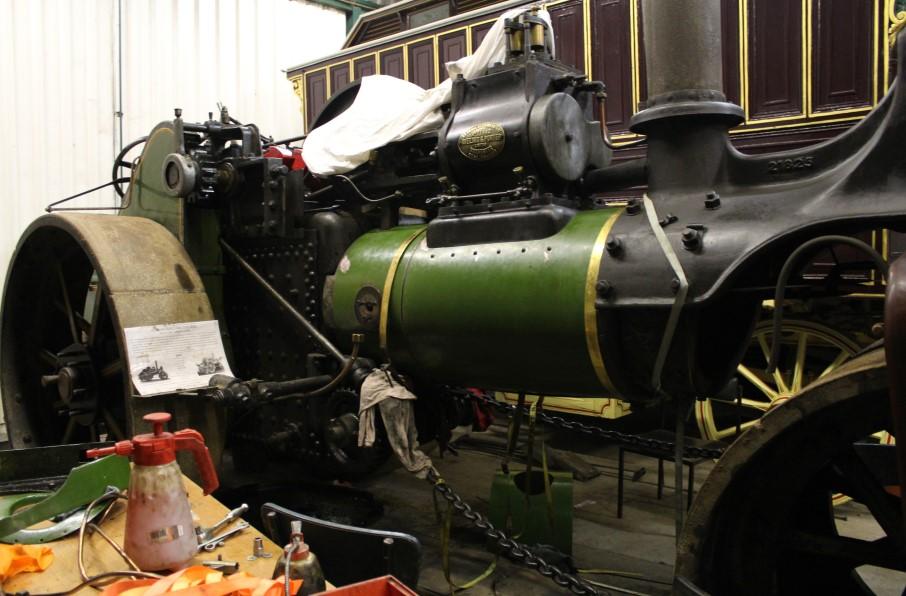
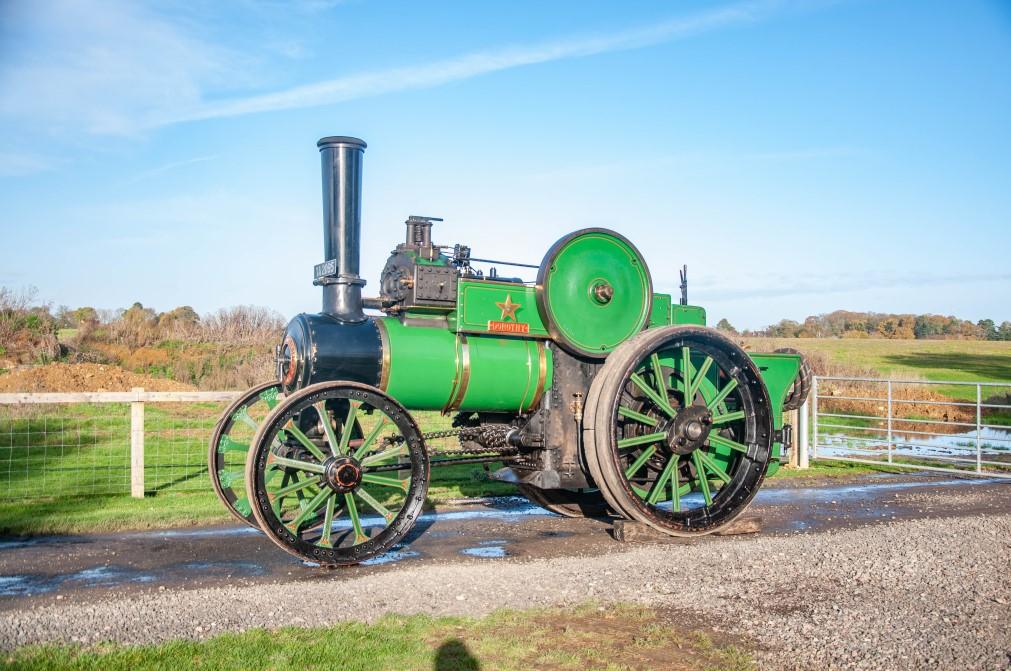
The Shuttleworth collection has two Clayton & Shuttleworth steam engines. N° s 48279 ‘PHOENIX’ and 46817
‘DOROTHY’.
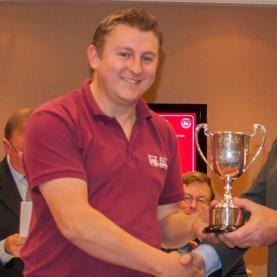
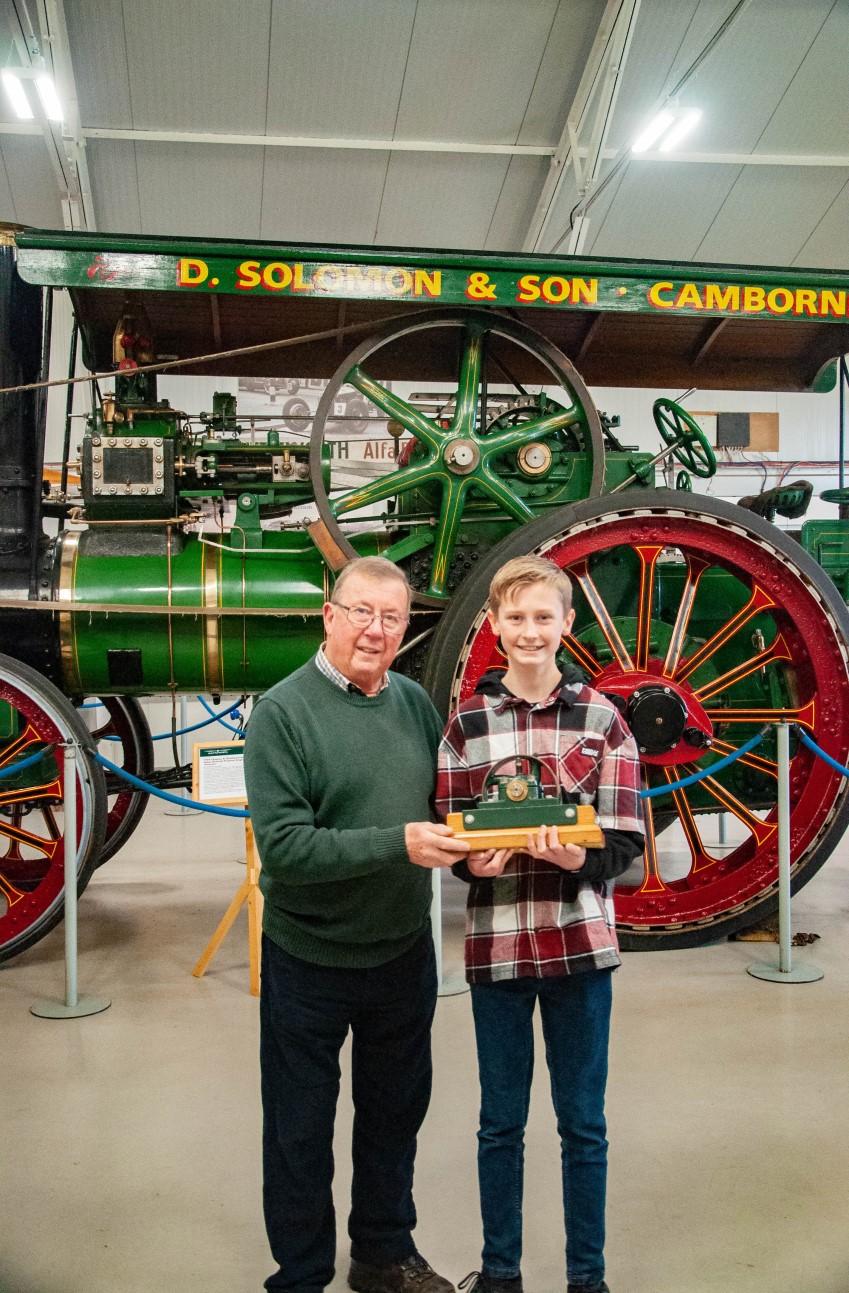
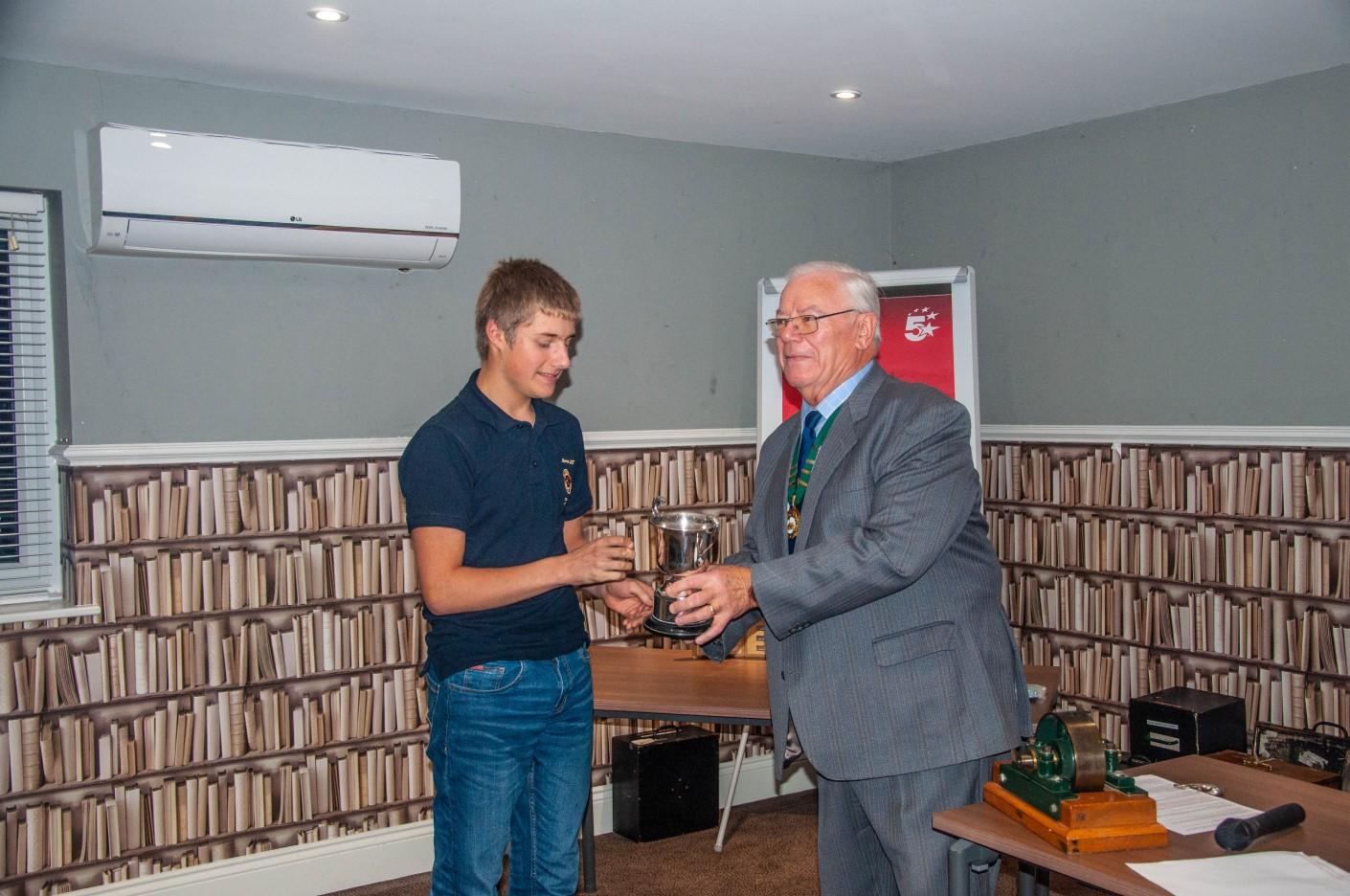
Whilst at the Shuttleworth collection, we were able to present the SAC’s Technical Achievement award to Joseph Wheeler. The Apprentice Of The Year award was presented to George Vickery at the meeting on Saturday afternoon. Congratulations to both of them.
Looking forward to 2023, we are planning to have our usual compliment of driving days. Details can be found later in the magazine.
We hope to have our usual selection of activities throughout 2023. Unfortunately the Great Dorset Steam Fair are taking a year off, but
this means we will have the chance to visit some different events.
Lady Sylvia has come to stay with me to have a bit of maintenance, and to prepare for her hydraulic exam later this year. We are planning to perform her hydraulic test at the NTET’s driver training course on the 13th & 14th May. We may be able to get some of you involved, so please keep an eye out on our website and Facebook page for details closer to the time.
On a personal note, my family’s Foster and Garrett engines are both now washed out for the winter. We took the Garrett our for a couple of runs to local pubs over the Christmas period. Being some of the shortest days of the year we have invested in some electric lights to mount to the front of the engine, so we can travel home in the dark if necessary. The Foster has been partially stripped down to give it a fresh coat of paint round the horn plates and firebox, and I am planning to spend some time re-packing
the glands on the Garrett, as they have been leaking a bit recently.
In the workshop I’ve been making a set of spring clips for the drive pins on the Garrett, a process that I explain in greater depth in this edition.
Please do get in touch to tell us about any steam adventures you have in 2023.
Steam Plough Club Hands-On Weekend
The Steam Plough Club will be holding their annual Hands-On event over the weekend of the 9th & 10th of September in Kent, further details tbc. Last year the SPC very generously offered subsidised places on the course to SAC members. This year the SPC have again offered up to 6 subsidised places to members of the SAC. The NTET are also sponsoring part of the cost, as we believe it is important to encourage younger people to learn the skills associated with steam.
Participants will be given expert tuition on the handling of steam ploughing engines and the implements to be used. There will be a maximum of 12 participants overall, so everyone has the opportunity to drive and crew the engines, the plough and the cultivator. Camping and caravan space is available on site, lunch packs and soft drinks are provided, as well as the customary evening meal for the Saturday night. The weekend will conclude at 5pm on Sunday.
The cost of the 6 SAC places will subsidised by both the SPC and NTET, making the overall cost £25 to SAC members. For insurance purposes, the places are open to fully paid-up members of the Steam Apprentice Club who are aged 16 or over and those who take part must also join the Steam Plough Club (if you are not already a member) at a cost of £20.
The NTET and SAC would like to thank the Steam Plough Club for again giving an opportunity for the SAC members to take part in their event.
If you are interested in taking part, please email sac.drivingdays@ntet.co.uk, with some details about yourself and your experience with steam, and we will put you in touch with the SPC. If you are under 18, please have your parent/guardian contact us.
Whilst at the Shuttleworth collection, we were able to present the SAC’s Technical Achievement award to Joseph Wheeler. The Apprentice Of The Year award was presented to George Vickery at the meeting on Saturday afternoon. Congratulations to
George Vickery receiving The Apprentice of the Year Award.
Victoria’s Torton Tales
As I write this Christmas is just a few days away and the weather is cold!
We have now got Victoria and our living van back home in Hampshire after an excellent summer at Amberley Museum in Sussex; it is nice to have them home and back on our drive. Our trailer is still at Amberley and the museum are using it for trailer rides over the festive season. Nice to see pictures of it trundling around the museum’s roads.
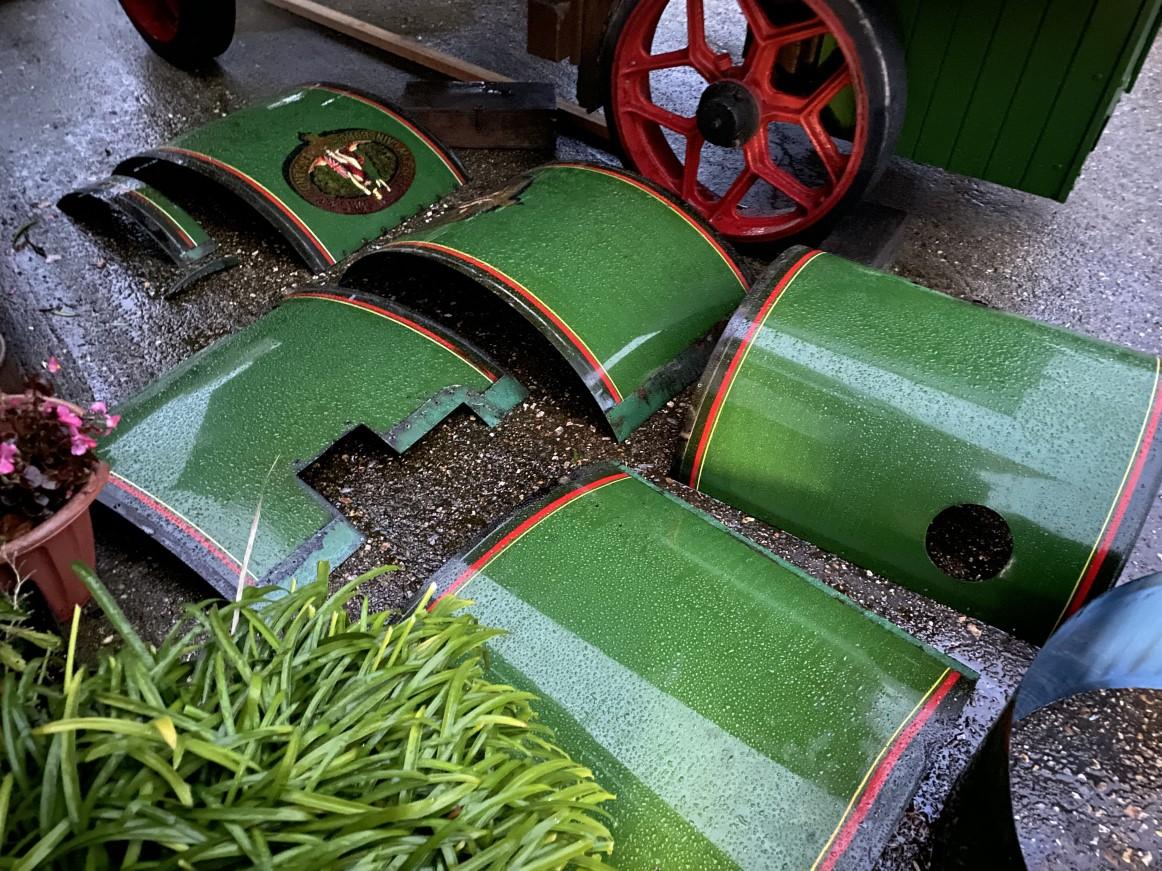
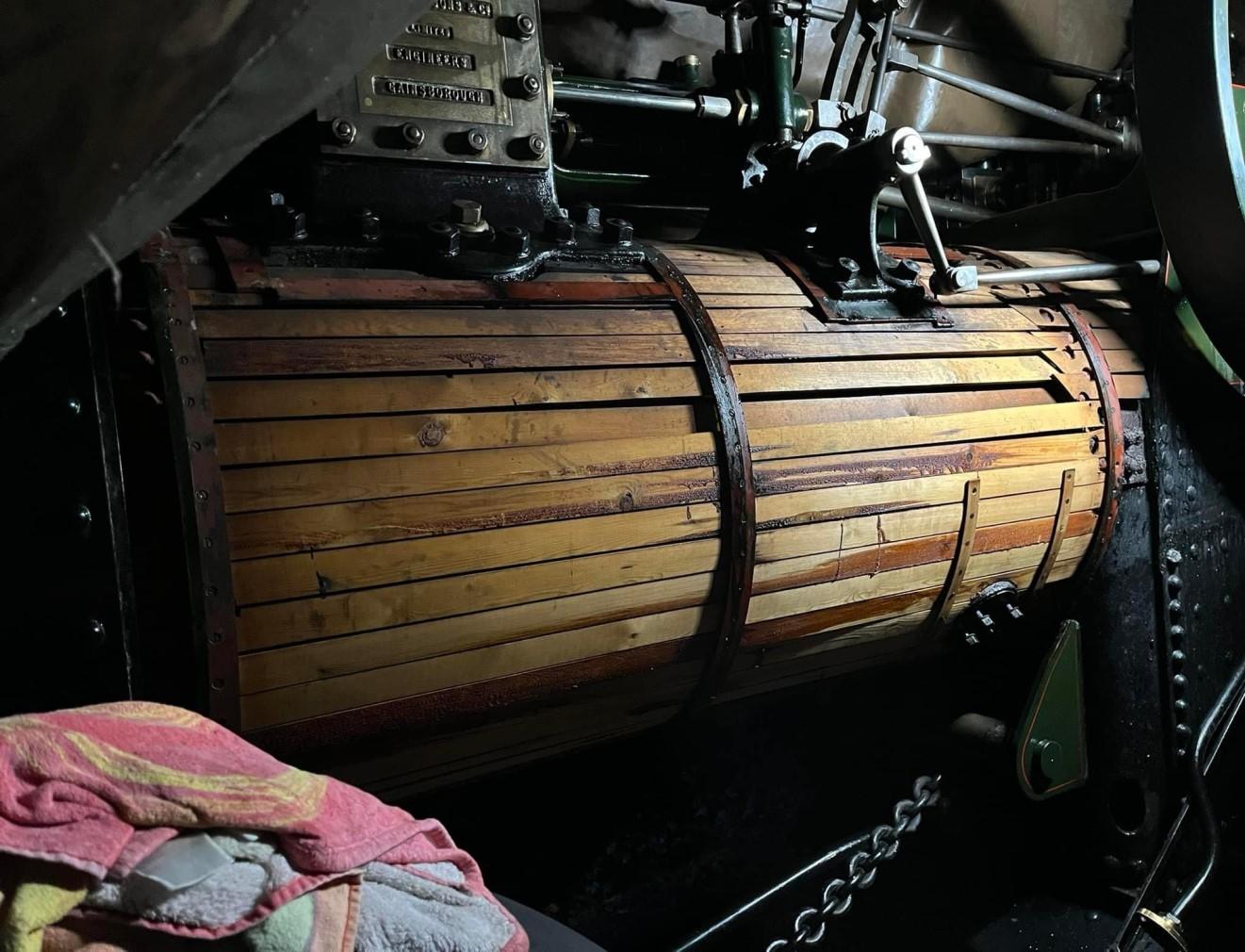
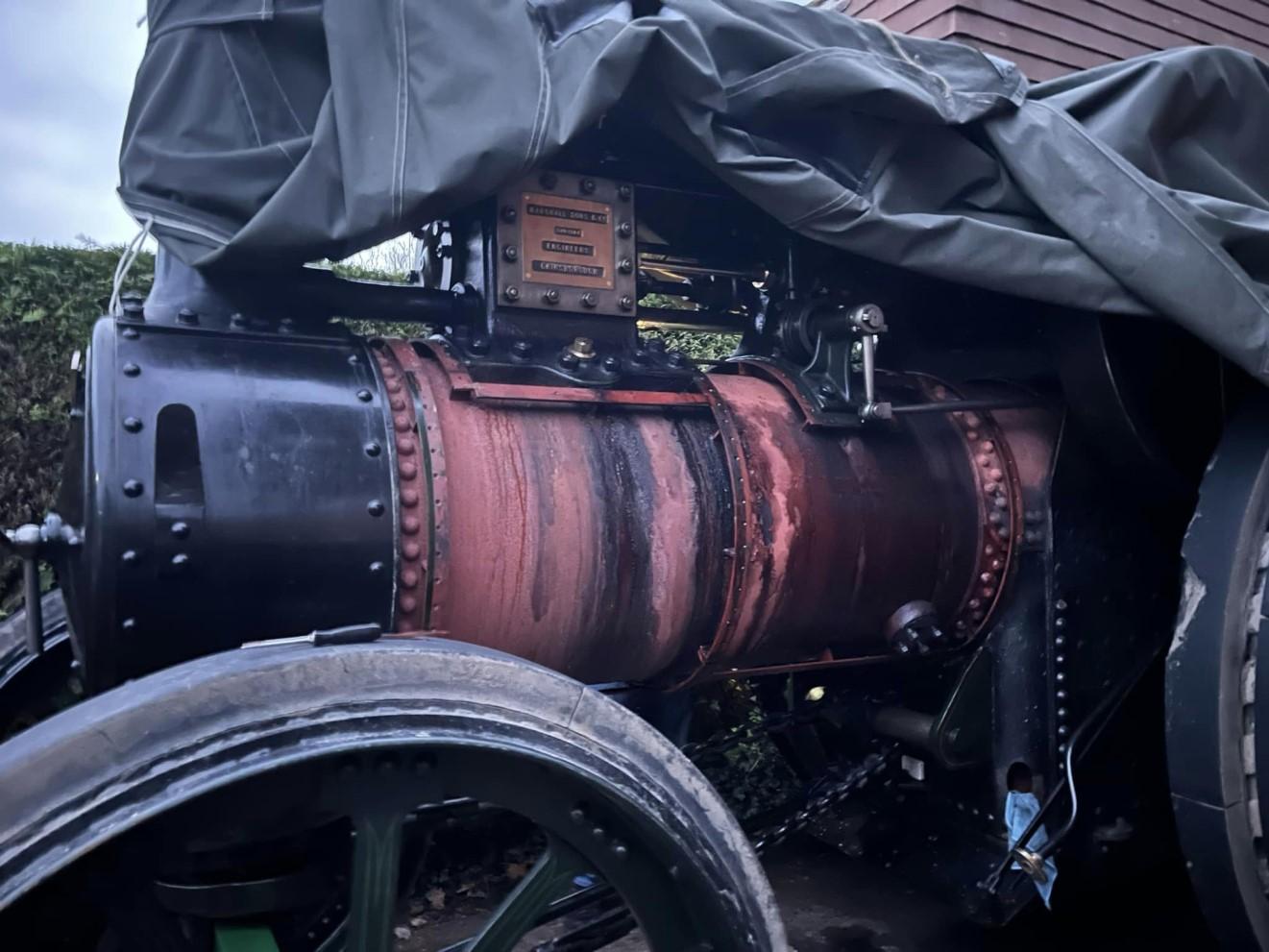
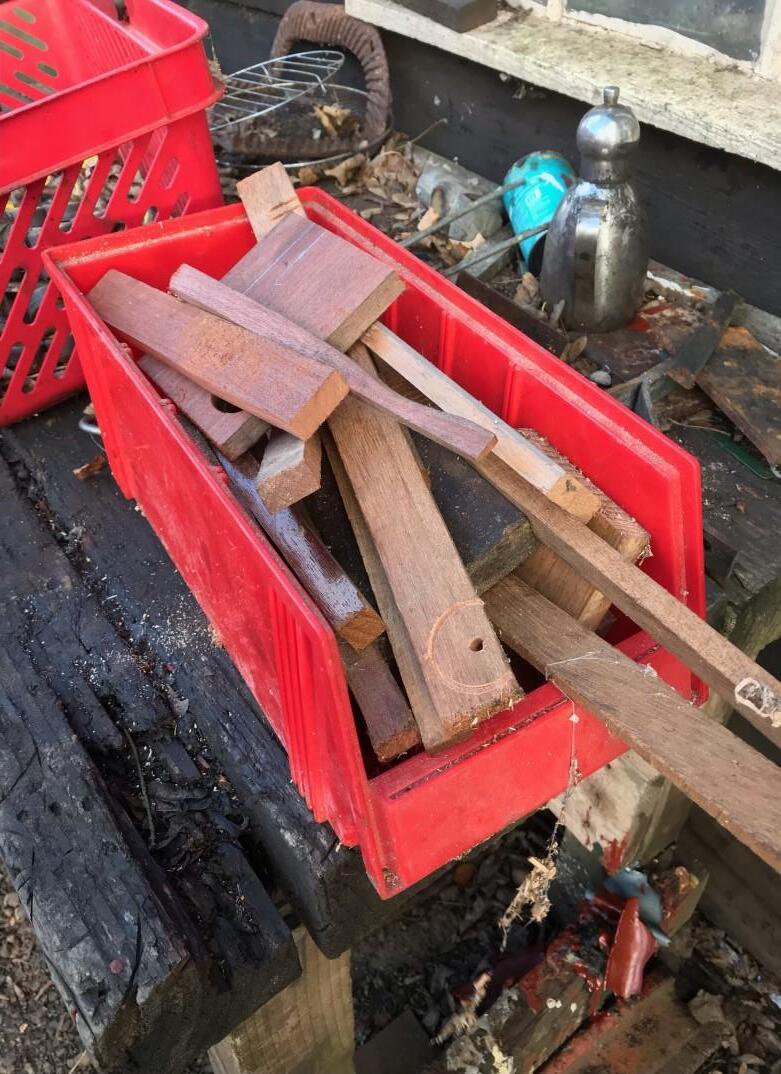
As for Victoria, well she is now being stripped of her lagging as she has her 10 year test this year. We have removed her green lagging sheets, that always look so shiny, and under that there is what is called her “Wooden lagging”, this has
now been removed too. After many pictures being taken, we have numbered each piece so we can reuse some when we come to putting her back together. She now has no water in her, her boiler and tender are both empty, and as she lives outside, she has her electric fires on to keep the chill off her.
We are looking forward to getting her ready for all her tests and we should be back out with her at the start of the season. We will keep you updated in these pages, also you can visit our website for more news as it happens www.victoriastortontales.uk
We hope you have had a lovely Christmas and New Year and we will see you all very soon.
Victoria’s lagging sheets after removal.
year test.
Victoria’s boiler barrel ready for her 10
Victoria’s wooden lagging.
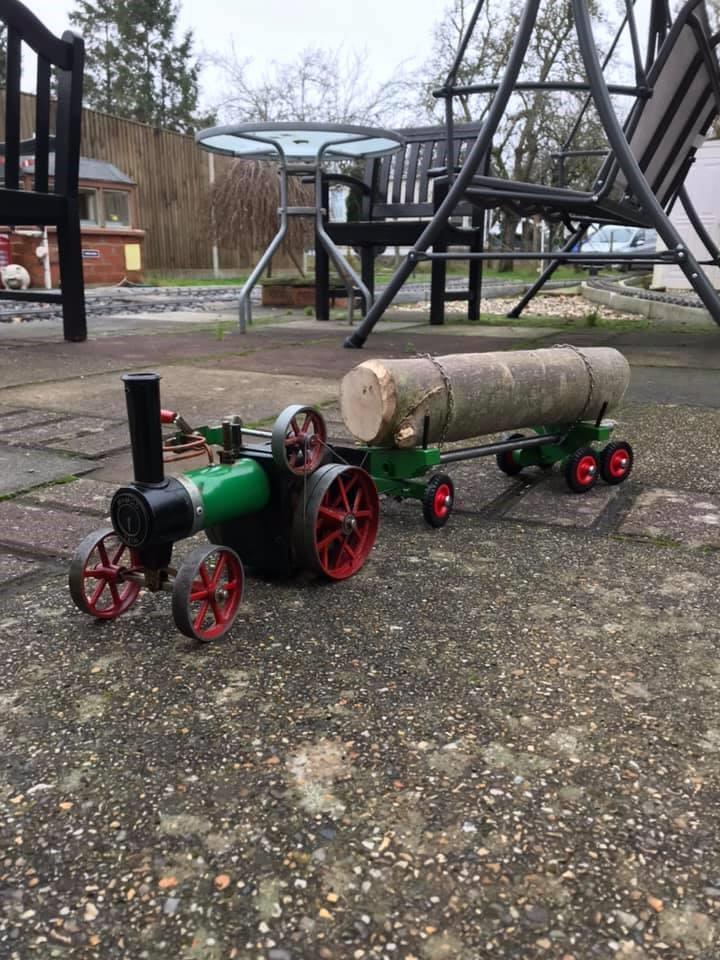
A Boiler Carriage For Your Mamod...
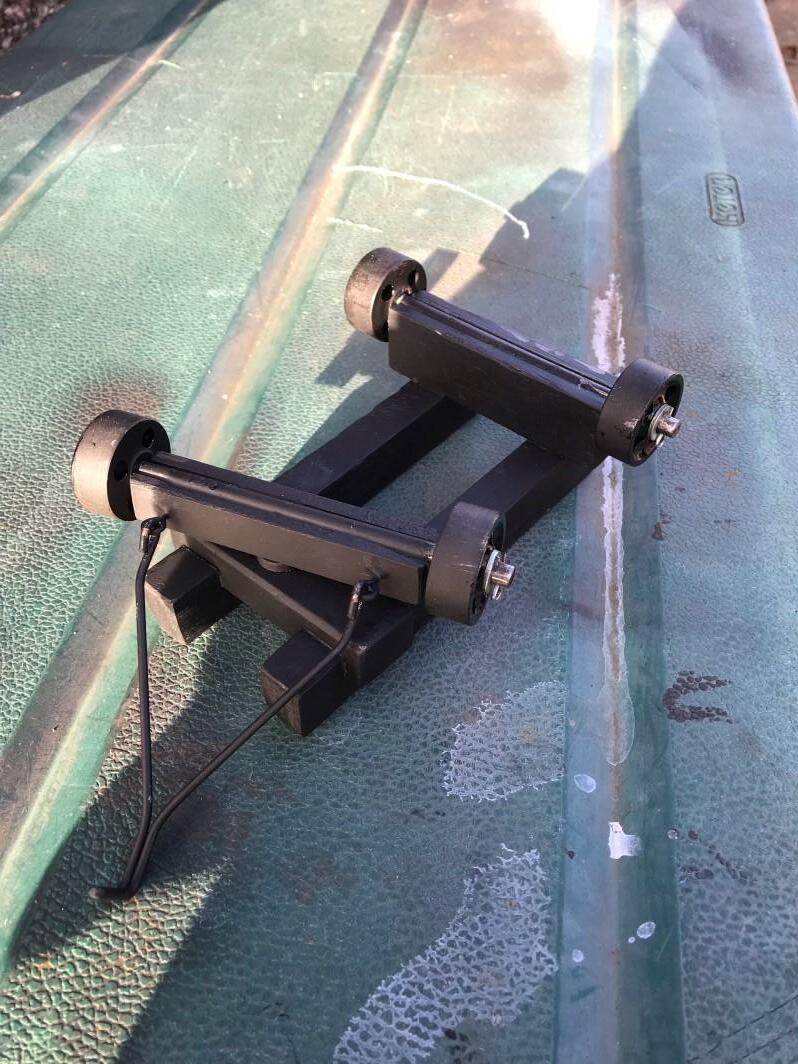
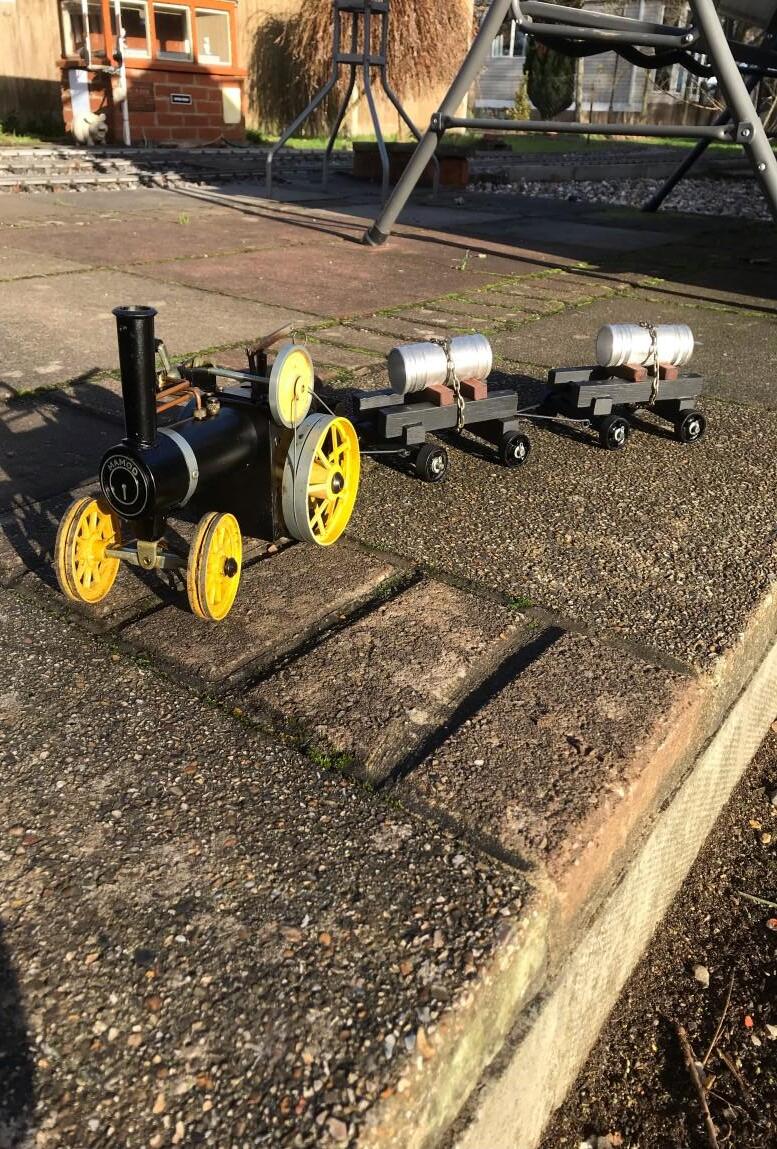
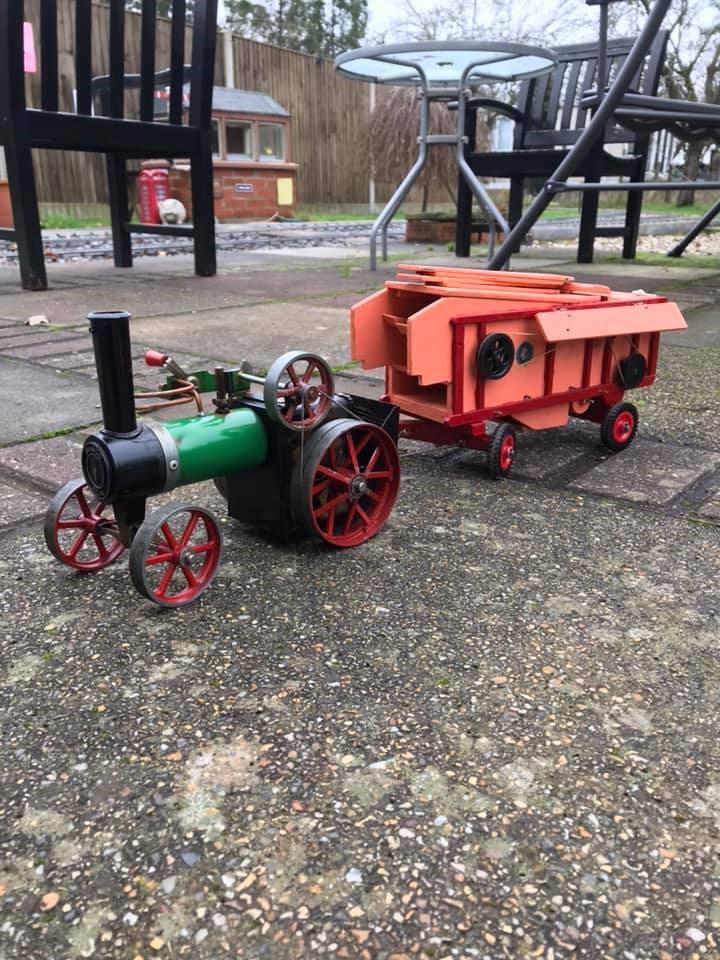
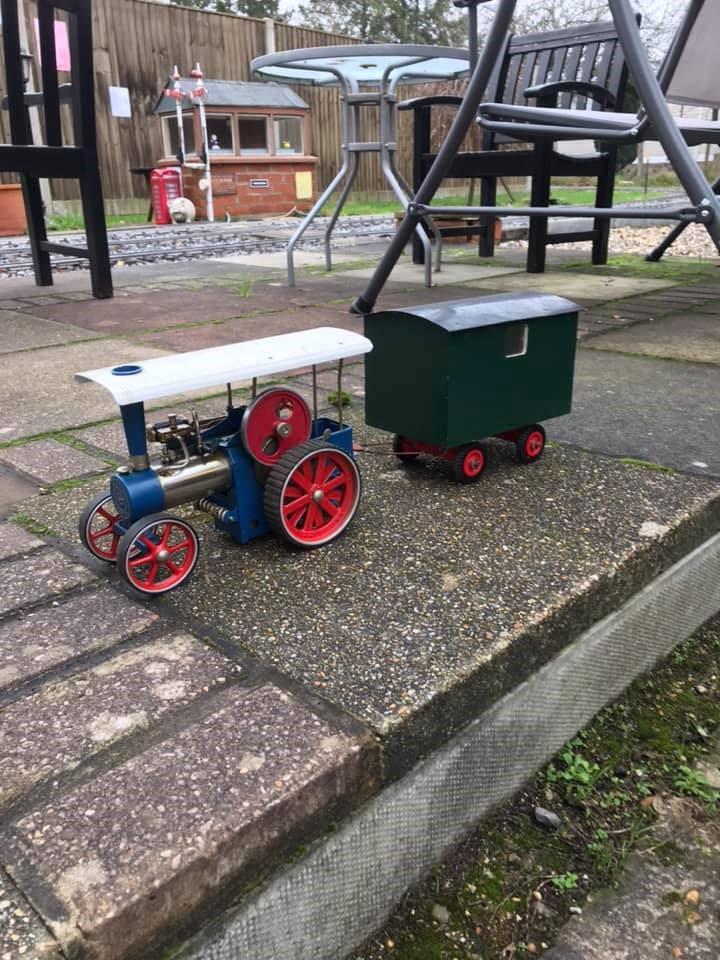
David Cooper has kindly written in with another of his Christmas holiday Mamod projects to inspire SAC members to have a go at building accessories for their toy steam engines. If you’ve a similar project on the go, then why not write in and tell us about it!
If anyone is planning a project like this, it’s a good idea to start collecting or setting aside useful bits long before you start. I held off building boiler trucks because of obtaining wheels. Old fashioned caster from furniture, or even more modern plastic ones would suffice, but they never seam to turn up.
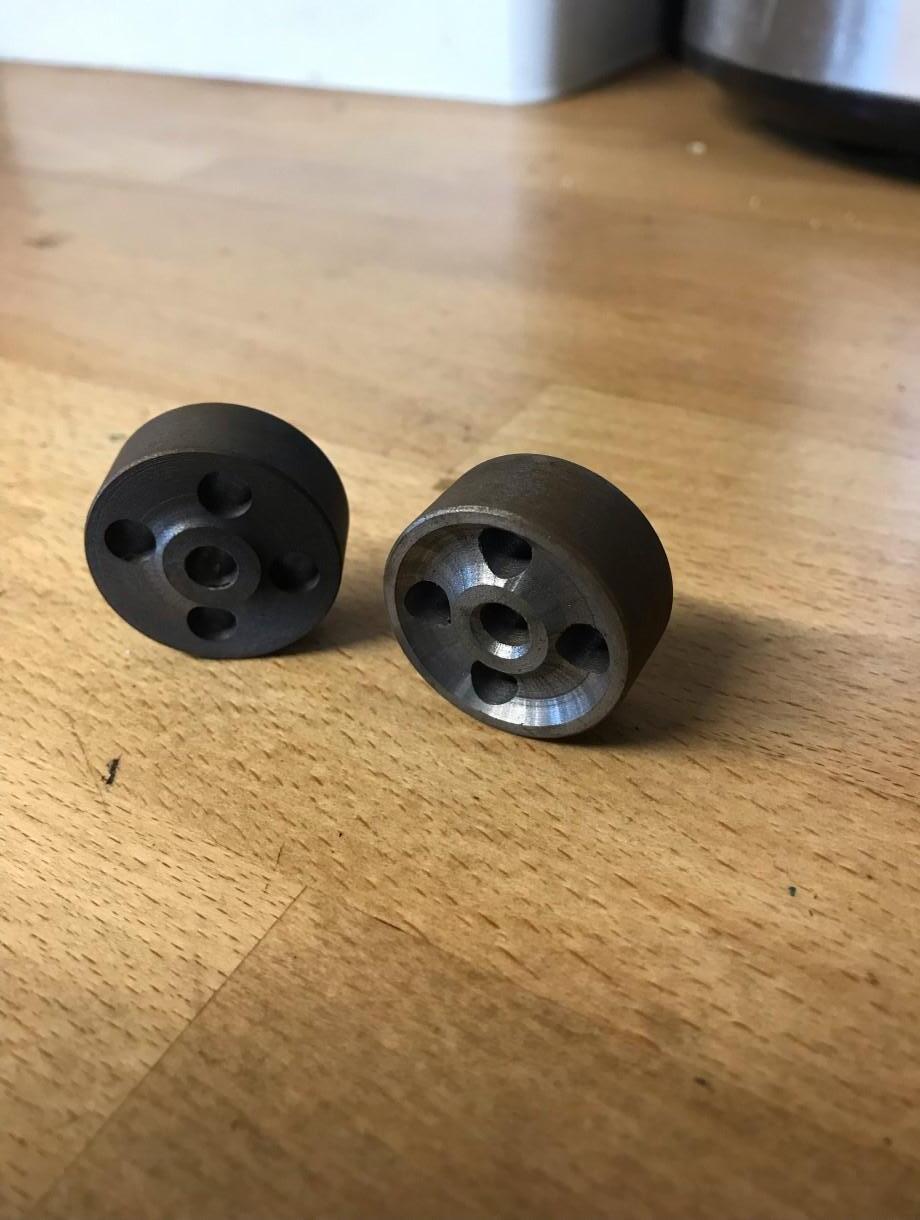
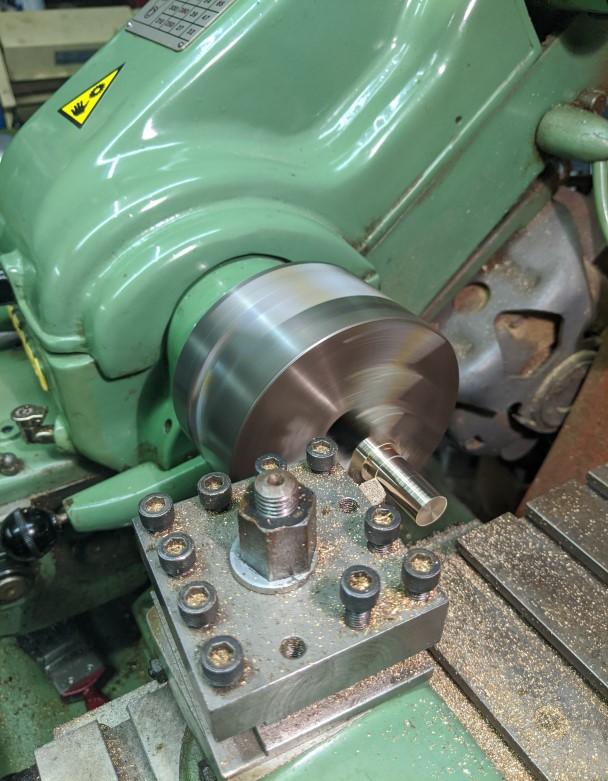
So the first job I did was wheels, luckily I had some cast iron the correct diameter, the end of the bar was drilled 1/4” diameter, and suitable slices parted off. These were marked and the four lightening holes drilled on a pillar drill. Two more trips to the lathe formed a boss on the rear and the recess in the outside of the wheel. A quick touch of the file also removed the sharp edge around
be taken to get the correct thicknesses for the timber axles so the truck sits level.
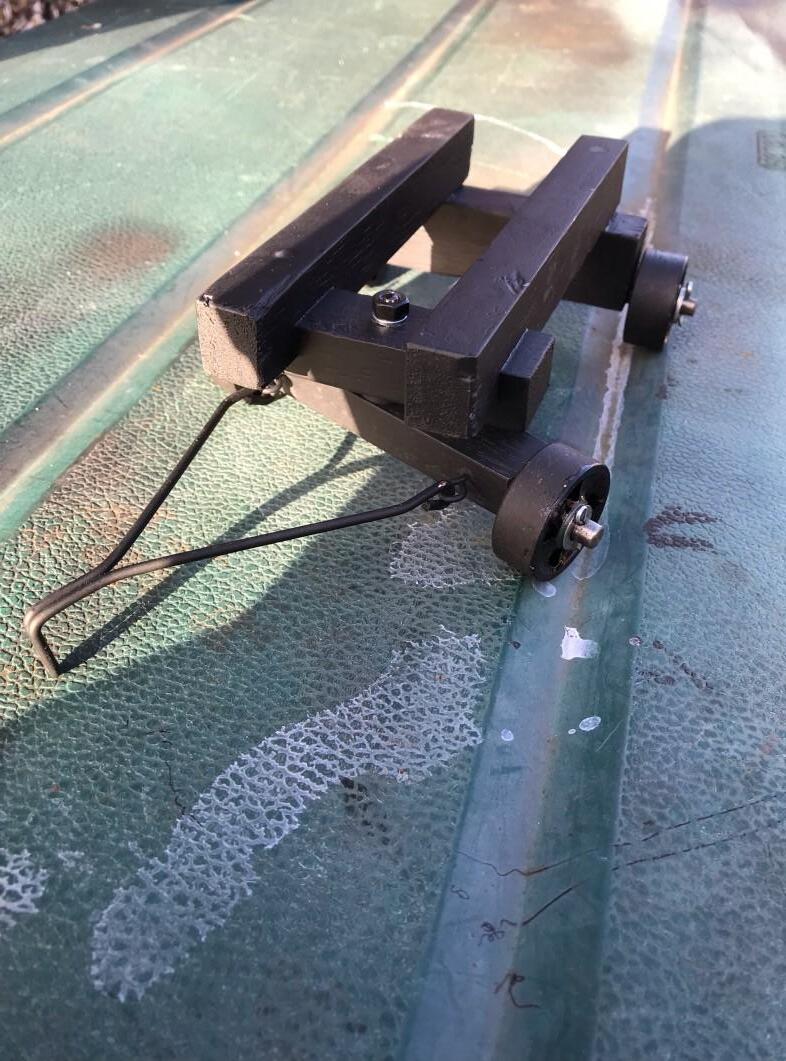
I left enough room to put a washer between the front axle and cross rail to assist with movement to follow undulating surfaces. Also the hole in the cross rail was elongated slightly at the bottom end side to side. The bottoms of both wood axles had a 1/4” groove cut in them. The steel axle the wheels run on was the pinned and glued into the slot, with suitable holes drilled into both components. The ends of the steel axles are also drilled for split pins to retain the wheels. The pivot for the front axle was pressed into a hole in the front axle again with glue. A short thread on the top allows for a retaining nut. The main
Small screw eyes are used to secure it to the front axle. An additional screw eye being fitted in the rear axle to form a rear
wire, and I ve found starting at the centre is easiest, any excess can be trimmed off.
David has very kindly agreed to write up a few more of his Mamod projects for Raising Steam in the future, but in the meantime here are a few pictures that may serve as
Shrewsbury Driving Day Report
SAC Member, William Thomas has written a report on the Shrewsbury Driving Day.
Each August bank-holiday-weekend, there is a steam rally just outside of Shrewsbury. For the last few years this has been upon the same weekend as Great Dorset Steam Fair, but whilst Dorset no doubt has much appeal there are also many who find it just too big to comprehend. The rally at Shrewsbury I think is a very good size, because you can look around everything in two days and there's enough time to pause and appreciate each exhibit, to watch each demonstration, and of course to spend time watching and riding in the funfair.
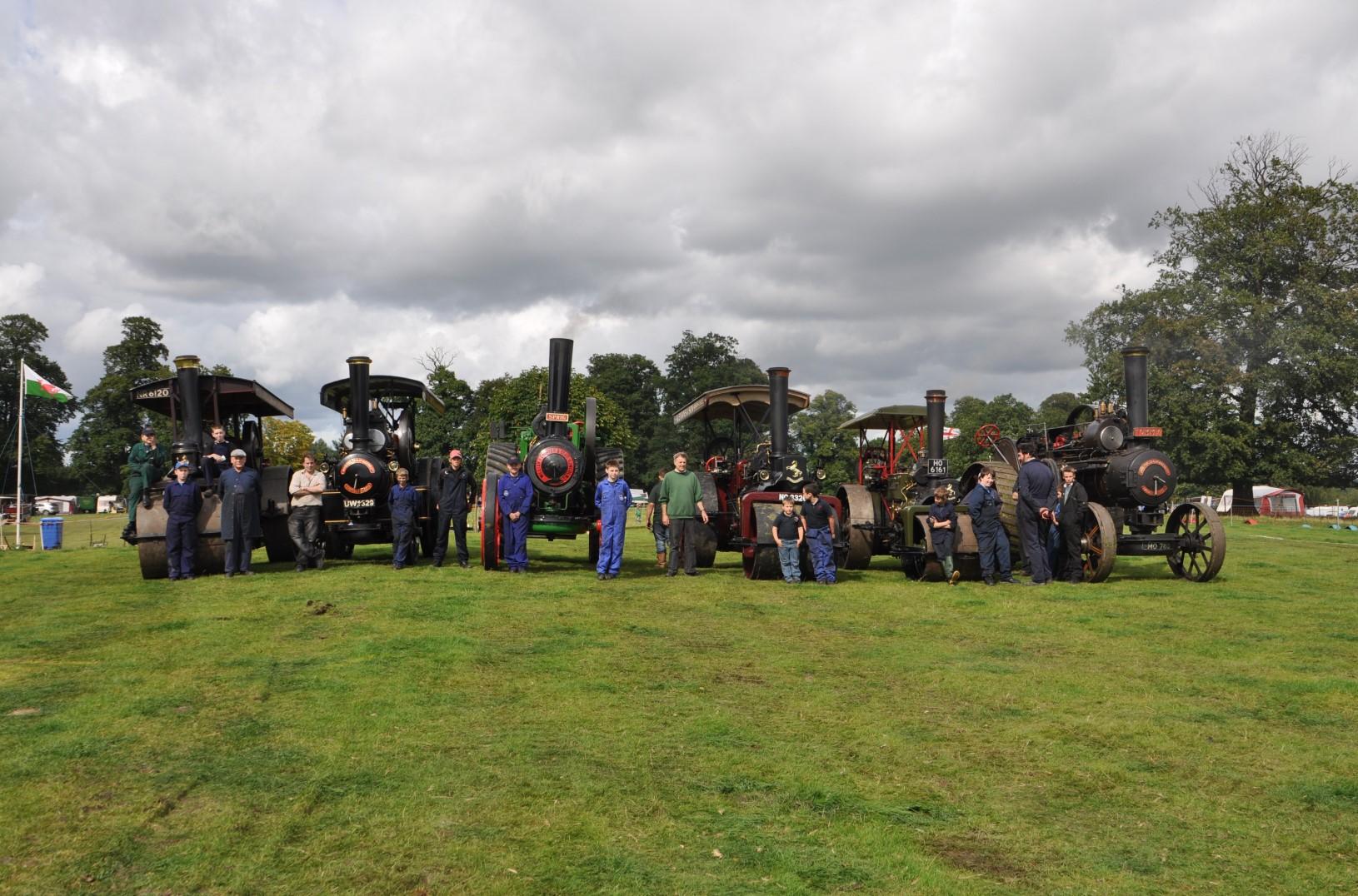
On the Saturday before this rally, there is a 'driving day' for the Steam Apprentice Club, in the main arena. The rally is only open to the public on Sunday and Monday; Saturday is just for exhibitors, SAC, and camping. I have been to this for a few years now, and there are usually about five or six full-size engines, plus a miniature or two.
We start by preparing an engine, with two apprentices per engine. This year I was with a Clayton roller. We sweep tubes, ashpan, and smokebox, check water and then light up. We then oil up and polish brass & paintwork whilst the engine warms up. Steam was raised just about at lunchtime. For lunch, we have bacon sandwiches, cooked on a shovel!
After lunch, we all chuffed around the arena, starting upon the engine with which we began the day and then having
a go on as many others as we wished. I did both steering and driving, in turns with a partner, under supervision from the engine-owner. It was a really fun day, and a great chance to experience driving, not owning an engine myself.
As a bonus, the following day (Sunday), I asked an engine-owner (Mister David Bosworth) if I could help him polishing (explaining that I had a bit of experience of engines through the SAC), and after polishing all the paintwork to be nicely shiny I was then invited to steer the engine around the ring for the grand parade, and to come back again on Monday to do the same!
A couple of weekends later, at Bedford rally, there was another engine driver offering driving trips for steam apprentices; it was really fun again and mostly facilitated by the previous experience at Shrewsbury.
Lots of thanks to Doug Milns for
Shrewsbury Driving Day Photos
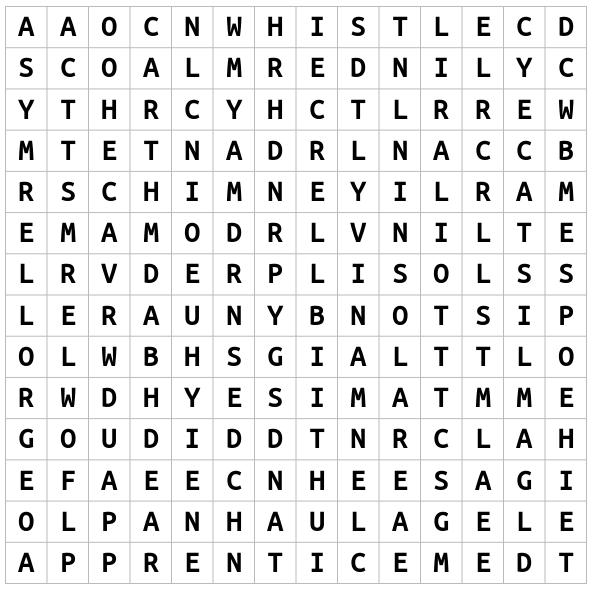
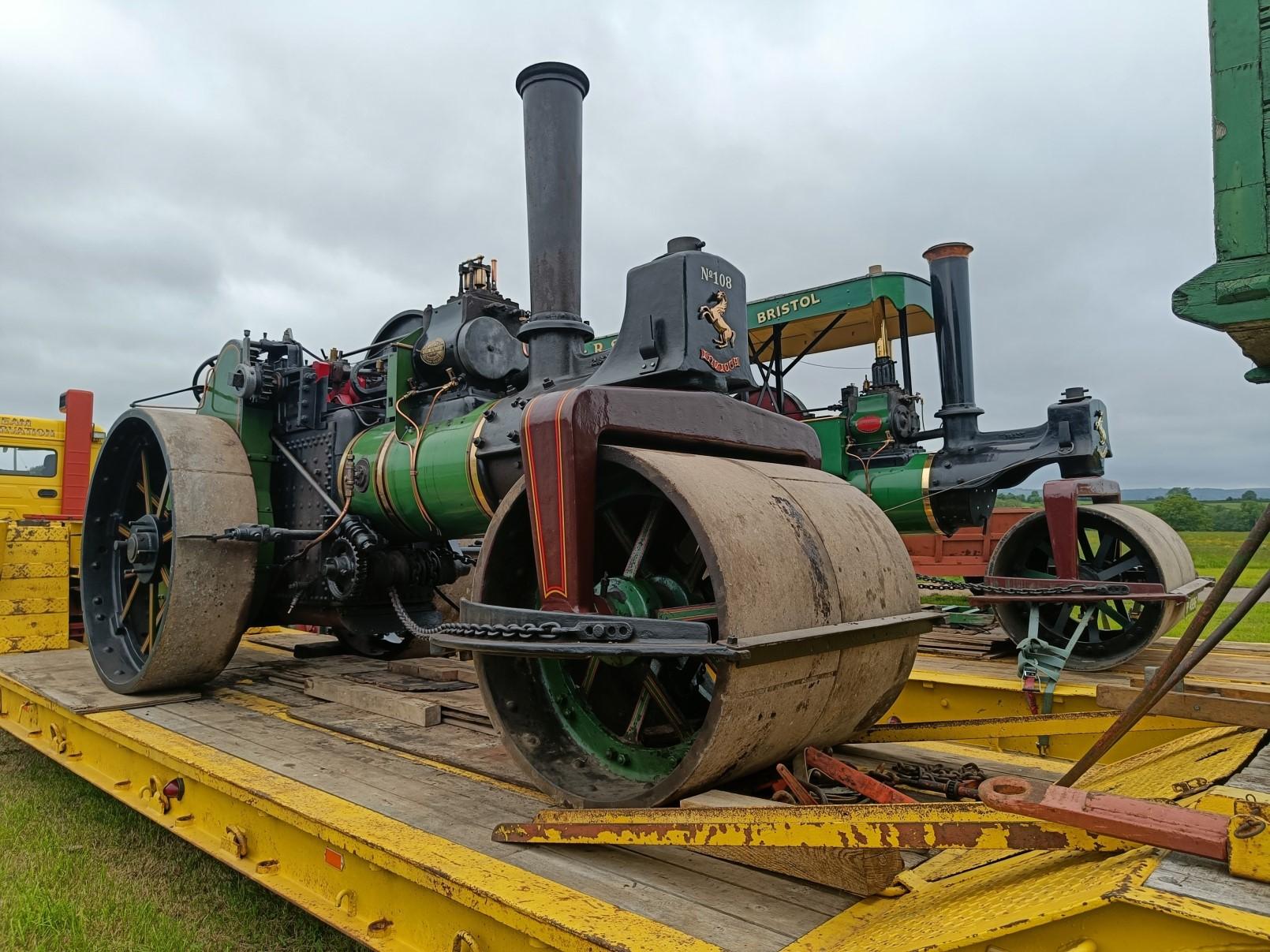
Can you spot the difference between these photos? There are 10 to find. The answers are on the next page.
Lady Sylvia
Did you know the Steam Apprentice Club has its own steam engine?
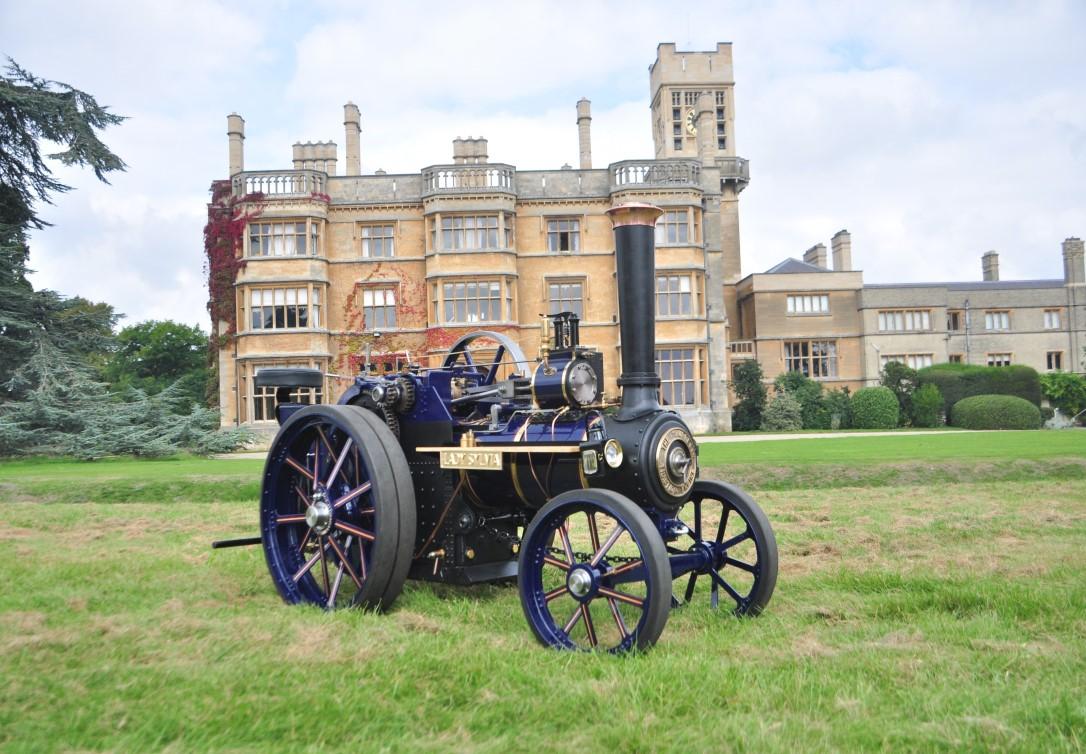
It’s a four inch scale miniature Burrell traction engine named ‘Lady Sylvia’. Our members actually built the engine as part of the ‘Build a Burrell Project’.
Thanks to the invaluable support given to from our sponsors; we were able to get a kit from a company called Steam Traction World. This provided us with the parts to put a traction engine together, with all the heavy and more difficult machine work already done.
Our apprentices got to see and handle many of the different parts of this engine, see how where they were supposed to go and fit them together themselves under supervision.
This gave our apprentices many opportunities to learn and develop their skills.
The project took two years in total, and at the Bedfordshire Steam and Country Fayre, September 2014, the newly completed Burrell Traction Engine was introduced. All our sponsors turned up, alongside apprentices and their parents to see Lady Sylvia unveiled. Although, many of the apprentices had already spent some time with her that day, polishing her up to look her best!
Later in the day, after all the special cakes had been eaten, some of the apprentices took her for a drive around a spacious, quiet area. They all had a turn driving and steering, it was such a fun day for all around.
Two weeks later, Lady Sylvia was given the number one spot at the National Traction Engine Trust’s 60th Anniversary Road Run. She, alongside a few apprentices and SAC volunteers, lead the start of this special run around the roads of Bedfordshire.
Now Lady Sylvia tours the country each year, attending different steam events and driving days. When possible, we ask for apprentices to come and help us steam and look after her. She is used to help apprentices learn how engines work, how they need to be cared for and maintained and how to drive a traction engine! Lady Sylvia is one very special engine; don’t forget to keep a look out for her running around!
Sponsors of Lady Sylvia
Building Lady Sylvia wouldn’t have been possible without the generous help from our sponsors. First and foremost, we have Steam Traction World who provided the kit of parts to build Lady Sylvia, and more recently a replacement perch bracket to replace the damaged original.
The SAC would again like to thank everyone who has contributed to the building, maintenance and ongoing running of Lady Sylvia since her creation in 2014.
With the years rolling on parts of Lady Sylvia will continue to wear out and eventually parts will need replacing: be them fire bars, tubes… this is natural wear and tear that comes from the successes of having her in steam for Apprentices to use. The very reason she was built!
Would you be interested in sponsoring Lady Sylvia? Contact us to learn more about how you can keep her steaming and being used by Apprentices.
List of Sponsors
Member Mail
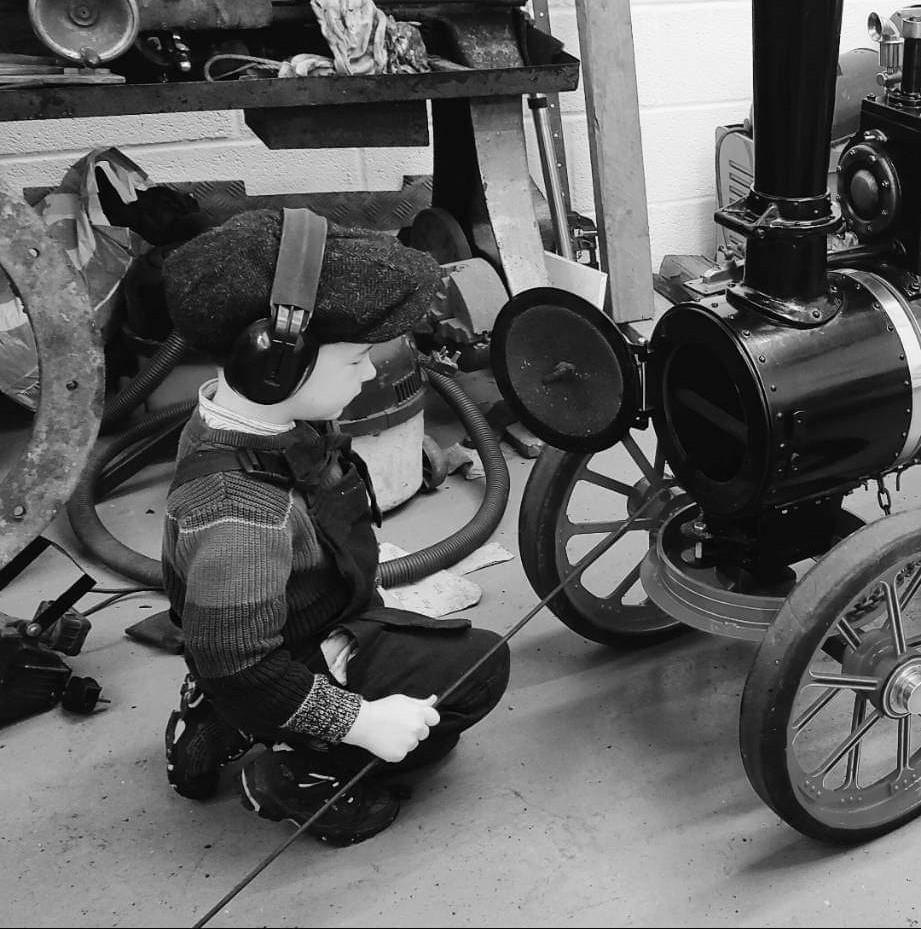
Albert Chiverton has been helping lay up an engine for winter.
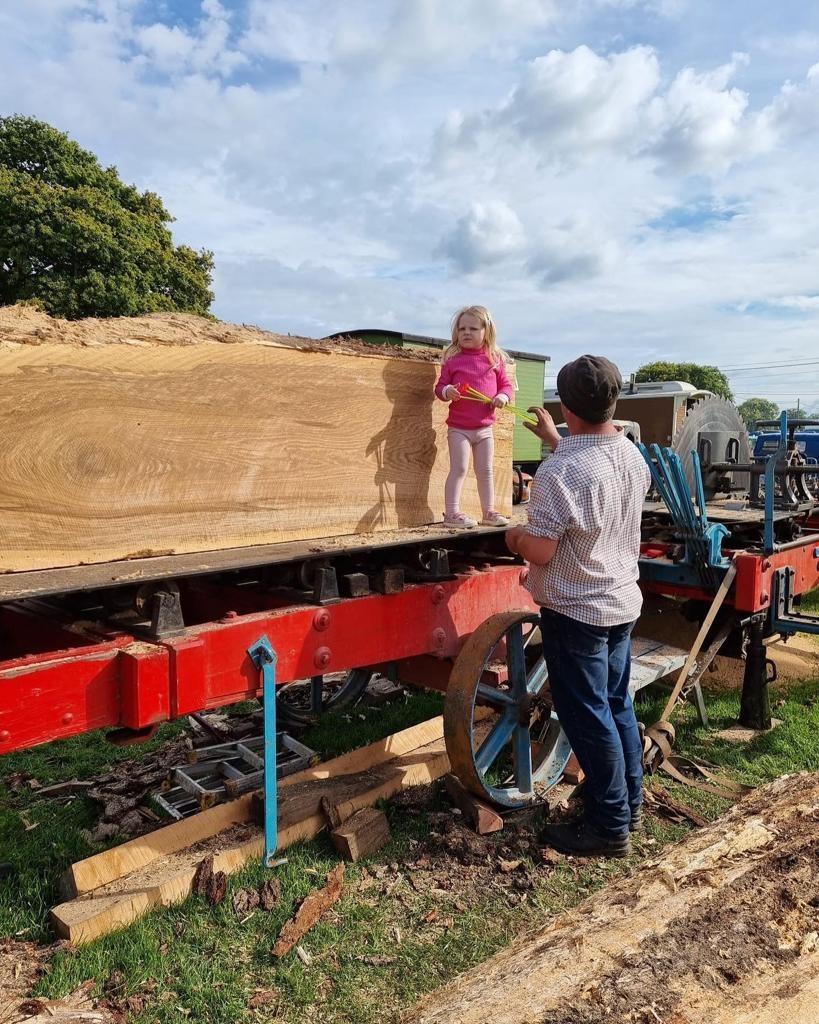
Charlotte Langley has been getting to grips with using a rack saw bench.
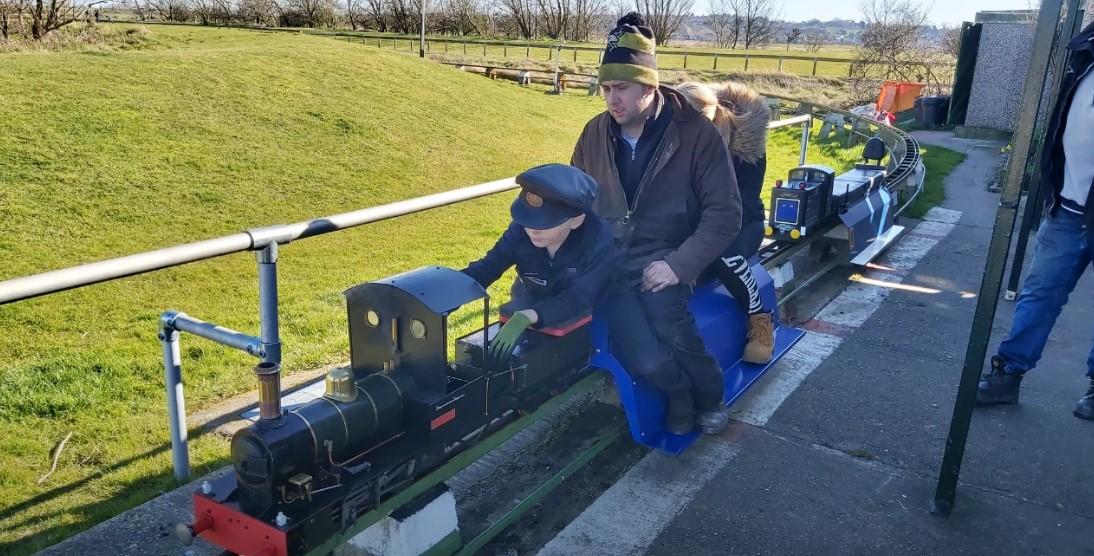
And Bradley Butcher has been learning to drive a miniature steam locomotive.
In the Workshop...
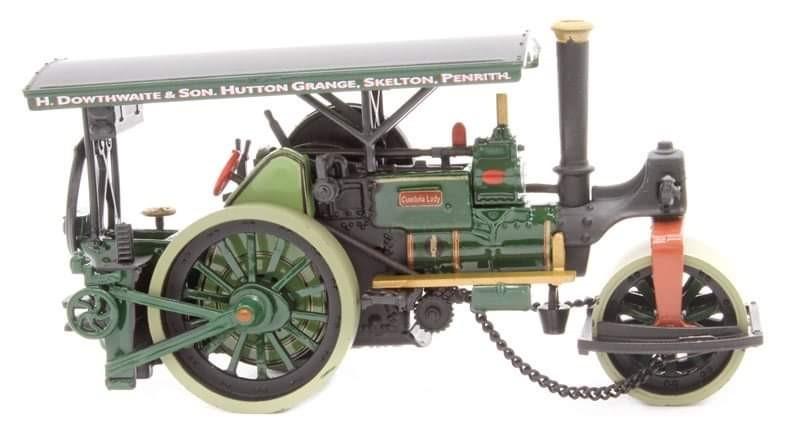
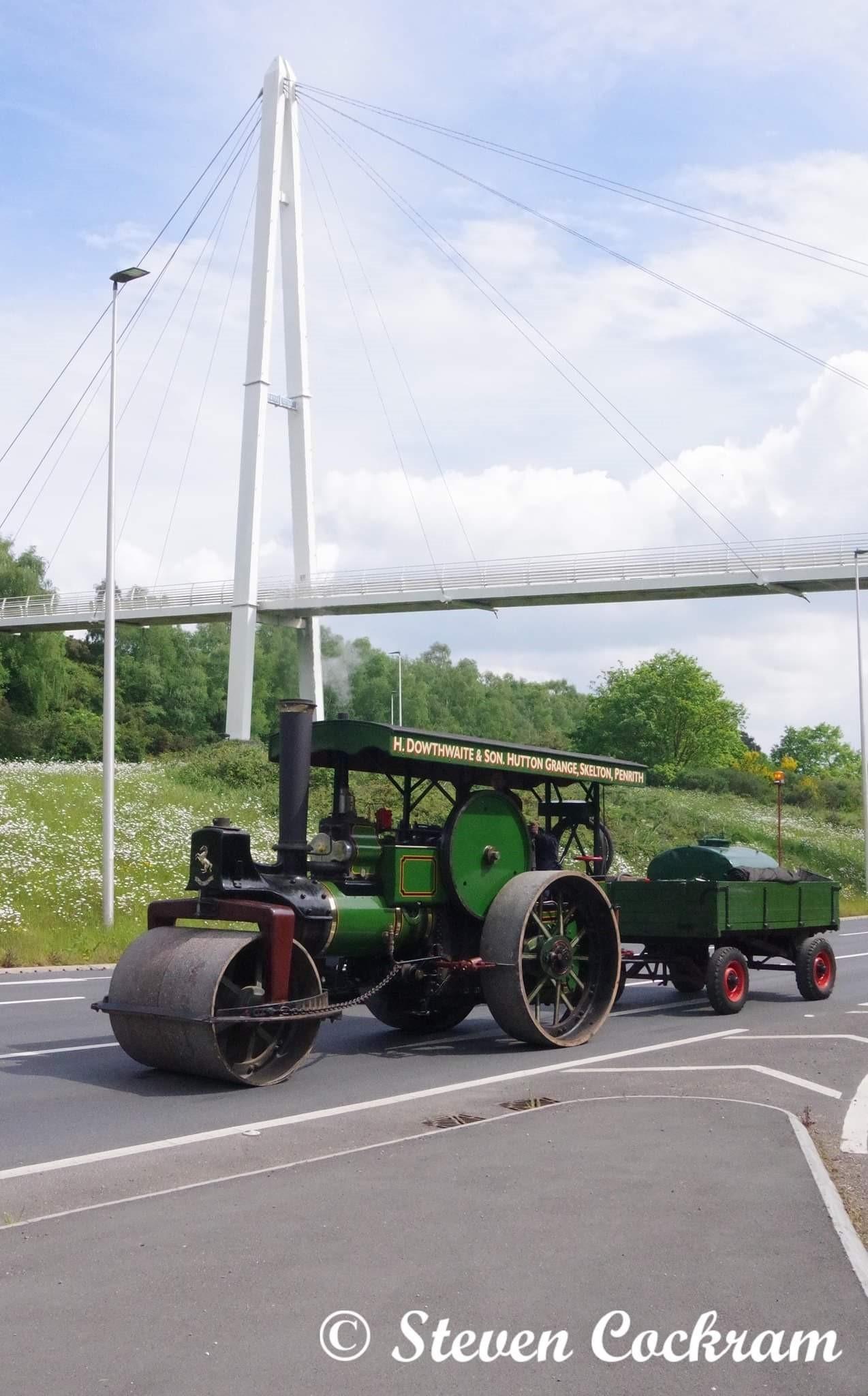
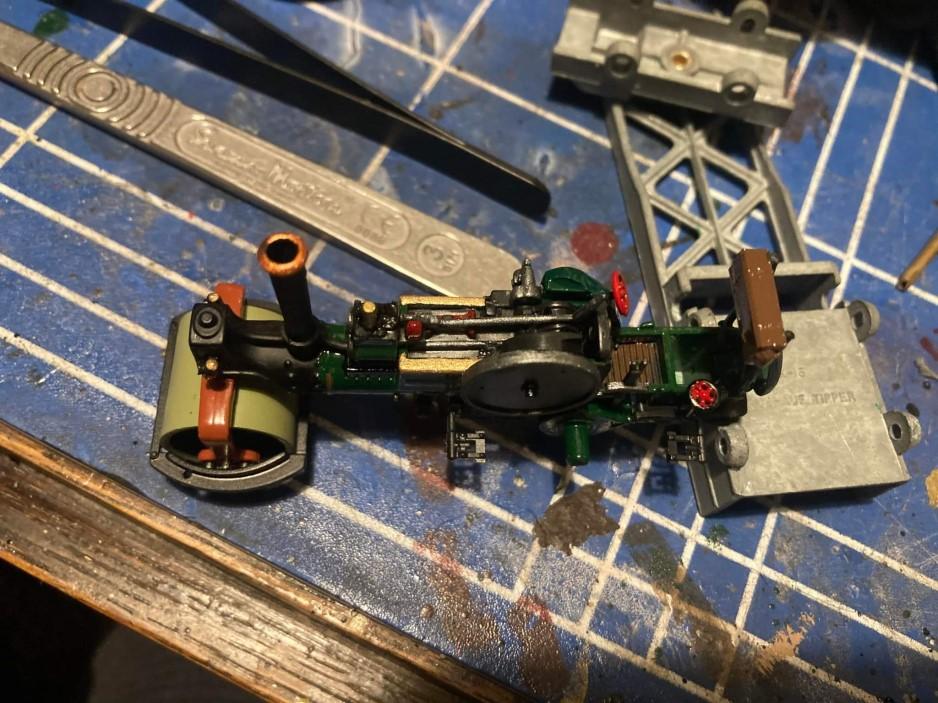
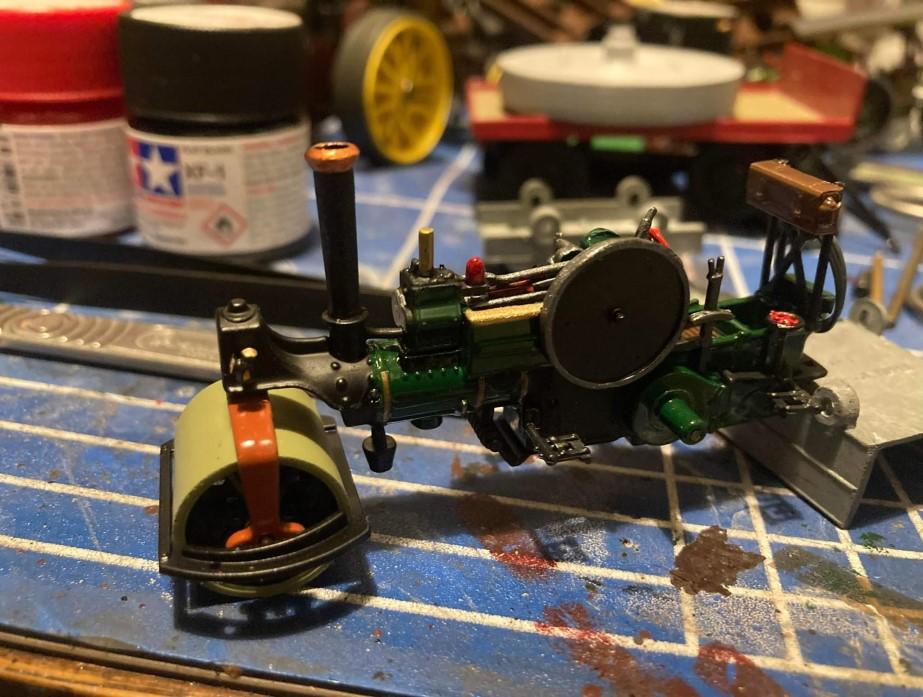
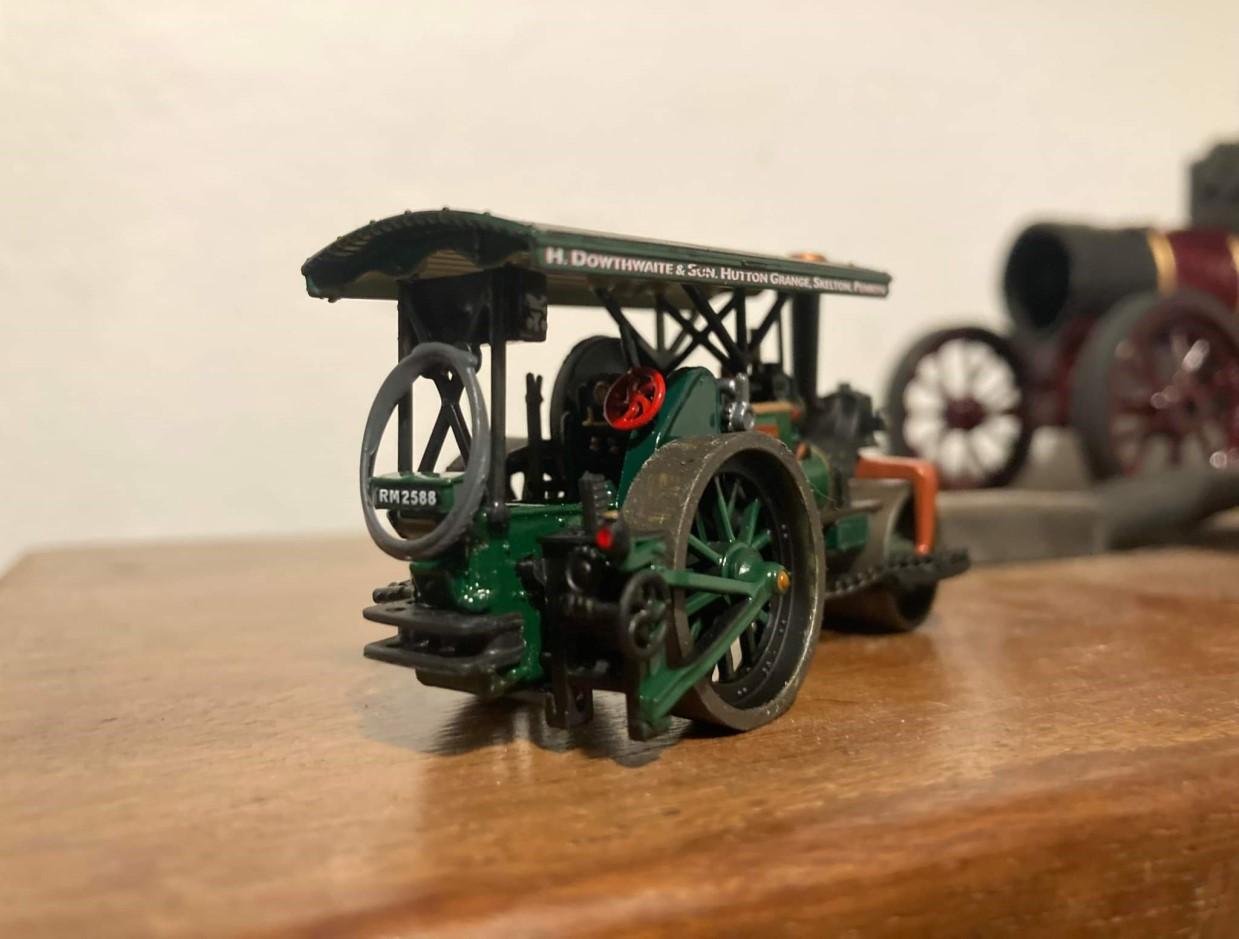
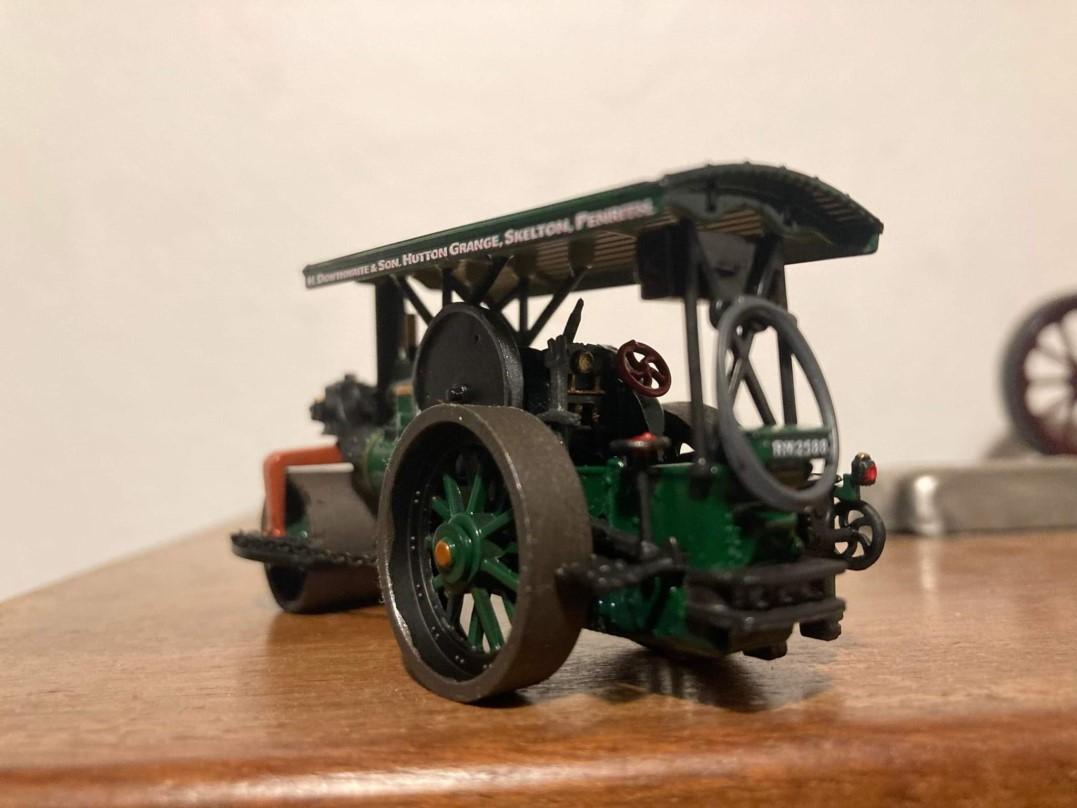
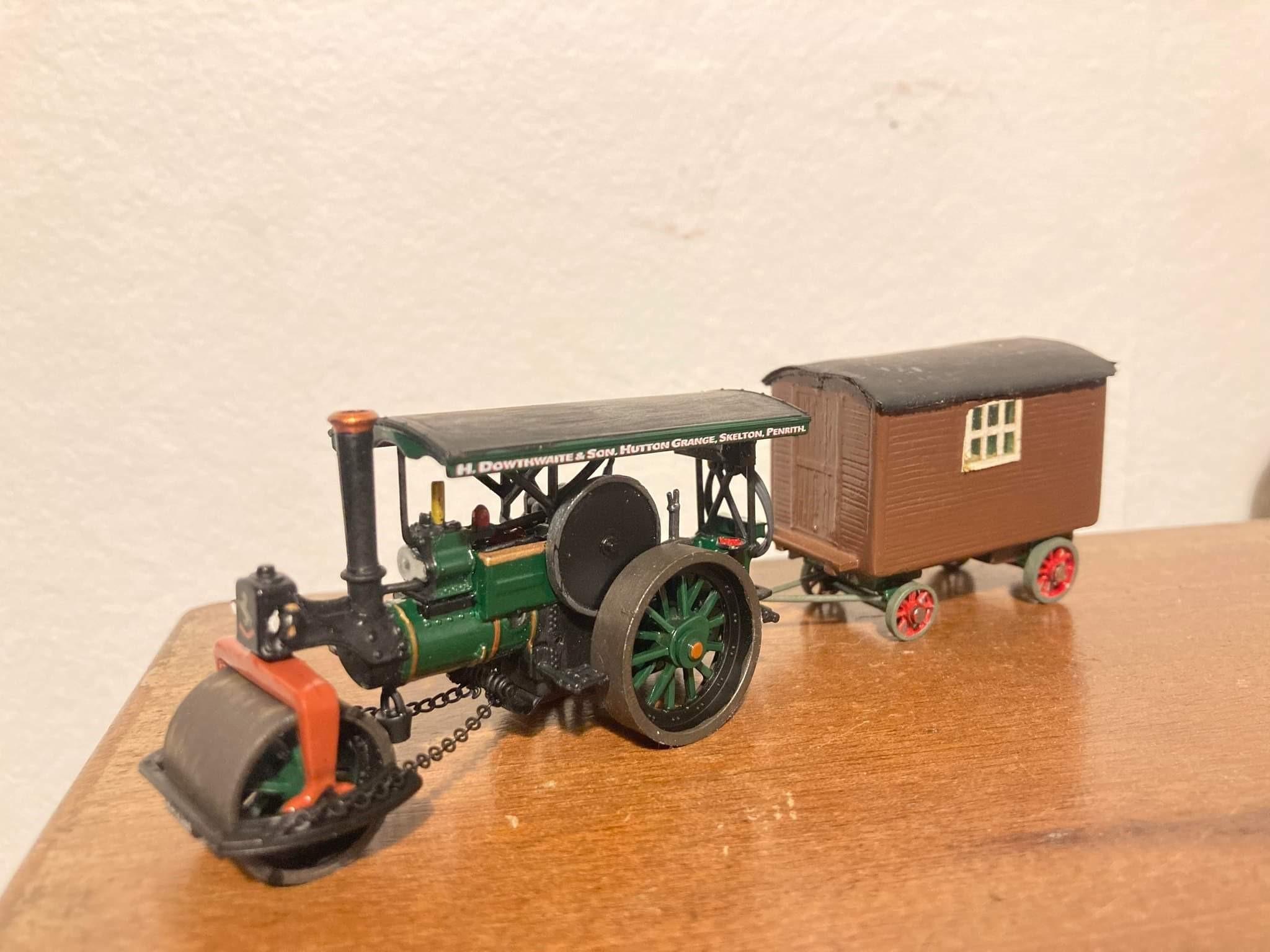
Elijah Bell has written another article to show you some of his model making skills to try and inspire some of you to have a go. Please do send in some photos or details of any workshop projects you get up to! Since the end of Corgi’s 1/50 ‘Vintage Glory of Steam’ line, the only diecast manufacturer regular producing new road steam models (albeit now in 1/76 – 00 Gauge) has been Oxford Diecast. Whilst their early releases of a Burrell Scenic Showman's engine and Fowler Road Engine had some issues (in my opinion) with proportion and accuracy, their later releases of Fowler Rollers, BB1 Ploughing Engines and Aveling Rollers have been superbly detailed.
So why when the latest release of Aveling Porter ‘Cumbria Lady’ landed on my desk, did I immediately throw away the packaging and take the model to pieces……? Good question….
Well it is because with a few very easy modifications and partial repainting, you can turn a good model into what I think is an excellent one!
To do this you will need:
A selection of Acrylic Paints – I used Tamiya: Gloss Red, Matt Black, Copper, Gloss Dark Green and a tiny amount of Gloss White. I also used small amounts of Brass Metallic and Silver metallic which are cheap brands from I think an art supply shop.
A selection of small, and very fine paint brushes – quality unimportant, mine a range of prices and makes – use what suits your technique and your budget!
Thin needle-nose pliers, tweezers, a small flathead screwdriver, a sharp hobby knife or scalpel, and some good quality THICK super glue – gel type works well.
Step One: Dismantling the model.
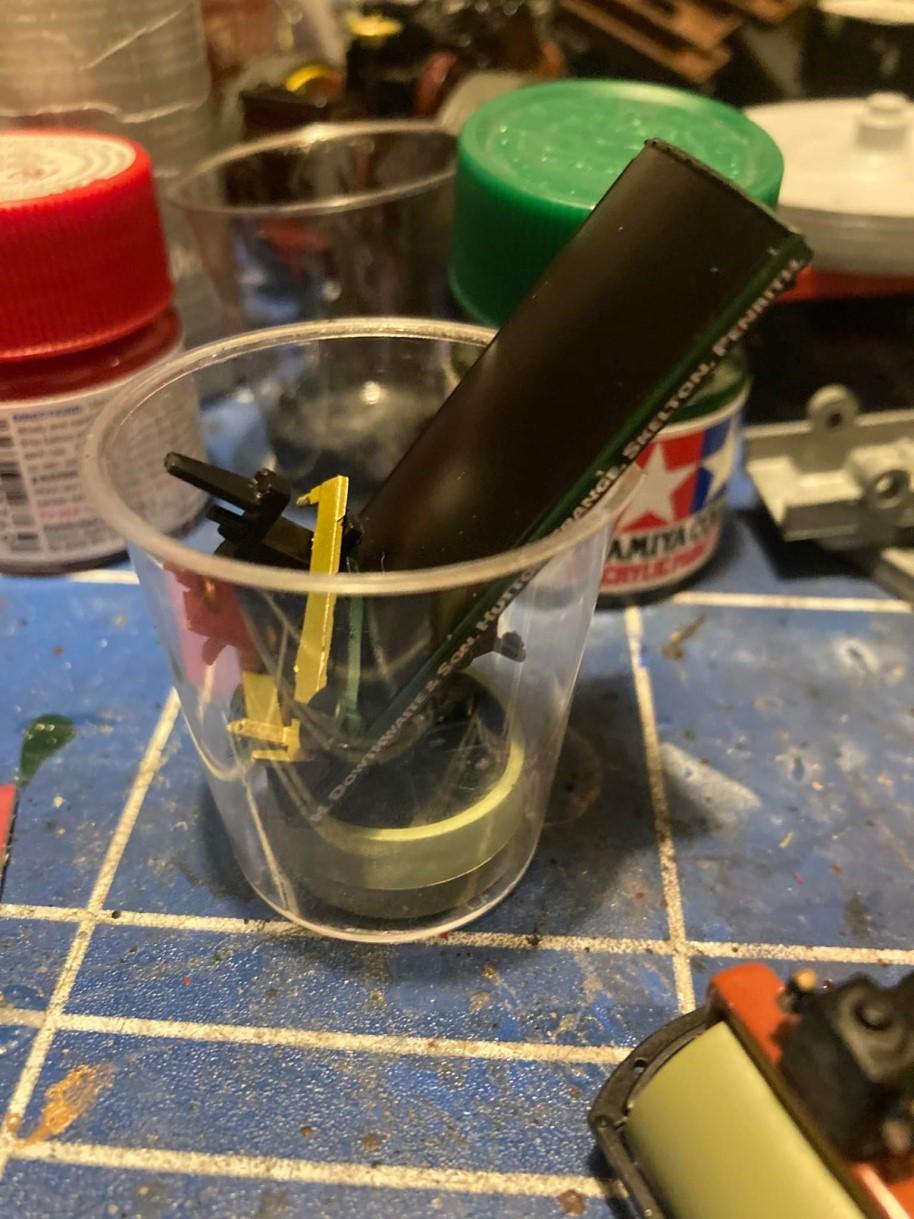
Oxford Diecast are generally very easy to strip down to component parts – although the boiler barrel/tender are metal – most of the added detail parts are plastic which are ‘push fits’ into various holes and sockets. Using a combination of the pliers, tweezers, and flathead screwdriver you should be able to get most pieces apart. I wanted to remove the canopy, rear wheels, scarifier, steering chains, and running boards. Most of these came off easy –for tight fitting parts a sharp hobby knife blade can be used to slice through the
The best way to find out what parts can be repainted to give a more realistic finish is to a quick google search usually turns a few good t seen the engine in person. I decided that I wanted to repaint: The motion work and footplate controls, the gear guard which was painted a lighter shade of green, and the rolls themselves needed painting a more realistic colour. For modification: The real roller only has a running board on the so one of them can be left off. The real roller doesn’t carry a scarifier so I could have left this off and filled in the holes on the tender but….. I prefer the look of a roller with a scarifier, so decided
Step Three: The Overhaul
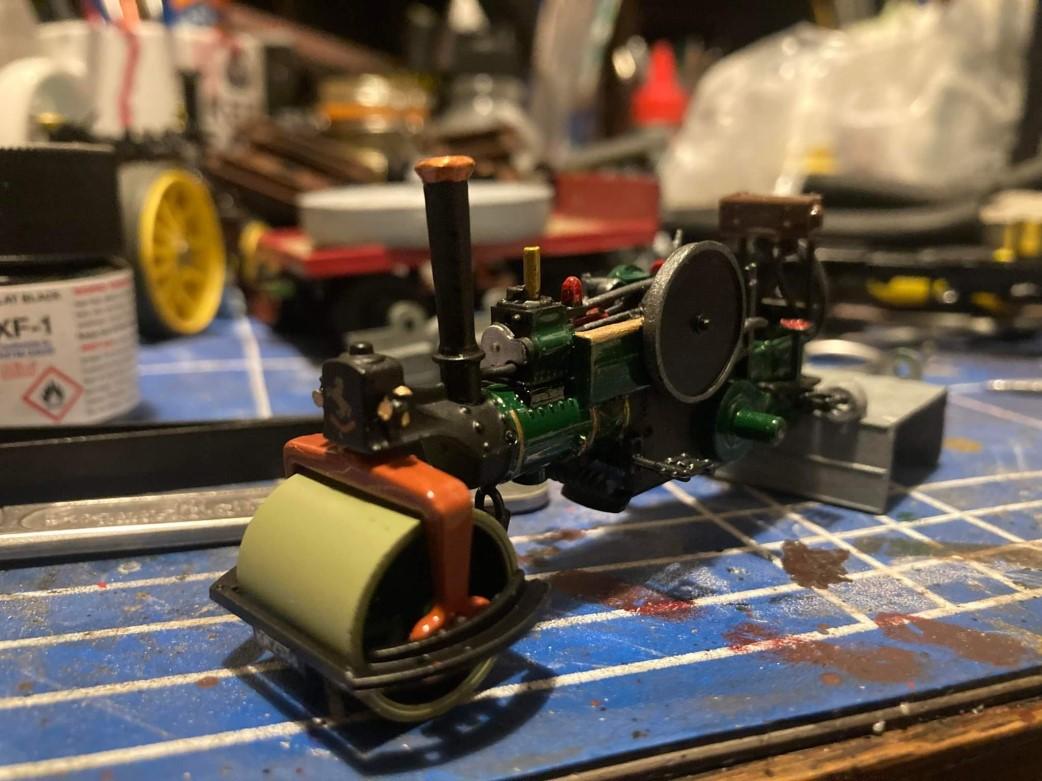
Once I had decided which parts needed repainting, it was just a case of picking the appropriate sized brushes to do the job! For fiddly bits like the pressure gauge/ lamps – the thinnest brush. Things like the motion work/footplate controls a thin brush, and for the gearguard and rolls, a slightly larger one. A brief breakdown of the painting:
Gearguard: Gloss Dark Green
Motion work/Footplate controls: Silver washed down with matt black/gloss red using photos as a guide.
Chimney top and cylinder drains: Copper
Pressure gauge/water gauges/lamp bezels: Brass
Rolls: a mixture of silver/matt black and I think I chucked some dark brown in the mix –just a case of stirring it until it look right! The front roll was painted without removing it from the forks – a cotton bud with white spirit on the end was kept on hand to wipe off any excess paint that got on the forks.
Step Four: Reassembly
This step is pretty much the reverse of step one! Most parts will ‘click’ back into place without any issue – I decided to add a drop of glue to the canopy supports and steering and as soon as this dried painted over with matt black paint.
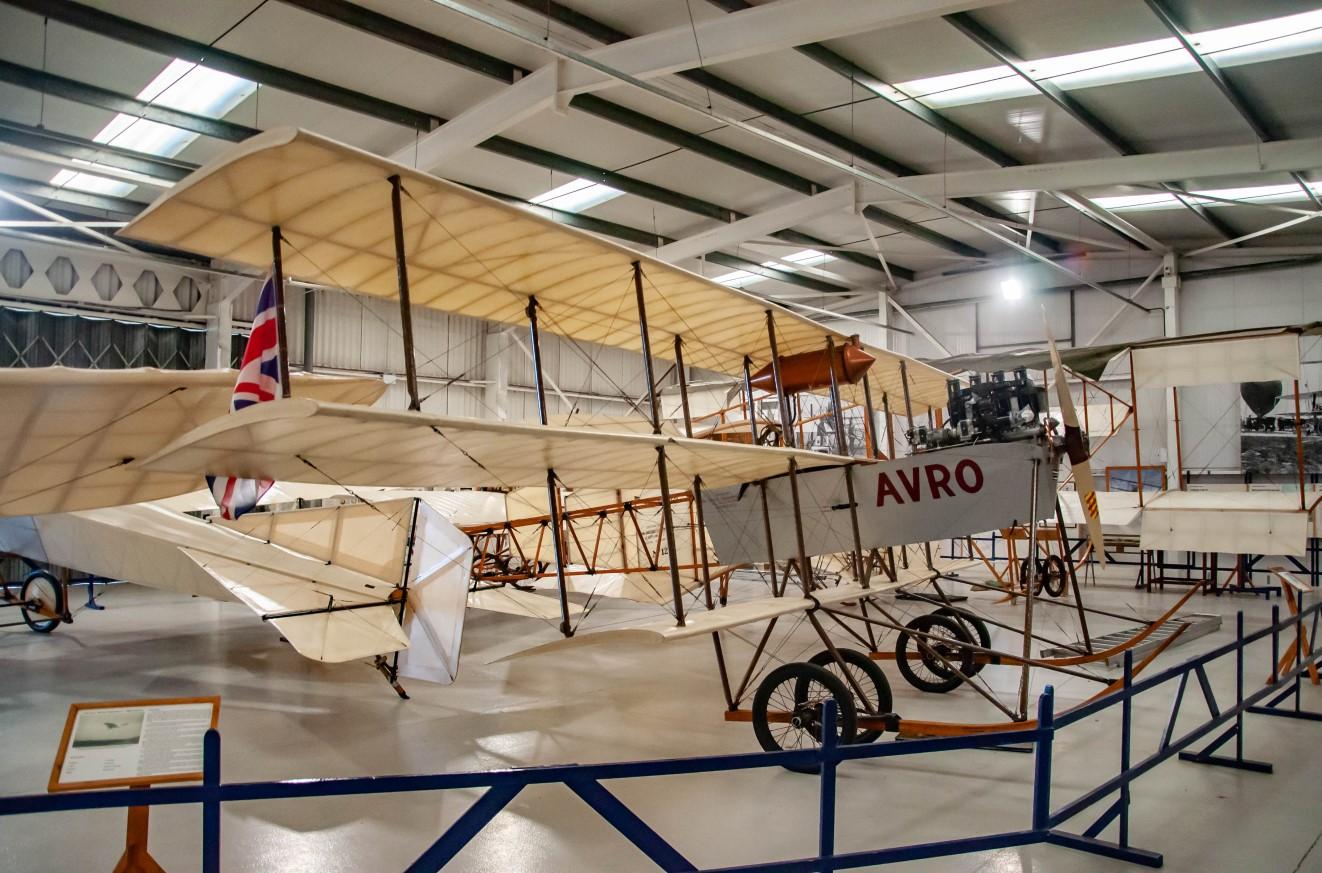
The Shuttleworth Collection
On the Sunday of the AGM, NTET & SAC members visited The Shuttleworth Collection to look at the many exhibits inside. John Durling writes to tell us a little about this important collection of traction engines, vintage vehicles and early aeroplanes.
The collection owes its existence to Richard Shuttleworth, who inherited the Old Warden estate in 1932, following the death of his father in 1913. Richard was the Grandson of Joseph Shuttleworth, co founder of the Clayton and Shuttleworth Company of traction engine fame. Like many men of his generation and background Richard was fascinated by the (comparatively) new motor cars, and especially driving them competitively and fast. He didn’t just drive the cars though, he also collected and restored early models and was a regular entrant in the London to Brighton Veteran Car Run. He suffered a serious crash in his Alfa Romeo in 1936 at the South African Grand Prix which finished his driving career.
During this time he also became interested in flying and bought and restored several early aircraft in his workshops at Old Warden. He tried to join the RAF in 1932, but was considered too old, however, in 1939 has was able to join the RAF Volunteer Reserve where he reached the rank of Pilot Officer. He was selected to join the Air Crash Investigation Branch, which is ironic given that, whilst flying a Fairey Battle Light Bomber for a training flight in August 1940, he crashed and was killed.
The collection we see today is due in no small part to the work of his mother, who continued to collect both aircraft and road vehicles in memory of her son.
One of the justifiably proud boasts of the Shuttleworth Collection is that almost all of the aircraft and road vehicles are operational. The aircraft regularly appear at the flying displays at Old Warden and the cars are also regular attendees at the London to Brighton runs.
SAC Logbook
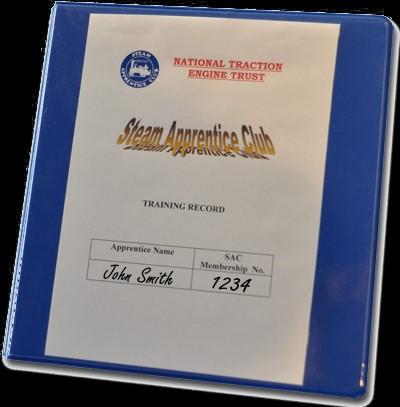
The log book is a very important tool for an apprentice. The purpose of a log book is to keep a record of your experiences with the different steam engines you have helped with.
Then, when you start with a new steam engine, the engine owner/crew can look through your records and get a good understanding of what you can already do, and what new things they should be teaching you.
Though be warned, although the majority of steam engines work in a similar way, just because something happens one way on a certain make of engine it doesn’t necessarily follow it will be the same on another.
Log books can be bought from NTET Sales. Email Kathy Smith at sales@ntet.co.uk for more information.
Driving Days 2023
We are happy to announce that we have another full calendar of Driving days planned for 2023!
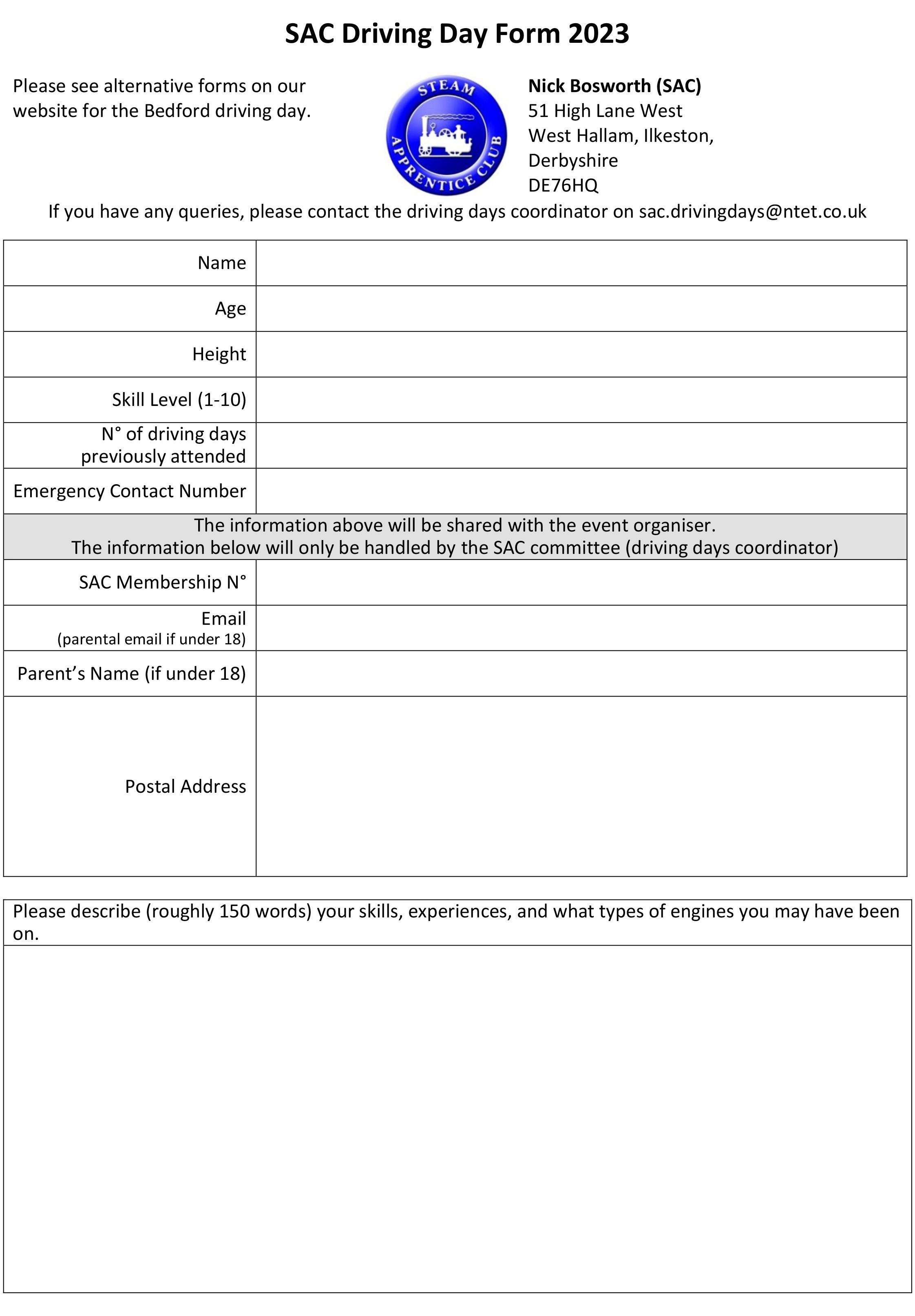
An application form can be found overleaf, and can also be downloaded from the Events page on our website – www.ntet.co.uk/sac/events.htm. A full list of the various driving days follows after the application form.
We are still awaiting some details for the and Tinker’s Park driving day in Sussex. Please keep an eye on our website and Facebook page for updates on this one.
The driving days can only happen thanks to the support from clubs and organisations around the country, so please remember to say thankyou to the people running the driving days you attend.
Please note – the application forms for the Bedford driving day should be sent directly to the Bedford club, and there is a separate form for this event on our website. For all other driving days, please use the regular form.
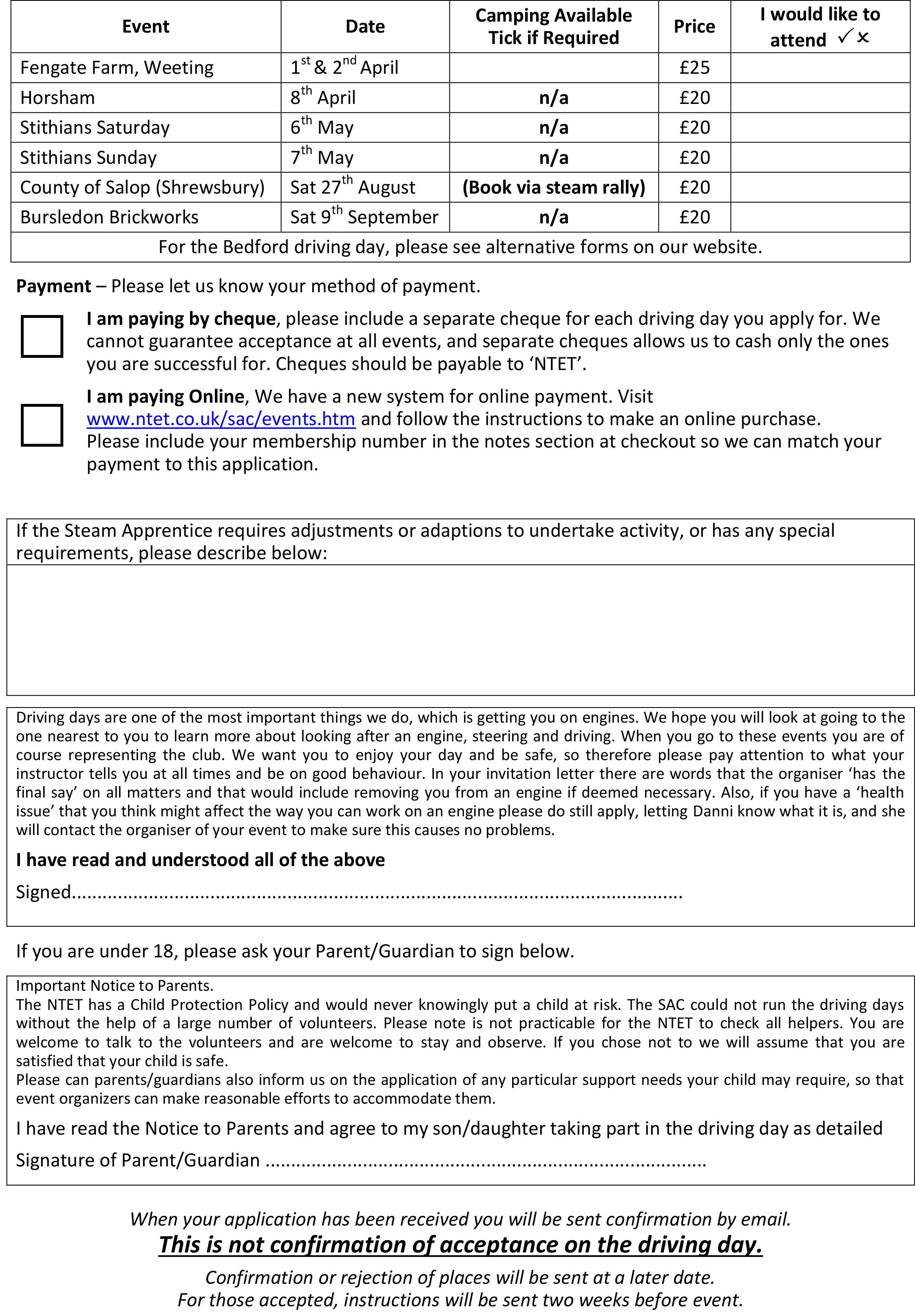
Payments Update – We’ve changed the way you can pay for the driving days. You can still send a cheque with your application form, but you can now also pay for driving days using our driving days ‘online shop’. Follow the link from the events page on our website, and add the driving days you wish to attend to your basket, then complete
2023 Driving Day Dates
This is what we like to see, a full calendar of driving days! I’m sure after two years, demand will be high so be sure to get your application in as soon as possible! Where details are TBC, please keep an eye on our website or Facebook page for updates.
Location Date Leader Comments
Fengate Farm, Weeting. 1st & 2nd April
Horsham Traction Company 8th April
Bedford 21st & 22nd May
Stithians (Sat)
Cornwall 6th May
Stithians (Sun)
Cornwall 7th May
County of Salop (Shrewsbury) 26th August
Bursledon Brickworks 9th September
Tinker’s Park
Sussex TBC
Kate Plant
Dee Searle
Sarah Smith
Sam Eastman
Sam Eastman
Doug Milns
Douglas Hynd
Adrian Vaughan
Mr Parrott has a collection of engines with others also on site. They are running over two days. Camping/Caravanning space is available.
The Searle family are back with another driving day held in the grounds of their haulage yard. Date TBC.
Price for Saturday ONLY - £20. Price for Sat & Sun - £25. Lunch provided on Saturday, breakfast provided on Sunday. Camping available.
Two SEPARATE days run by the West of England Steam Engine Society. Being run on the showground at Stithians.
Being run on the Saturday before the County of Salop Steam Rally. Camping available (Book via the steam rally).
Located in Hampshire, it is thought to be the last Victorian steam-driven brickworks left in the UK. Plenty to see and do!
Well established now at Tinkers Park in East Sussex. Has their own roadway so can operate in all weathers. Date TBC.
NO RALLIES TO GO TO OVER THE WINTER? WHY
NOT
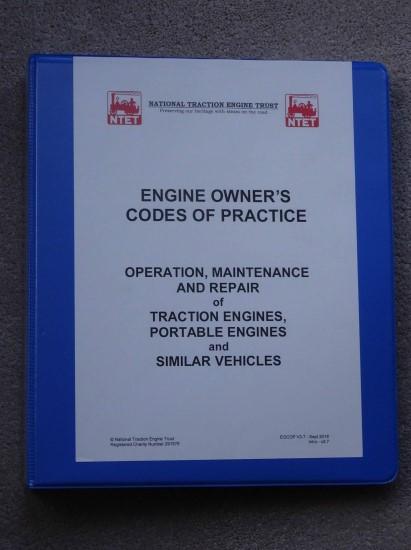
READ THE Engine Owners’ Code of Practice
The NTET Code of Practice; “The Management of Traction Engines and Similar Devices” has for a long time been widely accepted in the Insurance and Boiler Repair and Steam Engineering communities as a 'de facto' reference manual.
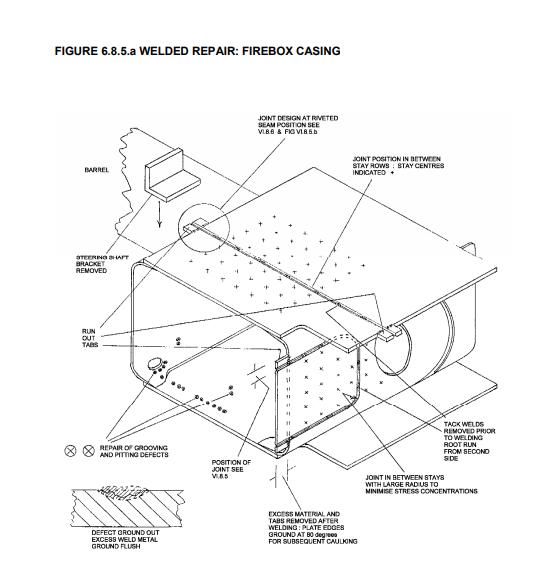
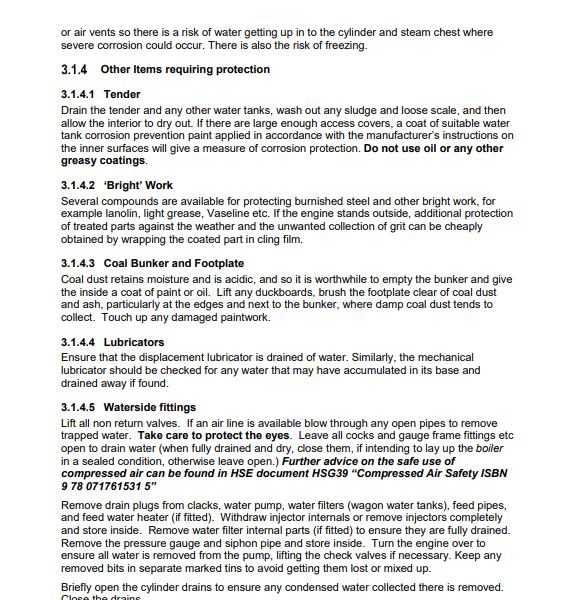
The CoP is 200 pages of practical advice on every aspect of engine usage, including Operation and Maintenance, Driving on the Road and in Public Places, Transport, Laying up and Storage, the NTET Written Scheme of Examination, Mechanical Inspection, Repairs, Appeals and Arbitration, and Records and Reports.
Your Steam Apprentice logbooks have been developed based on the information in the CoP to give you a good grounding with steam vehicles, and the CoP provides an excellent addition to further develop your understanding of the usage of steam vehicles.
The Code of Practice can be downloaded free as a PDF from the NTET website (www.ntet.co.uk). Alternatively, you can purchase a hard copy in a loose-leaf folder, with pages in plastic wallets, by sending a cheque for £35 inc. p&p payable to the NTET to the Chairman of the Engine Owners Section (address below). The hard copy includes relevant extracts from British Standards which are NOT available to download.
Bob Siddall
Stud Farm House
Castle Hill
Carlton-on-Trent
Nottinghamshire
NG23 6NX
Steam it Sunday
Steam-It Sunday is a national event based on the idea from the Federation of British Historic Vehicle Clubs ‘Drive It Day’.
The National Traction Engine Trust decided it needed an event where we all try and promote Steam on the road in it’s various forms, through a series of improvised and essentially free events organised at grass roots and local level, like in the early days of the road going steam movement.
In short: Steam it Sunday takes place on the first Sunday of October (this year will be 2nd October) and is all about steaming up your engines and enjoying our hobby!
Every year there are many gatherings up and down the UK and we are delighted with the response to the idea. Be it at local club level, regional society or just one man taking his for
a trundle, the first weekend in October will be alive the sight, sound and smell of engines doing what they do best – being enjoyed.
We encourage any enthusiast who wants to know more about local activities to contact their own local or regional steam and vintage club, to see what may be happening in your region. We would like to thank everyone who has supported ‘Steam It Sunday’. As you would expect we hope it will take off and become a free for all annual event for everyone to enjoy and to highlight the fact that we are still able to drive steam driven vehicles of various designs on our highways and byways.
Although 2020 was a difficult year, we were pleased to see engines out and about on Steam it Sunday. Let’s just hope we see a lot more this year!
In the Workshop - Springy Things!
Our chairman, Nick was written in to detail one of his winter projects. If you’ve been up to any projects, however simple, do write in to let us know, we’re always interested to know what you’ve been up to!
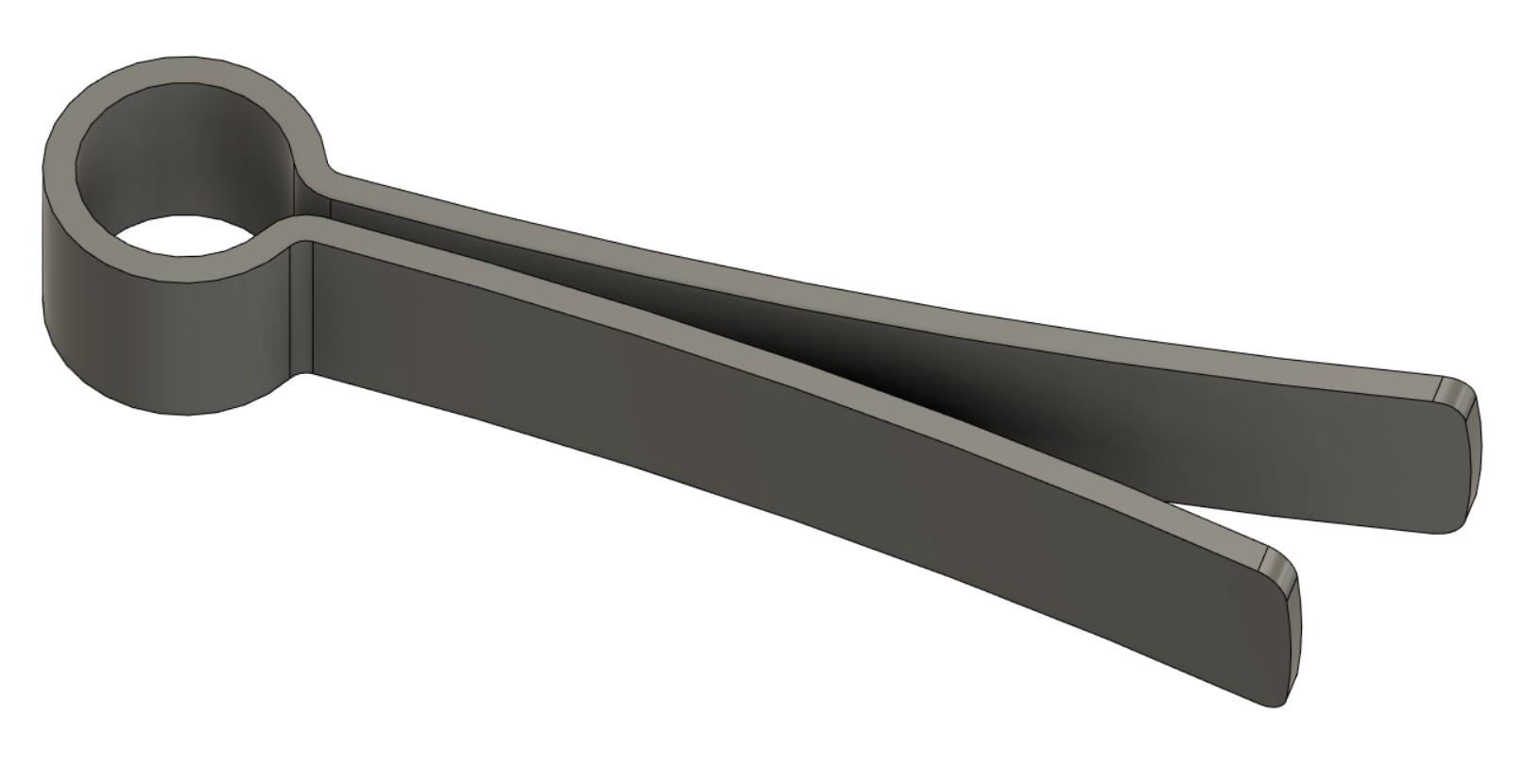
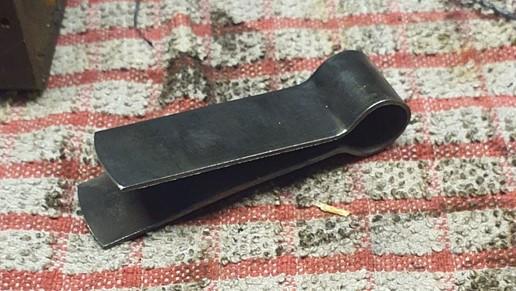
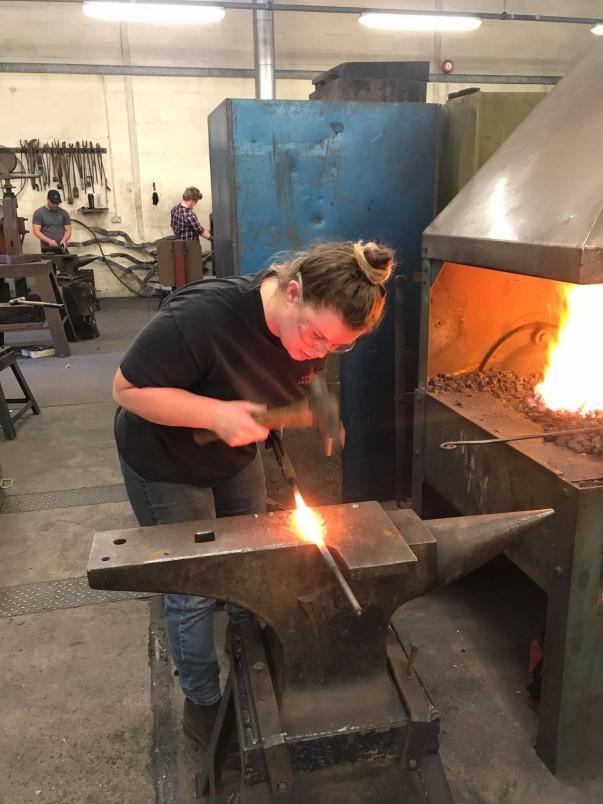
One of those “one-day” jobs has been to make some spring clips that retain the drive pins on the wheels of my cousin’s Garrett.
These clips pass through a slot in the retaining pin, and spring open to keep themselves in place. Therefore they are made of a special type of steel known as “Spring Steel”.
Spring Steel is a type of steel that has a higher amount of carbon content, approx. 0.95%, compared to 0.15% in regular mild steel. The extra carbon gives the steel a high yield strength, which means it is good at returning to it’s original shape after being bent or twisted. This makes it an ideal choice for the clips that we want to spring open at the end.
The extra carbon also allows the steel to be hardened through a process known as Heat Treatment. Heating and cooling the metal in a specific way can alter it’s mechanical properties, to make it harder or softer.
As a general rule, if steel is heated to red-hot, then cooled very quickly, it will
become very hard and brittle. If you heat steel and cool it slowly, it will be softer and easy to bend. This is known as annealing.
To make these clips I bought the steel as a straight flat strip, which I then had to form into the shape of the clips.
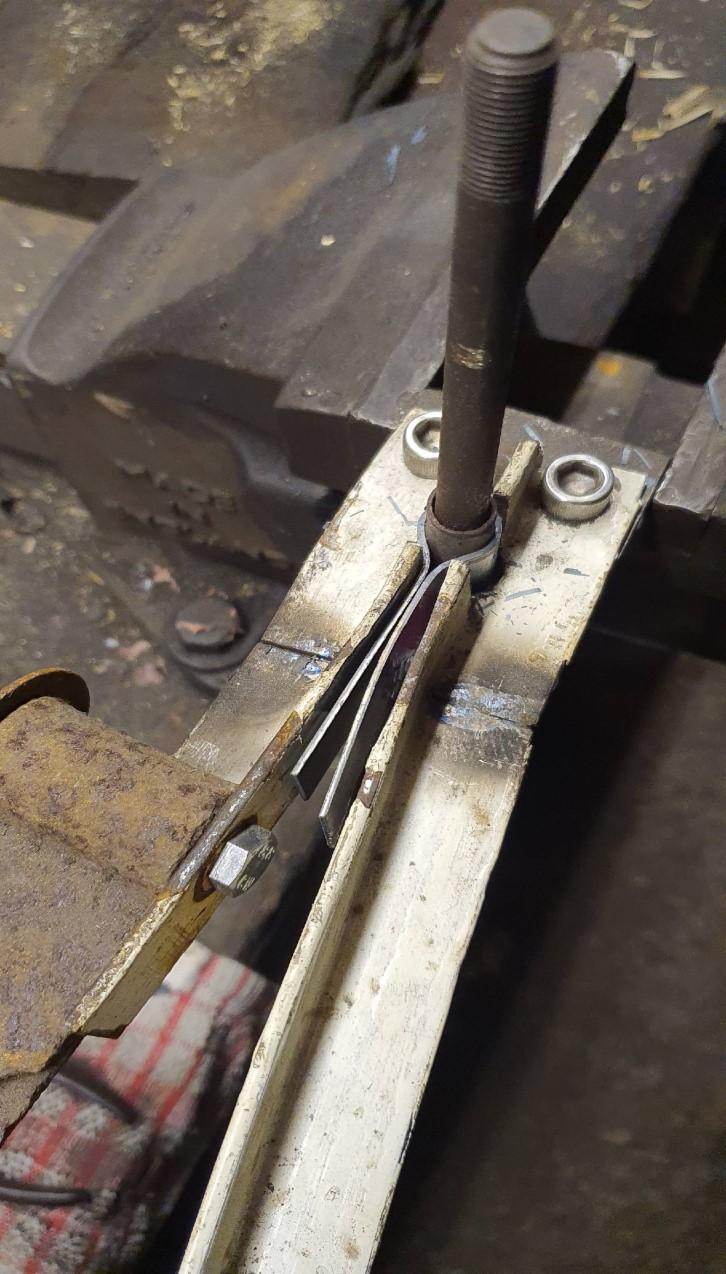
Being a type of steel that wants to return to its original shape (currently a flat strip), it has to be heated in order to bend it into the shape I want. I made a former to bend the spring steel around, as I wanted to make several clips that were all the same shape. The former also made it easier to handle the steel
The former consisted of a central peg which the loop was bent around, with two arms which came around to press the tight bend where the loop meets the straight parts. I made it out of scrap bits of steel that I had lying around.
The first step in making the clips was to cut the strip to length. I left it a bit longer than I needed, with the intention to trim it shorter at the end of needed.
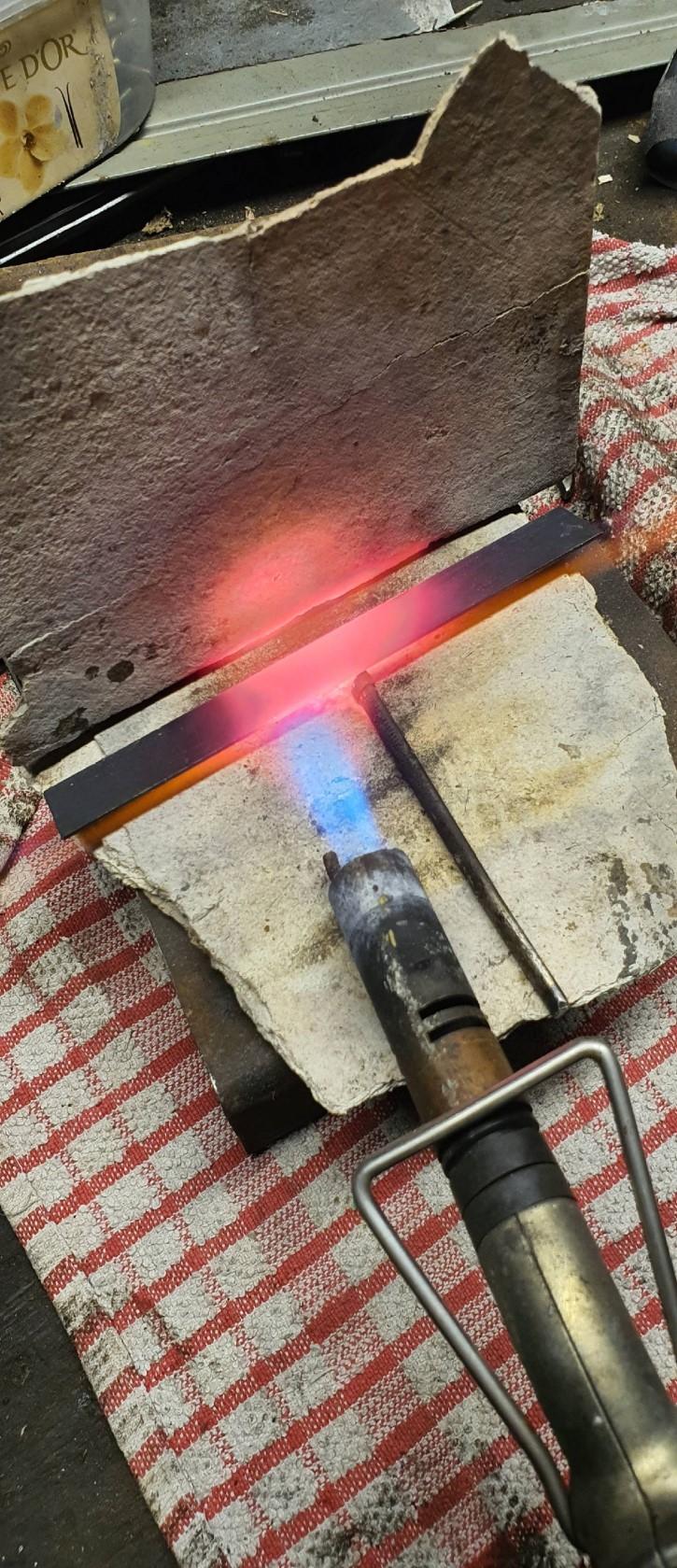
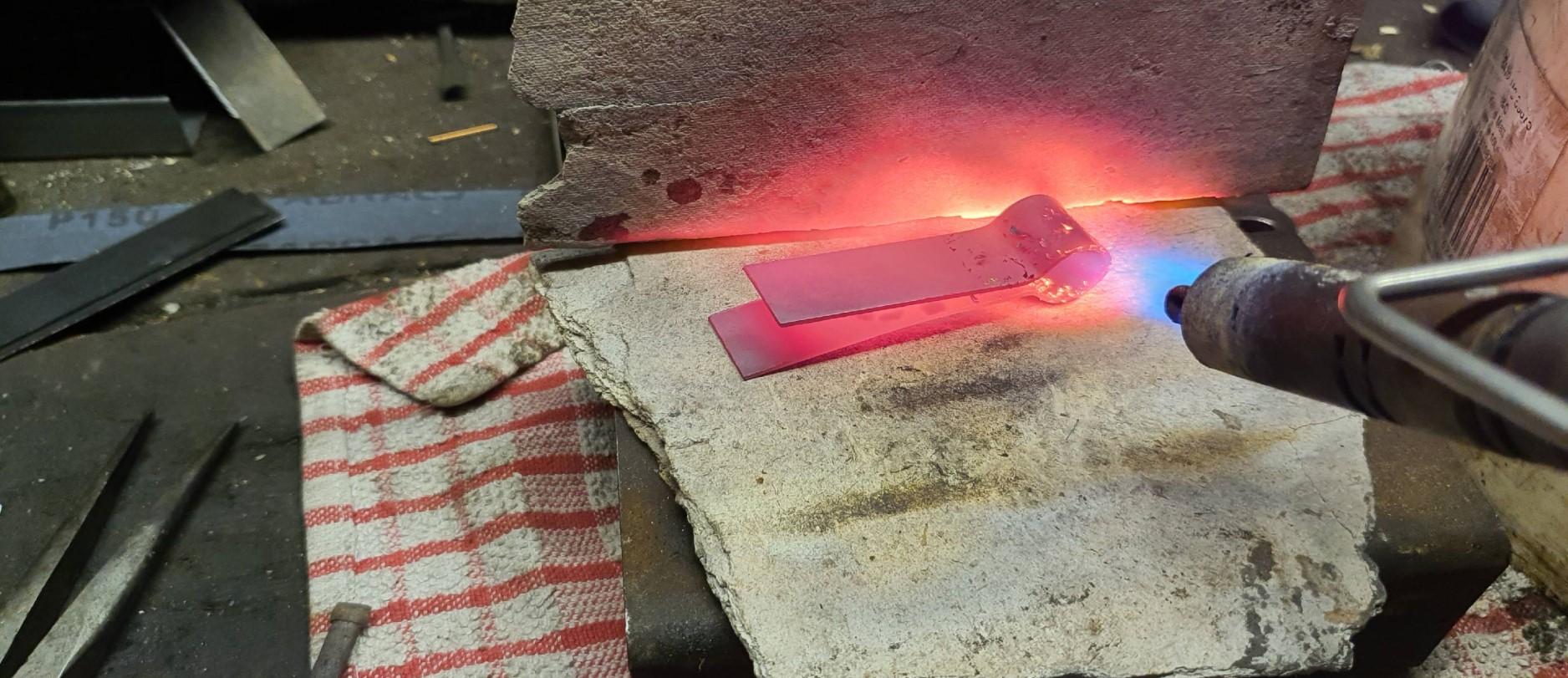
To form the shape, I heated the steel until it became soft, then pressed it into shape using the former. I used a blowtorch to do the heating.
The process of heating the metal to bend it around the former annealed the steel slightly, leaving it easy to bend. This made it less springy than we want it to be. Therefore I had to heat treat the steel to make it springy again.
To do this I had to heat the clip to around 900°C, and cool it quickly (know n as quenching). So out with the blowtorch again to get the clip glowing red, then quickly dunk it in a bucket of water.
Quenching the clip like this leaves the steel very hard and brittle. In this state it is actually too brittle to function as a spring. If it were left like this the clip would snap when squeezed together (guess how I found that out!)
So another type of heat treatment known as ‘Tempering’ is needed to make it slightly less hard, but not as soft as we had it before. To temper the metal, it should be heated to around 300°C, then left to cool slowly.
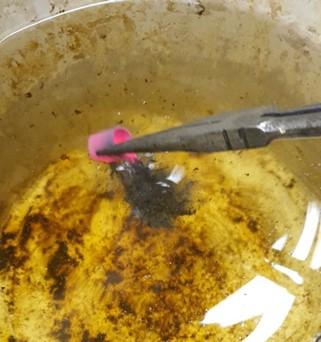
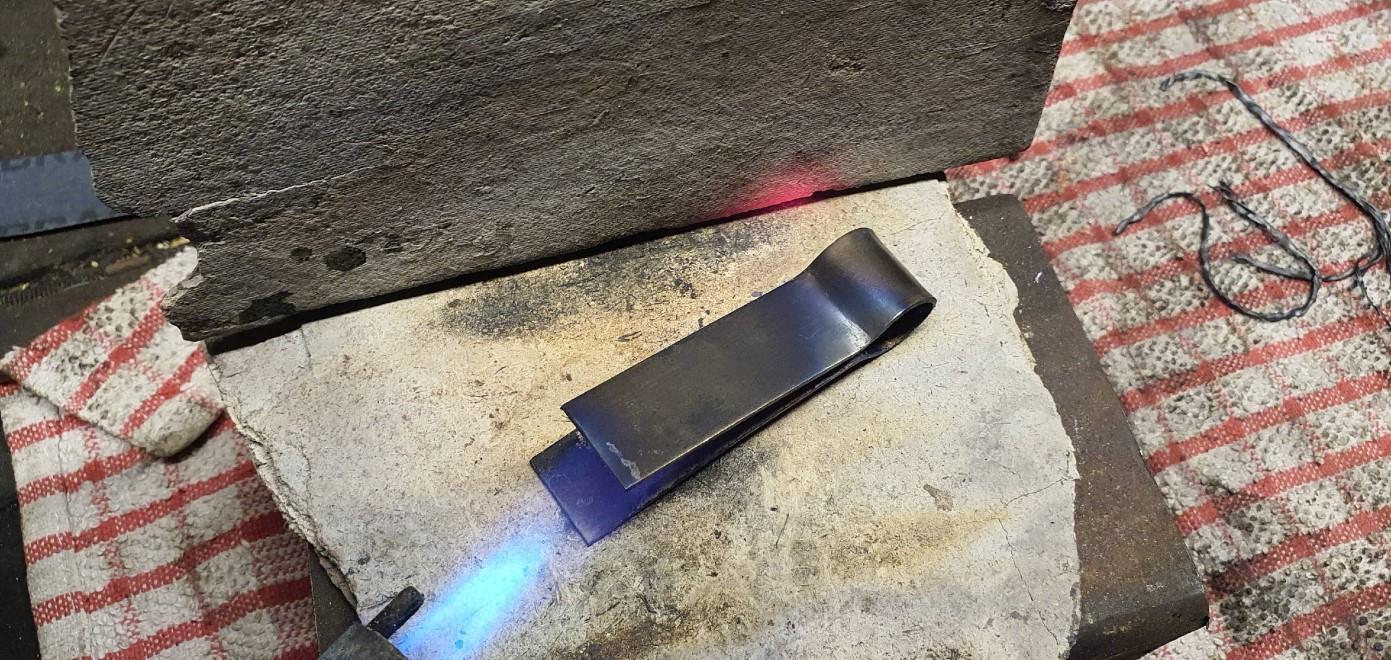
I was able to know the temperature by the colour of the steel. At around 250°C the steel turns a yellow ’straw’ colour, and around 350°C it turns shades of blue. So by cleaning the metal (as it was a bit crusty after heating & quenching) and watching the colour, I was able to get it to the correct temperature for tempering. In the picture below you can just see the clip starting to turn blue, so this was the point I stopped the heating.
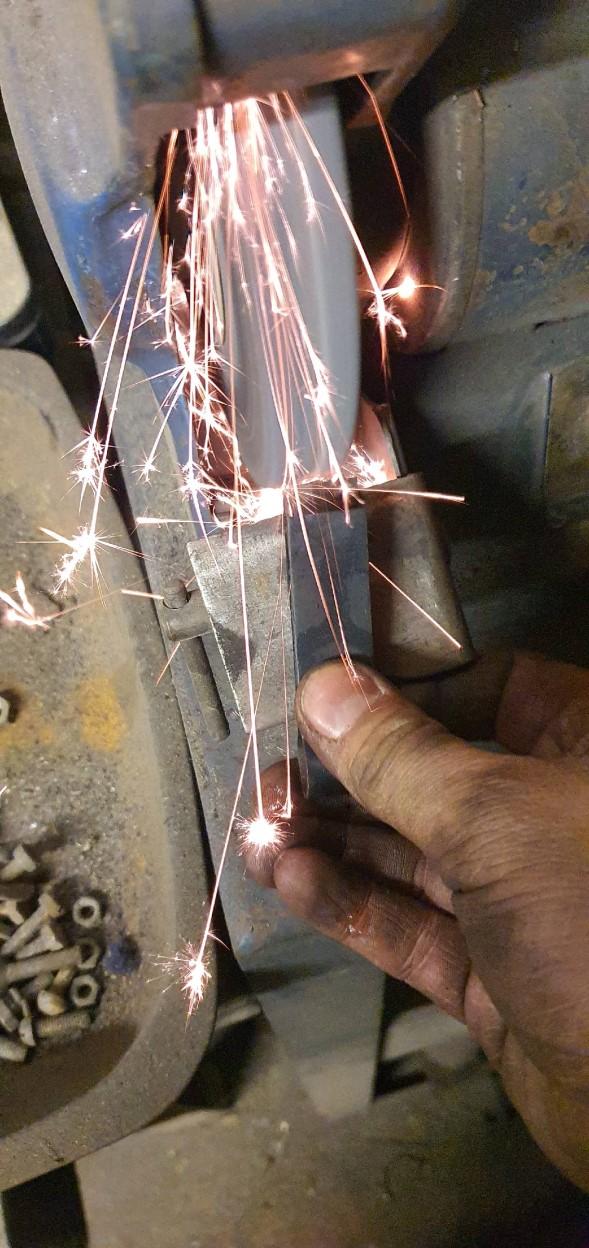
So now we have a spring clip in the right shape. All that was left was to clean it up, and grind a slight curve on the ends to make it look better and to remove
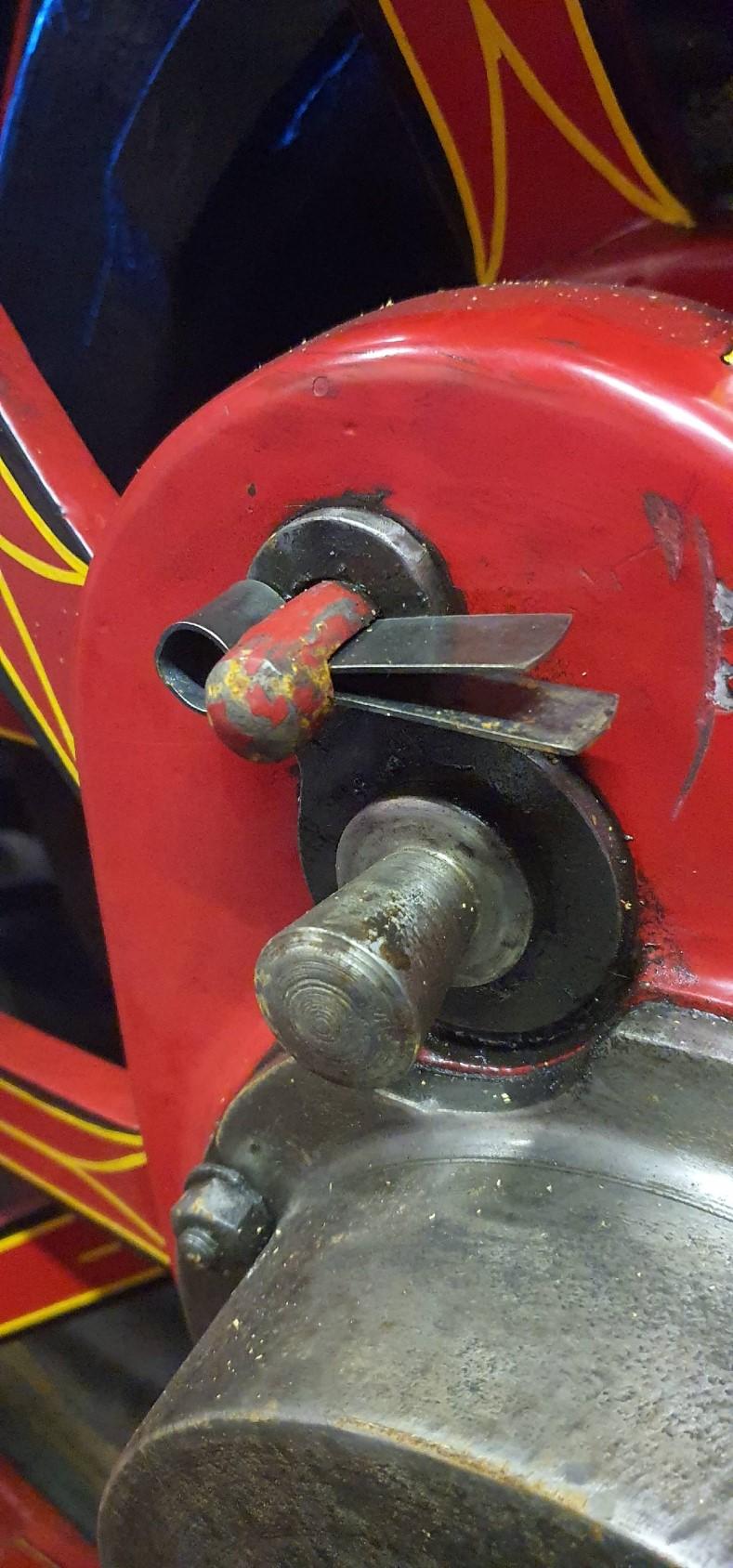
Finally, below can be seen the completed clip fitted to the hub of the Garrett.
In The Workshop - Replacing Stays
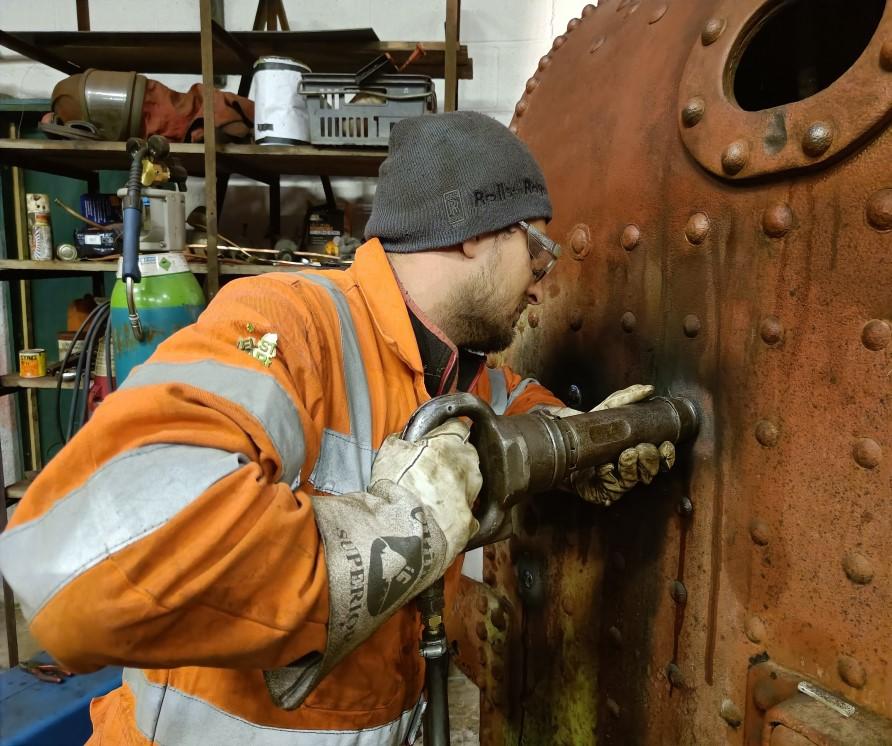
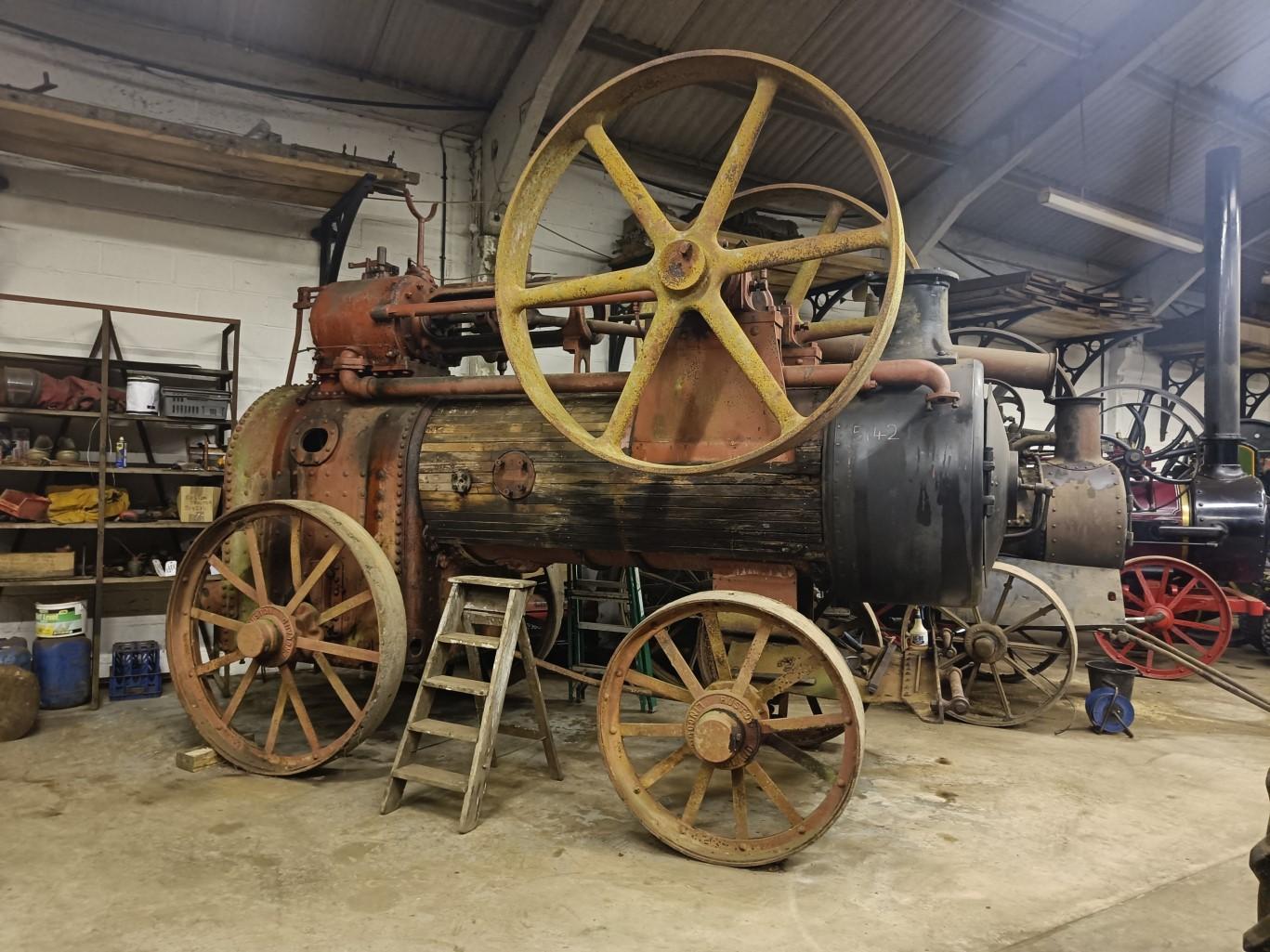
In the last bumper edition we detailed the process of removing old, broken stays from the firebox of a friends Ruston & Proctor 12nhp portable steam engine. Since then we’ve been busy continuing the restoration which has of course included replacing the stays that have been removed from the firebox. We left the process last time at having removed the stays from the firebox, with the threads left in generally good condition. For those who haven’t seen the first part of this, below we start with a reminder of the purpose of stays in the firebox of a boiler.
What are stays?
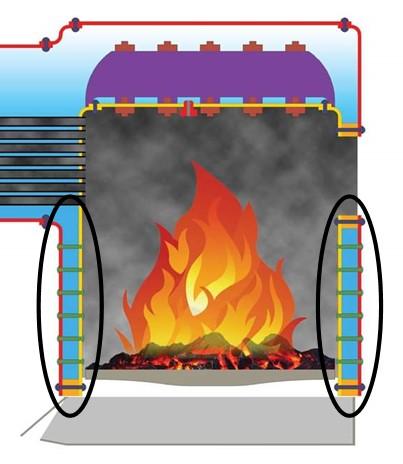
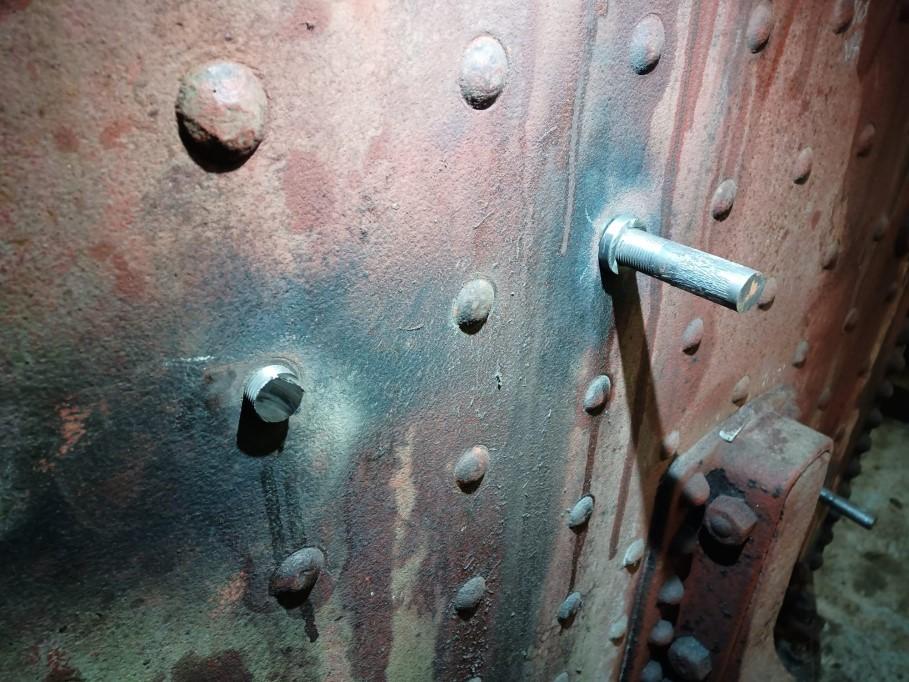
There are various types of stay used in the construction of a boiler; the ones we are focusing on are the firebox stays which are there to stop the large flat sides of the firebox and the outer wrapper from bulging under steam pressure. The stays are machined from threaded steel bar, and are then threaded through holes drilled and tapped in the outer wrapper and firebox. They are then heated and their heads knocked over to swell the threads into the holes and provide a seal. They are shown circled in the diagram, right.
Step 1
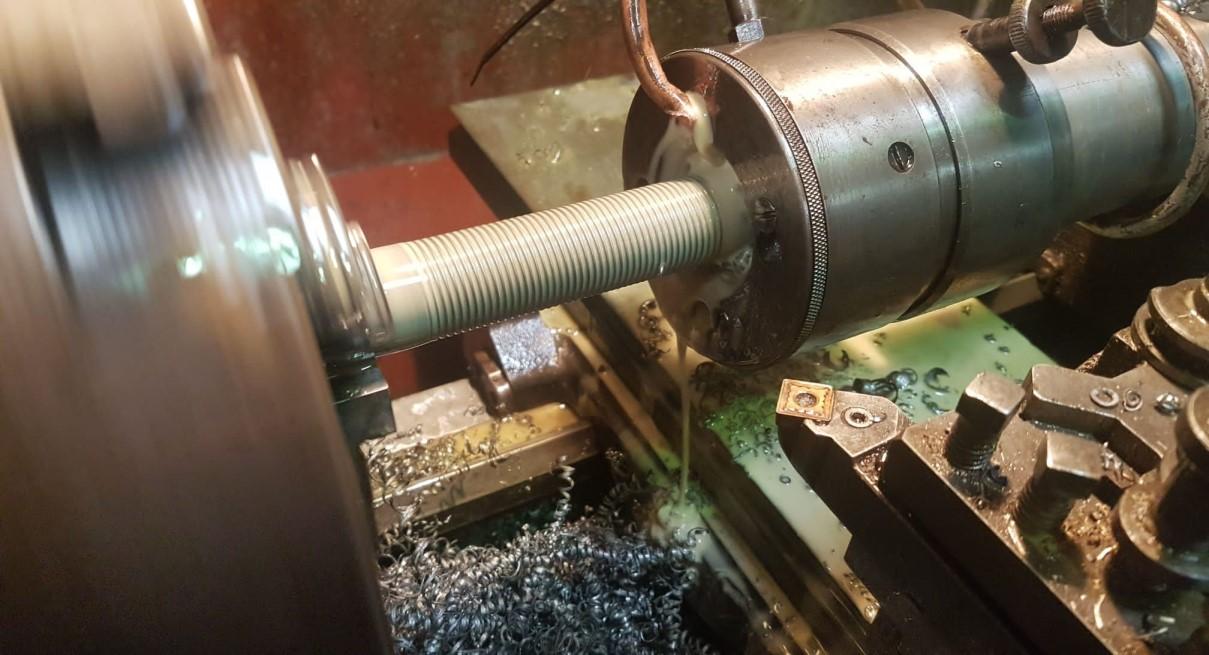
New stays are first machined from steel bar on the lathe. The threads are shown being cut here using a Coventry die head.
Step 1 continued
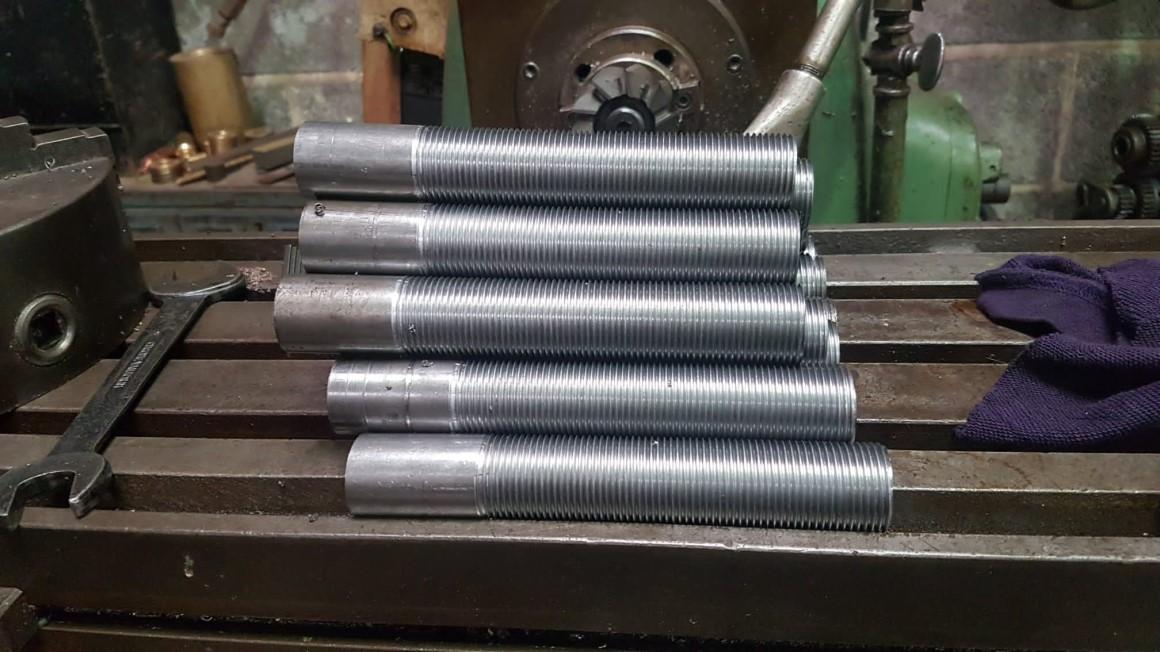
This photo shows a pile of machined stays ready to be fitted.
Step 3
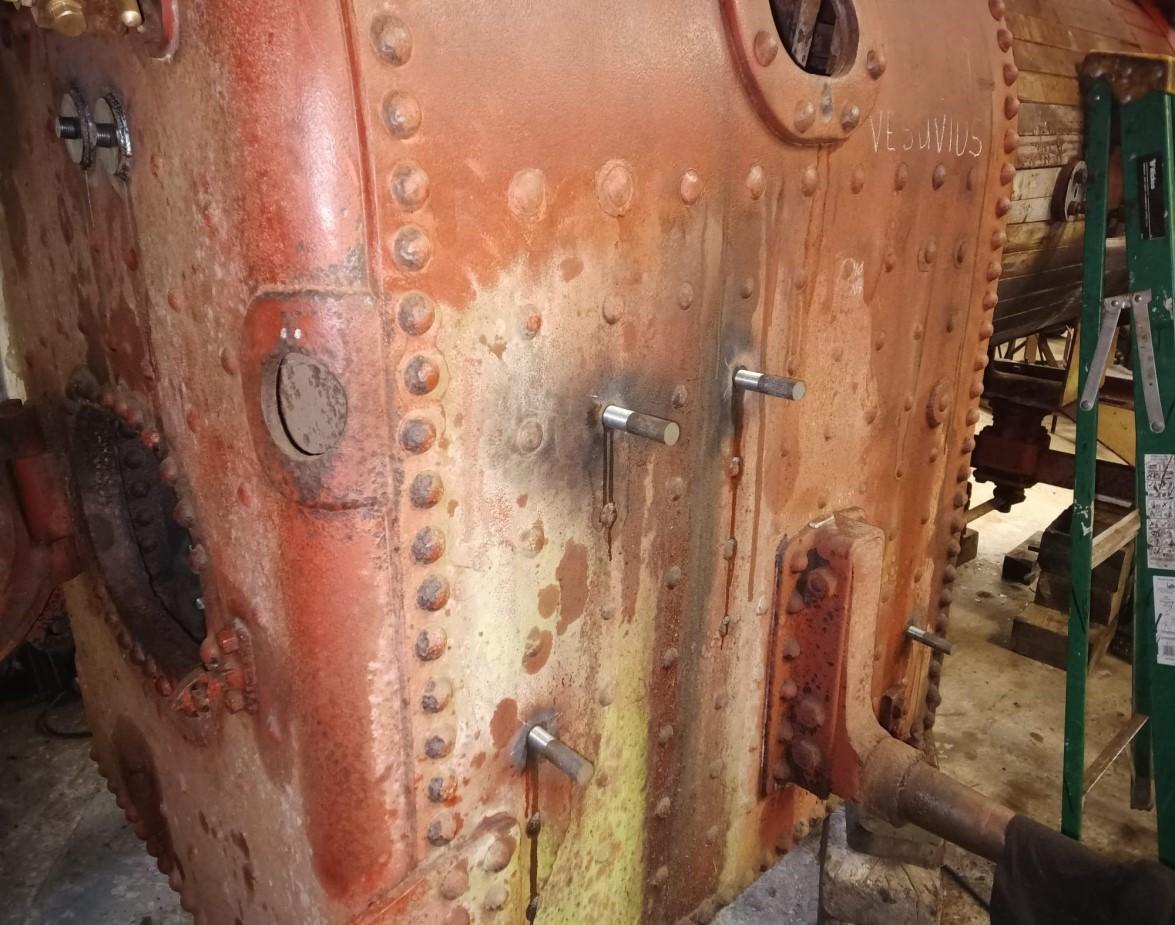
The stays are screwed into the outer firebox until they are showing through into the inner firebox.
Step 2
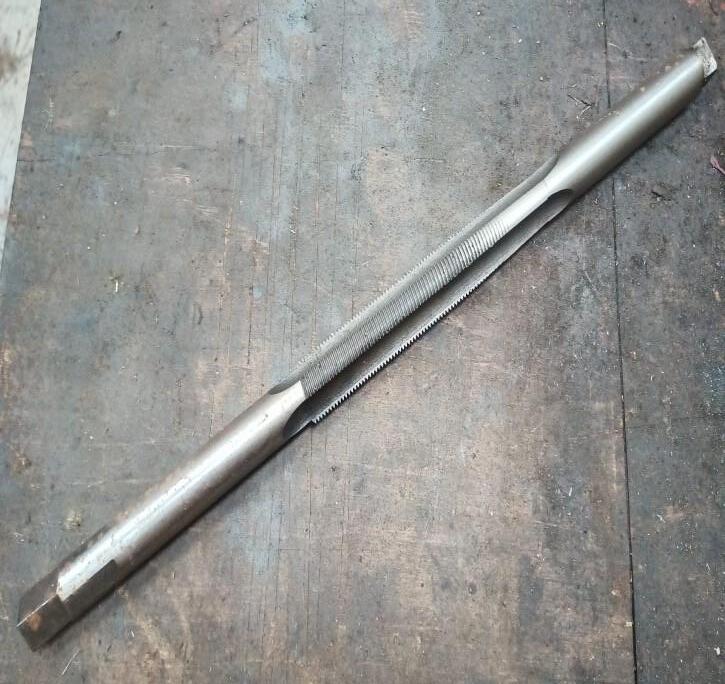
A special long tap called a stay tap is run through the holes in the inner and outer firebox to tidy up the threads.
Step 4
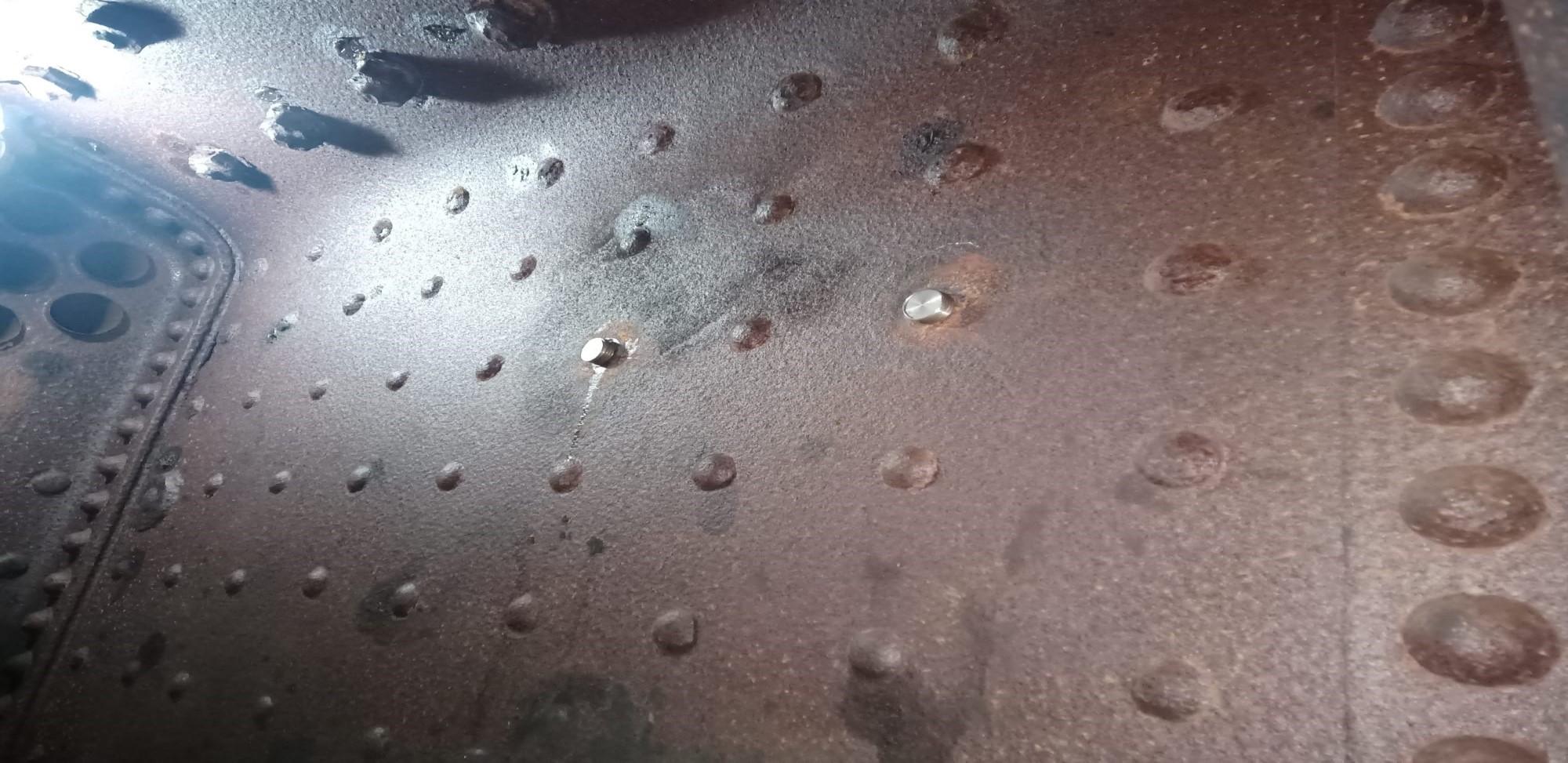
The stays are cut to length on both sides to ensure there is sufficient metal to form the head of the stay.
Step 4a
A view inside the firebox with the stays cut to length.
Step 5
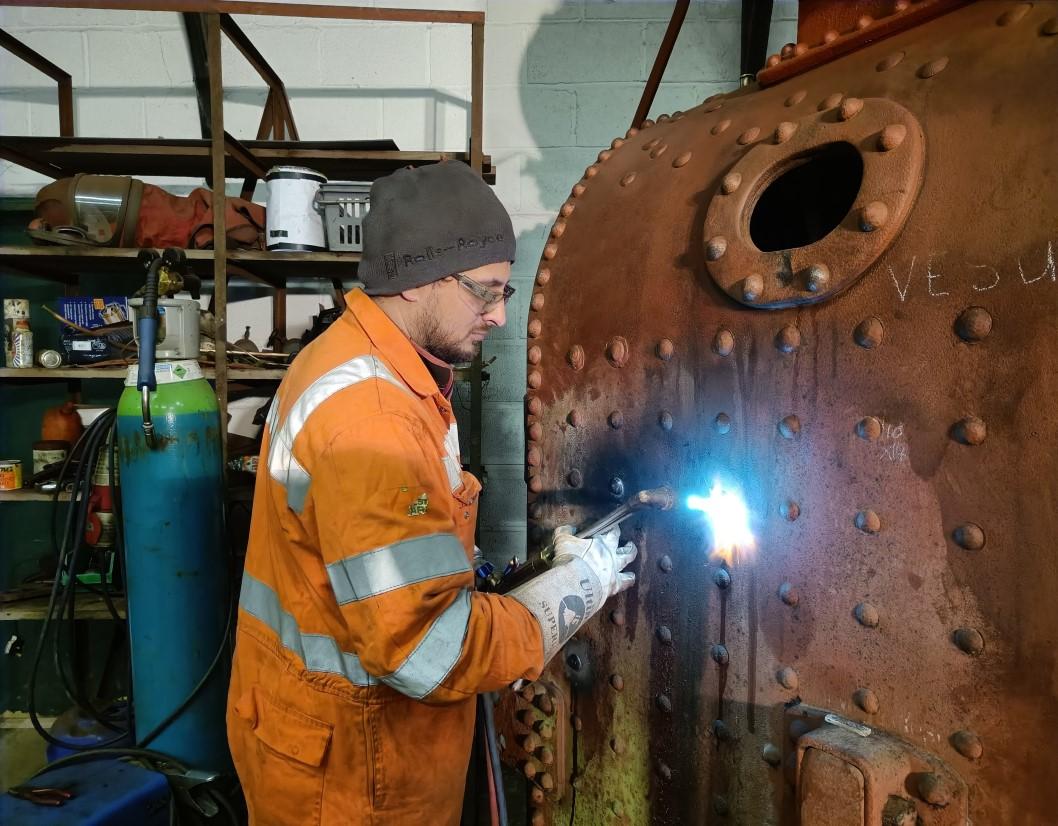
The heads of the stays are heated until they are soft.
Step 6
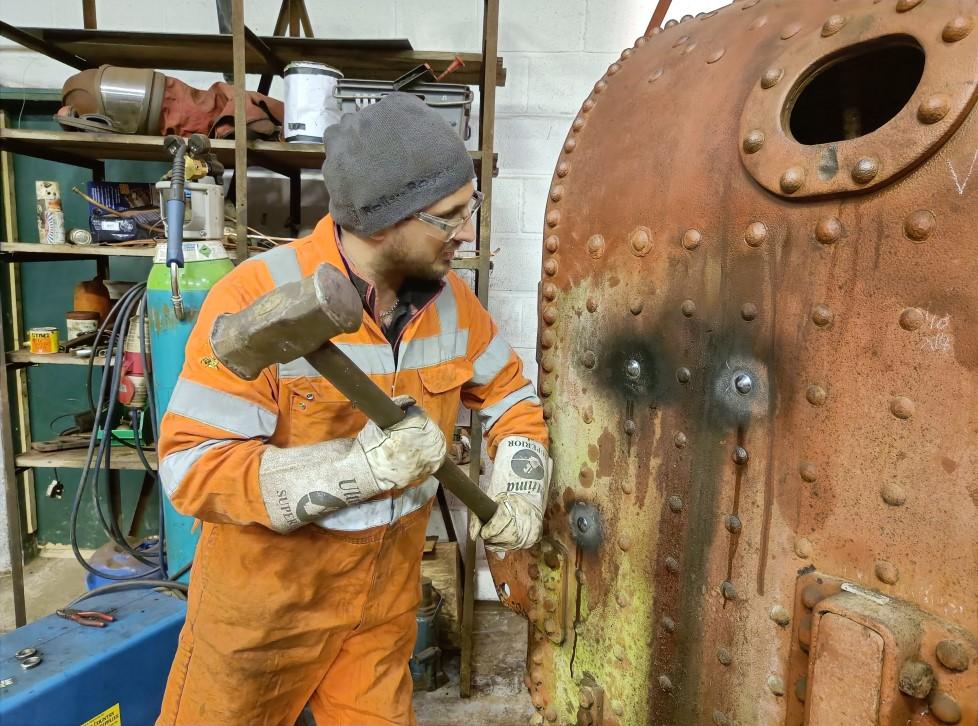
While hot, the heads of the stays are beaten with a hammer. This swells the material into the threads in the plate to provide the seal. Steps 5 & 6 are then repeated on the inside.
Step 7
A riveting gun with a specially shaped tool is used to form the head of the stay. The rivet gun is ‘rolled’ around the head to form the correct shape and tidy produce a tidy head. Step 7 is then repeated on the inside
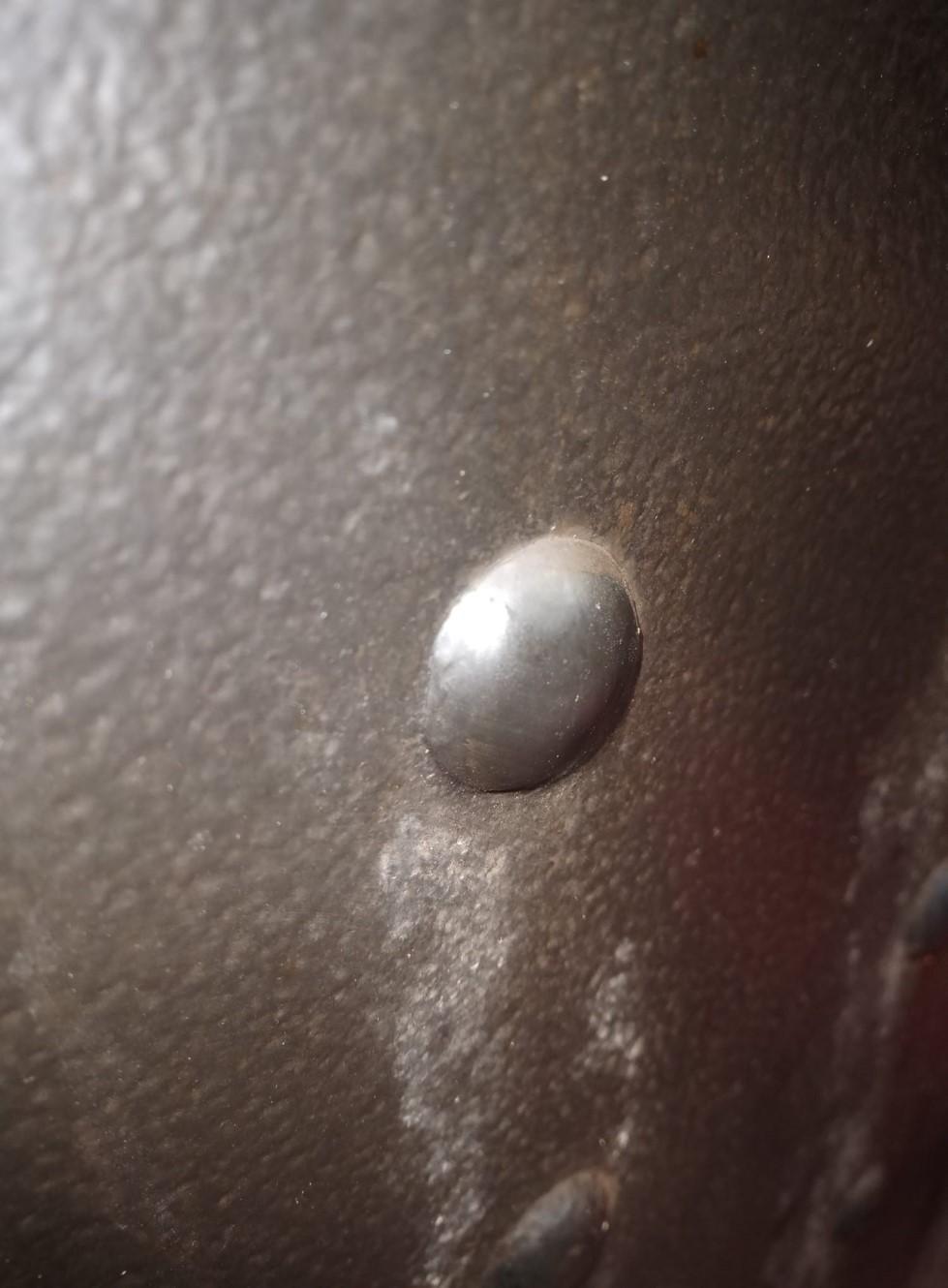
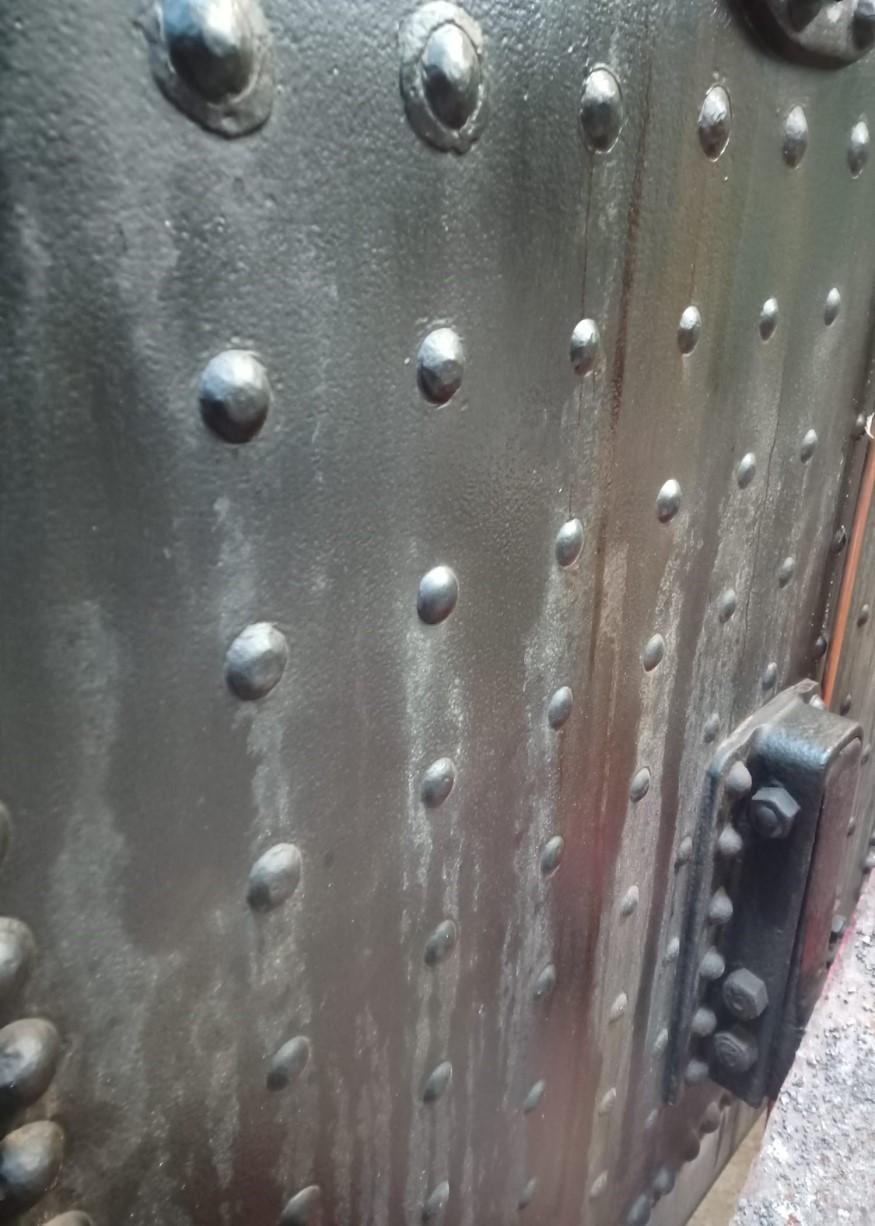
The completed stays. A neat job indeed...
Above, the Ruston Proctor Portable Engine undergoing restoration.
Below, the completed engine.
NTET DRIVER TRAINING SCHOLARSHIPS
The NTET is awarding Scholarships to participate in the NTET Driver Training Course which is held in May each year. The Scholarship covers the course fees for one year, NOT incidental expenses such as travelling, accommodation and food.
The scholarships are open to non-engine owners being members of nonengine owning families, who are members of the NTET.
For more details of the Scholarship and Course, visit: www.ntet.co.uk
Applications including a cv and a statement of why you wish to attend the 3 year Driver Training Course should be submitted by 31st January to the General Secretary of the Trust: general.secretary@ntet.co.uk
NTET Driving Training Course
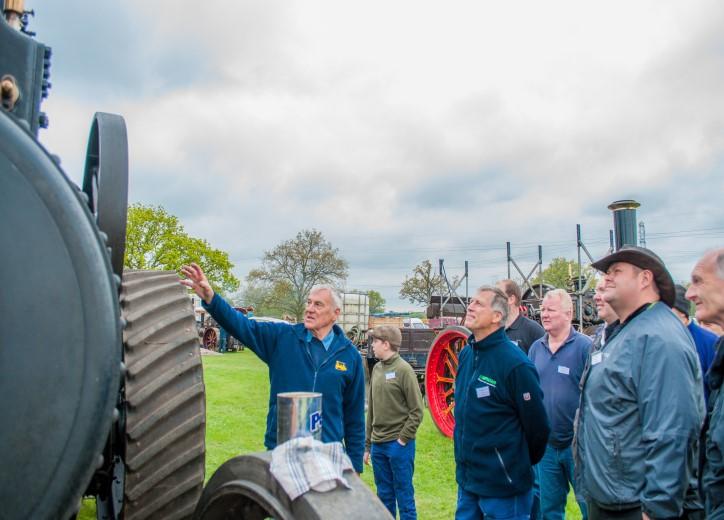
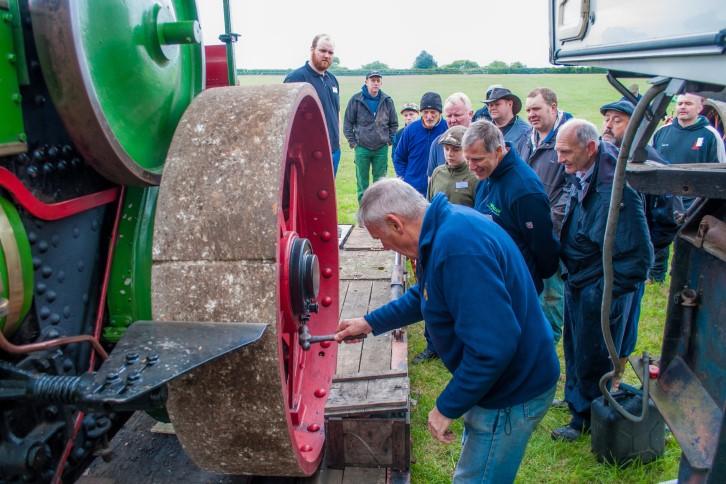
The NTET hosts a driver training weekend once a year for its members.
This course consists of both practical hands on driving time and theory sessions and is now open to Apprentices aged 13 years or older.
The course has three levels: foundation, intermediate, and advanced. It is recommended that Apprentices start with foundation and move up each year to get the most from the training.
Each level consists of a mix of both theory sessions with our skilled members and plenty of practical time on a selection of steam traction engines.
If you have any questions regarding this event please contact the event organiser, Joe Black, at:
training@ntet.co.uk
13th & 14th May 2023
£280 for the two days for members (discounted for SAC members)
DISCOUNT of 15% If you pay for 2 years at the same time
NTET Driving Training Course
Foundation Day 1
Introduction to Traction Engines -Boiler construction and Fittings -Motion work drive train and brakes, lubrication and gland packing, drive an engine, clean the engine.
Foundation Day 2
Light up and steer/drive an engine, engine insurance, engine maintenance, clean engines and help load up.
Intermediate Day 1
Light up and drive engine, repacking glands and ring bush renewal, Gauge frames and gauge glasses, Safety valves, cocks and clacks, clean the engine.
Intermediate Day 2
Washing out and preparation for inspection, low loading demonstration, water pumps and mechanical lubricators, boiler management and combustion, drive an engine, clean engines and help load up.
Advanced Day 1
Light up and drive engine, steering chains and maintenance, replacing tubes and stays, injectors, hydraulic testing and valve timing, clean the engine.
Advanced Day 2
Shafts, bearings, axles and wheel bushes, engine insurance, low loader demonstration, boiler management and combustion, drive an engine, clean engines and help load up.
Technical Achievement Award 2023
Applications are invited for the SAC Technical Achievement award. Areas of achievement may include: engineering work on full size engines, model engineering or any other appropriate steam related subject (bearing in mind that we are essentially a road steam organisation).
The purpose is to encourage young people to develop hands-on experience generally within typical engineering skills. This can be using various machines such as lathes and mills as well as handwork. Nominations to be entered by a sponsor for whom they have been working under the instruction of, or apprentices may enter themselves.
Applications to be received by August 15th and should consist of a brief description on one side of A4 paper with 3 or 4 photographs and/or sketches. See address inside your latest copy of Raising
Steam. The judging committee will then contact the nominator or apprentice by either phone or in person to discuss the application. From these discussions, suitable candidates will be chosen, and final and fully detailed submissions will be invited to be with the Chairman by September 15th.
Judging will be completed by mid October with the announcement of the winner by the end of October. The award will be presented at the NTET AGM.
Judges will be from members of the SAC Committee plus invited persons form an area appropriate to the subject entered.
Please note that due to the all round experience we are looking for it is unlikely the award will be awarded to an apprentice under 15. Though as we know there is always an exception to the rule, so please don’t hesitate to either enter or contact the Chairman for guidance.
If you have someone in mind to nominate, contact sac.publicity@ntet.co.uk
Apprentice Of The Year 2023
This award is to recognise an Apprentice who has shown all round enthusiasm in their involvement with Road Steam. This may be hands on experience with an engine, or helping to maintain or restore and engine. Consideration should be given to how well they have learnt and respected the necessary skills needed in the operation of an engine. There is no particular type of submission we are looking for other than that you feel the Apprentice has made an effort, has learned from whatever activity they are doing and has shown the ability to ‘stay the course’. We would expect that the Apprentice has been working with one engine or group for at least 3 or 4 years.
Submission should consist of a brief description on one side of A4 paper of what they have been doing and why you think the Apprentice deserves the award, perhaps with 3 or 4 photographs and/or sketches if you feel it will better illustrate the case.
Entries to be with the SAC Chairman by mid September, see address inside your latest copy of Raising Steam or Steaming. Judging will be completed by mid October, with the announcement of the winner to be made at the NTET AGM where the award will be presented.
The final decision on the recipient will be made by the SAC Committee.
If you have someone in mind to nominate, contact sac.publicity@ntet.co.uk
Then and Now
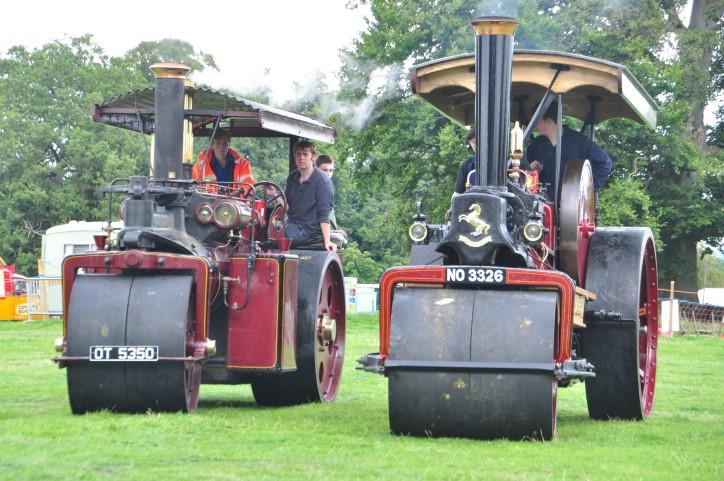
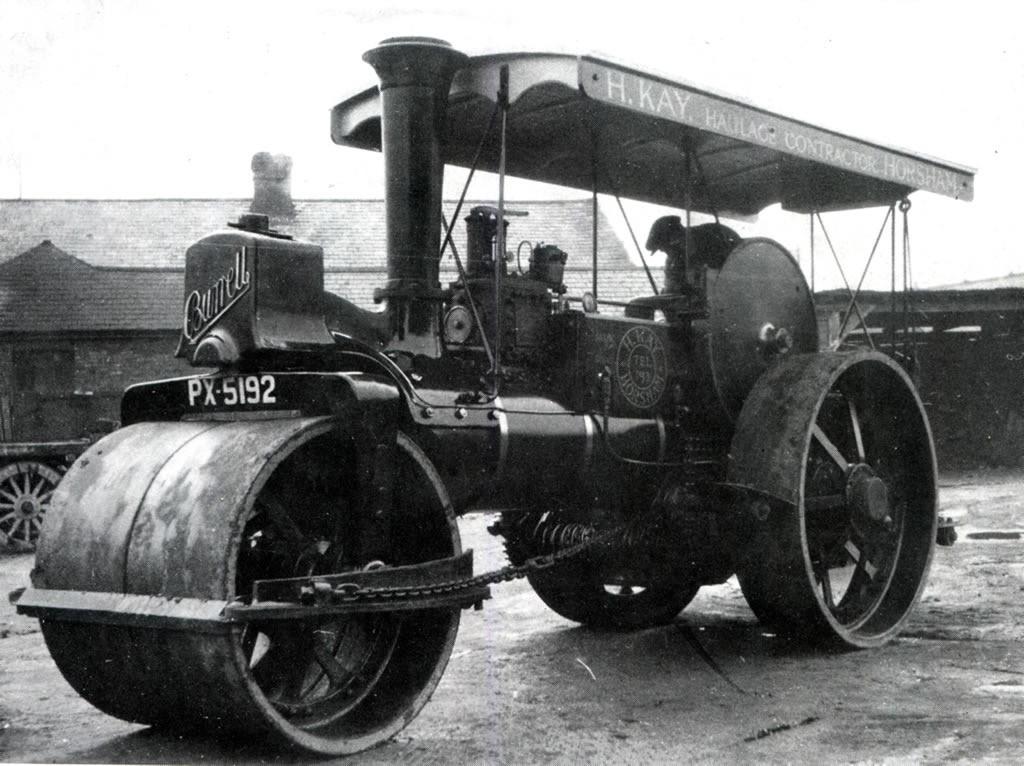
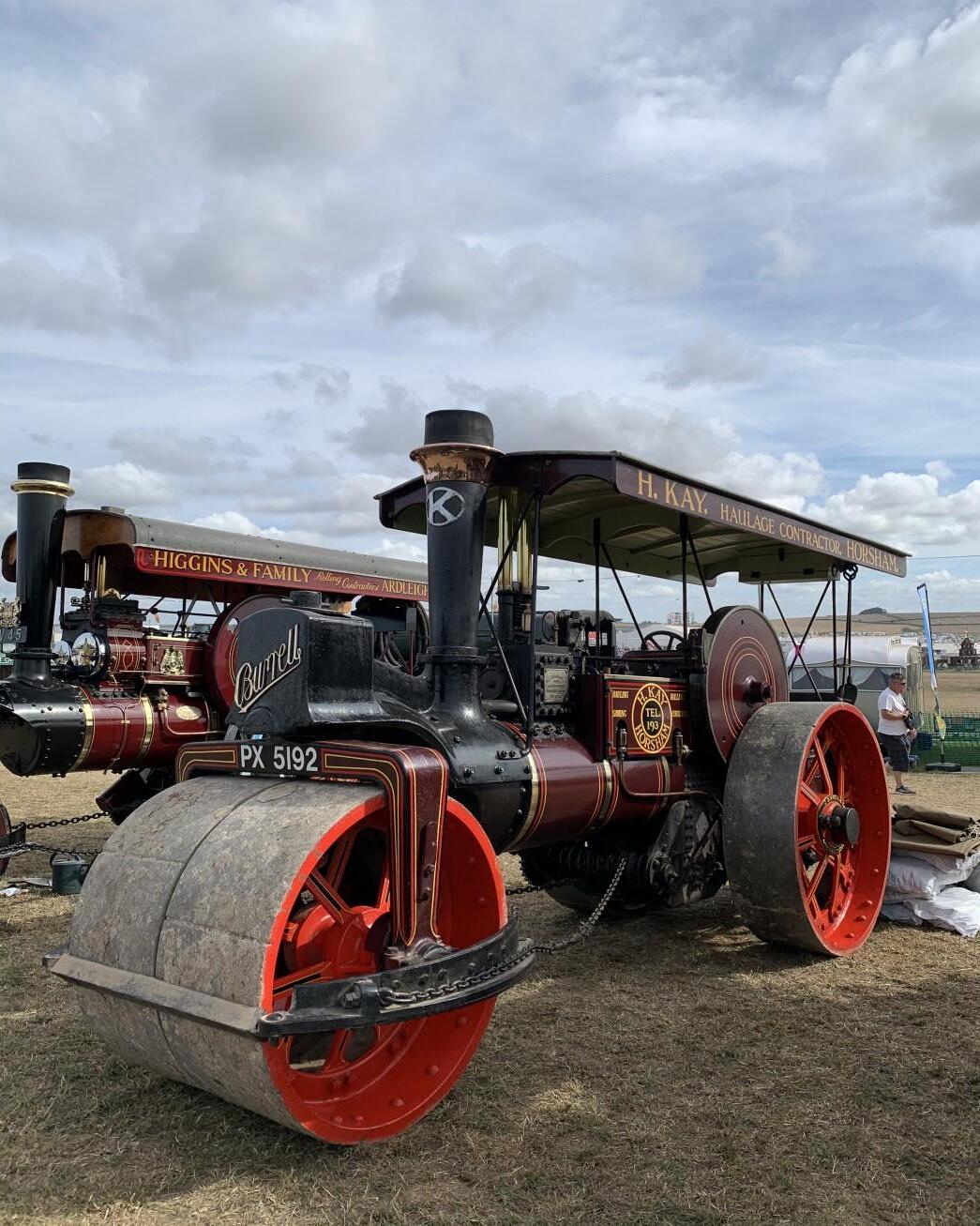
For this editions ‘Then and Now’ we take a look at the Burrell 8 ton steam roller No. 4048 of 1926.
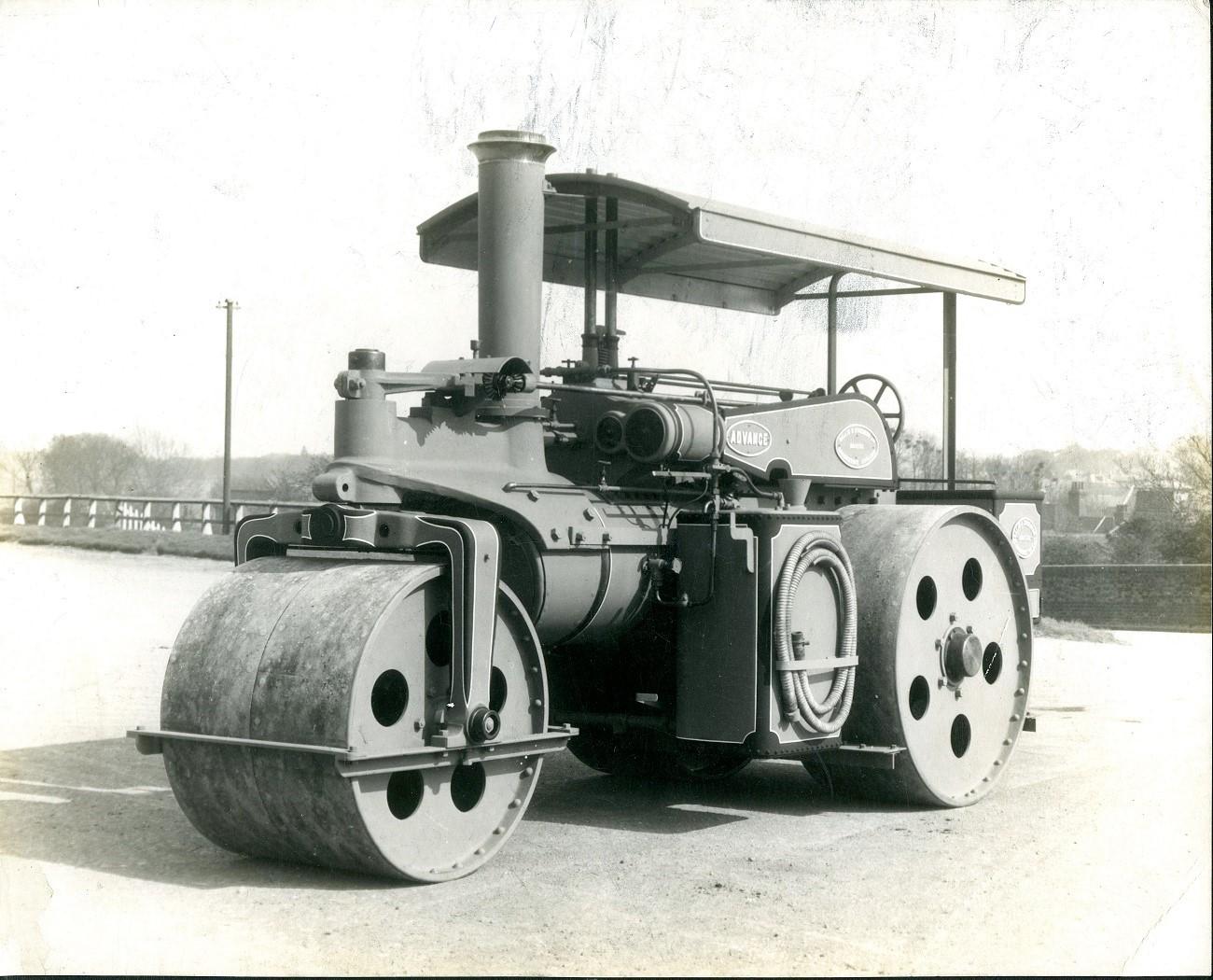
Then: No. 4058 when owned by H. Kay of Horsham, Sussex. Photographed in their yard.
Now: No. 4058 at the 2022 GDSF. She now lives back in Horsham.
Competition
Thankyou to those who got in touch to guess what the photo was in the last edition, we had two correct answers this time, from Bradley Butcher and Kieran Ford.
The extra dynamo is called the exciter dynamo and is driven off of the main dynamo on the front of the showman's engine. It is used to excite the field coils on the main dynamo to allow a smooth start to the ride. They were used on the large ‘scenic’ rides that required large starting currents. Without the exciter dynamo, these rides often caused belts to be thrown from the flywheel. A showman’s engine fitted with an exciter is called a scenic showman’s engine.
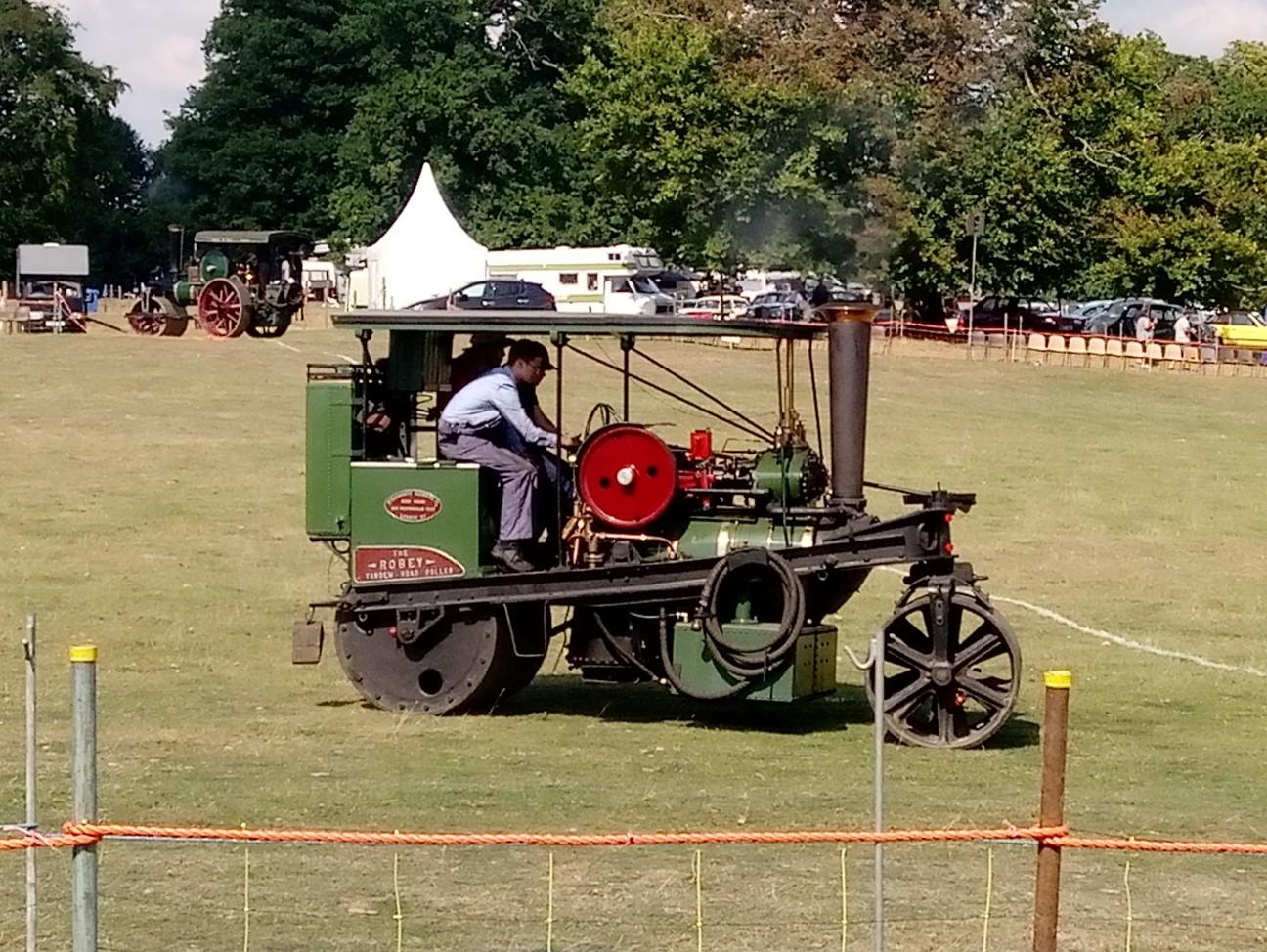
For this edition’s question, can anyone tell me why the Wallis & Steevens ‘Advance’ roller shown below wasn’t fitted with a flywheel as per most other steam rollers?
Send in your guesses or answers to sac.raisingsteam@ntet.co.uk and we’ll publish the correct answer in the next edition of Raising Steam.
Code of Conduct
Keeping everyone safe on a rally field (grown ups this means you too)
Now that the events season is nearly starting we thought it would be useful for everyone to be reminded of how to keep EVERYONE safe when we are at a Steam Apprentice Club driving event – or at any other event where we get to be hands on with an engine.
We are very proud of our apprentices that get to experience hands on working with an engine and we work hard to make these opportunities happen! This means that we must be safe and remember to make people proud to be associated with the Steam Apprentice Club.
It only takes one Steam Apprentice to do something silly or dangerous for Engine Owners to decide that they don’t want to allow young people to go on engines and stop offering their vehicles to driving events. Every engine our apprentices get to go on at an event is volunteered by its owner and crew and we are very lucky that many give their time so willingly.
With Facebook and Twitter news of bad behaviour will spread very quickly and affect EVERY driving day.
Of course we are not just concerned about the behaviour of Apprentices – but
also the engine crews as well!
As enthusiasts we must do everything we can to protect each other.
If you are at an event and see something that you do not think is right and could be dangerous – don’t be scared and tell the rally organiser right away!
Apprentices
• Dress safely
• Ask if you are not sure about something
• Be polite and respectful to both then engine crew and their machine
• Always be sensible when walking around moving vehicles
• Have a great time and remember to say thank you when you finish!
Crews
• It is not your responsibility to physically help a person on to or off an engine. Give advice on where to stand or what to hold on to but it is up to the Apprentice (and their adult) to safely climb on to your engine.
• You have the right to stop immediately, and ask any Apprentice misbehaving or acting unsafely to leave your engine or workspace and return to their responsible adult. You have given your time and
equipment willingly and we realise that as Apprentices we must respect both them and your crew.
Responsible Adults
• It is your responsibility to help your apprentice climb on and off an engine.
Listen carefully to the engine crew as they will give you instructions on how to so safely.
• Do not leave the area where your Apprentice is on an engine or attending a session (i.e. instructional workshops or story time). In the event of a mechanical
or medical emergency you will be required so quickly escort your Apprentice to safety. Unattended children will be removed from the activity and taken to the lost child points for their own safety.
• You are responsible for the behaviour of your Apprentice at all times.
• Please ask before you take photographs of your Apprentice on the engine: some crews are very shy. Others might show you where to stand for a better photograph!
Bursaries
The National Traction Engine Trust encourages and supports road steam by offering financial assistance and bursaries (maximum £500) for those who would like to improve their knowledge and skills so they can help and take part in maintain steam on the road.
These skills can include but are not limited to:
•Boiler maintenance
•Boiler management
•Boiler Inspection
•Signwriting
•Welding
•Fabricating
Lathe and millwork
The list is not exhaustive and any application will be considered which shows that it informs and educates about road steam as described in the NTET mission statement:
“Preserving our heritage with Steam on the Road”
Look in the heritage journals and prospectuses of colleges and schools for suitable courses. Approach people who already have a skill you are interested in to see if they would be willing to share their knowledge then fill out the application form with all the details. An application form can be found by going to:
www.ntet.co.uk/heritageeducation
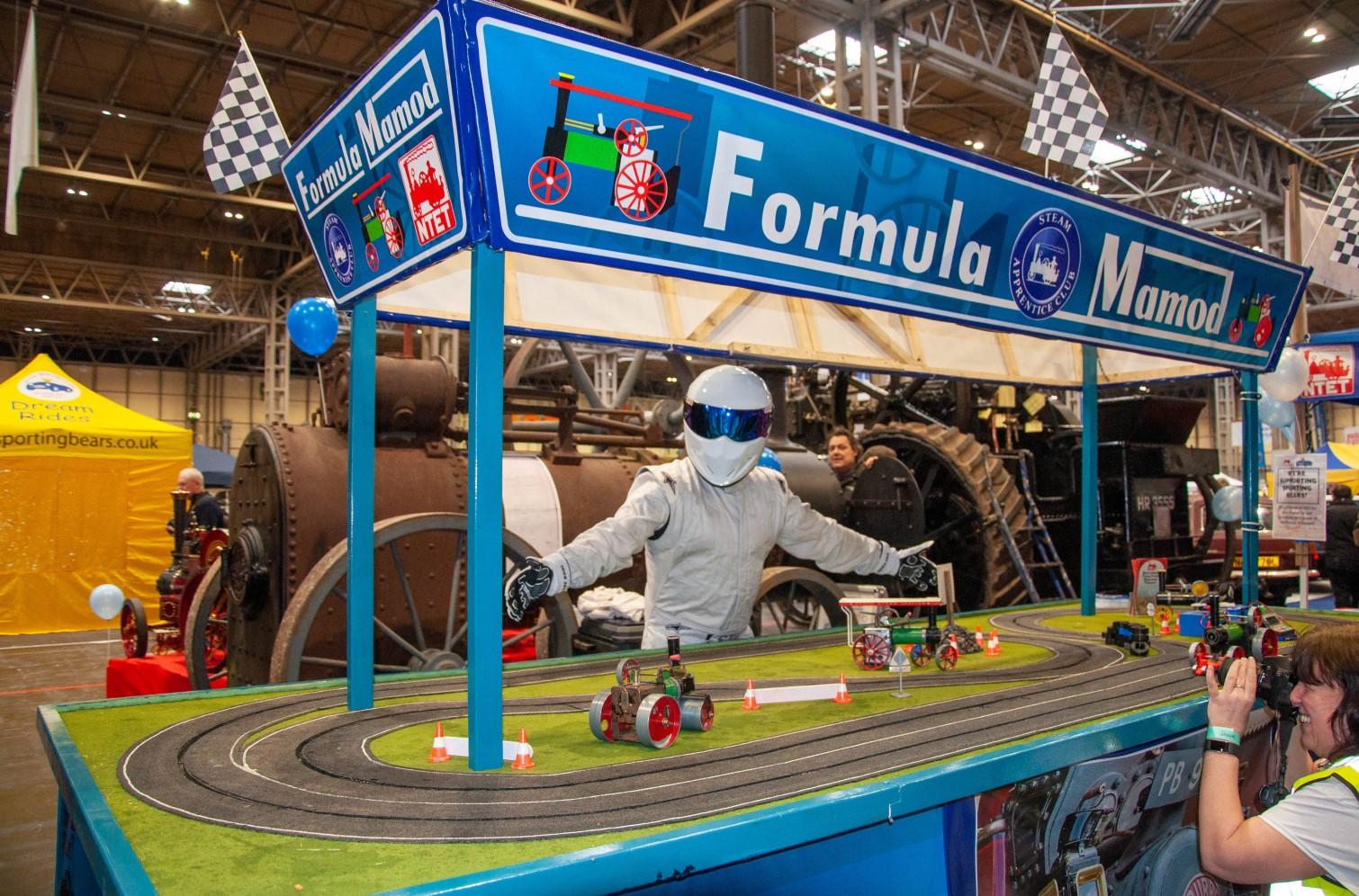
Formula Mamod
Formula Mamod gives members the opportunity to test your engine building and driving skills out on the track!
If you have a Mamod and want to modify it to get a faster lap time, remember that:
• The firebox must be standard.
• The safety valve must be standard.
• The fuel burner tray (solid fuel) must be standard.
To ensure a fair competition the SAC provides you with fuel to use a solid fuel burner tray if you don’t have one.
Don’t worry if you don’t have a Mamod as we have been donated standard engines for you to use.
A member of the team will inspect vehicles prior to their racing to make sure they’re safe to use (just like all race cars) and help you set yours up if you are not sure how to.
Remember that Formula Mamod is only for SAC and NTET members so if you have a friend who wants to join in, make sure they are signed up!
We’ll have to wait and see which rallies happen to know if Formula Mamod will be out and about this year, but if we do then with all the time you’ve had to modify and fettle your Mamods in lockdown, we’re expecting to see some very quick times!
Over 18? Nearly 21?
Older Members of Steam Apprentice Club will be delighted to know that from the age of 18 you can receive FREE copies of the National Traction Engine Trust (NTET) quarterly magazine STEAMING.
Once you turn 21 you are eligible to join the NTET for the reduced rate of £15 for your first year: the same you currently pay for your SAC membership!
If you could like to take up either of these offers just contact Clara.
Email: membership@ntet.co.uk
Richard Semple, NTET Membership
Linden Lea, Lydham
Bishops Castle, Shropshire
SY9 5HB
You do not need to be an owner or driver of an engine to be a member of the NTET.
As a member you will receive STEAMING magazine, the quarterly publication. It provides communication from the trust to its members, technical topics, historical articles and photos, information on events and engines around the U.K. as well as free classified adverts available to members.
You will be able to vote at the Annual General Meeting and stand to be part of the committee of volunteers.
The NTET produce an extensive rally list, detailing all NTET authorised events across the U.K. This is issued at the beginning of each year NTET authorised events have paid a small fee and agree to abide by the Rally Organisers Code of Practice, as produced by the Rally Organisers section of the NTET, which if followed ensures a safe and trouble free event.
About the NTET
The National Traction Engine Trust represents owners and enthusiasts alike and is pleased to be regarded as the World’s Premier Steam Traction Preservation Organisation.
Now in its 67th year the NTET aspires to be the Organisation of Choice for the vintage steam enthusiast, engine owner or driver and events organiser working together to meet a common aim:
Preserving our Heritage in Steam on the Road.
The main aims of the NTET are to:
• Encourage ownership and preservation of all forms of steam powered equipment.
• Set and maintain standards in equipment management and operation.
• Provide facilities to teach basic skills in engine management.
• Attract junior members via the Steam Apprentice Club.
• Set and monitor safety and operating standards in rallies and event organisation.
• Secure insurance and other related services for the benefit of members and rally organisers.
• Support the maintenance of records of engine manufacturers, design, livery and colour schemes, history and ownership.
• Administer a ‘rare spares and patterns’ register.
• Monitor and manage the introduction of legislation as it effects the movement.
• Administer a world wide club membership scheme.
• Communicate with members, clubs, organisations via the quarterly magazine STEAMING.
• Affiliate with similar bodies in the UK and World Wide.
• Promote the production and distribution of books, videos, tapes and other related memorabilia.
About the SAC
The Steam Apprentice Club (SAC) is a dedicated club for everyone aged under 21 who has an interest in steam.
Formed 41 years ago 1979, our slogan is ‘The Future Driving the Past’. We firmly believe our members are THE FUTURE and what can be more fun than DRIVING a traction engine: some of which are over 100 years old and are an important link to our industrial and engineering PAST.
Who can be a member?
You don’t have to own a traction engine or even have a traction engine in your family to be a member! Your parents might be members of the NTET or they may not have any interest in steal at all. We don’t mind if you work on an engine every weekend or if you’ve never been on an engine before.
All we ask is that you are interested in traction engine! It could be that you enjoy taking photographs at rallies, or that you want to learn more about the technical side of driving or even how to build an engine yourself. Simple really. Everyone is welcome to join us up until their 21st birthday - after that we encourage you to join the NTET (which is why after the age of 18 years you can ask to receive FREE copies of the NTET quarterly magazine STEAMING).