Lisa Crankshaw, NTET Membership PO Box 10348 Hinckley LE10 9FB membership@ntet.co.uk
Membership fee £15 per annum
SAC Committee
Rebecca Hurley (Derby) sac.publicity@ntet.co.uk
Nitck Bosworth (Derby) sac.webmaster@ntet.co.uk
Matthew Lund (Southampton) Tel: 01329 832462 sac.contact3@ntet.co.uk
Helen & Julian Tyrrell (Wiltshire) Tel: 01793 751830 sac.contact2@ntet.co.uk sac.contact6@ntet.co.uk
Glen Prince (Essex) sac.contact5@ntet.co.uk
Clara Taylor (Sheffield) sac.contact7@ntet.co.uk
Adam Brown (East Anglia) sac.contact8@ntet.co.uk
Keith Allen (Somerset) sac.contact4@ntet.co.uk
Driving Days Coordinator
Linda Allen (Somerset) sac.drivingdays@ntet.co.uk
The Editor welcomes any contributions of articles, shorter items or photographs for inclusion in future issues. All material submitted is voluntary and payment cannot be made for any material published. The opinions expressed in the magazine, with the exception of Club announcements, are those of the contributors and do not indicate the views of the Club as a whole. All items are held copyright by the contributor and the NTET. The Editor reserves the right to amend or refuse contributions. The magazine is normally published during January, April, July and October. The Club accepts no liability for failure to meet intended publication dates.
The Steam Apprentice Club is a section of the National Traction Engine Trust.
N TET is a Registered Charity, No. 291578. Registered in England No. 1302197. Registered Office: 4 Church Green East, Redditch, Worcestershire B98 8BT.
www.ntet.co.uk general.secretary@ntet.co.uk
SAC Editor - Kevin Munn
Here is your January issue of Raising Steam. You may have noticed this issue is bigger than you have received in the past. It does look as though we got a bit carried away, maybe this is a result of the festive pudding we had. In this issue you will see the usual articles, pictures, news and upcoming events. However this time you will also see activities and news about who we are and what we do for our apprentices. We certainly hope you enjoy this quarter’s issue!
In this winter season, many engines have been put to bed, including my own Aveling and Porter steam roller.
Putting an engine to bed is a rather dirty process and it’s all part of the fun when you are involved with steam engines. I however, won’t be going to bed for the winter, I will be far too busy with the many maintenance jobs that needs sorting.
What have you all been up to this winter? We would like to hear from you, tell us what you have been up to; send us some words and/or pictures. We would like to include them in the next issue!
Kevin Munn
Do you enjoy the Raising Steam magazine every quarter? Is there anything you would like to see? Do you have anything you would like to contribute? Never forget, this magazine is made for you, and it would be great to hear from you. You could send us a whole range of things, from articles, photos, drawings, questions and letters that can be printed in these pages to ideas of what you would like to see from us in the future. There is no contribution too small! All you have to do is email our editor at; sac.raisingsteam@ntet.co.uk
2018 Bumper Edition
Welcome to the Steam Apprentice Club!
If you are new to the Club, here’s a little bit about the SAC.
The Steam Apprentice Club: Who we are and what we do.
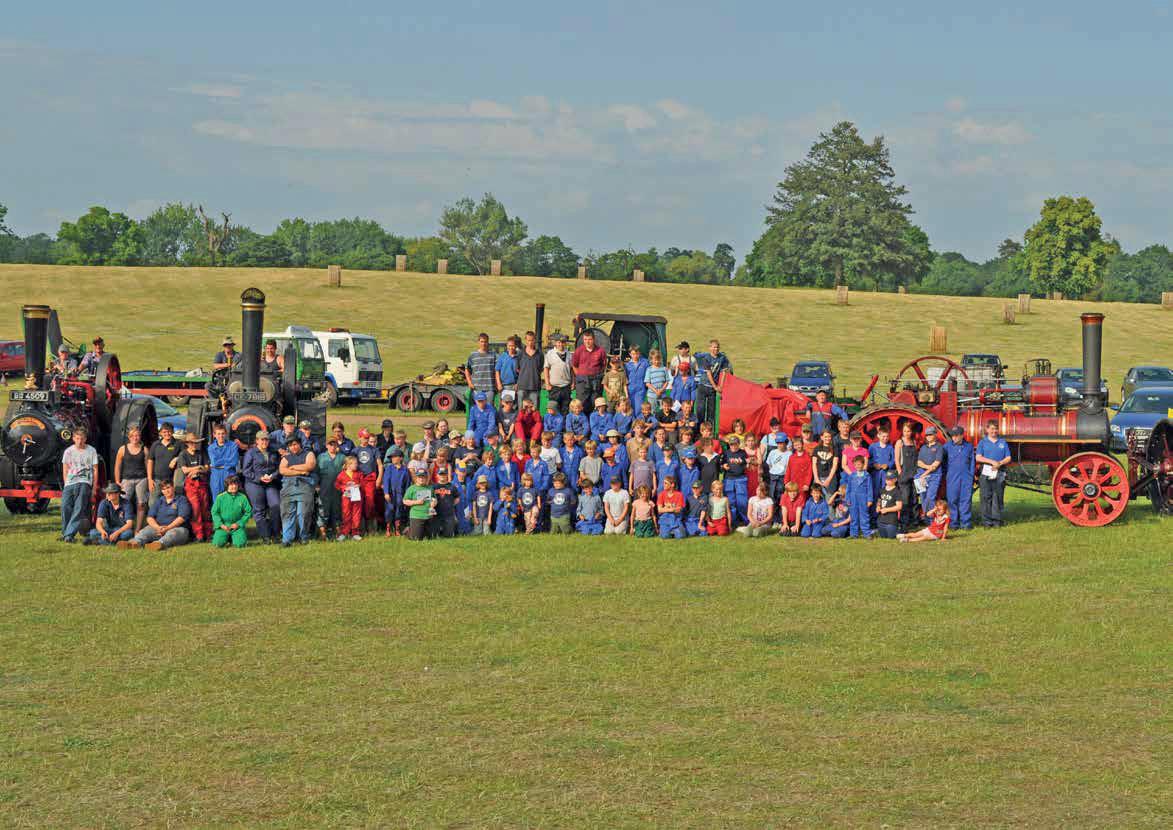
The Steam Apprentice Club (often known as The SAC) is a dedicated club for under 21 year olds. We were formed almost 40 years ago in 1979 by the National Traction Engine Club (now the National Traction Engine Trust: often known as The NTET) to help support younger people interested in road steam engines. Our slogan is ‘The Future driving the Past’. We firmly believe our members are THE FUTURE and what can be more fun than DRIVING a traction engine: some of which are over 100 years old and definitely an important link to our industrial and engineering PAST.
Who can be a member?
Many people don’t realise that you don’t have to own a traction engine or even have a traction engine in your family to be a member! Your parents might be members of the NTET or they may not have any interest in steam at all.
We don’t mind if you work on an engine every weekend, or if you’ve never even been on the footplate of an engine before. All we ask is that you are interested in traction engines! It could be that you enjoy taking photographs at rallies, or that you want to learn more about the technical side of driving or even how to build an engine yourself.
Simple really.
Everyone is welcome to join us up until their 21st birthday - after that we encourage you to join the NTET.
What do you get from being a member?
As well as our quarterly newsletter ‘Raising Steam’ filled with information and news from around the steam world you can access
• Driving Days
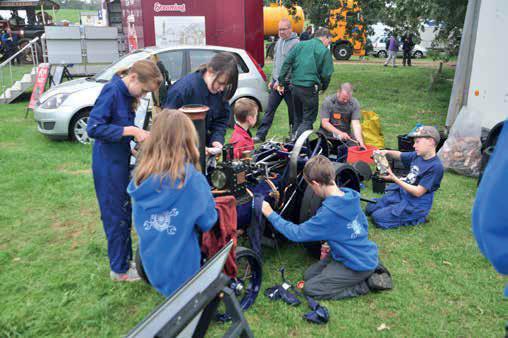
Thanks to local clubs across the country we are able to offer exclusive introductions to driving sessions for SAC Apprentices. Local engine owners and crews bring their own vehicles together to provide a day where you get to be hands on helping light up and drive an engine is a safe location.
•
Driver Training Weekends
Once you turn 13 years and are ready to take the step towards being a fully skilled member of an engine crew we encourage you to join in with our training weekend which takes place on private grounds. The course is a mix of classroom based learning and practical sessions on a large variety of vehicles and takes place over three years.
• Scholarships
We offer a small number of scholarships to help our members who do not have an engine in their family access our driving training course. This covers the cost for a year of the course but we ask our member to cover their own food / travel / accommodation costs.
• Bursaries
It takes a lot of different skills to keep traction engines on the road from boiler maintenance and welding to sign writing and pattern making! We realise that some of our members may need some extra support in accessing the training they need to keep these vital skills alive. With support of the NTET each year we are given the opportunity to offer a number of bursaries of up to £500 of financial assistance to requests that fulfil the mission statement of “Preserving our Heritage with Steam on the Road”.
• Keep in touch
Our social media accounts are packed with fantastic photos and the latest information that we can squeeze into Raising Steam. We use Facebook, Twitter, Instragm, and our website to keep in contact with our members.
• Free entry to selected rallies!
Yes that’s right you could go to a rally for free! Some NTET Authorised rallies
allow Steam Apprentice Club members free entry when they produce their membership card. Do remember to check the website www.ntet.co.uk or the events own website before you travel.
• Hands On Learning
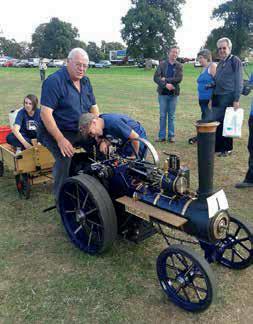
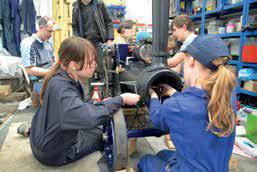
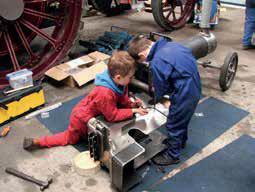
We want to see members getting their hands dirty! That is why as well as our driving experiences we try to offer our members ways to learn through practical experience. It might be a small project you can do at home or you might be part of a bigger team: like the apprentices that built from scratch our very own model Burrell traction engine Lady Sylvia!
Where will you find us?
It varies every year! We do not have a fixed location or building of our own.
Our small team of volunteers travel around the country attending rallies, model exhibitions, museums and country fairs with our pop up information stand to help reach new members as well as giving us a chance to meet up with our current members. But it is much more exciting than that.
Sometimes you will find us with Lady Sylvia: our model traction engine that was built by apprentices and is now used as both an educational display to look at but also a live engine that our apprentices can steam up and drive.
While at an event we may arrange a Mamod race track, story time for younger members, colouring and photography competitions, and even steering experiences on full size engines thanks to the support of their crews. Each event varies.
We are guided by our members telling us what THEY WANT. So if you suggest an idea of things we could be doing you might well find us setting up an event near you. Not all ideas people suggest work: but we are willing to try when we can.
We look forward to hearing from you!
Looking Ahead
Did you know 2019 will be the Steam Apprentice Club’s 40th anniversary and we plan to celebrate in style!
As part of those celebrations we would like to find and talk to some of our former apprentices. We would love to know what they are up to now, are they still involved with steam engines? Do they have their own engine? What are
they up to now?
Do you know any adults who used to be an apprentice? If so, please let them know we would like to hear from them! Let them know they can get in touch with us, through email, our website or Facebook.
Thank you!
A Brief History
Steam engines come in all shapes and sizes; they also had many different jobs. Steam rollers would work hard to make the roads we drive along, as you can probably guess, crane engines were made to lift heavy loads from one place to another and ploughing engines would plough the fields. Road locos, wagons and tractors would often haul heavy loads across the country and traction engines were made to do all sorts of jobs, haulage, belt work (sawing wood/threshing) and many other tasks. All in all, these engines were very useful machines, but they were expensive to run and took a lot of work to keep it running each day and maintained. So when the internal combustion engines started popping up, the power of steam faded away.
Some engines were taken straight into preservation, some were left in
fields and faded into the hedgerows, and many were sent the scrapyard to be cut up. Most of the engines you see around today have been rescued, restored and polished up to make the beautiful machines you see at the rallies. The hobby of steam engines that you see today with steam rallies and games started up in the 1950’s. The most famous steam event was the 1950 Appleford Traction engine race. Now there are lots of rallies and different steam events around the UK and the rest of the world. What is your favourite rally to go to?
Here’s a link to a youtube video of an early rally.
www.youtube.com/watch?v=jDw4VhaE9hE
Meet The Team
The Steam Apprentice Club is run by a dedicated committee. Here’ a little about us all.
President - Elaine Massey
Elaine has been involved with the SAC since 1996, recently becoming club president. Elaine spearheaded the idea of our members building their own miniature, a project which created Lady Sylvia. The Mtassey family are owner’s of Garrett traction engine ‘OLIVE’.
Chairman - David Hurley
I have been involved with steam for just over forty years and it would be fair to say it’s a life long obsession. I joined the Steam Apprentice Club in 1979 and was given the membership number of 125. Along with my family, we have gone on to own two full size engines, a Marshall roller and a portable. I also have a part built 4” Foster in the workshop as a long term project just to keep me busy.
Vice Chair & Editor - Kevin Munn
Vice chairman and Editor of Steaming. Used to work with aeroplanes before becoming hooked on steam engines. Has been a school governor and is interested in children’s education. Has his own steam roller, an Aveling & Porter E type of 1926.
Publicity & Social Media - Rebecca Hurley
I have been involved with road steam for as long as I can remember, I am told my first time on a rollers footplate I was only 2 weeks old! Since then I have grown up surrounded by engines and their crews. My family now own that roller and we travel mostly around the midlands, joining rallies, road runs and other events each year. Although our engine is currently undergoing major repairs, in the form of a new firebox. I have a few jobs in the SAC, managing social media, setting up and organising events such as the NEC & Great Dorset Steam Fair.
Driving Days Coordinator - Linda Allen
Works in a school and has a family who belong to the SAC She has been administering the SAC Driving days for several years.
Website & Magazine Artwork - Nick Bosworth
I have been involved with the SAC for over 10 years, and have been a NTET General Council member for 5.
My family has two engines, Foster TE 14410 ‘SPRIG’ and Garrett 4CD ‘Queen Mary”, both of which I have helped to restore.
Committee Member - Julian Tyrrell
An electronics engineer by profession but with mechanical engineering as a hobby. I have a 4 ½” Burrell Agricultural engine, a Plastows based miniature design dating from 1980, that has been used by the SAC apprentices for many years at both GDSF and the SAC driving days. Currently building a 4” Burrell Road Loco to have a larger engine to play with. To this day he is not quite sure how he became involved with the SAC, but suspects Elaine may be behind this.
Committee Member - Glen Prince
Glen progressed from a 4” Foster miniature to owning his own steam roller, which he is currently restoring. Glen already enrolled his young daughter who is only just toddling. Start them young!
Committee Member - Helen Tyrrell
Helen is a teacher in a senior school with an interest in children’s education.
Her 3 sons have been members of the SAC. She is currently assembling a Lykamobile steam kit car.
Assistant Editor - Clara Taylor
Northern Representative / General Mischief Maker / Chief Tea Drinker I discovered steam engines after visiting a small classic car rally and meeting a friendly crew on a 12 ton Avelling & Porter roller. I soon became their apprentice learning from the crew, and by going on driver training weekend with the NTET how to safely (and enjoyably) operate this magnificent machine. I own several Mamods: but there aren’t any full size engines in my family so I am very lucky that engine owners let me get involved with their engines. It’s not just a fun hobby though: the working knowledge of steam engines once got me a job designing boilers for oil refineries!
Committee Member - Adam Brown
Our most recent addition to the Committee. Located in East Anglia, Vice chair of East Anglian traction Engine society (EATES) Owns a 6 inch Foden wagon and works at Craftmaster Paints.
Committee Member - Matt Lund
I have been involved with the committee since 2003. I got interested in road steam when I was 13. My dad bought me a copy of Old Glory with an article on miniature traction engines. Showing an interest in building my own miniature dad bought me a lathe for Christmas and plans for a 4” scale Ruston and Proctor. This was the first of many miniature engines I have built, the current one being a 4” scale Mclaren road loco. Having a hobby in engineering helped me get an apprenticeship working on aircraft gas turbine engines and I now work on military and civil helicopters. Being a SAC member gave me a chance to crew on full size engines starting with crewing on a Sentinel timber tractor, and a Mclaren 8HP agricultural which I have been with for 14 years.
Commitee Member - Keith Allen
Keith has been on the committe for several years. He can be found helping with Lady Sylvia. He also assists Linda administering the Driving days.
SAC President - Elaine Massey
Happy New Year to everyone!
I have to tell you that I have now handed over the Steam Apprentice Club chair to Dave Hurley.
I have been heavily involved with the SAC since 1996. (I know! Last century!)
At first I innocently volunteered to give a hand at GDSF, where we were camping anyway. Help was greatly appreciated at that time, and it led to helping at other rallies. This was no biggie as my two children were both apprentices so we were going to these anyway. Of course then onto the then very small committee, and working hard to add volunteers, vary activities, and generally
expand the club.
My finest hour, I believe, was coming up with the idea, with Helen Tyrrell, of the apprentices building their own engine. This was of course Lady Sylvia.
My children are all grown up and busy with their own lives. That demonstrates to me just how long I’ve been involved. Its time for me to pass the reins to someone just as committed, but younger, with more energy and new ideas.
I will still be around, with the title “President SAC”.
SAC Chairman - David Hurley
I would like to introduce myself as the new Chairman of the SAC.
Firstly, before I tell you more about myself, I must say an enormous thank you to Elaine Massey for her dedication and years of service to the SAC and I look forward to working with her as the new President. She may have stepped down from the chair but we’re not letting her escape that easily.
I was a member of the Steam Apprentice Club back in the late 1970’s which seems a very long time ago! I, like many of you, had a great interest in steam engines but my family did not have an engine. My membership number was 125 and my son now has that number.
The first engine I went on was a Clayton & Shuttleworth called Enterprise which at the time belonged to the Beeby family of Rempstone. It is something I will never forget and will always remain one of my favourite engines.
I later became the Steam Apprentice for Mr P P Wood of Old Sawley, Long Eaton on his Marshall Steam roller, an engine I am now lucky enough to own today.
During the early 1990’s I was the editor of Raising Steam and part of the SAC Committee. The SAC has given me so much and now I want to work with the team, to help all of you further your enjoyment of steam. Perhaps, hopefully some of you will be inspired to keep the SAC moving forward by joining us on the Committee.
We will be publishing details of the places we are visiting, hoping to reach as many of you as we can with Justin Steam and Lady Sylvia. If you are attending an event where we are, please come and say hello and tell us what you would like the SAC to be able to do for you.
I look forward to meeting you.
David Hurley
NTET Chairman - Anthony Coulls
Welcome to this bumper edition of Raising Steam, some of you will already be members of a number of years, for some of you this will be the first copy you ever see - hopefully you’ll all enjoy it! The Steam Apprentice Club is nearly 40 years old - that’s quite an achievement, and the National Traction Engine Trust, the parent organisation is over 60.
Thirty years ago, in 1988, I joined the Steam Apprentice Club, not really thinking that I’d end up as Chairman of the NTET and that my own daughter,
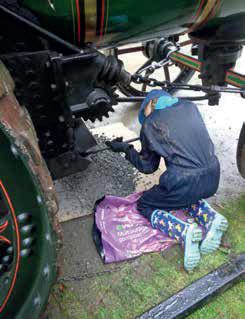
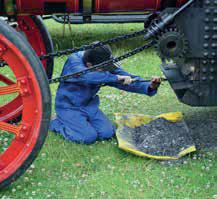
SAC Member Charlotte Coulls emptying the ashpan of the Marshall engine she and her family look after on Steam it Sunday in 2017
Charlotte, would end up joining the SAC herself too. That’s what’s possible if you join the SAC. I wanted to join the NTET, but found that the SAC existed for younger people. I asked for details, sent off my money and then stayed until I was old enough to make the transfer over to the NTET when I hit 21.
I enjoyed visits, events at Dorset and Raising Steam - though I don’t remember the magazine was called that at first. We didn’t have driving days near where I lived then, but coverage has grown throughout the country as the Club has grown. In 2018 I’d like to make it far more National in terms of where we go and what we do. Watch this space, but things will happen, especially as I live in County Durham, which is the far north to many!
We now have photographic, colouring and model making competitions and a very active membership. We have annual awards for apprentices and their achievements which are always really good to see.
Recently our mascot “Justin Steam” joined us and is already being seen up and down the country, showing his activities on Facebook and Twitter too.
The Club owns a Four inch scale Burrell model engine “Lady Sylvia”, named after one of our founders, Sylvia Dudley. She was Chairman for part of the time I was a member and whilst no longer
able to be active, she follows our activities with interest. There’s a lot going on, and a lot more planned.
You don’t have to be involved with an engine, or own one to be part of the Club, just have an interest in engines. We can help with driving days, or simply talking Mamod models - which is where a lot of big engine owners started to be honest. It’s all part of the fun - and you get to learn new things, new skills and make new friends. The Steam Apprentice Club is for all of you and I hope you will enjoy your time as members, and maybe decide to then follow into the National Traction Engine Trust when the time comes.
Perhaps you too may be Chairman one day?
Anthony Coulls, NTET Chairman
McLaren Road Locomotive “Gigantic” seen at Beamish museum in 2016.
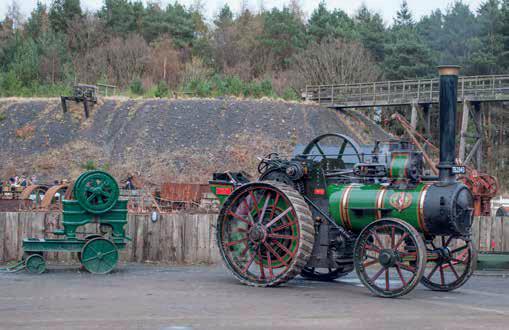
Burrell General Purpose Traction Engine “The Duke of Ongar”, again seen at Beamish museum in 2016.
Steam Profile - Anthony Coulls
Our new Steam Profiles section lets you get to know some of the BIG people in the world of steam.
Our first Steam Profile of of Anthony Coulls, chairman of the National Traction Engine Trust.
We asked Anthony 12 questions about his life in the world of Steam.
1. Tell us about your favourite engine
I have a number! These days, it happens to be the one I’m on, but I’m especially fond of Ransomes agricultural “The Countryman”, Marshall tractor “Jingling Geordie” and the big Aveling roller that our family have looked after since 2003.
2. What was the first engine you went on and can you remember where?
The first one I remember driving was a Marshall Universal roller belonging to Steve Hill of Soilhull, I would have been 8 and it was at the Town & Country Festival at Stoneleigh in Warwickshire where Dad used to do the commentary for the traction engine section. At the same time, I had a steer of Jack Marshall’s Ransomes “The Countryman”, which seemed a lot harder work!
3. What got you interested in steam engines and how old were you?
They’ve always been part of my life, road, rail, stationary – so I was never pushed into the interest, but it just sort of happened!
4. What do you do for a living?
I’m a museum curator – I look after, research and write about old and interesting things
5. Who’s your steam hero?
All the people who taught me about engines when I was younger and encouraged my interest. People like Trevor Daw, Dick Blenkinsop, Jack Marshall, Arthur & Hylbert Smith (who used to own Nero) and Doug Smith.
6. Has being involved with steam engines ever helped you get a job or into university/college?
Yes, it’s a unique interest which brings out a lot of different experiences and contacts.
7. Do you have a Mamod?
Yes, though I started with a Wilesco roller in 1984, the Mamod didn’t come until I won one in a raffle in 2000!
8. What is one thing on your bucket list?
To take our roller back to Northumberland where she used to work and recreate the only working day photo we have of her.
9. Do you have any other hobbies?
Miniature railways, watercolour painting, music and spending time with my young family
10. Describe the steam engine hobby in three words
Fun, friendly and special
11. If you had access to a time machine – Where would you go?
I’d go back to Fowler’s works in Leeds around 1920 and watch the construction of some of the finest engines ever to grace Britain’s roads and fields. Then after seeing a road loco being built, I’d love to go with Alf Pepper and deliver it to its customer. If I were allowed another go, I’d pop to the 1950s with a wadge of cash and save some of the engines that never made it into preservation.
12. Tell us your favourite (steam engine related) joke
I tried to make a joke about a traction engine but I ran out of steam…
SAC Driving Days 2018
Location Date Leader
Horsham 31st March Dee Searle
Fengate Farm, Weeting, Suffolk. 7th & 8th April Richard Parrott
Comments
After a year off, the Searle family are back with another driving day.
St Albans 21st July Tim Watson
Mr Parrott has a collection of 4 or 5 engines with others also on site. Again they are running over two days. Camping/caravanning space is available.
Held an event two years ago which was well liked. All weather course.
Two SEPARATE days as demand was high.
St Albans 22nd July Tim Watson
Stithians (Sat) Cornwall 5th May John Sawle Being run on the showground at Stithians. Two SEPARATE days run by the WESES as demand last year was high.
Stithians (Sun) Cornwall 6th May John Sawle
See special applying instructions on application form.
County of Salop 25th Aug Doug Milns Being run on the Saturday before the County of Salop Rally.
Tinkers Park Sussex 22nd Sep Adrian Vaughan
Well established now at Tinkers Park set in East Sussex own roadway so can operate in all weathers
Leeds TBC Ollie Maslin On the Otley Vintage Vehicle Extravaganza ground near Leeds.
Check SAC website for confirmation of the date of this event.
SAC Driving Days 2018
Happy New Year to you all! I hope you all had a wonderful time, maybe helping out or attending a winter road run or two?
We are lucky that our driving day organisers have said that they are happy to host days again this year. We see the return of the Horsham Driving day, led by the Searle family, and the St Albans driving day returns in place of the Bedford event for this year. An application form is available to download from our website. see www.ntet.co.uk/sac/events.htm or use the QR code opposite As ever, please get your applications for places in as soon as you can. The organisers really appreciate knowing some way in advance how many
apprentices are coming so they are able to accommodate you all safely.
Here’s to an enjoyable year of getting your hands dirty on these amazing machines!
NTET Driver Training Course
The NTET runs a driver training course every year. This year it will be held on the 12th & 13th of May.
The Driver Training Course has 3 elements over 3 years, Foundation, Intermediate and Advanced, and covers many aspects of engine management, maintenance and driving.
We are pleased to announce that it is open to Steam Apprentices who are 13 years or older.
Each level consists of a mix of both theory sessions with our skilled members and plenty of practical time on a selection of steam traction engines.
If you have any questions regarding this event please contact the event organiser, Joe Black, at training@ntet.co.uk
Foundation Day 1
Foundation Day 2
Intermediate Day 1
Intermediate Day 2
Advanced Day 1
Advanced Day 2
Introduction to Traction Engines - Boiler construction and Fittings - Motion work drive train and brakes, lubrication and gland packing, drive an engine, clean the engine.
Light up and steer/drive an engine, engine insurance, engine maintenance, clean engines and help load up.
Light up and drive engine, repacking glands and ring bush renewal, Gauge frames and gauge glasses, Safety valves, cocks and clacks, clean the engine
Washing out and preparation for inspection, low loading demonstration, water pumps and mechanical lubricators, boiler management and combustion, drive an engine, clean engines and help load up.
Light up and drive engine, steering chains and maintenance, replacing tubes and stays, injectors, hydraulic testing and valve timing, clean the engine.
Shafts, bearings, axles and wheel bushes, engine insurance, low loader demonstration, boiler management and combustion, drive an engine, clean engines and help load up.
NTET Scholarships
The NTET awards scholarships to the course. The scholarships are open to non-engine owners being members of non-engine owning families, who are members of the NTET or SAC.
Applications including a CV and a statement of why you wish to attend a year of the 3 year Driver Training Course should be submitted by 31st January to the General Secretary of the Trust:
general.secretary@ntet.co.uk
Successful Applicants will be notified by the end of February.
CV should include:-
Name, age, previous experience with steam engines, how you became interested, in traction engines, and any other information that you consider to be relevant to support your application.
NOTE: The Scholarships only cover the Course Fees, NOT incidental Expenses such as travelling, accommodation and food.
NTET Bursaries
The NTET encourages and supports road steam by offering financial assistance and bursaries (maximum £500) for those who would like to improve their knowledge and skills so they can help and take part in maintaining Steam on the Road.
These skills can include but are not limited to:
• Boiler maintenance
• Boiler management
• Boiler inspection
• Signwriting
• Welding
• Fabrication
• Lathe and millwork
• Hand metalwork skills
• Pattern making
The list is not exhaustive and any application will be considered which shows that it informs and educates about road steam as described in the NTET mission statement:
Preserving our Heritage with Steam on the Road
Look in the heritage journals and prospectuses of colleges and schools for suitable courses. Approach people who already have a skill you are interested in to see if they would be willing to share their knowledge - then fill out the application form with all the details.
An application form can be found here by going to www.ntet.co.uk/hertitageeducation
NTET AGM Report
Happy New Year everyone!
We hope that you’ve all had a wonderful break over the Christmas period and are now ready to get those overalls on and get ready for another year of fun and steam. There are lots of jobs that engine crews need to complete over the winter to make sure everything is ready for their first rallies in the summer. You might have heard of something called an AGM – or Annual General Meeting. This is where the volunteers who look after the club come together show the members what has happened over the year. Its not as scary as it sounds! This meeting is there for us to talk about what we did really well last year and what we think we would like to do next year: its just like your parents evening at school where your parents get to talk to your teacher. It is also a chance for members to talk to us: and you’ll be excited to hear we got lots of
suggestions and offers of help for ideas to make 2018 better than ever from members of the NTET.
It is worth remembering that the National Traction Engine Trust and Steam Apprentice Club aren’t two separate clubs and very much work together. To keep it simple we have only reported what was said about the SAC at the meeting. If you would like to receive the full report of the AGM please contact our Chairman (contact details in the front of this magazine). Our report was presented to members by Clara Taylor. What is happening in the Steam Apprentice Club
- We’ve gotten bigger! We welcomed three new volunteers to the committee team (Clara Taylor, David Hurley, and Adam Brown) But also the number of members (that’s you) have gone up too! This is wonderful news and we look forward to seeing even more people join our club.
- We made sure we publicly thanked all of the engine owners, crews, and people who organise our Driving Day events throughout the year. These people do a wonderful job – especially for those of us who don’t have our own engines to learn on.
- We explained that we have noticed many of the events we go too are in the South of England. We are going
to try to make sure that we travel across the entire country so that as many apprentices as possible can get involved.
- We told everyone that next year (2019) is our 40th birthday – although it feels a long way off we asked everyone with ideas of how to celebrate to talk to us
- Because it can be very difficult to write a magazine that is suitable for all of our members (because we have members from 1 year old all the way up to 21 years old) we explained that we had realised we needed to work harder to create something for different age groups. We then introduced Justin Steam our new mascot to everyone and explained how we hoped that he would help us entertain and educate the younger members of our club. He was very well received.
- We described the fun activities we had organised at Great Dorset Steam Fair including the Mamod race track, story time, and hands on technical workshops. It was hard work organising this and we thought that Rebecca Hurley and Matt Shipton had done a really good job.
- As an organisation we think that protecting our apprentices is really important. So we took time to explain that this year we would be concentrating on making sure that all of our paperwork that helps us keep everyone safe (data protection, risk assessments, child protection) are correct. This paperwork isn’t to stop us doing things – that wouldn’t be any
fun. But if we do everything properly we can help make sure people don’t get hurt.
- We even told everyone about our Facebook, Twitter, and Instragm pages, that we use to keep in touch with people in-between copies of Raising Steam. In November there were over 1,500 people following our Facebook page!
So now you, like everyone that listened to me talk, know what we have done in 2017, and what we want to do in the future. See: not scary at all! Clara.
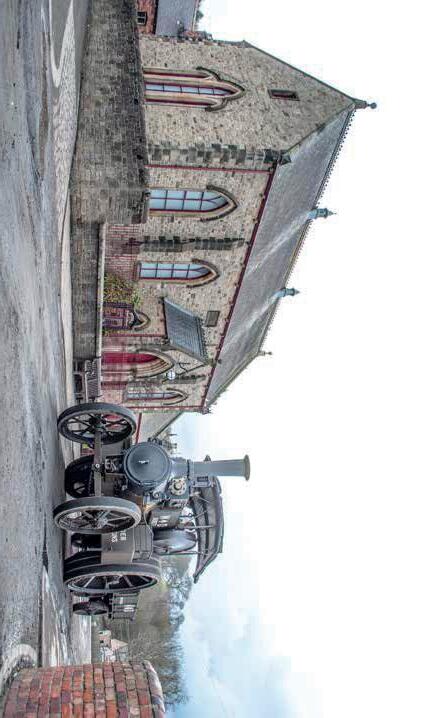
Westonzoyland Pumping Station the day after the NTET AGM.
A Robey portable seen on a visit to
Justin Steam - Keeping the Hobby Safe
Hello Apprentices!
Have you ever looked at the people driving an engine and wondered why they wear all those clothes, even if it is a REALLY hot day? It’s to keep them
1. Flat Cap
safe of course!
Look at my list of everything I need to wear to keep me really safe: and then see if you can draw them on me below so I’m ready to crew on an engine.
If you have long hair you need to make sure it is tied back so that it wont get in the way. A flat cap helps keep your hair safe. We use a flat cap instead of a baseball cap as the material is thick enough that in an emergency we can use it to stop our hands being burnt if we had to touch something hot.
2. Glasses
On some engines dirt and oil can land on your face. If it were to land in your eye this would be really sore: so you might see people wear-ing special glasses to keep their eyes safe.
3. Ear Defenders
BIGGER ENGINES LIKE A PLOUGHING ENGINE CAN BE REALLY LOUD! To protect our ears some people need to use special things to block out some of the noise.
4. Gloves
With the fire roaring parts of the engine can get very hot. So we wear gloves designed to protect us from the heat.
5. Long Sleeves
If a spark jumped out of that fire it might burn our skin. To protect us we always wear long sleeves and NEVER wear shorts.
6. Overalls & Old Clothes
Engines get very dirty and take a lot of cleaning. But when we clean the engines sometimes the dirt lands on us! This is why we always wear old clothes or overalls. Some material can melt if it gets hot: that is why we always wear cotton as it is much safer
7. Leather Boots
Engines are often very big. We need sensible shoes on so that we can climb up safely. But we also need leather boots (like walking boots) so that if our feet got splashed with hot water from the boiler we’d not get hurt.
Sometimes engine drivers have steel caps in their boots to protect them in case they drop something heavy on their toes.
Raising an Apprentice in Steam
How do you start ‘Raising Steam’ apprentices?
Since the age of 18 months Oliver has shown an interest in road steam. We are a family with no links whatsoever in the steam world. We are the least practical parents imaginable and have no idea where this interest has come from. However, the purchase of a DVD from a second hand stall for our 2 year old (because it had an engine on the front) opened a whole new world for us.
The disc turned out to be from the GDSF and became a firm favourite being
watched several times a day (much to my dismay). In 2015 we decided to take Oliver (aged 4) for one day, in 2016 we went for 2 days (and ended up staying for 3) and something that would shape our future happened...
Oliver had joined the SAC during his first visit to Dorset and we had heard about the cavalcade that was planned so the following year we turned up in mixed weather with overalls and a very excited 5 year old and hoped for the best. Unfortunately as the ground was rather slippery the apprentice club could not take part in the ring. Oliver took the
news well and didn’t fuss or complain but it soon became apparent that his silence was a reflection of how deeply disappointed he was. This came as a bit of a surprise to me as I had never seen him completely lock up emotionally before. I went into frantic, enthusiastic mummy mode and packed Oliver and daddy off on several trips in the trailer around the ring whilst I tried to think what to do. I realised that there were also rides available on a steam lorry so the next time Oliver returned I put him and daddy in that queue. All was going well until the steam lorry started having problems. Most people chose to get off and were safely escorted out of the arena but Oliver decided to stay. He watched as various attempts were made to get steam pressure up again and was mesmerised by the work going on in front of him. Whilst I was standing outside the ring watching a gentleman from inside the arena approached me and asked if Oliver was my son. I replied that he was and explained what had happened that afternoon and why we had spent so long on the trailer rides. He asked if he could borrow Oliver for a bit and I agreed. The gentleman promptly waved down an engine, spoke to the driver for a moment and popped him in the coal bunker. Oliver, who up to that point had been a very clingy child and never happy to leave my side, went off happily around the show ring. On his return I was reduced to tears to see that they had him standing in front of them so that he could hold the
steering wheel. We said our thanks and prepared to go but the gentleman’s son ran after us and took us back as he had found another engine... and so our story began.
During December and January Oliver checked the post every day so that he could sign up for a driving day as soon as they were announced. We attended St Stithians on a rainy weekend at the beginning of May. Here we were made to feel welcome and Oliver had a brilliant time. The organisation that had gone into the weekend and the amount of time and effort being freely
given by the engine owners took our breath away. There Oliver had the first entry in his log book. This book, and the comments from the driving days, helped to pave the way for the busiest summer ever. I turned into one of the pushy mothers that I dread meeting, as soon as I saw anyone with an engine I was asking if Oliver could join them. Most owners declined – which I understand completely – I wouldn’t necessarily let an unknown 6 year old near anything I own! However, some welcomed him with open arms and I will always admire them for this. One thing led to another,
once a few owners had given him the chance to join them word started to get around that he was actually okay for a ‘young ‘un’ and worth giving some encouragement. Oliver meanwhile was soaking up information like a sponge. Yes – he is little and so physically some things are impossible (although how he managed to get the 25k sack of coal across the field we will never know) and concentration can wander. He can however explain several things on the GCSE physics syllabus and drive or steer a wide selection of engines with confidence. He can explain the workings of an engine and what is going on behind all the metal sheeting. Perhaps more valuable than any of this though is that he has learned to talk and engage with so many people of a very wide age range, backgrounds and interests, he has learned to deeply respect these people too. His confidence in himself has rocketed, he is content in his own skin – having different hobbies from his friends is not a problem, he is popular (partly because he can now chat to anyone – about anything) and his friends in school are now curious about what he does.
Oliver has developed a real passion for engines. Not necessarily driving –although that is great fun – but for the pure mechanics of it. The steaming up, cleaning out and best of all the problem solving when something is not quite right make his eyes light up.
On a personal note, I have learned to
spend 14 hours a day standing in a muddy field without complaining (much), have driven to parts of Britain I did not know existed and have developed the ability to clean anything with a bottle of Brasso and an old rag. I have met some of the kindest, knowledgeable and interesting people and have gradually begun to realise something that many of the engine owners are well aware of. There is an immense and valuable pool of knowledge and experience out there
but unless children like Oliver become involved this pool will be lost forever – and the lovingly restored engines, a living part of our history will be once again be threatened with the scrapheap. I am proud to be ‘Raising Steam’. The engine owners who’s trust in Oliver has meant more to us than I can express are not only part of a little boy’s life but are instrumental in continuing a part of our history.
Louise Maunder
2018 Calendar
July
7-8
21-22
21-22
27-29
August 23-27
24-26
September
(Derbyshire)
(Suffolk)
Do you like colouring? Here’s the colouring competition page from 2017.
The National Traction Engine Trust
The National Traction Engine Trust represents owners and enthusiasts alike and is pleased to be regarded as the World’s Premier Steam Traction Preservation Organisation.
Established since 1954 the NTET has members of all ages and gender in over 20 countries world wide. The NTET is held in high esteem and is the umbrella organisation for the Steam Traction movement with affiliations held by over 30 organisations in the UK and world wide including the Road Locomotive Society, the Road Roller Association and many regional Clubs and Associations. The NTET is affiliated to the Federation of British Historic Vehicle Clubs.
The NTET aspires to be the Organisation of Choice for the vintage steam enthusiast, engine owner or driver and events organiser working together to meet a common aim, Preserving our Heritage in Steam on the Road.
The main aims of the NTET are to:
• Encourage ownership and preservation of all forms of steam powered equipment.
• Set and maintain standards in equipment management and operation.
• Provide facilities to teach basic skills in engine management.
• Attract junior members via the Steam Apprentice Club.
• Set and monitor safety and operating standards in rallies and event organisation.
• Secure insurance and other related services for the benefit of members and rally organisers.
• Support the maintenance of records of engine manufacturers, design, livery and colour schemes, history and ownership.
• Administer a ‘rare spares and patterns’ register.
• Monitor and manage the introduction of legislation as it effects the movement.
• Administer a world wide club membership scheme.
• Communicate with members, clubs, organisations and the general public via the magazine Steaming.
• Affiliate with similar bodies in the UK and World Wide.
• Promote the production and distribution of books, videos, tapes and other related memorabilia.
STEAMING Magazine
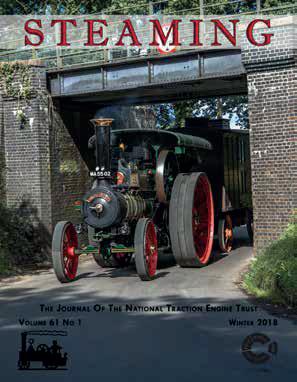
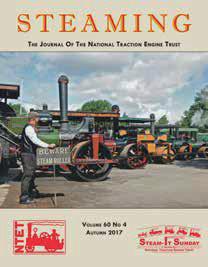
The National Traction Engine Trust produces a quarterly magazine, STEAMING.
Members of the Steam Apprentice Club who are over 18 years old will receive a free copy as well as their copy of Raising Steam.
STEAMING is a high quality, well respected quarterly magazine. Printed in full colour on heavy art paper it is packed with superb pictures both archive and contemporary and plenty of interesting reading too.
Every issue keeps you up to date with activities in the Trust and carries updates on such subjects as insurance and safety.
The popular Steaming Around feature is a digest of steam happenings round the country, much based on reports sent in by members and appearing only in our pages.
These regulars are backed by authoritative deeply researched historical features, lively debates on technical topics and thumbnail sketches of well known and not so well known characters in and around the movement.
Steam-It Sunday
Steam-It Sunday is a national event firmly based on the concept of the Federation of British Historic Vehicle Clubs hugely successful ‘Drive It Day’. The National Traction Engine Trust decided it needed an event where we all try and promote Steam on the road in it’s various forms, through a series of improvised and essentially free events organised at grass roots and local level, as it was done in the early days of the road going steam movement. Thus far we have heard of many gatherings up and down the UK, from Aberdeen to Hampshire and we are delighted with the response to the idea. Be it at local club level, regional society or just one man lighting his engine and going for a trundle the first weekend in October will be alive the sight, sound and smell of engines doing what they do best – being enjoyed.
Whilst in an ideal world we would try and list every individual event being staged, such is the interest it would be a very time consuming and almost impossible task. With this in mind we encourage any enthusiast who wants to know more about local activities to contact their own local or regional preservation group or steam and vintage club, to see what may be happening in your region. We would like to thank everyone who has pledged their support to ‘Steam It Sunday’. As you would expect we hope it will take off and become a free for all annual event for everyone to enjoy and to highlight the fact that we are still able to drive steam driven vehicles of various design on our highways and byways.
Half Price NTET Membership
Are you nearly 21?
If you are, you will be delighted to know that members of the Steam Apprentice Club who reach the age of 21 are eligible to join the NTET for half price for the first year’s membership!
That’s a full NTET membership worth £30 for the same price as your SAC membersip!
If you would like to take up this offer, please contact our memberhip secretary, Lisa Crankshaw, at membership@ntet.co.uk
You do not need to be an owner or driver of an engine to be a member of the NTET. As a member you wil receive Steaming magazine, the quarterly publication. It provides communication from the trust to its members, technical topics, historical articles and photos, information on events and engines around the U.K. as well as free classified adverts available to members.
The NTET produce an extensive rally list, detailing all NTET authorised events across the U.K. This list is distributed with Steaming, at rallies and in hundreds of tourist information centres across the U.K. so as to give maximum support and advertising to the authorised rallies. NTET authorised events have paid a small fee and agree to abide by the Rally Organisers Code of Practice, as produced by the Rally Organisers section of the NTET, which if followed ensures a safe and trouble free event.
An annual Driver Experience course is organised by the Engine Owners Committee and is tailored for beginners, intermediate and advanced students at a reasonable price for anyone over the age of 13. The course covers a range of subjects through technical lectures and practical demonstrations as well as hand on driving experience.
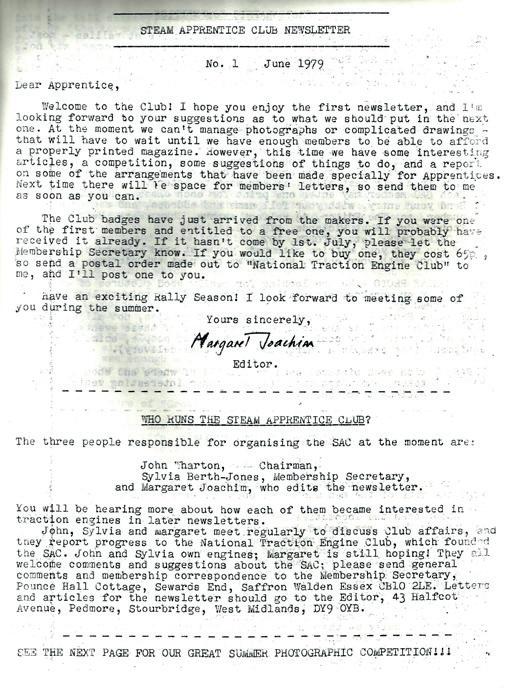
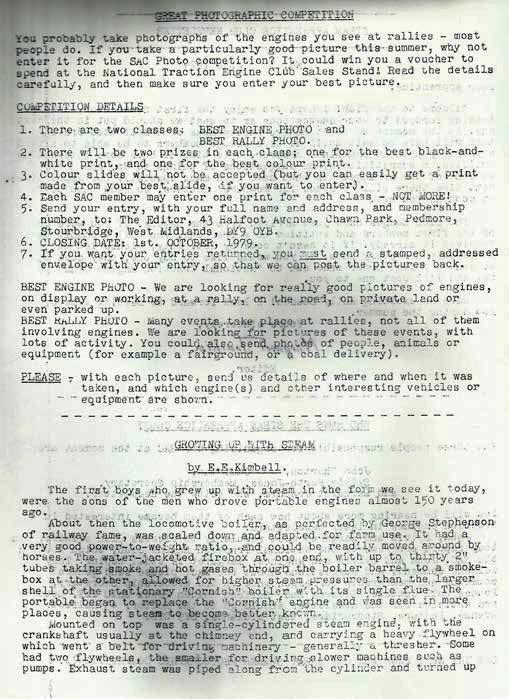
A Blast from the Past
Raising Steam is now in it’s 32nd volume, but before the SAC’s magazine evolved to it’s current form, there were newsletters.
The first newsletter was published in June 1979 and consisted of 5 pages written on a typewriter.
No pictures, no colour, no emais or facebook. A lot has changed in nearly 40 years.
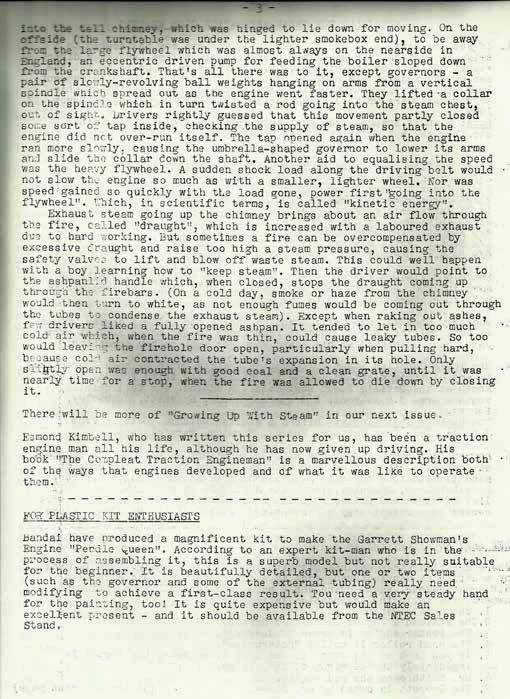
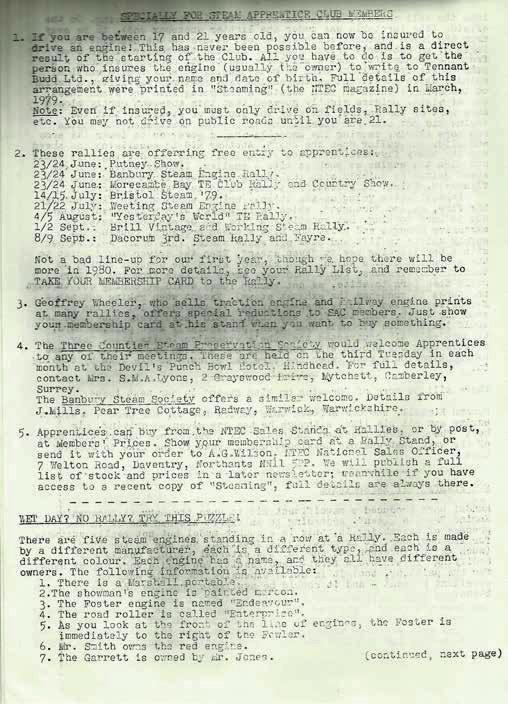
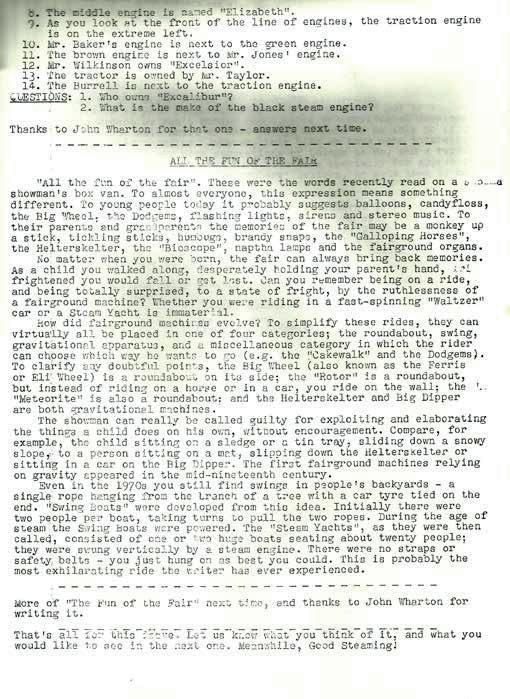
The following 5 pages are a reproduction of the original newsletter, which featured articles, news and a photo competition. Maybe not everything has changed since the beginning..?
Through the efforts of three original committee members, the SAC grew into that we know today.
A Steamy Word Search.
Can you find all the words?
Wordsearch
• AVELING
• BOILER
• ENGINE
• FOWLER • GLAND • OIL • PLUG • PUMP • ROBEY • ROLLER • STEAM • TRACTION • WALLIS • VALVE A D B O I L E R G V E N G I N E G H L A B R O L L E R T A L P J F O W L E R N V S U V M A
SAC Trophies
Every year the SAC awards three trophies at the NTET’s AGM.
These are;
Jack Beeby Cup for Apprentice of the Year
Doc Romanes Trophy
for an individual or organisation who have helped the SAC
Technical Achievement Award
Winners are nominated by Friends, Family and also by the SAC. Details of how to nominate a member of the SAC to receive the trophies can be found on the followng pages.
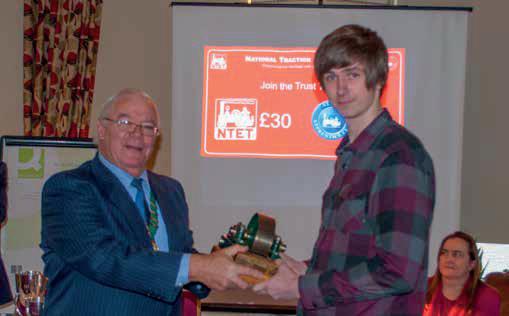
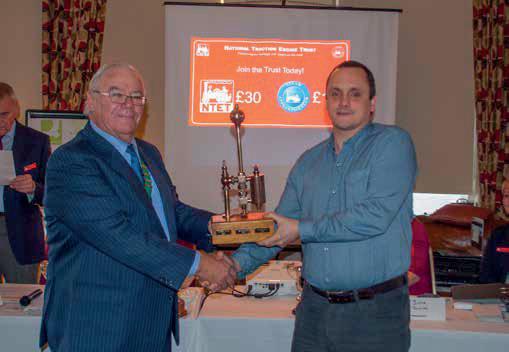
In 2017 the Technical Achievement award was won by Josh Menear, for
his outstanding 3D models of traction engines.
The Doc Romanes Trophy was awarded to Leeds & District Traction Engine Club for their determination and enthusiasm in running a SAC driving day, despite these events being hampered by bad weather in past years.
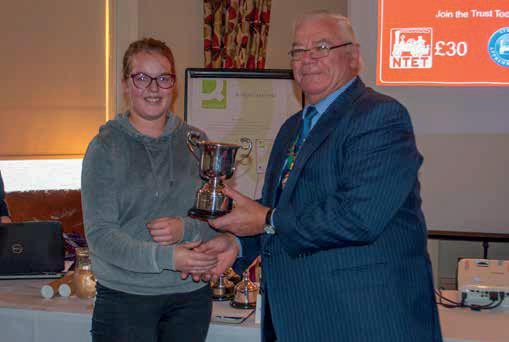
Steam Apprentice of the Year was awarded to Emma Atkins, who started out as a young girl in the coal bunker and has learnt the skills of steering, the basics of boiler management and how to operate the engine on the sawbench. She also oranised a steam event at Abbey Pumping station in Leicestershire, helping to promote our hobby to a wider audience.
Josh Menear - Technical Achievement Award
Emma Atkins - Apprentice of the Year
Andrew Rimington receiving the Doc Romanes Trophy
Technical Achievement Award
Applications are invited for the SAC Technical Achievement award. Areas of achievement may include: engineering work on full size engines, model engineering or any other appropriate steam related subject (bearing in mind that we are essentially a road steam organisation).
The purpose is to encourage young people to develop hands-on experience generally within typical engineering skills. This can be using various machines such as lathes and mills as well as handwork. Nominations to be entered by a sponsor for whom they have been working or have been under the instruction of, or apprentices may enter themselves.
Applications to be received by August 15th should consist of a brief description on one side of A4 paper with 3 or 4 photographs and/ or sketches. See address inside your latest copy of Raising Steam. The
judging committee will then contact the nominator or apprentice by either phone or in person to discuss the application. From these discussions, suitable candidates will be chosen, and final and fully detailed submissions will be invited to be with the Chairman by September 15th.
Judging will be completed by mid October with the announcement of the winner by end of October. The award will be presented at the NTET AGM. Judges will be from members of the SAC Committee plus invited persons from an area appropriate to the subject entered.
Please note that due to the all round experience we are looking for it is unlikely the award will be awarded to an apprentice under 15. Though as we know there is always an exception to the rule, so please don’t hesitate to either enter or contact the Chair for guidance.
If you have someone in mind to nominate, contact sac.publicity@ntet.co.uk
Apprentice Of The Year
This award is to recognise an Apprentice who has shown all round enthusiasm in their involvement with Road Steam. This may be hands-on experience with an engine or helping to maintain or restore an engine. Consideration should be given to how well they have learnt and respected the necessary skills needed in the operation of an engine. There is no particular type of submission we are looking for other than that you feel the Apprentice has made an effort, has learned from what ever activity they are doing and has shown the ability to ‘stay the course’. We would expect that the Apprentice has been working with one engine or group for at least 3 or 4 years. Submissions should consist of a brief
description on one side of A4 paper of what they have been doing and why you think the Apprentice deserves the award, perhaps with 3 or 4 photographs and/or sketches if you feel it will better illustrate the case.
Entries to be with the SAC Chairman by mid September, see address inside your latest copy of Raising Steam or Steaming. Judging will be completed by mid October, with the announcement of the winner to be made at the NTET AGM where the award will be presented.
The final decision on the recipient will be made by the SAC committee.
If you have someone in mind to nominate, contact sac.publicity@ntet.co.uk
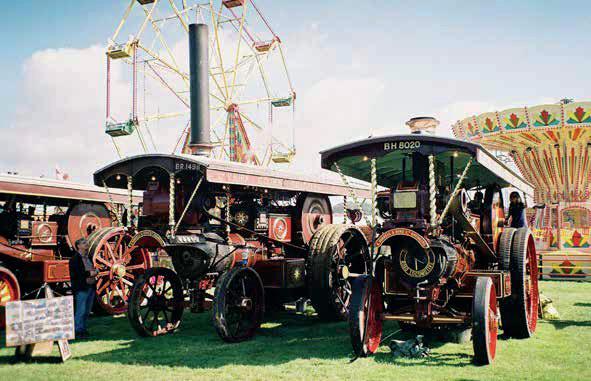
Burrell 6 NHP Road Locomotive
STARLIGHT
Works No. 3836
Built 1920
Registration No. BH 8020
This engine is a fine example of the elegant three-shaft machines made by Charles Burrell & Sons Ltd of Thetford whose design was particularly suitable for three-speed road haulage locomotives. These machines found favour with hauliers of all sorts, especially with those involved in timber and with travelling showmen. This engine worked in both those spheres of activity. The six nominal horse-power Burrell was a particular favourite as it was considerably smaller and handier than the eight horse-power model yet was still capable of hauling loads up to 20 tons and in fairground guise generating enough power to run an adult riding machine.
3836 is unique among the fifteen or so surviving 6 NHP road locos in that it is the only one built on the agricultural boiler which is 6” shorter and 2” fatter (with 5 extra tubes) than the usual road loco arrangement. Although this gave a slightly reduced grate and total heating area the boiler is capable of providing sufficient steam for all but the most extreme work, and the benefits of this boiler arrangement (most notably the additional width on the footplate
increasing the convenience and visibility for both driver and steersman) allied to well-matched gearing make for an all-round better engine than the others.
Starlight was new to a Buckinghamshire timber haulier, but after only two years was sold to S.Darke & Son of Worcester (also timber merchants). In 1934 (after one further timber ownership) the engine was acquired by Bob Edwards, the Swindon showman, and fitted out for fairground work, hauling and driving the firm’s dodgem track (now in the National Fairground Museum at Lifton, Devon) until the war. In 1941 Mr Edwards sold the engine to Fred Darby of Sutton, Cambs. for war work driving a thrashing box, and in 1952 the engine was sold into preservation to George Cushing of Thursford, Norfolk, the founder of the well-known Steam Museum there.
I bought the engine in 1992 and spent nine years giving the machine a thorough overhaul and repaint to recreate closely how the engine looked during the 1930s when with the Edwards concern. The engine only goes out to events where there is a ride for
it to drive, and since 2001 it has been out twenty eight times, travelled over 1000 miles on the road (with two trailers in train) and provided power to seventeen different adult riding machines, sometimes for as long as 10 hours continuously.
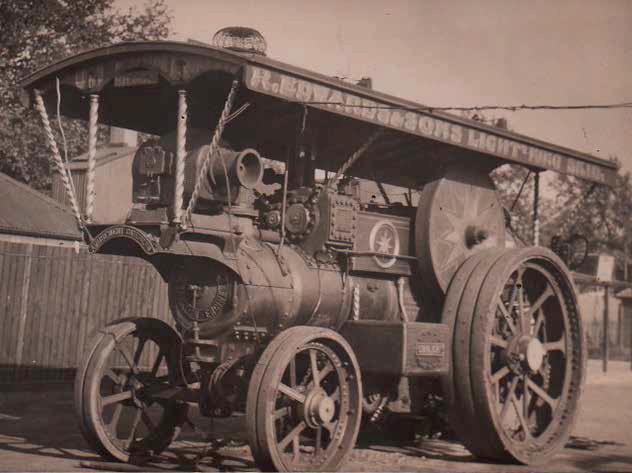
The photo above (by the late Philip Bradley) was taken on Good Friday, April 7th 1939 and shows 3836 on the Fairground at Wormwood Scrubs Common driving the Dodgems for the Easter fair. Bob Edwards bid for positions at two London fairs that Easter, and had to split the fair between the Scrubs and Hampstead Heath.
The Ark and the Dodgems went to Wormwood, while the new Brooklands
Speedway attended Hampstead. This division of the fair meant that the firm was short of generating capacity so they brought Starlight up from Swindon to power the track. By this time all the regular transport for the fair was diesel driven, with a fleet of tractors made by Scammell and Armstrong-Saurer, one of which is seen in the photo.
This is the photograph which I used to interpret all the detail of the flywheel blaze, the cabside legend and the lining on the wheels.
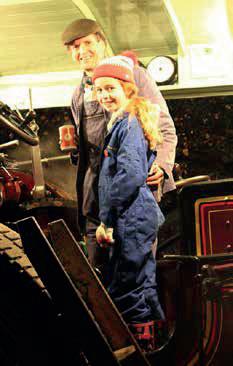
This photograph shows me and my Dad on the footplate of his Burrell. She is called Starlight and is a 6 NHP engine. The picture was taken by my headmaster at my school’s bonfire night. The school has a miniature steam railway of 9 1/2” gauge and it was very busy all evening with two trains running. The trains were always full as everyone wanted a ride! Starlight was working all the time making electricity to light up the tunnel and the second station were the trains stopped. Lots of people were amazed by Starlight as they had never seen anything like it before, and we all enjoyed a lovely night.
Ellie Lloyd 16.12.17
Starlight at Bedford Rally 2015 driving Starmer’s Chairs
Can you unscramble these Steam Engine words?
Lady Sylvia
Did you know the Steam Apprentice Club has its own steam engine?
It’s a four inch scale miniature Burrell traction engine named ‘Lady Sylvia’. Not only does this engine belong to the SAC and our members, but our apprentices actually helped us to build this engine! How?
Well, in 2012 we launched a new project called the ‘Build a Burrell Project’, thanks to the invaluable support given to from our sponsors; we were able to get a kit from a company called Steam Traction World. This provided us with the parts to put
a traction engine together, with all the heavy and more difficult machine work already done.
Our apprentices got to see and handle many of the different parts of this engine, see how where they were supposed to go and fit them together themselves under supervision. This gave our apprentices many opportunities to learn and develop their skills.
Hugh Dyson took on the management of the Build a Burrell project and ran lots of workshop days, some in equipped workshops and some at steam rallies, such as Elvaston Steam
Rally and the Great Dorset Steam Fair. Apprentices could come along and get to work building what was sure to be, a fantastic little traction engine. The project took two years in total, and at the Bedfordshire Steam and Country Fayre, September 2014, the newly completed Burrell Traction Engine was introduced. All our sponsors turned up, alongside apprentices and their parents to see Lady Sylvia unveiled. Although, many of the apprentices had already spent some time with her that day, polishing her up to look her best! Later in the day, after all the special cakes had been eaten, some of the apprentices took her for a drive around a spacious, quiet area. They all had a turn driving and steering, it was such a fun day for all around.
Two weeks later, Lady Sylvia was given the number one spot at the National Traction Engine Trust’s 60th Anniversary Road Run. She, alongside a few apprentice and SAC volunteers, lead the start of this special run around the roads of Bedfordshire.
Now Lady Sylvia tours the country each year, attending different steam events and driving days. When possible, we ask for apprentices to come and help us steam and look after her. She is used to help apprentices learn how engines work, how they need to be cared for and maintained and how to drive a traction engine! Lady Sylvia is one very special engine; don’t forget to keep a look out for her running around!
President of the N.T.E.T Andrew Semple being shown how to operate Lady Sylvia by S.A.C. apprentice Ellis Morris being watched in the background by N.T.E.T Chairman Anthony Coulls (in leather jacket) and the then Chair S.A.C. Elaine Massey at the 60th Anniversary run.
Why the name of Lady Sylvia?
During the building of this lovely little engine, it was decided that it should have a name. After a lot of thinking and a long discussion the name ‘Lady Sylvia’ was chosen.
Lady Sylvia is named after a long serving volunteer of the SAC, Sylvia Dudley. Sylvia was one of our founding members, she was there at the very beginning of our club and helped to build it from the ground up to the club you have today! She has done so much for this club in her many roles, including being Chairman for many years. Sylvia also helped our parent organisation, the National Traction Engine Trust, so we thought naming the new engine ‘Lady Sylvia’ was a perfect was to say thank you for so many years of hard, dedicated work.
Engineering In Miniature
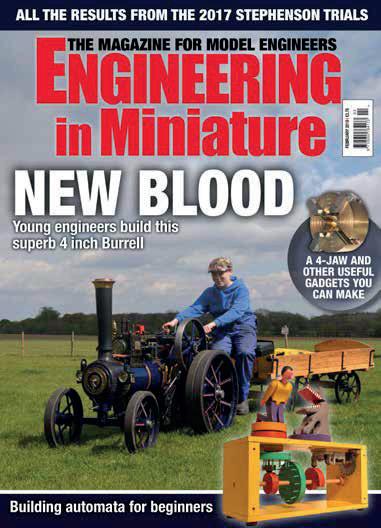
The January edition of the magazine Engineering in Miniature has recently printed a 6 page article about Lady Sylvia. Check out their website or facebook page.
Building Lady Sylvia wouldn’t have been possible withoug the generous help from our sponsors. First and foremost, we have Steam Traction World who provided the kit of parts to build Lady Sylvia, and more recently a replacement perch bracket to replace the damaged original.
The SAC would again like to thank eveyone who has contributed to the building, maintenance and ongoing running of Lady Sylvia.
Wanted
Engine Parts
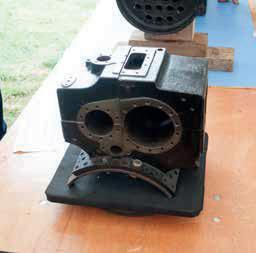
If you have seen us out and about at different shows, you may have seen our 4inch scale sectioned boiler and cylinder block.
These were kindly donated to us by Nick Allen and Brian Wainwright. They have been very useful over the past few years as visual aids, helping our apprentices to understand how these key engine parts work.
However, we would really like to collect some more parts. If you have any spare engines parts you do not need, maybe are too worn or have unfortunately been machined/produced incorrectly and would be willing to donate them to us, we would be extremely grateful. Just get in contact with one of us using the contact details on the front page to discuss this further.
Overalls
As you should be aware, we ask all our apprentice to dress appropriately when on an engine, long sleeves, full length trousers and safety boots. We ask this as a way to keep apprentices protected from sparks and hot pipes.
Sometimes, apprentices turn up without any protective clothing, or have forgotten their overall and have no means to keep their clothes clean from oil and coal dust.
If you have any old pairs of overalls lying around, overalls you no longer need or use, we would love to take them off your hands!
Any donations will be kept for the purposes of apprentices borrowing them as and when needed.
Thank you!
Competition Time
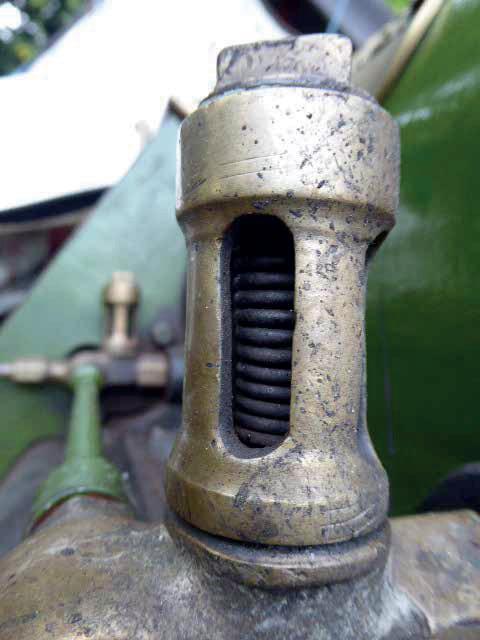
Can you tell us what is in this photograph? What does it do and why is it there?
The winner of this competition will be pulled out at random and will receive a SAC T-shirt.
Let us know your answer by email or post to the Editor. You will find the
details for this in the front of cover of your magazine. All answers must include a name, membership number and email address. The winner will be informed by email.
The closing date for this competition will be 28th February.
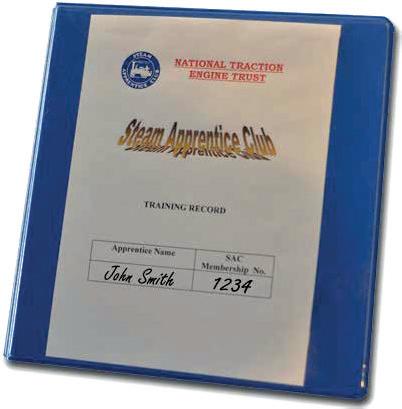
SAC Log Book
The log book is a very important tool for an apprentice.
The purpose of a log book is to keep a record of your experiences with the different steam engines you have helped with.
Then, when you start with a new steam engine, the engine owner/crew can look through your records and get a good understanding of what you can already do, and what new things they should be teaching you.
Though be warned, although the majority of steam engines work in a similar way, just because something happens one way on a certain make of engine it doesn’t necessarily follow it will be the same on another.
Log books can be bought from NTET Sales. Email Kathy Smith at sales@ntet.co.uk for more information.
Technical Challenge
I’ve been thinking of a way for our apprentices to put their skills to the test. To demonstrate how you are able to look at a problem and create something amazing.
I thought about getting you all to sove impossible math challenges or build a fully working pump for transporting safe drinking water from the shore to a ship at sea.
But then I noticed while looking after our Twitter account a similar theme keeps popping up in all of the photographs:
FOOD!
Of course you all know we need food and while technically the human body can in some circumstances last 2 months without food (source: BBC news) even just a weekend would get very unpleasant without a good meal.
Some crews attend rallies with a caravan that boasts all the cooking facilities you might need. But that just doesn’t sound very exciting.
So who instead cooks on their engine?
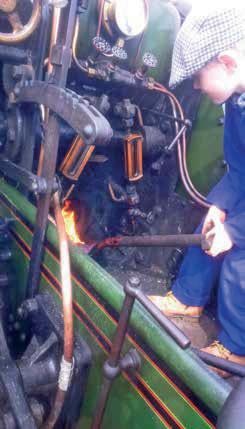
Well this Apprentice managed to get breakfast sorted just fine using a Fowler firebox to provide the heat. (I just hope they cleaned that shovel first!)
This got us thinking.....
What is the most extravagant meal you can cook up on a rally field using only what you have on an engine and in a living van?
Who can bake a loaf in a Burrell? Or Jacket potatoes for six in a Sentinel?
Macaroons on a Miniature?
Get your thinking caps on and aprons at the ready! We want you to come up with ways to use an engine to cook a meal for a crew using only what you might find on an engine and living van. We will be sharing your creations and showing you how we cook over the next few editions of Raising Steam.
Good Luck!
Hello Apprentices!
Bear Learns
This month I have been learning about the different types of traction engines. Did you know that I have found 10 different types of engine that you might see when you go to a rally?
Let me tell you a little about them:
Portable Engine
This engine cannot drive itself along like others so they used to use very strong horse to pull it!
An engine like this would be used to power machines like
• A bench for sawing wood
• A machine to crush stone
Ploughing Engine
A ploughing engine doesn’t go up and down a field like a tractor does but instead you would put a ploughing engine at both ends of the field and they pull on their wire ropes a plough across the field until it is ready to plant seeds in.
Steam Road Roller
These engines have one large metal roller wheel on the front and are used to help make roads: the big wheel can crush rocks and make the road smooth.
Road Locomotive
Road Locomotives are like trains but can go on the road! They can pull lots of goods behind them a long way on special trailers.
Steam Tractor
In 1904 the law said that a vehicle weighing less than 5 ton could be driven by one person: before that a traction engine always needed two people (a driver and steersman).
Steam Tractors were made so that they were light enough to be driven by one person for long distances.
Crane Engine
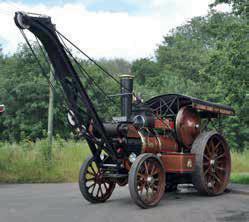
Some Road Locomotives had a special crane fitted to the front to help load their trailers and move very heavy objects likes machinery parts of wood.
Showman’s Engine
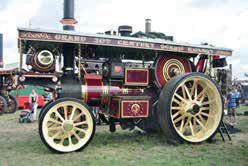
These engines used to power the rides at a fairground: they were even used to pull the rides around the country. These machines often look very beautiful with lots of golden decoration and have a large generator on the front to make the electricity.
Steam Waggon
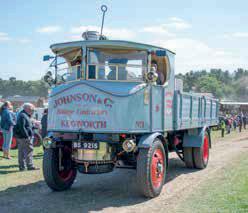
Steam Waggons are like lorries as they are built so that you can put all your goods onto the back without having to use trailer. They can go much faster than other traction engines.
Miniature
A miniature traction engine is a model of a real engine. Sometimes they can be very small and fit in your hand but sometimes they are big enough for adults to ride.
Lady Sylvia is a miniature!
Conversion
Sometimes people take a traction engine that used to be one type and turn it into another.
The engine in this photograph has been turned into a Showman’s Engine but used to be a Road Roller.
Convertible
Some engines were designed by their makers to be convertibles; think like a transformer.
This meant they could be both a road roller and a traction engine by swapping parts very quickly: some could less than half a day! The same engine could be used for hauling large loads in the winter as a traction engine and mending roads as a roller in the summer.
Steam Car
Today almost everyone has a car in their family but when Steam Cars were invented only the very rich could afford them.
All of these engines are very different but used to do some very important jobs that helped people. They played an important job in changing the entire world!
Before steam traction engines lots of things were done using horses and people. It would have been very hard work and took a very long time. I will tell you more about how each different type of jobs these engines did and how they changed the world around us another time.
See you soon!
Do you think they look very safe? They don’t have anyone seat belts!
Justin Steam
Bear’s Spotter Sheet
Now you know all about the different types of engines the next time you go to a steam rally why not use my
handy spotters sheet to see how many different types of engine you can find!
Rally Spotter
Name of the rally
Date I went
My favourite engine was called
Count up all your marks. How many engines did you see?
The Future Driving The Past
Abbey Pumping Station Social Event
S aturday 10 th
G uided t our S
G a M e S & a cti V itie S
Especially for you we have organised a SAC members social event at Abbey Pumping Station in Leicestershire.
Opening at 11am we will have Guided Tours of the museum, Games & Activities and Lady Sylvia in steam.
Entry is free for SAC members, but please remember to bring your membership card with you!
The Cafe will be open serving tea and snacks. You may want to bring along your own packed lunch though.
You can find out more about Abbey Pumping station on their website: www.abbeypumpingstation.org
Keep an eye out on our Facebook page for more details about this exciting event.
Burrell Convertible
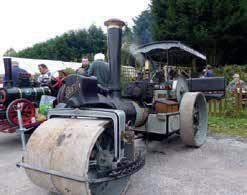
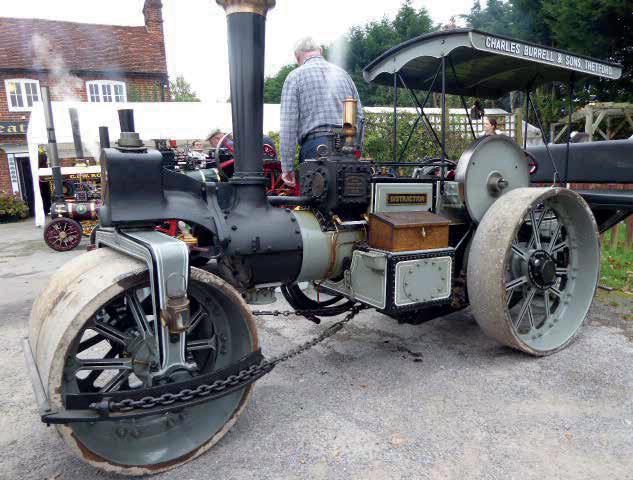
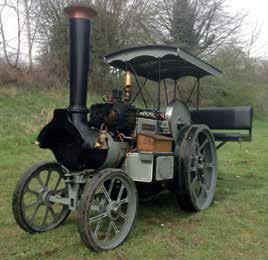
In our last edition a colleague wrote about visiting a small local rally as something different. Near me at a place called Jealotts Hill, in Berkshire, they did a Charity steam up to raise funds for local charities so I went along . There was 6 full scale engines as well as about the same for miniatures, it was one of the latter that caught my eye. Except it wasn’t so little being a 6 inch to the foot model. What made this model interesting to see was that it was a Burrell convertible roller, and according to the owner Andy Attwell the only one in the country (and the world?) though another one is currently under construction in the Bristol area.
Andy told me he started building the engine back in 2010 as a 6 inch scale Gold Medal Tractor. A lot of planning was done before the build even started and it was during this planning that Andy saw an old picture of full size engine, number 3850, sitting outside the Burrell paint shop in photographic grey as a convertible roller. This engine still exists and now forms part of the reserve collection at Thursford. That picture was the inspiration for building the 6” scale model. As a tractor so it would need quite a bit of work to make it a roller especially as there were no one who could supply castings or even drawings. This would mean he would have to produce drawings and patterns himself, not a straight forward or easy task. This involved a trip to the Museum of English Rural Life (M.E.R.L.) at Reading to get the
Burrell drawings. These were then drawn up on a ‘3 D’ cad drawing programme. Unlike the ‘old days’ you don’t have to use wooden patterns made so that a casting be made. The ‘3D’ drawing were sent to a company who cut them out of polystyrene . This can be a cost effective way of making a pattern especially if it is just one offs are required. The polystyrene pattern is put in the casting sand just like a traditional pattern to create the shape. The difference being it is left in the sand so when the hot metal is poured in it just melts away and the required shape is cast.
After all these were done of course much machining was done and other items fabricated so that the parts to convert a tractor to a roller were made. Another interesting thing about the project besides its uniqueness, is that Andy is not a trained engineer, in fact he works in media, and is self taught in using a lathe and a mill amongst other equipment. So, it goes to show that if you put your mind to it you can do something different .
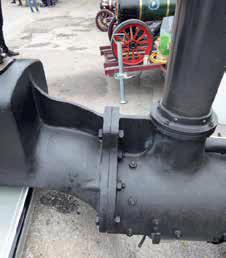
Above Right: Showing the headstock of the roller where it joins the smoke box of the tractor/roller. Engine weighs 2 ½ tons. Look out for it at next dorset where it will be converted back to a tractor and back again. Called ‘Distraction’ Unusual for an engine not being a girls or place name
3580 at the Thusford collection and 3850 outside the Burrell paint shop in photographic grey and was the inspiration behind the engine. (Copyright Road Locomotive Society)
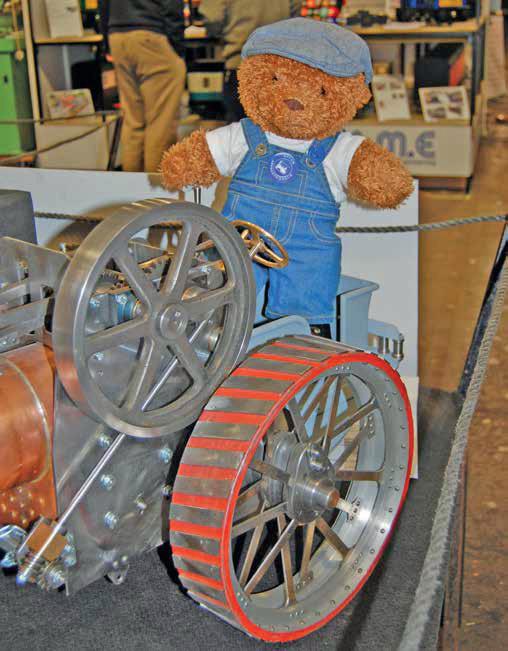
Here we have Justin Steam on the footplate of a 2 inch scale Minnie traction engine at the London Model Engineering exhibition. Check out the April edition of Raising Steam for a full report of the show!
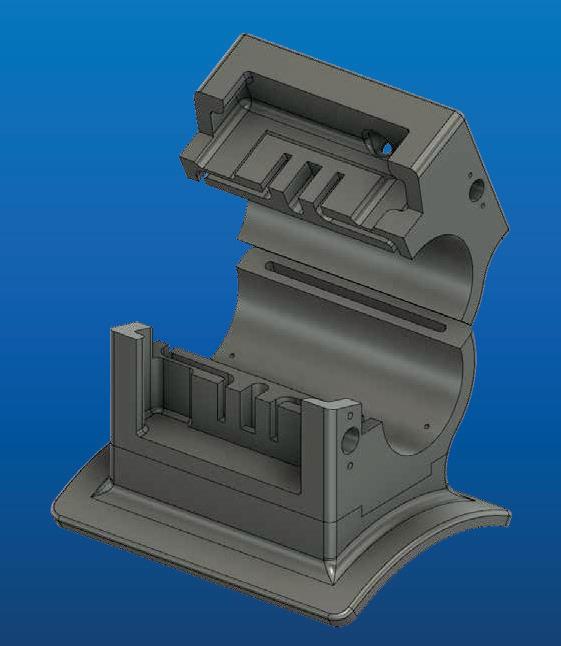
Cover: A 3D render of a sectioned Cylinder block..
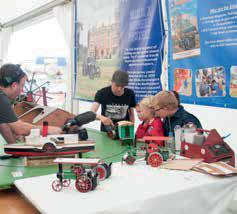
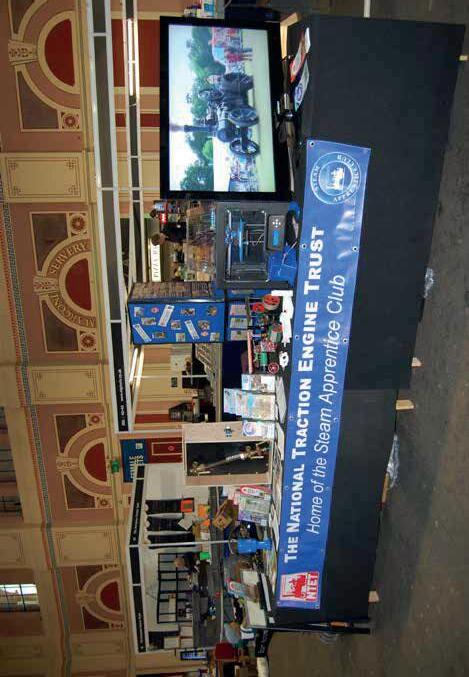
The Steam Apprentice Club stand at the London Model Engineering Exhibition in January 2018.