
Volume 30 Number 3 – July 2016

Volume 30 Number 3 – July 2016
Editor
Kevin Munn, 56 Blacklands Drive, Hayes End, Hayes, Middlesex. UB4 8EX. Tel 0208 573 9180 sac.raisingsteam@ntet.co.uk
Chairman
Elaine Massey, 21 Down Close, Northolt, Middlesex UB5 6NS Tel: 020 8248 6570 sac.chairman@ntet.co.uk
Vice Chairman
Hugh Dyson, 32 Granary End, Witchford, Ely, Cambridgeshire CB6 2WF Tel: 01353 667150 hugh.dyson@inbox.com
Membership Secretary
Lisa Crankshaw, NTET Membership PO Box 10348 Hinckley LE10 9FB membership@ntet.co.uk
Membership fee £15 per annum Webmaster
Nick Bosworth, 76a Main Road, Smalley, Ilkeston, Derbyshire, DE76EF Tel: 07931 577430 sac.webmaster@ntet.co.uk
SAC Committee
Main email: sac.raisingsteam@ntet.co.uk
Matthew Lund Tel: 01329 832462
Barry Sumsion Tel: 01633 671798 Helen Tyrrell Tel: 01793 751830
The Editor welcomes any contributions of articles, shorter items or photographs for inclusion in future issues. All material submitted is voluntary and payment cannot be made for any material published. The opinions expressed in the magazine, with the exception of Club announcements, are those of the contributors and do not indicate the views of the Club as a whole. All items are held copyright by the contributor and the NTET. The Editor reserves the right to amend or refuse contributions. The magazine is normally published during January, April, July and October. The Club accepts no liability for failure to meet intended publication dates.
The Steam Apprentice Club is a section of the National Traction Engine Trust.
N TET is a Registered Charity, No. 291578. Registered in England No. 1302197. Registered Office: 4 Church Green East, Redditch, Worcestershire B98 8BT.

www.ntet.co.uk

www.ntet.co.uk/sac
Kevin Munn
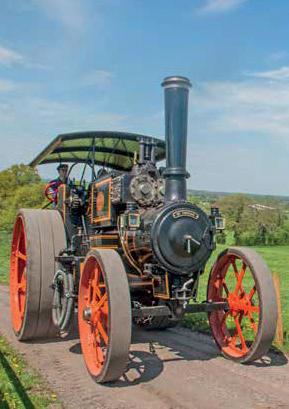
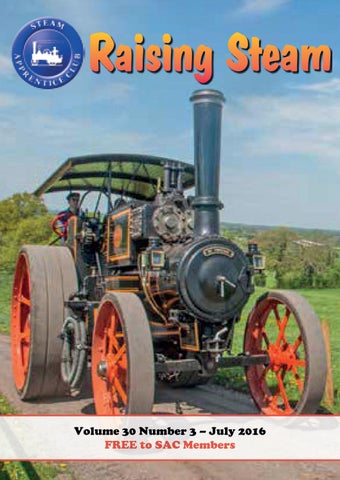
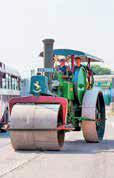
Halfway through the season and all seems to be going well for most events, though as is typical of British weather rain has taken its toll on several rallies having to be cancelled. I have been to several and everyone seemed to be enjoying themselves despite whatever the weather was. As you will see in the magazine I saw a rather unusual driven engine in Chimera, an aveling roller. I shall be out and about testing Kate now that it has passed its boiler inspection making sure all is well before planning to take her to rallies next year. As an engine of 90 years old even
though I have overhauled her, there is always something to do even now. Do let me know what you have seen and done so I can include it in YOUR magazine, as if I do not get items to put in their will be blank pages or even worst, no magazine.
Hello, well we are halfway through this season already! I hope all of you have been out and about enjoying yourselves, making the most of the rallies that have taken place. Of course several have been cancelled due to this years wet conditions. For those of you that have taken part in one of our driving days, then I really hope that you got alot from your experience and enyed the day thoroughly.
Remember to send to the editor any interesting photos from this year to put in the magazine. you will need to send some information with your pictures, name, engine names, dates, and if possible a bit about the scene. Save your best efforts for the photographic competition though. Further information about that is
in this edition of Raising Steam, and will be on our website, along with details of our other annual competitions. Don’t forget to come and say hello to your SAC committee members wherever you are, and PLEASE remember your manners with any enginemen helping the SAC!
With luck, I will see many of you at the Great Dorset Steam Fair. Don’t forget the change of dates this year, and that you are all entitled to free entry to the fair on production of your SAC membership card.
See you soon,
Elaine Chair SAC
Geoff Wingfield
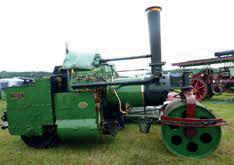
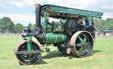
Aveling & Porter Shay-Drive 6-ton Tandem Asphalt Roller (MLD - Class)
No.7411
Reg.No. XP 2915
In 1912 Fulham Borough Council had found that their existing roller had become unsatisfactory for use in “the remaking of road surfaces with bitumenised macadam,” which was by then being extensively adopted in the Borough. Their Borough Surveyor, Francis Wood, made enquires of several firms and at a meeting of the Works & Highways Committee, on 22nd May 1912, reported that Aveling & Porter had a roller “of a tandem pattern which reverses quickly and easily. The weight being over 7 tons. The weight on the back wheel being just over 1 ton
per foot. The boiler is horizontal and vertical cylinders are fitted. The only objection I have is its appearance and that its weight is somewhat too light on the back roll.” This was No.7411, built June 1911, as the prototype of her class. Aveling & Porter offered to supply her on hire for a trial period and, in the event of the Council deciding to purchase her, the hire charge was to be deducted from her £325 purchase price. (This probably indicates her second-hand status as the normal new price up to August 1915 was £500.) The Committee agreed to hire her and she was supplied on 15th June 1912. At the Works & Highways Committee meeting on 31st July 1912 the Borough Surveyor reported her “satisfactory except for a defect in the quadrant
guide.” [This appears to be that in the original design when the reversing lever was in its forward position the roller was actually in reverse. Aveling & Porter added a second pivot in the middle of the lever thereby reversing its action.]
He also considered it desirable that “a contrivance should be added for watering the wheels of the roller when in use; the cost of fitting would be £12. The adoption of this extra mechanism would obviate the employment of a man keeping the wheels watered.” Subject to the defect being remedied by the makers to the satisfaction of the Borough Surveyor, the Committee recommended her purchase and also agreed to have the additional roll watering gear fitted.
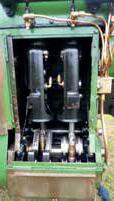
This work having been carried out at Aveling & Porter’s works she was dispatched back to Fulham on 5th October 1912. At the Finance Committee meeting of 9th October 1912 it was reported that “insurance had been taken out with the Law Accident Insurance Society Ltd., in the sum of £500,” against damage to herself and her surroundings through explosion, “at a premium of £15s-0d per annum.” (£1·25)She worked for them until 1928 when, at the Works & Highways Committee meeting of 27th June it was decided that she “had become unsuitable for the Council’s purposes.” Two offers had been received and the”more favourable one,” of £100, from W.W.Buncombe & Sons Ltd., (The Highbridge Steam Rolling Company), of Highbridge, Somerset was accepted.
She became No.118 in their fleet and worked for them until 1953. She worked over a large area during her time with them, including :-
Working between tramlines in Bristol. Rolled fields for a turf firm.
Wellington R.D.C., Somerset whilst driven by Charlie Gill.
Various Somerset Districts including Burnham-on-Sea and Highbridge U.D.C. Plympton St.Mary R.D.C., nr. Plymouth, driven by Charlie Gill.
Buffer Depot, Ashchurch, Gloucestershire for the American Forces who supplied the driver.
R.A.F. site near Wellingborough, Northamptonshire for a contractor who supplied the driver.
Yeovilton Fleet Air Base for the Admiralty, driven by A.Pomeroy. Dunkeswell, Devon driven by Ernie Long. Also driven by Teddy Castle and Bill Harvey.
Once, whilst working at a Burnhamon-Sea brewery, the driver, Jack Jones, having had his free ½-gallon of beer went to back her up to a wall but, instead of closing the regulator, opened it and drove through the wall into a field.
Whilst working for W.W.Buncombe’s in the winter of 1949 in Bridgewater, she developed a crack on the nearside of the face of the rear roll which was welded up by fitters who came out to the roller.
Last working place was Milton Road, Weston-super-Mare for the Corporation in 1953, driven by Bill Harvey.
Whilst on this job she was rolling a base coat of limestone for the road outside a church yard when she kept slipping and Bill couldn’t get her to move. The vicar came out saying that a funeral was due and he needed to have the roller moved. The vicar tried putting sticks, etc under the roll, but to no avail. Eventually Bill got her moved just in time for the funeral to take place.
She later passed into the ownership of
one of W.W.Buncombe’s sons, Norman D. Buncombe, who ensured her survival into preservation, keeping her under cover during her time in his care and was last steamed in his ownership during the early 1960s and last attended a rally in 1966 at Langport.
Purchased in August 1986 from Norman D.Buncombe by David Spooner of Wokingham, Berkshire. On arrival at her new home she was completely dismantled and her initial restoration was carried out over a period of about 18 months. This included replacing the smoke box, chimney, footplate, coal boxes, steering chains, boiler tubes, safety valve springs, gauge-glass protectors and the gears were built up. This work was carried out by Mark Wingfield, Bob Prior and David Spooner with the help of only a couple of outside firms. Attending her first event after the rebuild in May 1988. Later the front rolls were re-plated.
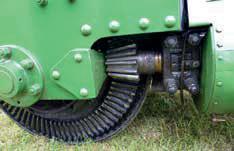
In 2002 it was decided to replace the firebox and her second restoration, a more thorough process began.
Over a period of four years the firebox, half the backhead, water tank, drive gears, piston rings, piston rods, valve rods, main and big-end bearings, tubes, rear-axle bearings were replaced, the water sprayers for the rolls refitted, the hind roll re-riveted, extra lubrication added, gauge-glass cocks refurbished by Alan Wingfield and the pressure gauge refurbished by the original makers, Budenberg. The boiler pressure was also raised to the original 180 psi, it had been lowered to 150 psi during its working life [although the last onemade had a working pressure of only 140 psi when new]. This rebuild was carried out mainly by Mark and Geoff Wingfield.
She is now the sole survivor of the ten of this type that were made over the period 1911 to 1921, and was then superseded in 1921 by the vertical boilered N and O-class tandem roller.
My thanks to Norman D. Buncombe, T. Ellis, Bill Harvey, E. A. Olive (AvelingBarford Archivist) and Christine tBayliss (Local History Librarian, Fulham Library) in the compilation of this history.
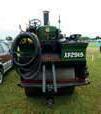
Cylinder Bore 6½ in
Cylinder Stroke 7 in
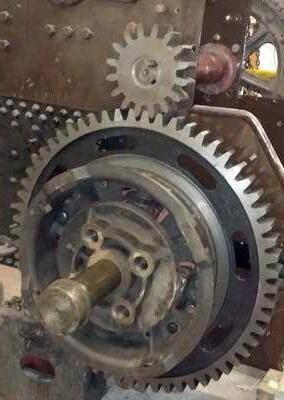
Drive Pinion 12 teeth
Crown Wheel 77 teeth
Fore Rollers (two)
Diameter 3 ft 6 in
Width 2 ft
Hind Roller
Diameter 3 ft 6 in
Width 4 ft
Rolled Width 4 ft
Steering (lock to lock) 44 turns
Wheelbase 11 ft
Boiler Diameter 2 ft 0¾ in
Number of Tubes 33
Tubes
Diameter 1¾ in
Length 3 ft 1 in
Grate Area 4·45 ft²
Heating Surface 73.3 ft²
Working Pressure 180 psi
Coal Capacity 3 cwt
Tank Capacity 60 gallons
Weight :-
Empty 7 ton 2 cwt
Working Order 7 ton 18 cwt
Length 16 ft 2 in
Width 6 ft 2 in
Height 10 ft 2 in
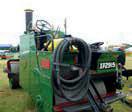
From Greek mythology :-
Reasons for this name.
A dreaded fire-breathing monster of great strength.
She has a large firebox and an 8 NHP engine unit. She had the head of a lion, body of a goat and tail of a dragon. She is part roller and part American railway engine. She was known as the monster of drought.
Having twin high pressure cylinders she uses quite a lot of water meaning frequent water stops.
In architecture the name is loosely used for any grotesque, fantastic or imaginary beast.
Earlier attempt to develop a roller specifically for asphalt. The word is now used generally to denote a fantastic idea of figment of the imagination. Everyone politely says “This is unusual!”
According to Homer :-
“Her pitchy nostrils flaky flames expire; Her gaping throat emits infernal fire.”
Kevin Munn
Well this article in many respects compared to others is going to be rather short. Over late summer 2015 I continued to do bits and pieces to the engine and steaming it up to check it out. I finally made the decision to submit it for inspection by the Boiler inspector. The 8th December was the big day, and though I was reasonably happy and confident about everything I felt like when I take my car for the M.O.T. nervous and apprehensive as even though you feel everything is okay you never know what might be found! Which in a way of course is a good thing, another set of eyes and experience checking it out. Firstly is the cold inspection when the inspector goes over the boiler checking everything he can see and touch. And in this modern day using an ultra sonic thickness checker
to make sure all thicknesses are above a minimum allowed. If it passes that phase the next part is to do a cold hydraulic test. The boiler is completely filled up with water and a hand pump used to bring the pressure up to 1 ½ times normal working pressure without any leaks appearing, my boiler did! It was only a small weep where the caulking had taken place between the firebox ring and the outer shell. A bit more caulking was carried out and all was well and it passed the hydraulic test. Now onto the final test, the engine in steam. I went through the normal procedures which hopefully you go through before lighting up with the one exception the boiler was drained down so the level was approximately ½ inch below top nut. A fire was started and I brought the pressure up in the boiler.
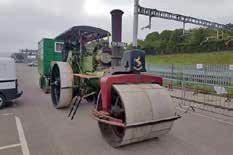
The inspector still goes around the engine checking for leaks and that all is well as heat makes a difference to joints and connections. When we had sufficient pressure we checked both the water pump and injector worked probably, that is putting cold water into the boiler, they worked fine. Then came almost the final check, getting the pressure up so that the safety valves operated at the correct pressure and kept letting out excess steam pressure even with a roaring fire. This it did though as we were parked inside the ‘tent’ that covered the engine and with flaps open it did become a bit of a sauna! It was then a few minutes wait before the Inspector had told me it had passed. Relief and joy that after over 8 years work I could now drive the engine out and about. I shall be doing local events this season as I continue to ‘shake down’ the engine in case any more problems come to light. Hopefully you will see me out and about next season.
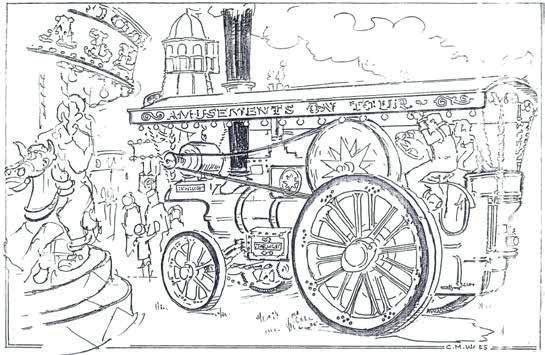
CAREFULLY remove this page from the magazine – ask an adult for help if necessary – be especially careful of the staples.
We are happy to accept a photocopy of the drawing if you don’t want to damage your magazine. It is also available to download from our websitewww.ntet.co.uk/sac
COLOUR the picture using pencils, crayons, paints or felt pens. WRITE your name, age, address and membership number in the space provided.
POST your entry in a large envelope, to avoid folding it too much. ENCLOSE a large stamped addressed envelope if you want your entry returned. REMEMBER to send your entry to arrive with Nick Bosworth by Monday 15th August.
This competition is open to all apprentices up to the age of 14.
Name:............................................................................. Age:..................................
Address:.......................................................................................................................
Membership N°:.........................................
ADDRESS for entries is: (SAC Colouring Competition) Nick Bosworth, 9A St Wilfrid’s Road, West Hallam, Ilkeston, Derbyshire, DE7 6HG
Details of the 2016 photo competition were published in the previous edition, so this is just a reminder to get your cameras out, and send your entries in. We have some MEGA prizes for the winners. We made a typo in the dare rules for this year’s competition (oops!). Your photos need to be taken in the year leading up to the closing date, and entries need to be with us by Monday 15th August.
www.ntet.co.uk/sac
This model is not very difficult, but you might need to source wheels, tap and stand pipe. I would suggest your local model or dolls house shop, or the “Hobbies” catalogue.
Suggested wheels are hobbies large moulded wheels, 72mm diameter. They can also supply a stand pipe.
You will need: 2 wheels, some thick card or mount board, a cardboard tube eg Pringles, A few pieces of wood eg coffee stirrers or lolly sticks, a wire coat hanger will do for you axle, wood glue, paint etc to finish. Optional a stand pipe, a tap.
To begin with cut the two circular shapes from mount board or similar. Then you will need a cardboard tube of some sort, I used a “Pringles” tube. You will need to cut a section of this 3
inches long. One of the circular shapes needs to be glued into each end of the tube, cut away a section of the tube to make it fit. Save that spare piece to form the lid of the barrel. That will need some time to stick securely.
Cut two small strips of wood and glue them to each side of the opening. While that is drying begin your towing assembly, using card for the metalwork attached to the barrel and coffee stirrers for the frame. Underneath the barrel you can glue your axle assembly, and use a straw or small piece of dowel for the tap.
To put the whole model together, glue the “A” frame onto the barrel, glue your standpipe on the side so that the tap goes into the top of the barrel, cut your lid from the piece of tube you removed, that way it will already have the right curve, and cut a piece of wood or card to form the platform at the front of the barrel..
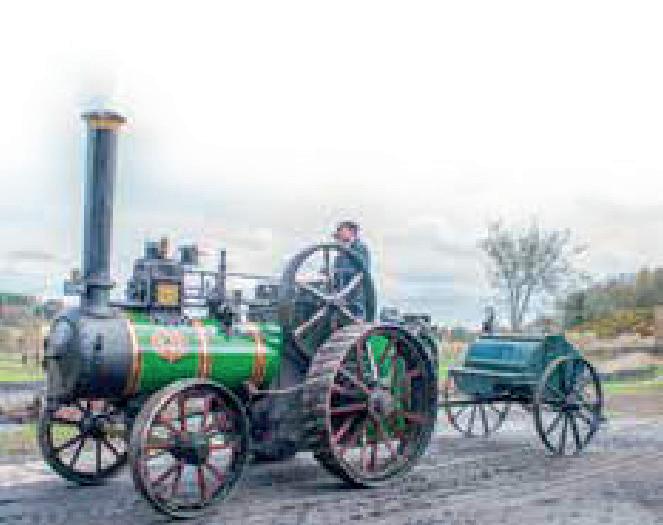
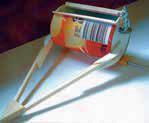
Paint your model as you wish, I would suggest enamels like “Humbrol” or something similar.
Don’t forget to bring it to Dorset if you can make it, and see if you can win our prize for 2016.
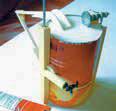
You can enter the SAC model competition by bringing it to Dorset or by submitting photographs. Bring along your models to the SAC Stand in the NTET marquee and we will display them for the week of the show.
If you cannot attend the Great Dorset Steam Fair in person, you can still enter the model competition by sending us photos of your model. You can send up to 10 photos, please make sure there are at least three of the finished model, and include photos showing the different stages of the build (so we can see how you’ve built it!)
We will put a selection of your photos on display at GDSF, alongside the usual model competition entries. (All your photos will be shown to the judges).
Entries should be emailed to:
sac.webmster@ntet.co.uk
Please include your name, age and membership number.
You can tell us about any special features of your model. Entries, both physical and photographic will be judged at the Great Dorset Steam Fair. Winners will be announced at GDSF, on the SAC website, on Facebook and in Raising Steam.
All entries to be received no later than Monday 15th August
NOTE:- If you are intending to bring your model to GDSF as usual, there is no need to send photographs
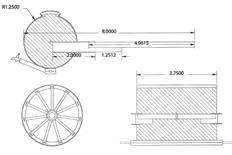
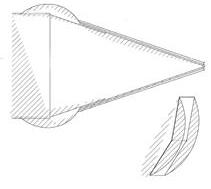
No. 78572 is a Marshall S-type road roller built on the 27th of April 1925, she was built for the Castle Donnington Rural District Council (RDC) in Leicestershire and was driven by a man named Ted Howe. In the 1930s she transferred from the RDC to Leicester County Council. During her time there she rolled a wide variety of roads including those of the stately home Beaumanor Hall, which she has recently visited re-create a photo taken in het working days.
All this came to a sad end though as in 1960 the rollers were laid up for the winter by the LCC. In 1961 her and the two last rollers on the fleet were taken to Hunts scrapyard in Cambridge.
Fortunately three enthusiasts had heard of these engine’s journey south, and followed them down to the scrap yard, where they bought a roller each.
The man who bought N ° 78572 was Tim Sage, who was based next to Bruntingthorpe airfield. Soon after, the LCC started to have problems with the diesel rollers that had replaced the steamers, so Ted hired the roller back to the council and went with it as driver!
In 1964 Tim had an accident with No. 78572 as a crack in the headstock that had appeared some time ago turned to a split. He asked his friend Fred Coombes to bring his lorry to collect the roller and tow it back to Bruntingthorpe, this seems

to have been the end of commercial road rolling for No. 78572. TIm managed to buy a replacement headstock which came from another S-type roller that had been converted to a traction engine.
Fred Coombes’ involvement with the roller was not done, as Tim needed to sell the roller in order to raise the money to by 2/3 of a Ransomes agricultural engine of which he owned the other 1/3.
But Fred preferred his Lorries, and so whenever the engine went to a show Fred let Tim drive and look after the engine. Eventually Fred decided that he’d had enough and decided to sell the roller. A man named Peter wood came in and bought No. 78572 and rallied it from 1973 up until his death in 2007.
Peter had a crew of people to help him in 1973, one member of the crew joined later on, his name was David Hurley. He was still a child when he joined the crew, but stayed with Peter for many years. When Peter died in 2007, he bequeathed the engine to David.
Soon it became apparent that boiler work was required, and so a three year repair began. No. 78572 reappeared on the rally scene in 2011 at the Wollaton Hall steam rally.
N° 78572 has been attending rallies in the midlands ever since, with David and his family working together as crew on our family owned engine.
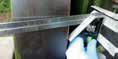
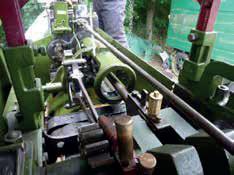
Applications are invited for the SAC Technical Achievement award. Areas of achievement may include: engineering work on full size engines, model engineering or any other appropriate steam related subject (bearing in mind that we are essentially a road steam organisation).
The purpose is to encourage young people to develop hands-on experience generally within typical engineering skills. This can be using various machines such as lathes and mills as well as handwork. Nominations to be entered by a sponsor for whom they have been working or have been under the instruction of, or apprentices may enter themselves.
Applications to be received by August 15th should consist of a brief description on one side of A4 paper with 3 or 4 photographs and/or sketches. See address inside your latest copy of Raising Steam. The judging committee will then
contact the nominator or apprentice by either phone or in person to discuss the application. From these discussions, suitable candidates will be chosen, and final and fully detailed submissions will be invited to be with the Chairman by September 15th.
Judging will be completed by mid October with the announcement of the winner by end of October. The award will be presented at the NTET AGM.
Judges will be from members of the SAC Committee plus invited persons from an area appropriate to the subject entered.
Please note that due to the all round experience we are looking for it is unlikely the award will be awarded to an apprentice under 15. Though as we know there is always an exception to the rule, so please don’t hesitate to either enter or contact the Chair for guidance.
This award is to recognise an Apprentice who has shown all round enthusiasm in their involvement with Road Steam. This may be hands-on experience with an engine or helping to maintain or restore an engine. Consideration should be given to how well they have learnt and respected the necessary skills needed in the operation of an engine. There is no particular type of submission we are looking for other than that you feel the Apprentice has made an effort, has learned from what ever activity they are doing and has shown the ability to ‘stay the course’. We would expect that the Apprentice has been working with one engine or group
for at least 3 or 4 years.
Submissions should consist of a brief description on one side of A4 paper of what they have been doing and why you think the Apprentice deserves the award, perhaps with 3 or 4 photographs and/or sketches if you feel it will better illustrate the case.
Entries to be with the SAC Chairman by mid September, see address inside your latest copy of Raising Steam or Steaming. Judging will be completed by mid October, with the announcement of the winner to be made at the NTET AGM where the award will be presented.
The final decision on the recipient will be made by the SAC committee.
In a previous article about Kate, my roller, I explained about how one measures and calculates the positions of the piston and piston valve to make sure they are in theory in the correct position for operation when you heat the boiler and steam up. To double check and maybe even correct those setting there is a reasonably easy cross check you can do. This is a method I am using on my single cylinder. Firstly you turn the flywheel so the piston rod is in the furthest back position and using a square make a line on the flywheel. Secondly you then turn the flywheel so the piston rod is in its furthest forward position. (always keep turning the flywheel in the same direction) and make another mark using the same position for the square. This way the two marks should be 180 degrees apart. The fire is then lit in the engine and engine brought up to 5 to 10 psi. The reversing lever is then positioned in the forward position as this is the most used. You then turn again the flywheel with the drain cocks open, just as steam emerges from a pipe you stop turning the flywheel and make a mark on it in the same way as when finding the end of the stroke previously. Again this is repeated so you then get a mark approx 180 degrees from the first mark when steam emerges from the cylinder drain cock pipes. The distance between the engine end of stroke line and the steam line is measured. You do this both sides. If the measurements are the same you know the piston valve is set correctly to let steam into both sides of the piston at the correct time to get best use and equal ‘power’ . If the measurements are different an adjustment on the screwed rod has to be made so the measurements end up the same.




Oliver Culpin - Saffron Walden, Essex
Oliver Rolston - Preston, Lancashire
Emily Woodcraft - Biggleswade, Bedfordshire
Bryce Lovell - Tavistock, Devon
Lucy Williams - Tavistock, Devon
Charles Black - Whitchurch, Shropshire
Jason Thomas - Woolesford
Rhys Burbury - Luton, Bedfordshire
Charlie Taylor - Brighton, East Sussex
Sam Crawley - Waterlooville, Hampshire
Spencer Rogers - Spalding, Lincolnshire
Daniel Crook - Harrogate
Harvey Green - Chesterfield, Derbyshire
Luke Crowther - Swindon, Wiltshire
Harvey Stigar - Gosport, Hampshire
James Wotton - Truro, Cornwall
Rebecca Wotton - Truro, Cornwall
Charlie F J Williams - Hay on Wye, Herefordshire
Tino Mason - Barnstaple, Devon
Michael Pettitt - Rye, East Sussex