
Volume 30 Number 2 – April 2016

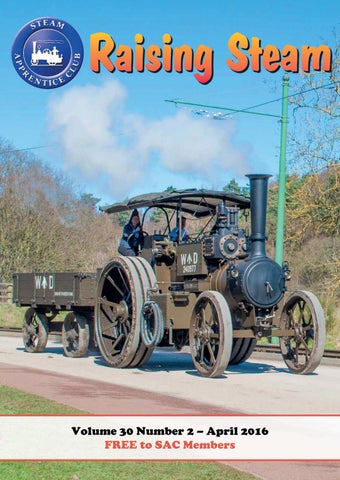
Volume 30 Number 2 – April 2016
Editor
Kevin Munn, 56 Blacklands Drive, Hayes End, Hayes, Middlesex. UB4 8EX. Tel 0208 573 9180 sac.raisingsteam@ntet.co.uk
Chairman
Elaine Massey, 21 Down Close, Northolt, Middlesex UB5 6NS Tel: 020 8248 6570 sac.chairman@ntet.co.uk
Vice Chairman
Hugh Dyson, 32 Granary End, Witchford, Ely, Cambridgeshire CB6 2WF Tel: 01353 667150 hugh.dyson@inbox.com
Membership Secretary
Lisa Crankshaw, NTET Membership PO Box 10348 Hinckley LE10 9FB membership@ntet.co.uk
Membership fee £15 per annum
Webmaster
Nick Bosworth, 76a Main Road, Smalley, Ilkeston, Derbyshire, DE76EF Tel: 07931 577430 sac.webmaster@ntet.co.uk
SAC Committee
Main email: sac.raisingsteam@ntet.co.uk
Matthew Lund Tel: 01329 832462
Barry Sumsion Tel: 01633 671798 Helen Tyrrell Tel: 01793 751830
The Editor welcomes any contributions of articles, shorter items or photographs for inclusion in future issues. All material submitted is voluntary and payment cannot be made for any material published. The opinions expressed in the magazine, with the exception of Club announcements, are those of the contributors and do not indicate the views of the Club as a whole. All items are held copyright by the contributor and the NTET. The Editor reserves the right to amend or refuse contributions. The magazine is normally published during January, April, July and October. The Club accepts no liability for failure to meet intended publication dates.
The Steam Apprentice Club is a section of the National Traction Engine Trust.
N TET is a Registered Charity, No. 291578. Registered in England No. 1302197. Registered Office: 4 Church Green East, Redditch, Worcestershire B98 8BT.

www.ntet.co.uk

www.ntet.co.uk/sac
Kevin Munn
The sun is out and the new season is here with already some events being held to ‘try out’ the engines after either minor or major maintenance having been carried out.
Did you help on any engines over the winter lay off? I hope to be out and about with ‘Kate’ my Aveling and Porter E type roller of 1926 and several rallies this year. I have been accepted to the Fawley Hill rally near Henley on 21 to 23 rd May so I
hope I can see some of you there. Happy steaming this summer.
As always, I welcome any contributions to this magazine. You can send articles and pictures to my email address below.
Elaine Massey
I really can’t believe it’s April already..... leaves on the trees and the welcome aroma of smoke and steam! This years programme of driving days is now underway, I do hope that you have all managed to get your applications in. If not then do so quickly!
Our driving days are our flagship activities, please do remember that everyone at the venues and all the engine crews are volunteers and take part because they believe in our aims, to teach young people about road steam. Be polite and respectful, even in difficult situations. Remember to dress appropriately, overalls, or very old clothes, arms and legs covered, with work boots or wellies, NOT trainers. Remember that GDSF is one week earlier this year, 25 – 29 August. This has
mainly been changed so that it does not clash with school terms. I hope to see lots of you there.
Let us know how we / you are doing, send us photos of your activities with a few lines to say what and where. You can e mail them to us, details are in the magazine.
Lastly, we are always looking for more adult help...... if you are bringing your youngsters along to events and would like to get involved, please get in touch.
Lamb,
Traction engines have a charm and character reminding us of the bygone age in which they were conceived. They are a challenge for the photographer often painted in darker colours particularly black.
How can we get the best photographs from these challenging subjects?
If you have a choice, cloudy bright days are best to show the fine detail of the engines. Things will not disappear into deep shadows caused by the sun.
For the finest quality images set your iso to the lowest setting available. The only time I would increase the iso is on very dark days when I don’t have a tripod.
Zoom lenses should be set to the telephoto end from a distance giving
a better perspective if you have space available. The telephoto setting will also allow you to minimise distracting backgrounds and find interesting details either on the engines or in the people around them.
If you are photographing on the footplate and want to show any action there you will need to use the wide-angle lens setting. If there are dark nooks and crannies that show no detail, it is an opportunity to use your built in flash as a fill in light source. Turn your flash on and if you have flash exposure compensation reduce your flash by 3 clicks. The technique is called fill in flash and there are lots of videos on YouTube explaining the technique.
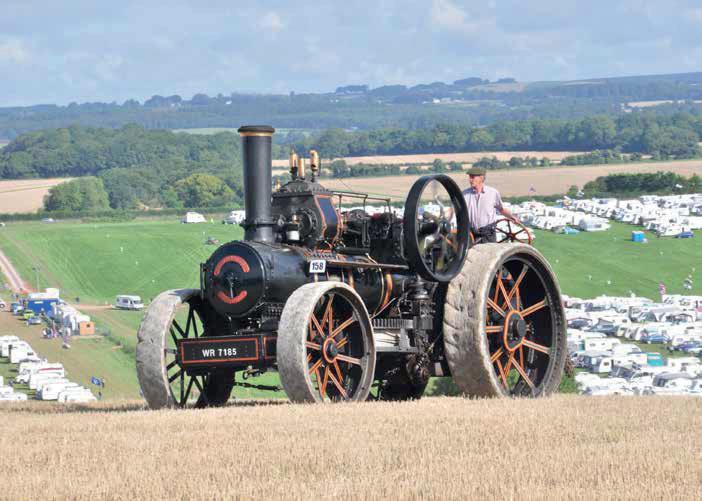
When at a show or an event it is not always possible to choose the best settings so how can we make the best images from the opportunities offered?
If you are in full sun try to ensure the engine is lit evenly. You could use fill-in flash again to lighten dark shadows. Make sure you only use higher iso settings when absolutely necessary but never use the highest setting. If you want to photograph the complete engine but cannot move far enough away, use a middle or slightly wide-angle lens but try to take your picture from the front corner, the distortion from the lens will give an imposing perspective. Don’t forget, you can turn your camera from landscape to portrait format if the subject suits it. The beauty of modern digital cameras is that you can view the image on the screen immediately, and if you don’t like what you see, delete move the camera or setting then try again.
Check out page 6 for details of our 2016 photographic competition!
These guidelines are intended to help but the most important tool for a photographer is their eyes. Look carefully, take and review on your screen and look for that unusual angle or viewpoint to create a photograph that no-one else has taken. Finally, keep practicing, big memory cards means the cost per. shot is minimal, shoot loads, you can always delete those you don’t like when you open them on your computer.
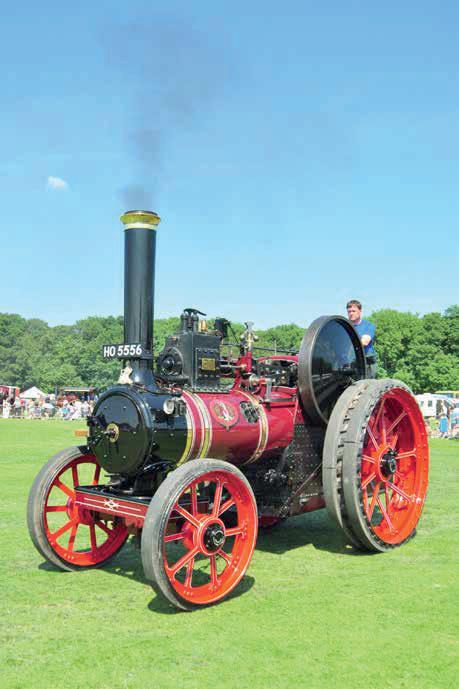
As in previous years, we are running a photo competition to be judged at the Great Dorset Steam Fair. We have some MEGA prizes for the winners and every apprentice who enters will receive a free badge.
Rules
1. Entry to this competition is restricted to fully subscribed members of the SAC.
2. Each entry will consist of 1 photograph taken by the apprentice between August 2016 and August 2016.
3. We prefer entries to be digital photos sent in by email or on a disc, but prints are also welcome.
4. Entries must be emailed to sac.webmaster@ntet.co.uk, or sent to Nick Bosworth (SAC), 9A St. Wilfrid’s Road, West Hallam, Ilkeston, Derbyshire DE7 6HG. Entries should arrive by Monday 15th August 2015.
5. If you would like your entry returned, please include an SAE.
6. If sending a print, please DO NOT mount your photo for display.
7. All entries must include: Name, age, address and SAC membership number; place, date and details of the engine or subject.
8. Copyright in all entries will remain with the SAC member and the Steam Apprentice Club.
9. Entries will be displayed at the 2016 Great Dorset Steam Fair in the NTET tent. Entries with a SAE will be returned after display and/or publication in the magazine
10. The competition will be judged in two age groups: up to 15 years and 16 years and over. Prizes for 1st, 2nd and 3rd place in each age group will be awarded from the selection below. The best overall entry will receive the Dorset Trophy shield, to be held for one year.
The judges will be looking for originality, composition and technical ability. Photographs do not have to be of traction engines, but other subjects must clearly be related to the traction engine movement. The judges’ decision on all entries will be final and members are asked to accept them in a spirit that will bring credit to themselves and the Steam Apprentice Club.
Read the article on taking photographs on page 4 & 5 of this magazine.
Try to plan the setting of the photo, keeping modern equipment and structures out of the background.
Try to take photos when the sun is behind you, as this will illuminate the subject better and the photo won’t be of the side in shadow.
Good Luck!!
www.ntet.co.uk/sac
By the time you read this, two driving days will have taken place, at Horsham and Fengate Farm, Weeting. I hope you all had a great time, met some new friends and learnt something about the engines the owners very kindly brought along for you.
Please send us in some pictures and a few words, it’s always good to let other apprentices know what you’ve been up to.
We still have places at the driving days later in the year: Stithians on 7th and 8th May (apply direct, details on the application form), St Albans in July,
County of Salop in August, Leeds in September and a few places at Tinkers Park, also in September. These days are a great opportunity to get involved with engines, so please do attend one if you possibly can.
This year’s SAC driving weekend at St Albans will be at Oaklands College. Camping space is available and lunch will be provided on both days.
The National Traction Engine Trust is pleased to announce we have arranged a ‘Members Day’ at the British Motor Museum at Gaydon in Warwickshire. To coincide with the event we are also delighted to announce that a number of engines will be visiting during the day. The date is Monday May 2nd 2016 and the following admission charges to members of the National Traction Engine Trust and Steam Apprentice Club apply:
• NTET members with a current membership card - £9 (£14 full price)
• SAC members aged 17+ with a current membership card £9
• SAC members aged 16 or under with a current membership card £6
• Under 5’s are free
To be held at Astwood Bank, Redditch, Worcestershire on 7/8 May 2016. Steam Apprentices (age 13-15) £80, (age 16 – 21) £115 for the two days. DISCOUNT of 15% If you pay for 2 years at the same time. Contact Joe Black at :training@ntet.co.uk or Tel: 07595 466353
For more information about the training course, see the NTET website: www.ntet.co.uk/owners-drivers/driving-experience-courses
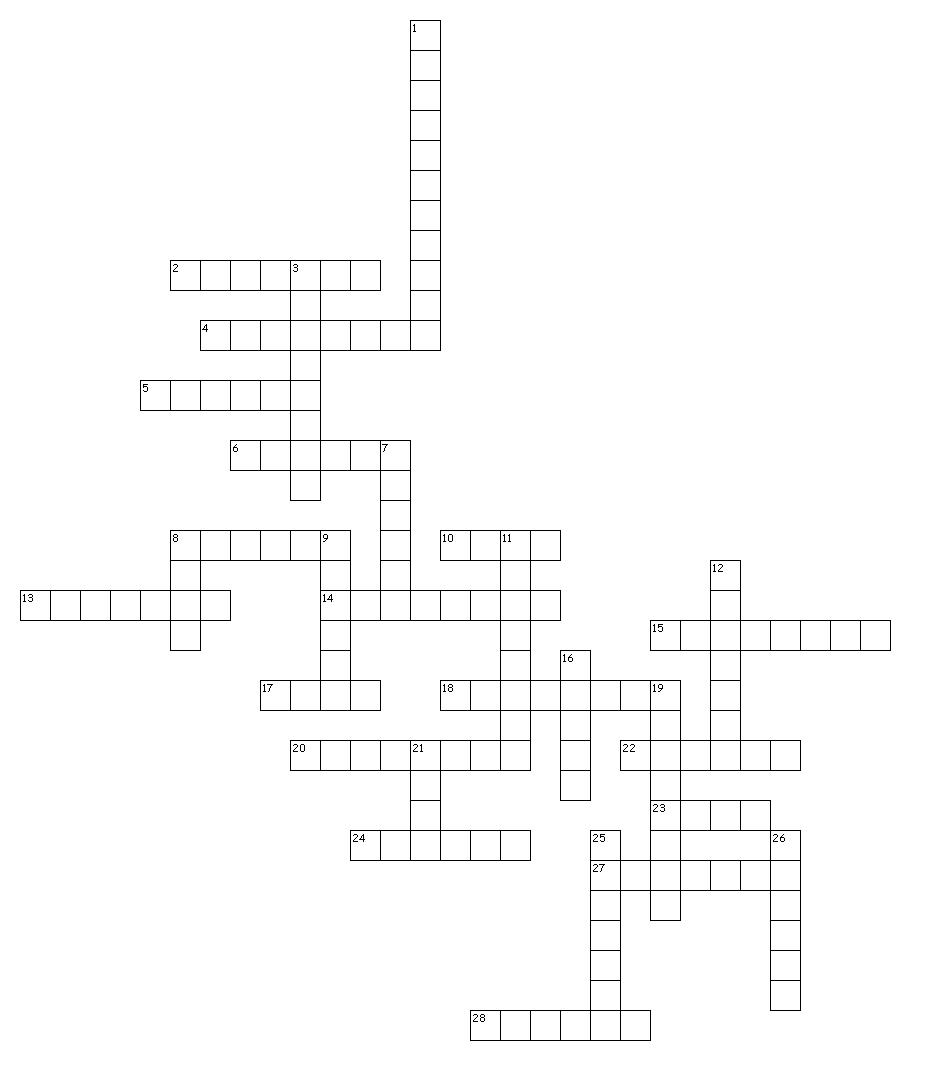
Using the same words as the word-search, try to complete this Cross Link. The aim is to find a way to fit all the words into the spaces so that the letters match where the words cross.
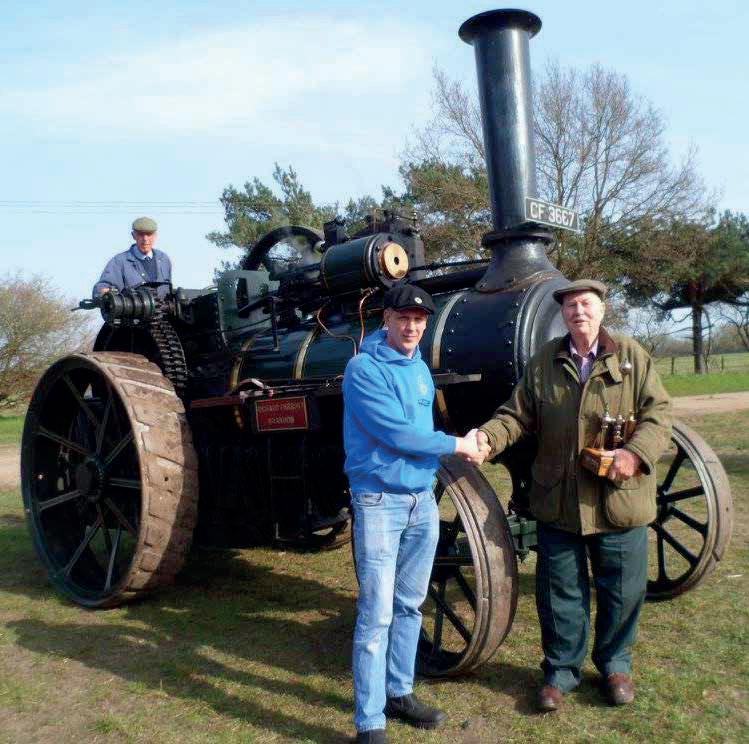
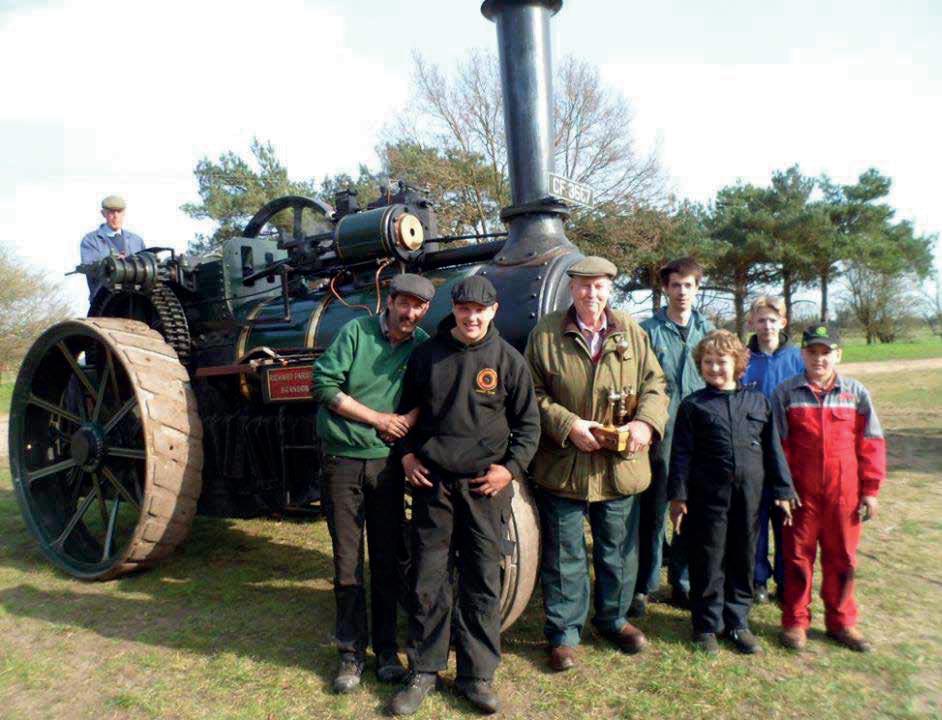
tThe 2nd & 3rd of April saw a successful driivng day at Fengate Farm in Weeting.
SAC committee member Hugh Dyson went along to present the leader of the driving day, Richard Parrott, the ‘Doc Romanes’ trophy, which is presented each year by the SAC to a person or organisatrion who has provided
considerable help to the SAC. Richard Parrott has organised many driving days over the years and we saw it appropriate to recognise his much appreciated help.
Here we have some photos by Jane Turner of the driving weekend and presentation.
John Durling
I’m sure most of you will be very much aware now that the world’s most famous locomotive, Flying Scotsman, is up and running again.
Since being withdrawn from BR service in 1963 she has had a chequered career, being owned by several wellknown people; Alan Pegler, William McAlpine and Dr Tony Marchington.
As well as running in this Country she visited America and Australia, but for the last ten years she has been in the care of the National Railway Museum undergoing a major overhaul.
The last part of the re-building process was carried out at Riley’s works
in Bury, Lancashire. As she was in Bury it was perfectly logical that her first running-in trips should take place on the East Lancashire Railway.
I wasn’t expecting to be able to be part of this until your Editor called me to say that he had a couple of ticket to ride behind this iconic engine during one of these running in trips.
The weekend turned out to be the coldest so far this year but my son Ian and I made the journey to Bury station to see what was happening. What was happening was a station absolutely crammed with people, all with cameras, vying for a spot to see their favourite
engine. The fact that it was freezing and snowing didn’t put anyone off!
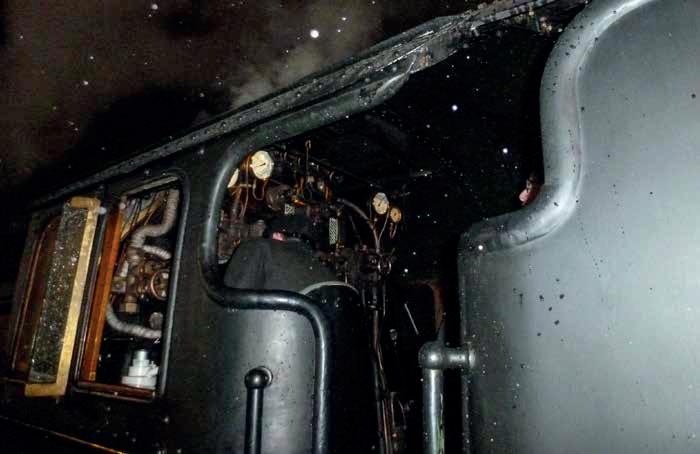
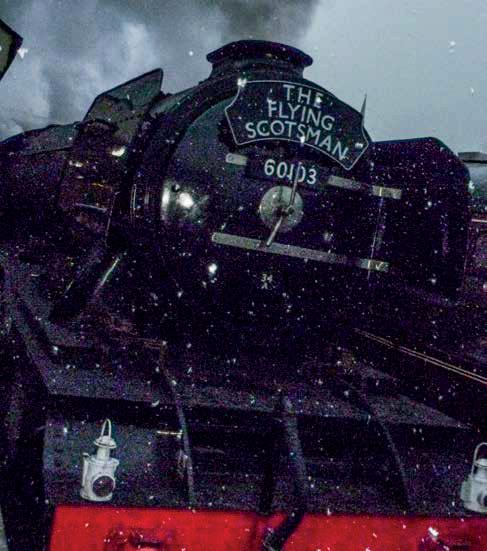
As well as Scotsman the railway was also running their LMS 2 6 0 ‘Crab’ 13065 and the SR loco City of Wells so there was a lot to see. Flying Scotsman is currently running in wartime black, which looked very different to the way we normally think of her. One thing I noticed was that she had number 103 on the left-hand cab side and 502 on the right-hand. I don’t know why but if anyone has an idea I’d love to hear it.
The actual journey behind Flying Scotsman lasted for a couple of hours and sitting in the old fashioned, steam heated coach took me right back to when I first started working in London in the 1970s and travelled every day in very similar coaches. There is something very cosy about a steam heated coach on a cold day.
We joined the train at Bury and set
off north towards Rawtenstall. This takes us under a bridge and then on a gentle climb. However Scotsman sounded wonderful, the valve timing was spot on and, because she was pulling 12 coaches and a class 31 diesel loco, she was chuffing nicely. The trip took us to Rawtenstall, south to Heywood and then back to Bury.
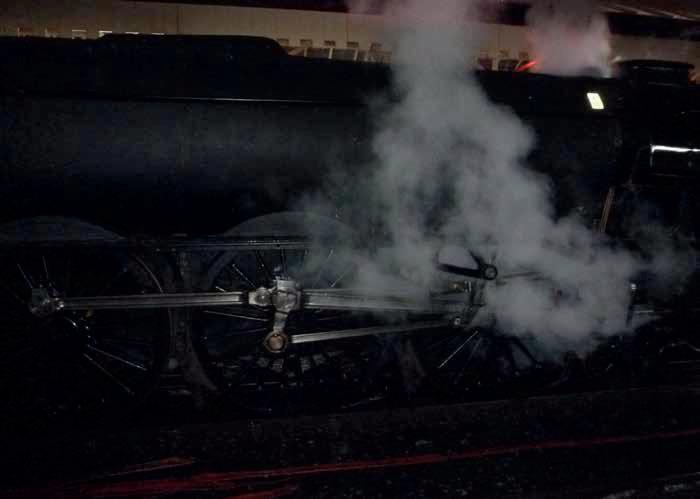
After a meal in the town we drove back through the snow to home; completing a wonderful day. I was not expecting to have the opportunity to make this journey but feel very pleased to have been part of such a wonderful experience. As the weather was not very good and the journey we were booked on started at 4.30 the pictures I got are not the best, but perhaps they could be described as atmospheric.
I’m now looking forward to seeing her on the main line.
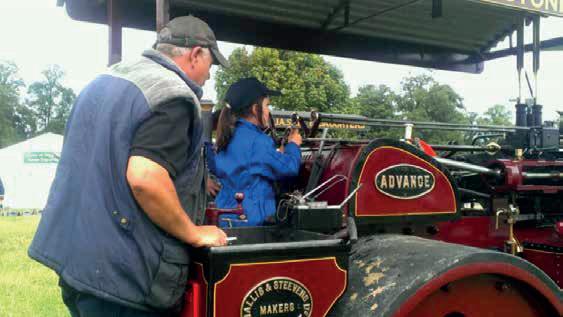
Once she was mans greatest friend, upon her invention the latest trend. She helped man with his daily tasks, she ploughed and in the fields corn she thrashed. Huge iron wheels go round and round, the mighty machine compacted the ground, She built our roads and was powered by steam; man did respect her and polished her clean.
With a heart of fire and water as her blood, in our land she proudly stood. Until one day her jobs were done, no longer was she number one. Left to rot and broken down our beautiful lady had left our towns. No more hissing of steam no more soot, no more whistle or crackling fire at foot.
Her silence was felt our friend no more, an empty space in our hearts we could not ignore. So from the scrap yards and overgrown ground our graceful machines were once again found. As young people it’s our task to preserve our might machines and make them last.
Elijah Whipps - Nr Southminster, Essex
Ben French - Uckfield, Sussex
Aaron Wickens - Bath, Bath & N E Somerset
Jack Pickard - Milton Keynes,
Charlie Upton - Eastleigh, Hants
Archie Catterall - St Albans, Herts
Dylan Garbett - Adfa, Powys
Lillia Stannard - Bognor Regis, West Sussex
Barry Thomas - Knockholt, England
Chloe Emini-Wilson - Knockholt, Kent
Jack Galloway - Hitchin, Herts
Daisy Morley - Biggleswade, Bedfordshire
Logan Maynard-Smith - High Peak
Bailey Matthews - Teignmouth, Devon
Kester Hull - Gosport, Hants
Andrew Wildish - Chartham Hatch, Kent
Jacob Sandow - Hayle, Cornwall
Abigail Edwins - Leighton Buzzard, Bedfordshire

This will take place 8 – 11 September 2016 at Crockey Hill, York. This is a huge event for the Steam Plough Club and will involve the 66th British National Ploughing Championships and the 63rd World Ploughing Contest. It is expected
that some 30,000 spectators will attend to watch ploughmen from 32 countries competing.
The SAC have been offered at least two places for those 14 and over to have a hands on experience and begin to learn to plough by steam. (there will be a small charge but the Plough Club are sponsoring these places. There will also be at least one set of miniature ploughing engines there, 4” scale I think. If any older apprentices are free for the few days prior to the event physical help in setting up would be most welcome.
Contact Elaine Massey if you are interested - sac.chairman@ntet.co.uk
Did you know you can get free entry to rallies when you show your membership card. Not all rallies do this but many do. Always check ahead with the rally organiser if they are willing to give you free admission. It is for YOU only and will not include family and friends. The NTET has a Authorised list of rallies at www.ntet.co.uk/events, so have a look.
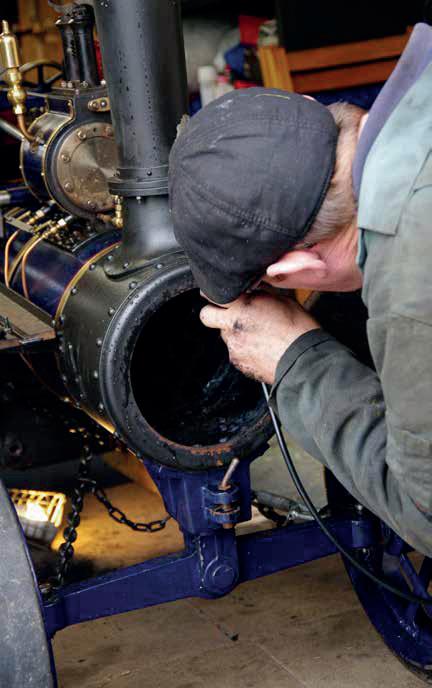
use a small camera on a long cable – but he got this stuck in Captains Jacks boiler between the longitudinal stay and the top tubes!
Finally Dave checks the condition and threads of the washout plugs and the threads and lead core of the fusible plug.
Now the fun begins in replacing the washout plugs (with suitable sealing like hemp or PTFE on the threads) and the fusible plug in the roof of the firebox. Then the boiler can be refilled; this is easy on an engine with a mud-hole door, but Lady Sylvia only has a dummy mud-hole so I filled the boiler through the front tubeplate washout plug – I put some boiler treatment into the boiler to help minimise and control the corrosion. Once the boiler is full, between ½ and ¾ way up the sight glass is a good level. Finally the last washout plug needs to be replaced and the boiler is ready.
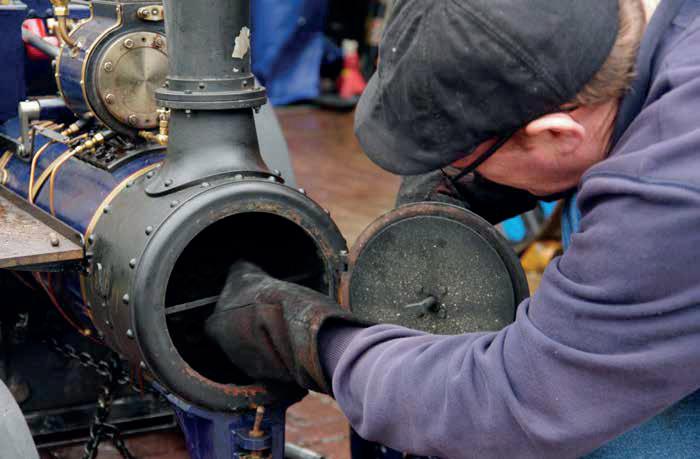
A fire is lit and the boiler brought up to pressure, to the point the safety valves are lifting, Dave then starts the ‘hot test. He looks at the front tube ends by opening the smoke box door; and the rear tube ends by opening the firebox and using a mirror; ee also looks at the fusible plug to check this is secure and not leaking. He checks that the washout plugs and mud hole are secure and sealed.
(maximum working pressure).
Finally we test that both the water pump and steam injector can replenish water in the boiler at maximum pressure.
Dave documents all of the measurements and visual checks and tests to issue a new certificate or ticket as it is more commonly called.
The blower is used to draw the fire and increase the pressure so that the safety valves are lifting so that the maximum pressure is checked to be no more than 10% higher than the red-line
Of course, with 2 engines freshly tested and 2 apprentices just back from school, they seem to spend the next hour or so driving round…
Many thanks go to Dave Wothers for Lady Sylvia’s Boiler Test.
receive the Jack Beeby cup
This award is to recognise an Apprentice who has shown all round enthusiasm in their involvement with Road Steam. This may be hands-on experience with an engine or helping to maintain or restore an engine. Consideration should be given to how well they have learnt and respected the necessary skills needed in the operation of an engine. There is no particular type of submission we are looking for other than that you feel the Apprentice has made an effort, has learned from what ever activity they are doing and has shown the ability to ‘stay the course’. We would expect that the Apprentice has been working with one engine or group
for at least 3 or 4 years.
Submissions should consist of a brief description on one side of A4 paper of what they have been doing and why you think the Apprentice deserves the award, perhaps with 3 or 4 photographs and/or sketches if you feel it will better illustrate the case.
Entries to be with the SAC Chairman by mid September, see address inside your latest copy of Raising Steam or Steaming. Judging will be completed by mid October, with the announcement of the winner to be made at the NTET AGM where the award will be presented.
The final decision on the recipient will be made by the SAC committee.
Nick Bosworth
Last month the National Traction Engine Trust attended the Practical Classics Restoration show. The event was mostly attended by car clubs, but the NTET wanted to promote our hobby outside of the usual steam-type events.
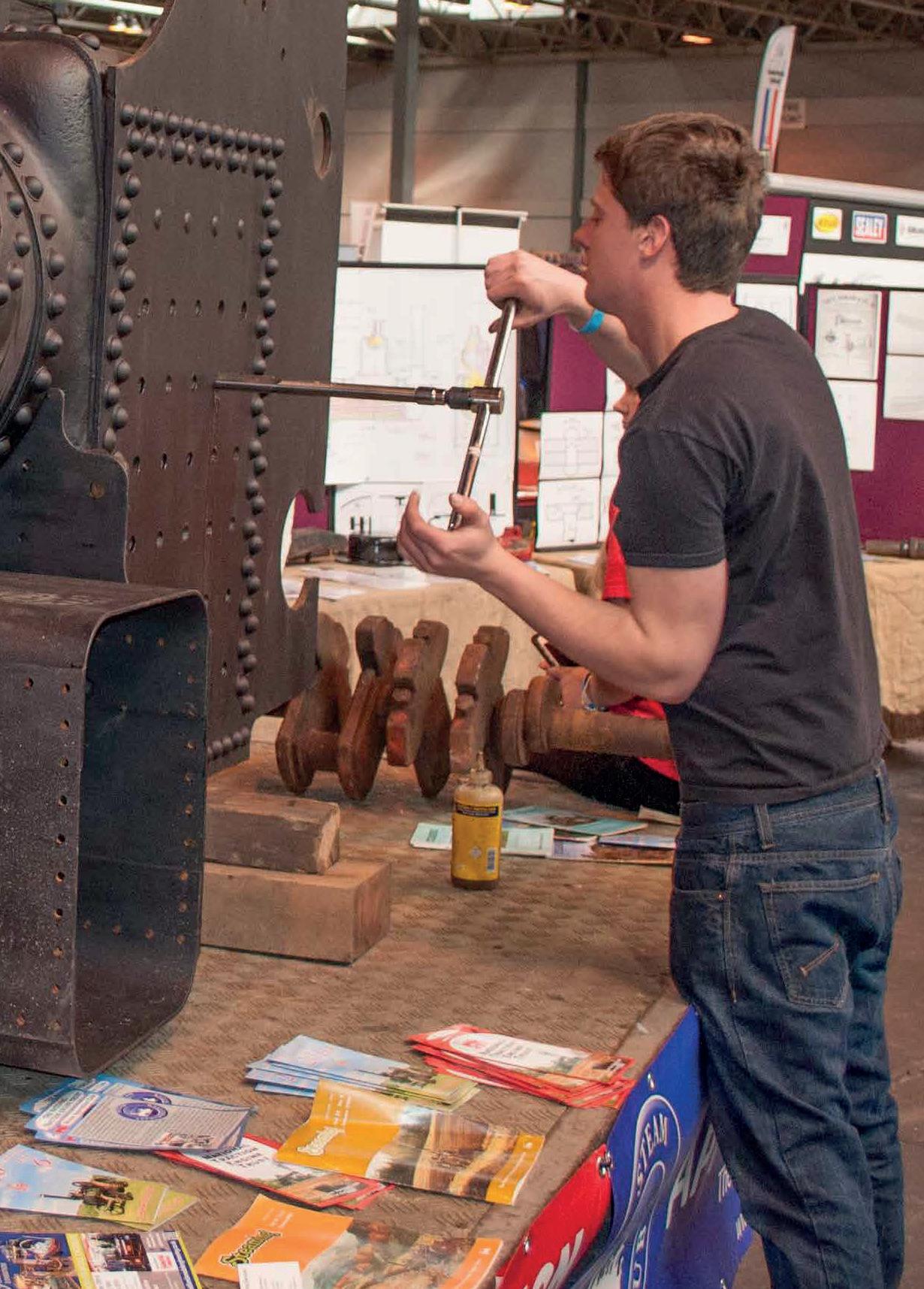
One of the exhibits on the NTET’s stand was the boiler of an Aveling & Porter tractor, owned by SAC member Tom Fields-Pattinson.
The tractor was rescued from the
shores of Loch ness, and since buying it Tom has fitted a new firebox.
One of the remaining jobs to do was to thread all of the holes in the horn plate and firebox ready to fit the stays.
Tom did this as a demonstration during the show, which attracted a lot of interest.
The photo on the rear cofer shows Tom using a ‘stay tap’ to thread the holes.
Applications are invited for the SAC Technical Achievement award. Areas of achievement may include: engineering work on full size engines, model engineering or any other appropriate steam related subject (bearing in mind that we are essentially a road steam organisation).
The purpose is to encourage young people to develop hands-on experience generally within typical engineering skills. This can be using various machines such as lathes and mills as well as handwork. Nominations to be entered by a sponsor for whom they have been working or have been under the instruction of, or apprentices may enter themselves.
Applications to be received by August 15th should consist of a brief description on one side of A4 paper with 3 or 4 photographs and/or sketches. See address inside your latest copy of Raising Steam. The judging committee will then
contact the nominator or apprentice by either phone or in person to discuss the application. From these discussions, suitable candidates will be chosen, and final and fully detailed submissions will be invited to be with the Chairman by September 15th.
Judging will be completed by mid October with the announcement of the winner by end of October. The award will be presented at the NTET AGM.
Judges will be from members of the SAC Committee plus invited persons from an area appropriate to the subject entered.
Please note that due to the all round experience we are looking for it is unlikely the award will be awarded to an apprentice under 15. Though as we know there is always an exception to the rule, so please don’t hesitate to either enter or contact the Chair for guidance.
Julian Tyrrell
The reasons for having an annual boiler test:
• Ensure that the boiler is safe and allowed to be used to the rated pressure
• Ensure that the safety valves lift to prevent the pressure from exceeding 110% of the rated maximum.
• Ensure that the two water injection devices work at maximum pressure.
The boiler test for the SAC Burrell, Lady Sylvia, and my Burrell engine, Captain Jack, was done on the same day by our favourite boiler tester Dave Wothers.
Preparations for the engine is for the ‘cold’ test, which requires the boiler to be drained, removal of all of the washout plugs from around the foundation ring. Additionally the wash-out plug from the front tube plate was removed. I then
used my home-made jet-wash to clean the inside of the boiler from any scale and rust deposits. The fusible plug from the roof of the fire box has to be removed; this requires a socket on a long extension as you can’t get inside the firebox with a spanner.
Dave does a ‘cold’ inspection, looking at the condition of the boiler front tube plate, welds, and tube ends; the firebox welds and tube ends; the foundation ring condition and welds. Dave then measured the thicknesses of the firebox walls, front tube plate, and boiler outside walls using and ultrasonic thickness gauge.
Then Dave looks inside the boiler using a ‘endoscope’ – a fibre-optic microscope that is only a few millimetres thick and can look into small openings and bend round corners. He may also