

Editor
Kevin Munn, 56 Blacklands Drive, Hayes End, Hayes, Middlesex. UB4 8EX. Tel 0208 573 9180 sac.raisingsteam@ntet.co.uk
Chairman
Elaine Massey, 21 Down Close, Northolt, Middlesex UB5 6NS Tel: 020 8248 6570 sac.chairman@ntet.co.uk
Vice Chairman
Hugh Dyson, 32 Granary End, Witchford, Ely, Cambridgeshire CB6 2WF Tel: 01353 667150 hugh.dyson@inbox.com
Membership Secretary
Lisa Crankshaw, NTET Membership PO Box 10348 Hinckley LE10 9FB membership@ntet.co.uk
Membership fee £15 per annum Webmaster
Nick Bosworth, 76a Main Road, Smalley, Ilkeston, Derbyshire, DE76EF Tel: 07931 577430 sac.webmaster@ntet.co.uk
SAC Committee
Main email: sac.raisingsteam@ntet.co.uk
Matthew Lund Tel: 01329 832462
Barry Sumsion Tel: 01633 671798 Helen Tyrrell Tel: 01793 751830
The Editor welcomes any contributions of articles, shorter items or photographs for inclusion in future issues. All material submitted is voluntary and payment cannot be made for any material published. The opinions expressed in the magazine, with the exception of Club announcements, are those of the contributors and do not indicate the views of the Club as a whole. All items are held copyright by the contributor and the NTET. The Editor reserves the right to amend or refuse contributions. The magazine is normally published during January, April, July and October. The Club accepts no liability for failure to meet intended publication dates.
The Steam Apprentice Club is a section of the National Traction Engine Trust.
N TET is a Registered Charity, No. 291578. Registered in England No. 1302197. Registered Office: 4 Church Green East, Redditch, Worcestershire B98 8BT.

www.ntet.co.uk

www.ntet.co.uk/sac
Well G.D.S.F. Was quiet compared to normally as many of you were back at school, finding your way in new schools or your way to different classrooms so it was a shame not to see you. But what was a bigger disappointment is that I have not received a article or picture from anyone, zero, zilch, cero, nowt! Therefore can I please plead with you as the season is now over please type away at the computer keyboard and write to me. Send pictures as well just put a few words with them to tell us what it is about. There might be near
you small gathering, fire works night for example, let me know about them and what engines went. By the time this issue reaches Christmas and New Year will not be far away, so I wish you all a good time and Father Christmas brings you plenty of steamy presents.
sac.raisingsteam@ntet.co.uk
Elaine Massey
I can’t believe it! We are already at the end of another “steam season”. I really do hope that you have all had a lot out of your membership with the SAC this year!
Watch out for the dates for next years driving days which will be in the next issue of Raising Steam. Get your applications quickly to ensure a place!
Consider too, those of you over 13 maybe asking your parents to book you a place on the popular NTET Driving Course at Astwood Bank in May! It’s a very good deal being half price for apprentices.
GDSF was very strange for the SAC in that there were practically NO children. This was because many of the local authorities had returned to school that week. In fact two of my committee had to miss the weekdays for teaching obligations. Next year, with it being a
leap year, we should be OK, given that they don’t ask kids to return to school on a Friday!
The SAC Burrell, Lady Sylvia, is running well. She has attended several events this year, including GDSF and Bedford, and was in steam at the Midlands Model Engineering Show. Sponsorship for the Burrell is ongoing and I would like to thank those involved; Walker Midgley, Craftmaster, Andy Holmes, the Davis family, to name a few. All her on costs are covered by sponsors the only current costs to the trust being mileage. She does attract a lot of attention at shows and in the press and I believe that the Trust has gained a lot from supporting this project.
I hosted a stand on behalf of the NTET at the Midlands Model Engineering Show in October, and our Burrell Lady Sylvia was in steam outside.
In January we have a stand booked for the NTET at the London ME show, Alexandra Palace.
In November I have been invited to speak at a conference hosted by the Heritage Railway Association focussing purely on “encouraging young persons on Heritage Railways”. The programme for this includes Vetting and Barring; Insurance; other youth organisations
and a talk from a BESST apprentice. The focus of my talk is “getting young people involved”.
Just left for me to wish you all a very Christmas and New Year!
Elaine Massey Chair SAC
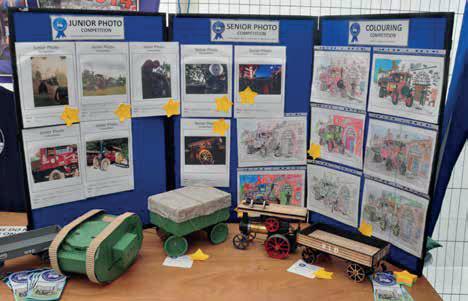
Our usual array of compettions were set in the July issue, and were judged at the Great Dorset Steam Fair.
Entry numbers were low this year, with only two entries for the mode, and only three for the senior photo! Hopefully we can do better next year! Congratulations to the winners.

Colouring
1) Tia Harkup
2) Reilly Sparkes
3) Isaac Jacobs
Junior Photo
1) Sean Og Lorden
2) Alice Shergold
3) James Allen
Senior Photo
1) Danielle Wainwright
2) William Hurley
3) Victoria Hough
Model
1) Kieran Tyrrell
2) Isaac Jacobs


1st
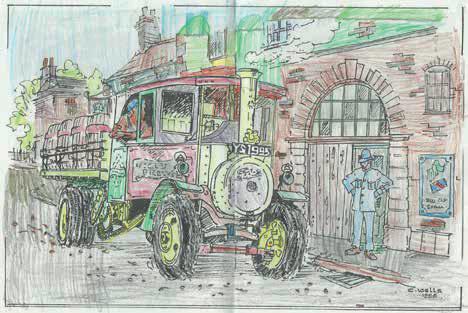
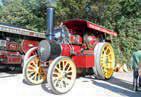
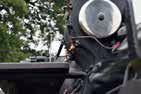
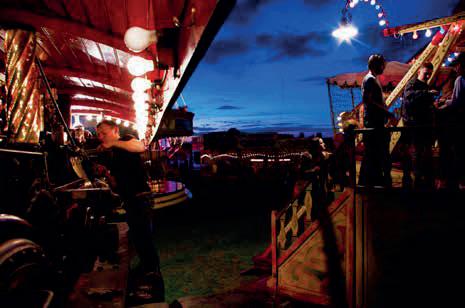
1st Place in the Colouring Competition, Tia Harkup
IS COMING! What present would you like?
Ask someone to give you a voucher for the NTET Driving Course To be held at Astwood Bank, Redditch, Worcestershire on 7/8 May 2016. Steam Apprentices (age 13-15) £80, (age 16 – 21) £115 for the two days. DISCOUNT of 15% If you pay for 2 years at the same time. Contact Joe Black at :training@ntet.co.uk or Tel: 07595 466353
For more information about the training course, see the NTET website: www.ntet.co.uk/owners-drivers/driving-experience-courses
Did you know you can get free entry to rallies when you show your membership card. Not all rallies do this but many do. Always check ahead with the rally organiser if they are willing to give you free admission. It is for YOU only and will not include family and friends. The NTET has a Authorised list of rallies at www.ntet.co.uk/events, so have a look.
www.ntet.co.uk/sac
Kevin Munn
Lady Sylvia, our 4 inch scale Burrell attanded the Great Dorset Steam Fair in early September.
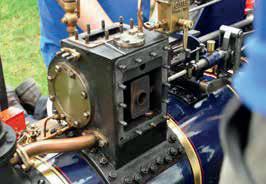
For some of the rally, she was used for learning workshops, where a few steam apprentices were shown the inside workings of the cylinder block and learnt about valve timing.
The bottom photo shows the valve chest cover removed and the part with the circular hole is the slide valve, which controls the steam entering the cylinder and directs it into the correct ends of the piston.
The Safety Valves had also been removed allowing access to the regulator.
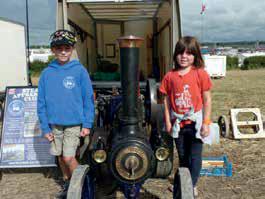
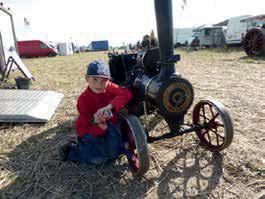
Later in the week Lady Sylvia was in steam. The top photo shows Jack and Emily Wallbridge all clean before starting to learn how a steam engine works, and the middle photo shows Alec Colbeck learning the first skill of an apprentice, brass polishing!
Kevin Munn
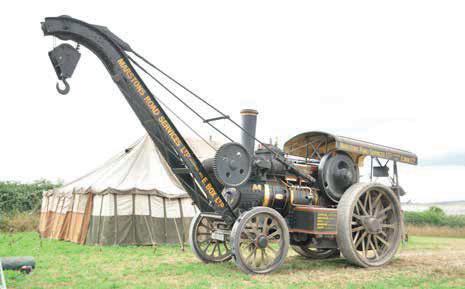
What might be rarer on a rally field than a genuine showman’s engine, might I suggest a crane engine.
When I was at Bedford Steam County fair in September I saw ‘Duke of York’ a Fowler B6 Road locomotive and crane engine which is 10NHP, built in 1928 with works number 17106.
With the jib at the front it is a big and towering machine which one certainly has to look up to.
The engine spent much of its life with Marston’s as written on the sideboard
moving heavy items such as castings, transformers and ships gear. It has moved many heavy items including a 126 ton casting from Sheffield to Liverpool in 1937.
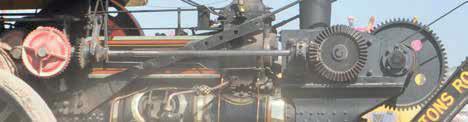
As you can see in the pictures, I have taken a close-up of how the drive was taken from the crank shaft to the gear above the smoke box which allowed lifting and lowering to take place.
We are told that at one time it lifted a 17 ton boring mill into position.
Kevin Munn
You would have thought by now all the traction, steam rollers, etc in this country would have been restored.
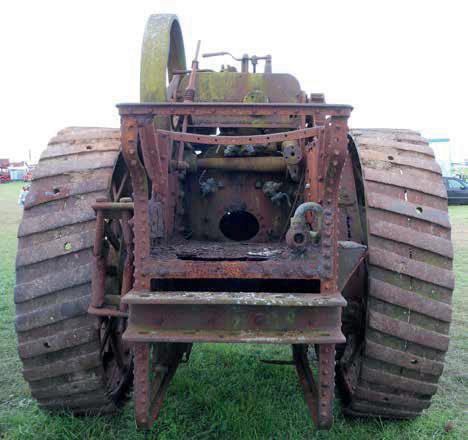
Not so! Marshall General traction Engine ‘Peggie’, a 6NHP engine built in 1894, works number 24121 is still in need of restoration.
When working in Pembrokeshire its main duties were threshing and stone crushing around the locality of Mathry before being laid up in 1942.
Peggie has spent the last 63 years out in the open and of course the weather took its toll, much corrosion has taken place especially of the sheet metal work and tender, which just has the main frame of it left intact. Despite being there for so many years it was only this year an enthusiast was able to purchase it for restoration. They certainly will have their work cut out over several years to bring it back to its full glory.
Photo: Rebecca Hurley
Julian Tyrrell
This year has been a hit-and-miss year for the Steam Shows – some very damp while others glorious. Perhaps I picked the best ones to attend with our engine ‘Captain Jack’; as South Cerney and GDSF in August we very hot and sunny, then last month the Bedford show at Old Warden, was again glorious.
South Cerney is a show in south Gloucestershire on an airfield south of Cirencester. With about 60 engines, both full size and miniature it is a large show. The steam show is combined with vintage vehicles of all types, and a country fair. Miniatures had their own driving area as was kept busy with a range of engines from one inch to 6 inch scale engines.
Great Dorset is the biggest fair, and I joined the Lady Sylvia in the miniature area acting as a tutorial engine for
apprentices. We had use of the miniature run down the side of the main ring and both apprentices and I had fun driving up and down the main ring.
As part of our time at Dorset some essential maintenance was completed on the Lady Sylvia with value timings being adjusted for apprentices. The regulator has also been adjusted so that it will open a little further. These changes were then thoroughly tested by apprentices driving up and down the ring for 5 solid days. Many happy smiling faces were seen –even if they did end up a little smutty!
The Bedford Steam Engine Preservation society run one of the best shows, with engines having to go and collect coal and water, which means all you, as visitors, have to do is sit in the right place and watch the show drive
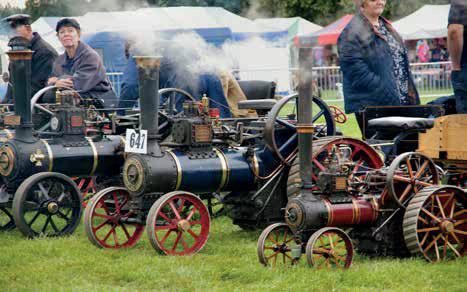
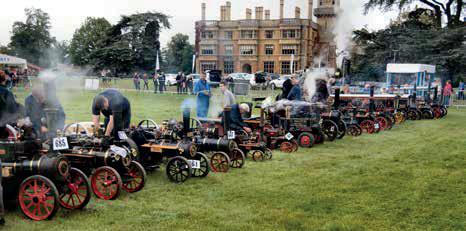
past you. In fact all the engines, of all size and shape are encouraged to spend all day driving around the site, not just restricted to ‘play pen’ driving. I took my 4 ½” Burrell and spent 3 days driving around the whole show ground, burning lots of coal and boiling gallons of water.
There is a new engine play pen which was thoroughly enjoyed by the engines, as the hill is steeper, but shorter than the one at Dorset, to the point that even some of the full size engines struggled to get to the top. For the miniatures pulling a trailer up the hill with an adult as ballast, this took some careful driving, a low gear and lots of regulator.
We again met up with the Lady Sylvia and the two engines were found on a number of occasions driving around the field to keep each other company.
The ‘Parade of Miniatures’ only took place on the Friday, and I lined my 4 ½” next to Dave Scott-Willliams’ 3” – these are both based on the original Plastow design – so that the difference in size is quite obvious. In driving up to the ring and around to the line-up, most of the engines were lifting the safety valves –so when the commentator asked for a combined whistle from everyone it was
quite loud!
On the topic of whistles, thanks must go to Bruce and RA Barker who provided Lady Sylvia with a new (loud) whistle. So people not only know we are coming but can be warned ‘we are coming through’. Overall a productive summer, good weather, fantastic shows and good company. Happy driving
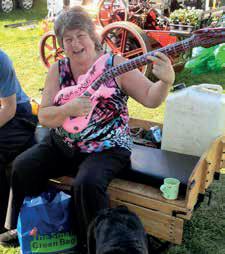
Our Chairman progressing to something more advanced than an ‘Air Guitar’.
Kevin Munn
Who would have thought?
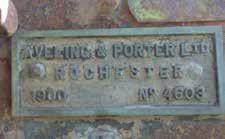
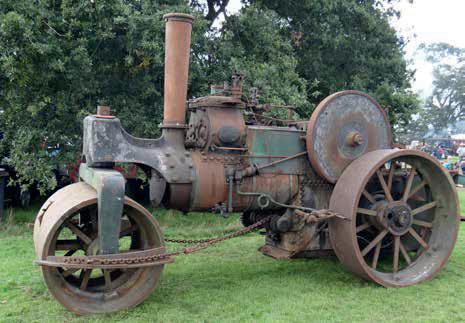
That after many, many years and countries apart that consecutive serialised Aveling and Porter steam rollers would end up in a field in Bedfordshire. I was at the Bedford club steam rally in September, where on show was Aveling Porter Steam roller serial number 4603 an R10 model built in 1910 when it was shipped new to Aalbory in Sweden which has only just been ‘rediscovered’ in a barn in Denmark before being sold and brought back to the UK. As you can seen from the pictures everything appears still to be with the engine, and you can also imagine you could fill it with water, light a fire and steam it up again. Of course the new owners will check it all out before
doing that. Then barely a few yards away is Aveling and Porter roller serial number 4604 called ‘Mona also a R10 model. This engine worked for Hove council from new. It was stripped down in 1970 and was found to need a new firebox and lay ‘derelict’ until 1999 when the current owners obtained it and completed the restoration.
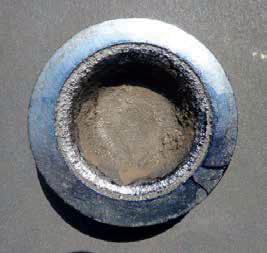
What do you think this might be?
Kevin Munn
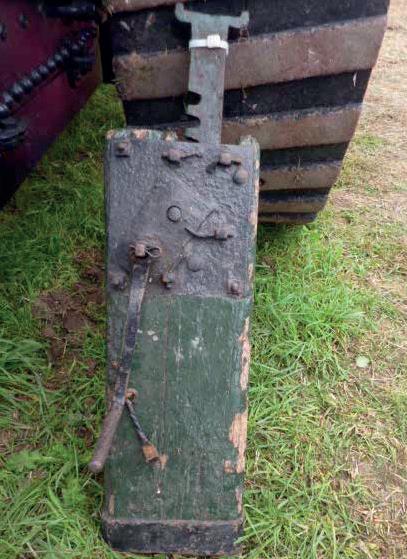
What do you think this item might be? It can be found on a traction engine.
If you think you know, post the answer on our facebook page or send us an email.

sac.raisingsteam@ntet.co.uk

SteamApprenticeClub
The answer will be revealed in the January edition.
Sean Lordan - Bandon, Eire
Ross Barnes - Shrewsbury, Shropshire
Katie Gliddon - Colyton, Devon
Stephen Gliddon - Colyton, Devon
Nathaniel Davies - Gorseion, Swansea
Greg Luck - Uckfield, East Sussex
India Rimmington - Morley, Leeds
Seren Rimmington - Morley, Leeds
Georgia Barton - Nr Lewes, East Sussex
George Jenkins - Cleeve, North Somerset
Nathan Griffin - Stockport, Cheshire
Jay Hardiman - Andover, Hampshire
Blake Wren - Paignton, Devon
William Tucker - Bridgewater, Somerset
Christopher Walker - Weymouth, Dorset
Harry Pilsbury - Shrewsbury, Shropshire
Niall Baxter - Woking, Surrey
David Tipper - Southampton, Hampshire
Oliver William - Maunder Usk, Monmouthshire
Cain Drew - Stotfold, Herts
Lewis Bailey - Leighton Buzzard, Bedforshire
Alexander Randall - Eastleigh, Hampshire
Emma Bradbury - Stoke on Trent, Staffordshire
Sam Timson - Macclesfield, Cheshire
Millie-Leigh Crump - Bewdley, Worcester
Samuel Medcalf - Southam, Warwickshire
Samuel Byatt - Waterlooville, Hampshire
Daniel Lawes - Walsall, West Midlands
Charlie Medcalf - Southam, Warwickshire
Jamie Thomas - Upton Swindon, Wiltshire
Kacie Emma - Upton Swindon, Wiltshire
Matthew Glover - Cambourne, Cornwall
Oliver Glover - Cambourne, Cornwall
Taylor Button - Ringwood, Hants
Ben French - Uckfield, Sussex
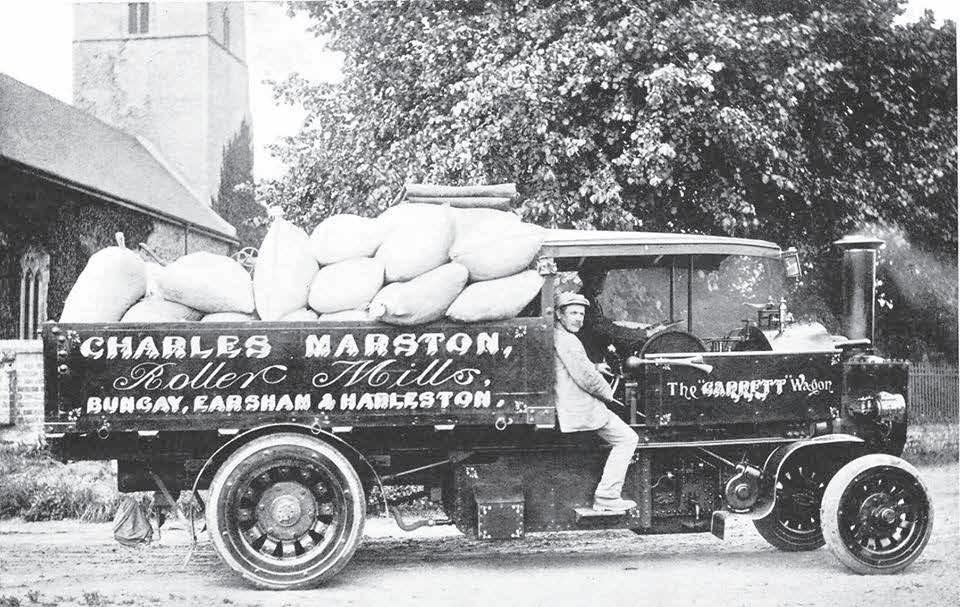
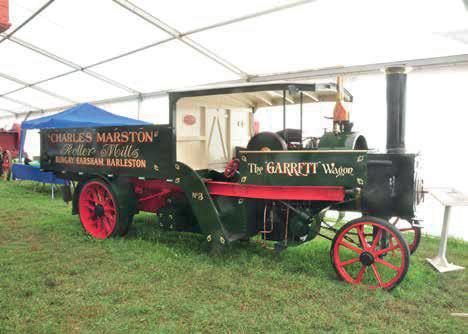
Earlier in the magazine, there is a article about an unrestored traction engine ‘Peggie’. Here is a steam wagon that has been restored from very few original parts.
• Garrett Overtype Steam Wagon
• 3 Tons
• Built 1912
• Works No. 30826
• Reg. No. BJ 3166
The wagon was supplied new on June 4th 1912. No. 30826 was the 8 th 3 Ton Overtype Wagon built by the Suffolk firm out of a total of 147 of this type.
The wagon was built for Charles Marston, a miller of Bungay, Earsham and Harleston on the Norfolk/Suffolk border, and was driven there by road.
Garrett’s supplied a driver to stay with the wagon for the first two weeks and train the crew - George Wilby as driver and Jack Mayhew as fireman.
The cost was £500, with a 10% discount if paid within 30 days of the invoice date, and an extra £100 was paid for rubber tyres. Marston must have been pleased with the wagon as in October 1914 he purchased a second wagon from Garrett’s, this time a 5 Ton model, No. 32504, registered BJ 2313 .
In September 1918 30826 returned to Garrett’s to have the rear wooden artillery wheels changed to cast metal wheels which also required a new axle and braking system. The wagon worked for the company until 1920 when it was sold through George Thurlow of Stowmarket (Garrett Agents) to George Cooper & Sons of Needham Market who
were also millers.
In 1921 the wagon passed to Robert Gray of Ipswich, a Showman, who sold her on in 1924 to William Stringer & Co. of Norwich who were Motor Engineers and also ran a Garrett Tractor, No. 32335. In 1925 the wagon was sold to Taylor Bros. of Wimbish, Essex who used the wagon to cart road stone and sugar beet amongst other things. The wagon was used by them for several years and was partially scrapped in the mid-late 1930’s with the chassis and rear axle assembly surviving as part of a shed. In 1975 Ken Frost acquired the parts for restoration and in 1998 they passed to Pat Jenkins. Purchased by the present owners, the Worbey family, in 2002 who embarked on the extensive rebuild and restoration of this unique wagon with much help from friends.
Via an appeal for parts that may aid the restoration, Colin Knight came forward with some original Garrett casting patterns, and all missing patterns including the cylinder were made by Terry Young. Mick Cox took on the challenge of machining all the new parts.
Matt Lund
We all know about injectors on engines, that little bronze fitting hanging on a load of pipe work down the side of the tender, but what are they and how do they work? In this article I will explain how to use an injector and how it works.
Early steam engines were stationery machines built into buildings for powering the industrial revolution of the early 18th century. Boiler feed water was pumped into the boiler by a crank shaft or beam driven reciprocating ram type pump. Early self moving steam locomotive needed their wheels to be in motion for a crank shaft or valve gear driven pump to operate. In 1858, Henri Gifford, a French engineer overcame this problem with the invention of the water injector, a device that seemingly works by magic. As it uses steam at boiler pressure to overcome that same pressure and force water into the boiler at a higher pressure, i.e. if you have a boiler at 100PSI the water pressure would need to be 105PSI to open the check valves on the side of the boiler.
If you take a cross section through a injector you will find it consists of a set of converging cones (cones that get smaller) and diverging cones (cones that get larger). When you put a converging cone and diverging cone together you end up with a converging-diverging nozzle (like the mixing / output cone) commonly known as a venturi. A venturi uses
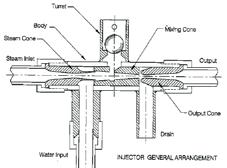
Bernoulli’s principle of hydrodynamics, which states that as a fluid (gas, steam or liquid) increases in speed it decreases in pressure and vice versa; as it slows down it’s pressure increases.
By forcing steam to flow through a converging cone you increase its velocity (speed) and kinetic energy (the energy in a moving object) and reduce its pressure. If you then pass that high speed jet of steam through water it will carry it with it because the steam transfers some of its kinetic energy into the water. The steam will condense so you end up with a jet of high velocity water and steam mixed together at a lower pressure. If that low pressure high velocity steam and water mix is now fed into the converging cone of a venturi its velocity is increased further and its pressure decreases even further (Bernoulli’s principle). As this now very high velocity low pressure water-steam mix passes into the diverging cone of the venturi the opposite happens, the watersteam mix slows down and in doing so increases its pressure. The result is you have a high velocity high pressure flow
of water-steam mix coming out of the injector, with enough pressure to force its way back into the boiler through the check valve against boiler pressure.
You can experiment with Bernoulli’s principle by getting your garden hose with the tap turned full on and put your finger over the end of the pipe. You will feel the pressure of the water pushing against your finger, by moving your finger so that you get a jet of water out you will notice this jet goes a lot further than a normal stream of water. This is because as you restrict the flow of water with your finger you have made a form of converging cone causing the speed of the water to increase as it flows past your finger.
How to use an injector and how it works....
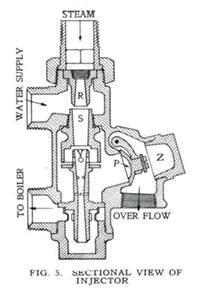
For an injector to work it needs a good supply of water from the tender and steam taken from a point off the top of the boiler. When using an injector you always open the water valve first allowing a good supply of water to the injector. (see figure 5) The water passes into the top of the injector body and by gravity down through the mixing cone (S) and out of the overflow valve (P). When steam is introduced to the injector it passes through the steam cone(R) and greatly increases in velocity. This steam passes through the water, carrying it along at very high velocity through the mixing cone (S) and into the first part of the delivery cone (Y)(a venturi). This causes a reduction in pressure in the mixing cone (S) as well as in the middle part of the injector body, caused by the steam condensing into the colder feed water and Bernoulli’s principle. This allows atmospheric pressure to close
the overflow valve (P). With valve P closed the reduced pressure through the mixing cone helps to draw more water from the tender. As the high velocity water jet passes down the delivery cone (Y) it’s velocity increases further in the first part of the cone. This high velocity is then transferred into high pressure in the second part of the delivery cone (Bernoulli’s principle). The high speed high pressure water jet that emerges from the delivery cone now has enough energy to open the boiler check valve against boiler pressure, allowing water to enter the boiler. Once there is enough water in the boiler the steam is shut off to the injector, causing the water to slow down through the injector and stop flowing through the delivery cone (Y). This increases the pressure in the middle part of the injector and the water now opens the overflow valve (P). The water can now be shut off from the injector.
Rear Cover: Of course there is much more to steaming an engine there is the equipment that goes with it.
This is a drum jack, which is used for lifting and adjusting the position of a drum (threshing machine)
They can be used to lift the threshing drum up, allowing blocks of wood to be placed underneath the wheels to make the drum level. Threshing drums must be level to work properly. When placed at an angle, as shown in the picture, a jack can move a threshing drum (or any other implement) by very small amounts, which is necessary when trying to align a belt from one machine to another.
The picture shows one being used to ‘jack’ the engine away from the drum to get the correct belt tension.
“What is a mud hole door”?
A Mud hole door is an opening in the boiler which allows the operator to drain and wash out the boiler.
Water isn’t always perfectly clean, and over time the impurities in the water build up inside the boiler and it becomes necessary to wash out the boiler. With boilers being made of steel they rust inside, so scale and muck also needs to be periodically washed out.
Mud hole doors are usually found on the lowest part of the boiler, around the edges of the firebox, because this is where the imputities tend to settle. They can also be found in the front tube plate, and sometimes in other parts of the boiler too. Usually they are in places where you can put a hose pipe in to wash out the impurities.
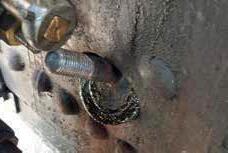
The picture to the right shows a typical
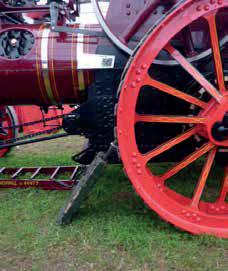
door. The door itself is an oval piece of metal, with a threaded stud in the middle.
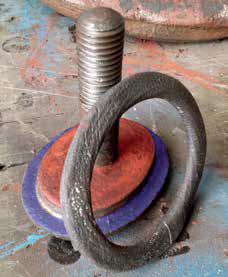
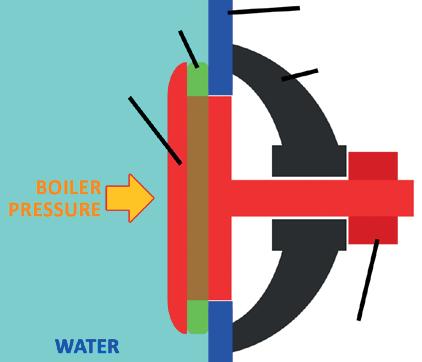
The red shaded part matches the size of the hole in the boiler. The blue shaded part is larger, and is where the sealing gasket goes.
The reason the door is oval is because the door is designed to be fitted on the inside of the hole in the boiler, so that the boiler pressure naturally holds the door in place. The blue part, at it’s narrowest point, is narrow enough to fit through the hole in the boiler at it’s widest point, the door is then turned 90 degrees into position. Then the ‘bridge’ is put over the stud, and a nut is screwed on to keep it all in place.
Leaned against the door in the picture is a gasket. This forms the seal between the door and the inside of the hole. There are several kinds of gasket, each with their own fitting procedure, but generally you tighten the door in position, and as the
gasket settles into place during the first steaming you check the nut periodically to make sure it is kept tight.
The diagram below is a cross-section of a mud hole door, showing how the boiler pressure will hold the door in place.
The gasket, which is a soft material, will squash thinner for the first few steamings after the door is fitted, as it moulds to the door and the inside of the boiler.