
Apr il 2010.*
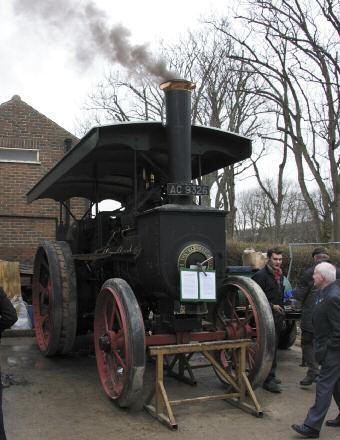
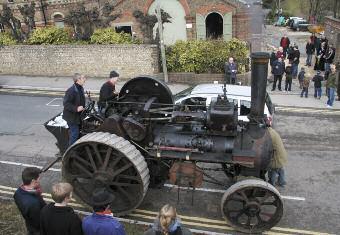
Above: Garrett 6 NHP General Purpose Superheated Traction Engine No. 29764 of 1911 at the Br itish Engineer ium, Br ighton. See page 8. This engine is the proper ty of our Vice Chair, Elaine Massey and family.
Editor
Nanette Durling, 19 Mill Lane, Barton under Needwood, Burton upon Trent, Staffordshire DE13 8HE
Tel: 01283 712818
sac raisingsteam@ntet co uk
President
John Durling, 19 Mill Lane, Barton under Needwood, Burton upon Trent, Staffordshire DE13 8HE
Chairman
Kevin Munn, 56 Blacklands Drive, Hayes, Middlesex Tel: 020 8573 9180 sac chairman@ntet co uk
Vice Chairman
Elaine Massey, 21 Down Close, Northolt, Middlesex UB5 6NS Tel: 020 8248 6570 elainermassey@ntlworld com
Membership Secretar y John Cook, Dolfarni, Church Lane, Kirkby la Thorpe, Sleaford, Lincolnshire NG34 9NU Correspondence only
Membership fee £10 per annum
Webmaster
Nick Bosworth, 9A St Wilfred’s Road, West Hallam, Ilkeston, Derbyshire DE7 6HG Tel: 01159 309868
sac webmaster@ntet co uk
SAC Co-ordinators
Emily Drury ecdrury@hotmail co uk
Matthew Lund Tel: 01329 832462 matt lund@engineer com
Kevin Lawrence Tel: 01229 838144 k lawrence@dsl pipex com
Barry Sumsion Tel: 01633 671798 barrysumsion@gmail com
Joe Black Tel: 01748 829601 joe1922@googlemail com
The Editor welcomes any contributions of articles, shorter items or photographs for inclusion in future issues All material submitted is voluntary and payment cannot be made for any material published. The opinions expressed in the magazine, with the exception of Club announcements, are those of the contributors and do not indicate the views of the Club as a whole. All items are held copyright by the contributor and the NTET The Editor reserves the right to amend or refuse contributions. The magazine is normally published during the early part of January, April, July and October The Club accepts no liability for failure to meet intended publication dates
The Steam Apprentice Club is a section of the National Traction Engine Trust NTET is a Registered Charity, No 291578 Registered in England No. 1302197. Registered Office: 4 Church Green East, Redditch, Worcestershire B98 8BT
Typesetting and Artwork by Kearline Graphic Images Ltd, Fairoak House Business Centre, Church Road, Newport, South Wales NP19 7EJ
Printed by TSG Creative Solutions, St Neots, Cambridgeshire PE19 8EL

It is now officially summer, a l t h o u g h i t ’s b e e n r a i n i n g t o d a y ! A t l e a s t t h e s h ow s we’ve been to so far this year h ave a c t u a l l y h a p p e n e d , unlike last year when several were rained off. Have you been to any good shows yet? I’m not necessarily referring to the great big ones. What about your local steam party or fete? Let us know what you’ve been up to The usual addresses and emails all still work.
So far John and I have taken Morning Star out to a couple of events, including spending a day at the Clay Mills Pumping Station in Burton on Trent. We got hailed on when driving there but it was still a good day.
Another exciting trip we made was from Klondyke Mills to a little village steam fair (only 3 engines) at Cauldon Lowe in the hills near Leek in Staffordshire. This was a 20 mile run towing the living van and included driving up Swinscoe Bank. This is a 2 mile long hill which is a 1 in 8 gradient (12%). This made Morning Star really work and when we got to the top there was no paint left on the smokebox. Coming back down on the Sunday was just as entertaining, holding her back on the brakes and the reverser. It was, of course, an enjoyable weekend. This is what I was referring to earlier when I mentioned the little shows.
We are planning our usual excursion into Yorkshire to visit the Masham Rally and then over the hills to Flookburgh in Cumbria. Please come and say hello if you’re there.
Elsewhere in the magazine you will see a report on the SAC visit to the Gunpowder Mills and a write up of the Driving Day at Les and Dee Searle’s in Horsham There are also changes in the way we are planning to run the SAC activities at GDSF this year so please read the Chairman’s bit.
I look forward seeing loads of you during this season.
Nanette Durling, Editor
The season is now truly into full swing and I hope you have managed to get out and about on an engine. Just to remind you, if you are going to a rally and want to go on an engine contact me in the first instance so I can see if I can arrange it with the rally organiser/steam section. This is at the request of the Rally Organiser’s committee. By doing this, hopefully an engine will be available when you turn up and also it will avoid bothering the Rally Organisers when they can be very busy. Don’t forget if you are just going to visit a rally many offer free admission to Apprentices. See the NTET list in your last magazine or go to the NTET website
There are still some spaces on the three driving courses we have left at Flookburgh in Cumbria, Salop in Shropshire and Tinkers Park in Sussex. See the website or previous issues of Raising Steam for full details
As you will see elsewhere in the magazine Elaine and I went to the Royal Gunpowder Mills to promote the SAC and its activities. We will also be at the Banbury rally at Bloxham on the 26/27 June and Kemble Gloucester Steam Extravaganza on the 6/7/8 August. Do come and say hello if you can.
For the older apprentices how would you like to do something different rather than just driving? I am thinking on the lines of experiencing working on a saw bench, threshing, or road making. Let me know and we shall make enquiries to help you expand your all round experience If there is enough interest we will create new pages for the logbook so you can record the work carried out.
Though Dorset is still several months off this will be the last magazine before the event We have been discussing various matters about Dorset and will be changing what we do there. Firstly to the bad news, there will be no ‘duckling run’ to place Apprentices on engines. We will however be having a Cavalcade event both on the Wednesday and the traditional Thursday evening starting at approximately 5pm Subject of course to weather and engine availability. Production of your membership card will be required, plus please wear the correct clothing. As I have indicated above we could try and place older





apprentices on engines in the working areas, but that will depend on how you respond We are currently talking with Dorset about another new initiative, but at the time of going to press all the pieces of the puzzle are not yet in place. We will put this and any other news on the website under the news section. Don’t forget the competitions that are already in place as we do look forward to receiving them and judging them at Dorset. Have a nice summer whether you are steaming or not
Kevin Munn, Chairman
SAC Driving Day
Dad and I got to the yard at 9.10am. All of the apprentices had a group safety briefing first of all.
I was then paired with Daniel who is 11 years old; we got on really well and made friends. We were assigned the Foden Ltd bus owned by Les and Dee at the yard. Dave was our driver, he was great fun and taught us loads of stuff. Our 1923 steam bus was called, ‘Puffing Billy’. It was a four ton, slide valve, compound cylinder bus.
I was really excited when I saw our ride for the day. Our engine was the first to pick up steam I found it easier to steer than our engines I had driven but it was harder to drive It had a foot brake which I had never used before. We took lots of passengers for rides around the yard; these were mostly the steam apprentices’ parents and grandparents. My Dad came along 4 times with me driving
At the end of the day all of the steam apprentices piled into, Puffing Billy to take a trip
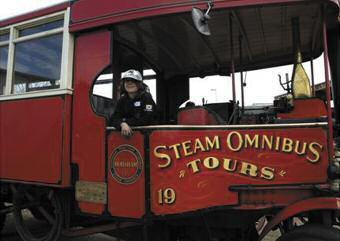
down to Horsham town – it was great fun, the best driving day I have ever had I didn’t want the day to end. Thank you so much to everyone who was involved and organised it.
Joe Creasey, (Age 10) Bexhill-on-Sea, East Sussex
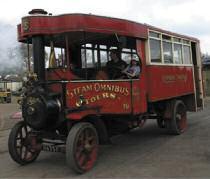
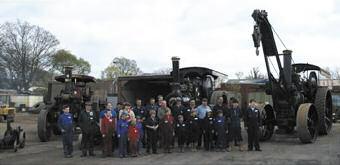
Editor’s note: It is really good to hear from someone who has obviously had so muc h fun. We should also give a big THANK YOU to Les and Dee Searle for stepping in at shor t notice so that this Dr iving Day could go ahead
Elaine Massey, our vice Chair, visited the Beaulieu Steam Revival: One of the star guests of the weekend was the record breaking steam car. Powered by liquid petroleum gas (lpg) and with nearly 3km of tubes this superheated steam car achieved a speed of almost 150 miles per hour!
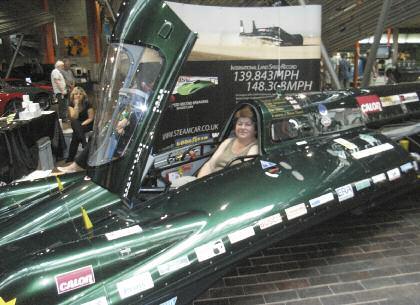
As you can see from the picture Elaine was allowed to sit in it; but I don’t think she got to drive! Elaine decided that there was nowhere to put the shopping. There is lots of informatio n about the car and design team on their website www.steamcar.co.uk.
Would you like to be able to show that you’ve achieved a high standard of enginemanship?
Are you 17 or over and hold (as a minimum) a provisional car licence? Then you can apply to take your Voluntary Competency Test The syllabus and other information is available on the NTET website or you can get a copy by emailing competency@ntet.co.uk.
Mike Holland, the Brighton businessman who stepped in and bought the Engineerium in May 2006 before it and its contents were auctioned off held a free public open day so that visitors could see the current state of restoration of the buildings and view plans of the continuing works and proposed extensions which will take approximately two more years to complete.
Burrell 'Gold Medal' Tractor 'Tiger' (No. 3786 of 1918) and Garrett Superheated GP engine 'Olive' (No. 29764 of 1911) outside the Engineer ium in Br ighton. (Elaine Massey)
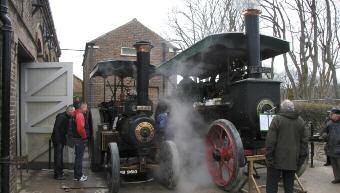
Visitors could see the restored roofs to the engine houses and former exhibition hall together with a new entrance and toilet block and a new kitchen, which has been constructed totally underground.
Continued on pages 13 and 14.
The theme for this year is J &
This is the theme for the Dorset Show so we are looking for your ideas based on this subject.
Entries can be in any medium, pastels, oils, watercolours, crayons, felt tips, anything you like. The maximum size will be A3. That is not to say you have to use that size, you can choose to go much smaller if you wish. If you are using pastels or charcoal, then please use some fixative to preserve it, especially if you are forced to post it (even hairspray works!).
This competition will be open to those aged 12 and over
Entries to be sent to either Nick Bosworth by 21st August or handed in at the stand in the NTET tent no later than 10a.m. Saturday of the Great Dorset Fair. See Nick’s details in Rule 3 of the Photographic Competition.
The annual photographic competition is an ongoing one, and starts almost as soon as the last one has finished, so let’s have as many of you as possible entering your best photographs that you have taken this year. The competition is split into 2 age groups – up to 15 years and 16 years old and over. Engraved medals and other prizes will be presented to the winners. The best overall entry will be presented with the Dorset Trophy and will receive a book donated by NTET Sales
1 Entry to this competition is restricted to fully subscribed members of the Steam Apprentice Club (SAC).
2. Each member’s entry will consist of 3 photographs. They may be 6” x 4” prints, colour or black and white, and can be digital. If supplying digital entries they may be supplied on disc in jpeg format or you can supply 3 prints on photo quality gloss paper Because they may be reproduced in this magazine afterwards, the resolution should be not less than the maximum setting on a 2 megapixel camera. All pictures should have been taken during the period 1st August 2009 to 31st July 2010
3. Entries must be sent to Nick Bosworth, 9A St Wilfred’s Road, West Hallam, Ilkeston, Derbyshire, DE7 6HG. Posted entries should arrive with him by Saturday 21st August 2010. He can receive e-mailed entries until 29th August 2010.
4. All entries must have the following details on the reverse of the photograph (or on the disc): name, address, age and SAC membership number; place, date and details of the engine or subject. (It is better to write these details on a piece of paper and then stick this on.)
5. Copyright in all entries will remain with the SAC member submitting the photographs and the organisers promise that prints will not be used in any manner or display other than in connection with the 2010 photographic competition
6 All entries are to include a suitable stamped addressed envelope to ensure all materials can be returned.
7 Entries will be displayed at the 2010 Great Dorset Steam Fair in the NTET tent Entries will be returned after display and/or publication in the magazine.
8. The competition will be judged in two age groups: up to 15 years; 16 years and over. Prizes and engraved medals for First, Second and Third places in each group will be awarded The best overall entry will receive the Dorset Trophy shield, to be held for one year.
The judges will be looking for originality, composition and technical ability. Photographs do not have to be of traction engines, but other subjects must clearly be related to the traction engine movement. The judges’ decision on all entries will be final and members are asked to accept them in a spirit that will bring credit to themselves and the Steam Apprentice Club
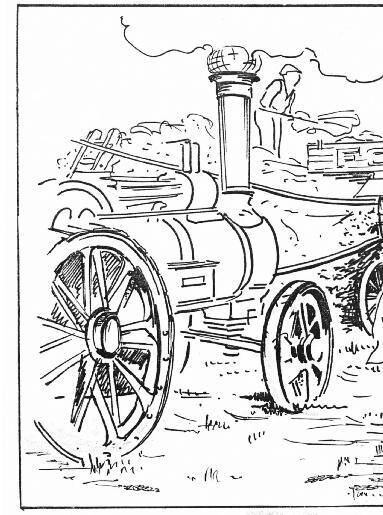
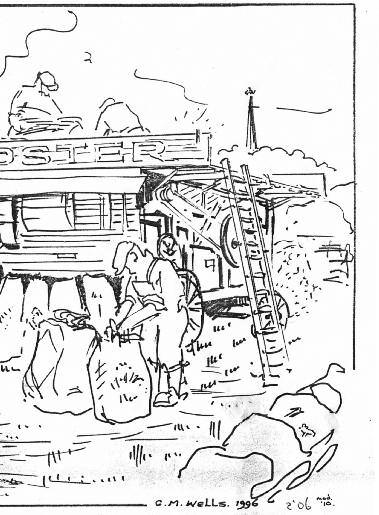
For Members aged up to 14 years old
CAREFULLY remove this page from the magazine – ask an adult for help if necessary –be especially careful of the staples.
COLOUR the picture using pencils, crayons, paints or felt pens.
WRITE your name, age, address and membership number in the space provided
POST your entry in a large envelope, to avoid folding it too much.
ENCLOSE a large stamped addressed envelope if you want your entry returned.
REMEMBER to send your entry to arrive with Nick Bosworth by Saturday 21st August
The competition is open to all apprentices up to the age of 14.
ADDRESS for entries is:
SAC Colouring Competition 9A St Wilfred’s Road West Hallam Ilkeston, Derbyshire DE7 6HG
Name Age Address
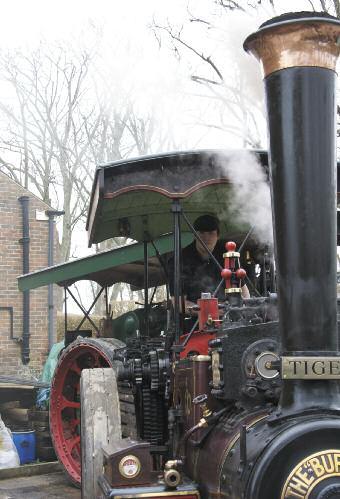
Graham Lynn on the Lynn family engine 'Tiger' - Burrell Gold Medal Tractor No. 3786, Reg PB 9610 of 1918. The photo was taken by our Vice Chair, Elaine Massey, dur ing the Br ighton Engineer ium open day in Marc h this year.
Although the smaller permanent exhibits were not on view the Easton & Anderson 250hp beam engine of 1876, in the number two engine house, was in steam, as was the Easton & Amos horizontal steam engine of 1862 which formerly powered the workshop machines via a lineshaft.
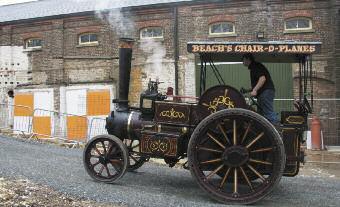
Burrell Gold Medal Tractor 'Tiger', No. 3786 of 1918 at the Br ighton Engineer ium. You can see evidence of the engine's showland histor y in the highly decorated paint sc heme . (Elaine Massey)
Also on display was a Shand Mason twin cylinder vertical boilered steam fire engine c. 1892; a Ransomes Sims & Jefferies 3NHP portable engine of 1954, together with a couple of man-handled fire pumps A display of 5” gauge live steam locomotives from Hove Park Railway also attracted attention from the visitors.
Outside two traction engines were in steam for the public to view and a good number of younger visitors took the opportunity to get up on the footplate for a closer look and to have the controls explained to them.
These engines were Burrell ‘Gold Medal’ tractor No. 3786 Tiger Reg No. PB 9610 of 1918 and Garrett 6NHP superheated general purpose traction engine No. 29764 Olive Reg No. AC 9326 of 1911.
A surprise visitor during the day was Michael Webber with his Q class single cylinder Marshall traction engine (one of the Lillywhite engines rescued a couple of years ago) who steamed across from his base at Lancing to support the event. Overall, an excellent day had by all; over 1,000 people attended Elaine Massey, Vice Chair.
Kevin continues with removal of the firebox from his Aveling & Porter roller ‘Kate’
The process of drilling out the stay heads took quite some time as of course I couldn’t do it every day but only on my days off. There are approximately 120 stays to ‘disconnect’ from the firebox to the outer wrapper and end plates, eventually this was done I then had
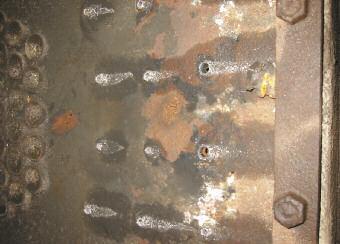
to turn my attention to the rivets which hold the foundation ring in place as well as those in the firebox door ring Like the stays they had formed heads so it would be difficult to
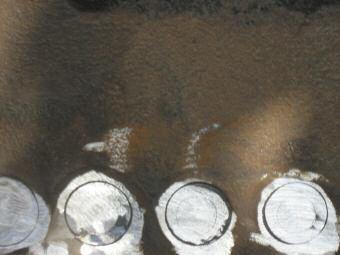
judge exactly where the centre was for drilling. Once again this resulted in the laborious task of grinding off the heads so that they became flush with the plates Once achieved, I centre-pop marked each stay and then drilled. First with a centre drill, then a small pilot drill going up in sizes so that I was finally just short of the original diameter of the rivet. To make the final task of removing the old stays easier I didn’t drill all the way through, but stopped approx 4 to 6 mm before the end. That way, with the aid of a drift inserted in the hole and a metal drift/bar, I could knock out the rivet Again I had many to do which took many hours and an aching arm from knocking out the rivets! It was finally all done; nothing was holding the box in place except rust! At anytime the box might have dropped out so I had supported it underneath using boiler supports At all stages of doing this project I have taken the necessary precautions to ensure I or anyone else didn’t get hurt. That means wearing goggles, hard hat, ear defenders, heavy duty shoes etc. I have just mentioned the need too for supporting and ensuring that at all times everything was secure. At long last the box was ready for removal.
Editor’s note. Kevin is making progress with his engine but you will now be becoming aware of how slow the process can be. However, if you can get yourself involved with this sort of work you will really understand how an engine goes together and works.
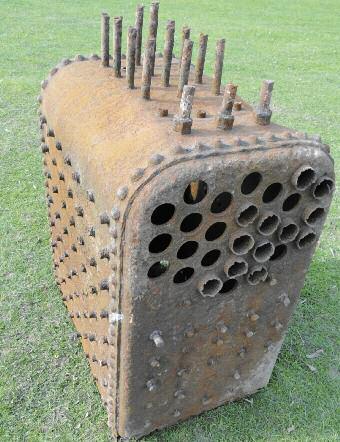
This picture of a complete firebox removed from a boiler is not from Kevin’s engine but is included to show what an inner firebox looks like. You can see the holes where the tubes were fitted and also the stays that used to hold the inner and outer firebox plates together. This picture was taken at the SAC Driving Weekend at Old Warden.
Have you ever wondered how the hot gasses and smoke get from the fire to the chimney? I’m sure most of you know that, in a locomotive boiler there are tubes running through the barrel. These carry the hot gasses from the fire and heat the water in the barrel. Over a period of time they become eroded due to the effects of the fire on one side and the water on the other. The tubes in Morning Star reached this point a couple of years ago.
They had been fitted for 10 years and were therefore probably due for replacement anyway, but we had always had problems with the tubes tending to leak whenever any serious work was done. This tendency got worse as the tubes aged.
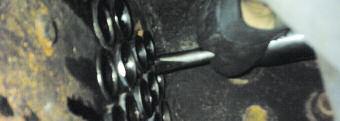
In order to try to improve the performance of the new set of tubes – 1¾” outside diameter by 10 gauge tubes from Willingales – I decided that we would bead the firebox ends when we fitted them. Beading the tubes means that instead of leaving the end of the tube sticking out into the firebox it is folded back on its self to touch the tubeplate and makes a much stronger finish to the tube.
It was this last point which led to me writing this article. Like many others, I had heard of beading the tubes but never seen it done, or even seen any traction engine boilers with the tubes beaded; therefore I was asked if I would try to describe what is done
The old tubes were removed in the standard way using the gas axe to cut through the tubes roughly half way along and then working them out through the man hole.
Because the old set of tubes had been rolled on several occasions using a 3 roller expander we reamed the tubeplate holes to return them to being round. This also had the effect of leaving clean, uncontaminated surfaces to expand the new tubes on to. Because the firebox on Morning Star is quite small we worked from the smokebox end as much as possible This meant using lots of extension bars to get the tools from the front to the back
The tubes were prepared by expanding the smokebox end to allow for the difference in diameters front to back and both ends of the tubes were annealed (softened) to make them easier to expand.
When the tubes were in we put expanders in both ends at the same time and turned the smokebox end one. This either resulted in the expander gripping in the smokebox end and expanding or turning the tube until the firebox end expander gripped. Either way we got the desired result Obviously we then had to move to the firebox end with the air gun to complete the expanding process To ensure that the right length of tube protruded through the firebox tube plate a 5/16” collar was made up to fit over the end of the tube and press on the end of the expander. By making sure that the expander contacted both the tube and the collar the correct protrusion was maintained.
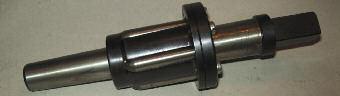
The expanders we used were 5 roller expanders as favoured by the railway boys because they produce a much rounder tube than a 3 lobe hole that can result from a 3 roller expander. You will also notice by looking at the picture that the rollers in the expander taper the opposite way to the mandrel which means that the outer surface of the rollers are parallel. This works much better at sealing the tubes in the tube plate than a conventional tapered expander
The beading was done using a small air riveting gun and three tools to work the tube end over in stages.
The first is a coned tool which is hammered in to the end of the tube to produce a flair. This is followed up with a radiused tool a bit like a dart which is used to spread the end of the tube further. This tool needs to be moved continuously whilst the air gun is working to produce a smooth working to the metal This sounds easier than it is; I had the benefit of someone who has beaded many hundreds of tubes to show me how, and then tidy up my first efforts
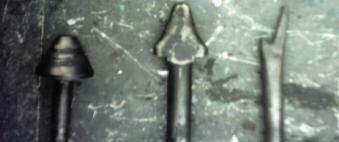
The final process uses a hook shaped tool to complete the rolling over. Again this is harder to achieve than it sounds. Working the tool round the tube needs to be a steady process working a ‘wave’ in front of the tool until the whole end of the tube is beaded smoothly on to the tubeplate. The skills of the professional were useful in finishing off my attempts to produce a bead. Apparently this process is much easier on railway locos where you can stand up inside the firebox with plenty of room to spare!
The photos show the three tools used in the beading process and the 5 roller expander as well as the finished result.