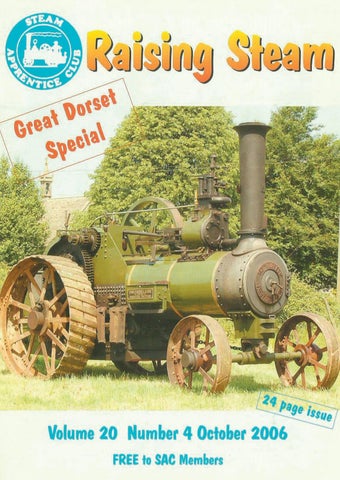
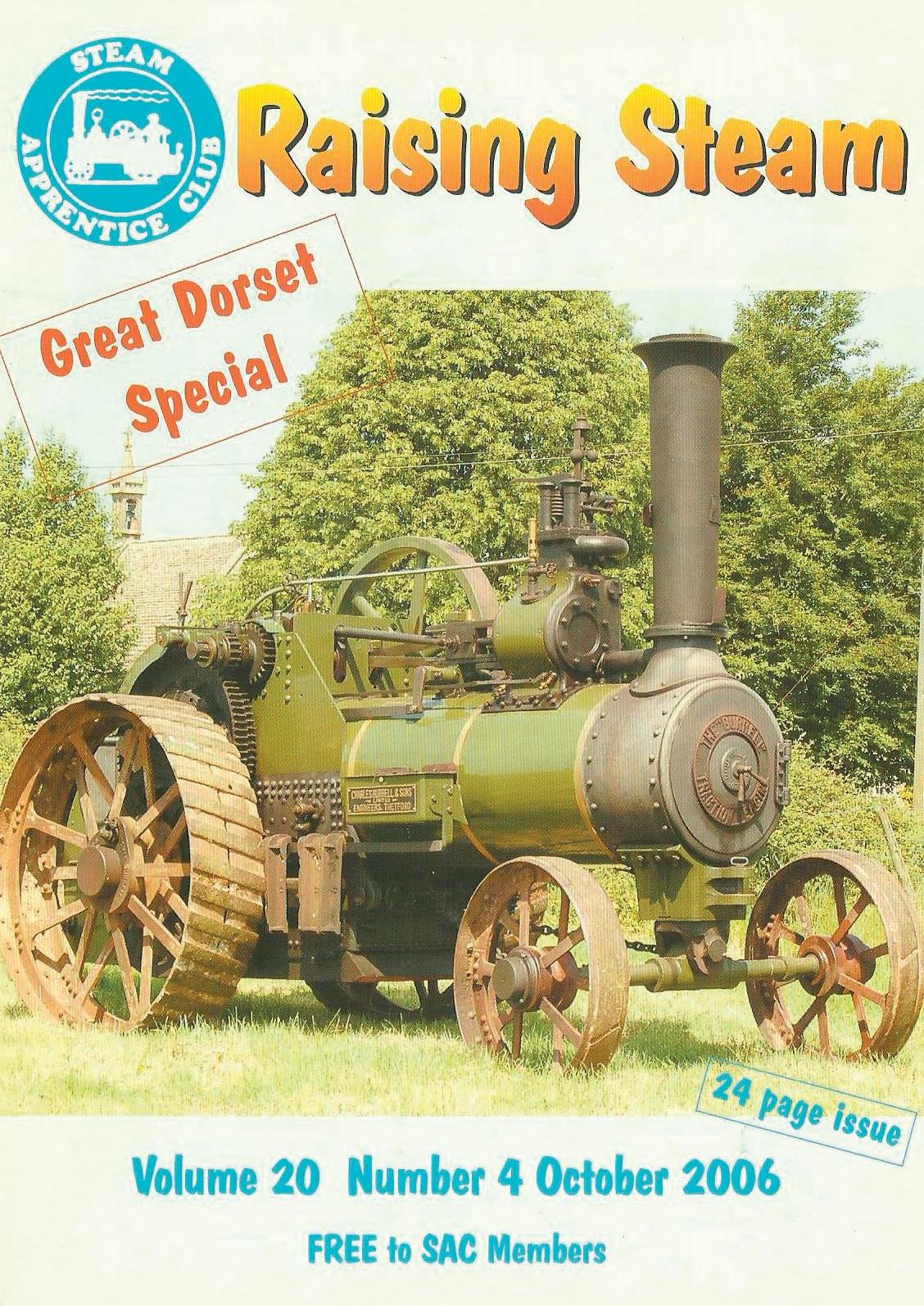
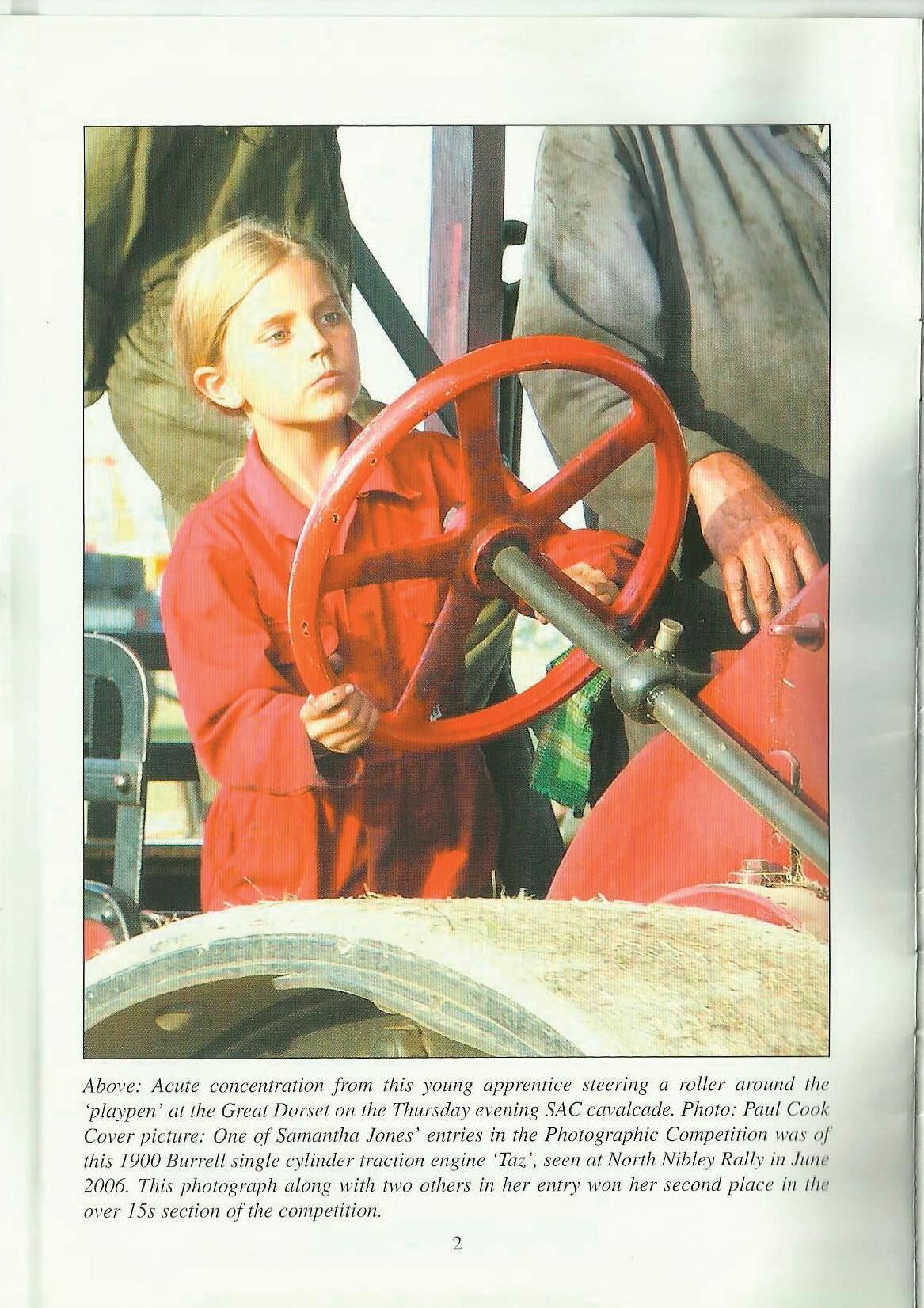
Above: Acute concentration from this young apprentice steering a roller around the 'playpen' at the Great Dorset on the Thursday evening SAC cavalcade. Photo: Paul Cook Cover picture: One of Samantha Jones' entries in the Photographic Competition W(IS <!I' this 1900 Burrell single cylinder traction engine 'Taz ', seen at North Nibley Rally in .!111w 2006. This photograph along with two others in her entry won her second place in tlil' over 15s section of the competition.
STEAM APPRENTICE CLUB
Editor
Naneue Sanders, Frog Cottage, New Road. PorchfieJd, Isle of Wight PO30 4LS Tel: 01983 523317 sac.raisingsLeam@ntet.co.uk
President
John Durling, Hawthorn Cottage, Swbwood, Uttoxctcr. Staffordshire ST 14 5HX
The Editor welcomes any contributions of articles. shorter items or photographs for inclusion in future issues. All material submilled is volunrary and payment cannot be made for any material published. The opinions expressed in the magazine. wich the exception or Club announcements, are those of the contributors and do not indicate the views or the Club as a whole. AJJ items arc held copyright by the contributor and the NTET. The Editor reserves the right to amend or refuse contributions. The Magazine is normally published during the early part of January, April. July and October. The Club accepts no liability for failure to meet intended publication dates.
The Steam Apprentice Club is a section of the National Trnccion Engine Trust. NTET is a Registered Charity, No. 291578. Registered in England No. 1302197. Registered Office: 4 Church Green East, Reddilch. Worcestershire B98 8.BT.
Typesetting and Artwork by Kearline Graphic TmagesLtd. Fairoak House Business Cencre, Church Road, Newpo1t, South Wales NPJ9 7EJ Printed by TSG Creative Solutions. St Neots, Cambridgeshire PE19 8EL
FROM THE EDITOR
There is a small change with this issue of the magazine. I usually wait until we are all home and relaxed after a busy time at the Great Dorset Steam Fair, and when your letters come pouring i11then I can get to work typing them all up ready for you to read in October. vVe are trying to move the issue date of the magazine to an earlier date which meant I needed to write the magazine before I went to the Dorset Steam Fair. This means that smne of your letters may be published in the January issue.
I had a difficult time writing tbi.s issue, as you can see my mail box was almost empty. In fact at the time I am writing this I only have two letters to type up and only a few days left before the magazine goes off to print. These situations cannot be helped as I know you are all busy either visiting rallies or going on holiday somewhere wonderful and exciting or even if you are still at school just enjoying the school hols. T do really need help to keep the magazine running and now that we have it in colour I do need some pictures to go in it. Perhaps some of you can think of ideas of what you would like to see in the mag, noLe your ideas clown, I will think them over and if I can make the change I will, and make sure that it is mentioned that it was your idea.
Thoughts for you. Those of you that went to the Dorset Steam Fair, did you enjoy yourselves? Those of you that went to other rallies over the hols did you enjoy yourselves? What was your favourite moment? Who did you see? What engines did you play on? Are you looking forward to next year so you can do it again? Did the list of questions you have just read give you an idea of what you can write about? Good! That was the idea. Now all you have to do is share those moments with me.
[ am looking forward to the next magazine as I know my village postman will be walking down my path with piles of what he calls ' Fan Mail'.
Nanette Sanders, Editor
THE CHAIRMAN'S BIT
Well Dorset is over and it was good to meet some or yuu and huve a chat. As usual unfortunately we cou1dn't get you all on an engine when we did tin· duckling run. but we have some ideas which hopefully we can put to the organizer lo gd 111nn:r11gincs availab1e for 2007. I hope I was able to answer your questions and enquiries lO your sutisl'action. But, anytime you have a query don't hesitate to contact me via the website rn even by snail mail and if I don't know the answer I'm sure someone on the cominillce will!
As a 'first' elsewhere in the magazine is an initial report from Dorset, the earliest I believe we have had one. We held the usual activities with the breakfast on Lhe shovel and the parade on the Thursday evening, which was great fun. We were supported well by the engine owners for this event and managed to get most apprentices having 2 or 3 turns on different engines.
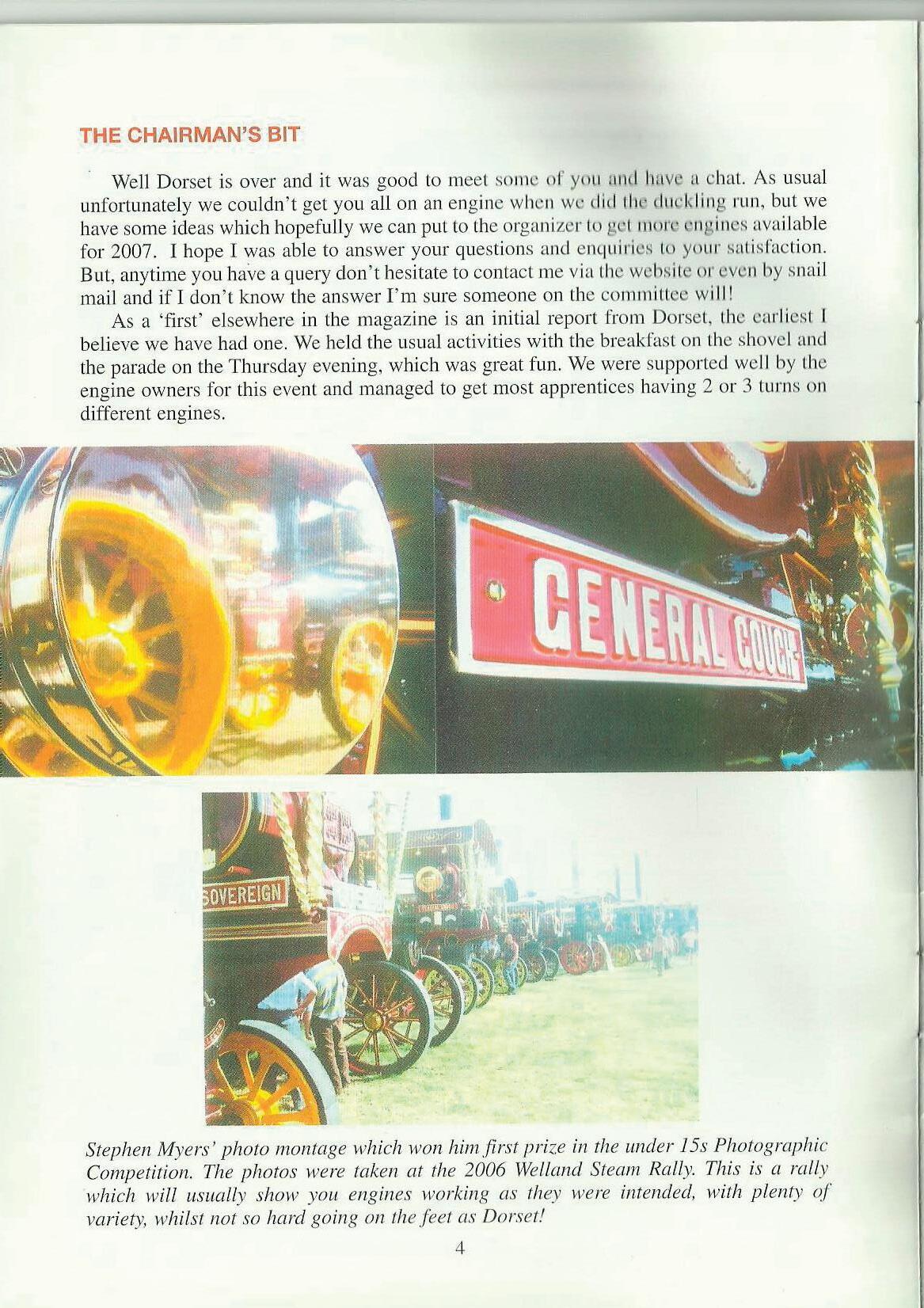
Stephen lv!yers' photo rnontage which won him.first prize in the under 15s Photographic Competition. The photos were taken at the 2006 Welland Steam Rally. This is a rally which will usually show you engines working as they were intended, with plenty of variety, whilst not so hard going on the feet as Dorset!
I have been ab]e to get to a few rallies so far this year albeit without my engine. I always find it interesting looking at the working displays and what uses steam engines are put to. A skill in itself is lining up the belt to tu1n a saw bench, a stone crusher or a tlu·esher and keeping it at the right speed (if your engine hasn't got a governor). ls that something you would like to learn? Let us know.
We do still need your support for the magazine by writing in with articles about what you have or are doing, pictures with captions on what it is about. Remember it is your magazine.
As you might have read in other magazines there have been two se1ious accidents on the road involving steam engines. I will not comment on the how's and why's, but it does bring home, we must always be very careful when operating our engines. Always follow best practices and safety procedures and as the saying goes 'Always be prepared for the unexpected' .
Happy steaming
Kevin
MORE TALES OF A LITTLE AVELING
Another twist in the unfolding tale that is running an engine. Having had the delights of bmnt lagging (see Raising Steam Vol. 20/2) and the work needed to put that right Morning Star embarked on the 2006 season.
The first thing was the boiler inspection, the cold exam followed by the steam test. All went well back in May and the inspector declared himself happy. With the engine in steam we took her out for a little run round the lanes. After a couple of hours the obligatory stop for lunch was needed. It was at this point that we noticed a small amount of water running out from under that cladding by the throat plate. It definitely hadn't been there when the boiler inspector was looking. However, it was really not much more than a fizzle and we still had to get back home - about a mile. When we arrived at home there was only the tell-tail line of dried scale to show that anything had happened, all was dry again. I put this down to a small leak from a rivet that had sealed up again. We continued with our season, going to the rally at Strumpshaw and then the local Klondyke Mill Steam Party in June. There were no further problems.
The next outing was to the Belper Rally at Duffield, just north of Derby, a distance of about 18 miles. Ian and his fiancee Sarah drove Morning Star over on the Fiiday before the rally; when they anived the leak had re-appeared. During the course of the weekend it just got worse. I saw the effects on the Sunday evening and decided there and then that she wouldn't be steamed again until the cause was found and put right.
I was picturing having to replace the throat plate, which would mean a new banel as well. This would mean that we were off the road for several years not to mention that cost of all that boiler work! I went home feeling pretty despondent.
This is where talking to others helps. Various people told me that a crack in the tlu·oat plate of an Aveling with a belpair firebox was not unusual and was just that, a crack, and not evidence of large scale corrosion. It was now time to do some proper investigation.
The first thing I needed to know was how thick the plate was in the area of the crack. A simple ultrasonic thickness gauge did the trick. This works by sending an ultrasonic signal into the plate and, by measuring the time the signal takes to come back, te11syou
how thick the plate is. This showed that there was plenty of metal left and that the crack could therefore be welded up. Huge relief! Now to find where lhc crack was precisely (it wasn't visible to the naked eye), and how long it was.
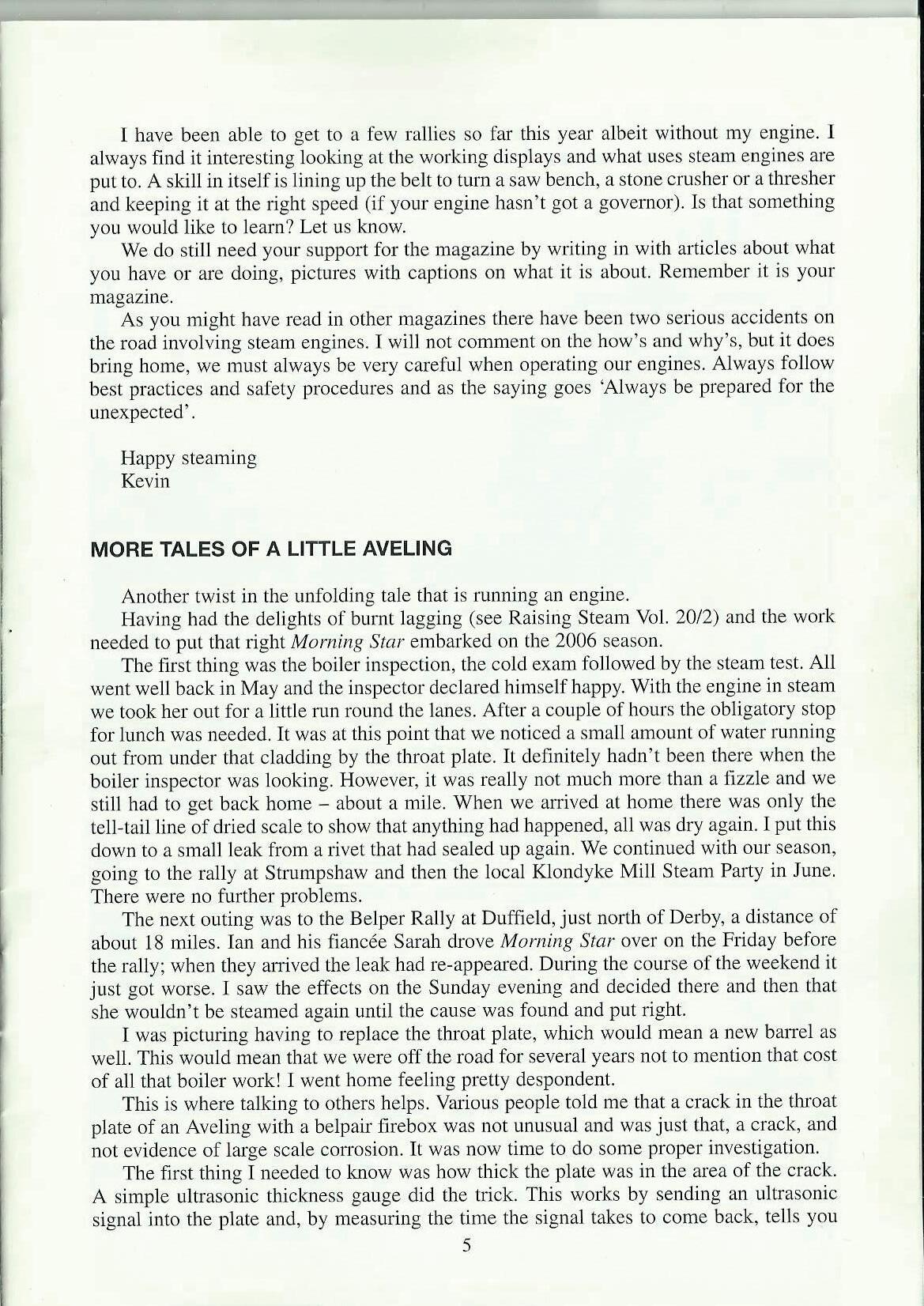
Picture of 'Morning Star's' crack in her throat plate. Notice the crack showing up easily against the white paint.
To do this we used a technique called magnetic particle inspection (MPI). This uses the fact that a crack in a piece of steel will concentrate a magnetic field. To show this is, in fact, quite simple. First the area must be completely clean, then a thin white paint is sprayed over the area. A large electro-magnet is then used to create the magnetic field. The position of the crack is shown up by using a suspension of fine iron fillings. Where there is a crack in the surface of the steel, the magnetic field is concentrated and shows up a black line against the white paint. The attached photo shows crack, the ends are marked with red pen to make finding it again easier.
Because the crack was in the stmctural part of the boiler a coded welder was needed to cmry out the repair and Terry Statham of TRS \Velding came out to do the job. He started by grinding out the effected area, and found that, in fact, there were 2 cracks side by side. One feature of a crack like this, which started from the back, or water-side, of the plate, is that it will be much longer at the back than the visible bit on the surface. This crack turned out to be nearly 4" long! When Terry was certain that he had got to the ends of the crack and had therefore removed all of the damage he repaired the area by welding. The finished job was ground back smooth and now looks as good as new. In order to be sure that the weld was sound, we gave the area another MPI test, whic;h was absolutely fine.
Morning Star is now up and rnnning agajn after being off the road for onlv 5 weeks and missing one rally. Quite different from what might have been had the boiler plate been badly wasted and needed replacing.
John Durling.
A FEW AMUSING ROAD SIGNS
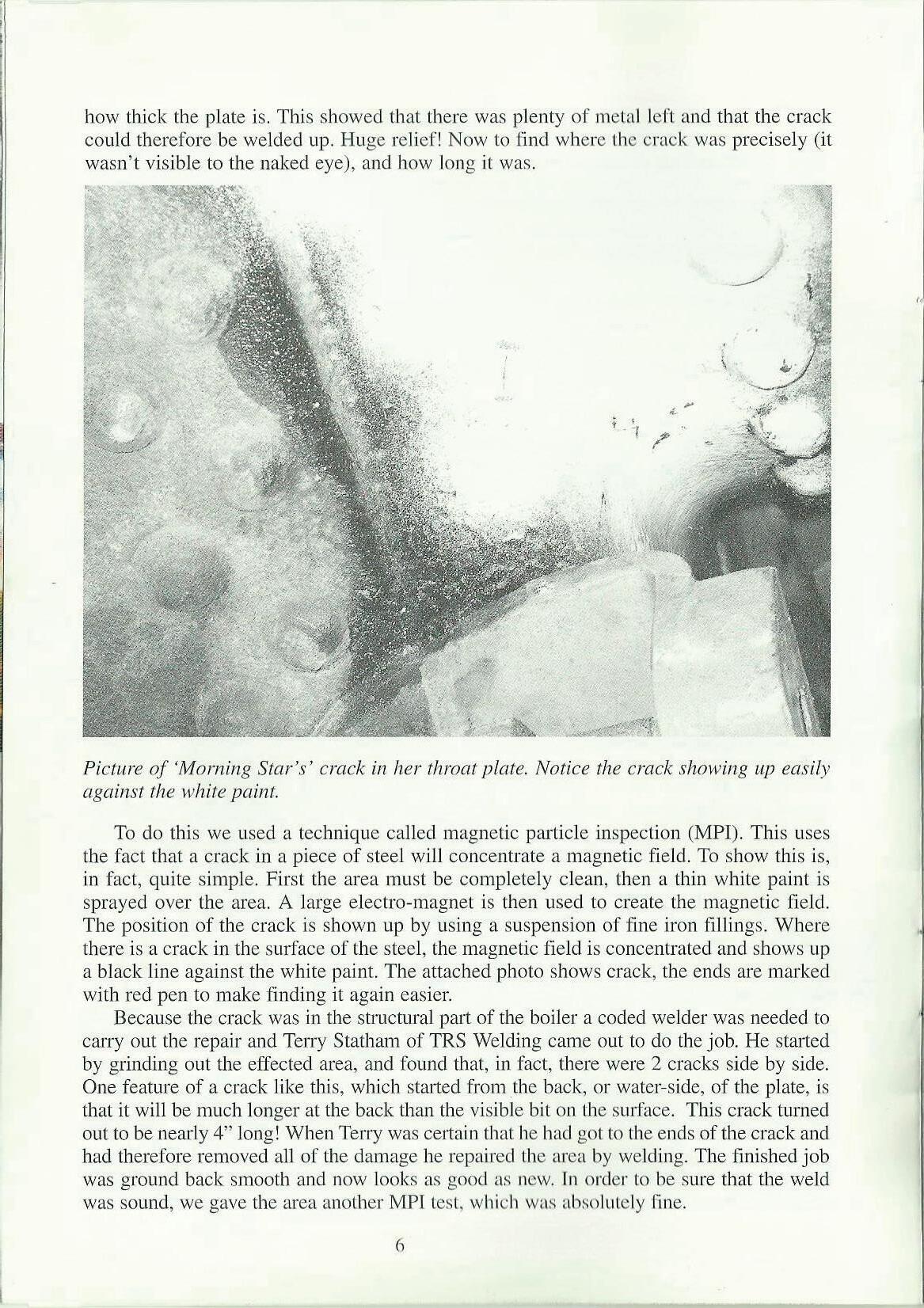
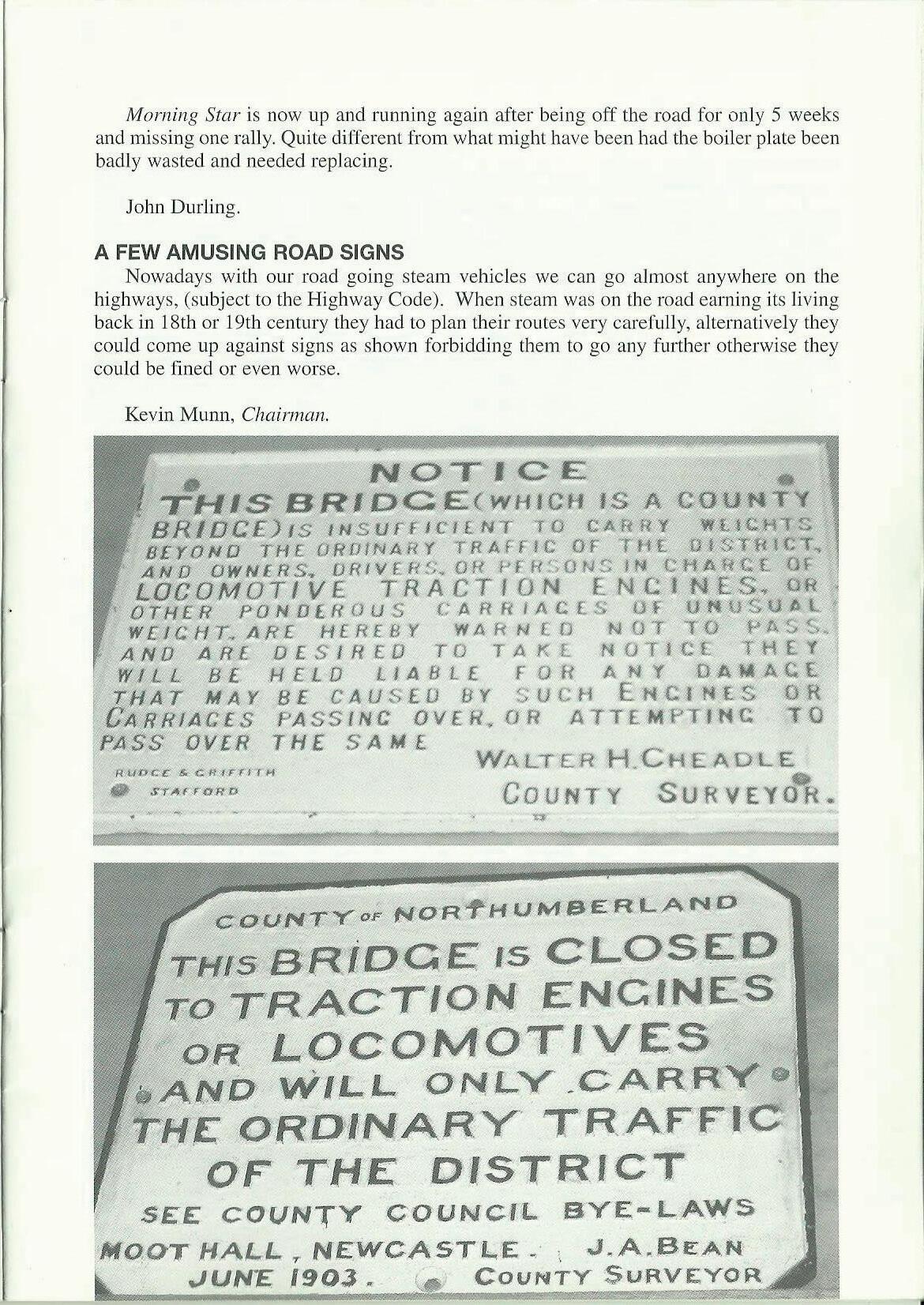
Nowadays ~ith our road going steam vehicles we can go almost anywhere on the h1gh~ays, (subject to the Highway Code). When steam was on the road earning its living back m 18th or 19th century they had to plan their routes very carefully, alternatively they could co~e up against signs as shown forbidding them to go any further otherwise they could be fmed or even worse.
Kevin Munn, Chairman
s lfJ,:YOHCJ TH! 0RfJ1NAk1 "fl?Afif-C Of
A 'NV OW tJ £ R $,,. D f<I V £ H ~; 0 ft P f k :d) N S t C tt A R C !: 0 f' LOCOMOTIVE TRACTION E:N.CJHE.S-i' OR i ( OTHER ?OND£.H0U$ CARRIAClS Of UfftJS:UA'L WJ: IC H T,., A ft£ Hl R £ B Y WA R N C f) N O 1' TO PAS $., AND AR£ DESIR£[} TO TAKE NUTfC[ TH£Y WfLL Bl HELD tlABL! fOH ANY OAMAGE J:H A T MA Y B £ CA US£. U 8 Y S U c H t N C i N f S O R trARRIACES PASSJNC (}VE.k, OR ATT£MPTJNC TO PASS OVER TH£ SA M E.
WALTER H ·CHEADLE COUNTY SURVEYO'lt .
MAIL BAG
Dear Editor
I am a big Aveling & Porter fan, and I am looking for any information on the only Aveling Showman's engine. Its called Samson, No. 4885, Reg. No. ME 6052, built 11/1901. Road Loco, class LC8, 8NHP and last known in or near Skegness. All this information I have found from the traction engine register, but I would like to know more about this engine, so could anyone with any up-to-elate details about its present condition and where it lives please reply. Thank you.
Rob Seago, Mill House, Mill Road, South Walsham, Norwich, NR13 6DF.
Dear editor,
On Sunday 9th April 2006 I went to the Brunel 200 celebrations at Portsmouth Historic Dockyard. There werelots of engines including steam ro11ers,ploughing engines, steam wagons, and a showmans engine • • called Lion. The showman's engine was providing electricity for the fairground carousel. I went up on the engine and I was shown how centrifugal force was used on the engine. My Mum took my photo. We had a look in the model tent where there was a wide variety of models and displays. We then had a ride on a
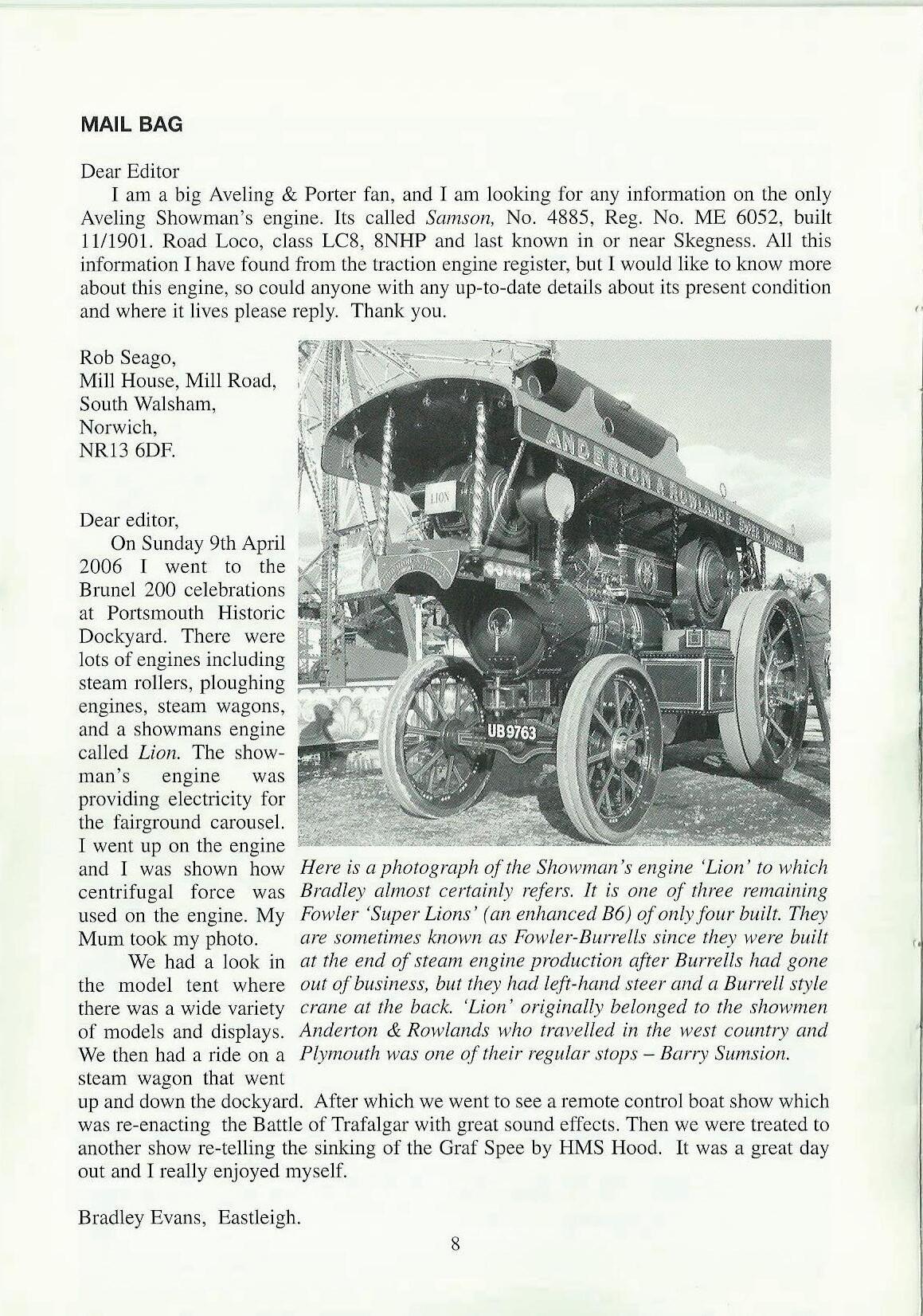
Here is a photograph of the Showman's engine 'Lion' to which Bradley almost certainly refers. It is one of three remaining Fowler 'Super Lions' (an enhanced B6) of only four built. They are sometimes known as Fowler-Burrells since they were built at the end of steam engine production after Burrells had gone out of business, but they had left-hand steer and a Burrell style crane at the back. 'Lion' originally belonged to the showmen Anderton & Rowlands who travelled in the west country and Plymouth was one of their regular stops - Barry Sumsion. steam wagon that went up and down the dockyard. After which we went to see a remote control boat show which was re-enacting the Battle of Trafalgar with great sound effects. Then we were treated to another show re-telling the sinking of the Graf Spee by HMS Hood. It was a great day out and I really enjoyed myself.
Bradley Evans, Eastleigh.
r,
2006
GREAT DORSET STEAM FAIR
This was my first Dorset and as always at Dorset one of the greatest worries is the weather. Whilst we had one day that was a washout due to the number of showers we had, the rest were reasonably dry for the movement of engines.
Because it was my first Dorset as Chair, our previous Chair and current Vice Chair volunteered me as a 'baptism of fir~' to take the apprentices who were there out on the Duckling run on the Thursday. This was a rather interesting experience as I asked, persuaded and cajoled the enginernen to take them on board for the day. I have to say T passed with flying colours as I managed to get all of them assigned. It was pleasing at lhe end of the day to be approached by several of the engine drivers to be told that their apprentice was well mannered, asked good questions and had done well with the tasks given to them.
I then had to do my duty in the NTET tent both manning the SAC stall and being available as representative of the NTET to answer general questions from both the public and membership. This gave me plenty of time to speak to current and potential members. I was also able to have a good look at the wagon and photographic entries. You will find pictures elsewhere in this edition of the entries. All I can say I am glad I didn't have to judge any of them as the standard was very high.
During the rally I am pleased to say two more apprentices took their competency test and passed successfully.
The Thursday evening as usual was cavalcade night when we had about 14 engines available to take apprentices around the heavy haulage arena. A long queue quickly appeared at the allotted time and soon we had apprentices scurrying in and out of the arena taking their turn on a engine and going off on a circuit, before getting off and joining the back of the queue to have another go on a different engine. Thanks to the engine drivers who stayed in so long to take them as they all had at least a go on three different engines. Saturday we had showers on and off. Because of this, and the standing order 'no engine movement until at least two hours after the last shower' nothing much happened at all. Nothing at all on the engine front, but certainly in our SAC camp. As well as the rain it was rather windy and several of the team's tents, or awnings got blown down or damaged so that come the evening, sleeping accommodation was in short supply! But we all helped out and got it sorted so no one had to sleep in a car or under an engine!
Sunday was the day for breakfast on a shovel and whilst we had plenty of food there wasn't enough people to eat it all. This was rather unusual I have been told. So next year make sure you make a note to come on down for a breakfast and a chat.
I enjoyed my first Dorset as Chair and meeting some of you. I hope I wil1 see more of you next year.
Kevin Munn, Chairman
GREAT DORSET AND THE SAC
Thanks to our colour pages we are now able to reproduce some of the competition results and also pictures of some of you enjoying yourselves. Our front cover shows one of the photographic competition entries whilst the centre pages, for the first time, shows one of the winners of the colouring competition. So enjoy a few pages of colour with the SAC at the Great Dorset 2006.
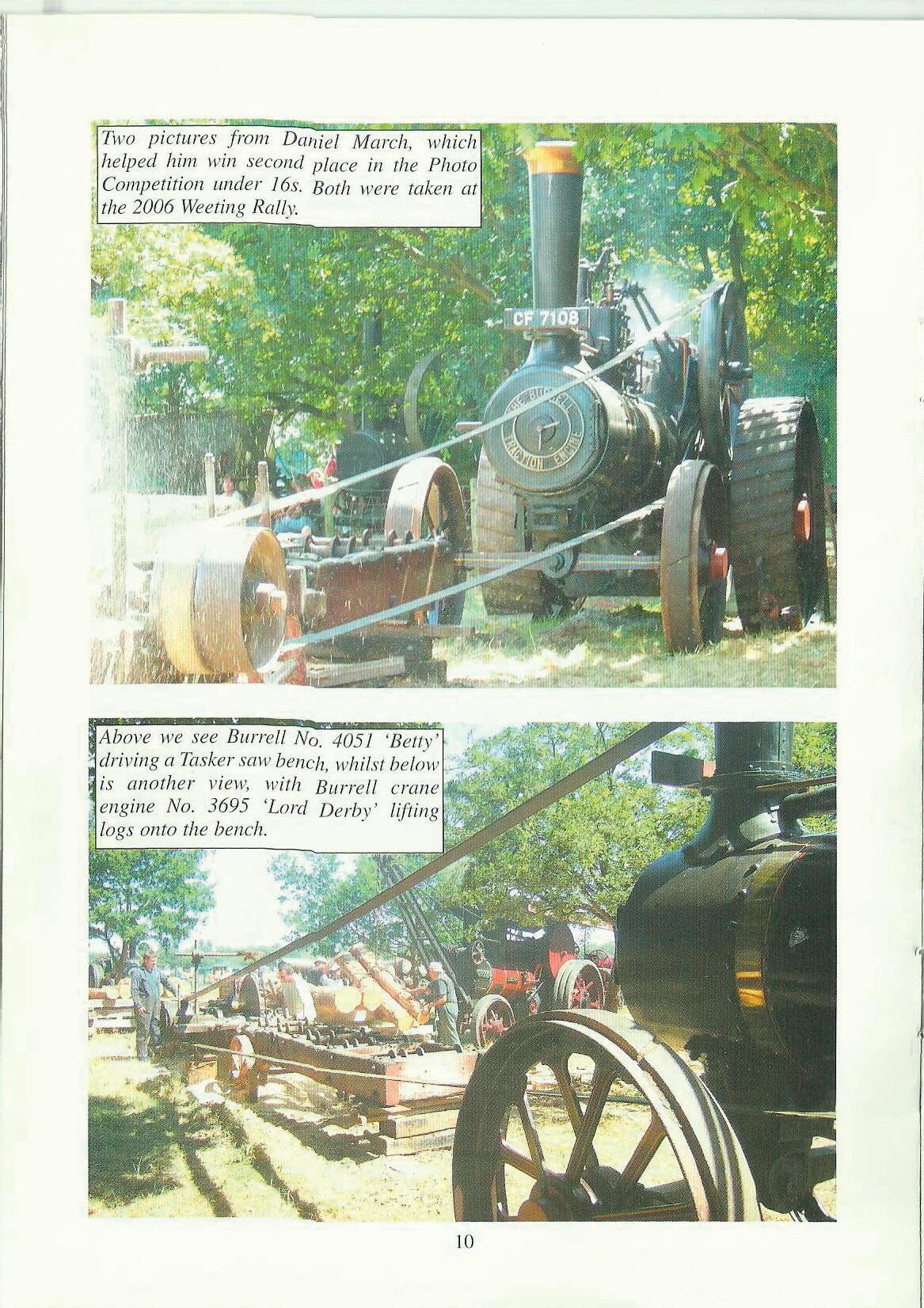
Two pictures from Daniel March, tvhich . helped him win second place in the Photo . Competition under 16s. Both were taken at ; the 2006 Weeting Rally.
bove we see Burrell No. 4051 'Betty' ' riving a Tasker saw hen.eh, whilst be!o. • another view, with Burrell ngine No. 3695 'Lord Derby' nt the bench.
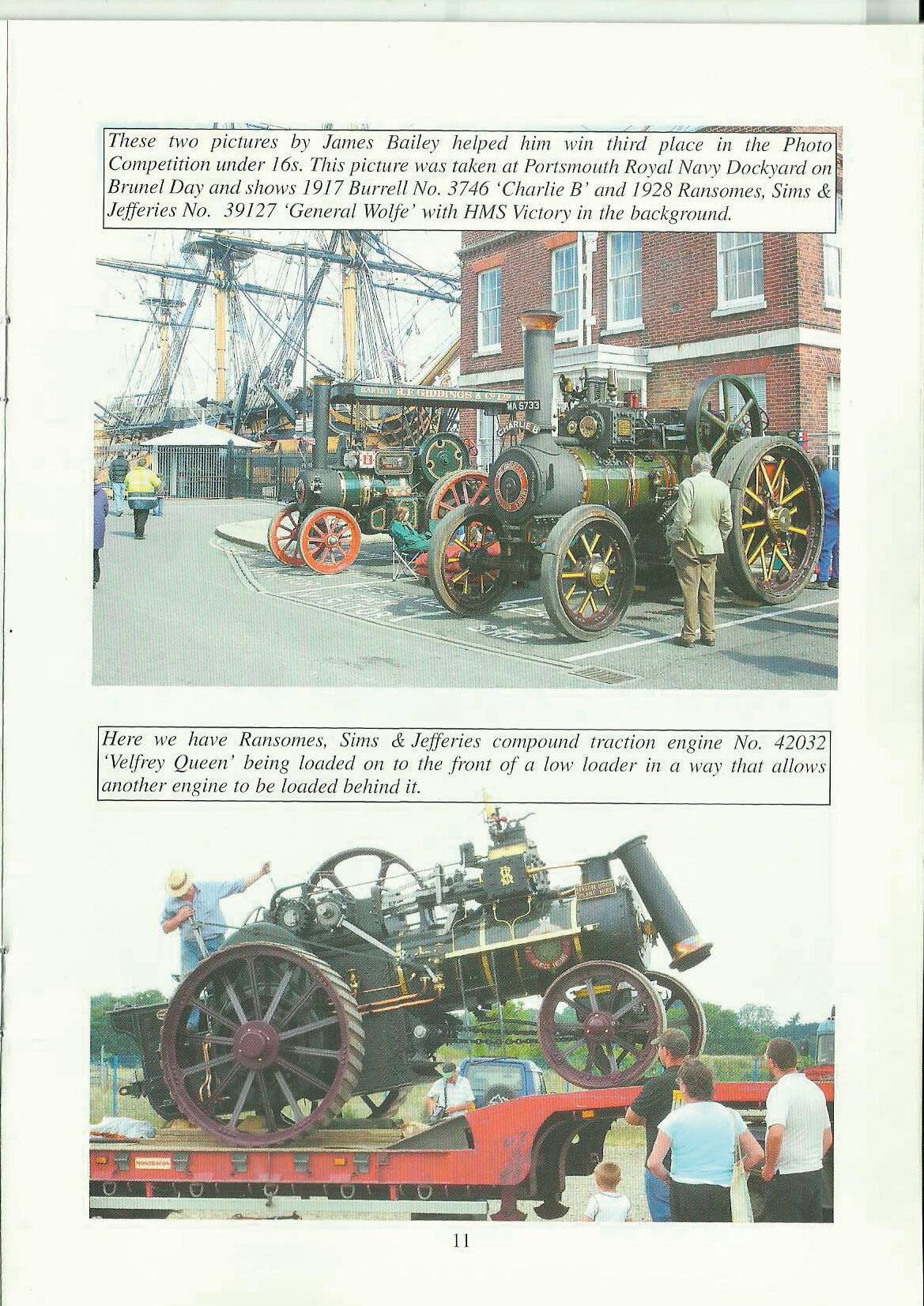
These two pictures by James Bailey helped him win third place in the Photo Competition under I 6s. This picture was taken at Portsmouth Royal Navy Dockyard on Brunel Day and shows 1917 Burrell No. 3746 'Charlie B' and 1928 Ransomes, Sims & _ Jefferies No. 39727 'General Wolfe' ·with HMS Victory in the backgmund. I
Here we have Rans01nes, Sims & Jefferies compound traction engine No. 42032 'Ve(frey Queen' being Loaded on to the front of a low loader in a way that allows another engine to be Loaded behind it.
COLOURING COMPETITION
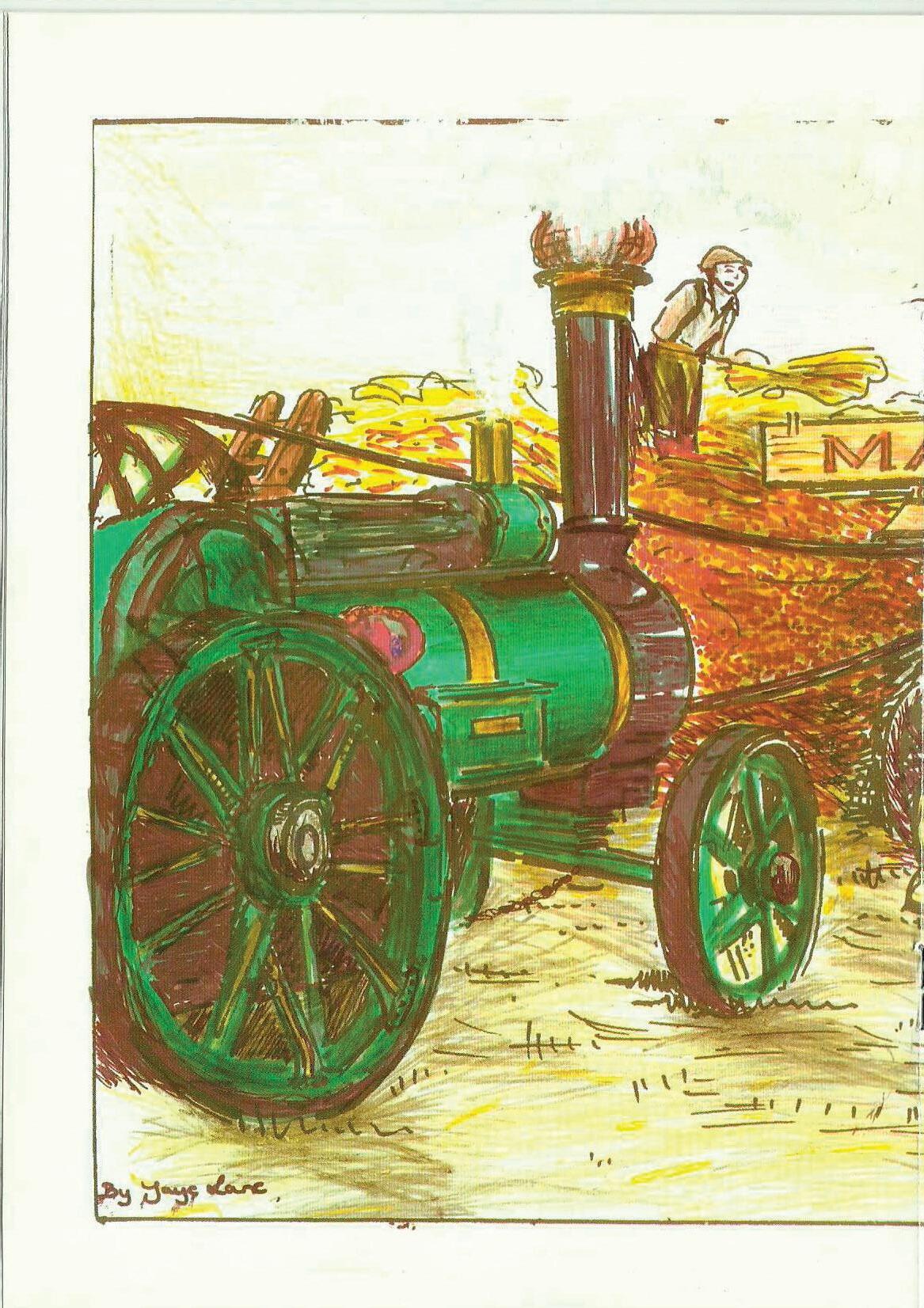
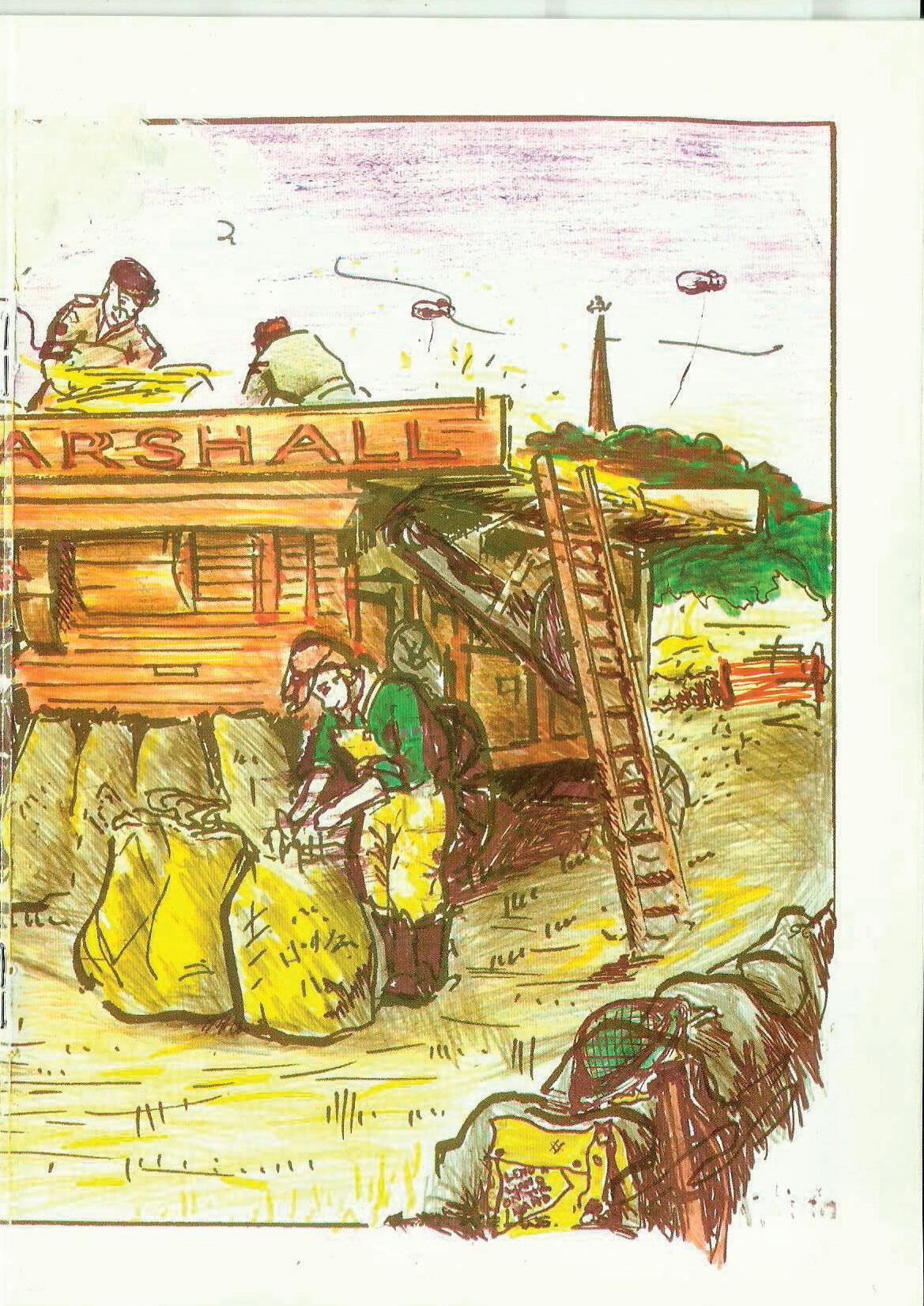
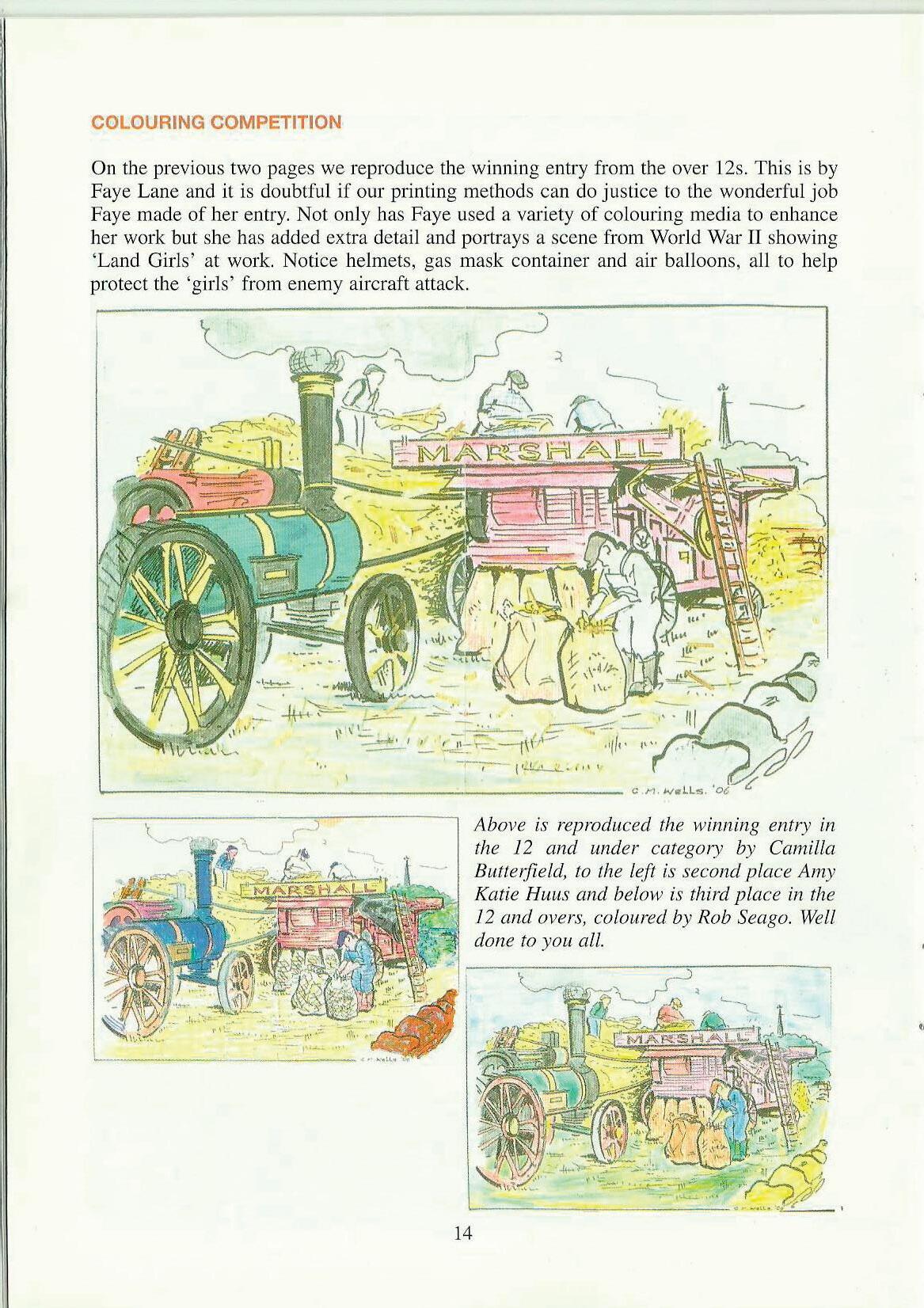
On the previous two pages we reproduce the winning entry from the over 12s. This is by Faye Lane and it is doubtful if our p1inting methods can do justice to the wonderful job Faye made of her entry. Not only has Faye used a variety of colouring media to enhance her work but she has added extra detail and portrays a scene from World War II showing 'Land Girls' at work. Notice helmets, gas mask container and air balloons, all to help protect the 'girls' from enemy aircraft attack.
Above is reproduced the winning entry in the 12 and under category by Camilla Butter.field, to the left is second place Amy Katie Huus and below is third place in the 12 and overs, coloured by Rob Seago. Well done to you all.
SAC AT DORSET
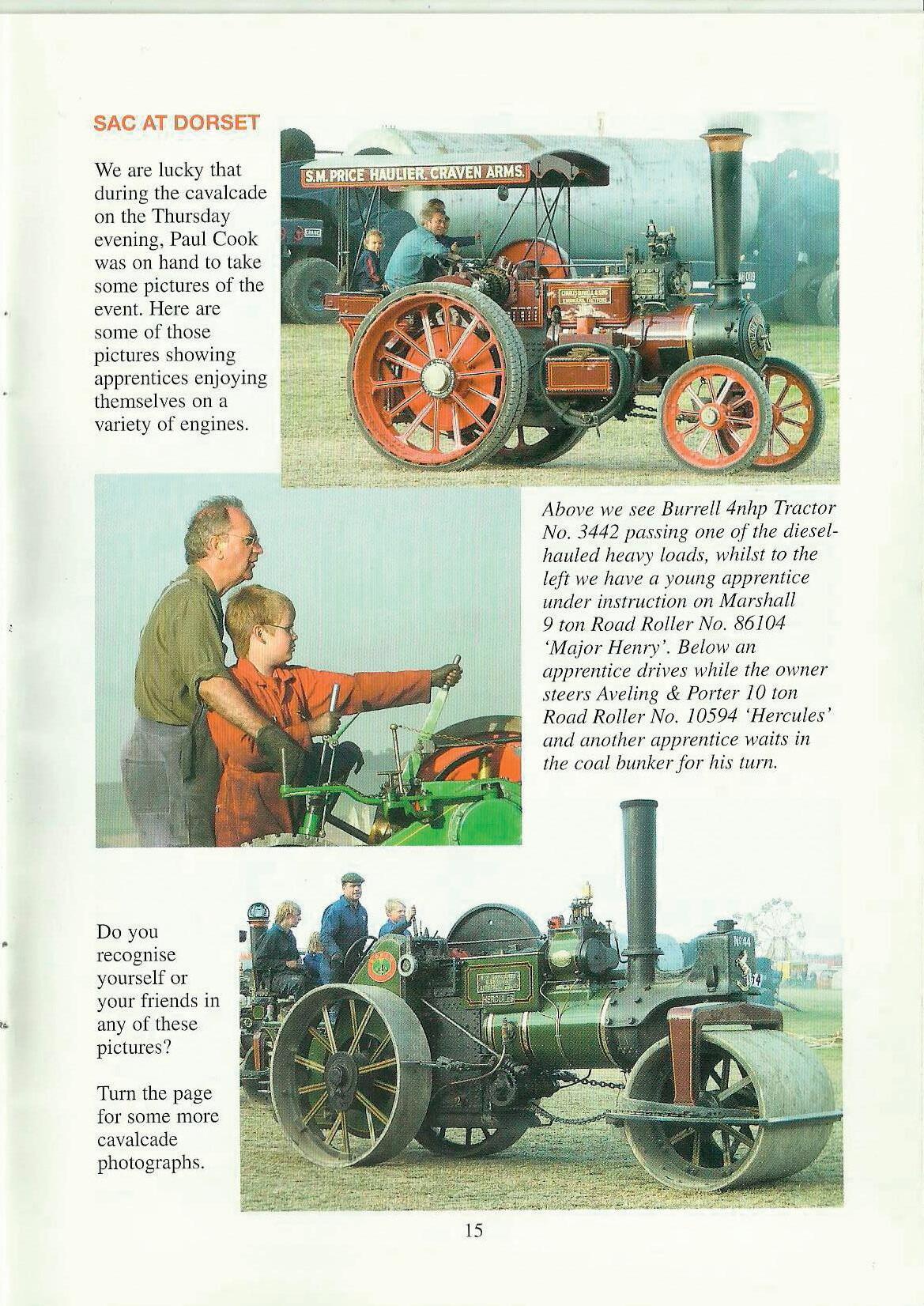
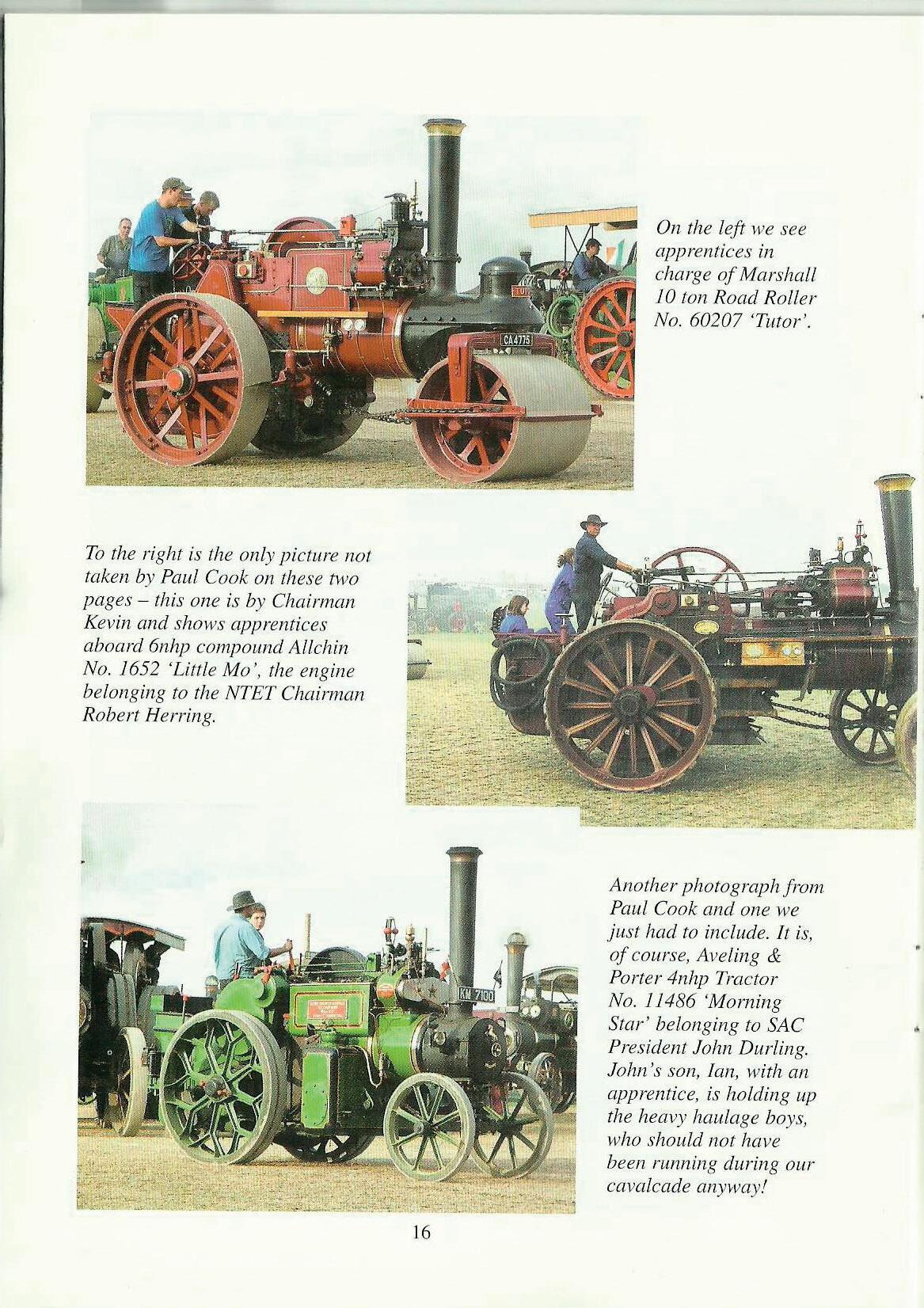
We are lucky that during the cavalcade on the Thursday evening, Paul Cook was on hand to take some picttll'es of the event. Here are some of those pictures showing apprentices enjoying themselves on a variety of engines.
Above we see Burrell 4nhp Tractor No. 3442 passing one of the dieselhauled heavy loads, whilst to the left we have a young apprentice under instruction on Marshall 9 ton Road Roller No. 86104 'Mafor Henry'. Below an apprentice drives while the owner steers Ave ling & Porter 10 ton Road Roller No. 10594 'Hercules' and another apprentice waits in the coal bunkerfor his turn.
Do you recognise yourself or your friends in any of these pictures?
Tum the page for some more cavalcade photographs.
On the left we see apprentices in charge of Marshall JO ton Road Roller No. 60207 'Tutor'.
To the right is the only picture not taken by Paul Cook on these two pages - this one is by Chairman Kevin and shows apprentices aboard 6nhp compound Allchin No. 1652 'Little Mo', the engine belonging to the NTET Chainnan Robert Herring.
Another photograph from Paul Cook and one we just had to include. It is, of course, Aveling & Porter 4nhp Tractor No. 11486 'Morning Star' belonging to SAC President John Durling. John's son, Jan, ·with an apprentice, is holding up the heavy haulage boys, who should not have been running during our cavalcade anyway!
GREAT STEAM CHALLENGE 2006
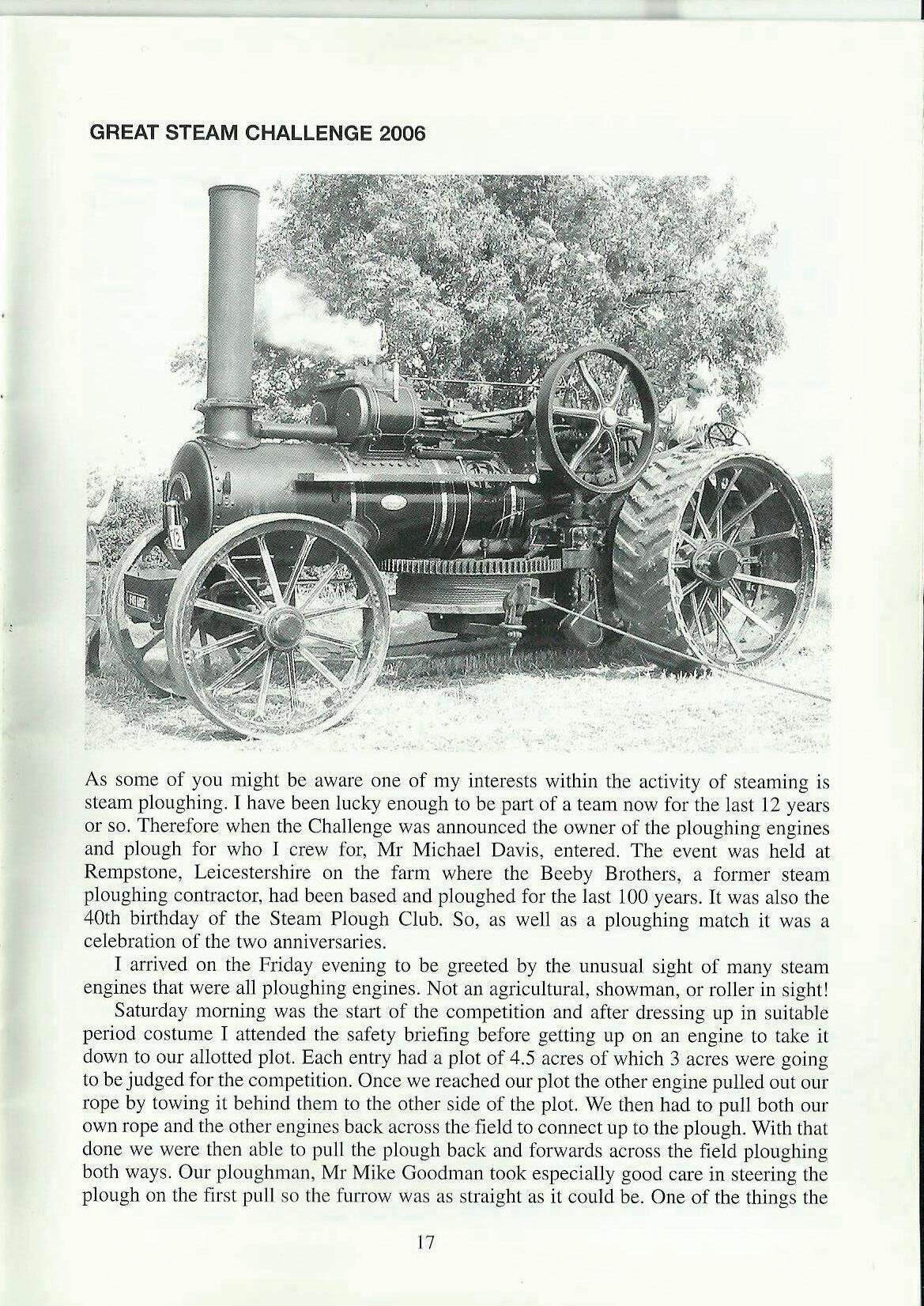
As some of you might be aware one of my interests within the activity of steaming is steam ploughing. I have been lucky enough to be part of a team now for the last 12 years or so. Therefore when the ChalJenge was announced the owner of the ploughing engines and plough for who I crew for, Mr Michael Davis, entered. The event was held at Rempstone, Leicestershire on the farm where the Beeby Brothers, a former steam ploughing contractor, had been based and ploughed for the last 100 years. It was also the 40th birthday of the Steam Plough Club. So, as well as a ploughing match it was a celebration of the two anniversaries.
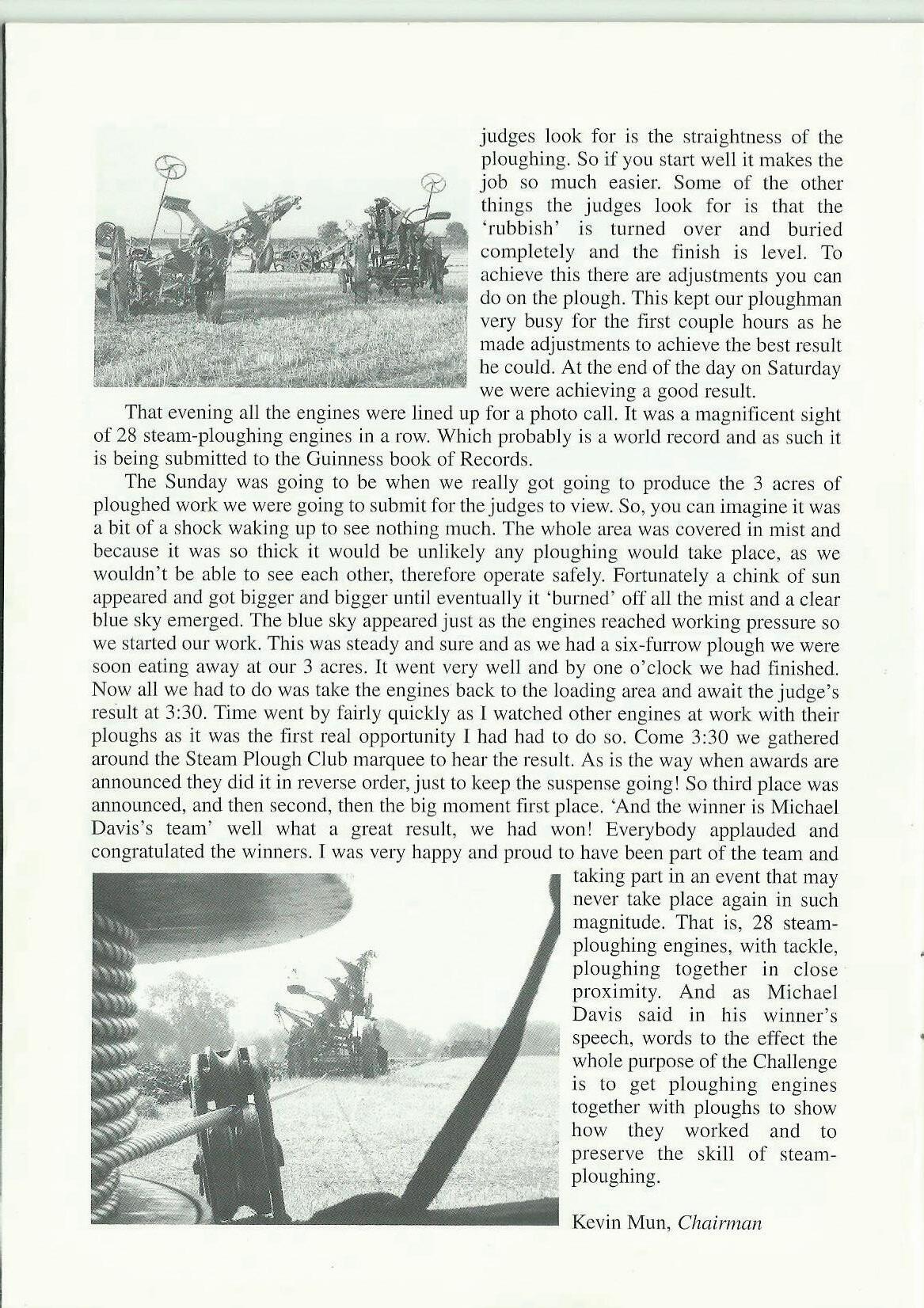
I arrived on the Friday evening to be greeted by the unusual sight of many steam engines that were all ploughing engines. Not an agricultural, showman, or roller in sight! Saturday morning was the start of the competition and after dressing up in suitable period costume I attended the safety briefing before getting up on an engine to take it down to our allotted plot. Each entry had a plot of 4.5 acres of which 3 acres were going to be judged for the competition. Once we reached our plot the other engine pulled out our rope by towing it behind them to the other side of the plot. We then had to pull both our own rope and the other engines back across the field to connect up to the plough. With that done we were then able to pull the plough back and forwards across the field ploughing both ways. Our ploughman, Mr Mike Goodman took especially good care in steering the plough on the first pull so the forrow was as straight as it could be. One of the things the
judges look for is the straightness of the ploughing. So if you start well it makes the job so much easier. Some of the other things the judges look for is that the 'rubbish' is turned over and buried completely and the finish is level. To achieve this there are adjustments you can do on the plough. This kept our ploughman very busy for the first couple hours as he made adjustments to achieve the best result he could. At the end of the day on Saturday we were achieving a good result.
That evening all the engines were lined up for a photo ca11.It was a magnificent sight of 28 steam-ploughing engines in a row. Which probably is a world record and as such it is being submitted to the Guinness book of Records.
The Sunday was going to be when we really got going to produce the 3 acres of ploughed work we were going to submit for the judges to view. So, you can imagine it was a bit of a shock waking up to see nothing much. The whole area was covered in mist and because it was so thick it would be unlikely any ploughing would take place, as we wouldn't be able to see each other, therefore operate safely. Fortunately a chink of sun appeared and got bigger and bigger until eventually it 'burned' off all the mist and a clear blue sky emerged. The blue sky appeared just as the engines reached working pressure so we started our work. This was steady and sure and as we had a six-furrow plough we were soon eating away at our 3 acres. It went very well and by one o'clock we had finished. Now all we had to do was take the engines back to the loading area and await the judge's result at 3:30. Time went by fairly quickly as 1 watched other engines at work with their ploughs as it was the first real opportunity l had had to do so. Come 3:30 we gathered around the Steam Plough Club marquee to hear the result. As is the way when awards are aru,ouncecl they did it in reverse order, just to keep the suspense gojngl So third place was announced, and then second, then the big moment first place. 'And the winner is Michael Davis 's team' well what a great result, we had won! Everybody applauded and congratulated the winners. I was very happy and proud to have been part of the team and taking part in an event that may never take place again in such magnitude. That is, 28 steamploughing engines, with tackle, ploughing together in close proximity. And as Michael Davis said in his winner's speech, words to the effect the whole purpose of the Challenge is to get ploughing engines together with ploughs to show how they worked and to preserve the skill of steamploughing.
Kevin Mun, Chairrnan
NEW APPRENTICES
(This list does not include apprentices who joined at the Great Dorset Steam Fair)
Michael Alchin, Oxford. Mark Hinder, Bristo].
Matthew Anthony, Exminster. Jessica McConachic, Lichfield. Oliver Anthony, Exminster. Jordan Murrell, Crowborough. Graham Baker, Luton. Sam Nicholson, Nottingham. John Barton, Shropshire. Daniel Odell, Northants.
Laura Blissett, Belper. Daniel Peach, Derbyshire. Naomi Brighty, Newmarket. Craig Pratley, Oxford.
Luke Bucksey, Bury st Edmunds. Christopher Randell, Keighley.
Daniel Calicut, Isle of Wight. Joshua Randell, Keighley.
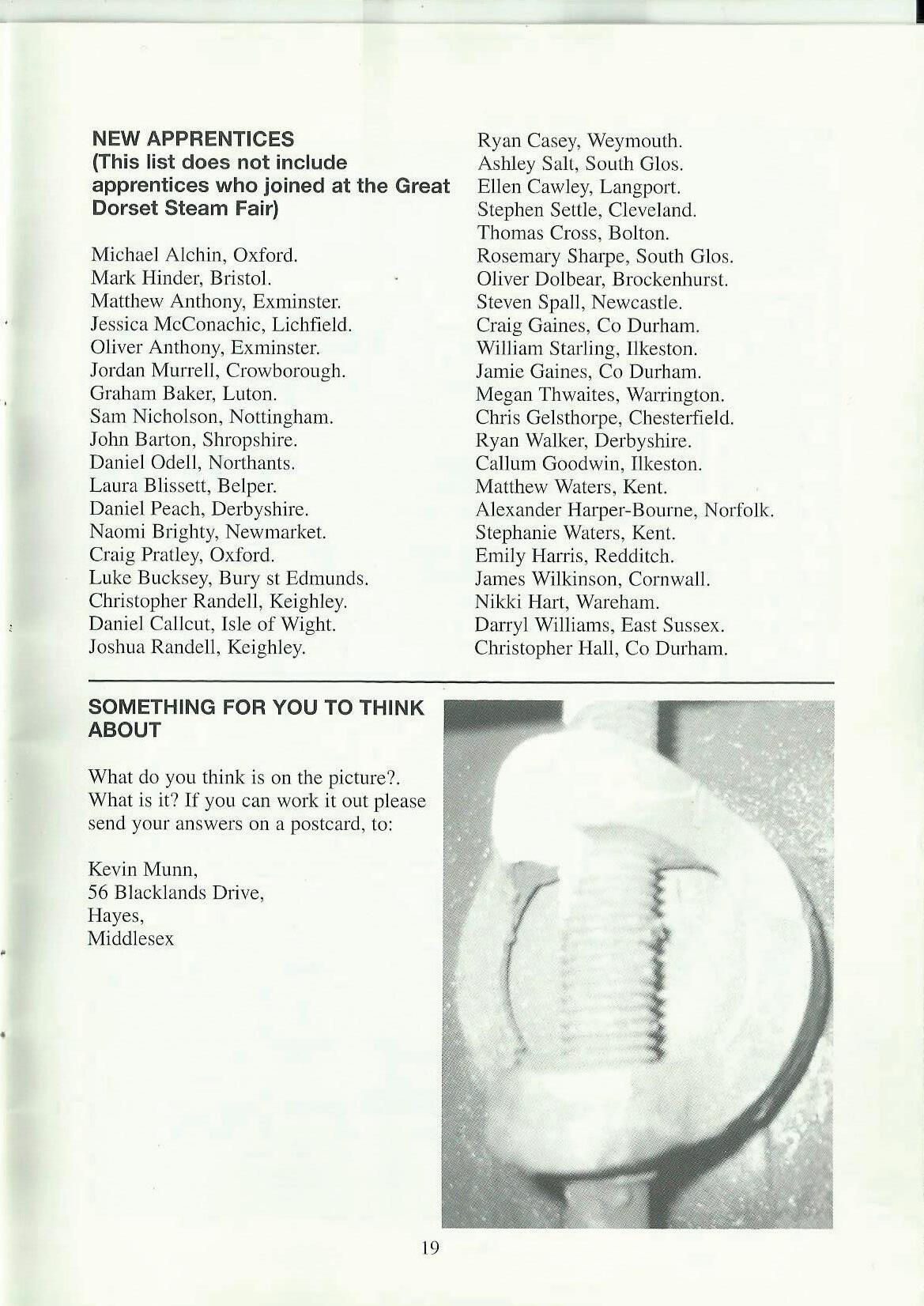
SOMETHING FOR YOU TO THINK ABOUT
What do you think is on the picture?. What is it? If you can work it out please send your answers on a postcard, to:
KevinMmm, 56 Blacklands Dtive, Hayes, Middlesex
Ryan Casey, Weymouth.
Ashley Salt, South Glos. Ellen Cawley, Langport.
Stephen Settle, Cleveland. Thomas Cross, Bolton.
Rosemary Sharpe, South Glos.
Oliver Dolbear, Brockenhurst. Steven Spall, Newcastle. Craig Gaines, Co Durham. William Starling, llkeston.
Jamie Gaines, Co Durham.
Megan Thwaites, Warrington. Chris Gelstborpe, Chesterfield. Ryan Walker, Derbyshire.
Callum Goodwin, Ilkeston.
Matthew Waters, Kent. Alexander Harper-Bourne, Norfolk.
Stephanie Waters, Kent. Emily Harris, Redditch.
James Wilkinson, Cornwall. Nild<iHart, Wareham. Darryl Williams, East Sussex. Christopher Hall, Co Durham.
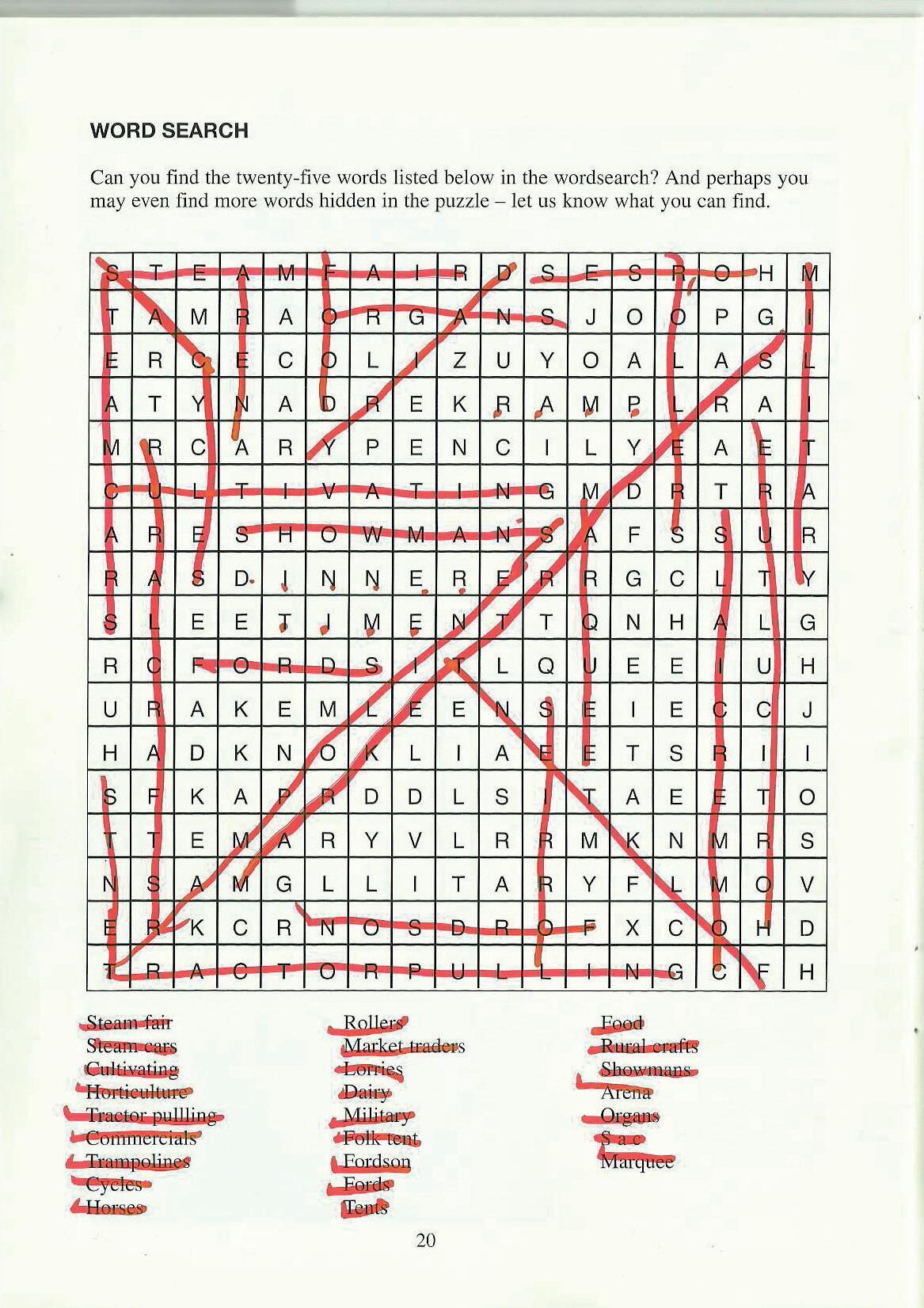
WORD SEARCH
Can you find the twenty-five words listed below in the wordsearcb? And perhaps you may even find more words hidden in the puzzle -let us know what you can find.
KNOW YOUR TRACTION ENGINE Part 4
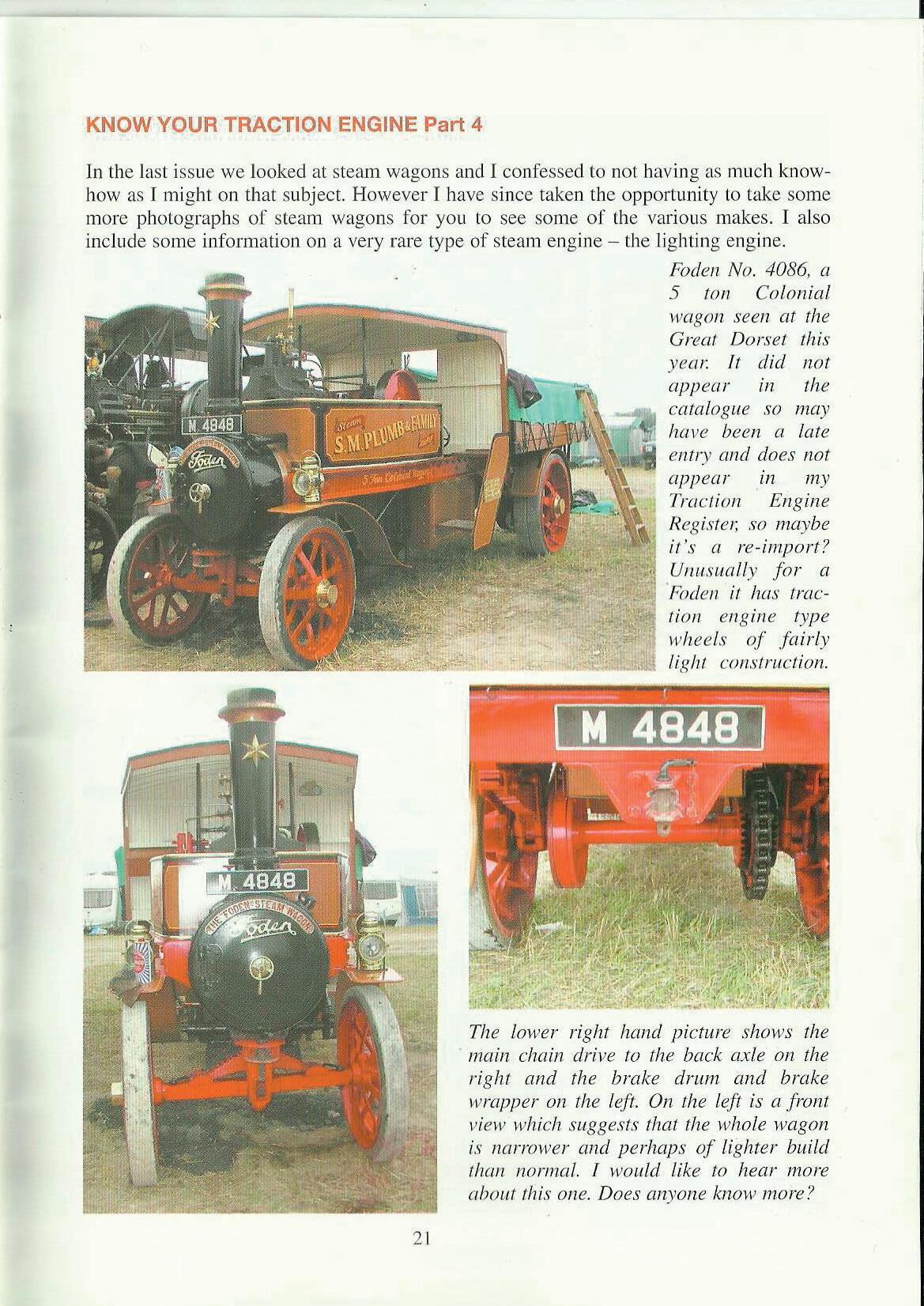
ln the last issue we looked at steam wagons and I confessed to not having as much knowhow as I might on that subject. However I have since taken the opportunity lo take some more photographs of steam wagons for you to see some of the various makes. I also include some information on a very rare type of steam engine -the ]jghting engine.
Foden No. 4086, a 5 ton Colonial wagon seen at the Great Dorset this year: It did not appear in the catalogue so may have been a late entry and does not appear m niy
Traction Engine Register; so ,naybe it's a re-import?
Unusually for a Foden it has traction engine type wheels of fairly light construction.
The lower right hand picture shows the main chain drive to the back axle on the right and the brake drum and brake wrapper on the le.ft. On the le.ft is a front view which suggests that the whole wagon is narrovver and perhaps of lighter build than normal. I would like to hear more about this one. Does anyone know more?
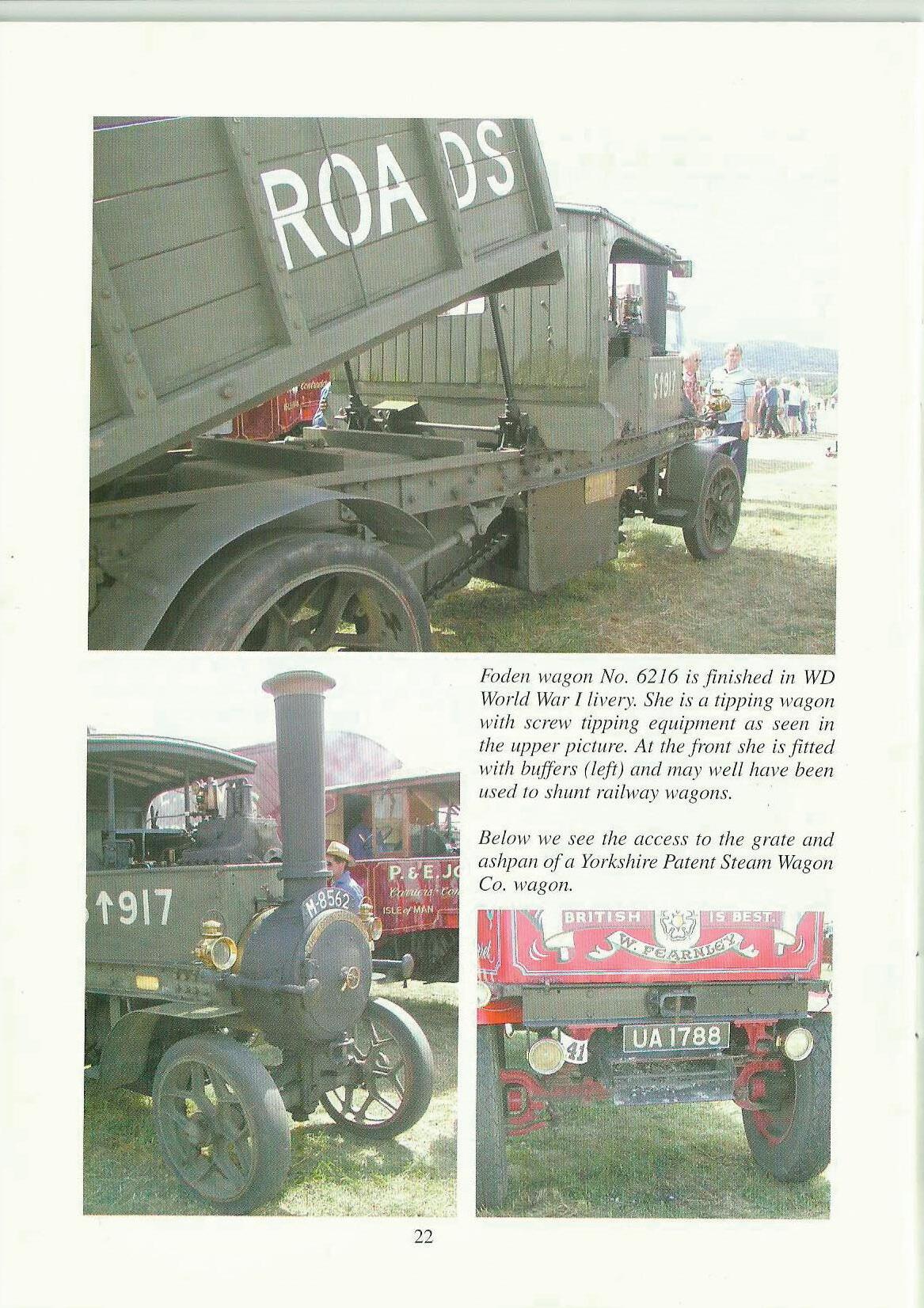
Faden wagon No. 6216 is finished in WD World War I livery. She is a tipping wagon with screw tipping equipment as seen in the upper picture. At the front she is fitted 1tvithbi~ffers (left) and ,nay well have been used lo shunt railway wagons.
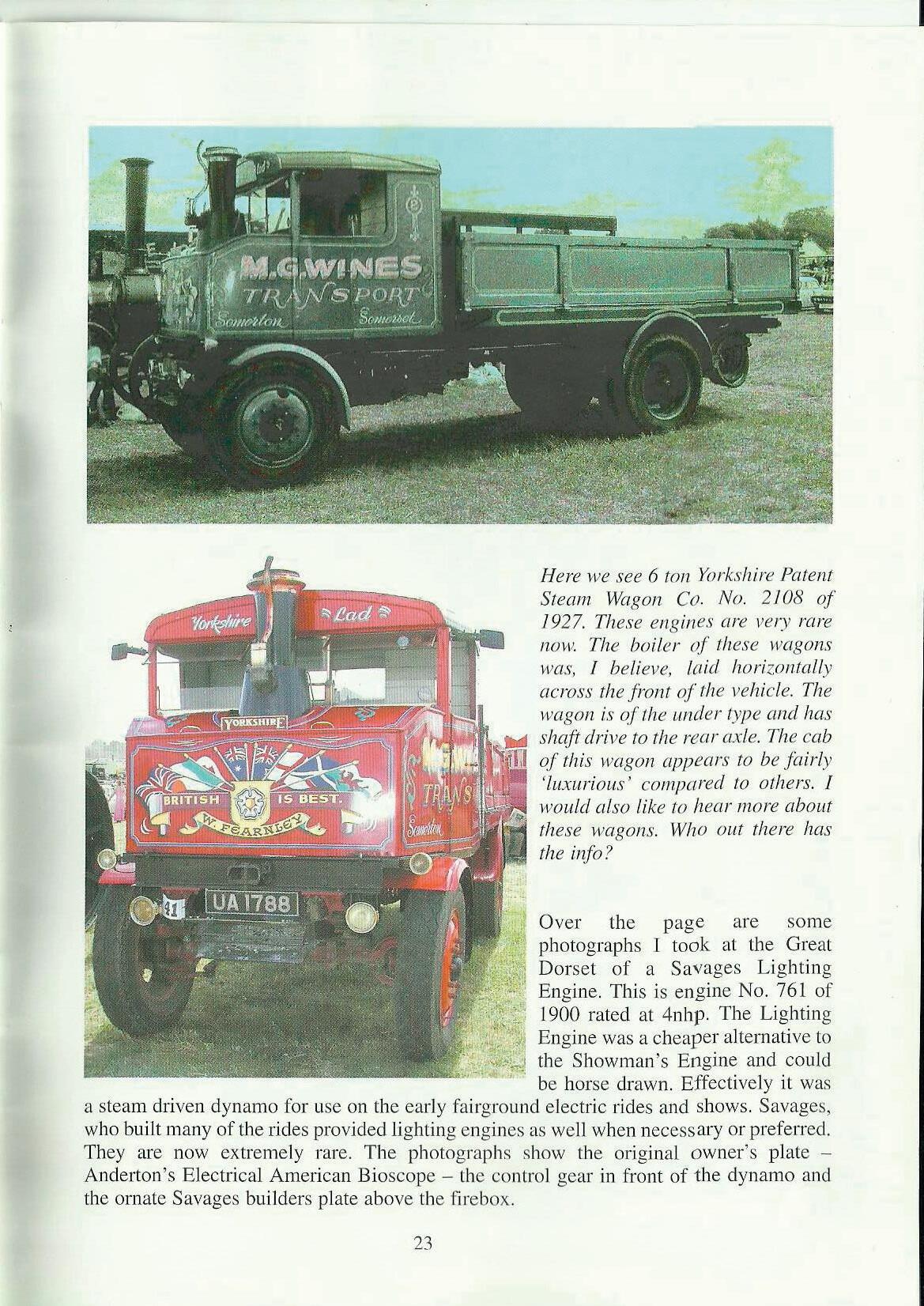
Below we see the access to the grate and , ashpan of a Yorkshire Patent Steam Wagon Co. wagon.
Here we see 6 ton Yorkshire Patent Steam Wagon Co. No. 2108 of 1927. These engines are very rare n.o\!v.The bo;fer of these wagons was, I believe, laid horizontally across the Ji-ont of the vehicle. The wagon is of the under type and has shaft drive to the rear axle. The cab of this wagon appears to be fairly 'luxurious' compared Lo others. I would also like to hear more about these wagons. Who out there has the info?
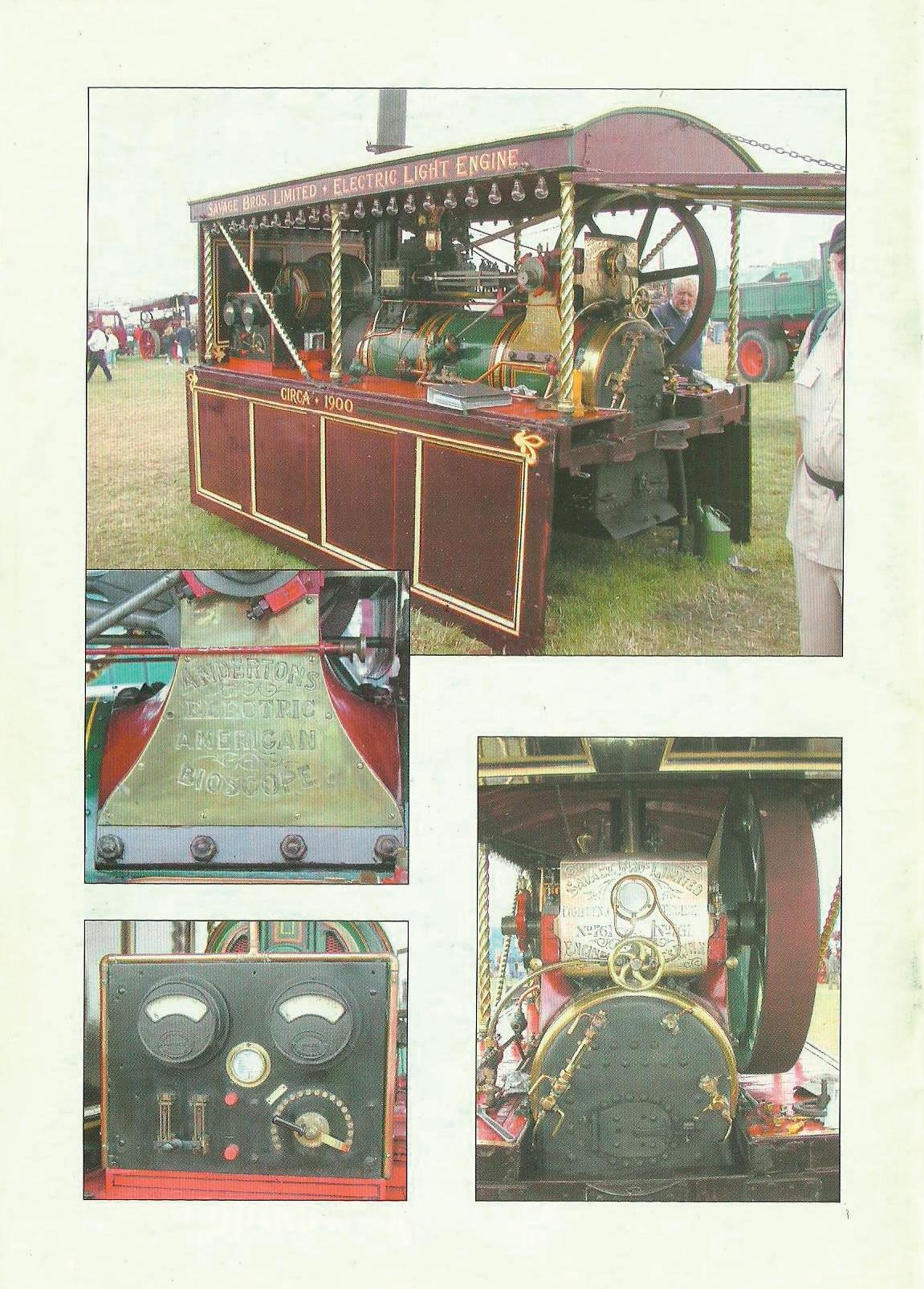
Over the page are some ,~ photographs I took at the Great Dorset of a Savages Lighting Engine. This is engine No. 761 of 1900 rated at 4nhp. The Lighting Engine was a cheaper alternative to the Showman's Engine and could be horse drawn. Effectively it was a steam driven dynamo for use on the early fairground electric rides and shows. Savages, who built many of the rides provided lighting engines as we11when necessary or preferred. They are now extremely rare. The photographs show the original owner's plateAnderton's Electrical American Bioscope - the contro1 gear in front of the dynamo and the ornate Savages builders plate above the firebox.