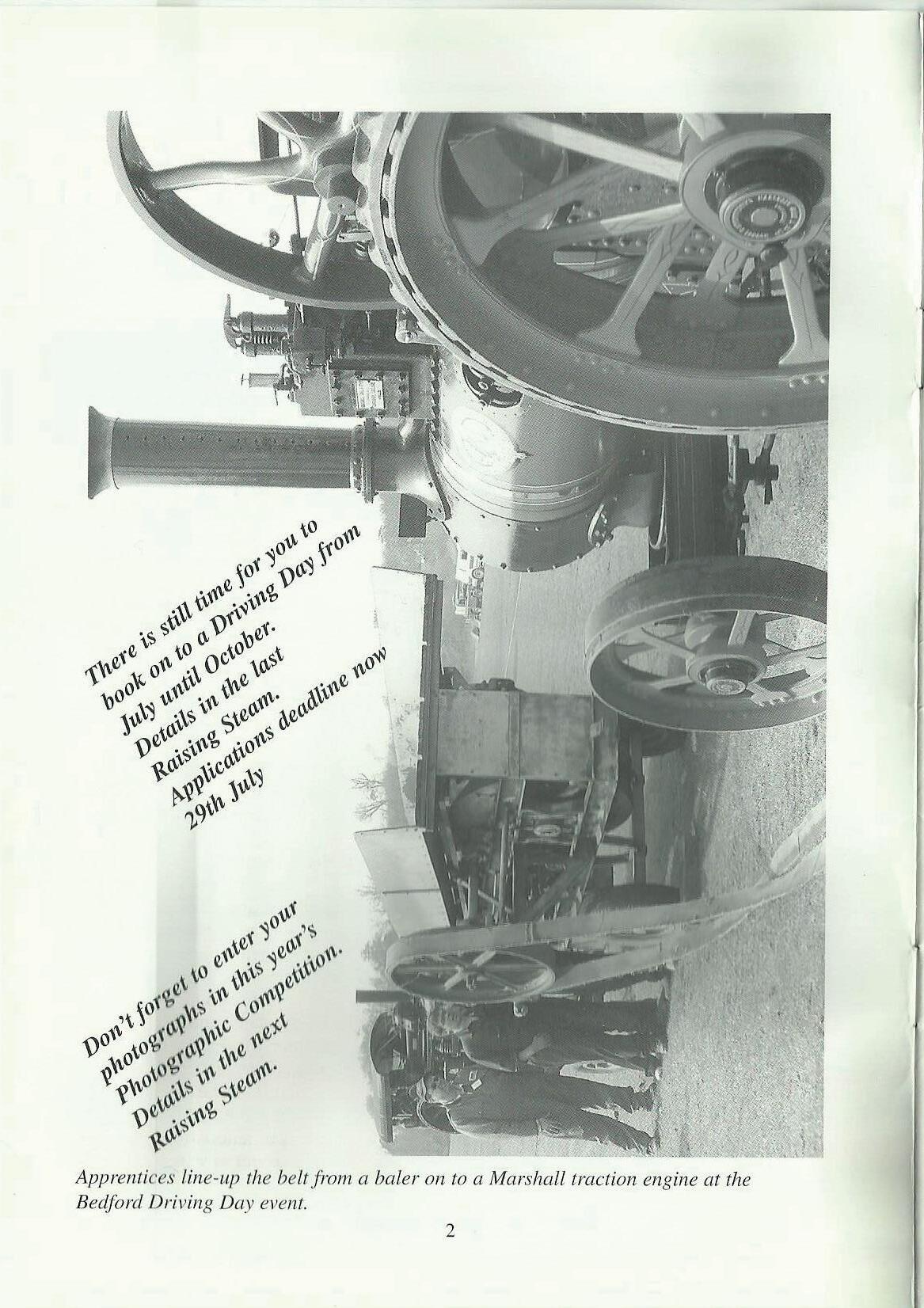
Apprentices line-up the belt.from a baler on to a lV!arshall traction engine at the Bedford Driving Day event.
STEAM APPRENTICE CLUB
Editor
Nanette Sanders, Frog Cottage, New Road, Porchfield, Isle of Wight PO30 4LS Tel: 01983 523317 sac.raisingstcam@ntet.co.uk
President
John Durling, Hawthorn Cottage, Stubwood, Uuoxeter, Staffordshire ST14 5HX
Chairman
Kevin Munn, 56 Blacklands Drive, l·fayes. Middlesex Tel: 020 8573 9180 e-mail: kevin@munnsteam.freeserve.co.uk
Vice Chairman
Elaine Massey, 21 Down Close, Northolt, Middlesex UBS 6NS Tel: 020 8248 6570 elainermassey@aol.com
Membership Secretary
John Cook, Do!Carni, Church Lane, Kirkby la Thorpe. Sleaford, Lincolnshire NG34 9NU. Correspondence only. Membership fee £5.00 per annum.
SAC Co-ordinators
Sam Bate Tel: 01642 897153 sambate@lycos.com
Duncan Croser Tel: 01494 875443 cluncasn.croser@btinlernet.com
Steve and Donna Taylor Tel: 01530 8352 l3stcvc.tailor@btinternet.com
Matthew Lund Tel: 01329 832462 matt.I und @engineer.com
Kevin Lawrence Tel: 01229 838144
John Lloyd Tel: 0 l603 415325
Barry Sumsion Tel: 01633 262197 barry@kearline.co.uk
The Editor welcomes any contributions of articles, shorter items or photographs for inclusion in future issues. All material submitted is voluntary and payment cannot be made for any material published. The opinions expressed in the magazine, with the exception of Club announcements, are those of the comributms and do not indicate the views of the Club as a whole. All items are held copyright by the conlTibutor and the NTET. The Editor reserves the right to amend or ref use contributions. The Magazine is normally published during the early part of January, April, July and October. The Club accepts no liability for failure to meet intended publication elates.
The Steam Apprentice Club is a section of the National Traction Engine Trust. NTET is a Registered Charily, No. 291578. Registered in England No. 1302197. Registered Office: 4 Church Green East, Redditch, Worcestershire 898 SBT.
Typesetting and Artwork by l<carline Graphic Images Ltd, Fairoak House Business Centre, Church Road, Newport, South Wales NP 19 7EJ Printed by TSG Creative Solutions, St Neots, Cambridgeshire PEI 9 8EL
FROM THE EDITOR
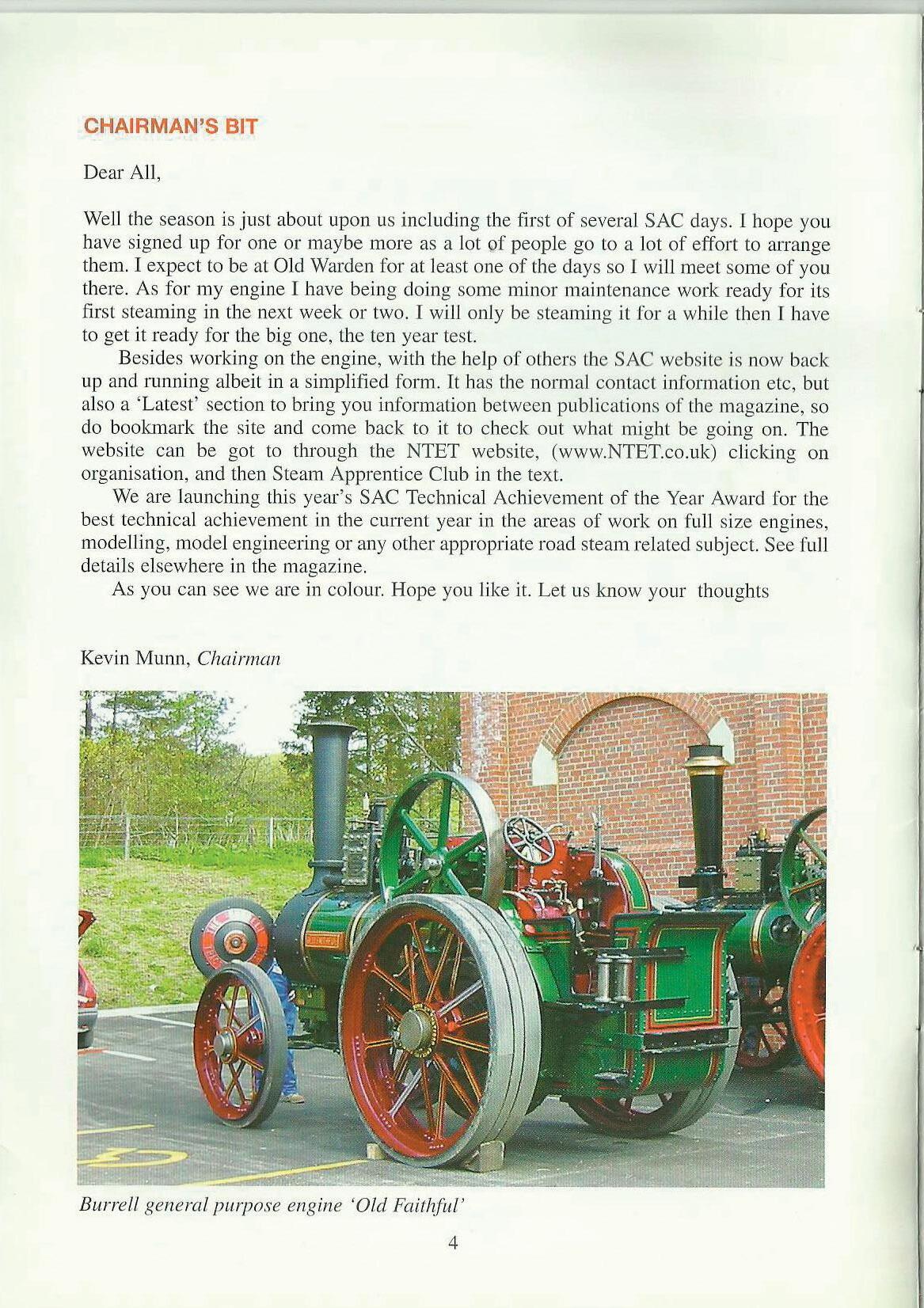
As you may have noticed, new and exciting things are happening with your mag. First of all you will have noticed with the last issue that the picture on the front cover had changed. There was a lovely picture of Olive.
Some of the magazine is now going to appear in colour so it will be nice if you could send me lots more pictures to brighten up the pages. There is a note in the magazine about how to send your pictm:es.
I would also like to include a page near the back of the next magazine giving space for you to advertise steam related items for sale. If you are interested in selling an item on this page then please could you include in your advertisement your name, address and phone number, and of course the item that you are wishing to sell.
If you would like to send me drawings that you have done remember that you can now colour them in. Please do not fold them as sometimes the crease is hard to hide.
There is a colour photo competition for you to enjoy taking part in. For each issue I would like you to send me photos for me to judge. The photo that I find the most interesting will be used on the front cover of the next issue. Once again there is a note in the mag about how to send your photo's. If you would like to take part then please could you clearly label your pictures with your name and address, and state that you wish to enter the FRONT COVER COMPETITION. Please write a small caption saying a little about the picture. For example where the picture was taken or who the engine belongs to. I am looking forward to lots of letters from you now that the new rally season is about to start.
Nanette Sanders, Editor
CHAIRMAN'S BIT
Dear All,
Well the season is just about upon us including the first of several SAC days. I hope you have signed up for one or maybe more as a lot of people go to a lot of effort to arrange them. I expect to be at Old Warden for at least one of the days so I will meet some of you there. As for my engine I have being doing some minor maintenance work ready for its first steaming in the next week or two. I will only be steaming it for a while then T have to get it ready for the big one, the ten year test.
Besides working on the engine, with the help of others the SAC website is now back up and running albeit in a simplified form. It has the normal contact information etc, but also a 'Latest' section to bring you information between publications of the magazine, so do bookmark the site and come back to it to check out whal might be going on. The website can be got to through the NTET website, (www.NTET.co.uk) clicking on organisation, and then Steam Apprentice Club in the text.
We are launching this year's SAC Technical Achievement of the Year Award for the best technical achievement in the current year in the areas of work on full size engines, modelling, model engineering or any other appropriate road steam related subject. See full details elsewhere in the magazine.
As you can see we are in colour. Hope you 1ike it. Let us know your thoughts
Kevin Munn, Chairman
DRIVER COMPETENCY
Just when you thought you'd heard the last of me!
Those of you who thoroughly read Raising Steam will know that last year five members successfully took and passed their 'Certificate of Competency' test. Ask any one of them and they will tell you that it is not the easiest test in the world but it feels absolutely great when you are told "you've passed".
What is involved?
To be able to apply for the chance to 'take your test' you must have the following:-
• A current SAC Membership Card
• A clriving licence for a car (or a provisional licence)
• A SAC log book which you have been completing for sufficient time to have repeated all of the tasks several times.
• Access to an engine. This can be either a traction engine or roller.
• A Mentor. This will normally be the owner of the engine you normally work on. He or she must be able to assess your ability against the Scheme Syllabus and recom1nend you for assessment.
• Access to somewhere suitable to take the test. Bear in mind that you will need to be able to demonstrate your driving ability, how to change gear going up and down hill, manoeuvring the engine through a set course and to set points etc.
• Tbe willingness to succeed.
If you think you can say yes to these points, get in touch with me and I'll send you a syllabus so that you can really understand what is involved. This should be discussed with your mentor so that he/she can help you know if you are ready for this test.
I should remind you a11that this is a voluntary scheme, and there is no pressure on anyone to get a competency certificate, but I can see the thne in the future when people will be asked to demonstrate that they have achieved the basic level of ability. If you have this certificate already, it will be one Jess thing to worry about.
John Durling. 0]889591188
john.r.durling@uk.transport.bombardier.com
MAIL BAG
Choosing a steam Engine.
Not many of us can afford a full size engine, and even m.iniatures cost many thousands of pounds. So if I want a steam engine of my own what choices have I got?
Straight from the box we have Mamod and Wilesco who do rollers, showmans and other models. If I can bolt my own engine together both Mamod and Wilesco do kits. A little more advanced is the Mercer engine.
How do I choose?
Well you need to consider if you want to assemble/ build yourself or would rather play straight away.
The drive mechanism, how the power is transmitted to the wheels.
The valve gear, how the steam gets in and out of the cylinder. Is the cylinder single or double acting? Is it driven both backwards and forwards or just one way.
Oh and price wi11probably come into it as well. As a rule, rollers are cheaper than showmans, with tractors in between, just like the real thing.
Starting with the cheapest option we have the._Mamodrange. These are the most basic technically and proved over many years. Power is transmitted from the flywheel to the road wheels using a sp1ingy metal band. Thjs can stretch and has to be removed if you want to let the engine run whilst standing still. ,.
Steering on the traction engines is by a knob above the chimney with a rod going down the chimney to the front wheels. It is a bit crude and you can end up dragging the engine or holding it back by the steering.
The steam gets in and out of the cylinder in the simplest possible way. The cylinder is pivoted and rocks as the flywheel goes round. This lines a hole in the cylinder up to the steam supply or exhaust as required. The cylinder is single acting, that means the steam pushes it one way and the flywheel pushes it back.
The Wilesco range look a little more continental and are slightly more expensive than Mamods. The extra money buys you a geared drive with simple clutch, so you can run the engine standing still. The steering uses a wheel on the footplate gearing and chains like the real thing. The cylinder is fixed, steam being controlled by a valve in a separate chest. From its perfo1mance my guess is double acting but I do not know. I do not think I will be chopping ours up to find out.
We have a Mamod showmans and a Wilesco roller in our house. Personally I would pay the extra for the Wilesco, it is just much closer to a full size engine.
Both these can be bought in kit form just needing to be bolted together and this will save about £10. Our Wi]esco was a kit and took an afternoon to assemble, you must be careful though with the steam pipe connections. It certainly feels more your engine when you have put it together.
If you are happy with a stationary engine Stuart Models do a wide range with the parts machined ready. These will be more challenging and expensive.
Top of the range is the Mercer, these are sophisticated I inch scale miniatures. Available ready to run or in kit form. The kits require skill and lots of time.
The Mamod and Wilesco belong to my children, So what have I got? Well I am into railway engines and if you are too, look at the Accucraft range. Starting at prices between Wilesco and Mercer they are sophisticated gas fired models. But do not forget to allow for some track.
Duncan Croser.
Dear Editor.
Just thought I would write a letter to let you know about a roller which we have just bought.
We already have a 4" miniature traction engine called The Chough which my dad built over 8 years ago, and has rallied every year for the last 4 years including at the Great Dorset Steam Fair.
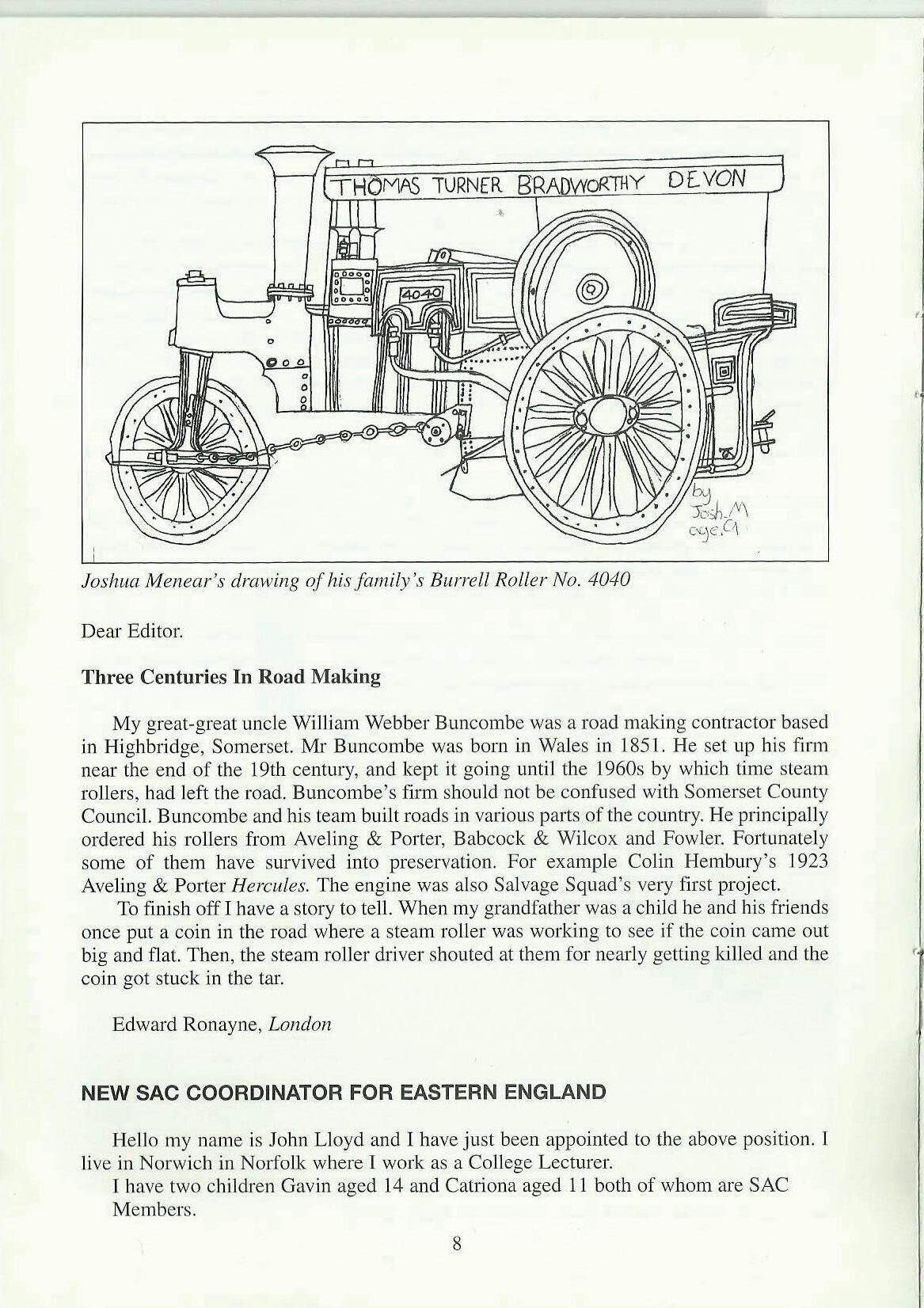
l\t1ypapa also has a 3" miniature Fowler A 7 traction engine which we also take around. At Christmas we bought Bunell No. 4040, reg No TT 7917. It was built in 1926 and is a 10 ton single cylinder A class roller built to the special order of Thomas Turner, Bradworthy, Devon. It is very unusual as it was fitted with many additional features not usually found on a roller. It was sold to R. Dingle & Son, Stoke Climsland and it worked for them into the 1950s. After various purchases it was sold to John Wakeham of Launceston in December 1996 and we bought it off John in December 2005.
We had lots of work to do at hoine before we could bring her back, but managed to bring her to her new home on 11th Febrnary 2006. Our first proper outing with her is going to be Trevithick Day, Camborne on Saturday 29th April 2006 with a road run on the Sunday. We will be going to most of the rallies in Cornwall and hopefully will take her by road rather than low-loader. I can't wait for this year's rally season with 4040. I have included a picture which I drew of Burrell 40401 hope you like it.
Joshua Menear, aged 9, Camborne.
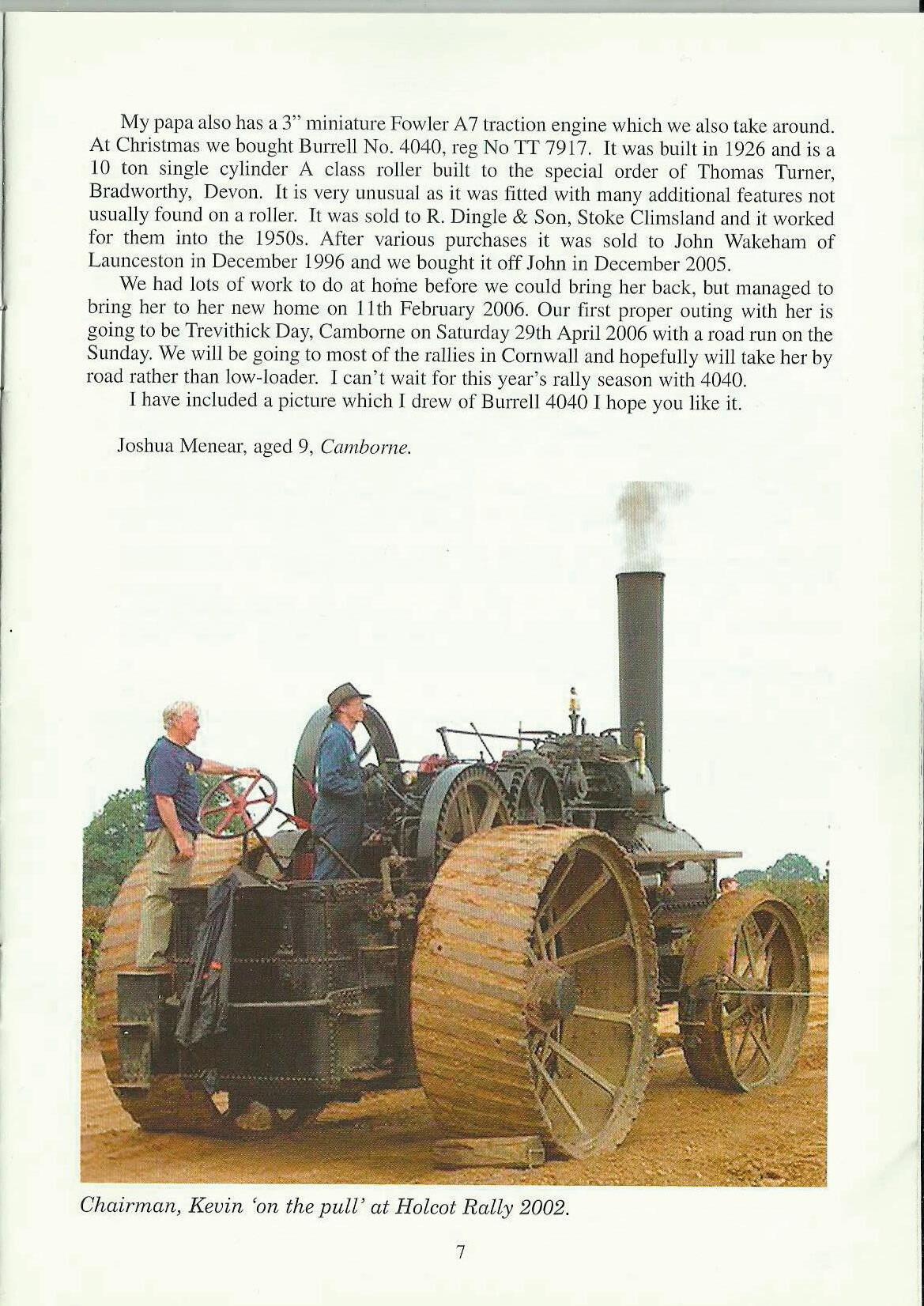
Chairnian, Kevin 'on the pull' at Holcot Rally 2002.
Joshua Menear's dravving of his.family's Burrell Roller No. 4040
Dear Editor.
Three Centuries In Road Making
My great-great uncle \Vi11iarnWebber Buncombe was a road making contractor based in Highbridge, Somerset. Mr Buncombe was born in Wales in 185 l. He set up his firm near the end of the 19th century, and kept it going until the l 960s by which time steam rollers, had left the road. Buncombe's firm should not be confused with Somerset County Council. Buncombe and his team built roads in various parts of the country. He principally ordered his rollers from Aveling & Porter, Babcock & Wilcox and Fowler. Fortunately some of them have survived into preservation. For example Colin Hembury's 1923 Aveling & Porter Hercules. The engine was also Salvage Squad's very first project.
To finish off I have a story to te11.When my grandfather was a child he and his friends once put a coin in the road where a steam roller was working to see if the coin came out big and flat. Then, the steam roller driver shouted at them for nearly getting killed and the coin got stuck in the tar.
Edward Ronayne, London
NEW SAC COORDINATOR FOR EASTERN ENGLAND
1-Iellomy name is John Lloyd and I have just been appointed to the above position. I live in Norwich in Norfolk where I work as a College Lecturer.
I have two children Gavin aged 14 and Catriona aged 11 both of whom are SAC Members.
Somebody recently asked me when I first became interested in Traction Engines and as best as I can remember it started in the early 1970s when one day I was off ill from school in Canterbury and watched the Iron Maiden film. I then badgered my parents to take me to a rally at Sellindge and by then the bug had well and truly taken hold and as we all know there is no known cure for this condition.
As my .sonGavin became older T was looking around for something that we could both do together so I took him to Strun:i.pshawSteam Rally in 2003 and we then became volunteers at the Strumpshaw Steam Museum.
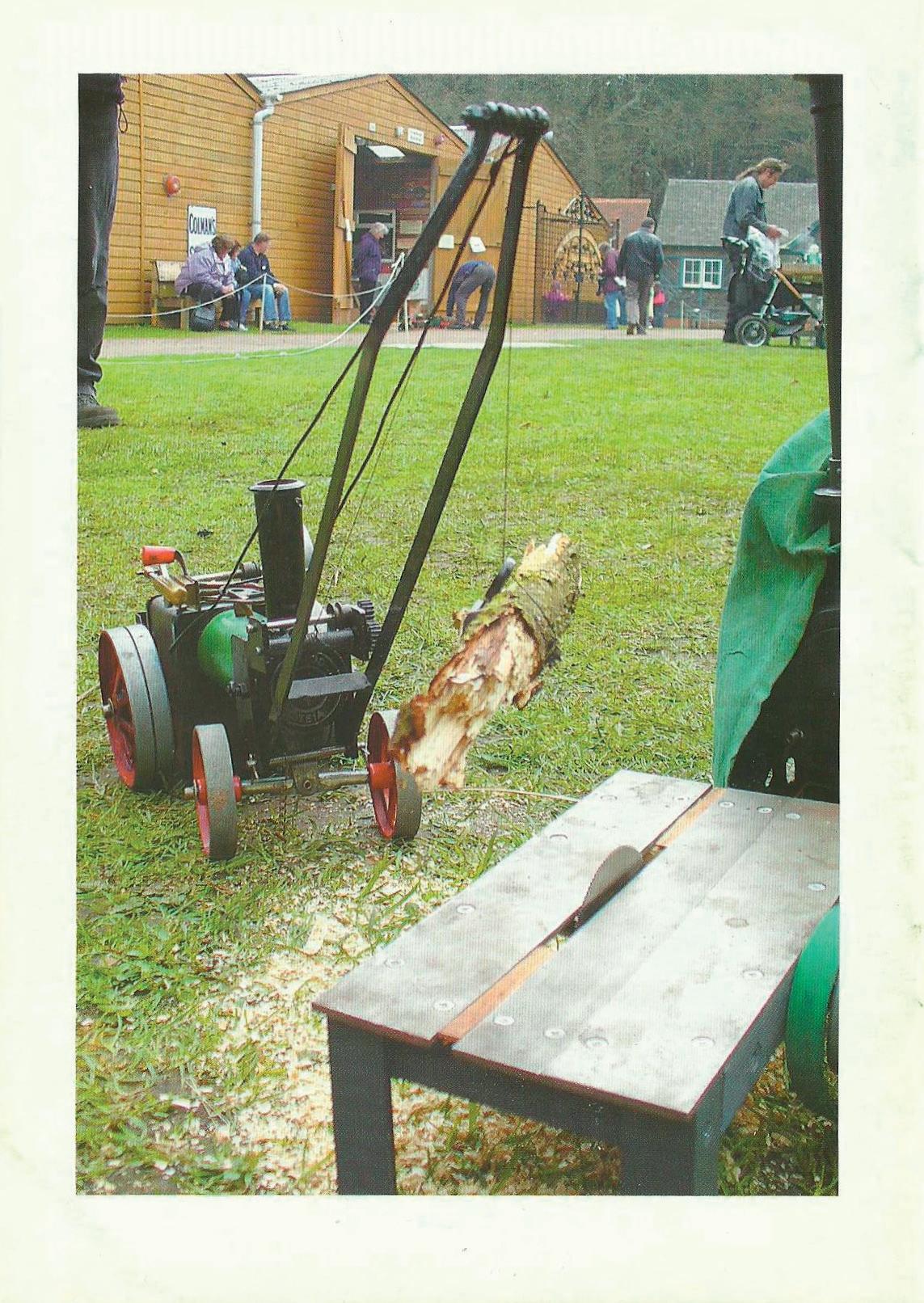
Last year we both attended the NTET D1iving Course at Astwood Bank, my son driving a rare Gibbons & Robinson engine and I a Fowler Ploughing Engine and Robert Herring's Engine Little Mo. We have subsequently had the chance to drive several different types of engine and to drive a steam powered racksaw at the Henshaw rally.
We jumped at the chance last year to drive Michael Moore's 1904 Burrell engine at the Weeting Rally and Gavin is pa1ticu]arly proud of coming third in the slow race.
I will be present with my family at the April SAC driving course at Weeting and also for my first GDSF later in the year.
I look forward to meeting many of the SAC members at events and I am very pleased to have been invited to join the organisation at an exciting stage of its development.
Best Wishes
John Lloyd.
Email: john.lloyd60@ntlworld.com
Home Address: 58 Blackwell Avenue, Norwich, Norfolk, NR7 8XW. Tel: 01603 415325 Mobile: 07901 575672.
Dear Editor,
I'd like to tell you about us and our steam roller called Sammy Lou. It was built by Aveling & Porter in 1925. reg no. PE 2458 boiler no. 11206.
Myse]f and my twin sister were christened at a steam rally on the Harris's vintage gallopers. They moved one of the gondolas so that the vicar could conduct the service from the ride, being watched by family, friends and engine owners, a1so members of the public.
\Vhen we were babies we had car seats in the living van, but now we have a wooden seat attached to the engine with seat belts. When we were litt]e our mum would tell our dad to put potatoes in the smoke box to cook for dinner, it takes three miles. When we go to the steam rallies we take the covers off the roller and see the mess that clad has left after driving it there. We spend hours cleaning and polishing before going into the arena. We are always last in there because dad is no good at lighting fires so mum has to do it while he's talking. In the evenings we have our dinner and dad takes us out to drive and steer the roller after everyone has gone home. We dress up warm and go to the beer tent. We play with our friends while mum and dad drink beer and talk to people. We then go back to the living van, me and Hayley are put to bed while mum and dad sit around the fire talking and singing.
Vivienne Foord, aged 10, East Sussex
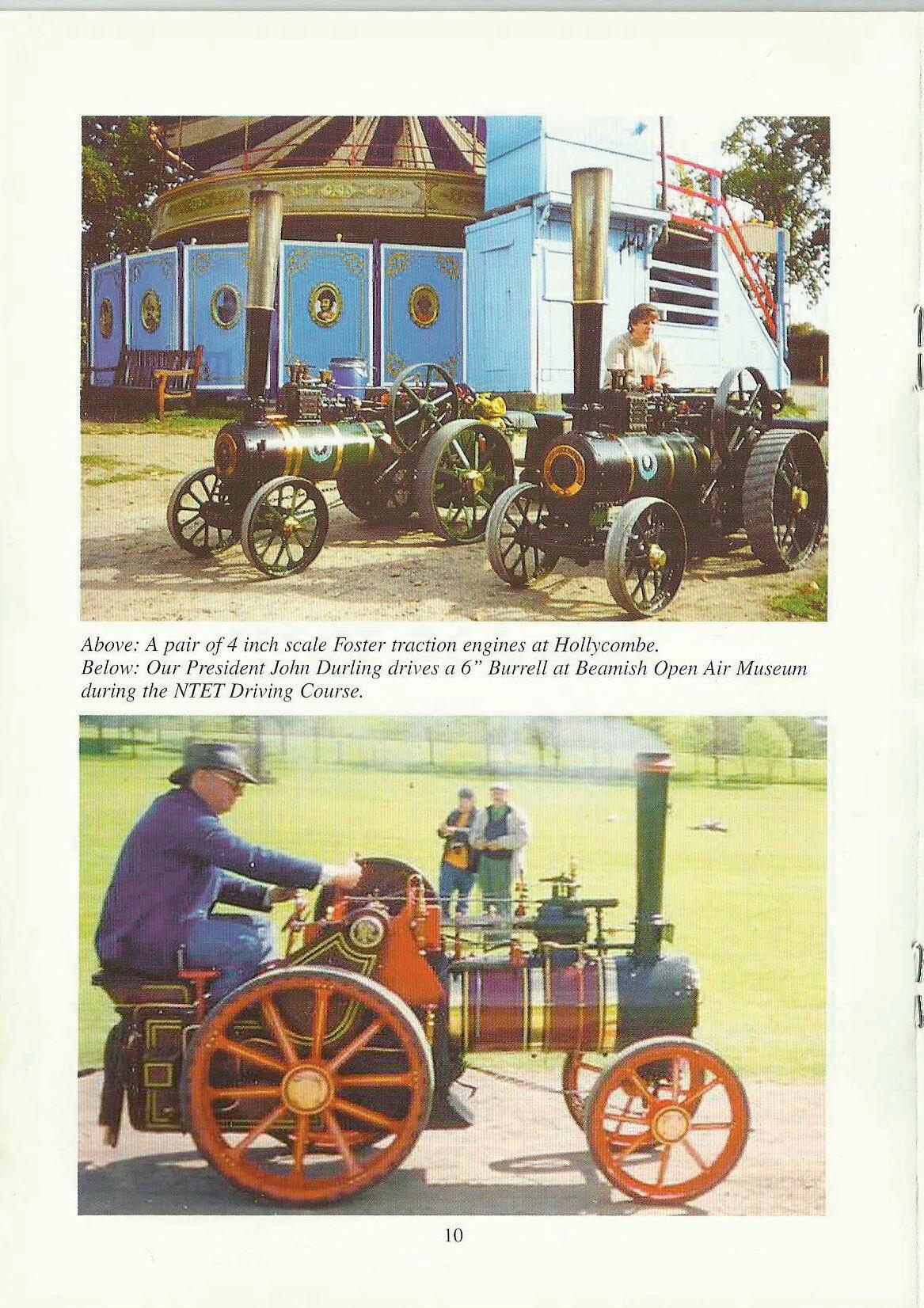
Above: A pair of 4 inch scale Foster traction engines at Hollycombe. Below: Our President John Durling drives a 6" Burrell at Bea,nish Open Air Museum during the NTET Driving Course.
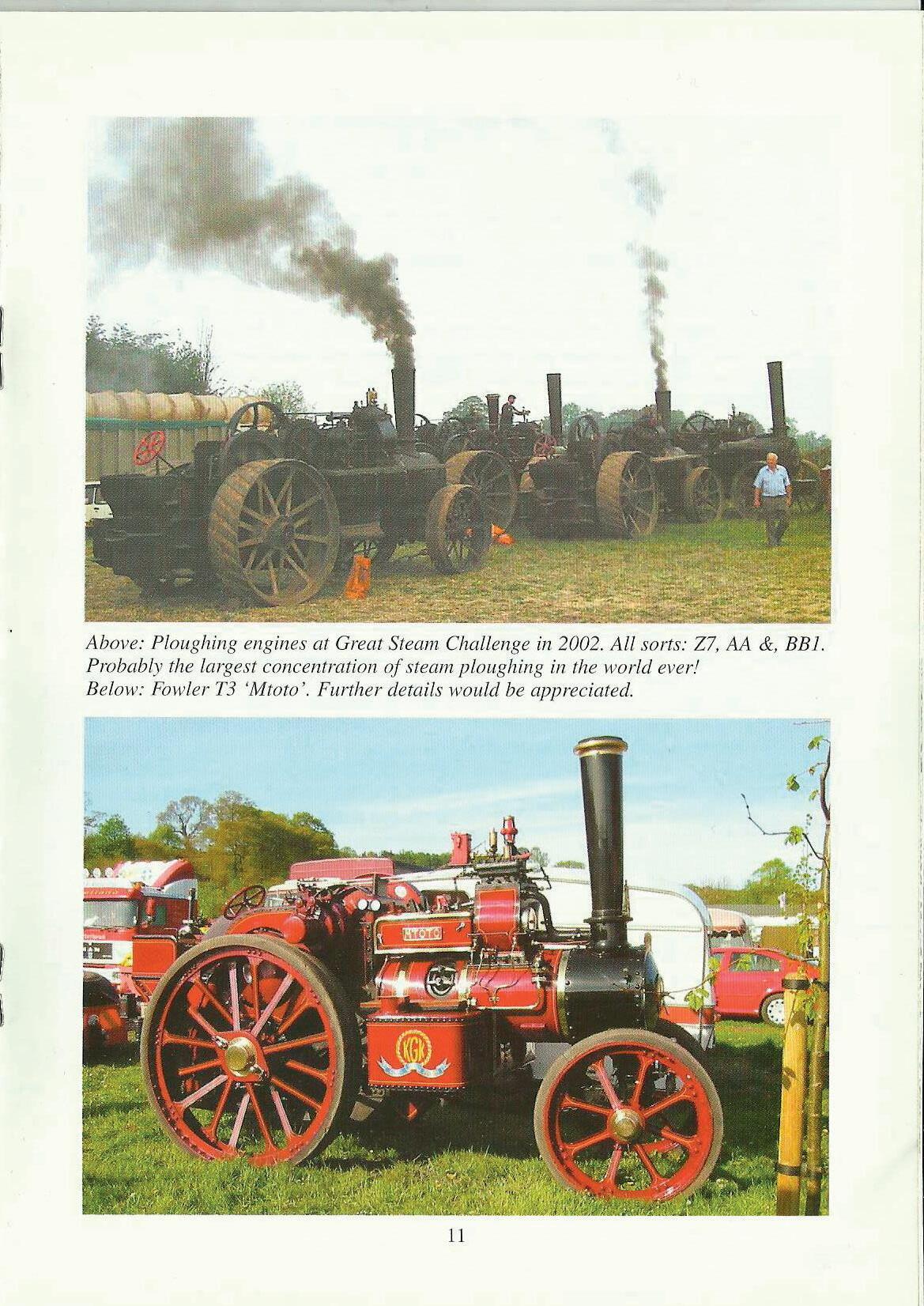
Above: Ploughing engines at Great Steam Challenge in 2002. All sorts: 27, AA &, BBJ. Probably the largest concentration of steam ploughing in the world ever! Below: Fowler T3 'Mtoto '. Further details would be appreciated.
YOUR NEW COLOUR MAGAZINE AND
YOUR PHOTOGRAPHS
We are pleased to be able to bring you your magazine with some pages in full colour. This is part of our wish to produce a better magazine both in terms of print quality and content. We need you to be part of these improvements and for each of you to help towards these aims.
Fisst of all we need to talk seriously about your photographs and how and in what format you must submit them. Not all photographs can appear in colour since not all of the pages will be printed in co]our. However in order for us to reproduce your pholographs to the best quality whether in colour or black and white, we need to lay down some rules which hopefully you can follow. We can accept photographs either as traditional prints developed and printed from film or from digital originals. I cannot impress upon you enough that we need good sharp photographs with the subject matter well lit. It is true that we can electronically/digitally improve pictures so long as they are not too bad in the first place, but there is no substitute for a well lit and sharp picture to strut with. So how can we try to produce good photographs? ,,,
It matters not whether you are using a traditional film camera or a digital one -you ru·e still taking a photograph! Very few of you (if any) will be professional photographers and many of you will have fairly simple cameras. That shouldn't matter. I am going to assume that you are using a simple 'point and shoot' type of camera. If you have a camera that gives you more control over the exposure and you know how to use these facilities, that is all well and good. To keep things simple and for your pictures to be satisfying to you and acceptable to us, follow two simple rules.
First do not put your subject matter in shadow. This ca·n be particularly difficult with a traction engine where the lower parts of the engine ru·e underneath the engine and therefore easily starved of Iight. I know it's not always possible but follow the old golden rule of having the sun behind you, lighting up your picture. If this is inconvenient, it is probably better to wait until the engine moves to another position or wait till later in the day when the sun is shining from a different position. If the engine is pattly out of its shed with building shadows falling on parts of it, try being a little cheekly (but very politely!) and ask the owner/driver if he cru1move the engine out into the light. Dull overcast days can produce another problem. The sun may not be shining brightly but there is almost certainly enough natural light to take a good photograph, but be careful not to point your camera up towards the sky. On such days the background sky will apperu·to the camera to be a light source since the sky is the same all over. This can produce unacceptable 'whiteout' effects where your camera will think there is a lot of light coming into it and adjust itself accordingly. Unfortunately this means that the engine apperu·sas if it is in shadowthat is under-exposed. I hope you are not reading this and thinking 'Oh dear, this is all very difficult!' It is not - simply try to photograph your engine (or whatever) with good light falling on it and look to see if there are any shadows or dark areas in your picture.
Secondly try to get your photographs sharp. That is they should not be fuzzy. Some cameras will have better lenses and shutters than others but again, a couple of principles hold good no matter what camera you are using. Unsharp pictures are usually caused by one of two things. Either you were moving when you fired off the shutter of your subject was moving. Let's talk about you moving. You need to understand that a camera's shutter moves very quicldy - and it will very quickly pick up any movement you may make. The worst times will be on cold days when you may be shive1ing even if only very slightly and
at other times when you have hun-ied to catch your subject when it is moving about. Being out of breath is as bad as shivering! So what can you do? Well if you are really serious then a tripod attached to your camera will answer all these questions. Unfortunately they can be awkward, and usually unnecessary things to carry around. Try to find a wall, gate or even a post that you can rest your camera upon. That will get around virtually every problem where you might be moving when you take your picture. If this is not possible try to be as warm as possible in cold weather, catch your breath if you've been running and get into a relaxed position before taking the picture. If you remind yourself of these things often, you will get into the habit of settling into a still and relaxed position before you take your pictures. But what if the subject is moving? Well it depends how fast it is moving and in which direction in relation to yourself. Slightly more expensive cameras will have the opportunity to increase the shutter's speed. That means that your camera will 'freeze' the movement for you. If you are using the 'point-and-shoot' type of camera where you cannot change the shutter speed, then you need to adapt your stance and movement to try and 'freeze' a moment of your subject's movement. If the subject is moving in front of you from left to right or vice versa, then you can try 'panning' your shot. Bear in mind that you do not wish to introduce any shake on your part. So try standing with your legs apart to obtain good relaxed balance, line up your subject in the viewfinder, and moving from the waist only, swing round with your camera keeping the subject where you want it within your viewfinder. When the picture is composed as you want it -for instance when the subject is directly straight ahead of you, take the picture, remembering not to do this with a sudden jerk or other movement. This will take a bit of practice but is not necessarily very difficult. Your picture should be sharp with things like wheels appearing to be moving, giving an appearance of speed. Such pictures can be very effective.
So that is some basic advice for you to try. Now what about sending your picture to the magazine? If you have a photograph obtained using traditional film, then all you need to do is make sure it is sharp, well lit and composed and send a postcard sized (or thereabouts) print to the Editor. Pack it well in an envelope and put some cardboard either side of it so that it should not get bent in the post. Make sure you include a description of what your pictui·e is all about - put as much information as you can find about.
If you have taken your photograph with a digital camera, then follow these guidelines. The picture should, again, be we]] lit and sharp. However we need to give you a few parameters that we shall need to obtain good reproduction in print. Most of you will have access to the Internet, so please send your picture via e-mail to the Editor in JPEG format. It is important that your camera is set to take pictures of at least the 2 megapixel setting for black and white reproduction - more if possible but not greater than 4 mega.pixels for colour reproduction. Any greater resolution is totaUy unnecessary and takes up more room on yours and the Editor's computers! We would rather you didn't send your own print to us. However if you really need to, it must be produced in fine quality on photo quality paper. A print done on ordinary document paper will not reproduce satisfactorily and you will be disappointed with the result when you see it in the magazine. WHENEVER YOU SEND A PHOTOGRAPH WHETHER FROM FILM OR A DIGITAL ONE, NEVER FOLD IT AND ALWAYS SUPPORT IT WITH CARD IN THE ENVELOPE!
I hope all this is found to be helpful. All I have told you is very basic stuff, intended to help you to take acceptable pictures. Our aim is to have from you some really good photographs to include in your magazine. Barry Sumsion
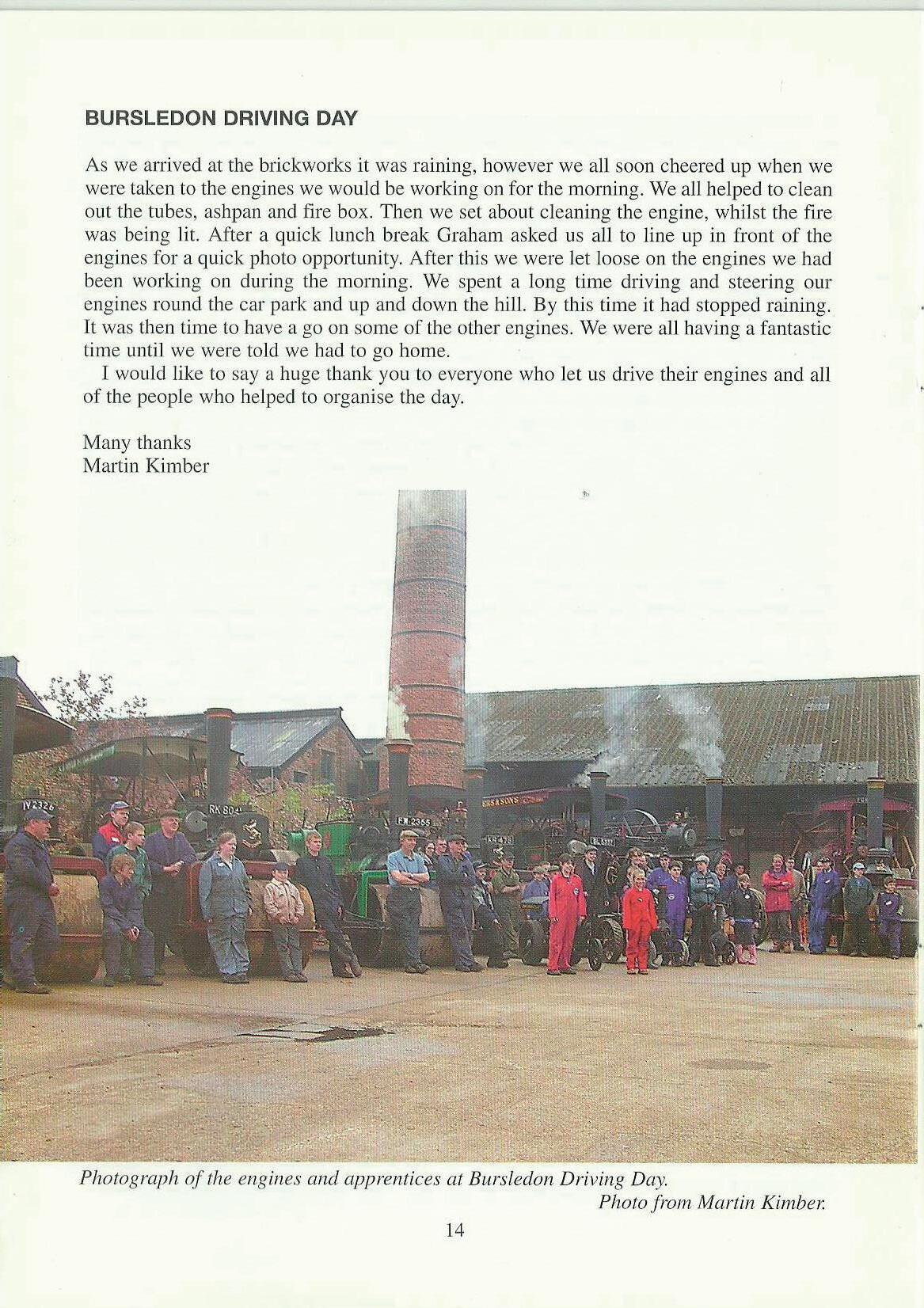
BURSLEDON DRIVING DAY
As we arrived at the brickwo{ks it was raining, however we all soon cheered up when we were taken to the engines we would be working on for the morning. We all helped to clean out the tubes, ashpan and fire box. Then we set about cleaning the engine, whilst the fire was being lit. After a quick lunch break Graham asked us all to line up in front of the engines for a quick photo opportunity. After this we were let loose on the engines we had been working on during the morning. We spent a long time driving and steering our engines round the car park and up and down the hill. By this time it had stopped raining. It was then time to have a go on some of the other engines. We were all having a fantastic time until we were told we had to go home.
I would like to say a huge thank you to everyone who let us drive their engines and all of the people who helped to organise the day.
Many thanks Martin Kimber
Photograph of the engines and apprentices at Bursledon Driving Day. Photo from l'vfartin Kiniber.
PERHAPS SHE SHOULD BE CALLED 'PHOENIX'.
Those of you who were fortunate enough to be at the NTET Road Run at Hollowell in September 2004 may well remember the problems that Morning Star had with a lagging fire towards the latter part of the run. Some others may remember reading my comments on this in Raising Steam.
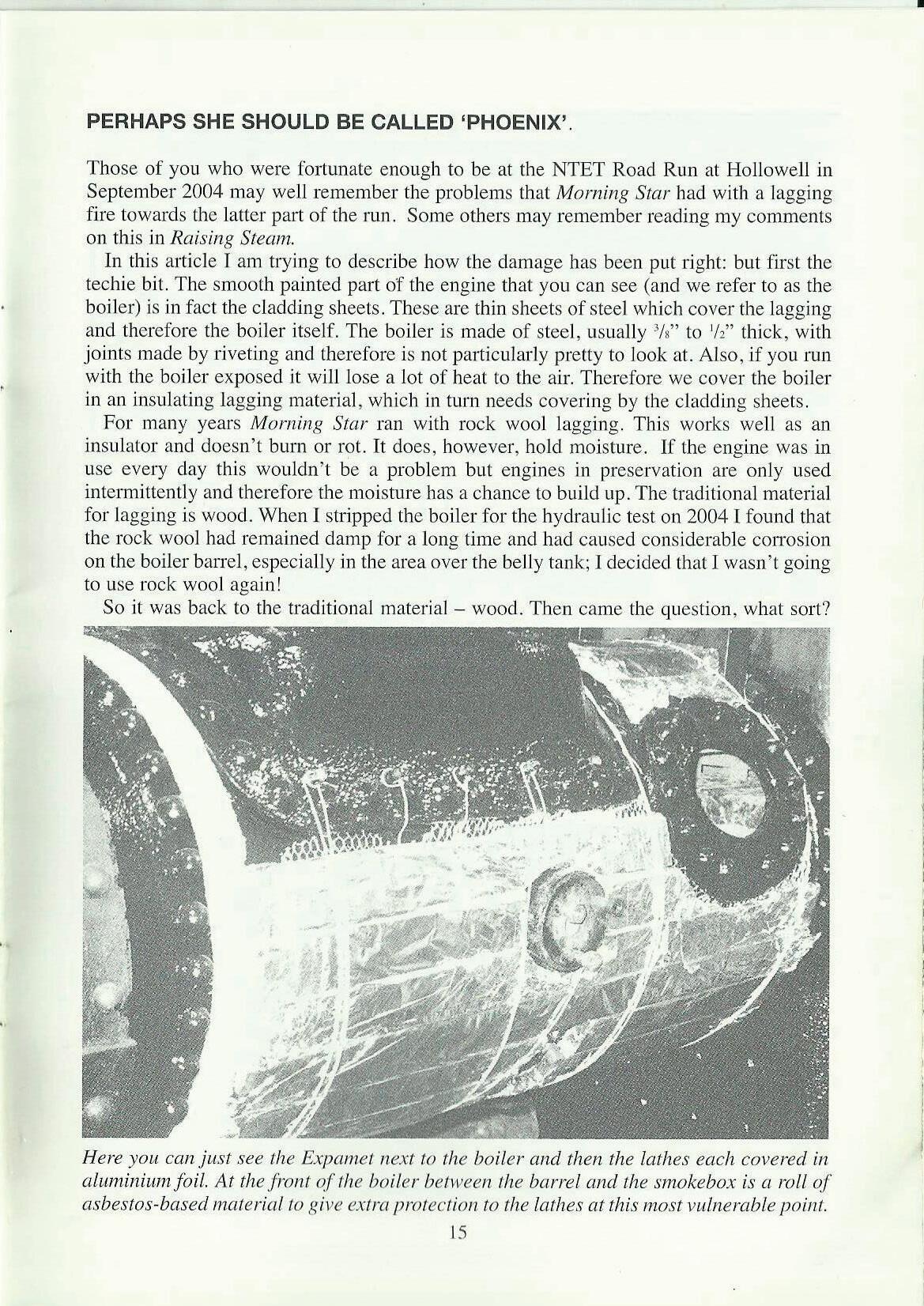
In this article I am trying to describe how the damage has been put right: but first the techie bit. The smooth painted part of the engine that you can see (and we refer to as the boiler) is in fact the cladding sheets. These are thin sheets of steel which cover the lagging and therefore the boiler itself. The boiler is made of steel, usually 3/s" to 1/2" thick, with joints made by riveting and therefore is not particularly pretty to look at. Also, if you run with the boiler exposed it will lose a lot of heat to the air. Therefore we cover the boiler in an insulating lagging material, which in turn needs covering by the cladding sheets.
For many years Morning Star ran with rock wool lagging. This works well as an insulator and doesn't burn or rot. It does, however, hold moisture. If the engine was in use every day this wouldn't be a problem but engines in preservation are only used inte1111ittentlyand therefore the moisture has a chance to build up. The traditional material for lagging is wood. When I stripped the boiler for the hydraulic test on 2004 I found that the rock wool had remained damp for a long time and had caused considerable corrosion on the boiler ban-el, especially in the area over the belly tank; I decided that I wasn't going to use rock wool aga.in!
So it was back to the traditional material - wood. Then came the question, what sort?
Here you can just see the Expamet next to the boiler and then the lathes each covered in aluminium foil. At the fi·ont of the boiler between the barrel and the smokebox is a roll of asbestos-based material lo give extra protection to the lathes at this most vulnerable point.
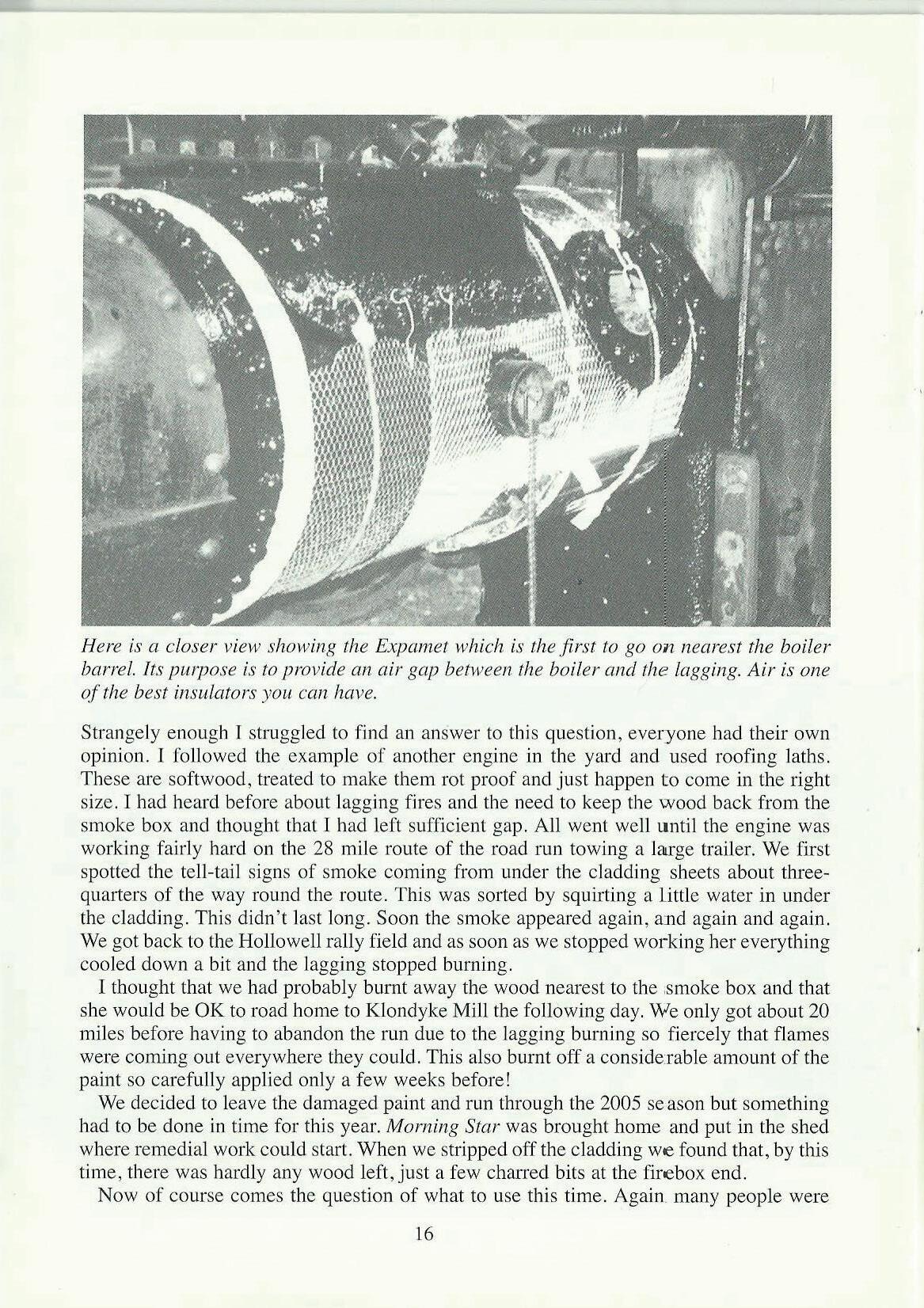
Here is a closer view showing the Expamet which. is the first to go on nearest the boiler barrel. Its purpose is to provide an air gap between the boiler and the lagging. Air is one of the best insulators you can have.
Strangely enough T struggled to find an answer to this question, everyone had their own opinion. I followed the example of another engine in the ym·d and used roofing laths. These are softwood, treated to make them rot proof and just happen to come in the right size. I had heard before about lagging fires and the need to keep the wood back from the smoke box and thought that I had left sufficient gap. All went well until the engine was working fairly hard on the 28 mile route of the road run towing a lairge trailer. We first spotted the tell-tail signs of smoke corning from under the cladding sheets about threequarters of the way round the route. This was sorted by squirting a little water in under the cladding. This didn't last long. Soon the smoke appeared again, a11dagain and again. We got back to the Hollowell rally field and as soon as we stopped working her everything cooled down a bit and the lagging stopped burning.
I thought that we had probably burnt away the wood nearest to the .smoke box and that she would be OK to road home to Klondyke Mill the following day. We only got about 20 ntiles before having to abandon the run due to the lagging burning so fiercely that flames were coming out everywhere they could. This also burnt off a conside:rable amount of the paint so carefully applied only a few weeks before!
We decided to leave the damaged paint and run through the 2005 season but something had to be done in time for this year. Morning Star was brought home and put in the shed where remedial work could start. When we stripped off the cladding we found that, by this time, there was hardly any wood left, just a few charred bits at the firebox end.
Now of course comes the question of what to use this time. Again many people were
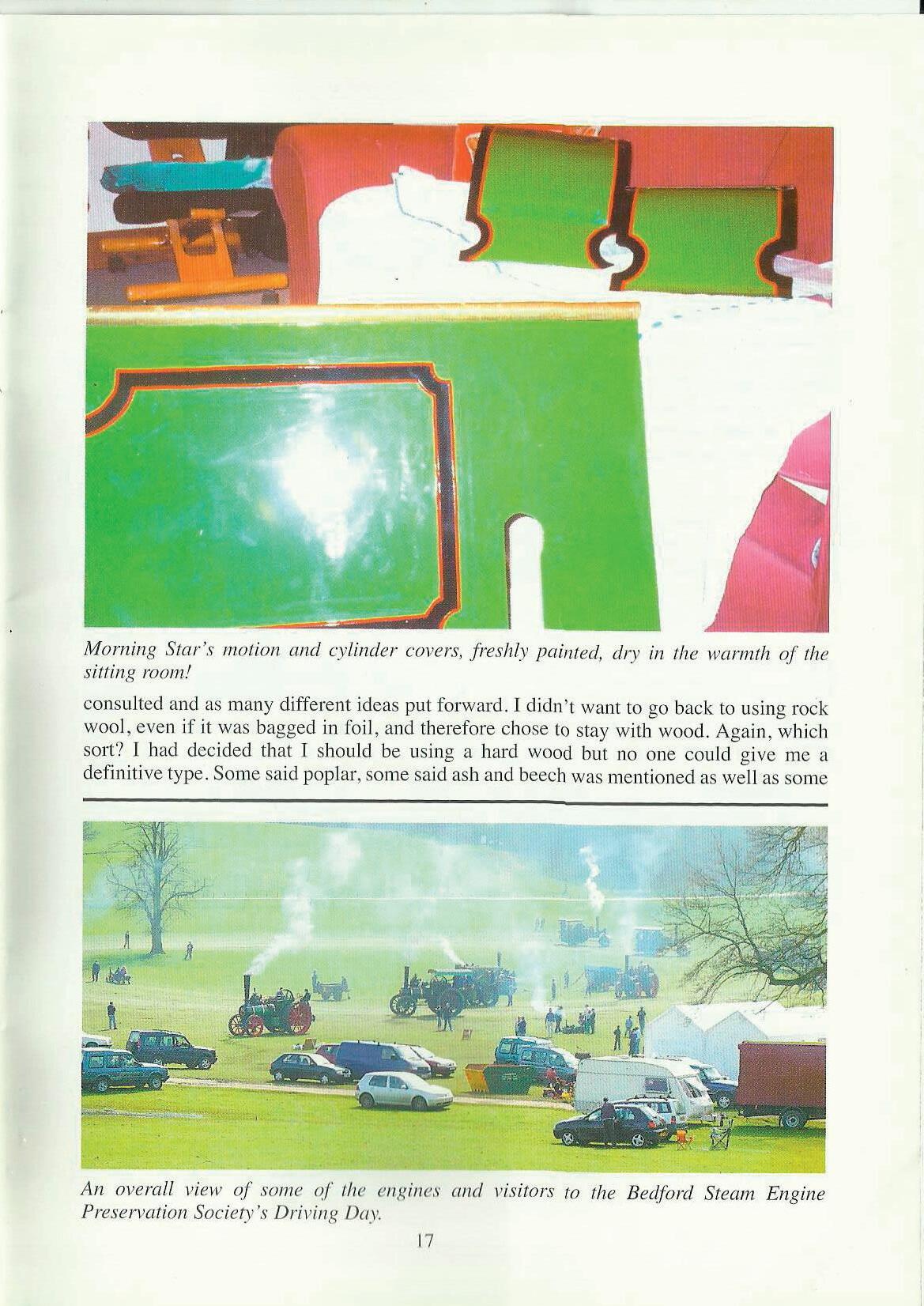
Morning Star's motion and cylinder covers, ji-eshly painted, dry in the wannth of the sitt;,ig room!
consulted and as many different ideas put forward. I clidn't want to go back to using rock wool, even if it was bagged in foil, and therefore chose to stay with wood. Again, whicb sort? I had decided that I should be using a hard wood but no one could give me a definitive type. Some said poplar, some said ash and beech was mentioned as well as some
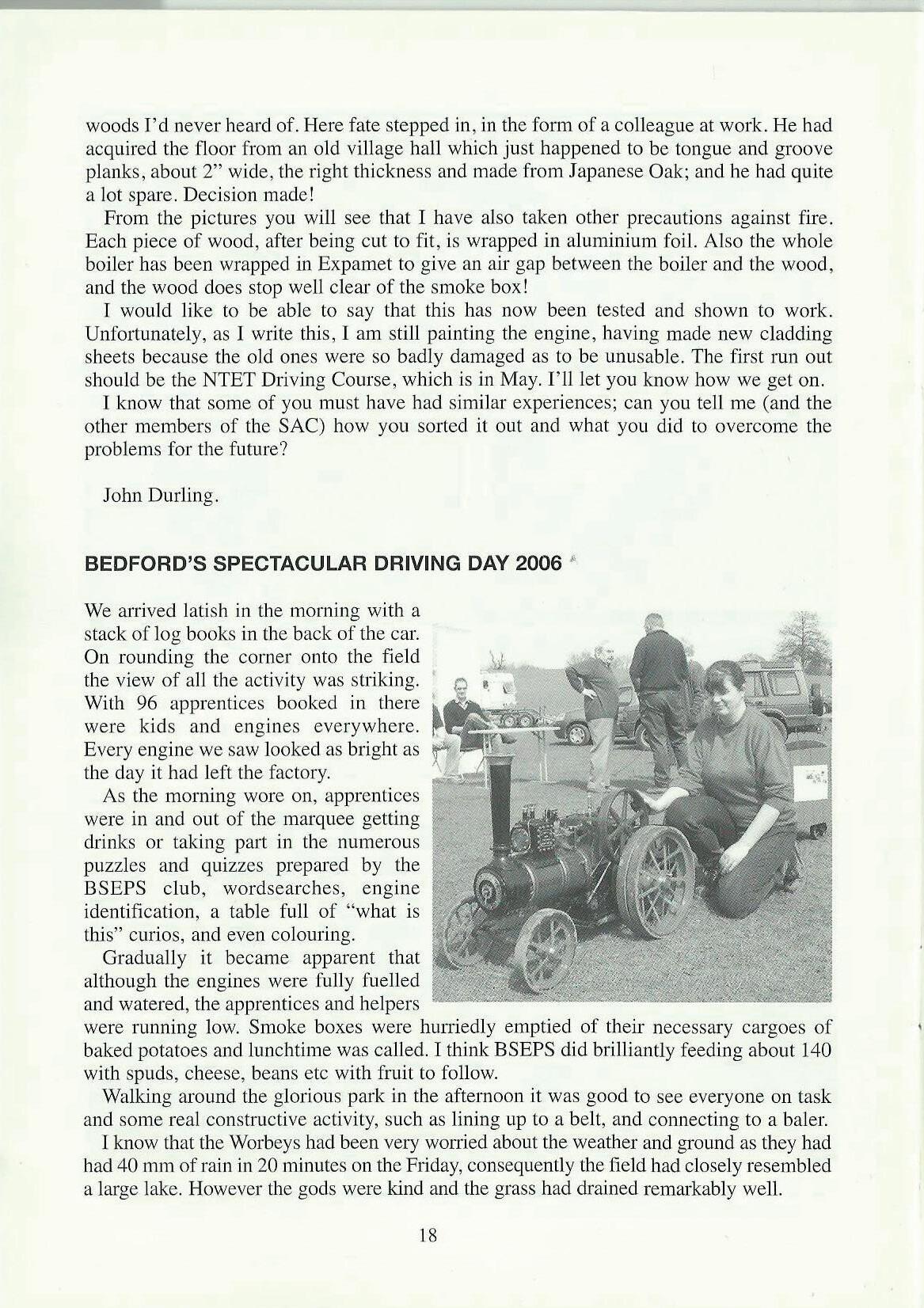
An overall view of some qf' the e11Ri11esand visitors to the Bedford Steam Engine Preservation Society's Driving Day.
woods I'd never heard of. Here fate stepped in, in the form of a colleague at work. He had acquired the floor from an o]d village hall which just happened to be tongue and groove planks, about 2" wide, the right thickness and made from Japanese Oak; and he had quite a lot spare. Decision made!
From the pictures you will see that I have also taken other precautions against fire. Each piece of wood, after being cut to fit, is wrapped in aluminium foil. Also the whole boiler has been wrapped in Expamet to give an air gap between the boiler and the wood, and the wood does stop well clear of the smoke box!
I would like to be abk to say that this has now been tested and shown to work. Unfortunately, as I write this, l am still painting the engine, having made new cladding sheets because the old ones were so badly damaged as to be unusable. The first run out should be the NTET Driving Course, which is in May. I'll let you know how we get on.
I know that some of you must have had similar experiences; can you tell me (and the other members of the SAC) how you sorted it out and what you did to overcome the problems for the future?
John Durling.
BEDFORD'S SPECTACULAR DRIVING DAY 2006 "
We arrived latish in the morning with a stack of log books in the back of the car. On rounding the corner onto the field the view of al1 the activity was striking. With 96 apprentices booked in there were kids and engines everywhere. Every engine we saw looked as bright as the day it had left the factory.
As the morning wore on, apprentices were in and out of the marquee getting drinks or taking part in the numerous puzzles and quizzes prepared by the BSEPS club, wordsearches, engine ,, identification, a tab1e full of "what is i. this" curios, and even colouring.
Gradually it became apparent that although the engines were fully fuelled and watered, the apprentices and helpers were running low. Smoke boxes were hurriedly emptied of their necessary cargoes of baked potatoes and lunchtime was called. I think BSEPS did brilliantly feeding about 140 with spuds, cheese, beans etc with fruit to follow.
Walking around the glorious park in the afternoon it was good to see everyone on task and some real constructive activity, such as lining up to a belt, and connecting to a baler.
I know that the Worbeys had been very worried about the weather and ground as they had had 40 mm of rain in 20 minutes on the Friday, consequently the field had closely resemb1ed a large lake. However the gods were kind and the grass had drained remarkably well.
Dr Busker's wife, Fran was there with her new 3" Burrell, The Famous Grouse. She is having a few teething problems but it is a beautiful little engine that I hope more of you will get to see.
Many thanks to Paul and the team at BSEPS for another great event.
TOY STEAM RALLY ON EASTER SATURDAY
While most of you were still in bed eagerly anticipating a breakfast of chocolate the following morning, we were up early, busily packing polished miniatures into the car to go to this Toy Steam Rally, at the Museum of Rural Life in Farnham.
This is the second year I have been to this event, the atmosphere is so good, and the rally organisers even supply fuel for all your Mamods, both paraffin and solid fuel. I was told that this year there were in excess of 600 engines, both stationary and road engines.
Walking round the displays there were some fascinating line shaft set ups, modified Mamods, model scenes and magnificent Meccano models.
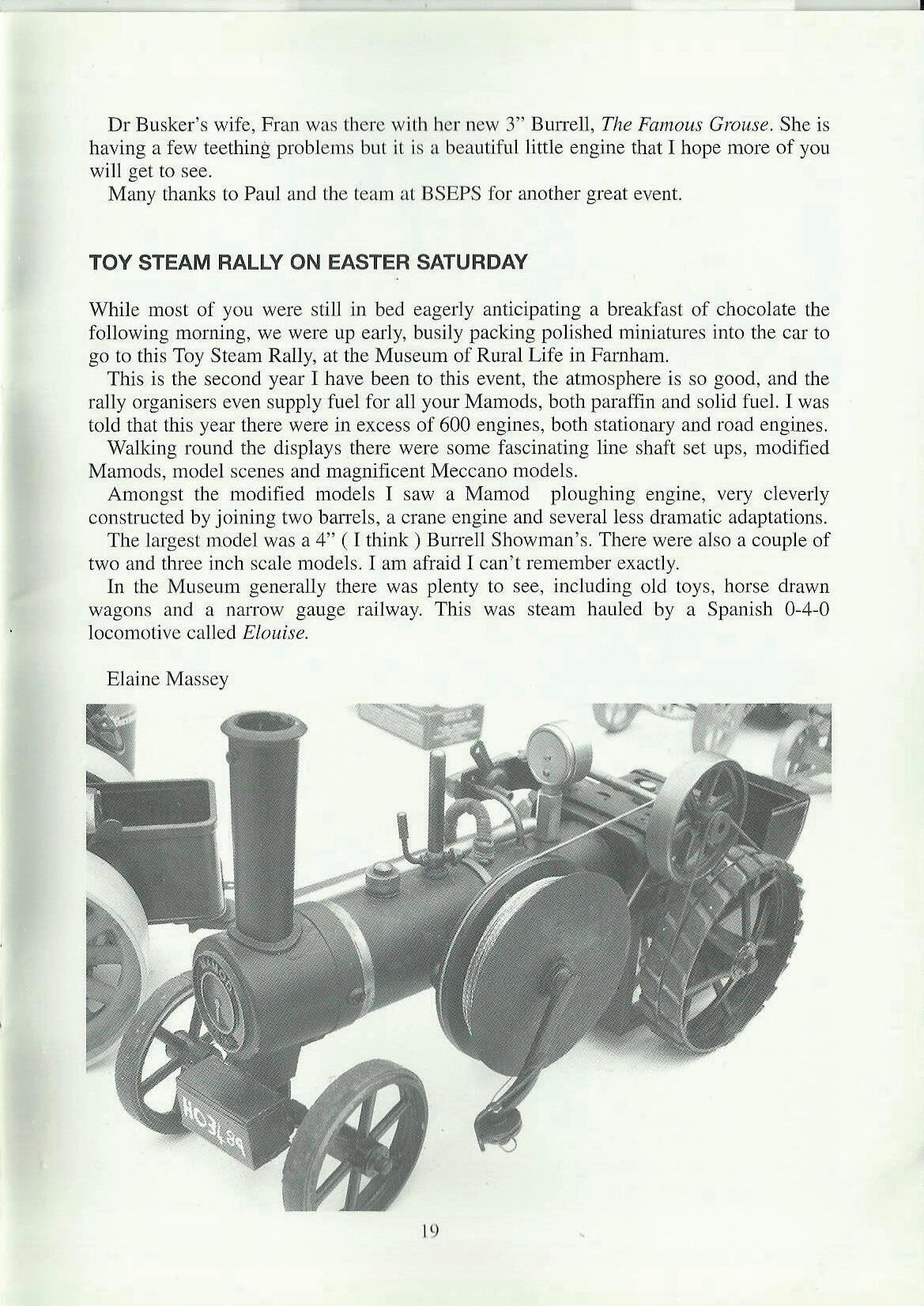
Amongst the modified models I saw a Mamod ploughing engine, very cleverly constructed by joining two barrels, a crane engine and several less dramatic adaptations.
The lru·gestmodel was a 4" ( I think) Burrell Showman's. There were also a couple of two and three inch scale models. I am afraid I can't remember exactly.
In the Museum generally there was plenty to see, including old toys, horse drawn wagons and a narrow gauge railway. This was steam hauled by a Spanish 0-4-0 locomotive called Elouise.
Elaine Massey