RAISING STEAM
EDITOR
STEAMAPPRENTICECLUB MAGAZINE
Nanette Sanders, Frog Cottage, New Road, Porchfield, Isle of Wight PO30 4LS Tel: 01983 523317 e-mail: sac.raisingsteam@ntet.co.uk
CHAIRMAN,STEAMAPPRENTICECLUB
John Durling, Hawthorn Cottage, Stubwood, Uttoxeter, Staffordshire ST14 5HX Tel: 01889 591188 (between 08.00 and 21.00 hours only please) e-mail: john.r.durling@uk.transport.bombardier.com
VICE-CHAIRMAN,STEAMAPPRENTICECLUB
Elaine Massey, 21 Down Close, Northolt, Middlesex UB5 6NS Tel: 020 8248 6570 e-mail: elainermassey@aol.com
MEMBERSHIPSECRETARY
John Cook, Dolfarni, Church Lane, Kirkby lu 'l'horpc, 8lcaford, Ll11co.lt11:;bfre NG34 9NU. Correspondence only. Momb(•rHhip lc-o fn.00 pN Hnnum.
SAC CO-ORDINATORS
Sam Bate, 30 Mowbray Grovt•, BiHhopHg'11r!.lt,fltndd.nn 011,'l'ticH, Cleveland TS19 8XA
Tel: 01642 897153 e-mHil: i,umhHl0Cu1lyrnH,1•m11
Graham Chaffer, 32 Jubifoo Wny, Htm·1111,:t11n,W1 1Hf,i-i11HA<'X1U120 3NZ
Tel: 01903 745921 o-mail: chulfol',,:uug<11tc~tl.m1t
Steve and Donna 'l'aylm~ 17 H111dh ( 'n•Hn•1d., C!mdviflc L,1~674JF
1'el: 01530 835213 1•-muil· Hf.-v••l111l11rc111li(,111l1•1•110Lc·om
Matthew Lund, Willow C!oUn,:P, 1l'wy1111111'11llill, 8hit·re11 Heath, Southampton SO32 2JL
Tel: 01329 832462 e-111oil:111111 I .lu11d(r1m1r,11wnr.com
Kevin Munn, 56 Blacklundf1 r>,1v1•,I l11,vN1,Middlei;cx
Tel: 020 8573 9180 <H1111ill1t1v1,1c11111111111til1111111.1'1·ccserve.co.uk
Barry Sumsion, 1 Lt'iCHHIP1 llwul, N11w1u11 I, f'iouth Wales NP19 7ER
Tel: 01633 213332 (offit'<') 1· 1111111!inn ,vc11kP111-lii,e.co.uk
Kevin LawTence, 62 P11rk Avo,1111•,11111rnw i11Furness, Cumbria LA13 9BH
Tel: 01229 838144
The Editor welcomoH 1111y 1•u1111d111I 11111.1 (lf u, t 1dt1H, shm·ter items or photographs for inclusi011 in future issues. All material submitted iHvnl11ul111 y 111111p11,v1111111Il'1111noibe made for any material published. 1'he opinions expressed in the magazine, wil,h 11111mm•pt 11111111' I 1l11hnnnouncements, are those of the contributors and do not indicate the views of the Club ai; 11wlwl,, /\ll 11111111 un, li11klc·opyright by the contributor and the NTE'l'.
Please send your ,·nr1l.1il11d1011"' 111 tlw Editor at least five weeks before publirnLion. 'J'ypecl or e-mailed articles are pn•lnn<'d h11I11111''"""'iiinl. If handwritten put any names of PEOPLE, PI.ACMHor MNOIN RS in BLOCK CAP'IT/\1.H, II v1111l<'q1111·1•1111.v pnrl of your article (eg photos) returning pleai,!' 1my110 und 011C'l0Hr a stamped addressed 1'11Vt•lop1' 11:111•hm1 1 yut11·1111mr,Address and (if Apprentice) age with any cuntrilrnlfou 'l'lw l!:dit.01· reserves the right to u1111u11I111, 11l11M1•Pu11L1·ibutions,and will attempt to correct spellfol{ uncl J.(1'11111111111'1 'l'hP Magazine is nonnull.Y p11hln1li,•dd111'111M t h11 l'u1·ly part of January, April, July and OcLoh1•1'rho <'lt1h ,11·1•11pt11 110 liability for failurc t,u 1111•1•1111(1,11d1•tlp1d,J1mLio11dates.
The Steam Appronl.ir1• ( 'ltd, ir111 Ml't•Iiu11 ol' 1,he National Traction Engine Trust NTET is a Regi8Lcrct1 ( 'h11111\,Nti Wl578. Registered in England No. 1302197
Registered Oflic<l: 4 C'h11n·h ( ln•1111l•!11HL,Hodditch, Worcestershire B98 8Bl'.
Typesetting and ;\1 lwm•l1 hy 1\111111111C11·uphicImages Ltd, Fairoak House l\11Hi1111Mn t '1°111,,,, I 'ltlll'rh Road, Newport, SouLh W11l1111NJ-' LU 11':,J'1'11I.01683 262197 Fax: 01633 259089 11111ntlr1111111 ,dr,, lu•wfou•.uo.u.k
Printed by MD ,fonldllti I '1111111m1,1.rl,Ly<'ln.ey,Glos GL15 4EJ
FROM THE EDITOR
I have recently had the opportunity to visit a boiler maker and engineer called Mark Filer. Walking through his workshop was an eye opener; there were parts for engines everywhere. Mark became interested in engines at a young age and started his own business as a blacksmith and agricultural engineer. In 1981 Mark moved to Arreton on the Isle of Wight where he now builds and repairs all parts for engines. Mark's ·first job was a Wallis and Steevens Roller belonging to Norman Ball. Mark made a whole new boiler he calls the traditional way, all riveted. Once it was found that he could build boilers in this way, word of mouth helped him set up the business he owns today.
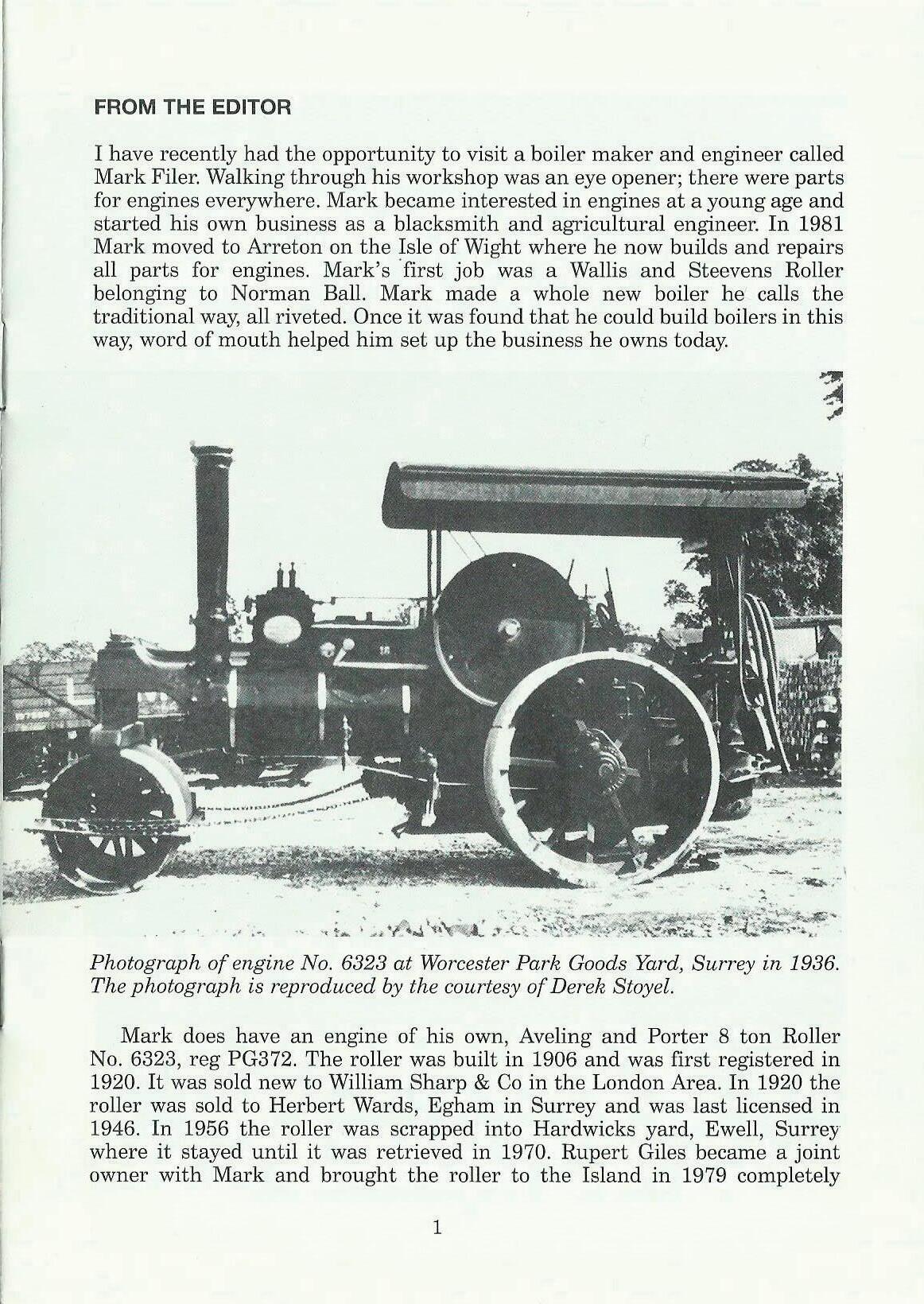
Photograph of engine No. 6323 at Worcester Park Goods Yard, Surrey in 1936. The photograph is reproduced by the courtesy of Derek Stoyel.
Mark does have an engine of his own, Aveling and Porter 8 ton Roller No. 6323, reg PG372. The roller was built in 1906 and was first registered in 1920. It was sold new to William Sharp & Co in the London Area. In 1920 the roller was sold to Herbert Wards, Egham in Surrey and was last licensed in 1946. In 1956 the roller was scrapped into Hardwicks yard, Ewell, Surrey where it stayed until it was retrieved in 1970. Rupert Giles became a joint owner with Mark and brought the roller to the Island in 1979 completely
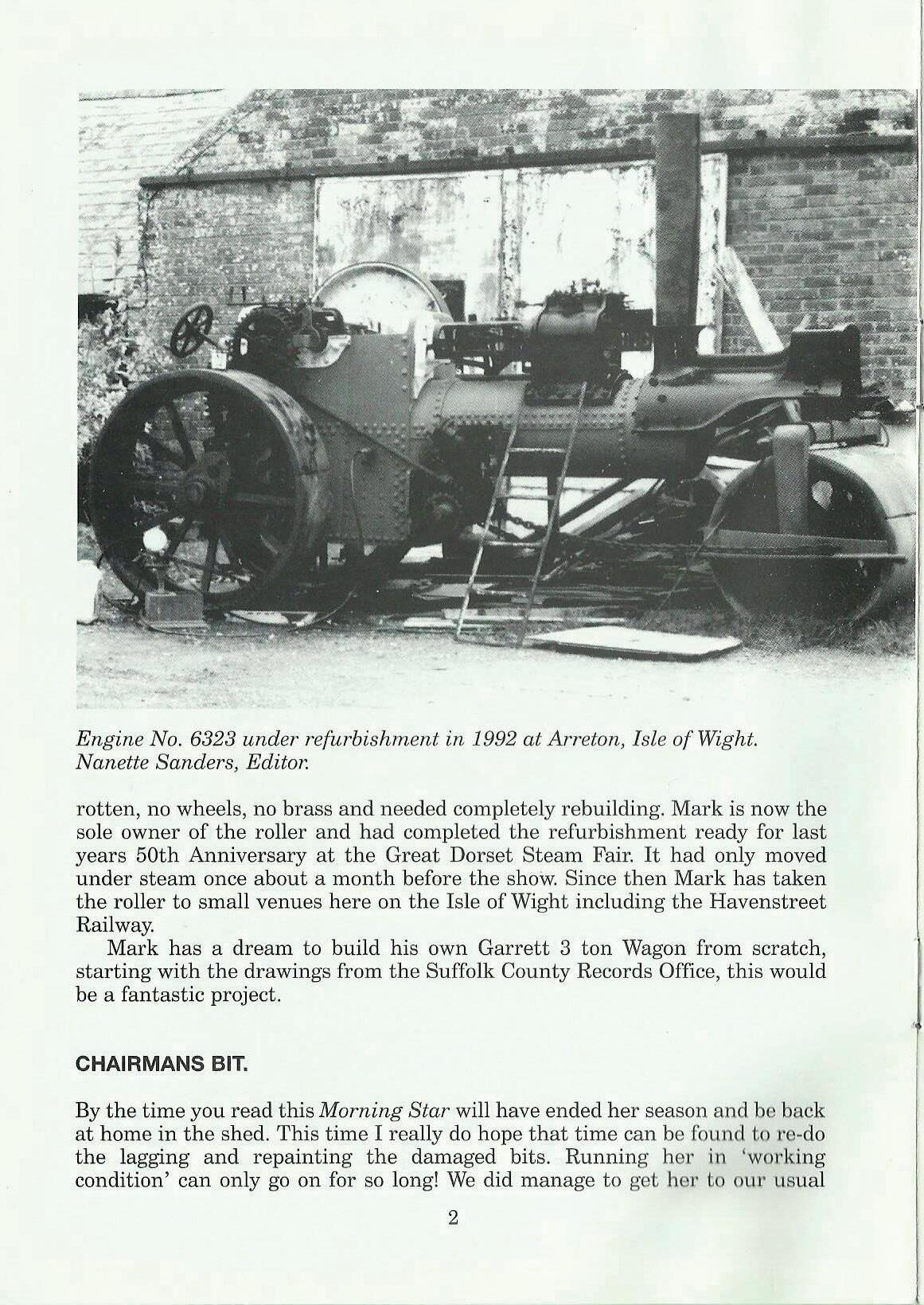
Engine No. 6323 under refurbishment in 1992 at Arreton, Isle of Wight. Nanette Sanders, Editor.
rotten, no wheels, no brass and needed completely rebuilding. Mark is now the sole owner of the roller and had completed the refurbishment ready for last years 50th Anniversary at the Great Dorset Steam Fair. It had only moved under steain once about a month before the show. Since then Mark has taken the roller to small venues here on the Isle of Wight including the Havenstreet Railway.
Mark has a dream to build his own Garrett 3 ton Wagon from scratch, starting with the drawings from the Suffolk County Records Office, this would be a fantastic project.
CHAIRMANS BIT.
By the time you read this Morning Star will have ended her season and be back at home in the shed. This time I really do hope that time can be found to re-do the lagging and repainting the damaged bits. Running her in 'working condition' can only go on for so long! We did manage to get hor to ou1·usual
September rallies; GDSF, Haddenham and Old Warden. It makes for a hectic but enjoyable month.
Now to Club Matters
Once again we have had a very successful GDSF forming, as we do, a prominent part of the NTET marquee. Unfortunately we could not have the IT facilities this year following the tragic loss of Graham Tucker and transport difficulties with the new web man, Steve Taylor. I know that many of you were able to join us and some were disappointed by not being able to get in as 1nuch engine work as you would like. We are giving serious thought to alternative activities for you to take the pressure off the engine crews and give apprentices more options -any ideas you may have will be keenly received. However, the cavalcade on the Thursday evening was very well attended, with some 23 engines and over 70 apprentices taking part.
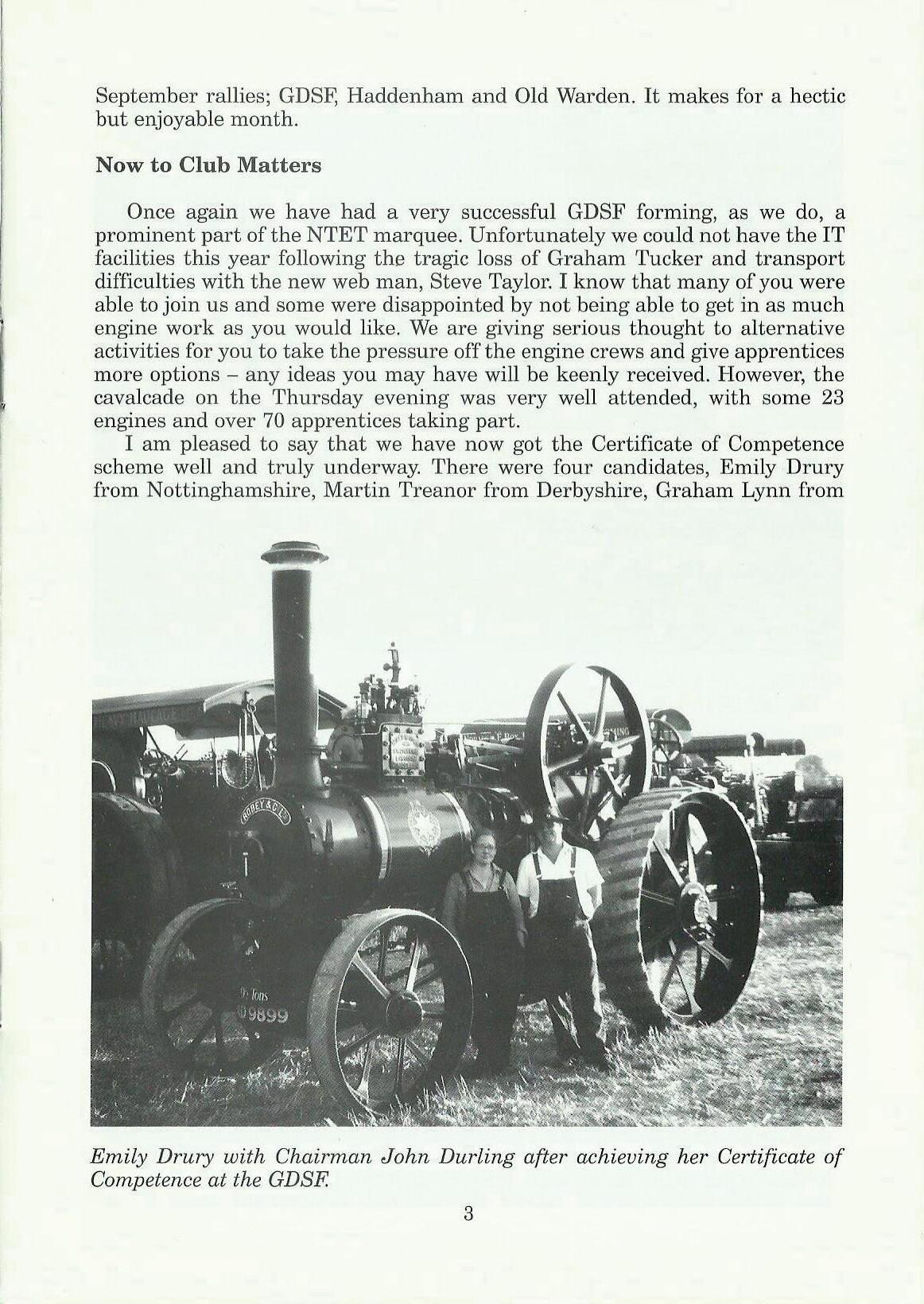
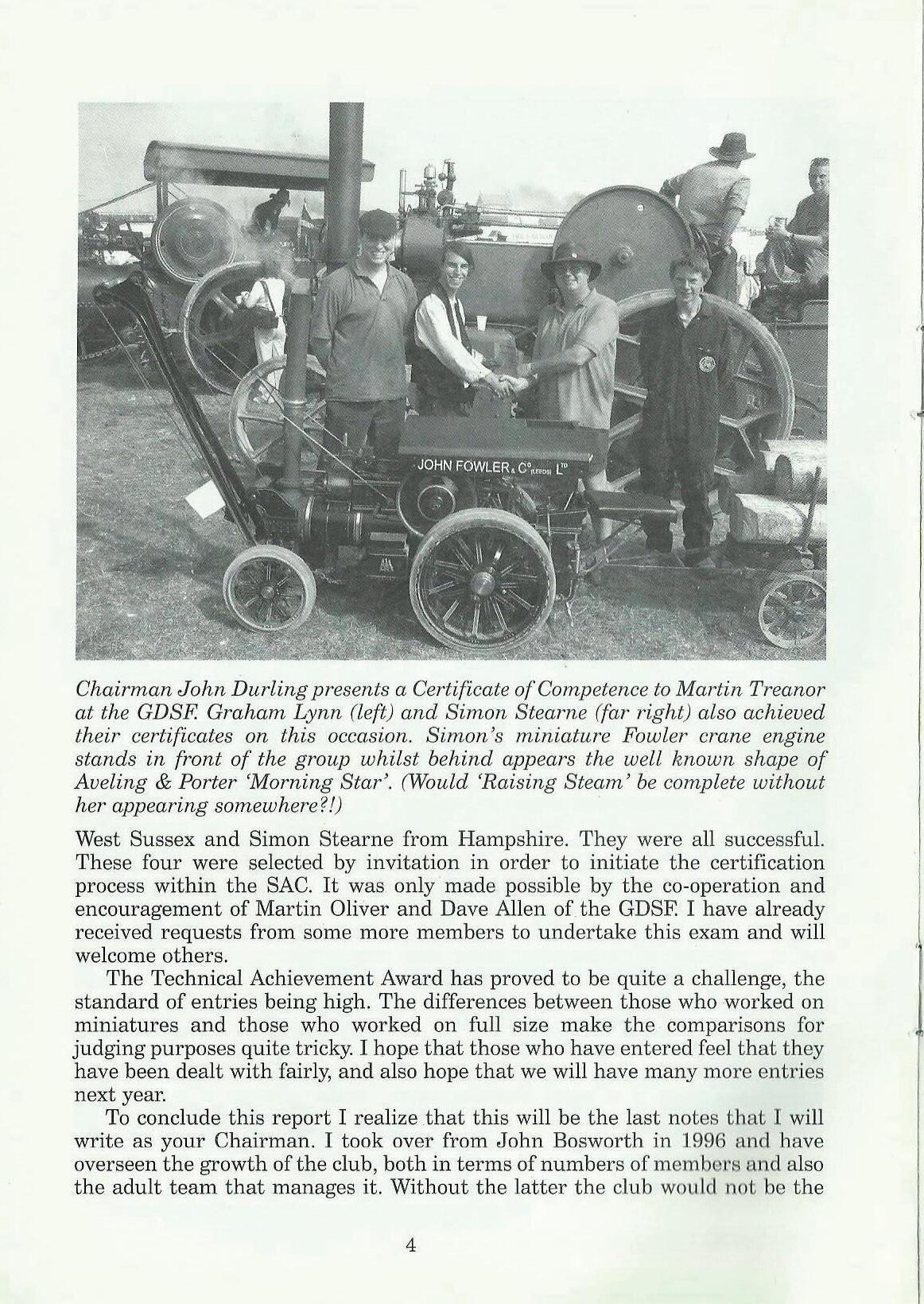
I am pleased to say that we have now got the Certificate of Competence sche1ne well and truly underway. There were four candidates, E1nily Drury from Nottinghamshire, Martin Treanor from Derbyshire, Graham Lynn from
Emily Drury with Chairman John Durling after achieving her Certificate of Competence at the GDSR
Chairman John Durling presents a Certificate of Competence to Martin Treanor at the GDSF Graham Lynn (left) and Simon Stearne (far right) also achieved their certificates on this occasion. Sinion 's miniature Fowler crane engine stands in front of the group whilst behind appears the well known shape of Aveling & Porter 'Morning Star'. (Would 'Raising Stea,n' be complete without her appearing somewhere?!)
West Sussex and Simon Stearne from Hampshire. They were all successful. These four were selected by invitation in order to initiate the certification process within the SAC. It was only made possible by the co-operation and encouragement of Martin Oliver and Dave Allen of the GDSF. I have already received requests from some more members to undertake this exam and will welcome others.
The Technical Achievement Award has proved to be quite a challenge, the standard of entries being high. The differences between those who worked on miniatures and those who worked on full size make the comparisons for judging purposes quite tricky. I hope that those who have entered feel that they have been dealt with fairly, and also hope that we will have many more en tries next year.
To conclude this report I realize .that this will be the last notes that I will write as your Chairman. I took over from John Bosworth in 1996 and have overseen the growth of the club, both in terms of numbers of member~ and also the adult tean1 that manages it. Without the latter the club would not be the
,,
success it is today. I now feel that it is time I stood to one side and let someone with new ideas come forward; this person is Kevin Munn. Kevin works as an engineer for British Airways, is Chairman of his local school Board of Governors and owns an Aveling and Porter roller Kate. I wonder if this means that you will now start to hear about the happenings of Kate instead of Morning Star? Over to you Kevin.
Having said that, I don't think that I am going to be allowed to disappear completely, and will still look forward to seeing and hearing fro111you all in the future.
John Durling, Chairman, Steam Apprentice
Club.
CALLING WOULD BE ENGINEERS
The SAC has been offered a small lathe by one of the NTET Committee members. I have been asked to find a suitable 1ne111berwho will benefit from, and appreciate owning such a machine.
The specification is as follows:-
Make RELMAC screw-cutting bench lathe, without a bench.
Overall length 40"
Centre height 4 1//'
Swing over gap 10 1/2" dia.
Distance between centres 15"
It comes complete with 3 jaw and 4 jaw chucks and a face plate.
'I'his lathe is old but in good condition, probably dating back before the Second World War. It has a single phase motor which drives the lathe through flat belts and a countershaft. It would have to be collected from the South Yorkshire area.
If you want to be considered for this generous offer please write to me explaining why you think we should give it to you. Details inside the front cover. The decision will be made by three of us, Kevin Munn, the gentleman presenting the lathe, and me. I look forward to hearing from you.
John Durling.
MAIL BAG
Dear Editor,
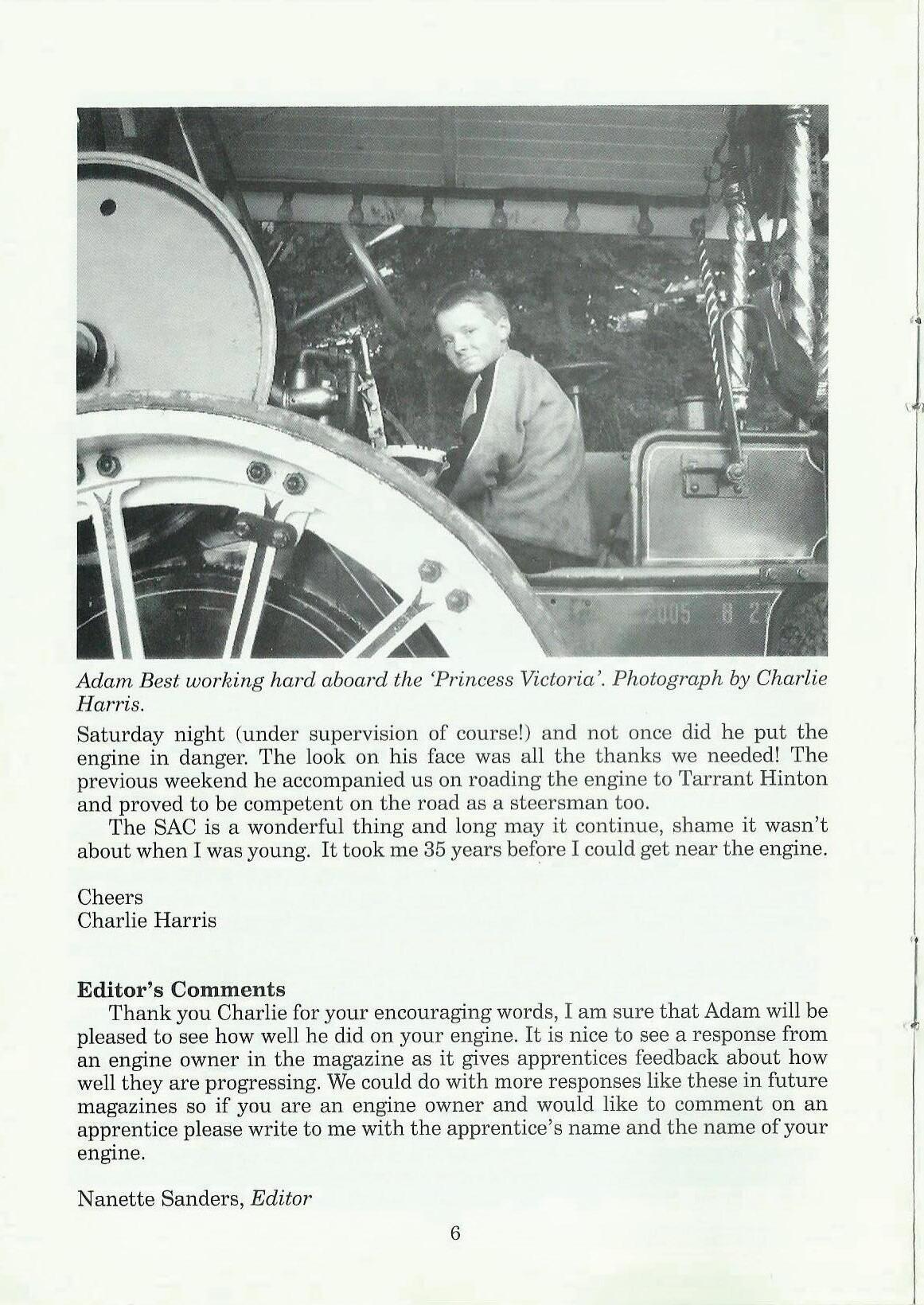
Although not part of the official SAC tutors we had 13 year old SAC member Adam Best of Mosterton, Somerset with us for the duration of the GDSF. (Aveling show111an'stractor Princess Victoria).
I would just like to put on record what a great lad he is and some day he will make a great engine man. He had sole charge of the engine Friday and
Adam Best working hard aboard the 'Princess Victoria'. Photograph by Charlie Harris.
Saturday night (under supervision of course!) and not once did he put the engine in danger. The look on his face was all the thanks we needed! The previous weekend he accompanied us on roading the engine to Tarrant Hinton and proved to be competent on the road as a steersman too.
The SAC is a wonderful thing and long may it continue, shame it wasn't about when I was young. It took 1ne 35 years before I could get near the engine.
Cheers
Charlie Harris
Editor's Comments •1
Thank you Charlie for your encouraging words, I am sure that Adam will be . pleased to see how well he did on your engine. It is nice to see a response from an engine owner in the magazine as it gives apprentices feedback about how well they are progressing. We could do with more responses like these in future magazines so if you are an engine owner and would like to comment on an apprentice please write to me with the apprentice's name and the name of your engine.
Nanette Sanders, Editor
Chairman's Comments
Charlie,
Thanks for taking Adam on to your engine - it sounds like he may be a permanent fixture.
Without engine owners like you prepared to give up their time and energy (and a little of their freedom) the SAC would not function. Thanks once again.
John Durling, Chairman SAC
Dear Edito1~
My son James has just joined the Steam Apprentice Club and he was lucky enough to get a chance to take part at the GDSF cavalcade. He had a go on a Garrett called Olive and now he is hooked on steam. Hopefully I can get him to do an article for the magazine.
Steve Bailey.
Dear Editor,
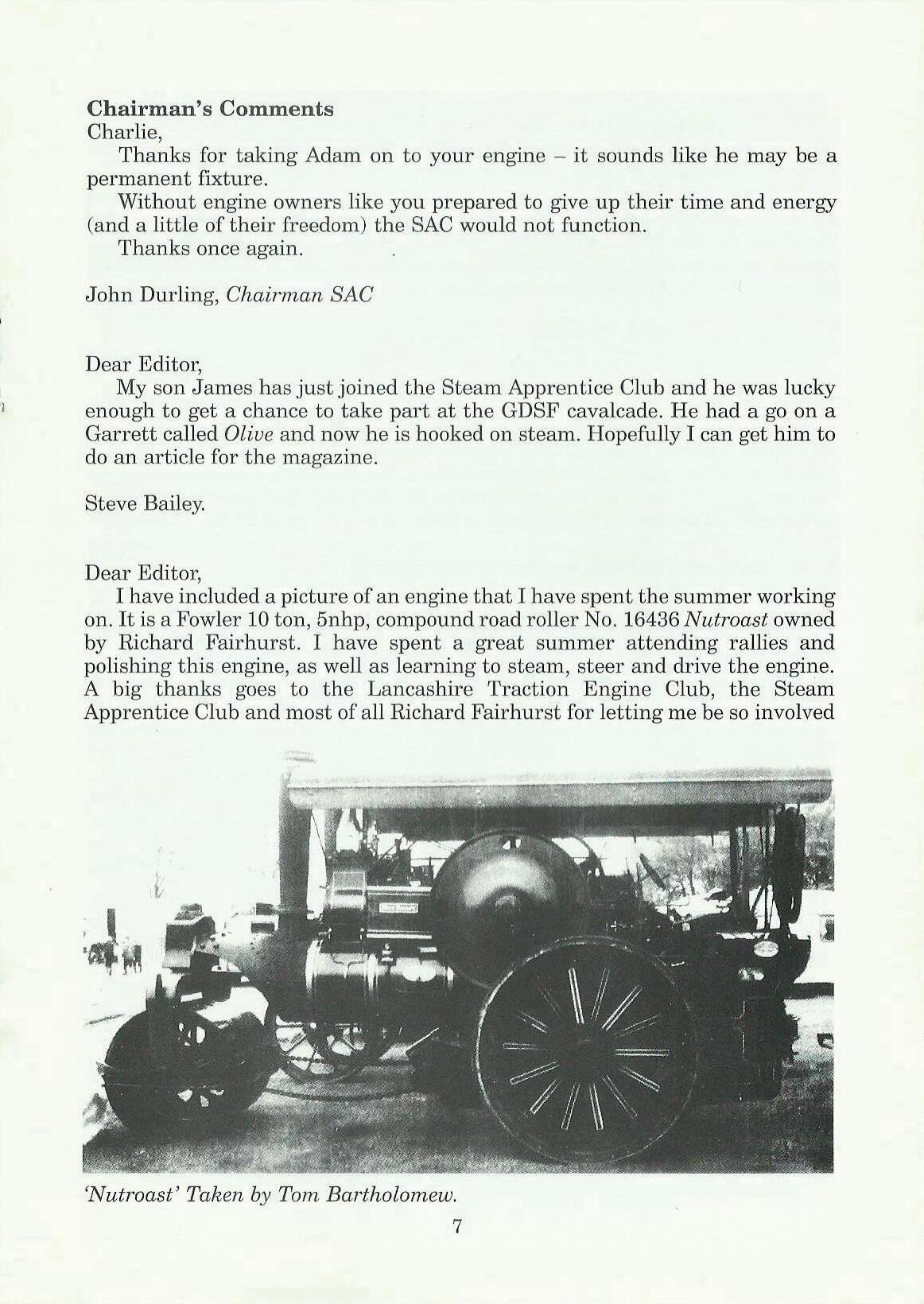
I have included a picture of an engine that I have spent the sum1ner working on. It is a Fowler 10 ton, 5nhp, compound road roller No. 16436Nutroast owned by Richard Fairhurst. I have spent a great summer attending rallies and polishing this engine, as well as learning to stea1n, steer and drive the engine. A big thanks goes to the Lancashire Traction Engine Club, the Steam Apprentice Club and most of all Richard Fairhurst for letting me be so involved
'Nutroast' Taken by Tom Bartholomew.
with the running of his engine. I have also been to Mayday steain fair which is in Manchester and the site is home to a miniature steam rally which I have been a member of long before the traction engine hobby. I have also visited Haydock Park near Wigan, Tabley House (Cheshire Steam Fair) in Knutsford and the last Astle Park in Chelford. I have had a go at steering the engine and I have raised it to steam and with the winter approaching I have been offered the chance to assist with the general repairs. I would just like to say a very big thank you to my friend Richard for letting me get involved and the Steam Apprentice Club for letting me join a brilliant hobby, thank you.
Tom Barthol01new, 15, Urmston
Dear Editor,
My name is Philip Webb and I have been with the Steam Apprentice Club for almost a year now but I have not told you that my Dad and I are building a 4 inch Burrell single cylinder traction engine. We started on Christmas day and we have just finished the front axle and we almost have all the parts to hold the wheels onto the axle.
Philip Webb, 10, Radcliffe on Trent) Nottingham,
Dear Editor,
I am writing to tell you how the driving day went on at Hollybank Farm near Whitchurch on September 17th 2005. The day was very enjoyable both for me and my Dad. I enjoyed it most because I was able to take part in everything right through to actually being able to handle the controls when steam was raised. I thought the breakfast on the shovel was really great and the sausages tasted really nice. The steam drivers were all friendly and Tony our instructor was a good patient teacher. The ladies that made the food were also very good and I enjoyed the road runs at the end as well as the slide show. Cannot wait for another of these driving days.
David Ridout.
Dear Editor, 1 \
Hello, everybody! j
I'm going to write about my time at the GDSF this year. Even ifmy Dad and I stayed in a local B+ B for two nights (1st to 3rd September), there were 1 misfortunes on my first day at the show which included my rejection from a place on Morning Star which was for the sake of another Apprentice. But for the second day, the 'green light was on' despite the fact that we had to get up incredibly early to deal with my blisters from the day before. Apart from that, I turned up early enough to work on Morning Star. I was only on the engine for four hours because I had to 'make way' for another apprentice. Apart from
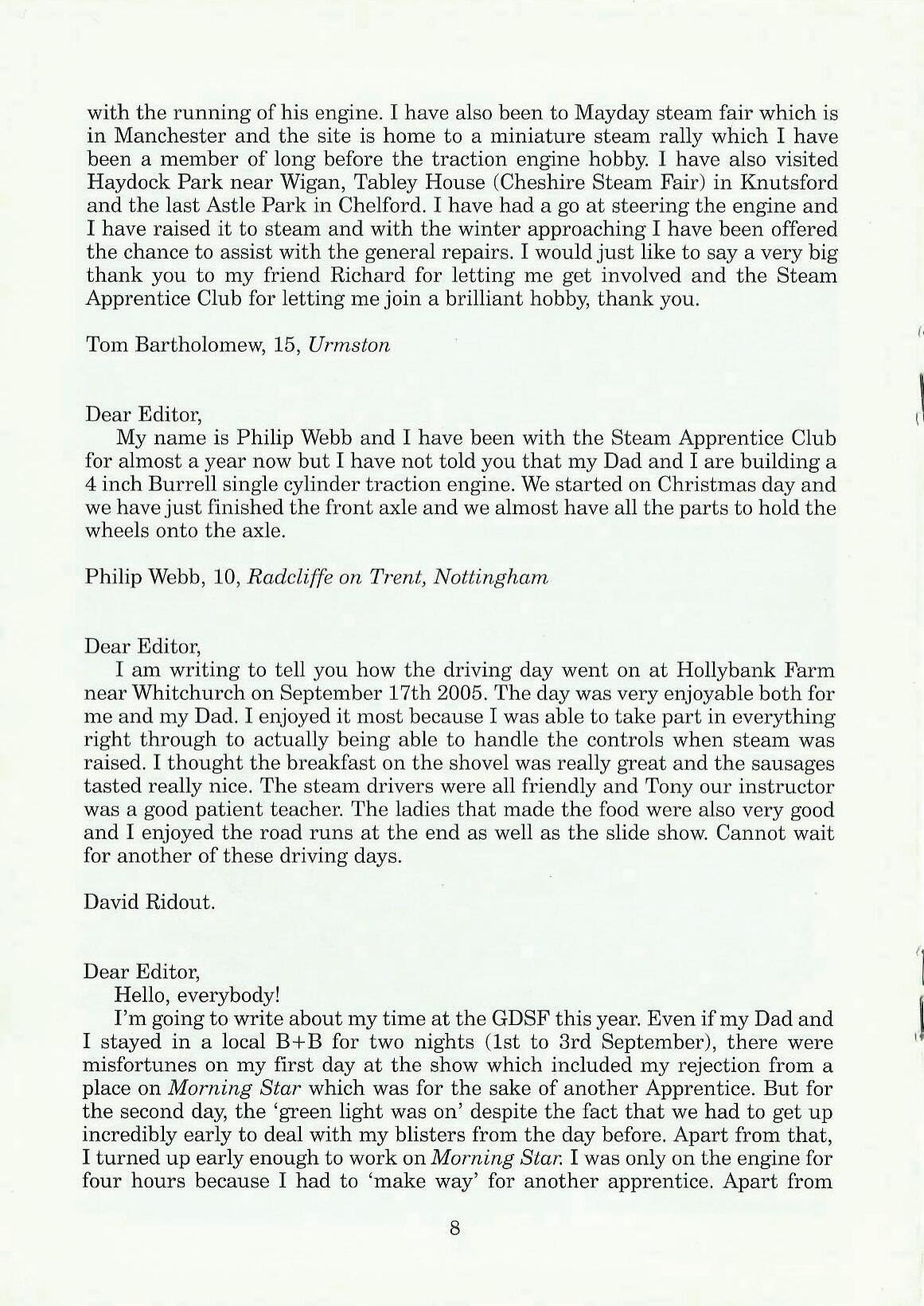
that, we travelled round the ring 3 or 4 times and I drove once. My favorite bit was probably when we shot up the hill at 15 mph! But that was not all. When we got to the top of the hill I had a great big smile welded to my face (not literally!) and I laughed while I said to myself "this is better than the fairground!" To finish off, I would like to say thank you to Ian Durling for letting me work with him and the engine and I'm very impressed with his feedback and also to John Durling for sorting it all out. I'm also rather happy that Morning Star is a 'drive ariywhere' engine and so I'll see you again. Plus, I enclosed a photo of me (on the left) steering the engine. Could this be my best stint yet?
Edward Ronayne (17), London
John's reply
I am very pleased that Edward thinks that his tin1e on Morning Star could be his "best stint yet". We do try to please. I also hope that it only felt like • 15 mph, and that you weren't actually going that fast! Edward's letter does raise a serious point though regarding the availability of engines for Apprentices to work on. When Edward arrived at our engine on the Thursday, we had already dealt with the issue of being told that there would be problems with the water supply for the engines and had cancelled the 'duckling run'. I had then been asked if I could help a lad who was only there for the day, so put him up with my son. !UD ,This meant that when I Edward arrived the engine was already full. This pressure continued on the Friday such that I felt
it better to give two lads half a day each, rather than one for a full day. It also highlights the problems of being "" related to the Chairman; Ian couldn't exercise the privilege of other engine drivers by saying no!
I hope that Edward still enjoyed his visit to Dorset and will return next year.
John Durling.
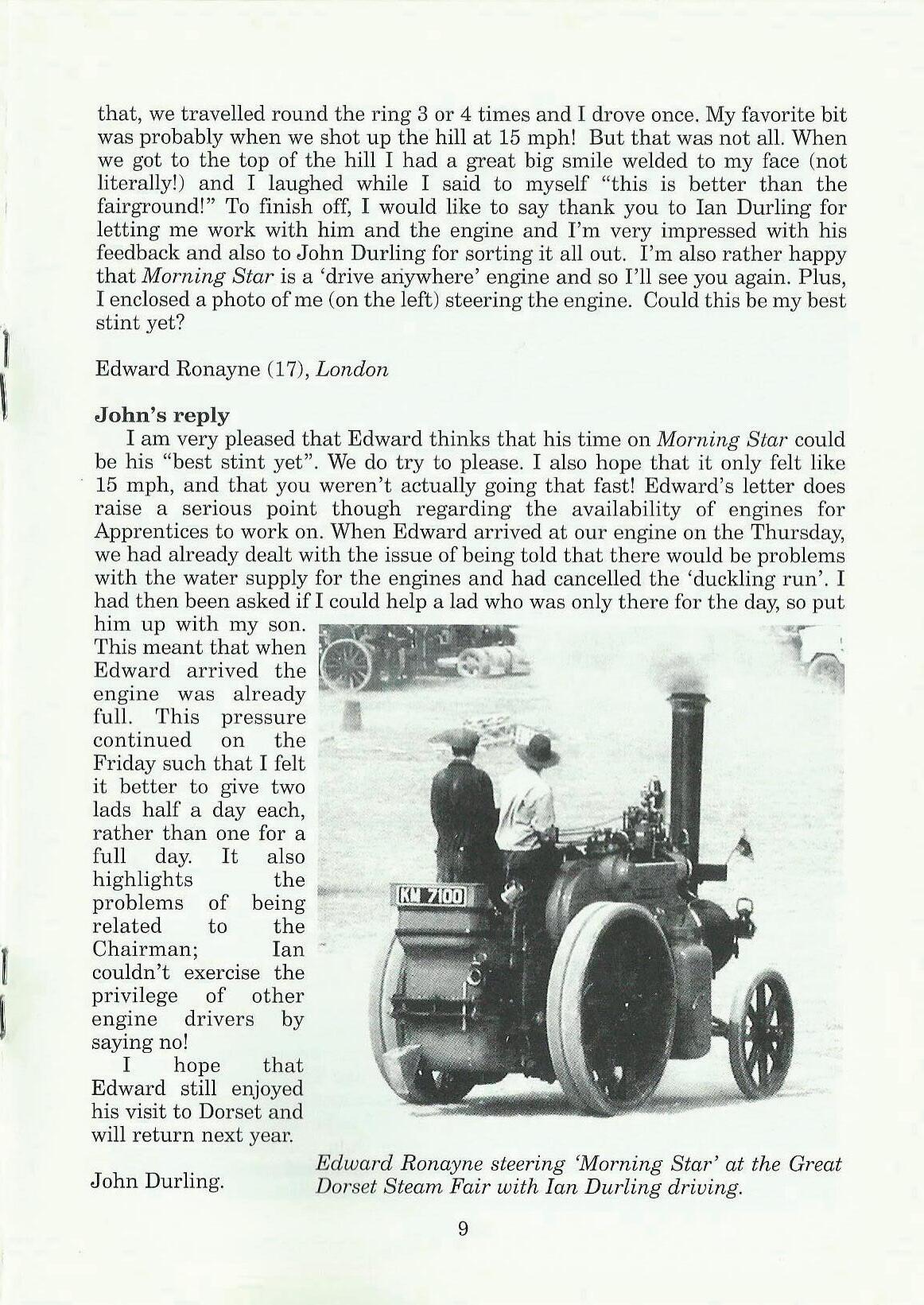
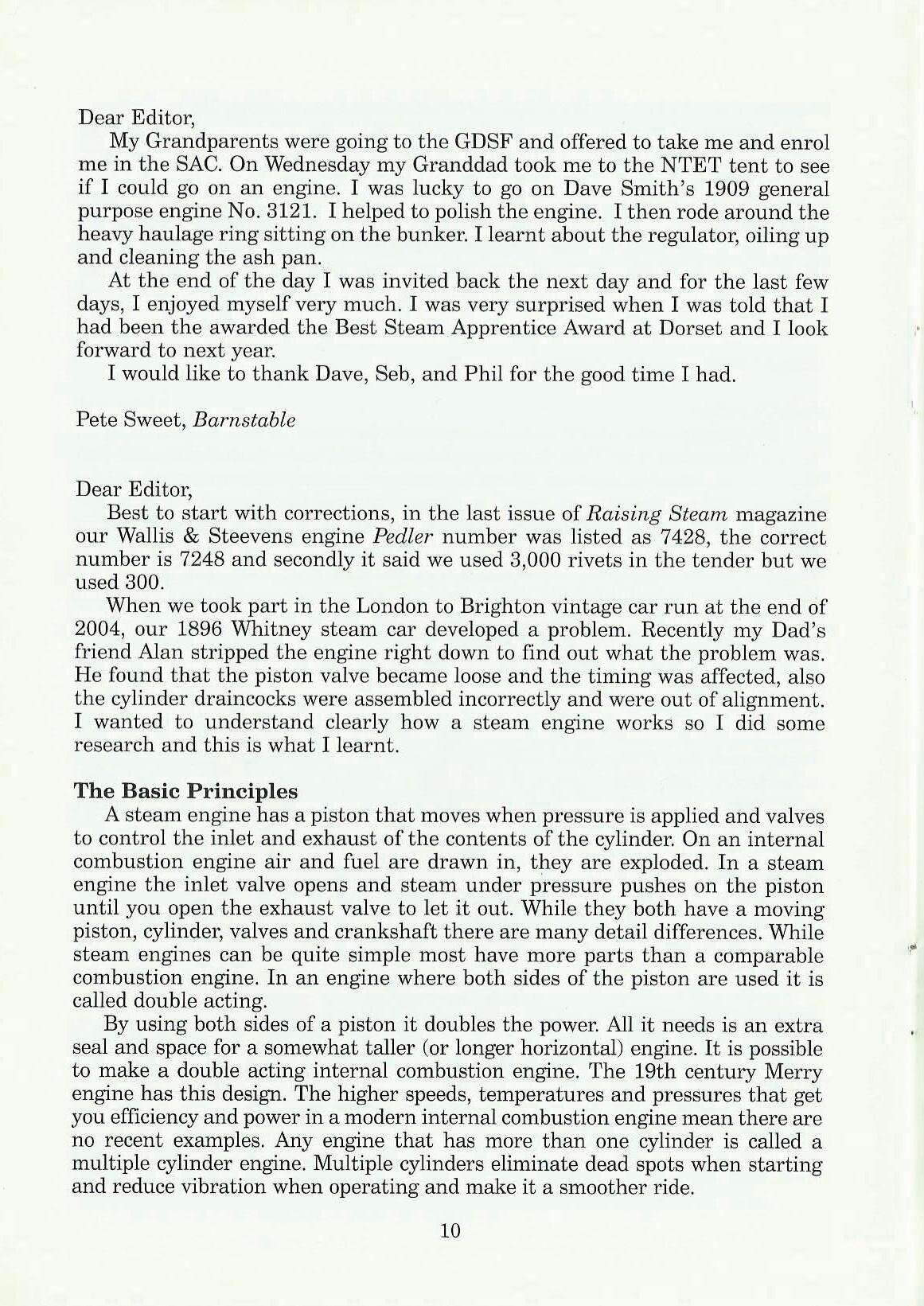
Edward Ronayne steering 'Morning Star' at the Great Dorset Steam Fair with Ian Durling driving.
Dear Editor,
My Grandparents were going to the GDSF and offered to take me and enrol me in the SAC. On Wednesday my Granddad took me to the NTET tent to see if I could go on an engine. I was lucky to go on Dave Smith's 1909 general purpose engine No. 3121. I helped to polish the engine. I then rode around the heavy haulage ring sitting on the bunker. I learnt about the regulator, oiling up and cleaning the ash pan.
At the end of the day I was invited back the next day and for the last few days, I enjoyed myself very much. I was very surprised when I was told that I had been the awarded the Best Steam Apprentice Award at Dorset and I look forward to next year.
I would like to thank Dave, Seb, and Phil for the good time I had.
Pete Sweet, Barnstable
Dear Editor,
Best to start with corrections, in the last issue of Raising Steam magazine our Wallis & Steevens engine Fedler number was listed as 7428, the correct number is 7248 and secondly it said we used 3,000 rivets in the tender but we used 300.
When we took part in the London to Brighton vintage car run at the end of 2004, our 1896 Whitney steam car developed a proble1n. Recently my Dad's friend Alan stripped the engine right down to find out what the problem was. He found that the piston valve became loose and the timing was affected, also the cylinder draincocks were assembled incorrectly and were out of alignment. I wanted to understand clearly how a stemn engine works so I did s01ne research and this is what I learnt.
The Basic Principles
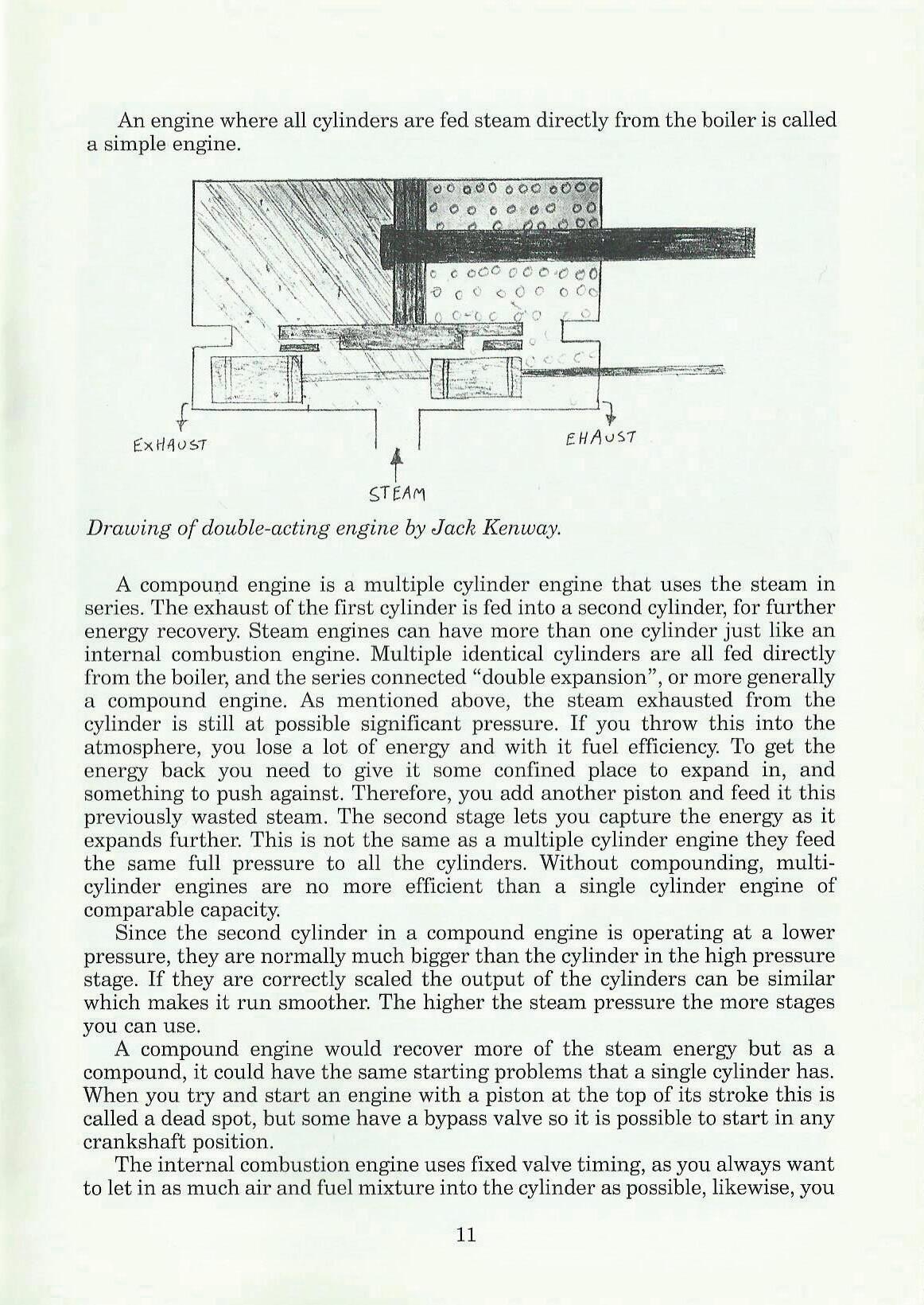
A steam engine has a piston that moves when pressure is applied and valves to control the inlet and exhaust of the contents of the cylinder. On an internal combustion engine air and fuel are drawn in, they are exploded. In a steam engine the inlet valve opens and steam under p·ressure pushes on the piston until you open the exhaust valve to let it out. While they both have a moving piston, cylinder, valves and crankshaft there are 1nany detail differences. While steam engines can be quite simple most have more parts than a comparable combustion engine. In an engine where both sides of the piston are used it is called double acting. By using both sides of a piston it doubles the power. All it needs is an extra seal and space for a somewhat taller (or longer horizontal) engine. It is possible to make a double acting internal combustion engine. The 19th century Merry engine has this design. The higher speeds, temperatures and pressures that get you efficiency and power in a modern internal combustion engine mean there are no recent examples. Any engine that has more than one cylinder is called a multiple cylinder engine. Multiple cylinders eliminate dead spots when starting and reduce vibration when operating and make it a smoother ride.
An engine where all cylinders are fed steam directly from the boiler is called a simple engine.
tSTEAt"l
Drawing of' double-acting engine by Jach Kenway.
A compound engine is a multiple cylinder engine that uses the steam in series. The exhaust of the first cylinder is fed into a second cylinder, for further energy recovery. Steam engines can have more than one cylinder just like an internal combustion engine. Multiple identical cylinders are all fed directly from the boiler, and the series connected "double expansion", or more generally a compound engine. As mentioned above, the steam exhausted from the cylinder is still at possible significant pressure. If you throw this into the at1nosphere, you lose a lot of energy and with it fuel efficiency. To get the energy back you need to give it some confined place to expand in, and something to push against. Therefore, you add another piston and feed it this previously wasted steam. The second stage lets you capture the energy as it expands further. This is not the same as a multiple cylinder engine they feed the same full pressure to all the cylinders. Without compounding, multicylinder engines are no more efficient than a single cylinder engine of comparable capacity.
Since the second cylinder in a compound engine is operating at a lower pressure, they are normally much bigger than the cylinder in the high pressure stage. If they are correctly scaled the output of the cylinders can be similar which makes it run smoother. The higher the steam pressure the more stages you can use.
A compound engine would recover more of the steam energy but as a compound, it could have the same starting problems that a single cylinder has. When you try and start an engine with a piston at the top of its stroke this is called a dead spot, but some have a bypass valve so it is possible to start in any crankshaft position.
The internal combustion engine uses fixed valve timing, as you always want to let in as much air and fuel mixture into the cylinder as possible, likewise, you
want all the combustion by-products removed before the cycle starts again. Some that run at very high speeds may use a system that allows little adjustment of the valves opening and closing (overlap). They do this to give a bit more time for the cylinder to fill, and help combustion products out. By changing the valve timing, you can control both the power and steam consumption of your engine. You can also change the valve timing so far that your engine can run in both directions. For vehicles, this is great it means you can drive in reverse without extra parts like a transmission with reversing gears. This can be done by using the reverser.
Jack Kenway, Hook, Hants
Dear Editor,
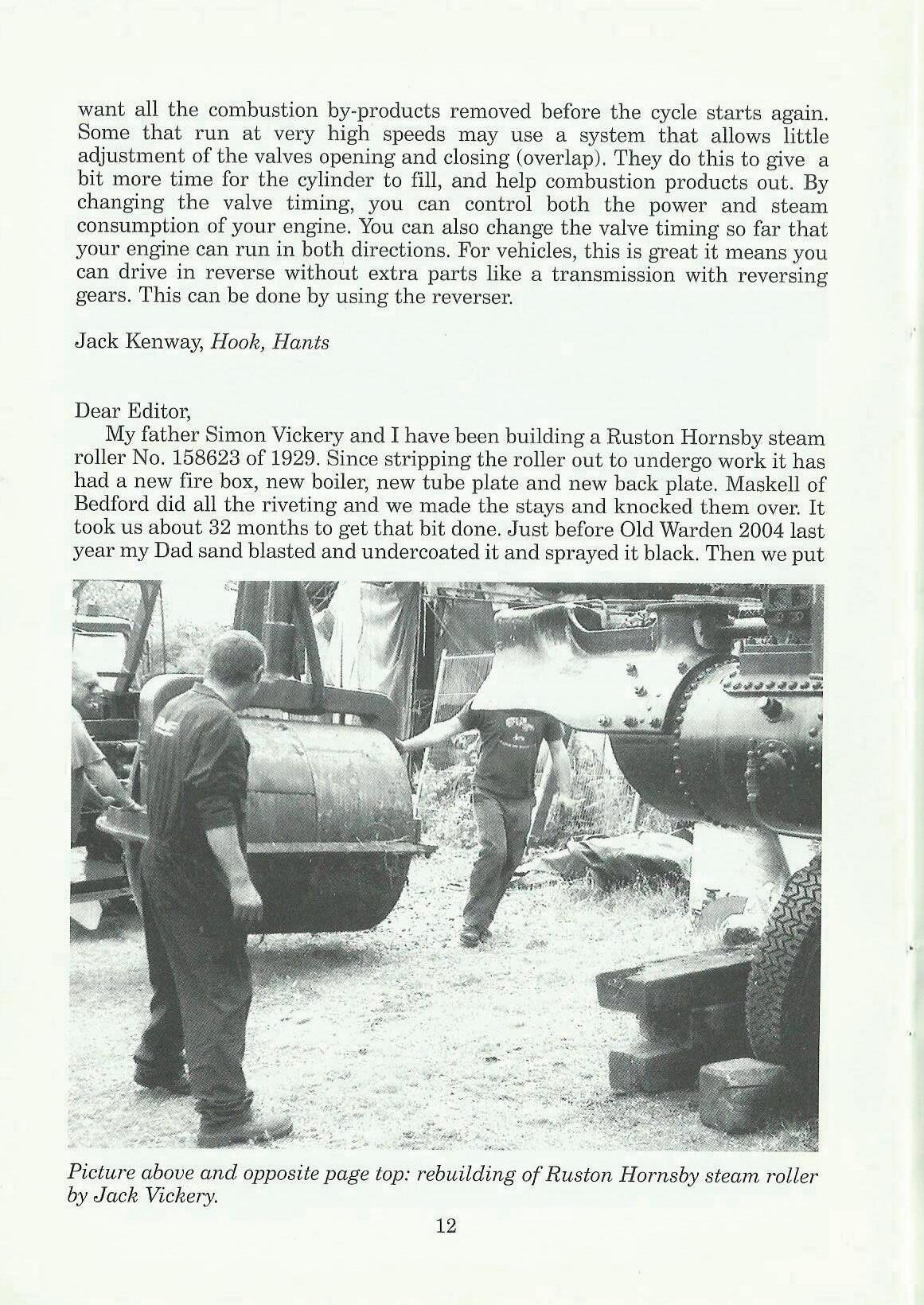
My father Simon Vickery and I have been building a Ruston Hornsby steam roller No. 158623 of 1929. Since stripping the roller out to undergo work it has had a new fire box, new boiler, new tube plate and new back plate. Maskell of Bedford did all the riveting and we made the stays and knocked them over. It took us about 32 n1onths to get that bit done. Just before Old vVarden 2004 last year my Dad sand blasted and undercoated it and sprayed it black. Then we put
Picture above and opposite page top: rebuilding of Ruston Hornsby steam roller by Jack Vickery.
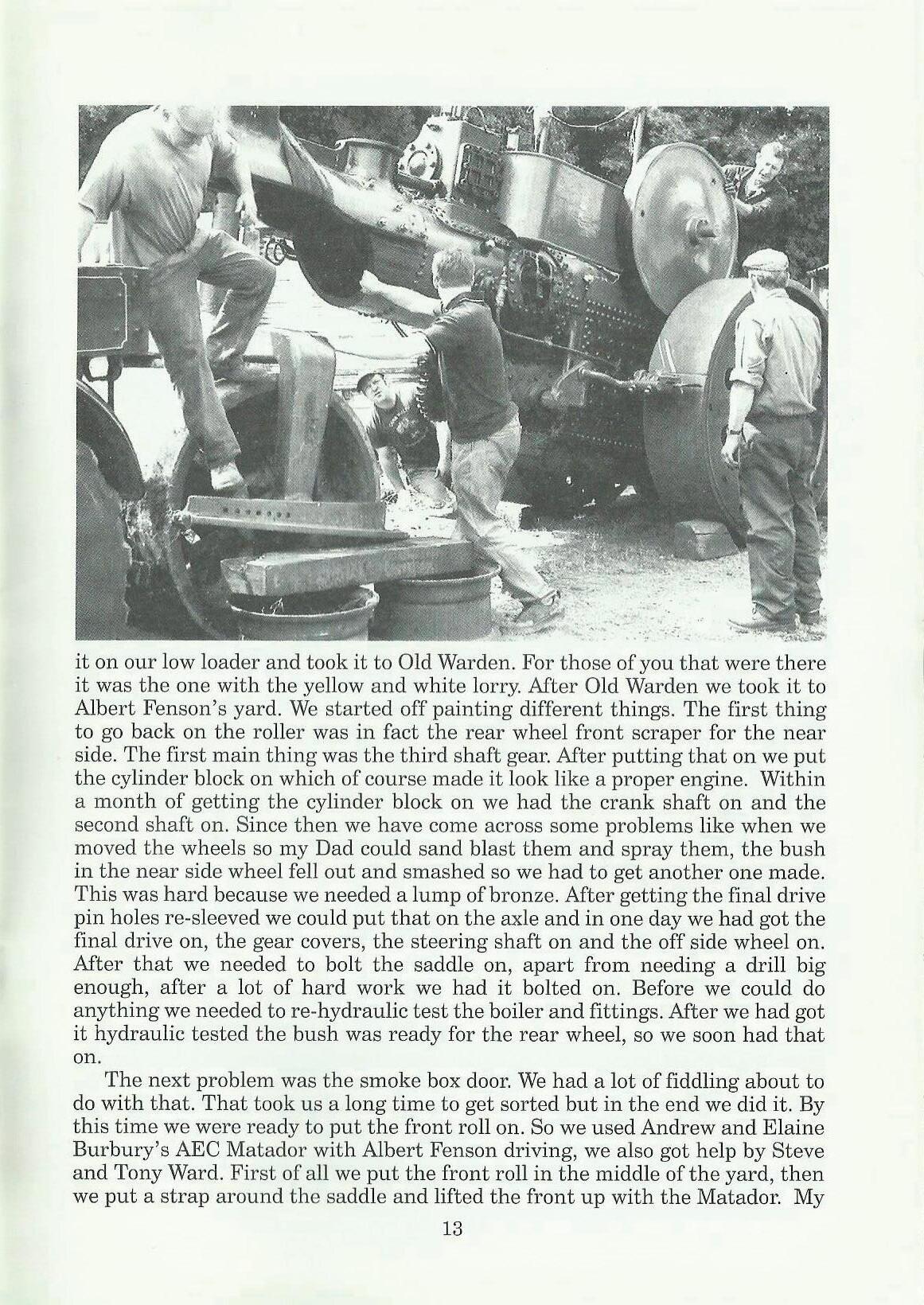
it on our low loader and took it to Old Warden. For those of you that were there it was the one with the yellow and white lorry. After Old Warden we took it to Albert Fenson's yard. We started off painting different things. The first thing to go back on the roller was in fact the rear wheel front scraper for the near side. The first main thing was the third shaft gear. After putting that on we put the cylinder block on which of course 1nade it look like a proper engine. Within a month of getting the cylinder block on we had the crank shaft on and the second shaft on. Since then we have c01ne across some problems like when we 1noved the wheels so my Dad could sand blast them and spray them, the bush in the near side wheel fell out and smashed so we had to get another one made. This was hard because we needed a lump of bronze. After getting the final drive pin holes re-sleeved we could put that on the axle and in one day we had got the final drive on, the gear covers, the steering shaft on and the off side wheel on. After that we needed to bolt the saddle on, apart from needing a drill big enough, after a lot of hard work we had it bolted on. Before we could do anything we needed to re-hydraulic test the boiler and fittings. After we had got it hydraulic tested the bush was ready for the rear wheel, so we soon had that on.
The next problem was the smoke box door. We had a lot of fiddling about to do with that. That took us a long time to get sorted but in the end we did it. By this time we were ready to put the front roll on. So we used Andrew and Elaine Burbury's AEC Matador with Albert Fenson driving, we also got help by Steve and Tony Ward. First of all we put the front roll in the middle of the yard, then we put a strap around the saddle and lifted the front up with the Matador. My
Dad put it in gear and rolled it back about a metre, then we twisted the roller around and put a lorry tyre under the boiler to support the roller while we lifted the front roll and put it in front of the saddle. Then we lifted the front of the roller up again and my Dad just turned the flywheel around a few times so the saddle was over the forks, then Albert let the roller down slowly onto the forks. So there it was sitting on all wheels. All that was missing was the canopy. My Dad asked me to unsheet the canopy ready to put on. Within minutes the canopy was in mid air hanging over the engine, Steve Ward and my Dad were bolting the front half of the canopy down while Tony Ward and Alan Burbury bolted the back half down. It was a fiddle but within 10-15 minutes it was on. We got the front roll and the canopy on, on 16th of July, and by the 25th of July we had put it in steam. My Dad and Albert timed the motion up. After that we were ticking her over. Then my Dad asked me and 1ny friend Sam to move the
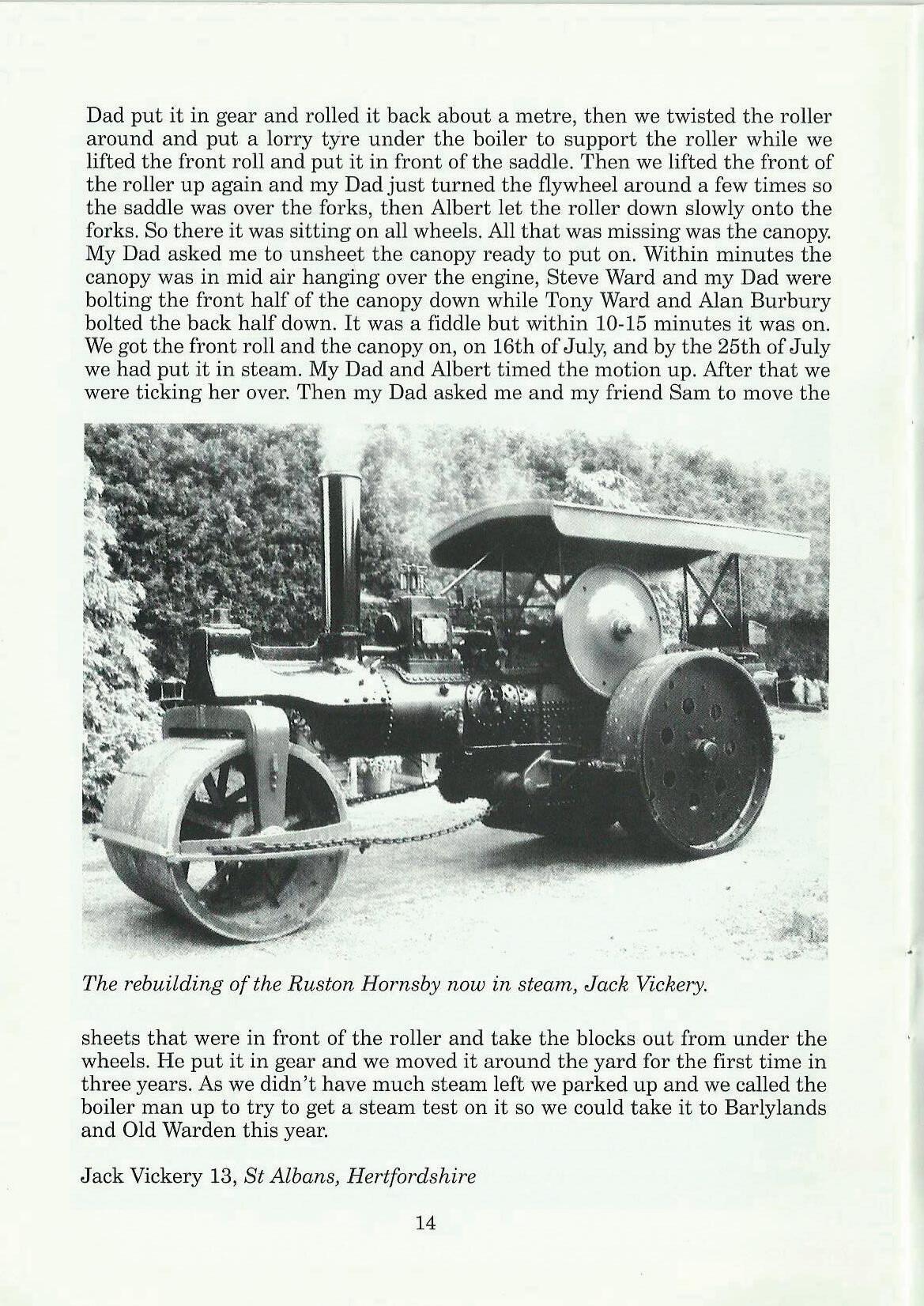
The rebuilding of' the Ruston Hornsby now in steam, Jack Vickery.
sheets that were in front of the roller and take the blocks out from under the wheels. He put it in gear and we moved it around the yard for the first time in three years. As we didn't have much steam left we parked up and we called the boiler man up to try to get a steam test on it so we could take it to Barlylands and Old Warden this year.
Jack Vickery 13, St Albans, Hertfordshire
Dear Editor,
I am writing to tell you about the great time we had at the Steam Apprentice Driving Day at Robert and Josie Millington's farm near Whitchurch. It was a surprise day out for my brother's birthday and neither of us knew where we were going until we arrived there.
Tim got to help on the Marshall traction engine Wandering Star and I helped on the Aveling & Porter convertible Lady Hesheth.
We would like to say thank you to Robert, Josie, the owners, drivers and helpers for a fantastic time and we hope to enjoy a similar day as soon as possible.
Hetty 7, and Tim 13, Winstanley.
Dear Editor,
My name is Ellis Bowen and I am a member of the SAC. Yesterday I went on my second driving day at Henstridge. When we got there it was a lovely sunny day and we saw the big and the small engines and lots of tents for camping. I was paired with Bridget and Pete and their beautiful little engine called Albert. I helped polish the wheels and learnt how long it takes to bring it up to steam. At lunch time there was a ride to the local pub to show off the engines and me and my sister and my Dad were lucky to get a ride on a steam Foden lorry which was owned by a man called Kevin. My Mum followed us in the car which was good because when we got to the pub it started raining really hard. We sat in the car looking at all the other engines while we ate our lunch, then Heather Vincent arranged a ride for us in a steam car owned by Sally -Ann. It was really fast and great fun. Although the rain ended the day early for us we had a great time.
I would like to thank everybody who helped us and we were really looking forward to Blandford and the next SAC day.
Ellis Bowen.
Dear Editor,
It was a rainy Saturday afternoon in the summer holidays. My Dad asked me whether I wanted to help him anneal some tubes for his friend's Fowler roller Alice No. 16392. So I put my boiler suit and boots on and went into the shed. To anneal the tubes we needed lots of heat. With a piece of oily rag, firelighter, coke, wood and a squirt of paraffin the forge was lit. We needed even more heat so we put on the fan so the fire would become hotter and more concentrated. When it had reached a bright yellow colour, we started to anneal the tubes. Two wheels are fixed on the front of the forge to put the tubes on, to ease the turning. The heat needs to be spread evenly around the end (first 3 inches of the tube). I positioned the tube on the wheels and began to turn it slowly. After a while it was time to take the tube out, as it had reached dark orange colour, from the heat of the forge. You have to be quick as the metal is
very soft. So the tubes were put into the boiler to cool down in still air. After all the tubes had been annealed they were left for a while to let the iron molecules relax. The forge was turned off and after 23 tubes it was time for a well deserved cup of tea! Eventually the tubes were taken out of the boiler, and left to stand until they were needed.
Charlotte Garbett, 13, Staffordshire
NEW APPRENTICES
Scott Adams, Derbyshire. Conner Allen, Cornwall. Michael Allen, Cornwall. Joshua Always, Somerset. James Bailey, Fordingbridge. Callum Barker, Poole. Thomas Bartholon1ew, Manchester.
Matthew Bayliss, Yeovil.
William Beck, Bean1inster.
James Benham, Chichester. Oliver Blackman, Atherstone.
Harry Bishop, Northants.
Alny Bradshaw, Eltham. Kyle Brooks, Padstow.
Kristina Bryant, Wetherby. Michael Bryant, Wetherby. Martin Burbidge, Harley. Mark Burnie, Surrey.
Robert Burns, Milton Keynes. Chris Butler, Whitchurch.
Camilla Butterfield, Wallingford. Joshua Callon, Cumbria.
Jack Carter-Hughes, Bridgewater. Harry Cheeseman, Leicester.
Martin Childs, Huntingdon. Jonathan Clay, Canterbury. Thomas Clay, Canterbury. Andrew Cooper, High Wycombe.
Aaron Cornwell, Bodmin. Fraser Coull, Ayrshire. Ben Cox, Brixham.
Joseph Cross, Bolton.
Thomas Crutchley, Leicester.
Harry Cullen, Hants. Jamie Cullen, Chesha1n.
Christopher Cun1111ins,Matlock. James Daw, Cornwall.
Samuel Jenner, Kent. Craig Johnson, Scarborough. 1-Ielen Jones, Fareham.
Gareth Jones, Carmarthenshire.
Robert Kearton, Co Durham. Nicholas Kilford, Ringwood. Brett Lawson, Portslade.
Jay Legg, Bournemouth.
Mark Lewis, Rugby. Gavin Lloyd, Norfolk. Aaron McLuskie, Beds. :Harry Mead, Chelmsford.
Ruaraidh Middleton, Uphall. Lee Morgan, Welshpool. Gareth Morgan, Welshpool. Paul Morris, Cumbria. Danny Mothersole, Essex. Simon Mottram, Devon. Luke Needham, Devon. Callum O'Keeffe, Truro.
David Parfett, Derby. James Parker, Harley. Oliver Perrin, Shedfield. William Pinder, Dorchester.
Joshua Powell, Worcestershire. Matthew Purveur, Gloucester. Alexandra Radford, Kent.
Tom Rhodes, Glos.
Jack Richard, Calmore. Henry Rooke, Somerset. Peter Rosewall, Cornwall. Elizabeth Rowan, Bucks. Amy Rowan, Bucks. Matthew Rowe, Boston. Jessica Rumney, Shropshire. Adam Rumney, Shropshire James Sandars, Derby.
Jon Davey, Sussex. Ray Davey, Sussex.
Jahlemn David, Dorset.
Robert Davies, Burntwood.
Leyton Derrick, Derbys.
Matthew Drinkwater, St Agnes.
Matthew Dovey, Worcestershire, Katie Eggleston, High Wycombe.
Joshua Elston, Torquay.
John Enright, Humberside. William Fisher, Ipswich.
Matthew Ford, Eastleigh.
Hannah Foskett, Suffolk. Hayley Foskett, Suffolk.
Thomas Freeman, Totnes.
William Freeman, Rugeley. David Froud, Bournemouth.
William Garside, Uttoxeter.
Matthew Gee, Letchworth.
Jessie Geeves, Lines.
Thomas George, Bodmin. Andrew Gibb, Lockerbie.
Jason Gleave, Nantwich. Amy Goodwin, Cornwall.
James Goodwin, Stoke-on-Trent. Chris Gunn, Clevedon.
Lizzie Gunn, Clevedon.
Jack Hall, Surrey.
Alexander Haslett-Saunders, Hitchin. William Haward, Haddenham.
Kerry Hirst, Totton.
Na than Hodgson, Barnsley.
Luke Holmes, Vale of Glamorgan. Andrew Horwood, N orthants.
John Hunt, Bishops Stortford.
Abigail Isaac, Salisbury. Ben Isaac, Salisbury.
Tony Sawyer, Polegate. Demelza Sears, Bordon. Erin Sharp, Hitchin.
Isaac Shelley, Bodmin. Joe Simons, Bournemouth.
Bradley Slipper, Essex.
Sally-Ann Sluggett, Devon.
Emma Sluggett, Devon.
James Smith, Bedford. Joshua Smith, Ringwood.
Toby Spencer, Northants.
Harry Stanley, Walden. Tim Stidston, Kingsbridge. Joshua Swain, Whitchurch. Jack Swain, Whitchurch.
Peter Sweet, Barnstable. Thomas Tallon, Hants.
Christopher Targett, Truro.
Zach Taylor, Penrith.
James Tilbury, Cheshire. Callum Turff, Bedfordshire. Roland Twelftree,.Birm.
Jackson Wade, Co Durham. Harry Wakelin, Hants. Jack Wakelin, Rants. Robert Ward, Carlisle.
Tim Ward, Northants. Ellen Watson, Cumbria.
Oliver Weaves, Suffolk. William Webb, Weybridge. George Webster, Suffolk.
Alan Whittaker, Ilkeston. Andrew Wildish, Kent. Zoe Wilson, Cumbria. Amber Wilson.
Hetty Winstanley. John Wright, Whitchurch. Nathan Yeo.