RAISING STEAM
EDITOR
STEAM APPRENTICE CLUB MAGAZINE
Nanette Sanders; Frog Cottage, New Road, Porcbfield, Isle of Wight P030 4LS Tel: 01983 523317 e-mail: sac.raisingsteam@ntet.co.uk
CHAIRMAN, STEAM APPRENTICE CLUB
John Durling, Hawthorn Cottage, Stubwood, Uttoxeter, Staffordshire ST14 5HX
Tel: 01889 591188 (between 08.00 and 21.00 hours only please) e-mail: john.r.durling@uk.transport.bombardier.com
VICE-CHAIRMAN, STEAM APPRENTICE CLUB
Elaine Massey, 21 Down Close, Northolt, Middlesex UB5 6NS Tel: 020 8248 6570 e-mail: elai11ermassey@aol.com
MEMBERSHIP SECRETARY
John Cook, Dolfami, Church Lane, Kirkby la Thorpe, Sleaford, Lincolnshire NG34 9NU. Correspondence only. Membership fee £5.00 per annum.
SAC CO-ORDINATORS
Brun Bate, 30 Mowbray Grove, Bishopsgarlh, Stockton-on-Tees, Cleveland TS19 BXA Tel: 01642 897153 e-mail: samDate@lycos.com
Graham Chaffe1~32 Jubilee Way, Stort'ington, West, Sussex RH20 3NZ
Tel: 01903 745921 e-mail: chaffe1:gang@ic24.net
Duncan Crose1; 16 Tripps Hill Close, Chalfant St. Giles, Bucks HPB 4JZ Tel: 01494 875443 e-mail: duncan.croser@ntl:world.com
Steve and Donna Taylor, 17 Smith Crescent, Coalville LE67 4JF Tel: 01530 835213 e-mail: steve.tailor@btintemet.com
Matthew Lund, Willow Cottage, TW)'Ilam's Hili 1 Shirrell Heath, Southampton S032 2JL
Tel: 01329 832462 e-mail: matt,lund@engineer.com
Kevin Munn, 56 Blacklunds Drive, Hayes, Middlesex Tel: 020 8573 9180 e-mail: kevin@munnsteam.freeserve.co,u.k
Barry Sumsion, l Leicester Road, Newport, South Wales NP19 7ER Tel: 01633 213332 {offiee) e-mail; barry@kenrline.co.nk '.rhe Editor welcom.esany contributions of articles, shorter items or photographs for inclusion in future :isSues.All material submitted is voluntary and paynlent.carmot be made fo:r any material pub!islrnrl.'rho opinions expressed in I.he magazine, with the exception of Club.announcements, are those of the contributors and do not indicate the views of the Club as a whole. All items are held copyright by tho:contributor and the NTET.
Please send your contributions to the Editor at least fiVe weeks before publication. Typed or e-mailed ~rticles are preferred but notessendai. If handwritten put any names of PEOPLE, PLACES or ENGINES in BLOCK CAPITALS.If:vou require any part of your article (eg.photos) returning please say so and enclose n stamped addressed envelope. Enclose your name, address and (if Apprentice) age with any contribution. The Edi1:ol' reserves the right to amend or refuse" cont).'ibutions, and will attempt r.o Correct spelling and grammar! 'l'lt(• Magazine is normally published during the early part of January, April, July and October. The C!ub accepl,s mi liability for failure to meet intended publication dates.
The Steam Apprentice Club is a section of the National Traction Engine Trust. NTET is a Registered Charity, No. 291578. Registered in England No. 1302197. Registered Office: 4 Chul'ch Green East, Redditch, Worcestershire B98 8BT
Typesetting and Artwork by Keru:line Graphic Images Ltd, Fairoak House Business Centre, Church lfo11d, Newport, South Wales NP19 7EJ Tel: 01633 262197 Fax: 01633 259089 email: general@kearline.r·o.1111
Printed by MD Jenkins Printers Ltd, Lydney, Glos GL15 4EJ
First I am sorry to announce the sad news of the loss of our webmaster. Graham Tucker who created the Steam Apprentice Website sadly died on Sunday 20th March at home. Graham offered his time and equipment at the Great Dorset Steam Fair giving you the opportunity to access the web site at the National Traction Engine tent. The Steam Apprentice Club offer their condolences to Graham's wife ·Janet and son Nathan. Graham will be sadly missed.
After visiting the annual steam-up at Compton Farm on the Isle of Wight I came across an interesting story about a model steam tug called Blazer. The owner of the tug, Nick Oxlade, invited me to his workshop to have a look at the delicate details he had included during the many years that it had taken to build his boat so far. Nick had spent many years building radio controlled Marblehead model yachts and decided to have a go at building a model steam tug. Nick obtained the plans for Blazer from the Model Maker Plans Service via the Internet, it is not known if this tug did actually exist.
The 1nain body of the boat was created from several planks of wood glued together and carving the whole boat from the solid block, shaping it using a moulding comb from drawing to plan. After making the deck from teak, bits of ply and strips of wood from old window blinds, it soon became time for details;
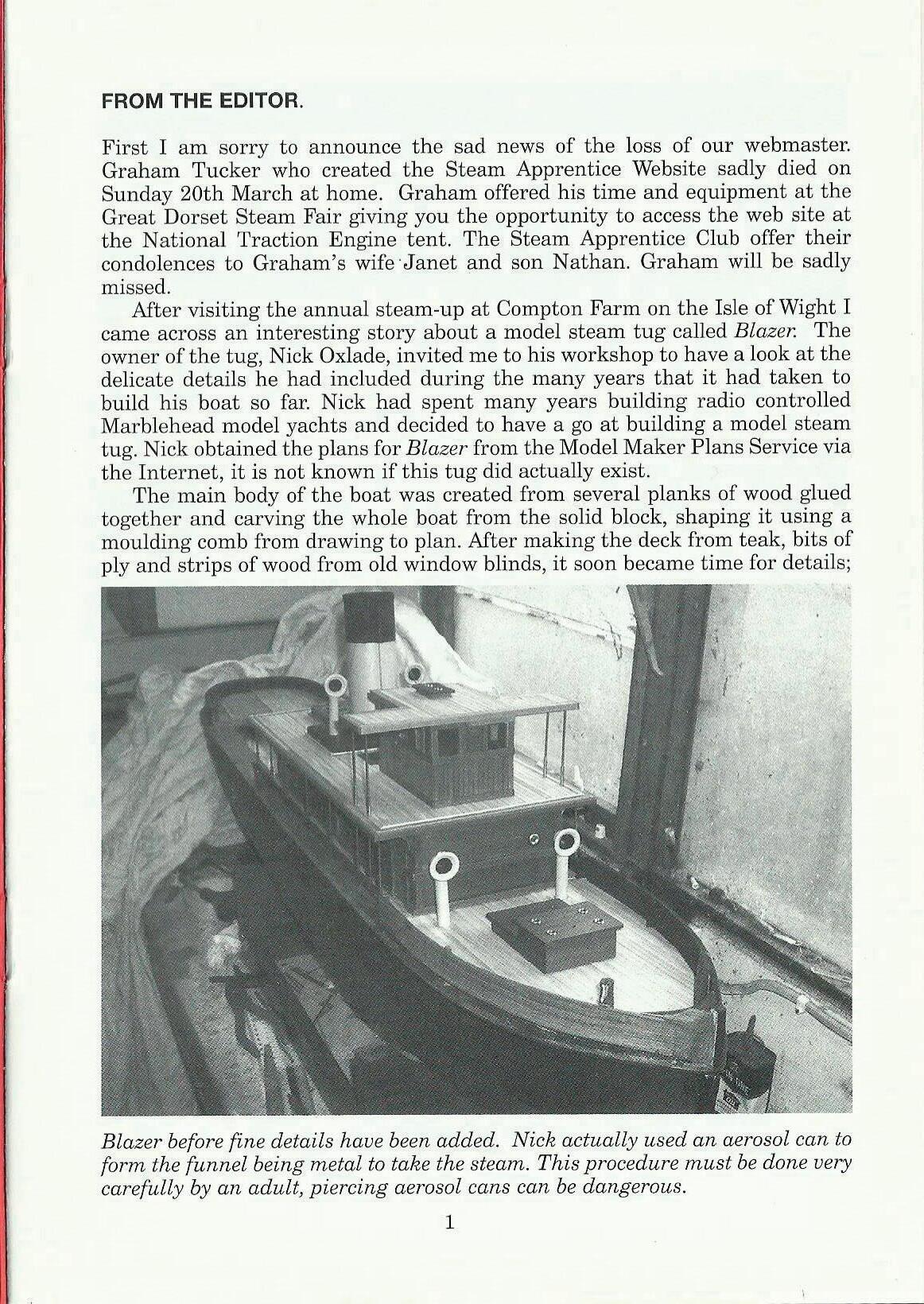
Blazer before fine details have been added. Nick actually used an aerosol can to form, the funnel being metal to take the steam. This procedure must be done very carefully by an adult, piercing aerosol cans can be dangerous.
this is where Nick found his imagination running away with one brilliant idea after another.
I was amazed at the details that Nick had added and the ways in which he had managed to create these fine details fr01n everyday items. The hand rails along the sides were made from brass pins and stainless steel wire, the wooden tops to the rails were made from Venetian blind and took Nick three weeks to finish. If you look at the first picture of Blazer you can see the tiny portholes that were made from brass cups for screws. The winch for the anchor which is visible on the picture of the almost complete Blazer is actually made from two spark plug tops from an old servo. I could go on and list many fantastic ideas that Nick has had including the canvas covering the lifeboats which had not been added to the tug at the time the photos were taken, the canvas was made fr01n Nicks cotton handkerchiefs stained and matt varnished.
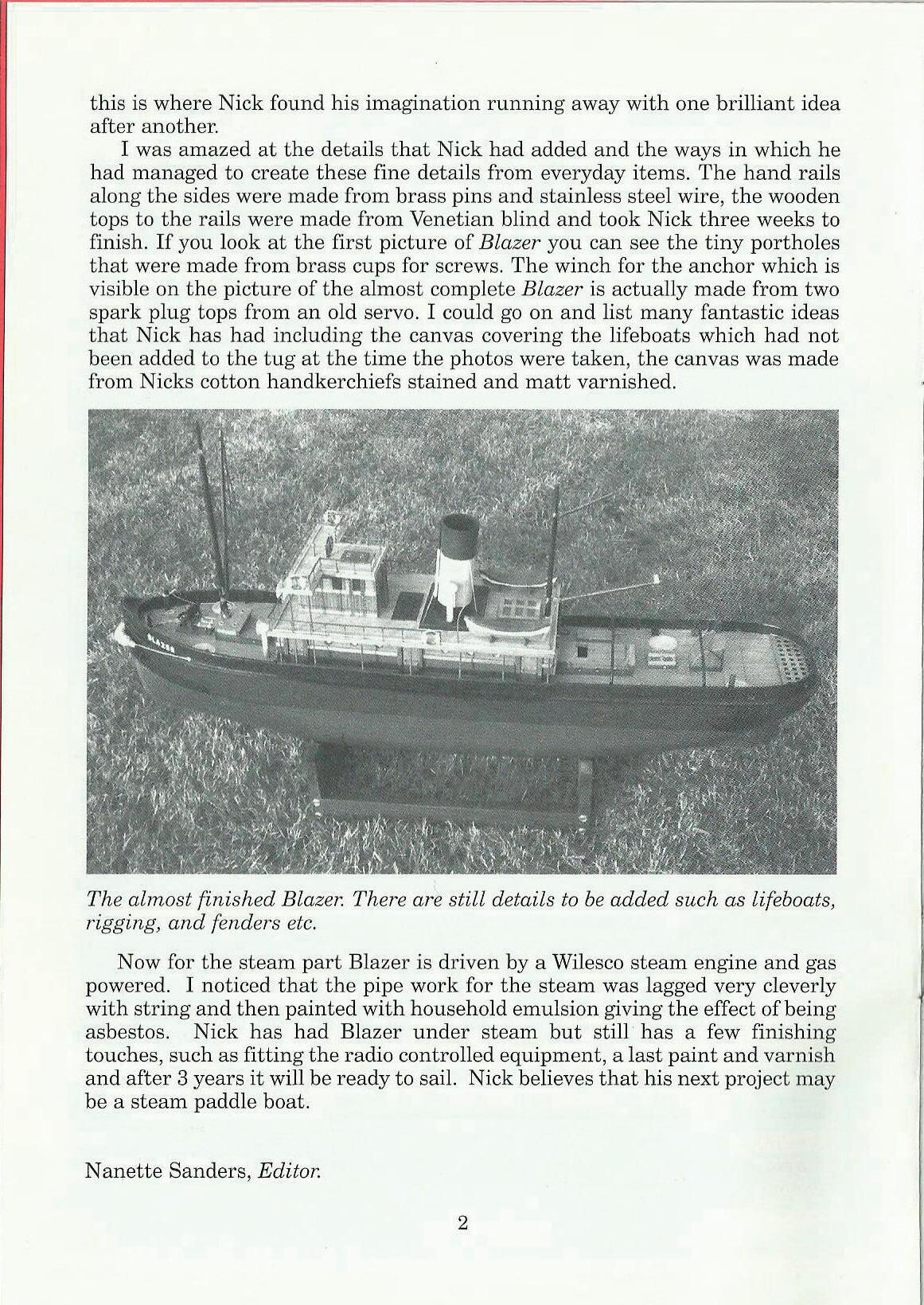
The almost finished Blaze,~ There are still details to be added such as lifeboats, rigging, and fenders etc.
Now for the steam part Blazer is driven by a Wilesco steam engine and gas powered. I noticed that the pipe work for the steam was lagged very cleverly with string and then painted with household emulsion giving the effect of being asbestos. Nick has had Blazer under steain but still has a few finishing touches, such as fitting the radio controlled equip1nent, a last paint and varnish and after 3 years it will be ready to sail. Nick believes that his next project may be a steam paddle boat.
Nanette
Sanders, Editor.
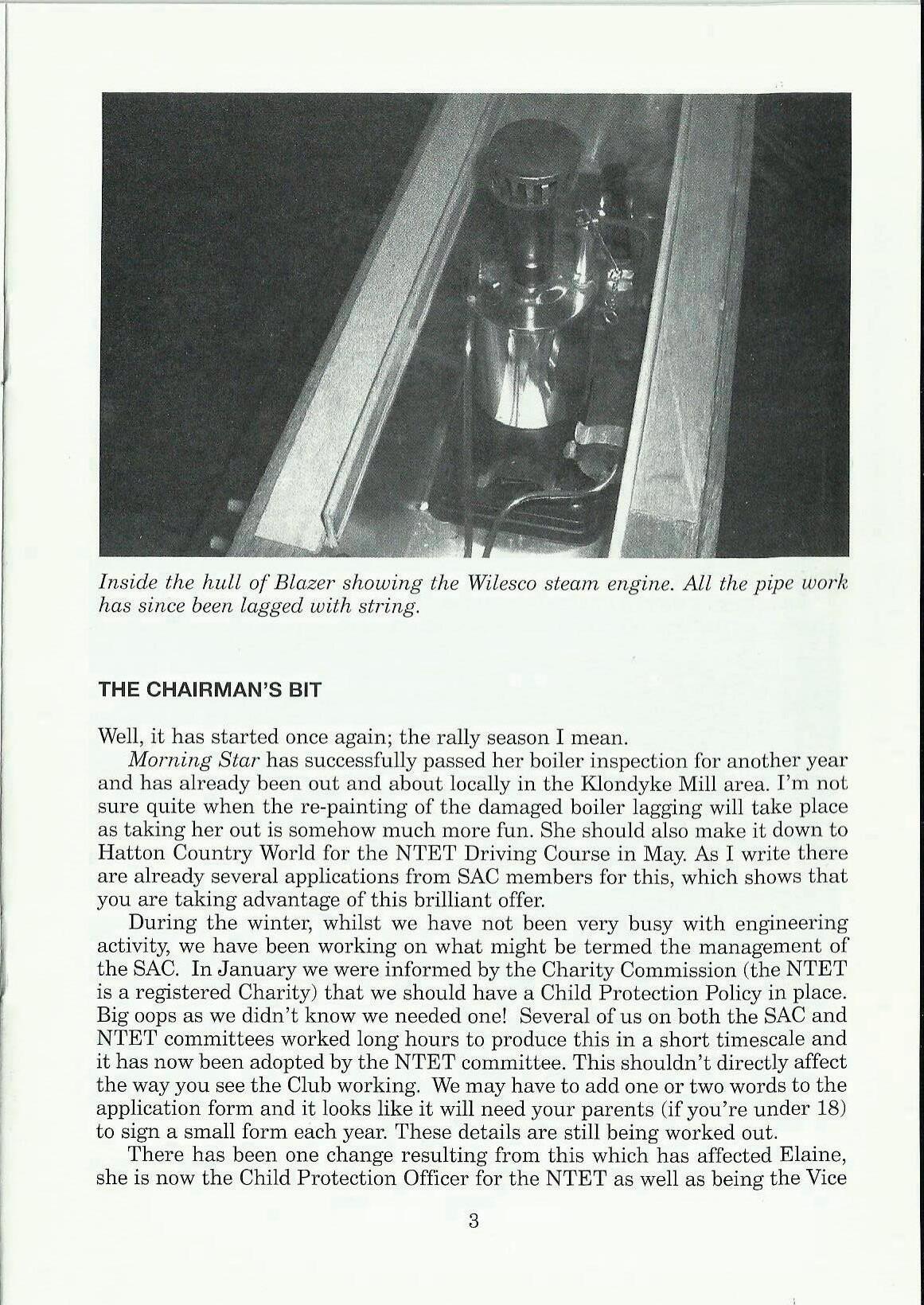
Inside the hull of' Blazer showing the Wilesco steam engine. All the pipe work has since been lagged with string.
THE CHAIRMAN'S BIT
Well, it has started once again; the rally season I mean.
Morning Star has successfully passed her boiler inspection for another year and has already been out and about locally in the Klondyke Mill area. I'm not sure quite when the re-painting of the damaged boiler lagging will take place as taking her out is somehow much more fun. She should also make it down to Hatton Country World for the NTET Driving Course in May. As I write there are already several applications fro1n SAC members for this, which shows that you are taking advantage of this brilliant offer.
During the winter, whilst we have not been very busy with engineering activity, we have been working on what might be tenned the management of the SAC. In January we were infonned by the Charity Com1nission (the NTET is a registered Charity) that we should have a Child Protection Policy in place. Big oops as we didn't know we needed one! Several of us on both the SAC and NTET committees worked long hours to produce this in a short timescale and it has now been adopted by the NTET committee. This shouldn't directly affect the way you see the Club working. We may have to add one or two words to the application fonn and it looks like it will need your parents (if you're under 18) to sign a small form each year. These details are still being worked out.
There has been one change resulting from this which has affected Elaine, she is now the Child Protection Officer for the NTET as well as being the Vice
Chair of the SAC. We do like to keep people busy!
By the time you read this the first of this year's driving days will have happened - I hope that those of you lucky enough to be there enjoyed it. I have had several phone calls about the fact that Klondyke Mill is not on the list. I'm sorry about this but we have run a course there every year since the start and the engine owners felt that they had done their bit. Also Klondyke Mill isn't really big enough for 4 or 5 engines to be moving at the same time. What we need now are new venues in the Midlands and the North. Do you know of anywhere? We need somewhere with a bit of private ground, preferably with hard areas, and a few engines either on site or nearby. If you can think of anywhere, get in touch - we'll do the rest!
Happy steaining and I hope to see lots of you during the season.
John Durling, Chairman.
PS. Don't forget to send your letter, pictures, e:mails etc. to the editor.
MAIL BAG
Dear Editor,
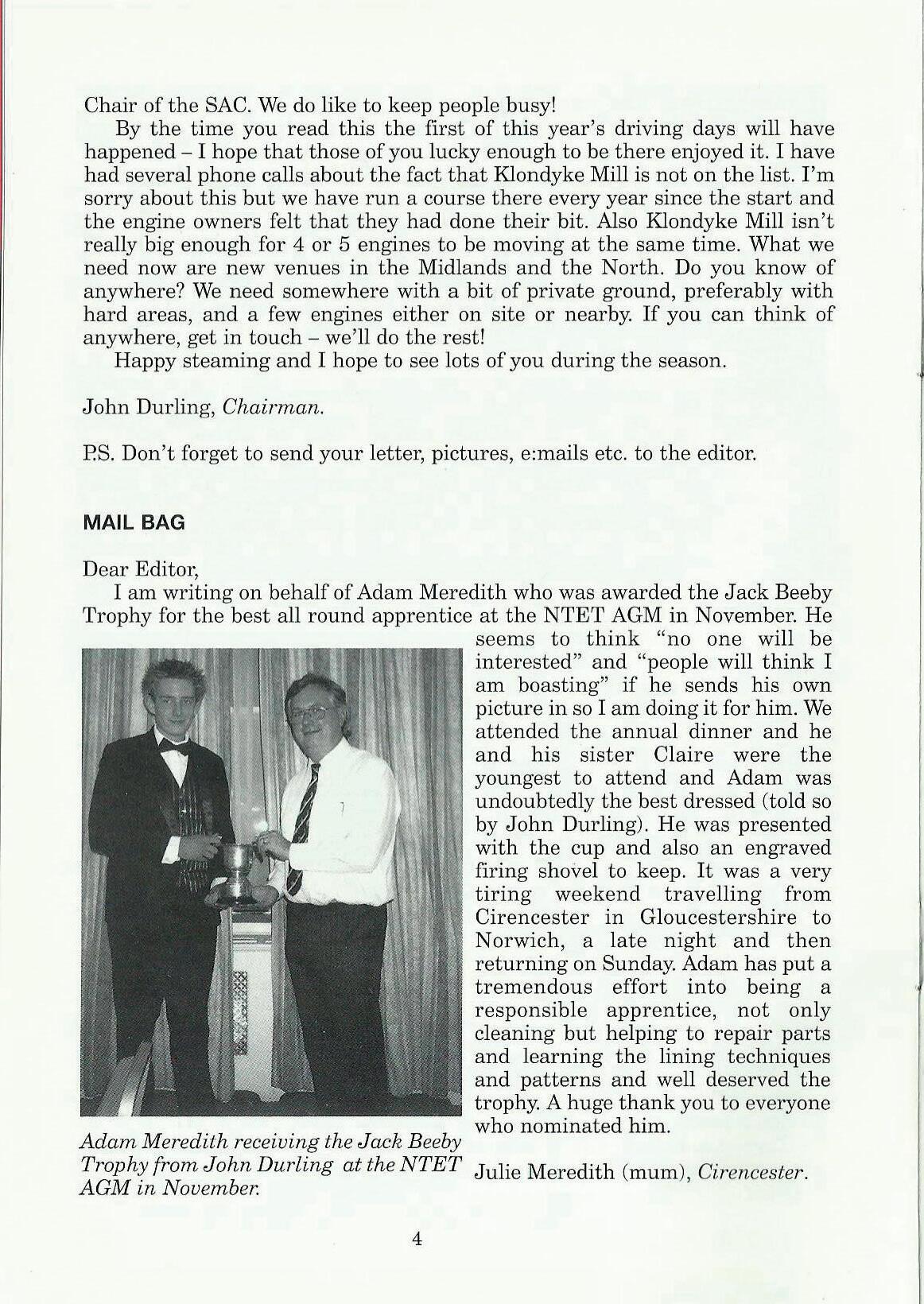
I am writing on behalf of Adam Meredith who was awarded the Jack Beeby Trophy for the best all round apprentice at the NTET AGM in November. He
Adam Meredith receiving the Jach Beeby seems to think "no one will be interested" and "people will think I ain boasting" if he sends his own picture in so I am doing it for him. We attended the annual dinner and he and his sister Claire were the youngest to attend and Adam was undoubtedly the best dressed (told so by John Durling). He was presented with the cup and also an engraved firing shovel to keep. It was a very tiring weekend travelling from Cirencester in Gloucestershire to Norwich, a late night and then returning on Sunday. Adam has put a tremendous effort into being a responsible apprentice, not only cleaning but helping to repair parts and learning the lining techniques and patterns and well deserved the trophy. A huge thank you to everyone who nominated him.
Trophy from John Durling at the NTET Julie Meredith (mum), Cirencester. AGM in November.
Dear Editor,
I might not be a professional comedian but I have experienced some funny incidents since I joined the SAC in 2001, and here they are ....
On 1st June 2003 at the Leighton Buzzard Bypass Rally I was feeding Alex Ross's stone crusher with bits of stone and tried putting in a great big one but the crusher spat it out. At the Old Warden Driving Day on 24th April 2004, I was steering a 1900 Aveling & P9rter Roller no. 4604. Paul Vickery, one of the engine owners, told me not to go mad with the steering, but I could not help it because I had trouble with the steering. At the same venue and on the same day I had a go at driving Annie a miniature ploughing engine; I found that I had trouble with the regulator on this engine too.
At Brantham Hall driving day on 2nd October 2004, Jonathon Wheeler asked for anybody (apprentices) to operate the water gauge on 1930 Aveling & Porter Roller (can't remember the works nu1nber and it does not have a name), I stepped forward. I asked how to operate the water gauge as I had only done it once before, Alan the apprentice that I was paired with thought that I knew how to work it. Again at the same event Alan and I were steering Nippy Richard Murphy's 1928 Aveling & Porter Tractor, and I discovered that when I steered I could not keep it in a straight line even when I turned the wheel once all the way round.
Edward Ronayne, 17, London.
Dear Editor.
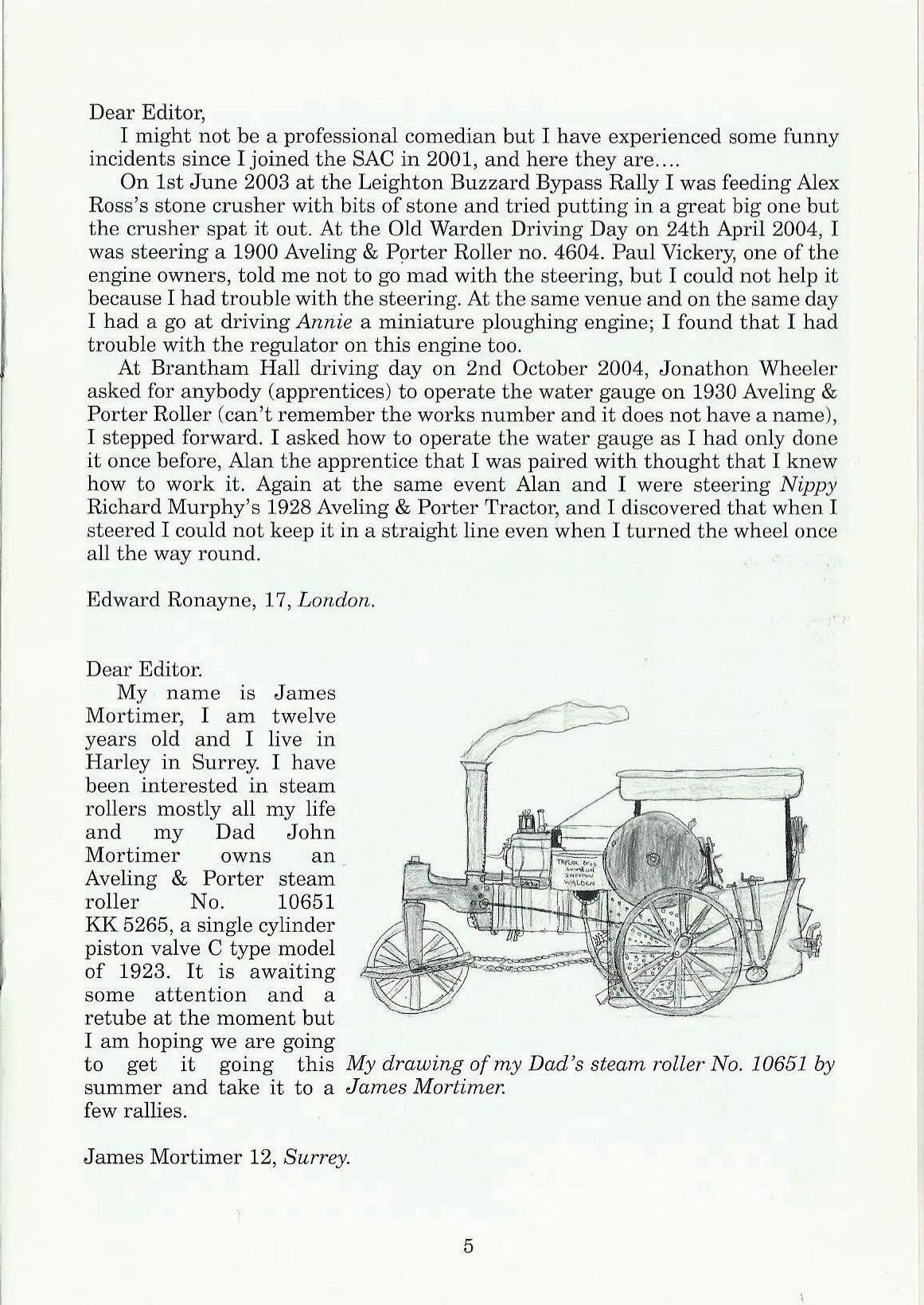
My name is James Mortimer, I am twelve years old and I live in Harley in Surrey. I have been interested in steam rollers mostly all my life and my Dad John Mortimer owns an Aveling & Porter steain roller No. 10651 KK 5265, a single cylinder piston valve C type model of 1923. It is awaiting some attention and a retube at the moment but I am hoping we are going to get it going this My drawing of my Dad's steam roller No. 10651 by summer and take it to a James Mortimer. few rallies.
James Mortimer 12, Surrey.
John Mortimer with his 1923 Aveling & Porter steam roller No.10651.
Dear Editor.
There has been a lot of progress on the restoring of my Dad's traction engine, Pedler, a 1914 8 nhp Wallis and Steevens no. 7428. Recently we have been busy working on Pedler's tender, we have put in about 3,000 rivets. We used two sizes, the large ones on securing the draw bar, and the smaller ones on the plating. It was good because I had to use a pneumatic gun to flatten the rivets. Someone had to climb inside the integral water tank and as I was the smallest it fell to me. It was deafening, cramped and a bit claustrophobic and I had to use ear defenders
When Pedler's boiler com.es back from Alex Humes, the boiler smith, at the end of the summer we will have cleaned and renovated all the parts ready to be attached to the boiler and Pedler should be steamed up and running by next year.
There has also been a lot of progress on the Wallis & Steevens living van. I prepared and painted all four wheels in red, and the chassis in green. Dad totally rebuilt the wooden body, carefully copying the joints exactly as they were when 1nade. I then prepared and painted the entire body, the final coat •· being green. As there were two hub caps missing we had a new set cast from the originals. We have only been working on it for a total of about two weeks. The walls are insulated with polystyrene and the only major jobs to complete the project are to finish the inside, and make the roof waterproof.
When the living van is finished our next project is to restore our Wallis & Steevens ten ton trailer. When Pedler, the living van and the 10 ton trailer are completed they will look good as a Wallis & Steevens collection.
We went to a steam rally in Andover on the 28th March. Dad's friend Tim Smith took his 1944 Marshall steam roller called Oar Wullie No. 89549. He
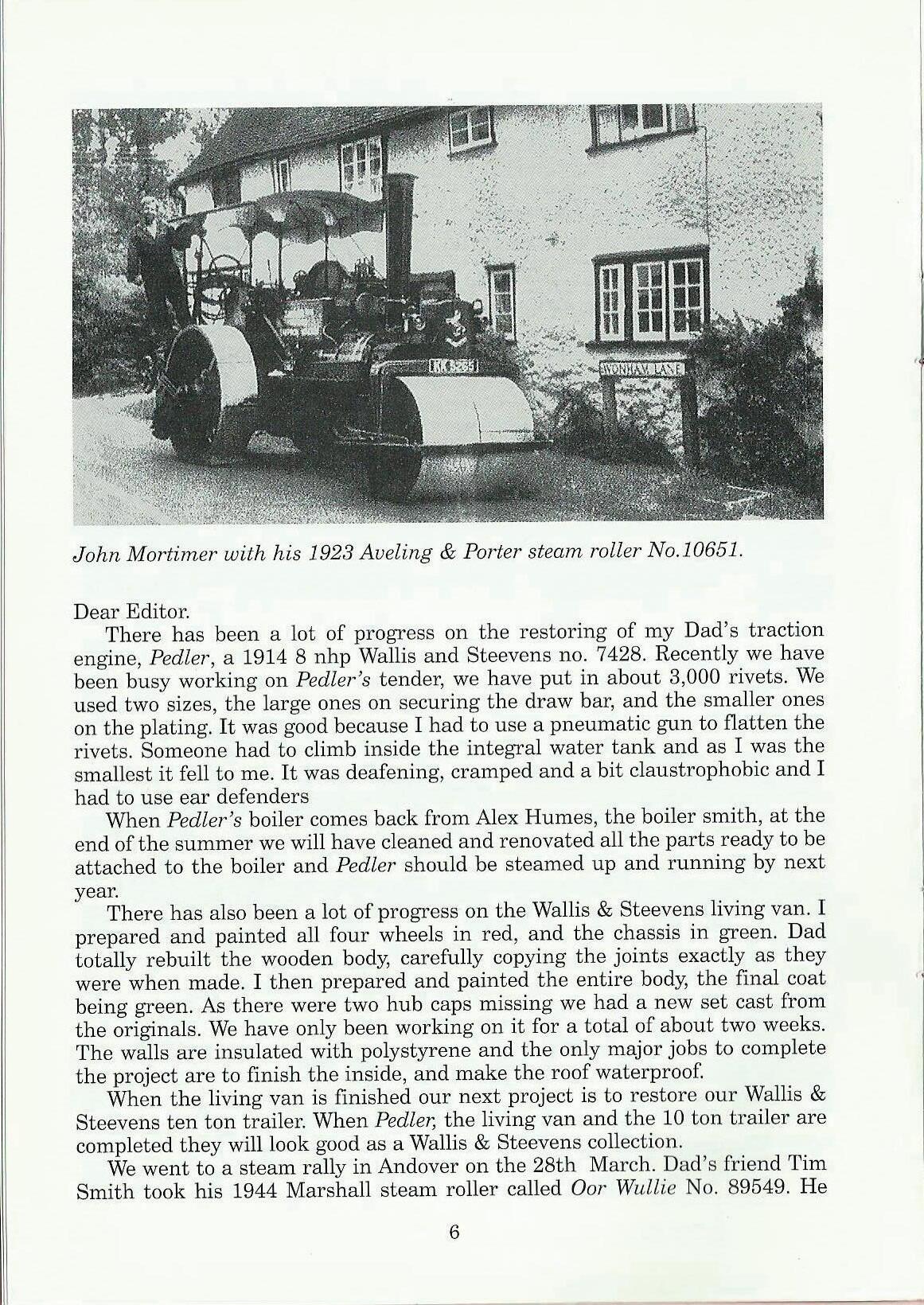
'Pedler) in a tug of war by Jack Kenway.
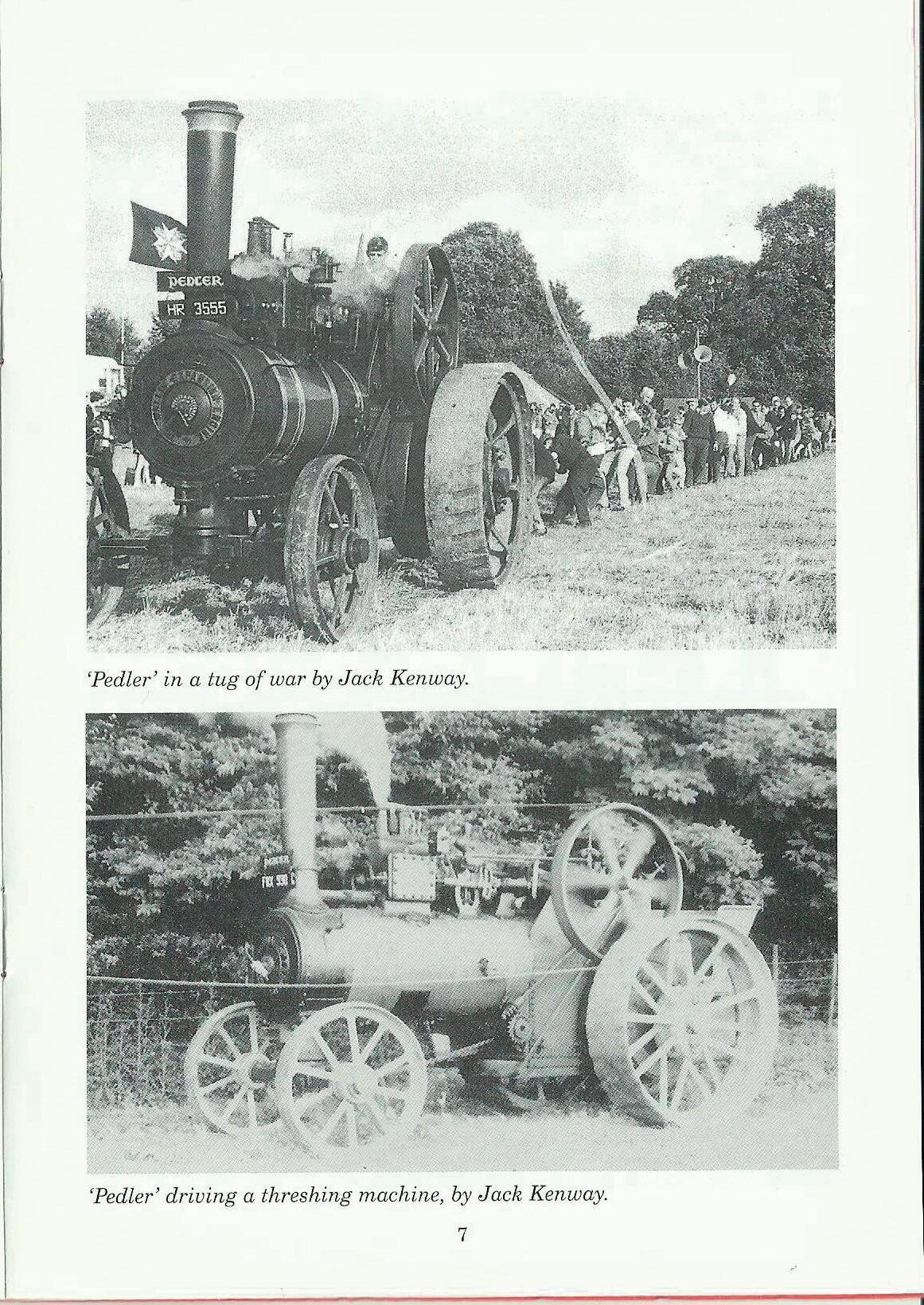
'Pedler) driving a threshing machine) by Jack Kenway.
offered to let me drive and steer it around the rally, before he could change his mind I was on the footplate and ready to go. I drove it for a little while but it was too crowded to take it far, great fun though.
A man Dad knows is 1naking an exact replica model of Fedler, and he has been painting it green with the necessary coach lines. Most Wallis & Steevens traction engines were originally painted green but Pedler was originally black. It leaves the problem of accuracy by changing the paint colour, or leaving it as it is.
We are still researching Pedler's history and have found many new photographs of her from years ago. If anyone has any other information on her we would be very obliged.
Jack Kenway, Hook.
Dear Editor.
Easter Extravaganza at the Museum of Rural Life, Farnham. TOY STEAM RALLY on Easter Saturday
Having seen articles about this in both the Old Glory and Vintage Spirit, I decided it was a "must do".
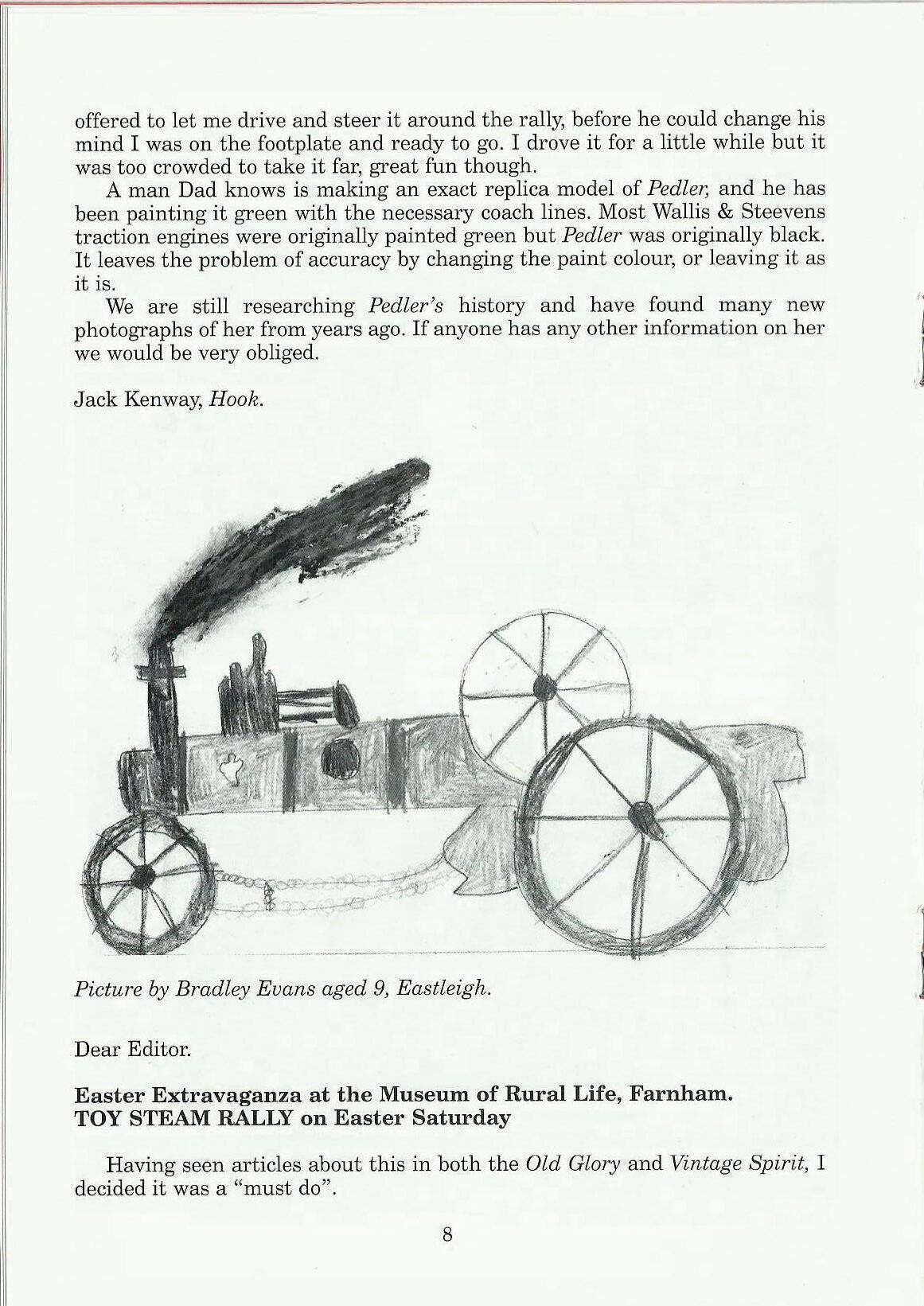
Picture by Bradley Evans aged 9, Eastleigh.
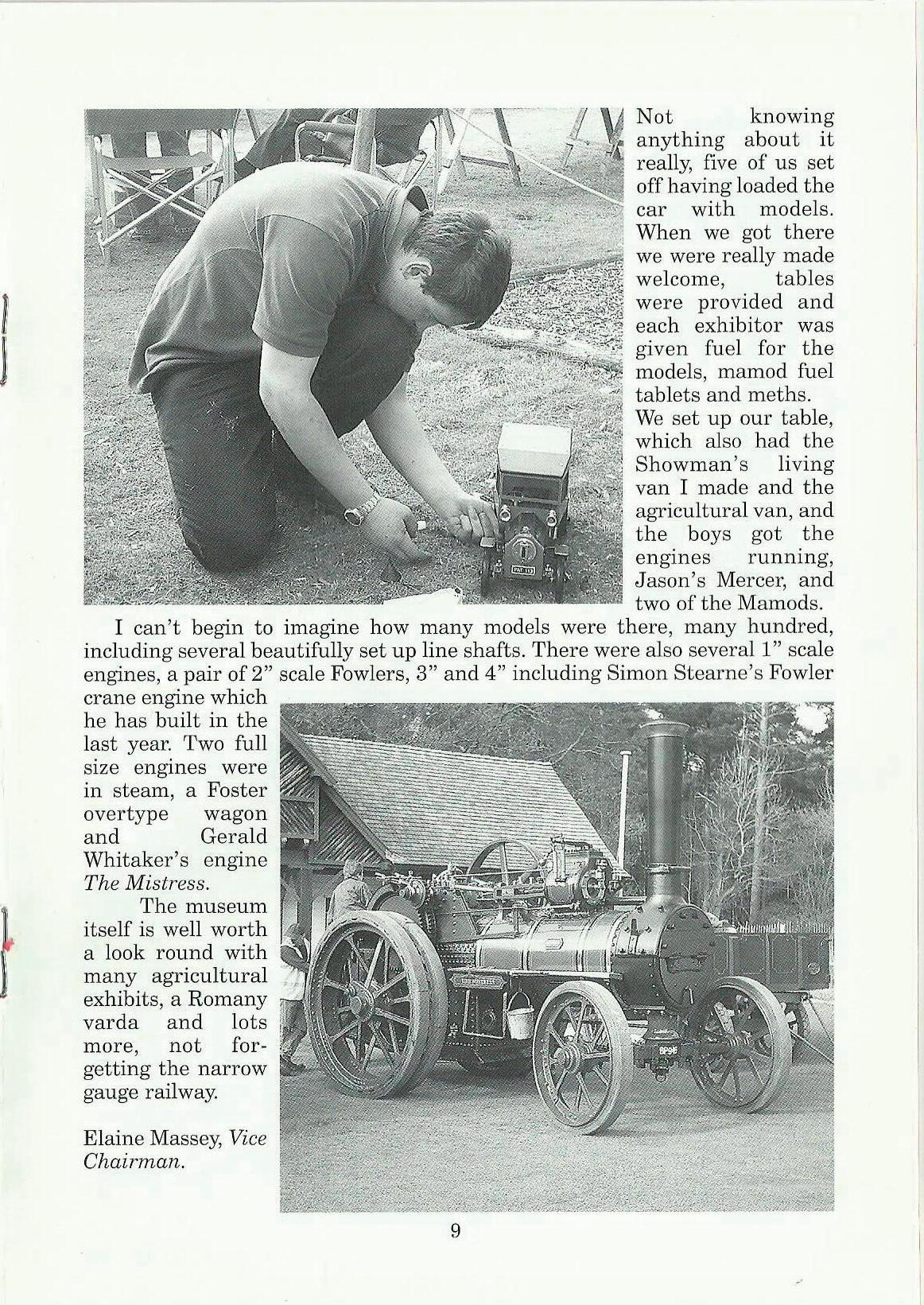
Not knowing anything about it really, five of us set off having loaded the car with models. When we got there we were really made welcome, tables were provided and each exhibitor was given fuel for the models, mamod fuel tablets and meths. We set up our table, which also had the Showman's living van I made and the agricultural van, and the boys got the . . eng1n.es running, Jason's Mercer, and two of the Mamods.
I can't begin to imagine how n1any models were there, many hundred, including several beautifully set up line shafts. There were also several 1" scale engines, a pair of 2" scale Fowlers, 3" and 4" including Simon Stearne's Fowler crane engine which he has built in the last year. 'I'wo full . size eng1nes were in steam, a Foster overtype wagon and Gerald Whitaker's engine The Mistress. The museum itself is well worth a look round with many agricultural exhibits, a Romany varda and lots more, not forgetting the narrow gauge railway.
Elaine Massey, Vice Chairman.
MAMOD SCALE LIVING VAN 'competition'
I have devised this to keep you all busy on non-steaming days, and hopefully provide an enjoyable challenge. The aim is that you all bring your models to Dorset and a prize will be awarded for the best one. The plans can be found as the loose drawing with the magazine.
Equipment
A sheet of mount board (the sort of board used for fraining pictures). Some small blocks of wood. Some thinner cardboard, cereal box or similar. PVA glue.
Four wheels eg HW3 from the Hobby's catalogue approx 5 cm diameter. A small piece of acetate, from a box of cards or Easter egg. Small piece of dowel 7 .5 cm for each axle.
Wire, coat hanger or similar.
Cut out and label all your pieces.
Glue two bases together and place under a weight so that they dry flat. Do the same with the ribs, gluing them in pairs. Repeat with the two belly box bases. Leave them to dry.
Cut out the door from one end and a window in one of the sides if you wish. If these are done carefully, the board cut out can be used for the door/ window. Make up the door and window and re-attach, hinging them if you wish. It is best to use a small piece of thin fabric for this, gluing it between the layers of card. You will need a narrow strip of card to act as a door fraine to sandwich your hinge.
When the base is dry glue on the third piece positioned 2mm from the sides and rear of your base. When this is dry then glue the bottom of your sides to the edge of the base and then glue the back of the van in between. Glue the front of the van between the sides level with the front of the smaller base.
To make the roof you need to glue the thinner card onto the four ribs, spaced equally but making sure they all fit inside the walls of the van. When this assembly is dry reinforce with a second layer of card. The roof could also be built using small wooden planks (coffee stirrers or similar). To make it look real, you could cover the roof with thin fabric to look like calico, or even use food cans as corrugated tin.
Make up the belly box and glue to the underside of your van. Make your doors using the same method as the van door.
The rear axle does not need to turn so glue the dowel, with wheels attached, onto a small block of wood approx 3 cm deep and glue that to the underneath of the van behind the belly box.
For the front axle use two small blocks of wood that 1natch the rear in height ie approx 3cm. Drill a central hole in these and bolt them together with a washer between them. Glue the dowel with wheels attached to this block and then glue the whole to the front underside. The 'A' frame for towing can be made very simply from a wire, see the diagram on the drawing.
To decorate the outside of the van, simply paint, or "plank" it using very thin card.
To furnish it use all your scrap card and your imagination!
Elaine Massey, Vice Chairman.
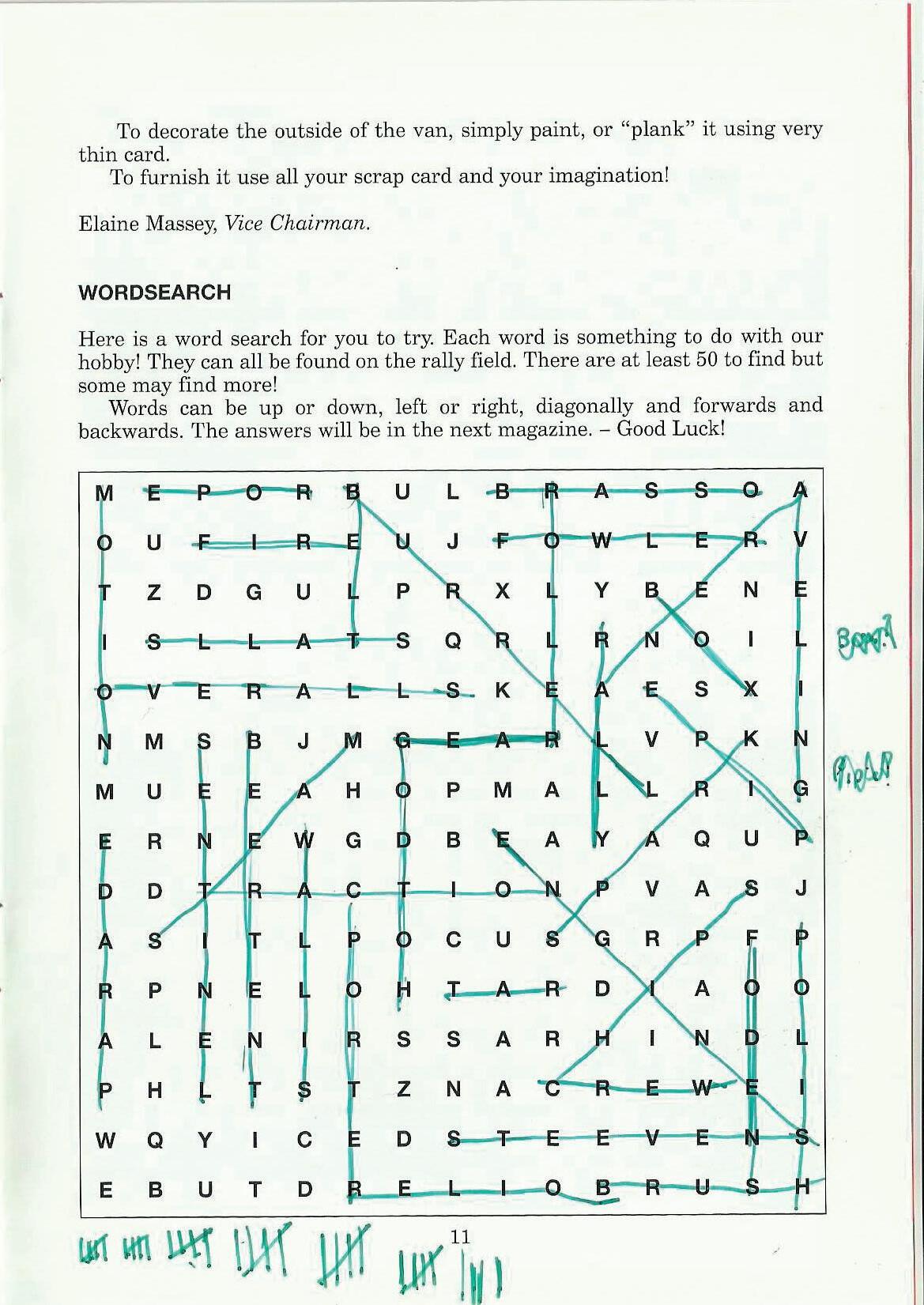
WORDSEARCH
Here is a word search for you to try. Each word is something to do with our hobby! They can all be found on the rally field. There are at least 50 to find but some may find more!
Words can be up or down, left or right, diagonally and forwards and backwards. The answers will be in the next magazine. - Good Luck!
KNOW YOUR TRACTION ENGINE Part 2
from Barry Sumsion
Last time we had begun to look at the different types of traction engine and had mentioned traction engines, tractors, road locomotives, showman's engines and crane engines. The other main groups must now be covered.
First of all there are the ploughing engines. These, usually large, machines are normally easy to spot due to their size and the winding drum beneath their boilers. Often at the bigger rallies you should be lucky enough to see these engines at work. Everything about these engines is built bigger and stronger than other types. This n1akes them less easy to use on the roads, especially ones
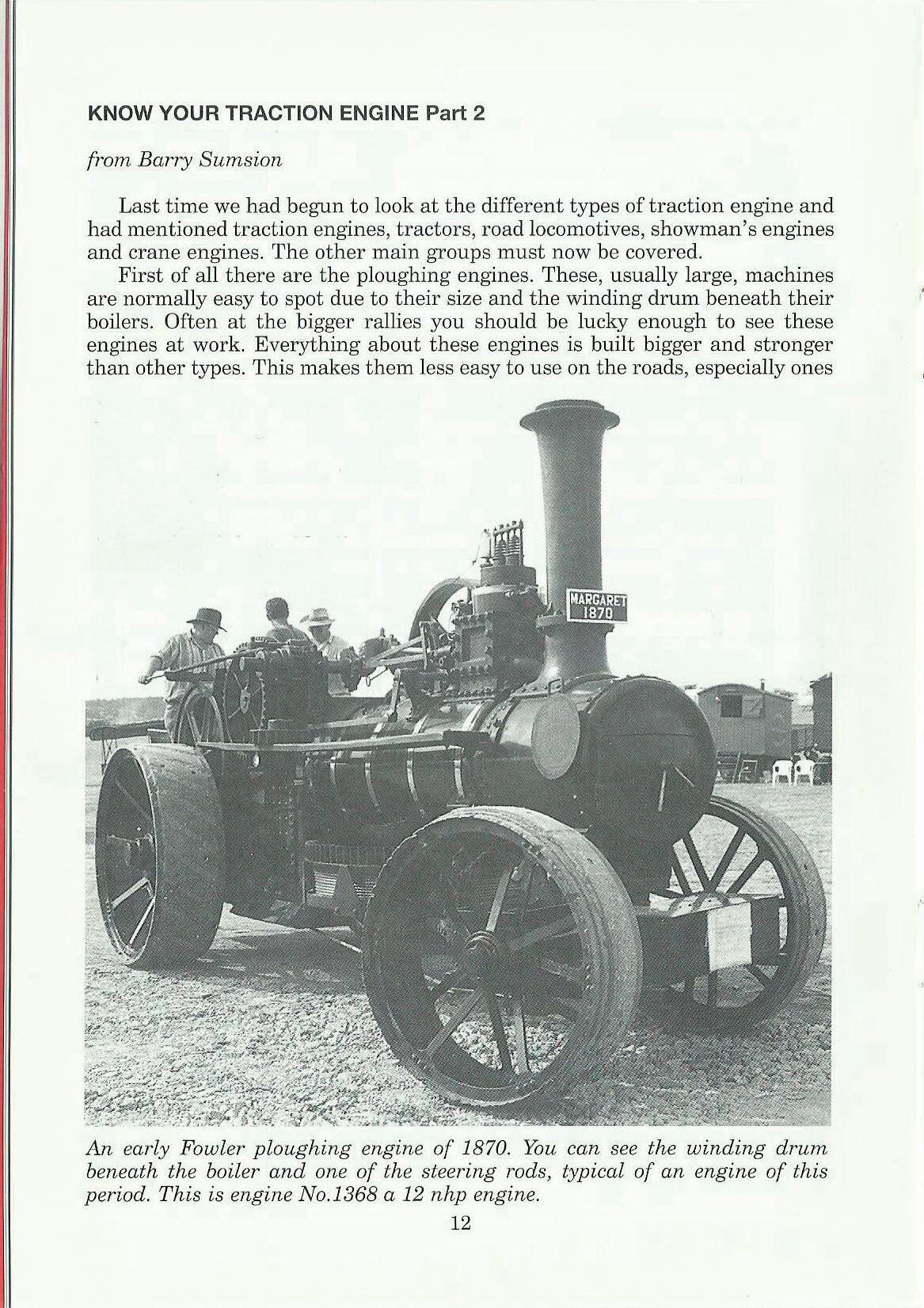
An early Fowler ploughing engine of 1870. You can see the winding drum beneath the boiler and one of the steering rods, typical of an engine of this period. This is engine No.1368 a 12 nhp engine.
Here we see the builder)s plate from Fowler No. 1368. This is an early style of plate and you will see that Fowler)s address was 'Steam Plough Works) at Leeds. Fowlers were providing agricultural equipment including ploughs before they produced steam engines.
which have the steering wheel right at the back of the engine and steering by long cumbersome rods and in some cases when you turn the wheel to the right, the engine turns to the left and vice versa! If you add their sheer bulk to this, then taking one out for a road run is not s01nething you take on easily. Most of the main manufacturers made ploughing engines at some time or other but the name most readily associated with the type is, of course, John Fowler and there are more Fowler ploughing engines left in preservation than any other make.
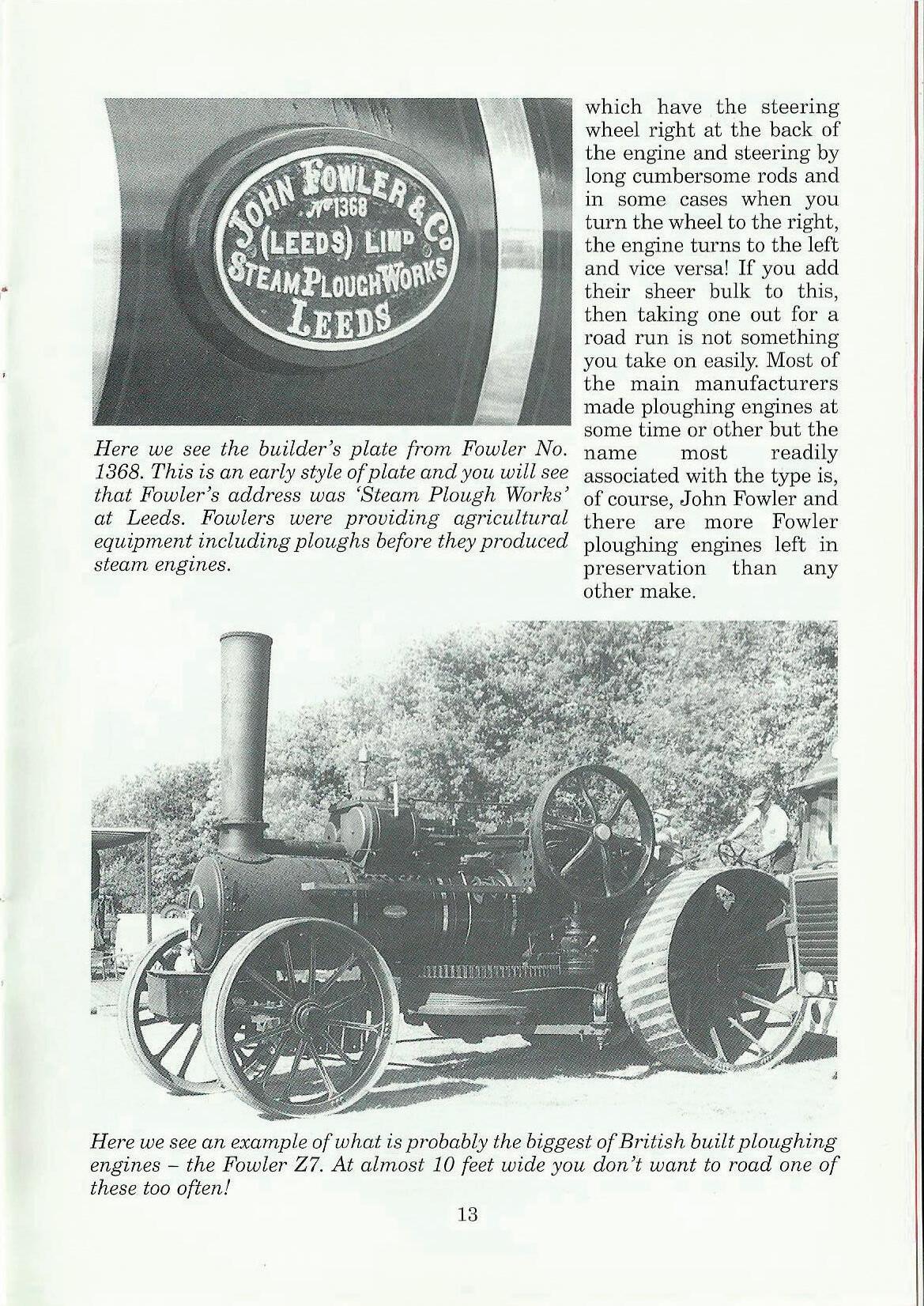
Here we see an example of what is probably the biggest of British built ploughing engines - the Fowler Z7. At almost 10 feet wide you don't want to road one of these too often!
The principle of the ploughing engine was actually very simple. Engines were normally supplied in pairs, one a left hand engine and one a right hand engine. A drum with steel cable wound upon it is mounted beneath the engine's boiler. The cable is attached to a reversible plough and the engine winds the plough across the field. The other engine's cable is also attached to the plough and this cable is pulled across the field behind the plough. At the end of the pull, the plough is reversed and the other engine now pulls it back. The need for left and right hand engines should now be obvious. The cable has to be fed off opposite sides of the engines in order that they may both face the same direction and slowly advance along the field. The steel cable used with ploughing engines obviously had to be of very high quality and that used by Fowlers gave industry a standard called BPS - Best Plough Steel, which was recognised as the best if you needed a cable of that calibre. Before we go on to our next group, we should be aware that some engines were built for 'direct ploughing' -that is they pulled the plough behind the1n, much as a present day tractor would. These are much rarer machines and you may not, at first, realise that you are looking at a ploughing engine.
Another 'main' group of engines is, of course, the road roller. There are probably more steam rollers in existence than any other type of traction. The reason is simply because they were in use in many parts of the country long after most other road steam had disappeared. It is unlikely that any of you would fail to recognise a road roller. They normally come with a wide front roll
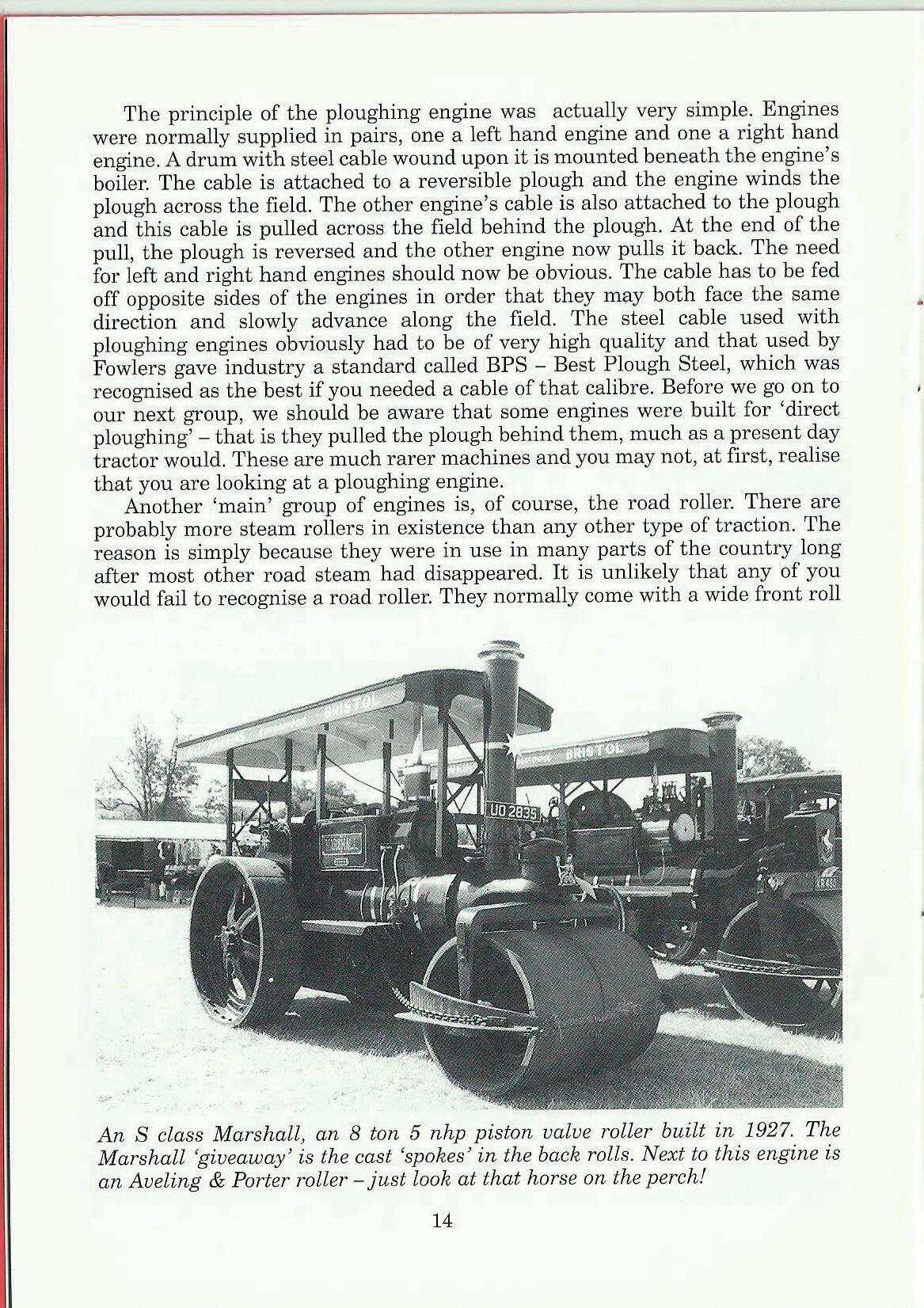
An S class Marshall, an 8 ton 5 nhp piston valve roller built in 1927. The Marshall (giveaway' is the cast (spokes' in the back rolls. Next to this engine is an Aveling & Porter roller - just look at that horse on the perch!
and rolls to the rear where there would be wheels on any other type of engine. The front roll is also usually mounted beneath a substantial front perch casting - nothing like other engines. They are mechanically very similar to the traction engine. They 1nay be single cylinder engines or compounds. It is said that the single cylinder was better for rolling, since the engine will reverse instantly more readily when rolling than might a compound. Apart from the rolls the gearing is likely to be 1nuch lower than on other engines and many machines will travel along at not much more than 4 miles an hour in top gear. Something you cannot see is the inside of the boiler. Roller boilers do not usually steam as fast and with as much volume as say a road engine. They simply do not require so much continuous power and so for the sake of economy and longevity their boilers are built accordingly. (This is also why, if you see an engine which has been converted from a steam roller into a tractor or showman's type, they can rarely perform those duties effectively as might the real thing!) Steam rollers were built by most of the main manufacturers and 1nany makes still exist in preservation but the name most frequently associated with the steam roller is Aveling & Porter. Rollers tend to be known by their weight rather than by their nominal horse power - they were not designed to replace the horse after all! Sizes from 8 tons to 15 tons would seem to be the normal range that rollers were built in - there were, of course, exceptions. Steam rollers tended to adopt a similar appearance whatever the manufacturer but again there are exceptionsnotably the Robey tandem and triple tandem rollers and the Wallis & Steevens Advance and Simplicity designs. Examples of these types still exist.
•• Rollers frequently
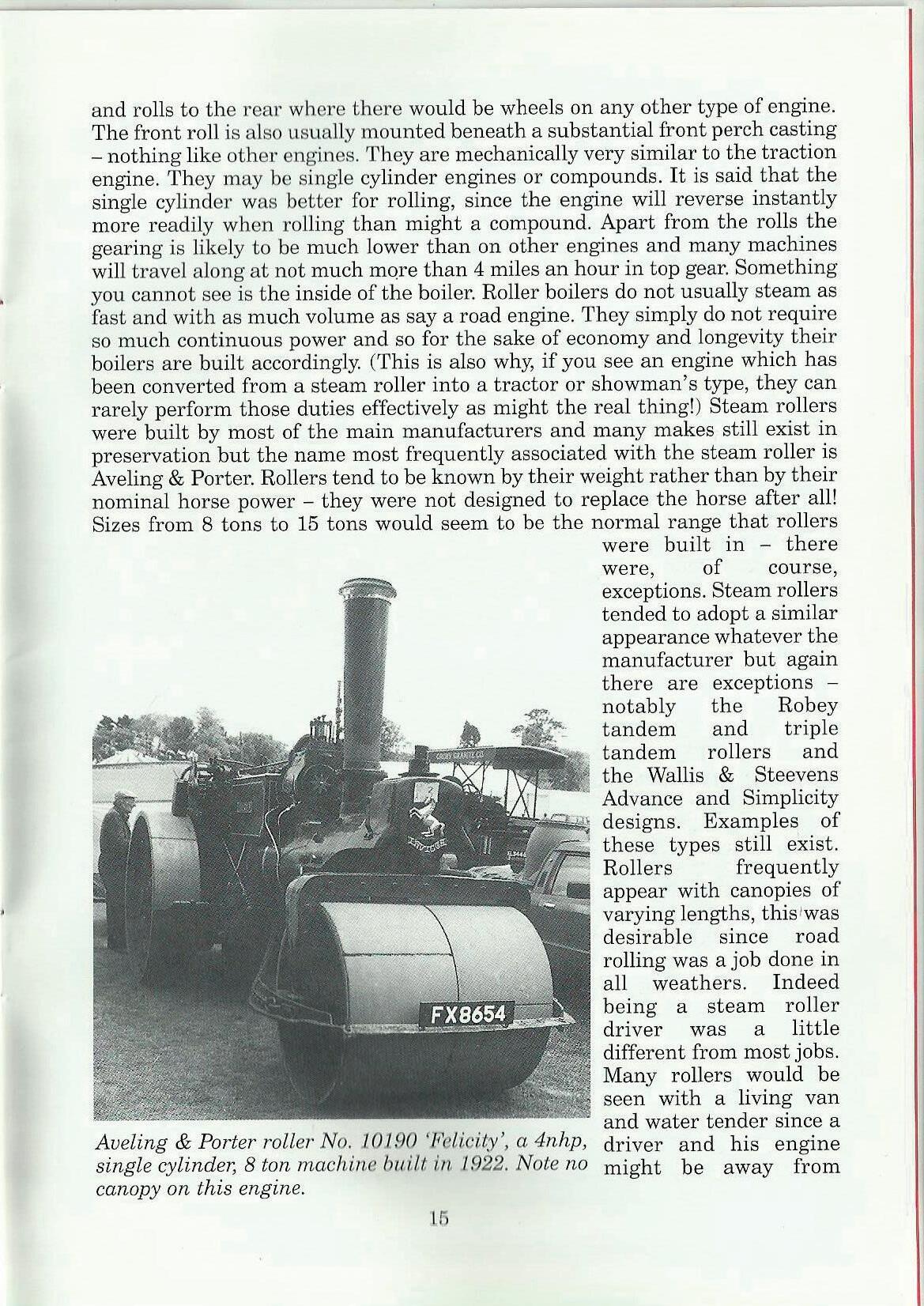
Aveling & Porter roller No. 10190 'l?~lici~y', a 4nhp) single cylinder, 8 ton machine bnilt in 1922. Note no canopy on this engine.
appear with canopies of varying lengths, thislwas desirable since road rolling was a job done in all weathers. Indeed being a steam roller driver was a little different from most jobs. Many rollers would be seen with a living van and water tender since a driver and his engine might be away from
home for weeks, travelling from one contract to another. The steam roller was much too slow to 'drive home every night' and so the driver lived in his living van and may have seen his family only occasionally.
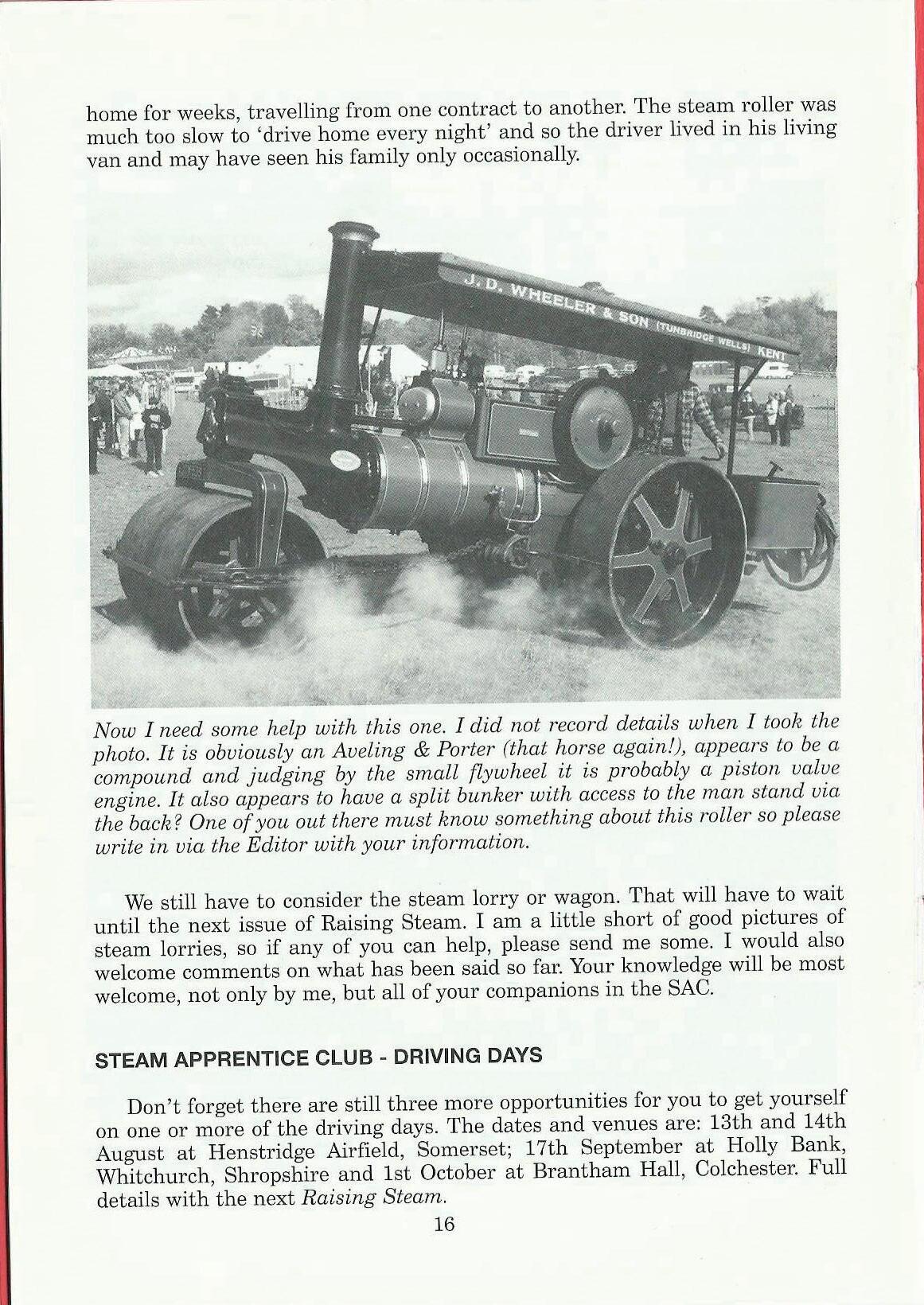
Now I need some help with this one. I did not record details when I took the photo. It is obviously an Aveling & Porter (that horse again!), appears to be a compound and judging by the small flywheel it is probably a piston valve engine. It also appears to have a split bunlier with access to the man stand via the back? One of you out there must know something about this roller so please write in via the Editor with your information.
We still have to consider the steam lorry or wagon. That will have to wait until the next issue of Raising Steam. I am a little short of good pictures of steam lorries, so if any of you can help, please send me some. I would also welcome comments on what has been said so far. Your knowledge will be most welcome, not only by me, but all of your companions in the SAC.
STEAM APPRENTICE CLUB - DRIVING DAYS
Don't forget there are still three more opportunities for you to get yourself on one or more of the driving days. The dates and venues are: 13th and 14th August at Henstridge Airfield, Somerset; 17th September at Holly Bank, Whitchurch, Shropshire and 1st October at Brantham Hall, Colchester. Full details with the next Raising Steam.