Please send your contributions to the Editon at least five weeks before publication. 'l'yped or ,, mailed articles are preferred but not essential. If handwrittep put any names ofJ'EGIPLE,!PLACESor ENGJNrnR Jn BLOCif CA:PIII'ALS. If you 'require any part q.f yow· article (eg photos) returning pleaEe say so and endose u fltampec1addressed envelope. Enclose your name, ad.dress an.d (if Apprentice) age with any contribut.ion. 'J'hu Editor r'ABarves the right to amend or refuse cont:ttlbi.ltions,and will attempt to correct spelling and grnmnmrl 'l'lw Magazine is normally publishci;l during 1:heearly IP.ru::t. of January, Apr.il, July and Octobe1•,'l'lw Ulub uucoµl~uu liability.far failure to meflt intended publication dates.
'l'he Steam A'pprentice Club is a section of the Nationa1 Traction Engine Tru~~. NTET is a Registered Charity,'!No, 29J,578. Registered in England No, 1802197 (Registered Office: 4 Church Green East, Redditc'h, WorcesterMhire 1308 AB'J1.
IPrinted by M [) Jenkins Printers Ltd, Lydney, Glos G-L151-EJ
I hope you all had a lovely Christmas and look forward to getting ready for this year's rallies.
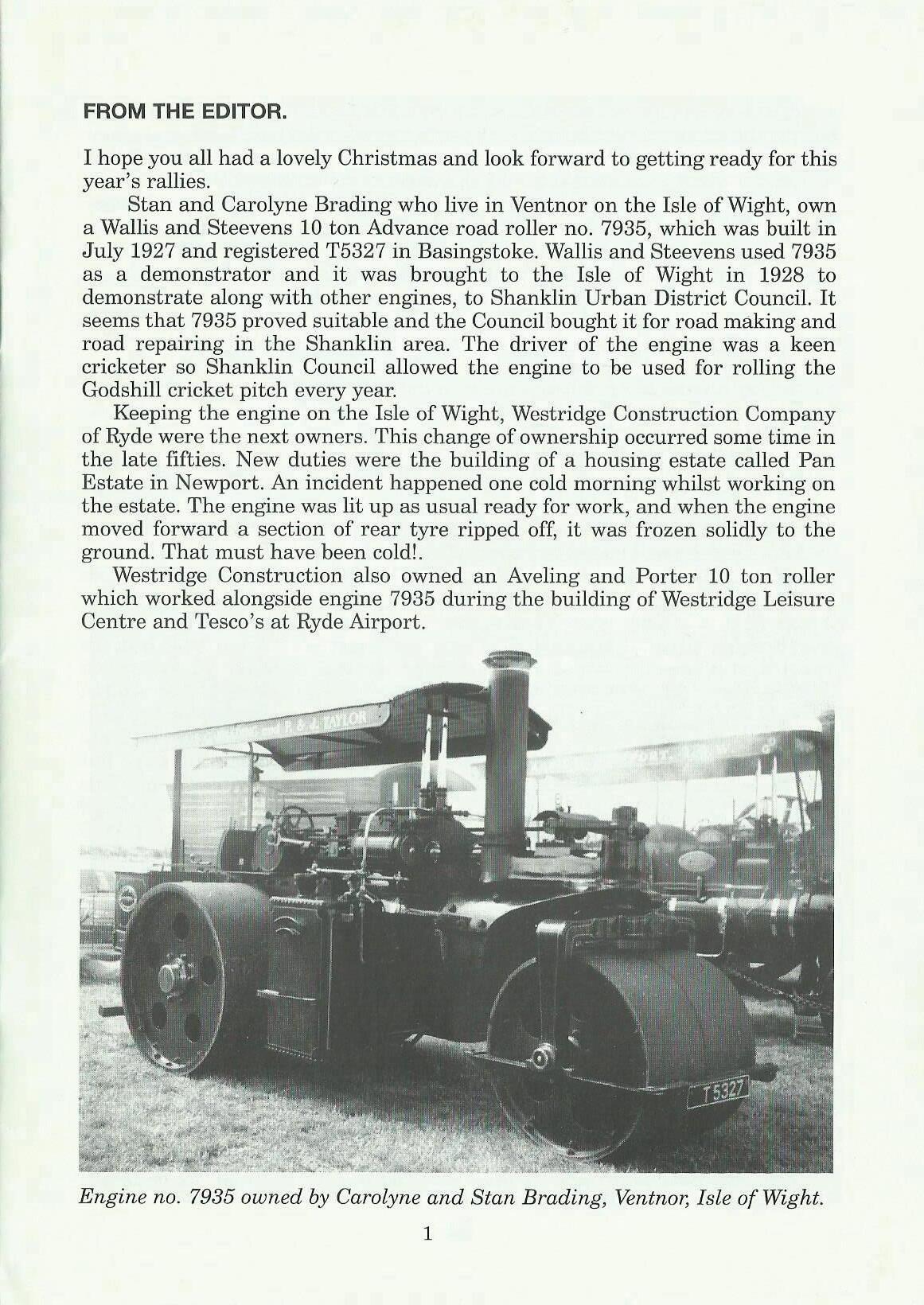
Stan and Carolyne Brading who live in Ventnor on the Isle of Wight, own a Wallis and Steevens 10 ton Advance road roller no. 7935, which was built in July 1927 and registered T5327 in Basingstoke. Wallis and Steevens used 7935 as a demonstrator and it was brought to the Isle of Wight in 1928 to demonstrate along with other engines, to Shanklin Urban District Council. It seems that 7935 proved suitable and the Council bought it for road making and road repairing in the Shanklin area. The driver of the engine was a keen cricketer so Shanklin Council allowed the engine to be used for rolling the Godshill cricket pitch every year.
Keeping the engine on the Isle of Wight, Westridge Construction Company of Ryde were the next owners. This change of ownership occurred some time in the late fifties. New duties were the building of a housing estate called Pan Estate in Newport. An incident happened one cold morning whilst working on the estate. The engine was lit up as usual ready for work, and when the engine moved forward a section of rear tyre ripped off, it was frozen solidly to the ground. That must have been cold!.
Westridge Construction also owned an Aveling and Porter 10 ton roller which worked alongside engine 7935 during the building of Westridge Leisure Centre and Tesco's at Ryde Airport.
Engine no. 7935 owned by Carolyne and Stan Brading, Ventnor, Isle of Wight.
The next change of ownership was in 1989 when Peter and Jill Taylor bought the engine. Over the next few years a new smoke box, stack and a new set of tyres were fitted followed by a repaint.
Carolyne and Stan bought a half share in the roller in 1999. They spent a very happy five years sharing the roller until November 2004 when they became the full owners. No. 7935 is extensively rallied through the summer and the odd trip out in the winter, usually teamed up on the road with Alan and Chris Sloper's Babcock & Wilcox 10 ton roller which was featured in the last magazine.
Nanette Sanders, Editor
THE CHAIRMAN'S BIT
Happy New Year to one and all.
Morning Star update.
Last time I was pleased to report that Morning Star was back in action, which she did quite spectacularly. So much so that the small lagging fire which emerged during the NTET road run became a full blown conflagration on the run from Northamptonshire back to Staffordshire. It shows how much heat is lost through the boiler lagging when the lagging starts to put heat back into the boiler! I have never known an engine to steam so well. The down side is that all of the boiler cladding sheets now need to come off again to be repainted and the wooden lagging replaced. This time I won't be using soft wood. I have been lucky to find a supply of oak flooring which is over 50 years old and should do the job quite well. It will, of course, be much harder to work in to shape but should be much more resistant to fire than the laths we used last time. 'rhis means that we are looking forward to yet another season of very limited activity whilst trying to sort things out. Still, it's better than working for a living!
Now to club matters.
How many of you managed to find an 'end of season' to attend?
Did you take any pictures?
Can we see the1n?
Did you get to work on an engine that you hadn't been on before? If so, let us know.
This year sees the start of one or two new ideas, as well as the trusty favourites.
We are running the driving days again, see the form elsewhere in this magazine, and we are again invited to the N'l'ET Driving Course at Hatton Country World in Warwickshire. See the advert for this on page 9.
The new ideas are:-
The Technical Apprentice of the Year Award, and a Certificate of Driver Competency.
The first is detailed on this page and describes an award which I hope will encourage some of you who are already carrying out engineering work, on either miniatures or full size, to document it and enter for this trophy. It is intended to be something that takes a bit of winning and is therefore worth the effort!
The second idea isn't really new, as the NTET have put in place the requirements for issuing a Certificate of Competency. The new bit is that we are now able to offer them to Apprentices.
Like the Technical Award, they won't be handed out easily though. If you have completed your log book and think that you are ready to go forward for a proper examination of your abilities please get in touch with me, I will then send you details of what will be required. There is one requirement that only time can help with, you must (as a minimum) have obtained a provisional driving licence. Several Apprentices have asked about this over the past couple of years, so I hope that a few of you can complete this process during 2005.
This time last year I signed off by saying that I must get back to the workshop or MS won't be ready for GDSF, it now looks very much the same this year - oh well!
I hope that I will be able to see some of you at the rallies later in the year.
John Durling, Chairman.
The
Steam Apprentice Club
announces its new annual award
The Technical Achievement of the Year Award
For the best technical achievement by an apprentice in the current year. Areas of achievement may include: work on full size engines, modelling, model engineering or any other appropriate steam related subject (bearing in mind that we are essentially a road steam organisation).
The purpose is to encourage young people to develop hands-on experience generally within typical engineering skills. Apprentices may enter themselves or)be entered by a sponsor for whom they have been working or have been under the instruction of.
Initial submissions should consist of a brief description on one side of A4 paper with 3 or 4 photographs or sketches and be with the SAC Chairman by the end of April. From these., suitable projects will be chosen, and final and fully detailed submissions will be invited to be with the Chairman. by the end of July. Judging will be completed by the end of September with the announcement of the winner by mid October. The award will be presented at the NTET AGM. Judges wiil be from members of the SAC Committee p.lus invited persons from an area appropriate to the subject entered.
Dear Editor
Quite exciting news, we've just acquired another engine. It's a 1914 Wallis & Steevens 8nhp called Peddler. My Dad has alreadly started to find out about its history and has found out why it is called Peddler; it leaked a lot so people called it Piddler but the owner thought that was too rude so he called it Peddler. We thought that was a funny bit of history. It's very interesting to us because it was made locally, in Basingstoke.
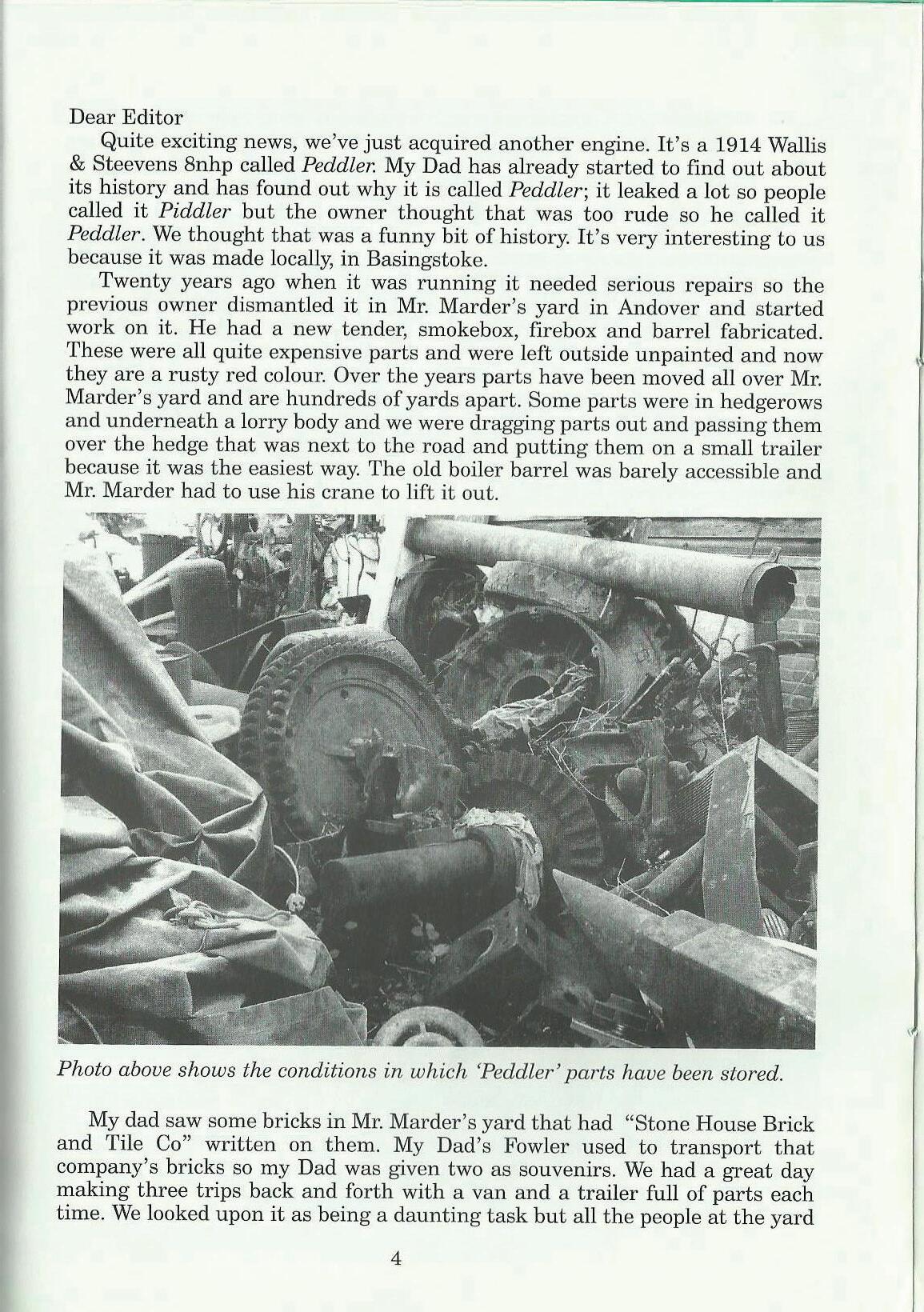
Twenty years ago when it was running it needed serious repairs so the previous owner dismantled it in Mr. Marder's yard in Andover and started work on it. He had a new tender, smokebox, firebox and barrel fabricated. These were all quite expensive parts and were left outside unpainted and now they are a rusty red colour. Over the years parts have been moved all over Mr. Marder's yard and are hundreds of yards apart. Some parts were in hedgerows and underneath a lorry body and we were dragging parts out and passing them over the hedge that was next to the road and putting them on a small trailer because it was the easiest way. The old boiler barrel was barely accessible and Mr. Marder had to use his crane to lift it out.
My dad saw some bricks in Mr. Marder's yard that had "Stone House Brick and Tile Co" written on them. My Dad's Fowler used to transport that company's bricks so my Dad was given two as souvenirs. We had a great day making three trips back and forth with a van and a trailer full of parts each time. We looked upon it as being a daunting task but all the people at the yard
Photo above shows the conditions in which 'Peddler' parts have been stored.
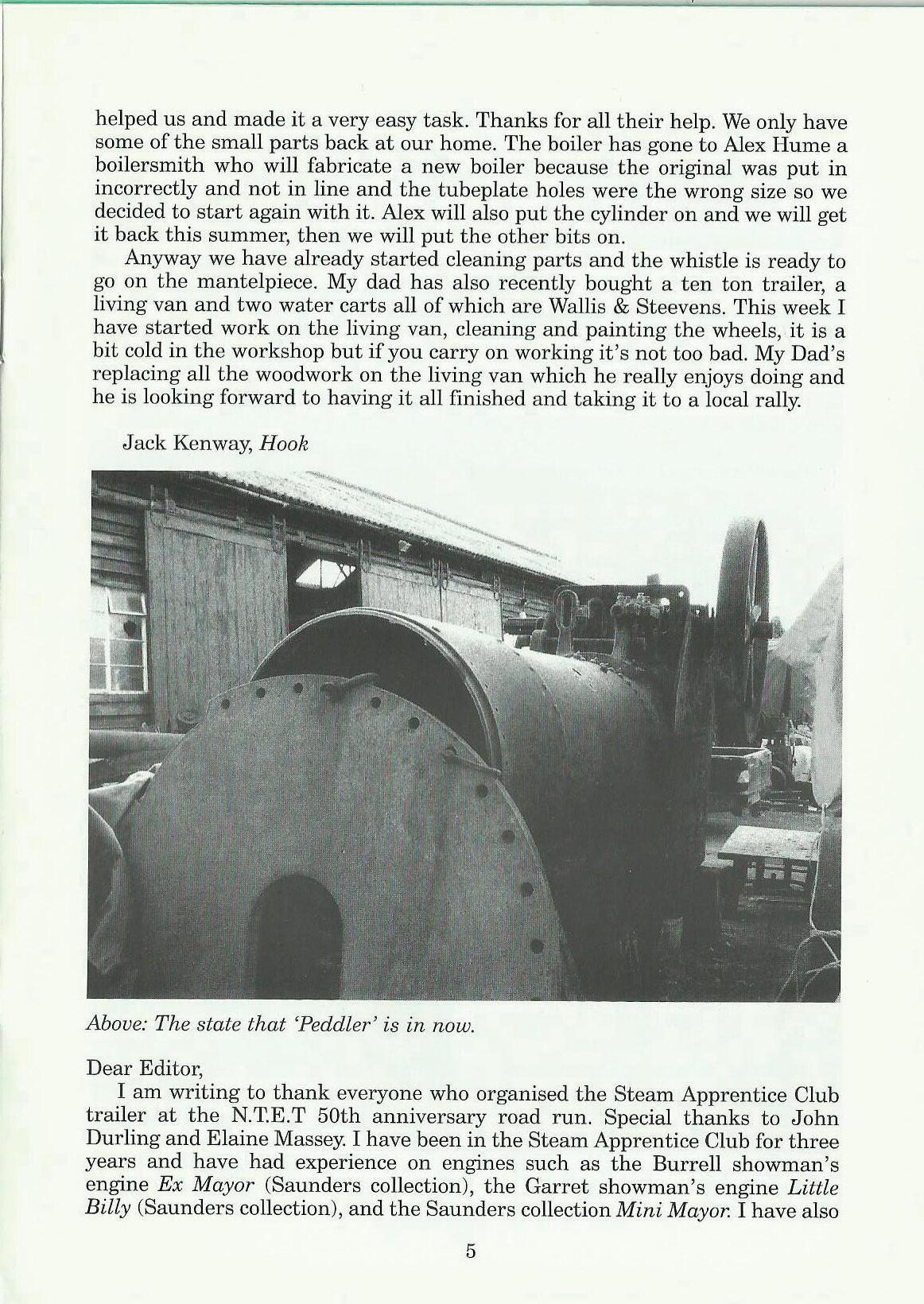
helped us and made it a very easy task. Thanks for all their help. We only have some of the small parts back at our home. The boiler has gone to Alex Hu1ne a boilersmith who will fabricate a new boiler because the original was put in incorrectly and not in line and the tubeplate holes were the wrong size so we decided to start again with it. Alex will also put the cylinder on and we will get it back this summer, then we will put the other bits on.
Anyway we have already started cleaning parts and the whistle is ready to go on the mantelpiece. My dad has also recently bought a ten ton trailer, a living van and two water carts all of which are Wallis & Steevens. This week I have started work on the living van, cleaning and painting the wheels, it is a bit cold in the workshop but if you carry on working it's not too bad. My Dad's replacing all the woodwork on the living van which he really enjoys doing and he is looking forward to having it all finished and taking it to a local rally.
Jack Kenway, Hook
Dear Editor,
I am writing to thank everyone who organised the Steam Apprentice Club trailer at the N.T.E.T 50th anniversary road run. Special thanks to John Durling and Elaine Massey. I have been in the Steam Apprentice Club for three years and have had experience on engines such as the Burrell showman's engine Ex Mayor (Saunders collection), the Garret showman's engine Little Billy (Saunders collection), and the Saunders collection Mini Mayor. I have also
Above: The state that 'Peddler' is in now.
had experience on the Worbey family's full sized Marshall and miniature Burrell, and miniature Faden, plus have also had experience on engines at the Shuttleworth St,eam Apprentice Weekends.
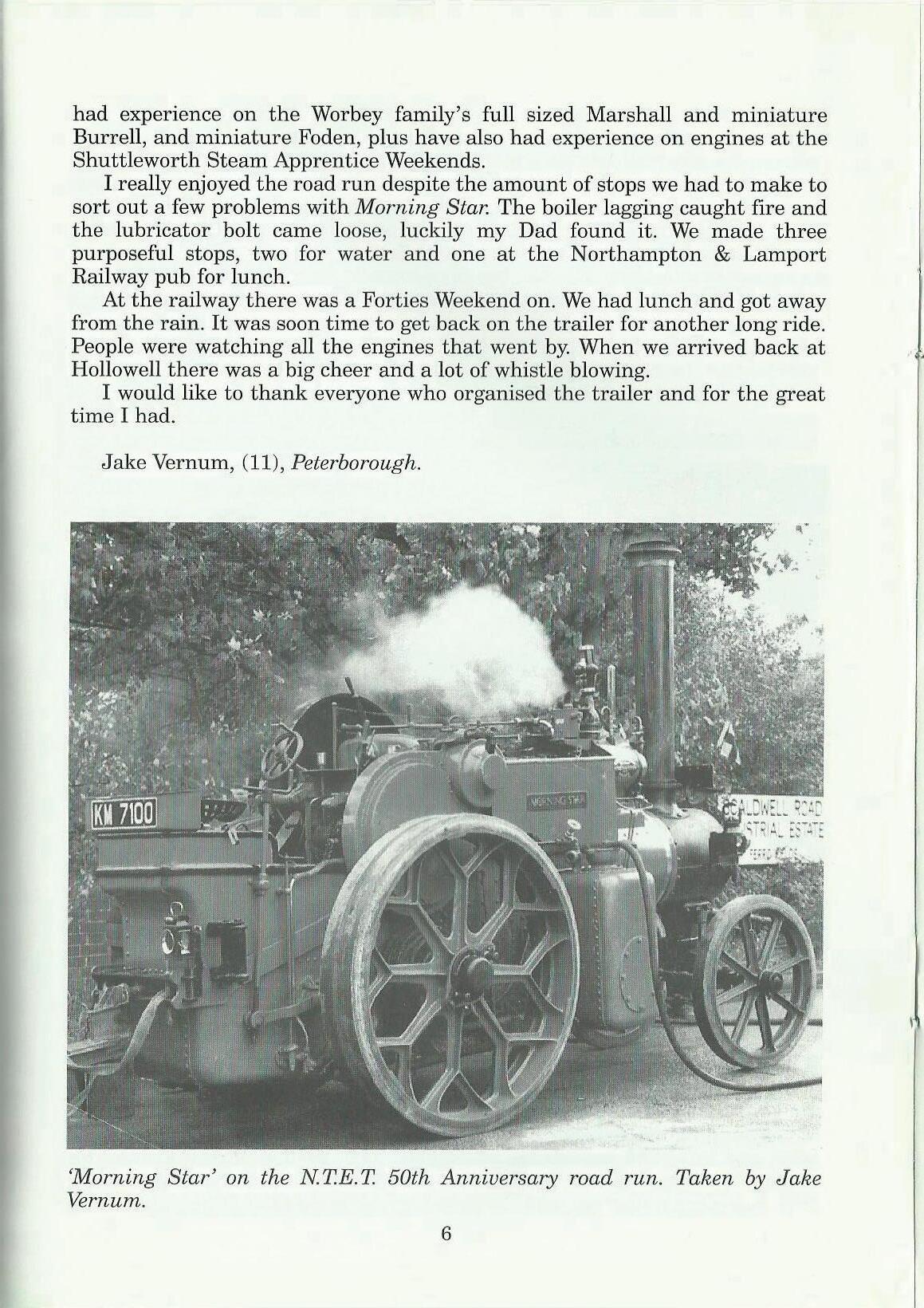
I really enjoyed the road run despite the amount of stops we had to make to sort out a few problems with Morning Star. The boiler lagging caught fire and the lubricator bolt came loose, luckily my Dad found it. We made three purposeful stops, two for water and one at the Northampton & Lamport Railway pub for lunch.
At the railway there was a Forties Weekend on. We had lunch and got away from the rain. It was soon time to get back on the trailer for another long ride. People were watching all the engines that went by. When we arrived back at Hollowell there was a big cheer and a lot of whistle blowing.
I would like to thank everyone who organised the trailer and for the great time I had.
Jalrn Vernum, (11), Peterborough.
'Morning Star' on the NT.E.T. 50th Anniversary road run. Taken by Jake Vernum.
Dear Editor,
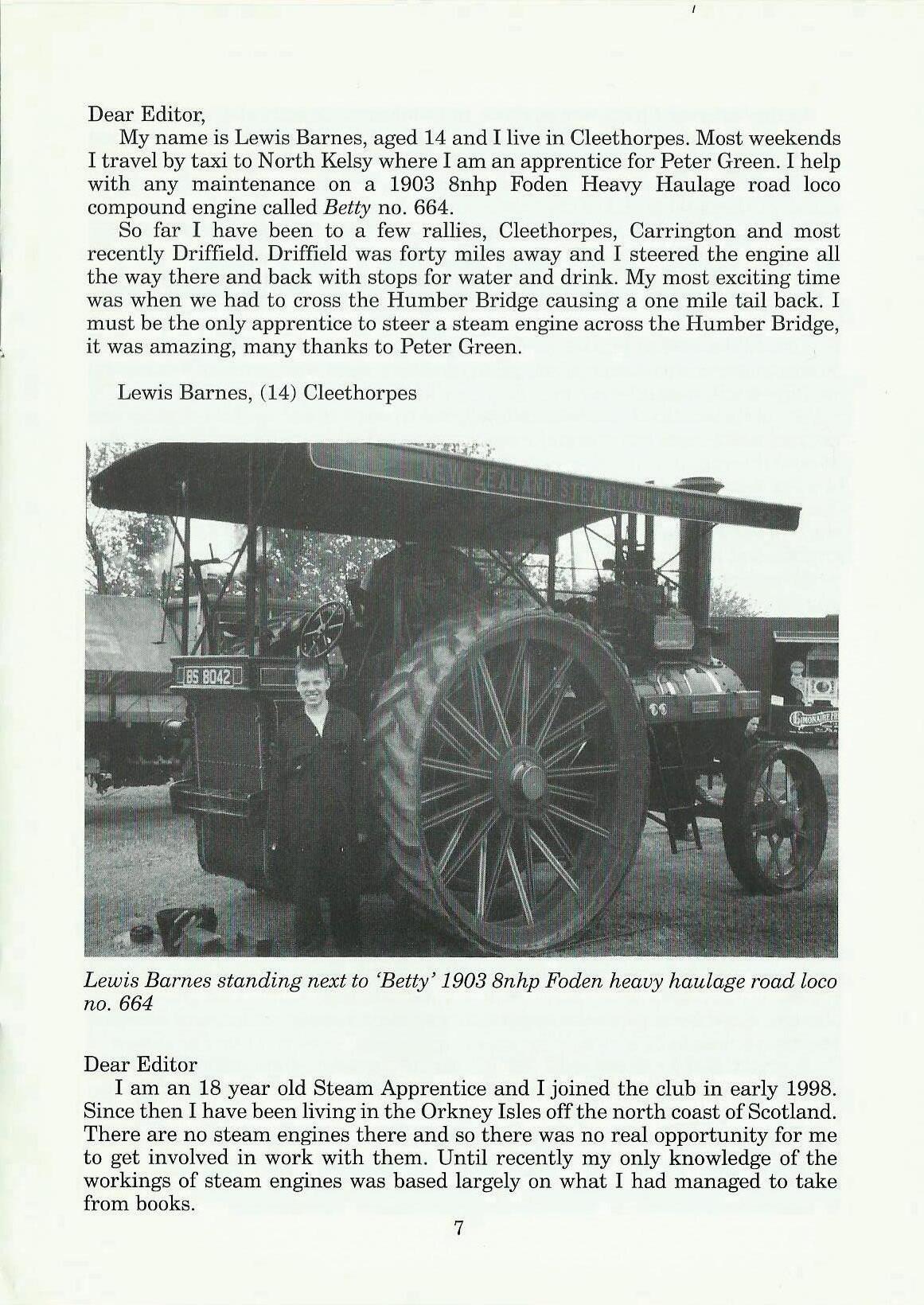
My name is Lewis Barnes, aged 14 and I live in Cleethorpes. Most weekends I travel by taxi to North Kelsy where I am an apprentice for Peter Green. I help with any maintenance on a 1903 8nhp Foden Heavy Haulage road loco compound engine called Betty no. 664.
So far I have been to a few rallies, Cleethorpes, Carrington and most recently Driffield. Driffield was forty miles away and I steered the engine all the way there and back with stops for water and drink. My most exciting time was when we had to cross the Humber Bridge causing a one mile tail back. I must be the only apprentice to steer a steam engine across the Humber Bridge, it was amazing, many thanks to Peter Green.
Lewis Barnes, (14) Cleethorpes
Lewis Barnes standing next to 'Betty' 1903 8nhp Faden heavy haulage road loco no. 664
Dear Editor
I am an 18 year old Steam Apprentice and I joined the club in early 1998. Since then I have been living in the Orkney Isles off the north coast of Scotland. There are no steam engines there and so there was no real opportunity for me to get involved in work with them. Until recently my only knowledge of the workings of steam engines was based largely on what I had managed to take from books.
In the last year I have moved south to Edinburgh; to start at University and I took the opportunity over the summer break to go to my first rally. I decided also to do it in style and to attend the Great Dorset Steam Fair.
When I arrived at the rally on day one, I stepped into the NTET tent and asked at the SAC stand if there was any chance I could ride on or drive an engine. I was told to appear the fallowing day, with boots and overalls, and they would try to get me working on a ploughing engine.
When I appeared, the following day; I was taken down to the ploughing field and introduced to the ploughing group operating the Wilder William and the Fowler Hercules.
One of the first things I noticed about the group was how willing they were to accept me as a member of the group and how good they were at feeding me with food and cups of tea.
As an Apprentice I was automatically set to work cleaning and polishing the engine, which gave the group the opportunity to test and adjust my knowledge of how the engine worked.
The next stage was to set up the cultivator and the two engines for work. Since both engines were already fired up all that remained was to set them at the two ends of the field. This was my first lesson in driving and controlling an engine, and it wasn't as easy as I thought it would be.
Over the next few days I had several goes at driving and controlling the engine during runs of the cultivator and when the engine was to be driven up or down the field at the start or end of the day. All of this was done under the close supervision of one of the members of the group.
On day five I had a go at firing up William which I found rather strange. I enjoyed it despite having to pluck the shovel out of the firebox!
I was surprised by just how much rule of thumb there was, and how much experience you need of each engine before you can drive them properly, you can't switch on and drive away like you can with a car. There is also an atmosphere to steam that you don't get with other machines and that you can't get from a book.
Other people that I met at the Rally (including those from SAC), encouraged me to look at modelling engines as a way of getting involved with steam from a place like Orkney. I had never really thought this to be possible, but I was given a lot of advice, and shown that it was possible, even with very few machine tools. I hope at some point to make an attempt at following this advice, and building an engine.
I was also helped out by SAC to find overnight accommodation when I missed my bus back to the hostel where I was staying. I did have a good excuse though; I had been given the opportunity to steer a steam roller, and time just seemed to pass by!
I would like to thank all of the Steam Apprentice Club officials and the ploughing team, for their help and guidance (and food), during the rally. They were possibly the best five days of my life, worth the wait since I joined the Club and I will try my best to make it down to Dorset for another five next year.
Derro.
Dear Editor,
My name is Vicky Rowe, I am a steam enthusiast and I am writing this to tell you of the steam engine rallies that go on in Cornwall and the ones that I go to. I also have access to engines every weekend, Berkswell an 8nhp Fowler traction engine built in 1899, works no. 8282 and owned by Brian Johns of Chacewater and Spitfire an Aveling & Porter 8 ton compound road roller owned by G.T. Stone. In August 2003 I received a cup 'The Stuart Solomon Cup' for the most enthusiastic Junior Member at the West of England Steam Engine Rally.
The first rally of the year is Camborne Trevithick Day which was on 24th April 2004. It was great fun bringing and taking the engines to Trevithick Day. The sad thing was not being able to take the engines through the street. Instead all of the engine men and women including myself paraded through the street on foot. The next day we had the road run which started at Crofty Mine and went through the street, through Four Lanes, Carn Brea then back to Crofty, but some of the engines carried on home.
The next steam rally I went to was Boconnoc which is in Liskeard. That was on the 16th, 17th and 18th July 2004. I like this rally very much except the weather, at the time. It rained, so on the Sunday when it was time to go home all the engines got stuck so they had to be pulled out by a tractor or Berkswell which has tractor tyres on the back so it has 1nore grip plus the engine has a fitted winch. During that weekend I was on and off engines either driving or steering them. The engine that I was mostly on during the weekend was Berkswell. Apart from the rain the engine rally was brilliant.
On Sunday 25th July I got up at 5.30am because I was being picked up at 6.30am to go up to Boconnoc again to bring Berkswell down to Wadebridge in time for the Cornish Traction Engine Rally which was on 7th and 8th August 2004 which I also attended. I will keep you infonned of the rest of the rallies and outings I attend during the rest of the year.
Vicky Rowe (15), Cornwall.
NTET DRIVING COURSE
HATTON COUNTRY WORLD, HATTON, WARWICKSHIRE
14TH & 15TH MAY 2005
If you want to get some really good instruction on the operation and maintenance of traction engines - and enjoy yourself as well - this is for you. For more details and an application form send a C5 (for A5) SAE to John Durling.
SAC members are again being offered massive discounts on the full cost:• 13 to 15 years - £41.13 (inc VAT) 16 to 21 years - £70.80 (inc VAT)
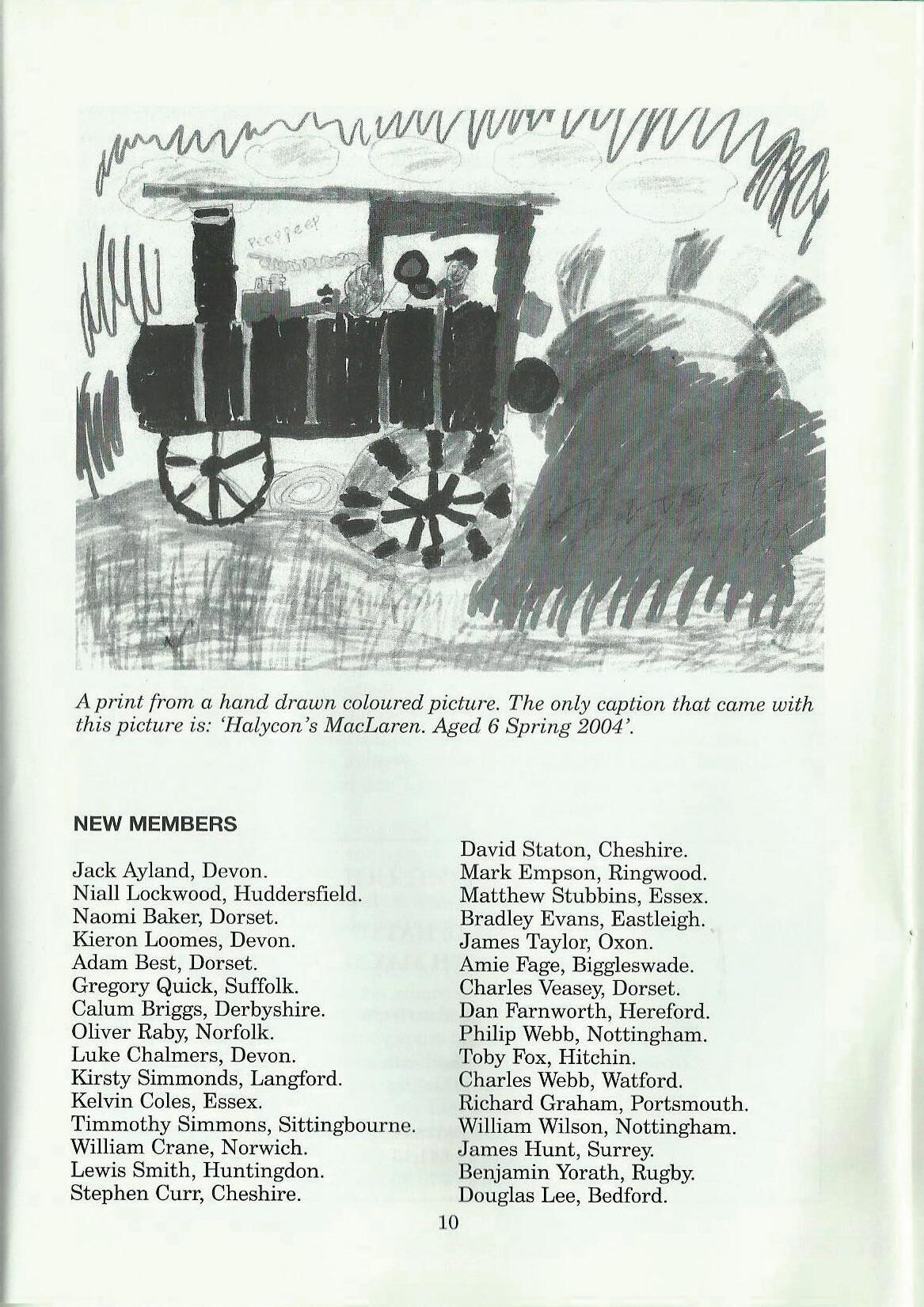
A print from a hand drawn coloured picture. The only caption that came with this picture is: 'Halycon 's MacLaren. Aged 6 Spring 2004'.
Oliver Raby, Norfolk. Luke Chalmers, Devon. Kirsty Simmonds, Langford. Kelvin Coles, Essex.
Timmothy Simmons, Sittingbourne. William Crane, Norwich. Lewis Smith, Huntingdon. Stephen Curr, Cheshire.
David Staton, Cheshire. Mark Empson, Ringwood. Matthew Stubbins, Essex. Bradley Evans, Eastleigh.
James Taylor, Oxon. Amie Fage, Biggleswade. Charles Veasey, Dorset.
Dan Farnworth, Hereford. Philip Webb, Nottingham.
Toby Fox, Hitchin. Charles Webb, Watford.
Richard Graham, Portsmouth.
William Wilson, Nottingham.
James Hunt, Surrey.
Benjamin Yorath, Rugby.
Douglas Lee, Bedford.
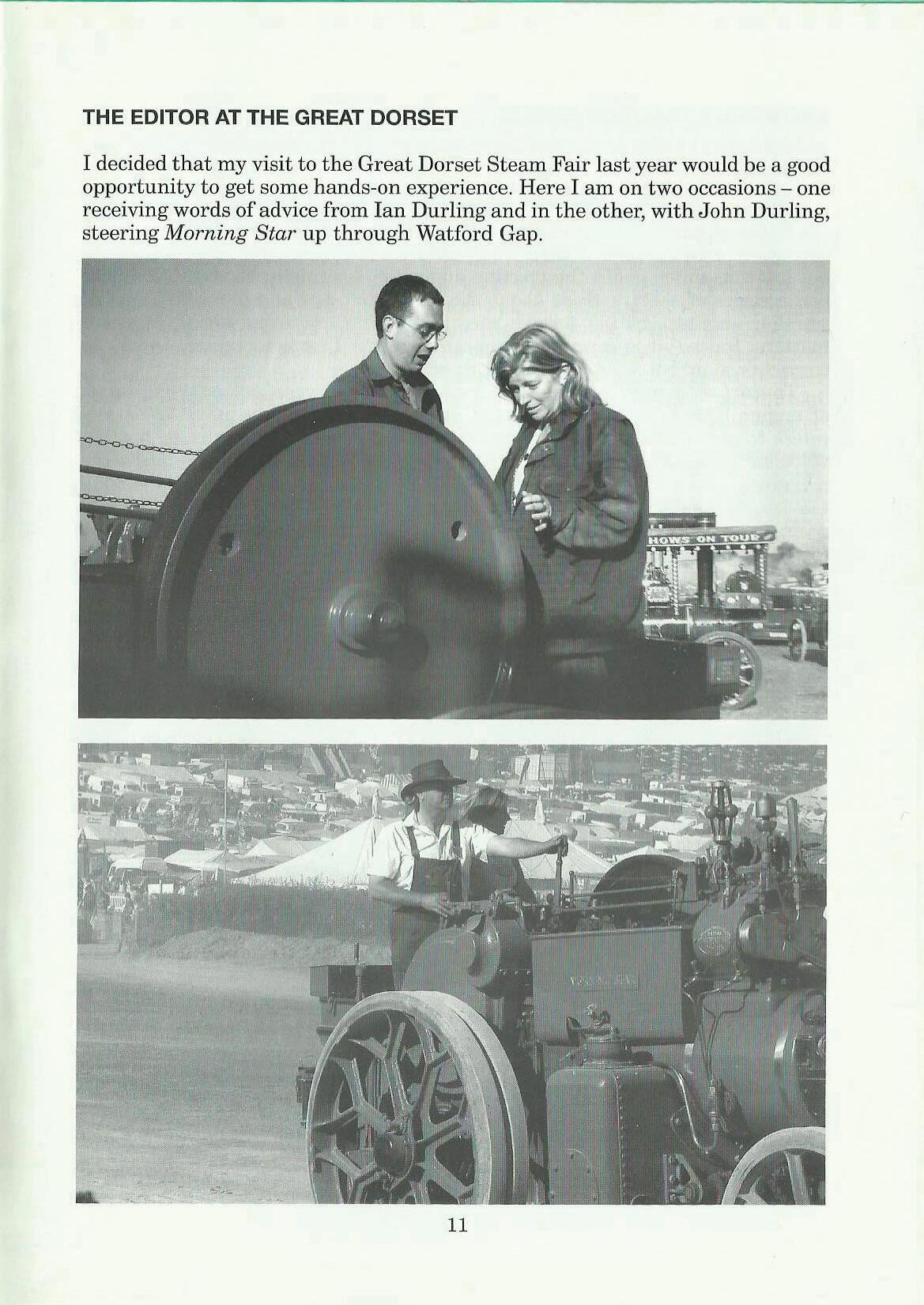
THE EDITOR AT THE GREAT DORSET
I decided that my visit to the Great Dorset Steam Fair last year would be a good opportunity to get some hands-on experience. Here I am on two occasions - one receiving words of advice from Ian Durling and in the other, with John Durling, steering Morning Star up through Watford Gap.
KNOW YOUR TRACTION ENGINE
from Barry Sumsion
Although I am no longer your editor, I am still involved with the running of the SAC and had always intended still to contribute to the magazine. From the correspondence I received when I was editor, it is obvious that many of you do not know as much about the traction engine as you might. My intention is to pen a series of short articles about the different types and manufacturers of traction engines. Please forgive me, those who are experienced in these matters. Indeed, it is from those apprentices that I hope to receive letters to correct or augment what I am about to write!
To start with, perhaps we should look at the main types, rather than makes, of engine (that will follow later). The expression 'traction engine' generally refers to any steam propelled vehicle which runs on its own wheels, has big wheels at the back and smaller ones at the front and a chimney. That is the perceived image of a traction engine by the general public. So, without getting too complicated, let's discuss the main types of engine.
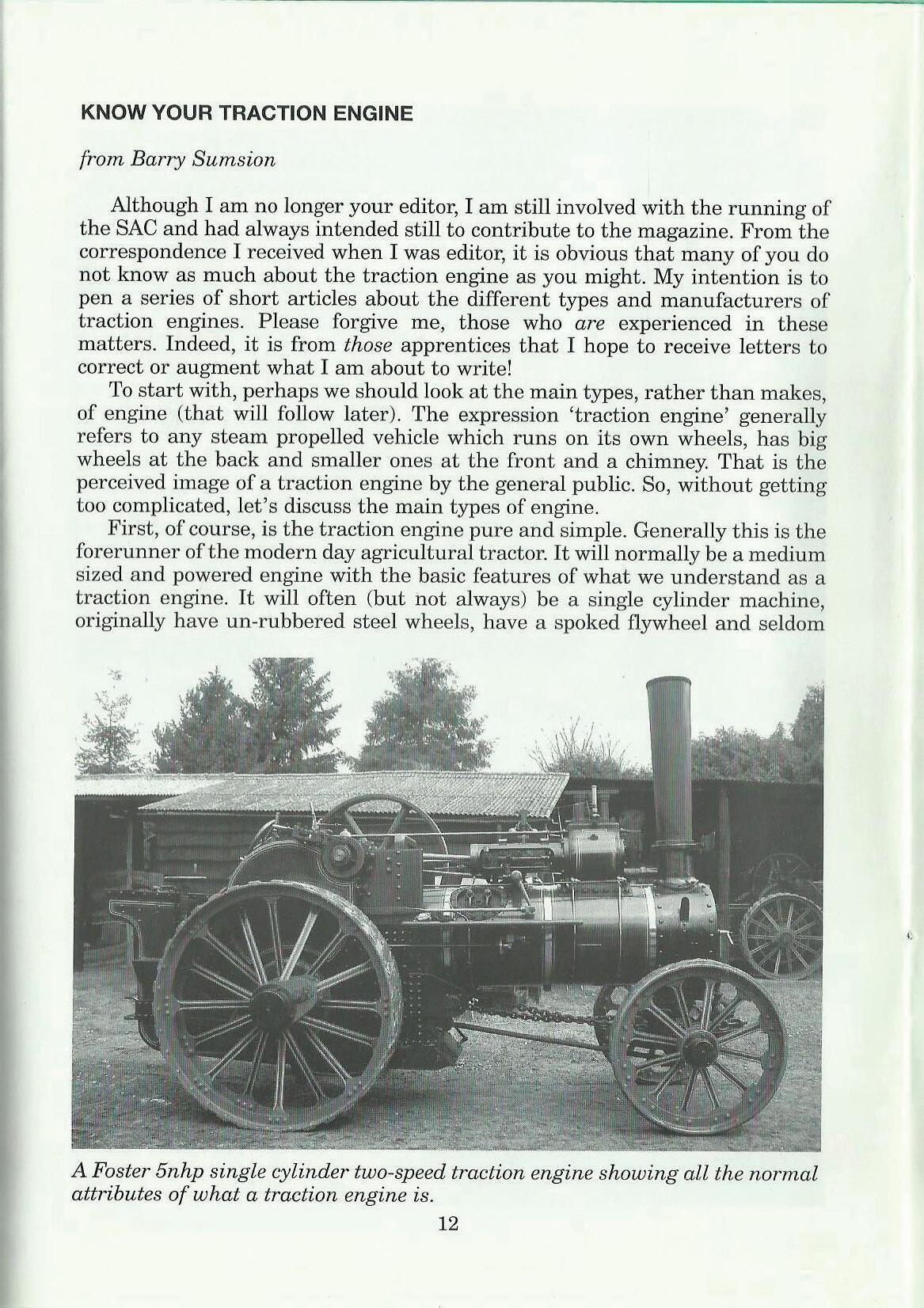
First, of course, is the traction engine pure and simple. Generally this is the forerunner of the modern day agTicultural tractor. It will normally be a medium sized and powered engine with the basic features of what we understand as a traction engine. It will often (but not always) be a single cylinder machine, originally have un-rubbered steel wheels, have a spoked flywheel and seldom
A Foster Snhp single cylinder two-speed traction engine showing all the normal attributes of what a traction engine is.
have any form of canopy. It will more often than not have gearing to give it two speeds. There are more of these in preservation than any other type of engine and they usually range in power from 4nhp to 6nhp. There are exceptions to these statements and this will be true of almost any specification that I mention.
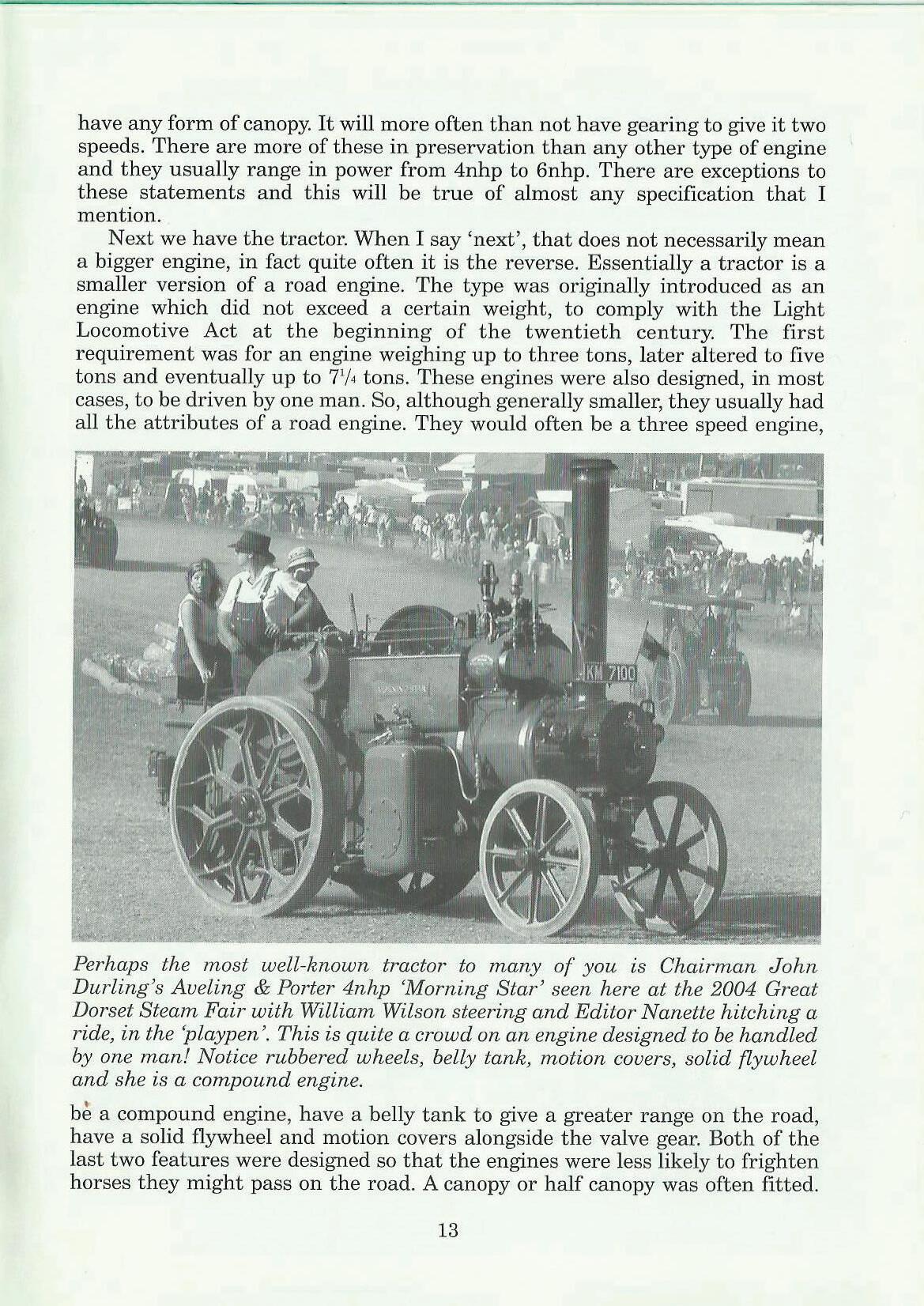
Next we have the tractor. When I say 'next', that does not necessarily mean a bigger engine, in fact quite often it is the reverse. Essentially a tractor is a smaller version of a road engine. The type was originally introduced as an engine which did not exceed a certain weight, to comply with the Light Locomotive Act at the beginning of the twentieth century. The first requirement was for an engine weighing up to three tons, later altered to five tons and eventually up to 71/4 tons. These engines were also designed, in most cases, to be driven by one man. So, although generally smaller, they usually had all the attributes of a road engine. They would often be a three speed engine,
Perhaps the 1nost well-known tractor to many of you is Chairman John Durling's Aveling & Porter 4nhp 'Morning Star' seen here at the 2004 Great Dorset Steam Fair with William Wilson steering and Editor Nanette hitching a ride, in the 'playpen'. This is quite a crowd on an engine designed to be handled by one man! Notice rubbered wheels, belly tank, motion covers, solid flywheel and she is a compound engine.
be a compound engine, have a belly tank to give a greater range on the road, have a solid flywheel and motion covers alongside the valve gear. Both of the last two features were designed so that the engines were less likely to frighten horses they might pass on the road. A canopy or half canopy was often fitted.
To confuse matters, manufacturers sometimes cheated, selling an engine as a tractor, quoted as being beneath a certain weight to comply with the act, whereas we know that several of these engines were definitely over the prescribed weight. They frequently carried a plate relating to the weight or had it painted on, knowing it to be incorrect! A good example of a tractor which is usually 'overweight' is the Garrett 4CD, especially when it is in showman's trim.
Then we come to the road engine proper, often ref erred to as a road locomotive. These tended to be from about 5nhp upwards, were usually compound engines and had all the attributes mentioned about the tractors. They were inevitably heavy engines. Just about everything about their build
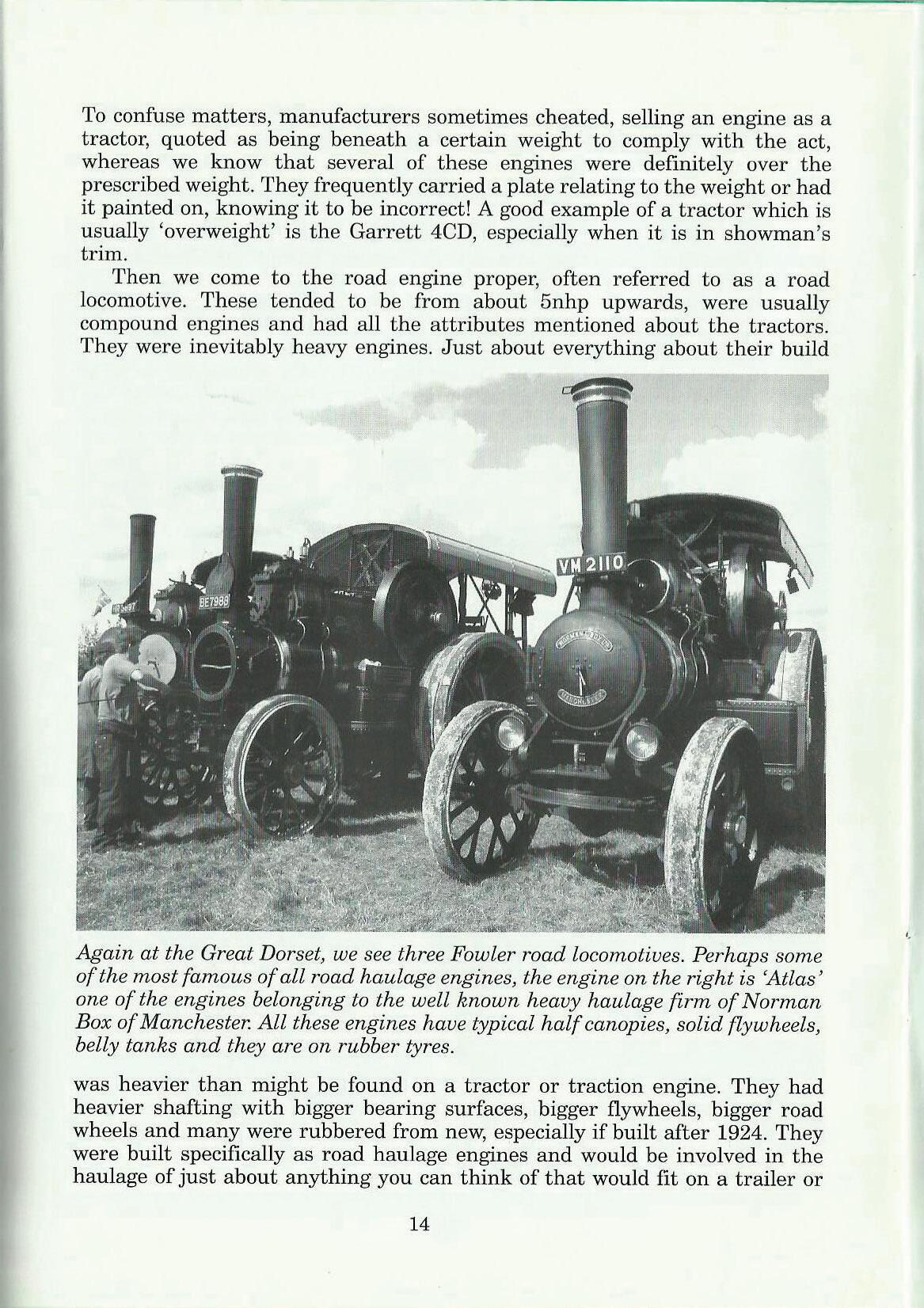
Again at the Great Dorset, we see three Fowler road locomotives. Perhaps some of the most famous of all road haulage engines, the engine on the right is 'Atlas' one of the engines belonging to the well known heavy haulage firm of Norman Box of Manchester. All these engines have typical half canopies, solid flywheels, belly tanks and they are on rubber tyres.
was heavier than might be found on a tractor or traction engine. They had heavier shafting with bigger bearing surfaces, bigger flywheels, bigger road wheels and many were rubbered from new, especially if built after 1924. They were built specifically as road haulage engines and would be involved in the haulage of just about anything you can think of that would fit on a trailer or
trailers. A load of 40 tons contained in say three traction wagons would not be unusual for a 7- or 8nhp engine. Where heavier loads were involved more than one engine would be used. This did not always mean that the main engine could not pull the load, rather that it needed more than one engine to control the braking of the load down hills. The Road Vehicles (Registration and Licensing Regulations, 1924) limited the weight of a road locomotive to 151/2 tons. There were exceptions to this rule where permanent fittings such as a crane was fitted or where pneumatic or son tyres were used. Hence the fitting of rubber tyres from around that date. Many engines exceeded this weight. Several engines survive and many of you will have seen them hauling heavy loads in the playpen at the Great Dorset.
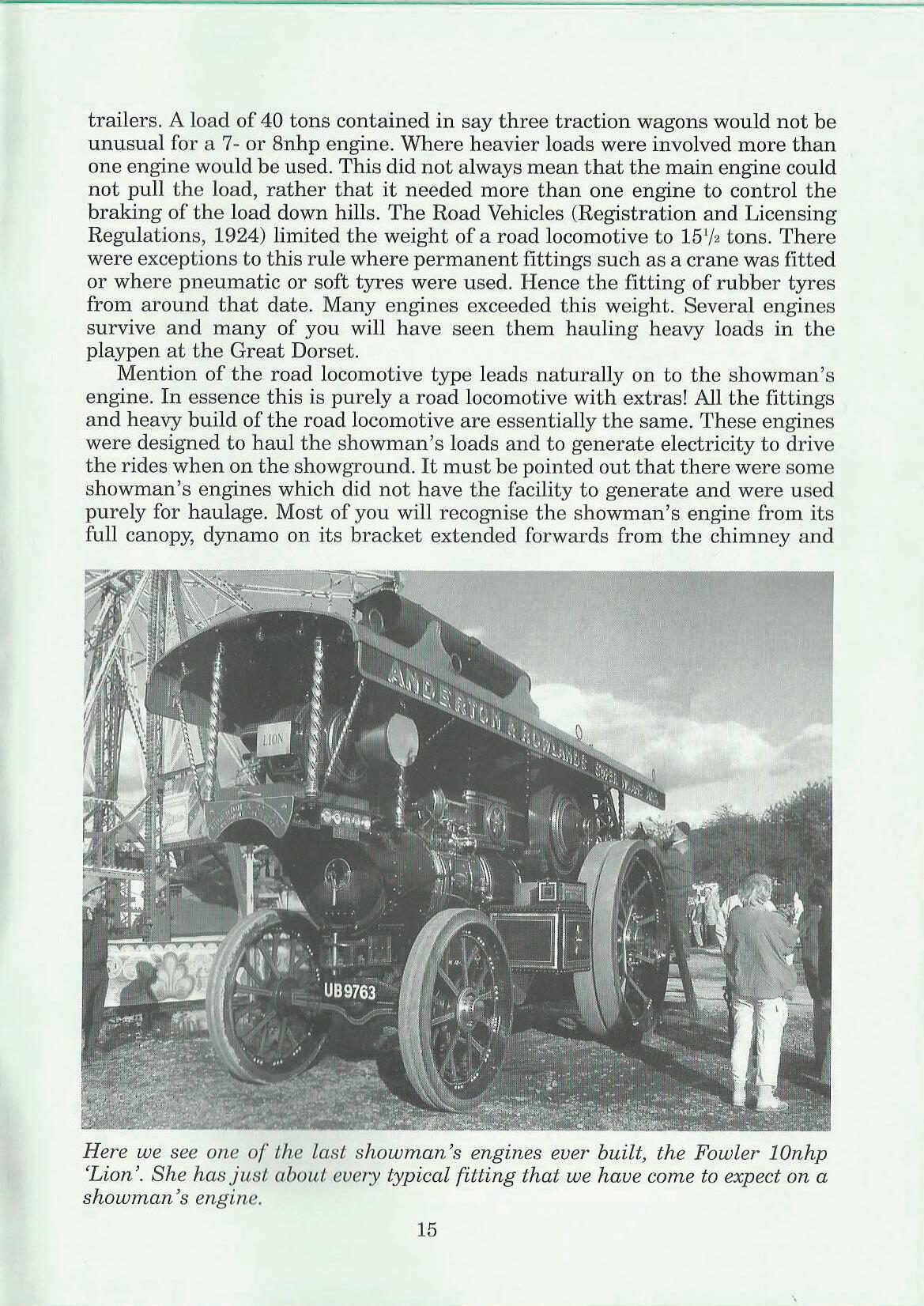
Mention of the road locomotive type leads naturally on to the showman's engine. In essence this is purely a road locomotive with extras! All the fittings and heavy build of the road locomotive are essentially the same. These engines were designed to haul the showman's loads and to generate electricity to drive the rides when on the showground. It must be pointed out that there were some showman's engines which did not have the facility to generate and were used purely for haulage. Most of you will recognise the showman's engine from its full canopy; dynamo on its bracket extended forwards from the chimney and
Here we see one of the last showman's engines ever built, the Fowler lOnhp 'Lion'. She has just about every typical fitting that we have come to expect on a showman's engine.
generally decorated paintwork. Many have decorative brasswork as well but not all. This depended on what the original purchasing showman either preferred or could afford. Some engines also have a crane mounted on the bunker to assist in lifting heavy pieces of the rides when setting up or pulling down. Some of you will associate that last feature with the Burrell scenic locomotives, but other showman's engines also had cranes on them. The Burrell scenic was a specially equipped engine, more of which later.
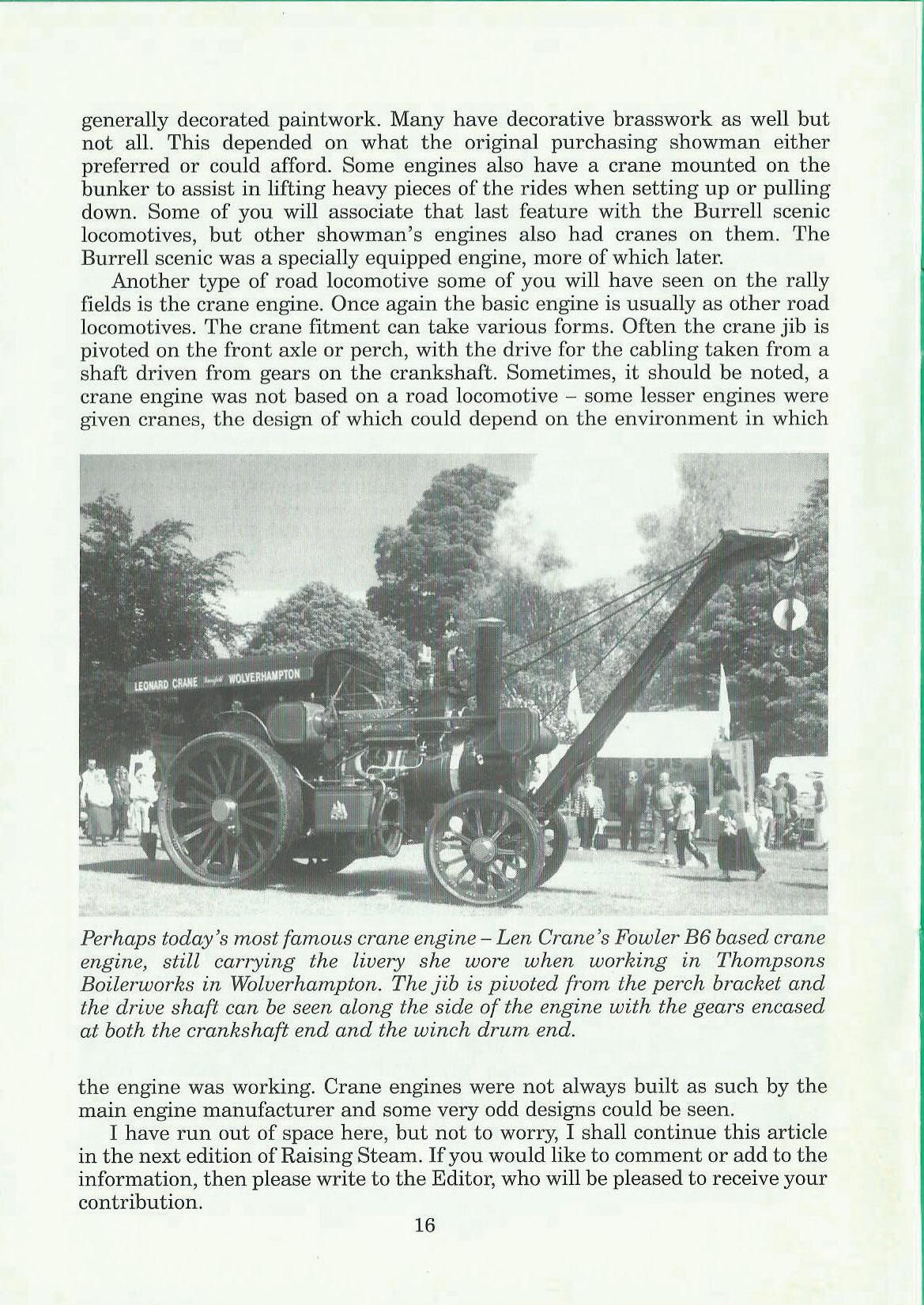
Another type of road locomotive some of you will have seen on the rally fields is the crane engine. Once again the basic engine is usually as other road locomotives. The crane fitment can take various forms. Often the crane jib is pivoted on the front axle or perch, with the drive for the cabling taken from a shaft driven from gears on the crankshaft. Sometimes, it should be noted, a crane engine was not based on a road locomotive -some lesser engines were given cranes, the design of which could depend on the environment in which
Perhaps today's most famous crane engine - Len Crane's Fowler B6 based crane engine, still carrying the livery she wore when working in Thompsons Boilerworks in Wolverhampton. The jib is pivoted from the perch bracket and the drive shaft can be seen along the side of the engine with the gears encased at both the crankshaft end and the winch drum end.
the engine was working. Crane engines were not always built as such by the main engine manufacturer and some very odd designs could be seen.
I have run out of space here, but not to worry, I shall continue this article in the next edition of Raising Steam. If you would like to comment or add to the information, then please write to the Editor, who will be pleased to receive your contribution.
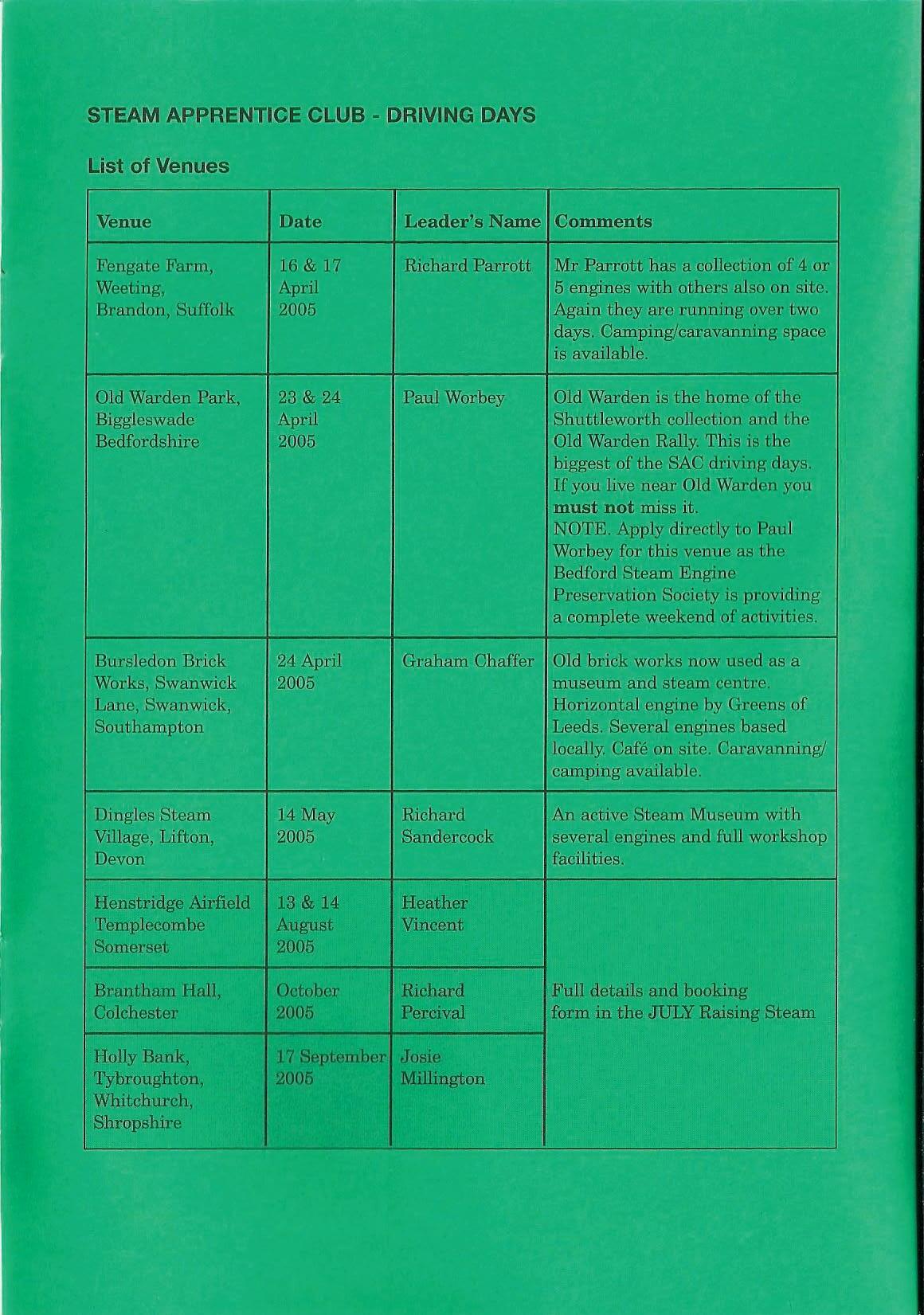
STEAM APPRENTICE CLUB - DRIVING DAYS
List of Venues
V.enue
Bate
tFengate Farm, 113,&a7
Leader's Name Comments
Richarfil Parrott
Mr Parr.ott has a co1lection of 4 or Weeting, April 5 engines wi'Uho'f:lhersalso @nsite. Brandon, Suffolk 2005 ~ ain tihey are running over two clays. Camping/caravanning space I• iis available .
Old Warden Par'k, 23 & 24 .PaJi Wonbey: Old War0.en ds Uhe home of the 1Biggleswade April Shuttleworth collection and ithe Bedfordshire 2@01\ Old Warden Rally. ll'his is lhe biggest ofd;he SAC dr.i,vingdays. [[fyQu h,ve near Old Warden you I' mus1f not miss it.
II iN0'.1/E.Apply directly to Paul Worbey for this venue as i1he !Bedford Steam Engine
Prese:r:vation Society is providing a ~completeweekend of activities.
Burs'ledon Brick r:24Apri1 Graham Cha:f/fer Old b:rfok.works now used as a Wmfu:s,Swanwick. 2005 EuS:eum and steam cen'ti·e. Lane, Swanwjck, rorizcmtal engine lby Greens 0f Sou11hampton