RAISING STEAM
EDITOR
STEAM APPRENTICE CLUB MAGAZINE
Nanette Sanders, Frog Cottage, New Road, Porchfield, Isle of Wight PO30 4LS Tel: 01983 523317 e-mail: sac.raisingsteam@ntet.co.uk
CHAIRMAN, STEAM APPRENTICE CLUB
John DurlingiHawthorn CottageiStubwood,Uttoxeter,StaffordshireST14 51-IX Tel: 01889 591188 (between 08.00 and 21.00 hours only please) e-mail: john.r.durling@uk. transport. bombardier.cam
VICE-CHAIRMAN, STEAM APPRENTICE CLUB
Elaine Massey, 21 Down Close, Northolt, Middlesex UB5 6NS Tel: 020 8248 6570 e-mail: elainermassey@aol.com
MEMBERSHIP SECRETARY
John Cook, Dolfarni, Church Lane, Kirkby la Thorpe, Sleaford, Lincolnshire NG34 9NU. Correspondence only. Membership fee £5.00 per annum.
APPRENTICE REPRESENTATIVE
Gareth Haase, 6 Poplars, Waltham Chase, Southampton SO32 2RH Tel: 07720718008 e-mail: sac@ghaase.co.uk
SAC CO-ORDINATORS
Sam Bate, 30 Mowbray Grove, Bishopsgarth, Stockton-on-Tees, Cleveland TS19 8XA Tel: 01642 897153 e-mail: sambate@lycos.com
Graham Chaffer, 32 Jubilee Way, Storrington, West Sussex RH20 3NZ Tel: 01903 745921 e-mail: chaffer.gang@ic24.net
Duncan Croser, 16 Tripps Hill Close, Chalfant St. Giles, Bucks HP8 4JZ Tel: 01494 875443 e-mail: duncan.croser@ntlworld.com
Steve and Dom1a Taylor, 17 Smith Crescent, Coalville LE67 4JF Tel: 01530 835213 e-mail: steve.tailor@btinternet.com
Matthew Lund, Willow Cottage, 'fwynam's Hill, Shirrell Heath, Southampton SO32 2JL Tel: 01329 832462 e-mail: matt.lund@engineer.com
Barry Sumsion, 1 Leicester Road, Newport, South Wales NP19 7ER Tel: 01633 213332 (office) e-mail: barry@kearline.co.uk
The Editor welcomes any contributions of articles, shorter items or photographs for inclw,ion in ruI11n• iRRUAH.AlI material submitted is voluntary and payment cannot be made for any materiAI publiRhed.'l'ho opin101111r•xpr11111-1NI in the magazine, with the exception of Club announcements, are those of LhPcon~ributon-1nnd tlo nnl. irulirnt11l,h11 views of the Club as a whole. All items are held copyright by the contrlbu1or 11nd1,hoN'l'l~'I'
Please send your contributions to the Editor aL loaH1,J'iv1• w11olt11hnfnr1• p11hlk11tInn 'l'ypml or e-mailed articles are preferred but not essential. If hundwriU,on put 1111y111111wH or PMC>PI,M, l'I ,ACT•!Hm·lr!NC1TNT~R in BLOCK CAPITALS.If you require any part ol' your ui-Uc:ln(tig photu1-1ln1turnJ11nplt•111111Hny1-111und r•11clns1, n stamped addressed envelope. Enclose your namo, nddrnRR and (if App1·1•11f1ml 111-(1•with nny rnnf rdmf 1011.'l'ho Mdilor reserves the right to amend or ref1.1seconLribuU01111,nnd will nl,ji,111pllo tim rnrl ~,1t,l1111J.l 1111d grn111nmrl 'E'hc Magazine is normally published during the Pnrly p1u f, uf ,J111111111y, /\pill, ,luly 1111d Orf11fu1 1· 'f'lw Cluh accepLs no liability for failure to meet intended publfoaUonuul11H, The Steam Apprentice Club is a section of LhoNt1l1011ul'l'rnl'f Ju11 rn,11{ltlt1 'l'l'IIHL. NTET is a Registered Charity, No. 291678. ltogiHL(•rodin J1}ngl1111dNo. 1ao21 ~J7. Registered Office: 4 Church Green Ea1:1L,H.mldilllli,Wo,•m1Hlt11•Hl111·1•UDHHB'l', Typesetting and Artwork by Kearline Graphic Tu111g<'HUd, Ji\1troak lfouRr•Business Centre, Church Road, Newport, South Wales NP19 7EJ Tel: 0Hl:l'.l 2mn1n l1\1x: otn:tl :.!n!HJ8Uomail: general@kearline.co.uk Printed by MD Jenkins Printers Lld, Lydmiy, Cllo11<llii Ii ,tM,I
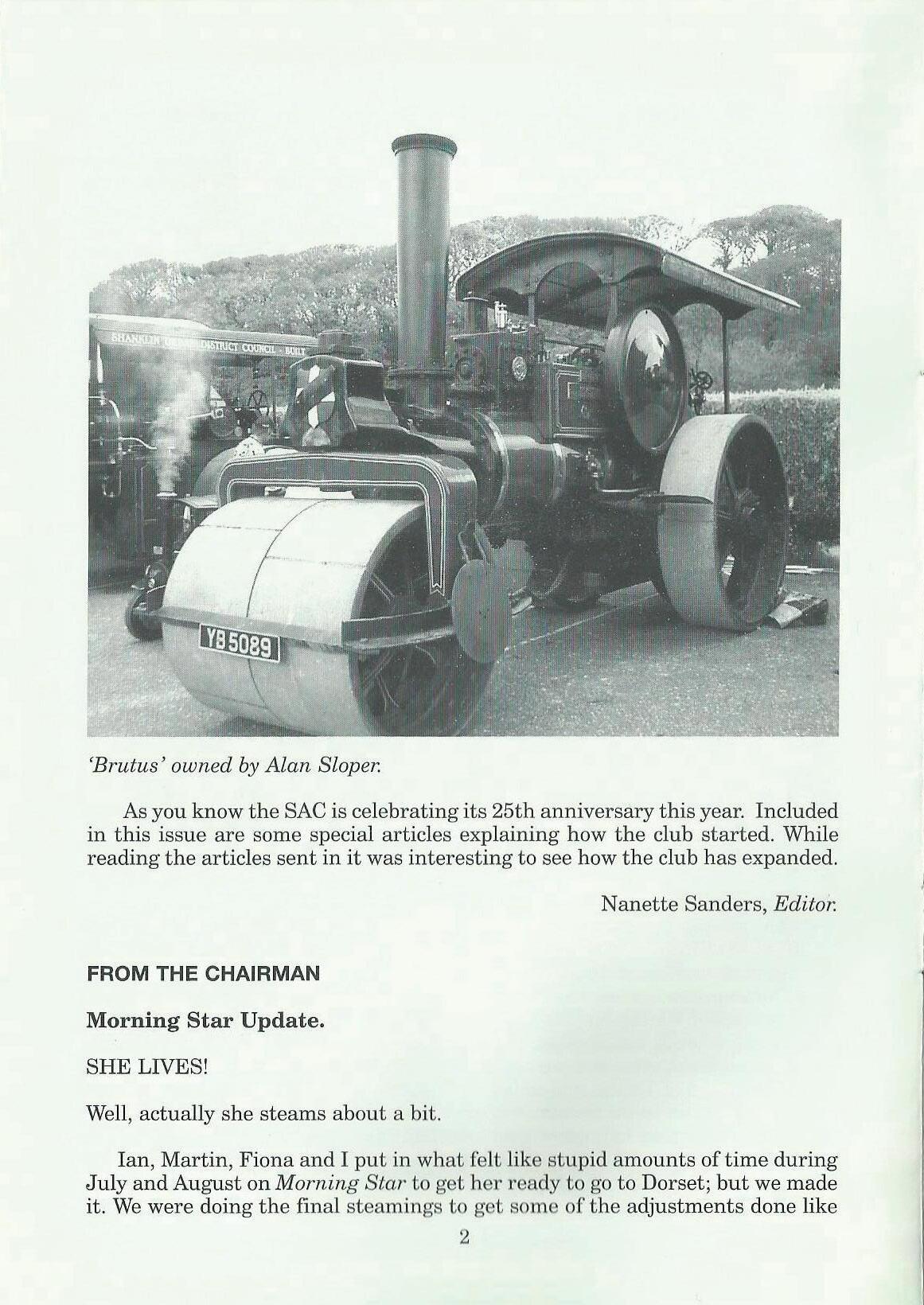
When visiting the Chale show on the Isle of Wight earlier this year, I came across a steam roller named Brutus, engine No. 95 4013, with an interesting background.
When Clayton and Shuttleworth of Lincoln went into liquidation in 1926, the stocks and parts of 10 engines were bought by Babcock and Wilcox, Scotland, along with Clayton's last contractor WW Buncombe of Highbridge, Somerset. The engines that were completed were renamed with the Babcock and Wilcox plate. Eight of these rollers being three 6 ton rollers and five 10 ton rollers were supplied to WW Buncombe who ran an engineering and road rolling contracting company. The engines supplied ran with consecutive numbers 95 4009-16 inclusive which includes the engine Brutus that I had seen at Chale.
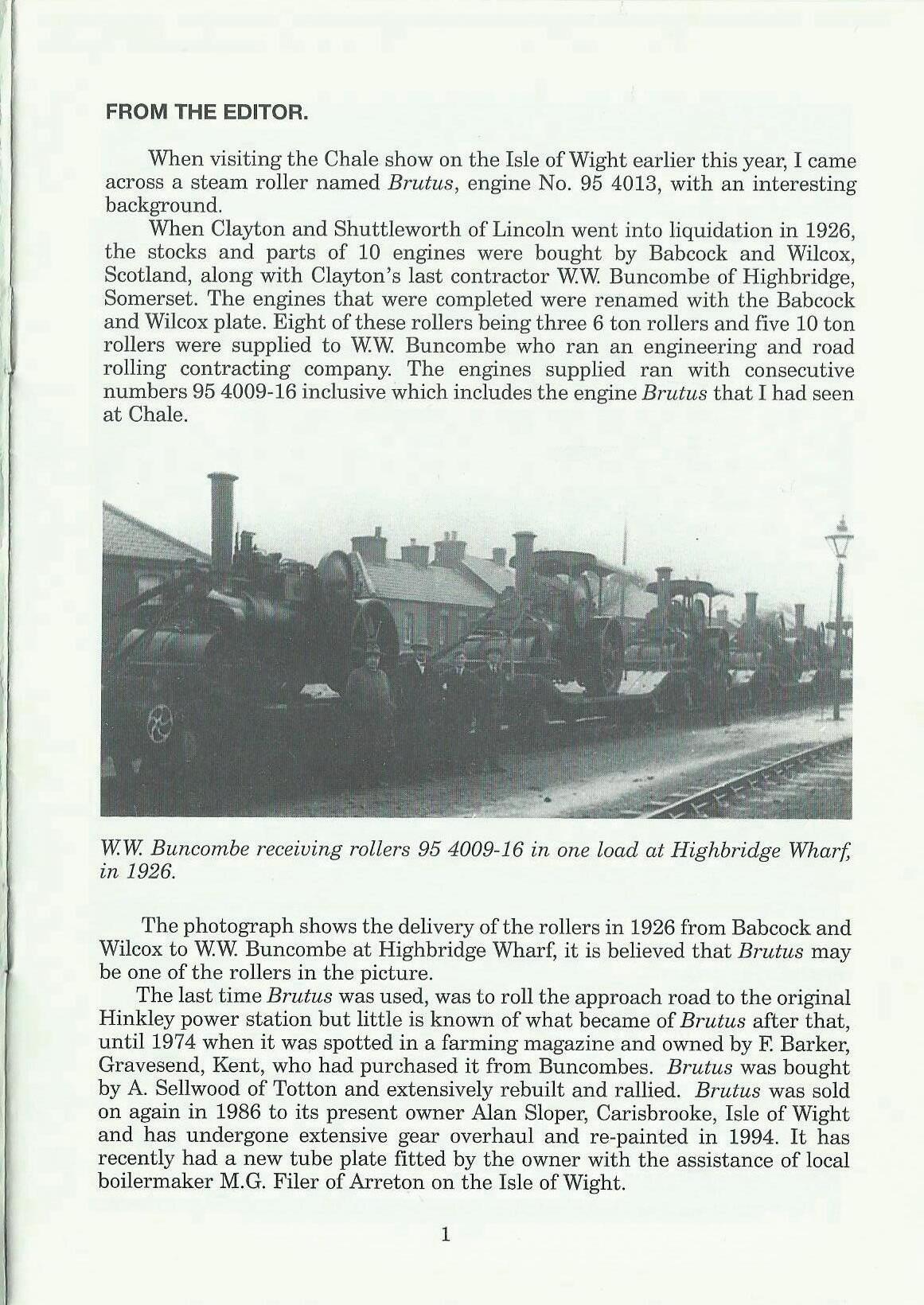
WW Buncombe receiving rollers 95 4009-16 in one load at Highbridge Wharf, in 1926.
The photograph shows the delivery of the rollers in 1926 from Babcock and Wilcox to WW Buncombe at Highbridge Wharf, it is believed that Brutus may be one of the rollers in the picture.
The last time Brutus was used, was to roll the approach road to the original Hinkley power station but little is known of what became of Brutus after that, until 1974 when it was spotted in a farming magazine and owned by F. Barker, Gravesend, Kent, who had purchased it from Buncombes. Brutus was bought by A. Sellwood of Tatton and extensively rebuilt and rallied. Brutus was sold on again in 1986 to its present owner Alan Sloper, Carisbrooke, Isle of Wight and has undergone extensive gear overhaul and re-painted in 1994. It has recently had a new tube plate fitted by the owner with the assistance of local boilermaker M.G. Filer of Arreton on the Isle of Wight.
'Brutus' owned by Alan Sloper.
As you know the SAC is celebrating its 25th anniversary this year. Included in this issue are some special articles explaining how the club started. While reading the articles sent in it was interesting to see how the club has expanded.
Nanette Sanders, Editor.
FROM THE CHAIRMAN
Morning Star Update. SHE LIVES!
Well, actually she steams about a bit.
Ian, Martin, Fiona and I put in what felt like stupid amounts of time during July and August on Morning Star to get her ready to go to Dorset; but we made it. We were doing the final steamingR to get some of the adjustments done like
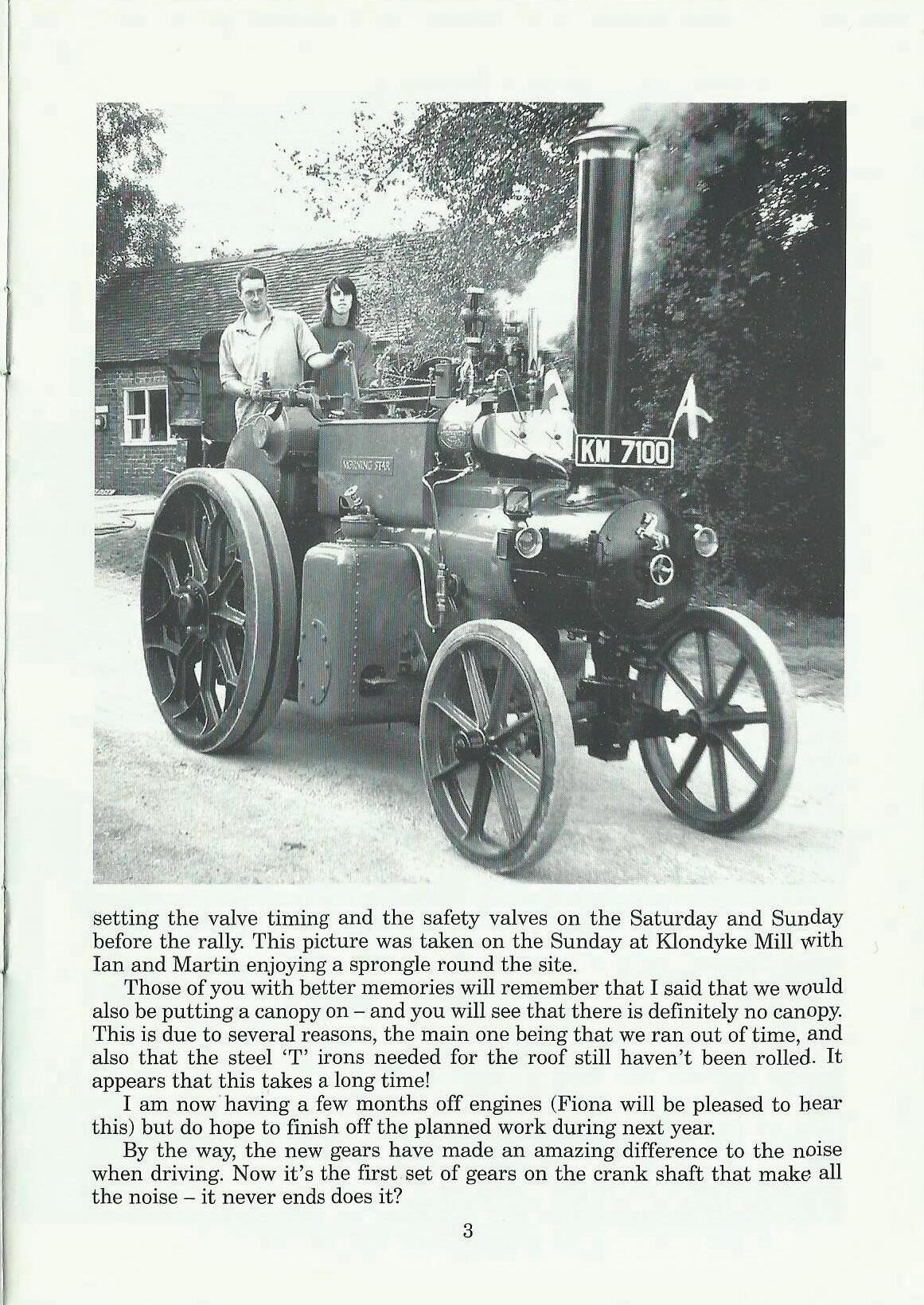
setting the valve timing and the safety valves on the Saturday and Sunday before the rally. This picture was taken on the Sunday at Klondyke Mill with Ian and Martin enjoying a sprongle round the site.
Those of you with better memories will remember that I said that we would also be putting a canopy on -and you will see that there is definitely no canopy. This is due to several reasons, the main one being that we ran out of time, and also that the steel 'T' irons needed for the roof still haven't been rolled. It appears that this takes a long time!
I am now· having a few months off engines (Fiona will be pleased to bear this) but do hope to finish off the planned work during next year.
By the way, the new gears have made an amazing difference to the noise when driving. Now it's the first set of gears on the crank shaft that make all the noise - it never ends does it?
Now to club matters.
I think that I should start this section by remembering Brian Sismey. It is with great sadness that I have to tell you that he died just before the GDSF Brian owned the Robey, Shamrock and was always willing to take an Apprentice onto his engine and give advice and help. He organised the Burseldon Driving Days for several years. His quiet approach and calm manner made those who were dealing with him feel immediately comfortable and hid the trauma that was taking place in his personal life. He will be sadly missed by those within the SAC and elsewhere who knew him.
I know that some of you wanted to be at the Great Dorset Steam Fair but couldn't be due to the changes in the school year; this did have an effect on the numbers visiting, but we still had more than we could cope with - which was great! The weather was kind to us and the rally was a wonderful opportunity to see many engines that you can't normally find out and about. This was of course thanks to the NTET celebrating their 50th anniversary with the '50 at 50' engines. I won't say too much about those here, there are already many write-ups on that subject. Suffice to say that I could have spent much more time looking at the rare engines on show. We did, of course, celebrate our own 25th anniversary as well, but perhaps not in quite the same style.
Whilst going on about the GDSF we mustn't forget that there are other rallies where the SAC appears, these have also been well supported and popular. We do, of course, need to spread the adult participation at these rallies so that we can arrange for more activities at more rallies.
The SAC was also well represented at the NTET Road Run. Both 'SAC' engines were out and about, that is Elaine's Garrett Olive and my Morning Star. We towed a riding trailer round the 28 mile course, I lost count of the number of people on board but they all enjoyed the run, even the un-planned stops for minor mechanical repairs! Ian and Jason Massey took Olive on a shorter route more appropriate to her size and speed. I wonder if we'll have to wait another 25 years for the next one.
As I write this the last Driving Day of the season has just happened, run by Richard and Verity at Manningtree in Suffolk. This is a new venue run by new volunteers. They had a great day (and so did the Apprentices) and I hope that it will happen again next year.
Perhaps it is now appropriate to remind you of the SAC web site at www.ntet.co.uk/sac
Your search engine should be able to find it from 'Steam Apprentice Club'.
We try to keep this up to date with recent reports of SAC happenings and also information on what will be happening in the future. You can help us with this by sending in your own reports of what you've done and where you've been. You can do this by simply going to the web site, click on 'E mail Webmaster' and send us your stuff. If you have friends wanting to join the SAC there is a downloadable membership form.
Don't forget, some of the best steam events are the little 'end of season' events that happen between now and ChristJnas - Lry to get to one and see what you can find.
John Durling, Chairman
PHOTOGRAPHIC COMPETITION RESULTS
The senior section and Dorset Shield was won by John Burton.
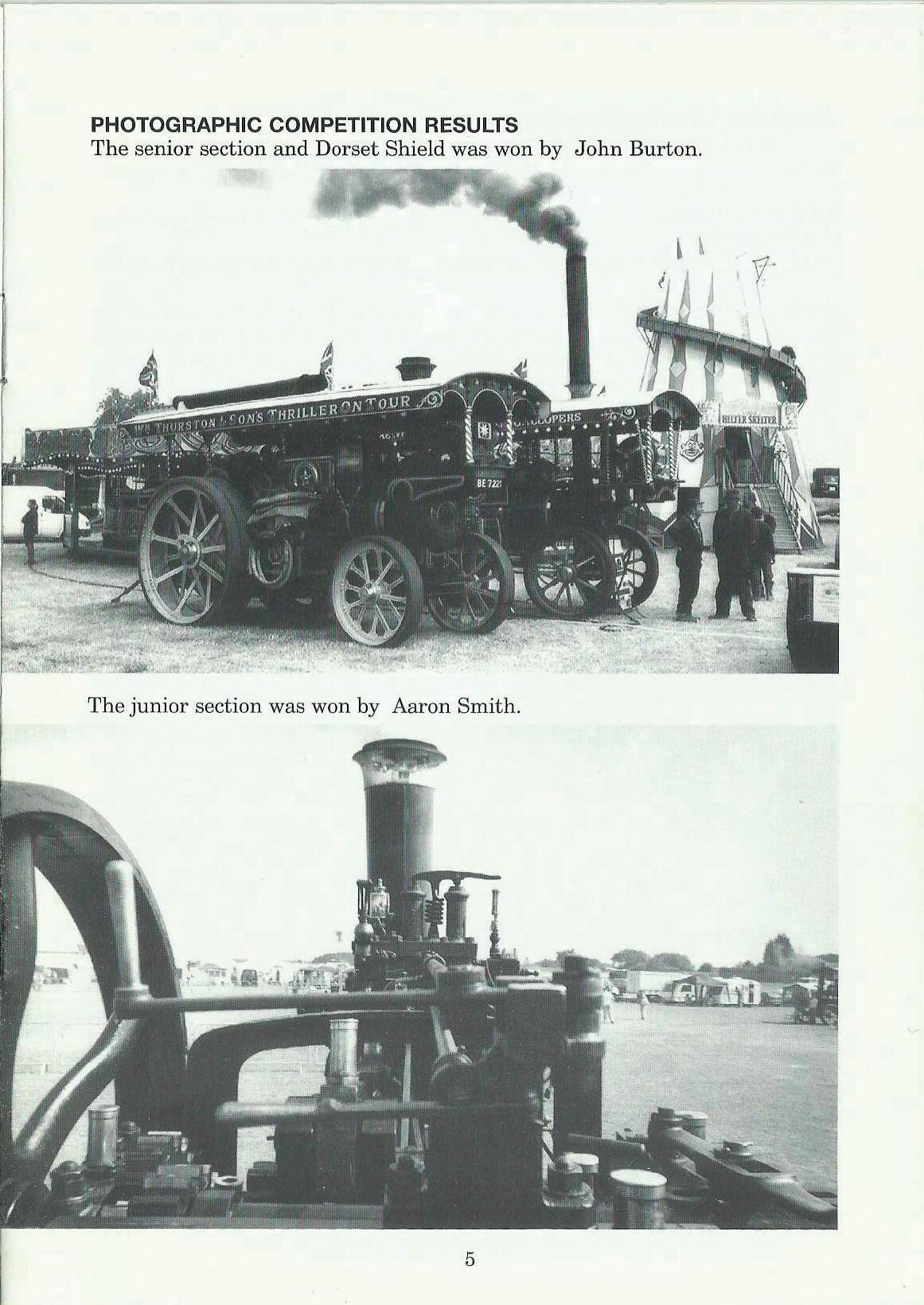
The junior section was won by Aaron Smith.
COLOURING COMPETITION RESULTS
Junior.
1st Daniel Wheeler
2nd Beven Wray.
3rd James Huntley.
Senior
1st Erica Chick.
2nd Gregory Chick.
3rd Clair Baldwin.
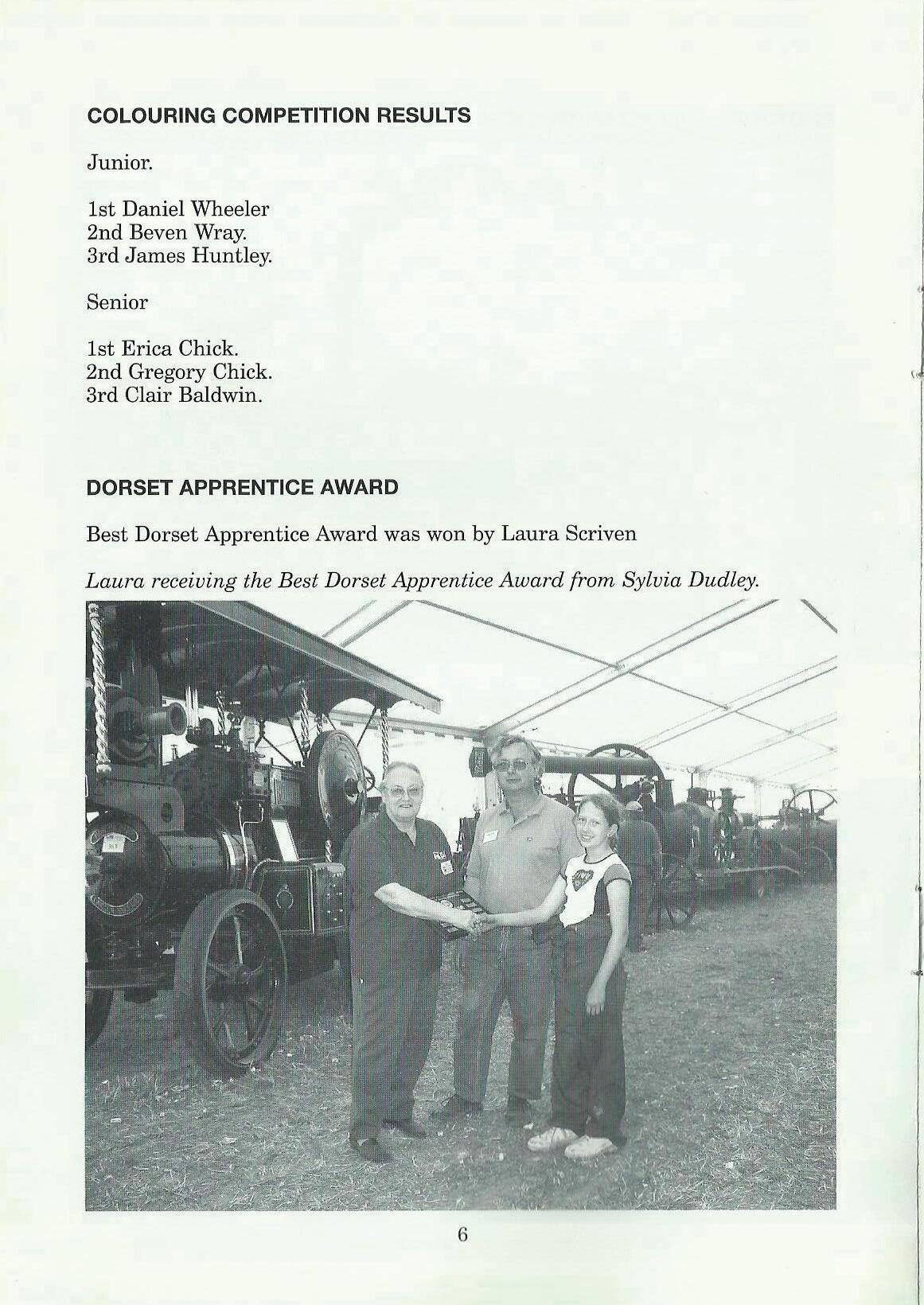
DORSET APPRENTICE AWARD
Best Dorset Apprentice Award was won by Laura Scriven
SPECIAL ARTICLES CELEBRATING THE 25TH ANNIVERSARY OF THE STEAM APPRENTICE CLUB.
An article found in Steaming 1978.
FULL STEAM AHEAD FOR THE APPRENTICES
At the recent National Committee meeting of the N.T.E.C., the new Steam Apprentice Club was finally launched. A survey during the rally season had shown plenty of interest in the idea, mostly among 12-18 year olds, and the S.A.C, will therefore cater particularly for this age group. For a £1 annual subscription, a steam apprentice will get a regular news letter, a membership card, a copy of the approved rally list, and free entry to some of the rallies. A special club badge will also be available, and apprentices will be able to buy N.T.E.C. publications and other items at the same rate as N.T.E.C. members.
We also hope to arrange special events and visits for apprentices; these will be publicised through the news letter, and we shall try to put each apprentice in touch with an engine owner living nearby, so that he can learn more about steam at first hand.
The small group which investigated the possibility of forming a new branch for young people has now transformed itself into Steam Apprentice Club Officers, as follows:
Chairman: John Wharton.
Membership Secretary: Sylvia Berth-Jones ( Sylvia Dudley) Editor/ Publicity: Margaret Joachim.
We hope that the N.T.E.C. members will help us make the Steam Apprentice Club a great success.
(Margaret Joachim, Club News, Steaming, Volume 22, No. 1, December 1978).
STEAM APPRENTICE CLUB 1980
Our first event was a training day, held on an April Sunday at Minster Lovell, by kind permission of the N.T.E.C President Jack Wharton. About twenty-five apprentices came from almost all over England and were treated to a full day's instruction on everything from maintenance, lubrication, and getting up steam, to steering an obstacle course and backing up to a trailer. For the most experienced there was the chance to drive. The weather was beautiful, the four engine owners and their engines were most co-operative, and everyone enjoyed themselves. The N.T.E.C sales stand did good business as well. We are most grateful to everyone who helped make it such a successful day.
The second event took place on the Sunday Morning of Rempstone Rally, and we hope it will be the prototype for many similar rally based occasions. Members turned up from 10.30am, and each was allocated to an engine to help with various jobs of cleaning, stoking and oiling. Most of them later took part
in the grand parade. Many had steering practice, and one or two of the older apprentices had a go at the controls. Some even drove the Z7 Fowler ploughing engine brought back from Mozambique. Our club caravan, with its new flag was part of the engine line, and there was a lot of interest in our activities.
We do rely a great deal on the goodwill of rally organisers and engine owners, and greatly appreciate the help that we get. There will be another SAC session at 10.30am on Sunday, September 14th, at the Roxton Rally. All members and accompanying parents will be most welcome. In fact, one of the commonest sights at an SAC event these days is an envious father on the sidelines.
We are always looking out for new members. If your child has always wanted to go on an engine, and is prepared to do some of the work involved, an SAC membership would make an excellent birthday or Christmas present. The news letter comes four times a year, and the free rally entry scheme gives you entertaining summer weekends.
(Margaret Joachim, Club News, Steaming, Volwne 23, No. 4, Septernber 1980)
A LETTER WRITTEN BY SYLVIA DUDLEY FOR THE S.A.C. 25TH ANNIVERSARY
In 1979 it was suggested that there was little point in preserving our much loved engines unless we preserved the living skills and knowledge to operate them in the future, and that the younger enthusiasts were the ones to encourage before it was too late. A small working party was formed to look into the best way forward.
A letter was prepared and published in Steam,ing asking anyone under 21 who was interested to make contact - we were surprised, and pleased with the response, the Junior section of the N.T.E.T was formed and the first newsletter telling those who had replied our plans. A subscription was set at £1 and the N.T.E.T agreed to cover initial costs as they felt the venture was important. A competition was arranged to ask members for suggestions of a more suitable name for the club, and a short list was published in the newsletter for a vote to 1 decide the outcome. After this your badge could be designed and produced, membership forms and letter headings printed and the Steam Apprentice Club l existed!! Later a similar system of suggestions and a vote was used to give the , newsletter a more suitable title. Raising Steam seemed to be a suitable lead up to Steaming the N.T.E.T magazine. Incidentally the engine on the front cover of Raising Steam and on the membership leaflets was specially drawn for us by the late Geoffrey Wheeler. He was asked to make sure that it looked like a normal engine but was not actually a known make of engine manufacture.
We appreciated that quite a number of our members would change their interests and leave the club, but rarely an issue of Steaming or Old Glory appears when a photograph or mention of one of those early members is included and we are delighted that they are coming forward to work with the committee in the running of the National. I am sure that you will be pleased to
know that quite a number now own or are regular crew with engines, so if as a young member of the SAC it seems to be all washing wheels and polishing it really can be worth it if you persevere.
Sylvia Dudley
THE FIRST STEAM APPRENTICE CLUB NEWSLETTER 1979
Dear Apprentice,
Welcome to the club! I hope you enjoy the first newsletter, and I'm looking forward to your suggestions as to what we should put in the next one. At the moment we can't manage photographs or complicated drawings that will have to wait until we have enough members to be able to afford a properly printed magazine. However, this time we have some interesting articles, a competition, some suggestions of things to do, and a report on some of the arrangements that have been made specially for apprentices. Next time there will be space for member's letters, so send them to me as soon as you can.
The club badges have arrived from the makers. If you were one of the first members and entitled to a free one, you will probably have received it already. If it hasn't come by 1st July, please let the membership secretary know. If you would like to buy one, they cost 65p, so send a postal order made out to 'National Traction Engine Club' to me, and I will post one to you. Have an exciting season! I look forward to meeting some of you during the summer.
(Margaret Joachim, Editor, Steam Apprentice Club Newsletter, June 1979.)
LETTER FROM APPRENTICE NUMBER ONE
you and your country's, future in steam.
As a Steam Apprentice, and a member of the SAC, you will be well aware that, at steam shows up and down the country, there are events that offer the opportunity for you, as Apprentices, to become involved with the operation and running of steam engines. Depending on your personal skill, enthusiasm and interest, there are a vast amount of skills that can be learnt and hopefully enjoyed despite the hard work.
During the last 25 years, there have been many Apprentices who have not only had a chance to gain experience over a variety of different engines, but have progressed to being regular crew, or even owners of their own engines.
Over the years to come, with time and dedication, you will be the next generation of steam enthusiasts that make these shows possible, and keep the great era of steam as a working example of our Great British past going for years to come.
• You might enjoy the glamour of the Showman's engine, with the noise and bustle of the fun fair. Which is an excellent place to learn the art of
balancing the fire, with a working level of water and steam. This is not easy when working hard generating electricity for a big ride.
• Alternatively you might enjoy the agricultural engines set up for threshing, wood sawing or stone crushing, where you have very different noises and smells than that of the extremities of the fair. This skill is possibly not as critical as the showman's engines for accuracy with the balance of fire and water, but if you got it wrong in the old days, there would have been some very angry men unable to do their job, and they probably would not have been paid if they didn't produce the materials at the end of the day.
• Tractors, (not those noisy, smelly petrol things), these engines were put to all sorts of tasks, and sometimes changed to suit the owner's requirements. These smaller engines can sometimes be tricky to look after, as the water level can drop rapidly. Well, "put some in", I hear you say. That's fine, but if you do your pressure drops. Ah!! "More coal". (As you are probably aware, black coal is cold, and therefore takes a while to ignite and get hot). In this situation your pressure has dropped, and the engine is left unable to function properly. Keeping this balance is a fine art that only comes with practice.
• Lets move on to the big black monsters tucked away out of sight in another field; yes, the Ploughing Engines. As most of you probably know, two big engines either side of a field with an implement (plough, cultivator, mole drain etc) between them. I hope some of the more advanced of you get the chance to do this, or at least understand it from a driver's perspective. You set your engine at the side of the field in the correct position. Easy. Then from the other end of the field you hear two whistles. That's the signal to go. You then realise you're not ready. At this point you should already be out of gear, (blocked, chocked, or whatever you want to call it), if necessary. You should have a good head of steam and a fairly full glass of water with a fresh fire. This being the case you can start. Gently putting the dog clutch for the winding drum into gear, and very slowly starting to pull the implement towards you. This is where you must be very good at what you're doing. You must have total control. What you might have forgotten, is that there are one or more people on the implement, and they are frantically trying to line the thing up down the field. (Not an easy job). Not only that, but you don't want to hurt them. Anyway, something to build up to if you have not already given it a trY, but go and look at it being done if you get the chance, and see what I mean.
• The wagons. Well!! Tucked away in a little cab out of the rain, fast, and relatively clean. I can see why a lot of people enjoy them. They, like a tractor, can be very tricky to handle and, unlike a traction engine, they have different responsibilities for the crew. Then, still a wagon, but a very different machine, is the Sentinel. Extremely advanced technology for its day. Fully enclosed aluminium crank case, under slung engine, and the boiler, not only running at a higher pressure, but the amount of steam it can produce is amazing.
• Finally the rollers. These must never be underestimated. When you drive to a show or event, just think that men and a steam roller originally built
the roads. There were even some used to make the ML They were some of the first and last engines to be used commercially, and can be seen at some shows doing the job they were intended to do. I know of one that every year is contracted to do the cricket pitch. I have used one to flatten a lawn and a rugby pitch.
To some of you that have not been involved for too long, and think that sweeping tubes and raking ashes is not much fun, well we all have to do it, and it must be done. These engines need a lot of work. It might take a while, and a lot of hard work, but as you gain more experience, you will be shown how to do some of the more highly skilled tasks. Who has had problems using an injector? I know I have. Had coal that's no good, or just simply had the wind blowing towards the back of the engine when trying to raise steam.
Quite enough from mej and I wish you all the best of luck, and of course enjoyment with the next 25 years of the SAC, by which time a lot of today's Apprentices will have Apprentices or maybe engines of their own, and help keep the old skills, and indeed the engines, going at the jobs they were intended to do. So, enjoy, and don't drop a plug, because you can guarantee everyone will talk about you for years if you do. (If you don't know what I mean, find out).
Many happy years of steaming, it is people like you that are keen now, that hold the knowledge for the future.
All the best. Alun Berth-Jones.
A LETTER FROM THE CHAIRMAN OF THE N.T.E.T.
I am sure many of you know that the N.T.E.T is 50 years old this year. The Trust was formed from an old club used by steam engine owners in the days when engines were working everyday. Those of us who were interested in engines forty years ago learnt how to drive them from men who used them everyday of their working lives. Today it is more important than ever to keep the skills of engine driving alive for younger people and so it was that, the N.T.E.T decided to start an apprentice club 25 years ago.
As the present Chairman of the N.T.E.T, I think that the Steam Apprentice Club is one of the most important things we do because the knowledge and skiHs must be passed on to you the engine drivers of the future. Mrs Sylvia Dudley, now a Vice-President of the Trust was the first Membership Secretary and later became Chairperson of the Steam Apprentice Club, she was then the owner of a Robey Showmans tractor which was on display this year in the marquee at Dorset. The late Jack \iVharton owner of Supreme and King George VI helped her in the beginning. Since the Steam Apprentice Club began there have always been engine owners helping to run the club. It is interesting to think that the engine that I first used to drive in 1960 is now owned and driven by one of the very first steam apprentices who joined 25 years ago.
You should be proud to be a steam apprentice for you are helping to keep engines alive for the future and I hope you enjoy being around engines and the
people who own and use them. I first drove an engine to a rally exactly forty years ago, to Harwood House near Leeds in 1964, and we eventually purchased our Ruston tractor in 1975 and is now part of our family. The steam world is a big family, which will enable you to make friends not only in Britain but also across the world. Traction engines have brought us friends and contacts as far afield as Australia, New Zealand, Canada and parts of Europe.
The knowledge and skills you will learn as a steam apprentice will quite possibly result in you understanding more about the engine you drive than a lot of the men who drove them for a living sixty or seventy years ago, so keep your log book up to date, take every opportunity to ask and learn and you will enjoy being part of one of the best hobbies you can choose.
Andrew Semple, Chairman N T.E.T.
FIRST PHOTOGRAPH ENTERED IN THE S.A.C, NEWSLETTER NO.8 DECEMBER 1980.
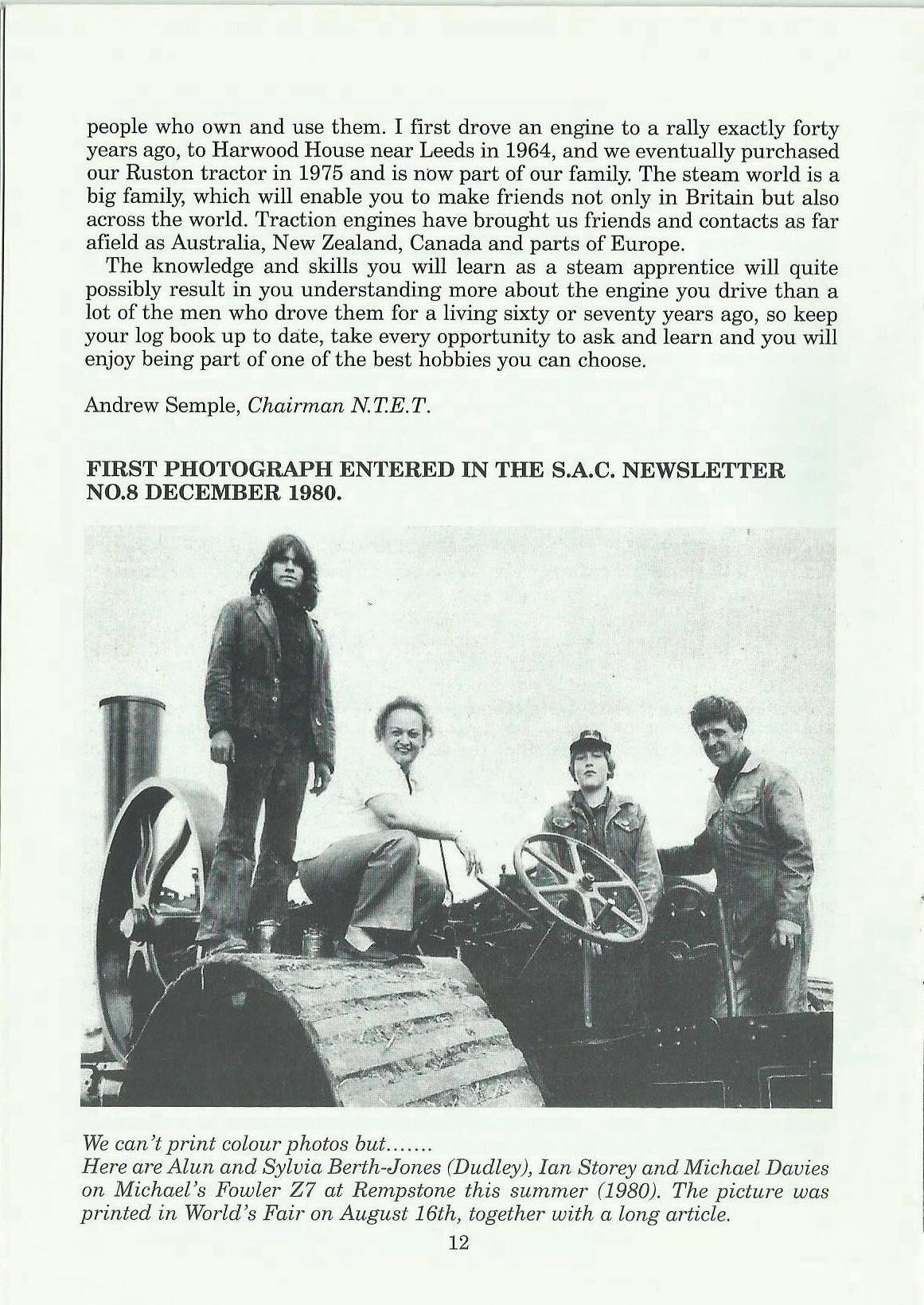
We can't print colour photos but ...... . Here are Alun and Sylvia Berth-Jones (Dudley), Ian Storey and Michael Davies on Michael's Fowler Z7 at Rempstone this summer (1980). The picture was printed in World's Fair on August 16th, together with a long article.
MAIL BAG
Dear Editor,
It was great fun at Dorset. My sister Laura, our Dad and myself arrived Tuesday evening to set up ready for an early start on Wednesday. Wednesday morning I was put with Dave and Rosie a Fowler 10 ton steam roller, works number 16144, built 1924. Each morning I cleaned the engine ready for the day ahead. Every day Dave and I went for a trundle around the heavy haulage arena and up through Watford Gap. Sometimes that was a bit scary with all the other engines moving around. One day we went to the NTET tent so Dave could get a cup of tea, which gave me the opportunity to visit the Steam Apprentice Club stand and have a look at the pictures on display and renew my membership. On the way back we had to search for water as we had got very low. We went to the threshing area where Dave knew there would be a bowser. My sister was working in this area on the Favourite a Mclaren general purpose engine, which was driving a threshing drum. I had four fantastic days with Dave. The best I have had at Dorset. Thanks to Dave.
Friday night was a good evening when we all had the chance to drive or steer different engines. I had a steer on Janet, a 1922 Burrell road locomotive works number 3937. I sat in the bunker of a Fowler ploughing engine Hercules works number 15306 built in 1918. Unfortunately there was no more time for another ride. Sunday morning we had our breakfast on the shovel, very tasty and thanks to all the helpers. After breakfast I took the opportunity to have a look around the 1niniatures; one day I would like to own one. We all went home very tired, but with some wonderful memories.
Keep on steaming.
Martin
Kimber (14), Woodley
Dear Editor,
A few things have been going on; my Dad took his Witney steam car out for a run to a fete in Kingsley; it was running well on the way there. The fete had a few rollers and many scale models. A slight problem occurred, a bit of dirt in the burner and we didn't clean it out, we just wanted to get home but it made it run badly and when we tried to drive up a hill I had to get out and push, because it was really steep for a while my Dad had to jump off as well. My Dad could still control the car from the outside. This is what we expected from a car that was made in 1896. I thought it was a good day out.
A few weeks ago my Dad took the Witney steam car to a local pub in Odiham. When we arrived at the pub many people were asking questions about the car and we had dinner there.
My Dad loved it when my Mum and sister had a ride and they had to jump off to push the car up a hill, he put his feet up on the seat, yawned and pretended to whip them with a buggy whip which would have been on the car originally for scaring dogs that chased the car in the late 19th century just like a horse drawn carriage.
I have just been to the Dorset Steam Fair for the day; my Dad won an award
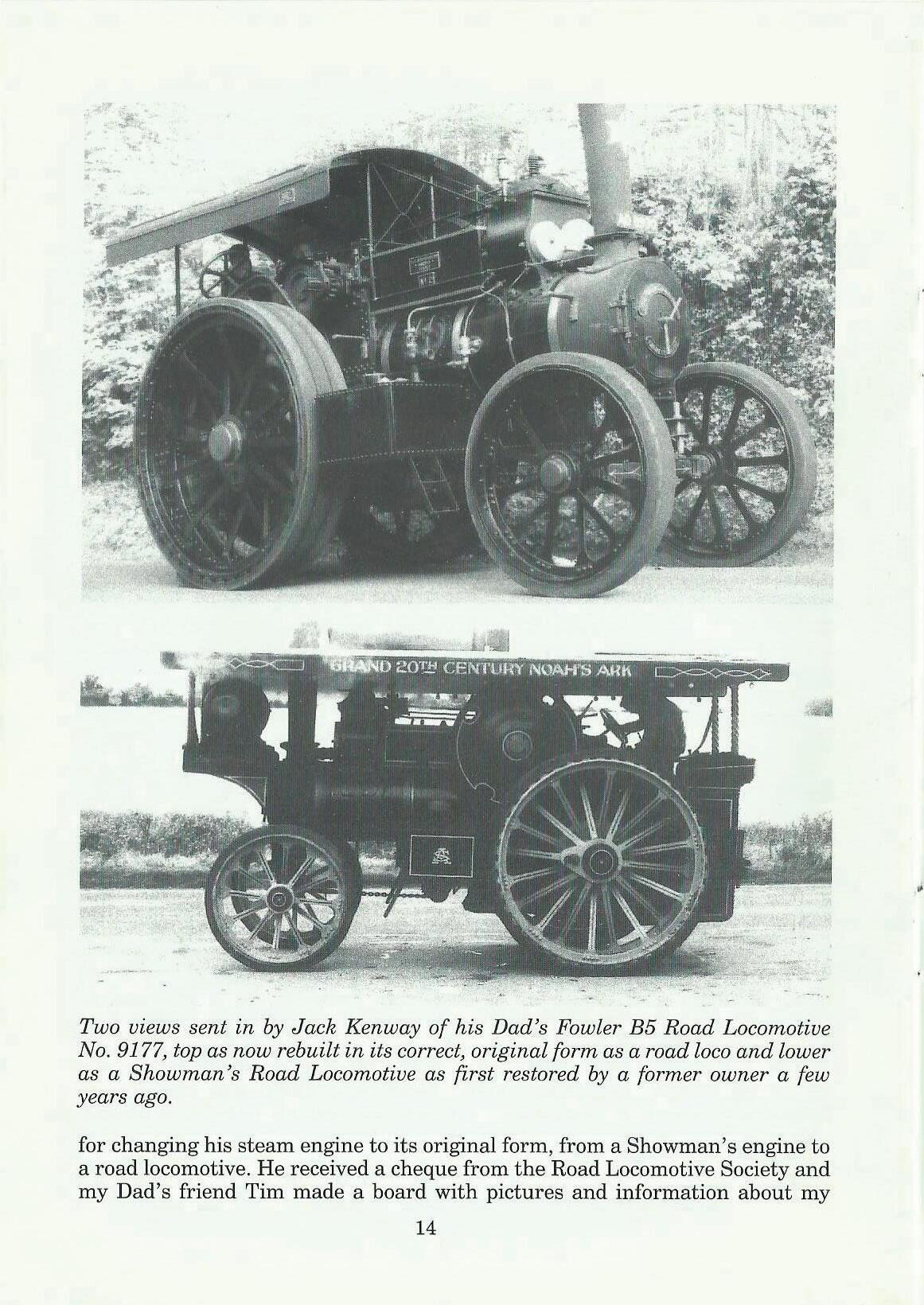
Two views sent in by Jack Kenway of his Dad's Fowler BS Road Locomotive No. 9177, top as now rebuilt in its correct, original form as a road loco and lower as a Showman's Road Locomotive as first restored by a former owner a few years ago.
for changing his steam engine to its original form, from a Showman's engine to a road locomotive. He received a cheque from the Road Locomotive Society and my Dad's friend Tim made a board with pictures and information about my
Dad's engine. When we were looking at the engines a gust of wind came along and picked up the straw and dust into a cone shape like a mini tornado and threw it over our chips. I really liked the heavy haulage driving around the ring; there were some really good engines and some massive lorries. We saw an old steam engine with a tree growing through it, it looked really good but a bit sad because it had not been looked after. I really liked seeing the Iron Maiden because I have seen the film and I especially liked the last Showman's engine that was made Supreme. I enjoyed watching the organs they sound great and look brilliant. When we look at the stalls I look out for old dirty cheap brass blowlamps because I enjoy cleaning them on my Dad's polishing wheel and repainting the non brass bits black, they come up super shiny and look a lot better. I did not find any cheap ones, but I bought an army jacket for a £1.00. I really like the Dorset Steam Fair and hopefully my Dad is going to take his engine down next year.
Jack Kenway, Hook
Dear Editor,
Although I have never written about the driving days and rallies I have taken part in since I joined the SAC three years ago, my log book says that I have worked on 16 engines since April 2002. I used 4 rollers, 3 tractors, 4 miniatures (one 2" scale ploughing engine and three 5" gauge railway engines), 1 standard gauge crane, 1 Showman's engine, 1 ploughing engine and 2 general purpose engines. When Robert Cox was filling in my log book last year at the Great Bucks Steam & County Fair, he filled in the last space in the used engines section that 1neant it was full up so I had to make a new copy by hand. I'm going to keep filling it up because I am driving one of the railway engines in the Didcot Railway Centre as part of the Great Western Society's Young Volunteers Programme, and I have also got the Great Dorset Steam Fair. When I heard that you could drive one of the engines at Didcot as part of the YVP, I decided to join because when I joined the Great Western Society in February, I applied for being a member of engine crew and restoring engines. This is because I am training to be a mechanic and I tried getting round to footplate duties but I could not do it so I decided to quit restoring when I turn 18 and become a driver. At the moment I am working on one of the Society's restoration projects. It is Pendennis Castle an express engine built in 1924 at Swindon. It was shipped out to Australia in 1977 and returned to the UK in 2000. One of my mates at Didcot had a reason to help with the Pendennis Castle project and that reason was because he's from Australia and he saw the engine over there. Being a member of two model engineering societies has given me a lathe to take on a project but I don't have any materials yet. My considered and chosen project is a railway engine named Conway. Conway is a simple but powerful 3.5" gauge 0-4-0ST designed by Martin Evans and the design borrows influences from many well-known makers e.g. Hunslet.
Edward Ronayne (16), London.
NEW MEMBERS
James Abbott, Surrey.
Tanya Alexander, Suffolk.
Tommy Allen, Glastonbury.
Clement Allen, St Albans.
Anthony Allsop, Mansfield.
David Barsby, Eversley
Emma Barsby, Eversley.
David Bentley, Hertfordshire.
James Blanch, Norfolk.
Jack Blanch, Norfolk.
Chris Bowden, Liskeard.
Ellis Bowen, Bristol.
Matthew Braund, Devon.
Joseph Brown, Huntingdon.
Georgina Brown, Bucks.
Andrew Brown, N otts.
David Bush, Norfolk.
Nathan Butterfield, Wallingford.
Nicola Collard, Bucks.
Myles Cornwell, Suffolk.
Henry Dawe, Kent.
Rowanne Maclachlan, Argyll.
Alexander Maclachlan, Argyll.
Daniel March, Andover.
Connor Marsden, (no address)
Lee Matthew, Derbyshire.
Gemma Mitchell, Cornwall.
Oliver Morrison, Corwall.
James Mortimer, Surrey
Harvey Murray, Bedfordshire.
Thomas Myers, York.
Andrew Myers, York.
Stephen Myers, York.
Benjamin Neville, Devon.
Andrew Noble, Salisbury
Kristina O'Keeffe, Suffolk.
Luke Opie, Cornwall.
Jack Opie, Cornwall.
Jamie Ord-Hume,Southampton.
William Pierce, Kent.
Craig Price, Powys.
Johnathan Ravenhall, Co Durham.
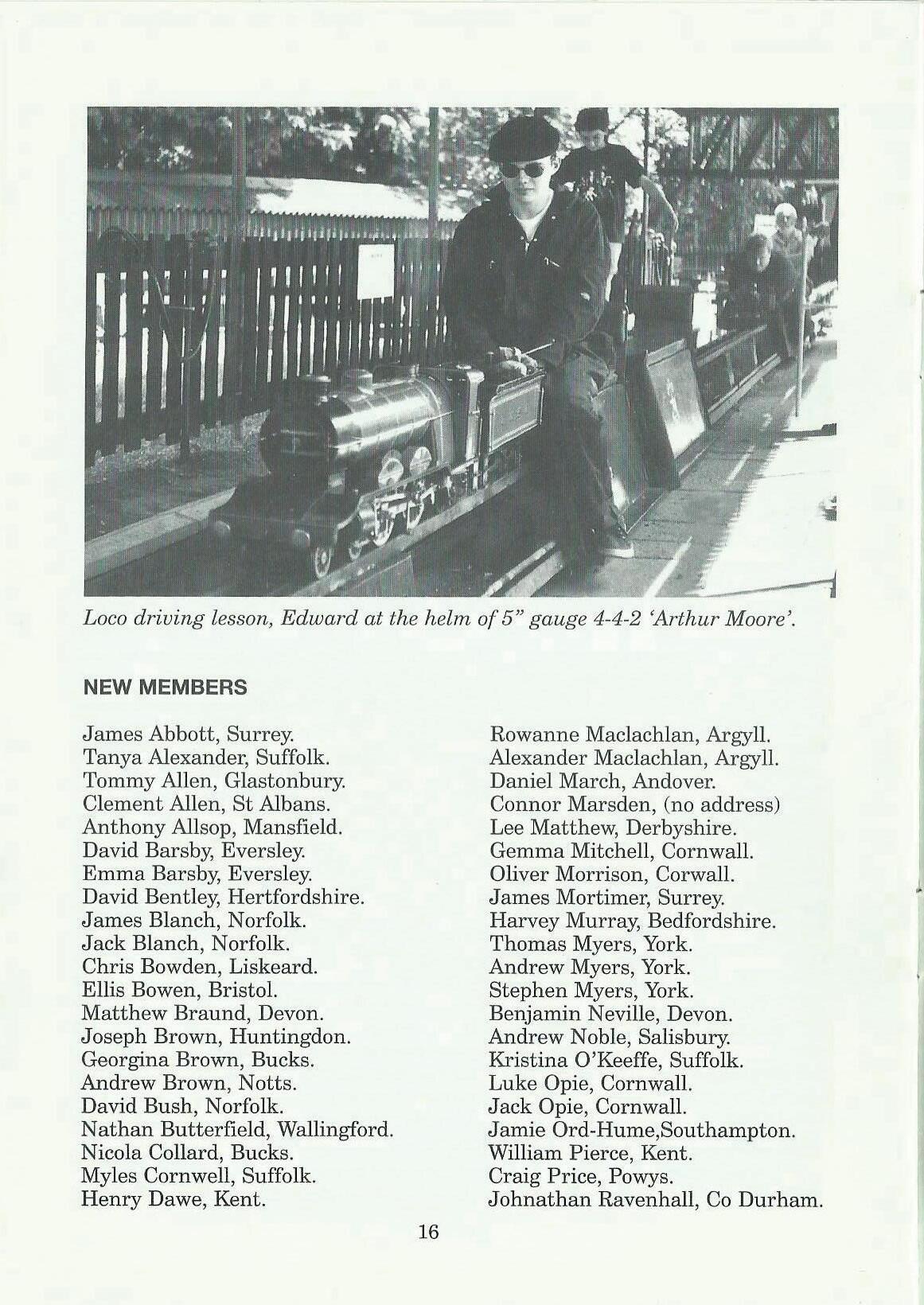
Loco driving lesson, Edward at the helm of 5" gauge 4-4-2 'Arthur Moore'.
Luke Drower, Bristol.
Samuel Earley, Eastleigh.
Rfohard Filer, Isle of Wight.
Graham Filer, Isle of Wight.
Matthew Furmage, Slough.
Melissa Garrod, Norfolk.
Barney Garrod, Norfolk.
Thomas Garwood, Suffolk.
Simon Gates, Taunton.
Sam Goddard, Wiltshire.
Emily Green, Lines.
Thomas Hailey, Beds.
Jonathan Hale, Worthing.
Christopher Hale, Worthing.
Timothy Hale, Worthing.
Hannah Hare, Bradford.
David Hare, Bradford.
Sarah Harrington, Horsham.
Peter Heath, Ringwood.
Edward Heath, Ringwood.
William Hume, Sussex.
James Hurley, Cheltenham.
Amy Hulls, Lutterworth.
Thomas Humphreys, Dorset.
Oliver Jacobs, Derby.
Oliver Joy, Frome.
Luke Kistle, Cornwall.
Adrian Knight, Berks. Faye Lane, Derbyshire.
William Roberts, Leics.
Peter Rose, Hants.
Jack Rushton, Isle of Wight. •
Joe Scott, Blackburn.
Leslie Searle, Horsham.
Thomas Searle, Horsham.
Daisy Simmonds, Sheff ord.
Francis Simpson, Devon.
Jordan Skinner, Dorset.
Shawn Spaan, South Africa.
Amy Spells, Southampton.
Katy Spells, Southampton.
Kelston Stark, Bristol.
Josey Taylor, Ipswich.
Benjamin Teall,Wokingham.
Jonathan Thompson, Hants.
Jack Thwaites, Warrington. Robert Usher, Salisbury.
Ryan Vater, East Sussex.
Henry Wheeler, Winchester. David Whitehall, Dorset.
Billy Wicks, Somerset.
Kira Wildblood, N orthants.
Lucia Wills, Cornwall.
Timothy Winstanley, Conwy.
James Wright, West Yorkshire.
Peter Wroe-Beacon, Chesham.
Maxwell Yells-James, Fairf ord.
Martin Luke, Glos.