Sam Bate, 30 Mowbray Grove, Bishopsgarlh, Stockton-on-Tees, Cleveland TS19 8XA Tel: 01642 897153 e-mail: sambate@lycos.com
Graham Chaffer, 32 Jubilee Way, Siorrington, West Sussex RH20 3NZ Tel: 01903 745921 e-mail: chaffor.gang@ic24.net
Duncan Croser, 16 Tripps Hill Close, Chalfont St. Giles, Bucks HP8 4JZ Tel: 01494 875443 e-mail: duncan.croser@btinternet.com
Steve and Donna Taylor, 17 Smith Crescent, Coalville LE67 4JF Tel: 01530 835213 e-mail: steve.tailor(g btinternet.com
The Editor welcomes any contributions of articles, shorter items or photographll for inclusion in future issues. All material submitted ill voluntary 11.ndpayment cannot be made for any material published 'rhl• optniom; expressed in the magazine, with the exception of Club announcements, are thO!lOof the cont rihulora 1111d dn not indicate the views of the Club as a whole. All items are held copyright by the contributor nnd Ih11N'l'E'I~ Please send your contributions to the Editor at least five Wl•!lkll hnforl' publicnlion. Typed or e-mailed articles are preferred but not essential. If handwritten put uny nnml''I nf l'l•;OPLJ<: Pl,A('l•'.Sor gNGINES in BLOCK CAPITALS. If you require any part of your urlicle Cl•gplmlm1)rPl11rr11111tplc-;1111,1411V o and enclose a stamped addressed envelope. Enclose your nnmc, addrl'li'l nnd (if App11•nti,·u)nf(owith 1111y r11ntnh11licm'!'he gditor reserves the right to amend or refuse contributionH, und will uU1•111pllo 1•111T1•rl "p1,ll1111t n111I grammar! The Magazine is normally published during the rarly part nf ,lnnunry, April ,July 1111,I lldulmr 'l'lw Club accepts no liability for failure to meet intended publication dall'~.
The Steam Apprentice Club is a i.ection of t.lw Nrit m11ul'l'rnl'I m11l•:111f1111'1'1IIHI NTET is a Registered Charity, No. 291678. Hog11•1t1>n•d111l*:11gl11111I No I :Ill'' I 117, Registered Office: 4 Church Green gust, Hl•ddilch, Wm l'll lt:1nh111 ll!IHttll I'
Typesetting and Artwork by Kearlim• C, ,1phll' l111111t1111I.Id, 1·)111onl 111111 tl B11f!1111•s <'uni re, Church Road, Newport, South Wales NP19 7gJ Tel orn:1:1 W'.'.1117
Fax: 01633 259089 email: kcurline(<, 11ol.t·u111
Printed by MD Jenkins PrintC>rs Lid Lyclrwy.Olos Ul,lr. 11,:,1
Hello, I am Nanette your new editor and I have never embarked on a project like this before so please bear with me for a few issues. Hopefully by then I will be able to produce your magazine as interesting and packed with information as Barry did.
I would like to start by explaining that the Isle of Wight is quite restrictive and trying to leave the island dw·ing the summer months can be difficult due to overbooked ferries, but I will try to visit as many rallies as I can to keep you informed about various events. I would like also to mention that although the island is small I was surprised to learn that we do have at least 15 engines of various sorts and over forthcoming issues I may cover the background hjstory
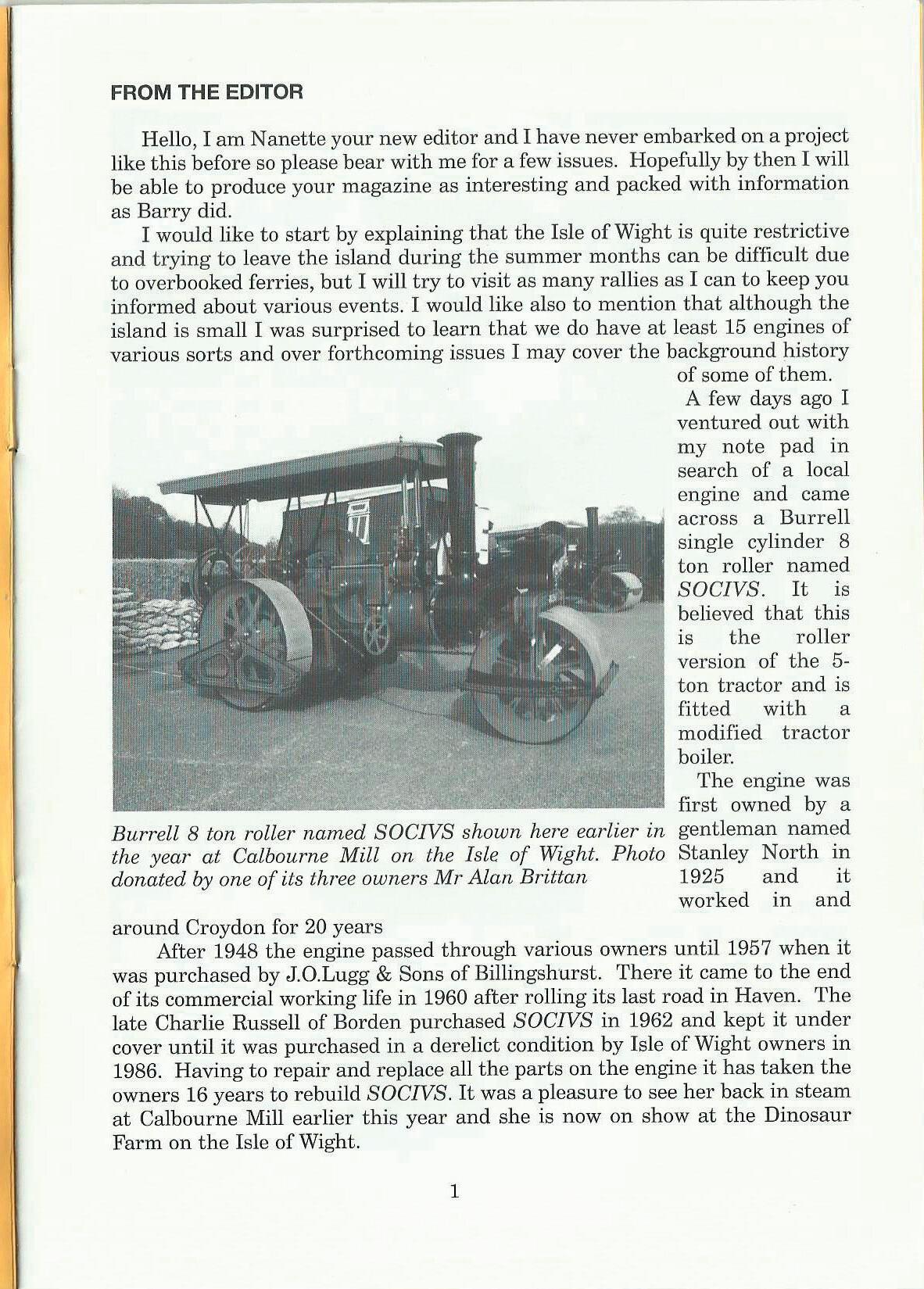
of some of them. A few days ago I ventured out with my note pad in search of a local engine and came across a Burrell single cylinder 8 ton roller named SOCIVS. It 1s believed that this is the roller version of the 5ton tractor and is fitted with a modified tractor boiler.
Burrell 8 ton roller named SOCIVS shown here earlier in the year at Calbourne Mill on the Isle of Wight. Photo donated by one of its three owners Mr Alan Brittan, around Croydon for 20 years
The engine was first owned by a gentleman named Stanley North in 1925 and it worked 1n and
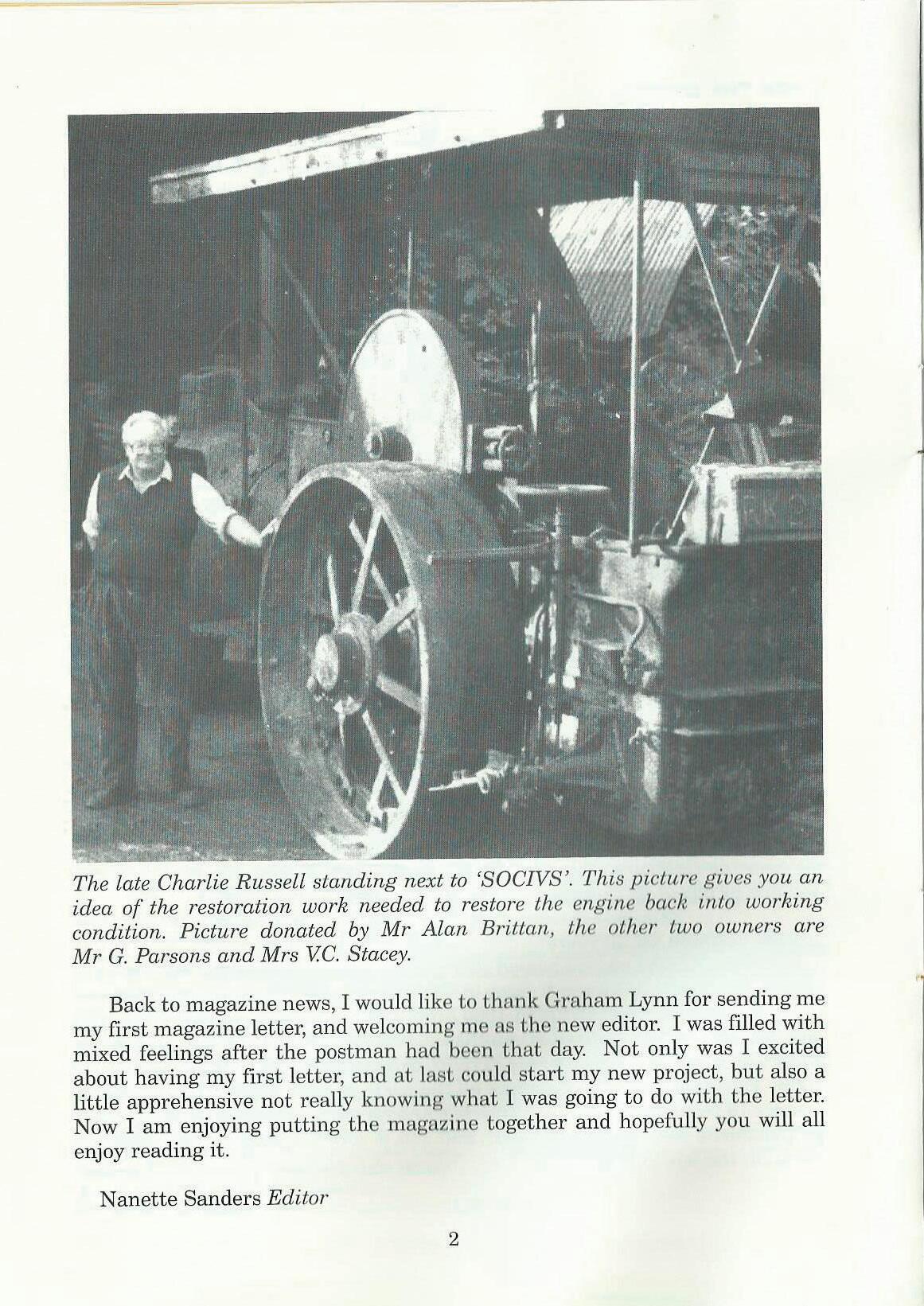
After 1948 the engine passed through various owners until 1957 when it was purchased by J.O.Lugg & Sons of Billingshurst. There it came to the end of its commercial working life in 1960 after rolling its last road in Haven. The late Charlie Russell of Borden purchased SOCIVS in 1962 and kept it under cover until it was purchased in a derelict condition by Isle of Wight owners in 1986. Having to repair and replace all the parts on the engine it has taken the owners 16 years to rebuild SOCIVS. It was a pleasure to see her back in steam at Calbourne Mill earlier this year and she is now on show at the Dinosaur Farm on the Isle of Wight.
The late Charlie Russell standing next to 'SOCIVS'. This picture gives you an idea of the restoration work needed to restore the enf.fine baclc.into working condition. Picture donated by Mr Alan Brittan, the ol lter two owners are Mr G. Parsons and Mrs VC. Stacey.
Back to magazine news, I would like to thHn k Graham Lynn for sending me my first magazine letter, and welcoming mf' as the new editor. I was filled with mixed feelings after the postman had boon that day. Not only was I excited about having my first letter, and at lai;Lcould start my new project, but also a little apprehensive not really knowing what I was going to do with the letter. Now I am enjoying putting the magnr.inc together and hopefully you will all enjoy reading it.
Nanette Sanders Editor
It has started at last!
I refer, of course, to the dismantling of Morning Star ready for the 10 year hydraulic test 'and repairs to the axle and second shaft bearing, springs etc. rrhere is now only about half of the engine left, with the crankshaft, gear guards, tender, second shaft and rear axle all removed. However I think that she doesn't like being taken apart and tried to fight back. When removing the steering drum it dropped on to a piece of packing timber, which was then thrown up and hit me - resulting in 8 stitches in the forehead. This has left me with the nickname of 'Harry', but the serious lesson is to remember how easily things can go wrong, even when you think that the job has been thought out and you have taken sensible precautions. The main thing to cmne out of this is 'never work alone'. If there hadn't been anyone around to help me and call the emergency services I would have been in serious trouble. I have now left MS for a couple of weeks to calm down again before trying the next job of removing the belly tanks. The good news is that the wear in the back axleboxes and springs doesn't look as bad as I thought it would be.
Now to Club business.
We have begun the year in a very positive light. We have had more exposure than usual in the press and are very grateful for the positive way in which the SAC has been highlighted. See if you can find a copy of the July edition of Vintage Spirit. Several of the club's Driving Days have been written about, describing the range of activities and the manner in which they were carried out. Lots of good pictures and a good advert for the SAC. As I write this the only Driving Day (or should that be weekend?) left to go is the BSEPS event at Old Warden Park. This again should be a great weekend. We had 8 apprentices at the NTET Driving Course held at Beamish Open Air Museum. I think that they all enjoyed themselves, but I hope to see a letter or two from them to let the rest of you know how they got on. This is a subtle hint!
You will see elsewhere in this issue an advert for the Gloucester Steam Extravaganza. They have contacted us to say that they have 8 engine owners who are willing to take apprentices on their engines. This means that you have to turn up!
Next year the SAC will be 25 years old - and the NTET will be 50. There are great plans being made to celebrate this, with a road run being organised and a special gathering at the Great Dorset Steam Fair. The organising committee also want a suitable logo to mark this occasion. I am asking for ideas from you for this logo. It needs to be simple, reproducible and expressing the achievement of both of these organisations! No pressure really. If you want to try your hand at this send your ideas to me either by post or e-mail.
The next major event in our calendar is the GDSF at the end of August. The SAC will be well represented and I hope to see lots of you there.
John Durling. Chairman
GLOUCESTERSHIRE STEAM EXTRAVAGANZA
2nd & 3rd AUGUST
KEMBLE, NEAR CIRENCESTER
The organisers of this event have arranged for 8 of their engine owners to offer places to visiting SAC members.
THIS MEANS YOU!!!
They are also offering free entry to the SAC members on presentation of a current membership card.
Elaine Massey will be at the rally to meet you and help the organisers.
Please support this event and contact Elaine to let her know that you want to attend.
MAIL BAG
Dear Editor,
On Sunday the 4th May I attended the driving day at Chatham Historic Dockyard for the 5th successive year. My school friend Joe Jackson also came and attended for the first time as he has only recently joined the SAC.
This year there were 9 apprentices present who were welcomed by John Galvin and the other drivers there.
Because it was a bank holiday weekend there were not so many engines available this year but even so there was an Aveling & Porter roller, Fowler roller, Fowler T2 tractor and a half scale Mann steam wagon for us to prepare and drive.
My day however was not spent on these engines. The dockyard has a standard gauge railway running through it and on certain weekends demonstration trains are run throughout the day. On this particular day, the loco section were short of a crew member, so I was asked by John Galvin if I would like to help them for the day. As I have had some previous footplate experience and I a1n used to running 5" scale steam engine::; ai 1ny local Model Engineers' club track I jumped at the chance to spend Lhe whole day on one. 1 /lrii -.; s,;r- So l sei off with Dave f lf}g:~ • Lo help prepare for the ~1 \ day's events.
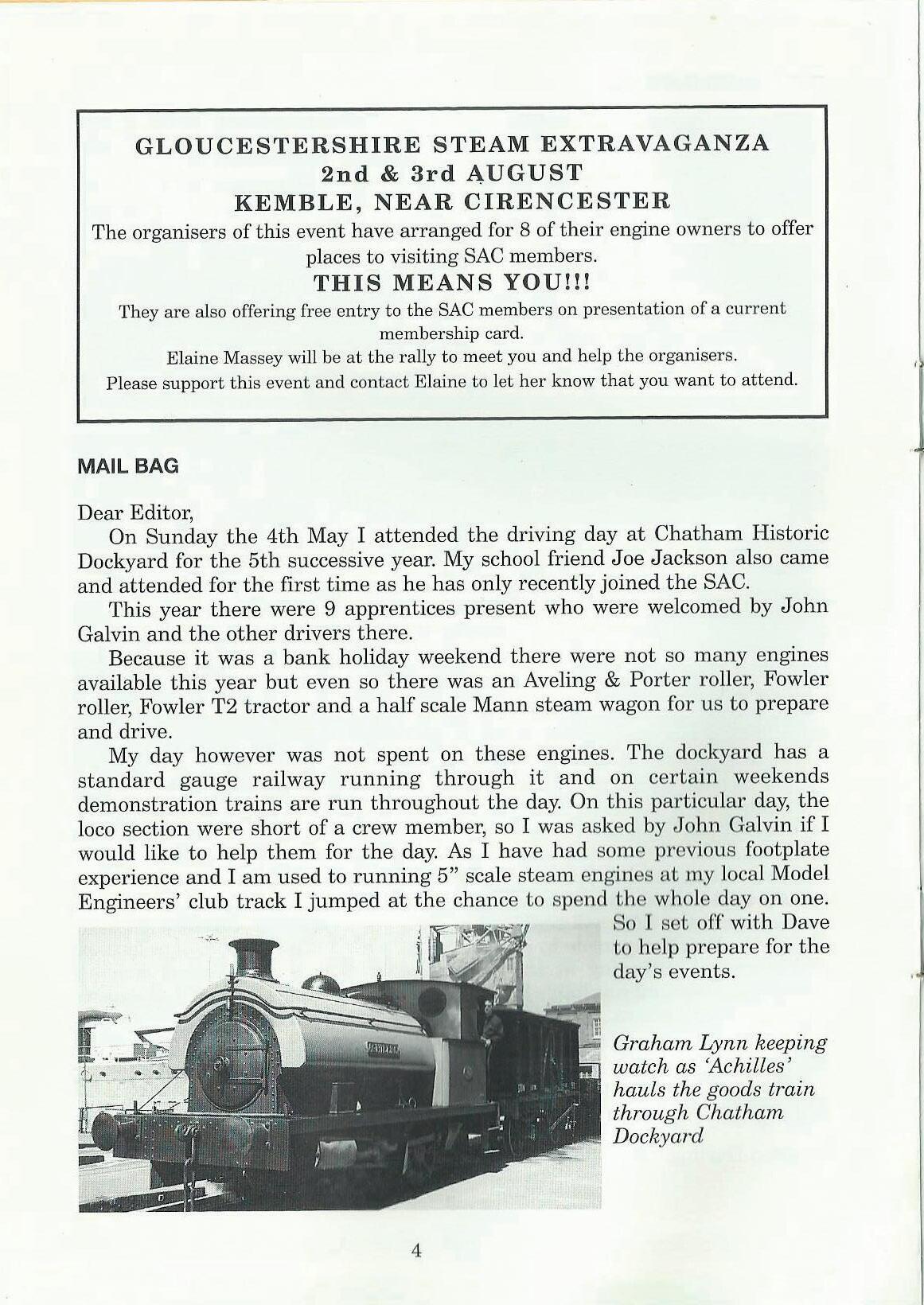
Graham Lynn keeping watch as 'Achilles' hauls the goods train through Chatham Dockyard
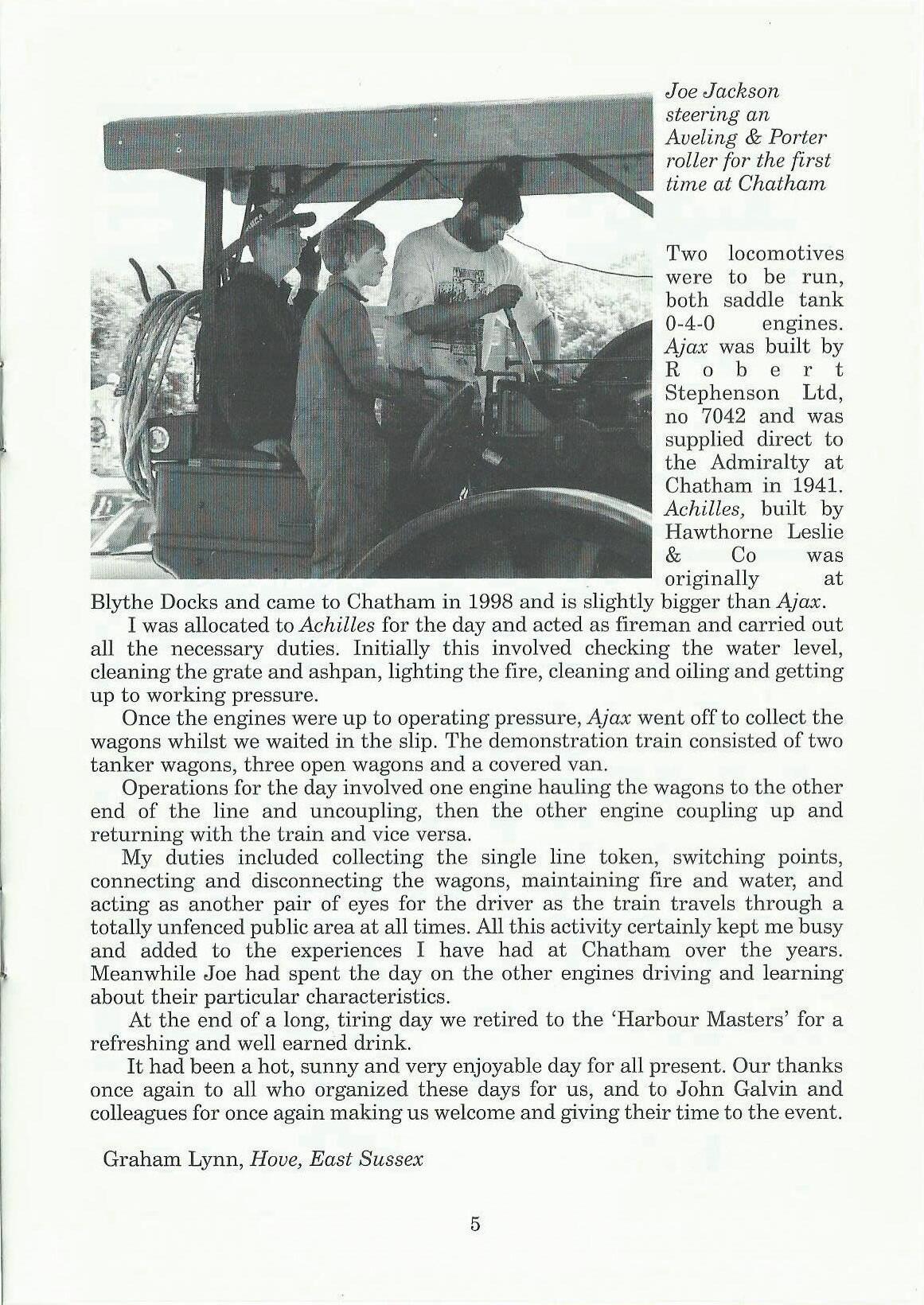
Joe Jackson steering an Aveling & Porter roller for the first time at Chatha,n
Two locomotives were to be run, both saddle tank 0-4-0 engines.
Ajax was built by R o b e r t Stephenson Ltd, no 7042 and was supplied direct to the Admiralty at Chatham in 1941. Achilles, built by Hawthorne Leslie & Co was _ originally at
Blythe Docks and came to Chatham in 1998 and is slightly bigger than Ajax. I was allocated to Achilles for the day and acted as fireman and carried out all the necessary duties. Initially this involved checking the water level, cleaning the grate and ashpan, lighting the fire, cleaning and oiling and getting up to working pressure.
Once the engines were up to operating pressure, Ajax went off to collect the wagons whilst we waited in the slip. The demonstration train consisted of two tanker wagons, three open wagons and a covered van.
Operations for the day involved one engine hauling the wagons to the other end of the line and uncoupling, then the other engine coupling up and returning with the train and vice versa.
My duties included collecting the single line token, switching points, connecting and disconnecting the wagons, maintaining fire and water, and acting as another pair of eyes for the driver as the train travels through a totally unfenced public area at all times. All this activity certainly kept me busy and added to the experiences I have had at Chatham over the years. Meanwhile Joe had spent the day on the other engines driving and learning about their particular characteristics.
At the end of a long, tiring day we retired to the 'Harbour Masters' for a refreshing and well earned drink.
It had been a hot, sunny and very enjoyable day for all present. Our thanks once again to all who organized these days for us, and to John Galvin and colleagues for once again making us welc01ne and giving their time to the event.
Graham Lynn, Hove, East Sussex
BUILDING 'MINNIE'
Building a miniature traction engine part 3.
By Matthew Lund.
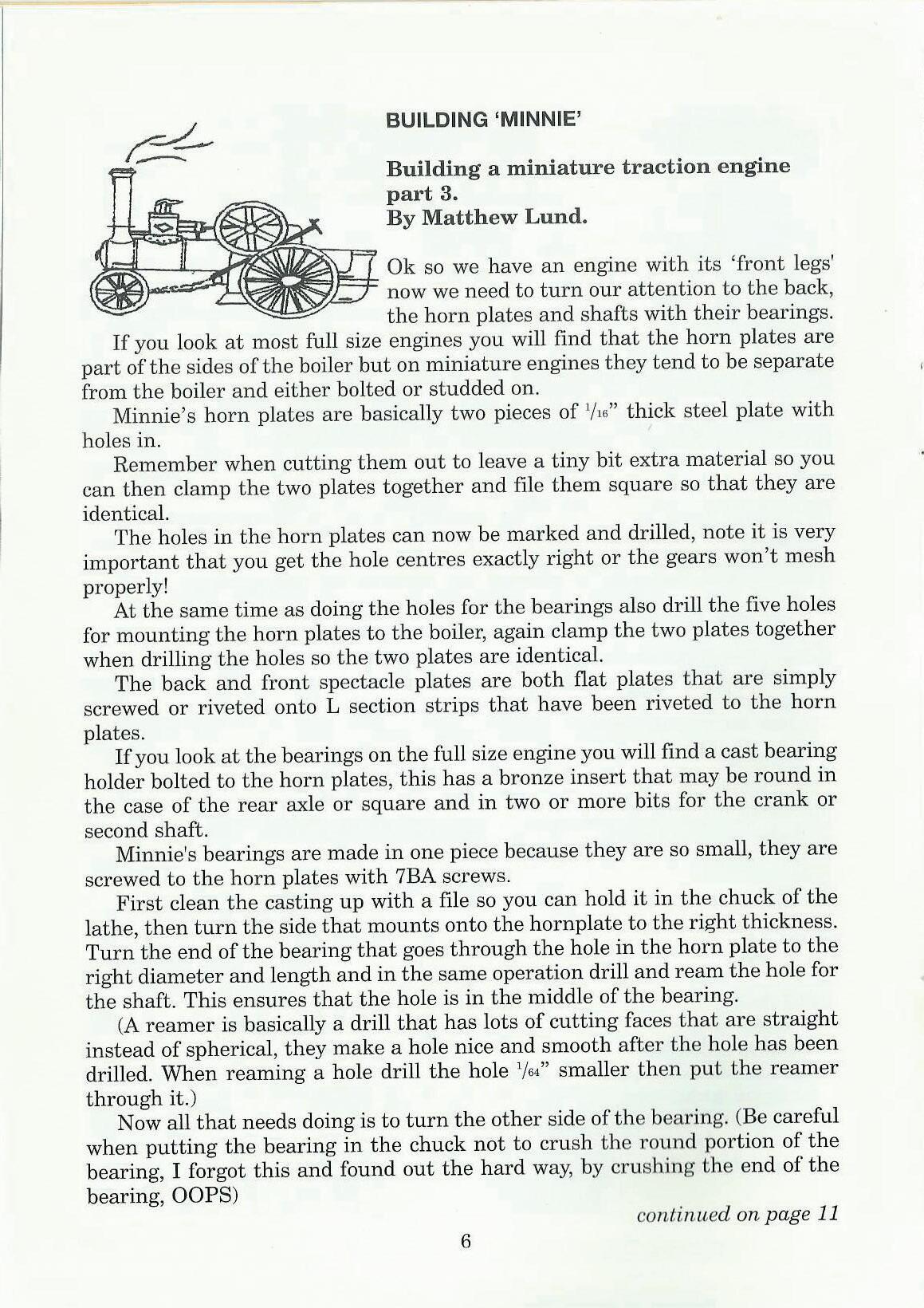
Ok so we have an engine with its 'front legs' now we need to turn our attention to the back, the horn plates and shafts with their bearings.
If you look at most full size engines you will find that the horn plates are part of the sides of the boiler but on miniature engines they tend to be separate from the boiler and either bolted or studded on.
Minnie's horn plates are basically two pieces of 1/16" thick steel plate with holes in.
Remember when cutting them out to leave a tiny bit extra material so you can then clamp the two plates together and file them square so that they are identical.
The holes in the horn plates can now be marked and drilled, note it is very important that you get the hole centres exactly right or the gears won't mesh properly!
At the same time as doing the holes for the bearings also drill the five holes for mounting the horn plates to the boiler, again clamp the two plates together when drilling the holes so the two plates are identical.
The back and front spectacle plates are both flat plates that are simply screwed or riveted onto L section strips that have been riveted to the horn plates.
If you look at the bearings on the full size engine you will find a cast bearing holder bolted to the horn plates, this has a bronze insert that may be round in the case of the rear axle or square and in two or more bits for the crank or second shaft.
Minnie's bearings are made in one piece because they are so small, they are screwed to the horn plates with 7BA screws.
First clean the casting up with a file so you can hold it in the chuck of the lathe, then turn the side that mounts onto the hornplate to the right thickness. Turn the end of the bearing that goes through the hole in the horn plate to the right diameter and length and in the same operation drill and ream the hole for the shaft. This ensures that the hole is in the middle of the bearing.
(A reamer is basically a drill that has lots of cutting faces that are straight instead of spherical, they make a hole nice and smooth after the hole has been drilled. When reaming a hole drill the hole 1/64'' smaller then put the reamer through it.)
Now all that needs doing is to turn the other side of the bearing. (Be careful when putting the bearing in the chuck not to crush the round portion of the bearing, I forgot this and found out the hard way, by crushing Lhe end of the bearing, OOPS)
coniinll,ed on page 11
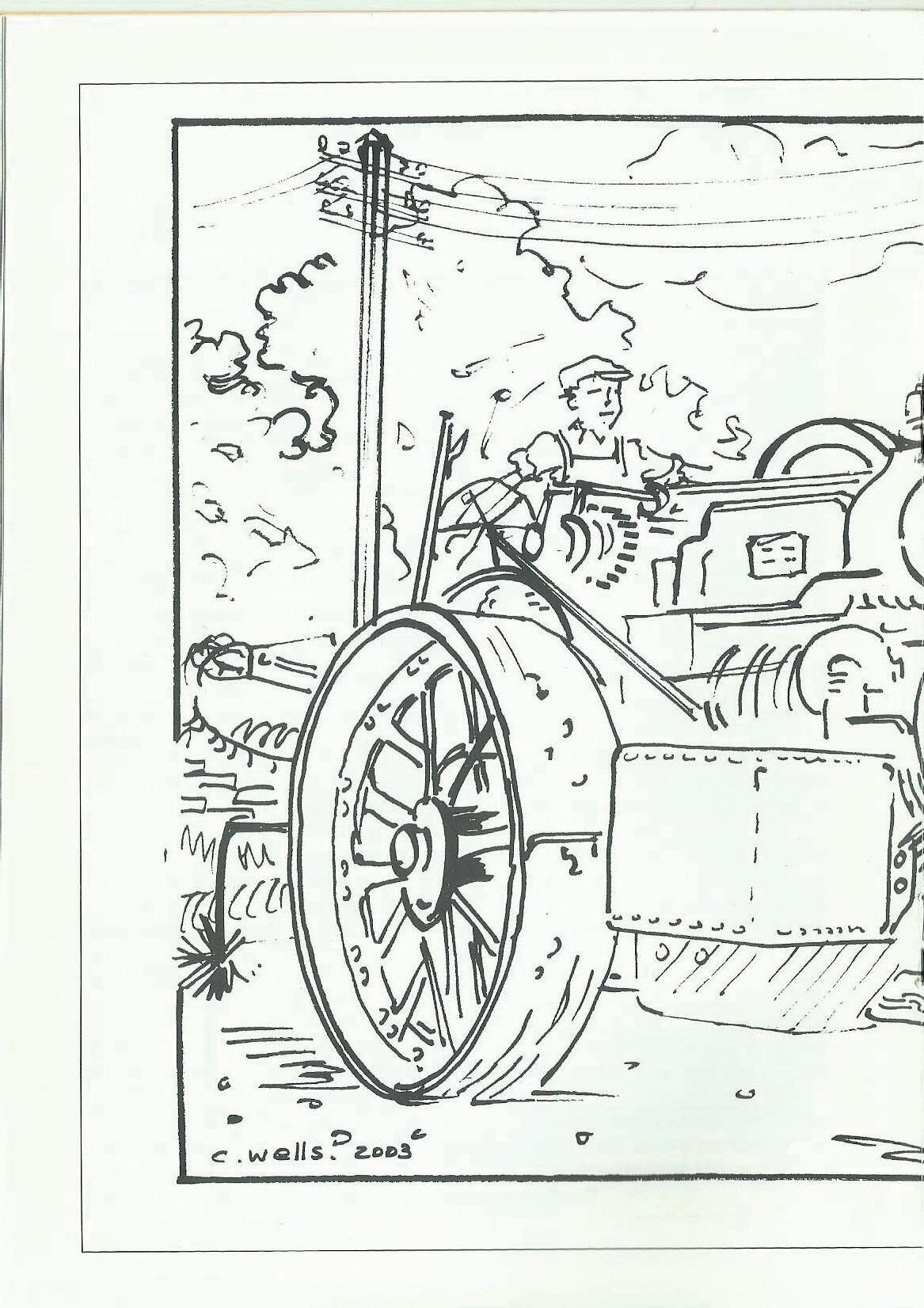
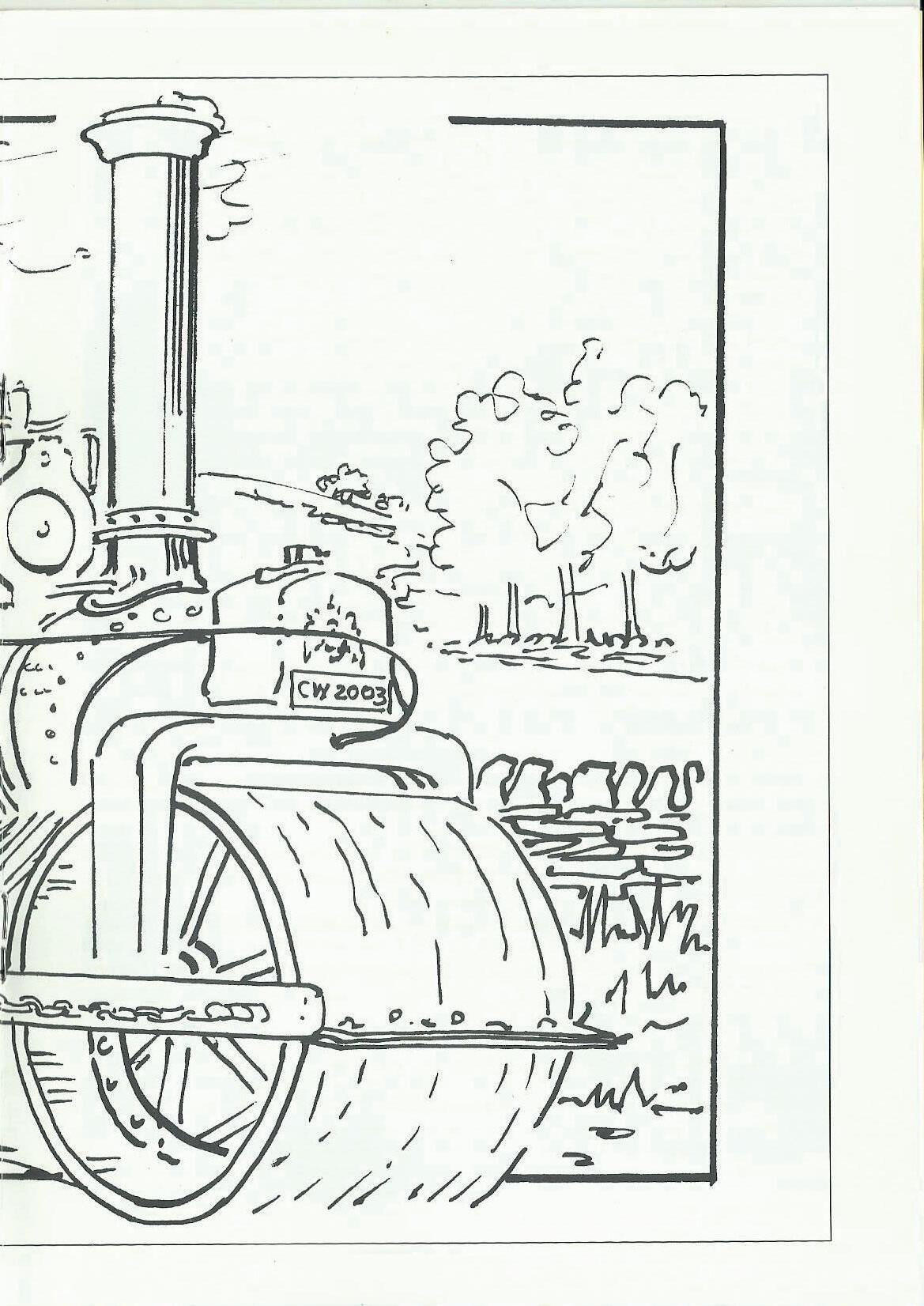
COLOURING COMPETITION
For Members aged up to 16 years old
CAREFULLY remove this page from the magazine ask an adult for help if necessary - be especially careful of the staples
COLOUR the picture using pencils, crayons, paints or felt pens. (Pencils are probably best.)
WRITE your name, age, address and membership number 1n the space provided.
POST your entry in a large envelope, to avoid folding it too much.
ENCLOSE a large stamped addressed envelope if you want your entry returned.
REMEMBER to send your entry to arrive with John and Fiona Durling by 15th August.
The competition is open to all apprentices up to the age of 16. Entries from those 12 years and under will be judged separately.
ADDRESS for entries is:
PHOTOGRAPHIC COMPETITION
The 2003 Steam Apprentice Club Photographic Competition
The annual photographic competition is an on-going one, and starts almost as soon as the last one has finished, so let's have as many of you as possible entering your best photographs that you have taken this year. The competition is split into age groups - up to 15 years and 16 years old and over. Engraved medals and other prizes will be presented to the winners. The best overall entry will be presented with the Dorset Trophy and will receive a book donated by NTET Sales.
Rules
1.. Entry to this competition is restricted to fully subscribed members of the Steam Apprentice Club (SAC).
2. Each member's entry will consist of three photographs, preferably 6" x 4" prints, col01aror black and white, and should have been taken during the period 1st August 2002 to 31st July 2003.
3. Entries must be sent to the Secretary of the SAC at Hawthorn Cottage, Stubwood, Uttoxeter, Staffordshire ST14 5HX, to arrive by Friday 15th August.
4~All entries must have the following details on the reverse of the photograph: name, address, .age and SAC membership number; place, date and details of the engine or subject. (It is better to write these details on a piece of paper and then stick this on the back of the photo.)
5. Copyright in all entries will remain with the SAC member submitting the photographs and the organisers promise that prints will not be used in any manner or display other than in connection with the 2003 photographic competition. (A selection of entries will appear subsequently in SAC magazines.)
6. All entries are to include a suitable stamped addressed envelope to ensure photographs can be returned. The organisers promise to return all entries if this rule is adhered to.
7. Entries will be displayed at the 2003 Great Dorset Steam Fair in the NTET tent. All entries will be returned after display and/or publication in the magazine.
8. The competition will be judged in two age groups: up to 15 years; 16 years and over. Prizes and engraved medals for First, Second and Third places in each group will be awarded. The best overall entry will receive the Dorset Trophy shield, to be held for one year.
Judging
The judges will he looking for originality, composition and technical ability. Photographs do not have to be of traction engines, but other subjects must clearly be related to the traction engine movement. The judges' decision on all entries will be final and members are asked to accept them in a spirit that will bring credit to themselves and the Steam Apprentice Club.
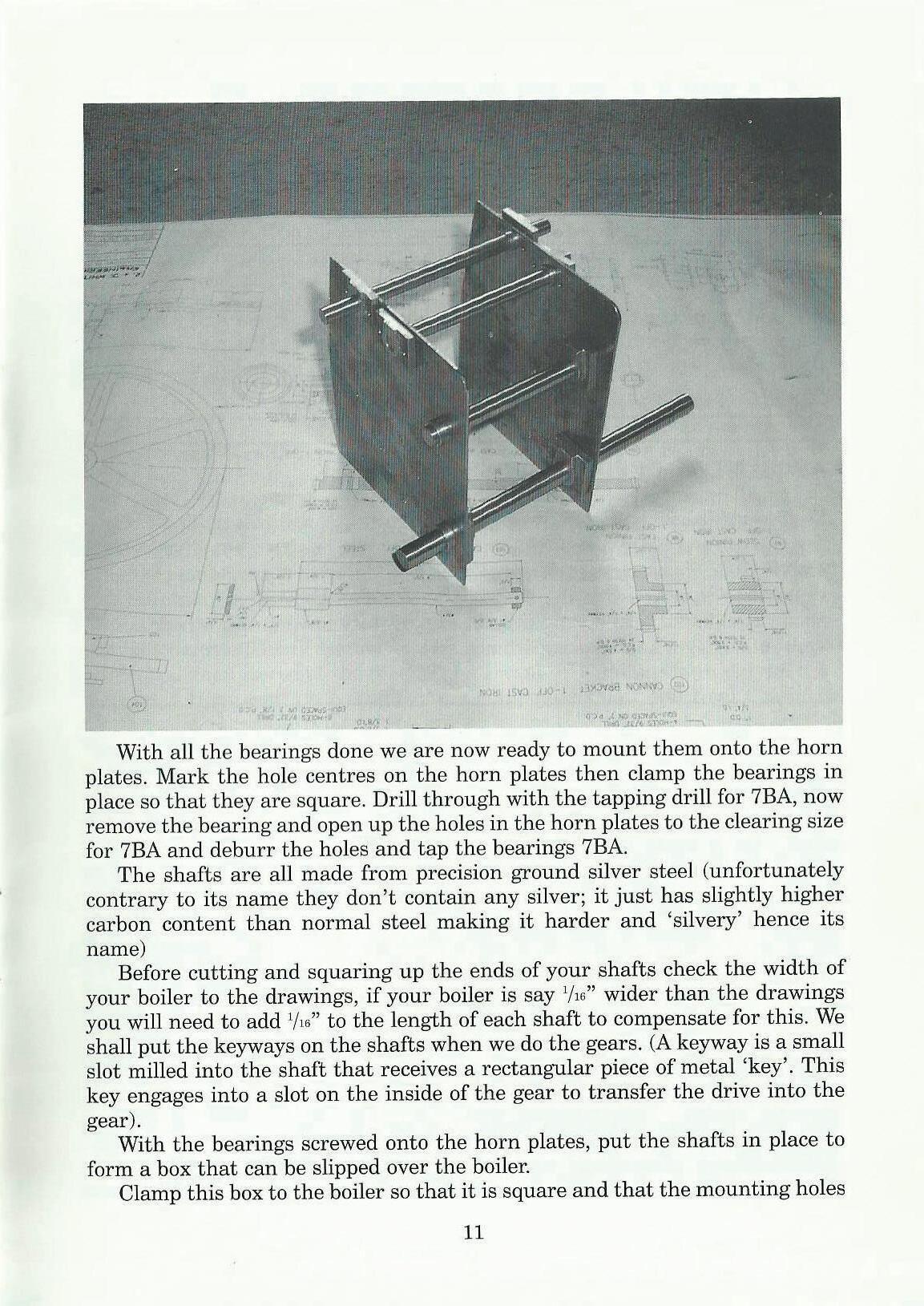
With all the bearings done we are now ready to mount them onto the horn plates. Mark the hole centres on the horn plates then clamp the bearings in place so that they are square. Drill through with the tapping drill for 7BA, now remove the bearing and open up the holes in the horn plates to the clearing size for 7BA and deburr the holes and tap the bearings 7BA.
The shafts are all made from precision ground silver steel (unfortunately contrary to its name they don't contain any silver; it just has slightly higher carbon content than normal steel making it harder and 'silvery' hence its name)
Before cutting and squaring up the ends of your shafts check the width of your boiler to the drawings, if your boiler is say 1 /16" wider than the drawings you will need to add 1/rn" to the length of each shaft to compensate for this. We shall put the keyways on the shafts when we do the gears. (A keyway is a small slot milled into the shaft that receives a rectangular piece of metal 'key'. This key engages into a slot on the inside of the gear to transfer the drive into the gear).
With the bearings screwed onto the horn plates, put the shafts in place to form a box that can be slipped over the boiler.
Clamp this box to the boiler so that it is square and that the mounting holes
are in the middle of the side stays and making sure that the shafts turn freely. Spot through with a drill onto the side stays. Remove the horn plates and drill through the stays for mounting the horn plates. For more information or help please e-mail me via the SAC website.
Matthew Lund.
ANY DONATIONS PLEASE
If you are planning to come to the Dorset Steam Fair this year and you have outgrown your overalls or boots, and would like to donate them to the club, then please bring them along to the Apprentice Club located in the NTET tent.
APPRENTICE OPPORTUNITIES
Staff working at the Science Museum, Wroughton, Wiltshire have decided to revamp some of their steam equipment. A request has been e-mailed to the club for any apprentices in the area that would like to spend some of their spare time working with the staff at the museum and help to restore the steam equipment. This is a fantastic opportunity for any willing and able apprentice to get hands on experience. Please contact Vice Chairman Elaine for further information.
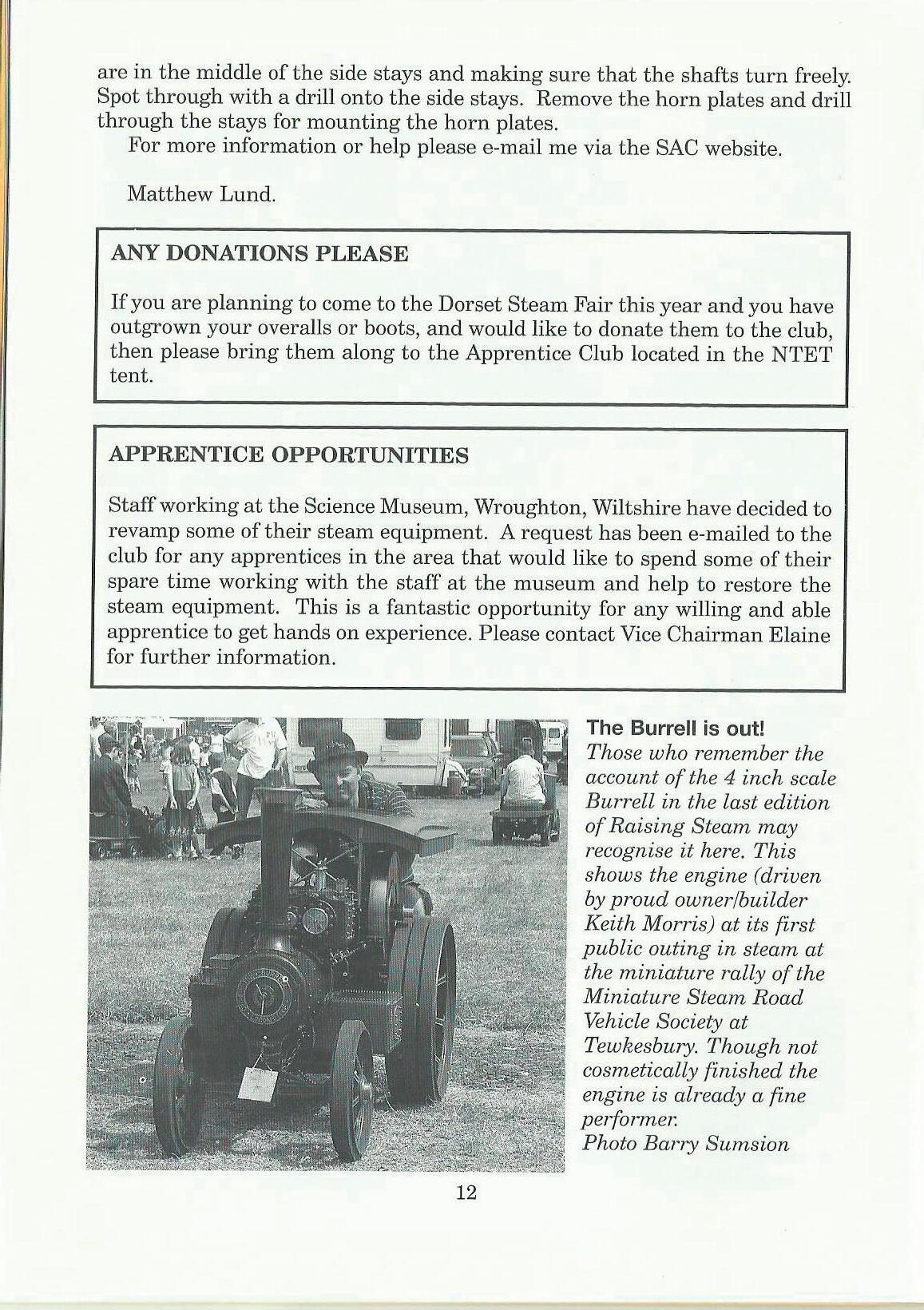
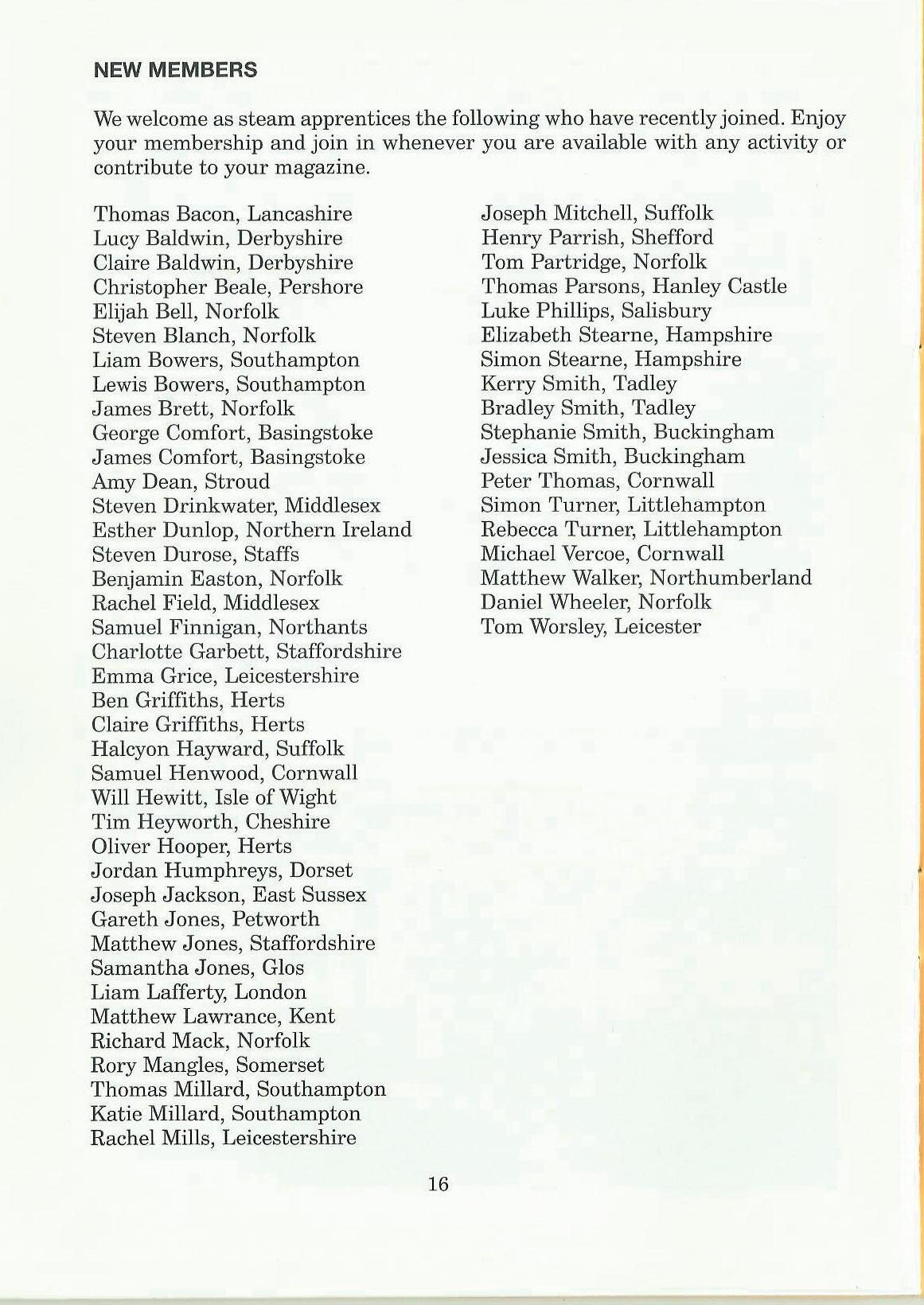
The Burrell is out! Those who remember the account of the 4 inch scale Burrell in the last edition of Raising Stea1n may recognise it here. This shows the engine (driven by proud owner/builder Keith Morris) at its f~rst public outing in steam at the miniature rally of the Miniature Steam Road Vehicle Society at Tewkesbury. Though not cosmetically finished the engine is already a fine performer.
Photo Barry Sumsion
Dear Editor
I am writing about the exciting weekend we had at the driving days at Weeting on 26th and 27th April. We arrived on the Friday and saw one of the two Burrell ploughing engines in steam. When we had finished putting up the trailer tent it started raining heavily so we could not go and look at the ploughing engine. The next morning when we woke up it had stopped raining. We had some breakfast and went out and found the other apprentices who were waiting for Richard Parrot the owner of the engines (except for the ploughing engine which is owned by the Museum of East Anglian Life, Stowmarket), When he arrived he said "get into pairs and go and find an engine to work on". I went with my brother Alan and found an engine called Spitfire which was a Burrell Devonshire no. 2626. The driver was Margaret.
The first thing was to start cleaning; I let Alan light the fire as he had never done it before. While we waited for the pressure to build up we went and collected coal from the coal heap for the coal bunker. When the pressure got to 65 psi, we let the engine tick over. When the engine got to 80 psi, we went for a run up to the top of the road and back. I steered up to the top where we had a go at running it out of gear. On the way back Alan steered. Margaret took over because we had to get round a very tight bend to get into the field where all the other engines were. Then we had lunch. After lunch we went round the field. At about 4.00pm we all had to listen for the ploughing engines whistle then we all changed engines, I went on the ploughing engine. It was very heavy to steer but OK to drive. Then I went on a double crank compound Burrell called Jessie which had been stored at the farm. Then I went on a single which did not have a name, I then went on a single crank compound roller and finally went on Century the oldest Burrell traction engine in the country. After, I went back to the tent and washed then had something to eat and went to bed.
The next day we went back to where the engines were. We went back on Spitfire with two other boys. I did the tubes while Alan did the ashpan. I lit the fire this time instead. Before we set off we had a competition to see who could get the engine to tick over the slowest and I won. We set off to get some water and I steered and Janet who was looking after the engine drove. Then we went round the field taking it in turns to drive and steer. After lunch I went on the single. At about 2.00pm we decided to see who could move the engine across the field the slowest but we did not have a stop watch so we pretended. At 4.30pm I helped put the single to bed. We said thank you to Richard Parrot and the crews. Then we went and hooked up the trailer tent and came home after a very enjoyable weekend.
From Glen (aged 12) and Alan (aged 10) Prince, Billericay, Essex.
Dear Editor
On the 16th February the first Great Mini Rally was held in the Kimber's back garden.
The morning started slightly later than most rallies but this was a very special rally. There were only 5 exhibits and it was not open to the public. We started the day by steaming the exhibits. These were a Mamod road roller, steam wagon, and tractor, a pop pop boat and a steam engine made from meccano. This was made by Mike Deering (Rob and Tom's Dad).
We then felt that as all other rallies have a programme that we should too. We designed a map, which had all the essential things to make a rally go well, like a fun fair, main ring, engine line-up and of course a beer tent. There was also a quick history of all of the engines complete with pictures. We even had a timetable of events including the engine parade, games, races, and fireworks.
After we had done this it was time for the engine parade. We had a video camera so that we could film some of the day. As Robert's engine had a small accident earlier in the day he became camera person and commentator. The engine made from meccano was pulling Robert's engine (this was our heavy haulage). The games and races could not take place because none of the engines had enough pressure at the same time and it was starting to get dark. Then it was time for the rally plaques to be presented.
After doing this we watched the film that we had been making, and then it was time for Robert and Tom to go home. We all had a lovely day and we are looking forward to the rally season ahead, when we will all be playing on full size engines.
From Laura and Martin Kimber, and Robert and Tom Deering
Dear Editor
On Sunday 27th April my friend Robert and I, Laura, went to the driving day at Bursledon brickworks.
After getting there an hour early we were soon put to work on a Garrett show1nan's tractor.
While Robert cleaned out the tubes and smoke box, I cleaned out the firebox. Soon the fire had been lit with a little help from some paraffin and Dan. Afterwards we helped to clean some of the brass.
Then after a long wait we had steam up and it was time for a photograph or three, we started to feel like celebrities. By then it was time for a short break. Now it was time for us to have a drive and steer. First we went on a C-type Foden wagon, as this is Robert's favourite type of engine. He was very happy about that. We thought that we were just going to have a ride but in the end we both had a turn at steering with a little help from Martin.
Next up was Elaine's new toy, a Garrett called Olive. Then it was our turn to have a go on a Robey tractor, which was very nippy, but easy to drive and steer.
Last, we drove and steered an Aveling & Porter road roller called The Squire. This was very hard to do a 3-point turn on (or as we both did a 10-point turn).
That was the end of our perfect day. We would like to thank everyone who helped to organise and run the event this year and we are looking forward to next year.
Thanks again from Laura Kimber and Robert Deering
PS We are very sorry to everyone who we nearly hit and the brave people who came on the engines with us. We would especially like to say sorry to the man in the wheelchair who we nearly hit twice.
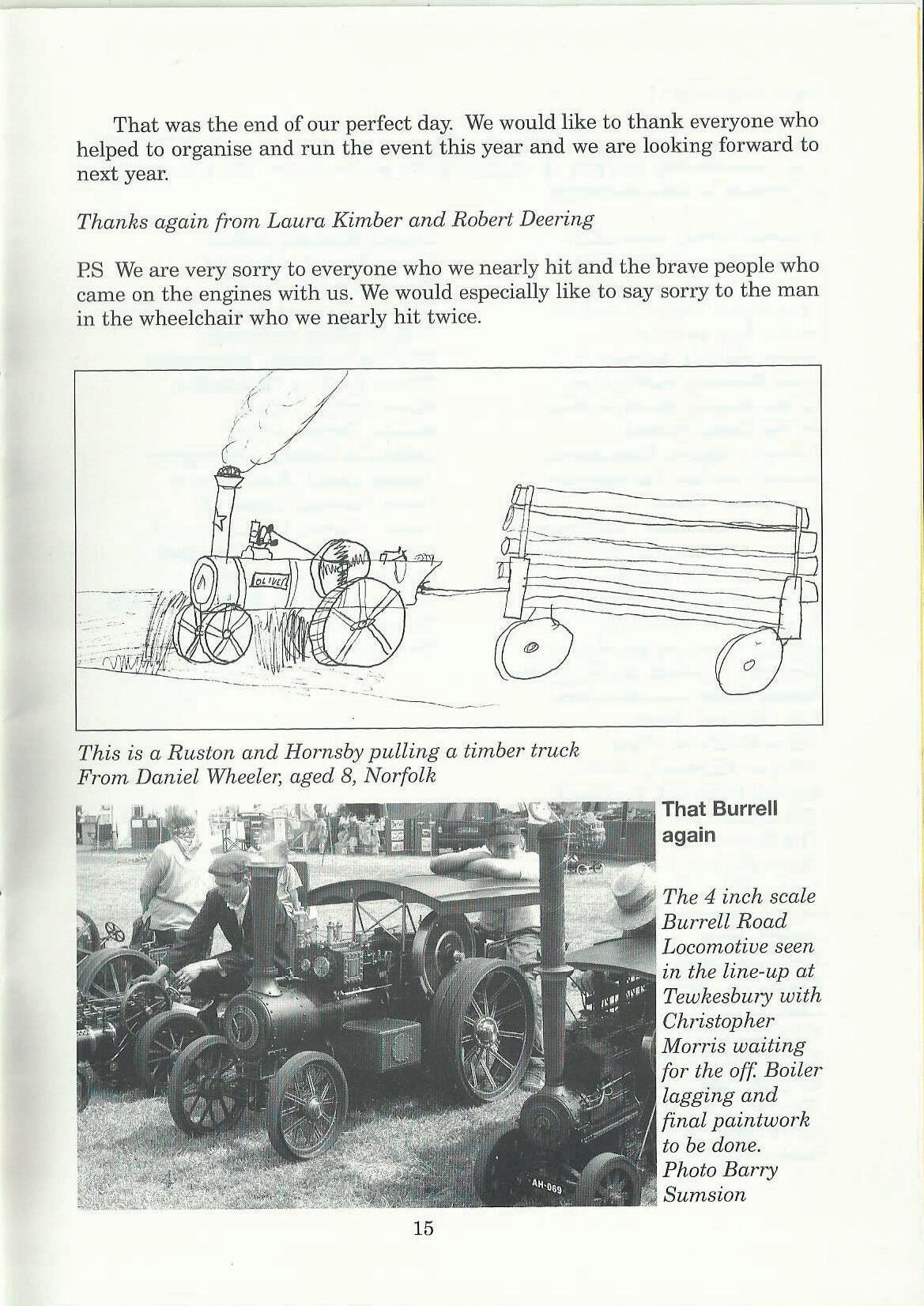
This is a Ruston and Hornsby pulling a timber truck From Daniel Wheeler, aged 8, Norfolk
That Burrell again
The 4 inch scale Burrell Road
Locomotive seen in the line-up at Tewkesbury with Christopher Morris waiting for the off. Boiler lagging and final paintwork to be done.
Photo Barry , ·, Sumsion
NEW MEMBERS
We welcome as steam apprentices the following who have recently joined. Enjoy your n1embership and join in whenever you are available with any activity or contribute to your magazine.