EDITOR
EDITOR
Barry Sumsion, Kearline Graphic Images, Fairoak House Business Centre, C11urchRoad, Newport NP19 7F,J Tel: 01633 262197 Fax: 01633 259089
CHAIRMAN, STEAM APPRENTICE CLUB
John Durling, Hawthorn Cottage, Stubwood, Uttoxetcr, Staffordshire ST14 5HX Tel: 01889 591188 (between 08.00 and 21.00 houri, only please) e-m1.dl:john. r,dur ling@uk.transport.bombardier.corn
VICE-CHAIRMAN, STEAM APPRENTICE CLUB
Elaine Massey, 21 Down Close, Northolt, Middlesex UB5 6'NS Tel: 020 8248 6570 e-mail: elainermassey@aol.com
MEMBERSHIP SECRETARY
John Cook, Dolfarni, Church Lane, Kirby la Thorpe, Sleaford, Lincolnshire NG34 9NU. Correspondence only. Membership fee £5.00 per annum.
SAC CO-ORDINATORS
Sam Bate, 30 Mowbray Grove, Bishopsgarth, Stockton-on-Tees, Cleveland TS19 BXA Tel: 01642 897153 e-mail: sambate@lycos.com
Grnham Chaffer, 32 Jubilee Way, Storrington, West Sussex RH20 3NZ Tel: 01903 745921 e-mail: chaffer.gang@ic24.net
Duncan Croser, 16 Tripps Hill Close, Chalfont St. Giles, Bucks HPB 4JZ Tel: 01494 875443 e-mail: duncan.croser@btinternet.com
Steve and Donna Taylor, 17 Smith Crescent, Coalville LE67 4JF Tel: 01530 835213 e-mail: steve.tailor@btinternet.com
The Editor welcomes any contributions of articles, shorter items or photographs for indu~ion iH future issues. All material submitted i1:1voluntary and payment. cannot be made for any mab~rinl published. The opinions expressed in the magazine, with the exception of Club announcements, an• those of the contributors and do not indicate the views of the Club as a whole. All items Ul'P held copyright by the contributor und the NTET.
Please send your contributions to the Editor at least five weeks before publication. Typed m· e-mailed articles arc preferred but not essential. If handwritten put any names of PEOPLM, PLACES or ENGINES in IlLOCK CAPITALS. If you require any part of yout· article (cg photo~) returning please say so and enclose a stamped addressed envelope. Enclose your name, addrns!:l and (if Apprentice) age with any contribution. The Editor reserves the right to amend or refuf;e contributions, and will attempt to correct spelling and grammar! 'T'he Magazine is normally published during the early part of January, April, July and October. The Club accepts no !iabilit,,v for faihU'e to meet intended publication dates.
The Steam Apprentice Club is a section of the National Traction Engine 'rrtlfit. NTET is a Registured Charity, No. 291578. Registered in England No. 1302197. Registered Office: 4 Cbl.ll·chGreen East, Re<l<litch,Worcestershire B98 8B'l'.
Typeset.ting and Artwork by Kearlirn, Graphic Images Ltd, Fairoak House Business Contn>, Church Road, Newport, South Wales NP18 7E,J Tel: 01633 262HJ7
Fax: 01633 259089 email: kearline@aol.com
Printed by MD Jenkins Printers Ltd, Lydney, Glos GL15 4EJ
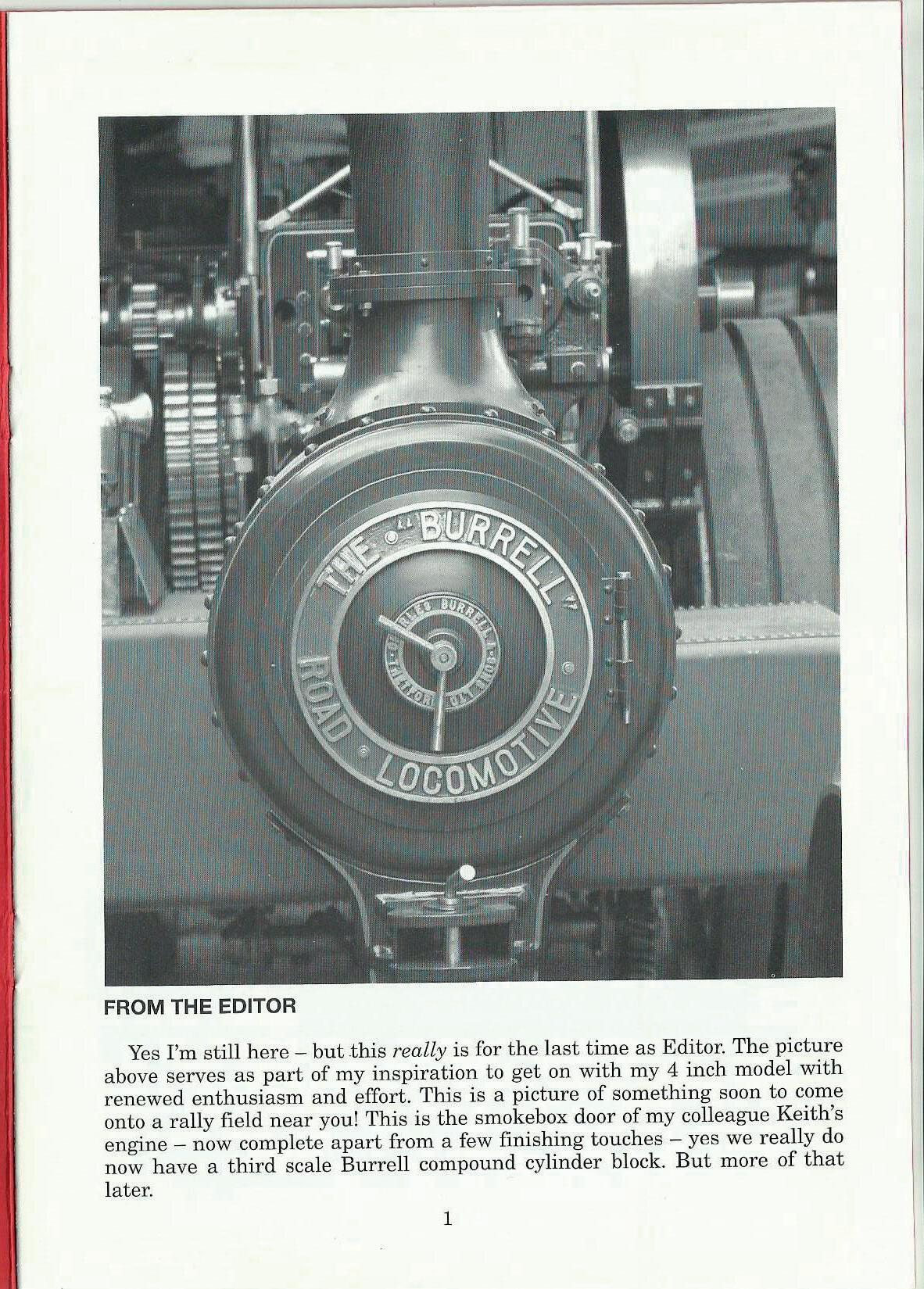
Yes I'm still here - but .this really is for the last time as Editor. The picture above serves as part of my inspiration to get on with my 4 inch model with renewed enthusiasm and effort. This is a picture of something soon to come onto a rally field near you! This is the smokebox door of my colleague Keith's engine -now complete apart from a few finishing touches -yes we really do now have a third scale Burrell compound cylinder block. But more of that later.
From the next edition of Raising Steam you will have a new Editor, who is Nanette Sanders and her address is Frog Cottage, New Road, Porchfield, Isle of Wight, PO30 4LS. Tel: 01983 523317. Both Chairman John and myself will assist to begin with, but I am sure Nanette will soon be creating a superb magazine for you. Keep up the support by sending in your contributions, be they letters, reports, photographs or anything else you feel is appropriate and of interest to your fellow apprentices.
Happy Steaming
Barry Sumsion, Retiring Editor
John Rackham owns a 1907 Aveling & Porter XAC tractor and is looking for an Apprentice to help him. He intends to visit 3 or 4 rallies a year plus other local steam ups. If you are aged between 12 and 16 and live near Winchester give John Durling a call - he has the details.
It is now April, time to start 'engineing' in earnest and Morning Star isn't even in the workshop yet. This is nothing to do with me being frightened of starting work and everything to do with family commitments during the first part of this year, including a couple of funerals. Still, things should now start to happen and I hope that by the next magazine I can report some serious progress. There is, of course, now a second 'SAC' engine in the form of Olive, a 6 nhp Garratt recently purchased by Elaine. She is telling you all about this elsewhere in this magazine.
As I write this piece the first of this year's Driving Days have already taken place - at Stanton Drew - the last will be in June at Old Warden. If you haven't booked in for one of the driving days that are still to happen (see your last magazine for details) then contact me NOW! I know that the forms were missed from vol. 1 so the closing date is not being stuck to. There is also the NTET driving course at Beamish on 10th & 11th May. We have quite a few Apprentices on the course this year - which is brilliant - but there could still be a few places so if you are interested contact me A.S.A.P.
I have also included a list in this magazine which tells you where the SAC committee members will be during the year. PLEASE make sure that they are not lonely - get out there!
We are also including the NTET rally list so that you can find out what is happening where. If you want to go to a rally on this list, and there isn't a SAC committee member going, please contact the rally direct to find out what they are able to offer.
All the usual reminders still apply at this time of year. Don't forget your camera when you go out to rallies, or working on engines etc.
Also make sure that you take your Log Book when you are likely to be working on an engine - it's no good if it is left in your bedroom!
I hope that I will see many of you during the season - even though I won't be going to as many rallies is I would normally.
You will see that there will be quite a large group of us at Dorset so I hope to see you there too.
John Durling, Chairman.
We are always being asked where can we find child sized overalls. This year we are planning a 'swap shop' at Dorset for overalls and engine boots. If you have either which are still in reasonable condition, just too small, then please bring them along to the Great Dorset Steam Fair.
I am sorry that the application forms for the driving days got missed out of the last issue of Raising Steam. Most of you managed to get in touch with me and make the arrangements that way. If you still haven't booked into one of the days which have yet to run, and would like to go - just give me a ring or send me an e-mail.
John Durling.
Hi everyone.
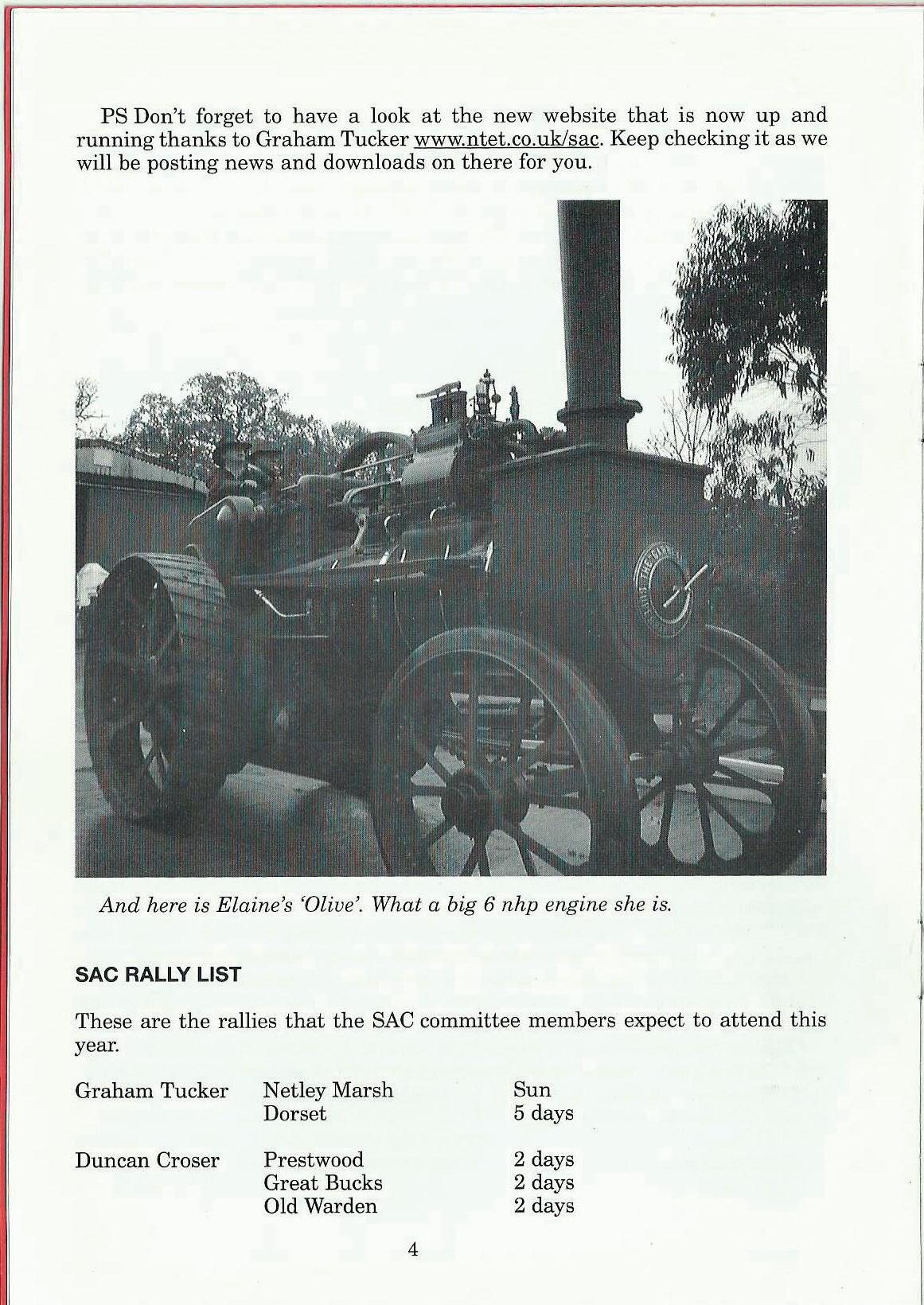
Here's another, rather unusual engine for you to look out for on the circuit. Her name is Olive and she is a superheated Garrett traction engine. We bought her at the end of last year and we are slowly learning her ways.
Olive lives at Bursledon Brickworks for those of you down that way. No doubt by the time you read this some of you will have been on her at the driving day there.
Olive is 6 nhp and weighs somewhere around 11½ tons. Built in 1911, she was sold to a gentleman in Ross on Wye and named after his daughter. For the last fifteen years Olive has been in Derbyshire and has been completely rebuilt to the original drawings.
Elaine Massey Vice Chairman
PS Don't forget to have a fook at the new website that is now up and running thanks to Graham Tucker www.ntet.eo.uk/sac. Keep checking it as we will be posting news and downloads on there for you.
RALLY LIST
These are the rallies that the SAC committee members expect to attend this year.
Elaine Massey Bill Target 2 days
Netley Marsh 2 days
Dorset 5 days
Old Warden 2 days
Nannette Sanders Dorset 5 days
Sam Bate
Barnard Castle 2 days
Pickering 3 days
Leeds 2 days
Masham 2 days
Helmsley 2 days
Chester le Street 2 days
Steve Taylor No information yet, please contact Steve if you are going to a Midlands rally
Graham Chaffer None
John Durling Garry Baker
Elvaston Castle
Doveridge Dorset Dorset 2 days 2 days 5 days 5 days
MAIL BAG
Matthew Bates writes in the last Raising Steam and asks "who is J T Beeby?''
Well Matthew, I can tell you who J T Beeby was as he was in part responsible for me getting 'hooked' on steam. He was one of a group of early enthusiasts of our hobby who retained their engines against the odds so that they are still here for us today. In recognition for his contribution he was, for many years, a Vice President of the NTET.
Jack, as we knew him, was the son of a contracting firm who used steam to make early roads and had ploughing engines which were hired out with their crews to dredge lakes, cultivate fields and pull out trees. When Jack's father died he took over the firm with his brothers, Phillip and Reg; they were no longer using steam very often but were still contracting and when the early rallies began, they took their engines along. I can clearly remember hearing the Fowler singles 1641 and 1642 when they were mole draining at an early Woburn Park rally (Bedfordshire) in the late 1950s. The 'bark' that the engines produce when they are working hard is quite unforgettable. The engines also used to work at the early Dorset events but I am afraid you will have to wait a while to hear them again as they are both in for major repairs. Jack's son Michael and Reg are overseeing this and they will, in fact, do a large part of the work themselves. In the meantime those of you who go to
Rempston and other rallies in that area are sure to see them. The singles were supplied new to Bomfords who sold them to the late Tom Powers from whom the Beebys bought them.
Michael, who is President of the Steam Plough Club, helped me with some of this information for you. It was he and Jack's widow who presented the NTET with the J T Beeby trophy saying that they would like it to be awarded for people in the Steam Apprentice Club. This is done each year at the NTET Annual General Meeting.
Matthew also mentions that he received his trophy from Mr Giles Romanes, who is the President of the NTET. He is Trust member No. 2; being one of the early people who formed the original club that later became the Trust. You will see him on his engine Goliath - no it is not a giant as you might expect but a small and very nippy Wallis & Steevens 3 nhp tractor! •
Sylvia Dudley, Vice President NTET.
33 Weathercock Lane, Woburn Sands, Milton Keynes, MKl 7 BNP.
Tel: 01908 583283
One of the very few benefits of your magazine running late is that we-are able to bring some very new contributions from the earliest driving days - Editor:
Dear Editor
Arrived home after the most fantastic day spent with Alan Sparkes and his crew at Stanton Drew.
We lit the fires and whilst waiting for the steam to build up I set to work cleaning and polishing Masterpiece and oh boy did my arms ache after polishing all that brass.
I drove three engines, two ploughing and the showman's engine Masterpiece.
We had a competition to keep the pressure at a hundred pounds whilst driving and I won!! I was given a prize of a jacket bearing the name of Kelston Sparkes.
Can't wait for the rallies to start.
Thank you for organising the driving day and a big thank you to Alan and everybody who made the day possible.
Aaron Foot
Saturday 5th April saw an influx of would-be enginemen arrive at Klondyke Mill, the site of the North Staffordshire and Cheshire Traction Engine Club. This was the occasion of the SAC Driving Day.
This year we had 13 Apprentices out of 12 turn up, and only 4 engines! However one of the engines was Howard Boulton's Fowler ploughing engine, which is able to accommodate several youngsters at once.
The other engines involved were Phil Jeffs' Fowler roller Morning Star, Peter Brookes' Aveling & Porter roller Betty Lewis and Andrew Hall's Aveling & Porter roller Evelyn.
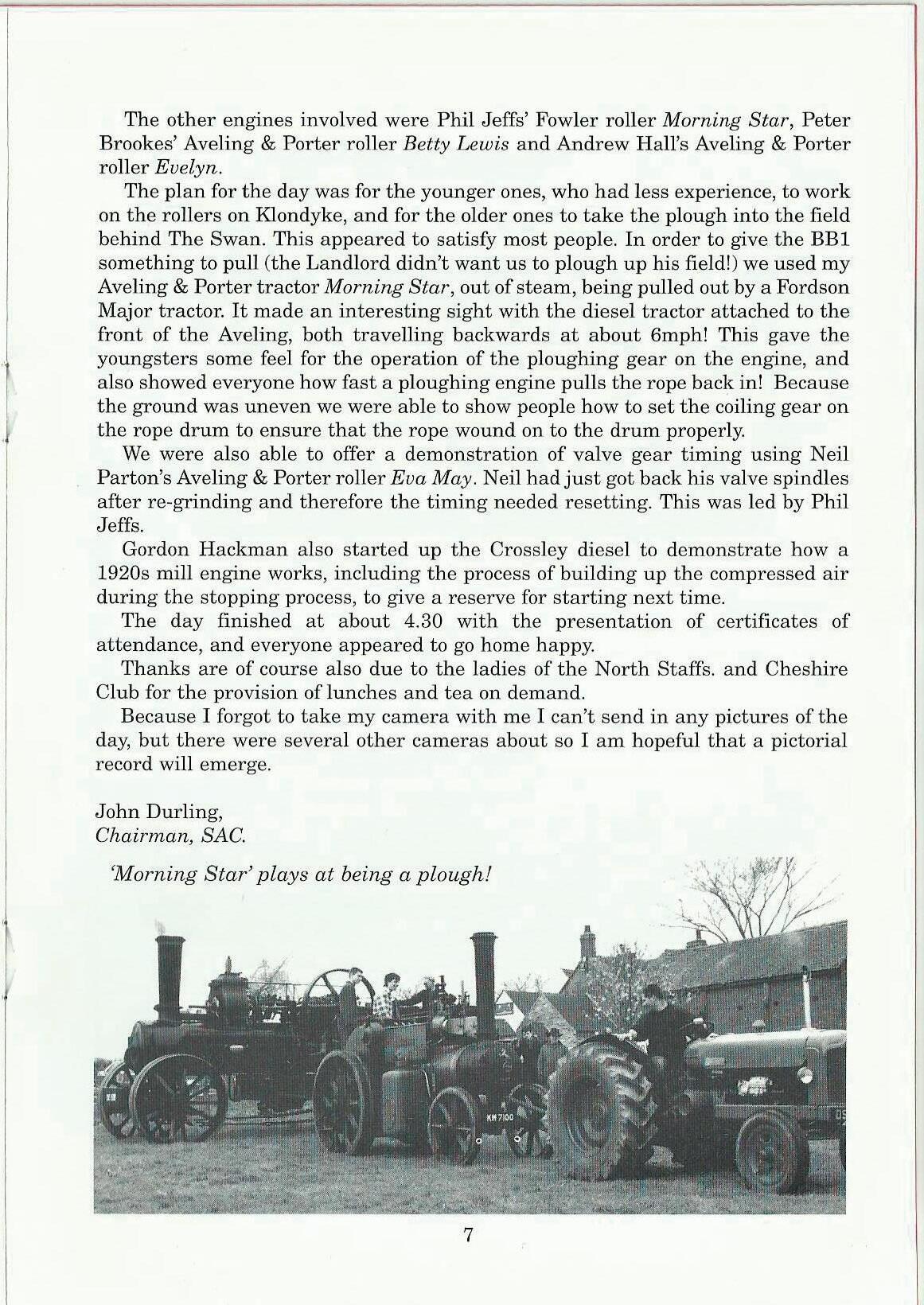
The plan for the day was for the younger ones, who had less experience, to work on the rollers on Klondyke, and for the older ones to take the plough into the field behind The Swan. This appeared to satisfy most people. In order to give the BBl something to pull (the Landlord didn't want us to plough up his field!) we used my Aveling & Porter tractor Morning Star, out of steam, being pulled out by a Fordson Major tractor. It made an interesting sight with the diesel tractor attached to the front of the Aveling, both travelling backwards at about 6mph! This gave the youngsters some feel for the operation of the ploughing gear on the engine, and also showed everyone how fast a ploughing engine pulls the rope back in! Because the ground was uneven we were able to show people how to set the coiling gear on the rope drum to ensure that the rope wound on to the drum properly.
We were also able to offer a demonstration of valve gear timing using Neil Parton's Aveling & Porter roller Eva May. Neil had just got back his valve spindles after re-grinding and therefore the timing needed resetting. This was led by Phil Jeffs.
Gordon Hackman also started up the Crossley diesel to demonstrate how a 1920s mill engine works, including the process of building up the compressed air during the stopping process, to give a reserve for starting next time.
The day finished at about 4.30 with the presentation of certificates of attendance, and everyone appeared to go home happy.
Thanks are of course also due to the ladies of the North Staffs. and Cheshire Club for the provision of lunches and tea on demand.
Because I forgot to take my camera with me I can't send in any pictures of the day, but there were several other cameras about so I am hopeful that a pictorial record will emerge.
John Durling,
Chairman, SAC.
'Morning Star) plays at being a plough!
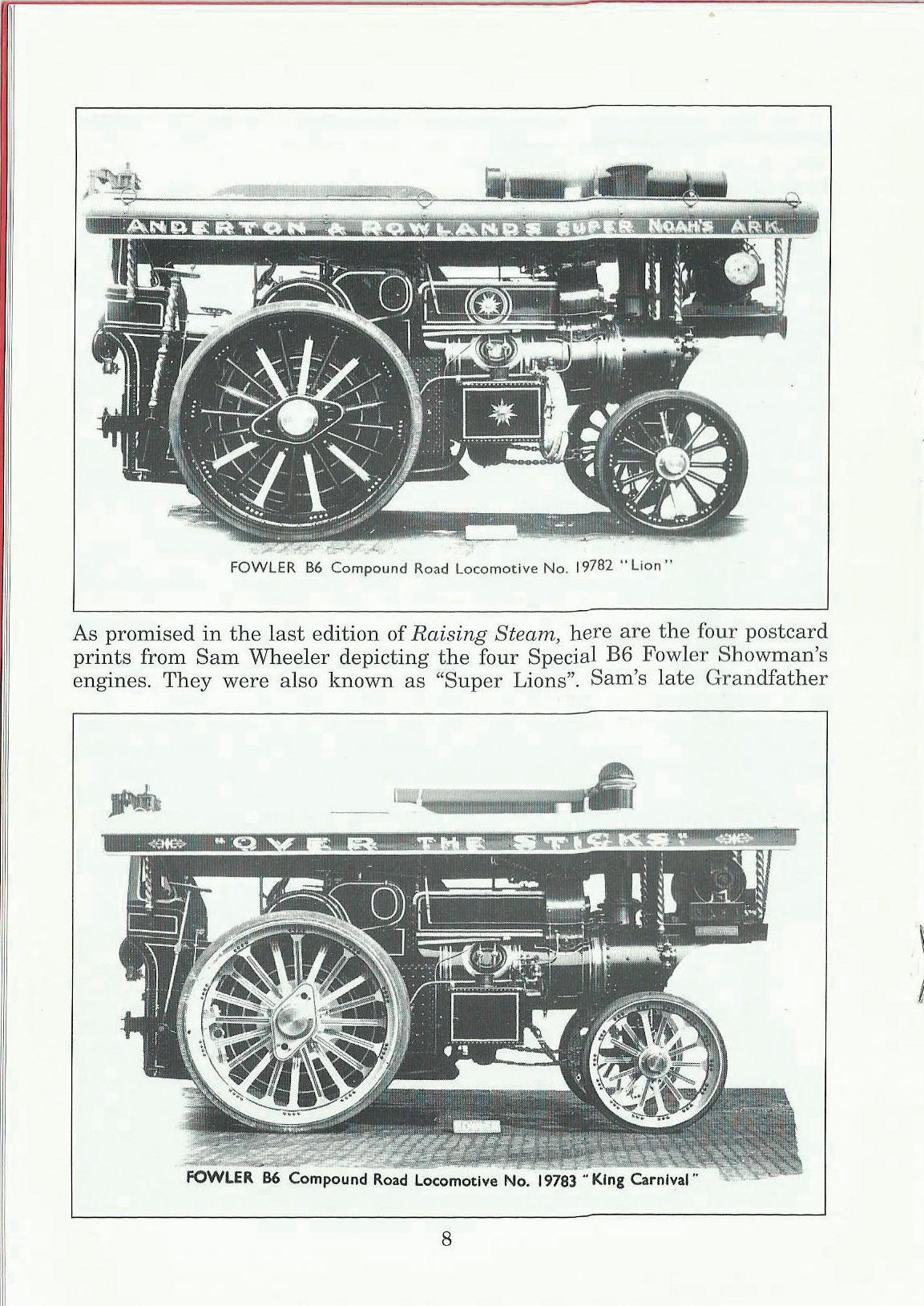
As promised in the last edition of Raising Steam, here are the four postcard prints from Sam Wheeler depicting the four Special B6 Fowler Showman's engines. They were also known as "Super Li.ons". Sam's late Grandfather
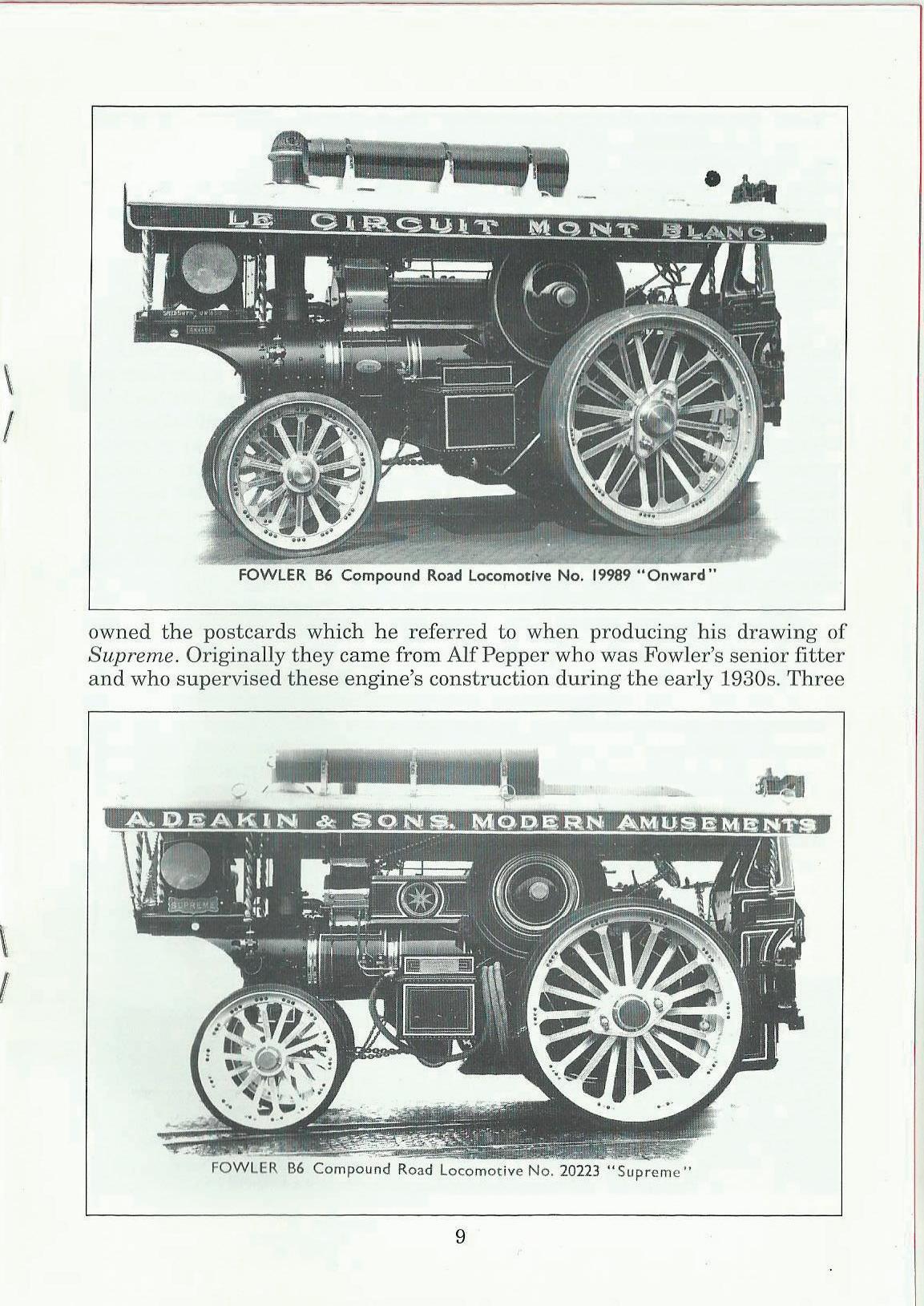
owned the postcards which he referred to when producing his drawing of Supreme. Originally they came from Alf Pepper who was Fowler's senior fitter and who supervised these engine's construction during the early 1930s. Three
of these engines still exist in preservation. Onward is the only one of the four to have been scrapped, although there has been a suggestion that someone intends to build a replica -now that would be good! Onward and Supreme both ended their days as haulage engines around Glasgo.w docks. The postcard of No 17983 names the engine King Carnival but if my memory serves me right it is actually King Carnival II. These engines were also known by some as Fowler-Burrells due to their left-hand steer and Burrell style bunker mounted crane. True Fowler fans are not keen on this denomination.
Dear Editor
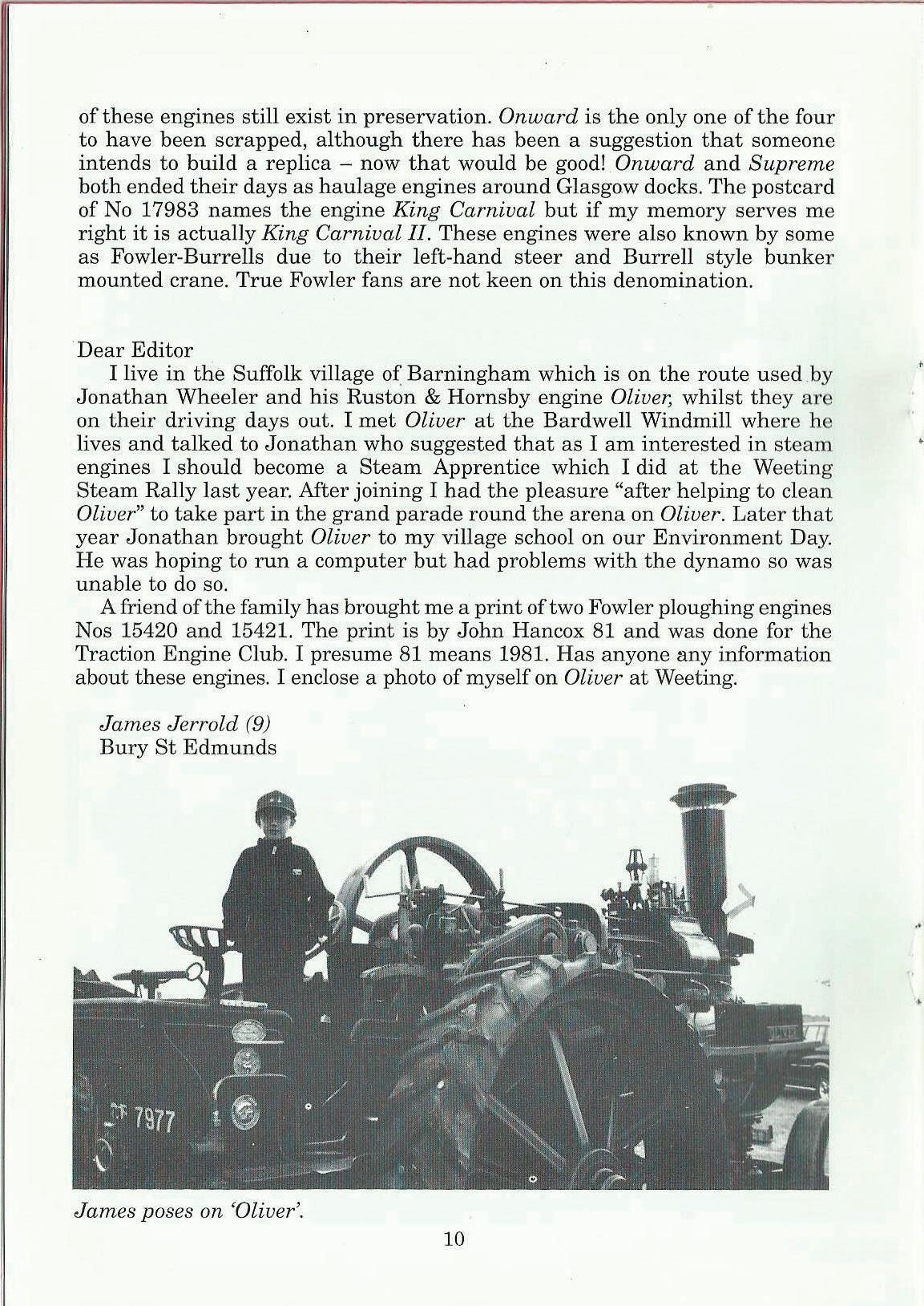
I live in the Suffolk village of Barningham which is on the route used.by Jonathan Wheeler and his Ruston & Hornsby engine Oliver, whilst they are on their driving days out. I met Oliver at the Bardwell Windmill where he lives and talked to Jonathan who suggested that as I am interested in steam engines I should become a Steam Apprentice which I did at the Weeting Steam Rally last year. After joining I had the pleasure "after helping to clean Oliver" to take part in the grand parade round the arena on Oliver. Later that year Jonathan brought Oliver to my village school on our Environment Day. He was hoping to run a computer but had problems with the dynamo so was unable to do so.
A friend of the family has brought me a print of two Fowler ploughing engines Nos 15420 and 15421. The print is by John Hancox 81 and was done for the Traction Engine Club. I presume 81 means 1981. Has anyone any information about these engines. I enclose a photo of myself on Oliver at Weeting.
James Jerrold (9) Bury St Edmunds
Building a miniature traction engine part 2.
By Matthew Lund.
Ok we have a boiler, the "chassis" of an engine, so now we need to start building the smoke box, front axle, wheels and turn plate assembly.
Minnie's smoke box starts off as a piece of copper tube that will fit snugly onto the boiler, a piece of steel plate that is the thickness of the smoke box door ring and the casting of the smoke box door.
After cutting the piece of copper tube that will be the smoke box barrel to length I then put it on the lathe to clean and square up the ends. The trickiest part of making the barrel is marking out the centre points for the rivets that will hold the smoke box onto the boiler and the smoke box door ring. The easiest way I have found of doing this is by putting the piece of copper tube face down on a flat surface then get a piece of string that will not stretch, wrap it round the tube so that the two ends butt together then measure the length of the string, divide the length by the number of rivets, in this case 20, and mark the string at the appropriate intervals then wrap the string back round and transfer the marks.
After finding and marking the centre of the steel plate that will become the door ring, put it in the lathe and bore it out to dimension. Then turn the plate around and, holding on the bore that you have just turned, turn the outside to dimension, the door ring must be a snug fit into the smoke box tube. When turning the corners off the plate take great care as the tool can break or you can throw the job out of the lathe if it is not held properly!
The next thing to do on the smoke box is the door and hinge. Minnie's door starts as a brass casting that is then turned to dimension so that it is a good fit on the door ring it is then drilled and tapped SBA, this is for the door locking handle. (Tapping is where a thread is cut in something using a tool called "a tap").
The hinge is made of two pieces, one piece on the door and the other on the side of the smoke box. Both pieces are marked out on a piece of 1 /16 thick plate that is then cut out, the edges are cleaned up with a file and it is then bent to shape. (It's like making a box out of card, you start off with the net that is then cut out and folded together). Remember to leave extra material for the bend radius (I forgot and had to make it again OOPS)! After the hinge has been made it is then riveted onto the door and smoke box with 1/16 copper rivets. With the hinge in place and the door on, the hole for the hinge pin can be drilled (this ensures that everything lines up) and the corners may be rounded of£ The hinge pin is turned from a piece of mild steel for a good fit in the hinge.
Now we have the basic shell of the smoke box, all that needs to be done is the door locking handle, the bar that the door locks onto and the hole in the top for the chimney base.
The perch bracket is made out of two pieces of 1/16steel, one that is a "U" shape with a hole in the bottom for the fork bracket and a curved piece that fits the bottom of the smoke box, these two pieces are silver soldered together.
On the full size engine the perch bracket may be a casting like on Morning Star or it may be made out of two pieces riveted together like on Olive.
Next comes the axle and fork bracket, the axle is made from a piece of rectangular mild steel that needs the ends turned down to receive the front wheels. This is achieved by using a four jaw chuck in the lathe, centring the material and turning it down to dimension. Once the ends have been turned down, holes need to drilled in the ends and tapped 4BA for the screws that hold the wheels on.
The fork bracket holds the front axle and is made from a piece of round mild steel that is first turned to dimension so that it is a snug fit in the hole in the perch bracket then a slot is cut that will fit the axle. When drilling the hole in the fork bracket for the axle pivot pin, first drill through the fork bracket smaller than the finish size, use this drill to make the hole in the axle, assemble and clamp the two together and drill through with the finish size, this ensures that everything lines up.
One of the longest, most tedious and some people would say is the hardest part of building a traction engine is the wheels and this is our next job. Minnie's front wheels each have 10 spokes and are 37/8 diameter, made from two castings (hub and the rim) with spokes made from 1 /16 thick mild steel.
The first and by far the easiest job is machining the rims, holding on the inside of the rim, first turn the inside dimensions, the edge and the outside dimensions, then turn the rim over and again holding on the inside true the rim up and turn the other side.
The hub is basically a fat cotton reel with five slots in each side. The hardest part of the hubs is getting an even spacing between the slots especially if you don't have a mill and dividing head (a dividing head is a tool that allows you to divide the slots evenly and very accurately, it is also used for cutting gears).
As I don't have a dividing head I made a simple marking gauge out of card that was 72° (the angle of each spoke) marked the ends of the hub and very carefully milled the slots on the lathe using a vertical slide set up by eye ball, and dare I say it they didn't turn out too bad. (The vertical slide enables you to do light milling on a lathe by putting the milling cutter in the chuck).
Each spoke started off as a strip of metal, after making a small jig to hold the strips on the vertical slide I milled the edges five at a time to form the shape of the spoke.
Accurately drill the end of one spoke 1/16 diameter for the rivets that hold it to the rim then use this spoke as a jig for drilling the others, do the same for the end that goes into the hub but this hole starts as the tapping size for the SBA screws that hold each spoke in the hub. For assembling the wheels I made a jig that was simply a piece of plywood with a spigot in the middle that was a good fit in the hub, a spacer piece and a load of pins to centre the rim. (The hub is offset in the rim, it is closer to the outside of the wheel that is why you need the spacer to lift it off the plywood base).
First put the hub and rim on the jig, then put each spoke in position and bend it so that it sits in position and looks good, number each spoke so it goes back in the same place and carefully drill the hole in the hub. Remove the hub and tap the SBA screw holes. Drill the holes at the hub ends of the spokes out 12
to 8BA clearance, then countersink the outside of the hole in each spoke and screw the spokes in position (I use Araldite to lock the screws in place and to help to hold the spokes). Put the hub back in the jig with the rim and do the same to the other side, remember to put the rim in position when you screw the other spokes in or you won't get it in! Now you should have a wheel with a loose rim. With it still in the jig, drill one of the holes in each spoke through the rim and place a rivet in it to hold it in position, now you can remove the wheel from the jig and peen the rivets over. Do the same to the other side then drill and rivet the remaining holes. (If your jig is accurate enough you should end up with a perfect wheel).
On full size engines the spokes were bent and riveted to the rim first, then the hub was cast in the middle locking the spokes in place.
For more information/help please e-mail me at 1natt.lund@engineer.com.
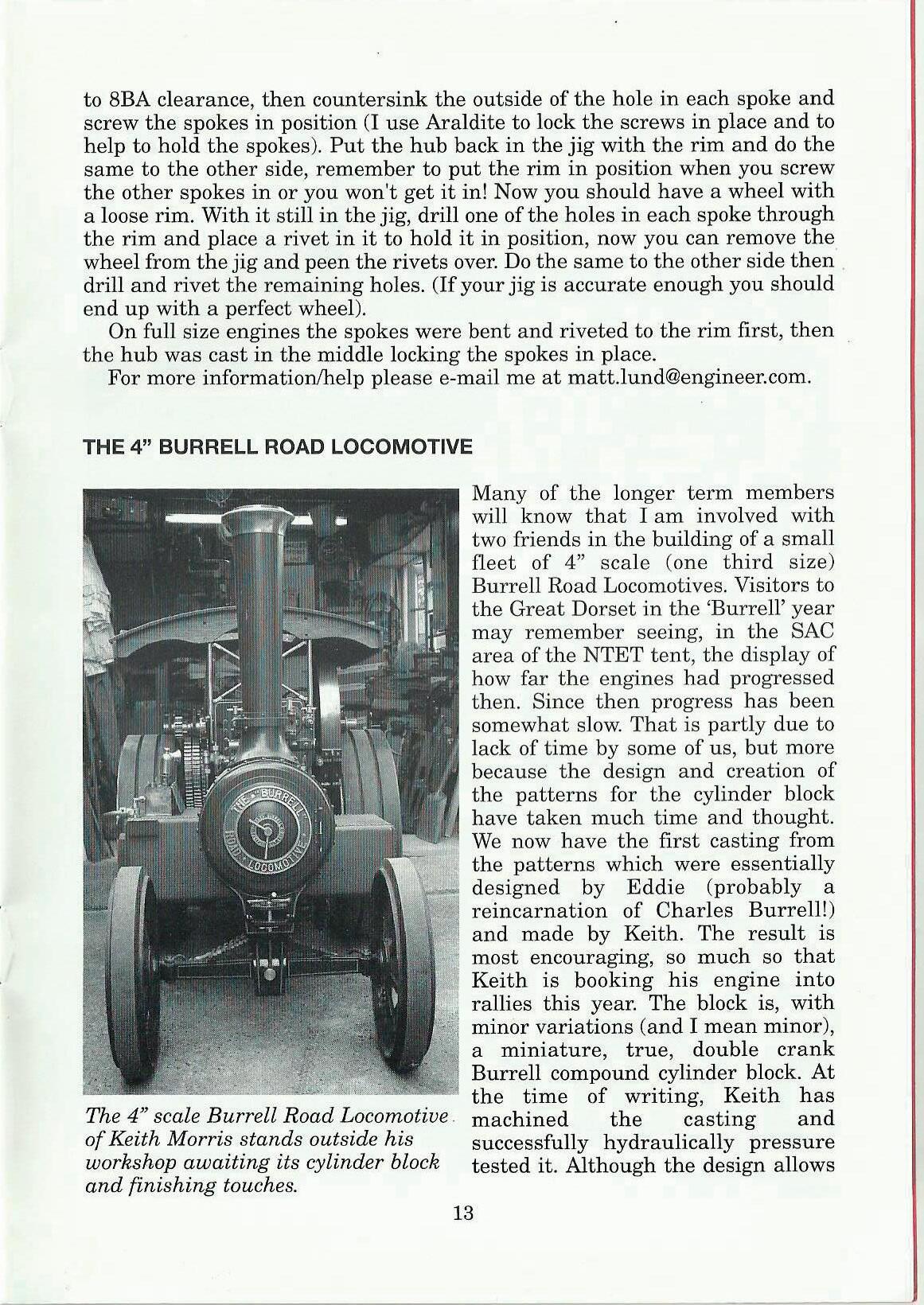
The 4" scale Burrell Road Locomotive. of Keith Morris stands outside his workshop awaiting its cylinder block and finishing touches.
Many of the longer term members will know that I am involved with two friends in the building of a small fleet of 4" scale (one third size) Burrell Road Locomotives. Visitors to the Great Dorset in the 'Burrell' year may remember seeing, in the SAC area of the NTET tent, the display of how far the engines had progressed then. Since then progress has been somewhat slow. That is partly due to lack of time by some of us, but m.ore because the design and creation of the patterns for the cylinder block have taken much time and thought. We now have the first casting from the patterns which were essentially designed by Eddie (probably a reincarnation of Charles Burrell!) and made by Keith. The result is most encouraging, so much so that Keith is booking his engine into rallies this year. The block is, with minor variations (and I mean minor), a miniature, true, double crank Burrell compound cylinder block. At the time of writing, Keith has machined the casting and successfully hydraulically pressure tested it. Although the design allows
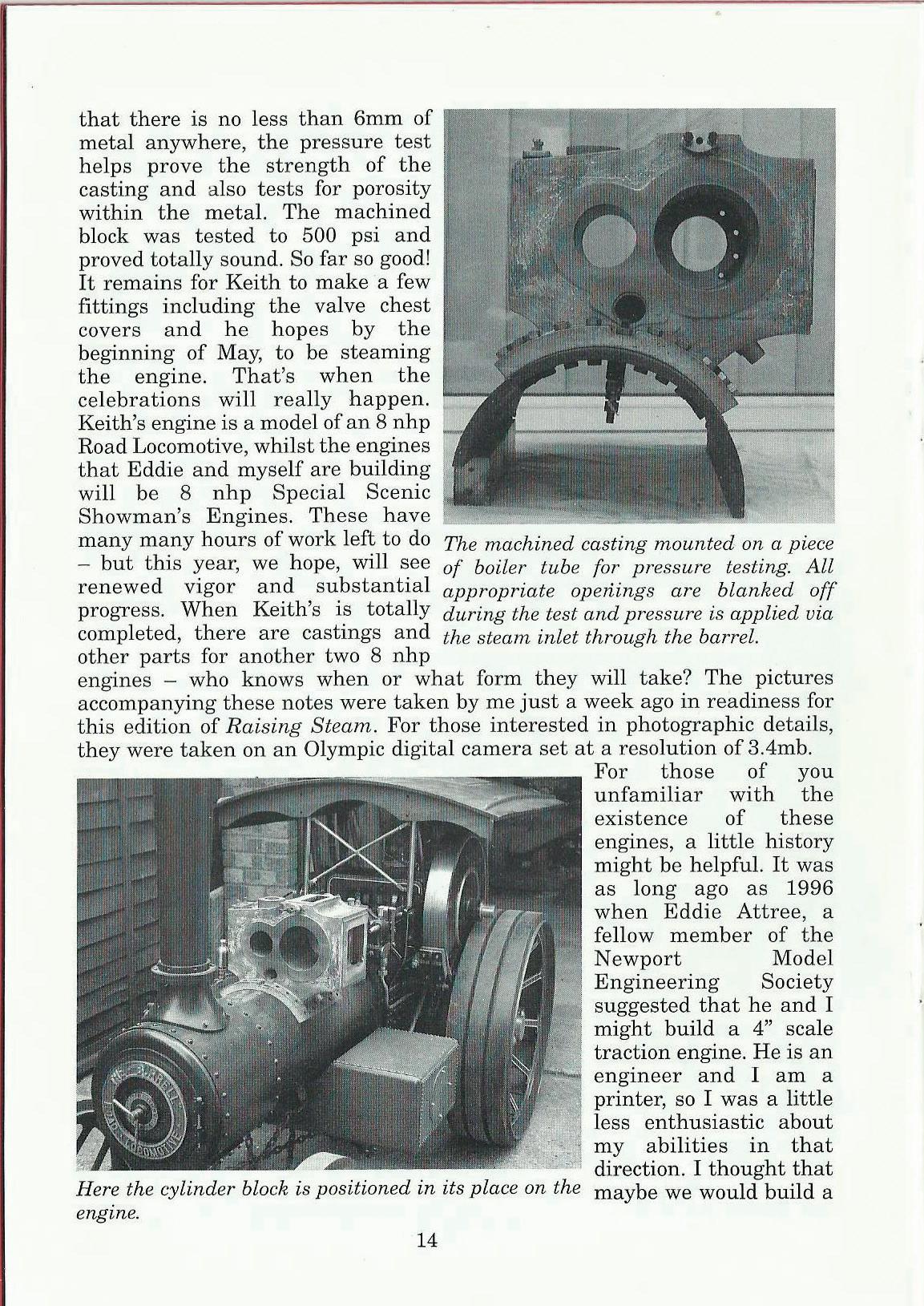
that there is no less than 6mm of metal anywhere, the pressure test helps prove the strength of the casting and also tests for porosity within the metal. The machined block was tested to 500 psi and proved totally sound. So far so good! It remains for Keith to make a few fittings including the valve chest covers and he hopes by the beginning of May, to be steaming the engine. That's when the celebrations will really happen. Keith's engine is a model of an 8 nhp Road Locomotive, whilst the engines that Eddie and myself are building will be 8 nhp Special Scenic Showman's Engines. These have many many hours of work left to do The machined casting mounted on a piece - but this year, we hope, will see of boiler tube for pressure testing. All renewed vigor and substantial appropriate openings are blanked off progTess. When Keith's is totally during the test and pressure is applied via completed, there are castings and the steam inlet through the barrel. other parts for another two 8 nhp engines - who knows when or what form they will take? The pictures accompanying these notes were taken by me just a week ago in readiness for this edition of Raising Steam. For those interested in photographic details, they were taken on an Olympic digital camera set at a resolution of 3.4mb. For those of you unfamiliar with the existence of these engines, a little history m.ight be helpful. It was as long ago as 1996 when Eddie Attree, a fellow member of the Newport Model Engineering Society suggested that he and I might build a 4" scale traction engine. He is an engineer and I am a printer, so I was a little less enthusiastic about my abilities in that direction. I thought that Here the cylinder block is positioned in its place on the maybe we would build a engine.
single cylinder Foster, a design which has been very popular for a while now. But no, Eddie would have none of that - it would be a double crank compound. Furthermore available castings were not to his liking, so we would be making our own patterns and acquiring our own castings from local foundries where we would be able to monitor costs and quality. Other members of the club wanted in, Dummy core patterns positioned in the sand mould. but when they realised These were made of plaster and helped prove that each the standards and core pattern, in turn, would work. requirements that
Eddie had laid down, it was only Keith that stayed (and won) the course. Results are proving that he was right, despite the extra work required. As for me, I just did as I was told and I'm quite pleased with some of the results - but there is much more to do and I am grateful for the continuing help and guidance given to me by Keith and Eddie.
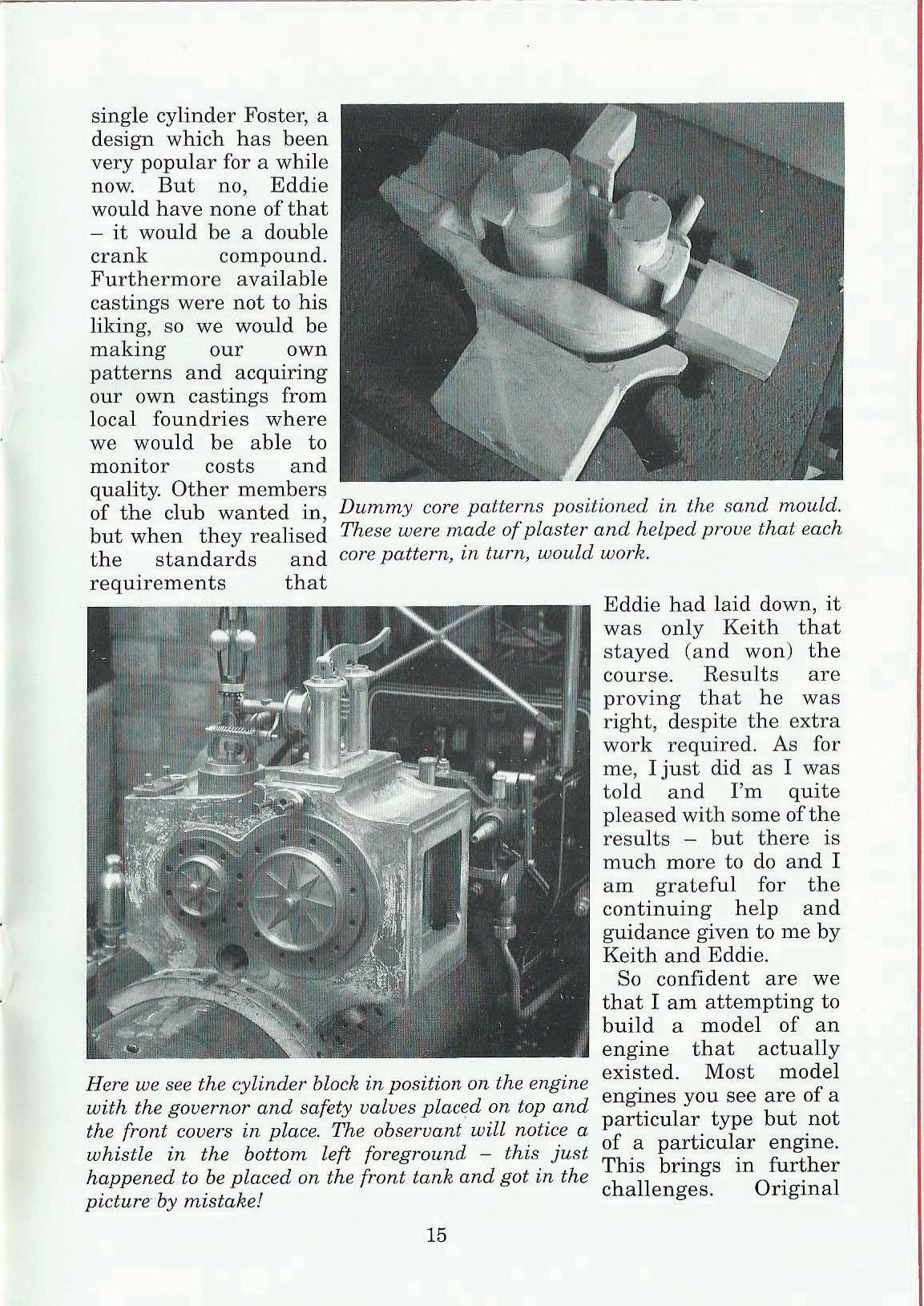
Here we see the cylinder block in position on the engine with the governor and safety valves placed on top and the front covers in place. The observant will notice a whistle in the bottom left foreground - this just happened to be placed on the front tank and aot in the 0 picture· by mistake!
So confident are we that I am attempting to build a model of an engine that actually existed. Most model engines you see are of a particular type but not of a particular engine. This brings in further challenges. Original
The back end of Keith's engine - all flnished, painted and lined. The hub is an item of which we are particularly proud - we know it's right!
works drawings are available for many parts and I have a copy of the original ' specifications for the engine.
1 But what we have found is that no two Burrells were entirely alike and photographic evidence shows that the engine I am attempting to create in miniature had different and extra fittings than those specified in the original works order. It is, however, very interesting and good fun discovering all the differences in the various Burrells. It would be good if we found two Burrells of essentially the same design, where even the wheels were identical!
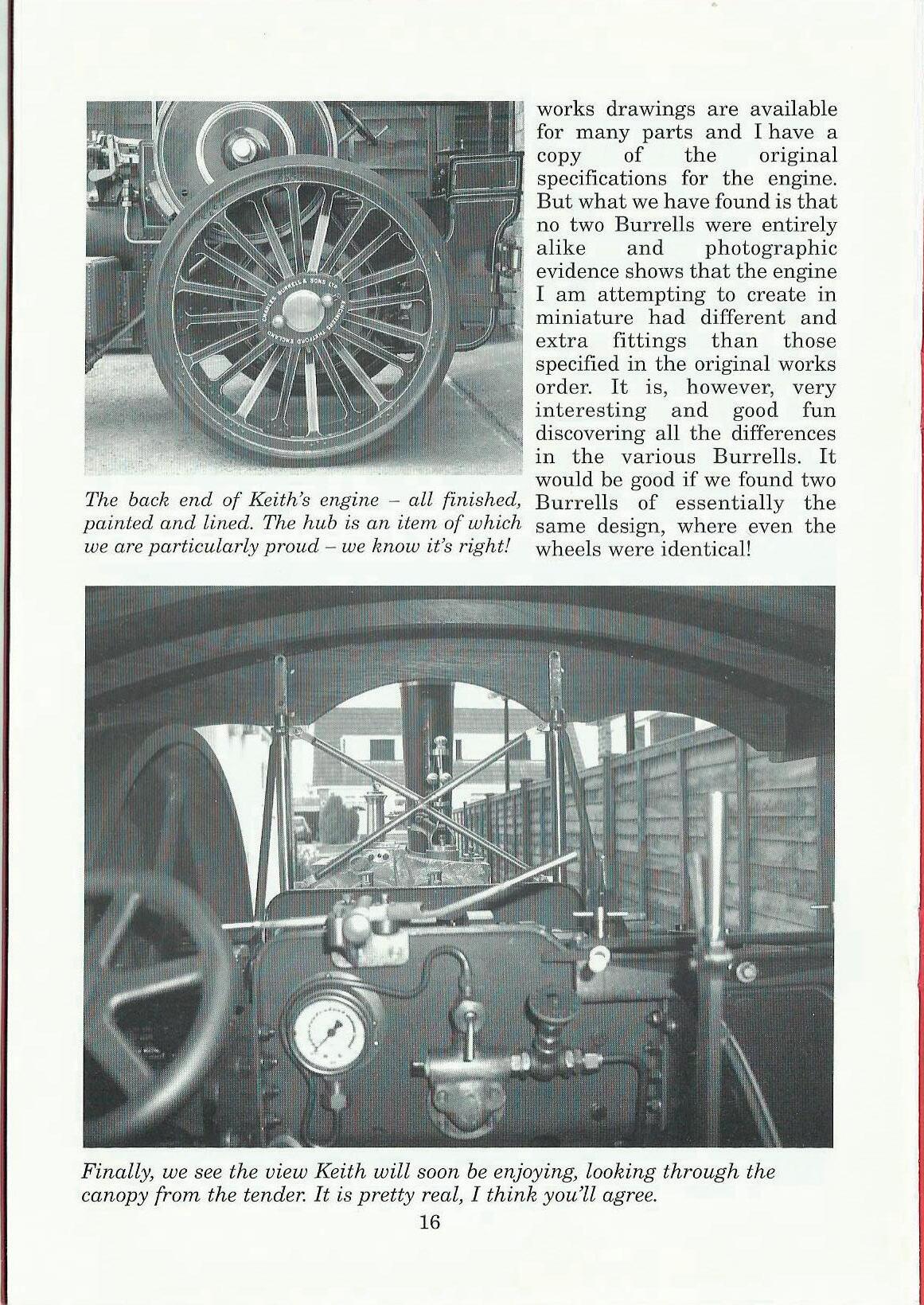
Finally, we see the view Keith will soon be enjoying, looking through the canopy from the tender. It is pretty real, I think you'll agree.