Elll1'G>R
Elll1'G>R
Barvy Sumsion,ili:earline Graphic Images, Fairioak Blouse Business Centre, ~hurch '.Road,tNewport NP19 7EJ Te1: Oil.633262197 Fax: 01@33259089
CHAIRMAN, STEAM AARRENJICE CLUB
John Du.ding, Hawbhorn Cottage, Stubwo0d, Uttoxeter, Staffordshlre SU'14 5HX '!11.el:01889 591188 (between 08.00 and 21.00 hours o:olyplease) e-mail: john.r.dur;ling@uk.traniwovti.bom.bardier.com
VICE-CHAIRMAN, STEAM APPRENTICE CLUB
Elaine Massey, 21 Down Close, North0lt, Middlese)(' UBlii6NS '.Ii'el:020 8248 6€>~10e-mail: e1ainermassey@aol.com
MEMBERSHIP SECRETARY
John €oak, :0o1£arni,Ohurch Lane, Kirby ii.amhorpe, Sleaford, IT..,incolnsh:ire NG34 9NU. Correspond_ence only. Membovshi,p fee £5.00 per annum.
SAC C0-0RDINATORS
Sam Ba~e, 30 !Mowbray Grove, BishopS'garth, Stockton-on-Tees, (pleveland TSrn SXA Tel: 01642 89'7153 e-mail: sambate@lycos.Qom
Graham 0haf.fer, 3.2.'Jubilee Way, Storrington, West Sussex RH20 3NZ 1Jie1:01903 745921 e-mail: cbaffer.gang@ic24.net
Duncan Croser, il 6 ['ripps Hill Close, OhaJfont St. Giles, 1E!ucksHlP8 4JZ IJi'el:OM9~ 8'7.5443 e-mail: duncan.croser:@btin,ter.net.com
Steve and Donna 'Faylor, 17 Smith Crescent, Coalv.ille LE67 4JF 'r~l: 01530 820213 e-mail: steve.tailor@btinteoo.et.com
'Ilhe i!Ed.i.torw&l.aomesany contributions of articles, shorter items or photographs for inclusion i 11 fut'llre issues. All mater.ial submitted is >vdluntacy and payment cannot be made for any mn!m·iul published. The op;ini.onsex.pressed6n the :roaga;;ine_,with the exception of Club annm.1nc01twnb1, 111·1• tbose of foe contributors and do not ~ndicate the views of the Club as a whole. All itemH Hl'I' lwlcl copyni~t by tne contmbutor and :tlheNff'ET.
Please send you:r;contlilbutions to the Editor at least f.i.veweeks before publication. Typl•d al' e-mailed articles are pr:efarr:eUbut ncit essei.tti.a'l.If :handwlri.t,ten put any names of PlOOPLr1!, PMCES or ENGINEB in EThOOKCAPITA]$ :Iif you irequive an:r part of your arl..iclo(cg phoLuHl Tetu.ruing please say so au& enclose a stamped addressed envelo,pe. Enclose yom· name, addi•0as and (if Apprentice) age with any contribution. Tihe EdiWr J;'eserves the right to amend or nifi.iHl" contributions, and will attempt to cm;rect spelling and gi,ammar! T.he Magaz-ine i11norrmtlly published during the early. part of January, Ap:ui1,Juil.yand October. The Club accopl;tino liabllit_y for failure.to meet intended puOlioatiorr dates.
The Steam A_pprenLiceClub is a section of tJheNat-iana1 Tu·actionE.o.g,i:neTruaL, NTE'J' is a Registered Chanity, iNo. 29tlID78.Registered in England No. 1302197. Eegistered ODfice:4.-Ohurdh GreeruEast, atedditch, W'orces'tershire B98 SET.
'l\ypesetting and A<rtwoxkby Kearli.ne Graph'i.clmages Ltd, Fai.roa!k.House :Business ConLl'C\ Chu11chRoad, Newport, South Wales NPi9 7EJ Tel: 01633 262197
Fax: 01033 259089 email: kealiline@aol.corn
Pr,inted by !M iD Jenkdns Printers Ltd, L.y.dney,.GlosGL15 4EJ
Late again, I'm sorry. Regrettably work just keeps on getting in the way of my producing your magazine on time. It also keeps me away from far too many rallies during the year - I didn't even make Dorset in 2002! Which leads me on to tell you that I shall be stepping down
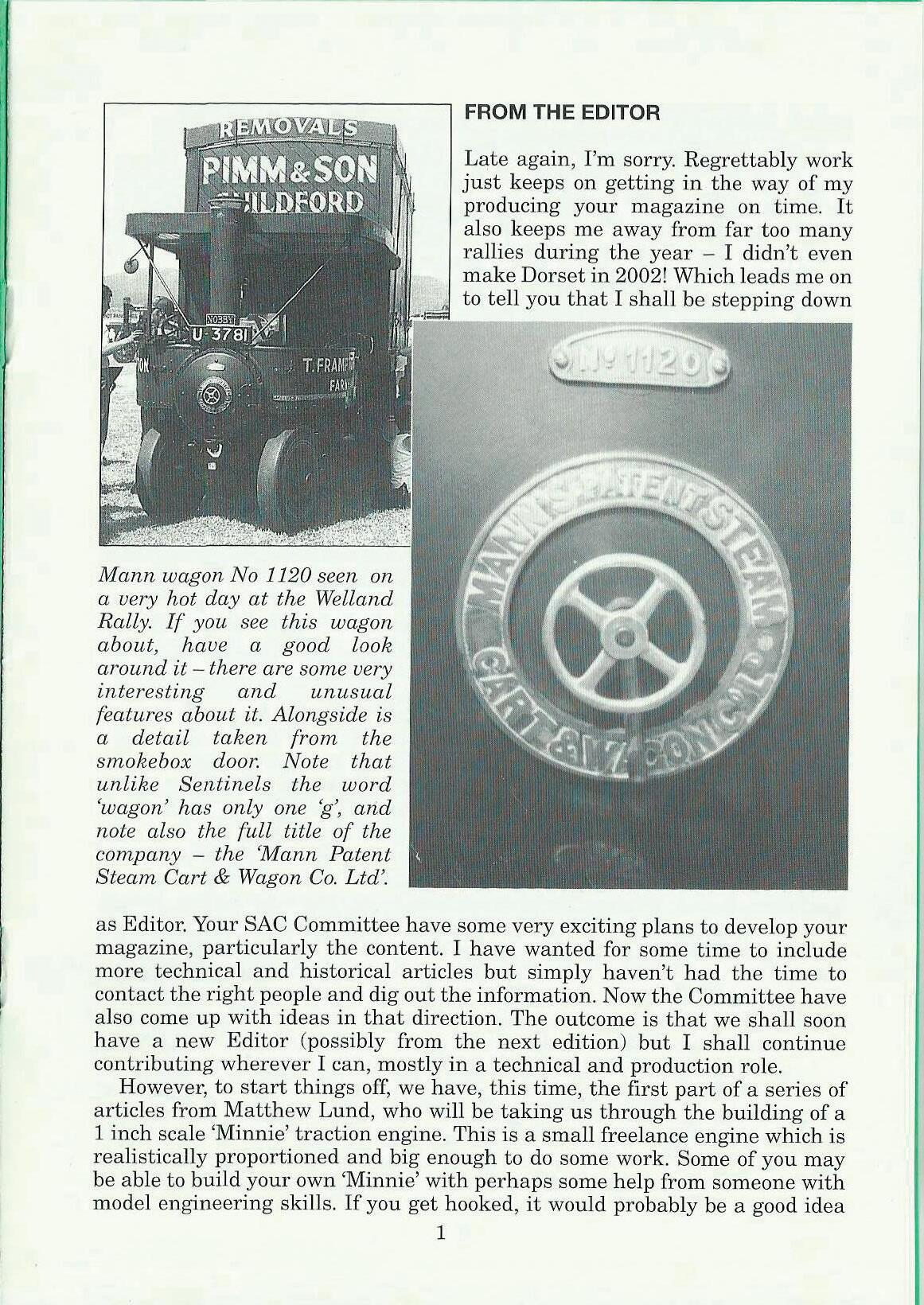
Mann wagon No 1120 seen on a very hot day at the Welland Rally. If you see this wagon about, have a good look around it - there are some very interesting and unusual features about it. Alongside is a detail taken from the smokebox door. Note that unlike SentZ:nels the word 'wagon' has only one 'g', and note also the full title of the company - the 'Mann Patent Steam Cart & Wagon Co. Ltd'.
as Editor. Your SAC Committee have some very exciting plans to develop your magazine, particularly the content. I have wanted for some time to include more technical and historical articles but si1nply haven't had the time to contact the right people and dig out the information. Now the Committee have also come up with ideas in that direction. The outcome is that we shall soon have a new Editor (possibly from the next edition) but I shall continue contributing wherever I can, mostly in a technical and production role. However, to start things off, we have, this time, the first part of a series of articles from Matthew Lund, who will be taking us through the building of a 1 inch scale 'Minnie' traction engine. This is a small freelance engine which is realistically proportioned and big enough to do some work. Some of you may be able to build your own 'Minnie' with perhaps some help from someone with model engineering skills. If you get hooked, it would probably be a good idea
to join your local model engineering society. Matthew should be able to help where you are genuinely interested.
Keep on sending in your articles, illustrations, whatever - to me for the time being. If you feel that you or someone you know has the ability to edit this magazine, then please contact John Durling. The main thing is that you keep on cofitributing and enjoying the magazine - it's only going to get better!
Happy Steaming
Barry Sumsion, Editor
When I started to write this I checked back to see what I had written last year. Then I was talking about Morning Star being put on hold for a few months whilst s01ne of the 1nore boring jobs round the house got done -this year I am saying exactly the same. The only difference is that I have actually started on some of the afore-mentioned jobs.
As I told you last time Morning Star is due for some fairly serious TLC, including the hydraulic test of the boiler. This last part means that most of the engine has to come apart, wheels off, belly tanks off, lagging off etc. It will feel very strange not having my own engine to take out and about - I hope that it won't be for too long.
Now to Club business.
Duncan Croser, who organised the last Driving Days, has been quite ill for a significant chunk of the year, so I have taken back the arrangements. Elsewhere in this issue you will see the details of where and when they are taking place. The Bedford Club has again offered to run one of their training weekends, and this year, for the first time, the good people at Fengate Farm, near Weeting are making their course a two day affair.
We have also again been invited to take part in the NTET Driving Course, which is visiting Beamish Museum, near Newcastle for the second time. If you have never been to this wonderful open air museum then take this opportunity to combine driver training with a chance for some site-seeing. If you really want to know how it should be done, get yourself on this course! It only costs £60 + VAT for two days of working on engines and high quality instruction. Give me a call (or a letter or e:mail) if you are interested.
We are all looking forward to warmer weather and the chance once again to get out and about on the engines.
I hope that I will see lots of you about this year.
John Durling, Chainnan.
Are you in your teens and keen to work on real engines 'from the bottom up'?
Do you live within striking distance of South Derby? If you can answer yes to these questions contact John Durling, who has been approached by an engine owner, (who owns a Fowler showman's) and is looking for a keen youngster to work with him. Don't miss this chance, call me now! ( details in the front of the magazine)
Dear Editor,
In 2002, our Dad sold the road locomotive Duke of Kent No. 3593 and bought Margaret No. 3926 a showman's engine. On the 30th of December we took Margaret on a Santa Special from Wimbish yard (near Saffron Walden in Essex) to a pub in Thaxted for lunch. Margaret pulled a trailer with lots of people on it including five steam apprentices. We were also accompanied by Melvyn Camp's Sentinel steam waggon. It was very wet on the way back to the yard and we got soaked. When we got back Dad played his organ The Four Seasons (which he has recently moved from a trailer to a lorry). Margaret was generating lights next to it. We had hot pizza, 1nince pies and fruit pies warmed in the 'entertainments lounge' - a big· shed with an oven and chairs in it.
Jennifer Honour (11) and Richard Honour (9)
Dear Editor
On Saturday 21st September I left early with my parents to go to the Kettering Rally. After we put up the tent, I went with my Dad to find the Steam Apprentice stand, where I was found an engine to work on. This was Colin Brothwell's Ruston & Hornsby No 115100, Reg. No DO 2953 called Hildary. I spent Saturday and Sunday with this engine. I did lots of different jobs like cleaning, oiling, steering and driving. Thank you to everyone for a great weekend especially Colin and Daniel.
Alan Prince (9) Billericay, Essex
Alan's older brother Glen now writes with his version of his time at the show.
Dear Editor,
I am writing about the rally at Kettering on the 21st and 22nd September. When I got there I went to see if any of the engines were alight, while my Mum, Dad and brother put up the tent. One engine was alight when I got there. I went to see if Steve Taylor was about. I found his caravan but he
wasn't there so I decided to wait. Five minutes later his son came out and asked if I was an apprentice. I said yes. We went along the line of engines until we got to a Wallis & Steevens Advance roller No 8058, Reg. No OU 4 737 owned by Mike Farmer. Before I got started I went back to the tent and put on my overalls and boots.
The first job was to light the fire while Mike's mate, who was also called Mike, moved the low loader to a bit of level ground, making it a bit difficult to throw wood into the firebox while moving. The next thing was to get the Wallis off the low loader. It took about an hour and a quarter for the engine to get up pressure. Mike then drove the roller off the low loader. He cal1ed me over to the engine and said I was allowed to have a go at driving. It was a bit hard because the ground was not level, so I was continually slowing down and speeding up to get up and down the bumps. We went to the other end of the engine line. On the way back we used the steam water lifter because there was not much water in the water bowser. We then went back to our spot. I took it out of gear and let it tick over while I put some coal on the fire. About half an hour later we went to the other end of the field with me steering. Of course we went the hard way through a gap just wide enough for us. When we got to the tap we filled the water bottle and topped up the tanks. We went back the easy way. When we got back I took it out of gear and tried the injector. It took about five attempts to pick up. At about 1.20pm we went into the arena, I was steering. On the way out we decided to do a bit of rolling backwards and forwards. We went for one more run round the field at about 5.00pm. When we got back I took it out of gear and let it tick over for a while and let the pressure drop. We then sheeted up for the night. Dad came to pick me up, I said goodbye for the night and went back to the tent, where I had a good wash, a meal and went to bed.
At 9. 00am the next day I went back to the engine and Mike asked me to take off the sheets, clean the tubes and light the fire. Mike had to help me clean the tubes because it was a new tube brush and very stiff. To light the fire, I first put a bit of coal on the bottom, then some wood on top. I lit an old rag, put it in the firebox then put some wood on top and left it to get up pressure. When the engine had 30 psi, I let it tick over. At about 12 o'clock it came over all dark. Mike said to put a sheet up, then it might not rain! The sun came out again at 12.20pm. When it was time to go into the arena, I steered. We shot out of the arena because it was going to rain hard. When we had parked up, Mike went into his caravan for his lunch and I put up a sheet on the side the wind was blowing, to stop the engine and me getting wet. It rained until 3.00pm. Then Mike came out and said we were going for one final run around the field before loading up. So I took down the sheet and put it into gear. Mike drove and I steered. When we got back, Mike drove the engine up onto the low loader. By 5.00pm we were all ready to go. My Mum and Dad came to get me and I said goodbye to Mike and Mike. I would like to thank the organisers and especially Mike and Mike for letting me join them on the engine for the weekend.
Glen Prince (12) Billericay, Essex
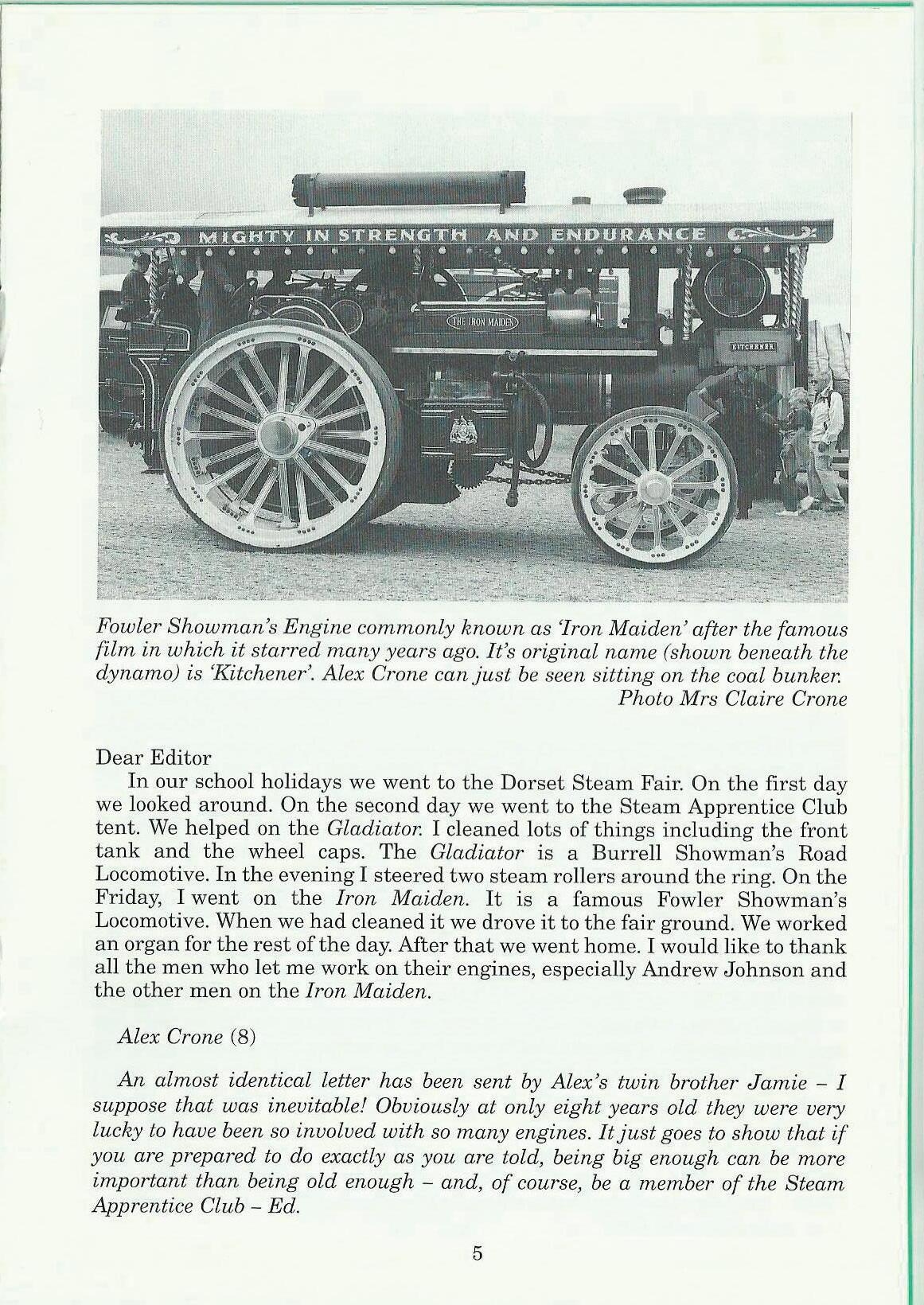
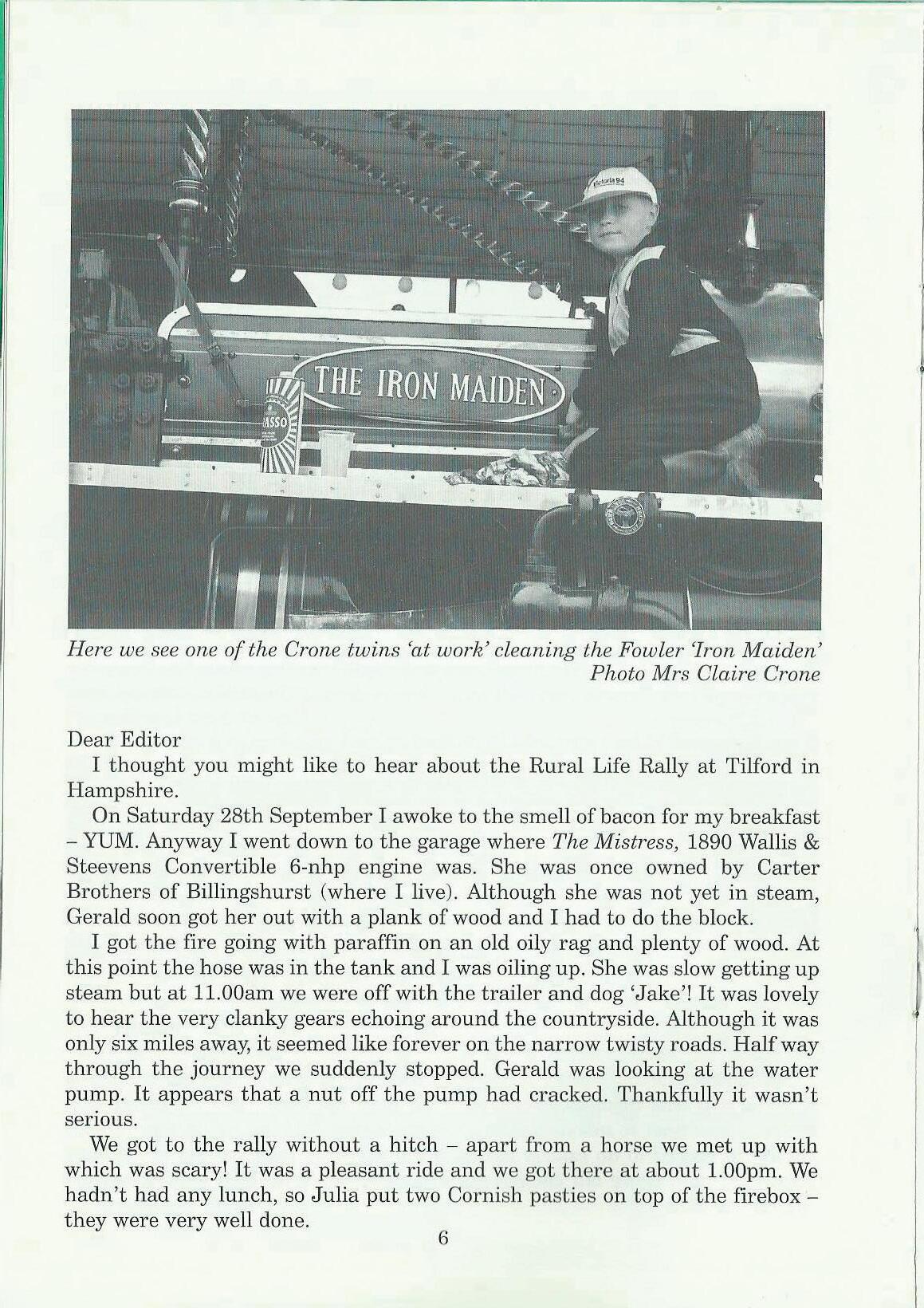
Fowler Showman's Engine commonly known as 'Iron Maiden' after the famous film in which it starred many years ago. It's original name (shown beneath the dynamo) is 'Kitchener'. Alex Crone can just be seen sitting on the coal bunker.
Photo Mrs Claire Crone
Dear Editor
In our school holidays we went to the Dorset Steam Fair. On the first day we looked around. On the second day we went to the Steam Apprentice Club tent. We helped on the Gladiator. I cleaned lots of things including the front tank and the wheel caps. The Gladiator is a Burrell Showman's Road Locomotive. In the evening I steered two steam rollers around the ring. On the Friday, I went on the Iron Maiden. It is a famous Fowler Showman's Locomotive. When we had cleaned it we drove it to the fair ground. We worked an organ for the rest of the day. After that we went home. I would like to thank all the men who let me work on their engines, especially Andrew Johnson and the other men on the Iron Maiden.
Alex Crone (8)
An almost identical letter has been sent by Alex's twin brother Jamie - I suppose that was inevitable! Obviously at only eight years old they were very lucky to have been so involved with so many engines. It just goes to show that if you are prepared to do exactly as you are told, being big enough can be more important than being old enough - and, of course, be a member of the Steam Apprentice Club - Ed.
Here we see one of the Crone twins <atwork' cleaning the Fowler
Dear Editor
I thought you might like to hear about the Rural Life Rally at Tilford in Hampshire.
On Saturday 28th September I awoke to the smell of bacon for my breakfast -YUM. Anyway I went down to the garage where The Mistress, 1890 Wallis & Steevens Convertible 6-nhp engine was. She was once owned by Carter Brothers of Billingshurst (where I live). Although she was not yet in steam, Gerald soon got her out with a plank of wood and I had to do the block.
I got the fire going with paraffin on an old oily rag and plenty of wood. At this point the hose was in the tank and I was oiling up. She was slow getting up steam but at 11.00am we were off with the trailer and dog 'Jake'! It was lovely to hear the very clanky gears echoing around the countryside. Although it was only six miles away, it seemed like forever on the narrow twisty roads. Half way through the journey we suddenly stopped. Gerald was looking at the water pump. It appears that a nut off the pump had cracked. Thankfully it wasn't serious.
We got to the rally without a hitch - apart fro1n a horse we met up with which was scary! It was a pleasant ride and we got there at about l.00p1n. We hadn't had any lunch, so Julia put two Cornish pasties on top of the fireboxthey were very well done.
We had a look round and there was a wide choice of miniatures. We were not the only full size engine, an Aveling & Porter 8-ton road roller had come as well. A train that went around the rally offered some fantastic views. There was something there for all steam enthusiasts.
At 3.00pm it was time to go to the arena. I hopped up with Julia-she drove and I steered. The annoying thing was that there was a tree by the entrance to the arena and every time I passed it, the leaves always became caught in the gears. The Aveling was already there, but as we drove up to our place, we saw many, many people who had come to see the engines.
After the arena at 6.00pm, we sheeted her up, took off the lamps and went home.
Next day at the rally, it was bright and sunny. The Aveling roller was already getting up steam as we unsheeted the Wallis. We lit the fire and started the oily task of polishing and oiling up. While we were getting up pressure, I went to have another look round. This time I met a man with a 4 inch scale single cylinder Burrell. Although he was only there for the day, he said that he would let me have a go on it later.
At 1.00pm I watched the Aveling do some road making by the station. It was clear that there was a lot of skill and concentration in doing it.
When I came back to the Wallis to do some more polishing, two new Steam Apprentices called Tom and Becky Haryett were deeply engrossed in the Wallis. At 2.30pm Julia and I slowly drove the Wallis down to the arena. (It wasn't half difficult!) Although the procession is not until 3.00pm, we took her down so that To1n and Becky could have a steer. Both of them did really well at steering - better than me!
We had a few minutes to spare as we waited for the roller. Lots of kids were fascinated on the footplate. The roller came and we led off around the procession. When we had all. stopped and had to do another two laps, Gerald told me to drive because another apprentice was going to steer. The most difficult thing was getting her to start on a fairly steep gradient. After a couple of attempts, she burst into life, so much so that I had to close the regulator a fair bit. I got the hang of it after a while.
After the procession, I steered her back to the trailer. And I got caught up in that tree again! After we had hitched up the trailer ready to go home again, a reporter wanted to take some photos of the Wallis at places difficult to move the engine to. Gerald and Julia persuaded me to steer her to the water hose (it was very tricky). While we were filling her up, Tom and Becky were on the trailer for a ride down the road. The engine was ready to go, but getting off the spot that she was on proved tricky. On the road, they were asking very good questions about her history as a roller and technical things like the handbrake and safety valves.
At a pub 3 miles down the road, we stopped to let Tom and Becky off to their awaiting Mum. At the pub there was a group of American tourists who were
staying there. They were fascinated in the engine and one was shocked at the size of it. We had a good journey home - apart from Jake who was trying to beat the engine up hill in a noise contest!
I want to thank Gerald and Julia, my cousins and everyone else.
Dominic Geary (12)
Billingshurst, West Sussex
Dominic sent a very well executed line drawing of the Wallis & Steevens engine 'The Mistress,_ Unfortunately it was drawn only in the faintest ofpencils and would not reproduce. - Ed.
Dear Editor
On November 16th I was very pleased to attend the NTET AGM inside the chapel at Beamish Museum in County Durham, which is not very far from where I live and is an excellent open air museum with plenty to see. Although
I did not find the meeting very interesting, mainly because I did not understand a lot of what was being discussed, I did enjoy the part where Mr Giles Romanes handed over trophies to those drivers who had completed restoration of their traction engines and especially when I was handed the last
one, the J.T. Beeby Trophy, for my interest in the Steam Apprentice Club which I have been a me1nber of since September 1995.
I was very nervous and excited when John Durling stood up and spoke some very nice things about my interest in the engines. Then I had my photograph taken. I couldn't wait to get back home and show off my trophy to everyone. (I would like to know who J. T. Beeby is.)
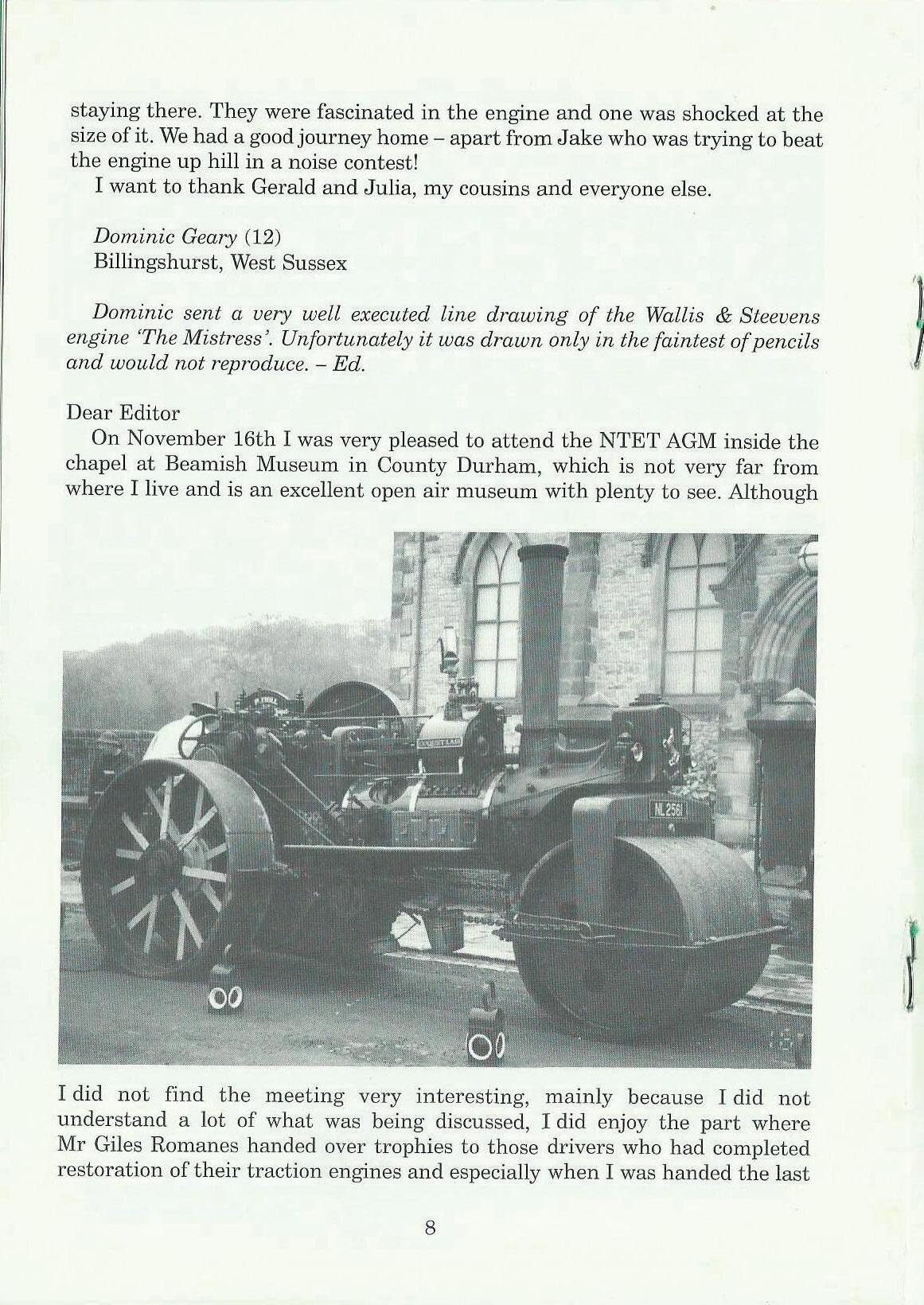
Four traction engines turned up at the museum including one which I had ii not seen before: Aveling & Porter No 4307 Coquet Lass which is owned by Dave l Walker of Morpeth (see photo). It was built in 1899 and spent its full working f 1 life in Morpeth, new to Morpeth RDC and finished service in 1964. Mr Walker has spent 14 years restoring it, for which he received one of the trophies. The next day we all met at the Tanfield Steam Railway, which is not far from Beamish, where we looked at the large stock they have and took a ride on the train.
I went to my first rally when I was 6 months old (Masham) but didn't start taking real notice until I was about 5 years old. Every year we visit approximately 15 steam rallies and always try to include one or two new ones when we go on our holidays in the caravan, though I don't think. my Mam really likes going. This year we went to Astle Park which was very wet and muddy but at least we did see a lot of engines we had not seen before. Later we went to Bramham Park near Leeds which was also very good. My Dad is always looking for new engines as he keeps a big photogTaph album of them with lots of history notes which he is always adding to - he has nearly 700 different engines now. These are great to look at when we can't go to rallies. Next summer we hope to go to the Isle of Man for our holidays but I don't think they have steam rallies or engines in museums over there ... do they? At least we should be able to go to the rally at Grange Over Sands which is excellent. We set up a small display at two rallies this year to promote the Steam Apprentice Club, with signs, leaflets and copies of Raising Steam but were very disappointed with the results. We were not given very good plots by the marshalls.
I have been collecting die cast models of traction engines which my Dad buys and now have 28 Corgi models, 21 Matchbox and 19 Lledo plus my Mamod engine and a 13 inch matchstick model of a showman's which my Grandad built and Dad painted, naining it Sa,nson.
Also I went down to Bristol for the SAC driving event held by Alan Sparkes at Chew Magna. This was great fun as I was able to drive my favourite engine, a steam roller owned by Tom(?) Bell: Aveling & Porter 11347 Lulu. When I am older and have the money I want to buy a Garrett steam roller, something like Consuelo Allen. In previous years I have also been to driving events at Frank Lythgoes in Lymm where I saw eleven engines that he used to own and also twice to Grange Farm, Durker, Wakefield where the grub was great! When I was 10 my Dad arranged a surprise birthday present for me and took me to Fred Dibnah's house for the day where we had lots of time to look around his
amazing garden workshop, talk with him, look at his two engines (I wonder if he has finished his second one yet?) and then go to the pub with him for dinner and a pint.
I would like to spend more time working on engines as we do not have one of our own but the owners in our area don't seem interested in steam apprentices which is probably why so few of them sign up for any of the driving events arranged in the north. If anyone near Stockton-on-Tees needs an occasional weekend worker or better still, would like an apprentice with them at rallies, PLEASE let 1ne know! I did know of a steam roller kept at T J Thomson's scrapyard in the town but they wouldn't even let me look at it. I think he has now sold it but I don't know where it went. I also know that there was a yellow steam roller in the playground at Laurance Jackson School in Guisborough, North Yorks (anyone know about it?)
I am really looking forward to more driving events next year but will I really have to give my trophy back?
Matthew Bate (13)
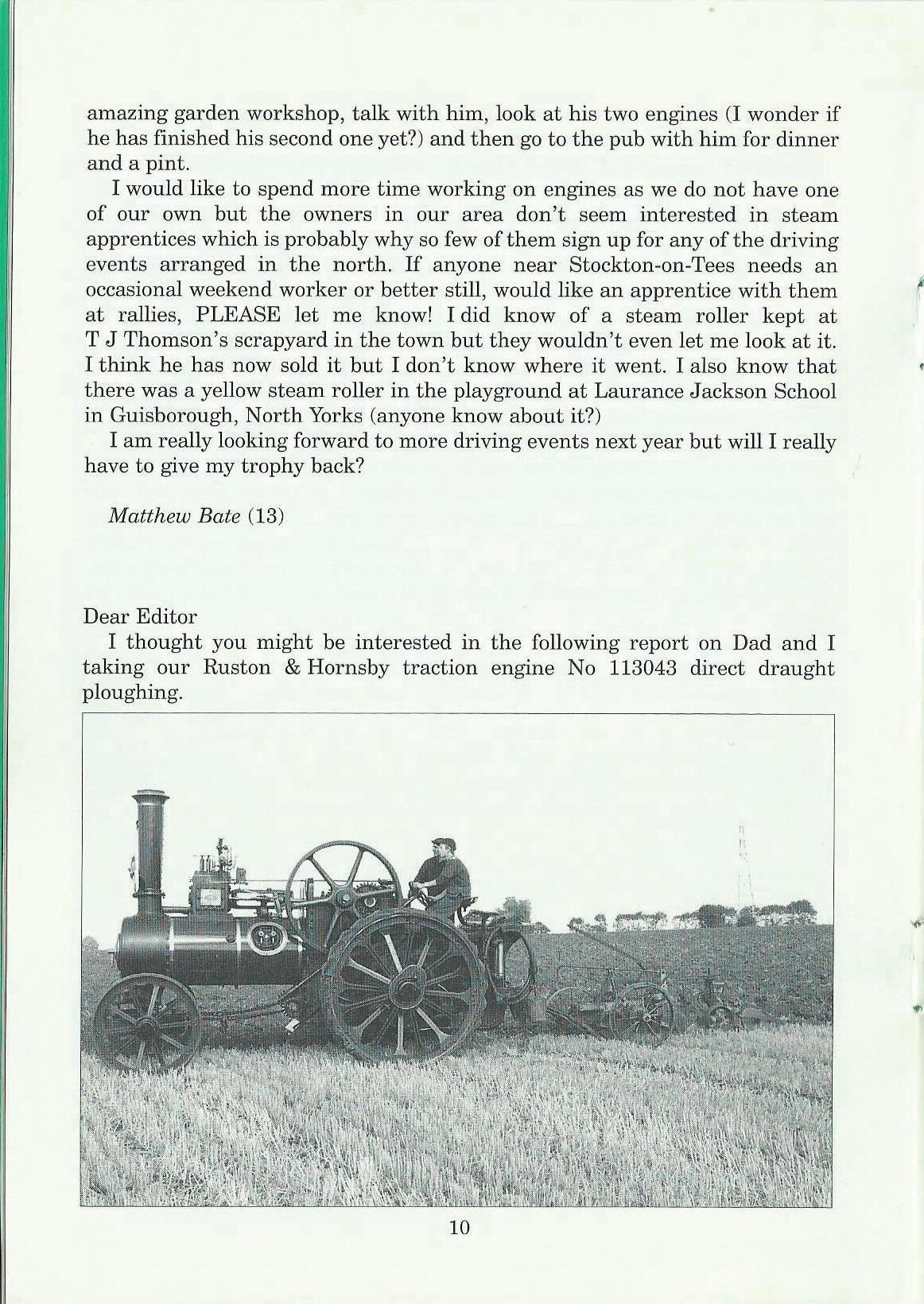
Dear Editor
I thought you might be interested in the following report on Dad and I taking our Ruston & Hornsby traction engine No 113043 direct draught ploughing.
On Thursday 26th September and onwards local farmer Colin Aves had organised a 48 hour ploughing marathon which was in aid of children's charities at West Suffolk Hospital and Guys of London.
On the Saturday morning, we set off early at 7 .30 to go and pick up the Ransomes 2-furrow trailed plough from a good friend of ours, Michael Garrod. On our way there we could hardly see 10 yards in front of us for thick mist. Anyway we coupled up the car to the trailer and proceeded to Dale Farm at Stanton, very slowly though because of the heavy plough in tow behind the car. Sturgeon Brothers' yard, who were thrashing, ploughing and engine repairers, used to be in the centre of Stanton but their yard is now having houses built on it! Sturgeon Brothers were big steam contractors in their heyday.
We arrived to find the Ruston in a shed - what a luxury it must have been for her as she is usually kept outside under a tarpaulin and on a concrete pad at the windmill at Bardwell. We pulled the engine out of the shed using a tractor. As there was a considerable drop from the shed to ground level, Dad put the engine into gear and the brake hard on.
Once out of the shed we set about clearing out the old fire and doing all the necessary things in preparation to light the fire. She didn't take long to steam because Dad had roaded the two miles from Bardwell to the farmyard the even ing before. By 10.00am she had a full head of steain and I backed her down the yard to the hosepipe to fill the tank with water.
The mist had now burnt off leaving a perfectly clear blue sky and we had a beautiful day in store for us. The tank didn't take long to fill, so we then connected up to the plough and we were ready to do some work. We were soon on the field and after a brief talk with the farmer and a knowledgeable chap on Ransomes ploughs and direct ploughing (he used to work for Sturgeons), we promptly decided where to plough.
We dropped the plough into the dense brown soil of the area we had been set. I steered whilst Dad drove. I had to line the flywheel up with a peg at the other end of the patch we had been set to have a go on. It seemed to be a successful first go so we turned around and repeated this several times. We tried once without the peg but we didn't succeed in cutting a very straight furrow because on Ruston's the steering wheel is on the left for road work. Marshalls and some Fowlers had the steering on the right, which would be better for ploughing. I think we must have done about 4 trips around our patch, anyway we weren't out to do as much ploughing as possible but just to have a go.
We stopped at 11.00am to chat to local spectators; there was a fair crowd especially at 12.00 noon when they eventually stopped ploughing at the end of the 48 hours.
After they'd ceased ploughing we thought that we might have a go where they had been ploughing with their posh Renault tractor and 4-furrow reversible plough. So we set the plouugh's right hand wheel into the furrow and dropped in the two plough shares on the Ransomes plough and we began
working again. We got on a lot better than we had done on our first patch because we had a deep furrow to follow and after going 200-300 yards we turned around because we'd gone a fair distance fr01n the other tractors.
We didn't do any more ploughing after that so we said our goodbyes and headed back to the farmyard to load up the plough onto the Ifor Williams. Then - after loading the plough - we put the Ruston into high gear and roaded the 2 miles back to the windmill, where my Nana lives and where my late Granddad used to live. It was Granddad (Geoffrey Wheeler) who drew the engine on the front cover of the SAC magazine. On the way back Dad drove whilst I steered as it was only narrow typical Suffolk lanes we were going down. It seemed only minutes after we were drawing out of the gate at the farmyard than we were drawing in the yard at the windmill. We were soon greeted by a cup of tea from my Nana who must spend most of her life making tea as she always makes people feel at home whoever they are and wherever they come from.
We put the sheet on the engine and went home with smiles on our faces after an enjoyable day! We have been informed lately that they raised over £4,000. Well done! Especially Mr Mundford who stuck it out in the cab of a Renault tractor for 48 hours!
Dad and I would like to thank Michael Garrod for the use of his plough, Colin Aves for loading and unloading the plough and his wife for supplying the matches.
I would also like to comment on the caption below the picture of The Lion in the last issue of Raising Steam, I believe written by the Editor about Fowler B6 Super Lion Showman's engines not being a success. Out of the 4 of them built between the 2 years 1932-1934 only one of them was cut up. This engine was No 19989 Onward (XG 2010) which was purchased in April 1933 by S Ingham of Manchester. After being sold to Pick.fords for haulage in 1941 they cut her canopy back, removed the dynamo and front perch bracket and other showland fittings. This process made an engine a lot better for haulage work. Eventually in 1950 Cohens, whom I'm afraid I am unable to find their location, cut her up for scrap. The other 3 engines survived into preservation.
In my eyes these engines were some of - if not! -the finest showman's engines built, other people may say different but that's my view!
Thanks everyone for a brilliant day at the ploughing and well done!
Keep steaming from
Sam Wheeler (13)
Diss
Oh dear! I do seem to have rattled Sam's cage with my comments about the Fowler B6 Super Lion. The facts see,n to be that the standard B6 was/is a superb engine. The 'Supers' were somewhat fudged to hopefully create something even more powerful. At the Fowler tent at Great Dorset a few years ago when Fowlers
were the featured make, two Super B6s were inside - 'Lion', at that time stripped down, and 'Supreme'. A die-hard 'Fowler-man' whom I have known for many years, admitted that an 8-nhp Burrell would out-do one any day. Another well known gentleman of the present day movement who has been involved in restoring a Super B6 agreed - the problem it seems is that it is almost impossible to set up the valve gear so that the engine will run efficiently in both directions - and being a 4-shaft engine that means you can either have it 01( for the road or OK for generating - but not both - a compromise has to be made. Never mind Sam has sent some superb photos of the 4 Super B6s which we shall see in the next Raising Steam. - Ed.
Part 1 of Building a miniature traction engine by Matthew
Lund
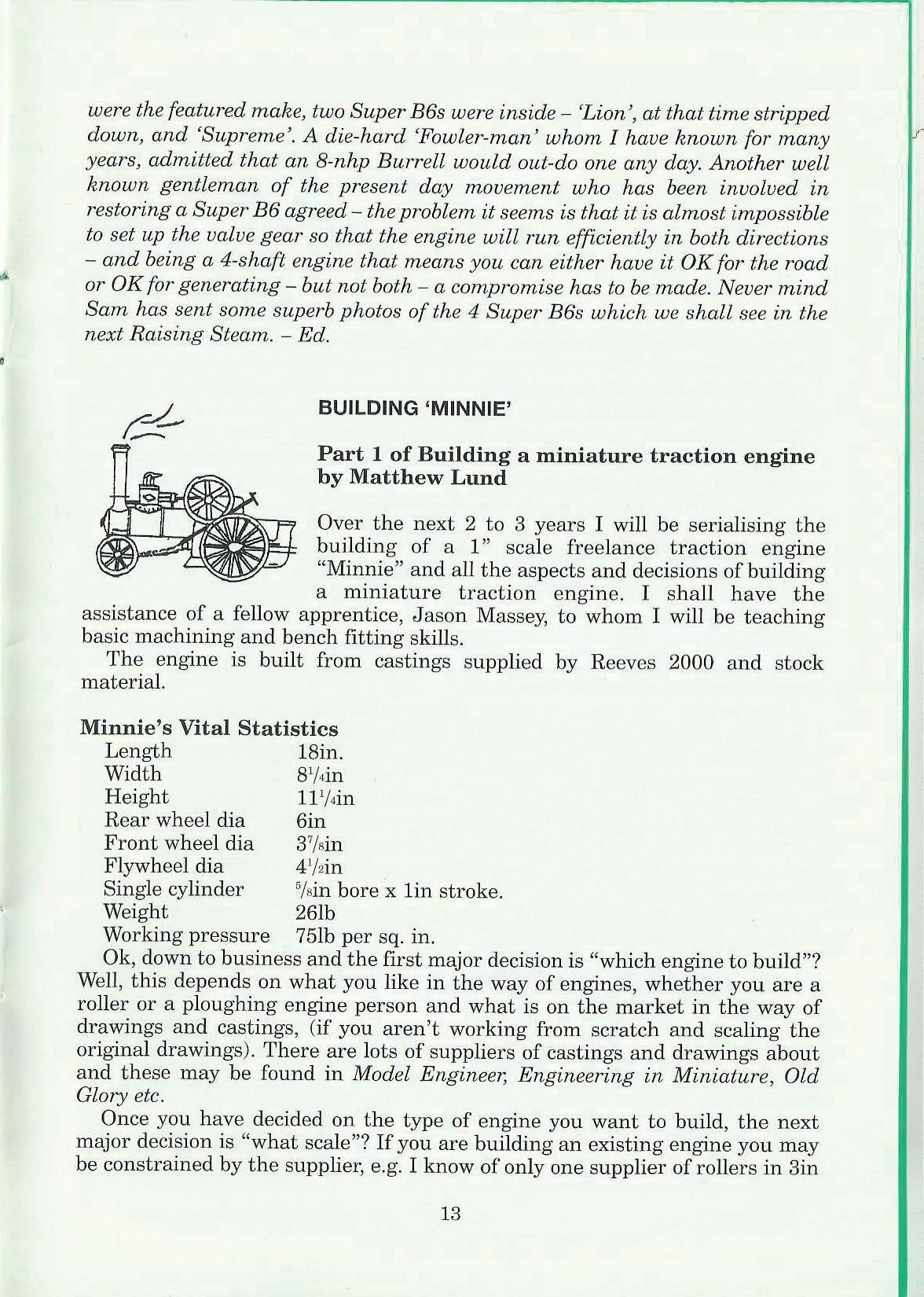
Over the next 2 to 3 years I will be serialising the building of a 1" scale freelance traction engine "Minnie" and all the aspects and decisions of building a miniature traction engine. I shall have the assistance of a fellow apprentice, Jason Massey, to whom I will be teaching basic machining and bench fitting skills.
The engine is built from castings supplied by Reeves 2000 and stock material.
Minnie's Vital Statistics
Length 18in.
Width 81/4in
Height l l 1/4in
Rear wheel dia 6in
Front wheel dia 37/Rin
Flywheel dia 4 1/zin
Single cylinder 5/sin bore x lin stroke.
Weight 261b
Working pressure 751b per sq. in.
Ok, down to business and the first major decision is "which engine to build"? Well, this depends on what you like in the way of engines, whether you are a roller or a ploughing engine person and what is on the market in the way of drawings and castings, (if you aren't working from scratch and scaling the original drawings). There are lots of suppliers of castings and drawings about and these may be found in Model Engineer, Engineering in Miniature, Old Glory etc.
Once you have decided on the type of engine you want to build, the next major decision is "what scale"? If you are building an existing engine you may be constrained by the supplier, e.g. I know of only one supplier of rollers in 3in
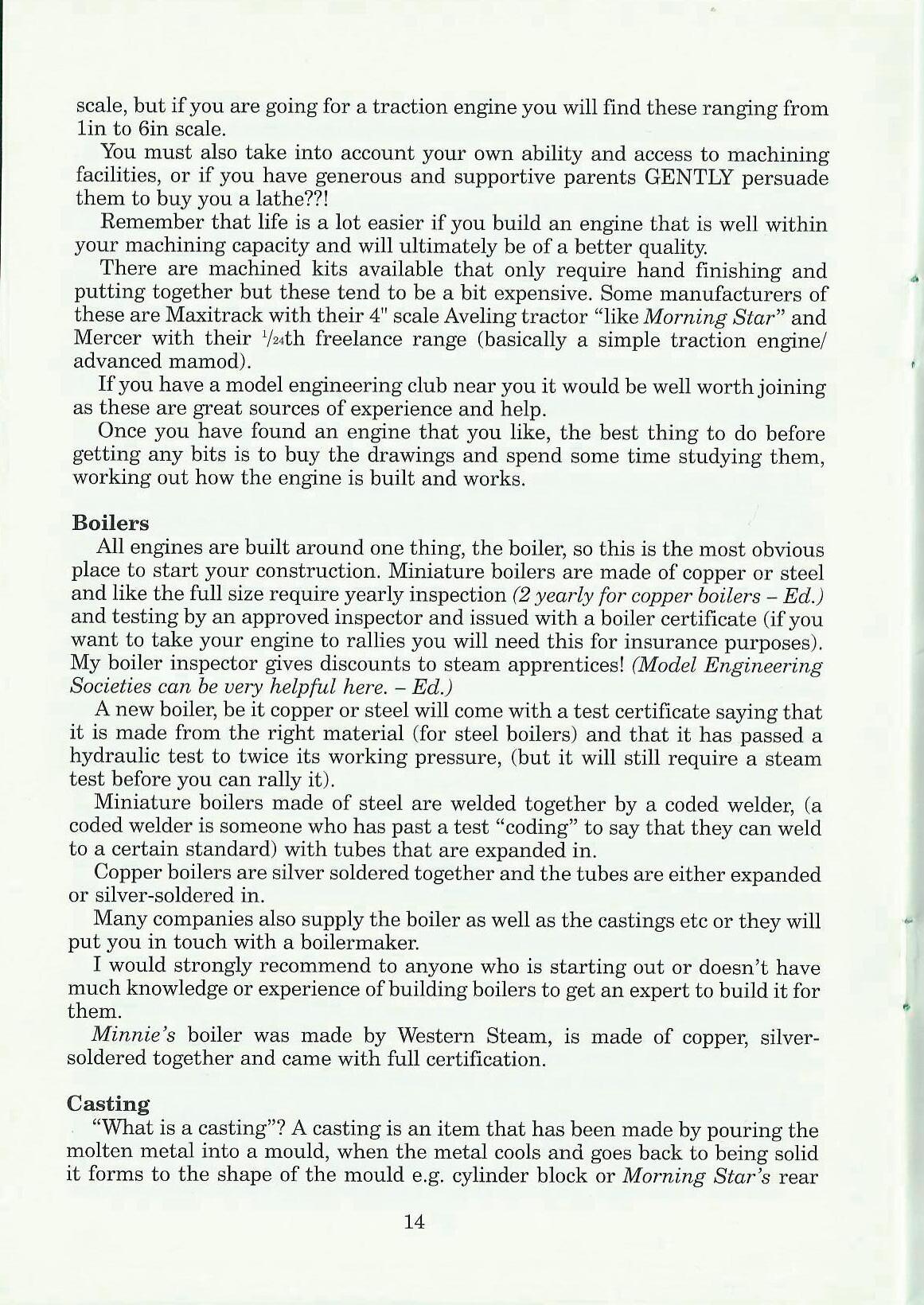
scale, but if you are going for a traction engine you will find these ranging from lin to 6in scale.
You must also take into account your own ability and access to machining facilities, or if you have generous and supportive parents GENTLY persuade them to buy you a lathe??!
Remember that life is a lot easier if you build an engine that is well within your machining capacity and will ultimately be of a better quality.
There are machined kits available that only require hand finishing and putting together but these tend to be a bit expensive. Some manufacturers of these are Maxi track with their 4 11 scale Aveling tractor "like Morning Star" and Mercer with their 1/21th freelance range (basically a simple traction engine/ advanced mamod).
If you have a model engineering club near you it would be well worth joining as these are great sources of experience and help.
Once you have found an engine that you like, the best thing to do before getting any bits is to buy the drawings and spend some time studying them, working out how the engine is built and works.
All engines are built around one thing, the boiler, so this is the most obvious place to start your construction. Miniature boilers are made of copper or steel and like the full size require yearly inspection (2 yearly for copper boilers - Ed.) and testing by an approved inspector and issued with a boiler certificate (if you want to take your engine to rallies you will need this for insurance purposes). My boiler inspector gives discounts to steam apprentices! (Model Engineering Societies can be very helpful here. - Ed.)
A new boiler, be it copper or steel will come with a test certificate saying that it is made from the right material (for steel boilers) and that it has passed a hydraulic test to twice its working pressure, (but it will still require a steam test before you can rally it).
Miniature boilers made of steel are welded together by a coded welder, (a coded welder is someone who has past a test "coding" to say that they can weld to a certain standard) with tubes that are expanded in.
Copper boilers are silver soldered together and the tubes are either expanded or silver-soldered in.
Many companies also supply the boiler as well as the castings etc or they will put you in touch with a boilermaker.
I would strongly recommend to anyone who is starting out or doesn't have much knowledge or experience of building boilers to get an expert to build it for them.
Minnie's boiler was made by Western Steam, is made of copper, silversoldered together and came with full certification.
"What is a casting"? A casting is an item that has been made by pouring the molten metal into a mould, when the metal cools and goes back to being solid it forms to the shape of the mould e.g. cylinder block or Morning Star's rear
wheels. This casting may then be machined to pr,oduce the finished item. Believe it or not the moulds are in two halves made from sand. The sand has small amounts of clay in it to hold the sand together. To create the shape in the sand usually a wooden "Pattern" is used that is slightly larger than the finished item because when the metal cools it shrinks and you don't want it to shrink smaller than the finished item. This pattern is then removed and the shape left is filled with molten metal.
If you want more information, advice or have any questions please contact our Vice-Chairman Elaine Massey (contact details inside front cover) for information.
This looks like the beginning of some pretty exciting stuff! If you want to own a model traction engine and feel you could build one yourself then here is a good place to start. I cannot emphasise enough how useful and helpful it would be to join a 1nodel engineering society - they have lots of experience, usually lots of equipment they may be prepared to let you use and they can steer you through any queries you may have about boilers.
Well that was a well filled edition of your magazine. Keep your contributions coming - even though I may not be your Editor by the next edition, I will almost certainly not be far away! - Ed.
We welcome the following as members of the Steam Apprentice Club.
Joshua Menear, Camborne
Aaron Foot, Bristol
Emily Drury, Newark
Adam Alexander, Stowmarket
Emily Mettam, Chesterfield
Megan Lyons, Bournemouth
Jack Maley, Bishop's Stortford
Adam Parrish, Shefford
Joe Williams, Eastleigh
Daniel Beevers, Northampton
Philip Humphrey, Warwick
Jonathan Swain, Edington
Sam Tonkin, St Agnes
Shane Grice, Melton Mowbray
Martin Mills, Melton Mowbray
Edward Morrow, Sandy
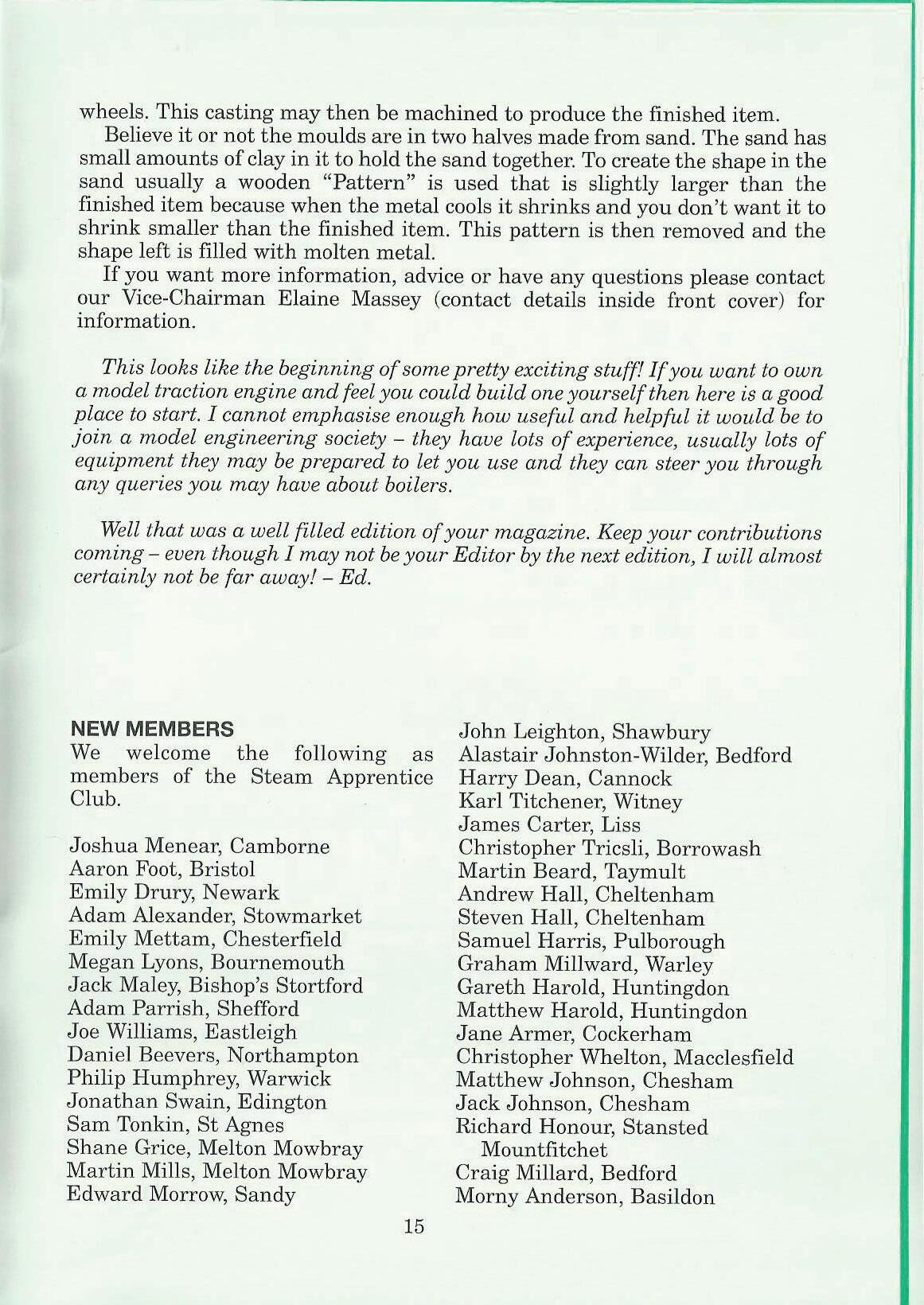
John Leighton, Shawbury
Alastair Johnston-Wilder, Bedford
Harry Dean, Cannock
Karl Titchener, Witney
James Carter, Liss
Christopher Tricsli, Borrowash
Martin Beard, Taymult
Andrew Hall, Cheltenham
Steven Hall, Cheltenham
Samuel Harris, Pulborough
Graham Millward, Warley
Gareth Harold, Huntingdon
Matthew Harold, Huntingdon
Jane Armer, Cockerham
Christopher Whelton, Macclesfield
Matthew Johnson, Chesham
Jack Johnson, Che sham
Richard Honour, Stansted Mountfitchet
Craig Millard, Bedford
Morny Anderson, Basildon
Steam Apprentice Club - Driving Days. List of venues.
Venue Date Leader'sName
KlondykeMill, 5 April John Durling Draycott in the Clay, 2003 East Staffordshire.
FengateFarm, 26 & 27 Richard Parrott Weeting, April Brandon,Suffolk. 2003
Stanton Drew, 29 March Alan Sparkes Bristol. 2003
DinglesSteam l0May Richard Village, 2003 Sandercock Lifton, Devon.
Old WardenPark, 21 & 22 Paul Worbey Biggleswade, June 2003 Bedfordshire.
Comments
North Staffs & CheshireTE Club Base. Several engines based here plus visitors. Lunch will be provided
Mr Parrott has a collection of 4 or 5 engines with others also on site. This year they are running over two days. Camping/caravaningspace is available.
Mr Sparkes has a collection of 4 or 5 engines with others also on site.
An active Steam Museum with several engines and fuJlworkshop facilities
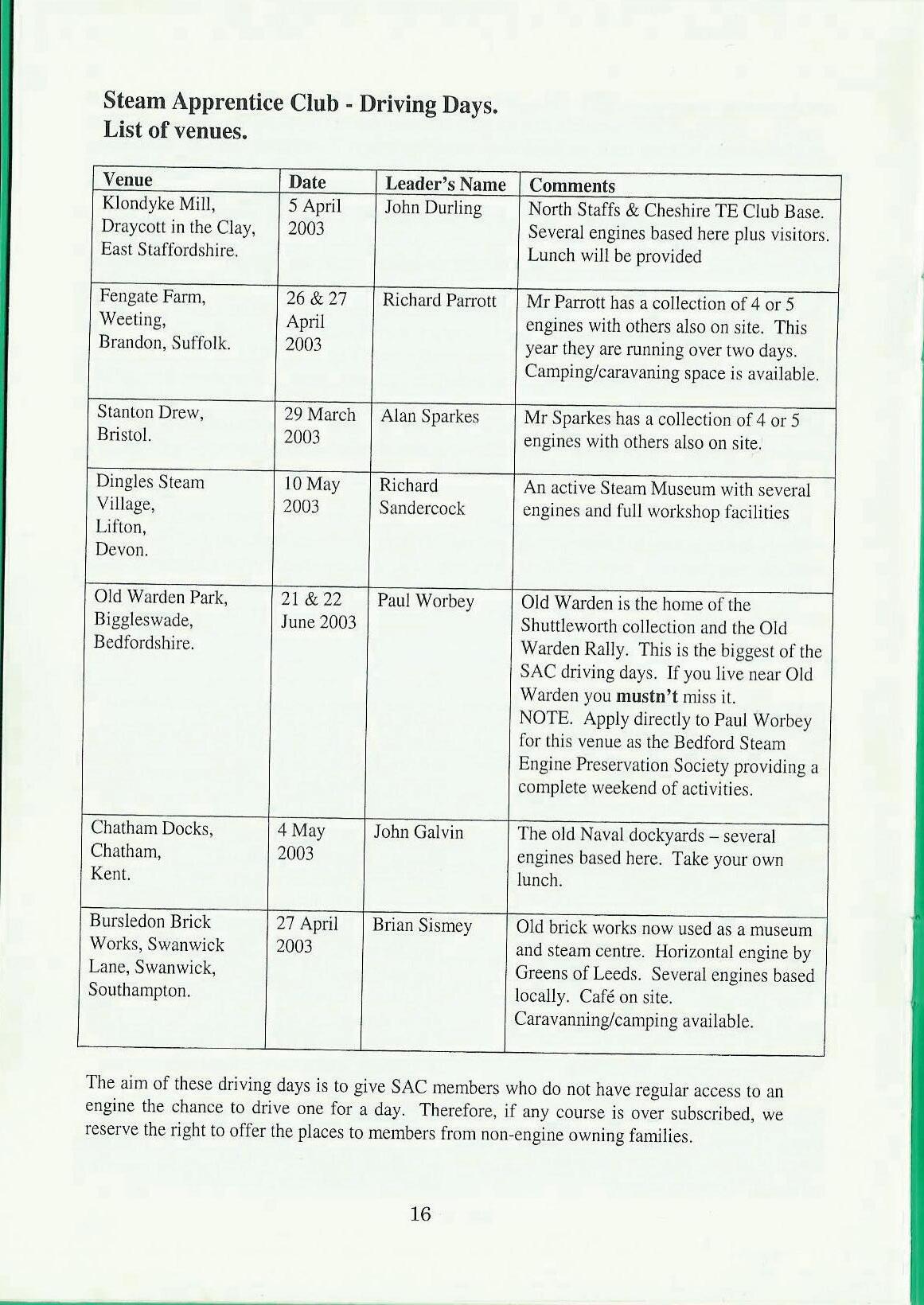
ChathamDocks, 4May John Galvin Chatham, 2003 Kenl.
BursledonBrick 27 April Brian Sismey Works,Swanwick 2003 Lane, Swanwick, Southampton.
Old Warden is the home or the Shuttleworthcollectionand the Old Warden Rally. This is the biggest of the SAC driving days. ff you live near Old Warden you mustn't miss it.
NOTE. Apply directly to Paul Worbey for this venue as the BedfordSteam Engine PreservationSociety providinga complete weekendof activities.
The old Naval dockyards-several engines based here. Take your own lunch.
Old brick works now used as a museum and steam centre. Horizontalengine by Greens of Leeds. Several engines based locally. Cafe on site. Caravanning/campingavailable.
The aim of these driving days is to give SAC memberswho do not have regular access to an engine the chance to drive one for a day. Therefore, if any course is over subscribed, we reserve the right to offer the places to members from non-engineowning families.