RAISING STEAM
STEAM APPRENTICE CLUIB MAGAZINE
El31'1iOR
Barry: Sumsfom, Kear.Jine Gr-a:r:,hlc[m.ages, Faiir0ak House Busjness Centre 1 !Shurch 1R0a<I,Nem:>ort NP19 qJilff 'J!el:011633262197 Fax: Ol633 259089
Cl:IAIRMAN, SliEAM APP.REl\l'l"ICECJJUB
John Durling, Haw.horn Coitage, S1mbwo0<1,Uttoxete,,, Staffcn•dshire STa4 5HX '!Del:018S9 59llS8 (between ©8.©©and 21.00 hours only ploaseJ
MEMBERSHIP SEGREiJ">!'IR:Y
J0J:i,n00ok, Do1fm:iru,©hurch Lane, Kirby la Thorpe, Slenfol'd, Lincolnshire NG3~ 9NU. Co;oresi;,ondenceonly. Membership fee £0.00 por •nnum.
~he Editor w.elcome:sany contributions of articloa, ahort.m·itumR or photographs for iBdusi0n in fu_t;ureissues .Ml mater.ial submit,it.1diMvu!1mtury and payment can:r:10the 'll\ade :for an;ymateriaJ published. Tho opiniornilox:prm1audin the magazine, with the .excepti0n 0f Club announcemcmt.1:1,un1 u~of.ui1,f the c@ntributors an.fildo not dndicate the views of the Club as n wholn. All items are held cop,'<ig,htby the eol!ltriJ,UJtorand the INT<ET FJease sen,.dyouli' conbri@utfonsto the Editor at least five Wl:H.1kHbefore publication. fued articles a,,e prefer~ea but not essenti,il. If hu11dwritten put any names ofFE0PIJE, PL.ACEliilor ENGINES in BLOCK CAl'TTALS.If you require any part of;y@urarticle (eg)Photos) re'6uvning please say sound l'ndnse a stamped addr.essecften,ve1$i1pe.ENol@sey;ouirname, addvess and (if Appru11lict•lnge with an:Y cpntribution.
The Edi:tle)rreserwes theWigh"t;~oamend or refuse contribntionH, and will. attempt Uoe@rreGtsve1ling.and ·grammar! liirhe 1\11aga~ime is nomnall!w@ublished<luring the early purl, of ,Junuury, A:pril, Ju[y, and @ctober. \Phe Club accepts no lia'bili1Jyfor failure lo mout intendud pufu1ioatiQndates.
The Steam :App:r:enticeClab i:isa secilion of the I.NationalTractfrm Engl no Trust. N'!I;E['!isa 'Registered Chanity, No. 29d5:78.Registered in Eng'lnnd No. 13021!17 Registered Office: 4 Churclt G,r.eeniEast, Redditch, Worceijtert-1hir1•llHBRWr.
Ty.;pesettingand .Artwor-klby !KeroilineGraphic Images, Fairoak 1luuHt• liusilWt:18t!entro, Church B.oad, Newport, Soutlh Wales NP19 7EJ Tel: 01633 262]f)'/ 11\LXIIIm1a imlOM9 email: bsumsion@k"eai:;-line.fsnet.oo.uk
Printedlby The Whitehouse F11essLtd, High Street, Lydn0y, Ukm <ll ,16 WIJP
FROM THE EDITOR
Well here we are again, a little late, but not too late to wish you all a very happy and steamy new Millenium. Traditionally the winter period tends to be a little quiet on the steam front, but not so this year. Those model Burrells are moving on apace, with the first of the back wheels assembled and being painted as we speak. The three of us enjoyed a visit to the home of Richard Wilcox of the Road Locomotive Society, where we inspected his not inconsiderable collection of engines and received advice on the correct paint mixes to apply to our engines. The drawings for the cylinder casting are all but finished and the pattern well advanced. The second and third engines still have a lot of work to be done and will probably be another two or three years in the finishing, but don't be too surprised to see the first engine - a road engine - in steam at this year's Great Dorset!
On the Raising Steam front it is good to see that many of you are, at long last, sending in your letters and articles, and very interesting many of them are. It seems that publishing my e-mail address has prompted more of you to send in your contributions. That is very good, but don't spend more time on your computers than you do getting involved with steam engines whenever you can!
John and Fiona have again been very busy organising special events for you. Please support these whenever you possibly can. Remember the more you join in, the more you will get out of your membership. As I write this, I have been talking with John who tells me that a Mr L. Palmer of Caversham, near Reading, who is the owner of Wallis & Steevens engine Wildfire, is desperately seeking an apprentice (over 14) to learn and assist him this season. I am told he has had this engine since 1954, so there won't be much about this engine that he can't teach you! So come on, there must be someone in the area who should jump at this opportunity. Ring or write to John if you are interested.
Good Steaming, Barry Sumsion, Editor
THE CHAIRMAN'S BIT
Well, Christmas and New Year are now behind us and, although we are staying inside and trying to keep warm we must think about the coming of warmer days and the start of the next steam season.
The Driving Days organised last year went very well. So well in fact that we are organising more for this year. Like last time these days are planned to be fun, with the emphasis on driving and steering engines -safely of course. The sites that have offered help this time are listed elsewhere in this magazine and there is a sheet for you to send back to say that you are interested in going to one of these days. If you are wondering whether you would like it, try talking to someone who went last year - they had a great time.
For more formal driving instruction the NTET Driving Course is being organised in the Norwich area on the weekend of the 6th & 7th May. The cost
will be £50.00 + VAT for those aged 16 and over and £30.00 + VAT for those aged 13 to 15. Again, if in doubt, talk to someone who has been before. These courses give you the chance to get some proper instruction in how engines work, how to look after them and how to drive them - there is of course lots of time spent on engines! If you are interested in this course send me a note and I will send you the information pack and application form as soon as they are available. Please enclose an A5 size stamped addressed envelope.
At the NTET AGM last November, Kerry Dunderdale was awarded the Jack Beeby trophy. This cup is given every year to an apprentice who has shown that they can stick with it and learn how to work an engine. This normally means being apprenticed to one engine - or owner - for some time. Kerry has worked with Graham Atkinson and his engines for 4 years and is now a valuable part of his crew. Some say that she is now the boss of the crew but that is a different story!
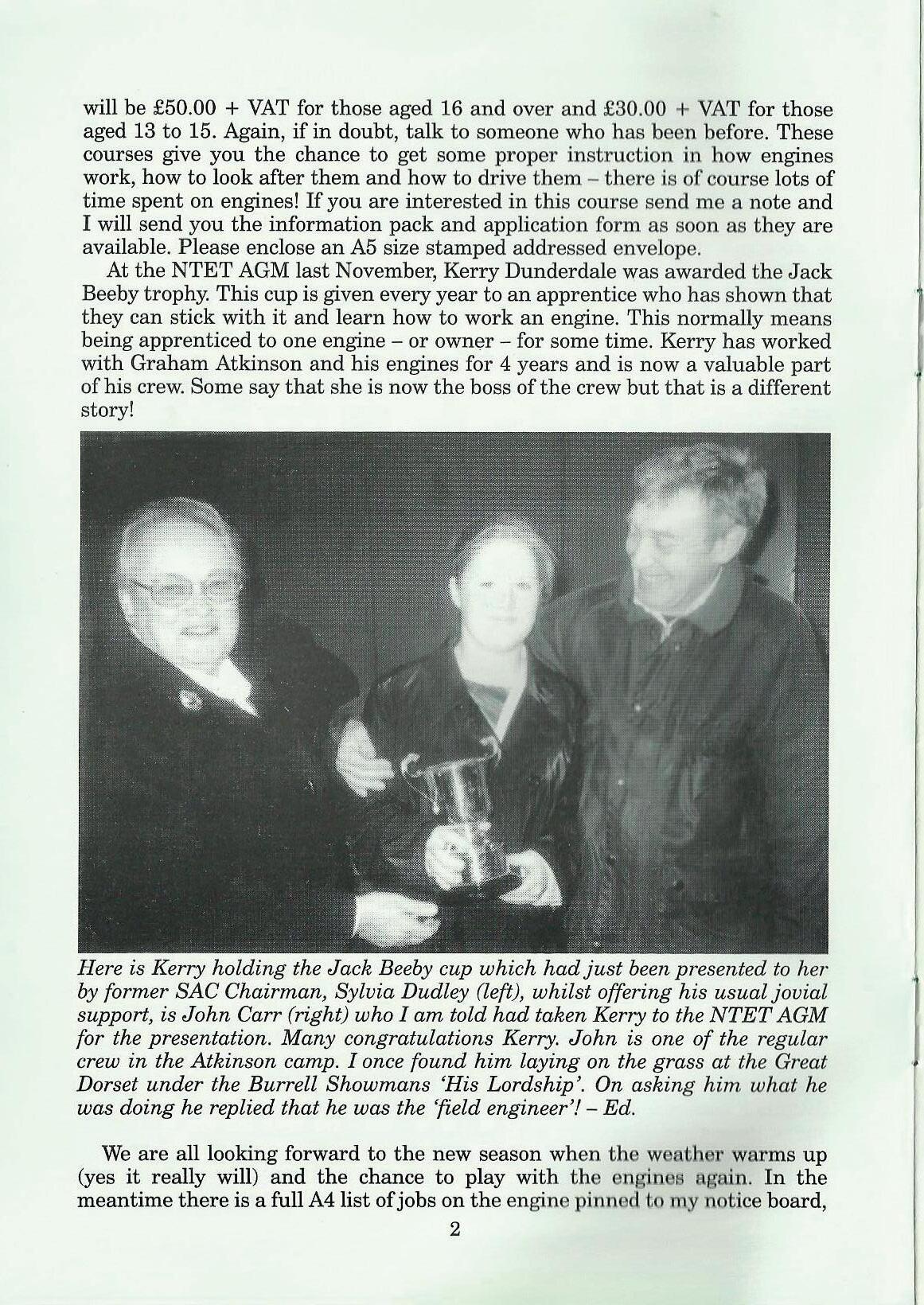
I-Jereis Kerry holding the Jack Beeby cup which had just been presented to her by former SAC Chairman, Sylvia Dudley (left), whilst offering his usual jovial support, is John Carr (right) who I am told had taken Kerry to the NTET AGM for the presentation. Many congratulations Kerry. John is one of the regular crew in the Atkinson camp. I once found him laying on the grass at the Great Dorset under the Burrell Showmans 'His Lordship'. On asking him what he was doing he replied that he was the 'field engineer' I - Ed.
We are all looking forward to the new season when the weftth~r warms up (yes it really will) and the chance to play with the engino1.1ugain. In the meantime there is a full A4 list of jobs on the engine pinned to my notice board, 2
so I suppose I had better get started on some of them. I hope to see many of you round and about during the course of the year.
John Durling, Chairman
MAIL BAG
Dear Editor
On the 19th December, my Mamod Millennium Bus was stolen from the couriers at Birmingham. I would like to ask the other Steam Apprentices to keep their eyes and ears open. If they see a bus with a plaque numbered 107 on the front or if it looks as though it has been repainted; the bus has no genuine papers with it. If anyone does think that they might have seen it, could they please contact Mamod on 0121 500 6433.
Thank you very much Laurence Spry (age 7)
That's a sad start to the year. Please do keep your eyes and ears alert. You may see this bus at a rally, for instance, on a trade stand or just being played with. If you do suspect you've seen the bus, please do not do anything yourself other than telling an adult, a policeman or ring Mamod as Laurence suggests. - Ed.
Dear Editor
I have had a nice summer last year going to my favourite steam rallies with my Dad and Uncle. We have been to Prestwood, Knowl Hill, Great Bucks and Great Dorset steam fairs with my display of Wilesco models. After going to these rallies I decided to build a web site about the events. So far I have had very few visitors to my site and only one e-mail! I wondered if you would tell other steam apprentices about my site, which can be found at: http//www.dean.ndo.eo.uk/steam_ world
I would also be interested to know if anyone else has made a web site.
From Ross Dean (age 10)
Rickmansworth, Herts
Ross also sent in some pictures on a disc as entries for this year's Photograhic Competition. Well, Ross, whilst applauding your enthusiasm, your photos must be supplied as prints in entries of three photographs. So you must produce prints of the three photos you would like to enter, and then send them to John Durling later in the year, when the competition is announced. However, when you have chosen your entries, I would be more than happy to reproduce some of the other pictures in 'Raising Steam'. - Ed.
Dear Editor
On Saturday 6th November, I went to Klondyke Mills Fireworks and Steam. I arrived at 6.30pm and found John Durling and his Aveling & Porter tractor
Morning Star. I got up on the footplate and sat on the rim of the coal bunker and waited for the bonfire to be lit.
I checked the fire was O.K. and checked the water but I needed to inject. On goes the water, on goes the steam and just wait for a minute or two. Steam off, water off and one large lump of coal at the back of the firebox and the bonfire was lit. After 5 minutes I began to get a little bored, I turned my attention to the engine. Suddenly I heard a loud bang followed by a large number of other loud bangs and we came to the conclusion that the bonfire had started the firework display 5 minutes earlier than was first planned! Then on came the real fireworks.
It was a very interesting display and who should finish it off but the engines with their whistles! I said goodbye and thankyou to John and Fiona Durling and they said would I come and watch them wash out the boiler tomorrow. I immediately said yes as this was something I had never seen before.
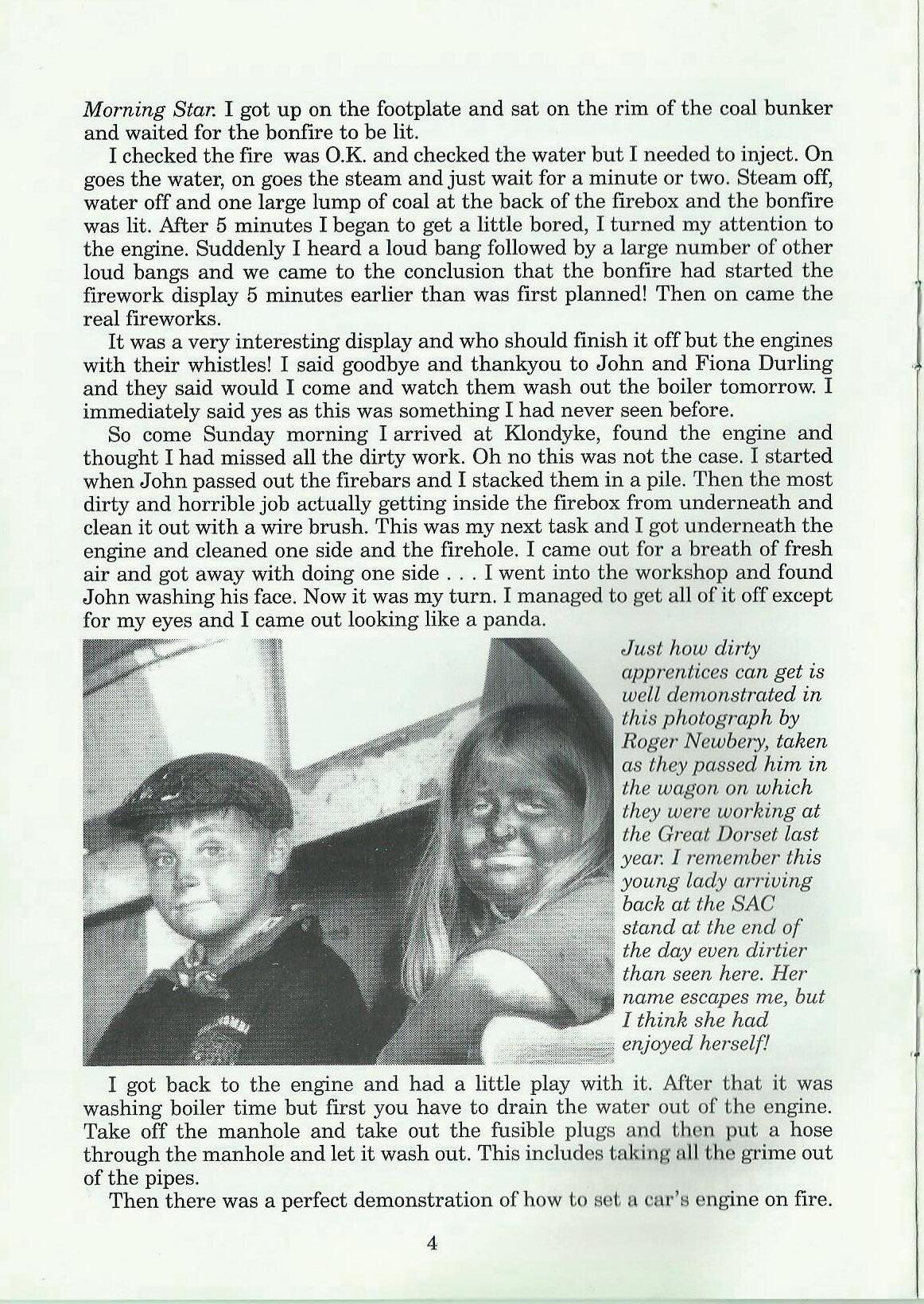
So come Sunday morning I arrived at Klondyke, found the engine and thought I had missed all the dirty work. Oh no this was not the case. I started when John passed out the firebars and I stacked them in a pile. Then the most dirty and horrible job actually getting inside the firebox from underneath and clean it out with a wire brush. This was my next task and I got underneath the engine and. cleaned one side and the firehole. I came out for a breath of fresh air and got away with doing one side ... I went into the workshop and found John washing his face. Now it was my turn. I managed to get all ofit off except for my eyes and I came out looking like a panda.
Just how dirty apprentices can get is well demonstrated in this photograph by Roger Newbery, taken as they passed him in the wagon on which they were working at the Great Dorset last year. I remember this young lady arriving back at the SAC stand at the end of the day even dirtier than seen here. Her name escapes me, but I think she had . )~;lt~ltii!!i~1irnli! enjoyed herself!
I got back to the engine and had a little play with it. After that it was washing boiler time but first you have to drain the water out of the engine. Take off the manhole and take out the fusible plugs and then put a hose through the manhole and let it wash out. This includes taking nH !,he grime out of the pipes.
Then there was a perfect demonstration of how to imL u cu.r1 1:1engine on fire.
Really they were trying to blow it up! Then my Mum came to take me home but she let me see what happened to it then, I said thanks to John and then went home after a very enjoyable weekend at Klondyke.
From Martin Treanor (age 12) Duffield, Derbyshire
Actually the incident with the car, was apparently the mindless actions of some visiting yobs, your Chairman was not impressed! - Ed.
Dear Editor
As an older member of the SAC (18) hopefully my comments will be listened to and people will think that my comments are valid.
I have been "on the scene" for over 15 years, as an active helper for the past 8 of them. I am the "apprentice" at Chatham Historic Dockyard, but am now involved very much in my own restoration, a 1946 site contractors hut/living van, although with a great deal of help and guidance from the older members. Perhaps if there is a younger keen member of the SAC living in the area who would like to get their hands dirty, as indeed they will, perhaps you could put me in touch with them.
Anyway, the main reason I wrote:
I am a firm believer that traction engines/steam rollers etc were given wheels so that they can go along the road. I'm not one of the bathchair brigade! Although I can seen the point of view of people who do lowload their engines, for whatever reason. (Try driving one of your rollers from Kent to the Great Dorset and then you'll understand! - Ed.)
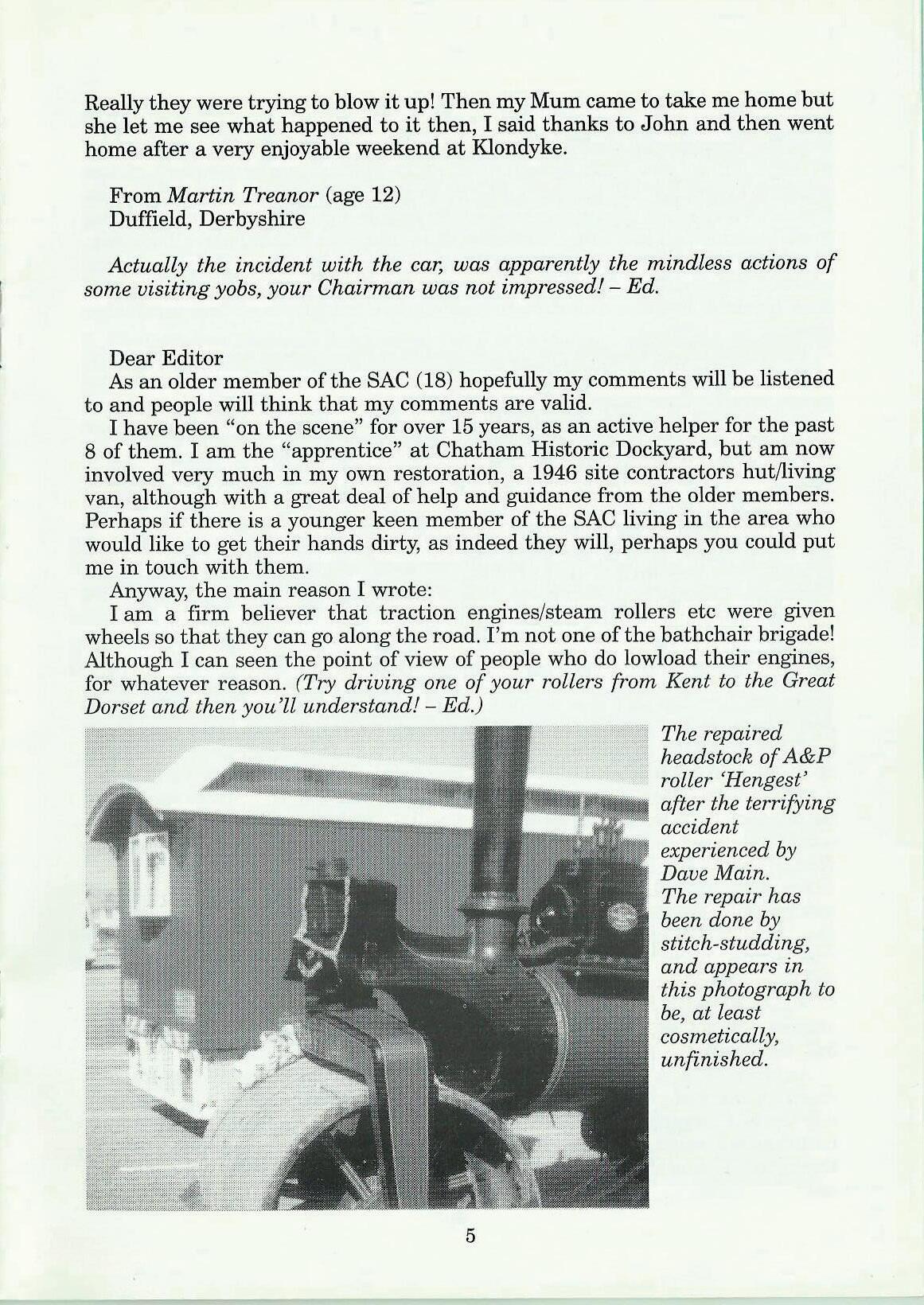
The repaired headstock of A&P roller 'Hengest' after the terrifying accident experienced by Dave Main. The repair has been done by stitch-studding, and appears in this photograph to be, at least cosmetically, unfinished.
Each year I do many miles on the road on one engine or another. However, on 19th July 1999 I was steering an engine (Aveling & Porter Rl0 roller Hengest) through the Medway Tunnel on our way back to the Dockyard when we were hit by two vans travelling at great speed. The momentum of the accident threw me off the back of the engine, hitting the scarifier in the process. The force of the impact pushed the engine a good 20 feet, smashing the front headstock off and badly fracturing the water lifter bracket and offside rear wheel. The police were called, as was an ambulance for one of the van drivers who had cracked a rib. Amazingly there were no fatalities. The engine has now j been repaired, but this unfortunate incident has taught me several invaluable lessons.
The police officers who turned up agreed that the accident was not our fault, . lighting regulations had been obeyed, we were sober, etc. They felt that the motor vehicles travelling at 50 mph (the speed limit on this piece of road) had gone from bright sunlight into bright artificial light. It took only a moment for their eyes to readjust, but that was too long, the first van tried to brake and turn into the outside lane, but got it wrong and hit us with his nearside wing, pushing the engine of the van into his passenger seat, which luckily was unoccupied. The other van was close behind him and careered into that. The police thought that whatever we could have done, would not have prevented the accident. It was too bright for a flashing light to be effective and paraffin lights, no good at all. The coal we were using was smokeless, and anyway, the extraction system in the tunnel would have sorted that out.
Anyway, it goes to show, even in these perfect conditions, accidents do happen and if we have to think that the majority of other road users are total idiots then so be it, treat them as so. Try to make engines easy to spot, flashing lights etc, I realise that it is not possible to eliminate smoke, after all they are steam engines, but please, the story "it was so smokey, drivers had to put their fog lights on" I feel is asking for trouble. My living van, for example, is going to be fitted with full electric lighting, flashing lights, indicators, hazard signs, etc, if only to catch people's attention after all. The last thing I want to happen is for my time to be wasted as someone drives into it, but even worse than that, I would hate ever to read in thii.spublication or another, that someone such as yourself had been fatally injured in an accident.
I realise that many of you are probably thinking, yeah, yeah, yawn, when is this sermon going to end. After all, steam engines built prior to 1930 only need two paraffin front lights and one rear, although it is now law that a vehicle travelling at under 5 mph on a dual carriageway must have a working amber flashing light. The roads are a lot faster and busier than in 1930, surely we
should work with the motorists, otherwise I can foresee a time when steam engines will not be allowed on the roads, full stop. So please enjoy your hobby, but be careful! '
Anyway, on a lighter note this rally season has been a happy one for me, meeting many of you at rallies across the south of England, or at the driving day the SAC organised at Chatham. I'm now working for a living as apprentice maintenance engineer at the Ropery in, you've guessed it, Chatham Historic Dockyard. This is an interesting place and well worth a visit, why not come and see.
I hope you all had a good year of rallies wherever you are; this year keep a look out for me, come and say hello. I am easy to spot, being 6'2" and usually around a Fowler, Aveling, Foden or McLaren, although it has been said that apparently I have been spotted near a Burrell, but until I see photographic proof, I will not admit to it! - Sorry Burrell fans! You will learn what a joy it is to go on a proper engine some day, until then, second best I guess.
From Dave Main Gillingham, Kent
The accident obviously has caused Dave to become somewhat unbalanced - a good weekend on a hard working Burrell should put him right! - Ed.
P.S. from Dave -
So all you steam spotters, those of you who went to see the film The Mummy at the cinema last summer, who spotted the steam engines in it? Well, several people have wondered and I can tell you the roller is Aveling & Porter E-type (piston valve single) registration number FX 8240 which left Aveling's works on 15 August 1921. At the time of the filming (October 1998) it was owned by Martin Conroy and kept in the Dockyard. The steam cranes are all Grafton 5 ton 0-6-0 cranes, built between 1938 and 1945 and the railway locomotive is Robert Stephenson & Hawthorne 0-4-0 Ajax. The above locomotives were part of a set made in the Dockyard alongside the Ropery, and yes us (the crews) did have to dress up as Arabs, and yes there is a photo of me wearing a turban, but no-one is getting their hands on it! (Especially not Kevin Mills, Pushpole & Co are not getting their hands on that one mate!)
The dockyard is often used for film sets, the ones filmed in part there during 1999 include David Copperfield, Great Expectations (both Dickens' novels) and James Bond The World is Not Enough (opening sequence and fish market) (I'm in this one as well!)
1999 COMPETITION RESULTS
As promised in the last Raising Steam we now feature the results of last year's Photographic Competition at the Great Dorset.
The winners of the Colouring competition were:-
lst Gregory Chick, age 8
2nd Gareth Pearson, age 7
3rd Ethan Parsons, age 8
The winners of the Photographic competition were:-
lst Robert Deering age 12 -also won the Dorset Shield
2nd Robert Bance age 14
3rd Rebecca Pope age 12
See over for some of the photographic entries:
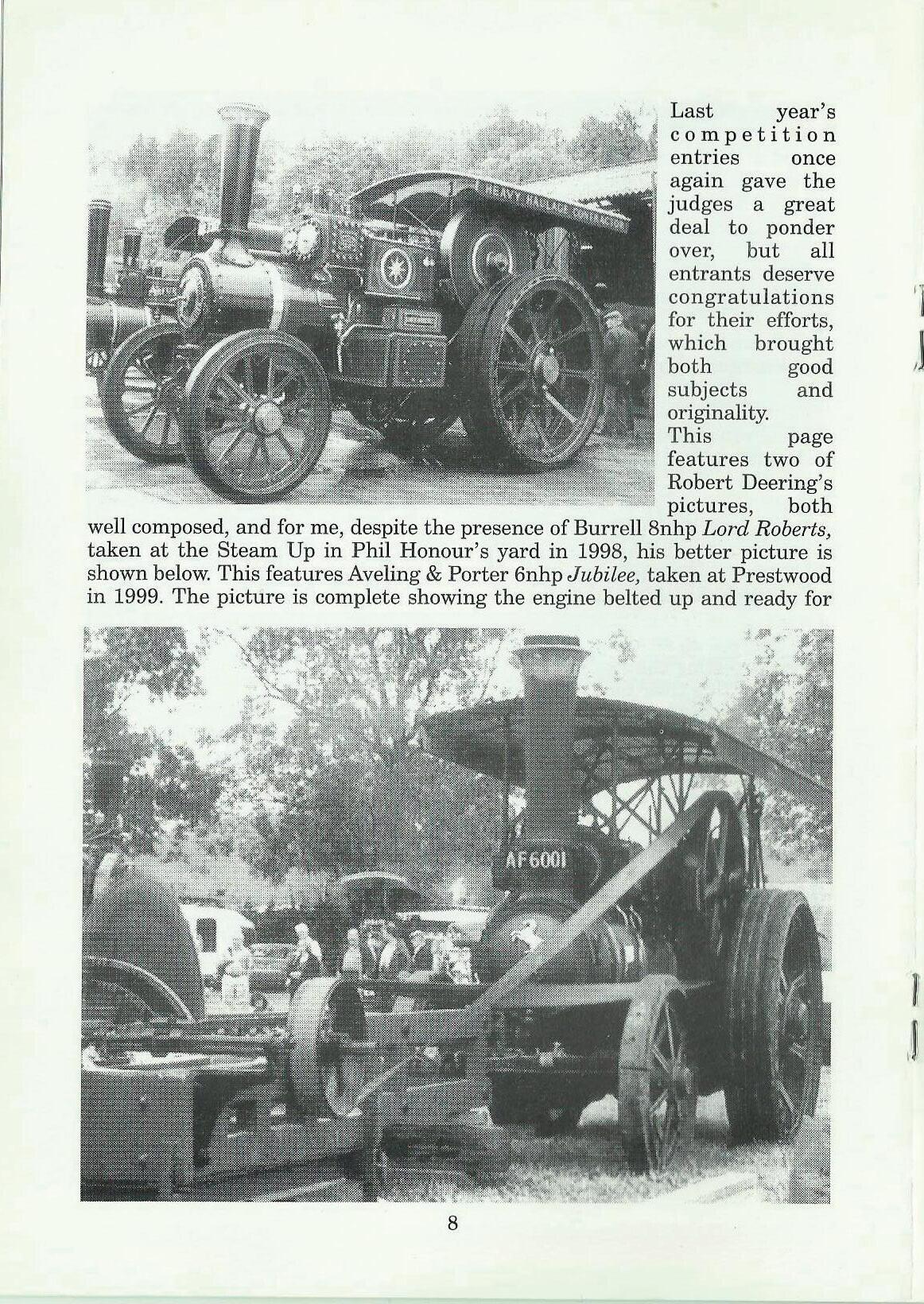
Last year's competition entries once , ¾ again gave the • judges a great deal to ponder over, but all entrants deserve congratulations for their efforts, which brought both good subjects and originality.
This page features two of Robert Deering's pictures, both well composed, and for me, despite the presence of Burrell 8nhp Lord Roberts> taken at the Steam Up in Phil Honour's yard in 1998, his better picture is shown below. This features Aveling & Porter 6nhp Jubilee>taken at Prestwood in 1999. The picture is complete showing the engine belted up and ready for
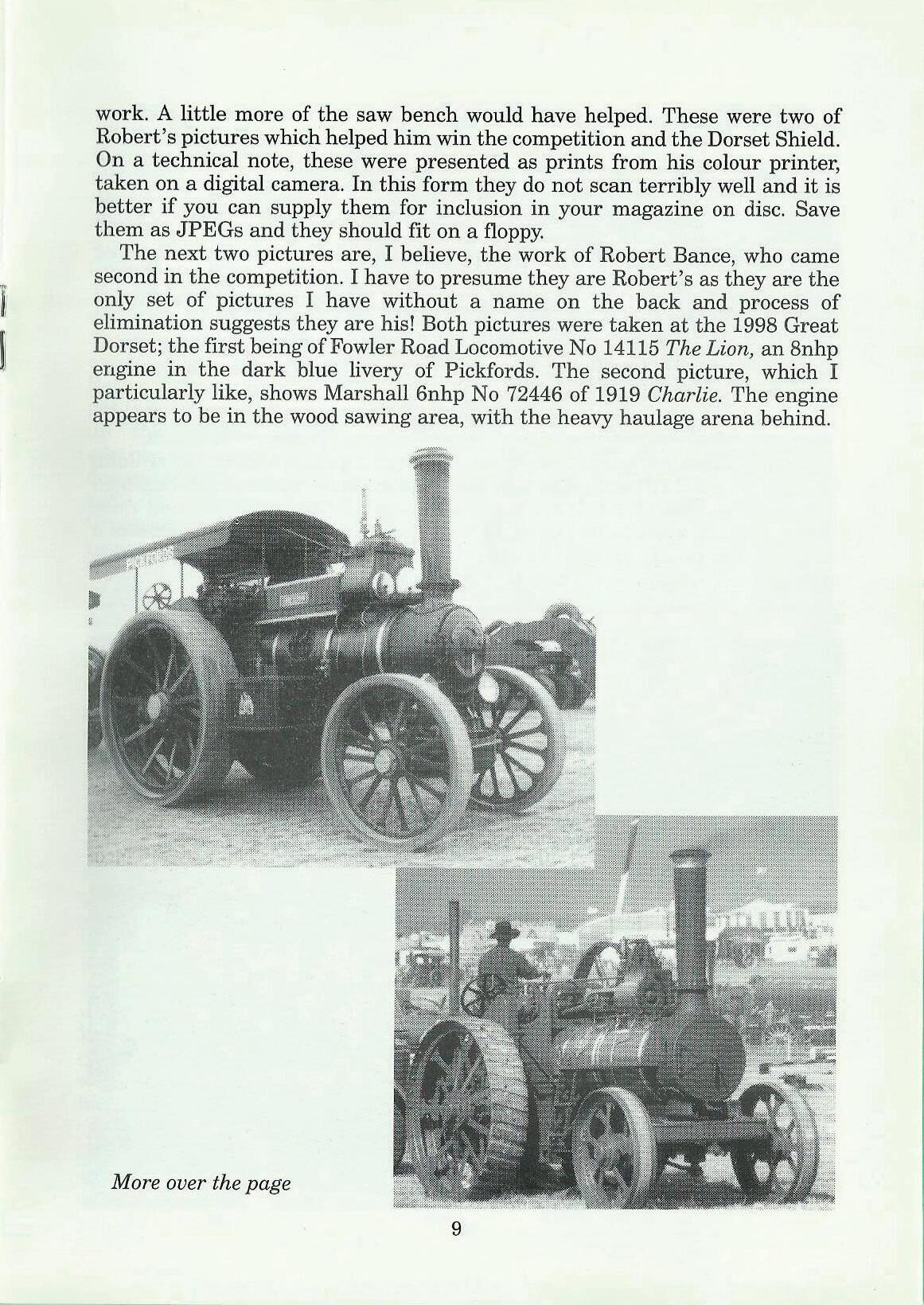
work. A little more of the saw bench would have helped. These were two of Robert's pictures which helped him win the competition and the Dorset Shield. On a technical note, these were presented as prints from his colour printer, taken on a digital camera. In this form they do not scan terribly well and it is better if you can supply them for inclusion in your magazine on disc. Save them as JPEGs and they should fit on a floppy.
The next two pictures are, I believe, the work of Robert Bance, who came second in the competition. I have to presume they are Robert's as they are the only set of pictures I have without a name on the back and process of elimination suggests they are his! Both pictures were taken at the 1998 Great Dorset; the first being of Fowler Road Locomotive No 14115 The Lion, an 8nhp engine in the dark blue livery of Pickfords. The second picture, which I particularly like, shows Marshall 6nhp No 72446 of 1919 Charlie. The engine appears to be in the wood sawing area, with the heavy haulage arena behind.
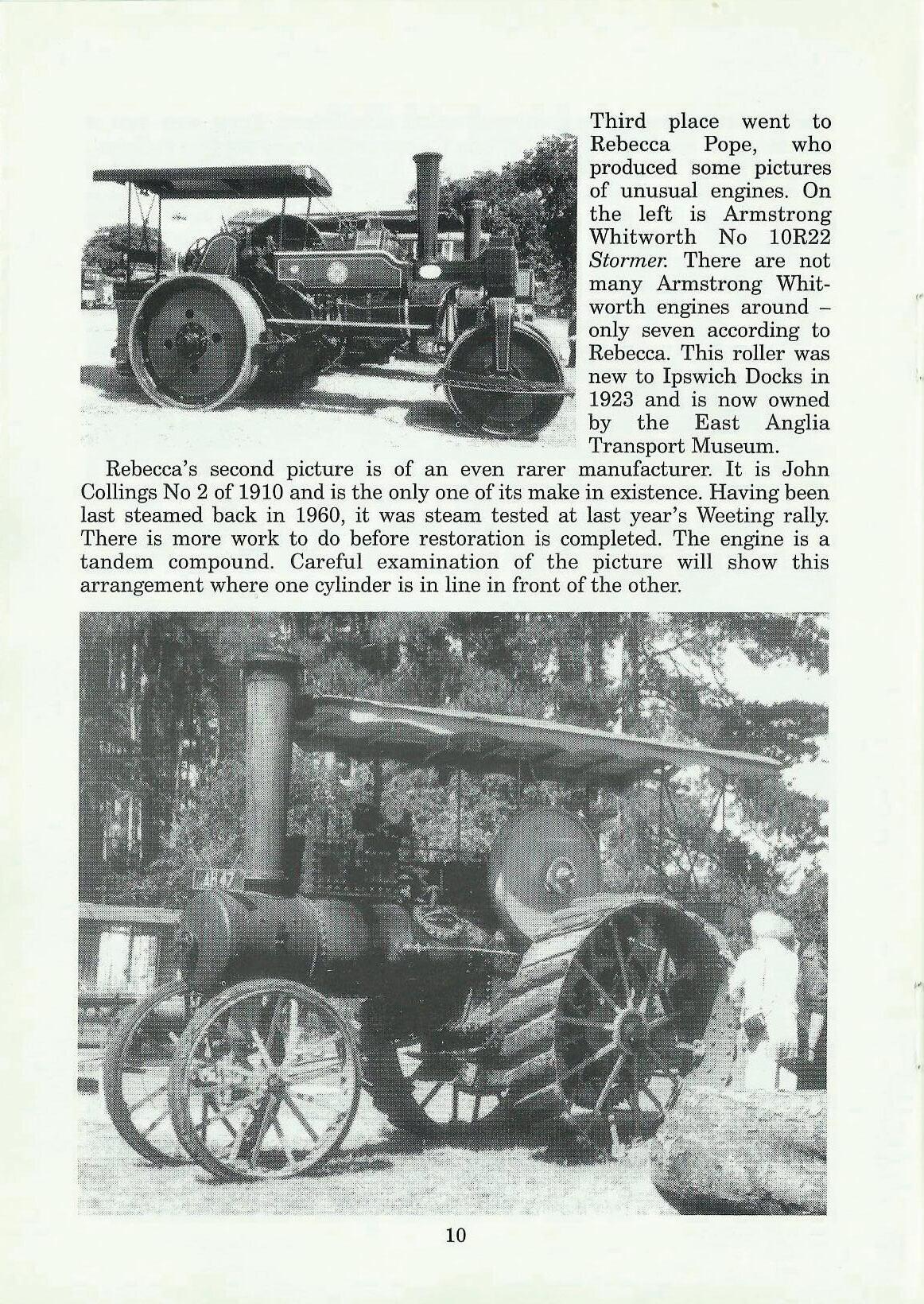
Third place went to Rebecca Pope, who produced some pictures of unusual engines. On the left is Armstrong Whitworth No 10R22 Stormer. There are not many Armstrong Whitworth engines aroundonly seven according to Rebecca. This roller was new to Ipswich Docks in 1923 and is now owned by the East Anglia Transport Museum.
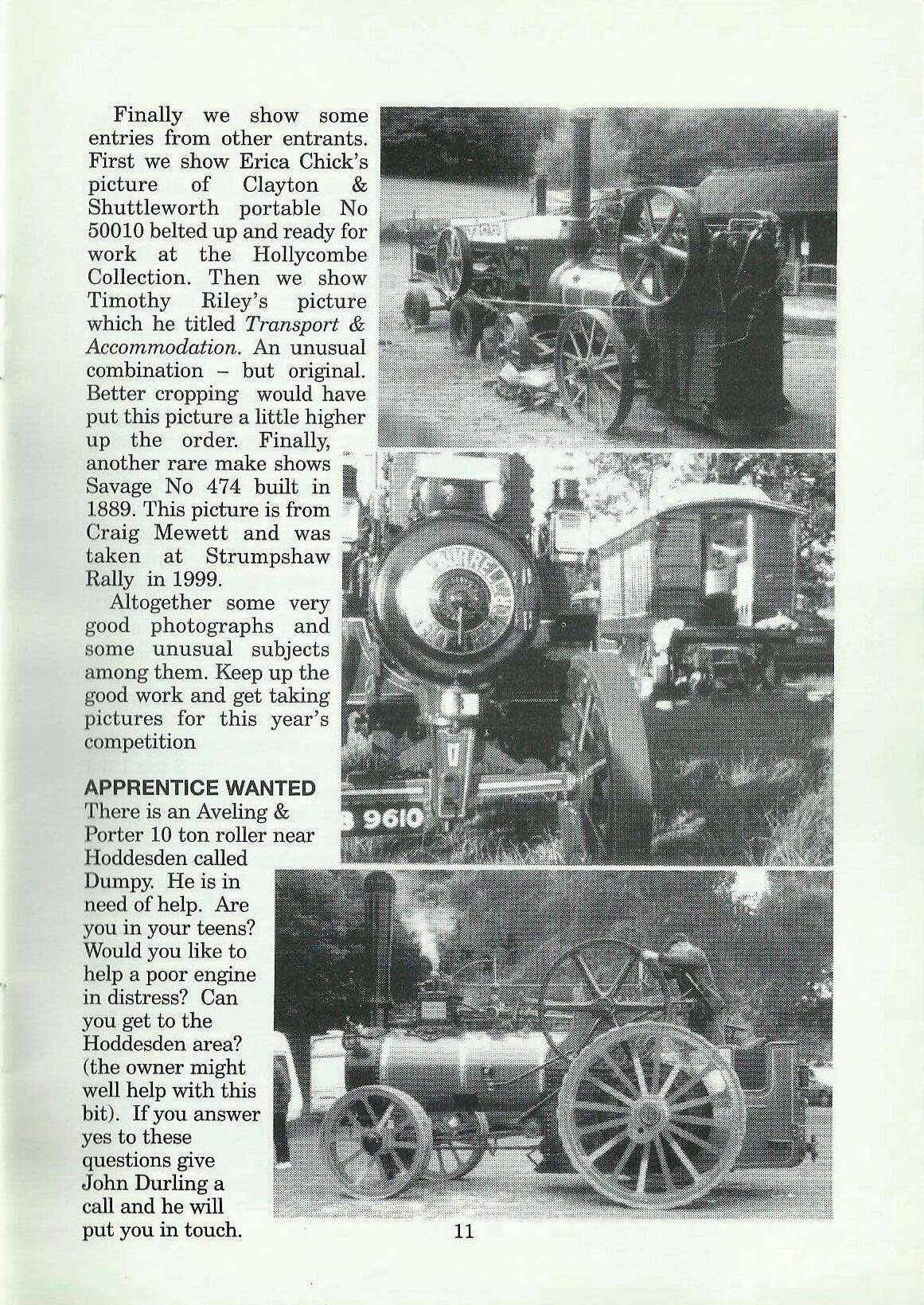
Rebecca's second picture is of an even rarer manufacturer. It is John Collings No 2 of 1910 and is the only one of its make in existence. Having been last steamed back in 1960, it was steam tested at last year's Weeting rally. There is more work to do before restoration is completed. The engine is a tandem compound. Careful examination of the picture will show this arrangement where one cylinder is in line in front of the other.
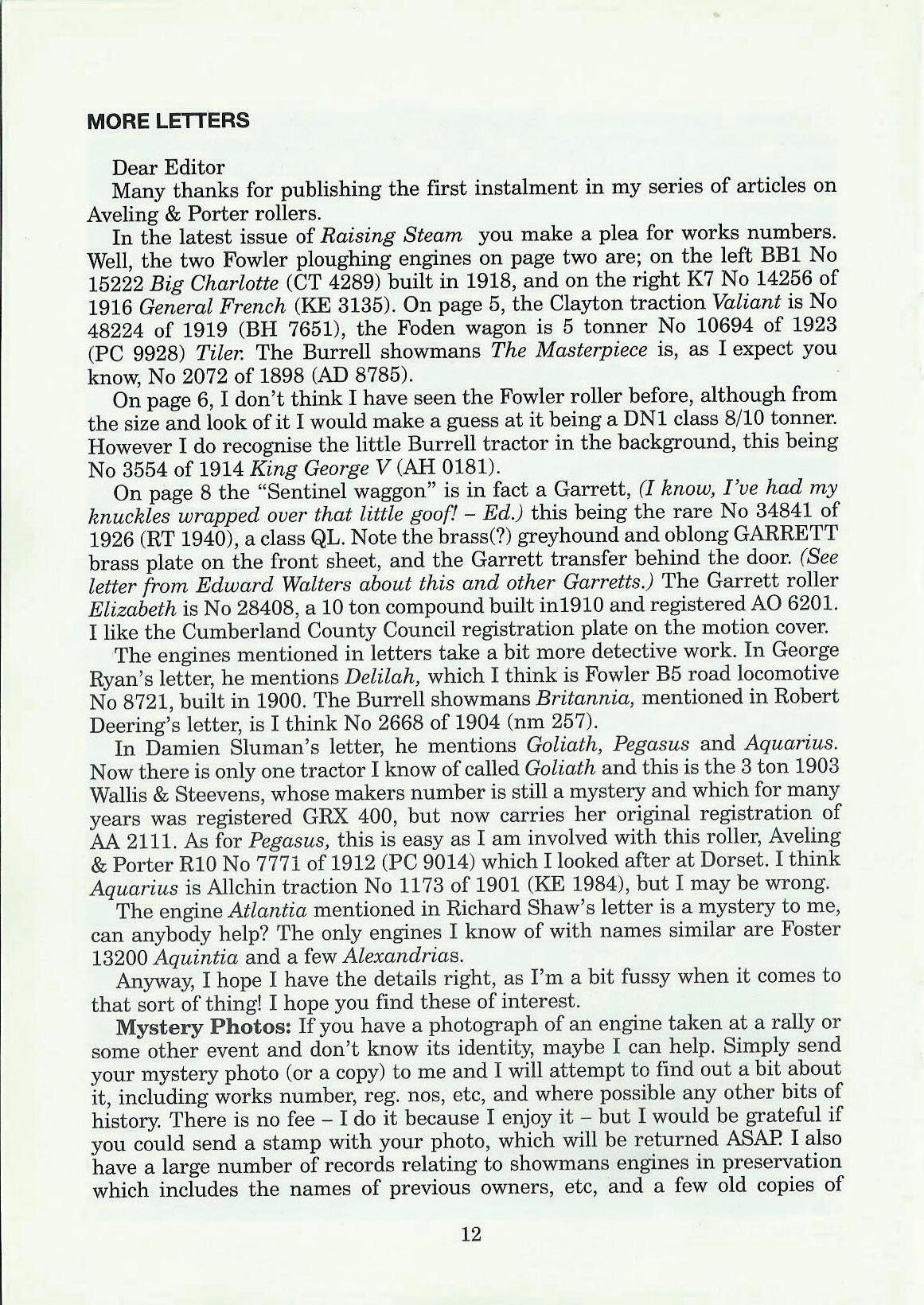
Finally we show some entries from other entrants. First we show Erica Chick's picture of Clayton & Shuttleworth portable No 50010 belted up and ready for work at the Hollycombe Collection. Then we show Timothy Riley's picture which he titled Transport & Accommodation. An unusual combination -but original. Better cropping would have put this picture a little higher up the order. Finally, another rare make shows Savage No 4 74 built in 1889. This picture is from Craig Mewett and was taken at Strumpshaw Rally in 1999. Altogether some very good photographs and some unusual subjects among them. Keep up the good work and get taking pictures for this year's competition
APPRENTICE WANTED
There is an Aveling & Porter 10 ton roller near Hoddesden called Dumpy. He is in need of help. Are you in your teens? Would you like to help a poor engine in distress? Can you get to the Hoddesden area? (the owner might well help with this bit). If you answer yes to these questions give John Durling a call and he will put you in touch.
MORE LETTERS
Dear Editor
Many thanks for publishing the first instalment in my series of articles on Aveling & Porter rollers.
In the latest issue of Raising Steam you make a plea for works numbers. Well, the two Fowler ploughing engines on page two are; on the left BBl No 15222 Big Charlotte (CT 4289) built in 1918, and on the right K7 No 14256 of 1916 General French (KE 3135). On page 5, the Clayton traction Valiant is No 48224 of 1919 (BH 7651), the Foden wagon is 5 tonner No 10694 of 1923 (PC 9928) Tiler. The Burrell showmans The Masterpiece is, as I expect you know, No 2072 of 1898 (AD 8785).
On page 6, I don't think I have seen the Fowler roller before, although from the size and look of it I would make a guess at it being a DNl class 8/10 tonner. However I do recognise the little Burrell tractor in the background, this being No 3554 of 1914 King George V (AH 0181).
On page 8 the "Sentinel waggon" is in fact a Garrett, (I know, I've had my knuckles wrapped over that little goof! - Ed.) this being the rare No 34841 of 1926 (RT 1940), a class QL. Note the brass(?) greyhound and oblong GARRETT brass plate on the front sheet, and the Garrett transfer behind the door. (See letter from Edward Walters about this and other Garretts.) The Garrett roller Elizabeth is No 28408, a 10 ton compound built in1910 and registered AO 6201. I like the Cumberland County Council registration plate on the motion cover.
The engines mentioned in letters take a bit more detective work. In George Ryan's letter, he mentions Delilah, which I think is Fowler B5 road locomotive No 8721, built in 1900. The Burrell showmans Britannia, mentioned in Robert Deering's letter, is I think No 2668 of 1904 (nm 257).
In Damien Sluman's letter, he mentions Goliath, Pegasus and Aquarius. Now there is only one tractor I know of called Goliath and this is the 3 ton 1903 Wallis & Steevens, whose makers number is still a mystery and which for many years was registered GRX 400, but now carries her original registration of M 2111. As for Pegasus, this is easy as I am involved with this roller, Aveling & Porter Rl0 No 7771 of 1912 (PC 9014) which I looked after at Dorset. I think Aquarius is Allchin traction No 1173 of 1901 (KE 1984), but I may be wrong.
The engine Atlantia mentioned in Richard Shaw's letter is a mystery to me, can anybody help? The only engines I know of with names similar are Foster 13200 Aquintia and a few Alexandrias.
Anyway, I hope I have the details right, as I'm a bit fussy when it comes to that sort of thing! I hope you find these of interest.
Mystery Photos: If you have a photograph of an engine taken at a rally or some other event and don't know its identity, maybe I can help. Simply send your mystery photo (or a copy) to me and I will attempt to find out a bit about it, including works number, reg. nos, etc, and where possible any other bits of history. There is no fee - I do it because I enjoy it -but I would be grateful if you could send a stamp with your photo, which will be returned ASAP. I also have a large number of records relating to showmans engines in preservation which includes the names of previous owners, etc, and a few old copies of
Steaming which may be able to help. Free service to all SAC members. Contact: The Aveling Man (or Kevin Mills if you want to use my correct name), 46 The Avenue, Goring by Sea, Worthing, West Sussex BN13 3RP (telephone 01903 602041 after 5pm weekdays).
Because of the amount of correspondence and held over matter printed this time, it has not been possible to produce Part 2 of Kevin 's articles on Aveling rollers. They will appear from the next issue. Kevin will be pleased to hear that I have received two photos of a C class roller from Dr Barry Job, which hopefully we shall use at the appropriate time. They are then to be sent on to Kevin. I hope you all appreciate Kevin's offer. It is good to hear from an apprentice who is obviously so keen.
Dear Editor
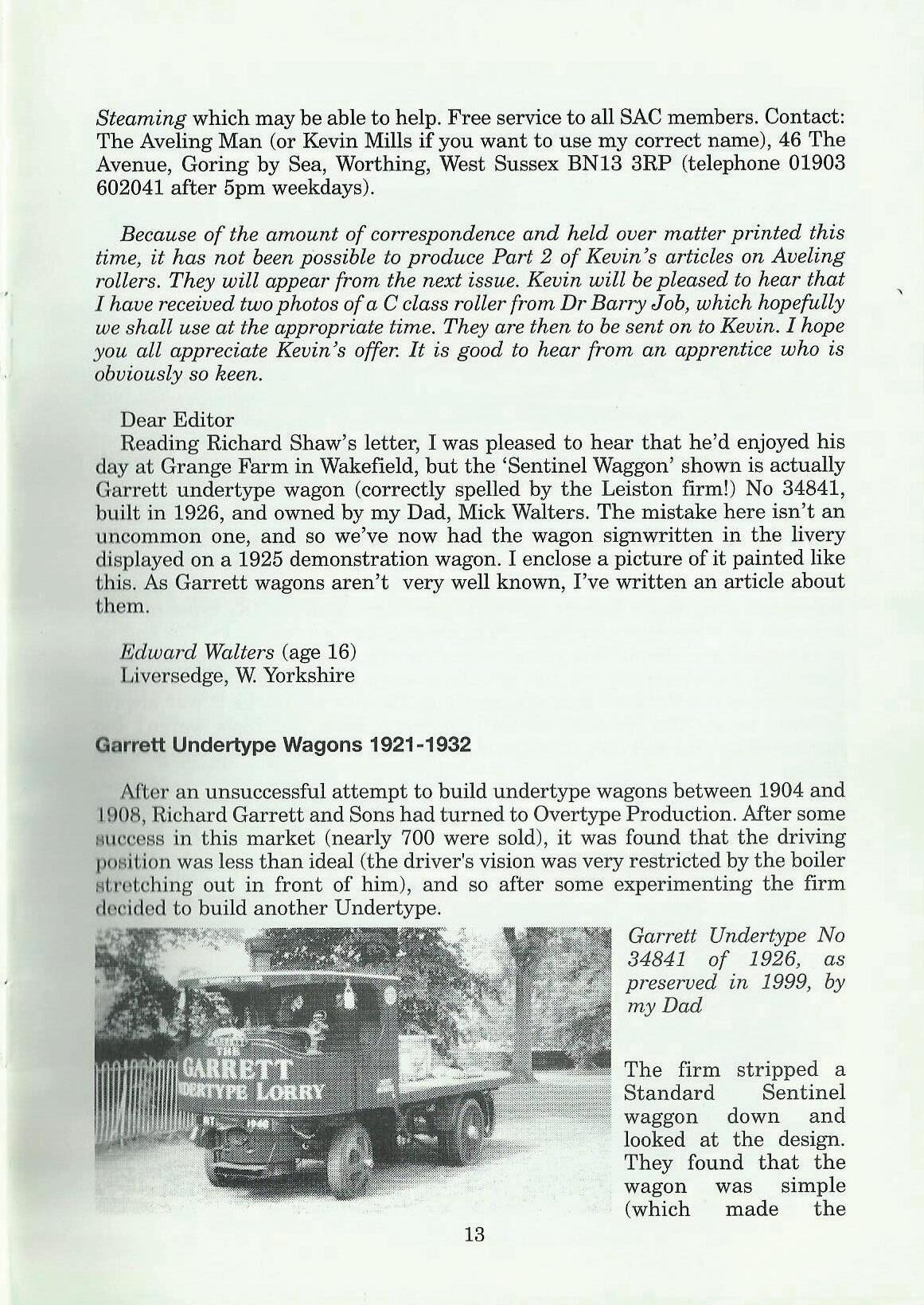
Reading Richard Shaw's letter, I was pleased to hear that he'd enjoyed his day at Grange Farm in Wakefield, but the 'Sentinel Waggon' shown is actually Garrett undertype wagon (correctly spelled by the Leiston firm!) No 34841, built in 1926, and owned by my Dad, Mick Walters. The mistake here isn't an uncommon one, and so we've now had the wagon signwritten in the livery displayed on a 1925 demonstration wagon. I enclose a picture of it painted like this. As Garrett wagons aren't very well known, I've written an article about them.
Edward Walters (age 16) Liversedge, W Yorkshire
Garrett Undertype Wagons 1921-1932
After an unsuccessful attempt to build undertype wagons between 1904 and J 908, Richard Garrett and Sons had turned to Overtype Production. After some Htlcce~s in this market (nearly 700 were sold), it was found that the driving poHiLionwas less than ideal (the driver's vision was very restricted by the boiler HLre'tching out in front of him), and so after some experimenting the firm dt ('i<ledto build another Undertype.
Garrett Undertype No 34841 of 1926, as preserved in 1999, by my Dad
The firm stripped a Standard Sentinel waggon down and looked at the design. They found that the wagon was simple (which made the
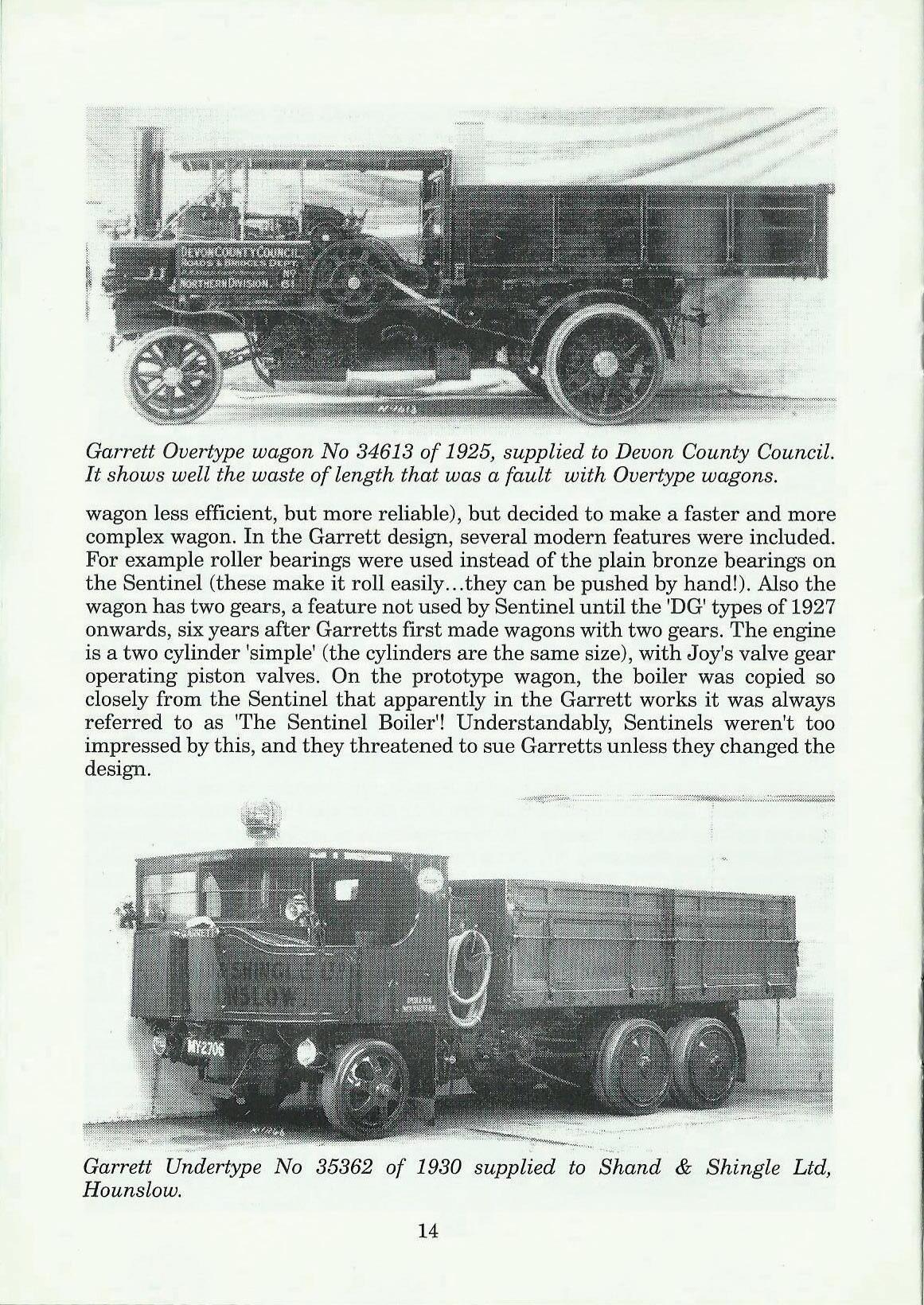
Garrett Overtype wagon No 34613 of 1925, supplied to Devon County Council. It shows well the waste of length that was a fault with Overtype wagons. wagon less efficient, but more reliable), but decided to make a faster and more complex wagon. In the Garrett design, several modern features were included. For example roller bearings were used instead of the plain bronze bearings on the Sentinel (these make it roll easily they can be pushed by hand!). Also the wagon has two gears, a feature not used by Sentinel until the 'DG' types of 1927 onwards, six years after Garretts first made wagons with two gears. The engine is a two cylinder 'simple' (the cylinders are the same size), with Joy's valve gear operating piston valves. On the prototype wagon, the boiler was copied so closely from the Sentinel that apparently in the Garrett works it was always referred to as 'The Sentinel Boiler'! Understandably, Sentinels weren't too impressed by this, and they threatened to sue Garretts unless they changed the design.
•v
Garrett Undertype No 35362 of 1930 supplied to Shand & Shingle Ltd, Hounslow.
All Garrett boilers from then on were of a different design, and several users thought that the design was the best ever fitted to any steam wagon. It certainly can make steam quickly if the fire is right. Its working pressure is 250 psi.
When the prototype was tested, it was able to carry over 10 tons for 46 miles with an average speed of over 11 mph, which wasn't a bad speed in those days. At that time the wagon was available in 4 ton, 6 ton and 8 ton capacities. No major design changes were made until in 1925 the firm decided to increase the capacity. They did this by adding an extra rear axle, and made the first rigid six wheeled wagon (Sentinels copied the idea). By June 1926 the new wagon was finished, and it was very successful on test, although the first production wagon was not built until 1928. The capacity of these new wagons was 12 tons. I think that the production was delayed because in late 1927 the engine was changed to use poppet valves instead of the piston valves originally used. In early 1928 the cab design was changed to give the driver a better view of the road, by bringing him forward and squaring the corner of the cab. No. 35362 of 1930 is a wagon of this type and is shown in photo 3.
No more maJor modifications were made to the design, except that after 1930 the wagons were available with pneumatic tyres, instead of the solid rubber tyres fitted before then. In total 310 wagons were built. Also in 1931, the boiler was strengthened and the working pressure was increased to 2 75 psi.
Today in Britain there are 3 wagons that are virtually complete.
Details of my dad's continued on inside back cover
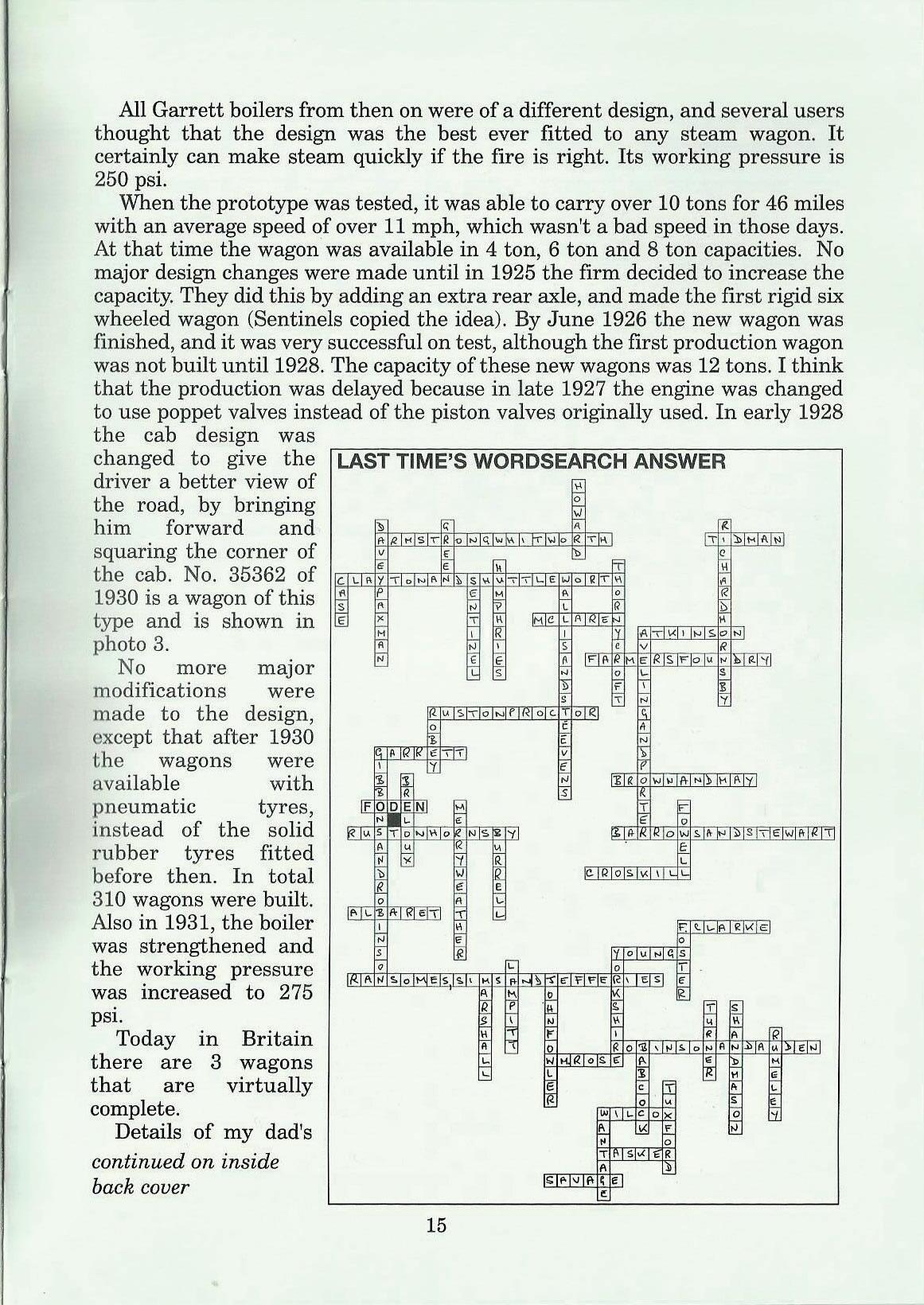
LAST TIME'S WORDSEARCH ANSWER
Steam Apprentice Club -Driving Days.
List of possible venues - 2000
Venue
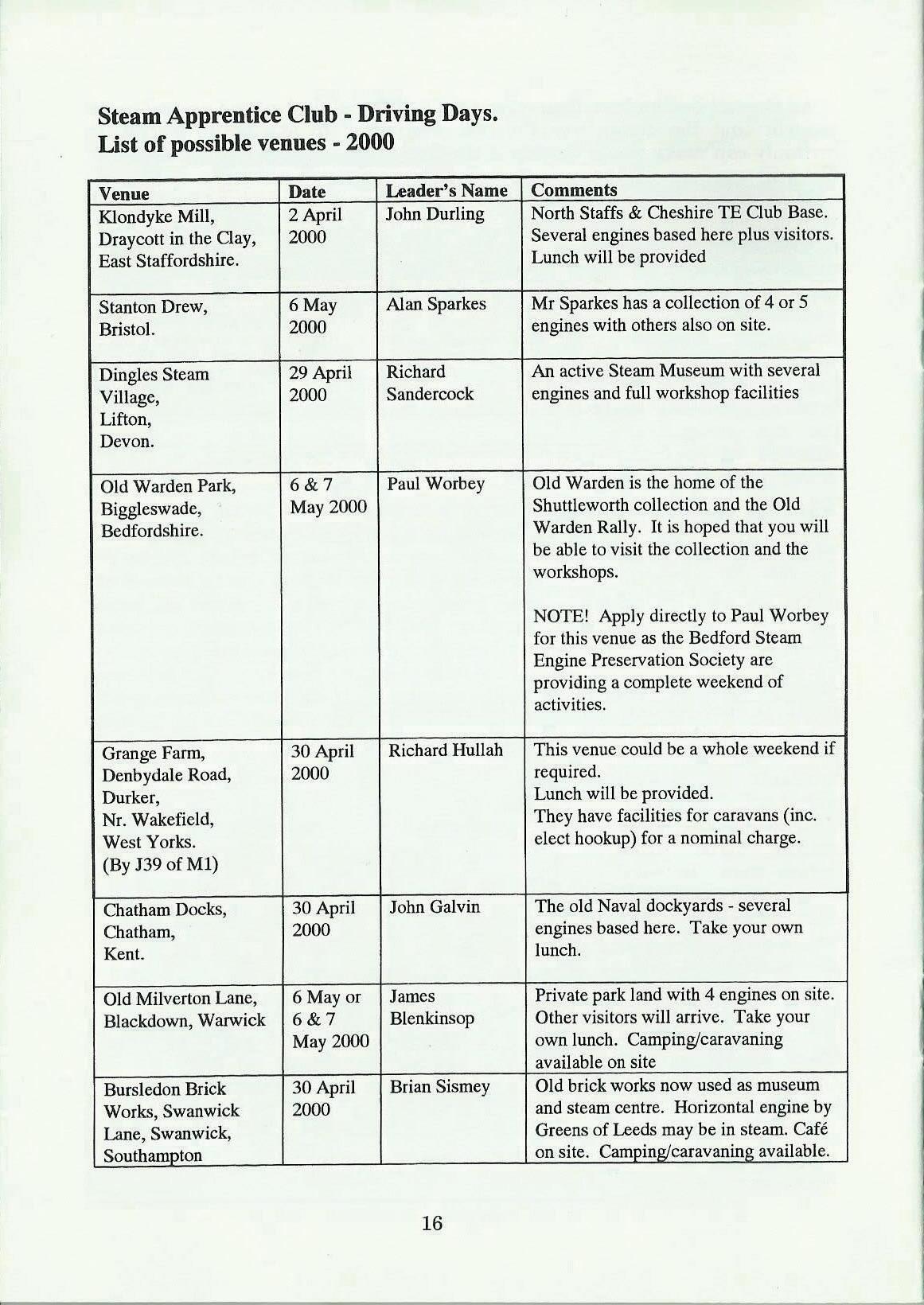
Date Leader's Name
Klondyke Mill, 2 April John Durling Draycott in the Clay, 2000 East Staffordshire.
Stanton Drew, 6May Alan Sparkes Bristol. 2000
Dingles Steam 29 April Richard Village, 2000 Sandercock Lifton, Devon.
Old Warden Park, 6&7 Paul Worbey Biggleswade, May 2000 Bedfordshire.
Comments
North Staffs & Cheshire TE Club Base. Several engines based here plus visitors. Lunch will be provided
Mr Sparkes has a collection of 4 or 5 engines with others also on site.
An active Steam Museum with several engines and full workshop facilities
Grange Farm, 30 April Richard Hullah Denbydale Road, 2000 Durker, Nr. Wakefield, West Yorks. (By J39 of Ml)
Chatham Docks, 30 April John Galvin Chatham, 2000 Kent.
Old Milverton Lane, 6May or James Blackdown, Warwick 6&7 Blenkinsop May 2000
Bursledon Brick 30 April Brian Sismey Works, Swanwick 2000 Lane, Swanwick, Southampton
Old Warden is the home of the Shuttleworth collection and the Old Warden Rally. It is hoped that you will be able to visit the collection and the workshops.
NOTE! Apply directly to Paul Worbey for this venue as the Bedford Steam Engine Preservation Society are providing a complete weekend of activities.
This venue could be a whole weekend if required. Lunch will be provided. They have facilities for caravans (inc. elect hookup) for a nominal charge.
The old Naval dockyards - several engines based here. Take your own lunch.
Private park land with 4 engines on site. Other visitors will arrive. Take your own lunch. Campinglcaravaning available on site
Old brick works now used as museum and steam centre. Horizontal engine by Greens of Leeds may be in steam. Cafe on site. Campin.e)caravaning available.
wagon: 348~1 (RT 1940): Photo 1. This was delivered on 20tl\ May 1926 as a 6-ton non-tipping wagon. The first owner- was CW Packard of ]T)orking,who was a haulage contractor. He used it for brick haulage, and then later for hauling sand and gi,avel. The fact that he would have to use a shovel to u11load the wagon evecy trip and he dlidtwo tri]!)sa day means that it wol!ddnot have been easy work!
After 1934, the wag0n was not used, and during the war, the engine and boiler were sc,apped, and the chassis was used as a trailer. This was the condition that it was in when my Dad bought it in 1976, and since then we've been restoring the wagon to its original specification. It is, as far as we ilmow the only Garrett l]fnde1'type in working order.
As you can see, once more we have a very full magazine 1 so much so that 1 have more to come. There's more from 'Kevin Mills on Aveling rollers and 1 have lellcrs from Martin Treanor, Matthew Bate, Martin Leigh and Emnia, Turnerall of which will appear in the next Raising Steam. That does not mean thaf I don't need any more. Keep those letters, repor,/;sand photos c01ning and, of course, you may now e~mail me at the address sh0wn inside the front cover. Your ma11azineis getting better by the issue - because of your conZributions. - ]j}d.