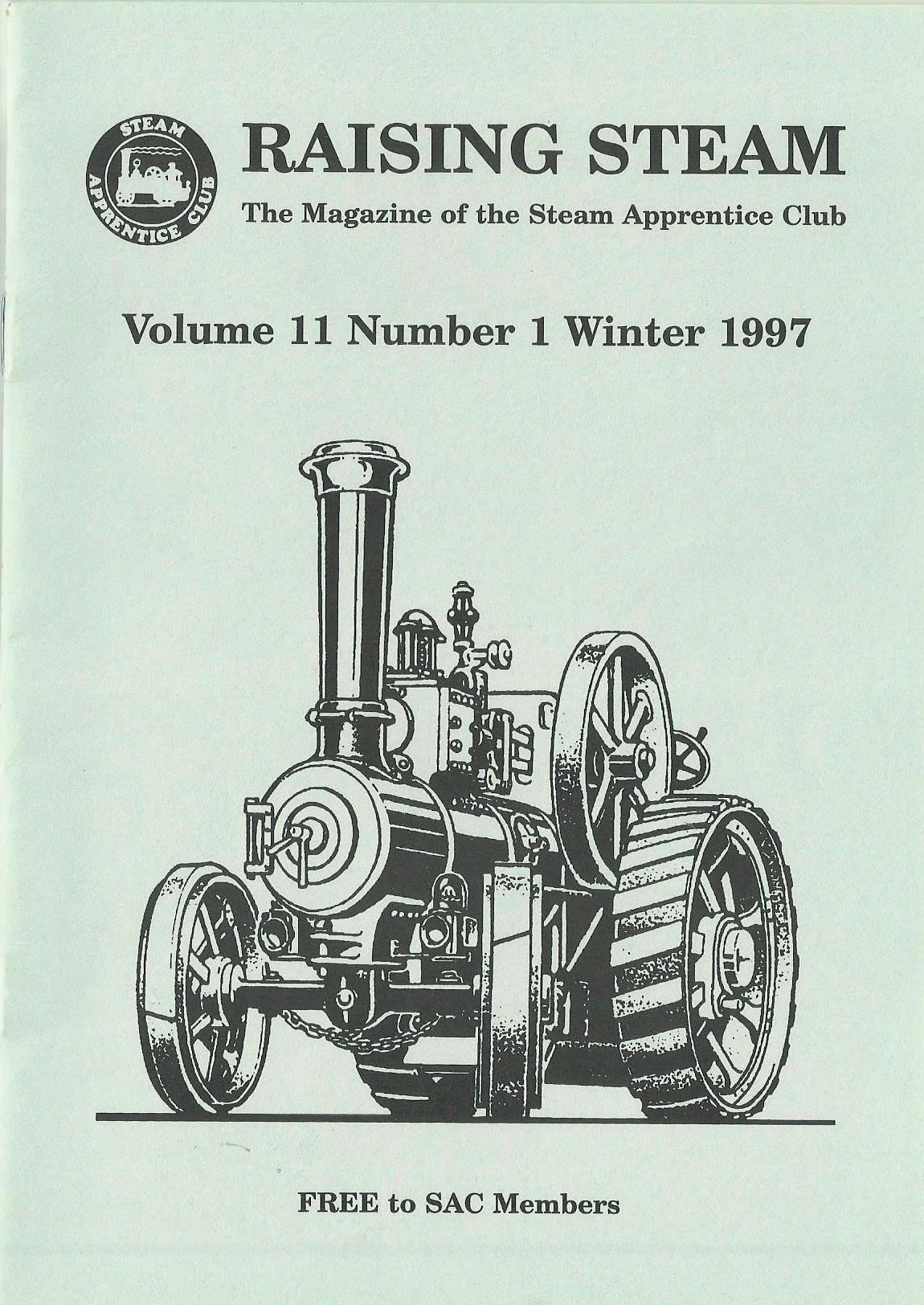
RAISING STEAM
STEAM APPRENTICE CLUB MAGAZINE
EDITOR
Barry Sumsion, 1 Leicester Road, Newport, South Wales NP9 7ER Tel: 01633 262197 Fax: 01633 259089
CHAIRMAN, STEAM APPRENTICE CLUB
John Durling, Hawthorn Cottage, Stubwood, Uttoxeter, Staffordshire ST14 5HX Tel: 01889 591188 (between 08.00 and 21.00 hours only please)
MEMBERSHIP SECRETARY
John Cook, Dolfarni, Church Lane, Kirby la Thorpe, Sleaford, Lincolnshire NG34 9NU. Correspondence only.
The Editor welcomes any contributions of articles, shorter items or photographs for inclusion in future issues. All material submitted is voluntary and payment cannot be made for any material published. The opinions expressed in the magazine, with the exception of Club announcements, are those of the contributors and do not indicate the views of the Club as a whole. All items are held copyright by the contributor and the NTET.
Please send your contributions to the Editor aL least five weeks before publication. Typed articles are preferred but not eRRcntial.If handwritten put any names of PEOPLE, PLACES or ENGINES in BLOCK CAPITALS. If you require any part of your article (eg photos) returuing plosM,esay HOan.d enclose a stamped addressed envelope. Enclose your name, address and (if Apprentice) age with any contribution.
The Editor reserves the right to amend or refuse contributions, and will attempt to correct spelling and grammar!
The Magazine is normally published during the early part of January, April, July and October. The Club accepts no liability for faUurc to 1noet intended publication dates.
The Steam Apprentice Club is a section of the National Traction Engine Trust. NTET is a Registered Charity, No. 291578. Registered in England No. 1302197. Registered Office: Forum House, 1-6 Millmead, Middlesex TW18 4UQ.
Typesetting and Artwork by Kearline Graphic Images, 1 Leicester Road, Newport, South Wales NP9 7ER Tel: 01633 262197 Fax: 01633 259089
Printed by The Whitehouse Press Ltd, High Street, Lydney, Glos GL15 5DP
FROM THE EDITOR
I am writing this editorial just having celebrated Christmas and the New Year -not much steam about, though I did find an American traction engine, a Mineapolis, whilst visiting EuroDisney on new year's eve. I hope you all had a very good Christmas and made lots of worthwhile new year resolutions -like visiting as many rallies as possible this year and then sending in your report of each rally to your magazine. I hope to visit more rallies this year than I did in 1996 and then bring you my reports - but I'd much rather print yours. Also we'd like to hear from those of you who are actively involved with an enginewhat you get up to and where you might go with the engine. One thing is sure, we are now 'on a roll' with your magazine. I am now getting more contributions and the content is becoming a better mix so that there is something for everyone. That is also the aim of your new Chairman and committee - as much to do, see and get involved with in all age groups as is realistically possible. Keep your contributions coming - the more you contribute, the better your magazine will become - you are the eventual winners.
Barry Sumsion, Editor
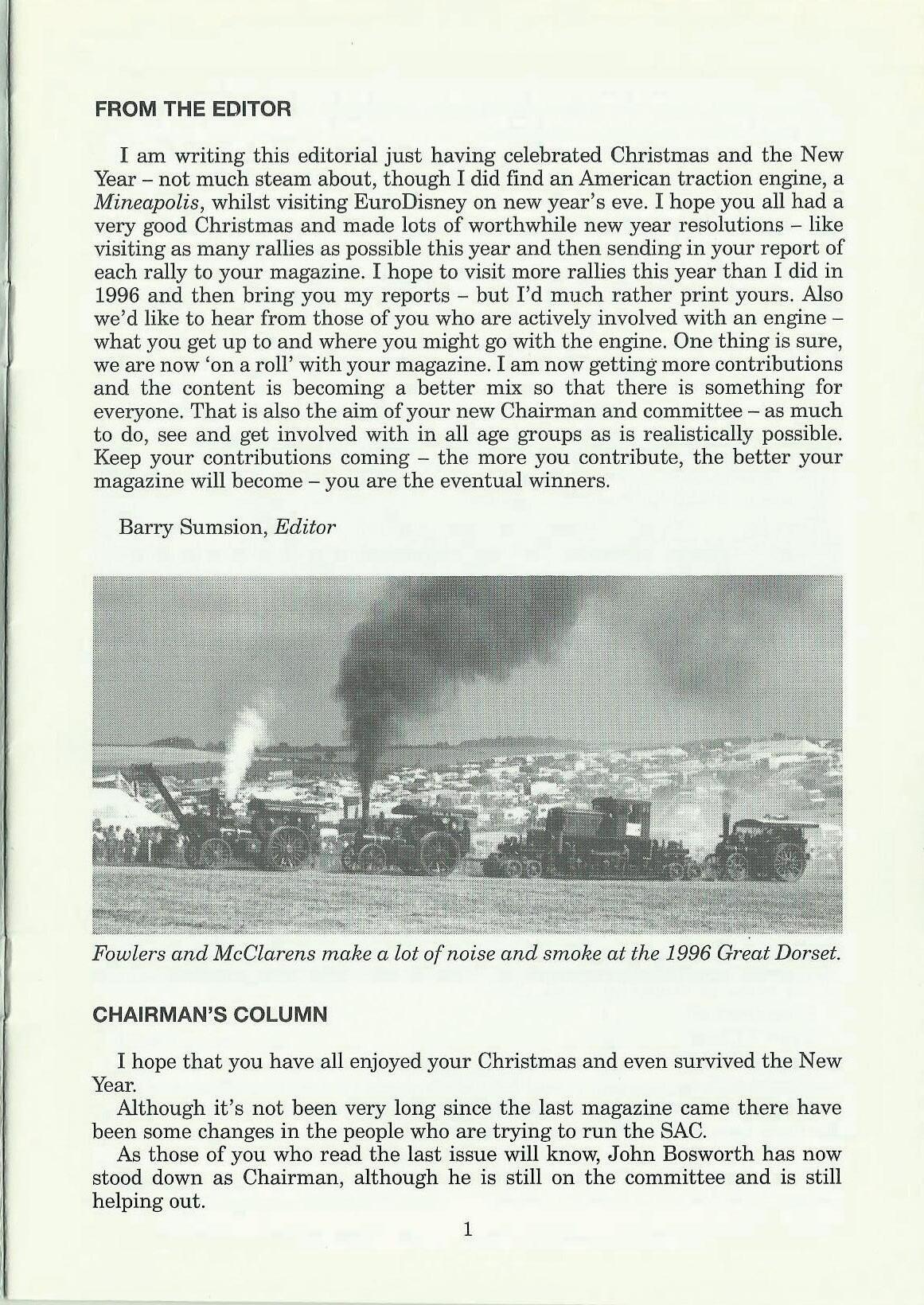
Fowlers and McClarens make a lot of noise and smoke at the 1996 Great Dorset.
CHAIRMAN'S COLUMN
I hope that you have all enjoyed your Christmas and even survived the New Year.
Although it's not been very long since the last magazine came there have been some changes in the people who are trying to run the SAC. As those of you who read the last issue will know, John Bosworth has now stood down as Chairman, although he is still on the committee and is still helping out.
Fiona and I have now picked up the reins (or should that be regulator?) and will try to follow in John's footsteps.
We are trying to involve adults in many parts of the country to bring SAC activities to your local area, so that more can be done for each of you without long journeys being needed. We already have offers from people in Cheshire (Malpas), East Anglia and County Durham. I hope that by the start of the next season there will be many more.
I went to the National Traction Engine Trust's AGM in November and had great pleasure in presenting Nick Shillito from Yorkshire with the Jack Beeby ·Cup.He was brought down to Bristol in the hope of seeing a very old Aveling roller (like the one he works on) and was completely surprised when he was asked to accept the cup. This trophy is awarded annually to an SAC member who has made significant progress in their knowledge of steam engines or who has made a major contribution to the SAC. I hope that Nick's example will inspire some more of you to make an effort to learn how steam engines work and to attach yourselves to an engine. If any engine owners who have apprentices are reading this I would like to hear from you if you think that your apprentice is worthy of special mention.
Driving Course. The venue has now changed - it will now be held at Coldharbour Mill, Uffculme, Cullompton, Devon. This is a steam powered woollen mill situated between Taunton and Exeter. We have had enquiries from one or two of you - more would be very welcome. The NTET subsidises this event for SAC members, so lets make the most of their support. Get your mums and dads to ring if you need more information (number inside front cover). I look forward to seeing many of you during this year.
John Durling, Chairman
MAILBAG
Dear Editor
Gisela is a 1946 Aveling Barford steam roller, new to Cumberland Council in October 1946. She is works No. AG758, Reg. No. FRM973. Her working pressure is 200 p.s.i. but she will move at 80 p.s.i. In 1962 she was purchased by John Crawley. In 1977 she was restored and named "Gisela". Brian Johnson purchased her in 1983. In 1988 a new firebox was fitted. Gisela is often steamed at her home at Amberley Chalk Pits.
Specification:
Type T Class
Reg No FRM973
Weight 6 Tons
Gisela is a Ruston design, built by Vickers Armstrong and sold as an Aveling Barford! I am very lucky to be Gisela's apprentice.
From Kevin Mills, Durrington, West Sussex (age 12)
Thank you for that informative piece Kevin, and I'm pleased to see from your letter that you will be sending in rally reports next season. - Editor
Dear Editor
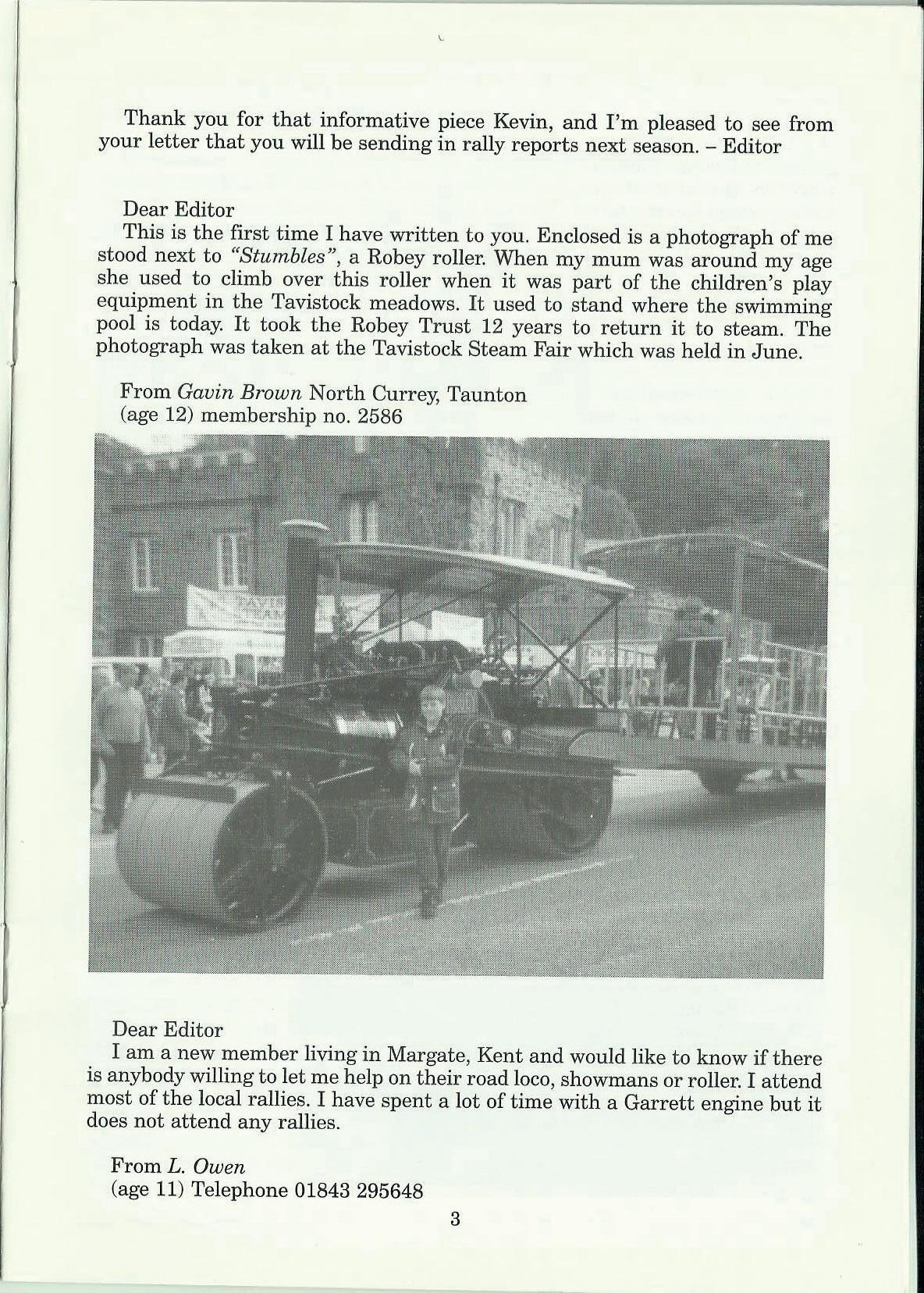
This is the first time I have written to you. Enclosed is a photograph of me stood next to "Stumbles", a Robey roller. When my mum was around my age she used to climb over this roller when it was part of the children's play equipment in the Tavistock meadows. It used to stand where the swimming pool is today. It took the Robey Trust 12 years to return it to steam. The photograph was taken at the Tavistock Steam Fair which was held in June.
From Gavin Brown North Currey, Taunton (age 12) membership no. 2586
Dear Editor
I am a new member living in Margate, Kent and would like to know if there is anybody willing to let me help on their road loco, showmans or roller. I attend most of the local rallies. I have spent a lot of time with a Garrett engine but it does not attend any rallies.
FromL. Owen (age 11) Telephone 01843 295648
Dear Editor
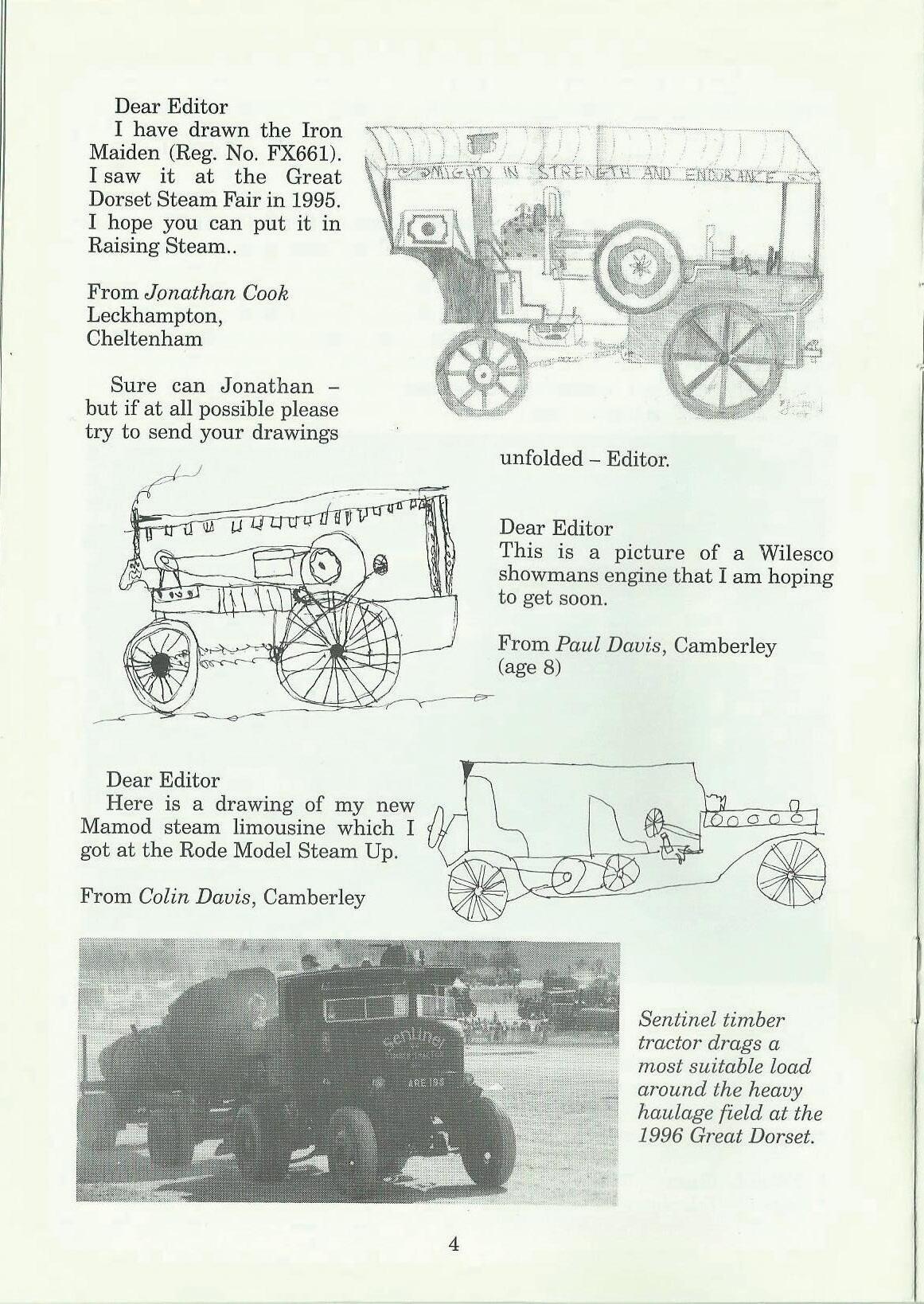
I have drawn the Iron Maiden (Reg. No. FX661). I saw it at the Great Dorset Steam Fair in 1995. I hope you can put it in Raising Steam ..
From Jonathan Cook Leckhampton, Cheltenham
Sure can Jonathanbut if at all possible please try to send your drawings
Dear Editor
Here is a drawing of my new Mamod steam limousine which I got at the Rode Model Steam Up.
From Colin Davis, Camberley
unfolded -Editor.
Dear Editor
This is a picture of a Wilesco showmans engine that I am hoping to get soon.
From Paul Davis, Camberley (age 8)
Sentinel timber tractor drags a most suitable load around the heavy haulage field at the 1996 Great Dorset.
A CUP WINNING APPRENTICE REPORTS
I have been a member of the Steam Apprentice Club for about 4 years and roughly a year ago I was put in touch with an engine owner through the SAC. The engine owner, Richard Hullah, used to be a member back in its early days. He now owns two engines, both rollers. The first he bought is an Aveling & Porter No. 2481 built in 1889. It was classed as an RIO, which means roller 10 tons. Its actual working weight is around 12 tons. It was Aveling's first successful design of 3 point roller, this being 2 back rolls and 1 set of front rolls. Thousands of these rollers were built ranging from the 10 ton up to the 20 ton
version. The 10 ton was the most popular.
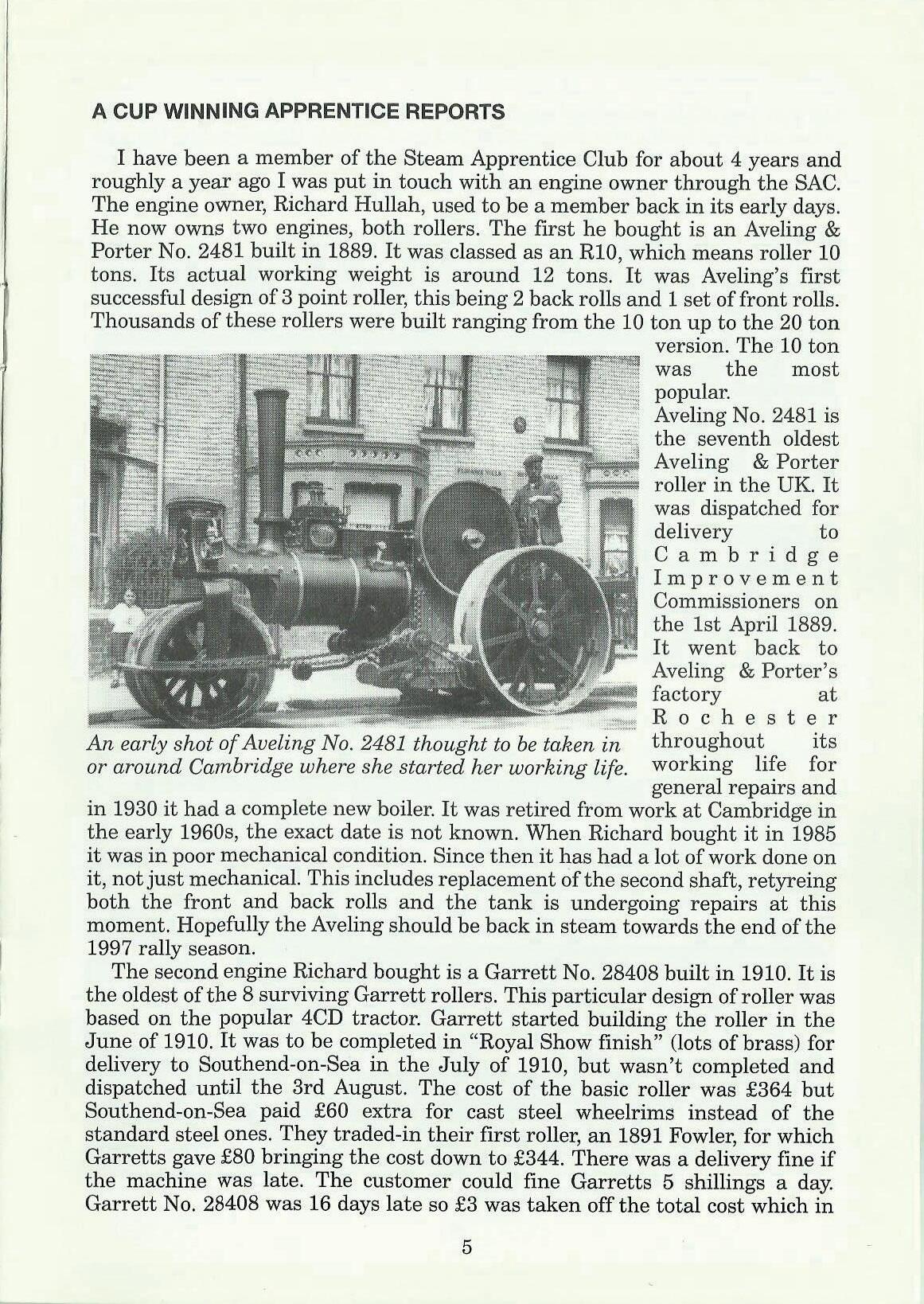
An early shot of Aveling No. 2481 thought to be taken in or around Cambridge where she started her working life.
Aveling No. 2481 is the seventh oldest Aveling & Porter roller in the UK. It was dispatched for delivery to Cambridge Improvement Commissioners on the 1st April 1889. It went back to Aveling & Porter's factory at Rochester throughout its working life for general repairs and in 1930 it had a complete new boiler. It was retired from work at Cambridge in the early 1960s, the exact date is not known. When Richard bought it in 1985 it was in poor mechanical condition. Since then it has had a lot of work done on it, not just mechanical. This includes replacement of the second shaft, retyreing both the front and back rolls and the tank is undergoing repairs at this moment. Hopefully the Aveling should be back in steam towards the end of the 1997 rally season.
The second engine Richard bought is a Garrett No. 28408 built in 1910. It is the oldest of the 8 surviving Garrett rollers. This particular design of roller was based on the popular 4CD tractor. Garrett started building the roller in the June of 1910. It was to be completed in "Royal Show finish" (lots of brass) for delivery to Southend-on-Sea in the July of 1910, but wasn't completed and dispatched until the 3rd August. The cost of the basic roller was £364 but Southend-on-Sea paid £60 extra for cast steel wheelrims instead of the standard steel ones. They traded-in their first roller, an 1891 Fowler, for which Garretts gave £80 bringing the cost down to £344. There was a delivery fine if the machine was late. The customer could fine Garretts 5 shillings a day. Garrett No. 28408 was 16 days late so £3 was taken off the total cost which in
the end was £341. Southend-on-Sea ran the roller until 1917 when it was commandeered by the war department for World War 1. It was sold by the war department in 1919 to Cumberland County Council where it worked around the Lake District until 1956 when it was recommended that it should be scrapped. It was then parked up in a quarry and shortly after it was sold to a
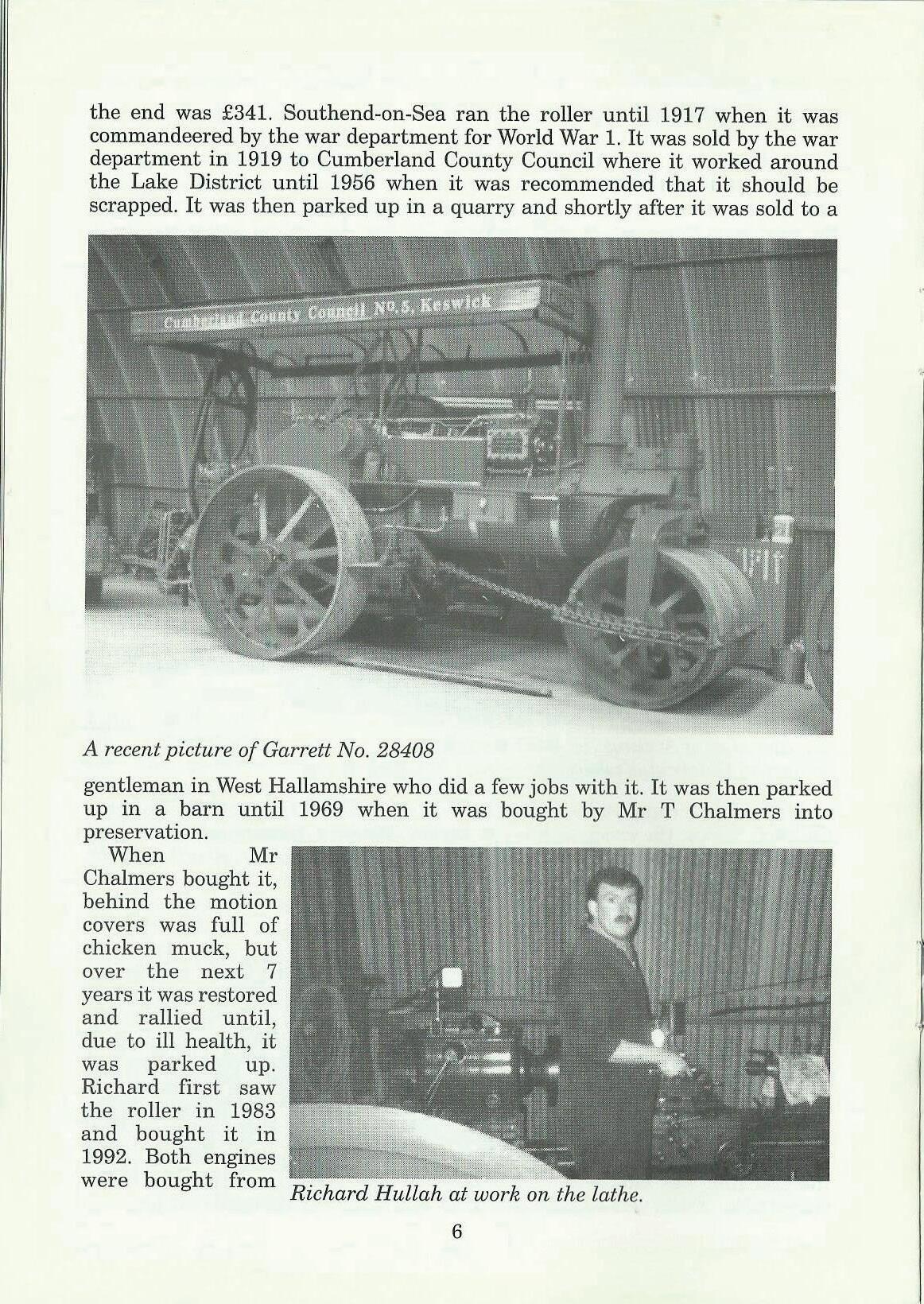
A recent picture of Garrett No. 28408
gentleman in West Hallamshire who did a few jobs with it. It was then parked up in a barn until 1969 when it was bought by Mr T Chalmers into preservation. When Mr Chalmers bought it, behind the motion covers was full of chicken muck, but over the next 7 years it was restored and rallied until, due to ill health, it was parked up. Richard first saw the roller in 1983 and bought it in 1992. Both engines were bought from Richard Hullah at work on the lathe.
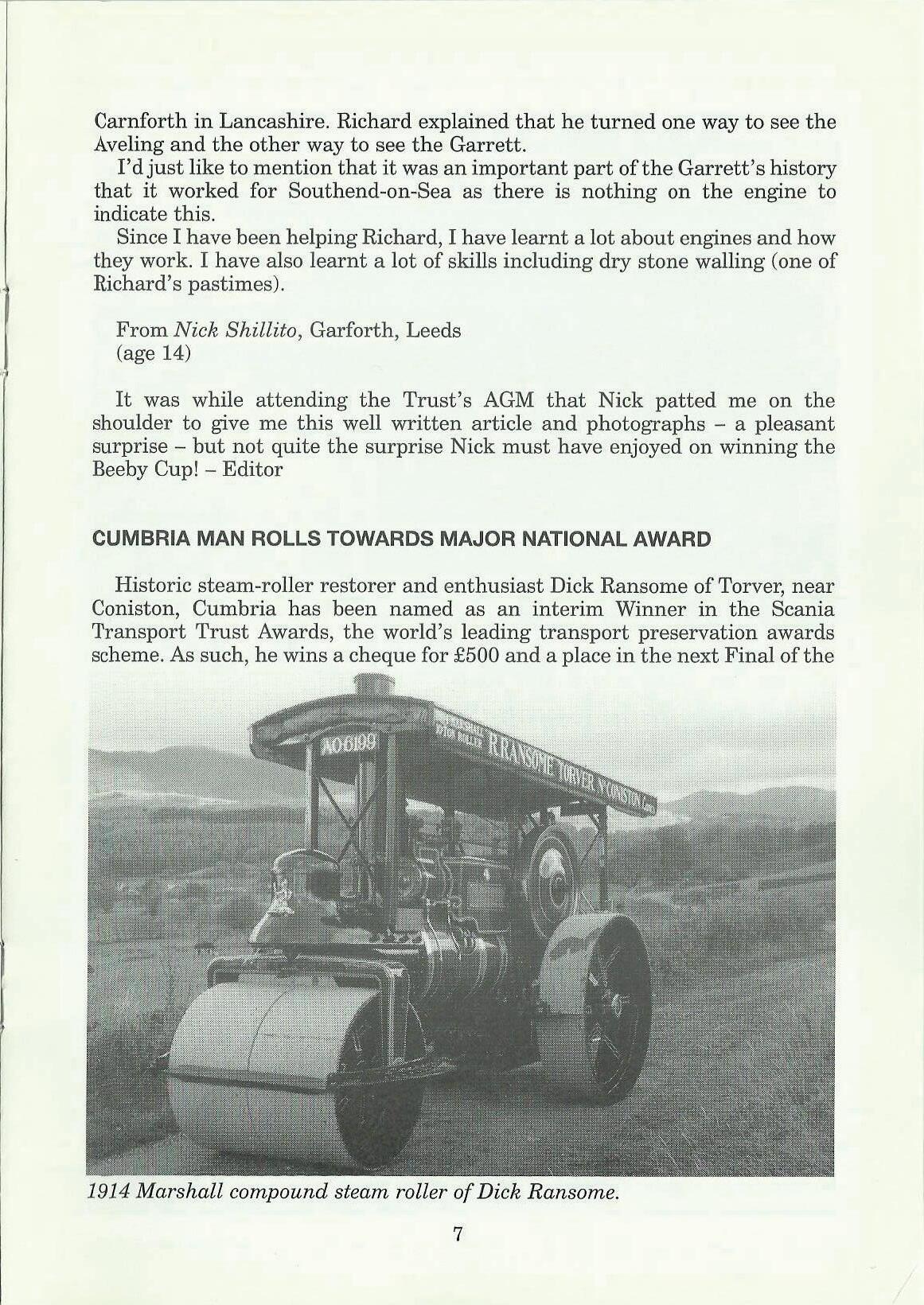
Carnforth in Lancashire. Richard explained that he turned one way to see the Aveling and the other way to see the Garrett.
I'd just like to mention that it was an important part of the Garrett's history that it worked for Southend-on-Sea as there is nothing on the engine to indicate this.
Since I have been helping Richard, I have learnt a lot about engines and how they work. I have also learnt a lot of skills including dry stone walling (one of Richard's pastimes).
From Nick Shillito, Garforth, Leeds (age 14)
It was while attending the Trust's AGM that Nick patted me on the shoulder to give me this well written article and photographs -a pleasant surprise - but not quite the surprise Nick must have enjoyed on winning the Beeby Cup! -Editor
CUMBRIA MAN ROLLS TOWARDS MAJOR NATIONAL AWARD
Historic steam-roller restorer and enthusiast Dick Ransome of Torver, near Coniston, Cumbria has been named as an interim Winner in the Scania Transport Trust Awards, the world's leading transport preservation awards scheme. As such, he wins a cheque for £500 and a place in the next Final of the
1914 Marshall compound steam roller of Dick Ransome.
Awards. This could ultimately bring him a further £5,000 in prize money plus a visit to Scania's own museum in Sweden.
Dick Ransome's award has been made in respect of the work he has undertaken to restore and preserve his 1914 Marshall Compound Steam Roller, a vehicle which spent much of its working life in service with Cumbria County Council. In rewarding his efforts, the Transport Trust's judge John Robinson said, "This is a very fine restoration, executed by a skilled engineer to a particularly high standard. The care to replicate original working parts makes this one of the best restored steam rollers I have ever come across".
The 10 ton Marshall roller was retired from service in 1964. It was acquired by Dick Ransome four years later in poor condition and an extensive renovation followed. This included rebuilding the coal bunker, footplate and part of the water tank, fitting a new smokebox and retubing the boiler. A new canopy was added and every other item requiring repair or renovation was attended to. Today, in full restored and working order, the roller can be seen at events and rallies around the area.
I am indebted to Peter Ballard of the Transport Trust for this information and photograph - Ed.
A LITTLE OF 1996
Although I visited far too few rallies during 1996, here are a few photographic memories from that season.
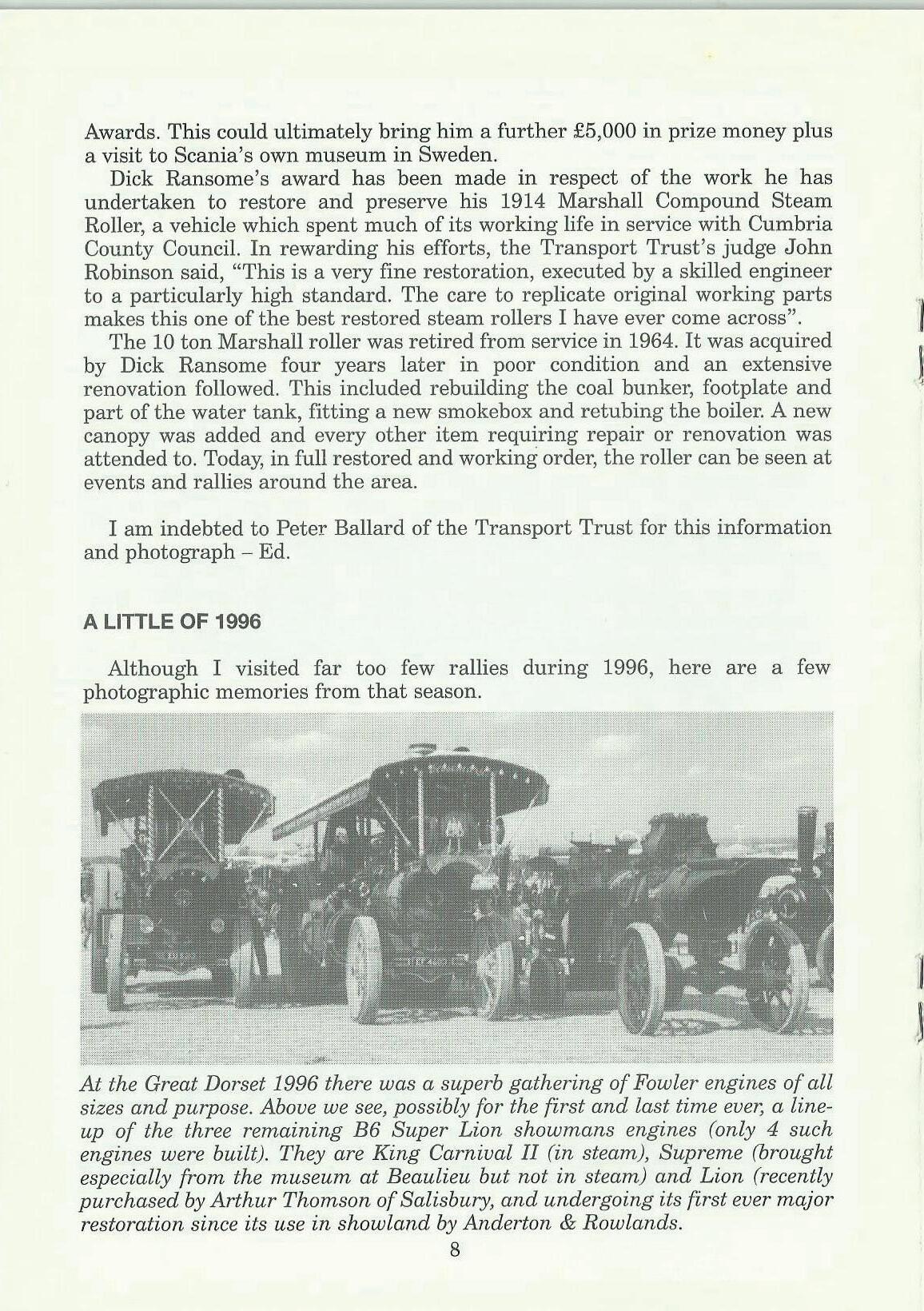
At the Great Dorset 1996 there was a superb gathering of Fowler engines of all sizes and purpose. Above we see, possibly for the first and last time ever, a lineup of' the three remaining B6 Super Lion showmans engines (only 4 such engines were built). They are King Carnival II (in steam), Supreme (brought especially from the museum at Beaulieu but not in steam) and Lion (recently purchased by Arthur Thomson of Salisbury, and undergoing its first ever major restoration since its use in showland by Anderton & Rowlands.
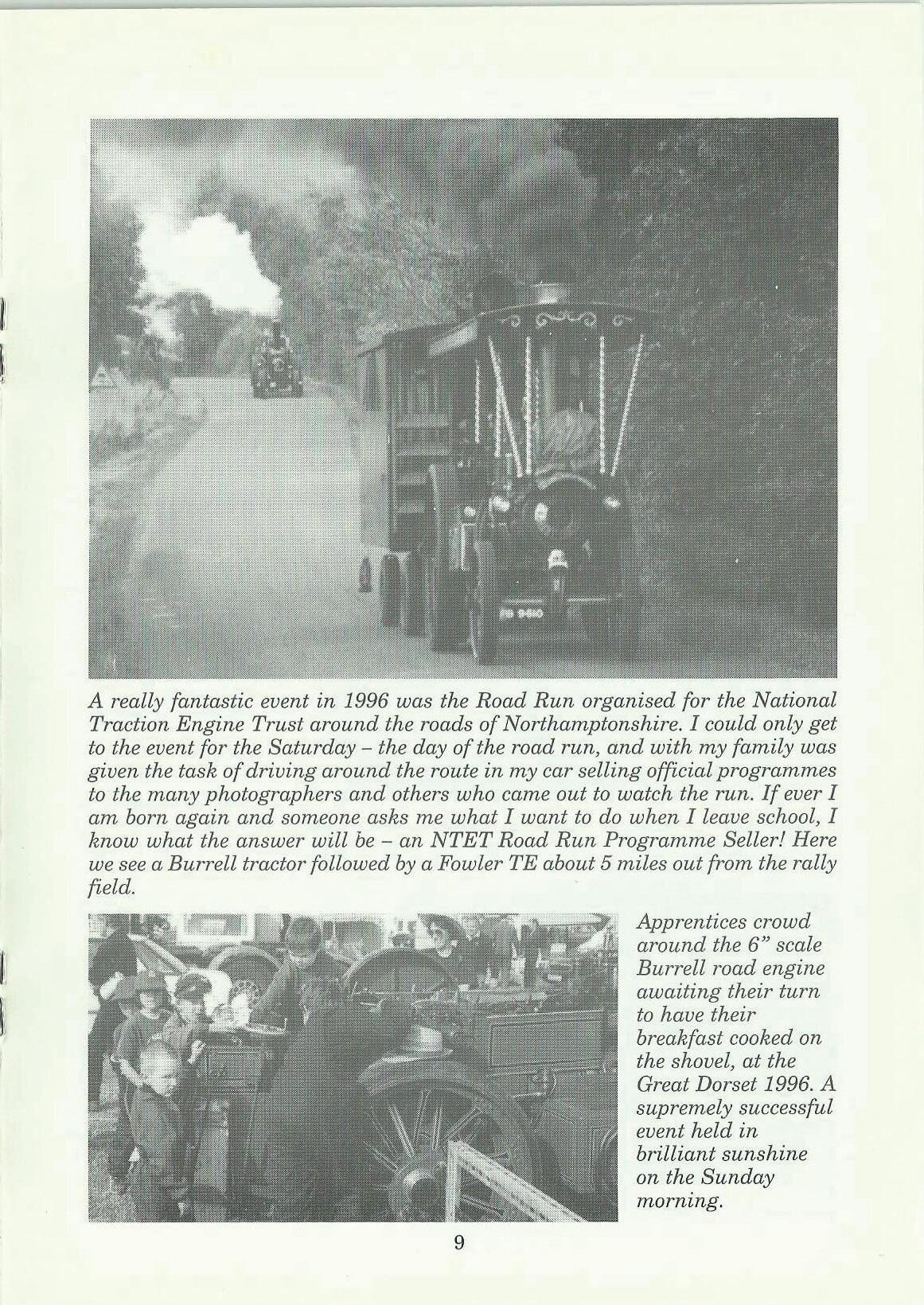
A really fantastic event in 1996 was the Road Run organised for the National Traction Engine Trust around the roads of Northamptonshire. I could only get to the event for the Saturday - the day of the road run, and with my family was given the task of driving around the route in my car selling official programmes to the many photographers and others who came out to watch the run. If ever I am born again and someone asks me what I want to do when I leave school, I know what the answer will be - an NTET Road Run Programme Seller! Here we see a Burrell tractor followed by a Fowler TE about 5 miles out from the rally field.
Apprentices crowd around the 6" scale Burrell road engine awaiting their turn to have their break{ast cooked on the shovel, at the Great Dorset 1996. A supremely successful event held in brilliant sunshine on the Sunday morning.
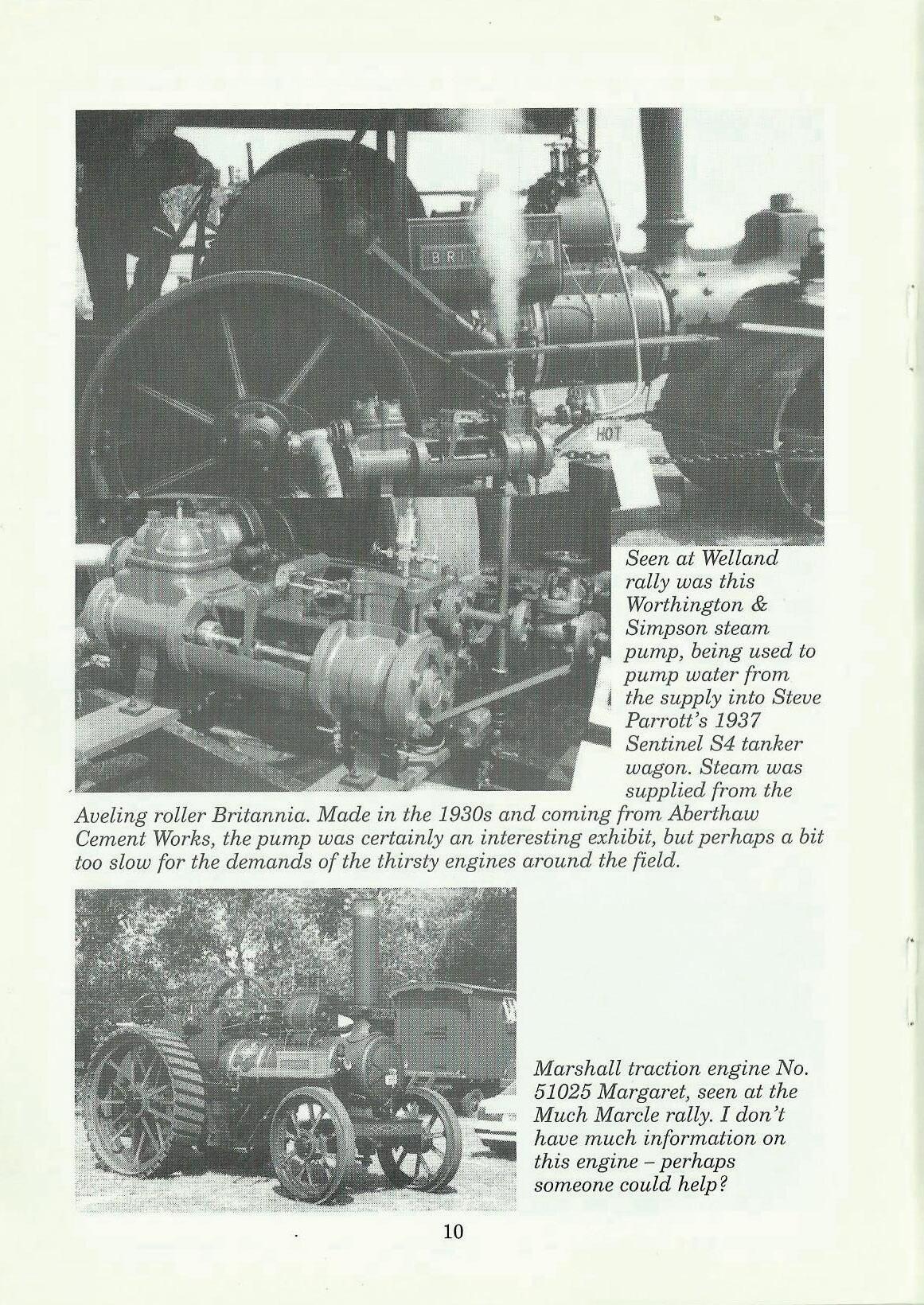
Seen at Welland rally was this Worthington & Simpson steam pump, being used to pump water from the supply into Steve Parrott's 1937 Sentinel S4 tanker wagon. Steam was supplied from the
Aveling roller Britannia. Made in the 1930s and coming from Aberthaw Cement Works, the pump was certainly an interesting exhibit, but perhaps a bit too slow for the demands of the thirsty engines around the field.
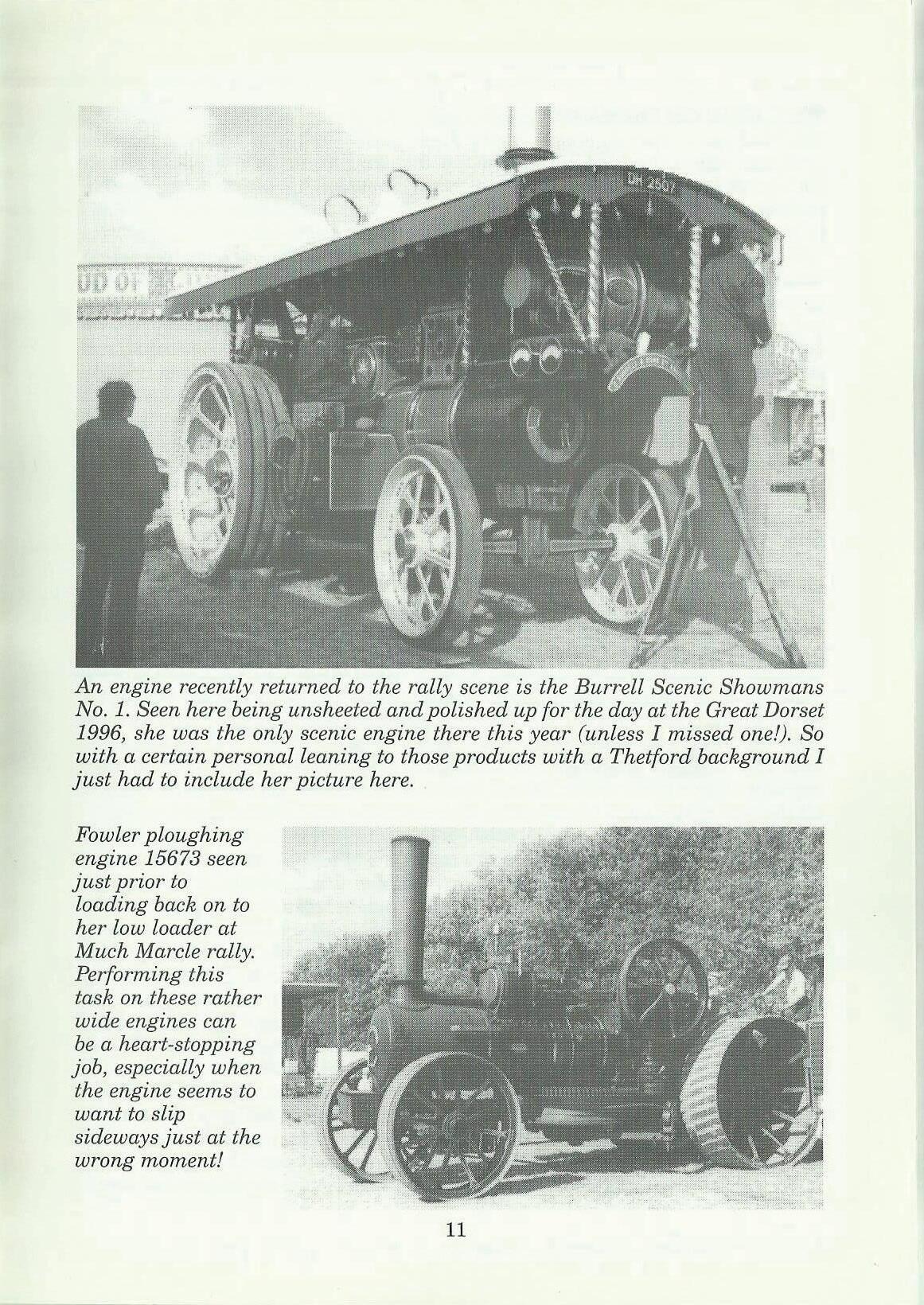
Marshall traction engine No. 51025 Margaret, seen at the Much Marcle rally. I don't have much information on this engine - perhaps someone could help?
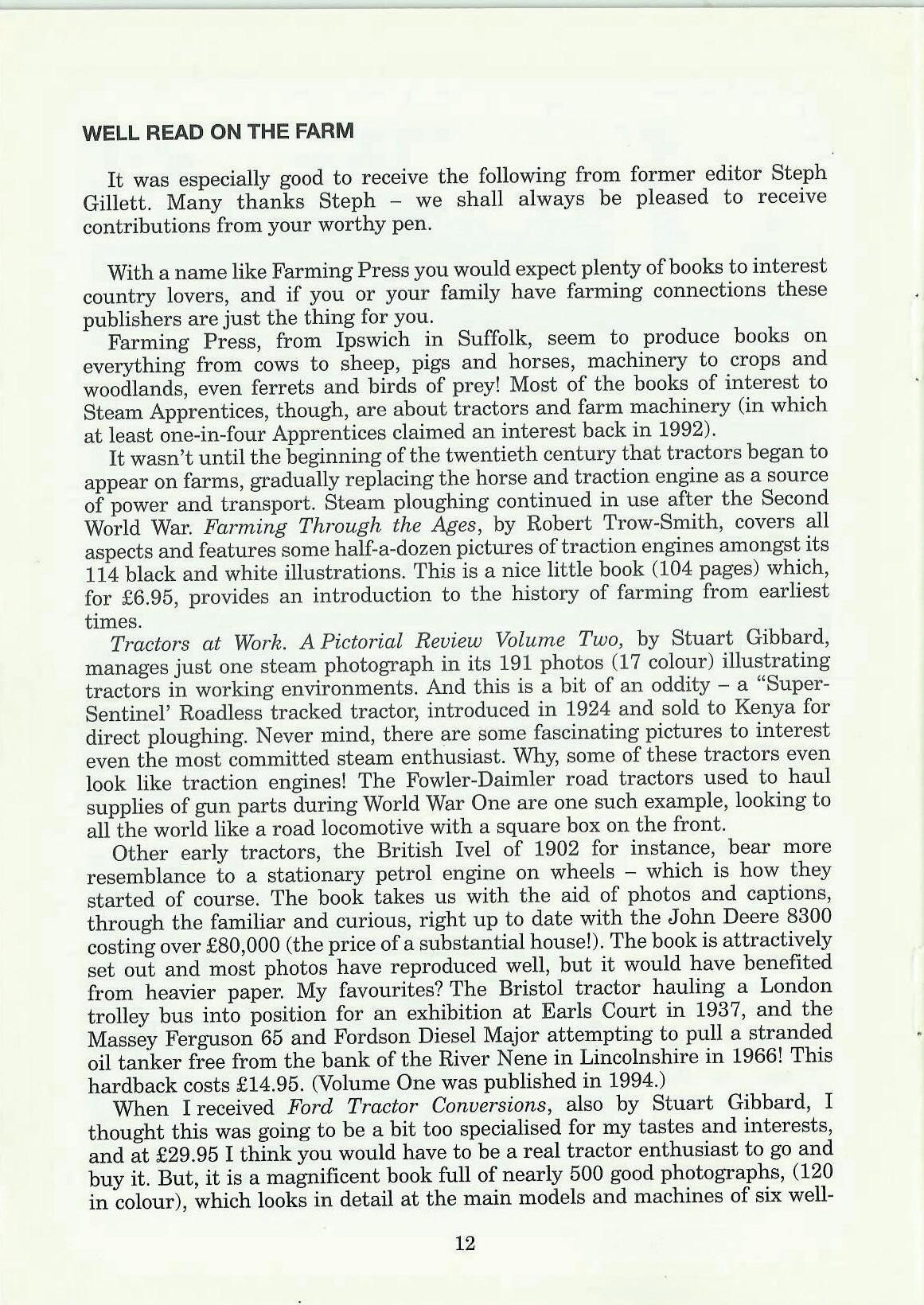
An engine recently returned to the rally scene is the Burrell Scenic Showmans No. 1. Seen here being unsheeted and polished up for the day at the Great Dorset 1996, she was the only scenic engine there this year (unless I missed one!). So with a certain personal leaning to those products with a Thetford background I just had to include her picture here.
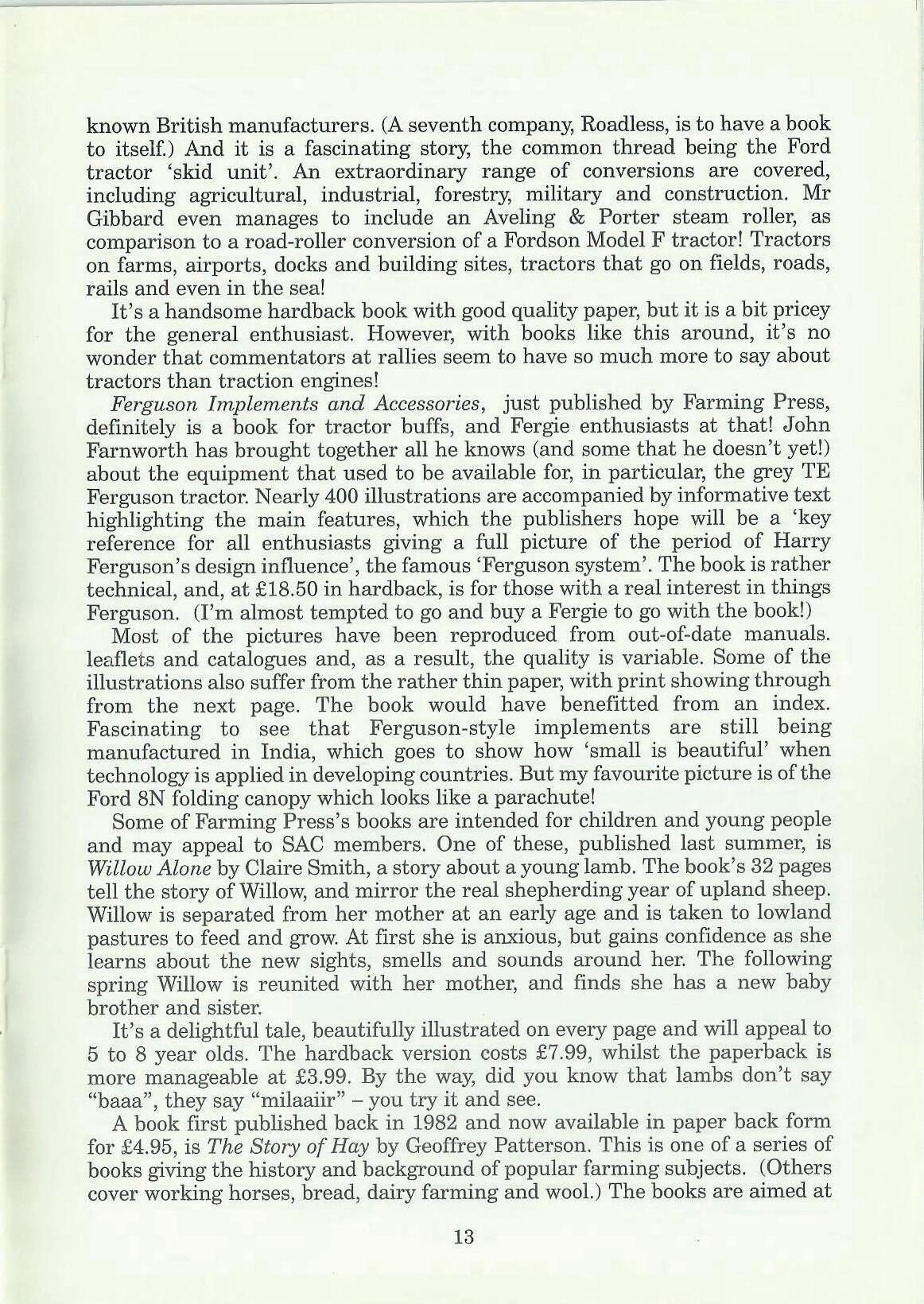
Fowler ploughing engine 15673 seen just prior to loading back on to her low loader at Much Marcle rally. Perfarming this task on these rather wide engines can be a heart-stopping job, especially when the engine seems to want to slip sideways just at the wrong moment!
WELL READ ON THE FARM
It was especially good to receive the following from former editor Steph Gillett. Many thanks Steph - we shall always be pleased to receive contributions from your worthy pen.
With a name like Farming Press you would expect plenty of books to interest country lovers, and if you or your family have farming connections these publishers are just the thing for you.
Farming Press, from Ipswich in Suffolk, seem to produce books on everything from cows to sheep, pigs and horses, machinery to crops and woodlands, even ferrets and birds of prey! Most of the books of interest to Steam Apprentices, though, are about tractors and farm machinery (in which at least one-in-four Apprentices claimed an interest back in 1992).
It wasn't until the beginning of the twentieth century that tractors began to appear on farms, gradually replacing the horse and traction engine as a source of power and transport. Steam ploughing continued in use after the Second World War. Farming Through the Ages, by Robert Trow-Smith, covers all aspects and features some half-a-dozen pictures of traction engines amongst its 114 black and white illustrations. This is a nice little book (104 pages) which, for £6.95, provides an introduction to the history of farming from earliest times.
Tractors at Work. A Pictorial Review Volume Two, by Stuart Gibbard, manages just one steam photograph in its 191 photos (17 colour) illustrating tractors in working environments. And this is a bit of an oddity - a "SuperSentinel' Roadless tracked tractor, introduced in 1924 and sold to Kenya for direct ploughing. Never mind, there are some fascinating pictures to interest even the most committed steam enthusiast. Why, some of these tractors even look like traction engines! The Fowler-Daimler road tractors used to haul supplies of gun parts during World War One are one such example, looking to all the world like a road locomotive with a square box on the front.
Other early tractors, the British Ivel of 1902 for instance, bear more resemblance to a stationary petrol engine on wheels - which is how they started of course. The book takes us with the aid of photos and captions, through the familiar and curious, right up to date with the John Deere 8300 costing over £80,000 (the price of a substantial house!). The book is attractively set out and most photos have reproduced well, but it would have benefited from heavier paper. My favourites? The Bristol tractor hauling a London trolley bus into position for an exhibition at Earls Court in 1937, and the Massey Ferguson 65 and Fordson Diesel Major attempting to pull a stranded oil tanker free from the bank of the River Nene in Lincolnshire in 1966! This hardback costs £14.95. (Volume One was published in 1994.)
When I received Ford Tractor Conversions, also by Stuart Gibbard, I thought this was going to be a bit too specialised for my tastes and interests, and at £29. 95 I think you would have to be a real tractor enthusiast to go and buy it. But, it is a magnificent book full of nearly 500 good photographs, (120 in colour), which looks in detail at the main models and machines of six well-
known British manufacturers. (A seventh company, Roadless, is to have a book to itself.) And it is a fascinating story, the common thread being the Ford tractor 'skid unit'. An extraordinary range of conversions are covered, including agricultural, industrial, forestry, military and construction. Mr Gibbard even manages to include an Aveling & Porter steam roller, as comparison to a road-roller conversion of a Fordson Model F tractor! Tractors on farms, airports, docks and building sites, tractors that go on fields, roads, rails and even in the sea!
It's a handsome hardback book with good quality paper, but it is a bit pricey for the general enthusiast. However, with books like this around, it's no wonder that commentators at rallies seem to have so much more to say about tractors than traction engines!
Ferguson Implements and Accessories, just published by Farming Press, definitely is a book for tractor buffs, and Fergie enthusiasts at that! John Farnworth has brought together all he knows (and some that he doesn't yet!) about the equipment that used to be available for, in particular, the grey TE Ferguson tractor. Nearly 400 illustrations are accompanied by informative text highlighting the main features, which the publishers hope will be a 'key reference for all enthusiasts giving a full picture of the period of Harry Ferguson's design influence', the famous 'Ferguson system'. The book is rather technical, and, at £18.50 in hardback, is for those with a real interest in things Ferguson. (I'm almost tempted to go and buy a Fergie to go with the book!)
Most of the pictures have been reproduced from out-of-date manuals. leaflets and catalogues and, as a result, the quality is variable. Some of the illustrations also suffer from the rather thin paper, with print showing through from the next page. The book would have benefitted from an index. Fascinating to see that Ferguson-style implements are still being manufactured in India, which goes to show how 'small is beautiful' when technology is applied in developing countries. But my favourite picture is of the Ford SN fo1ding canopy which looks like a parachute!
Some of Farming Press's books are intended for children and young people and may appeal to SAC members. One of these, published last summer, is Willow Alone by Claire Smith, a story about a young lamb. The book's 32 pages tell the story of Willow, and mirror the real shepherding year of upland sheep. Willow is separated from her mother at an early age and is taken to lowland pastures to feed and grow. At first she is anxious, but gains confidence as she learns about the new sights, smells and sounds around her. The following spring Willow is reunited with her mother, and finds she has a new baby brother and sister.
It's a delightful tale, beautifully illustrated on every page and will appeal to 5 to 8 year olds. The hardback version costs £7.99, whilst the paperback is more manageable at £3.99. By the way, did you know that lambs don't say "baaa", they say "milaaiir" -you try it and see.
A book first published back in 1982 and now available in paper back form for £4.95, is The Story of Hay by Geoffrey Patterson. This is one of a series of books giving the history and background of popular farming subjects. (Others cover working horses, bread, dairy farming and wool.) The books are aimed at
eights and over, but I liked this one so much I wanted to keep it for my own collection! However, I'm sending my review copy to Mr Editor, so that he can use it as a prize for the next competition.
32 pages long and beautifully illustrated throughout in colour, it includes pictures of typical haymaking scenes in 1800, 1850 and the present day help to demonstrate how haymaking has changed over the years. Mr Patterson explains how the development of modern machinery such as tractors, hydraulic lifts and bale loaders has changed the way hay is harvested. Sadly no traction engines, but pretty much everything else connected with the story of hay is pictured. This would be a good book for someone doing a school project or wanting to learn about agriculture.
If you want to know more about books from Farming Press their address is. Wharfedale Road, Ipswich IPl 4LG, telephone 01473 241122.
Finally; a tractor book not from Farming Press! I treated myself to this one whilst on holiday, because of the stunning pictures, 32 in all painted by John Appleyard. The Farm Tractor, published in hardback by Greenwich Editions for £14.95, starts with the Ivel and finishes with the Field Marshall Series III. Mr Appleyard describes the development of the tractor, lists museums with items of agricultural interest, gives details of each tractor in turn, and even explains how he carried out the paintings. If you want to see a tractor that really looks like a traction engine, check out the Walsh & Clark Victoria Oil Ploughing Engine of 1918. The radiator at the front gives it away, but it has a 'boiler' (really fuel tank) with cylinder and flywheel atop, and horizontal cable drum below. There is a Walsh & Clark engine in the Science Museum store at Wroughton, near Swindon.
Steph Gillett
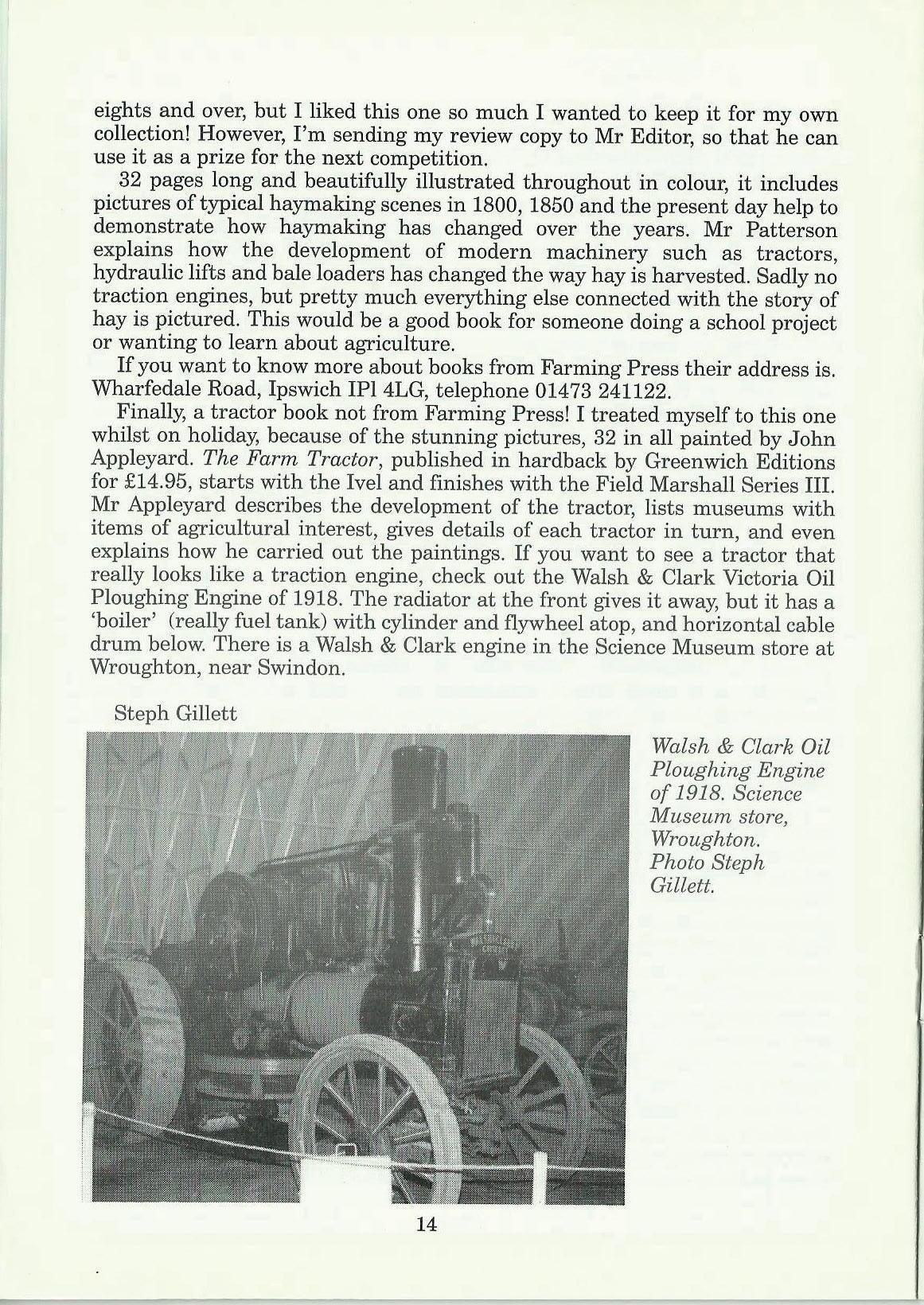
Walsh & Clark Oil Ploughing Engine of 1918. Science Muse um store, Wroughton.
Photo Steph Gillett.
NEW APPRENTICES
We welcome the following new apprentices. Play as big a part as you can in the SAC and you will get most from it. Send in your contributions to your magazine no matter how large or how small, get out to the rallies whenever you can and make yourself known at any event where you see an SAC section or the NTET sales unit. Most of all, enjoy the steam engine in any way you can.
Matthew Hale, Stevenage, Herts
Simon Thomas, Yelverton, Devon
Alastair Hall, Nantwich, Cheshire
Christopher Bannister, Felixstowe, Suffolk
Patricia Bannister, Felixstowe, Suffolk
Jennifer Bannister, Felixstowe, Suffolk
Craig Ennis, Towcester, Northants
Russell Hart, Ilkeston, Derbys
Steven Wood, New Maston, Manchester
Danielle Wood, New Maston, Manchester
Thomas Boddington, Lechlade, Glos
Lynton Owen, Margate, Kent
Colin Gouldby, Lowestoft, Suffolk
Edward Gouldby, Lowestoft, Suffolk
Samantha Hooper, Little Harrowden, N orthants
Adam Woods, North Waltham, Rants
Thomas Pitchford, Farnham, Surrey
Dominic Ball, Liskeard, Cornwall
Robert Davidson, Northallerton, N Yorks
Mark Wiseman, Watford, Herts
Dickon Armstrong, Holybourne, Rants
Michael Clark, Netherley, Kincardineshire
Joseph Farrow, Loddon, Norfolk
Christopher Allen, Holt, Norfolk
Christopher Briggs, Bispham, Blackpool
Joseph Hobson, Bakewell
Laura Siddall, Barnsley
MY DATE WITH A PRINCESS Part 1 by Neil Cobb
Before anyone gets too excited this is not another royal family scandal but my account of the 1995 Great Dorset rally.
The main actors in this story are my Family, Captain Dick, John Carr, Graha1n Atkinson, the Garrett tractor Princess Maude and a Verbeek organ.
The Family -My family consists of Mum, the provider of clean socks, shirts, overalls, food, money and medical services like plasters, creams and bandages etc. I don't know what she does with her spare time, a bit of cleaning and gardening, oh yes and she's always on about the decorating and complaining about us being tidy. I think the latter point is inbred in all mothers. Dad,
another good source of money, you know a top up, especially if he doesn't know I've been round mother first. Dad is also useful as a chauffuer, for cleaning the caravan, repairing the tractors (TVO, Fergies etc) and being nagged at by Mum. Brother Andrew; he does have some uses and as he is older and will soon have a car his usefulness is becoming greater. Being older he can get served in the beer tent, I have to pay but using Mum and Dad's money of course! Andy of course being older is much wiser, so he can argue my point of view for me, especially if I can make Mum think its his point of view in the first place, which gives my halo longer to stay bright and shiny.
Captain Dick - Richard Douglas Esq. He's a wonderful North Yorkshire character, his command of the English language is beyond belief, especially if he hits his finger with a hammer or burns himself on a pipe. His mernory, if he is to be believed goes back as far as Noah. He's served under every captain since Ahab, and he runs a tight ship in the style of Captain Bligh. Dick's knowledge of things nautical is par excellance if you get hiin talking about ships engines, like the triple expansion engine (three leggers to him) or natural draught boilers or bilge pumps, you are mesmerised, not just by the story itself but by his terminology and accent combination (tha nos = you know).
Another of Dick's abilities is to "scrounge" as he puts it, things like shim stock, bearing scrapers, soft solder, copper washers, etc, literally conjuring them up like magic on demand (wi out payin ort odds = without paying too much).
John, J.C., or John Carr. ANother Yorkshireman but from as he puts it the Socialist Republic of South Yorkshire and proud of it. He has a million and one little expressions like this, which with his accent and speed of reply are difficult to understand at the time but tend, when thought about later, to be quite funny, humorous even. John has this overwhelming desire to make everything work properly which usually means taking the whole thing apart and rebuilding it but he doesn't seem to be bothered where he starts these jobs or when. Side of the road, middle of a field, half way up a low loader, if its knocking he has to stop it instantly. To hear J.C. and Dick in conversation about engines is mind blowing but it appears to be some sort of Yorkshire code they use with words like trimmings, shims, slap, nats whisker, cotters, knocking sticks and fittalls. Translated = oil feedwicks, spacers, end float, fractional adjustment, fixing pins, hammers and adjustable spanner; Owzat = how's that.
Graham Atkinson - Yet another Yorkshireman, quiet spoken, a good supplier of beer, and the owner of the engine and organ, which instantly makes him a friend of mine. Graham is the music man and spends his time feeding the cardboard music through the key frame, cleaning the organ front and complaining about the voltage and dust, both of which seem to have an adverse effect on his music. Graham is a farmers lad through and through with an ability to get up early and stick at a job until it's done, not stopping for anything until the task is completed. Food and drink are secondary to the job in hand, unlike Dick and John who can drink tea for England.
The Princess Maude. A Garrett 4CD Tractor of 1918 with an abundance of brass, dark blue paintwork and pale blue and gold lining, "lovely".
The Organ - built by Verbeek especially for Graham in 1991, is a joy to behold, it looks smart and sounds magnificent. It is frequently referred to as being "t'box full o' whistles" or "the firewood department". Having outlined the main characters of the story, I will now relate events.
Well you will have to wait until your next magazine to read Neil's continuing story. I feel that I must point out that the foregoing description is entirely Neil's own words and perhaps he should be able to run quite fast! - Ed.
Well that was a very full magazine, and there's more to come. Neil's continuing story will be in the next magazine along with an account of a day with Lord Lascelles from Robert Houghton. Keep it coming-it's all good stuff and it's all yours! - Barry Sumsion, Editor
Clothing for Juniors
FRUIT OF THE LOOOM SWEATSHIRTS
produced with the image of a road roller, printed centre chest position.
FRUIT OF THE LOOM TEE-SHIRTS
produced with the image of a road roller, printed centre chest position