STEAM APPRENTICE CLUB MAGAZINE
EDITOR
Barry Sumsion, 1 Leicester Road, Newport, South Wales NP9 7ER '1'el: 01633 262t97 Fax: 01633 259089
CHAIRMAN, STEAM APPRENlilCE CLUB
John Bosworth, J4 Main Road, Smalley, Derby DE7 6EF
Tel: 01332 880405 between 8.00am and 10pm only
MEMBERSHIP SECRETARY
John Cook, Dolfasni, Chu,ch Lane, Kirby la Thorpe, Sleaford, Lincolnshire NG34 9NU. Correspondence only.
The Edit01, welcomes any contributions of articles, shgTte-ritems or phot0graphs for inclusion in future issues. All materia1 submitted is v0luntaTy and payment cannot be made for any material published. The opinions ex_J!)ressedin the magazine, with tfil.eexce,ption of Club announcements, are those of the contributors and do not indicate the views of the Club as a whole. All items ate held copyright by the contributor and tne NTEI!'.
Please send your contribmtio11sto the Editor at ieast five weeks before publicatfon. Typed artic,les are preferred hat not essential jJf handwritten put any names of'l?EOP1E, PLAOES or ENGINES in iBLOCK CAPrrTALS.Ifiy.ou require any pwt of yonr article Gegph0tos~ retmrning please say so and enolose a stam}')ed addressed envelope. Enclose Y01'l,(t'name, address an..,d(if Apprentice) age with any contribution.
The Edit0r reserves the :riightto amend or refuse contributions, ar.i.dwirnattempt to correct spelling and grammar!
The Magazine is rrormallJ>publisned during the early pa,,t of January, AprH, July and Octob€r. T-1rnClub accepts no liability for fa,ila,reto meet i111tendedpubliGatioN dates.
The Steam Apprentice @ub is a section of the National Traction Engine Trust. NTET is a Registered. Charity, No. 291578. Registered in England No. l302il97. Registered @ffice: Forum House, !l.-6Millmead, Middlesex TW18 4UQ.
Typesetting and Artwork by Kear line Graphic [mages, 1 Eeicester R0ad, Newport, South Wale&NP9 7ER il'el:01633262197Fruc0~633259089
P~i.nted by The 'W,hitehouse Press Ltd.,.,,High Street, Lydney, Glos GV15 5BP
Spring is just about upon us as I write these notes and that means apprentices up and down the country should be preparing for the coming rally season, checking dates and persuading parents, where necessary, that they need to visit as many rallies as possible. They should also be keeping an eye on what activities the SAC may be getting up to or organising for them. The first of these special events is the forthcoming Training Weekend at Klondyke Mill in Staffordshire on the weekend of April 13/14. So far very few have taken up this opportunity and I hope it does not have to be cancelled through lack of support as has happened before. So come on apprentices (14 and over), get in touch with Chairman John Bosworth straight away and find out just what you'll be 111:issing.By the time you get this magazine, there may still be time to get on the course. If you are unable to come, please write to John or myself and explain why. It is very difficult for John to organise events for you (mostly on his own) ifhe gets little or no communication from apprentices about what they would like and where they would like it. He is not a magician, and so not all things are possible, but if the right suggestion comes up, I'm sure he will do his best to get something organised on your behalf.
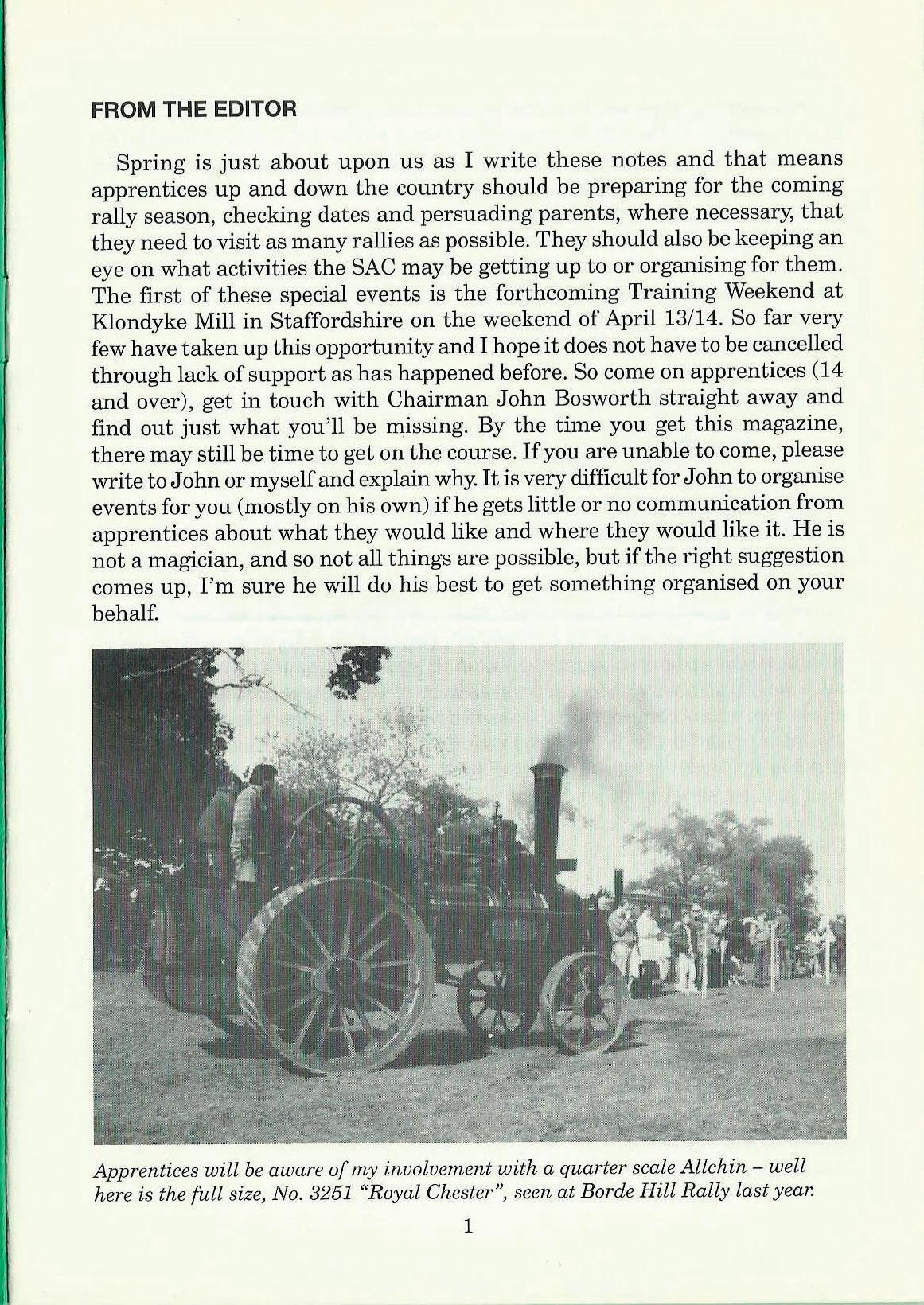
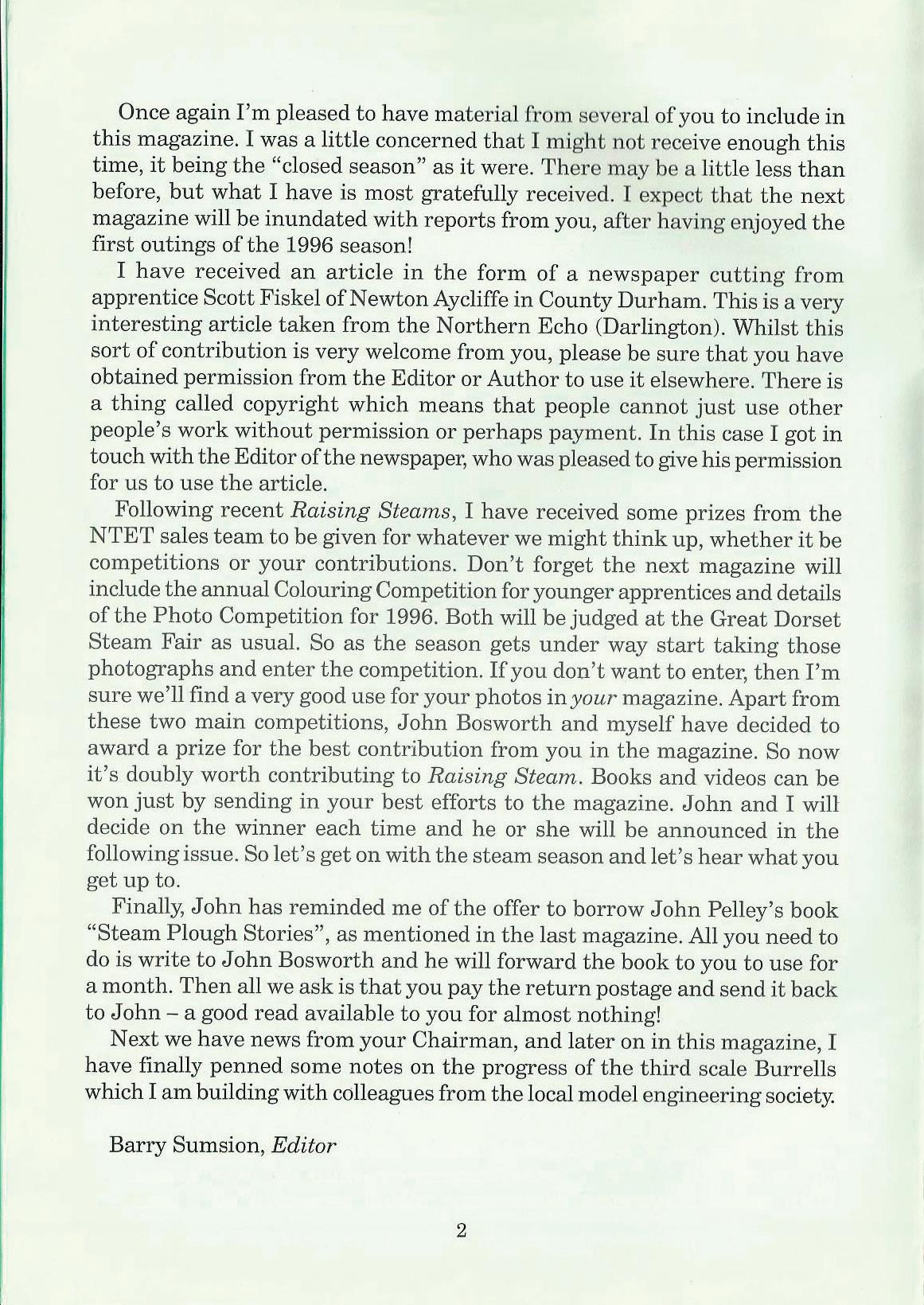
Apprentices will be aware of my involvement with a quarter scale Allchin - well here is the full size, No. 3251 "Royal Chester", seen at Borde Hill Rally last year.
Once again I'm pleased to have material from several of you to include in this magazine. I was a little concerned that I might not receive enough this time, it being the "closed season" as it were. There may be a little less than before, but what I have is most gratefully received. I expect that the next magazine will be inundated with reports from you, after having enjoyed the first outings of the 1996 season!
I have received an article in the form of a newspaper cutting from apprentice Scott Fiskel of Newton Aycliffe in County Durham. This is a very interesting article taken from the Northern Echo (Darlington). Whilst this sort of contribution is very welcome from you, please be sure that you have obtained permission from the Editor or Author to use it elsewhere. There is a thing called copyright which means that people cannot just use other people's work without permission or perhaps payment. In this case I got in touch with the Editor of the newspaper, who was pleased to give his permission for us to use the article.
Following recent Raising Steams, I have received some prizes from the NTET sales team to be given for whatever we might think up, whether it be competitions or your contributions. Don't forget the next magazine will include the annual Colouring Competition for younger apprentices and details of the Photo Competition for 1996. Both will be judged at the Great Dorset Steam Fair as usual. So as the season gets under way start taking those photographs and enter the competition. If you don't want to enter, then I'm sure we'll find a very good use for your photos in your magazine. Apart from these two main competitions, John Bosworth and myself have decided to award a prize for the best contribution from you in the magazine. So now it's doubly worth contributing to Raising Steam. Books and videos can be won just by sending in your best efforts to the magazine. John and I will decide on the winner each time and he or she will be announced in the following issue. So let's get on with the steam season and let's hear what you get up to.
Finally, John has reminded me of the offer to borrow John Pelley' s book "Steam Plough Stories", as mentioned in the last 1nagazine. All you need to do is write to John Bosworth and he will forward the book to you to use for a month. Then all we ask is that you pay the return postage and send it back to John - a good read available to you for almost nothing!
Next we have news from your Chairman, and later on in this magazine, I have finally penned some notes on the progress of the third scale Burrells which I am building with colleagues from the local model engineering society.
Barry Sumsion, Editor
CHAIRMAN'S COLUMN
Steam Apprentices, do you read Old Glory? The Editor mentions, an1ongst other things, the NTET engine owners' meeting and the need for new engine owners or drivers to take some basic training which to my way of thinking is a must. Which brings my thoughts to our own training weekend at Klondyke Mill, Draycott in the Clay on April 13/14. It is your opportunity to get some training under your belt (or bib & brace). You won't be a competent steam driver with two days training but you must start somewhere. Some excellent instructors and lecturers will be on hand. Four or five engines should be in steam on site. Saturday evening a meal will be put on at a very moderate price - details at time of booking. This will be followed by a showing of the films "The Iron Maiden" and "The Titfield Thunderbolt" if time. The Howard Brothers have invited the SAC to visit their works and home of "Renown" but it will have to be an in-week visit, no date fixed yet. Anyone interested? I may couple this with a visit to the National Tramway Museum at Crich.
On the weekend of 28/29 September this year, the NTET is to stage a steam engine road run around the area of Northampton. This is to be a prestigious event with driving rules according to those used in the 1907 RAC Commercial Vehicle Trial. We are intending to offer the services of suitable Apprentices as stewards and programme sellers. As we go to press final details are not available but please write to me if you would like to be involved and I will tell you how you may help when I know more.
John Bosworth, Chairman
MAILBAG
Dear Editor
I have been a member of the Chatham Historic Dockyard Steam Society for 3 years.
Over 16 steam vehicles are regularly displayed there, as well as several lorries, stationary engines and an Aveling Barford DX type diesel roller. The oldest engine on display is an Aveling & Porter 20 ton roller, built 1896 (No. 3781) for Gloucestershire Council. The newest is an Aveling Barford W type roller, Omega, built 1948 (No. AH 162), the sole survivor of its type, supplied new to the G.W.R.
I go to the Dockyard most Sundays, and have been taught many skills involving steam. I have participated in the Medway Carnival twice, and steamed to and from Sittingbourne (about 10 miles away), for a Festival of 3
Transport. I regularly light and oil up, and get the engines running, especially looking after a Fowler DH type 12 ton roller (No. 15698), built 1922 for Banbury Corporation. During the summer I crewed on Aveling & Porter C type piston valve 8 ton roller Sammy Lou (No. 11206). We went from Snodland to Groombridge, about 24 miles.
During 1995 there have been two main steam events in the Dockyard. On 8th May we lit up for the Dockyard's VE Day celebrations. 9 engines were in steam, including Sentinels S4 and Super Sentinel, owned by Society members. The previous day their engines had taken part in the London to Brighton commercial vehicle run. The S4 is painted in a Shepherd N eame Brewery livery. There was a special visit by the paddle steamer Waverley, and a Blenheim Bomber and Spitfire fly past. This was a really spectacular sight, one I will always re1nember.
On the weekend of 12/13 August we had the Dockyard's Steam Rally. Most of the engines were running, plus 5 visiting engines, Burrells Validus and Princess, Fowler road locomotive Endeavour, Ruston Hornsby 12 nhp Portable of 1931, and one of the two remaining Ruston rollers.
There were demonstrations:
- Stone crushing by William Peg & Sons crusher owned by Alan Brice of Sellinge.
- Log sawing, using a bench made in mid 1930s to American design, using cables and capstan instead of the more commonly found rack and pinion.
- Scarifying, with 1923 Aveling & Porter Morning Star (No. 10043).
- Threshing, by a Fordson Major tractor providing the power.
- There was also a dynamometer, worked by belting up to the flywheel of the engine and by passing water through it. Dials show the engine's brake horse power.
One of the stars of the rally was a steam crane, built by Grafton, which is capable of lifting 10 tons, and originally worked in the Dockyard. It is one of 5 on permanent display. Other displays included heavy haulage, stationery engines and model engines. And the coal powered paddle steamer Kingswear Castle, which worked on the River Dart in Devon, gave rides on the River Medway.
We occasionally run a large Portable Boiler, built in the Dockyard. This was used, along with several others, to supply steam for heating the ships in the yard. This now produces steam for a single cylinder Robey steam engine, originally used in a London launderette. There is also a steam winch.
Unconnected at present are a Weir steam transfer pump, and a triple expansion engine. Also kept in the Dockyard is a Robert Stephenson & Hawthorn 0-4-0 saddle tank locomotive Ajax, a steam T.I.D. tug, and the last coal powered paddle tug in the U.K., the John H. Amos, which is currently undergoing restoration.
At present I am involved in the restoration and conversion of a Fowler roller/showmans engine. I have learned many skills, including helping to make the firebox, rivetting and drilling. I have really enjoyed the past 3 years.
I have only mentioned some of the exhibits. Come and find out more! Admission is one price to look around over 80 acres of the Historic Dockyard including the Steam Centre.
From David Main Age 14
Gillingham, Kent
P.S. Thank you for producing such a brilliant i and informative magazine.
Thank you for your kind remark. I have to say it is contributions such as yours David that make the magazine a good read. It does sound as if Apprentices should make the effort to visit this very interesting place. Perhaps you may even find David at work!
Telephone the Dockyard on 01634 812551 for up-to-date information about events going on there
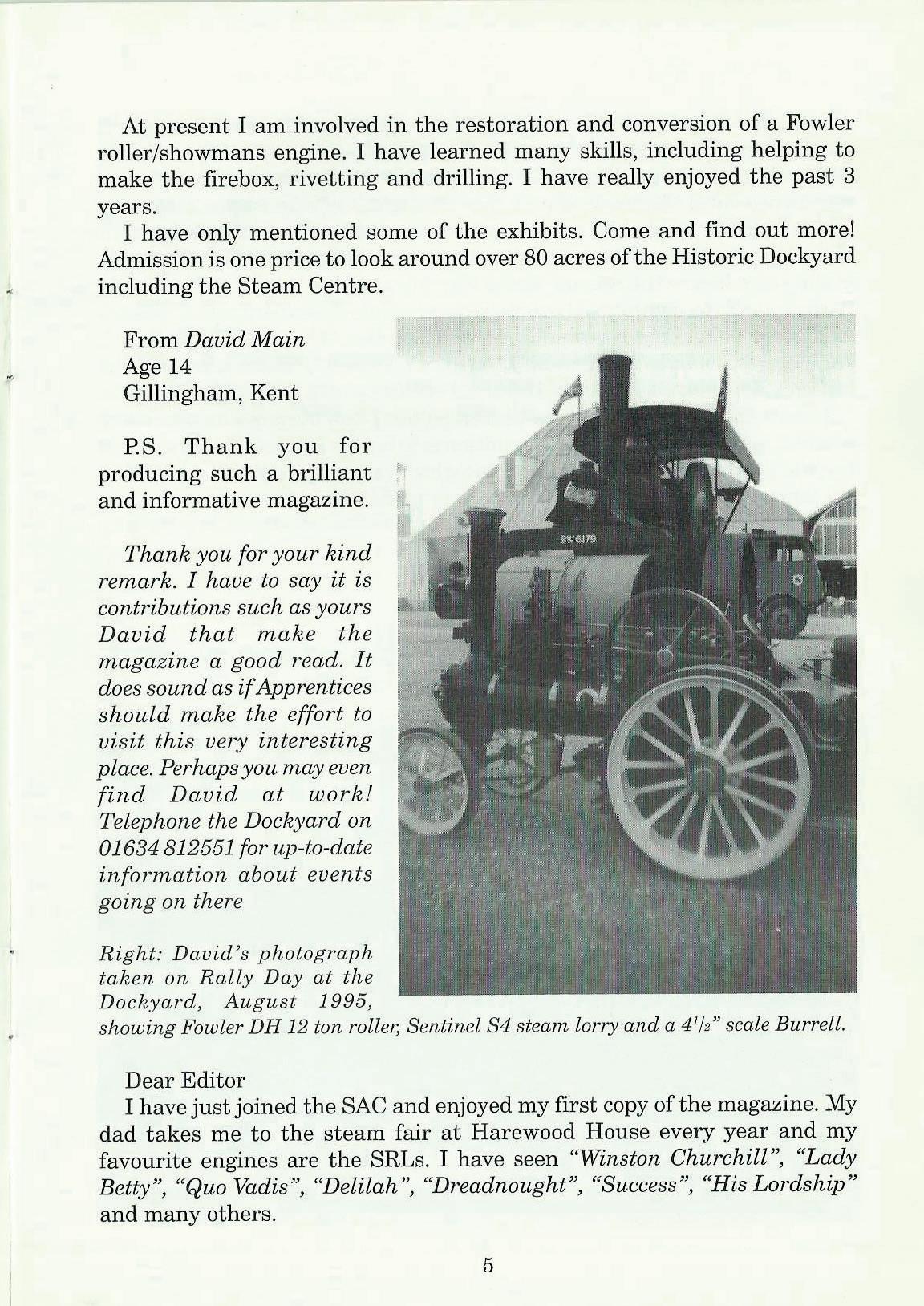
Right: David's photograph taken on Rally Day at the Dockyard, August 1995, showing Fowler DH 12 ton roller; Sentinel S4 steam lorry and a 41/2"scale Burrell.
Dear Editor
I have just joined the SAC and enjoyed my first copy of the magazine. My dad takes me to the steam fair at Harewood House every year and my favourite engines are the SRLs. I have seen "Winston Churchill", "Lady Betty", "Quo Vadis", "Delilah", "Dreadnought", "Success", "His Lordship" and many others.
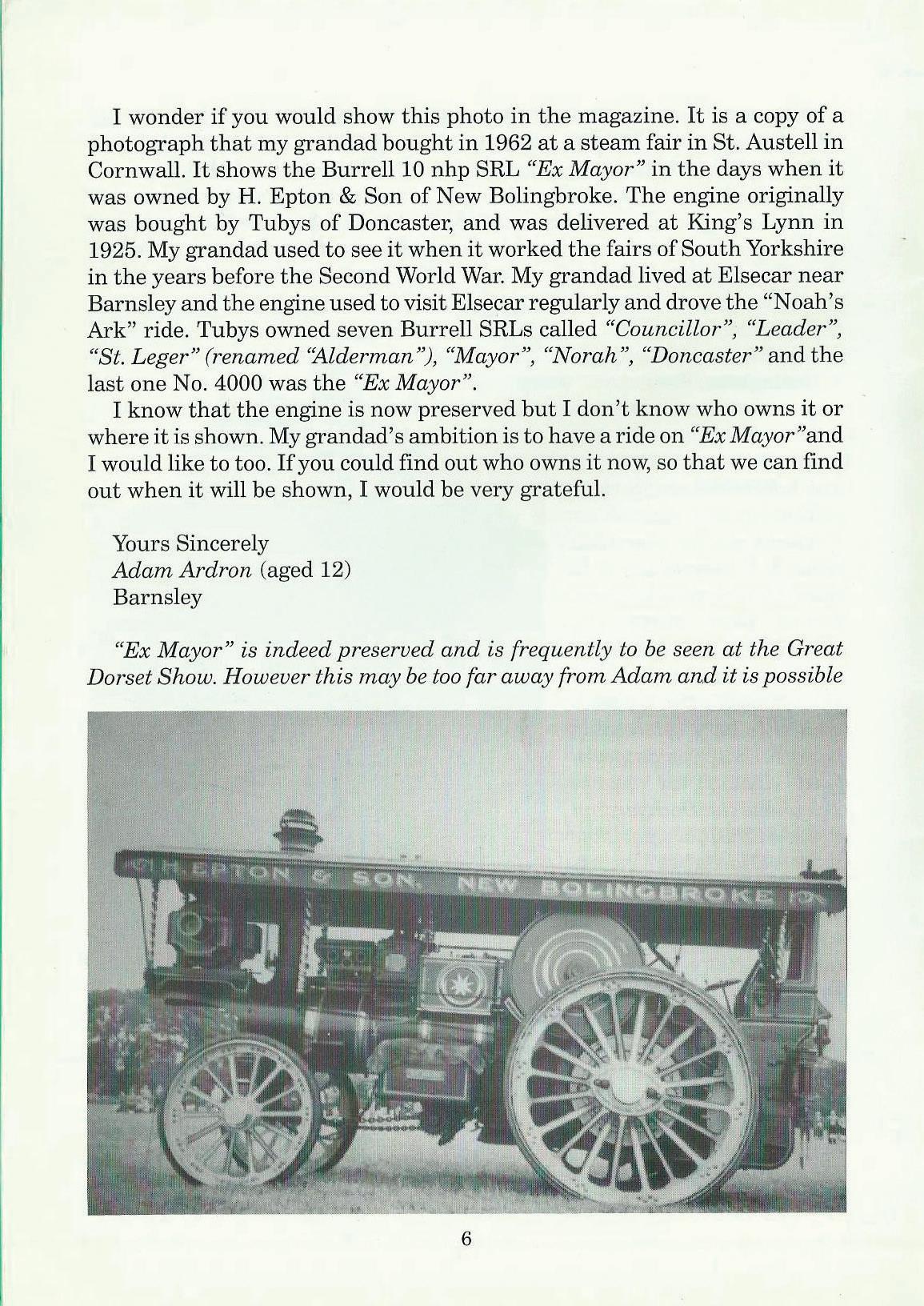
I wonder if you would show this photo in the magazine. It is a copy of a photograph that my grandad bought in 1962 at a steam fair in St. Austell in Cornwall. It shows the Burrell 10 nhp SRL "Ex Mayor" in the days when it was owned by H. Epton & Son of New Bolingbroke. The engine originally was bought by Tubys of Doncaster, and was delivered at King's Lynn in 1925. My grandad used to see it when it worked the fairs of South Yorkshire in the years before the Second World War. My grandad lived at Elsecar near Barnsley and the engine used to visit Elsecar regularly and drove the "Noah's Ark" ride. Tubys owned seven Burrell SRLs called "Councillor'', "Leader", ((St. Leger" (renamed ('Alderman"), ((Mayor", ((Norah", ((Doncaster" and the last one No. 4000 was the "Ex Mayor".
I know that the engine is now preserved but I don't know who owns it or where it is shown. My grandad's ambition is to have a ride on "Ex Mayor"and I would like to too. If you could find out who owns it now, so that we can find out when it will be shown, I would be very grateful.
Yours Sincerely
Adam Ardron (aged 12) Barnsley
('Ex Mayor" is indeed preserved and is frequently to be seen at the Great Dorset Show. However this may be too far away from Adam and it is possible
that the engine travels to events further north. Perhaps someone out there can help. One interesting thing about this engine is that it is quoted as either a 10nhp or sometimes as an Bnhp engine. Depending on whose book you read, different cylinder dimensions are shown. I know that it has many differences from what may be considered a "standard" Scenic Showmans. Again perhaps someone out there may like to comment on this. - Ed.
Dear Editor
I have two Mamod engines, a hammer press and polisher. As well I have a green polisher and a green grinder (not shown). I am having a change about by taking up the tools and re-arranging them and have a roof drive.
Yours sincerely,
George Shackleton (age 10)
Bury St Edmunds, Suffolk
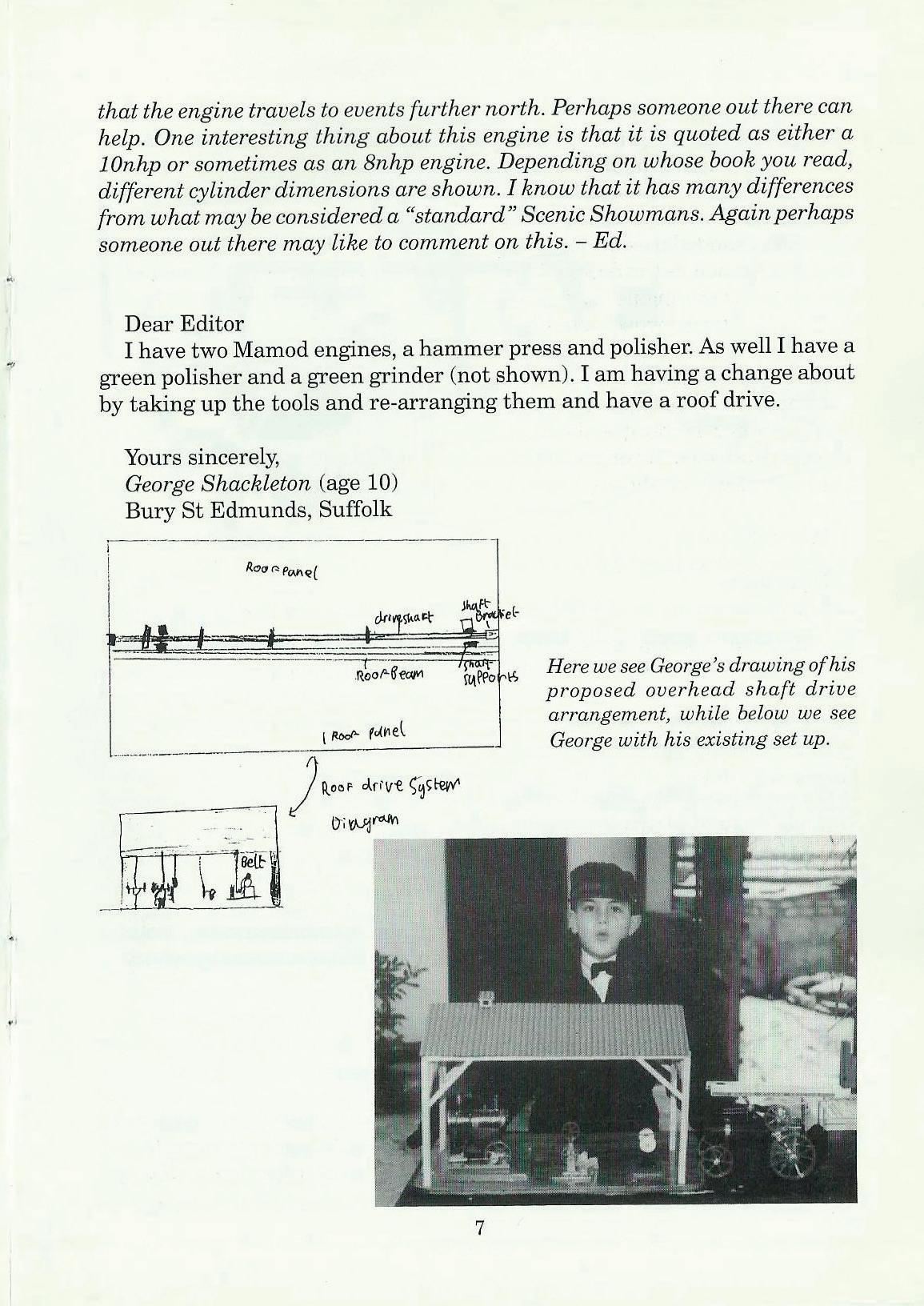
Here we see George's drawing of his proposed overhead shaft drive arrangement, while below we see George with his existing set up .
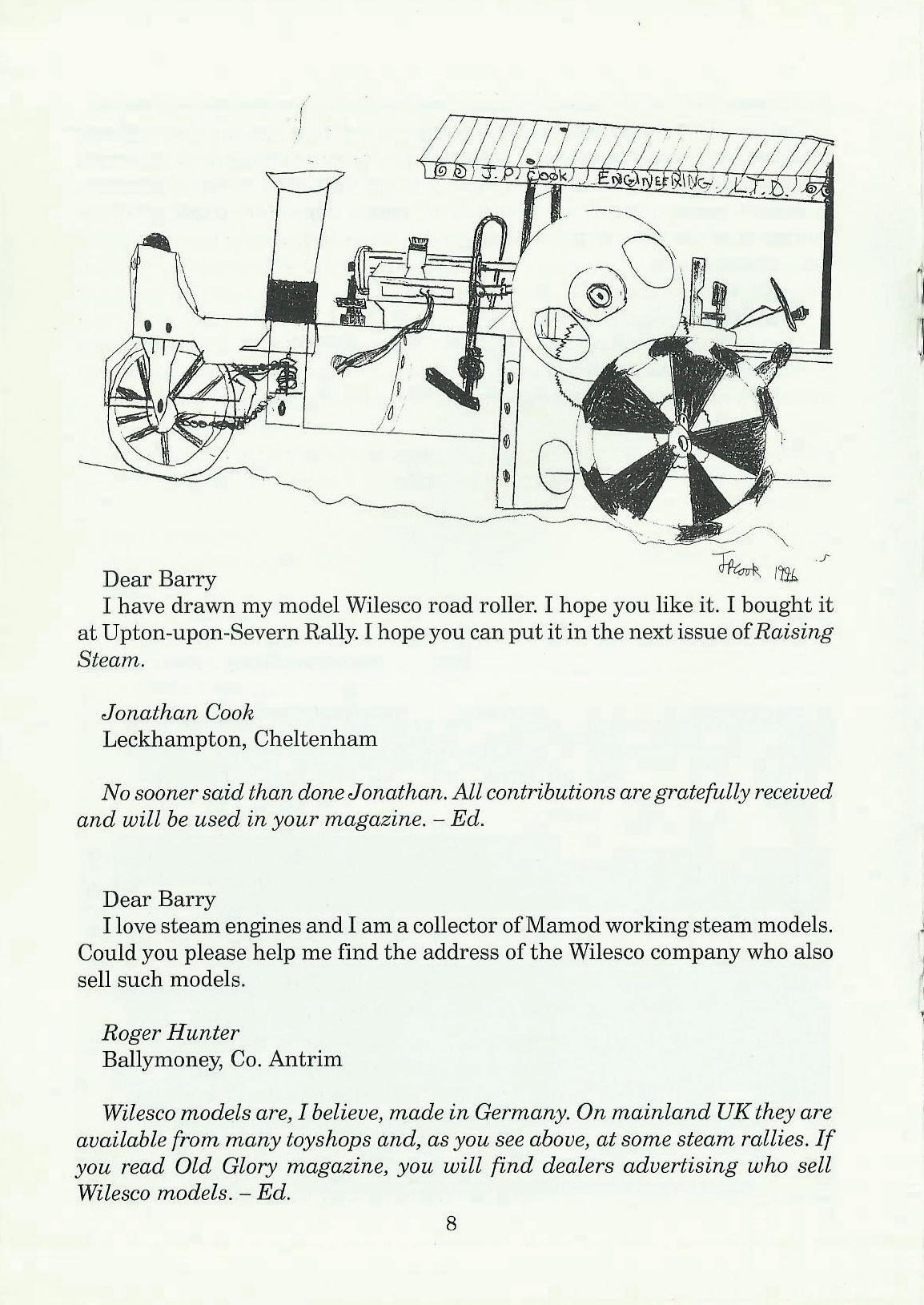
Dear Barry ( }
I have drawn my model Wilesco road roller. I hope you like it. I bought it at Upton-upon-Severn Rally. I hope you can put it in the next issue of Raising Steam.
Jonathan
Cook Leckhampton, Cheltenham
No sooner said than done Jonathan. All contributions are gratefully received and will be used in your magazine. - Ed.
Dear Barry
I love steam engines and I am a collector of Mamod working steam models. Could you please help me find the address of the Wilesco company who also sell such models.
Roger Hunter
Ballymoney,
Co. Antrim
Wilesco models are, I believe) made in Germany. On mainland UK they are available from many toyshops and, as you see above) at some steam rallies. If you read Old Glory magazine, you will find dealers advertising who sell Wilesco models. - Ed.
Dear Editor
I am replying to a question set by Matthew Bate, about the 'Titfield Thunderbolt'. The 'Thunderbolt' does exist, but is in fact called "Lion". It is in the transport gallery in the Liverpool Museum. It was once mounted on blo~ks and made to pump water by attaching the pump to the crank axle. It was later rescued and restored by the LMS. I know of two miniature 'Lions', one in 5 inch gauge and one in 10¼ inch gauge which I have driven!
Yours Sincerely
Chris Field (age 13), No. 2341
Broadstone, Dorset
P.S. I would be very grateful if you could put me in touch with a traction engine near me.
One for the Chairman, I think. - Ed.
Dear Editor,
Following Matthew Bate's letter in the Winter edition of Raising Steam about the engines which starred in the film 'The Iron Maiden', I thought you may find this information interesting.
The 'Iron Maiden' was built by Fowlers of Leeds in 1920 and was named "Kitchener" and has engine number 15657 and registration number FX 661. Other engines which appeared in the film include: 1. Burrell Showmans number 3610 "Flower of Scotland" (named "Dreadnought" in the film), built 1914; 2. Burrell Showmans number 3489 "King GeorgeVI" (named "Duchess of Avon" in the film), built 1913; 3. Burrell TE "Crimson Lady" number 4055 of 1927; 4. Fowler 6 ton roller "Princess Caroline", built 1930; 5. Fowler single ploughing engine 24 79 of 1874; 6. Garrett tractor 33991 "Patricia", of 1920; 7. Ransomes crane engine 31066 "Hooky", of 1920; 8. Thornycroft wagon 39 "Dorothy", of 1901.
Many people say that a full sized wooden replica of the 'Iron Maiden' was built for the last few shots of the engine when it 'explodes'. However I believe one was not built for many reasons: 1. If you look closely at this shot it would appear that the only damage to the engine is a burning canopy and the wheels removed from the front axle. This shot could easily be achieved by replacing the original roof with one made out of wood and burnt prior to being put onto the engine, as for the wheels these could be un-bolted and are leaning against the axle; 2. The boiler shows no sign of damage except it is slightly blackened. If it had actually exploded the back and front would not still be
intact with the two sections several metres apart; 3. If it had exploded then nobody would be able to be within several hundred metres of the explosion, and so the two people who are walking next to the engine would die; 4. After the explosion there is no debris such as safety valves, whistle, governors, cylinder etc surrounding the engine.
I hope this information is interesting and useful.
Yours faithfully
David Main (age 14)
Gillingham, Kent.
P.S.The 'Titfield Thunderbolt' was filmed on the Limpley Stoke-Camerton branch of the G.WR. (then freight branch only) in 1952. The station in the film named 'Titfield' was originally called 'Monkton Coombe'.
The last two letters prove the value of reading and contributing to your magazine. Obviously David Main is a well read and enthusiastic apprentice! -Ed.
A WARM WELCOME
We are very pleased to announce that, following our appeal for help in running the Steam Apprentice Club in Yorkshire, Mr David and Mrs Diane Parkin of Castleford have agreed to co-ordinate Steam Apprentices at the Yo:rkshire rallies (and any others which they attend) this year. They have three Steam Apprentices of their own as well as an engine and so will be well placed to help you all.
Please give them your support. Do tell them in advance if you can, which rallies you will be attending so that they can sort out and plan accordingly. You can contact them on 01977 514521 or write to them at 100 Aketon Road, Cutsyke, Castleford WFl0 5DU.
Our grateful thanks go to David and Diane for helping out and we wish them lots of luck and fun over the coming season.
John and Fiona Durling
And let's hope that we will see John and Fiona successfully moved and again enjoying their place on the rally fields. They have done a wonderful job in Yorkshire for the SAC - can we possibly hope they may become involved with us again? - Ed.
DID JOHN GET MORE THAN A PLOUGHSHARE OF FAME?
The following article was sent in by Scott Fishel of Newton Aycliffe, County Durham. He spotted it in The Northern Echo (Darlington) for the 26 February last, and thought it of interest here. It is, but first of all I obtained permission from the Editor of The Northern Echo, with whose permission we gratefully reproduce it here. It is written by Chris Lloyd as one of his 'Echo Memories' series.
A fortnight ago, Echo Memories told the tale of Darlington's only proper piece of public art: Joseph Pease's statue on High Row.
But there is, in South Park, the remains of the town's other statueremains being an important word for all that is left on the top of the slope above the pond is a hulking grey granite plinth.
The last anyone saw of the bronze bit which used to sit on the granite was in the seventies - in a wheelbarrow. Someone was stealing it for scrap.
That bronze bit was in the shape of a revolutionary steam plough invented by John Fowler. Mr Fowler's connection with Darlington is tenuous - he married Joseph Pease's ninth child, Elizabeth Lucy, but that was enough to earn him a statue.
Fowler was born in Wiltshire to a Quaker family in 1826, and came north to Middlesbrough to gain experience in the engineering industry on his 21st birthday. He met Ms Pease, but did not marry her for a decade, sensibly believing that a man should be secure in his career before taking on the expensive baggage of a wife. Little did he think that his life would be so cruelly short, leaving Lizzie a long-time widow.
Fowler patented many devices, the first being something called a mole drainage plough, but he was forever fascinated by the potential of steam. Yet for two hours one July day in 1852 he paced the beach at Brighton in earnest conversation with an inventor pal and they concluded that steam power would never improve on horse power.
Controversially, then, Fowler pressed on and in 1856 developed his balance plough which sat in South Park until the wheelbarrow man stole it. With its large wheels pivoting it in the middle, it could be pulled both ways which saved the trouble of turning round. What is more, Fowler created two steam powered engines which sat at either end of the field and dragged the plough up and down on a cable.
This revolutionised Victorian farming. As a notable farmer said in 1863, a Fowler plough did the work of 56 oxen. Indeed, with the oxen redundant, he had used their field to grow another 150 acres of wheat. Plus, said the farmer, steam was far better. Stronger than a horse, more patient than an ox, andwith coal delivered for ten shillings a ton -cheaper than the fodder for cattle.
Farmworkers liked the new system. At the end of the day, they could put the fire out and go to the pub without having to stable the animals.
But the Fowler plough was not without its dangers. In June 1881 a Darlington bricklayer called HA Waites went to Cuckoo House Farm, Walworth, to watch the modern wonder in action. Tragically, it went out of control and ploughed him to death!
Long before this tragedy, Fowler himself had died. In 1860, he had moved to Leeds where he had set up a traction engine factory. But the strain of so much inventing took its toll, and his doctor ordered him to take some exercise and get some fresh air. So Fowler took up horse riding. In 1864, aged just 39, he fell from his horse, broke an arm, tetanus set in, and he died.
A hint of scandal does still taint his name. Shortly after he died it was claimed that a Darlington man called John McDermid had invented the steam plough in 1840. McDermid had sent his prototype drawings to the one man in the area whom he thought had the vision and the finance to get the scheme up and runnning: Joseph Pease.
McDermid had heard no more from the Peases until, in the 1860s, he had discovered a Leeds firm called John Fowler mass-producing his design of plough. Surely the great, the noble Joseph Pease would not resort to such an underhand deed to help his son-in-law claim a place in posterity?
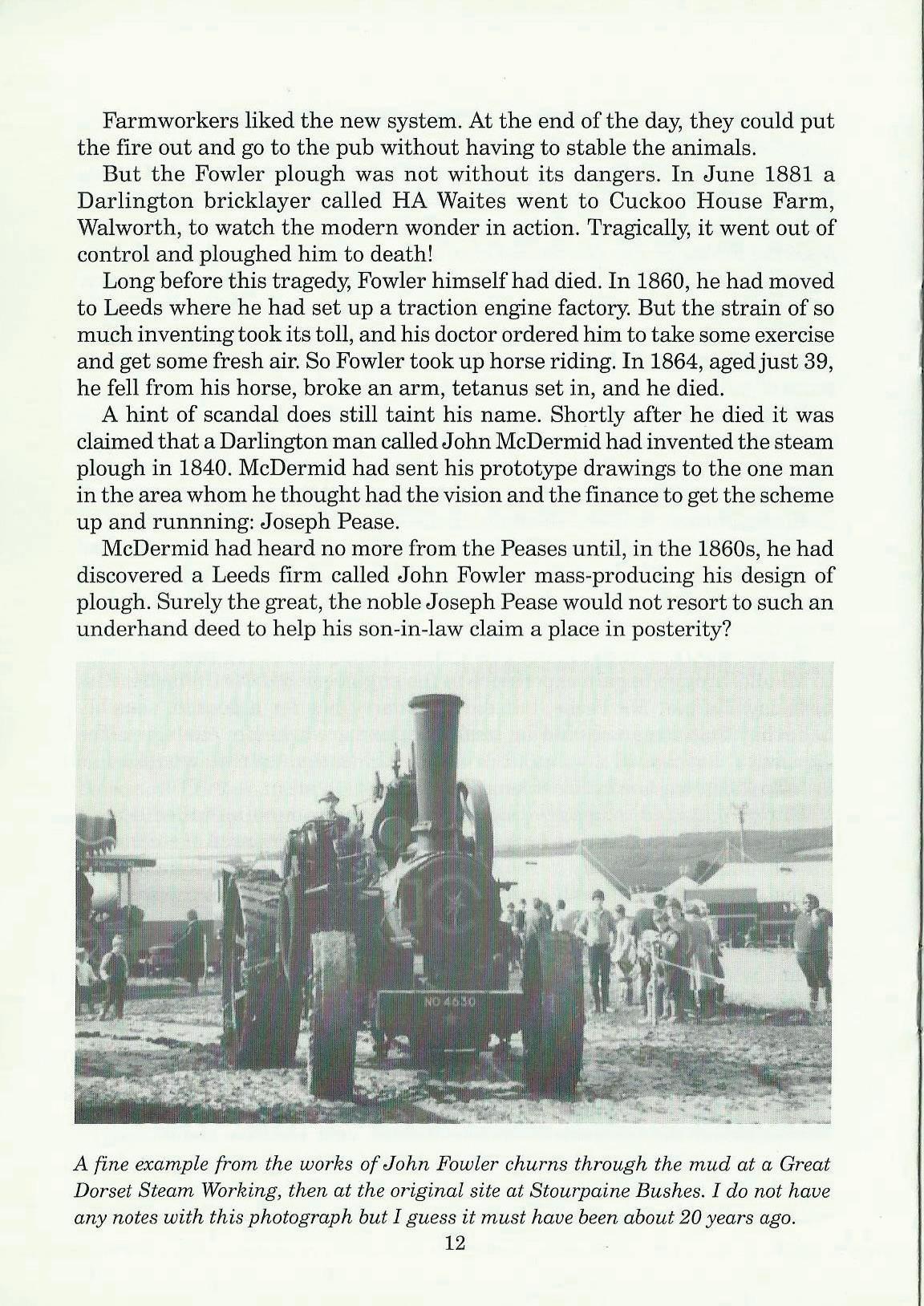
A f'ine example from the works of John Fowler churns through the mud at a Great Dorset Steam Working, then at the original site at Stourpaine Bushes. I do not have any notes with this photograph but I guess it must have been about 20 years ago.
THOSE 4" BURRELLS
I have mentioned many times before about the third scale Burrell engines that I and colleagues at the local model engineering society are building. I have also threatened to report on the progress (or lack of it) that we are making. For those of you not used to Imperial measurements, there is no real equivalent to the traciitional scaling that British modellers still use. A foot is a foot i.e. 12 inches, and although it can of course be converted into a metric equivalent, it doesn't ring true to us (slightly) older apprentices. So for those of you who have never had the benefit of using the Imperial system, then it is easier to say that the models are to one third size of the original full size.
The club I belong to has for many years been a railway orientated one, many, many fine models being built for over 25 years. However very few traction engine models had been built. That is until I came across the nearly completed 3" scale Allchin of Ken Davies. He had built many fine railway locomotives, but had never felt the need to complete the Allchin, which was built as much out of curiosity as anything, to try something different. Coming from the west country as I had, this was a challenge that had to be taken up. So with much cajoling from myself and Ken's wife, the engine was completed. It immediately became a firm favourite at club. At first only Ken and myself would drive it, but gradually other members had a go and were duly smitten with the traction engine bug. This was about six years ago, during which time the Allchin has been one of the busiest and hard worked model engines I know. Other members wanted one of course. A pile of castings and drawings that had been passed around the club for many years suddenly re-appeared as a fine 2" scale Fowler ploughing engine, as it was always intended to be. A new me1nber appeared one day saying he had virtually finished a 3" scale Marshall roller. The ball had started rolling. Trips to the Great Dorset appeared on the club calendar and the talk was of building engines - traction engines! A temporary member joined us for about a year, and he had a 4" scale DCC Burrell. That was it! That was what we would build. Originally 6 members wanted to be in on the project. The trouble with this scale is that it is fairly large and this means that several jobs cannot be done on the equipment to be found in the average model engineer's workshop. To have the work done out professionally is quite expensive and in any case it is not the traditional way that British model engineers approach a project. Build it yourself wherever possible is the norm. Nevertheless a start was made, obtaining drawings, photographs and raw materials for the six engines. It was not long before some realised they may have 'bitten off more than they could chew', so now we are three. The existence of so much material and the work already started means that now three ofus a.re building five engines!
Before long we realised that some of the castings available commercially were both expensive and not always of the best quality or design. So we decided that wherever possible we would make our own patterns and have the castings done at a local foundry where we would have control over the quality and design - and saving approximately 75% of the cost as well! It is to our great benefit that two of my colleagues are both professional engineers of some local repute which brings several advantages along the way.
Some operations are still not possible in our domestic workshops but so far we have enjoyed the good fortune that my colleagues' employers have been very supportive in the availability of bigger machinery when necessary -or perhaps they are just 'turning a blind eye'!
We have been at it for nearly two years now and it may appear that there is not much to show. However a lot of research has been done. The available drawings leave quite a lot to be desired - if you are a professional engineer. So my main responsibility has been to finding out wherever possible by correspondence and photographic evidence, how things should be on the full size engines. One thing's for sure, there doesn't appear to be two identical Burrells ever built! So we decided to get them as right as possible.
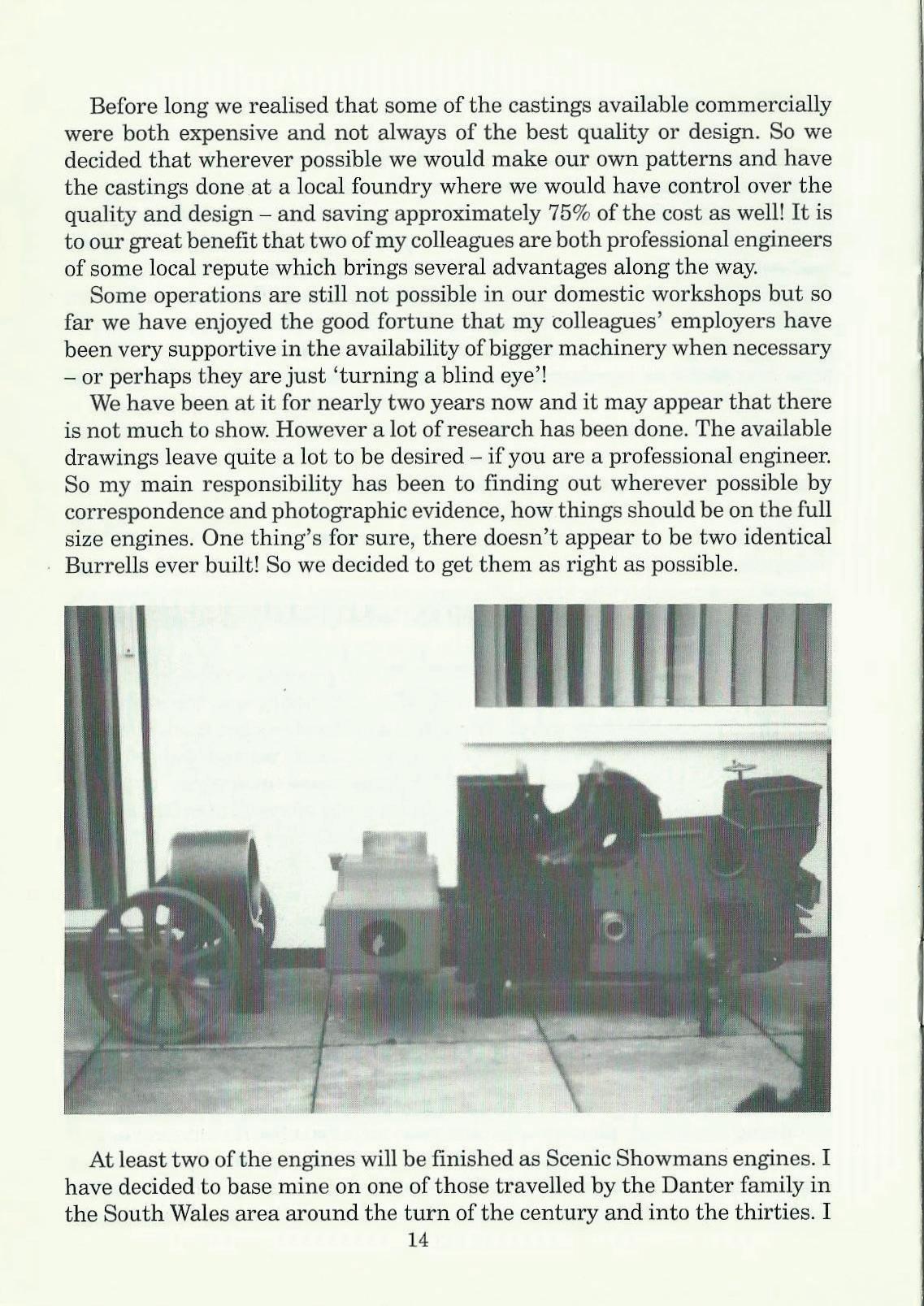
At least two of the engines will be finished as Scenic Showmans engines. I have decided to base mine on one of those travelled by the Danter family in the South Wales area around the turn of the century and into the thirties. I
have been fortunate enough to meet the present head of the family, who lent me a couple of photographs. I an1 always searching for more of course to try and get everything as accurate as possible. Many patterns and castings have been made but there are many more yet to do. The most daunting of these is likely to be for the cylinder block. Many of you will know that these two cylinder engines are compounds and the steam passages within the cylinder block call for complicated casting practices. Also we intend that the Showmans engines will do the job just like their full size counterparts. So we are aiming to run dynamos producing 110 volts DC, and calculations suggest that we may be able to produce perhaps 30 amps. The problem here is that the dyna1nos, like the rest of the engines, have to be to scale visually. So we have a maximum outer diameter of about 10". Well if we cannot come across a couple of dynamos that fit the bill, then like everything else, we will have to build them too.
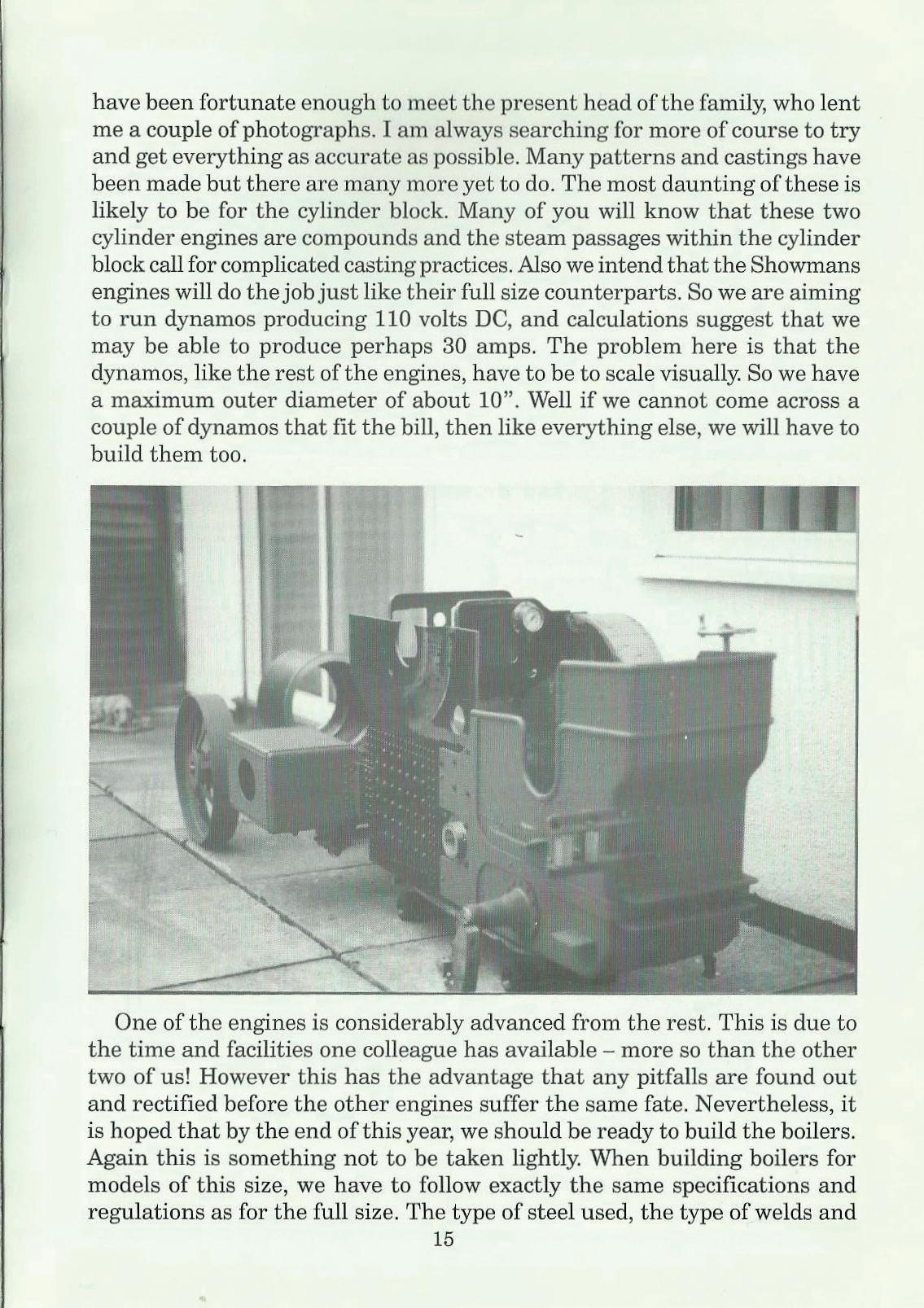
One of the engines is considerably advanced from the rest. This is due to the time and facilities one colleague has available - more so than the other two of us! However this has the advantage that any pitfalls are found out and rectified before the other engines suffer the same fate. Nevertheless, it is hoped that by the end of this year, we should be ready to build the boilers. Again this is something not to be taken lightly. When building boilers for models of this size, we have to follow exactly the same specifications and regulations as for the full size. The type of steel used, the type of welds and
welding materials used have to be very specific. A competent welder must do the work, and we are currently very fortunate in having two such welders available and willing to do this work for us. At all stages the work must be inspected by the boiler inspector and finally a fully certified boiler should be the result. Annual tests and the maintenance of the boilers follows on throughout the life of the boiler just as in the full size.
We have a few years work left to do yet, but I'm sure we will be well pleased when eventually they roll out of our workshops, paint glistening, and ready for their first public workings. Roll on that day.
The photographs accompanying this article show an assembly of some of the parts of one of the engines so far accomplished. One thing that keeps coming to mind when working on them is that they are pretty big and increasingly "very heavy"!
Clothing for Juniors
FRUIT OF THE LOOOM SWEATSHIRTS
produced with the image of a road roller, printed centre chest position.
FRUIT OF THE LOOM TEE-SHIRTS
produced witln the image of a road roller, printed centre chest position
94% Cotton/6% Polyester