Steph Gillett, 93 Devon Road, Easton, Bristol BS5 6ED. Tel: 0272 511399 between 8.00 pm and 9.30 pm only
John Bosworth, 74 Main Road, Smalley, Derby DE7 6EF Tel: 0332 880405 between 8.00 am and 10 pm only
John Cook, Dolfarni, Church Lane, Kirby la Thorpe, Sleaford, Lincolnshire NG34 9NU Correspondence only.
The Editor welcomes any contributions of articles, shorter items or photographs for inclusion in future issues. All material submitted is voluntary and payment cannot be made for any material published. The opinions expressed in the magazine, with the exception of Club announcements, are those of the contributors and do not indicate lhe views of the Club as a whole. All items are held copyright by the contributor and the NTET.
Please send your contributions to the Editor at least five weeks before publicalion. Typed articles are preferred but not essential. If handwritten put any names of PEOPLE,PLACESorENGINESinBLOCKCAPITALS.Ifyourequireanyparlofyour article (eg. photos) returning please say so and enclose a stamped addressed envelope. Enclose your name, address and (if an Apprentice) age with any contribution.
The Editor reserves the right to amend or refuse contributions, and will aUrmpL Lo correct spelling and grammar!
The Magazine is normally published during the early part of March, J unc, Replrnnher and December. The Club accepts no liability for failure to meet intended public11t1u11 dates.
The Steam Apprentice Club is a section of the National Traction Engine 'I'rw1I.. NTET is a Registered Charity, No.291578. Registered in England No.1:m21fl'7. Registered Office: Forum House, 1-6 Millmead, Middlesex TW18 4UQ
Typesettingby TilsetServices,22 Prestbury,Yate,BristolBS174LB.Tel:04b~314:-irn Printedby EconomicPrintingCompany,245StapletonRone!,8rlstol.
Preserved or restored? I wonder how many of the traction engines we see on the rally fields can be described as 'original'. Indeed one wonders how much of any 'preserved' items of vintage transport, of any sort which are still 'driven', was made when the traction engiire, lorry, boat, car, aeroplane, railway locomotive, motor bike, etc. was first built.
With the greater use of many preserved traction engines and railway locomotives, and the resulting need for repair and replacement, many more parts will have been made recently. At some stage, perhaps, we have to ask whether the engine is still 'original'. As the range of skills, technologies and, apparently, resources available to those involved in restoration increases, many more tasks are undertaken which, a few years ago, would have been considered impossible. It is not so many years ago that the suggestion of building a new boiler would have been laughed at.
Examples of restoration projects that have previously been considered by many to be 'impossible' include the Foden steam wagons from W.J. King of Bishops Lydeard, Somerset and the enormous task of bringing the near derelict Burrell showman's road locomotive 3288 (TA1118) Nancy back into steam and on to the rally fields.
On the railway side of preservation, the restoration, to 'mainline' condition, of BR pacific locoDuke of Gloucester is an example of preservation against all odds. In Doncaster the Al Steam Locomotive Trust have embarked upon the building of a new 'LNER' Pacific loco. That's something that would not even have been dreamed about by most enthusiasts when British Rail withdrew their last standard gauge steam engines in 1968.
But are all these 'preserved' engines really 'authentic'? Which parts of a traction engine need to be kept from the original for it to keep its identity? For railway locomotives it is usually the main frames that continue through the life of the engine, usually with the cylinders, ensuring it retains its identity. (Though even here it is not always simple, witness the GWRDukedog locos, supposedly new, which were built in 1936 using the frames of redundant Bulldog engines with 'Duke' type boilers).
Traction engines, without frames, rely on the boiler for their structural shape. Boilers, as we have seen, are often rebuilt, sometimes completely replaced. So, do we rely on other parts, the wheels, cylinders, motion, chimney, to identify the original traction engine? This also has its problems; David Prout has used parts from the Burrell crane loco 3166 in the rebuilding of Nancy, and what about the now unique Gibbons & Robinson 8 NHP traction engine 959 (AY9874) which
incorporates the cylinders and motion formerly on another· ong-inc•'l:-,;hmtldthis latter traction engine really be referred to as Wantagc Engin c ring number 1432?
No doubt questions of originality and authenticity will contin U<' I o concern restorers, preservers and the keepers of historic collections of traction <•ngincA, whilst for most of us we will be happy enough to know that others have l, 1lu •n t.lw time and trouble to ensure that something representative of our agricullul'f,11,,. industrial past has been kept alive.
Unless you have joined very recently, you will realise that we do not always get around to doing things in the Steam Apprentice Club as quickly as we would like to! Last year there were some activities that failed to happen altogether. I have often remarked on my failings as Editor when it comes to producing Raising Steam on a regular basis.
Another task that I have not been very successful with is in placing Steam Apprentices with engine owners, though I have managed to link up a few people. I am very pleased to say that our new Chairperson, John Bosworth, has agreed to take on the job of arranging'Apprenticeships', and hope that more bf you will be able to have a more practical involvement with traction engines. As John is an engine owner himself, (something I am sadly not), he understands the practical difficulties, and can talk to other engine owners better than I can. All Steam Apprentices who have asked to be placed with an engine will be hearing from us shortly. I must point out again though, that, for practical and insurance reasons, we can only operate the Apprenticeship scheme for members aged 12 years or over. See John's article for details of other activities which he is arranging.
As I have recently started a part-time course in Industrial Heritage at the Ironbridge Institute in Coalbrookdale, Shropshire I will not have much spare time for SAC activities for the next two years. I am therefore hoping to hand over the magazine to a new editor after the next issue which is due in February. I would have liked to carry on producing Raising Steam, but as I have to do exams next year, (for the first time in over 20 years!), I really cannot afford the time. Hopefully I will be able to contribute the odd item of interest in future editions of the magazine as a result of my spending some time in an area rich with evidence of the 'industrial revolution'.
If you are interested in taking over Raising Steam and would like to know what is involved do get in touch with me. I will, ofcourse, offer any help I can to whoever takes over from me.
John Cook continues to look after the Membership side of the SAC, including the mailing lists, so it is important that any changes of address or membership details are referred to him. Addresses and telephone numbers for both John
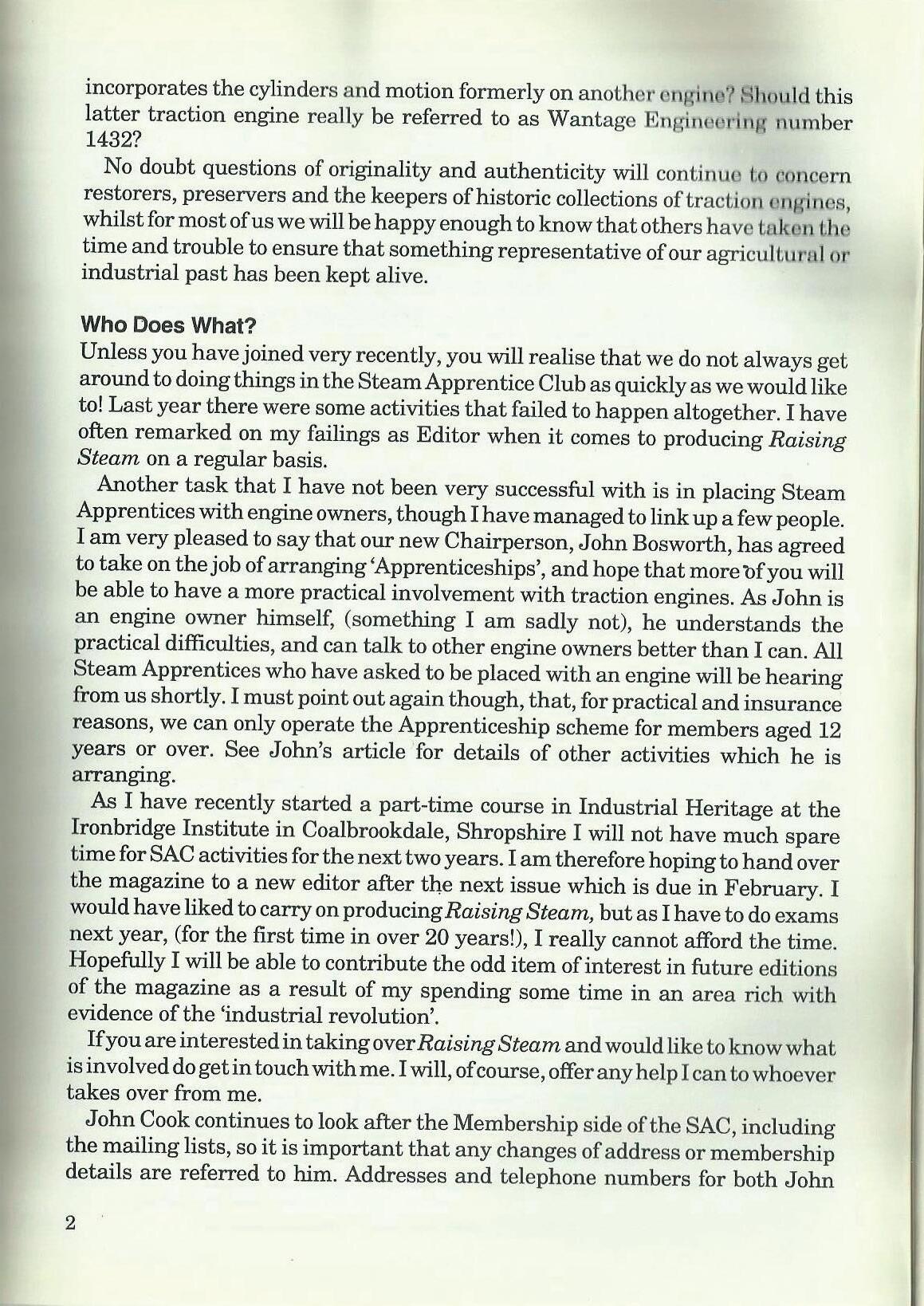
Firebox end of Ruston, Proctor & Co. Ltd.12NHPportableengineNo.18188 of 1894, showing twin cylinders, gauge glass and regulator.
Seen by the Editor at Birmingham Science Museum on a field trip from Ironbridge.
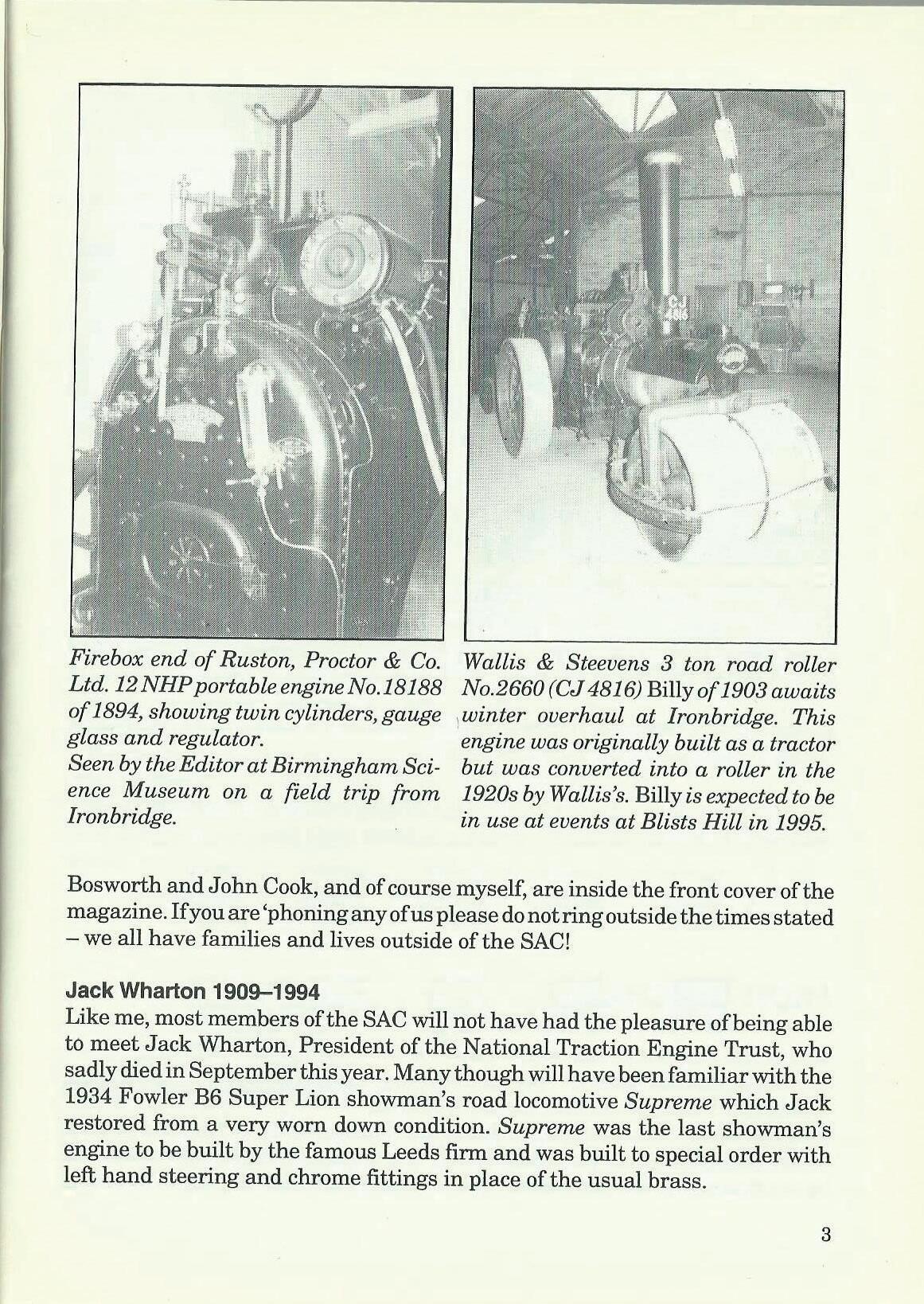
Wallis & Steevens 3 ton road roller No.2660 (CJ 4816) Billy of 1903 awaits 1winter overhaul at Ironbridge. This engine was originally built as a tractor but was converted into a roller in the 1920s by Wallis's. Billy is expected to be in use at events at Blists Hill in 1995.
Bosworth and John Cook, and of course myself, are inside the front cover of the magazine. If you are 'phoning any of us please do not ring outside the times stated -we all have families and lives outside of the SAC!
Like me, most members of the SAC will not have had the pleasure of being able to meet Jack Wharton, President of the National Traction Engine Trust, who sadly died in September this year. Many though will have been familiar with the 1934 Fowler B6 Super Lion showman's road locomotive Supreme which Jack restored from a very worn down condition. Supreme was the last showman's engine to be built by the famous Leeds firm and was built to special order with left hand steering and chrome fittings in place of the usual brass.
Fowler B6 Super Lion Showman's road loco No.20223 (EU 5313) Supreme of 1934at Upton-upon-Severn Rally in July 1990. This engine was acquired by Jack Wharton in 1958 in very poor condition and rebuilt over a twelve year period.
A skilled engineer and founder member of what was to become the National Traction Engine Trust, Jack was also a supporter of the Scouts and raised thousands of pounds for cancer research and other charities. Jack will be greatly missed by his family and all who knew him.
Assuming that this edition gets posted in time, may I wish you all SEASONS GREETINGS and a HAPPY NEW YEAR!
One of the benefits of being a member of the Steam Apprentice Club is 'special club visits, events and training weekends', see back cover of
Steph Gillett, December 1994 Raising Steam. I am arranging a visit to the National Railway Museum at York in the early part of the new year, (possibly first week in April), date and cost will be announced in the next issue of the magazine. I am hoping to have an
introduction by one of the museum staff and tea and biscuits before you leave for home. This will be a good opportunity for you to view the exhibits of the NRM and for me to get to know some of the SAC members.
The provisional date for a Steam Apprentices Training Weekend is 6/7 May 1995. The venue will be Draycottin-the-Clay near Uttoxeter, further details and cost in the next issue.
Michael Davis, Chair of the NTET Engine Owners Committee has told me that they are also runnihg a training weekend in May, at Murton near York. Michael will take Steam Apprentices at this event who are aged 18 or over.
I am writing to pumping station and mill engine sites to ask if they are interested in having Steam Apprentices to help maintain the engines, etc. I'm sure they could do with some help, any volunteers? Contact me if you are interested.
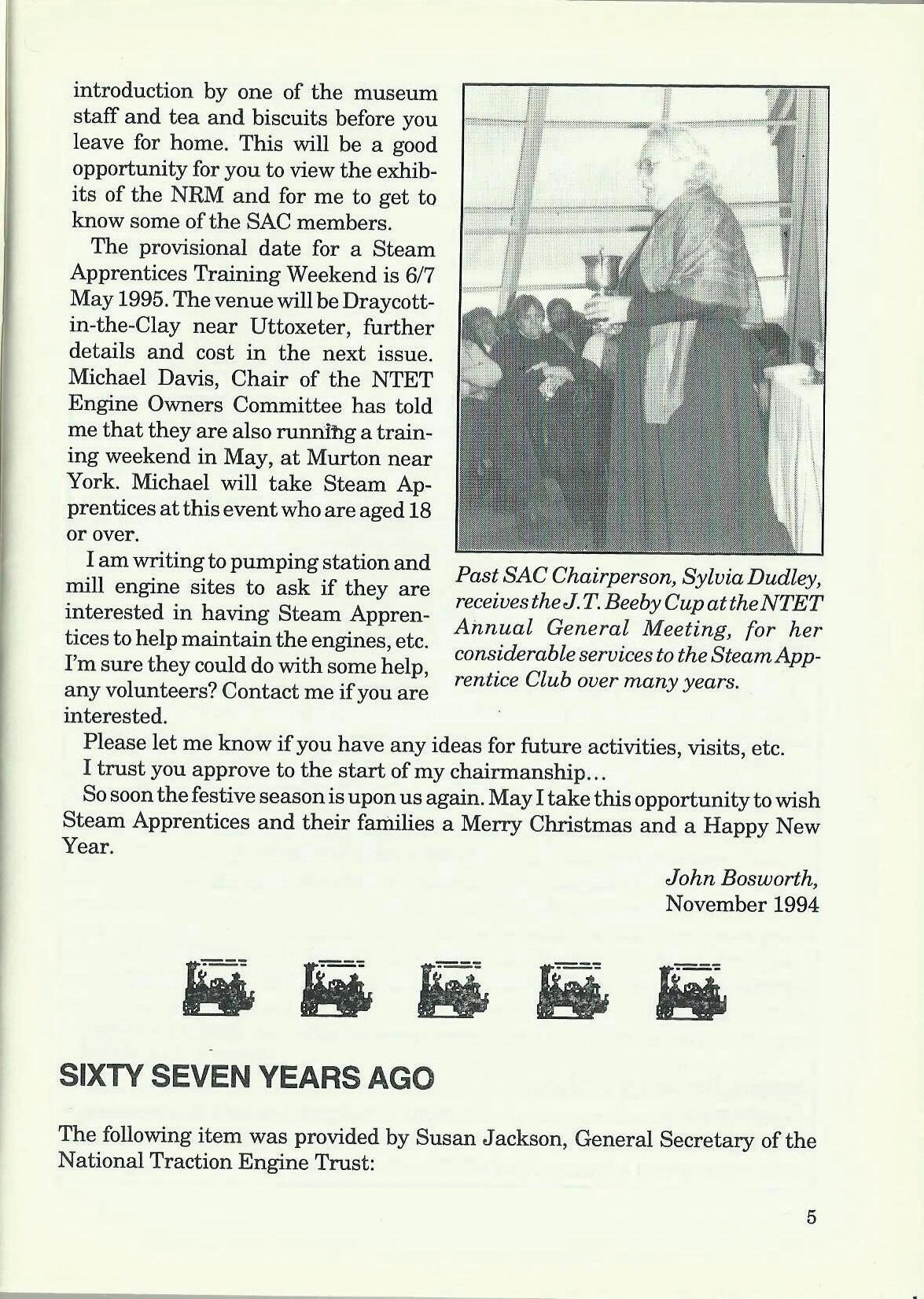
Past SAC Chairperson, Sylvia Dudley, receivestheJ. T. Beeby Cup at theNTET Annual General Meeting, for her considerable services to the SteamApprentice Club over many years.
Please let me know if you have any ideas for future activities, visits, etc. I trust you approve to the start of my chairmanship ...
So soon the festive season is upon us again. May I take this opportunity to wish Steam Apprentices and their families a Merry Christmas and a Happy New Year.
John Bosworth, November 1994
The following item was provided by Susan Jackson, General Secretary of the National Traction Engine Trust:
constituent companies. Excelsior was built during the existence of AG1•1a,,rl iH thus plated on the smokebox to that, oflcwL.
With hoHL Anthony< )n11ll8 1 Aberystwylh. l>yfod
Dear Steph,
My main reason for writing is in case yntt J111v,, nul 11•1•rnv t1 ,,
I ho mysteryofthelogoon thewheelhubsofthc B1u1MII 111ll1 1 1 r 111t1 In h11111 l,oing an expert and have not yet got either oftho lhn n·II h1111kpto, 1111f1t1t111ll I lu 1 fiu:Ls but from the books available to me this is wlmt I 1lturuv1H ml
AGE stands for Agricultural and Genoral 1 I ,tll •1Ii I , m was founded by a Mr. Maconochiein 1919andwaR bm-1icull:v11111t111ulu111u1tltnn ofm1ch firms as Burrells, Aveling and Porter, Garretti-;, ,J ,~ 1 4' I lown, 11uurl H11rford & Perkins with each company still producing their own pr 111111,ll,1 111 t l1111r own name. Mr Maconochie was later replaced by G.E. ltowl,11111whu ''wl11111u--dhis fellow directors into abject submission". The final showd11w11r•u11111111 I u:10 with Rowland disappearing. Fortunately for him at least Mr·Httdn1 t1 Wlltl uhl11to reestablish his company which he combined with Avelinr, 111111I'm fm· to form Aveling and Barford Ltd. This business is of course still t.1'1,di11Htlu111Hli ,l has passed through the hands of several owners since then and 11ton, nl 11g,., whilst in the ownership of British Leyland, it was combined with Mnnd 1tdlu nrtA VC'IingMarshall Ltd.
Ihopethisofuse to you and have enclosed a photo of a similnr lop,uon I he•front of Burrell showman's engine N o.3888 General Gough takon II t. U1P C r1111t. I >orset in 1989.
Yours sincerely,
Stuart Gaines Wickham, Hants.
Dear Sir,
My name is Christopher Holden, aged 7 years. I joined the SAC nt tho 1994 Great Dorset Show.
I am very lucky to know Mr Tony Slingsby, who is teaching mo nbout his two steam engines. I spent lots of time last year with Tony, who baa an 1876 Marshall called Baldrick, and a 1917 Foden steam wagon.
Tony has taught me how to light the fire, and check the damper, also where the oil goes, he has given me my own oil can. I also have to learn the names of the parts of the engine.
We have been threshing with the traction engine, and doing road runs with the steam wagon. I have had my first bacon sandwich cooked on Tony's fire shovel it tasted great.
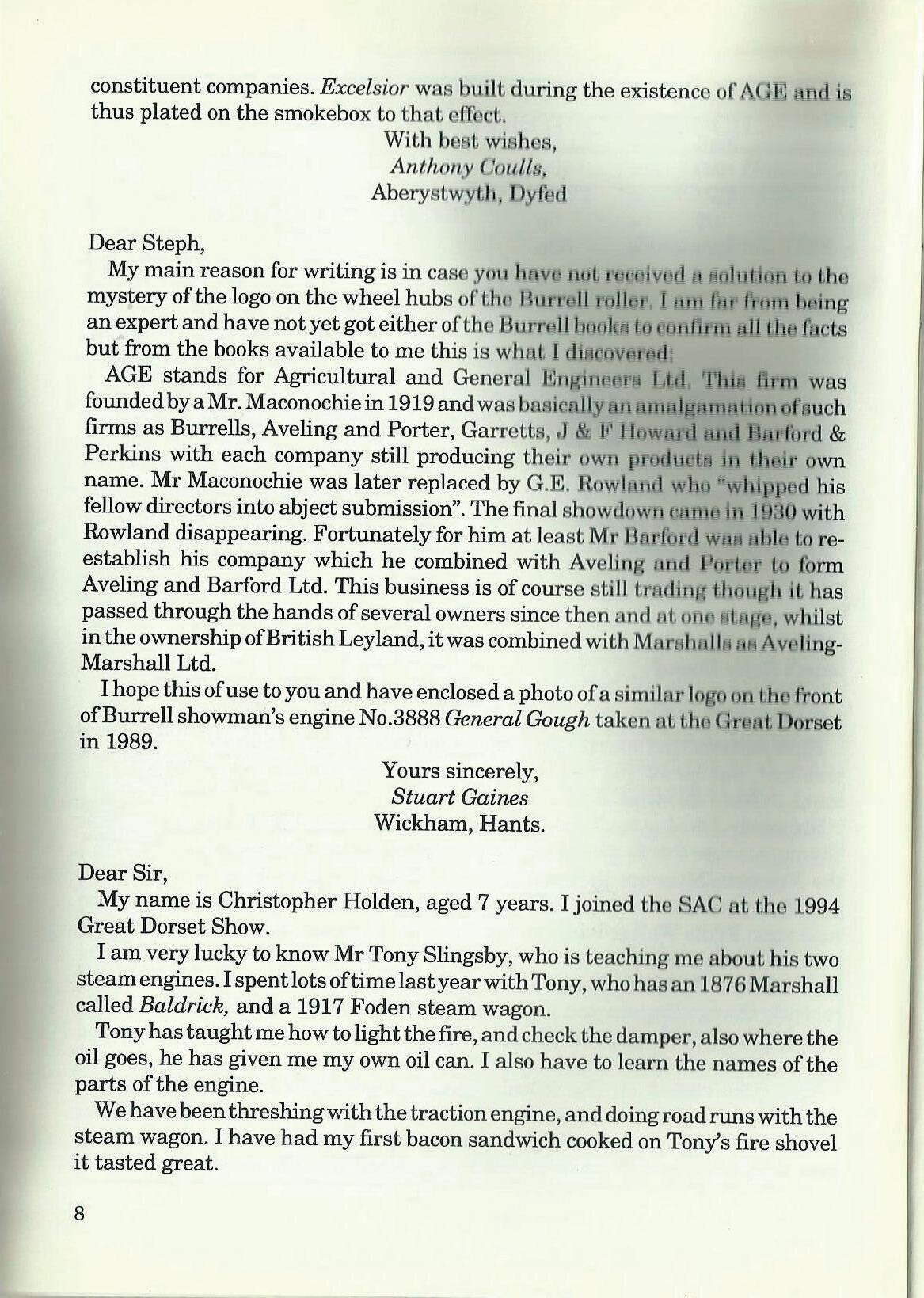
Burrell 8 ton road roller No.3456 (WR 9084) of 1913 at Ysgethin (photo-AnthonyCoulls)
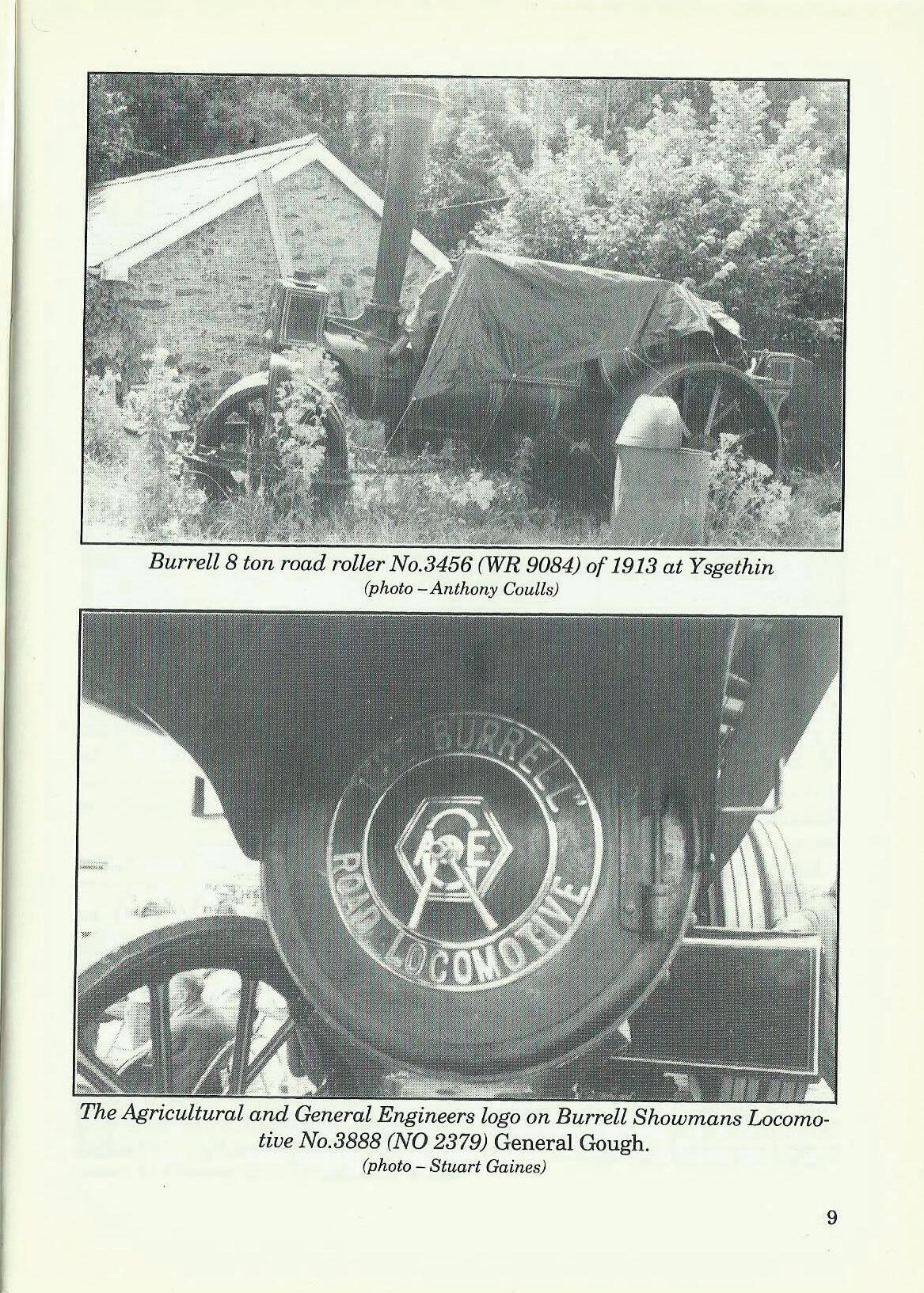
The Agricultural and General Engineers logo on Burrell Showmans Locomotive No.3888 (NO 2379) General Gough. (photo-StuartGaines)
constituent companies. Excelsior wn.Rbuilt during the existence of A(;l 4 ~ 1111rl h~ thus plated on the smokebox to thni fT£wL.
With h HLwiHhcs, Anthony <!nil/IH, . AberyaLwyl.11,IJyfi d
Dear Steph,
My main reason for writing is in caso you hnv1111111 , t•t'l'tvi,d 11 th1l11f 1011 lo 1.110 mystery of the logo on the wheel hubs of Uw 1111111 II , hll11, I 11111Ou I, 11111h, 1 1ng an expert and have not yet got either oft.he B11l'rullIJtmlrnI1111111.h, 111 ull thu fiu:t,s but from the books available to me this is wl111I. I rJ111( 11vn1 t,,t
AGE stands for Agricultural and Genornl l•!ng1111'1 ltl 1,td 'l 1 lth1 ft, 111 was founded by a Mr. Maconochie in 1919 and was buHir.n lly ru 1,rn 111IHJtmu f firms as Burrells, Aveling and Porter, Garrette, ,I ,~ 1 1 ' U11wn1,I urn I 11111ford & Perkins with each company still producing their own p1111lw fr1 111 thNr own name. Mr Maconochie was later replaced by G.E. Rowl11rnl who "wlur111rnlhis fellow directors into abject submission". The final showdown 1•111111,tu I u:u,with Rowland disappearing. Fortunately for him at least, M ,. llt1rf111 cl w1rn ul,lc•to reestablish his company which he combined with Avoling 1111cl Pnrt,u· lo form Aveling and Barford Ltd. This business is of course still t,rrnl1n1t t ho11J{l1it has passed through the hands of several owners since then und 11t 0111 111fll{M, whilst in theownershipofBritishLeyland, it was combined with Mun1l11dln1111AvPlingMarshall Ltd.
I hope this of use to you and have enclosed a photo of a sirn'il11rlogo 1111I he•front of Burrell showman's engine No.3888 General Gough taken nt U1cC n II t, I >orset in 1989.
Yours sincerely,
Stuart Gaines Wickham, Hants.
Dear Sir,
My name is Christopher Holden, aged 7 years. I joined the SAO nt tho 1994 Great Dorset Show.
I am very lucky to know Mr Tony Slingsby, who is teaching mo about his two steam engines. I spent lots of time last year with Tony, who has an l 876 Marshall called Baldrick, and a 1917 Foden steam wagon.
Tony has taught me how to light the fire, and check the damper, also where the oil goes, he has given me my own oil can. I also have to learn the names of the parts of the engine.
We have been threshing with the traction engine, and doing road runs with the steam wagon. I have had my first bacon sandwich cooked on Tony's fire shovel it tasted great.
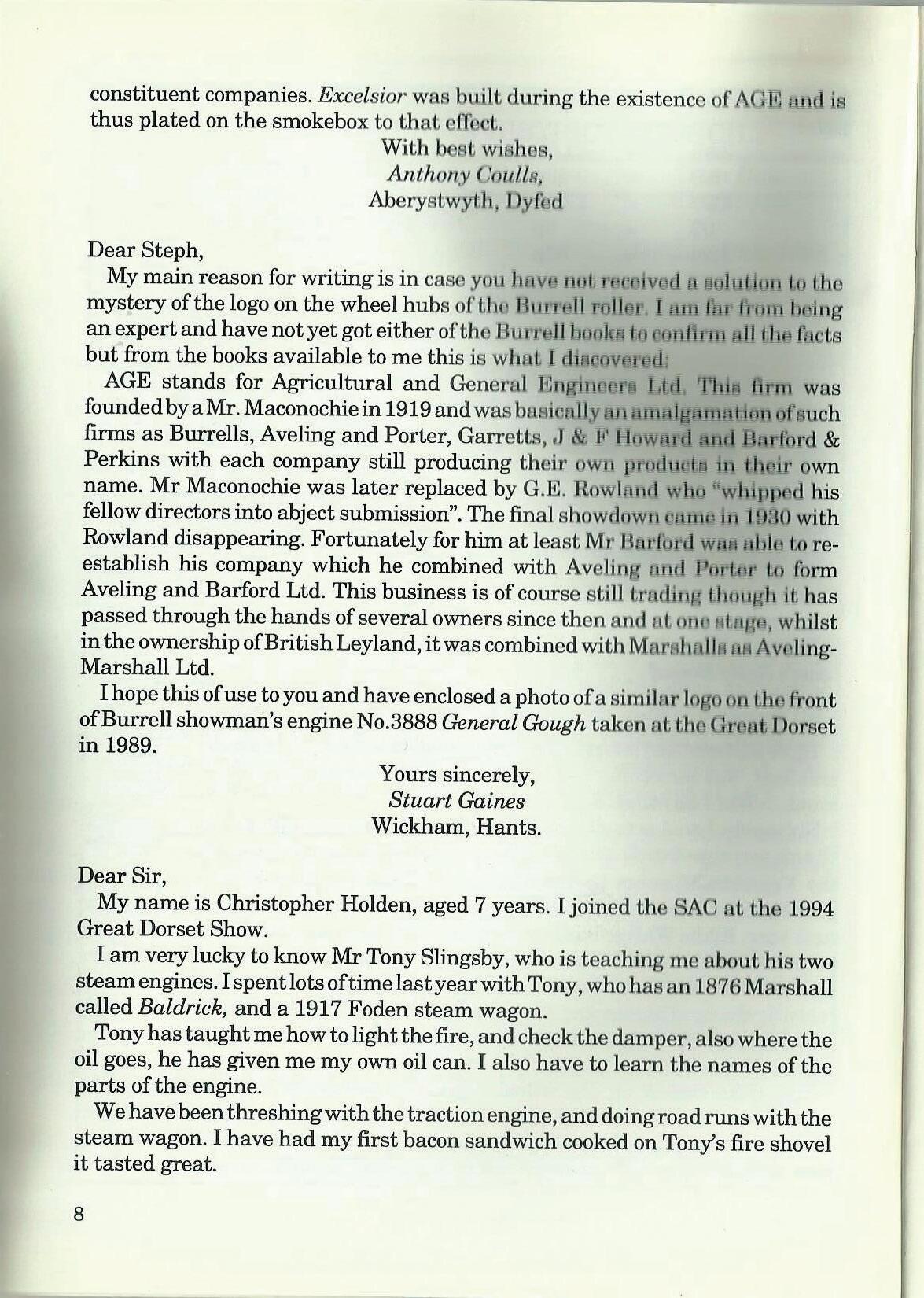
Burrell 8 ton road roller No.3456 (WR 9084) of 1913 at Ysgethin (photo-AnthonyCoulls)
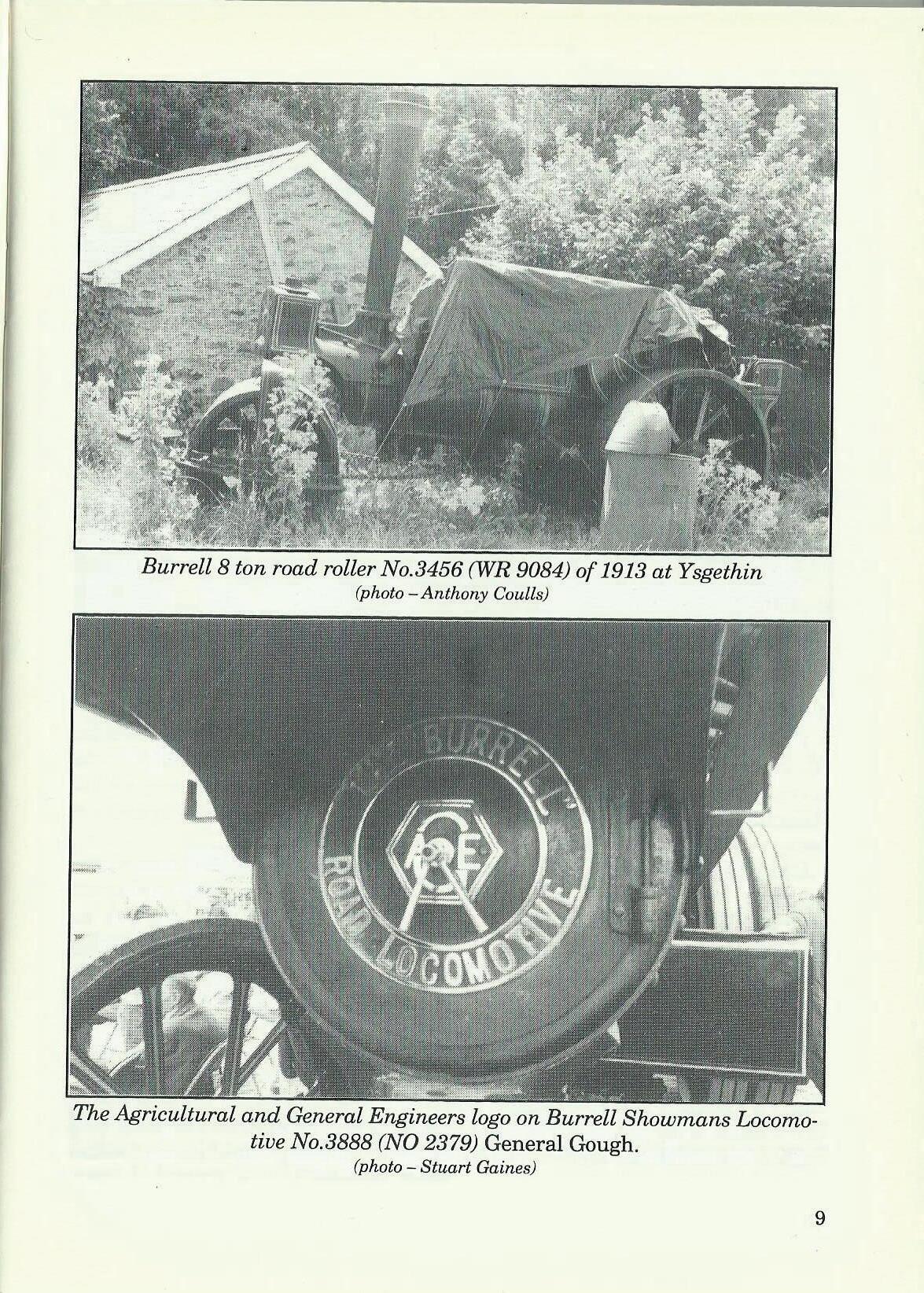
The Agricultural and General Engineers logo on Burrell Showmans Locomotive No.3888 (NO 2379) General Gough. (photo - StuartGaines)
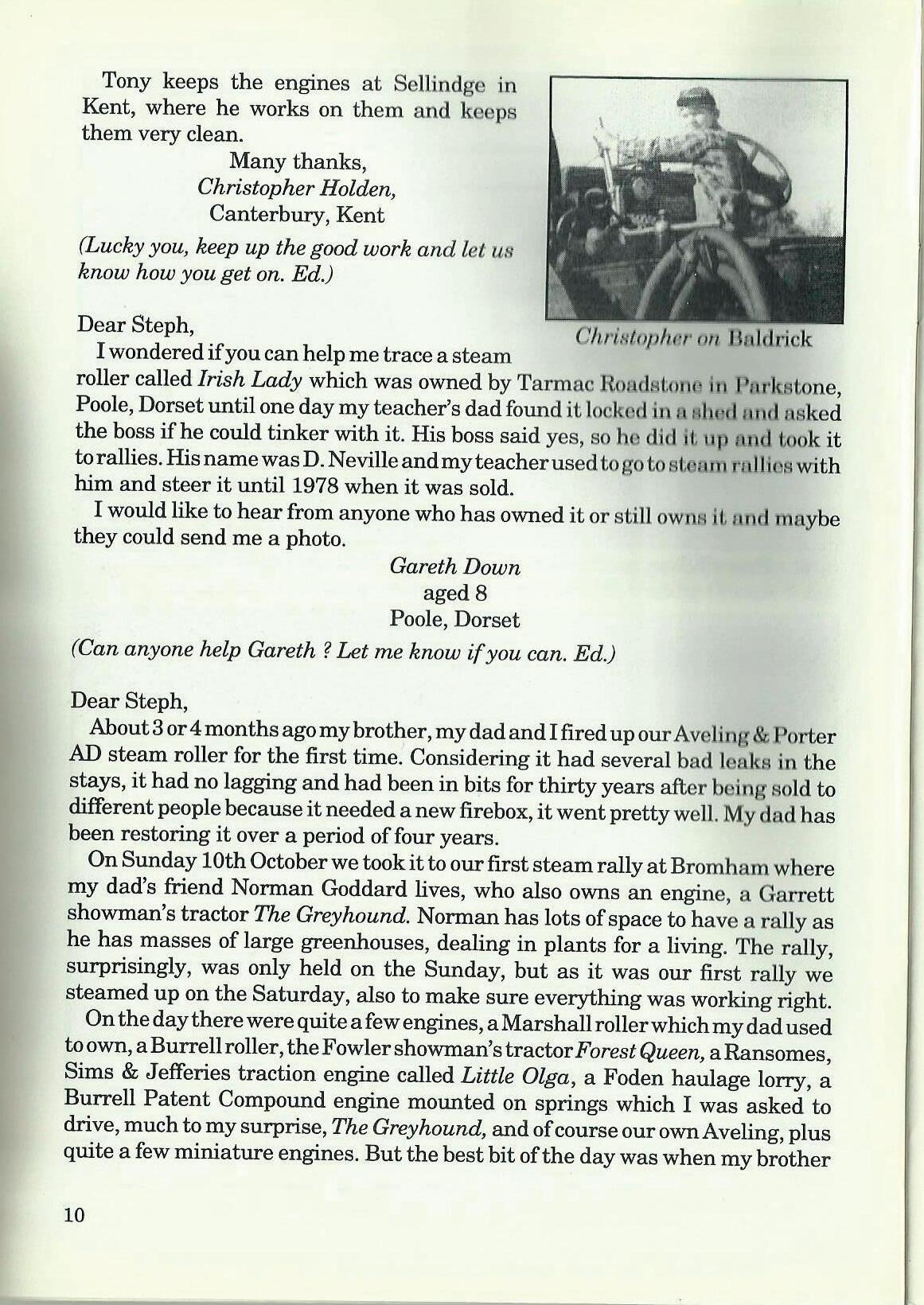
Tony keeps the engines at Sel1indge in Kent, where he works on them and keeps them very clean.
Many thanks,
Christopher Holden, Canterbury, Kent
(Lucky you, keep up the good work and let us know how you get on. Ed.)
Dear Steph, Chriulo11h,·r,111 Bnlrlrick
I wondered if you can help me trace a steam roller called Irish Lady which was owned by Tarmac Ro11clHtorn·111 P11drnLone, Poole, Dorset until one day my teacher's dad found it lockod in r, nl11•tlrnul nt:iked the boss if he could tinker with it. His boss said yes, so lw di<l it 11p nncl took it to rallies. His name was D. Nevilleandmyteacherused togotoat .•mu ntlli< H with him and steer it until 1978 when it was sold.
I would like to hear from anyone who has owned it or still OWHH iLnnrl maybe they could send me a photo.
Gareth Down aged8 Poole, Dorset (Can anyone help Gareth ? Let me know if you can. Ed.)
Dear Steph,
About 3 or 4 months ago my brother, my dad and I fired up our Ave1i 1111& I>orter AD steam roller for the first time. Considering it had several bad lc}t\kliin the stays, it had no lagging and had been in bits for thirty years after being Roldto different people because it needed a new firebox, it went pretty we1l.My dad has been restoring it over a period of four years.
On Sunday 10th October we took it to our first steam rally at Bromham where my dad's friend Norman Goddard lives, who also owns an engine, a Garrett showman's tractor The Greyhound. Norman has lots of space to have a rally as he has masses of large greenhouses, dealing in plants for a living. The rally, surprisingly, was only held on the Sunday, but as it was our first rally we steamed up on the Saturday, also to make sure everything was working right.
On the day there were quite a few engines, a Marshall roller which my dad used to own, a Burrell roller, the Fowler showman's tractor Forest Queen, a Ransomes, Sims & Jefferies traction engine called Little Olga, a Foden haulage lorry, a Burrell Patent Compound engine mounted on springs which I was asked to drive, much to my surprise, The Greyhound, and of course our own Aveling, plus quite a few miniature engines. But the best bit of the day was when my brother
and I drove our roller on our own, with dad watching from the ground. So all in all a very good show!
Yours sincerely,
James Cummins, Badminton, Avon
(Sounds great, and good to hear of yet another engine back in steam. Ed.)
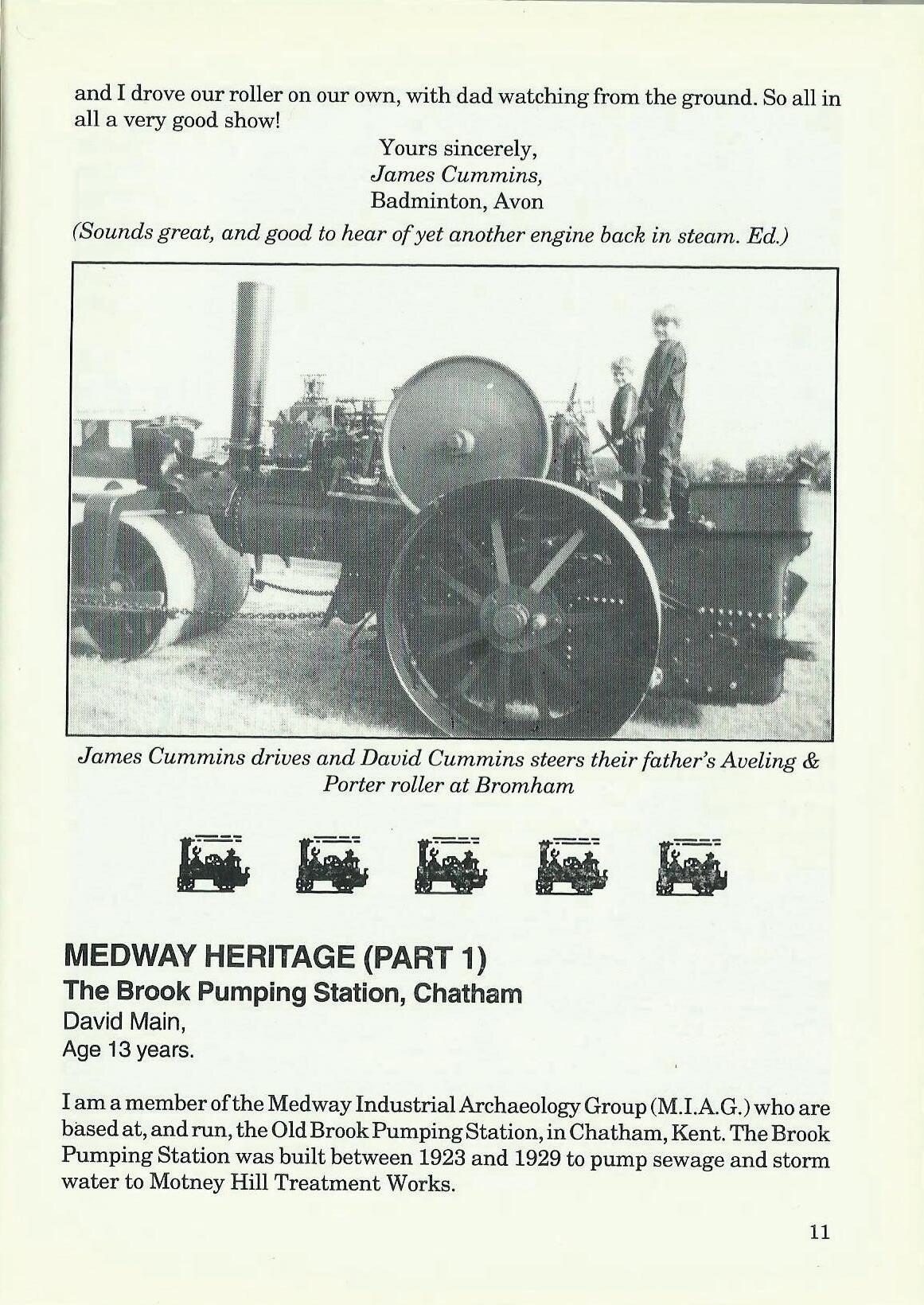
James Cummins drives and David Cummins steers their father's Aveling & Porter roller at Bramham
The Brook Pumping Station, Chatham
David Main, Age 13 years.
I am a member of the Medway Industrial Archaeology Group (M.I.A.G.) who are based at, and run, the Old Brook Pumping Station, in Chatham, Kent. The Brook Pumping Station was built between 1923 and 1929 to pump sewage and storm water to Motney Hill Treatment Works.
Underneath the Engine Hall is a sump, which can contain half a million gallons. It's foundations go through the bed of the Brook, 25 metres below.
The two main engines are Campbell diesel engines, which were inAtallod in 1926, with the building being constructocl around thorn. They were suppli< d as amatchingpair, with serial numbers 1:36l3 and 13514,which are rated utl56hp, driving 14 inch unchokable pumps capable of vurn ping 260,000 gal 10111-.pm· hour.
The Brook Pumping Station closed in 1H79 nnd wnA l,nkon ovPr hy the Now Brook Pumping Station on the opposite sido of Llw Brouk. II. wnM <liHconnocied from the main sewage system but it was ropairod, nlHtorocl n11ddo11nod up by M.I.A.G., and is now fully operational as a rnuH011m.
Other engines include a Hayward Tyler hot air ongiiw, iirnl,11lloclin 1898 at a large house in Wateringbury, near Maidstone, to pun1p w11t1·rfru111H private well to a large house to a brewery and it is believed it last worl<c1cI l,lu 1rc•i 11 l.hb 1930s. It was donated to M.I.A.G., and has been restored at tho Hn,ol\, It. n1n be seen working most Saturdays.
There is also a Q type Aveling and Porter diesel ro11u·,HOl(l t.o Rochester Corporation in 1925. The original engine was Blackstone EHI, which developed 26 bhp at 265 rpm. This engine was later converted to type l~BK, and in this uprated form delivered 28 bhp. The roller is 16 feet long, 7 foot w ido, u 11d weighs 13 tons. The engine is similar in appearance to steam rollers with LhoBlackstone engine's exhaust pipe inside the chimney.
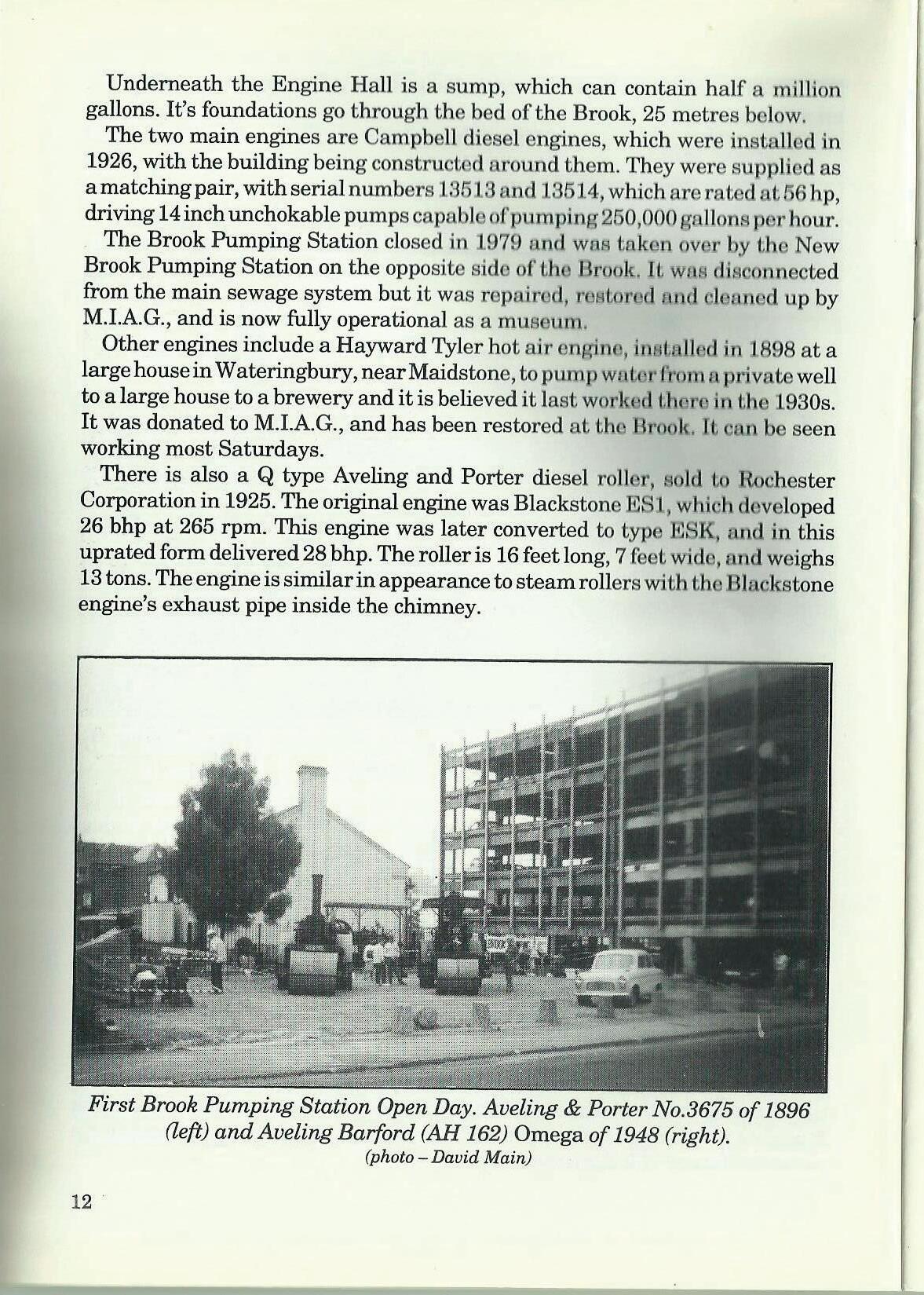
First Brook Pumping Station Open Day. Aveling & Porter No.3675 of 1896 aeft) and Aveling Barford (AH 162) Omega of 1948 (right). (photo-DavidMain)
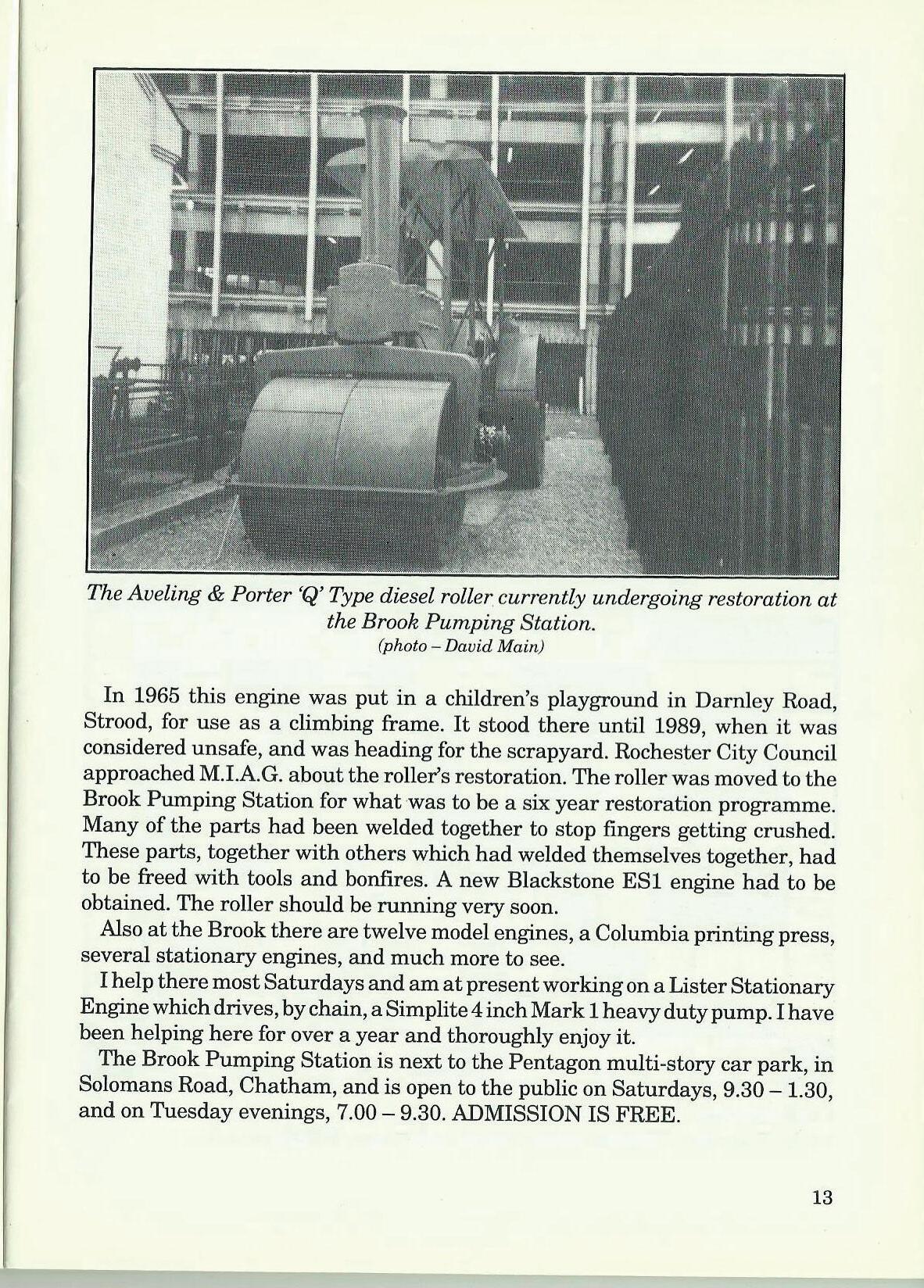
The Aveling & Porter 'Q' Type diesel roller currently undergoing restoration at the Brook Pumping Station.
In 1965 this engine was put in a children's playground in Darnley Road, Strood, for use as a climbing frame. It stood there until 1989, when it was considered unsafe, and was heading for the scrapyard. Rochester City Council approached M.I.A.G.about the roller's restoration. The roller was moved to the Brook Pumping Station for what was to be a six year restoration programme. Many of the parts had been welded together to stop fingers getting crushed. These parts, together with others which had welded themselves together, had to be freed with tools and bonfires. A new Blackstone ESl engine had to be obtained. The roller should be running very soon.
Also at the Brook there are twelve model engines, a Columbia printing press, several stationary engines, and much more to see.
I help there most Saturdays and am at present working on a Lister Stationary Engine which drives, by chain, a Simplite 4 inch Mark 1 heavy duty pump. I have been helping here for over a year and thoroughly enjoy it.
The Brook Pumping Station is next to the Pentagon multi-story car park, in Solomans Road, Chatham, and is open to the public on Saturdays, 9.30-1.30, and on Tuesday evenings, 7.00 - 9.30. ADMISSION IS FREE.
Lee Chadderton has kindly provided another crossword for you to try, but wants to know how you like the pu,zzle8 - are they too easy or too hard? (Lee is currently writing about the rebuild nlhis 4 1I:1inch Burrell after a new boiler and firebox and will send us a copy for Raising 8t.oum. He says he is having a real struggle as he's not an engineer and his toot.1.1r:onsi.lit of a spanner, screwdriver and a lump hammer!)
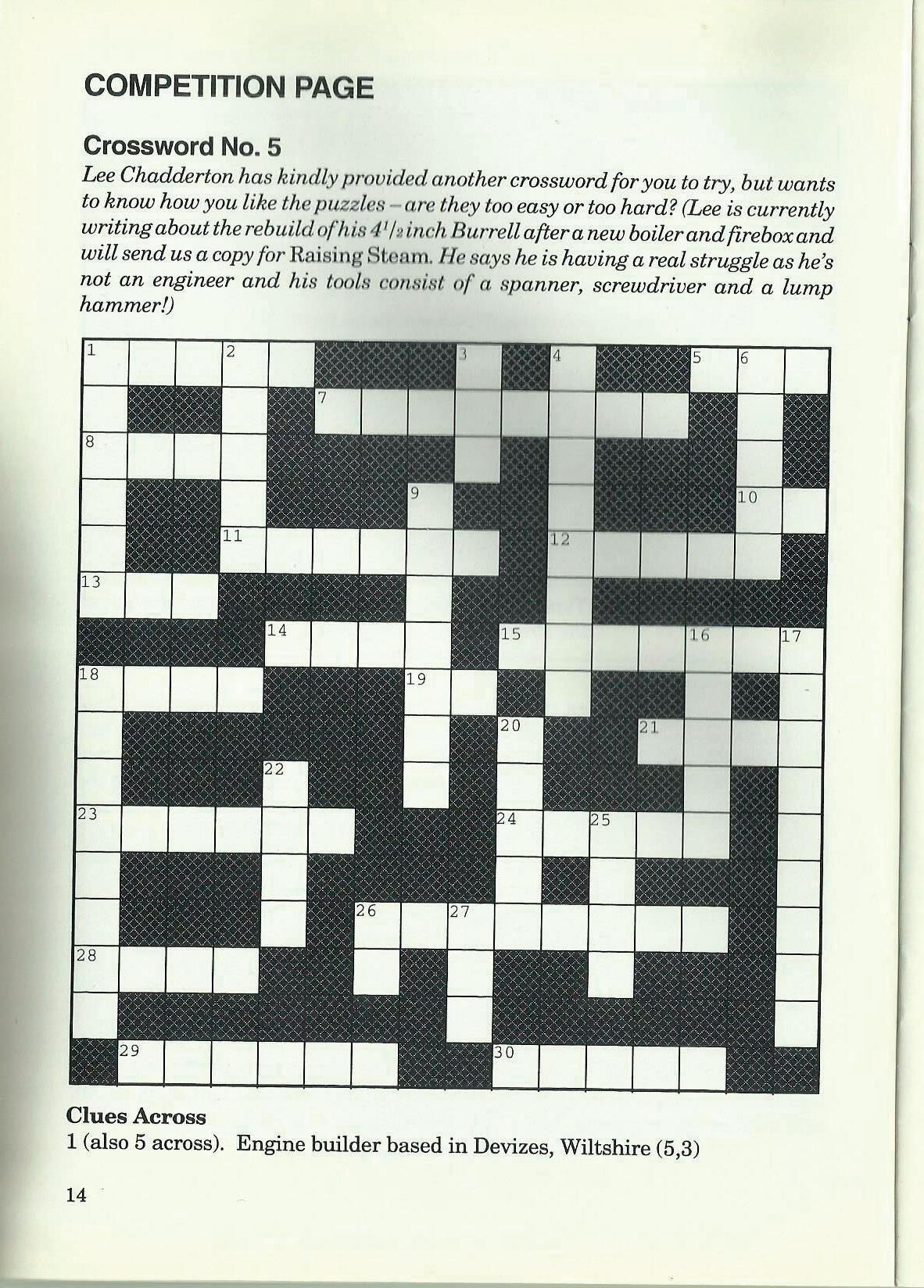
Across 1 (also 5 across). Engine builder based in Devizes, Wiltshire (5,3)
5 (also 1 across). Builders of Engine No.8742 General Buller (5,3)
7. Magazine of National Traction Engine Trust (8)
8. World-wide Steam Organisation (Abbr.) (4)
10. Class of Fowler ploughing engine (2)
11 (also 9 down). Engine builder based in Lincoln (6,7)
12. Town where Fowlers and McLaren were based (5)
13. Connecting, welding and fishing --(3)
14. ---Patent Steam Cart & Wagon Co. Ltd. (4)
15. 23 Across was based here (7)
18. Blast, steam and hose ---(4)
19. A class of Sentinel Wagon (2)
21. Device in firebox crown to prevent water getting too low (2nd word only) (4)
23. Engine builder that made 'The Little Giant' range (6)
24. You will find these around a showman's canopy (5)
26. Engine builders based in the 'Orwell Works', Ipswich, Suffolk (1st word only) (8)
28. Lighting device on front/rear of engine (4)
29. Device on engine for raising steam faster (6)
30 (also 25 down). Residue left in boilers (4,5)
Clues Down
1. Coal storage area on engine (6)
2. Liquid put in boilers (5)
3. The Club you're all in (3)
4. Valve on an engine used on compound engines when the crank is top dead centre (8)
6. World Travelled B6 Fowler once owned by Norman E. Box (5)
9 (also 11 across). Engine builder who merged with Proctor Co. Ltd. in 1919 (7)
16. Showman's generate electricity measured in this (5)
17. The 'Stop & Go' control on an engine (9)
20. Sweeping these in the morning helps the fire burn (5)
22. A way of repairing/joining metal (4)
25 (also 30 across). Hard, harmful deposit in boilers, worse in soft water areas (4,5)
26. Fowler's Repulse I Renown are this class (2)
27. Nominal Horse Power (Abbr.) (3)
The first correct entry 'pulled out of a hat' on 1st March will receive a small prize. Good luck, and do let me know if you like the crossword puzzles. (Write your solutions on a separate sheet, or photcopy this page, if you don't want to spoil the magazine)
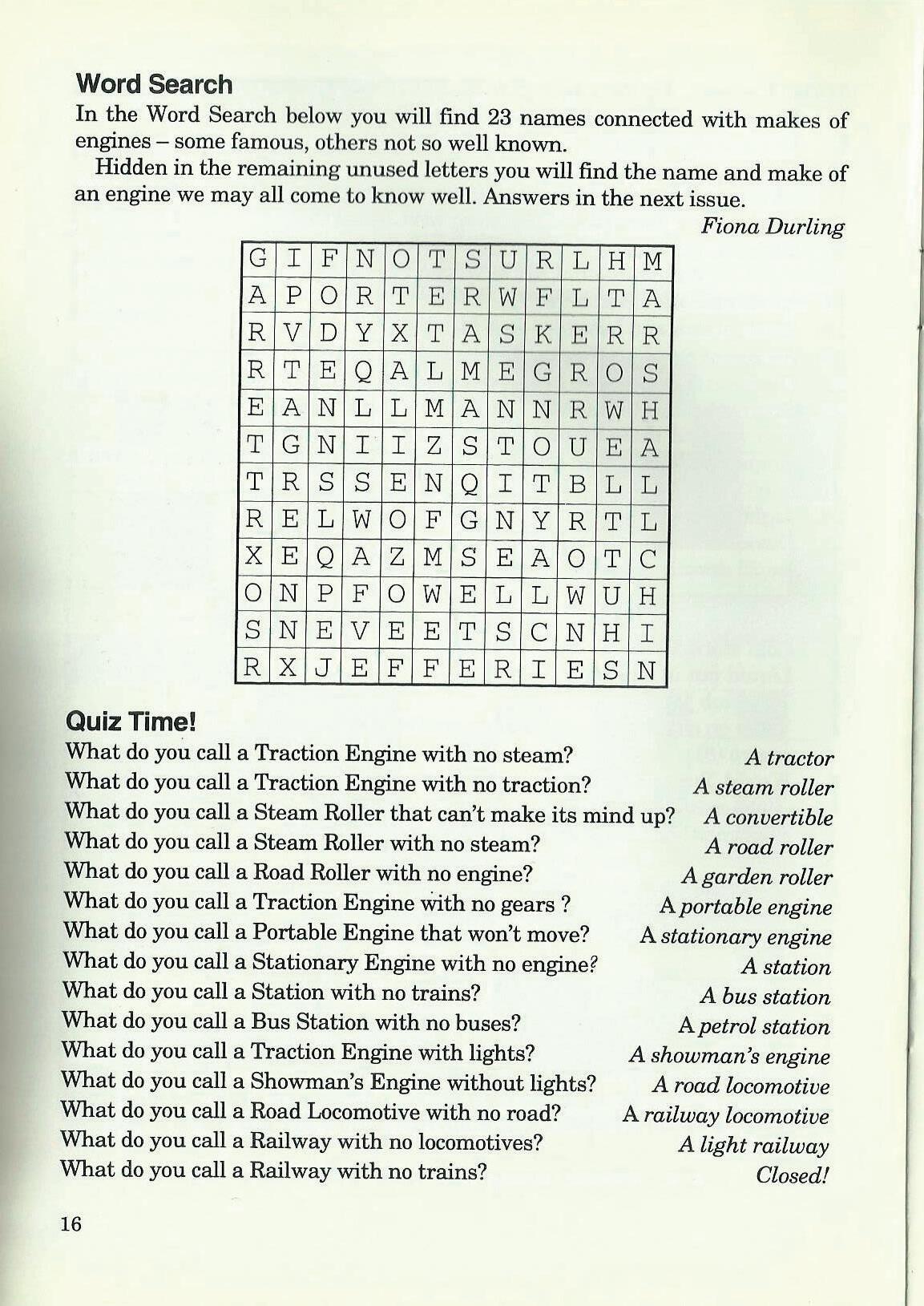
In the Word Search below you will find 23 names connected with makes of engines - some famous, others not so well known. Hidden in the remaining unused letters you will find the name and make of an engine we may all come to know well. Answers in the next issue.
G I F N 0 T s u R L
A p 0 R T E R w F L
R V D y X T A s K E
R T E Q A L M E G R
E A N L L M A N N R T G N I I z s T 0 u
T R s s E N Q I T B
R E L w 0 F G N y R
X E Q A z M s E A 0
0 N p F 0 w E L L w
s N E V E E T s C N
R X J E F F E R I E
What do you call a Traction Engine with no steam?
What do you call a Traction Engine with no traction? Fiona Durling
What do you call a Steam Roller that can't make its mind up?
What do you call a Steam Roller with no steam?
What do you call a Road Roller with no engine?
What do you call a Traction Engine with no gears ?
What do you call a Portable Engine that won't move?
What do you call a Stationary Engine with no engine?
What do you call a Station with no trains?
What do you call a Bus Station with no buses?
What do you call a Traction Engine with lights?
What do you call a Showman's Engine without lights?
What do you call a Road Locomotive with no road?
What do you call a Railway with no locomotives?
What do you call a Railway with no trains?
convertible
road roller
garden roller
portable engine
stationary engine A station
A bus station A petrol station A showman's engine A road locomotive A railway locomotive A light railway Closed!
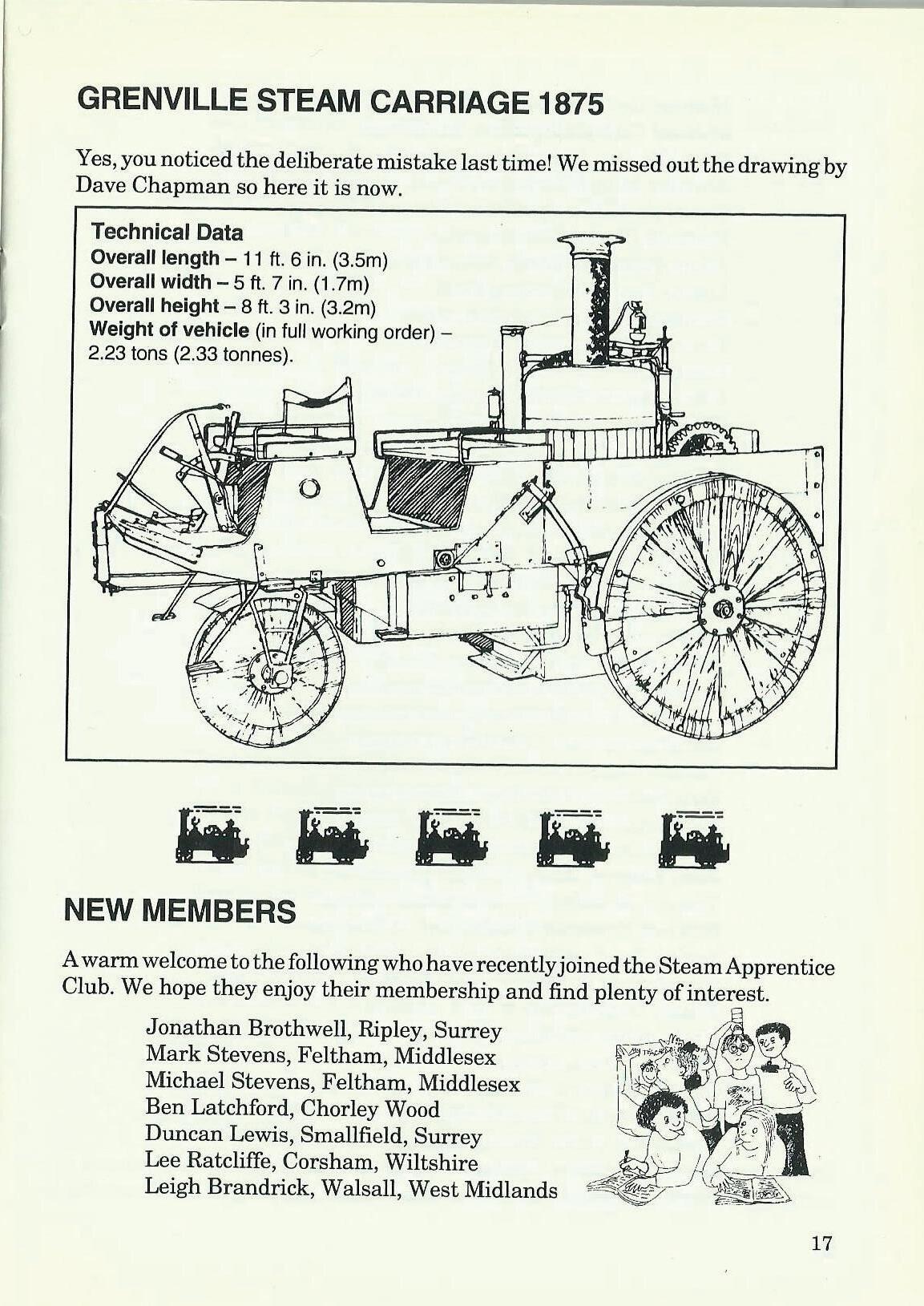
Yes, you noticed the deliberate mistake last time! We missed out the drawing by Dave Chapman so here it is now.
Technical Data
Overall length - 11 ft. 6 in. (3.5m)
Overall width - 5 ft. 7 in. (1.7m)
Overall height - 8 ft. 3 in. (3.2m)
Weight of vehicle (in full working order)2.23 tons (2.33 tonnes).
A warm welcome to the following who have recently joined the Steam Apprentice Club. We hope they enjoy their membership and find plenty of interest.
Jonathan Brothwell, Ripley, Surrey
Mark Stevens, Feltham, Middlesex
Michael Stevens, Feltham, Middlesex
Ben Latchford, Chorley Wood
Duncan Lewis, Smallfield, Surrey
Lee Ratcliffe, Corsham, Wiltshire
Leigh Brandrick, Walsall, West Midlands
Michael Griffiths, Nelson, Mid Glamorgan, Wales
Michael Coffey, Edgeware, Middlesex
David Brown, Haslington, Cheshire
Jennifer Milns, Burton on Trent, Derbyshire
Jonathan Milns, Burton on Trent, Derbyshire
Renauld Clarke, Southampton
Adam Paterson, Leeds, West Yorkshire
Louise Foord, Smarden, Kent
Samantha Foord Smarden, Kent
Hannah Nutley, Romford, Essex
Daniel Humble-Smith, Seaton, Devon
Ritz Handels GmbH, Bremen, Germany
George Drewitt, Epsom, Surrey
Adam Hackett, Ashton-u-Lyne, Lancashire
Michael Smith, Worcester
Gareth Pearson, Didcot, Oxfordshire
Sam Pearson, Didcot, Oxfordshire
Jed Pearson, Didcot, Oxfordshire
Joe Marchant, Lynton, North Devon
Alison Roper, Penrith, Cumbria
Christopher Holden, Canterbury, Kent
Sarah Auger, Whisby Moor, Lincoln
Andrew Auger, Whisby Moor, Lincoln
Christopher Field, Broadstone, Dorset
Christopher Bell, Glentham, Lincoln
Joanna Cheater, Swindon, Wiltshire
Tom Harrison, Llandogo, Gwent, Wales
Johnson Holly, Bakewell, Derbyshire
Oram Family, Hungerford, Berkshire
John Flinton, Retford, Nottinghamshire
Thomas Rowland, Teddington, Middlesex
Edward Rowland, Teddington, Middlesex
Louise Brudenell, Gosport, Hampshire
Christopher Brown, Bournemouth
Emma Day, Ossett, West Yorkshire
Christopher Gilham, Aylsham, Norfolk
Susan Gilham, Aylsham, Norfolk
Jonathan Dacre, Pudsey, West Yorkshire
Jessica Penn, Boroughbridge
Samantha Penn, Boroughbridge
Andrew Hebden, Leeds
Sarah Winter, Ossett, West Yorkshire
Gareth Johns, Chesterfield, Derbyshire
Lee Puddifoot, Sawston, Cambridgeshire
Jamie Berry, Bourne, Lincolnshire
Muhmer Family, Stowmarket, Suffolk
Paul Sampson, Lowestoft, Suffolk
Christopher Cambage, Boroughbridge
Jonathan Tilling, Farringdon, Oxfordshire
Nicola Cave, Morpeth, Northumberland
Steven Rudd, Wincanton, Somerset
Luke Birch, Frampton Cotterell, Avon
Scott Fiske!, Newton Aycliffe, Co. Durham
Stephen Wood, Pudsey, West Yorkshire
Michael Wood, Pudsey, West Yorkshire
Daniel Stone, Mansfield, Nottinghamshire
Kerri Stone, Mansfield, Nottinghamshire
Kevin Walshe, Driffield, North Humberside
Alexander Dando, Chipping Sodbury, Avon
Michael Hunt, Ashford, Kent
Richard Smith, Halesowen, West Midlands
James Hussey, Chislehurst, Kent
Philip Jeffers, Belfast, Northern Ireland
Joseph Huxtable, Newport, Isle of Wight
Oliver Huxtable, Newport, Isle of Wight
Andrew Simpson, Eagley, Lancashire
Andrew Cobb, Wimborne, Dorset
Nicholas Brown, Hopwas, Staffordshire
Paul Fairall, Southbourne, Hampshire
James Foster, Didcot, Oxfordshire
Colin Stirrat, Chessington, Surrey
Colin Souza, Gourock, Scotland
Benjamin Couzens, Sleaford, Lincolnshire
Kyle Thomas, Stedham, West Sussex
James Rickards, Sleaford, Lincolnshire
Allen Anthony, Wymondham, Norfolk
Ian Hiller, South Cerney, Gloucestershire
Simon Loosley, Southend-on-Sea, Essex
Robert Little, Bedford, Bedfordshire
Christopher La Fontaine, Leamington Spa, Warwickshire
Richard Pearson, Cowbridge, South Glamorgan, Wales
William Payne, Hitchin, Hertfordshire
A warm welcome to you all, especially those of you from across the waters and borders. It is also good to see new members from my own Bristol and Avon area.
Ploughingenginesrepresentthelargestandmostpowerfulmembersof thetractionenginefamily,thisFowler881 enginebeingratedat 16nominalhorsepowercomparedwith1On.h.p.forthebiggestof theroadengines.Massive in construction,the down-to-earthfunctionaldesignof a ploughingenginerepresentsall thatwasbestin British engineeringwhensteamreignedsupreme.Althoughotherenginebuilders turnedtheirhandsto buildingploughingengines,by far the greatest •numberwerebuiltbyJohnFowler&CompanyofLeedsandtheirfamewas ') tospreadthroughouttheworld.Indeed,therearefewcountriesthatdidnot havetheirsurfacedisturbedby Fowlerengines. Workingin pairs,ploughingenginesrope-haul suchimplementsasa plough,cultivatorormole drainerto andfroacrossthefield,theengines 3 themselvesstandingclearof the areabeing cultivated A demonstrationofthecapabilities of ploughingenginesis a highlightat Stourpaine Bushes.
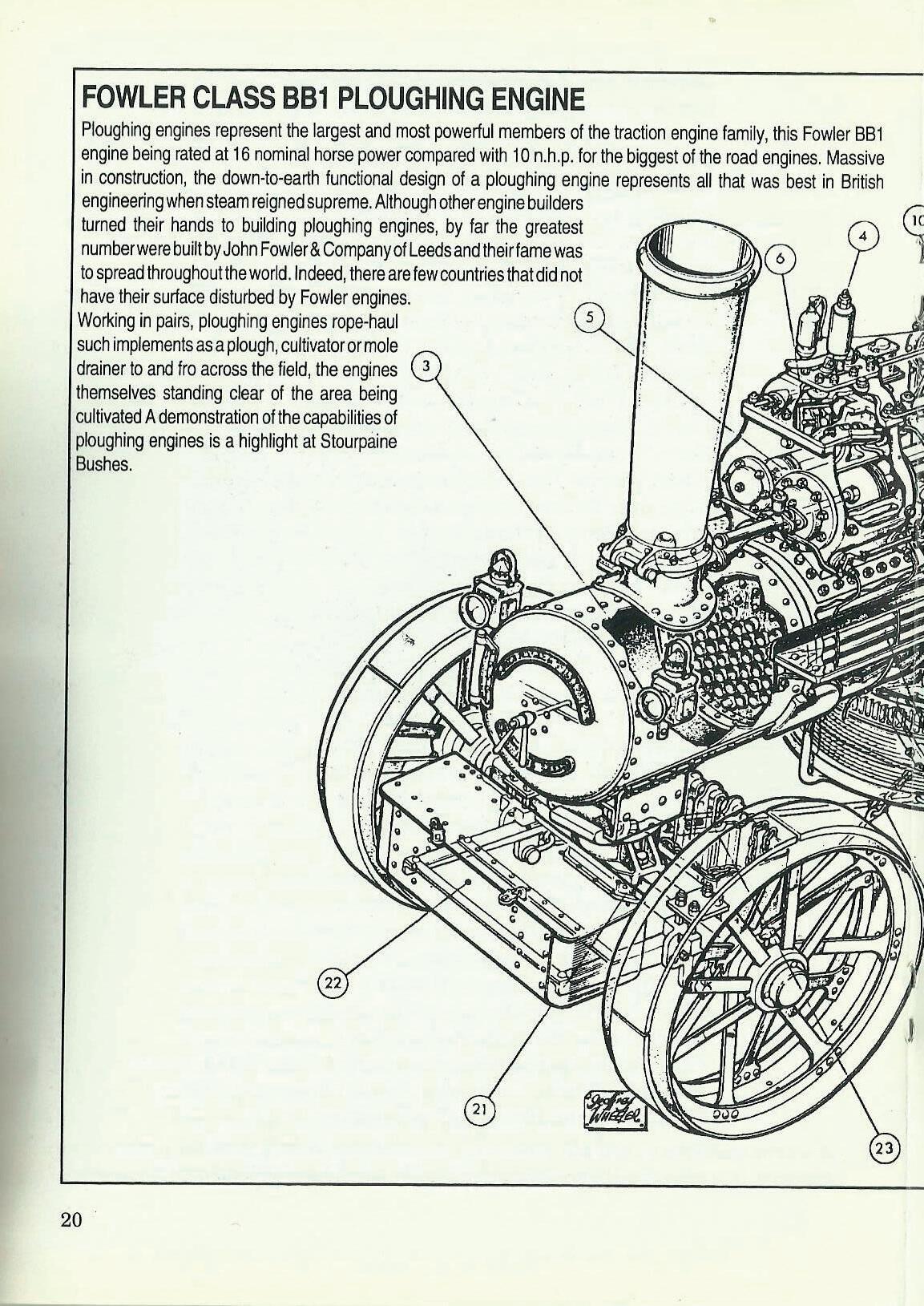
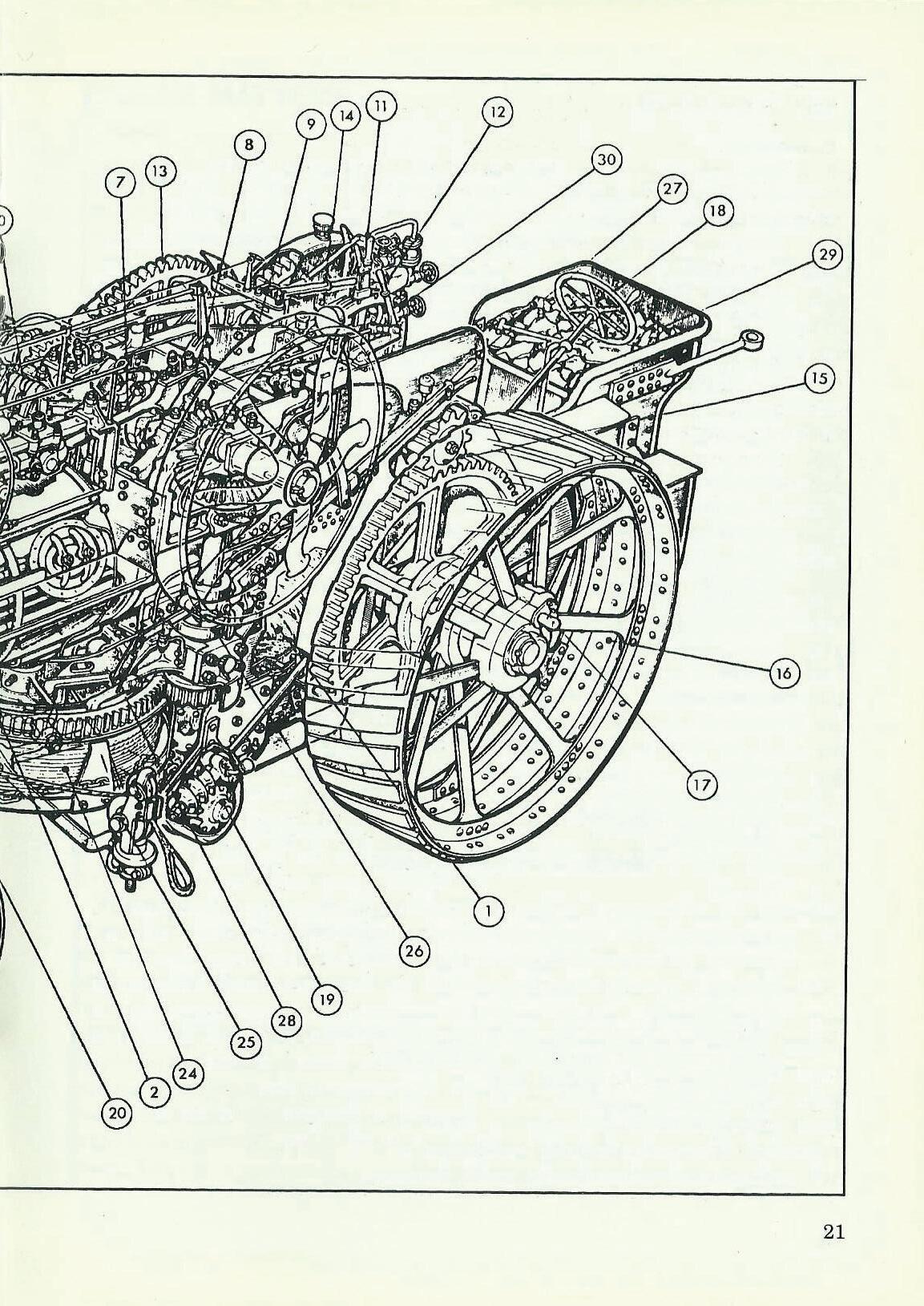
1 Firebox.
2
Boiler, through which pass 40 2-inch tubes carrying the heat of the fire through the water to turn it into steam.
3 Smokebox.
4
Safety valve, releasing steam when the pressure in the boiler reaches 180 lbs. per square inch. .
5 Cylinders. These are known as "'compound" cylinders, the piston in the smallerdiameter (high pressure) cylinder being driven by steam taken directly from the boiler and exhausting it to drive the piston in the larger low pressure cylinder.
6 Slide valves, controlling the admission and exhaust of steam to the cylinders.
7 Connecting rods.
8 Crankshaft.
9 Flywheel.
1O Valve gear, operating the slide valves and determining the direction of rotation of the crankshaft.
11 Forward/reverse lever, connected to the valve gear. Here it is shown in the "mid gear'' or neutral position.
12 Regulator handle, by which the speed of the engine is controlled.
13 Two-speed road gearing.
14 Gear change lever.
15 Pinion and spur wheel final drive.
16 Hind wheels, 6ft. 6ins. diameter.
17 Driving pin, connecting the hub of the hind wheel to the final drive spur wheel centre. No differential or compensating gear is fitted to this type of engine. Traction is obtained from one wheel only, the other being free to revolve on its shaft. A similar driving pin may be fitted to the far-side wheel to obtain two-wheel traction in difficult conditions.
18 Steering hand-wheel.
19 Worm-and-pinion steering gear.
20 Steering chains.
21 Swivelling forecarriage carrying the front wheels.
22 Tool box.
23 Spud box containing the "spuds" -tee shaped strips fixed to the hind wheel rims to provide extra grip in soft or muddy conditions. Also in the spud box are the checkchains for securing the coiling lever when on the road.
24 Winding drum, with 600 yards of steel wire rope with which plough, etc. is hauled across the field.
25 Coiling lever, raised and lowered by a gear-driven cam under the winding drum, and which ensures that the wire rope winds evenly.
26 Clutch for engaging winding drum.
27 Clutch operating lever.
28 Winding drum brake.
29 Coal bunker, with water tank underneath.
30 Injectors for feeding water into the boiler.
'Clinker'
The following article is reproduced from the Hollycombe Steam Collection's newsletter Hollycombe Express by kind permission of the Editor, Reg Bosley.
I can remember the problems we used to have trying to protect the engines during Winter working. There were no reliable weather forecasts in them days and you had to be your own Michael Fish (or whoever does it these days) and try and predict a frost yerself. Most times banking up the engine for the night was enough, but during really cold snaps or when the fire was let out for a Sunday, the water fittings had to be protected somehow, usually by packing straw, cotton waste or corn sacks, around any exposed bits to try and insulate them, or to drain them down.
These days most engines hibernate for the Winter. Some I hear tell have air conditioned, temperature controlled, buildings, but most are kept in draughty sheds or out in the open and what applied when I were young is still good now -you've got to protect from frost. It's no goodjust opening the boiler blow down cock. The tender needs draining, open all cocks so there's no chance of water collecting above them, and if there's any low points in pipes which can't be drained by taking out a plug disconnect the pipe and empty it.
A good example of this is the siphon and bellows of the pressure gauge. l remember seeing a gauge once that was left on over the Winter permanently reading 170 psi and it was only lined for 150, so the best thing is to take it off and keep it indoors. A driver I once knew couldn't work out why the pump on hiR Aveling had cracked during the Winter. He had drained everything down, but later had to admit that he hadn't taken out the pump jumpers and we can only guess that water had been trapped between them which had cracked the pump body when it froze. We'll probably never know for sure but its a good idea to remove all jumpers from clacks and pumps.
Winter these days usually means a visit from the boiler inspector. We usually know whether an engine is going to need work done on it but just to make sure he's in a good mood make sure the engine is ready for him and as clean as can be expected. Make su:re the boiler is fully washed out, when we washed out every week it was something we got over as quickly as possible, but taking your time has its reward like helping the boiler last longer. Make sure all the plugs, manholes and mud hole doors are removed, don't get them mixed up as they may look the same but won't always seal properly in a different place. Use plenty of water and bits of wire and bar as scrapers, to make sure all the sediment is out of the boiler, particularly round the back of the foundation ring and the firebox crown. You know you've done a goodjob when, no matter where you squirt it, the
water comes out as clean as it went in. While you're playing with water its a good time to clean off any mud accumulated on the wheels.
For some reason, boiler inspectors seem to like wearing white boiler suits, so the smoke and fire box should be really clean so as not to upset him by getting his clothes dirty. First sweep the tub~s with a good hard brush that's a tight fit and keep brushing each tube until nothing comes out with the brush, then using wire brushes and any suitable scrapers clean the smoke box and fire box thoroughly leaving no sooty deposits as damp soot is very corrosive to boilers. Whilst you are in the smoke box clean around the blast pipe as well, I was surprised at the mount of carbonised cylinder oil and soot that had bunged up Leiston's blast pipe last Winter.
Some people oil the smoke and fire box for the Winter. I've never bothered as it's a waste of oil and gets the boiler man's overalls dirty, but if you must, use clean oil and sparingly, its a bigger waste if the engine is running with oil, and never use old engine oil as it can be as corrosive as damp soot.
When you've got that little lot done protect the brasses and bright work, to save a lot of elbow grease next season, with oil, vaseline or dewatering fluid, drain off any water in the mechanical lubricator and lift the wicks in the other oilers. It's then time to sheet up the engine. If it's under cover make sure there's room for air to circulate between the engine and the sheet and try to stop the sheet resting on paintwork as even with modern paints a damp sheet can leave bloom on a painted surface which has to be cut back. The same applies to engines left outside but make sure the sheets are tied up good and proper and there are no areas where water can sit as it will drip through onto the engine and is likely to get you wet the first time you take the sheet off.
Simon
Preston aged 12
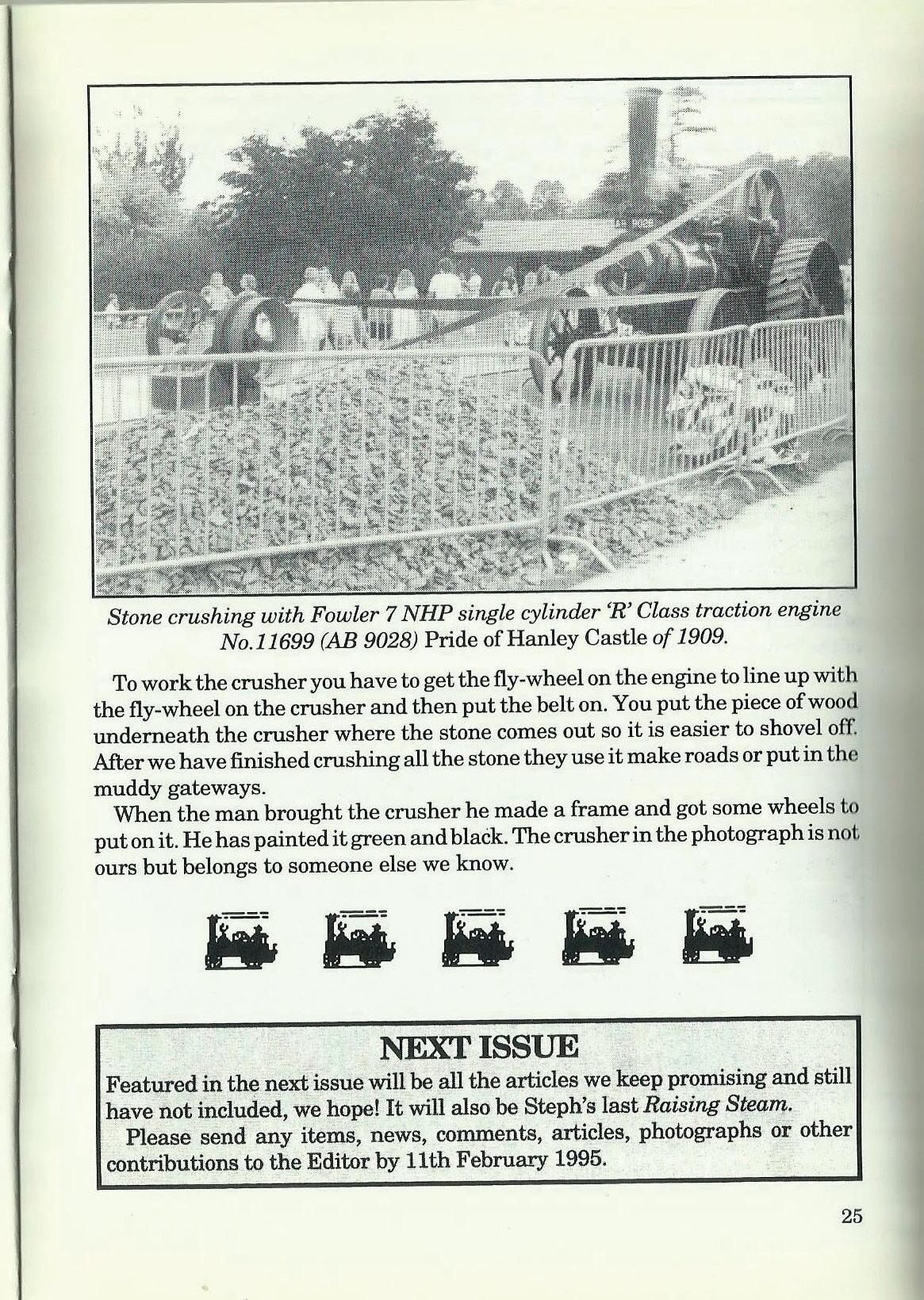
At most rallies we go to we drive a stone crusher. The make of the stone crusher is a Masons and the year of manufacture is 1905. We drive the crusher with The Pride of Hanley Castle which is a 1909 Fowler agricultural traction engine. When we go stone crushing we take with us lots of equipment like a shovel, a piece of wood to shovel the crushings off of, a sledge hammer and a belt to drive the crusher.
When we get to the rallies there is usually one or two skips full of stone for us to crush.
Stone crushing with Fowler 7 NHP single cylinder 'R' Class traction engine No.11699 (AB 9028) Pride of Hanley Castle of 1909.
To work the crusher you have to get the fly-wheel on the engine to line up with the fly-wheel on the crusher and then put the belt on. You put the piece of wood underneath the crusher where the stone comes out so it is easier to shovel off. After we have finished crushing all the stone they use it make roads or put in the muddy gateways.
When the man brought the crusher he made a frame and got some wheels to put on it. He has painted it green and black. The crusher in the photograph is not ours but belongs to someone else we know.
Featured in th~ next issue will be all the articles we keep promising and still have not included, we hopet It will also be Steph's last Raising Steam. Please send any items, news, comments, articles, photographs or other contributions to the Editor by 11th February 1995.
The 1994 Steam Apprentice Club Photographic and Colouring Competition entries were judged on Saturday 19th November at the end of the NTET Annual General Meeting, held at the Heritage Motor Centre in Warwickshire.
Thankyou for all your entries and congratulations to the prize winners.
~~~~?,~!;,~~Cfo~~~:~1::!~~ entry was awarded, -_•• L •[a for the second year running, to James Duncombe. (Watchout for one of James's winning photos in Old Glory. Ed.)
All six prize-winners in the photo competition will receive ..c:a-•c:i- '°...,-- -• engraved medals, kindly donated once again by our good friend Stuart Pryke. Entries were also received from the following Apprentices: Christopher Brown, Southbo111e, Bournemouth; Paul Coupland, Skegness, Lincolnshire; Victoria Else, Matlock, Derbyshire; Gary Fenson, Redbourn, Hertfordshire; Chris Lawson, Gillingham, Dorset; Nick Shillito, Garforth, Leeds; Jack Smith, Stroud, Gloucestershire.
Thank you for taking part, I hope you will enter again next year whether or not you won this time. A selection of the winning entries are reproduced in this issue of the magazine, we will feature more of your entries next time, including some of the 'runners up'.
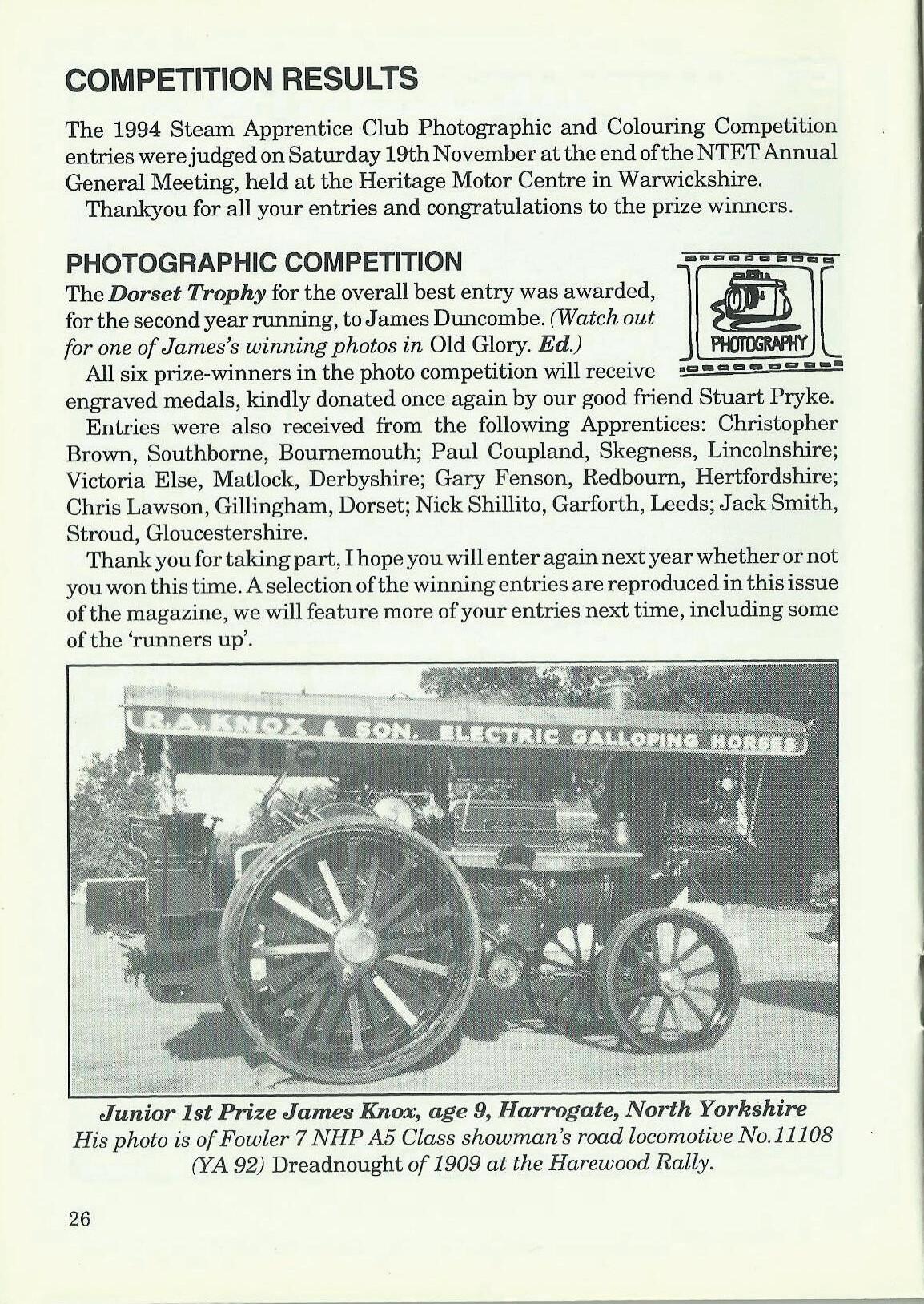
His photo is of Fowler 7 NHP A5 Class showman's road locomotive No.11108 (YA 92) Dreadnought of 1909 at the Harewood Rally.
The Photographic Competition was judged by well known photographer Dick Blenkinsop and Brian Gooding, Editor of Old Glory magazine, thank you both. (Your Editor's role this time was restricted to laying out the photos!)
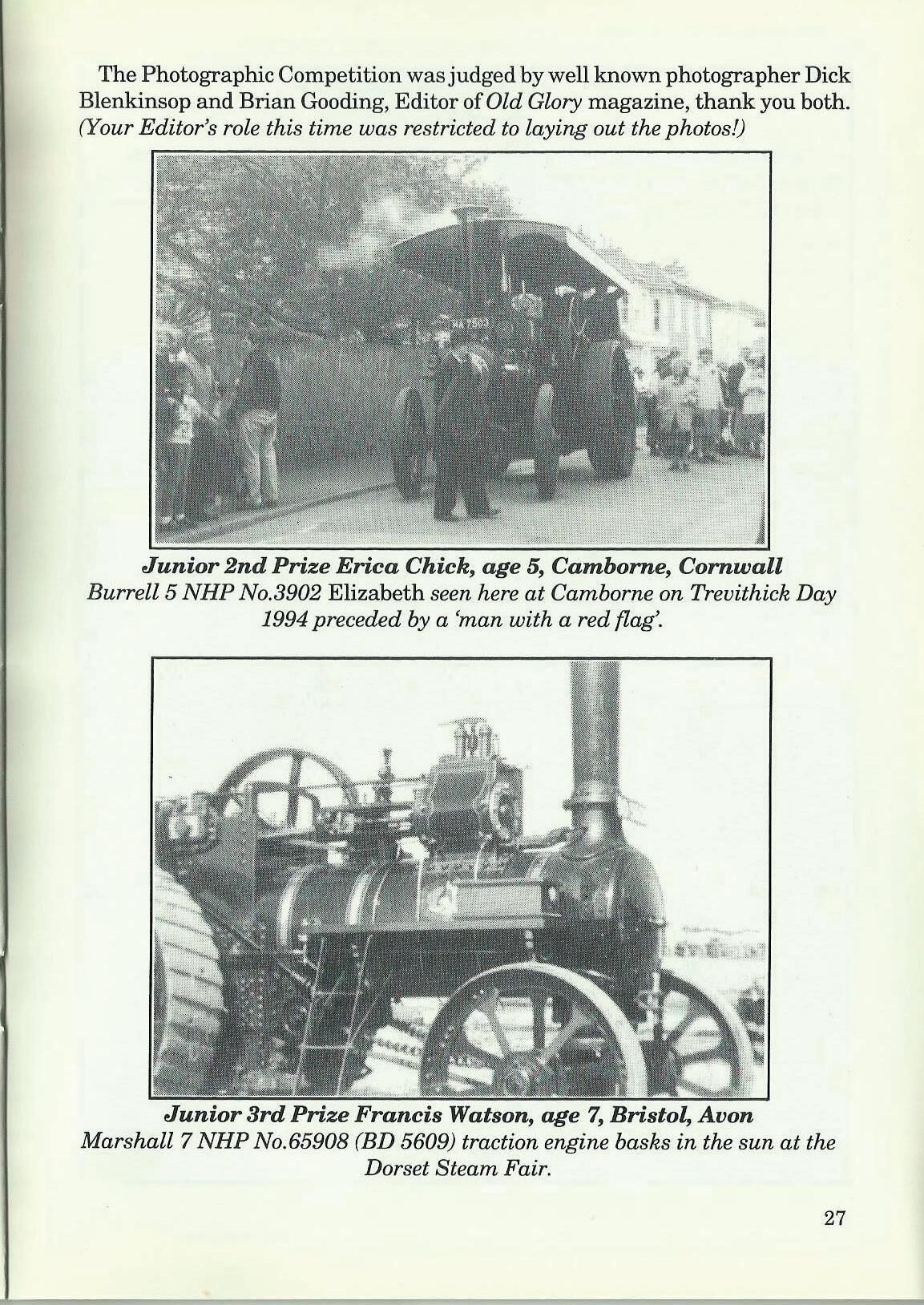
Junior 2nd Prize Erica Chick, age 5, Camborne, Cornwall Burrell 5 NHP No.3902 Elizabeth seen here at Camborne on Trevithick Day 1994 preceded by a 'man with a red fiag'.
Junior3rd Prize Francis Watson, age 7, Bristol, Avon Marshall 7 NHP No.65908 (BD 5609) traction engine basks in the sun at the D'orset Steam Fair.
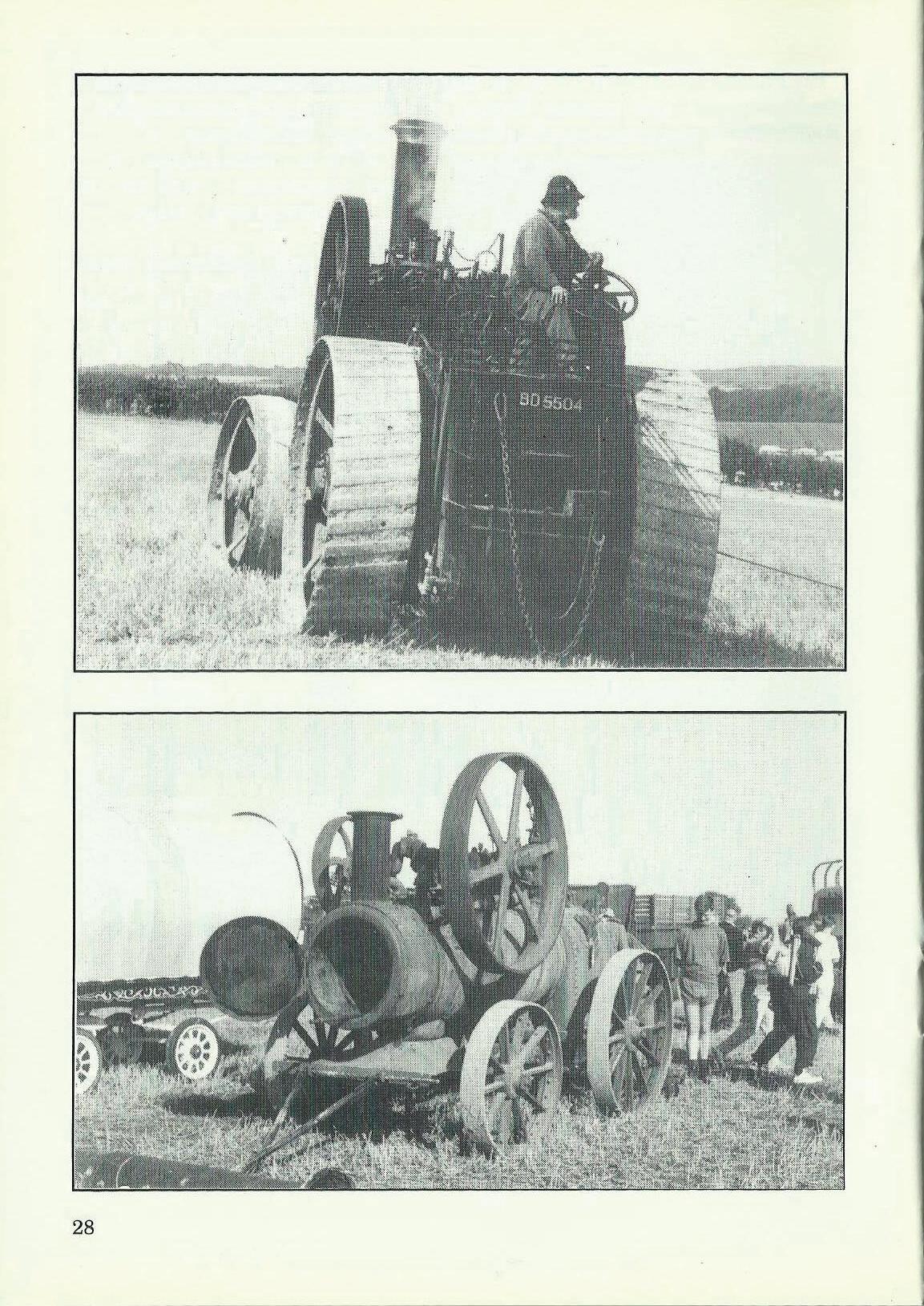
Photographs Opposit Page:
Senior 1st Prize James Duncombe, age 15, Gillingham, Dorset
James won the Dorset Trophy with his entry. Here is his view of McLaren 16 NHP ploughing engine No.1552 (BD 5504) Hero built in 1919, at Dorset Steam Fair.
Senior 2nd Prize Andrew Auger, age 14, Whisby Moor, Lincoln Marshall portable engine No.15011 of 1887, photographed at the Dorset Steam Fair's auction.
(This engine is not in the Traction Engine Register, presumably because it was imported from abroad.)
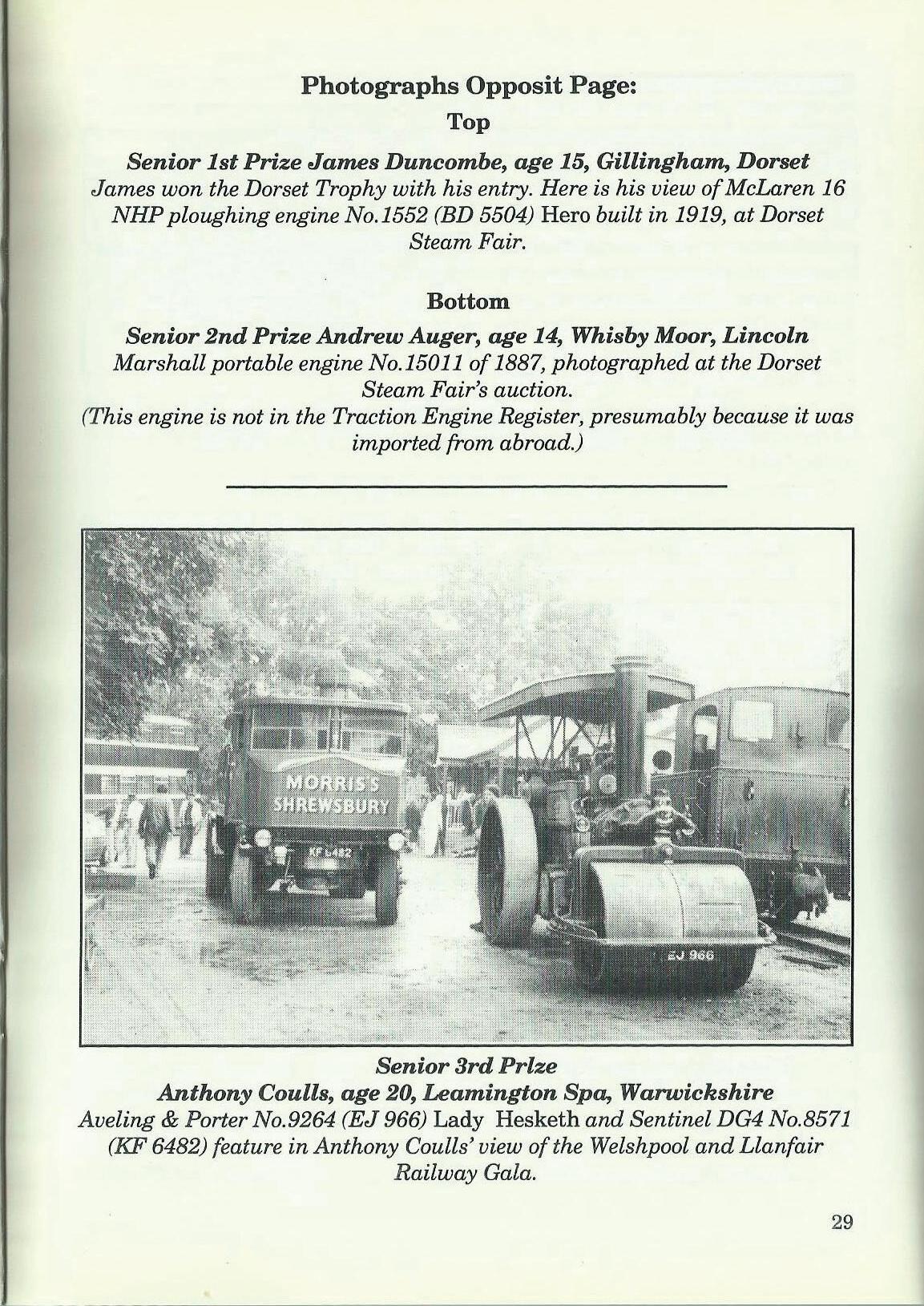
(KF 6482) feature in Anthony Coulls' view of the Welshpool and Llanfair Railway Gala.
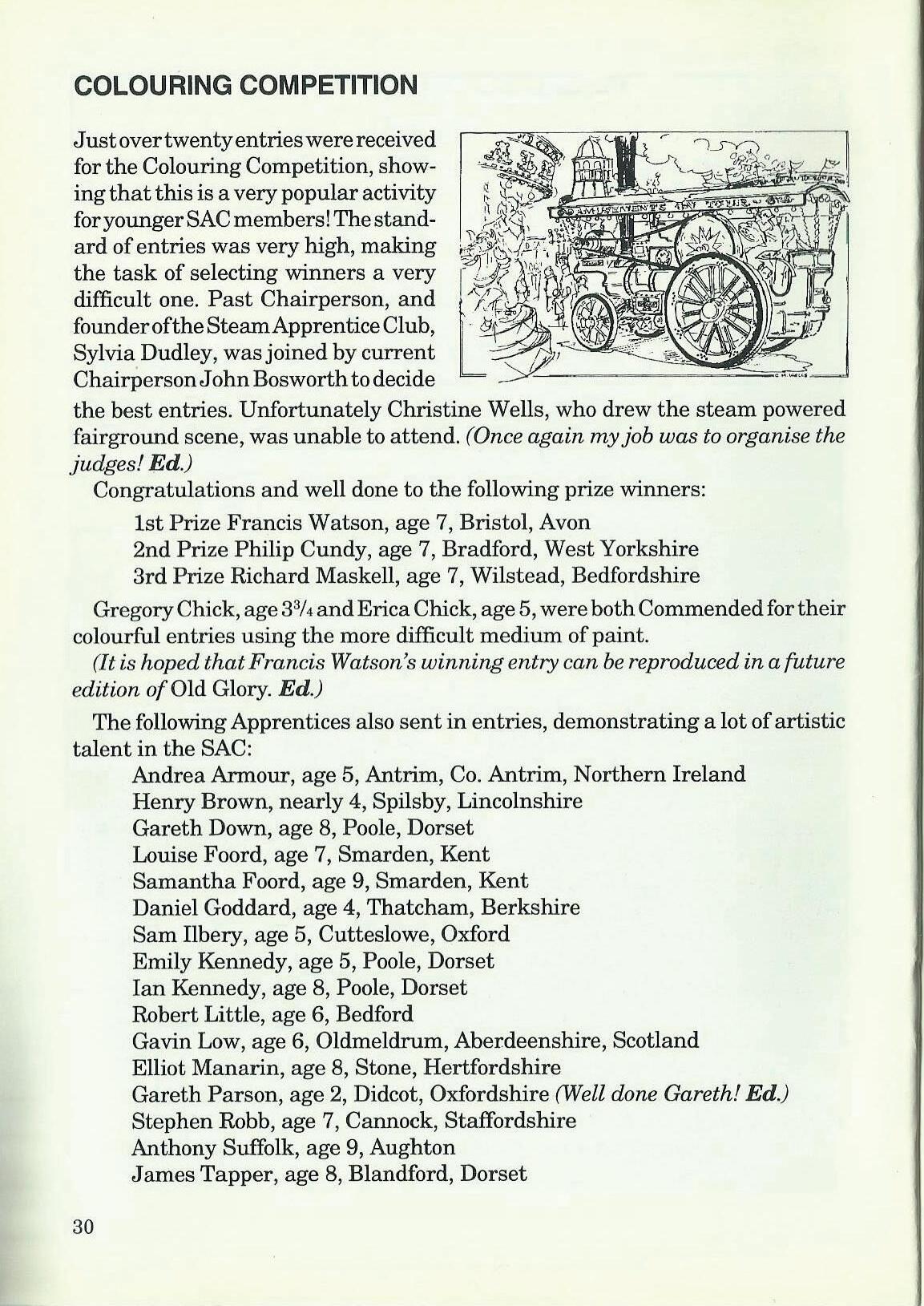
Just over twenty entries were received for the Colouring Competition, showing that this is a very popular activity for younger SACmembers! The standard of entries was very high, making the task of selecting winners a very difficult one. Past Chairperson, and founder of the Steam Apprentice Club, Sylvia Dudley, was joined by current Chairperson John Bosworth to decide the best entries. Unfortunately Christine Wells, who drew the steam powered fairground scene, was unable to attend. (Once again my job was to organise the judges! Ed.)
Congratulations and well done to the following prize winners:
1st Prize Francis Watson, age 7, Bristol, Avon
2nd Prize Philip Cundy, age 7, Bradford, West Yorkshire
3rd Prize Richard Maskell, age 7, Wilstead, Bedfordshire
Gregory Chick, age 33/ 4 and Erica Chick, age 5, were both Commended for their colourful entries using the more difficult medium of paint.
(It is hoped that Francis Watson's winning entry can be reproduced in a future edition of Old Glory. Ed.)
The following Apprentices also sent in entries, demonstrating a lot of artistic talent in the SAC:
Andrea Armour, age 5, Antrim, Co. Antrim, Northern Ireland
Henry Brown, nearly 4, Spilsby, Lincolnshire
Gareth Down, age 8, Poole, Dorset
Louise Foord, age 7, Smarden, Kent
Samantha Foord, age 9, Smarden, Kent
Daniel Goddard, age 4, Thatcham, Berkshire
Sam Ilbery, age 5, Cutteslowe, Oxford
Emily Kennedy, age 5, Poole, Dorset
Ian Kennedy, age 8, Poole, Dorset
Robert Little, age 6, Bedford
Gavin Low, age 6, Oldmeldrum, Aberdeenshire, Scotland
Elliot Manarin, age 8, Stone, Hertfordshire
Gareth Parson, age 2, Didcot, Oxfordshire (Well done Gareth! Ed.)
Stephen Robb, age 7, Cannock, Staffordshire
Anthony Suffolk, age 9, Aughton
James Tapper, age 8, Blandford, Dorset
Sorry that you could not all have won a prize, there were so many good entries. (I was very sorry that one or two members were not able to send their entries to me beforethe closingdate, but even more upset to learn that the Post Officehad failed to deliver some entries. I will certainly be complaining about this and will let those affected know what the Post Office has to say. Ed.)
We are very grateful to Paul Appleton and Brian Gooding of Old Glory magazine for providing a wonderfull selection of T-shirts, videos, model buses, calendars, pens and hedgehogs! as prizes for both the competitions. Everyone who has been awarded a prize should have received something by now.
John& FionaDurling
"Hello boys and girls." "Hello John and Fiona." '~re you having a good time?" "Yeeeeesssssss!!!"
We hope that this could be the opening to a SAC playlet!
As many of you know, we have taken the SAC stand to rallies at Duncombe Park, Masham, Driffield and 'Harewood House this year. It was a new venture for us and we could really use some feed back from you (and your parents) on how you enjoyed it (or not!).
We tried to pair up ,each men1ber with an engine if they didn't have access to one and also to give people the chance to work on different types of engine if they wanted to. On the Saturday evonings we had a get together with a quiz and barbecue.
However, we felt things got better as the season went on - we're still learning too.
So those of you who ca1n0 Uus year PLEASE let us know if this is what you want. If you have any other' 'ideas we would love to hear from you.
Are there any older me'mberswho could give us a hand? Do you have a special interest that you could chat to the others about? Are there any Mums or Dads out there who could come and chat about construction, use or experiences of/with steam? There must be!
We hope you like the selection of pictures of members taken at some of the rallies this season; if you come to one of our rallies next year you too could be in this line up. We look forward to hearing from you SOON.
17 The Avenue, Haxby, Yorkshire Y03 3EH
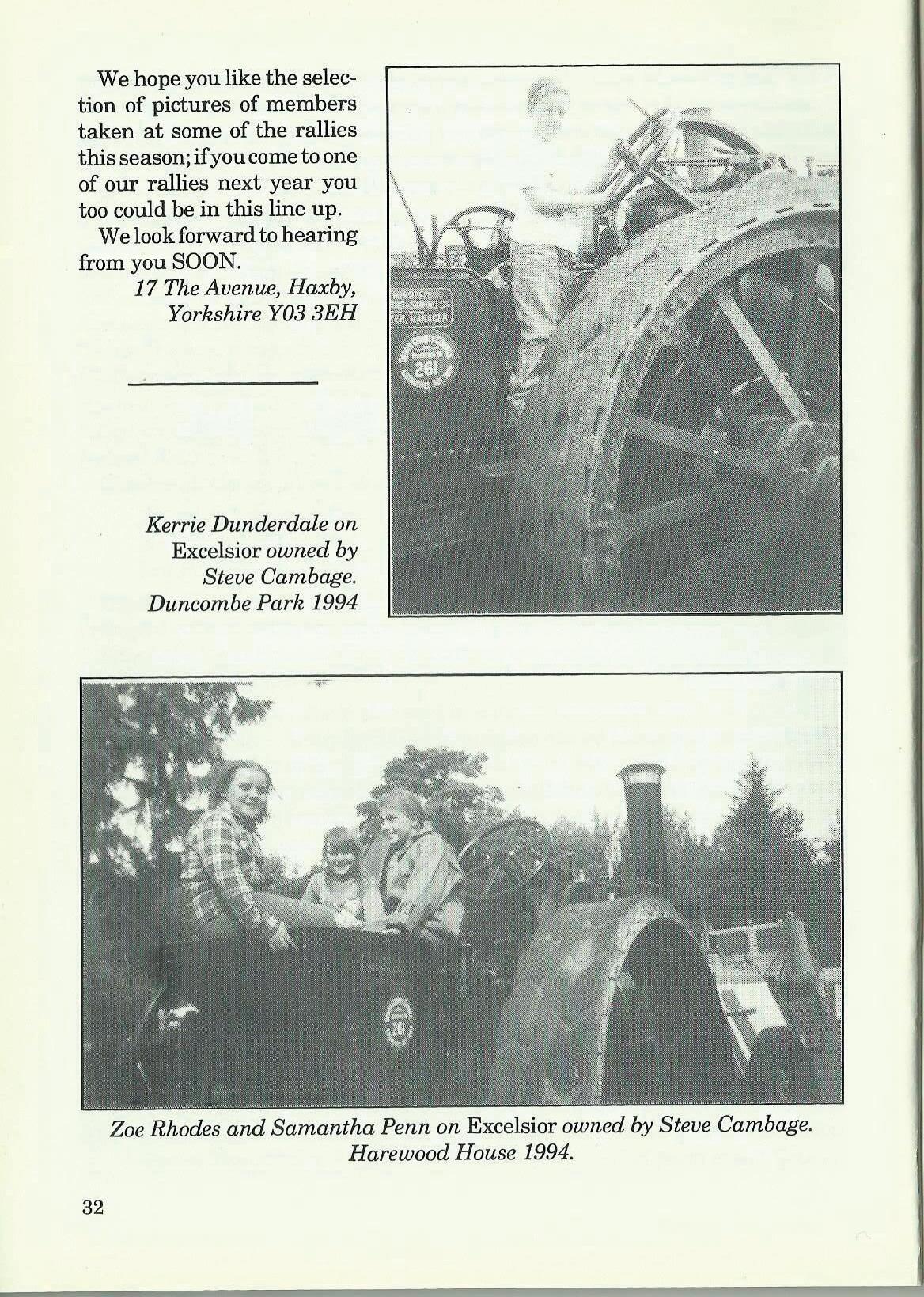
Kerrie Dunderdale on Excelsior owned by Steve Cambage. Duncombe Park 1994
Zoe Rhodes and Samantha Penn on Excelsior owned by Steve Cambage. Harewood House 1994.
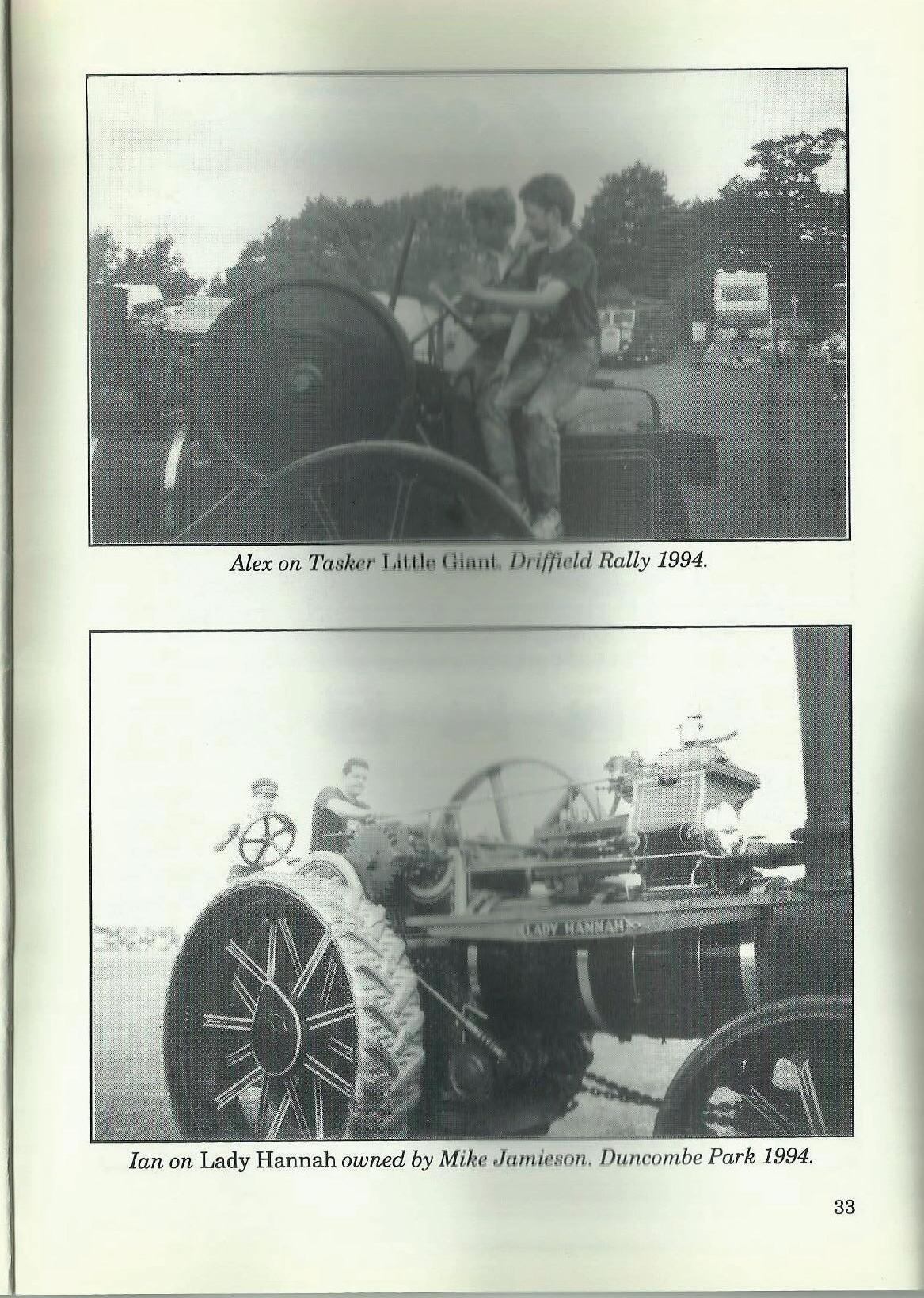
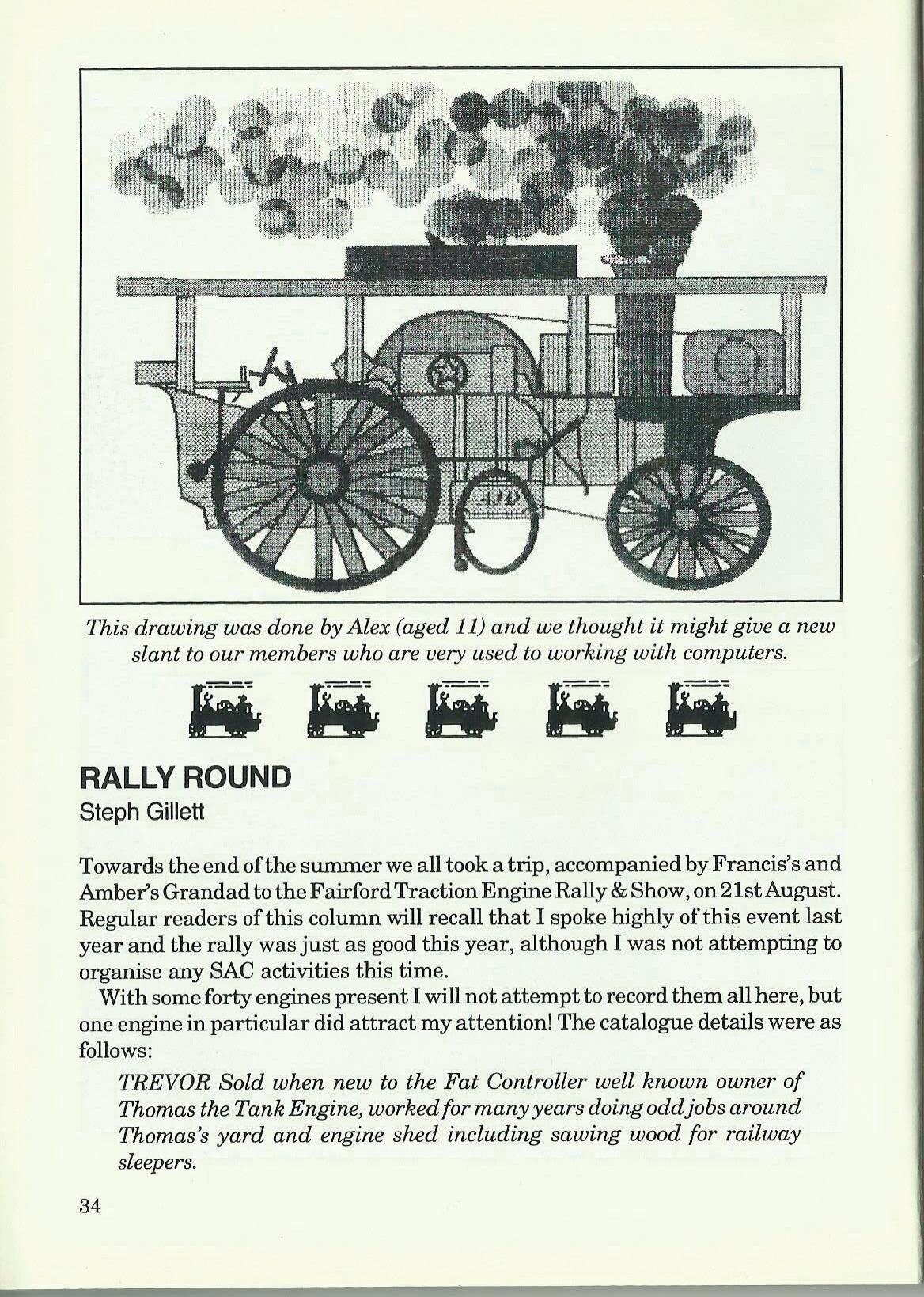
This drawing was done by Alex (aged 11) and we thought it might give a new slant to our members who are very used to working with computers.
Steph Gillett
Towards the end of the summer we all took a trip, accompanied by Francis's and Amber's Grandad to the Fairford Traction Engine Rally & Show, on 21stAugust. Regular readers of this column will recall that I spoke highly of this event last year and the rally was just as good this year, although I was not attempting to organise any SAC activities this time.
With some forty engines present I will not attempt to record them all here, but one engine in particular did attract my attention! The catalogue details were as follows:
TREVOR Sold when new to the Fat Controller well known owner of Thomas the Tank Engine, worked for many years doing odd jobs around Thomas's yard and engine shed including sawing wood for railway sleepers.
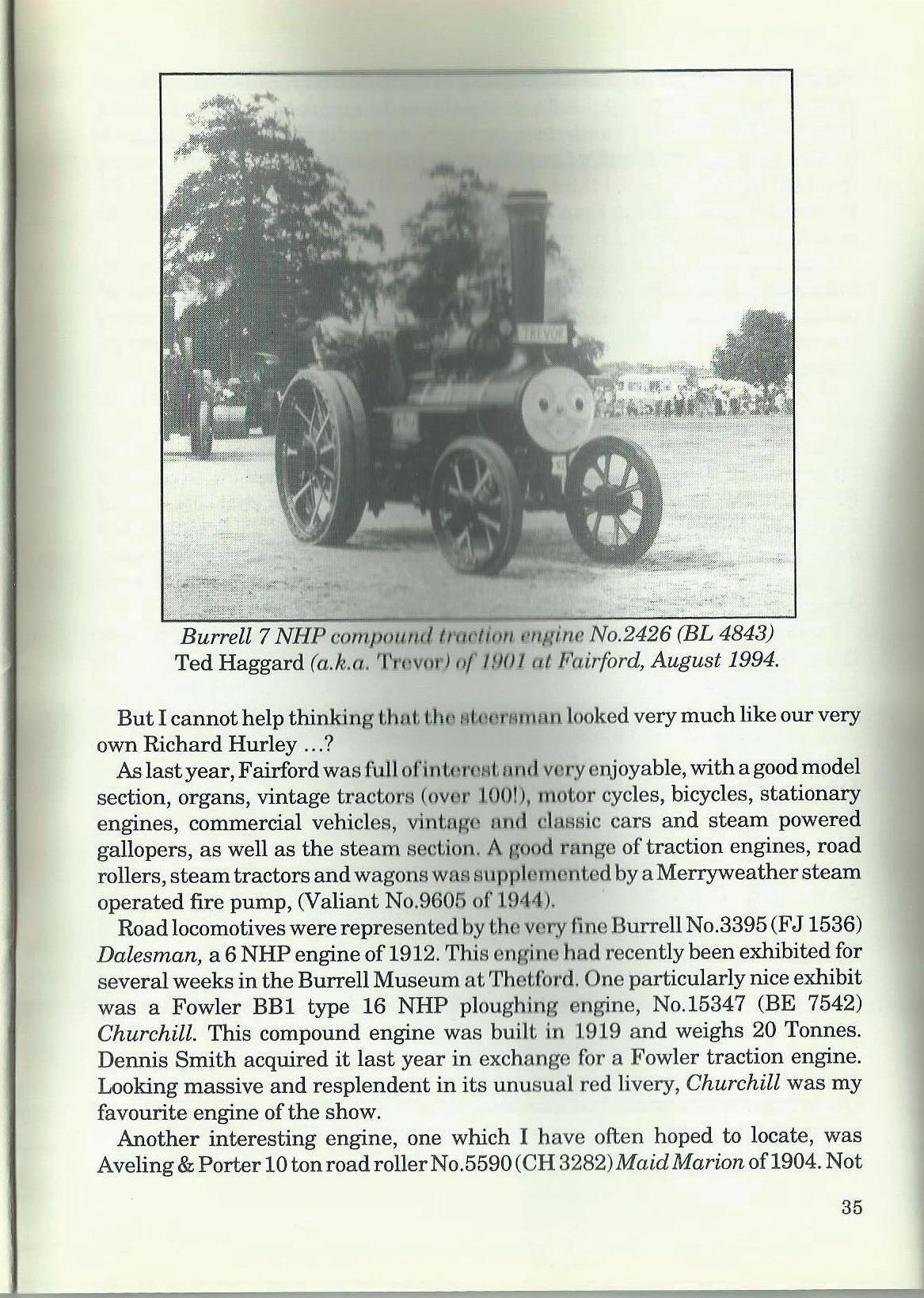
Burrell 7 NHP co1t1/)()tlfulf, tt,•f 11111,•11,-:,11,, No.2426 (BL 4843)
Ted Haggard (a.h.a. 'l'n•v111) u/ /.'JOI al /r1nirford, August 1994.
But I cannot help thinking Uu,if,U11 HIo, no111111 looked very much like our very own Richard Hurley ... ?
Aslastyear,Fairford wasfull ofinl,•rc•ttl 1111d voryonjoyable, with a good model section, organs, vintage tractorH (ovt r J001), 1notor cycles, bicycles, stationary engines, commercial vehicles, vinlugP n11d rlnt:1t:1iccars and steam powered gallopers, as well as the steam section. A good rnngo of traction engines, road rollers, steam tractors and wagons wnA Ht1pplonu ntcd by a Merryweather steam operated fire pump, (Valiant No.9605 of' 1044).
Road locomotives were represented by tJu, vPry fine Burrell No.3395 (FJ 1536) Dalesman, a 6 NHP engine of 1912. This cngino had recently been exhibited for several weeks in the Burrell Museum at ThoLford. One particularly nice exhibit was a Fowler BBl type 16 NHP ploughing ongine, No.15347 (BE 7542) Churchill. This compound engine was built in 1919 and weighs 20 Tonnes. Dennis Smith acquired it last year in exchange for a Fowler traction engine. Looking massive and resplendent in its unusual red livery, Churchill was my favourite engine of the show.
Another interesting engine, one which I have often hoped to locate, was Aveling&Porter10tonroadrollerNo.5590(CH3282)MaidMarionofl904.Not
anything especially remarkable about any of that, a fairly typical single cylinder, slide valve roller, you might well say. But this is the engine that appeared in the 1952 film The Titfield Thunderbolt, in which, driven by Sid (Carry On) James, it takes part in a 'duel' with a Great Western Railway 0-4-2T auto-train engine, (No.1401 for the record!). I think Mr James would have benefited from a NTET Practical Engine Driving Course, and certainly the treatment of the roller as seen in the film would have caused any rally safety officer to have a fit!
John Huntley, in his book Railways on the Screen, writes, "Sabotaging the railway is the only way to save the bus and, when the day for the Inspector's final test is about to dawn, the villains attack. They hire the steam-roller driver to tow the train away in the middle of the night and send it to destruction over an embankment."
He adds,"' ... the steam-roller was Invicta, (sic) loaned by Messrs. Barnes Bros. of Southwick, Wilts."
This roller seems to have moved about in recent years, being recorded in the 5th edition of The Traction Engine Register (1987), un-named and located in Bristol. In the 6th edition of the Register No.5590 has been christened Maid Marion and moved to Comrie, Perth, some 420 miles North. The engine is now owned by Nigel Keene and was bought from Scotland in February of this year.
A good day all round; I am sure we will visit again, especially as Steam Apprentices had free entry!
I wasn't going to go, I said I wouldn't go. But in the end, I went! Where? The Great Dorset Steam Fair, that huge sprawling collection of market stalls, craft tents, autojumble, fairground rides, society stalls and ... Oh yes, traction engines, road rollers, showman's engines, ploughing and heavy haulage, and this year, something special in the way of steam lorries and wagons.
We did only go for the day, I think we enjoyed it, but I am never really sure if I like being at Dorset or not! I am always frustrated by the time it takes to get from one section to another - I missed out having a proper look at the very rare Atkinson, Aveling & Porter, Burrell, Foster, Fowler, Garrett, Leyland, Mann, Robey, Tasker, Thornycroft and Wallis & Steevens steam wagons, not to forget Clayton & Shuttleworth, Yorkshire, Foden and Sentinel. I did have a ride in the Foden replica steam bus No.11340 (M 6359) Puffing Billy, and, I have to say, it was the most uncomfortable experience I have ever had, (except perhaps the time Francis and I were almost thrown out of the steam yachts a few years previously). Why is it that no one gives up their seat on a bus for someone holding a baby or toddler in their arms, even steam enthusiasts?
The 1994 Official Catalogue of the 26th Great Dorset Steam Fair seemed to contain less errors than past years, at least there weren't as many engines called Unchristened this time! But the 'Programme of Events' seems to bear no resemblance to reality and is entirely 'subject to change'. Where, for example, were the 'Steam Engines in non-work at Show' at 5.45pm? Where was the 'Main
Ring' anyway! The plan of the site was a map-maker's mistake, a cartographer's cartoon, but not that funny when you've tramped back and forth for an hour trying to find something.
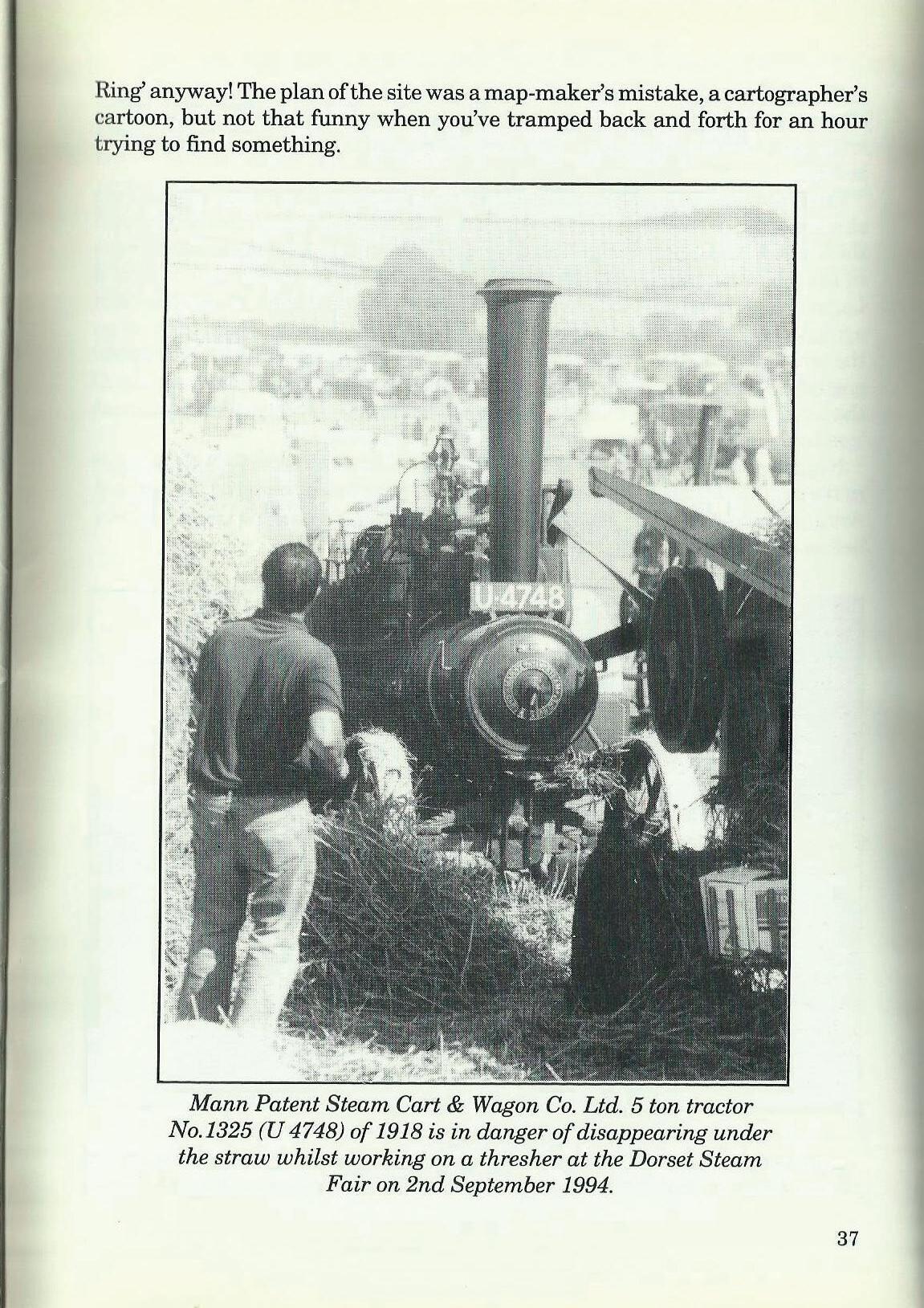
Mann Patent Steam Cart & Wagon Co. Ltd. 5 ton tractor No.1325 (U 4748) of 1918 is in danger of disappearing under the straw whilst working on a thresher at the Dorset Steam Fair on 2nd September 1994.
We left Dorset late, after spending a smaU fortune on fairground rides. I heard of one family who took nearly three hours to get out of the car park in the afternoon, what a nightmare. I won't be going again ... (Where have I heard that before!)
Imagine the scene, the autumn sup_setting low behind the hills, casts a long shadow of the silhouetted 1914 Ave ling & Porter traction engine trundling down the country lane. The grazing goat, sleeping donkey and assorted ducks and hens in the small-holding above the stream are disturbed by the throaty roar of a Lagonda sports car as it follows the route of the traction engine. Then all is calm again in the 'Indian Summer' sunshine. The peace is broken when, high up on the embankment, the whistle of a London & South Western railway 0-4-4 tank engine, built in 1897, warns of its passage towards the bridge over a turning off the lane. A perfect day at the beginning of the twentieth century? One of those 'good old days' our parents, aunts and uncles tell us about?
No, it was 9th October 1994 at the first Yeovil Railway Festival, of which more in the next issue of Raising Steam. But, for the time being, here is a view of that Aveling tractor, 4 NHP No.8376 (KT 2828) Princess Victoria, being watered before its departure from Yeovil.
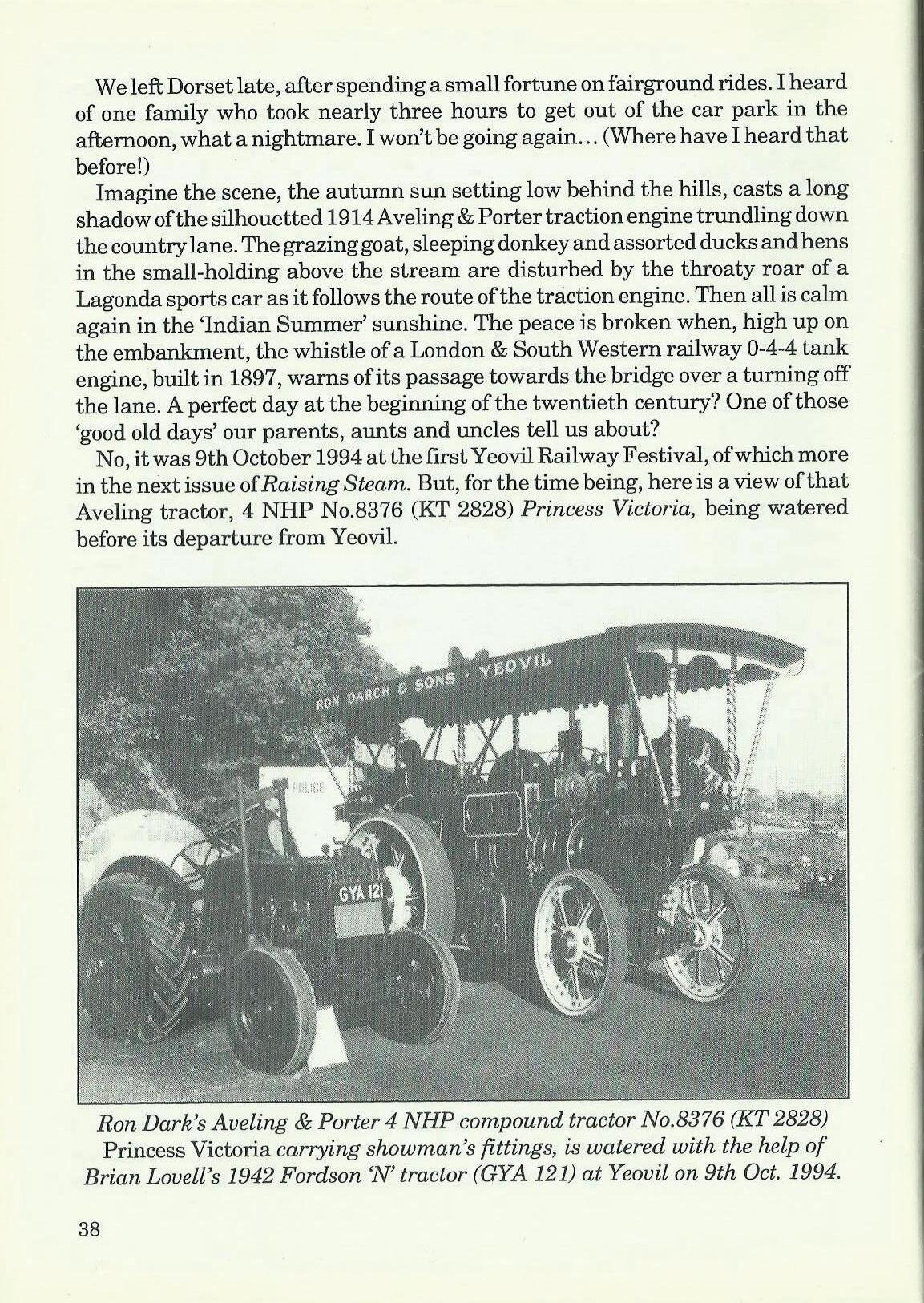
Ron Dark's Aveling & Porter 4 NHP compound tractor No.8376 (KT 2828) Princess Victoria carrying showman's fittings, is watered with the help of Brian Lovell's 1942 Fordson 'N' tractor (GYA 121) at Yeovil on 9th Oct. 1994.
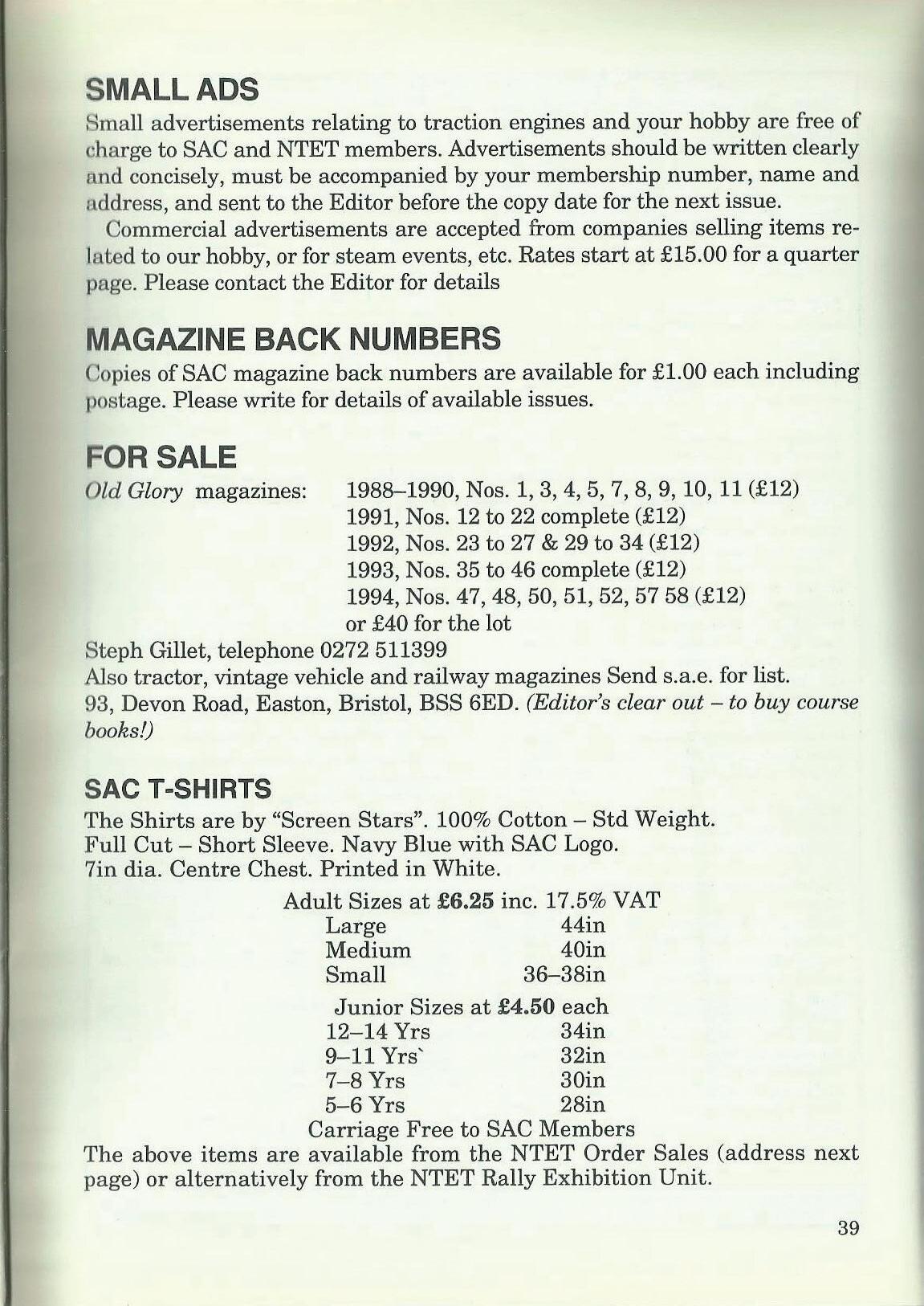
Small advertisements relating to traction engines and your hobby are free of charge to SAC and NTET members. Advertisements should be written clearly and concisely, must be accompanied by your membership number, name and address, and sent to the Editor before the copy date for the next issue. Commercial advertisements are accepted from companies selling items related to our hobby, or for steam events, etc. Rates start at £15.00 for a quarter page. Please contact the Editor for details
Copies of SAC magazine back numbers are available for £1.00 each including postage. Please write for details of available issues.
Old Glory magazines: 1988-1990, Nos. 1, 3, 4, 5, 7, 8, 9, 10, 11 (£12)
1991, Nos. 12 to 22 complete (£12)
1992, Nos. 23 to 27 & 29 to 34 (£12)
1993, Nos. 35 to 46 complete (£12)
1994, Nos. 47, 48, 50, 51, 52, 57 58 (£12) or £40 for the lot
Steph Gillet, telephone 0272 511399
Also tractor, vintage vehicle and railway magazines Send s.a.e. for list. 93, Devon Road, Easton, Bristol, BSS 6ED. (Editor's clear out - to buy course books!)
The Shirts are by "Screen Stars". 100% Cotton -Std Weight. Full Cut -Short Sleeve. Navy Blue with SAC Logo. 7in dia. Centre Chest. Printed in White.
Adult Sizes at £6.25 inc. 17.5% VAT
Large 44in
Medium 40in
Small 36-38in
Junior Sizes at £4.50 each
12-14 Yrs 34in
9-11 Yrs' 32in
7-8 Yrs 30in
5-6 Yrs 28in
Carriage Free to SAC Members
The above items are available from the NTET Order Sales (address next page) or alternatively from the NTET Rally Exhibition Unit.
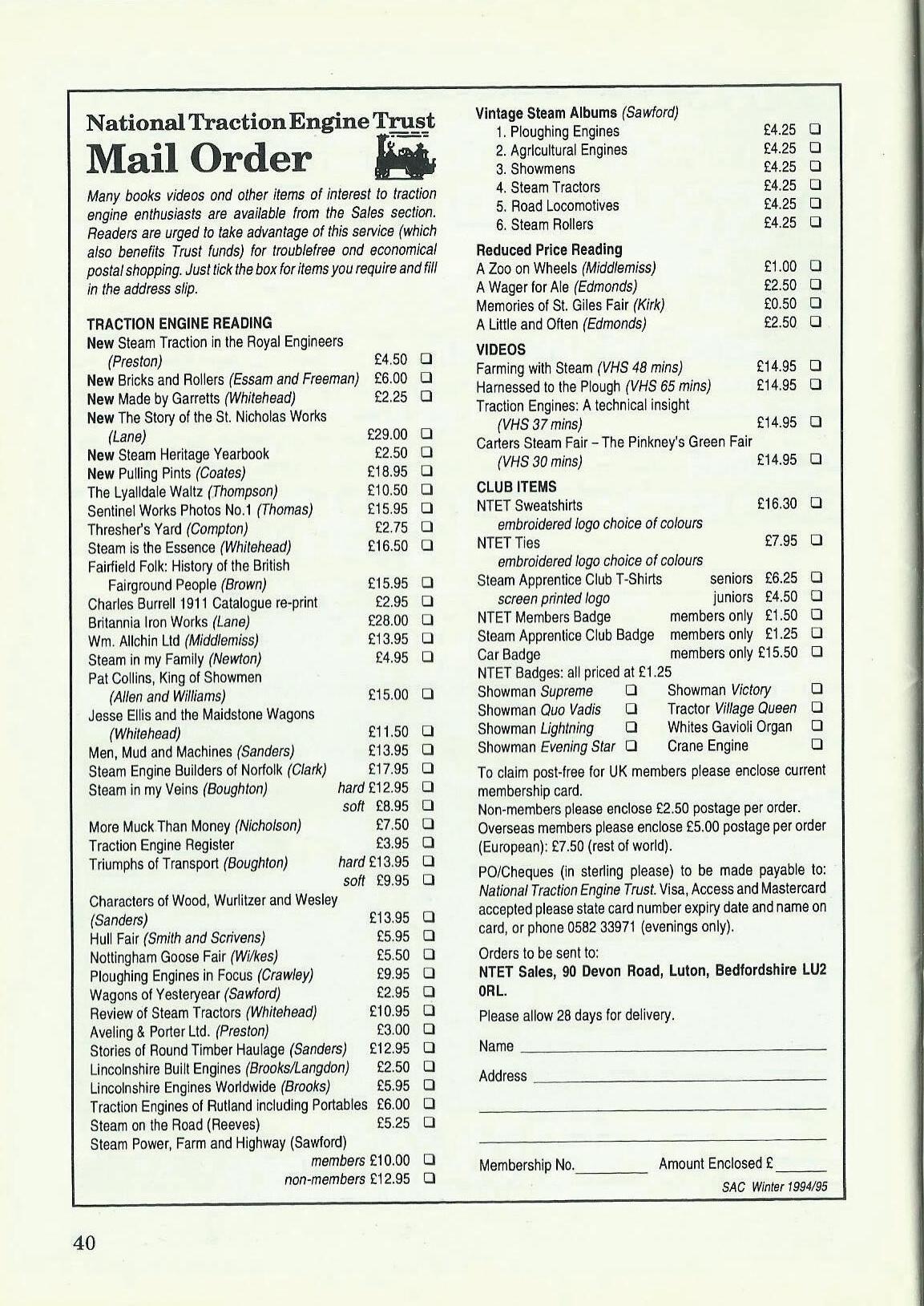
Manybooksvideosondotheritemsofinteresttotraction engineenthusiastsareavailablefromtheSalessection. Readersareurgedtotakeadvantageofthisservice(which alsobenefitsTrustfunds)fortroublefreeondeconomical postalshopping.Justticktheboxforitemsyourequireandfill intheaddressslip.
NewSteamTractionin the RoyalEngineers (Preston)
NewBricksand Rollers(EssamandFreeman)
NewMadeby Garretts(Whitehead)
NewTheStoryof the St. NicholasWorks (Lane)
NewSteamHeritageYearbook
NewPullingPints(Coates)
The LyalldaleWaltz(Thompson)
SentinelWorksPhotosNo.1(Thomas)
Thresher'sYard(Compton)
Steamis the Essence(Whitehead)
FairfieldFolk:Historyof the British FairgroundPeople(Brown)
CharlesBurrell1911Cataloguere-print
BritanniaIronWorks(Lane)
Wm.AllchinLid (Middlemiss)
Steamin my Family(Newton)
PatCollins,Kingof Showmen (AllenandWilliams)
JesseEllisandthe MaidstoneWagons (Whitehead)
Men,MudandMachines(Sanders)
SteamEngineBuildersof Norfolk{Clark)
Steamin myVeins(Boughton)hard
MoreMuckThanMoney(Nicholson)
TractionEngineRegister
£4.50 0
£6.00 0
£2.25 0
£29.00 0
£2.50 0
£18.95 0
£10.50 0
£15.95 0
£2.75 0
£16.50 0
£15.95 0
£2.95 0
£28.00 0
£13.95 0
£4.95 0
£15.00 0
£11.50 0
£13.95 0
£17.95 0
£12.95 0
soft £8.95 0
£7.50 0
£3.95 0
Triumphsof Transport(Boughton)hard£13.95 0
soft £9.95 0
Charactersof Wood,WurlitzerandWesley (Sanders)
Hull Fair(SmithandScrivens)
NottinghamGooseFair (Wilkes)
PloughingEnginesin Focus(Crawley)
Wagonsof Yesteryear(Sawford)
ReviewcifSteamTractors(Whitehead)
Aveling& PorterLid. (Preston)
£13.95 0
£5.95 0
£5.50 0
£9.95 0
£2.95 0
£10.95 0
£3.00 D
Storiesof RoundTimberHaulage(Sanders) £12.95 D
LincolnshireBuiltEngines(Brooks/Langdon)
LincolnshireEnginesWorldwide(Brooks)
VintageSteamAlbums(Sawford)
1. PloughingEngines
2. AgriculturalEngines
3. Showmens
4. SteamTractors
5. RoadLocomotives
6. SteamRollers
ReducedPriceReading
A Zoo onWheels(Middlemiss)
A Wagerfor Ale (Edmonds)
Memoriesof St.GilesFair(Kirk)
A Littleand Often(Edmonds)
VIDEOS
FarmingwithSteam(VHS48mins)
£4.25 0
£4.25 0
£4.25 0
£4.25 0
£4.25 0
£4.25 0
£1.00 0
£2.50 0
£0.50 0
£2.50 0
£14.95 0
Harnessedto the Plough(VHS65mins) £14.95 0
TractionEngines:A technicalinsight (VHS37mins)
CartersSteamFair- The Pinkney'sGreenFair (VHS30mins)
£14.95 0
£14.95 0
CLUBITEMS
NTETSweatshirts
£16.30 D embroideredlogochoiceofcolours
NTETTies
£7.95 D embroideredlogochoiceofcolours
SteamApprenticeClubT-Shirts seniors £6.25 D screenprintedlogo juniors £4.50 0
NTETMembersBadge membersonly £1.50 D
SteamApprenticeClubBadge membersonly £1.25 0
Car Badge membersonly £15.50 D
NTETBadges:all pricedat £1.25
ShowmanSupreme 0 ShowmanVictory D
ShowmanQuoVadis 0 TractorVillageQueen D
ShowmanLightning 0 WhitesGavioliOrgan D
ShowmanEveningStar 0 CraneEngine 0
To claimpost-freefor UKmemberspleaseenclosecurrent membershipcard.
Non-memberspleaseenclose£2.50postageper order. Overseasmemberspleaseenclose£5.00postageperorder (European):£7.50(restof world).
PO/Cheques(in sterlingplease)to be made payableto: NationalTractionEngineTrust.Visa,AccessandMastercard acceptedpleasestatecardnumberexpirydateandnameon card,or phone058233971(eveningsonly).
Ordersto be sentto: NTETSales,90 DevonRoad,Luton,BedfordshireLU2 ORL.
Pleaseallow28daysfor delivery. Name
£2.50 0
£5.95 0
TractionEnginesof RutlandincludingPortables£6.00 0
Steamon the Road(Reeves)
£5.25 D
SteamPower,Farmand Highway(Sawford) members£10.00 0 non-members£12.95 0
I would lllrn lt1 ]uln 1h13r,l@tsttn Apr11 fjf ttloo Club
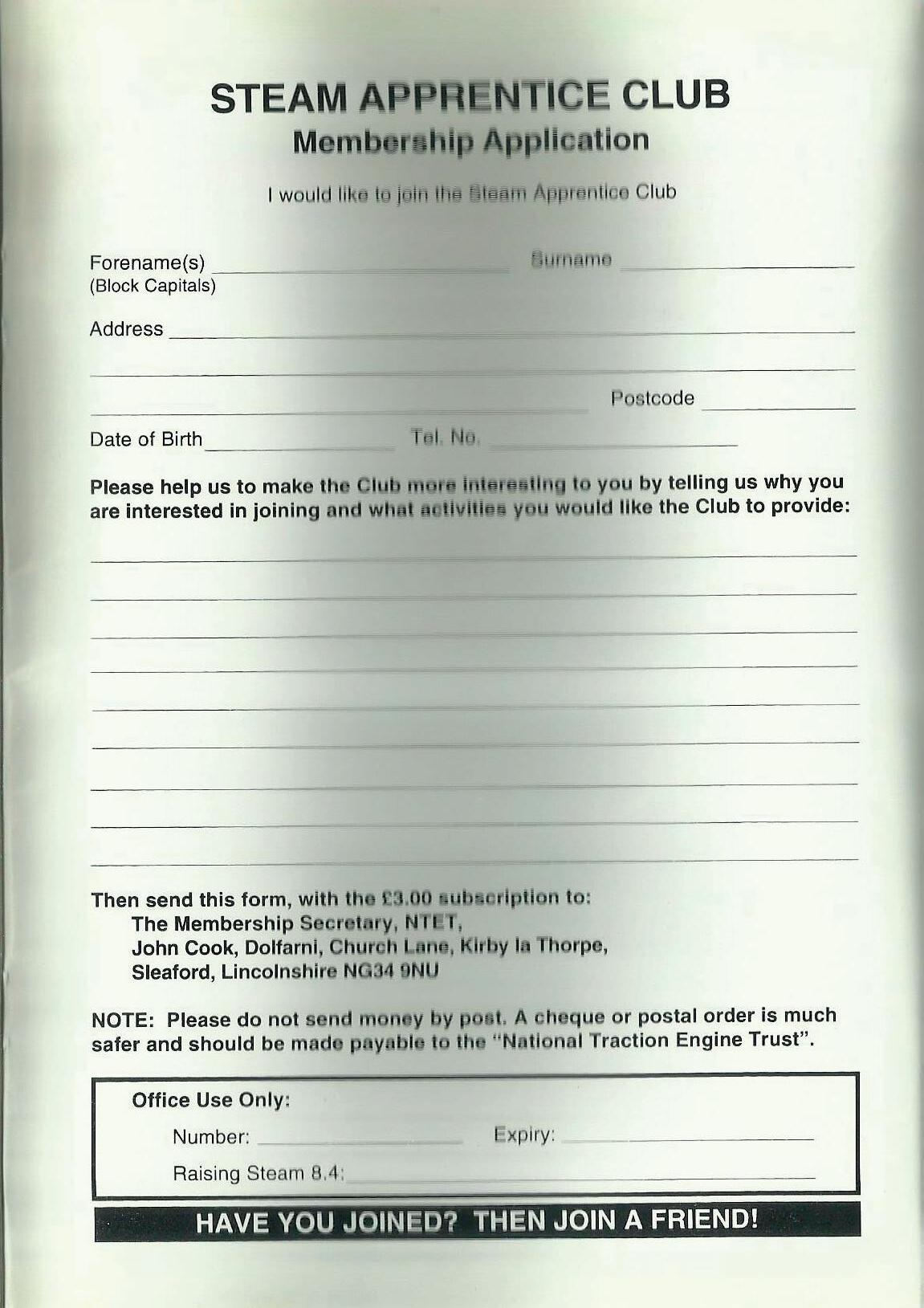
Forename(s) --~ (Block Capitals)
Address -----
Date of Birth ---,llffletllltl Po&1tcode
1 ttl N11
Please help us to make the Cluh morff lnhu111dlny lo you by telling us why you are interested in joining ond whot "' llvtllfftt yuu WtHdct like the Club to provide:
Then send this form, with tho r~um 1-1htu t lpti(Jl1 IQ: The Membership Secretnry, Nl l I, John Cook, Dolfarnl, Church Lttt1Jt,Klr by In fhorpo, Sleaford, Lincolnshire N0:14 UNU
NOTE: Please do not send monny hy pm;t, A choque or postal order is much safer and should be modo puynhlu tu llm ''Natlonal Traction Engine Trust".
Office Use Only:
Number: I xplry:
Raising Steam 8.4:
· HAVE YOU JOINED? THEN JOIN A FRIEND!
The Club was formed for young people under the age of 21 who are interested in steam traction engines, in 1979 by the then National Traction Engine Club. Today it is the young person's branch of the National Traction Engine Trust, a registered educational charity.
Many people watch engines at rallies, but few of them know how an engine works and even fewer have the chance to be shown over one by the owner, to talk about the work it used to do, or even help with the engine's maintenance.
The Club publishes this magazine with many of the articles being written by Steam Apprentices.
We have a scheme which allows Club members into many NTET approved traction engine rallies free of charge. We also try to put members aged 12 and over in touch with a local engine owner, so that they can learn more about engines from people who actually run them, in addition to our training sessions and schemes.
If you enjoy rallies, photographing and recording engines, collecting pictures or books about engines, talking about steam or just wish to learn more, the Steam Apprentice Club is for you.
1. A quarterly Magazine.
2. A Membership Card.
3. Free admission to many NTET approved Traction Engine Rallies.
4. A Free copy of NTET approved Rally List.
5. A chance to buy Books, Videos, T-shirts, Badges and other items sold by the NTET, often at special rates.
6. Special Club Visits, Events and Training Weekends.
7. Special Insurance considerations in connection with Traction Engines.
8. Annual Photographic and Colouring Competitions.
9. 20% Discount on Mamod Steam Services.
Our annual subscription is just £3.00. Membership runs to the nearest quarter.
Join us NOW: Just fill in the membership application form inside the back cover. Then send it to the membership secretary with your subscription or hand it into any NTET Rally Stand.
If you wish to keep your magazine intact, you may photocopy the membership application form, or copy the details onto ano~her sheet of paper.