EDITOR
EDITOR
Steph Gillett, 93 Devon Road, Easton, Bristol BS5 6ED.
CHAIR, STEAM APPRENTICE CLUB
John Bosworth, 74 Main Road, Smalley, Derby DE7 6EF
MEMBERSHIP SECRETARY
John Cook, Dolfarni, Church Lane, Kirby la Thorpe, Sleaford, Lincolnshire NG34 9NU
The Editor welcomes any contributions of articles, shorter items or photographs for inclusion in future issues. All material submitted is voluntary and payment cannot be made for any material published. The opinions expressed in the magazine, with the exception of Club announcements, are those of the contributors and do not indicate the views of the Club as a whole. All items are held copyright by the contributor and the NTET.
Please send your contributions to the Editor at least five weeks before publication. Typed articles are preferred but not essential. If handwritten put any names of PEOPLE, PLACES or ENGINES in BLOCK CAPITALS. If you require any part of your article (eg. photos) returning please say so and enclose a stamped addressed envelope. Enclose your name, address and (if an Apprentice) age with any contribution.
The Editor reserves the right to amend or refuse contributions, and will attempt to correct spelling and grammar!
The Magazine is normally published during the early part ofFebrum·y, Mn.Y,/\11~!11Ht and November.
The Steam Apprentice Club is a section of the National T,•111 1 111111 1•:11u11uI 111 t NTET is a Registered Charity, No.291578. RflgiHl.t•rod111 IOni:li111ciNI J Ill '1 I Registered Office: Fonun House, 1~6Millmorul, Mttlrllt,ra 'I\-\ Ill JI HJ
TypesettingbyTilsetServices,'2?Prm,lhwy, t llltt1 Ilflrnh1I I l' I 1111 I ~1 1 i l 1• Printedby EconomicPrinting l orn11;111y, rt lal 1lt;1I It II I Ii =I 1
Welcome to another, (late!), edition of Raising Steam. Welcome also to our new Chairperson, John Bosworth, who is taking over from Sylvia Dudley. Sylvia has been involved with the Steam Apprentice Club since promoting its formation :fifteenyears ago. "It's not that I have lost interest in the SAC," said Sylvia, "It's just that I have so many other things to do for the National Traction Engine Trust." I am sure that many members will want to send Sylvia their best wishes and good luck. I am certainly very grateful for all her help and support since I took over editing the magazine in 1992.
John Bosworth and his wife Olive live in Derbyshire and own a Foster 7NHP general purpose agricultural traction engine Sprig which they rally at events in 'middle' England.John writes, "My first duty is to thank Sylvia Dudley for all her hard work and for keeping the SAC flag flying. My second duty is a big "thank you" to Fiona and John Durling for looking after SAC members at rallies in Yorkshire, especially at Harewood House where I first met them."
John plans to try and organise area representatives so that there is someone in each part of the country to attend rallies to get members working on engines. Are any of your Mums, Dads, Aunts, Uncles, Guardians or senior members willing to help? John also hopes that area reps can introduce Steam Apprentices to engine owners to go and help especially in the closed season, which of course we are now entering.
The desire to link Steam Apprentices with engines is echoed by Richard Sandercock, Chair of the NTET, who feels that SAC members should not be afraid to approach local owners directly. See mailbag for Richard's letter.
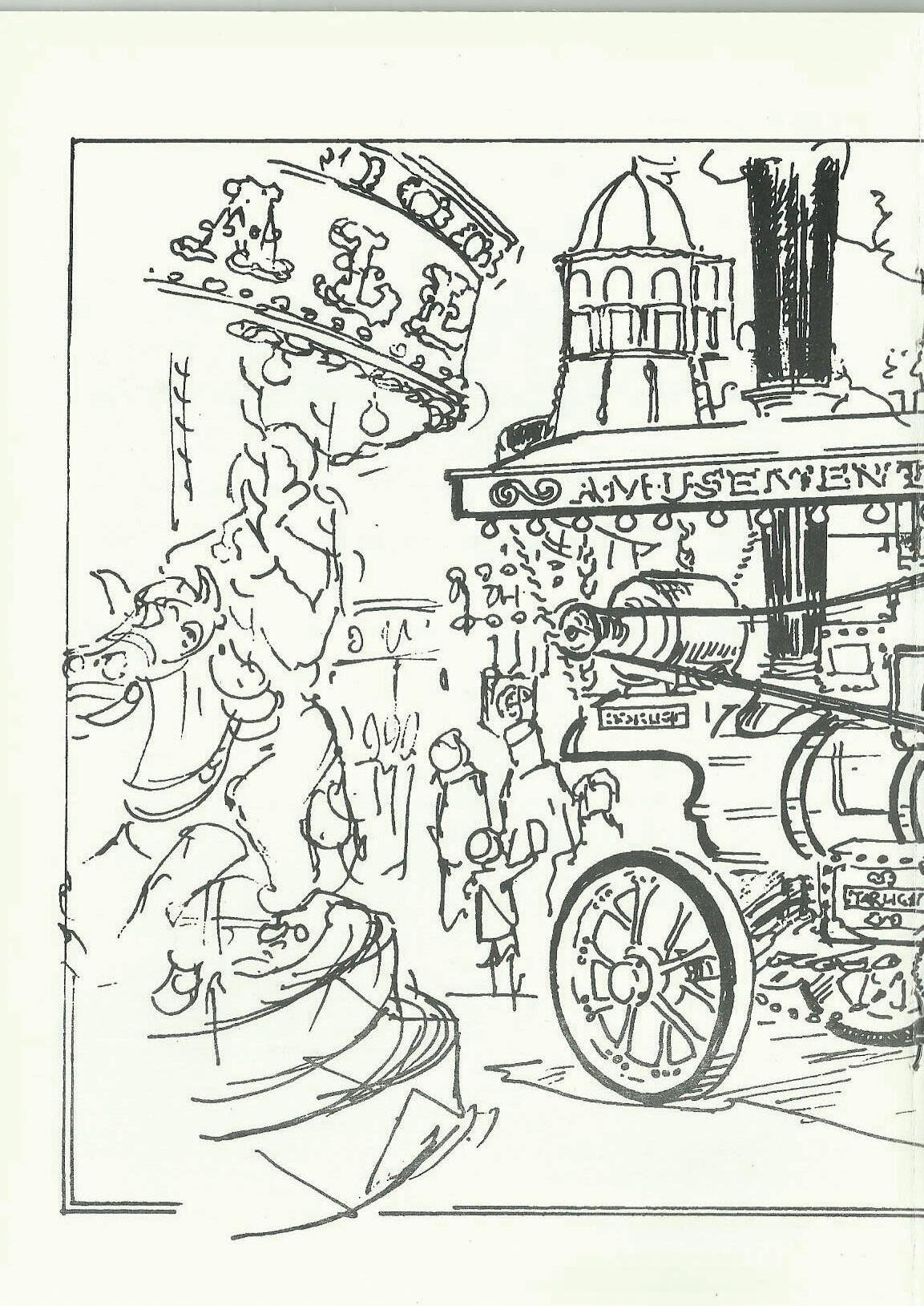
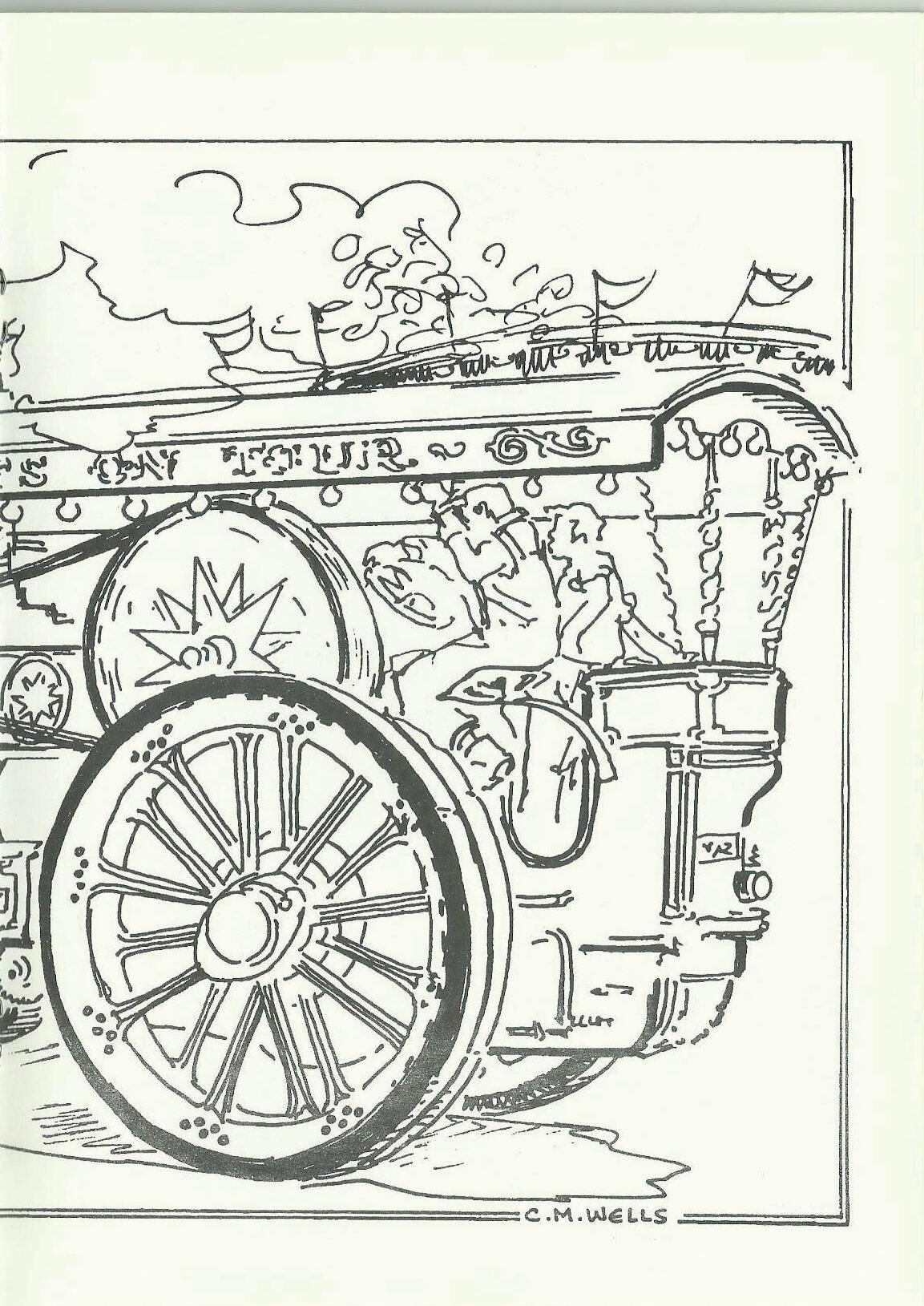
In this issue is a reminder of the Photographic Competition, and in the centre of the magazine the drawing by Chris Wells for the Colouring Competition. Christine's showman's engine should provide plenty of opportunity for members up to nine years old to express themselves colourfully. I am grateful to both Chris for the artwork, and to Paul Appleton of Old Glory who has agreed to join the panel of Judges and provide some additional prizes.
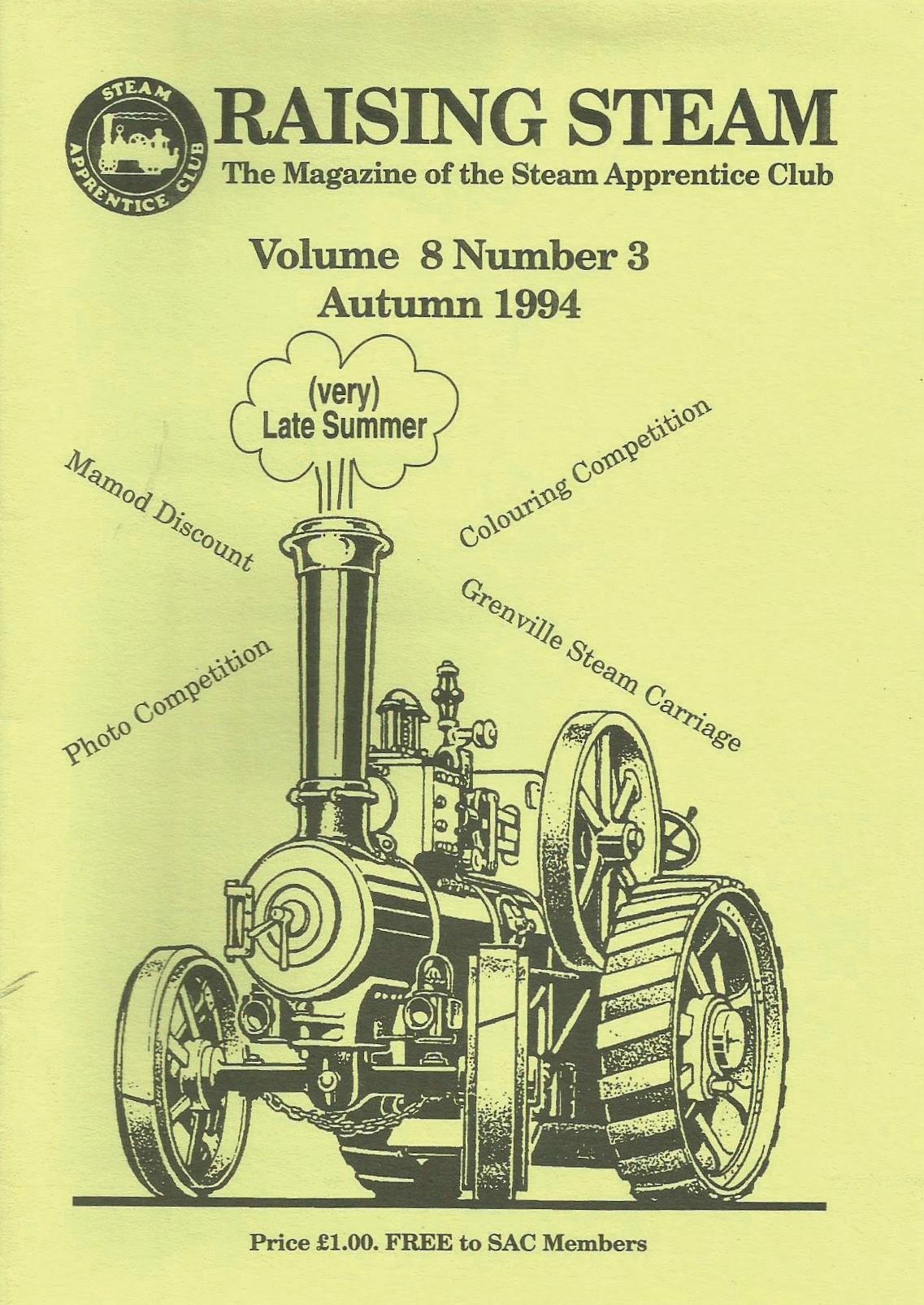
In the middle of the magazine is the first of a series of detailed drawings by Geoffrey Wheeler. You will need to remove the colouring competition to fully appre~iate it. Geoff is the person who drew the engine on the cover of Raising Steam. Members will realise that this is not meant to be a 'real' engine, (the flywheel owes its origins to Mamod!), and was drawn in the evenings after Geoff and his son had finished working on their Ruston traction engine. I think it has done very well for the club, and we are very grateful for this and the centre spreads. 1
Mention of Mamod brings me on to some exciting news for owners of their steam models, and I know many of you have one, or more! Mamod are offering a special service facility to SAC members - a 20% discount off each service cost for models up to fifteen years old, providing you quote your membership number. Many thanks to David Evans ofMamod Steam Services for this offer, and for answering James Ettle's query about Mamod kits, (apparently they are available). Incidentally, Mamod suggest replacing the safety valve and seals every three years or so. My stationary engine is well overdue for a service, but it won't qualify for a discount though as it must be nearly thirty years old! Not that I really need to worry as the boilers were designed to withstand pressures far in excess of their working pressure, usually 8 to l0psi. The last destructjon teAt by Mamod showed the boiler failure as 1,200psi; up to 150 times higher than working pressure!
If you want to arrange a service on your Mamod model, or need a list ofMamod stockists in your area, you can contact Mamod Steam Services by phoning 0734 834182.
Many thanks to everyone who has sent in contributions for Raising Steam. Don't worry if it's not printed in this edition- I have only once refused an item, an unsuitable cartoon - and will make use of anything sent in. Lack of time means that I do not always acknowledge receipt of your article or photographthat same lack of time that invariably makes me late producing your magazine. Thanks also to those other clubs and societies who send me their newsletters and magazines - Hollycombe Steam Collection, Somerset Traction Engine Club, Road Roller Association and Foxfield Light Railway Society Ltd. -it all helps to keep in touch with what's happening in the world of steam restoration and preservation. Don't forget, if you send me an article or photograph, you will receive an extra copy of Raising Steam. Lastly, thank you to Anthony Coulls for his kind letter. I hope that he, and everyone else who had exams at school, college or university, were successful and managed to balance their homework with their hobby!
That's about all from me, I hope you had a safe and enjoyable summer, and look forward to hearing from you now that the rally season is over.
Steph Gillett September 1994
I am sorry that I missed meeting those of you that came to the two events held at the Great Dorset Steam Fair this year but I had to return home unwell. Those ofyou that were there will have already heard that Mr. John Bosworth has taken over the Chairmanship of the SAC and I wish him well in the future.
I have enjoyed my work with you all since the first meeting that was held in 1978 to decide 'if and how' such an activity might work, and I have carried out most of the officers duties at some time or other since then!! having been membership Secretary, stand-in editor and chairman. It has meant that I have watched the early members reach adult life and in several cases own their own engines but when I was introduced to a first baby by one of those early members I decided it was time someone else brought some fresh ideas to the Club.
Thank you to all the helpers, parents and members for your support and friendship during the past and I look forward to meeting you as usual on the rally fields in future. Good luck, John.
Sylvia Dudley
Please send your letters, of any length, to the Editor for inclusion in the next issue of the magazine.
The Penfriends Scheme has not yet taken off, although several members have said they would like to write to someone else. I am asking them to write a short letter for the Mailbag to see if other members would like to become a penfriend.
Dear Steph,
We are entering the third generation of engine owners. The first worked with engines and formed the trust forty years ago and we owe them our hobby. The second, like me, were taught by the first and are now the holders of the knowledge, which we must pass on to the third; those who had no direct contact with the past.
The number of drivers who are fully competent to deal with an
engine on poor roads with full loads is too few. Rally field driving is all most people do and these are the people teaching others their own bad habits. We need a register of willing owners who will train both the improvers and the appren-
tices. They are tomorrow's people and must be encouraged. Without the SAC there is no future for the movement. This will only work on a one to one basis over long periods. I would welcome help with my engines and will lead from the front if we can get a scheme moving.
As with all training the early days will be filled with tedious chores until enough experience is gained to move forward. This will sort the wheat from the chaff. Engine owning is hard and requires commitment, which is where the satisfaction comes from. Engines demand constant detailed attention and only the driver knows at the end of the Journey how well he has done.
Of course licence and insurance rules define when this can start and until the correct age is attained active involvement is not possible other than at closed events. Your members should not be afraid to approach local owners directly. They may say no, but so what, or they may say yes.
Yours sincerely,
Richard Sandercock, Chairman NTET, Milford Farm, Lifton, Devon
Dear Mr Gillett,
I have recently joined the SAC. I like steam engines and vintage machinery. I have an old Monrotiller Rotavator which I am entering into the Cumbria Steam Gathering next year. I am also entering my uncle's Royal Enfield push bike. I have been going to the Cumbria Steam Gathering and the Morecambe Bay (it used to be at Lancaster) Steam Rally, since I was a small lad. I have always wanted a steam engine (a full size one). I have got a small Mamod Steam roller but when I get older I hope to have a full size one. I think the idea about the penfriends is great once it kicks off. I hope I can have a pen friend. Please let me know if there is any apprentice work going on around the Cumbria area. Thank you.
Yours sincerely, Andrew Bircher, Barrow-in-Furness, Cumbria.
My apologies to lain Jubb, Gainsborough, for mis-spelling his name in the last Mailbag. Ed.
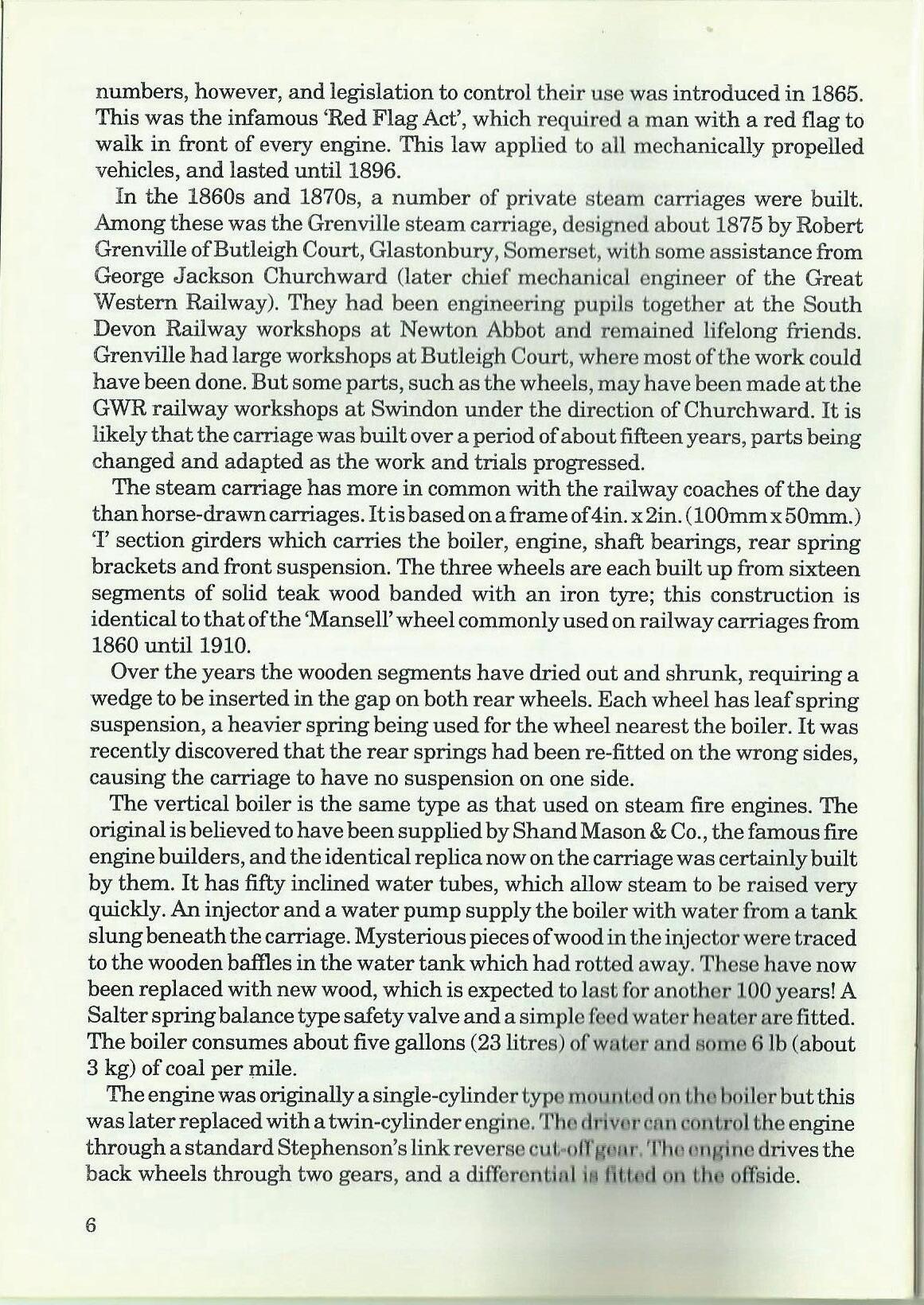
The Grenville steam carriage is believed to be the oldest self-propelled passenger carrying road vehicle still in working order. It is the best surviving example of the private steam-powered vehicles developed from 1860 to 1890 before the widespread appearance of the motor car.
In the early nineteenth century, the high cost of keeping horses and their unsuitability for continuous long-distance coach travel led to attempts to find an alternative. George Pocock, a Bristol schoolteacher, experimented in the 1820s with carriages drawn by kites, but most effort was made on harnessing steam power to road vehicles. The vehicles developed by Goldsworthy Gurney, Walter Hancock and others in the 1820s and 1830s were designed to replace horsedrawn mail coaches and buses, and met with some success. But the development of railways over the next few years took away the passenger market and high tolls on turnpike roads made these vehicles expensive to run.
Between 1840 and 1860 almost nothing was done to further develop steam passenger road vehicles. Agricultural traction engines were built in large
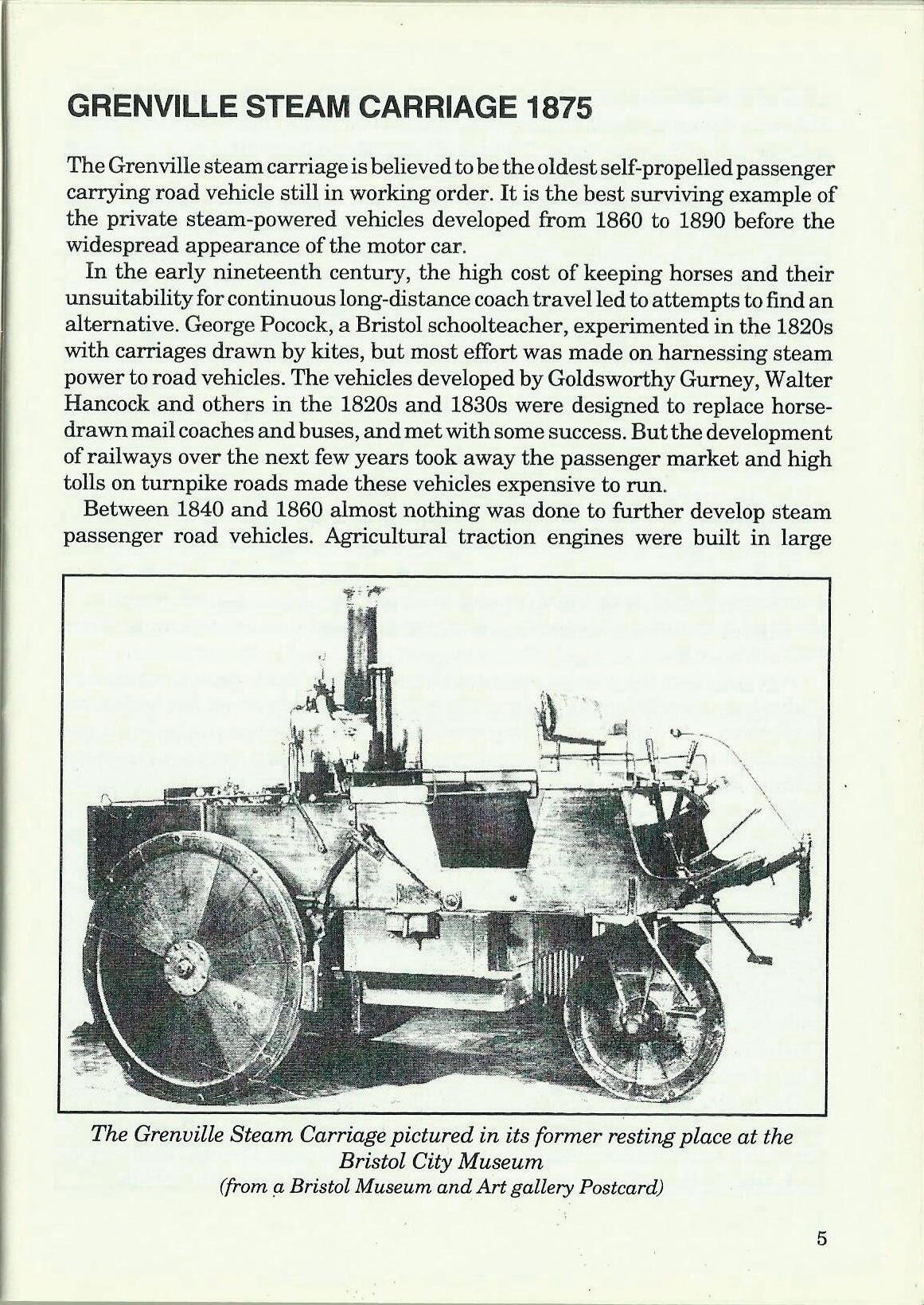
The Grenville Steam Carriage pictured in its former resting place at the Bristol City Museum (from p, Bristol Museum and Art gallery Postcard)
numbers, however, and legislation to control their use was introduced in 1865. This was the infamous 'Red Flag Act', which required a man with a red flag to walk in front of every engine. This law applied to all mechanically propelled vehicles, and lasted until 1896.
In the 1860s and 1870s, a number of private steam carriages were built. Among these was the Grenville steam carriage, designed about 1875 by Robert Grenville ofButleigh Court, Glastonbury, Somerset, with some assistance from George Jackson Church ward (later chief mechanical engineer of the Great Western Railway). They had been engineering pupils together at the South Devon Railway workshops at Newton Abbot and remained lifelong friends. Grenville had large workshops at Butleigh Court, where most of the work could have been done. But some parts, such as the wheels, may have been made at the GWR railway workshops at Swindon under the direction of Churchward. It is likely that the carriage·was built over a period of about fifteen years, parts being changed and adapted as the work and trials progressed.
The steam carriage has more in common with the railway coaches of the day than horse-drawn carriages. It is based on a frame of 4in. x 2in. (100mm x 50mm.) 'I' section girders which carries the boiler, engine, shaft bearings, rear spring brackets and front suspension. The three wheels are each built up from sixteen segments of solid teak wood banded with an iron tyre; this construction is identical to that of the 'Mansell' wheel commonly used on railway carriages from 1860 until 1910.
Over the years the wooden segments have dried out and shrunk, requiring a wedge to be inserted in the gap on both rear wheels. Each wheel has leaf spring suspension, a heavier spring being used for the wheel nearest the boiler. It was recently discovered that the rear springs had been re-fitted on the wrong sides, causing the carriage to have no suspension on one side.
The vertical boiler is the same type as that used on steam fire engines. The original is believed to have been supplied by Shand Mason & Co., the famous fire engine builders, and the identical replica now on the carriage was certainly built by them. It has fifty inclined water tubes, which allow steam to be raised very quickly. An injector and a water pump supply the boiler with water from a tank slung beneath the carriage. Mysterious pieces of wood in the injector were traced to the wooden baffles in the water tank which had rotted away. These have now been replaced with new wood, which is expected to last for another 100 years! A Salter spring balance type safety valve and a simple foo<lwater hoa tor are fitted. The boiler consumes about five gallons (23 litres) of wnLornnd Home 6 lb (about 3 kg) of coal per mile.
The engine was originally a single-cylinder typo mnu n1,otlon thP boiler but this was later replaced with a twin-cylinder engino. 'rlH rh,vPr cm1 f'Ont,rol Lheengine through a standard Stephenson's link revenie c, 1i.-offgf~Fu- 'rJ1n onf(i,10 drives the back wheels through two gears, and a difforontifll iu titled ou th~ offside.
The driver has control of the tiller steering, throttle and cut-offlevers and the whistle, operated by a foot pedal. At the time that the carriage was built the law required a brakesman to be carried. He sat on the driver's right and controlled the brake pedal, which operates wooden brake blocks. There are seats for four passengers. The fireman has a small seat in the engine compartment at the rear and is responsible for firing the boiler and maintaining its water level. Experi- ence has shown that the carriage performs best with a crew of three, driver, steersman and fireman. A speed of 18-20mph (29-32kph) is easily reached on the flat; fast enough to hold its own in city centre traffic jams! The main problem with the carriage is that the boiler provides too much steam, having been designed to raise steam quickly and supply it steadily to a pump, causing the safety valve to lift more than desired.
R.N. Grenville used the carriage in the Glastonbury area for a few years. In April 1896 he recorded the following trip in his diary.
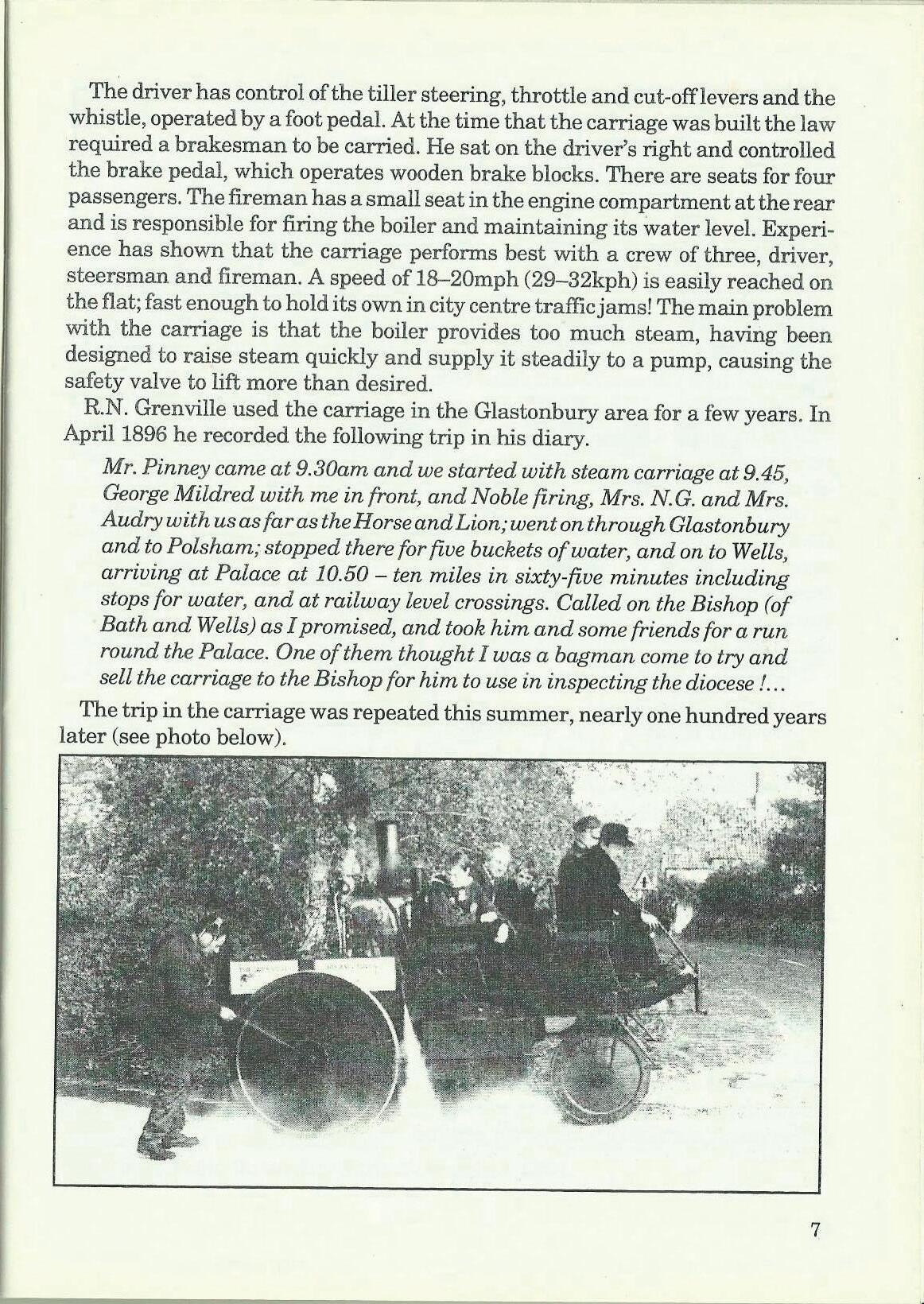
Mr. Pinney came at 9.30am and we started with steam carriage at 9.45, GeorgeMildred with me in front, and Noble firing, Mrs. N.G. and Mrs. Audry with us as far as the Horse and Lion; went on through Glastonbury and to Polsham; stopped there for five buckets of water, and on to Wells, arriving at Palace at 10.50 - ten miles in sixty-five minutes including stops for water, and at railway level crossings. Called on the Bishop (of Bath and Wells) as I promised, and took him and some friends for a run round the Palace. One of them thought I was a bagman come to try and sell the carriage to the Bishop for him to use in inspecting the diocese! ...
The trip in the carriage was repeated this summer, nearly one hundred years later (see photo below).
In 1898, experiments in cider making were started at Butleigh Court and the Grenville carriage was adapted for use as a stationary engine driving a cider mill by bolting a pulley to the nearside wheel and jacking the carriage clear of the ground on blocks. The pulley bolt holes can still be seen. The experiments finished in 1902 and the carriage fell into disuse. Around the same period the motor car was beginning to appear, together with light and efficient steam cars from America, and it seems likely that Grenville lost interest in the steam carriage.
After Grenville died in 1936, it was lent to John Allen & Sons Ltd. of Cowley, Oxford, where it was given a complete overhaul. A replica boiler replaced the original, which was beyond repair, and a new back axle was made. A number of successful trial runs were completed before the Second World War intervened and, in 1946, the carriage took part in the London Jubilee Cavalcade in Regent's Park, where it frightened a police horse! The following year the carriage was presented to Bristol City Museum by Captain P.L. Neville, a nephew of R.N. Grenville. (It was here as a youngster that I first saw the carriage. Ed).
After over twenty years of static display, the carriage was again overhauled in the Museum's workshops by the Technology Conservator Fred Lester. Modifications were made to the boiler by Messrs. Jefferies (Ship Repairers) Ltd. Avonmouth and, after passing its MOT test, the carriage ran again under its own power in the Lord Mayor of Bristol's Jubilee Procession in 1977. It is now displayed at Bristol Industrial Museum and attends steam rallies and other events from time to time.
Overall length- 11ft. 6in. (3.5m.)
Overall width - 5ft. 7in. (1.7m)
Overall height- 8ft. 3in. (3.2m.)
Weight of vehicle (in full working order)-2.23 tons (2.33 tonnes).
Boiler- vertical water tube with 50in. x lin. (25mm.) diameter inclined water tubes, working at 120psi (8 bar). Grate area 2.5sq.ft. (0.23sq.m.).
Heating surface totalling 29sq.ft. (2.7sq.m.); 13sq.ft. (1.2sq.m.) in the firebox and 16sq.ft. (l.5sq.m.) in the tubes.
Water capacity- boiler 35 gallons ( 158.7 litres); water tank 50 gallons (227 litres).
Engine - twin cylinder simple horizontal 5in. (127mm.) bore x 6in. (152.4mm.) stroke.
Stephenson's link reverse cut-off gear. Slide valves. Grateful thanks are expressed to Andy King, Curator, Bristol l11dustrial Museum, for providing the drawing, photographs and most of'the tetl /tH·t.his article about one of the Editor's favourite 'engines'.
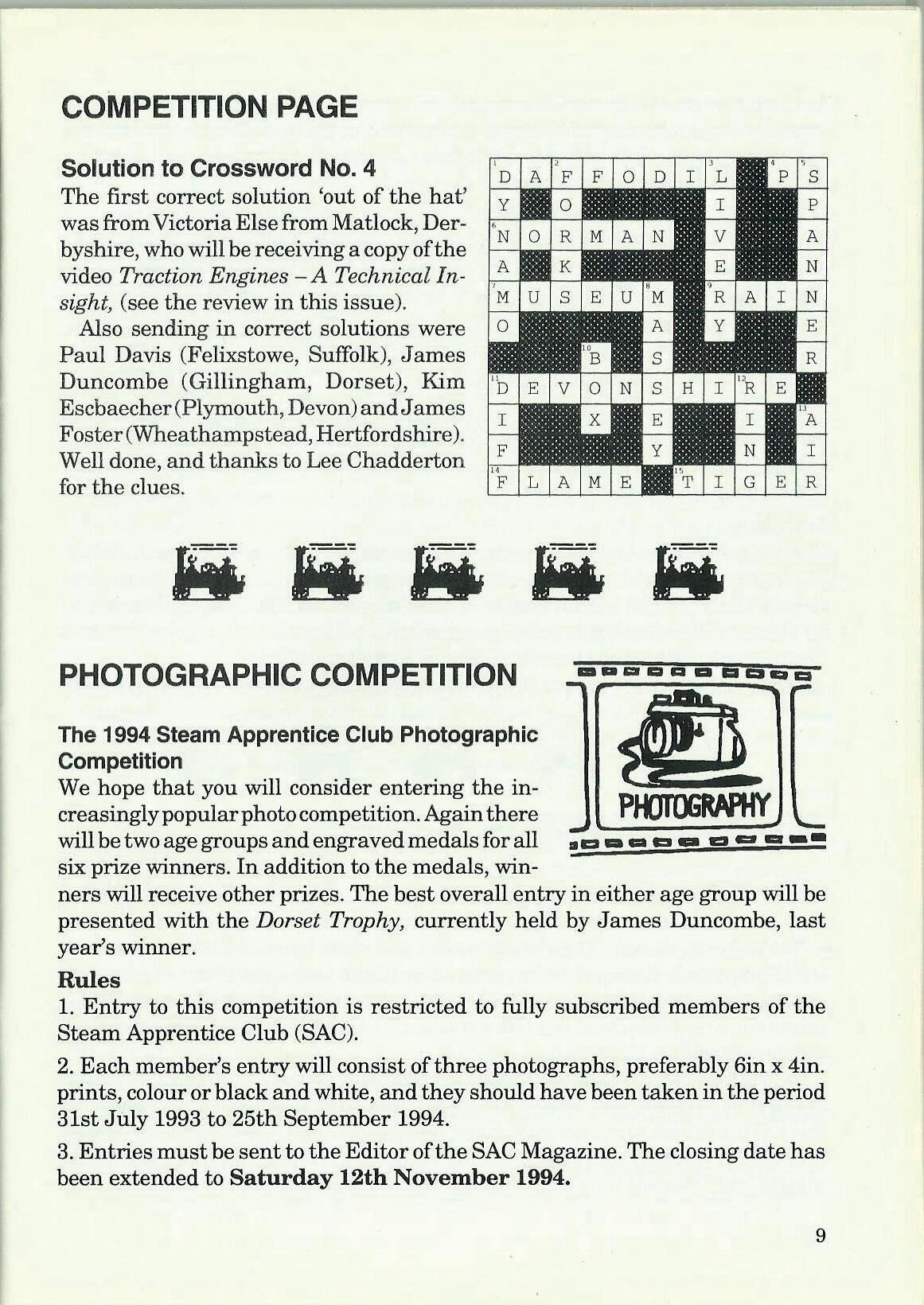
The first correct solution 'out of the hat' was from Victoria Else from Matlock, Derbyshire, who will be receiving a copy of the video Traction Engines -A Technical Insight, (see the review in this issue). Also sending in correct solutions were Paul Davis (Felixstowe, Suffolk), James Duncombe (Gillingham, Dorset), Kim Escbaecher (Plymouth, Devon) andJ ames Foster (Wheathampstead, Hertfordshire). Well done, and thanks to Lee Chadderton for the clues.
The 1994 Steam Apprentice Club Photographic Competition
We hope that you will consider entering the increasinglypopular photo competition. Again there
will be two age groups and engraved medals for all
six prize winners. In addition to the medals, winners will receive other prizes. The best overall entry in either age group will be presented with the Dorset Trophy, currently held by James Duncombe, last year's winner.
1. Entry to this competition is restricted to fully subscribed members of the Steam Apprentice Club (SAC).
2. Each member's entry will consist of three photographs, preferably 6in x 4in. prints, colour or black and white, and they should have been taken in the period 31st July 1993 to 25th September 1994.
3. Entries must be sent to the Editor of the SAC Magazine. The closing date has been extended to Saturday 12th November 1994.
4. All entries must have the following details on the reverse of each photograph: name, address, age and SAC membership number; place, date and details of the engine or subject. (It is better to write these details on a piece of paper and then stick this on the back of the photo.)
5. Copyright on all entries will remain with the SAC member submitting the photographs and the organisers promise that prints will not be used in any manner or display other than in connection with the 1994 Photographic Competition. (A selection of entries will appear in subsequent SAC Magazines.)
6. All entries are to include a suitable stamped addressed envelope to ensure photographs can be returned. The organisers promise to return all entries after display and/or publication if this rule is adhered to.
7. The competition will be judged in two age groups: up to 15 years; 16 years and over. Prizes and engraved medals for First, Second and Third places will be awarded in each age group. The best overall entry will receive the Dorset Trophy shield, to be held for one year.
The judges will be looking for originality, composition and technical ability. Photographs do not have to be of traction engines, but other subjects must be clearly related to the traction engine hobby/movement. The judges' decision on all entries will be final and members are asked to accept them in a spirit that will bring credit to themselves and the Steam Apprentice Club.
COME ON DON'T BE SHY - POINT THE LENS AND PRESS THE SHUTTER!
"At last!", I hear you say, and quite right too. After all, it was the '1993 Membership Survey' and here we are three-quarters through 1994!
Not to worry though, as your comments and ideas have already been considered and recorded, even if we have not been able to take up all your suggestions just yet. I mentioned before (V ol.8 N o.1)the winners of the lucky draw and those prizes have·now been sent but there was not enough space in the last issue to go into any details of the results.
Nearly fifty members returned the questionnaire, about 12%of the mailing list at the time. Not quite as many as in 1992 but enough to get an idea of what you think of the Steam Apprentice Club and Raising Steam. I was delighted that well over half of you said that the magazine was good; in fact over 80% replied good or excellent, which is very encouraging. The same proportion of you felt that the
Club overall was excellent or good, although at least one member questioned whether the SAC existed as a 'Club' at all. Half of you think the quality of photographs in Raising Steam are good, but over a quarter said only OK. I hope we have continued to improve the reproduction during the past year. Thank you for all your comments and suggestions to make the magazine better, I will try to include your ideas. It was good to know that most of you look forward to and enjoy the magazine but many of you would like more issues and more pages (and no doubt like to receive them on time!)
A lot of members (79%) would be interested if the Club organised outings and many of you suggested various steam centres, museums and preserved railways that could be visited. Sadly it has not been possible to organise anything this year, or even hold an Apprentices Traction Engine Driving Course, (something else that several members mentioned). Perhaps next year we can organise some events around the country, especially if John Bosworth's idea for regional contacts works. I certainly hope so.
Steam Apprentices visited a wide range of traction engine rallies in 1993, from the big established events to small local affairs. Some of you only get to one or two rallies in a year, others must be at something almost every weekend during the season, with events like Bishops Castle, Elvaston Castle, Driffield, Harewood House, Pickering, Upton-upon-Severn, Weeting, Netley Marsh, and Langport being especially popular. Of course many of you go to the Dorset Steam Fair, where we have our annual get-together, engine rides and breakfast on a shovel. Most members (60%) thought we should stay at Dorset for the annual meeting but quite a lot suggested alternative events in other parts of the country, Dorset being a long way off from anywhere North of Derby. Again the idea of regional events could help with the problem of transport.
Only about a quarter of those replying had used their SAC membership card for free entry into rallies and several mentioned that some of the events supposed to be giving free entry to Apprentices did not do so. This seems to suggest a need for better publicity about the scheme within the traction engine rally movement itself. In fact only about a dozen of the eighty NTET Authorised Rallies publicised free entry to SAC members this year.
If you would like a copy of the full results of the 1993 Membership Survey, (or indeed the 1992 survey), send me a stamped addressed envelope. In the meantime here are just a few of the comments and suggestions you made last year:
"The Club offers young people the opportunity to experience the magic of steam and to work with these machines" (Patrick Tonks, Leeds)
"The Club gives you a chance to meet people your own age that have the same interests" (Paul Honeybun, Lymington)
"I have never met anyone who is in the SAC yet" (Jonathan Girling, Driffield)
'We get plenty of information and stories in the magazine" (Jemma Dowey, Barnsley)
"I like it when we have bacon and egg on the shovel" (Michele Farmer, Worksop)
"Raising Steam would be better if there were more pages" (Andrew Loader, Wimborne, and many others!)
"I like it when children write in about their experiences as a Steam Apprentice" (Victoria Else, Matlock)
Thanks again to everyone who took part in the survey-per haps again next year - or maybe not until 1996!
Produced with embroidered NTET Logo (approx: 3in x 2½in) onto left hand chest position, onto plain sweatshirts.
QUALITY: Polyester/Cotton basecolour
Red
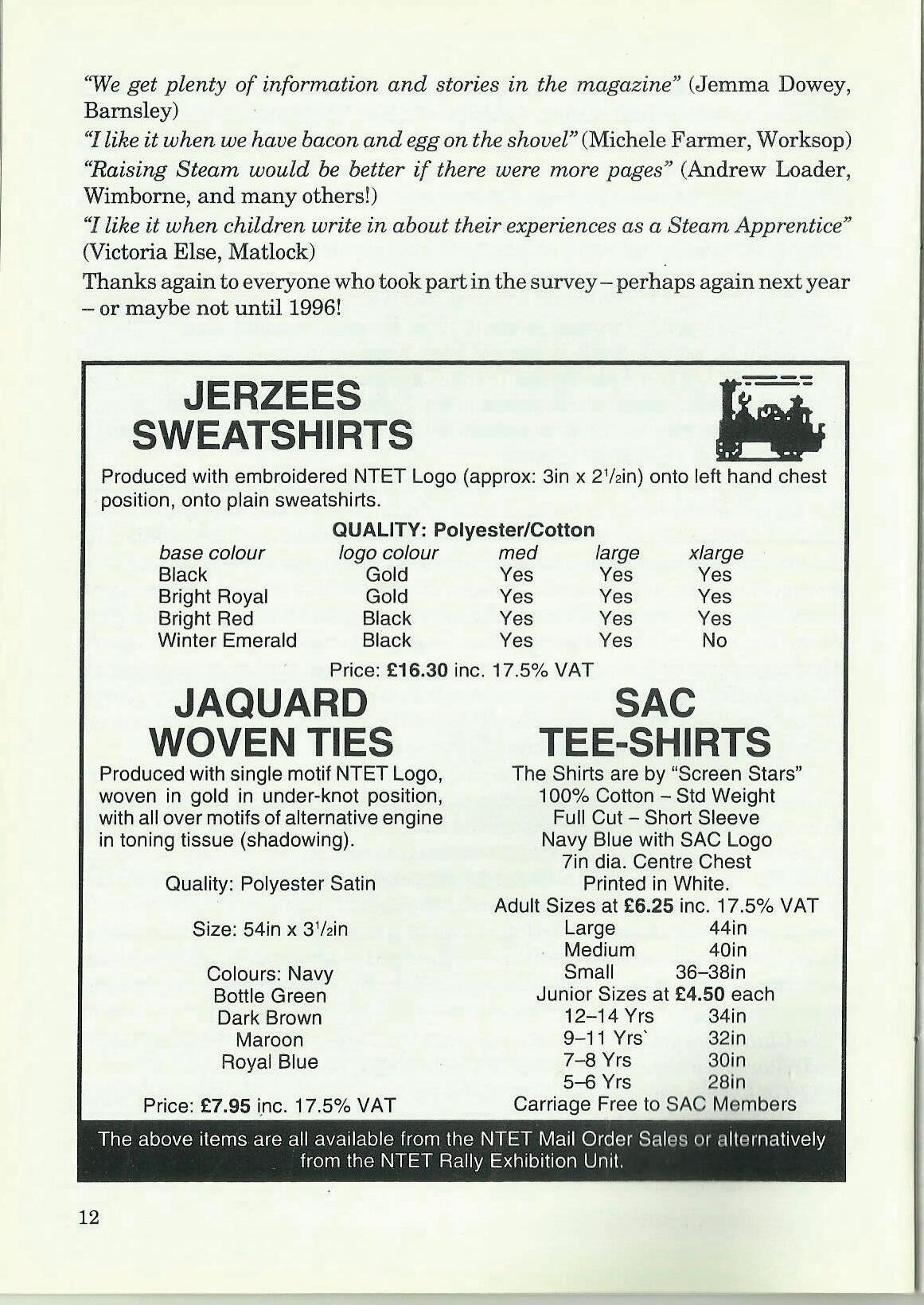
Price: £16.30 inc. 17.5% VAT
Produced with single motif NTET Logo, woven in gold in under-knot position, with all over motifs of alternative engine in toning tissue (shadowing).
Quality: Polyester Satin
Size: 54in x 3½in
Colours: Navy
Bottle Green
Dark Brown Maroon
Royal Blue
Price: £7.95 i,nc. 17.5% VAT
The Shirts are by "Screen Stars" 100% Cotton - Std Weight
Full Cut - Short Sleeve
Navy Blue with SAC Logo ?in dia. Centre Chest Printed in White.
Adult Sizes at £6.25 inc. 17.5% VAT
Large 44in
Medium 40in
Small 36-38in
Junior Sizes at £4.50 each
12-14 Yrs 34in
9-11 Yrs' 32in
7-8 Yrs 30in
5-6 Yrs 28in
Carriage Free to SAC Members
The above items are all available from the NTET Mail Order Sales or alternatively from the NTET Rally Exhibition Unit.
Manybooksvideosandotheritemsofinteresttotraction engineenthusiastsareavailablefromtheSafessection. Readersareurgedtotakeadvantageofthisservice{which alsobenefitsTrustfunds)fortroublefreeondeconomical postalshopping.Justticktheboxforitemsyourequireandfill intheaddressslip.
TRACTIONENGINEREADING
NewSteamTractionin the RoyalEngineers (Preston)
NewBricksandRollers(EssamandFreeman)
NewMadeby Garretts(Whitehead)
NewTheStoryof theSt. NicholasWorks {Lane)
NewSteamHeritageYearbook
NewPullingPints(Coates)
TheLyalldaleWaltz(Thompson)
SentinelWorksPhotosNo.1(Thomas)
Thresher'sYard(Compton)
Steamis the Essence(Whitehead)
FairfieldFolk:Historyof the British FairgroundPeople(Brown)
CharlesBurrell1911Cataloguere-print
BritanniaIronWorks(Lane)
Wm.AllchinLtd (Middlemiss)
Steamin my Family(Newton)
PatCollins,Kingof Showmen (AllenandWilliams)
JesseEllisandtheMaidstoneWagons (Whitehead)
Men,MudandMachines(Sanders)
SteamEngineBuildersof Norfolk(Clark)
£4.50 0
£6.00 0
£2.25 0
£29.00 d
£2.50 0
£18.95 0
£10.50 0
£15.95 0
£2.75 0
£16.50 0
£15.95 D
£2.95 D
£28.00 0
£13.95 0
£4.95 D
£15.00 D
£11.50 0
£13.95 D
£17.95 0
Steamin myVeins(Boughton)hard£12.95 D soft £8.95 D
MoreMuckThanMoney(Nicholson) £7.50 D
TractionEngineRegister
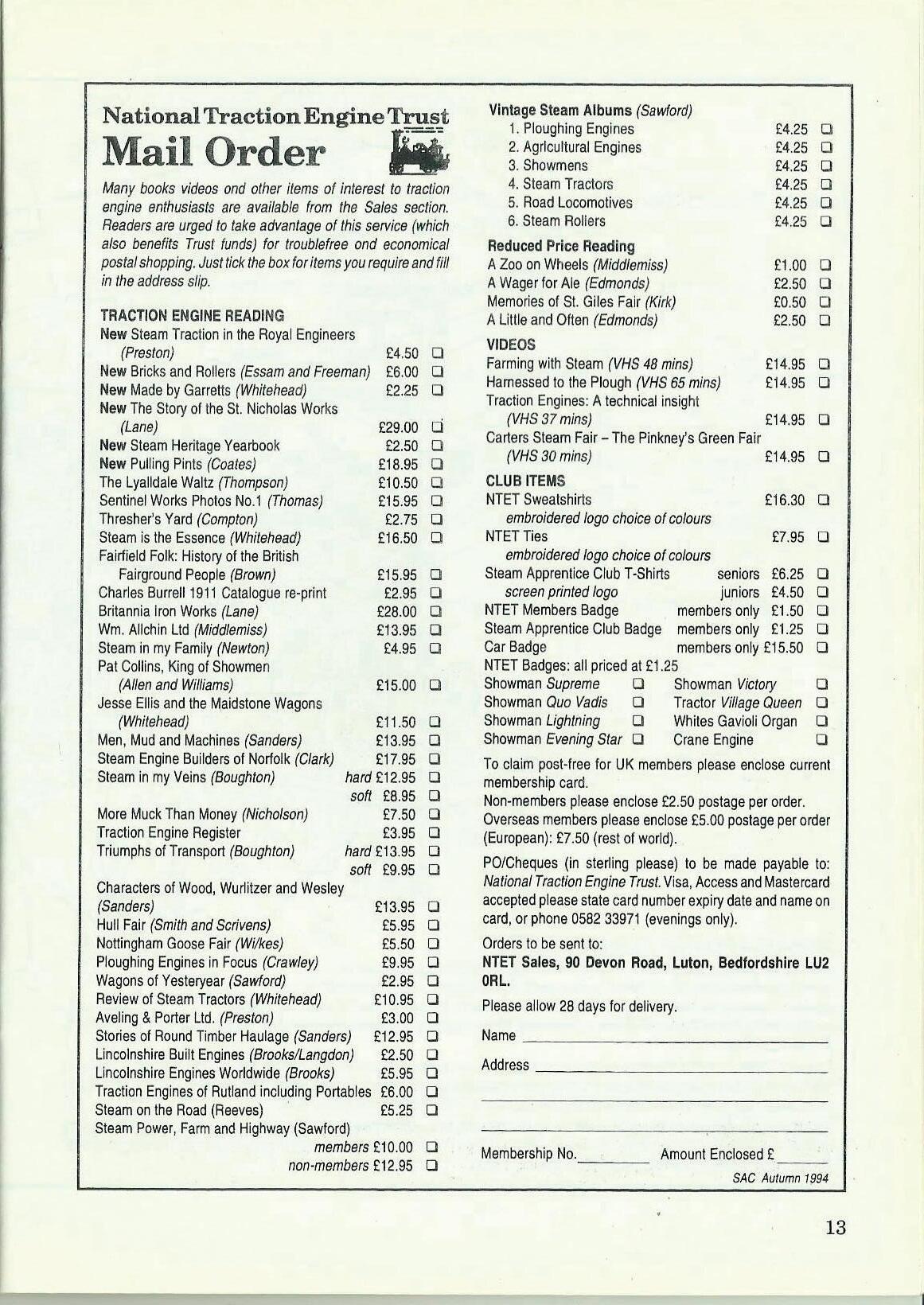
£3.95 0
Triumphsof Transport(Boughton)hard£13.95 0 soft £9.95 0
Charactersof Wood,WurlitzerandWesley (Sanders)
HullFair(SmithandScrivens)
NottinghamGooseFair(Wilkes)
PloughingEnginesin Focus(Crawley)
Wagonsof Yesteryear{Sawford)
Reviewof SteamTractors(Whitehead)
Aveling& PorterLtd.(Preston)
£13.95 0
£5.95 0
£5.50 0
£9.95 0
£2.95 0
£10.95 0
£3.00 0
Storiesof RoundTimberHaulage(Sanders) £12.95 0
LincolnshireBuiltEngines(Brooks/Langdon)
LincolnshireEnginesWorldwide(Brooks)
£2.50 0
£5.95 0
TractionEnginesof Rutlandinclu~ingPortables£6.00 0
Steamon the Road(Reeves)
SteamPower,FarmandHighway(Sawford) members
£5.25 0
£10.00 0 non-members£12.95 D
VintageSteamAlbums(Sawford)
1. PloughingEngines
£4.25 0
2. AgriculturalEngines £4.25 0
3. Showmens
£4.25 D
4. SteamTractors £4.25 0
5. RoadLocomotives £4.25 0 6. SteamRollers £4.25 0
ReducedPriceReading A ZooonWheels(Middlemiss) £1.00 D A Wagerfor Ale (Edmonds) £2.50 0
Memoriesof St. GilesFair (Kirk)
£0.50 0
A little andOften(Edmonds) £2.50 0
VIDEOS
FarmingwithSteam(VHS48mins) £14.95 0
Harnessedto the Plough(VHS65mins) £14.95 0
TractionEngines:A technicalinsight (VHS37mins)
£14.95 0
CartersSteamFair- The Pinkney'sGreenFair (VHS30mins) £14.95 0
CLUBITEMS
NTETSweatshirts £16.30 0 embroideredlogochoiceofcolours
NTETTies £7.95 0 embroideredlogochoiceofcolours
SteamApprenticeClubT-Shirts seniors £6.25 0 screenprintedlogo juniors £4.50 0
NTETMembersBadge membersonly £1.50 0
SteamApprenticeClubBadge membersonly £1.25 0
CarBadge membersonly £15.50 D
NTETBadges:all pricedat £1.25
ShowmanSupreme 0 ShowmanVictory 0
ShowmanOuoVadis 0 TractorVillageQueen 0
ShowmanLightning D WhitesGavioliOrgan 0
ShowmanEveningStar CraneEngine 0
To claimpost-freefor UK memberspleaseenclosecurrent membershipcard.
Non-memberspleaseenclose£2.50postageperorder. Overseasmemberspleaseenclose£5.00postageperorder (European):£7.50(restof world).
PO/Cheques(in sterlingplease)to be madepayableto: NationalTractionEngineTrust.Visa,AccessandMastercard acceptedpleasestatecardnumberexpirydateandnameon card,or phone058233971(eveningsonly).
Ordersto be sentto:
NTETSales,90 DevonRoad,Luton,BedfordshireLU2 ORL.
Pleaseallow28 daysfor delivery.
Name
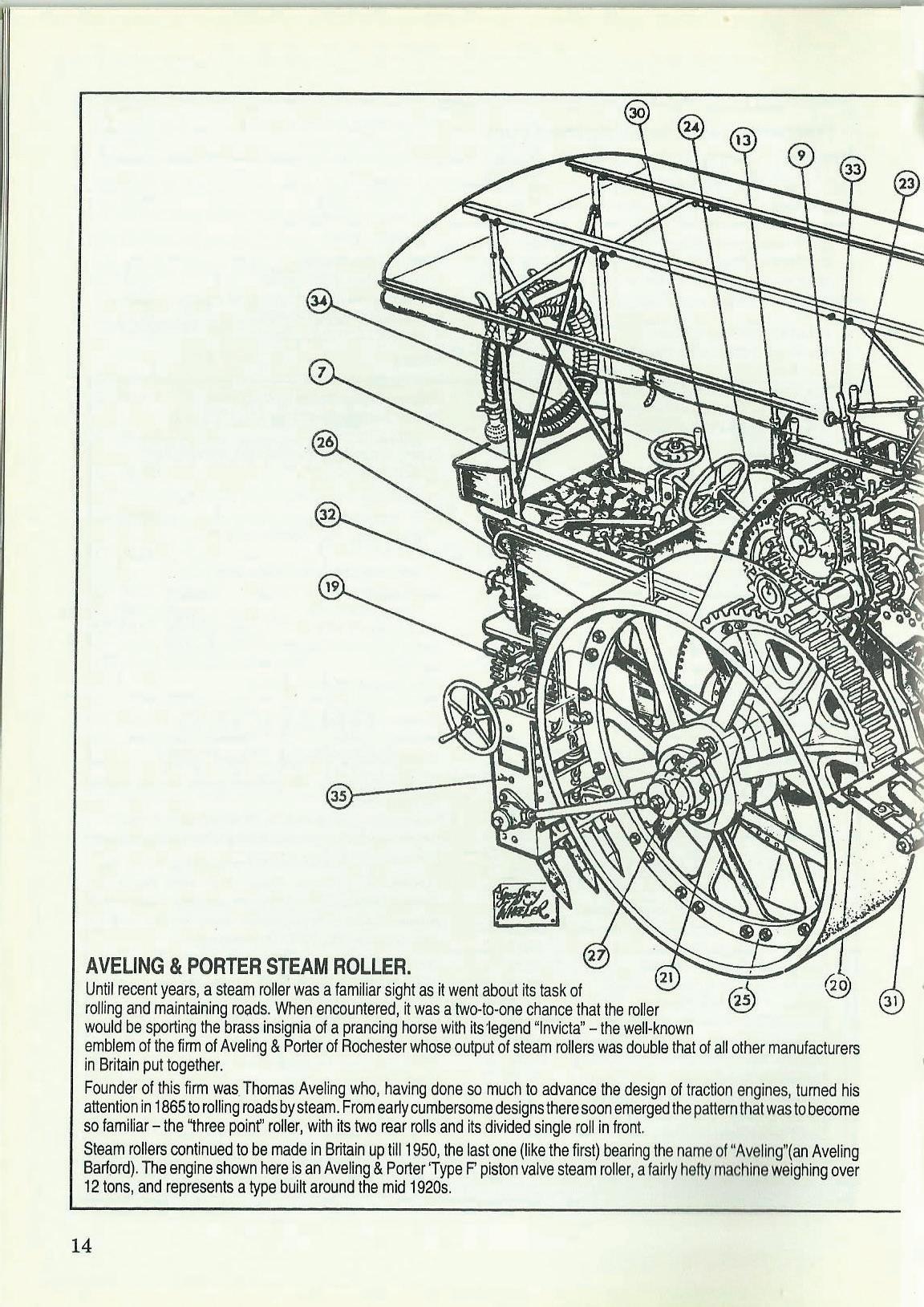
AVELING & PORTERSTEAMROLLER.
Untilrecentyears,a steamrollerwasa familiarsightasit wentaboutitstaskof rollingandmaintainingroads.Whenencountered, it wasa two-to-onechancethattheroller wouldbesportingthebrassinsigniaof a prancinghorsewithits1egend"lnvicta"-thewell-known emblemofthefirmofAveling& PorterofRochesterwhoseoutputof steamrollerswasdoublethatofallothermanufacturers in Britainputtogether.
Founderof thisfirmwas.ThomasAvelingwho,havingdoneso muchto advancethedesignof tractionengines,turnedhis attentionin1865torollingroadsbysteam.Fromearlycumbersomedesignstheresoonemergedthepatternthatwastobecome sofamiliar - the"threepoint''roller,withitstworearrollsanditsdividedsinglerollin front.
Steamrollerscon1inued to bemadein Britainuptill 1950,thelastone(likethefirst)bearingthenameof".Aveling"(anAveling Barford).TheengineshownhereisanAveling& Porter'TypeP pistonvalvesteamroller,a fairlyheftymachineweighingover 12tons,andrepresents a typebuiltaroundthemid1920s.
CAREFULLY remove this page from the magazine -ask an adult to help if necessary -be especially careful of the staples.
COLOUR the picture using pencils, crayons, paints or felt pens. (Pencils are probably best.)
WRITE your name, age, address and membership number in the space provided.
POST your entry in a large envelope, to avoid folding it too much.
ENCLOSE a large stamped addressed envelope if you want your entry returned.
REMEMBER to send your entry in before the 12th NOVEMBER 1994.
ADDRESS for entries is:

Name
Address
SAC, 93, Devon Road, Easton, BRISTOL, BS56ED
Age
Membership No.
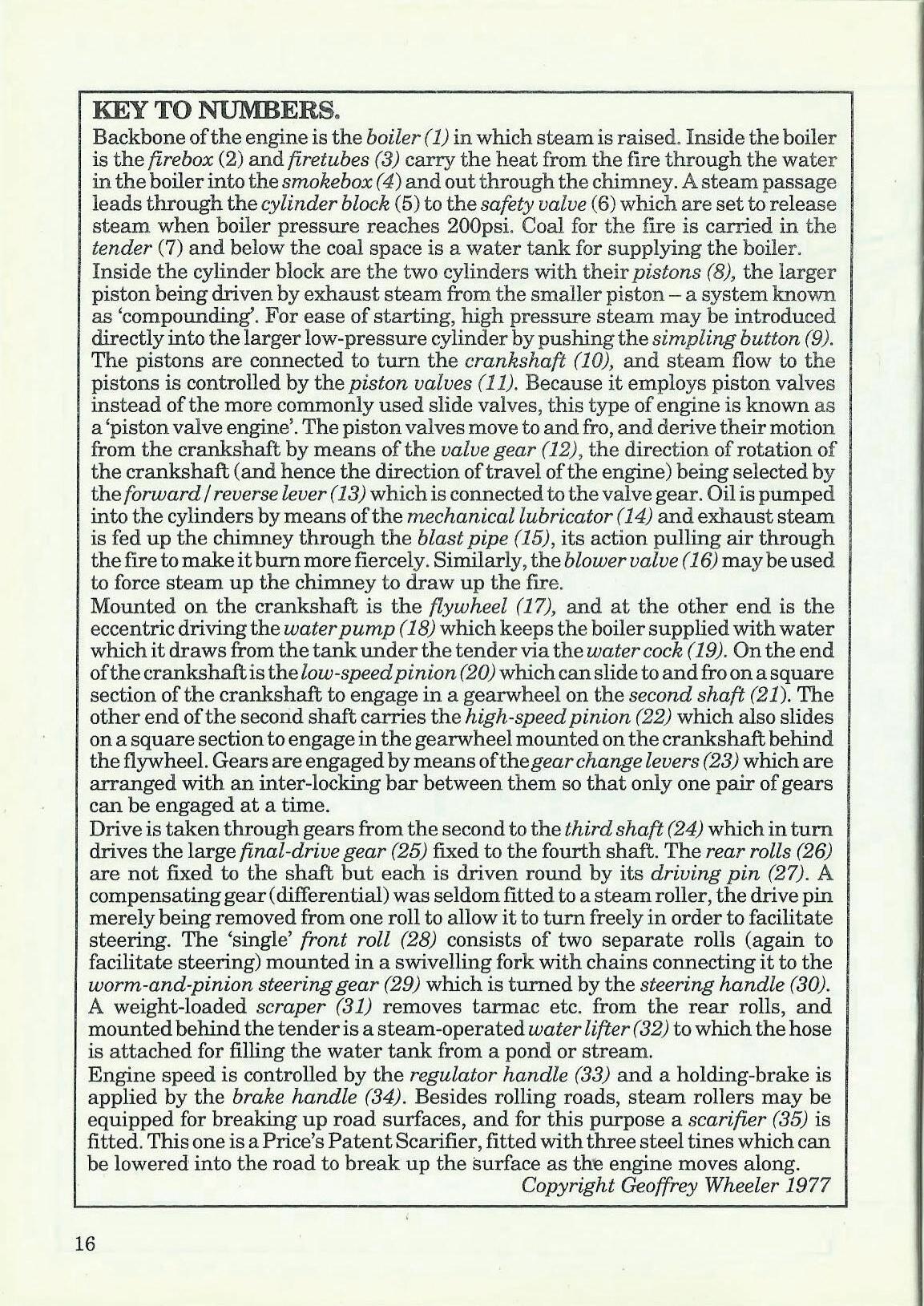
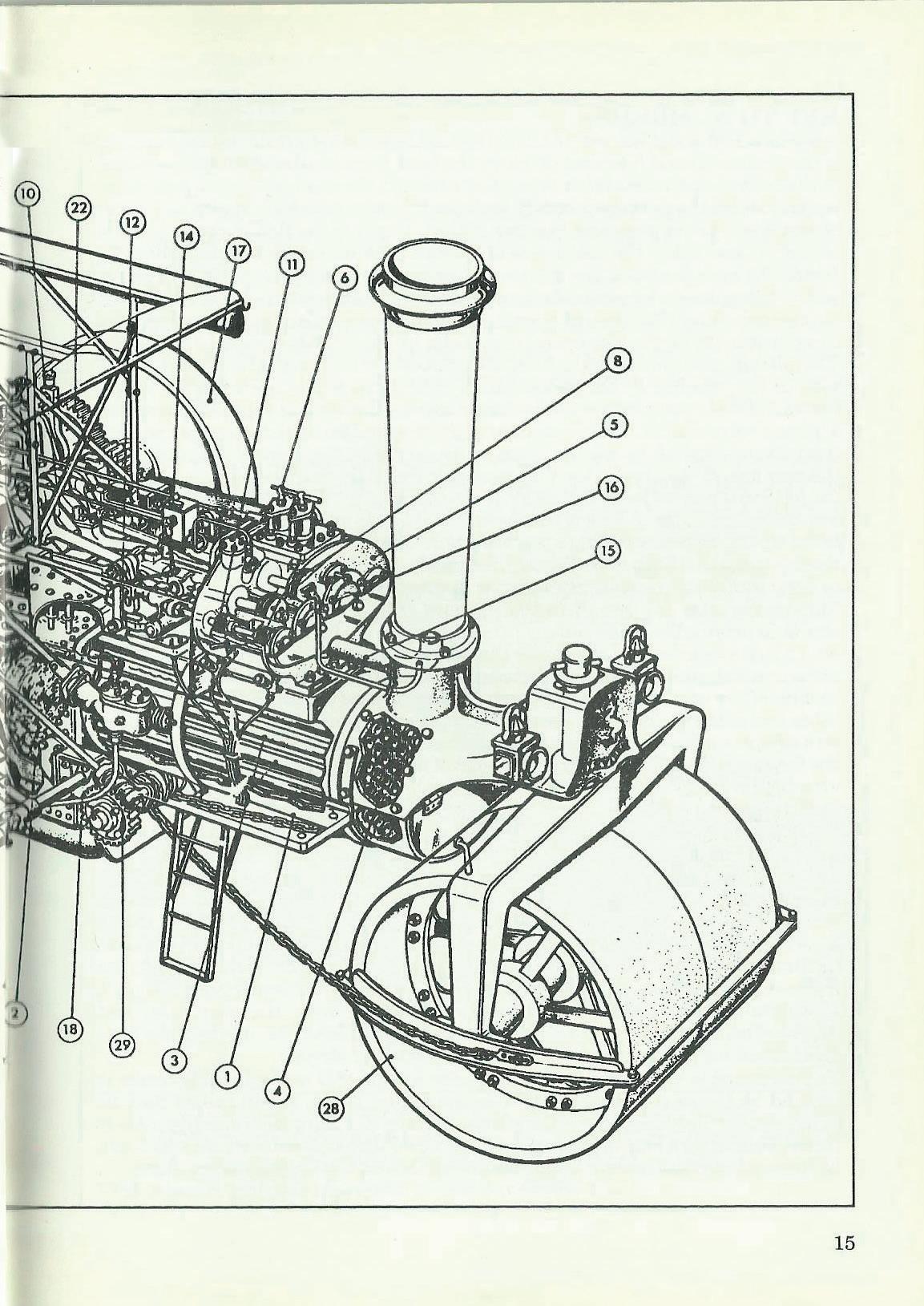
Backbone of the engine is the boiler (1) in which steam is raised. Inside the boiler is the firebox (2) and firetubes (3) carry the heat from the fire through the water in the boiler into the smokebox (4) and out through the chimney. A steam passage leads through the cylinder block (5) to the safety valve (6) which are set to release steam. when boiler pressure reaches 200psi. Coal for the fire is carried in the tender (7) and below the coal space is a water tank for supplying the boiler. Inside the cylinder block are the two cylinders with their pistons (8), the larger piston being driven by exhaust steam from the smaller piston - a system known as 'compounding'. For ease of starting, high pressure steam may be introduced directly into the larger low-pressure cylinder by pushing the simpling button (9). The pistons are connected to turn the crankshaft (10), and steam flow to the pistons is controlled by the piston valves (11). Because it employs piston valves instead of the more commonly used slide valves, this type of engine is known as a 'piston valve engine'. The piston valves move to and fro, and derive their motion from the crankshaft by means of the valve gear (12), the direction of rotation of the crankshaft (and hence the direction of travel of the engine) being selected by the forward I reverse lever (13) which is connected to the valve gear. Oil is pumped into the cylinders by means of the mechanical lubricator (14) and exhaust steam is fed up the chimney through the blast pipe (15), its action pulling air through the fire to make it burn more fiercely. Similarly, the blower valve (16) may be used to force steam up the chimney to draw up the fire.
Mounted on the crankshaft is the f1,ywheel (17), and at the other end is the eccentric driving the water pump (18) which keeps the boiler supplied with water which it draws from the tank under the tender via the water cock (19). On the end of the crankshaft is the low-speed pinion (20) which can slide to and fro on a square section of the crankshaft to engage in a gearwheel on the second shaft (21). The other end of the second shaft carries the high-speed pinion (22) which also slides on a square section to engage in the gearwheel mounted on the crankshaft behind the flywheel. Gears are engaged by means of the gear change levers (23) which are arranged with an inter-locking bar between them so that only one pair of gears can be engaged at a time.
Drive is taken through gears from the second to the third shaft (24) which in tum drives the large final-drive gear (25) fixed to the fourth shaft. The rear rolls (26) are not fixed to the shaft but each is driven round by its driving pin (27). A compensatinggear(differential) was seldom fitted to a steam roller, the drive pin merely being removed from one roll to allow it to turn freely in order to facilitate steering. The 'single' front roll (28) consists of two separate rolls (again to facilitate steering) mounted in a swivelling fork with chains connecting it to the worm-and-pinion steering gear (29) which is turned by the steering handle (30). A weight-loaded scraper (31) removes tarmac etc. from the rear rolls, and mounted behind the tender is a steam-operated water lifter (32) to which the hose is attached for filling the water tank from a pond or stream. Engine speed is controlled by the regulator handle (33) and a holding-brake is applied by the brake handle (34). Besides rolling roads, steam rollers may be equipped for breaking up road surfacest and for this purpose a scarifier (35) is fitted. This one is a Price's Patent Scarifier, fitted with three steel tines which can be lowered into the road to break up the surface as th'e engine moves along. Copyright Geoffrey Wheeler 1977
Steph Gillett, with contributions by Anthony Coulls, Richard McCormick and Aubrey Tummon
Before I tell you of my rally visits I am pleased to include two rally reports from SAC members. Firstly an item from regular contributor Anthony Coulls on the Bloxham Rally.
Over the weekend of the 25th and 26th June, the Banbury Steam Society held its annual 'Steam Engine Rally and Fayre' at Bloxham Fields. Being easily accessible, we decided to visit on the Saturday -it also being Dad's birthday! Added attractions for this year included a meet of Foden and ERF commercial vehicles. The weather was dry and bright, though dry ground made for occasional clouds of dust blowing across the site.
Of course there were the usual displays of cars, motorbikes, stationary engines and military vehicles, whilst among the tractors was an example of the Fowler 'Gyrotiller' design. The main lure for most of the visitors however, had to be the steam engines. In their own field this year, there were around 45 in attendance, several being well known regulars, while there were also some pleasant surprises. First in the line was the Burrell Showman's Nero, at one time preserved by friends in Warwickshire but now domiciled in Norfolk. Following along the line were two Z7's and a smaller plougher.
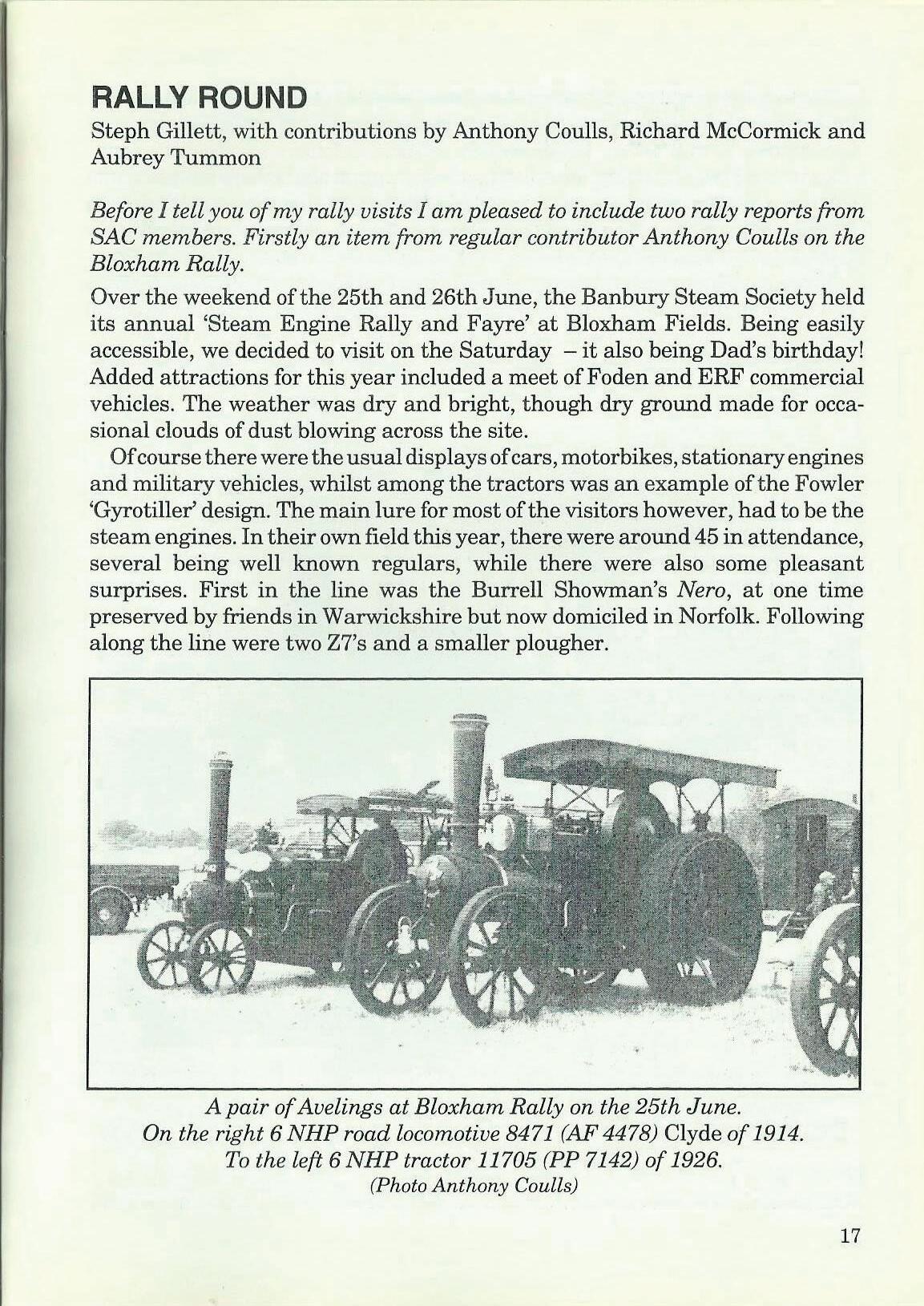
A pair of Avelings at Bloxham Rally on the 25th June. On the right 6 NHP road locomotive 8471 (AF 4478) Clyde of 1914. To the left 6 NHP tractor 11705 (PP 7142) of 1926. (Photo Anthony Coulls)
Continuing on, there was a good selection of engines of all types. Local engines included Dick Blenkinsop's Aveling & Barford roller, Mike Davies' Fowler Road Locomotive Jo and Trevor Daw's Ruston roller.
As it was Dad's birthday, he ended up being put on the latter's footplate and steered it for the grand parade. (I should add that he was a part owner of the engine until 1972 ... ). Our chairperson was acting as commentator, and drew attention to the occasion as well while the engine went round!
Moving on from such things other surprises included the Bicknells' maroon Fowler ploughing engine Churchill, while elsewhere on the site was a wonderful
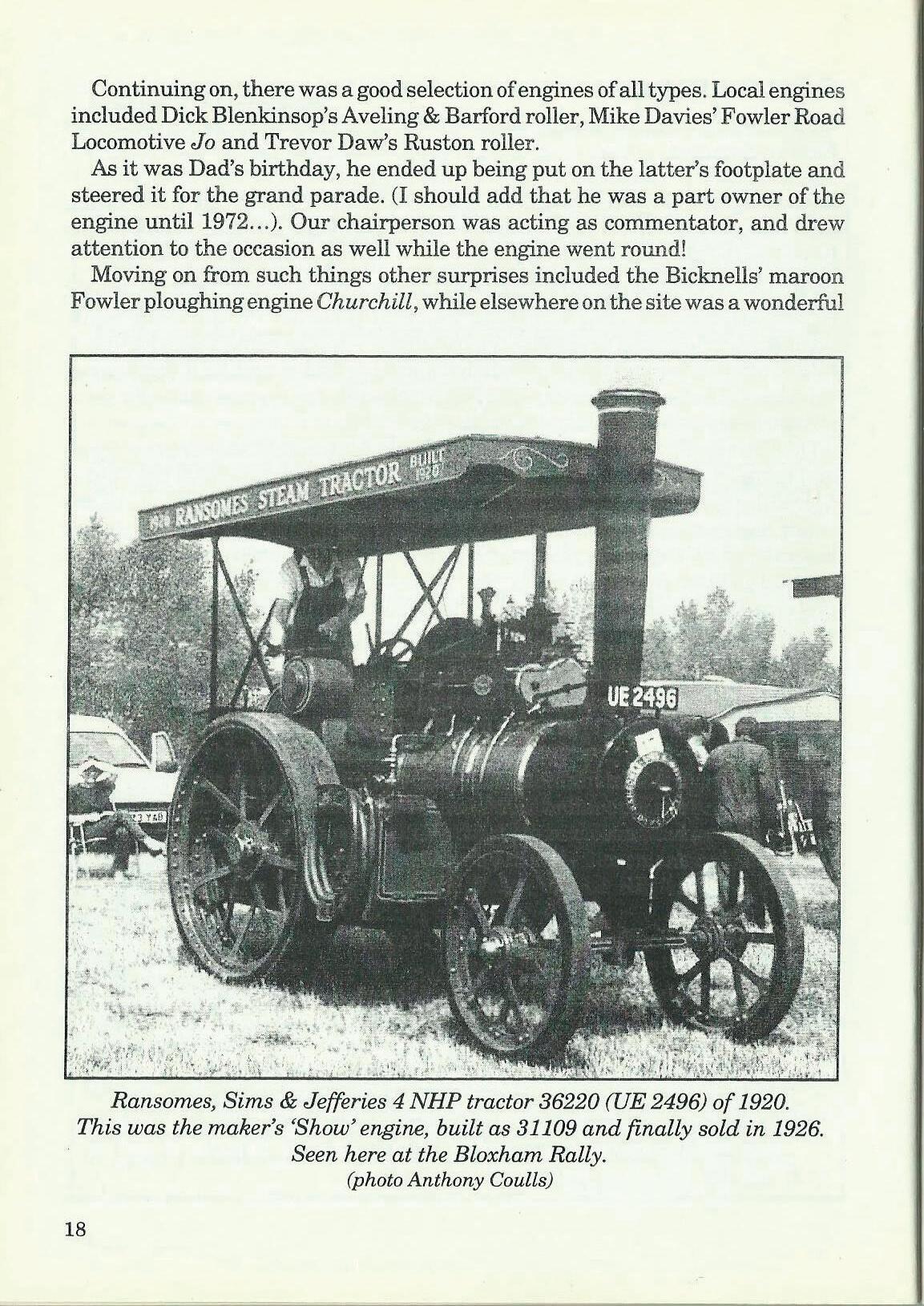
Ransomes, Sims & Jefferies 4 NHP tractor 36220 (UE 2496) of 1920. This was the maker's 'Show' engine, built as 31109 and finally sold in 1926.
Seen here at the Bloxham Rally. (photo Anthony Coulls)
4in. scale threshing set, in steam and working hard judging by the sound from the chimney. The Herrings' portable was kept busy on the saw bench, while trailer rides were available to those who wanted.
A Fowler roller which once worked on the Isle of Mull was also present and a couple of engines made first appearances in the area at this rally as well. SAC favourite Renown attended, popular as ever, and the Burrell Road Engine The Dalesman also drew much admiration for her splendid state of cleanliness. Unfortunately, The Iron Maiden did not appear - a shame, as unlike most, I haven't actually seen her yet!
Around the site were the usual trade stands offering bargains (or not, as the case may be!). A copy of Ronald Clark's Development of the English Traction Engine at £125 was just a little out of reach, though we did acquire some plants for the garden railway ....
Once again, a good show, well worth the money. If you haven't been it's interesting to go to a rally which is in essence how rallies were and should be, without too much commercialisation and a good number of active engines to please the public. Unfortunately, space precludes an engine listl
A week after the Bloxham event Richard McCormick had succeeded in convincing his Dad that their engine needed an outing. Here's his report. Our Marshall Traction Engine, No.76963, has been out of the Rally field for about twenty years. She has been laid up in the shed next to our house for eight years without a single steam up. But I was now at an age (16) when my enthusiasm for steam engines was strong and I badgered Dad to get her going again. So in the autumn of 1993 and early this year we stripped her down ready for the three essential inspections - Cold, Hydraulic, and In-Steam. Various things crune to light. Repairs had to be done, but nothing very expensive. In due course everything was found OK and we were issued the NTET Certificate of Boiler Inspection.
In the spring of this year we did little road runs around our village. Dad al ways did like a Sunday pub-crawl on the traction engine! We also turned up at his doctor's 50th Birthday party on the engine. This caused quite a stir, and was a great day for me as steersman.
The major decision, however, was to steam from home to Hollowell, a distance of about eighteen miles, over two days, in order to attend their 1994 rally. It was not easy to arrange because I am at boarding school with limited weekends out, and Dad is a full time General Practitioner with weekend duties, so it was great for us both to be able to fix Friday and Saturday (1st & 2nd of July) for the road runs. Dad and I had travelled the exact route in the car beforehand noting distances between water pick-ups and coal pick-ups. Our engine needs water every four or five miles and coal every eight or nine miles.
At the end of the first day our engine would get 'board and lodgings' at Middleton' s farm in the village ofHolcot. You may have noticed the restored 1901
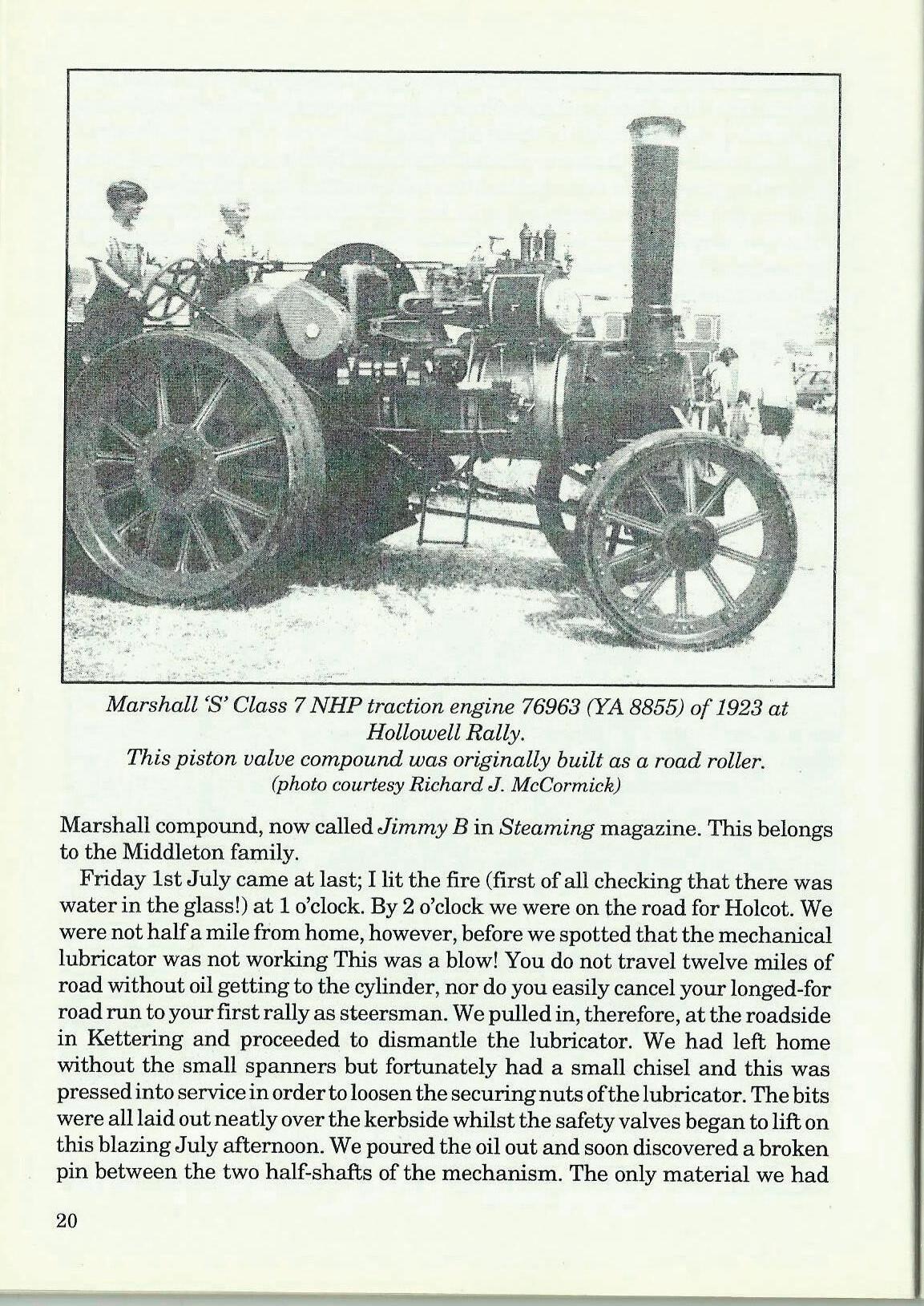
Marshall 'S' Class 7 NHP traction engine 76963 (YA 8855) of 1923 at Hollowell Rally.
This piston value compound was originally built as a road roller. (photo courtesy Richard J. McCormick)
Marshall compound, now called Jimmy B in Steaming magazine. This belongs to the Middleton family.
Friday 1st July came at last; I lit the fire (first of all checking that there was water in the glass!) at 1 o'clock. By 2 o'clock we were on the road for Holcot. We were not half a mile from home, however, before we spotted that the mechanical lubricator was not working This was a blow! You do not travel twelve miles of road without oil getting to the cylinder, nor do you easily cancel your longed-for road run to your first rally as steersman. We pulled in, therefore, at the roadside in Kettering and proceeded to dismantle the lubricator. We had left home without the small spanners but fortunately had a small chisel and this was pressed into service in order to loosen the securing nuts of the lubricator. The bits were all laid out neatly over the kerbside whilst the safety valves began to lift on this blazing July afternoon. We poured the oil out and soon discovered a broken pin between the two half-shafts of the mechanism. The only material we had
with us to replace this was a length of coat hanger wire in the spud pan. I put the ratchet and pawl together and used a pair of surgical forceps, which we always carry in the toolbox to get the new pin in. The nose of our pliers was too big-for that job.
The repair was good and we were soon in business again but had lost 45 minutes. All went well until our first water pick-up, four miles on. The lift pump would not work. On examining the pipe we found a great split in it. This was new for we had tested the pipe about two weeks before and found it OK We always carry a garden hose on the engine so we topped up the tender from the Weetabix factory tap.
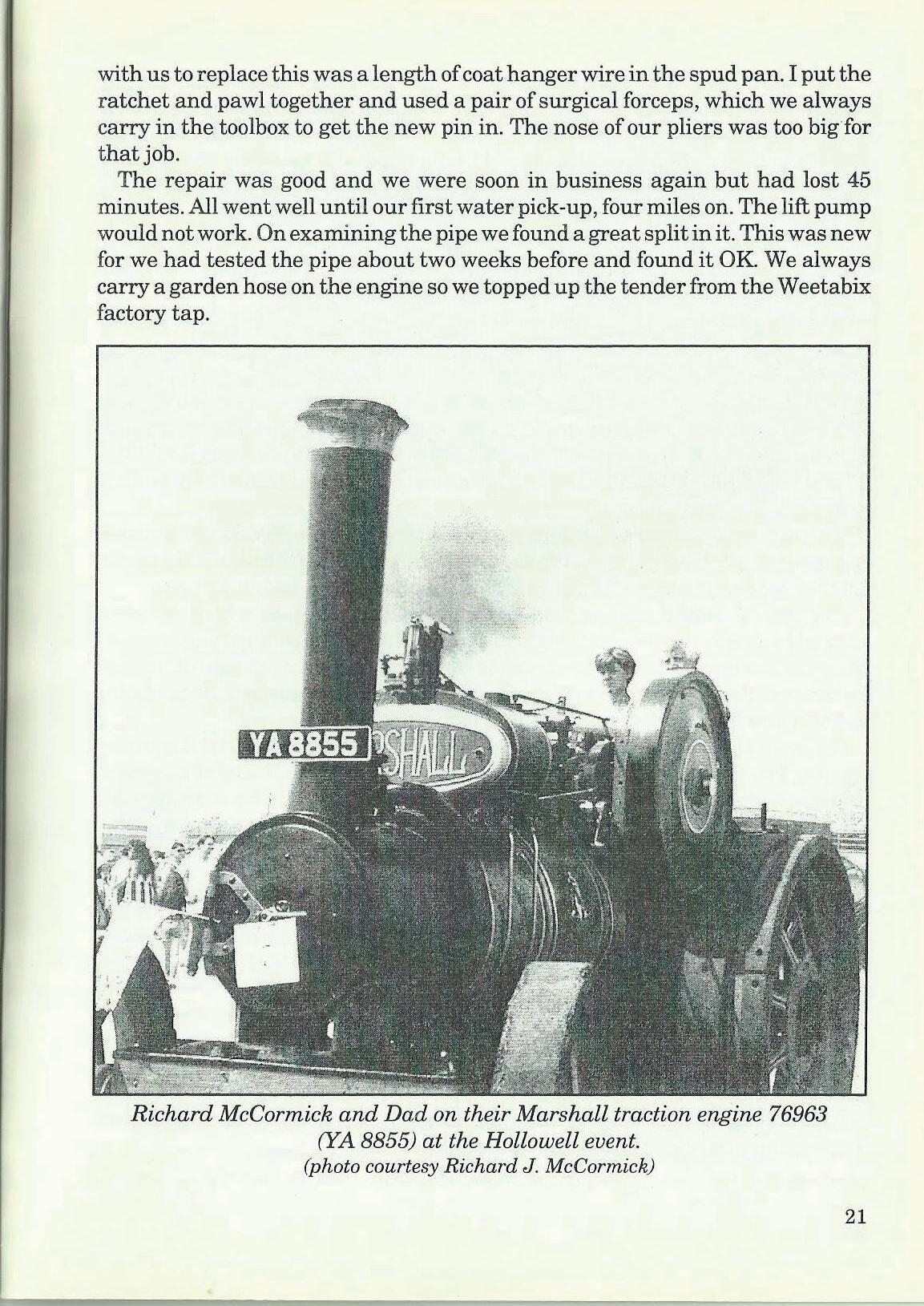
(photo courtesy Richard J.
That was the end of our problems for that day. The Middletons did an emergency repair on our lift pipe. Dad says that this pipe actually came from a farm in the village of Old (N orthants.), where Middleton's Marshall also came from. It is likely, therefore, that our old pipe originally belonged to their old engine. So that at the most our pipe would be 93 years old! Dad got it in 1972 so we know that it was at least 22 years old.
At any rate our first eleven miles were done and we were late, tired, dirty, and happy. Dad said that the lubricator job was the biggest roadside repair ever done for our engine. I was glad to have played a major part in it.
Next day we steamed up early, and set off the eight miles to Hollowell. We left the farm with only 501b on the pressure gauge. Our engine is a compound, and should work at 1501b.The first half mile through Holcot village was all uphill. We did that in low gear and it was interesting to see how the engine could come up the hill with such low pressure. It was also great to watch the fire really come alive and the needle rise up towards the 1501bred line over the next half mile. What a willing old engine she is. I've said before to Dad that I think the Marshall compound is a great design.
With our newly repaired lift pipe we felt fairly confident of picking up water at a stream after Brixworth. But disaster! She would not lift and Dad found another split in the pipe. "Looks as if this old pipe is done for", I thought.
Dad agreed. Half a mile on we found dog boarding kennels where we were allowed to obtain water from their outside tap. The thing about garden hoses to fill up the tender, is that they are horribly slow compared to the steam lift, so that twenty minutes later we were off again - and no more problems with lubrication and no more need for water until the rally field.
The last half mile to Hollowell field is pretty steep uphill but we did it in style, top gear this time! A couple hours late arriving, but not the last engine to arrive.
It was a great two days getting to Hollowell, a great revival for our engine, a well organised rally, a great two days for me as steersman, and a great trip home on Middleton's low-loader-thundering along at 50mph to Warkton village on the Sunday evening.
Since writing the last Rally Round my dosage of steam, (road and rail), has gone up slightly to a more satisfactory level! No sooner had I despatched issue number 8.2 off for typesetting than I was preparing for my annual visit to the Bristol Steam Festival. This event involves not only traction engines, but steam railway, crane and boats in and around the City Docks. We all bundled into the car and headed off to park near the SS Great Britain, which returned from the Falkland Islands in 1970 to the dry dock in which it was built nearly 130 years before, (when built in 1843 Brunel's ship was the largest ever constructed and the first ocean-going propeller-driven ship in history).
Burrell 6 NHP double-crank compound agricultural engine 3816 (AF 3518) Cornish Maid at St. Merryn Rally. Built to a special order with a long boiler, this engine lias now been restored to its traction engine form (photo Aubrey Tummon)
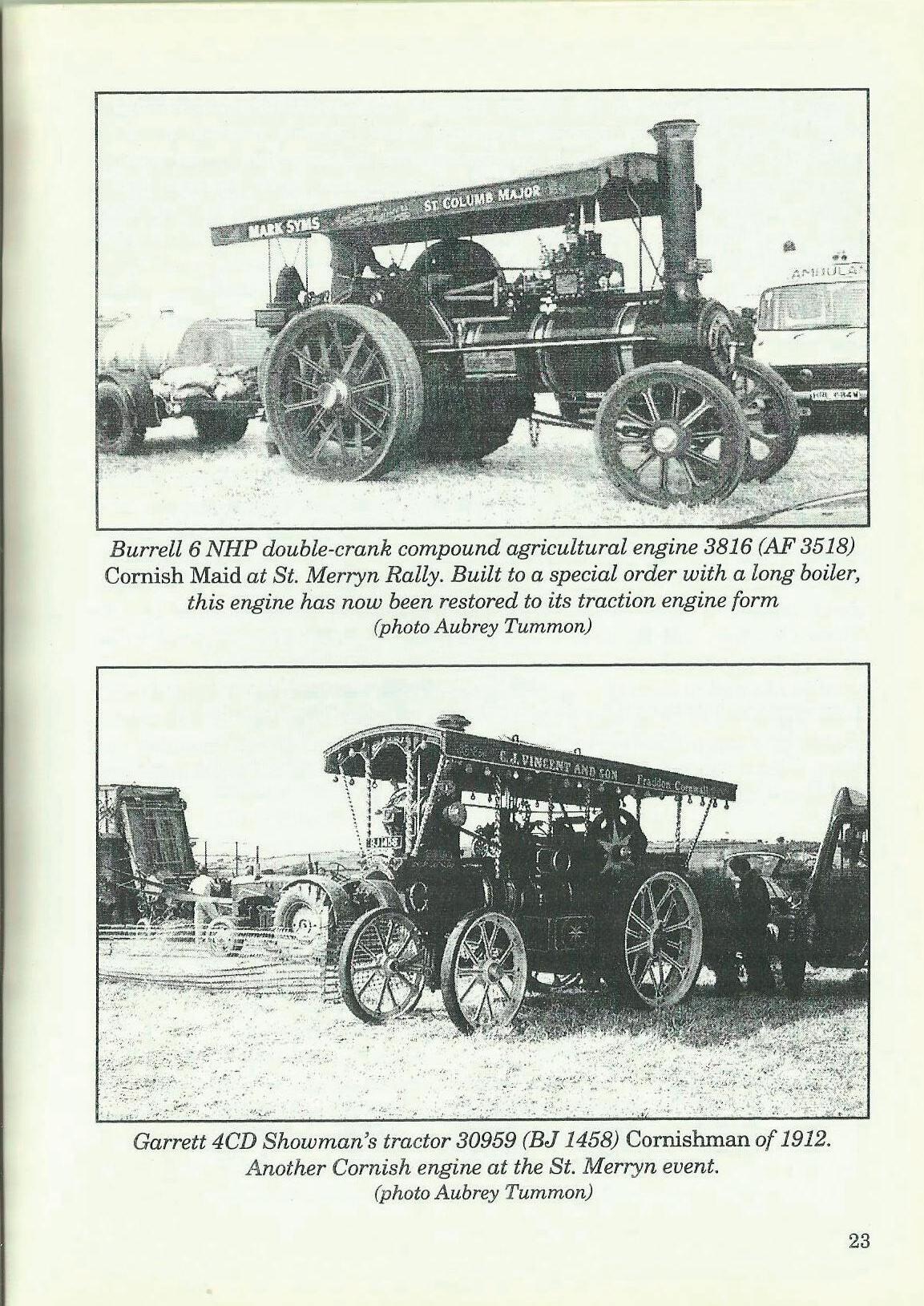
. Garrett 4CD Showman's tractor 30959 (BJ 1458) Cornishman of 1912. Another Cornish engine at the St. Merryn event. (photo Aubrey Tummon)
After watching some of the traction engines being prepared and wandering round some of the static exhibits, we claimed a spot outside on the pavement to watch the road run. Heading the procession were the Grenville steam carriage (see article in this issue. Ed.) and the Haleson steam motorbike of c.1906. Other engines taking to the streets of Bristol on 10th July included Burrell 3996 Conqueror, Wallis and Steevens 7685 Lord Louis, Burrell showman's 3631 Kathleen, Wallis and Steevens Advance roller 8030, three Aveling and Porter road rollers, two Foden steam wagons and a Sentinel steam waggon, whilst Burrell 1840 Duke of Windsor and Marshall 76301 Ellen remained on the quayside.
Holidays this summer took us to North Wales where, once again, we were able to sample the delights of steam haulage on the Festiniog, Welsh Highland andTalyllyn narrow gauge railways. Sadly Anthony Coulls was not firing on the occasion of our visit to Tywyn during the Talyllyn's Victorian Week. Whilst in Cymru we visited the Ysgethin Museum at Talybont, near Barmouth, where, amongst a fascinating collection of tractors, tools and boats, bicycles and motorcycles, gramophones and radios, cameras, butter churns and numerous other items of everyday country life of the past was Burrell traction engine 3895 (WR7246)Excelsior. This 1921 (or 1927 according to the museum) 6NHP double crank compound engine, massive compared to other exhibits, is owned by J.E. (Eddie) Walker, and features a flywheel brake. Francis was delighted when allowed an unofficial visit to the footplate. (Amber settled for a Fordson tractor outside!) As well as several vintage tractors outside was Burrell 8 Ton road roller 3456 (WR9084) of 1913, also owned by Eddie Walker. This engine was mostly hidden by a tarpaulin. One little mystery, which perhaps an SAC member can solve, is the meaning of the following logo or abbreviation on the wheel hubs, and elsewhere, of Excelsior:
There will be more rally reports in the Christmas issue to remind you of warmer days. We'll finish this time with a couple of photos by Aubrey Tummon taken at the St. Merryn Steam and Vintage Rally in Cornwall back in May this year. By the way, I have decided to award Richard McCormick the prize for best rally report this time, well done on your first contribution.
A warm welcome to the following who have recently joined the Steam Apprentice Club. We hope they enjoy their membership and find plenty of interest.
John Raymond, March, Cambridgeshire
Sam Burridge, Bletsoe, Bedfordshire
Simon Wildash, Broxbourne, Hertfordshire
David Wildash, Broxbourne, Hertfordshire
Jamie Barnes, Enfield, Middlesex
Roger Pilbeam, Blackpool, Lancashire
Darren Nicol, Inverurie, Aberdeenshire
Charles Corkill, Maughold, Isle of Man
Jemima Corkill, Maughold, Isle of Man
Nicholas Berry, Brampton Ash, Leicestershire
Nicholas Bosworth, Ilkeston, Derbyshire
Martyn Bosworth, Ilkeston, Derbyshire
Jamie Stone, Nether Langwith, Nottinghamshire
Georgina Heath, Worksop, Nottinghamshire
Robert Foster, Kettering, Northamptonshire
Michaela Harper, Swindon, Wiltshire
David Harper, Swindon, Wiltshire
Benjamin Meek, Horton-Cum-Studley, Oxfordshire
Andrew Bircher, Barrow-In-Furness, Cumbria
Henry Brown, Hagworthingham, Lincolnshire
Michael Penketh, Sutton Coldfield, West Midlands
Chris Harrison, Thrapston, Northamptonshire
Edward Jordan, Walton-on-Thames, Surrey
Oliver Angell, Great Missenden, Buckinghamshire
Benjamin Spoors, Taunton, Somerset
Philip Cundy, Bradford, West Yorkshire
Byron Martin, Cirencester, Gloucestershire.
Kevin Pittock, Woodham Ferrers, Essex.
Justin Clark, Boston, Lincolnshire
Neil Annett, Lisburn, Co. Antrim, Northern Ireland
Marlon Biber, London
Robert Evans, Hereford, Herefordshire
Daniel Reynolds, Rugeley, Staffordshire
Kevin Beer, Caerphilly, Mid Glamorgan, Wales
Wayne Beer, Caerphilly, Mid Glamorgan, Wales
Zoe Rhodes, Castlef ord, West Yorkshire
Gareth Rhodes, Castleford, West Yorkshire
Ruth Billings, Borrowash, Derbyshire
Jonathan Weston, Cowfold, Sussex
Benjamin Griffiths, Kingswinford, West Midlands
Melissa Ward, Cranleigh, Surrey
Christopher Dixon, Kendal, Cumbria.
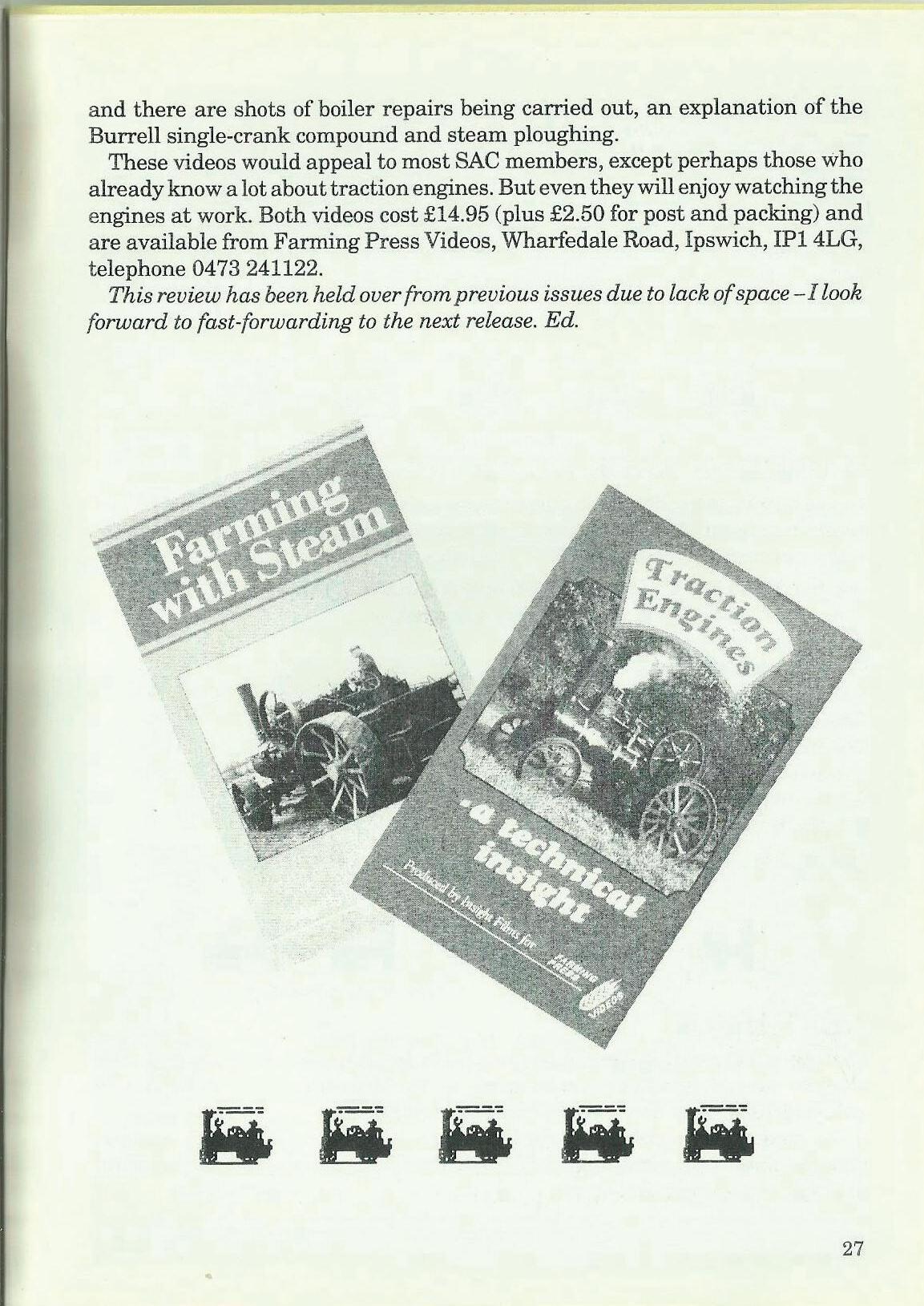
I was delighted to receive for review, (some time ago it must be said!), two videos from Farming Press Books & Videos. Appropriately for a company specialising in agricultural matters, one of these is titledFarming with Steam (48 minutes).
This video starts by describing how farming was carried out before steam power, using horses or hands, much of this using vintage photographs or woodcuts, some shots being rather brief. The later impact of tractors is also referred to. The special way in which steam fitted into traditional agriculture is shown with portable and traction engines at work threshing, ploughing, hauling timber and driving a saw bench. A long section on steam ploughing is described by 80 year old Joe Challis, seen in the film at the regulator of a Fowler BB engine, and explains the difference between ploughing and cultivating.
There is a delightful scene of a thresher, elevator and baler driven by two traction engines accompanied by horse drawn carts. At least some of the sequences seem to have been filmed near W eeting in Suffolk, as they feature several engines normally resident at Richard Parrott's farm. Lesley Colsell of the Museum of East Anglian Rural Life, who has helped the Steam Apprentice Club in the past, provides a commentary on the living conditions and social background of farming with steam. Did you know that farming with steam started at 7am and finished at 5pm, (or 7pm during the six weeks of harvest)? Or that school children who caught rats from the corn stack would be paid for any rat tails they took into school?
The second video Traction Engines -a technical insight (37 minutes) is a good introduction to the history and workings of traction engines. The story begins in the 1700s with the beam engines built for the Cornish mines and the world's largest working beam engine is shown in action. Some of the archive pictures are those used in Farming With Steam and the development of steam power concentrates on its use in agriculture. Gary Wragg of the Hampshire Museums Service, another friend of the SAC, explains the workings of a traction engine,
and there are shots of boiler repairs being carried out, an explanation of the Burrell single-crank compound and steam ploughing.
These videos would appeal to most SAC members, except perhaps those who already know a lot about traction engines. But even they will enjoy watching the engines at work. Both videos cost £14.95 (plus £2.50 for post and packing) and are available from Fanning Press Videos, Wharfedale Road, Ipswich, IPl 4LG, telephone 0473 241122.
This review has been held over from previous issues due to lack of space -I look forward to fast-forwarding to the next release. Ed.
Small advertisements relating to traction engines and your hobby are free of charge to SAC and NTET members. Advertisements should be written clearly and concisely, must be accompanied by your membership number, name and address, and sent to the Editor before the copy date for the next issue. Commercial ads are accepted from companies selling items related to our hobby, or for steam events, etc. Rates start at £15.00 for a quarter page. Please contact the Editor for details
Copies of SAC magazine back numbers are available from the Editor, (address inside front cover), for £1.00 each including postage. Please send cheque or postal order, not cash, payable to 'NTET. The following issues only are available:
Volume 3 Number 4 Winter 1989/90 only a handful of this early issue.
Volume 6 Number 1 Spring 1992 only a few left.
Volume 6 Number 2 Summer 1992
Volume 6 Number 3 Autumn 1992
Volume 7 Number 1 Winter 1993
Volume 7 Number 2 Spring 1993
Volume 7 Number 3 Summer 1993
Volume 7 Number 4 Autumn 1993
Volume 8 Number 1 Winter 1994 sorry, sold out.
Volume 8 Number 2 Summer 1994
Special discount for any 5 - £4.50 including postage; 6 or more 80p each.
Featured in the next issue will be more Rally Round, another Grace 'n' Jamie story for our younger members, an article on the Museum of English Rural Life and, hopefully, your news, views and photographs. The next magazine is due out for Christmas. Please send any items, articles, photographs or other contributions to the Editor as soon as possible and help him to keep to his publication date!
I would like to join the Steam Apprentice Club
Surname Forename(s) __________ _ {Block Capitals) ---------
Address _________________________ _
Postcode ------
Date of Birth ------Tel. No. ________ _
Please help us to make the Club more interesting to you by telling us why you are interested in joining and what activities you would like the Club to provide:
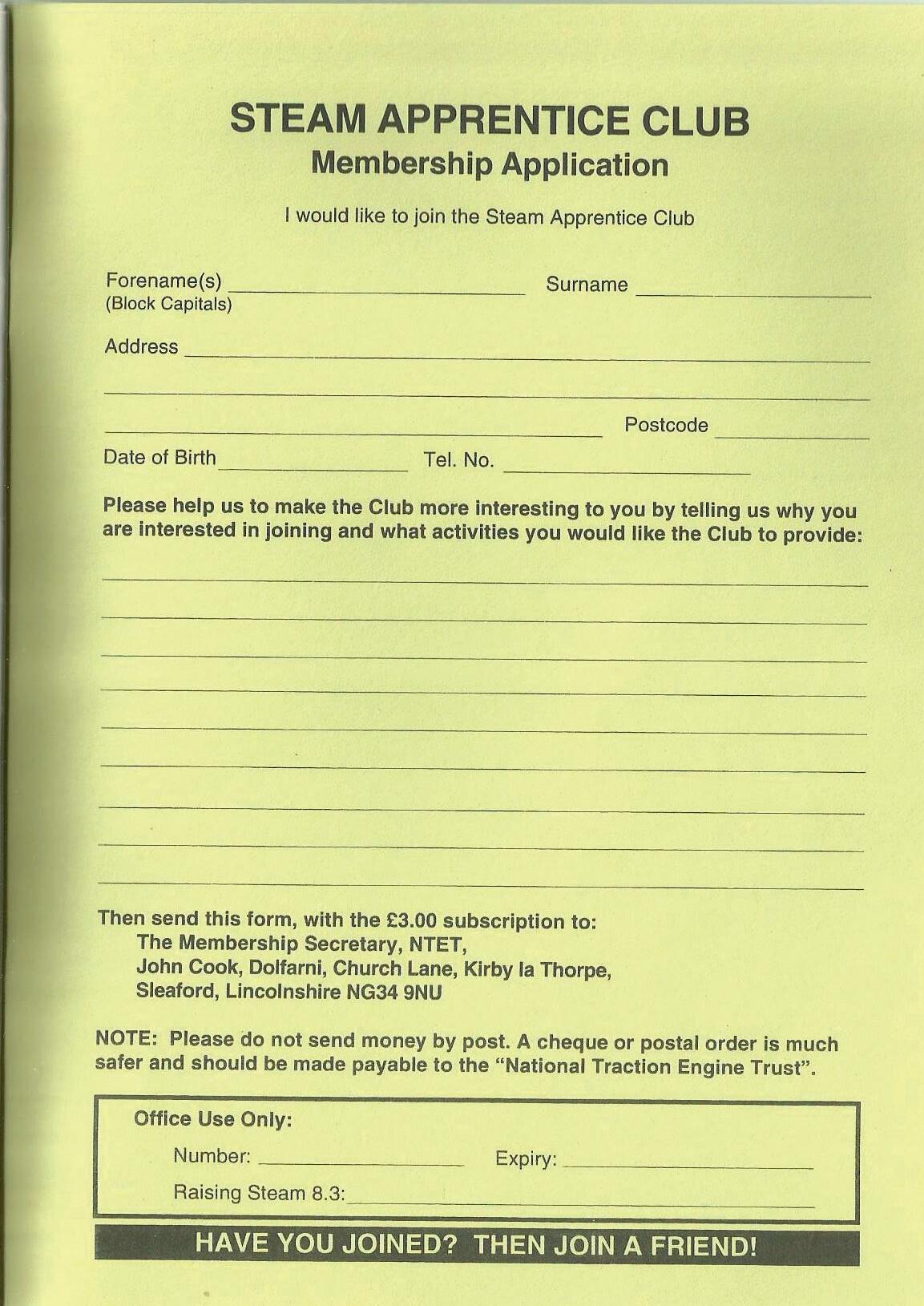
Then send this form, with the £3.00 subscription to: The Membership Secretary, NTET, John Cook, Dolfarni, Church Lane, Kirby la Thorpe, Sleaford, Lincolnshire NG34 9NU
NOTE: Please do not send money by post. A cheque or postal order is much safer and should be made payable to the "National Traction Engine Trust".
Office Use Only:
The Club was formed for young people under the age of Twenty-One who are interested in Steam Traction Engines in 1979 by the then National Traction Engine Club.
Today it is the young person's branch of the National Traction Engine Trust, a registered educational charity.
Many people watch engines at rallies, but few of them know how an engine works, and even fewer have the chance to be shown over one by the owner, to talk about the work it used to do, or even help with the engine's maintenance. The Club publishes this magazine with many of the articles being written by Club members.
We have a scheme which allows Club members into most Traction Engine rallies free of charge. Also we will try and put you in touch with a local engine owner near you, so that you can learn more about engines from people who actually run them, in addition to our special training sessions and schemes.
If you enjoy rallies, photographing and recording engines, collecting pictures or books about engines, talking about steam or if you just wish to learn more, the Steam Apprentice Club is for you.
1. A quarterly Magazine.
2. A membership card.
3. Free admission to many NTET approved Traction Engine Rallies.
4. A Free copy of NTET approved Rally List, each Spring.
5. A chance to buy books, magazines (including "Steaming") and other items sold by the NTET taking advantage of any special discounts and offers available to NTET members.
6. Special club visits, events and training weekends.
7. Special Insurance considerations in connection with Traction Engines.
8. Many other items are advertised in our club magazine.
Our annual subscription is just £3.00. Membership runs to the nearest quarter.
Join us NOW: Just fill in the membership application form inside the back cover. Then send it to the membership secretary with your subscription or hand it into any NTET Rally Stand.
If you wish to keep your magazine intact, you may photocopy the membership application form, or copy the details onto another sheet of paper.