EDITOR
EDITOR
Steph Gillett, 93 Devon Road, Easton, BriHtol HSfi 6ED.
Sylvia Dudley, 12 Hillway, Woburn Sands, Milton Keynes, Buckinghamshire MKl 7 SUL
John Cook, Dolfarni, Church Lane, Kirby la Thorpe, Sleaford, Lincolnshire NG34 9NU
The Editor welcomes any contributions of articles, shorter items or photographs for inclusion in future issues. All material submitted is voluntary and payment cannot be made for any material published. The opinions expressed in the magazine, with the exception of Club announcements, are those of the contributors and do not indicate the views of the Club ai, a whole. All items are held copyright by the contributor and the NTET.
Please send yom· contributions to the Editor at least five weeks before publication. Typed articles arc prcferrod but not essential. If handwritten put any names of PEOPLE, PLACJ,;sor l•~N CllNES in BLOCK CAPITALS. If you require any part of your article (eg. photoH)ruturning please say so and enclose a stamped addressed envelope. Enclose your nnrnc, mldrm~M,md (if un Apprentice) age with any contribution.
The Editor r0Hervrn1 Uu, right t.omncmdor refuse contributions, and will attempt to correct spelling 11nclgrmnnwrl
The Magazine iHnorrn11llyp11hliBhuclduring tho onrlypart ofFebruary, May,August and November.
The Steam ApprN11.i«·t1C.luh io u Hc<'liun nf'l ho N11l101111I 'l 1r11d,io11l•)11gi1U''l'ntHL, NTET is a RcgiHif•n·tl Churitv, No,2!HG7H. H1•i{if:1l,1_•n•d i11 1,~nt:ln111INo. I :toi 1Y7. Registered Offict•: l lwrn111 1 H MHhuoncl, Midcll1•1mK'l 1W 1H •II l<tl
Typesettingby TllsotSorvicoA,:-,:ir1m1th1ny,Y,1111,131111lol II!: 11~IU, I ol O•lr14314279. Prlntodby l .conomlc:111tnllll!JCrn11p.11,y, :1-l11 ntc1plt1to11 I lontl, u,lntol.
Do you ever wonder why there aren't more hours in the day? I am always asking myself, "Where has the time gone?" There never seem to be any answers though, and I'm still wondering why I never manage to get things done on time! Take this magazine, for instance. I was all set up to finish it at Christmas and had even made arrangements to have it printed in the New Year.
My job, of course, takes up a lot of my time, just as school or college does for many Steam Apprentices. But any of you with a younger sister or brother may know what reaUy takes up lots and lots of time - yes, a baby does! You may get fed up with how much time your parents have to spend looking after your baby brother or sister, if you have one, and wonder why mum or dad don't pay you more attention. Well, I can tell you, babies are very demanding, and don't take kindly to being ignored. One thing is for sure though, we were all a baby once, so we just have to be patient with them if we can!
I hope you will be patient with me if your magazine doesn't always arrive as soon as you would like. Because of the delay to this issue, the next magazine will not come out until May.
Readers of Old Glory will have seen the article about the Steam Apprentice Club in their February edition. This was very pleasing to see, not least for the reproduction of Jemma Dowey's winning entry in the colouring competition. This was the first of an 'occasional column', but I'm not sure yet how occasional! Welcome to new members who have joined as a result of seeing the Old Glory item. Welcome also to those who found out about the SAC from the leaflets being put in with Mamod steam models. Thank you to everyone who has sent in articles for the magazine or Christmas cards, reproduced here is David Main's seasonal offering. Congratulations to Anthony Coulls who was a warded the J. T. BE EBY CUP by the National Traction Engine Trust for his strong and continued support of the activities of the Club by entering the photographic competitions and writing for the magazine. Anthony travelled from Aberystwyth to York in November courtesy of British Rail, a difficult journey in very bad weather, to receive the cup at the NTET's annual meeting. Your editor was there to witness the event, and took advantage of a tour of the National Railway Museum later that night.
It is hard to imagine, with the snow only just thawed, that in just a few weeks time
HAPPY
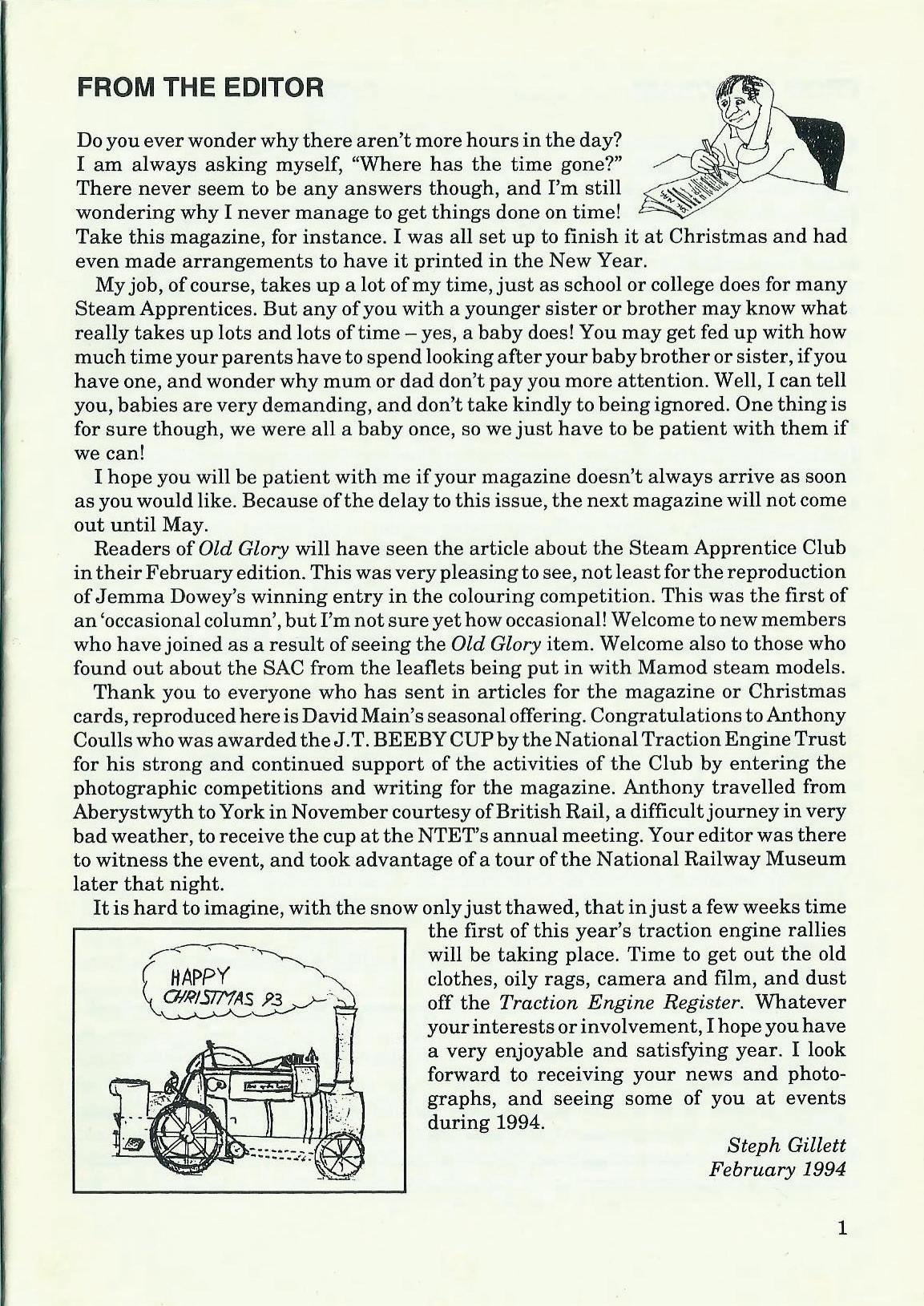
the first of this year's traction engine rallies will be taking place. Time to get out the old clothes, oily rags, camera and film, and dust off the Traction Engine Register. Whatever your interests or involvement, I hope you have a very enjoyable and satisfying year. I look forward to receiving your news and photographs, and seeing some of you at events during 1994.
Steph Gillett February 1994
It has been good to meet with past and present members during the Rally season, and to see the many things that Apprentices can be found doing on the Rally fields during the year.
Many of you visit events with parents for the day or perhaps the weekend, but we do like to hear from you about these visits as I know that what you are doing when you get to events varies greatly, ranging from taking part in running an engine or a working demonstration of ploughing, road making or powering a machine of some sort, and helping to prepare engines for the day's work.
Those that belong to local clubs can be seen helping to run the ring or marshal traffic on the field or some of the many other tasks that make up a rally day.
Don't forget, only Steam Apprentices can purchase one of our badges and wearing this tells an engine owner that you are especially interested in what he is doing and ifhe is not too busy he will have more time to talk to you than a member of the public. However, don't forget that an engine that needs coal or water won't wait and has to come first!!
We are planning another weekend driving course in the spring after the clocks change but the date is not finalised yet. Watch for details in the next issue.
Sylvia Dudley
Have you moved home or changed address recently? If so John Cook, the Membership Secretary would like to hear from you. All your details are on the NTET computer, so if you find any incorrect spellings or addresses would you please let John know so they can be corrected. John has also moved during the last year; his address is in the front of the magazine.
Another recent change, from 1st January 1994, the membership fee went up to £3 a year. We hope that you still consider this to be value for money, especially as this is the first increase for many years. Please remember that renewals should be sent to John Cook, and not the Editor or Chair.
1. When your membership is due you will receive a BLUE reminder form together with the latest copy of the magazine.
2. If you fail to renew after receiving that, you will receive a YELLOW final reminder and no magazine!
3. If still no payment is received, then you will be deleted from the records prior to the posting of the next magazine.
Older members may be interested to know that they can also join the NTET and receive the Steaming magazine that is published at about the aamo Limoas this one. SAC members are automatically sent details of the 'N atJ onaJt when thoy roach 21 and are too old to be Apprentices.
Thanks to everyone who has responded to the questionnaire. We have not received as many back as last time, 43 so far, so it's not too late to send your form in. The first five back were from Thomas Sutton, Gosport, Hampshire; Peter Simmons, Redruth, Cornwall; Chris Cooper, Leeds; Shelly Daws, Lowestoft, Suffolk and Gary Dimmock, Mundesley, Norfolk, all of whom will receive a free SAC badge. (If you didn't win a badge you can buy one for £1 - see end of magazine for details. Ed.) Matthew Healey from Stockport, Cheshire is the lucky member whose name was drawn out of the hat at the end of November. Something special will be going to Matthew when the Editor has spoken to the Chairperson!
The results of the survey will be in the next issue of the magazine, but thanks to everyone who has offered to help at events, on the committee or with publicity; we will be • getting in touch with each of you.
I was fascinated by the 'coat of arms' on the envelope from K. Milns, Ellesmere; I wonder what it means! Ed.
During the week 16th to 20th August last year, the Steam Car Club of Great Britain organised a tour of Wales, visiting tourist attractions and resorts, and tackling challenging roads.
Amongst their ports of call were Aberdovey, Borth and the climb over the Cader Idris range via Dinas Mawddwy. Based in Dolgellau, they were ideally situated to visit the Talyllyn Railway on the Tuesday.
Thus it was that I took time off from playing steam trains to watch our guests arrive. I walked up the main road out of Tywyn to photograph the cars on the road, keeping a sharp eye as the silent movement of a steam car can go unnoticed. The only warning of their approach was an occasional glimpse of steam or maybe a blast on the six note chime whistle that most were fitted with. The mountains provided a superb backdrop to the thirteen cars making their way to the railway.
One of the cars, a Stanley which had come over from America for the event, had a spot of trouble and pulled over into the local industrial estate as it passed me, and a wheel promptly came offl After some lightning repairs, car and passengers made it in time for the train that had reserved accommodation for them. Whilst their passengers were up the railway line, the cars were parked at Wharf station fQr inspection. The television crews were there, along with crowds of people, and I somehow managed to take in the region of forty-five photos during the day! We posed our loco number 2, Dolgoch, alongside the cars for pictures and someone drew our
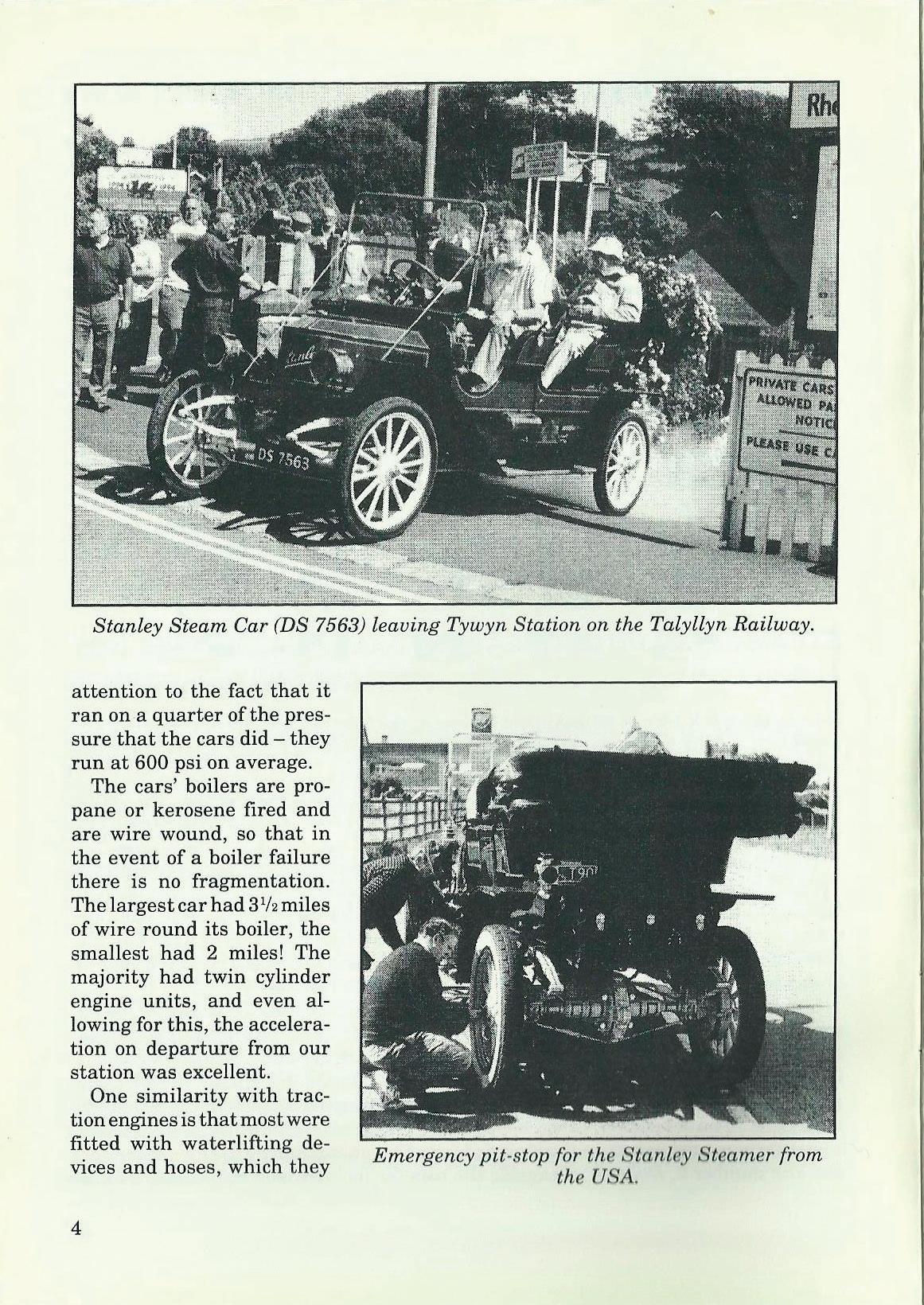
Stanley Steam Car (DS 7563) leaving Tywyn Station on the Talyllyn Railway.
attention to the fact that it ran on a quarter of the pressure that the cars did-they run at 600 psi on average.
The cars' boilers are propane or kerosene fired and are wire wound, so that in the event of a boiler failure there is no fragmentation. The largest car had 3 ½ miles of wire round its boiler, the smallest had 2 miles! The majority had twin cylinder engine units, and even allowing for this, the acceleration on departure from our station was excellent.
One similarity with traction engines is that most were fitted with waterlifting devices and hoses, which they
put to good use at Talyllyn Lake on the return trip. Of the thirteen cars which visited us, eleven were Stanley Steamers, one was a White and the other was John Liming's Likamobile, (a 1991 built Locomobile replica).
Later in the week cars were spotted at Portmadog on two separate days - once in a petrol station which must have caused amusement to the staff. We were very pleased to have them as guests of the railway and look forward to seeing them again.
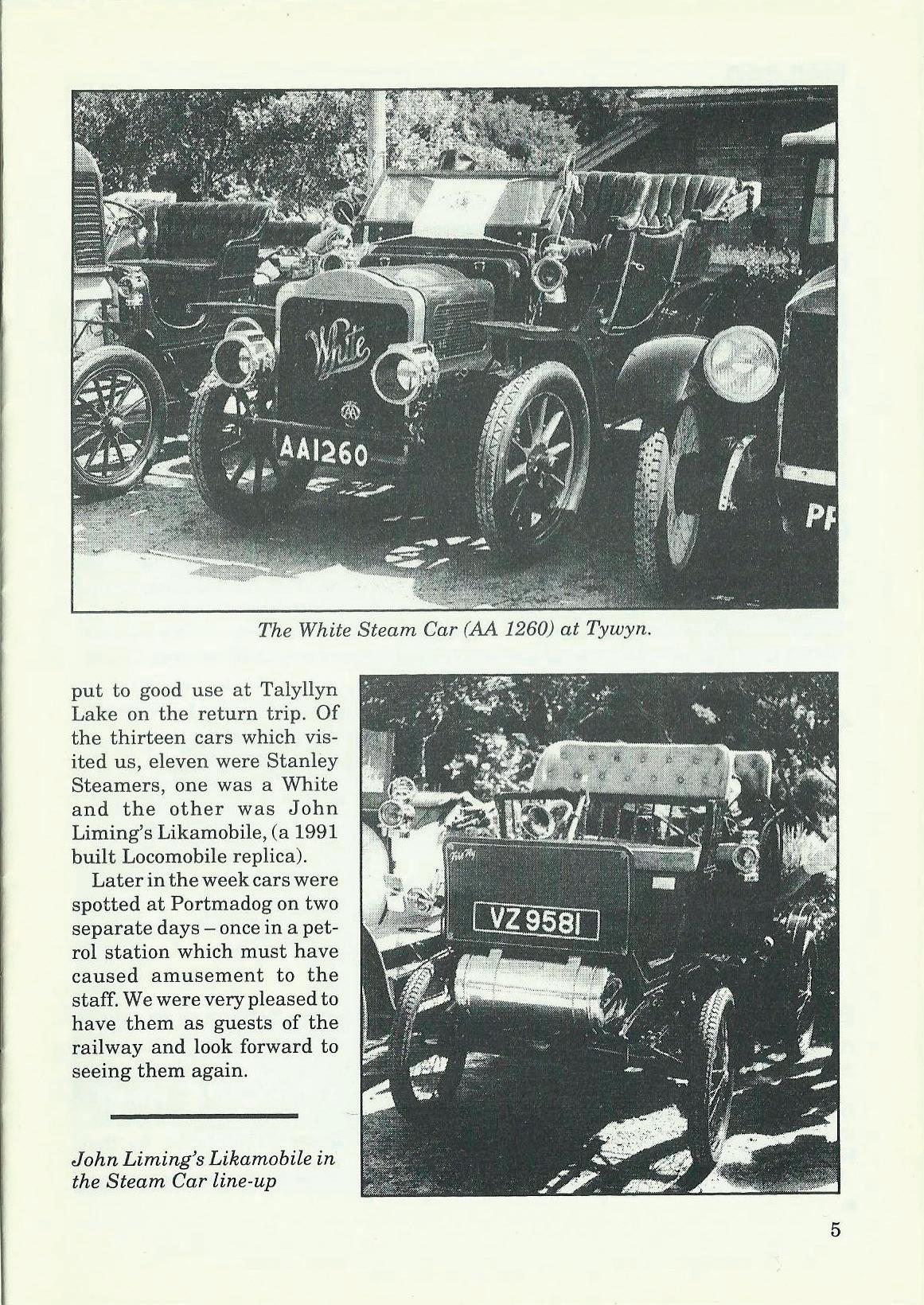
John Liming's Likamobile in the Steam Car line-up
Please send your letters, of any length, to the Editor for inclusion in the next issue of the magazine.
The Penfriends Scheme has not yet taken off, although several members have said they would like to write to someone else. I am asking them to write a short letter for the Mailbag to see if other members would like to become a penfriend. Ed.
Dear Steph,
I have read your piece in Steaming Vol.37 No.1, and feel that it may be to my advantage to write to you. I run an active preservation yard in my spare time, concerned with both steam and diesel, and I would be prepared to offer a position to a Steam Apprentice to assist my helpers and I, and to learn something of steam engines (and other matters) by practical example.
I would be looking for an intelligent and personable young man of 16 or more, keen in outlook and of good manners and tidy appearance, who would like to get involved on a regular basis with the maintenance and renovation of particular engines. No previous experience is necessary, but enthusiasm is essential and natural mechanical aptitude (which in my opinion is inherited-it cannot be taught) would be most desirable. The right candidate is likely soon to become a regular member of the team.
You mention the problem of transport, which so often prevents young lads from attending particular premises on a regular basis, and I fear that this will be as much of a problem in my case as any other. It would be possible to collect and return an apprentice from Malvern or Worcester, and even from Redditch, as one of my regular helpers commutes from there, but from elsewhere it would require the boy's parents to transport him if he has no transport of his own.
If you can think of anyone in the SAC who might like this opportunity, please get in touch.
Yours sincerely
Allan Lloyd Colwall, Nr. Malvern, Worcs.
Anthony Hooker
Age 16
Over the weekend of 17th/19th September 1993 the Rodeo Switchback, believed to be the UK's oldest fairground ride, was moved from Fovant in Wiltshire to the Hollycombe Steam Collection near Liphook.
The ride was pulled by two Burrell showman's engines, Princess Mary 3949 and Princess Marina 3847. Princess Mary lead the road train pulling a packing truck, centre truck and a coal trailer. Princess Marina pulled the car trailer a second packing truck and another trailer.
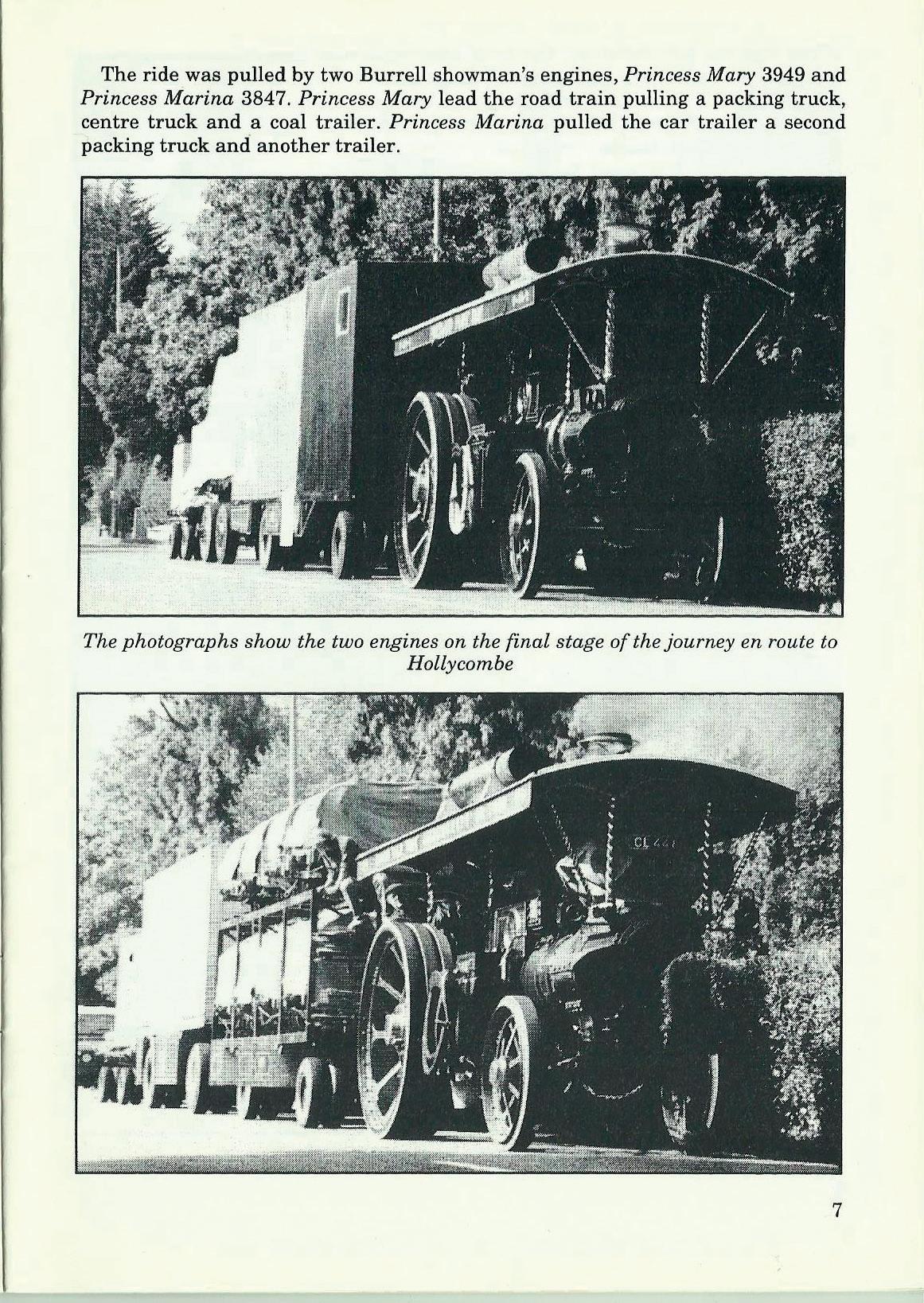
The photographs show the two engines on the final stage of the journey en route to
The engines-left Salisbury Cattle Market early on Saturday morning. Good progress was made through Stockbridge and onto Winchester where problems occurred with Princess Marina. The problem was leaking tubes so the load was uncoupled from Princess Marina and pulled by an ERF unit to the overnight stop just outside Petersfield, Rants.
Princess Mary continued the journey and arrived at the overnight stop twelve hours after leaving Salisbury.
Princess Marina's leaking tubes were fixed overnight with a tube expander in time for the short journey to Hollycombe on the Sunday.
The two engines arrived at Hollycombe at 1pm and were met by a large group of video operators, photographers and the general public. As the engines travelled up through the car park they were greeted and welcomed to the collection by blasts of engine whistles.
The Rodeo Switchback is now owned by the Fairground Heritage Trust and it is hoped to have the ride operating at Hollycombe, it's temporary home, from the Spring Bank Holiday 1994. Princess Mary and Princess Marina are believed to be returning to Hollycombe for the opening of the ride, to generate the power for it.
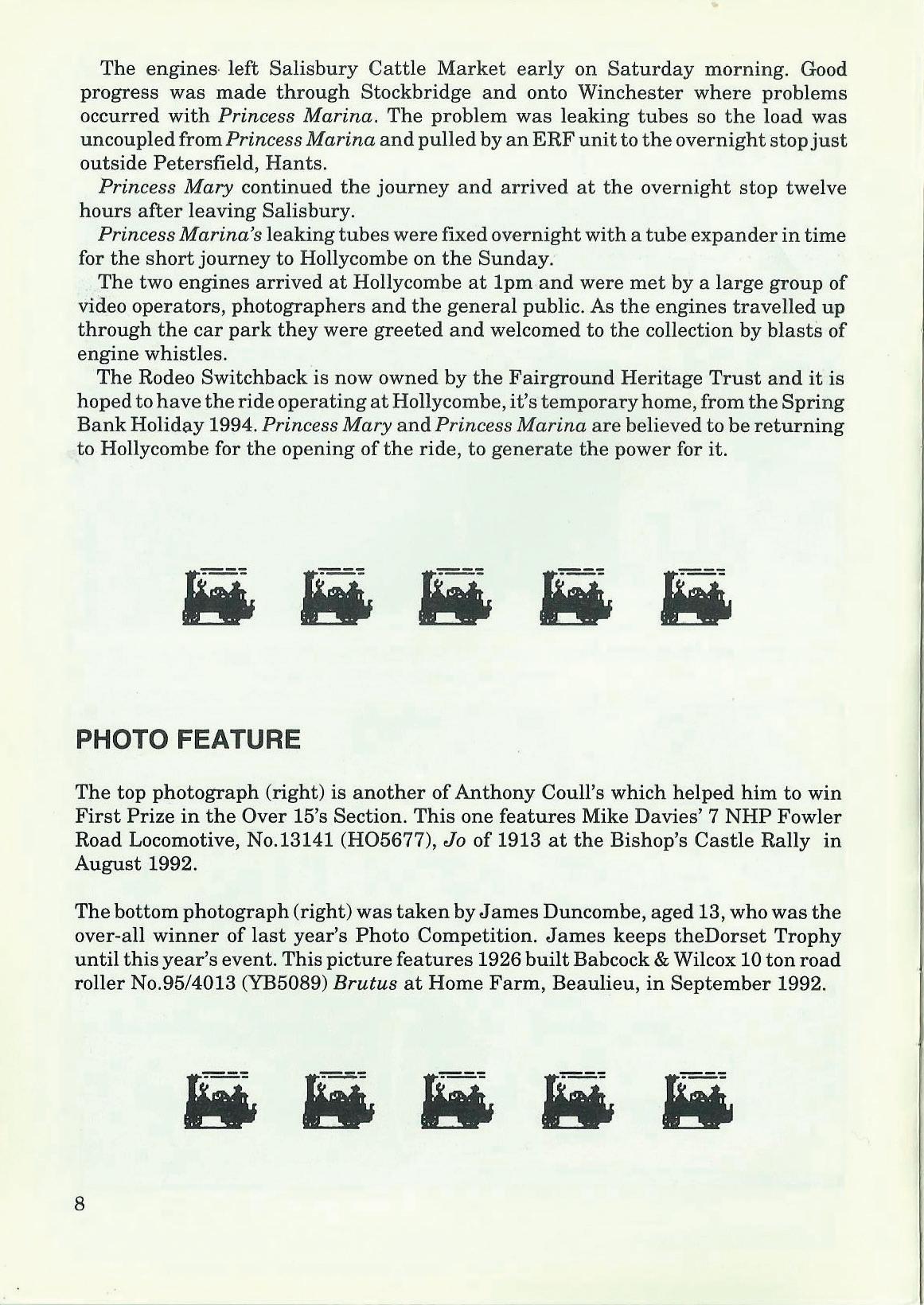
The top photograph (right) is another of Anthony Coull's which helped him to win First Prize in the Over 15's Section. This one features Mike Davies' 7 NHP Fowler Road Locomotive, No.13141 (HO5677), Jo of 1913 at the Bishop's Castle Rally 1n August 1992.
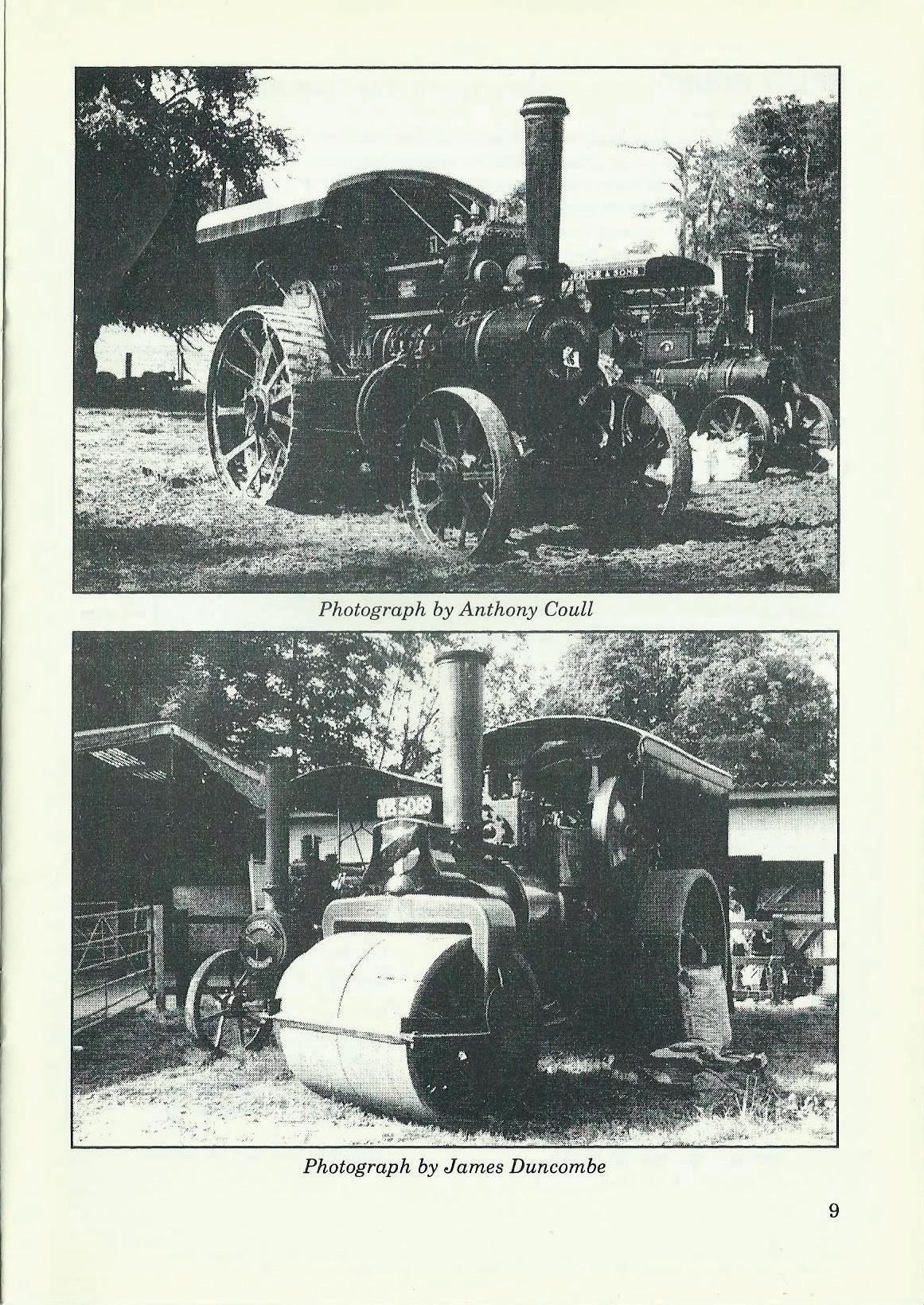
The bottom photograph (right) was taken by James Duncombe, aged 13, who was the over-all winner of last year's Photo Competition. James keeps theDorset Trophy until this year's event. This picture features 1926 built Babcock & Wilcox 10 ton road roller No.95/4013 (YB5089) Brutus at Home Farm, Beaulieu, in September 1992.
There is very little to report to you of course, as it has been the 'closed season' so to speak, since the last magazine. In fact the only steam activity not on a railway line that I have witnessed since the Dorset event was the New Year's Day road run in Taunton. Organised by our good friends the Somerset Traction Engine Club, the day brought a variety of vintage and classic vehicles out onto the highways in and around Taunton. Three steamers had been anticipated, in fact I only saw two from our vantage point in the town. These were both familiar engines; Aveling & Porter showman's tractor 7612 Amelia (F5218) owned by Ron Sams, and John Woodley's Sentinel steam waggon 1465 (AW3321). This waggon was built in 1917 as one of the makers 'Standard' design but was fitted with a 'Super' engine as late as 1942. Just a little touch of steam to keep me going until the Spring!
Last year I mentioned the Cheltenham and Swindon rallies, (Vol.7 No.3), and suggested that members would have been better off at the latter event. I subsequently learned from Richard Hurley that the Swindon show suffered from the torrential rain and that nothing was able to move on the site. Sadly this means the demise of the Swindon rally, I gather, whilst the Cheltenham event is to become part of their Town & Country Show.
Whilst on the subject of rally reports, I would like to make it clear that any comments made about events are my own and do not necessarily reflect the views of the SAC or NTET as a whole. The aim of the column is to give a personal account of rallies that I have been able to visit. If I have enjoyed a show I will say so, and if I was disappointed then the same applies. After all, I have to pay to get into most of the events I visit!
Looking ahead to this year, included in the magazine is the Preliminary Rally List for 1994. These are the rallies authorised by the NTET and some dozen of them have so far indicated they will admit SAC members free and/or allow us to arrange a training event for Apprentices. Any older members, or adults, who can help to organise something at any of the rallies should contact the Editor. SAC Committee member John Durling is hoping to organise something at four or five rallies in Yorkshire, so watch out for further details. In addition Jerry Hawkins of the Somerset Traction Engine Club has written to ~.,;;kifwe would like to take part in the Low Ham, LangportRally, on the 16th and 17thJlJy. Aslastyearwentsowell I shall reply to say we will do so.
PLEASE LET US KNOW WHICH RALLIES YOU EXPECT TO VISIT so that we can arrange events and activities.
Watch out for information about the SAC Driver Tr.:.iining Event to be held in early May.
The organisers of these events have undertaken to conduct them in accordance with the recommendations contained in the NTET's Code of Practice. This Code is designed to promote the interests of the rally organisers and the public, particularly furthering all aspects of safety for visitors and participants alike.
April
30-2
May Day Steam
Abbotsfield Park
Chassen Road
Flixton
Manchester
About 20 engines expected.
May
7-8
Stoke Goldington Steam
Rally
West Side Farm
Stoke Goldington
Buckinghamshire
About 20 engines expected.
8 Birmingham Museum Of
Science & Industry Trac-
29-30 O.N.C.A. Steam Rally
Sherwood Forest Farm Park
Nr. Edwinstowe
Mansfield
Nottinghamshire
About 25 engines expected.
30-2
14-15
June
4-5
Cavalcade 94
Lancaster Farm
A45 East of Higham Ferrers
Northamptonshire
About 20 engines expected.
Lister Petter Tyndale Rally
Nibley House Farm
North Nibley
Dursley tion Engine Rally
Newhall Street
Birmingham
About 25 engines expected.
Borde Hill Steam Rally
Borde Hill Gardens
Borde Hill
Haywards Heath
West Sussex
27-30
28-29
4-5
Gloucestershire
About 19 engines expected.
Mid Shropshire Vintage
Club Rally
Agricultural Show Ground
Berwick Road
Shrewsbury
About 11 engines expected.
5-6
East Of England Steam & About 20 engines expected.
Cuckoo Vintage Transport
Fayre
Mill Farm
Pevensey
Nr. Eastbourne
About 15 engines expected.
AEC Rally
Wollaton Park
Nottingham
29-30
Vintage Spectacular
East Of England Showground
Peterborough
About 50 engines expected.
5-6
Upton Steam & Vintage
Rally
St. Patrick's
Upton
Innishannon
Cork
Commercial Vehicle Gathering. Eire
Carrington Rally
White House Farm 11-12
About 15 engines expected.
Stoke Row Steam Rally
Carrington Nuffield
Boston
About 35 engines expected.
Nr. Henley-On-Thames
About 25 engines expected.
11-12
Vintage Gathering 2-3
Bromyard Gala
Margreen Farm Mintridge Farm
Burbage Stoke Lacy
Marlborough
Wiltshire
About 15 engines expected 2-3
Bromyard
About 35 engines expected.
Heddington & Stockley
11-12
Great Amwell Traction
Steam Rally M
Rally
Hillside Farm
Great Amwell
Nr. Ware
About 45 engines expected. 2-3
11-12
South Tyne Traction
Home Farm
Reddington
Calne
About 25 engines expected.
Chiltern Traction Engine
Club Steam Rally
Engine Society Steam and The Hangings
Vintage Rally
Tynedale Park
Corbridge
Hexham
About 25 engines expected. 2-3
Prestwood
Great Missendon
Buckinghamshire
About 50 engines expected.
Hollowell Steam & Heavy
18-19 Parham Steam Rally Horse Show
Parham Park Hollowell Village
Storrington
18-19
25-26
Nr. Creaton
Pulborough Northamptonshire
West Sussex Off A55
About 20 engines expected.
Claybrooke Vintage Rally 9-10
About 30 engines expected.
Chester Le Street Traction
Victoria Farm Engine Rally
High Cross
Claybrooke
Leicestershire
About 12 engines expected. 9-10
Banbury Steam & Vintage
Rally
Bloxham
Riverside Park
Chester Le Street
About 36 engines expected.
Downs Steam Rally
Torberry Farm
Hurst
Petersfield
Nr. Banbury (On Rants/Sussex border)
About 40 engines expected.
25-26 Bon Accord Steam Engine 9-10
About 30 engines expected.
Rempstone Steam & Rally Country Show
Hazlehead Turn Post Farm
Aberdeen Wymeswold
About 28 engines expected.
25-26 Sheffield Steam Extrava-
ganza
Rother Valley Country Park
About 30 engines expected.
July
2-3 El vaston Castle Steam 'n'
Transport Festival
Elvaston Castle Country Park
About 40 engines expected.
10
Leicestershire
About 34 engines expected.
Collon Steam Rally
Collon Village J
Co. Louth Eire.
About 10 engines expected.
15-16 Cawood's Ulster Traction
15-17
16-17
16-17
16-17
16-17
29-31 Cumbria Steam Gathering
Engine Rally ii
Cark Airfield
The Showground
Ballymena
Co. Antrim
About 25 engines expected.
Weeting Steam Engine Rally
30-31
Flook burgh
Grange-Over-Sands
Cumbria
About 30+ engines expected.
Rushmoor Steam and Fengate Farm
Weeting
About 90 engines expected.
Lambeth Country Show
Brockwell Park
London SE24
About 6 engines expected.
Woodcote Rally
Crays Pond
Nr. Reading
Berkshire
About 25 engines expected.
Marcie Steam Rally
Rye Meadows
Much Marcle
About 25 engines expected.
Fair Organ Rally
30-31
Vintage Show
Rushmoor Arena
Aldershot
Hampshire
About 50 engines expected.
Milford Rally
Milford Farm
Lifton
Devon
About 10 engines expected.
31-1
Irish Steam Preservation
Society
Stradbally
Co. Laois
Eire
About 30 engines expected.
6-7
Masham Steam Engine & August ii
Masham
Low Burton Hall Farm, ii
North Yorkshire
About 35 engines expected.
16-17 Ardingly Vintage Vehicle
Show
South Of England Showground
Ardingly
About 20 engines expected.
Note: Free entry with pass; advise in
22-24
6-7
Thurlow Steam Rally &
Country Show
Haverhill Showground
A143. 1 Mile from Town Centre
About 20 engines expected.
Cornish Traction Preser-
vation Club
Tredinnick Farm
St. Issey
Wadebridge (off A39)
About 30 engines expected. advance of visiting.
Netley Marsh Steam
Engine Rally
Meadow Mead Farm
Netley Marsh
Southampton
6-7
Wellingborough Charity
Transport Gala
Bassetts Park
Wellingborough
About 6 engines expected.
6-7
Gre.at Bucks Steam Work- About 28 engines expected. ing
29-31 Upton-On-Severn Steam
Worminghall Rally
Woodside Farm
Welland
Nr. Aylesbury
Buckinghamshire
About 25 engines expected. About 65 engines expected.
Note:
Driffield Steam & Vintage Rally
The Showground
Kelleythorpe
Driffield
East Yorkshire
About 30 engines expected.
Cadeby Steam & Country
Fayre
Naneby Lane
Cadeby (A44 7 north of Hinckley)
About 15 engines expected.
Rudgwick Steam & Country Show
Rudgwick Showground
About 20 engines expected.
Knowl Hill Steam Rally
Bottle Meadow
Knowl Hill
Berkshire
About 56 engines expected.
West Of England Steam Engine Rally
Tywarnhayle Farm
N r. St.Agnes
Cornwall
About 55 engines expected.
Fairford Steam Rally & Show
The Park
Fairford
Gloucestershire
About 40 engines expected.
Liskeard Steam & Vintage
Club
Merrymeet
Liskeard
About 25 engines expected.
Town and Country Festival
Royal Showground
Stoneleigh
Warwickshire
About 8 engines expected.
Charge for entry. Training event only offered.
Harewood Traction Engine Rally
Harewood House
Leeds (Between Leeds and Harrogate)
About 40 engines expected.
Ecton Park Rally
Ecton Park
Ecton
Northamptonshire
About 12 engines expected.
County of Salop Steam Engine Rally
Onslow Hall
Bicton Heath
Shrewsbury
About 50 engines expected.
Haddenham Steam Rally
Haddenham
Cambridgeshire
About 50 engines expected.
Malpas Yesteryear Rally
Hampton Old Hall
Hampton
Malpas
About 35 engines expected.
Wallington Hall Working Weekend & Country Fair
Wallington Hall
Nr. Downham Market
Norfolk
About 6 engines expected.
Astwood Bank Steam Party
Sandhills Farm
Edgioake Lane
Astwood Bank
Worcestershire
About 20 engines expected.
Essex Steam Rally & Craft Fair
Barleylands Farm
Billericay
About 80 engines expected.
Indicates Event Organisers are offering free entry to SAC Members and the opportunity to hold Training Events.
The story so far ... Whilst on holiday at their grandparents' farm in the country, twins Grace and Jamie have discovered an old abandoned traction engine, called The Emperor. Their friend, Mr. Johnson, has begun the long and difficult job of restoring The Emperor back to working order. In the meantime the twins have joined the Young Steamers Club.
"I'm bored," said Grace, as she finished the last crossword clue in the Young Steamers Club magazine, "I wish we could spend the holiday on the farm with Granny and Granddad."
"Oh, I don't mind so much," replied Jamie, "I've got lots to do." He was writing a poem about The Emperor for the Club magazine.
Grace and Jamie were different in lots of ways even though they were twins. Grace missed the chance to help work on the farm, feeding the chickens, grooming the ponies and, when one of her grandparents were close by, exploring the sheds and barns full of interesting machinery and farm equipment.Jamie was happy to stay at home for the winter holidays with his books, drawing, writing and colouring. Their parents had decided the weather was too bad to risk travelling at Christmas so they were to stay in their house in the middle of town.
Outside it was raining again. It had rained every day of the school holidays, making shopping for presents and food, damp and miserable. A trip to the museum with Mum two days ago had been the only excitement but Jamie and Grace were disappointed that none of the machines or engines were working. They were missing traction engines and wanted to see something with steam coming out of it!
"You could always look at the kettle," joked their Dad. But there weren't any rallies or traction engine events in their town at this time of the year.
That night the twins finished wrapping up the Christmas presents. Grace had bought Jamie a set of paints and a book of myths and legends. For Grace, Jamie had bought a set of science experiments.
"Do you think Grace will like her gift?" Jamie asked his Mum "I'm sure she will, it's just what she wants," she replied. There were two more days before Christmas and the weather was growing much colder as the twins got ready for bed.
"I think it might snow tonight," said Dad, and it did. When they woke next day there was a covering of snow on everything.
Grace had already been outside throwing snowballs and making a toboggan out of an old tin tray before Jamie had even got dressed. He was too busy looking at the frost patterns on his windows. It was then that he saw it.
Grace called out to him from the garden as she slid down the hilly part of the garden (straight over Mum's vegetable patch, she wouldn't be allowed to do that in the summer). Jamie looked at the far end of the garden where the junk and old tools were kept.
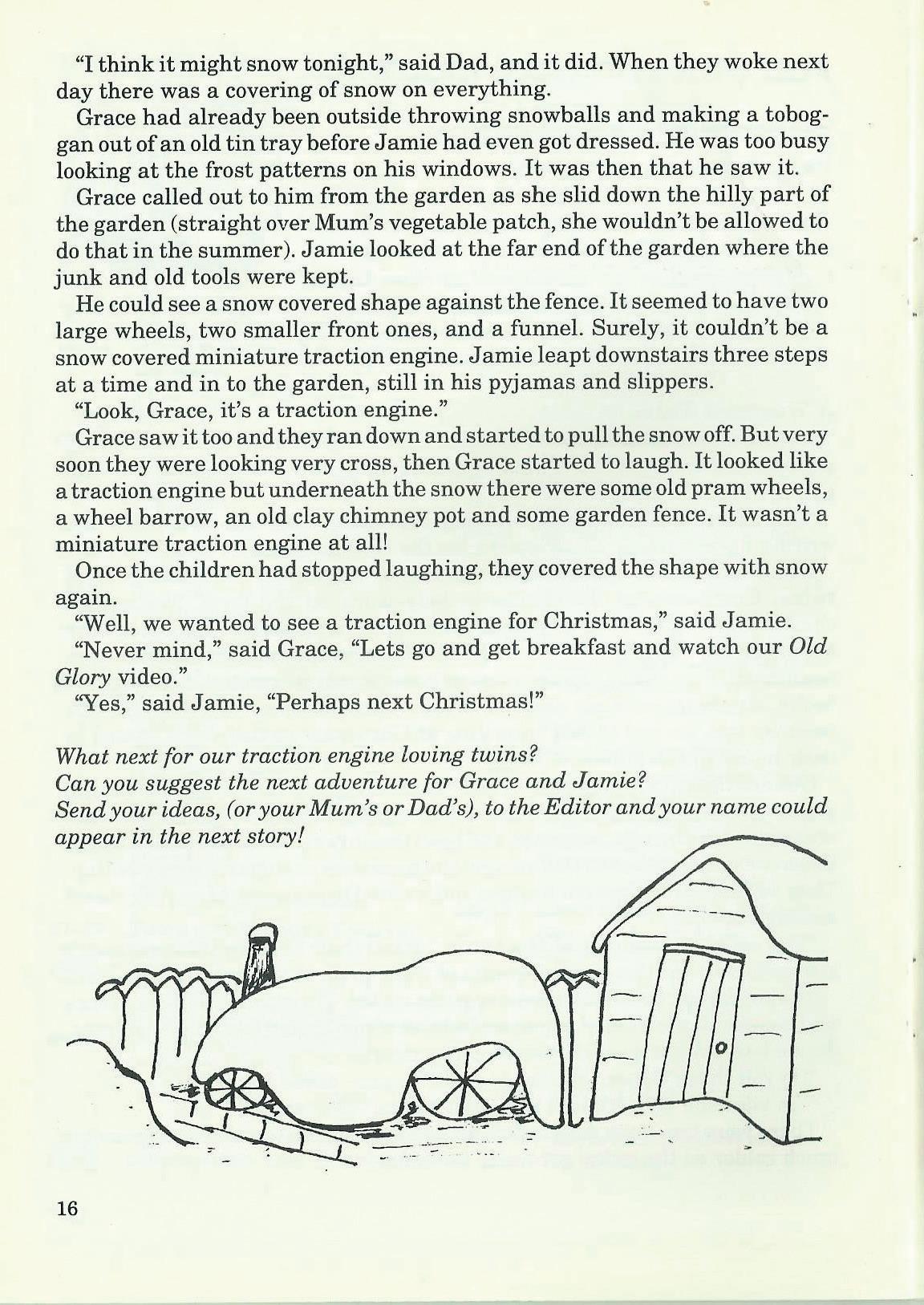
He could see a snow covered shape against the fence. It seemed to have two large wheels, two smaller front ones, and a funnel. Surely, it couldn't be a snow covered miniature traction engine.Jamie leapt downstairs three steps at a time and in to the garden, still in his pyjamas and slippers.
"Look, Grace, it's a traction engine."
Grace saw it too and they ran down and started to pull the snow off. But very soon they were looking very cross, then Grace started to laugh. It looked like a traction engine but underneath the snow there were some old pram wheels, a wheel barrow, an old clay chimney pot and some garden fence. It wasn't a miniature traction engine at all!
Once the children had stopped laughing, they covered the shape with snow again.
"Well, we wanted to see a traction engine for Christmas," said Jamie. "Never mind," said Grace, "Lets go and get breakfast and watch our Old Glory video."
"Yes," said Jamie, "Perhaps next Christmas!"
What next for our traction engine loving twins?
Can you suggest the next adventure for Grace and Jamie? Send your ideas, (or your Mum's or Dad's), totheEditorandyour name could appear in the next story!
The Steam Apprentice Club tries to put those members that wish in touch with a traction engine owner near them so that they can learn more about engines from people who actually run them.
This depends on willing engine owners and where the Apprentice lives. This activity is, of course, more suitable for· _ older members and recent ad- .-::;~<:~ vice is that Apprentices under 12 years old may not be covered by public liability insurance. Most engine owners insist on Apprentices being older than this anyway. If you would like to work on an engine you need to complete and return the blue form to register your interest. Spare forms are available from the Editor.
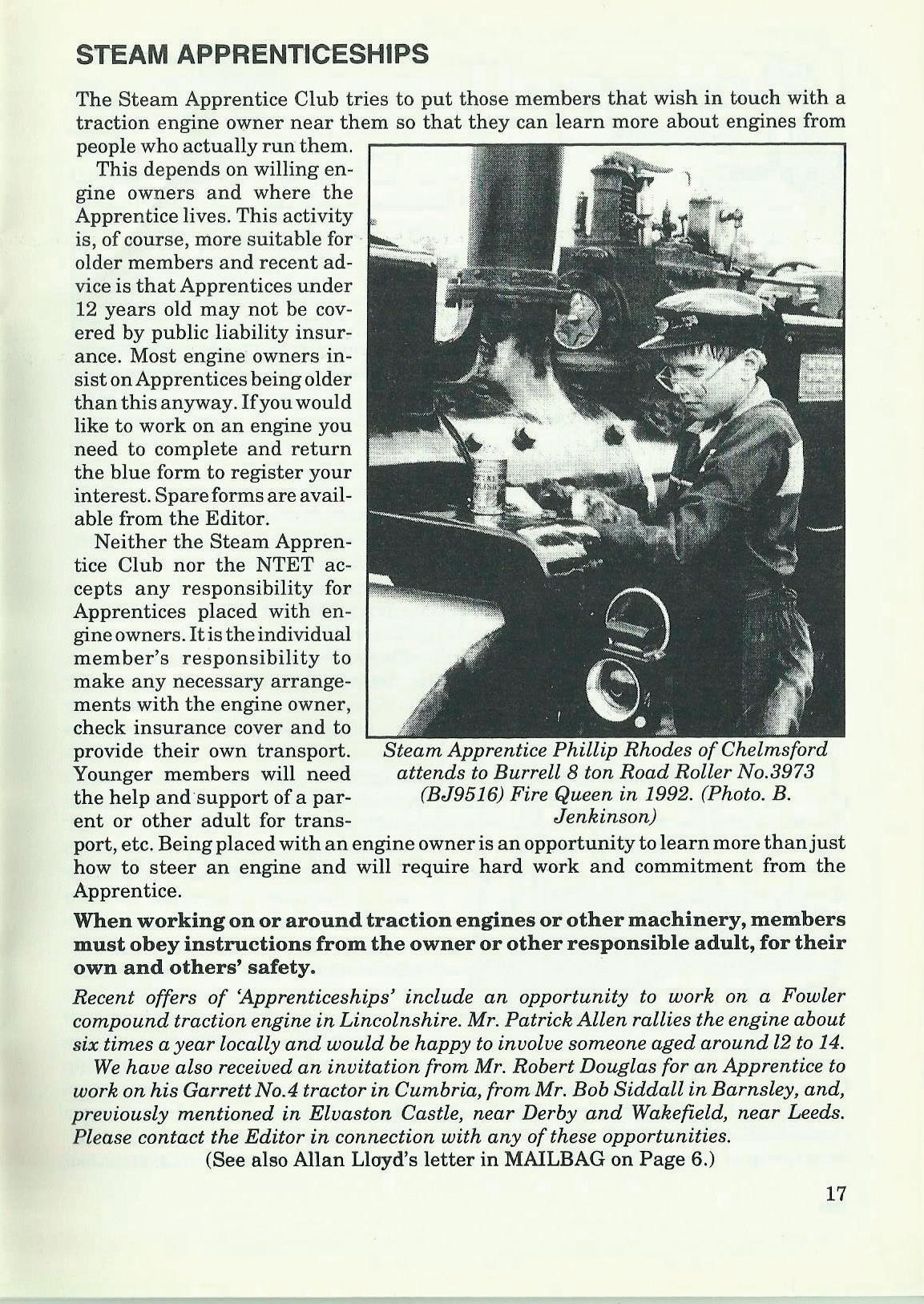
Neither the Steam Apprentice Cl uh nor the NTET accepts any responsibility for Apprentices placed with engine owners. It is the individual member's responsibility to make any necessary arrangements with the engine owner, check insurance cover and to provide their own transport. Steam Apprentice Phillip Rhodes of Chelmsford Younger members will need attends to Burrell 8 ton Road Roller No.3973 the help and support of a par- (BJ9516) Fire Queen in 1992. (Photo. B. ent or other adult for trans- Jenkinson) port, etc. Being placed with an engine owner is an opportunity to learn more than just how to steer an engine and will require hard work and commitment from the Apprentice.
When working on or around traction engines or other machinery, members must obey instructions from the owner or other responsible adult, for their own and others' safety.
Recent offers of 'Apprenticeships' include an opportunity to work on a Fowler compound traction engine in Lincolnshire. Mr. Patrick Allen rallies the engine about six times a year locally and would be happy to involve someone aged around l2 to 14.
We have also received an invitation from Mr. Robert Douglas for an Apprentice to work on his Garrett No.4 tractor in Cumbria, from Mr. Bob Siddall in Barnsley, and, previously mentioned in Elvaston Castle, near Derby and Wakefield, near Leeds. Please contact the Editor in connection with any of these opportunities. (See also Allan Lloyd's letter in MAILBAG on Page 6.)
There are three main ingredients necessary to enable a traction engine, steam wagon or steam roller to work satisfactorily. Two of these are, of course, coal and water-the fundamental requirements to make steam. The other is oil. Adequate lubrication is necessary to prolong the life of the engine by effectively oiling all the wearing surfaces where components move in either a sliding, rubbing or turning motion. Bearings need oil and also other wearing surfaces such as the valve gear, valve and pump eccentrics, chains and operating levers. Use of an oil can or even an old washing-up bottle filled with oil is a relatively easy method of getting oil into these important places.
There are two other locations, however, to which easy access by such means is not possible. These are the valve face and piston. A special type of oil is used for this application, and this has to be suitable for mixing with steam and at the same time, its constituents require it to be such that it does not loose its lubrication properties.
Steam cylinder oil is a very thick, dark green coloured oil with a smell all ofits own. When cold, it does not pour very well, such is its 'heavy' nature. It is often said that it is the smell of the hot cylinder oil and coal smoke which gives the traction engine part of its fascination, along with other forms of steam engine. It is usually fed into the cylinder as close to the valve face as possible so that it is carried by the steam via this face, lubricating it in the process, into the cylinder(s) where it can then lubricate the piston(s) and rod(s), depending on whether the engine concerned is a single or a compound.
It should be noted that information on oils contained in this article relates primarily to traction engines and steam rollers which operate at working pressures of around 100 to 180 psi. For steam wagons and Sentinels in particular, whose working pressure is over 250 psi, the boilers of which operate at a high degree of superheat, a very special grade of cylinder oil is necessary which will not breakdown at such temperatures.
The device used for injecting cylinder oil into the system is called a mechanical lubricator. It is usually driven by an arm from a convenient location on one of the eccentrics or valve rod, so that it travels backwards and forwards at the same time as the engine is working. This to and fro motion (known as a reciprocating motion) is translated into a turning or rotary motion at the pump, to turn the pump's main drive shaft. On this is to be found a ratchet and pawl device which is sometimes located on the outside (as on a Foster type pump), on others, it is inside the body of the lubricator. This device prevents the internal pumping arrangement from going backwards. A typical mechanical lubricator is the Manzel Force Feed Oil Pump manufactured by the British Manzel Oil Pump Co., Crown Works, Carlisle, a brief description of which follows.
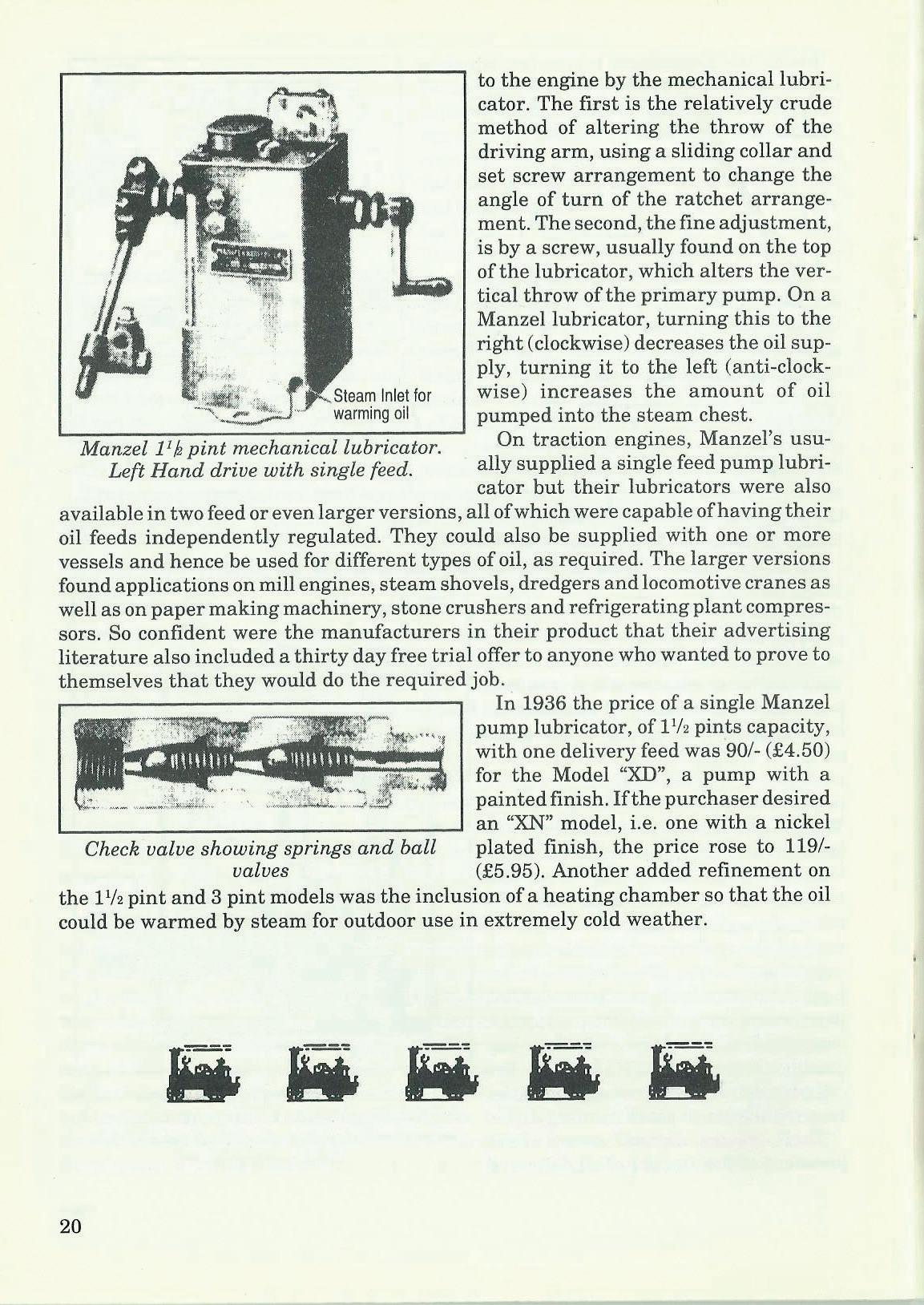
Inside the mechanical lubricator, which is itself a vessel for containing oil normally poured in through the top, are two small pumps. Because they continually work in oil, they are self lubricated and invariably the arrangement is trouble free. The first pump, situated within the reservoir, takes oil from within the reservoir and delivers it through a sight feed glass on top of the lubricator into a small secondary reservoir. The second pump, which draws from this reservoir, is then used to force the oil along the delivery pipe, through a nonreturn valve and into the steam chest adjacent to the engine's steam valve. This non-return valve consists of two spring loaded stainless steel ball bearings in a suitable housing. The
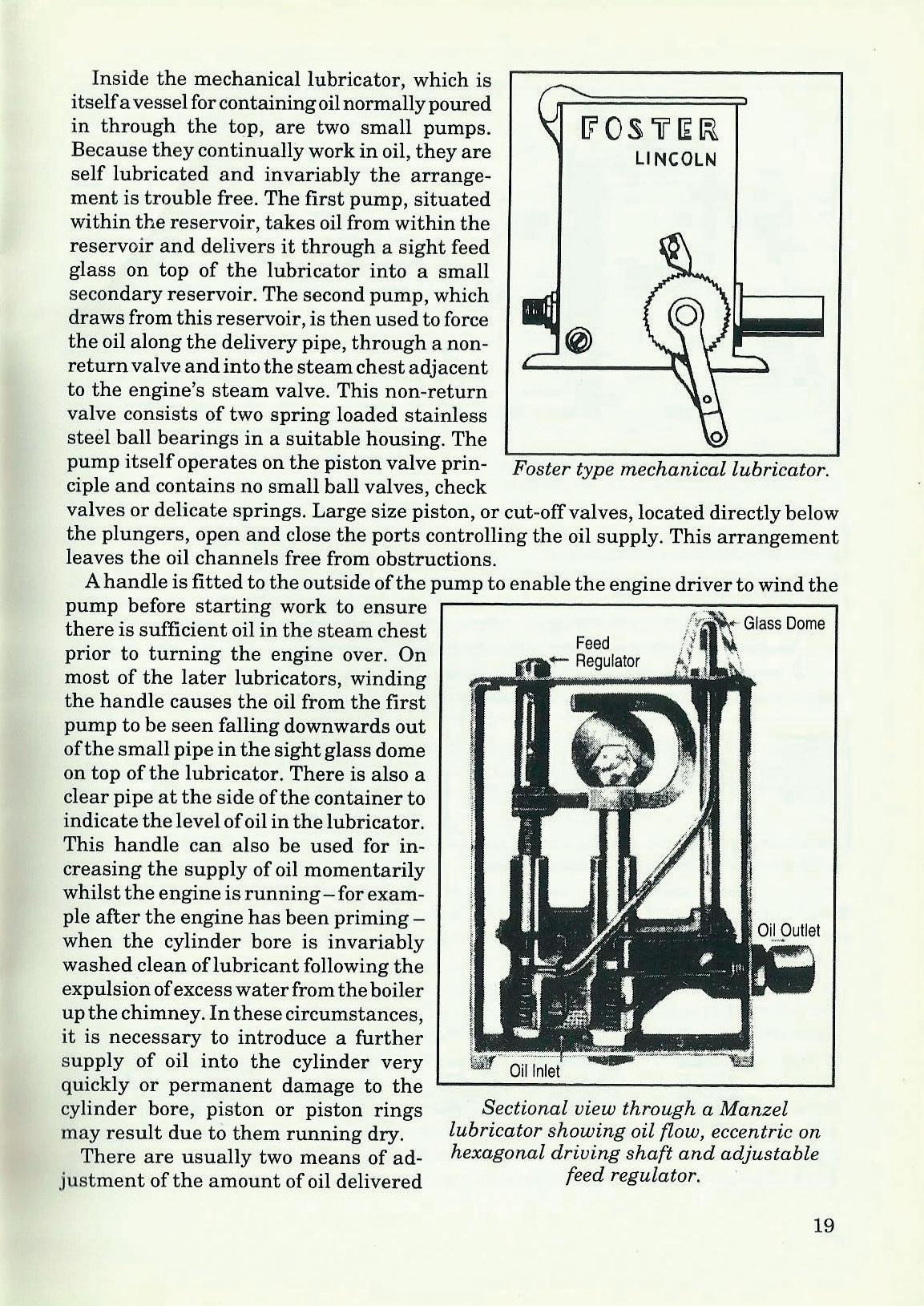
pump itself operates on the piston valve prin- Foster type mechanical lubricator. ciple and contains no small ball valves, check valves or delicate springs. Large size piston, or cut-off valves, located directly below the plungers, open and close the ports controlling the oil supply. This arrangement leaves the oil channels free from obstructions.
A handle is fitted to the outside of the pump to enable the engine driver to wind the pump before starting work to ensure there is sufficient oil in the steam chest prior to turning the engine over. On most of the later lubricators, winding the handle causes the oil from the first pump to be seen falling downwards out of the small pipe in the sight glass dome on top of the lubricator. There is also a clear pipe at the side of the container to indicate the level of oil in the lubricator. This handle can also be used for increasing the supply of oil momentarily whilst the engine is running-for example after the engine has been primingwhen the cylinder bore is invariably washed clean of lubricant following the expulsion of excess water from the boiler up the chimney. In these circumstances, it is necessary to introduce a further supply of oil into the cylinder very quickly or permanent damage to the cylinder bore, piston or piston rings may result due to them running dry. There are usually two means of adjustment of the amount of oil delivered
Manzel 1 1k pint mechanical lubricator. Left Hand drive with single feed.
to the engine by the mechanical lubricator. The first is the relatively crude method of altering the throw of the driving arm, using a sliding collar and set screw arrangement to change the angle of turn of the ratchet arrangement. The second, the fine adjustment, is by a screw, usually found on the top of the lubricator, which alters the vertical throw of the primary pump. On a Manzel lubricator, turning this to the right (clockwise) decreases the oil supply, turning it to the left (anti-clockwise) increases the amount of oil pumped into the steam chest.
On traction engines, Manzel's usually supplied a single feed pump lubricator but their lubricators were also available in two feed or even larger versions, all of which were capable of having their oil feeds independently regulated. They could also be supplied with one or more vessels and hence be used for different types of oil, as required. The larger versions found applications on mill engines, steam shovels, dredgers and locomotive cranes as well as on paper making machinery, stone crushers and refrigerating plant compressors. So confident were the manufacturers in their product that their advertising literature also included a thirty day free trial offer to anyone who wanted to prove to themselves that they would do the required job.
In 1936 the price of a single Manzel
pump lubricator, of 1 ½ pints capacity,
an "XN" model, i.e. one with a nickel
Check valve showing springs and ball plated finish, the price rose to 119/valves (£5.95). Another added refinement on the 1 ½ pint and 3 pint models was the inclusion of a heating chamber so that the oil could be warmed by steam for outdoor use in extremely cold weather.
Stephen Smith
Sec. Fairground Association of Great Britain
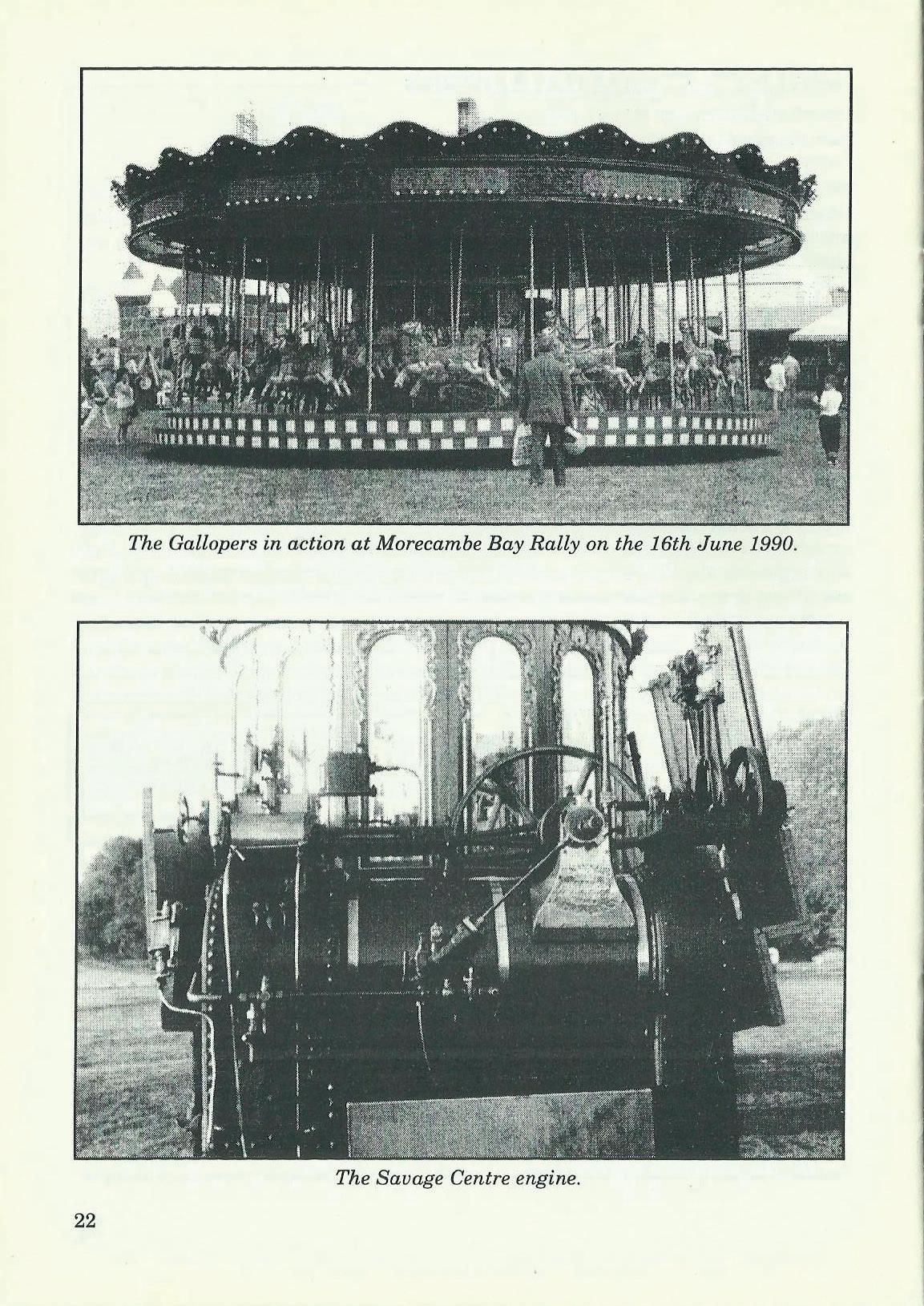
When you visit a steam rally there are often working displays showing engines working as they did many years ago. One such engine which is often neglected by rally organisers. and which probably works harder than any of the other engines on the site is the centre engine driving the Gallopers.
Ashley's Gallopers are probably unique in always having been steam driven. When most other sets were being converted to electric drive in the 1940s and 1950s, Ashley's not only kept theirs steam-powered, but even bought another engine when their original was worn out.
Some of you may have seen Ashley's Gallopers at a steam rally during the season. Today they are owned by Jack Schofield of Retford, but their history goes back a century to the nearby city of Nottingham.
In Sneinton, a district ofN ottingham, Samuel Ashley worked as a tin-smith. In the 1880s he advertised his work in a local directory, working as a tinner, gas-fitter and bell-hanger from his shop in Gedling Street, and later at 8 Bond Street. How his interest turned from metal-working we do not know, but it probably had something to do with Nottingham's Great Goose Fair, which Samuel no doubt visited in Nottingham's Market Square each October. Perhaps he saw Pat Collins' splendid roundabouts and wanted one of his own.
In about 1894 Samuel's dream came true. He bought a steam centre from Thomas Walker's works in Tewkesbury and built a set ofDobby Horses around it. He took it to local villages during the summer, but he was not allowed to go to the Goose Fair, so instead he built it up at Sneinton whilst the other famous showmen were open on the Market Square.
Most of the time Samuel would have used horses to pull his roundabout from feast to feast, but sometimes he hired local contractors to use their traction engines to move the trucks. Benjamin Renshaw's diary from 1903 still survives and in it he mentions moving Ashley's Horses to Langar on 3rd June, and then to Newark on 24th June, and two days later on to West Bridgeford. If the engine was not needed it was sometimes used to drive a dynamo mounted on a dray so the roundabout could be lit with electric lights. In 1912 Samuel Ashley bought his own traction engine. This was a powerful Foster Showman's Road Locomotive called Royal Don.
During the First World War the Dobby Horses were packed a way and Samuel's two sons, Arthur and Albert, worked for the government on munitions. When the war ended Samuel did not want to travel the ride any more. Not only was he getting old, he was also going blind, so his two sons took over. They decided the old Dobby Horses were out-of-date and so, in 1920, the ride was rebuilt by Robert Tidman of Norwich. to a set of Galloping Horses. Ashley's also gained another prize after the war, a position at the Goose Fair.
Various other improvements were made in the 1920s, including having a set of fourteen horses -carved by Orton, Sons and Spooner, of Burton on Trent, for the outside row, and three chickens carved by Andersons of Bristol. But in 1931 Ashley Brothers bought a Noah's Ark or Speedway ride, and the Gallopers were used less and
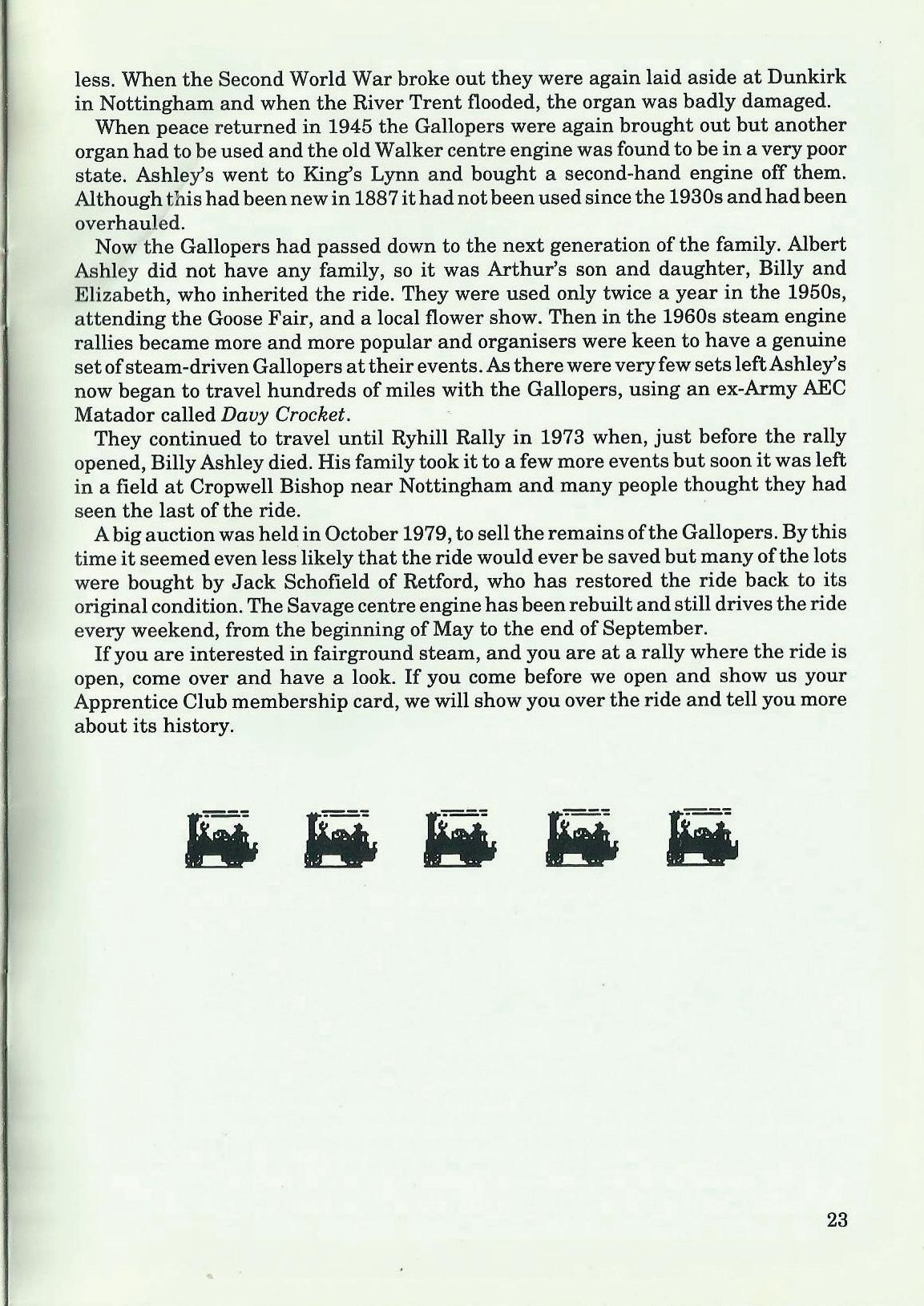
less. When the Second World War broke out they were again laid aside at Dunkirk in Nottingham and when the River Trent flooded, the organ was badly damaged. When peace returned in 1945 the Gallopers were again brought out but another organ had to be used and the old Walker centre engine was found to be in a very poor state. Ashley's went to King's Lynn and bought a second-hand engine off them. Although this had been new in 1887 it had not been used since the 1930s and had been overhauled.
Now the Gallopers had passed down to the next generation of the family. Albert Ashley did not have any family, so it was Arthur's son and daughter, Billy and Elizabeth, who inherited the ride. They were used only twice a year in the 1950s, attending the Goose Fair, and a local flower show. Then in the 1960s steam engine rallies became more and more popular and organisers were keen to have a genuine set of steam-driven Gallopers at their events. As there were very few sets left Ashley's now began to travel hundreds of miles with the Gallopers, using an ex-Army AEC Matador called Davy Crocket.
They continued to travel until Ryhill Rally in 1973 when, just before the rally opened, Billy Ashley died. His family took it to a few more events but soon it was left in a field at Cropwell Bishop near Nottingham and many people thought they had seen the last of the ride.
A big auction was held in October 1979, to sell the remains of the Gallopers. By this time it seemed even less likely that the ride would ever be saved but many of the lots were bought by Jack Schofield of Retford, who has restored the ride back to its original condition. The Savage centre engine has been rebuilt and still drives the ride every weekend, from the beginning of May to the end of September.
If you are interested in fairground steam, and you are at a rally where the ride is open, come over and have a look. If you come before we open and show us your Apprentice Club membership card, we will show you over the ride and tell you more about its history.
Small advertisements relating to traction engines and your hobby are free of charge to SAC and NTET members. Advertisements should be written clearly and concisely, must be accompanied by your membership number, name and address, and sent to the Editor before the copy date for the next issue.
Commercial ads are accepted from companies selling items related to our hobby, or for steam ev·ents, etc. Rates start at £15.00 for a quarter page. Please contact the Editor for details.
Steam Apprentice Club BADGES £1.00 direct from the Chairperson,.Sylvia Dudley, (address in front of magazine). Please enclose a First Class stamped addressed envelope and a cheque or postal order, not cash, payable to 'NTET'. MAKESURE.YOUSTANDOUT FROMTHE
Copies of SAC magazine back numbers are available from the Editor, (address inside front cover), for £1.00 each including postage. Please send cheque or postal order, not cash! payable to 'NTET'. The following issues only are available.
Volume 3 Number 4 Winter 1989/90 only a handful of this early issue.
Volume 6 Number 1 Spring 1992 only a few left
Volume 6 Number 2 Summer 1992
Volume 6 Number 3 Autumn 1992
Volume 7 Number 1 Winter 1993
Volume 7 Number 2 Spring 1993
Volume 7 Number 3 Summer 1993
Volume 7 Number 4 Autumn 1993
Special discount for any 5 -£4.50 including postage; 6 or more 80p each.
In the next issue we will have steam roller articles by Derek Rayner and John Reeves, the results of the Membership Survey, a welcome to new members, more of your news and views and, hopefully, the articles promised in the last edition! The next magazine is due out in May. Please send any items, articles, photographs or other contributions to the Editor by the 15th April at the latest.
I would like to join the Steam Apprentice Club
Forename(s) --Surname (Block Capitals)
Address -----
Date of Birth
Postcode
Tel. No. ---------
Please help us to make the Club more interesting to you by answering these questions:
1. Why are you interested in joining the Steam Apprentice Club?
2. What activities would you particularly like the Club to provide?
3. Do you already have access to a traction engine? (If yes, which one?)
Then send this form, with the £3.00 subscription to: The Membership Secretary, NTET, John Cook, Dolfarni, Church Lane, Kirby la Thorpe, Sleaford, Lincolnshire NG34 9NU
NOTE: Please do not send money by post. A cheque or postal order is much safer and should be made payable to the "National Traction Engine Trust".
Office Use Only:
HAVE YOU JOINED? THEN JOIN A FRIEND!
The Club was formed for young people under the age of Twenty-One who are interested in Steam Traction Engines in 1979 by the then National Traction Engine Club.
Today it is the young person's branch of the National Traction Engine Trust, a registered educational charity.
Many people watch engines at rallies, but few of them know how an engine works, and even fewer have the chance to be shown over one by the owner, to talk about the work it used to do, or even help with the engine's maintenance. The Club publishes this magazine with many of the articles being written by Club members.
We have a scheme which allows Club members into most Traction Engine rallies free of charge. Also we will try and put you in touch with a local engine owner near you, so that you can learn more about engines from people who actually run them, in addition to our special training sessions and schemes.
If you enjoy rallies, photographing and recording engines, collecting pictures or books about engines, talking about steam or if you just wish to learn more, the Steam Apprentice Club is for you.
1. A quarterly Magazine.
2. A membership card.
3. Free admission to most NTET approved Traction Engine Rallies.
4. A Free copy of NTET approved Rally List, each Spring.
5. A chance to buy books, magazines (including "Steaming") and other items sold by the NTEC (1984) Ltd. Taking advantage of any special discounts and offers available to NTET members.
6. Special club visits, events and training weekends.
7. Special Insurance considerations in connection with Traction Engines.
8. Many other items are advertised in our club magazine.
Our annual subscription is just £3.00. Membership runs to the nearest quarter.
Join us NOW:Just fill in the membership application form inside the back cover. Then send it to the membership secretary with your subscription or hand it into any NTET or NTEC (1984) Ltd. Rally Stand. •
If you wish to keep your magazine intact, you may photocopy the membership application form, or copy the details onto another sheet of paper.