EDITOR
EDITOR
Steph Gillett, 93 Devon Road, Easton, Bristol BS5 6ED.
CHAIR, STEAM
Sylvia Dudley, 12 Hill way, Woburn Sands, Milton Keynes, Buckinghamshire MKl 7 8UL
MEMBERSHIP SECRETARY
John Cook, 25 Ripon Drive, Sleaford, Lincolnshire NG34 8UF
The Editor welcomes any contributions of articles, shorter items or photographs for inclusion in future issues. All material submitted is voluntary and payment cannot be made for any material published. The opinions expressed in the magazine, with the exception of Club announcements, are those of the contributors and do not indicate the views of the Club as a whole. All items are held copyright by the contributor and the NTET.
Please send your contributions to the Editor at least five weeks before publication. Typed articles are preferred but not essential. If handwritten put any names of PEOPLE, PLACES or ENGINES in BLOCK CAPITALS. If you require any part ofyour article (eg. photos) retunring please say so and enclose a stamped addressed envelope. Enclose your name, address and (if an Apprentice) age with any contribution.
The Editor reserves the right to amend or refuse contributions, and will attempt to correct spelling and grammar!
The Magazine is normally published during the early part of January, April, July and October.
The Steam Apprentice Club is a section of the National Traction Engine Trust. NTETis a Registered Charity, No.291578. Registered in England No.1302197. Registered Office: Forum House, 1-6 Millmead, Middlesex 'IW18 4UQ
TypesettingbyTilsetServices,22Prestbury,Yate,BristolBS174LB.Tel:0454314279. Printedby EconomicPrintingCompany,245StapletonRoad,Bristol.
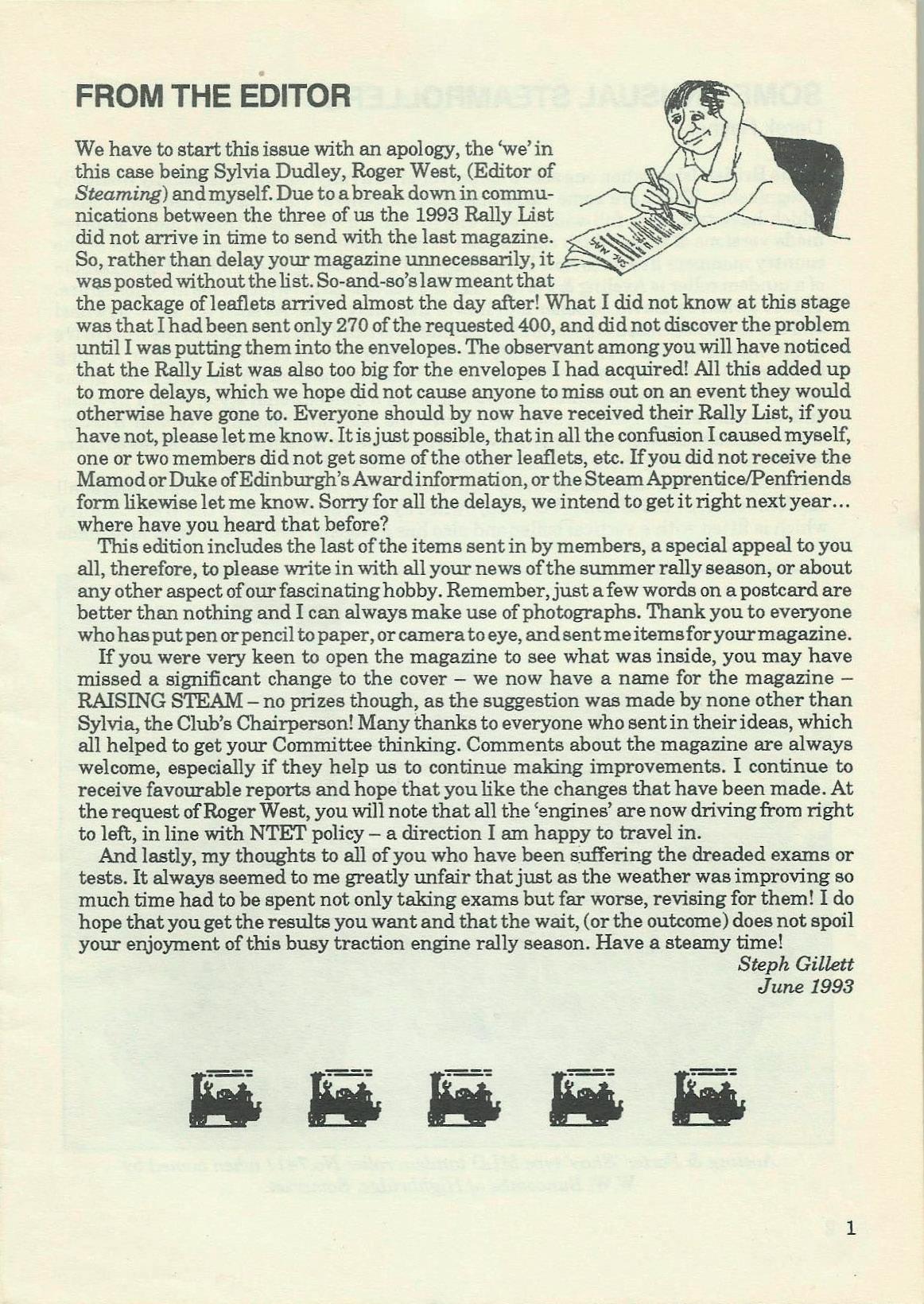
We have to start this issue with an apology, the 'we'in this case being Sylvia Dudley, Roger West, (Editor of Steaming) and myself. Due to a break down in communications between the three of us the 1993 Rally List .......__ did not arrive in time to send with the last magazine. So, rather than delay your magazine unnecessarily, it was posted without the list. So-and-so's law meant that the package of leaflets arrived almost the day after! What I did not know at this stage was that I had been sent only 270 of the requested 400, and did not discover the problem until I was putting them into the envelopes. The observant among you will have noticed that the Rally List was also too big for the envelopes I had acquired! All this added up to more delays, which we hope did not cause anyone to miss out on an event they would otherwise have gone to. Everyone should by now have received their Rally List, if you have not, please let me know. It is just possible, that in all the confusion I caused myself, one or two members did not get some of the other leaflets, etc. If you did not receive the Mamod or Duke of Edinburgh's Award information, or the Steam Apprentice/Penfriends form likewise let me know. Sorry for all the delays, we intend to get it right next year ... where have you heard that before?
This edition includes the last of the items sent in by members, a special appeal to you all, therefore, to please write in with all your news of the summer rally season, or about any other aspect of our fascinating hobby. Remember, just a few words on a postcard are better than nothing and I can always make use of photographs. Thank you to everyone who has put pen or pencil to paper, or camera to eye, and sent me itemsforyourmagazine.
If you were very keen to open the magazine to see what was inside, you may have missed a significant change to the cover - we now have a name for the magazineRAISING STEAM -no prizes though, as the suggestion was made by none other than Sylvia, the Club's Chairperson! Many thanks to everyone who sent in their ideas, which all helped to get your Committee thinking. Comments about the magazine are always welcome, especially if they help us to continue making improvements. I continue to receive favourable reports and hope that you like the changes that have been made. At the request of Roger West, you will note that all the 'engines' are now driving from right to left, in line with NTET policy - a direction I am happy to travel in.
And lastly, my thoughts to all of you who have been s.uffering the dreaded exams or tests. It always seemed to me greatly unfair that just as the weather was improving so much time had to be spent not only taking exams but far worse, revising for them! I do hope that you get the results you want and that the wait, (or the outcome) does not spoil your eajoyment of this busy traction engine rally season. Have a steamy time!
Steph GiUett June 1993
Derek Rayner
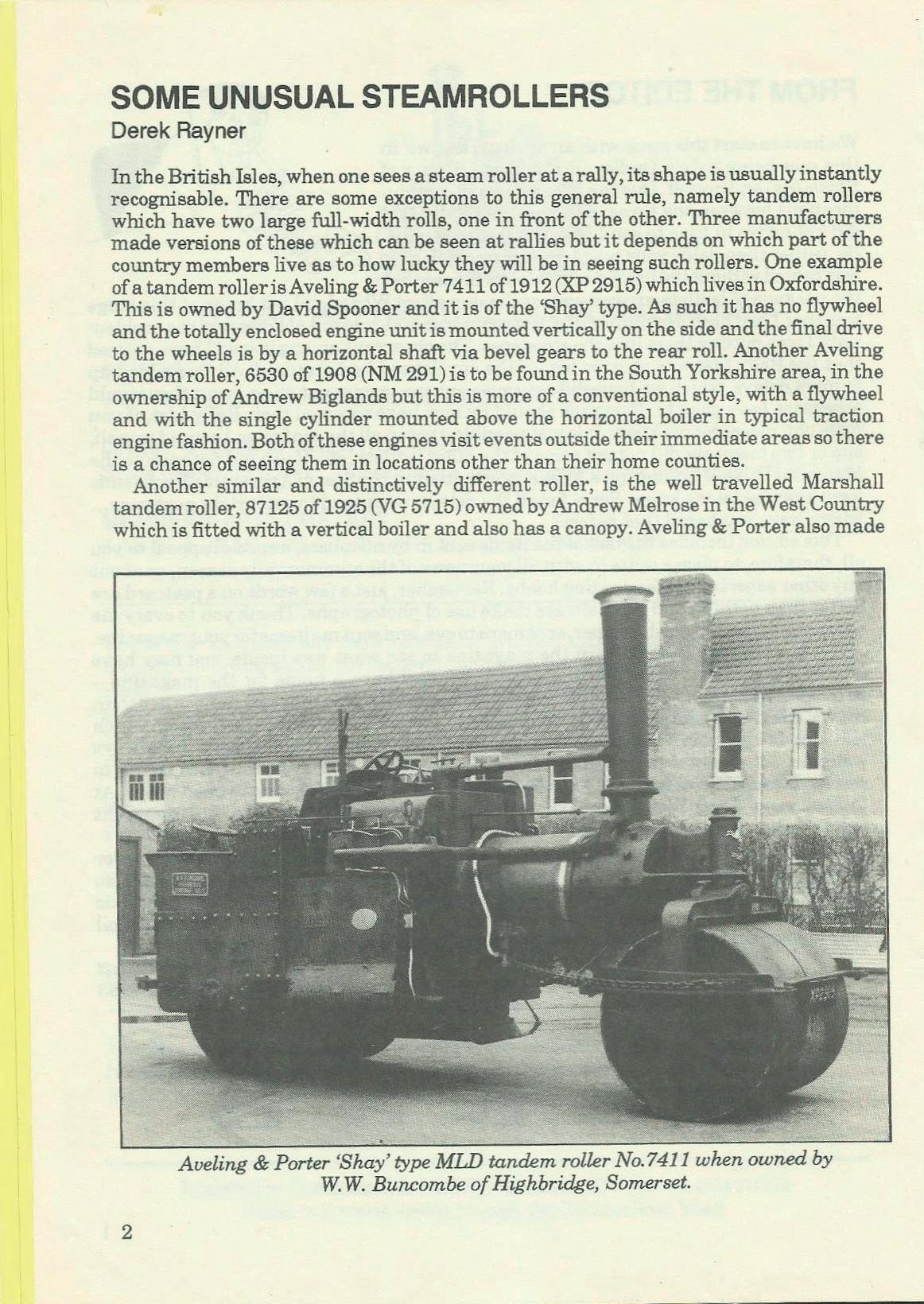
In the British Isles, when one sees a steam roller at a rally, its shape is usually instantly recognisable. There are some exceptions to this general rule, namely tandem rollers which have two large full-width rolls, one in front of the other. Three manufacturers made versions of these which can be seen at rallies but it depends on which part of the country members live as to how lucky they will be in seeing such rollers. One example of a tandem rollerisAveling &Porter 7411 of1912 (XP2915)which lives in Oxfordshire. This is owned by David Spooner and it is of the 'Shay type. As such it has no flywheel and the totally enclosed engine unit is mounted vertically on the side and the final drive to the wheels is by a horizontal shaft via bevel gears to the rear roll. Another Aveling tandem roller, 6530 of 1908 (NM 291) is to be found in the South Yorkshire area, in the ownership of Andrew Biglands but this is more of a conventional style, with a flywheel and with the single cylinder mounted above the horizontal boiler in typical traction engine fashion. Both of these engines visit events outside their immediate areas so there is a chance of seeing them in locations other than their home counties.
Another similar and distinctively different roller, is the well travelled Marshall tandem roller, 87125 of1925 (VG5715) ownedbyAndrewMelrosein the West Country which is fitted with a vertical boiler and also has a canopy. Aveling & Porter also made
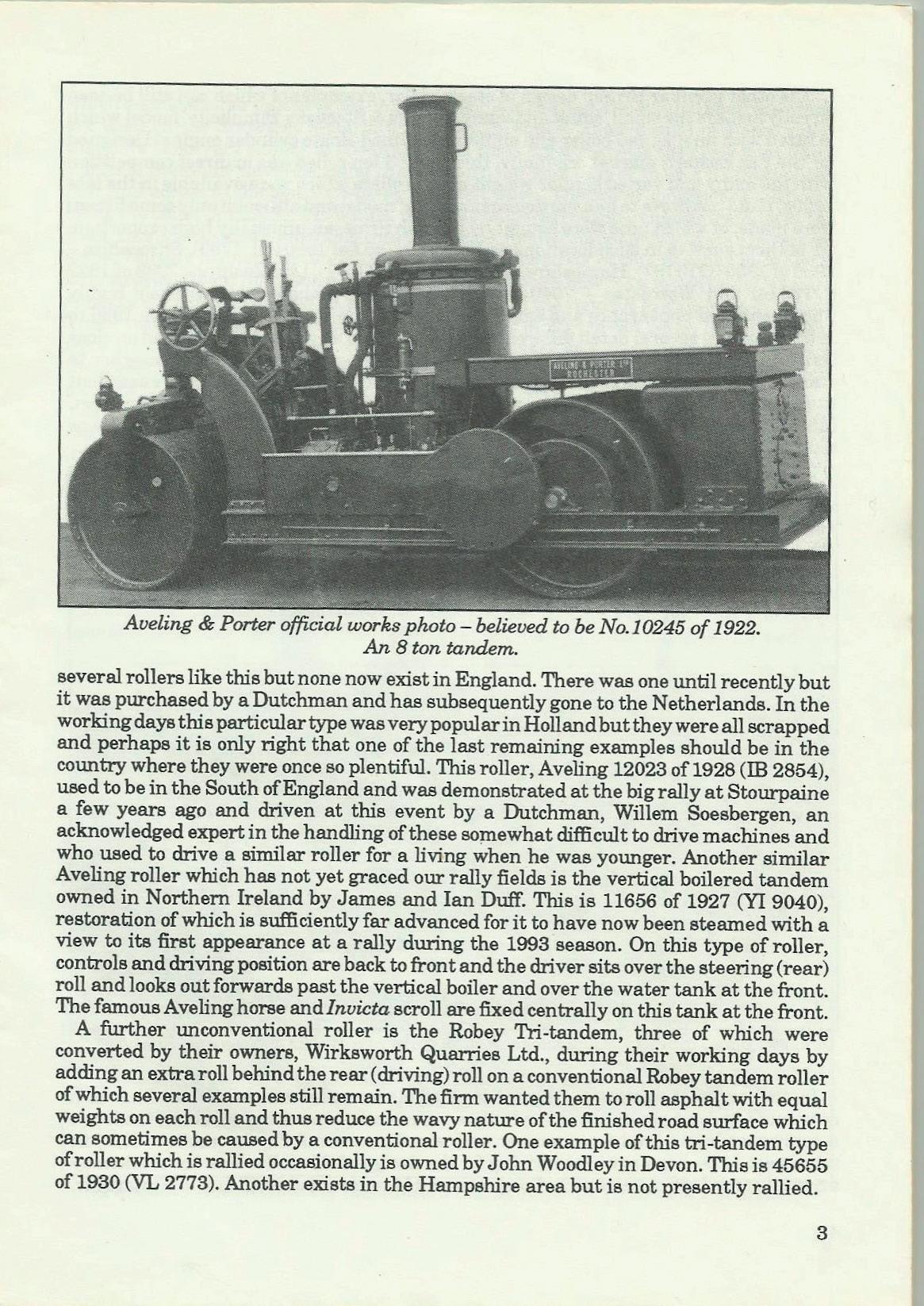
Aueling & Porter official works photo-believed to be No.10245 of 1922.
An 8 ton tandem.
several rollers like this but none now exist in England. There was one until recently but it was purchased by a Dutchman and has subsequently gone to the Netherlands. In the working days this particular type was very popular in Holland but they were all scrapped and perhaps it is only right that one of the last remaining examples should be in the country where they were once so plentiful. This roller, Aveling 12023 of 1928 (IB 2854), used to be in the South of England and was demonstrated at the big rally at Stourpaine a few years ago and driven at this event by a Dutchman, Willem Soesbergen, an acknowledged expert in the handling of these soµiewhat difficult to drive machines and who used to drive a similar roller for a living when he was younger. Another similar Aveling roller which has not yet graced our rally fields is the vertical boilered tandem owned in Northern Ireland by James and Ian Duff. This is 11656 of 1927 (YI 9040), restoration of which is sufficiently far advanced for it to have now been steamed with a view to its first appearance at a rally during the 1993 season. On this type of roller, controls and driving position are back to front and the driver sits over the steering (rear) roll and looks out forwards past the vertical boiler and over the water tank at the front. The famous Aveling horse andlnuicta scroll are fixed centrally on this tank at the front.
A further unconventional roller is the Robey Tri-tandem, three of which were converted by their owners, Wirksworth Quarries Ltd., during their working days by adding an extra roll behind the rear (driving) roll on a conventional Robey tandem roller of which several examples still remain. The firm wanted them to roll asphalt with equal weights on each roll and thus reduce the wavy nature of the finished road surface which can sometimes be caused by a conventional roller. One example of this tri-tandem type of roller which is rallied occasionally is owned by John Woodley in Devon. This is 45655 of 1930 (VL 2773). Another exists in the Hampshire area but is not presently rallied.
The other peculiar British design of steam roller, examples of which can still be seen on rally fields is the small, squat and dumpy Wallis & Steevens 'Simplicity' model which is fitted with an inclined boiler and similarly inclined single cylinder engine. Designed for the Far Eastern market originally, this small 3 ton roller was in direct competition with the many and varied similar weight motor rollers which were available in the late 1920s. It did not prove to be a particularly popular model and although only some fifteen were made, of which nine were bought by English firms, an unusually high proportion, six of them survive in such locations as Norfolk-7981 of 1930 (OUl 789), Shropshire7936 of 1930 (OT5187), Hampshire-8023 of1932 (CG571), Lincolnshire-7939 of 1927 (OT6514) and Worcester -7940 of 1928 (OT8512), probably due to their highly unconventional appearance and small size. Being made at various times from 1926 to 1932, there are several detail differences between them as was able to be noted on close scrutiny when all of the remaining members of the marque were brought together to stand side by side at the Great Dorset Steam Fair at Stourpaine in 1983. This excellent little gathering of a rally within a rally was organised by James Gilbey of Somerset, himself the owner of the first and prototype 'Simplicity' roller 7832 (H064 72) which was built in 1926.
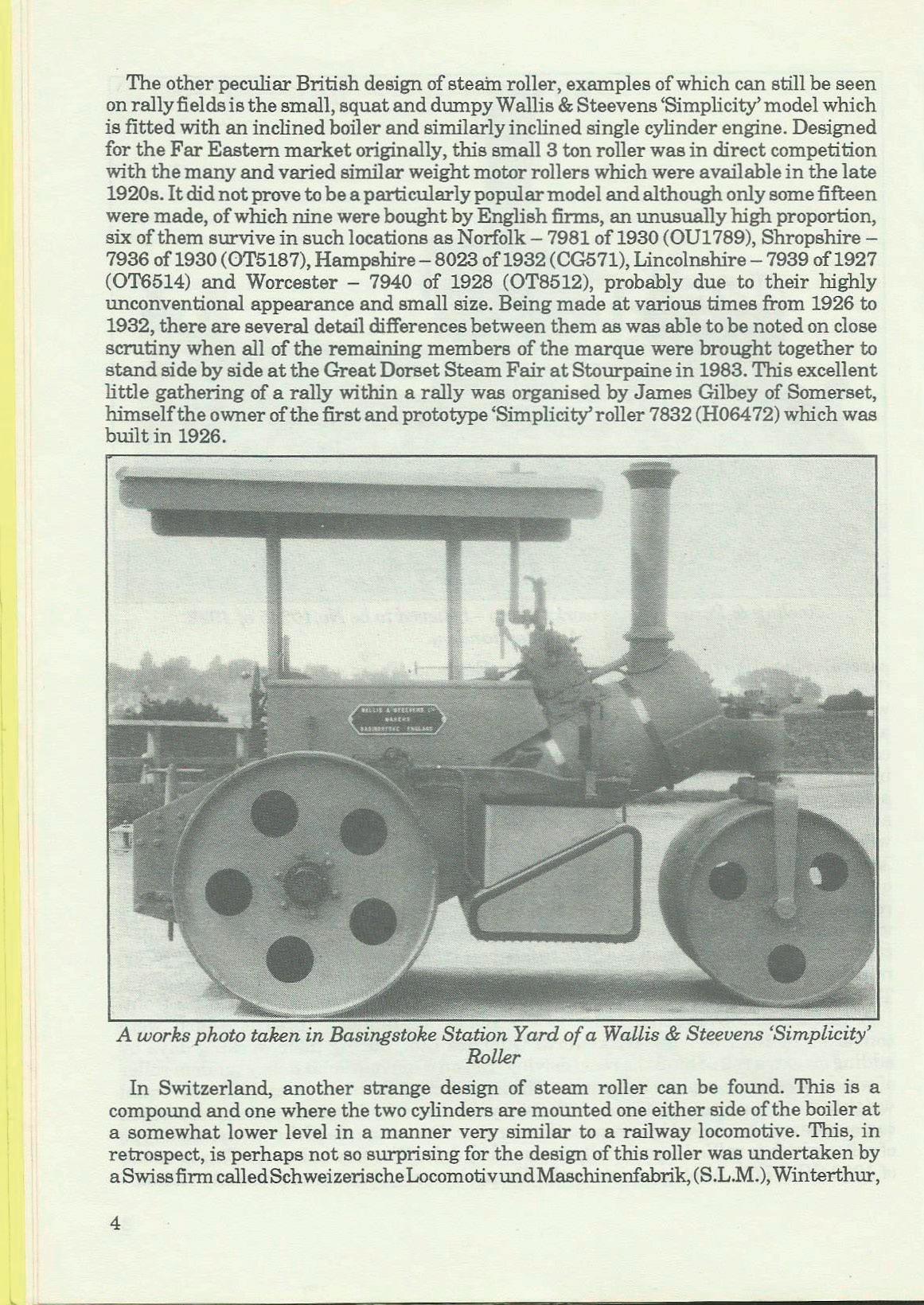
A works photo taken in Basingstoke Station Yard of a Wallis & Steevens 'Simplicity' RoUer
In Switzerland, another strange design of steam roller can be found. This is a compound and one where the two cylinders are mounted one either side of the boiler at a somewhat lower level in a manner very similar to a railway locomotive. This, in retrospect, is perhaps not so surprising for the design of this roller was undertaken by a Swiss firm calledSchweizerische LocomotivundMaschinenfabrik, (S.L.M.),Winterthur, 4
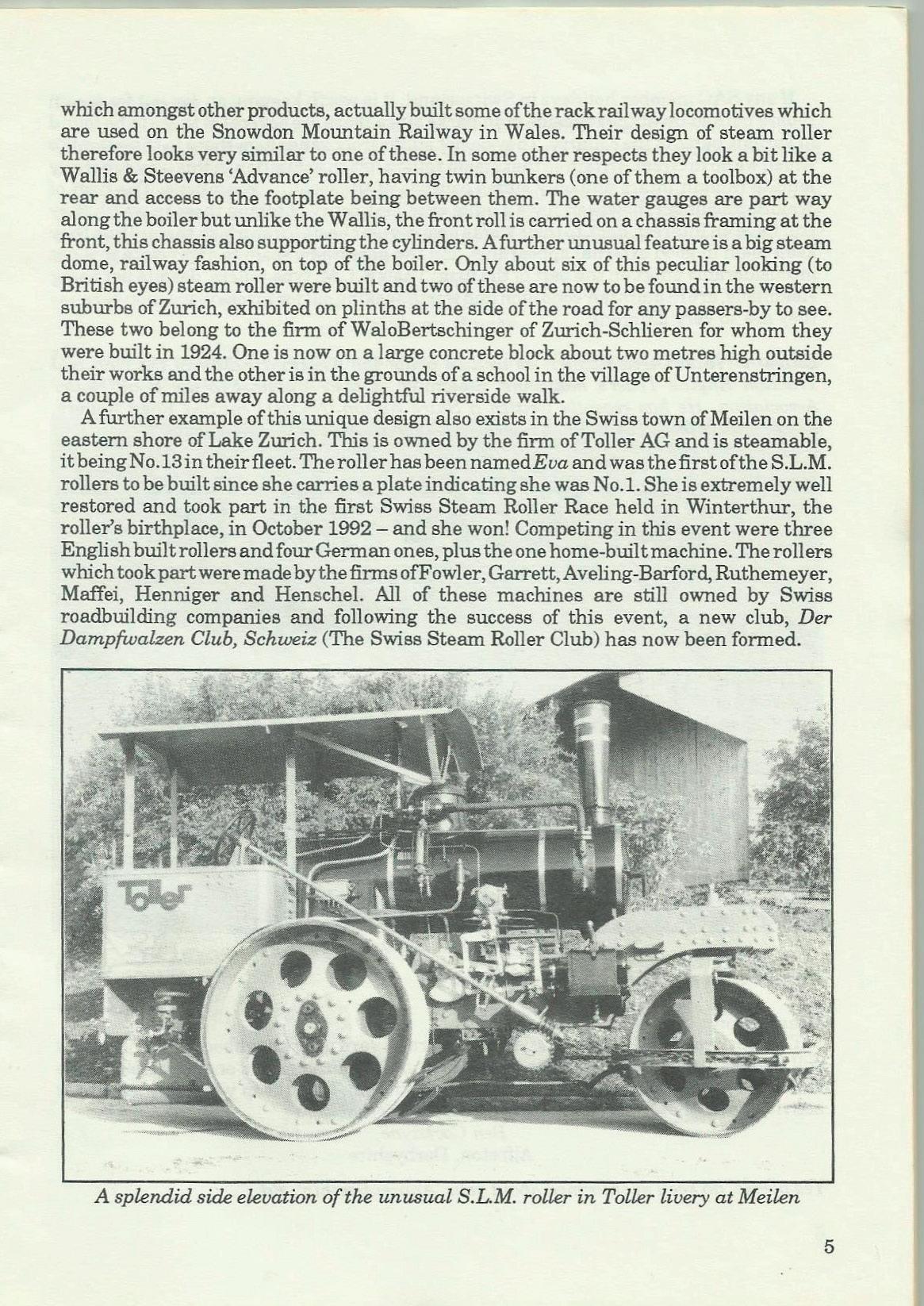
which amongst other products, actually built some of the rack railway locomotives which are used on the Snowdon Mountain Railway in Wales. Their design of steam roller therefore looks very similar to one of these. In some other respects they look a bit like a Wallis & Steevens 'Advance' roller, having twin bunkers (one of them a toolbox) at the rear and access to the footplate being between them. The water gauges are part way along the boiler but unlike the Wallis, the front roll is carried on a chassis framing at the front, this chassis also supporting the cylinders. A further unusual feature is a big steam dome, railway fashion, on top of the boiler. Only about six of this peculiar looking (to British eyes) steam roller were built and two of these are now to be found in the western suburbs of Zurich, exhibited on plinths at the side of the road for any passers-by to see. These two belong to the firm ofWaloBertschinger of Zurich-Schlieren for whom they were built in 1924. One is now on a large concrete block about two metres high outside their works and the other is in the grounds of a school in the village ofUnterenstringen, a couple of miles away along a delightful riverside walk.
A further example of this unique design also exists in the Swiss town ofMeilen on the eastern shore of Lake Zurich. This is owned by the firm of Toller AG and is steamable, it being No.13in their fleet. The roller has been namedEva and was the first of the S.L.M. rollers to be built since she carries a plate indicating she was No. l. She is extremely well restored and took part in the first Swiss Steam Roller Race held in Winterthur, the roller's birthplace, in October 1992 -and she won! Competing in this event were three EnglishbuiltrollersandfourGermanones,plustheonehome-builtmachine. Therollers which took part were made by the firms ofFowler, Garrett,Aveling-Barford, Ruthemeyer, Maffei, Henniger and Henschel. All of these machines are still owned by Swiss roadbuilding companies and following the success of this event, a new club, Der Dampfwalzen Club, Schweiz (The Swiss Steam Roller Club) has now been formed.
If any SAC member holidays in Switzerland, it is worth keeping an eye out for steam rollers parked up at the roadside or in parks since there are several of these to be found in various parts of the country. They do not suffer from vandalism there to the extent to which we do in Great Britain so that steam rollers left on exhibition in this way generally tend to remain intact and only suffer because of the weather conditions. The firm of WaloBertschinger, however, have a quite excellent policy of taking those in which they still have an interest, back to their works on a regular basis to refurbish them. Thus they keep them in good external appearance and the passers-by seem to appreciate this not inconsiderable effort on the part of the firm. Their S.L.M. type rollers, despite not being steamable, are in quite fair condition and worth seeking out for a close inspection because they are so very different.
Editor's Note: Derek Rayner, as well as being the Assistant Editor of the National Traction Engine Trust's magazine, Steaming, is also .Archivist to the Road Roll.er Association. He has recently written a Shire Album (No.281) entitl.ed Road Rollers, inexpensively priced at £1.95, a review of which appears in this magazine.
Dear Steph,
Referring to the letter from Vicky Marshall (Vol.7 No. l), I'm glad she found my railway article interesting, and I'm sorry if I made out that firing a traction engine is easy. On balance, it's possibly harder with the fluctuations in the gradient on roads. I also have it easier on a railway loco in that I know the 'road' and can prepare for what's ahead. On a traction engine, you may not know what lies around the next bend, and need to be ,------,,.i-"'J ready. I would agree with the idea of firing little and often, however, as that's exactly what I do on railway engines, be they narrow gauge or 7¼ inch gauge.
Best wishes,
Anthony Coulls, Aberystwyth
Why not send me your footp/,ate story? Ed.
Dear Editor,
The other weekend I visited Mr. Fred Dockray's yard near Loughborough. I hopefully will be making many more visits down there to help Fred on his engines. Also in the swnmer I will be helping on Fred's engines with him. I will keep you informed on my activities and thanks for getting me an 'Apprenticeship'.
Ben Cockayne, Alfreton, Derbyshire
Yes please, do keep us informed about your 'Apprenticeship'. Ed.
To all concerned,
I would like to thank Sylvia Dudley and all the members of the Staffordshire Engine Club for the recent training weekend. We received a warm welcome from everyone and this made our stay at Klondyke Mill very enjoyable.
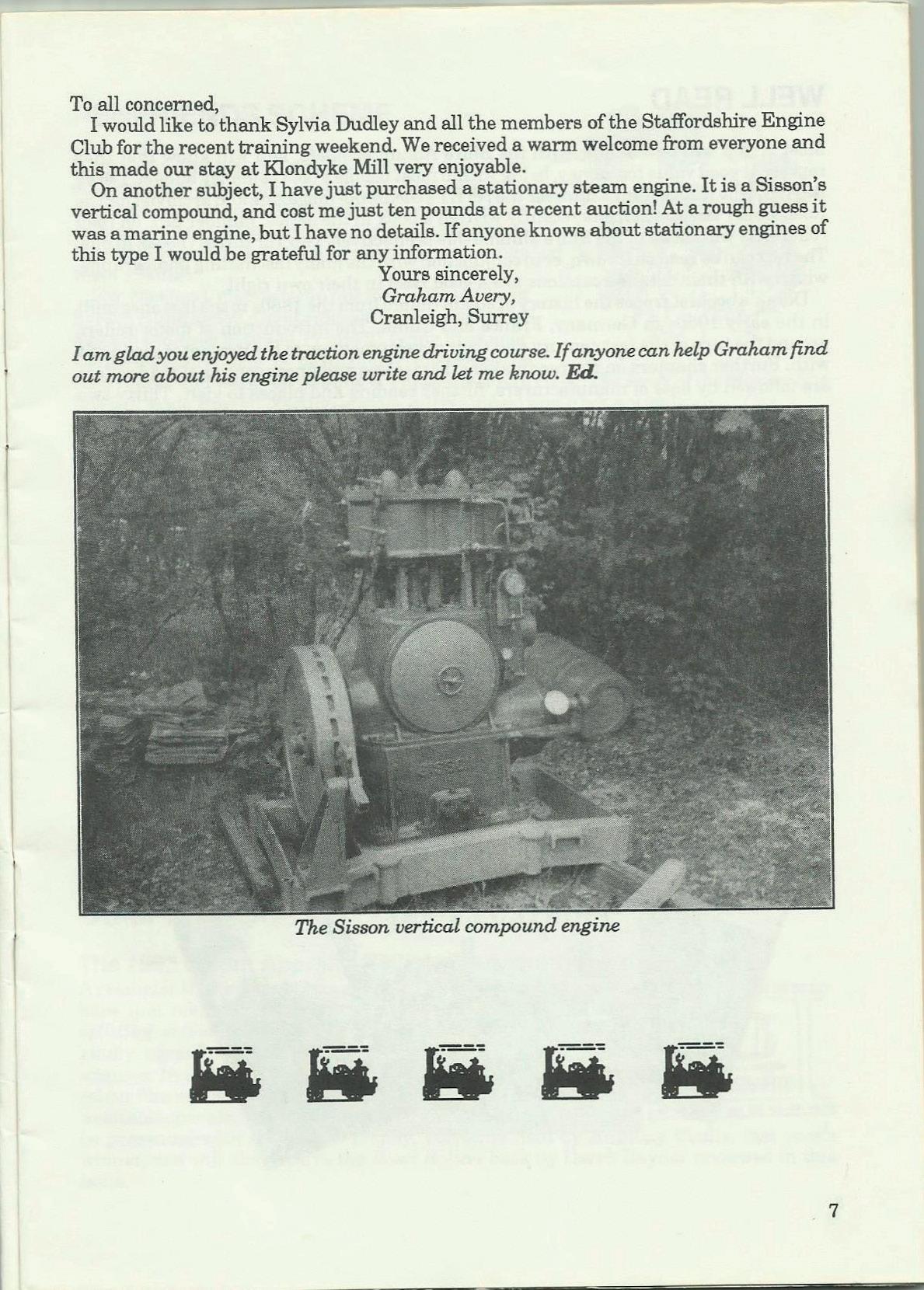
On another subject, I have just purchased a stationary steam engine. It is a Sisson's vertical compound, and cost me just ten pounds at a recent auction! At a rough guess it was a marine engine, but I have no details. If anyone knows about stationary engines of this type I would be grateful for any information.
Yours sincerely, Graham Avery, Cranleigh, Surrey
I am gl,a,dyou enjoyed the traction engi,ne driving course. If anyone can help Graham find out more about his engine please write and /,et me know. Ed.
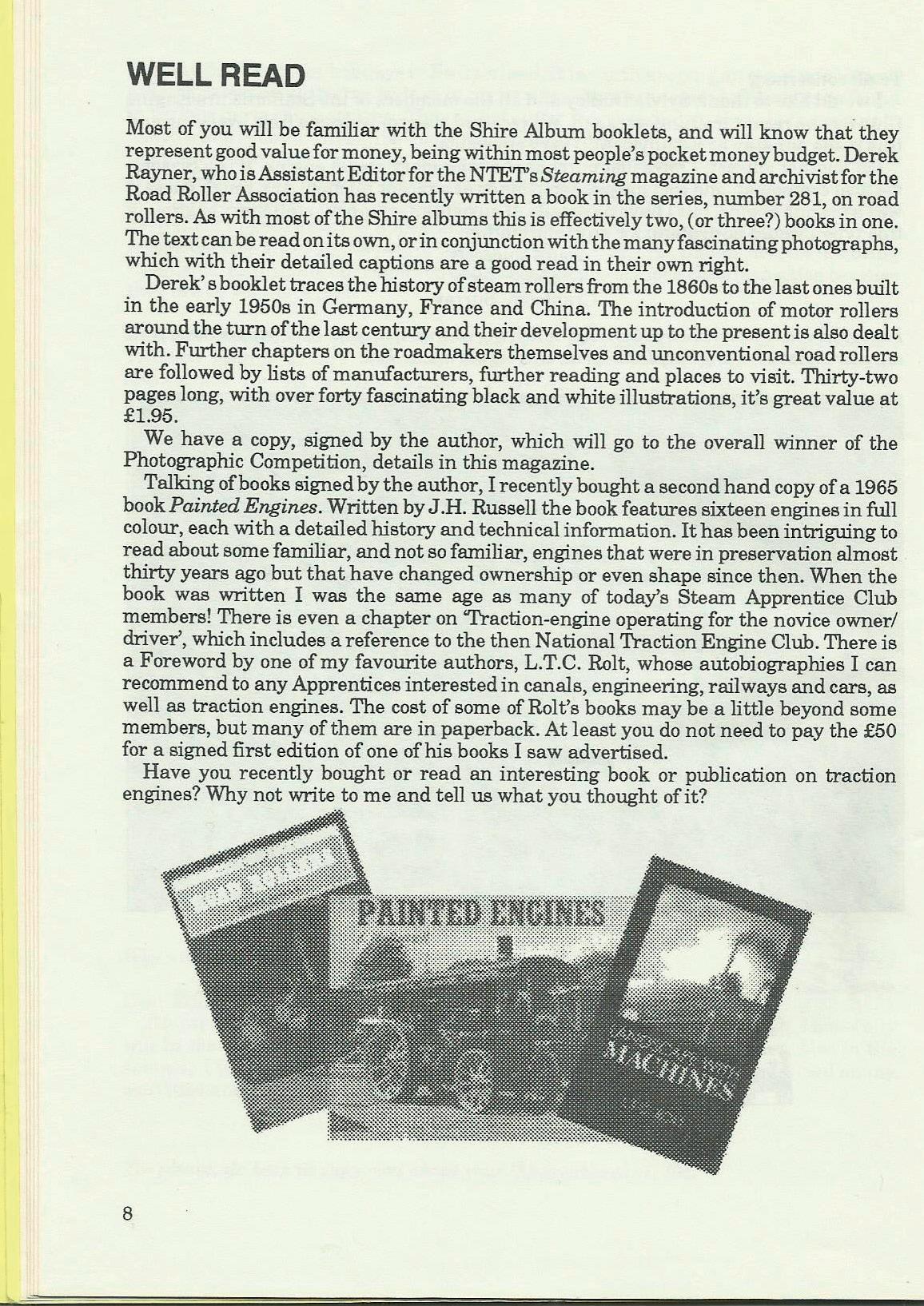
Most of you will be familiar with the Shire Album booklets, and will know that they represent good value for money, being within most people's pocket money budget. Derek Rayner, who is Assistant Editor for the NTET's Steaming magazine and archivist for the Road Roller Association has recently written a book in the series, number 281, on road rollers. AB with most of the Shire albums this is effectively two, (or three?) books in one. The text can be read on its own, or in conjunction with the many fascinating photographs, which with their detailed captions are a good read in their own right.
Derek's booklet traces the history of steam rollers from the 1860s to the last ones built in the early 1950s in Germany, France and China. The introduction of motor rollers around the turn of the last century and their development up to the present is also dealt with. Further chapters on the roadmakers themselves and unconventional road rollers are followed by lists of manufacturers, further reading and places to visit. Thirty-two pages long, with over forty fascinating black and white illustrations, it's great value at £1.95.
We have a copy, signed by the author, which will go to the overall winner of the Photographic Competition, details in this magazine.
Talking of books signed by the author, I recently bought a second hand copy of a 1965 book Painted Engines. Written by J .H. Russell the book features sixteen engines in full colour, each with a detailed history and technical information. It has been intriguing to read about some familiar, and not so familiar, engines that were in preservation almost thirty years ago but that have changed ownership or even shape since then. When the book was written I was the same age as many of today's Steam Apprentice Club members! There is even a chapter on 'Traction-engine operating for the novice owner/ driver', which includes a reference to the then National Traction Engine Club. There is a Foreword by one ofmy favourite authors, L.T.C. Rolt, whose autobiographies I can recommend to any Apprentices interested in canals, engineering, railways and cars, as well as traction engines. The cost of some of Rolt's books may be a little beyond some members, but many of them are in paperback. At least you do not need to pay the £50 for a signed first edition of one of his books I saw advertised.
Have you recently bought or read an interesting book or publication on traction engines? Why not write to me and tell us what you thought of it?
Would you like the opportunity to make friends in other parts of the country? Well, the following SAC members would, and want to hear from Apprentices willing to write to them on a regular basis. They have agreed to reply at least once to everyone who sends them a letter.
Eve Newland, membership number 1463, is 19 and lives in Huntingdon, Cambridgeshire. She would like a penfriend aged between 17 and 21 living in or near Cambridgeshire. She is particularly interested in road rollers and works on Aveling & Porter 1904 RlO roller The Lady of the Manor. She has a 3" scale Burrell traction engine, enjoys mu.sic and likes animals.
Member number 1897, Nicholas Alderson, is 13 and lives in Boroughbridge, North Yorkshire. He likes all steam engines, computers and watching videos. His favourite engine is Dolphin and would like a penfriend aged 13 living anywhere.
Claire McKee is aged 11 and lives in Ripley, Derbyshire. Her membership number is 2064 and she likes miniature and full size traction engines, her favourite engine being Fowler 14406Pandora. Her other interests are drawing, music and wildlife. She would like to write to someone around the same age and not too far away.
If you would like to write to Eve, Nicholas or Claire, send your letter with their name and membership number on it, to me, Steph Gillett, (address at the front of the magazine), and I will pass on your letters. Please include your membership number and get your parent or guardian to sign if you are under 14 years old.
Members wanting to request a penfriend should send in the blue form enclosed with the last issue, and we will publish your details in the next edition. If you have not got a form let me know. Do not forget to enclose a large stamped addressed envelope for any letters we receive for you.
Neither the Steam Apprentice Club nor the NTET accepts any responsibility for the Penfriends Scheme beyond publicising requests for penfriends. Any correspondence is the responsibility of the members concerned.
The 1993 Steam Apprentice Club Photographic Competition
A reminder that we are holding another photo competition, and
hope that many of you will submit entries. This year we are splitting entries into two age groups, and Stuart Pryke has kindly agreed to supply engraved medals for all six prize winners. In addition to the medals, winners will receive rolls of colour film and we may be able to offer other prizes if we can find
a suitable sponsor. The best overall entry in either age group will aa
be presented with the Dorset Trophy, currently held by Anthony Coulls, last year's winner, and will also receive the Road Rollers book by Derek Rayner reviewed in this issue.
1. Entry to this competition is restricted to fully subscribed members of the Steam Apprentice Club (SAC).
2. Each member's entry will consist of three photographs, preferably 6in. x 4in. prints, colour or black & white, and they should have been taken during the period lstAugust 1992 to 31st July 1993.
3. Entries must be sent to the Editor of the SAC Magazine by Saturday 14th August. (Address at front of magazine.)
4. All entries must have the following details on the reverse of the photograph: name, address, age and SACmembership no.; place, date and details ofthe engine or subject. (It is better to write these details on a piece of paper and then stick this on the back of the photo.)
5. Copyright on all entries will remain with the SAC member submitting the photographs and the organisers promise that prints will not be used in any manner or display other than in connection with the 1993 Photographic Competition. (A selection of entries will appear in a subsequent SAC Magazine.)
6. All entries are to include a suitable stamped addressed envelope to ensure photographs can be returned. The organisers promise to return all entries if this rule is adhered to.
7. Entries will be displayed at the 1993 Great Dorset Steam Fair in the NTET tent. All entries will be returned after display and/or publication in the magazine.
8. The competition will be judged in two age groups: up to 15 years; 16 years and over. Prizes and engraved medals for First, Second and Third places in each age group will be awarded. The best overall entry will receive the Dorset Trophy shield, to be held for one year.
The judges will be looking for originality, composition and technical ability. Photographs do not have to be of traction engines, but other subjects must be clearly related to the traction engine movement. The judges' decision on all entries will be final and members are asked to accept them in a spirit that will bring credit to themselves and the Steam Apprentice Club. Judging will be by Stuart Pryke, Sylvia Dudley and Steph Gillett.
COME ON DON'T BE SHY - POINT THE LENS AND PRESS THE SHUTI'ER!
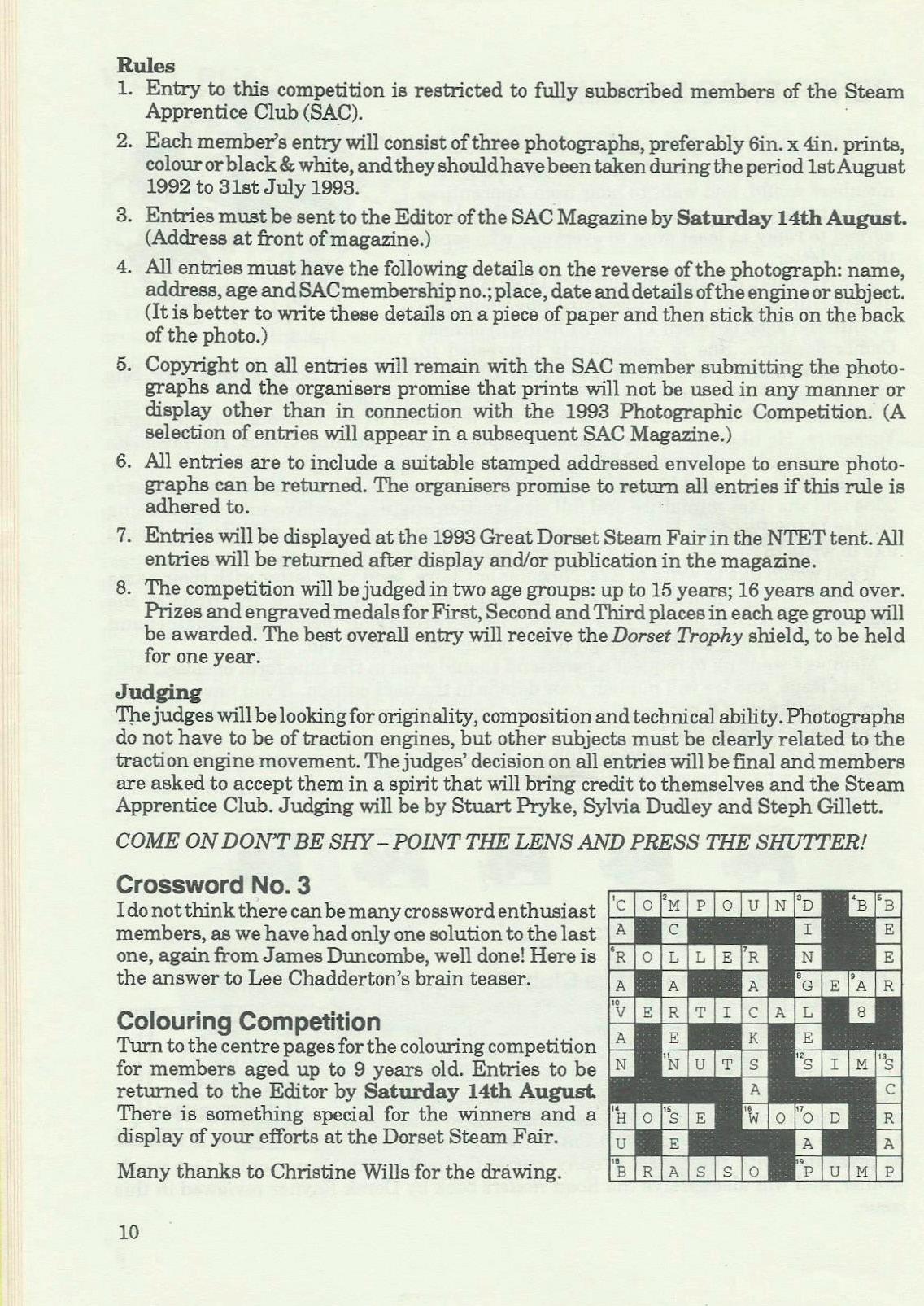
I do not think there can be many crossword enthusiast members, as we have had only one solution to the last A one, again from James Duncombe, well done! Here is the answer to Lee Chadderton's brain teaser.
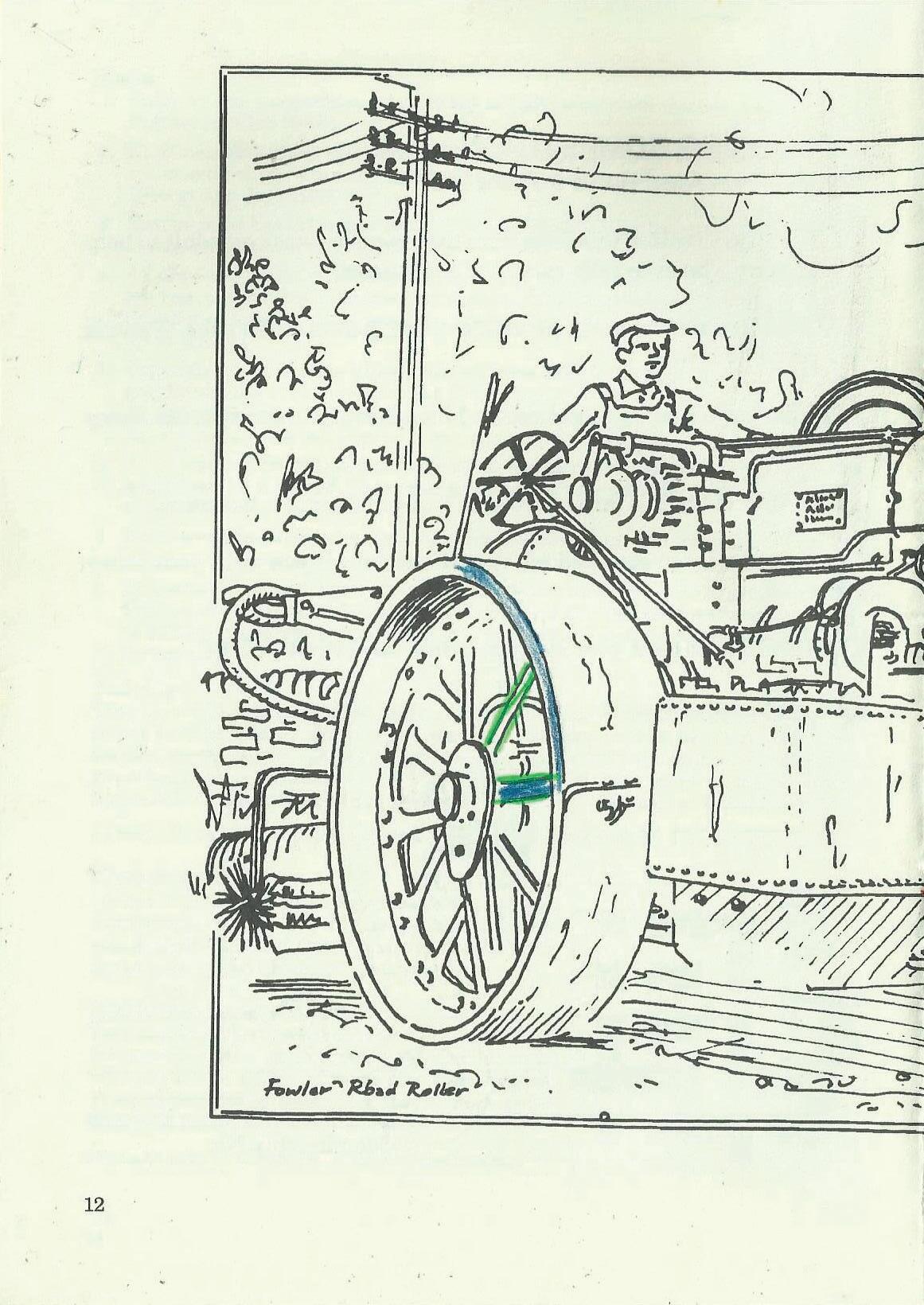
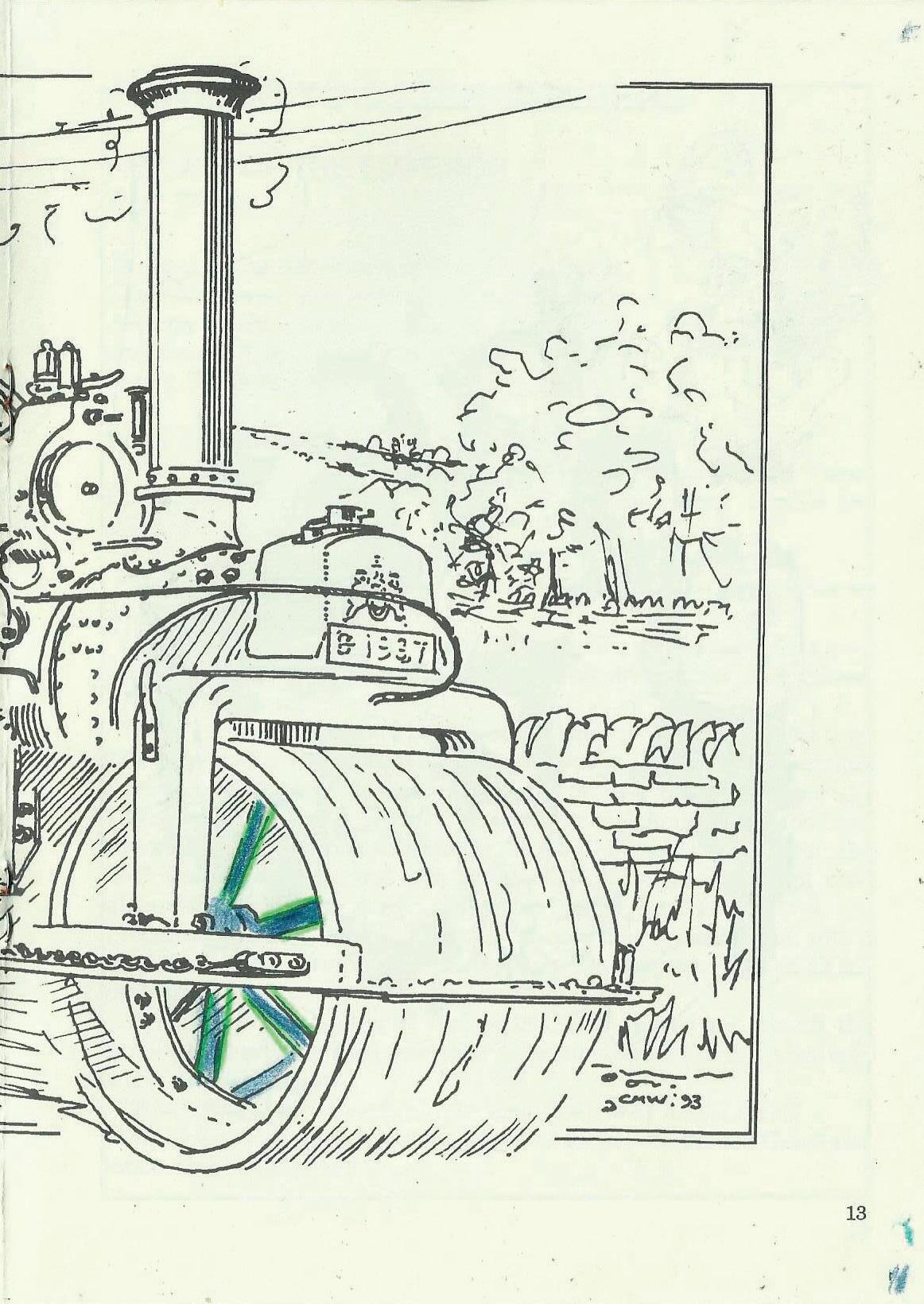
Turn to the centre pages for the colouring competition A for members aged up to 9 years old. Entries to be returned to the Editor by Saturday 14th August There is something special for the winners and a display of your efforts at the Dorset Steam Fair.
Many thanks to Christine Wills for the drawing.
CAREFULLY remove this page from the magazine -ask an adult to help if necessacy - be especially careful of the staples.
COLOUR the picture using pencils, crayons, paints or felt pens. (Pencils are probably best.)
WRITE your name, age, address and membership number in the space provided
POST your entry in a large envelope, to avoid folding it too much.
ENCLOSE a large stamped addressed envelope if you want your entry returned.
REMEMBER to send your entry in before the 14th AUGUST.
ADDRESS for entries is:
Name
Address SAC, 93, Devon Road, Easton, BRISTOL, BS56ED
The continuing adventures of Grace and Jamie. The twins have encountered the strange Mr. Johnson whilst visiting an old time fair. He has promised to help them restore a derelict traction engine, The Emperor ...
''Rain, rain, rain," said Jamie, ''I hope Mr Johnson will still come."
But he need not have worried, as sure enough at exactly ten o'clock Donald Johnson arrived in his van, wearing his greasy overalls and carrying a bag of tools.
"Can you get it going?" asked Grace.
"How long will it take?" added Jamie. ''Will you be able to fix it while we are still on holiday?"
Donald laughed a big loud laugh. ''It will take a while longer than your holidays to fix this fm afraid." he replied. ''How old are you?"he enquired. ''Eight!" they chorused.
"Well, I should think you'll be nine or ten before you see any steam from this Emperor!" and with that Mr. Johnson started to climb and crawl all over, and all around, and under the rusted broken traction engine.
After what seemed an age of banging and poking and looking and head scratching, and quite a lot of"Oh dear, Oh dear'', Donald emerged from the shed where the engine had been hidden all those years. He was covered with cobwebs from the spiders and feathers from the chickens.
"It could be worse, it could be better," he said mysteriously, ''but, with a lot of hard work, we should be able to have The Emperor back in all his glory again."
At this the twins cheered and yelled, and danced all around the farmyard, nearly colliding with their Grandmother who was on her way to feed the calves.
''What is all this commotion?" she enquired. ''Why all the fuss?"
"Mr. Johnson is going to fix The Emperor for us!" exclaimed Grace and Jamie. "Isn't that great?"
Their grandparents agreed but said it was time everyone washed their hands and faces and came in for lunch.
During a lunch of freshly baked bread and slabs of farmhouse cheese, Donald Johnson explained what would have to be done to get the old engine back into steam again. Most ofthe boiler would have to be replaced, most of the valve gear was missing, and the chimney had rusted away all together.
The holiday was nearly over and it was nearly time for the twins to go home to their town. Jamie and Grace spent most of the last few days cleaning all the rubbish away from their precious engine and then with old brooms and a bucket and mops, they gave the old machine a clean, ready for when Mr Johnson would transport The Emperor to his workshop.
On the very last day before they went home, Donald, the twins and their grandparents visited a steam ploughing event.
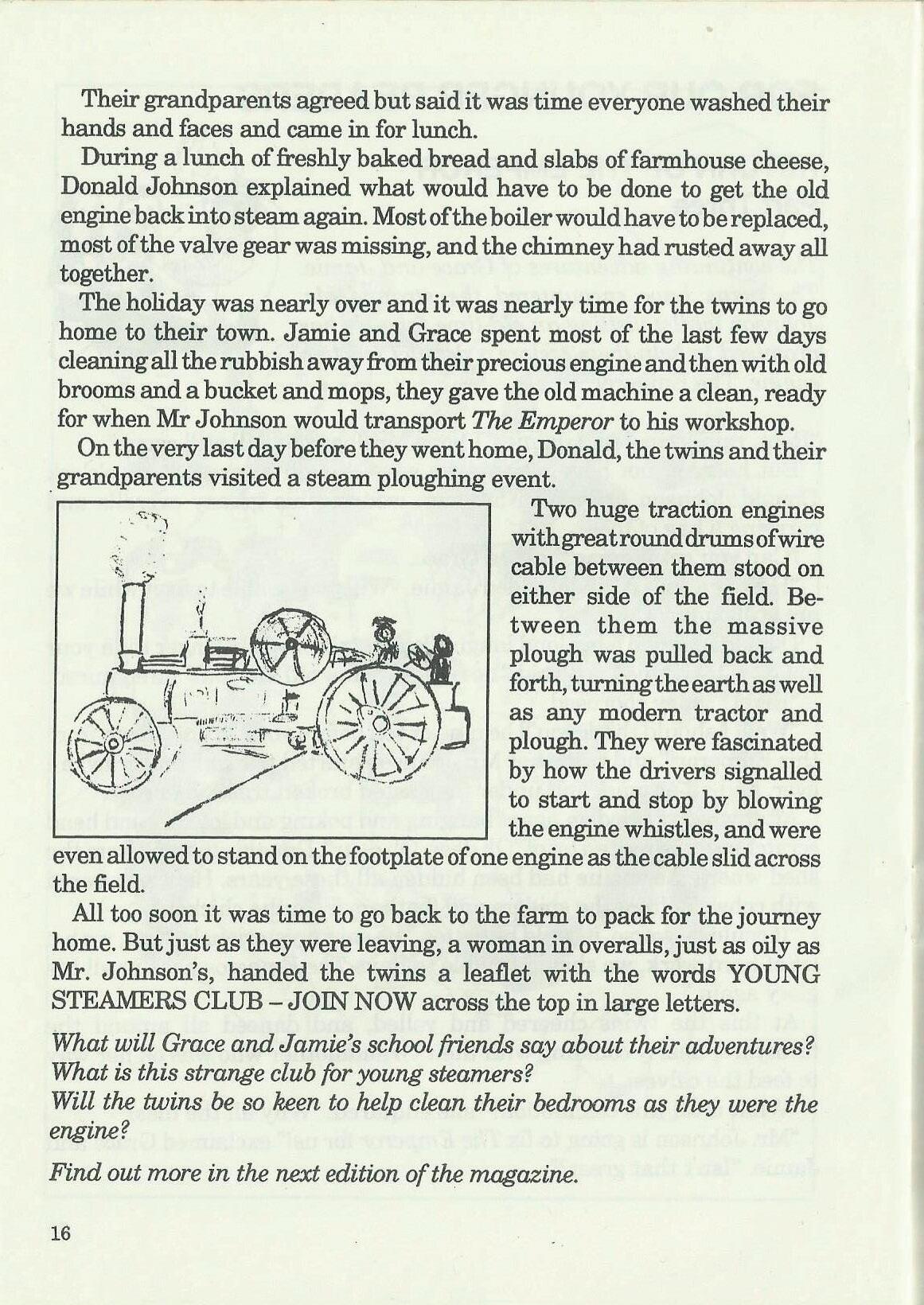
Two huge traction engines withgreatrounddrumsofwire cable between them stood on either side of the field. Bet we en them the massive plough was pulled back and forth, turning the earth as well as any modern tractor and plough. They were fascinated by how the drivers signalled to start and stop by blowing the engine whistles, and were even allowed to stand on the footplate of one engine as the cable slid across the field.
All too soon it was time to go back to the farm to pack for the journey home. But just as they were leaving, a woman in overalls, just as oily as Mr. Johnson's, handed the twins a leaflet with the words YOUNG STEAMERSCLUB- JOIN NOW across the top in large letters.
What will Grace and Jamie's school friends say about their adventures? What is this strange club for young steamers? Will the twins be so keen to help clean their bedrooms as they were the engine?
Find out more in the next edition of the magazine.
During the winter months the corn was threshed to separate the grain from the straw and chaff. Until the threshing machine crone into more common use during the second half of the 19th century, this task was done by hand. It was long and exhausting work which occupied farm workers for much of the winter.
The earliest successful threshing machines were invented during the late 18th century. These were driven by hand, horse or water power and permanently fixed in barns.
The introduction of the threshing machine was the cause of social unrest and violence. During 1830 farm labourers, whilst complaining oflow wages, also feared that the new machines would deprive them of winter work. The result was rioting, burning of barns and destruction of many threshing machines by the rioters. The march of progress was, however, not to be halted and the threshing machine was to become an accepted part of 19th century farming.
By the mid 19th century, threshing machines were constructed on wheels. Steam engines provided the motive power for these new portable machines, which were able to thresh, winnow and bag the corn in one continuous operation.
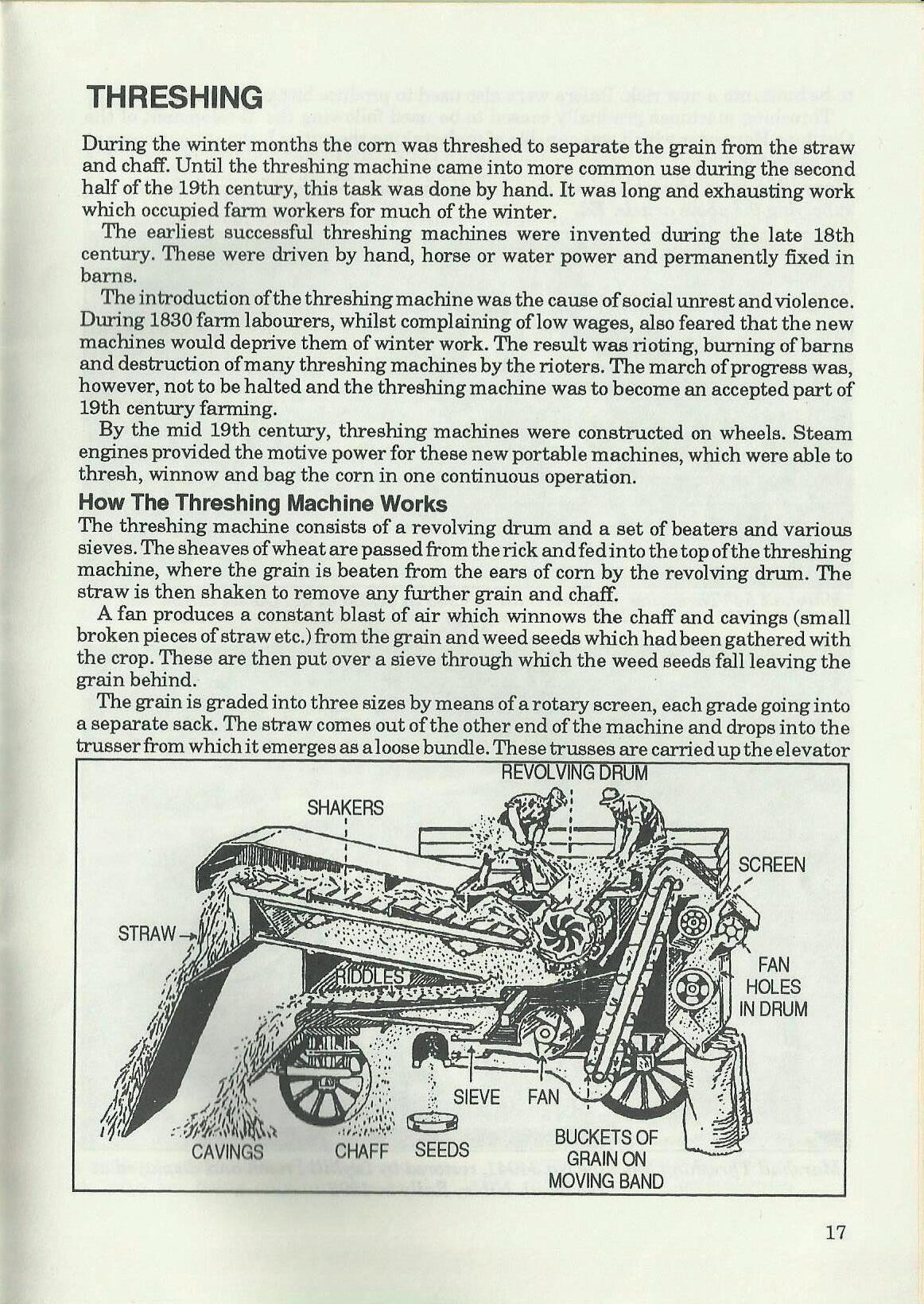
The threshing machine consists of a revolving drum and a set of beaters and various sieves. The sheaves of wheat are passed from the rick and fed in to the top of the threshing machine, where the grain is beaten from the ears of corn by the revolving drum. The straw is then shaken to remove any further grain and chaff.
A fan produces a constant blast of air which winnows the chaff and cavings (small broken pieces of straw etc.) from the grain and weed seeds which had been gathered with the crop. These are then put over a sieve through which the weed seeds fall leaving the grain behind.
The grain is graded into three sizes by means of a rotary screen, each grade going into a separate sack. The straw comes out of the other end of the machine and drops into the trusserfrom whichitemergesas aloose bundle. These trusses are carried up the elevator
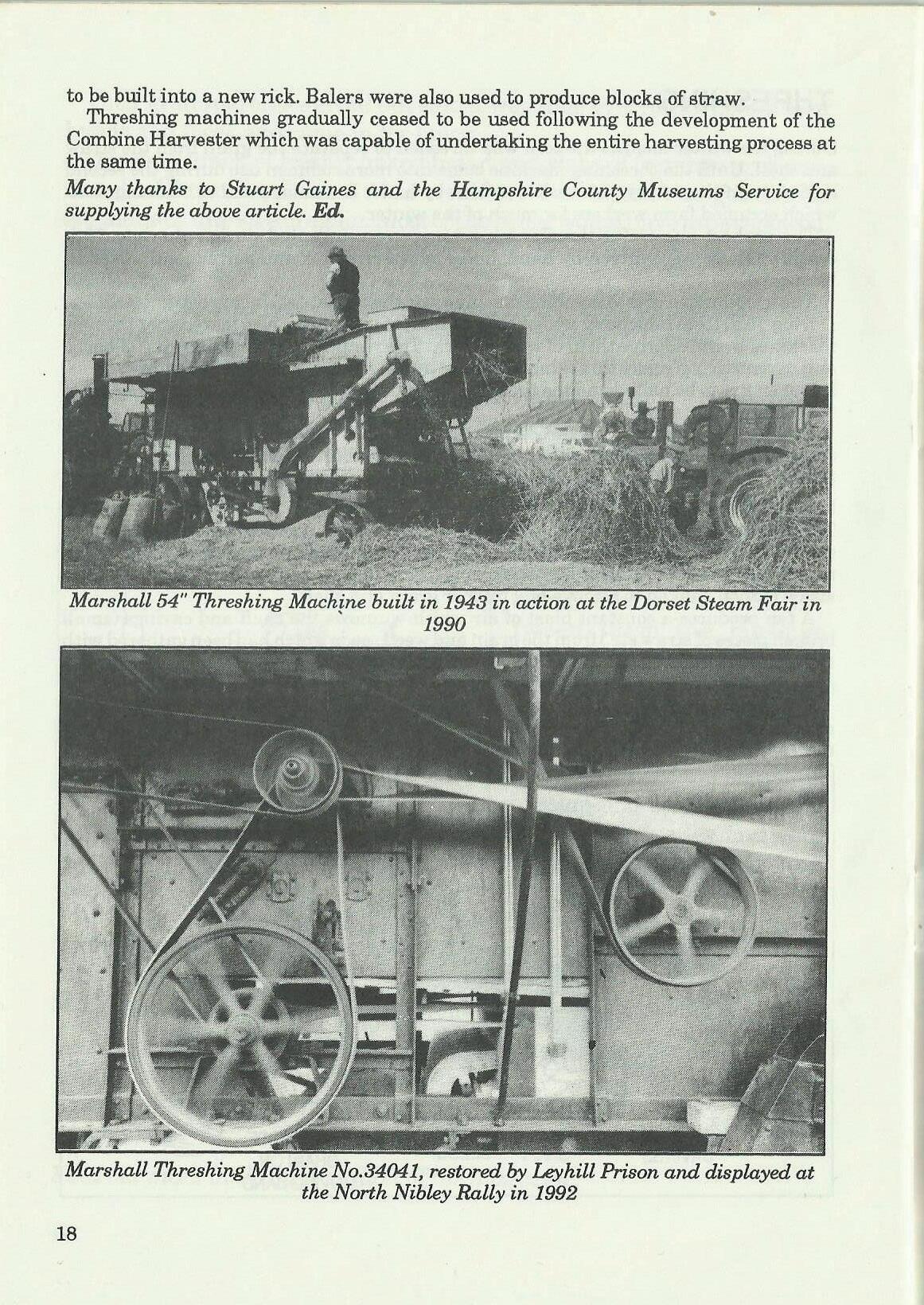
to be built into a new rick. Balers were also used to produce blocks of straw.
Threshing machines gradually ceased to be used following the development of the Combine Harvester which was capable of undertaking the entire harvesting process at the same time.
Many thanks to Stuart Gaines and the Hampshire County Museums Service for supplying the above article. Ed.
Despite all good intentions Francis and I were unable to attend the engine driving course atKlondykeMill,duetothenocturnalhabitsofAmber-Ruth,(i.e.shekeptusawakemost of the night before!) Unfortunately I have not received any of the promised reports or photographs from this event, but gather that it went well (see Mailbag). Perhaps someone can let me have something for the next issue. Neither, for similar reasons did we make it to the Festiniog Railway at the beginning of May as hoped.
Our first rally of the season was, as last year, the Abbey Hill Steam Rally in Yeovil, on the first May Bank Holiday, fortunately with plenty of sunshine on the day we went; that's Francis, his granddad and I. Of the reputed thousand exhibits just thirteen were steamers, plus a few miniatures. Road rollers were well represented with three 10 ton Aveling & Porter engines: former Buncombe engine 5124 (N0754) of 1902, 8196 (DF5055) ofl914 and 10594(YA6375)Hercules of1923 another Buncombe's engine, also an 8 ton roller 12400 (TK2922) Ruby. Starting life as a roller, but now in tractor form, was T3B Fowler 21635 (C57852) The Phantom looking very colourful in the livery it acquired in preservation in Scotland. Listed in the Register as a traction engine, but at 4NHPlookingmore like a tractor, Aveling 7056 (MD4517) Vulcan of 1910 was also stated by the commentator to have been built as a roller. Last of the rollers was Wallis & Steevens 6 ton Advance type 8030 (OU3787) Wilma of 1929.
Still looking very smart a year after its restoration Burrell traction engine 1840 (YA2481) The Duke of Windsor built in 1894 and exhibited at the Taunton Show in 1895 was the oldest engine present and the only one of the Thetford marque. Two further traction engines, both singles of 1901 vintage, were 6NHP Allchin 1173 (KE1984) Aquarius and 7NHP Marshall 36033 (NK2524)Hayden Princess, the latter providing power for one of two saw benches.
Lastly, and demonstrating a fair turn of speed around the areha, were three Sentinel waggons, Super engined 6 tonner 1465 (AW3321) of 1916 and two S4's, timber tractor 8843 (UJ2112) of 1933 and waggon 9032 (D55430) from the following year.
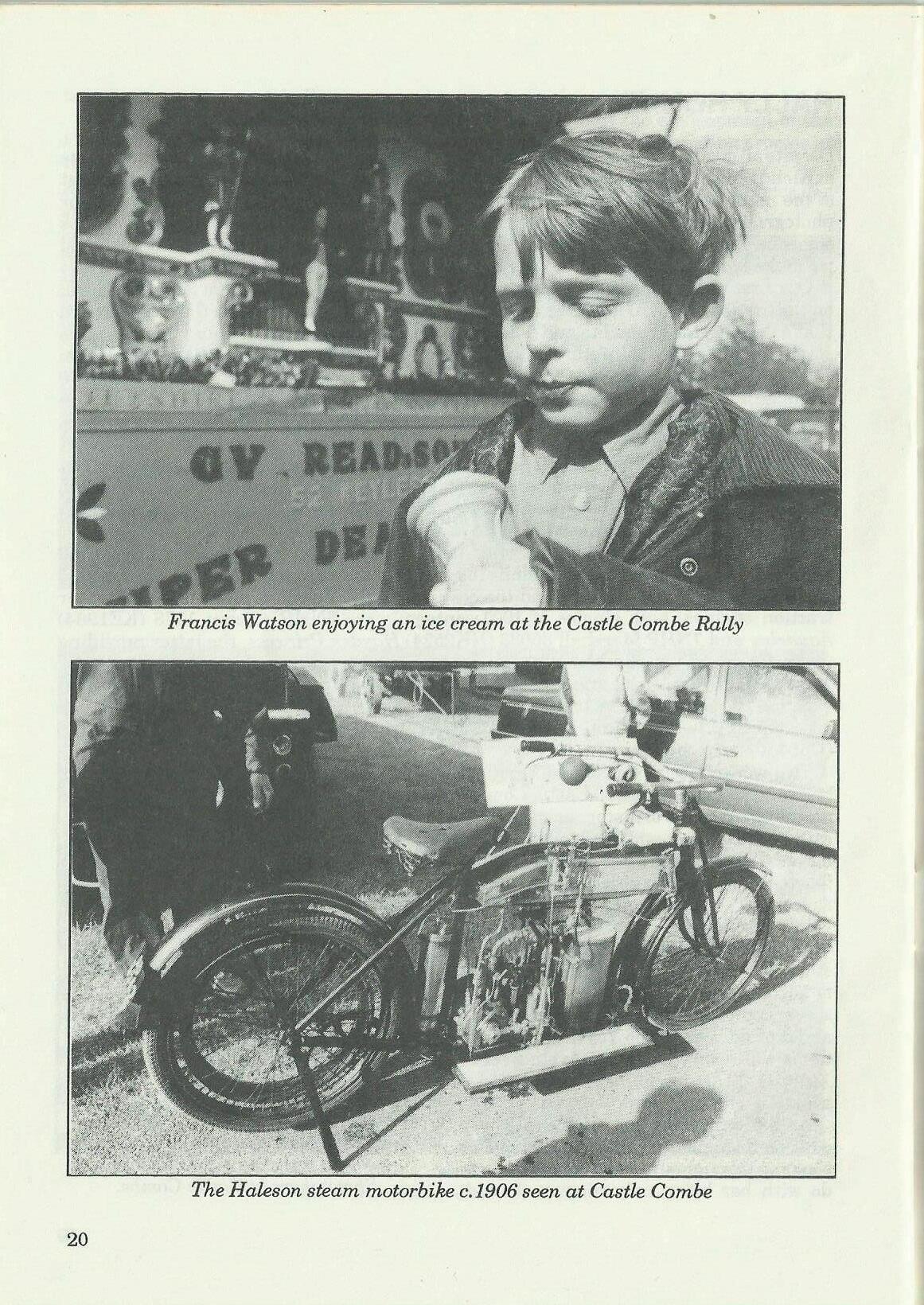
Two weeks later Francis and I made a last minute dash across to Castle Combe, normally the home of motor racing, for the rally there. The steam section was much larger than last year and, as well as the fourteen traction engines, road rollers, steam waggons and showman's tractors, were a Stanley steam car, a Merryweather Valiant fire pump of 1944, and a Haleson steam motorbike of about 1906! Sadly the motorbike was not working. Most of the steam exhibits were familiar local engines and six had been at the Yeovil event. New to me was a very tidy 8 ton Aveling roller 14089 (YD973) Josephine from the Bristol area.
Amber's first traction engine rally was a rather disappointing uffair, although her sleeping throughout wat1 probably more to do with her being only nine weeks old,
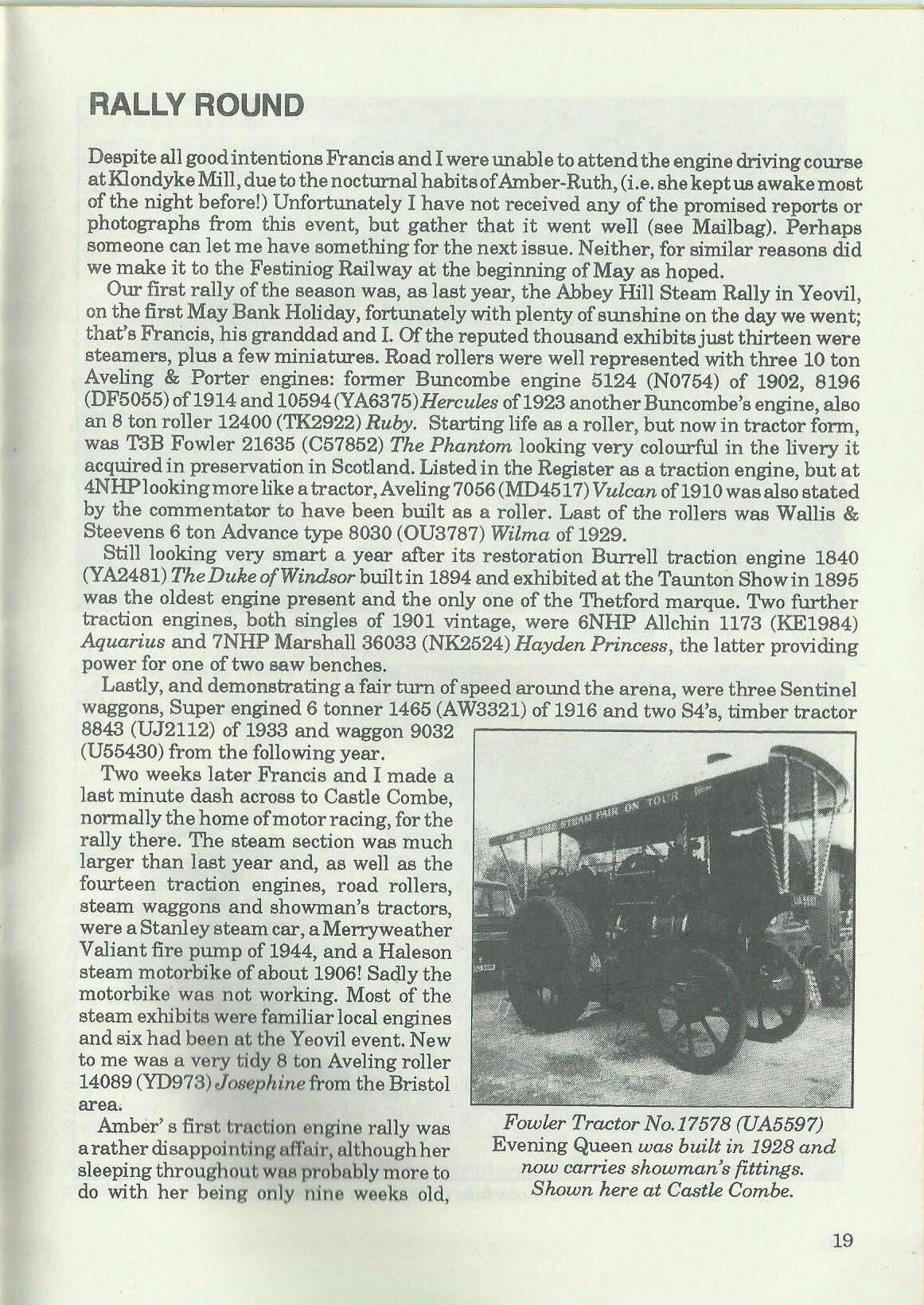
Fowler Tractor No.17578 (UA5597)
Evening Queen was built in 1928 and now carries showman's fittings. Shown here at Castle Combe.
rather than a direct reflection on the event! Whilst the sensible among you were joining Richard Hurley at the Swindon Vintage Showon3lstMay, we headed offin the opposite direction to Cheltenham. An authorised NTET rally, the third bi-annual Cheltenham Steam and Vintage Show was expected to have about ten engines, and indeed the programme listed eight. In fact only four steamers were present, three of which had been at Castle Combe! The site was very cramped with the engines confined to a small hard standing, except when taking part in the 'Parade of Steam Engines', if you can have a parade of four, which anyway happened an hour earlier than programmed. With two local radio station roadshows blasting outi t was impossible to hear the commentary from most parts of the site anyway! Which all goes to show that NTET 'authorised' does not necessarily mean 'recommended'. It certainly did not seem any safer than the nonauthorised rallies, less so if the children climbing over the tractor line-up was anything to go by; the nicely produced programme featured a picture of someone sitting on the flywheel of a Burrell traction engine -which appears to be in full reverse gear!
The fourth engine at Cheltenham was more interesting, however. Burrell 4028 (RL1978) Supreme is listed in the Traction Engine Register as having been built as a showman's engine 3951, being rebuilt as traction engine 4024. This 4½ NHP double crank compound engine has now been rebuilt to full showman's specification, so it's a case of full circle. Another compensation at Cheltenham was the Gallopers of Masons World of Fun from Reading.
The following NTET authorised rallies have agreed to admit Steam Apprentice Club members free of charge. A valid SAC membership card must be shown, and nonmembers, (e.g. family), will be charged the normal admission. Some events have agreed to an SAC training session, normally between 10.30 and 12.30 on a Sunday morning in the main ring or the engine lines. The training sessions vary and are dependent on an SAC Committee Member taking responsibility for organising it. For further details of the rallies themselves please refer to the full NTET Rally List in which contact addresses may be found. See also the Free Rally List sent out with the last.magazine. It is a good idea to confirm arrangements for the rally with the organiser beforehand, especially if you are travelling any distance, to avoid unnecessary disappointment.
July 10-11 Downs Steam Rally; training ~f.~ijt
July 10-11
July 17-18
July 24-25
Rempstone Steam & Country $,qW
Marc\~-:~m Rally it! }
R~hn;ttj~r··:s~am ..Vint~~::S~~t; training event
Jul 31-A . 1 ..GieattBhck.S.::$.teariLWorki~f·\:tihl'nin event
September 18-"fi'fi;:;::., .. <1Mu~t't.:v'4.'\fe:-St.~htP.a~\'Wi~kerid=t.'.:::Ch~hire September 2&26:, :>:-:.::ti!t1~~·~riirr{R~i'iit,\~icFfil,tF@r::···•:-•,:::::,,•::::.::•.•:•:•:·:··· :\:/ff::):::(::,:~.:.::•, I'.::: :,::},:.:::::f:f?:•:::,,:::i:::;::::,•: • ' ••
Any seni&lsACmaYfthor or nrh1lt"Wi1hng to help organise the training events at rallies should contact Steph Gillot.i.
Although not NTET authorised the Somerset Stearn Spectacular at Langport on 17th and 18th July will feature some events for Steam Apprentice Club members, and probably free entry.
The 25th Anniversary Dorset Stearn Fair is not NTET authorised either, nor will there be free admission. However, the national sales tent will be at Dorset, and we will be organising the usual range of activities for Apprentices, breakfast on a shovel, engine steering, etc. These will take place on Saturday 4th September, so come along to the NTET tent from about nine o'clock and see what is happening or look out for notices in the tent beforehand.
Anthony Coulls
Some of you may have heard of or met the late Rev. Teddy Boston, or seen his Foster Fiery Elias at rallies in the Midlands. You may have also been to Cadeby and visited the steam collection. If you have not, then maybe this article will interest you.
Teddy Boston was a vicar, who moved to the village of Cadeby on the LeicestershireWarwickshire border around 1958 or so. Whilst the arrival of a new rector to the parish was nothing unusual, his interest certainly was. From childhood days he had been a steam enthusiast, and at Cadeby his hobby was to grow and mature and be shared by many over the years. It began when Teddy acquired a 1903 Aveling roller, No.5163, weighing 10 tons, which he named Thistledown. Following this came 8NHP singlecylinder Foster traction engine No.14593 of 1927, the well known Fiery Elias.
Ai3the time passed Teddy established the Cadeby Light Railway, with a small Bagnall 0-4-0 saddle tank engine called Pixie of 1919 as the principal motive power. A model railway and other items of steam and rail interest formed the nucleus of the Cadeby Collection, which opened on the second Saturday of every month. Meanwhile, Thistledown and Fiery Elias continued to attend rallies in the Midlands, with the Foster assuming the role of'coal fired pulpit' on many Sunday mornings as Teddy led a rally service from the footplate.
He and his engine gave great enjoyment to many, and tales of his exploits are renowned. I recall one Town & Country Festival at Stoneleigh when his engine won the 'slow race' - he refused the prize of a can of beer, preferring instead a bottle of pop. Another game consisted of engines pulling'sleds'round the arena, with a rider collecting as many traffic cones as he could. With Teddy at the regulator, the unfortunate rider finished the course tanglad in the tow rope, so anxious was the vicar that he should win. He was a legend, as well as a true man of God, and it was with great sadness that the steam fraternity learned of his death in April 1986.
Stearn days continued at the rectory, which was not occupied by a new vicar, as Cadeby became a member of a group of parishes sharing the same vicar. Teddy's widow Audrey is therefore resident to this day.
I had been fortunate to visit Cadeby in 1983 whilst Teddy was still alive, and was able to ride on 'his' railway with him driving. Then, nine years later in November 1992, the chance to visit on a weekend home from university arose. It was not the second Saturday of the month, but a Bonfire Steaming as an extra, though we were not able to stay for the evening's entertainment. Upon· our arrival we found Fiery Elias in steam, along with 22
another resident, 10 ton Aveling & Porter No.7798 of 1912, a roller named Titanic. The Cadeby Light railway was also in operation with Pixie doing sterling service.
Round the back of the rectory was a surprise - as well as Teddy's standard Peckett tank engine, was a new building, entitled the 'Boston Collection'. Inside is a large display of many of Teddy's model railway engines, trains and traction engines in cases around the walls. There are also larger steam age artefacts and models. In the centre of the room are several cabinets, all relating to the Rev. Boston's variedinterests and his life. Thus there is a case naturally on his engines, his steam collection, his interest in canals (his canal boat is moored not far away), his love of 18th century music and brass rubbings. The final case is of personal items relating to his life, from his birth certificate, school reports, acceptance into the church to his wedding and his funeral service. A very
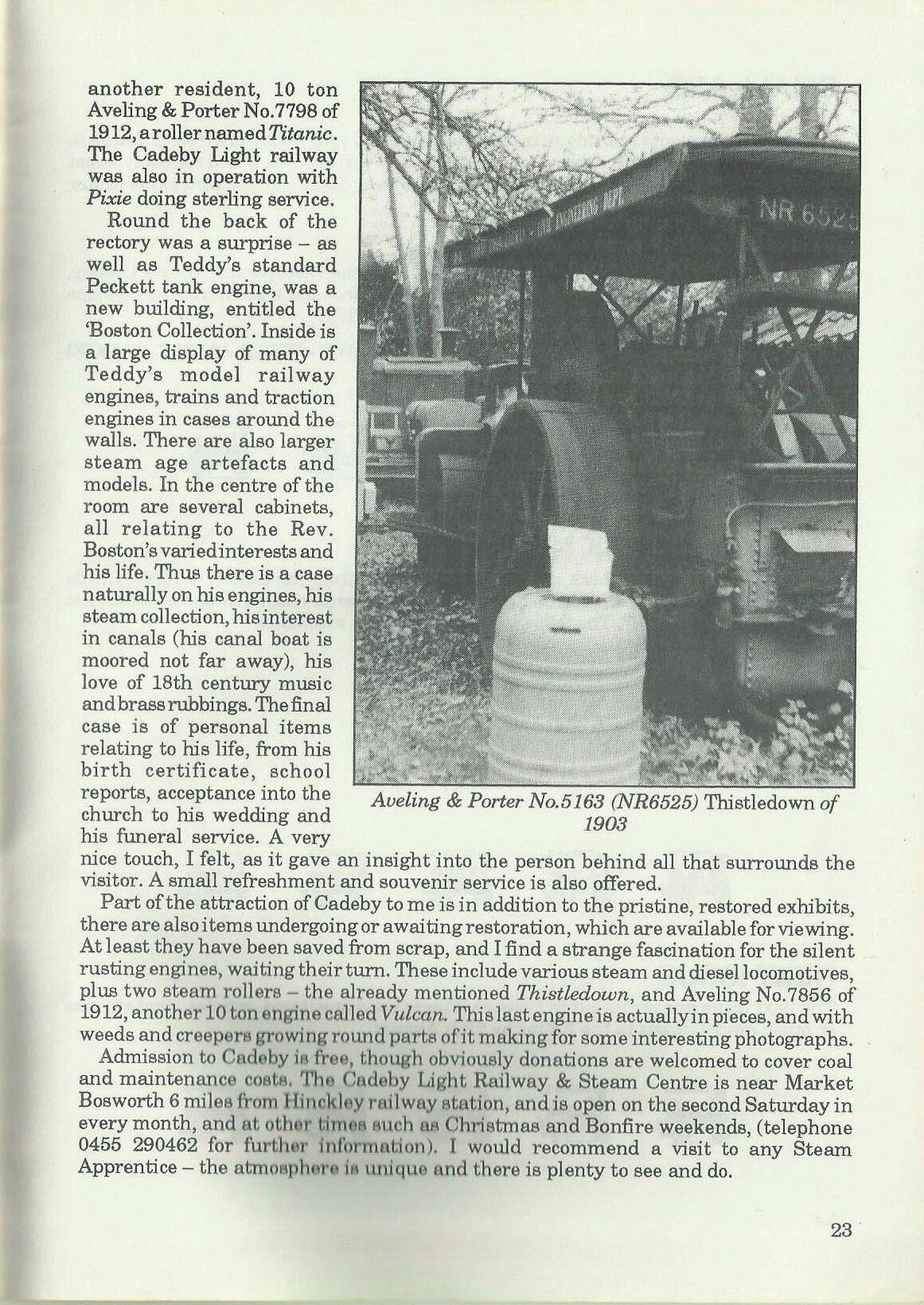
Aveling & Porter No.5163 (NR6525) Thistledown of 1903
nice touch, I felt, as it gave an insight into the person behind all that surrounds the visitor. A small refreshment and souvenir service is also offered.
Part of the attraction of Cadeby to me is in addition to the pristine, restored exhibits, there are also items undergoing or awaiting restoration, which are available for viewing. At least they have been saved from scrap, and I find a strange fascination for the silent rusting engjnes, wooting their turn. These include various steam and diesel locomotives, plus two steam rollers - the already mentioned Thistledown, and Aveling No.7856 of 1912, another 10 ion engine called Vulcan. This last engine is actuallyin pieces, and with weeds and creeper~ growing-round parts ofit making for some interesting photographs.
Admission to Cmlohy it1froo, though obviously donations are welcomed to cover coal and maintenance cm-1tH.'rho Cudel,y Llght Railway & Steam Centre is near Market Bosworth 6 miles from 111nr.klny rnilway HLation,and is open on the second Saturday in every month, and at otho, UmoH Huch UH Christmas and Bonfire weekends, (telephone 0455 290462 for furthor infm rnnLlon). I would recommend a visit to any Steam Apprentice - the atmm1phoro 111 ttm4uu an<l there is plenty to see and do.
Small advertisements relating to traction engines and your hobby are free of charge to SAC and NTETmembers. Advertisements should be written clearly and concisely, must be accompanied by your membership number, name and address, and sent to the Editor before the copy date for the next issue.
Steam Apprentice Club BADGES £1-00 direct from the Chairperson, Sylvia Dudley, (address in front of magazine). Please enclose a First Class stamped addressed envelope and a cheque or postal order, not cash, payable to 'NTET'.
MAKESUREYOUSTANDOUTFROMTHECROWD-WEARANSACBADGE!
Copies of SAC magazine back numbers are available from the Editor, (address inside front cover), for £1.00 each including postage. Please send cheque or postal order, not cash, payable to 'NTET'. The following issues only are available:
Volume 6 Number 1 Spring 1992 only a few left
Volume 6 Number 2 Summer 1992just a few left
Volume 6 Number 3 Autumn 1992
Volume 7 Number 1 Winter 1993
Volume 7 Number 2 Spring 1993
Special discount for all 5 -£4.25 including postage.
The next magazine is due out in October. Please send any items, articles, photographs or other contributions to the Editor by 28th August.
I would like to join the Steam Apprentice Club
Forename(s) __________ _ (Block Capitals) Surname ---------
Address _________________________ _
Postcode ------
Date of Birth Tel. No. -------
Please help us to make the Club more interesting to you by answering these questions:
1. Why are you interested in joining the Steam Apprentice Club?
2. What activities would you particularly like the Club to provide?
3. Do you already have acoessto a traction engine? (If yes, which one?)
Then send this form, with the £2.00 subscription to: The Memborshlp Soctc tnry, NTET, J.R. Cook, 26 Alpon Drlvo, Sleaford, Llncolnohlro NG34 8UF
NOTE: Please do not t1ondrnom y by post. A cheque or postal order is much safer and should b modo pnyublc to the "National Traction Engine Trust".
Use Only:
The Club was formed for young people under the age of Twenty-One who are interested in Steam Traction Engines in 1979 by the then National Traction Engine Club. Today it is the young person,s branch of the National Traction Engine Trust, a registered educational charity.
Many people watch engines at rallies, but few of them know how an engine works, and even fewer have the chance to be shown over one by the owner, to talk about the work it used to do, or even help with the engine,s maintenance. The Club publishes this magazine with many of the articles being written by Club members.
We have a scheme which allows Cluh members into most Traction Engine rallies free of charge. Also we will try and put you in touch with a local engine owner near you, so that you can learn more about engines from people who actually run them~ in addition to our special training sessions and schemes.
If you enjoy rallies, photographing and recording engines 7 collecting pictures or books about engines, talking about steam or if you just wish to learn more, the Steam Apprentice Club is for you.
A quarterly Magazine.
A membership card.
Free admission to most NTET approved Traction Engine Rallies.
A Free copy ofNTET approved Rally List, each Spring.
A chance to buy books, magazines (including "Steaming") and other items sold by the NTEC (1984) Ltd. Taking advantage of any special discounts and offers available to NTET members.
Special club visits, events and training weekends.
Special Insurance considerations in connection with Traction Engines. Many other items are advertised in our club magazine.
Our annual subscription is just £2.00. Membership runs to the nearest quarter.
Join us NOW:Just fill in the membership application form inside the back cover. Then send it to the membership secretary with your subscription or hand it into any NTET or NTEC ( 1984) Ltd. Rally Stand.
If you wish to keep your magazine intact, you may photocopy the membership application form, or copy the details onto another sheet of paper.