STEAMAPPRENTICECLUB
EDITOR
EDITOR
Steph Gillett, 93 Devon Road, Easton, Bristol BS5 6ED.
Sylvia Dudley, 12 Hill way, Woburn Sands, MiltonKeynes,Buckinghamshire MKl 7 8UL
John Cook, 25 Ripon Drive, Sleaford, Lincolnshire NG34 BUF
The Editor welcomes any contributions of articles, shorter items or photographs for inclusion in future issues. All material submitted is voluntary and payment cannot be made for any material published. The opinions expressed in the magazine, with the exception of Club announcements, are those of the contributors and do not indicate the views of the Club as a whole. All items are held copyright by the contributor and the NTET.
Please send your contributions to the Editor at least five weeks before publication. Typed articles are preferred but not essential. If handwritten put any names of PEOPLE, PLACES or ENGINES in BLOCK CAPITALS. If you require any part ofyour article (eg. photos) returning please say so and enclose a stamped addressed envelope. Enclose your name, address and (if an Apprentice) age with any contribution.
The Editor reserves the right to amend or refuse contributioHH, nnd will n.ttempt to correct spelling and grammar!
The Magazine is normally published during tho c,nrly ~m1-tofLl1u11mry,Apri],July and October.
The Steam Apprentice Club iH t1 1-mct;io11of t.h11N11L1urllll'1'1ndiun Engine Trust. NTET is a Registered Charity, No.2916'/R. Rn1tit\l,orod ltl J-i!np.-lnndNo.1302197. Registered Office: Forum IIouHu, l 6 Milluuu1tl,M1dtUt1uuxTW18 4UQ
TypesettingbyTilsetServioos,22 Prostbury,Ynto,Bristol1:3S174LB.Tel:0454314279. PrintedbyHiscox& Lambert,AbbeyRoad,Stratton•on•the•Fosse,SomersetBA34RH.
Having survived a year as Editor of your magazine, I thought it was time I thanked some of the people who have helped me produce the four editions during this time. Firstly I must say thank you to everyone who has sent in items, photographs, cartoons or letters. Without your contributions there would be no magazine at all. I am very grateful to all of you, but a special thanks must go to Anthony Coulls of Leamington Spa, Warwickshire, who I think has had an ~11. article in every edition, and continues to find time during his studies at university in Aberystwyth to write something. Keep up the good work!
Secondly I need to say a big thank you to Carol Watson, my partner and Francis' mum. Not only does Carol share the rather boring task of putting magazines in envelopes, but she helps write the new story for our younger readers and al ways has useful comments about the layout. However, Carol may not be helping as much with this issue, as she is about to give birth to our second child! The baby will have arrived by the time this magazine gets to you, and we are planning that Francis' new sister or brother should become the youngest ever member of the Steam Apprentice Club.
Gordon Tily, in Yate, who does the typesetting and Bob Hiscox who prints the magazine in Somerset, have both been a great help, and have taught me a lot about the printing business and helped to knock my sometimes untidy copy into shape. The Membership Survey last year showed that you were mostly very pleased with the results, and that it was worth using Gordon's and Bob's services. One concern has been over the quality of some of the photographs and I am delighted that we have been able to overcome these problems. I hope you continue to enjoy the magazine and please keep sending in the articles.
Reading some of the railway publications recently I get the distinct impression that all is not well amongst preservationists. It seems to me a great pity, not to mention waste of energy, when people supposedly committed to the san1e things are in conflict with each other. The battle between the National Railway andBressingham Steam Museums over the locomotive Oliver Cromwell, and the rival factions in North Wales that want to rebuild the Welsh Highland Railway, are two notable examples. It is no wonder that peace in Bosnia, Palestine or Northern Ireland is so difficult to achieve if people cannot resolve their differences. I hope that the younger ge..,nerationof steam enthusiasts and restorers can set the adults a better example and work together for the future. It would be a shame if the disputes between traction engine owners and rally organisers that appear to have occurred became the norm rather than the exception. AB to the rallies themselves, it does seem to me that any profits made from our hobby should go to charitable causes, except for the 'profit' of simple enjoyment.
Well, that's enough from me for now. I look forward to hearing from you and meeting some of you during the rally season.
Steph Gillett March
1993
A meeting of the SAC Committee took place on Sunday 21stFebruary at Sylvia Dudley's house in Milton Keynes. This was the first formal meeting of the committee since I became Editor and a day's full discussion took place. It wasn't nearly so for me though, as I had left my car lights on the night before and had to call out the breakdown service to attend to a flat battery before I could be on my way!
The SAC Committee comprises Sylvia Dudley, Graham Austin from Ipswich, Stuart Gaines from Wickham, Rants., Stuart Pryke from Burford, Steve Parrott from Shabbington, Bucks., Richard Hurley from Cheltenham, David Hurley from Boston, Lines. and myself. Sylvia and Steve are also members of the NTET Committee. Unfortunately not everyone was able to attend, Stuart Pryke for one, suffering from a recent car crash. However, Graham, Stuart Gaines and myself, under the chairmanship, (chairperson/womanship?), of Sylvia had a successful meeting and covered many varied topics.
Quite a lot of talk was devoted to the magazine, recognised as the only contact some members have with the Club. The general feeling was that it was well received and was money well spent by the NTET. Additional expenditure, of about £40 each issue, was agreed to enable all photographs to be reproduced at a higher standard. We also discussed proposals for a new name for the magazine, (see elsewhere in this issue), the photographic and colouring competitions, a Pen Pals scheme and the Practical Traction Engine Driving Course. Committee members expressed their disappointment at the low take up of the driving course, especially considering the amount of work that goes into organising such an event.
There was a lengthy discussion about the new rally arrangements and the effect this had on free admission to events for SAC members. The lack of a national sales stand this year may mean that the NTETis not represented at many rallies, with a subsequent loss in recruitment for the SAC. We hoped that membership levels, currently at 360, would not be hit. Plans to produce a training programme book were again looked at, and Stuart Pryke has been asked to find out if the Duke of Edinburgh's Award scheme can be linked to this through the Skills Section.
Apprenticeships with engine owners was another complicated issue with which the committee grappled. To date we have tried to link a small number of members with engines, using information from the Membership Survey initially. This has only been of limited success, and it has not been helped by members not letting us know if they have contacted owners, or not. In the end it was decided to ask all Apprentices who wanted • to work on an engine to fill in a separate form which you should find enclosed with this . magazine. Another enclosure is the leaflet from Mamod, who have also agreed to enclose details of the SAC with every model they sell. We await with interest the response and wonder whether we shall have many more members joining as a result.
Membership involvement in the organisation of the Club is not easy, with younger people not having their own transport and us covering all of Britain. However, the committee was very keen to see new blood getting involved in a11aspects of the Club, and would be pleased to hear from ,any older ApprenticeR who might like to help with any aspect; at rally events, on the committee, with planning or organisation. Do let me know if you might be interested. Sylvia also indicated that she would like to stand down as Chair during the year, if someone suitable can be found to take over this vital role. The committee meets twice a year, andisnext due to ho held at the Dorset Steam Fair, orjuat after the end of the rally season.
I
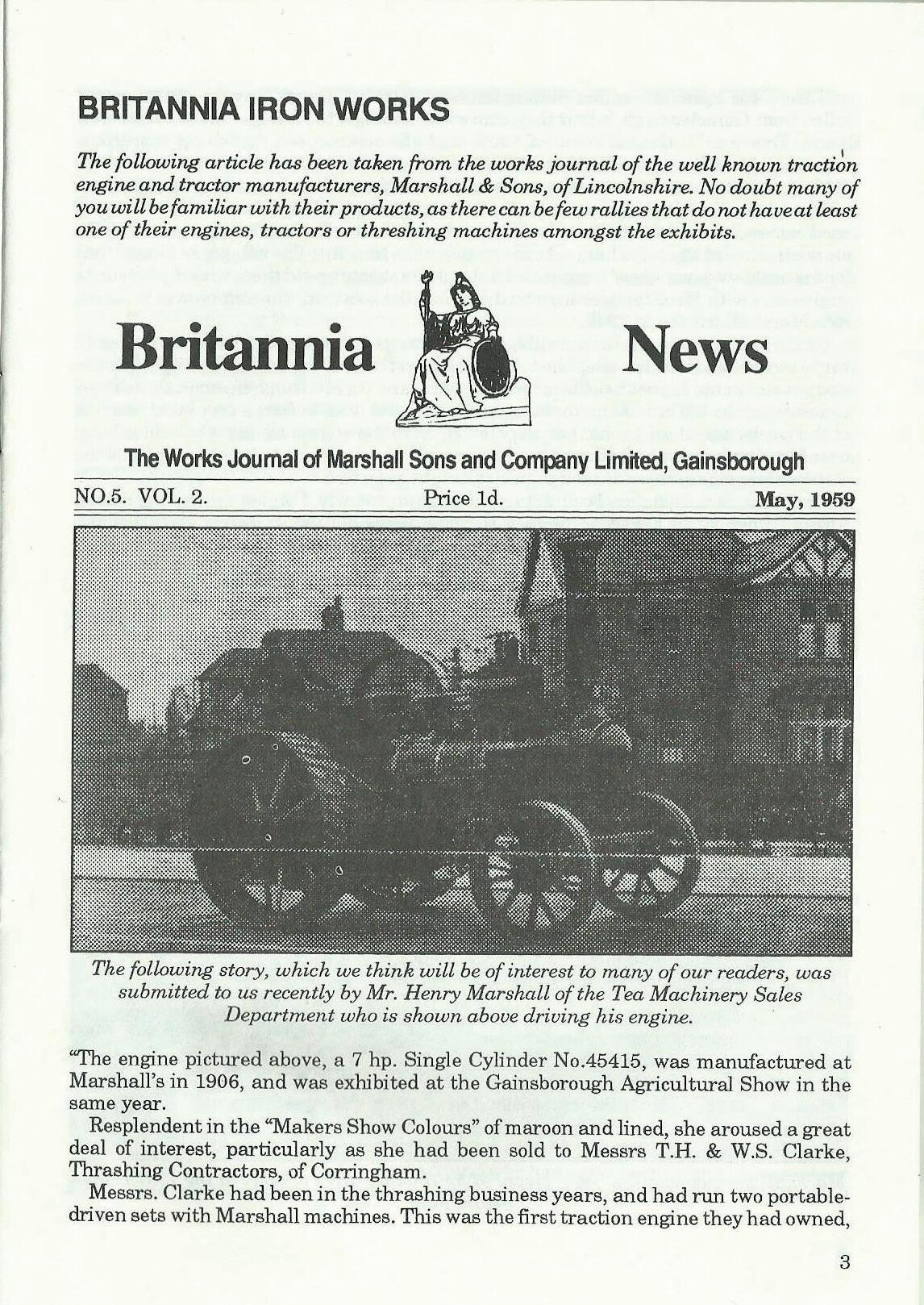
The following artide has been taken from the works journal of the well known traction engine and tractor manufacturers, Marshall & Sons, of Lincolnshire. No doubt many of you will befamiliar with their products, as there can be few rallies that do not have at least one of their engines, tractors or threshing machines amongst the exhibits.
TheWorksJournalof
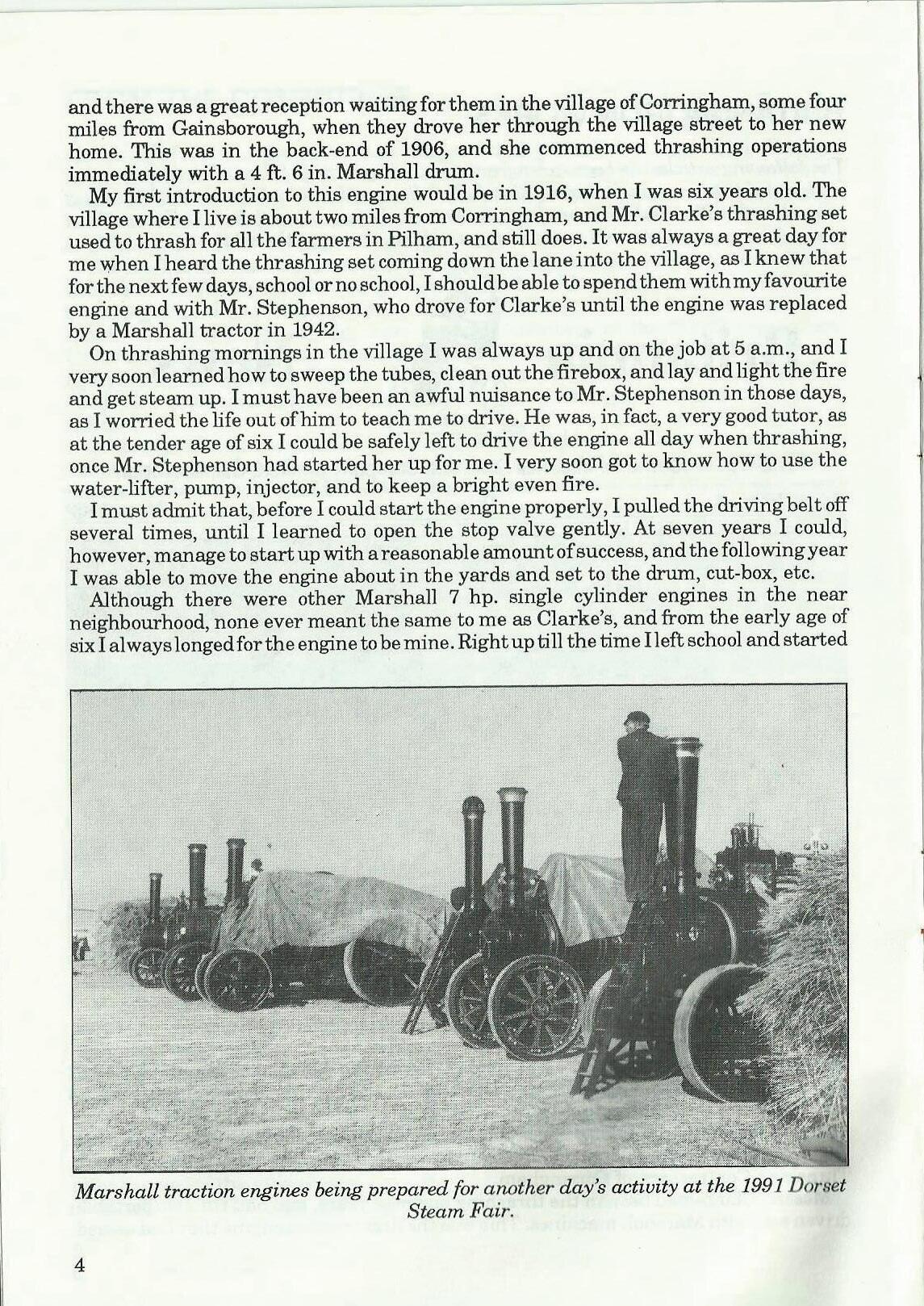
The following story, which we think will be of interest to many of our readers, was submitted -tous recently by Mr. Henry Marshall of the Tea Machinery Sales Department who is shown above driving his engine. •
"The engine pictured above, a 7 hp. Single Cylinder No.45415, was manufactured at Marshall's in 1906, and was exhibited at the Gainsborough Agricultural Show in the same year.
Resplendent in the "Makers Show Colours" of maroon and lined, she aroused a great deal of interest, particularly as she had been sold to Messrs T.H. & W.S. Clarke, Thrashing Contractors, of Corringham.
Messrs. Clarke had been in the thrashing business years, and had run two portab1edriven sets with Marshall machines. This was the first traction engine they had owned,
and there was a great reception waiting for them in the village of Corringham, some four miles from Gainsborough, when they drove her through the village street to her new home. This was in the back-end of 1906, and she commenced thrashing operations immediately with a 4 ft. 6 in. Marshall drum.
My first introduction to this engine would be in 1916, when I was six years old. The village where I live is about two miles from Corringham, and Mr. Clarke's thrashing set used to thrash for all the farmersinPilham, and still does. It was always a great day for me when I heard the thrashing set coming down the lane into the village, as I knew that for the next few days, school or no school, I should be able to spend them with my favourite engine and with Mr. Stephenson, who drove for Clarke's until the engine was replaced by a Marshall tractor in 1942.
On thrashing mornings in the village I was always up and on the job at 5 a.m., and I very soon learned how to sweep the tubes, clean out the firebox, and lay and light the fire and get steam up. I must have been an awful nuisance to Mr. Stephenson in those days, as I worried the life out of him to teach me to drive. He was, in fact, a very good tutor, as at the tender age of six I could be safely left to drive the engine all day when thrashing, once Mr. Stephenson had started her up for me. I very soon got to know how to use the water-lifter, pump, injector, and to keep a bright even fire.
I must admit that, before I could start the engine properly, I pulled the driving belt off several times, until I learned to open the stop valve gently. At seven years I could, however, manage to start up with a reasonable amount of success, and the following year I was able to move the engine about in the yards and set to the drum, cut-box, etc.
Although there were other Marshall 7 hp. single cylinder engines in the near neighbourhood, none ever meant the same to me as Clarke's, and from the early age of six I always longed for the engine to be mine. Right up till the time Ileftschool and started
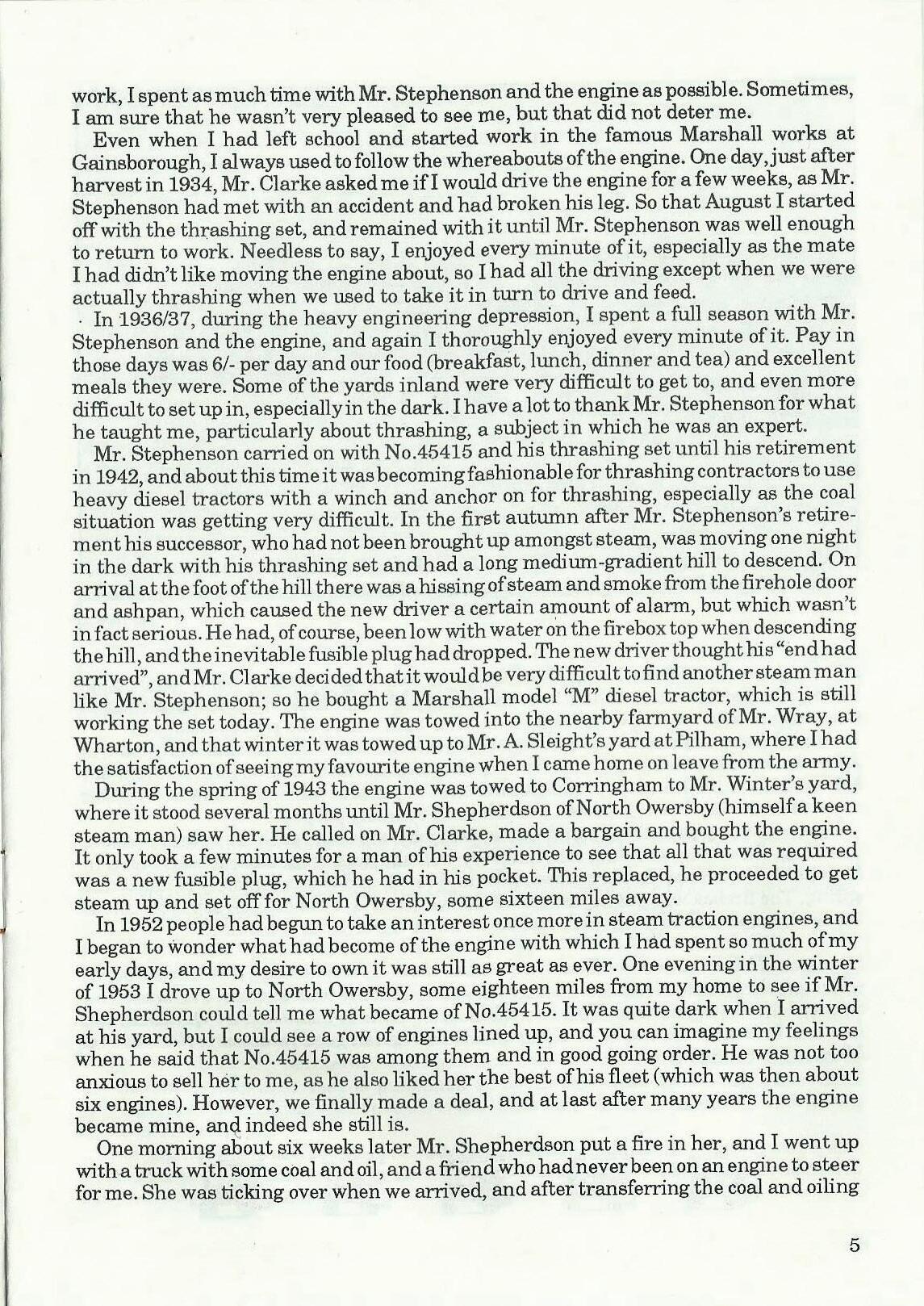
Marshall traction engines being prepared for another day's activity at the 1991 Dorset Steam Fair.
work, I spent as much time with Mr. Stephenson and the engine as possible. Sometimes, I am sure that he wasn't very pleased to see me, but that did not deter me.
Even when I had left school and started work in the famous Marshall works at Gainsborough, I al ways used to follow the whereabouts of the engine. One day ,just after harvest in 1934, Mr. Clarke asked me ifl would drive the engine for a few weeks, as Mr. Stephenson had met with an accident and had broken his leg. So that August I started off with the thI,'ashing set, and remained with it until Mr. Stephenson was well enough to return to work. Needless to say, I enjoyed every minute ofit, especially as the mate I had didn't like moving the engine about, so I had all the driving except when we were actually thrashing when we used to take it in turn to drive and feed.
· In 1936/37, during the heavy engineering depression, I spent a full season with Mr. Stephenson and the engine, and again I thoroughly enjoyed every minute ofit. Pay in those days was 6/- per day and our food (breakfast, lunch, dinner and tea) and excellent meals they were. Some of the yards inland were very difficult to get to, and even more difficult to set upin, especially in the dark. I have a lot to thank Mr. Stephenson for what he taught me, particularly about thrashing, a subject in which he was an expert.
Mr. Stephenson carried on with No.45415 and ms thrasmng set until his retirement in 1942, and about tms time it was becoming fashionable for thrashing contractors to use heavy diesel tractors with a winch and anchor on for thrasmng, especially as the coal situation was getting very difficult. In the first autumn after Mr. Stephenson's retirement ms successor, who had not been brought up amongst steam, was moving one night in the dark with his thrashing set and had a long medium-gradient hill to descend. On arrival at the foot of the hill there was a hissing of steam and smoke from the firehole door and ashpan, which caused the new driver a certain amount of alarm, but which wasn't in fact serious. He had, of course, been low with water on the firebox top when descending the hi11,and theinevitablefusible plug had dropped. The new driver thought his "end had arrived", and Mr. Clarke decided thatitwouldbe very difficult to find another steam man like Mr. Stephenson; so he bought a Marshall model "M" diesel tractor, which is still working the set today. The engine was towed into the nearby farmyard of Mr. Wray, at Wharton, and that winter it was towed up to Mr.A. Sleight's yardatPilham, where I had the satisfaction of seei ngmyfavouri te engine when I came home on leave from the army.
During the spring of 1943 the engine was towed to Corringham to Mr. Winter's yard, where it stood several months until Mr. Shepherdson of North Owersby (himself a keen steam man) saw her. He called on Mr. Clarke, made a bargain and bought the engine. It only took a few minutes for a man of his experience to see that all that was required was a new fusible plug, which he had in his pocket. This replaced, he proceeded to get steam up and set off for North Owersby, some sixteen miles away.
In 1952 people had begun to take an interest once more in steam traction engines, and I began to wonder what had become of the engine with which I had spent so much ofmy early days, and my desire to own it was still as great as ever. One evening in the winter of 1953 I drove up to North Owersby, some eighteen miles from my home to see if Mr. Shepherdson could tell me what became ofNo.45415. It was quite dark when t arrived at his yard, but I could see a row of engines lined up, and you can imagine my feelings when he said that No.45415 was among them and in good going order. He was not too anxious to sell her to me, as he also liked her the best of his fleet (which was then about six engines). However, we finally made a deal, and at last after many years the engine became mine, and indeed she still is.
One morning about six weeks later Mr. Shepherdson put a fire in her, and I went up with a truck with some coal and oil, and a friend who had never been on an engine to steer for me. She was ticking over when we arrived, and after transferring the coal and oiling
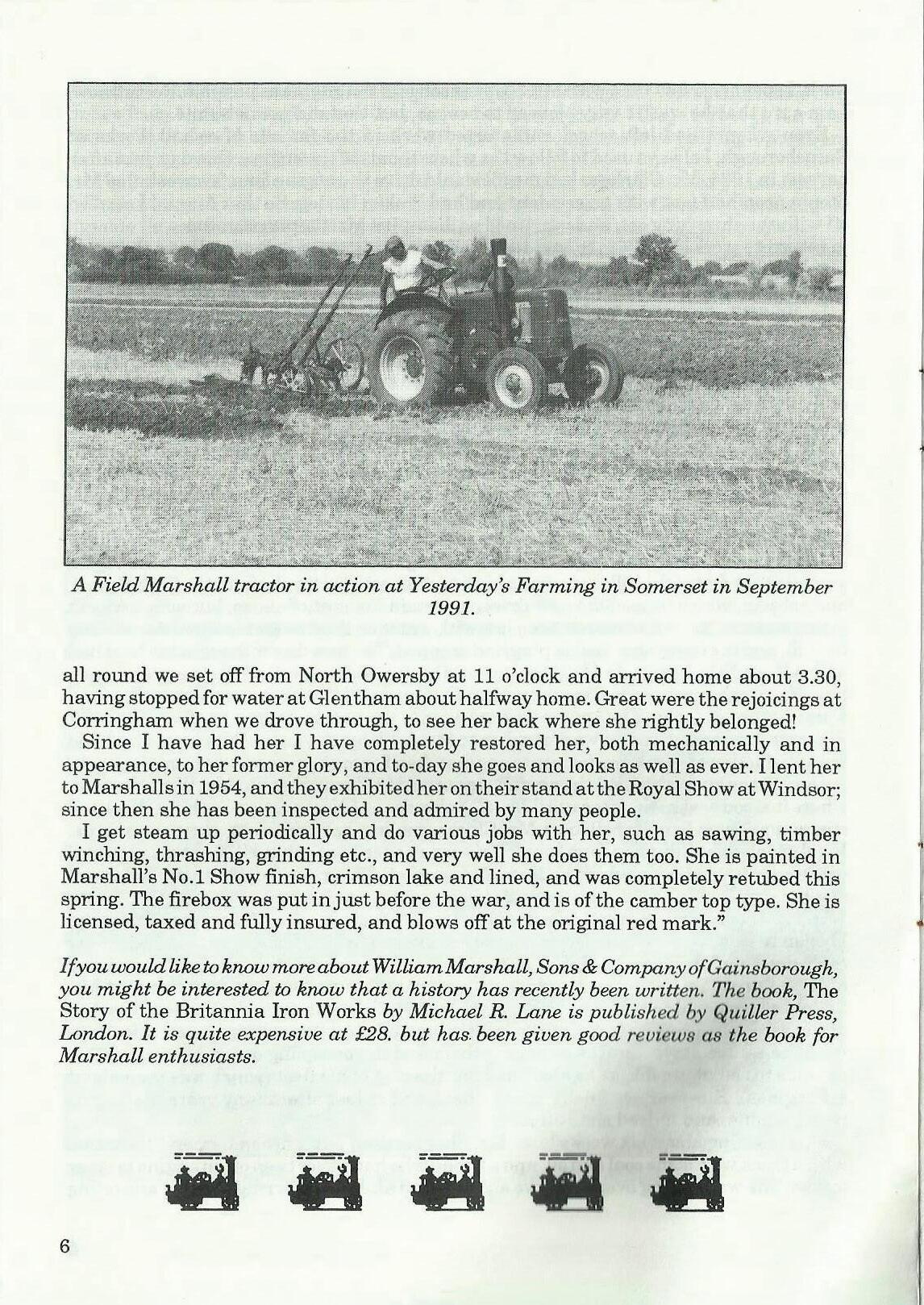
A Field Marshall tractor in action at Yesterday's Farming in Somerset in September 1991.
all round we set off from North Owersby at 11 o'clock and arrived home about 3.30, having stopped for water at Glentham about halfway home. Great were the rejoicings at Corringham when we drove through, to see her back where she rightly belonged!
Since I have had her I have completely restored her, both mechanically and in appearance, to her former glory, and to-day she goes and looks as well as ever. I lent her to Marsh alls in 1954, and they exhibited her on their stand at the Royal Show at Windsor; since then she has been inspected and admired by many people.
I get steam up periodically and do various jobs with her, such as sawing, timber winching, thrashing, grinding etc., and very well she does them too. She is painted in Marshall's No.1 Show finish, crimson lake and lined, and was completely retubed this spring. The firebox was put in just before the war, and is of the camber top type. She is licensed, taxed and fully insured, and blows off at the original red mark."
If you would like to know more about William Marshall, Sons & Company of Gainsborough, you might be interested to know that a history has recently been written. The book, The Story of the Britannia Iron Works by Michael R. Lane is published by Qttiller Press, London. It is quite expensive at £28. but has. been given good reviews as the book for Marshall enthusiasts.
Some ofyou have certainly been putting your <thinking caps' on, and we have had another selection of possible names for the MAGAZINE:
Born To Steam
Smokebox
Soot & Cylinders
Eccentrics
Steam In The Blood Steam In The Veins
Whistle Stop Cranks
Fire & Water
Steam Galore
Stac Chat
Fire Up
Smoke Rings
Steam Talk
Eccentrics In Steam
Whistle
Ashes
Young Steam
Steamscene
Claire McKee, 11, from Ripley in Derbyshire, explains Stac Chat, ((This is short for Steam ,Apprentice Club and stac also means chimney. I chose chat because it is a very chatty magazine."
Others sending in suggestions were Sarah Saunders of Hinckley, Leicestershjre, Michael Pugh from Leicester, Ben Cockayne from AJfreton in Derbyshire, Ann Collier of Aylesbury in Bucks and Chris Sheppard who lives in Guildford. Thanks for all your ideas, but now it's time for you to choose the future title for your magazine.
The Committee looked at all the suggestions, and the two they most liked are:
Simmering Raising Steam
Please let me have your votes as to which name you want us to use, just write it on a piece of paper with your name and membership number and send it to me as soon as possible.
It is probably time to remind you again of the system for renewing SAC membership. All your details are on the NTETcomputer, so if you find any incorrect spellings or addresses would you please let John Cook, the Membership Secretary, know so they can be corrected.
1. When yourmembership is due you will receive a BLUE reminder form together with the latest copy of the magazine.
2. If you fail to renew after receiving that, you will receive a YELLOW final reminder and no.magazine.
3. If still no payment is received, then you will be deleted from the records prior to the posting of the next magazine.
I hope that you do not find the above too complicated! The current membership fee is £2 a year, but will probably need to go up next year. Please remember that renewals should be sent to John Cook, and not the Editor or Chair.
Older members maybe interested to know that they can also join theNTETandreceive the Steaming magazine that is published at about the same time as this one. SAC members are automatically sent details of the< National' when they reach 21 and are too old to be Apprentices.
I am hoping, withJohn's help, to include details of new members in the magazine, and a separate list of all our members, each gjving town and county. This should be useful for our new Pen Pals scheme.
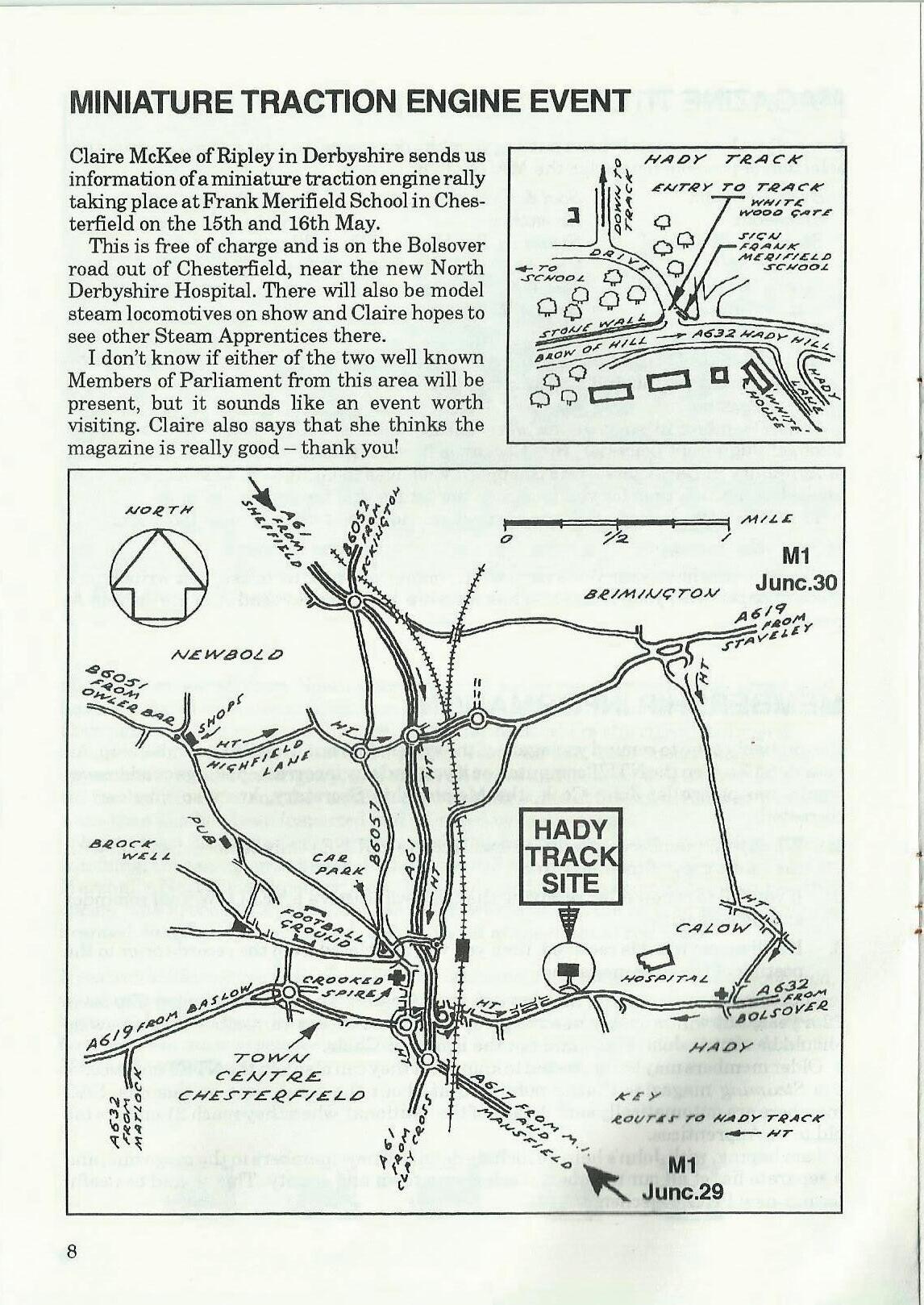
Claire McKee of Ripley in Derbyshire sends us information of a miniature traction engine rally taking place at Frank Merifield School in Chesterfield on the 15th and 16th May.
This is free of charge and is on the Bolsover road out of Chesterfield, near the new North Derbyshire Hospital. There will also be model steam locomotives on show and Claire hopes to see other Steam Apprentices there.
I don't know if either of the two well known Members of Parliament from this area will be present, but it sounds like an event worth visiting. Claire also says that she thinks the magazine is really good - thank you!
This Ruston Proctor steam tractor in 2 in. scale constructed by Kenneth Vickers, won a Bronze Medal at the International Model Engineer Exhibition in January
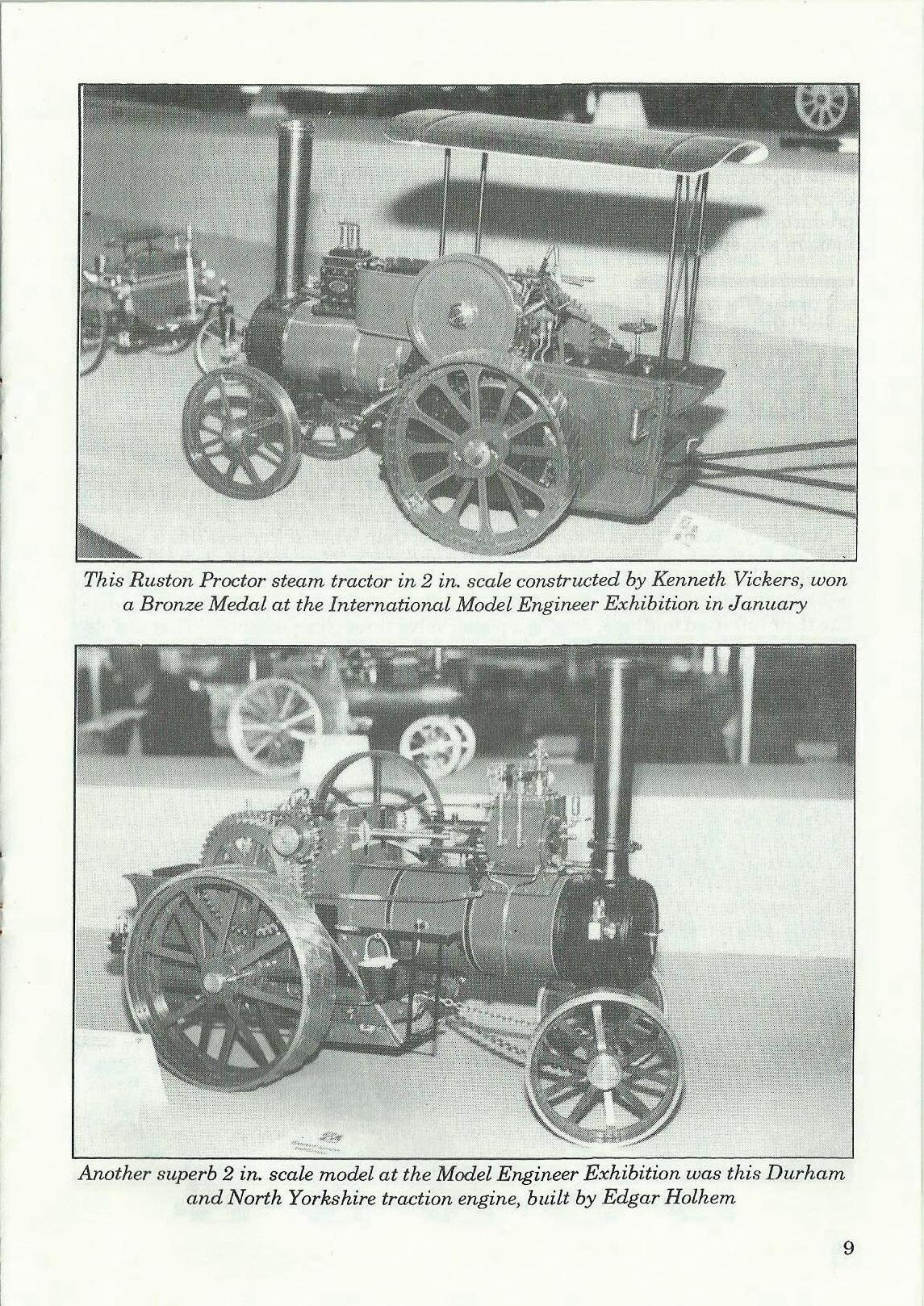
Another superb 2 in. scale model at the Model Engineer Exhibition was this Durham and North Yorkshire traction engine, built by Edgar Holhem
AnthonyCoulls
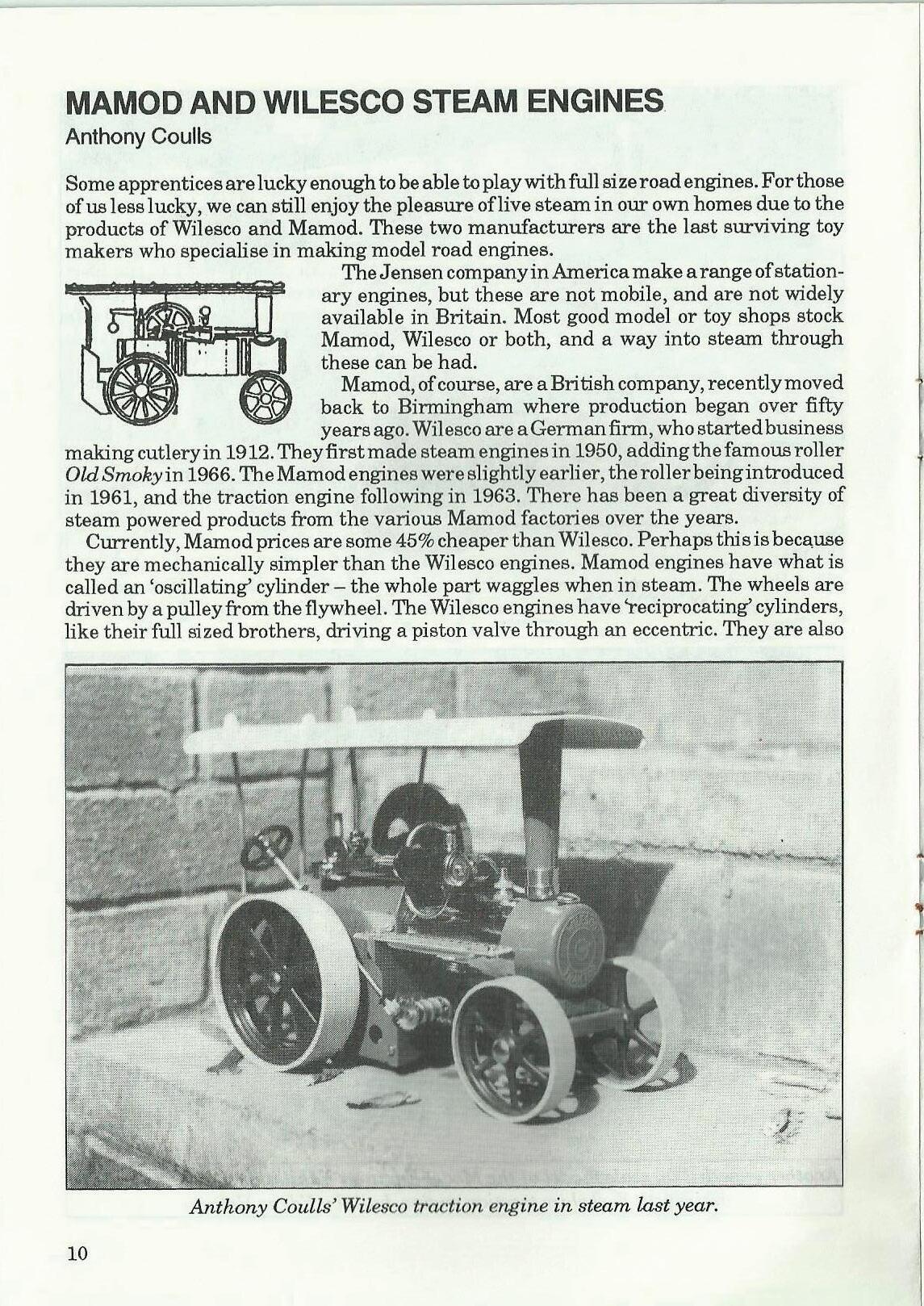
Some apprentices are lucky enough to be able to play with full size road engines. For those of us less lucky, we can still enjoy the pleasure oflive steam in our own homes due to the products of Wilesco and Mamod. These two manufacturers are the last surviving toy makers who specialise in making model road engines.
The Jensen company in America make a range of stationary engines, but these are not mobile, and are not widely available in Britain. Most good model or toy shops stock Mamod, Wilesco or both, and a way into steam through these can be had.
Mamod, of course, are a British company, recently moved back to Birmingham where production began over fifty years ago. Wilesco are a German firm, who started business making cutlery in 1912. They first made steam engines in 1950, adding the famous roller OldSmokyin 1966. TheMamodengineswereslightlyearlier, therollerbeingintroduced in 1961, and the traction engine following in 1963. There has been a great diversity of steam powered products from the various Mamod factories over the years.
Currently, Mamod prices are some 45% cheaper than Wilesco. Perhaps this is beca,use they are mechanically simpler than the Wilesco engines. Mamod engines have what is called an 'oscillating' cylinder - the whole part waggles when in steam. The wheels are driven by a pulley from the flywheel. The Wilesco engines have 'reciprocating' cylinders, like their full sized brothers, driving a piston valve through an eccentric. They are also
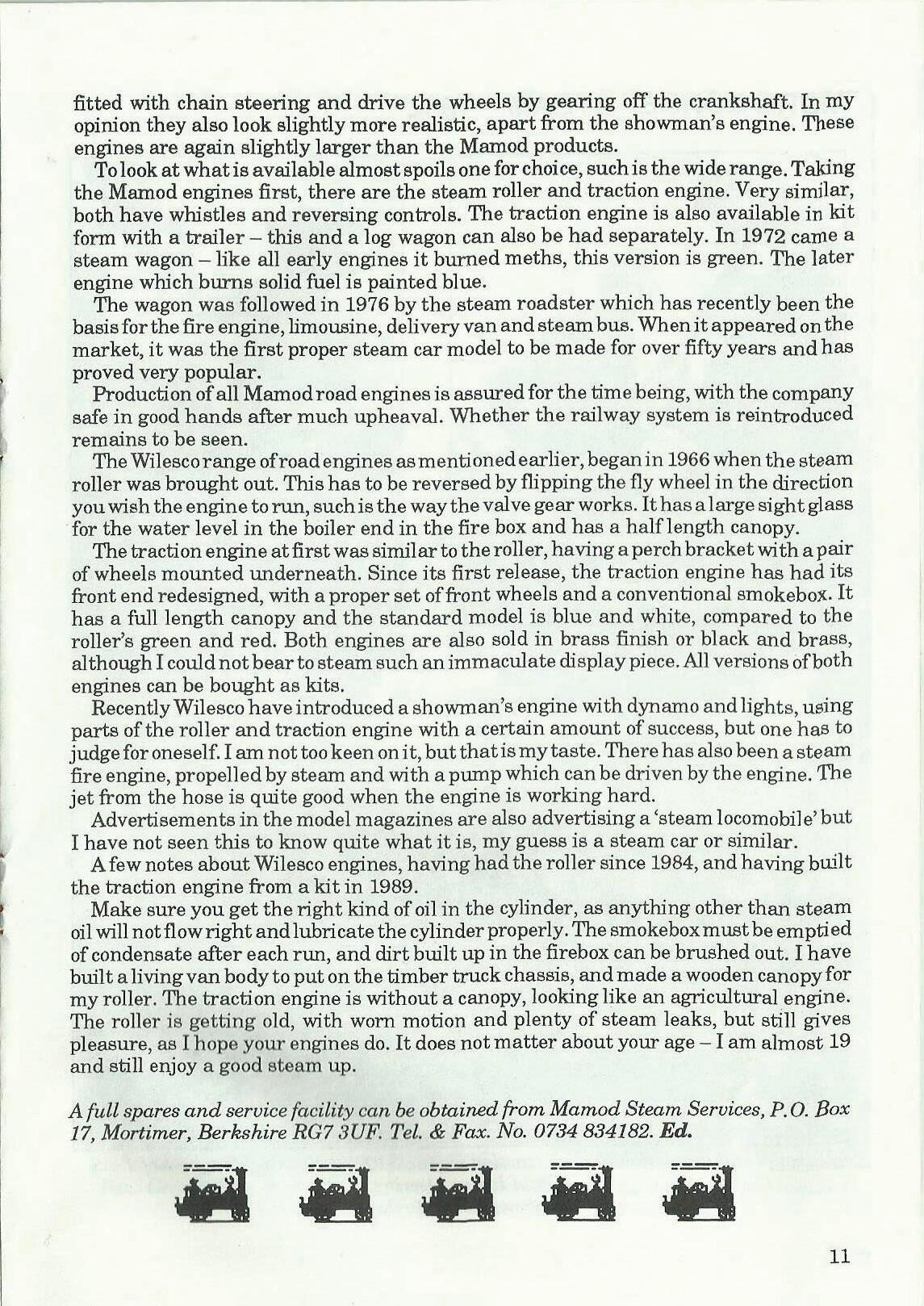
fitted with chain steering and drive the wheels by gearing off the crankshaft. In my opinion they also look slightly more realistic, apart from the showman's engine. These engines are again slightly larger than the Mamod products.
To look at what is available almost spoils one for choice, such is the wide range. Taking the Mamod engines first, there are the steam roller and traction engine. Very similar, both have whistles and reversing controls. The traction engine is also available in kit form with a trailer - this and a log wagon can also be had separately. In 1972 came a steam wagon -like all early engines it burned meths, this version is green. The later engine which burns solid fuel is painted blue.
The wagon was followed in 1976 by the steam roadster which has recently been the basis for the fire engine, limousine, delivery van and steam bus. When it appeared on the market, it was the first proper steam car model to be made for over fifty years and has proved very popular.
Production of all Mamod road engines is assured for the time being, with the company safe in good hands after much upheaval. Whether the railway system is reintroduced remains to be seen.
The Wilesco range of road engines as mentioned earlier, began in 1966 when the steam roller was brought out. This has to be reversed by flipping the fly wheel in the direction you wish the engine to run, such is the way the valve gear works. Ithasalarge sight glass for the water level in the boiler end in the fire box and has a half length canopy.
The traction engine at first was similar to the roller, having a perch bracket with a pair of wheels mounted underneath. Since its first release, the traction engine has had its front end redesigned, with a proper set of front wheels and a conventional smokebox. It has a full length canopy and the standard model is blue and white, compared to the roller's green and red. Both engines are also sold in brass finish or black and brass, although I could not bear to steam such an immaculate display piece. All versions of both engines can be bought as kits.
Recently Wilesco have introduced a showman's engine with dynamo and lights, using parts of the roller and traction engine with a certain amount of success, but one has to judge for oneself. I am not too keen on it, but that is my taste. There has also been a steam fire engine, propelled by steam and with a pump which can be driven by the engine. The jet from the hose is quite good when the engine is working hard.
Advertisements in the model magazines are also advertising a 'steam locomobi]e' but I have not seen this to know quite what it is, my guess is a steam car or similar.
A few notes about Wilesco engines, having had the roller since 1984, and having built the traction engine from a kit in 1989.
Make sure you get the right kind of oil in the cylinder, as anything other than steam oil will not flow right and lubricate the cylinder properly. The smoke box must be emptied of condensate after each run, and dirt built up in the firebox can be brushed out. I have built a living van body to put on the timber truck chassis, and made a wooden canopy for my roller. The traction engine is without a canopy, looking like an agricultural engine. The roller is getting old, with worn motion and plenty of steam leaks, but still gives pleasure, as I hope your engines do. It does not matter about your age - I am almost 19 and sti11enjoy a good steam up.
A full spares and service facility can be obtained from Mamod Steam Services, P. 0. Box 17, Mortimer, Berkshire RG7 3UF. Tei. & Fax. No. 0734 834182. Ed.
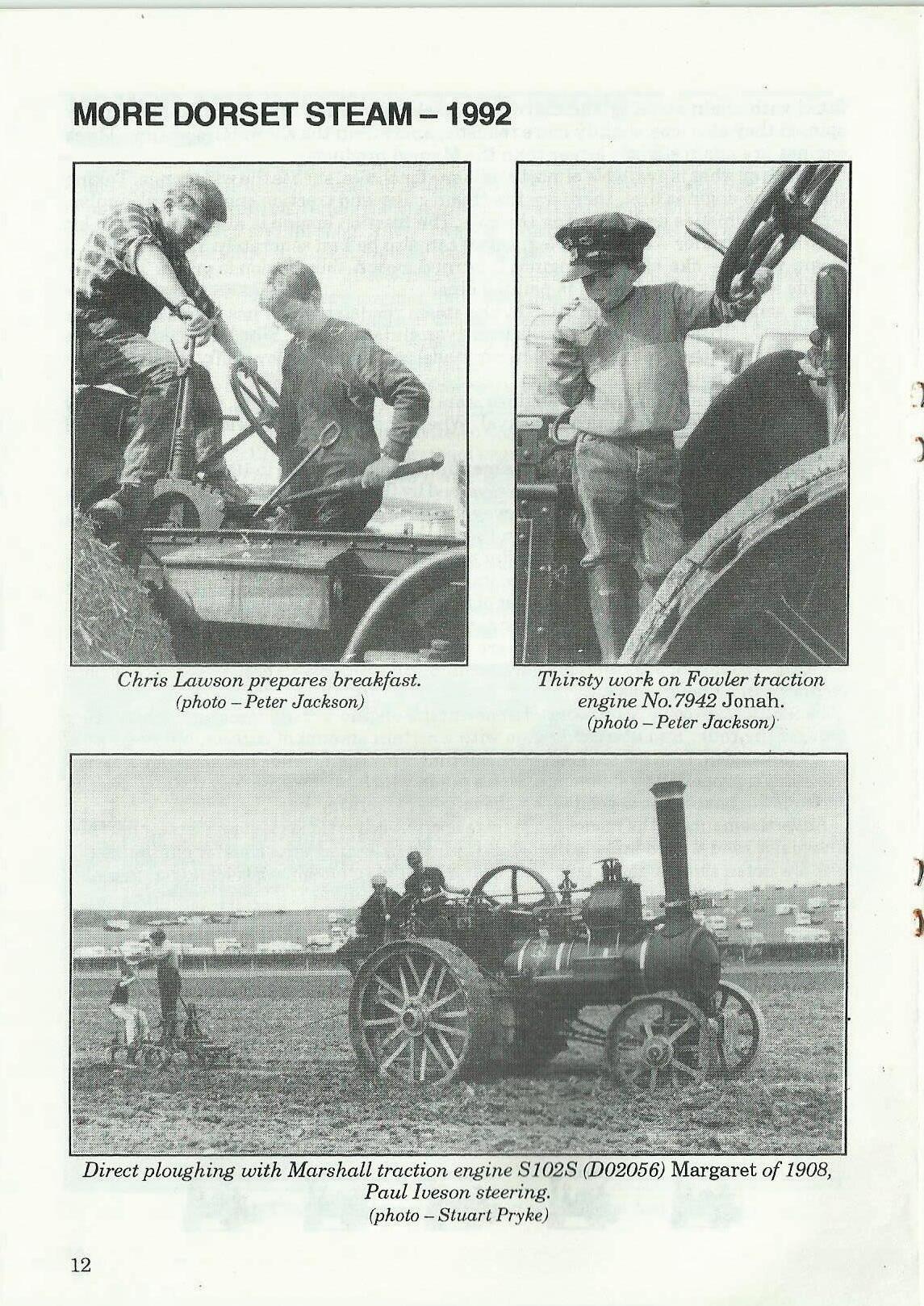
Green of the Road
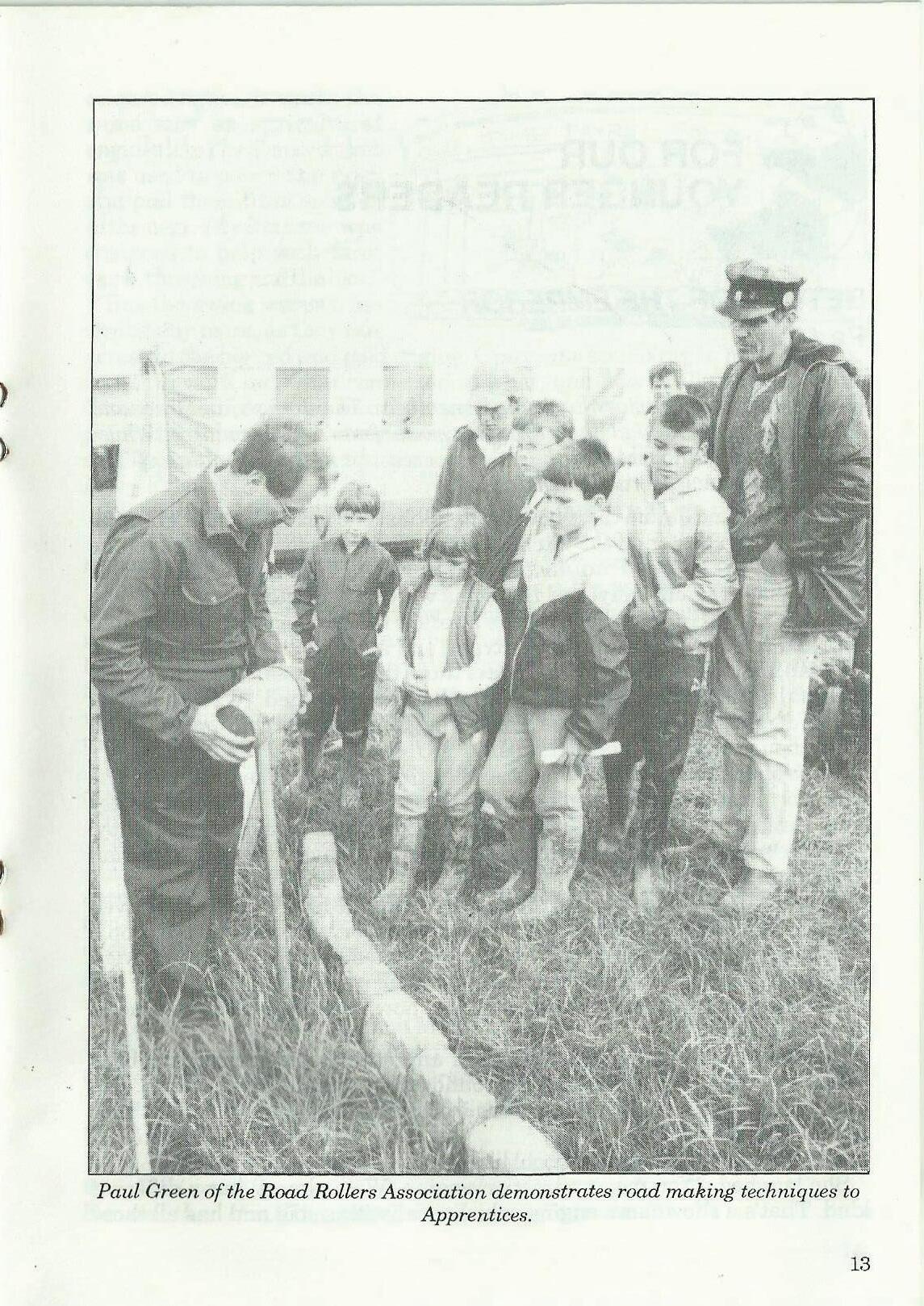
Association demonstrates road making techniques to Apprentices.
We continue with our story for younger members. The story so far, Grace and Jamie are on holiday at their Grandparents' farm in the country. Whilst exploring the outhouses they have discovered the rusting remains of The Emperor, an ancient traction engine ...
When Grace and Jamie came down to breakfast the next day, their grandfather had left a poster on the kitchen table before he went off to work on the farm. Old Time Fayre-TraditionalFunFair For AJ,lThe Family. The fair was to take place the next day, and the twins were very excited.
"Great," said Grace, "I hope there's a rocket ride, and a rotor, and a super bob. and a really frightening ghost train, and a ... "
''Yeah, and loads of sweets, and one ofthose fantasy rides," broke in Jamie. Grandmother, coming in after milking the cows, laughed. ''Well, there ·will be lots of rides, but not like those. There'll be gallopers, and chairoplanes, and a lighthouse slip, and lots of organs."
Later on, as the twins sat and stared at the rusting broken pieces of The Emperor, Grace and Jamie talked about the fair and told each other that they would pretend to enjoy it, expecting not to, to keep their grandparents happy.
"There's just one thing," said Jamie, "They did have sweets in Victorian times didn't they ?"
The next day was very hot as they all set off for the fair. When they arrived neither Grace nor Jamie could believe their eyes or ears. There were people wandering around in lovely old clothes, and instead of pop music there were organs with painted figures which danced or played drums.
"Cor, this is great," said Grace, "I can see how those long cards with holes in make the tune."
But Jamie didn't reply. He just stood and stared at a brightly coloured carousel, with lots ofhorses all going round and round and up and down. The roundabout was wonderful itself, but it was the big engine next to it that caught Jamie's eye.
"Granny, it' s a thingummy bob, like The Emperor!"
She laughed, ''You mean a traction engine. Well, almost, but a different kind. That's a showman's engine, which is why it's so big and has all those
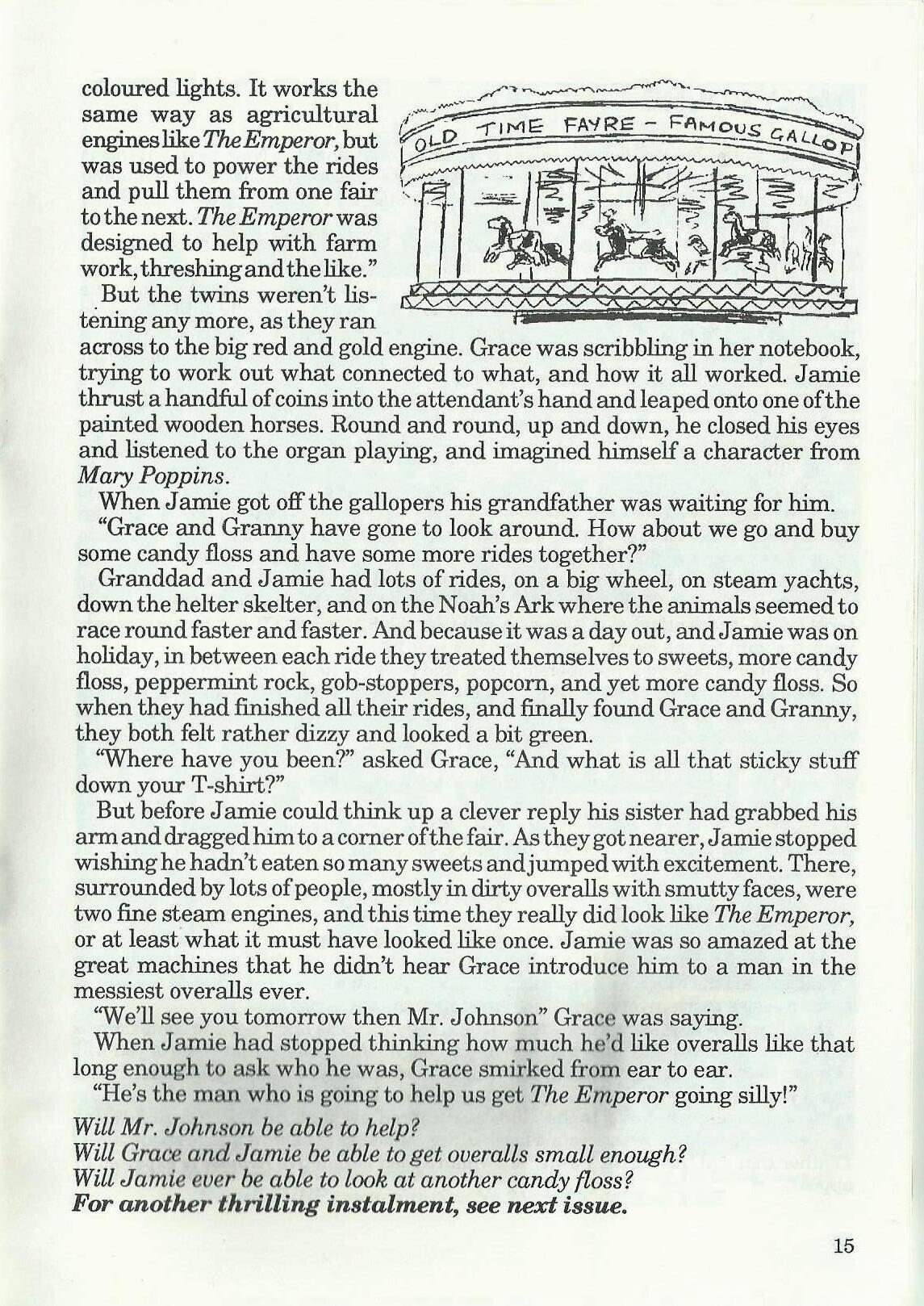
coloured lights. It works the same way as agricultural engines like The Emperor, but was used to power the rides and pull them from one fair to the next. The Emperor was designed to help with farm work, threshing and the like."
But the twins weren't listening any more, as they ran across to the big red and gold engine. Grace was scribbling in her notebook, trying to work out what connected to what, and how it all worked. Jamie thrust a handful of coins into the attendant's hand and leaped onto one of the painted wooden horses. Round and round, up and down, he closed his eyes and listened to the organ playing, and imagined himself a character from Mary Poppins.
When Jamie got off the gallopers his grandfather was waiting for him.
"Grace and Granny have gone to look around. How about we go and buy some candy floss and have some more rides together?"
Granddad and Jamie had lots of rides, on a big wheel, on steam yachts, down the helter skelter, and on the Noah's Ark where the animals seemed to race round faster and faster. And because it was a day out, and Jamie was on holiday, in between each ride they treated themselves to sweets, more candy floss, peppermint rock, gob-stoppers, popcorn, and yet more candy floss. So when they had finished all their rides, and finally found Grace and Granny, they both felt rather dizzy and looked a bit green.
"Where have you been?" asked Grace, "And what is all that sticky stuff down your T-shirt?"
But before Jamie could think up a clever reply his sister had grabbed his arm and dragged him to a corner ofthe fair. As they got nearer, Jamie stopped wishing he hadn't eaten so many sweets andjumped with excitement. There, surrounded by lots of people, mostly in dirty overalls with smutty faces, were two fine steam engines, and this time they really did look like The Emperor, or at least' what it must have looked like once. Jamie was so amazed at the great machines that he didn't hear Grace introduce him to a man in the messiest overalls ever.
"We'll see you tomorrow then Mr. Johnson" Grace was saying.
When Jamie had stopped thinking how much he'd like overalls like that long enough to ask who he was, Grace smirked from ear to ear.
"He's the man who is going to help us get The Emperor going silly!"
Will Mr. Johnson be able to help?
Will Grace and Jamie be able to get overalls small enough? Will Jamie ever be able to look at another candy fioss? For another thrilling instalment, see next issue.
No opportunities for any visits to rallies or steam events since the New Year, but this is the time when we all start looking forward to a new season. Included in this mailing should be a copy of the NTET list of Authorised Rallies, and a list of those events which give free entry to SAC members.
Last July there was a change to the Road Traffic Act, which means that the offences of 'dangerous, careless and inconsiderate driving of a mechanically propelled vehicle apply in a public place, and not just on the highway. A public place is anywhere that the public has access, whether free or on payment of a fee, so it covers rally fields. To avoid the danger of drivers of traction engines being prosecuted by the police for careless driving, which could apply to many situations, rally organisers can have their event exempted from the Act by becoming Authorised under the NTET's Rally Code. The National Traction Engine Trust has the status of an Authorising Body, based on the Code of Practice which has been used by many events to ensure safety for several years. Only Authorised events will be exempt from the law, which could mean police enforcing the Act at other events.
Only rallies Authorised by the NTET appear on the two lists sent out with this magazine. If you see anything dangerous or unsafe at any rally this summer you, or an adult, should report it to the rally organisers or a police officer. Because of the change in the law, and from the old NTET Approval Scheme, we may not have approached all rally organisers about free entry or activities for SAC members, but hope to have a better system ready for next year. At the time of writ:i ng the Dorset Steam Fair had not applied for NTET Authorisation, so it is unclear whether the SAC or NTET will be present this year, the 25th for the event.
Rem.ember to take your membership card, and the Free Rally List, with you to rallies. If the people on the entrance gate don't know about the SAC and insist on charging you admission, ask them for a receipt. If this happens take the receipt to the rally organisers' tent and ask them for a refund. Remember, it is a privilege and not a right, be polite for the sake of others coming after you. At some of the rallies the SAC will be organising activities for Apprentices. This may include the chance to steer a traction engine, but we also hope that Apprentices may also have the opportunity to learn more about the engines by helping prepare and clean them. These activities usually take place on the Sunday morning, but some are at other times, so do check beforehand, especially if you are travelling a long way.
SAC Committee member RichardHurleyis organising an event for Apprentices at the Swindon VintageShowonMonday3lstMay. The advice given by Richardin the enclosed details apply equally to other free rally events. Any older Apprentices, or adult members of their families, who would like to help organise the SAC activities at their local rally should contact the Editor or Chairperson initially. As you will read on other pages we are keen to see as much involvement from the membership as possible. Dependent on how things are with the new baby, Francis and I hope to come for one day at the traction engine driving course at Klondyke Mill. I hope that some of you will be going to this event; if you have not already booked up and you want to go contact Sylvia Dudley without delay, it will cost you £25 plus your keep.
We will certainly be going to the 'Hunslet Hundred' event at the Festiniog Railway at the beginning of May. Apart from a fascinating collection of narrow gauge steam locos, I gather that SAC favourite, Fowler showman's road locomotive Repulse is expected to appear.
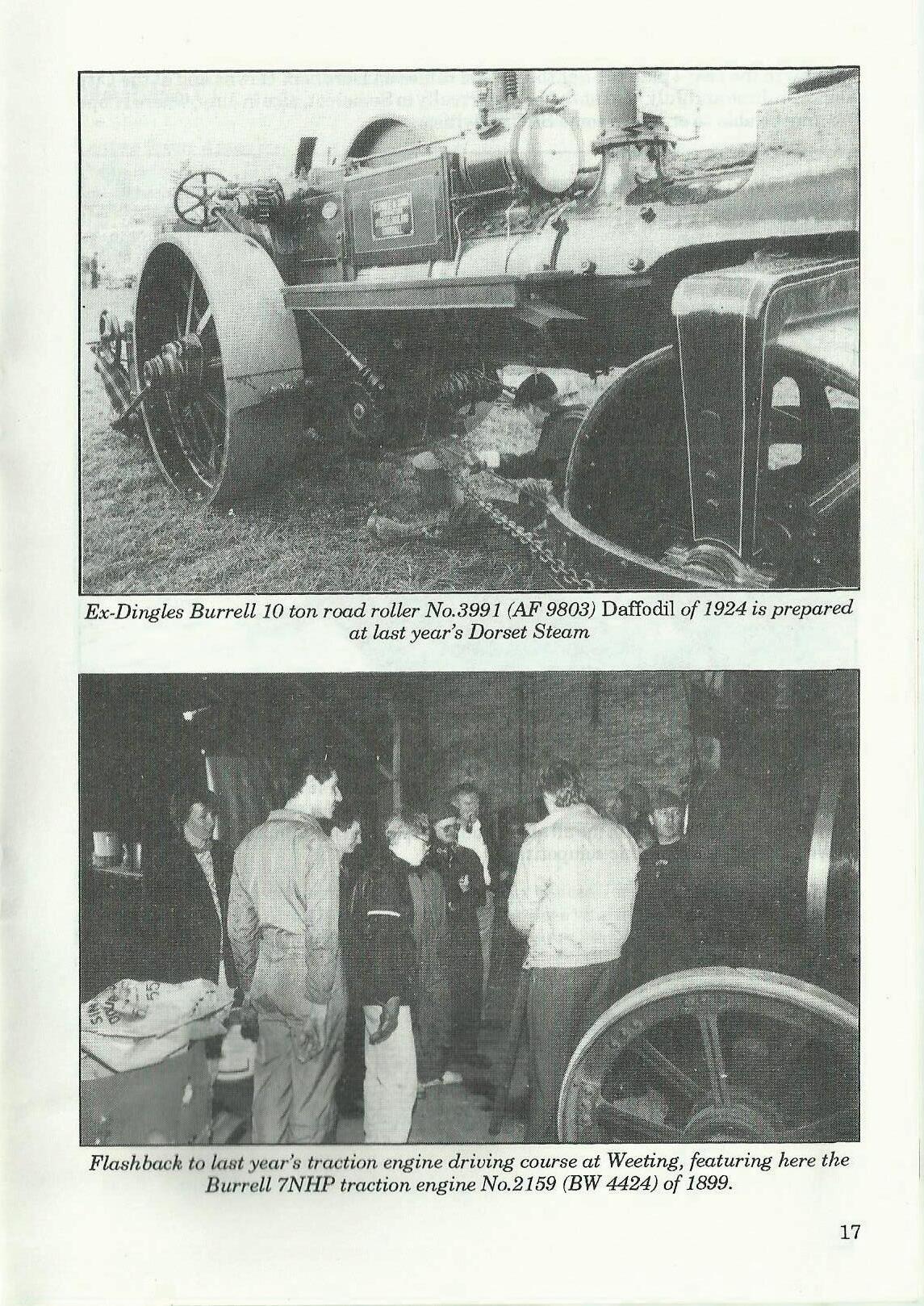
Ex-Dingles Burrell 10 ton road roller No.8991 (AF 9808) Daffodil of 1924 is prepared at last year's Dorset Steam
Later in the year I plan to be at the Bristol rallies on Durdham Downs and at the City Docks,inJune and July, and at the Langport rally in Somerset, also in July, where I hope we may be able to organise some SAC activities.
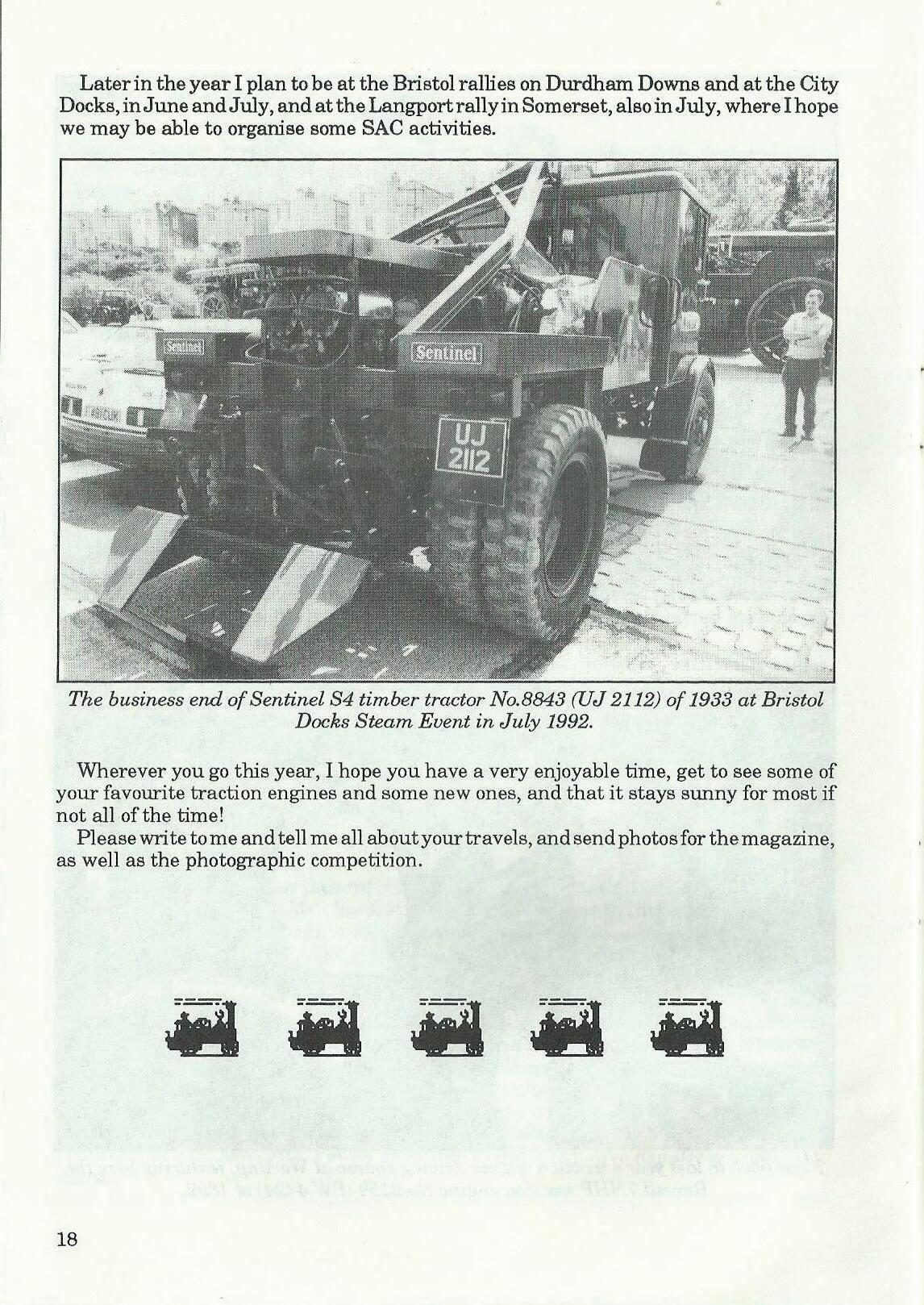
The business end of Sentinel S4 timber tractor No.8843 (UJ 2112) of 1933 at Bristol Docks Steam Event in July 1992.
Wherever you go this year, I hope you have a very enjoyable time, get to see some of your favourite traction engines and some new ones, and that it stays sunny for most if not all of the time!
Please write to me and tell me all about your travels, and send photos for the magazine, as well as the photographic competition.
Letter from America. Dear Steph,
How are you doing? I'm doing fine. On Wednesday my cousin broke his arm_ playing basketball with me and another cousin. Thanks for putting my article in your magazine. I took the magazine to school and some of the kids read it. Most of them liked it. I also want to thank you for the list of shows and the
Dear Sir, invitation to England. But I don't think we will be able to make it.
David
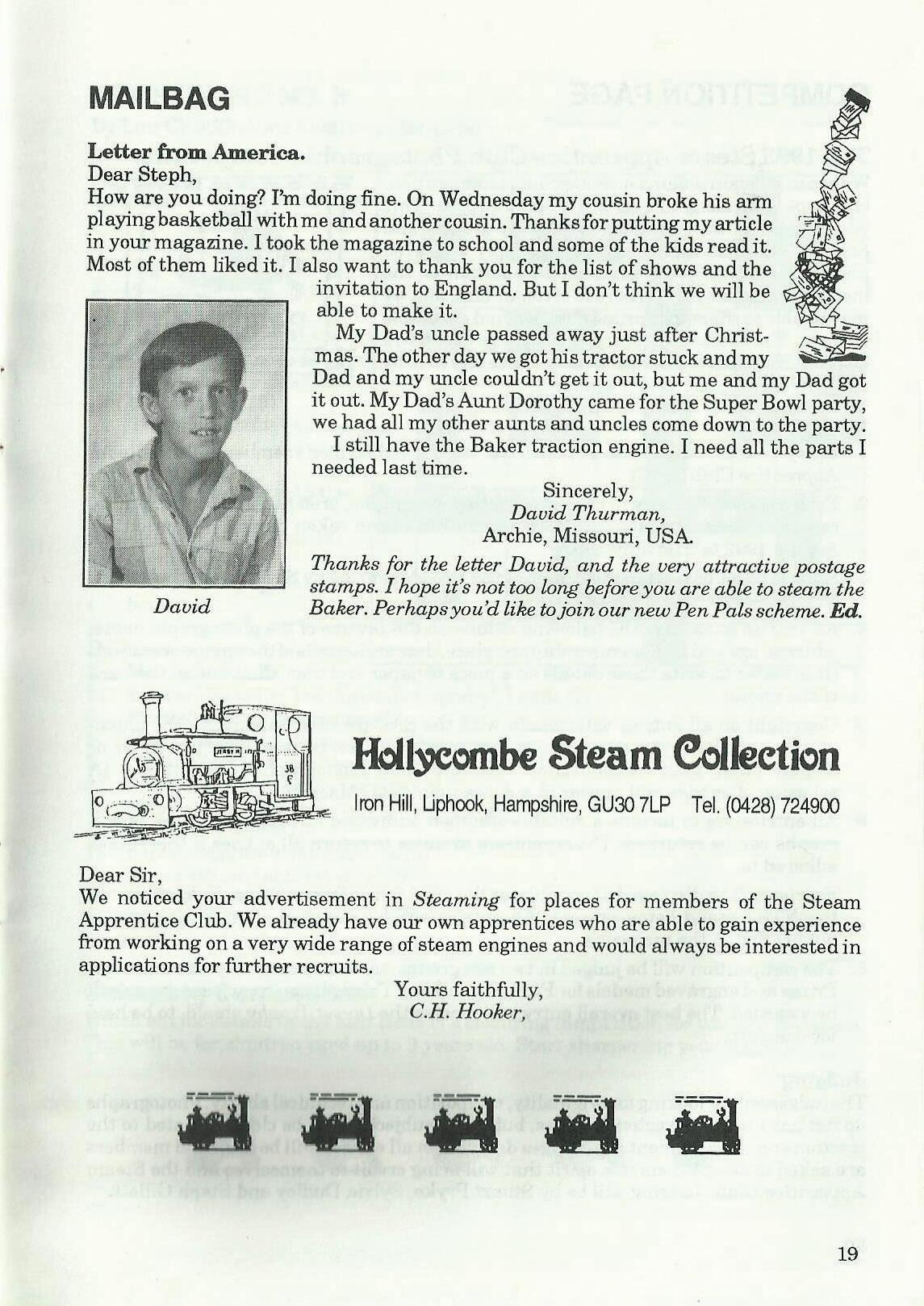
My Dad's uncle passed a way just after Christmas. The other day we got his tractor stuck and my Dad and my uncle couldn't get it out, but me and my Dad got it out. My Dad's Aunt Dorothy came for the Super Bowl party, we had all my other aunts and uncles come down to the party. I still have the Baker traction engine. I need all the parts I needed last time.
Sincerely, David Thurman, Archie, Missouri, USA
Thanks for the letter David, and the very attractive postage stamps. I hope it's not too long before you are able to steam the Baker. Perhaps you'd like to join our new Pen Pats scheme. Ed.
We noticed your advertisement in Steaming for places for members of the Steam Apprentice Club. We already have our own apprentices who are able to gain experience from working on a very wide range of steam engines and would al ways be interested in applications for further recruits.
Yours faithfully, C.H. Hooker,
We are once again holding a photographic competition, c:aea a c:::t• c:a 11:1c::::aea c:s a.nd hope that many of you will submit entries. This Year we are splitting entries into two age groups, and Stuart Pryke has kindly agreed to supply engraved niedals for all six prize winners. In addition to the niedals, winners will receive rolls of colour film, and we niaybeabletoofferotherprizesifwecanfindasuitable
sponsor. The best overall entry in either age group will be presented with the Dorset Trophy, currently held by :ac::::t D • ea ea • - a-• Anthony Coulls, last year's winner.
ltules
1. Entry to this competition is restricted to fully subscribed members of the Steam Apprentice Club (SAC).
2. Each member's entry will consist of three photographs, pref er ably 6in. x 4in. prints, colour or black & white, and they should have been taken during the period 1st August 1992 to 31st July 1993.
3. Entries must be sent to the Editor of the SAC Magazine by Saturday 14th August. (Address at front of magazine.)
4. All entries must have the following details on the reverse of the photograph: name, address, age and SAC membership no.; place, date and details ofthe engine or subject. (It is better to write these details on a piece of paper and then stick this on the back of the photo).
5. Copyright on all entries will remain with the SAC member submitting the photographs and the organisers promise that prints will not be used in any manner or display other than in connection with the 1993 Photographic Competition. (A selection of entries will appear in _asubsequent SAC Magazine.)
6. All entries are to include a suitable stamped addressed envelope to ensure photographs can be returned. The organisers promise to return all entries if this rule is adhered to.
7. Entries will be displayed, if possible, at the 1993 Great Dorset Steam Fair, subject to the NTET stand being present. All entries will be returned after display and/or publication in the magazine.
8, The competition will be judged in two age groups: up to 15 years; 16 years and over. Prizes and engraved medals for First, Second and Third places in each age group will be awarded. The best overall entry will receive the Dorset Trophy shield, to be held for one year.
Judging
The judges will be lookingfororiginality, composition and technical ability. Photographs d~ not have to be of traction engines, but other subjects must be clearly related to the h'action engine movement. The judges decision on all entries will be final and members ate asked to accept them in a spirit that will bring credit to themselves and the Steam Apprentice Club. Judging will be by Stuart Pryke, Sylvia Dudley and Steph Gillett.
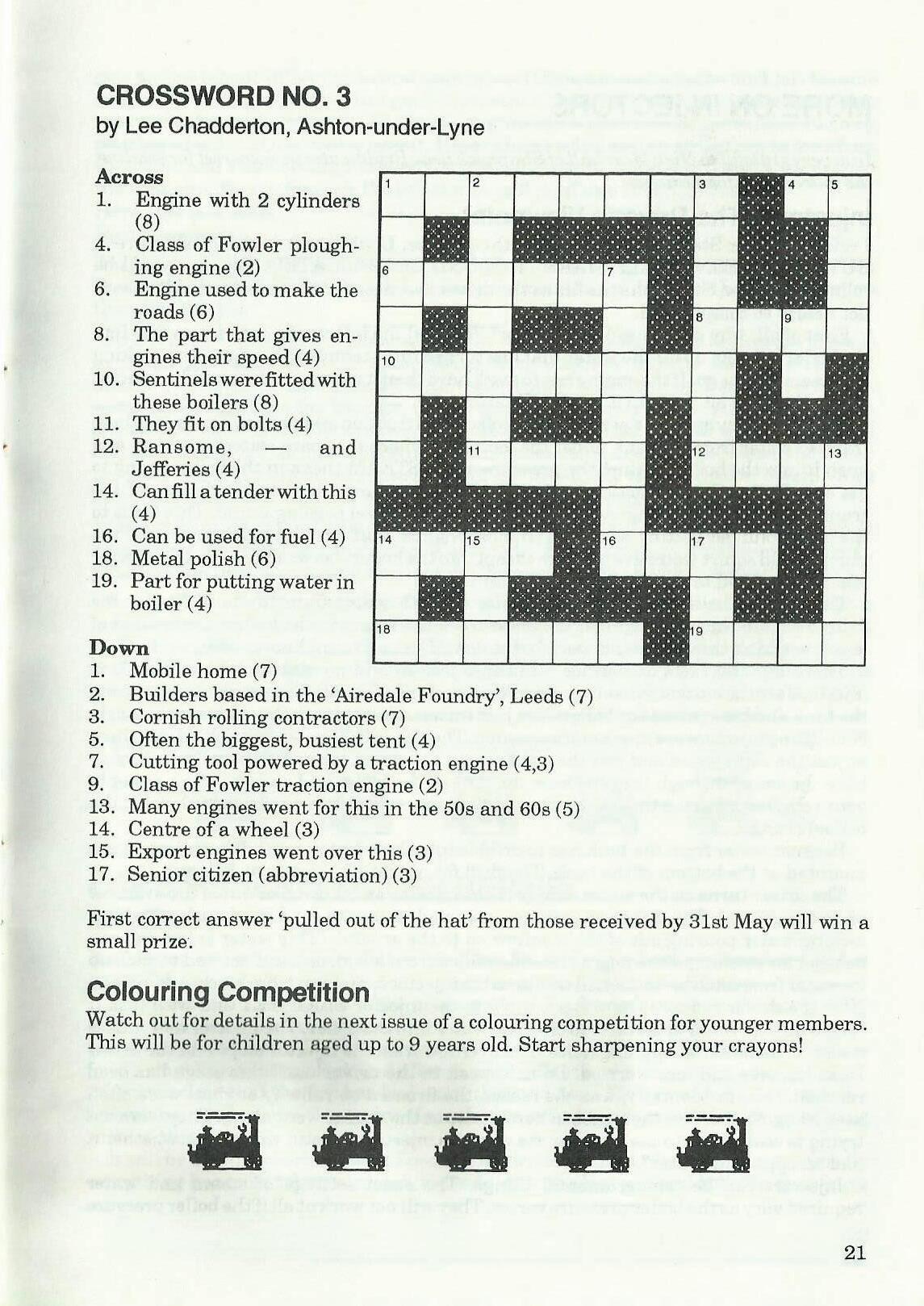
by Lee Chadderton,Ashton-under-Lyne
Across
1. Engine with 2 cylinders (8)
4. Class of Fowler ploughing engine (2) s
6. Engine used to make the roads (6)
8. The part that gives engines their speed (4) 10
10. Sentinels were fitted with these boilers (8)
11. They fit on bolts (4)
12. Ransome, and Jefferies (4)
14. Can fill a tender with this (4)
16. Can be used for fuel (4)
18. Metal polish (6)
19. Part for putting water in boiler (4)
Down
1. Mobile home (7)
2. Builders based in the 'Airedale Foundry', Leeds (7)
3. Cornish rolling contractors (7)
5. Often the biggest, busiest tent (4)
7. Cutting tool powered by a traction engine (4,3)
9. Class of Fowler traction engine (2)
13. Many engines went for this in the 50s and 60s (5)
14. Centre of a wheel (3)
15. Export engines went over this (3)
17. Senior citizen (abbreviation) (3)
First correct answer 'pulled out of the hat' from those received by 31st May will win a small prize.
Watch out for details in the next issue of a colouring competition for younger members. This will be for children aged up to 9 years old. Start sharpening your crayons!
I am very gra'teful to Nick Marshall of Shapwick near Bridgwater in Somerset for sending the following information:
I refer to Doctor Steam's explanation of the injector. Doubtless it is absolutely correct, BUT SHE DOESN'T HALF MAKE IT SOUND COMPLICATED. I'm sure you'll be relieved to know, Steph, that as far as the driver is concerned the injector and its use is not nearly so complicated.
First of all, why do we need the injector? We need the injector to put more water into the boiler to make up for the water that has turned into steam and been used up making the steam engine go. If the engine has to work hard then it uses up water quickly. In point of fact there's a bit more to it but this'll do for now.
Unlike rail way engines nearly all road rollers and traction engines have a pump to help transfer water from the tank under the footplate, where the spare water is carried, and push it into the boiler against the pressure of the STEAM that's in the boiler trying to get out. On nearly all traction engines and steam rollers the pump is driven off the crankshaft and is pumping away all the time the flywheel is going round. This leads to the pump plunger getting worn and on most engines that I've had much to do with the pump would squirt water everywhere except into the boiler- so we had to use the injector when we wanted to top up the boiler water level.
The injector uses steam from the boiler to push water from the tank (under the footplate) into the boiler against the pressure of the steam in the boiler. On the face of it you wouldn't think it would work but it does (Doctor Steam knows why).
There are two sorts of injector - lifting injectors and non-lifting injectors. Lifting injectors are the easiest to use (my oldAllchin had one of these). They suck up water from the tank and blow it into the boiler. Youjust turn on the steam to the injector and bingo. Non-lifting injectors are much more common. They have to have water trickled into them at just the right speed and just the right amount of steam too and then, with luck, they blow the water through the pipe from the tank to the boiler and soon (as often as not to your relief) you can see the level in the gauge glasses (which show the water level in the boiler) rising.
Because water from the tank has to dribble into the injector, non-lifting injectors are mounted at the bottom of the tank. The drill for operating them is as follows:
The driver turns on the water supply to the injector and it dribbles out of the overflow on to the ground. The driver then turns on enough steam to get a good gush of"white" looking water pouring out of the overflow on to the ground. (This water is hot and can be used for washing if the engine has been filled from a hydrant and not had to suck up its water from ditch bottoms.) All this time the injector is making "chack-ack-ack" noises. Now the driver reduces the water supply to the injector SLIGHTLYand with luck it "picks up" the water and starts to blow the water into the boiler. The injector now makes a sort of"aaaahhhhh" sighing noise. The overflow from the injector stops and the driver looks happier and less worried. Do not speak to the driver until this stage has been reached.This, incidentally, was the reason th~ firemen on railway engines were often seen hanging out from their cabs in heroic pose as the engine went along. They were not trying to cool off but to see whether the engine's injector was still working or whether it had "dropped the water".
Injectors can be temperamental things. The exact settings of steam and water required vary as the boiler pressure varies. They will not work at all if the boiler pressure
gets too low (about 70lb/sq .in. in our Aveling) or if the spare water in the tank has become warm, or if the injector itself has got hot because the driver is trying to make it go using too much steam. An injector that is playing up can sometimes be persuaded to go by pouring a bucket of cold water over it.Never go on and on and on struggling to match up the ste~ and water settings to start the injector. Turn offthe steam. Let the water from the tank dribble out through the injector to cool it off and then start again.
Hope this is of help.
Nick Marshall
Thanks Nick, that sounds much simpler! How about these instructions though from Penbarthy Products, from a time when a replacement Steam Jet would have cost no more than two dollars.
"TO START-Open full the globe valve Hin water supply first, and then globe valve D in steam pipe wide open. If water issues from overflow throttle the valve H until discharge stops. Regulate Injector with water supply valve, not by steam valve. When water supply is above the Injector, in starting, open valve H only a half turn and then open steam valve D full. Where two valves H and M are used valve M should be opened only about one half turn or a little more, this valve being designed to reduce the water pressure, valve H always being used to regulate the supply to the Injector. Steam valve must be opened full. One half your trouble comes from opening only part way."
And if that hasn't completely confused you, how about this information from A Textbook of Applied Mechanics and Mechanical Engineering by Professor Jamieson, published in 1921, explaining Bernoulli's Theorem, which is why it works:
".. .it will be readily understood that if a stream of water be rapidly forced through a tapered passage, its pressure may be so lowered below the surrounding atmosphere, that it can draw more water from another source connected to the smaller end of the taper. If the whole of the water be then conducted along a gradually enlarged passage, its pressure will increase and the outflow can take place at a higher level than the intake of the induced stream, but lower than the free surface of the driving water."
But, of course, Doctor Steam knew that all along!
It all began at Torbay Steam Rally in August. My uncle and I were taking Lord Fisher around the arena when we noticed some water coming out of the ash pan.
We steamed the engine out of the arena and quickly loaded it up onto the lorry. After which, Dad threw the fire out and sheeted the engine down. The next morning when the boiler had cooled down, Dad and some other engine owners (one of them mended boilers for a living) look.od1c-1tthe leak and after several coffees and a drop of the stronger stuff, it became clenr I.hut I.ha fire box had worn thin and Lord Fisher needed a new one. We haven't been ablo Lo wu the engine since then (not that it has stopped me from helping with another).
It will ho n nir\JUI' t>V6rhaulto fit Lord Fisher with new parts for the boiler as literally everything hn~ t.obQtaken to pieces, right down to the last nut and bolt. We then have
to take the boiler down to a specialist in Cornwall who will take the boiler's measurements and replace the existingfire box with a new one, alsomaking anewfront tube plate and repairing the shell of the boiler ifit is required. When this has been completed the boiler will come home and.Lord Fisher will be reassembled again. All of this is expected to take from three to four years.
The fire box has done very well as it was .Lord Fisher's original one which he has had for seventy-two years, and which has had numerous fires in it- I wouldn't like to think how many I have witnessed.
One of our steam friends said that he would try to get us some passes so that we could go to some of the rallies this season, and thatJonathan and I could help him on his engine, Aquarius.
We all look forward to a few years time when Lord Fisher is back on all four wheels and no longer has a stomach ache .
Small advertisements relating to traction engines and your hobby are free of charge to SAC and NTETmembers. Advertisements should be written clearly and concisely, must be accompanied by your membership number, name and address, and sent to the Editor before the copy date for the next issue.
Steam Apprentice Club BADGES £1.00 direct from the Chairperson, Sylvia Dudley, (address in front of magazine). Please enclose a First Class stamped addressed envelope and a cheque or postal order, not cash, payable to 'NTET'. MAKE SURE YOU SfAND OUT FROM THE CROWD-WEAR AN SAC BAOOE!
Copies of SAC magazine back numbers are available from the Editor, address inside front cover, for £1.00 each including postage. Please send cheque or postal order, not cash, payable to 'NTET' . The following issues only are available:
Volume 6 Number 1 Spring 1992
Volume 6 Number 2 Summer 1992
Volume 6 Number 3 Autumn 1992
Volume 7 Number 1 Winter 1993
Special discount for all four - £3.50 including postage.
The next magazine is due out in July. Please send any items, articles, photographs or other contributions to the Editor by 28th May.
I would like to join the Steam Apprentice Club
Forename(s) ___________ _ Surname --------(Block Capitals)
Address ----------------------------
Postcode
Tel. No.
Date of Birth ------- ----------
Please help us to make the Club more interesting to you by answering these questions:
1. Why are you interested in joining the Steam Apprentice Club?
2. What activities would you particularly like the Club to provide?
3. Do you already have access to a traction engine? (If yes, which one?)
Then send this form, with the £2.00 subscription to: The Membership Secretary, NTET, J.R. Cook, 25 Ripon Drive, Sleaford, Lincolnshire NG34 8UF
NOTE: Please do not send money by post. A cheque or postal order is much safer and should be made paynble to the "National Traction Engine Trust". Off ice U Only:
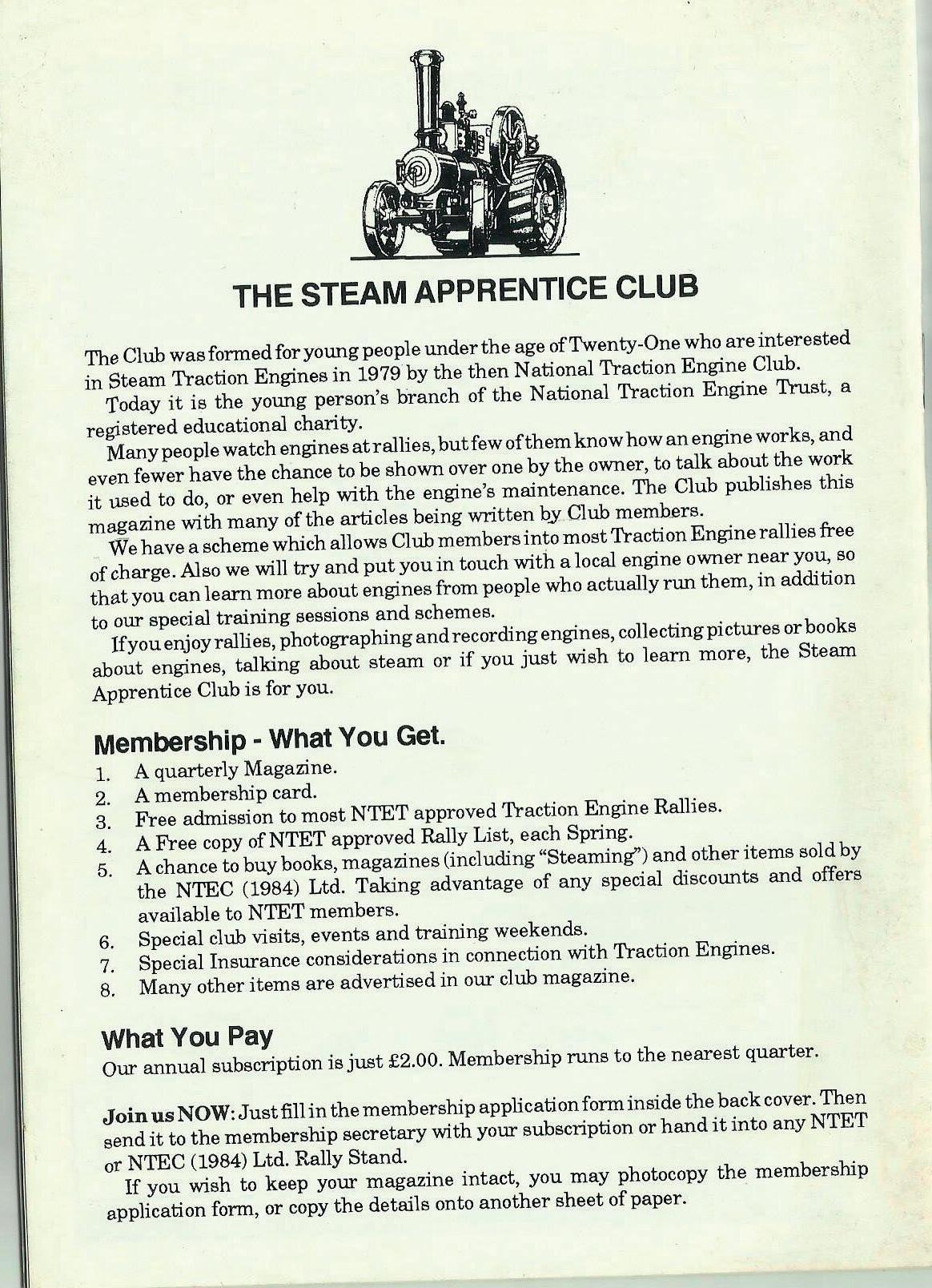
The Club was formed for young people under the age of Twenty-One who are interested in Steam Traction Engines in 1979 by the then National Traction Engine Club.
Today it is the young person's branch of the National Traction Engine Trust, a registered educational charity.
Many people watch engines at rallies, but few of them know how an engine works, and even fewer have the chance to be shown over one by the owner, to talk about the work it used to do, or even help with the engine's maintenance. The Club publishes this magazine with many of the articles being written b_yClub memb.ers.
We have a scheme which allows Club members into most Traction Engine rallies free of charge. Also we will try and put you in touch with a local engine owner near you, so that you can learn more about engines from people who actually run them, in addition to our special training sessions and schemes.
lfyou enjoy rallies, photographing and recording engines, collecting pictures or books about engines, talking about steam or if you just wish to learn more, the Steam Apprentice Club is for you.
1. A quarterly Magazine.
2. A membership card.
3. Free admission to most NTET approved Traction Engine Rallies.
4. A Free copy ofNTET approved Rally List, each Spring.
5. A chance to buy books, magazines (including "Steaming") and other items sold by the NTEC (1984) Ltd. Taking advantage of any special discounts and offers available to NTET members.
6. Special club visits, events and training weekends.
7. Special Insurance considerations in connection with Traction Engines.
8. Many other items are advertised in our club magazine.
Our annual subscription is just £2.00. Membership runs to the nearest quarter.
Join us NOW:Just fill in the membership application form inside the back cover. Then send it to the membership secretary with your subscription or hand it into any NTET or NTEC (1984) Ltd. Rally Stand.
If you wish to keep your magazine intact, you may photocopy the membership application form, or copy the details onto another sheet of paper.