STEAMAPPRENTICECLUB
ADDRESSES
The Membership Secretary, David Duffill, 181, Foden Road, Great Barr, Birmingham. B42 2EH
The Editor, David Hurley, Leyland, Willington Road, Kirton End, Boston, Lincolnshire. PE21 lNR
Assistant Editor, Graham Austin, 47 Sir Dar Road, Ipswich, Suffolk, IPl 2LD
South East Branch Officer, Peter Forecast, 5 Penney Lane, Stanford-le-Hope, Essex. SS17 8100
Kampshire Section Branch Officer, Stuart Gaines, A. Page, The Newsagent, The Square, Wickham, Hants.
rorkshire Branch Officer, Stev-en Gibson, 25 Mason Crescent, Sheffield, South Yorkshire. S13 8LK
We are pleased to consider articles of any length and or photographs for inclusion in future issues. All material so submitted is voluntary and payment cannot be made for any material so published. Please state if you require any part of your article returning, ie photographs. The opinions in the maga~ine, with the exception of club announcements, are those of the contributor and do not indicate the views of the club as a whole. All items are held copyright of the contributor and the club.
Next Issue: Any letters or other.items for inclusion in the next issue should be submitted before the last day of JULY.
This magazine is produced by the Steam Apprentice Club and printed by
EDITORIAi,
There could well be one or two members thinkine the S.A.C. is slippiine back into the old habits it developed a few years ago. The late publication of the magazine being a classic symptom. I would like to apologise for this issue and the free list being so late, but, this does not mean a repeat performance of those not so good years. The problems tha.t have enveloped the club over the lc1.st few months have been at a committee level and have been completely beyond our control.
Happily with the publication of this magazine those problems will be behind us and we can all get on with what we are supposed to be doine. Havine said all that there are still no articles comine from you the members. In fact most of the material in this issue has come from 'Steaming•, the big brother to our magazine. I will leave this time with a request that you read carefully the obituary in our club news, in the hope that everyone will take notice and think.
CLUB NEWS
OBITUARY. STUART SOLOMO~
To lose a senior member of our fraternity is always a great loss, but when someone on the threshold of life passes on, it is even harder to bear. The recent tragic death of 13 year old Stuart Solomon has stunned the county's steaming community. Stuart had inherited his dad's passion for the steam engine and from an early aee showed signs that he was to become a competant enginema.n. When junior membership was introduced to the West of England Steam Engine Society a couple of years ago, he was one of the first to join and soon proved that not only was he the practicle sort but could also prove himself in literary terms, submitting an article for inclusion in their quarterly magazine that any adult enthusiast would have been proud to of written. There are few young enthusiasts that stay the test of time but Stuart was certainly one of them. Many•s the time that my own son, .Scott; would come home from school and remark on yet another steam project that Stuart had told him that he was embarking upon 1 It was his way of life and he was never happier than when he was workinff op one of his stationary engines or helping with the res1.oration of "Phoenix", the family's traction engine. In his youne life he had achieved more than less inspired beings have done in their entire lifetime and when "Phoenix" once again
returns to our rally fields she will be a fitting tribute to one whose enthusiasm was the main inspiration of her rebuilding. Stuart's parents, David and Eliza.beth can be justly proud of him. Our thoughts are with them during this time of bereavement.
Alan Thomas 2 June 1991.
I have recently received a letter asking me to print the following somewhere in the magazine. "Congratulations to Mr Steven Gibson on his recent engagement to Miss Georgina Ianson of Darlington." Signed "A friend of both parties."
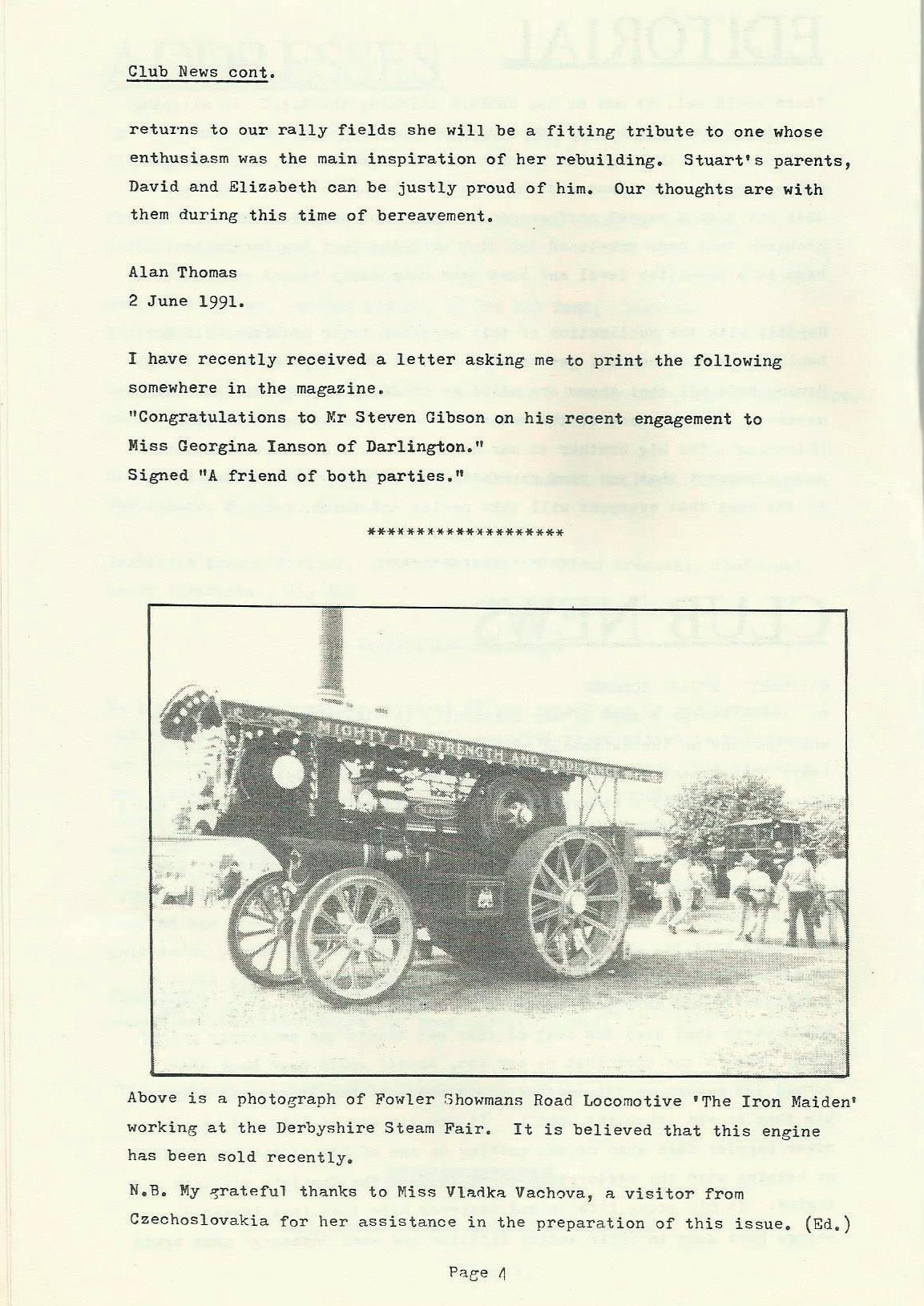
IAbove is a photograph of Fowler Showmans Road Locomotive 'The Iron .Maiden' working at the Derbyshire Steam Fair. It is believed that this engine has been sold recently.
N.B. My ~rateful thanks to Miss Vlarlka Vachova, a visitor from Czechoslovakia for her assistance in the preparation of this issue. (Ed.)
\fallis &:Steevens Compound Roller 7742.
Our roller was supplied new to Southampton Corporation in Hampshire on 29/8/21.on the 30th of October 1~30,it ran away down a hill into the public baths.Luckily nobody got seriously hurt,but the roller's chimney got bent back and the back wheels got broken. If you ever see the roller you will see it has got 'John Allen of Oxford' back wheels, because they were cheaper replacements than original 'Wallis & Steevens' wheels.
In the late 50's it was sold to the ex showmen Bakers of Southampton, who bought it for commercial rolling then Bakers turned into a haulage company. They also owned a Wallis Advance steam roller.
My dad asked if he could buy their compound roller and they said no he couldn't buy that one but he could buy the Wallis Advance. He didn't want to buy that as all the brass work was missing.
A few years later he went back again and asked if he could buy the roller and this time they said that he could.My dad was 18 when he bought the roller.
When he got the roller home he got the lorry to push it down the path. He wanted to park it up behind his da·ds garage so he filled it up with water oiled round and lit up and a while later he had got steam up and he reverses up behind his dads garage.
He put a new set of tubes in the roller, straightened out the back of the tender and gave the roller a coat of paint. In 1982 dad put a new tubeplate,smokebox and another set of tubes in.
We do most of the rallies in Hampshire, •rhe Great Steam Fair and also one on the Isle of Wight on the bank holiday.
Dorset August
I had my first steam lesson when I was six weeks old. For many years I have polished the roller and now I am taller I can steer on the road. I steered on the road to Netley Marsh steam rally which is about 16 miles from home.
Paul Honeybun
(1313)
GETTING
HER ON.
By W. M. Salmon.
In making this second offering in an occasional series on the less commonly discussed aspects of shunting about with engines, I would like to make it clear that I write as an amateur, for amateurs, and base my· remarks on the sort of muddles I have got into myself, or seen others of similar inexperience get into. The experianced "Old Timer" may well wonder what all the fuss it about, but then, the first time he tried to put an engine on a lorry he had already had much more experience of straightforward driving than many of us will ever have.
Increasing traffic congestion on the roads, increasing price of coal, and frequently, the lack of the spare time for long journeys, have all contributed to make the use of low-loaders for the transport of our engines a much more common practice, and this trend is cer-tainly assisted by the very generous help given to enginemen by some of our lorry-owning members. Thus the ability to load or unload his engine is something which every owner should acquire. In many cases the lorry may arrive with a one-man crew, and he without any idea of engine-driving, so the owner has no option but to load his engine himself, and in doing so to advoid damage to what may well be several thousand pounds-worth of lorry.
Most low-loaders c.~re referred to as having a. "knock-out back axle", although in fact two short axles carry the four wheels, and these are readily removed once the weight of the platform has been taken on jacks. The driver must take charge of this operation, but he may be glad of some assistance if this can be given without interfering with his usual routine. Some firms supply quite elaborate skids, and the use of these makes loading very simple, but in the general run of heavy haulage work sleepers are more versatile and so are commonly used. They are supported on packing, and usually there is n)thing to prevent them moving endwise, unless the lower ends are pres$ed into soft ground. Thus, when loading on a hard road it is essential to use the crab-winch on the lorry to ease the engine up, a very little steam being used to tak.e som~ of the weight and assist the winch-crew. Otherwise it is very simple to cause the engine to "kick the skids out from under her feet'', when she comes down with a bang onto the road, and may \1ell put a s:<id, a block, or the rear ~dee of the lorry through her ash-pan or back tank. Worse still, she might kick one out and tip over. Therefore, use the winch-you can always get that critical by-stcnder to llelp turn the handlet
Rollers are something of a problem, ,md while two sleepers can usually be placed so that the front rolls run on the inner sides and the rear rolls c~tch the outer sides, it is safer, if possible to use four sleepers, for if the weight bears on less th1:m he,lf the width of the sleeper the latter may twist over, and down she goes.
The decisi0n as to whether the en~ine shall ride facing backwards or forwards must, clee.rly, be t;;(ken before Ol)erations commence. If the load is anywhere near to the rat-2d capacity of the lorry it is generally better to load frontwards, for then the hettvier rear axl-e of the en~ine is ne·,r the rear trailing axle of the lorry, vrhich is
usually more fitted to take it than the driving axle. With rollers, however, it is often better to go up backwards so that the winchrope can··be· counled to the only proper coupling available.
Once on it should be checked that the engine is either quite central on the-bed of the lorry or a little to the off-side to allow for the camber of the road. It should never be off-set to the nearside. Securing the load is again the resoonsibility of the lorry driver as he has to drive it, but if the winchrope is tight with the eneine herd up to the swan-neck of the lorry the main stress is accounted for. Chocks can be nailed to a wooden lorry bed in front of the engine rear wheels and the winch tightened to pull her hard onto them, while quite small wooden strips similarly nailed outside (or even inside) her wheels will prevent her moving sideways. If the bed is metal, a chain on the engine coupling pin may be taken to each side of the lor1·y. Except where the engine overhangs the width of the lorry and there is absolutely no tolerance for any sideways movement, the merciless use of securing chains round painted wheel rims and spokes is just not justifiable. The loading of lar~e engines on lorries which are really too small for them is a higly specialised branch of the art which must be left in the capable hands of accepted experts.
As to the management of the enP,ine, it is convient to have half a glass of water, for she iA to be ~uite considerably tilted, and she is neither to dror her plug or prime. About half her full working pressure is usually enough too, and renders her more docile for following the winch-rope. ThP.re should be very little fire. Once 01, she may be filled up with water, the damper dropped, and a lid placed on the chimney. If you cen arrange things that she arrives at her destination without having blown off and still with enough steam to unload you have done v~ry well. llsually it is convenien.t· to stop 5-10 miles from journey's end and either relight or make up the fire, and remove the chimney lid.
While it may be permissible to load with the front of the lorry slightly down-hill to reduce the amount of climb for the en~ine, a nice level place is better for unloading. The chocks are removed ~·ith the weie-ht on the winch and she is quietly allowed to roll down the sloping lorry- bed and skids as the winch is slacked out. At the bottom of the skids it may be required to give her just a idsp of !;team to move her clear, although on a hard level road a dead engine may be m)re conveniently unloaded on the road, and later pushed clear of the highway with a nushpole or even a oiece of stout board against the front couoling with which most low-loaders are equipped.
The practice of letting go the winch-rone and driving the engine off is '1Uick and excellent wher~ oronerly secured skids are in use, and experts are at work, but .,,ith an amateur on sleepers the meth0d outlined is sl~wer, but a lot safer.
Lest anyone t,e tempted to unload or. ;;, down-hill, thinking to get more assistance from gravity, the sad tale may be told of the roller that ,,:a.s so unloaded, not so very long a~o. Perhaps she was short ~f water, but the fact was that she was off the lorry, away down the hill, through the parapet of a bridge, and wallowing on her side in the brook before anything could be done to stop her. This involved a lot of work, for there was the roller to s~lv~ge, the brid~e to mend, ahd a econd roller to be fetched to do the job the first one had come about.
Low-loaders are expensive, and owners of tractors and other small engines are sometimes tempted to use an ordinary platform lorry. This is quite satisfactory as long as two elementary points are considered. Firstly engines are usually heavier than their names imply. A ''5-ton" tractor is more likely to be 6-7 tons; an 118-ton" roller ·may well be ten. Also the centre of gravity of an engine, considered as a load, may be rather high. For both these reasons it is required that the lorry used shoud be rated to carry, say, 25 per cent more than the known weight of the engine. Secondly, an engine being loaded onto a platform lorry MUSTbe loaded off a PROPER LOADINGBANK. True, engines have been loaded off hedgebanks and various temporary erctions, but this is al1·•ays inadvisable and is never a job for the beginner. Suffice it to say that following many accidents the loading of even farm tract,-,rs by these methods has been prohibited by many firms, despite the extra expense that may be entailed. Even though it is well within the rated load of the lorry the whole weight of an engine is carried at only four points on the bed, so slee~ers are usually required to spread the load, at least two for each back wheel, while half-sleepers may be handy in front. The rear axle of the engine MUSTbe loaded within the wheelbase of the lorry, so if the lorry bed is not such that this is achieved with the engine lookong forwards, she must be turned round, otherwise the lorry will be unsteerable. Naturally there will be no winch on such a lorry and the eneine must ~o on under power, either her own or that of another engine. 3efore doine this the extreme rear of the lorry should be supported on jacks to ·•revent dc.1mage against the face of the loading bank, aud measurements should be taken to allow of a good big block beiug put down each side of the lorry bed for the engine rear wheels to come up to. Thus-wise there will not be even a little dent in the back of the lorry cab.
Securing an en~ine on :, pln.tform lorry must not be either hurried or s\dmped. It is no good to say "We are not going far". If she comes off the results are q_uite independent of the distance travelled. You h<we the best part of a full load, all in one oiece and on wheels. It is high enough off the ground that if it moves it will be sure to tip over. Unless the lorry h,,s unusually good securing arrangements it is probably safer to j:..ck the en,o;ine aud pack her securely beneath the back t1.:.uks and the front axle so c:.s to stop her tending to roll on her wheels at all.
~ith the increasine use of lorries ti1are is no doubt that our Rallies h, 1ve lost somet,.ing. In the early days we needed no .judges. You h..,d come ten, forty eighty miles, and to prove it you were there. Since then there has pas1:ed by the full economic lifetime that many m.:,kers expected of their engines, and as our veterans get older and older it bec-:>mes less and less justifi,.ble to chas<! them about on lone journeys. Thus what once savoured of ''cheating-", has now become the accepted things to do.
A last word of warnin.o;-if the weather is very wet take extra care. Wet timbers, wet mud and wet lorry-loads :-:.re sli!"'nery and treacherous to both enr-;ines and men. He!=:ist the temptation to rush toe-et out of the wet, rather take time, Dnd avoid an accident-and that h1lds good for a dry da_y too, come to that.
LEND US YOUH PUSHPOLE.
By W• .M. Salmons
YES, "Lend us your pushpole"; it is so often a cry of the driver of a disabled engine, or of a Good Samaritan who is prenared to a.s~ist one. As such it is usually a difficult re~uest to refuse, yet, all too often, a pushpole is handed over, never to be returned in its original form. Even with experienced men in charge, pushpole do get bent and broken; with inexperienced drivers they very frequently suffer. Invariably this is due to "pinching" the nole against the coupling when the two engines get out of line. It may be helpful therefore to see how this happens.
The case of the towing and shunting of a dead engine will be considered. Similar operations with A. trailer, threshing drum, etc. will obey the same laws, but the dead engine represents the most awkward case owing to the lar:"$e part of the weight bearing on the rear wheels. Also for most of us today, it is the more common case.
To tow an en'sine along the road on a stiff pole sounds the simplest of operations. On the level and uphill it is. As long as the dead engine is steered to within a yard or so of the track of the live one no harm will be done. The tension in the b~r will tend to correct any steering errors, even to the extent that on most surfaces an engine with its steerin~ locked straight would tow in some sort of a fashion. Trouble occurs as soon as the pushpole comes into COMPRESSION. This can happen when stonping on the level, when descending hills, or when pushing the dead engine during shunting movements.
It will be apparent that the very force, which in the towed engine tends to keep it in line, will, when reversed, tend to thrust it further out of line. In either ca.se the sideways effect of the nushpole is resisted by the resistance to sideways movement of the front wheels. This is ~enerally not very high, owin~ to the small prooorti0n of the total weight of the engine which rests on the front wheels, and it is reduced to a very low figure indeed on greasy muddy surfaces. Thus at all times when the pushpole is in compression it is very important to keep the two env,ines a.s clos•'ly in line as possible. Wh8n descending hilla it is wise to use the dead engine's brake, or put her in gear, despite the obvious competence of the leadin~
engine to hold her, to reduce the "push'' in the pole and so prevent this tendency for the front end to slide over to one side. The commonest case of this is when entering a ,gate, when the cambP.r of the road will act as a considerable gradient on the rear wheels. As the engines are bound to be at an angle to each other on the turn the dead one may rear over quite suddenly and damage pushpole and gateuost. This can easily be prevented by use of the brake. If this is not serviceable the towed engine should be steered on a slightly smaller circ:e than the live one, and the driver should take things very steadi!y indeed to give the towed steersman every opportunitu, and in particular should avoid checking suddenly when on the curve.
When a dead engine has actually to be pushed, as in the confines of a yard, it is essential to try to keep the pushpole in line with both engines if possible, and if not, then in line with the one who~e front coupling is in use. On rough or slippery ground it may be better to couple the engines back to back, when advanta1;e may be taken of the triple rear couplings to keep the pole lined up.
Now let us suppose that despite all care, the pole has ~ot to an acute angle and the two engines are obviously in danger of closing up. Any movement of either may lead to disaster. What should be done? When shunting, the first thought should be "Block up". Block the rear wheels, between the engines so that they canr,ot come to<>;ether. The live engine may then be eased away and uncoupled. After ~etting her lined up -\;he p?le may be counled up again and operations continued.
If you are being chased down a hill by a dead engine and the pole is getting b,"dly out of line you are in an unenviable position. It may be possible to ed,~e out in the ri~ht direction to correct the alignment, and the crew of the towed en,-;ine should try to bring their charge into line, and at the same time to aoply any brake-power they may have. Under no circumstances should the leading engine be checked suddenly, and on a short slope such as a camber or hump bridge it may be possible to keep out of trouble by accelerating slightly so as to reduce the comnression in tlte pole. However on all but the shortest hills this may b-- a rather desperate ex[)edient, but has been used to give time for the brakes of the towed en~ine to be applied.
Finally rnake sure tho.t the pole you are using is adequate for the type of en~ine to b~ towed, ;,.nd th.tt the conpline pins are adequate and not
-excessively fatigued. Stresses in the nole and pins during towing can be very severe between two such heavy vehicles. A light pole which had towed an engine 100 miles behind a Land Rover failed a.t once when used for the same engine, but behind a road locomotive. 3reakaways have occured in the past, sometimes without a lot of damage, but with modern traffic we just cannot afford to risk such an event. When travelling any distance on the road a safety chain should always be rigged in addition to the pole.
And when the job is done, don't forget to take the pole back.
A ROUGH GUIDE TO THEAPPRENTICE
By JOH~: HANCOX.
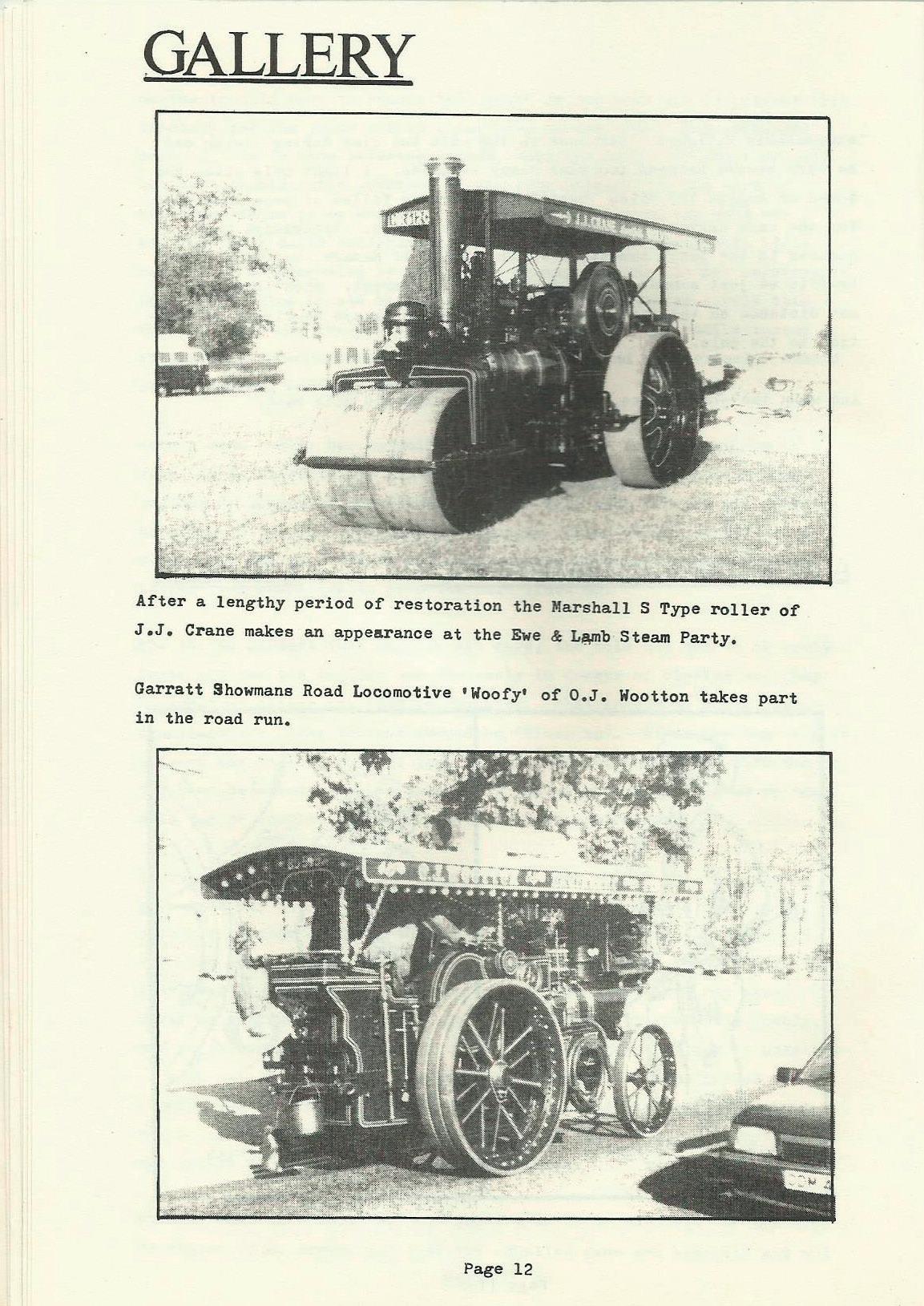
After a lengthy period of restoration the Marshall S Type roller of J.J. Crane makes an appearance at the Ewe & L~b Steam Party.
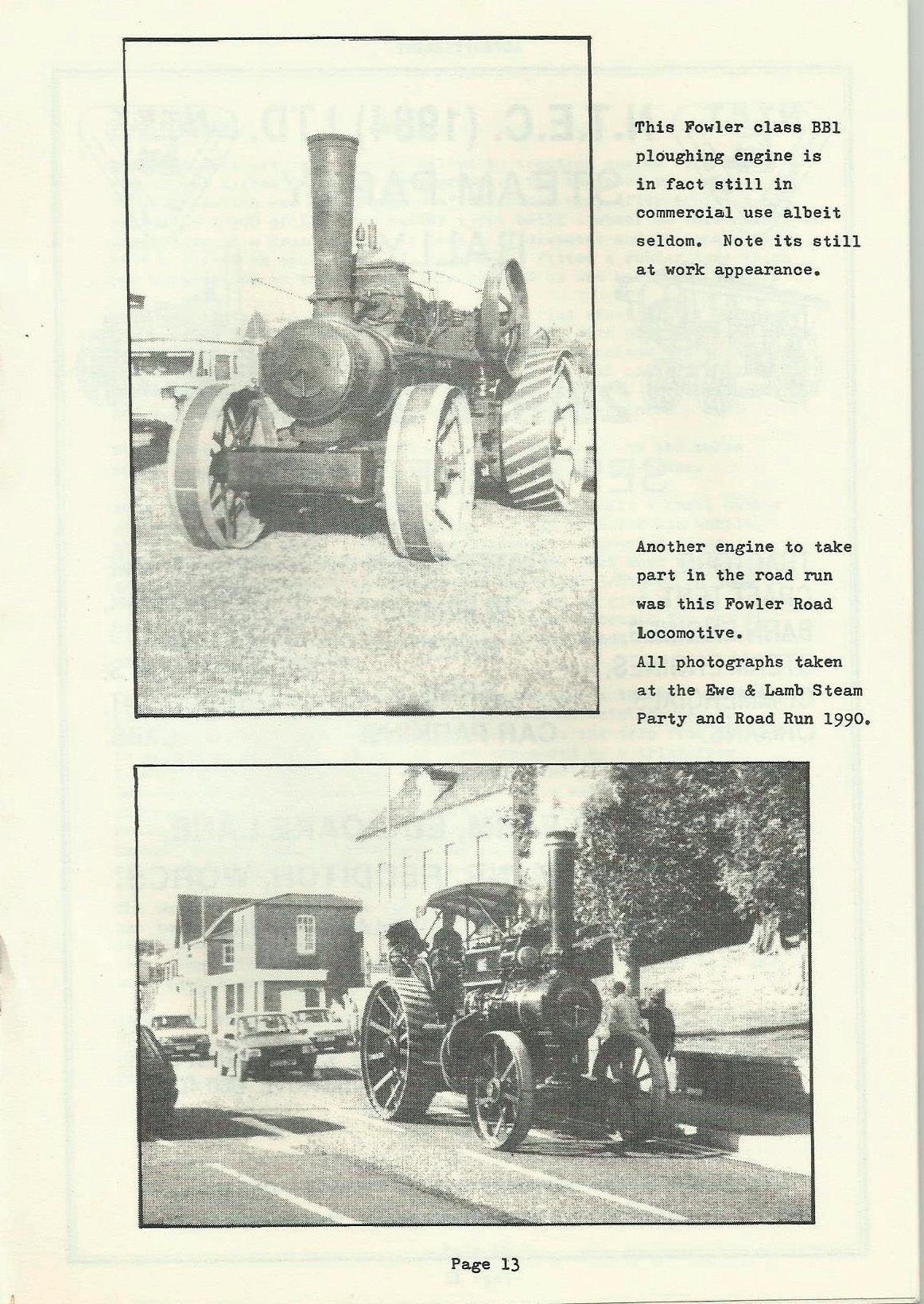
Garratt Showmans Road Locomotive 'Woofy' of O.J. Wootton takes part in the road run.
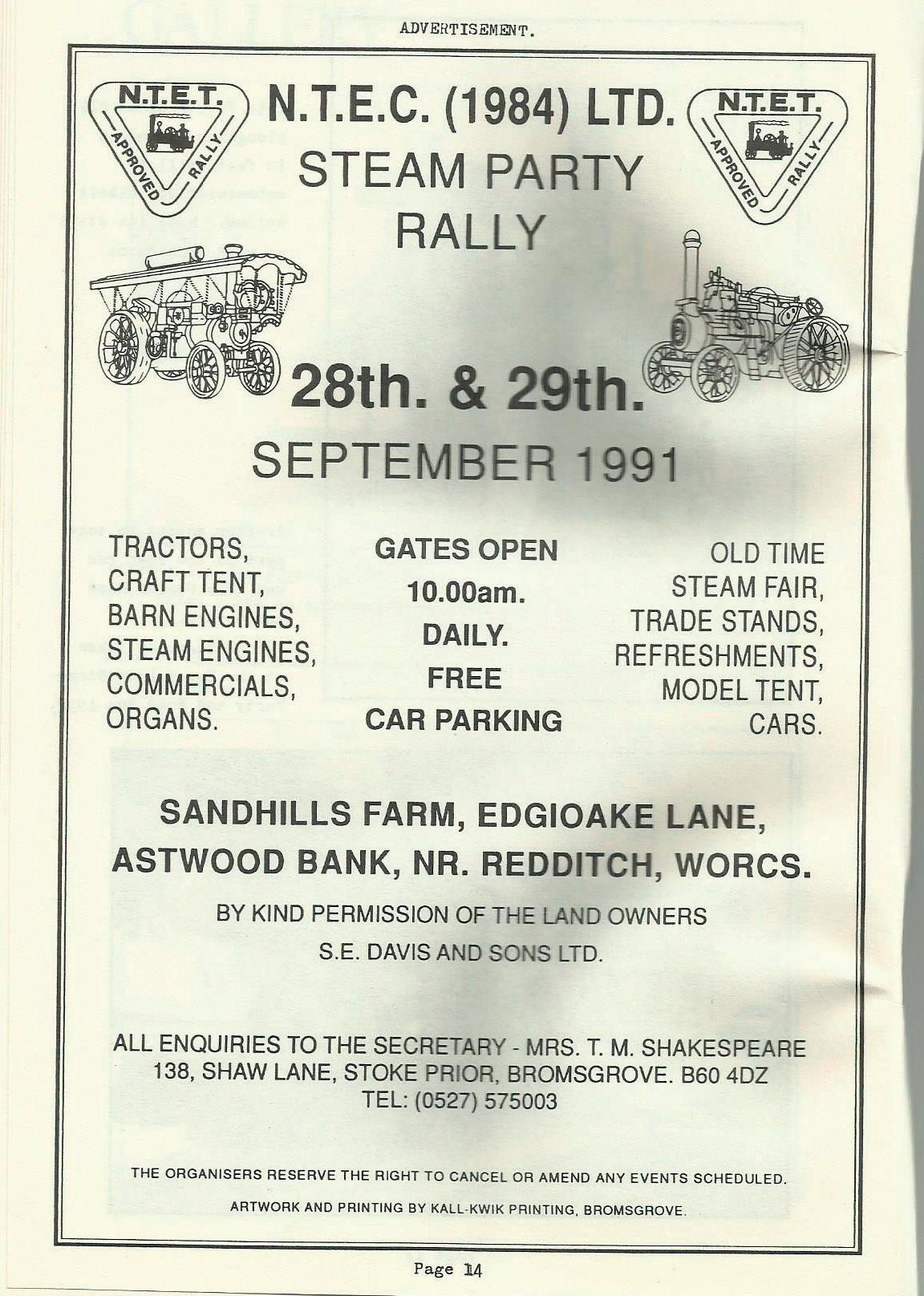
This Fowler class BBl ploughing engine is in fact still in commercial use albeit seldom. Note its still at work appearance.
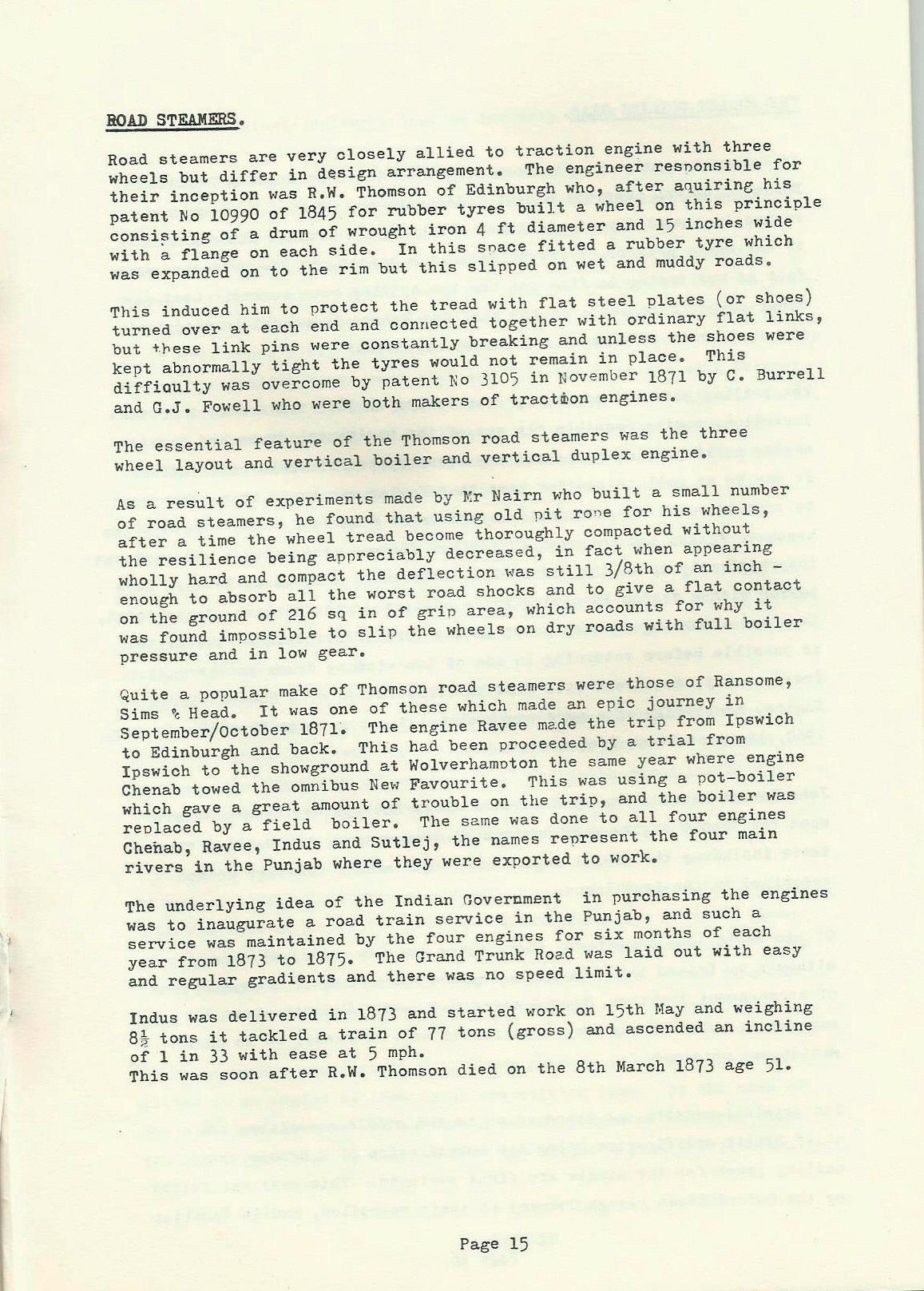
Another engine to take part in the road run was this Fowler Road Locomotive.
All photographs taken at the Ewe & Lamb Steam Party and Road Run 1990.
ROADSTEAMERS.
Road steamers are very closely allied to traction engine with three wheels but differ in d~sign arrangement. The eneineer resoonsible for their inception was R.W. Thomson of Edinburgh who, after aquirine his patent No 10990 of 1845 for rubber tyres built a wheel on this principle consi~ting of a drum of wrought iron 4 ft diameter and 15 inches wide with a flange on each side. In this snace fitted a rubber tyre which was expanded on to the rim but this slipped on wet and muddy roads.
This induced him to protect the tread with flat steel plates (or shoes) turned over at each end and connected together with ordinary flat links, but tpese link pins were constantly breaking and unless the shoes were kept abnormally tight the tyres would not remain in place. This diffiaulty was overcome by patent ~o 3105 in November 1871 by C. Burrell and G.J. Fowell who were both makers of tractmon engines.
The essential feature of the Thomson road steamers was the three wheel layout and vertical boiler and vertical duplex engine.
As a result of experiments made by l\'.r l~airn who built a small number of road steamers, he found that using old pit rone for his wheels, after a time the wheel tread become thoroughly compacted without the resilience being appreciably decreased, in fact when appearing wholly hard and compact the deflection was still 3/8th of an inchenough to absorb all the worst road shocks and to give a flat contact on the ground of 216 sq in of grin area, which accounts for why it was found impossible to slip the wheels on dry roads with full boiler pressure and in low gear.
Quite a popular make of Thomson road steamers were those of Ransome, Sims~ Head. It was one of these which made an epic journey in September/October 1871. The engine Ravee ma.de the trip from Ipswich to Edinburgh and back. This had been proceeded by a trial from Ipswich to the showground at Wolverhamoton the same year where engine Chenab towed the omnibus New Favourite. This was using a pot-boiler which gave a great amount of trouble on the trip, and the boiler was reolaced by a field boiler. The same was done to all four engines Chehab, Ravee, Indus and Sutlej, the names represent the four main rivers in the Punjab where they were exported to work.
The underlying idea of the Indian Goverument in purchasing the engines was to inaugurate a road train service in the Punjab, and such a service was maintained by the four engines for six months of each year from 187 3 to 1875. The Grand Trunk Roa.d was laid out with easy and regular gradients and there was no speed limit.
Indus was delivered in 1873 and started work on 15th May and weighing 8¼ tons it tackled a train of 77 tons (gross) and ascended an incline of 1 in 33 with ease at 5 mph. This was soon after R.W. Thomson died on the 8th March 1873 age 51.
THE R>WLERCOILING GEAR.
At Woburn recently a well known member of the East Anglian Traction Engine Club was observed almost underneath the drum of a ploughing engin~ in a most devout attitude. It being an unusual place and time to say one's prayers, I investigated the matter, to discover that in fact he was trying to find out how the coiling gear worked: Lest any other member attempt to do the same and become impressed instead by the hind wheel, I venture a brief description.
The coiling gear introduced by John Fowler in 1863 was a most important invention, making possible the use of the horizontal druma and double engine working which outlasted any other s.,stec of cable cultivation. It may be as well to mention here that Fowler was by no means the first to turn his mind to cultivation by means of a cable system. In 1855 the brothers Fisken had patented an endless flyrope system• which was employad intermittently up to the mid 1880•s. Meanwhile Howards of Bedford were toying with a system involving guide pulleys in the corners of the fie]d, the rope absorbing as much power in the form of friction at the pulleys as possible be·fore returning to one of two winding drums on the engine. Incidentally, enquirers will find an illustration of a Roward Ploughing Engine, Admittedly of a more conventional tyPe, on page 22 of the Spring, 1960, issue of Steam Preservation.
John Fowler himself employed several different systems before he hit upon the double engine with horizontal drum method, his earlier experiments inoluding the single engine clip drum anchor carriage method described in the last issue-.
Of his basic 1863 invention, then, there are two prir,ciDal types, although my friend the l:ite M. H. Royston l.'<Usnected., fro- exa:iination of arran&ement drawings, that a third was used. Un~onuna~el'")' the en~ines to which it may have been fitted went overseas, so no confirmation was obtained.
The 'original pattern was standcrd up to the middle seventies, the chief det~il modification being the substitution of a double armed coiling lever for the sin~le arm firs~ emnloyed. This ~ear was fitted by the Oxford Steam Plough Company to their re-builds, and is familiar
to us on the sin~le cylinder ingines formerly owned by Messrs. Beeby.
The action of this and the later tyne of gear is as follows. The coiling lever is pivotted below the winding dr-um and carries guide pulleys at the other extremity to lead the rooe onto the drum. For every revolution of the drum these pulleys rise or fall a distance e:·1ual to the diameter of the rope. It will be easiest to take an example from actual practice and so we ~ill consider a drum 12 coils deep of}" dia. rope, i.e., the actual depth of drum would be 911 • The outer end of the coiling lever must rise and fall 8-!" ( the distance between the centres of the top and bottom coils) while the drum makes 24 turns. This is effected by a die fixed between the coiling lever arms engaging a cam path on the perimeter of the tappet wheel rotv.tiite' on the drum stud. On this stud, im1,1ediately below the drum, is fixed the clutch wheel having 25 teeth: below is the tappet wheel with, above the cam path, 24 teeth. A double pinion with 12 teeth is mounted on a pin below the drum and is carried round with it, rolling in the stationary clutch wheel and also engaging the tappet wheel. Since the latter has one tooth less, the motion of the pinion causes it to turn one tooth.
In the later type of gear, the tanpet wheel has 24 internal teeth engaging with a 23 tooth eccentric wheel. This latter is carried on an eccentric extension of the drum bush and rolls round inside the tappet wheel; as it is held by a stop from rotating, its movement causes a one tooth per revolution turn of the tappet wheel.
It must be emphasised that ea.eh coiling gear is designed for its own drum and size of rope; the drum must accommad~te the intended number of coils and the ro~e must he neither too large nor too small. (Old steam ploughmen know that drums may be packed out a little if a new rooe is on the large side, but only a trifle.)
It is generally ~ossible to tell which pattern of coilin~ ~e ,r was fitted to an engine by lookine at the coiline cage. In the ca.se of the old type the cage 1-:as supnort.ed on the bot tom of the drum stud: the lat'.:!r type cage is c,.•1-ried from the boiler b· r.rel and firebox.
ZXPLOSIONAT EAST HANNINGFIELD.
Taken from 'Steaming', Vol. 30. No. 3.
On Monday 8th October 1866 an inquest was held at East Hanningfield on John Saunders, killed when a portable steam engine exploded on the previous Friday afternoon. The jury had gathered at the sc·ene of the accidentLittle Clayden•s Farm, East Hanningfield, a village some five miles south east of Chelmsford in Essex -and The Chelmsford Chronioal for Friday 12th October recorded that they heard enough from a variety of witnesses to ~eturn a verdict of accidental death, though as we shall see, that verdict had an addendum.
The accident, which the local press described as 'dreadful••• of a character and extent happily unknown in Essex', followed the anrival of the threshing s-et at the farm about 2pm. The farms occupier, Jeffery Ambrose, had hired the engine from John Brown of Victoria Road, Chelmsford for the purpose of threshing peas. The equipment arrived with no less than fourteen men in attendance, all under the charge of John Saunders, aged 50, of Rayleigh. The engine was put near the barn, filled with water to 'overflowing' and the fire lit. An hour and a half later there was 45 lbs pressure, enough to start work though the jury was told they could have had 80 lbs -and Saunders put on 'the strap' and started to run the machine. However, the belt almost immediately slipped off; then, just as the engine was started again after replacing it, the boiler exploded.
Saunders was hurled 17 yards into a shed, killing him on the spot. Others were shockingly soalded. The engine was thrown four to five yards and the barn set alight. Quite obviously chaos must have reigned, though a police constable passing by with a prisoner stopped to give help. The inquest jury learned Saunders had been with engines 'a long time', though he had merely been employed as a feeder until he was given charge of the engine at the start of the 1866 season. The engine's owner, Brown, told that the portable had been to Messrs Eddington's {of New Street Ironworks, Chelmsford, later to become Eddington & Steevenson) in late July for repair. For the sum of £57 they had put it in thorough working order and the mechanical parts were said to be as good as new, though Brown claimed
'the slides did not work exactly to my satisfaction, but that would have nothing to do with an explosion.'
Thomas Mercer, an engineer, gave evidence. He had been employed by Coleman & Morton, ironfounders and millwrights of London Road Iron\·nrks, Chelmsford, for 30 years and considered the exploded boiler was in a decayed state, its iron 'perished'. He thought the engine had probably had one or more replacement fireboxe~ in the past. The cause of the accident he wouldn't care to state, but thou~ht the corroded crown plate w~s not strong enough - and he agreed it was something an examination in .Tuly should have discovered The Coroner at that stage regretted that Eddingtons were not represented at the inquest - Brown said he had advised them of the explosion on the Saturday, but could not say why they hadn't sent a representative. Mercer gave further information: the en~ine w;,s 'from as eminent a manufacturer as can be found in England' but en~ines wore out and his firm (Colemans) had some in their yard which were standing because they were n0t worth a new box -he thou~ht Mr Brown's en~ine should be so classed. (Colemans advertised in contemporary issues of the Chelmsford naper, offering fireboxes and 'several excellent secondhand engines for sale'. They themselves built a small number of portables.)
Summing up, the Coroner said he would not adjourn the inquest - Eddingtons should have b~en present and all the evidence would be published and the firm could write to the press if they wanted. Obviously he felt what had been told was a strong indictment a~ainst the firmt The jury returned Accidental Death, also •expressing their regret that Messrs Eddington had not thought it proper to attend.'
Drown by these comments the following week's newpaper carried a statement by Eddingtons that they had not yet received a report of the cause of the explosion. It was the week after before the firm could publish its defence. By then they had a report by Robert Longridge of the Manchester Steam Boiler Insurance Co attributing the explosion to the weakness of the outer firebox, the plate forming the left hand side bein~ seriously weakened by a large piece cut out to f0rm a manhole, , nd moreover it being brittle in ·1ua.lity. 'f'he crown plate was not worn, and the firebox stays were properly secured (the latter had
.been doubted at the in1u~st). But Longridge carried on: 'Althou~h I do not consider you ou~ht to have condemned the boiler when under repair, I thing both you and the original maker of the boiler shnuld have observed that it was seriously weakened by the manhole, which was without any stren~thenin~ rin.o;.' He further observed that there had been several similar cases lately.
By this time in the narrative the reader will realise the maker of the portable has not been mentioned. Strangely, no record of this appears in the press reports, thought of c~urse, the main puroose of the inquest itself was to resolve the cause of death, not to apportion blame as inquiries under later ~oiler Explosions Act were to do. Eddingtons, through their belated response to the ,;ury' s doubts, cle::rly felt their diligence had been questioned, and were orobably sufficiently satisfied with Lon~ridge's report to let be nublished in renly to the .;ury•s remarks, dammning thou~h it may have been to their local trade.
However, rumours must h:ive snrc d, "or one maj0r en~ine builder felt their reout3tion w~s on the line. On 9th hovemb:r 1q66 the Diss Express published a letter from Ransomes Sims of Ipswich regarding the Chelmsford explosion. 'An account ... having appe;;.red in !'\everal of the local newspapers in this district, and with it a st~tement that the Engine W3.S made by Ransomes :iims, we have the fullest authority for contradicting this st:1tement and can positively affirm that the En.~ine was n ,t of our make, nor have we at any time had anything to do with it. As a false statement of grave importance has thus been made, ,,nd widely circulated, to the nre_judice of our manuf,.1.ctures., we must request you eive this letter due nrominence in your next impression. 'le think it orobable that the error arose from the fact that the threshing machine, which was abo11t to be driven by the eno;ine ... was one of our :nake; but this, of course, had no influence up,m the ens;ine ..•. We are happy t"> ~tate th:it no boiler of our make, amon~st the many hundreds we hqve sent out, to the best of our belief, has burst; but at the sa,,ie time, 1d1en we see the ccireless nnd ienor'1nt way in which s,me boilers are rn:,de al!d ren?.ired, as well as the reckless way they are used, our sur -rise is tlv1.t there are not many more eX]'.)losiow:, •;e are, yours resnectfull.y, Hansomes ?r. Sims'.
Why Ransomes sh:>Uld have felt it imperative to anproach a newspaner at Diss, nearly 70 miles north of E:a:;t Hanningfield, i!; ::,robably explair,ed by the reference to newspaper :iccounts in the Diss di-strict. lfo letter from them appears in the Chelmsford Chronicle, so maybe the erroneous report only a9~eared further afield, orompting Ransomes to locally defend their good name. It would be interesting to know just who the eminent manufacturer was that orovided firebox side manholes with no streng·thening.
The above acc-:,unt is taken from the columns of the newspapers quoted, and we thank member E. Haterson of Bungay, Suffolk for drawing our attention to Ransomes' letter which led to the discovery of earlier reports.
ANY QUESTIONSPLEASE?
This is the section of the magazine where we publish your letters. We will .do our best to answer any questions on any steam, rally or club issues. Please send your letters to the editor, the address is to be found at the front of the magazine.
Dear liir Hurley.
I thought that the club might like to know that Mr. Nick Baker of Gillingham Dorset has bought a Showmans engine amoung the other two that he has got.
The showmans and the Burrell engine Daphne are in working order but his other engine is in bits and has been sent off to be mended.
Yours Faithfully, James Duncombe. Gillingham, Dorset.
ADVERTS
Any members of the club may advertise their sales or wants free of chal!ge. Send your adverts to the editor. All adverts must be clean and concise. Please enclose your Membership Number with your copy ot the advert.
WANTEDThe book 'I Worked with Traction Engines' written by Jack Hampshire Will pay a reaso»able but sensible price. Contact D. Hurley. Te~. (0205) 722929.
J'OR SAL:& Club pens with the club logo are availabl• at 15p. Send your o·rders t~ l·.T.B.c. ( 1984) Ltd. D. Duff'ill, 18:t Foden Road, Great Barr, Birmingham. B42 2EH. Please enclose. a stamped addressed envelope with each order. Stocks are limited.
WANTED Old Steam Apprentice Club magazines, Newsletters Ho's l 16 only Contact M. Poole. 89 Olebelands, Pulbrough, West Sussex. RH20 2JH.
The following Rallies have agreed to .allow S.A.C. members .free admission on production of a current membership card. Pree admission cannot be guaranteed, it is at the discretion of the organiser. 19/21 20/21
Weeting Steam Engine Rally
Somerset Traction Engine Rally
Netley Marsh Steam Engine Rally
Ross-on-Wye Steam Engine Rally
Cumbria Steam Gathering
Rushmoor Steam & Vintage Show (poss. event Sun)
Cornish Steam Engine Rally
3/4
Great Bucks. Steam Working
Redhill Steam Rally (possible event)
Driffield Steam & Vintage Rally
Bledon Steam & Country fayre
Island Steam Extravaganza
Harewood House Steam Rally (S.A.C. event)
Egham & Thorpe Royal Show
Liskeard Steam & Vintage Rally
Bishop Castle Rally
Chapleton Barton Steam Rally
The Great Dorset Steam Pair (see magazine for details)
l<Jaddesdon Steam Rally
Haddenham Steam Rally
Malpas Yesteryear Rally
Essex Steam Rally
N.T.E.C. (1984} Ltd. Steam Party (Astwood Bank, Nr. Redditch)
~Great Dorset Steam Pair
Pree admission can only be gained for one day of this event. Pay at the gate in the normal way, then take your ticket to the N.T.E.T. hospitality tent and obtain a refund. Please note: This can only be done once on a day of you choice, a register will be kept. NO TICKET NO REPUND. Refunds will not be made against complimentary tickets and refunds will be made at the lower rate where advanced cut price tickets are used.
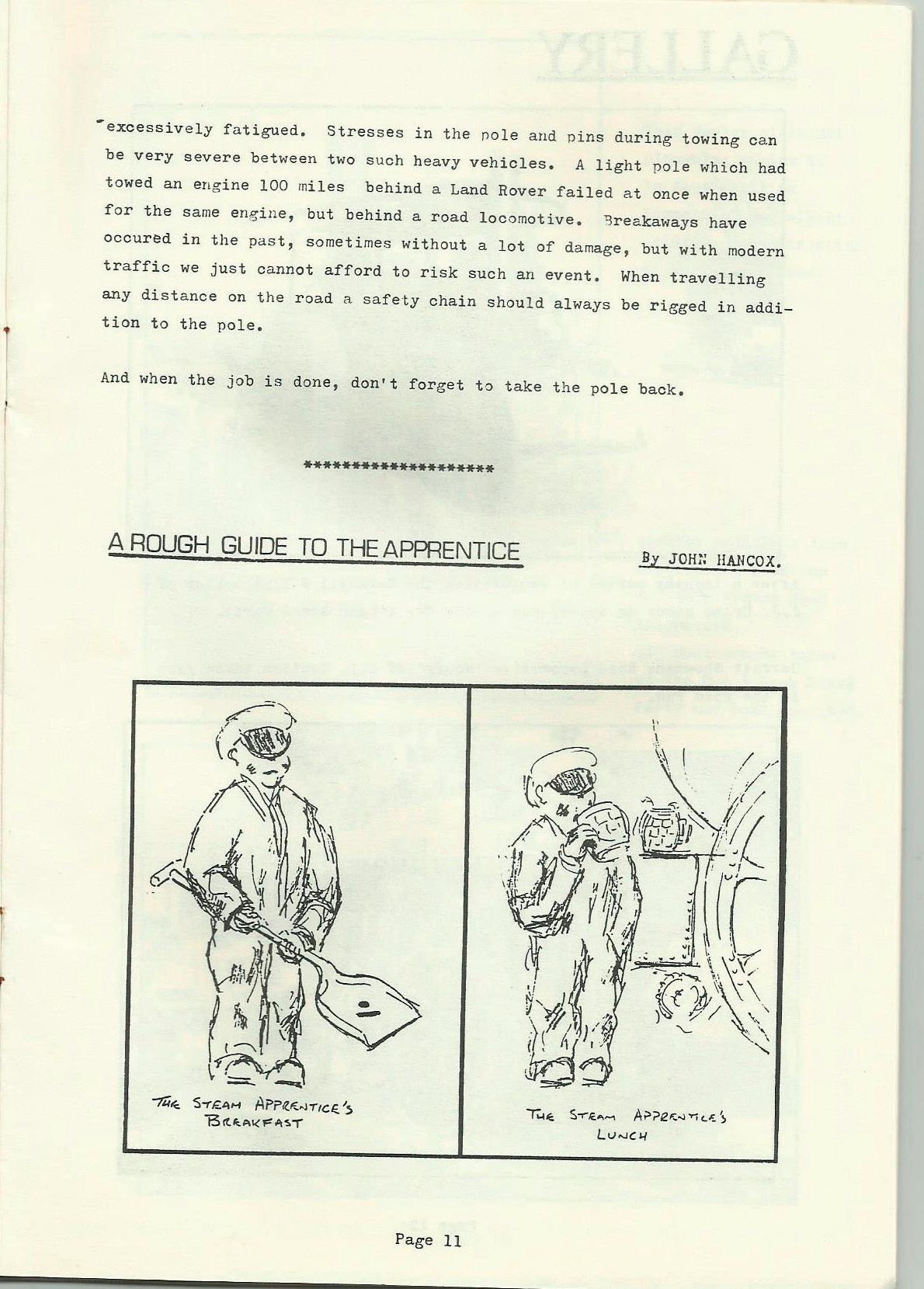
The S.A.C. events will be held on Saturday of this rally. Event one, Breakfast off the Shovel 10.30 a.m. by.~he N~T.E.T. tent participants must provide their own food and utencils. Event two, A chance for you to visit some of the engines at the rally. The contents of this event will depend on space and how crowded the field is. Please as~~mble at the N.T.E.T. tent at 2pm.
At all times when taking part in a Steam Apprentice Club event think safety and be careful. Do as you are told and do not touch any controls or get on to an engine unless you have had permission first.
All meMbers take part in our events at there own risk. Be prepared clothes may become dirty at times.
If any member is at Dorset with an engine please bring it with you to your club events. But please let Sylvia Dudley at the N.T.E.T. tent know well in advance that you are doing so.
JOIN A FRIEND
Why not get ·your friends to join the S.A.C. Get them to fill in this form or a copy of it. When complete send the form together with £2.00 Tos David Duffill, I8I Foden Road, Great Barr, Birmingham. B42 2Elf. On·hand 'it into any N.T.E.c. rally stand.
Name.
Address.
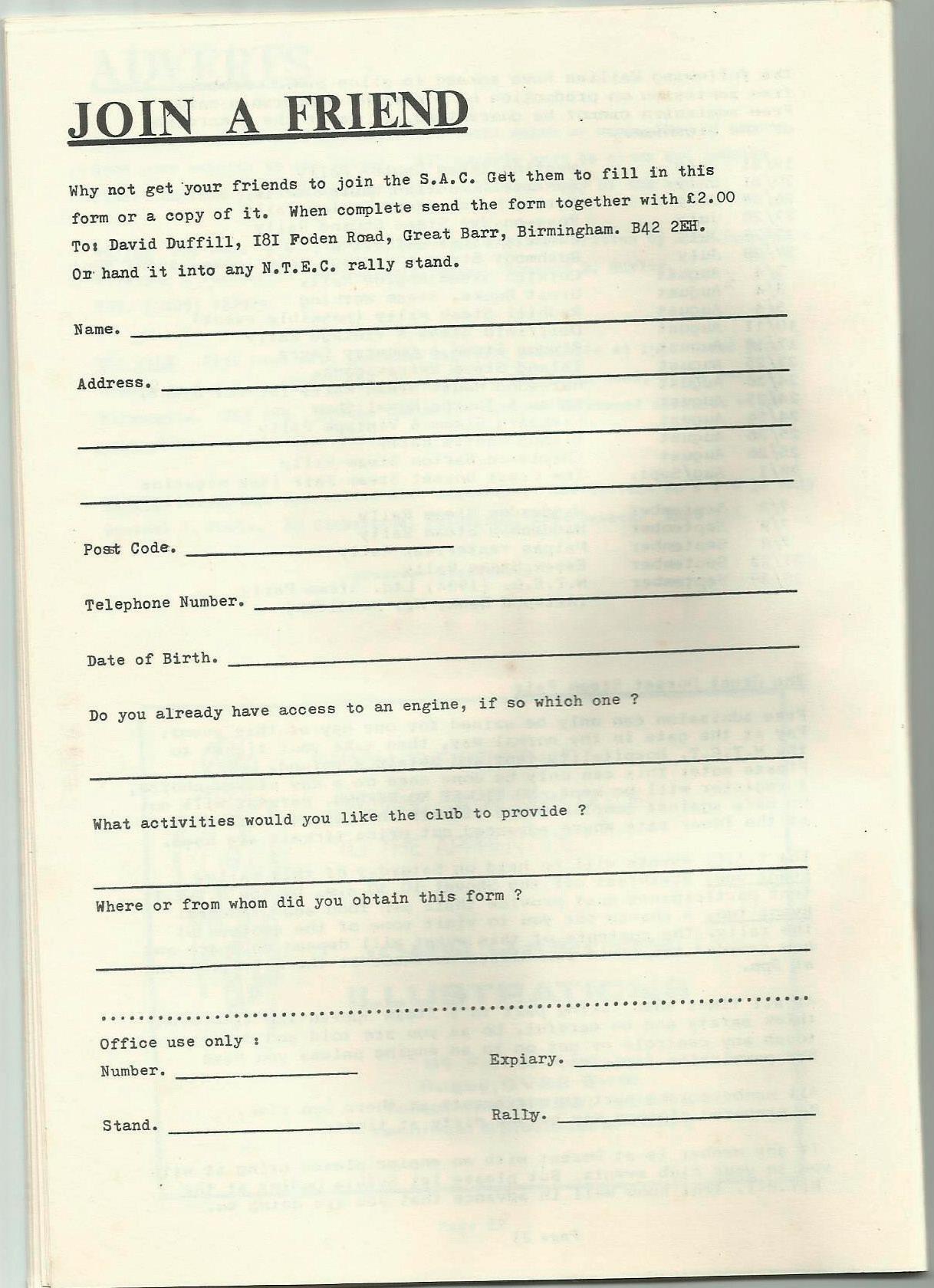
Pos;t Code:.
Telephone Number.
Date of Birth. ------------------------------
Do you already have access to an engine, if so which one?
What activities would you like the club to provide?
Where or from whom did you obtain this form?
...........................................................................
Office use only: Number. ---------Ex-piary. -------------
Stand. Ral~. --------------