ADDRESSES
The Membership Secretary, David Duffill, 181, Foden Road, Great Barr, Birmingham. B42 2EH
The Editor, David Hurley, Leyland, Willington Road, Kirton End, Boston, Lincolnshire. PE2l' lNR
Assistant Editor, Graham Austin, 47 Sir Dar Road, Ipswich, Suffolk, IPl 2LD
South East Branch Officer, Peter Forecast, 5 Penuey Lane, Stanford-le-Hope, Essex. SS17 8:m
Hampshire Section Branch Officer, Stuart Gaines, A. Page, The Newsagent, The Square, Wickham, Rants.
rorkshire Branch Officer, Steven Gibson, 25 Mason Crescent, Sheffield, South Yorkshire. Sl3 8LH
We are pleased to consider articles of any length and or photographs for inclusion in future issues. All material so submitted is voluntary and payment cannot be made for any materiai so published. Please state if you require any part of your article returning, ie photographs. The opinions in the maga~ine, with the exception of club announcements, are those of the contributor and do not indicate the views of the club as a whole. All items are held copyright of the contributor and the club.
Next Issue: Any letters or other.items for inclusion in the next issue should be submitted before the last day of FEBRUARY.
This magazine is produced by the Steam Apprentice Club and printed by
EDITORIAL
It mi:i.ynot be irnmea.diately obvious but the club's 'sub co,arnittee• iu it's wisdom, (?) has decided to change the dates of publicatio1~. The new dates being January, April, July and October. This is to bring the publication of our magazine as close as possible to that of 'Steaming' the l(ational Trust's magazine. It is hoped that this will iror, out a few minor snags that we encounter from time to time. This does mean. however, that last year went short, when one issue was lost to this change over, and one to the lack of articles.
Now comes the part of my editorial which no one takes the slightest bit of notice of. The article Crisia, this is no longer desperate, it's acute. I shall say no than that other than to say a big thank you to four peopl.e who have cpntibuted to this magazine. Mr N Allen and Miss Maria Casely were kind enough to think of the poor old editor and his hopeless task of putting together a magazine without an article in sight, and both came up with an article. I would also like to thank !-:r ; .Du.'..;.e for answering a question in our letters section and ~lso C L~~son for telling us about. his toy engine club. Well thats it for now, please, some one send ~e some articles. Don't forget. the next wonder issue is in Apri-1.
CLUB NEWS
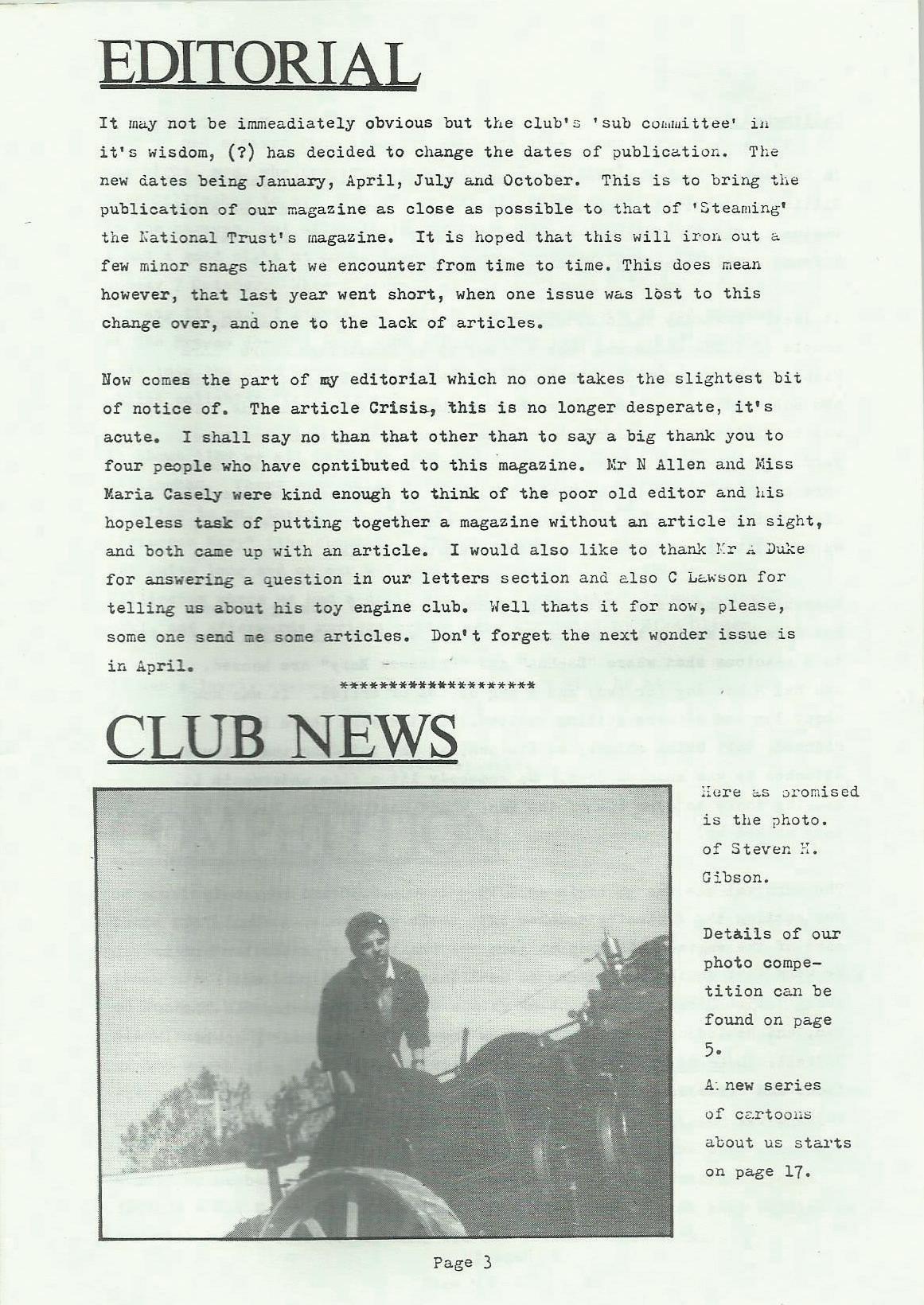
II ere c..s ::,rorais ed is the ;,hoto.
Gibson. Details of our photo competition can be found on page 5.
A:new series of cc:.rtoons about us starts on page 17.
Oillingham Carnival. By Maria Casely.
In September, Nick Baker rang Dad up, inviting us to take pant in Gillingham Carnival along with "Daphne", his Burrell, and some other engines. The carnival was on the 6 October, and up to that weekend I found myself counting the days leading up to it.
At last~ Saturday the 6 October had arrived. Dad and I made up a co:i9le of lunch boxe$ and made our way up to Henstridge wher~ ''Lord Fisher'' was sitting on the lorry. It was about 9. 30 am so ,-1e \·Jashed and polished the engine, after which we had our lunch and made our way to Gillingham. All of the engines were meeting in 1;ick Bakers yard. When we arrived, everybody else had lit their fires and some were ready to steam off of their trailers, as they had been there since Friday. As soon as we had found somewhere to put the lo~ry, we also lit up and gave "Lord Fisher" another polish.
Meanwhile, Jane Crane, Esther and other wives were cooking up some hot dogs and making tea and coffee. Soon, we were all called over to a spacious shed where "Daphne" and "Princess Mary" are housed, and had a hot dog (or two) and a mug of tea or coffee. It was now about 3pm and we were getting excited. In the yard there is a disused, tall brick chimney on its own, as the building that it was attached to was knocked down. So somebody lit a fire underneath it, causing smoke to come out of the top, which confused the locals as they walked by.
The carnival was due to begin at 7.15. It was 6.30 and everybody was putting the finishing touches onto their engines. At about 7.00 some of the engines lined up to join the floats in a particular order. We were last on the programme, so we didn't leave the yard until about 7 .45. Directly in front of us was l)ave Antell to\>'ing his Guards Van, an:l. behind us was l•lalcolm Hughes and his Dad on their ¼ scale Burrell. Lots of people turned out to see it, and judging by their faces and cries of excitment every time a. whistle was pulled, they enjoyed it.
W!Rn we had steamed back into the yard and shut "Lord Fishertt down for the night, mum, who had arrived to watch the carnival, and I wept into Gillingham to get fish and chips. I wanted to stay the night in the caravan, but after listening to reason, I decided that if I had a good night at home, I would enjoy tommrrow more. It ,,as Sunday 7 Octobe::-. (lhen I arrived at the engine at 8.30 ar;i, 1)..,_tl haci already lit up. I started to polish the brass before it got to~ hot as the Brasso doesn't have much effect otherwise. At about 9ao I went into the shed where Jane made me a mug of tea, which I dra.n.~ whilst polishing "Lord Fisher".
At about 11am we all left the yard and went on a road run around Gillinghamo There were quite a few of us. Of the engines that were familiar to me, there were "Daphne", "The Wolverhampton Wanderer", "Princess Viary'' (the showmans), "The Thatcher:• and others. The run was quite long and on our way back, we stopped at a hotel in Gillingham where we had a dri.llk and some roast beef. It was a lovely meal, and afterwards various prizes were presented by Mike Oliver.
It was a lovely weekend and I hope that there will be many more like it.
COMPETITION
.;,s promised in the last _issue we are holdi~g a photographic com;>cti tion. There are 3 prizes to be won, these will be awarded to the 3 er.trants judged to have taken the best photographs. The prizes are three books, these are; Steam Rollers in Focus, Fred Dibnah Steams On and Stearn Builders of Norfolk. The judge is to be the well know steam photographer 1,lr R.G. Blenkinsop. The winning photographs will be published'in the summer issue of the magazine. The closing date for all entries is 30 APRIL 91. Put your entries in an envelope and mark it Photo. Competition. All entries must be sent to the ~embership Secretary. The judges decision is final 0 All photographs entered must be road. steam related and have been \a.ken by a paid up member. of the club. If you want your photo's returned please a. ~.~.Y.. <),:: "'~ e3.'tl.ru)'t.. 't!et.urn. t.h.em., You may make as many entries as you wish but an entrant ma.y only win one prize. Good Luclc.
PROVISIONS WITH R&::ARDTO TRACTION ENGINES
The whole of the provisions contained in section 296 of the Bury Corporation Act, 1909 with respect to use of traction engines in the borough, are as follows:-
(1) The Corporation may from time to time prescribe the time (being the same hours as are from time to time prescribed by the county authorities) at which the streets or classes of streets along or across which a lone traction engine shall pa~s and the owner and person in charge of any such engine who shall knowingly.pass therewith at any time or along or across any street not so prescribed shall be liable for such offences to a penalty not exceeding ten pounds in addition to the cost of repairing any damage to such streets which may arise by reason of such offences.
(~) The corporation may require any person who desires to use a traction engine in any street to deposit with them a sum of money not exceeding one hundered pounds as they may dem responsible to recoup ~hem the cost of repairing any damage along the same respectively and in the case of any such damage they may repair the same and apply such deposit to meet as far as it will extend the cost of such repair and may recover the balance of such cost from sue~ person.
(3) If the corporation require any person to make such a deposit they shall pay interest to such person after the rate of three pounds ten shillings per centum on the amount of the deposit for the time being in the hands of the corporation.
(4) No persons using or conducting any such engine shall supply the same with water from any public fountain, trough, well or receptacle in any street within the Borough except with the licence of the Corporation and upon suoh terms as to payment and otherwise as shall be stated therein and any person offending against this pll?'Ovision shall for every such offence be liable to a penalty not exceeding five pounds.
It all started back in 1983. I had decided to rekindle my interest in steam a..."l.dso I began to look for a steam road engine. It soon became obvious that I would be able to afford a steam road roller. \/endy my wife was not totally convinced, she would have been a lot happier if I could have made do with my old and trusted "Z.:AMOD"roller now in pride of place in the living roomo
However undeterred I approached a collegue at work, who I knew had something to do with his late ~athers steam roller. I was told that the engine had been unused since he had died and that now his mother had decided to sell it. I made an appointment to go to see it and with rough directions set off in the direction of Cambridge. Getting lost in Cambridge is easier than you think but eventually we found the house with the roller parked up along side •
.After making our introductions we were left to take our time and have;- c. goo<! look arour.d. The engine turned out to be an Avelir,g .z ?orter 10 1-on, number ;1246, registration number CE 9188, carr;ying the name "William". He had been new to Cambridge Town Council in 1920, and. had been in use untill 1965 when it was sold into preservation. r.~y father was a bit concerned about the size and to where we were goine; to keep it, but I convinced him that it was the normal size for a steam roller and we were sure we could find him a good home. :/iL.iam was complete, fror:i the original A. & P. tools to the "Taylor Picard" mileomete:r now showing a reasonable 34940 miles. "Two owners never raced or. rallied, 11 I thought. On enquiries I found the boiler tubes had been replaced shortly before the owner had died and it had been laid up for the last six years. Every thing had been oiled up well a.nd the boiler drained properly to avoid damage. There was no current Boiler report so it was agreed that if I did the work and had the boiler checked I could make a final decision on the purchase on the inspectors findings.
The next few weeks saw me up and down the AlO from Che shunt to ifa ter beacr, to strip all the boiler lagging, and clean all the necessary bits ready for the inspection. The dry test was carried out with out problems, this
b-eing followed by the full hydraulic 10 year test with the i)ressurc: held for the full half houro No defects were found ar1d "William" 1·io.S givo:n a full bill of health. As a result of this I was now the own~r of 10 tons of old iron.
It was agreed that we could stay at Waterbeach untill we were ready and had passed the group G driving test. I was then lucky enough to be given an old trailer and 200 gallon water tank {ex WWII Bedford Truck). The trailer was totally rebuilt from the chassis up and the tank bolted on. This left enough room for about a ton of coal and the necessary tools to be carried, and meant we could go about 20 miles between ~ater stops (1 days roading).
The group G driving test was carried out in the village with the locals looking on. I invited the examiner to steer the engine, he turned white and refused firmly but polietly. We proceeded to roll around the village green for the next half hour doing the normal emergency stop, three point turn, reversing into a space and so on untill the examiner had seen enough. I had r,assed and with the L plates in the fire set off on the o;:,en road.
"to you wa.t?-tto come to a rally? 11 came the voice from cl. pair of legs one day whilst I was at work inside the firebox. I agreed that it 1~oulci be a good idea and was given Mr Pumfreys' address, rally secretary for the nad.denham Rally held in September. An entry form was duly a.isoatched and plans put in hand for the journey.
It was for us to be the longest journey we had tried at that time. Hith the family all primed, Mumand Dad the sandwiches and camera, Wendy the coal and the transport home, we set off on the Sunday before the rally. A 6am start from Cheshunt was needed to get the engine on the road by 10am. An uneventful run was made via a couple of pub stops until: we came to the top of Haddenham Hill. Up untill now we had not had to negociate a hill, the area around Cambridge being fairly flat. ~e had stopped at the top of the hill to pin up ( to insert both driving pins in the rear wheels so as to have drive to both rear wheels) as "Willia..:tt is not fitted with a differential gear. As we were waiting a number o~
p'"eople joined us from Mr Burgess's yard nearby. I was advised to fill the boiler up with water in order to go down the hill so as to keep water over the firebox crown and so avoid dropping the fuisible plug. So¾ of a glass of water was put in and off we went, taking it easy not letting the roller get out of control. On reaching the bottom of the hill the water disappeared out of the top of the gauge glass and as I opened the regulator, water and steam appeared from all the steam packings and out side the canopy it began to rain. We coasted to a halt with the drain cocks open and now I knew what it was like to prime an engine. I now had to bring the water level down in the boiler in order to continue on our way. We decided to open the blow down valve situated on the front of the firebox. After about five minutes of steam and water roaring out, the water came back in sight. By now however a crowd of worried residents had turned up asking questions like "Is it alright? Will it blliw up?" and "I hope your well insured". I turned the valve off using the spanne= and fou.:id to my pain that the spanner had become v~ry very hot. ~hlliar.. nad given me a lesson not to forget.
So we arrived at the rally field. We had an exellent day and all involved had learnt more about running old machinery on the roac. in that one day than "the previous yearo Haddenham Rally is one of the best in the·U.K. and we found we all had a great time. \ie made new friends and even met one of 11~illiams" old drivers. We left the weekend shattered with aching arrns , legs and backs •
We now travel "William" complete with living van and water cart on the road over 400 miles a year, so if we get in your way be patient, we will get you by, and a friendly wave is always appreciated.
The following article is taken from the Spring 89 issue of Steaming. It is in fact the editorial and is written by Roger West.
Putting the magazine together and getting it ready for printing is always a somewhat hectic time in the editorial household but an additional minor interference attached to this issue was that the timing coincided with a change of motor car.
3o in having to make the decision of what to buy -the make, which ~;o.!el, ne~ or second hand and was Brown's trade-in offer better than Jones'sit crossed our minds whilst driving back from one trip to Leicester that those questions might have been exactly the same thoughts that were goir.g through the mind of I-'armer Smith \~hen he knew he would have to get anot:ier engine for the approaching threshing season, or lose business to his competitor two villages away.
:re know quite a lot about the mechanical side of traction ene;ines, because through our own efforts hundreds still exist to be studied and cornpared at will, a.D:dif we want more engineering information a fortunate selection of makers records and drawings have survived. But one fascinating part of the business history of the various makers is more difficult to understand, and probably never was set down - what of their position in the market and their ability to make sales over the heads of their rivals?
For all the stories we read of how such and such a make was better for this or that work than the ones built in Somethingshire, we shouldn't be surprised if the buyers choice came down to much more personal reasons. The perceived results of past experience with one make - exeellcnt or disastrous - must have played a·great part in Farmer Smiths musings, but his final dicision could well have been influenced by much the same (and p~ssibly irrational) thoughts that we sift through when taking another motor car. 111:icely lined paintwork, ;,:r Smith, and an excelle1,t i::r2.ss top on the chi:nney; it's a v-ery tily engine :.i.t the pric~ " Perhaps times don't chanf;e all that much.
(~~yone with similar thoughts or ideas ?lcazc drop me a line ~c.)
GAUGES OLASS&S
Carry two or three spare gauge glasses, wrapped in asbestos string on top of the boiler crown, in the crank pit. This will ensure that there is always a piece of this latter, always useful, commodity to hand for a joint or emergency packing for a rod gland, when imp:negnated with graphite flack and cylinder oil. It also ensures that the glasses are warm in readiness for if a glass has to be replaced when under steam.
In case of steam leakage past the column cocks, the bottom blow down cock should be opened prior to inserting the new glass through the plug opening in the top mounting. Cone type washers are perferable to rings as cone type allows for any misalignment of the gauge columnes and they last longer than rings, besides giving a bit of warning before •blowing'. With cones and washers in place, the glass held on its bottom seating, jhe lower nut is tightend band tight to set the glass, then the top nut also tightened band tight.
The top mounting plug is replaced, a large piece of cloth is taken up - in threshi.J3g d&y"Sa corn sack - the blow down still open, a trickle of steam via the top cock, is allowed to blow through the glass to warm it then, with the sack held to protect the face, the blow down is closed and the top cock gradually opened fully to take boiler pressue. Allow about a minute to see if the glass is safe before opening the bottom mounting cock. The pre-warming, followed by blowing through, gently, of steam makes the procedure as eafe as possible but, if full pressure is allowed onto a cold glass, then in nine instances out of ten, it will 'let go' straight away. A follow up on the nuts is advised after approx. an hour but strong hand tightness is all that should be necessary.
One source of •get you home• gauge glass washers used to be the red rubber rings on screw top beer bottles even if it did mean having to purchase t.o bottles of beer!
Turning to reflex type - Klinger or dewrance - these should receive a gentle blowin« through of steam if fitted to an engine in steam and rather gentler and for longer than with a conventional glass for, whilst they are classed as unbreakable, they are not unburstable A reflex type glass usually gives a bit of notice when it is on the way out and it is advisable to replace it as soon as possible.
GALLERY
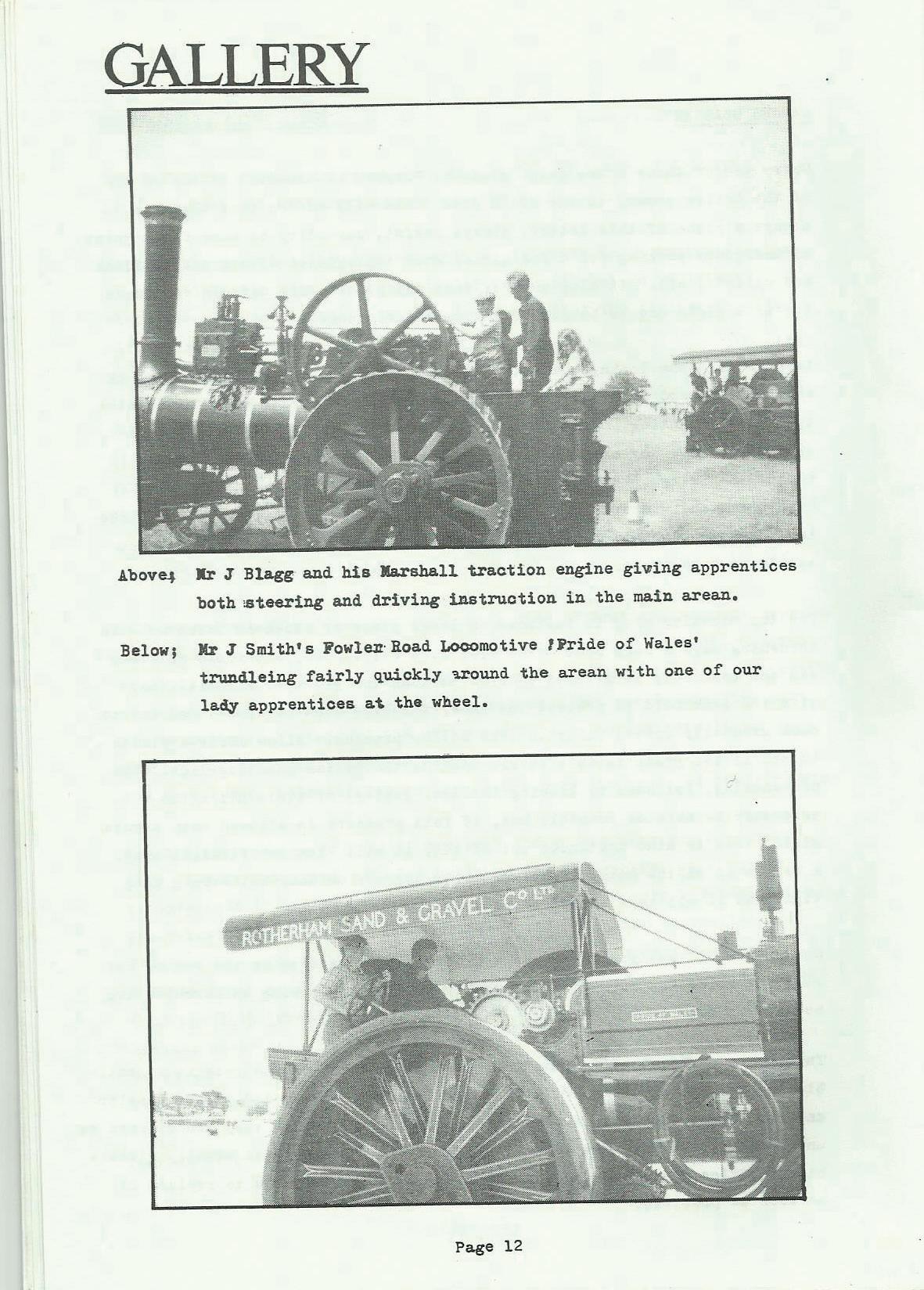
Above.J Jlr J Blagg and his Jla.rshall traction engine giving apprentices both :Steering and driving instruction in the main arean.
Below, Mr J Sm.ith's FowleJ?·Road Locomotive ffride of Wales' trundleing fairly quickly u-ound the arean with one of our lady apprentices a~ the wheel.
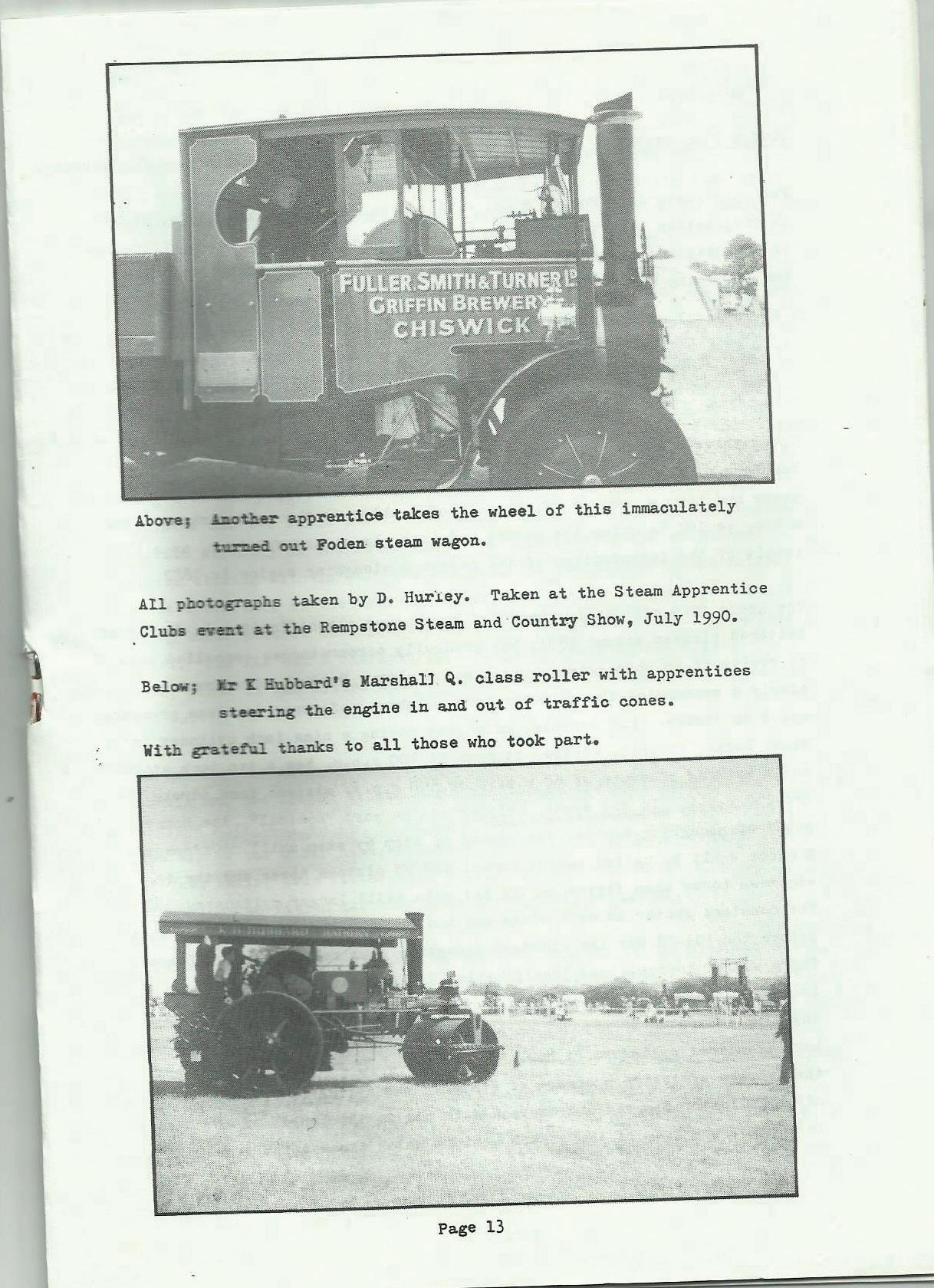
Abovai :bother appreJLti~ takes the wheel of this immaculately -tu..~ out Paden: steam wagon.
All plU>~o&-a;hs taken by D. Huriey. Taken at the Steam Apprentice Clubs evct at the Rempstone St.eam and ·country Show, July 1990.
Bel..011oi;K:- Ecbbard' s Marshall Q. class roller with apprentices stee...-uig the engine in and ou.t. of traffic cones.
With ~te~ thanks to all those who took par~.
FOWLERP.E. CLASSIFICATION.
By Rev. R.C. S~ehbing:
Fpr many years John Fowl~ & Co. of the Steam Plough Works, Leeds, used i~ conjunction with their German branch, a system of letter classificatioL o~ engines, a.nd there existed in a manuscript at Leeds what they called the l•~agdeburg List. For my purposes I shall extract the f'ollowing; -
Ki 6 h.p. single cylinder engines.
134: 8 h.p. compound engines with horizontal or vertical side drums.
AA: 10 h.p. compound ploughing engines._
These three classes, with the B4 redesigned as the BB, have been the backbone of English steam cul.~ivation since about 1910, in which year there had been a revival of the sale of tackles on the home market, after a long period in which the market had been almost non-existant, as a result of the introduction of the compound ploughing engine in 18820
The Leeds firm officially abandoned horsepower classification in favour of lettered classes around 1a,1, but graduall.7, circumstances compeiled them to revive it to some extent, which was a pity. llominal horsepower is simply a measure of the cylinder bore, without ·reference to steam pressure speed or stroke. For example, an engine having a nine inch cylinder is eight horse, nominal, whether it runs at 100 r.p.m. has a ten inch stoke and a working pressure of 60 p.s.i. or 500 r.p.m. sixteen inch stroke and 250 p.s.i. In the event, relying on the word "nominal", the horsepower of ploughing engines was pushed up step by step until nowadays the K class would be called twelve horse, the BB sixteen horse and the AA eighteen horse when fitted as the AA7 with still larger cylinders. The constant factor in each class was boiler diameter, whilst until just before the '14-18 War th-e standard ploughing gear ratios were unaltered. There was of course, soae justification in increasing the quoted n.h.p. in comparison with traction engine. A six horse trac-t;ion can dev.elop the same indicated horsepower as a Class K ploughing engine, since they have identical cylinders (i.h.p. is calculated by multiplying together the average effective pressure ot steam in the cyli.Jlder, found by means of an indicator diagram and expressed in p.s.i. the length of the stroke in inches, the area of the piston against which steam acts, in square
inches, and the number of power strokes per minute, and dividing by 33,000. ) but the plougher runs flat out, with rests betweci-, boutti during which the injector is turned on and. the fire replenished. What would be the use of a traction engine loaded so heavily that it had to stop every quarter mile'! The capacity of the boiler to supply steam liimits the power at which the traction cau be quoted.
About 1910 all three classes, K5, B4 and AA2 were very much alike. The short smokebox with extension to bring the forecarriage in front of it found on earlier Kand AA eng;nes, had been superseded by the long smokebox, almost exaggeratedly long in the case of the K5 with the chimney right in front. The first K7 engines retained this feature. The hind tank and coal bunker had a flat upright back, whilst the driver had to do a bit of mountaneering, especially if his ene;ine hac:. a brE.ke, to get to his place, for no opening for access was provided. :i:ach cylinder had two slide bars. The "bell pinion" of the road gearing was carried directly on the outer end of the crankshaft, the slow speed pinion sliding with in it. The AA2 could be identified by the rather squat appearance of the cylinder block, occasioned by the valve chests being lower because the cylinder centres were some five inches further apart. :'ne had a characteristic lagging cover on the cylinc.er don,e, since it ~as fitted with the open top cylinder allo~ing acces~ to the valves u.....der st~arr ..
Except for the setting back of the chimney, the fittin~ of lareer hinc wheels and the shaped extension to the top of the co"'l bunl:0r, the K engines have not, as far as my observation goes, altered a great deal. the B4, on the other hand, ceased to be built after 1912, thou6h many of them having been fitted with double speed ploughing gear, class BB engines so fitted are sometimes erroneously called B4.
The new type of engine called BB appeared in 1913 in two cylinler sizes, the smaller corresponding to the B4 and generally having double speed ploughing gear as the AA. Possibly the distinctii.ve feature of these engines is the single slide bar per cylinder. They had u. ne\, jJ;;,.t ten, road gear, the bell pinion, constrained axially by a cage, revolved freely on a sleeve keyed to the crankshaft bu.t moveable axially by the gear 1·ever. This sleeve carried the slow speed pinion which functioned as it
had done with the older plain bell. Polished false covers, large enougl: to conceal the true covers, adourned the back of the cylinders. The hind tank was altered to give a curved back to the bunker, and a gap in the side made access to the footplate easier. The feed pump, hitherto standard and driven from an eccentric next to the right hand crankshaft bearing was, unless specially ordered, replaced by an injector, or more generally by two, at this period.
The BBl, a class originating ill the Ministry of Munitions order, is distinguishable from the BB in having an extension to the low pressure piston rod. This in conjunction with false covers exposing the studs on the cylinder covers, is easily visible. The road gearing on the righthand side is modified too. \li th the exception of the retention of double guide bars, the AA acquired the modifications of the BB step by step, the ll7 ?Unistry engines being the first to complete the process.
This may be the place to remark on the engine numbers anc dates of mar.ufacture. The war period threw the number sequence completely awry. The first BB set 134 79 and 13-480 \Ii th large cylinders came to \:ill:..her Co. of Coggeshall, Essex, in 1914, the first ·,·,ith :;;ru:.11 c.;linJ.ers, 13431 a.nd 13482, to F. Keeling&; '.:;ons, :r ...ys.; i:ill, the o.:.·e::viou::;.fccJ.r·.
The last pair, 14716 and 14714, ~as sc:nt to E.T. Drage of Chrishall in 1919, although the BBl sets, 15138 to 15231, were all delivered in 1913. Certain .U. sets, 13870 to 13887, were held up from 1913 to 1916 and 1917 before being sold. 14 726 to 14729 were delivered after the llinistry sets 15232 to 15257.
Now a word about the class TE2 or "Russian" engines. ·over the years a few "Ploughing and Traction Engines'' had been buil:.t for single engine working and one way implements, i.e. the implement was only in work wtilst approaching the engine. On the road gear end of a traction enein~ was fixed a bevel wheel driving through a slantine; shaft a pair of drums on one stud below the boiler. The bottom, tail, dru~ ran quite fast and carried a light rope which, passed round an anchor on the opposite headland, pulled the implement back for the succeeding bout. The "Russian" type ~as based on the road locomotives rather than the general purpo~e engin~ and had but one dr~m. !lumbered consecutively from 14908 to 149$2,
the -engines were ordered by the Russian rnili tary authorities to further their action againct Germany, but domestic turmoil within ~ussia l~ci to the cessation of hostilities before the engines could oe shipped outo As a result, in Uarch, 1917, John Fowler&: Co found themselves with 75 engiines of type TE2 on their hands, alnd disposed of most of them on the home market. I believe a number were built to a Minisry of r,:uni tions order and may have had larger cylinders. There is a record of one pair being converted to ploughing engines and sold to iial ton-on-the-1:aze, their power output was probably that of Class K enginec.
l!. matter which sometimes arises is the comparative pulling po1,er of various engines, the lower horsepower classes being praised as pulling better than their bigger sisters. Even after making allowance for exaggeration it has to be said that for sheer pull on the rooe the 3~ had slightly the better of the BB and K, the latter two beine about equal. :lhe.t must be a.dded is that, while exertinc; the Gc.1.me :,ull, the rope s:,1eed of tha B'9 is distincily higher. (I am considering st.:ci:uE.r(i sinGle S?eed ?loughin~ gear.) It may be that the prevalence of cultivatine rather than ,)laughing in Enelan<l before the '14 - 18 ~la1- suggested the new gear on the :SB, in any case John Fowler 3: Co lik~u to qote the most suitable engines for the work they would be required to do.
A ROUGH GUIDE TO THEAPPRENTICE
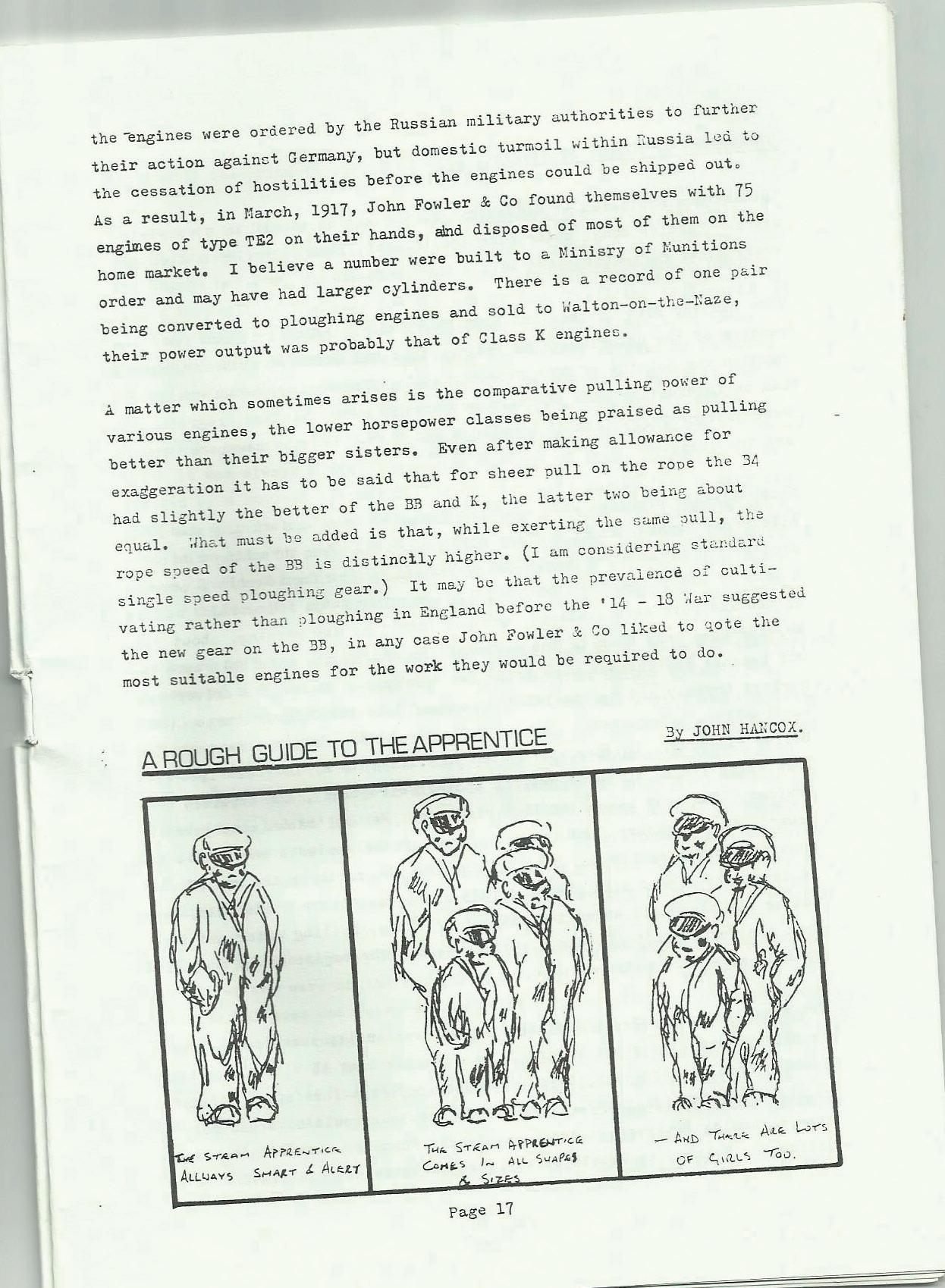
3y JOHN H.1u;cox.
DISA$TROUSEXPLOSIONAT WINFARTHING.
'Disastrous Explosion At Winfarthing ••. the engine itself is a complete wreck. Wheels, body, under-carriage, funnel, levers, boiler plates and every other part were blown into a shapeless mass,'
Thus did the Diss Express and Norfolk & Suffolk Journal inform its readers of the unfortunate happenings that had occurred at Henry Barkers farm on the morning of 20th December 1901, The engine, as we shall see, was an interesting one; the circumstances of the explosion, regretably, were just ordinary lack of knowledge and care. Let the newspaper report set the scene.
Henry Barkers prcmiseo were somewhat i~olated from 1:infarthinG and l! miles from Banham, about 8 miles north of Uiss. ¥01· tr.resJ-.in:_; his oat cro;, he had hired an engine, drum and clnff cutter from J,;essrs Z Lovec:..,.,:;·
Sons of Old Buckenham a couple of miles or so a~ay. 3omd half a score of men and boys were employed, and not long into the morning, about 9.30 am, and when only down to the eaves of the stack, the main belt came off because the sheaves were being fed too fast. The engine driver was Herbert Loveday and he, assisted by casual labourer John Lancaster (he was really a bricklayer), went to refix the belt. During this task the boiler exploded. Loveday was hurled 30 yards into a ploughed field (his watch landed 40 yards away in another direction), and severely scalded. Hut poor Lancaster lost his life, He wa£ 'blown some yards towards the farmhouse, and the whole mass of the exploded locomotive fell upon him, crushing him and binding him into the earth by the rim of one of the heavy ribbed hind wheels. This alone would have killed him, but he was also held under the outpour of steam, boiling water and fire from the furnace ... ' It was 1 o'clock before the en&ine could be jacked up and Lancasters body released.
3ad news travels fast and inevitably local curiousity was aroused, for at the wt!ekend, the p.:.:,er recortletl, many p~o;,le came to ·Jie\, the gris!.,;: scene - from :. ttleboro-..igh, Diss, Hymontlnnm and even L'hetforu. '."'e::-ha;,s r:ie,1 fro:n the St :: icnolas works in the l.:i.t ter town would. haV<:! i,o.tl more than a passing interest ia the happeningli·: i-'armer 3urker c..ml the loc.:.l ;JOliceman, Palmer, took collections for Lancasters depcnclants and on
the Sunday the princely sum of £7 5s 6¼d resultedo
The inquest on Lancaster and the subsequent Board of Trade Explosion report, reveal more d.etailo Arthur Loveday, Herbert's broth.er told that the engine had been purchased by his father Elisha in November 1886 from a Mr Redit of Downham, for the sum of £80, including transport. It had-been built by A. Dodman of Highgate Iroh Works, Kings Lynn •many years ago• but the exact date was unknowo Loveday refused to be drawn by the coroner into commenting on its age, declining to agree it was 30, 40, 50 or even 60 y~ars old. "I don't think they had traction engines 60 years ago". "Was it once a portable'? " he was asked. "t:o. I thi~ it w~s always a traction eneine but one of those that used to b~ steered by a horse. 11 Farmer !3arker believed foe ,:!li.gine • was °' v e1·y -)Li one• but said it bad been no tro~ble before - presumably Lovedays had sent it on hire o::i previous occasionso 'rhe inquest jury found ;ierbert. Loveday guilty of want of judgement in not knowing the cefective state of the boiler, but not criminally negligent tor the death of Lancaster.
The Board of Trade inquiry took a more technical line, al though d.isco,vering no more of the engines pedigree. They heard that Elisha Loveday had been in partnership with his father in 1886 when the engine was ao~u.ired and had previously served his time as an engineer under the latter. Together they inspected the boiler, found the firebox thin and renewed so~e stays. Having giv~n it a 200 lb hydraulic pressure test they worked it at 120 to 125 lbs, because they had seen it \·10rked so before. In 1891 a new firebox was fitted made of low moor iron and all tubes and screwed stays were. renewedo Then after a 200 lbs hydraulic test, a working pressure of 120 to 125 lbs was again used.
In June 1900 the Loveday brothers had inspected and hydraulically tested the boiler and were of the opinion that all was sound. Dy now some patching hQ.d been done over cracks at stay holes over the he;::i.d!;of the stays. 1~o other inspection took place by :.oveday before the explosion at \Hnfarthing. In the: explosion the whole of the right hanu sile of the outer shell of the firebox was blown out leavin~ an opening about 1 29in. by 48in. As we have seen the force lifted the engine some distance and the right hand wheeL and tender were blown some yards away. The Board of Tra.de'·s Engineer Surveyor found that the safety valve was
weighted to 146 lbs; eleven stays supporting the firebox side were broken and his opinion was that they were broken some time before the explosion itself. Abulge had existed in the area. The box, he said, could not have been in good condition when inspected by the owners in June 1900 and e.ven when new was not fit for more than 100 lbs pressure.
The report pointed out that Kessrs Loveday held themselves out as co~petent engineers, having 50 to 60 years experience. They let out engines for threshing and chaff cutting, and their cu~tomers, by the firms re;,utation, were perfectly justified in allowiug the tac:clc on their pre:!li.ses with confidance. The Bou.rd of Trade, in condea.n.ic..g tl-.eir lack of knowledge and inexperience found the explosioa was caused by neglect of the three Lovedays and ordered them to pay ~20 each and the firm ~60 towards the cost of the inquiry.
Details are taken from contemporary issues of the Diss EA-press and tforfolk & Suffolk Journal. and the Board of Trade E!xplosion Report No 1370.
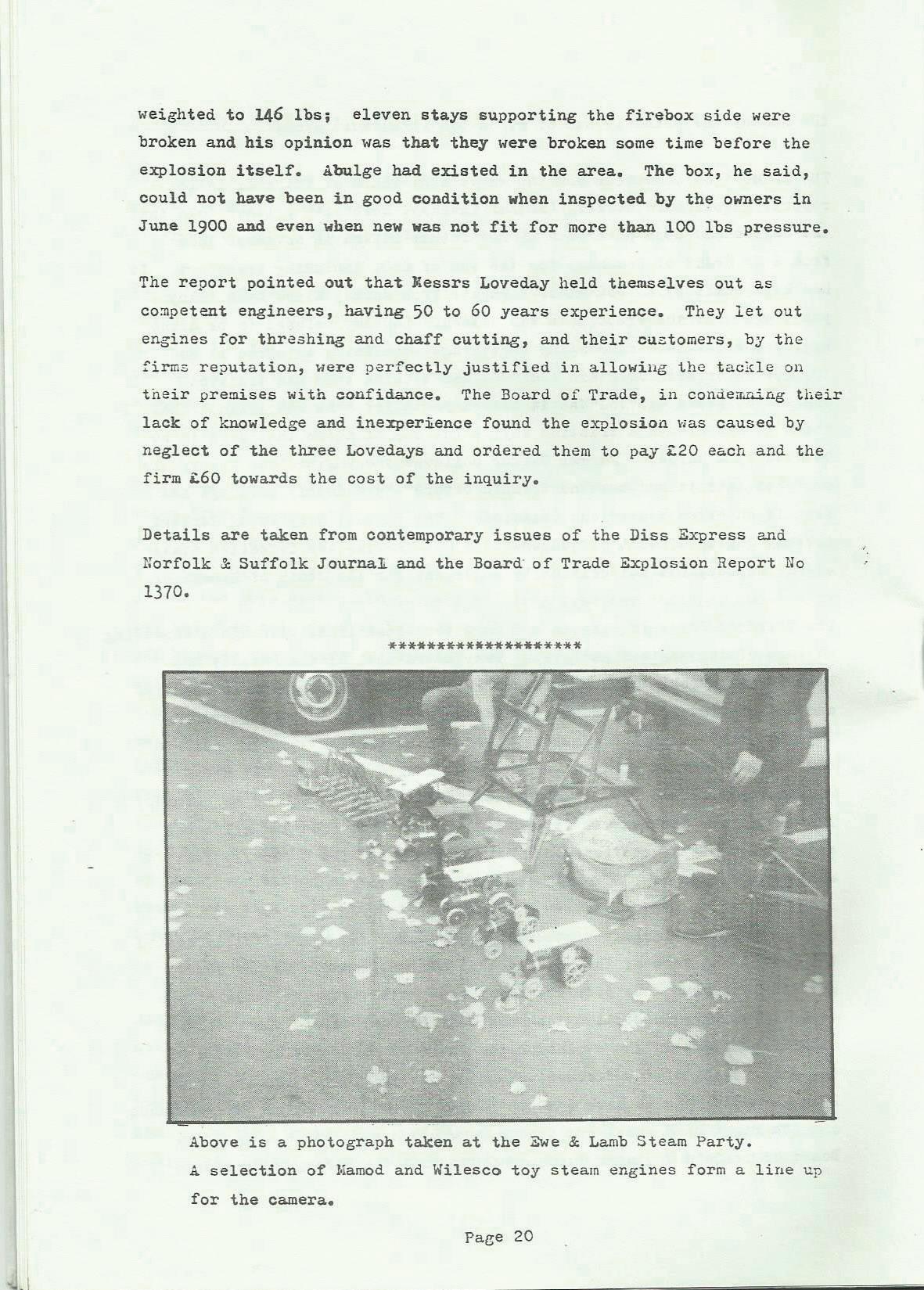
Above is a photograph taken at the Ewe & Lamb Steam Party. "" selection of l•lamod and Wilesco toy steam engines form a line t:.p for the camera.
ANY QUESTIONSPLEASE?
This is the section of the magazine.where we publish your letters. We will do our best to answer any questions on any steam, rally or club issues. Please send your letters to the editor, the address is to be found at the front of the magazine.
Dear Kr. Hurley.
I recently received a copy of the Stear.i Apprentice Club r1aeazine. I had no:t seen one of these before. I rl)ad. it wi tli t;r4..~c:.. t inter·es t and thougrrt I would cirop you a line to con5ra,tulate you on a 1-:ell put together ~agazine.
I have been a member of the National Club/Trust since soon after it was formed and as you may know I am Hon. Records Officer of the Road Locomotive Society. 1-lith regard to )~iss Scarrett' s question on page 21, (Vol. 4 No. 2), I fear that no Fyson traction engine survives. There were 17 altogether and a few lasted to the mid 1950's. There was one No. T3, in Duce•s scrapyard at Cambridge which was broken up in 1957.
Yours Faithfully A. Duke.
Dear Mr Hurley.
While reading your magazine I noticed that you are asking for any things we do connected with steam. I thought you might be interested to know that a fe¼" of my friends and I have a 'l 11a.rnociSteam Club' and meet every week for h steam up.
I havE: three f,'.arnocisteam engines and bet,:een us w~ h~ve nirw cq~inei:. At our local carnival my friend James and I had a ride on Kr Nick Bakers engine, and spent a whole day helping with the engines.
I joined the Steam Apprentice Club at the Great Dorset Steam Fair and thought the Club was very enjoyable, and I am sure the other boys and girls will agree,
Look forward to next years season, Yours Faithfully. Christopher Lawson.
ADVERTS
Any members of the olub may advertise their sales or wants free of chal!ge. Send your adverts to the editor. All adverts must be clear and concise. Please enclose your Membership Number with your copy of the advert.
WANTEDThe book 'I Worked with Traction Engines' written by Jack Hampshire Will pay a reasonable but sensible price. Contact D. Hurley. Tel. (0205) 722929.
POR SALE Club pens with the club logo are available at 15p. Send your orders to l·.T.E.C. (1984) Ltd. D. Duffill, 181: Foden Road, Great Barr, Birmingham. B42 2EH. Please encl!osa a stamped addressed envelope with eaoh order. Stooks are limited.
WANTEDOld Steam Apprentice Club magazines, Newsletters No's 1 16 only Contact M. Poole. 89 Glebelands, Pulbrough, West Sussex. RH20 2JH.
JOINA FRIEND
Why not get your friends to join the s.A.C. Get them to fill in this form or a copy of it. When complete send the form together with t 2.00
To;. David Duffill, 181 Foden Road, Great Barr, Birmingham. B42 2EH. Or band it into any N.T.E.C. rally stand.
Name.
Address.
Post Code.
Telephone Number. ____________________________ _
Date of Birth. ------------------------------
Do you already have access to an engine, if so which one?
What activities would you like the club to provide?
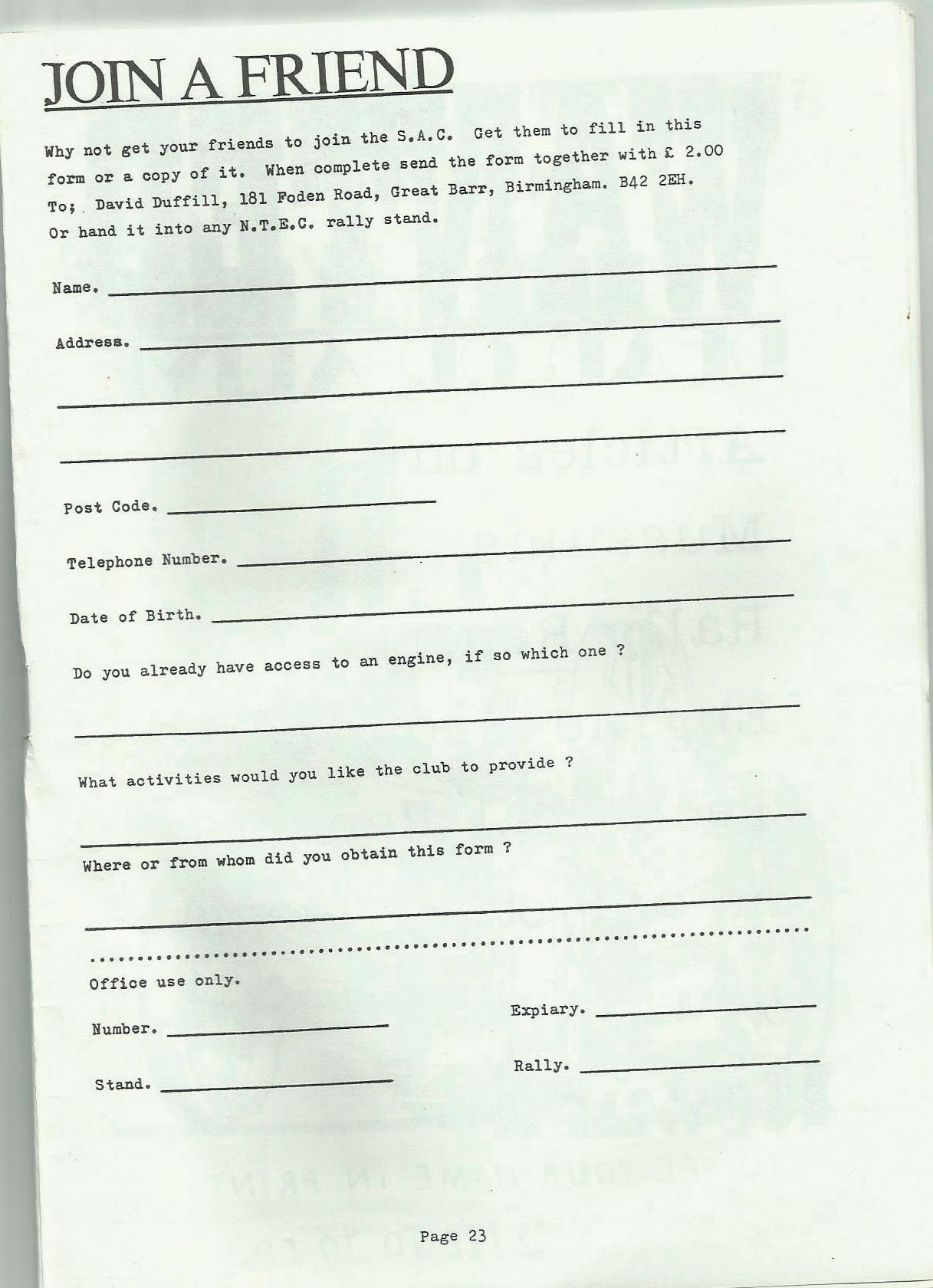
Where or from whom did you obtain this form? ............................................................................
Office use only.
Number. -----------Expiary.
Stand. Rally.