STEAMAPPRENTICECLUB
ADDRESSES
The Chairman, Robert Herring, Bellacourt, Blacklocks Hill, Banbury, Oxfordshire. OX8 7DH
The Membership Secretary, David Duffill, 181 Foden Road, Great Barr, Birmingham. B42 2EH
The Editor, David Hurley, Leyland, Willington Road, Kirton End, Boston, Lincolnshire. PE21 l.NR
Assistant Editor, Graham Austin, 47 Sir Dar Road, Ipswich, Suffolk. IPl 2LD
South East Branch Officer, Peter Forecast, 5 Penny Lane, Stanford-Le-Hope, Essex. SS17 8EG
Hampshire Section Branch Officer, Stuart Gaines, A. Page, The Newsagent, The Square, Wickham, Hants.
We are pleased to consider articles of any length and or photographs for inclusion in future issues. All material so submitted is voluntary and paymen~ cannot be made for any material so published. Please state if you require any part of your article returning, ie photographs. The opinions in the magazine, with the exception of club announcements, are those ot the contributor and do not indicate the views of the club as a whole. All items are held the copyright of the contributor and/or the club.
NEXTISSUEs Any letters or other items for inclusion in the next issue should be submitted before the last day of rJ~v~Mt!.e~
This magazine is produced by the Steam Apprentice Club and printed by
EDITORIAL...
This-time I must start with a complaint. Putting this magazine together is not ·easy even with a stack of articles. It be.comes simply impossible if there are no articles at all. This is your magazine and without your input there is no magazine. We need all sorts of material to make a magazine including rally reports, articles on engines, articles on what ~team related activities you get involved in yourselves. Tell us how you became interested in steam, or about the engine you may help with. An example can be seen on page 17 of the last issue.
If there is something you would like to ask the club or even tell the club, we have a section in the magazine just for this. Its not that hard and if every member wrote one article or letter we would have enough to last for ages. By the way the odd joke or two on things steam wouldn't go amiss, but keep them clean, please, its not that we don't like them, we just can't print them.
Well thats all for now, the next issue will not be long as this one is so late, thats if I get some articles.
CLUB NEWS
We have a new branch officer· to introduce~ he is Steven H. Gibson. Steven will be looking after the Yorkshire region and can be found at local events in the area. He is usually to be seen with the Tasker Little Giant steam tractor. This engine is owned by the company that built it, C:aven Tasker. Steven and Mr john Carr have custody of the engine and maintain it and rally it. With luck and a bit of cunning I should get a photograph of him for you in the next issue. If you see him at rallies please introduce yourselves and feel free to ask as many questions as you can think of, including ''can I have a ride please'. If you would like to write to Steven his address is as follows, Yorkshire Branch Officer, s. Gibson, 25, Mason Crescent, SHEFFIELD, South Yorkshi~e. S13 8LH.
EARLYFOWLERSTEAMPLOUGHPRACTICE
By Rev. R. c. Stebbing.
The accompanying illustration is a reproduction of one in John Fowlers fifth catalogue issued in 1861. From its appearance it would seem that the artist made an attempt at a perspective view from an arrangement drawing, though no such origi~al existed in recent years, and consequently the actual engine depicted can only be a matter of conjecture. 1861, however, was marked by the introduction of the:Clip Drum, generally credited to Robert Burton, and patented in 1859. The illustration may therefore be taken as representing the first engine so fitted.
The Clip Drum consisted of an upper and lower ring of L shaped levers arranged in pairs. The upper lever had its top member horizontal, with the other vertically downwards, the lower lever had its vertical member pointing upwards. The rope was led on to the drum between the horizontal, outward pointing members and press pulleys kept it up against the vertical members, with the result that the levers pivotted and gripped the rope firmly between the horizontal members. These levers, with the guide and press pulleys, may be seen in the drawing, below the boiler. The drum was driven through an upright shaft as in later ploughing engines.
The engine was built by Kitson&: Hewli.tson, Airedale Foundry, Leeds, Fowlers own Steam Plough Works adjacent would not turn out an engine till the following year. The records of the period, of which only copies remain, were fragmentary and in some cases contradictory, so that the first Clip Drum engine cannot be determined, but both 10 and 12 h.p. sizes were apparently built about the same time and were too much alike on the ploughing gear side to be readily distinguisba~le. The road gear, of course, was the Slanting Shaft type, consisting of bevel gears on the crankshaft driving a shaft slanting down to more bevels, either on the hind axle or a countershaft. The hind wheels had each a broad spoke to which was anchored a friction band surrounding a drum on the axle, tightening or loosening the band aoted as a substitute for the modern compensating gear. At this period the road gear was not used for 1110vementalong the headland. 4 snatchblock was laid out ahead and the engine drawn toward$ it by a rope on the winding forward drum mounted on the forecarriage and driven through a clutch and gearing from the upright shaft.
The clip drum as drawn did not survive many months. It will be noticed that the flange carrying the lower ring of levers was held up by bolts. For this was substituted a flange screwing on the upper part of the drum, thus allowing for adjustment to suit the rope diameter (and wear). The drum stud was lengthened and a loose drum added on which spare rope could be coiled or the main plough rope wound when moving from job to job. (It must be remembered that the rope was endless and therefore its length had to be adjusted to suit varying distances between headlands). This spare rope drum has misled some into thinking the engine was a winding engine, but it was not so.
The 10 h.p. engine had double cylinders 7ins. by 12 ins. and a boiler 2ft. 8 ?/8 ins. dia. by 6fto 6 11/16 ins. long. Hind wheels were 5ft. 5½ ins. by 16 ins, front 4ft. 6 ins. The rope speed at 130 r.p.m. was about m.p.h. The steam pressure is doubtful 1 but probably it was permissible to work up to 100 lbs., in practice the safety valve was just screwed down to allow satisfactory working, it being believed that the lower the pressure the better.
The system of working with clip drums was, of course, single engine, with a travelling anchor carriage on the opposite headland. The plough rope ran round a large pulley on the carriage, by means of a clutch on the pulley shaft a winding forward gear simtlar to that on the engine could be actuated. The rope ends were wound on drums on the plough, these drums being part of the "Slack Rope Gear". When pulling commenced, the rope in action was unwound from its drum, but, through a chain and sprockets, the idle rope -was wound up on the other drum at a much faster rate, thus taking up any slack and maintaining some tension in this rope. The ploughman taking his seat on the plough ready for the bout automatically put into action the required chain gearing.
Just as David Greig's Balance Plough was the first really satisfactory implement, so the clip drum and slack rope gear supplemented it to provide the first steam ploughing system to give reasonably good service. The rather crude 10 h.p. engine was followed by a fine looking 14 h.p. and the system survived some four years till the perfecting of Coiling Gear made winding engines a practical proposition, in turn demonstrating the benefits of the Double Engine System.
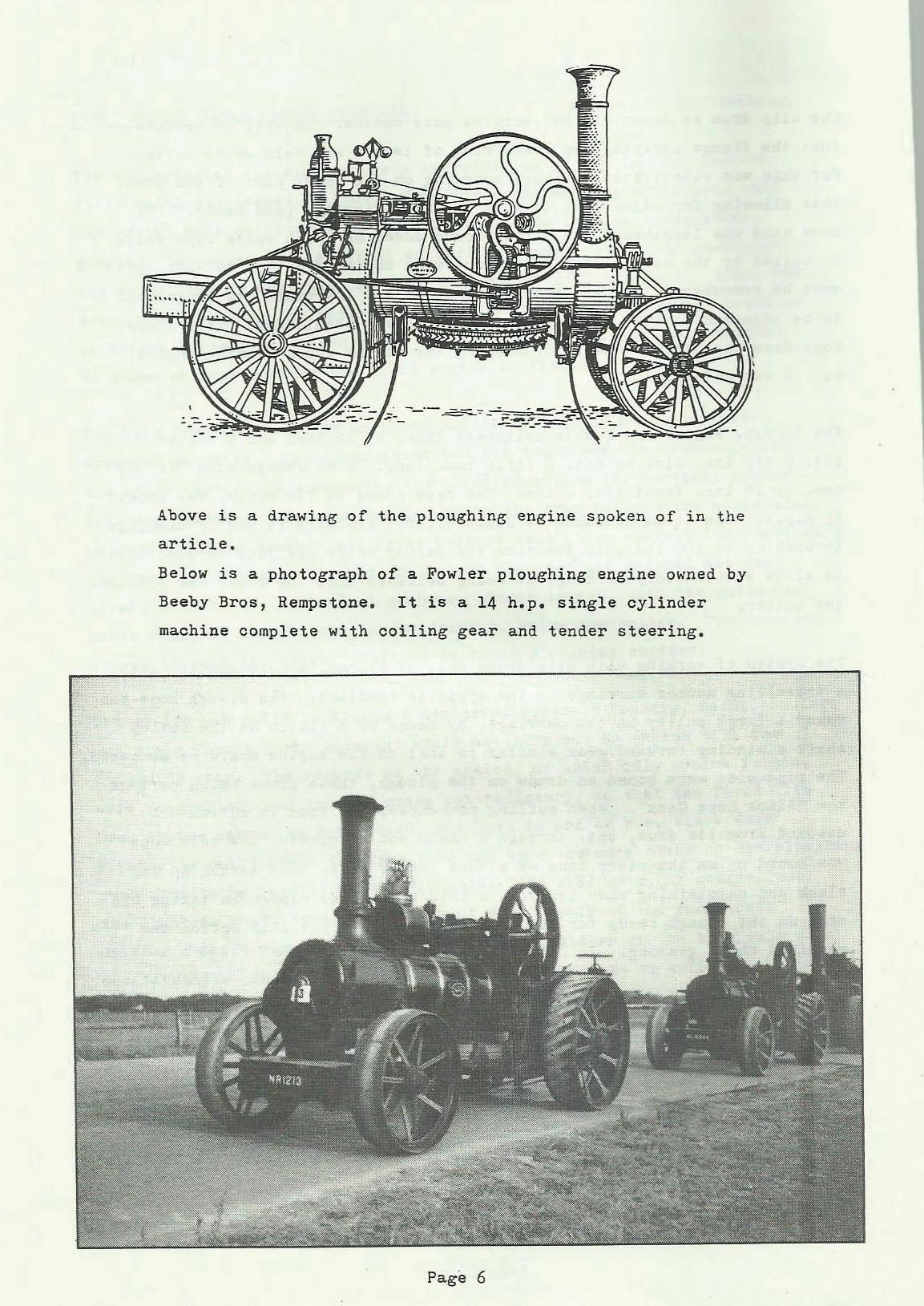
Above is a drawing of the ploughing engine spoken of in the article.
Below is a photograph of a Fowler ploughing engine owned by Beeby Bros, Rempstone. It is a 14 h.p. single cylinder machine complete with coiling gear and tender steering.
THE' AVELING&
PORTER"TYPE
L" STEAMTRACTOR
The steam traction engine, as any historian of mechanical engineering will bear witness, soon evolved into a form which was at ··the same time simple and elegant in design, and relatively easy to manufacture. In fact, there are those who would say that the majority of traction engines were never designed at all, in the sence in which we understand it today, but were just thrown together and, if they worked, used as the prototype for a production run of anything from one to a thousand. Some manufacturers were quita content that this should be so. Provided their engines sold reasonably well, and provided manufacturers in other parts of the country kept to their own territories and did not poach at all, they were perfectly secure, and what did it matter if now and then one the premium apprentices thought he knew a better way of making engine? If the founder or the firm, the revered Charles, or John Thomas, had built his engine so, and had, forty years ago won a gold medal at some obscure exhibition in Upper Bavaria or Lower Silesia, surely that was good enough, when a mans wages were only a few shillings a week, and extra time spent clearing the scale from the firebox crown because the stays had always been designed to thwart this operation as far as possible least someone notice their dubious method of attachment to the boiler shell, would not be pounced upon by a Trades Union as unscrupulous exploitation although, of course, it was exploitation of the most shameful kind.
However, the odd company did display some enterprise, and most notable of these was, in my opinion, the concern of Aveling and Porter, Limited, Rochester, England. Avelings had always been ready to pioneer any development which might lead to an increasedefficiency or ease of handling of their engines, and it is not generally realised that the traction engine in its present form, with geared drive and hornplates both Aveling and Porter introductions, owes a good deal to the original thought of certain Men of Kent who had courage enough to break out of the cast iron brackets and pitch chains rut in which Burrells, Fowlers and the rest were wearily plodding •. Al though it is to the Aveling steamro_ller that :the mind flies at once, with many of them still in service the world over, to my mind the type L five ton steam road tractor represents the most mechanically elegant of all Aveling· engines.
Now it is not my intention to make extravagant claims for the L type, nor will I dwell at great length on their good looks or the quality of the workmanship or the materials which went into them. I leave that to those who find their adopted types of such inferior mechanical quality that their manufacturers had perforce to have recourse to such titivation as large copper chimney tops air outlandish colour schemes, or compounds which would ge~ stuck on dead centre like any old single. No, I submit that from all practical considerations, there is nothing to beat the Aveling & Porter Type L.
Any village. blacksmith, almost, could knock together some odd bits of plate fill the resulting vessel with water, continue to pump in water faster than it leaked out, light a fire under it all and generate steam after some sort of fashion. The difficultya.rose·when our hypothetical blacksmith found that hia hypothetical steam was being generated rather more ~uickly than he would like. What to do? The conventional practice was to knock together some old levers and the more vital oomponants of a spring balance and call the result a spring balance safety valve, such as may. be seen on Burrells, Wallisea and such to this day, The safety valves on the Aveling Type Lare of marine type, are easy to set whilst the engine is under steam, collars for the side pillars being easily fitted, and the valves themselves are of the narrow seat type which opens and shuts cleanly without the irritating sizzle and view obscuring feather of steam apparently loved by those who write of steam engines in romantic vein.
Before we can have steam, though, we must fill the boiler, and the filling plug on the type Lis at the extreme top of the cylinder casting so that the boiler may be completely filled when it is not in use to prevent exposure to the atmosphere and result in corrosion. Furthermore, the cover is bolted on much better in. every way than a screwed plug. To control the exit of steam from the boiler, the type L regulator consists of a circular self lapning valve in a buckle, through which is screwed a one piece rod, thus dng oan come loose. The whole thing is easy to dismantle, and the valve opening can be adjusted under steam if need be.
The cylinder is mounted on a saddle rivetted to the boiler, making for easier lining up of cylinder block and motion than is the case where the block is attached direct to the boiler where any slight error in alignment
means much laborious scraping in the absence, in those days, of aputting on tool. Unlike the Marshall version, the Aveling L type has its nuts hidden under a neat pressing, with all the practical and asthetic advantages this implies. Furthermore, the drain cocks are fore and aft coupled by a straight rod with square and socket on to the plugs, much better than. the customary cranks, levers and pins. As an example of bad practice here, the Fowler D.c.c. 8 ton. roller employs no fewer than eleven levers and cranka and fourteen joins thereupon to accomplish exactly the same result. The boiler, too, is commendably simple in construction and has no openi!l8B what ev.er in the smokebox to give trouble. There is a large manhole in the side of the barrel, so placed that the firebox crown is readily accessible and all staying is direct by means of round screwed rods between parallel surfaces, thanks to the Belpaire firebox. There are no angles, gussets or other forgings whatever, on the firebox or on the firebox shell. Beneath the firebox, the ashpan is a hefty steel pressing about¼ in. thick instead of the usual sheet metal and angle which rots away in no time at all. Turning to the boiler fittings, the water gauges are mounted on extensions and so are not hidden behind the intermediate shaft. (A pity all Avelings were not so built. One tractor which I have on occasion driven has the gauge so tucked away that a horizontally mounted mirror is needed to see the water level. And you can imagine how long the mirror stays clean, down there by the fire hole door, below the crankshaft.)
The feed check valves have a sc~ew down shu~ off valve above the ~alve and its seat. The blow down valve is also of screw down pattern, as opposed to the usual plug cock type,, and fs easy to open and shuts off tight each time. All pipes are coppe~ with brazed oa uni.ons, For the steering gear, always a point of weakness on any traction engine just think, the last Fowler Showmans Road Locomotivte built in 1934, ha.d nothing more precise than worm and gear and twin chains the pivot and retaining collar are entirely inside the perch braoket and yet outsida the smokebox. The chains have spring links and wind on to a proper worm of sensible diameter, the gearing is covered in.
The road wheels are of the standard Aveling & Po~ter patta-n, being Y spoked steel castings. Although this was by no means. an exclusively Aveling & Porter featU1?e, one cannot but wonder why it was not more widely adopted. It was lighter than the spokes cast into the hub arrangement, and there was nothiing to work loose. Casting spokes into the hub was at best of times
~athe~ .dodgy, and a consistant standard of work was difficult to attain. The odd batch would turn out to be of inferior quality, the spokes would work looae, and then. where were you? The dragplate is attached to separate bars taking the pull:. straight on to the born. plates, instead of pulling the tender off. The engine. has trunk gui.de.s, a balanced. crankshaft and cu.t geara on. crank and in.tell'!llediate shaft.a, t.he advantages of all of which a.re immediately apparent andi v.e.r.y efteotive single l1ever change speed mechanism wbioh only goea to refute those persons who, having seen some of the larger ~.&.P. rollers, go abou~ saying that Avelings could nev.er make a gear change. Lastly, it is fitted with a three star compensating gea.r or differential.
All of which makes the Av&ling & Porter Type L Tractor a most attractive little machine.
LITTLE XNO\ffl.. MAKERS
Woods and Co.
Amoung the extensive range of engines which woods produced was a portable engine. The engines were totally typical of the period, they were supplied with an exhaust feed water heater and a variable eccentric {so that steam could be cut off at any neoesaar¥ poin~ in the stroke, and the engine could run either way.) The. range of single cylinder engines was from 3 to 10 X..H.P. and duplex (two oylinders using full regulator pressu.re) up to 20 N.H.P.
If inferior coal was to be use~ abroad the extra large firebox was to cost the purchaser £1 per N.H.P. extra. ********************
STOP PRESS
There is a photographic competition to be held by the club. This will be run in the next issue with the results printed in the summer issue of 1991. Look out for the details in the next issue. Tliere are some great prizes to won, DON'T MISS IT.
GALLERY
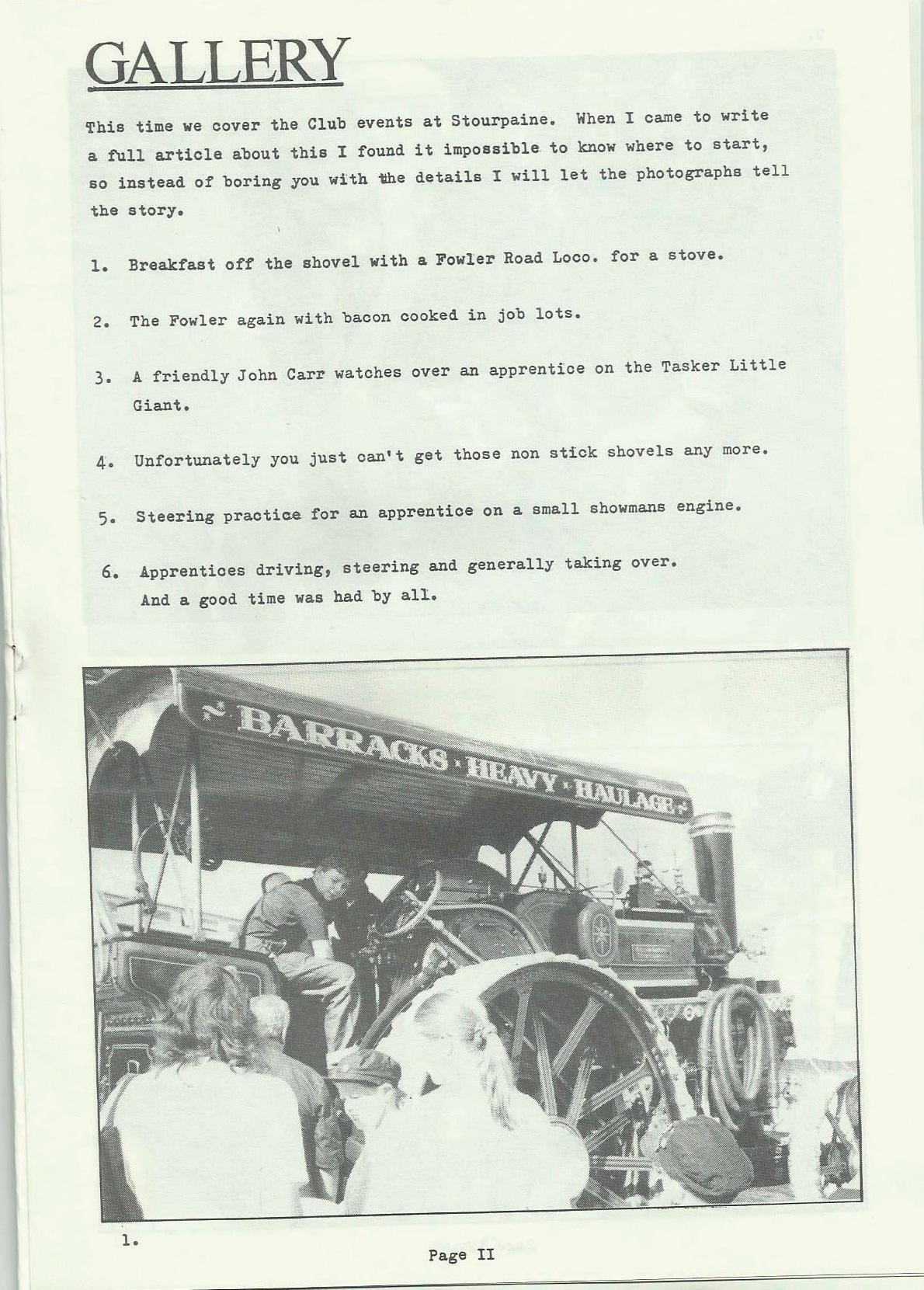
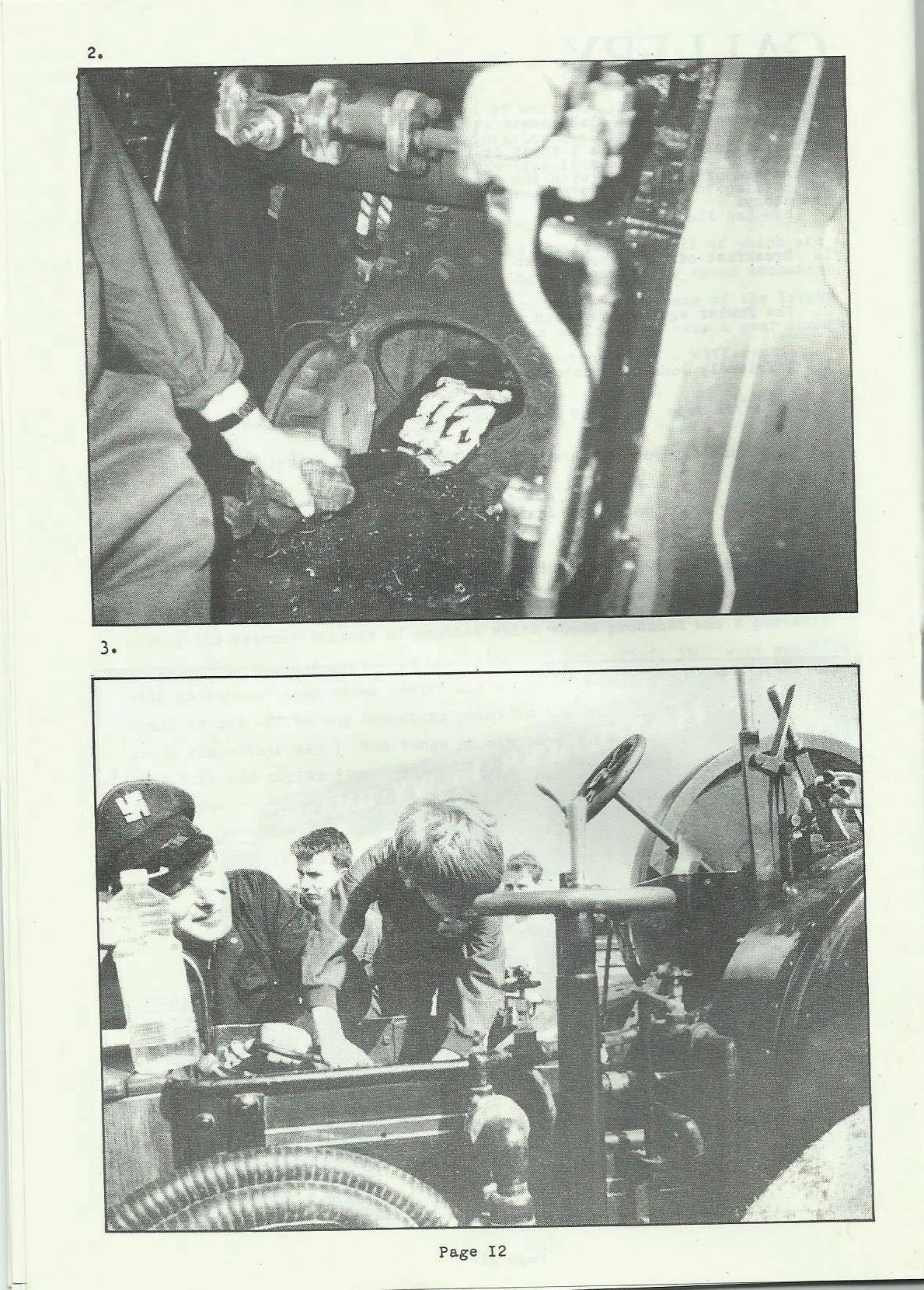
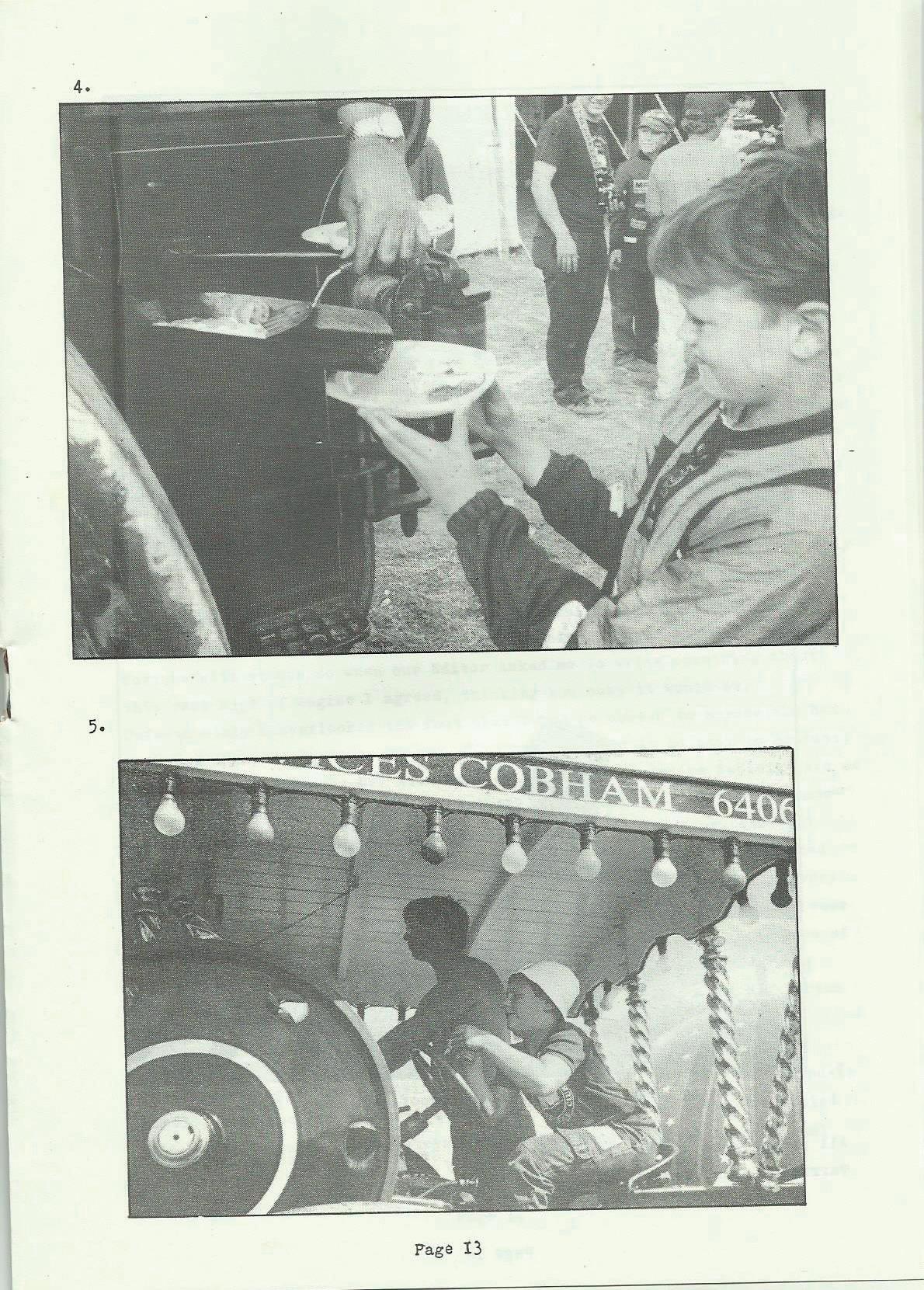
This time we cover the Club events at Stourpaine. When I came to write a full article about this I found it impossible to know where to start, so instead of boring you with ilhe details I will let the photographs tell the story.
l. Breakfast off the shovel with a Fowler Road Loco. for a stove.
2. The Fowler again with bacon cooked in job lots.
3. A friendly John Carr watches over an apprentice on the Tasker Little Giant.
4. Unfortunately you just oan't get those non stick shovels any more.
5. Steering practice for an apprentice on a small showmans engine.
6. Apprentioes driving, steering and generally ta.king over. And a good time was had by all.
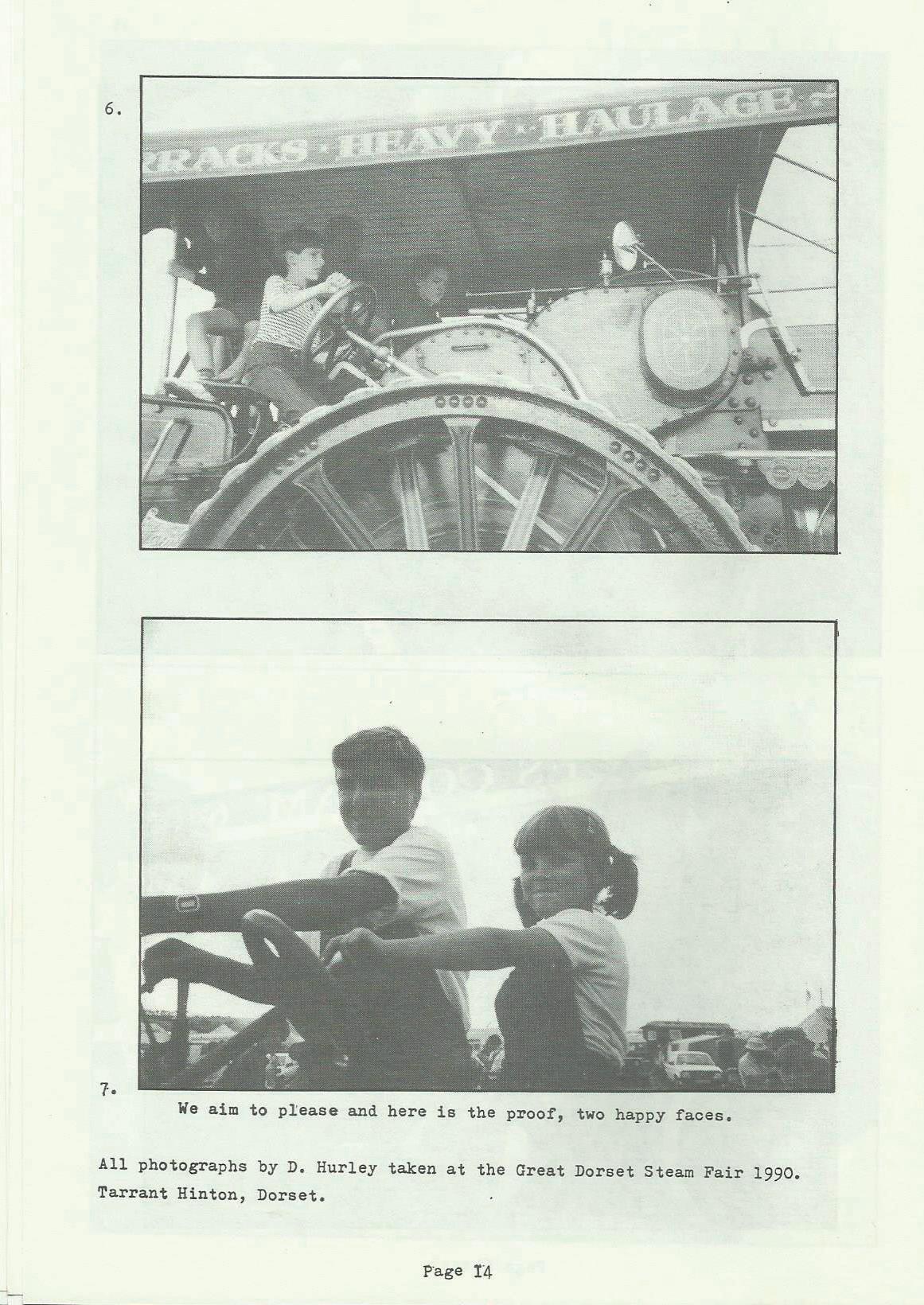
We aim to p!ease and here is the proof, two happy faces.
All photographs by D. Hurley taken at the Great Dorset Steam Fair 1990. Tarrant Hinton, Dorset.
by R.G. Pratt
There has been and probably will continue to be much coni'usion amou.ng interested parties as. to whether or not Richard Garrett & Sons Ltd., built their Suffolk Punch steam tractor for direct ploughing or for timber hauling. In fact the answer is both because Leiston Works produced two types, each called the Suffolk Punch, and yet one was quite different from the other and built for a different purpose. The earlie~ one, which came out towards the end of the. First World War, waa the direct ploughing tractor with the chimney at the rear, giving it a very back to front appearance. This class, also known as the Agrimotor, was the last real attempt by steam to challenge the internal combustion tractor for thia ctas:s of work. One example of this type survives in preservati'on. 'l'Jie timber trao·tor of the same name was a much later product, and it is with this that we are primarily concerned. Records show that only three were built. These were Nos. 35320, 35332 and 35412, out-shopped in 1929-30, and I count myself fortunate that I actually saw and photographed one of these going through Braintree in 1934. Not only this, bu~ I am doubly fortunate in that I have a complete set of works photographs on it and the printed literature put out by the makers at the time they were built. It seems only right that I should share this good fortune with others so when our Editor asked me to write something about this rare type of engine I agreed, thinking how easy it would be. Un.fortunately I overlooked the fact that I had no access to anyone who h~d ever had any practical experience of them, nor would it be easy to contac·t such a person. However Xr. Alan Duke of the Road Locomotive Society gave me the information that Nos. 35320 and 35412, after a period of use as demonstrating vehicles, were sold in July 1932 to John Sadd & Sons, the well known Maldon, Essex, timber merchants. With this knowledge I approached East Anglian member, Mr. R.L. Orth, of Maldon.and although be had no very clear recollections of these traators he was good enough to carry out some enquiries,as a result of whioh I am able to give here the recollections of two meu:vho had experieno& of the Garrett Suffolk Punch timber hauling tractor. They are Mr. Atherton who retired some years ago and Mr. Merton who is still employed by John Sadd & Sons Ltd.
The drivers liked these machines very much and said they were very good to handle, once you had mastered the art of driving them. They were fitted with vertiole water tube boilers and Messrs. Sadd expected them to haul
loads of anything up to twentj""--ton~ bu~ at loads such as this it was found diffiault to keep up suffLaient head of steam on a boiler not really big enough fo~ the job. It took quite a time· to get used to firing these boilers and keeping the water level whene it should be, a matter of a few gallons of water meant al] the difference between a full glass and an empty one. Stops often had to be made to get the water level up again. The trao.tora were powered by an, engine having two high pressure double acting oylind~B with steam oonitrolled by poppet valves. This engine was ad.midships half in the bonnet and half in the oab, and was totally en~losed. If the boiler primed at any time it was not long before it caused a valve to stick up and when this. happened it immobilised the engine, it being necessary to oil and free the offending valve before proceeding. The superheater did a very good job. The working pressure was 250 p.s.i. and Mr. Atherton remembers once coming home i?L the dark, the engine pulling well and extra lively, he glan~ed at the pressure gauge and found it was reading 450 p.s.i. the safety valves had stuck.
A good supply of water was carried, enough to giwe the tractor a range of about twenty five miles As regards handling, both Mr. Merton and Mr., Atherton preferred the Garrett for its pulling power but a Foden was easier to drive al though it did not pull so well!. The Garretts als·o used a lot of lubricating oil, probably'because hot, dry superheated steam did not lubricate the bores in the same way as ordinary saturated steam does, and were scrapped after a useful life of only two o~ three years.
The specification that appears in the Garrett literature I have tells us that these Suffolk Punch tractors had a drawbar pull of 8,500 lbs. for short periods. Two road speeds were fitted giving 4 and 12 m.p.h. The water tank oapaoity was 500 gallons and the overall dimensions given by the makers were length, lff feet 6 inohes, width, 7 feet 3inches and a height of 9 feet 9 inches, although these measurements do not correspond in all respects tp those which accompany a diagram in a contemporaneous issue of The Enginaer. The turning circle was 52 feet. The front axle weight when ready for the road was 2 tons 9 cwt., and the rear axle weight was 10 tons lcwt. The tractor had six wheels, the four rear wheels of cast steel Y spoke type being under the boiler mounted on a bogie which was intended to permit a swivelling action for working over rough gound. Two rear wheels of this type may be seen on the remains of a Garrett Steam Wagon in Taylor Bros. yard at Wimbish. The drive was by roller chain and
~he two pairs of bogie wheels were also coupled by the same means, giving four whe&l drive. Raked ackerman steering was fitted. The poppet valve engine already referred to was slung in the chassis by three point suspensioA. Massive roller bearings were fitted to the crankshaft and two speed shaft as in the contemporary Garrett Wagon, in fact many features, such as the boiler, for instance, were common to both. There were no fewer than sixteen brake shoes in the rear axle assembly, the brakes being operated by hand, foot or steam, the catalogue telling_us the tractor couLd be brought to a standstill in ten yards when fully loaded. It omits to tell us at what speed. Performance figures claimed by Garretts were,-
On reasonably good macadam, 30 to 35 tons at 6 to 10 m.p.h.
On di:rt roads in good condition, 20 to 30 tons at 4 to 6 m.p.h.
On rough tracks, 15 to 20 tons at 2 to 4 m.p.h.
Mention must be made of the substantial w.inding drum, again chain driven, at the front end of the tractor and the cab, which in the writers opinion spoiled the whole appearance, was of tongued and grooved weather board. The Suffolk Punch I saw was finished, as near as I can recall, in a maroon red.
Why then, we may ask, were these tractors not more successful and why did they not last longer? I have already drawn attention to the features they had in common with later type of Garrett Wagon of which Garrette in their catalogue actually claims- 11Built like a motor oar" and therein lies the answer. Neither these tractors nor the later wagons were intended to last long but to do a maximum amount of work, work in excess of what an internal combustion engined vehicles could do, in other words a short life and a merry one, but this unfortunately did not lead to repeat orders for the very essential advantage of steam, its tough longevity, had been sacrificed.
One of the ''Suffolk Punch" tractors owned by John Sadd & Sons Ltd., passing through Braintree in 1934
A "Suffolk Punch'' hauling a Garrett boiler at their Lciston, Suffolk, works
SHOWMANSmoINES
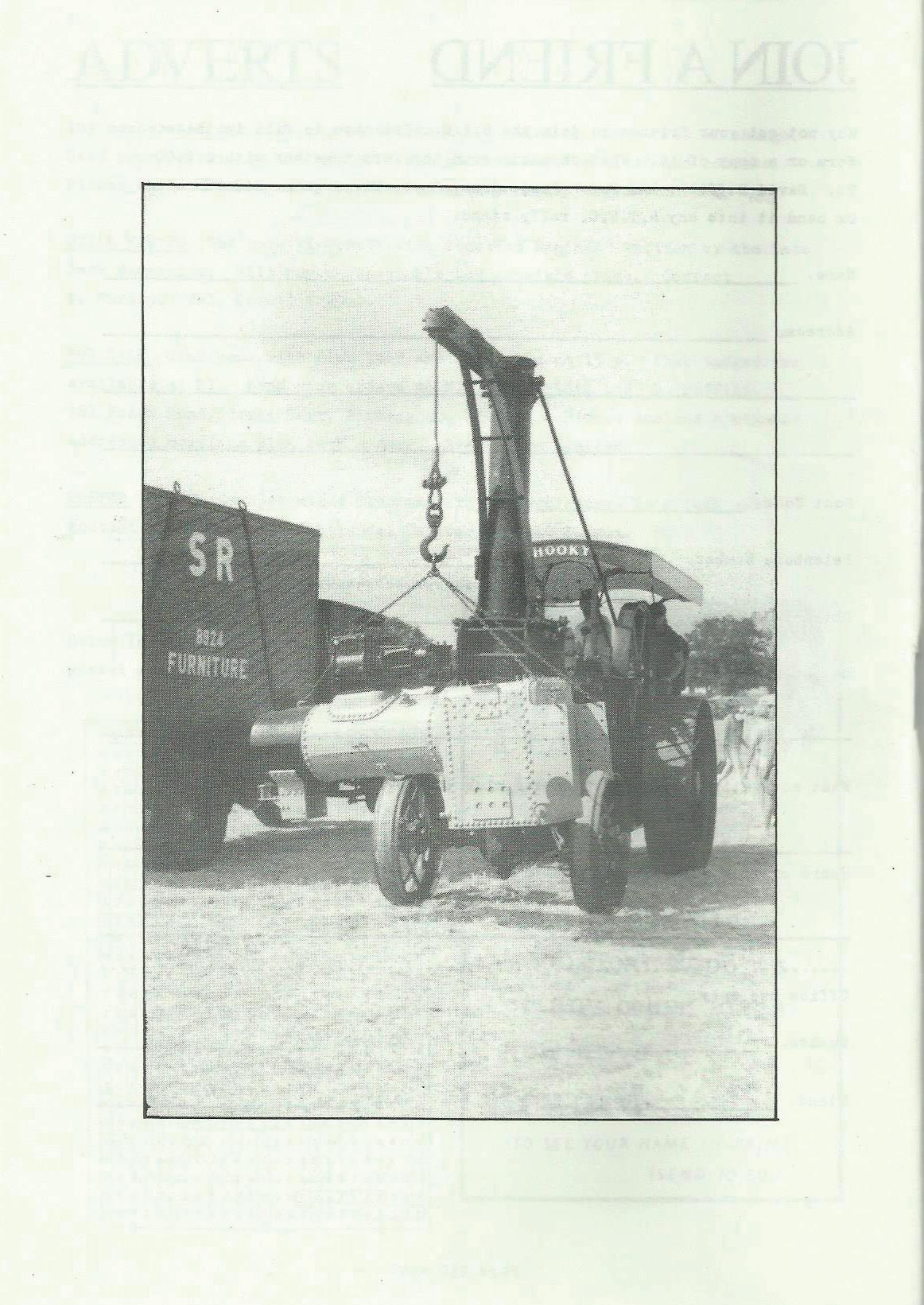
During the middle of the last century showmen started to travel around the country with. larger fairground machines cal?.ed 'bioscopes' • These were the forerunner to our present day cinemas. The rides were getting- far too heavy for the horses whicmup to that time had been pulling the show wagons. Also the showmen wanted to travel greater distances, and so they took to using second hand traction engines. As well as being stronger they also needed less men to take care of them, during the winter an engine could be left, but if you employed horses these still had to be fed and looked aft,er.
The first report of an engine being used to pull a showmans wagon was in 1859, when ~im Meyers, an American circus owner hired one of Bray's traction engines to haul his circus into Folkstone. It is said that he didn't employ the engine for pra~tical reasons but instead to attract people to the circus, who normally would not have gone.
In the later half of the 19th century'eleotrio lighting arrived for the travelling showman, but the problem was that they needed large amounts of heavy batteries to keep the lights going. The breakthrough came with Faradays discovery of magnetic electric induction and so the prospect for a dynamo or generator became practical.
The first electric generating plant for a traction engine was designed for ltarshalls of Gainsboroggh by R.E.B. Crompton in 1879. In July of the same yearf:Marshalls took one of their engines fitted with a Crompton generator to the Henley Regatta, where it was ussed to power the illuminations. As one would.expect, it drew the crowds in their thousands. Many did not just come to see this wonder, as usual wi~h inventions which people do not understand, they are afraid of it and so fearful for the future they tried to sabotagge the engine and generator. But Marsh~lls were afraid of this and so were prepared with a group of men from Gainsborough armed with heavy spanners, and so managed to fight off the saboters.
In 1886 Thomas Aveling produced his first engine for showmen. This engine had a generator mounted over the motion on extensions to the hornplates. It was driven straight off the crankshaft by means of gears, the only problem was that it suffered from oil splash and so Aveling gave up on the
idea of mounting the generator over there. In the same year Fowlers produced an engine which catered for a showmans needs. The engine was from Fowlers standard range but i~ had an extension generator platform fixed by means of angle iron to the front of the smokebox.
So showmans engines were now taking up their familiar form. But they still didn't have full length canopies. Burrells were the first to build an engine with the dynamo, motion covers and full length canopy. They built it for Jacob Studt of South Wales in 1889, it is also said that Studt was the first showman to use electric lighting. Fowlers first special engine was built 6 years later for Tom Norman and called Enterprize.
Once the engines had been developed the showmen turned their attentions to bigger and better rides. One of these was the •scenic Railway•. This was a very impressive ride but with its introduction it brought many problems. The first was that the care of the ride had to be manhandled on to the trailers from the track and also the power needed to start the ride was far too great for any of the dynamos fitted to engines at that time.
Faced with this problem Burrells developed special 'Scenic Engines', these were equiped with a crane, which was an extension to the tender. Also they supplied an extra exciter dynamo mounted between the cylinder block and chimney, this was used to give a power boost while starting the ride, But the overall number of engines wasn't great, only 411 between_ 1885 and 1934. These engines had 3 speeds and were often fitted with rubber tyres. While on the road they would have to pull many trailers, in one case it was recorded that 13 trailers were being pulled, for maybe 100 miles then help set up the fair, and after all that they would have to generate power late into the night.
Special showmans engines. At one time Fowlers produced an engine with polished aluminium boiler lagging. Fowlers also produced an engiine with hinged canopy supports so it would reduce the overall height, it was built for Jacob Studt. He needed an engme like this because he travelled the Welsh vallies and had to negotiate many low bridges. Fowlers only built one engine with an extra dynamo mounted between the cylinder and chimney, many people thought it was ugly and so the exciter dynamo was fitted on the belly tanks from then on.
The~last two showmans engines built by Burrells and Fowlers were 'Simplicity' by Burrells in 1930, this was infac.t built at the Garrett works because Burrells were bankrupt. The last Fowler was 'Supreme• built in 1934, both engines were ordered by M~s A Deakin of Brywawr. During the war both the engines were cut down and used as road engines by Kerrs in Glasgow.
I would like to finish with a •only if' It is about a showmans engine which could have been built but never was. John Proctor was in the. Burrell.Jworks trying to place an order fo'JJ the largest showmans engine he could get. While~ the yard he saw a boiler "There \ ", be said "Xake me a three speed around that 1''. The boiler was infact tor a 20 N.H.P. ploughing engine. It was impossible because it would have been illegal in this country.
ANY QUESTIONS PJ,EASE?
This is the section of the magazine where we publish your letterso We will do our best to answer any questions on any steam, rally or club issues. Please send your letters to the editor, ~he address is to be found at the front of the magazine.
This time I have received a question from a Miss Scarratt 1340. Miss;"'Scarratt would like to know if there. are any FYS0N traction engines still in existance? If so where are they, and are there any pictures to be seen of these machimes?
Unfortunately none of the club· committee can produce the answers to these questions. As such I am appealing to any reader who may know the answers to these: q~estions to please write down the answers and drop them in the post. Im sure quite a few people would be interested to know about this subject.
ADVERTS
Any-members of the club may advertise their sales or wants free of charge. Send your adverts to the editor. All adverts must be clear and concise. Please enclose your membership number with your copy of the advert.
STILL WANTEDThe book 'I Worked with Traction Engines' writ~en by the late J"ack Hampshire. Will pay a reasonable but sensible price. Contact D. Hurley. Tel. (0205) 722929.
FOR SALE Club pens with ctlub logo are available at 15 p. Club badges are available at Cl. Send your orders to N.T.E.C. (1984) Ltd. D. Duffill, 181 Foden Road, Great Barr, Birmingham. B42 2EH. Please enclose a stamped addressed env.elope with each order. Stooks are limited.
WAJf!ED 01~ Steam Apprentice Club magazines, Newsletters No•s 1-16 only contact K. Poole. 89 G~ebeland.s, Pulbrough, West Sussex. Rlf20 2Jlf.
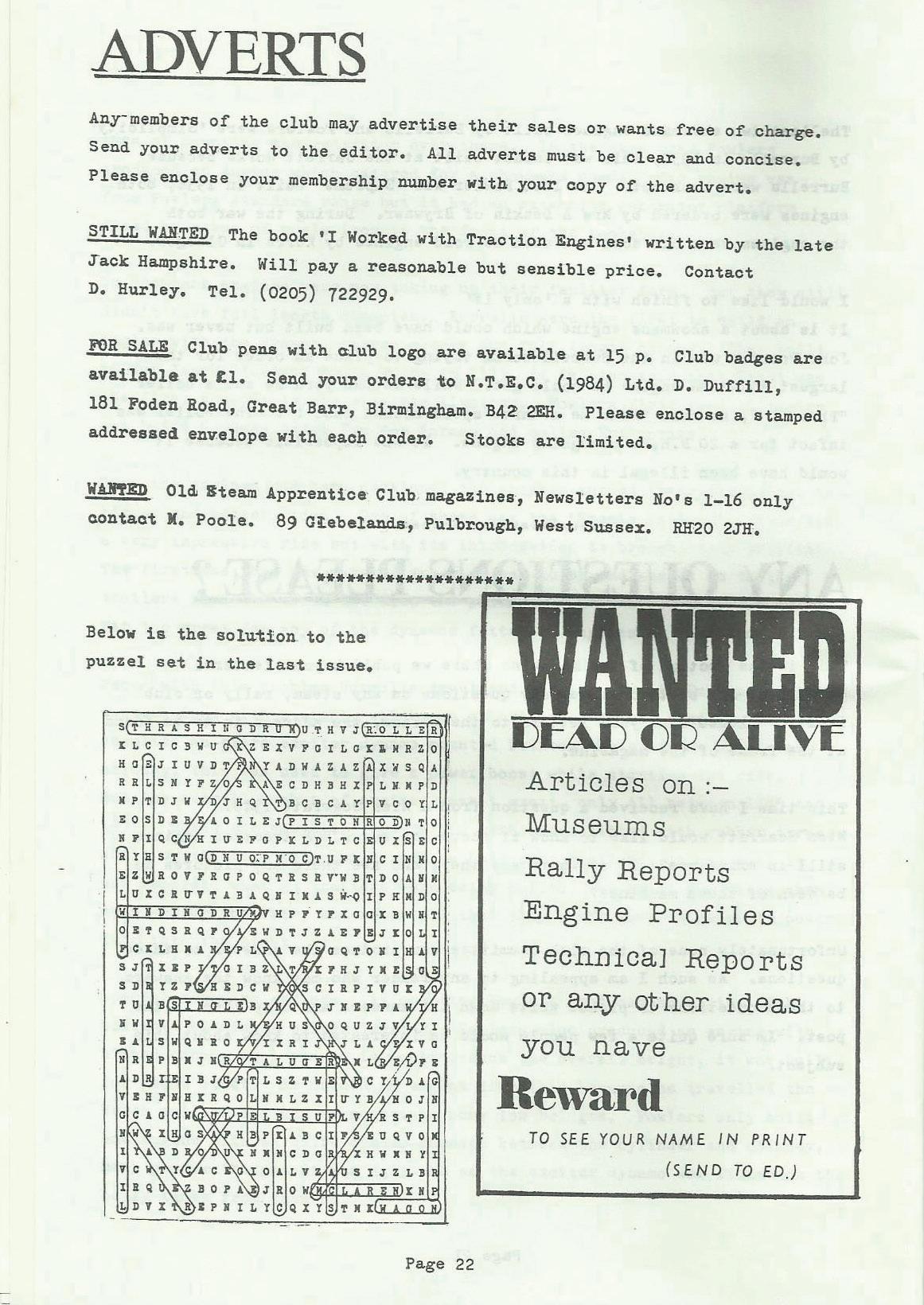
Below is the solu~ion to the puzzel set in the last issue.
JOINA FRIEND
Why not get your friends to join the S.A.C. Get them to fill in this form or a oopy of it. When complete send the form together with£ 2.00
To; David Duffill, 181 Foden Road, Great Barr, Birmingham. B42 2EH. Or hand it into any N.T.E.C. rally stand.
Name.
Address.---------------------------------
Post Code. --------------
Telephone Number.
Date of Birth.
Do you already have access to an engine, if so which one?
What activities would you like the club to provide?
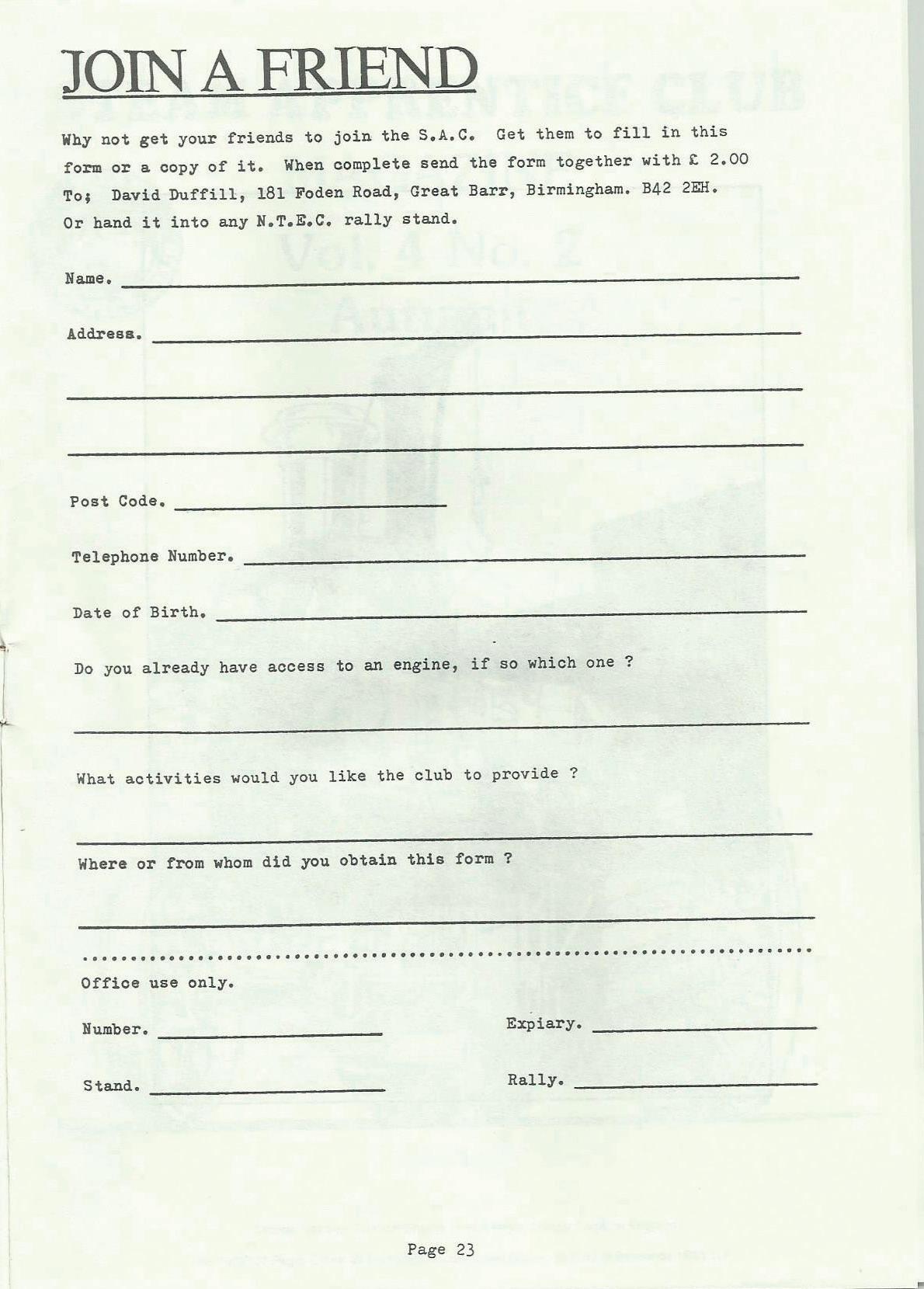
Where or from whom did you obtain this form? ............................................................................
Office use only.
Number. ------------ Expiary. -----------Stand. -----------Rally. ___________ _