STEAMAPPRENTICECLUB
ADDRESSES
"The Chairman, Robert Herring, Bellaoourt, Blacklocks hill, Banbury, Oxfordshire. OX8 7DH
The gembership Secretary, David Duffill, 181 Foden Road, Great Barr, Birmingham. B42 2EH
The Editor, David Hurley, Leyland, Willington Road, Kirton End, Boston, Lincolnshire. PE21 lNR
Assistant Editor, Graham Austin, 47 Sir Dar Road, Suffolk. IPl 2LD Ipswich,
South East Branch Officer, Peter Forecast, 5 Penny Lane, Stanford-Le-Hope, Essex. SS17 8EG
Hampshire Section Branch Officer, Stuart Gaines, A. Page, The Newsagent, The Square, Wickham, Hants.
We are pleased to consider articles of any length and or photographs fo~ inolusion in future issues. All material so submitted 4s voluntary and payment cannot be made for any material so published. Please state if you requir~ any part of your article returning, ie photographs. The .opinions in the magazine, with the exception of club announcements, are those of the contibutor and do not indicate the views of the club as a whole. All items are held the copyright of the contributor and/or the club.
NEXTISSUEa Any letters or other items for inclusion in the next issue should be submitted before the last day of APRIL.
magazine is produced by the Steam Apprentice Club and printed by
EDITORIAi,
As you will no doubt have noticed this magazine is slightly late, this is to allow us to send out the rally lists for the coming season at the same time.
With the rally season speeding towards us it is a good time to start and make plans as to which events yo~ would like to attend, and perhaps start on what can be a long and painful task of persuading your parants to take you. If at all possible try your best to get to those rallies which have a special S.A.C. event, these are usually held on a Sunday Morning.
In the magazine this time you will find plenty of good reading to amuse you although I have not had time to wright an article on last years Stourpaine event, with luck it should be in the next issue as I have just about got enough material now and hopefully enough time. Time is a precious commodity which in my case is being spent at the Midland Railway Trust in Derbyshire. I am helping with the replacement of a fire-box for an A.veling t Porter roller, a full article on this, complete with a full set of photographs will appear in later issues.
P.S. I still need a lot more articles so please keep sending them in.
CLUB NEWS
It is with sadness we have to report the passing of T. McTaggart. Known to us as Tam he kindly wrote many articles for our club ma.gazine and also helped us where ever possible with lectures ete. He is yet another genuine steam man. that has been lost and I hope this will act as a reminder to us all of the clubs aims of members ta.king their place in the preservation movement. Even so Tam will be missed. there is no doubt
Club events will be held at the Elvaston Castle steam rally on the Sunday morning and also at the Rempstone Steam and Country Show, times of these events will be in the next issue, as will other events that are planned.
RALLY REPORTS
THE EWE A.ND LA)(B STEAM PARTY.
It started very slowly on Saturday making it impossible to hold a formal S.A.C. event. At 10 am the exhibits numbered 3, this being made up of 2 oil engines and Peter Webbs four abrest gallopers. Even the gallopers could not work as their power supply, showmans engine 'Repulse• had got lost and ended up in Gloucester.
Finally about lunch time the road engines started to arrive. Much to Peter Webbs relief 'Repulse• finally arrived, meaning Peter could begin making a living. Saturday was a slow day with a few visitors but it was very cold. Sunday saw a good attendance of exhibits with several items turning up that were not invited, but of course all were welcome. Sunday saw a road run of about 5½miles around Bromsgrove. Four engines took part with some classic cars and 2 commercial vehicles. Also included was a surprise exhibit of my car built in 1985. I was towing a trailer with a fairground organ and operator inside. The organ was playing Chrismas carols as we drove round. The run caused some large traffic queues and we had the usual drivers who attempted to pass us at all costs. It was a shame that not many apprentices turned up as it was a good week-end.
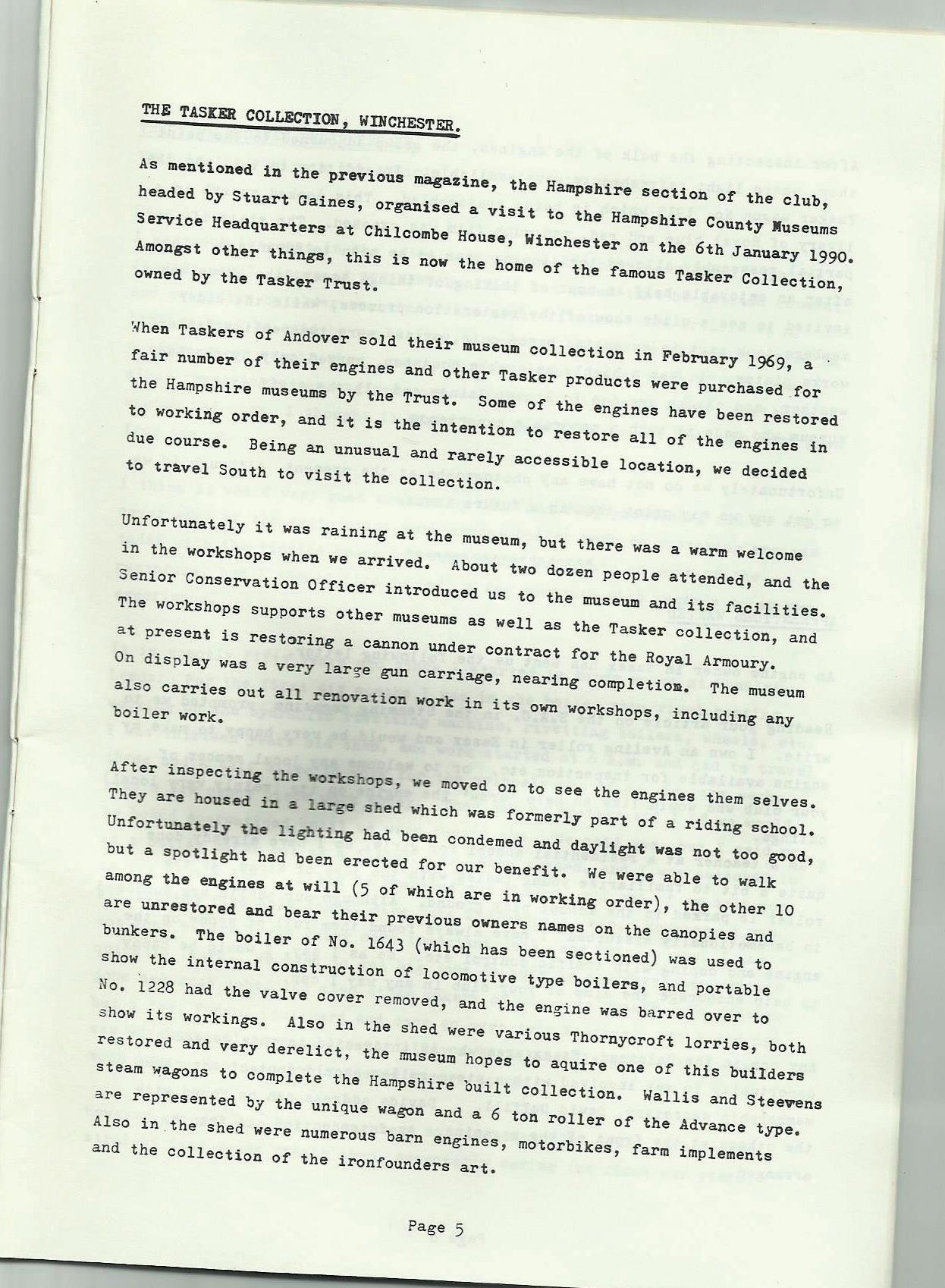
So to worn you all an event will be held again this year •. To those who turned up last year, we are sorry but owing to problems a formal event could not be held. Below is a photo of some of the engines that attended.
THE TASKERCOLLECTION, WINCHESTER.
As mentioned in the previous magazine, the Hampshire section of the club, headed by Stuart Gaines, organised a visit to the Hampshire County Kuseums Service Headquarters at Chilcombe House, Winchester on the 6th January 1990. Amongst other things, this is now the home of the famous Tasker Collection, owned by the Tasker Trust.
~hen Taskers of Andover sold their museum collection in February 1969, a • fair number of their engines and other Tasker products were purchased for the Hampshire museums by the Trust. Some of the engines have been restored to working order, and it is the intention to restore all of the engines in due course. Being an unusual and rarely accessible location, we decided to travel South to visit the collection.
Unfortunately it was raining at the museum, but there was a warm welcome in the workshops when we arrived. About two dozen people attended, and the Senior Conservation Officer introduced us to the museum and its facilities. The workshops supports other museums as well as the Tasker collection, and at present is restoring a cannon under contract for the Royal Armoury. On display was a very large gun carriage, nearing completio&. The museum also carries out all renovation work in its own workshops, including any boiler work.
After inspecting the workshops, we moved on to see the engines them selves. They are housed in a large shed which was formerly part of a riding school. Unfortunately the lighting had been condemed and daylight was not too good, but a spotlight had been erected for our benefit. We were able to walk among the engines at will (5 of which are in working order), the other 10 are unrestored and bear their previous owners names on the canopies and bunkers. The boiler of No. 1643 (which has been sectioned) was used to show the internal construction of locomotive type boilers, and portable No. 1228 had the valve cover removed, and the engine was barred over to show its workings. Also in the shed were various Thornycroft lorries, both restored and very derelict, the museum hopes to aquire one of this builders steam ~agons to complete the Hampshire built collection. Wallis and Steevens are represented by the unique wagon and a 6 ton roller of the Advance type. Also in the shed were numerous barn engines, motorbikes, farm implements and the collection of the ironfounders art.
After inspecting the bulk of the engines, the group adjourned to the paint shop, where light refreshments were available. In addition to this was the Tasker wagon No. 1915 which is being reassembled. This looked superb in a livery of Royal blue and red, and much film was exposed. The state of partial reassembly allowed the tipping gear to be seen to advantage. Then, after an enjoyable half an hour of talking of things steam, the group was invited to see a slide show of the restoration process, while the older members took part in an engine based quiz, prizes were two replica Tasker works plates. It was a highly enjoyable occasion, marred only by the bad weather, and thanks are due to Stuart Gaines and all the staff of the museum who made it such a memorable experience.
Unfortunately we do not have any photographs at the present, although if we do get any we may print them in a future issue.
APPRENTICESWANTED
An engine owner in 3ssex has sent us the following ·1etter.
Reading your article on the S.A.C. in the Steaming magazine prompted me to write. I own an Aveling roller in Essex and would be very happy to make my engine available for inspection etc. or to welcome any local member of your club who would like to help •crew' the engine on its (mainly very local) outings.
I am a teacher at a residential school for girls, so I have already done quite a bit to familiarize young ladies with the joys of steam, as the roller is parked in the school play ground. Although our pupils are supposed to be•~motionally disturbed' I have always found them ful: of sence on the engine and coping with traffic control etc. so as I say, I would be happy to help encourage the aims of your club in any way I can.
Any one in·the Halstead, Essex area who is interested in this generous opportunity to get involved with a steam roller should contact the clubs membership secretary, David Duffill, Davids address can be found with the others at the front of the magazine. An introduction can then be arranged.
TRACTIONENGINESUNDERREPAIR
This is the reply to the article is the last issue.
Dear.Sir,
I was much interest in the article "Traction Engines Under Repair"· in the January, 1962, issue of STEAMINGby "26", and noted that he invited comment and criticism by older members of the club. I showed the article to my brother, and he said he would like to comment, and as he served his time in a steam wagon repair shop, namely Manns, and has spent much of his tim~ since repairing steam engined road vehicles of different makes, mostly wagons and cars, I thought it might be a good idea to let him. So.here goes from now on.
I think it was a very good article by "26" and very pr~cticle, and it should cover most of the restoration work except boiler work on restoring engines today with the limited means and eqaipment available to most of the restorers, but r·should like to make a few comments with regards to my own experience.
It is exactly fifty years ago since I started in Manns works at Hunslet, Leeds. For the first six months I was in the boiler shop rivet heating, working on the hydraulic rivetting machine, rivetting boilers, wheels, etc. I was thirteen years old then, and work started at 6 a.m. and had to travel three and a half miles to work for the princely sum of 4s. 6d. per week, plus a few pence piece work money. They ask my brother and I if we would be bound apprenticed until we were twenty one. We said yes, but I said not as a boiler maker but as a fitter. Mr. Mannagreed, and I was switched in to the repair shop. I had to start at the bottom, and one of my main jobs was fit~ing fire hole doors, fire bars and ashpans, etc. However, I was not long before I was doing more important jobs, and being young, I was quick to learn. We used to get big jobs in such as new fireboxes, little jobs and rush jobs, and also other makers of wagon to repair. To mention but a few, Foden, Coulthard and once an over type Sentinel, bat I did not see any Sentinel name on it only Alley & Mclellan, Glasgow. It was very much like a Foden, only it seemed larger to me.
~owever, to get on, let me say here and noe that "26" could have walked straight into Manns repair shop, especially during the first war years,
and he would have been a good asset as good men w.ere hard to get t~en. He would have that his work would have been much facilitated by proper equipment, such as an overhead travelling crane and the full backing of a machine shop, smith shop, brass finishing shop, etc. and he would have got through his work quicker besides making a better job.
As an instance, just after the out break of the 1914-18 war, the Manns wagon owned by my father and his brother, was sent in to get a new firebox fitted, and this job was completed in one month from driving in to the works to driving out. My brother and I worked on this job with two other fitters, and I wonder if this is a record·, as I think it certainly was for Manns.
His remarts regarding engine fitting and valve setting, etc. are very much correct, but I would just like to add one or two points here regarding facing slide valves and cylinder faces. He mentions using a long ~craper and taking good cuts off the cylinder face.when the faces were in bad condition which they often were. We had at Manns a hand shaping machine which fastened on to the cylinder cover studs. The cutter could be worked by hand lever and it could make as good a job as an ordinary shaping machine. It was only necessary then to lightly scrape and finish off to the face plate. This should fit inside the cylinder and be large enough to cover all ports. Also, please note, surface plates should be kept in wooden oases and surface greased after use. It is most important that the intersection between the ports should have no hollow spots, as this would result in a direct blow through, live steam to exhaust, and would cause heavy fuel and water consumption.
Regarding valve setting, his rem.arks are about right, but he forgot to mention that when setting, the reversing lever should be in forward notch, for forward running. Reverse notch could generally be ignored as this would ordinarily tak9 care of itself. His remarks about allowance for would probably be about right for a long boilered traction engine, but on a wagon 1/16 in. may be a little.bit too much and 1/32 in. may be enough. In any case, to get accuracy it is possible to set the valve with steam up, but this depends on the steam tightness of the regulator valve. If there is no blow through at all, the covers can be left off and valves set when hot, and then no allowance for expansion and then no ~llowanoe for
expansion would be needed. This is the best method, as it is surprising what a difference it makes to the performance of an engine and also to coal and water consumption if the valves are only 1/32 in. out.
Pistons and ring fitting, Here again he mentions fitting ri~ to worn bores with stop peg in th& grooves to stop rings tunung. We did not do that.. When the bores were worn to that extent we adopted the same procedure as we did with ~he slide valves. ·we had a hand boring machine which fastened on the studs at the front end of the cylinder, and the cutting tool was worked by hand and it was just as good as machine- bored. This method saved taking the cylinders off the boiler barrel which entailed a lot of work. Perfect piston and ring fitting does restore new performance to the engine and makes for good economy.
Regarding fitting new pins to link motion there is one point I would like to stress. That is, the pin should not go in the hole before hardening but should only just enter, as it will be found that it will shrink at least a thou. after hardening and then after polishing with emery cloth it will go in without slack, otherwise it will be loose. Another point to watch is that when assembled, and the reversing lever is in full forward notch, the die in the link is not striking the top of the link when running, a.s this will cause the reversing lever to rock backwards and forwards and wear the notch. It should be about 1/8 in. clear, and this can be done by having the rod that couples the reversing lever to the rocking shaft jumped up slightly after heating up.
Eccentric sheaves ·on crank shaft should be checked for quality, especially the forward. eccentric on high pressure cylinder, as if this is worn it will cauae loss of valve travel and affect the valve setting, besides having the liability to breaking the strap. It should either b; replaced by a new one if detachable, which they generally are, or turned down and a ring fitted on either with pegs or weldin.g.
The crankshaft on a compound have someti.mes a nasty habit of bending. This will show itself up by the main bearings jumping- and running hot if tightened down. It is a matter then of having it straightened. This is a case then of where the smith and turner comes in, the smith to do the straightening and the turner to check it in the lathe to make sure it is true. This is rather a difficult job, but it can be done.
''26" is rigllt about filing oval bigend journals. I have seen it done many a time, but only one man used to do it, and he was a lea.dill€ fitter with much experience and there was never any trouble with them after he had done them. I once tried it on a petrol engine in a Dennis lorry. Just as "26" says, about 1924, I thought I had made a lovely job of them, but the bearings did not last long- and the crank had to come out to be reground, so do not try it on a fast running engine.
"26" was right, hammer and chisel, file and scraper, were our chief weapons and there was an art in using them, but there should also be added calipers, both inside and outside, odd legs, small steel square, compasses or dividers, feeler gauges, steel rules, centre punches and marker, micrometer gauges were not necessary for us, but we had to use standard gauges, both male and female, for bushes and shafts, etc. and these were made to micrometer limits. Also we had to capable of reading and working to drawings, and when working on many different types of drawings had to be followed exactly, then if anything did go wrong, which was not often, the fitter could say I have followed the drawing and could pass the buck back to the drawing office.
I have not seen any aention in STEA.MINGor by any member of the traction engine club of the Mann & Charlesworth traction engine. I think they made about six of these just before the turn of the century, about 1898. I had the good fortune to work on one of these about 1914, a general purpose single cylinder engine about the same size as most G.P. engines. I think that it would be very much similar to a Mclaren. Square shafts, cast iron bored guide, open at the sides, etc. Manns followed Mclaren practice pretty closely on their overtype engines, and I was very much impressed with the swe&t running of the engine vb.eu cot in gear. I thill.lt it came from a farm at Monk Fryston, near Selby, and I never heard anything further about it after it left Manns. I hope that this contribution may be of some benefit to engine restorers.
Yours Faithfully, w. Cole.
P.s. I should qualify my remarks about valve setting with steam up. This would apply mainly to engines with outside slide valves, such as Burrells, etc. It-would be difficult, if not impossible, with engines with inside valves.
Also my remarks regarding Manns following Kclaren design, this applied only to the 5 and 6 ton overtype which were in the majority. Other types such as the 3 and 4 tonner, 5 ton carts and agricultural tractors all had inside slide valves, which differed from the Mclaren.
IMPORTANT: -
TO ALL S.A.C.
MEMBERS
There will be NO FREE ADMISSIONon the patgates at the Great Dorset Steam Fair 1990.
Due to the problems that arose last year over free admission for the S.A.C. members, the N.T~E,T. have arranged with Michael Oliver, the shows organiser, that although you must pay on the gate, you will receive a refund.
By coming to the N.T.E.T. marquee you will be refunded your admission, on producing your ticket and your current S.A.C. membership card.
PLEASE NOTEs~ This offer applies ONCEONLY(i.e. if you attend the show on two days, only one day will the ad.mission be refunded.)
A register will be kept acordingly.
Tracey Shakespeare, on behalf of the N.T.E.T.
This notice will be repeated nearer to the event.
GALLERY
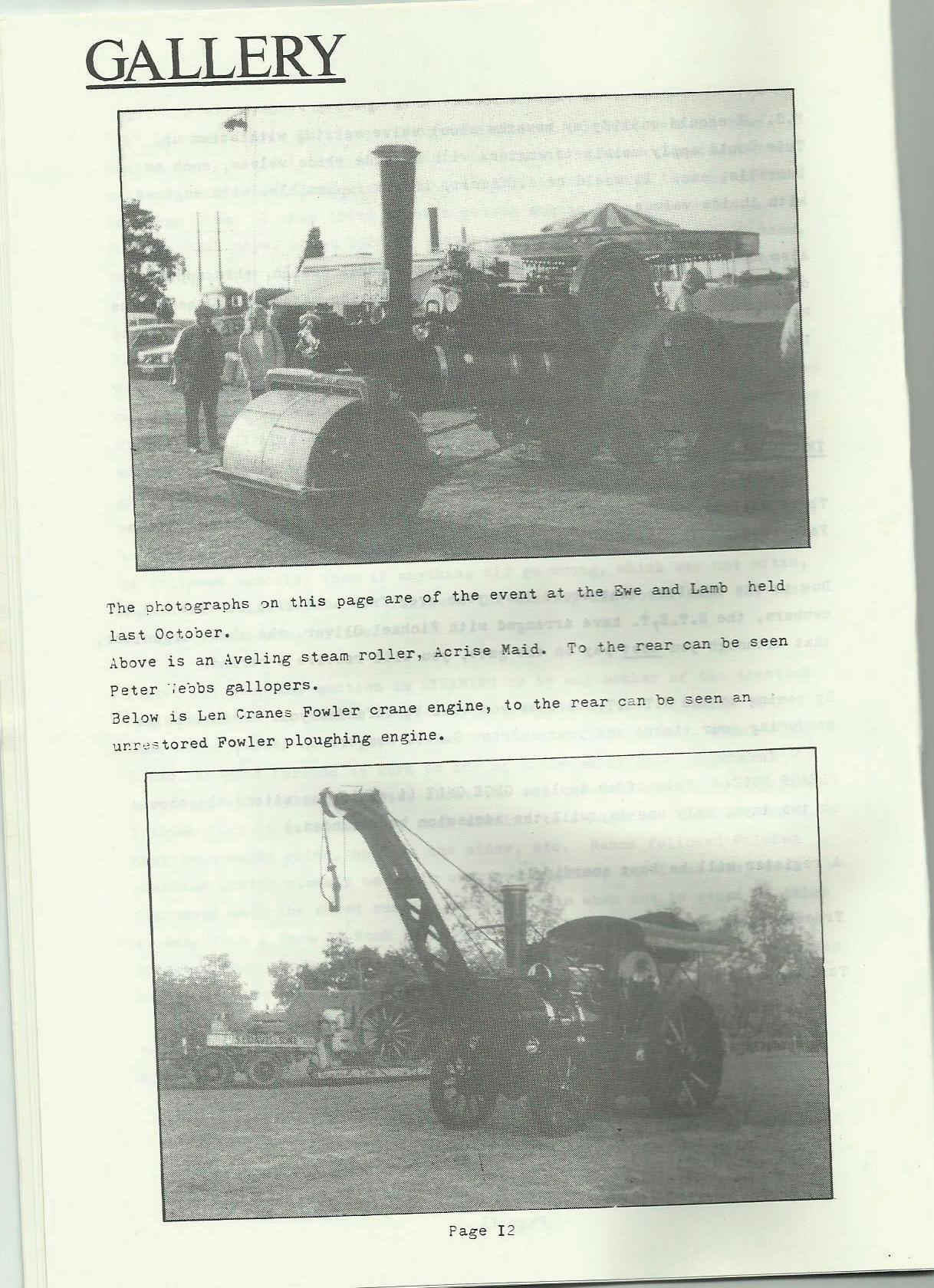
The ptotographs ?n this page are of the event at the Swe and La~b held last October.
Above is an Aveling steam roller, Acrise Maid. ~be rear can be seen Peter ·:e":Jbs gallopers.
Below is Len Cranes Fowler crane engine, to the rear can be seen an u~r~~tored Fowler ploughing engine.
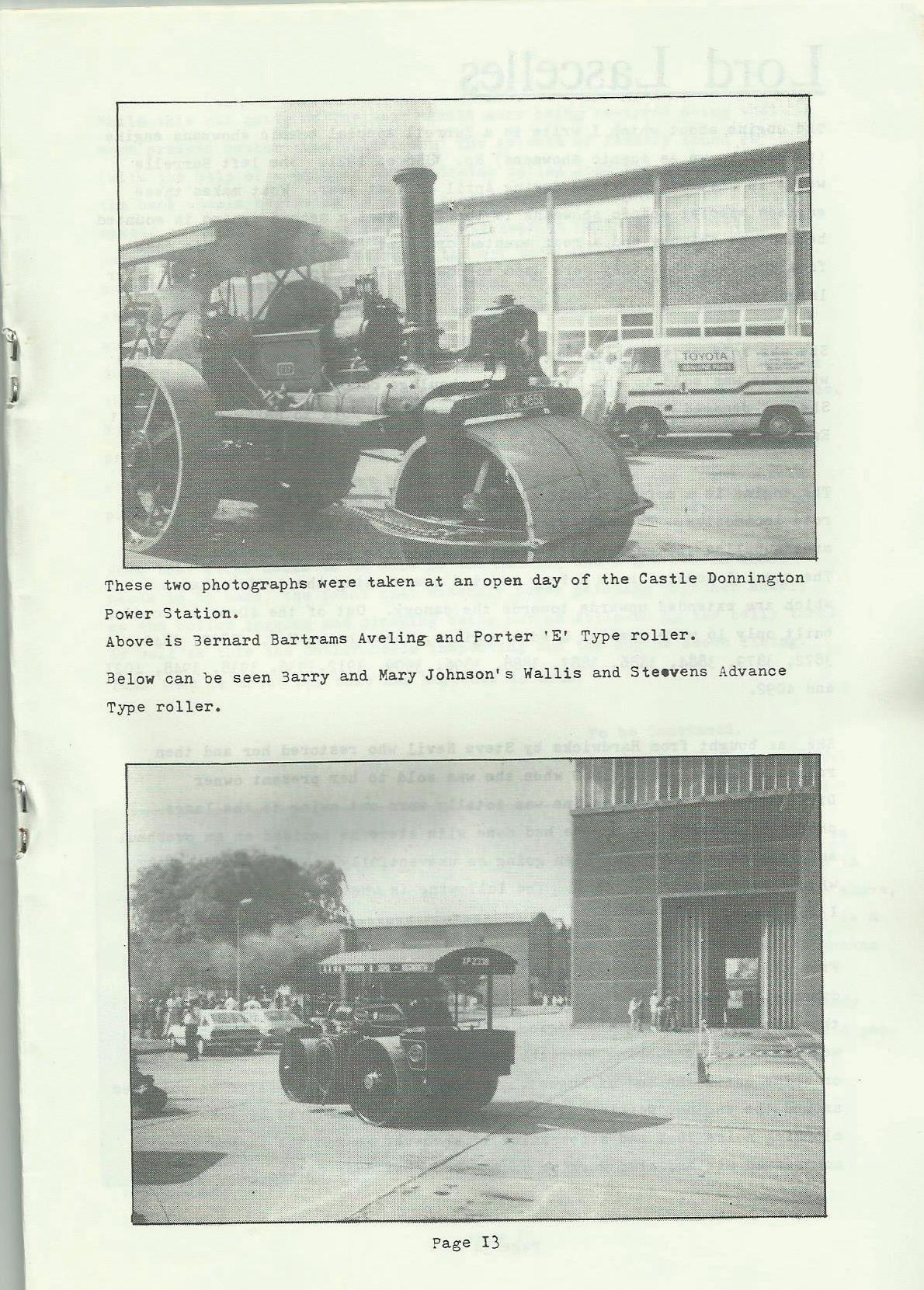
These two photographs were taken at an open day of the Castle Donnington Power Station.
Above is 3ernard Bartrams Aveling and Porter 'E' Type roller.
3elow can be seen 3arry and Mary Johnson's Wallis and Ste•vens Advance Type roller.
Lord Lascelles
T~e engine about which I write is a Burrell special scenic showmans engine (usually known as scenic showmans) No. 3886 of 1921. She left Burrells works in Thetford sometime during April of that year. What makes t"hese engines special scenic showmans is the fact that a second dynamo is mounted behind the chimney and a rear mounted crain is fitted. The scenic came from the fact that they were used to power a large scenic railway or other large rides.
She was sold to the 3attersea showman Harry Gray. He used her until 1939 when she was sold to the London heavy haulage concern J. Hickey½ Son. She was renamed 'Tulyar'. Then in 1951 she was sold to Hardwickes of west Ewal where she stayed for about 5 years.
The engi~e is a normal double crank compound, 8 nhp three shaft sprung road locomotive. The coal fire burning in her 6.6 sq. feet of grate area supplies the engine with steam at a working pressure of 200 psi. The special scenics have a rear mounted crane using the tender plates which are extended upwards towards the canopy. Out of the 40 or so scenios built only 16 were special scenic engines, these being Nos. 3827, 3840, 3872, 3879, 3884, 3886, 3887, 3888, 3896, 3909, 3912,3936, 3938, 3948, 4021 and 4092.
She :,as bought from Hardwicks by Steve Nevil who restored her and then ralied her until about 1980 when she was sold to her present owner Dick Marsh. Since the engine was totally worn out owing to the large amount of roading the engine had done with steve he decided on an overhaul and repaint and this has been going on uneventfully until September 1987 when I arrived on the scene. The following is what has happened since I got there.
From about October 87 until April 30th 1988 we were wiring up the two dynamos and switch gear and also welding the canopy lights. These were then tested by running the engine on compressed air. The following weekend found us rubbing down the two gear cases and this carried on rain or shine until the end of August. During the autumn and winter we pottered •around the engine, working on the motion trying to get rid of the loud clonking noise that had accompanied it whenever we ran the engine on compressed air and also working on the -smokebox door catch.
While this was going on th~ back wheels were being re-tyred using that were. pressed rather than bolted on. The seventh of January found us (with the help of a painter and decorator called John Mason) working on the back wheels beginning to paint them. On the twenty first of January myself and Dick started to put the brake gear on while John carried on painting. By the 25th of February the off side wheel was ready for painting. The weekend of the 4th of March the nearside rear wheel was started on and this was finished by the end of May. For the rest of the summer nothing else was done on the engine. Parts were however being done 'in Dicks engineering works namely tyring the front wheels and cutting the gears. The 23rd of September found us again back at work on the engine. By the 30th of that month the diff~rential had been assembled ·and some parts had been collected from the works. The 21st of October found us at work on the.engine in ernest by tidying the tyres up on the front wheela prior to being sent away for shot blasting and metal spraying-.
Work that still needs to be done is the gearing and a new second shaft needs to be made, the front axel assembly needs patching- together aswell as the boiler lagging and cladding being put on followed by the belly tank. As well as this the boiler needs inspecting and the engine needs lining. This then is aboµt all th~t has happened to date.
To be Continued.
By Matthew Heal~y (1259)
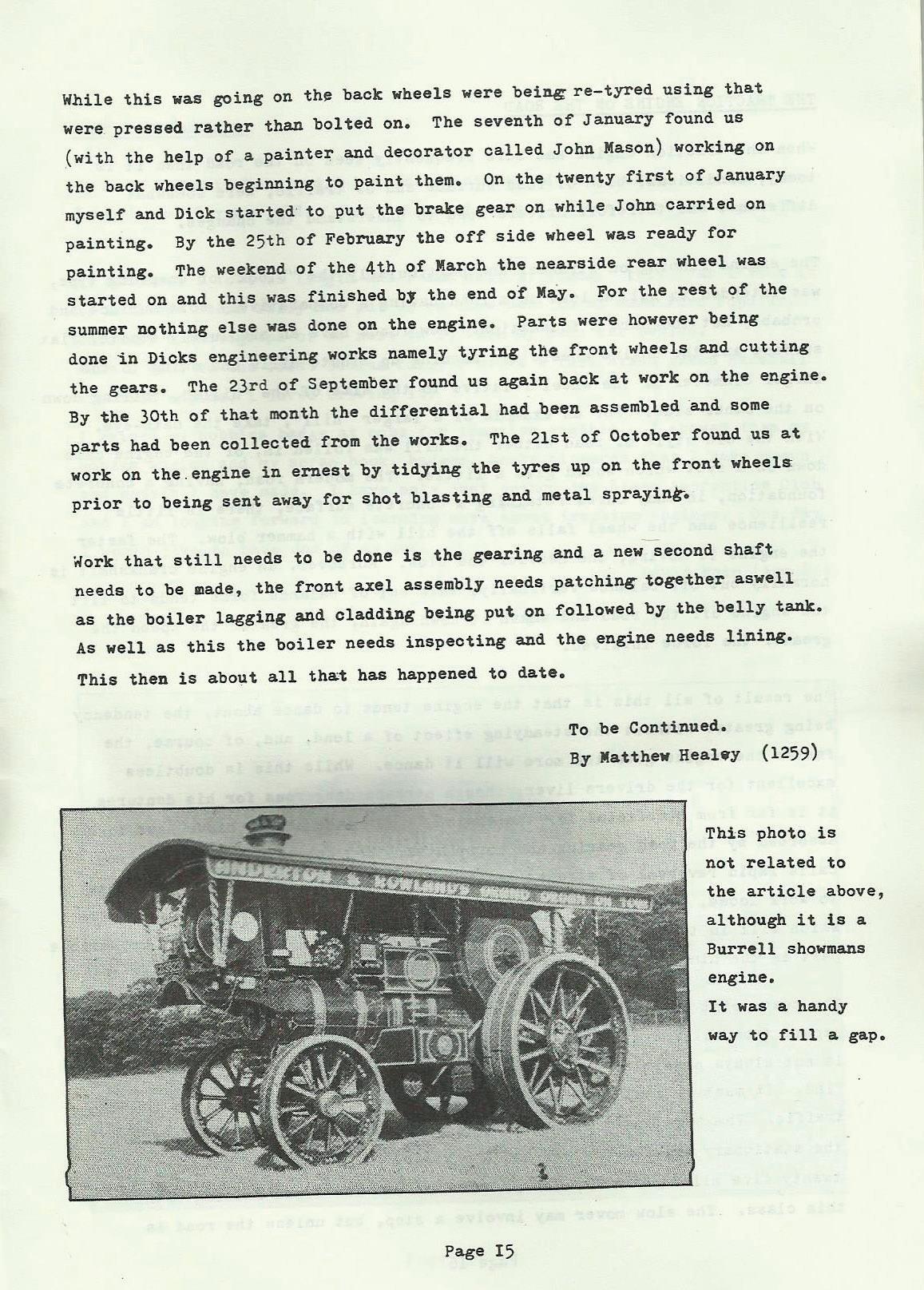
This photo is not related to the article above, although it is a Burrell showmans engine. It was a handy way to fill a gap.
THE TRACTIONE:NGINEON THE ROAD
~hen the traction engine was more frequently seen on the road than it is today, conditions, both of road surface and of traffic, were somewhat different, and therefore drivers need to understand the changes.
The engine running on strakes, and particularly the "block" or unsprung type, was intended to pull a load on a road having a comparatively soft surface and probably not too hard a foundation. Few roads have an absolutely smooth, flat surface and the engine wheels are running up minute hills and owing to the larger diameter of the wheel relative to the size of the ''hills", falling down on the other side. For an example of a larger ''hill", take the cats-eye. ~ith the old style of road either the hill was rolled in, or the engine came down on a spot which would give a little. The modern road, having a concrete foundation, in many cases retain,j,ng a concrete surface, there is little resilience and the wheel falls off the hill with a hammer blow. The faster the engine is moving, the heavier the blow. Moreover, an engine crankshaft is normally out off balance vertically, this out of balance force tends to lift the engine off the road and smash it down again, the greater the speed the greater the force invvlved.
~he result of all this is that the engine tends to dance about, the tendency being greater without the steadying ert·ec t of a load, and, of course, the faster the engine goes the more will it dance. While this is doubtless excellent for the drivers liver, though perhaps dangerous for his dentures it is far from beneficial for the engine. All these hammer blows have to be absorbed by the road gearing and hornplates, they set up what the engineer calls rapid reversal of stress, and this, quite apart from encouraging nuts to w.ork loose,· results in metal fatigue, formation of a crystaline structure which will in the course of time lead to failure. Possibly the most vulnerable part is the hind axle. ~he moral of all this is, do not drive too fast t
The next point is traffic. Avoid it. This means trying to arrive at and depart from rallies at a time when traffic is a minimum. Unfortunately this is not always possible, and, in any case, quiet roads and times are hard to find. It must be realised that a traction engine is an obstruction to car traffic. The car driver has two kinds of obstruction with which to deal, the stationary or slow moving, and the vehicle travelling at say, about twenty five miles per hour, low loaders and service buses falling within this class. The slow mover may involve a stop, but unless the road is
A Real &nthusiast.
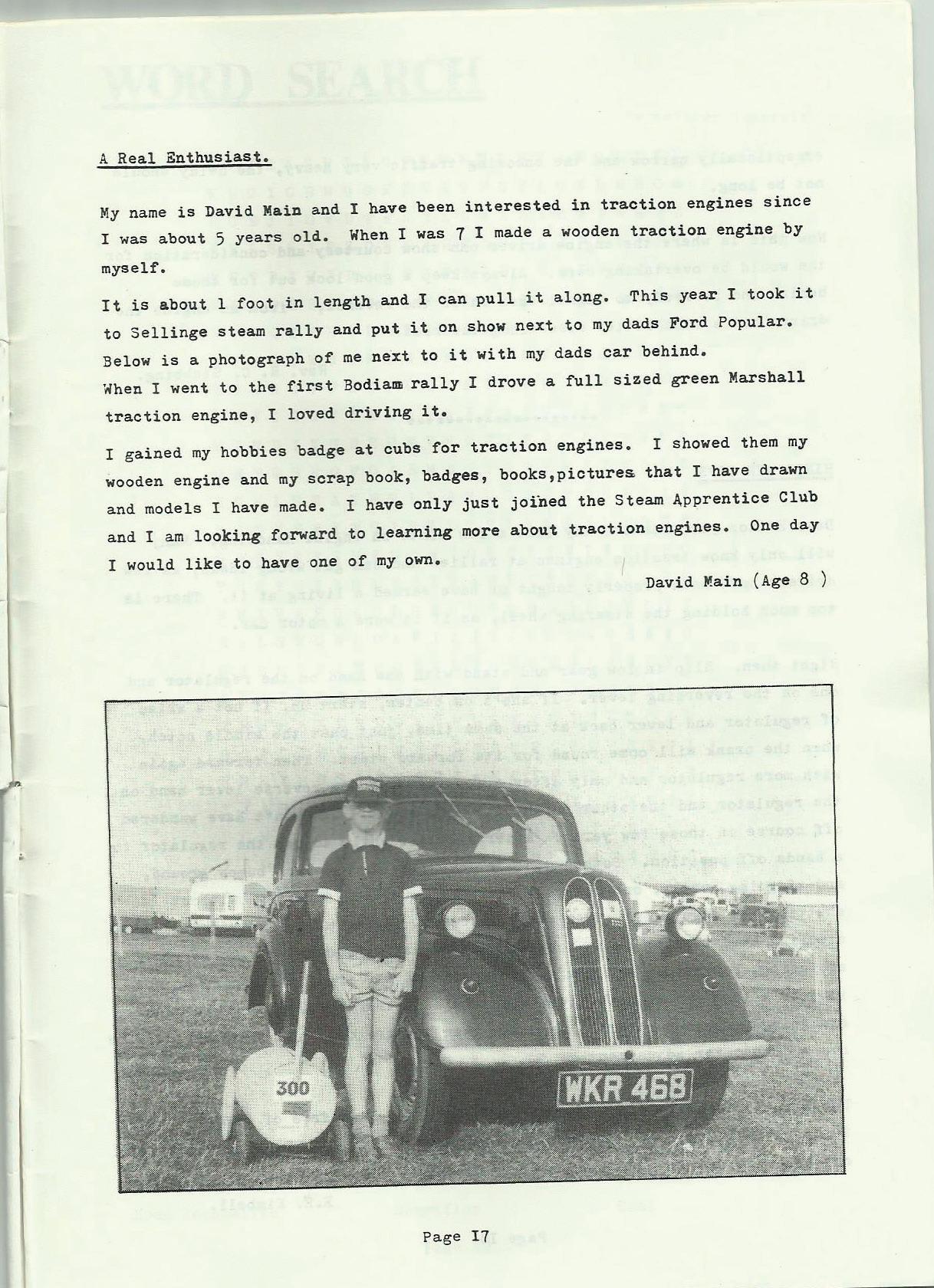
My name is David Main and I have been interested in traction engines since I was about 5 years old. When I was 7 I made a wooden traction engine by myself.
It is about 1 foot in length and I can pull it along. This year I took it to Sellinge steam rally and put it on show next to my dads Ford Popular. Below is a photograph of me next to it with my dads car behind.
When I went to the first Bodiam rally I drove a full sized green Marshall traction engine, I loved driving it.
I gained my hobbies badge at cubs for traction engines. I showed them my wooden engine and my scrap book, badges, books,pictures that I have drawn and models I have made. I have only just jo1ned the Steam Apprentice Club and I am looking forward to learning more about traction engines. One day I would like to have one of my own.
David Main (Age 8)
e%'ceptionally ~arrow and the oncoming traffic very heavy, the delay should not be long.
Now tthis is where the engine driver can show courtesy and consideration for the would be overtaking cars. Always keep a good look out for those behind and be ready to signal them on or the reverse, from an engine the driver has a much better view along the road.
Rev. R. C. Stebbu:.g.
HINTS AND TIPS
Dear Editor your readers may like a few hints on engine handling. Many will only know traction engines at rallies and can get wrong ideas, as few drivers have been properly taught or have earned a living at it. There is too much holding the steering wheel, as if it were a motor car.
Right then. Slip in low gear and stand with one hand on the regulator and one on the reversing lever. If she's om center, start up, if not a whisp of regulator and lever back at the same time, just past the middle notch, when the crank will come round for its forward start. Then forward again with more regulator and only after a few revs put the reverse lever hand on the regulator and the other on the steering wheel. She won•t have wandered off course on those few yards. After a little while adjust the regulator to a hands off position. Both hands are then free to steer on bumpy ground, and if going gently, one can pull back the lever for a reverse without shutting the regulator. Then stand sideways, facing wheel and with the nonsteering hand resting on it. Here, with a glance, you can see where you are going, backwards, and how the turntable at the front is shaping up for it. On a long run whi~ rollers did turn a further half; facing where you are going. The non-steering hand can then be stretched back to the regulator now and then for adjustment •
• There is more skill in getting her to move slowly and free of jerks. There is no skill in just opening up and 'banging about•. This hand and body drill can be practiced on a dead engine and done over and over again. E.E. Kimbell.
S T H R A S H I N G DRU'MUT H V J R 0 L L E R
K I, C I C B W-U G K Z 1i! Y. V F G I LG K L MR O Z H G E J. I UVDTFN YA D WA z A Z A X w s Q A
R R L S N Y F Z OS K A E C D H B H X p L N M p D
M p T D J w X D J H Q I T B C B C A y p V C 0 y L
E O S DEB E A 0 I LE J p I s T 0 N R 0 D N ·r o
N F I Q C N H I u EFG P KL D L T C E U X S E C
R y H s T W G D N U 0 P M 0 C T U F K t• C I 'N r,10
E Z w R 0 V F R G p 0 Q T R S R V w B T D 0 A N M
LUX C R U V T A B A Q N I M A s w 0 I p H 111D 0
W I N D I N G D R U M V H p F y F X G C· K B w N T
0 E T Q S R Q F O A E W D T J z A E F E J K 0 L I
F C K L H M AN E P L p A V U s G QT o n I H A V
s J T X E P I T G I B Z LT H K F H J V ?.·' c l•I z s G E
s D R y z F S H E D C w y 0 s C I R p I V U K B 0
T tJ A. B S I N G LE BX N Q u p J N E P F A W I H
N W IV A p· 0 A D L M EH u s G 0 Q u z J V L y I
E A l, s··-wQ N R O K V I X R I J E J L A C -<' .J XV G
N R E p B M J N R 0 T A L U G E R E !Ii L R E L F E A D R I E I B J G p T LS z T w E V R C y L D A G
V E H F N H K R Q
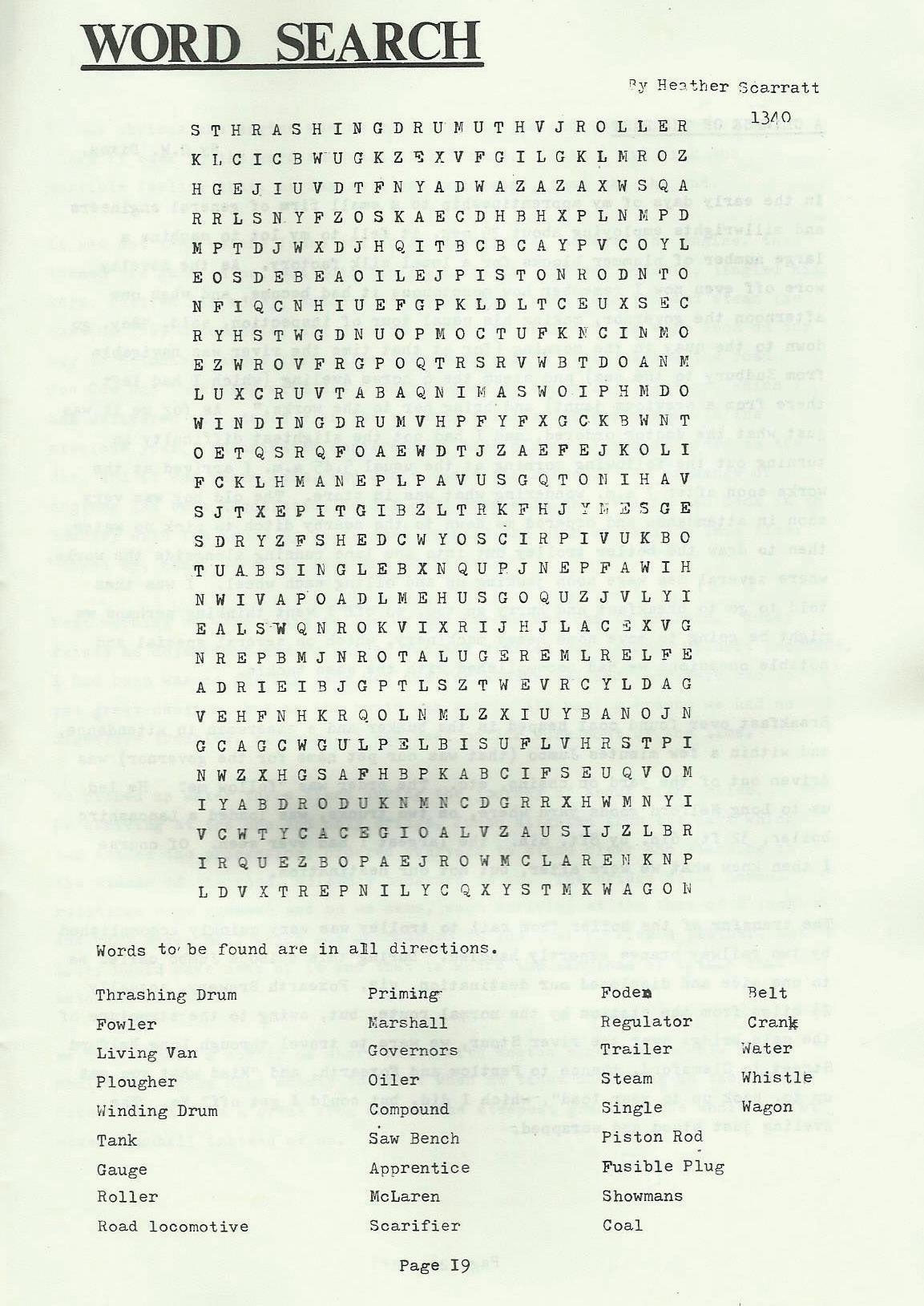
Words to, be found ar-e in a]l directions.
Thrashing Drum
Priming- Fode:o Belt
Fowler Marshall Regulator Crank
Living Van Governors Trailer Water
Plougher Oiler Steam Whistl~
Winding Drum Compound Single Wagon
Tank Saw Bench
Gauge Apprentice
Roller McLaren
Road locomotive
Scarifier
Piston Rod
Fusible Plug
Showmans
Coal
A GLIMPSE OF THE PAST
By G.W. Dixon.
In the early days of my apprenticeship to a small firm of general engineers and millwrights employing about 25 men, it fell to my lot to machine a large number of plummer blocks for a local silk factory. As the novelty wore off even now I remember how monotonous it had become, and when one afternoon the governor, making his usual tour of inspection, said, n3oy, go down to the quay in the morning (fo~ at that time the river was navigable from Sudbury to the sea) and steam the 6 horse Aveling (which I had left there fromi a previous jaunt) and bring her to the works." As for me it was just what the doctor ordered, and I had not the slightest difficulty in turning out the following morning at the usual 5.45 a.m. I arrived at the works soon after 7 a.m. wondering what was in store. The old boy was very soon in attendance and ordered me down to the nearby ditch to pick up water, then to draw the boiler trolley out into the lane running alongside the works, where several men were soon jacking up and oiling each wheel. I was then told to go to breakfast and hurry up too, so off I went thinking perhaps we Night be going to move some heavy machinery, which on several special and notable occasions we had accomplished with the same tackle.
Sreakfast over found coal heaped in the bunker and a steersman. in attendance, and within a few minutes Jumbo (that was our pet name for the governor) was driven out of the yard on chains, etc. The order was ''follow me~ Ke led us to Long Melford goods yard-where, on two trucks, was loaded a Lancashire boiler, 32 ft. 6in. by 8ft. 6in. the largest I had ever seen. Of course I then knew wha~ we were after, but not our destina~ion.
The transfu of the boiler from rail to trolley was very quickly accomplished by two railway cranes expertly handled. During this episode Jumbo called me to one side and disclosed our destination, viz, Foxearth Brewery, actually 2½miles from the station by the normal route, but, owing to the structure of the main bridge over the river Stour, we were to travel through Long Melford Stree1t to Glemsford, thence to Pentlow and Foxearth, and "Mind what you get up to, hook up to your load'', which I did, but could I get off? No. The Aveling just stood and scrapped.
ft was obvious the engine was no good for the job and the nert order was "take it back to the yard and wait till I come.'' This I did with the horrible feeling that, as far as I was concerned, that was the end.
It was not long before Jumbo put in an appearance, he eyed the engine, then turned his gaze on me, put both his hands in his trouser pockets, jingled his
keys, rattled his money, hunched his shoulders, then said "Go and steam thecar (an 1399 Locomobile) and pick me up at the office." We were soon on our way to Belchamp, about five miles away, where in a field beside the road ..
Joe Coe was threshing with his 8 horse Robey of about 1875 vintage, which I. had delivered and stayed with for a weeks trial after works rebuild the previous year. ~n animated conversation took place. Jumbo returned to the car, and it was "Home John, and don't spare the horses." An exchange of engines had been negotiated, so off once more with the Aveling and back in to Sudbury with the Robey by 9p.m. that evening and with my tail up thi:.s time. Banked up, home, wash and fed, and so to bed.
Next morning we were again following the horses and van to Welford. Robey raised no objections and we pulled out and started our journey without incident. I had been warned the old lady was due for a wash out and therefore had to use great caution, but as the route was nearly all rising ground we had no digestive troubles, although it was real collar work most of the time.
We picked up water three times during the journey of about eight miles. On arriving at the one and only bridge, Jumbo alighted from the cart which had headed the procession, ordered everyone to stand clear and standing in the middle of the road, solemnly beckoned me on. The bridge held, normal relations were Pesumed and on we came, soon arriving at the foot of a long and very steep hill which was approached in low gear showing a feather, but Robey would have none of it and that is where the van load of tackle came into the picture.
~e had to make a number of short hauls with snatch block and double rope chainning engine hind wheels to front when at times on taking up the strain Robey hopped like a great frog and on the steepest gradient the whole outf~t moved downhill instead of up.
~l! this took a long time and we eventually arrived in Foxearth Street well after 6 p.m. and the whole village turned out to welcome us and watch the operation of turning in at an acute angle from a narrow country lane to the back entrance of the brewery, which fortunately came off without damage to anything or anyone. Well, call it a day.
Next day found us winkling the load in a very restricted space in alignment with the prepared brickwork, using snatch block and greased boiler plate.
All this happened in 1902, and last year for the first time since I looked into the brewery boiler house and commented to an old boy who was cleaning the fire, "So you still use the old boiler? '' In turn his comment was, "Old boiler, what do you know about it?" I could have told him quite a lot.
ANY QUESTIONSPLEASE?
This is the section of the magaz•ine where we publish your letters. ~e will do our best to answer any questions on any steam, rally or club issues. Please send your letters to The Edit~r, the address is to be found at the front of th.e magazine.
Dear Mr Hurley
I am writing to you to find out why my article and photo has not been printed It was an article on a Marshall single cylindBr traction engine which won first prize at the Sellindge steam special in 1987, as you said you desperately needed articles on events and steam rallies etc. If i Vs not too much trouble could you possibly print the article for m_e. Yours ~incerely Mr L. Goodman.
In reply to this letter I must inform both Mr Goodman and also any other people in a similar position that I have only recently taken up the postion of editor. Perhaps there is some confusion with my having the same surname as the former editor. With the change being recent I do not have all the material that has been sent in the past. As such I am in need of more articles for more imediate use, whilst we will do our best to find your article and print it.
ADVERTS
Any members of the club may advertise their sales or wants free of charge. Send your adverts to the editor. All adverts must be clear and concis~. Please enclose your Membership Number with your copy of the advert.
WANTEDThe book 'I Worked with Traction Engines' written by Jack Hampshire Will pay a reasonable but sensible price. Contact D. Hurley. Tel. (0205) 722929.
FOR SALS Club pens with the club logo are available at 15p. Send your orders t~ N.T.E.C. (1984) Ltd. D. Duffill, 18L Foden_Road, Great Barr, Birmingham. B42 2EH. Please enclose a stamped addressed envelope with each order. Stocks are limited.
WANTED Old Steam Apprentice Club magazines, Newsletters No's 1 -16 only Contact M. Poole. 89 Glebelands, Pulbrough, West Sussex. RH20 2JH.
DON'T FORGET!
CLUB BADGES
ORDERYOURSFROMTHE MEW.3ERSHIPSECRETARY D. DUFFILL. 181 Foden Road, Great Barr, Birmingham. B42 2EH.
They cost just £1 Send a stamped addressed envelope with each order. Please send cheques or P.O.s made payable to N.T.E.c. (1984) Ltd. (No cash please)
ORDERNOW WHILE STOcK·s LAST
JO IN A FRIEND
:·lhy not get ·your friends to join the S. A. C. Get them to fill in this form or a copy of it. When complete send the form together with £.2.00
To: David Duffill, I8I Foden Ro:a.d, Great Barr, Birmingham. 342 2EK.
0~ hand ·it into any N.T.E.C. rally stand.
Name.
Address.
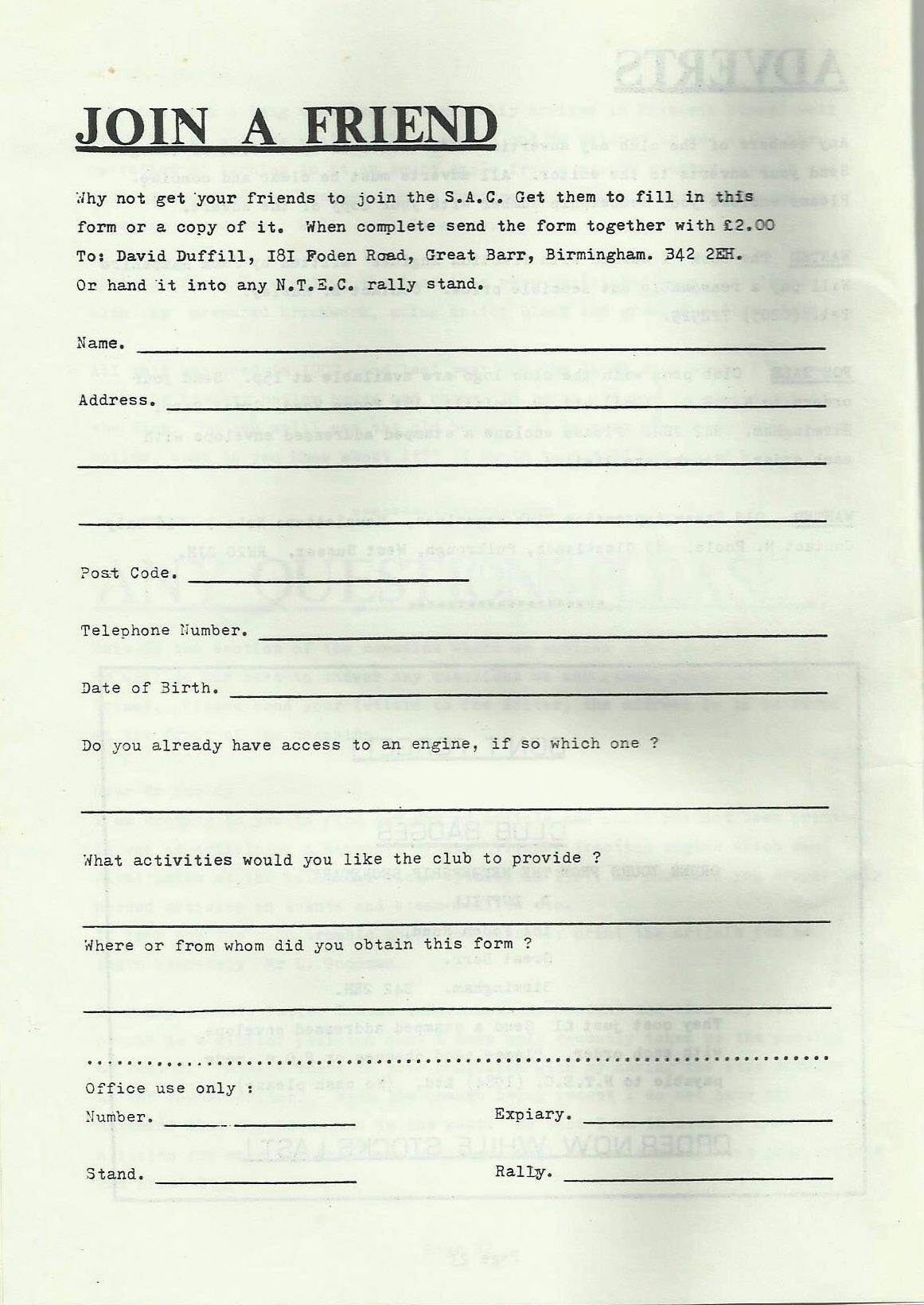
?os.:t Code.
Telephone Humber.
Date of Birth.
Do you already have access to an engine, if so which one?
·,</hat activities would you like the club to provide ?
~here or from whom did you obtain this form?
Office use only }lumber.
Stand. Expiary. Ral:D,y.