STEAMAPPRENTICECLUB
ADDRESSES
"The Chairman, Robert Herring, 3ellacourt, 3lacklocks hill, 3anbury, Ox:ordshire. OX8 7DH
The ~embership 3ecretary, David Duf~ill, 181 Foden aoad, Great Barr, 3irmingham. B42 2EH
The lditor, David Hurley, Leyland, Willington Road, Kirton End, Boston, Lincolnshire. ?E21 1.NR
Assistant Editor, Graham Austin, 19 Mornington Avenue, Ipswich, Suffolk. IPl 4LA
South East Branch Officer, Peter Forecast, 5 Penny Lane, Stanford-Le-Hope, Essex. SS17 8EG
Hampshire Section Branch Officer, Stuart Gaines, A. Page, The Newsagent, The Square, Wickham, Hants.
We are pleased to consider articles of any length and or photographs for in~lusion in future issues. All material so submitted .s voluntary and payment cannot be made for any material so published. Please state if you requir~ any part of your article returning, ie photographs. The opinions in the magazine, with the exception of club announcements, are those of the contibutor and do not indicate the views of the club as a whole. All items are held the copyright of the contributor and/or the club.
NEXT ISSUE: Any letters or other items for inclusion in the next issue should be submitted before the last day of FEBRUARY.
This magazine is produced by the Steam Apprentice Club and printed by
EDITORIAL ...
It takes a deal of effort, a couple of weeks of spare time, and a fatr helping of good luck to get the magazine ready for printing. As such it is really disappointing when no one sends in any articles. Since there are no more rallies to go to, this must be the perf~ct time of year for you to write articles for your magazine. I have a grand total of 4 articles for the next issue. So it is up to you, if there's no articles there will be no magazine.
It is once again the time of year for putting away out steam engines, having cleaned and prepared them for their win.ter hibernation. There is quite a bit of work involved in this preparation, as such this is the best time to learn the necessary skills and methods required. You will also find that engine owners are grateful for any help they receive, as it can be quite a long and heavy job.
Unfortunately it seems that few of our members know what must be done at this time of year, but don't worry, there will be some articles on this in future issues. Anyway thats enough from me for now, but please remember to send me some articles.
CLUB NEWS
We start off this time on a lighter note with a club record. The record of the clubs youngest member goes to Master Christopher Duffill. The young man was signed up by his father David Duffill (the membership 'Secretary). ~Jaster Christopher was just four hours old at the time. Congratulations to David and Andrea Duffill from us all.
Anyone with any steam engine jokes or funny stories, please send them in to the editor along with any articles or photos. (Keep the jokes clean)
Club badges are available at tl from D. Duffill.
Hamoshire Museams Visit.
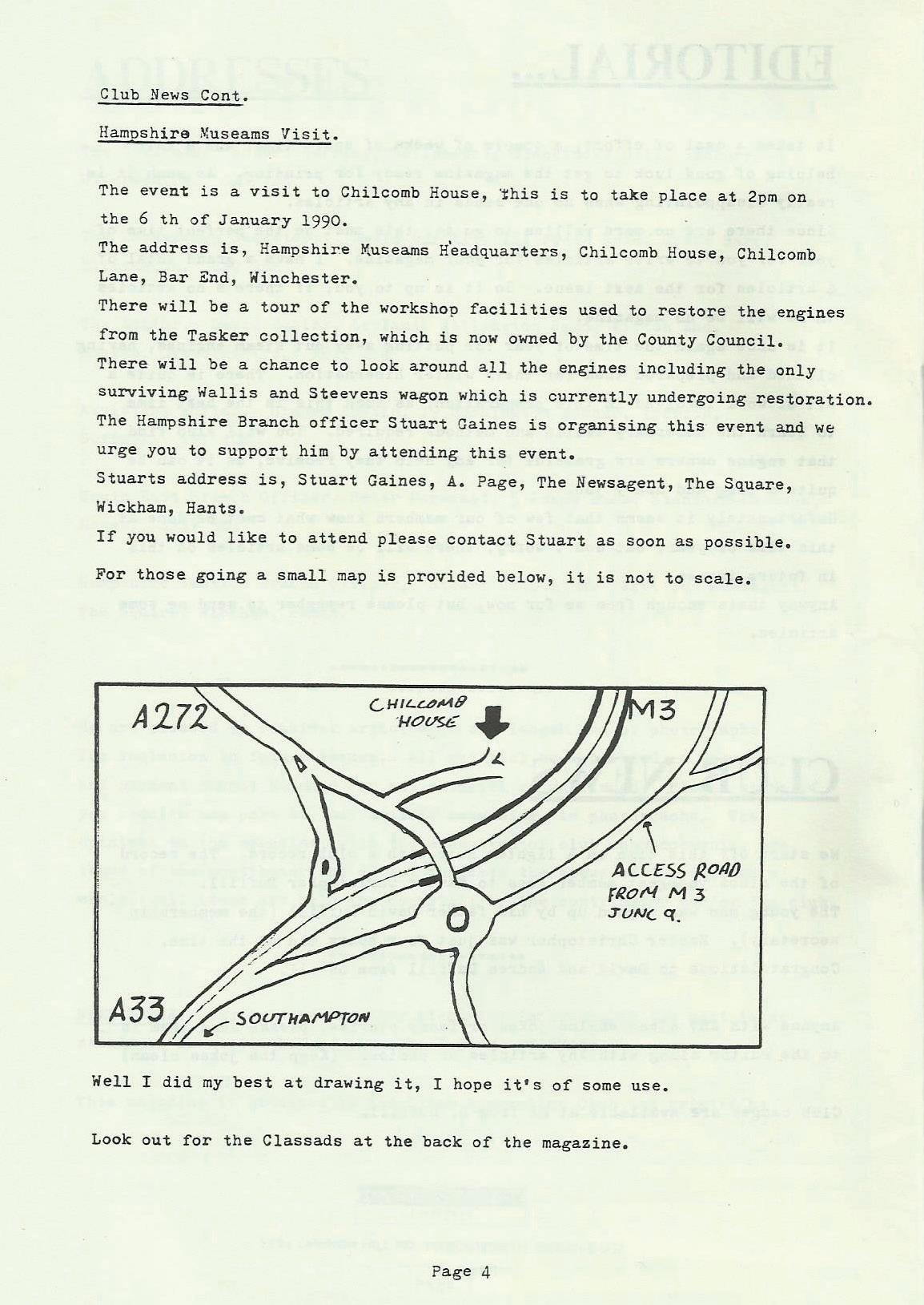
The event is a visit to Chilcomb House, 'this is to take place at 2pm on the 6 th of January 1990.
The address is, Hampshire M.useams H'eadquarters, Chilcomb House, Chilcomb Lane, Bar End, Winchester.
There will be a tour of the workshop facilities used to restore the engines from the Tasker collection, which is now owned by the County Council.
There will be a chance to look around all the engines including the only surviving Wallis and Steevens wagon which is currently undergoing restoration.
The Hampshire Branch officer Stuart Gaines is organising this event and w~ urge you to support him by attending this event.
Stuarts address is, Stuart Gaines, A. Page, The Newsagent, The Square, Wickham, Hants.
If you would like to attend please contact Stuart as soon as possible.
For those going a small map is provided below, it is not to scale.
AC.C.£5S jl.ollfJ FllOl'I M 3 :J'UN(. q_
Well I did my best at drawing it, I hope it's of some use.
Look out for the Classads at the back of the magazine.
Living in a house with no garage and narrow side access. put a limit on the physical size of any preservation project, so my hankering to have something steam powered had to remain 'unhankered' until last Autumn when I heard of a small hand propelled fire pump soon to be sold. I had been taken by these self contained portable units since visitins a friends collection of five of them at Chiswick, not far from Kew 3ridge Pumping Station. These were all found in a contractors yard about five years ago, having stood in the open for about twenty years. It was as a result of this visit that I-heard later of one for sale in Lincolnshire, so it came to pass one day last september - the rainy onethat two Suffolk-ites did venture forth into the principality of Louth with but one faithful follower -a trailer.
The pump was kept in store at an engineering works in company with a Burrell showmans conversion No 4073 of 1929 and a Fowler steam roller No 18867 of 1934 along with bits of a Fowler ploughing engine. After inspecting the goods, loading up was a straight forward winching job as the whole thing comes complete on its own transport carriage with a pair of 3 foot wheels. Following a marathon lashing of ropes -and rain - we cautiously set off, slowing for the many bends until sure of the handling and having stopped to check that all was secure. That first journey will always remain a memory of the many strange looks from motorists, especially when we first got up speed and the draue~t drew the remaining ash from the grate out through the chimney. The only casualty of the day was a drive shaft on the car which passed ~way not ten yards after returning the trailer to its home. That's three drive shafts in 12 years rallying.
This summer should see it out and about on the rally field, but before then a final OK from the boiler inspector will be needed, the main 10 year examination having been completed already, just the final hydraulic test at l½ times full working pressure remain, this having been reached, but not so far without the accompaniment of a few leaking ~eals. Final painting will be in military green, being an ex army example, WDNo 3494 was probably with the Royal Engineers until sold off at a Government surplus auction at Donnington in the mid 60s.
3eing designed for use as a fire pump, the r,:erryweather is a fast -, steamer and can be onerating in 10-15 minutes from cold by virtue of the large heating surface resultin~ from the 56 copper tubes used to
~~at jus~ ~allons of water in~ stay less water tube boiler. 3oiler operating pressure is 120 l"::> ;,si, ·out it can run ha;,pily at 50 ~si. Fittings in~lude both ~echanical pump and steam injector water :~eeds, and water sup;>ly can be ei t:ier independant or taken from the pumped suo~ly. J~u 5 es for steam and pump pressures, water level si 5 ht glass, whistle, blower for. assisting drau 5 ht, regulator valve, cylinder drain cocks, cylinder lubricator, water level test cocks and blow down valve. '!'he pumo has a 16'' flywheel, air bells for both inlet and output and is capable of pumping 5000 g~llons per hour to a height of 35 feet or a pressure of over 150 psi. ~eight of the unit is about 6½
CWT and another 2 C~T for the carriage, Steam ,:>umps of this type were derived from those employed on horse drawn fire engines, being smaller and without the copper lagging.
Designed to be hand propelled and portable, they were often used as factory or county estate apoliances but many were later parted from pump and carriage for use as soil sterilisers or boilel!'S for small steam launches, where some twenty are know to have gone, although three were still in use with the British army in Germany in 1985 as vehicle cleaners and may still be in use now,
Graham Austin.
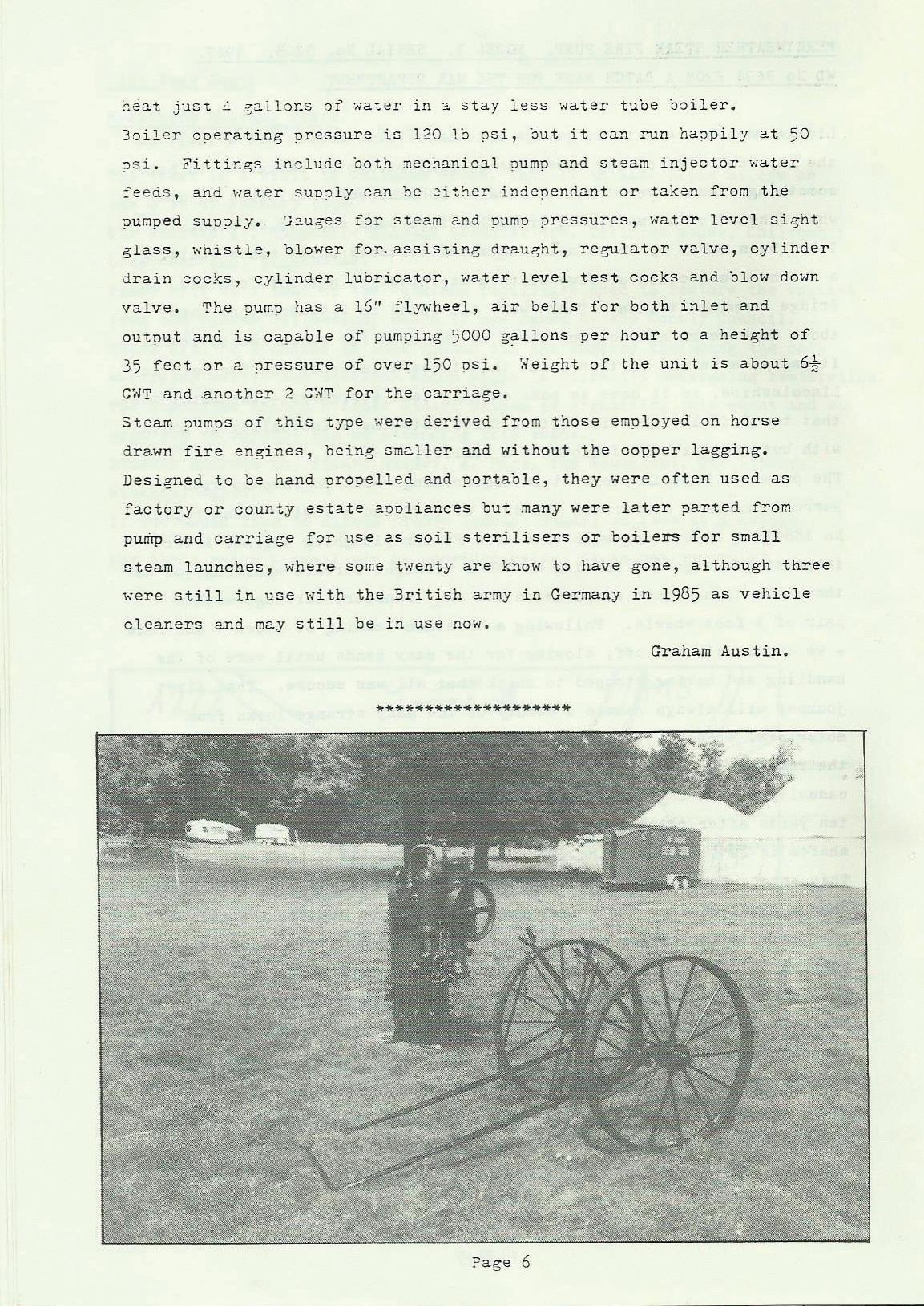
To the left can be seen Grahams Merryweather steam fire pump. It makes an attractive display as it appears at one of its first rallies since being purchased and restored by Graham.
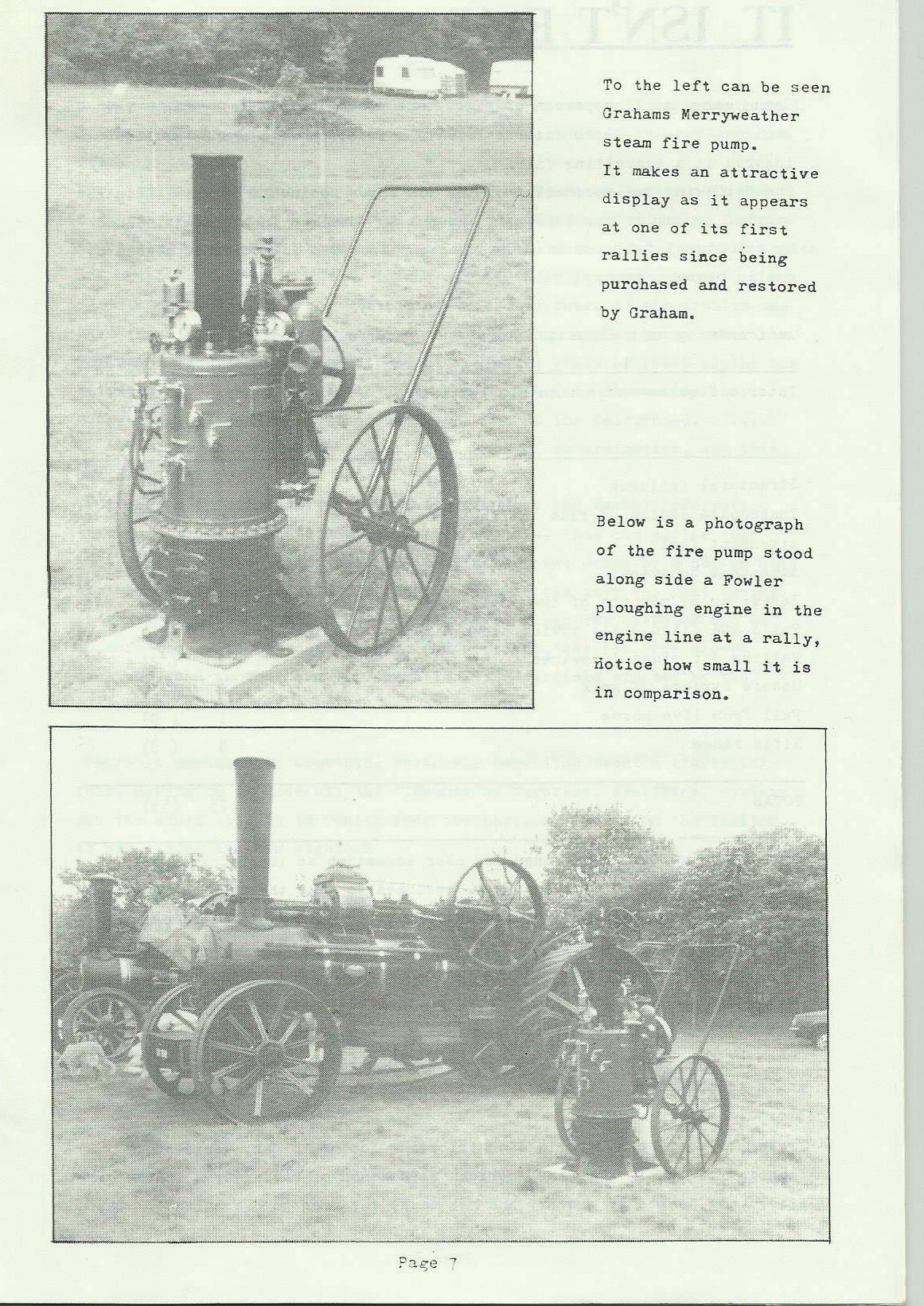
Below is a photograph of the fire pump stood along side a Fowler ploughing engine in the engine line at a rally, notice how small it is in comparison.
IT ISN'T FAIR
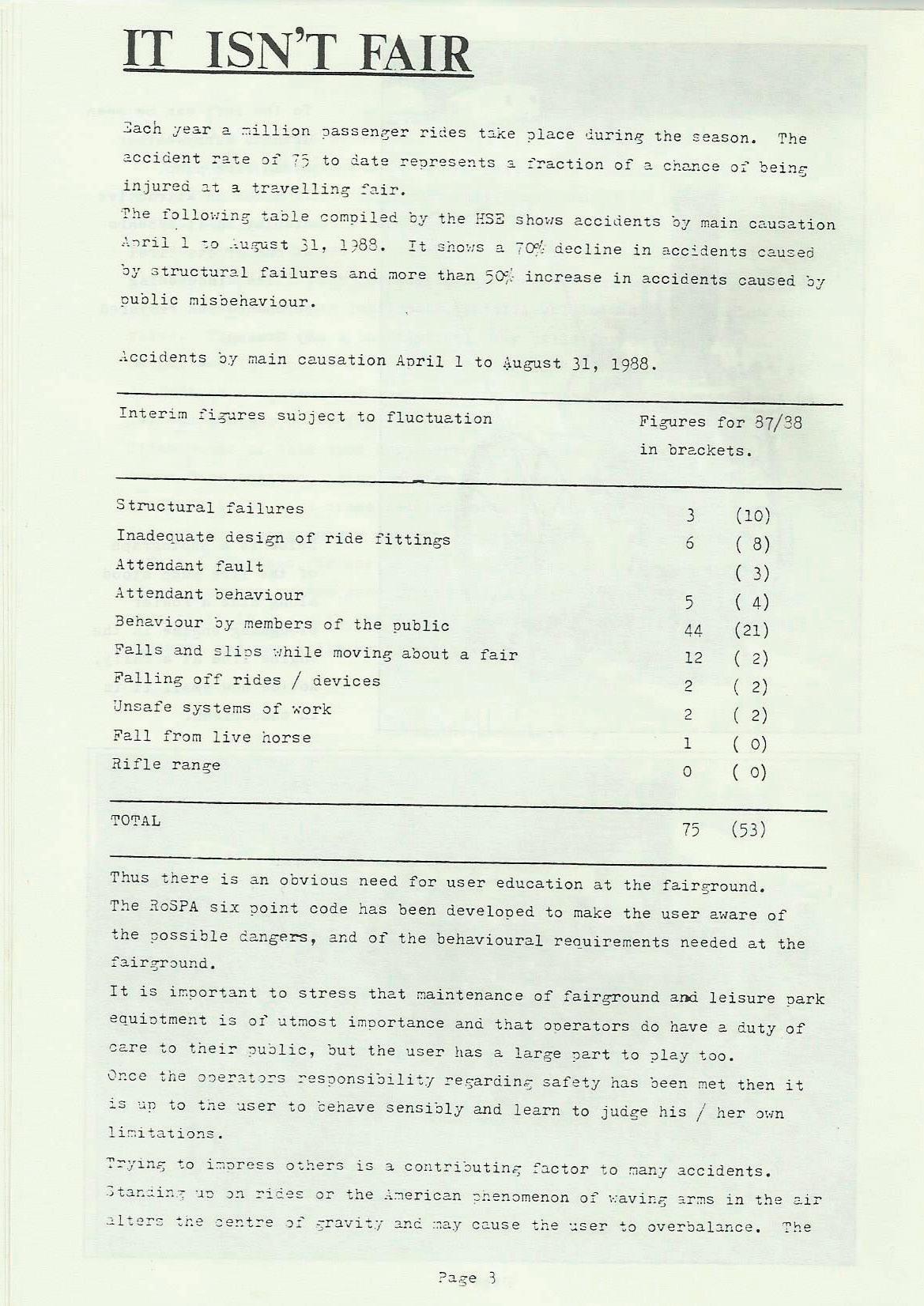
~ach year a ~illion ?asseneer rides t~ke ?lace tlurin~ che season. The ~ccicient ra~e of 75 to iate represe~ts _ :raction of~ chruice Oi bei~€ injured~~~ travelling ~~ir.
T~e following table compiled by the HS~ shows accidents bJ main cau3ation
A""lril 1 -:o .su,-;ust 31, 1)88. It sno1•1Sa 7CC.'~decline in a.ccidents caused b:;• 3tructural failures and. ::iore than 50;'.-increase in accicients caused OJ puolic mis·oehaviour .
.~cciden ts ":Jy main causation Anril l to ,';'ugust 31, 1988.
Interim fi,s..ires su·::iject to fluctuation
Structural failures
Inadec_uate design of ride fittings
Attendant fault
Attendant behaviour
Behaviour oy members of the public :'alls and slips ·.-1hile movin~ about a fair ?alling of~ rides I devices
Unsafe systems of ·,,ork
Fall from live horse
Rifle range
TOTAL
Figures for 87/38 in brc:>.ckets.
3 (10) 6 ( 8) ( 3)
Thus there is an oovious need for user education at the fairground. The 3oSPA six point code has been developed to make the user aware of the ?OSsible cange?"S, and of the behavioural re~uirements needed at the fair;round.
It is i~portant to stress that ~aintenance of fairground anci leisure park eQuiotment is of utmost im?ortance and that ouerators do have a duty of care to thei~ ?UOlic, but the user has a large ,art to ?lay too. 0r.ce the ooer~t?~s ~esponsi~ili:y re~ardin€ safety h3s oeen ~et then it :.s '--')) to t:ie aser to cehave sensibly and learn to jucige his / her own
T~y1n~ to i~oress ot~ers is a contributin~ ~3ctor to ~any accidents. ~n rid~E or :he ~~erican ~nenomenon of ~avin~ ~~~sin t~e air
·user must never. attempt to open a restraining bar once it has been locked. 3arrs are there for the user to grip, onto hence the name '''.lhi te Knuckle" rides.
For a leisure park such as Alton Towers in an isolated location it has ~een easy to monitor and restrict alcohol consumption. However, for a travelling fair where their locations are often surrounded by public houses and people are f:-ee to wander in and out at their leisure, alcohol is a serious cause for concern, Attendants are made aware of the p·roblem and have the right to refuse admission shou~d someone appear to be under the influence of drink, but one attendant against a group of·rowdy youths has little effecrt.. Again it is the users responsibility to realise the dangerous implications that alcohol can have at the fairground., ..... . it causes irresponsible behaviour and a lack of co-ordination, and this can cost a life.
Visitors to a fairground must be aiware of signs and verbal information that inform of safety precautions. For example, they can advise that loose articles should not be worn, that a pregnant woman or a person with high blood pressure should not ride, but it is the user who must decide. If the user chooses not to fieed safety advice then the operator can do no more than witness. another pointless accident, see his ride closed down and read another cruelly sensationalised article created by the media. IT SIMPLY ISN'T FAIR?
"Ther.e is undoubtedly something curiously beguiling about a travelling fair, having as it does all the elements of surprise, excitment, mystery and the added ability to vanish over the horizon, away from the familar to new places and new sights."
Ia.n Starsmore 'English Fairs'
Many thanks to Alton Towers to.J3lackpool Pleasure 3each, The British Association of Leisure Parks,_Piers and Attractions, The Showmans Guild of Great Britain, The Health and Safety Executive for thei/ help in the compilation of this article.
'!'his article by Ian Starsmore deals with modern fairs and modern equiptment. The advice that is given is sound advice but this also applies to the fairgrounds at traction engine rallies. Especially on vintage or steam powered rides, just because they are old does not mean they are any less dangerous if not tr~ated with respect.
FAIRGRmnrn USERS SAFETY CODE
1. SPOT THE DANGERS.
A fairground is a place of fun but it has heavy, powerful and fast travelling equiptment. Always watch out for these things and enjoy yourself safely.
2. KNOWYOU LIMITS.
Use rides which are suitable for your own age and height. Do not drink alcohol; it will affect your judgement, awareness and behaviour. Never open a restraining bar or stand up on a ride.
3. CHECK NEW PLACES.
Every ride is different and may require different rules. Make sure you are aware of the safety procedures for each ride.
4. TAKE SAFETY ADVICE.
Special written or verbal notices will warn you of potential hazards. Look for them, read or listen to them but most importantly, do what they say. They are there for your own safety.
5. LOOK OUT FOR OTHERS.
Young children may easily be hurt at the fairground. They should always be well supervised. Be aware of anyone misbehaving or showing off around you and warn somebody about them.
6. LEA.RNHOWTO HELP.
Should you see anyone in trouble, ~eep calm, and inform a fairground official immediately.
KNOWYOUR ONIONS 1
This is a new series to the magazine which is designed to help you to recognise different makes of engines, and also a little of their makers history.
When you look at an engine and you want to see what make it is, the most obvious thing to do is to look for a makers name plate. This is of course the easy way out and is not as much ~un as trying to identify an engine by looking at its features. For example, having seen an engine you wish to identify, don•t look at the name plates. Look at the engines features, eg. cylinder block, flywheel, chimney and gear casings. These features vary from engine to engine. So if you Know rour Onoions you should not need to look at the name plates of an engine, except when you are sure of what it is, and then you are only checkin~. First though, you need to know what features to look for on different engines.
In this article we feature the Gainsbough based firm of MARSHALLSONS & Co. Ltd.
This firm did not go in for the flash lights and fancy of fairground nor the very large and heavy ploughing or road locomotive type engines. Marshalls as they are known, went in for two main types of engines. Farm yard agricultural, and road rolling engines.
Marshalls produced engines of very great quality, this can still be noticed today. Along with these engines they built threshing drums and associated equiptment.
Unfortunately Marshall traction engines are very ordinary to look at, but the young engine spotter can recognise them by the following features;
1. Dished spoked flywheel.
2. Right hand steering.
3. Second shaft between hornplates which means a fairly flat gear casing.
4. Cast cylindrical crosshead guides.
5. Plain smokebox door.
6. t,:anhole is usually found on the flywheel side. These features are usually standard on most of their traction engines, but do not extend to their rollers. Occasionally you will find an exception to the rule with something being different. Eg. Left hand steering. These alterations were not a company design, they were probably a special order from a customer.
Marshall rollers are much easier to recognise :-1ith their domed perch bracket above the front roll. lnother major feature is the use of castin~s in the making of the wheels, lfarshall rollers are seldom seen without
canopys. These en1sines are also well endowd with tr:..de marks and name plates, so you can not fail to identify them. A~ain, these engines were ouilt to very ~igh standards of workmanship and are usually quieter in gearing noise than ~ost other engines.
Some of the smaller rollers were convertiole, they could become a smart little steam tractor. These tractors were quite fast, managing up to 5mph. easily. On the other end of the scale the large and heavy~ Type rollers which were also convertible, were slow and some what lumbering. They were better as rollers and it is quite rare to see S Type traction engines, at least thats in my experience.
The firm was eventually to take control of another major engine building company.Fowlers of Leeds.
Later Marshalls went on to build their highly successful Field Marshall tractor series, which, are also a common sight on rally fields. There is also a single member of the Marshall family who was involved in the company at the time of steam, who is still living today.
Not many companies can boast that t
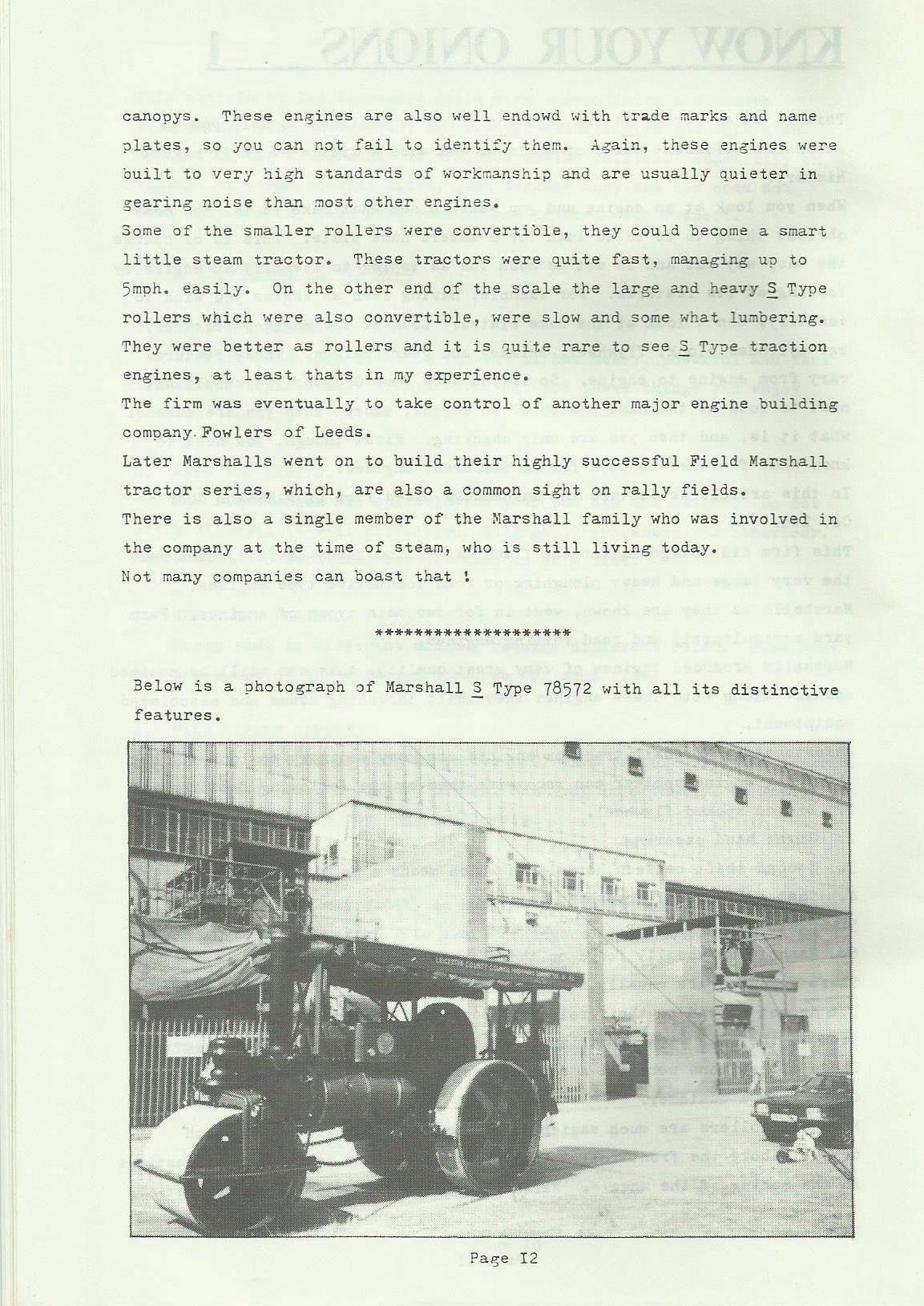
iielow is a photograph of Marshall S Type 78572 with all its distinctive features.
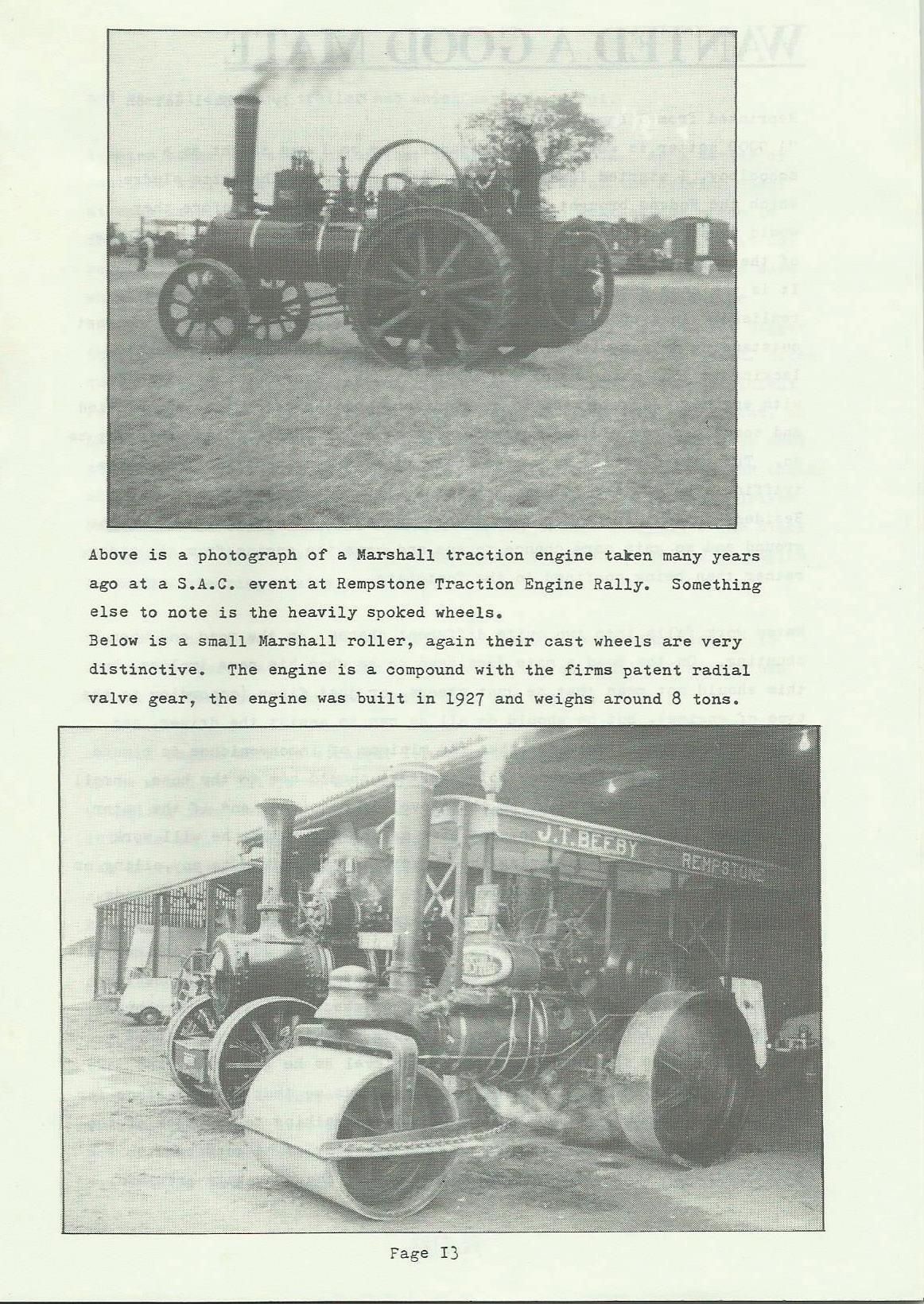
Above is a photograph of a Marshall traction engine taken many years ago at a S.A.C. event at Rempstone Traction Engine Rally. Something else to note is the heavily spoked wheels.
Below is a small Marshall roller, again their cast wheels are very distinctive. The engine is a compound with the firms patent radial valve gear, the engine was built in 1927 and weighs around 8 tons.
WANTEDA GOOD MATE
]y ~ichael Salmon
~eprinted from Steaming July 1962
'':\ GOODsetter is ·.-;orth another loader,'' or so I •.-1as taught as a schoolboy, I started leading the horses carting out the white sludge •..;hich the Foden$ brought from i-1erton. It •;1as some time before they would trust me to set a cart at the great white heaps so that all three of the day men working there could shovel conveniently. It is the same with engines. A good mate is often worth more than is realised. An average driver, with a good mate, can do more than the most outstanding driver with no mate, or a poor one. gven so we are sadly lacking in good mates among our engines today. Everyone who has to do with engines seems to want to be a driver, and the mates job is neglected and sometimes regarded an inferior sort of occupation. This should not be so. The mate can be a very great help to a driver, especially when the traffic is heavy, and in some jobs is really the more important man. Besides, on anything other than trunk running he spends more time on the ground and so gets more chance to see and hear the engine from all sides, rather than being confined to the footplate.
Mates work falls into two quite different phases; on the road and when shunting. On the r.oad a mate does tend to be what hi~ name implies, but this should not mean that he just steers, or just fires (according to the type of engine), but he should do all he can to assist the driver, and under todays conditions, see that the minimum of inconvenience.is caused to other traffic. At a water hole the mate should see to the hose, urµ-oll it, ensure it is under water on the shovel if required, and if the water hole is convenient one on the same side as the water lift he will work the steam valve too, so leaving the driver free to attend to any oiling or adjustment which may be required. Where the Nater is on the wrong side, however, it is usually ~etter for the mate to set up the hose, and the driver to see to the steam valve. ~hile the water is lifting both me~ can amuse themselves wiping down the boiler and any other parts needing • it, feeling wheel hubs for signs of heat, or checking bolted on rubber for evidence of loose bolts. When on a long run with spare coal on a trailer, the mate should check the bunker level as he gets down, and take every opportunity of working a bit more forwards so that special stops for this purpose can be avoided. If this involves walking to the back of the train, he will, of course, glance at _each coupling as he goes by, to satisfy himself that all coupling pins, cottars and draw bars are safe,
and he will feel any trailer hub which may be suspect.
A mates badge, or staff of office, should be the 3LOCK. As a matter of habit he will drop a block under the downhill side of the driving wheel at each stop, ie. in front or behind according to we.atter the grade is down or up. It is better to put a block down a few times when it is not required than to forget it on the very occasion the engine tries to move when there is no one on the footplate. The block for a road engine should be big enough to hold the engine on a reasona'ble slope, the bigger the wheel the bigger the block needs to be. A piece of 4 in.* 3 in. often quite adequate for a trailer wheel on a hard road, but is not sufficient for the rear wheel of a traction engine, niether is a spud sufficient, as has been demonstrated quite recently. Naturally the mate should see that any block he puts down is picked up again before moving off, but the engine block should not be picked up without first making quite sure the driver knows this is being done, as otherwise he may change gear after the block has gone. A block should NEVERbe put under the front wheeI of an engine as broken steering chains can result.
The mate should see to his own comfort, a sack or something similar to sit on if there is a seat, and his issue of rag or waste for wiping his hands, turning hot cocks and wiping down the engine.
Not all engine work is straight forward running along the road, and indeed, there would be little to attract some of us if it were so. When shunting, wriggling into awkward places, or roping any load the mate really comes into his own. Indeed, under these conditions, if both members of the crew can drive with reasonable c.ompetence it may well be better for the more experienced man to act as mate, with the other driving to his instructions. Remember that under showground or heavy haulage conditions it was usual for the owner, or a foreman of some sort, to be on the ground to supe:x-Jise and then the driver and mate remained as such. Under our conditions today this may not be so and it is usually more satisfactory for the man on the ground to be in char~e as he has a better general view of ~hat is haopening.
When coupli~g ..~P- a. trailer the mate should hold the drawbar up in good time so that the driver can see where the eye is, but once the eye passes out of the drivers view beneath the bunker it is up to the mate to call out some guidance. ''Back a yard!'' , ''Back a foot!'', give the driver more
than a vague ''Come on!" Once the pin is ;:i.1.rt way in it is required to call "FoI"'.,ard ::>n the pin" or "Shake back on the pin". From the footplate of a big engine the driver cannot see the coupling, and to stand there heaving and cussing until he gets down to see ·..;hat is what is going on only wastes time and temper.
Often it is not practicable to back straight onto the drawbar and a chain is used. The ring end can be on one of the side pins of the engine, leaving the middle one free for the drawbar when it has been drawn up straight. The hook of the chain should br passed through the drawbar eye upwards from underneath; it will then be easier to get off, and less likely to come out if the drawbar rubs along the ground. On working engines it was common practice to swing the hook end of the chain up to the bunker top where it would hang conveniently when not in use. Many old engines have little grooves in the top of the bunker from this cause, but showmen, and others concerned for their paint would not tolerate this practice, as the writer learned quickly during his first day as mate on show tackle. When there is more shunting to do the chain may be looped over tke top of the pin; otherwise it can be taken off and put away.
When coupling up a trailer at an angle to the engine the mate should always stand on t.!:e side of the bar where there is most room. If he is in the more confined space and the engine overruns by the small~st amount he may get squashed. This is another reason for insisting that an inexperienced mate picks up the bar in good time so that the driver can see, before closing up, that the mate is on the proper side.
It is not very likely, unfortunateiy, that the engine drivers or mates of today will require to couple up trains of trailers. There are two ways of doing this. One is to draw the second trailer up as closely as may be behind the first and insert a chain. It is then fairly simple, on a hard road, to draw straight and shunt back to eliminate the chain. The other way is to use a chain hooked to the body of the second trailer to draw it uµ behind the first, steering it by hand. Neither of these operations should be attempted on a down grade, but a slight up grade can be helpful. ~,any traction engines had ring bolts on the front corners for this purpose. Again the driver will not be in a position to him. The same job can be done 9y propelling the second truck into place with a push pole from behind, ~ut this is a oit cumbersome and rarely done in r,ractice.
·r:, i1owever, :he _:nsh 9ole is oei:i,g ·.1sed on the f'r0nt of the enc;ine, especially a showrnans engine, it should oe couoled to the engine :irst and then ;:,oved up to the truck, as that ·,,ay the driver can often see the free end. It is !'lot good for the nerves to drive un -!;o a :i:<ed ~ole ·.,ith a couple of !:len huddled under ::-.e 'iynar:10 ?late.
The coupling ?in should be held by its handle if it has one, and if not with :he thu~o and first fin~er. On no account should the fin~ers str1y round the back and get pinched bet~een the ?in and the bunker.
3efore unco~pling a trailer, see that it is properly blocked up, ~ith blocks both before and behind the rear wheel if there is any doubt as to the slope of the ground. A trailer .::!lould ::?JSR oe ":>locked oy the front wheel as the forecarriage can swing und the ,·iheel pass clear of the block. Smaller blocks can be used for trailers than for engines, but as before it is a good plan to block uo •,thenever and wherever a trailer is left as a ~atter of habit, even where there is no apparent risk of the trailer running away. Trailer brakes'? '.{e 11, unless you do '.cnow they wor!-: it is safer to drop a block.
The gentle art of making a trailer "Strike" or go in directions other than directly towards the engine, may be conveniently mentioned in connection with roping, and there.are so many variations on that theme that it had better be left for another time.
~aving collected ~he load we may assume it is required to ~ull out on the road. The mate should :;o ahead on foot ·.-iith a red flag if there is one, and "see the engine out". The driver will pull to the gate and wait for his mate to advise him that the road is clear. The mate should then stand where the driver can see him, but should watch that side of the engine opposite to the steering so that the driver is ~ot required to move to and fro across the en;ine. Once the engine ~nd train has started to move out, any traffic which appears should be fla.gged down, ·;Jut as. soon ~s the engine is plainly visible to other road users the ~ate can return his eye to the ;ateposts, esoecially the one on the irivers blind side. It is essentia~ with a big load that the driver can assume, in the absence of any cry from his mate, that he can keeo coming ~she is. Thus if a ~atepost goes on the blind ~ide it is wore likely to be the =~ult of
the mate than driver.
Finally you get home. The driver is tired. You have only been doing all the work, so you are not supposed to be tired. While he see's to the fire and perhaps wipes the motion over, you will have wiped down the boiler and motion covers yet again, got the sheets laid out ready to put up, squared up the water-dandy if there is one, and perhaps oiled round the brasses if it is to stand several days.
At a recent rally an event was devised to represent, as nearly as may be, part of a days work with an engine. It was noticeable that the crew that won included a professional driver-as matet
SOMEDERELICT ENGINES
THE FOWLERSAT 3INTON, WARWICKSHIRE
At the former Railway station beside the A 439 between Stratford-uponAvon and Bidford-on-Avon you can still find seven derelict Fowler ploughing engines that were used by Bomford and Carr in their dredging business.
All but one of the engines have been converted to diesel power, numbers 15133/4 (ex K7) have been fitted with 4 cylinder engines on top of the boilers by McLaren. Numbers 14266-9 (ex BBS) (s standing for superheated) have been fitted with tender mounted ex Sherman tank engines, the other engine is possibly number 15223 class BB which still retains its cylinder block but minus its motion. Non of the engines have moved in the last few years.
Also in the yard is a fowler tractor with a cable drum under the floor which was an attempt to enter the internal combustion engine tractor market.
Graham Austin.
R~printed from Steaming Volume 6 ~o.l
I am recording some of the treatment traction engines received when under going repairs, the scene being the small works in a busy country town and the tlme just over forty years ago (in 1962), during ny anprenticeship.
On arrival in the high street the engine would await the squad of boiler makers armed with spanners and sacks whose job it was to remove the chimney. Passing under the low arched entry, the engine would either b~ placed "under the crane" or in the erecting shop. The former location accommodated two engines under a gantry operated by ropes from the ground, the shop boasted pulley blocks only, but was decidedly warmer in winter.
Let us assume a big overhaul was required. The first job was to remove the hind wheels. Sandcaps were taken off and a jack arranged under the end of the hind axle. We were rather short of wood packing to bring- the jack up to height and once Joe carefully put a nice bit inside the rim of the wheel. Of course it saved packing, but he, and not the engine, went up in the air when my tactful comment made the penny drop~ Lifting under the axle made sure the weight was not taken on any part not designed for the purpose, but it was necessary to remember to jack high enough to allow for slacla:less in the bearings (or the spring gear) causing the axle to drop when the weight of the engine was taken on blocks under the firebox. We always followed up the jack with packing, just in case.
To take off the wheels when not under the crane, we had two long wooden, iron shod pinch bars, these speedily prised the wheel sideways till it was on the floor. Removing the tender ,.ras generally done under the crane, and it was a nice exercise in adjusting slings to ensure easy removal and replacement without binding or losing alignment of the bolt holes.
Long drawbolts and a bar across the end of the axle were needed to take off the driving drum or bevel wheel. Someone "paid" the bar with a slogging hammer while another ma.n tightened the bolt in turn with a spanner and a length of pi:pe. Sometimes the hammer blow would be too successful and the rig would fall down with disatrous consequences for the spanner operator.
There is no need to detail the dismantling of the rest of the engine, save to note that we usually marked each as we took it off (and recorded the slide valve position) as a precaution. Once I had to erect a steam wagon from a heap of bits and pieces, it meant much "trial and error".
With the parts on the bench, the piston rod and valve spindle would go to the turners to be skimmed, glands to be bored and bushes turned up, with new neck rings. Burrells were rather a nuisance. Their rods are parallel throughout, consequently when skimmed the end in way of the cotter fastening the rod to the crosshead must not be touched and so split bushes were needed. We used to plane the half-bushes in the shaper and they were sweated together before being bored and turned. I have been told of the rod being-turned down the whole length and the crosshead bushed, thus weakening the rod at its weakest part. New pins in the link motion were normally needed. The holes were reamed out, new pins turned and drilled for stop pins, then hardened and finally fitted. It was too risky softening the link, so a new die would be mada, fitted to the widest part of the link, usually the bottom, hardened, and then the link lapped by hand with a copper lap tilL the die would slide freely and without shake the whole distance, a tedious job. New piston rings were filed and scraped on the sides to fit trued out grooves in the piston, as they were normally prevented from rotating in the cylinder by stop pins, we used to fit them to the bore if this was unusually out of true.
Burrell crossheads frequently needed new brass slippers, these heavy pieces (I refer to the popular single crank compound) were an unfortunate feature from the fitters point of view.
We did not like swinging the crankshaft in the lathe, if the dip was scored or oval, a smooth file, calipers and an emery cloth lap could effect much improvement. All bearing brasses and eccentic straps were filed and • scraped to give a good bearing except at the top and bottom, while a good radius was left to ensure there was no binding sideways. Big end and eccentrics were adjusted so that when their rods were on they would just drop gently under their own weight.
The slide valve almost always needed ~craping and care was needed to see that a good marking on the surface plate was not combined with a rock on the. valve. The art of valve scraping is to know where to take metal off to finish with a good bed on the edges of the valve and round the ports on the port face. I used a scraper about two feet long, and with this tucked under the armpit or over the shoulder a really good cut could be taken on a port face. Some of the latter, especially the Burrell L.P., were to far in for convenience. Wonderful tales are told of lifting surface plates by almost dry valves, but I never met the man who pulled the cylinder off before th~ valve would come away from the ports. Anyway, it is not necessary to scrape valves so finely. Stop valves needed much more careful scraping than slide valves. We used to leave the drain cocks open when testing the engine to see if there was a leak. Once I inadvertently knocked the valve out of the buckle when boxing it up. You may imagine how I felt when steam was raisedl
Very rarely a new ring of boiler plate would necessitate re-bedding the cylinder. This is to long a job to describe here, involving as it does keeping correct alignment, the actual work consisted of putting "marking" on the barrel, dropping the cylinder on it and then chipping and filing the cylinder till it will make a steam tight joint. You could make your self a lot of work by taking too much off in the wrong place.
When assembling the top works it was necessary to check that the packing in the crankshaft and big end bearings were not put in all one way. It is disconcerting to find the piston sticking out of the cylinder on the "in" center.
New keys were sometimes needed in the road gearing and probably the keyways would have to be filed out, unless a lipped key could be used. Each key had to fit sideways in the shaft, sunk keys being caulked in, and all along the top in the wheel. Since draw bolts were almost always needed to draw the wheel off after each fitting, it was not a light job to fit up a hind axle. If you remember to do so, the separate rope ring would be put on before what you hoped would be the last attempt at fitting before driving the drum home, lffllCh trouble and language could thus be avoided.
With us the flywheel was the last item to be replaced. The manager always sent for the owner to take the engine away as soon as he saw the flywheel
on t Incidentally, when fitting keys with the weight of the wheel on the shaft, the keyway should be underneath. If the wheel is slightly slaok on the shaft the key may show marking all along and yet fail to draw the wheel up tight. I have not mentioned valve setting. We used to set equal lead, i.e. with the crank on alternate centers the port should show the same opening at each end. Afterwards the valve would be moved a good sixteenth towards the chimney end to allow for expansion of the boiler. A few years ago at the request of the owner I investigated his valve gear to find that the valve the valve was a quarter of an inch to long! I wonder if any other engines are r-enning about now with wrong valve settings.
No boiler work has been mentioned because I was in the fitting shop and so had little opportunity of seeing this. I heard of one job the boiler makers did. They induced a driver to put his olast pipe upside down because he would be surprised at the result. He was!
Some of the younger generation may be interested to learn of what used to be done and how. Hammer, chisel, file and scraper were our weapons, though we often sighed for a "putting on" tool such as is now provided by modern methods of welding, etc. Perhaps some of the other older members may like to comment and criticise, we are none of us too old to learn how the other man used to do it.
ANY QUESTIONS PT1EASE ?
This is the section of the magazine where we publish your letters. We will do our best to answer any questions on any steam, rally or club issues. Please send your -letters to The Editor, D. Hurley, Leyland, Willington Road, Kirton End, Boston, Lines. PE21 lNR.
May I also say how disappointing it is to see nobody making use of this new section.
ADVERTS
Any members of the club may advertis·e their sales or wants free of charge. Send your adverts to the editor. All adverts must be clear and concise. Please enclose your Membership !iumber with your copy of the advert.
WANTEDThe book 'I Worked with Traction Engines' written by Jack Hampshire Will pay a reasonable but sensible price. Contact D. Hurley. Tel. (0205) 722929.
FOR SALE Club pens with the club logo are available at 15p. Send your orders to N.T.E.C. (1984) Ltd. D. Duffill, 18L Foden Road, Great Barr, Birmingham. B42 2EH. Please enclose a stamped address~d envelope with each order. Stocks are limited.
WANTED Old Steam Apprentice Club magazines, Newsletters No•s 1 - 16 only Contact M. Poole. 89 Glebelands, Pulbrough, West Sussex. RH20 2JH.
DON'T FORGET!
CLUB BADGES
ORDER YOURS :FROJ.1THE KEMBERSHIPSECRETARY D. DUFFILL. 181 Foden Road, Great 3arr, Birmingham. B42 2EH.
They cost just £1 Send a stamped addressed Jnvelope with each order. Please send cheques or P.O.s made payable to N.T.E.C. (1984) Ltd. (No cash please)
ORDERNOW WHILE STOcK·s LAST