ADDRESSES
The Chairman, Robert Herritfg, Bellacourt, Blacklocks hill, 3anbury, Oxfordshire. OX8 7DH
The Membership•Secretary, David Duffill, I8I Foden Road, Great 3arr, Birmingham. B42 2EH
The Editor, David Hurley, Leyland, Willington Ro~d, Kirton End, Boston, Lincolnshire. PE2I INR
Assistant Editor, Graham Austin, I9 Mornington Avenue, Ipswich, Suffolk •. !PI 4LA
South East Branch Officer, Peter Forecast, 5 Penny Lane, Stanford-Le-Hope, Essex. SSI7 8EG
Cornwali and Devon Branch Officer, Position vacant.
We are pleased to consider articles of any length and or photographs for inclusion in, future issues. All material so submitted is voluntary and payment cannot be made for any material so published. Please state if you require any part of you~· article returning, ie photographs. The opinions in the magazine, with the exception of clµb announcements, are those of the contributor and do no;t indicate the. views of the club as a whole. All items are the copyright of the contributor and/or the club.
NEn' ISSUE: Any letters or other items for inclusion in the next issue should be submitted before the last day of NOVEMBER.
This magazine is produced by the Steam Apprentice Club and printed by
EDITORIAL
There have been many chanees in the cl~b t:1i:, yeo.r, includin~ :iew editor. ~s Richard explained last ti~e his com~itments do not ~ive hi~ enough time to produce the magazine any more. Richard will. ~owever. stay on the sub-committee to help with the club. I would also like to take this opportunity to say on behalf of the club thank you to Richard for his work and good luck for the future.
By the way there is no relation beb,een Richard and myself -despite the surnames.
As editor I will try my best to keep the magazine on time, but this does mean that you the members are going to have to send in lots more article~, regularly.
There will also be one or two new features, for example, there is a new letters section where you get the chance to ask us all sorts of questions. In addition to the free admission and eventa list that is sent out each spring, we will be publicizing all the S.A.C. events in the magazine. So if you know of something thats happening, please write and tell us. Well thats all for now but please remember to send me some articles.
CLUB NEWS
I4 and I5 October.
Ewe and Lamb Steam Party Stoke Heath Bromsgrove. This is to be a small event but well worth a visit as the smaller events mean less people and better chances to get on engines. It is to be held at the Ewe and__Lamb public house which is just off the main A38 between Bromsgrove and junction 5 of the M5. There is limited camping facilities nearby. For full details contact Keith Shakespeare on 3romsgrove 575003. The main S.A.C. event starts at I0.00 am. Saturday.
There is a possibility that a new branch will be starting in Yorkshire more details will be given latter.
Don't forget anyone living in the Devon or Cornwall area the position of branch officer is vacant, enquiries for this please address to the membership secretary.
Great Dorset Steam Fair.
In the next issue we hope to do a full review of our events at the show.
WANTED Reports
Photographs
Send all mate~ial to the editor Immediately.
I990
What would you like the club to do in the next decade. We are about to start planning. If you have any ideas send them to David Duffill as soon as possible.
Club visits to museums are being aranged.
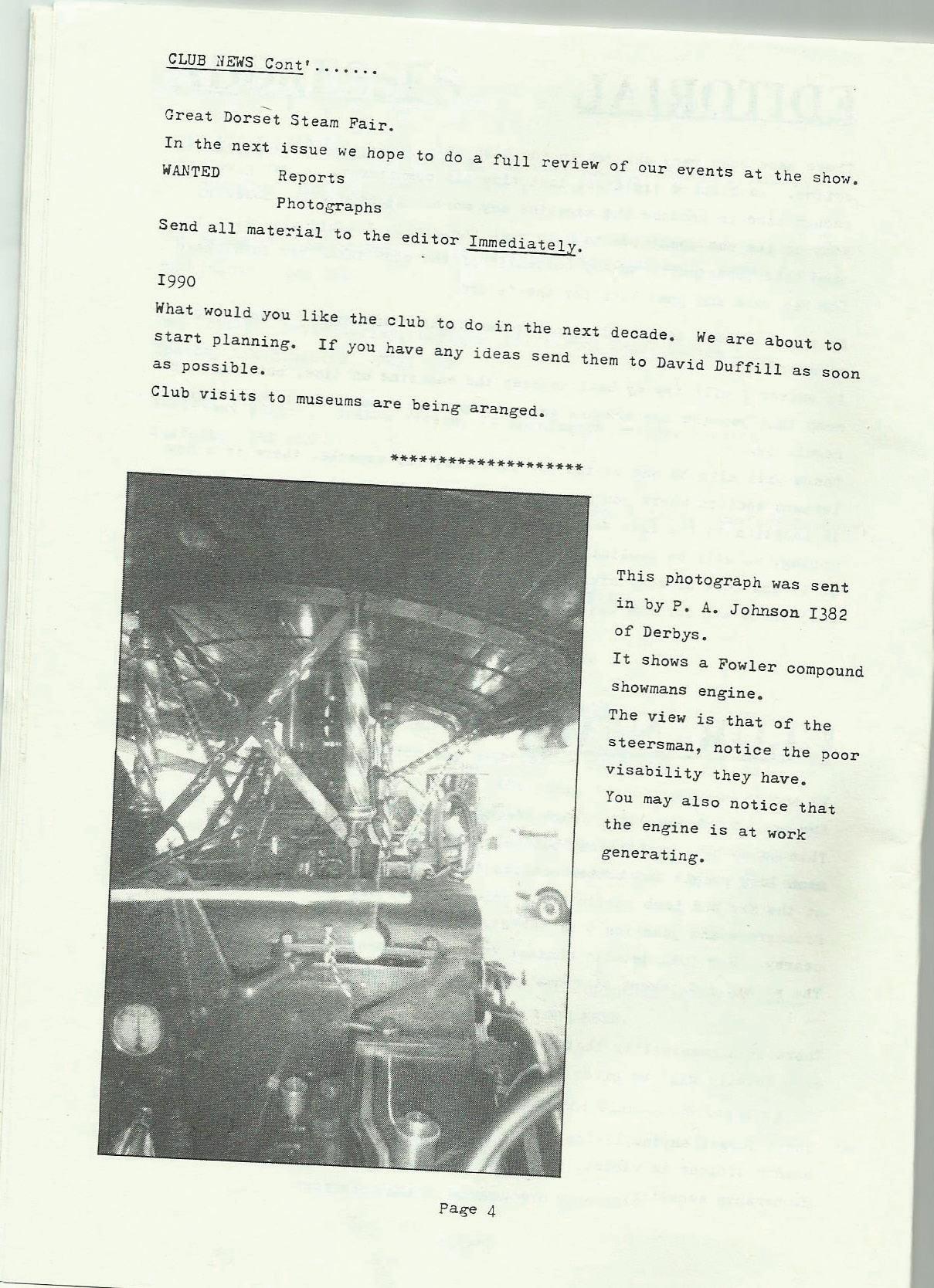
This photograph was sent in by P.A. Johnson !382 of Derbys.
It shows a Fowler compound showmans engine.
The view is that of the steersman, notice the poor visability they have.
You may also notice that the engine is at work generating.
My Dad by now had been looking for a roller (large) after he had just sold our ten ton Marshall.
He had heard that there was a big fowler sixteen ton D5 compound roller for sale. He and his friend went to have a look at it.
Seeing as it had a new firebox and a good boiler, after a lot of discussion my dad decided to buy it.
We low loaded it back to Hackley Heath where our association is based, everybody had a play on it. We ran it for that season to see what it was like. It was a good engine, easy to drive but· it was mechanically worn out and the paint was coming off.
My dad ·and I decided to have the works, and strip it to the bone. My dad being a toolmaker made the second and third and axle shafts in his workshop. All the motion and crank works either remade or re-ground. We had new top gears made and now everything was mechanically sound.
So now we had to start the paint work side and my dad and I painted and lined it all ourselves until there was hardly any bits er dust left in the paintwork.
The Fowler was now ready to go and we took it for a six mile test drive down the road and as we were coming back up a steep hill, the gears started to hop about so we stopped imeadiatly. We saw the left hand crank cap whicil holds the shaft in had broken, this meant we had to drive home in bottom gear.
After a couple of months we noticed that top gear was extreamly noisy, at first we just thought that it needed running in. But it got no quieter. Some engineers told us the gear teeth were totally the wrong shape which meant the gear cutter had made them wrong.
Dad now had to pay hundreds of pounds for new gears for the sear cutter would not admit his error.
~e have now put the gears back in and we should be testing it soon.
Lets hope they are quiet.
Yours steamingly
Chris Hill
A FEW HINTS ,urn TIPS
Reprinted for steaming Spring I967
As our hobby develops over the years, and attracts the admiration and appreciation of an ever-expanding public, most engine owner must feel a least a little proud to think that the machine upon which they have lavished so much care and hard work is looked upon with great interest by so many others when it is finally exhibited on a rally field. It must, of course, be admitted that there are still~ few amongst us who dislike this publicity, and whilst we must admire their modesty, it would certainly appear that the traction engine rally has grown into nothing short of a show for all to come and see, and the older concept of the rally as a social event for participants only has now taken a very definite second place.
This development has brought about a number of changes-engines have become valuable, and there is little doubt that they will never again change hands generally for a few pounds above scrap price, as they did a decade ago. No longer is there scope for the heroes amoungst us who spent all our spare time and money in snatching them from the scrap-mans torch, and let us not forget that nowadays it is most unlikely that anyone under voting- age will have clear recollections of traction engines at work. The whole scene is changing from a basis of sentiment ta a new foundation of pure interest coupled with perhaps a little showmanship, and in another decade there is small doubt that the change will be complete.
The question of insurance is one aspect of this change, and past controversy is but an indication of a general realisation of the new responsibilities that have to be faced when a large paying public is involved. We all knew that sooner or later the boiler inspection would have to come, and whilst over the formulative years we have clung on to our straws of legal exemption in an effort to prevent our less firm survivors being put down, the increased values of our engines have now assured their protection, and no longer need we take these formidable risks upon our own heads of the heads of those around ~s. The first round of the challenge is over, and we now start the second, which opens with the problems associated with the actual boiler inspection, which
whether we like it or not, is here, and here to stay.
As mentioned earlier, there must be many owners who by virtue of their ago or profession have never had need to call upon the services of a qualified boiler inspector, an~ quite naturally they must heed his coming in an aura of fear that he, in one fell swoop, will destroy the results of hours of delicate labour of love. Let us not forget that the boilen inspector himself may be equally apprehensive, since he, and his company in' turn have never in the whole of their existence been called upon to inspect and insure steam boilers by the hundred which are owned and operated in many cases by inexperienced people, who steam them in the midst of a throng of thousands of spectators. Quite obviously, a situation such as this is likely to lead to gentle conflict unless reason is forced to ~revail, and the first advise to owners is identical to that given to inspectors by their companres. That advice is to be reasonable, compromising and tactful at all times. To act in any other way will not achieve results of any kind, where as a sound and amicable relationship between the inspector and the owner can only lead to a strengthening of the whole of our hobby.
What then, does an owner do to see the job through smoothly, and what practical steps can he take to he-lp the inspector? Perhaps the following hints may help:
I. Find out from the inspector before he comes, as to whether he is likely to require. a hydraulic tes~ as part of his survey. If he does, ask him whether he wants the test before or after his internal examination.
2. If he does not want a hydraulic test, prepare the boiler as follows: Remove ashpan, firebars, all mud-lids and manhole doors. Brush out soot from smoke box, firebox and tubes, and wash out loose scale from boiler.
Provide boards or sacks under firebox for inspectors convenience.
3. If he wants a hydraulic test before his internal examination prepare boiler according to 2, and set up for testing according to 5.
4. If he wants a hydraulic test before his inte~nal examination, carry out procedure as per 2, but leave mud-lids and mar.hole doors in position, and leave the water in the boil.er. continu~ as per 2.
5. Preparation for hydraulic test may be carried out as follows:
a. Make sure that all clack boxes, etc. ~ra sound, and if possible, turn them off by use of the built in plug cock where fitted. Better still, take them off the boiler altogether, and blank off the holes by means of prepared plates.
b. Turn off wate~ guage fittings.
c. Replace all lids and doors if previously removea, using new joint rings where possible.
d. Remove sa~ety valves, and place a piece of thin rubber sheet between the regulator valve and its face. This stops leakage of water into the cylinder block.
e. Make up a steel blanking plate to fit over safety valve mounting studs. This plate should be at le~st I/2 in. thick, and can incorporate a I/2 in. BSP fitting to connect up to the test pump. Fill ~he boiler with water right up to the level of the safety valve opening and fit blanking off plate. A joint made from sheet rubber is best for a cold water test since it accommodates irregularities more readily, and does not have to with stand any heat. If possible a test pump should be obtained and a dummy run made prior to the inspectors visit, but on no account should the normal working pressure of the boiler be exceeded during such unsupervised tests.
f. Fusible plugs and boiler lagging should not be disturbed prior to the inspectors visit. It might be, however, that he will require these items to be wholly or partially removed during the course of the survey. In the case of an engine with a known history of inspection, it is very likely that the lagging will .not need to be disturbed, and very often an engine with no known inspection history but in obviously good general condition would not need to have its lagging moved in the event of the hydraulic test being satisfactory. This is left entirely to the
discretion of the inspector, and no doubt may be influenced to some extent by private discussion between the owner and the inspector. It is, however, more likely that fusilbe plues may have to be replaced, and since in any case it is advisable to remove these annually, it would be just as well to provide facility for removing the plug if required. A long tube spanner with a tommy bar which can be swung clear of the foundation ring will usually shift a stubborn plug. If it does not do the trick, a sharpe upward bump with a medium weight hammer will loosen the threads. If all else fails, a cook in an oxy-acetylene flame will break down the last resistance. As consolation, you may depend that if this last resort is used, the fire box crown is pretty healthy.
6. After the inspection, the inspector will tell the owner there and then if he thinks the boiler is satisfactory, and if so, the engine may be re-assembled in anticipation of a confirmatory report from the company. It may be that repairs will be required before such a report could be issued, and generally speaking there is no finer consultants as to how to overcome repairs as the inspector himself. He can invariably recommend commercial companies who are capable of carrying out the repairs, and in many cases he can advise the owner as to the best do-it-yourself techniques. In any case, the boiler should not be steamed until repair as recommended have been completed to the inspectors satisfaction, and no insurance company would accept liability for an accident that occurred with a boiler that had been recommended for repairs and which had not been attended to.
7. On completion of re-assembly, and subject to all required repairs having been passed, the boiler should be steam tested, and when all is well, the inspector should be notified that the engine is ready for inspection under steam. The inspection is very brief, but is a statutory part of an insurance survey. Very often it is carried out on a rally field, since, believe it or not, some boiler inspectors enjoy the rallies as much as we enthusiasts do and what better than ~ixing a little business and pleasure. This,.of course, is the time that we have all been waiting for, and what better peace of mind than exhibiting the engine with the knowledge that everything has been done that can be done, and even if anything did !~O wron~, nobody would question the inte-:rri ty of the owner they couldn't, and after all, is what insurance is f~r.
All this is but a brief guide to the very wide as~ect of boiler insurance, and we, i:1 the National Traction :i:n.g-ine Trust, realise that life is not without its complications. Rightly or wron~ly, the committee has undertaken a tremendous amount of work in thrashin~ out every concept of this difficult subject. We now feel that a fair deal has been arranged for the eneine owner, but in the event of there being any difficulty with inspections, we ask, as forcefully as we can, that any dispute between inspector and owner is brought to our notice, when we will do all we can to bring about a fair compromise. Remember that the first inspection is the most stringent, and that the hydraulic tests are not normally required every year some companies allow as long as seven years between hydraulic· test as long as no heavy repairs have been necessary. The thorny question of lagging has yet to resolve itself, which it no doubt will, but be careful here, because if the inspector has been prevented from seeing the barrel, he will say so on the final report, and if an explosion was traced down to that defective barrel by the little man from the Board of trade who by law would have to scratch through the wreckage, that same report would be very useful evidence for the insurance companyt you•ve got to pay your premium, so you may as well have your moneys worth, its up to you.
Stop Press
January 6th 1990. A Hampshire member Stuart Gaines has organised a
Visit to the Hampshire County Museum Service Branch at Chilcombe House
Nr. Winchester. There is only a limited number that can attend, so if you would like to go contact Stuart. aa soon ae possible.
Write to: Stuart Ga.inea,A.Page the News&&ent, The Square, Wickham, Hants. For those going full directions will be our next magazine.
Sefore arriving at Rempstone the fog had set in which was to stay with us all day Saturday. At the time of our visit seven engines where there, of these only Fowler traction engine No. I4600 which was waiting for a firebox replacement, was not owned by the Beeby family.
The other six engines comprised of the following;
CLATI'ONAND SHUTTLEWORTHTRACTIONENGINE No 44103 of I9II
MARSHALLCOMPOUNDPISTON VALVEROADROLLERNo 825!7 of I927
FOWLERSINGLE CYLINDERPLOUGHillGENGINE No 24 79 of' !874
FOWLERSINGLE CYLINDERPLOUGHINGENGINENo 2693 of' I875
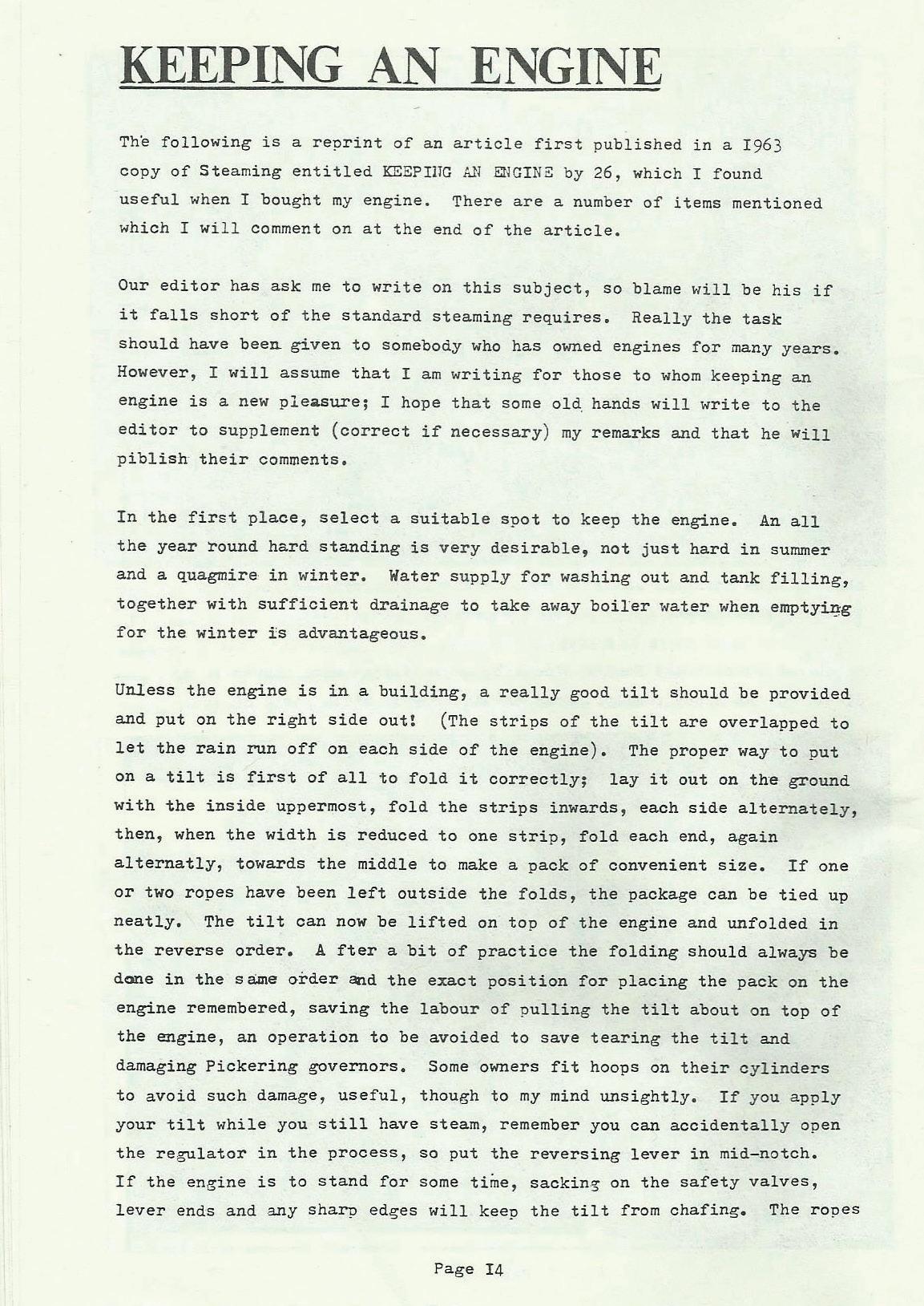
FOWLER DIESEL CONVERSIONPLOUGHINGENGINE No I5I98 of I9I8
FOWLER DIESEL CONVERSIONPLOUGHINGENGINE No I5I99 of I9I8
On the Saturday Fowler ploughing engine No 2479 was steamed, on the Sunday this engine and the Marshall steam roller were steamed.
The two diesel conversions where done by the Beeby family when they were stili commercialy used by them. These two were the only engines that were sold the following June at auction, along with the contents of the yard which included most of the parts except the boilers of a pair of single cylinder Fowler ploughing engines, as well as cylinders and motion from the diesel conversions.
Graham Austin.
Note from the editor.
We must apologise for this article appearing so late. I have only just received it and I feel that the weekend deserved to be mentioned. It was cold but a useful and informative weekend, giving a number of apprentices the chance to lend a hand in a job that few know of', this can be seen in the photographs.
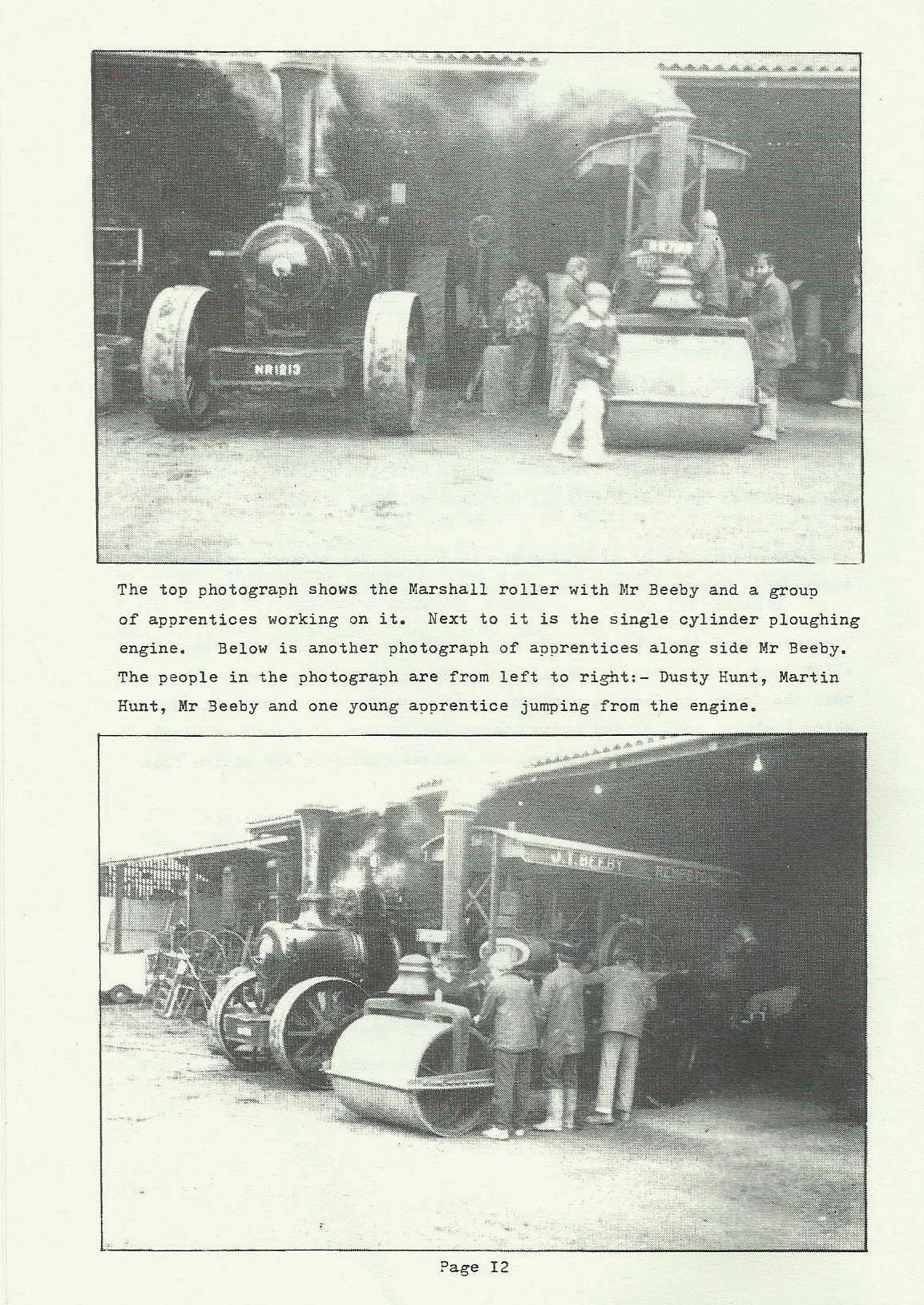
The top photograph shows the Marshall roller with Mr Beeby and a group of apprentices working on it. Next to it is the single cylinder ploughing engine. Below is another photograph of apprentices along side Mr Beeby. The people in the photograph are from left to right:- Dusty Hunt, Martin Hunt, Mr Beeby and one young apprentice jumping from the engine.
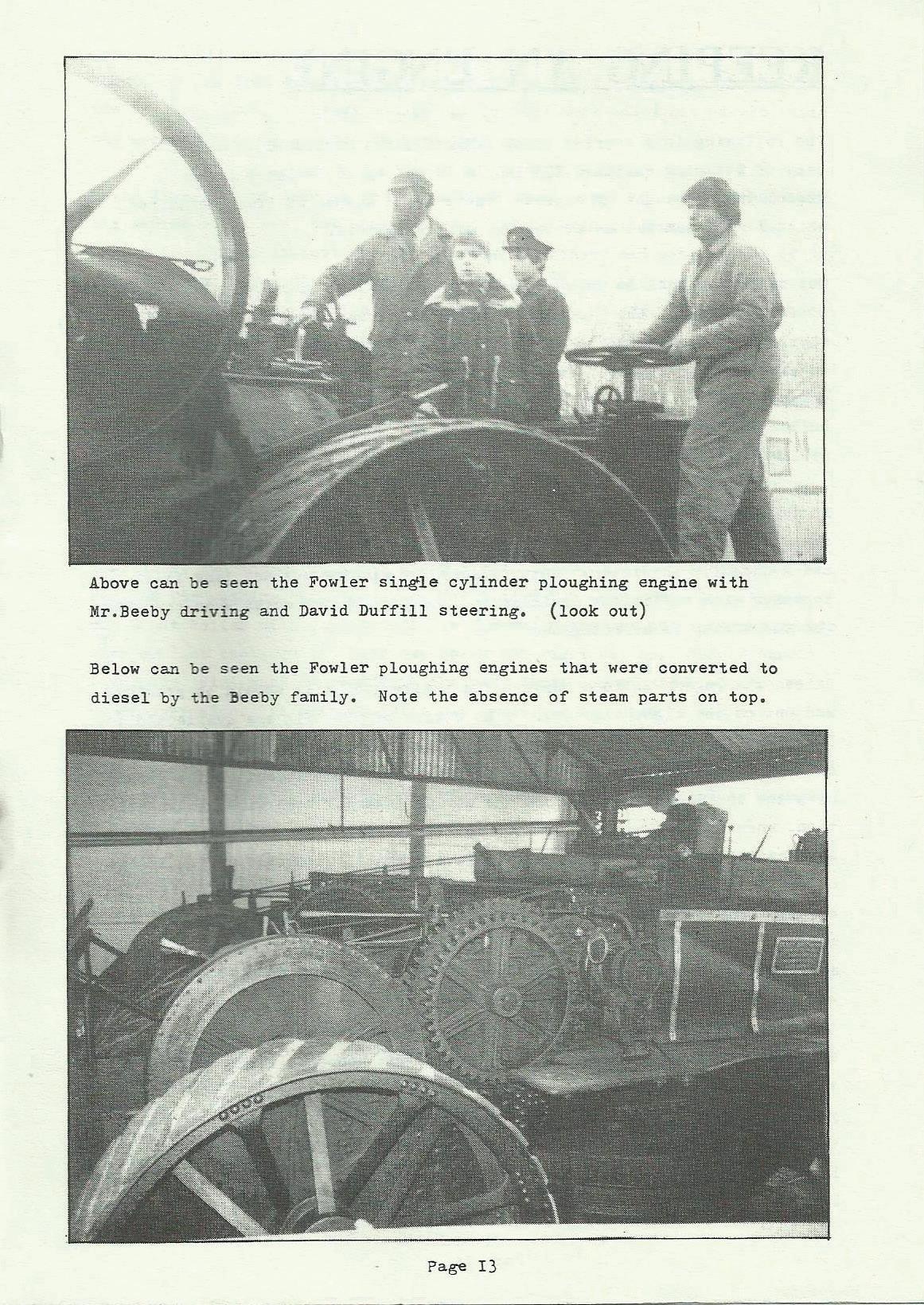
Above can be seen the Fowler single cylinder ploughing engine with Mr.Beeby driving and David Duffill steering. {look out)
Below can be seen the Fowler ploughing engines that were converted to diesel by the Beeby family. Note the absence of steam parts on top.
KEEPINGAN ENGINE
Th~ following is a reprint of an article first published in a 1963 copy of Steaming entitled KEEPillG All ENGINE by 26, which I found useful when I bought my engine. There are a number of items mentioned which I will comment on at the end of the article.
Our editor has ask me to write on this subject, so blame will be his if it falls short of the standard steaming requires. Really the task should have been given to somebody who has owned engines for many years. However, I will assume that I am writing for those to whom keeping an engine is a new pleasure; I hope that some old. hands will write to the editor to supplement (correct if necessary) my remarks and that he Will piblish their comments.
In the first place, select a suitable spot to keep the engine. An all the year ~ound hard standing is very desirable, not just hard in summer and a quagmire- in winter. Water supply for washing out and tank filling, together with sufficient drainage to take away boiler water when empty4\'g for the winter is advantageous.
Unless the engine is in a building, a really good tilt should be provided and put on the right side outt (The strips of the tilt are overlapped to let the rain run off on each side of the engine). The proper way to put on a tilt is first of all to fold it correctly; lay it out on the ground with the inside uppermost, fold the strips inwards, each side alternately, then, when the width is reduced to one strip, fold each end, again alternatly, towards the middle to make a pack of convenient size. If one or two ropes have been left outside the folds, the package can be tied up neatly. The tilt can now be lifted on top of the engine and unfolded in the reverse order. After a bit of practice the folding should always be done in the same order and the exact position for placing the pack on the engine remembered, saving the labour of pulling the tilt about on top of the engine, an operation to be avoided to save tearing the tilt and damaging Pickering governors. Some owners fit hoops on their cylinders to avoid such damage, useful, though to my mind unsightly. If you apply your tilt while you still have steam, remember you can accidentally open the regulator in the process, so put the reversing lever in mid-notch. If the engine is to stand for some time, sackin~ on the safety valves, lever ends and any sharp edges will keep the tilt from chafing. The ropes
should be fastened securely, but not strained tight. Whatever you put on the chimney should be heavy enough not to blo;, away and a bit of old tilt may well be tied on as well to keep rain out.
There should be no need to remind drivers about sweeping boiler tubes when the engine is in use; but what happens, say between rallies? The smokebox should be cleaned of soot and the firebox of clinker and ash, which, if left touching the plates, speedily causes corrosion. If the engine is to stand for any length of time, the ashpan should come off, firebars removed, and the accumulation between bearers and plates cleaned away. For the winter laying up, the inside of both firebox and smokebox should be painted with waste oil.
Washing out should never be neglected, many makers used specify "after working every IOO hours". Of course, the water used has a bearing on the frequency, but it does, I think, save trouble in the long run not to let sludge accumulate and harden. Burrells used to recommend blowing down about two inches of water every nigh·t. Every mud door should be removed for washing out, they were not fitted for ornament! Do not wash out a hot boiler with cold water: As the mud doors are not interchangeable they must be replaced in their own holes and right way up. Should one leak, the joint must be remade at the very first opportunity, neglect means corrosion. (A weeping joint may sometimes be cured by a smart tap with a hammer). Occasionally the fusible plug should be taken out and the top scraped free from scale. Failure to do so may not only make the plug inoperative, but also give trouble if, through mishap, you need to change a plug in a hurry.
Make sure the water gauge is working, when the engine is running the water should be moving up and down in the glass. In any case at intervals, and always before lighting a fire, close the top cock and open the bottom one. The glass should·· empty and water, hot or cold as the case may be, run out steadily. This shows that the bottom cock and water cock are both in order. Shut the water cock and open the top cock. Steam, if there is any will blow out. Shut the bottom cock and open the water cock and the water should flow up the glass to its proper level. Be sure that the top cock is open before letting water into the.glass, or a false reading will result.
There are two ways of laying an engine uo for a lon~ period. Pr~bably the most desirable is to fill the boiler absolutely full of water, but this involves lightin~ a small fire, not of course sufficient to raise steam, in frosty weather. Even in a buildin.g, frost precautions are necessary.
The other way is to drain the boiler completely, give it a few days to dry out, and then replace the mud door or whatever was used for draining. The pressure gauge should be removed and its S,Yphon pipe, close the cock (and remember to open it again when you put the gauge back). Open t~e water gauge bottom·cock, close the other two. J.lalce sure that no water is trapped anywhere in the feed pump, injector, clacrks, etc. The approved method for Scotch mar~ne boilers to put in trays of quick lime to absorb moisture in the air left in the boiler, but I have not heard of this being done in the case of a traction engine.
Apart from covering parts liable to rust with thick oil, I have no suggestions for care of the motion, though there may be more up to date rust preventers available now. A friend of mine for years kept his engines sprayed all over with waste oil.
Before putting an engine into mothballs forth~ winter, it would be advantageous to strip any parts which require bench work, as this can often be done under cover. I never enjoyed scraping regulator ports when it was snowing~ A note should be made of any work needed before the engine is to be steamed in the spring and any material such as gland packing and jointing obtained. There is no saving in just tighting up glands on worn, hard packing, it only scores the rods. Incidentally I never object to an occasional whiff of steam frorn a gland, it shows the driver has not been too heavy handed with his spanner. Oil cups need to be kept cleaned out and syphons renewed when necessary, the number of strands bein~ adjusted, by the light of experience, so as to provide sufficient but not too much oil. A four shaft engine will soon anoint the drivers face in gratitude for too generous~ supply.
I sometimes wonder if all the oiling points on the road gearing get enough attention. cups are occasionally missing on an engine when bou~ht, and, of course, the compensating ge~r is enclosed. A careful inz~ection
should.be made to ensure you are not· missins any 9oints, since wear ha.s already ta.ken place a seizure is unlikely, but, of course, wear will continue far too fast.
Too many eneines are to be seen with almost dry steerage. The turntable, worm and wheel, and chain barrel bearing all want oil, and grease on the barrel does no harm to the chain.
A drop of oil on the weighshaft bearings will make it easier to reverse the engine, which reminds me that the regulator will be much sweeter to operate if the glands are properly packed and the packing not allowed to get hard.
I have avoided mentioning what in my day would have been fitters jobs, these notes are not for the experienced man, and some such person is really essential to help anyone lacking mechanical knowle&ge.
I would add one point about driving on the road. If the traction engine driver exercises proper courtesy, particularly in keeping a good lookout for overtaking traffic and giving it every opportunity to pass, he is no more obstruction than say, a service bus. The engine moves so slowly that q~ite a short length of clear road allows overtaking, the bus is slower than normal traffic flow, yet a comparatively long clear stretch is needed for overtaking it. I myself generally drive the biggest engines on the road today, so I am not entirely without experience, a mate is essential, for keeping an eye behind, and on occasion courtesy demands that we will pull in to the side and stop.
At the beginning I said that I would comment on some of the items mentioned.
The article said ''use old oil to paint the firebox" this is not a good idea because used oil has many conaminates and car oil has additives.
Mention was made about the way to fold the tilt and it said fold the tilt with the "inside upper most" when folding it, this is the wrong way up (I think). One method of sheeting an engine with no canopy not mentioned is to place a length of timber between the chimney and the rear of the tender, this allows water and snow to drain off more easily.
CRASHBANGWALLOP
..Banbury rally was usually a very good rally with plenty for the enthusiast, and as usual I was there with a sales stand.
Then during the Grand Parade it happened. Despite action from both crews two engines collided with resulting damage.
The only surviving Brown and May showmans engine rolled backwards into Keith Emmetts showmans 'Kitchener•. The 3rown and May suffered a bent canopy, chimney and other parts while the other engine got away with paint work damage and a broken hub cap.
We all have to be careful with engines as demonstrated here, but of course the accident could have been much worse.
Consider these points,
I) Why did an engine apparantly roll away?
II) What would have happened if it had hit the boiler and not the wheel?
III) If it had not hit another engine where would it have stopped, in the crowd may be?
All apprentices must remember when around engines, Safty is all important. They must not be treated lightly, only do what you are asked or ask before you do anything.
At the Great Dorset Steam Fair many visitors thought it was funny to see an engine drive up behind them and blow its whistle, then stand there looking at it. Instead of moving out of the way before it runs them over making a mess of them.
Steam engines are things of beauty but they can give you a nasty sting if not treated with respect.
BE CAREFUL! BE SAFE!
Before doing anything ASK FIRST t
By David Duffill.
WHAT A PICTURE
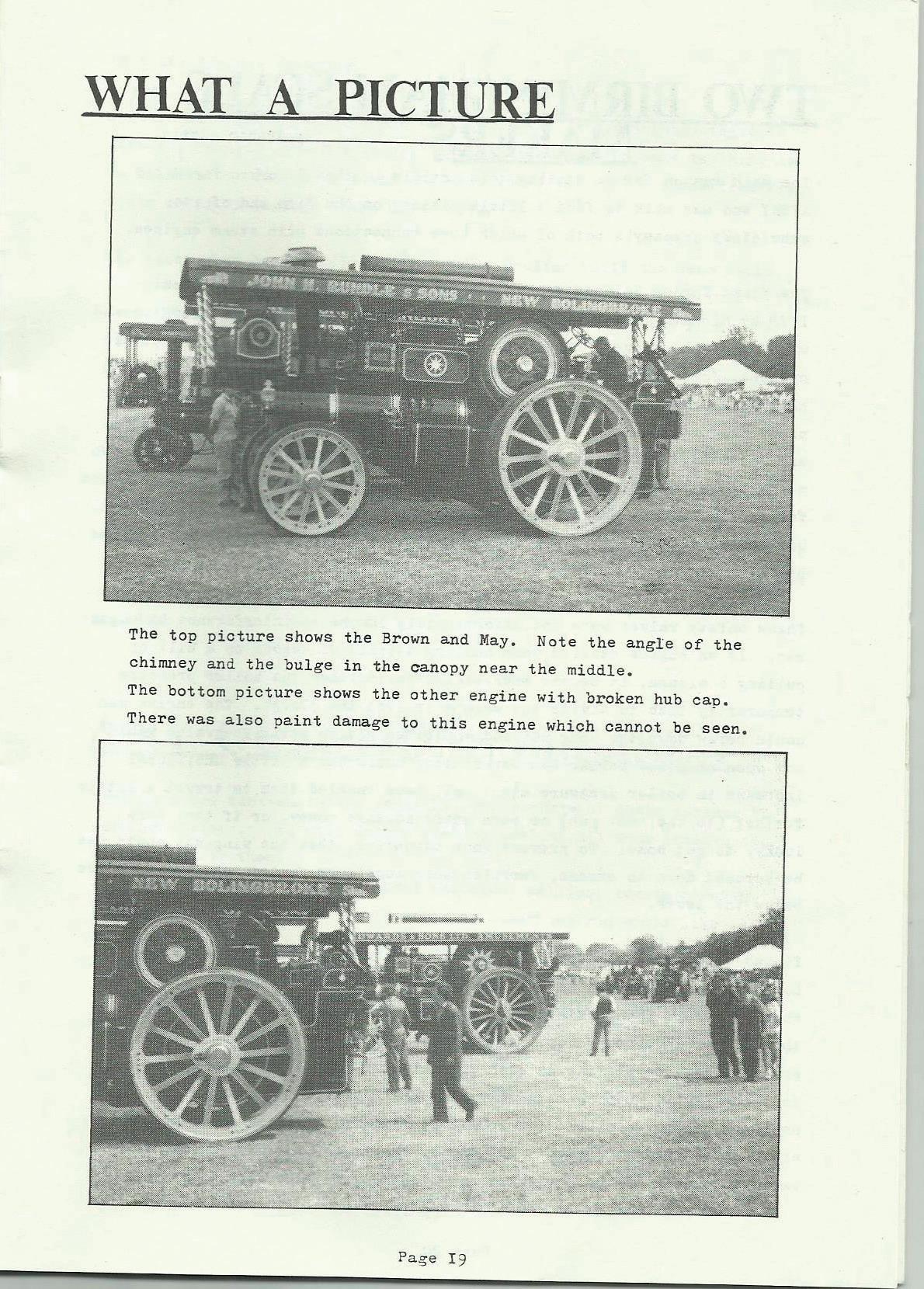
The top picture shows the Brown and May. Note the angle of the chimney and the bulge in the canopy near the middle. The bottom picture shows the other engine with broken hub cap. There was also paint damage to this engine which cannot be seen.
TWO BIRMINGHAMSCALE MAKERS
3y Graham Austin
The main reason for me writing this article is that I worked for W T AViRY and was able to find a little history on the firm and of its subsidiary company's both of which have connections with steam engines.
The first Spring Balance to be made in Britain was constructed about 1770 by Richard Salter wno was a Spring Balance maker in ii est Bromwich and was one of the Pioneer industrialists of the Midlands. He and two of his nephews, John and George, founded the firm of George Salter,'& Co. which have been making spring balances ever since and which are still common place all over the world. The firm patented the spring balance in I838 and locomotive safety valve-assemblies that incorporated them became known as ''Salters patent safety valves". There can be little doubt that balances for safety valves, which had a pointer in front of a scale so that the boilers blowing off pressure could be seen by the engine men, were suplied by Salter & Co.
These safety valves were not unfortunately immune to interference by engine men. If an engine stalled when hauling- a train of wagons up a hill or pulling a plough, it became much easier to increase the boiler pressure temporarily than to divide the wagons or lift the plough. The engine men could screw down the wing nut and sometimes did so until the valve would not open at all. Engine men worked long hours and a little unofficial increase in boiler pressure might well have enabled them to travel a little further (to the next pub) or earn extra ao~eage money, or if they were lucky, to get home. To prevent such tampering, that the wing-nut could not be screwed down to excess, ferrules were sometimes fitted onto the spindles below the lever.
It wa~ to prevent tampering by engine men that John Ramsbottom of the London & North Western Railway devised his famous safety valve at Crewe shortly before 1856. His design employs two valves of equal size and in the form of inverted cones. A horizontal steel lever has two pointed projections, one seating in each conicalvalve, and.a coil spring holds down the lever, keeping both valves on their seats. As soon as the steam pressure begins to exceed the permitted maximum, it lifts open the valves against the spring tension. One end of the lever protrudes beyond the valve to enable the safety valve to be checked to make sure they will
lift and are not sticking.
Salters were not the only scale making company in 3irmingham, the~e is also the compan.Y of W & T Avery, although they did r.ot make anything to do with safety valves or steam engines, there is still a connection with steam industry through there works site.
The story goes back to 1762 when Matthew Boulton built the Soho works, later James Watt joined the company in 1775. Two years after this William Murdock was employed and was later to become famous for the first ever self propelled vehicle intended for use on Snglish roads, he was unfortunately stopped by his employers. The model vehicle is now in the Birmingham Science Museum as just another exhibit considering it is so historic.
Boulton and Watt became one of, if not the most famous maker of Beam engines. They were still maki.ng these engines as late as 1905 a year after the works was sold to W & T Avery who still own the site. The site is basically unchanged since then and still retains the original entrance arch and roadway with !iilliam Murdocks house and other buildings still standing.
ANY QUESTIONSPLEASE ? •
This is a new section to the magazine, for members or their parents to send in letters. We will do our best to publish all such letters and also to answer them.
So if you have any questions about the club, rallies, events or even technical questions, or if you just have something you would like to tell us about, send your letters to S.A.C. D. Hurley, Leyland, Willin~ton Road, Kirton lnd, Boston, Lines. PE2I lNR.
It would help if you could mark them by putting Letters on them thank you.
BOOK R·EVIEW
301-lE ADVENTURESOF SAMSONCOGG.
Ronald H. Clarke.
a·oose
and Son Publishers.
By D. Hurley.
This paperback book can be described in my opinion as a simple story book. Without wishing to be unkind it is best to be used as childrens fiction. Perhaps even as bedtime stories for those who are past Goldilocks.
The book is devided into sixteen chapters, all of these are short stories. Each chapter takes up to three or four pages, with one or two taking up to seven.
The author explains in his words before that each story is based on facts, but the. actual characters and places and other such details are fictitous. Having said this the author does take the trouble to choose events that always end happily. In fact you may begin to think the main character of the book Samson Cogg lives in a perfect world.
The book is based upon steam engines but also has light reference to vintage motorcycles and other such forms of transport.
It is not a difficult book to read and I do not suggest that it is solely for children. It can be quite entertaining for older readers as.well, especially if you like happy endings.
There are sixteen illustrations by the author, one per chapter. These d.rawings are admittedly better than any thing that I could prouduce, but only just, and I cannot draw at all. I believe they are an attempt t~ help the reader to visualise the stc:sry.
It is not such a bad book though as it does leave the reader feeling-contented. Somehow the author manages to get across to the reader the feeling of happiness and satisfaction that the character Samson Cogg experiences.
All in all its not a book that I would rush to buy, but if you like steam and you like fiction its well worth reading.
The book contains one hundred and thirty six pages which for the princely sum of £3.95 I feel is reasonable value.
Of course the book is available from the N.T.E.C. sales, at rallies or by post. Also at good book shops, although it may need to be ordered for you~
FROM S. A. C. D. DUFFILL
I8I FODEl~ ROAD
GR.EATBARR
BIRMINGHAM
Btl-2 2ER AT THE FANTASTICPRICE OF ONLY £1·00 .
CHEQUES AND P.0.'s PAYABLE TO N.T.E.C. (I984) LTD. (NO CASH PLEASE) PLEASE ENCLOSE A STAMPED ADDRESSED ENVELOPE WITH EVERY ORDEB.
ORDER NOW WHILE STOCKS LAST !
JO IN A FRIEND
Why not get ·your friends to join the S.A.C. Get them to fill in this form or a copy of it. When complete send the form together with t2.00 Tos David Duffill, I8I Foden Road, Great Barr, Birmingham. E42 2EH. Or· hand 'it into any N.T.E.C. rally stand.
Name.
Address.
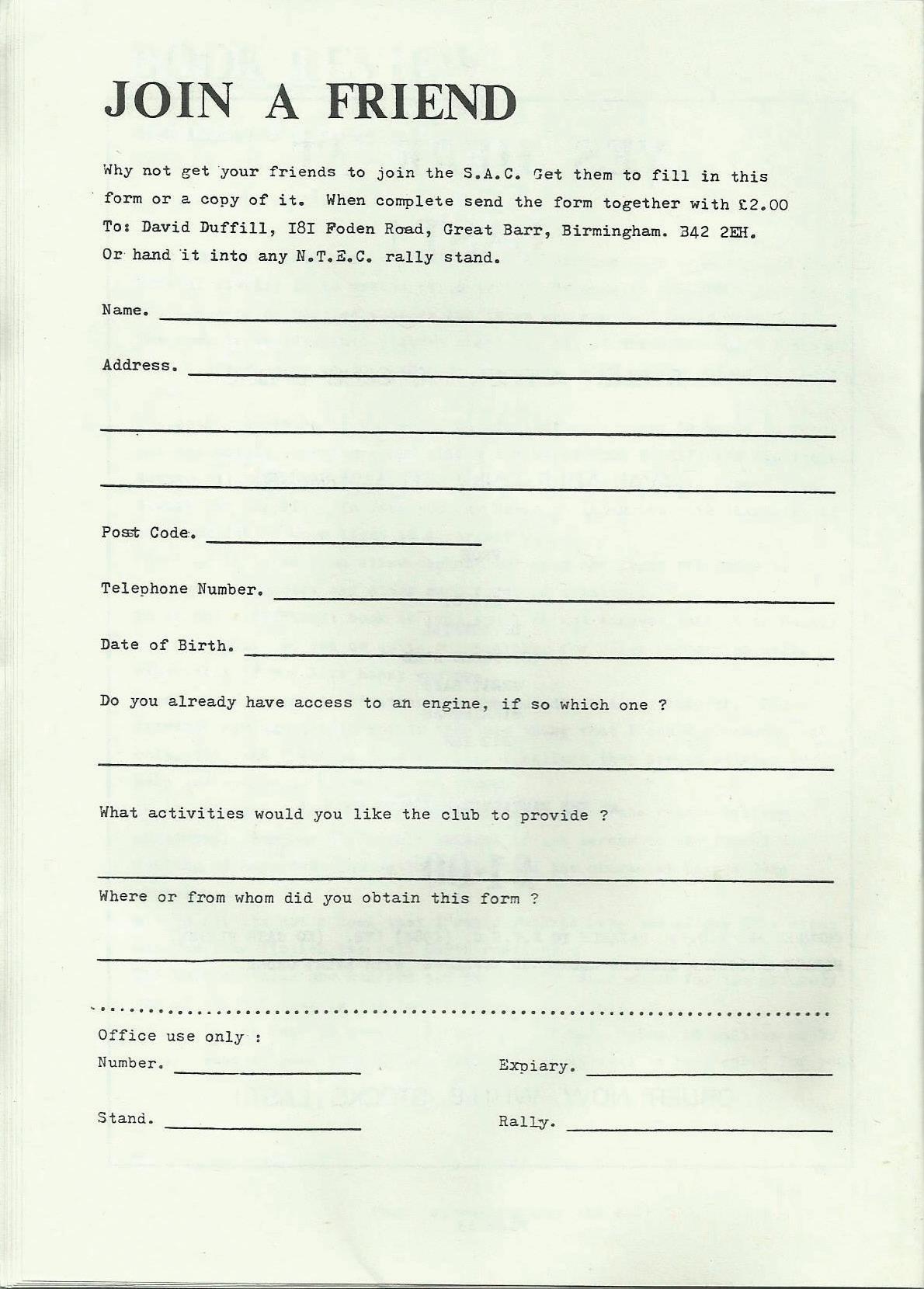
Pos;t Code-.
Telephone Number.
Date of Birth.
Do you already have access to an engine, if so which one?
What activities would you like the club to provide?
Where or from whom did you obtain this form? ..............................................................................
Office use only: Number. Expiary.
Stand. Rally.