STEAMAPPRENTICECLUB
The Chairman. Robert Herring, Bellacourt. Blacklocks hill. Banbury, Oxfordshire OXS 7DH
The Membership Secretary, David Dutfill. 181 Faden Road. Great Barr. Birmingham B42 2EH_
The Editor. Richard Hurley, 2 Reaburn Close. Haabrook Park, Charlton Kings, Cheltenham, Glos. 6L52 6NL._ (0242 221100)
Cornwall and Devon Branch Officer. Tyrone Jaaes, 6 Fernhill road, Newquay, Cornwall, TR7 tLE (0637 873258>
The Editor willbepleasedto consider contributions of suitable articles, shorter iteas or photographs for inclusion in future issues_ All material so subaitted is voh.r.t-ry and payaent cannot be aade for ;any ~terial publishec:L The opinions expressed in the aagazine,. Nith exception of those printed as club anno..--ceaents,. are those of the contributors and do not indicate the views of the club as a Mhole_ all are held copyright of the contibutors and/or the club_
NEXT ISSUE: The press date tor any news rally reports. photographs or ar'ticles is the last day of FEB.AUARY.
This magazine is produced by the Ste~ Apprentice Club and printed by LASERSPRINT LTD. 123a CHURCH HILL RD. HANDSWORTH BIRMINGHAM
Well I expect that it was quite a surprise when this popped through your letter box this morning, since there hasn't been one tor soae time_ I feel that this needs some explanation_ Firstly I aa eaployed by G_C_H_Q_ in Cheltenham and aswel 1 as working 1 I attend col l~·e. where this year I am doing my finals in ay H_N_C_ This autUWl I shall be going to University all these take up auch of ay time_ But in addition we are restoring a living van, repainting and lining our engine_ Also I have a fantastic girlfriend who I like to see and also I ski_ So why haven't we had a aagazine the aa.in reason is that I haven't had many articles from you the apprentices, and I a.a sure that you can spare halt an hour to write an article if I can spare a couple of days to publish the magazine_
Well any way after that I sure that there will be articles coaing through my letter box soon_
A_G_N the J_ Beeby Cupwasawarded again, this cup is given to S_A_c_ •eabers_ This year it waswon by Richard L_ Hurley (sounds fami 1 i ar) for his work for the club over the past years even before he became editor_
This issue contains the first part of an article by Ray Hooley on the history of Rustons and I aa sure you will all learn scaething fro• it_
Next issue will contain a list of rallies where Ne hope to hold s_A_c_ events and also details of a photographic coapetition_
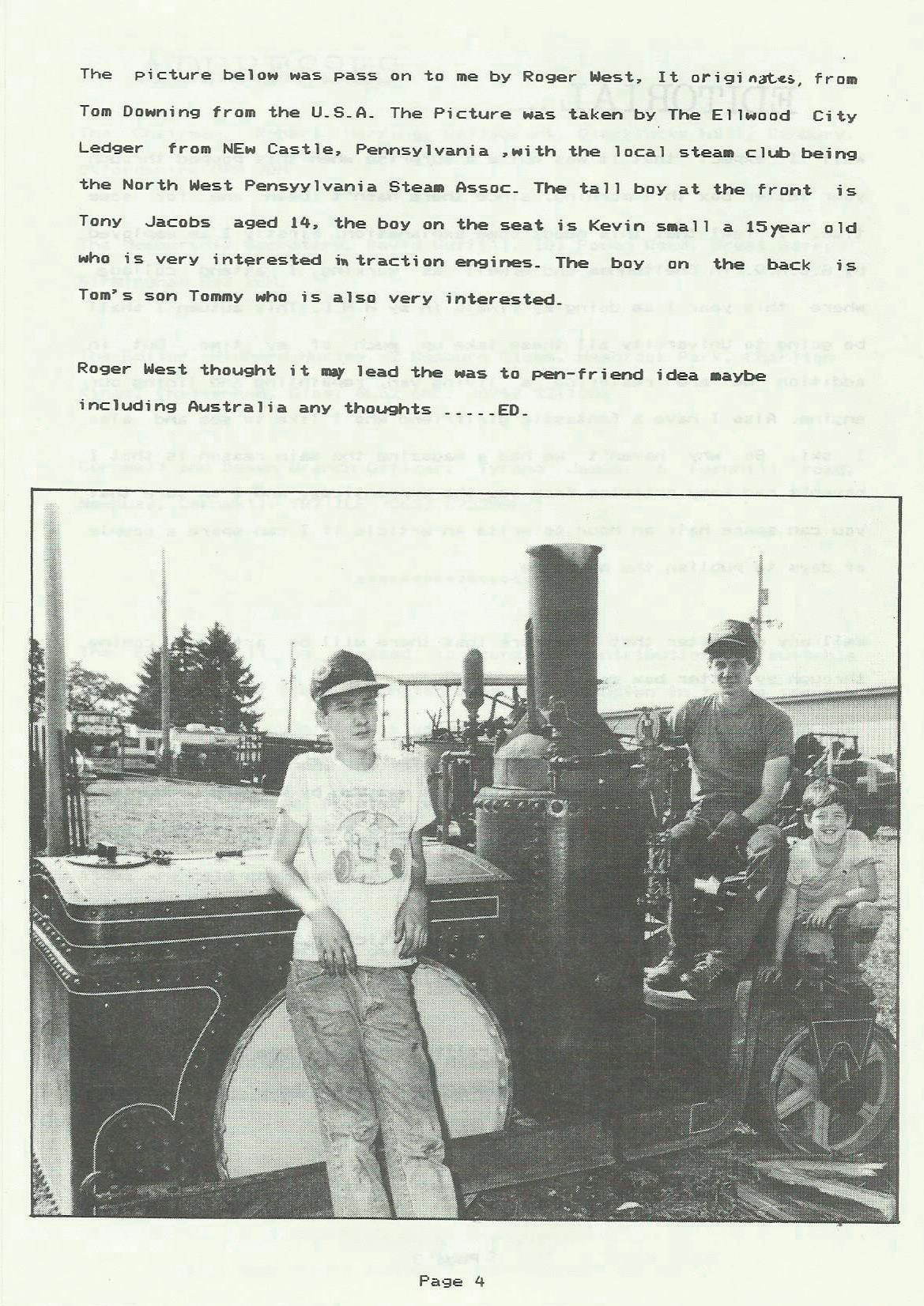
The picture below was pass on to me by Roger West, It origin.rt,~~, from Tom Downing from the U.S.A. The Picture was taken by The Ellwood City Ledger from NEw Castle, Pennsylvania ,with the local steam club being the North West Pensyylvania Stea• Assoc. The tall boy at the front is Tony Jacobs aged 14, the boy on the seat is Kevin s•all a lSyear old who ; s very i nt~rested i" traction engines. The boy on the back is Tom's son Tommy who 1s also very interested.
Roger West thought it may lead the was to pen-friend idea aaybe including Australia any thoughts ED.
At the Great Dorset Steam Fair, Stourpain~ 3rd September 1988 the Steam Apprentice Club had a meeting_ As we had just joined the club it was a new experience for us and we had a very enjoyable one_ First we had a talk by Tam Mc Taggart, then we split up into groups of three_ In my group their was my brother Andrew. my sister Emily and ayself_ Richard Hurley took our group around (he was very nice)_ First weNent on Fowler Showman's engine no_ CU978 RENOWN_ The engine driver talked to us about how the engine worked, it was only the second tiae I'd been on a stea• engine, he also told us that it was his engine, he also let us pull the whistle chain_ Next Ne went to a Sentinal Stea• Wagon No_ 'ET 1969_ Again the engine driver showed us how it worked_ We moved on to another steam ~agon this tiae it was a Faden no_ TW 4207, he also told us about the engine and we asked questions which he asnswered_ Ne.xt we went to Wa11 is and S-teevens ro 1 ler no_ CR 6315 and we were shown the fire and the dials and how everything worked_ After that we went on THE IRON l'tAIDEN Fowler no FX 6661_ Ne didn't spend long on there and went onto the last engine KING GEORGE VI _ This was a big engine belonging to John Wlarton and fot.Wld out that you can't see everything infront of your engine while driving, we al~o had a go at sitting on the driving seat. After refreshaents we joined the other S_A_C_ members for a group photo_ Ne can't wait for the next opportunity to up again and learn soaeaore about • Steaming• ! Thank you to everyone concerned for an enjoyable aeeting an a great rally_
Samatha Agnew No_ 1392
C H A R L E 5 B u R R E L L M I p F I
C L p X F z G y R w Q R Q L L E w 0 F
B R A U N y G N I L E V A N E L L L A
M A E y Q D R ·o F X u T X H H 5 p A R
T F N j T C p R C B V R Q 5 C N V z H
N E D 0 F 0 W L E R D 0 B R I L B L E
M C L A R E N N V K 0 p C A F w s B R
A Q E U 0 T A s K E R B B H F G N D s
u 0 D D A Q H Q H V C V G V E w R N F
I F s I M s u A E u D E D V s s 0 F 0
0 j E F F E R I E s T R G C E B H K u
A K M 0 0 s B E T 11 H T A A E B N V N
X I M z s E N T I N E L L s V p 0 B 0
D L 0 T T M A H u D z T 0 E M A T R R
j L s N E V E T s s I L L A w G s N y
T A N 0 R p R Q u V B V N X 0 0 u J D
j X A z K T N I u F E N w K L 0 R L T
G A R R E T T I 0 H A N p w F p V T V
w B 0 X F 0 R D s T E A M p L 0 u 6 H
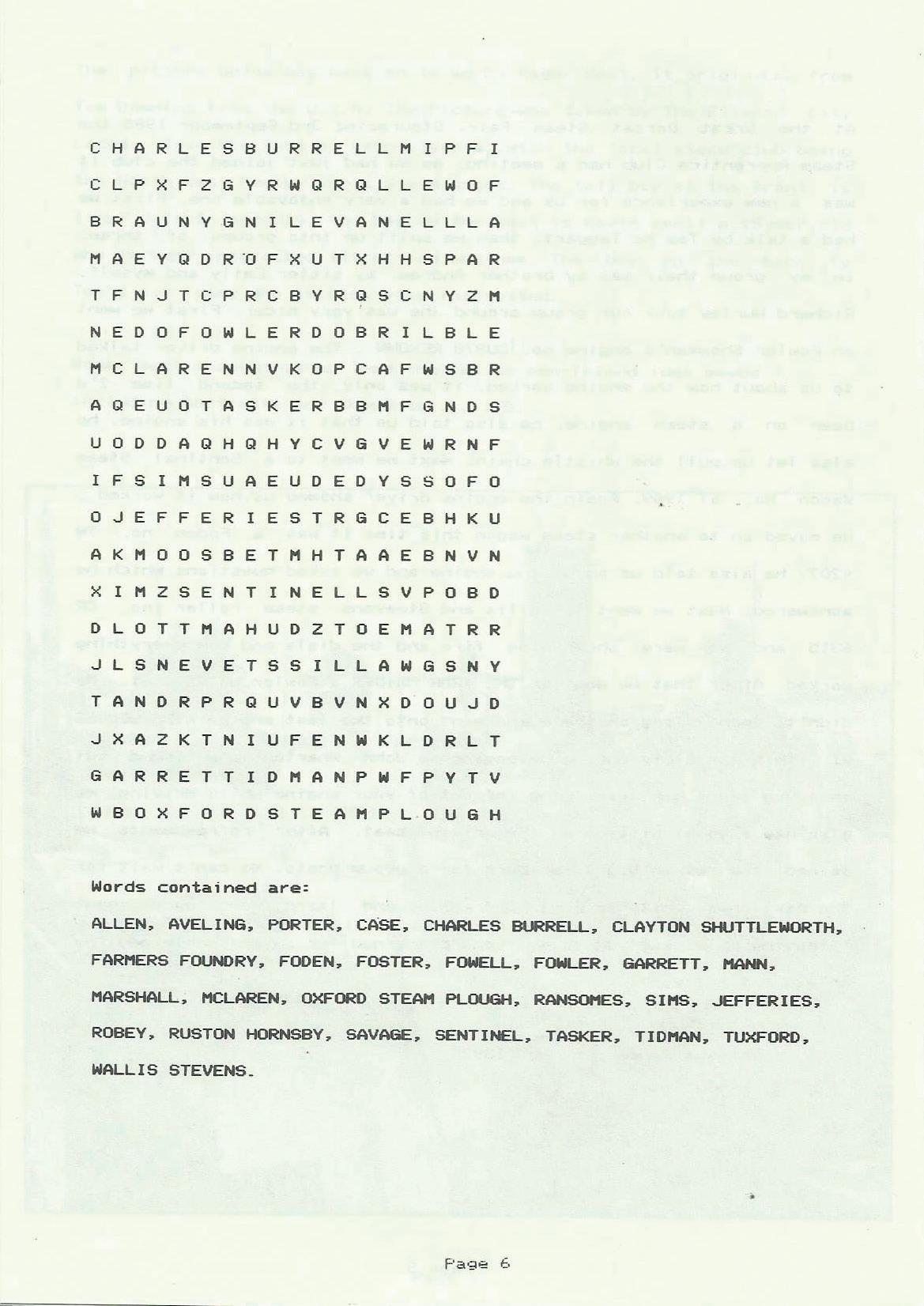
Words contained are: ALLEN, AVELING, PORTER, CASE, CHARLES BURRELL, CLAYTON SHUTTLEWORTH, FARMERS FOUNDRY, FODEN, FOSTER, FOWELL, FOWLER, GARRETT, t1ANN, MARSHALL, MCLAREN, OXFORD STEAM PLOUGH, RANSONES, SINS, JEFFERIES, ROBEY, RUSTON HORNSBY, SAVAGE, SENTINEL, TASKER, TIDHAN, TUXFORD, WALLIS STEVENS_
NO AH167_ JXH174
One of the last steam rollers to be built_ The last of a batch received by G_W_R_, Swindon_ Only very few were operated in the British Isles as most of them were built for India and eXPorted there_
Originally a Ruston & Hornsby design, as can be noted in John Crawley's book ··steam Rollers in Focus··- It was built at Aveling-Barfords under licence_ They were piston valved engines, all singles. except one, and in 6, 8, or 10 ton variations with 4, 5 or 6n_h_p engines_ All had 2 constant aesh gears and were built between 1937 and 1948 and now there are only 20 still in existence_
Ah 162 was built in February 1947, the last of a batch designated to go to India, but, delivery was delayed and in February 1948 G_W_R_ swindon purchased the consigneMent for their own use_ has a 2 tine Price scarifier and water sprinklers, canopy plus a re-designed coal bunker_ Instead of walking bet..eentwo coal pots from behind l1ke an "Advance·· she has been converted to the aore modern all-in-one bunker arrangeinent_ She worked all her, albeit short, commercial life for G_W_R_ In the late fifties about 1959/60 Mr Charles Gregory purchased her and dro e her all the wayhoae to Redruth, a journey of about 250 ailes_ She did not see auch rally
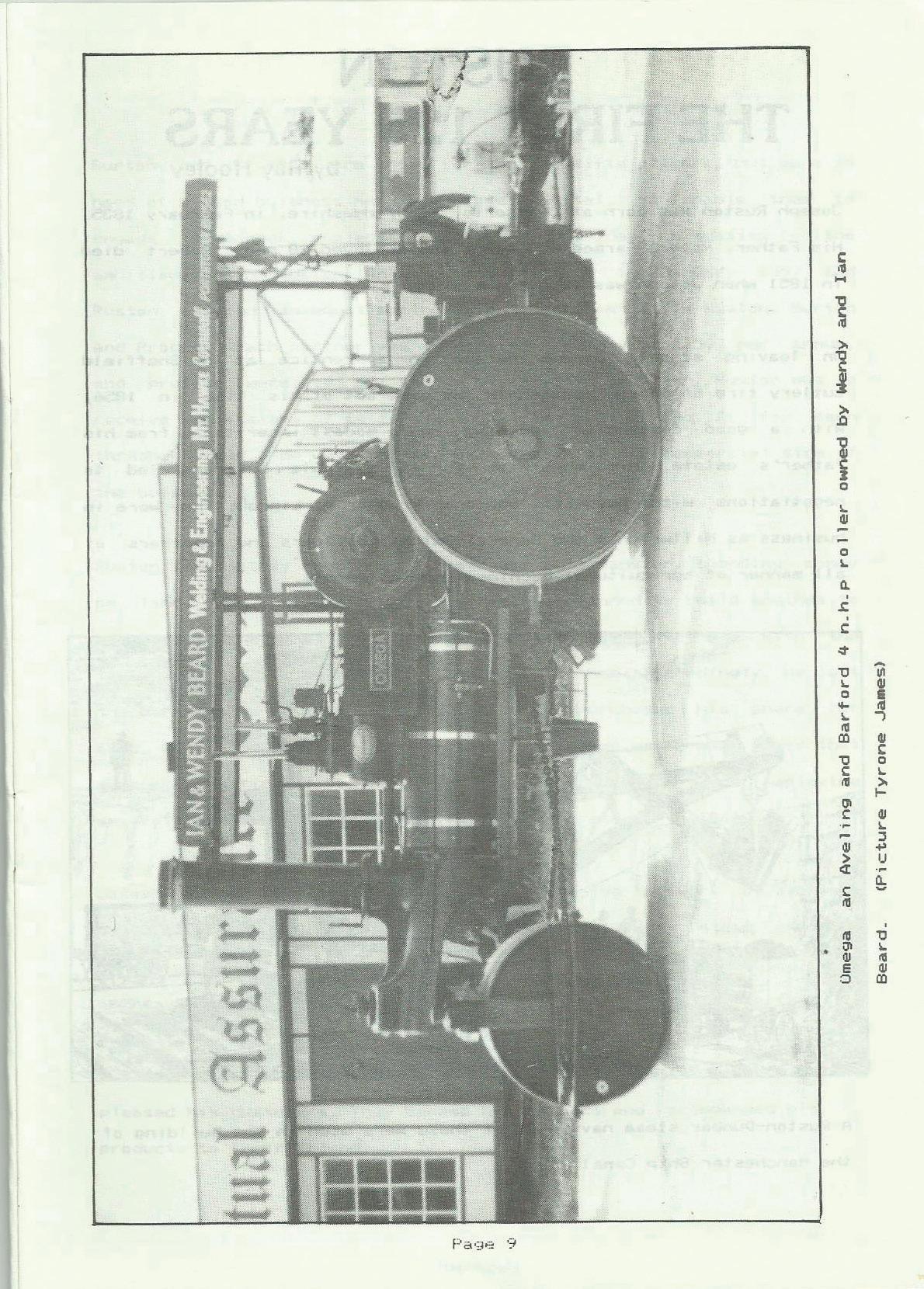
use, then in 1965 Mr Vernon Carveth bought her and he took her to rallies tor a few years, but, other bus;ness commitmnets caught up _with him and "Omega" was stored in ht's garage and only brought out on very rare occasions_ The boiler inspections were, nevertheless, kept up_
In October 1985 the Barford was sold again, th;s time to an ex-G_W_R fireman who now owns her in a partnersh;p with h;s wife_ Wendy, who under instruction has learned to drive the -o.ega- very well, considering these rollers are small, but, very quick and she has had to master the piston valves and a sharp regulator_ Wendy has achieved no mean feat_ Since they bought "'Oaega" Ian has made a new regulator rod, fitted a flywheel brake, re-lined the bond brake, f;tted extra, badly needed, cab-stays, fitted the water spr;nklers, re-plumbed the injector and puinp, worked her for several days and in 12 aonths has completed well over 300 ailes on the road 200 or so in the sua111er of 1986 alone!
Ian and wendy have got th;s unusual and very pretty roller extremely we 11 pres.erved and she is in tip-top condi t i on in every way -
by Ray Hooley
Joseph Ruston was born at Chatteris. Cambridgeshire. in February 1835_ His Father, Robert Fanned 600 acres and employed 28 men_ • Rober-t died in 1851 when Joseph was 16_
On leaving school, Joseph becaae an apprentice at the Sheffield cutlery firm of George WostenhoJm_ He came out of his time in 1856, w1 tr, a good commerci a 1 training and a modest inheritance from his father's estate_ His enquiries for a suitable business. led to negotiations with Messers_ Burton & Proctor of Lincoln They were in business as Millwrights and General S.iths; builders and repairers of all manner of agricultural machines and
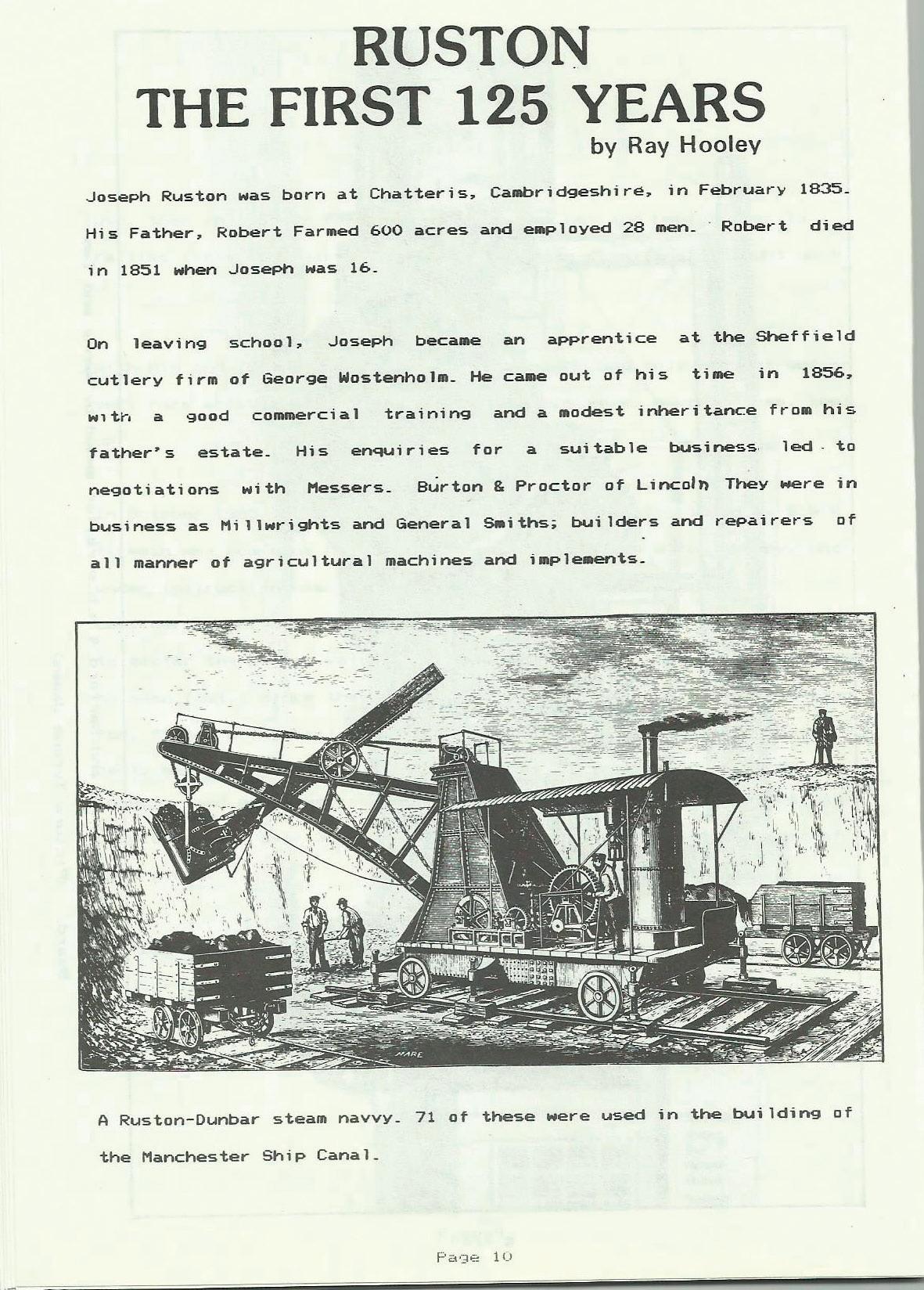
A Ruston-Dunbar steam navvy_ 71 of these were used in the building of the Manchester Ship Canal_
Burton and Proctor were known for their quality of wot·k, but werein need of a good buisness head and more capital, to enable thell to engage in larger projects. This was an ideal situation for the ambitious ~Joseph Ruston. An was made in January 1857 and Ruston entered an equa 1 partnershi P. to be known as : - Rust·on,. Burton and Proctor. Each partner was to receive a salory of £150 per annum, and profits were to be shared equally_ In addition, Ruston was to receive commissions of £4 for each engine and £1 for each thresher sold. He was to take sole charge of the coaaercial side of the buisness.
Ruston immed1ately commenced a prograaae of expansion, spending on land, new buildings and machines. He planned to build engines to stock - an unhear~ of practice! Burton strongly disagreed with the lavish spending, saying that it would ruin thea. Accordingly, he left the partnership on 18th July 1857. Ruston purchased his share for £855. Within a few years the share was to becoae worth aany tiaes that ammount. The firm of Ruston & Proctor prospered, and were eaploying several hundred men by the time l'lr. Proctor retired in 1864.
Joseph Ruston ha4 established an impressive network of overseas agenc1es, and the Company's portable and stationary steam engines, thrashing machines, elevators, corn mills, boilers, Pt-aPS, etc., were in heavy demand. These products were con~tanty winning prizes at exhibitions all over the world. Ruston adopted the -11y Customer is my B st Fr'iend He insisted on a quality pt·oduct which pleased his customers. They became his friends and recoamended his products to their friend.
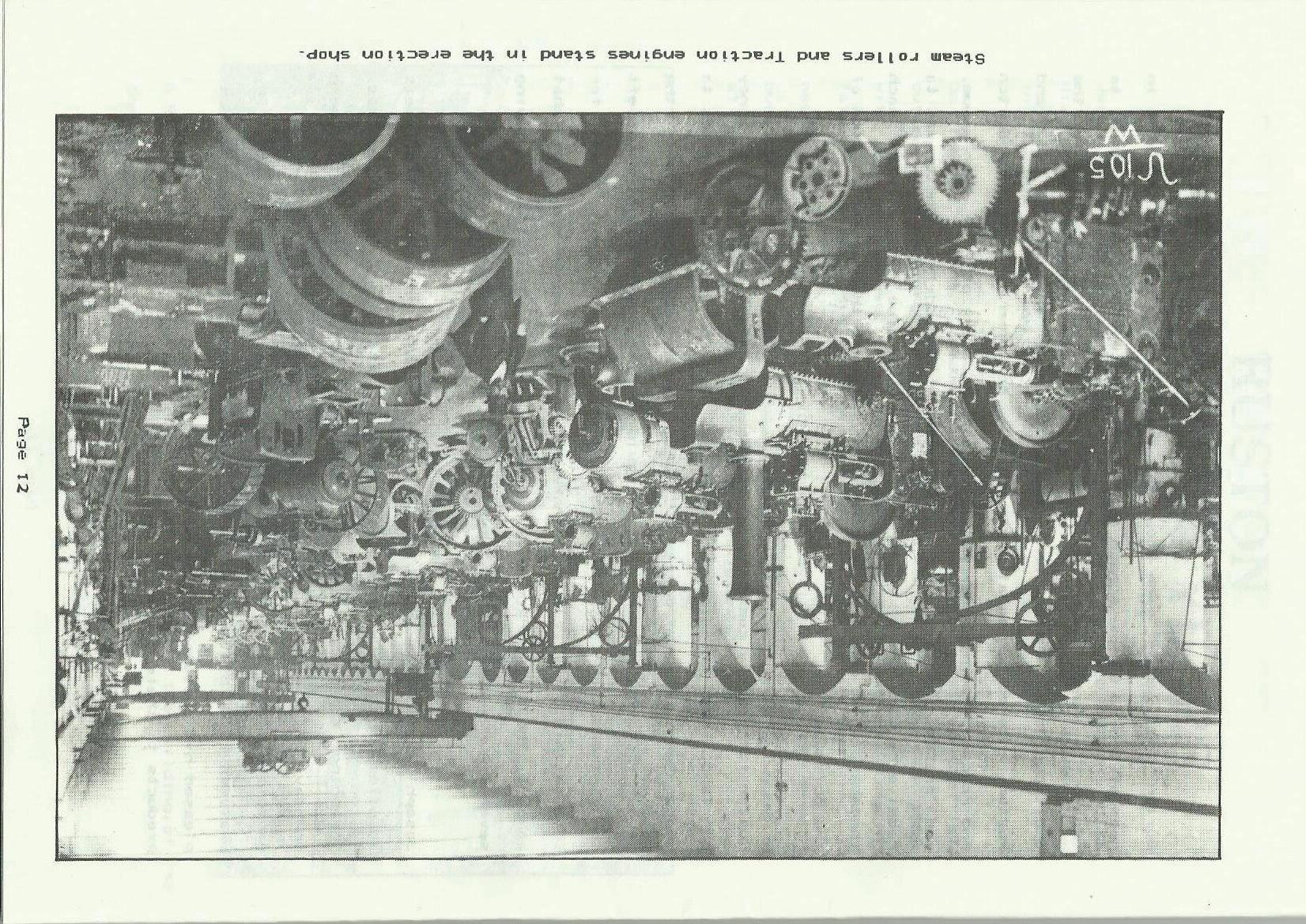
._loseph Ruston was a super salesman by any standard~- He travelled to Russia in 1880 to negotiate a deal for steam engines and PUMPS to dra1n 8 mi Jlion acres of the Pr1pet Marches_ On the way back he heard of large oi I strikes at Baku. He immediately headed in that direction and won large orders for oilfired equipment_ A few years latet· persuaded a group of Lanchashire buisnesscnen that a ship canal ft·o• Liverpool to MVlchester wuld be an econoaical viab1lity if ston-built mechanic~l excavators were employed_ Orders for aore than 70 Ruston Dunbar excavators were received_
By 1889 Ruston, Proctor and Co were eaploying 1600 aen, being one of the largest eng1neerin9 fims 1n the~ountry_ The product range included tract1on engines, steaa rollers, & locoaotives, in addition to iteas already mentioned_ Joseph Ruston decided that it was the right tiae to go public_ He received £465,000 as the purchase price, and reaained Chairman of the new Company. The workshops then extended over 15 acres and were equiped with over 600 machines. 50 cranes, and 72 steaa engines supplying 800 h_p_
In 1890 Ruston turned downa demand for higher wages - withthe excuse that the buisness was hardly earning hi• bread and cheese_ In thesaae year he paid for a new Drill Hall for the Lincoln Voluntee,·s, to be built on Broadgate_ Inevitably the new building becaae known.as 'Bread and Cheese Hall'. Joseph Ruston was nicknaaed 'Mr_ Bread and Cheese'_ Profits, of the company had, intact been very9.,J that year, but Ruston knew that to grant an increase in wages to his eaployees then would probably put other local engineering coapanies out of buisness !
Joseph Ruston died in 1897. but the fa•ily interest was carried on by hia eldest son. Joseph Steward Ruston_ His father had seen the introducton of the oil engine. a product which w.lS to feature in the works output far aany future years_ Despite thedoaination of the oil engine •arket by close neighbours ~R- Hornsby & Son. at Granthaa. Rustons played an iaportant par't in developingthe internal coabustion engine_ The Ruston fuel injec'tor of 1912 becaae a aodel for future developaent_ By the ou'tbreak of the 1914 -18 War they Nere building cold-start oil engines and were fast gaining the ascendary over Hornsbys_ Hornsbys entered the ail engine field when they reached an agreeaen't with Ho-ber't Akroyd Stuart in 1891 aanufacturers of engines to his designs_ these engines were low-coapression. parafin-fueled. and required the aid of a blowlaap for s'\arting_ This ..as the start of •ore 'than 20 goldern years for Harm.bys_ They very quickly phased out all steaaengine building andpinned their faith coapletely on the inter~l coabustion engine-
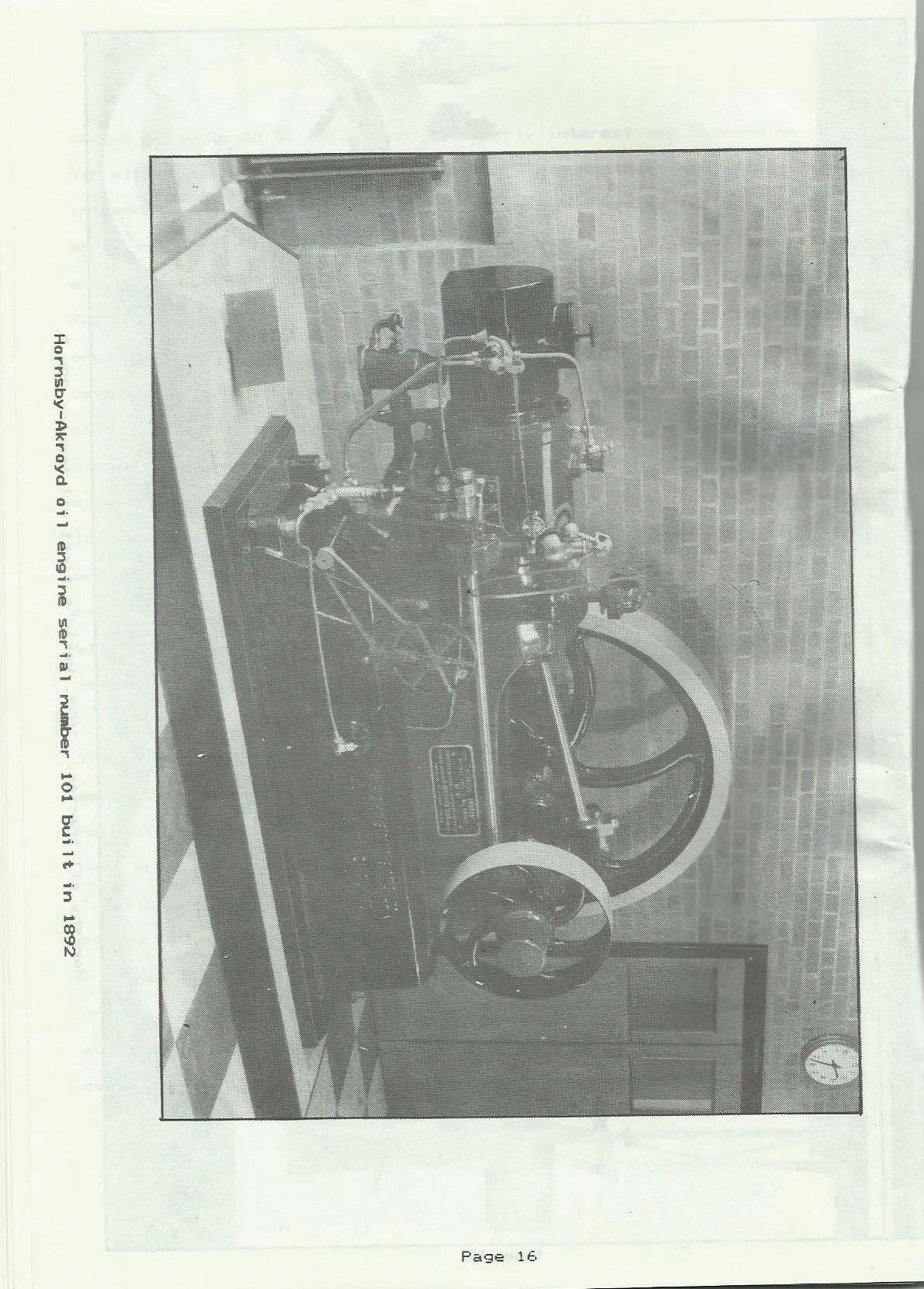
The Hornsby-Akroyd oil engine w.lS an i..ediilte success_ A tot.al of more than 45.000 •hot-bulb• engines Nere produced at Granthan_ Hornsbys were also very adventurous in its application_ By 1896 they had produced the World's first oil engined 'tractor. and the world's firs't oil engined locoaotives- They also built engines for use in boats. subaarines. li9"\'thouses. radio s'tations etc_ A Hornsby engine provided the power for i 1 h.-ina'ting the St.atue of Liberty at NeN York_ Another powered the transaitter which sent the first wireless aessage across the A'tlan'tic Ocean in 1902_ The first oil tractor was later converted to becoae the World•s first caterpillilr tractor in 1905
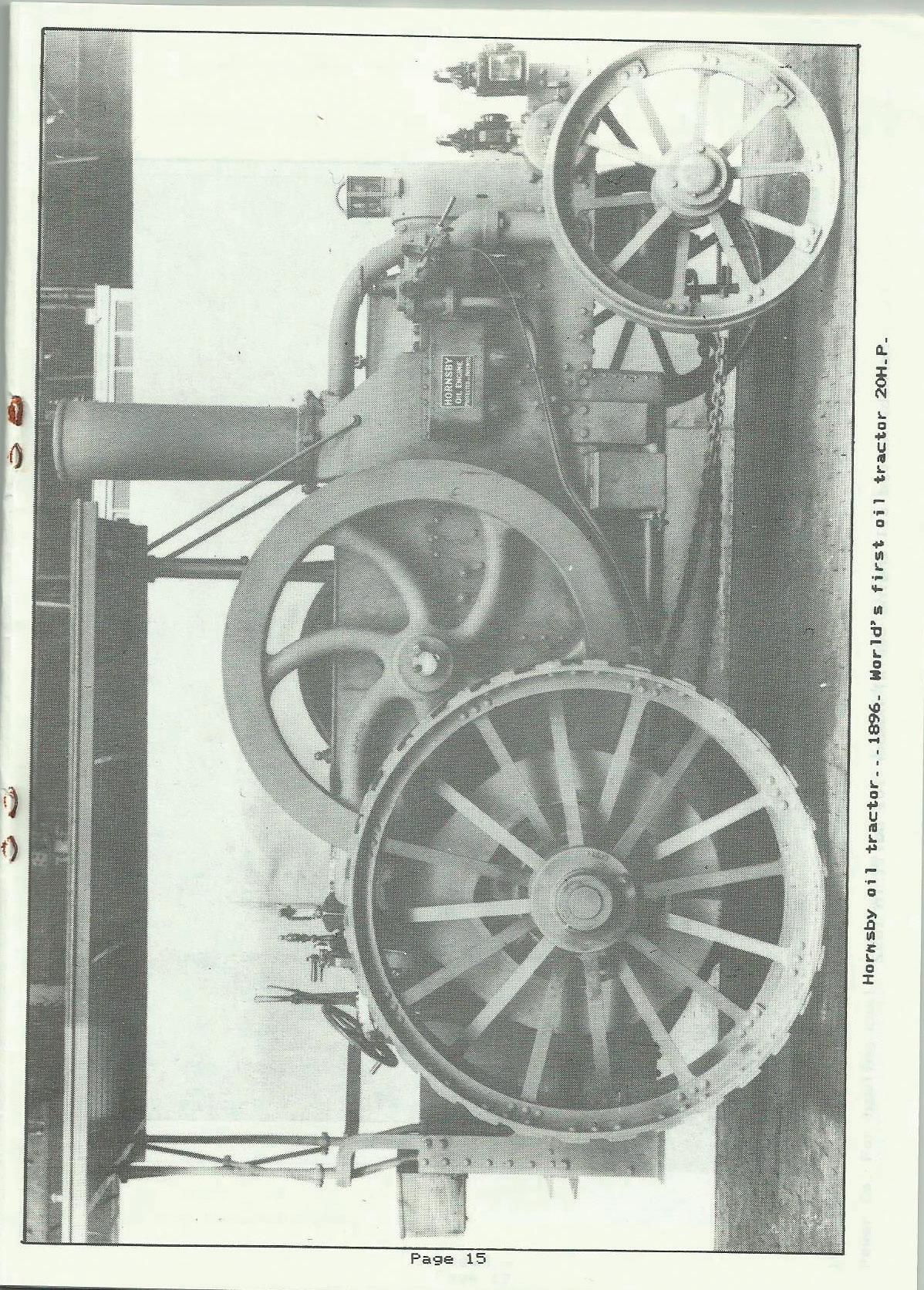
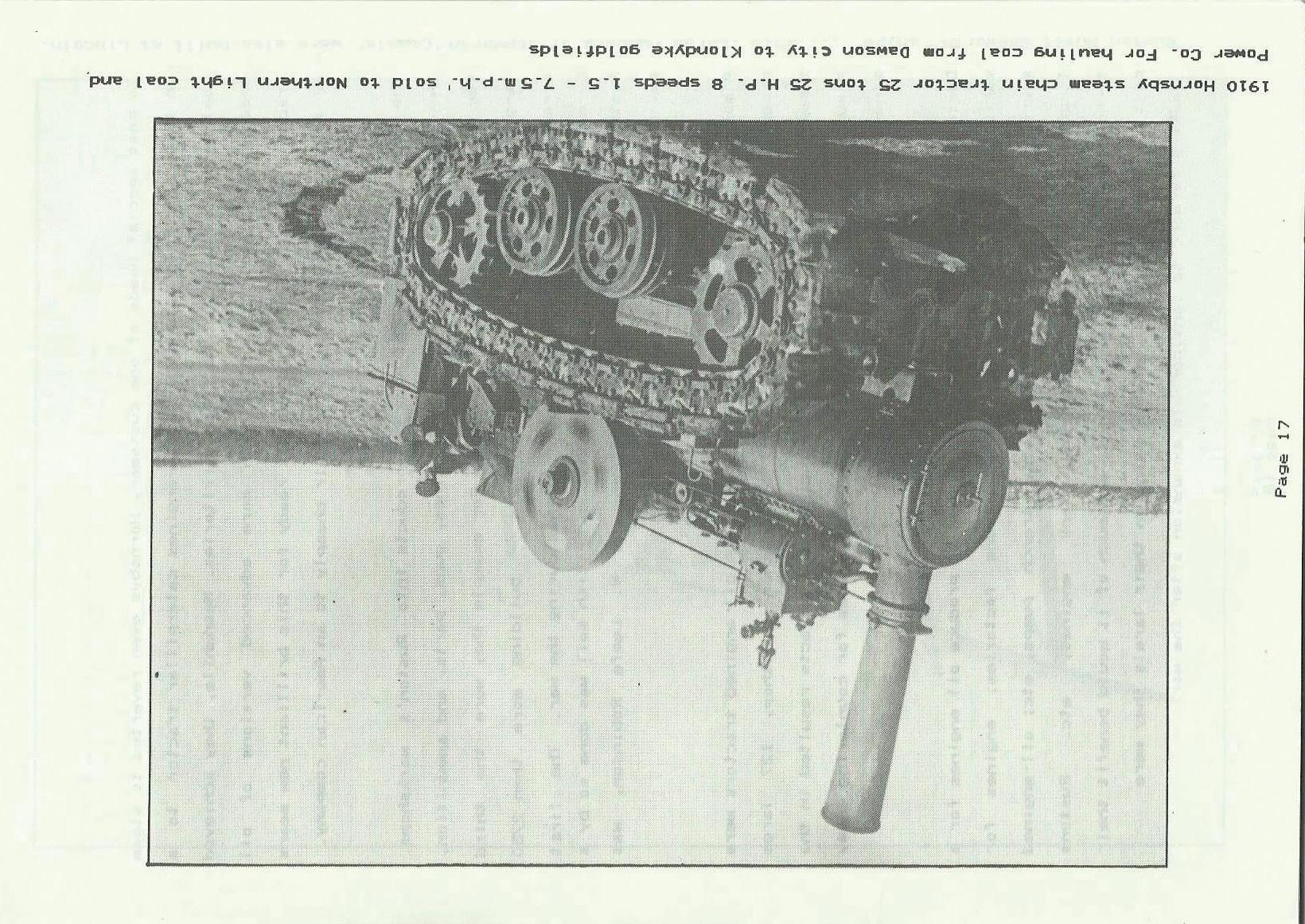
To meet special needs of one custoaer, Hornsbys even reverted to steaa in 1910, when they supplied a steaa-engines ca'terpi11ar tractor to a coal mining concern in the Yukon territories_ 11eanNhile, they achieved speeds of around 25 m_p_h_ with aare advar.ced versions of oil tractors_ Alas, the world was not ready for this bri 1 liant newaeans of transport, and Hornsbys sold their cheaply to an Aaerican coapany_
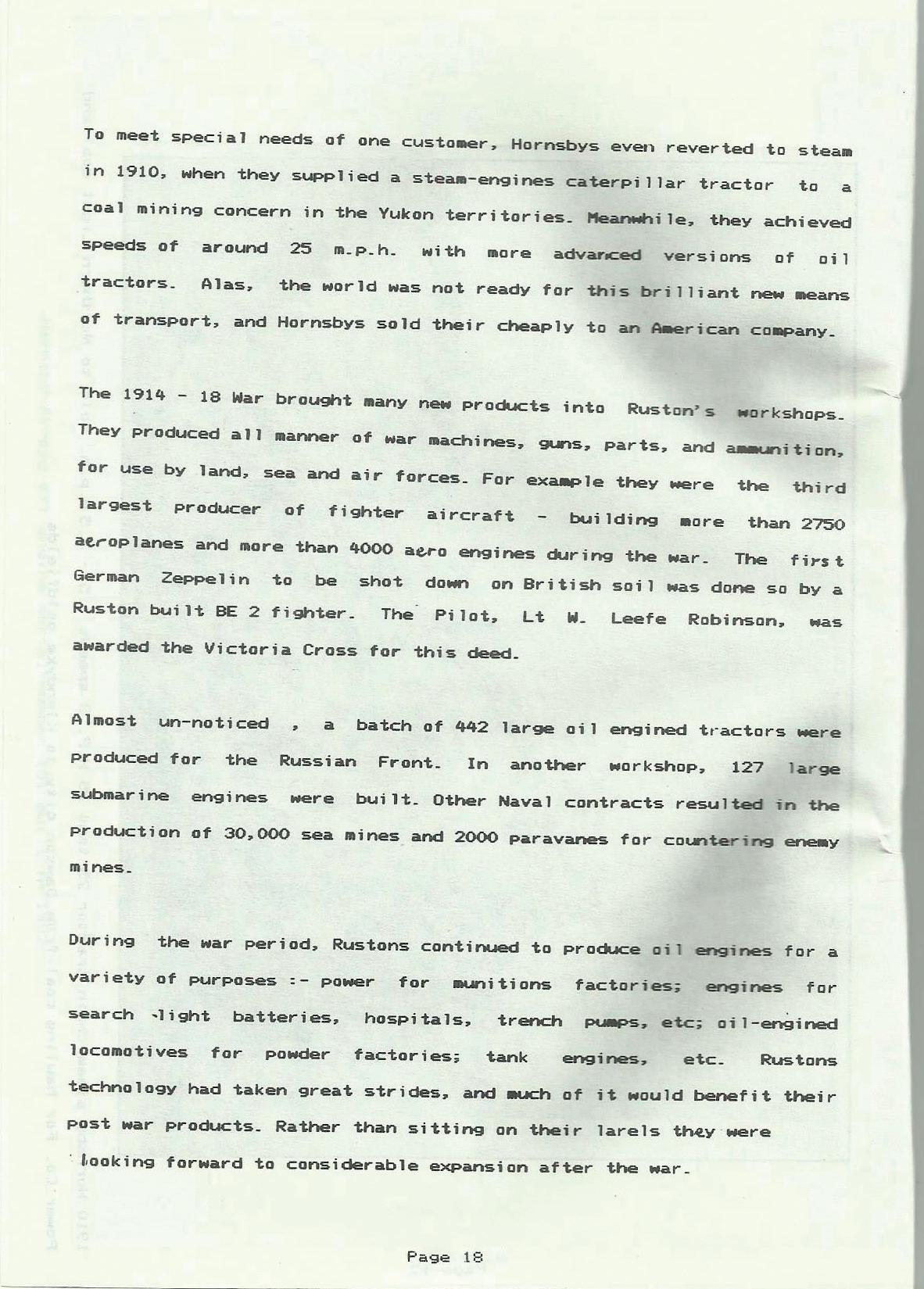
The 1914 - 18 War brought aany new products into Ruston•s workshops_ They produced all aanner of war machines, guns 7 parts, and for use by land, sea and air forces_ For exaaple they .-ere the third largest producer of fighter aircraft building aore than 2750 a~roplanes and more than 4000 aero engines during the war_ The fiYst German Zeppelin to be shot do..n on British soil ..as done so by a Ruston built BE 2 fighter_ The Pilot. Lt w_ Leete Robinson. ttas awarded the Victoria Cross for this deed_
Almost un-noticed a batch of 442 large oi 1 engined tt·actors ..ere produced for the Russian Front_ In another workshop, 127 large submarine engines were built_ Other Naval contracts resulted in the production of 30,000 sea aines and 2000 paravanes for col.rltering eneay mines_
During the war period, Rustons continued to produce oil engines for a variety of purposes:- po..-er for munitions factories; engines for search ,light batteries, hospitals. trench puaps, et.c; oil-engined locomotives for powder factories; tank engines, etc_ Rust.ons technology had taken great strides, andauch of it would benefit their post war products_ Rather than sitting on their larels ~Y ..ere
• l,ooking forward to considerable expansion af'ter the war-
David Dufftll
As usual it started many months in advance for the sales stand I arrived Wednesday morning. although I should have arrived Tuesday but I had to spend the day rebuilding my faulty oil~ on the car_ I arrived on the field to Join a long que..,eand at the start of it a big puddle_ ,All the fields of the shoN slopped doNn to the saae point an4'. all the water collected in the main gate way_ Eventually I was alloNed through with much wheel spinninag I arrived behind the sales stand_ I spent the res"t of the day helping to set uP the Sales Stand and Hospitality area_ I was woken early Thursday aorning by the worried face of Keith shakespere head of Sales to say that he needed help with the tent_ I rushed into 'the tent to find the roof full of water and touching one of the tables in one place_ The sight arol.nd was not pretty_ The main beer tent was in a heaP with all the poles sticking through the canvas and lots of other tents bloNn away_ At this point we realy thought that the show was finished. of that gale and it Mould have been_ Large sections at our books ..ere ..et and so the salvage work started_ Thursday was spent withainiaal stock out to save any futher daaage_ Eventually the show caae ta life ..nd the weather changed for the better_
The Great Dorset Stea. Fair was visited by aany of our hrs with about 20 joining our ranks andaany others asking about aeabe~ship_ Saturday 10 aa started withabrightsunny day and Lord Fisher of ' Lambeth joined us outside the aarquee_ Naria Casely and her fa"ther sta,-ted our steaa apprentice club events with breakfas-t off the shovel_ Naturally I joined in. having a bacon sandwich which I aa blaming for •Y sudden gain in weigh-t_
I understand from Maria that several people advantage and enjoyed an unusual breakfast_ Our special thanks go to maria and her Father for doing this_ Lord Fisher was unable to join us later because he was busy doing heavy haulage_
At 2•p_m_ we held our main event with 30 members taking part_ After a talk by Tam Mc Taggert the apprentices were split in to groups to look around the engines_ We hope a good tiae was had by all and hope to do thing on a similar line again in the future_
Special thanks go from us to all the engine owners and ct-ew who all helped out without them it would not have been possible_
Engines taking place were
Sentinal Steam Lorry
Faden Steam Lorry
Burrell showmans King George VI
Fowler Showmans Renown
Dreadnought
Iron Maiden
Ave 1 i ng Ro 11 er
Wallis & S~eevens Roller
I would like to repeat all those thank-vous and also that the staff in the hospitality tent espically those who kept going with cups of tea_ Thanks Richard L- Hurley
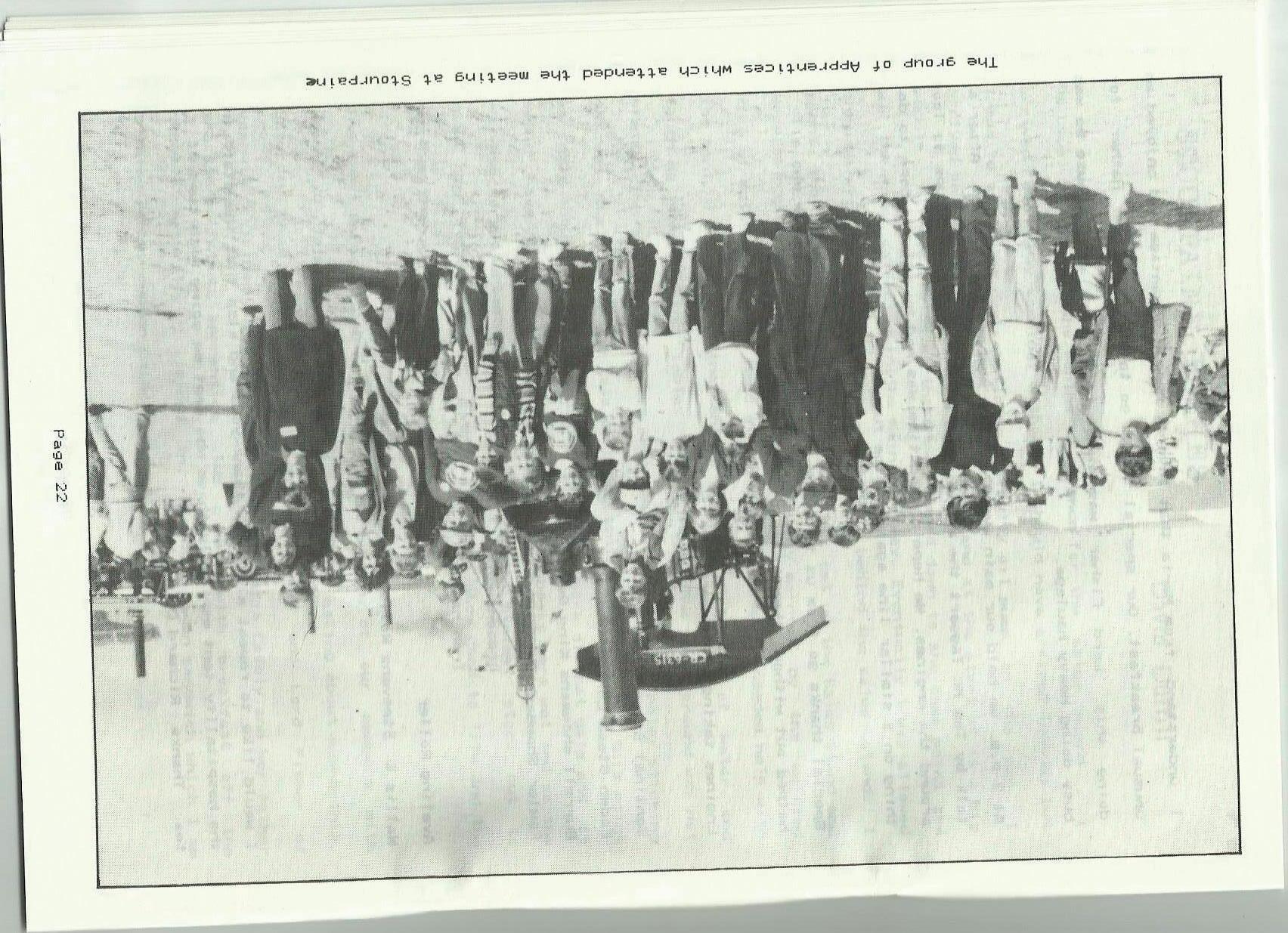
The groL~P of Apprentices which attended the meeting at Stourpain«:
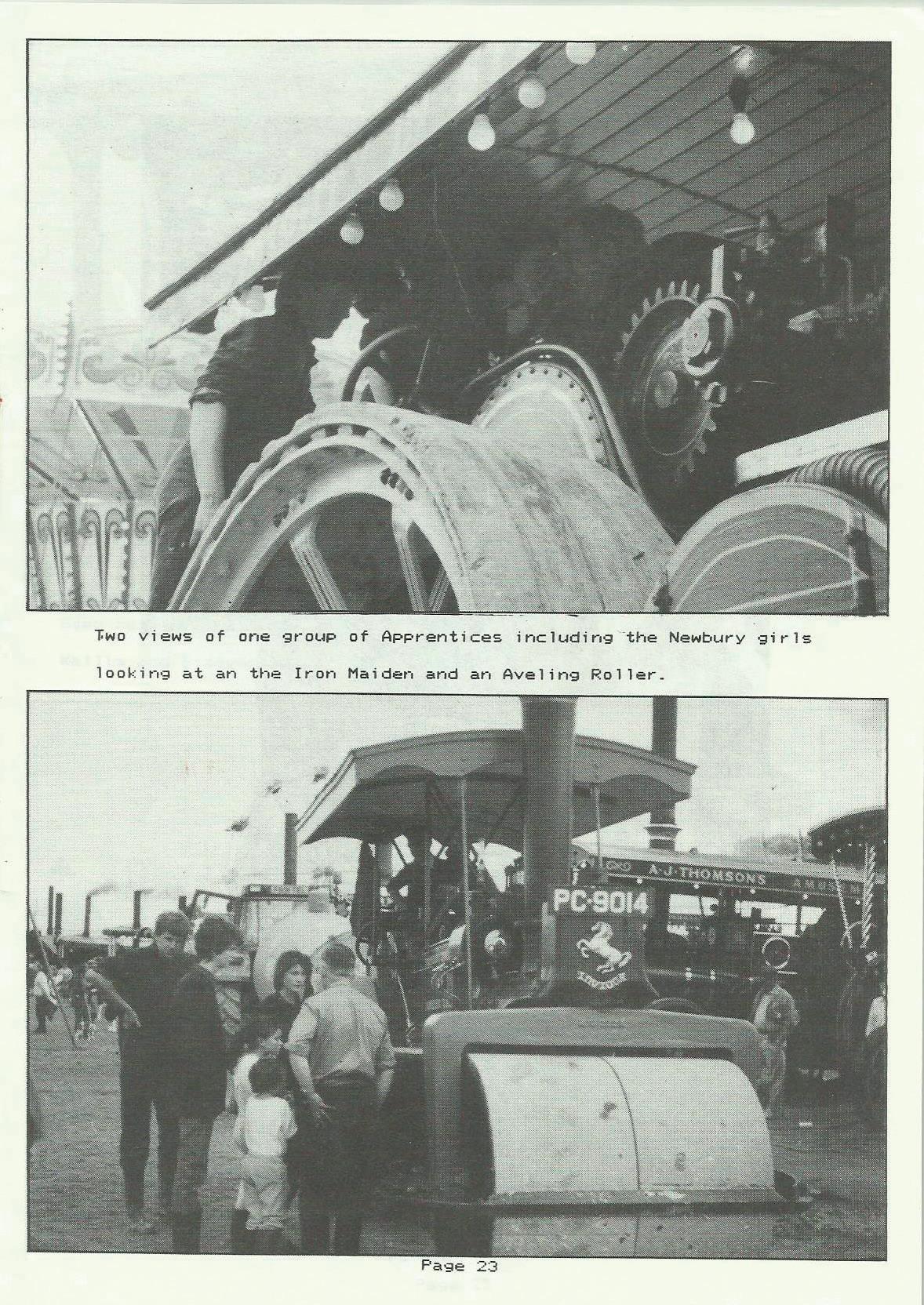
~wo views of one group of Apprentices including ·the Newbury girls looking at an the Iron Maiden and an Aveling Roller.
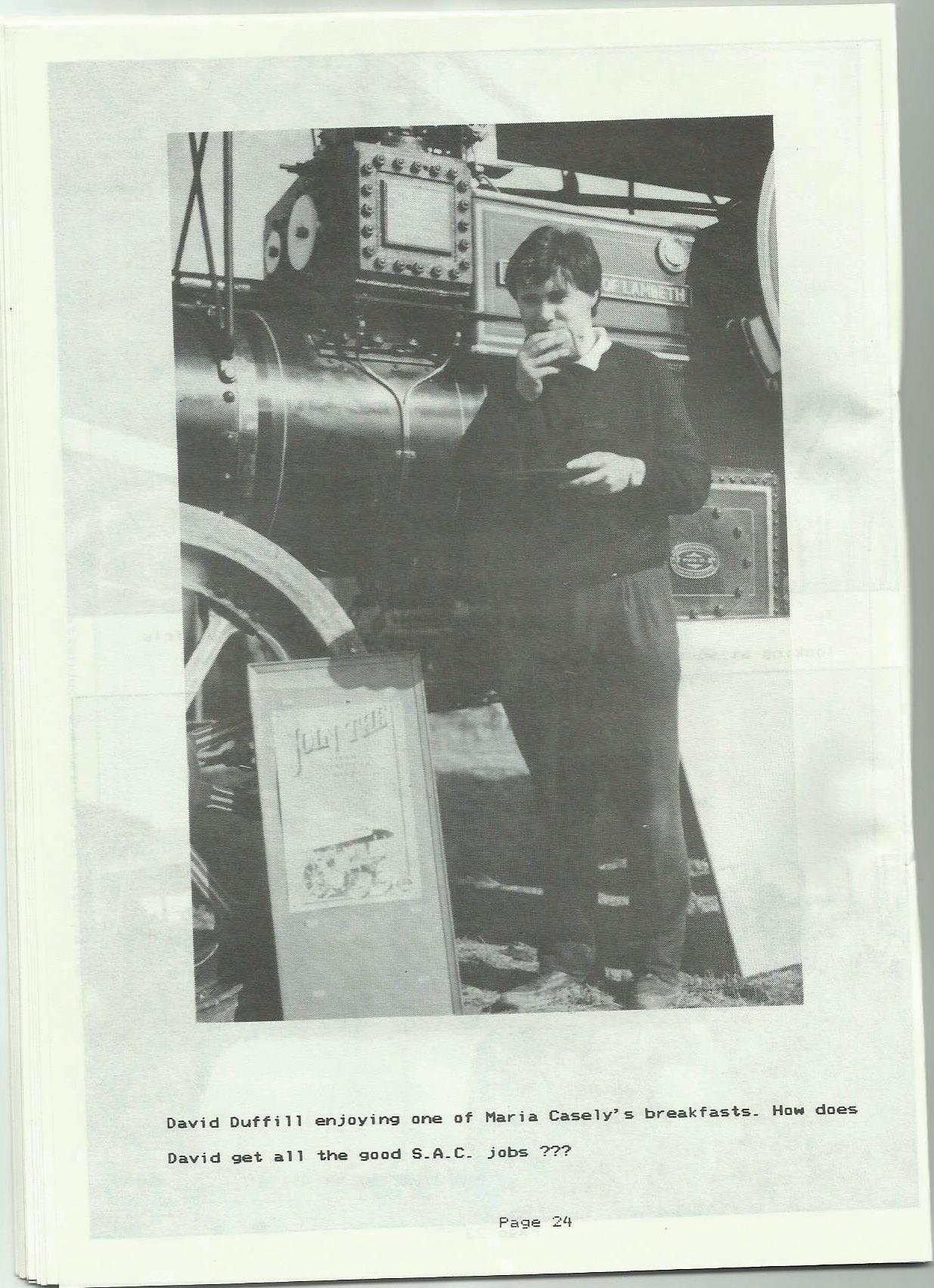
David Duffill enjoying one of Maria Casely's breakfasts_ How does David get all the good S_A_C_ jobs???
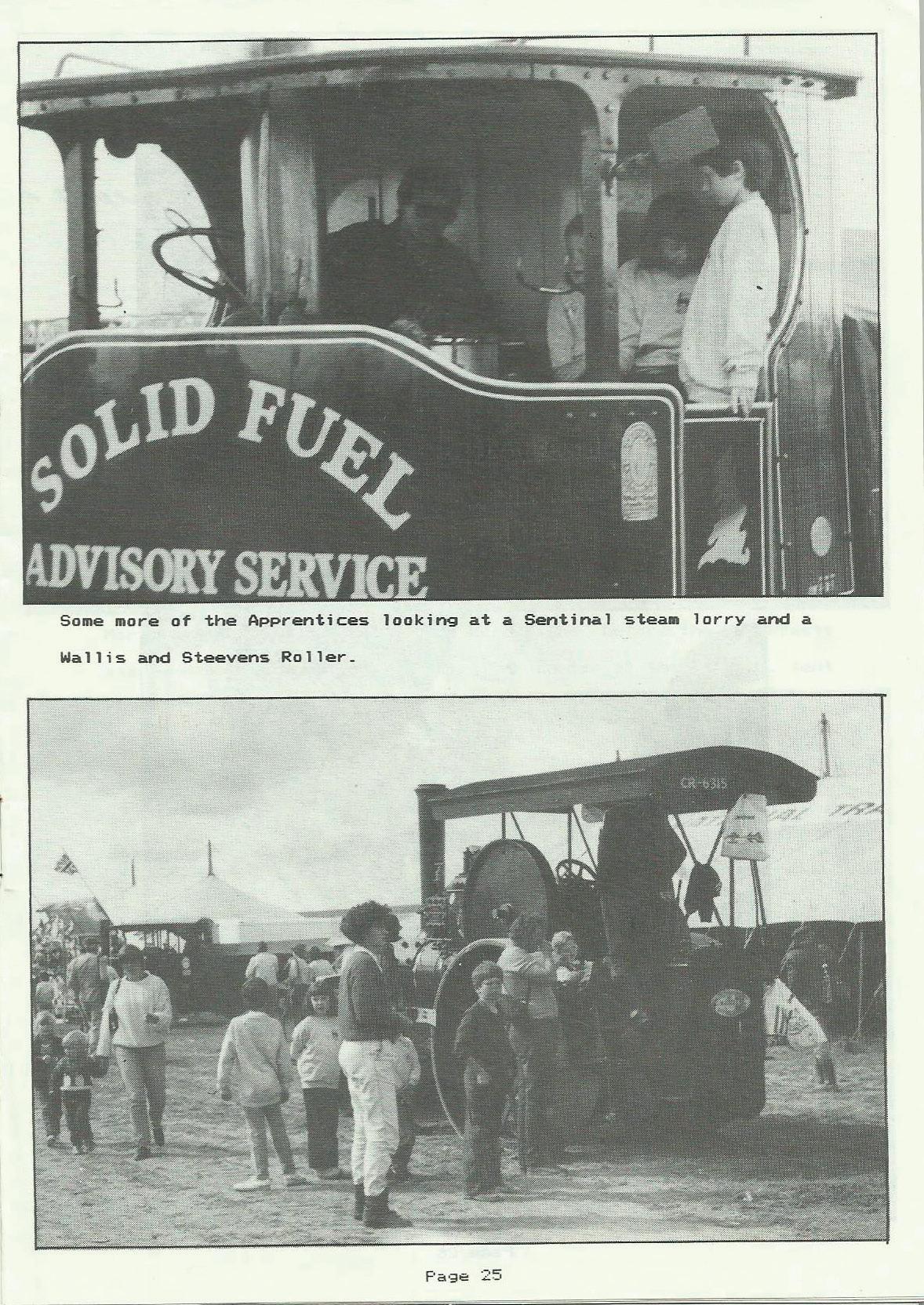
Some more of the
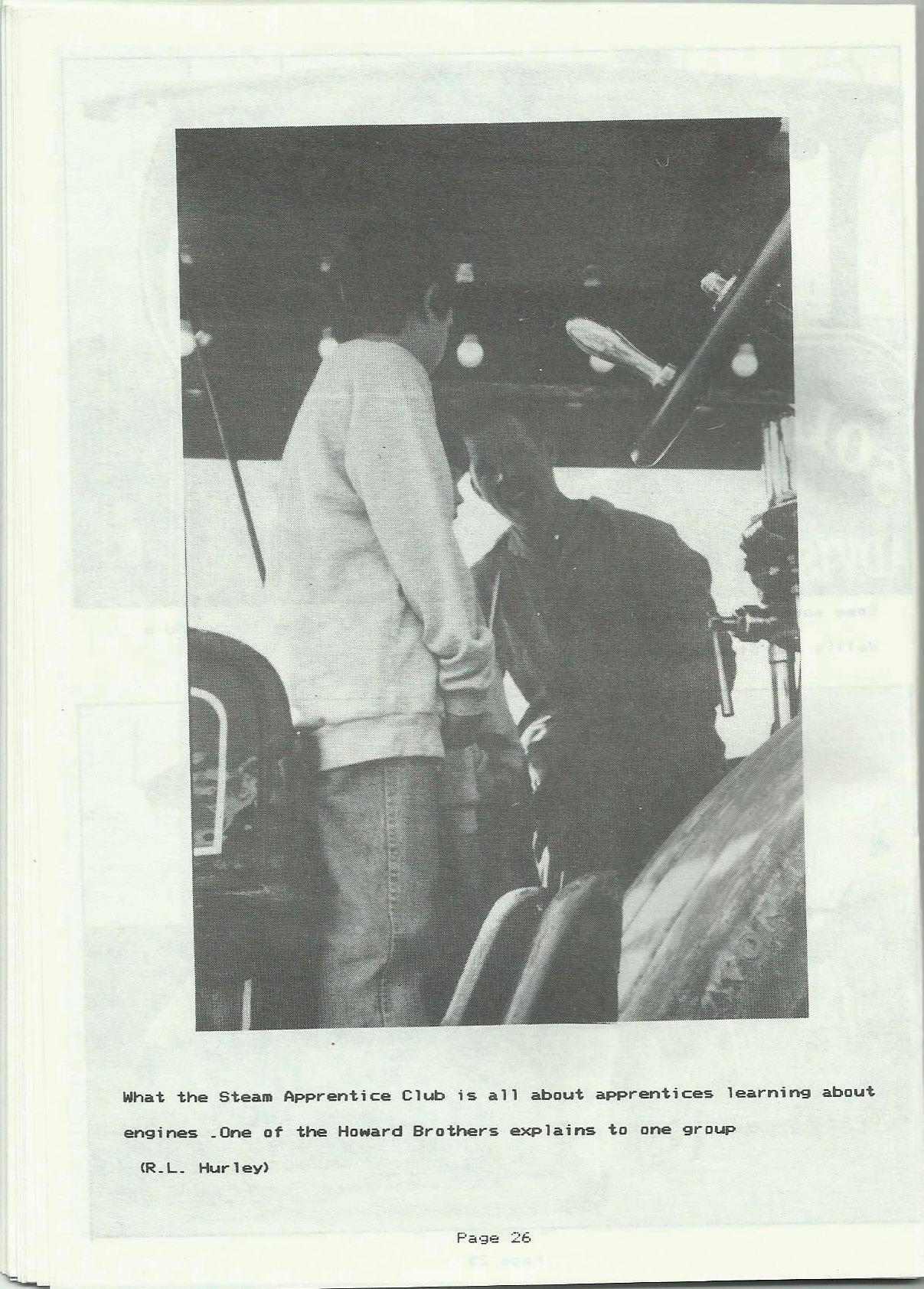
What the Steam Apprentice Club is all about apprentices learning about engines _One of the Howard Brothers explains to one group (R_ L_ Hur 1ey)
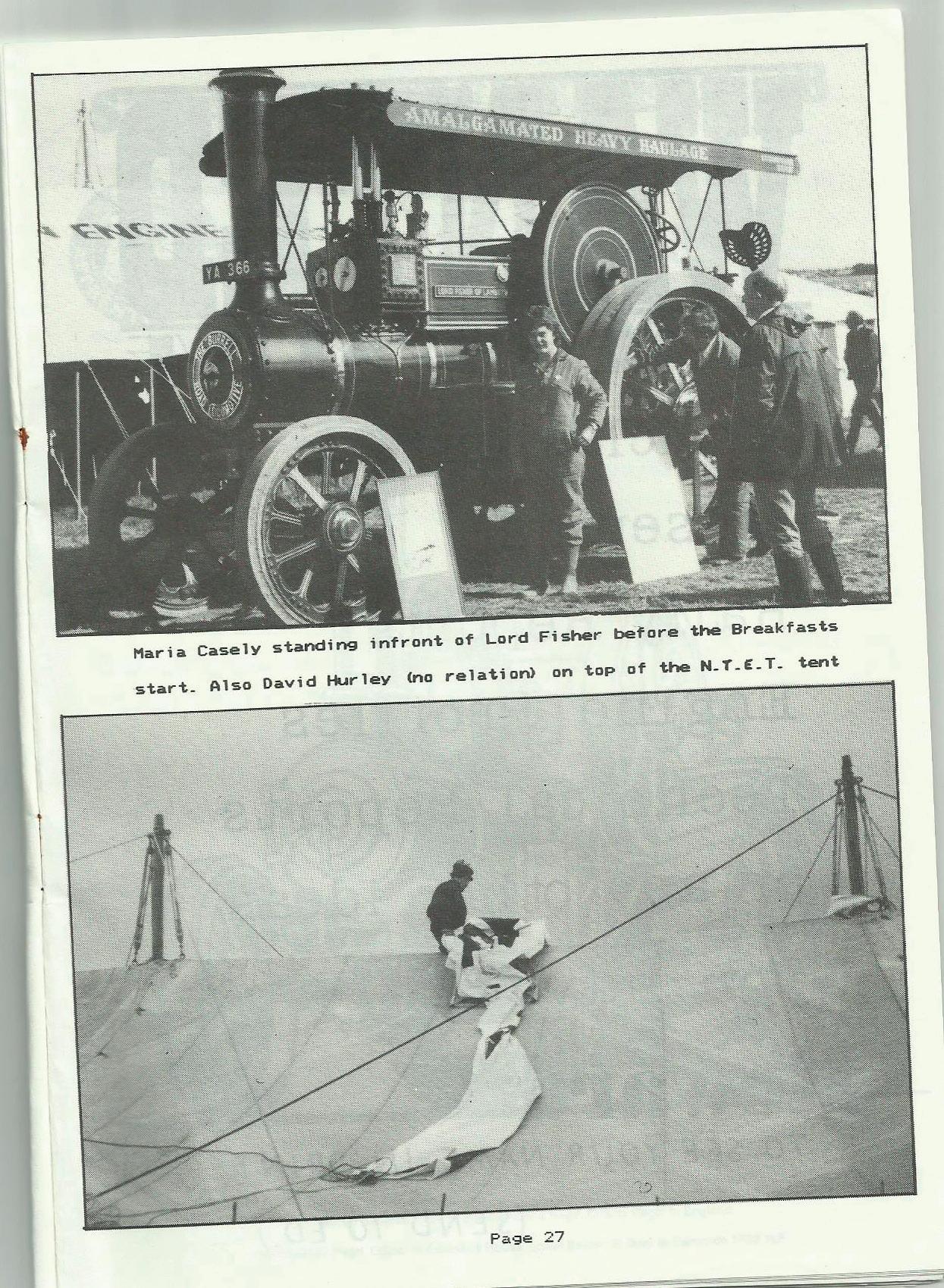
Mar;a Casely standing infront of Lord Fisher before the Breakfasts start. Also Dav;d Hurley Cno relation> on top of the N.T.E.T. tent
TO SEE YOUR NAME IN PRINT (SEND TO ED.)