STEAMAPPRENTICECLUB
ADDRESSES
The Chairman, Robert Herring, Bella Court, Blacklocks Hill, Banbury, Oxon OX16 8SZ
The Membership Secretary, David Duffill, 181 Faden Road, Great Barr, Birmingham B42 2EH_
The Editor, Richard Hurley, 2 Reaburn Close, Haabrook Park, Charlton Kings, Cheltenham, Glos, GL52 6NL_
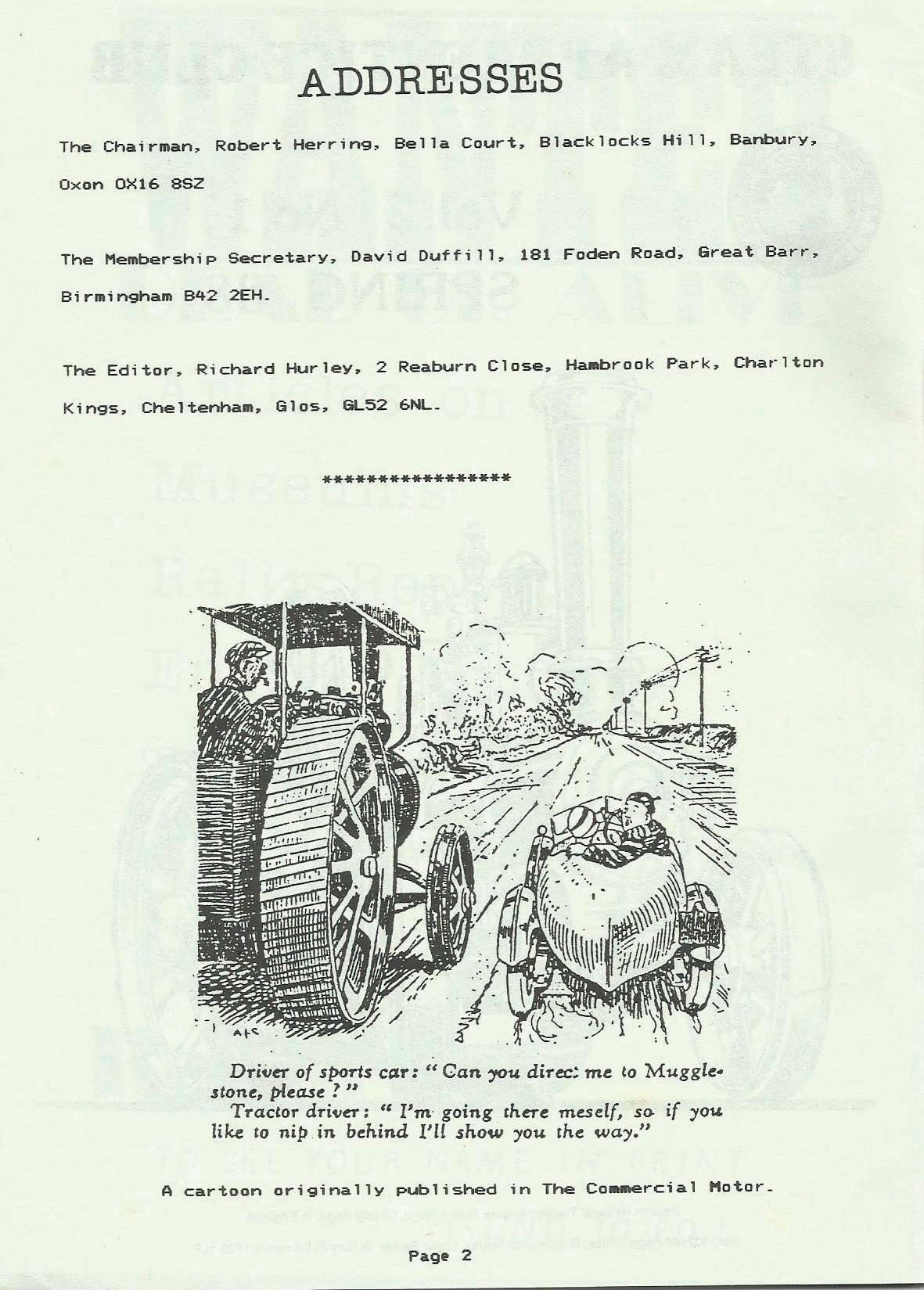
Driiler of sports car: "Gan ,014 direr; me to Muggle• .itone, plea..!e ? u
Tractor dri"u: " I'm· going there mes elf, so if you like to nip in behind I'll ~how you the way."
A cartoon originally published in The Coaanercial "otor_
EDITORIAL ...
By the time most of you recieve this jornal, the traction engine rally season wjll be under way. Each season Ne see engines out in new liveries and under new ownership. This year will be a special year tor my family my friend Colin Hatch and Myself as after aany years of driving the Burrell single crank coapound owned by Ted Haggard we have this year bought it.
Another important thing that has happened this year· is that our club has after a great many years under the watchful eye of Sylvia Dudley, has a new chairman. Because of extra work involved with running the National Traction Engine Trust, Sylvia has stefJped do...-- and Robert Herrir,g the Chairman of the Banbury Steaa Club has kindly fi 1 led the
In the next issue of the journal we will have a piece about Robert, but until then if any of you see hi• at any of the rallies I am sure he will be glad to answer any questions.
As summer comes around each year all I seee to think about is the nearing rallies, but as a young peoples steam group early sc..aaer holds tor so~e. something not so enjoyable, exaas. So let us wish all those who have any to take the best of luck.
Lastly I would like to say two thankyous firstly to Andrew Black for· his support of the club in the latest issue of and secondly to Debbie Lawrence tor doing some of the typing for •e this issue since I was short of tiae.
Little Glutton
As a new S.A.C. member, I thought I would wr;te and tell you about ay involvement with steam. I have been going to rallies all my life, the first one when I was just six weeks old! My Dad has been an enthusi~st since steam preservation began in Cornwall back in 1955 and organises the eng'ine entries at the St. Agnes Rally each yea·r. We v'isit sever·al ra11;es each Summer. Amoung those we went to during 1987 were Stoke Goldingto~, Weeting. Harewood House and Stourpa;ne.
Dad and I help out occasionally on two 1 oca 1 engines. One ;s the Garrett Showman-type Tractor 30959 of 1912, now owned by Bernard True of St. Agnes. Bernard's son, Mart;n, looks after the engine and each year, on the last Saturday of Apr;1, it comes to Caaborne, along with several others, for the town's Trevithick Day Celebrations. 30959 arrives on the Friday afternoon and parks up in the cul-de-sac near our house. I keep an eye on the eng;ne tor Nartin and early on the Saturday morning, we raise steam in order to be ready for the first parade through the town at 9.00 a.m. The street is closed to tratf;c for the day and it is that between 25,000 and 30,000 people attend the event. There is another parade of engines at 2.30 P.ffi. with the town band and dancers leading the procession_ Mat·tin's dad also owns a fa1r organ and 30959 stands alongside, generating_ Martin has shown me alot about looking after an engine and the day after Trevithick Day last year, he let ,ae ligt,t uP the Garrett and raise steam. under his SuPervision.
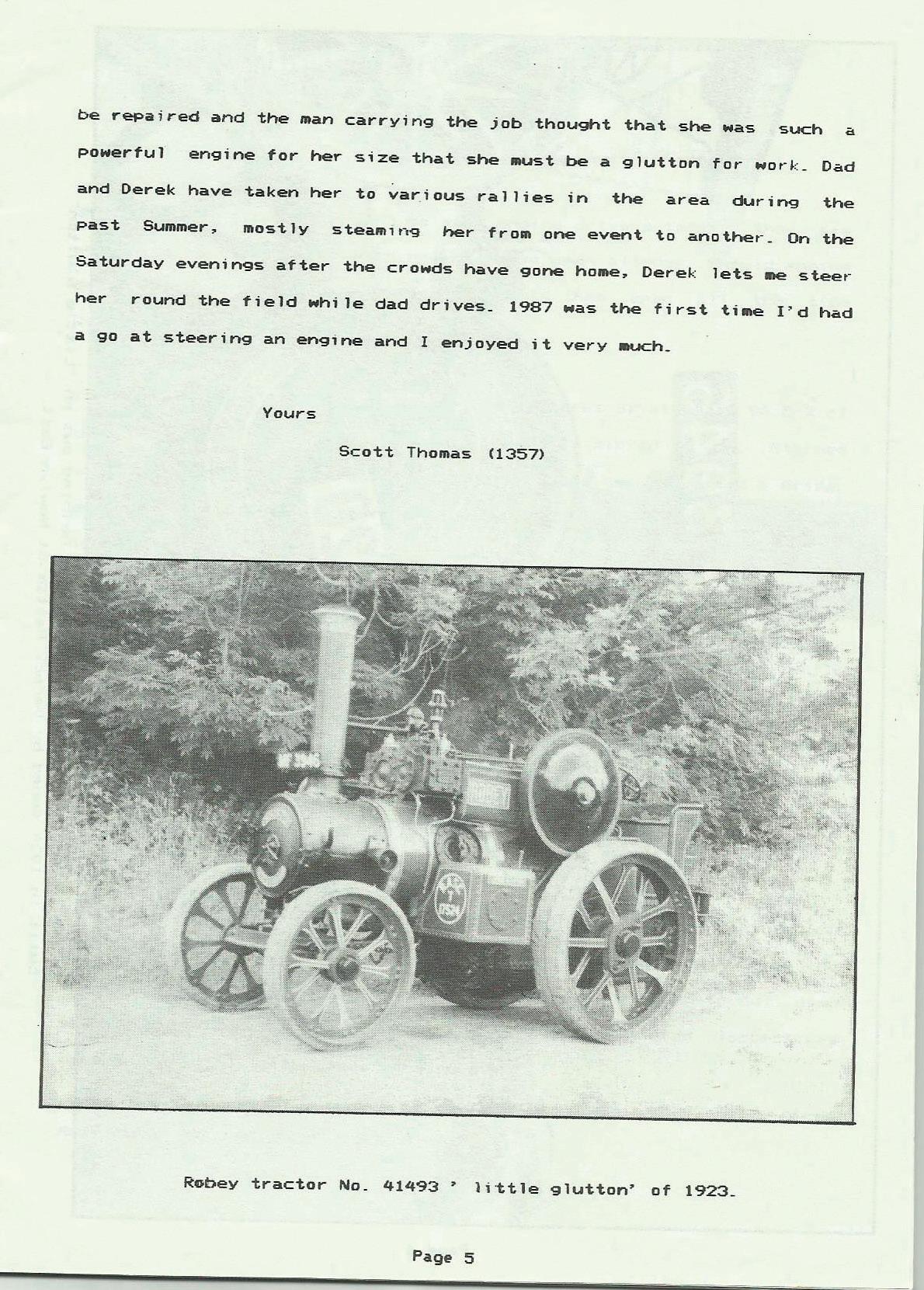
The other engine which dad and I help on is Robey tractor 41493 -Litt le Glutton of 1923 Mhi eh is owned by Det·eck Hatta• who 1ives near Newquay at the moment but Nho will be shortly to Camborne. This one obtained its unusual name when a previous owner took het· to
be repaired and the man carrying the job thought that she was such a powerful engine for her s;ze that she Must be a glutton for work. Dad and Derek have taken her to various rallies in the area during the past Summer~ mostly steaming her frosn one event to another·_ On the Saturday even; ngs after the crowds have gone home, Derek lets me steer· her round the field while dad drives. 1987 was the first t'iae I'd had a go at steering an eng1ne and I enjoyed it very auch.
Yours
Scott Thomas (1357>
Robey tractor No. 41493 • li ·tt le glutton' of 1923.
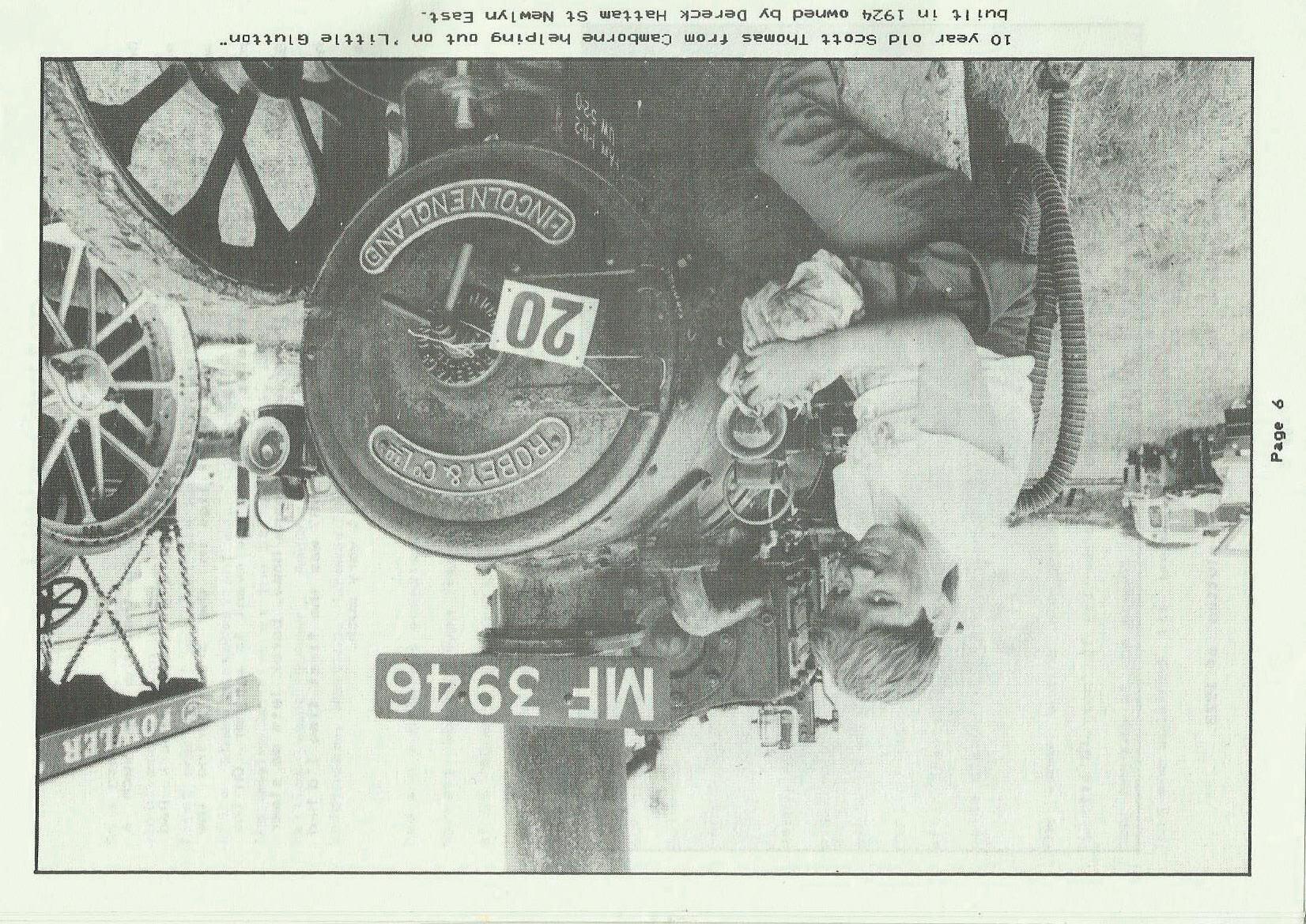
10 year old Scott Thomas from Camborne helping out on 'Little bui It in 1924 owned by Dereck Hattam St Newlyn East_
Cylinder Drain Cocks
BY Tam Mc Taggart
What are they for? According to some engine drivers today 7 they are something to open 1n the morning and leave open all day_ Should eng1ne des, gr,ers have agreec:17 they would have left them open a 11 without a means of closing them. the tiae
Strange to relate7 todays enginemen are aaatures or at least 98_5 7. of them. They were not taught by anyone7they only picked it up_ Starnge how they pick up some wrong ideas_ A few weeks ago I spotted a driver who should have known better 7 climing a hill with the cocks open_ After approaching him7 I was imforaed that this was necessary or the cylinders· could f1ll w'ith water. 1'1y ! f'ly!
Another strongly held belief 1s that the cocks aust be open while travelling down hill in case the cylinders pick up water_ Rubbish! How do you think that an old engine driver took a heavily loaded brakeless trailer down a steep hill. Remeaber that having open cocks one is left without brakes as steam pressure disapears through the open cocks when the lever is pulled back_
It is up to the driver to see that the water level is kept low, not to uncover the plug but low enough not to rlll into the cylinders, no matter how low the nose drops. The fire is also allowed to dull do1111n abit as steam .,.,11 not be needed and who ever saw road loco•otives descending a hill with steam blowing off_
They are fitted to allow water that has collected overnight to be drained out of the cylinders_ They should be opened for afew in"inutes in the morning after raising steam, then closed for the remainder of the day unless the engine has been ly"ing dead for an hour or so_ Afteropening the cocks the driver should walk over to examine what has drained out_ He may be surprised to find streaks of oil among the water_ Why is this ? Wel 1 behind the cylinder block is a square box containing a Jittle pump driven off the motion work which pumps a little oil into each cylinder every 111inute the engine runs_
This oi I lubricates the piston r1ngs allow1ng free up and down the cylinder walls and each time the drain cocks ar-e opened out goes this precious oil_ Of course it is well known now that those engine owners now-a.days have plenty of time and money to replace pistons, rings and even rebore cylinders because the lubricant was all drained out from the cylinders_
In the old days an engine would run about thirty years before this was required_
A MajOf Diary
18 th October 1987 SUNDAY
By Vicky Marshall
Today we went to see Mr. Fi nch' s Ave 1i ng and Porter r o 1 1er. ' Ma .i or' •
When we arr,ved Mr. Finch was having difficulty with the as~pan as he did not say •morning major•. After the ashpan was sorted out Mr_ Finch filled •maJor• up with water and lit his fire_ While he was mending the ashpan pin he left us to struggle with the sheets.
Then at approximately L 20 p. m. we went in for lunch and ct good wat·m up as it was now raining hard.
When we came out of the house "Major• had got up 60 lbs of steam. Then the w~ter cart was moved out of the way_ After a little bit of difficulty which 1nvolved getting the Landrover out to help PUll the steam roller out of the sunken stones_ We were off. steaming down a country lar,e 1n Hemyock. My brother· and I were standing 1n tne coat bunker on top of the coal wh1 le Dad steered amd Mr. Finch drove. He rattled along gently in a nice sort of way. We passed a. field with cows in_ The cows looked over the hedge and watched us trundle by_ They follewed us carefully w1th their eyes and then continued to graze. A few paddocks away, on the other side, were two ho r·ses who stood watching the s•oke and stea• r1se from the chimney.
ln .spite of the weather he seemed to enjoy his last Sunday along the Hemyock lane. After our r1de we went into the F1nch's living van while we had a chat about • MaJor• and other engines_ 1 t is quite large for·
a living van and 1s refurb1shed nicely with a little coal st~~e and a gas one also_
They said~"We fitted e'ight people in here the other night_"
Then we went into the house to •ake arrangements about the next Saturday_ 24 th October 1987 SATURDAY
TODAY IS THE ARRIVAL OF "MAJOR"
At 9_30 a_m_ we were already waiting for a phone call from Mt·. Finch_ l could not read because I could not concentrate so we finished the jigsaw we started last night when we started to get fidgety_ Then at about 10.30 Dad phoned Mr_ Finch_ He sa1d ~that the lowloader had been delayed as he had not had time to take yesterdays load off.
Then at around 11.30 Mr. Finch rang up to say that they were on their way.
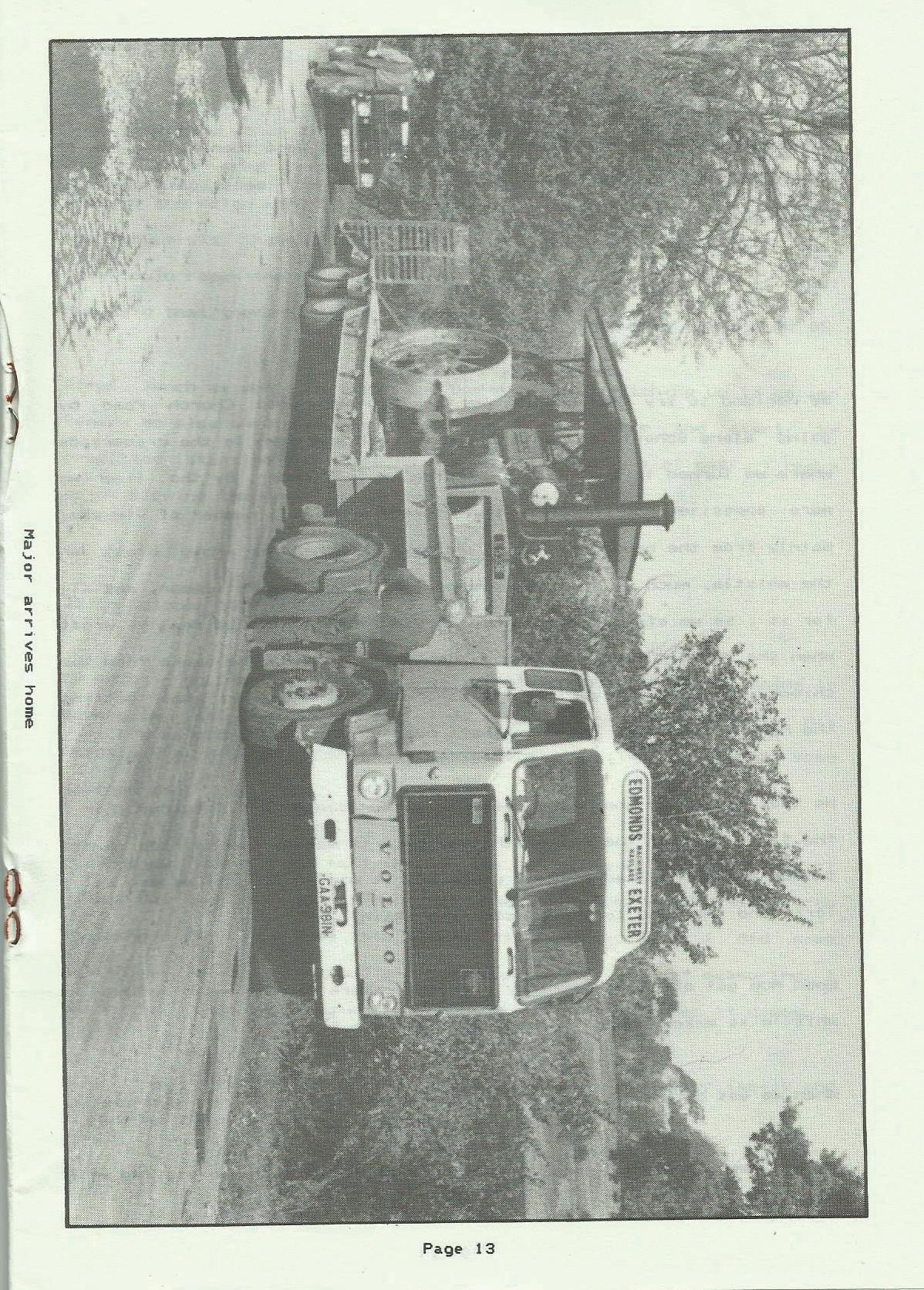
We went down to the Dunball interchange in a fully loaded Landrover. We had agreed to meet them there to show them back to the unloading place. We Naited for ages before we saw the•7 well it seemed like ages. It looked grand coming off the •otorway. 'Majors' side gleamed in the sun and he had plenty of stea•~ it looked as if the lowloader was powered by steam. We crossed back over the road and then ran up to the Landrover_
We tollewed them. they had pulled into a layby to-wait for us_ Here we took the family photographs_ We then went onto the unloading place_ >Major• came off n,cely. 1 got my bike out of the Landrover so that I could cycle on ahead and look back on 'Major'- The journey was only about a mile from home_ But when ..e were about half Nay the trouble started_ The crankshaft bearing started to seize UP- Mum who had. been following in the Landrover went hoae to get soae oil_ After it had cooled down 'Major' was started again, we were very nearly home when it started smoking again so we stopped_ Then Ml.an caae with the oil so once aga1n we could get on our way_
It was about 2_30 when we had our lunch and a little later Mrs_ Finch came w1th their car_ We chattted for a long time and then we show~d Mr_ Finch Oads t1lms about Allch1n 002006 and then Mr_ F1nch showed us his t1lms of 'MaJor•_ After that Roger. Dad, Mum and I •ade our.way to Otherly Village hall where Mr_ Mc Taggart ..as going to give a talk to the Somerset Traction Engine Club and Mr_ and Mrs_ Finch followed in their car_
The whole day was enJoyable_ 25 th October 1987 SUNDAY
I spent most of the day polishing and cleaning 'Major'_ bath made him feel better after yesterday when he left a good ft·iend_ I even polished his chimney cap until it shone like the sunat least a.1"'1 hout· on the chimney cap_
I spent
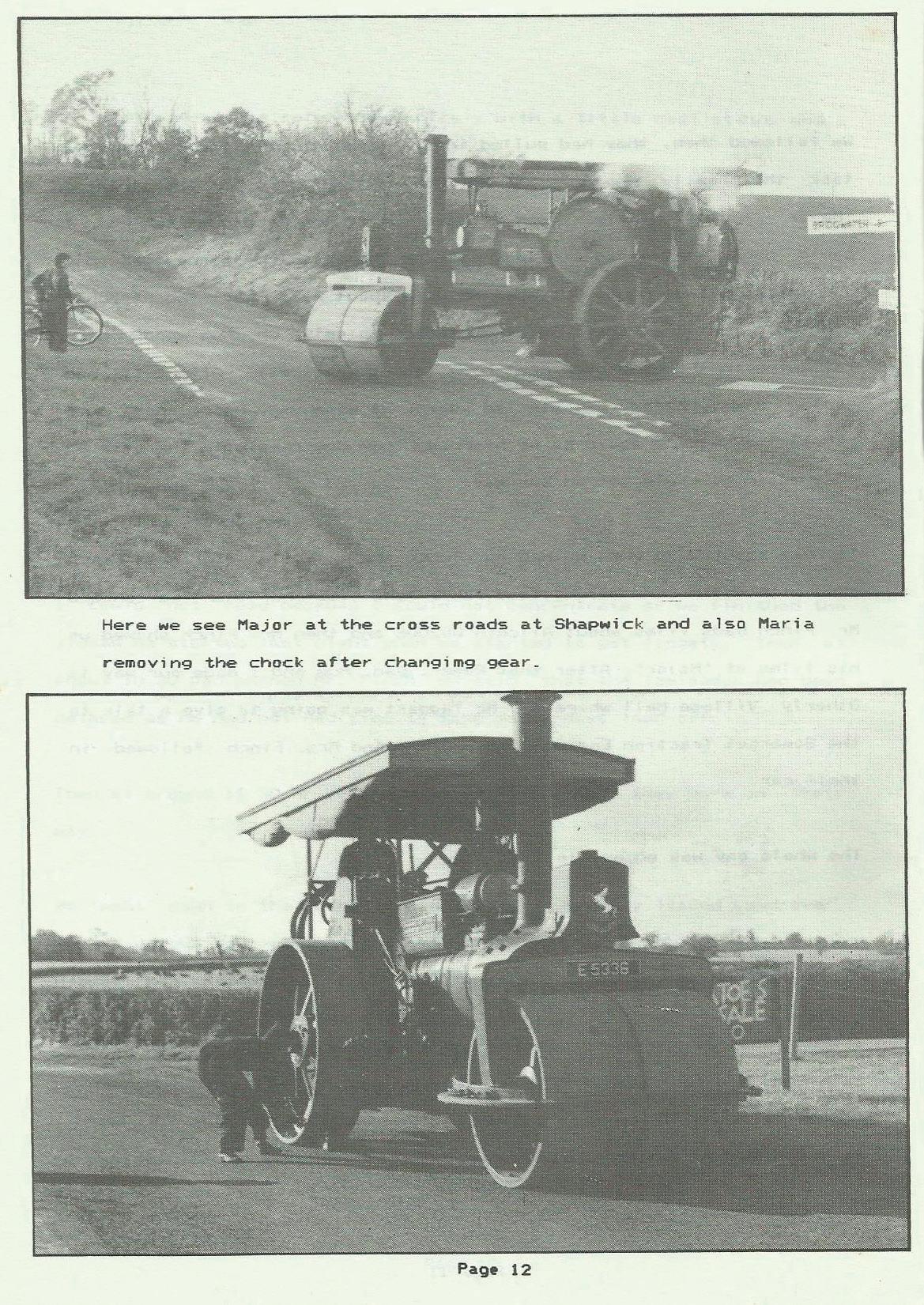
Here we see Major at the cross roads at Shapwick and also Maria remov'ing the chock after changimg gear.
By the end of the day I found I had used more then half a can of BTasso_ I dare say that 'Major• and Hr_ Finch will aeet again much to their enjoyment_
28 th October 1987
WEDNESDAY
We decided to try 'Major• out_ We took him out onto Church Road by going along School lane onto the main road and down to the crossroads where we turned left_ I h~d first ride in the tender_ By the tiae we were opposite the church we had picked up quite a numbet- of viewers, mainly from the house next door_ We gave the children a big blast on the whistle, much to their enjoyment_ Mr_ Jones the Policeman, was all for it, so we offered him a turn at steering_ It looked really great when the st.eam roller passed a maroon Austin Seven_ The saoke from the chimney puffed away over the fields and Dad (the driver) was getting the hang of h1m now_ The crankshaft bearing was no trouble at all_
We took him up to the layby where h~ was '-M'lloaded last Saturday_ For the first half of the way of the way back it was •Y tun to ride in his tender again_ Mum had a go at steering, it was okay llltil Ne a lorry and then Dad took over steering again_
When Mum got off and was ready with 'the caaera Dad let ae blow the whistle to make a more impressive photograph_ When we got back honie with 'Major• our other neighbours were watching_
There was a whole gang of thea as soae relations were staying with
-theat. Then t.he Jones children, Rachel and Rebecca caae out of the house. They were longing tor a wt-listle, so we let them have one. Rebecca and Helen went first because 'they could reach it_. the other smaller girls thought it was fantastic after being lifted up so that they could reach the whistle. One of the• asked tor another go, but Mum said that there had been enough whistling.
After lunch we went out again and Dad explained notching up to ane and Roger. He also showed us how to change gear, stop and start. We practised starting and stppping hi• while he was out of gear·. I had a go at b 1owing the gauge g 1ass down ..
29 th October 1987 THURSDAY
My opinion on 'Major's' name has definitely changed. His name seems to have grown into hi•. He has a really aasculine voice as well. His whistle is nice and deep not like those silly little peeps that soae engines owl.
I poked out the a~h- It fel 1 through ·'the tire bars nicely. Then I helped Dad clean out the boiler tubes. Next I raked out the ashes from the ashpan and swept them into an old plastic sack. Later I did soae polishing. but not auch. Dad and f1'-MDseeaed to do alot of aeasuring, I think they were wondering where t·o put the 1i vi ng van Nherl it coaes.
(Thank you very much Vicky,~d I hope we will see you, your faaily and of course 'Major' on the rally field t.his year.) Ed.
A .B C D E F
G H I J K L
THE ENGINEMAN'S ALPHABET
by Alan Porter
is for axle, a lump that is strong it's commonly round and seldom goes wrong but should it go oval and start up a throb then changing the brute is a hell of a job!
is for boiler, where steam is produced provided that water is often induced but should there be failure of 'jector or pump then quickly get lost, before bang goes the lump!
is for coal, but some prefer coke, it makes all the steam and lovely black smoke. Now some prefer smokeless, they stoke it with glee but most have a liking for that which is free!
i's for dynamo, it's stuck at the front it generates juice·with seldom a grunt, but when not in form will splutter and spark more often than not when you're in the dark!
is for engine, there are a few types some which are painted, some covered in pipes. They chuff down the road to give us a thrill and some stop at pubs to have a quick gill!
is for flywheel, a thing that goes round it powers machines with no sign of a sound, but why some are solid and others have spokes just baffles the driver and most other folks!
is for gear, to help you along most often there's two. both being quite strong, but just try applying both steam and reverse and likely the teeth they will come off the worse!
H is for hydrant where water is found it's easy to spot, just stuck in the ground. Now legally speaking you should leave alone ·cos police and the firemen only will moan!
is for inspector, a man we all fear he cheerily comes just once every year. He pokes and he hammers for holes large and small and happy are we if he finds none at allt
is for joints, of which there's _afew to seal them you need asbestos and glue. In some special cases they have to be greased otherwise stripping them can be a beast!
is for Klinger, a type of gauge glass it shows you the height of water en - mass. Now some find it tricky to see when it's full they have to bend down to give it a pull!!
is for lotion, it's found in all pubs stocked in big barrels and also in tubs. It's gulped down at rallies. forced down at night the happy result is that everyone's tight!
N 0 p R s T u V
is for motion, there's sometimes a lot it rattles and bangs and often gets hot. The symptoms are clear, great clouds of blue smoke while cooling it off is far from a joke!
is for nut that goes with a bolt, unless pulled up tight come loose at a jolt, But some are quite stubborn, all rusty and bare, requiring to move them a bloody good swear!
is for oil, it keeps wear at bay dripping through bearings all during the day~ But don't do an oil-up when you aught to know then siezure is certain to come in one go!
is for polish, to keep up the shine
• on paintwork and brass, and other thin~s fine. Some owners go crazy with brasso and wire just bulling up nameplates instead of the fire!
is for rust that ruins bright steel and also the paintwork, just making it peel. Some try double primer. some varnish apply but all fail to stop it, damn rust will not die!
is for spanner or dirty black soot one is quite useful the other all but. There's also the· sprinkler which rollers have got and silly old jossers all talking much rot!
is for tubes, of them we all know stuck in the boiler, stacked row upon· row. Now changing one devil is done in a min., but make sure on startin' the fire isn't in!
is for Uncle, George Eves is his name a rare piece of rustic, this steam-man of fame. He writes in the paper. oft cursing a few, complaining of all sorts we amateurs do!
is for valve that opens and shuts letting in water in splitters and spluts. . •There's those on the steam chest that seldom should work the only occasion's when pressure's beserk! for wheels. on engines they're found some having ridges while others are round. Now changing a rear wheel demands time and care So thank God for one thing - that punctures are rare!
is for extras like tokens and fees handed out freely for owner's to please. Without these additions to free coal and beer some engines are steamless all during the year!
There's only two left a Y and a Zed God knows what they're so let's go to bed. Ifs damn n~arly daybreak, we're tired to a man so tum out the candle, and head for your van!
Now having had fun through this little skit All that is needed - some music to fit So come all you note-men, begin to compose a cracking good number. let's hear how it goes!
More about EDDINGTON and STEEVENSON
New Street Iron Works, Chelsford, Essex_
BY Graha/fl Austin
In 1877 they supplied the heavier items for the first broadside ··oarby D'i99er" the second was by J & H Mc l.,..aren_ Three •ore diggers followed aade entirely by W & S Eddington and were marketed by Darby_
In 1886 Steevenson joined them but the partnership was dissolved in 1890 when Steevenson joined Mr_ T_c_ Darby with the works and contents being sold by auction in October 1894_
In 1880 they showed an engine at the Smithfield show_ Beside the cylinder all engine and motion parts were bolted to plates which in turn were rivett.ed .to the bo'i ler, spring washet-s being used tht·ough out_
Another engine was exhibited at the Smithfield show in 1886, on this engine the counter shaft was igeniously aounted eccentrically also a 'Patent Priming Preventer' * was fitted_
* 'Prta'ing' 1s the term used to describe the emission of ..at.er as well as steam from the funnel_ It 'is usually due to the boi let- being overfilled, Niti"t a result -that the boiler water floods uP into the top of the boiler and passes ~rough the regulator into the cylinders_ As water is incompressible 'it can cause great damage in the cylinder and valve chest_ It can also occur when an engine is travelling down hill_
In l.888 again at Smithfield they showed yet another and re-designed engine, only the low·pressure cylinder was fitted to the boiler with the h1gh pressure cyl1nder cantilevered fro• it_ It was positioned between the crank shaft and the high pressure cylinder.
Only one of their engines is still in existance, this is an 8 H.P. single cylinder portable of 1879 and has a works number of 34.
MASON & WEYHAMof Guildford
The engine was made to the design of Mr. James Br aby o t Maybank. Sussex. The engine made in 1884 was rated at 3 N.H.P and was ea l led 'The Little Wou'. The machine itself had three wheels, 2 at the rear and one driving. the steer1n9 wheel being at the front. The engine had two separate duplex** cylinders with 'Joy• valve gear, the drive was by bevel gears. with two road speeds of 3 and 7 ai les per hout·. The engine was remarkablly light at only 1.5 tons unladen. One was exhibited at the Shrewsbury Royal show in 1885 and was pr·iced at £170
** The term Duplex engine refers to an engine with twin cylinders but with both cylinders of equal diameter both using boiler pressure steam Cie high pressure>.
REQUEST FOR HELP
_________ _
We need engine owners who would like help fro• a S.A.C. aember. It you know anyone please get them to drop DAVID DUFFILL aline or better still a letter.
'You Must Be Mad l '
By John Newton
Reprinted from 'STEAM I NG'
Mention must be made here, I feel, of Bridge FarM itself_ What a place it was to a steam enthusiast_ Going. in, one would find on the left, 'the two old Fowler single cylinder ploughing engines -Noreen" and Margaret , both now over one hundered years old, then resplendant in new coats of paint and under new tarpaulines, parked so that theirfront wheels were just off the road_ Next on the right towat-ds the back door of the farmhouse, under a spreading tree was to be found a very nice 1'1arsha11 traction engine which belonged to- Ha111ish Or-r-Ewing, so I was told_ On into the yard, past a garage on the left and an open-fronted cart shed which housed an old Titan tractor, we came to another ploughing engine which was very unique - the one sole survivor of a J_ & H_ Wilder Fowler-based ploughing engine_ I am sad to say that this was not in going order, but in MY eyes did not look to be in need of too much attent1on_ Then we caae to an old roller living van and a four-wheeled, high sided traction engine trailer ( about which I will write more in due course), then - at the far end -The Ransomes_
This was not all, by any means, for to be found in a large asbestos clad build'ing across the ya,,-d were P1r_ Napper's own engines_ Firstly -the alYeady famous Marshall "Old Timer··, the engine on which he raced back ,n ~he early 1950's_ These races, about which many words have already been wrjtten, started the preservation aovement of steam engines as we know it today_ Also in the shed ..ere his other two engines, a Fowler single cyhnder engine "Tolllffty" and in those days his Faden overtype tractor "Berkshire Belle"_ This was the sight to meet the eyes of the enthusiast at Bridge Appleford, and to ae it all rekindled many Memories of my childhood days as it was when l was a
young boy that I SPent about one week per suaaer at my Grandparents• farm at Brookland in the Romney Narsh of Kent_ This fara, the Harvey Farm,. Brookland,. had been my father's faaily hoae for almost a century, and was the hoae of what had been one of the largest fleets of steam eng1nes to be found in the country_ Stea• was synonymous with "the Harvey Far• as it was there,. that a large steaa ploughing and threshing contracting business had operated_
EARLY DAYS
the 1940s,. the stea• contracting
In the days of which I write,. buisness had naturally lapsed,. but a 11 or most of U·~ stea• tack le remained_ This was because everyone said that grandfather wovld never see his beloved steam en91nes cut up to feed hungry furnaces,. whjch unhapp1ly he did in his old age and failing years_ Ny happiest times on my holidays were spent playing an these old relics_ I well remember a line of six Fowler ploughing engines, standing slightly sunk into the ground where they had been parked adjacent to the workshop, all complete in every way_ I used to stand up in the rear one pretending to be driving and look along the row in front of me, which at my tender age, seemed to go on for ever, chimney stack after chimney stack_ Then the thri 11 of running fro• one engine to another· along the running board, across to the tender of the next and so on until I reached the front engine, hopping over the cylinder chest, and back down the running boards to where I had started from at the rear one_
Then -ta sit on one of the seats of the anti-balance plough and move the steering wheel as best I could and watch the one at the opposite end revolve as if by aagic. I would sit there and survey the wondrous
scene of the mach;nery, eng;nes,. cultivators,. living vans,. water carts, p'loughs, horse-dral«l i teas and a 11 the parapherna 1 i'a of an age just past_ The strength. and heritage of ay faaily, the pride of ay forefathers,. as it was •ore than a century before Mhen the first steam engines to appear in any form took to the land,. 'that ay forebears had come to Kent to ti 11 the land usfr)9 this aost fascinating and loved form of propUlsion_ I aa in no doubt that it was on these aany ho 1 i days, play1ng aaongst these aachines and sniffing the saell that sti 11 1 ingered aaongst the now-rusting ;aachinery and ferreting aaongst all that was to be found and seen in the now silent workshop, that kindled in me - then only a small boy - 'that love of stea• was to become such a passion and obsession with ae later in life_ All this ·returned to me as if in a f·lash, many childhood aeaories, as I stood and gazed around at Bridge Farm, and here I was eabarking on what .as to be for iae another exciting adventure_
THE PURCHASE
Back to my story_ Having quickly surveyed the Ransoaes, I went to find Mr Napper,. wholl' I was pleased to see had at least reaelftbered ae from my earlier encounter with hi•'at that rally_ I told hi• of •Y intention to buy the engine if at all possible and he infonned ae that he was· sure that he knew who owned it, and also that I would have to have it tested by a Board of Trade inspector to see if the boiler was sound and tit to steam_ After a long and interesting chat with he said that he would find out what he could by •Y next visit_ When I arrived a day or two later,. he presented ae with a piece of paper on which was wr1tten the name and address of a titled lady who he assured me owned a fair proportion of the engine_ •Y next step was to write to this lady and obtain her consent to sell her share in "Enterprise"
as the enine was known at that time_ It turned out that she was indeed willing to sell her third-share of the engine which she held with four other persons_ Armed with the possibility of at least a one-third share in t.he engine,. I found ayself heading towards Fareham to find the person who owned the remaining two-thirds_ Before I came away from Fareham that evening,. I had ~ade ay purchase and heard a little more of the fascinating story of the Ransomes_
Upon receiving the Log Book,. all that I had so far learnt about fell into place and it was interesting to find that this engine was one of the very first engines in Essex to be preserved and had,. in those days, taken part in some of the very first gathering of engines befot·e the Rally movement got under way in that part of the world_ I also found out that the engine had in fact only escaped the cutter's torch by a mere two days_
It came as soaewhat of a shock to me to learn that ay purchase also included the oJd high-sided traction engine wagon,. mentioned earlier,. but now that I owned it, I viewed it wi.th mor-e than a passing glance,. and found that it was aade at about the turn of the century,. mounted on solid type wheels,. but very dilapidated as most of the woodwork was rotten and the iron work very rusty_ Its contents turned out to be some old 40 gallon oil drums,. the odd engine spud and about a foot in dep¼h of what looked like coal dust -not much good I came to the conclusion,. but; felt that it could be restored and as i had aquired it with the engine I felt that it must stay with it _________________ _
TO SEE YOUR NAME IN PRINT (SEND TO ED.)