STEAMAPPRENTICECLUB
ADDRESSES
The Chairman, Sylvia Dudley, 12 Hillway, Woburn Sands, Buckinghamshire, MK17 BUL_
The Membership Secretary, David Duffill, 181 Faden Road, Great Barr, Birmingham 842 2EH_
The Editor, Richard Hurley, 2 Reaburn Close, Hambrook Park, Charlton Kings, Cheltenham, Glos, GL52 6NL_
Edmonds gets it right tor once _______________ _
Taken from Steam1ng winter 1987
____ They say a sign ot getting Just that bit older is when one needs glasses to read the phone book, and when one realises that clet·gymen and policemen are younger than you are_ To that I would add engine ,j,- 1vers. Have you noticed how many young people are taking up our hobby. _ _ and becoming very •=ompetant_. _ __ .Perhaps it is a g l 1 mpse ot the obvious when I say that the continuing success and prosper·1ty ot our movement depends upon young people who have no nostalgia to fall back on _____ _
Here, Here Mr Edmonds atlas~ people are beginning to take us young people serio•.Asly and not just thinking of us just as kids, but instead as the engine owners of the future.
EDITORIAL ...
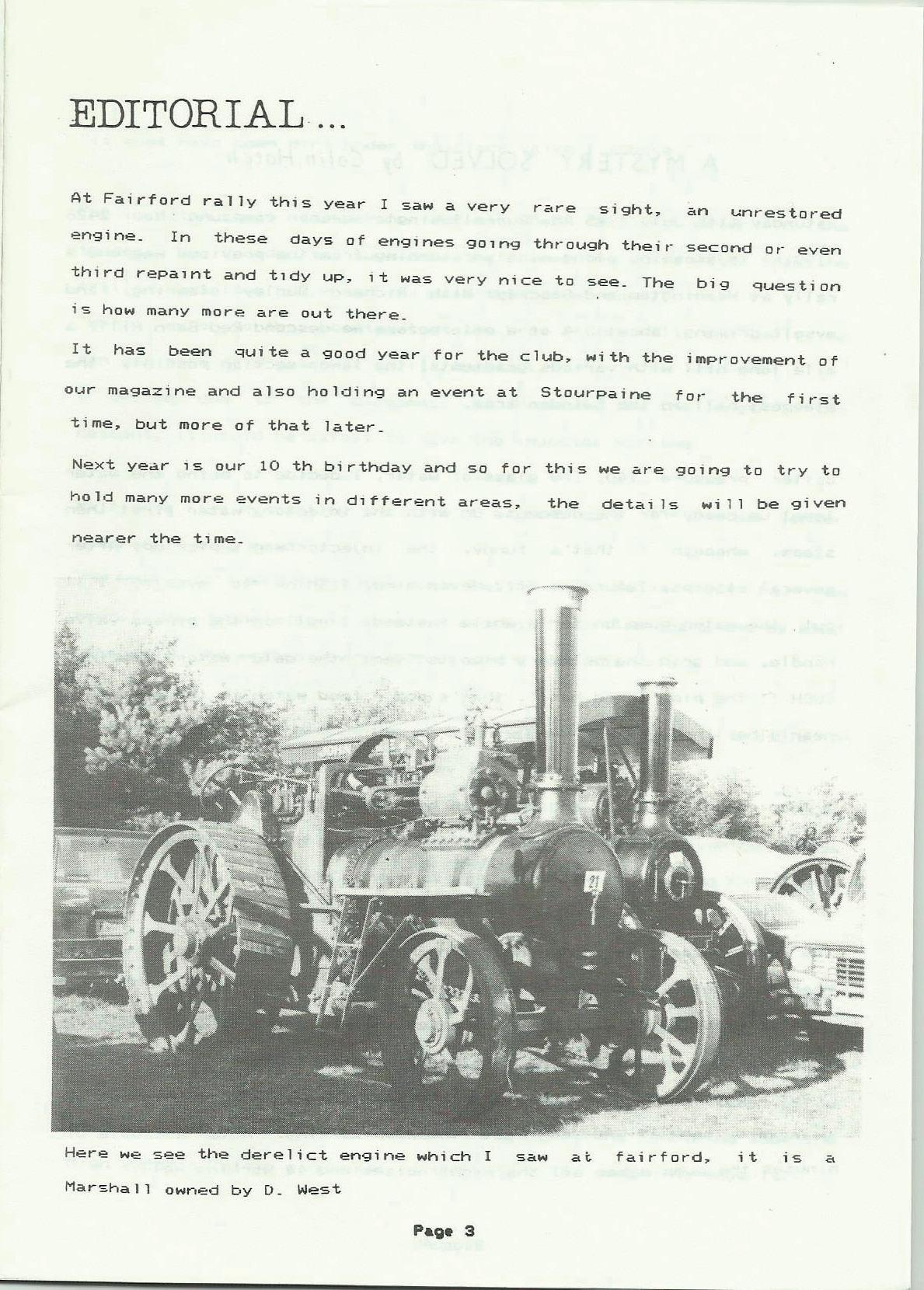
At Fa1rford rally th1s year I saw a very rare sight, an unres to r-ed engine. In these days of eng1nes go1ng thr-ough the, t· second or- even th1rd repaint and tidy up, ,t was very nice to see. The big question is how many more are out there. It has been quite a good year for the club, with the improvement of our magazine and also holding an event at Stourpaine time, but more of that later. f O t· the first
Next year is our 10 th birthday and so for this we are going to try to hold many more events in different areas, nearer the time
the details will be given saw ai;. fair ford, is a
Here we see the derelict engine which I Marshall owned by D- West
A MYSTERY SOLVED by Colin Hatch
Saturday 11th July 1_45 AM, Burrell single crank compound No_ 2426 (1901) is steaming along nicely returning from the pt-evious weekend's rally at Headington and Stockly_ With Richarq Hur-ley steering, and myself driv1ng, about 3/4 of a mi le before we descend Red Bar-n Hi 11, a mile long h1ll with various gradients, the lower section possibly the steepest hi 11 in the Swindon area_
Boiler pressure 140, 1/3 glass of water, I decide to bring the water level up ready for the descent_ On with the water- first then steam, whooosh that's funny, the injector won' t pi ck up_ Afterseveral attemps, I turn it off_ Never mind, I think to myself, I' l l put the water pump on for a wh1le instead_ I pull on the bypass valve hand 1e, and grip the deli very pipe to feel·· the cold water· feeding_ OUCH ! ! the p1pe's red hot !, that's odd -feed water in the tender is nearly boiling_
I lean over to Richard and shout in his right ear, "Pull in at the next layby, the water pump clack valve is blow1ng back, and the in_jecto,won't pi ck 1.,1p the hot water_··
The Burrell comes to rest, and, with the pump bypass valve open we can hear the steam ""perculating" through the watet- in the tender_ ""The injector won·· t work with hot water yu know,·· shouts Ted Hagg.ard from h1 s seat on the tra i le,-_ (Methinks, I wonder why ?)
" Put a block behind the wheel Richard, ""says I "'I' 11 knock hirn out of gear and see if we can get the pump working_ After· a couple of m 1 nutes the P•-~mp makes a I l the r 1 ght noises and is work i n,g we 1 l -
"It must have been d1 rt under the clack valve I s' pose_··
The injector sti 1 I not working due to near boi Ii ng water· in the tender_ We decide to suck up the r-emaining cold water from the trailer, but it's not enough to cool the tender down_
"We' 1 l go on to those cottages at the br·ow of the hi l I. and see if we can get some cold water to refill the tank_
I decide due to the closeness of the hill, and the length of the descent, 1t would be safest to have the injector working_
We find a tire hydrant by the s1de of a barn, duly drain the tender· and refi 11 with cold_
"Perfect It's all right now, lets get on then, we've 1 ost ha 1 f an hour_·· We trundle on to make our descent in bottom gear, and my mind ponders on the reason why injectors don't like hot water_
Some weeks later, I'm scanning my bookshelves for a certain article_ A large fawn coloured book catches my eye instead_
•• THE EFFICIENT USE OF STEAM • by OLIVER LYLE - 1947_ This I '?'u'l"<;:.\°\"o.s~rj. ~.-t. a.. local jumble sale for 50 pence, and is over· 900 pages of knowledge about steam_ The book tails open at page 363 214) <see fig
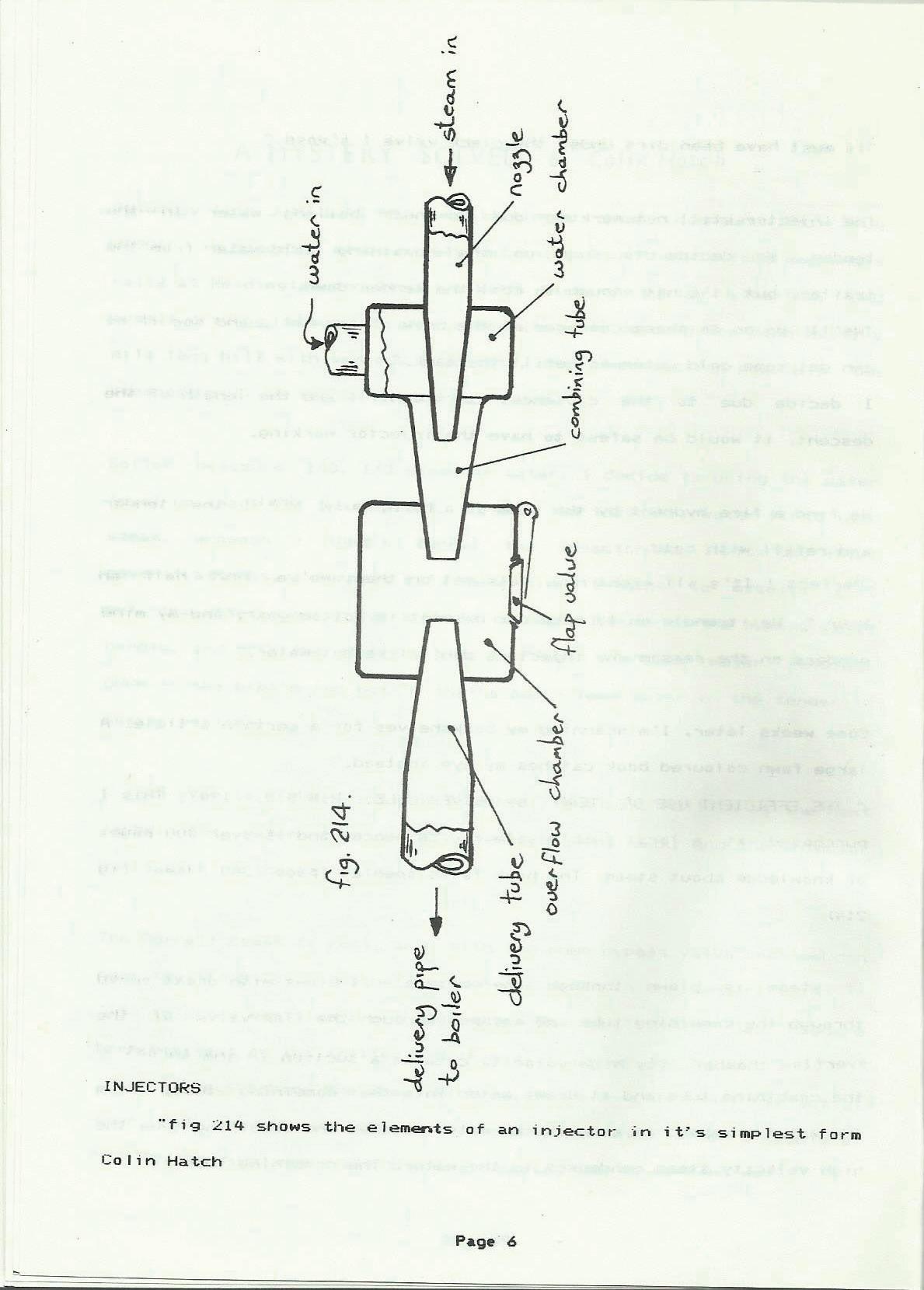
It steam is blown through the nozzle, it blows with great speed through the combining tube and escapes through the flap valve of the overflow chamber. Its high velocity creates a suction in the throat of the combin1ng tube and 1t draws water into the combining tube, from the water chamber_ As soon as the water reaches the combining tube the h19h veloc1ty steam condenses 1n the water_ The combining tube is
!NJECTOf<S
'"fig 214 shows the elements of an injectot· ·in 'it's simplest form Co I in Hatch
narrowed down so that as the steam condenses the mixture occupies less space, its velocity is maintained_ The high velocity water- jet shoots across the gap in the over flow chamber and enters the delivery tube which gradually diverges_ The water slows down in the delivery tube and 1t' s ve J oci ty hea.d ; s conv~t-ted into a pressure head so that j t emerges at low speed high pressure_ As soon as the water- jet jumps the gap in the overflow chamber it causes suction there and closes the flap valve_ The various nozzles and tubes ar-e so designed that the water emerges at higher pressure than boiler water can enter the boiler_ pressure so that the It is clear that the injector can only operate with COLD WATER as the water MUST CONDENSE ALL THE STEAM USED_
The injector is often looked on as an inefficient machin~ but apart from a little radiation and a little loss of steam at the start, the whole of the heat in the steam ,s returned to the boiler and it has a thermal efficiency of almost 100 per cent-·
So there we have it I Next time you see someone pouring buckets of cold water on their injector to make it work, you know the reason why!
•• ______ the injector can only opperate with cold water as the water must condense a 1 ! the steam 1,4sed_ ••
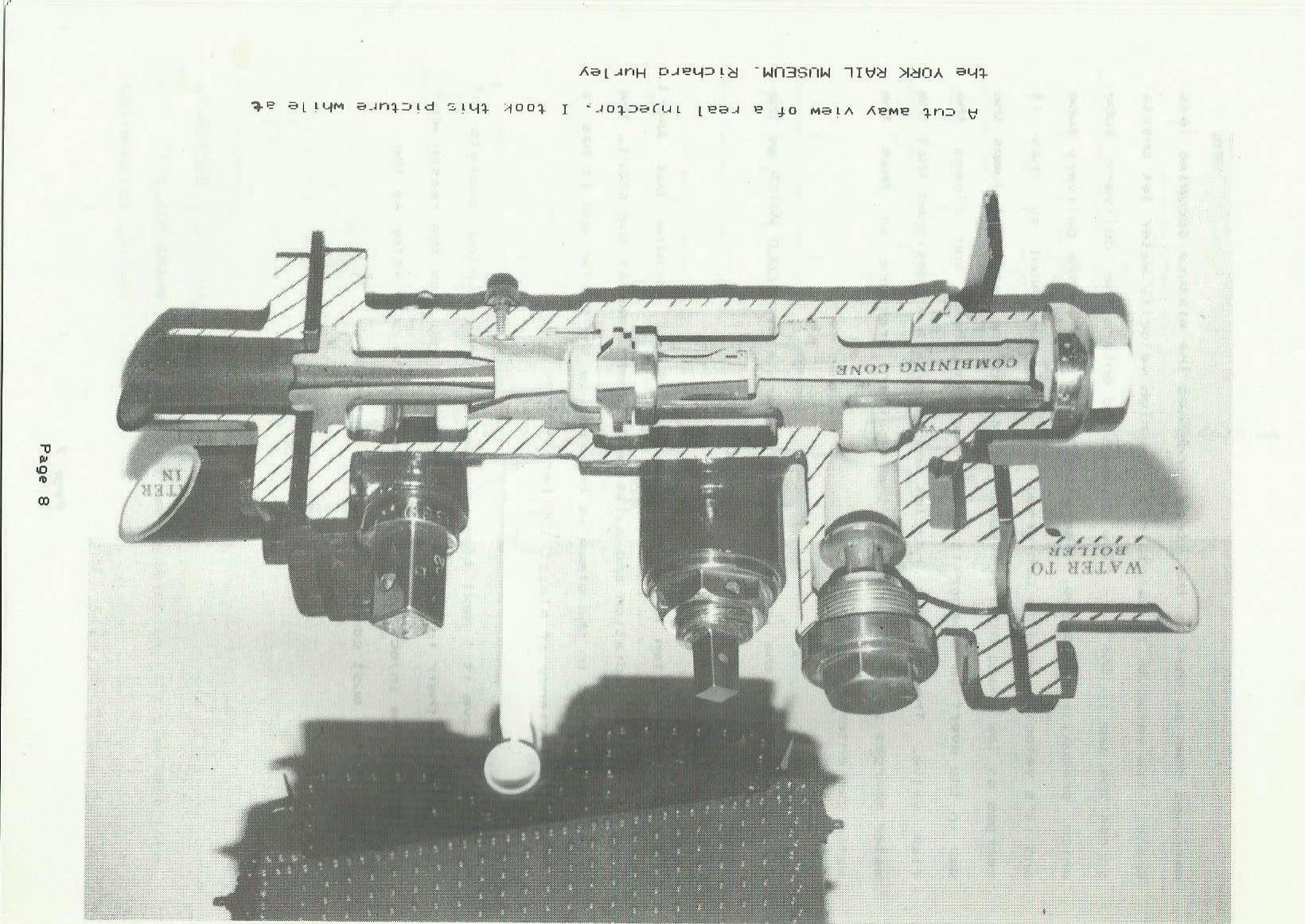
A cut away v1ew of a real 1nJector. I too~ thi~ picture while at the YORK RAIL MUSEUM_ Richarc Hurley
Letters
On Friday, August 15th,· we went to Langport Steam Rally_ Saturday I went around the stalls - there was a lot to see, and things to do as in r if 1e shooting etc_ On Satlffda.y I he 1ped dact po 1i sh the bt-ass on 01..1r engine "Lord Fisher of Lamberth'" and make it 1ook pt·esentab le In the arena, Andy Melrose who owns a ploughing engine, was winching ourengine 1.1p the field demonstrating how it was used to plough the fields_ It wa.s 900d fun On A1..1gust 18th we a 11 went to Oxford and left the en-;iine on the low-lowder in John Wharton's yard_ We were all going on a canal holiday near Stratford On Avon_ We had gre.at fun, <Dad nearly fe 11 in !) _ We came back and picked the engine up after three days, and went to The Lamberth County Show in London_ There was plenty to see and 1 i sten to, such as steel bands, stalls and the fairground_ Shreela Ghosh (Naima) from East Enders was there as the guest on Sunday, I managed to get her autograph_ A month later at Stourpaine ~'ohn What-ton had "King George VI" and "Supreme" out in the ··showman's·· section of engines while our engine was busy with the "Heavy Haulage", black smoke coming out of the chimneys wher-e r·ubber tyres had been thrown in the fire to create the effect to which the people flocked to see as they loved watching it as we do_ Satut·day morn1ng dad steamed the eng1ne down to the S_A_C_ meeting at 10_30.
1n which we watched a video of some engines loading a trailer for the Heavy Haulage Section. we then had a look at a couple of the engines in the field, and talked about the magazine etc_ I was sorry when it was a i 1 over, (espec1 a 1 ly as 1 had to go to school two days later->_
Maria C:asely
STOURPAINE BUSHES
David Duff,11
I was asked recently what•s Stourpaine? Well Stourpaine is a little vi 11 age near Blandford Forum in Dorset_ But in the Steam world the glazed look says it all_ Fi v--=: hundred acr-es of steam enthusiasts ,jream, and abo1..1t 150,000 people come to enjoy it_ Stour-paine is host to the largest gathering of preserved steam engines ever_ Most people put the figure at 142 engines attending_ Sylvia, Richard and I were all in attendance Sylvia and I were at· the N_T_E_T_"s sales and hospitality tent and Richard spend1ng his time out and about with very early wet morn1ngs, a story for Richard to tell sometime_ St our-pa i ne for me started many months before with preparations for the sales stand and hospitality tent_ During the four days I met over 50 of our members, some faces I have met before, others I have not_ Also I would l1ke to welcome our new readers with nearly forty new members at Stourpaine and several more since_ _joining
As many of you w1ll remember Saturday morning was our get together with a half hour delay as we were not quite ready_ As some will remember Fr1day night caused qu1te alot of problems, it rained which ment several (almost al I) our expected engines due to .i o i n us co u 1d not move ,j1...1e to the slippery cond1tions on the field_ One that did make: it "Lord Fisher of Lamberth" a Bun-ell r-oad locomotive owned by the Casely fami 1y, and 1..-1nt1l recently polished by our two members Jonathan and Maria Casely_ I say recently as Jonathan broke his arm playing f0otball soon after Stourpaine_ Lets hope his polishing arm heals soon_ We continued the morning with a v1deo which could have been vintage film except it was filmed at Stoupaine in 1985_ It was of the heavy haulage br1gade loading drainage pipes on to a in
order to demonstrate haulage during the rally_ During this several members took advantage of an invitation to visit the foot plate of "Lord Fisher of Lamberth'" _ Later Jonathan Case l y gave us a talk about Lord Fisher_ Next we visited an engine owned by another apprentice's father_ After a group photograph in which I notice Richar·d stayed well behind the •=amer·a out of the way_ ( Well someone had to take the photo ED_) We had a dicussion about the club and the futw-e fol lowed by lots of promises of articles ( but the question is where are they all???>
Due to the weather we were unable to get more engines ther·e_ Just our luck the weather brightened up later and the ground dried out ! Well never mind better luck next year_ It was some what of a shame that we •=ould not put on our ful J event but the weat;her put. an end to that and has done to many events lately.
Thank yo1..1 David, as you said better luck next time_ Thinking of next time ie 1'':f89 ,t is our tenth b1rthday so we hope to have a bettet· year for events. We have also had offers from many other rally organisers to hold events 1n many different areas but these are not decided upon yet_
Fina 11 y I wo•.dd like to thank the N.T.E_T_ for putting up with us on the Sa t•..lrday morning. Next time we wi l l to hold the events a l1ttle later as some people had difficulty getting in at that time especially if they had to travel long distances_ Not to long traffic queues to get in.
mention the
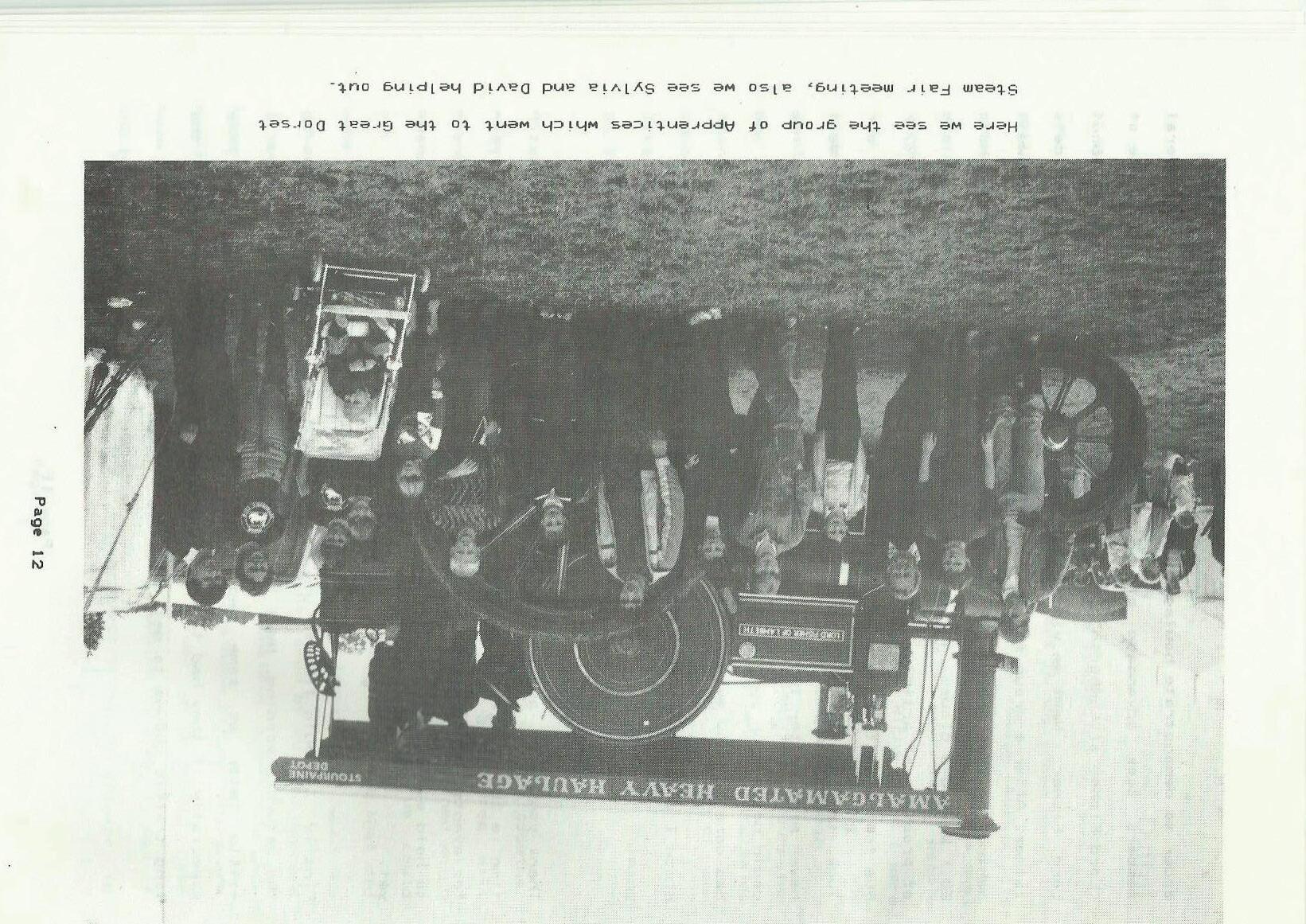
Here we see the group of Apprentices which went to the Great Dorset Steam Fair meeting, also we see Sylvia and David helping out.
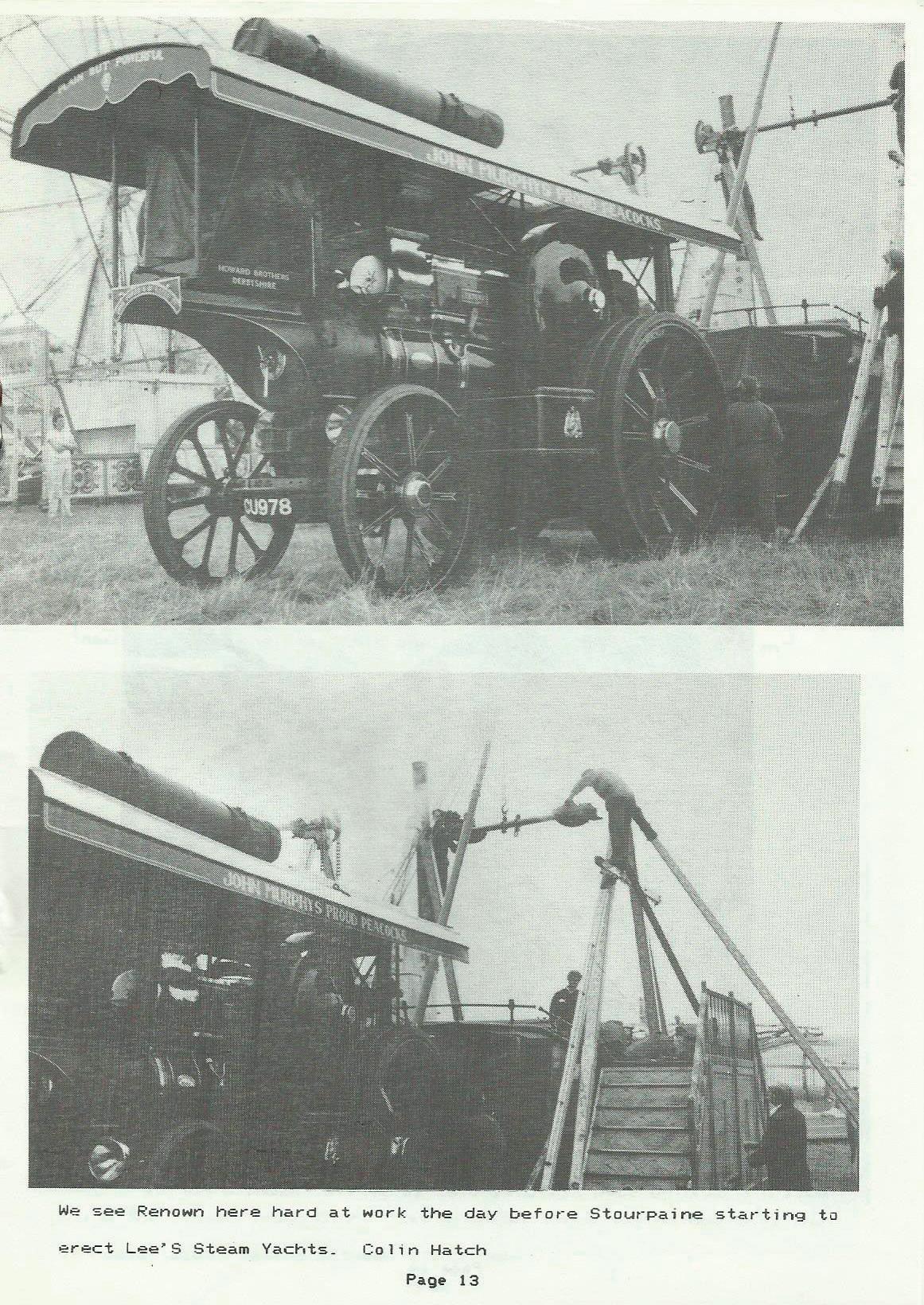
We see Renown here hard at work the day before Stourpaine starting to erect
Lee"S Steam Yachts_ Colin Hatch
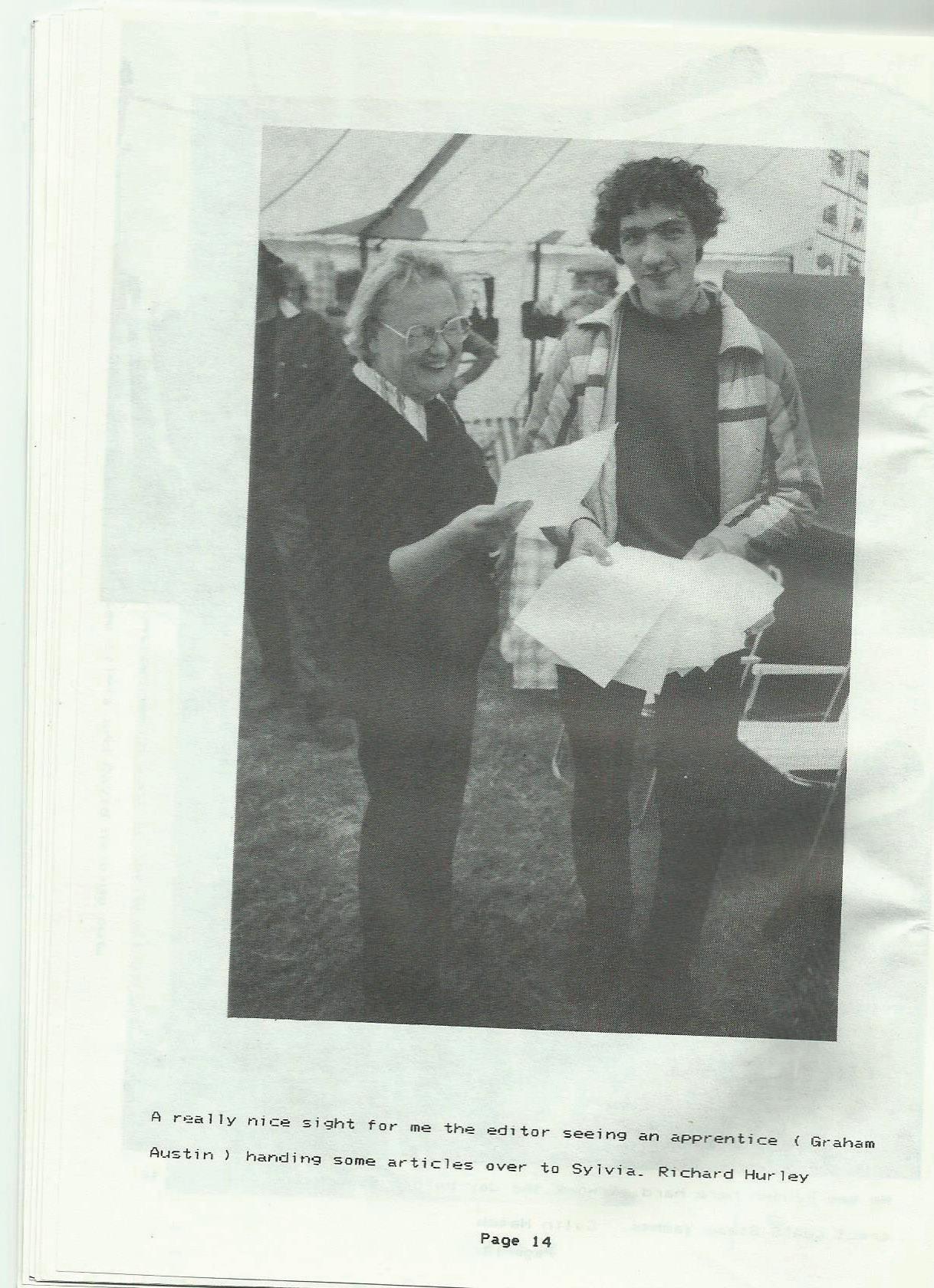
A really n1ce sight for me the ed1tor seeing an apprentice ( Gt-aham Austin) handing some articles over to Sylvia_ R1chard Hurley
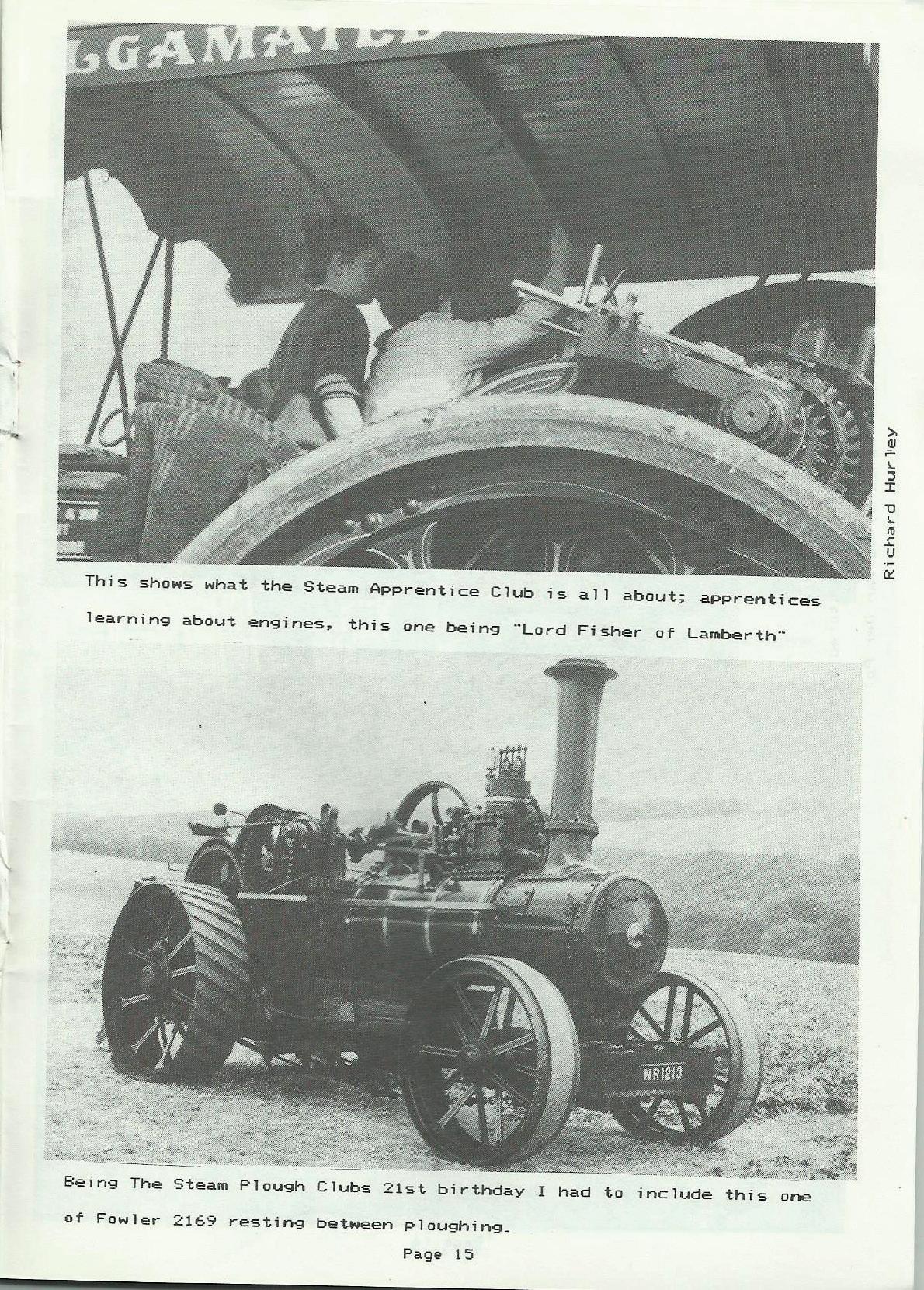
This shows what the Steam Apprentice Club is all about; apprentices learning about engines, this one being -Lord Fisher of Lamberth-
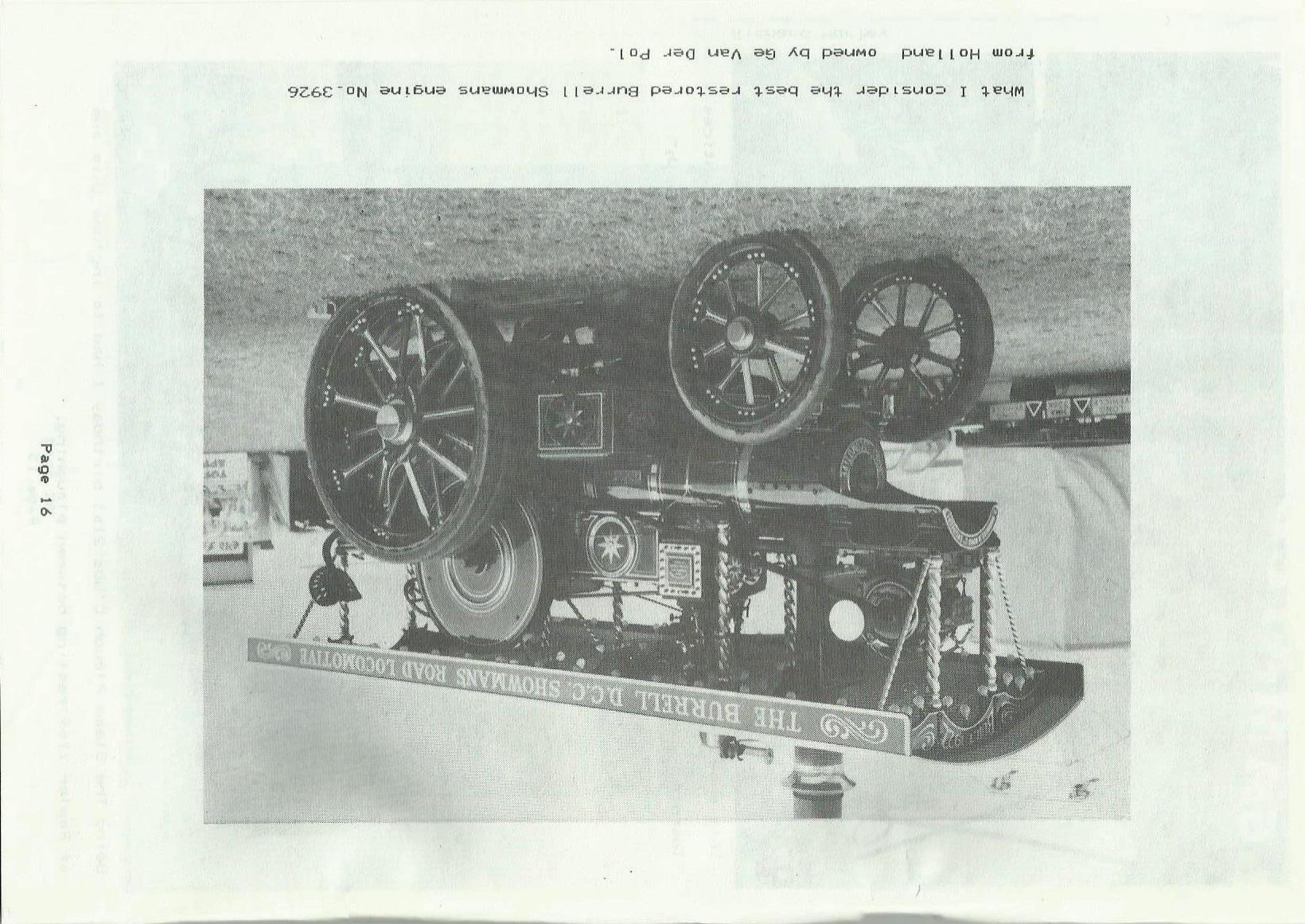
Being The Steam Plough Clubs 21st birthday I had to include this one of Fowler 2169 resting between ploughing_
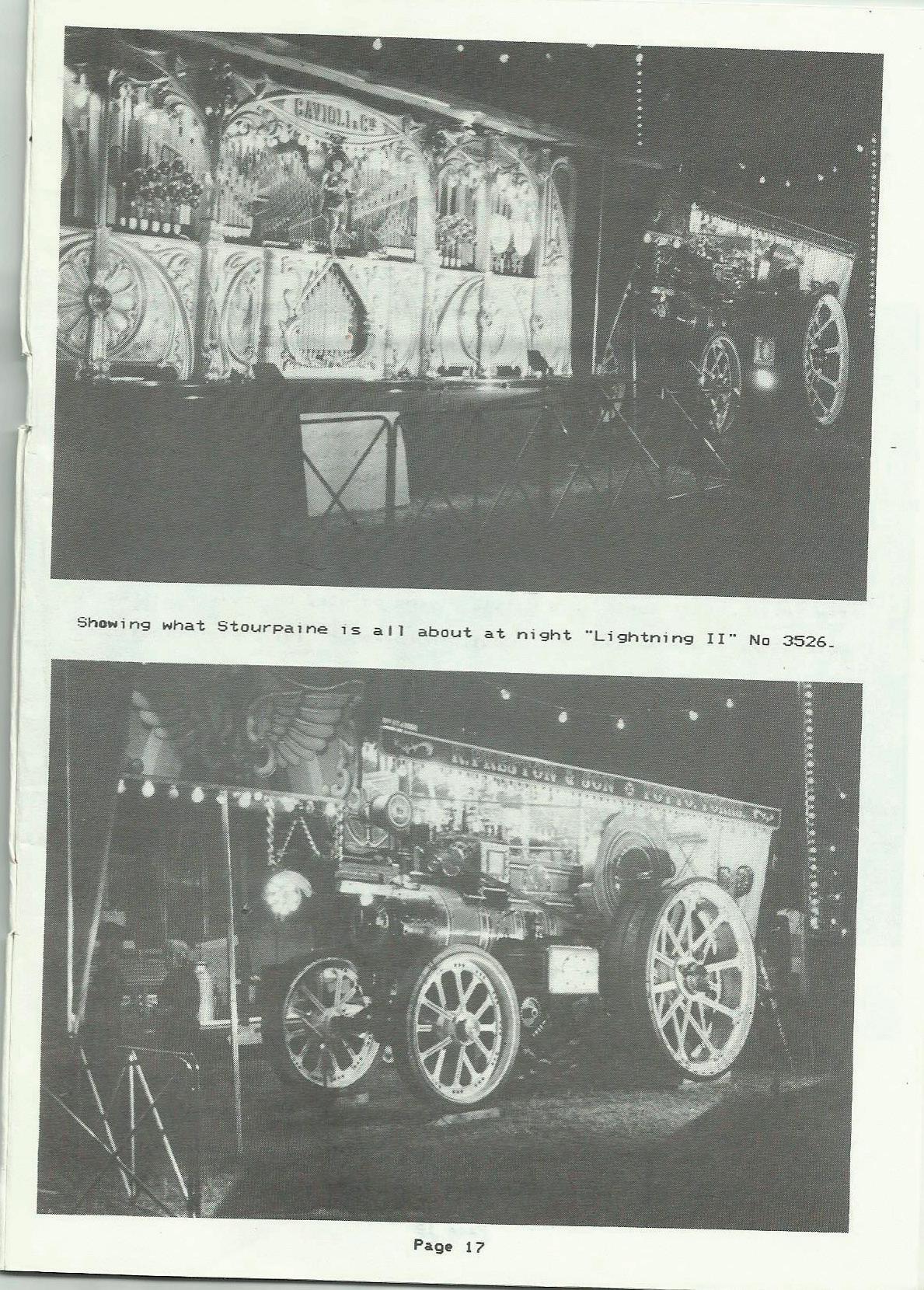
What 1 cons1der the best restored Burrell engine No_3926 from Ho l 1and owned by Ge Van Der Pol_
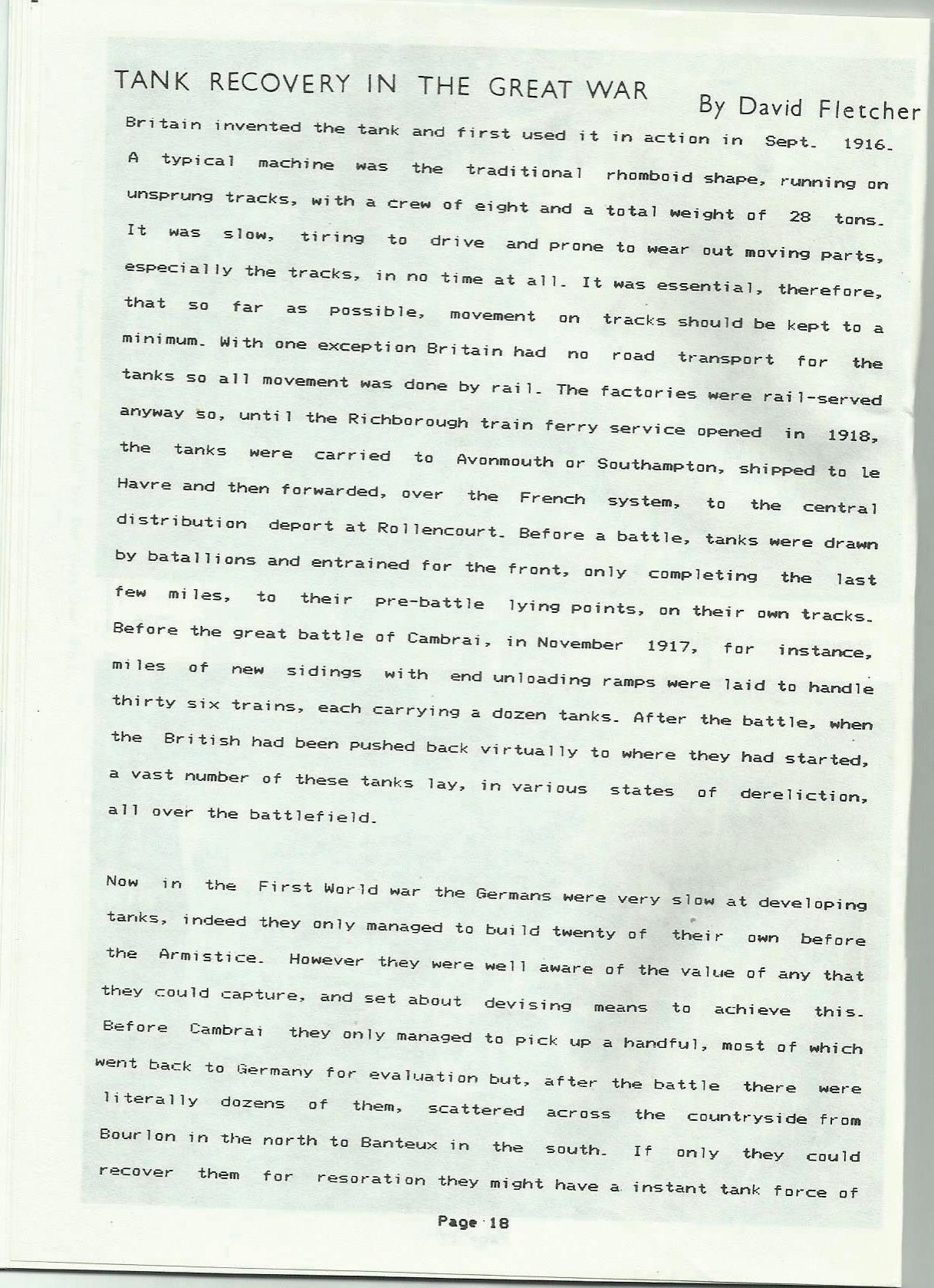
Showing what Stourpa1ne 1s all about at night '"Lightning II" No 3526_
TANK RECOVERY IN THE GREAT WAR
By David Fletcher
Britain invented the tank and first used it in action in Sept_ 1916_ A typical machine was the traditional rhomboid shape, running on unsprung tracks, with a crew of eight and a total weight of 28 tons_ It was slow, tiring to drive and prone to wear out moving parts, especially the tracks, in no time at all_ It was essential, therefore, that so far as possible, movement on tracks should be kept to a minimum_ With one exception Britain had no road transport for the tanks so all movement was done by rail_ The factories were rail-served anyway so, until the Richborough train ferry service opened in 1918,. the tanks were carried to Avonmouth or Southampton. shipped to le Havre and then forwarded, over the French system, to the central distribution deport at Rollencourt_ Before a battle, tanks were drawn by batallions and entrained for the front, only completing the last few miles, to their pre-battle lying points, on their own tracks_ Before the great battle of Cambrai, in November 1917. for instance,. miles of new sidings with end unloading ramps were laid to handle thirty six trains, each carrying a dozen tanks_ After the battle,. when the British had been pushed back virtually to where they had started, a vast number of these tanks lay, in various states of dereliction,. all over the battlefield_
Now in the First World war the Germans were very slow at developing tanks, indeed they only managed to build twenty of their- own before the Armistice_ However they were well aware of the va.lue of any that they could capture, and set about devising mea.ns to achieve this8e:fore Cambrai they only managed to pick up a handful, most of which went back to Germany for evaluation but, after the ba.ttle there were literally dozens of them, scattered across the countryside from Bourlon in ~he north to Banteux in the south_ If only they could recover them for resor·ati on they might have a. instant tank force of
their own. The means they used was an exemplary piece of improvisat1on, and it used steam.
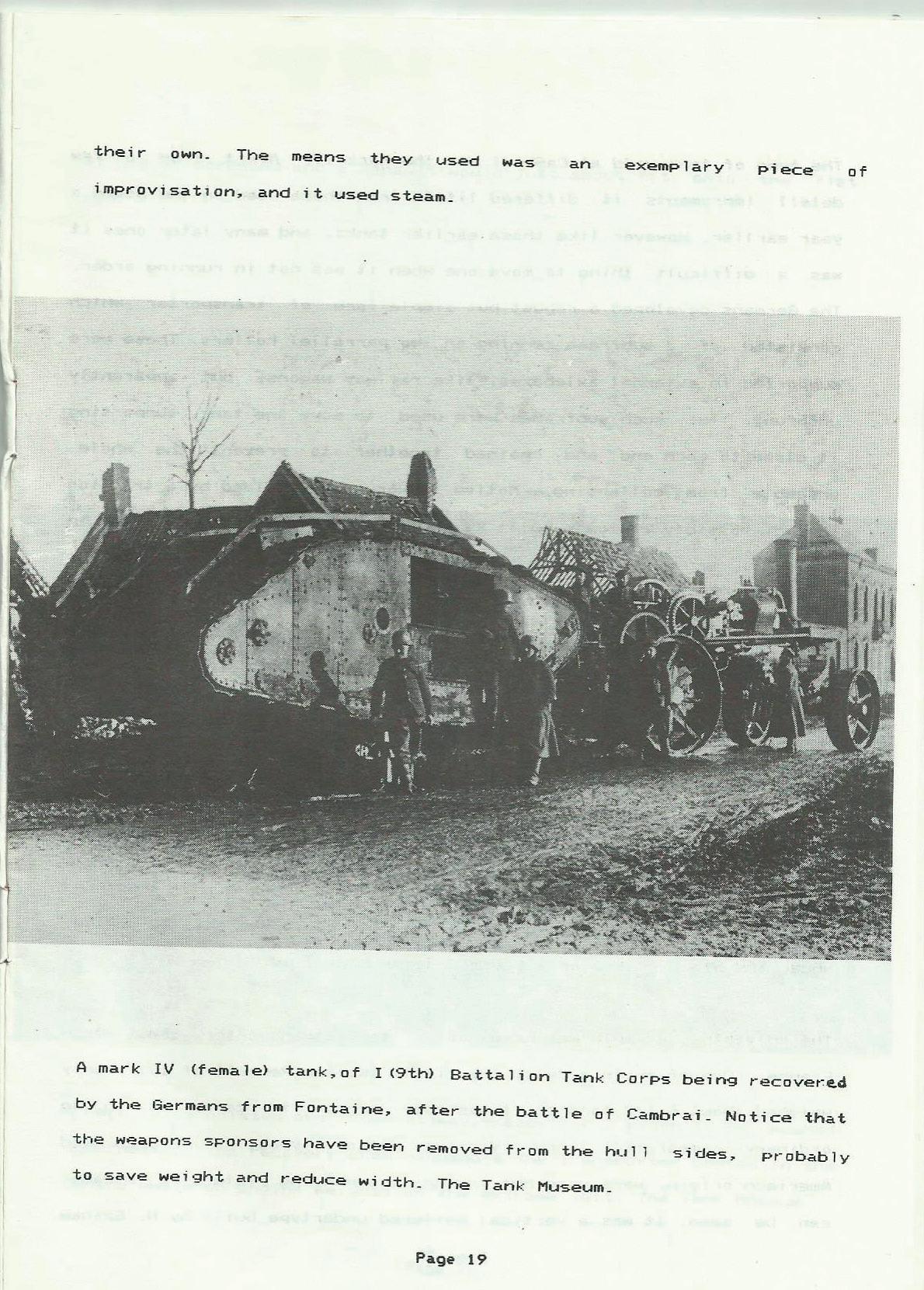
sides, probably
A mark IV (female> tank,of I (9th) Battalion Tank Corps being recover.~d by the Germans from Fontaine, after the battle of Cambrai. Notice that the wo:apons sponsors have been removed from the hul to save weight and reduce width. The Tank Museum.
The type of tank used at Cambrai was the Mark IV_ Apat·t from a few detail improments it differed little from those used on the Somme a year earlier. However like those earlier tanks7 and many later ones it was a difficult thing to move one when i t was not in r·unn i ng order_ The 13ermans developed a robust but simple form • of transporter which consisted of a subframe running on two parrallel rollers_ These were supported in external axleboxes 7 like railway wagons, but appar-ently unsprung_ Two such subframes were used to move one tank, supporting it close to each end and chained together to prevent the whole ensemble from col lapsing_ Motive power was provided by a traction engine, possibly a German built Kemna like the one photographed in Fontaine, or any suitable type_ Obviously the ground from which the tanks could be recovered had to be chosen carefully but the area around Cambrai was relatively free from the effects of heavy bombardment and, being mainly chalk downland, quite well drained_
In any event, once a tank had been mounted on the subframes it was drawn away to the railhead and set down straddling the tracks_ Four large pillar jacks were then used to lift it high enough to enable the wagon to be shunted underneath and then it was off, to the Ger·man tank workshops at Cha.rlerloi in Belgium_ Het·e the tank was either restored to fighting trim or· stripped tor spares. In the former case to emet·ge, under the black cross, as a Beute (booty) Panzer IV_
The only other example we have of a tank transporter· comes fr· om France_ One of their models. the little two-man Renault of 1917, only wei-;ihed about.-6 1/2 tons so it was easy enough to carry it in an ordinary commerc1al lorry_ Various pett· o 1 types, of French and Ameriacn or1g1n. were used but in the accompanying picture a steamer can be seen. It was a vert1cal bo1let·ed undertype built by H. Exshaw
et Cie of Bordeaux and a Renault would just about fit onto bed.
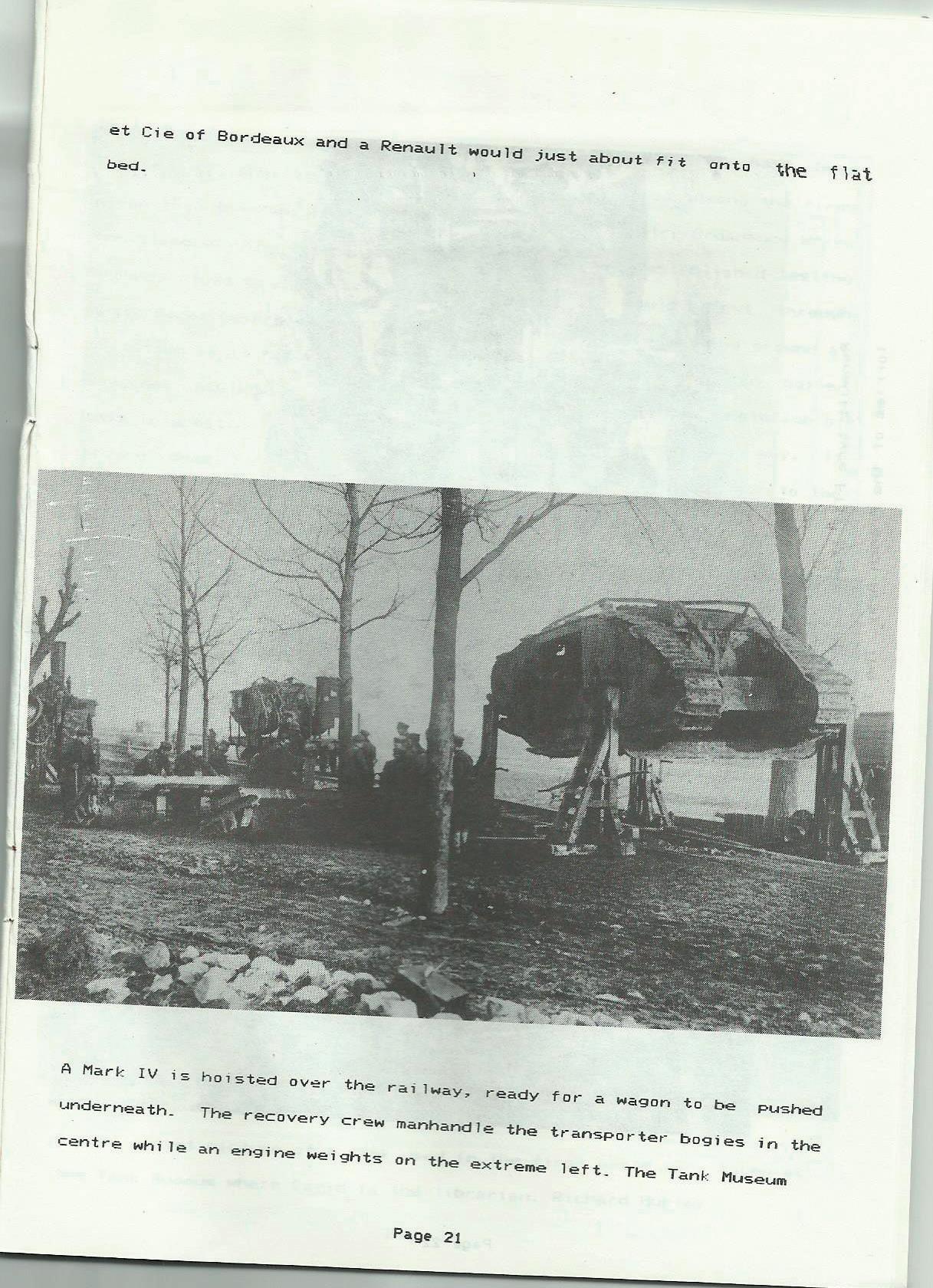
A Mark IV 1s hoisted ov~r the ra1 lway, ready for a wagon to be pushed underneath. The recovery crew manhandle the transporter bogies in the centre while an engine weights on the extreme left. The Tank Museum
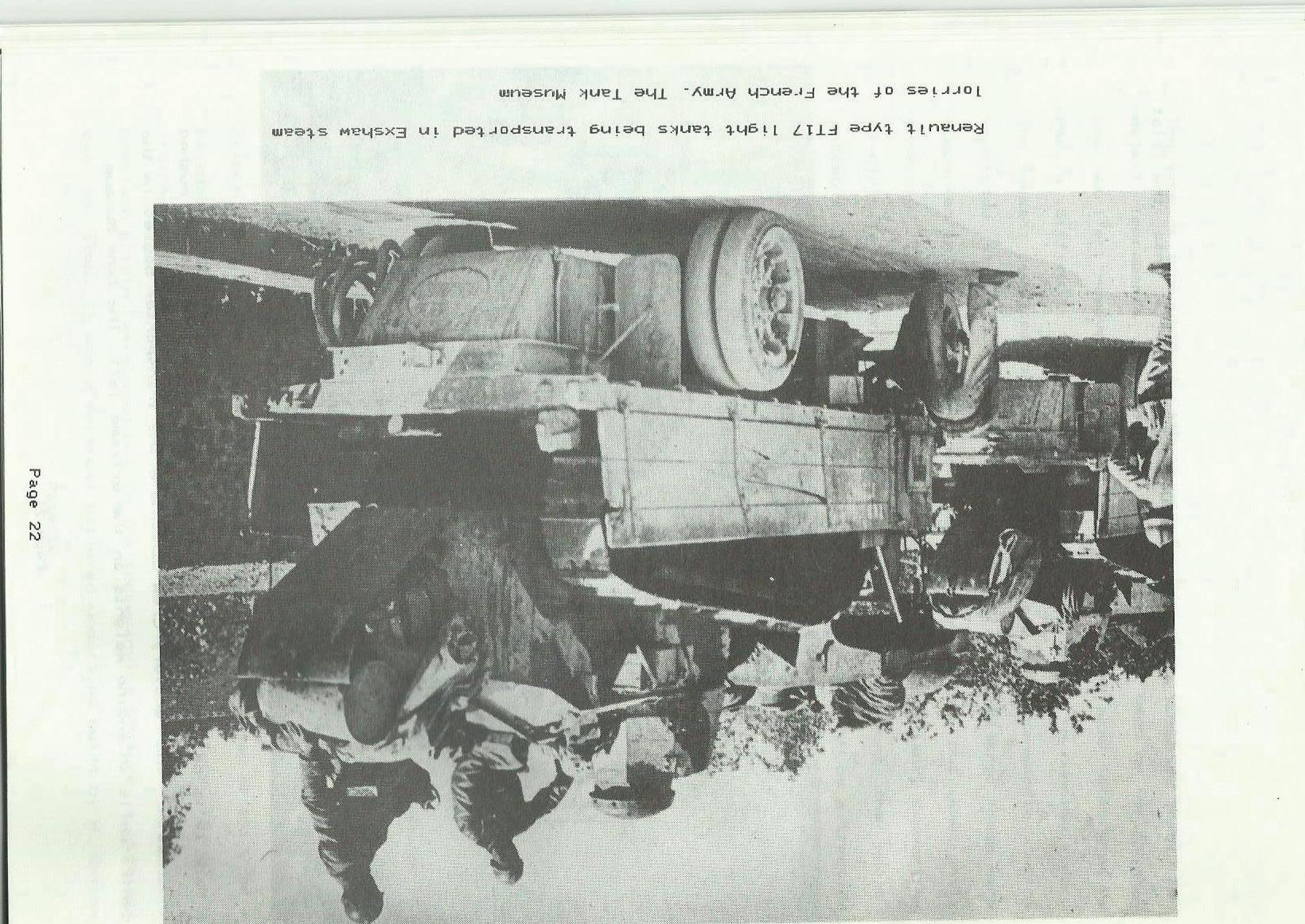
Renault type FT17 light tanks being transported in Exshaw steam
1 orr i es of the F,·ench Ar·my _ The Tank !'1•..4seum
British interest in steam tank transporters appears to have been 1 i mi ted to one location over a fair-ly short period_ Among the fi.-ms drawn into the tank builing programme was the Coventry Ordanance Works in Glasgow_ The Mechanical Warfare Department established testing t.irounds close to each factory whet-e new machines could be put theit- paces before delive,-y to the Army_ The Glasgow testing ground at Scotsto,--'n it is recorded that tanks were carTied the,.-e on boi le,.waggons. hauled by traction engines_ Unfortunately no photgraph of this interesting event has yet come to light and, needless to say, if anyone does have such a thing it would be of great interest to the writer_
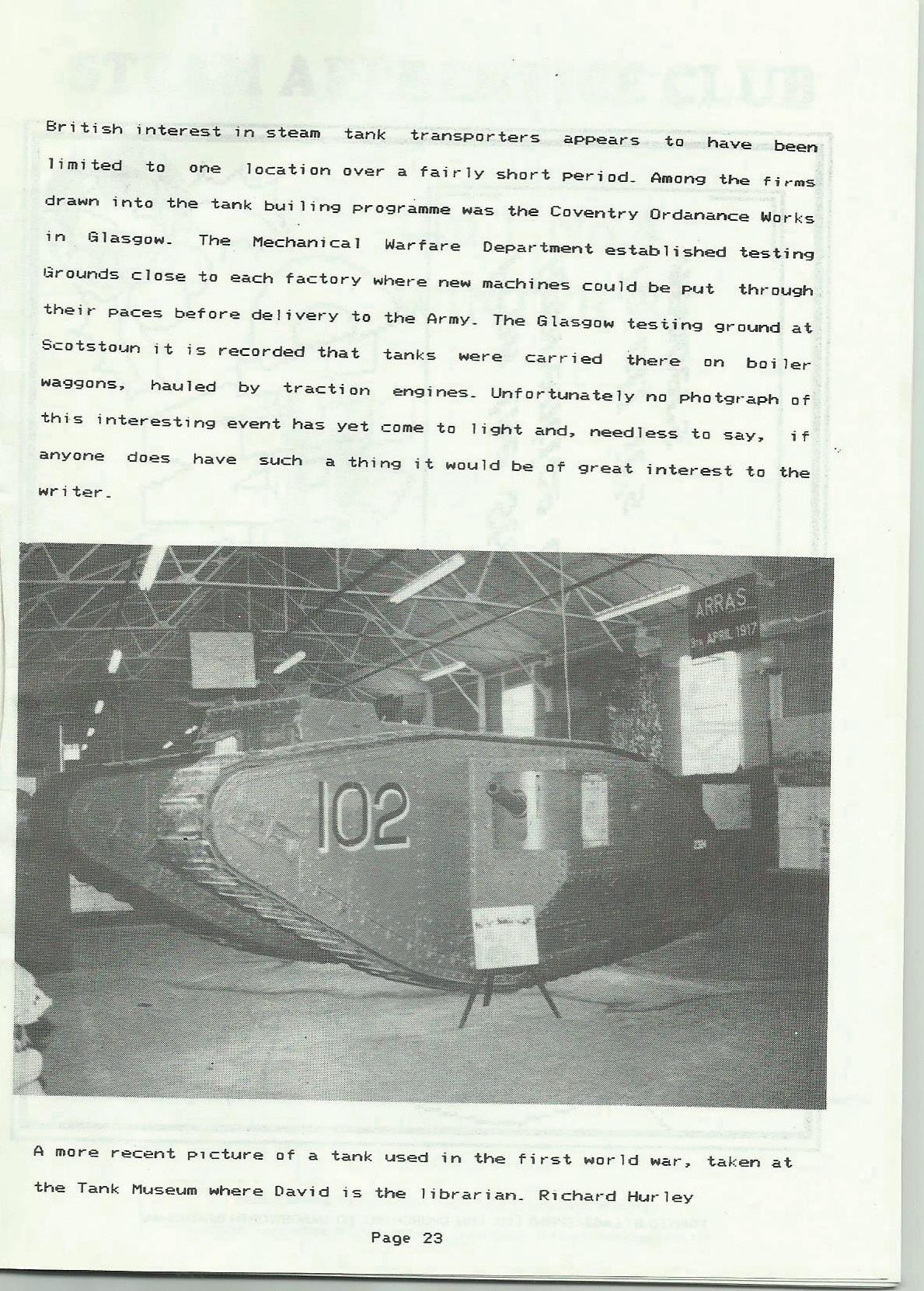
A more recent p1cture of a tank used in the fi,-st world wa,-. taken at the Tank Museum where David is the librarian_ R1chat-d Hut-ley