STEAMAPPRENTICECLUB
Vol. 1 No. 2
JUNE, 87 Newsletter 22
Vol. 1 No. 2
JUNE, 87 Newsletter 22
The Chairman, Sylvia Dudley, 42 Russell Street, Woburn Sands, Bucks. MK17 8NX
Membership Secretary, David Duffill, 191 Foden Road, Great Barr, Birmingham B42 2EH
The Editor, Richard Hurley, 2 Reaburn Close, Charlton Kings, Cheltenham, Glos. GL52 6NL
If your membership is due for renewal now or in the near future send your membership card with £2.00 and an S.A.E. to the Membership Secretary; address above.
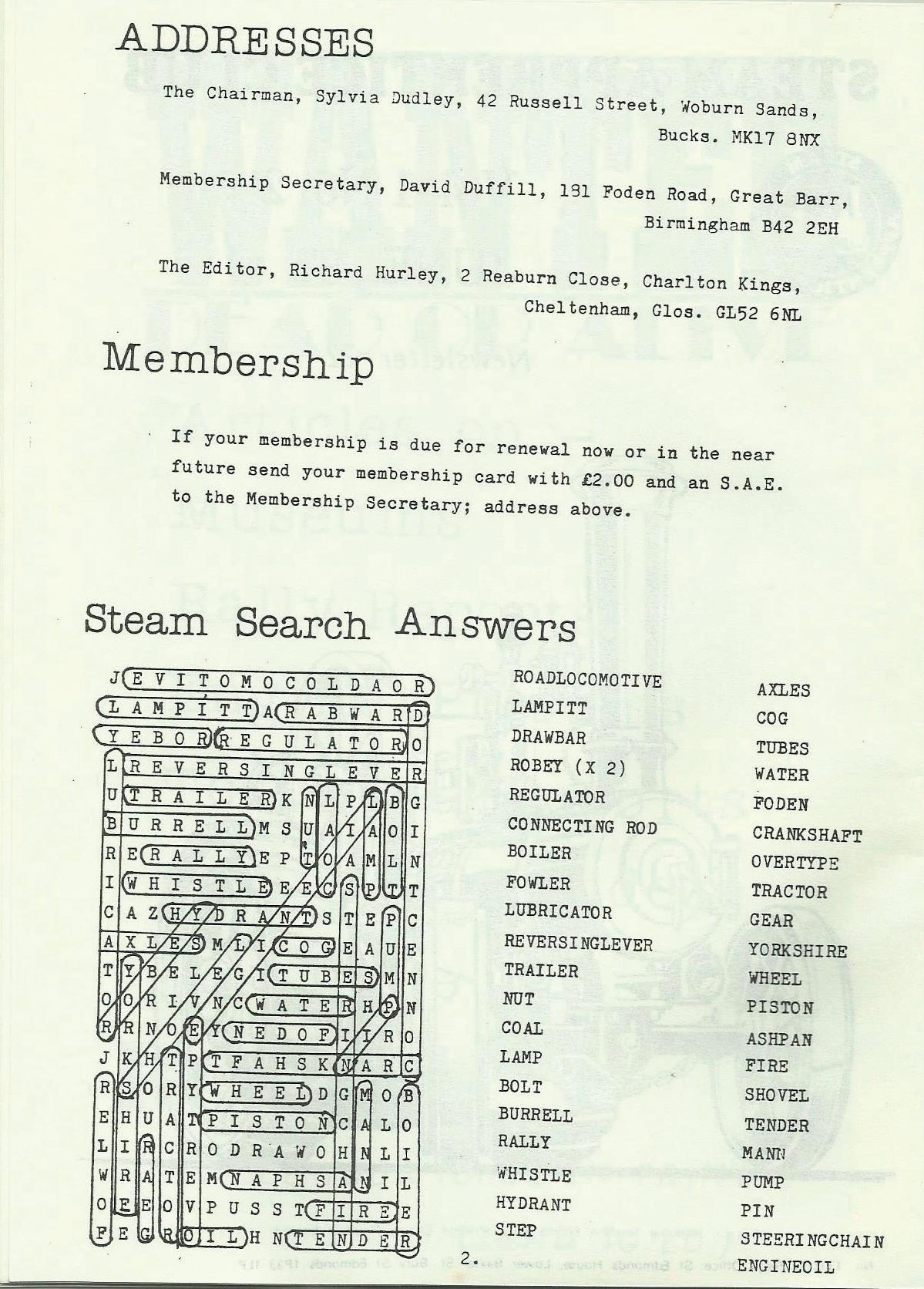
J(E VITO MOC OLD AO R) (LAMP IT T)A RA B WARD (y B O R) • E G U L A T O R 0 E V E R S I A I L E R
ROADLOCOMOTIVE
LAMPITT
DRAWBAR
ROBr:Y(X 2)
REGULATOR
CONNECTINGROD
BOILER
FOWLER
LUBRICATOR
REVERSINGLEVER
TRAILER
NUT
COAL
LAMP
BOLT
BURRELL
RALLY
WHISTLE
HYDRANT
STEP
By the time this reaches you the rally season will be vell underway, but at the time of writing I still haven't been to one. But I'm sure I vill make up for this later on in the season.
Now you ~re all going to rallies I hope you will all be sending me rally reports, with photographs of the rallies to go with them. Also, how about some letters to say what you think of the newsletter; ie. Do you think this is an imDrovement, what would you like to see in it? Do you belong to any local groups or clubs? Why not write and tell us what you do in thi~ group.
In this months newsletter we have the second part of John Wharton's article "1986 with Georgie Boy" and~ letter from Clive Hollingworth describing the 1986 Weeting event. To go vith his letter he sent me many photographs of which a selection are printed. Those who read Steaming regularly will know that Clive Hollingworth is a very good photographer and often has entries in their photogr~phic competition.
Our first article comes from Mr. Robert ~hitehead author of many books including "Age of the Traction Engine" and "Garrette of Leisten". I thank him very much for taking the time to write an article for us, also I thank Mr. B.D. Stoyel for providing us with a fitting illustration.
I wish you a good rally season and hope to see you at many of the rallies.
The club is organising a meeting of all members and Stourpaine Bushes Rally at 10am on Saturday 5th September 1987. It will be held in the N.T.E.T. courtesy tent which will be next to the N:T.E.C. sales stand. If you are with an engine that weekend please bring it with you. Alterations to rally list No stand will visit Weston Park or Bishops castle as the have been asked not to attend as they have attended Buxworth steam group rallies in the area. Parham steam Rally Keith attending, Derbyshire Country Show David attending, Great Surrey Steam Fair David attending and Barleylands Steam Rally Keith attending.
By ~-A. 'i'ihi tehead
The task for which the great majority of general purpose traction engines were purchased was thrashing (if you owned any make of engine other than a Garrett} or threshing if you owned a Garrett. Why Garretts chose the alternative spelling is not known but they stuck to it doggedly.
It is interesting, therefore, to consider what made for the ideal. threshing engine. Each maker had his partisan supporters and it is doubtful if any group placed together would have agreed on the most desirable make. They would, however, have agreed about some broad aspects of the subject and these are discussed below.
Firstly they would have agreed that it would not have been a cross compound. Cross compounds were used for threshing but they were not common. Such an engine, if a 6 horse-power, was probably about £60.00 (about 15 per cent) dearer to buy than a single and the hire rate was the same for compounds and singles. Moreover there was a good deal more machinery to oil and keep clean and there had to be a rather higher pressure in the boiler when work started than was needed on a single. If the crew were a bit late getting to the engine this was an important consideration. The Burrell single crank compound, however, was well liked, taking little more in oiling and cleaning than a single and being very economical.
They would, by a majority, have stipulated that it should not be a steam tractor. A steam tractor, carefully managed and in good order, would run a 54 inch threshing drum as well as you could wish, perhaps using less coal than a traction engine but it required the whole attention of its driver. It had its advantages, too, in getting into closely confined stackyards or over weak bridges and culverts but, conversely, unless equipped with rubber tyres, it had less control over
the loads behind it when running downhill on tne road. So although steam tractors were handy in Cumbria, the Welsh border, Devonshire and other areas abounding in narrow lanes and tight stackyards they were never the norm for ordinary threshing contracts.
The bigger the engine the slower it ran since the power requirement of the drum was a constant factor. A six horse-power engine was a comfortable size for running a threshing drum and a straw elevator especially if it was a Fowler but a seven horse-power gave more reserve and could, if required, work a chaff cutter and blower in addition.
Chaff cutters were not liked by drivers as the knives constantly needed sharpening, a task which fell to the driver,whilst the thin galvanised ducting by which the chaff was blown into the loft or barn became dented in handling and liable to stoppages of the blown chaff, a source of delay to the threshing set and an irritating chore to the crew in clearing it.
Where stackyards were large and firm an eight horse-power engine was in order. The large stackyards of the South Midlands with their stone bottoming saw many big engines on threshing and in the last years in which it was done there were former road locomotives or showmen's engines to be found working at it. Stan Burgess's Foster Admiral Beatty (No. 14153 of 1916) finished out its life in this way for G. Desborough & Sons of Chatt~ris, Cambridgeshire after being sold out of fairground use with William Thurston.
Easy steaming was another attribute much sought after. Economy of fuel was a good thing as it pleased the farmer customer, who had to provide the coal, but if it was achieved at the expense of having an ample supply of steam it was of no avail. The Wallis & Steevens engines equipped with 2½ inch tubes were notably free steamers even if not remarkable for economy. There were no embellishments on a Wallis, everything was there for use and the make had a faithful following. 5.
A good threshing engine needed to govern well. Nothing was more inimical to the working of a thresher than alternate overspeeding and underspeeding of the drum, a defect which often happened with paraffin tractors. Pickering governors were excellent, well ahead of even good cross arm types and many times better than the early governors running at crank-shaft speed such as those fitted to the Science Museum Aveling & Porter.
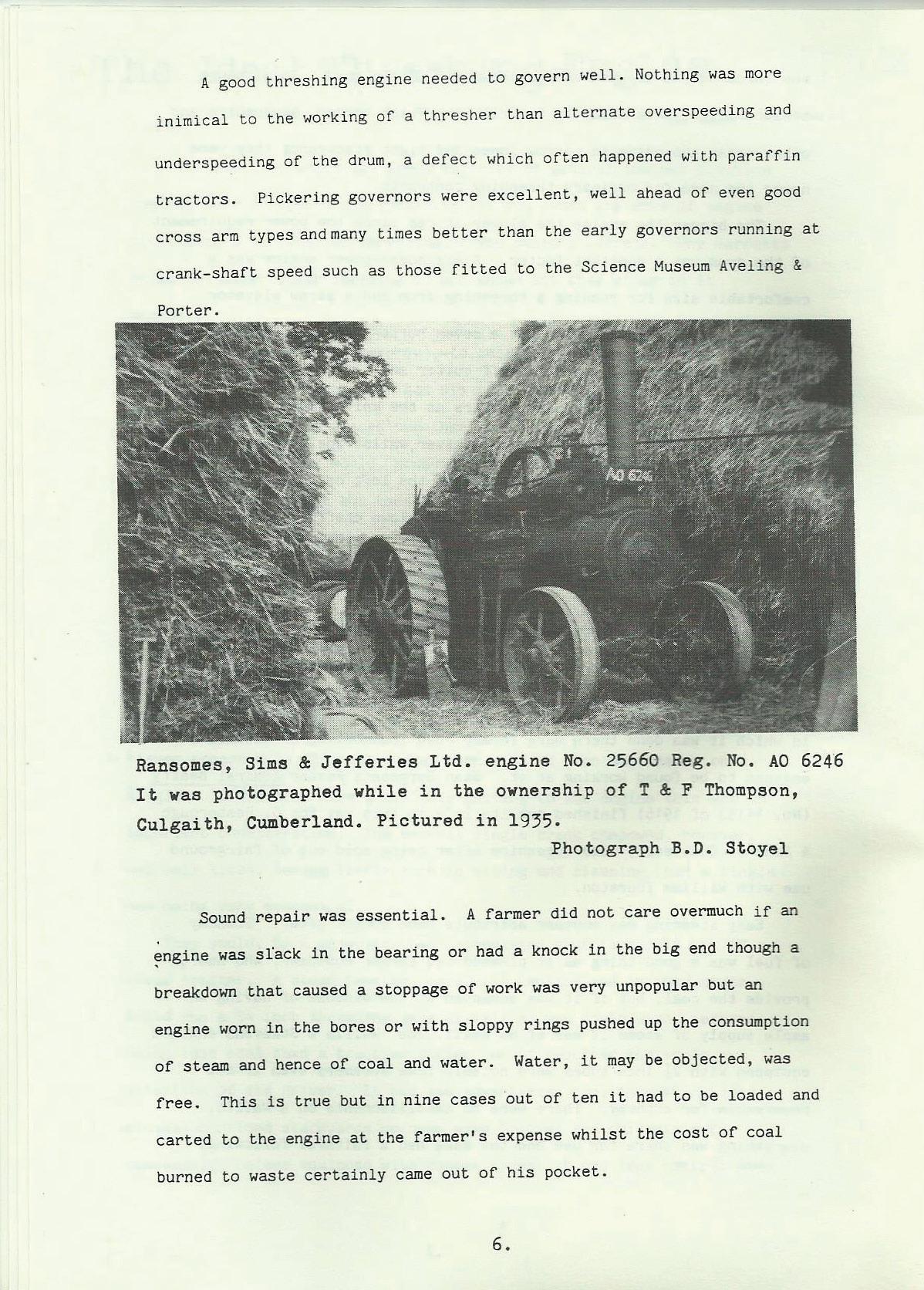
Ransomes, Sims & Jefferies Ltd. engine No. 25660 Reg. No. AO 624'6 It was photographed while in the ownership of T & F Thompson, Culgaith, Cumberland. Pictured in 1935.
Photograph B.D. Stoyel
Sound repair was essential. A farmer did not care overmuch if an ~ngine was sl'ack in the bearing or had a knock in the big end though a breakdown that caused a stoppage of work was very unpopular but an engine worn in the bores or with sloppy rings pushed up the consumption of steam and hence of coal and water. Water, it m~y be objected, was free. This is true but in nine cases ·out of ten it had to be loaded and carted to the engine at the farmer's expense whilst the cost of coal burned to waste certainly came out of his pocket.
Ease of handling when placing the drum and setting to it made for popularity, helped by a lower working pressure. Ease and economy were at war here as higher pressures generally made for economy of steam. Being snatchy on the regulator, a Marshall attribute, was not liked nor was a tendency to vertical starts - lifting the front end up on starting. John Allen introduced his heavy cast iron chimney partly with a view to discouraging this.
Left or right hand steer made not much difference. Drivers soon adapted to either. Springs, surprisingly, were not over popular. Though they eased shocks on the hard road they allowed the engine to be on the "work" when belted up to the drum. Some people preferred three shahts to four shaft engines on the ground that they had to nm in reverse, with the links up, to thresh it evened out the wear but the same result could have been achieved on a four shaft by crossing the \ belt. The engine I used to go with was a four shaft but Lew Leigh, the driver, never bothered with crossing the belt.
A tendency to prime, understandably, made an engine unpopular. Post-Fletcher Claytons were notorious for "drawing their water" but they were not the only culpri~s. Geared pumps were not a popular feature They ran too fast and made a lot of noise but an eccentric driven pump was a desirable feature. By getting the by-pass setting right a driver could keep the level in the boiler constant. Since firing could be intermittent this left him free to manage the sacks or, in the old days, to make straw bands for tying the straw trusses.
After all these generalities which were the best threshing engines. A Fowler built after about 1904 was a good sound engine, right hand steered it is true but this never bothered threshing drivers much,though somewhat heavy at the rear. A Foster 7 horse-power also deser~es honourable mention. Though sometimes disparaged as long and gangling it could do most things asked of it if there was room. The Marshall
too was a good threshing engine, short and compact. Curiously the firm fitted an injector only as an extra. A McLaren was very strong and hard wearing but consequently very heavy. A Clayton & Shuttleworth of Fletcher's design was also a sound machine noted for ease of control and absence of priming. After him they became noted for it. The engine I have chosen to illustrate, however, is the Ransomes, Sims & Jefferies, not quite so compact as the Marshall perhaps but again not too heavy at the rear though because Ransomes liked to place the steersman far back it was a long way from the regulator to the wheel, sometimes awkward for the driver in shunting about. It was, however, a reasonably good steamer and did not prime. Be assured that whatever I were to say or whatever engine I were to nominate there would be a dozen to contradict me. Engine preferences were like that.
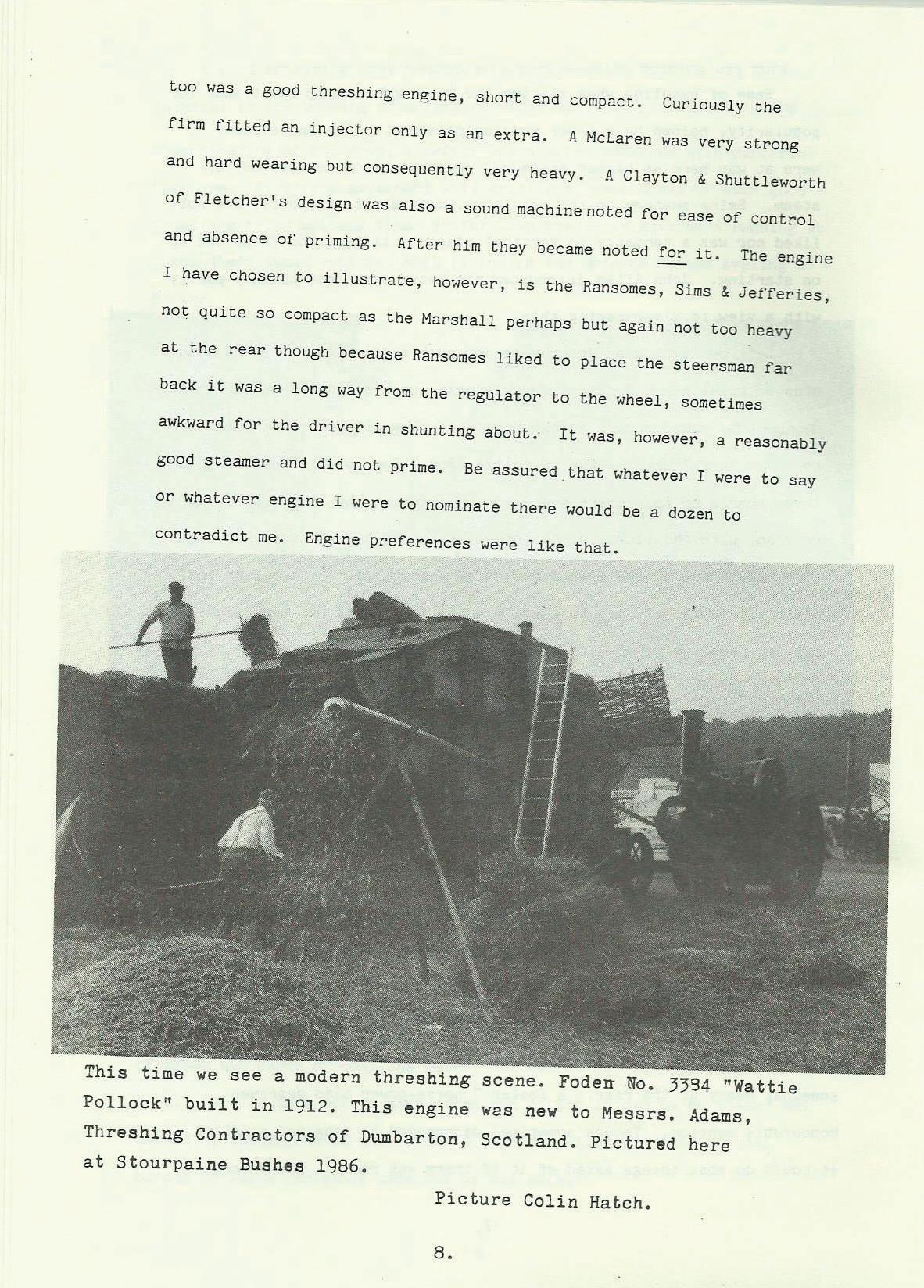
This time we see a modern threshing scene. Foden Wo. 3394 "Wattie Pollock" built in 1912. This engine was new to Messrs. Adams, Threshing Contractors of Dumbarton, Scotland. Pictured here at Stourpaine Bushes 1986.
Picture Colin Hatch.
By CliYe Hollingworth
"Why are we going to ·weeting in April when the rally' s not on until July?", was the bemused qaestion posed by my wife as we drove towards Norfolk through the wet miserable morning on April 5th.
Why indeed passed through my mind, briefly I hasten to add, but the answer, as you are all no doubt aware, was to visit the training at Weeting being held by the S.A.C.
Me ? ·r•m well passed being eligible for the S.A.C. but have been a member of the N.T.E.C. (N.T.E.T.) for sometime during which the formation of the S.A.C. took place and no doubt along with most other members have read of its progress in 11Steaming" but today was to be the day when I came face to face with real live "Apprentices" courtesy of their "Boss Lady".
Locating the venue -was no problem for a seasoned Weeting regular (if in any doubt look for the smoke), locating "Boss Lady" was even easier. After a chat it was time to find out·what was going on and where the apprentices were.
I was informed that half a dozen were to be found-somewhere-so with camera in hand it was off to find them. Question- how do you tell a S.A.C. member from any other overalled youngster with oil and coal dust covering face and hands?
Then it rained, snowed and most things 1n between. ~hen the sun came out it was time to find out what was making all the smoke. iaid out in the surrounding fields were 8 engines, listed below, 6 Thetford built beasts and 2 imported from somewhere called Leeds.
All engines were available for Apprentice use and the friendly Norfolk ''Twang" from the crews was all that was needed to reassure the wary that they were welcome to "come aboard".
Those not belted to various eauipment could be seen to be trundling around the site (in between more rain showers) with ever varying
crew members but not the "Boss Lady" who has probably been pampered by the Robey ride to risk a turn on a Thetford footolate !
Everyone was enjoying themselves, in spite of the odd shower, and having a ~good time, the inclement weather only serving to remind everyone that working with steam was a hard job, a realism often lost on a hot sunny summer rally field.
This was a first class event, better than a great many rallies and I for one appreaciated the effort put in by Mr. Parrot and friends, your committee and everyone at the event to make it a marvellous occasion, so come on you out there, twist Mum and Dad's arm abit more and if another similar event is organised go to it in your hundreds.
P.S. Can I come again Boss Lady?
Engines:-
Burrell 8 HP 2948 driving Marshall 54 in drum (making the most smo.ke and the best stack music)
Burrell 7 HP 4038 driving aawbench
Burrell 6 HP 2626 driving stonecrusher
Burrell 8 HP 743
Burrell 2159
Burrell roller 3994
Fowler BBl Ploughing engines 15453 15454
Burrell No. 2948 driving a Marshall 54 in drum this is a 8 HP engine built in October 1907.
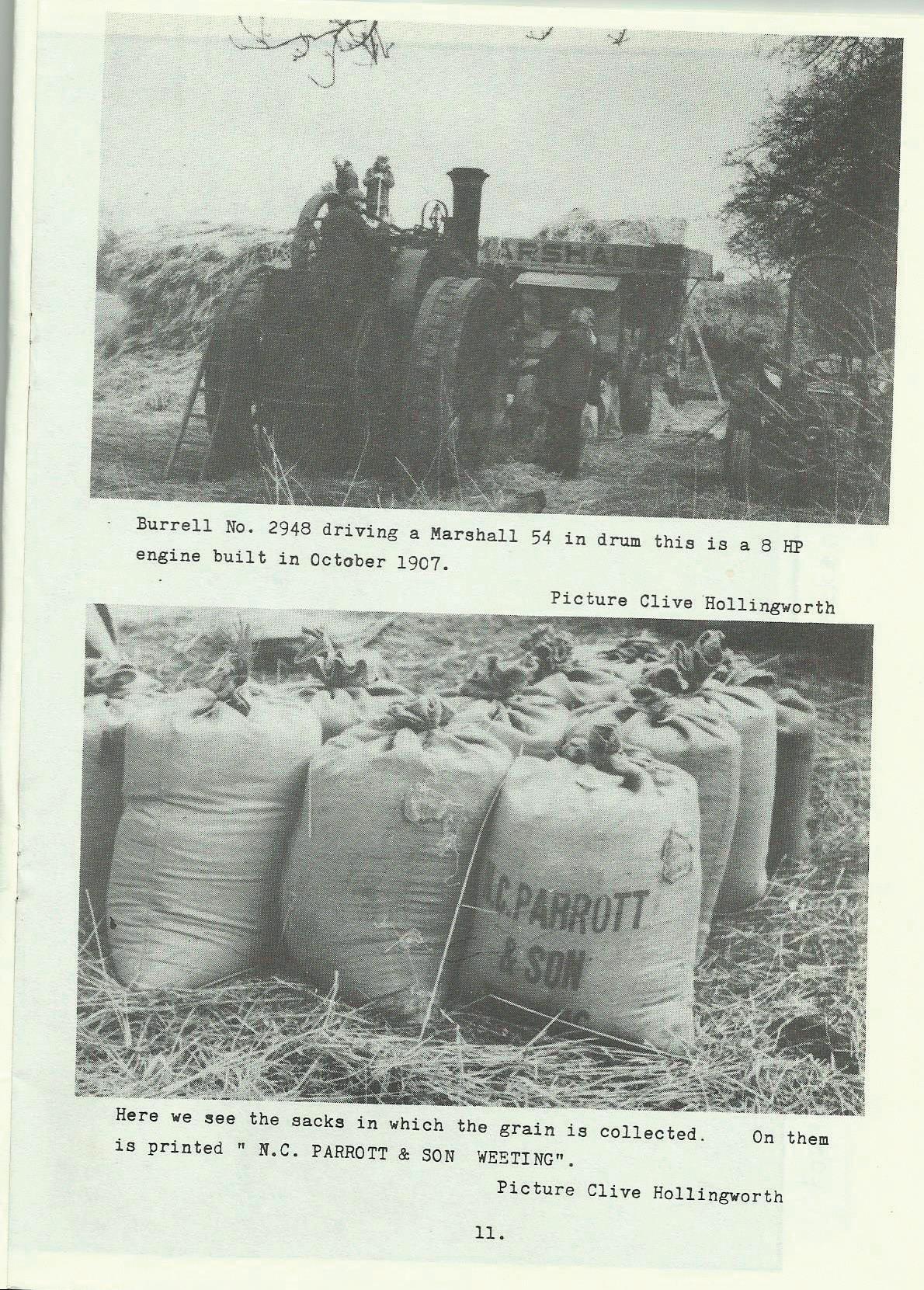
Here we ~ee the sacks in which the grain is collected. On them is printed "N.C. PARROTT& SON WEETING".
Picture Clive Hollingvorth
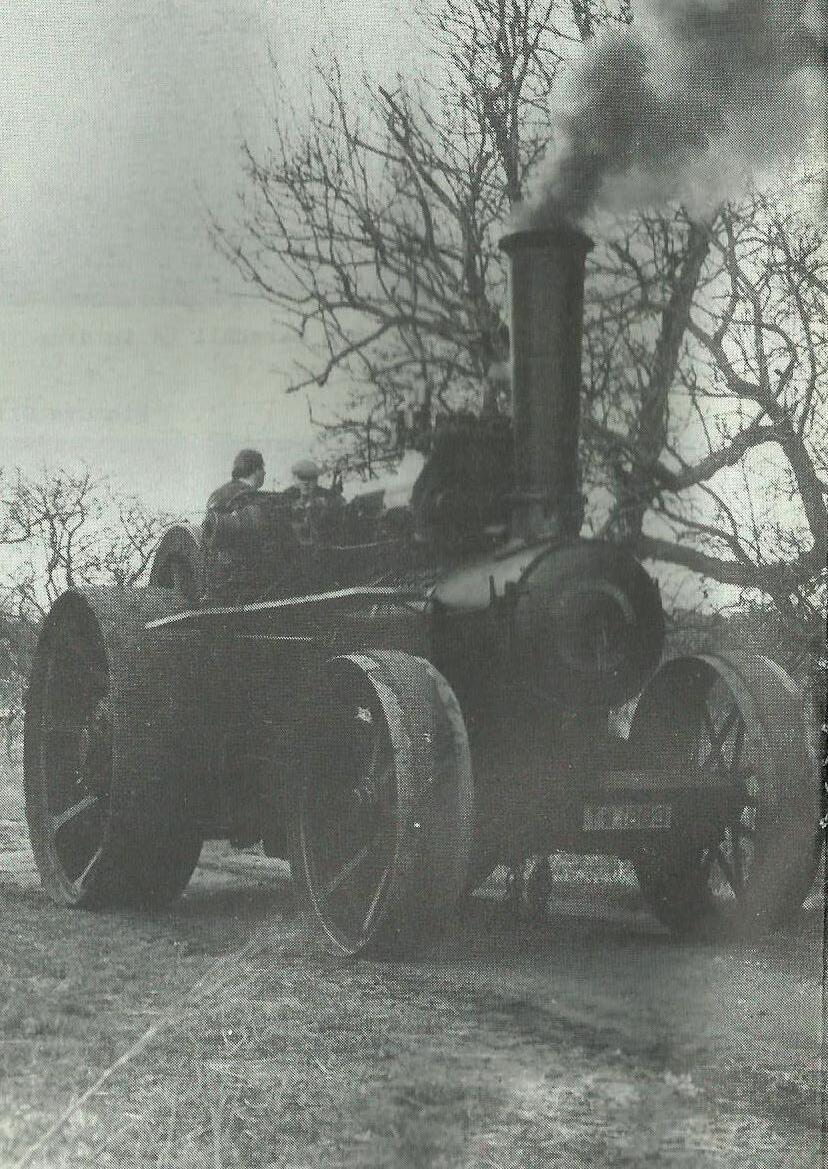
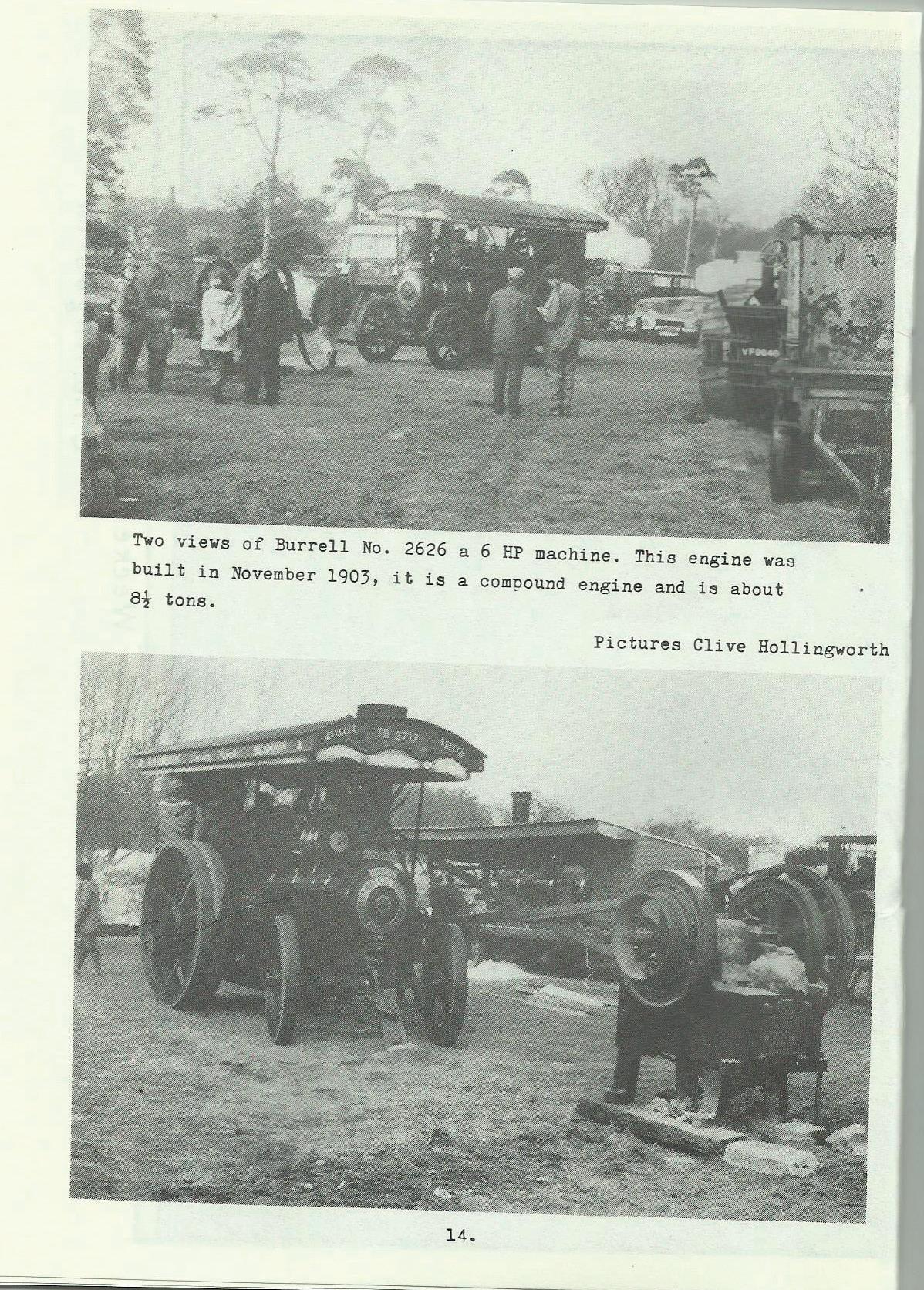
Two views of Burrell No. 2626 a 6 HP machine. This engine was built in November 1903, it is a compound engine and i~ about at tons.
Pictures Clive Hollingworth
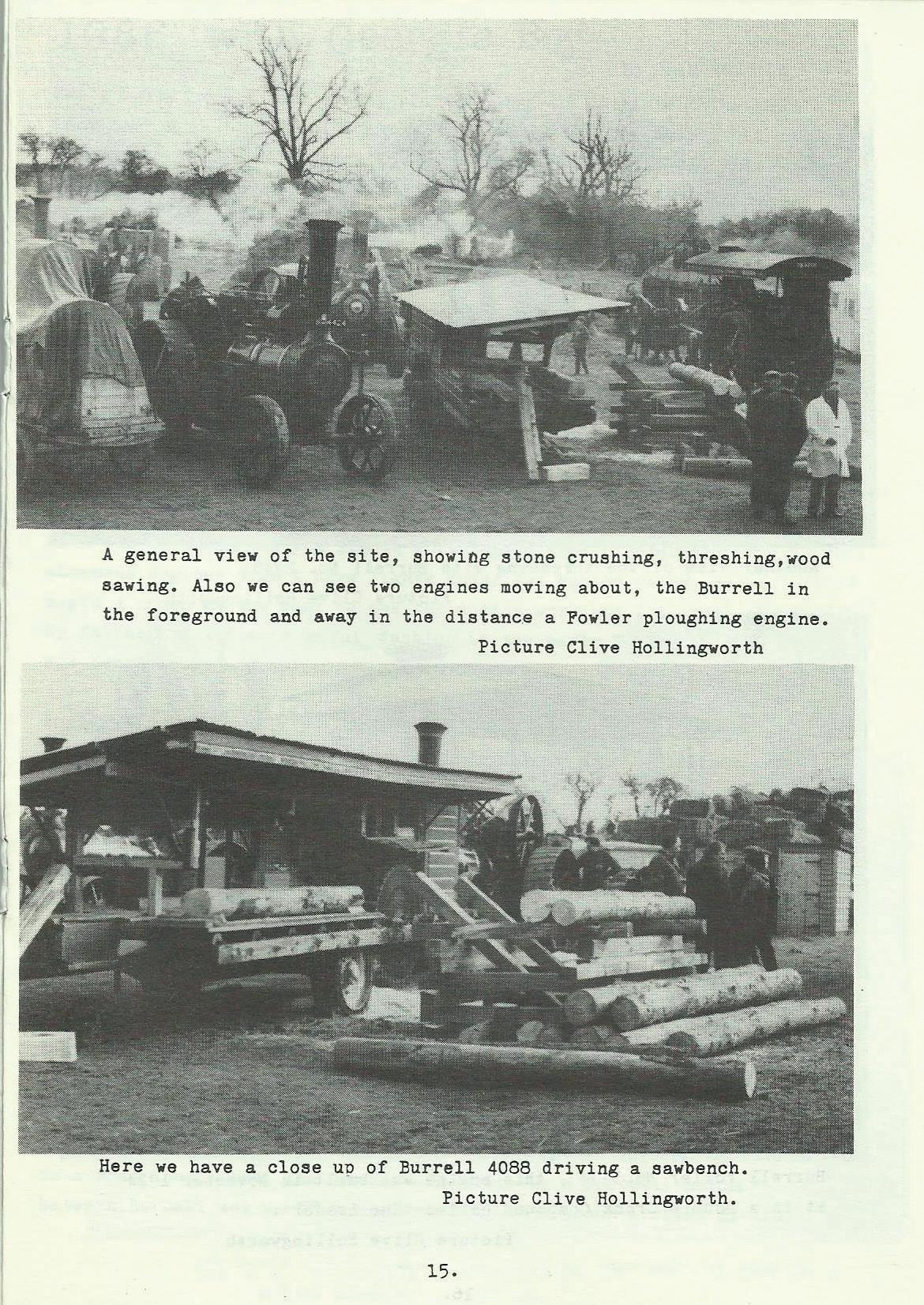
A general view of the site, showing stone crushing, threshing,wood sawing. Also we can see two engines moving about, the Burrell in the foreground and away in the distanc.e a Fowler ploughing engine.
Picture Clive Hollingworth
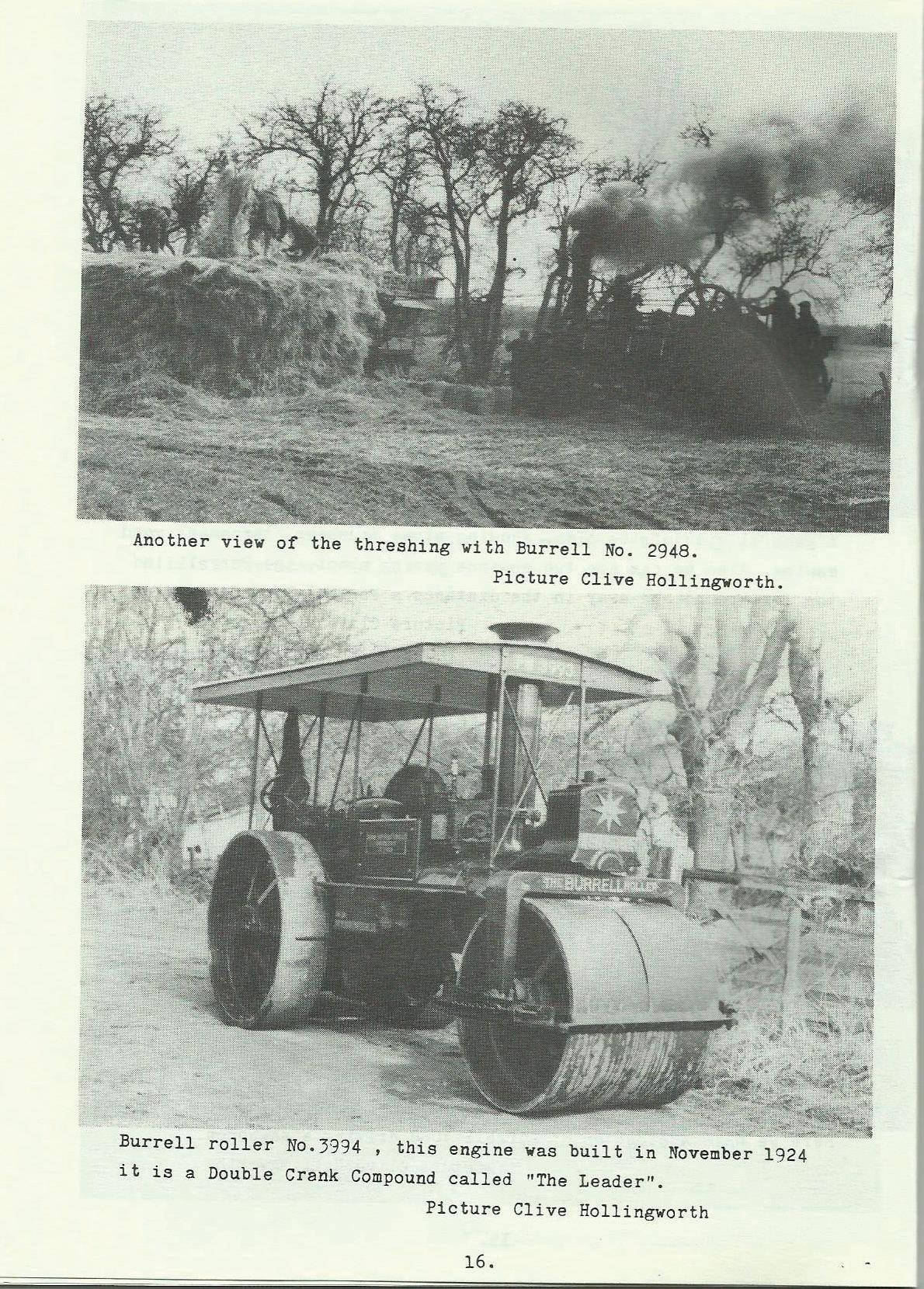
Here we have a close up of Burrell 4088 driving a sawbench.
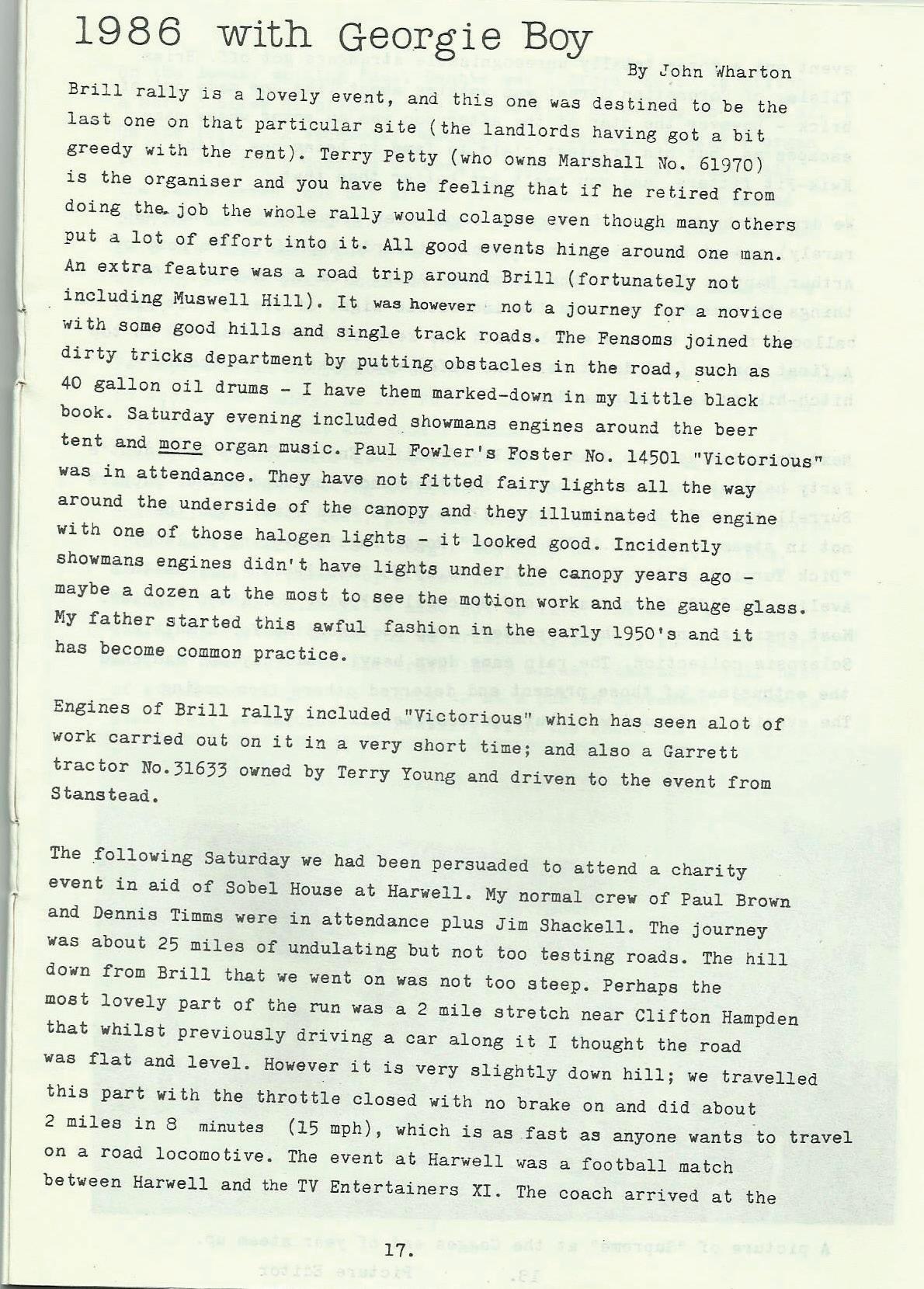
Another view of the threshing with Burrell No. 2948.
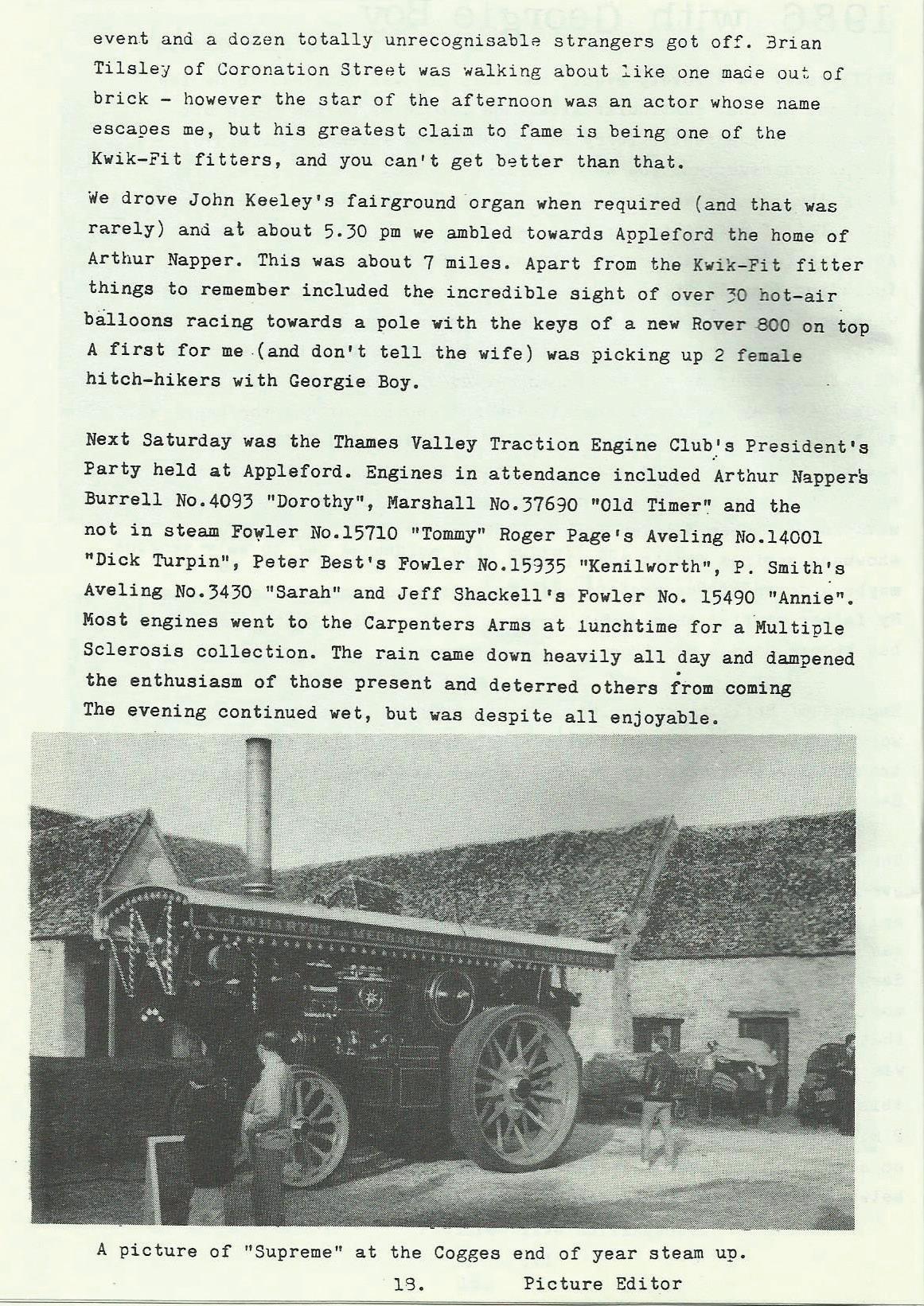
Burrell roller No.3994 this engine was built in November 1924 it is a Double Crank Compound called "The Leader".
By John Wharton
Brill rally ia a lovely event, and this one was dastined to be the last one on that particular site (the landlords having got a bit greedy with the rent). Terry Petty (who owns Marshall No. 61970) is the organiser and you have the feeling that if he retired from doing thL job the whole rally would colapae even though many others put a lot of effort into it. All good events hinge around one man. An extra feature was a road trip around Brill (fortunately not including Muswell Hill). It was however not a journey f~r a novice with some good hills and single track roads. The Fensoms joined the dirty tricks department by putting obstacles in the road, such as 40 gallon oil drums - I have them marked-down in my little black book. Saturday evening included_showmans engines around the beer tent and~ organ music. Paul Fo,,..ler's Foster No. 14501 "Victorious" was in attendance. They have not fitted fairy lights all the way around the underside of the canopy and they illuminated the engine with one of those halogen lights - it looked good. Incidently showmans engines didn't have lights under the canopy years agomaybe a dozen at the most to see the mo~ion work and the gauge glass. My father started this awful fashion in the early 1950' s and it has become common practice.
Engines of Brill rally included "Victorious" which has seen alot of work carried out on it in a very short time; and also a Garrett tractor No.31633 oyned by Terry Young and driven to the event from Stanstead.
The _following Saturday we had been persuaded to attend a charity event in aid of Sobel House at Harwell. My normal crew of Paul Brown f and Dennis Timms were in attendance plus Jim Shackell. The journey was about 25 miles of undulating but not too testing roads. The hill down from Brill that we went on was not too steep. Perhaps the most lovely part of the run was a 2 mile stretch near Clifton Hampden that whilst previously driving a car along it I thought the road was flat and level. However it is very slightly down hill; we travelled this part with the throttle closed with no brake on and did about 2 miles in 8 minutes (15 mph), which is as fast as anyone wants to travel on a road locomotive. The event at Harwell was a football match bet.,een Harwell and the TV Entertainers XI. The coach arrived at the
event and a dozen totally unrecognisable strangers got off. 3rian Tilsley of Coronation Street was walking about :ike one made out of brick - however the star of the afternoon was an actor whose name escapes me, but his greatest clai~ to fame is being one of the Kwik-Fit fitters, and you can't get b~tter than that.
We drove John Keeley's fairground ·organ when required (and that was rarely) and at about 5.30 pm we ambled towards Appleford the home of Arthur Napper. This was about 7 miles. Apart from the Kwik-Fit fitter things to remember included the incredible sight of over 30 hot-air balloons racing towards a pole with the keys of a new Rover 800 on top A first for me .(and don't tell the wife) was picking up 2 female hitch-hikers with Georgie Boy.
Next Saturday was the Thames Valley Traction Engine Club __ ' s President's Party held at Appleford. Engines in attendance included Arthur Nappers Burrell No. 4093 "Dorothy'', Marshall No. 37690 "Old Timer'~ and the not in steam Fo;'ler No.15710
"Tommyn Roger Page's Aveling No.14001
"Dick Turpin", Peter Best's Fowler No.15935 "Kenilworth", P. Smith's Aveling No.3430 "Sarah" and Jeff Shackell's Fowler No. 15490 "Annie". Most engines went to the Carpenters Arms at lunchtime for a Multiple Sclerosis collection. The rain came down heavily all day and dampened the enthusiasm of those present and deterred others from coming The evening continued wet, but was despite all enjoyable.
On the Sunday morning Paul, Dennis and I drove "KGVI" to Milton a mere 3 miles of pleasant flat roads with no events to s9eak of. On the following Wednesday "Georgie Boy" and John Keeley's organ were assisting a company celebrate their 10th anniversary. All the secretaries came out of the offices when the organ started playing and said how nice it was. 2 hours later one came out and said has that thing got a volume knob or even better an "off" switch? We ate small mouth sized snacks and then went home for a meal.
Perhaps the most enjoyable events of the year are the steam parties, no appearance money, no Joe Public asking nonsence questions, but plenty of steam chat and good friends. One such do was held at Goosey in Oxfordshire at the Pound. To get there we went the 12 miles in convoy, meeting at Milton. The Fowler rollers of Jeff Shackell and Peter Best, plus the Aveling of P.K.Smith disappeared into the distance whilst Georgie Boy only had 30 PSI of steam. We had stupidly parked by a tree and.that can affect the draught of the chimney. We also got up late. Patience not being one of my virtues at 50 PSI we criminally set off in bottom gear. Half an hour later we had travelled 3 miles, attained a full head of steam and caught the others up at a pub in Steventon. Burrells steam well on the road-especially with the smoke box door closed.
We stayed in convoy to Goosey, which was difficult· for KGVI as it • doesn't normaliy go that slow. The Pound is famous for its food. It is not one of those nouveau cuisine establishments ~here_small quantities of food are served up prettily for extortionate prices; infact quite the reverse. Huge portions are supplied for modest sums. They do a meal called an "All day breakfast'' which I experimented. It is served on an 18 inch diameter plate (I thought it was a tray). I am still unsure whether the all .day part of the description refers to the fact that it will last you all day and you won't need to eat another thing-or that fact that it takes you all day to eat it. Whilst eating this KGVI fire almost went out and had a hell of a game driving John Keeley's organ.
On Sunday morning Peter·Best took his Fowler back to its stable at Milton, whilst the rest of us drove the 12 miles back to Whitney. Yet another -weekend later and the last in a series.of 10 Paul, Dennis and I ventured with Georgie Boy to Charlbury Street Fair. This is a.glorified fete in the middle of a rural Cotswold town. John Keeley's Limonaire competed with a Scots pipe band; the organ finally won when the gov.enor belt on KGVI broke and a 3 minute tune lasted about 20· seconds. No harm done though. The ;event was formally opened by actor Michael Elphick who stars i.n the TV series Boon. He apparently plays the role of a good samaritan that thumps "baddies" and rides about on a motorcycle. I also had a motorbike on display at Charlbury, but he declined an offer to ride it due to his inexperience-apparently he had never personally o~ned a bike and had to have an intensive one week course for the "Boon" series. He has a voice that sounds as if he has swallowed gravel. We ventured back home. This particular route is arduous 10 miles of hills up and down.
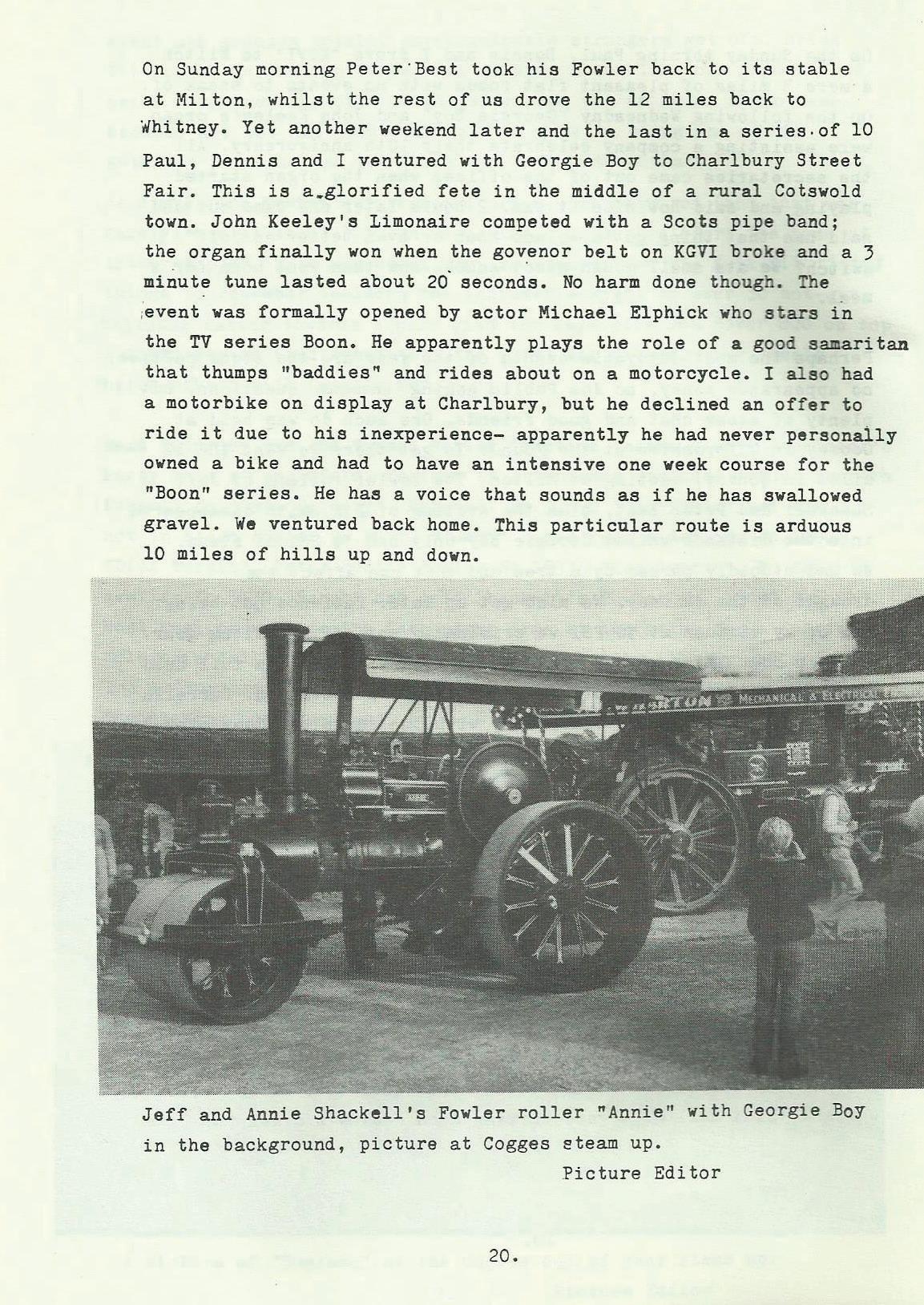
Picture Editor 20.
When I thought I was going to have a week-end off my father soon changed it. A local pub at Curbridge held a 'do' for Cancer Research. I did not take Georgie Boy-but father had caught his finger in a sliding door and was unsure whether he could drive "Supreme" (Fowler No. 20223) I obliged, but he was OK. Other engines on parade were Nigel Heaths Aveling No. 4872 and Jeff Shackells Fowler No. 15490. A so called bear called "George" promoting Hoffmeister lager paraded about. Unfortunately the fancy dress costume looked l%SS lik~ a bea~ tnan most teddy bears do and some visiting Americans when hearing the catch phrase "Follow the Bear" asked which one was the bear.
Jeff Shackell hires out grand pianos for concerts and had to deliver one the evening of the Curbridge shindig. He had the option of either taking his Fowler home early or asking me to return it.
Unfortunately he made the wrong decision and asked me. Now you get used to your own engine and I had not had much experience of this little Fowler roller. It is a T3 and has a tiny firebox. To fire up it is probably easier to get off the engine. Now to fire Georgie Boy you basically fill the firebox with coal until it starts falling out of the firehole onto the footplate. On this toy, more than 6 lumps of coal and it won't steam - it really likes a shallow fire. So you are firing every 30 seconds. The time came to go and the matchbox model had 150 PSI (It works at 200 PSI) so I fired up and assumed it would make steam -did it hell ! Apparently on smali engines you start with a full head of steam and maintain it - they cannot make steam whilst moving. With about 25 PSI and 100 yards to go we just reached home but the poor thing was incapable of moving itself; so we resolved the situation by pushing it by hand. No doubt some bright spark took pictures of this too. What a good job it wasn't a big one.
Near Whitney was a village called Cogges. Whitney is now a sprawling growing town and Cogges has become part of Whitney. At Cogges there was a quaint farm which has now been moulded into Cogges Farm Museum. It has pigs, sheep, chickens, horses and goats-but 21.
it doesn't smell like farms usually do. I believe they must spray the pigs with deodourant and 9ut Domestos in the stys. Apart from the animals they have many attractions over the summer season from "the wash day",baking bread and cakes, butter making, corn dolly making, blacksmith display, horse-shoeing, wheel making includi~g steel tyring, hurdle making and the high light of the year threshing and bailing, carried out thi~ year by Mike Thextons Ruston No.33471 and Pete Nichol's ·conversion. Pictures Editor.
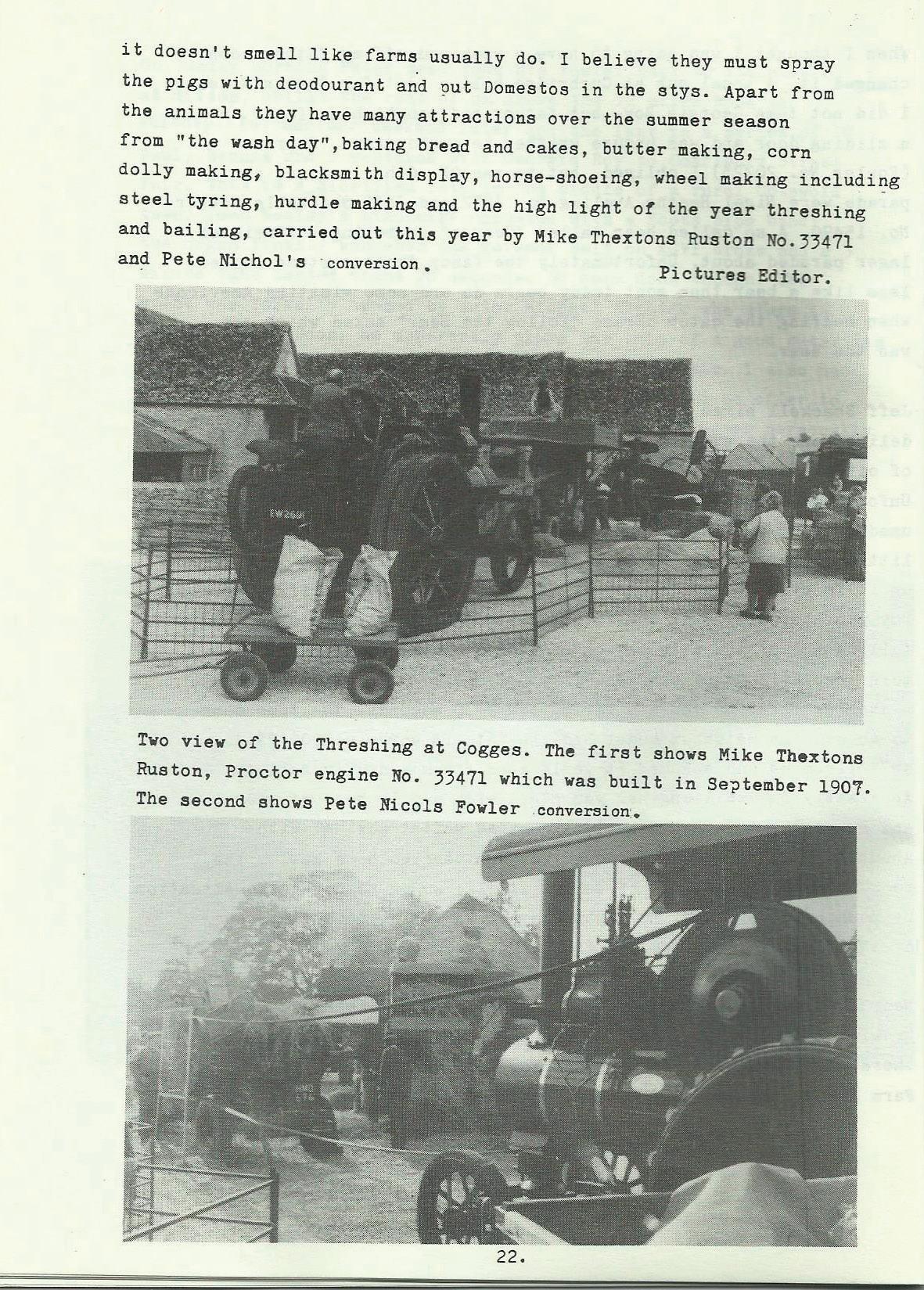
Two view of the Threshing at Cogges. The first shows Mike Thextons Ruston, Proctor engine No. 33471 which was built in September 1907. The second shows Pete Nicols Fowler .conversion:.
At the end of the museum season on the last weekend in October we close Cogges down in style by taking as many engines that still have water in them to the museum. Out of our yard rolled Jeff and Annie Shackell's Fowler No.15490, PK Smith's Aveling No.3430 Nigel Heaths Aveling No.4872 plus our "Supreme" and "Georgie Boy".
Halfway through the weekend I had to go and load moat of Aveling No.4463 onto a trailer. The roller required a new firebox and was stripped but stiil retained cylinder block and headstock. My forklift is only a 50001b machine and having lifted it; the rear steering went all light. People had to sit on the back to stop it tipping up. All was done without incident. The roller is owned by Pete Symes of Brill, and being repaired by Bill Hedges of Chatham Dockyard
On the Saturday evening Jeff and Annie Shackell treated many of us to a ride on their trailer behind their well illuminated Fowler (all done by electric). We visited a few hostelries to be sociable. This trip home parted afew curtains in the locality.
Mid-Sunday afternoon we all took engines back to the yard in an effort to beat the light. This alone was a sure sign of Winter.
That just about ended 1986 for Georgie Boy. My thanks to all my crews.
This Winters work is well mapped out. I have a Marshall Traction engine No.15391 which in 1987 will be 100 years old. The boiler had a hole in it so in early autumn it was despatched to Bill Hedges workehop. He did say publicly that I should have it back for the New Year - I must admit though - he didn't say which new year!