ADDR.ESSES
The Chairman, Sylvia Dudley, 42 Russell Street, Woburn Sands, Bucks. MKl7 8NX
Membership Secretary, David Duffill, 191 Poden Road, Great Barr, Birmingham B42 2EH
The Editor, Richard Hurley, 2 Reaburn Close, Cheltenham, Glos. GL52 6NL
As a national club, it is very difficult to get any fac~ to face contact between our members, because of the distances involved.
Because of this we have decided to try to form local groups which could meet at rallies, organise social meetings, film shows etc.
We are in the process of writing to members to try to get this together, bµt we would welcome any ideas you have regarding these groups.
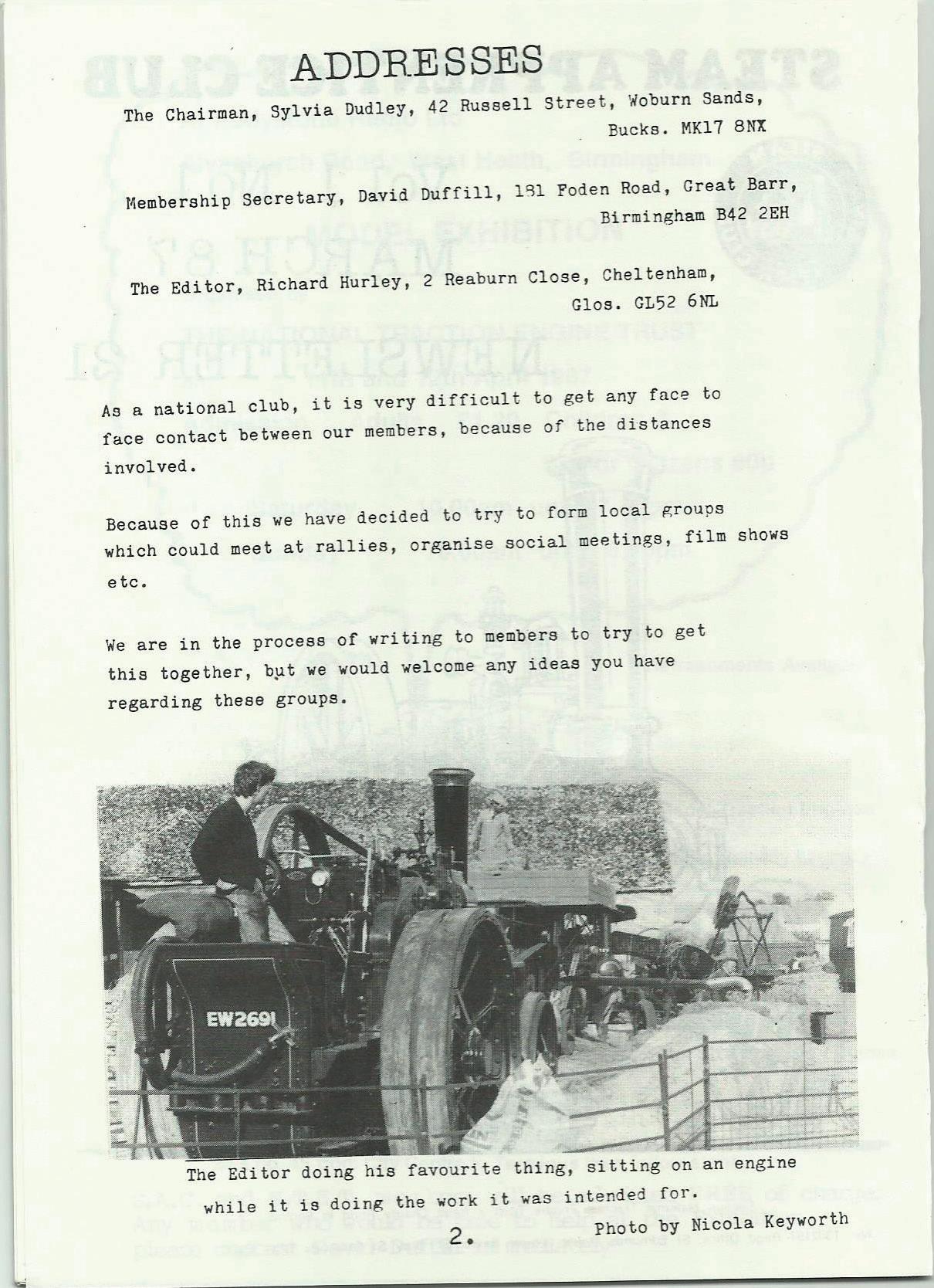
The Editor doing his favourite thing, sitting on an engine while it is doing the work it was intended for.
Photo by Nicola Keyworth
EDITORIAL ...
As you can see the Steam Aporentice Club has come of aRe. It is our 21 st newoletter, and the $tart of a new year so we have improved our quantity and quality.
We now have 24 paees, instead of our old 9; so this means that I hav~ to do three times the work, which I don't mind, but also means I need three times the amount of articles. So come on get pen to paper anrl start writing • At this point I must thank Tyrone James for all the articles ne has sent me.
Our newsletter, because of its increase in size is now longer than the Steam Plough Club Times and two thirds the length of the Road Locomotive Society Journal. But alas we are nowhere near the length of Steaming.
Normally the new year period is a quiet one for me with respect to traction engines; but this year due to television I must say it was quite different.
My first encounter happened one evening when I was getting ready to go out. All at once I heard screams from my parents to come down to watch the T.V. In fact it was "AJ.lo" "Allo" featuring quite a number of traction eneines. My favourite bit was where the steam roller was supposed to have flattened the German staff car.
The next appearafice was on New Years Day when the majority of tae country was recovering from the night nefore, the several thousand traction engine enthusiasts and a few who had had enough of watching Mary Poppins watched one of the best programmes on our hobby I have ever seen, of course it was the programme on the Great Working of Steam ~ngines at Stourpaine Bushes. Full marks to the production team.
And so to the new year I hope all your rallien P-O well and I hope to meet some of you this year. While on en~ines try not to drive like Mark Curry off Blue Peter, ie don't drive into any walls.
1986 with Georgie Boy
By John Nharton
With steam engine events going on later in the year, right up to Christmas and even the New Year, and with events being held at Easter, and in the Winter; that was at one time the period for preservation, is now very short and there barely seems time to wash out your boiler. As a result of this with our Burrell 3489 (1913)"King George VI" we decided to cut out some of the Spring events in 1986 to enable some maintainence.
A couple of years ago ~e manufactured a new froftt axle, after witnessing four broken front axles on other peoples engines. We presumed that the small defects in manufacture had developed into fractures, and a heavy shock could break tne axle. Unfortunately on King George VI after fitting, the cast iron bushes partially seized on the axle (because the ~rease didn't f-et where it ought to have been). This ruled out my road trips for over a year. In April 1996 however we decided if we were to enjoy the engine, road trips were compulsory; so we rectified this by making a new wheel bush and regrinding one end of the axle. Fortu~ately we have the machinery that is big enou~h to deal with a front axleand the task did not seem too big a deal.
The first rally we attended was Banbury at Hopcrofts Holt. The distance from home is about 16 miles and it seemed to take an age as we struggled to remember how to irive an enPine afain an~ stopped every two miles to check the front axle. For me the star of the show was Ted Freemans newly acoui red Burrel 1 No. ]395 ••The Dalesman" I first saw this engine in 1970 when ow~ed by John Crowther who carried out the remarkable restoration. Tt is reputed that Mr. Crowther used to wear his carpet slippers on the immaculately clean engine and have his coal prepacked in little bags to avoid coal dust on the engine. The gears were all renewed and it is consequently (alone; with 4og3 "Dorothy") one of the nuietest Burrells existinR. I spent the weekend at Banbury to get King GeorP,e VI as far away as possible from The Dalesman as my ge3rinR is noisy and I know it.
I make no bones about it - I don't like orRan music. Unfortunately if you have a showmans engine you are freouently put near or~ans, and some are simply awful. At Banbury King GeorRe was shackled to John Keeleys fairground organ that was having a good weekend and playing quite well.
Photo by Colin Hatch
Because we were still auite wary about our front axle, instead of thrashing home on the Sunday night we souP.ht u local haven for a week. I was told to pop it down to Rousham Park about a mile away.I had been to Rousham before but not on this road. As the directions given did not have any particular words of warning we set off in top gear and descended down this hill that initially looked gentle. However it changed its character it got steeper and we started to make good time. At the end of the hill we were supposed to turn rieht, but there was a car coming in the opposite direction; we couldn't stop so we had an extra look at the beautiful countryside before we reversed up (with trailer) and made a Recond attempt at turning rirht. It was well over a mile from the rally field to Rousham probably nearer 3, Coal bein~ like gold to the engineman, you don't put it in the firebo~ unless you are F-Oing to burn it; and assaming a one mile trip we comnleted our journey with 50 pounds of steam (we normally like 200).
Another of the Wharton's engines "Supreme·• the Fowler Showmans
The following weekend we steamed home. The trip was so good and uneventful it almost fell int-o the category of "boring".
The next tnree rallies we went to via the bath chair(low loader ) Unfortunately you have to earn a living some time so yo~ have the option of not going at all to a rally or Roing by lorry. The first was Malvern rally which was relocated from Much Marcle. The site was beautiful and on the Saturday night seein~ the showmans lined up with the back-drop of the Malvern Hills, lookinp. like an Austrian village was a sight to remember. An engine new to me was Fowler. "Titan" who was previously "The Dalesmans'' stable mate. This impressive workmanlike road loco has wooden blocks on the rear wheels. Malvern was the first weekend of a series of ten consecutive weekend events for us.
The next weekend we went to the Brintol Dock Rally, held in conjuntion with Bristol Regatta. I am generally gettin8 tired of steam en~ine rallies and doing the same thinR every year. Most rallies seem to be one big parade, and by the time everyone has circled the ring with steam engines; cars, lorries, motor bikes and tractors the day has gone by. Lip service is paid to the demonstrations with sawing displays and putting straw through threshing machines. Bristol was totally different, a tiny site on a ~ock side, with water sports and displays going on in the dock all weekend. All engines are invited to take oart in a road run (not just the Sentinels and geared up Fodens). The atmosphere is good, pranks are rife and as Bob Garnett (the rally secretary) will tell you, you cannot even leave your caravan unattended. The best riot since St.Pauls.
Engines t.ha t caught my eye were the two Fowler road locos of Richard Willcox and Nigel Massam (Monty). Both very different, fast and pretty. Whilst on the dockside King George VI broke through the concrete in a deep hole; climbed out OK though. Onto Knowl Hill, and the pinnacle of the event is probably the Saturday night with live music, showmans engines dotted on the horizon, fireworks and thousands of people. Stars of the show were probably the Irish 1918 Ransomes, Sims and Jefferies traction en~ine still in its original paint that came to the present owner Mr. Mick Smith via David Hurst; and the immaculate Burrell showmans engine No. 3909 Winston Churchill from the Hardwich stable that had not been exhibited for over six years.
And so to our tour by road, commencing with Fairford. Readers of the Worlds Fair will have seen "Georgie Boy'' in a rather embarrassing predicament, in the ditch. I give no thanks at all to Mr. Sidney Cato for advertising my moment of misfortune. From our yard at Minster Lovell to Fairford is about a distance of 18 miles, and the incident happened about a mile from Fairford. I can claim to have been taking a short cut, or finding the nearest parking space ~o the centre of Fairford, but it came down to steersman error and I am responsible (as the driver), for not stopping in time. My brother-in-law was steering and he is a novice. ~e is ·basically a talented steersman (a natural) but instead of being about a foot away from the curb, he was about six inches away, giving himself no latitude and when he hit the soft verge it just took the steering wheel out of his hand as it span around. My thanks to those who helped pull the engine out. I now know how the Royal Family feel towards photographers. Alf Pepoer the Shoo Supervisor at John Fowlers once said,"Engines don't go in the ditch; they are driven there.'' One hour after the picture was taken "Georgie Boy" was generating outside the Eight Bells at Fairford. Total damagepaint rubbed off the offside front lamp bracket. After this incident the rest of Fairford rally fell into insignificance for me. Engine of the rally Sentinel S4 ( number unrecorded but painted green, carrying the name Brown).
Peter Beat was doing a sponsored run for Multiple Sclerosis with his Fowler roller No.15935 "Kenilworth", travelling the 62 miles from Fairford to Kenilworth. It was "King George's" task to be with an organ (initially Dave Plant's street organ, and later John Keeley's fairground organ), and collect funds in the street at various towns en route. On Sunday night of the fairford rally we left early and went to our first collection point Lechlade. On Monday 11:00 am to 2:00 pm we stopped at Burford. The Fowler didn't like Burford hill. With both driving pins in and the brake hard on the near roll started skidding as it came into contact with double yellow lines. A block was thrown in the.front of the roll to try to atop the engine, but it just pushed the block forward for about 20 feet before the Fowler finally halted, a quick change of underwear and the descent was finally conquered.
On Monday night we collected at Stow-on-the-Wold in the square. The manager of a high class hotel was so impressed by the work we were doing, he provided us all with a meal and a drink. Considering there were 9 of us, that was a hell of a gesture.
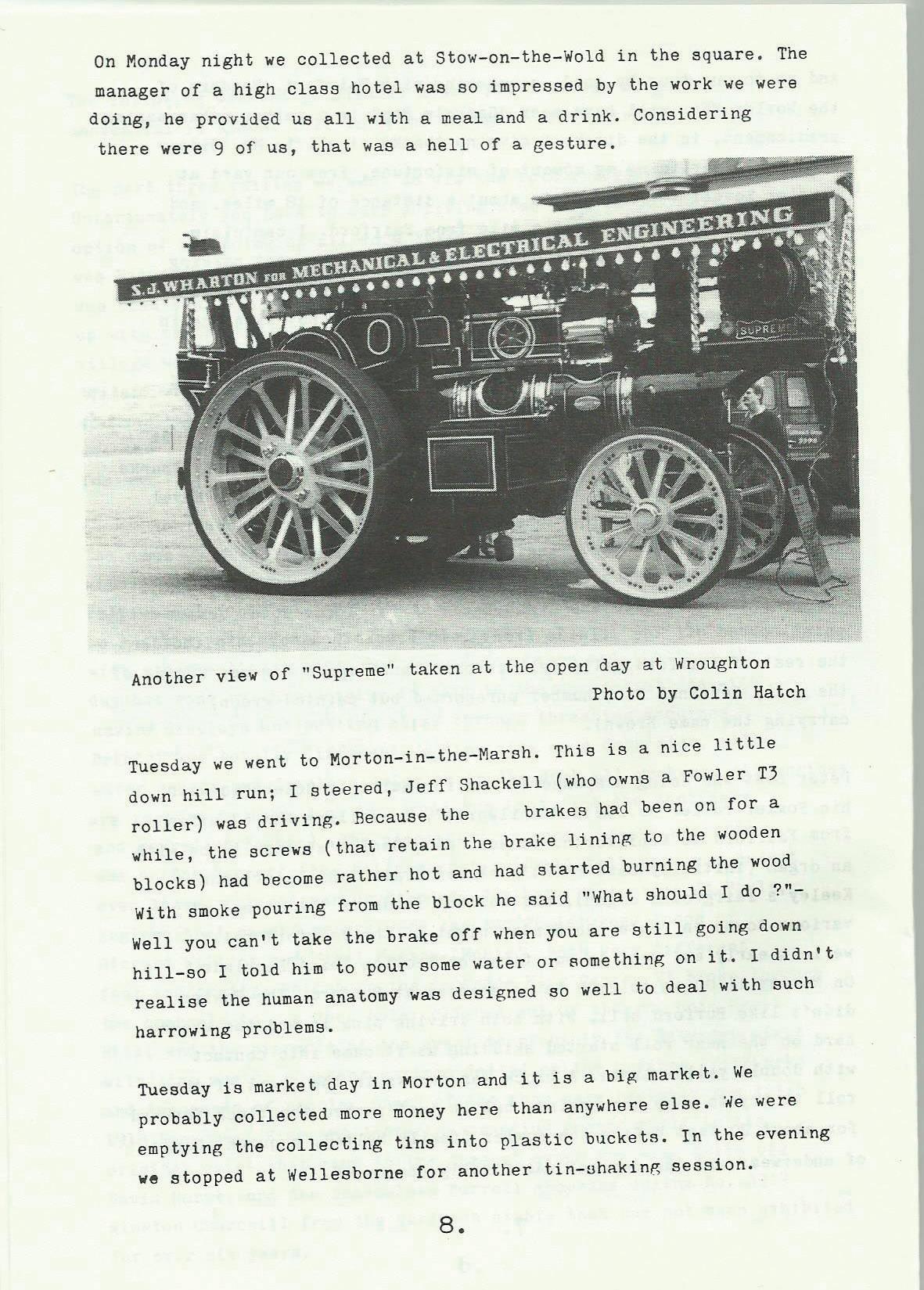
Another view of "Supreme" taken at the open day at Wroughton
Tuesday we went to Morton-in-the-Marsh. This is a nice little down hill run; I steered, Jeff Shackell (who owns a Fowler T3 roller) was driving. Because the brakes had been on for a while, the screws (that retain the brake lininR to the wooden blocks) had become rather hot and had started burning the wood With smoke pouring from the block he said ''What should I do?"Well you can't take the brake off when you are still going down hill-so I told him to pour some water or Bomething on it. I didn't realise the human anatomy was designed so well to deal with such harrowing problems.
Tuesday is market day in Morton and it is a bi~ market. We probably collected more money here than anywhere else. ~e were emptying the collecting tins into plastic buckets. In the evening we stopped at Welleaborne for another tin-uhakinf, session.
Photo by Colin Hatch
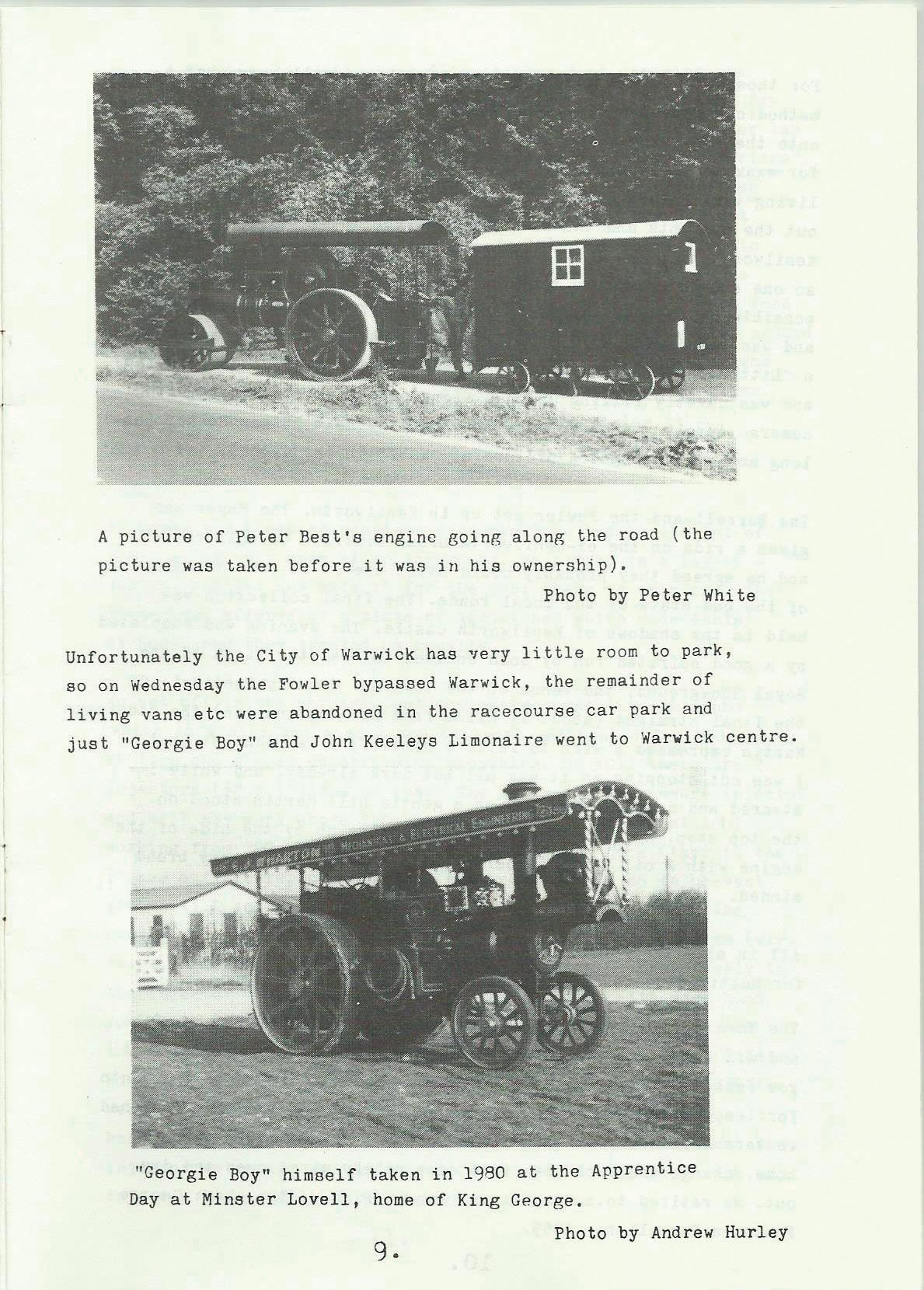
A picture of Peter Best'a engine Boing along the road (the picture was taken before it waR in his ownership).
Unfortunately the City of Warwick has very little room to park, so on Wednesday the Fowler bypassed Warwick, the remainder of living vans etc were abandoned in tha racecourse car park and just "Georgie Boy" and John Keeleys Limonaire went to Warwick centre.
Photo by Peter White
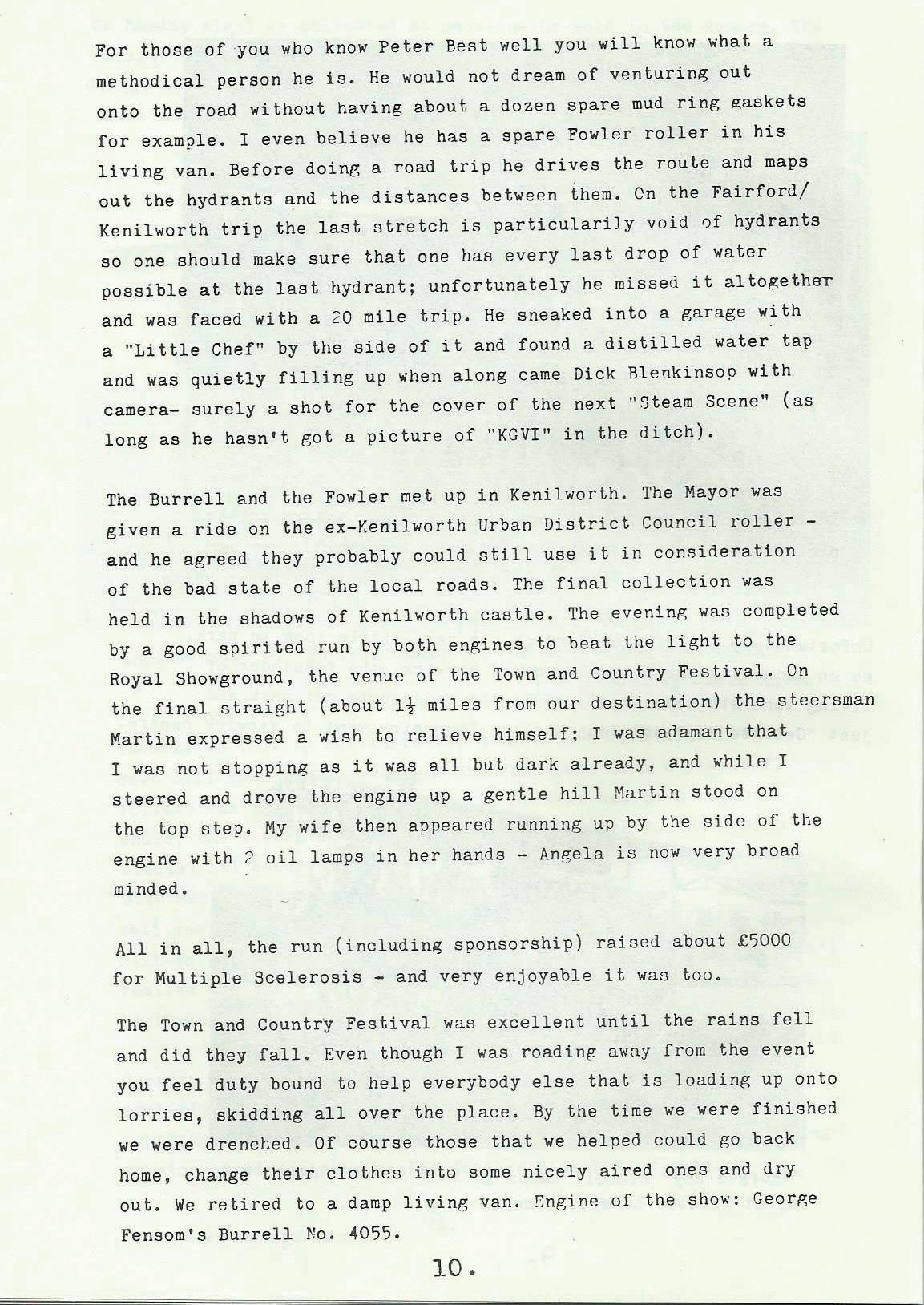
"Georgie Boy" himself taken in 1980 at the Apprentice Day at Minster Lovell, home of King George.
Photo by Andrew Hurley
For those of you who know Peter Best well you will know what a methodical person he is. He would not dream of venturin~ out onto the road without having about a dozen spare mud ring ~askets for example. I even believe he h~s a spare Fowler roller in his living van. Before doing a road trip he drives the route and maps out the hydrants and the distances between them. Cn the Fairford/ Kenilworth trip the last stretch is particularily void 0f hydrants so one should make sure that one has every last drop of water possible at the last hydrant; unfortunately he missed it alto~etheT and was faced with a 20 mile trip. He sneaked into a garage with a ''Little Chef" by the side of it and found a distilled water tap and was quietly filling up when along came Dick Ble~kinsop with camera- surely a shot for the cover of the next "Steam Scene" (as long as he hasn't got a picture of "KGV1" in the ditch).
The Burrell and the Fowler met up in Kenilworth. The Mayor was given a ride on the ex-Kenilworth Urban District Council rollerand he agreed they probably could still use it in con8i<leration of the bad state of the local roads. The final collection was held in the shadows of Kenilworth castle. The evening was completed by a good spirited run by both engines to beat the light to the Royal Showground, the venue of the Town and Country Festival. On the final straight (about l½ miles from our destination) the steersman Martin expressed a wish to relieve himself; I was adamant that I was not stoppin~ as it was all but dark already, and while I steered and drove the engine up a gentle hill Martin stood on the top step. My wife then appeared running up by the side of the engine with? oil lamps in her hands - An~ela is now very broad minded.
All in all, the run (includin~ sponsorship) raised about £5000 for Multiple Scelerosis - and very enjoyable it was too.
The Town and Country Festival was excellent until the rains fell and did they fall. Even though I was roadinf awny from the event you feel duty bound to help everybody else that is loading up onto lorries, skidding all over the place. By the time we were finished we were drenched. Of course those that we helped could go back home, change their clothes into some nicely aired ones and dry out. We retired to a damp living van. ~ngine of the show: George Fensom's Burrell No. 4055.
The next morning we lit up at 6.00; Ashley Bond steering, me driving we set off at 8.00 am, heading for Brill. The first few miles went well, and we repeated Peter Best's distilled water tap trick whilst we devoured a couple of Little Chef "early starters"~ Ashley is a big man and eating ranks highly in the priorities of any day. As we ambled towards Banbury Georgie Boy was not steaming well - unfortunately the only thine we could find to blame was the coal from the Town and Country Festival. As we struggled into Banbury on abcut 100 psi we stopped for more food (fish and chips) and picked up more water. As Ashley walked around the front of the engine he noticed that the smoke-box door was open -which was of course the cause of our steaming problems. We found a road in Banbury with over 50 hydrants in itone every 10 yards, we were like dogs i~ a forest.
Although our steaming problems were over, we had lost a lot of time, so we only made it to Adderbury. We parked in a lay-bywashed, changed and made it for the pub; there is only one. The darts team offered us a plate of sandwiches which made Ashley at home, and they treated us royally.
We set off in the morning, not too early, went through Aynho (which is a hill and a eood one to beat) and headed for Bicester. We then had a most embarrassing happening. On KGVI there are 2 injectors(¾" & l") and no pump. The l" is.a low pressure injector and will not work above 120 psi. The{" is an excellent tool working from 200 psi right down to 30 psi. The cock (tap) to the ¾11 has a fibre replacement seat and had grooved, so to prevent steam still going to the injector you had to really turn the cock tight. No fault of Ashley-but I told him to give it an extra twist, and the threads stripped allowing steam to flow freely to the injector - whoops. By pressing the tap down with your hand you could stem the flow - but naturally you can't do that all the time. We hunted in the hedgerows for a bit of didgrow (that's wood -it did grow once), whittled it to lenght and was able to wedge it between the top of the cock and the flange on the backhead - stopping the flow of steam. When we wanted to use the injector we merely knocked the wood out. We couldn't use the l" injector because we had about 130 psi of steam, 11.
We motored on through Bicester and then departed from civilisation towards Brill on the single track roads. If Aynho is built on a hill, Brill is built on a mountain and approaching it from the north is like ascending Everest. We stopped to ensure we had a full glass of water and 200 psi before our attempt. A local farmer came along and said "You're not goinB up there are you?" "Yup" came my reply. "Do you know how steep that hill is ?" "I dare say I shall do when I get to the top" I retorted. "Best of luck" was his farewell gesture. This put the wind up me - but I kept telling myself that steam rollers must have rolled the road originally and our rubber tyres can grip the road better. Ashley hadn't heard the conversation and so was not conscious of the dangers nor of my nervous bowel. As we climbed the mountain known as Muswell Hill the canopy of the engine seemed about 45° from level, Ashley was commenting on the tremendous view. We finally made it - that's the steepest one I have been upand surely wouldn't want to come down it - it went on forever steep all the way. We then had to go down a hill before goinP, up again via Windmill Hill to Brill and a pub called the Pheasant. Whilst I unfolded my fears of Muswell Hill to Ashley over a pint we came to the conclusion that they must have rolled it with about· 6 rollers and the County Surveyors brother-in-law probably at that time had a scrap-yard at the bottom. You can imagine it, tie up the steering and "OK we're ready, send the next one down" and as it went down at 30 mph the scrap-yard gaten were opened just in time for the roller to craGh into a heap of twisted metal. No wonder more of them didn't make it into preservation.
We parked up in the Brill rally field, drained the steam (that takes longer than you would think) removed the offending cock and went home -feeling like gladiators.
Museum
Report (SAC 1270)
By Cameron Sutherland
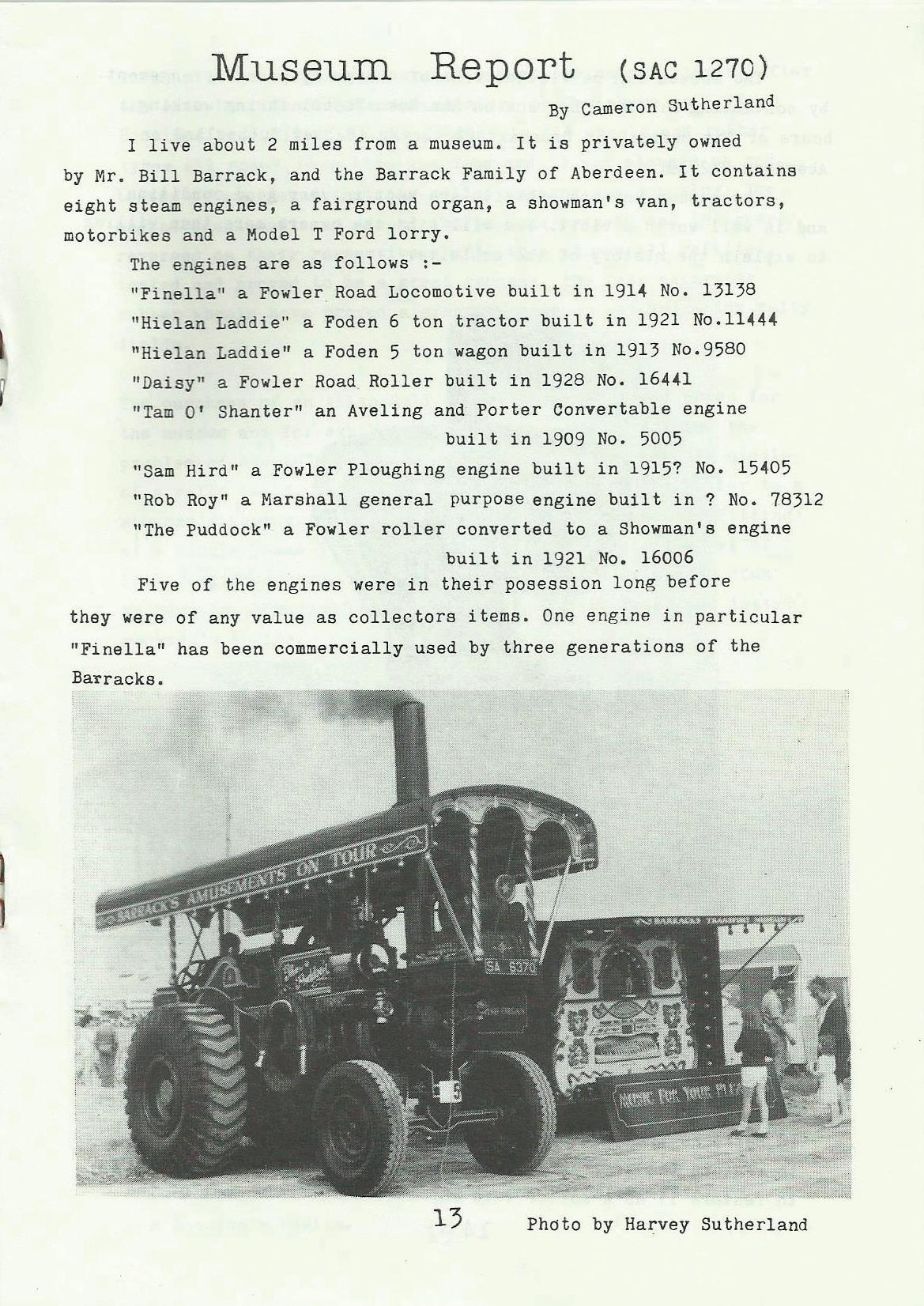
I live about 2 miles from a museum. It is privately owned by Mr. Bill Barrack, and the Barrack Family of Aberdeen. It contains eight steam engines, a fairground organ, a showman's van, tractors, motorbikes and a Model T Ford lorry.
The engines are as follows :-
11Finella 11 a Fowler Road Locomotive built in 1914 No. 13138
"Hielan Laddie" a Foden 6 ton tractor built in 1921 No.11444
"Hielan Laddie" a Faden 5 ton wagon built in 1913 No.9580
"Daisyn a Fowler Road Roller built in 1928 No. 16441
"Tam O' Shanter" an Aveling and Porter Convertable engine built in 1909 No. 5005
"Sam Hird" a Fowler Ploughing engine built in 1915? No. 15405
"Rob Roy" a Marshall general purpose engine built in ? No. 78312
"The Puddock" a Fowler roller converted to a Showman's engine built in 1921 No. 16006
Five of the engines were in their posession long before they were of any value as collectors items. One engine in particular "Finella" has been commercially used by three generations of the Ba-rracks.
Phdto by Harvey Sutherland
The museum can be visited free of charge by prior arrangement. by contacting Mr. Bill Barrack on Aberdeen 703601 during working hours or Sam Barrack on Drumoak 262, or Mr. Harvey Sutherland on Aberdeen 742939.
The museum and its exhibits are kept in very good condition and is well worth a visit. You will find the owners more than willing to explain the history of the exhibits.
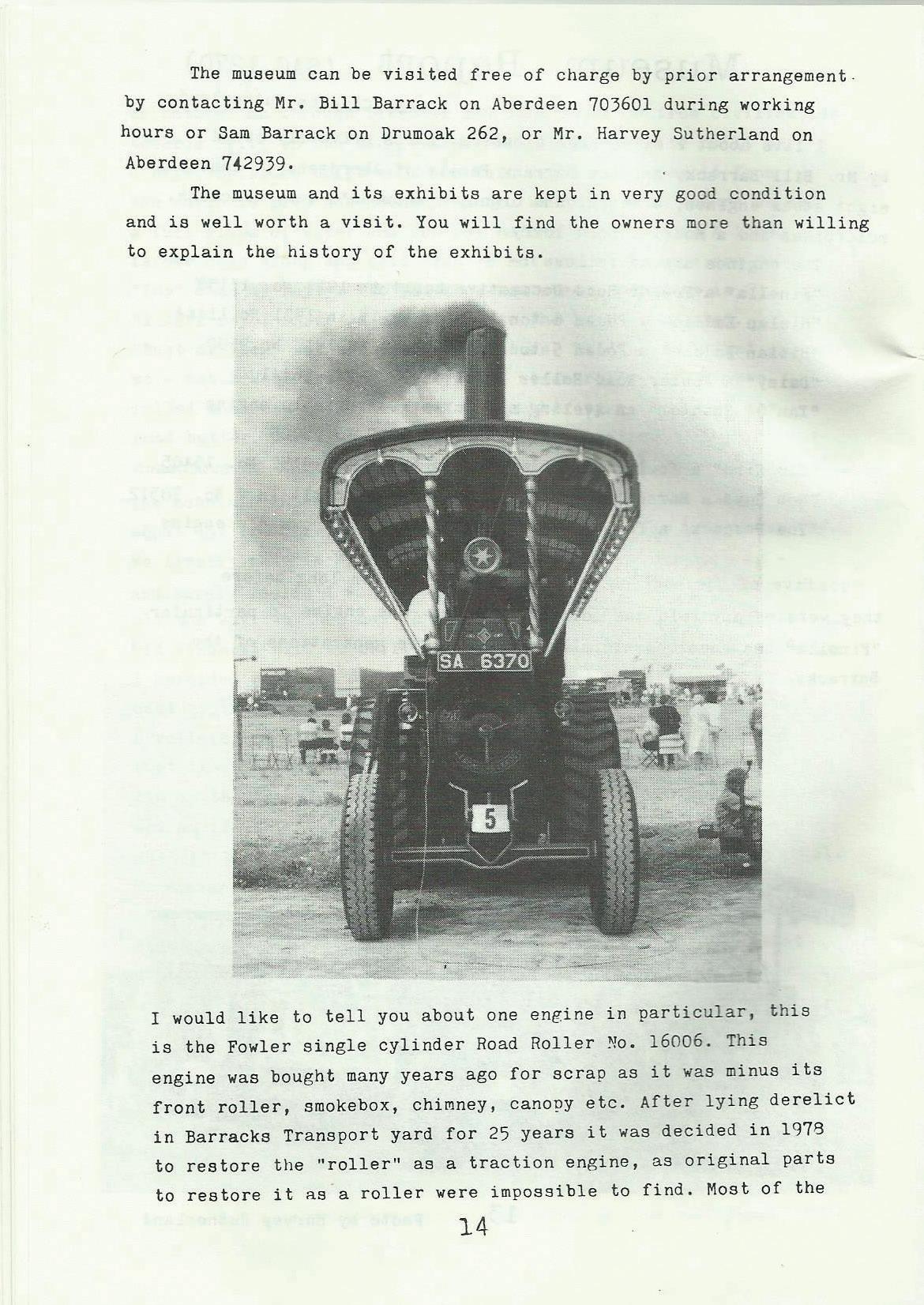
I would like to tell you about one engine in particular, this is the Fowler single cylinder Road Roller No. 16006. This engine was bought many years ago for scrap as it was minus its front roller, smokebox, chimney, canopy etc. After lying derelict in Barracks Transport yard for 25 years it was decided in 1978 to restore the ttroller'' as a traction engine, as original parts to restore it as a roller were impossible to find. Most of the
work and fabrication was carried out at the museum itself. After the smokebox, front axle and chimney, or Cum as we call it in Scotland were fitted it was decided to fit wheels and rubber tyres all round. Once this was done and it was steamed up and tested it was found that the roller gearing was too slow. The engine crankshaft and second shafts were removed and the gears reversed on their respective shafts then it was all refitted, tested and proved to be a great success. The rear excavator rubber wheels have proved a great success on wet and muddy rally fields.
The purchase of an Allan Pell 48 keyless fairground organ for the museum and for exhibiting at rallies then presented the problem of how to supply the power for the organ in the middle of a rally field. The solution - futher convert the Fowler to a showman's engine. So with another years hard work, the fitting of a single phase 3 KW240 v Startomatic generator, a set of Pickering governors, a full lenght canopy and extension "Cum" we have the "Puddock" as it is today. A fully tried and tested showman's engine.
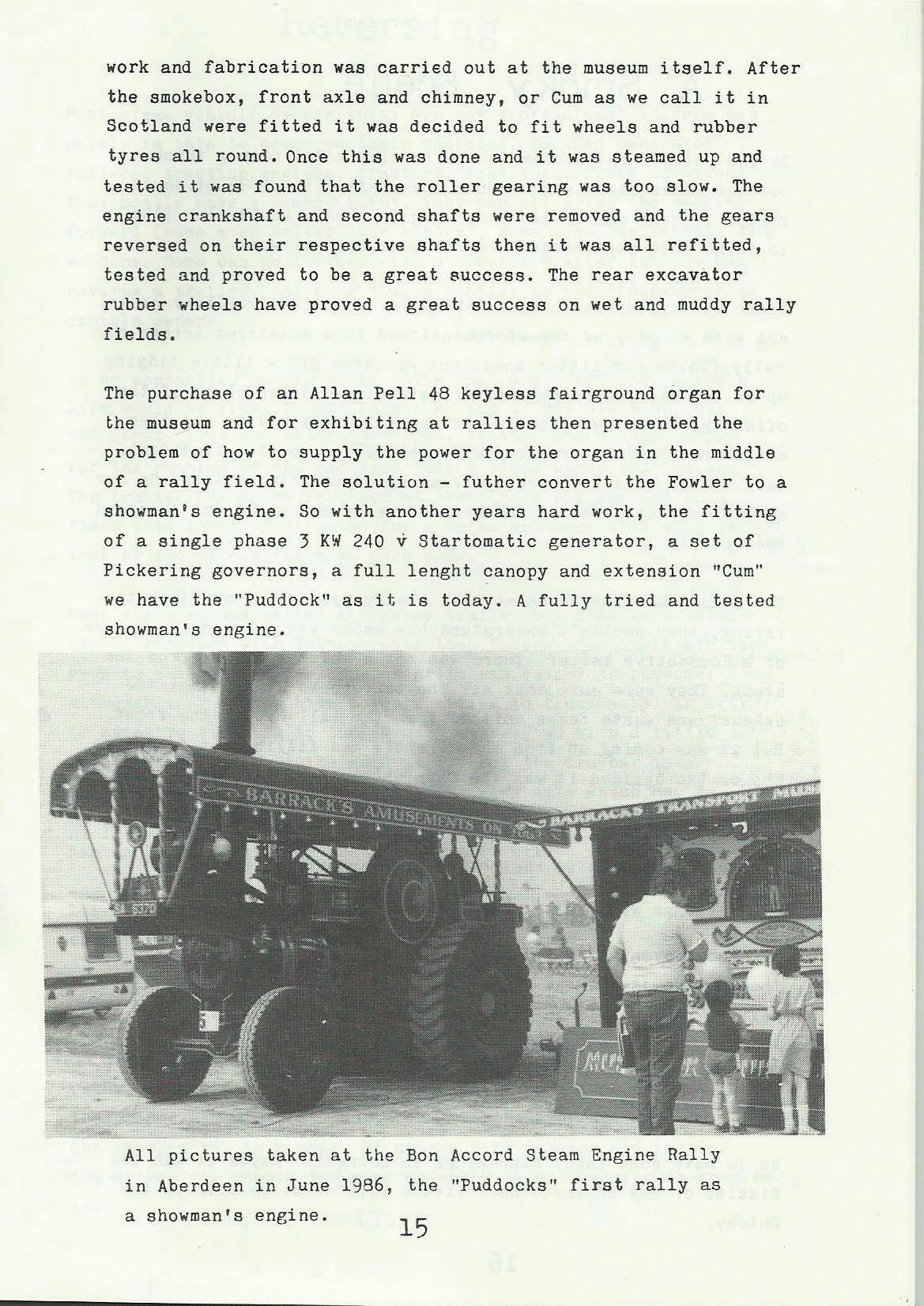
All pictures taken at the Bon Accord Steam Engine Rally in Aberdeen in June 1986, the "Puddocks" first rally as a showman's engine.
A Smoky Scene
Do you believe in phantoms or polter~iests? I rather think a certain Faden steam waeon owner does, after the 1136 St.Agnes rally. I think one or two other en~ine owners would also like to think that supernatural forces have been at work.
These certain spooks have a liking for plastic fertilizP.r sacks; and with so many of the aforementioned item scattered across our rally fields our litter conscious sp~ctrea did a little tidying up on the Saturday night. After gathering a dozen or so of the offending sacks our ghostly garbage-gatherers had to put them somewhere. Now on a rally field there are several cylindrical, tall litter bins with pretty brass or copper flared tops. So our spooks duly disposed of their load one by one so as not to crowd the "bins".
The Sunday morning, when several bleary-eyed steam men took to firing, they couldn't understand how smoke was defying the desien of a locomotive boiler. There was not a whisper coming from the stack. They were sure that all the text books stated that the exhaust and waste fumes emitted from the tall bit at the front. But it was coming up from the firehole and filling the footplate. One or two decided it was the Cornish Ales' fault and gave up, but our Faden man and a certain Marshall man did not give up. They persevered to feed sticks, rags and diesel. More fire went in more smoke belched in their eyes and more frayed became their tempers.
Mr. Foden even managed to get household coal alight and that was the last we saw of the Faden Steam Wagon "Pride of the West'', for half an hour, as it was shrouded in acrid black smog.
Mr. Marshall swore the sticks were wet, one or two others muS t have swept their tubes three or four times.
We do have some funny happenings in Cornwall. Maybe it was the Piskies or any of the other "little folk" that we have in the Dutchy.
Reversing
By Tam McTaggart
Most steam vehicle owners today are not professional drivers but purely in this to preserve their vehicles. Be they owners of rollers, traction engines, tractors, road locomotives or wagons they mostly have a common point. They can all drive the machine forward (some even better than others), some even can reverse the machine. Some can go forward with a drawbar trailer but few can reverse a trailer, not more than a handful in the thousand or so vehicle owners.
As an apprentice do you never think what a professional drivers life would be like. Do not f?rget he had to get steam up, oil and clean, fuel and water then load, deliver and unload to pay for the running of the machine. Take a steam wagon and trailer. The trailer has to be reversed at least once per day and some times into lanes constructed for a horse and cart with only an inch or two of clearence on each side.
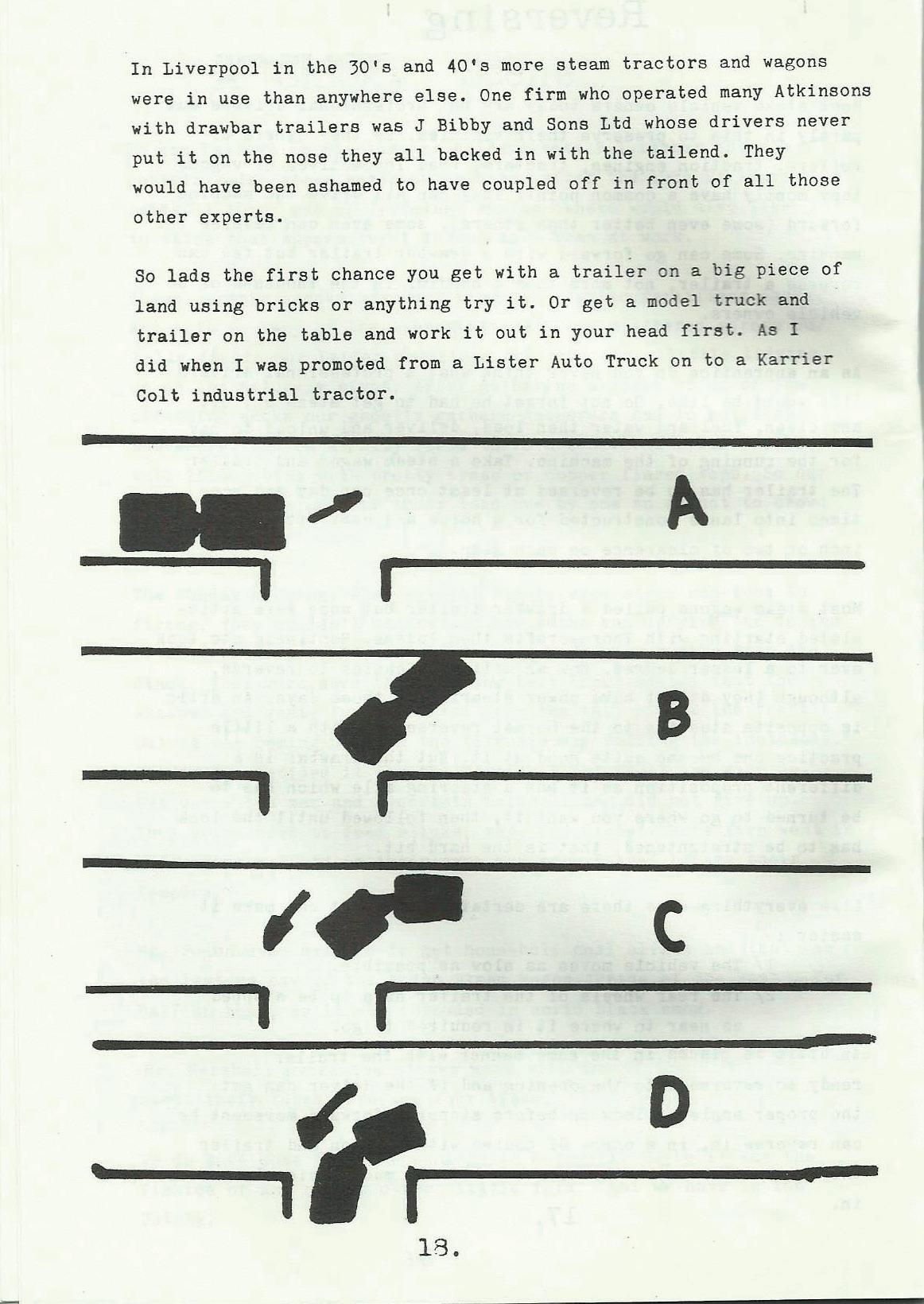
Most steam wagons pulled a drawbar trailer but some were articulated starting with Thornycrofts then Fodens, Sentinels etc. took over to a lesser degree. Now an artic was easier to reverse, although they didnot have power steering in those days. An articis opposite steering to the normal reverse, so with a little practice one became quite f,Ood at it. But the drawbar is a different proposition as it has a steering axle which has to be turned to go where you want it, then followed until the lock has to be straightened, that is the hard bit.
Like everything else there are certain rules that can make it easier:-
1/ The vehicle moves as slow as possible.
2/ The rear wheels of the trailer have to be stopped as near to where it is reouired to go. An artic is placed in the same manner with the trailer ready to reverse into the opening and if the driver can get the proper angle of lock on before stopping forward movement he can reverse in, in a oner. Of course with a waP,on and trailer the driver can couple the nose on which is much easier to reverse in.
17.
In Liverpool in the 30's and 40's more steam tractors and wagons were in use than anywhere else. One firm who operated many Atkinsons with drawbar trailers was J Bibby and Sons Ltd whose drivers never put it on the nose they all backed in with the tailend. They would have been ashamed to have coupled off in front of all those other experts.
So lads the first chance you get with a trailer on a big piece of land using bricks or anything try it. Or get a model truck and trailer on the table and work it out in your head first. As I did when I was promoted from a Lister Auto Truck on to a Karrier Colt industrial tractor. I
8 I I C I r D I C 18.
Finding of 'Little Audrey' (sAc 1240)
By Tyrone James' Father
Reg Tamkin and I left Treburrick at 9o'clock one Satur.day morning and went to Devon by the coast road; Wadebridge, Camelford and Hartland Point. We found Mr. Giffard and asked to see the Marshall traction, after we got through the brambles and bushes we found the engine. It was in a bad way so we didn't waste any more time than we had to, we did look at a little Garrett thresher while we were there, then we went on to Polars Piece, Bill Morris' place. We went in and spoke to Bill and had a cup of tea, we asked him if he knew of ~ny engines which were for sale. He said he did and that he would go with us and show us where she was.
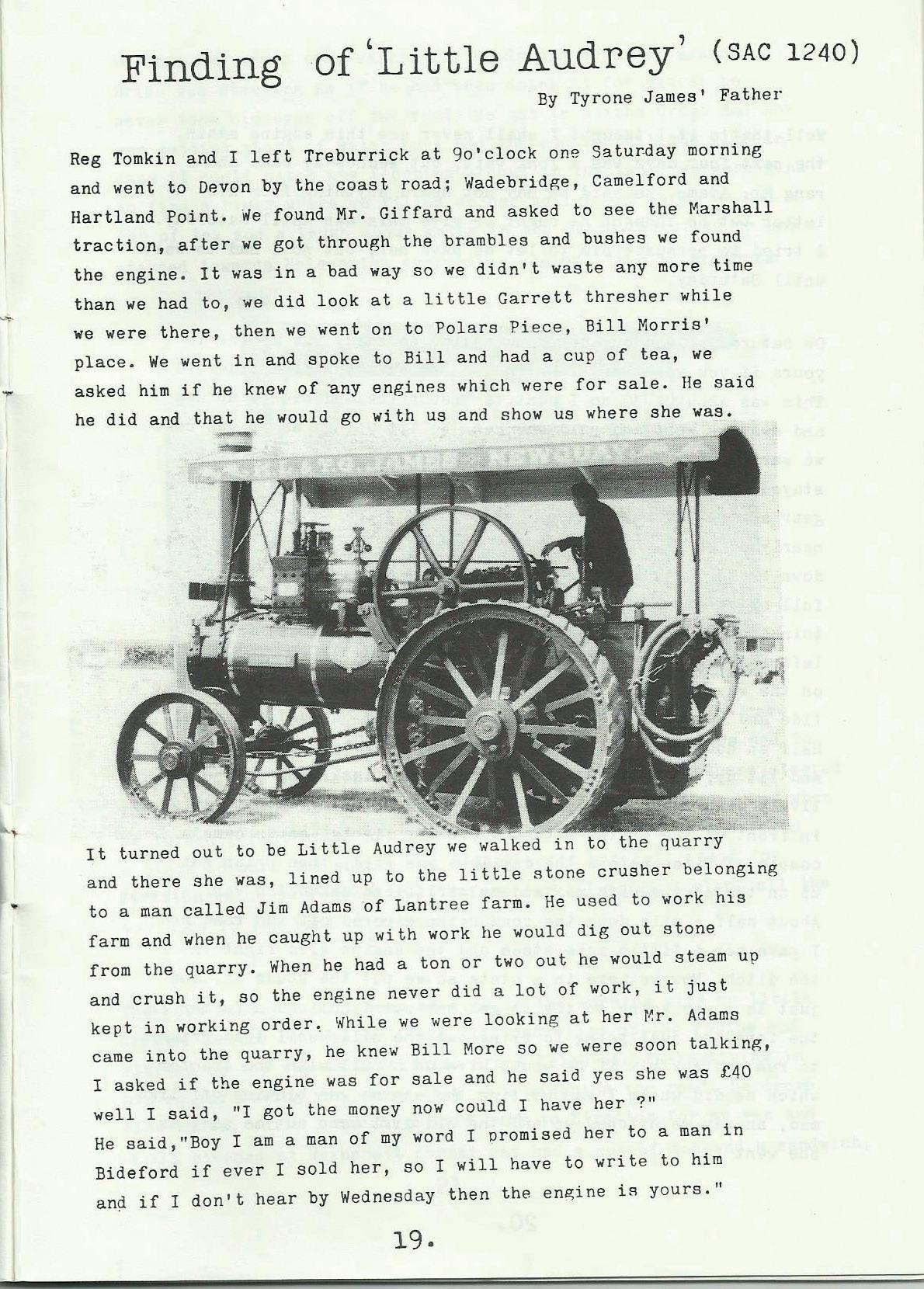
It turned out to be Little Audrey we walked in to the quarry and there she was, lined up to the little stone crusher belonging to a man called Jim Adams of Lantree farm. He used to work his farm and when he caught up with work he would dig out stone from the quarry. When he had a ton or two out he would steam up and crush it, so the engine never did a lot of work, it just kept in working order~ While we were looking at her t~r. Adams came into the quarry, he knew Bill More so we were soon talking, I asked if the engine was for sale and he said yes she was £40 well I said, "I got the money now could I have her?" He said,"Boy I am a man of my word I promised her to a man in Bideford if ever I sold her, so I will have to write to him an~ if I don't hear by Wednesday then the ene;ine is yours."
Well that's it I thought I shall never ~ee this engine again, the next four days was a long wait, but Wednesday came and I rang Mr. Adams, he said he had not heard anything from his letter but he thought he ought to give this man until Saturday. I tried to persuade him to let me have her, but no I had to wait until Saturday.
On Saturday I was on the phone again, he said,"The engine is yours if you want her, I haven't heard anything from Bideford". This was about 1.30 so I went to Treburrick and picked up Reg and away we went and paid for her. We lit up and as it was cold we warmed our hands on the stack as she was making steam. We stayed there until we had 50 pounds of steam. WP,put her in gear and pulled back out of the pits, the nearside wheel was nearly up to the hub with ashes, but she came out Ok we put her down by the gateway, it was dark by now so we pumped the boiler full of water and came home. I didn't sleep much that night thinking about the Marshall. The following Saturday night we left home at 12 O'clock with an A40 van full of coal,wood and oil, on the ~ay to Launceston we had a puncture, it was raining like a tide and we BOt very wet by the time we had changed the wheel. Half an hour later we were on our way, we got to Lantree ouarry and lit up, we had a cup of tea from the flask. The engine was lively with steam by daylight so I told Brian my mate to drive on in front of the engine with the van for liehts, so we came a couple of miles before the daylight was good; then Brian got ~p on the engine with ma, and my girlfriend drove the van. About half a mile down the road Brian steered off the road and I gave her a little more steam and the engine slid right in the ditch. Now we were in a state so we put the spuds on, and just as I was going to try to get her out I noticed a farmer in the farmyard just going to bring o~t the milk, so I told Brian to run and ask him if he would give us a pull with the tractor which he did while I was waiting the engine was blowing off like mad, anyway we hitched up and the old girl came out as easy as she went in. 20.
We took the spuds off, washed our hands and were off again, Brian was steering as if he had been doing it for years; he never took his eyes off the road. We got to Stibbs Cross and she was getting short of water so I had the pump on all the time in case it could catch any flopping around in the tank, we were glad to find a river where we filled up her boiler and tank, we had a cup of tea and a laugh about going in the ditch. We oiled up and started towards Holsworthy everything was OK. Then my Brothers
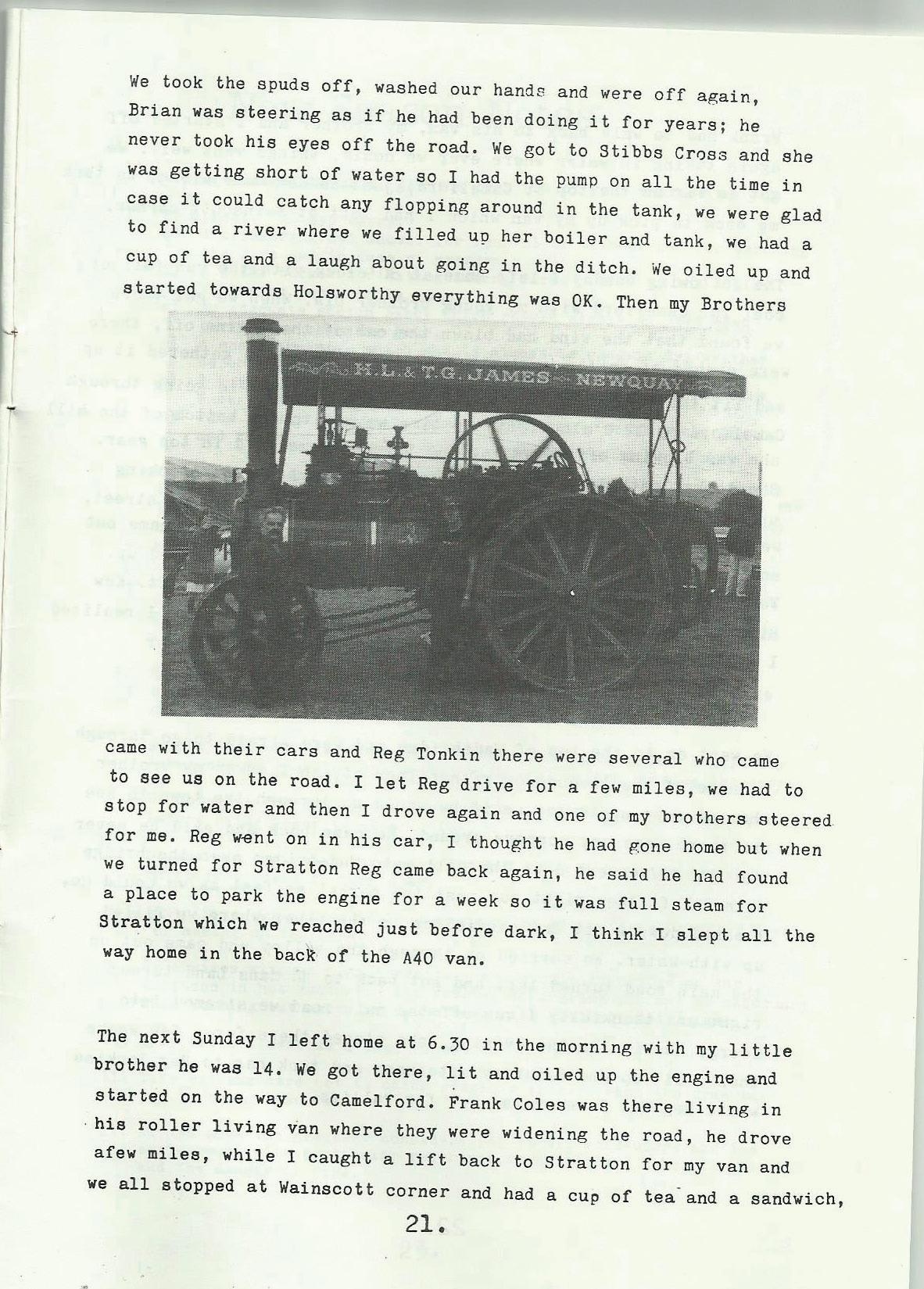
came with their cars and Reg Tonkin there were several who came to see us on the road. I let Reg drive for a few miles, we had to stop for water and then I drove again and one of my brothers steered. for me. Reg w-ent on in his car, I thought he had gone home but when we turned for Stratton Reg came back again, he said he had found a place to park the engine for a week so it was full steam for Stratton which we reached just before dark, I think I slept all the way home in the bacR of the A40 van.
The next Sunday I left home at 6.30 in the morning with my little brother he was 14. We got there, lit and oiled up the engine and started on the way to Camelford. Frank Coles was there living in • his roller living van where they were widening the road, he drove afew miles, while I caught a lift back to Stratton for my van and we all stopped at Wainscott corner and had a cup of tea.and a sandwich, 21.
Frank had to walk back to his van, my brother and I started off again taking in water where ever we could, thines went well. We got as far as the top of Camelford, just as Reg came along, he took me back to pick up my van which I had left at Wainscott corner.
The following Sunday I left home at 8O'clock with the van full of coal for Camelford with my young brother Dia. When we got there we found that the wind had blown the cab of the engine off, there were piece~ of rotten wood all over the place so we gathered it up and lit the fire with it. We got steam up and we were going through Camelford by 12 O'clock. By the time we got to the bottom of the hill she was blowing off so we went up through Camelford in top gear. She looked pathetic, with no cab just the bare struts sticking up, but she sounded lovely barking up through that narrow street, we stopped at Valley Truckle for water. Mr. Rush and son came out and had a yarn with us while we filled the engine and oiled up. We started up the Allen Valley every thing OK then on to St. Kew Highway took on more water, and it wasn't until then that I realized I had no licence or insur~nce not even No. plat~s, it never entered my head I was so full of owning a traction engine.
We went on to the top of Wadebridge and were afraid to go through because of the licence or rather lack of, so I askerl my brother who had come up to see us if he would go through the town to see if there were any coppers around. He came back and said he never saw any so.we went down the hill into Wadebridge over the bridge turned left then right out past the market as fast as we could go, I eased down a bit and carried on to the river where we filled up with water. We carried on through the valley and came out on the main road turned left and got back to No Mans Land turned right and thankfully I was off the main road we steamed into George Hawkins in the evening, she stayed there for a few weeks then I lit up one Saturday afternoon and took her to Reg Tonkins where Reg and I renovated her for rallies.
New Season Notes
A few suggestions of how to get the best out of your engines.
1. Equipment. Always carry:-
a) A clinkering out shovel for removal of clinker 3.lld for throwing the fire out in c~se of emergency.
b) A water bucket for extinguishing fires caused by the engine including your own la.;ging.
c) An adequate scotch block Y:hich should always be used when parking or changing gear.
d) A spark arrester which should always be used in dry weather • especially near thatched houses and ripening crops.
e) A cover for the chimney for use when parking up or reducing excessive blowing-off.
f) Tube brush, steam oil, lubricating oil, a spare gauge glass and tools.
2. Keep regular checks on the water level especially before lighting the fire or when moving on uneven ground and make sure that all the taps on the gauge glass move freely in case the glass gets broken and so that the water level can be checked by blowing down when necessary.
). Always make sure reversing lever is centred up and open cylinder drain cocks before oiling up or adjusting or leaving the engine. Do not leave an en 6 ine unattended when in steam. Always ~ut pins in gear-changing mec:1anism when moving.
4. When steaming up from cold, do not turn the engine ove~ on wet steam i.e. less than 80 - 100 lbs. as this damages valve faces v.nd packings.
5. Do not let cold air on to hot fire-box plates more th,n absolutely neces~ary by charging the shovel with coal before opening the door,
6. Do not have the damper too far over when pulling and close damper before using poker to clear tubes.
7, Do not use the poker unnecessarily and never before the engine has sufficient steam to turn over.
8. Anticipate variations in load or terraine when adjusting water level or making up the fire ..
9, On engines without a differential, extra care· is needed on tar surfaces in hot weather. The removal of a drive pin may be necesJary when turning but never go up or"down hill .without both pins.
1e. Only use a blower as a last resort.
11, Take extreme care not to catch people's fingers when the draw-bar pin is being inserted.
12, Always show the greatest consideration to all road-users and the environment with particular reference to horses and other livestock and the danger of fire.
Alvechurch Road, West Heath, Birmingham
MODEL EXHIBITION
Organised by THE NATIONAL TRACTION ENGINE_TRUST
on: 11th and 12th April 1987
Admission : Adults £1.20 Children & Saturday Sunday Senior Citizens 60p 10.00am until 7.00pm 10.00am until 6.00pm
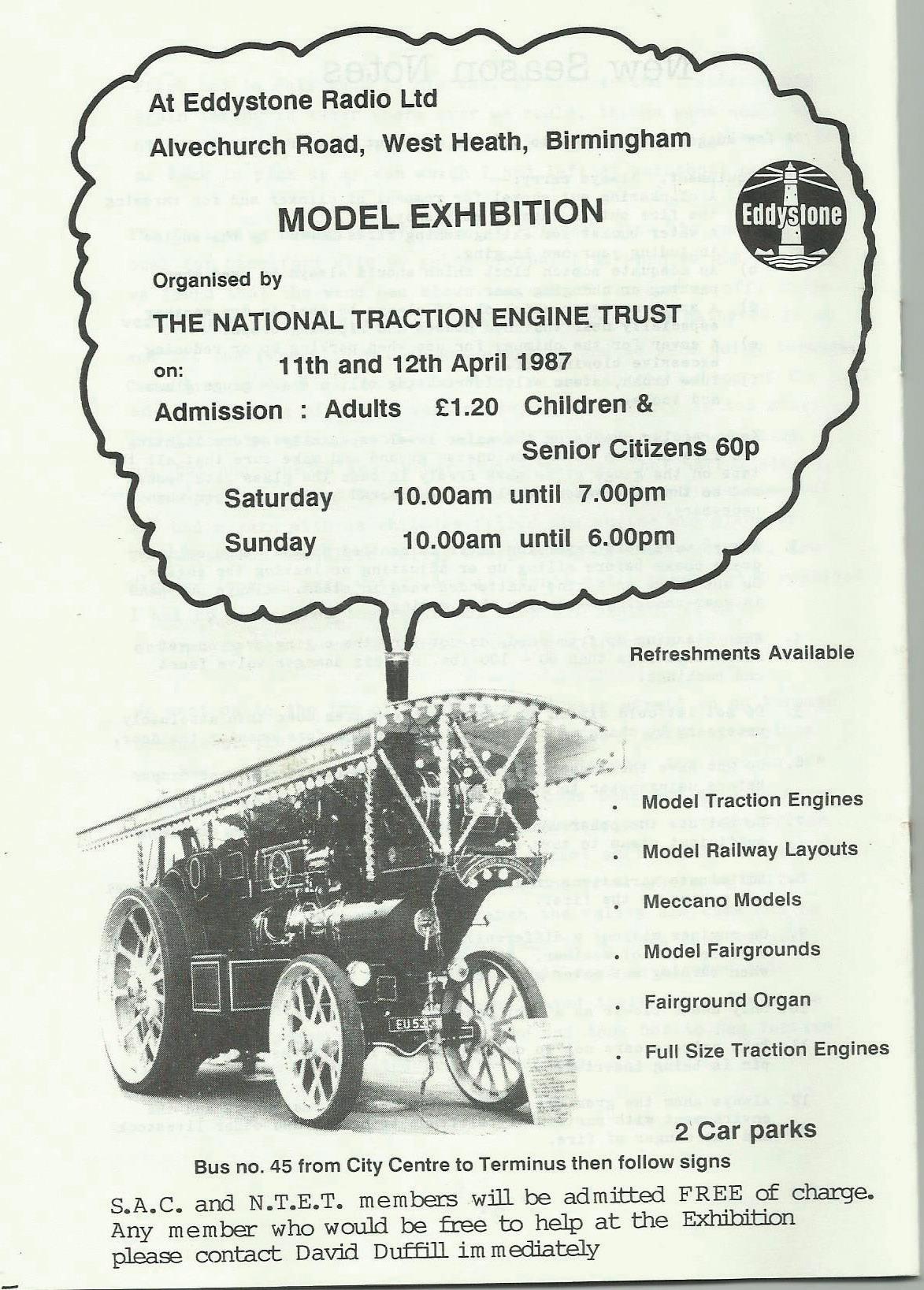
Refreshments Available
Model Traction Engines
. Model Railway Layouts •
. Meccano Models
. Model Fairgrounds
. Fairground Organ
. Full Size Traction Engines
2 Car parks
Bus no. 45 from City Centre to Terminus then follow signs
S.A.C. and N.T.E.T. members will be admitted FREE of charge. Any member who would be free to help at the Exhibition please contact David D1rffill immediately