

From GPS-guided ballast trains to the new Automated Tie Unloader, Herzog delivers the most advanced right-of-way equipment, maximizing safety, efficiency, and uptime for Class I railroads and maintenance crews.


![]()


From GPS-guided ballast trains to the new Automated Tie Unloader, Herzog delivers the most advanced right-of-way equipment, maximizing safety, efficiency, and uptime for Class I railroads and maintenance crews.


Railway Age and RT&S present the fourth annual Women in Rail Conference!
Women in Rail 2026 empowers individuals to grow, lead, and thrive in the rail industry. The conference unites women and allies to share strategies for career advancement, leadership development, and workplace success.
Through panels, peer discussions, and networking, attendees gain insights on compensation, skillset enhancement, and economic trends. The event also supports workforce engagement and leadership pipelines, benefiting both individual professionals and the organizations they represent.
Women in Rail 2026 is a must-attend industry event, highlighting diverse experiences and practical methods for moving the industry forward.
OPENING SPEAKER:

Maryclare Kenney Senior Vice President & Chief Commercial Officer CSX


Vol. 122, No. 4
Print ISSN # 0033-9016, Digital ISSN # 2160-2514
EDITORIAL OFFICES
1025 Rose Creek Drive Suite 620-121 Woodstock, GA 30189 Telephone (470) 865-0933 Website www.rtands.com
DAVID C. LESTER Editor-in-Chief dlester@sbpub.com
JENNIFER M c LAWHORN Managing Editor jmclawhorn@sbpub.com
EDITORIAL BOARD
David Clark, CSX
Daniel Hampton, CSX
Brad Kerchof, formerly Norfolk Southern Jerry Specht, CPKC/AREMA
Robert Tuzik, Talus Associates
Jeffrey Watson, Genesee & Wyoming Gary Wolf, Wolf Railway Consulting
CORPORATE OFFICES 1809 Capitol Avenue Omaha, NE 68102
Telephone (212) 620-7200 Fax (212) 633-1165
ARTHUR J. MCGINNIS, JR. President and Chairman
JONATHAN CHALON Publisher
MARY CONYERS Production Director
NICOLE D’ANTONA Art Director
HILLARY COLEMAN Graphic Designer
JO ANN BINZ Circulation Director
MICHELLE ZOLKOS Conference Director
CUSTOMER SERVICE: 847-559-7372
Reprints: PARS International Corp. 253 West 35th Street 7th Floor New York, NY 10001 212-221-9595; fax 212-221-9195 curt.ciesinski@parsintl.com

By David C. Lester, Editor-in-Chief
Iam the first to admit that a college education is not for everyone. While I don’t have any statistics or analyses handy, it’s safe to say that more people enroll in college than should. Many of the important needs in the modern world require a different kind of training. For example, auto repair, plumbing, electrical work, law enforcement, culinary arts, photography, farming, and many jobs on the railroad do not require a college degree to be successful. Vocational schools, “junior” colleges (never have liked that term), trade schools, and simply specialized training are needed and require hard work, laser focus, and dedication, just as college work does. Unless artificial intelligence can do things down the road that we can’t see right now, it’s hard for me to see how any of these professions can be replaced by it. Good salaries and job security should be available in most of these areas for the coming decades.
At the same time, however, I grow weary of those who say (and who often have college degrees themselves) that college is not worth the time, effort, and money, it’s only for wealthy and privileged, it’s a rip off, a bill of goods, and offers little, if any, return on investment. That is balderdash . Yet, I agree that, for most, obtaining and paying for a four-year degree is much more difficult today than it was when I was in school, and finding a job is more challenging and more difficult to keep with corporations thinking little of laying off thousands of workers to achieve their “financial goals,” or to cover up slip-shod management. Moreover, the amount of debt college graduates can be left with is astronomical. As I’ve written
before, in the “old days,” (pick your own decade) there were four distinct stakeholders in public corporations: customers, employees, the community, and shareholders. Not so today. Although companies often pay lip service to the other three, shareholder value is the driving force. And this promotes the feeling among college graduates that their degrees are not as valuable as they might otherwise be.
F ortunately, everyone who participated in our “Engineers Under 40” honors does not feel their college degree has no value. Each nominee holds either bachelor’s or bachelor’s and master’s degrees, mostly in civil engineering.
Nevertheless, railroads have numerous jobs on their engineering teams that do not require a college degree, which takes us back to the discussion of the value of vocational and trade school education. Regardless of one’s level of education or training, opportunities can be difficult to find. They can be found, though, and the principles of discipline, dedication, and hard work apply to all.
One final note from this year’s “Engineers Under 40” honors event is the amount of enthusiasm demonstrated for the nominee by their nominator. The profiles of all our honorees were thoughtfully written, detailed, and praiseworthy. Those who are honored this year should tip their hats to those who supported them. It’s a trait not always seen in today’s world.

DAVID C. LESTER Editor-in-Chief

Operations at the FAST loop saw 31 weld breaks in 2024.
Ananyo
Banerjee, Ph.D., PE,
Principal Investigator II
John Krasovic, Denise Valdez, and Kerry Jones
MxV Rail is celebrating the 50th anniversary of the Facility for Accelerated Service Testing (FAST®) in 2026. The track on which this important research tool operates has changed several times since 1976. The current FAST track was constructed in 2023, and heavy axle load (HAL) operations on the new track began in November 2023. When the FAST track was being constructed, the majority of the rail installed in the track fell in the head hardened category. An external contractor welded the rail into strings using a mobile welding unit. The strings were then welded together in track using primarily electric flash butt (EFB) welds and a few thermite welds. Operations resumed in early 2024 with a train
consisting of three locomotives and up to 114 loaded coal gondola cars loaded to 286,000 or 315,000 pounds. In the first year of operations on the new track, 31 weld breaks have occurred. A summary of the most commonly observed root causes for the different thermite weld failures, and EFB weld failures can be found in a previously published Technology Digest.1 Figure 1 (left) shows the distribution of the weld breaks/failures based on three different criteria: track curvature, side of rail in curves and spiral, and type of weld. Twenty-two of the 31 breaks (71%) were found in curves; seven were found in tangent; and two were found in a spiral. Of the 24 weld failures occurring on curves or in spirals, 12 were on the high rail, and 12 were on the low rail. Regarding tie type, 16 of the 31 were found on rails with concrete ties and the remaining 15 failures were found on rails with wood ties. Of the 15 failures on wood ties, 10 were on rails with cut spikes, and five were on rails with elastic fasteners. There were 24 EFB weld failures, three occurring on tangents and two found on a spiral. Four of the seven thermite weld failures were on tangents and three were on curves. Figure 1 (right) reflects the location of weld breaks in the FAST loop with the spirals and five- and six-degree curves shown in colors.
EFB Weld Failures
Figure 2 shows photos of six out of the
24 EFB weld failures that occurred at FAST in 2024. The ovals indicate the fracture origins identified during examination. Most failures were related to the sharp change in profile due to insufficient post-weld grinding at the head/ web fillet or on the web/base fillet and originated with the fracture at the stress risers. Failures A and B showed the fused metal forming a lip that was not removed by shearing and grinding after the EFB weld was performed. The weld failures in D and E were linked to branding marks that were not removed by pre-weld grinding on the rail and therefore could have acted as stress risers. The C and F weld failures occurred because of the sharp profile change along the web, which also should have been removed by grinding after welding was completed. Although no obvious metallurgical reasons were found for these failures, some of the failures were dissected and observed using metallurgical analysis. The fracture initiation in weld fracture F revealed a stress riser with considerable deformation caused by alternate fatigue bending cycles from train operations due to the nonremoval of the metal lip along the edge of the fusion zone.1 Insufficient post-weld shearing and/or grinding to remove the stress risers caused these failures.
Thermite Weld Failures
Thermite welds were installed as replacement welds for prior EFB weld failures.
Seven thermite weld breaks were observed during 2024 FAST operations, three of which occurred before 25 million gross tons (MGT) were accumulated. All seven thermite welds were analyzed due to concerns about the low tonnage accumulation in some of the welds prior to failure. Figure 3 shows photos of four of the weld failures with white ovals indicating the fracture initiation locations.
Two main weld failure causes were found. Four out of the seven thermite weld failures (including G, I, and J) showed shrinkage porosity and voids, both of which were caused by lack of heat during the weld solidification process. The term shrinkage porosity is used when the metal contracts (shrinks) during solidification, and the remaining liquid metal solidifies more quickly due to a lack of heat before filling the empty space, thereby causing pores to form. However, shrinkage also could be due to lack of heat during the pre-heating process, the presence of moisture in molds, or the entrapment of moisture from the surrounding sand/ clay during the thermite welding process. The remaining weld failure (H) showed
large, trapped alumina (Al2O3) particles along with surrounding voids and shrinkage near the fracture origins. The bottom right of the weld fracture J shows three large voids that formed during the welding process and could have contributed to the loss of strength in the thermite weld.
Figure 4a shows an optical microstructural image of weld fracture H. MxV Rail used a scanning electron microscope (SEM) and energy dispersive spectroscopy (EDS) to examine this failure, and the trapped globules showed high peaks of aluminum (Al) and oxygen (O), indicating presence of alumina. The visible voids around the alumina particles could have been formed during the thermite welding process. Alumina particles could be present due to unreacted alumina in the thermite mixture that does not melt at steel melting temperature. Figure 4b shows multiple cracks initiating near the fracture origin of weld fracture G. These thermite weld cracks are usually formed by the coalescence of neighboring voids and porosity. Similar weld breaks were observed by MxV Rail researchers at the
track previously used for FAST operations.2 Multiple porosities due to lack of fusion between metal droplets during the solidification process can be observed close to the cracks (see Figure 4a). A deeper analysis performed using the SEM indicated some of these shrinkage porosities and indicates how they are formed.
Figure 5a shows interconnected pores caused by the incomplete solidification in weld fracture I. The red arrows in Figure 5a indicate the circular edges of the advancing solidification fronts that were about to fuse together during the thermite process. Due to insufficient heat, the edges failed to coalesce, and the weld solidified prematurely causing porosity to form. Therefore, shrinkage porosity is a result of incomplete solidification. Figure 5b shows the presence of alumina particles in the same broken weld (I). The proper amount of heat should allow enough time for alumina to float up as slag and overflow into the slag pans as the exothermic thermite reaction causes aluminum (Al) to react with iron oxide (Fe2O3) and form iron (Fe) and alumina (Al2O3). In these cases, the insufficient


heat did not allow enough diffusion time for all the alumina to float up, and premature freezing caused these inclusions to get trapped in the fusion zone.
Conclusion
In 2024, operations at the new FAST loop saw 31 weld breaks. Several EFB and thermite weld breaks were analyzed for failure causes. The analysis showed a lack of

sufficient post-weld grinding to remove stress risers was a major reason for the EFB weld failures while the thermite weld failures were mostly due to the formation of voids and the shrinkage porosity caused by insufficient heat during the thermite process. For welders and track crews, these findings are important in order to understand both the necessity of proper post-weld grinding for EFB
welds and the importance of pre-heating and maintaining enough heat during the thermite process to ensure complete solidification. Future work will focus on the analysis of wheel-rail contact stresses and contact locations and how both are related to bending stresses that cause failures in the head/web and web/base fillets.
The Technology Digest this article is


The WRI 2026 Heavy Haul Conference is specifically tailored for the heavy haul (freight) sector, focusing on the challenges and advancements unique to the wheel/rail interface on heavy haul freight and sharedtrack passenger systems. The WRI 2026 Heavy Haul Conference will be held in Dallas, TX from April 22-24, 2026, and will focus on practical applications. Attendees will be from class 1 railroads, shortlines, suppliers, contractors, government regulators, researchers, and consultants. https://wri2026hh.wheel-rail-seminars.com/
Sponsorships Available, Consult the Conference Website.
Questions? Contact Brandon Koenig, Director of Operations, 847-808-1818 or email at brandon@wheel-rail-seminars.com
wheel-rail-seminars.com
based on can be found in the MxV Rail eLibrary along with more than 1,000 other publications describing the railway research, testing, and analysis available from the Association of American Railroads (AAR) Strategic Research Initiative (SRI) program. Explore www.mxvrail. com to learn more about MxV Rail and to register for the 31st Annual AAR Research Review to be held April 28–30, 2026.
The authors would like to acknowledge the AAR’s Strategic Research Initiative (SRI) program for funding this research.
References
1. Banerjee A., Krasovic J., Valdez D. and Jones K. 2025. "Analysis of Broken Welds from 2024 FAST® Operations." Technology Digest TD25-004. AAR/MxV Rail. Pueblo, CO.
2. Gutscher D. 2007. "Thermite Maintenance Weld Performance at FAST." Technology Digest TD07-017. AAR/ Transportation Technology Center, Inc.


By David C. Lester, Editor-in-Chief & Jennifer McLawhorn, Managing Editor

SHAWN BAER
Assistant Vice President Structures
Genesee & Wyoming

At Genesee & Wyoming, Shawn has ensured that thousands of rail bridges are safe and compliant for operations. His work managing structures in the Northeast U.S. and responding to outages and completing critical projects helps keep the railroad running, enabling G&W to provide dependable rail freight transportation for new and long-term customers alike. Shawn has brought several new technology initiatives to fruition while planning and executing sound structural projects. Shawn manages 2,145 Active Structures with 3,765 Active Spans between Pittsburgh, Pa. and Auburn, Maine.
Shawn has been very successful in quick and sound decision making responding to challenges including structural component failures due to weather, bridge strikes by third parties, as well as capital planning.
In addition, he has mentored track personnel, teaching them what to look for during track inspections related to structures, culverts and slope conditions.
S hawn wants to continue his passion for learning all aspects of the industry and to become a more well-rounded railroader as he supports G&W railroads. He also aims to be more involved in AREMA.
Senior Electrical Engineer
Long Island Rail Road

Since joining the MTA Long Island Rail Road in 2016 as a Junior Engineer, Andrae J. Banton, P.E., has gained progressively responsible experience across a wide range of fleet engineering projects and currently serves as a Senior Electrical Engineer in Equipment Engineering. His work has contributed to fleet modernization, onboard technology improvements, and compliance with federal safety requirements. Early in his career, Andrae supported the development and installation of passenger-area camera systems across the fleet. He now serves as the lead engineer for implementing the Federal Railroad Administration mandate requiring front-facing locomotive cameras and crashworthy memory modules, an initiative that strengthens operational transparency and post-incident analysis.
Andrae also played a key role in integrating new locomotive technology into the existing passenger fleet. As part of the introduction of Siemens Charger locomotive units, he addressed the challenge of integrating the locomotives’ industry-standard 27-pin communication and control system with the 36-pin trainline used by the existing C-3 coach fleet. To verify compatibility and ensure proper operation, he designed specialized diagnostic test equipment used to validate trainline communication and operational logic between locomotives and coaches.
In addition, Andrae has contributed to improvements in onboard communication networks, automatic vehicle monitoring systems, and onboard router technology. His work includes system testing, configuration, engineering analysis, technical documentation, and training of maintenance personnel. One of the most technically challenging problems Andrae solved involved updating the onboard automatic station announcement system, which operates on a legacy architecture developed more than 30 years ago using an MS-DOS-based platform.
Andrae Banton’s professional goal is to continue advancing rail fleet technology by leading increasingly complex fleet-wide system upgrades that improve safety, reliability, and regulatory compliance.
Division Engineer
Norfolk Southern

Christopher “Chris” DelGallo has built his career in railroad engineering through handson leadership across a range of operational environments and large-scale infrastructure projects. He entered the industry as a laborer with the Wheeling & Lake Erie Railroad before completing two internships with Norfolk Southern in Bellevue, Ohio, during the Moorman Yard expansion project that doubled the size of the class yard. After graduating, he joined Norfolk Southern as a management trainee and has since taken on progressively broader responsibilities, reflecting increased scope, leadership, and impact, across roles including assistant track supervisor, track supervisor, engineer of track, and now division engineer for the Gulf Division of Engineering’s Maintenance of Way & Structures (MW&S) team. In total, he oversees 4,400 track miles that span seven states from Virginia to New Orleans. His career spans multiple regions—including St. Louis, Mount Vernon, Grand Junction, Kansas City, Chicago, Roanoke, Altoona, and Birmingham—gaining both breadth of exposure and deep, on-the-ground experience across varied operating environments.
In his current role as division engineer in Birmingham, Chris plays a key role in several significant capital projects, including the Warrior Coal and 3B infrastructure initiatives supporting increased capacity and operational efficiency. His responsibilities include overseeing material shipments, coordinating outage planning, and providing direct field leadership during execution. He takes a hands-on approach to project management, working alongside field supervisors to organize resources and ensure complex infrastructure work is completed safely and efficiently.
DelGallo’s long-term goal is to build on the strong safety culture and operational momentum within the division while strengthening collaboration across departments. He believes that sustained operational excellence depends not only on engineering performance but also on strong relationships and teamwork across the railroad. As a third-generation railroader, Chris draws on more than 85 years of combined family experience.
MICHAEL DELIBERO
Product Development Manager ENSCO

Senior Principal Research Engineer
University of Illinois Urbana-Champaign

As a Product Development Manager for ENSCO Rail, Michael has focused his leadership on the Ultrasonic Rail Flaw Detection System product line, driving improvements that directly strengthen rail safety, reliability, and operational efficiency. Michael has led the development and maturation of leading-edge ultrasonic testing capabilities for the rail industry, translating modern sensing and system concepts into practical tools that can perform in demanding field conditions.
A hallmark of his impact has been his pivotal role in delivering ENSCO’s first high-speed ultrasonic rail flaw detection system, an important development that enables effective inspection at speeds up to 50 mph. Through his product leadership, Michael has helped move ultrasonic inspection from incremental improvement to genuine performance advancement, raising the bar for what high-speed, high-quality rail flaw detection can look like in day-today railroad operations. His contributions have strengthened the industry’s ability to detect rail defects faster, with less disruption, and with a clearer path to scalable deployment.
Through persistence, accountability, and hands-on leadership across the full development lifecycle, Michael overcame schedule pressure and elevated expectations to deliver a high-performing product on time and with measurable impact.
His ability to balance technical rigor with execution focus has helped the team deliver meaningful capability advancements on schedule while maintaining a high standard of quality and professionalism.
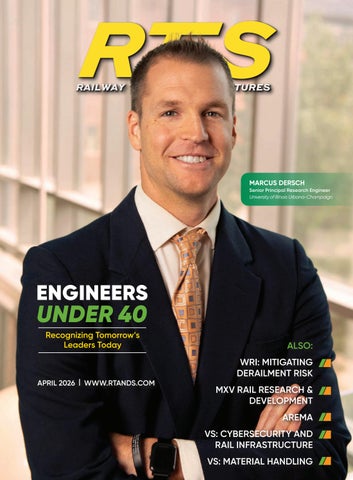
As a Senior Principal Research Engineer at UIUC, Marcus is faced with challenges in management of large-scale research and testing projects in full scale laboratories - and in coordinating with host railroads to conduct experimentation on track. Additional challenges Marcus has overcome relate to management of procurement of materials and supplies needed to carry out testing - in an environment where rules are frequently changing. Here are some of the example impacts Marcus has had on the rail industry through his research leadership role in RailTEC UIUC:
• Improved mechanistic–empirical design of track components (crossties, fasteners, ballast, under-tie pads) by leading field and lab research.
• Enhanced safety through better management of rail stresses, neutral temperature, and buckling risks - improving rail adjustment practices.
• Modernized inspection with UAVs, 3D laser scanning, machine learning, and automated change-detection systems.
• Improved quantification of wheel loads and track loading environments to support maintenance and design - developed a new small system for quantifying wheel flats.
• Acquired and promoted understanding of ballast and substructure behavior, including performance in transition zones.
• Developed predictive models for track degradation and component health.
• Influenced industry standards and best practices through committee leadership and technical guidance. Spent nine years in Committee 30 leadership for AREMA.
• Advanced resilient track components such as engineered interspersed sleepers and under-ballast mats.
• Improved data-driven planning for track life-cycle management and component replacement strategies.
• Translated research findings into practical solutions adopted by railroads, agencies, and industry partners.
• Served as a dedicated mentor by advising and developing the next generation of railway engineers and researchers.
• Grew a strong, collaborative research program that integrates advanced technologies such as sensing, machine learning, and automated inspection.
• Contributed to national standards and professional organizations to influence best practices across the rail industry.

Signaling Project Engineering Performance Lead – North America Alstom

Alaina Elias has contributed to the rail industry through advanced signaling system engineering, technical leadership, and engineering performance initiatives supporting major transit programs. From 2018 through January 2022, she served as a System Application Engineer on the Eglinton Crosstown Light Rail Transit project, one of North America’s most complex transit infrastructure programs. In this role, she supported implementation of advanced signaling and control systems, translating system design into functional application, resolving technical challenges, and coordinating across engineering interfaces critical to project delivery. She also supported Urbalis Flo signaling programs, where she developed and maintained core system data structures, created track schematics representing physical and logical system elements, and modeled system configurations used by subsystems. This work required precision, systems understanding, and cross-discipline coordination. Alaina progressed into leadership roles including Technical Lead and Engineering Domain/Metier Group Manager, leading teams of System Application Engineers supporting projects across the Americas. She developed a training program from scratch, improved team capability, and supported resource planning and technical problem solving.
Elias’ professional goals focus on advancing sustainable transportation through high-performing railway systems and strong engineering organizations. She aims to continue contributing to large-scale signaling and transit programs while improving the processes, performance frameworks, and measurement approaches that enable consistent, efficient, and high-quality delivery. Her long-term goal is to operate at the intersection of technical engineering, organizational performance, and workforce sustainability by helping engineering teams perform at a high level while ensuring the industry continues to grow, evolve, and reflect the communities it serves.
In summary, Alaina gives back both at Alstom and to the community in a multitude of ways: Founder, Alstom Women of Excellence Pittsburgh Chapter (2021), Alstom Women of Excellence North America Chair (current), Alstom Pittsburgh Site Mental Health Champion, American Foundation for Suicide Prevention Volunteer raising more than $20k, Led event and partnership initiatives with Alstom, University of Pittsburgh Swanson School of Engineering, Alumni speaker and presenter. Alaina has demonstrated leadership through technical team management, organizational initiatives, and culture-focused industry impact.


EMMANUEL GROSPE
Director of Operations Analytics & Reporting
RailPros

In his 7+ years in the rail industry, Emmanuel Grospe has made critical contributions, helping deliver numerous significant and award-winning rail engineering projects in California. Emmanuel has more than 8 years of experience and knowledge in project controls, scheduling, data analysis and modeling, reporting, and system implementation. His technical experience includes developing baseline project schedules and integrated master schedules, cost management, contract administration, design, implementation, and management of Project Management Information System (PMIS), and business process improvements. Emmanuel made significant contributions to the Los Angeles Union Station (LAUS) Rail Yard Rehabilitation and Modernization Project for Southern California Regional Rail Authority (SCRRA). This critical $67 million+ rehab project was a highly complex undertaking that modernized legacy track and signal infrastructure, enhancing sustainability and long-term performance in one of the most critical areas of Metrolink’s network. As the Project Controls Manager, Emmanuel oversaw schedule development/management and cost monitoring. He also implemented PM systems and processes and was instrumental in leveraging Microsoft SharePoint, Teams, Planner, and Power BI to foster collaboration and transparency between the project team, SCRRA, and contractors. The completed project won both regional and national awards from the Construction Management Association of America (CMAA).
Grospe’s professional goal is to advance how data and analytics are used in the rail industry to improve project and program performance. He is focused on applying advanced analytics, AI, and machine learning to transform raw project data into clear, actionable insight that helps clients make better, faster, and more informed decisions. Through his work, clients have been able to address some of their most challenging problems ranging from schedule risk and funding constraints to safety prioritization by relying on structured, transparent, data-driven tools rather than fragmented reporting.

Brandon Klevans
Signal Engineer I
Through his dedication to advancing CSX’s signal engineering and power technology, Brandon delivers vital innovations that directly enhance network efficiency, reliability, and safety.
He led the development and implementation of the company’s first new signal aspects in more than 30 years, modernizing train handling and improving operational consistency across the network. Brandon also piloted a hybrid yard switch power solution that serves as our new standard, offering improved performance, extended life cycles, and safer operations.
Brandon’s commitment to innovative solutions creates a measurable impact that continues to strengthen the CSX network and inspire our team every day.
Signal Engineer I
CSX

Brandon has played a pivotal role in advancing CSX’s signal engineering and power technology capabilities, delivering innovations that directly improve operational efficiency, reliability, and safety across the network. He led the development and implementation of CSX’s new Limited Approach Limited and Limited Approach Medium standard signal aspects—representing the first new signal aspects added to the company’s operating rule book in more than 30 years. These enhancements are now being widely deployed, with over 100 field installations to date and have received overwhelmingly positive feedback from train crews for improving train handling and operational consistency.
In addition to his signal modernization work, Brandon piloted a new hybrid operating and standby power technology for yard switches that significantly outperforms traditional lead acid battery systems. The solution delivers longer duty cycles and extended standby power, reduces weight, and eliminates the need for hazardous disposal handling. Due to its proven reliability and performance, the cross functional team supporting the pilot has elected to leave the installations in place and formally adopt the technology as the new standard yard switch power solution across CSX. Through these contributions, Brandon has demonstrated exceptional technical leadership, innovation, and cross functional collaboration—driving measurable improvements that position CSX for long term operational excellence and earning him recognition as a clear rising star within the organization.
Brandon is an emerging railroad signal engineer with four years of experience who is focused on expanding his role in developing and implementing advanced signal engineering solutions that leverage new and evolving technologies. He is highly motivated to take on increasingly complex and high impact projects that broaden his technical expertise and deepen his understanding of large-scale railroad operations.

Congratulations to Chris DelGallo for being recognized as a Young Engineer Under 40 honoree.
Chris’s contributions have helped improve reliability, expand capacity, and support the safe and efficient movement of freight across our network. From major capital projects to complex disaster recovery efforts, his leadership helps keep freight moving safely and efficiently. Chris exemplifies the dedication, accountability, and teamwork that define the future of railroad engineering.
COLIN MCGRANE
Assistant Director of Project Management & Deputy Project Manager Metro-North Railroad

Colin’s professional goals center on advancing resilient rail infrastructure while strengthening the next generation of railroad engineers.
Colin demonstrates leadership through technical command, cross-functional coordination, and mentorship. On the Park Avenue Viaduct Replacement Project, he serves as the central coordination point between the Design-Builder, Metro-North operations, Maintenance of Way, and MTA Construction & Development. The project requires precision planning to execute intensive weekend outages without disrupting weekday service for nearly 225,000 daily riders. Colin leads outage planning meetings, aligns construction sequencing with railroad operations, and ensures that structural, track, and systems work is fully integrated. Beyond project delivery, Colin actively mentors junior engineers and oversees three engineering trainee graduates.
One of the greatest challenges of the Park Avenue Viaduct Replacement Project is replacing major structural elements on a 133-year-old elevated railroad that cannot be completely taken out of service. The project team must demolish and replace two-track bridge spans within tightly constrained weekend windows while ensuring the adjacent two tracks remain operational. Early in the construction phase, sequencing complexities and coordination between disciplines posed schedule risks. Colin worked closely with field personnel, railroad maintenance forces, and the Design-Builder to refine outage work plans, improve pre-fabrication strategies, and enhance real-time communication protocols. Through structured planning sessions and continuous improvement after each outage, production efficiency increased significantly, culminating in peak weekends where six two-track spans were replaced successfully. By turning operational constraints into structured execution strategies, Colin helped transform one of the most logistically complex rail bridge replacement efforts in the country into a repeatable, high-performing program—demonstrating resilience, adaptability, and engineering leadership under pressure.


TIM ROBINSON
Assistant Chief Regional Track Engineer
Canadian National

A railway engineer trusted to lead at every level, Tim Robinson represents a rare and powerful combination in modern railway engineering: a technically rigorous engineer, a proven operational leader and a trusted executive advisor who has worked at the very center of corporate decisionmaking. He exemplifies the next generation of railway engineering leadership - deeply grounded in operations and guided by a strong sense of stewardship for the railroad and the people who run it.
Some of Tim’s recent accomplishments include:
• Data driven, risk-based engineering initiatives that significantly improved long train safety, reliability, and network fluidity on critical freight corridors.
• Delivered measurable safety and performance outcomes, including a 50% reduction in in service failures on one of CN’s most heavily trafficked subdivisions.
• Bridged engineering, operations, and executive leadership, ensuring technical solutions were operationally practical and trusted by field teams.
• Championed field-engaged change implementation, building adoption through transparency, dialogue, and respect for frontline expertise.
• Strengthened enterprise-level decision making through system-wide thinking, translating complex engineering and operational insights into clear executive guidance.
• Demonstrated values-based leadership during periods of uncertainty, supporting safe and reliable rail operations through major network wide challenges.
Leadership that comes prepared, Tim Robinson’s goals are rooted less in titles and more in stewardship, capability, and trust. One of the most significant challenges Tim Robinson encountered was navigating rail operations through the COVID 19 pandemic, a period when the railroad was required to continue operating as an essential service amid rapidly evolving health guidance and widespread uncertainty.


Congratulations to Emmanuel Grospe, Director of Data & Analytics, on his Engineers Under 40 recognition! As an expert project controls leader, Emmanuel helps deliver key projects driving the future of North American rail. Join our Team at: Go.RailPros.com/Careers
Junior Design Engineer, Structures
Zephyr Rail

Michelle Sabers exemplifies the new wave of rail infrastructure leaders, engineers who blend innovative structural research, practical field experience, regulatory expertise, and a commitment to advancing the rail industry. Less than three years after earning her undergraduate degree, Michelle is already making an impact on major rail and transit projects throughout California. Her rapid progress showcases exceptional technical skill, proactive problem-solving for constrained right-of-way issues, and leadership within professional groups. She is not just involved in infrastructure projects; she actively influences and shapes their development. Michelle considers engineering a public trust, recognizing that the infrastructure we create benefits communities for generations. She approaches her work with integrity, curiosity, and a profound respect for the responsibilities of our profession. Michelle stands out not only for her ability to perform her tasks effectively but also for her way of thinking like a senior engineer. She anticipates constraints, suggests refined structural solutions in tight right-of-way situations, and seeks ways to enhance internal processes for future projects. She does not wait for instructions; she proactively offers solutions.
Sabers currently serves as the Treasurer for ASCE’s Orange County Younger Member Forum (2025) and as PE/FE Review Chair, aiding emerging engineers in licensure preparation. Previously, she held roles such as Treasurer of the Earthquake Engineering Research Institute (UCI Chapter), Secretary of Chi Epsilon (UCI Section), and Team Captain for a collegiate Seismic Design Competition. These positions involved managing finances, leading organizations, and coordinating technical efforts. Michelle also guided Zephyr Rail’s involvement in the Samaritan’s Purse Operation Christmas Child shoebox drive during the 2025 holiday season. Although the initial target was 10 boxes, her leadership led Zephyr Rail to donate 55 boxes.


Specialist Track Evaluation
Canadian Pacific Kansas City (CPKC)

Terry has played a pivotal role in developing advanced rail testing technologies and industryleading analytical tools at CPKC. Through in-house methodologies and algorithms, Terry has enabled comprehensive, real-time monitoring of track conditions and critical assets, including ties, ballast and other vital track materials. Terry’s work sits at the intersection between data collection and data analyzation, finding him working both in the field and in office. His work is one that handles an astounding level of data that he must parse through to both analyze for the betterment of the company and pass along to relevant stakeholders.
As a leader, he has delivered immediate and lasting benefits by reducing derailments, extending asset life, minimizing slow orders and driving safer, more efficient rail service. By empowering his team and leveraging cutting-edge measurement and analytics, he enabled CPKC to achieve a step-change in operational safety, reliability and efficiency across its entire network. He served as Project Manager Lead for the Automated Track Geometry Measurement System boxcar initiative, overseeing the full lifecycle from design and construction to deployment and utilization. He managed all aspects of the project, including cross-functional communication, ensuring successful implementation from start to finish.
The Track Stress Index’s reliability and accuracy require consistent refinement, which presents significant opportunities for Terry. He must manage millions of data points and continually adjust complex calculations. Much of the validation process is dependent on field leaders to confirm accuracy. This demands substantial time and precision, frequent engagement and real-time tweaking and considerable discretionary effort to ensure the Index remains robust and effective. As a result, confirming accuracy is an ongoing process, introducing both uncertainty and risk. Terry approaches this challenge with strategic thinking and a warm attitude that welcomes collaboration and feedback as he continues to improve upon technology that already performs at a high level, just like Terry himself.


Group Leader
Olsson

Kylie Steel is driving meaningful innovation in the railroad industry through her exceptional ability to deliver creative, constructible structural solutions that keep trains moving during complex infrastructure projects. As a Group Leader in Olsson’s Rail Engineering and Design team, she combines deep technical expertise with practical design intuition, directly strengthening the reliability and safety of rail networks across the country. Kylie has earned industry-wide recognition for her talent in solving unconventional structural challenges— projects with tight geometry, complex staging, aging infrastructure, or narrow construction windows where standard solutions simply don’t work. A powerful example is her work on Union Pacific Railroad’s Miller Yard Bypass Track project, where she developed an innovative 14 segment precast concrete box culvert with a post tensioning and tongue and groove system. This approach enabled track rerouting and bridge replacement under aggressive time constraints while maintaining yard operations. She later presented this work at the 2021 AREMA Annual Conference, establishing her as a trusted structural problem solver within the rail community. A major focus of Kylie’s professional goals is strengthening industry knowledge around complex structural design and constructability. Through research, national presentations, and collaboration with Class I railroads, she intends to expand the field’s understanding of how innovative structural systems—such as segmental precast solutions, pier protection design, and advanced staging configurations—can be applied to accelerate construction while maintaining safe operations.

Tim Robinson Assistant Chief Regional Track


By Jeff Tuzik
Alot of derailments happen at switches and turnouts. Many are low-speed, low-energy derailments that happen in yards and sidings. But they’re still costly and disruptive. Evaluating and optimizing wheel/rail contact conditions at these locations is different than it is on open track. It requires specific tools, specific practices, and specific research.
The relatively complex geometry of switches complicates wheel/rail interaction at these locations. It makes inspecting and assessing the risk of derailment at a switch difficult; so, railroads use various methods to perform these assessments and inspections, from visual inspection to dynamic simulation and modeling. “At BNSF, as on most railroads, we paint the switch points to
see what the wheel contact looks like. But that’s just the starting point,” Zach Dombrow, Director of Maintenanceof-Way Research and Field Testing Services at BNSF, told colleagues at the 2025 Wheel Rail Interaction Heavy Haul Conference.
Painting switch points is a helpful visualization, but it doesn’t give the full picture of wheel/rail interaction. For
that, it’s important to know the wheel profile, as well. And it’s important to have precise measurements.
Figure 1 shows a gauge used by BNSF to measure switch-point/wheel-flange contact conditions and to help track inspectors better assess wheel-climb derailment risk. The gauge is marked to show a 60-degree flange-contact angle. If the switch point contacts the wheel below this mark (in the red) it is considered a failure. Other types of switch point gauges are used to assess wheel climb potential based on parameters such as switch point damage, wear on the gage face of the switch point, and switchpoint/stock-rail-profile angles.
The gauges used by Dombrow and BNSF were developed as an outgrowth of the 2014 Transportation Research Board (TRB) IDEA (Innovations Deserving Exploratory Analysis) Project 231 (see also Predicting Failure at the Interface for more information).
This project—a collaboration between Allan Zarembski (University of Delaware) and Norfolk Southern’s Department of Research and Tests—developed and modified gauges designed to assess wheel-climb-derailment potential for various switch-point and switch-point/ wheel-profile-contact conditions. The gauge designs are based on wheel/rail lateral/vertical (L/V) force calculations and provide a simple pass/fail threshold for conditions where L/V forces and wheel/rail/switch geometry are likely to conspire to cause wheel climb.
BNSF later adopted the switch-point/ wheel-flange gauge and the verticalwear-angle (also called gage-face-wear angle) gauge for use on their own system. Dombrow and the BNSF Research and Test group initially used the gauges to measure 150 switches throughout BNSF territory and found that 13% of them met a threshold of concern for wheel-climb risk potential and needed to be addressed; these higher-risk switches were not (and perhaps could not be) detected by track inspectors who lacked gauges. “It’s fair to say that the gauges introduced in the IDEA project have been instrumental in preventing and reducing wheel climb,” Dombrow said.
Guard Rail Climb
Looking past the switch point, wheelclimb derailments can also occur at turnouts due to guard-rail climb. The


mechanisms of derailment in these cases are entirely different than wheel climb incidents at the switch point, but the end result is the same: a train on the ground. Guard-rail-climb derailments tend to share several common factors. They typically occur on the diverging route
of a tight turnout. They often involve long, light cars. And the car that derails is typically operating under buff force (compressive force), said Corey Pasta, Scientist at MxV Rail. “There are a lot of guard-rail-derailment mechanisms, but there are three that are particularly

relevant to wheel/rail interaction: buff force; angle of the guard rail face; and guard-face-gage and back-to-back wheel spacing.”
Figure 2 shows the site of a guard-railclimb derailment. The diverging route is shown in the image, with an arrow indicating the direction of travel. As a vehicle moves through a turnout like this, the left wheel is initially laterally restrained at the flange by the frog, while the right wheel is restrained by the guard rail. Once the left wheel enters the frog throat (circled in yellow) it loses its lateral restraint.
“At that point, you’re asking the other wheel, and the guard rail, to protect against lateral movement,” Pasta said. In this scenario, if the car is under buff force, the back side of the front right wheel flange is forced against the guard rail and can, with sufficient lateral force or insufficient vertical force (or both), climb the guard rail.
Mitigating buff force via train handling and yard operations is one way to reduce the L/V ratio, and thus derailment risk, Pasta said. “Maybe this takes the form of a protocol that restricts certain train configurations from being pushed through Number 8 turnouts.” It’s also important to note that buff force is also generated when braking—a car being pulled through a turnout can experience intense buff force during a sudden stop, and depending on the car configuration and coupler angles involved, this too can

cause the L/V to reach a critical threshold.
The angle of the guard-rail face in relation to the back of the wheel flange affects the L/V ratio in a guard-rail/wheel-climb scenario just as it does in a “traditional” wheel-climb derailment. “There’s less of an angle on the back of the wheel flange than there is on the front,” Pasta said, so small changes to the guard-rail-face angle add up quickly. Figure 3 shows an example of a new guard rail (solid line) superimposed with a worn guard rail (dotted line) for comparison. “You want
to maintain your guard rail to a near vertical slope.”
Figure 4 illustrates a proper guardface gage (the distance from guard-rail face to frog-wing face) and back-to-back wheel spacing. If the guard-face gage is too wide or the back-to-back spacing too narrow, either track components will be displaced, or the wheelset will climb the guard rail, or both will occur, Pasta said. “Guard-face gage is a measurement that’s probably overlooked when it comes to derailments at guard rails.”
Wheel Profile and Picked Switches
Picked- or split-switch-point derailments occur when the wheel flange slides between the stock rail and the switch point. Many factors can contribute to a picked point (see Switch Point Derailments: Is it the Point or the Wheel? for additional information) but wheel flange shape and switch condition are chief among them. A recent and ongoing study by MxV Rail (on behalf of the AAR’s Strategic Research Initiative) looked specifically at the wheel-flange-tip radius and


metal flow and their contribution to picked point derailment risk.
International standards vary, but there is currently no North American standard or limit on flange-tip radius. The British standard, for example, sets the limit for flange-tip radius at no less than 5 mm, said Ulrich Spangenberg, Principal Investigator at MxV Rail. As this radius decreases, the flange tip becomes “sharper” and thus, theoretically, more likely to pick a switch point.
To get a sense of flange-tip flow/ flange-tip radii in the U.S., MxV interrogated a database of roughly 300,000 measured wheel profiles provided by AAR members. “We were curious to see how many of our wheels would exceed the British standard,” Spangenberg said.
MxV also calculated the maximum flange angle for the wheels. They found a peculiarity in the data, in that many of the wheels with flange-tip flow also had a bilinear flange angle, meaning that the flange angle was in fact two different angles (the green line in Figure 5 marks the flange angle flexion point in
one example).
Of the ≈300,000 profiles, MxV determined that 6.8% would be condemnable by British standards. Of this population, they identified nine with a flangetip radius of <2.5 mm and a maximum flange angle of >77.5 degrees—a combination of parameters thought to be most conducive to picking a switch point. These wheels were then modeled using NUCARS (modeling and simulation software) with each of the nine wheels as a lead wheel on an unloaded hopper car, Spangenberg said. “We wanted to determine wheelset attitude as it approached the switch point.” Specifically, the aim was to determine wheelset lateral displacement and angle of attack to study wheel/rail/ switch-point-contact conditions in three dimensions. The switch used in the simulations was a CAD model of a Samson point switch.
Figure 6 shows simulation results from four of the nine wheels. “The typical clearance [lateral displacement] between the wheel-flange face and the gage face
is 11.7 mm,” Spangenberg said. In the NUCARS simulations, lateral displacement exceeded the 11.7-mm figure in all cases, ranging from 11.9 to 17.3 mm. This is the result of flange wear (a thinner flange allows for more displacement) and the fact that the modeled wheel tended to offset and hug the stock rail, he said. The angles of attack from the simulation range from 0.15 mrad to 1.95 mrad. These figures are typical of a wheelset negotiating a 1- to 2-degree curve, Spangenberg said—not excessive, but enough to point the modeled flange tip toward the switch point.
Figure 7 shows a detail of flange-tip/ switch-point interaction from CAD analysis of wheels 1 and 3 from Figure 6. In both cases (in all nine cases, in fact), the wheel-flange-contact point preceded the wheel-tread-contact point (due to the angle of attack) in the direction of travel. However, none of the wheels were able to pick the switch point in simulation. “We couldn’t identify any particular wheel profile that had a bigger derailment risk in terms of

Track Safety Standards Subparts A-F
Track Safety Standards, contains the Track Safety Standards, Subparts A-F, for Classes of track 1-5. The standards cover general information, Roadbed, Track Geometry, Track Structure, Track Appliances and Track-Related Devices, and Inspection. Includes Defect Codes.
Updated July 1, 2025.
BKTSSAF Track Safety Standards, Subparts A-F $13.95 Only $12.50 for orders of 50 or more!

FRA Part 237 establishes Federal safety requirements for railroad bridges. This rule requires track owners to implement bridge management programs, which include annual inspections of railroad bridges, and to audit the programs. Part 237 also requires track owners to know the safe load capacity of bridges and to conduct special inspections if the weather or other conditions warrant such inspections. Updated July 1, 2025
BKBRIDGE Bridge Safety Standards $14.00
Only $12.60 for orders of 50 or more!

This reprint includes the FRA's Railroad Workplace Safety Standards addressing roadway workers and their work environments. These laws cover such things as: personal protective equipment, fall protection, and scaffolding for bridgeworkers; and training issues. Also includes safety standards for on-track roadway vehicles.
Updated July 1, 2025
BKWRK Railroad Workplace Safety $13.95

Classes of Track 6 and Higher: Applies to track required to support the passage of passenger and freight equipment in specific, higher speed ranges. Includes Defect Codes and Appendix C to Part 213 - Statement of Agency Policy on the Safety of Railroad Bridges. Updated July 1, 2025
$13.00 for orders of 50 or more!
switch picking,” Spangenberg said. It’s important to note that the switch point used in the model was in perfect condition. “Wheels with a small flangetip-radius may increase the likelihood of a picked switch if the switch is poorly maintained, out of adjustment, or
chipped or broken.”
The next step of this study is to incorporate lateral and vertical forces into the model, which will allow MxV to determine whether small flange-tip-radius wheels contribute to wheel-climb derailment risk at the switch point.
“We also want to look at the TRB IDEA gauges and see how those measurements compare to our findings,” Spangenberg said. “This is part of an effort to give the industry more objective assessment tools for switch-point inspection and evaluation.”


By Jennifer McLawhorn, Managing Editor
Often when we include these spotlights on track construction or maintenance machines, we offer a specific focus, especially for rail welding and ballast maintenance. However, in taking a broader view, this spotlight places an emphasis on moving and ‘handling’ large amounts of material to construction sites. These specialized machines provide a necessary function in moving and distributing material. Here’s what those in the market currently offer.
Plasser American says it focuses “on providing practical, efficient solutions that help railroads and contractors move materials safely and productively. Our MFS material handling units are designed to do exactly that. Built on a proven railroad vehicle platform, these units feature a hopper with a floor conveyor belt and a transfer conveyor belt at the front of the machine. The conveyor systems are hydraulically powered, with a diesel engine supplying the energy needed for reliable operation in demanding work environments.
“Our MFS lineup includes four models: the MFS40, MFS60, MFS100, and MFS100 S. Each unit is designed to convey, store, and unload ballast, spoil, or other materials in train formation, allowing crews to efficiently move resources to and from the job site. The MFS40 can handle up to 41 cubic yards of material, the MFS60 up to 61 cubic
yards, and the MFS100 and MFS100 S each offer a capacity of up to 90 cubic yards.
“The MFS100 S adds even more versatility with an additional transfer conveyor belt and ballast distribution devices that allow precise placement of ballast into the track or along the ballast shoulder. Inside the hopper, the floor conveyor enables continuous loading or the passing of material through the unit. The front transfer conveyor can then move material to the next hopper or discharge it alongside the track, slewing up to 45 degrees in either direction. MFS units can be coupled together in any configuration to create a material train and can also be integrated with ballast cleaning machines or Plasser’s Ballast Distribution Systems, helping crews handle material efficiently across a wide range of maintenance operations.”
“Turnouts and large panel installations remain among the most complex and demanding material-handling operations in modern rail infrastructure projects,” DavRail told RT&S. “Traditional cranebased methods have long been the default approach, but they often introduce logistical challenges when access to the line is limited, and work windows are tight. Mobilizing cranes can increase costs, add congestion to constrained job sites, and introduce additional safety considerations during heavy lifting operations.
“The TRACS (Turnout Remover And Carrier System) from Genesis Rail & Plant, available through domestic provider DavRail, was engineered specifically to address these challenges and provide a safer, more efficient approach to handling turnout panels and heavy track components directly on-site. Remote-control operation enables precise positioning while further improving visibility and safety. Center-lift and sideshift functionality allows crews to precisely position turnouts and complex panels by utilizing all axes of movement. A lifting capacity of 27,550 pounds-per-machine provides the muscle needed to safely manage huge track structures. The TRACS machine height is optimized for operation beneath overhead catenary and electrified systems, making it ideal when vertical clearance is limited. Featuring self-loading capability onto trailers, the machine also allows for easy mobilization and reduced secondary equipment needs. The TRACS Alpha represents more than 20 years of industry feedback and design considerations, helping shape a solution tailored to the real-world demands of modern Maintenance of Way.”
For Loram ’s material handling capabilities, it says, “efficient material handling is a critical driver of productivity, safety, and cost control. From ballast delivery to tie distribution and spoil removal, the ability to move material accurately and
quickly often determines the success of a maintenance window.
“Loram addresses these challenges with a comprehensive portfolio of material handling solutions designed to help railroads do more work in less time. At the foundation of this portfolio is the DumpTrain® family, engineered for high volume ballast delivery. Capable of moving up to 1,500 tons per train and unloading a full consist in under an hour, DumpTrains support high production work sites, stockpiles, and washout locations. The DumpTrain for Curves® extends this capability to curved track while maintaining precise placement up to 45 feet from track centerline. Loram’s self powered slot trains add power and versatility to complex operations. The SPS 7000 series combines 3,600 horsepower with a six axle drive, enabling the movement of heavier consists and a wide range of materials—including ballast, rail, ties, and rip rap—within excavator reach.
improve throughput, rapidly offloading ballast or spoils and transferring material

between cars to keep supporting equipment productive. Automation technologies such as GateSync™, Solaris®, and HydraDump® enhance precision, safety, and reliability across ballast and sidedump operations.
ties from railcars to the right-of-way has traditionally required heavy manual labor, tight coordination, and valuable track time. Herzog’s Automated Tie Unloader aims to change that equation.
“The Automated Tie Unloader (ATU) is designed to streamline the unloading and tion and maintenance-of-way projects. By automating a process that has long depended on manual handling, the system improves safety, increases efficiency, and


helps railroads complete tie programs within increasingly limited work windows. The self-propelled ATU removes ties
from railcars and distributes them along the right-of-way as it moves through the project area. The system delivers ties in a
controlled, consistent pattern with precision tie placement, allowing installation crews to maintain a steady workflow and avoid delays common with traditional unloading methods. With tie-for-tie accuracy, replacement ties are delivered exactly where crews need them.
“The ATU also integrates with the Herzog Survey Platform, which adds another layer of precision to tie distribution. Using GPSenabled coordination between the survey system and the unloading unit, ties can be placed exactly where they are needed along the track.
“This connection allows railroads to align tie delivery with inspection data and tie replacement plans. Automation reduces the number of personnel required to unload and manage ties, limiting manual lifting and reducing exposure to moving equipment and heavy materials. At the same time, consistent placement improves efficiency for tie gangs.
“For railroads balancing production demands with safety and limited track access, the ATU represents a more controlled and reliable approach to tie delivery.”
RAIL GROUP NEWS brings you a daily round-up of news stories from Railway Age, RT&S, and IRJ. This email newsletter offers North American and global news and analysis of the freight and passenger markets. From developments in rail technology, operations, and strategic planning to legislative issues and engineering news, we’ve got you covered.


By Jennifer McLawhorn, Managing Editor
Cyberattacks on rail infrastructure, perhaps while uncommon, are not unheard of. As technology advances and becomes more sophisticated, so are cybersecurity solutions. Particularly within a more complex infrastructure that carries passenger rail, such as the Northeast Corridor, it is important to keep these networks as safe as possible and reduce the susceptibility to attacks.
Railway Track and Structures spoke to ENSCO about its own cybersecurity solutions. At “the Center for Critical Infrastructure Protection (CCIP), operated by ENSCO at the Transportation Technology Center (TTC) in Pueblo, Colorado,” ENSCO says it “provides specialized cybersecurity services tailored to the railway industry and the broader transportation sector. As rail systems become increasingly digitized relying on connected signaling, operational technologies, and data networks; cyber threats present a growing risk to safety, reliability, and operational continuity. CCIP was established to help railroads, suppliers, and transit agencies address these evolving threats through a comprehensive, risk-based approach to cybersecurity. CCIP’s cybersecurity offerings focus on four core areas:
training, assessment, testing, and protection. The center provides hands-on training programs and executive-level workshops that equip railway personnel with the skills needed to identify cyber vulnerabilities, respond to incidents, and implement best practices across rail operations.
“In addition, CCIP conducts threat and vulnerability assessments, penetration testing, and large-scale incident exercises designed to evaluate how rail networks and supporting systems respond to cyberattacks. These assessments help organizations identify weaknesses and strengthen defenses before incidents occur. By leveraging ENSCO’s deep expertise in national security and transportation safety, CCIP delivers services that improve cyber resilience across the rail ecosystem—from freight and passenger railroads to suppliers and infrastructure operators. Through practical training, real-world testing, and strategic guidance, CCIP helps the rail industry safeguard critical infrastructure while maintaining safe and reliable rail operations.”
Since it was founded back in 2017, Cylus says it is “dedicated to protecting rail and transit systems.” The company “developed CylusOne, a purpose-built platform that
provides comprehensive visibility and threat detection across rail operational technology (OT) environments — including signaling, communications, onboard systems, stations, and SCADA networks. Unlike general-purpose OT security solutions, CylusOne was designed from the ground up for the unique protocols, architectures, and operational requirements of rail networks. The platform delivers a single pane of glass across both onboard and infrastructure environments, providing unified visibility, continuous monitoring and real-time threat detection without interfering with rail operations. Security teams can identify vulnerabilities and respond to cyber incidents before they impact safety or service availability.
“Cylus works with major railroads, transit agencies, and rail operators across North America, Europe, and Asia-Pacific. Its technology supports compliance with evolving regulatory requirements, including TSA Security Directives and emerging international rail cybersecurity standards. The company’s team brings deep expertise in both cybersecurity and rail operations, with leadership that has contributed to the development of IEC 63452 rail cybersecurity standards.”

We’ve all had that moment in time when we are riding in an elevator and it’s just yourself and the boss. We have the opportunity to make the case and there is a moment to make the pitch. It could be a passing conversation in a hallway, a brief exchange before a meeting, or, as stated earlier, a quick ride up the elevator.
In these moments, professionals have an opportunity to influence leadership—but only if they can clearly and concisely communicate value.
That’s where the elevator speech becomes a powerful tool, but you have to prepare for that moment ahead of time and be able to hit it out of the park when that moment happens.
For those advocating participation in the American Railway Engineering and Maintenance-of-Way Association (AREMA), the challenge is not just explaining what AREMA is—it’s demonstrating why it matters to the business.
To railroad executives, every investment must connect directly to performance, safety, and longterm success.
At first glance, AREMA may appear to be a professional organization focused on engineering recommended
For those advocating participation in AREMA, the challenge is not just explaining what AREMA is - it’s demonstrating why it matters to the business.
practices and collaboration. In reality, it is the technical backbone of the railroad industry.
AREMA maintains and develops the Communications & Signals Manual and the Manual for Railway Engineering —foundational resources guiding track, signals & communications systems, structures, and maintenance/operational recommended practices.
But the true value lies in its Technical Committees, where the industry comes together to solve real problems in real time. Those conversations provide rich discussion about history, lessons learned, and foundational principles to why something is the way it is.
AREMA isn’t just where recommended practices are written—it’s where the future of the railroad industry is shaped.
If it is known that railroad executives are focused on outcomes (e.g. safety, cost control, operational efficiency, and workforce development) that are important to the business, it lends itself that in order to gain support, your message must align with these priorities. For example, instead of stating: “AREMA is great for networking…,” you could rephrase
the conversation to state: “AREMA gives us access to the recommended practices, technologies, and industry expertise that help us reduce risk, improve safety, and make better investment decisions.” This subtle but important shift from personal benefit to organizational value is what captures attention.
Using the previous information and formulating an executive language, an example could be “Supporting AREMA Membership is a direct investment in our railroad’s performance. Through AREMA Committees and events like the Communications, Signals & Information Technology (CS&IT) Symposium, we gain access to the latest recommended practices, technologies, and lessons learned across the industry. That knowledge helps us improve safety, avoid costly mistakes, and make better decisions faster. It’s a small investment that delivers measurable value back to the railroad.”
Where AREMA Delivers
AREMA Committees — including Committee 37 (Signal Systems), Committee 35 (Information Technology), Committee 5 (Track), and other Committees are where recommended practices are developed and refined. The impacts to the railroad are influence over industry recommended practices, early awareness of changes,
and alignment with best practices.
The CS&IT Symposium that was held last month provided insight into the History of Signaling, Positive Train Control (PTC) advancements, network security and resiliency, datadriven railroad operations, and other technical topics. The impacts to the railroad are understanding where signals came from, immediate application of new technologies, improved system reliability, and enhanced cybersecurity awareness.
The AREMA Annual Conference & Expo, which will be held in Kansas City, Mo., in 2026, provides industry alignment and brings together a full spectrum of the industry. Opportunities include technical presentations, Committee collaboration, and direct engagement with suppliers and peers. This provides impact on the railroad in faster problem-solving, stronger vendor relationships, strategic alignment across the industry, and helps to
Stand out at the AREMA 2026 Annual Conference & Expo in Kansas City, Mo., September 13–16. Booth and sponsorship opportunities are open—secure prime visibility while top spots last: www. conference.arema.org. Attendee registration is about to go live—don’t miss your chance to be first in line.
Get up to speed fast: The 2026 AREMA Communications & Signals Manual delivers nearly 80 updated, new, or reaffirmed parts with the latest guidance on signal technology, helping you ensure safer, more efficient, and cost‑effective installations—buy your copy today to stay current and consistent.
Download the AREMA 365 App for essential rail resources and networking opportunities. Easy access to news, events, and educational materials lets you stay informed and connected to the industry. Download it today by searching for AREMA in your phone’s app store.
Did you know we offer a wide variety of On Demand education for learning
MAY 4-5
Committee 5 - Track Charlotte, NC
MAY 14-15
Committee 8 - Concrete Structures & Foundations Pueblo, CO
MAY 19-20
Committee 15 - Steel Structures Lancaster, PA
JUNE 3-4
Committee 9 - Seismic Design for Railway Structures Denver/Golden, CO
JUNE 11
Committee 30 - Ties and Fasteners Urbana, IL
on your time? Browse our most popular webinars, seminars, and Annual Conferences to earn your PDH credits on the go. Visit www.arema.org to start your On Demand learning today.
If you’re looking for a podcast to binge, check out AREMA’s Platform Chats— now celebrating its 50th episode. Featuring guests from every corner of the railway industry, you can catch up on all five seasons available on your favorite listening services today.
Leverage the power of your trusted association’s Railway Careers Network to tap into a talent pool of job candidates with the training and education needed for long t erm success. Visit www.arema.org/careers to post your job today.
CONNECT WITH AREMA ON SOCIAL MEDIA: NOT AN AREMA MEMBER? JOIN TODAY AT WWW.AREMA.ORG

AUGUST 5-6
Committee 7 - Timber Structures Colorado Springs, CO
SEPTEMBER 29-30
Committee 15 - Steel Structures Virtual Meeting
Join a technical committee
JANUARY 27
Committee 15 - Steel Structures TBD
APRIL 12-13
Committee 15 - Steel Structures Denver, CO
SEPTEMBER 27
Committee 15 - Steel Structures Virtual Meeting
Joining a technical committee is the starting point for involvement in the Association and an opportunity for lifelong growth in the industry. AREMA has 30 technical committees covering a broad spectrum of railway engineering specialties. Build your network of contacts, sharpen your leadership skills, learn from other members, and maximize your membership investment. If you’re interested in joining a technical committee or sitting in on a meeting as a guest, please contact Alayne Bell at abell@arema.org.
For a complete list of all committee meetings, visit www.arema.org.

Invest in Your Growth: Earn PDHs Anytime with AREMA Education
Access to valuable professional development content is just a few clicks away with AREMA Education. Our On Demand offerings span multiple disciplines, providing accredited Professional Development Hours (PDH) courses that let you learn from industry experts online— without leaving your office.
1. LEARN MORE
Studies show that participants learn more while taking On Demand courses, as you can skim through the material you understand and spend more time on the more challenging areas.
2. GET INSTANT ACCESS
With AREMA On Demand courses, you don’t have to wait to learn and get your PDHs as they’re available instantly after purchase.
3. CONVENIENT AND FLEXIBLE
Above all, On Demand education is meant to be taken at your own pace and on your time. Study from anywhere in the world, whether from your office or the convenience of your sofa.
4. COURSE VARIETY
AREMA On Demand education offers a wide variety of topics for all areas of railway engineering.
Register and Start Learning today at www.arema.org.
BECOME A MEMBER AND SAVE
Not an AREMA member? Join today at www.arema.org and get discounts on all AREMA Educational Offerings, from Virtual Conferences to our Webinars.
develop relationships with experienced professionals who can be called to provide better insight into current problems you may experience. Ultimately, one conference, multiple returns. A single AREMA event can generate ideas and solutions that save months of trialand-error back on the railroad.
Turning Participation Into Performance
When employees actively engage in AREMA, the benefits extend far beyond the individual.
These benefits include:
Engineering Confidence
Better-informed decisions on infrastructure and capital investments.
Safety Advancement
Access to shared lessons learned and proven practices.
Leadership Development
Opportunities to lead Committees, present ideas, and grow professionally.
Faster Problem-Solving
Leveraging solutions that are already tested across the industry.
Knowing these benefits is crucial to helping others to understand what AREMA benefits exist. I ask the question, what do you do to report out each time you participate in these events? With the question about return on investment, railroad executives want to know what you learned, how you are going to apply this in your job, and/or what problem you can solve now that you weren’t able to solve before. Incredibly, this is the most overlooked step: the report out and follow up from these events. Return on investment at these events is critical for helping leaders understand why the money and time was invested. Don’t make this mistake!
Every investment faces scrutiny—but AREMA stands up to it. Here are some of the thoughts out there that need to be overcome and potential responses.
“We don’t have the budget.” The cost is minimal compared to one
preventable failure.
“We don’t have the time.” Time invested leads to faster, more efficient solutions.
“What’s the ROI?” Safer operations, stronger teams, and better decisions.
Changing the mentality that AREMA is an expense to seeing it as an investment in safer operations, stronger teams, and smarter decisions.
The most successful railroads don’t just allow AREMA participation, they promote it. They understand the impacts that are made by leveraging the benefits to see overall improvements that are made. The railroads understand and encourage Committee involvement, support attendance at Symposiums and Conferences, and expect knowledge-sharing across teams. This creates a multiplier effect where one person’s experience benefits the entire organization.
The railroad industry is evolving rapidly in the spaces of advancing digital technologies, changing workforce dynamics, and increasing safety expectations. These situations are currently happening before our eyes. Railroads that engage with AREMA are better positioned to adapt, innovate, and lead.
In just 60 seconds, a well-crafted elevator speech can shift the conversation from cost to competitive advantage. It can help executives understand that AREMA is not simply a professional organization—it is where the railroad industry sets the recommended practices, shares its knowledge, and shapes its future. It helps our younger Members develop the skills to keep the rail industry safe, effective and efficient for the future. For those who actively participate, the return is clear. How we frame the message is important to make sure the return is clear to others! I challenge each of you to craft your unique message (opening, value, impact, and close) to explain why you should be an active Member of AREMA. Have it ready for the opportunity when it presents itself!


Pennsy Tuscan Red GG1 4907 and train at New Brunswick, N.J., headed to New York City on September 19, 1962. The non-streamlined equipment suggests it’s not a name train. The 4907 was the only Tuscan Red GG1 the photographer saw during his few days on the Pennsy, 9.16.1962 to 9.21.1962. All the others were Brunswick Green. Photography by Tom Gildersleeve, collection of Center for Railroad Photography & Art.

When SP 4449 made its first outing in Daylight livery, the trip was supposed to be from Portland to Sacramento and back, but the SP decided to put a few of their cars behind the locomotive and make a swing to Los Angeles and return. Here we see the locomotive exiting Tunnel 5 on the climb to Tehachapi. The date was May 12, 1981. Photography by Tom Gildersleeve, collection of Center for Railroad Photography & Art.

2400 Enterprise Dr., Independence, KS 67301 Call 620-485-4277 or visit precisionrwy.com for more details
Let Precision remanufacture your non-functional, outdated 6700 into a fully functional 6700 with the latest technology. If you have an old, worn-out 6700 ta m per, we have your solution.


CSX Corporation
Danella Rental Systems
ENSCO
G&W Railroad Services Inc
Herzog
HiRail Corporation
Hougen Manufacturing, Inc.
Norfolk Southern
Olsson Engineering
Racine Railroad Products, Inc.
RailPros
Railway Educational Bureau
Wheel Rail Seminar
Women in Rail
Zephyr Rail
PHONE #
301-459-3200
888-888-5909
888-333-6370
904-359-3200
561-743- 7373
570-728-7998
203-202-8900
816-901-4038
800-274-7245
866-245-3745
855-667-3655
262-637-9681
682-223-6897
402-346-4300
847-808-1818
212-620-7224
714- 835-6355
E-MAIL ADDRESS
marketing@arema.org www.cn.ca cpkcr.com www. csx.com
SBolte@danella.com Reber.Acacia@ensco.com corpcomm@gwrr.com
amcclain@hrsi.com info@hirail.com info@trak-star.com www.NorfolkSouthern.com mgilloon@olsson.com custserv@racinerailroad.com www.railpros.com bbrundige@sb-reb.com https://wheel-rail-seminars.com www.railwayage.com/womeninrail www.zuirail.com
This section has been created solely for the convenience of our readers to facilitate immediate contact with the RAILWAY TRACK & STRUCTURES advertisers in this issue. The Advertisers Index is an editorial feature maintained for the convenience of readers. It is not part of the advertiser contract and RTS assumes no responsibility for the correctness. COMPANY AREMA


By David C. Lester, Editor-in-Chief

I’ve said this before, but for reasons I don’t understand, when Union Pacific “merges” with another large railroad, it’s not a merger but an acquisition. Thankfully, the railroad has six “legacy” or “heritage” locomotives that pay tribute to the roads UP acquired in the late 20th Century: Missouri Pacific, 1982, Western Pacific, 1983, Missouri-KansasTexas, or “Katy,” 1988, Denver & Rio Grande Western, 1989, Chicago & North Western, 1995, and Southern Pacific, 1996. Interestingly, each heritage unit number represents the year that railroad was acquired by UP. I believe these locomotives were painted in heritage colors as a sincere tribute to the acquired roads. Cynics may say, however, that the railroad is simply displaying these engines as trophies of a conquering host.
Whatever the reason, if UP+NS were to be approved by the Surface Transportation Board (STB) in, say 2028, Norfolk Southern deserves a whole lot more than an NS-styled locomotive with a UP logo, numbered 2028. Although the Union Pacific has been around since the days of Lincoln, the heritage of the railroad that is the product of a 1982 merger of Southern Railway
and Norfolk & Western is arguably as rich, if not richer, than that of Union Pacific. Indeed, Southern and N&W themselves had rich and consequential histories. Now, make no mistake –– I have long been a Union Pacific enthusiast, and I’m even a member of the Union Pacific Historical Society (which is not, of course, affiliated with Union Pacific Railroad). This railroad has been intertwined with America’s development since the 19th Century in a way that, over the long haul, surpasses all others. I’ll admit, though, that some of the recent efforts to promote the UP+NS merger have left me scratching my head. Moreover, the NS heritage locomotives represent the relatively recent history of railroading in the entire eastern United States, which included much more mileage than Union Pacific alone during that time.
Nevertheless, the continuing celebration of Norfolk Southern history should not be pitched to the wind if UP+NS is approved. Specifically, the 22 heritage locomotives on the NS roster that were painted in the full paint schemes (sorry, CSX) of various predecessor roads of either Southern, N&W, or NS that pull freight
every day. Readers will remember that the original 20 engines were conceived, painted, and rolled out to the public in 2012 at a memorable celebration at the North Carolina Transportation Museum in Spencer. Immediately after the event, each unit was dispatched to a revenue service assignment.
Wick Moorman was then NS’s president and present at the North Carolina rollout. A key point in his remarks was that seeing heritage paint schemes throughout the railroad reminds employees of the length of time railroads have been around, the tremendous economic impact rail has had on the economy, and that they work for a strong industry with a rich heritage. More recently, NS has added two heritage locomotives to the roster, one honoring the Tennessee, Alabama, and Georgia Railroad, and the Delaware & Hudson Railway. If the industry continues to consolidate, it’s important to maintain quality representatives of railroads that came before, and these schemes, as far as I can tell, are universally admired and create goodwill for the industry. Again, let’s not allow our history to end up in the ashbin.


Albuquerque, NM
Installed


Installed
Installed


