Railway Age March 2026

Page 1


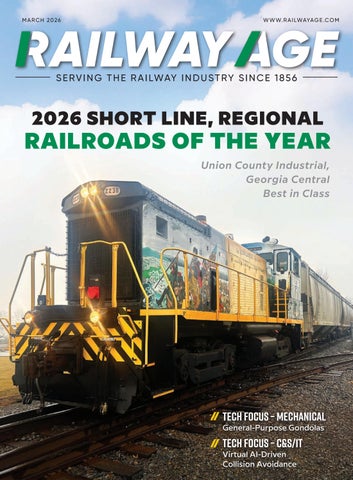
Union County Industrial, Georgia Central

Best in Class

ENGINEERED TO PERFORM

The VersaFlood aggregate hopper from FreightCar America combines lightweight efficiency with heavy-duty strength—giving operators unmatched flexibility and reliability.

CUSTOM MATERIAL CONFIGURATIONS

Available in hybrid aluminum/steel, full aluminum, mild steel or stainless steel.

SUPERIOR CORROSION RESISTANCE

Strategic aluminum integration enhances lifecycle performance.

Scan the code to discover our Purpose-Built approach.

CONVERSION-READY DESIGN

Adaptable from coal or small-cube donor cars for expanded fleet versatility.

ADVANCED DOOR SYSTEM OPTIONS

Transverse or longitudinal designs with manual or automatic independent operation.

INTUITIVE TOUCH-PAD DOOR CONTROL

Safe, efficient unloading—one pocket or all at once.

Don’t Have a Conniption. It’s Just Corporate-Speak

I’ve been wanting to write this column for a very long time. Recently I came across a Wall Street Journal article by News Editor Demetria Gallegos: “The Corporate Jargon We Hate the Most.” “We pinged our readers for the terms that really annoy them,” she wrote. “The list is long.”

In my nearly 34 years at Railway Age, I’ve rolled my eyes and popped Pepcid pills while deciphering press releases polluted with conniption-causing corporate-speak. Here’s a sampling of euphemistic words and phrases— some of which I’m guilty of using:

• “_____ is our number one priority” (fill in the blank)

• “360-degree-view” (makes my head spin)

• “10,000-/50,000-foot view” (nosebleed)

• “Asset allocation” (this goes where?)

• “Bandwidth” (AM? FM? VHF? UHF?)

• “Circle back” (boomerang)

• “Core competency” (incompetency?)

• “Cost control” (Wall Street favorite)

• “Customer-centric” (just circling around?)

• “Deep dive” (until you drown?)

• “Deliverable” (to the wrong address?)

• “Drill down” (how deep?)

• “Hard stop” (derailment?)

• “Judicious use of capital” (cheap)

• “Cutting edge” (until it’s dull)

• “Lean in” (without falling over)

• “Leverage” (fancy word for “use”)

• “Low-hanging fruit” (maybe putrid?)

• “Move the needle” (off the scale?)

• “New normal” (until it’s old)

• “Pivot to growth” (yeah, ok …)

• Raise the bar” (how high?)

• “Rationalize” (sometimes irrational)

• “Right-size/downsize” (fire people)

• “Shareholder value” (ugh!)

• “Solution” (to a challenge?)

• “Solve challenges/issues” (grammar!)

• “Stakeholder” (to kill Dracula?)

• “Synergy” (cooperation)

• “Targeted” (for right-sizing?)

• “Touch base” (you’re out!)

• “Thought leader” (someone with ESP?)

Had enough? No? Try to decipher this “press release boilerplate BS text” I wrote in this column a while back:

“We’re executing best-in-class service, and we’re extremely confident that substantial opportunities exist to leverage our service product offering, capture growth and deliver superior financial returns. Our 360-degree view, which incorporates, where appropriate, rationalized right-sizing and/or downsizing initiatives, is focused on strategically deploying disciplined capital investments. We’re working aggressively to implement a remarkable rate of positive organizational change, developing and implementing customer-centric operating strategies by engaging and communicating proactively through frequent interactions with both our internal and external stakeholders about our processes for tighter procedural coordination. In a challenging environment filled with persistent headwinds, we are fully committed to deploying the streamlined resources necessary to address our capacity constraints, while raising the bar on our customer service metrics. Safety is our top priority, followed closely by our commitment to enhancing shareholder value.”

Yogi Berra was right: You can observe a lot by watching! Now, about that fork in the road ...

INTERNATIONAL OFFICES

46 Killigrew Street, Falmouth, Cornwall TR11 3PP, United Kingdom 011-44-1326-313945

International Editors

Kevin Smith

ks@railjournal.com

Railway Age, USPS 449-130 (ISSN 0033-8826), is published monthly with a special C&S Buyers Guide issue in December by the Simmons-Boardman Publishing Corporation, 1809 Capitol Avenue, Omaha, NE 68102-4905. Tel. (212) 620-7200. Periodicals postage paid at Omaha NE and additional mailing offices.

Subscriptions: Qualified individuals in the railway industry may request a complimentary subscription. All other subscriptions: US/Canada/Mexico; $100.00 per year. Rest of World $139.00 per year. Single copies $36.00 per issue. For Subscriptions & address changes, please call (US, Canada & International) +1-847-559-7372, Fax +1 (847) 291-4816, e-mail railwayage@omeda.com or write to: PO Box 239, Lincolnshire IL 60069-0239 USA.

COPYRIGHT© 2026 Simmons-Boardman Publishing Corporation. All rights reserved. Contents may not be reproduced without permission. For reprint information contact PARS International Corp., 102 W. 38th Street, 6th floor, New York, NY 10018, Tel.: 212-221-9595; Fax: 212-221-9195.

POSTMASTER: Send address changes to Railway Age, PO Box 239, Lincolnshire IL 60069-0239 USA

David Briginshaw

db@railjournal.com

Robert Preston

rp@railjournal.com

Mark Simmons

msimmons@railjournal.com

CUSTOMER SERVICE: RAILWAYAGE@OMEDA.COM , OR CALL 847-559-7372

Tamping with a technological advantage

The Plasser TampingAssistant knows where every work unit belongs. It automates maintenance, supports operating staff, and delivers consistently high quality thanks to AI with deep learning, state-of-the-art sensor technology, and digital tamping plans. And the development journey continues!

”Plasser
& Theurer“, ”Plasser“ and ”P&T“ are internationally

Industry Indicators

‘AN UNEVEN BACKDROP’

“For the economy, uncertainty continues to be a defining feature,” the Association of American Railroads reported last month. “The most recent GDP figure—4.4% in Q3 2025 over Q2 2025—was strong, but few forecasters view that pace as sustainable.

“It’s not hard to find economic indicators that are worrisome. Consumer confidence recently fell to an almost 12-year low. So far, consumer spending has held on, suggesting households are pushing past sentiment concerns, but the durability of that support remains uncertain. Housing is subdued, auto sales have softened, and industrial production has been largely flat for several years. January’s big jump in the Manufacturing PMI to 52.6% was encouraging, but whether that marks a sustained turn or a short-lived bounce is unknown.

“On the other hand, several fundamentals help explain why many economists still expect growth in the 2%2.5% range this year. The labor market, while cooling, continues to generate income growth, while inflation has eased enough to support real purchasing power. Household balance sheets remain relatively healthy; service-sector activity is holding up; and financial conditions have not tightened to recessionary levels. If GDP growth persists, it will likely be because consumer spending continues to carry the expansion, employment avoids a sharp downturn, and manufacturing weakness does not deepen. These conditions are far from guaranteed but are not implausible.

“For railroads, this uneven backdrop points to a cautious outlook. Freight demand will hinge on, among other things, whether manufacturing momentum can be sustained, how trade policy evolves, and what unfolds in the labor market—all areas with significant open questions.

“A severe winter storm disrupted rail operations in much of the country the last week of January, but U.S. rail volumes have remained resilient.

“Total U.S. carloads rose 4.4% in January 2026 over January 2025, with 12 of the 20 major AAR-tracked carload categories posting gains, led by grain, coal and industrial-related products. Meanwhile, U.S. rail intermodal shipments fell 3.5% in January, their fifth straight year-over-year decrease as weaker port activity, softer goods demand, and ample trucking capacity continued to weigh on intermodal volumes.

“The AAR Freight Rail Index (FRI), which tracks seasonally adjusted intermodal shipments and carloads excluding coal and grain, is a useful gauge of economysensitive rail volumes. The index rose 3.1% in January 2026 over December 2025, thanks mainly to an uptick in carload traffic.

“The sharp divergence between growing iron and steel scrap carloads and falling metallic ore carloads (chart, opposite) reflects continued cyclical and structural shifts in steelmaking. Domestic steel production has long been tilting toward electric-arc furnaces, which

use scrap rather than ore and can support rail movements even in a low-growth manufacturing environment. Scrap is also domestically generated and rail-friendly, while metallic ores are more exposed to blast-furnace utilization (which has softened) and can bypass rail altogether via water-based supply chains. Together, these forces help explain why scrap volumes have strengthened even as ore traffic has weakened over the past couple of years.”

ASLRRA SHORT LINE CARLOAD REPORT

Total carloads handled calculates the total number of individual carloads that were either an origination, termination or a bridge movement, on at least one U.S. short line. This total will generally be smaller than the sum of originated, bridged and terminated movements as some individual carloads experience more than one of these events.

This short line carload data report is created by the American Short Line and Regional Railroad Association in cooperation with Railinc, based on waybill data submitted by railroads. A detailed report is published each month via ASLRRA’s Views & News. Visit www.aslrra.org/carload to learn more.

Industry Outlook

POTUS 47 Stymied, Gateway Moves Forward

August 2025: Gateway Development Commission CEO Tom Prendergast (center) shows now-resigned FTA Administrator Marc Molinaro (see p. 40) and FRA Administrator David Fink progress across five active construction sites started in the year since securing full funding for the Hudson Tunnel Project.

ONCE AGAIN, POTUS 47’S EFFORTS AT CREATING CHAOS HAVE BEEN TRUMPED: ON FEB. 18, THE GATEWAY DEVELOPMENT COMMISSION (GDC) RECEIVED THE FULL REIMBURSEMENT OWED TO IT FROM THE FEDERAL GOVERNMENT AND NOW HAS MORE THAN $205 MILLION AVAILABLE TO CONTINUE WORK ON THE HUDSON TUNNEL PROJECT (HTP), CENTERPIECE OF THE GATEWAY PROGRAM.

It has been a long, torturous road for the GDC, and it’s not over just yet. But so far, every attempt by POTUS 47 to cripple the Gateway Program has been thwarted. Gateway, described as “the most urgent major infrastructure program in the country,” is “a comprehensive set of rail investments that will improve commuter and intercity services, add needed resiliency, and create new capacity for the busiest section of the Northeast Corridor (NEC), the most heavily used passenger rail line in the country, hosting more than 2,200 train movements and 800,000 passenger trips daily.”

In short, Gateway continues its forward momentum under the leadership of CEO Tom Prendergast and his team. Many

industry observers have said there is little doubt this critical passenger rail project will be completed on budget and on time.

Federal Judge Jeannette A. Vargas of the Southern District of New York late Friday, Feb. 6 blocked the Administration from freezing billions in funding for the $16 billion HTP, pending ongoing litigation. “Plaintiffs have adequately demonstrated that they would imminently suffer” irreparable harm, Judge Vargas wrote in her 11-page ruling, if the HTP was “forced to shut down its operations.”

Then, on Feb. 12, the U.S. Court of Appeals for the 2nd Circuit allowed Judge Vargas’s order to take effect, requiring the POTUS 47 Administration to resume funding. In doing so, the appeals court paved the way for the project to resume as a lawsuit brought by the two Democratic-led states of New Jersey and New York proceeds. The court was expected to issue another ruling after holding oral arguments late last month.

The GDC has been seeking release of HTP federal funding withheld since October 2025. POTUS 47 has said the project is “terminated,” though he and Transportation Secretary Sean Duffy have given conflicting public statements on its status.

In October, POTUS 47 and the USDOT

began withholding federal funding payments for the HTP and Phase 2 of the New York Metropolitan Transportation Authority’s Second Avenue Subway projects, stating that payment requests could not be processed during project reviews it had ordered. Such “reviews” have been based on USDOT’s notion that it needed to investigate whether “any unconstitutional practices” are occurring within the projects after the agency ruled that “race and sexbased presumptions of social and economic disadvantage that violate the U.S. Constitution” should be removed from the Disadvantaged Business Enterprise (DBE) program, which is intended to favor small businesses when awarding contracts for federally funded projects.

USDOT officials had said that the funding halt “would last until a review of the project’s contracts for compliance with new policies regarding diversity could be completed,” The New York Times reported GDC Executive Vice President Catherine Rinaldi said the Commission had responded to all of the USDOT requests and that all of its contracts with DBEs had been “appropriately certified.”

Additionally, the GDC sued the USDOT for breach of contract in a federal court in Washington on Feb. 2, contending that it was owed more than $200 million in expenses that had not been reimbursed. The States of New York and New Jersey filed a separate suit in federal court in Manhattan.

The White House has accused Democratic politicians of failing to negotiate with the POTUS 47 Administration to secure a “deal” (POTUS 47’s most frequently used word in his rather limited lexicon) for the project’s future. The Administration blamed Senate Minority Leader Chuck Schumer (D-N.Y.) and other Democrats for refusing to negotiate, and “alluding to their stances on immigration policies,” according to the Times

On top of that, POTUS 47 had approached Schumer offering to release the funds in exchange for Schumer supporting naming Penn Station New York after him as well as Dulles International Airport, to include changing its “IAD” designation to “DJT.” Schumer rebuffed POTUS 47.

– William C. Vantuono

Amtrak Rolls Out First Siemens Mobility Airo Trainset

Amtrak on Feb. 10 showcased the first new Airo trainset from Siemens Mobility at Union Station in Washington, D.C. It features the Amtrak Cascades evergreen, cream, and mocha color scheme and Cascade Range mountain graphics. The first of the 83 Airo trainsets—valued at approximately $8 billion—are slated to enter revenue service on the Amtrak Cascades route, which serves 18 stations in the Pacific Northwest between Seattle, Wash.; Portland, Ore.; Vancouver, B.C.; and Eugene, Ore. Siemens is expected to finish manufacturing all eight Cascades trainsets this year at its Sacramento, Calif., plant. The first Cascades trainset left the plant July 22, 2025, and wrapped up testing in Pueblo, Colo., in October before officially heading to the Northeast Corridor (NEC) for additional testing. Airo trainsets will also be deployed in the coming years on the Northeast Regional, Empire Service, Amtrak Virginia Services, Keystone Service, Amtrak Downeaster, Maple Leaf, New Haven-Springfield-Greenfield Service, Palmetto, Carolinian, Pennsylvanian, Vermonter, Ethan Allen Express, and Adirondack routes. According to Amtrak, the first trainsets for the Northeast Regional will complete production and begin testing this year, with revenue service expected to start in 2027. The final new Airo trainset is anticipated to enter service in 2031/2032.

BRANDT INDUSTRIES

has teamed with ON-SITE SERVICES to help improve rail operator access to parts and service for Brandt R5 Power Unit railcar movers across the continental U.S. Based in Fort Worth, Tex., On-Site Services is a nationwide mobile maintenance provider for Class I and II railroads, as well as the gas, oil and utility industries. The company’s mobile repair “minimizes downtime for operators and provides service to remote locations and on machines that are too difficult to transport for repair,” according to Brandt, which is headquartered in Regina, Saskatchewan, and services markets in Canada, the United States, Europe, Australia, New Zealand, and Asia.

STANDARD RAIL CORPORATION

announced last month that its SIDINGS™ platform has integrated rail freight rate estimation through a partnership with TRATICS , a rail rate management and analysis firm. The capability is available immediately to all SIDINGS™ users across North America. The integration, which “reflects a shared focus on embedding pricing intelligence across the rail logistics workflow,” means that a shipper evaluating a new distribution point can now “compare rail access, available services and estimated freight costs across multiple locations in a single session—a process that previously required separate outreach to carriers, brokers, and service providers.

Estimates are generated instantly within the platform and are intended for planning and feasibility purposes. Rail freight cost has historically been one of the last variables a shipper learns about—often weeks into a planning process, and only after location, access, and service decisions have already narrowed. By the time a rate estimate arrives, the window for considering rail at all may have closed. The Tratics integration addresses this directly. Rate context is now present from the start of the planning process, embedded alongside the infrastructure and service data that SIDINGS™ already provides.” The feature does not provide live carrier pricing or initiate commercial negotiations.

STB’s Preordained ‘Energizer Bunny’

For Surface Transportation Board (STB) Vice Chairperson Republican Michelle A. Schultz, preparation and persistence paved what likely was an already preordained career path.

Serving a second and statutorily final five-year term ending Nov. 11, 2030, Schultz will be in place to vote on a Union PacificNorfolk Southern (UP-NS) merger application if a revised version is submitted, as expected, by April 30.

Only Republican Chairperson Patrick J. Fuchs (see Railway Age, March 2025, for his profile) is similarly assured a vote. Democrat Karen J. Hedlund, whose first term expired Dec. 31, is in a maximum 12-month holdover and must then depart if not renominated and Senate confirmed for a second term. Of the two vacant seats on the five-member board, POTUS 47 nominee and Republican Richard Kloster awaits Senate action. A Democratic seat is open after the court-challenged firing by POTUS 47 of Robert E. Primus.

Never during Schultz’ high school years— where band, cheerleading, field hockey, student council, track and volleyball filled her days, and studying her nights—did she imagine someday being nominated for a federal post by the President of the United States and having her qualifications evaluated by the United States Senate.

Nor did such thoughts occur to this human version of the Energizer bunny when studying economics, English, government administration and public policy at Penn State University—or at Widener University Law School, or later in private law practice, or subsequently working her way to deputy general counsel of Southeastern Pennsylvania Transportation Authority (SEPTA) while simultaneously earning a master’s degree in government administration at the University of Pennsylvania.

Schultz’ post-law school judicial clerkship at the bankruptcy court for the Eastern District of Pennsylvania strongly suggests career preordination. It’s the very courthouse where Penn Central filed for bankruptcy on June 21, 1970, some two years before Schultz’s birth. The echoes remain.

Even today, there is discussed in legal circles the Penn Central autopsy revealing an infamous confluence of poor management, culture clash, unrealistic projections and operational chaos compounded by STB predecessor Interstate Commerce Commission ordering an already bankrupt New England railroad, the New Haven, into the ill-fated marriage.

Might the unanimous January STB decision rejecting the UP-NS merger application, without prejudice for refiling with improved data and cured of other deficiencies, echo the wreck of Penn Central? Didn’t President Ronald Reagan counsel, “Trust, but verify?”

Schultz was Senate-confirmed in 2020 to occupy in January 2021 a new and still vacant seat created by the 2015 Surface Transportation Board Reauthorization Act.

In reviewing cases ahead of voting, Schultz is known for persistently questioning STB staff experts on economics, environmental science and agency precedent. Where Government in Sunshine laws and the 2015 Surface Transportation Board

Reauthorization Act permit, she is known to prod peers aggressively to reveal the thought process and logic underpinning their concerns or likely vote.

Schultz’s capacity to appreciate and integrate opposing viewpoints flows from lessons learned lobbying the Pennsylvania legislature for SEPTA funding. To overcome rural Republican skepticism of transit subsidies, she employed data and logic to demonstrate that public transit’s statewide economic benefits far exceed subsidy costs.

While some allege Schultz’s voting record mirrors that of fellow Republican Fuchs— she has penned only 11 dissents—the claim lacks factual support. The similar voting record can be explained by Fuchs’ brand of pre-vote consensus building. Hedlund has penned fewer dissents.

Where Schultz has written some 25 separate expressions, pro and con, attorneys on both sides acknowledge they are cogent and well-reasoned. As with many attorneys, writing skill is attributable to studying styles of revered judges. In 2022, her dissent to a majority decision preserving Final Offer Rate Review was cited multiple times by the Eighth Circuit Court of Appeals, which vacated it.

Most remarkable at this STB is the collegiality among Schultz, Fuchs and Hedlund— a chemistry the White House and Senate should seek to preserve ahead of filling out the agency’s five seats. Those occupants could decide the most consequential railroad merger application in U.S. history.

Railway Age Capitol Hill Contributing Editor Frank N. Wilner is author of “Railroads & Economic Regulation,” available from Simmons-Boardman Books, www. railwayeducationalbureau.com/product/ railroads-economic-regulation-an-insidersaccount/, 800-228-9670.

Capitol Hill
Contributing Editor
Michelle A. Schultz

Ocean of Capital Chasing Trains

This column is a topic recommended by Eric Marchetto, Chief Financial Officer of Trinity Industries Inc. This column is companion to a Railway Age Rail Group On Air podcast with Marchetto. The podcast and this “Financial Edge” are available free on www.railwayage.com.

Pick up a newspaper today that devotes itself to any business coverage and you’re going to be quickly overwhelmed by two topics. The first is AI and the second is the world’s obsession with the availability of and need to deploy what feels like an ocean of capital that seems to exist in the world’s markets today.

In the 2026 Railroad Financial Desk Book (October 2025 issue), the correlation between availability of capital and increasing asset valuations was drawn. If anything, the correlation for rail assets is just one piece of a larger puzzle that includes stocks, companies and fixed income investments (bonds). One doesn’t have to reach very far to see how the abundance of capital is impacting business. There’s Google’s 100-year bond (following in the steps of Norfolk Southern, Ford and Motorola), the currently limitless appetite for high yield bond debt, and the surge in private lending.

This leads us to North American rail. The abundance of capital chasing investment opportunities in rail spans the industry from railroads to maintenance and repair to—what else?—railcars and locomotives. However, for industry veterans, the current era’s investment patterns differ from historical investment interest. Formerly, highly structured tax-affected (often leveraged) leases and Equipment Trust Certificates (ETCs, a sophisticated word for a well-collateralized loan) were the investment products of choice for asset acquisition and finance.

During this time, shorter term operating leases were the province of a handful of investors taking above average risk and receiving above average, but occasionally slightly erratic, returns that followed the cyclicality of the rail equipment marketplace.

Eric Marchetto notes that today’s

capital “stack” (to use an I-bank word) looks very different. (Yes, this is not your father’s capital stack.) One difference is the types of capital coming into the rail market today, including long horizon passive capital from infrastructure funds and insurance companies. These are potentially very large investors that can use one billion in equity to buy three to four billion in railcar assets.

Furthermore, there are shorterterm investors (think PE firm Apollo) that are repackaging rail asset backed loans as collateralized debt obligations (CDOs) parsing out portfolios into credit-rated tranches.

This is all in the shadow of an industry expected to build 25,000 railcars in calendar year 2026. At the Railroad Financial Corporation and FTR Intel Houston Railcar Symposium in November 2025, Marchetto asked a room full of companies that move freight by rail if they intended to grow their railcar fleets in 2026. Very few rail shippers saw a need for that. Contrast that against the investment community, where every railcar lessor and investor is looking for more growth in a year where new builds are contracting.

What do these investors love about rail? Marchetto notes that “rail assets represent an attractive risk-adjusted investment.” There is low default risk, and

the long-lived nature of railcars represents an inflation hedge. Marchetto sees directly and anecdotally, especially after the GATX / Brookfield acquisition of the Wells Fargo fleet, more funds looking to get into the rail equipment leasing business. He sees growing demand from these investors looking for attractive returns. Think of the HALO (Heavy Assets Limited Obsolescence) trade that is currently a theme with investors looking for AI disruption alternatives.

Additionally, investors see an opportunity for steady and consistent returns in the railcar leasing space. Think of it this way: While many railcar owners may feel that post-COVID railcar prices have risen dramatically, Marchetto notes that new railcar prices have risen 3% to 4% annually over the past 20 years.

Contrast this against lease rates that have risen 1% to 2% over the same 20-year period. This gives conviction in the longterm returns and the opportunity for lease rates to continue to increase to match the rise in asset value. Couple that with the abundance of liquidity available in today’s market, which when it gets deployed will have to assume that lease rates will rise in the future to justify paying today’s prices.

Also add the uplift in railcar investment from the 100% bonus depreciation made available to investors in the 2025 tax bill. This makes for a rather compelling investment thesis when you are looking to deploy capital and generate attractive risk-adjusted returns.

Expectations are that more capital will move into railcars. This topic will be on the forefront of investor mindsets throughout 2026. Listen to the podcast for additional insight!

Got questions? Set them free at dnahass@ railfin.com.

Trinity Industries Inc. CFO Eric Marchetto

We Need Strong Public Policies. It’s Up to You!

Short line railroading is a growth-focused industry, and ASLRRA’s primary goal is to provide opportunities to promote that growth through engagement, education, training and connections. As this column goes to print, we are in between the two events that offer the very best of those opportunities: Railroad Day on Capitol Hill and ASLRRA’s Annual Conference and Exhibition.

To keep America’s freight moving the rail industry needs strong public policies that help railroads invest in infrastructure, improve safety, and create value for customers. That was the message more than 350 Class I, Class II, Class III and rail supplier industry representatives delivered to 300-plus Congressional offices during a highly successful March 4 fly-in advocacy day in Washington, D.C.

For short lines and regionals, the specific message was about securing the much-needed update of the 45G tax credit to account for inflation, securing continued robust funding of the CRISI grant program, opposing the never-ending effort to increase truck size and weights, and streamlining federal permitting to allow investment grant dollars to be put to work faster. In today’s oversaturated digital world, the opportunity to talk face to face with elected officials about the real-life impact of a 45G track rehabilitation project that reduced derailments for a local shipper or a CRISI project that saved a local bridge from collapsing is truly a golden opportunity.

Nobody tells the story of short line railroading better than the people who live it!

And nowhere is the successful result more apparent than in the growing number of House and Senate co-sponsors of our 45G tax credit update bills. Every one of these co-sponsors has been earned one at a time by an individual short line contact with his or her individual congressperson. Going into

Railroad Day on Capitol Hill, we had 149 House co-sponsors and 37 Senate co-sponsors. The numbers ultimately needed will be higher, but even today, both bills are among the most co-sponsored in this Congressional session. Importantly, they are also two of the most bi-partisan legislative efforts navigating the difficult terrain of a bitterly partisan landscape.

Railroad Day on Capitol Hill is an important educational tool, but equally important is a show of force that demonstrates our geographical reach and our ties to thousands of small business customers and local communities that would otherwise be cut off from the national rail network and the U.S. economy. I am grateful for the many short line and supplier members that took the time and effort to make that show as impressive as possible, and hope that even more will do so in the future.

On April 12-14, more than 1,700 individuals will converge on Minneapolis for ASLRRA’s Annual Conference and Exhibition. This three day event is the most efficient and productive way to learn, to connect, and to focus on understanding the forces driving change in our industry. It is the short line industry’s premier event featuring top tier speakers, more than 40 hours of educational workshops, an exhibit hall with more than 200 industry suppliers showcasing their wares, and dozens of opportunities to network with colleagues and potential business partners.

This year’s keynotes speakers include Federal Railroad Administrator David Fink, BNSF President and CEO Katie Farmer, and Norfolk Southern President and CEO Mark George. The educational workshops will feature nearly 50 breakout sessions led by industry experts on 12 subjects—everything from engineering to finance to marketing to technology to safety, and many more. It will literally cover the bases from A to Z on running a modern short

line railroad and will be as good a tool as a short line can get in advancing the knowledge and skills of its workforce and in understanding the newest and best practices being used to build a better short line industry.

Rounding out this excellent program, which ASLRRA staff has worked tirelessly to develop, will be presentations of our annual awards, including the Business Development Awards, our Hall of Fame inductees, the Distinguished Service Award, and Safety Person and Professional of the Year— projects and people who represent some of the best of our best.

While there is always much to discuss and learn at this annual short line event, this year’s meeting will be held in the shadow of the proposed Union Pacific/Norfolk Southern transaction application. It goes without saying that no other 2026 industry gathering will have such a large number of attendees who have a detailed understanding of the regulatory process, are well versed in the details of the proposal, and are stakeholders critically impacted one way or the other by the outcome.

ASLRRA’s 2026 Annual Conference and Exhibition is a unique opportunity for every short line to do a deep dive into the merger issues and to discuss the potential pros and cons with your colleagues. It is an opportunity not to be missed and there is still time to get in on the action. www.aslrra.org/ events/conference/ provides registration and hotel information and is constantly updated with late-breaking program information.

See you there!

SHORT LINE, REGIONAL RAILROADS OF THE YEAR 2026

Union County Industrial Railroad, a North Shore Railroad Company affiliate, and Georgia Central Railway, a Genesee & Wyoming subsidiary, represent this year’s Short Line and Regional Railroads of

the Year, respectively. Earning Honorable Mention are Sierra Northern Railway (Short Line) and R. J. Corman Railroad Company’s Nashville & Eastern Railroad (Regional). Railway Age proudly recognizes all four, which are not only achieving growth through strategic investment, a collaborative

approach to industrial development and a commitment to service excellence, but also positioning themselves as technology innovators, delivering value to the industry, customers and the communities they serve every day. The railroads and their partners share their stories over the following pages.

A Georgia Central locomotive at the Garden City Terminal within the Port of Savannah.

RAIL LEASES TAILORED TO YOUR NEEDS.

Your business depends on reliable transportation capacity. That’s why we match our extensive experience with one of the youngest, most diversified railcar and locomotive fleets in the industry. Turn to us for creative rail leasing solutions that can help you free up capital for your growth priorities.

A Division of Fi rs t Citi zens Bank

2026 Short Line, Regional Railroads of the Year

UCIR helped bring on line Country View Family Farms’s new $55 million facility, which includes a 600,000-bushel silo and an 8,250-foot loop track designed to handle unit trains.

2026 SHORT LINE OF THE YEAR

UNION COUNTY INDUSTRIAL RAILROAD

Founded on March 30, 1995, the Pennsylvania-based Union County Industrial Railroad (UCIR) operates 18.2 miles of track owned by three private companies. The Class III over the past 31 years has grown almost twentyfold—from handling some 200 railcars annually to nearly 4,000 today—and achieved more than 13 consecutive years without an FRA-reportable injury. It serves customers across Milton, West Milton, New Columbia, Winfield, and Allenwood, and interchanges with Norfolk Southern (NS) and Canadian Pacific Kansas City (CPKC) via haulage rights in Northumberland.

UCIR’s success is rooted in focused marketing, innovative operations and exceptional customer service—from the office to the field—delivered by Operations, Customer Logistics, Marketing and Maintenance of Way teams alike.

GROWTH THROUGH STRATEGIC PARTNERSHIPS

UCIR has experienced growth in both infrastructure and customer base over the past 15 years. The railroad constructed three new sidetracks and runarounds, including a 1,700-foot runaround (installed in 2020) and two additional

runarounds (completed last year). Since 2017, it has invested more than $8 million in infrastructure.

One of the most impactful examples of UCIR’s growth is its partnership with Country View Family Farms. In 2022, CVFF—a family-owned business and one of the top hog producers in the United States—was seeking a location for a hog feed facility capable of handling both manifest traffic and unit trains. After more than a year of unsuccessful searches elsewhere, UCIR stepped in with a creative solution. Its local marketing team identified a property not previously on the market and facilitated discussions between CVFF and the landowner. The resulting agreement allowed the former landowner to continue farming within a 115-railcar loop track built around the property. One year after groundbreaking, CVFF celebrated the $55 million facility’s launch in 2024. It includes a 600,000-bushel silo and an 8,250-foot loop track designed to handle unit trains. UCIR and NS teamed to secure new trackage rights through the Surface Transportation Board, enabling seamless unit train service without disrupting main line operations. UCIR now assists with unloading trains and manages all manifest traffic to

the facility. Production ramped up in 2025. CVFF now supplies feed to farms within a 50-mile radius—enough to support nearly one million hogs. It also created 50 permanent jobs and supports 30 full-time truck drivers. “This was the largest project I was ever involved with,” UCIR Chief Marketing Officer Todd Hunter noted “The railroad is extremely proud to now be a part of the CVFF family.”

UCIR’s customer growth also includes major industrial partners such as GAF, a leading North American roofing and waterproofing manufacturer with 30 U.S. locations, and White Deer Gas.

UCIR first connected with GAF in 2015, and after evaluating multiple sites, GAF chose New Columbia for its East Coast manufacturing facility. Following a $75 million investment, the plant became operational in 2018. GAF later expanded with an additional $100 million investment. It built a second 400,000-square-foot facility and two rail spurs, which UCIR began serving in 2021. The company publicly cited “excellent rail service” as a key reason for the expansion. It has brought more than 60 familysustaining jobs to the region. Beyond rail service, UCIR has supported GAF by assisting with hiring efforts, community connections, and special events, including an inaugural railcar ribbon-cutting attended by regional leaders.

UCIR in 2017 attracted White Deer Gas to New Columbia. The company invested more than $10 million in a new transfer facility located on the railroad; it began receiving shipments in 2018 and handled nearly 200 railcars in its first year. The terminal is among the largest of its kind east of the Mississippi River.

COMMUNITY COMMITMENT

UCIR’s success extends beyond freight service. The short line is active in industry associations, economic development organizations, and local chambers of commerce, serving on boards and committees. It is also devoted to the community, donating passenger excursions for Scouting America (Boy Scouts), veterans’ organizations, community celebrations, and special-needs events. In 2024 and 2025, UCIR brought to fruition and hosted the Veterans Benefit Voyage, raising nearly $32,000 for nonprofit

2026 Short Line, Regional Railroads of the Year

organizations supporting U.S. Veterans.

The railroad has also added Toys for Tots collections in conjunction with the North American Railcar Operators Association, the day after the North Shore Railroad Toys for Tots drive. Combined, NSHR and UCIR have gathered more than 10,000 toys and raised more than $25,000 over the past seven years for this Marine Corps initiative.

Additionally, UCIR has invested heavily in public safety and infrastructure, including the complete rehabilitation of the Winfield grade crossing in partnership with the Pennsylvania Department of Transportation, and upgrades to accommodate highand-wide dimensional shipments.

LOOKING AHEAD

UCIR is proud to have a hand in growing Central Pennsylvania manufacturing. The projects UCIR has been involved in have brought more than 150 jobs to the area and had a positive impact on local farming and the agriculture and building and construction industries. This comes after $8 million

in infrastructure and $240 million in new project investment over the past decade.

UCIR’s steady growth demonstrates that strategic investment, strong partnerships, and a commitment to customer service drive long-term success. As railcar volumes continue to rise, it remains well-positioned to serve the area’s industries, communities, and economy for decades to come.

“The communities located along the UCIR were a hidden gem of Central Pennsylvania for a long time,” North Shore Railroad Company & Affiliates President and CEO Jeb Stotter said. “Over the past decade, this gem has been discovered and has enhanced the corporations that were wise enough to see the incredible potential therein. The introduction of two large corporations to New Columbia in such a short time is nothing less than phenomenal. GAF and Country View Family Farms saw the potential in this rural area and are wonderful additions to this community. It would not have made sense for these companies to take a risk on Union County

if it were not for the talent and customerfocused efforts of the employees working on the UCIR. From track to train, they make UCIR what it is. They deserve this award; our crews have earned it. Thank you!”

“We are so proud of our team’s accomplishments on UCIR,” North Shore Railroad Company & Affiliates Treasurer/Controller

Diana Williams noted. “We can’t wait to see what UCIR will do in 2026 and beyond. I have faith that courage will carry our team to heights they have never imagined before.”

“We are honored to receive this award, and it’s the result of many months and even years of communication, negotiations, and cooperation with many public and private partners to grow the UCIR,” Todd Hunter added. “We have a great team here that makes the difficult look easy!” Congratulations to the Georgia Central Railway team on their well-deserved recognition as Regional Railroad of the Year! Their relentless focus on safety, service, innovation and investment for growth has been transformative for Savannah industries. gwrr.com/gc

2026 Short Line, Regional Railroads of the Year

2026 REGIONAL OF THE YEAR

GEORGIA CENTRAL RAILWAY

The 211-mile Georgia Central Railway (GC), which runs from Savannah to Macon, Ga., and interchanges with CSX and NS, is a case study in how small roads can help boost regional economies, deliver value through strategic vision and disciplined execution, and lead the rail industry into a new chapter.

In 2025, GC positioned itself at the forefront of innovation, becoming the first freight railroad in North America to receive FRA approval to pilot test Parallel Systems’ zero-emission, self-propelled rail technology on portions of its line. If the pilot proves successful, the technology has the potential to capture new container business moving to and from the Port of Savannah, as well as reinvigorate traffic on rural rail lines and revive inland ports in Georgia— all while removing trucks from the region’s roads. Two of the seven pilot phases were completed in 2025.

That milestone is the latest chapter in a broader transformation of the Class II. Halfway through a decade that has in large part been defined by a global pandemic and persistent market volatility, GC remains a steady bright spot in the rail industry. It has strategically invested for long-term growth, secured major industrial development wins, and delivered top safety performance and customer service in a high-growth industrial corridor that includes the booming Port of Savannah.

Recognizing the potential to grow

alongside Savannah, GC carried out improvement projects over the past two decades that have enabled 286K capacity along the entire line and, through a publicprivate investment/FRA CRISI grant, 25 mph track speeds on more than one-third of it.

To handle present traffic demands, two new sidings totaling 20,000 feet and representing a $12 million investment were completed in summer 2025.

In addition, GC in 2022 completed a two-year initiative to overhaul its locomotive fleet by adding 14 cleaner engines that consume 23% less fuel and enhance the railroad’s overall efficiency.

INDUSTRIAL DEVELOPMENT FOCUS

Industrial development has been a contributor to GC’s growth. Over the past five years, customer projects totaling more than $6 billion have occurred along the line. From 2024-25 alone, a half-dozen projects came on line, adding nearly 11,000 carloads and expanding traffic across the railroad’s diverse commodity base, including new frozen potato shipments, as well as increased aggregate, pulp and paper, chemical, and fertilizer volumes. Frozen potato shipments, for example, grew more than ten-fold in those two years, while another customer’s traffic increased nearly 460%.

“GC has provided outstanding service to us and has been a strategic partner as we work to deliver refrigerated and frozen food

to customers in the Southeast,” said John Ripple, Chief Development Officer at Agile Cold Storage, which ships frozen potatoes via the Class II.

These wins are on top of GC’s 2019 selection as the rail service provider for a $172 million plastic distribution facility and 2022 selection as the transportation provider for Hyundai Motor Group’s $5.5 billion electric vehicle and battery-manufacturing facility.

Meanwhile, one of the railroad’s major customers in the distillers’ dried grains sector is developing a project for 2026 that could increase GC carloads by 20% in the long term. An aggregate customer’s expansion could generate more growth, GC added.

PRIORITIZING SAFETY, SERVICE

GC understands that with growth comes the responsibility of community stewardship. The railroad has reduced the number of its reportable injuries by 80% over two years. Amid a challenging freight environment, the railroad also scored 8.8 out of 10 in overall satisfaction on its 2025 biennial customer survey.

“GC has consistently demonstrated exceptional responsiveness and reliability,” said Jason Lovett, Chief Operations Officer at GC customer DSI. “Their team maintains clear communication, promptly addresses any operational concerns, and thoroughly reviews data to ensure the highest level of accuracy in our railcar information. That unwavering customer

Zane Williams Photograph, Courtesy of GC, G&W
A GC train hauls freight through southeast Georgia.

2026 Short Line, Regional Railroads of the Year

focus and commitment to excellence have made them an invaluable long-term partner to our organization.”

Thanks to all these initiatives that have demonstrated a commitment to southeast Georgia, GC has seen traffic grow more than 36% in five years, rising from nearly 22,000 carloads in 2020 to more than 30,000 carloads in 2025. By 2032, annual carloads are expected to surpass 50,000.

“The story of the GC clearly demonstrates how investing in a railroad, hustling for growth and providing worldclass service can be a recipe for success,” G&W North America CEO Michael Miller said. “The future looks bright at GC for decades to come.”

2026 Short Line, Regional Railroads of the Year

2026 SHORT LINE HONORABLE MENTION

SIERRA NORTHERN RAILWAY

The last Interstate Commerce Commission-approved short line transaction was Mike Hart’s 1995 acquisition of what is now Sierra Northern Railway (SERA) in California. Widely expected to fail, its 600 carloads were operated over 49 excepted miles of broken ties and rusty

rail. Derailments were common, and a lone Baldwin locomotive was firing on five cylinders.

Through an innovative “take-or-pay” agreement with Sierra Pacific Industries, freight traffic was stabilized and rebuilt by dramatically reducing rates to those

charged when the railroad was constructed in 1897. Over the next 31 years, the railroad expanded, adding the Yolo Short Line Railroad (YSLR), Mendocino Railway’s “Skunk Train” (MRY), operations at the Port of West Sacramento, the Riverbank Industrial Complex, and the former Fillmore & Western trackage in Ventura County. Parent company Sierra Railroad Company also added excursion services, developed electric-assisted rail-bike operations, and maintained SERA’s reputation as the “The Movie Railroad” with more than 400 films recorded on site.

SERA, Sierra Railroad Company’s freight division, began to accelerate in 2015 under Kennan H. Beard III’s leadership. It now moves more than 15,000 carloads annually and has materially expanded system capacity through new sidings, interchanges, storage tracks, and transload facilities.

Sierra Railroad Company in 2020

2026 Short Line, Regional Railroads of the Year

acquired and developed a 116-acre inland port and unit train transload facility that serves Union Pacific and BNSF and now handles more than 7,000 carloads annually, and in 2024 constructed a West Sacramento transload that exceeds 3,000 carloads per year.

Last fall, the first of four HFC (hydrogen fuel cell)-powered, ZE (zero-emission) four-axle switchers entered service on SERA. Developed with Railpower Technologies (now a SERA subsidiary), the locomotive is described as “the first [of its type] in the United States built specifically for freight rail.” The project was made possible through a P3 (publicprivate partnership). The California Energy Commission awarded $4 million to design and demonstrate the prototype. In 2023, the California State Transporta-

provided $19.5 million for three additional locomotives. In addition to Railpower, technology partners include GTI Energy, OptiFuel Systems LLC, Ballard Power Systems, and the University of California, Riverside. Sierra Railroad Company’s energy division, founded in 2003, is producing hydrogen for the locomotives using waste feedstocks.

In December 2025, SERA completed a 5-1/2-year FRA CRISI project installing 90,000 new ties and eight miles of 115-pound rail, and upgrading ten highway-rail grade crossings. With RRIF financing, SERA built more than six miles of new main line sidings, including an 8,000-foot unit-train interchange and fully utilized storage tracks.

SERA represents a turnaround story— from near-abandonment to sustained

Environmental Award winner is now entering into a new phase with the sale of a majority interest to Ridgewood Infrastructure.

“Thank you to Railway Age magazine for recognizing Sierra Northern Railway with an honorable mention, a testament to our team’s dedication and innovative spirit,” said Kennan H. Beard III, President and CEO of SERA. “This acknowledgment celebrates our remarkable growth in services, from expanded freight capabilities and sustainable initiatives to enhanced customer partnerships across California. We are inspired to continue our expansion, building on this momentum to deliver even greater value to our communities and the rail industry.”

2026 Short Line, Regional Railroads of the Year

2026 REGIONAL HONORABLE MENTION

NASHVILLE & EASTERN RAILROAD

Nashville & Eastern Railroad (NERR) in Tennessee has achieved measurable, longterm economic development in the communities it serves. Leveraging an understanding of the highly competitive Nashville market, parent company R. J. Corman in 2025 worked with multiple partners to identify and develop

rail-served sites along the busy I-40 corridor, providing customers with a competitive rail alternative and reducing reliance on longhaul trucking. NERR not only advanced these projects but also continued operating 12 daily roundtrips of WeGo Public Transit’s 32-mile Nashville Star commuter rail service.

Annual carloads are projected to increase by about 2,700, a significant accomplishment for a railroad whose volumes have historically remained at 10,000-10,500 carloads per year.

This expansion followed R. J. Corman’s January 2019 acquisition of NERR, which serves the counties of Davidson, Putnam, Smith, and Wilson, and interchanges with CSX at Vine Hill. With 31 customers along 145 miles of track, R. J. Corman successfully integrated the railroad’s operations and service.

A key element of NERR’s growth strategy has been its ability to create value through the thoughtful redevelopment of existing railserved property. The National Cement terminal in Lebanon is one example. The site had been vacant and included an underutilized rail spur. Following construction, test cars began running in fourth-quarter 2024 and full production commenced in first-quarter 2025. The terminal represented a 12% increase in NERR carloads and is forecasted to support

R. J. Corman Railroad Company

2026 Short Line, Regional Railroads of the Year

sustained carload volumes for years to come.

“We are pleased to partner with R. J. Corman Railroad Company to transport our cement products,” said Jason K. Heathcock, Vice President-Logistics at National Cement Company of AL, Inc. “Their commitment to safety and efficiency aligns with our company values, and we are confident in their ability to meet our expanding supply chain needs.”

The development of a fly ash terminal in Lebanon reflects the same strategic approach. Eco Materials Technology, a CRH company, committed to a structured five-year volume plan, culminating in a 10% increase in annual NERR carloads. The terminal has two tracks with a 20-railcar capacity, allowing for operational flexibility and future commodity growth.

This project required the cooperation of several partners and represented a combined $5.8 million investment. The Nashville Eastern Railroad Authority provided property

and financial support, R. J. Corman/NERR facilitated facility construction, Eco Materials Technology installed equipment for unloading materials, and CSX contributed rate alignment to strengthen service competitiveness.

“The opening of the Lebanon terminal reinforces Eco Materials’ leadership in sustainable innovation and represents another major milestone in building our national network of rail terminals dedicated to delivering lowcarbon cement alternatives,” Eco Material Technologies President Grant Quasha said.

Projects like these depend on alignment across real estate owners, utilities, zoning, capital investment, customer needs, and Class I connectivity. NERR has excelled in bringing these elements together. It is committed to working with partners to enhance industrial site and building inventory along is line.

“We are incredibly proud of the work taking place on the NERR, and we’re grateful to Railway Age for recognizing the progress being

made along the line,” R. J. Corman Railroad Group COO–Railroad Shannon Drown said. “Our team’s commitment to collaboration and thoughtful development has strengthened service for our customers and reflects the robust relationships that support this growth. The ability to bring new terminals into operation, repurpose dormant industrial sites, and grow freight service on a shared commuter corridor speaks to the dedication of our employees and partners across Middle Tennessee. We appreciate Railway Age for highlighting the significance of this work and are excited for what the NERR will accomplish in the years ahead.”

SIERRA

NOT YOUR ‘RUN OF THE MILL’

GONDOLAS

Improved carbody materials and innovative designs are transforming these long-lived warhorses into state-of-the-art railcars.

The general-purpose, open-top gondola has been a part of freight railroading since its beginnings nearly 200 years ago. But if you think these gondolas are “run of the mill” railcars, think again. New designs and new materials are helping these rugged, mostly all-purpose

cars meet shipper demands for efficient, damage-free loading and unloading.

For this report, Railway Age asked The Greenbrier Companies, TrinityRail® and FreightCar America for their viewpoints on short- and long-term market conditions, including current and projected demands for new railcars (i.e. replacement of cars aging

out of the North American interchange fleet); design improvements (i.e. types of steel or aluminum, carbody construction, etc.); and current R&D initiatives.

THE GREENBRIER COMPANIES

“We continue to view the North American railcar market as operating below The Greenbrier Companies

replacement levels—currently under 40,000 builds—as fleet owners largely remain on the sidelines amid ongoing trade and tariff uncertainty,” The Greenbrier Companies Vice President of Marketing and General Manager Tom Jackson tells Railway Age. “That said, we are beginning to see early signs of growth in select end markets, including biofuels, metals and certain specialty chemicals. Overall, the industry is entering a multi-year replacement cycle, as significant railcar builds from the 1980s

TECH FOCUS – MECHANICAL

approach the end of their service lives. This dynamic is most evident across core freight car types such as grain hoppers, boxcars and gondolas.

“As part of Greenbrier’s continuous improvement culture, our engineering teams evaluate railcar designs throughout the entire product lifecycle. We work closely with customers to tailor solutions that address their specific operational challenges and objectives. From a design and innovation standpoint, our engineers focus on increasing efficiency, improving aerodynamics, reducing tare weight, and optimizing loading configurations. To support these efforts, we explore alternative materials—including advanced steel grades—to reduce weight, increase payload capacity, and enhance durability. This is evident in the success of our highstrength steel gondola portfolio. In parallel, we continuously refine our facility layouts and production processes to drive efficiency while maintaining industryleading safety standards.”

Jackson adds that Greenbrier “maintains a robust product development pipeline, with multiple prototypes currently in service and generating strong test results. These include several gondola configurations, CO₂ tank cars, boxcars utilizing alternative materials for doors and roofs, and new specialty railcar designs. Leveraging our global engineering footprint, we have incorporated proven design concepts from Europe and Brazil into North American offerings, allowing us to accelerate innovation and apply best practices across regions. That’s our integrated strength success, which separates us from other railcar suppliers.”

Greenbrier’s gondola portfolio spans a wide range of applications and is available in high-strength, advanced highstrength, and ultra high-strength steel grades. “These materials are also being deployed across other railcar components, including boxcar structures, resulting in improved reliability, lower maintenance costs and extended service life for fleet owners,” notes Jackson. “In addition, we are launching a new family of advanced high-strength rotary gondolas that are gaining strong traction in the mining sector. These designs deliver payload increases ranging from approximately

6,000 to 15,000 pounds while further enhancing durability. Our gondola offerings currently range from 2,300 to 7,100 cubic feet, and we are actively developing one of the industry’s largest wood chip gondolas—8,200 cubic feet.”

TRINITYRAIL®

“We see tremendous upside in the mill gon market in both the short and long term,” TrinityRail® Chief Commercial Officer Charley Moore tells Railway Age. “The growth in Electric Arc Furnace (EAF) steel production has created a very efficient use of rail by enabling producers to load inbound carloads of scrap and outbound carloads of finished goods in the same car.”

The railcar market is constantly changing. One shift TrinityRail® has seen in recent years is the changing variety of mill gondolas in demand. “Shippers want to optimize their mill gons for the varying density of their products, which could include making the car lighter and creating more capacity with taller interior walls,” says Moore. “At TrinityRail® , we offer many different mill gon designs of varying length and capacities ranging from 2,743 to 6,400 cubic feet. With our design engineering expertise, we work directly with our customers to create a railcar specification that meets the customer’s needs and maximizes the safe loading capacity for the products that they ship.

“Some of the markets served by gondolas demonstrated strength last year with Iron & Steel Scrap carloads up almost 10%, and Nonmetallic Minerals (Aggregates) up almost 2%. Attrition will also continue over the next few years, showing a need for railcars to serve both market growth and replacement of aging railcars. There have been more than 25,000 gondolas built in the past five years, with most of them serving the metals markets (mill gons and coil cars). With attrition and growing demand, we expect that trend to continue into the near future.”

FREIGHTCAR AMERICA

“Similar to the demand environment we see with many car types, gondola deliveries are largely tied to the replacement of aging fleets,” FreightCar America Chief Commercial Officer

Greenbrier 7,100-cubic-foot wood chip gondola. The company is developing an 8,200-cubic-foot version, which will be one of the industry’s largest.

TECH FOCUS – MECHANICAL

TrinityRail® notes it “delivers durable, highstrength gondolas, including the 66-foot mill gondola (pictured), engineered and built to offer reliable, heavy-duty rail transportation for the toughest commodities.”

Matt Tonn tells Railway Age. “This is also supported by inquiry levels. There are indicators that the demand for gondolas will remain consistent with what we have seen in the past few years, driven primarily by strong retirements expected through 2030 and largely tied to scrap steel demand.”

Higher-yield steels “are more acceptable for customers today than at any time in recent history,” Tonn notes. “Collaboration with customers to gain deeper insights into their operating environment, as well as fleet planning and maintenance challenges, continues to drive our focus on new railcar designs and

enhancements. Gondolas are a staple car type in the rail industry that serve multiple industries and market segments. From steel and metal products to aggregates, coal and construction materials, gondolas represent one of the largest carload segments in our industry.

“Over the decades, FreightCar America has introduced multiple enhancements to its gondola designs, starting with the allaluminum Bethgon coal car. With nearly 300,000 coal cars delivered, these lightweight designs vastly increased carload capacity over the older generation steel car designs. On our conventional mill and aggregate gondolas, we’ve introduced increased use of high-strength steels, which have become more acceptable to customers in today’s market. The use of these materials, along with refined designs, including reinforced top chords, side sills, and corner connections, not only delivers a more robust ‘purpose-built’ car design, but also reduces weight and

BUILT TO DELIVER

TECH FOCUS – MECHANICAL

FreightCar America VersaCoil fivetrough coil gondola. The VersaCoil line features a “class-leading lightweight design,” the company says.

enhances capacity, efficiency and utility.”

For the aggregate market, FreightCar America has developed a new line of railcars that Tonn says “are specifically tailored to customers shipping highly corrosive commod ities. Our patented Gold, Silver and Bronze Aggregate cars incorporate high-strength

carbon and stainless-steel materials in select areas, assuring long life of the rail asset, even in the harshest carload environments. The VersaCoil gondola has benefited from many of the standard gondola design enhancements, resulting in a class-leading lightweight design that provides maximum configurability of

loading coils from 30 to 108 inches (2.5 to 9 feet). The VersaCoil is available in 5, 7, 9 and 10 trough configurations and are customizable to meet specific car owner load configuration requirements, including an optional insulated coil cover.”

FreightCar America’s Engineering team “is foundational to who we are—driving railcar design development, continuous enhancements and the disciplined inno vation that keeps our railcars perform ing in the field,” adds Tonn. “We partner closely with customers to understand real operational challenges and translate those insights into practical design improvements and fit-for-purpose features. That collabora tion, combined with deep technical exper tise, allows us to deliver railcar solutions tailored to specific commodities, loading practices and maintenance requirements. The result is a railcar design that’s not only robust and reliable, but purpose-built for each customer’s operation.”

JOIN US AT OUR CONFERENCES

Women In Rail

October 6–7, 2026 | Schaumburg, Il

Railway Age / RT&S Women in Rail empowers professionals to grow and take on leadership roles in the rail industry. The conference brings together women and allies for practical conversations on career advancement and leadership development. Panels and peer discussions address mentorship, compensation, employee resource groups, and emerging industry trends. The event supports both individual growth and stronger workforce pipelines.

Next-Gen Rail Systems

October 21–22, 2026 | Philadelphia, Pa

Railway Age Next-Gen Rail Systems is a technical conference focused on the future of train control and signaling. Designed for engineers and technology leaders, the event provides a rigorous forum for understanding system design, as well as the emerging and proven technologies shaping safety, reliability and performance.

Light & REGIONAL Rail

November 4–5, 2026 | Philadelphia, Pa

Railway Age / RT&S Light & Regional Rail equips transit professionals with the knowledge and connections to improve light rail systems across North America. Peer-led sessions focus on practical solutions for planning, design, operations, and maintenance. Case studies explore AI-driven operations, sustainability, electrification, and next-generation rolling stock.

Next-Gen Freight Rail

March 2027 | Chicago, Il

Railway Age Next-Gen Freight Rail convenes senior leaders to examine the forces shaping freight rail’s future. Fireside conversations with Class I executives, regulators, and financial experts explore revenue growth, service performance, engineering excellence, and workforce leadership. The conference also recognizes emerging talent through the "Fast Trackers" 25 Under 40 Awards.

Manufacturing has always driven the North American economy—from motor vehicles to heavy machinery to home appliances and many other products. Railserved manufacturing is on the rise, with business development efforts at Class I’s, regionals and short lines.

Railroad business development departments

specialize in identifying potential new customers and working with them on establishing a plant location, which can potentially be an expensive proposition. Often, state or local economic development agencies are involved.

Railway Age contacted Norfolk Southern (NS) and Watco to find out how they are attracting manufacturing plants to their systems and the factors that come into play.

“Watco has several examples of success in

the Industrial Development space,” Senior Vice President Sales and Marketing Zachary G. Boehme tells Railway Age. “This is an area of our business that we’re extremely proud of and see as a key component to growth.”

Bartlett, a Savage Company, in 2024, opened its newest soybean processing plant in Cherryvale, Kans. Served by Watco’s South Kansas & Oklahoma (SKOL), this facility, which is one of Watco’s largest Industrial Projects to date, is

Watco
Served by Watco’s South Kansas & Oklahoma, Bartlett’s (a Savage Company) newest soybean processing plant in Cherryvale, Kans., is one of the company’s largest Industrial Projects to date.

INDUSTRIAL DEVELOPMENT S PACES BUILDING SUCCESSFUL

Norfolk Southern and Watco provide prime examples of how railroads can attract manufacturing plants to their systems and grow business.

expected to handle up to 49 million bushels of soybeans annually.

Additionally, the Watco team worked alongside Charlotte Pipe and Foundry from site selection to design, build and rail service startup at its new facility in Maize, Kans. The new $80 million facility, served by Watco’s Kansas & Oklahoma Railroad (KORR), celebrated its grand opening in August 2025. The 175,000-square-foot plant houses several

plastic extrusion lines to produce PVC pipe for plumbing and irrigation applications, with room for future expansion.

When advancing businesses development efforts, main line sidings, short spurs and in-plant industrial trackage can cost upwards of $1 million/mile, and the question of who pays for it often arises. Watco says it has approached this aspect from all angles and has “found success in each of them.”

“We do utilize all grant funding that is available/applicable to us and the customer. However, I think it’s important to highlight that Watco has invested more than $600 million in customer growth and expansion projects over the past 10 years,” Boehme notes. Depending on the scope, long-term traffic potential and public benefit, rail infrastructure investments may be shared among the customer, NS and public-sector partners,

BUSINESS DEVELOPMENT

GVP Industrial Development Craig Hudson tells Railway Age. “Norfolk Southern’s Industrial Development team works with customers early in the site‑planning process to evaluate rail design, operating require ments and commercial arrangements tied to new or expanding rail‑served facilities,” he says. “Our team also coordinates with state, local and economic development partners to help identify potential funding or incentive opportunities where available, working with communities, economic development agen cies and customers to support projects that qualify for public funding or incentives tied to job creation, private investment and infra structure development.

“While funding availability and eligibil ity vary by project, location and program, rail‑served industrial development has supported billions of dollars in private invest ment across multiple states, demonstrating how public‑private collaboration can accel erate economic growth. In 2025 alone, NS customers advanced more than 60 rail‑served

projects representing $7.7 billion in industry investment, often in partnership with local and regional stakeholders.”

Some of NS’s successful industrial devel opment partnerships include an NS served site in Huntsville, Ala., which will be home to Eli Lilly’s $6 billion advanced manufactur ing campus, “a landmark investment for the state’s bioscience sector and a major win for the region’s economy,” Hudson notes. Addition ally, an NS served REDI site in Orangeburg, S.C., will be home to SODECIA AAPICO JV’s new $120 million manufacturing facility serving joint customer Scout Motors.

When asked what the railroad’s expected ROI (return on investment) is with some of these partnerships, Boehme says Watco doesn’t utilize a one size fit s a ll approach for these types of projects: “Each project is nuanced and all vary widely in size and scale. Our focus is to ensure that we reach an agreement with our customers mutu ally beneficial to both parties, and that promotes a long term relationship centered

on mutual growth and value.”

According to Hudson, NS evaluates ROI through “long‑term, sustainable freight growth, network utilization and customer retention rather than short‑term gains.” Rail‑served industrial projects are designed to generate recurring rail traffic over decades. NS currently has a pipeline of more than 500 manufacturing projects in the site‑selection phase, positioning us for future growth with customers both current and prospective.

When it comes to how a railroad makes using its services attractive to the customer, Boehme says he believes that Watco “offers a superior value to its customers.”

“Speed to market, flexibility, multiple connectivity options to the larger North American rail network, and tailormade services for the customer are a few of the selling points that set us apart from other organiza tions in the space,” Boehme said. “Watco is unique in that in addition to our 48 railroads, we are one of the largest private terminal and port operators in North America and also

have an expansive logistics business segment that allows us to build a complete supply chain solution for our customers.”

Watco notes it has served customers “safely and efficiently” since 1983. “We believe that walking alongside our customers in every aspect of their business will allow us to continue to grow well into the future,” says Boehme. “Having said that, we take the approach that we adapt our operating plans around our custom ers’ needs, not the other way around. We pride ourselves on listening to what our customers’ needs and pain points are and then developing solutions to exceed those needs.”

“Shipping with NS offers customers a strategic supply‑chain advantage, enabling shippers to move high‑volume or heavy commodities in a safe, sustainable and cost effective way,” Hudson says. “Through our NSites platform, customers can access infor mation on hundreds of development‑ready properties, customized track planning and end‑to‑end industrial development support. By shipping on rail, customers can improve

BUSINESS DEVELOPMENT

efficiency and reach new markets with a trans portation solution that supports long‑term growth.” In 2025, NS brought on projects that support industries ranging from automotive and metals to paper, aggregates and emerg ing biotech, “demonstrating rail’s flexibility across sectors.”

According to Hudson, NS integrates new

customers through a structured industrial development and operations planning process that begins “well before the first railcar moves.”

The railroad’s Industrial Development team, he adds, collaborates with customers on site design, rail access and operations needs “to ensure new facilities can be efficiently served within the existing network.”

An NS-served site in Huntsville, Ala., will be home to Eli Lilly’s $6 billion advanced manufacturing campus.

SOUTH CAROLINA PORTS AUTHORITY INTERMODAL FOCUS:

Now the No. 8 U.S. port by volume and still looking to grow, South Carolina Ports Authority boasts the deepest harbor on the East Coast and “can handle any ship, any tide, any time.”
BY WILLIAM C. VANTUONO, EDITOR-IN-CHIEF

The South Carolina Ports Authority (SCPA), with two rail-served intermodal inland ports with daily, overnight service, delivers the benefits of a coastal marine terminal many miles inland and allows shippers to reduce carbon emissions up to 80% vs. all-truck service. SCPA, served by Norfolk Southern (NS) and CSX, is investing $3 billion in capacity, trying to stay ahead of growing demand. Recently appointed SCPA President and CEO Micah Mallace late last year detailed a “pledge for aggressive growth” to 1,100 port customers and stakeholders during his first State of the Port address.

SCPA’s Port of Charleston “enjoys the

deepest harbor on the U.S. East Coast, has secured a path to 10 million TEUs at its marine terminals, and has invested to ensure its rail capabilities match the growth occurring in South Carolina and throughout the Southeast,” the Authority noted. “Companies invested $8.19 billion in new and existing businesses in South Carolina over the past year. Of that, Port customers invested more than $786 million into new and expanding manufacturing facilities and distribution centers, adding 1,200 jobs and bringing new volume to the Port’s inland and ocean terminals.”

Ocean carriers also showed “a vote of confidence” in SC Ports’ capabilities within the U.S. Southeast market, SCPA said. The

Port of Charleston grew its weekly services to 29 in 2025, including first-in-calls from key markets in Asia and Europe, and expanding coverage of the growing India market to six weekly services.

The Authority noted that, combined, its eight freight terminals—Inland Port Dillon, Inland Port Greer, North Charleston Navy Base Intermodal Facility, Wando Welch, Leatherman, Columbus Street, Veterans and Union Pier—“outpace the U.S. market and other South Atlantic ports for growth in the Northeast Asia-U.S. trade lane. Post-COVID, the Port of Charleston’s volume has increased by 9% in this trade lane, compared to a decline of 2% at other regional ports.”

South Carolina Ports Authority

In

“SC Ports was the fastest growing U.S. container port for nearly a decade,” Mallace said. “We have done this before, and we can achieve it again. Generating growth necessitates a momentum change, and momentum change requires bold initiatives. This is a region where one can engineer above-market growth, and that is exactly what we intend to do.” Mallace said a multi-year effort includes plans to use SCPA real estate to “facilitate growth projects for businesses, help support projects with partners who generate growth, focus on revenue-generating infrastructure, and offer creative solutions and white-glove service to BCOs (Beneficial Cargo Owners).”

In July 2025, SCPA opened Navy Base Intermodal Facility (NBIF), a near-dock, rail-served cargo yard located on a 118-acre site on the former North Charleston Navy Base. NBIF allows import and export traffic to move between the Port of Charleston and Inland Ports Greer and Dillon, and on to inland markets throughout the Southeast and Midwest. NS and CSX serve NBIF.

intermodal focus

NBIF, in which the State of South Carolina invested $550 million, features 78,000 linear feet of railroad track that can handle 14,000-foot-plus trains, and six electric railmounted gantry cranes to transfer containers between CSX and NS trains and trucks. A one-mile dedicated drayage road is used to truck cargo to and from Leatherman Terminal, and a planned barge service will transport containers between the Leatherman and Wando Welch terminals. Annual lift capacity is one million containers.

SCPA has also expanded Inland Port Greer to enable it to handle longer trains and 50% more cargo.

SCPA’s shorter-term growth prospects are somewhat uncertain, though. Despite the strength of the U.S. Southeast market, “challenges persist,” and the Authority saw “tempered container volumes and stable growth in its 2025 fiscal year.”

“As the three-year freight recession persists, spot rates are down, and volatility has become the new normal. The port market will continue to have to operate in a challenging environment,” Mallace told State of the Port attendees. “We see the same challenges as our competitors, but we are not satisfied with 3% year-over-year growth in the container segment.”

July 2025, SCPA opened Navy Base Intermodal Facility (NBIF), a near-dock, NS- and CSXserved cargo yard located on a 118-acre site on the former North Charleston Navy Base.

COLLISION AVOIDANCE, THE AI WAY

Creating safer rail operations through artificial intelligence applications.

Around 2016, Derel Wust, founder of Australian software engineering provider 4Tel, approached the robotics laboratory at the University of Newcastle to explore how cameras and sensor technology could process and respond to situational information in real-time, according to Wust’s daughter Joanne Wust, 4Tel’s Group CEO. At the university, a special interest group was preparing to compete at an international robotics competition where teams were creating robots that could play soccer and abide by FIFA rules. Wust’s company sponsored the team, and Derel Wust identified that his company could take those robotics concepts and apply them to the railway.

“Learning from the robots’ spatial awareness, how they are aware of their location and proximity to objects and then applying that into the train is quite

relevant. It’s a different use case, but the same sort of principles. It’s being able to see and determine where you are and what’s in front of you,” Joanne Wust told Railway Age

Derel Wust recognized the commercial future of this research combined with the expertise of 4Tel’s core rail systems development and integration staff. This led to the spinoff company, 4AI Systems, formed in 2020 that develops perception systems powered by artificial intelligence (AI) “to create better operational outcomes for rail network operators across the world.” Years later, in 2026, “we’ve now got a couple of different pilots and demos out there. And, you know, the future is looking pretty good,” Joanne Wust, who also serves as Group CEO for 4AI Systems, adds.

Indeed, tech companies like 4AI Systems and RailVision are developing AI-informed technology that provides train operators and engineers with an

additional set of eyes that’s focused on preventing collisions. These technological tools use sensors that gather real-time data that is analyzed alongside historical data to ensure that the passenger or freight train does not hit something on the tracks.

“From RailVision’s perspective, AI-powered digital twins and perception systems allow rail operators to predict and prevent collisions by continuously analyzing live sensor data and simulating how situations are likely to evolve—not just reacting to predefined rules or fixed thresholds,” says Doron Cohadier, Vice President of Business Development and Marketing for RailVision, an Israel-based company that develops tools that incorporate advanced sensors, AI and Big Data for the rail space.

COLLISION PREVENTION

RailVision has been working with Israel Railways to develop and implement its

AI-informed sensor technology on Israel Railways’ freight and passenger network. In a pilot project, RailVision’s system combines video analytics and AI to identify objects on railway infrastructure and anticipates potential obstacles on the track based on train speed, according to Hagay Rozenfeld, Chief Innovation Officer with Israel Railways. This obstacle detection—a type of predictive analytics—happens in real time, enabling operations to be more efficient while also reducing accident risk, he says.

Cohadier describes RailVision’s offerings as AI-powered digital twins and perception systems that allow rail operators to predict and prevent collisions. These onboard AI vision systems operate directly on locomotives. “Right now, the rail industry is using technologies like wayside sensors, GPS-based train control, and largely rule-based monitoring systems,” Cohadier notes. “In practice, these tools mostly help railways execute the plan: enforcing procedures, validating expected conditions, and monitoring known, structured scenarios, but they are less effective at identifying truly unexpected, unplanned events in real time, which is exactly where Rail Vision focuses. Looking ahead, the near-term trend is more automation and tighter integration: more sensors, more connected data, more AI-assisted decision support, and faster intervention workflows. The gap that remains—and the opportunity we address—is reliable detection of the unexpected, early enough to enable quicker decisions and intervention.”

At 4AI Systems, the focus has been on developing technology that can be installed on the train, according to Joanne Wust. “How can we help determine where the train is in real time without having to take a feed from the track or the wayside infrastructure?” she says. “When we can pull more technology on board, it starts to open up a lot of efficiencies for operators.”

Mark Wood, 4AI Systems Chief Technology Officer, describes his company’s offering as providing “better situational awareness so that the engineer is assisted in all conditions to make better decisions.”

The technology, which can be used for freight and passenger rail operations, consists of onboard sensors that detect visuals, movement and positioning. Data from these

sensors is compared with information that the software already knows about the track and adjacent infrastructure such as signals or speed signs. The technology compares the real-time data with the reference and historical data, uses AI to detect anomalies that could result in a collision, and informs the train conductor or engineer of any potential hazards on the track.

“The AI is helping us not only perceive the environment from an object detection perspective but also provides input into helping us localize ourselves,” Wood notes. “We use the multi-sensor array to allow us to have confidence in what we’re detecting as the train travels forward. This is one of the things that’s important when detecting an object. So, detecting an object with a single sensor, that’s easy. But validating whether that detection is correct and whether you care about that detection from a collision avoidance perspective is a lot more complex. That’s where a multi-sensor array, allowing overlap of sensor redundancy of different types, allows for those decisions to be more confident so that we’re not creating false alarms.”

INTEGRATING AI WITH OPERATIONS

While the integration of AI into onboard sensor technology has already begun, the

rail industry overall has yet to maximize AI’s potential.

“MxV Rail remains engaged in work related to onboard sensor technology through the AAR’s Train Control & Communications Oversight (TCCO) Committee. That effort includes collaboration with several suppliers (including 4AI Systems) who are exploring technologies that support increased levels of automation, such as enhanced situational awareness and restricted- s peed collision avoidance,” says Niki Toussaint, Assistant Vice President of Marketing and Education. “While some of these suppliers use AI within their systems, our current work is focused on broader sensor-based automation rather than an explicitly AI-driven project.”

Other areas where MxV Rail is exploring AI applications are AI-assisted track geometry monitoring, automated- or AI-enabled visual inspection technologies and AI models supporting ultrasonic rail flaw detection, according to Toussaint.

For the rail industry to integrate this kind of technology into current operations, multiple partners are often involved. RailVision, which has developed AI-driven technologies for main line and switching operations, is partnering with

The Railway Educational Bureau Railroad Resources

Dr.

Managing Major Railroad Programs

startup Exodigo to carry out advanced underground infrastructure detection across various Israel Railways track segments. Exodigo, which has developed a mapping platform, has incorporated RailVision’s technology to deploy a multidimensional visual model or digital asset that allows Israel Railways’ teams to access accurate, high-quality information about existing infrastructure along a railway corridor, according to RailVision. The company says this technology will help prevent damage to infrastructure during construction works, streamline maintenance and development processes, and reduce disruptions to project timelines. The offering involves mounting Exodigo’s AI-powered remote-sensing platform onto railcars, which enables the development of precise 3D digital models of buried utilities and infrastructure beneath the tracks.

“Israel Railways faces challenges similar to those of railway operators around the world, including the need to

maintain schedule accuracy and highquality service while maintaining and expanding the existing network,” Exodigo CEO and Co-Founder Jeremy Suard says. “Our proposed solution will enable the railway to efficiently and systematically map all existing rail assets and introduce new capabilities for digital asset management in a dynamic environment. This will allow future integration of AI tools into infrastructure-related decision-making processes, with the goal of maximizing services for the public.”

Israel Railways also has an Open Innovation strategy that provides innovation partners opportunities to pilot and promote their AI technologies within railway regulations, Rozenfeld says. More than 70 innovation partners are already working with Israel Railways.

At 4AI Systems, their offerings are not on test trains but rather are on revenue service operations. “In each of those environments, the technology is in various stages of development,” according to Wood.

Even as 4AI Systems is working with rail companies to implement and use the technology on their trains, the company also continues to collaborate with universities and is part of a working group for MxV Rail “to understand the challenges of implementing the technology in different rail environments,” Wood notes. “This is the future. There’s no one that’s actually using this technology in full rail operations. We’re currently going through the program of getting it there. The technology is one step, but the application into an operation is a whole change management process that doesn’t happen overnight.”

But the big benefit that will come as the technology improves over time is helping train crews “manage their jobs in inclement weather or if they’re tired,” Wood says. “If something jumps on the track and you can’t stop the train, well, that’s the laws of physics. But if we can reduce the impact— give a few seconds more to the engineer to apply brakes or perform an action—that may avert an incident.”

WHEEL/RAIL VERTICAL

IMPACT FORCE MEASUREMENT COMPARISON

Under the Association of American Rail roads (AAR) Strategic Research Initiatives (SRI) program, MxV Rail developed and evaluated improved tech niques for measuring wheel/rail (W/R) vertical impact forces using a combina tion of onboard and wayside systems. The study compared three key measure ment technologies: 1) high‑accuracy instrumented wheelsets (IWS), 2) a new bearing adapter (NBA) that blends force measurement with acceleration compen sation, and 3) a high‑accuracy in‑track bi‑circuit (HAC). So c alled portable rail bumps (PRBs) were manufactured and placed on the rail to produce controlled impact loads. The study objective was establishing a benchmark method for validating Wheel Impact Load Detector (WILD) systems.

Previous work demonstrated that PRBs could reliably generate repeatable impact loads, enabling the direct comparison of onboard and wayside measurements (references 1-3). This work resulted in the expansion of the dataset and the gather ing of simultaneous measurements to support statistical validation of measure ment accuracy and repeatability. Exist ing WILD calibration practices (AAR Standard S - 6101, reference 4) primarily address strain‑gage‑based detectors and lack provisions for alternative systems. The integrated HAC–NBA–IWS approach offers a generalizable framework suitable for emerging technologies.

The in‑track HAC uses two full‑bridge strain‑gage circuits per crib to measure vertical loads and contact locations across the crib. Installed on MxV Rail’s High‑Speed Loop, the system consists of six bi‑circuits across seven concrete

ties with synchronized automatic loca tion devices (ALDs). Similarly, the NBA incorporates four load cells and an accelerometer on each bearing adapter, enabling force estimation with accelera tion compensation. One axle uses eight load cells and two accelerometers across both adapters. Each IWS uses strain gages to produce continuous vertical, lateral and longitudinal W/R forces, plus lateral contact location. Two high‑accu racy IWS units (on axles 1 and 4 of a loaded 110‑ton hopper car) were used and paired with an NBA unit for direct comparison. Four PRB types (different thicknesses) were installed to generate controlled impact forces. Two PRBs were placed on each test run (one on each rail) to minimize crosstalk and ensure stable impulse generation.

A locomotive, an instrumentation car and a loaded hopper car were operated

MxV Rail

through the test site at speeds from 5 to 40 mph with various PRB thicknesses. The HAC, NBA, and IWS systems were synchronized via ALDs. A total of 162 valid impact events were recorded, with IWS‑measured peak forces ranging from 46.5 to 97.7 kips—exceeding the AAR “actionable” limit (90 kips) in some cases.

The difference between IWS and HAC measurements remained within ±5%, with only one outlier across all tests. Although NBA performance varied between wheelsets, the NBA–IWS differ ences were within ±10%, indicating a need for improved stability. The impact force magnitude increased with PRB thickness and operating speed, following an approx imately linear trend. The PRBs effectively controlled force magnitude and location, validating their use for repeatable impact generation in WILD system testing. The HAC and high‑accuracy IWS provide

consistent, benchmark‑quality W/R impact force measurements. The NBA shows potential as a low‑cost, onboard alternative, but it will require stability refinements. The combination of IWS and PRBs offers a practical verification strat egy for WILD systems.

As a result of this work, AAR Stan dard S‑6101B Industry Data Validation: Wheel Impact Load Detector (WILD) was implemented in April 2025. The specification calls for the use of PRBs to generate impact loads measured by an IWS and a wayside detector to facilitate accurate evaluation.

The Technology Digests this article is based on can be found in the MxV Rail eLibrary along with more than 1,000 other publications describing the railway research, testing and analysis available from the AAR SRI program. Explore www.mxvrail.com to learn more about

MxV Rail and to register for the 31st Annual AAR Research Review, to be held April 28 3 0, 2026.

REFERENCES

1. Witte, M, Y. Zeng. 2023. “Measuring Wheel Impact Force through the Bearing Adapter.” Technology Digest TD23 014. AAR/MxV Rail.

2. Stoehr, N, Y. Zeng, and M. Witte. 2024. “Wheel/Rail Impact Force Measurement Validation.” Technology Digest TD24 023. AAR/MxV Rail.

3. Stoehr, N, Y. Zeng, and T. Sultana. “Wheel/ Rail Vertical Impact Force Measurement Comparisons.” Technology Digest TD25 003. AAR/MxV Rail.

4. Association of American Railroads. 2025. Manual of Standards and Recommended Practices (MSRP). Section F. Standard S 6101B: Industry Data Validation: Wheel Impact Load Detector (WILD). AAR.

Figure 1: PRBs installed in Crib of the HAC.

ERIC SIFFERLEN

HIGH PROFILE: Eric Sifferlen has been named Senior Vice President of Corporate Development at Ir ving, Tex.-based RailPros, which offers signal and communications training and certification, turnkey program delivery, and alternative delivery execution, engineering, field services, total right-of-way management, project management, training, and technology solutions for freight, passenger, and transit rail-related clients across North

With more than two decades of ex perience in mergers and acquisitions, including oversight of 20-plus successful multimillion dollar transactions, Sifferlen has navigated deals in both private equity and public companies across a broad range of industries. He holds a Bachelor of Science degree in mechanical engineering from the United States Naval Academy, and a Master of Business Administration from the University of Pennsylvania. Sifferlen is also a veteran of the U.S. Navy.

“Eric’s addition to the team will enable us to continue to partner with founderled firms, as well as business enterprises of all sizes across North America,” said Kendall “Ken” Koff, CEO of RailPros. “His expertise will help us to success fully acquire and integrate companies within the E&A, Safety, and Field Services areas that, in turn, will allow us to expand our services to our growing group of clients.”

“The rail industry continues to play a vital role in North America’s infrastruc ture,” Sifferlen said. “I look forward to working with the RailPros executive team and partnering with complementary companies within the railroad ecosystem by combining our respective capabilities and resources to better serve custom ers, drive shared value, and deliver improved outcomes.”

Republican minority in the New York State Assembly, according to four people directly familiar with his plans,” The New York Times reported Feb. 13. “The potential move from a position that oversees a staff of more than 600 to an office with about six aides is highly unusual in the world of politics, where ambi tion typically leads in only one direction, up. Prominent leaders on the right in New York said on Friday [Feb. 13] that they were baffled by the decision, which was first reported by particularly given the fact that Mr. Molinaro, 50, had graduated from the Assembly to higher office 15 years ago.” According to the , “[p]eople familiar with Mr. Molinaro’s thinking said that his reasons for leaving the [POTUS 47] Administration were mostly personal. After a lifetime in elected office, he missed having his own constituency. They also said the commute from his home in the Hudson Valley to Washington had been difficult for his family ... They stressed that Mr. Molin aro, who had been a relative moderate during his one term in Congress, was not leaving because of disagreements with [POTUS 47] or his Administration.” The noted that the “people in question were not authorized to speak publicly about Mr. Molinaro’s plans because he remained a federal employee, subject to Hatch Act restrictions on partisan political activity.”

In related developments, RailPros earlier completed its acquisition of Diverging Approach, Inc., a railway system contractor based in Williamsburg, Va. In 2025, it acquired St. Louis-based Design Nine, Inc., and opened offices in Kansas City, Mo., and Toronto, Ontario, Canada.

Marcus“Marc” J. Molinaro, con firmed last summer as the Federal Transit Administration’s (FTA) 16th Administrator, stepped down Feb. 20. He reported his decision on X, the social media platform formerly known as Twitter: “After a record-breaking year working with @real[POTUS 47] & @ SecDuffy, my last day with the Administra tion will be Friday, February 20th. I’m coming home to be closer to my family and get back into the fight. New York is being run

into the ground. Stay tuned!” Molinaro, who previously served as U.S. Representative for New York’s 19th congressional district (2023-25), was nominated by POTUS 47 in February 2025 for the top FTA job. The U.S. Senate Banking, Housing, and Urban Affairs Committee advanced his nomination in April for full Senate consideration. Molinaro succeeded Nuria Fernandez, who retired Feb. 24, 2024. Now, after less than a year, he has left the POTUS 47 Administration “to run for a backbench seat among the

Julien Deagostini has joined HNTB Senior Project Manager, and William Fitzgerald has joined as Technical Advisor, “strengthening the firm’s capabilities in plan ning, delivering and integrating communica tions-based train control (CBTC) for major rail operators.” Deagostini brings nearly three decades of complex systems work across global programs and recent leadership supporting the New York Metropolitan Transportation Authority’s (MTA) interoperable CBTC initiative. As Technical Advisor, Fitzgerald brings extensive control center, systems and operations knowledge from his nearly 40-year tenure at MTA New York City Transit (NYCT). His experience includes implementation of various CBTC ATS systems with NYCT, along with coordination of contractors, vendors and agency stakeholders across power, communications and computer systems that underpin revenue service delivery.

W OMEN IN RAIL AILWAY

Railway Age and RT&S present the fourth annual Women in Rail Conference!

Women in Rail 2026 empowers individuals to grow, lead, and thrive in the rail industry. The conference unites women and allies to share strategies for career advancement, leadership development, and workplace success.

Through panels, peer discussions, and networking, attendees gain insights on compensation, skillset enhancement, and economic trends. The event also supports workforce engagement and leadership pipelines, benefiting both individual professionals and the organizations they represent.

Women in Rail 2026 is a must-attend industry event, highlighting diverse experiences and practical methods for moving the industry forward.

OPENING SPEAKER:

CIT RAIL

DANELLA RENTAL SYSTEMS

FREIGHTCAR AMERICA

G&W RAILROAD SERVICES INC

GREENBRIER COMPANIES THE

L B FOSTER COMPANY

PLASSER AMERICAN CORP POWERRAIL

PROGRESS RAIL A CATERPILLAR CO

RAILWAY EDUCATIONAL BUREAU

RJ CORMAN

SIERRA RAILROAD COMPANY

STRATO INC

412-385-0108

312-906-5700

561-743- 7373

630-561-4755

203-202-8900

800-343-7188

412-928-3425

757-543-3526

570-883-7005

256-505-6402

561-448-2050

800-611-7245

732-317-5406

721-443-8881

800-631-4420 570- 473-7949

630-679-9927

212-620-7200

www.sierrarailroad.com/ korozco@stratoinc.com cynthia.ruddy@trainyardtech.com trinityrail.com www.nshr.com/ucir hannah.tadey@wi-tronix.com

The Final Act of Independence

Railroad history tends to be reductive, or at the very least presented without a great deal of context. Why that is, and what to do about it, have not greatly troubled scholars and writers of popular histories for the past two centuries. There were many reasons.

By its nature, railroading is complex, multi-disciplinary, dispersed and sometimes devilishly hard to characterize. It was our first truly synthetic technology, in which the whole was vastly greater than the sum of its parts. The extent to which railroad mobility shaped almost every aspect of modern America has never been fully explored. It was merely assumed, or taken for granted.

Railroading was seductive in so many ways. The works themselves could be grand and reflect emerging American values. For many decades it was on the leading edge of what it was possible to do. It was what we might call an “enabling technology”—much like digital computing a century-and-ahalf later. And it provided good livings for millions of people.

It also could be rewarding. Railroading made travel and business more accessible and less fraught. Many people found railroad work satisfying, and it was the answer to problems we had never even thought of before. What railroading provided was a lot like the idea of American-style democracy itself. It was a new form, turned old ways of thinking on their heads and opened possibilities that were unimaginable just a few decades earlier.

We too often accept conventional interpretations that railroading was either an import from Great Britain, or some “new” technology (like penicillin or the electric light bulb) that was suddenly “invented” and quickly made the world better. The standard narrative was that mobility in the U.S. was primitive before 1827, when the Baltimore & Ohio Railroad sprang into existence as the country’s first fully conceptualized, modern logistics enterprise. Afterward, everything changed. That is lazy thinking of the worst kind.

This year seems particularly apt to pause for some attitude adjustment. I suggest that the 1820s were not merely the dawn of the “Railway Age” (an older expression from which this storied publication takes

its name), but the final act in the project to create effective American independence.

In its first half-century, neither the survival nor prosperity of the new “United States” was assured. At times, its prospects were downright precarious, and everyone involved knew it. The Founding Fathers (we have little idea what the Founding Mothers thought) had profound reservations: How, when everything moved at the speed of an animal, the wind or a current, would it even be feasible to govern a continental nation? Thomas Jefferson imagined it would take a thousand years or so to create a nation stretching from the Atlantic to the Pacific.

In fact, it took roughly 90 years—one long lifetime. Railroad mobility was the reason. There were men and women in 1893 whose lives overlapped the signing of the Treaty of Paris in 1784, which officially ended the War for Independence. That was the year railroads mounted massive and celebratory history exhibits at the World’s Columbian Exposition in Chicago.

America’s earliest railroads were a necessary, although not sufficient, element of the country’s successful independence. Early railroad promoters had a deep understanding of the struggle to create a new, and likewise synthetic, nation. One of the greatest challenges facing the U.S. in the Early National period was mobility. It took a few decades, but railroading answered the need.

It wasn’t coincidence (or a stunt) that Charles Carroll, the only surviving signer of the Declaration of Independence, turned the first spade of earth to mark the beginning of construction for the B&O on July 4, 1828.

The quote attributed to him—that he considered his involvement in early railroading second in importance only to signing the Declaration of Independence (if even to that)— was not mere politesse. He was a plantation owner, clear-eyed businessman and participant in a revolution that could have turned out very badly for him and his family. Carroll clearly understood that the mobility railroading promised would make the kind of America he (and his fellow patriots) imagined possible.

The great experiment we know as the United States was, and remains, a process and not a fait accompli. Miscalculations by the British, and the apparent freedom engendered by being an ocean away, gave rise to the notion of American independence. A brutal

seven-year struggle offered a kind of nascent physical and political independence. But that was never sufficient to ensure its survival.

Railroad mobility provided what I call “independence of creation.” It isn’t the physical reality of the most comprehensive logistics network the world had seen that represents railroading’s accomplishment. Instead, it is the kind of freedom and independence that reliable, all-weather, effective, inexpensive, near-universal transportation confers on a population at continental scale.

That represents railroading’s contribution to American Independence. By removing barriers of time, distance, cost and effort, railroad mobility unleashed a century of individual and collective creativity never before imagined, much less attempted. The railroad boom of the 1820s and 1830s was, in my opinion, the final chapter in the half-century struggle to create a truly independent and sustainable U.S. It wasn’t merely an enabling technology. It was the technology we needed, at the right time and in the right places.

That is why the Bicentennial of American Railroading is important. It isn’t a single event or year we should be celebrating, but rather a kind of awakening. There is always a before and an after, and somewhere in the middle something changes. It is the same for the American political independence we celebrate this year.

There is much to be gained by nesting railroading’s 200 years deeply within America’s 250, if for no other reason than that the success of each depended on the other. The railroad industry looks forward—as it must.

But neither should it ignore, or worse yet, underestimate, the richness and importance of its past. It isn’t too late to more creatively recognize, and share, what railroading has meant in the creation of the modern U.S. The short-term benefits of the railroad industry embracing its history may seem elusive. Two centuries of experience suggest otherwise. It would be an astute investment in its future.

We’re current, are you? FRA Regulations

Mechanical Department Regulations

FRA News:

The FRA amended Reflectorization of Rail Freight Rolling Stock (Reflectorization Standards or Part 224) to codify waivers and remove the outdated implementation schedule. The changes are expected to enhance safety, promote innovation, clarify existing requirements, and reduce unnecessary paperwork burdens.

The amendments are consistent with the mandate of the Infrastructure Investment and Jobs Act (IIJA), which requires FRA to review and analyze certain longstanding waivers to determine whether incorporating the waivers into FRA’s regulations is justified.

This update was effective January 27, 2026.

Part 213: Track Safety Standards

49 Part 213, Subparts A-F. Classes of Track 1 through 5: Applies to track required to support passenger and freight equipment at lower speed ranges. Includes Defect Codes and Appendices A, B, and C to Part 213. Softcover. Spiral bound. Updated 7-1-25.

BKTSSAF Track Safety Standards $13.95

Order 50 or more and pay only $12.50 each

Part 237: Bridge Safety Standards

FRA Part 237 establishes Federal safety requirements for railroad bridges. This rule requires track owners to implement bridge management programs, which include annual inspections of railroad bridges if the weather or other conditions warrant such inspections, and to audit the programs. Part 237 also requires track owners to know the safe load capacity of bridges. Updated 7-1-25

BKBRIDGE Bridge Safety Standards $14.00

Order 50 or more and pay only $12.60 each

Part 214: Railroad Workplace Safety

The FRA’s Railroad Workplace Safety standards address roadway workers and their work environments. Subparts A-General, B-Bridge Worker Safety Standards, C-Roadway Worker Protection, D-On-Track Roadway Maintenance, and Defect Codes for Part 214. Spiral bound. Updated 7-1-25

BKWRK Railroad Workplace Safety $13.95

Order 50 or more and pay only $12.50 each

Railcar repairs shouldn’t derail your operations.

At Progress Rail, we keep you moving with comprehensive services—from inspections and routine maintenance to complete rebuilds and repairs.

Our ISO-certified facilities, strategically located across the U.S., deliver the turnaround times you need to stay on schedule. When reliability matters, trust the team that keeps you rolling.

Inspections to Rebuilds –We’ve Got You Covered

Turn static files into dynamic content formats.

Create a flipbook