Railway Age February 2026

Page 1


ing

Let’s Not Get Too Cartoonish, OK?

Cartoons are supposed to give a fast, easy-to-understand message, without requiring much contemplation , right?

Take the classic Peanuts scene, for example. Lucy holds the football for perpetually hapless place-kicker Charlie Brown. Believing that Lucy, who deep down is really a mean, narcissistic little kid, won’t do what she repeatedly does— pull the ball away at the last moment—gullible, gentle soul Charlie charges forward,

took me a while to figure out. First, “This isn’t your grandmother’s railroad!” What exactly is that supposed to mean? UP (or virtually any railroad) is your grandmother’s, grandfather’s, father’s, mother’s, uncle’s, grand-uncle’s great-grandfather’s, greatgreat-grandfather’s railroad, etc. It’s 157 years old! Almost as old as Railway Age (170).

What’s a “store” got to do with the proposed Union Pacific-Norfolk Southern merger? Is it a café car? Nah! Harvey House? Nah! (Besides, that chain was on the Santa Fe.) See the two containers marked “UP” and “NS”? Perhaps they contain half-andhalf? Adding them together equals one? That doesn’t work, either, because you still end up with half-and-half, eh?

aims his foot dead-center on the ball, and wham! falls flat on his back. She’s fooled him again! Good grief!

This Jan. 27 X-posting by Union Pacific

Here’s what I think it means: The gray-suited guy holding the “Coffee Concessions” folder represents a railroad seeking merger conditions from the STB, like trackage rights, line sales, reciprocal switching, whatever. He wants to set up shop in, or at least have access to, UP territory. The guy behind the counter in the yellow shirt represents UP. He looks a bit non-plussed, though so far that hasn’t represented Jim Vena’s publicly stated views on concessions.

Can we try to make the obvious less obscure? Onward and sideways, in Notch 8!

Railway Age, USPS 449-130 (ISSN 0033-8826), is published monthly with a special C&S Buyers Guide issue in December by the Simmons-Boardman Publishing Corporation, 1809 Capitol Avenue, Omaha, NE 68102-4905. Tel. (212) 620-7200. Periodicals postage paid at Omaha NE and additional mailing offices.

Subscriptions: Qualified individuals in the railway industry may request a complimentary subscription. All other subscriptions: US/Canada/Mexico; $100.00 per year. Rest of World $139.00 per year. Single copies $36.00 per issue.

For Subscriptions & address changes, please call (US, Canada & International) +1-847-559-7372, Fax +1 (847) 291-4816, e-mail railwayage@omeda.com or write to: PO Box 239, Lincolnshire IL 60069-0239 USA.

COPYRIGHT© 2026 Simmons-Boardman Publishing Corporation. All rights reserved. Contents may not be reproduced without permission. For reprint information contact PARS International Corp., 102 W. 38th Street, 6th floor, New York, NY 10018, Tel.: 212-221-9595; Fax: 212-221-9195.

POSTMASTER: Send address changes to Railway Age, PO Box 239, Lincolnshire IL 60069-0239 USA

AILWAY GE

SUBSCRIPTIONS: 847-559-7372

EDITORIAL AND EXECUTIVE OFFICES

Simmons-Boardman Publishing Corp. 1809 Capitol Avenue Omaha, NE 68102 (212) 620-7200 www.railwayage.com

ARTHUR J. McGINNIS, Jr. President and Chairman

JONATHAN CHALON Publisher jchalon@sbpub.com

WILLIAM C. VANTUONO Editor-in-Chief wvantuono@sbpub.com

MARYBETH LUCZAK Executive Editor mluczak@sbpub.com

CAROLINA WORRELL Senior Editor cworrell@sbpub.com

DAVID C. LESTER

Engineering Editor/Railway Track & Structures Editor-in-Chief dlester@sbpub.com

JENNIFER McLAWHORN

Managing Editor, RT&S jmclawhorn@sbpub.com

HEATHER ERVIN

Ports and Intermodal Editor/Marine Log Editor-in-Chief hervin@sbpub.com

Contributing Editors

David Peter Alan, Jim Blaze, Nick Blenkey, Sonia Bot, Bob Cantwell, Dan Cupper, Alfred E. Fazio, Justin Franz, Gary Fry, Michael Iden, Don Itzkoff, Bruce Kelly, Pauline Lipkewich, Joanna Marsh, David Nahass, Jason Seidl, Ron Sucik, David Thomas, Frank N. Wilner

Art Director: Nicole D’Antona

Graphic Designer: Hillary Coleman

Corporate Production Director: Mary Conyers

Production Director: Eduardo Castaner

Marketing Director: Erica Hayes

Conference Director: Michelle Zolkos

Circulation Director: Joann Binz

INTERNATIONAL OFFICES

46 Killigrew Street, Falmouth, Cornwall TR11 3PP, United Kingdom 011-44-1326-313945

International Editors

Kevin Smith

ks@railjournal.com

David Briginshaw

db@railjournal.com

Robert Preston

rp@railjournal.com

Mark Simmons

msimmons@railjournal.com

CUSTOMER SERVICE: RAILWAYAGE@OMEDA.COM , OR CALL 847-559-7372

Reprints: PARS International Corp. 253 West 35th Street 7th Floor New York, NY 10001 212-221-9595; fax 212-221-9195

curt.ciesinski@parsintl.com

Industry Indicators

‘CAUTIOUS OPTIMISM FOR 2026?’

“Throughout 2025, there were persistent claims that a broad U.S. economic downturn was imminent., the Association of American Railroads reported last month.

“That didn’t happen. In fact, the most recent official numbers say U.S. GDP rose 4.3% in 3Q25 over 2Q25, the fastest quarterly growth rate in two years.

“Nothing is certain, but most economists expect the U.S. economy to continue to grow moderately in 2026, supported by consumer spending and business investment. In addition, tariff rollbacks and improved trade relations have eased supply chain pressures. These tailwinds come even as the labor market remains tepid; as inflation, while trending lower, remains above the Federal Reserve’s target rate of 2%; and as manufacturing sluggishness endures.

“This nuanced backdrop has parallels in rail freight trends. Intermodal volumes softened in the second half of 2025 after an earlier import surge, but resilient consumer spending and tightening trucking capacity could support intermodal growth in 2026. On the carload side, volatility that characterized 2025 is likely to persist. Coal, grain and chemicals will try to build on 2025’s gains, while categories that struggled in 2025— such as metallic ores, lumber and paper—will look to recover. Rail freight and the economy enter 2026 on a similar footing: seemingly stable overall, but with underlying vulnerabilities that could disrupt growth.

“Total U.S. rail carloads fell 2.3% in December 2025 from December 2024, their third year-over-year decline in the final four months of 2025. Seven of the 20 major carload categories the AAR tracks saw gains in December, led by grain, steel-related products and motor vehicles. For all of 2025, total carloads were up 1.5% over 2024, their biggest percentage gain since a 6.6% gain in 2021. Sluggish U.S. manufacturing output helps explain why rail carload growth was relatively muted in 2025. To the extent output remains sluggish in 2026, rail carload volumes will remain under pressure.

“Meanwhile, year-over-year U.S. rail intermodal shipments fell 3.4% in December, their fourth straight year-over-year decline but an improvement over November’s 6.5% decline. For all of 2025, U.S. intermodal volume was 14.06 million containers and trailers, up 1.5%, or nearly 213,000 units, over 2024 and the second-most ever (behind 2018’s 14.36 million). U.S. rail container volume in 2025 was 13.65 million units, up 2.4% over 2024 and the most ever for a year.

“Rail intermodal shipments are closely tied to consumer spending, whose growth in 2026 will hinge on factors like inflation-adjusted income growth, disposable income, labor market stability and interest rates. If inflation eases and borrowing costs fall, households will have more room for big-ticket and discretionary purchases, boosting retail activity and intermodal freight. Conversely, elevated interest rates or weaker job growth could tighten budgets and curb demand,

leaving railroads with muted gains in consumer-driven intermodal traffic.

“The AAR Freight Rail Index (FRI), which tracks seasonally adjusted intermodal shipments and carloads excluding coal and grain, is a useful gauge of economysensitive rail volumes. The index slipped slightly in December, its seventh decline in nine months, and was 6.3% below its year earlier level. The recent decline in the FRI is driven mainly by a slowdown in intermodal traffic.”

ASLRRA SHORT LINE CARLOAD REPORT

Total carloads handled calculates the total number of individual carloads that were either an origination, termination or a bridge movement, on at least one U.S. short line. This total will generally be smaller than the sum of originated, bridged and terminated movements as some individual carloads experience more than one of these events.

This short line carload data report is created by the American Short Line and Regional Railroad Association in cooperation with Railinc, based on waybill data submitted by railroads. A detailed report is published each month via ASLRRA’s Views & News. Visit www.aslrra.org/carload to learn more.

Industry Outlook

STB Rejects UP-NS Merger Application as ‘Incomplete‘

IN A DECISION PREDICTED BY RAILWAY AGE (“WHY NOT A MERGER TIMEOUT?,” WATCHING WASHINGTON, RA , NOVEMBER 2025, P. 10), THE SURFACE TRANSPORTATION BOARD IN A UNANIMOUS DECISION REJECTED, “WITHOUT PREJUDICE,” THE UNION PACIFIC (UP)-NORFOLK SOUTHERN (NS) MAJOR MERGER APPLICATION AS INCOMPLETE “because it does not contain certain information required by the Board’s regulations.” UP was required to submit a letter of refiling intent to the STB by no later than Feb. 17.

“Merger applicants should be required to demonstrate, with specificity, the merger’s likely harm, as well as benefits, to small railroads, communities and modal competition; how they intend to attract on their lines new factories and warehouses as domestic manufacturing is revived; and how they will poach market share from non-union truckers, given rail volumes were stagnant following the 1990s merger wave,“ Railway Age Capitol Hill Contributing Editor Frank N. Wilner wrote.

“Under the law, the Board … must reject the application, and does so without prejudice to Applicants refiling a revised application remedying the deficiencies identified in the decision.” STB said its decision “is based solely on the incompleteness of the Dec. 19 application and should not be read as an indication of how

the Board might ultimately assess any future revised application.”

STB said regulations at 49 C.F.R. part 1180 “detail the information that must be contained in a major merger application. This includes: (1) full system impact analyses that include, among other things, market share projections for the entity to be created by the transaction; and (2) the entire merger agreement, including the submission of any contract or other written instrument that pertains to the transaction.

“Under 49 C.F.R. § 1180.7(b), Applicants are required to submit ‘full system’ impact analyses that include actual and projected market shares of certain revenues and traffic volumes demonstrating, among other things, the impacts of the transaction on competition. In the application, Applicants project that the merger will result in traffic growth, including diversions, and state that the full impacts of the transaction will not be realized until three years post-consummation.

“However, Applicants present as the projected market shares only the sum of actual 2023 UP and NS estimated market shares. The application does not contain future market share projections showing the combined effects of merger-related growth, diversions, and merger-influenced and other changes to market conditions that Applicants anticipate. Today’s decision finds that Applicants’ market impact analyses must necessarily project market shares beyond the transaction’s consummation date, and therefore that the application does not include the ‘projected market shares’ as required. These marketshare projections are necessary because ‘[a]ny railroad combination,’ including an end-to-end combination, ‘entails a risk that the merged carrier would acquire and exploit increased market power.’ 49 C.F.R. § 1180.1(c)(2)(i).

“In addition, under 49 C.F.R. § 1180.6(a) (7), Applicants must provide copies of ‘any contract or other written instrument entered into, or proposed to be entered into, pertaining to the proposed transaction.’ Applicants’ submission to the Board includes their ‘Agreement and Plan of Merger’ document but does not include certain schedules and

documents that are expressly made part of the merger agreement and that define Applicants’ obligations under it. Nor do Applicants attempt to justify why they withheld these materials from the Board.

“The plain text of the Board’s regulations requires submission of these documents. Such documents—disclosure schedules, exhibits, and other documents that supply terms of the agreement—may contain information that relates to competitive issues the Board must consider in its review of the proposed transaction. One of the merger agreement schedules, referred to as ‘Schedule 5.8,’ describes the contractual term ‘Materially Burdensome Regulatory Condition,’ which, if imposed by the Board or a court, would give UP the contractual right to walk away from the merger agreement. Because the application failed to provide the complete merger agreement and all contracts or other written instruments pertaining to the transaction, including Schedule 5.8, today’s decision finds the application is incomplete.

“In addition to these issues, today’s decision identifies further deficiencies with the application. Specifically, the decision finds that Applicants’ related application for acquisition of control of the Terminal Railroad Association of St. Louis is a significant transaction, not a minor transaction as submitted to the Board. Finally, the decision identifies several technical, minor issues that should be addressed in any revised application.”

“In accordance with statute, based on the findings in today’s decision, the Board must reject the application,” STB concluded. “The decision does not result in the dismissal of the merger proceeding, and Applicants are permitted to file a revised application in the docket, which would commence a new review by the Board for completeness. The decision directs Applicants to file a letter in the docket by Feb. 17, 2026, indicating if and when they anticipate filing a revised application. Any statutory time periods that follow from the timing of the filing of the application will be computed from the filing date of any revised application, if it is accepted.”

SFRTA Charges Ahead With Siemens Motive Power

Tri-Rail regional/commuter rail service operator South Florida Regional Transportation Authority (SFRTA) has ordered seven Charger diesel-electric locomotives from Siemens Mobility as additions to its fleet. Expected to enter service in 2029, these locomotives will be Tri-Rail’s first Siemens Chargers and are expected to enable full access to MiamiCentral Station. The new units will replace SFRTA’s aging fleet of six EMD GP49H-3 units, “enabling Tri-Rail to retire older equipment and enhance service quality for riders,” the agency said. They will be operating along the 73.5-mile corridor linking Miami, Fort Lauderdale, and West Palm Beach, as well as the additional 8-mile stretch on the Florida East Coast (FEC) Corridor to access MiamiCentral, which “requires rail equipment that meets specific operational and compliance requirements to access the station.” The procurement, funded through the Federal Transit Administration (FTA), “recognizes Siemens Mobility as the only manufacturer capable of providing locomotives that comply with SFRTA’s operational needs and regulatory requirements,” SFRTA said. “The Charger (equipped with a Cummins QSK-95 prime-mover) is EPA Tier 4 compliant and recognized as the diesel-electric locomotive with the lowest emissions in North America. By modernizing its fleet, SFRTA is reinforcing its role as a vital complement to South Florida’s intercity rail network, offering an affordable, dependable, and modern transit alternative for commuters.”

CANADIAN PACIFIC KANSAS CITY (CPKC) and NORFOLK SOUTHERN (NS) are advancing their locomotive fleet modernization programs through acquisitions of new Tier 4-compliant road units from WABTEC and PROGRESS RAIL. CPKC’s acquisitions are part of an ongoing, multi-year $800 million investment program and are part of a previously announced multi-year capital plan. Having completed purchase of 100 Wabtec Evolution Series ET44AC Tier 4 locomotives built at the company’s manufacturing facility in Fort Worth, Tex., the railroad expects to take delivery of an additional 70 this year. The first two were expected to arrive last month.

CPKC also expects to take delivery in second-half 2026 of 30 new Progress Rail EMD® SD70ACe-T4 Tier 4 locomotives manufactured at the company’s Muncie, Ind., plant. These locomotives are part of an order for 65. The locomotives will feature Progress Rail’s Talos™ energy management system, “certified by the EPA to deliver a 12.3% efficiency gain—an industry-leading benchmark for fuel savings and reduced emissions,” the company said. “Powered by AI, Talos optimizes in-train forces and has logged more than four million miles without a break-in-two, setting a new standard in safety across the rail industry.” NS is acquiring 40 new Wabtec Evolution Series

ES44ACs, marking its first new locomotive purchase since 2022. Delivery, expected in second-half 2026, will occur at NS’s Chattanooga, Tenn., shop. The Tier 4-compliant locomotives “will provide significant fuel savings, lower operating costs, reduced emissions, enhanced reliability and crew comfort,” NS said. “They represent unparalleled reliability in today’s freight transport. Built to our specifications, they feature the newest generation of control systems, which enable real-time remote diagnostics and live operational views. By retiring older units, we will continue to create momentum gained from our industry-leading DC-toAC modernization program.”

Watching Washington

STB Heeds SCOTUS on UP-NS Merger

Ca ll them the “menses horribiles.” They’ve not been kind to the desired wedlock of Union Pacific (UP) and Norfolk Southern (NS), and worse for UP CEO Jim Vena, whose resultsdriven assertiveness collided with his official-Washington naiveite .

Vena is under the glare because it isn’t NS CEO Mark George who boldly predicted a “99.999%” probability of merger approval; used crude language to disparage those adversely critiquing the merger application; or engaged in personal lobbying of the POTUS, widely interpreted as attempted intimidation of Presidentially nominated and Senate-confirmed rail regulators.

Vena journeyed to the White House in September to pursue favor from a POTUS infamous for humiliating those kneeling before him—Intel having been fleeced of a 10% equity stake and U.S. Steel affording the POTUS a right to veto major corporate decisions. Perhaps corporate heritage fogged Vena’s vision. Vena predecessor Drew Lewis was Ronald Reagan’s Transportation Secretary. Once serving on UP’s board were George W. Bush’s Transportation Secretary Andrew Card and Vice President Dick Cheney. UP ran a “funeral train” to transport the body of President George H.W. Bush from Houston to College Station, Tex., for burial.

POTUS 47 couldn’t grant Vena’s merger approval wish, as the law since 1920 allows only the independent Interstate Commerce Commission (ICC) and its successor Surface Transportation Board (STB) to rule on rail merger applications. Equally instructive, Vice President J.D. Vance, with cognitive ability superior to POTUS 47’s, has openly criticized “concentration in the corporate sector.”

Next came the January smackdown— STB broadcasting its decisional independence in rejecting as incomplete (without prejudice to refiling) the some-7,000-page UP-NS application.

Deficiencies include failure to reveal full details of break-up fee commitments; how a merged UP-NS, which will hold controlling financial interest of St. Louis-area rail switching facilities, will act with neutrality toward other railroads; and how applicants arrived at projected post-merger traffic growth.

So, who flubbed the dub? The attorneys responsible for the rejected application didn’t recently tumble off a turnip wagon with mail-order law degrees. More probable is that their UP and NS handlers—intoxicated with a sense of corporate dominance and inclined not to reveal much that might be useful to merger opponents—restricted the attorneys’ ability to prepare an application fully responsive to STB merger rule requirements.

Consider:

• Although STB’s so-called “new” rules for major railroad mergers have yet to be used since their 2001 publication, they are not puzzling to the outside legal counsel responsible for the merger application.

• The rules were developed by former ICC and then STB Chairperson Linda J. Morgan. At her STB term expiration, Morgan joined UP’s Washington law firm, Covington & Burling, which successfully superintended UP mergers with Chicago & North Western in 1995 and Southern Pacific in 1996— both winning then-regulator Morgan’s support.

• Covington & Burling’s lead attorneys for those mergers were the late Arvid Roach and now retired J. Michael Hemmer—the latter subsequently becoming UP’s senior vice president for law. Tutored in merger application preparation by the two was young Covington & Burling attorney Michael L. Rosenthal, now heading the firm’s Transportation Practice Group still representing UP.

• Representing NS are attorneys

Ray Atkins and William A. Mullins. Atkins is a former Covington & Burling attorney, formerly STB general counsel, also a Ph.D. economist and now with the law firm Sidley & Austin. Mullins was an ICC chief of staff and later represented Kansas City Southern.

• While Rosenthal, Atkins and Mullins are unrivaled in background and experience to write an exceptional merger application, they are dependent on client authority to disclose fully accurate data, some of which those in the C-suite claim to be privileged. Such disclosure is essential to avoid STB from again stamping their work “incomplete.” (Attorneys do not tattle on clients, so there may be other explanations, but we are doubtful fault lies with Rosenthal, Atkins and Mullins.)

Among what the STB seeks in a revised application are, for example, evidence-based explanations of how the applicants intend to grow intermodal units by some 12% (1.4 million diverted from motor carriers; 450,000 from competing railroads). Notable is that intermodal’s compound annual growth rate has been flat for 10 years, and rail analyst Rick Paterson predicts another “lost decade of volume growth.” And should BNSF and CSX seek marriage if UP and NS merge, they also will be pressed to project a boost in intermodal volume.

The revised application requires greater transparency as to what headwinds applicants face and how they intend to overcome them to achieve the merger benefits they claim. Headwinds to intermodal growth include battery improvements allowing EV trucks to compete with rail on long-haul routes; increased use of driverless tractor trailers already operating on a 600-mile route between Ft. Worth and El Paso; Congress’ decades-long unwillingness to increase highway user charges

Watching Washington

to levels that recover fully the costs of bridge and pavement damage caused by big trucks; lawmaker liberalization of truck size and weight limits; and willingness of intermodal marketing companies to invest billions in facilities expansion. Trade tensions, diminished hiring and weaker consumer spending also lurk.

To be considered on the rail side are what transportation consultant Michael Weinman (PTSI Transportation) terms “friction factors” (minor annoyances driving customers elsewhere). They include problems navigating rail websites; the pain of negotiating volume rates; difficulty tracking loads; first- and last-mile delays; cargo theft and damage; and shortages of container chassis.

As for St. Louis switching, history adds context. In 1912, the Justice Department invoked the Sherman (Antitrust) Act against Terminal Railroad Association of St. Louis (TRRA), which held financial control of Mississippi River rail crossings and lighterage service. Rather than order divestiture, the SCOTUS ruled TRRA must act with neutrality in its pricing and service, finding large size and monopoly not necessarily evil.

Another issue deserving of greater transparency in a resubmitted application is whether merger benefits outweigh the costs, and whether projected service improvements and traffic growth can alternatively be achieved through partnerships. Merger proponents say single-line service streamlines high-volume interchange and significantly reduces ton-mile costs; that partnerships can dissolve; that incentives are never aligned; and when two separate railroads interchange freight cars, it can take hours or days.

Proponents of partnerships say preblocking can reduce physical transfers to just one hour; that if partnerships fray, they can be improved; and mergers may enlarge a firm to where it cannot

who flubbed the dub? The attorneys responsible for the rejected application didn’t recently tumble off a turnip wagon with mail-order law degrees. More probable is that their UP and NS handlers— intoxicated with a sense of corporate dominance and inclined not to reveal much that might be useful to merger opponents—restricted the attorneys’ ability to prepare an application fully responsive to STB merger rule requirements.”

be managed efficiently—the bureaucracy becoming too large and communications breaking down.

History, again, can be a guide. A precursor to Precision Scheduled Railroading (PSR) occurred in 1931 when six small railroads—Central of New Jersey, Reading, Western Maryland, Pittsburgh & West Virgina, Wheeling & Lake Erie and New York, Chicago & St. Louis (Nickel Plate)—partnered to challenge successfully the single-line service of railroads New York Central, Pennsylvania and Baltimore & Ohio between origin points of New York, Philadelphia and Baltimore, and destination points of Chicago and St. Louis.

Known as the Alphabet Route for the waybill acronyms (CNJ, RDG, WM, P&WV, W&E and NKP), trains eastbound and westbound were built incrementally through precision scheduled physical transfers.

Decades ago, on the eve of a previous “largest rail merger in history,” the SCOTUS observed, “If not handled properly, [Penn Central] could seriously disrupt and irreparably injure the entire railroad system.” The same applies today, with the independent

STB disregarding calls to rubber stamp a merger on the basis of high-level political connections and heeding six-decade-old SCOTUS advice to be methodical.

That Vena, a respected and competent railroader, is not Washington savvy is not atypical of CEOs. Solace may be found in the words of 16th century Scottish sea captain Sir Andrew Barton:

I am not hurt, I am not slain; I’ll lay me down and bleed a-while, And then I’ll rise and fight again.

Railway Age Capitol Hill Contributing Editor Frank N. Wilner is author of Railroads & Economic Regulation,” available from Simmons-Boardman Books, 800-228-9670.

Capitol Hill
Contributing Editor

TACOs Leave a Bitter Taste in Carbuilder Mouths

We now bring you this regularly scheduled reprieve from the UP/NS merger banter.

The constantly shifting landscape of the application of tariffs across broad swathes of the U.S. economy puzzles consumers and manufacturers. Don’t want to hand over Greenland? How’s 10% grab you (and 200% on wine— ouch!!) Go to sleep, it’s a 10% tariff. Wake up, it’s a 20% tariff. Step out for lunch when the tariff is 25% and you return to a 60% tariff that is adjusted because some perceived slight occurred at the wrong time of day. Who says Presidents never get hungry?

The rail economy witnesses the volatility. In 2025 there were inventory purchases pulled forward followed by an intermodal loadings ramp-up. Then there was the sustained pause, and the post-pause rebound that never really materialized in the expected way following “Liberation Day.”

Not enough yet? Remember the “Taco Tuesday” trademark battle between Taco Bell, Taco John’s and New Jersey’s Gregory’s Restaurant & Bar? How long before the President decides that being blasted with both tacos and TACO Thursday (after the recent Davos flimflam on Greenland) gives reason for Presidential business interests to own that trademark? You heard it here first.

(TACO—Trump Always Chickens Out—is an acronym that gained prominence in May 2025 after many threats and reversals during the trade war POTUS 47 initiated with his Administration’s “Liberation Day” tariffs. It’s used to describe his tendency to make tariff threats, only to later delay them as a way to increase time for negotiations and for markets to rebound. The term originated on Wall Street, where the TACO Trade involves buying stocks cheaply after a tariff announcement pushes them lower, then selling them at a profit after the tariffs are delayed or reduced and the market rebounds. TACO is used to describe his reversal of threats to annex Greenland.)

One thing that everyone seems to agree on is that tariffs create uncertainty. Even as of the writing of this column, the world waits for the Supreme Court to decide the legality of the 2025 tariffs. If determined illegal, then the question becomes, will it matter?

Expectations are that tariffs overturned by the Supreme Court will be re-started under the 1977 International Emergency Economic Powers Act as a license—a strategy promoted by the Administration.

Back to North American rail. Potential Section 232 tariffs, specifically addressing the use of foreign steel, are meeting resistance throughout the industry. The current group of tariffs were added in 2025 under Section 232 of the Trade Expansion Act of 1962. The Greenbrier Companies Senior Vice President External Affairs Jack Isselmann notes that “Section 232 is based on national security, not traditional trade law. The goal is to ensure the U.S. maintains a strong domestic steel and aluminum industry that can support defense, infrastructure, and critical manufacturing.” In August 2025, 400 items were added to the list of items to be subject to these tariffs—railcars not included.

In September 2025, a request was submitted by Union Tank Car Company requesting inclusion of tank railcars into the Section 232 steel derivatives tariff. Succinctly, these tariffs add a 50% surcharge to foreign-sourced steel used in tank railcar products (even the railcar head shields) directly to the U.S., and is tariff- and tax-free under USMCA. This would include tank railcars as well as the componentry. Even with a January 2025 deadline, no decision to include tank railcars has been made, yet. Oppositional letters have been filed by Trinity, Greenbrier, and the Rail Security Alliance. Other letters may have been filed.

At January’s Chicago MARS conference, The Greenbrier Companies President and CEO Lori Tekorius said tariffs on tank railcars could increase costs up to 12.3% and cause up to 13,760 lost

jobs. Greenbrier estimates tariff-related production decreases of between 6.5% and 12.3%. Speaking with Tekorius, she noted, “North American railcar builders are among the largest purchasers of U.S. melted and poured steel. Applying a 50% Section 232 tariff to the full value of a railcar erodes freight rail’s cost competitiveness, limits its ability to gain modal share and delivers no corresponding benefit to domestic steel suppliers while driving up railcar costs.”

The impact on railcar pricing, rail consumers, railcar manufacturers and owners and component suppliers could easily be economically punitive.

North American rail is fighting for many things. As Tekorius notes, it needs modal share, but also needs loadings growth (a part of modal share) and a competitive edge against trucking, railroad pricing, higher interest rates and inflation-causing tariffs. It needs a strategy to address economic policy indecisiveness. (Endorsing stablecoin, cryptocurrencies, isn’t it?) Steel, components (mostly made of steel) and labor are the three biggest pieces of a railcar’s cost.

Projections for 2026 new car builds range from a low of 20,000 to the high 20,000s. This is after fewer than 30,000 railcars were built in 2025. When railcar builders will be fighting for every railcar, many will question the upside of inviting the federal government to shine a spotlight on railcar builders. Who benefits and what the benefits might be will take time to unravel and understand.

However, the Jan. 23, 2026-announced 100% tariffs on Canada and Mexico might make this moot anyway. Oh, but wait—TACO!

Got questions? Set them free at dnahass@ railfin.com.

Work Harder, Smarter, More Creatively Than Ever

The origin of the popular saying “the only constant in life is change” is generally attributed to the ancient Greek philosopher Heraclitus, who also famously said, “you cannot walk in the same river twice.” The river’s water is always moving and changing. In 2026, the changing water will include the political and industry landscape in which we work. These changes will require short lines to work harder, smarter and more creatively than ever to achieve what is needed to provide the best service to existing customers and grow traffic from new customers.

On the legislative front, the landscape is increasingly challenging as our politics have become more divisive, government policies more unsettled, and headline news more stridently negative. Collaboration is increasingly scarce, even on traditionally bipartisan transportation issues. In 2015, the five-year surface transportation reauthorization Fixing America’s Surface Transportation Act (FAST Act) passed the House of Representatives by a vote of 359 to 65. In 2021, the margin on the next five-year transportation reauthorization, the Infrastructure Investment and Jobs Act (IIJA), was down to 228-206. In 2025, the margin of victory on most major legislation of substance was only one or two votes.

In 2026, Congress must pass the next surface transportation reauthorization bill, which encompasses multiple issues vitally important to short lines, including the Consolidated Rail Infrastructure and Safety Improvements (CRISI) program. CRISI is the only federal infrastructure grant program in which short lines are directly eligible applicants. Current funding levels for CRISI under IIJA combine guaranteed advance appropriations with less-certain discretionary appropriations decided annually by Congress, but that was only in place from FY22 through FY26.

Reverting to simply authorizing funds and hoping for approval of those funds in the annual discretionary appropriations process in FY27 and beyond would eliminate the stability and predictability that has

made the CRISI program so successful in rebuilding reliable, competitive, and safe infrastructure for thousands of small town and rural rail shippers.

Equally important to short lines is a much-needed update of the 45G tax credit. The credit remains a potent tool in addressing the deferred track maintenance that short lines inherited from previous owners, but the credit has been frozen at $3,500 per mile since 2005 and inflation and restrictions on eligible track are eroding its potency. Today’s costs are at least $15,000 per mile for needed upgrades vs. roughly $7,000 per mile when the credit was first enacted. In 2004, the larger tax bill that included the 45G provision was the American Jobs Creation Act, the final version of which passed the House on a vote of 280 to 141. In 2025, the most recent large tax bill, the One Big Beautiful Bill, passed the House by a vote of 218 to 214, and passed the Senate 51 to 50 with the Vice President having to break a tie.

Be it CRISI, 45G, or our other legislative priorities, short lines need to redouble the effort to build the Congressional support necessary to win in a bitterly divided Congress. This year that effort begins by attending Railroad Day on Capitol Hill in Washington, D.C., on March 4.

This industry-wide event is the best opportunity of the year to get face to face with Representatives and Senators and their key staffers, helping them understand how important short line rail service is to their state and district. In particular, it is the opportunity to highlight the thousands of shippers that are the actual beneficiaries of successful short line service. Most Congresspeople know these small businesses by name and understand their importance to the local economy, but few understand how much those shippers depend on reliable short line service. Short line and shipper participation in Railroad Day allows us to make that important connection. Ninety-eight of 100 Senators and 376 of 435 Representatives have one or more short lines in their district. We only get a meeting if we have a local constituent attending. In a world where

one congressional vote may now make the difference between success and failure, we cannot afford your absence. You can register for Railroad Day on Capitol Hill at www.aslrra.org/railroad-day.

As with the political landscape, the rail industry landscape is facing a potentially enormous change related to the proposed Union Pacific/Norfolk Southern merger. If approved, competition, customer service, access and rates will all be impacted. Some impacts will be positive, some negative, some unintended, many unknown. ASLRRA has filed a notice of intent to participate in the Surface Transportation Board’s (STB) review process, and we will productively engage and focus on ensuring the transaction adequately addresses any impact on short lines and their customers. To do so effectively, we need ongoing input from every short line on how they view the merger’s impact on their business and on what, if any, conditions they feel are needed to protect their interests and those of their shippers.

ASLRRA’s Annual Conference and Exhibition will be held April 12-14 in Minneapolis, where Federal Railroad Administrator David Fink and BNSF President and CEO Katie Farmer will keynote the General Sessions. In addition to offering a wide array of industry education and networking opportunities with rail executives, industry analysts, and government officials, the meeting provides an excellent forum to discuss the pros and cons of the merger with your colleagues.

As with Railroad Day on Capitol Hill, ASLRRA’s Annual Conference and Exhibition is a meeting well worth attending, and we want you there! https://www.aslrra.org/ events/conference/ provides registration and hotel information.

BNSF proudly congratulates MATT DENHAM for being chosen as the Railway Age FAST TRACKER FOR 2026 honoree.

Established in 2016, our annual awards are presented to top North American railroaders under the age of 40 for making an impact in their respective fields or within their companies in the United States, Canada and Mexico. They represent freight and passenger railroads, as well as the supply and consultant/contractor and government communities. Candidates, who were required to be under age 40 as of Jan. 1, 2026, were judged on criteria that included industry experience and education, leadership skills, industry contributions, and community service involvement. “Submissions covered job content and brought it to life by describing impacts, results, and, wherever possible, describing examples applying leadership skills and dynamic thinking. Most importantly, it was not just about ‘getting the job done’ but making sure safety was foremost. One take-away I noted this year was that change was not feared but embraced. It was recognized as an opportunity to develop oneself in order to achieve business success,” sa id former Michigan State Center for Railway & Education Nick Little, program judge.

JUDGE

Railway Education Michigan State University (MSU) Center for Railway Research and Education Broad College of Business, Lansing, Mich.

While in high school in Britain, Little started his career with clerical and operating internships at Plymouth on British Rail’s Western Region in the early 1970s. He won a scholarship program with the British Railways Board that gave him a supply management degree plus training in all aspects of BR’s organization. Little then spent 15 years with BR in many locations, including Derby and London. In 1995, he came to MSU, initially for one year on loan to work on a research program, but stayed to follow his passion of helping to develop future generations of railway industry expert managers and leaders. He took charge of MSU’s Railway Management Certificate Program at the Broad College of Business in 2013 and retired in 2024.

Berci is a technology and business leader who has made significant contributions to the rail industry by modernizing critical lead-to-cash systems and setting new standards for SAP-based rail processes. At CPKC, he led the implementation of an integrated quoting, rating, and assessment solution within SAP Transportation Management, replacing multiple legacy platforms and streamlining processes that support billions of dollars in freight and non-freight revenue. His disciplined approach—leveraging standard SAP functionality and minimizing customization— has positioned CPKC for long-term scalability, smoother upgrades, and future migration to SAP S/4HANA. Berci played a pivotal role during the CP–KCS merger, providing critical guidance to integrate U.S. lead-to-cash processes into a unified system under intense timelines, ensuring continuity for customers across North America. Beyond delivery, he is known for influence-driven leadership, crossfunctional collaboration, and a strong commitment to developing future talent through mentorship and safe learning environments. He also gives back through volunteer work with the CPKC Mini Train program, promoting rail safety education in communities across North America while fostering positive connections between the railroad and the public.

25 Under 40

Anderson is a strategic communications leader who has made meaningful contributions to the passenger rail and transportation industry by elevating how major infrastructure investments are understood, valued, and supported. He has led or supported communications for some of the nation’s most complex and high-profile rail projects, including WMATA’s Silver Line Extension, SafeTrack, and Platform Improvement Program, as well as Amtrak’s capital delivery portfolio— spanning the Connecticut River Bridge Project, East River Tunnel Rehabilitation, B&P Tunnel Replacement Program, and multiple billion-dollar initiatives. Through clear, compelling storytelling, Anderson has helped position Amtrak not only as an essential transportation provider, but as a builder of nationally significant infrastructure. His work translates technical, multi-agency projects into accessible narratives that highlight safety, reliability, accessibility, and long-term economic value, strengthening support among policymakers, media, customers, and industry partners.

Bybee is a seasoned rail operations leader whose career at Union Pacific spans nearly two decades of hands-on experience, progressive leadership, and measurable results across the network. Beginning his career as a Brakeman, Bybee brings deep craft knowledge to every role he’s held, from Field Manager Trainee to senior executive leadership across transportation, network planning, locomotive distribution, and crew management in nearly 20 locations. Today, Bybee serves as Senior Vice President of Operations for Union Pacific’s Southern Region Transportation team. Since stepping into this role in 2024, he has led the region to back-to-back years of best-ever safety performance, with double-digit reductions in personal injuries, derailments, and serious incidents. Under his leadership, the region has also delivered record-setting service reliability, cost control, car velocity, and dwell—driving customer growth through a consistently strong service product. Bybee is known for motivating teams through transparent, safety-first leadership, and continuous improvement. He is deeply committed to developing future leaders and gives back through community service, employee mentorship, and industry engagement, including serving on the Board of Directors for the Alton & Southern Railroad.

25 Under 40

PAOLA CALA-ORTIZ

Cala-Ortiz is a trusted advisor and infrastructure leader whose work has helped shape some of the most significant rail and transportation initiatives in the U.S. She began her U.S. career at the New York City Department of Transportation and later became one of the first staff members at the Gateway Development Commission, where she played a key role in securing funding and advancing early construction for the Hudson Tunnel Project. At the Commission, Cala-Ortiz led industry outreach forums that brought together construction leaders and federal officials, directly informing procurement strategies, construction risk allocation, dispute resolution frameworks, and insurance and bonding requirements. Today, Cala-Ortiz advises public- and private-sector clients at Telos Advisers on complex transportation and rail programs. Her recent work supporting an Amtrak and NJ Transit collaboration to improve NEC service was recognized with a Distinguished Award from ACEC–New Jersey. She is deeply committed to public service, mentorship, and strengthening governance and delivery models that build longterm public trust in major rail investments.

Denham is a proven rail operations leader with more than 14 years of experience at BNSF, currently serving as General Superintendent of Transportation. Throughout his career, he has held 12 roles of increasing responsibility across 10 geographic locations, building deep operational expertise and a reputation for delivering results. Early on, Denham played a key role in establishing BNSF’s crude-by-rail program and supporting double-track expansion on the Glasgow Subdivision—investments that increased capacity, unlocked new business, and strengthened service across the broader rail network. As a General Manager, Denham consistently elevated safety, service, and efficiency. On the Twin Cities Division, his leadership drove best-ever safety performance, including a 143-day injury-free streak. On the Northwest Division, he led record-setting crude and grain deliveries, achieved industry-leading customer service, restored unit train service for major customers, and supported public safety improvements through community partnerships. He also led landmark operational milestones, including the first PTC train to operate in Canada.

LEADING WITH SAFETY.

DELIVERING WITH EXCELLENCE.

We are proud to celebrate Tim Morris, Hub Manager Mid-Atlantic IMAU, for being recognized as Railway Age “Fast Trackers” 25 Under 40 honoree.

Tim’s leadership is building stronger, safer, more efficient operations and driving improvements that matter for our people and customers. From elevating safety performance to streamlining intermodal flow, Tim brings clarity, discipline, and alignment to daily operations. His impact helps strengthen our network and deliver the reliable service our customers count on.

NorfolkSouthern.com ©2026 Norfolk Southern Corporation

Ezell is a rail safety leader with nearly two decades of industry experience and a nationally recognized track record in contract flagging services. Beginning his career as a conductor and Roadway Worker

In Charge (RWIC), Ezell built deep frontline expertise before rising into leadership at RailPros, where he has spent more than a decade shaping one of the largest and most advanced flagging programs in the country. Starting as a flagger himself, he helped strengthen audit programs, expand operations nationwide, and develop best practices that now serve all Class I railroads, numerous short lines, and commuter agencies. Today, as Vice President of RWIC Operations, Ezell leads a team that has grown by more than 800 employees and driven more than 250% industry growth. Under his leadership, RailPros became the first FRA-approved flagging program under Part 243 and achieved ISO 45001 certification. Ezell is known for fostering a strong safety culture, advancing innovative tools like the award-recognized On-Track Supplemental Safety app, and setting standards that continue to elevate safety and performance across the rail industry.

25 Under 40

Fitzgerald is a rising operations leader at CSX who has quickly distinguished himself by taking on complex challenges and delivering meaningful, lasting improvements. Recently promoted to Director of Operations Planning and Design - Intermodal, Fitzgerald has demonstrated an exceptional ability to drive operational excellence while strengthening workplace culture. At the Bedford Park Intermodal terminal, he played a key role in implementing major operational changes that improved performance and efficiency. He later led the complete turnaround of the Jacksonville Intermodal terminal, addressing both operational shortcomings and cultural challenges to create a more productive, collaborative environment. Fitzgerald is widely respected for his hands-on leadership style, transparent communication, and “can-do” mindset. He leads by example, inspires trust, and empowers teams to take ownership of their work. Through mentorship and collaboration, he fosters environments where employees feel supported, motivated, and aligned around shared goals.

25 Under 40

Felipe Horta Gomez is committed to developing future talent through training programs for new inspectors, and he supports local economic development as a small business owner and employer in rural Mexico.

Gomez is a civil engineer and QA/QC specialist who has made significant contributions to Mexico’s railway infrastructure sector over the past seven years. His work focuses on ensuring safety, regulatory compliance, and technical quality for major rail projects, including the Tren Maya, the Tren Interurbano México–Toluca, and new national rail initiatives under the current federal administration. Gomez plays a key role in the safety certification process, serving as an interface with Independent Safety Assessors to resolve non-conformities and support the development of Safety Cases for commercial operation. As a quality leader, he has professionalized on-site QA/QC practices by standardizing documentation, implementing quality assurance plans for complex subsystems, and coordinating inspection teams across large, multi-section projects. His “boots-onthe-ground” verification ensures civil works meet Mexican regulations and international standards. Beyond project delivery, Gomez is committed to developing future talent through training programs for new inspectors, and he supports local economic development as a small business owner and employer in rural Mexico.

CONGRATULATIONS

Congratulations to Ryan Ramirez, Engineer V - Senior Project Engineer, on being named a 2026 “Fast Tracker!” Through his passion for advancing rail infrastructure projects, Ryan is helping us propel the industry towards a thriving future.

Join our Team at: Go.RailPros.com/Careers

Congratulations to Vice President of RWIC Operations DJ Ezell on his 2026 “Fast Tracker” recognition! DJ has played a vital role in building our outstanding flagging team, advancing safety and efficiency across the rail industry.

Alpenglow Rail

Huster is an entrepreneurial rail executive who has played a central role in building one of North America’s fastest-growing rail terminal platforms. After beginning his career at OmniTRAX, where he rose to Director of M&A and built the company’s research and analysis team, Huster co-founded Alpenglow Rail in 2016 with a vision to create a premier rail infrastructure business. Under his leadership, Alpenglow secured institutional investment from Stonecourt Capital and BlackRock, completed its first major acquisition, and later formed a long-term partnership with CC&L Infrastructure. Through multiple acquisitions—including USA Rail Terminals, Orange Rail, and Alberta Midland Railway Terminal—Huster has helped grow Alpenglow into a leading terminal operator with six facilities across Canada and the U.S. Gulf Coast. Today, the company switches more than 125,000 carloads annually, manages more than 6,000 railcar storage spots, and provides transloading and cleaning services to blue-chip customers. As Co-Founder and Chief Strategy Officer, Huster leads long-term strategy, M&A, and commercial growth while championing safety, ESG initiatives, and community engagement.

Jafarian is a rail engineering leader whose work has strengthened track design, safety, and workforce capability at Metrolinx. After joining the organization in 2020 as a Track Specialist, he led the development of a comprehensive track design course based on Metrolinx Track Standards, improving technical understanding and collaboration across engineering, project management, and inspection teams. Promoted in 2022 to Manager—and later Senior Manager—of the newly established Track Engineering department, Jafarian built Metrolinx’s first in-house track design team, reducing consultant dependency while delivering 16 design projects to date. Under his leadership, design costs were reduced by 55% per project and delivery timelines by 50%, while reliability improvements tripled the mean time between track geometry failures and cut surfacing costs by two-thirds. Jafarian has modernized track standards, led root-cause initiatives to eliminate recurring defects, and spearheaded one of Canada’s first autonomous track inspection programs.

www.ontarionorthland.ca

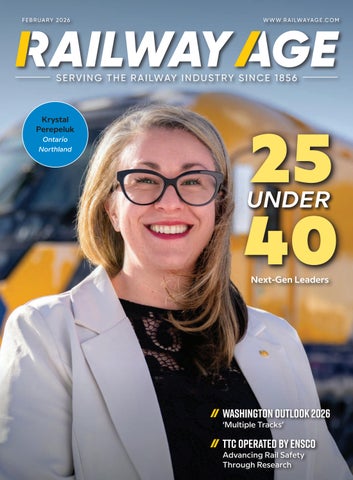
Krystal has been an integral part to the reinstatement of passenger rail in Northeastern Ontario! The passenger train service, known as the Northlander, will fundamentally shift how people move across the province, creating a more connected, integrated transportation network.

Congratulations Krystal Perepeluk, Director of Passenger Rail, for being recognized as a Fast Tracker in the industry.

25 Under 40

JASON MAIDMENT

General Superintendent,

British Columbia South

CN

Maidment has made significant contributions to the railway industry through frontline leadership, operational innovation, safety advancement, and people development across CN’s national network. Beginning his career as a conductor in Prince George, he advanced into leadership roles by leading with humility and adapting to diverse operational and cultural environments across Canada. He drove practical innovations to improve network performance, including piloting air cars in intermodal service to enhance winter resilience and network fluidity. A strong safety advocate, Maidment developed a standardized derailment response checklist to guide teams through high-pressure incidents, improving consistency and decision-making. He has led teams through extreme weather, derailments, major disruptions, and a workplace fatality, reinforcing a safety-first culture that prioritizes employee well-being. He also supports leadership development by co-facilitating CN’s LINK program and mentoring employees. His customer-focused approach has strengthened partnerships and improved service reliability across multiple regions.

The Greenbrier Companies

Miller is Vice President of Engineering at Greenbrier, overseeing the company’s Engineering organization and advancing tank car safety, innovation, and quality across North America. With a strong mechanical engineering background and regulatory expertise, he was appointed Executive Committee Chairperson of the Railway Supply Institute’s Committee on Tank Cars in 2023, assuming industry leadership following the East Palestine derailment. In this role, he has promoted new technologies, designs, and collaboration to strengthen tank car safety and regulatory alignment. At Greenbrier, Miller has led the modernization and expansion of the tank car portfolio, helping establish the company as North America’s leading producer. He anticipates market and regulatory changes, including introducing an anhydrous ammonia tank car to meet evolving fertilizer needs. A collaborative mentor, he supports workforce development through Greenbrier’s mentoring network and Emerging Leaders ERG while engaging regulators, customers, and industry partners to drive long-term industry value.

Congratulations Lewis and Tatini

Railway Age’s 2026 Fast Trackers | 25 Under 40

Lewis Fitzgerald,

Honoree

Lewis Fitzgerald, Director of Intermodal Operations Planning and Design, is known for his operational excellence and transparent, hands‑on leadership. He has led complex initiatives that improved performance, strengthened collaboration, and reinforced our culture of integrity.

Tatini Gandham,

Honorable Mention

Tatini Gandham, Senior Data Engineer, drives innovation at CSX through advanced cloud and data solutions that enhance efficiency and impact. Her collaborative leadership and commitment to developing others make her an important part of the CSX team.

Miller has built a distinguished career in the railroad industry through a combination of hands-on field experience, technical expertise, and a solutions-oriented approach to quality and client service. He

began as a union foreman, pipe layer, and grade checker, building a foundation in construction before earning a degree in construction management. Miller joined Stacy Witbeck as a quality control field supervisor and advanced to Quality Control Manager on major light rail projects, gaining expertise in track and signal installation, testing, and commissioning. In 2015, he joined Modern Railway Systems, where he spent the past decade developing and leading a comprehensive quality program supporting engineering, installation, and testing on complex rail projects across North America. His work has supported agencies including Amtrak, BART, Caltrain, Sound Transit, and Brightline, with key contributions to large-scale cutovers, PTC integration, and high-speed and electrified rail systems. This spring, Miller will assume the role of Corporate Quality Manager for Stacy Witbeck and MRS.

25 Under 40

Morris contributes to the rail industry through safety performance, operational reliability, and improved coordination between railroad teams and third-party partners at a key NS intermodal hub. As lead officer in the Harrisburg Intermodal Yard (HIY), he has consistently reinforced a strong safety culture, and in 2021, the yard marked a milestone: a derailment-free year with no derailments caused by a rule violation. That performance was driven by clear communication, accountability, transparency, and focused checks in identified weak areas. Morris has also improved terminal efficiency and performance. In 2025, he led the implementation of a bobtail lane at HIY, creating an additional entry and exit outside of the main lane and helping expedite drayage flow. The result was driver dwell time consistently below the 37-minute goal. Additionally, Morris helped to establish a new Standard Operating Procedure requiring pad placement for inbound trains four hours in advance, reducing chassis-related drayage issues by roughly 70% and helping HIY consistently meet its availability goals. These improvements translate into better service reliability for thousands of customers each day.

25 Under 40

Kendel Ortiz’s work at MTA Metro-North Railroad reflects a deep commitment to safety culture, operational excellence, and the development of the next generation of rail leaders.

MTA Metro-North Railroad (Honorable Mention, 2025)

Ortiz’s work at Metro-North reflects a deep commitment to safety culture, operational excellence, and the development of the next generation of rail leaders. He played a key role in designing the award-winning Train Approach Warning VR training program, which has become a nationally recognized model for immersive, highrisk safety instruction, and helped to develop the QR-code qualification card system, a breakthrough in credential tracking that allows employees and supervisors to instantly view training status and certifications by scanning a code. Within M/W, Ortiz has modernized critical programs such as the Track Foreman School, MW-4 Refresher, and Track Car Pilot Qualification plan, ensuring consistency, transparency, and strong safety alignment. He has also pioneered microlearning, interactive job aids, and SharePoint-based learning hubs that make complex rules and standards more accessible to employees in the field. One of his most impactful initiatives outside of work is his leadership in organizing the Los Rancheros Unidos Softball League, a community-based program that not only brings people together but also promotes mentorship and teamwork.

MATTHEW PEAGLER

IHB Terminal Operations & Network Coordinator at CIROC (Chicago Integrated Rail Operations Center)

Indiana Harbor Belt Railroad

Peagler is working to improve operational efficiency, workforce management, and interline coordination within one of the most complex rail environments in North America, the Chicago Terminal. In his roles with IHB and Terminal coordination functions, he has supported daily interline operations involving multiple Class I’s by improving communication, planning, and execution during periods of high-traffic volume. Peagler led initiatives to standardize operational processes, reduce service disruptions, and improve reliability at critical interchange points on the national freight network, and played a key role in advancing workforce and crew-management modernization efforts, including planning and governance for new crew-management systems and improving transparency, compliance, and operational readiness. He has also developed dashboards, forecasting tools, and governance frameworks so leadership can better understand manpower utilization, terminal constraints and service impacts. Through these efforts, Peagler has contributed to safer, more efficient and more reliable rail service.

25 Under 40

Perepeluk is leading the reinstatement of Canada’s Northlander passenger rail service between Timmins and Toronto, with connections to the Polar Bear Express. She oversees a nine-figure program budget and leads cross-departmental and multi-stakeholder coordination to ensure service is delivered on time and on budget. Previously, at Metrolinx, she helped to establish the practice of sponsorship to support delivery of multibillion-dollar transit projects, and she served as lead sponsor for the Northeastern Passenger Rail Service expansion. Perepeluk was also instrumental in creating a dedicated negotiation team in the Capital Projects Group, directly advancing GO Expansion through agreements on grade separations and level crossings. Earlier in her career, she contributed to the 2041 Regional Transportation Plan at Metrolinx, and the Northern Ontario Multimodal Strategy and High-Speed Rail initiatives at MTO. Her career reflects a consistent commitment to building strong partnerships, advancing innovation in passenger services, and delivering transformative rail projects that strengthen regional connectivity.

Nicely done, Steven, Susannah and Jamie.

Union Pacifi c congratulates Steven Bybee, senior vice president – Operations, and Susannah Sullivan, senior general attorney – Law, for being named among Railway Age’s 2026 25 under 40; and Jamie Harrmann, senior general attorney – Law, for earning an honorable mention.

Steven Bybee
Susannah Sullivan
Jamie Harrmann

25 Under 40

Ramirez has contributed to high-profile projects for the San Joaquin Regional Rail Commission, Southern California Regional Rail Authority, and Port of Long Beach, leading teams and demonstrating an exceptional ability to coordinate, communicate, and guide others. He served as Deputy Project Manager and Resident Engineer on the $67 million Los Angeles Union Station Rehabilitation and Modernization Project, and helped RailPros successfully complete extensive outage coordination while ensuring that no SCRRA trains were delayed because of construction. The project earned both regional and national awards from the Construction Management Association of America. For SCRRA’s 25-Year Metrolink Rehabilitation Plan, Ramirez assisted with strategic goals and multi-year budget development, and provided recommendations for rehab projects. He has also served as Terminal Track Inspection Lead for POLB and helped update the crossing inventory of the ports of Long Beach and Los Angeles and the Pacific Harbor Line for the FRA and California Public Utilities Commission. Within RailPros, Ramirez is a mentor, helping team members grow their careers.

A Professional Civil Engineer and Certified Reliability Engineer, Schwartz’s training and experience is in project management, mechanical engineering, civil engineering, computer science, signal systems, and telecommunications. He served CSX for nearly 10 years as Manager of Track Testing, Manager of Network Operations, Communications & Signals, and Engineer Standards II, before joining Hatch in 2023 as a project manager. Schwartz was a member of the Executive Steering Committee for the Howard Street Tunnel Expansion project, and led diverse teams in his work on projects in Mexico, Jamaica, Panama, and Australia that demanded cultural, regulatory, and logistical adaptability. He overcame the challenge of designing under severe constraints for the SPCT Redevelopment and SunCoke expansions, which involved restricted space and operating limitations. Schwartz’s goal is to lead and grow Hatch’s freight rail group, deliver high-impact rail infrastructure projects, advance industry standards, integrate multidisciplinary engineering approaches, and strengthen stakeholder relationships. He supports and is a member of AREMA committees 1 (Roadway & Ballast) and 5 (Track).

Simonds has delivered transformative improvements to rail governance and project delivery in California. She modernized the state’s delivery framework to strengthen accountability, improve interagency coordination, and ensure projects advance clear public benefits. According to her nominator, Simonds’ work has reshaped how Caltrans, the Joint Powers Authorities, and partner agencies collaborate, creating a unified and efficient model that maximizes funding and protects critical timelines. She also positioned California to take full advantage of federal opportunities by aligning state programs with the FRA Corridor ID initiative. Through her leadership, the nominator said, California is better able to compete for federal funding and advance corridor development in a structured, compliant, and strategic way. Simonds also gives back. Within the Division of Rail, she has created a year-long training program that builds staff proficiency in rail operations, delivery practices, and program management. Additionally, she serves on the TRB’s Committee on Rail Transit Systems to help shape research priorities and elevate best practices across the passenger rail industry.

25 Under 40

As a first-generation railroader and fifth-generation lawyer, Sullivan has represented the nation’s Class I’s across multiple states since 2017. At UP, she works to defend the railroad in personal injury and employment lawsuits and has been part of cases whose favorable resolutions were reached after employing innovative litigation discovery techniques and motion practice. She has also been part of a specialized team to help accelerate the law department’s AI processes and resources. Whether arguing in the courtroom or providing advice to her operating partners, her creativity and common sense help drive results for UP. Licensed to practice law in Illinois, Missouri, the U.S. District Courts of Illinois (Southern, Central and Northern), and the U.S. Seventh Circuit Court of Appeals, Sullivan was recognized four consecutive years as an “Illinois Emerging Lawyer.” Additionally, she was selected to participate in UP’s Uplift Program, where high achieving employees are paired with executives for mentorship and professional advocacy. Outside of work, she serves on the Lake Forest (IL) Preservation Foundation’s Executive Committee Board and the National Association of Railroad Trial Counsel’s Executive Committee.

25 Under 40

ADITYA UMESH Systems Engineer

Hitachi Rail

Umesh is a Systems Engineer who over the past six years has rapidly progressed from verification and validation and commissioning into technical leadership for global driverless metro systems. He has led and supported onboard system-level integration for major programs including the Honolulu Skyline, Copenhagen Metro, Rome Line C, Milan metro projects, and others. Through improved requirements traceability, early integration planning, and structured validation strategies, his work contributed to an approximately 15% reduction in rework and measurable efficiency improvements across projects. Umesh also supports early-stage bidding and planning efforts for future driverless systems across Europe and Asia. He earned Hitachi’s 2024 Rail Values Award–Grand Prix (Global) for contributions to the Global Onboard Vital Platform Development Project and Rail Values Award–Pioneering Spirit (Global) for innovation and leadership on the same global platform initiative. As a University of Massachusetts alumnus, Umesh engages with students and recent grads to introduce them to rail industry opportunities in signaling, automation, and driverless systems, where he sees a need for more young talent and fresh perspectives.

SATISH

Head of Quality, North America, Rolling Stock and Components, Alstom

A 15-year Alstom veteran, Vijayaraghavan started as an engineer and progressed to roles in Operations, Supply Chain and Quality. He is now accountable for the quality of rolling stock products developed and manufactured in North America. He oversees 250-plus people across nine sites, and manages a 15-project portfolio, including Toronto’s Citadis LRVs; Vancouver’s Mark V metro trains; NJT and Metra commuter rail vehicles; Amtrak Next Generation High Speed Trains; BART rapid transit cars; SEPTA LRVs; and Automated People Mover vehicles for the Denver, Atlanta and Tampa airports. He has reduced defects per unit by 40% across the portfolio; reduced external defects detected by customers by 33%; improved customer satisfaction scores by 7%; reduced the backlog of safety issues from an average of eight to zero; and increased gender diversity to more than 40% on his team. In 2021, he was instrumental in developing a strategic plan to preserve Alstom’s La Pocatière facility in Quebec as it approached the end of major program work, resulting in a $C56 million investment by the Quebec government and protecting more than 300 manufacturing jobs.

Ben Miller Vice President of Engineering

Wahlen began his railroad career in 2018 with the Golden Triangle Railroad in Columbus, Miss. He earned conductor and engineer certifications and played a key role in upgrading safety and service standards across Patriot Rail properties. He later became the company’s first management trainee and was appointed Trainmaster when Patriot acquired Salt Lake Garfield & Western in 2021. He has since transitioned to Operations Manager and to Regional Manager at multiple locations. In his current role, he has spearheaded the operations team through the acquisition of a scenic railroad (now called the Granite State Railway) and rail bikes operation, one of the company’s most complex integrations. Wahlen turned a challenging transition into an opportunity for growth, according to his nominator, navigating cultural differences, aligning operational processes, building trust across teams, and elevating the rider experience. He also led the successful launch of the Gettysburg Railway. According to his nominator, Wahlen “exemplifies what it means to lead through change.” His goal: to grow and develop leaders who make the railroad industry an innovative, safe place to work.

25 Under 40

Wilson joined Anacostia Rail Holdings in 2014 as a Staff Accountant for subsidiary Louisville & Indiana Railroad Company. LIRC created the position to support a new joint facility arrangement with CSX and a $130 million project upgrading 106 miles of track between Indianapolis and Louisville and replacing a more than 100-year-old bridge. Based on his successful management of the project’s complicated accounting, he was promoted to Senior Staff Accountant. Upon completion of construction in 2019, he rose to Financial Analyst for the ARH corporate team and now provides executive and senior management with monthly revenue results, overview analysis, and annual projections, including analyzing the revenue process across the company’s six U.S. railroads. Wilson was integral to LIRC’s recent conversion to a new freight revenue management system and is working closely with operations and marketing to evaluate current business and prospective customer opportunities to ensure company growth. He is fast becoming a company leader, demonstrating not only a strong work ethic but also a desire to grow.

Bernie Miller Named a 2026 Railway Age

A clear signal of the next generation leading with quality, safety, and leadership across the industry.

TATINI GANDHAM Senior Data Engineer CSX

JAMIE HARRMANN Senior General Attorney, Law Union Pacific

CHRISTIAN KNAPP Chief Mechanical Officer Denver Transit Operators

ALEXANDER MYRAH Engineer–ET ESA Level III MTA Long Island Rail Road

YINKA ROBINSON Head of Public Affairs, External Communications and Marketing (North America), Public Affairs & Communications

Hitachi Rail

SIT AND LISTEN

C.

Railway Age

David C. Lester

Railway Track & Structures

Kevin Smith International Railway Journal

Railway Age, Railway Track & Structures and International Railway Journal have teamed to offer our Rail Group On Air podcast series. The podcasts, available on Apple Music, Google Play and SoundCloud, tackle the latest issues and important projects in the rail industry. Listen to the railway leaders who make the news.

William
Vantuono

TRACKS MULTIPLE

For freight railroads and their customers, Union Pacific’s proposal to acquire control of Norfolk Southern commands center stage in Washington in 2026. With the prospect of the first transcontinental railroad in the United States pending Surface Transportation Board (STB) decision, interests from Wall Street to Main Street will press their views.

Rather than add to that commentary, this overview looks beyond UP-NS for a scan of other Washington issues now in front of the freight rail sector. Federal oversight and investment top the list, but tech policy also merits scrutiny in this midterm election year.

STB’S AGENDA

In May 2025, the U.S. Supreme Court unanimously (8-0) upheld in Seven County Infrastructure Coalition, et al. v. Eagle County, Colorado, et al. the STB’s finding that the National Environmental Policy Act (NEPA) does not require the agency to consider environmental upstream and downstream effects that are “separate in time or place” from the underlying project under review.

The Court’s endorsement of the STB’s rational adjudication reinforced other Board reform initiatives under Chairman Patrick Fuchs. Complementing but distinct from early DOGE efforts, Vice Chairman Michelle Schultz led listening sessions intended to streamline Board procedures. Notwithstanding the 43-day federal

shutdown in late 2025, the STB has already implemented some process reforms with more planned in 2026.

“Our goal is to increase accountability, transparency and collaboration at the Board,” Fuchs told Railway Age. “We have cut the backlog of pending matters and accelerated decisions in recent proceedings. The Board now, for the first time, issues regular ‘Updates on Outstanding Proceedings,’ providing entities greater certainty around the timing of Board action and thereby benefitting parties’ operational and capital planning.”

In September 2025, railroads and shippers united to urge the STB to leverage its authority and “provide clear and definitive guidance on the scope and Bruce Kelly

Federal oversight and investment top the list of Washington issues beyond UP-NS, but tech policy also merits scrutiny in this midterm election year.

application” of Interstate Commerce Commission Termination Act of 1995 preemption to “protect the fluidity of the transportation network and the continued growth of American businesses.”

Roger Nober, who formerly chaired the STB under President George W. Bush, served as EVP and Chief Legal Officer for BNSF, and is now a professor at George Washington University, said, “Any time railroads and shippers advocate for the same outcome, it’s worth paying attention. The STB can and should issue the requested preemption statement. Crafting preemption guidance that courts will respect will take thoughtful care, given the Supreme Court’s 2024 Loper Bright ruling mandating that the judiciary use its own judgment to interpret

FREIGHT RAIL WASHINGTON OUTLOOK 2026

statutes such as the ICCTA.”

Fuchs, Schultz and Member Karen Hedlund are well positioned to thread this needle. Declared Fuchs, “In light of the potential benefits to the public, we are considering issuing a policy statement on preemption in the first half of 2026.”

In another early 2026 action, the STB proposed to repeal 49 C.F.R. § 1144 and streamline the path for shippers to obtain competitive access. The repeal of the current regulations governing prescription of reciprocal switching, through routes and through rates, opens a competitive debate.

Whether the STB will implement its agenda with three, four, or five members is up to Congress and possibly the Supreme Court. Senate confirmation of Republican Richard Kloster remained pending as of late January 2026. Last year, the President removed Democrat Robert Primus from the STB, vacating that seat. Primus challenged his dismissal, and in December 2025 added a racial discrimination claim. An upcoming Supreme Court decision on the President’s removal of Federal Trade Commission Member Rebecca Slaughter could instruct resolution of Primus’ case and shape how the STB fits with an evolving unitary executive branch framework.

ON CAPITOL HILL

This year began under another Continuing Resolution funding much of the federal government. Following House approval late in January, the Senate anticipated passing FY 2026 “THUD” appropriations including USDOT and the STB. Less than eight months remain before Congress must finalize funding for the next fiscal year, FY 2027.

Beyond appropriations, Washington strategy dean Bruce Mehlman places surface transportation alongside the Farm Bill and the Foreign Intelligence Surveillance Act Section 702 as top 2026 Congressional reauthorization priorities. The expiring Infrastructure Investment and Jobs Act (IIJA) includes authorizations for Federal Railroad Administration (FRA) and other rail and multimodal programs, which will end unless Congress acts by Sept. 30, 2026.

STB reauthorization also remains pending. The legislative dialogue is uncertain with UP-NS under consideration and reciprocal switching in renewed play. FRA reauthorization typically features new rail

safety provisions, but the mandate crusade following the 2023 East Palestine incident has subsided. That doesn’t mean that rail management and labor won’t differ over more safety requirements.

OneRail Coalition Director Devon Barnhart said, “While the rail sector has a range of interests in surface transportation reauthorization, we are united in our concern about any increase in truck size and weight. Our OneRail members are fully aligned on the essential role rail plays in easing congestion and supporting safe, reliable goods movement.”

Although highway and transit priorities have historically dominated surface transportation reauthorization, rail now counts, too. From a freight rail perspective, short lines seek continued advance appropriations for the FRA Consolidated Rail Infrastructure and Safety Improvements (CRISI) program. The IIJA broke new ground with $1 billion annually in pre-approved advance appropriations for CRISI for each of the five fiscal years, FY 2022-2026, making CRISI a game changer for short lines and their customers.

The push to maintain robust CRISI funding collides with what Eno Foundation analyst Jeff Davis calls the “$150 Billion Problem.” As Davis explains, “$150 billion is the approximate amount of extra revenue, or reduced spending, that the [Highway] Trust Fund (HTF) will need to remain solvent for another five-year authorization.”

By comparison, when enacted in the wake of COVID and the supply chain logistics crisis, the 2021 IIJA included $118 billion in transfers from the general fund. The funding gap for the IIJA’s successor legislation is larger. If agreement can’t be reached, Congress could temporarily extend surface transportation reauthorization, a frequent past outcome.

Shoring up the HTF with general funds may help CRISI and other multimodal programs. If surface transportation funding requires general taxpayer dollars to prop up inadequate highway user fees flowing into the HTF, why shouldn’t these general funds support rail investments? Plus, unlike electric vehicle subsidies, CRISI has bipartisan appeal with support from the Administration based on the President’s FY 2026 budget proposal that included $500 million for CRISI above IIJA advance appropriations.

FREIGHT RAIL WASHINGTON OUTLOOK 2026

Playing the CRISI long game mirrors the approach of the American Short Line and Regional Railroad Association (ASLRRA) to modernize the 45G track maintenance credit. H.R. 516, which would increase the per-mile tax credit cap from $3,500 to $6,100, index the credit to inflation going forward, and allow eligibility for expenditures on all current short lines, now has 141 House cosponsors. The Senate counterpart S. 1532 has 36 cosponsors.

While the legislative path to enacting 45G modernization isn’t yet clear, as ASLRRA President Chuck Baker told Railway Age last October, “We feel good about our case. We have the right champions. We have a lot of support.” Concluded Baker, “We don’t know how long it will take but we’ll keep banging on the door until somebody opens it.”

FRA PRIORITIES

Last October, the Senate confirmed David Fink as FRA Administrator. A fifth-generation railroader, Fink started at Conrail in 1976 as a 15-year-old summer track worker. Fink rose to President of Pan Am Railways and brings deep rail experience to the FRA.

At his Senate confirmation hearing in May 2025, Fink underscored his belief in FRA’s “primary mission, which is one of safety first.” He committed to refresh regulations, improve FRA’s CRISI grant program delivery, and partner to advance safety innovations and get “safety technology out in the field.”

Fink’s safety focus builds on Transportation Secretary Sean Duffy’s announcement in September 2025 that FRA would add rail bridge safety standards training to leverage the current federal and state track inspector workforce. In January 2026, Fink reformed the agency’s safety civil penalty settlement negotiation process and rechartered FRA’s Rail Safety Advisory Committee (RSAC).

Streamlining CRISI project delivery will take time. More than 15 months have passed since FRA’s most recent CRISI awards of $2.4 billion in combined FY 2023-2024 funds, including 81 awards valued at nearly $1.3 billion for short line projects. As of late January, the rail industry waited for FRA’s anticipated notice of funding opportunity for approximately $1.1 billion in FY 2025 CRISI funds.

Yet with AI and transformative tech sweeping society, the insistent policy

challenge facing FRA and railroads looms beyond the industry.

In December 2025, Purdue University declared, “For the first time in the U.S., a roadway has wirelessly charged an electric heavy-duty truck driving at highway speeds.” This multistage research demonstration with Indiana DOT, according to Purdue, “lays groundwork for highways that recharge EVs of all sizes across the nation.”

Then, at the January CES 2026 tech showcase came this: “Automotive technology supplier Aumovio has partnered with cloud computing giant Amazon Web Services to speed up the deployment of autonomous vehicles, starting with Aurora Innovation’s fleet of self-driving commercial trucks.”

If one day AI-driven autonomous trucks recharge under way while delivering freight, what must shift in Washington for freight railroads to keep pace?

As T&I Railroads, Pipelines, and Hazardous Materials Subcommittee Chairman Daniel Webster (R-Fla.) assessed last June, “Unfortunately, while other government agencies, including those in the Department of Transportation, are embracing the promise of innovation and developing the right regulatory frameworks for its promotion, much of the Federal Railroad Administration’s regulatory framework remains a relic of the past.”

The Washington Post agreed, urging FRA in December to remove “burdensome regulations holding back technological progress” that “block American-made automation technology from being adopted.”

Following that editorial, FRA announced a new temporary waiver program to better evaluate the impact of automated track inspection (ATI) technology. Association of American Railroads President and CEO Ian Jefferies welcomed the revised ATI waiver as a positive step forward, noting that the industry “values its partnership with the Administration and shares its goals of strengthening U.S. manufacturing, onshoring supply chains, driving down costs, accelerating innovation, and advancing smart regulatory reform.” Jefferies added that under Secretary Duffy, “a data-driven, future-forward approach to regulating new technology benefits everyone—including employees—by enabling railroads to safely adopt AI-driven and other innovations at the pace needed to keep America’s supply

chain competitive and resilient.”

Former FRA Administrator Allan Rutter, now a senior research scientist at the Texas A&M Transportation Institute, underscored the urgency of accelerating rail tech adoption: “Freight railroads are implementing AI-supported analytics and other technology tools to improve service as the market demands, without government mandate. Where tech has a safety nexus, however, FRA has a statutory role. I am confident that Administrator Fink will align the FRA’s regulatory stance with a safety focus consistent with the other USDOT modal agencies accelerating deployment of autonomous vehicles including trucks.”

In a statement to Railway Age, Fink said, “Under Secretary Duffy, the FRA is modernizing American rail by prioritizing safety and investing in innovation. Our rail industry is the backbone of a competitive U.S. economy, delivering essential goods that families rely on every day. By cutting through red tape to unleash new technology—such as granting the long-overdue waiver for automatic track inspection technology that the previous Administration sat on—we are ensuring that our infrastructure remains safe, efficient and ready to serve the American people.”

Rutter captures the work ahead: “FRA must team productively with the other USDOT agencies to assure tech adoption that benefits all transportation modes. But to get beyond press releases, rulemaking and litigation, FRA also must partner with the regulated rail community—and that includes labor. Railroads would do well to advocate rail technologies that enhance rather than replace the work of railroad workers.”

For 2026 in Washington, think multiple tracks. FRA and USDOT will plot new courses to drive tech, while streamlining regulation. Congress will consider the next phase of federal investment in rail amid a surface transportation funding reset. The STB will assess rail competition and a petition for approval of the first U.S. coast-tocoast transcontinental railroad—all while trade and other domestic and foreign policy actions shape the economy.

In November, voters will have their say. Their voice will cap a dynamic year signaling our future.

Don Itzkoff is Chief Policy Officer for Patriot Rail.

FRA’s Adjustable Test Track, the only track in the U.S. capable of introducing isolated and combination track geometry deviations for vehicle and inspection system testing.

ADVANCING RAIL SAFETY THROUGH RESEARCH

CURRENT FRA R&D INITIATIVES AT TTC.

Railroads continue to operate in an increasingly demanding environment shaped by higher axle loads, growth in hazardous materials traffic, and shifts in operating practices that may impact safety and reliability. These conditions magnify the consequences of in-service failures of critical components and challenge traditional inspection, operating, and maintenance practices.

At the same time, advances in inspection systems, communications, artificial intelligence and modeling tools offer new ways to mitigate risk. To be effective, however, these technologies must be rigorously evaluated under representative controlled conditions before

widespread deployment.

The Federal Railroad Administration (FRA) maintains a multidisciplinary research program that utilizes full-scale testing, simulation and modeling, and targeted field experimentation. A significant portion of this work is conducted at FRA’s Transportation Technology Center (TTC), whose facilities enable investigations that cannot be safely or efficiently performed on revenue railroads.

This article highlights key FRA research initiatives under way at TTC, supported by railroads, suppliers, universities, and other industry partners, and explains how these efforts advance data-driven standards, performance-based regulations, and practical safety improvements.

TRACK RESEARCH

FRA’s track research focuses on reducing derailment risk associated with vehicle-track interaction and degradation or failure of track components. A core element of the program is the evaluation of emerging inspection and monitoring technologies.

One priority area is rail integrity. FRA continues to advance non-destructive evaluation methods to improve the reliability and efficiency of rail flaw detection and characterization. TTC supports this work through the nation’s most extensive library of rail and weld defects, along with the Rail Defect Test Facility, a nearly one-mile test track containing known service-induced and machined defects. These resources

TTC OPERATED BY ENSCO

allow technology developers to calibrate and validate advanced inspection systems under known conditions.

FRA also focuses on continuously welded rail management. Excessive longitudinal rail forces remain a leading contributor to high-consequence derailments. At TTC, FRA establishes controlled track conditions to support development of longitudinal force measurement tools and rail neutral temperature monitoring technologies. Current research includes refinement of rail break theory, particularly in curves and frozen ballast conditions. Development of improved guidance for low rail temperature differential (ΔT) and small rail gap scenarios will follow in the next phase of this research.

FRA is also improving vehicle-track interaction modeling by developing and validating vehicle model parameters through full-scale vehicle characterization and testing. Assessment of vehicle response under a wide range of controlled conditions for model validation will utilize TTC’s full scale vehicle test fixtures and FRA’s adjustable test track, currently the only U.S. facility capable of introducing isolated and combined geometry deviations. By summer 2026, a curved adjustable track section will complement the existing tangent section. Validated models will support derailment investigations and evaluation of performance-based safety standards.

In parallel, FRA is advancing innovative inspection technologies aimed at assessing track strength, support conditions, and degradation mechanisms. Emphasis is placed on non-contact methods, autonomous operation, integrated systems, and advanced data analysis using machine learning and artificial intelligence. Recent efforts have evaluated vertical track deflection measurement and alternative approaches to estimating vertical track stiffness. TTC’s test tracks provide suppliers and railroads with real-world environments to mature these technologies.

ROLLING STOCK RESEARCH

FRA’s rolling stock research addresses derailment prevention, crashworthiness, and hazards associated with new vehicle technologies. Full-scale testing at TTC plays a vital role.

Tank car research continues to provide

the technical foundation for FRA rulemaking and standards development. In coordination with the Pipeline and Hazardous Materials Safety Administration and industry stakeholders, FRA uses full-scale impact testing to refine tank car design, construction, and use. In January 2026, FRA will conduct testing with a DOT-112 tank car to determine deformation modes and puncture resistance to side impacts.

Passenger equipment research in 2026 will include compression testing of an Arrow III railcar using TTC’s upgraded Squeeze Test Fixture, capable of applying loads up to 2.6 million pounds. Results will inform ongoing improvements to passenger car crashworthiness standards.

FRA is also assessing protective structures for battery energy storage systems introduced into the railroad environment. Testing will characterize potential damage to batteries and associated electrical components resulting from falls, blunt impacts, rollovers, and fire exposure. Custom fixtures developed for this work will remain available for future industry testing.

Condition-based maintenance and vehicle inspection is another priority with several initiatives planned.

TRAIN CONTROL, COMMUNICATIONS AND HUMAN FACTORS RESEARCH

FRA’s train control and communications research emphasizes technologies

that reduce collisions between trains or with highway vehicles. Current initiatives include evaluation of connected vehicle communications to enhance grade crossing safety. Testing at TTC in 2024 and 2025 focused on cellular vehicle-to-everything (C-V2X) systems capable of providing warnings to motorists at active and passive crossings. Full-scale testing of technologies supporting next-generation train control is anticipated in 2026.

Human factors research complements these efforts by addressing operational practices and training needs associated with accident risk. A switching and shoving safety study completed in 2025 identified gaps in current industry training and led to creation of a pilot training program developed in cooperation with railroads and labor organizations. Future training at TTC is expected to include realistic yard scenarios that cannot be safely staged in revenue service yards. This training is intended to complement existing railroad training programs.

FACILITY ENHANCEMENTS AND PARTNERSHIPS

Advancing rail safety requires sustained collaboration among regulators, railroads, suppliers, and researchers. FRA encourages industry partners to engage with its research program and leverage the unique capabilities of TTC to evaluate new technologies, inform standards, and translate research into practical safety improvements.

MATT IGOE

R.J. Corman

HIGH PROFILE: Matthew (Matt) Igoe became R.J. Corman Railroad Company President and Chief Operating Officer (COO) last month. He will assume responsibility for transportation, mechanical, engineering, and day-today network performance across R.J. Corman’s short lines. He previously served as Executive Vice President of Operations at BNSF, a position he held since January 2021. Igoe’s appointment followed Ray Goss’s retirement as President. “We are absolutely thrilled to welcome Matt to our executive team,” said R.J. Corman Railroad Group President and CEO Justin Broyles. “His proven track record in the railroad industry is unparalleled, and we are confident that his vision and expertise will accelerate our growth and enhance our service offerings across the board. This is a game-changing moment for our company and for our customers.” Before joining BNSF in 1998 as a management trainee, Igoe served as an officer in the U.S. Army. He holds a Bachelor of Arts in Biology from Canisius College and an MBA from Northwestern University’s Kellogg School of Management. Igoe’s career, “marked by rapid progression through key operational and strategic roles at BNSF, combined with his military leadership experience, uniquely positions him to drive excellence in safety, operational performance, and employee engagement across our organizations,” R.J. Corman said. “I’m excited to join R. J. Corman and lead a team that is passionate about safety, service, and innovation,” said Igoe. “My focus will be on delivering operational excellence, supporting our employees, and partnering with customers to create value. This is an incredible opportunity to build on R. J. Corman’s excellent reputation as a valued partner and help shape the future of short line railroading.”

HNTB

last month named Senior Vice President Michael Mangione as the firm’s New York Office Leader, bringing more than 30 years of transportation industry experience and a “proven track record of leadership” to the role. Mangione joined HNTB four years ago and most recently served as Regional Sales Officer for the firm’s East Region, where he provided “strategic guidance and leadership” across client programs and pursuits in key market sectors, including departments of

transportation, transit and rail, aviation and tolling. “His expertise includes a focus on strengthening partnerships, driving business development and supporting major infrastructure programs,” HNTB noted. “Mike is known for his strategic leadership and ability to build strong relationships with our clients and foster high-performing groups capable of delivering complex programs,” said HNTB Northeast Division President Gary Bua. “He has a national reputation for leadership in market strategy, growth and talent

development. This, paired with his deep familiarity with our clients, strategy and people, has prepared him to step seamlessly into the office leader role.” Mangione’s portfolio includes supporting major initiatives such as the New York City Department of Design and Construction (NYC DDC) East Side Coastal Resiliency Project; statewide programs for the New York State Department of Transportation (NYSDOT); and key New York Metropolitan Transportation Authority (MTA) projects, including the Second Avenue Subway Phase 2, Systemwide Open Road Tolling Conversion and the Bronx Whitestone and Henry Hudson Bridge Approaches Replacements. “I’m honored to lead HNTB’s New York office and continue building on our strong foundation of delivering innovative solutions for our clients,” Mangione said. “Our team is committed to advancing critical infrastructure that improves mobility and resilience for communities across the region.”

Mariia Zimmerman was named Director of the Virginia Department of Rail and Public Transportation (DRPT), leading the agency’s continued efforts to plan, fund and deliver rail and public transportation initiatives. With more than 30 years of experience across the public, private, and nonprofit sectors, she served most recently as Founder and Principal of MZ Strategies, a Richmond, Va.-based planning and policy firm that is described as working with states, regions, and organizations nationwide “to advance transit-oriented development and implement transportation projects that improve mobility, access, and community outcomes.” Zimmerman previously held senior leadership roles at the U.S. Department of Transportation, where she was a member of former Secretary Pete Buttigieg’s executive leadership team. She served as Principal Deputy Assistant Secretary for Transportation Policy and as CoDirector of the Bipartisan Infrastructure Law Implementation Team, helping to guide the rollout of federal investments in rail and public transportation through major discretionary grant programs and policy initiatives led by the Federal Transit Administration (FTA), Federal Highway Administration (FHWA), and Federal Railroad Administration (FRA).

Leading Through Uncertainty Final in a Series: The Road Ahead

The numbers don’t lie: According to the American Psychological Association’s 2025 Work in America survey, 54% said that job insecurity was having a significant impact on their stress levels at work, and 44% agreed that there are changes happening at their job with little to no warning. Forty percent expect the job market to worsen in 2026. Meanwhile, manufacturing activity has contracted for ten consecutive months, tariff uncertainty continues to reshape supply chains, and freight volumes remain volatile.

For our industry specifically, the challenges cut deeper. Railway Age Financial Editor David Nahass wrote: “Generally, the industrial economy is bearing the brunt of a kind of weakness that has led to a great amount of uncertainty about 2026 and its prospects.”

In a recent survey of rail contractors, workforce availability emerged as a top concern heading into 2026. A labor shortage can negatively impact project timelines, profitability and safety performance.

These are our realities and precisely why the leadership principles we’ve explored throughout this series matter more now than ever.

THE CHOICE BEFORE EVERY RAIL LEADER

The past three articles examined what distinguishes leaders who transform uncertainty into competitive advantage.

We started with the four-stage cycle:

• Heighten Awareness

• Increase Clarity

• Build Alignment

• Drive Momentum

In Part 2, we explored the leadership styles that emerge under stress:

• The Hammer, the command-andcontrol boss who gets short-term results while destroying long-term trust. When there’s a crisis, they make the call. When operations are falling behind, they crack the whip. Decisions are made and executed without question. The common phrase is, “I’m not here to be liked.” Things get done. In the short term, this style can turn around failing operations, meet aggressive deadlines

and push through resistance. But people suffer. Burnout becomes common.

• The People Pleaser, who mistakes kindness for permissiveness. True kindness means caring enough about people to have the hard conversations that keep them safe and help them grow. Permissiveness isn’t compassion. It is cowardice dressed up as concern. Here’s the hard truth: When you avoid necessary conflict, you enable unnecessary risk.

Recognizing we must lead ourselves before leading others, Part 3 reviewed the importance of the Trinity of Excellence: self-awareness, self-control and self-respect.

We now have a choice. We can use realities and predictions to justify fear, paralysis, and retreat, or we can recognize them for what they are: The greatest opportunity for differentiation a career may ever present.

WHY UNCERTAINTY CREATES OPPORTUNITY

When workers feel burned out, the leaders who genuinely invest in their people’s wellbeing become a magnet for the best performers fleeing toxic environments. When workforce availability is the industry’s greatest concern, the organization that treats railroaders with dignity solves a problem technology alone cannot fix.

Class I leaders themselves acknowledge 2026 will bring “limited volume growth” and continued macroeconomic headwinds.

CN’s Tracy Robinson put it directly: “We’re not accepting the macro reality as our fate. We’re just going to have to work harder to achieve our goals.”

That’s not optimism. It’s fierce resolve and the posture of leadership.

PUTTING IT ALL TOGETHER

Heighten Awareness of what’s really happening in your operation. The macro trends cited are industry-wide, but your track crews, signal maintainer, and yard workers see realities the boardroom misses. Ask them what they’re seeing about the challenges ahead.

Increase Clarity by establishing decision anchors that work even during times

of uncertainty. When your people encounter unexpected conditions, can they make quick decisions without waiting for you? If not, deliver clarity to build trust and drive performance.

Build Alignment around a higher purpose. Safety remains a key mission for our industry. Besides safety, what other purpose-driven pursuit can galvanize your team so they can flourish, even during times of uncertainty?

Drive Momentum by celebrating early wins while recognizing they reveal the next challenges. Success in one area gives you credibility and organizational confidence to tackle what comes next.

And through each stage, lead yourself first. Know your triggers. Control your responses. Respect your capacity. A burned-out leader cannot solve a burnout crisis. A fearful leader cannot inspire confidence. A reactive leader cannot build strategic momentum.

THE FINAL WORD

Since hope is not a strategy, 2026 will reveal which rail leaders are prepared and proactive and which are not.

The organizations that will thrive— attracting talent, maintaining safety standards, achieving results without destroying their people—will be led by those who master themselves first.

We cannot control the macro environment, eliminate tariff uncertainty or instantly create skilled workers. But we can control how we respond. We can control whether we lead from fear or purpose, whether we build trust or destroy it.

To see if your leadership is a competitive advantage during times of uncertainty, check out https://www.surveymonkey. com/r/TheRailWay_Lead.

Mechanical Department Regulations

FRA News:

There are no new proposals or final rules to report for this issue. Be sure to check back next month to see if there are any changes to FRA regulations.

Part 213: Track Safety Standards

49 Part 213, Subparts A-F. Classes of Track 1 through 5: Applies to track required to support passenger and freight equipment at lower speed ranges. Includes Defect Codes and Appendices A, B, and C to Part 213. Softcover. Spiral bound. Updated 7-1-25.

Part 237: Bridge Safety Standards

FRA Part 237 establishes Federal safety requirements for railroad bridges. This rule requires track owners to implement bridge management programs, which include annual inspections of railroad bridges if the weather or other conditions warrant such inspections, and to audit the programs. Part 237 also requires track owners to know the safe load capacity of bridges. Updated 7-1-25

BKBRIDGE Bridge Safety Standards $14.00

Order 50 or more and pay only $12.60 each

Part 214: Railroad Workplace Safety

The FRA’s Railroad Workplace Safety standards address roadway workers and their work environments. Subparts A-General, B-Bridge Worker Safety Standards, C-Roadway Worker Protection, D-On-Track Roadway Maintenance, and Defect Codes for Part 214. Spiral bound. Updated 7-1-25

BKWRK Railroad Workplace Safety $13.95

Order 50 or more and pay only $12.50 each

Part 228: Passenger Train Employee Hours of Service; Recordkeeping and Reporting; Sleeping Quarters

49 CFR 228 for records, recordkeeping, and reporting of hours of duty of a railroad employee. Also covers the construction of employee sleeping quarters and health requirements for camp cars. Softcover. Spiral bound. Updated 7-31-25.

BKHS Hours of Service of RR Employees $16.00

Order 50 or more and pay only $14.50 each

Turn static files into dynamic content formats.

Create a flipbook