RailStaff - Issue 302 | March - April 2026

Page 1


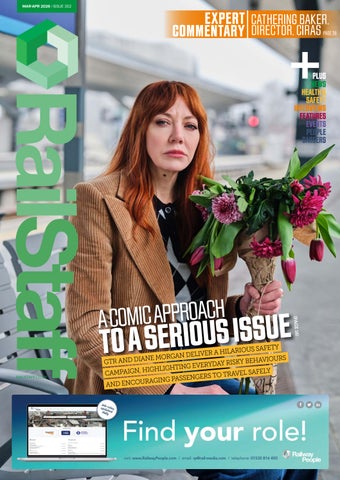
GTR AND DIANE MORGAN DELIVER A HILARIOUS SAFETY CAMPAIGN, HIGHLIGHTING EVERYDAY RISKY BEHAVIOURS AND ENCOURAGING PASSENGERS TO TRAVEL SAFELY

A COMIC APPROACH TO A SERIOUS ISSUE | 16

GTR and Diane Morgan deliver a humorous safety campaign highlighting risky behaviours and encouraging safer journeys.

TAKING PRIDE IN OUR WORK | 18

Rail’s return to public ownership offers a chance to enhance pride, accountability, and shared purpose.

FATIGUE: THE INVISIBLE RISK | 20

Fatigue management is a complex challenge, influenced by working patterns, lifestyle factors, and 24-hour operations.

A LOCALISED CHALLENGE: BRINGING AIR QUALITY INTO FOCUS | 22

While rail remains environmentally friendly nationally, new evidence reveals a more complex picture at stations.

EXPERT COMMENTARY: CATHERINE BAKER, DIRECTOR, CIRAS | 30

SPOTLIGHT

Connecting the UK rail industry for over 29 years.

Contact us:

Editor: Matt Atkins

Production and design: Adam O’Connor

Track safety: Colin Wheeler

Advertising: Craig Smith

MUCH MORE THAN INFRASTRUCTURE

Contact email addresses

News: news@rail-media.com

Track safety: colin@rail-media.com

Pictures: pictures@rail-media.com

Adverts: adverts@rail-media.com

Subscriptions: manda@rail-media.com

Contact details

RailStaff Publications, Rail Media House, Samson Road, Coalville, Leicestershire, LE67 3FP.

Tel: 01530 816 444

Fax: 01530 810 344

Web: www.railstaff.co.uk

Email: hello@rail-media.com Printed

There’s a familiar rhythm to the railway. The steady movement of people, the precision of operations, the constant balancing act between performance, safety, and service. But behind that rhythm sits something less tangible, but no less important: the human experience of rail.

In this issue, we explore that idea from multiple angles, from culture and creativity to safety, wellbeing, and pride in the job.

tool, and it is often the smallest observations that prevent the biggest incidents.

Take London’s Underground as an example. For most it is simply a means to an end, but as our feature on Art on the Underground reveals, it has quietly become something much more. By embedding creativity into stations, platforms, and even the familiar Tube map, TfL has reimagined what a transport network can be. It’s a reminder that the railway is not just infrastructure; it is a shared public space, capable of inspiring reflection, connection, and even moments of calm.

That sense of ownership and connection is particularly relevant at a time when the industry is entering a new chapter. As rail returns to public possession there is a real opportunity to reset the conversation around what the railway stands for, says Colin Wheeler. Pride, accountability, and shared purpose are not abstract ideals, they are lived values, shaped by the people who operate, maintain, and support the network. Enhancing that culture will be just as important as any structural reform.

Of course, culture is tied closely to safety, as we explore in our focus on Health, Safety & Wellbeing. In this issue’s interview, CIRAS Director Catherine Baker highlights the importance of listening – not just when something goes wrong, but before it does. The ability to raise minor concerns and to be heard without judgement remains a powerful

That theme continues in our feature on fatigue, an issue that rarely commands headlines but sits at the heart of operational risk. Managing fatigue on a 24-hour railway is inherently complex, shaped by shift patterns, lifestyle factors, and the realities of round-the-clock service. Yet its impact on human performance, and therefore safety, is undeniable. Addressing it requires not only policy and planning, but openness, trust, and a willingness to confront uncomfortable truths.

Communication, too, plays a critical role. Govia Thameslink Railway’s latest campaign, fronted by comedian Diane Morgan, takes a different approach, using humour to tackle risky passenger behaviours. It’s a clever reminder that safety messaging doesn’t always need to be too serious to remain effective. Sometimes, a moment of recognition, even through laughter, can prompt lasting change.

Elsewhere, we examine air quality at stations, where new evidence suggests a more nuanced picture than rail’s strong environmental credentials might imply. It’s a timely reminder that the passenger experience is shaped not just by punctuality, but by the environment in which journeys take place.

And, as ever, we return to people. The RailStaff Awards remain a highlight of the calendar not because of its trophies and titles, but what they represent. The Awards shine a light on the individuals and teams whose efforts define the railway, often quietly but always consistently.

Ultimately, rail is a people industry, and it is those people who will shape its future.

An AI tool has been premiered in Glasgow that is already helping Network Rail make savings on electrification upgrades.

Developed by Furrer+Frey, Lineform.AI works with data beamed down from Airbus satellites and uploaded from an array of datasets to develop recommendations for electrification. It also provides high level cost estimates as well as embodied carbon data for each option and can then draw up concept designs.

Having been trained by engineers, Lineform.AI surveys satellite images to spot rail infrastructure and assess any existing line – mapping out culverts, signals, bridges and level crossings. With its understanding of a line’s constraints, and access to an in-depth database of electrification system standards, weather models and averaged construction costs, it develops hundreds of electrification options for review by engineers.

AI platform drives electrification savings

The AI tool can quickly run complex calculations that consider multiple interdependent variables, such as wind speeds, span lengths, cable tensions, catenary height and more, to optimise an overhead line system and the structures that support it.

The tool has already helped modify UK infrastructure standards and supported contracting strategies on key projects in the UK and Ireland. Following detailed AI analysis of the Perth to Aberdeen corridor,

New DLR trains set for summer return

DLR customers will benefit from the return of the network’s new trains, with a phased reintroduction expected by late summer. This follows significant progress by engineering teams in carrying out detailed investigations, testing, and assurance to ensure the fleet is ready to enter service safely and reliably. Further detail of the reintroduction will be provided in spring.

In late 2025, a train stopped past its intended stopping point – the only time this occurred after the new trains were introduced – but safety is TfL’s number one priority, so all three new trains were withdrawn as a precautionary measure. TfL has since been working closely with CAF, the manufacturer, to identify the root cause and safely and reliably reintroduce the new trains.

To support the safe return of the trains, engineers are introducing a focused package of improvements - including braking software upgrades to improve performance in the type of specific low rail adhesion conditions experienced during the incident.

Network Rail implemented UK wide changes in the way it designs rail electrification to reduce cost.

The latest phase of work has now examined ScotRail’s Barrhead to Kilmarnock and Troon routes, helping shape early plans for upgrades pencilled in to start in Network Rail’s Control Period 8 (from 2029). It has also been used to inform early design strategy for Irish Rail’s extension of the Dublin Area Rapid Transit (DART+) scheme. Analysis is

underway for further British and continental European routes considering electrification.

Attended by around 50 delegates from across industry at the University of Strathclyde’s Technology and Innovation Centre, the AI tool was showcased to demonstrate how it can help keep costs down and manage complexity.

The project to develop the tool was awarded funding by the UK Space Agency and supported by Airbus Space and Defence and Network Rail.

These are currently being tested on the manufacturer’s test track before further testing on the DLR network. Some network closures will be needed to facilitate this testing, so it is recommended customers check before they travel by using the TfL Go app or Journey Planner on the TfL website.

Once fully rolled out, the new fleet will replace the oldest trains on the DLR and boost overall capacity by more than 50%. Customers will benefit from modern walkthrough carriages, air-conditioning, improved accessibility, real time travel information and enhanced safety features, all

designed to make journeys more comfortable, easier and more reliable.

Stuart Harvey, TfL’s chief capital officer, said: “We know customers are looking forward to travelling on these new trains, and we will provide a further update in the spring, with the trains being reintroduced by summer.

“Our engineers, together with CAF and our franchisee KeolisAmey Docklands, have worked tirelessly to ensure they return safely and reliably. We are confident customers will welcome the extra space, improved accessibility, real-time travel information and air-conditioning these trains provide.”

HS2 completes Curzon Street piling work

Engineers working for the HS2 project have completed the last of more than 2,000 concrete piles that will underpin the foundations of Birmingham's Curzon Street station, as new images were published showing how the public spaces around the building will look.

Stretching for more than 400 metres between Moor Street station and Millennium Point, Curzon Street will include seven platforms covered by an enormous arched roof inspired by the railway architecture of the Victorian age.

Construction of the new station is now well underway, with engineers this week completing the last of 2,011 piles. These concrete columns – each between six and 24 metres deep – have been sunk into the ground to support the foundations of the building.

HS2 Ltd’s senior project manager, Alistair Morgan, said: “Once complete, Curzon Street will be a new landmark for Birmingham – and provide a fitting city centre terminus for a railway that will improve journeys and free up space on the existing West Coast Main Line. These new images also show how it will be integrated into the rest of the city – with new green spaces, better accessibility and onward public transport links.

“It’s great to see how much progress has been made on the foundation works and I’d

like to thank everyone who’s been working so hard to get the job done. But we’ve still got a lot of work to do before the first passengers arrive, and I look forward to seeing more significant progress in the year ahead.”

At the front of the station, passengers will pass through a paved ‘station square’ edged by gardens facing Moor Street Queensway.

The new images show recent landscape design refinements that are being submitted to Birmingham City Council for approval. These include improvements to the management of rainwater drainage and improvements to the integration of cycling and walking routes connecting to the wider city.

They also show the tree-lined promenade with landscaped terraces that will stretch along the side of the building. A second entrance at the other end of the station –giving access to Digbeth and the east side of the city – will include a tram stop and taxi drop-off points as well as improved cycle access.

The piling work, which began in Sept 2024, was delivered by HS2’s construction partner Mace Dragados joint venture (MDJV), working with Keltbray. As part of the project, the team installed an 8m high retaining wall at the western end of the site and excavated 47,000 cubic metres of material to create a level base for the station.

Once the earthworks were complete, they brought in CFA piling rigs to install the reinforced concrete piles.

Following a short pause to allow Network Rail to deliver some essential maintenance to the railway viaduct alongside the site, the final piles were installed during late February and early March 2026.

With the piling now complete, the main focus has turned to preparing the way for the Digbeth extension to the West Midlands Metro - which will stop under the station on New Canal Street – and completion of the remaining foundation works.

Therapy dog Nya stars in new rail safety book

TransPennine Express (TPE) has launched a new children’s book featuring Nya, its much-loved therapy dog, in a bid to help young passengers feel more confident and reassured when travelling by train.

Written by the train operator’s safeguarding and crime prevention Lead, Steve O’Callaghan, the story was released on World Book Day.

Nya, a six-year-old German Shepherd has been officially registered with Pets as Therapy, making TPE the first train operator to have its own therapy dog.

She has quickly become a familiar and calming presence across the network. With her gentle temperament, she’s helped everyone from worried young travellers to adults having difficult days.

Steve, who spent two decades as a police officer before taking on his current role, said creating the book was a natural extension of the work Nya already does.

He said: “I recognised the natural way that children and families were drawn to Nya, and I wanted to harness that curiosity to create a gentle, engaging way to introduce safeguarding and rail safety messages though an educational and friendly narrative.

“It will encourage children to stay clear of the platform edge, stick close to a trusted adult, know when to ask staff for help, and understand what to do if they are lost.”

As part of the launch on World Book Day TPE stations across the network hosted book-swap shelves offering free copies for families. These took place at Manchester Airport Huddersfield, Hull, Brough, Selby, Malton, and Scarborough on Thursday 5 March.

The campaign will also extend into classrooms, with visits to schools supported by the company’s new Police Community Support Officers, who will help reinforce the book’s key safety themes.

Steve added: “I hope children enjoy reading this book as much as I've enjoyed writing it and Nya and I can’t wait to meet you all out on the TransPennine Express network when you’re next catching one of our trains.”

Railway trials quantum navigation tech

Britain’s railway has taken a major step in the development of quantum navigation technologies, with new systems designed to measure train position with extreme precision now being advanced for the national rail network.

Quantum inertial navigation uses ultrasensitive sensors capable of detecting minute changes in motion and rotation. Unlike satellitebased navigation systems such as GPS, it does not rely on external signals, meaning it could provide highly resilient positioning even in environments where satellite signals are unavailable, including tunnels, dense infrastructure or areas affected by interference.

The technology is being developed as a potential future alternative to fixed trackside positioning infrastructure, which can be costly to install and maintain and are vulnerable to environmental disruption or equipment failures. Once developed, quantum navigation will enable a lower cost, more reliable, more resilient system.

As part of this development programme, a Rail Quantum Inertial Navigation System (RQINS) has now been tested on a mainline railway for the first time anywhere in the world. The system was carried on a Great Northern train operated by Govia Thameslink Railway (GTR) between central London and Welwyn Garden City on Tuesday 3 March, providing real-world data to help understand how quantum positioning technologies perform within the operational environment of a national railway network to inform its development.

This milestone builds on work undertaken by the Ministry of Defence and on Transport for London’s network and represents the next step in developing quantum sensing technologies for use on heavy rail.

The development programme is being progressed through a specialist consortium led by MoniRail, working with Imperial College London, the University of Sussex, QinetiQ, PA Consulting and the National Physical Laboratory, with support from Innovate UK and the Department for Science, Innovation and Technology (DSIT).

This development is convened by GBRX, the strategic innovation and technology body for Great British Railways, to accelerate the adoption of strategic technologies that improve the railway for passengers and freight.

LNER honours women with station stars

Trailblazers Elizabeth Holman, Gladys Garlick, and Betty Chalmers are among the women honoured in LNER's Hollywood walk of fame-style installations unveiled at stations. The new campaign launched ahead of International Women’s Day (8 March 2026), highlights the incredible contribution of women within the rail industry – both past and present.

This comes as new data reveals that 97% of Britons have no idea that over 35,000 women currently work in the UK railway industry with almost half (42%) incorrectly believing the figure is between 5,000-10,000. A further 72% have no knowledge of the stories of women who have made the railway what it is today. Stars honouring a range of incredible women are now present at York and London King’s Cross stations, many of whom have never had their stories told. Women celebrated include Elizabeth Holman who was one of the earliest known women to work on the British railway. In the 1850s she defied social limits by disguising herself as a man to take on dangerous and physically demanding railway construction work.

Nellie Nelson – who worked as a porter for LNER at York station during the Second World War – supported passengers and kept services moving through air raids and blackouts, while Gladys Garlick served as one of the first LNER female guards at this time, both showing true strength and resilience. Modern day women honoured include inspirational female LNER train drivers. Helen Donagher heroically helped save someone’s life by swiftly stopping her train and disembarking to administer crucial first aid, while Rezwana Rahman became the first LNER female train driver to wear a hijab.

Despite almost a third (31%) of female adults admitting they would consider a career in rail, 67% say they aren’t aware of all the opportunities available for women within the industry.

Paula Bullock, people director at LNER, said: “Gender equity in the transport industry – particularly within rail – is something we’re deeply passionate about and firmly committed to improving at LNER. By unveiling this installation, we’re not just shining a spotlight on the remarkable achievements of women,

past and present, we’re also recognising there is still work to be done.”

“Supporting women in the rail sector is essential to building a more innovative and inclusive industry. When women are empowered and supported to progress, we see better outcomes for our customers, colleagues, and communities. We want rail to be a place where women feel they belong, where their contributions are visible and valued, and where they have equal opportunities to lead and succeed. Today’s celebration is both a tribute to the trailblazers who paved the way and a confirmation of our commitment to creating a railway where future generations of women can thrive.”

LNER has been a leading example for gender diversity and equality in the transport industry, and it shows no signs of slowing down. Its latest data report reveals that 45% of its workforce is female, compared with the industry benchmark of 17.4%.

A 1.5-mile section of the Grand Union Canal, owned by the charity Canal & River Trust, has reopened to the public seven days ahead of schedule after HS2 engineers successfully launched a 130-metre-long steel bridge into position over the canal.

The launch operation, which began on Wednesday 4 March, involved sliding the 1,620-tonne deck across a country road, canal, and towpath near Ufton in Warwickshire.

It took engineers just two days to successfully complete the manoeuvre using the tried and tested ‘skid shoe methodology’. Two giant hydraulic jacks pushed the structure forward at speeds of up to 10 metres per hour, aided by specialist pads coated in a Teflon-like material to minimise friction and ease the slide process.

The weathering steel viaduct, supported by two abutments and two piers on either side of the canal, was then lowered to its final position and secured in place before engineers confirmed the job was complete at 19.00 on Thursday 5 March.

The successful launch follows a two-and-ahalf-year programme of work led by engineers working on behalf of HS2’s construction partner, Balfour Beatty VINCI (BBV).

At peak construction, a team of 40 worked on the project. This included the installation of 34 piles at depths of up to 30 metres and two concrete piers cast parallel with the canal to enhance the aesthetic for canal users.

The project also involved construction of two abutments, and 37 precast planks, which form the base of the bridge deck.

A new retaining wall was also built to ensure the structural integrity of the canal ahead of works commencing. Constructed with seven-metre-deep sheet piles, the new concrete-capped wall replaces the original ‘wash wall’ and soft bank, which is believed to have been formed around a century ago when the canal was widened.

Vibration levels were carefully monitored throughout the work programme to protect the nearby Grade II listed Longhole Bridge, which carries traffic and pedestrians over the Grand Union Canal between Ufton and Hunningham Hill.

Harry Toase, Balfour Beatty VINCI’s civil engineering lead for the project said: “The

team has put in a huge amount of work to prepare for the bridge installation and shown meticulous attention to detail throughout to protect the canal and nearby Grade II listed bridge.

“I’m delighted we’ve been able to complete the works one week ahead of schedule and thank the local community for their patience.”

Longhole viaduct is situated just one kilometre from the north portal of the Long Itchington Wood Tunnel. When trains emerge from the tunnel, they will travel along the Ufton Wood cutting before joining the Welsh

HS2 canal bridge installed early

Road embankment, which connects to Longhole viaduct.

Vicki Lee, Senior Project Manager at HS2 Ltd commented: “Thanks to the hard work of our engineers and site-based teams, we’ve made good progress in this area over the last 12 months, with completion of the Long Itchington Wood Tunnel and the successful Longhole viaduct slide operation.

“There’s still a vast amount of work to do as we turn our attention to the embankments and cuttings that will link these sections of the railway ahead of track and power being installed.”

HS2 Ltd and BBV have worked closely with the Canal & River Trust to prepare for the viaduct installation. The launch was deliberately timed to take place during the close season, which ended on Friday 13 March, to minimise disruption for boaters on this popular stretch of the UK’s most famous canal.

£10 million depot will enhance Manchester rail maintenance

A £10 million new rail maintenance depot has been unveiled to keep passenger and freight trains moving smoothly through Greater Manchester.

The high-tech facility at Guide Bridge is the new home for over 120 Network Rail staff who work night and day to make the railway safe and reliable.

In just over a year, the two-storey building has been built on a 2.3-acre former railway siding.

It brings four separate track maintenance teams under one roof for the first time, having previously been based in separate temporary cabins with outdated facilities on the same site.

It's hoped that bringing the staff together will mean better collaboration and faster response times to fix railway faults – leading to fewer delays for passengers.

The building came in £6 million under budget

thanks to a range of efficiency measures including innovative construction sequencing, material specifications, and challenging standard railway approaches.

Everything has been built to modern accessibility standards, with a lift between floors, accessible toilet and changing rooms.

The male locker room has 120 lockers and female equivalent 20 lockers, both with showering and toilet facilities, while the mess room has capacity for 100 staff at any one time.

There is an array of 60 solar panels on the depot’s roof which will provide approximately 44% of the depot’s energy, with a buy-back scheme set to be introduced so it can generate revenue with any surplus being supplied back to National Grid.

Ten new electric vehicle charging points have also been installed at the depot as part of Network Rail’s commitment to move to allelectric vehicles in future.

NEWS IN BRIEF

BABIES ON BOARD

Transport for London has celebrated the 20th anniversary of its iconic ‘Baby on Board’ badge which has supported tens of thousands of customers since it launched. To mark the milestone, TfL has introduced a new badge option for those carrying multiple babies, with a new ‘Babies on Board’ badge.

The brand-new ‘Babies on Board’ badge is now available to order or collect along with the ‘Baby on Board’ badge. By introducing this new badge, TfL aims to represent the range of mums-to-be who travel on London’s transport network, and to remind all its customers of the importance of looking up when they travel and to offer their seat to those who may need it more.

ACCESSIBILITY INSIGHTS

Just 2.8% of surveyed disabled rail passengers say replacement services are fully accessible, according to new independent research published by Great British Rail Replacement (GBRR). Commissioned in 2025, the research reveals 30% of disabled passengers polled were left without a viable alternative when their train was cancelled or replaced, while two-thirds (66%) of research participants report their experience during disruption has deteriorated over the past year.

GOOD TO TALK

New data reveals that 52% of Brits think small talk is a thing of the past despite more than half of people saying they would appreciate the kind words of a stranger if they were visibly upset.

A survey commissioned by Samaritans found that over three quarters (78%) of Brits admitted to having avoided small talk in the past, despite 59% of respondents stating they would appreciate kind words from a stranger if they were visibly upset. Two thirds (68%) said they would be more inclined to make small talk with a stranger if they knew it made a positive impact.

RAISING AWARENESS

London Northwestern Railway has raised awareness of support options for neurodiverse passengers this month as part of Neurodiversity Celebration Week (16 – 20 March).

Following the positive reception of LNR’s sensory packs which launched last summer, the train operator is restocking stations with the free bags. Available on request from ticket offices, each pack contains foam ear plugs, sunglasses, fidget toys and a stress ball to support neurodiverse customers in managing sensory overload while travelling.

TfL targets harassment with VR training

On International Bystander Awareness Day (Thursday 13 March), Transport for London (TfL) harnessed the power of virtual reality to give people the skills and confidence to support fellow passengers who are being targeted by all forms of abuse and harassment on the network.

Awareness events will be held at Victoria station and Stratford bus station with representatives from TfL, British Transport Police (BTP), and the Metropolitan Police Service (MPS). Virtual reality headsets were used to show a situation with a TfL customer being targeted by abuse, with the public learning to be an ‘active bystander’ and act like a friend to the victim by striking up conversation or checking in with them after the incident and helping them to report it.

People also had the opportunity to find out more about how TfL works with its police partners to help keep Londoners safe, and how to report an incident. TfL continues to encourage people to report incidents, as every report helps build up a picture that can help convict the people responsible and informs TfL’s intelligence-led policing operations.

TfL previously helped to fund bystander awareness training sessions for the public with the charity Protection Approaches, and launched a campaign in the autumn encouraging people to ‘act like a friend’ to those they see being targeted.

Deputy Mayor for Transport, Seb Dance, said: “Ensuring Londoners' safety is the

Mayor's number one priority, and tackling hate crime and abuse on our transport network is central to this mission.”

“We all have a role to play in stamping out hate crime and supporting victims, which is why I encourage all Londoners to take part in these awareness events and learn how to safely intervene and provide support. Together, we can build a safer, fairer London for everyone.”

Siwan Hayward, director of Security, Policing and Enforcement at Transport for London, added: “When we see another passenger being targeted by abuse on a bus or train, or in a station, it can be hard to work out in that moment what to do for the best, both for the victim and ourselves.

“Being an active bystander isn’t about confronting the perpetrator – it’s about distraction and helping the targeted person, if that feels safe, and these virtual reality headsets are a great way to explore how to do that in case we ever encounter a real-life situation.”

In October, during National Hate Crime Awareness Week, TfL launched a new campaign, including in cinemas and on ITVX, encouraging people to ‘act like a friend’ towards those who experience hate crime and sexual offences and harassment on the London transport network.

A complementary campaign also launched to target perpetrators, with hard-hitting messaging focussing on the consequences of committing crime on the TfL network and how perpetrators are likely to be caught.

Growing Places

Stations could deliver £79 billion by 2036

Railway stations across the UK could unlock 1 million jobs and deliver £79 billion in economic value by 2036, according to new research commissioned by Great Western Railway (GWR).

The findings, revealed in a new report from economic research consultancy Development Economics show how stations are anchors for growth. The report reveals the "Rail Catalyst Effect": how stations act as catalysts for investment, opportunity and prosperity across the UK.

The study analysed 11 locations on the GWR network, looking at how development around railway stations supports new homes, businesses and skilled jobs. The research uses these case studies to model the wider economic impact of regional rail investment across Britain.

As new figures show unemployment in the UK sits at a five-year high of 5.2%, the report makes the case that continued investment in rail supports regional economies and unlocks future prosperity for communities across the UK.

The research finds that development around UK railway stations could support more than 1 million permanent jobs by 2036, generating £78.7 billion for local and regional economies.

Around £64.6 billion - 82% of projected economic value - is expected to be generated near larger stations, with at least 580,000 passengers a year, such as Cambridge South and Birmingham Interchange.

Over the next decade, construction activity alone near regional stations is expected to contribute £7.1 billion, providing an immediate boost to jobs, businesses and supply chains.

Mark Hopwood, managing director, GWR, said: “The findings of this report are clear: the railway, its stations, and the trains that serve them are powerful drivers of economic growth, community prosperity, and regeneration.

“Across our network, development around the railway is delivering thousands

of homes, new commercial space and thousands of jobs, generating hundreds of millions of pounds in economic value for the communities we serve. I’m pleased to see the railway recognised as a key part of the Government’s plans to support the continued growth of towns and cities across the country.”

When applying the same model across the GWR network, railway stations are projected to create 238,000 jobs and £14.25 billion in annual economic value by 2036, much of it in high-skilled sectors such as professional services and technology, bringing opportunity closer to where people live.

Similarly, across just nine stations in the South West and South Wales, development within an 800-metre radius over the past five years has delivered 3,500 new homes, 67,000 square metres of commercial space, supported 4,500 jobs, and generated £328 million in annual economic value.

Beyond the economic impact, railway stations play a vital role in driving social mobility and widening opportunity, particularly for those without access to a car, which accounts for around 22% of households in England.

With over 1.6 billion passenger journeys made each year, rail is enabling access to opportunity at scale, shaping where people can work, learn and build their futures.

Jon Shaw, professor of Transport Geography at University of Plymouth, and chair of the Devon & Cornwall Rail Partnership said: “Across the South West and Wales and the UK as a whole, rail plays a critical social and economic role in the communities it serves. It connects people to jobs, skills and education, and supports housing growth by linking new and existing communities to centres of employment.

“At the same time it underpins sectors like construction, enabling the movement of materials and people we need to build the places we live and work in. It sustains our vibrant hospitality and tourism economy by bringing visitors into our towns, cities and coastal communities. For many businesses, reliable rail services are not simply a convenience; they are part of the foundation on which investment decisions are made”.

Passengers who rely on assistance when travelling with Northern Trains should see improvements to the service over time, after the Office of Rail and Road (ORR) secured commitments from the operator to ensure staff receive disability awareness training and to provide a £550,000 additional package of measures.

Northern Trains is currently working on resolving the concerns about their failure to provide disability awareness training for front-line staff, highlighted by the regulator’s investigation, with most of these improvements expected to be completed by the end of March 2026.

ORR also accepted the operator’s package of additional measures, which are predominantly targeted at further improving disability awareness training. The rail regulator said it would work with Northern Trains on the detail of the measures, worth an estimated £550,000.

ORR’s investigation was prompted by ongoing concerns about the operator’s compliance with commitments to provide passenger-facing staff with disability awareness training. The issue was identified when Northern Trains reported in August 2025 that around 800 of its passenger-facing staff had not received disability awareness training. In the course of ORR’s investigation, the regulator established there were significant historic gaps in training for Northern Trains’ passenger-facing station staff, with inadequate management oversight and record-keeping.

Northern agrees accessibility improvements

ORR noted that Northern took steps to significantly close the training gap in Autumn 2025.

Northern Trains’ breach of its licence obligations is considered ongoing until there is assurance that the training gap is fully resolved and the improvement plan is delivered. ORR will report on Northern’s progress after the end of July 2026.

Stephanie Tobyn, ORR’s director of strategy, policy and reform, said: “Our investigation found that Northern Trains failed to meet its public commitment to provide training to existing staff at least every two years, falling short of the basic standard of service that disabled passengers rely on. Staff training is essential to delivering an accessible railway, and the failings we identified highlight the need for strong management oversight and accountability.

“Northern Trains has, however, acknowledged these failings, taken steps to address them, and committed to further

improvements and reparations that should make a meaningful difference for passengers. Securing lasting changes to training, governance and passenger support will deliver greater public benefit than us imposing a financial penalty, and we will continue to monitor Northern Trains closely to ensure these commitments are fully delivered.”

Tricia Williams, managing director of Northern commented: “We welcome ORR’s feedback. Through the delivery of our improvement plan, we are working towards a stronger approach to the definition, governance and oversight of disability awareness training. All items are on track to be completed as outlined in the plan.

"Our priority is simple: every customer should be able to travel with confidence, dignity and the support they need, and we are sorry if any customer has been let down. We remain committed to working closely with ORR to ensure that improvement continues across our network."

New Shipley depot set to boost rail resilience

The Transpennine Route Upgrade (TRU) recently welcomed Leader of Bradford Council, Susan Hinchcliffe, Councillor Alex Ross-Shaw, and Councillor Liz Rowe to its Shipley site, where the programme is investing over £100 million in the construction of a new TrainCare Centre.

The rail depot will initially be used to house and maintain Northern’s fleet of electric trains on the Airedale and Wharfedale Lines while access to its Neville Hill depot in Leeds is restricted during a future phase of TRU in 2028, reducing impact on rail services for customers.

Northern will keep the depot open following the completion of TRU with up to 100 permanent employees.

The site has now been completely cleared and flattened, with all contaminated soil from its former use as a scrapyard moved away. A large retaining wall has also now been installed along the western edge of the site which will enable the safe construction and operation of the main facility.

Adam Sellers, TRU senior sponsor, said: “Great progress has been made with enabling works at our Shipley site, so we were delighted to have our Bradford Council colleagues see

this firsthand, and to provide a detailed update on the benefits this site will bring to not just railway resilience in West Yorkshire, but the local economy.

“TRU is committed to supporting local communities and providing local jobs, and this new depot will ensure we leave a positive lasting legacy in the town.”

Cllr Susan Hinchcliffe, Leader of Bradford Council, commented: “It's great to see this major investment in Shipley begin to take shape, which is another vote of confidence in the district from the industry and further positions Bradford as a great place to do business.

“Today I saw firsthand how the new depot will be an important part of operating rail in the north of England, increasing service reliability for rail users, as well as its role in increasing employment opportunities for local people and developing skills through regeneration.

"I'd like to thank TRU and Northern for bringing us up to speed with the project, it’s great to see such progress being made.”

TPE marks class 185 milestone

TransPennine Express (TPE) has marked 20 years of its Class 185 trains with a special celebration at Siemens Mobility’s Ardwick depot in Manchester.

The event recognised two decades of an award-winning fleet that has become a backbone of rail travel across the North, travelling almost 180 million miles – the equivalent of circling the earth more than 7,200 times.

The event, held on Monday 16 March, brought together colleagues and industry partners to celebrate the role the Class 185 fleet has played in transforming journeys between major towns and cities across the TransPennine network.

The fleet first entered service on 14 March 2006, introducing modern 100mph diesel trains to the TransPennine network and helping transform journeys across the North and has carried millions of customers across the region.

The event gave guests a behind-the-scenes look at the Ardwick depot where Class 185 trains are maintained, including guided tours of engineering facilities and the chance to see the work carried out by teams who keep the fleet running.

Visitors also had the chance to see some of the specialist equipment used by engineers and explore the driver simulators that support driver training across the network.

With party hats and brownies on offer, the event had a celebratory feel as colleagues reflected on the fleet’s 20 years.

Paul Staples, engineering, safety and sustainability director at TPE, said: “Reaching 20 years of service for our Class 185 fleet is an immense milestone and a testament to the dedication of the many colleagues at TPE, Siemens and Beacon Rail who keep these trains running for our customers every day.

“The fleet plays a vital part of connecting communities and supporting regional growth across the North and it was great to celebrate this anniversary with our partners and colleagues at Ardwick depot.”

Aglaja Schneider, joint UK&I CEO of Siemens Mobility and managing director for Rolling Stock and Customer Services commented: "The whole Siemens Mobility team is so proud to celebrate two decades of the Class 185 fleet serving millions of passengers across the North.

"A huge thank you to our Siemens Mobility, the Beacon Rail and the TransPennine

Express maintenance and engineering teams, whose dedication to safety, performance and passenger experience keeps these trains running. And with the digital upgrade to the fleet enabling data-driven maintenance, the 185s are ready for the future.

Today, the trains serve 66 stations and have called at more than 100 stations across the network over the past two decades.

The fleet has also earned a strong reputation for reliability.

In 2025, it was named Most Reliable First Generation New DMU at the Golden Spanner Awards for the tenth time, recognising the work of engineers, drivers and technicians who keep the trains performing at a high standard. Alongside the anniversary, the fleet is also undergoing a refresh programme. A deep clean launched in autumn 2025 is giving every carriage a full interior clean, including removing seats and tables to thoroughly clean carpets and upholstery.

01483 763 558

administration@woking-homes.co.uk

“I’ve never found a more perfect example of how older people should be cared for than Woking Homes.”
Former Chairman, Age UK, Waverley

AtkinsRéalis secures Wessex signalling contract

AtkinsRéalis has been awarded a £98.5 million contract by Network Rail to upgrade signalling and telecommunications infrastructure in Wessex, southern Britain, through the Havant Relock & Re-control project.

Metro driver retires after 40 years

Brian Bulmer, 67, of Hebburn in South Tyneside, has bid an emotional farewell to his colleagues, a job he has "absolutely loved", and to his many thousands of customers.

Brian started driving Metros in 1986 and described the train cab as the “best office in the world”. Metro operator Nexus said he had given them outstanding service for the last four decades and wished him well for the future.

Brian is among a unique and declining group of drivers who were there in the early 1980s when the Metro system was new.

He said: “I’ve absolutely loved my time in the role. It’s been fantastic. I feel emotional to be going. I’ll miss it.

“I just felt that now was the right time to retire after so many years.

“There aren’t that many of the original team of drivers from the 1980s who are left now. I think I might be one of the last ones.

“Above all my experiences the one I treasure the most, of course, is meeting my wife Christine at a work social event in 2010.”

Brian joined the Passenger Transport Executive, now Nexus, after 10 years working as a bus driver.

As well as driving Metros, he spent 20 years as a coach and an assessor, mentoring new drivers to get them through their test.

When the Sunderland line opened in 2002, he played a key role in getting Metro train crews prepared for taking their trains on to the Network Rail line.

Brian said: “When you add in my time as a bus driver, I’ve done 50 years in the public transport industry. That’s not too bad!

Kevin Storey, operations director at Nexus, said: “On behalf of all the team I want to wish Brian well for his retirement. He’s given us 40 years of dedicated service. It’s an outstanding record and he can be rightly proud of his time here.”

The three-year programme will be delivered by a Network Rail and AtkinsRéalis integrated project team, covering 43 kilometres of railway near Portsmouth spanning 11 stations, 10 interlockings, four level crossings and associated signalling power and telecommunications systems. The project will replace obsolete systems and target a significant reduction in signallingrelated delays, improving reliability and performance for passengers and freight operators.

The Wessex Route connects London with Portsmouth and Southampton, two of Britain's major ports and industrial centres which serve as important gateways for trade and are receiving significant government investment. The route is part of South Western Railway & Network Rail Wessex's £2 billion investment programme to modernise the railway across the South West into London between 2024 and 2029.

The project involves the relock and recontrol of the Havant Area Signalling Centre on the Wessex Route to the Basingstoke Regional Operating Centre. Work has commenced with engineering, procurement and construction now underway.

The project will be delivered by Network Rail and AtkinsRéalis within the Southern Integrated Delivery (SID) programme under the Southern Renewals Enterprise (SRE). The contract was awarded through Network Rail's £4 billion Train Control Systems Framework, which AtkinsRéalis secured a place on in September 2024.

WMR launches services at two new stations

Two brand new railway stations in the Black Country opened their doors to customers for the first time on Thursday 19 March.

Willenhall and Darlaston railway stations are now open to the public, bringing rail connectivity to local communities for the first time in more than 60 years.

The two stations will be operated by West Midlands Railway (WMR) and connect passengers to the Shrewsbury Line which runs between Birmingham New Street and Shrewsbury via Tame Bridge Parkway and Wolverhampton. The line is served by WMR’s newest diesel fleet, the Class 196s, which first entered service in 2022.

The two stations feature sheltered platforms, accessible lifts, ticket machines, and secure cycle racks. Darlaston Station includes a car park with 300 spaces for park and ride commuters, while Willenhall includes an additional 33 parking spaces.

The opening follows a £185 million construction programme led by Transport for West Midlands (TfWM) to build five new stations in the West Midlands, including Willenhall and Darlaston as well as three stations on the new Camp Hill Line in South Birmingham which are due to open next month.

Jonny Wiseman, customer experience

director for WMR, said: “We are delighted to officially open these two brand-new stations for passengers in Willenhall and Darlaston, unlocking faster and greener travel options for local residents. These stations will make a huge difference to thousands of passengers in the Black Country, bringing direct transport links to major hubs in Birmingham, Wolverhampton, Telford and Shrewsbury. From today, we are excited to welcome new passengers on board the service for the first time and we look forward to seeing even more customers on board in the coming months.”

The first train to call at the new stations was the 06:26 westbound departure from Birmingham New Street to Shrewsbury.

The construction project was delivered by Kier and led by Transport for West Midlands (TfWM), part of the West Midlands Combined Authority, and the West Midlands Rail Executive, in partnership with WMR, Network Rail, Birmingham City Council, Walsall Council, and the Department for Transport.

© WMR

and this is another excellent example of that close collaboration.”

James Williams, head of emergency preparedness for West Midlands Ambulance Service, said: “It was great to take part in this exercise alongside partner agencies. As a service, it’s vital that we’re prepared to deal with every large-scale emergency scenario we’re faced with.

Industry partners test incident response

Teams from across the emergency services and the railway played out a full-scale simulated emergency on Thursday 12 March in order to stay as prepared as possible to keep people safe.

Passengers and residents close to the Severn Valley Railway's Kidderminster station will have spotted a major response, with fire crews, police and ambulances involved in the scenario.

Fortunately, the incident was one of a number of pre-planned exercises that agencies across the country take part in to ensure they are best prepared for the real thing.

The exercise involved a huge range of partner organisations including Network Rail, West Mercia Police, British Transport Police, West Midlands Ambulance Service, both Hereford & Worcester and Shropshire fire and rescue services, the Severn Valley Railway and West Midlands Railway.

The event included 200 volunteers playing passengers and other members of the public. It simulated the collision of a hydrogen train, provided by Vanguard STS, and a diesel train.

Martin Colmey, operations director for Network Rail Central, said: "Safety is at the heart of everything we do, and these training exercises are vital to ensuring we can act quickly and effectively in a real-life emergency. Yesterday's event was a success and helped us to hone our emergency planning as well as allowing us and partners to test our joint response and be prepared if needed.

"I would like to thank all partners involved for their support with this incident and their work in making the day a success. Special thanks go to the Severn Valley Railway. Holding the event at a heritage railway meant we could carry out an important exercise in a live railway environment on a day they're closed, and therefore not have to impact mainline trains and passengers."

Gus Dunster, managing director of the Severn Valley Railway, said: “The SVR has been pleased to support Network Rail in providing a location for this large-scale emergency response exercise.

“We facilitated an authentic railway environment with two sets of locomotives and carriages in the vicinity of Kidderminster Town station so that the exercise could take place

without impacting on the operational main line. Exercise Saber was timed to take place when the SVR was not operating public services.

“Our staff have worked closely with Network Rail and the many other agencies involved, and it has been a privilege to play a part in such an important exercise. For more than two years, we’ve had a partnership agreement with NR,

"The day was a success with nearly 100 staff members from WMAS participating. A big thank you to everyone at WMAS and other agencies that took part and made the day possible.”

Simon Newell, safety, security and sustainability director at West Midlands Railway, said: “Working as a team with Network Rail and other partners is key to a successful emergency response. Training scenarios like this allows us to test and hone our responses, so we are always prepared for real-life emergency situations.

"We are grateful to the Severn Valley Railway for hosting the exercise on site, ensuring day to day railway operations were unaffected.”

Amey wins new Northern Powerhouse Rail contract

Amey has secured a new contract with Network Rail to deliver multi-disciplinary railway consultancy services for the Leeds to Sheffield corridor, as part of the Northern Powerhouse Rail programme.

Secured under Network Rail’s Development and Design Partnership Framework (DDPF), the new contract will see Amey provide multidisciplinary railway consultancy services to support connectivity between Sheffield and Leeds, enabling increased capacity on the network through additional train services, and faster journey times across key northern routes.

As part of the contract, Amey will work in close partnership with Network Rail to design and develop engineering solutions for the key route in the Leeds to Sheffield scheme. Leveraging its experience of designing, operating and maintaining complex rail networks, the company will provide provisional design solutions to enhance performance, minimise disruption, and deliver resilient outcomes for both passengers and freight.

Colin Wood, managing director at Amey, said:

“We are pleased to have secured this contract as part of the Network Rail Development and Design Partnership Framework. This new contract award reflects our strong track record in delivering complex rail solutions and our commitment to supporting improved connectivity across the North of England as part of the Northern Powerhouse Rail programme. We look forward to working closely with Network Rail to deliver solutions that improve performance and resilience across the wider rail network.”

Amey’s systems thinking approach will be key to supporting the delivery of end-toend engineering services on the scheme, underpinned by close collaboration with delivery partners to ensure a transparent and valued-driven approach throughout the scheme delivery. This will also be complemented by Amey's digital-led application of data and analytics to inform optioneering, including assessing station dwell times and their impact on wider network performance.

A COMIC APPROACH

TO A SERIOUS ISSUE

GTR AND DIANE MORGAN DELIVER A HILARIOUS

SAFETY CAMPAIGN, HIGHLIGHTING EVERYDAY

RISKY BEHAVIOURS AND ENCOURAGING

PASSENGERS TO TRAVEL SAFELY

To encourage customers to slow down and travel safely, the UK’s largest train operator has taken an unconventional approach.

Partnering with award-winning comedian Diane Morgan, Govia Thameslink Railway (GTR) has launched its first-ever train safety film. ‘Travel Safe with Diane Morgan’ blends humour with a serious message: the small risks we take in a hurry can have real consequences.

For anyone who regularly uses the railway, the idea behind the film will feel familiar. The internal monologue that kicks in when a train is about to depart – that persuasive voice urging you to pick up the pace – is something most passengers will recognise. Whether it’s breaking into a sprint as the doors begin to close or wrestling a suitcase onto a crowded escalator, these behaviours have become almost normalised across the network.

However, beneath that sense of routine lies a concerning reality. According to new research commissioned by GTR, almost one third (31%) of UK passengers admit that their ‘inner voice’ has encouraged them to take risks at stations. These aren’t isolated incidents or occasional lapses in judgement – they are everyday behaviours, repeated thousands of times across the network, often without a second thought.

Each year, around 800 preventable injuries occur across GTR’s network alone, many of them linked to exactly these kinds of actions. While individually these moments may seem minor, collectively they represent a significant safety challenge for the industry.

A FRESH APPROACH

Instead of leaning on the usual warnings and signage, GTR has taken a different route to tackle this problem. By using humour and relatable, everyday situations, its new campaign encourages people to pause and reflect, rather than simply telling them what to do.

Diane Morgan, best known for her deadpan delivery and sharply observed comedy, is central to that approach. In the film, she plays a version of herself caught in the alltoo-familiar scenarios faced by rail passengers. Viewers see her on the verge of committing classic station sins, only to be interrupted at the crucial moment.

What you get is a series of moments that feel familiar, handled with just enough humour to stop it feeling preachy. It’s less about telling passengers off, and more about helping them see themselves in the situation.

And that balance matters. Safety campaigns can sometimes struggle to land, particularly when audiences feel they are being lectured or when the messaging is too generic. This campaign takes a more honest approach, recognising that people are busy and often under pressure, and that

these split-second decisions usually come from rushing rather than any real intent to take risks.

Morgan herself leans into the humour of the concept. Commenting on the campaign, she said: “As has been well publicised, I have always been a strong advocate for rail safety. Unlike some of my comedy contemporaries, who would love to see passengers fall down stairs or get their head trapped in the closing doors, I have always made it quite clear that rail safety is my number one priority. These short films

7% admit to having done so. It’s a familiar pattern in safety culture: behaviours that are easy to recognise in others, but harder to acknowledge personally.

There is also a strong element of social judgement attached to these actions. More than three-quarters (79%) of respondents described getting stuck in train doors as embarrassing, while nearly half (47%) said the same about running for a train. In other words, while these behaviours are common, they are not widely approved of – even by those who occasionally engage in them.

This tension between behaviour and perception presents an opportunity. If passengers already recognise these actions as undesirable, then shifting behaviour may be less about introducing new information and more about reinforcing existing instincts – giving people permission to slow down.

That’s where the campaign’s tone becomes particularly effective. By presenting these moments in an amusing but honest way, it encourages selfrecognition without defensiveness. Viewers are invited to see themselves in the situation, laugh at it, and, crucially, reconsider it.

Samantha Facey, health, safety and security director at GTR, emphasises this point: “Most injuries we see from these behaviours are preventable and we're committed to helping our customers travel safely. We know that people are busy, journeys can be rushed, and some of these habits are so ingrained that they stop feeling like risks at all.

“That’s exactly why we needed a different approach, and working with Diane gave us something powerful – a chance to make people laugh at behaviour they might recognise in themselves, and in doing so, genuinely think twice. We want customers to pause, take their time, and travel safely, and I hope this film is a step towards that.”

THE HUMAN FACTOR

There is also broader lesson here for the rail industry. Safety is not solely about infrastructure, technology, or procedures –although all remain critical. It is also about human behaviour and the small decisions made by passengers every day.

Changing those behaviours is rarely straightforward. It’s about more than information – it requires engagement, relevance, and creativity. Campaigns like this suggest a shift in how operators are approaching that challenge. Rather than relying on traditional messaging alone, there is a growing recognition of the role that storytelling, humour, and cultural relevance can play in shaping safer habits.

For passengers, the message is simple. Allow a little more time, resist the urge to rush, and accept that while missing a train is an inconvenience, an injury can be far more serious.

OUR WORK TAKING PRIDE IN

As the railway returns to public possession, there is an opportunity to rekindle a culture of pride and responsibility across the industry. This is not simply a structural change, but a call to those who work on and for the railway to take ownership of its success and reputation.

In the early years following nationalisation, a strong sense of duty underpinned the workforce, with individuals striving to do their best not just in their roles, but for the railway as a whole. That ethos should be revived. Alongside this, there is value in recognising the role of informal collaboration and local knowledge in delivering effective outcomes. Experience shows that when teams communicate openly and take collective responsibility for planning and delivery, the results can surpass those achieved through rigid processes alone.

Re-establishing this balance between professional pride, accountability, and practical cooperation will be essential in shaping a more resilient and trusted railway.

In the meantime, the Rail Accident Investigation Branch (RAIB) continues to carry out a steady and substantial programme of work, as illustrated by the following examples…

NEAR MISS AT HELPSTON LEVEL CROSSING

During this incident, the signaller on duty at Helpston signal box used the ‘raise barriers’ control for Helpston MCB level crossing, having forgotten that a freight train was approaching the crossing. The barriers became fully raised, and the wig-wag road traffic lights extinguished, while the freight train was still on the crossing. The signaller then realised what had happened and used the ‘lower barriers’ control to start the lower sequence.

One of the waiting car drivers started to move their vehicle towards the crossing after the barriers started to rise. There is conflicting witness evidence about how far the car moved. The train driver did not report seeing any road vehicles enter the crossing as the train approached and no road vehicles were struck by the passing train. No one was injured in the incident and no damage was caused.

An RAIB investigation released on 9 March found that the signaller on duty used a sealed release to manually raise the barriers. Normally, the interlocking system prevents barriers from being raised if a train is approaching or a route is set. After two passenger trains had passed, the signaller attempted to raise the barriers but was prevented by the system because a freight train was approaching on the Up Stamford line.

Believing the barriers had developed a fault – based on a recent barrier failure experienced at this level crossing) – the signaller used a sealed release plunger to override the safeguards. The paper seal intended to deter misuse had been broken four months earlier and had not been replaced. The investigation found the signaller had routinely used the sealed release due to a local practice that was inconsistent with Rule Book requirements and had not been detected through assurance processes.

DERAILMENT AT DARLINGTON NORTH ROAD

At around 13:19 on 31 January 2026, a passenger train derailed and then rerailed at Hopetown Junction, near to Darlington North Road station, County Durham.

This train had been routed over the crossover at Hopetown Junction and on to the Bishop Auckland single line towards Shildon. Train crew were initially unaware of the derailment and consequently the train continued its journey to Shildon.

Examinations of the track and train revealed that “several wheelsets derailed and then re-railed at Hopetown Junction within the length of the crossover.” Train crew, including the driver, were only made aware of the incident after the train arrived at Shildon.

An RAIB spokesperson said: “We have undertaken a preliminary examination into the circumstances surrounding this incident. Having assessed the evidence which has been gathered to date, we have decided to publish a safety digest.”

The track at the crossover immediately after the incident.

Colin Wheeler.
Helpston MCB level crossing with Helpston signal box (right).

FATALITY AT DIMMOCKS COTE LEVEL CROSSING

At around 15:00 on 3 March, a train collided with a car on this crossing at Stretham near Ely. The car had two occupants, one of whom was pronounced dead at the scene and the other injured. The crossing is unmanned and is self-operated by drivers of road vehicles. The train was operated by CrossCountry Trains and the crossing is between Waterbeach and Ely.

TRAPPED AND DRAGGED AT EALING BROADWAY

RAIB report 01/2026, issued on 4 March, relates to a passenger being trapped and dragged at Ealing Broadway Station on 24 November 2024.

At 00:09 hours that Sunday at Ealing Broadway a passenger was dragged for about 12 metres along the platform with a hand trapped in the doors as the train departed. The passenger was dragged free by another passenger and a member of staff, only receiving minor injuries.

The train driver had closed the doors while passengers were still leaving and boarding the train. The train doors did not detect the presence of the passengers. The report says that “the train driver was not aware that the passenger’s hand was trapped before initiating the trains departure.”

The report says that MTR Elizabeth Line’s measure used to control risks at Ealing Broadway were not effective and Network Rail did not conduct a thorough risk assessment for the replacement and relocation of a waiting room building.

As a result of this accident, RAIB has made five recommendations.

The first to the new operator of the Elizabeth line, GTS Rail Operations, is to improve how the risks of trap and drag events are understood and controlled. The second is for Transport for London to look to enhance the views of the platform-train interface captured on DOO CCTV and presented to train drivers.

The third recommendation asks Transport for London to evaluate technological options which may further reduce the risk of a passenger becoming trapped and subsequently dragged by a departing train on the Elizabeth line. The fourth recommendation asks the Rail Safety and Standards Board to ensure the rail industry standard for DOO CCTV incorporates latest practice.

The final recommendation is for Network Rail to ensure any changes made to infrastructure on Elizabeth line station platforms have been evaluated and managed appropriately to ensure they do not impact the safety of railway operations and passenger safety.

FATAL ACCIDENT AT ICKENHAM

Issued on 3 March, RAIB report 02/2026 addresses a fatal accident that took place on 25 March 2025 at Ickenham Underground Station. At 22:30 hours that night a passenger fell from the platform onto the track where they remained undiscovered for two minutes before being struck by a train.

RAIB’s investigation concluded that the individual had lost their balance leading to the fall. The report adds that the passenger was fatally injured and the accident was only discovered after the train’s brakes were automatically applied upon departure due to contact with the passenger.

The report says the passenger was in a vulnerable state after they fell. CCTV evidence suggests that they were probably attempting to move towards the platform face and out of the path of the train. However, the under-platform space was occupied by communication cables.

RAIB has identified two underlying factors. Firstly, London Underground standards relating to under-platform recesses were not being complied with and, secondly, they were not consistent with each other.

RAIB has made three recommendations, all addressed to London Underground. The first recommends that London Underground review its standards relating to under platform recesses to ensure that they are effective and consistent. The second recommends site-specific risk assessments for all station platforms and the implementation of appropriate risk controls. The final recommendation relates to providing operational staff with the necessary guidance and training to safeguard people under the influence of alcohol on the London Underground network.

Two learning points have also been identified. The first is how a thorough track check can be effective in preventing further train movements when a person has fallen onto the track, as was the case in this accident. The second highlights the importance of following company policy with regards to routine drug and alcohol testing following serious accidents.

FATIGUE: THE INVISIBLE RISK

Health, Safety, and Wellbeing are central pillars of the Rail industry. Our network carries millions of passengers each day and relies on thousands of skilled workers performing safety-critical roles around the clock. From drivers and signallers to maintenance engineers and operations staff, the railway depends on peak human performance at every level.

In recent years, fatigue management has emerged as one of the most pressing safety issues facing the railway. Regulators, operators, and safety bodies increasingly recognise that tired staff can present a genuine operational risk, particularly in roles where alertness, concentration, and rapid decision-making are essential.

Though the industry has made considerable progress in improving safety culture over the past two decades, fatigue remains a complex challenge shaped by working patterns, lifestyle factors, and the inherent demands of a 24-hour railway.

THE HIDDEN HAZARD

Unlike many traditional safety hazards, fatigue is difficult to measure and even harder to control. It does not appear in the same way as a faulty signal or damaged track, yet its effects can be just as serious.

When a person becomes fatigued, reaction times slow, attention wanders, and decision-making becomes impaired. In safety-critical environments such as railway operations, this can increase the likelihood of human error. Microsleeps, which are brief, involuntary episodes of sleep lasting just a few seconds, are particularly concerning in transport settings, as they can occur without warning.

The Office of Rail and Road (ORR) has repeatedly highlighted fatigue as a key human-factors risk in the railway. Industry investigations into operational incidents frequently identify fatigue as either a causal factor or a contributing element. Research by the Rail

Safety and Standards Board (RSSB) suggests that fatigue may play a role in around 20% of high-risk railway incidents.

This does not mean fatigue is the sole cause in most cases. More often, it appears alongside other factors such as workload, complex shift patterns, or environmental distractions. However, its presence can reduce a person’s ability to respond effectively when something unexpected occurs.

“Improving how fatigue is managed is fundamental to protecting people and supporting a safe and reliable railway,” says Richard Hines, ORR’s HM Chief Inspector of Railways.

“ORR has been clear, through its published guidance and industry engagement, that sustained leadership attention and effective risk management are essential if the industry is to reduce fatigue related harm and deliver lasting safety improvements.”

Part of the challenge lies in the nature of the railway itself. Unlike many industries, rail operations run almost continuously. Passenger services begin early in the morning and extend late into the night, while maintenance and engineering work often take place overnight when the network is quieter.

This operating model inevitably relies on shift work. Drivers, signallers, control room staff, and maintenance teams frequently work rotating shifts that may include early starts, night duties, and irregular schedules. While such patterns are necessary to keep the railway moving, they can disrupt normal sleep cycles and increase the risk of fatigue.

Scientific research has long shown that the human body is naturally programmed to sleep at night and remain active during daylight hours. Night shifts and early-morning duties can therefore conflict with the body’s circadian rhythm, making it harder for workers to obtain restorative sleep.

Over time, these disruptions can accumulate, leading to what is sometimes referred to as ‘sleep

RISK

debt’. Even when workers feel they have adapted to shift patterns, their sleep quality may still be reduced compared with a conventional daytime schedule.

For many rail employees, the issue is compounded by long commutes, family responsibilities, or the need to adjust sleeping patterns between shifts. The result can be chronic fatigue that builds gradually over time.

A RECURRING THEME

Accident investigations have played an important role in highlighting the risks associated with fatigue. The Rail Accident Investigation Branch (RAIB) routinely examines human-factor issues when analysing incidents, and fatigue is a recurring theme in many of its reports.

In a 2025 investigation into a buffer stop collision at London Bridge station, which occurred on 13 December 2024, fatigue was identified as a likely contributing factor.

The train struck the buffer stops at low speed, causing damage but fortunately no injuries. Investigators concluded that the driver may have experienced a brief microsleep and therefore failed to brake in time.

The incident serves as a reminder that fatigue can affect even experienced professionals who operate within established safety systems. It also demonstrates the value of continuous monitoring and improvement in fatigue management practices.

Elsewhere, investigations into freight operations have prompted further scrutiny of fatigue risks. Following a collision between two freight trains at Loversall Carr Junction in 2022, industry groups examined how fatigue is assessed during shifts and whether existing procedures adequately capture real-time alertness levels.

Such investigations rarely point to a single cause. Instead, they highlight the complex relationship between scheduling practices, workload, environmental conditions, and individual wellbeing. The lessons learned from these events continue to shape industry guidance and operational policies.

Recognising the importance of fatigue management, the ORR has published detailed guidance outlining how rail organisations should address the issue. The regulator emphasises that fatigue should be managed in the same systematic way as any other safety risk.

This means organisations are expected to identify fatigue hazards, assess the risks they pose, and implement appropriate controls. Monitoring and review are also essential to ensure those controls remain effective over time.

Importantly, the ORR stresses that fatigue management is not solely about limiting working hours. While duty time limits remain an important safeguard, they do not always capture the full picture. Factors such as workload intensity, shift rotation patterns, rest opportunities, and commuting time can all influence fatigue levels.

As a result, many rail companies now adopt a broader Fatigue Risk Management System (FRMS) approach. This framework combines data analysis, staff engagement, and operational planning to identify fatigue risks before they lead to incidents.

ROLE OF TECHNOLOGY

Technology is increasingly being used to support fatigue management across the railway. For example, advanced scheduling software allows organisations to analyse shift patterns and predict where fatigue risk may be highest. These systems can take account of factors such as consecutive shifts, time of day, and rest periods between duties.

In some sectors of the transport industry, wearable devices and alertness monitoring systems are also being explored. These tools can detect physiological indicators of fatigue, such as changes in eye movement or reaction time. While such technology is still evolving, it may offer new ways to identify fatigue risks in real time.

Within rail, technological solutions are often combined with broader human-factors research. The RSSB continues to study how fatigue affects operational performance and how scheduling practices can be improved to support worker wellbeing.

One area of interest is the design of rosters that align more closely with natural sleep patterns. For example, gradual shift rotations are generally considered less disruptive than sudden changes between day and night duties. Similarly, ensuring adequate recovery time between shifts can significantly reduce fatigue accumulation.

While systems and technology play an important role, fatigue management also involves cultural change. Historically, fatigue has sometimes been viewed as an unavoidable aspect of shift work, with workers expected to push through tiredness in order to complete their duties.

However, modern safety thinking takes a different approach. Instead of placing responsibility solely on individuals, organisations are encouraged to create environments where workers feel comfortable reporting fatigue concerns without fear of stigma.

Open reporting is vital because fatigue can be difficult to detect from the outside. A driver or maintenance worker may appear alert while experiencing significant sleep deprivation. Encouraging honest conversations about fatigue helps organisations identify problems before they escalate.

Many companies now provide training on fatigue awareness, helping staff recognise the early signs of tiredness and understand how lifestyle factors can affect sleep quality. Education programmes often cover topics such as sleep hygiene, diet, and the importance of rest during shift work.

SUPPORTING THE WORKFORCE

Fatigue management is closely linked to broader wellbeing initiatives across the railway. Over the past decade, the industry has made increasing efforts to support both physical and mental health among its workforce.

Wellbeing programmes recognise that factors such as stress, workload, and work-life balance can all influence fatigue levels. Employees who feel supported and able to maintain healthy routines are generally better equipped to manage the demands of shift work.

Infrastructure improvements also play a role. Access to suitable rest facilities, quiet areas, and welfare amenities can make a significant difference during long or irregular shifts. These practical measures demonstrate that wellbeing is not just a policy concept but something embedded in day-to-day operations.

The emphasis on wellbeing aligns with the industry’s wider commitment to a ‘just culture’, where safety concerns can be raised openly and learning takes priority over blame. In such an environment, fatigue management becomes a shared responsibility between employers and employees.

DIFFERENT PERSPECTIVES

Although fatigue affects the entire railway, its impact can vary between different sectors. Freight operations, for example, often involve long-distance journeys that may take place overnight. In addition, drivers can spend extended periods working alone, which may increase the importance of monitoring alertness levels.

Passenger operations present their own challenges. High service frequencies, early-morning departures, and complex timetables can place pressure on staff schedules. At the same time, customerfacing roles such as onboard staff must maintain high levels of concentration while interacting with passengers.

Recognising these differences, industry groups have developed

sector-specific guidance. The National Freight Safety Group, for instance, has worked with operators to develop tools that help assess fatigue during shifts. Such initiatives aim to ensure that fatigue management practices remain relevant to the operational realities of each sector.

LOOKING AHEAD

The British railway has long been regarded as one of the safest transport systems in the world. Achieving this level of safety has required continuous learning, investment, and collaboration across the industry.

Fatigue management represents the next stage in that journey. As the railway becomes increasingly sophisticated, attention is turning toward the human factors that influence operational performance. By understanding how fatigue affects workers and implementing effective controls, the industry can further strengthen its safety culture.

There is no single solution to fatigue. Instead, progress will depend on a combination of improved rostering practices, technological innovation, regulatory oversight, and ongoing engagement with the workforce. Each element plays a role in reducing risk and supporting the wellbeing of those who keep the railway running.

Ultimately, fatigue management is about recognising that people are at the heart of the railway. The network may be powered by advanced signalling systems, modern trains, and complex infrastructure, but its success depends on the individuals who operate and maintain it every day.

Ensuring those individuals are rested, alert, and supported is therefore not only a matter of wellbeing but also a fundamental aspect of safety.

As the industry continues to evolve, fatigue management will remain a key priority. By addressing this invisible risk with the same determination applied to traditional safety hazards, the railway can build on its strong record of safety and ensure that both passengers and staff benefit from a healthier, more resilient transport system.

A LOCALISED CHALLENGE: BRINGING AIR QUALITY INTO FOCUS

Air quality has become an increasingly prominent issue across the rail industry in recent years and, while rail remains one of the most environmentally sustainable modes of transport at a national level, new evidence shows that the experience at station level can tell a more complex story.

The latest findings from the Rail Safety and Standards Board’s (RSSB) Air Quality Monitoring Network (AQMN) offer a comprehensive picture of pollutant concentrations across Britain’s rail estate, and the conclusions are nuanced. The study, which covers the period covering 2022 and 2023, shows that air quality is within acceptable bounds for the majority of stations, but it also finds that conditions are less reassuring at a significant minority of locations, sometimes markedly so. It should be noted that the data cannot be used to measure air quality for those working in stations, as worker exposure is assessed differently under separate legal requirements.

UNDER THE MICROSCOPE

The AQMN was commissioned by the Department for Transport (DfT) in 2020 and delivered by RSSB to address a long-standing gap in knowledge about air quality within railway stations. Historically, data on air quality within stations has been limited, often focused on individual locations rather than the network as a whole. The AQMN was therefore established with the objectives of:

• Providing a clear picture of air pollution levels across stations in Great Britain.

• Identifying locations where air quality improvements may be required.

• Assessing the effectiveness of mitigation measures.

• Improving transparency and public understanding of air quality in railway environments.

• Supporting evidence-based decision making across the industry.

By 2022, monitoring equipment had been deployed across more than 100 stations, targeting those most likely to experience elevated pollution levels. These were typically stations which exhibited several risk factors including: high volumes of diesel services; enclosed or covered station layouts that restrict air circulation; the presence of sidings where trains may idle; and stations located in areas already affected by poor air quality.

In 2023, the network was refined to focus on 71 locations, while additional sites were added where potential risks had been identified.

The AQMN focused on the three pollutants most relevant to railway environments. The first of these is

© iStockphoto.com/Ceri Breeze

CHALLENGE:

Nitrogen dioxide (NO₂), which is produced primarily by combustion engines, including diesel trains and road vehicles associated with station activity. Second and third are particulate matter – PM10 and PM2.5 – which are tiny airborne particles created through combustion, mechanical wear from wheels and brakes, and the re-suspension of dust by moving trains.

These pollutants are widely recognised as important indicators of air quality and are linked to respiratory and cardiovascular health impacts when exposure occurs over prolonged periods.

FINDINGS

The findings gathered by the AQMN show that most stations perform reasonably well. In 2022, the majority recorded nitrogen dioxide (NO₂) concentrations below 40 μg/m3. This is the threshold used as an improvement indicator and the ambient air quality objective used by local authorities (though currently there is no legal or contractual requirement for stations to achieve this). However, 35 stations exceeded this level and by 2023, that number had risen to 47.

The highest concentrations were typically recorded on platforms, where trains are

present and emissions are most concentrated. By contrast, the lowest levels were usually found in external areas away from railway operations. Enclosed stations and those with significant canopy coverage were more likely to experience higher pollution levels due to reduced air circulation.

One of the most notable findings was recorded at Birmingham New Street, where, in 2023, the highest annual average nitrogen dioxide concentration network reached 327.8 µg/m³ in specific areas. Short-term spikes were also recorded when diesel trains were present or idling, demonstrating how operational activity can influence air quality in real time.

At first glance, the findings might suggest a worsening picture, but in reality, the upward shift reflects a more targeted approach to monitoring. Lower-risk stations were removed from the network, while additional higher-risk locations were brought in. The data, therefore, provides a clearer view of where the real challenges lie.

One of the study’s most consistent findings is the variation in air quality within stations themselves, highlighting that not all spaces are equal. Platforms emerge as the most problematic areas, regularly recording the highest pollutant concentrations. This is perhaps unsurprising. They are closest to the primary source of emissions – trains themselves, particularly those powered by diesel engines.

By contrast, concourses and waiting areas generally show lower levels, while outdoor ‘background’ locations away from railway activity tend to record the lowest concentrations. Even so, enclosed concourses can still experience elevated pollution where ventilation is limited.

Footbridges and subways present another interesting case. Positioned above or below platform level, these areas can act as pockets where pollutants accumulate, especially in stations with restricted airflow.

Thus, the message is that air quality within stations is highly spatial, and passenger exposure can vary significantly depending on where they spend their time.

DIESEL DOMINANCE

At the heart of the issue is diesel traction, and the study leaves little ambiguity here. Diesel trains, particularly when idling, are the dominant contributor to poor air quality in stations.

High-resolution monitoring shows a direct relationship between train activity and pollutant levels, and this is not a problem limited to outdated rolling stock. Peaks in nitrogen dioxide and particulate matter align closely with the presence of diesel trains, especially when engines are left running in enclosed or semi-enclosed environments.

While operational requirements mean that some level of idling is unavoidable, whether for safety checks, system readiness, or timetable resilience, the cumulative effect is significant.

The challenge, therefore, is twofold: reliance on diesel traction must be reduced over the long term, while operational practices must be addressed in the here and now.

HOTSPOTS AND EXTREMES

While averages across the network are relatively moderate, they can mask extreme localised conditions, the study found.

Birmingham New Street stands out as a notable example. The station recorded the highest annual mean NO₂ concentration in the network, alongside exceptionally high short-term peaks. Such spikes are not constant, and they do not represent conditions across the entire network. However, they do highlight the potential for significant exposure in specific environments, particularly for frequent users.

These hotspots tend to share common characteristics: enclosed designs, high traffic volumes, and a continued reliance on diesel services. They are, in many ways, a legacy of earlier railway design meeting modern environmental expectations.

It is important, however, to place these findings in context. At a national level, rail contributes only a small fraction of the UK’s total air pollutant emissions and compared to road transport, its impact is relatively minor. Unfortunately, this big-picture perspective does not negate the local experience.

Air quality is, by its nature, a localised issue. Even low-emission sectors can produce high concentrations in confined or poorly ventilated environments, and for passengers there is little distinction. What matters to them is the quality of the air they breathe on the platform, not the sector’s share of national emissions.

TACKLING THE CHALLENGE

Encouragingly, the study highlights a range of actions already underway across the industry.

Electrification remains the most effective long-term solution, removing diesel emissions at source. Alongside this, newer rolling stock is helping to reduce pollutant output, even where diesel operation continues.

Operational changes are also playing a role. Efforts to reduce unnecessary idling – through revised procedures, improved driver awareness, and technological solutions – are beginning to show promise, although progress is uneven and context-dependent.

Crucially, the introduction of Air Quality Improvement Plans (AQIPs) marks a more structured approach. Stations exceeding the improvement indicator are now required to develop targeted strategies, setting out practical measures to reduce emissions and improve conditions.

These plans recognise that there is no one-size-fits-all solution. Each station presents its own combination of challenges, requiring tailored interventions and, often, collaboration between multiple stakeholders. Beyond operations and rolling stock, station design itself plays a critical role. The study reinforces a longstanding principle: ventilation matters. Open-air stations naturally allow pollutants to disperse, reducing concentrations even where emissions are relatively high. Enclosed or covered stations, by contrast, can trap pollutants, leading to build-up over time.

This raises important questions for future infrastructure projects. As the industry continues to invest in major stations and upgrades, air quality considerations will need to be embedded from the outset, rather than addressed with hindsight.

Rail’s legacy estate presents a more complex challenge, as retrofitting improved ventilation or redesigning enclosed spaces is rarely straightforward, particularly in historic or constrained locations. Nevertheless, incremental improvements, whether through airflow management, operational changes, or technology, can still make a difference.

A MEASURED OUTLOOK

So what, ultimately, does the study tell us?

First is that air quality at stations is not a universal problem, but neither is it an insignificant one. The majority of locations perform well, but a significant minority require attention.

Second, the issue is highly localised. Conditions vary not just between stations, but within them, influenced by design, operations, and the presence of diesel traction.

Finally, and more positively, it tells us that the industry is not standing still. Monitoring has improved dramatically, mitigation measures are in place, and longer-term strategies are moving in the right direction. Perhaps most importantly, the AQMN underscores the value of visibility. By quantifying the problem, the study has shifted air quality from an abstract concern to a measurable, manageable challenge. For an industry built on precision and performance, that is a significant step forward.

The task now is to translate this insight into impact and ensure that the railway not only moves people efficiently, but does so in an environment that supports the health and wellbeing of everyone who uses it.

Boxplot 2022 and 2023 of location specific annual mean NO2 concentrations in the AQMN.
(Above) A ‘low-cost’ diffusion tube sensor.

CIRAS reporting app

Got a health or safety concern?

CIRAS is the confidential safety hotline for transport. Download the CIRAS reporting app on Google Play or the App Store to raise your health, safety and wellbeing concerns. We protect your identity and share your concern with the right people, so they can act.

Report it in confidence, on the go. Scan

EXPERT

COMMENTARY CATHERINE BAKER, DIRECTOR, CIRAS

CIRAS plays a unique role in the transport industry, providing a confidential route for reporting safety concerns when people don’t feel able to use other channels. Director of CIRAS Catherine Baker sat down with RailStaff to discuss hidden risks, the importance of listening cultures, and why seemingly minor concerns can play a critical role in improving safety.

Thanks for joining us, Catherine. For those less familiar, could you start by outlining the role that CIRAS plays across the transport industry?

CIRAS is an independent organisation which provides a place where people can come confidentially when they have health, wellbeing, or safety concerns. We're here to listen to people when they find that other channels aren’t suitable, for whatever reason.

When people call us, they’ll find a real human being at the end of the line. That gives us the chance to really understand what their concern is, what's behind it, and how it's affecting themselves and their colleagues.

Protecting the identity of those who call is critical to our work. We always reassure our callers that we can help get their concerns heard in a way which isn't going to identify them or their colleagues. We take their concerns to their employer, without providing any details which might identify the caller, so that the company can take action.

All of our member companies commit to trying to understand the concerns of employees who call us. They take away the information we deliver, carry out whatever investigations are appropriate, look into how improvements can be made, and explain to us how they’ve responded to the problem. We then share this information back with the reporter and they have a chance to feedback if the measures put in place have made a difference.

Even though we protect the identity of reporters who use CIRAS, it is very important that we know who they are. In this way, we can continue the conversation with them, attend to any further questions or concerns that they have, and update them on the situation they’ve reported.

At what point should an employee consider contacting CIRAS rather than reporting internally? Are there situations where it wouldn’t be the right route?

If you feel able to raise a concern through internal channels, whether that’s with a team leader, manager, or via formal reporting processes, that’s almost always the best place to start. You’re going directly to the people responsible, and it creates an opportunity for an open conversation. However, if for any reason you don’t feel comfortable using those channels, that’s where CIRAS comes in.

As an independent body, we sit outside of the employer organisation, which means people can come to us with concerns they may not feel able to raise internally. That might be because of workplace dynamics, or because the issue sits beyond their own company. They may have already raised the issue with their company, but it has not been acted upon.

We also hear from people who have spotted something in another part of the industry and aren’t sure who the responsible organisation is. In a sector as complex as rail, with so many interfaces and boundaries, that’s not uncommon. In those cases, CIRAS provides a route to ensure those concerns are still captured and passed on.

Can you point to any examples where concerns raised through CIRAS have led to tangible safety improvements on the network?

There are plenty of recent examples. You can read more on the CIRAS website and in our Frontline Matters newsletter. One involved Stratford International station, where concerns were raised about how crowds were being managed on football matchdays. The volume of

COMMENTARY

passengers was creating potential safety risks, particularly around slip hazards and on stairs.

In response, the organisation reviewed its approach, introducing additional staff, refining announcements, and improving cleaning arrangements. Taken together, those changes have made a noticeable difference to safety during busy periods.

In another case, a concern was raised about manual handling risks during track upgrade work. The way sleepers were being moved on site didn’t align with the original plan, creating potential issues for staff.

The organisation paused the work to investigate and subsequently put measures in place to ensure the right equipment was available when needed. It’s a good example of a company taking a step back, learning from the report, and making practical changes.

A third example relates to skills and training. A worker raised concerns about skills fade around emergency procedures, specifically for working at height. They felt there weren’t enough opportunities to practise and maintain those competencies.

As a result, the organisation reviewed its approach and introduced more opportunities for staff to refresh those skills, ensuring they are prepared should an incident occur.

They’re three very different

examples, but each highlights how relatively small interventions can lead to meaningful safety improvements.

What health and safety concerns are currently being most reported through CIRAS?

At the moment, the three areas we’re hearing about most are people’s working environment, health and wellbeing, and rules and procedures.

Within those, there’s a range of issues. One that’s coming through more often is security and workrelated violence. That’s particularly evident in stations, but not exclusively – staff are reporting both real and perceived threats during interactions with the public, along with concerns about whether the right measures are in place to keep them safe. That might include access to safe spaces or how incidents are managed as they develop.

It’s not just about the immediate risk, either. People also talk about the impact on their wellbeing: for example, stress, anxiety, and the cumulative effect of working in that kind of environment.

Welfare facilities are another recurring theme. That covers both access and conditions – whether facilities are available, where and when they’re needed, and whether they’re fit for purpose. It’s a wellbeing issue, but also a practical one. If people can’t take proper breaks

or are distracted by those concerns, it can start to affect performance in safety-critical roles.

We’re also seeing concerns linked to weather, particularly around extreme heat. Recent hot summers have brought that into sharper focus, with reports around how conditions are being managed, whether that’s ventilation, PPE, or adjustments to working patterns to reduce risk.

The third area, rules and procedures, covers a broad spectrum. In some cases, people feel the processes they’re expected to follow don’t reflect the realities on the ground. In others, the issue is about compliance, where procedures may be sound but aren’t always being followed.

That can span everything from train operations and track work to station management. It’s a reminder of how varied the operational environment is, and how important it is that both systems and behaviours are aligned in practice.

Have you noticed any shifts in the nature of concerns being raised in recent years?

There have been some shifts, although they tend to reflect wider events rather than any fundamental change in the types of issues being reported. For example, periods of extreme weather have led to more concerns about working conditions, particularly during hotter months.

During the COVID emergency phase, we saw a clear increase in reports linked to health, wellbeing, and hygiene. More recently, there was a rise in concerns around rules and procedures, although that has since eased, with reporting now more aligned to themes like wellbeing and the working environment.

So, there is movement over time, but I wouldn’t say there’s been a dramatic shift overall, more a reflection of what people are experiencing at any given moment.

One area that has remained consistently present is workrelated violence and security, as previously mentioned. It’s not necessarily increased significantly in volume, but it continues to be a concern, particularly in busy environments or where staff are managing large numbers of passengers, including late-night services. There’s also a growing awareness of issues such as violence against women and girls, and the conflict that staff can face between protecting passengers and protecting themselves.

We’re also mindful that wider changes across the industry, such as ongoing reform, may begin to influence the types of concerns being raised. As those changes take shape, it’s important that people feel able to speak up if they affect their ability to work safely, and that they’ll be listened to.

More broadly, we’re seeing that concerns are often shaped by context; whether that’s operational change, media focus, or wider societal issues. That can prompt people to reflect on their own working environment and come forward.

CIRAS often highlights the importance of a strong ‘listening culture’. How would you assess the rail industry’s progress on that front?

From our perspective, we see this most clearly in how organisations respond to the concerns we share with them. There are some very positive examples of companies treating reports as opportunities to learn: taking them seriously, investigating thoroughly, and, importantly, recognising the effort it takes for someone to speak up in the first place.

In those cases, you’ll often see organisations thanking the reporter and acknowledging that raising a concern isn’t always easy. That kind of response goes a long way in reinforcing trust and encouraging

others to come forward.

That said, it’s not consistent across the board. We still see instances where responses are more procedural: where an organisation checks that the rules and processes have been followed and, if they have, concludes that everything is fine. While that’s part of the picture, it doesn’t always get to the heart of why someone felt something was unsafe in the first place.

Fatigue is a good example of that. The industry has put a huge amount of work into fatigue risk management, particularly around rostering. But sometimes the lived experience of individuals or specific teams doesn’t quite align with what the systems say on paper. A truly listening culture means taking that extra step –understanding the context and asking whether something has been missed.

So, there is clear progress but it’s uneven. Some organisations are really embracing the idea of listening as a core part of their safety culture, while others are still on that journey.

Ultimately, a listening culture is strengthened every time an

organisation engages with a concern openly and with genuine curiosity –not just to check compliance, but to understand and improve.

In your view, what are the main barriers that prevent people from raising concerns internally?

We ask that question directly when people come to us, because it’s really valuable insight for the industry. The most common reason is a lack of confidence that reporting internally will lead to any meaningful action, either because someone has tried before and didn’t feel heard, or because they believe nothing will change.

There’s also an element of uncertainty, particularly in a complex, multi-organisational industry like rail. People don’t always know who to raise a concern with, especially if it sits across organisational boundaries or outside their immediate employer.

Fear does still play a role as well. It’s not the most frequently cited reason, but for some individuals there is a genuine concern about potential consequences; for themselves or their colleagues. That perception may not always reflect the current culture of their organisation, but it can be shaped by past experiences and it’s important to recognise that.

Another key issue is feedback. One of the things we hear quite often is that people have raised concerns internally but never heard anything

back. In some cases, action has been taken but, because that feedback loop wasn’t closed, the individual assumes they weren’t listened to.

More broadly, it comes down to making it as easy as possible for people to speak up, and ensuring they feel it’s worthwhile. That means simple, accessible reporting processes, clear ownership of concerns, and consistent follow-up so people can see that their input has made a difference.

There’s also been some useful work in this area recently, including research with track workers that looks at the capability, opportunity, and motivation to report concerns. It reinforces the idea that removing barriers isn’t just about systems, it’s about building trust and demonstrating that speaking up leads to action.

Beyond encouraging people to speak up, how can organisations ensure concerns are genuinely heard and acted upon?

A lot of focus quite rightly goes on encouraging people to speak up, often framed around psychological safety. But that’s only one side of the equation.

There’s an equally important challenge in making sure organisations create the right conditions for people to listen. Supervisors, team leaders, and managers are often working under significant pressure, balancing

competing priorities. If listening to concerns is seen as an added burden, or something that might create further issues, that can become a barrier in itself.

So, it’s not just about giving people the confidence to speak up, but about ensuring those receiving concerns have the time, capacity, and support to engage with them properly. That includes creating an environment where listening is valued, not seen as a threat or a distraction from day-to-day responsibilities.

In practical terms, that means putting as much emphasis on supporting the ‘listeners’ as those who are speaking up. Ultimately, a reporting culture only works if concerns are not just raised but properly understood and acted upon.

Finally, what would you say to a frontline worker who is unsure whether their concern is serious enough to report?

If in doubt, raise it.

There are a couple of important reasons for that.

First, what might feel like a small issue on its own could be part of a much bigger picture. When combined with other reports, it can help highlight a wider problem that needs to be addressed. So even if it seems minor, it may be a crucial piece of the jigsaw.

Second, it’s often the small things that make the difference. The railway operates safely because of the countless everyday actions people take. Equally, it’s small issues that can start to undermine that over time. Something like access to welfare facilities might not seem critical in isolation, but if it affects fatigue, concentration, or wellbeing, it can become a contributing factor to wider risk.

There’s also a broader industry point here. Safety relies on building an accurate picture of what’s happening across the network. That depends on people speaking up. If concerns aren’t raised, they can’t be identified, tracked, or addressed, and patterns can be missed.

The message is simple: don’t second-guess it. If something doesn’t feel right, raise it.

UNDERGROUND ART ON THE

For most passengers, a journey on the London Underground is a routine part of daily life; a means of getting from A to B as efficiently as possible. But woven into the fabric of this vast transport network is something far less functional, but no less important. Transport for London (TfL) hosts what is effectively London's largest public art gallery, embedded throughout its transport network and at the Global Poster Gallery at the London Transport Museum.

At the heart of this cultural offering, lies TfL’s ‘Art on the Underground’ programme which, over the past two decades has quietly transformed the Tube into one of the largest and most accessible public art galleries in the world. From bold installations in disused platforms to artist-designed Tube maps carried in their millions, the initiative has embedded creativity into the everyday journeys of Londoners and visitors alike.

Launched in 2000 as ‘Platform for Art’ and rebranded in 2007, Art on the Underground was created with a clear ambition: to bring high-quality contemporary art directly to the public, outside the traditional confines of galleries and museums.

Today, the programme commissions both temporary and permanent works across the network. These appear in a variety of forms: from large-scale installations at stations, murals, and mosaics, to digital and sound-based works and posters that replace traditional advertising space. New commissions are added to the network on an annual basis to sit alongside permanent works, which encompass historic commissions, including Henry Moore’s first public commission from 1929.

2026 PROGRAMME

Back in January, TfL announced the theme of its 2026 programme which is inspired by subterranean histories, hidden work, and historic imbalances. In March, TfL unveiled its latest installation, a four-part piece by London-based artist Phoebe Boswell which invites audiences to consider how we relate to water and the natural world.

The new commission, named ‘we move through scales of blue’, is made up of four photographic artworks running next to the escalators at Bethnal Green and Notting Hill Underground stations, with the images layered into complex sequences that are brought to life by customers’ movement up and down the escalators. The work continues the artist’s exploration of themes including water, freedom, and migration, and invites customers to reflect on their interactions with nature, even within a busy urban environment like London.

Eleanor Pinfield, head of Art on the Underground, explained: “Phoebe Boswell’s new artwork engages deeply with the idea of the Underground as a series of connections. Situated alongside escalators in the east and west of the city, Boswell’s sublime images connect us to hidden waterways in the city and allude to journeys - over water, through generations - of those who live in London today.

Boswell photographed Black and non-white swimming communities underwater, with participants responding intuitively to her prompts. The history of the underground Walbrook and Westbourne rivers shares similarities with the development of the London Underground network, and the commission traces the notion of the waterway, evoking journeys and migratory routes to, from, and within London, particularly for Black diasporic communities.

The work is also a response to the Black Swimming Association’s statistic that 96% of Black British people don’t swim regularly and invites audiences to consider reclaiming water as a space of healing and renewal.

Artist Phoebe Boswell said: “It has been an immense pleasure to engage with both these public sites as spaces to consider waterways and our relationship to them. I have so much gratitude for all the participants who joined me in our underwater studio, for their generosity in bringing their presence and their stories to this work.

“The process of the gathering is always revelatory and transformative; we are all unique and infinitely whole, and yet intricately connected and interdependent across histories and geographies. This ultimately informed how I shaped each tableau figuratively within the liquid

abstraction of the water, with each person’s journey flowing fluidly into the next. I hope the work brings a moment of pause, breath and reflection during people’s commute.”

MORE TO COME

Following the launch of this photographic commission, American artist Ellen Gallagher will explore colonial landscapes and marine mythology in her design for the 42nd pocket Tube map. Expanding on her interest in colonial topographies and marine mythology, Gallagher’s Tube map cover will explore notions of sediment and the subterranean waterways which run alongside the Underground tunnels. Launching in June, the 42nd pocket Tube map will remain in circulation for a year

Later in June, an audio artwork commission by London-based composer, artist and DJ Ain Bailey will then run for 10 days at Waterloo Underground station. The work, which is the artist’s first UK public artwork, is the third audio artwork commission in a series for Waterloo Underground station with the Mayor of London’s Culture and Community Spaces at Risk programme.

September will see the unveiling of a largescale artwork by Scottish painter Caroline Walker. Following visits to Stratford Market Depot, where all Jubilee line trains return each evening to be cleaned and maintained, Walker has shadowed women working night shifts as train operators and cleaners. This new work for Stratford station will illuminate the Underground’s 24-hour workforce and the women whose unseen labour keeps the network running.

For the tenth Brixton Mural, November will see a new commission by internationally renowned British painter Hurvin Anderson. His site-specific work for Brixton Underground station will extend a decadeslong investigation into scenes of transit and migration. It opens in the same year as his major survey exhibition at Tate Britain.

GALLERY GUIDE

Helping passengers navigate this vast and often overlooked gallery beneath the streets, TfL’s Art Map is designed to guide customers through the network’s growing collection of artworks. Acting as both a cultural companion and a practical tool, it enables users to locate and explore installations across the Underground with ease.

Art on the Underground recently launched a new edition of the map, showcasing the rich and diverse commissions that have joined existing

artworks on the TfL network since the Art Map was first released back in 2016. Providing images and texts for each work featured, including details of where to find each artwork, the Art Map is free and available in all Zone 1 London Underground stations, as well as in stations with Art on the Underground commissions outside of Zone 1, including Brixton, Seven Sisters and Sudbury Town. The latest version of the map provides customers with a guide to visit all the 26 permanent artworks which are now on display across the London Underground network.

ENHANCED EXPERIENCE

From an operational perspective, the inclusion of art within the Underground may seem secondary to the core business of running a safe and reliable railway, but its impact on the passenger experience should not be underestimated.

Art can play a subtle but important role in shaping how people perceive their environment, and in busy, enclosed spaces such as Underground stations, welldesigned visual and cultural elements can reduce stress, improve mood, and create a more welcoming atmosphere.

There is also a growing recognition across the rail industry that passenger satisfaction is influenced by more than punctuality and capacity.

Factors such as comfort, cleanliness, and ambience all contribute to overall perception — and art has a role to play in each of these areas.

Another key dimension of Art on the Underground is its focus on representation and inclusion. Many commissions explore themes such as identity, migration, and community, reflecting the diversity of London itself.

By providing a platform for a wide range of artists, the programme helps to ensure that the Underground is not only a shared physical space, but a shared cultural one. This aligns closely with broader public service objectives, reinforcing TfL’s role as a civic institution rather than simply a transport operator.

MORE THAN A JOURNEY

TfL’s approach offers valuable lessons for the wider rail sector. As operators across the UK and beyond look to enhance passenger experience and demonstrate social value, the integration of art and culture presents a great opportunity.

While not every network can replicate the scale of London’s programme, the underlying principles are widely applicable: designing with passengers in mind, creating a sense of place, and recognising the importance of the journey experience as a whole. In an era where rail must compete with other modes of transport – and where public perception plays an increasingly important role – such initiatives can help the rail industry stand out.

Ultimately, TfL’s use of art on the London Underground is about more than decoration. It represents a deliberate effort to enrich the experience of travel, to connect infrastructure with culture, and to create a network that reflects the city it serves. It reminds us that even in the most functional of spaces, there is room for creativity — and that the journey itself can be as meaningful as the destination.

WHERE PEOPLE TAKE CENTRE STAGE

The rail industry is no stranger to awards ceremonies, but few capture the mood quite like the RailStaff Awards. As the 2026 event approaches, it once again offers something refreshingly different: a celebration not of companies or balance sheets, but of people.

At its heart, the RailStaff Awards exists to recognise the individuals and teams who keep the railway moving every day. From frontline staff and engineers to behind-the-scenes specialists, these are the people whose efforts often go unseen, yet whose impact is felt across the entire network.

And that human element matters more than ever. As the industry continues to evolve, responding to changing passenger expectations and navigating complex operational challenges, it is people who make the difference. The RailStaff Awards provides a moment to pause and recognise that contribution.

RECOGNISING EXCELLENCE

For 2026, we’re delighted to unveil a wide range of award categories, each offering the opportunity to acknowledge and nominate your colleagues and peers for their outstanding contributions:

• Charity Award

• Customer Service Team or Person Award

• Equality, Diversity & Inclusion Team or Person Award

• Health & Wellbeing Team or Person Award

• Innovation & Technology Team or Person Award

• Learning, Development & Investing in People Award

• Lifesaver Award

• Lifetime Achievement Award

• Project Team or Person Award (over £5 million)

• Project Team or Person Award (under £5 million)

• Rail Ambassador of the Year Award

• Rail Engineer of the Year Award

• Rail Manager of the Year Award

• Railway Depot Team or Person Award

• Safety Team or Person Award

• Station Staff Team or Person Award

We’re also especially excited to receive submissions for the following new awards:

Emerging Talent Team or Person Award – Recognising the newcomers and apprentices who are already making a significant impact on the future of rail.

People & Workforce Team or Person Award – Celebrating those dedicated to HR, recruitment, and the overall development of our industry's greatest asset.

Small Business Team or Person Award – Highlighting the vital contributions of SMEs and independent contractors who keep our network running.

Community Impact Team or Person Award – For those who go above and beyond to provide social value and support to the communities we serve.

NOMINATE TODAY!

With nominations now open, anyone can put forward a deserving individual or team, whether that’s colleagues, managers, friends, or even members of the public who have experienced exceptional service firsthand. The only rule is simple: no selfnominations. This is about recognising others.

Once nominations are in, the process becomes a shared celebration. Public voting allows the wider rail community to show its support, before an independent judging panel reviews the top entries to select winners and highly commended finalists. It’s a balance of popular recognition and expert assessment, ensuring that every story is given the consideration it deserves.

JOIN THE CELEBRATION

Of course, the RailStaff Awards is known for its unique atmosphere. More than just a ceremony, it is an experience – an evening that combines recognition with celebration, bringing together colleagues from across the industry for a night that is as memorable as it is meaningful.

Guests can expect an exquisite dining experience, exhilarating entertainment, and the heartwarming glow of having championed their peers.

This unforgettable night wouldn’t be possible without the support of the industry. As ever, there are a range of exciting sponsorship opportunities available – a chance to showcase your brand while supporting the heroes of rail.

Initial sponsors for the 2026 RailStaff Awards include:

• HALOS Body Cams

• RailwayPeople.com

• ReadyPower Group

• Train’d Up

• Transport Benevolent Fund CIO (TBF)

Our thanks go to all for their early support in helping bring this event to life.

If your organisation is interested in sponsoring an award or supporting the event more broadly, we’d be delighted to hear from you.

Get in touch at www.railstaffawards. com/contact-us

www.railstaffawards.com

TRAIN'D UP SUPPORTS SUPERB CUSTOMER SERVICE

At the heart of every successful business lies a culture of excellent customer service. This is particularly true in rail, where a passenger’s experience can shape their view of the entire network and of rail travel as a clean and efficient mode of transport.

The RailStaff Awards celebrates those who go above and beyond to deliver exceptional service with the Customer Service Team or Person Award. With this prize, we honour the individuals and teams who turn everyday interactions into meaningful connections and keep customers returning.

In 2026, Train’d Up, a leading national provider of apprenticeships, work-based learning, commercial training, has once again stepped up to support this prestigious award. Since its formation in 2003, Train’d Up has become a nationally recognised centre of excellence for innovative training and development solutions. With sites across England and Scotland, the company is well placed to meet the needs of the rail industry nationally.

The company currently delivers a variety of national apprenticeship programmes, covering Railway Operations, Customer Service, and a range of Engineering to different industries. Whether you’re an employer looking to take on an apprentice or a young person seeking an opportunity, Train’d Up provides guidance and support every step of the way.

“We’re absolutely delighted to sponsor the Customer Service Team or Person Award,” says CEO Emma Barrett-Peel. “Customer service plays a vital role across the rail industry, and the RailStaff Awards provide an important opportunity to recognise the dedication and professionalism of the people who deliver it every day.”

A NEW STANDARD

The Customer Service Award was presented in 2025 to Grand Central’s Customer Relations Team, whose achievements set a new standard for excellence. Between 2024 and 2025, the team resolved an impressive 98.6% of cases within 20 days, boosted customer satisfaction by 22%, and handled more

than 42,000 interactions with unwavering professionalism and compassion.

Proactive initiatives and cross-functional collaboration drove real improvements across the business, transforming feedback into action, restoring passenger trust, and creating a compassionate, high-performing culture. The team not only elevated customer experience but strengthened the company as a whole.

“This is several years of hard work that’s finally paid off for us and our customers,” said Grand Central’s Sarah Newton. “We are a small team, but the amount of work these guys get through – and how they support our customers – is exceptional.”

As the rail industry continues to evolve, the importance of outstanding customer service remains constant. Behind every positive passenger experience are dedicated professionals who go the extra mile to ensure journeys run smoothly and customers feel valued.

The Customer Service Team or Person Award shines a spotlight on those individuals and teams whose commitment, empathy, and professionalism make a lasting difference. With the continued support of Train’d Up, the RailStaff Awards will once again recognise the people who represent the very best of the rail industry.

YOUNG RAIL PROFESSIONALS A NEW CHAPTER BEGINS

YOUNG RAIL PROFESSIONALS

(YRP) HAS STARTED A NEW CHAPTER, MARKED BY A CHANGE OF LEADERSHIP AT NATIONAL LEVEL AND UNDERSCORED

BY ANOTHER HIGHLY SUCCESSFUL ANNUAL DINNER AND AWARDS.

Following the conclusion of its latest National Board elections, YRP has named a new executive team tasked with guiding the organisation through its next phase of development.

On 1 April, Richard Harmer took up the role of chief executive officer, supported by Rony Roy as chief operating officer, Victor Poznyak as chief financial officer, Michael Haigh as chief technology officer, and Aaron Smith as chief commercial officer. The position of chief projects officer currently remains open and will be filled by the new board in the near future.

The elections themselves saw strong engagement from YRP members across the industry, reflecting the scale of YRP’s reach and the level of commitment among its volunteer base. As an organisation built on the energy and enthusiasm of early-career professionals, that engagement is fundamental to YRP’s continued success.

Outgoing CEO Bonnie Price described her time in post as a privilege, pointing to the organisation’s significant growth during her tenure. Membership has more than doubled over the past three years, a clear indication that YRP’s offer of professional development, networking, and industry insight continues to resonate with the next generation of rail talent.

YRP has now turned its attention to its regional chair and vice-chair elections across England, Scotland, Wales, and Ireland. These roles are critical in maintaining YRP’s grassroots presence and ensuring that its impact is felt at both local and national level.

CELEBRATING THE NEXT GENERATION

The leadership transition formed the backdrop to the Young Rail Professionals Annual Dinner and Awards 2026, which was held at London’s Park Plaza, Westminster Bridge. Bringing together professionals from across disciplines, organisations, and career stages, the event provided an opportunity to recognise excellence while reinforcing the importance of investing in the future workforce.

CEO Richard Harmer used his first public address to set out the scale of the challenge facing the Rail industry.

“The UK rail market has experienced significant growth in recent years, with investments in infrastructure projects and technological advancements driving progress and innovation,” he said.

“However, alongside this growth, we are faced with a pressing issue - the skills gap within the UK rail, engineering, and construction market. The demand for skilled professionals in these sectors continues to outstrip supply, posing a challenge to the industry's sustainability and future development.”

“As we gather here tonight,” he added, “let us reflect on the importance of investing in the future of our industry by supporting and empowering young professionals. Together, we can bridge the skills gap, drive innovation, and ensure the continued success of the UK rail, engineering, and construction market.”

Richard also highlighted the dual role of the Awards: not only celebrating individual and team achievement, but also acting as a catalyst for others considering a career in rail. In a market shaped by increasing demand for skills and rapid technological change, attracting and retaining talent remains one of the industry’s most pressing priorities, he said.

THE WIDER CHALLENGE

The evening’s keynote address, delivered by Ruth Busby, people director at Govia Thameslink Railway, brought a broader perspective to the discussion, focusing on the barriers facing young people entering the workforce and the role rail can play in addressing them.

“One in eight young people, aged 16 to 24, is not in education, employment or training,” she reminded the audience.

“That's nearly 1 million young people who haven't got work or educational activity. We think there's maybe another half a million in the same boat, but who just aren't receiving benefits. That's huge.”

Drawing on her work as non-executive director with the Youth Futures Foundation, Ruth highlighted the uneven distribution of opportunity. Factors such as geography, ethnicity, disability, and personal circumstance continue to shape outcomes for young people, making targeted intervention essential.

Against this backdrop, she positioned rail as part of the solution. With its national footprint, structured career pathways, and strong sense of purpose, the industry offers a compelling proposition. Yet participation remains low, with just 6.8% of the workforce aged between 16 and 24.

“Rail is sometimes the best kept secret that no one knows about,” Ruth said.

Central to her message was the need for

Richard Harmer.

coordinated action. Ruth outlined plans for a Rail Youth Promise, built around five pillars: Inspire, Hire, Learn, Grow, and Connect. The ambition is clear: to double the proportion of young people in the rail workforce by 2030. But, as she stressed, success will depend on more than recruitment alone.

“It isn’t a workforce strategy,” she said. “It’s a social value commitment… a chance to shape the future of rail for decades so that no one is left behind.”

Ruth left the audience with a clear call to action, closing her speech with a quote from American writer and civil rights activist Maya Angelou: “Do the best you can until you know better. Then when you know better, do better”.

RECOGNISING EXCELLENCE

If the speeches set the tone, the awards themselves provided a powerful demonstration of the talent already shaping the industry’s

future. This year’s winners reflected the breadth and diversity of roles within rail, from engineering and operations to leadership and innovation.

Among the headline honours, the Young Rail Professional of the Year award was taken away by Lizzie Stevens of WSP, who was recognised for her outstanding contribution and impact.

Other winners included:

• Mentor of the Year – Mohammed Al-Sharif, Skanska

• Employer of the Year – Telent Technology Services Ltd

• Employer of the Year (SME) – RPS

• Distinguished Service Award – Kathryn Lancaster, Alstom

• Apprentice of the Year – Ethan Madina, AtkinsRéalis

• Volunteer of the Year – Olive Shuk Sze L.

• Innovation of the Year – The DICE Team, Network Rail and WSP

• Operational Excellence of the Year – The Greatest Gathering, Alstom

• Personality of the Year – Charlotte Southwick, Network Rail

Each award offered a reminder that while the industry faces challenges, it is also rich with capability, commitment, and innovation.

BUILDING FOR THE FUTURE

Taken together, the leadership transition and the success of the YRP Awards underline the organisation’s growing significance within the rail sector. With a growing membership, a refreshed national team, and a clear focus on supporting early-career professionals, the organisation is well placed to play a central role in addressing the industry’s long-term workforce needs.

The challenge ahead is not insignificant. An ageing workforce, evolving skill requirements, and increasing competition for talent all point to the need for sustained, coordinated action. But as the evening demonstrated, there is also a strong foundation to build on.

For YRP, the task now is to harness that momentum by supporting its members, strengthening its networks, and continuing to champion the next generation of rail professionals.

As Richard Harmer made clear, the objective is not simply to recognise talent, but to nurture it, retain it, and ensure it thrives.

Emma Barrett-Peel named

Train'd Up CEO

Train’d Up, provider of rail and engineering apprenticeships, has announced the appointment of Emma Barrett-Peel as chief executive officer (CEO).

Emma joins Train’d Up with extensive leadership experience across the UK skills and training sector. She previously served as chief operating officer at Learning Curve Group and has also worked as an Ofsted inspector for the past four years, bringing deep insight into quality, compliance and the future of vocational training in the UK. Her appointment marks an important step in Train’d Up’s long-term growth strategy as the organisation continues to expand its engineering and technical training provision while strengthening its established leadership in rail apprenticeships. Train’d Up is making significant investment in curriculum development, employer partnerships and

delivery innovation to ensure its programmes continue to meet the evolving needs of engineering and rail employers across the UK.

“Joining Train’d Up at this stage of its journey is incredibly exciting. The organisation has built a strong reputation for delivering high-quality apprenticeships that genuinely make a difference to individuals and employers across the rail and engineering sectors. We are investing in apprenticeships that help employers build real capability – from maintenance and reliability through to technician development. Our focus is on delivering quality outcomes, meaningful employer impact, and training that fits around the operational realities of modern engineering businesses.”

Andy Scutt appointed Resonate CIO

Resonate has appointed Andy Scutt as chief information officer, supporting the company’s continued growth in digital rail innovation.

Andy brings over 25 years’ experience building and transforming technology operations and the software and systems underpinning them in UK and global businesses. His career spans organisations of all sizes: agile startups to global enterprises, including Oracle and IFS.

With deep expertise across cloud and on-premises environments, Andy has led complex technology functions managing large portfolios of services, with a focus on reliability, security, and operational excellence.

In his role at Resonate, Andy is responsible for delivering a stable and secure platform on which Resonate designs, builds and delivers its products, supporting day-to-day business operations and enabling customers to realise the full value of Resonate’s digital solutions.

Andy said: “Resonate plays a huge role in delivering critical national infrastructure.

“I’m delighted to join the business and lead the experts who’ll ensure that’s done securely and with the future in mind for our customers, and their customers.”

Blake Richmond, chief executive officer at Resonate, commented: “Now more than ever, information and cyber security are central to resilient critical national infrastructure.

“Andy’s vast experience will be great for Resonate and our customers, in an exciting phase for the company. I’m delighted to welcome him to the team.”

QTS expands senior leadership team

Rail contractor QTS Group has welcomed two new directors to its board.

The appointments follow a strong period of growth for the organisation, which now employs more than 750 people nationwide across 14 offices.

Adam Jordan has been promoted to director of engineering and will be based at the company’s Rench Farm HQ office. He joined the firm in 2022, following a decade-long stint at Network Rail.

Adam brings extensive experience in rail engineering and has already played an important role in delivering complex infrastructure projects across the network. In his new role, he will oversee engineering strategy and delivery, ensuring QTS continues to provide innovative and technically-robust capabilities for its client-base.

Tony Vozniak has joined the business as HSQE director based in QTS’ newest office in Derby. This new stand-alone role will

assist in driving our health, safety, quality and environmental performance forward.

Tony will work closely alongside the current compliance director, Iain Kirk, who continues to lead, develop and manage compliance, including licencing, accreditations and business management systems, ensuring all remain at a high standard.

Tony boasts 25 years of experience in health and safety leadership within rail, infrastructure and construction. He has a strong track record in building positive safety cultures and implementing industry-leading standards across complex operational environments.

Existing board member, Bruno Martin2 has been promoted to strategy and technical director, based in the Manchester office.

Bruno joined QTS Group almost 16 years ago and has been instrumental in supporting the company’s growth and technical capability, particularly through his work in engineering leadership and business development.

His new role will see him focus on

developing strategic industry partnerships and exploring new market opportunities to ensure the continued expansion of QTS Group.

Andy Steel, managing director at QTS Group, said: “These appointments reflect both the strength of talent within our organisation and our ambition for continued growth.

“Adam and Bruno have made significant contributions to the business and their promotions recognise the impact they have already made. Tony will make a great addition to the team, with this expertise further strengthening our skillset on the board, helping to maintain the highest standards of safety across all our operations.”

New head of programmes at TransPennine Express

TransPennine Express (TPE) has appointed a new head of programmes for its part in the Transpennine Route Upgrade –shaping the future of rail travel across the North.

Lindsey Tien-Rhimes is overseeing the delivery of key upgrades as part of the Transpennine Route Upgrade (TRU), a major programme transforming rail travel across the Pennines, bringing better journeys for customers travelling between Manchester, Huddersfield, Leeds and York.

With more than 11 years’ experience in rail infrastructure,

Lindsey has worked at Network Rail in senior roles including head of planning and special projects manager, building a career delivering complex programmes across the industry while working closely with train operators.

Joining TPE marked a significant step in her career, providing the opportunity to work directly for an operator while contributing to one of the most important rail transformation programmes in the country.

“It felt like a real development opportunity,” Lindsey said. “After more than a decade in infrastructure, I wanted to work for an operator where customers are

at the heart of what they do, while being part of a programme that’s truly transformational.”

TRU is already delivering change, with electrification, new track and upgraded signalling, with the next 12 months being a big year for the programme, as major station improvements are delivered for Dewsbury, Batley and Huddersfield, with Mirfield station recently being completed.

PBH Rail bolsters track systems expertise

Following two years of growth, PBH Rail is continuing its expansion with the appointment of Alan Quince, who joins the company as joint director of its systems engineering (formally track) division.

With a master’s degree in Railway Systems Engineering and Integration, Alan brings 35 years of rail industry experience and a wealth of knowledge in track and systems engineering. He joins PBH Rail after 30 years at Network Rail, and three years managing his own company, AQRES.

Alan will work alongside the division’s engineering technical director, Wayne Feery, to manage and grow the department, and support the delivery of a new major rail project worth over £1.9 billion.

Upon joining the company, Alan said: “I am thrilled to be joining PBH Rail. I have had the chance to work with some of the PBH team over the years and have always been impressed by their approach, work ethic, and collaborative culture.

“There is a real family feel to the business; the people are brilliant at what they do and are always willing to support one another. I am looking forward to contributing to that culture and helping the team develop their skills further.”

Engineering technical director, Wayne Feery added: “We are delighted to welcome Alan to the team. His expertise in digital signalling, safety assurance, and railway systems integration will complement our existing expertise, and will be invaluable in supporting the growth and development of our engineers.

“Investing in our people is at the heart of what we do, and Alan will play a key role in helping us upskill and mentor our teams to ensure we are delivering high-quality, safe, and compliant solutions for clients, as well as meet the challenges of the rapidly changing sector.”

Established in 2003, PBH Rail Group works on rail projects for clients across the UK and internationally. Headquartered in York, the company employs 98 staff members across its five divisions including Permanent Way, Systems Engineering, OLE, Survey, and Civils.

ACE names new CEO

The Association for Consultancy and Engineering (ACE) has announced the appointment of Milda Manomaityte as its new CEO, effective 2 March 2026.

Milda will succeed Kate Jennings, who stepped down from the role on 5 March, following two years as CEO. Kate has led ACE through a period of positive change, strengthening the organisation’s internal team and significantly enhancing its political engagement and profile. During her tenure, she also oversaw the development of ACE’s three-year strategy, providing a clear and ambitious direction for the organisation’s future.

Milda joins ACE with extensive experience in trade association leadership, policy engagement and organisational transformation. She has spent the past seven years at the Railway Industry Association (RIA), holding a number of senior roles across the organisation, including Innovation Director and, most recently, chief operating officer. Building on a strong existing platform and working closely with the leadership team, Milda will put members at the centre of delivery, driving the agreed strategy and maximising impact across an evolving political, economic and infrastructure landscape.

Law firm Freeths boosts Rail practice

Freeths has bolstered its specialist Projects and Rail practices with the arrival of Director Rachel Crosier. She joins from A&O Shearman.

Based in London, Rachel will work closely alongside Partners James Larmour and Tom Johnson to support the firm’s continued growth in specialist PFI/PPP, major projects work, and rail and wider transport and infrastructure capability. Her appointment reflects Freeths’ strategy to strengthen its market-leading offering across complex transport and infrastructure portfolios, in response to growing client and market demand.

An experienced international infrastructure projects lawyer, Rachel brings over 14 years’ experience advising on the procurement, development, financing, delivery, and operation of major infrastructure schemes, as well as associated regulatory frameworks.

Her work within the rail sector includes advising on a wide range of rolling stock public-private partnerships, major fleet procurements, operational and maintenance arrangements, depot infrastructure, and wider commercial and regulatory matters across UK and international rail markets.

Rachel’s broader practice spans transport, defence, maritime and giga-project developments. She has acted for a broad range of infrastructure sector participants, including government departments and agencies, equity investors, pension funds, manufacturers, contractors and operators, and has worked across multiple jurisdictions including the UK, Saudi Arabia, Africa, the UAE, Australia and Asia.

Commenting on Rachel’s appointment, James Larmour said: “The infrastructure landscape is becoming increasingly sophisticated, and Rachel’s insight will be invaluable as we support clients through that evolution. Her international experience and deep understanding of complex infrastructure transactions, including major rail programmes, strengthens our ability to support clients across the full lifecycle of their projects.

“As demand in this market continues to grow, particularly in specialist rail and transport portfolios, Rachel’s expertise will play an important role in enhancing the breadth and depth of our offering.”

Rachel Crosier added: “I’m delighted to be joining Freeths at a time when the firm is experiencing such strong growth across its infrastructure, rail, and major projects work. PFI/PPP and wider complex infrastructure schemes continue to evolve, especially within the rail sector, where clients increasingly need advisers who can combine technical expertise with genuine sector insight. I look forward to working closely with James, Tom, and the wider team to support our clients across these expanding markets.”

DB Cargo reorganises senior management

DB Cargo UK has announced a number of new appointments to further improve the company’s operational and financial performance and position the company for long-term success.

Roger Neary, who was previously chief sales officer, will take on the consolidated role of chief commercial officer. This will bring all the company’s commercial activities under one umbrella – Sales and Commercial Development – as well as Engineering which DB has ambitious plans to grow as part of its new strategy.

Kate Turner, who was previously head of operations North, has been appointed chief operating officer, but with additional responsibility for Train Planning. This will bring all the company’s frontline operations under one umbrella, ensuring DB continues to deliver safe and reliable services to its customers. Kate, who joined DB as an apprentice in 2012, will join the UK management board.

Mark Sargant, who was previously head of operations south, will take on the role of director of operations, with a new national remit. He will be responsible for all train running operations across the UK, working with frontline colleagues to ensure the safe and efficient delivery of day-to-day services.

Graham Preston, head of operational projects, will also take on overall accountability for delivery of the company’s activities associated with the introduction of the European Rail Traffic Management System here in the UK.

New leadership team at EDI Charter for Rail

The EDI Charter for Rail has announced new additions to its senior leadership group.

The Working Group was founded by the Railway Industry Association (RIA) and Women in Rail in 2020 and has now secured over 230 signatories who are committed to playing a role in promoting positive change in the rail industry.

Mandeep Singh, global product marketing manager –Rail, at TÜV Rheinland Group,

and Ben Evans, new business director, UK & Ireland, at AtkinsRéalis, will be stepping down from their roles as chair and vice-chair.

Tracey Barber, senior EDI business partner at LNER and Maggie Talty-Sanghera, capability development manager at Telent Technology, will be joining as cochairs of the Group, and Stefani Dupree, head of communications & social value for Central Rail Systems Alliance, is the new vice-chair.

SIEMENS MOBILITY

People you can trust with rail transformation

Our UK-based, regional delivery teams understand that collaboration across the rail industry is crucial for reducing cost and driving transformation. siemens.co.uk/mobility

Turn static files into dynamic content formats.

Create a flipbook