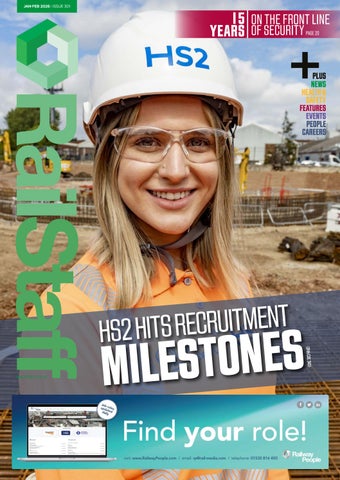
RailStaff - Issue 301 | January - February 2026

Page 1


LOOKING FORWARD TO CLOSER COOPERATION | 16

With the return of the railways to public ownership, Colin Wheeler is feeling optimistic.

DERBY DELIVERS FIRST REFUBISHED VOYAGER | 18

RailStaff attended the unveiling of CrossCountry’s refurbished Voyager trains at Alstom’s Litchurch Lane Works.

15 YEARS ON THE FRONT LINE OF SECURITY | 20

Leading security solution provider ResponSec is marking a very special anniversary.

FULL STEAM AHEAD FOR THE RAILSTAFF AWARDS | 22

Though 2026 has only just begun we’re already preparing for the awards event of the year.

HS2 HITS RECRUITMENT MILESTONES | 30

As the mega-project surpasses apprenticeship objectives its progress is creating even more opportunities.

Contact us:

Editor: Matt Atkins

Production and design: Adam O’Connor

Track safety: Colin Wheeler

Advertising: Craig Smith

GREAT OPPORTUNITIES AND GREAT RESPONSIBILITY

Contact email addresses

News: news@rail-media.com

Track safety: colin@rail-media.com

Pictures: pictures@rail-media.com

Adverts: adverts@rail-media.com

Subscriptions: manda@rail-media.com

Contact details

RailStaff Publications, Rail Media House, Samson Road, Coalville, Leicestershire, LE67 3FP.

Tel: 01530 816 444

Fax: 01530 810 344

Web: www.railstaff.co.uk

Email: hello@rail-media.com Printed

A new year always carries a sense of renewal. Plans are refreshed, ambitions sharpened, and industries take stock of both progress and unfinished business. In Rail, 2026 begins with cautious optimism. Major projects continue to advance, reform gathers pace under public ownership, and investment in skills and technology remains high on the agenda. Yet this is also a year that reminds us of the weight of responsibility the railway carries.

In January, Spain saw two fatal rail derailments, one involving two high-speed trains which resulted in many casualties. This brought a stark reminder of why safety must remain the industry’s unwavering priority. Rail is built on competence and vigilance and however much the industry evolves, it must continue to honour that duty.

Against this backdrop, one theme dominates: People. The railway’s future will be shaped not just by infrastructure and policy, but by whether it can attract, develop, and retain the talent it needs.

Carrington West’s 2026 Rail Salary Survey provides a timely snapshot of where the industry currently stands. Pay rises remain central to recruitment and retention, but the survey also highlights persistent skills shortages and intense competition for experienced professionals. Salary alone is no longer the deciding factor, and career progression, flexibility, and job security are playing an increasingly influential role in the decisions of job-seekers. In a candidate-led market, employers must work harder and smarter to stand out.

The importance of long-term commitment is reflected elsewhere in this issue. Alstom celebrates two colleagues who have each dedicated more than 50 years to the company - a remarkable testament to rail as a lifelong career. At the same time, HS2 continues to generate opportunities, surpassing its apprenticeship targets and demonstrating how major infrastructure programmes can drive meaningful workforce development.

Yet the recruitment challenge is not simply about filling vacancies; it is about reshaping perceptions. Daisy Chapman-Chamberlain examines what young people truly want from their careers - purpose, financial security, happiness, and the chance to make a tangible difference. Encouragingly, Rail naturally aligns with these priorities. It is central to decarbonisation, community connectivity, and regional growth. The task ahead is to communicate those strengths clearly, using the channels and language that resonate with younger generations.

Supporting this evolving recruitment landscape is RailwayPeople.com, which continues to provide a sector-focused platform connecting employers with a substantial and highly relevant talent pool. In a competitive market, targeted recruitment tools are more valuable than ever.

Elsewhere, optimism surrounds the prospect of closer cooperation as rail returns to public ownership. Many hope structural change will foster clearer accountability and stronger collaboration across the network. On the ground, progress continues: RailStaff attended the unveiling of CrossCountry’s refurbished Voyager trains in Derby, signalling ongoing investment in the passenger experience. Meanwhile, ResponSec marks 15 years supporting rail security - another reminder that safety underpins everything the industry does.

Finally, with preparations underway for the RailStaff Awards 2026, the countdown to the event of the year has begun. We can’t wait to see you there and celebrate the individuals who keep the railway moving. The year may be young, but its direction is clear. Rail stands at a moment of opportunity, driven by reform, shaped by innovation, and sustained by its people. If the industry can continue to balance ambition with responsibility, 2026 could prove to be a defining chapter.

Government sets out plans for NPR

On 14 January the Government released its plans for Northern Powerhouse Rail, promising that people across the North West, Yorkshire, and the North East will benefit from faster commutes, greater job opportunities, and increased investment.

The first phase will prioritise upgrades and electrification between Leeds-Sheffield, Leeds-York, and Leeds-Bradford to transform commutes, set to be delivered in the 2030s, and work on the business case for the Leamside Line will be taken forward, as part of ensuring NPR services reach Newcastle.

The North East will also benefit from regular services onwards to Newcastle via Darlington and

Durham. This follows recent investment of £4 billion in the East Coast Mainline which has seen 60,000 extra seats weekly through the new timetable.

The plans also include a new rail route between Liverpool and Manchester, running via Manchester Airport and Warrington. The second phase will include three new stations at Manchester Airport, Manchester Piccadilly, and Warrington Bank Quay Low Level along the route, with delivery starting in the 2030s. Improvements to busy stations, Liverpool Lime Street and Liverpool Central, are also being considered alongside the work

Network Rail staff hailed as heroes

Joanne Reid, 60, says she feared the worst after falling during her normal dog walk on 5 January near Insch station.

With reports of 23 inches of snow and drifts even higher, she was completely hidden from view and unable to get back on her feet due to mobility issues.

Fortunately, a team of Network Rail colleagues were working to clear the heavy snow from railway lines nearby and heard Mrs Reid shouting for help.

Darren Stalker, Stuart Fraser and Allan Rough were able to find her and her dogs lying in the deep drifts and help them to safety.

Mrs Reid said: “I couldn’t get up so I started to crawl towards the field, hoping there was something to help me, but I couldn’t get far. My support dog, Riley, was shaking as he knew something was wrong. My other dog, Rufus, lay down beside me.

“I was next to the railway, but trees were masking me. I couldn’t see how anyone was going to find me, so I started shouting. Eventually after 10 or 15 minutes, I saw an orange jacket through the trees and the three men appeared.

the government is undertaking together with Liverpool City Region to look at options for a major regeneration scheme in the city centre.

“For too long, the North has been held back by underinvestment and years of dither and delay – but that ends now,” said Transport Secretary Heidi Alexander.

“This new era of investment will not just speed up journeys, it will mean new jobs and homes for people, making a real difference to millions of lives.”

The landmark upgrade is one of the central building blocks of a plan for the North – to be

published in the spring. This will include plans for a northern growth corridor from Liverpool to York – which has the potential to be one of Europe’s great economic powerhouses. It will also include plans to make the most of economic opportunities right across the North, including in clean energy, defence and advanced manufacturing.

The NPR plans are in addition to the Transpennine route upgrade, which will cut journey times between York and Manchester and Manchester and Leeds, create over 5,000 jobs, and support the development of 6,500 new homes in the region.

“The relief was unbelievable. I burst into tears. I really believed that if I hadn’t got somebody soon, the dogs and I could’ve been dead. I was so grateful.

“It was cold and horrible and they’re out working in this weather. Not only are they helping get the railway back up and running, but they’ve also just rescued somebody. I really do believe they saved my life. They say not all heroes wear capes, and that’s exactly what they were. Wearing bright orange safety gear and hard hats. They are my heroes.”

After getting back to their vital work clearing the railway, the team returned later in the day to check on Mrs Reid at home.

Darren Stalker, Stuart Fraser, and Allan Rough said: “We are just glad that the lady and her dogs are home safe and well. The

weather was treacherous, so being stuck outside was certainly not ideal for her.

"We really appreciate all the recognition, but anyone in that situation would have done the same. We were glad we were there to help. Thanks from us all.”

Liam Sumpter, manager director at Network Rail Scotland, said: “I’m incredibly proud of our colleagues whose quick thinking and compassion made such a difference in truly brutal conditions.

“They were out there working tirelessly to keep the railway running safely yet didn’t hesitate for a second to help someone in real distress. Their actions show the very best of Network Rail.

“I’d like to give a big thank you to them and all our other teams working hard in such challenging weather.”

Three Network Rail workers have been hailed as heroes for rescuing a woman and her two dogs after she fell in deep snow.

HS2 completes Coleshill viaducts deck assembly

Engineers working on HS2’s complex triangular intersection outside Birmingham have successfully completed the construction of four parallel viaduct decks – an essential part of the huge project.

The viaducts being built near Coleshill in Warwickshire stretch for more than 600 metres and form a small part of the Delta junction – a huge intersection being built to the east of Birmingham for the new highspeed railway.

Like the nearby Spaghetti Junction, the Delta is formed of a series of interconnected viaducts, flyovers and underpasses, taking the high-speed line over motorways, local roads, railways, rivers, and floodplains.

The Coleshill East and West viaducts form the southern part of the junction, where the railway splits apart as it crosses a local road and the floodplain of the river Cole, between the M6 and M42.

Two parallel viaduct spans will carry the four-track mainline running north and south, while two narrower viaducts on either side will carry services to and from the new Birmingham Curzon Street station in the city centre.

The construction of the Coleshill viaducts – which stretch for a combined total of 2.4km – is being delivered by HS2’s main works contractor in the Midlands, Balfour Beatty VINCI.

The decks are made of 1,024 individual concrete segments which were manufactured off-site at a purpose-built facility a few miles away at Kingsbury. These were then moved to site before being lifted and secured into position to form the spans of the viaducts.

The central 22-metre-wide deck consists of two rows of 11-metre-wide segments, each weighing 60 tonnes, while the two single track viaducts are made of single rows of smaller, 44 tonne segments. They are supported by 54 reinforced concrete piers, each up to 12 metres high.

BBV used a cantilever process to install the segments with temporary steel cables supporting each one until the spans were complete. Permanent post-tensioned cables were then installed in the hollow centre of the viaduct to strengthen the structure.

The same process was repeated between each of the piers until all the spans were complete. With the deck segments now installed, the focus is turning to the finishing works, with the robust kerbs and parapets still to be completed.

Porterbrook acquires Corelink fleets

Rolling stock financier Porterbrook has completed a deal to acquire 404 vehicles owned by Corelink Rail Infrastructure Limited (Corelink).

The fleet of 324 Class 730 Aventra electric and 80 Class 196 diesel units, operated by West Midland Trains (WMT), serve passengers on regional and long-distance routes between London, Birmingham, and Liverpool. Together, they account for 60% of WMT’s network operations.

Mary Grant, Porterbrook CEO, said: “West Midlands Trains has been one of our largest customers for over 15 years and this latest transaction solidifies that partnership for the future. It also completes a programme of more than £1 billion of capital deployed during the last five years in new trains, fleet upgrades, traction innovation, and rail infrastructure.”

The five-car Aventras will be stabled and maintained at the Bletchley Train Maintenance Depot. Last year the site was upgraded with modern sidings, inspection facilities, new overhead electrified lines, and gantries following Porterbrook’s £66 million investment.

Corelink is a joint venture between Infracapital and Pan-European Infrastructure II, a fund managed and advised by DWS Group & GmbH Co KGaA. Porterbrook was advised by CA-CIB (Financial), Freeths (Legal), and Deloitte (Tax). Infracapital and DWS were advised by DC Advisory (Financial) and Eversheds Sutherland (Legal).

Porterbrook

New training centre provides a boost

Network Rail’s new training facility in Doncaster is already making a difference in helping apprentices develop the skills needed to maintain, improve, and futureproof Britain’s railway.

In the past year, Network Rail has welcomed 290 joiners into its apprenticeship programmes. This forms part of the organisation’s wider commitment to developing skilled talent, with 1,780 apprentices recruited during the last five years.

Sunday 8 February marked 100 days since Network Rail revealed the name of the centre – the Gresley Institute – following a public vote. The building has been transformed into a modern centre for operational training, education and development. The first apprentices transferred their studies on the operations apprenticeship course to the centre in October, with final assessments taking place during National Apprenticeship Week (9-15 February).

There are 21 classrooms across two floors, with equipment such as signalling simulators – both traditional lever-pull models and modern systems with visual display units. The centre will eventually train up to 1,000 rail industry colleagues each year.

Richard Turner, Network Rail’s head of apprenticeships, said: “Apprentices play a vital role in keeping Britain’s railway running safely and reliably, and we’re proud to welcome nearly 300 new joiners this year across engineering, business, IT, and finance.

“Our programmes give people handson experience, the chance to earn while they learn, and the skills to build long-term careers. They also help us develop the next generation of STEM* talent and create a diverse, future-ready workforce for the railway.”

Tram-trains to revolutionise South Wales transport

New tram-trains that will transform transport in South Wales are now in their final phase of testing before being introduced into service on some of the Core Valleys Lines this spring.

The Class 398 Tram-Trains, which are part of the Welsh Government’s £800 million investment into brand-new trains across Wales and the Borders, have the unique ability to run on both rail and tram lines, offering more frequent and faster journeys, level boarding, modern air conditioning, power sockets, improved passenger information screens and multi-use areas for bikes and wheelchairs.

The 36 brand-new trains will run on the Merthyr, Aberdare, and Treherbert lines, travelling to Cardiff and Cardiff Bay.

Speaking at a visit to the Taffs Well depot, where the new tram-trains will be housed, First Minister Eluned Morgan said: “Improving transport across Wales is one of my top priorities – investing in high quality transport,

which is more reliable, more convenient, and more enjoyable to use.

“I am delighted that passengers are now experiencing the significant benefits of our investment in the South Wales Metro with improved services, brand-new trains, and better facilities both on and off the track. And with the arrival of the new tram-trains in the spring it’s an exciting time for transport in Wales.”

Cabinet Secretary for Transport and North Wales, Ken Skates, added: “The future for rail in Wales is bright – modern trains, faster and more regular services, and now revolutionary tram-trains coming down the track – our vision of creating a transport system that is sustainable, accessible, efficient, and meets the needs of all our communities is now becoming a reality.

“But we’re not stopping there, from May services across the North Wales mainline will be increased by 50%, with a 100% increase in train services between Wrexham and Chester and the rollout of Pay as You Go technology in North Wales this year too.”

Govia Thameslink Railway (GTR) has revealed a significant increase in the number of women starting an apprenticeship with the rail operator. A total of 420 new starters began an apprenticeship with GTR in 2025, with 106 new starters being female colleagues, representing an increase of 49% from the previous year.

In 2025, GTR saw the highest number of female applicants for its team leader / supervisor apprenticeship in five years, revealing a growing interest in women looking to upskill and progress their careers. This came as the rail operator launched two new apprenticeship courses - Women in Leadership Level 3 and 5 - to

Publicly-owned operators report rapid growth

Train operators in public ownership have shared details of the stations on their networks seeing strong passenger growth according to the most recent ORR station usage figures.

For Southeastern, Thanet Parkway in Kent, which opened its doors in 2023, has become the operator’s fastest growing station. Passenger entries and exits more than doubled in the last year, rising by 116% to over 123,000. The exceptional passenger growth supports the aims of the station investment, to connect more people to new housing, new business and job opportunities, as well as the local leisure and tourism industry.

West Horndon in Essex, c2c's fastest growing station, grew by 36% year-on-year. Towards the end of 2024, West Horndon joined c2c’s network of contactless ticketing enabled stations as part of Government plans to expand pay-as-you-go areas. Contactless ticketing is available across the operator’s entire route and has been popular with customers. The station is also strategically located near the housing growth area of

help develop and empower future female leaders within the business, reflecting GTR’s commitment to create a diverse and inclusive workforce.

GTR has also exceeded its target of having a 20% female uptake across all apprenticeships, with the current figure standing at 27%. As well as more women taking on apprenticeships, the overall number of employees starting an apprenticeship has increased by 75% in the last five years –jumping from 240 new starters in 2021 to 420 in 2025.

One woman who is reaping the benefits of GTR’s apprenticeship programme is Natalie Parker, who is studying the Level 3 Women in Leadership: Team Leader apprenticeship to take her career to the next level.

GTR sees huge increase in female apprentices

“The apprenticeship has been brilliant so far because we’ve covered a range of topics, such as project and team management, the importance of networking, and developing presence and professionalism,” she said.

“My confidence has increased during the course, because I’ve learnt about why we experience self-doubt and how to manage it. This has been very helpful because growing up with dyslexia meant I always felt I wasn’t good enough, so this course has helped shift my mindset.”

GTR People Director Ruth Busby, said:

“It’s fantastic to see more women are taking on apprenticeships to learn new skills and develop existing ones so they can unlock their full potential in the rail industry.

“Our people are at the heart of everything we do, therefore it’s vital we invest in a wide range of apprenticeships to attract, develop, and retain talent. This is key to creating a diverse workforce which represents the communities we serve.”

Thurrock and has easy access to the M25.

Another station which is undergoing major improvements and saw a marked passenger increase was Darlington, managed by LNER. The station in North East England was the operator’s fastest growing station, recording a 20% increase in passenger entries and exits, rising from 2.35 million to 2.83 million.

In December, Network Rail confirmed the £140 million Darlington station development is expected to open in Spring 2026. The station transformation project is a collaboration between LNER, Network Rail, Tees Valley Combined Authority, Darlington Council, and majority funder the Department for Transport.

It will turn the station into a modern transport hub that improves reliability, capacity and the facilities for passengers.

SWR’s Woolston station in Southampton was the operator’s fastest growing station, recording over 180,000 passenger entries and exits, a 74% year-on-year increase.

TransPennine Express’ fastest growing station was Malton in North Yorkshire, rising from 293,000 to 376,000, a 28% increase. Meanwhile, Northern recorded notable growth at stations such as Deansgate, 62% and Hindley in Wigan which also grew by 62% from 148,000 to 240,000 entries and exits.

NEWS IN BRIEF

TIME TO TALK

Hull Trains has launched a new mental health podcast series, 'Moving Minds'.

Episodes are recorded during real Hull Trains journeys on the East Coast Main Line, with interviewees joining the onboard studio at destinations between East Yorkshire and London King’s Cross. The video podcasts will feature special guests sharing their own mental health stories and wellbeing tips.

Hull actor Gemma Oaten is hosting the series – a familiar face from her roles on shows including Emmerdale, Coronation Street, and Holby City. Gemma has spoken publicly about her own mental health journey and passion for getting people to talk about how they’re feeling.

TRAIN EXCHANGE

Severn Valley Railway (SVR) and the Vale of Rheidol Railway have announced an exciting two-year locomotive exchange that will bring two iconic steam engines to fresh audiences in new locations.

From Spring 2026, the SVR’s GWR 7819 Hinton Manor, currently on display in the SVR’s Engine House, will travel to the Vale of Rheidol Railway in Aberystwyth for static display. In return, GWR ‘Dukedog’ 9017 Earl of Berkeley will be welcomed to the SVR.

This landmark swap will give visitors in the Midlands and mid-Wales the chance to see locomotives they might otherwise never encounter up close.

NO TROUSERS

The No Trousers Tube Ride, part of a global phenomenon that began in New York, returned on Sunday 11 January.

The event sees hundreds of participants board Tube trains wearing winter coats, scarves, and hats, but no trousers or skirts. Organisers say the aim is simple: to inject a sense of humour and surprise into the daily commute, with riders behaving as though nothing out of the ordinary is happening.

Participants typically wear shorts, leggings, or underwear beneath their coats, and the event is designed to be lighthearted rather than provocative.

PROGRESS REPORT

Eighteen months since the Government took office in July 2024, The Railway Industry Association (RIA) delivered its third six-monthly assessment on the progress of UK rail policy.

RIA recognised there has been progress on rail reform – including initiation of the Government’s Railways Bill to establish Great British Railways – and there has been continued Government support for rail infrastructure, with projects such as HS2 (including to Euston), the Transpennine Route Upgrade, and East West Rail.

Clifton Bridge installed and reopened

A major bridge replacement scheme on the West Coast Main Line (WCML) has been completed, with the installation of a new structure at Clifton near Penrith as part of wider upgrade works.

The work saw Clifton railway bridge near Penrith replaced by Network Rail and its principal contractor Skanska as part of a £60 million investment to make the WCML fit for the future.

On Saturday 10 January, the new 130-metrelong structure was carefully manoeuvred into place with millimetre precision by SelfPropelled Modular Transporters (SPMTs) with more than 600 wheels to carry the load. The new bridge has a design life of 120 years. Despite sub-zero temperatures and challenging weather conditions, work progressed so smoothly that the motorway reopened shortly before 4pm on Sunday 11 January – 13 hours ahead of schedule.

To allow the huge civil engineering project to take place, two unprecedented 60-hour closures of the whole motorway were scheduled between junctions 39 and 40 over consecutive weekends.

Christian Irwin OBE, Network Rail North West and Central region capital delivery director, said:

“It’s a testament to the hard work of hundreds of people that we’ve been able to install this huge new structure both successfully and speedily. We've been in close contact with National Highways throughout so we could capitalise on that

and get the M6 reopen over half a day ahead of schedule to alleviate pressure on local roads.

“I’d like to once again thank drivers for adhering to the road diversions, and also thank the local communities impacted by them this weekend, so we could carry out this vital work to secure journeys for both road and rail users in the future.”

With the bridge installation complete, railway teams got to work installing new track and reconnecting overhead power lines and signalling systems over the renewed structure. While that took place, the railway remained closed between Oxenholme and Carlisle until its full reopening. Train services re-commenced on the morning of 15 January.

The extended closure provided Network Rail teams with the opportunity to carry out dozens of other improvement projects between Preston and the Scottish border.

During the upgrades, Network Rail and Avanti West Coast worked closely to keep customers on trains for as much of their journeys as possible by running a special shuttle service on the historic Settle to Carlisle line – the first time in a decade that diversionary route has been used.

“We have used this vital 14-day closure to make the biggest possible impact on the West Coast Main Line with multiple major upgrades now completed,” said Christian. “As a result of the hard work of hundreds of our colleagues, both passengers and our freight operators will have a more reliable railway for generations to come.”

land evictions. The business evolved, with Land Sheriffs in its current form being established in 2005 when it began working with Network Rail to help protect their property, people, and infrastructure.

Since then, it has become a trusted security partner for a wide range of clients, delivering high-profile projects including protecting the HS1 route, ensuring the smooth operation of travel during the London 2012 Olympic and Paralympic Games, and contributing to the opening of the Elizabeth Line.

Land Sheriffs celebrates 20 years

Essex-based smart security specialist

Land Sheriffs has launched a fresh brand and new website to celebrate its 20-year anniversary.

To mark the milestone, Land Sheriffs has unveiled an updated logo and refreshed branding, introducing a modern design that complements its established brand while reflecting the ethos and position the company holds today.

Alongside this, it has launched a brandnew website which provides an even better

experience for its clients and offers a clearer overview of the services they provide.

“We’re incredibly proud to be launching our brand-new website and logo as part of our 20th anniversary celebrations,” said Managing Director James Coyle. “After two decades establishing ourselves in the industry, it feels like the perfect moment for a refresh. The new logo and website not only represent how far we’ve come, but also reflect our ambition and confidence for the future.”

Land Sheriffs’ roots trace back to the mid90s, when it supported businesses with legal

“We’re incredibly proud of how far we’ve come since those early days, constantly evolving to meet our clients’ needs,” James added. “We’ve experienced exceptional growth and we’re excited to keep building on that success. Our new redesign gives clients a clearer view of the services we offer and the sectors we work in, while our updated logo ensures we remain instantly recognisable – a reassuring presence for both clients and the public.”

“As we celebrate 20 years, I want to thank our incredible team, including our founders Steve and Tyler LeMay, and our clients for their continued trust and support. We’ve built a reputation for delivering smarter security solutions that make a real difference, and with our refreshed brand and website, we’re excited about the opportunities ahead.”

New demonstrator line for CVLR

Coventry University’s Technology Centre will be the first stop on a pioneering new tram network set to be built in the city.

Coventry City Council has approved a new demonstrator line for its Coventry Very Light Rail (CVLR) network, designed to showcase the huge benefits of the technology.

The initial 800-metre section will run from Coventry Railway Station to the Technology Park and will also include a new service area and charging station at the university’s Mile Lane site.

Should the demonstrator prove successful, the line would remain in place as part of the permanent network and be extended further afield.

The technology behind CVLR enables tram routes to be built quickly and cheaply, while the shallow tracks mean the majority of existing infrastructure such as pipes and cables can remain undisturbed underground.

The electric trams are also designed to cope with much sharper turns, allowing them to navigate through the existing city landscape, negating the need for wholescale

changes to city layouts and for the acquisition of land for the route. The non-invasive construction of the track routes means they don’t require planning consent which further expedites the project delivery.

The route to the Technology Park has been made possible thanks to an agreement by the university allowing Coventry City Council to use its land. The team behind CVLR also plans to base its delivery headquarters at the Technology Park.

Brendan O’Reilly, sustainable transport manager at Coventry University, said: “CVLR is a first-of-its-kind transport system that offers huge benefits, not just for Coventry but for other cities across the globe of a similar size who may find a traditional tram system too costly or problematic.

“We have collaborated closely with the city council and it is fantastic that Coventry University’s Technology Park will be the first stop on the demonstrator line. With our focus

on sustainability, being able to offer transport from the railway station in the city centre to the Technology Park will help us encourage people to leave their cars at home.

“The technology behind CVLR is owned by Coventry City Council so should other cities adopt it, this would be a very proud moment for us to see it help others.”

It is not the first time Coventry residents have been given a glimpse of CVLR, with a short demonstrator line being temporarily installed in the city centre last year.

However, this new, much longer demonstrator line is an important step for the project as it will allow the CVLR to run alongside live traffic.

Coventry City Council want to see the demonstrator operational by October 2027, allowing delegates at the Intelligent Transport Systems (ITS) World Congress being staged at the NEC in October that year to be among those to experience it for themselves.

More services return to public ownership

On Sunday 1 February, London Northwestern Railway (LNR) and West Midlands Railway (WMR) services became the latest to join DfT Operator Limited (DFTO), the Government's public sector rail owning group.

The milestone marks a further step towards creating an integrated rail network that passengers can rely on and be proud of under Great British Railways, which will deliver reliable, safe and more affordable journeys.

The move brings the two sides of the West Midlands Trains (WMT) business under public ownership: LNR, which operates services between Liverpool and Birmingham and along the West Coast Main Line to and from London Euston; and WMR, which serves destinations across the West Midlands via Birmingham New Street and Birmingham Snow Hill.

WMT is the fourth operator to enter public ownership under the government’s Passenger Railway Services (Public Ownership) Act, marking another step towards a simpler, more unified railway under Great British Railways (GBR).

Transport Secretary Heidi Alexander said: “From this Sunday, the thousands of passengers who travel with London Northwestern and West Midlands Railway will be using services that are owned by the public and run with their interests at heart.

“We’re working hard to reform a fragmented system and deliver a reliable railway that regenerates communities, rebuilds the trust of its passengers, and

delivers the high standards they rightly expect.”

West Midlands Trains joins Greater Anglia, c2c, Northern, TransPennine Express, Southeastern, LNER, and South Western Railway which are currently managed by DFTO.

Ian McConnell, managing director of West Midlands Trains, commented: “We are proud to be one of the fastest-growing train operators in the country with millions of passengers travelling on London Northwestern Railway (LNR) and West Midlands Railway (WMR) services every month.

“Public ownership is an exciting opportunity to build on this success through a strong culture of collaboration and integration with the wider family of publicly owned operators.

“Together, we can drive performance by sharing best practice and accelerating innovation and continue to deliver even better journeys for our passengers across the LNR and WMR networks.”

Govia Thameslink Railway’s (GTR) services will be next to transfer on 31 May 2026, marking another significant step in the government’s plans to bring services into public ownership.

Rail industry rallies for Brew Monday

On Monday 19 January organisations across the rail industry came together to celebrate Brew Monday, Samaritans' annual campaign. The day saw rail staff and volunteers handing out teabags to the public and popping on the kettle in offices, sparking meaningful conversations across the country.

Brew Monday takes place each year and challenges ‘Blue Monday’ as we know that feeling low isn’t just something that happens on Mondays or a random day in January. It follows a recent survey by Samaritans which found one in five people never talk about their feelings (18%) while a further fifth only talk about their feelings once a month (20%).

The suicide prevention charity is centred on the power of human connection, and this campaign encouraged people to come together and have a conversation with someone they are worried about because it could save a life.

On the day, those in the rail industry held both public-facing and internal events, helping to spread Samaritans' message: there’s always time for a cuppa and a catch up.

Dave Brown, head of the rail programme at Samaritans, said: “It was great to see so many of our colleagues in rail embracing Brew Monday this year and reminding both staff and the public how good human connection feels, how easy it is, and what a difference it can make to people’s wellbeing. And we’re so

Smart sensors make finding a seat easy

Customers travelling with LNER will find it easier to locate an available seat or wheelchair space, thanks to new smart sensors being introduced across the Azuma fleet.

Following a successful trial, LNER is installing more than 36,000 'SeatSense' sensors. The small devices will be fitted above all seats and wheelchair spaces and will detect and show instantly whether they are available or occupied, providing real-time updates. This marks a significant shift from previous systems that relied almost entirely on reservation data.

LNER has partnered with tech company Sensative AB.

The sensors use radio-wave technology – a first for the railway industry – with the results of the trial revealing more than 98 per cent accuracy. The sensors are cable-free and are powered by a single energy-efficient cell battery. A further onboard enhancement designed to make journeys simpler for customers is the removal of the ‘May be reserved later’ messaging on the Azuma trains. Seats and wheelchair spaces will now show either green for ‘Available’, red for ‘Reserved’, or amber for when the seat is currently available but reserved later in the journey, helping customers feel more confident when travelling with LNER.

grateful to the rail industry for their continued support for Brew Monday, by helping us to turn small talk into big talk, it might just save someone’s life.”

Louise McNally, principal suicide & trespass prevention specialist, said: “Brew Monday highlights the importance of pausing to talk and really listen, whether it’s with colleagues or with the travelling public.

“The railway connects communities across the country every day, and initiatives like this help make checking in on each other a normal part of life. Taking a few minutes for a cup of tea and a conversation can break down barriers, and those simple moments of connection can have a powerful impact.”

Samaritans and Network Rail have worked in partnership since 2015, dedicated to preventing suicide on the railway. Part of the partnership involves training rail staff in suicide prevention and what to do after an incident.

The training courses available include Managing Suicidal Contacts and Trauma Support Training, which is aimed at frontline staff and their managers, and helps participants recognise signs of trauma, respond effectively, and support colleagues through their recovery. You can sign up by emailing: railcompaniestraining@samaritans.org.

Anyone can contact Samaritans, free, any time from any phone on 116 123 or visit www.samaritans.org.

www.woking-homes.co.uk

“I’ve
never found a more perfect example of how older people should be cared for than Woking Homes.”
Former Chairman, Age UK, Waverley

Former signaller returns to his roots

A former railway signaller has celebrated his 90th birthday with a special visit to the Manchester Rail Operating Centre (ROC), returning to the railway where he spent more than four decades of his career.

Eric Hilton, who turned 90 on Wednesday 4 February, spent almost 43 years working across the railway, building a career that took him through a variety of roles, becoming station manager at Crewe before moving into train planning, operations control, and later working at Warrington's power signal box.

Eric and his guests were welcomed to the Manchester ROC, where they were shown how modern railway operations are managed today and given a behind-the-scenes look at the technology and teams that keep trains moving across the network.

EMR doubles down on body-worn cameras

East Midlands Railway (EMR) has rolled out more than 330 additional body-worn cameras for its staff as part of its ongoing commitment to colleague and customer safety.

All station and on-train colleagues will carry cameras, which will be activated, for example, during ticket checks, at busy stations, during events, or if a situation is escalating.

Any footage captured is automatically stored securely for 31 days. If required for an investigation, footage can be retained for longer and shared with the British Transport Police (BTP).

A study by the Rail Delivery Group (RDG) and the University of Cambridge shows that wearing body-worn cameras reduces the likelihood of assault by 47%, even when not recording.

Since April 2025, the BTP has recorded 60 crimes related to physical assaults and 136 related to verbal assaults against EMR staff, out of 21.8 million customer journeys.

EMR is working closely with the BTP and trade union representatives to ensure the rollout supports both staff and customer safety, reinforcing the message that there is no excuse for abuse on the railway.

Philippa Cresswell, customer experience director, said: “Every day, thousands of people travel with us, and the vast majority do so safely and respectfully.

“Increasing the number of body-worn cameras is just one more way we are making our railway a safer place for everyone. Other measures include more specialist training, increased staff presence in key locations, new technology, and closer working with stakeholders.”

Eric’s visit was a chance to recognise a long and varied career on the railway, and to thank him for the contribution he made over more than four decades of service.

During the visit, Eric was able to see how railway operations have evolved since his time on the network, while reconnecting with familiar faces and revisiting a place that’s central to keeping the railway running today.

Phil James, route director at Network Rail,

said: "It was an absolute pleasure to welcome Eric and his friends to the Manchester Rail Operating Centre. Eric has an incredible railway story, and it was fascinating listening to his experiences from a career that spanned so many roles across the industry.

"Looking after our railway family is incredibly important to us, and this visit was a chance to recognise Eric’s contribution and to say thank you as he celebrates a very special milestone.”

Reflecting on the day, Eric said: "I’ve had a wonderful birthday experience here, and I never expected anything like it.

"My time on the railway was incredibly varied, and I could talk about it for hours. It was a fantastic career and an experience I would happily repeat. Being welcomed back today has meant a great deal to me."

Youngest ever Metro driver retires

A Metro worker who holds the record for being its youngest train driver when it opened in 1980 is retiring after nearly 50 years of service.

Phil Taylor, 65, of Bank Foot in Newcastle, was just 19 when we he got the chance to become a Metro driver. He remains the youngest man to join Metro train crew, starting his career when it opened in August 1980.

Phil worked as a Metro driver for 14 years, before going on to play a key role training the drivers. He then became a Metro operations manager, dealing with incidents on the system, before taking his most recent role based in the Metro control room as a service delivery controller.

He said: “I’ve always been proud to work for the Tyne and Wear Metro. I found myself at the age of 19 getting the chance to drive the trains when they were shiny and new. I vividly recall being told each one was worth a million quid.

“All of the drivers were proud to be a part of it. It was such a big achievement, and the system was delivering something huge for the region.

Phil started his career when he joined British Rail straight from school in 1977 aged 16 as a junior, before becoming a train guard.

In more recent years at Nexus, he worked in the Metro control room. The role involves managing the safe operation of the trains out on the system. He played a big part in the introduction of its new digital signalling control system in 2018.

Metro operator Nexus said Phil had given outstanding service to Metro and wished him well for the future. Kevin Storey, operations director at Nexus, said: “Phil has given us excellent service for over 45 years. He’s a been a key member of our team and has helped to mentor so many of the workforce in all different areas of Metro operations through the roles he’s had. We wish him all the best for his retirement.”

© Nexus

Neil Warner, Avanti West Coast deputy team leader, is the longest-serving employee at the station – clocking up nearly 30 years’ service – and regards it as a place that “feels like home”.

50 years of Birmingham International

Avanti West Coast has marked the 50th anniversary of Birmingham International station, celebrating half a century since it first opened.

Built to serve Birmingham Airport and the National Exhibition Centre (NEC), the station opened its doors on 26 January 1976. Over the last five decades, it has become a commuter hub for residents living in Solihull, Coleshill, and surrounding areas.

To mark the occasion, representatives from the West Midlands Combined Authority, Birmingham Airport, Solihull Metropolitan Borough Council, and the NEC, joined Avanti West Coast, which manages the station.

A specially made birthday cake was presented, and guests shared their memories from the last 50 years.

The station was also dressed in commemorative bunting and messages showing appreciation to passengers were displayed on screens.

Birmingham International originally shared

its name with the nearby airport and was designed by architect Ray Moorcroft, who became the chief architect for British Rail from 1977. He also designed Wolverhampton and Northampton station buildings prior to their revamps, as well as being involved in London Euston’s redevelopment in the 1960s.

“It is quite special to me because it's the place where I've worked nearly all my life. There's a great team here and there's been some unique characters over the years, and we’ve all got on well together”, said Neil.

He added: “With the NEC on our doorstep, I’ve been fortunate to meet a lot of famous people, including Paul O’Grady and Prince William.”

Birmingham International is served by Avanti West Coast’s Pendolino and Evero trains, alongside services from West Midlands Trains, CrossCountry, Transport for Wales, and as of this month, Caledonian Sleeper.

More than 300 trains call at the station each day, with around five million people travelling to or from Birmingham International every year.

Network Rail cleans up at Loo of the Year Awards

Network Rail was on a roll at the Loo of the Year Awards as it scooped a number of titles, with the Platform 12 toilets at London Paddington being crowned as the best railway station toilets in Britain.

More than a staggering 6,000 miles of loo roll are used in toilets at Britain’s third busiest station each year; enough to stretch all the way from the station to its famous namesake's home in darkest Peru.

The loos, which have been fitted with occupancy detectors so users can easily see which cubicles are free, achieved a satisfaction rate of over 90% from users.

The station’s Changing Places toilet was also Highly Commended for its baby changing facilities, and achieved the highest grading of Diamond from Loo of the Year.

The Changing Places toilet also includes stoma-friendly facilities, following guidance from Colostomy UK, in a first for Network Rail’s managed stations.

A spokesperson from Network Rail said: “We’re delighted to take the number one spot as the best station facilities in Britain for our toilets at London Paddington. Whether you’re taking a train or just making a ‘pit stop’, we’re proud to offer clean and accessible facilities for everyone.

“I’d like to give massive thanks to the station team and our hardworking cleaning staff who have really earned their stripes with their commitment to providing the best facilities for our passengers.”

Network Rail’s Western route – which upgrades and maintains the railway infrastructure between London Paddington and Penzance – was also one of just 14 organisations given a Champions League Standards of Excellence Award, given to organisations managing eight or more sets of toilets of which five achieve grades of Diamond.

LOOKING FORWARD TO CLOSER COOPERATION

As I write, it has been announced that driverless cars will be permitted to operate as taxis in London. If Artificial Intelligence (AI) can make this a safe and viable option on our roads, it prompts the question of whether similar technologies might one day play a greater role in train operation. Seen in that light, the recent decision to lower the minimum age for train drivers to 18 takes on a different perspective.

There is clear enthusiasm for recruiting more heavy goods vehicle drivers to meet current and future industrial demand. Yet electrifying more of our railways – and harnessing AI to improve how they are operated – may represent a more strategic long-term direction. Modernising freight rolling stock and expanding the use of scheduled, reliable, electricallyhauled freight services would offer a cleaner, more efficient alternative, supporting both capacity and sustainability objectives.

The case extends beyond freight. Britain must continue to expand electrification while accelerating the introduction of high-speed rail services, following the lead of countries such as China, Japan, France, and Spain. In doing so, many domestic passenger flights could progressively be replaced by faster, lowercarbon rail journeys.

Taken together, these developments suggest a broader shift in how transport policy should be framed – not simply around meeting immediate labour or capacity shortages but around embracing technological and infrastructural change to shape a more efficient and sustainable network.

FATAL ACCIDENTS IN SPAIN

Spain operates one of the largest highspeed networks in Europe, with trains running on 3,900km of dedicated high-speed track. Tragically, on Sunday 18 January, a significant accident occurred near Adamuz, close to Córdoba. It has been described as the country’s most serious rail incident for more than a decade and resulted in 45 fatalities and 292 injuries – many of which were serious.

The collision took place at approximately 19:45 local time and involved a Málaga-Madrid service operated by the private company Iryo. The final three coaches of that train derailed on a straight section of track, blocking the adjacent line where they were struck head-on by an oncoming service operated by the state-owned operator Renfe. In total, around 400 passengers and staff were travelling on the two trains.

The derailment occurred on a section of track that was last refurbished in May 2025. Both trains were travelling within the 250km/h (160mph) speed limit on the track, and access to the site of the derailments was through a single-lane road, which complicated rescue and recovery operations.

A preliminary report published by Spain's Rail Accidents Investigation Commission (CIAF) on 23 January found nicks in the wheels on the right-hand side of the three front carriages of the Iryo train, consistent with an impact with the top of the rail.

“These nicks in the wheels and the observed deformation in the rail are consistent with the rail being fractured: with the rail’s continuity interrupted, the section before the break would initially bear the full weight of the wheel, causing that part of the rail to sag slightly,” the report said.

“Since the section of rail after the break would not be acting in unison with the section before it, a step would momentarily form between the two sides of the fracture, which would strike the wheel rim.”

The report added: “We can hypothesise that the rail fracture occurred prior to the passage of the Iryo train involved in the accident and therefore prior to the derailment.” However, it was also stressed that the theory was provisional and would be subject to further testing and investigation.

Just two days after this tragedy, another fatal accident occurred on a commuter line between Gelida and Sant Sadurní d'Anoia, Catalonia. On 20 January, a Rodalies de Catalunya commuter train collided with a retaining wall after it was struck by a landslide, causing the train to derail. A trainee driver who travelled in the driver's cab was killed and at least 37 passengers were injured. Preliminary investigations state that the cause of the retaining wall collapse was heavy rainfall during Storm Harry.

Both of these incidents underline the operational and environmental challenges faced even by modern networks and highlight the importance of maintenance, monitoring, and resilience planning alongside infrastructure expansion.

Colin Wheeler.

OVER-SPEEDING AT CAMBRIDGE JUNCTION

On 11 December 2025, at 10:12 hours, the Kings Cross to Ely train operated by Great Northern Trains travelled through the permanent 25mph speed-restricted Cambridge Junction at 56mph.

According to the Rail Accident Investigation Branch (RAIB) “signals displayed their expected indications.” RAIB has said that the train lurched sideways and as a result “several passengers fell out of their seats.” No injuries were reported and no damage was caused.

Following completion of a preliminary examination of this incident, RAIB has also reviewed two similar incidents that occurred at Spital Junction, Peterborough on 17 April 2022, and 4 May 2023. RAIB has decided to publish a Safety Digest for the Cambridge Junction incident.

A spokesman for Great Northern has said that it is carrying a full investigation into the incident, and will share all findings with the RAIB.

DERAILMENT AT SHAP

On 3 November 2025, the 06:10 Glasgow Central to London Euston passenger train derailed after running into debris from a landslip three miles south of Shap summit. Debris had been washed onto the track which was sufficient to lift the first bogie off the rails and to the right resulting in derailment at 83mph with the train running derailed for some 560 metres.

The landslip was the result of “heavy and sustained rainfall”, and a drainage channel running across the slope above the track was unable to cope with the volume of water.

There were nine staff and 86 passengers on the train. Four people suffered minor injuries and there was damage to both the train and railway infrastructure. RAIB’s investigation is underway.

FATAL ACCIDENT AT FOOTPATH CROSSING

RAIB is investigating this accident which occurred at 19:05 on 26 November.

A young person was struck by a train while crossing the railway at the Chesnut Grove footpath crossing situated between Lowdam and Burton Joyce stations in Nottinghamshire. The train was travelling at about 60 mph. The crossing provides pedestrian access between the village of Burton Joyce and footpaths leading to the River Trent. The crossing has gates on either side of the railway and is provided with signage which instructs users how to cross.

RAIB’s investigation will consider the actions of those involved, any previous incidents, the management of risks and coordination between Network Rail, local government, and other organisations, as well as Network Rail’s strategy for footpath crossings for mitigating risks.

SHARING BEST PRACTICE

Slowly, train operation is returning to public ownership, and I am in favour. From a railway infrastructure perspective, sharing best practice and working together for mutual benefit should bring improvements in both operation and safety.

Thinking back to my first job as a regionally employed graduate civil engineer, I learnt from those around me. A couple of spells as an assistant divisional civil engineer and later as the permanent way assistant divisional engineer were both huge learning experiences. My later role as a divisional civil engineer was followed and overtaken by the preparations for more organisational changes.

On call and emergency call outs by regional control varied. During my working life I was involved in reinstating railway infrastructure following two heavily reported derailments on Morpeth curve and numerous less publicised incidents and accidents.

With the return of our railways to public ownership my aspirations are for the unification of infrastructure and train operations to a greater extent than ever. Before privatisation there was rivalry between the various functions involved, but also a unified approach to getting the job done by improving trains and railway infrastructure.

I recall intense debates on priorities and a spirit of cooperation with train operators. Meetings were almost always beneficial when disruption was necessary to improve both trains and the infrastructure.

Privatisation brought elements of competition, which was not always beneficial from a safety perspective or providing for our national needs!

DERBY DELIVERS

FIRST REFURBISHED VOYAGER

On Tuesday 10 February, RailStaff attended the unveiling of the first of CrossCountry’s refurbished Voyager trains at Alstom’s Litchurch Lane Works in Derby. The event marked a significant milestone in a £75.1 million investment programme designed to modernise the operator’s longdistance fleet.

Guests from across the industry and staff from both companies, gathered at the historic Derby site to tour the newly refreshed train and experience the improvements first-hand. The event also provided an opportunity not just to see the finished result, but to understand the scale of the work undertaken behind the scenes.

A MODERNISED FLEET

The British Rail Class 220 Voyager was built in Belgium by Bombardier Transportation between 2000 and 2001. The trains were introduced in 2001 to replace the 20-year-old InterCity 125 and the almost 40-year-old Class 47-hauled Mark 2 fleets operating on the Cross Country Route. Initially operated by Virgin, they have been in the hands of CrossCountry since 2007.

While the Voyager trains have now been a familiar presence on Britain’s network for more than two decades, upgrades were required to ensure the fleet continues to meet modern expectations for comfort, sustainability, and security. The recent refurbishment programme has delivered a fully renewed interior and refreshed

exterior, creating a more modern and consistent look across both Standard and First Class accommodation.

The enhancements, made by Alstom, will be rolled out across all 70 trains in CrossCountry’s long-distance fleet. They include: new seating with increased legroom; improved under-seat storage and integrated power sockets; upgraded tables at every seat; new carpets; refreshed interior and exterior artwork; and more efficient LED lighting throughout.

The upgrade also includes refurbished toilets and vestibules as well as new and upgraded onboard CCTV systems.

Sustainability has also been embedded in the process. In line with Alstom’s policy of sending no waste to landfill, materials removed during refurbishment are being recycled wherever possible, with further reuse options being explored as the programme continues.

Addressing guests gathered at the unveiling, CrossCountry Managing Director

Shiona Rolfe said:

“This train marks an important step in our commitment to improving the experience for everyone who travels with us. The Voyager fleet has served passengers well for more than two decades, and these upgrades will ensure it continues to meet modern expectations for comfort, sustainability and security.

We’re proud to be investing in the future of long-distance rail travel and look forward to welcoming passengers on board our refreshed trains.”

Shiona also expressed her gratitude to Alstom’s engineering team, who have made the refurbishment a reality.

“I want to take a moment to thank the many people that have been involved,” she said. “Those of you who have seen

All images © Alstom

me here on site, you know how much I felt the passion and the pride in the work that you're doing here, for us, and with us.”

“You've all played an incredibly vital role in transforming this project from concept through to completion. This refurbished voyager is a real credit to both your skill and also your passion.”

PRECISION IN PRESENTATION

While the interior and exterior refresh is immediately visible, the engineering and production effort required to reach this stage has been considerable. Approximately 130 staff at Alstom’s Derby Litchurch Lane facility are delivering the programme, working through a detailed schedule of modifications and upgrades.

One member of Alstom’s engineering team reflected on the scale of the task: “The team have done a fabulous job. It’s been a lot of hard work over the last 18 months, and we’ve finally reached this point. A huge amount of time and effort has gone into it.

“When you see the finished product, it looks very different from the original. If people had seen one of the units fully stripped back - taken right down before repainting and modification - they’d really appreciate what’s involved. From engineering to production, every stage matters. Only then can you truly understand the work

required to transform a unit into what you see here under the lights.”

Steve Harvey, services director, UK and Ireland at Alstom, was keen to sing the praises of all involved in the programme.

“This milestone reflects the strength of Alstom’s refurbishment capabilities in the UK and the expertise of our team in Derby. Upgrading a fleet as intensively used as the Voyagers demands precision, innovation and deep technical knowledge — and our people have delivered exactly that.

“The engineering team, the technical team, the supply chain, and every other person that's in our group have worked tirelessly to bring the first unit together. To hit this milestone is a great achievement.

“I’m proud of the quality and dedication our team has brought to the first Voyager to leave Litchurch Lane, and I know that same commitment will define every train we deliver throughout this programme.”

THREE-WAY PARTNERSHIP

The Voyager fleet is owned by rolling stock company Beacon Rail and leased to CrossCountry. Beacon has invested £75.1 million into the refurbishment, reinforcing long-term confidence in the fleet’s continued role within Britain’s long-distance network.

Adam Cunliffe, chief executive officer of

Rail, commented: “Beacon is proud to support CrossCountry in delivering this substantial upgrade to the Voyager fleet. These trains have underpinned long-distance rail travel in Britain for more than two decades, and this investment ensures they remain reliable, comfortable, and fit for the future.

“Through our close partnership with CrossCountry and Alstom, we remain committed to providing sustainable, high-quality rolling stock that enhances the passenger experience.”

RENEWED COMMITMENT

Over the next two years, 136 Voyager (Class 220) and 176 Super Voyager (Class 221) vehicles will be refurbished in Derby, including 12 additional trains recently added to the CrossCountry fleet following their release from Avanti West Coast.

With Class 220 No. 220033 now returned to service, the programme signals not just a refresh of a familiar fleet, but a renewed commitment to extending its life for the next generation of passengers.

At a time when value, sustainability, and passenger expectations are under sharper focus than ever, the Voyager refurbishment demonstrates what can be achieved through partnership, planning, and precision engineering.

Beacon

15 YEARS ON THE FRONT LINE OF SECURITY

ResponSec, one of the UK’s leading providers of bespoke security solutions, is marking its 15th anniversary this year, a milestone that reflects not just longevity, but a sustained reputation for trust, adaptability, and excellence in some of the country’s most complex environments.

Founded in 2011, ResponSec has grown from a focused security operation into a multisector partner working across the UK, Europe, and Africa. Today, the company supports major stadiums, large-scale live events, transport infrastructure, retail estates, and corporate sites, delivering tailored security strategies shaped by real-world risk and human behaviour.

Over the past decade and a half, ResponSec teams

have operated at the heart of high-profile venues and brands including London Stadium, Twickenham Stadium, Printworks London, Network Rail, London Overground, and French Connection. Its services span event and stadium security, railway and retail loss prevention, door supervision, close protection, anti-social behaviour patrols, corporate and site security, and specialist K9 handling – all delivered by fully licensed and rigorously trained personnel.

PEOPLE FIRST

At the core of ResponSec’s approach is a belief that effective security is as much about people as it is about presence. The company has built its reputation on professionalism, calm decisionmaking and the ability to adapt in fast-moving, high-pressure situations.

Reflecting on the anniversary, Founder and Managing Director Daniel Blackwood said: “When I started ResponSec, the goal was simple: to build a security company that people genuinely trusted. Fifteen years on, I’m incredibly proud of the teams we’ve developed and the environments we’ve helped protect.

“The industry has changed enormously, but our focus on training, integrity and doing the job properly has never shifted. This milestone isn’t just about looking back, it’s about setting the standard for what comes next.”

ResponSec’s commitment to professionalism and inclusion is reinforced through its industry accreditations, including Disability Confident Committed status, reflecting a long-term investment in people, training and culture.

AWARD-WINNING

The company’s expertise, which is known throughout the industry, has earned numerous accolades. In 2024 it was recognised at the RailStaff Awards, taking home the Safety Person or Team Award. In response to rising staff assaults and antisocial behaviour, it had deployed two teams of safety, security & enforcement officers for a 16-week trial with Arriva Rail London. The team patrolled 1,763 trains and handled 280 anti-social behaviour incidents. As a result, over 80% of ARL staff reported feeling safer, and 77% noticed a decrease in workplace violence.

“When our name was called it took a few seconds to sink in and head to the stage,” said Daniel on the big night. “I am so proud of the teams that worked on the project and all their efforts to make passengers and staff feel safe.”

Indeed, ResponSec is a long-term supporter of the impressive event, sponsoring award categories for three years running.

“The RailStaff Awards is a great event for staff who are on the ground,” Daniel says. “They’re out there everyday, whether that’s on trains, at stations, or doing maintenance, and the Awards really show them that they are appreciated.”

As it enters its next chapter, ResponSec plans to continue expanding its capabilities across sectors, with increased investment in training, technology and specialist services to meet the evolving demands of modern security.

RailStaff congratulates the company and all its dedicated staff on this significant milestone.

FULL STEAM AHEAD FOR THE RAILSTAFF AWARDS

Two months into a new year, it feels as if we’ve only just wrapped up 2025’s spectacular RailStaff Awards, but preparations for the next event have already begun!

Held each year at Birmingham’s NEC, the RailStaff Awards celebrate the people whose commitment keeps the railway moving day in, day out. Filled with energy, pride, and genuine emotion, the event is far more than a glittering ceremony – it is a sincere tribute to the individuals at the heart of Britain’s rail network.

HEROES OF 2025

A RECORD-BREAKING EVENING

On 27 November last year, a record 1,063 distinguished guests gathered to celebrate the extraordinary hard work of those employees who always go the extra mile. On arrival, guests stepped into a snow-dusted Alpine village high in the mountains, where an end-of-season après ski party was in full swing. The ceremony attracted an unprecedented 855 nominations and 6,050 votes cast.

Broadcaster, journalist, and former politician Michael Portillo led the celebrations, putting guests at ease with his warmth, wit, and unmistakable flair.

“2025 has been another year of challenge and progress in the industry,” he said. “From infrastructure upgrades to customer service innovations, the railways are always evolving. And through it all, it is the resilience and the commitment of the people in this room tonight who keep the wheels turning.”

He proved the perfect host for an unforgettable evening.

As ever, the full breadth and depth of the industry’s superb staff was represented, and our team of judges faced some very tough decisions. Finally, to much applause, the names of 2025’s award-winning employees were announced:

Apprentice of the Year Award

Rohan Mannion, Hitachi Rail

Graduate of the Year Award

Yasha Siddiqui, Alstom

HR & Recruitment Team or Person Award

Deborah Birch, Hull Trains

Railway Depot Team or Person Award

Jack Farley, Great Western Railway

Safety Team or Person Award

Paula Hilliard, Network Rail

Health & Wellbeing Team or Person Award

Colleen Johnston, Arriva Rail London

Rail Manager of the Year Award

Richard Tandy, GTR

Lifesaver Award

Dorothy Omovbude, Carlisle Support Services

Project Team or Person Award (Under £5 Million)

The Greatest Gathering, Alstom

Project Team or Person Award (Over £5 Million)

Westbury South Renewal Team, South Rail Systems Alliance

Charity Award

Dave Bateson, Network Rail

Sustainability Champion of the Year Award

Advanced Hydrogen Technology (AHT), K2C Rail, RSK 1stinrail, DB-ESG, HNRC-Swietelsky

Learning, Development & Investing in People Award

Mark & Natalie, Transport for Wales

Customer Service Team or Person Award

Customer Relations Team, Grand Central

Station Staff Team or Person Award

Emma-Jane Kennedy, Great Western Railway

Innovation & Technology Team or Person Award

Southern Safer Isolations Team, Network Rail

Equality, Diversity & Inclusion Team or Person Award

Charlotte Briers, Alstom

Rail Engineer of the Year Award

Mark Walsh, Hitachi Rail

Lifetime Achievement Award

Tim Shoveller, Freightliner

Rail Ambassador of the Year Award

Maro Sakpere, GTR

AN EVENT BEYOND COMPARE

Year on year, the RailStaff Awards continues to grow – drawing wider attention, more nominations, and an ever-increasing wave of positive feedback. But what truly sets it apart from other awards evenings?

Quite simply, every RailStaff Award is reserved for the people at the heart of the industry – the frontline individuals and teams who keep the network moving. It celebrates those who go above and beyond: supporting colleagues, improving safety, serving their communities, or simply brightening someone’s day. These awards recognise the people who exceed expectations, give their time generously, and show outstanding care for both customers and co-workers.

“The RailStaff Awards is a one-of-akind occasion, shining a light on the people in our industry who continually go above and beyond,” says Rail Media Managing Director Adam O’Connor.

“It is inspiring and humbling to organise this event, and it’s a privilege to see the positive impact it has on our remarkable workforce. Every winner and highly commended individual deserves real recognition, as do all the finalists and nominees.”

LOOKING AHEAD

Now comes the challenge of making this year’s celebration even more memorable than the last. After the success of 2025, expectations are high – but we’re determined to deliver another truly spectacular evening.

If you’ve yet to experience the RailStaff Awards, you’re missing something special. Yes, it’s a remarkable occasion –but it’s more than that.

The event is a heartfelt celebration of the people who make our industry what it is. It’s one night of the year when the entire railway family comes together to recognise its brightest stars.

Join us this November and don’t miss the railway’s night of the year. www.railstaffawards.com

BTTC CELEBRATES SMALL PROJECTS WITH BIG RESULTS

A WORTHY WINNER

In 2025, a new RailStaff Award shone a spotlight on the importance of collaboration, innovation, and strong leadership across the rail industry. Recognising excellence in the delivery of small-scale rail projects, the Project Team or Person Award (under £5 million) celebrates the individuals and teams who successfully deliver them.

Supported in 2025 by BTTC, the award reflects a growing recognition that smaller projects can deliver transformational outcomes when they are managed effectively.

BTTC is a high-performing rail and infrastructure project consultancy founded on the principle that project outcomes are exceeded when asset owners and supply chain partners work well together.

Combining an innovative, collaborative, and pragmatic approach with extensive industry experience and technical expertise, BTTC works across rail and the wider infrastructure sector, helping clients transform how projects are planned and delivered, and focusing on long-term, mutually beneficial relationships. All of this made the company a natural fit as sponsor.

The inaugural award was won by Alstom’s ‘The Greatest Gathering’ team, recognised for delivering a landmark event at its historic Litchurch Lane Works in Derby to mark 200 years of the modern railway. The celebration attracted more than 40,000 visitors and featured over 140 iconic rail vehicles from across the UK, alongside rides, talks, and a wide range of STEMfocused activities designed to inspire future generations.

Organised entirely in-house and supported by hundreds of volunteers, The Greatest Gathering demonstrated outstanding project management and teamwork. Judges praised the team for successfully balancing heritage and innovation, safety and spectacle, and for delivering a complex, large-scale public event while maintaining the highest safety standards.

The impact of the event extended well beyond the twoday celebration. It brought communities together, showcased the breadth and creativity of the UK rail sector, raised more than £60,000 for charitable causes, and created a platform to recognise the people and skills that underpin the railway.

Ben Goodwin, director of communications at Alstom, said: “Just to be nominated was incredible. We were a small team, but

we made it all happen with the help of the wider industry and the railway family.

“Yes, this award is for our team, but none of it would have been possible without everybody’s support. To receive this recognition is just the icing on the cake.”

By supporting the award, BTTC is helping to champion the behaviours and values it believes are essential to successful project delivery.

As the rail industry continues to face challenges around cost, capacity, and skills, the award serves as a reminder that collaboration, strong leadership and empowered teams can deliver exceptional results – regardless of project size.

“At BTTC, we are proud to support an award that recognises the power of small projects to deliver big impact,” said Operations Director Rhiannon Price. “Too often, excellence is measured purely by scale or capital value, when in reality it is leadership, collaboration, and clarity of purpose that define success.”

“Alstom's 'The Greatest Gathering' was a powerful example of what can be achieved when teams are empowered, aligned, and trusted to deliver. These are exactly the behaviours our industry needs as it navigates increasing complexity and constraint. Celebrating them matters, because they set the standard for how projects of all sizes should be delivered.”

TRANSFORMING THE INFRASTRUCTURE INDUSTRY

AMULET SECURITY: A GOLDEN PARTNER

Widely recognised as one of the most important events in the rail calendar, the RailStaff Awards is dedicated to acknowledging the dedication, professionalism, and passion of frontline and operational staff.

As spectacular events go, the Awards sit right at the top of the list, providing employees with an evening devoted exclusively to them, featuring fine dining and exceptional entertainment.

But an event of this magnitude simply would not be possible without the generous support of the wider industry, and the RailStaff Awards sincerely appreciates those organisations that step forward as sponsors, whether of individual awards or the event as a whole.

COMMITTED TO PEOPLE

In 2025, Amulet Security underlined its commitment to the people powering Britain’s railway by supporting the event as a Gold Sponsor.

As a leading provider of security and safeguarding services to the UK rail sector, Amulet plays a significant role in supporting

both the industry and passengers alike. The company works in close partnership with train operating companies and transport authorities to deliver station and depot security, specialist Travel Safe Officers (TSOs) and TravelSafe Support and Enforcement Officers (TSEOs), as well as mobile patrols. Its approach prioritises visibility, reassurance, and proactive engagement, helping to create a safer and more welcoming environment across the network.

At the heart of Amulet’s offer sit the core principles of training and professionalism. Many of its officers operate under the Railway Safety Accreditation Scheme (RSAS), working alongside rail partners and the British Transport Police (BTP) to uphold high standards of safety, behaviour, and customer care.

By combining well-trained personnel with intelligent deployment and modern security technology, Amulet helps operators respond effectively to challenges including anti-social behaviour, vulnerability, trespass, and workforce safety.

But that’s not all. Amulet’s commitment to the rail industry extends beyond contract delivery. The company actively supports rail safety education initiatives and wider social value programmes, reinforcing its role as a responsible and engaged

industry partner. This broader contribution closely mirrors the ethos of the RailStaff Awards, which celebrate not only technical excellence but also teamwork, compassion and positive impact on passengers and communities.

“Safety on the railways is something dear to us,” said Kieran Mackie, managing director of Amulet. “We make sure we recognise the real difference our people make, and we are delighted to support the RailStaff Awards in celebrating the achievements made by others across the industry”.

VALUED SUPPORT

All at the RailStaff Awards thank Amulet for its support, which helps ensure the event remains a meaningful and high-profile celebration of rail employees.

Gold Sponsors play a vital role in sustaining the RailStaff Awards and amplifying its message. Amulet’s involvement reflects a strong alignment with the values of the Awards and a clear belief in recognising excellence at every level.

By acting as a Gold Sponsor, companies can demonstrate their appreciation for the inspiring individuals who make the railway work every day, and reinforce the belief that a safe, secure, and successful railway starts with its people. For further information on how to support the RailStaff Awards, contact events@rail-media.com or visit www.railstaffawards.com.

Keeping rail security on track

Our dedicated rail teams have invaluable experience and knowledge of the rail sector and offer rail-specific solutions tailored for each client.

For further information contact: 0844 2252121 email: info@amulet.co.uk

RAILWAYPEOPLE.COM UNLOCK YOUR POTENTIAL

The new year is here and it’s the perfect moment to reassess your career, explore new opportunities, and get ahead of the competition.

January and February are peak months for recruitment, as employers activate new budgets and candidates start searching for their next challenge. With senior decision-makers reviewing priorities, jobseekers often receive quicker responses – making now the ideal time to act. Unfortunately, opportunity does not eliminate competition, and many of the most attractive positions remain highly sought after. Thankfully, RailwayPeople.com can help you navigate the recruitment landscape effectively, making the difference between success and frustration.

YOUR RAIL CAREER HUB

Launched in 2001, for the past 25 years RailwayPeople.com has been the UK rail industry’s leading job board, providing a dedicated platform for connecting employers and professionals. For 2026 and beyond, we have refined our digital tools and reinforced our sector connections, ensuring that employers and jobseekers alike can navigate the evolving recruitment landscape with confidence.

With hundreds of opportunities advertised at any one time, our new site offers access to opportunities across construction, engineering, operations, management, and support services. The site features roles with many of the industry’s largest employers and we work alongside specialist recruiters to match organisations with suitable candidates. Vacancies are drawn from across the UK as well as international markets, offering options for those considering relocation or global career experience.

For candidates, registration enables tailored job alerts that deliver relevant vacancies directly to inboxes, while visibility within the CV database allows recruiters to approach individuals proactively regarding upcoming projects or roles.

ACCESS THE BEST RAIL TALENT

The benefits of RailwayPeople.com extend equally to employers. Securing the right candidate is critical to a project’s success, and sector-specific recruitment channels offer a more targeted response than general job boards. As one of the best-known and most widely visited employment sites dedicated to rail,

RailwayPeople.com provides organisations with the tools they need to maximise their visibility and engagement.

Our offering includes flexible job-posting packages, a searchable candidate database, bespoke email alerts highlighting suitable applicants, and customisable company profile pages that showcase organisational culture

and values. With hundreds of thousands of registered candidates, the platform offers employers access to a large and relevant talent pool.

Combining advanced search capabilities and strong optimisation with access to a substantial and growing CV database of over 280,000 candidates, RailwayPeople.com

also leverages long-standing relationships across the industry to help employers broaden their reach, promote vacancies effectively, and reinforce their brand presence.

CONNECTING TALENT WITH OPPORTUNITY

Whether you have career progression or workforce expansion in mind, RailwayPeople. com plays a central role in supporting the industry’s evolving employment landscape. By connecting jobseekers with employers through a dedicated, sector-focused platform, it helps ensure opportunities are visible and accessible while enabling organisations to identify the skills they require.

As the rail sector continues to invest in infrastructure, technology, and services, workforce development will remain a defining factor in delivering long-term ambitions. Platforms that bring together talent and opportunity are therefore essential – not only for individual careers but for the wider success of the industry.

If you’re ready to explore your next move, www.RailwayPeople.com provides an essential gateway to the possibilities ahead.

HS2 HITS RECRUITMENT

MILESTONES

As HS2 celebrates apprenticeship milestones, project progress is driving future workforce opportunities.

This year’s National Apprenticeship Week, which ran from 9-15 February, brought together businesses and individuals to shine a light on the impact that apprenticeships make to career-starters, the industry, and the wider economy.

The rail family celebrated with a wide range of activities and new programmes designed to encourage college leavers and graduates to choose rail as a career option. Apprentices from Network Rail, for instance, took part in a team-building event in York organised by the British Army, while Amey delivered a new AI workshop experience, and apprentices based at Siemens Mobility’s Goole Rail Village took part in a scheme where they shadowed members of the senior leadership team.

HS2, meanwhile, had particular cause to honour the occasion, and not only did it open enrolment for this year’s apprentice and graduate intake, but it also celebrated a recruitment milestone.

More than 30 apprenticeship vacancies and 16 graduate roles went live on 9 February as HS2 opened its search for more talented young people to help support the delivery of Britain’s high speed railway.

Five apprentices are being sought to join the project controls and commercial teams within HS2 Ltd, while Balfour Beatty VINCI (BBV), HS2’s West Midlands construction partner, is recruiting for 26 apprentices across a broad range of business areas.

HS2’s construction partners in London have also announced they are recruiting three new apprentices.

Mace Dragados is beginning the search for a logistics apprentice, while Balfour Beatty VINCI SYSTRA (the joint venture building Old Oak Common Station) is recruiting for roles in civil engineering and quantity surveying. In addition, Skanska Costain STRABAG, HS2’s construction partner for the Euston approaches, will be boosting its workforce with 15 new apprentices.

EXCEEDING GOALS

This news came shortly after HS2 announced it had exceeded its pre-construction goal of creating 2,000 apprenticeships. In January, HS2 Ltd published data showing that it had welcomed 2,032 new apprentice starts to date. Of those, 99 joined the project between September and December 2025.

Mohammed Sharif, a civil engineering trainee from Birmingham, was named the project’s 2,000th apprentice. Mohammed, from Bordesley Green, lives just minutes away from the network of viaducts that are being built on the approach to HS2’s new terminus station at Curzon Street. Seeing HS2’s construction from his bedroom window inspired him to explore a career in civil engineering. Now he’s part of the team helping to build HS2 in his home city.

“I knew I wanted to work on HS2, so I applied to University College Birmingham to study for a T-Level in Construction and secured a work placement with HS2’s construction partner, Balfour Beatty VINCI,” Mohammed said.

“I worked hard at college and put 100% into my placementand it paid off. When I finished

my studies, Balfour Beatty VINCI offered me a civil engineering apprenticeship.

“I used to look out of my bedroom window and see all the work taking place on HS2 – now I’m helping to build it. This project is going to open up so many opportunities for young people like me, I couldn’t be prouder to be a part of it.”

Celebrating the achievement, Rebecca Young, HS2 Ltd’s head of Skills, Inclusion and Supply Chain commented: “We welcomed our very first cohort of HS2 apprentices back in 2017, so this year marks our tenth annual intake.

“Hitting the 2,000-apprentice milestone was a huge achievement not just for HS2, but the country as a whole, as we strive to create a specialist talent pool that will deliver the UK’s major infrastructure projects of the future.”

And while apprenticeships are a popular choice for sixth form and college leavers, with no upper age limit, HS2 also welcomes applications from individuals looking for a change of career direction.

“It’s never too late to start a new career and apprenticeships are a brilliant option for those seeking something new,” Rebecca added.

“With fully funded training costs and time allocated for study, there’s never been a better time to consider an apprenticeship.”

In addition to attracting apprentices, HS2 Ltd has also launched a recruitment campaign for its sought-after graduate programme – a two-year course that allows candidates to rotate across different areas of the business. The company has announced that 16 graduate placements will join its engineering, commercial, and project controls teams, with roles based in Birmingham and London.

Furthermore, it has also confirmed that it has reached its goal of supporting 5,000 unemployed people into work. The figure currently stands at 5,645. This comes as a new report from HS2 Ltd – Mind the Skills Gap – shows that the combination of apprenticeships and workless job starts delivered on the project to date is worth £315 million to the UK economy.

As construction progresses from major civil engineering to rail systems installation, the HS2 mega-project will create even more new career opportunities.

CONSTRUCTION MILESTONES

HS2’s recent successes have not been limited to its achievements in recruitment, and last month saw the project meet major milestones underground. While skills development underpins the project’s future, construction progress continues to demonstrate how that workforce capability is being applied.

On 19 January, HS2 Ltd said that civil work on the 16km-long Chiltern tunnel was complete. Main construction of the twinbore tunnel – each to carry a single track for trains travelling north and south – began in May 2021 with the staggered launch of two 2,000-tonne tunnel boring machines (TBMs) from a site next to the M25 near Maple Cross in Hertfordshire.

Five deep ventilation and access shafts were sunk to depths of as much as 78 metres along its route and completed before the TBMs’ arrival. The machines progressed north at an average speed of 16 metres per day before breaking through near Great Missenden, Buckinghamshire, in early 2024.

Since then, work has continued to build the porous extensions to its north and south portals, install its internal walkways, and fit out 40 cross passages.

It is the second of HS2’s five twin-bore tunnels to be structurally complete after the same achievement was marked for the one-mile Long Itchington Wood tunnel in Warwickshire last year.

HS2 Ltd head of civil engineering for Chiltern tunnel, Mark Clapp said: “The team we assembled at HS2 Ltd, and with Align

JV – our main civil works contractor – and all its subcontractors, to deliver this part of the new high-speed railway was exemplary. I pay tribute to everyone involved. They can all feel certain that their hard work will stand the test of time.”

HS2’s journey into central London also took a step closer on 27 January after TBM “Madeleine” started its passage from Old Oak Common in the capital’s west, to Euston station.

The Chief Secretary to the Prime Minister, Darren Jones, and the Rail Minister, Lord Hendy visited Old Oak Common station alongside Mark Wild, chief executive officer of HS2 Ltd, and Andy Lord, Transport for London commissioner, to switch on the 1,624-tonne tunnel boring machine, which will excavate a 4.5-mile tunnel between the two stations.

Lord Hendy said: "It was brilliant to switch on the tunnel boring machine at Old Oak Common today – not just because it’s an engineering marvel – but because it brings HS2’s journey to Euston another step closer to reality.

"We’re putting HS2 back on track, and taking the railway into central London is crucial to unlocking its full potential to deliver more jobs, more homes, and a longterm boost to the whole British economy."

Taking HS2 to Euston is essential to unlocking the project’s full economic potential, with estimates from Camden Council suggesting a mix of new homes and commercial development at Euston could add £41 billion to the economy by 2053 and support 34,000 new jobs.

The delivery of the Government’s plans for Euston will be taken forward by a new body, the Euston Delivery Company. Once established, the Company will lead delivery of an affordable and integrated transport hub along with commercial development across the Euston campus.

BUILDING FOR THE FUTURE

Taken together, HS2’s progress in recruitment and delivery illustrates the wider impact major infrastructure programmes can have beyond the assets they create. The project has not only provided employment and training opportunities at scale, but has also helped to cultivate the skills base required for future national infrastructure delivery.

While the physical railway remains under construction, its legacy is already well established – a growing cohort of trained professionals whose experience reflects the scale, ambition, and technical demands of building Britain’s high-speed future.

For more information about the apprentice and graduate roles with HS2 Ltd visit: hs2.org.uk/careers/careers-with-hs2-ltd

CELEBRATING

EXPERTISE A CENTURY OF

ALSTOM HAS HONOURED TWO COLLEAGUES, EACH WITH OVER 50 YEARS’ RAIL SERVICE, MARKING THE ACHIEVEMENT WITH AN AWARD PRESENTATION AND A TEST TRACK EXPERIENCE.

Arare milestone has been marked by train manufacturer Alstom which has honoured two colleagues who have each dedicated over 50 years to the rail industry. Alongside receiving a Long Service Award, Alex W Brown and Nigel Freeman were able to drive an Aventra passenger train along Alstom’s Test Track in Derby.

Born in 1953 in Fontainebleau, France, Electrical Engineer Nigel Freeman has worked for Alstom – and predecessor company, General Electric Company – since leaving school in 1970. As part of his career, Nigel has worked all over the world, including six years spent in South Africa, nine in Ireland and a three-month stint in the USA and Canada.

Nigel’s role has seen him commission iconic train fleets in to service, including the Class 465 and 466 Networker electric multiple units (EMUs), and he was the Resident Engineer for London’s Dockland Light Railway and Manchester Metrolink light rail systems. The 72-yearold has lived in Nottingham since 2012, where he today works as Project and Contract Manager as part of Alstom’s maintenance of the tram fleet for Nottingham Express Transit (NET).

Alex W Brown, born in 1958 in York, began his career in 1975, when he enrolled at British Rail Engineering Limited’s Apprentice Training School on Poppleton Road in the city. He then spent almost 20 years working at York’s Holgate Road Carriage Works, achieving the position of quality manager. From 1996, Alex relocated to Derby Litchurch Lane Works, where he worked on tram projects for Strasbourg and Milan, before commissioning fleets closer to home in Nottingham and Manchester.

During a 14-year stint in Manchester as depot manager, he provided warranty support for the city’s 147 Alstom-built Flexity Swift trams – as well as Blackpool’s Flexity 2 fleet – before relocating to the East Midlands in 2023, where the 67-yearold works as a Maintainer at NET’s Wilkinson Street Depot.

PROUD MOMENT

Alan Fravolini, project director at Alstom, said: “We are immensely proud to celebrate Nigel and Alex, whose remarkable careers amount to over a century of dedicated service to the rail industry. Their expertise, passion and commitment have helped shape many of the fleets that keep millions of people moving around the world today.”

“Colleagues like Nigel and Alex embody the best of Alstom, and their achievements inspire the next generation of railway professionals who are joining our growing teams across the UK, Ireland and around the world.”

Marking their respective careers, Alex and Nigel were presented with their Long Service Awards by Rob Whyte, managing director UK and Ireland at Alstom during a lunch held in their honour at the company’s Derby Litchurch Lane Works. The facility is one of the world’s largest rolling stock factories, and the only UK factory that designs, engineers, builds and tests trains for domestic and export markets.

“Throughout my 55-year career, many things have changed, from the technology we use to do our jobs, to how teams collaborate across countries and time zones. However, train travel has remained important throughout and the industry has always been powered by great people,” said Nigel.

“My career at Alstom has taken me around the world, from South Africa to Ireland, and from mainland Europe to North America, giving me the chance to work with incredible colleagues from so many cultures. I don’t think there’s a profession that offers such variety, challenge and opportunity – I cannot recommend a life on the railways enough!”

A UNIQUE EXPERIENCE

In further recognition of their service, Alex and Nigel were invited to drive a Derbybuilt Aventra EMU along Litchurch Lane’s 1.6km-long Test Track following their award presentation on Tuesday 20 January.

“It’s an honour to receive this recognition, and to look back on a career that has taken me from the apprentice school in York to projects across the UK and Europe, said Alex. “Plus, getting to drive an Aventra train on the Derby Test Track was a unique experience that I’ll never forget!” Brown, Maintainer at Alstom.

He added: “From Strasbourg to Nottingham, the constant in my career has been the people – skilled, committed

teams who take pride in delivering safe and reliable transport. I’ve been fortunate to learn from brilliant colleagues, mentor apprentices coming through, and see our work make a difference for passengers every day.”

Although both are based at NET’s Wilkinson Street Depot today, Alex and Nigel first worked together in the 1970s, when the former was helping manufacture the Class 312 EMUs in York and the latter was commissioning the trains into passenger service on the Great Eastern Main Line.

AND THE RACE FOR TALENT PAY RISES, SKILLS GAPS,

In early January, recruitment firm Carrington West released its 2026 Rail Salary Survey & Guide, giving a snapshot of rail workers’ potential earnings and providing an overview of the current recruitment market.

The guide offers vital benchmarking data to support workforce planning across the rail sector, drawing on Carrington West’s engagement with clients and candidates throughout 2025. It covers both public and private sector employers and includes contractor rate trends, permanent salary ranges, and regional variances.

Here, RailStaff gives you a breakdown of the report’s key findings and Carrington West’s outlook for recruitment and compensation over the next 12 months.

DESIGN, CONSULTANCY & ENGINEERING

Delayed projects and a lack of uncertainty saw the design, consultancy & engineering segment suppressed in 2025. With HS2 systems and civils packages paused, CP7 design works continued to be patchy, and were largely limited to structural and civils maintenance.

Major consultancies continued to benefit from their role in key frameworks but many SMEs remained in a state of flux due to unsigned contracts and unclear delivery volumes. Salary growth in design and consultancy was therefore modest, with small improvements reported rather than significant raises.

Overall, recruitment levels remained stable, though hiring has been hindered by the gap between salary expectations and employer budgets. However, the report highlights that a growing number of professionals are leaving the industry in search of more secure sectors offering more competitive salaries, bonuses, benefits, and progression.

There is ongoing competition between consultancies and main contractors to attract staff, with many consultancies relying heavily on work-life balance and development, rather than the higher salaries that contractors can offer.

Candidates are becoming more aware of this disparity, contributing to higher salary expectations, more counteroffers, and a growing tendency for commercially focused professionals to consider main contractor roles or exit the rail industry.

Carrington West reports that salaries across design, engineering & consultancy have begun to edge up as 2026 has progressed, with increases most noticeable at mid–senior levels, where competition for experienced designers, commercial staff, and project leaders is tightening. Contract rates have also risen slightly.

With the talent pool shrinking, consultancies are likely to face strong competition for experienced design engineers, which Carrington West anticipates will drive an increase in salary expectations. While some companies will be able to absorb these higher rates, others will remain short-staffed or be forced to compromise on experience.

Carrington West expects a firmly candidate-led market once activity ramps back up, with salaries becoming a crucial factor. Early engagement and flexible working arrangements will also be fundamental to attracting talent back into rail.

PROJECT DELIVERY

In 2025, project delivery roles in rail saw little in the way of growth, with most hiring focused on commercial and pre-construction positions such as bid managers and estimators. With major CP7 frameworks only

partly mobilised, much of the industry was left operating below capacity. In addition, redundancies and staff transitions from programmes like HS2 and the TransPennine Route Upgrade increased the number of available candidates, many with pay expectations that were difficult to meet within tighter budgets.

A clear skills gap has appeared at midcareer level, says the report, leaving too few professionals between junior and senior roles. In regional markets, subcontractors also struggled to match main contractor pay, making site-level recruitment more difficult. Looking ahead, Carrington West predicts that delivery activity will ramp up from late

2026 as stalled projects begin to move toward their construction phases. This will increase demand for site-based staff, particularly supervisors, delivery managers, and rail-accredited engineers. The shortage of mid-level candidates will remain a concern, so employers should consider investing in training and upskilling to close the gap. Additionally, as more professionals prioritise stability and work-life balance, site-based delivery teams may need to offer greater flexibility to attract talent.

RAIL SYSTEMS

Slow progress and subdued activity – due to the slow roll-out of CP7 schemes and the 12-month deferral of HS2 systems work –defined the rail systems market in 2025, says Carrington West.

Though some CP7 programmes moved into the design phase, an uptick in construction work did not follow as expected. Contractors were cautious when hiring, generally selecting permanent staff for long-term planning and relying on freelancers where shortterm demand required it. Constrained by project staffing budgets, companies kept salaries and day rates level.

The talent pool continued to change as experienced professionals moved into the energy sector, attracted by better pay, flexibility, and longer-term work. As a result, rail systems employers saw growing demand for hybrid and part-time roles from senior candidates looking to improve their work-life balance.

Carrington West expects a turning point to be reached in April 2026, when HS2 systems packages are scheduled to re-enter the preconstruction phase, while only limited systems work around existing HS2 civils is expected to require construction staff.

With talent having been driven out of the sector by the recent slowdown, the market faces a serious skills shortage, and, as activity picks up later in 2026, this will likely increase salaries and contractor rates into 2027. Employers must therefore act early to secure specialist staff before they’re snapped up by the competition.

KEY TAKEAWAYS

The 2026 Rail Salary Survey & Guide highlights that the industry is currently navigating a complex delivery environment marked by deferred projects and structural reform, and Carrington West describes a market that is active but is increasingly difficult to predict. In summary, the key findings of the report are that:

1. Project delays have led to a diminished workforce as professionals have left the sector.

2. Salary levels will likely increase as talent demand increases throughout 2026 and into 2027.

3. Candidate appetite for flexible working arrangements continues, even for predominantly site-based roles.

“The rail sector continues to offer exceptional long-term career opportunities,” says Oliver Gooch, department manager, rail at Carrington West, “but employers are facing real challenges in securing the skills they need.”

“Our 2026 salary survey shows that market conditions remain highly competitive. The most successful organisations will be those that act quickly to engage top talent, offer meaningful flexibility, and invest in developing their internal capability.”

What is RailwayPeople.com?

RailwayPeople.com is the largest dedicated rail job board in the UK.

How can it help me?

With the top career opportunities updated daily, your next move is a fingertip away.

What should I do?

Visit www.RailwayPeople.com to find your new career and become an essential part of the UK’s rail industry to help the nation build back better.

WHAT DO YOUNG PEOPLE WANT?

Imust have written a dozen articles on the topic of youth engagement, attracting young people to the rail sector, and what rail needs to do to retain young talent. I will start this piece with a few obvious facts.

First is that rail has a recruitment crisis. Second, rail has an image problem externally; often talked of as exclusively a ‘problematic’ sector. Third and finally, the rail sector is a secure, exciting career option, but there is a communication gap in promoting this.

The first question we must ask ourselves in rail is this: do young people (and indeed the broader population) know what the opportunities are in rail, beyond driver and conductor roles?

The ONS (2025) shows there are almost 1 million (987,000) young people not in education or employment, the highest figure in more than a decade. 46.4% of young people in the UK are uncertain about their career options – an increase from 24.6% in 2018 – placing the UK as one of the worst rated countries out of the 80 countries featured.

ASPIRATIONS

Career aspirations for young people are concentrated around a small number of ‘traditional’ or well-known jobs, with 50% of young people reporting that they are focused on just 10 jobs – including actor, doctor, and lawyer. Worryingly, very large numbers of young people reported focusing on jobs with very slim chances of success such as social media influencer and sports star. This paints a picture of a generation of young people who have not been given adequate knowledge about the vast range of career options available, as well as a lack of information about what these careers entail in terms of wages, security, and success factors.

There are some excellent youth engagement programmes in rail, including NSAR’s Routes into Rail to Community Rail, which work with thousands of schools a year. However, 2025 research conducted by Ravensbourne University London found that less than a fifth (16%) of 3,000 young people surveyed used a careers service for careers advice. Family members (24%) and social media platforms, such as YouTube and TikTok (21%), were found to be the leading sources of career inspiration for young people.

When we consider that family members are the leading source of career advice, it paints a divided picture: those whose family members have had rail employment experience (and, we hope, recommend it), and those who absorb the largely negative mainstream press surrounding the railways, and therefore may not consider it as a positive career path for the young people they know.

More positive mainstream press for rail must be a key priority linked to the broader careers agenda. If rail is perceived more positively in a general sense, it will also be seen as a more likely employment option by the family members advising younger people. Engaging young people within the sources of digital information they use is also vital – from social media campaigns to collaborations with influencers – rail needs to meet the next generation on their own turf.

PROMOTION

But when promoting the sector, what should we be saying to ensure we are an engaging and attractive sector? The State of the Nation report, published in December 2025 by the National Youth Strategy’s Youth Advisory Group, found that out of 27 European countries, the UK comes last in how happy 15-yearolds are with their life, and nearly half of young people spend the majority of their spare time in their bedroom.

We can then look to the 2025 BBC Bitesize Careers Survey, involving 4,001 teenagers aged 13-16, which found that their most important career priorities were ‘feeling good about what you do’ (which 28% said was the most important factor) and ‘happiness’ (26%).

Young people report feeling unhappy, and therefore naturally believe that positive feelings and happiness are their priority for their future careers. Positioning rail as an industry which can provide this is therefore crucial - we often talk about the ‘railway family’ with lifelong careers, job security and good wages.

According to the Next Generation UK report (2024), financial security is viewed as the most crucial factor for personal happiness and wellbeing but remains one of the most elusive challenges young people face. Promoting rail as a career which is not only supportive and collaborative, but also offers financial security, should be a clear priority within recruitment moving forward.

PRIORITIES

When we consider that young people want to feel good about what they do, we must first know their key priorities in this regard. The British Science Association has collated and analysed a broad range of youth perspectives, providing valuable insights into young people's views. Climate change emerges as a primary concern for young people, with a significant majority (71%) believing it will impact their lives in the future. Rail, of course, is a vital industry in the push to achieve net zero by 2050, but do young people know this?

According to the State of the Nation report, almost half of young people in England feel that their voice does not matter in decisions across the country, and one third of young people feel like they don’t know how to influence decisions taken in their local area. Rail is an industry which significantly impacts communities; supporting regional growth and job creation, ensuring access to life opportunities and leisure, boosting tourism, and reducing emissions. We can see that young people want careers where they feel they can make a difference and positively impact local and regional communities, and rail is an ideal home for these ambitions. Those of us who work in the industry know that the benefits of a career in rail align naturally with the ambitions and needs of young people. The path forward is therefore clear:

use the channels that young people do to ensure that rail is promoted as a career offering meaning, satisfaction, and security. This also involves structuring engagement in a way which will be well-received and understood by younger generations – for example, short form videos are extremely popular. Just visit Amtrak’s Instagram to learn what youth engagement looks like in 2026!

Targeted interventions, as outlined in this article, added to the valuable youth engagement work which already takes place across the sector, will help to ensure that rail is seen as an exciting, desirable career destination for young people.

About the author:

Daisy Chapman-Chamberlain is rail services lead at Rail North Partnership. She focusses on improving transport systems, accessibility, safety and beyond. She is also the chairperson of the Oxfordshire Community Rail Partnership. Daisy can be reached via LinkedIn.

DFTO appoints chief information officer

Mark Robinson has been appointed chief information officer (CIO) of DfT Operator (DFTO). He will lead DFTO’s digital, data, and cybersecurity strategy and provide a strategic overview across all train operators in public ownership.

Mark has over two decades of experience delivering largescale digital transformation projects across complex public and private sector organisations. Prior to joining DFTO, he served as director of technology at the Ministry of Justice where he managed one of the UK’s largest technology estates.

Mark has also held senior roles at Cubic Corporation, where he managed infrastructure supporting Transport for London’s Oyster and Contactless payment systems, and at Red Bee Media, where he led a global infrastructure strategy for brands including the BBC, Channel 4, BT Sport, and Disney.

Commenting on his appointment, Mark said: “I’m excited to have joined DFTO at such a transformative time for the rail industry.

“My focus will be on creating a secure, data-driven and futureready technology environment that supports the public ownership programme as the journey towards Great British Railways accelerates in 2026.”

James Howard takes lead on Northern's rolling stock

James Howard, who became director of new rolling stock programmes in December 2025, has taken charge of the operator's plan to buy hundreds of new trains.

Northern is planning to make the largest ever investment in its fleet, by purchasing up to 450 trains in three phases. That will include around 130 trains in the first phase. The publicly-owned operator invited manufacturers to submit a final tender in November and those submissions are due next month. Northern is aiming to award the contracts by early 2027 and have the first trains delivered in 2030.

Over the last few years James has played a key role in developing the ambitious plan for new trains and the business case, which must be approved by the government.

“This will be a step change for the North,” he said. “It will be the largest ever investment in our fleet, providing our customers with modern, reliable trains, and we are working to deliver them as quickly as possible.

“Getting to this point hasn’t been easy but that only fuels our desire to see it through. I fundamentally believe Northern needs these new trains and our customers deserve them.”

James first joined Northern in 2011, as a business analyst and auditor. He moved to Stagecoach in 2016 and spent two years with the company’s rail franchise bid team. He returned to Northern in 2018, shortly after the operator purchased 101 trains as part of a £500 million government-backed investment.

Since 2020, when Northern was brought back under public control, he has been involved in developing the operator's new rolling stock strategy.

Siemens Mobility announces new joint CEO

Siemens Mobility UK & Ireland has named Aglaja Schneider as joint chief executive officer and managing director for rolling stock and customer services in the UK & Ireland.

Aglaja joins the company’s existing senior leadership team in the UK, consisting of Rob Morris (joint UK&I chief executive officer) and Marko Feulner (chief financial officer and chair of the board UK&I), spearheading their mission to transform rail travel and transport across the country.

Michael Peter, CEO and managing director of Siemens Mobility, said: “Aglaja’s appointment comes at a pivotal moment for the UK and Irish rail industries, as we look to deliver Britain’s first battery bi-mode trains from Goole, digitalise signalling from Chippenham, and train the next generation of rail engineers in Northampton.

“The UK and Ireland are amongst our key markets, and with Aglaja, Rob's, and Marko's leadership, alongside our innovative and sustainable rail portfolio, I am confident we are well positioned to transform rail travel and transport in the UK and Ireland.”

Aglaja has extensive leadership experience within Siemens Mobility, most recently serving as project director for the Piccadilly line and head of the London Deep Tube Upgrade Programme.

She said: “I am excited to take on the role of joint CEO at a time when the UK rail industry is entering a transformative phase, with rail reform accelerating and Great British Railways bringing track and train closer together to improve passenger journeys. This is a moment that calls for bold thinking and strong collaboration. I will continue to work with our partners and customers as we strive to transform rail travel and transport for everyone.”

Railway Mission welcomes new Northeast chaplain

The Railway Mission has announced the appointment of Frances Roscoe as its new chaplain for the Northeast of England.

Frances joins the Railway Mission with a rich and varied background spanning education, pastoral care, and community support. She brings a deep commitment to encouraging others and helping them recognise their own potential. Frances began her professional career as a primary teacher and went on to work in a wide range of educational and support roles, including tutor, EFL teacher, parent support advisor, teaching assistant, and A Level Psychology teacher. Throughout these roles, supporting and uplifting others has remained

central to her vocation.

Her calling to chaplaincy emerged in 2018 when she became a university chaplain in Falmouth, Cornwall. Working as part of a multifaith chaplaincy team, Frances supported students and staff through a wide range of personal and professional challenges, offering a welcoming presence, confidential listening and gentle guidance.

Frances takes over the Northeast chaplaincy role from Andrew Mitchell, who is moving into an new position leading the Railway Mission’s new training programme, Paideia Coaching.

Liam Johnston, executive director of the Railway Mission, said: “We are thrilled to welcome Frances to the Railway Mission team. Her warmth, sensitivity

and depth of experience in both education and chaplaincy make her an excellent fit for the Northeast.

“Frances has a real heart for people, and I am confident she will make a meaningful difference to those she meets on the railways. We are also deeply grateful to Andrew Mitchell for his faithful service in the region and excited to see him take forward our new Paideia Coaching training programme, which will equip and support chaplains and leaders into the future.”

New leadership appointments at Loram EMEA

Loram EMEA has announced the appointment of Lee Tinney as managing director. Lee brings a wealth of experience and will focus on strengthening Loram’s relationships with customers, suppliers, and stakeholders throughout the UK and EMEA.

With over two decades of experience in the railway industry, Lee brings extensive expertise in delivering rail maintenance services across the UK, USA, Europe, and the Middle East. Since joining Loram EMEA in 2015, he has served as operations director, overseeing contract services, aftermarket support, and the integration of new technologies.

Lee commented: “I am delighted to be leading Loram EMEA at this exciting time for the business as we look to introducing our newest Rail Grinders into specific markets and prepare to deploy the latest

technology from our US parent to support safer and more reliable railways across the EMEA region.”

In addition, Jennifer Gladding has been named as operations director. As a chartered engineer, Jennifer will lead Loram EMEA’s Operations and the Derby-based Infrastructure Monitoring team.

Brad Willems, president and CEO, Loram Maintenance of Way Inc., said: “I want to

congratulate Lee and Jen on their appointments – both bring huge amounts of energy and experience to their new roles, and they share a passion for delivery and customer service.

“The UK and EMEA regions form a key part of Loram’s ambitious global strategy, and I’m delighted that Lee and Jen will give a renewed focus to existing and new markets across Europe, the Middle East, and Africa.”

New managing director at Dalcour Maclaren

Infrastructure consultant

Dalcour Maclaren has appointed Pete Whipp MISEP as its new managing director.

Pete has nearly 20 years’ experience in environmental consultancy, with a background managing multidisciplinary environmental teams to deliver solutions for clients. He joins Dalcour Maclaren from RSK Group, where he spent 15 years in senior leadership roles, including as managing director and ops director of its environment department.

An environmental professional and project director, Pete has worked on major UK infrastructure projects such as Crossrail and HS2, with experience spanning planning, construction, and project delivery.

Pete succeeds Andrew Barker MRICS, who moves into the role of chief client officer. Andrew will lead Dalcour Maclaren’s Client Experience strategy, driving initiatives that deepen client relationships, enhance DM’s clientcentric approach and deliver a truly world-class service.

Commenting on his appointment, Pete said: “Having spent most of my career working alongside developers, engineers, and planners on complex infrastructure projects, I know how important it is to balance delivery, environmental responsibility, and stakeholder expectations. Dalcour Maclaren has a strong reputation for doing exactly that, and I’m looking forward to building on this alongside a highly experienced team, while continuing to put clients and landowners at the heart of everything we do.”

SUPPORTED BY

QTS Group names HR director

QTS Group has appointed Sara Crosby as its new HR director. She is the first HR representative appointed to the company’s board.

Her appointment will support QTS Group’s growing workforce, which has expanded significantly in recent years. The company now employs more than 750 people, requiring a larger HR function.

In the role, Sara will support the existing HR team as it transitions to an advanced operation, which includes a restructure of the existing team to create four new job openings.

These positions are being recruited for in early 2026 and will further strengthen HR capabilities across the business, enhancing learning and development programmes to support employees with career progression.

Boasting more than 15 years of HR experience, Sara has moved to QTS Group following a five-year stint at Story Contracting.

Discussing her new post, Sara said: “QTS has a very established culture and a strong existing HR function, which was a major attraction for me. HR has a crucial role to play as the gatekeeper for attraction and retention, and there is real potential here to build the right structure and support that helps people succeed.

“Having spent time in operational roles, I understand the pressures faced on the ground and the support that good HR can provide. We are continuing to invest in our people, strengthening line management capabilities and creating the development pathways that will help us retain top talent for the long term.”

Sheena Smith named RSSB non-executive director

The Rail Safety and Standards Board (RSSB) has appointed Sheena Smith to the RSSB board as an industry non-executive director (suppliers).

Sheena is a founding director and technical director for assurance of Anturas Consulting, which specialises in programme management and initiation and technical assurance services for complex infrastructure projects, particularly in the rail sector.

She has more than 25 years of experience supporting large infrastructure projects and is a Chartered Engineer and Chartered Quality Professional. She is a specialist in rail system safety and contributes to the company's strategic direction in the UK and globally.

On her appointment, Sheena said: “It’s a privilege to join RSSB as a non-executive director. My career has centred on rail system safety, engineering assurance, and collaborative delivery, and I’m keen to contribute that experience to the board’s evidence based decision making.

I’m looking forward to strengthening the partnership between RSSB and the supply chain so we can help the railway innovate safely and deliver real value on the ground.”

New chairs named at Network Rail and DFTO

Two key rail leaders have been appointed to oversee the railways at a monumental time for the industry.

Richard George has been appointed Chair of Network Rail, the public body that owns, operates, maintains, and develops Britain's railway infrastructure.

Sir Andrew Haines will become Chair of Department for Transport Operator Limited (DFTO), the government body bringing all currently privately-owned train services into public ownership ahead of the creation of Great British Railways.

With significant experience in the rail industry, both appointees will support the Government’s mission to bring together track and train – delivering a better service for passengers.

Richard has 45 years of

experience operating at the most senior level in the UK transport industry and is the current Chair of DFTO. His extensive career includes roles as managing director of Great Western Trains and HS1 project director for Eurostar, as well as an advisor to the Department for Transport on matters relating to rail performance and investment in the north of England. Prior to privatisation, he had 20 years railway management experience with British Rail.

Leadership shake-up at Mott MacDonald

Mott MacDonald has appointed Rachel Ellison to the new position of operations director for UK and Europe.

Rachel will play a central leadership role across the region together with Richard Risdon in his dual role as managing director for UK and Europe and group strategy director on the executive board. She will focus on driving profitable, sustainable and strategically aligned growth across the UK and Europe, and will be instrumental in translating and embedding group strategies within the region.

Rachel will be replaced as managing director for advisory and programme delivery by Kerry Hancock, who is moving from her regional development manager position. Kerry brings

vast experience from across Mott MacDonald’s business and markets having previously spent four years in leadership roles for the advisory and programme delivery business.

At the same time, Sally Russell is taking on the managing director role for Mott MacDonald’s water and environment business, as Tim Hill moves into a technical director role, supporting the delivery of the Strategic Resource Options Programme.

PEOPLE MOVES

Connecting the UK rail industry for over 29 years.

Turn static files into dynamic content formats.

Create a flipbook