
CIRAS reporting app
![]()


CIRAS reporting app

CIRAS is the confidential safety hotline for transport. Download the CIRAS reporting app on Google Play or the App Store to raise your health, safety and wellbeing concerns. We protect your identity and share your concern with the right people, so they can act.

Report it in confidence, on the go. Scan me


for
Looking forward to the 2026 IRSE Convention
The IRSE Convention returns to Europe in May and Finland’s rail community looks forward to welcoming participants.
HS2 launches 1,620 tonne bridge
A 1.5-mile section of the canal was reopened to the public ahead of schedule after these successful works.
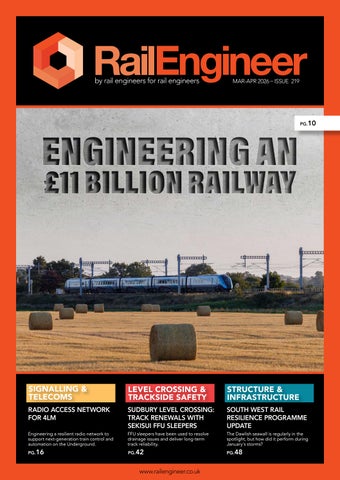
Engineering an £11 billion railway
Peter Stanton revisits the TRU project as it unlocks faster journeys and economic growth across the North.


KeTech: redefining Passenger Information Systems
a resilient radio network to support next-generation train control and automation on the Underground.
Kingmoor resignalling
This project has replaced 1960s assets with digital systems, boosting reliability and future-proofing the West Coast Main Line.
An update on the East Coast Digital Programme
The ECDP is equipping the southern end of the East Coast Mainline with ETCS and removing lineside signals.
Cambridge resignalling takes shape
In 2023, Network Rail embarked on signalling works in the Cambridge area at an estimated cost of £200 million.
Our increasingly connected world brings many benefits as well as threats in the form of cyber attack.
Solving electrification challenges with flexible traction power
A more flexible way of supplying traction power could help unlock electrification benefits sooner and in more places.
The RSSB estimates that 6% of total mainline system risk is on level crossings.
Sudbury Level Crossing: track renewals with Sekisui
FFU
KeTech is quietly reshaping expectations around one of the most important communication points between operator and customer.
South West Rail Resilience Programme update The Dawlish seawall is regularly in the spotlight, but how did it perform during January’s storms?
Graeme Bickerdike reflects on the structures that still grace Britain’s landscape long after their last train departed.
Railway 200: two centuries of railway engineering
Mark Phillips examines the transformation of Britain’s landscape as the early railway system expanded across the nation.
Getting the best out of HS2
Rail Manager Chris Gibb spoke to David Shirres about maximising the benefits of the HS2 programme.
On track for UK Rail 2026
Rail Engineer provides a preview of May’s UK Rail event - a meeting place for the entire industry.
Doubling Ireland’s rail market share
Irish railways have a huge potential, as made clear at a recent Railway Industry Association summit.
Engineering Scotland’s Railway
For the second year running, Network Rail Scotland’s engineering conference was combined with RIA’s Scottish Unlocking Innovation event.

The recently published English integrated transport strategy has the laudable aim of promoting seamless cross-modal urban, suburban, and rural transport in England. Although it proposes many useful measures, it does not consider the need to enhance strategic UK transport links as recommended by the then Sir Peter Hendy in his 2021 Union Connectivity Review. Nor does this strategy consider the need for modal shift from congested roads. Yet other countries in the British Isles have transport strategies that address such issues.
The Welsh transport strategy states that modal shift is at its heart and sets a target of increasing public transport / active travel journey share from 32% to 45% by 2040. The Well-being of Future Generations (Wales) Act 2015 also requires public investments to consider whole life costs.
The Welsh and Scottish strategies promote modal shift to public transport through a sustainable travel hierarchy in which cars are at the bottom. This includes electric cars which will not reduce congestion. Scotland also commits to an ambitious rail decarbonisation programme which recognises the need for electrification of InterCity routes that carry both passenger and freight services.
The Republic of Ireland’s National Sustainable Mobility Policy also supports modal shift through infrastructure and service improvements. It has a target to deliver at least 500,000 additional daily active travel and public transport journeys and a 10% reduction in kilometres driven by fossil fuelled cars by 2030. For rail, its focus is improving commuter services in Dublin and Cork as well as electrification as required by the All-Island Strategic Rail Review (AISRR).
As shown in our report on the Railway Industry Association's (RIA) All Ireland Summit, the AISRR is an ambitious detailed £30 billion plan to double Ireland’s rail market share by 2050. It was jointly produced by the Republic of Ireland and the Northern Ireland Executive as part of a plan for an all-island economy that will significantly boost productivity
throughout Ireland. It also provides a prioritised delivery framework which gives a visible project pipeline.
In addition, Dublin is to extend its tram lines and build an underground metro. Cork is also to get a tram line and is also to have the first Irish 25kV electrified railway. Delegates at the summit were advised that, with the use of the Network Rail led development of voltage-controlled clearances, Cork considers continuous electrification to be the preferred solution.
Leeds has a population four times that of Cork and is Europe’s largest city without a light rail system. Hence it was good to see that, according to the 2025 UK infrastructure strategy, construction of the West Yorkshire Mass Transit system was to start in 2028 and that £2.1 billion had been allocated to this project. Yet, in December it was announced that this tram system was to be delayed until the late 2030s. This was the result of a review, which Government refuses to publish, which apparently required consideration of bus rapid transit systems that have half the capacity of trams.
In 2023, HS2 was cutback so that it no longer alleviates West Coast Main Line (WCML) capacity south of Crewe. Yet there is still no strategy to maximise the benefits of HS2 which is now unlikely to connect to WCML until the late 2030s. Experienced rail operator Chris Gibb has a plan to make the best use of HS2 and we explain why he considers it would be a mistake to lengthen trains by varying the HS2 train contract and that by the time HS2 trains run on the WCML a new tilting HS2 train fleet will be required to replace today’s Pendolinos.
By summer, the Government is committed to publish a Long-Term Rolling Stock and Infrastructure Strategy (LTRS&IS). It is to be hoped that this will take account of how other parts of the British Isles plan to get the best benefit from their railways and take a whole system view to ensure that infrastructure and rolling stock investment considers whole life cost.
Pendolinos will need to be replaced by the time HS2 joins WCML.


The Transpennine Route Upgrade must surely feature in the LTRS&IS. As Peter Stanton describes, when completed this huge programme will boost passenger and freight connectivity across northern England by a route that will be electrified and have ETCS signalling. Installing ETCS is a complex task as David Fenner explains in his update on the East Coast Digital Programme (ECDP) which is now two years behind its original programme as a result. No doubt there are many lessons to be learned.
No doubt the LTRS&IS will also show the long-term programme for ETCS fitment, as it will be many years before ETCS signalling is the norm. Until then conventional signalling renewals will be required such as the Cambridge and Kingmoor Signalling renewals on which we report.
The signalling system being installed on 150km of the London Underground subsurface tube lines is a Communications Based Train Control (CBTC) system which provides moving blocks to maximise train movement capacity. As Clive Kessell explains, establishing an ultra-reliable radio link between trains and the control centre is a real challenge. ETCS and CBTC bring new cyber security challenges. As we explain, these will soon have to be addressed by new legal requirements and railway standards.


DAVID SHIRRES RAIL ENGINEER EDITOR
However good the equipment at the 5,500 level crossings on the mainline rail network, managing level crossing safety must take account of human behaviour. Amongst the measures to improve level crossing safety, Paul Darlington describes the work to understand how people behave at level crossings.
In his Railway 200 feature Mark Phillips explores the visible legacy of early railway civil engineering works. He describes how the British landscape was rapidly transformed by the construction of awe-inspiring structures and earthworks which required around a million workers. Though some of these structures are no longer part of a railway they are still aweinspiring as Graeme Bickerdike’s book ‘Railway Wonders’ shows.
Whilst railway structures are carrying loads that their builders never imagined, other parts of the infrastructure are less resilient.
For example, the breached seawall at Dawlish shut the railway for two months in 2014. Since then, as Bob Wright describes, the South West Rail Resilience Programme has reduced the likelihood of a future blockage. In January, Storm Ingrid hit the seawall with 60mph winds and 12-foot waves. Bob’s verdict was that the seawall performed well.
Providing a resilient rail infrastructure despite a changing climate was one of many issues considered at the Network Rail and RIA Scotland Engineering & Innovation Conference as we report.
Finally, we have a preview of the UK Rail exhibition at the NEC Birmingham on 13-14 May. We’ll be there. Do come to say hello.
Editor David Shirres editor@railengineer.co.uk
Production Editor Matt Atkins matt@rail-media.com
Production and design Adam O’Connor adam@rail-media.com
Engineering writers
bob.hazell@railengineer.co.uk
bob.wright@railengineer.co.uk
clive.kessell@railengineer.co.uk
david.fenner@railengineer.co.uk
graeme.bickerdike@railengineer.co.uk
malcolm.dobell@railengineer.co.uk
mark.phillips@railengineer.co.uk
paul.darlington@railengineer.co.uk peter.stanton@railengineer.co.uk
Advertising Craig Smith craig@rail-media.com
Rail Engineer
Rail Media House, Samson Road, Coalville Leicestershire, LE67 3FP, UK.
Switchboard: 01530 816 444 Website: www.railengineer.co.uk
Rail Engineer Videos http://rail.media/REYouTube
Editorial copy to Email: news@rail-media.com
Free controlled circulation Email: subscribe@rail-media.com
The small print
Rail Engineer is published by RailStaff Publications Limited and printed by PCP Ltd.

© All rights reserved. No part of this magazine may be reproduced in any form without the prior written permission of the copyright owners.
Part of: www.rail-media.com


Project team from the Helsinki Metro Capacity Programme at the latest metro extension prior to its opening, Kivenlahti station.
The Institution of Railway Signal Engineers (IRSE) will hold its 2026 Convention in Helsinki, Finland from 25 to 29 May 2026. Held every two years, this year’s convention returns to Europe having been held in Toronto, Canada in 2024. The Finnish rail community is looking forward to welcoming the Convention and participants for a dialogue on how signalling is evolving. I have been a member of the Institution since the previous convention in Helsinki in 1997, and a Fellow since 2002. During my professional career I have enjoyed the networking and access to professional information offered by IRSE membership. This is why I am proud to be on the organising committee to invite everyone to this year’s convention in my hometown.
The programme includes a seminar day, where technical presentations will showcase the latest developments in the signalling industry in Finland. There will be opening addresses from senior leaders from the Finnish Ministry of Transport and Communications, the Finnish Transport Infrastructure Agency, and Helsinki
Metropolitan Area Transport Ltd. The seminar day also includes this year's second presidential lecture entitled 'The Impact of Human Factors on Designing Modern Train Control Systems'.
The rest of the week will consist of technical site visits. We will see examples of how signalling technology is evolving and the challenges faced in applying nextgeneration technology to existing railways, including the introduction of ETCS and the upgrade of the Helsinki Metro's signalling system to a CBTC system.
In the field of ETCS, Finland’s Digirail programme is pursuing the results of the latest technological standardisation efforts, utilising, for example EULynx standards for subsystem integration, ATO over ETCS, and mobile cellular network-based FRMCS connections for ETCS Level 2+ system communications. Delegates will have an opportunity to ride on the ETCS test train to the site visit at Rail Technology College, housing a large collection of signalling technology available on Finnish Railways. There will also be an opportunity to learn about the Metro Capacity Programme. Helsinki Metro is undergoing a signalling upgrade featuring, among
other developments, a dual public/virtual private-private 5G network for the CBTC communications, and one of the latest implementation projects in the CBTC market.
The conference will be held from Monday 25 to Friday 29 May. The event starts with a welcome event and registration on Monday evening, and the seminar day is on Tuesday 26 May. The programme will also include evening networking events, and the convention will culminate with a gala dinner on Friday evening.
Delegates are warmly invited to bring their partners to Helsinki to participate in the supplementary guest programme focused on the historic sights and culture of the Helsinki area, including two UNESCO World Heritage Sites – Verla Paper Mill and Suomenlinna Island Fort. There will also be a programme of evening social and networking events shared by delegates and partners alike.
The Scandic Grand Central hotel next to Helsinki Central Station is the premises of the former Finnish Railways headquarters and offers an excellent convention centre based on the railway theme, ideally located in the heart of the city.
IRSE Conventions are unique events that combine insightful site visits and technical presentations. They provide a unique educational experience for people at all levels of the railway industry and attract high-calibre representatives from our international professional membership.
Events such as the IRSE Convention provide an essential opportunity to bring together professionals who want to expand their skills and personal networks in a way that can never be done otherwise. The Convention offers an unparalleled opportunity for learning and knowledge exchange in the fields of train control, rail transport, and related fields.
Railways have some unique characteristics and very longlasting assets that require us to maintain many of our existing skills. The Convention provides an excellent opportunity to learn about how both mainline and metro organisations in Finland are responding to these challenges, as well as hearing from industry leaders, providing highly effective and enjoyable learning opportunities for staff at all levels.
You can register for the IRSE Convention at: https://irse.org/ Get-Involved/Convention.
Heikki Viika is programme director at City Transport Ltd, Helsinki. With 30+ years rail project business experience, Heikki began his rail career in product development, focusing on control and communication systems for railways. Over the next few years, he led a number of global research and development projects and became global head of product development at Adtranz Signal.
Subsequently, Heikki held positions at Bombardier signalling division, including senior project director, as general manager of Asia Pacific region, and the head of global sales and business development. He has also held a position as the president and CEO for a power electronics corporation in Finland.
Currently, Heikki is with City Transport authority of Helsinki as the programme director for the Metro Reliability and Capacity Improvement Programme.
Heikki holds an MSc in Electrical Engineering Helsinki University of Technology and has completed management studies at Helsinki School of Economics and IMD. He is Fellow of the Institute of Railway Signalling Engineering (FIRSE).
IRSE is an international institution founded in 1912. It is a not-forprofit organisation whose aim is to encourage, develop, inspire, and advance all those interested in railway signalling, control and communications, and related fields. With over 5,000 members around the world, the IRSE has a global reach and the ability to support the development of critical resources needed by the industry.
If you are interested in joining or would like further information, please visit our website https://www.irse.org/ or contact us at contact@irse.org.
A week-long programme of technical visits and presentations given by leading industry experts.
The IRSE International Convention, held every two years, offers a unique blend of technical briefings, site visits and networking opportunities aimed at a worldwide audience. This year, the Convention will be held in the historic city of Helsinki. Delegates’ partners are warmly invited to participate in the parallel sightseeing programme.
The Convention is an ideal professional development opportunity for active industry participants at all levels of experience. We would particularly encourage companies to send staff at the early stages of their careers to engage with our IRSE bursary winners.

irse.info/helsinki2026
The Convention includes a one-day seminar to be held on Tuesday 26 May which is available as a separate event.
Price £945 (full week), £179 (seminar day only) with reductions for IRSE members. Bookings can be made via our website at irse.info/helsinki2026


A 1.5-mile section of the Grand Union Canal, owned by the charity Canal & River Trust, recently reopened to the public seven days ahead of schedule after HS2 engineers successfully launched a 130-metre-long steel bridge into position over the canal.
The launch operation, which began on Wednesday 4 March, involved sliding the 1,620-tonne deck across a country road, canal, and towpath near Ufton in Warwickshire.
It took engineers just two days to successfully complete the manoeuvre using the tried and tested ‘skid shoe methodology’. Two giant hydraulic jacks pushed the structure forward at speeds of up to 10 metres per hour, aided by specialist pads coated in a Teflonlike material to minimise friction and ease the slide process.
The weathering steel viaduct, supported by two abutments and two piers on either side of the canal, was then lowered to its final position and secured in place before engineers confirmed the job was complete at 19.00 on Thursday 5 March.
The successful launch follows a two-and-a-half-year programme of work led by engineers working on behalf of HS2’s construction partner, Balfour Beatty VINCI (BBV).
At peak construction, a team of 40 worked on the project. This included the installation of 34 piles at depths of up to 30 metres and two concrete piers cast parallel with the canal to enhance the aesthetic for canal users. The project also involved construction of two abutments, and 37 precast planks, which form the base of the bridge deck.
A new retaining wall was also built to ensure the structural integrity of the canal ahead of works commencing. Constructed with seven-metre-deep sheet piles, the new concrete-capped wall replaces the original ‘wash wall’ and soft bank, which is believed to have been formed around a century ago when the canal was widened.
Vibration levels were carefully monitored throughout the work programme to protect the nearby Grade II listed Longhole Bridge, which carries traffic and pedestrians over the Grand Union Canal between Ufton and Hunningham Hill.
Harry Toase, Balfour Beatty VINCI’s civil engineering lead for the project said: “The team has put in a huge amount of work to prepare for the bridge installation and shown meticulous attention to detail throughout to protect the canal and nearby Grade II listed bridge.
“I’m delighted we’ve been able to complete the works one week ahead of schedule and thank the local community for their patience.”
Longhole viaduct is situated just one kilometre from the north portal of the Long Itchington Wood Tunnel. When trains emerge from the tunnel, they will travel along the Ufton Wood cutting before joining the Welsh Road embankment, which connects to Longhole viaduct.
Vicki Lee, senior project manager at HS2 Ltd commented:
“Thanks to the hard work of our engineers and site-based teams, we’ve made good progress in this area over the last 12 months, with completion of the Long Itchington Wood Tunnel and the successful Longhole viaduct slide operation.
“There’s still a vast amount of work to do as we turn our attention to the embankments and cuttings that will link these sections of the railway ahead of track and power being installed.”
HS2 Ltd and BBV have worked closely with the Canal & River Trust to prepare for the viaduct installation. The launch was deliberately timed to take place during the close season, which ended on Friday 13 March, to minimise disruption for boaters on this popular stretch of the UK’s most famous canal.


Connecting the UK rail industry for over 29 years.


Rail Engineer last visited the Transpennine Upgrade Programme (TRU) in Issue 208 (May-Jun 2024) and with great pleasure recently received another invitation to visit and view further progress on the scheme. Rail Engineer was pleased to meet David Lawrance, engineering & technical director, TRU at Network Rail, and Sonam Norbu, associate director at ARUP and design lead for civil engineering on TRU Project W3A, who hosted the visit together with a few other colleagues.
Though the route is geographically challenging, this transformative, multibillion pound infrastructure programme has great significance for the connectivity of freight and passenger business in the North of England, and its aims are clear: faster and more reliable journeys; longer trains with more seats; improved stations; and greener travel.
The situation at the time of our visit in February was that significant works had been completed, including diversionary route upgrades and capacity and electrification schemes at both the Manchester and York ends of the route.
Further large-scale upgrade engineering works were under way. In particular, the massive earthworks for the vital grade separation scheme at Ravensthorpe and the significant works on the Grade 1 listed station at Huddersfield. A journey on the route from Leeds to Huddersfield allowed the sheer scale and the tremendous impact of the project to be appreciated. Of note was the complexity of the staging sequence. Disruptive access is extensive, but the well thought through overhaul of diversionary routes to the value of over £100 million means that passengers are kept on trains to the maximum possible extent.
The major service aims of the project are the provision of up to six fast services every
hour between Leeds and Manchester and up to two local services for connectivity. Journey improvements will see Manchester-York travel time cut by 14 minutes down to 63 minutes and Leeds-Manchester cut by 10 minutes to 41 minutes.
The station works accompanying the rail infrastructure scope aim to maximise accessibility via a £100 million station improvement fund. In terms of environmental gain, the scheme will see the complete electrification of the line from Leeds to Manchester and, on completion, is predicted to remove 1,000 lorries from the road every day through increased freight capacity. The project’s wide-ranging scope will make a significant contribution to decarbonising transport across the Pennines.

The scope of this scheme has varied over the years, but its range is now fixed and has been assembled into the following key outputs:
» KO1 - Diversionary routes resilience.
» KO2 - Manchester Victoria to Stalybridge.
» KO3 - York to Church Fenton.
» KO4 - Huddersfield-Leeds-Church Fenton.
» KO5a - Stalybridge-Huddersfield.
» KO5b – ETCS.

The first three of these have now been chalked off, with over 25% of the route already electrified.
K04 is the next major system change, but there are numerous intermediate milestones achieving significant benefits along the way, including:
» Four new stations at Huddersfield, Morley (completed), Ravensthorpe, and Mirfield (now officially opened).
» 10km of four-tracking coming into use between Huddersfield and Ravensthorpe (Huddersfield blockade recently complete).
» Major junctions include Ravensthorpe grade separation and Baker Viaduct.
» The phased introduction of electrification.
» A new Northern Trains fleet.
Looking ahead, work will progress in line with Key Output 5A on the Stalybridge–Huddersfield section. This will involve:
» Infrastructure construction in 20272031.
» Lowering the track through Scout and Stalybridge Tunnels achieving W12 clearance.
» Third track between Marsden and Huddersfield (10 km).
» Four new proposed stations: Greenfield, Mossley, Slaithwaite, Marsden (not currently authorised).
» Level crossing closures and numerous bridge recons.
» TransPennine Express new fleet introduction.
Completion is currently scheduled for 2034. While that may seem some way off, access constraints have necessitated a deferral of the original start date.
In addition to this impressive list are the various permanent and temporary depot enhancements required to support existing and new rolling stock during and following the upgrade works.
Overall, the programme is valued at £11 billion, with £7.3 billion approved to date. In terms of employment, the programme supports a workforce of around 5,000 people, more than 85% of whom live within 40 miles of the worksites. It has also created 456 apprenticeships and delivered over £2.3 billion in social value.
Amid ongoing concerns around the electrification of England’s national railway, full electrification of the route is estimated to remove more than 100,000 tonnes of carbon dioxide annually. Given the scale of the programme, there is a clear responsibility to ensure that its intended benefits are fully realised. As such, a significant emphasis has been placed on a systems engineering approach, providing a clear line of sight from the initial definition of programme outcomes, through to projects with well-defined requirements, and along the ‘V-diagram’ to ensure that projects are delivered as intended and add up to deliver the outcomes.


With the enterprise also incorporating train operators (see later), this approach extends to close collaboration between the programme and its operator partners, ensuring that new rolling stock plays a full and effective role in delivering the overall railway system outcomes.
Along with its core aims and sustainability benefits, this project is a catalyst for unlocking growth and opportunities, connecting towns and cities, and supporting a stronger, resurgent North. The project aims to target a 10% Biodiversity Net Gain (BNG) by 2035, and is targeting a 30% reduction of construction-associated carbon. In a boost for accessibility, the station schemes are enabling step-free access at the majority of stations along the route. Mention has been made of the facilitation of around 590 apprentices across the life of the programme, and the programme aims to engage around 64,000 children via Science, Technology Engineering, and Mathematics (STEM) volunteering sessions. Additionally, at least 25% of the programme’s
expenditure will be directed towards local businesses, underscoring its strong commitment to its surrounding communities.
Delivery of the programme works centres on two alliances, plus an additional ‘hub’ capability for delivery of ETCS and the Stalybridge to Huddersfield works. The West Alliance is a partnership of Network Rail, Amey, Bam Nuttall, Siemens, and ARUP. The East Alliance, covering Leeds to York, comprises Network Rail, J. Murphy and sons, Volker Rail, Siemens, and Systra. The Programme Management Organisation is a blend of Network Rail and Enterprise Partners, plus supplementary support from Jacobs (engineering and system integration) and Arcadis (programme management).
The project has moved to be inclusive of all interested production parties and, to that end, has assembled a structure that brings together the whole industry to deliver the programme. The players involved are the Department
for Transport, Network Rail, and the delivery alliances. These parties are led by an Enterprise Executive team, with their respective sub-teams working collaboratively to make the best decisions for the railway system as a whole. These arrangements were certainly not always easy, with the inevitable, but constructive, tensions arising, but the outcome has been massively preferable to a traditional model.
A useful example can be seen with re-baselining in early 2024. The team moved back-end schedule contingency into front-end schedule resilience, which required a substantial re-cast of the access plan. This would normally have involved a massive negotiation, but it was agreed within a few weeks because the operators were already in the tent, understanding the challenges and that the proposal represented a better system solution.
There’s a clear sense of pride within the team when it comes to applying innovation, and the results show it’s making a real difference. While there’s always more to be done, several standout examples highlight how innovation can take many forms.
First, is the Checkpoint Authority app. This is a great example of how the TRU programme supported an SME with a great idea to get through NR’s safety assurance process with a true win-win outcome. The app allows engineering
supervisors to grant worksite authority to multiple sites simultaneously, the conventional alternative being individual phone calls to perhaps 30-50 COSSs. Use of the app enables an additional 30-60 minutes of production, taking into account the time at the beginning and end of a possession.
Other examples include the Triple Pipe Jack maintaining partial operation of the live railway whilst installing new culverts. Also, a tunnel inspection radar was used to understand what is occurring behind tunnel linings, particularly where attaching OLE. Additionally in place is the cable route system combining screw piles with raised troughing, which drastically reduces time, effort, and cost when installing high voltage cables.
Extremely valuable gains for electrification have included input from Network Rail HQ engineers in the areas of Voltage Controlled Clearances (VCC) and removing train requirements for new electrification. A particularly clever solution can be seen at Mossley, where 25 cottages back directly onto the line, leaving very limited clearance – with some even having washing lines at the same height as the OLE.
After considerable consultation and explicit risk evaluation to work through risk mitigation options came the proposal of an earthed section, with downhill coasting on the nearside under normal conditions. Careful analysis and signaling controls will be required around a wrong direction running uphill on rare occasions.

The Kirklees Skills Hub is a state-of-the-art training facility based at Kirklees’ College’s Engineering centre in Huddersfield, the result of a partnership between Kirklees College, Flannery plant hire, and Kirklees Council. It has had a significant effect on stakeholders along the route, most important of which is the impact on employment of those around the project.
The facility plays a vital role in supporting the local economy by equipping individuals with practical skills that meet the growing demand for trained plant operators across West Yorkshire and beyond.
At the heart of the Hub is a mobile training unit fitted with a high-tech virtual reality plant simulator and classroom space for theoretical learning. Adjacent is a live construction site to give operators a hands-on experience in a controlled environment.

A considerable amount of work had already been completed when Rail Engineer last visited the project, and its progress continues to proceed at pace.
The TRU is a massive undertaking and along the route are several geographic points of significance.
Scout & Stalybridge tunnels, for instance, date back to the mid to late 1800s. They are amazing feats of engineering, but sadly not tall enough for W12 gauge freight traffic. Thus, the need to lower the rail level by up to 500mm and install slab track. This has required a very careful approach.
The work, which is taking place in some very challenging ground conditions, brings with it the real risk of destablising the walls. Permeation grouting is required where there is not competent ground, and trials are imminent. This is combined with ground anchors throughout to stabilise the walls during the temporary and permanent configuration.
The work to upgrade Huddersfield station commenced in the second half of 2023 and a number of different activities have taken place, including the removal of the listed tearoom, the installation of scaffold towers, the removal of the old canopy roof, and steel work strengthening and repairs. New platforms 1 and 2 have also been installed.
The plans for Huddersfield include: reconfigured and extended platforms to improve capacity; a new footbridge and lifts; step-free access from the front entrance; an extension of the passenger subway with new lifts; the sympathetic restoration of the existing station roof alongside new rooves for new platforms; and track upgrades to support more trains.
In September 2025, Huddersfield station was closed for reconfiguration into its temporary state. The work set
for the back end of 2026 includes major remodelling that will transform the layout of the station and enable more trains with more seats to run through the area.
The enhancement of the station is supported by the works on Huddersfield Viaduct which is undergoing a significant upgrade with some spans being fully reconstructed and extensive strengthening elsewhere. The design has been significantly influenced by the listed status of the structure, originally built in the 1840s.
The result will be a structure that has been enhanced for greater capacity and greater resilience for the effects of climate change. While generally viewed as part of the East Coast Mainline, York station is a key transport hub connecting passengers with cities and towns across the North of England. As part of the TRU, the area has undergone enhancements such as the renewal of tracks and improvements to drainage between York and Church Fenton. Also replaced are the two heavily used sets of points which allow trains in and out of Holgate sidings.
Plans for Huddersfield include: lengthening the platforms to 200 metres; asset protection and strengthening works to the historic footbridge to improve accessibility between the platforms and the entrance; and extending the canopies and waiting areas.
Improvements are currently under way with the works scheduled to be complete by summer 2026.
Ravensthorpe
Ravensthorpe station is undergoing major development with the key feature being its relocation 200 metres west of the original site. The new station will feature an island platform, two accessible and step-free
platforms, new lifts, and a new footbridge. It will also receive upgraded lighting and CCTV with customer information screens, as well as a new forecourt with accessible parking bays and additional bicycle storage facilities. The significant work requires the closure of the existing station and construction is planned to be spread over two and a half years.
At the Leeds end of the newly fourtracked section, the Ravensthorpe grade separation and the Baker viaduct are probably the centrepiece of the TRU infrastructure works. The core aims of easing access in from Healey Mills and a general contribution to robust passenger and freight workings are readily apparent when studying the layout.
The groundworks are huge and extremely impressive, with massive plant in operation. Even national grid pylon lines are affected as the lines crossing the site are being rerouted into underground cabling. In addition is the accompaniment of the foundations for the Static Frequency Convertoranother application of innovation to the programme and its electrification power supply supports the level of innovation withing the programme.
In summary, David Lawrance emphasised the reality of delivering a project of this scale and complexity safely, sustainably, and to a planned timescale — all within an environment where it is well understood that major railway schemes can, and sometimes do, go wrong. He acknowledged that there are many ways such challenges can arise, and that this project certainly had the scale and complexity to be at risk of them.
The TRU is taking a proactive approach to steer away from these risks. While the causes of major project challenges are numerous, this programme encompasses many of them — including the introduction of new technology, a wide range of internal and external interfaces, and multiple stages of infrastructure and operational change. The challenges become clear when visiting the sites, and the case for the route upgrade is reinforced by the poor quality of the main roads across the Pennines in this area. The geology presents significant difficulties, but equally evident is the careful integration of new technology - such as ETCS at the Western End - alongside customer-focused improvements, including better access, level boarding, and new rolling stock introduced by the train operating companies.
Also notable are the works taking place beyond traditional 'railway' sites, alongside significant on-track activity such as re-ballasting and deep excavations to deliver a more robust and resilient infrastructure. There is also a clear sensitivity to environmental and heritage considerations, exemplified by efforts such as the rebuilding and reinstatement of the historic tearoom at Huddersfield.
TRU has certainly committed to a systems engineering approach, which should help it reach the finishing line with the confidence it will meet its output commitments. Just as importantly, the programme is underpinned by a culture that recognises the value of learning from past experience and actively embraces external expertise wherever it can be found.
With many thanks for the guidance and hospitality of David Lawrance and Sonam Norbu, ably assisted by Daisy Dick.


CLIVE KESSELL
Rail Engineer has reported on the London Underground Four Lines Modernisation (4LM) project on several occasions. This programme is the re-signalling and re-control of the Metropolitan, Hammersmith & City, Circle, and District lines to provide a Communications Based Train Control (CBTC) system incorporating Automatic Train Operation (ATO), Automatic Train Supervision (ATS) and Automatic Train Protection (ATP) with moving block to maximise train movement capacity.
The project was described in Issue 201 (Mar-Apr 2023), in an article which featured the SelTrac CBTC system previously deployed on the Northern and Jubilee lines and on the Docklands Light Railway. Following Hitachi’s acquisition of the Thales signalling business, Hitachi Rail is now responsible for delivering and supporting the Seltrac CBTC solution on 4LM. This project differs from the previous deployments by using radio-based train positioning and not track loops. The radio access network that underpins the signalling data exchange is extensive and is central to successful CBTC operation.
This article builds on Julien Puyon’s recent talk to the IRSE London & SE section and describes the design and implementation approach for the radio network.
The four lines represent 40% of the London Underground network, covering 150km of route, over 200 trains, and more than and 100 stations. Although classed as ‘Underground’ lines, the majority of the routes are above ground with the tunnel sections being built on the ‘cut and cover’ methodology, so they are near to the surface and carry both tracks. A control centre
at Hammersmith was opened in 2018 and a progressive introduction of CBTC began with the Paddington Hammersmith section, rolling out to the central London areas and then finally to the extremities, the longest route being to Amersham in Buckinghamshire. A minimum of disruption to passengers was a demand made by the operating authorities, so the changeovers had to be carefully planned and tested with minimal line blockades during the commissioning periods.
For the selection and design of any radio network, the frequency band of operation is the first consideration, taking account of spectrum availability and allocation, the application and its communications need including data rates, bandwidth, radio propagation requirements, and resilience considerations. For 4LM, this became clear early on with the decision to adopt a dedicated and purpose-designed radio access network engineered for CBTC communication in the operational Underground environment. The system requires sufficient bandwidth to support all the CBTC functionality to ensure reliable operation.

The various components of the CBTC where the Radio Access Network will be critical to successful operation are:
» The Vehicle Control Centre (VCC) which manages the area where the train is positioned, be it moving or stationary. Continuous and guaranteed communication is required between the VCC and the Vehicle On Board Controller (VOBC).
» Data Communication System (DCS) consisting of two sub systems: the Radio Access Network (RAN) and the core transmission network to connect the RAN back to the Hammersmith control centre.
» Wayside Radio Unit (WRU).
» Radio Access Point (AP) connected to the WRU and including aerials and RF cabling.
» Mobile Radio Unit (MRU) connected to the VOBC.

The CBTC system depends on these sub systems working reliably and correctly. All of these caused challenges during the design and testing phases which needed to be understood and resolved before implementation of CBTC could be achieved. In addition to the radio elements, the
connections back to the control centre required a resilient backbone fibre network to be in place.
A first decision was whether to use tunnel-mounted aerials or radiating cable in the underground sections. An interference exercise indicated that radiating cable would be more vulnerable to picking up unwanted radio signals than aerials, so the latter was adopted. The aerials are directional and are relatively small at these higher frequencies. Coverage tests showed that aerials need to be spaced at roughly 200-metre intervals meaning around 1450 APs for the entire routes regardless of underground or surface locations. The link between the aerials and the train mobile relies on a direct line of sight to guarantee optimal signal quality.
Positioning the aerials underground had to overcome the problem of heritage platforms where historical factors made it forbidden to install APs in the middle of platforms. It was permitted to install APs at the platform edges, but this made
positioning of the WRU difficult. Lack of clearance in the tunnels was another problem, and the existing structures were often cracked or had corroded beams or with water ingress.
Obstruction of railway signal sighting was another factor as the trains would continue to be manually driven until the changeover. Getting the WRU as close as possible to the aerials was important to minimise the RF loss when receiving signals from a train. Having worked through all of these, the resulting radio network had to comply with OFCOM regulations on power outputs and not cause interference to near neighbours operating in the same band which, as mentioned, is already congested.
A design has to inevitably make some assumptions on the resulting system performance. For this project the V cycle process was used, enabling a robust validation process and subsequent system fine tuning. Validation required both static and moving train assessments. Static testing had to ensure that each AP is interacting with neighbouring APs. The moving-

train testing had to ensure that the MRU configuration was optimised and that the CBTC would function when taking into account any signal degradation. The design will sometimes need changing once installation and testing takes place. Radio networks always need special attention because of the challenge in predicting radio coverage.
Testing needed to ensure that the emitted radio frequency (RF) output powers were commensurate with OFCOM regulations, that RF levels were strong enough to ensure reliable communication to trains and that the RF thresholds did not interfere with near neighbours through the static radio validation exercise.
Continuous monitoring of the radio signals is part of the static validation process, but additional testing took place every night to ensure compliance to the standards and to assess the impact of any radio degradation. This was part of the dynamic
validation to ensure the following functionality:
» Packet loss – the data sent to the trains is in packets for spectrum efficiency but occasionally packets will be ‘lost’ and the loss rate has to be such that control of the CBTC operation is not impaired.
» Latency – the time it takes for a packet to do a ‘round trip’ between the control centre and the train.
» Consecutive communication loss – the duration of consecutive packet losses.
» General radio availability – the guarantee that an MRU always has a WRU to communicate with.
Another factor was to plan for the necessary staged introduction where some sections were fully commissioned while others were still in the testing stage. This meant having to make projections as to coverage likelihood in the overlap areas.
Continuous analysis and monitoring
Even when commissioned it is essential that the radio performance remains within the required specification. To do this, Big Data analysis is used to process billions of data inputs from across the network which are then assessed to identify the radio configurations from both the WRUs and the train MRUs.
From the data, further testing is often necessary to achieve optimised performance. Despite the careful RF planning, some changes were found to be necessary and consequently some site work to reposition aerials has taken place. All of this relates primarily to the robustness of the radio infrastructure. External influences will always occur, interference from unwanted sources being typical but can also emerge from changes to platform usage and situations of overcrowding.
Big data analysis is used for: verification of all AP installations; configuration tuning for both WRUs and MRUs; confirmation that the RF links are operational; confirmation that each AP meets the RF design threshold with its neighbours; and continuous monitoring of RF signals for degradation.
The same Big Data platform is used for other analytics that measure operational acceptability on the 4LM routes, such as: sub-system validation; monitoring of performance; system troubleshooting; corrective maintenance; system tuning.
The system is designed for both front and rear cab MRUs to receive the radio signal. The MRUs receive the data packets and apply deterministic selection logic based on reception quality metrics to prioritise the best available signal path. Some custom tools have been developed to monitor parameter change on the MRUs both between different train fitments and with communication to trains in differing circumstances.
The system must be robust enough for CBTC operation to be absolutely reliable, meaning that near-continuous communication is necessary since any interruption for only a few seconds will cause the emergency brake to be applied.
The radio network needs constant monitoring to ensure acceptable performance. 70GBits of data are sent out every day and this data is constantly being checked for consistency which can lead to actionable modifications being determined.
The radio coverage is designed such that the loss of any one AP will not impact on system performance as adjacent APs have sufficient overlap coverage to fill the gap.
More tools are being developed and industrialised for engineer and technician usage into the future. The Big Data platform leads to data monitoring that supports decision making and new analytical capability. It is important for any new entrant that he/she learns and understands how to interpret the raw data.
The platform provides the support to present complex raw data that can give actionable insight in a format that makes this possible.

So often with modern signalling systems like CBTC and ETCS, it is just assumed that the connectivity between train and control centre is the easy part and will always be there. GSM-R is a classic example but if this article has opened eyes as to the essential nature of the communication links and the considerable effort that goes into making sure they are robust, then it will have done its job.
The 4LM radio network has built on the success of communication links needed for the DLR, and the Jubilee and Northern lines which employ the Seltrac system. It has become a well-established system for metro modernisation with data driven monitoring becoming part of its ongoing features.


Over the Christmas and New Year period, Network Rail delivered a number of projects between London and Cumbria. These included a major railway junction renewal in Buckinghamshire, signalling system upgrades at Preston station, platform improvements at Milton Keynes and Wolverton stations, a bridge strengthening project in Stafford, and the demolition and rebuilding of a 130-metre-long railway bridge over the M6 at Clifton near Penrith.
However, one project delivered during this period didn’t receive much popular media coverage, despite being a £61 million project to modernise 1960s signalling systems, which were the oldest electrical signalling on the West Coast Mail Line. This took place at Kingmoor just north of Carlisle.
The work began in April 2025, and has been delivered by Siemens Mobility as the principal contractor, assisted by a number of companies including L.B. Foster and Haigh Rail. The project included providing new lightweight LED signal heads and structures; track circuit train detection systems to monitor train movements, upgrades to track and points (including the replacement of air powered points); overhaul of signalling power supplies;
renewal and changes to the existing control panels for signallers in Carlisle signal box; and upgrading the CCTV system at Floriston level crossing.
On Wednesday 7 January, all systems went live after a seven-day closure of the line between Carlisle and Lockerbie for final installation, testing and commissioning.
The area was last resignalled over 60 years ago in 1963. Two relay ‘free wired’ interlockings were then provided at Kingmoor and Etterby, controlled from a new power signal box at Kingmoor. The relays in the interlockings were known as pre-BR960 relays. Air-powered ElectroPneumatic (EP) points were provided,

along with low voltage DC track circuits and colour light signals. This installation replaced mechanical signal boxes located at Etterby Junction, Kingmoor Junction, Moss Band Junction, and Rockcliffe.
In the 1970s, major resignalling took place on the London Midland Region of British Rail north of Weaver Junction in Cheshire to the Scottish border, with the provision of continuous multiple aspect colour light signalling worked from three new Power Signal Boxes (PSB) at Warrington, Preston, and Carlisle. Unlike Kingmoor, all the interlockings were Westinghouse Westpac Mark IIIa geographical sets, fitted with plug in relays and connected using plug couplers. The geographical units were pre-wired and tested in the factory and housed in lineside relay rooms linked to the signal boxes via TDM remote control systems. All the points were motorised type 63 machines.
Carlisle PSB replaced 46 mechanical signal boxes in 1973, but as the Kingmoor and Etterby interlockings and associated signalling were only 10 years old they were simply recontrolled to Carlisle PSB. A new Westpac Mark IIIa geographical interlocking was provided at Gretna Junction to the north of Kingmoor and Etterby, marking the northern limit of the London Midland Region. Kingmoor PSB was abandoned in January 1973 and it can still be seen to the west if travelling north of Carlisle towards Scotland. Over the years the Warrington, Preston, and Carlisle PSBs have been upgraded,
including new Westpac Mark IIIa relay bases in all interlockings, but the older Kingmoor and Etterby areas mainly stayed as they were, including the EP points.
The area has been considered for signalling renewal a number of times.
For example it was assessed in the early days of Railtrack 30 years ago, but it was determined that the signalling on the southern part of the LM Region was in greater need of renewal. It is a credit to the providers of the 1963 Kingmoor installation and the maintainers over the years that the electrical relay-based signalling (and the EP points) remained in operation for over 60 years.
Signalling Infrastructure Condition Assessments (SICA) is the process used by Network Rail to evaluate the condition of its signalling assets and to determine when assets need to be renewed. A set of questions are used to assess the physical condition, environment, reliability, and maintainability of an asset, with samples taken from multiple assets within an interlocking area. A condition score is determined for each asset type which is used to estimate when the asset will need an intervention to life extend the signalling or if it should be renewed.
Primary surveys are less detailed and are performed earlier in the asset's life.
Secondary SICA surveys are more detailed and are performed on assets that are approaching the end of their life. So, in the case of Kingmoor and Etterby, secondary SICA checks monitored the signalling condition and eventually confirmed that it did need including in the renewals work bank.

To replace the relay interlockings, an electronic computer-based Westlock interlocking has been provided in a cubicle in Carlisle PSB. Siemens has also provided Kingmoor Interlocking Management System (IMS), which communicates between the new Kingmoor Westlock and trackside signalling via a new Westronic system. This also manages the signallers panel inputs and outputs for the Kingmoor area, and interfaces with Floriston Level Crossing, providing controls and indications for the level crossing on the panel.
The new panel faceplate at Carlisle PSB, supplied by L.B. Foster, features a new Westcad SPAD Monitor which enables Signals Passed at Danger (SPAD) to be detected and monitored on the panel for the first time. This is known as Predetermined Overrun Protection (POP) Signal Group Replacement Control (SGRC).
Carlisle Train Describer (TD) was also modified as part of the project, with its connection to Network Rail’s SMART train information system being removed and reconnected to Kingmoor IMS. With this change Kingmoor IMS now passes all available S Class messages, for the Kingmoor area, over to SMART system for the first time. S Class messages are capable of reporting the status of a number of signalling elements, such as whether a signal is displaying its most restrictive aspect, whether points are set normal or reverse, the status of a Train Ready To Start (TRTS) button, used by train dispatch staff to indicate to the signaller that a departure is due, and whether level crossings barriers are lowered or raised.
Dorman LED signal heads have been provided on new folding structures and the DC track circuits replaced to remove the low voltage track circuits. The air powered points EP points have been replaced with clamp lock points, and the communications from Carlisle PSB to line side object controllers is via dedicated fibre with diversity provided via FTNx. Floriston level crossing CCTV has also been upgraded and uses the FTNx network.
The project was essentially a like-for-like signalling renewal in modern form, but other benefits to make the area more operationally flexible included removing the conditional double reds and providing more effective overlaps.

Conditional double reds are a signalling control to manage train movements at junctions. They hold a signal at red until a train has passed a specific TPWS Over Speed System (OSS) at the point of conflict, known as the Safe Overrun Distance (SOD). Another operational benefit has been a change to the signalling of the Kingmoor Up Avoiding Line. Previously, control of this section had to handed over and back to the depot from Carlisle PSB, but now the Carlisle signaller is in complete control of this section.
There is one more stage of the project to complete with the renewal of the Westpac Mark IIIa geographical interlocking at Gretna Junction, with commissioning planned in 2027.
Matt Kent, director of operations and manufacturing, rail infrastructure at Siemens Mobility UK&I, summed up the project when he said: “We are proud to have partnered with Network Rail to successfully deliver the Kingmoor resignalling project, a key milestone in our mission to transform rail travel and transport on the West Coast Main Line.
“This extensive signalling upgrade includes state-of-the-art digital trackside equipment, fully compatible with Siemens European Train Control System (ETCS) equipment to enable future integration. These enhancements will help future-proof the line, delivering enhanced reliability and efficiency for both passengers and freight.”
The author is most grateful to the Network Rail project team for its assistance with this article.


DAVID FENNER
At the beginning of the year, Network Rail, supported by Govia Thameslink Railway (GTR) and Siemens Mobility, gave an update on the East Coast Digital Programme (ECDP), a project which is equipping the southern end of the East Coast Mainline (ECML) with ETCS and removing lineside signals. This is a first step in the longterm aim of transitioning the network to ETCS for train control and thus needs to identify the challenges and develop suitable solutions.
The fitment of ETCS level 2 will enable the removal of lineside signals by providing in cab signalling information. Once achieved this should realise significant benefits including less lineside infrastructure because of fewer signals and associated equipment. This will result in lower carbon emission, greater operational flexibility, improved reliability, and significantly lower capital and operating cost especially in terms of signalling maintenance.
In addition to those benefits, implementation of ETCS provides Automatic Train Protection (ATP) ensuring the train is always operated within a safe speed envelope throughout its journey. The major challenge is getting there because of the changes to several features of current railway operation.
The primary objective of the briefing was to provide an update on the progress made over the previous 12 months and to outline the next steps.
The presentation was led by Sarah Jane Crawford, Network Rail’s industry partnership director, supported by Chris Hobden, Network Rail’s programme delivery director, Raj Patel, head of ERTMS Govia Thameslink Railway (GTR), and Mark Ferrer, operations director for rail infrastructure at Siemens Mobility.
Moving to an in-cab signalling system presents a significant challenge. This can be gauged from the scope of the ECDP which involves 40 different types of train to be fitted with ETCS using six different onboard systems and resulting in over 3,000 drivers to be trained on the new method of working. And it isn’t just drivers; several other operations staff need to understand the changes a driver will experience as well as the fleet management and maintenance staff.
In addition, Network Rail staff, especially signallers and other operations staff, need to have an appreciation of the changes and how they affect their interface to drivers. Eventually, over 700 signals will be removed from the trackside as part of ECDP. As a prelude to national rollout, other teams need to be involved meaning the work is spread over more than 30 organisations making coordination a key issue.
The project is managing this through a number of Railway Configuration States (RCS) which aim to learn lessons step by step. The first step was fitting and running the Northern City Line using ETCS overlaid on lineside signalling. The second was removing the lineside signals on this route.
Early in the programme it was decided to start with the Northern City Line (NCL) running between Drayton Park and Moorgate as a ‘pathfinder’. This route is the last few miles into London used by the inner suburban train services to Hertford, Welwyn Garden City and Stevenage. While a small part of the route, the service over this section is very frequent with a train in each direction around every three minutes in peak periods. It has the advantage of a single type of modern rolling stock and a single train operator hence its selection as the ECDP pathfinder.
The route was initially equipped with an ETCS overlay to enable drivers to be trained and gain experience of driving under ETCS supervision. During this time there was some degradation of performance as people became used to the system. A particular challenge was starting a journey (or mission) in ETCS. By autumn 2024 all drivers had been trained and were building experience operating in ETCS mode so, in May 2025, the lineside signals were removed and the railway now operates in the planned end state for ECDP.
In the end, removing the signals was said to have been an underwhelming change. This was primarily because drivers, signallers, and others had been suitably trained and had experience of using ETCS as the operational signalling system, leading to a smooth, barely noticeable transition. A consequence has been a noticeable improvement in operational performance with fewer delays and cancellations from signalling causes.
Raj from GTR emphasised the effect of system integration on the people and processes involved in managing and operating with ETCS. The people across the track-train boundary need to work together just as the equipment on an ETCS railway must function across that same boundary. She said it is important their fleet control appreciate the language now used by drivers when they experience an issue, but it is of similar significance for the driver and signaller to have a common understanding of the problem when operations do not run smoothly.
In the same way, getting to the root of a problem requires staff to be open about the symptoms and effects of a fault so the correct diagnosis is generated and the problem fixed, regardless of which part of the system generated the error.
Managing the event properly can significantly influence the speed and accuracy of the rectification. As a small example of how people and system interact, there are crypto graphic ‘keys’ used in messages between track and train to ensure security. Initially when the key did not work or could not be found, some asked whether the ‘key’ was in a pocket!

The plan now is to take the learning from NCL and share it with other operators to ensure those lessons do not need to be relearnt on subsequent stages of ECDP and ultimately on further projects rolling out ETCS.


The Welwyn to Hitchin infrastructure was upgraded to operate with ETCS overlay early in 2024 and subsequently has been completing proving and safety assurance. Previous testing has already demonstrated correct interactions between train and Radio Block Centre (RBC) using Great Northern Class 717, Grand Central Class 180, and Network Rail Class 43 vehicles.
Disruptive possessions were required during February and March 2026 to complete the system proving. In early February, other possession works were used to enable balises to be reprogrammed with additional functionality, particularly to prevent trains moving in shunt mode outside the designated area.
Testing in mid-February included two trains - a Class 717 and a Class 180 - running to prove system function with multiple trains and demonstrated the latest Radio Block Centre (RBC) software version. A key requirement was upgrading the software to provide significantly more flexible implementation of the Temporary Speed Restriction (TSR) functionality enabling shorter restrictions to be implemented.
At the time of writing, it was anticipated overnight testing and one Sunday test in March would further check some of the operational scenarios that have been developed to ensure the actual on site performance corresponds with the laboratory testing that is already complete.
The next stage will occur in July when it is expected the first service trains will start to operate under ETCS supervision albeit with lineside signalling available. These are planned to be the Class 717 units already operating on the Northern City Line. It is then intended to increase the number and types of train running using ETCS as the trains and drivers become suitably equipped.
Moving to a significant number of trains operating in ETCS mode over the Welwyn to Hitchin section will happen during the various stages of Railway Configuration State 3.
This is presenting some challenges. The Class 717 inner suburban trains are all fitted and working as previously discussed. The very similar Class 700 outer suburban Thameslink units are now being updated to the latest software. This includes provision of GPRS data communications to cope with the expected volume of data traffic. The Grand Central Class 180 trains are all retrofitted and have taken part in testing.
The first in class LNER Azuma (Class 800) has had a software upgrade and been tested at the Melton test site. It provides a basis for all the other Class 80x trains operating on the route. The largest passenger fleet for retrofitment is the GTR Class 387. GTR has already ‘deadfitted’ the first 20, which means they are not yet operational.
The biggest retrofitment issues involve the freight locomotive fleet. The Class 66 locomotive fleet is a challenge. Given the age and variety of sub-fleets as well as the total size of the fleet, this is perhaps not surprising. For the early stages of ECDP the focus is now solely on getting sufficient Class 66 locomotives fitted and operational.
Work on other freight fleets is currently paused. There is a move to a freight sector centred fitment model based on an amended design developed with three of the major freight sector players. The aim is to achieve approval and then fit around 15 vehicles for use on the initial ECDP area. It is noted that the initial first in class fitment to locomotive 66 039 will need to be reworked to meet the amended design.
Fitment on two heritage locomotives, steam engine Tornado and D9000 Class 55 Royal Scots Grey are complete, and Tornado was dynamically tested on the Cambrian Route in April 2025. Interestingly, the fitment to Tornado appears to be at least a European first, if not a World first, in terms of ETCS fitment to an operational steam locomotive. A further 16 Class 43 units are being fitted. The options for fitment or alternative means of movement for various elements of on-track plant are being investigated.


away
The forward ECDP schedule is currently undergoing a rebaselining, which is expected to conclude over the summer
Once services over Welwyn to Hitchin have fully migrated to ETCS, the next stage will involve going directly to a no signals railway on iterative sections.
Initial work was focused on Biggleswade to Fletton but various options are actively being evaluated, with current asset condition being a key consideration. Signals Away sections are expected to be introduced in phases during CP8.
Ensuring the railway is ready
Mark Ferrer emphasised that safety and ETCS approval alone are not sufficient. Regulatory compliance is insufficient. The whole system needs to be verified as being reliable and delivering the opportunities for the future. This requires not only laboratory testing, which has been taking place at Chippenham, but is followed by on-site testing to confirm the laboratory really does represent conditions that may be experienced on site.
Then there is demonstration of the reliability of the system including the response of the
people using it. Finally, is the question of whether the industry is ready for the change and the associated changes to behaviours. Given this is a pilot for wider national roll out, the ECDP is developing the future standards that will be used by other routes.
The project is funded by the Department for Transport (DfT) up to and including Railway Configuration State 3 (Operation of the Welwyn to Hitchin section). The rest of the signals away plan on the line is primarily funded by renewals and is budgeted in Control Period 7. There are a few outstanding issues around added costs because this is a first application and these are under review.
In many ways, the ECDP is proving that the transition to digital signalling is as much about people and processes as it is about technology. While significant progress has been made, from the successful Northern City Line pathfinder to advancing infrastructure and train fitment, the scale and complexity of the programme remain considerable. The lessons now being captured will be critical in shaping the next phases and informing wider national rollout.

In 2023, Network Rail embarked on signalling works in the Cambridge area at an estimated cost of £200 million. The current Cambridge signalbox was commissioned in 1982. At that time the northern limit was in the vicinity of Waterbeach, and the southern boundary interfaced with Bishop Stortford signalbox. The area also reached a boundary near Royston on the line to Kings Cross. The southern boundary moved north to Elsenham when Stansted airport was provided with a rail link in 1991 and the adjacent signalbox became London Liverpool Street. Much of the remaining equipment is thus over 40 years old, although some interlockings on this stretch have been replaced by interfaced SSI due to poor condition of the original interlocking wiring.
North of Cambridge, the signalbox control area was extended to include Ely and the route from Ely through Soham in the early 1990s when SSI was installed and the area rationalised. That equipment is now 30 years old. Finally, control of the line from Ely toward Norwich was transferred in the early 2010’s as part of a modular signalling project. The project thus has a number of strands with parts resignalled, others relocked and finally some elements recontrolled. Hence the project title C3R meaning Cambridge Resignalling, Relock and Recontrol.
The need for resignalling is driven by the age and approaching obsolescence of parts of the system and will thus improve reliability and release selected critical spares for other places.
The final control area is illustrated in Figure 1 together with an indication of the original signalling.
scheme
The main parts of the scheme are as follows:
» The resignalling of the Cambridge station area and south to between Shelford and Whittlesford with recontrol south from there.
» Resignalling of the route from Cambridge via Newmarket and Bury St. Edmunds resulting in the closure of three mechanical signalboxes.
» Relocking by provision of new computer based interlockings and the provision of a new VDU based control system within the current Cambridge signalbox structure.
» The route from Ely north junction to Wymondham will be recontrolled on to new workstations compatible with those used for the rest of the control area.
Overall, the new centre will cover approximately 132 track miles. Associated works will be carried out at a number of level


crossings, with seven upgraded due to safety concerns. There are also enhancements to the telecommunications network and power supply systems that support the signalling. In excess of 600 Signalling Equivalent Units (SEU) will be updated as part of the project.
The area around Cambridge is also subject to four other extant or potential projects that require alteration to the signalling, including:
» The building of Cambridge South station which is substantially complete and expected to open during 2026.
» Plans to relocate and expand Waterbeach station between Cambridge and Ely as part of a wider expansion of the town.
» The Ely Area Capacity Enhancement scheme, currently awaiting decision.
» The longer-term effect of East West Rail on capability requirements around Cambridge.
The resignalling includes alterations for Cambridge South and ensures there is capacity to add or amend the signalling to cope with the other schemes when or if they are developed. Alstom was awarded the contract for the work in February 2022. The firm has designed and built the new interlockings around the Smartlock 400 system using its new object controller Smart I/O. All replacement interlockings will be located in Cambridge signalbox.
Communication between the new interlockings and the object controllers is via internet protocol communications links over fibre using Network Rail FTNx services.
The signallers will use a new VDU based Modular Control System (MCS Infinity) supported by Modular Automatic Route Setting (MARS). Train detection will use Frauscher axle counters. Within the resignalled area some of the level crossing control systems are being updated using ElectrologIXS controllers. Signals are being converted to LED aspects, where suitable, using the Dorman light weight LED signal. Where the condition of the signal support is not considered serviceable the signals are being renewed.
An additional part of the scheme is a change to the operation of seven level crossings seen as having significant safety risk, or as a result of the abolition of the adjacent controlling signalbox. Six of the level crossings are being converted to Full Barrier Obstacle Detector level crossings and one to CCTV. The crossing at Dullingham is converted from manually controlled gates (MCG) to an obstacle detector crossing due to the closure of the current adjacent signalbox. Those at Croxton, Six Mile Bottom, Dimmocks Cote, Waterbeach, and Milton Fen are similarly converted from Automatic Half Barrier (AHB) to Obstacle Detector, while one at Meldreth Road will be converted to CCTV.
While not being changed from an operational perspective, the crossing at Hauxton Road, Little Shelford will have the new control equipment housed in a new Relocatable Equipment Building (REB).

In addition to the crossings being upgraded are several others in the control area, in particular five CCTV monitored crossings on the line toward Liverpool Street as well as a significant number of AHB and other crossings. The location of the seven upgraded level crossings is shown in Figure 2.
On the topic of level crossings, that at Foxton remains as a gate box but the control equipment is being renewed. Foxton is a particularly busy crossing with up to six passenger trains in each direction per hour going across the A10 trunk road from London to Cambridge and on to Kings Lynn.
Associated works were required to provide suitable cable routes, power supplies, and access to the fibre optic telecommunications network for communications services linking the interlockings and external object controllers. Some of this work has been carried out by subcontractors with Telent charged with providing the necessary access points to the FTNx network. Unipart is assembling the equipment housings and testing them at Waterbeach prior to trackside installation in the majority of cases. AtkinsRéalis is preparing the interlocking data while Baldwin Frances is responsible for creating seven new power supply points for the remote signalling installations.
The Smartlock 400 interlockings will drive the external equipment via 49 equipment housings distributed along the route. Each housing comprises a Smart IO system driving the signals and points in the local area and house the Frauscher axle counter evaluation units. The interlockings located in Cambridge signalbox will communicate with the Smart IO using internet protocols over the Network Rail FTNx network with diverse routing facilities. Except where possession constraints dictate, these housings are being fully equipped by Unipart at the Waterbeach site office, tested and then subject to a soak trial to eliminate as many early failures as possible prior to installation.
The final installation will be operated from six workstations. The first workstations (Workstations 3 and 4) were commissioned during the Christmas period of 2024. These control the area north
from Waterbeach up to and including Ely. This area was relocked rather than resignalled meaning a new interlocking was provided but much of the outside equipment has been reused. This work decommissioned part of the old Cambridge signalbox NX control panel which has subsequently been removed.
During a blockade over the Christmas 2025 period, the main resignalling south from and including the Cambridge station area was completed and Workstations 1 and 2 were brought in to use. During this period the remainder of the control panel was decommissioned and subsequently removed. This coincided with the final major construction stages for Cambridge South station, thus minimising temporary stage works. The station is currently expected to open during 2026.
The Cambridge area resignalling work affected over 100 signals, 76 point machines, and over 300 axle counter sections, and provided 323 signalled routes controlled from two new interlockings. In addition, there were nine level crossing recontrols and the recontrol of the SSI and RRI interlockings south of Whittlesford.
The new Workstation 1 supervises the area from Cambridge South station to the southern boundaries of the signalbox at Elsenham and approaching Royston. Workstation 2 supervises from the northern end of Cambridge South through to just beyond Coldham Junction and the line to Newmarket that is the area of Cambridge station. The work over Christmas was completed successfully and is now in daily service.
Stage 3 includes most of the level crossing works and recontrol of the Ely to Norwich route on to workstation 6 during 2026, while Stage 4 brings control of the Newmarket and Bury St. Edmunds resignalling in to use on Workstation 5 in 2027.


We live in an increasingly connected world with an increasingly connected railway. This brings many benefits, but also a threat in the form of cyber security risk. This year will see new legal requirements to demonstrate good cyber security, and a new cyber security standard for mission critical operational equipment. This article sets out to explain Network & Information Systems (NIS2) legislation, the UK's Cyber Security and Resilience Bill, and IEC 63452 Railway applications – Cybersecurity.
The changes to cyber security come as the rail industry roles out digital signalling systems such as ETCS, smart asset monitoring, smart ticketing and passenger information, automated control, and smarter trains. These technologies bring increased efficiency while creating new security and compliance challenges. Railway systems must meet rigorous standards while also demonstrating system safety under the revised legislation.
Cyber security can be written as one word or as two, and both forms mean the same thing. ‘Cybersecurity’ is the accepted and used form in the US along with many other countries and organisations. However, in the UK The National Cyber Security Centre (NCSC and two words for cyber security) provides advice for businesses and critical national infrastructure. As Rail Engineer is published in the UK, we will therefore be using the two-word format for this article, unless refereeing to named legislation or standards.
The next thing to explain is that the legislation and standards use the terms Information Technology (IT) and Operational Technology (OT). Railway OT is safety-related or safety-critical
and, for example, cyber security must not compromise the fail-safe principles of signalling.
IT systems focus on information business systems, such as passenger information, ticketing systems, and back-office functions. The priorities are confidentiality, integrity, and availability. OT systems, however, focus on applications such as signalling systems for train control, rolling stock systems, and infrastructure monitoring. The priorities for OT are safety, availability, and integrity and therefore the cyber security arrangements need to focus on these areas. There are other key differences between IT and OT systems, for instance the technology support lifetime is typically three to five years for IT, but for OT it could be up to 40 years or more.
The characteristics of OT systems are different to IT. OT systems were historically air-gapped or completely isolated from external networks and relied on proprietary and industrial protocols, rather than standard internet protocols. The equipment was designed for safety, stability, and performance rather than flexibility. In OT, downtime is essentially zero and real-time processing can typically be milliseconds, and the difference between safe operation and catastrophic failure. Modern OT
systems must provide these essential requirements while requiring remote, but very secure, communications and robust cyber security protection.
In Europe, the NIS 1 (Directive 2016/1148) was the first comprehensive piece of EU legislation aimed at improving cyber security to safeguard vital services for the economy and society. NIS 2 (Directive 2022/2555) came into force in January 2023, expanding the scope of NIS 1 and addressing the growing cyber security challenges faced by critical infrastructure sectors such as rail.
The new NIS directive introduces requirements in four key areas: risk management, corporate accountability, reporting obligations, and business continuity. It now includes more sectors, such as public administration, space, waste management, food production, content delivery networks, managed service providers, and data centres.
NIS2 applies to all large and mediumsized organisations. It mandates stronger cyber security measures, including supply chain security, and board-level accountability, and that incidents must be reported within 24 hours with structured follow-ups. NIS2 also emphasises the management of third-party risks and introduces higher standardised fines for non-compliance - up to 2% of global turnover. Although the NIS2 requirements do not apply to the UK, UK organisations that fall under the scope must be compliant in order to do business in the EU.
The UK will also strengthen its cyber security and resilience in 2026 with the Cyber Security and Resilience Bill. This was announced in November 2025 as part of a broader set of initiatives under the Government's National Cyber Strategy. The legislation is aimed at enhancing cyber defences and addressing rising threats, particularly in critical national infrastructure sectors such as transport. The Cyber Security and Resilience Bill is similar to the NIS2 directive and mandates strict cyber security standards for operators of essential services and also introduces penalties for non-compliance.
The bill promotes resilience with strategies to recover quickly from cyber-attacks and minimise disruptions. It encourages collaboration between the public and private sectors to share information and coordinate responses to cyber threats. The legislation also addresses emerging risks associated with new technologies like AI, IoT, and 5G, and supports the development of the National Cyber Force, to deter and counteract cyber-attacks.
This standard is being developed for publication in 2026 to address cyber security within the railway sector. It covers all OT domains including as high-speed lines, mainlines, freight lines, metros, tramways, trolleybuses, fully automated transport systems, and magnetic levitated transport systems. In the UK, BSI will publish the standard as BS EN IEC 63452 Railway applications – Cybersecurity and the standard will comply with some of the requirements of NIS and the Cyber Security and Resilience Bill.

IEC 63452 will be based on IEC 62443
Series of Standards, which are a series of standards to define requirements and processes for implementing and maintaining electronically secure industrial automation and control systems in all industries. IEC 63452 will adapt IEC 62443 to the railway operational context, to provide comprehensive cyber security requirements and guidance for every stage of a railway operational application’s life cycle. This will include the safety function of critical operational equipment.
Railway legacy systems are often long-lifespan OT assets which were not designed with cyber security in mind. Another challenge for the industry is the complex integration and multiple subsystems, spanning signalling, rolling stock, and fixed infrastructure.
IEC 63452 is being purpose-built for railway systems and will address many railway-specific challenges, such as trainto-ground communication and integration with signalling and rolling stock. It will

provide a life cycle approach with cyber security activities mapped to railway safety system application phases, from concept through to operation. It will be designed to work alongside EN 50126 Railway applications - the specification and demonstration of Reliability, Availability, Maintainability and Safety (RAMS), and establish a condition for safety. A robust assurance and compliance structured approach will also be included in order to demonstrate cyber security.
Cyber security is not a one-time activity and must be integrated throughout the railway application lifecycle aligned with EN 50126. IEC 63452 lays out a number of phases:
» Phase 0-1: Concept - Identify stakeholders and define cybersecurity context.
» Phase 2-3: Definition - System architecture, essential functions, initial risk.
» Phase 4-5: Design - Detailed risk, zone models, security requirements.
» Phase 6-8: ImplementationVerification, validation, cyber security case.
» Phase 9-11: Operation - Vulnerability management, patch management.
» Phase 12: Disposal - Secure decommissioning of systems.
Detailed risk assessment per device is costly and impractical, so IEC 62452 groups assets with similar security needs into manageable segments. These are called ‘Zones’, and group assets based on risk level, function, and physical location.
‘Conduits’ are communication paths which control data flow between zones and enforce access rules, data filtering, and security boundaries.
IEC 63452 requires a systematic approach from stakeholders through detailed risk assessments, the essential functions that drive the assessment, and a model which balances security with operational needs. Security Level Target (SL-T) vectors provide specific mandatory and guidance requirements for cyber security controls, based on threat analysis and risk assessment.
SL-T 1 is for protection against casual attackers, SL-T 2 is protection against intentional attackers with limited resources, SL-T 3 applies to sophisticated attackers with extended resources, and SL-T 4 is protection against nation-state level threats.

The Office of Rail and Road (ORR) has made cyber threats a top priority, emphasising that they are “a real and present risk” for rail. The ORR underlines that duty holders must now manage cyber risk “in the same way as any other safety risk” by integrating software and IT/OT security into their Safety Management Systems.
The Railways and Other Guided Transport Systems (Safety) Regulations 2006 (ROGS) remains the core safety regime, requiring all mainline operators to maintain formal Safety Management Systems. However, ROGS is also planned for review in 2026 to incorporate EUderived Common Safety Methods for risk evaluation and conformity assessment. Given the cyber security risks on mission critical operational equipment, it may be tempting to provide isolated air gapped systems with no interconnections. This is easier said than done as, for example, an air gapped system could still be infected by, for instance, a virus via a maintenance technicians USB memory stick, or a laptop innocently plugged into the operational system.
This would also mean missing out on the advantages new technology offers, such as remote maintenance diagnostics and monitoring. It is no longer safe to deploy maintenance staff to remote lineside locations, and networked assets will be essential for better safety, reliability, and productivity reasons. A totally isolated communication network is therefore no longer sustainable and robust cyber security is an essential requirement of a modern railway.
Steps that should be considered to manage cyber security include addressing cyber security requirements at the earliest stage of any project. A thorough threat analysis should be regularly carried out and consider both internal and external threats. A network is more likely to be attacked from within than outside the organisation (via a disgruntled employee).
Cyber security should be implemented in layers using a wide range of solutions to provide monitoring and defence across and throughout the organisation (defence in depth). This should include protection from physical attack by using locking systems to protect communications cables and ports, equipment rooms, and equipment cabinets in rooms and on rolling stock.
Access to equipment must only be allowed to competent, trusted maintainers. Use recognised good security management practice, and implement physical, personnel, procedural and technical measures. Implement simple measures, such as instructing everyone not to use USB drives or clicking on any links from outside the business without checking they are safe. Implement cyber security using a quality assurance system and test cyber security on a regular basis, ideally by an independent third party. It is not just the rail industry which will have to comply with the Cyber Security and Resilience Bill as it applies to all industries.
The government also published its Cyber Action Plan in January which sets out how government will rise to meet the growing range of online threats. Driven by a new Government Cyber Unit, the plan will rapidly improve cyber defences and digital resilience across government departments and the wider public sector.
This will make more services accessible online, reduce time spent in phone queues and filling in paperwork, and enable citizens to access support without repeating information across multiple departments. This approach could unlock up to £45 billion in productivity savings by using technology effectively across the public sector says the government.
The new legislation will require cyber security expertise and knowledge. However, the rail industry is well placed to meet the challenges. The industry was relatively late in adopting new software and processor-based OT systems compared to other industries. This allowed time for the industry to learn from others. There is also a generation of new rail engineers who have grown up with cyber security and have left university with the knowledge of what is required. Control system engineers have joined rail from other industries, such as telecoms, and they also bring with them much cyber security knowledge and experience to rail.
Assistance with cyber security and cyber crime is also available to the rail industry from the British Transport Police (BTP). All instances of rail cybercrime must be reported to BTP, which is ready to investigate, help and advise. If a rail company or part of the railway supply chain is experiencing a live and ongoing cyberattack, they should contact the BTP control room on 0800 405 040. The BTP also says that if anyone in the industry suspects they have been scammed, defrauded, or have experienced cyber crime, the Report Fraud team can also provide help, support, and advise on 0300 123 2040.


Electrification remains central to the future of Britain’s railway. Its advantages are well understood: electric trains are cheaper to operate and maintain than diesel traction, they accelerate more quickly, produce lower noise levels, and deliver substantial reductions in carbon emissions at the point of use. As the UK electricity mix continues to decarbonise, those benefits only increase.
Yet progress with electrification in the UK has been uneven. Some routes have been wired for decades, while others still operate diesel trains, and the pace of new schemes has slowed. The debate is no longer about whether electrification is desirable, but about how it can be delivered in a way that is affordable, operationally effective, and compatible with today’s railway.
Across the network, electrification is held back by familiar challenges: high capital costs and, increasingly, a lack of available electrical power. New opportunities to reduce industry costs, such as renewable supply to OLE, are proven but not yet adopted on the mainline. Look more closely, however, and a common factor emerges. In almost every case, the real constraint is not the wires themselves, but how traction power is sourced, supplied and managed.
Traditionally, addressing these challenges has required different solutions in different places: major high voltage grid connections for new electrification, reinforcement schemes for electrically constrained routes, bespoke arrangements for depots, and complex interfaces for renewable energy. That fragmented approach adds cost, time, and risk.
Increasingly, the industry is exploring whether a more flexible way of supplying traction power could help unlock electrification benefits sooner, and in more places.
One such approach is Siemens Mobility’s Rail Charging Converter (RCC). Using static frequency conversion technology, the RCC enables 25kV overhead line equipment to be supplied from local 11kV or 33kV distribution networks, and, where desired, directly from renewable sources, changing how and where traction power can be provided.
The cost of overhead electrification in the UK is well understood. While international experience and more stable delivery programmes show that costs can be reduced, historic overruns and a ‘boom and bust’ approach have weakened confidence in the UK rail industry’s ability to deliver large scale schemes quickly and affordably.
At the same time, the strategic case for electrification remains strong. Electric traction offers lower whole life costs and supports decarbonisation, particularly as the national electricity mix continues to shift towards renewable generation. The challenge, therefore, is not whether electrification is the right long term solution, but how its benefits can be delivered sooner and more widely within current financial and delivery constraints.
Increasingly, this is leading some in the industry to reconsider the assumption that electrification must mean wiring every mile of passenger-only railways due to the cost and disruption of full route electrification. This has driven growing interest in discontinuous electrification, which means electrifying only those sections of route that are most affordable or operationally suitable, and using on board energy storage to bridge the gaps. Battery bi mode trains are central to this approach. By charging while running under the wires, and during planned dwell times at stations, they can operate electrically over non electrified sections without the need for continuous overhead line infrastructure. In practice, significant energy can be recovered during normal operations: full battery charging can be achieved in 15-20 minutes, while even short stops of three to four minutes

can provide a meaningful recharge that extends electric running and removes reliance on diesel traction.
What has constrained wider deployment is not the rolling stock, but the ability to provide suitable traction power at the right locations. Charging needs to be fast, compatible with all train platforms, and deployable wherever electrification delivers the greatest return, not only where large grid connections exist for traditional feeder station sites.
This is where flexible traction power becomes an enabling factor. Using the Rail Charging Converter, 25kV supply can be provided from local medium voltage distribution networks to create electrified ‘islands’ that support both conventional operation under the wires and the charging of battery bi mode trains. Crucially, this approach is not tied to a specific train design or supplier, providing a standard, compliant traction interface for a mixed and evolving fleet.
Rather than treating electrification as a binary choice, wired or not wired, discontinuous electrification supported by flexible traction power allows progress to be made route-by-route and section-by-section. It adds flexibility to conventional electrification, enabling it to be targeted, phased, and scaled to deliver benefits sooner, without waiting for full network solutions to become affordable or deliverable. In addition, a greater level of benefits and savings can be achieved by procuring as a whole system across electrification and rolling stock.
Power availability is also becoming a limiting factor on parts of the existing electrified network. In some locations, the traction power supply cannot support additional electric services or certain operating patterns, even though overhead line equipment is already in place.
Recent examples have brought this issue into sharper focus. On the West Coast Main Line, power supply constraints have been cited as a factor in diesel operation on fully electrified routes. On parts of the East Coast Main Line, bi-mode trains are required to operate under diesel power for long sections of wired railway because the available traction
power cannot support full electric running.
In these situations, the benefits of electrification are diluted. Carbon and air quality gains are reduced, and the railway fails to extract full value from existing infrastructure.
Here, too, traction power flexibility becomes critical. The RCC can be deployed as a local power capacity enhancement, providing additional traction power where voltage regulation or feeder capacity is limiting performance. Delivered in modular 2.5MVA increments, it allows capacity to be added progressively, without waiting for major high voltage grid reinforcements.
Decarbonisation ambitions extend beyond electrification alone. The integration of renewable energy into rail traction supply offers the potential to reduce emissions further and provide greater cost stability, but doing so is far from straightforward.
A 25kV railway cannot simply be ‘plugged into’ a wind or solar installation. Power quality, protection, compatibility, and compliance with railway standards all need to be addressed. While the sector has explored direct wire renewable solutions, practical deployment remains complex.


The RCC has been positioned as an enabling interface in this space. Siemens Mobility identifies renewable infeed as a specific application, allowing smaller renewable installations, such as solar or wind sites up to around 10MW, to supply trains via the 25kV system. The same interface can support battery storage, helping manage intermittency and optimise energy use.
In effect, the RCC converts locally available three phase medium voltage supplies into the single-phase traction power required by the railway, providing a compliant bridge between local generation and the traction system.
Depots and stabling facilities present another practical challenge. Electrifying and powering depots often depends on major supply connections that are costly and slow to deliver. In many cases, depots are also operationally dependent on the mainline supply, meaning that isolations for maintenance can disrupt depot operations.
Independent, resilient power supplies are increasingly important, particularly as fleets transition towards electric and battery operation.
Independent depot feeding is a core RCC use case. By providing a traction compatible supply that is separate from the mainline, the RCC allows depots to remain operational during maintenance isolations. The system is factory built and tested, delivered as a turnkey package, and described as ‘plug-and-play ready’, enabling rapid installation and commissioning where conditions allow.
This is not purely theoretical. At Long Marston Rail Innovation Centre, an RCC installation was delivering power to trains within 18 months of contract award, with onsite installation completed in a week, at a fraction of the cost of a traditional high voltage supply connection. The technology is also being deployed on major programmes, including the Transpennine Route Upgrade, where a new electric depot at Shipley will be powered using an RCC.
Across these different scenarios – affordability, constrained routes, renewable integration, and depot resilience – the same requirement appears repeatedly. The railway needs traction power that is more flexible, more modular, and quicker to deploy than traditional approaches alone can offer.
The Rail Charging Converter addresses this by changing how traction power is supplied: drawing from local medium voltage sources, deployed in scalable increments, and supporting multiple applications from a single platform.
Technically, the Siemens Mobility Rail Charging Converter converts three phase medium voltage supplies into single phase 25kV/50Hz traction power. Rated at 2.5MVA and scalable through parallel operation, it is compact, space efficient, and designed to minimise onsite works. Low harmonic emissions support electromagnetic compatibility with UK railway systems, including AC immune train detection, while digitally controlled output voltage optimises performance and efficiency. The use of SF6free switchgear removes harmful emissions associated with traditional equipment.
Electrification remains essential to the future of Britain’s railway. But achieving it at the pace and scale required will demand more than improvements to conventional delivery alone. Affordability, power constraints, depot resilience, and future energy sourcing all need to be addressed, often simultaneously.
Flexible traction power solutions such as the Rail Charging Converter do not replace traditional electrification. Instead, they complement it, providing additional ways to unlock benefits sooner, reduce risk, and adapt electrification to the realities of today’s network.
In a railway that must decarbonise quickly while managing cost and delivery confidence, that flexibility may prove just as important as the wires themselves.
See the Rail Charging Converter in action at Rail Live 2026. Visit Siemens Mobility at stand F2.


What is RailwayPeople.com?
RailwayPeople.com is the largest dedicated rail job board in the UK.

How can it help me?
With the top career opportunities updated daily, your next move is a fingertip away.

What should I do?
Visit www.RailwayPeople.com to find your new career and become an essential part of the UK’s rail industry to help the nation build back better.


Britain’s mainline railway is one of the safest in Europe and the number of level crossing incidents are well below the European average. However, the Railway Safety and Standards Board (RSSB) estimates that 6% of the total mainline system risk is from level crossings. The majority of this risk is borne by members of the public using the crossings and every incident has the potential for significant human and economic loss. While society reluctantly accepts road risk, every rail incident will understandably make the headlines.

All infrastructure managers have a legal duty under the Health and Safety at Work etc. Act 1974 (HSWA) to minimise risk, so far as is reasonably practicable. This applies to the approximate 5,500 level crossings on the mainline rail network, a further 1,500 on heritage and minor railways, and a small number of crossings in rail depots.
The Office of Rail and Road (ORR) says its strategy for level crossing regulation includes ensuring continued improvement in risk management by embedding the use of its guidancePrinciples for Managing Level Crossing Safety - for all level crossing risk assessments. Assessments should be drawn up by competent people who have a proper knowledge of
the risks and control measures associated with crossings, as well as a good understanding of the behaviour of users and their perception of risk.
The ORR wants to encourage research, innovation, and new technologies to improve risk control at level crossings, and to target its interventions on the highest risk areas. For the mainline railway this means passive footpath and userworked crossings and Automatic Half-Barrier (AHB) crossings.
The ORR says that the closure of level crossings must be the first option considered in any risk-control strategy. Alternatives to crossings must be fully explored and delivered where reasonably practicable, and the ORR does not support the creation of new level crossings where there is a reasonably practicable alternative.
For a passive footpath user-worked level crossing, the user has to determine if it is safe to cross. This can be based on sighting alone, the sound of a train horn in some circumstances or, where telephone is provided, by calling the signaller. There has been a welcome reduction in the number of passive level
crossings over the last four years, with either closure or replacement with an active level crossing, but this leaves over 60% of the level crossing population as passive level crossings. An active level crossing is where the level crossing user is warned of the approach of the train through closure of gates or barriers, and/or by warning lights and/or alarms.
There are still nearly 400 AHB crossings on the main line network, where the approaching train activates the closure sequence for the level crossing automatically. There are no protecting signals and the crossing area is not checked to ensure it is clear prior to the arrival of the train, and, as the name suggests, half barriers are provided to ensure no one is trapped in the crossing area. But this also means users can ‘weave around’ the barriers when they are down. However, AHB crossings are very convenient for the user, due to their short barrier down time, and providing a crossing with a greater barrier down time could encourage misuse.
There has been welcome closure of a number of passive level crossings (approximately 1% of the crossing population) over the last four years, but these have been the ‘low hanging fruit’ and it is increasingly difficult to close level crossings. As we are a crowded island, it is not easy to build underpasses and bridges to replace level crossings, and the capital cost of a structure will be far greater than providing an active level crossing. Whole life cost of a structure (which will have much longer life) could be lower than an active level crossing but would need a much larger initial budget and the space to build one.
Closing level crossings needs to take into account many factors, including the legal arrangements for closing rights of way (which
can be significant), the need to minimise the possible transfer of risk to other crossings, and the possibility of importing new dangers, such as increasing the likelihood of trespass, or requiring users to use busy alternative roads. While this may reduce the safety risk to the railway it could increase risk to the user.
When any railway line was authorised by an Act of Parliament, the type of level crossing on any route was prescriptively described in the Act. To avoid a new Act of Parliament when a level crossing is changed, the ORR is authorised to issue Level Crossing Orders (on behalf of the Secretary of State for Transport), and then to inspect level crossings to ensure that the measures in the Order are in place and being complied with. The ORR streamlined and simplified its process in 2022, in order to better promote technology developments.
Responsibility for level crossing risk is primarily with the railway infrastructure manager, working with the train operating companies, local authorities, highways agencies, and users of the crossing. Cooperation and collaboration are critical and each stakeholder has a role to play.
The level crossing equipment, such as gates, barriers, warning lights, alarms, and signs must be kept under review through a regular reassessment of risks, and may need to be changed if the risk profile at the crossing alters. For example, if there are changed traffic levels (road vehicles, pedestrians, and/or trains), a different mix of users, a new school or housing development, or different user behaviours are identified.

Table 1.
In the 10 years from April 2013 to March 2023, there were 61 fatalities to level crossing users on the mainline railway (excluding suicides). Table 1 shows the types of crossing where they occurred.
The ORR says that the majority of heritage railways have level crossings as part of their operation. Its survey of level crossing types in the heritage sector found that around 16% of
Table 1
The greatest proportion of fatalities occurred at passive footpath crossings, followed by AHB and UWC-T.
There were also 67 vehicular collisions in the same 10 years and AHB crossings were the greatest contributor with 34% of all incidents, with AHBs 7% of the total number of crossings. The ORR provides guidance on situations where it considers AHB crossings are inappropriate, and Network Rail is also trialling the use of equipment to deter unsafe use (such as weaving around the barriers).
Each crossing type has a different risk profile. The RSSB Safety Risk Model models this risk by considering factors such as level crossing protection, road and rail traffic over the crossing, and train speed. The results show that the risk of collisions between trains and road vehicles is greatest at AHB, UWC-T, and UWC-MSL crossings, and that the greatest proportion of the risk to pedestrians is at footpath crossings, rather than from pedestrian use of any other type of crossing.

these public carriageway crossings were public open level crossings, with half being automatic with lights Automatic Open Crossings Locally Monitored (AOCL), and half being crossings with signage only – where the train driver is required to observe that the crossing is clear. These are known as Open Crossings (OC). There were nine collisions between trains and vehicles on the heritage railways sector between April 2013 to March 2023, but none of these resulted in reported injuries to the vehicle or train occupants, possibly due to the lower train speeds involved. Heritage railways generally operate at lower speeds not exceeding 25mph (40kmph), and when compared to the mainline sector, the lower speed profile changes the level of risk with level crossings. However, the risk remains significant and the ORR level crossing strategy remains relevant to the heritage sector. The same legislation applies, and the ORR expects the heritage sector to achieve the same legal standard as the mainline sector.
Risk at level crossings should be reduced as far as is reasonably practicable. The ORR says it is therefore important that heritage operators understand the risk profile of all of their level crossings through the production of a suitable and sufficient risk assessment, identifying control measures, and ensuring that these are implemented effectively.
Level crossings need to be regularly inspected by competent persons to ensure the control measures remain effective. Risk assessments also need to be regularly reviewed and the risks reassessed, as well as after an incident or when significant change in use is likely or has occurred. This includes changes in train type or operation, user profile, local developments, or infrastructure enhancement/renewal. The reviews may indicate that changes are justified, such as closure, an alternative crossing method, or different type of level crossing.
Brighter, tougher, and completely retrofittable. Ensure maximum safety at your level crossings.
Why upgrade to the Mk2?
Unmatched Visibility:
17.5x brighter and 40% wider front face diameter than the previous model, guaranteeing 100 meters of visibility in daylight and darkness.
Zero Maintenance:
Fit it and forget it. Requires no maintenance other than routine external cleaning, dramatically reducing labour costs and operational downtime.
Fully Compliant:
Meets all new Network Rail specifications (Product Approval Certificate PA05/07849).
Protect your crossings & reduce your costs.

Plug-and-Play Installation:
Fully retrofittable to existing booms and brackets. No additional hoods, fittings, or on-site design changes required.
Built to Last:
Shock and vibration resistant, IP56/ IP57 rated against water/dust, and IK04 vandal-proof. Engineered for a 98-year operational life at 25°c.

Scan here to learn more
As the heritage sector hopefully expands and extends or reinstates old railway lines, the opening or reinstatement of level crossings may increase. In line with the general principles of prevention, the ORR expects operators to demonstrate that there is no reasonably practicable alternative to the provision of a new or reinstated level crossing, based upon a suitable and sufficient risk assessment.
From Control Period 6 (CP6) 2019–2024, the ORR recognised that Network Rail does not have additional ring-fenced funds to improve level crossing safety, and that decision making was devolved to the routes and regions. In line with statutory requirements, reasonably practicable improvements in risk control were adopted, and Network Rail focused on using better techniques and digital technologies to improve the maintenance, management, and taking further steps to reduce risk to the public at level crossings.
A range of MSL systems have been developed and approved, together with far better red / green lights. MSL crossings can make a passive crossing active, although if there is a stopping / non stopping station or diverging junction between the crossing and its strike in point, the MSL will need interfacing with the signalling system. This will increase the cost and the time to deploy.
Network Rail now has a team of dedicated level crossing managers in place, which is a great initiative to improve level


crossing safety. Level crossings are inspected by the managers at a frequency based on the level of risk of the crossing, typically from every 7 weeks to every 12 months.
During the inspections the level crossing managers check for any defects at the crossing that may pose a risk to users, trains, or vehicles. Where faults or defects are minimal (vegetation or sign cleaning) they may be resolved by the managers themselves immediately, or they will raise the defects for repair by the maintenance teams. The level crossing managers act as ‘owner’ of the crossings and undertake risk assessments, and liaise and communicate with local users of the crossings, such as schools.
Work is underway with the University of Southampton to better understand human behaviour and decision making at level crossings. This sets out to help improve safety at level crossings by developing a deeper understanding of how people behave at them, and creating decision support tools for level crossing managers, engineers, safety teams, and investigators.
Signage at level crossings has been improved over the last 10 years, but work is planned to simplify and improve level crossing signage even further. Public highway behaviour improvement is also being looked at and flexible tips to discourage AHB weaving are being trialled, together with improved LED barrier lights. To
reduce the whole-life cost of level crossings, COTS PLC level crossing controllers to replace bespoke controllers is the way forward, together with digital CCTV systems for remote level crossing operation. Barrier machine reliability is also being looked at, together with Machine Learning (ML) and Artificial Intelligence (AI) to improve level crossing behaviour and design.
The ORR says it will continue to monitor Network Rail’s progress against its targets and encourage it to continue implementing its level crossing strategy to reduce risk across the whole crossing population.
‘Transforming Level Crossings 2015 – 2040’ outlines Network Rail’s long-term strategy to improve level crossing safety in Great Britain. The strategy provides the details of the work Network Rail will undertake to improve level crossing safety, by detailing the work that needs to be done to the end of CP91 (March 2039). This will allow Network Rail to plan long-term across a number of funding periods.
Key elements of the strategy include continued focus on targeted level crossing closures, making all passive crossings active, illuminating all telephone and whistle boards crossings, prioritising the removal of AHBs near to stations and schools, more red-light safety cameras at public road level crossings, and ensuring that the whole organisation is involved in the strategy.
Synthetic Sleeper
Simply working & sustainable


SEKISUI CHEMICAL GROUP : Enhancing Lives, Preserving the Planet. At Sekisui, we’re dedicated to advancing the quality of life worldwide while championing the protection of our planet.


Against that backdrop, Jack Bloomfield, Network Rail’s Derby-based reliability improvement specialist for East Midlands, set out to find a permanent solution to these problems.
Jack’s objectives included: eliminating longterm track quality issues through the crossing; improving drainage throughout the crossing footprint; and improving the road profile leading to better ride quality and reduced traffic noise.


Sudbury is a picturesque village in East Staffordshire located close to the border with Derbyshire, 15 miles from Derby and 23 miles from Stokeon-Trent. Its railway station was opened by the North Staffordshire Railway in 1848 and closed under British Railways in 1966. All that remains of the station today are the railway cottages and signal box, still in use adjacent to its level crossing.
The busy double-track, non-electrified Crewe to Derby line crosses the A515 road at Sudbury Level Crossing. Line speed along this section is 70mph. The line forms part of Network Rail’s East Midlands Route in the Eastern Region.
Over the years, Sudbury Level Crossing had presented numerous challenges for its owner Network Rail and for train passengers and local road users. These included poor drainage and so-called ‘wet beds’ forming, causing slurry to be pumped upwards leading to voiding and track geometry deterioration.
Heavy road traffic caused the concrete cill beams on the level crossing to crack, and the combination of heavy rail and road traffic caused cracking of concrete sleepers beneath the crossing decking. This resulted in ride quality issues for both trains and cars, leading to frequent and disruptive maintenance and remedial works.
These problems were resolved during a possession between Friday 23 January and Monday 26 January 2026 during which 80 metres of track was renewed and 120 metres of drainage was installed. Sekisui’s Network Railapproved Fibre-reinforced Foamed Urethane (FFU) Plain Line synthetic sleepers were installed as the preferred type of sleeper for the track conditions at Sudbury.
In use continuously worldwide since 1980, FFU sleepers are proven not to rot or split when exposed to damp conditions over many years. In addition, FFU does not pose a risk of cracking under continuous cyclic loading or under heavy axle loads. The track underneath Sudbury Level Crossing is exposed to high longitudinal and lateral forces from both heavy rail and heavy road traffic.
FFU sleepers are fully approved by Network Rail for all track categories up to and including 1A at line speeds up to 125mph. They have a lifespan of 50-70 years; offer lower life-cycle costs; can be recycled; are water- and weatherresistant; chemical- and oil- resistant; UVresistant; and thermally resistant (tested from -65 degrees up to +50 degrees celsius).


On the track, FFU sleepers have demonstrated resistance to gauge spread, baseplate indentation, and thermal expansion, and also give excellent lateral resistance.
A total of 114 number 130mm x 300mm x 2500mm wider FFU Plain Line sleepers were procured. Wider sleepers help to distribute load on the track bed. These were then fitted with Getzner Under-Sleeper Pads (USPs) in order to significantly improve lateral stability and enhance ballast life. They were then transported to Trackwork’s site in Doncaster for fitting of PAN11 baseplates, and then finally moved to sidings at DB Cargo’s Toton Depot in Nottingham for loading on to an infrastructure train ahead of transportation to site.
Heading up the project on the Permanent Way side was Alex Thompson, principal technical officer for Network Rail Works Delivery (Track) and joined by the rest of his team. The project scope was developed in unison with Network Rail’s East Midlands Route Asset Management Team and the local track maintenance engineer and track section manager to ensure that the correct solution was being constructed.
Premier Rail Services was responsible for delivery of the crossing works, including new crossing units, cill beams, and
other components. The Strail decking utilised on this ‘A’-road crossing and its fixtures were compatible with Sekisui’s FFU plain line sleepers.
Supply of site labour for the project was supported by Vital Rail and plant and equipment were provided by ReadyPower Rail and Torrent Trackside.
The Sudbury project proved to be quite challenging for the team in a number of ways.
For instance, the location of the crossing was logistically difficult due to having houses on both sides within close proximity. This necessitated a full road closure and regular contact with the residents and the Highways Agency to ensure smooth delivery.
Secondly, the crossing cill beams were requested to be a poured concrete which is extremely difficult to handle due to its quick setting time.
Early engagement with the supply chain meant that a specialist contractor was sourced and procured and the new cill beams were installed without issue.
Buried services also presented a big hurdle for the team during delivery. As well as recorded services highlighted in the buried services report, additional ‘un-recorded’ services were encountered during the drainage aspect of
the works. This required some localised redesign but was ultimately overcome.
In the end, the Sudbury Level Crossing Improvement Works were successfully delivered on time, on budget, and safely without any major incident.
This project represented the first ever installation of Sekisui’s FFU Plain Line sleepers through a level crossing in the UK.
The works which were carried out will help mitigate severe problems that the crossing had presented over the years, and deliver lasting reliability improvements for the area’s train passengers and road users.
With a lifespan of 50-70 years, Sekisui FFU sleepers will play a major role in future-proofing the Permanent Way at Sudbury Level Crossing for many years to come.

For information about Sekisui FFU sleepers and bearers, please contact: Sekisui’s UK Sales Representative Chris Davies: +44 (0)7852 464212 | davies@sekisui.de

On today’s railway, information is as critical as infrastructure. Track, signalling, rolling stock – all are essential, but for passengers, the experience of rail travel is increasingly defined by something less tangible: the quality, accuracy, and timeliness of information.
When things run smoothly, passenger information systems (PIS) can go unnoticed. But during disruption – delays, cancellations, or changing service patterns – they become one of the most important communication points between operator and customer.
In this space, KeTech has been quietly reshaping expectations. Drawing on decades of experience delivering information systems across the UK rail network, the company has developed a PIS offering that is not only real-time and fully dynamic
but also designed with sustainability and long-term value at its core.
Sales Director Paul Warren and Technical Consultant Graham Cooke sat down with Rail Engineer to explain further.
KeTech delivers accurate, real-time journey information to passengers on board trains and on stations across the rail network. The system integrates live data feeds to provide contextual, reliable, information via onboard displays, station screens, and central control
interfaces, improving passenger experience while supporting operational efficiency and disruption management.
What sets its offering apart from others is a fundamental shift in how passenger information is delivered.
KeTech’s system translates data into intelligence and presents it in a matter of seconds to eliminate the risk of out-of-date information. The PIS displays the live progress of the train, allowing customers to know exactly where they are on their journey and how long it will take to get to their stop.
“There was a real push about a decade ago to be real-time and Darwin-connected,” Paul explained “but the most important thing is being dynamic.”
“It’s great getting a lot of information, but if the system can’t adapt and process that information and provide useful, up-to-date information because something has changed, then it’s not doing its job.”
At its core is a system that continuously interprets live data and adapts its output to ensure relevance.
“Our systems really earn their money when there is disruption,” says Graham. “When everything’s running to timetable, it’s all good. But when things change, that’s when people need the information most. It's that dynamic behaviour we can offer, on top of all the data feeds, that makes our product stand out.”
Additionally, every customer has different needs, whether that’s a lite touch solution or a fully integrated system, and KeTech has designed its PIS with flexibility, scalability, security, and reliability in mind.
“We tend to ask customers two questions: What are your operational challenges, and what's your aspiration from a customer experience perspective?”, says Paul. “It's about tailoring the system to what the customer wants to achieve, and that also obviously includes budget as well.”
British built KeTech’s PIS is not a standalone product, but part of a wider ecosystem built around its Universal Information System (UIS).
“The system that sits behind this doesn’t just support PIS,” says Graham, “it supports CIS, CDAS, RCM – they all plug into the UIS which sits at the back end.”
The UIS serves as the central integration layer, allowing PIS, CIS, and RCM to share a single source of truth and eliminate operational silos. By enabling systems to share data, this architecture reduces duplication, improves
efficiency, and supports more coordinated operations.
As Great British Railways (GBR) moves toward a simpler, more integrated network, KeTech’s Universal Information System (UIS) provides the essential architecture to manage disparate resources more effectively. In an increasingly globalised supply chain, KeTech’s PIS stands out as a leading, UK-developed solution. Purpose-built to navigate the unique challenges of the British rail network, the systems are designed specifically to support the industry's transition and the evolving needs of network infrastructure. It also aligns with a growing industry focused on supporting UK-based innovation and supply chains, particularly as Great British Railways looks to shape the future of the network.
One of the most compelling aspects of KeTech’s PIS is its contribution to a more sustainable railway. For refurbishment projects, rather than adopting a traditional ‘rip and replace’ approach, the system is designed to reuse, repurpose, and extend the life of existing assets wherever possible.
“If there’s hardware already there and we can use it, we will,” Graham explains. “It’s about asking what we can reuse.”
This philosophy directly reduces material waste, avoids unnecessary manufacturing, and minimises the environmental impact associated with new installations.
“We’ll pick up old equipment if it’s perfectly serviceable. Amps are amps, speakers are speakers,” Graham adds.
In an industry increasingly focused on decarbonisation and whole-life carbon, this approach aligns closely with wider sustainability goals. Extending the operational life of


onboard systems not only reduces expenditure but also significantly cuts embodied carbon. These sustainability benefits are particularly evident in retrofit projects.
“We have a sliding scale,” Paul explains. “From really light-touch integration through to fully integrated systems. It really depends on the age of the fleet.”
“It can be as easy as a PIS display bolted to the bulkheads… you power it up, give it connectivity, and it will run.”
“We take that all the way through then to a fully integrated system, whether that’s with brand new equipment that we've provided or integration with existing equipment. It really depends on how much functionality is required.”
By intelligently re-engineering existing assets rather than retrofitting an entirely new system, KeTech has demonstrated that operators can achieve up to 80% cost savings while significantly lowering embodied carbon.
This approach to asset life extension also applies where the system is provided in a new train build environment, ensuring fewer components are discarded and fewer resources are consumed, making the environmental implications just as significant as the financial ones.
This flexibility also extends to how fleets are deployed operationally. Because the system is configured and
managed remotely, onboard equipment does not need depot engineering time when a train is moved between routes or operators.
This allows trains to be redeployed where capacity is needed, with passenger information, branding, and service data updated centrally to reflect the new route(s). The result is a consistent, realtime passenger experience, regardless of where the train is operating.
However, KeTech’s sustainability mission extends far beyond the initial installation. KeTech’s system is designed to reduce environmental impact throughout its entire digital lifecycle by utilising remote updates and simulation tools.
As Graham explains, older systems often required technicians to physically visit a train with a USB stick - a process that is both costly and time-consuming. By enabling remote deployments from an office environment, we cut the carbon footprint and high operational costs associated with traditional site visits.
Simulation tools further reduce inefficiencies, Graham continues. “We provide a simulation tool so operators can see exactly what will happen before committing it to the train.”
Taken together, these features support a more efficient, lower-impact maintenance model – one that aligns with the rail industry’s broader environmental ambitions.
Looking ahead, KeTech emphasises the importance of being “future-ready” rather than “future-proof”.
“You can’t really guess where technology is going to go,” says Paul, “so we design systems to be modular.”
KeTech believes a modular approach is not just a ‘nice to have’, it's strategic defence against one of the industry’s biggest headaches – technical obsolescence. By designing their products with a modular architecture, they ensure that components can be upgraded individually, avoiding the need for wholesale replacement and further supporting sustainability goals.
This strategy aligns with broader industry insights from the RSSB, which highlights that modularity in digital systems can reduce longterm integration complexities and associated costs by up to 20%. This ensures that as the GBR infrastructure evolves, KeTech systems can adapt seamlessly without the excessive expense or waste of a total system replacement.
“It’s about not being caught in a corner,” Paul adds.
Ultimately, the value of any passenger information system lies in its ability to improve customer journeys but, increasingly, it must also contribute to a more sustainable railway. KeTech’s PIS achieves both.
By delivering accurate, realtime information, it enhances the passenger experience. By reusing existing assets, reducing maintenance interventions, and enabling smarter operations, it supports a lower-cost, lowercarbon, and more resourceefficient network.
As the railway evolves, systems like this will play a central role – not just in informing passengers, but in shaping a greener and more resilient future for rail.

Live Information, Every Second Of The Journey
From the next stop to the bigger picture, everything you need to know - exactly when you need it.
KeTech’s Passenger Information System delivers live information, seamlessly, so passengers always know where they are, what’s next and what to expect if things change.


The well-known seawall along Dawlish Warren often features in the national press following storm damage and disruption to rail services.
In 2014, the railway here was closed for two months following a breach of the seawall and also a serious landslip at neighbouring Teignmouth. This caused considerable disruption to travellers and to the wider southwest economy.
Following temporary repairs, the five phase South West Rail Resilience Programme was developed to reduce the likelihood of future track blockage between Dawlish and Teignmouth. Much of the Dawlish seawall was strengthened, a rock shelter was constructed north of Parson's Tunnel, and cliff face stablisation was carried out between Dawlish and Parson’s Tunnel. These first four phases were completed by 2024, at a cost of £165 million. Rail Engineer described these works in 2022 and 2023.
This January, during Storm Ingrid, the sea wall was damaged again, and questions have been asked on the long-term sustainability of this exposed section of the Paddington to Penzance mainline.
How did it perform?
Storm Ingrid was predicted to bring 60mph winds with 12-foot waves expected to hit the sea wall at Dawlish. As a result, on the night of Friday 23 January Network Rail issued a black alert for 20:30 to 22:30 – its highest level of warning – and, as a safety precaution suspended services between Exeter St Davids and Plymouth.

During the storm and high tide, the sea wall parapet adjacent to Sea Lawn Terrace, was demolished in two short locations by heavy seas with local flooding, leaving debris on the down line. The damaged walls were sections of the old sea wall and not part of the recent improvement works. Network Rail said that this area had previously been assessed as lower risk, with plans for improvements scheduled for the 2030s, during Control Period 8.
The strengthened sections performed very well, absorbing wave energy as designed and deflecting waves back into the sea. The debris was cleared and minor repairs carried out and

the line reopened on Monday 26 January, initially with single line working on the up line. Network Rail said that its teams had worked in “pretty trying conditions” to clear debris and make the route safe.
The line was also closed overnight three days later for repairs, when a hole at the base of the cliffs was found, within the length of the deferred phase five section.
Martin Wrigley, MP for Newton Abbot, said the railway is “a crucial lifeline for the entire south west” and that the incident demonstrated that further investment was needed to strengthen the route.

The fifth and final phase of the South West Rail Resilience Programme is to strengthen the cliffs along the 1.1-mile-long section of railway running along the coastline from Parson’s Tunnel to Teignmouth. This had been deferred as the cost was expected to be substantially more than the other four phases combined.
The cliffs here are up to 70 metres in height, and of weathered sandstone too weak to provide anchorage for soil nailing and netting stabilisation, as applied in the previous phase four works east of the tunnel.
With the support of world-leading coastal, marine, and railway engineers, Network Rail has been investigating the best long-term solutions to make this section of the railway more resilient.
An initial option here was to realign the railway towards the sea on a structure built at the top of the beach. Network Rail consulted with the local community on this in 2016, however it was not well received and, in any case, was a very costly solution.
Alina Wolfe-Murray, Network Rail’s sponsor, explained that the cliffs from Parsons Tunnel to Teignmouth have been divided into 15 Cliff Behavioural Units (CBU) each of which has its own specific geological and hydrological characteristics and risk profiles.
Much of the cliffs’ instability is a result of groundwater flow through the cliff face. A possible solution being considered here is to provide long term dewatering installations behind the cliff. As part of the development of a design for this, Network Rail is investigating the hydrology of the cliffs. A minimum of two dewatering trials will be required to prove the concept.
These will monitor the potential effectiveness of this solution. They will pump water from the cliffs, discharging into the sea by a temporary pipeline via an under-track crossing. Pumping will

continue around the clock for seven consecutive days for each well to determine the impact on ground water levels, monitored using nearby observation boreholes at varying distances from the pumping wells. This will help to understand whether deep cliff dewatering could increase the resilience of the cliffs and reduce the likelihood of large cliff failures affecting the railway.
In CBU 4 a 60-metre-deep borehole has been installed above Sprey Point located in grassland with straightforward access for construction. This will dewater the identified lower aquifer from a level around 10 metres above the track.
Subject to the success of the first test, a second well will be installed further along the cliff.
This 30-metre-borehole will be installed above CBU 8-13, dewatering from the upper aquifer, around 40 metres above the track. Installation and operation here will require access through residential properties for construction.
Ultimately it is expected that permanent dewatering will be required in CBU 4 and 8-13. In the remaining CBU, it is likely that more traditional stablisation solutions will be used to prevent rockfalls.
In CP8, from 2029, Network Rail’s attention will focus east of Dawlish, on the Exe estuary and Powderham Banks where flood protection is provided by 200-year-old earthworks managed by The Environment Agency.
Some strengthening to the old sea wall to the east of Dawlish may be included too, including the section recently damaged.


RailStaff has been
As
»
»
»
»
We


GRAEME BICKERDIKE
Graeme Bickerdike reflects on the structures great and small - captured in his new book - that still grace Britain’s landscape long after their last train departed.
Is Ralph Farmer a familiar name? In 1963, he threw four potatoes over Darcy Lever Viaduct in Bolton, becoming only the second man to complete the feat. What about John Bevan? He lost his life at the hands of a fellow navvy - both employed on the construction of Cefn Glas Tunnel - following a violent and alcohol-fuelled tour of beer houses around Quakers Yard. And then there’s James Mitchell. Heard of him? He was charged with culpable homicide after the partial collapse of Teviot Viaduct near Kelso shattered families, claiming eight men.
These stories are embedded in the 200-year social history of Britain’s railway network and told in my new book, Railway Wonders, which celebrates 100 of our great disused viaducts, tunnels and bridges.
Whilst it’s the engineering and landscapes that initially catch the eye, even more compelling are the chronicles of those involved in building them, the challenges they had to overcome, the conditions endured and high price paid. From the Highlands to Cornwall, Snowdonia to Kent, the railway touched thousands of communities and although many lost out to the retrenchment of the Fifties and Sixties, left behind is a legacy of awe-inspiring industrial heritage and future repurposing potential.
The book charts the construction, operational and redundancy periods of the featured structures, together with insight on how to find and explore them. They’re grouped into regions, an
editorial choice which serves to convey the concentration of large structures in areas with challenging topography and how railway closures disproportionately affected rural and former industrial areas, leaving much of the south-east unscathed.
Historical perspective
Kicking the book off is an account of how civil engineering emerged as a discipline in its own right, how Victorian railway promoters changed Britain through social revolution, how encampments of transient navvies brought deep cultural impacts - many of them unwelcome - and how redundancy has left us with mile after mile of vibrant green corridors which, as well as being ecologically important, present opportunities to reuse these feats of metal and masonry for active travel or heritage railways. Social, economic, tourism and health benefits ensue.

More than 350 photographs bring the structures to life, capturing their setting and most striking attributes. Completing the picture is a small collection of evocative archive images - one dating back to the 19th century - which are particularly helpful when the structure in question has mostly been demolished, such as Belah Viaduct on Thomas Bouch’s Stainmore line across the north Pennines which, at 196 feet, formerly boasted the title of England’s highest viaduct.
Great and small
Scale is not a good measure of significance when it comes to engineering and heritage value. That said, the book presents readers with the chance to admire some of our grandest legacy tunnels and viaducts. In Scotland, several large metal structures appear including Bilston Glen, Connel Ferry and Logierait which are all open to cyclists and pedestrians. Now closed, however, is Spey Viaduct, two spans of which were lost in December, after the book had gone to the printers.
If you prefer viaducts of the masonry variety, the north of England and Wales contribute several. Of particular note is a highly-skewed structure on the former Border Counties Railway which had to be built in Baronial style to gain the approval of the Duke of Northumberland, the landowner. Adorning the cover, Cwm Prysor Viaduct in remote north Wales partly collapsed in 1881 after its timber centering was removed prematurely.
For those who relish adventures underground, unique experiences are to be had in the lengthy Combe Down and Tidenham tunnels in Bath and Chepstow respectively, whilst others - off the beaten track - offer intrigue to those with a little courage, and a torch.
And then there are the relics with peak historical interest. Causey Arch near Newcastle is generally accepted to be the world’s oldest surviving railway bridge, opening in 1727 as part of a waggonway via which coal was hauled to the Tyne for onward transportation. At Wickham Bishops in Essex are England’s last two surviving timber trestle viaducts, recorded as Scheduled Monuments but slowly decaying. Wimborne in Dorset hosts both a rare example of a ‘caterpillar’ tunnel and one of the most ornate railway bridges you could possibly imagine. There are revelations within the book’s 256 pages.


It’s been a joy to spend the past couple of years touring Britain’s length and breadth in pursuit of the engineering long since abandoned by the railway. We’re lucky that so many of these structures are located within spectacular landscapes and easy to explore thanks to those who still recognise their value for active travel provision. More will be repurposed as that investment continues.
But even more eye-catching is what they represent. At a time when infrastructure is slow, costly and disruptive to deliver, these bridges, tunnels and viaductsbuilt in circumstances we can’t begin to imagine - remind us that Britain persistently sharpened the cutting edge, driven by ambition, tenacity and courage. We were the envy of the world.
If you’d like to venture out to find your local structure, Railway Wonders can be bought in bookshops and online at a recommended price of £18.99.
(Above) Lady Wimborne's eyecatching bridge in Dorset.
(Top) Logierait Viaduct crosses the Tay in central Scotland.
(Left, upper) Kielder Viaduct on the former Border Counties Railway.
(Left, lower) Combe Down Tunnel in Bath, repurposed for active travel.
PHOTOS: GRAEME BICKERDIKE


The years from 1830 to 1860 saw the rapid transformation of great swathes of the English landscape as the expanding railway system made its mark on town and country. The population can hardly have failed to notice the awe-inspiring masonry and brick viaducts, along with dramatic cuttings and embankments and new iron bridges of various types that were appearing everywhere. Comparisons have been made with the building of the cathedrals, but each of those took a hundred, or hundreds, of years. The railways appeared almost overnight.
Some statistics serve to illustrate the magnitude of the early railway development. It has been estimated that during the most intensely active period of the mid-1840s, 250,000 men were involved directly in railway construction and another 750,000 were employed in the manufacture of materials for the new lines. Between 1830 and 1860, around 30,000 bridges were built, more than had existed in ‘pre-railway’ Britain.

To make it all happen a new breed of professionals had to come forward, both to survey and select the best route and to produce the detailed designs and specifications for the new infrastructure and then to build it all. These were respectively the civil engineers and the contractors.
Following the opening and successful operation of the Liverpool and Manchester Railway, for which George

Stephenson was largely responsible, the die was cast and the promotion and building of the next major long distance railway routes was soon underway. The concept, surveying for, design, and supervision of construction was entrusted by the various railway companies to several engineers who began to make names for themselves.
Those in the forefront throughout this early period were Robert Stephenson, Isambard Brunel, and Joseph Locke. They are generally regarded as the great triumvirate, although, of course, there were many other engineers who made careers in the building of the railway system. Brunel was flamboyant and daring, which gave him striking successes and dazzling failures; Robert Stephenson was safe and steady; Locke was precise

and workmanlike and, above all, he was careful with other people’s money. All three died in their mid-50s, a measure of the toll that their extraordinary workload had taken.
The majority of the early construction was accomplished by distinguished contractors, with Thomas Brassey, William MacKenzie, William Cubitt, and Morton Peto being prominent. It is striking that Thomas Brassey, for example, built one third of the railways in Britain and, by 1848, three-quarters of those then existing in France, as well as many projects elsewhere. But all the technical skills of the civil engineers and the planning and organisational skills of the contractors would have amounted to nothing without a vast dedicated labour force.

ongoing contracts at home. So, he took on many French labourers, to work alongside their British fellows. This led to some amusing situations. The British navvies were scathing about their French colleagues, scorning the wooden shovels and basket-sized barrows which the French peasants brought to work, themselves using picks and heavier shovels. Locke said that he had often heard French workmen around a group of navvies exclaiming: “Mon dieu, ces Anglais, comme ils travaillent” or rather, “My God, those English, how they work!”
The new and particular requirements of the railways led to a previously unprecedented acceleration in the science and practice of civil engineering.
To achieve the almost level track formation required by the locomotives of the time, significant earthworks would be necessary. This became the main task of the ‘navvies’ and why there was a need for them in prodigious numbers. The work and living conditions for these men were undeniably extremely tough and safety was of low priority, but it seems that the contractors had no difficulty in recruiting sufficient labour for building those first main lines.
The scale of earthworks required became less demanding with the advancement in locomotive design and capability. For 85 miles out of London, Brunel’s line to Bristol was laid almost dead level. Similarly, the first London to Southampton line, built by Joseph Locke and opened in 1840 was only achieved by some stupendous cuttings between Basingstoke and Winchester. At the time, this line was regarded as severe compared to the Great Western, with one gradient of 1 in 250 running for 17 miles. By contrast when the Portsmouth line, through similar country, was completed only 20 years later, the engineer permitted gradients of 1 in 80 and the line was carried through the South Downs with few major earthworks. This was certainly due to the improvements in locomotives made in the 1850s and 1860s. Locke tried to avoid tunnels if at all possible. He was confident of building the railway over Shap and through the Southern Uplands with severe gradients of 1 in 75. He was responsible for most of what is today’s West Coast Main Line north of Birmingham and there are no tunnels from there to Glasgow.
There is no better example of the rigours endured by the navvies than those encountered in the building of the first Woodhead Tunnel. The single-track tunnel, bored through the Pennine summit for the line being engineered from Manchester to Sheffield, was built between 1839 and 1845. The work was dangerous and miserable. Water ran down the sides of the tunnel, which was generally ankle-deep and sometimes knee-deep in mud. It cost the lives of 32 men and seriously injured over 200.
A local surgeon, Henry Pomfret, lived about eight miles away and went up to the tunnel three days a week to treat the injured. He also made himself available ‘on call’ to respond immediately to accidents. It is of significance that he was not retained by the railway company or the contractors but by the men themselves, who paid so much a week as voluntary contributions.
Thomas Brassey and William Mackenzie secured a contract for the Paris to Rouen line in 1841, for which Joseph Locke was the engineer and needed to recruit labour locally. Brassey’s loyal British workforce were keen to take on this new challenge, but he was reluctant to take too many of them away from his
As the industrial revolution in the UK took off towards the end of the eighteenth century and the start of the nineteenth, the need to improve roads and the building of the canal system were the prime drivers of civil engineering as a recognisable and specialised profession. However, the technical knowledge and skills required to create these particular infrastructures were, with one or two exceptions, simply the development of traditional building practices that had been used for many centuries. They could be built with confidence by practical men, mostly without formal education or training. Also, there was not much need for a mathematical approach to the theory of structures or to understand their exact predicted behaviour under various loading conditions.
Another difference between the design and layout of the other forms of transport infrastructure prior to that needed by the railways was their more modest need of significant structural work. For example, canal promoters were satisfied with allowing their routes to follow contours as much as possible. Only where a great diversion or additional route length would otherwise be necessary were lock flights or tunnels budgeted for. Railways, in contrast, needed more direct alignments and minimal gradients.
Apart from locations where the proposed route lay in lowland or could easily follow the course of a river valley, major earthworks were required in the various forms of cuttings and embankments. Where the terrain to be traversed was such that the scale of the earthworks would be uneconomic or impractical, then major bridges, viaducts, and tunnels had to be designed and built. While recognising that construction of the canals necessitated the labour of thousands of navvies to excavate vast quantities of material, as did in their turn, the railways, there was a limited need for the design of innovative structures. The Grade 1 Pontcysyllte aqueduct carrying the Llangollen Canal across the Dee Valley is a notable exception to this observation. Designed and built by Thomas Telford and opened in 1805 it has UNESCO World Heritage Site status.
Railway structures required the proper understanding of the behaviour, performance, and limitations of the materials used and of loading. An empirical approach to this seemed adequate initially and, with the knowledge available at that time, was all that was possible in the early days. Quite soon structural theory was developed and applied by the engineers charged with the design and construction of the rapidly expanding railway system. That this new approach was needed was, unfortunately, confirmed by one or two high profile structural failures.
The failure of the viaduct over the Tay estuary in 1879 is the most famous disaster to befall early railways. Designed by Thomas Bouch, it had been completed only the previous year. There were defects in workmanship and inspection, but its downfall was largely that the need for adequate wind bracing had not been properly appreciated.
Regrettably, Robert Stephenson’s bridge over the River Dee near Chester also had a short life and almost ended his career in 1848. Here the problem was the failure in tension of one or more of its cast iron beams. Stephenson had incorporated wrought iron ties with the intention of relieving the tensile forces, but the subsequent inquiry found that they had not functioned as intended and may even have made the situation worse. This accident made engineers even more wary of using cast iron than they already had been, except for bridge components clearly in compression throughout their cross-section, such as evenly loaded columns and arch ribs.
Less well known is the collapse on 19 April 1845 of an almostcomplete masonry viaduct at Stalybridge with the loss of 18 lives. The contractor had built the piers largely with unmortared rubble encased in a thin dressing of stone.
A happier example of structural failure with an honourable outcome was the failure on 10 January 1846 of the 27-arch, 100-feet-high, curving brick Barentin Viaduct, when nearly finished on the line between Paris and Le Havre. Fortunately, there were no injuries.

Thomas Brassey, the contractor, visited the site and determined that the failure was caused by being erected too quickly, in wet weather, and with poor lime. He took immediate responsibility and offered to rebuild the structure completely at his own expense of £40,000. In his report to the directors, he said: “I have contracted to make and maintain the road and nothing shall prevent Thomas Brassey from being as good as his word”. Both these viaducts had been designed by Joseph Locke, but these misfortunes had no long-term effects on his career, nor that of Brassey and they often worked in partnership.
Joseph Locke eschewed the use of metal for bridge construction and preferred to build in masonry wherever possible. There are many notable viaducts to his name, such as the 1837 Dutton Viaduct over the River Weaver on the Grand Junction Railway. Other engineers made greater use of cast iron and wrought iron as appropriate.

Isambard Brunel built many impressive viaducts using timber for the Great Western’s extensions into South Devon and Cornwall. He chose this material as it was uncertain how much traffic these routes would attract, and so he recommended to the railway directors a more modest outlay of capital expenditure initially. He had found a source of yellow Baltic pine, with a reputed lifespan of 30 years. This was borne out. Of the 67 viaducts built between 1848 and 1864 many were not replaced until the 1880s or even into the 1900s. Metal decks were installed in place of the timber and, in some cases, new masonry piers.
The Royal Society had been in existence for some time, enabling the sharing of scientific knowledge and progress. But young civil engineers needed a similar forum to promote the exchange of ideas and information. Thomas Telford was the undisputed head of the small family that made up the engineering profession.
Unbeknown to him, a group of eight young engineers led by Henry Robertson Palmer had launched the Institution of Civil Engineers at a meeting on 2 January 1818. Telford was invited to become its first president in 1820 and remained so until his death in 1834.
The railways were a boon to the civil engineering profession, rapidly broadening its experience and opportunities. Equally, the Institution fostered rapid advances in railway design and construction techniques.
From the many magnificent assets created in the railway’s early years, it is invidious to mention only a few. But some deserve selection because of the ingenuity deployed in their design and construction, the challenges overcome to actually build them, or by virtue of their dramatic appearance or longevity.
Robert Stephenson’s tubular Britannia Bridge over the Menai Straits was the larger cousin to a similar bridge with the same principles used to cross the Conway, gaining their strength from the box sections of wrought iron. What particularly distinguishes the Britannia Bridge is the method of erecting the tubes by floating them out and jacking them up through guide slots in the masonry piers. This process was fraught with risks and was not successful on the first attempt, despite a very large crowd of spectators!
It is inspiring to read in detail about the hurdles that Stephenson had to overcome and the heavy mechanical lifting and manipulation techniques devised to eventually get the tubes into
position. Brunel had travelled to the site to observe the operations and to support his friend. Stephenson was later able to reciprocate when Brunel was having great trouble in completing his Great Eastern ship in London. Stephenson was ill and unable to travel to the site, but his written suggestions were conveyed by courier. This is illustrative of the friendship and collaboration that existed between several successful engineers of the day.
Similar feats, with some slight differences, were later achieved by Brunel in constructing his famous and magnificent Royal Albert Bridge over the Tamar at Saltash, taking the railway into Cornwall for the first time.
Robert Stephenson’s High Level Bridge over the River Tyne at Newcastle, carrying the railway on its upper deck and a roadway at the lower level was under construction between 1847 and 1849. During this time, the Dee bridge failed. This must have given Stephenson serious pause for concern, as the primary structural arch members for the High Level Bridge were of cast iron. However, the relatively slender piers supporting each of the five spans were not adequate to resist the lateral thrust from the arches and so he had incorporated wrought iron tie beams to form bowstrings to carry the arch reactions as tensile forces.
The Forth Bridge designed by Sir John Fowler and Sir Benjamin Baker, built by William Arrol, and opened in March 1890 is surely the supreme achievement in the contribution of civil engineering to the expansion of the railways. It was the first major use of mild steel for bridge construction - 55,000 tons in total.
There are many other major feats of civil engineering in the nineteenth century which are not readily in public view. To reach the Channel ports, the South Eastern Railway took an easy route across the Vale of Kent until it reached Folkestone in 1843. The remaining seven miles to Dover meant tackling the chalk cliffs. William Cubitt, somewhat a hybrid between engineer and contractor was sufficiently confident

about the stability of the chalk that he bored Abbotscliffe and Shakespeare Tunnels quite close to the exposed cliff face.
Another example, out of sight but of great importance, is the Severn Tunnel, completed between 1873 and 1885 with many problems of water ingress making construction very difficult. Pumping is still required today.
After the railway mania subsided in the 1860s, with far more schemes given Parliamentary approval than were ever built, the only major works towards the end of the Victorian era were the Settle and Carlisle Railway and the Great Central Railway. Railway civil engineering in the UK then became largely one of maintenance and renewal for over a century, until, that is, the construction of the Channel Tunnel, HS1, and now HS2. Meanwhile, worldwide, the British engineers who had founded the UK railways were soon advising for and building railways across the globe.
Worldwide, there will continue to be a demand for new routes, especially high-speed passenger lines and new freight lines for exporting minerals and for container traffic. All will require a significant civil engineering input with opportunities for innovative structural designs. These will, no doubt, aim to satisfy
carbon targets in the choice of materials and use ever-improving methods of construction – for example, taking advantage of pre-fabrication of bridge, viaduct, and tunnel units off site wherever possible – giving better worksite safety.
For the UK, with its particular geology and climate, there will need to be ever more attention given to earthworks. Embankment, cutting, and sea defence failures have caused operating problems and risks ever since they were built. In future, a much larger budget for preventative work will be required. The effects of climate change have begun to show clearly how essential this will be, and such an approach is already well underway. A challenge for railway civil engineers of the next few decades will be to devise monitoring and predictive tools to target investment in the most effective way and to design and install permanent solutions to the geotechnical problems which they will face. It seems fitting to round off this article celebrating 200 years of railway civil engineering by being reminded of those momentous earthworks created almost entirely by the herculean effort of men and horses.


As originally conceived, HS2 was to be a Y network providing a by-pass for the West Coast, East Coast, and Midland Main Lines with a spur to Birmingham. After its Leeds and Manchester legs were cancelled in 2021 and 2023, all that remained was HS2 phase one to Birmingham Curzon Street and Handsacre Junction on the WCML just north of Lichfield.

It then seemed that HS2 services on the West Coast Main Line (WCML) north of Birmingham would have a significantly reduced passenger capacity as these would be operated by 200-metre HS2 trains instead of the current 266-metre Pendolino trains. With no 400-metre HS2 Manchester station, there could no longer be 2 x 200-metre HS2 trains to Manchester.
In Issue 209 (Jul-Aug 2024) we described how experienced rail manager, Chris Gibb, whose CV includes six years as chief operating officer of Virgin West Coast Trains, had proposed that life extended Pendolinos running on HS2 at 155mph could be used until 400-metre platforms could be built at some time in the future.
Two years ago, it seemed that the problem of WCML 200-metre HS2 trains urgently needed to be addressed. Yet, it is now apparent that WCML HS2 trains will not be running until the late 2030s. Hence WCML HS2 will start around the time that the WCML Pendolino fleet, introduced in 2002, will need to be replaced. With Gibb now considering how this replacement fleet could be used to maximise seats and train speeds on WCML HS2 services, Rail Engineer spoke to him again to learn more. In summary, he firmly believes that that the current contract for 54 x 200-metre eight-car trains should not be amended and that the Pendolinoreplacement fleet should be 286-metre tilting trains.
After a procurement process that took almost five years, in 2021 it was announced that the £2 billion contract for 54 HS2 trains would be awarded to a Hitachi-Alstom joint venture. These trains are to be built in accordance with a 338-page specification which specified that they would be 200 metres long, have a maximum speed of 360km/h, and travel the 644km between London and Glasgow, including 192km of HS2 between London and Handsacre junction, with two stops in three hours 45 ½ minutes.
When the contract was let, the requirement was for these trains to start their testing in 2024 and enter service between 2026 and 2033. The first train is now expected to be completed around 2027 with full production starting after the design is finalised. They will be the Class 895 units.
After the contract was let, the Hitachi-Alstom JV advised that these would be eight-coach trains. HS2 coach mock-ups on display at last year’s Greatest Gathering showed that the Class 895 units will have 504 seats with spaces for four wheelchairs, four bikes, and two children’s buggies. They offer more leg room than the Pendolinos and will have 10% more seats per train-length-metre than the Pendolino fleet. This is achieved by placing all the train’s equipment below the coach.

Gibb is adamant that lengthening these trains would be a mistake as it would prevent 400-metre trains running on HS2 between London and Birmingham and so reduce long-term capacity. He considers it essential that such HS2 passenger traffic is maximised to provide capacity for those at intermediate WCML stations between London and Birmingham and on Chiltern lines. Running 2 x 200-metre trains would also make best use of the HS2 trains on order prior to them operating WCML services.
Lengthening HS2 trains would also incur significant cost as:
» Altering Washwood Heath depot to accommodate 250-metre instead of 200-metre trains within the current
depot footprint would be challenging and time consuming with the requirement for a revised planning application.
» It would require the expensive variation of a £2 billion contract.
» Fewer trains would be produced which would reduce capacity and revenue.
The current Class 390 Pendolino fleet comprises of 574 vehicles made up of 21 x 9-car and 35 x 11-car trains.
Though they have a maximum speed of 200 km/h they were built for 225 km/h as Railtrack was contractually committed to operate the WCML at this speed. Virgin Trains originally announced

that it would offer 140mph trains travelling between London and Glasgow in three hours 55 minutes.
As they were introduced in 2002, these trains will need to be replaced around the same time that HS2 connects to the WCML at Handsacre. Hence prior to then a fleet replacement programme will be needed. The HS2 timetable that Gibb has worked

(Above) Tilting Pendolinos. (Inset) HS2 seating on display at the greatest gathering.
London to Glasgow
single Preston stop & non-tilt HS2 trains
Original plan - HS2
Route % HS2
Minutes saved on HS2 route
Non-tilt time lost on WCML
Journey time
Tilting train No tilt
London to Bamfurlong @ 360km/h 44% 50 -15 3hr 18min 3hr 33min
Current plan - HS2
London to Handsacre @ 360km/h 30% 27 -17 3hr 41min 3hr 58min
Possible plan - HS2
London to Handsacre @ 300km/h 30% 22 -17 3hr 46 min 4hr 03min
2009 timetable with single Preston stop 4hr 08min
2021 non-stop Pendolino record breaking attempt 3hr 53min
with others to develop requires the current order for 54 x 200-metre HS2 trains plus a further 43 x 12-car Pendolinoreplacement trains. Hence 516 vehicles need to be procured. Gibb considers that these trains should be 286-metres long with 750 seats. Such trains could be accommodated at Manchester, Glasgow, and Edinburgh. He also considers it to be essential that they should be tilting trains as discussed later.
Though there need be no capital spend on this replacement fleet for several years, a start needs to be made now on planning the specification and procurement of these trains. This includes engaging with major manufacturers who would be attracted by this large order, especially as other European tilting trains will require renewal about the same time.
To tilt or not HS2 did not procure tilting trains as it was perceived that tilting adds weight, complexity, and cost. Gibb disputes this view which has not been market tested. Furthermore, the original long-term plan was for HS2 trains to join the WCML at Bamfurlong, south of Wigan with 44% of the London to Glasgow journey being on HS2 tracks. This would have offered significantly greater time savings than time lost due to the lack of tilt.
However, as HS2 is now to join the WCML at Handsacre, its time savings become comparable to the time lost from lack of tilt. Furthermore, if, as has been suggested, HS2’s maximum speed train speeds are to be reduced from nontilting, HS2 trains will only offer a minimal journey time saving between London and Glasgow.
The table above illustrates these times which are your writer’s best indicative estimate based on HS2 line speed profiles and sectional appendix EPS speeds and published HS2 journey times.
This explains why Gibb considers that tilting trains, such Alstom’s Avelia Liberty, are essential. These have a design speed of 330km/h and offer active tilting up to 7 degrees at up to 300km/h.
An alternative is infrastructure work to enable HS2 trains to operate at higher curving speeds. A 2014 Network Rail study concluded that increasing cant and lengthening transition curves could offer a 10-minute journey time saving between Handsacre and Glasgow. This would require work at 76 locations at an estimated cost of £100 million excluding the cost of any overhead line work. Assessing the best way to minimise journey times on the curvy WCML route requires a whole system study which would have to consider the impact on slower trains of increased cant.
For now, the option to purchase tilting trains needs to remain open. Currently, a Pendolino’s speed on curves is controlled by a Tilt Authority Speed System (TASS). The planned WCML introduction of ETCS therefore should include a tilt-enabled speed profile for the operation of a future ETCSfitted tilting train fleet.
2040 HS2 timetable
A railway timetable is the industry’s shop window showing the journey opportunities offered to passengers. HS2’s 2019 business case included an indicative service pattern yet, since then, nothing has been published about the services that will be offered by HS2. Gibb’s proposal rectifies this omission as it includes a timetable produced by volunteer expert timetable planners to show how HS2 could operate 10 services an hour from Old Oak Common to Birmingham Curzon Street and WCML destinations. This timetable uses a mix of HS2 and Pendolino replacement trains to provide 10 HS2 services from Old Oak Common per hour with 286-metre Pendolino replacement trains to Manchester and Glasgow, 2 x 200-metre HS2 trains to Birmingham and single 200-metre HS2 trains to other destinations as shown in the diagrams.

This proposal would provide 8,286 seats per hour with most passengers getting to Old Oak Common using the Elizabeth line. As this is comparable with the seating capacity on the Elizabeth line which also carries many other passengers, a lot of HS2 passengers would have to stand when using the Elizabeth line. It is to be hoped that HS2’s Euston station will have opened by then.


With the cancellation of HS2 phase 2a, the WCML north of Handsacre has no additional capacity to accept HS2 services without cancelling an equivalent number of WCML train services from Euston. At peak hours there are currently 10 WCML trains through Lichfield each hour. Introducing seven HS2 WCML trains therefore leaves capacity for three trains per hour to accommodate northbound WCML traffic from Milton Kenyes, Rugby, Nuneaton, and Lichfield.


Chris Gibb’s (far right) presentation of his HS2 proposal to the All-Party Parliamentary Rail Group on 13 April was well received.
Gibb believes that, despite the capacity constraints, it would be possible to run a fast half-hourly service between Birmingham Curzon Street and Manchester. This could be done by routing northbound trains via Stafford and southbound trains via Hixon to avoid the conflict at the flat junction at Colwich.
Maximising HS2’s benefits
HS2 phase one will eventually carry more WCML-bound trains than those to Birmingham. Yet in 2023 it was announced that work on HS2’s 27km link between its delta junction outside Birmingham and Handsacre is to be paused indefinitely. In April 2025 it was announced that work on the Handsacre link will resume in 2030.
The justification for this pause is that it enables construction to focus on the cost-efficient delivery of HS2’s opening to Birmingham. Although the decision reduces HS2’s annual project cost, it will increase total project costs. It also defers benefits of HS2 WCML trains and released WCML capacity south of Lichfield by several years as well as leaving the new £2billion HS2 fleet underutilised during this time.
HS2 CEO Mark Wild will soon announce the result of HS2’s cost and programme reset which should include a definitive date for the introduction of HS2 WCML services via Handsacre. This will be around the late 2030s.
As previously mentioned, this is around the time that the current Pendolino fleet will need to be replaced. Therefore, maximising the benefits of HS2 WCML services requires a strategy to make the best use of both the HS2 trains on order and the Pendolino replacement fleet.
The first HS2 services to Birmingham will release a small number of WCML train paths
out of Euston and will create extra capacity on Chiltern services as passengers transfer to HS2s service from Birmingham. The eventual introduction of HS2 WCML trains once the route to Handsacre is operational, will release significant capacity on the WCML south of Lichfield. However, on the congested WCML, a train service will have to be withdrawn for each new HS2 WCML service. Hence it is important to maximise the seating capacity of HS2 WCML trains.
The last business case for HS2 was for the full Y network to Leeds and Manchester and envisaged an initial WCML service of 10 trains an hour of 3 x 400-metre trains to Birmingham and 7 x 200-metre trains to WCML destinations in 2031 to offer 6552 seats per hour. This is 21% less than the timetable that Gibb suggests using the Pendolino replacement fleet. After this business case was published in 2019, HS2 was cut back to Birmingham and Handsacre. However, there has been no information about HS2 train services since then.
The 2019 HS2 business case has no mention of tilting trains without which HS2 services to Glasgow are likely to offer minimal journey time savings. This illustrates the need for a strategy to maximise the benefits of HS2 WCML services such as Gibb suggests. His proposal also rejects suggestions that the 200-metre HS2 trains on order should be lengthened as retaining 200-metre-long HS2 trains maximises capacity on Birmingham services with 2 x 200-metre trains.
In his discussion with Rail Engineer, Gibb stressed that as HS2 will be a legacy left by his generation for the next generation, it is essential that decisions taken now must not reduce its legacy.


Exhibitors are making their final preparations for UK Rail 2026, which takes place from 13-14 May at Birmingham’s National Exhibition Centre (NEC). More than 100 firms will be exhibiting this year, with products and services spanning the entire rail sector, from infrastructure and rolling stock to digital technologies, asset management, and workforce solutions. With over 3,000 attendees expected and more than 150 expert speakers taking part, the event is set to provide a comprehensive snapshot of the current state of the UK rail industry.
Organised by Terrapinn as part of its well-established global rail portfolio, UK Rail has quickly positioned itself as a key meeting point for the supply chain. The NEC provides a central and well-connected venue, enabling strong attendance from across the UK and beyond. Its Birmingham location also reflects the importance of the Midlands as a growing hub for rail investment, innovation, and skills development, while complementing other major industry gatherings held across the country.
Along with a host of familiar names, the exhibitor list includes a significant number of companies taking part for the first time. Many of these are newer entrants to the rail sector or organisations bringing technologies and expertise from adjacent industries, creating valuable opportunities for visitors to discover fresh ideas, explore new partnerships and broaden their supply chain networks. This mix of established suppliers and new market
entrants is expected to be a key strength of the exhibition floor.
Alongside the exhibition, a wide-ranging conference programme will run across both days, with keynote presentations, panel discussions, and technical sessions covering some of the most pressing issues facing the industry. Topics set to be explored include rail reform, longterm investment strategies, regional connectivity, digital transformation, sustainability, and the challenge of building and retaining a skilled workforce. The programme has been designed to offer practical insights, with a strong emphasis on delivery, collaboration and innovation.
Senior figures from across government, industry bodies, and major client organisations are expected to contribute, providing attendees with direct access to the thinking shaping the future of UK rail. These sessions will offer valuable context around policy direction and funding priorities, while also giving
suppliers a clearer understanding of where opportunities may emerge in the coming years.
In addition to the formal conference sessions, the event will provide extensive networking opportunities throughout the halls, enabling exhibitors and visitors to reconnect with existing contacts and develop new relationships. With the industry continuing to navigate a challenging economic environment, events such as UK Rail 2026 play an important role in bringing the sector together, sharing knowledge, and identifying opportunities for growth.
UK Rail 2026 is part of Terrapinn’s established global rail events portfolio, which has built a strong reputation for delivering content-led exhibitions worldwide. The UK edition reflects this experience, combining a focused exhibition with a strong supporting programme designed to maximise value for both exhibitors and visitors.
Registration to attend UK Rail 2026 is free of charge and can be completed online via the event website. With a strong lineup of exhibitors, an extensive conference programme and a broad cross-section of the industry in attendance, the event promises to be a worthwhile visit for anyone involved in the UK rail sector.


Once again, Rail Engineer is pleased to support the keynote and conference programme at UK Rail 2026. Sessions will take place across both days at the NEC Birmingham, within dedicated theatres forming a central hub for insight and discussion throughout the event.
The keynote addresses will be delivered by senior figures from across the industry. Noel Travers, Chair of the Rail Industry Association, will open proceedings on day two, offering reflections on the current state of the sector and the role of the supply chain. Maria Machancoses, Chief Executive of Midlands Connect, will address regional strategy and investment, focusing on strengthening connectivity and supporting long-term growth.
10:00 | Welcome to UK Rail 2026
Keynotes | Conference pass
Speaker: Sean Willis, Managing Director, Terrapinn
10:05 | Introduction by Noel Travers, Chair, RIA
Keynotes | Conference pass
Speaker: Noel Travers, Chair, Rail Industry Association
10:20 | Keynote address from Transport Commissioner of Greater Manchester Combined Authority
Keynotes | Conference pass
Speaker: Vernon Everitt, Transport Commissioner Greater Manchester, Greater Manchester Combined Authority
Topics covered:
» Regional leadership and rail strategy
» The role of devolved decision-making in shaping rail investment and delivery
» How local priorities connect to the wider national rail network
10:35 | Keynote address from Graham Sutherland, FirstGroup: The role of operators in a modern railway
Keynotes | Conference pass
Speaker: Graham Sutherland, CEO, FirstGroup
Topics covered:
» How operators contribute to reliability, performance and passenger trust
» Collaboration between operators, infrastructure owners and government
» The operator role in a reformed, more integrated railway system
Further contributions come from Richard Goodman of the Department for Transport, who will provide insight into rail reform and future policy direction, and Ruth Cadbury MP of the Transport Select Committee, bringing a parliamentary perspective on accountability and investment.
Alongside the keynote programme, a series of technical seminars will be presented by exhibitors and industry specialists, covering a wide range of subjects across the rail sector. Together, these sessions will provide visitors with both strategic context and practical insight into the challenges and opportunities shaping today’s railway.
10:50 | Mayoral keynote address from Mayor Richard Parker, West Midlands Combined Authority
Keynotes | Conference pass
Speaker: Richard Parker, Mayor, West Midlands Combined Authority
11:00 | Keynote panel: Building Britain’s future rail network
Keynotes | Conference pass
Speakers:
» David Hughes, CEO, East West Rail
» Hannah Ross, CEO, Scottish Rail Holdings
» Vernon Everitt, Transport Commissioner Greater Manchester, Greater Manchester Combined Authority
» Dame Andrea Jenkyns, Mayor of Greater Lincolnshire, Greater Lincolnshire Combined Authority
» Patrick Doig, CFO, Transport for London
» Noel Travers, Chair, Rail Industry Association
Topics covered:
» Long-term vision for planning, funding and delivering Britain’s rail network
» Aligning policy, infrastructure, operations and investment
» Balancing growth, resilience and passenger needs
13:50 | Keynote address from James Richardson, Transpennine Route Upgrade
Keynotes | Conference pass
Speaker: James Richardson, Managing Director, Transpennine Route Upgrade
Topics covered:
» Delivering one of the UK’s most
complex rail upgrades
» Managing disruption while improving capacity, performance and reliability
» What the programme means for the future of rail across the North of England
14:00 | Keynote panel: Driving reliability through innovation - Electrification & rolling stock strategy
Keynotes | Conference pass
Speakers:
» Panel slot reserved for Stadler
» Rob Whyte, UK MD, Alstom
» Richard Garner, UK Director, CAF
» David Jordan, Chief Operating Officer, Angel Trains
» Noel Travers, Chair, Rail Industry Association
Topics covered:
» Electrification and rolling stock strategy
» Aligning infrastructure upgrades, fleet investment and delivery timelines
» Learning from current programmes
14:40 | Keynote address from Tom Riordan, The Chancellor of the Exchequer’s Northern Growth Envoy
Keynotes | Conference pass
Speaker: Tom Riordan, Northern Growth Envoy, HM Treasury
Topics covered:
» Rail infrastructure and Northern Growth priorities
» Enhanced connectivity and private sector investment
» Future funding models and policy frameworks

10:00 | Welcome to UK Rail 2026 Day 2
Keynotes | Conference pass
Speaker: Noel Travers, Chair, Rail Industry Association
10:05 | Keynote address from Maria Machancoses, Midlands Connect
Keynotes | Conference pass
Speaker: Maria Machancoses, CEO, Midlands Connect
Topics covered:
» Aligning regional transport strategies with national investment priorities
» Unlocking funding and delivery models
» Supporting economic growth through long-term transport investment
10:15 | Keynote address from Richard Goodman, Rail Reform Strategy Group, DfT
Keynotes | Conference pass
Speaker: Richard Goodman, Director General, Department for Transport
10:30 | Keynote address by Ruth Cadbury MP, Transport Select Committee
Keynotes | Conference pass
Speaker: Ruth Cadbury MP, Chair, Transport Select Committee
10:40 | Keynote panel: Futureproofing infrastructure for the next generation
Keynotes | Conference pass
Speakers:
» Adrian Carrington, Transport for Wales Rail Services
» Sandeep Shingadia, Transport for West Midlands
» Naomi Green, England's Economic Heartland
» Ross Moran, Network Rail
» Andrew Linfoot, Jacobs
» Noel Travers, Rail Industry Association
Topics covered:
» Cross-sector collaboration for major infrastructure delivery
» Long-term planning for future rail services
13:20 | Keynote panel: Putting passengers first: Delivering a network that works for everyone
Keynotes | Conference pass
Speakers:
» Richard Thorp, COO, London St. Pancras Highspeed
» Jools Townsend, Chief executive, Community Rail Network
» Natasha Grice, Director for Rail, Transport Focus
» Sezin Tumer, Head of Customer Proposition, West Coast Partnership Development
» Noel Travers, Chair, Rail Industry Association
Topics covered:
» Focusing the railway on passenger needs, trust and everyday experience
» Aligning policy, operations and investment to deliver consistent outcomes
» Exploring how the whole system can work together to serve all users better
14:00 | Keynote panel: Diversity in the workforce
Keynotes | Conference pass
Speakers:
» Sonia Hazel, Assurance & Controls Manager, Network Rail
» Jo Field, Chair, Women in Transport
» Noel Travers, Chair, Rail Industry Association
Topics covered:
» Building a workforce that reflects the communities the railway serves
» Attracting, retaining and developing talent across all parts of the industry
» Creating inclusive cultures that support long-term performance and resilience

As the UK rail sector undergoes a period of significant transformation, UK Rail 2026 represents a pivotal moment for the industry to convene and chart the path forward. FISA will be present at this year's event, reaffirming its strategic commitment to the British market.
With a client base spanning Train Operating Companies (TOCs), Rolling Stock Companies (ROSCOs), new build and refurbishment contractors, FISA has developed a thorough understanding of the demanding requirements that characterize the UK railway interiors sector.
Central to FISA's approach is its network of established UK-based partners, ensuring local supply chain resilience and responsive after-sales service – both considered essential where operational continuity and quality assurance are nonnegotiable.
Supported by a consistently growing order book and sustained market interest, FISA has positioned itself as a dedicated railway interiors supplier for the UK, combining Italian manufacturing excellence with the agility of local presence.
The FISA team will be available at Stand E4 to discuss current projects and the full breadth of the company's product portfolio.
www.fisaitaly.com


The Recruitment Wall, powered by RailwayPeople.com, forms an area publicising details of exhibitors’ job opportunities, aiming to match those with the skills of visitors seeking career development.
Exhibitors are encouraged to display up to three vacancies free of charge. Within the region of 80 exhibitors at the show, that adds up to a lot of jobs!
Staff from RailwayPeople.com will be on hand to work with both employers seeking staff and show visitors looking to expand their horizons. School leavers, apprentices, graduates, and experienced railway staff can all drop in to see what’s on offer, while any company in the industry can also enquire about the best ways to recruit.
Launched in 2001, RailwayPeople.com provides the perfect platform to fill your vacancies. RailwayPeople.com knows that attracting the right candidates to your career opportunities is important so they offer a range of products and services to help you achieve this.
Located on stand E8 in the main hall at UK Rail 2026, the Recruitment Wall is available throughout the exhibition.
www.railwaypeople.com


In 2024, there were 64 million rail passenger journeys in Ireland, of which 13 million were in Northern Ireland. On the UK mainland there were 1.7 billion rail journeys, with rail accounting for 9% of the distance travelled. This compares with only 1.6% in Ireland.
Yet Irish railways have a huge potential. This was made clear at a recent All Ireland Rail Summit organised by the Railway Industry Association (RIA) where speakers described how the last 10 years have seen an Irish “railway renaissance”.
This summit also considered the All-Ireland Strategic Rail Review (AISRR) which showed how Irish railways could boost the Irish economy and reduce congestion, pollution, and transport carbon. This review proposes doubling rail’s passenger market share by a large-scale programme of electrification, double tracking
single lines, and building new lines at an indicative cost of £30 billion at 2023 prices over the next 25 years with about 75% funded by the Republic of Ireland.
Its recommendations are intended to significantly boost productivity throughout Ireland by more effective sharing of resources and knowledge between Ireland’s major economic hubs. The AISRR is one of various initiatives on which the Republic of Ireland and Northern Ireland Executive are jointly working together to develop an all-island economy and deepen North/South cooperation.

Irish railways today
The state-owned railway companies of Ireland are Translink in Northern Ireland and Iarnród Éireann (IE) in the Republic. They have networks of respectively 357km and 1,944km. Apart from mainlines from Dublin to Cork and Belfast, and some suburban lines, the rail network is generally single-track which severely limits service frequencies. IE also operates Dublin Area Rapid Transit (DART) which has Ireland’s only railway electrification: 53km of 1.5kV DC electrification.
Indicative statistics for the railway operations of IE and Translink are:
Weekly trains operated
IE 5,000 - Translink 2,200
Employees
IE 5,500 - Translink 1,300
Passenger vehicles
IE 670 - Translink 143
Stations
IE 147 - Translink 54.
The current Irish rail network of 2,301km is 42% of all the 5,500km of railway lines built in Ireland. A large area in the north west of Ireland is devoid of railways as lines crossing the border were not viable. Of eight such lines, only the Belfast to Dublin line survives.

Ireland’s railway track gauge of 1,600mm compares with the UK’s standard 1,435mm. As a result, Ireland needs a bespoke fleet of On Track Machines. IE and Translink have a plant sharing agreement to make the best use of these machines. This was just one example of the close collaboration between Ireland’s railway companies.
Various speakers at the summit noted that the last 10 years have seen an increased demand for travel due to recent investments.
In Northern Ireland, the opening of Belfast Grand Central Station in October 2024 was the result of a £340 million investment that created the largest integrated transport hub on the island. This has
26 bus stands and eight train platforms, four of which are 224 metres long. Grand Central replaced the adjacent fourplatform Great Victoria Street station. £17 million has also been invested in Belfast’s York Street Station to make it fully accessible.
After investing £50 million in track and signalling on the Coleraine to Derry line including a new passing loop, hourly services were introduced between Belfast and Derry in 2017. Since then, passenger numbers have increased by 78%. Following a £27 million investment, Derry station was transformed into a modern transport hub in 2020.
The Enterprise service between Belfast and Dublin is jointly operated by IE and Translink. With the opening of Belfast Grand Central, an hourly timetable was introduced. Since then, passengers numbers have increased by 50%.
In the Republic of Ireland, the £150 million project to reopen the 42km mothballed line between Foynes port and Limerick as a freight line started in 2023 and is now almost complete. The first stage of a programme to enhance Cork
Ireland's rail network overlaid on a 1906 railway map.


commuter services was the addition of a new platform at Cork Kent station last year and double tracking 10km of single track. There are currently major station upgrades at Galway and Waterford whilst, as shown later, the capacity of Dublin’s DART service is to be doubled.
03F - Ireland Rail Summit - 01.docx
1567 words
The All-Ireland Strategic Rail Review (AISSR) was launched in 2021 as it was recognised
that a whole Ireland network review was needed due to address bottlenecks, gaps in the network, and single track constraints.
At an early stage the review developed six goals:
» Contribute to decarbonisation.
» Improve connectivity between Ireland’s major cities.
» Enhance regional and rural accessibility.
Summary of All Ireland Strategic Rail Review recommendations
Decarbonisation
An all-Ireland rail decarbonisation strategy that includes an 850-route km electrified intercity network
Procure electric and hybrid rolling stock
Intercity Intercity network upgraded for 200km/h running
Quad tracking and new short sections of railways on congested corridors
Dual track cross country network
A cross Dublin solution
Regional and rural Upgrade to at least 120km/h running.
Reinstate railways connecting routes radiating from Dublin and Belfast including a two-track electrified railway between Portadown and Derry
At least one train every two hours
Integrate bus and rail timetables
Sustainable cities Rail connections to Dublin, Shannon and Belfast International Airports.
Double tracking in Belfast
New Cork suburban service
Capacity upgrades in Dublin including the DART+ programme
Freight Develop network of inland rail freight terminals.
Strengthen connectivity to Ireland’s ports including last-mile solution for Dublin port.
Customer experience Clock face timetables
Accessibility improvements including step free access
Improved transport mode integration .
» Encourage sustainable mobility.
» Foster economic activity.
» Achieve economic and financial feasibility.
These goals were published as part of a public consultation in 2021 which showed there was a strong interest in improving intercity connectivity, building new lines, shorter journeys, and increased service frequencies. Only 2% of respondents did not support more rail investment.
The review developed around 70 options, many of which were rejected after an initial sift for cost effectiveness. This showed that a segregated high-speed railway from Cork to Belfast via Dublin offered very poor value for money and that the cost of several regional options were not justified due to their low passenger traffic. This option analysis resulted in 32 recommendations which are summarised in the table below.
The AISRR’s Rail Project Prioritisation Strategy was published in December 2024. This provided a sequenced delivery framework for the AISRR’s recommendations and identified what can be done in the next decade.
This gives the supply chain visibility of a pipeline projects with opportunities for early contractor involvement. It was jointly produced by both jurisdictions with support from the European Investment Bank. For Northern Ireland the immediate priorities are the enhancement of the Belfast to Derry corridor and developing proposals for the following new lines: Portadown–Armagh, Lisburn–Antrim, and Portadown–Derry.
In the Republic of Ireland, immediate priorities are station enhancements and passing loops as well as progressing ongoing projects such as the Cork suburban services, the Foynes freight line, and the DART+ project.
Replacing the Enterprise fleet is also a priority for both administrations who expect Belfast to Dublin electrification and line speed improvements to be delivered before 2040.
Longer term projects are network wide electrification, new lines, and major capacity upgrades.
There has been a 57% increase in cross border journeys on the flagship Enterprise service between Belfast and Dublin since an hourly service was introduced in October 2024. Most of the Enterprise services are train sets formed of coaches built by the De Dietrich Ferroviare in 1997, a single UK Mark 3 generator van coach, and 2,400 kW Class 201 diesel electric locomotive. To provide an hourly service, some Enterprise services must be operated by IE diesel multiple units. The fastest journey time is two hours and five minutes which is an average speed of 93km/h.
The 30-year-old De Dietrich fleet, and its locomotives, needs to be replaced as they are becoming increasingly expensive to maintain and do not meet current emissions standards. A new fleet is needed that can accommodate increasing passenger numbers and be future proofed for net zero operation.
The Enterprise fleet replacement programme started in 2021 and is jointly managed by IE and Translink. It requires eight new trains, capital spares and simulators, as well as a 15 year maintenance agreement, extendable to 30 years. The trains will be tri-mode offering zero emission running into Dublin, under 1.5kV DC overhead electrification and into Belfast under battery power. They will be designed for easy conversion to full 25kV electrification.
Associated infrastructure work includes depot upgrades and alterations to Dublin Connolly station.
Peter Smyth, IE’s chief mechanical engineer, advised that Stadler has been selected as preferred bidder for these trains which are 10-car units about 200-metres long with distributed traction. They consist of a driving motor car with a roof-mounted traction battery, 2 x 4-car articulated sets, each with a 1.5kV DC pantograph and one with a traction battery, and a driving diesel power car that has two generator sets which will be replaced by a 25kV AC power car when the line is electrified.
The units have over 400 seats and low floors throughout with level boarding at all doors. It is expected that these new trains will be delivered from 2028 onwards and enter service in 2030.
Dublin’s DART system was inaugurated in 1984. It has 32 stations on routes totalling 53km electrified at 1.5 kV DC. It has 36 x 4 car electric multiple units (EMUs) of which 19 units are from the original 1984 fleet.
In his second presentation to the summit, Peter Smyth described the rolling stock ordered for the DART+ programme and to replace the 1984-built units. The €3 billion DART+ programme is the Republic of Ireland’s largest rail investment scheme and will double the DART’s capacity from 26,000 to 52,000 passengers per hour. It comprises:
» DART+ North – Service extended by 36km from Malahide to Drogheda.
» DART+ West – Electrifying 40km of existing lines with a new depot at Maynooth.
» DART+ South West –Electrifying 20km of existing lines and 4km of four-tracking beyond Dublin Heuston station.
» DART+ Coastal South –Capacity improvements to increase service frequency.
These are all in the planning phase, except for the DART+ North which will use BEMUs rather than extending the DART’s 1.5kV DC electrification as this route is part of the Enterprise route which is to be electrified at 25kV.

Procurement of the DART+ trains began in 2017 and resulted in a 10-year framework contract awarded to Alstom in December 2021 for up to 750 vehicles. The three orders placed are: 2021 - 6 x 5 car EMU plus 13 x 5-car BEMU; 2022 - 18 x 5-car BEMU; and December 2025 - 20 x 5-car EMUs. These orders include four train simulators and a depot automatic visual train inspection system.
The DART+ trains are 82-metre 5-car articulated units with a maximum speed of 145 km/h and a passenger capacity of 550. They have a low floor throughout with level boarding. The vehicles are assembled in Poland, bogies are from France, and cabs are from Italy. Due to Ireland’s unique 1,600mm gauge the trains must be assembled in Dublin and so required a new €12 million Testing & Commissioning facility at IE’s Inchicore Works. This has two pitted roads, roof access, cranes, and a 5-car lifting facility.

Introducing the new DART+ fleet also required train-scanner buildings, BEMU pantograph control infrastructure, and an overhead conductor rail fast charging system at Drogheda. This was designed and installed by Alstom and ABB. It requires a battery storage system as the local grid only provides 10kV. It can charge four trains simultaneously and has been successfully tested at 800 amps per train using two pantographs.

The train’s Lithium-ion NMC battery packs have 458 cells with a capacity of 105 kWh. This has a minimum nine-year life to 75% capacity. Four such battery packs are mounted on the roof of each driving car with their thermal management system which provides heating or water cooling as required. Each train has a battery capacity of 840kWh with a state of charge normally between 20% and 80%. This gives a range of +80km. This battery size was derived from simulations that considered various worstcase scenarios and has been validated during testing.
With no rail traction battery standards, the battery packs have been designed using best practice industry standards which includes an hour’s thermal runaway containment. At the depot, there is a dedicated containment building for spare batteries which is five metres away from other buildings and has an aerosol extinguishing system.
It is anticipated that these trains, which are now subject to dynamic testing, will enter service by mid 2027.
Cork commuter rail Cork is the Republic of Ireland’s second city and has a metropolitan area population of 330,000. Its main railway station is Cork Kent from where there is a train every 30 minutes to Midleton and Cobh. There is also an hourly local service to Mallow.
The Cork Area Commuter Rail (CACR) programme is a €1 billion programme consisting of seven projects:
1. 220m through platform at Cork Kent, the city’s main station, completed in April 2025.
2. Signalling upgrades to be completed in 2027.
3. 10km of twin tracking between Glouthaune and Midelton to be completed by summer 2026.
4. Eight new stations.
5. New fleet maintenance depot.
6. 25 kV electrification.
7. New EMU fleet
The first three projects support the introduction of a 10-minute frequency train service and had EU funding. New stations in development zones and the electrification of Cork’s commuter network will build on this initial investment with the aim of tripling rail ridership in the Cork area which is expected to increase its population by 60% by 2040. This requires a modern, highperformance, high-capacity rail network that can only be delivered by electric trains. CACR will require 125 single track kilometres of 25kV electrification. Delivery Manager AJ Cronin advised that although this is a challenging area to electrify, with the application of the UK developed voltage-controlled clearance technology, it is likely that continuous electrification is the best solution.

As this will be Ireland’s first 25kV electrification, a working group has been established to consider key technical requirements, learn lessons from its delivery in the UK and Europe, and guide implementation. There is also close collaboration with the Irish grid and electricity supply network.
A new depot in East Cork will service a fleet of 21 x 5-car EMUs which will provide the acceleration needed to operate a frequent commuter service between closely spaced stations. They will replace the 8 x 2-car diesel units that currently operate Cork suburban services.
The SATNAV company Tom Tom considers Dublin to be the world’s third most congested city with drivers spending eight days a year in rush hour traffic. Hence, in addition to the DART+ project, the city plans to expand its tram network and build an underground metro. This is in addition to the recommendations of the AISRR which only considers main line rail network.
The Irish word for speed is ‘Luas’ which is the name of the Irish tram system. This has Red and Green lines which opened in 2004. By 2017, the Luas network had grown to 44km after three extensions and a cross-city line was built. The standard gauge Alstom Citadis trams were originally 35 metres long and have now been extended to 55 metres to carry 408 passengers.
Dublin’s 81 trams now carry a million passengers a week with a capacity of 8,000 passengers per hour in each direction. They have driven urban development with
houses and offices clustering along Luas lines and a strong uplift in land value.
Tram extensions in Dublin are planned in the following order: Finglas (4km); Lucan (16km); Poolbeg (1.5 km); and Bray (6km). Finglas is expected to open in 2031, with all extensions completed by 2042. An 18km Luas line for Cork is also at the preliminary design stage.
The early 2030s should see the opening of Metrolink. This is a €10+ billion project to build a 20km underground driverless metro with 16 stations including one at Dublin airport. When completed it will carry 20,000 passenger per hour.
Though a metro line to the airport was first proposed in 2001, it was not until 2018 that the National Transport Authority announced its Metrolink proposal. After this was refined during consultation and site investigations, the Irish national planning authority approved a railway order in October 2025 to authorise Metrolink’s construction.
Contract notices for two Major Civils Contracts for the design and build of tunnels, stations and other civil works of Metrolink’s 8km northern and 11km southern sections were issued in February. These contracts should be let by the end of 2027.
The AISRR’s recommendations as well as Dublin’s Metrolink and Luas extensions could cost around €50 Billion by 2050. During this period, the Republic of Ireland also plans to spend around €12 billion on electricity grid and water infrastructure upgrades. Hence, Ireland faces the challenges of funding these projects and procuring sufficient resources to build them in a busy global construction market in which, for example, the global Metro rail market is expected to grow to $250 billion by 2035.
As well as government funding, it is to be hoped that the benefits of significantly expanding the capacity of the Irish rail networks will attract sufficient private investment. Furthermore, EU funding should be available as the AISRR recommendations align with the EU’s sustainable transport goals. During the summit, various speakers emphasised the importance of a steady predictable pipeline of work to procure sufficient resources in a cost-effective manner.
Delivering Ireland’s new, enhanced, and electrified railways presents huge challenges. Meeting these challenges first requires a credible long-term strategy that derives its recommendations from identified benefits and has a prioritised delivery plan to deliver these recommendations and provide a clear work pipeline.
Ireland’s railways now have such a strategy. Rail Engineer looks forward to seeing how it is delivered.


For the second year running, Network Rail Scotland’s engineering conference was combined with the Railway Industry Association’s (RIA) Scottish Unlocking Innovation event. The result was a conference with around 400 delegates entitled ‘Network Rail and RIA Scotland Engineering & Innovation Conference’.
The event had nine plenary presentation and three workshop sessions where delegates could choose from 15 topics which included: innovation; climate extremes; electrification; Future Rail Mobile Communications System (FRMS); passenger perspectives; sustainability; and supply chain opportunity. Your writer chose the workshops on Signalling Scotland’s future, Air operations, and Infrastructure monitoring.
First plenary sessions
Opening the conference, Network Rail Scotland Route Managing Director Liam Sumpter reflected on the recent tragic accident on Spanish railways which highlighted the company’s duty to operate a safe, reliable railway where everyone gets home safe every day.
Liam then advised of four other key challenges:
3. Apply systems thinking across all activities.
4. Collaborate to deliver even more for our environment, economy and communities.
Changing climate was a key conference theme.
This was certainly the event to attend to learn of engineering developments on Scotland’s railway.
1. Provide a resilient rail infrastructure despite a changing climate.
2. Provide the required service in a constrained fiscal environment.

Alan Ross, Network Rail Scotland’s director of engineering & asset management, then considered the route’s infrastructure challenge. Scotland’s railway includes around 2,776km of track and over 12,500 structures with an asset value of circa £60 billion, requiring a £500 million annual renewal spend. Scotland’s railway is a vast, ageing asset that is under increasing pressure from demand, geography, and climate, all of which is stressing assets for more than they were designed.
Alan explained the benefits of moving asset-type thinking to corridor based systems management, which also provides a better focus for investment. He also stressed the need for efficiencies and revenue focused engineering decisions due to limited control period funding. Innovation is also needed to improve efficiency. He closed his presentation by emphasising that the only way to manage Scotland’s railway infrastructure is for track, train and the supply chain to work together.

Managing director of GBRX, Toufic Machnouk, then outlined how GBRX was addressing the wider challenge of adopting technology in a fragmented rail industry. He considered that the difficulties of implementing innovation stem not from a lack of creativity, but from structural barriers such as complex liabilities, procurement law, safety validation, and scarce specialist skills.
He emphasised the need for new adoption pathways, coordinated capability building, and strategic initiatives such as data apprenticeships, pathfinder projects, and GBRX’s incubator initiative. He stressed that a long term innovation capability needs to be embedded across the sector.
Catherine Hall, Network Rail Scotland’s director of strategy and investment, explained how the railway can make a real difference to communities and businesses. She also explained how her team are working closely with local authorities, regional transport partnerships, and the Scottish Government to determine what tomorrow’s railway needs to provide.
With audience participation, she explained the distinction between project, scope, capability, outcomes, and benefits. To make the best use of limited funding projects must have measurable benefits to address the Scottish Government’s investment priorities of economic growth, tourism, air quality, and decarbonisation. As an example, she explained how a new station provides access to education to
reduce inequalities, delivers decarbonisation by getting people out of their cars, and improves health as about 30% rail passengers walk to the station from their homes.
Signalling Scotland’s future Network Rail Scotland’s Control Period 7 (CP7) plan did not include any implementation of in-cab signalling (ETCS) due to the high cost of retrofitting rolling stock. However, the procurement of new train fleets, due to enter service in the early 2030s, makes ETCS a more viable option for CP8.
Regional Asset Manager (Signalling) Lyndsey Hunter explained that the North electric corridor between Helensburgh and Newbridge Junction via Glasgow Queen Street Low Level was a particularly suitable route for ETCS. This is a high-capacity railway with multiple stations, many with a short distance between them, and signalling assets that are almost life expired. She considered that adopting modern in cab signalling could unlock further opportunities to enhance capacity and reliability as well as eliminating the constraints of lineside signals.
Yet she recognised that any decision to implement in-cab signalling would be much more than a technical decision as it would bring significant operational, financial, and cultural challenges as it requires comprehensive track and train integration. Hence, it requires a whole industry consensus and consultation to justify the investment.
Lyndsey noted the importance of taking this time-critical opportunity over the next two years to align with the development of the CP8 (2029 to 2034) work bank and rolling stock procurement timescales.
To ensure all factors are considered, she envisaged forming a team that would engage with the many stakeholders involved to learn what is important to them and focus on their needs. In this way, she hoped that an agreed vision and strategy could be produced this year so that business cases can be agreed by Network Rail and Transport Scotland in 2027.
Throughout her presentation Lyndsey stressed the importance of engaging with stakeholders and being open to their views. Her intention was not to force the agenda by demanding in-cab signalling but to force a conversation to enable an informed positive decision to be taken.
Scottish air operations
National Aerial Survey Specialist Sean Leahy described how Network Rail Scotland’s dedicated helicopter is contracted for 600 hours per year and to be instantly available throughout the year. This uses the latest survey technology to collect data and information and uses GPS with an integrated Inertial Measurement Unit to provide the centimetre-level accuracy needed for surveying.
It is fitted with a Multi Angle Camera System (MACS) which has three 150 megapixel cameras and one 150
megapixel infrared scanner as well an inertial measurement unit. It collected data for the design of the Fife Electrification project as well as the Ayr and Stranraer station projects.

The helicopter is used as required by specialist engineers and undertakes weekly flights on high priority geotechnical routes. During incidents it can provide a live feed to control and those involved. The helicopter’s capability was shown by its use to inspect 1,400 Scottish OLE 1250 Amp current disconnectors within 45 hours as required by a Special Inspection Notice issued in April 2023.


Sean explained that helicopters are ideal for long distance corridor surveys, high altitude imaging and rapid coverage of large areas. They are complemented by the use of drones which are suitable for localised asset inspections and rapid deployment at incidents.
An evolving drone application is AI prediction of trespass and vandalism locations (currently 70% successful prediction) as well as behaviours at events such as this year’s Commonwealth Games. Network Rail is also working with British Transport Police to address concerns about malicious and unsafe drone use.
Network Rail’s Intelligent Infrastructure programme has developed various digital maintenance systems to predict faults and enable work to be planned at the right time. These tools use a single data warehouse and include the following:
» StrEAMS – all drainage and lineside assets.
» DLI – Digitised lineside assets.
» Mywork and Mywork manager – more efficient completion and approval of works orders.
» MyRoster – rostering and fatigue monitoring.
» Myinfrastructure manager – fault management system linked to MyWork.
» II insight – plan and prioritise track and signalling work.
» RCM – provide reliably centred signalling database.
» eSMTH – digitised signalling maintenance handbook.
» National Relay Database – data on over 750,000 signalling relays.
» Schedule – provides overview of access, work required, staff availability and competency.
The workshop discussed the difficulties of implementing digital tools. These included a cultural shift to get sufficient people using these technologies and poor IT provision in some depots. Nevertheless, it was recognised that digital tools offered significant benefits and their use was increasing.
In Perth last year over 70% of inspections were planned with these digital tools. For example, the DLI tool enables 30 to 40 vegetation inspections a day to be undertaken in a safe office environment. This compares with three or four per day when done in the more hazardous track environment.
The workshop also considered the generation of infrastructure data by the Class 153 Visual Inspection Units (VIUs). There are five such VIUs which are single-car diesel units converted by Porterbrook as part of Network Rail’s Infrastructure Management Trailblazer programme. Their monitoring equipment includes One Big Circle’s AiVR system which has a location accuracy within 30mm and is updated to Network Rail’s digital tools within 24 hours.


As the monitoring equipment on the train is fully automatic, the only person on the train is normally the driver. Being a singlecar unit, it does not take long to reverse the unit which can be beneficial when monitoring complex sections of track.
The afternoon’s plenary session was introduced by Bob Docherty, RIA’s business engagement manager in Scotland. He advised the conference that RIA holds several unlocking innovation events each year as well as an annual innovation conference which is to be held in Newport South Wales in March.
Bob felt that the previous sessions had shown how unlocking innovation works by getting the right people in the room so they can collaborate to provide the require innovations. He then introduced Network Rail’s Head of Rail Technology Gareth Evans who advised that his job was to do just as Bob described by connecting challenge owners with solution providers and help remove any barriers.
Network Rail can also help organisations access funding from Government and European organisations. Gareth mentioned the bilateral agreements that Network Rail has with European and global railways which Scottish teams may be able to use. As an example, a joint initiative with ProRail in the Netherlands is digitising schematic diagrams.
He also advised that an innovation incubator was to be run in Scotland on 26 March. This is a structured, fast feedback workshop that brings together Network Rail challenge owners, supply chain innovators, specialists, and academia to rapidly explore a specific problem and form partnerships. Gareth advised that an incubator event on Wales and Western had created partnerships and identified a solution for a long standing signalling condition monitoring problem.
Next to speak was Mark Warrender, Telent’s chief rail engineer. He believed that innovation is more about better behaviours rather than better tools. To illustrate this, he described the early stages of the REACH fibre installation programme, in which his team proposed sharing their open-source tools methods with everyone involved. This initially met with resistance due
to intellectual property concerns , but once they committed to openness, competitors began sharing back and a “cascade of openness” emerged. The key elements of this new approach were:
» Shared datasets with all parties inputting hazards, access points, and existing infrastructure onto a common map.
» Joint decision-making of optimal routes.
» Video mapping enabled designers to visualise the site.
» Idea-first design in which teams co-created the design in real time rather than sequentially.
The result was a faster, safer collaborative design process which eased acceptance as everyone was involved from the start.
Mark considered that the lessons from this were that openness, collaboration, and cross organisational trust are the real enablers of industry-wide improvement.
Professor John Easton of Heriot Watt University, south west of Edinburgh, then spoke about the UK Rail Research and Innovation Network (UKRRIN) which was established in 2018. This gives universities the opportunity to turn academic ideas into deployable products. It also offers the rail industry guidance on which university can meet their research requirements. UKRRIN is structured into Centres of Excellence (CoE) at the following universities:
» Digital Systems led by Birmingham supported by Lancaster, Hull, and Brunel.
» Rolling Stock led by Huddersfield supported by Newcastle, Loughborough, Cambridge, and Bristol.
» Infrastructure led by Southampton supported by Nottingham, Heriot Watt, Sheffield, and Loughborough.
» Testing Facilities led by Network Rail which has test facilities at Melton and Duxford.
Heriott Watt University supports UKRRIN’s infrastructure work with its Heavy Structures laboratory which can simulate a year’s loading of railway track in a one day. The university is also the home of the National Robotarium which is researching the industrial use of robotics.

In 2021, UKRRIN invited expressions of interest to establish two new CoEs on Inclusive Passenger Experience and Rail Economics, Policy and Operations (REPO). Professor Easton advised that the REPO CoE will be led by University of Leeds.
The graduates’ view
In the penultimate session of the day, Lynsey Hunter, Regional Asset Manager (signalling) for Network Rail moderated a panel discussion with five Network Rail graduates: Kush Kotecha, Emily McLaren, Hamish Cameron Miller, Muhila Ramanan, and Angus Robb.
She first asked them why they joined Network Rail. Their responses included that the company “ticked all the boxes of public service, decarbonisation and a strong employee culture,” and that, at interview, Network Rail did well at selling itself to graduates. One graduate joined Network Rail after a recruitment mix up but stayed as the work was very interesting.
When asked about the difficulties they had experienced, all agreed
that acronyms and “railway language” was a particularly problematic. Other issues were data fragmentation across systems and long, unfocused documents. The graduates had experienced inconsistent working practices across regions and found that people often don’t understand what other teams do.
The group considered that there should be exchange placements between regions, improved visibility of what other teams do, and better data sharing. They also felt that there is a major opportunity to use AI to automate workflows and improve customer service.
In the discussion it was clear that the graduates felt welcomed, found their work to be interesting, valued access to specialists across the organisation, and were encouraged to contribute. One noted that “every person I’ve spoken to has been so happy to share their knowledge with me”. Another pointed out that “the best thing about being a graduate in the railway is getting to work with awesome people”.
Performance is the biggest driver of customer satisfaction as passengers rely on every train to run and be on time. Hence, any deterioration risks reversing fragile recovery of passenger numbers. This was the key message of a joint presentation by Network Rail Scotland Route Director Ross Moran and ScotRail Service Delivery Director Mark Ilderton. Their presentation noted the post-Covid shift in travel patterns with less commuter travel and increasing leisure travel. As a result, Edinburgh Waverley may soon overtake Glasgow Central as the busiest station in Scotland. However, although passenger numbers are increasing, the 2026 forecast of 93 million is less than the pre-Covid peak of 98 million.
Research by Transport Focus shows that the top three passenger requirements are affordability, reliability, and punctuality. Although eliminating peak price tickets has addressed the first requirement, a relentless


focus on train performance is required. ORR data shows that ScotRail is near the top of the performance table. Over the 12 months to 2025/26 Q11, ScotRail’s Public Performance Measure (% trains under five minutes late) was 89.7% compared with the national average of 85.61% over this period. However, more needs to be done as the ORR’s target is 92.5%.
It was explained how lessons were learnt from an incident at Glasgow Central when the station lost half its platforms due to a failure of the 1962 fixed tension overhead line equipment (OLE). This affected over 500 trains and spread disruption across the network causing 3,500 delay minutes. Following the incident, Scotland’s Targeted Performance Fund was used to install OLE monitoring cameras on Class 334 units and set up a dedicated OLE monitoring desk in Motherwell.
It was noted that the changing climate is a growing operational threat with recent heavy rain, repeated storms, and sudden snowfall. Action taken to meet
highlighted was the importance of cross organisation working to enable one team to make the best decisions for customers.
Another initiative was dynamic timetable stress testing to simulate the introduction of the East Coast timetable which was introduced in December 2025 by considering such things as perturbation, regulation points, and crew and unit diagrams.
The significant customer benefits of more reliable electric trains with faster acceleration were also stressed. They were considered one of the reasons why the main Edinburgh-Glasgow route now exceeds pre-Covid patronage. Hence electrification is considered to be a revenue driver.
this threat includes Scotland being the only route to have dedicated meteorologists
The presenters concluded by calling for engineers who can analyse timetables and understand system interactions, as well as using data and modelling to drive performance.

and the use of a dedicated helicopter which can be rapidly deployed.
The presentation introduced the North Clyde Line Integration Programme - a whole system initiative, inspired by Swiss practice to operate railways within railways. It brings all engineering and operational aspects of the route together and includes a revamped command and control centre at Yoker. Also
Alan Ross echoed this call as he closed the conference. As well as thanking everyone who organised the event, he encouraged the engineers present to challenge both themselves and Network Rail. He considered that there were huge opportunities for Scotland’s railways which required everyone to apply themselves to the challenges needed to deliver these opportunities.


SIEMENS MOBILITY
We understand that collaboration across the rail industry is crucial for reducing cost and driving transformation.
siemens.co.uk/mobility