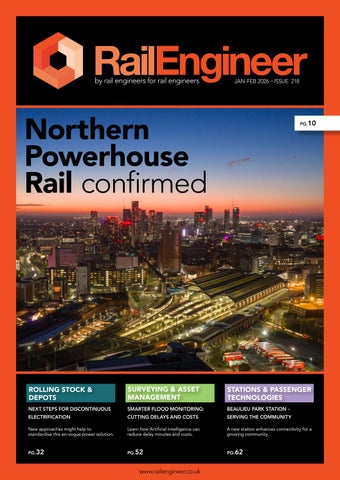

Northern Powerhouse Rail confirmed


New demonstrator line for CVLR
Coventry City Council has announced an 850-metre route to be installed between the city’s station and university.
Clifton Bridge successfully installed and reopened On Saturday 10 January, the new structure was carefully manoeuvred into place with millimetre precision.
Alstom and CrossCountry unveil first refurbished Voyager
CrossCountry unveiled the first of its refurbished Voyager trains at Alstom’s Litchurch lane works in Derby. 16|


Improving freight train responses in braking and low adhesion
RAIB recommends management of adhesion risks and understanding of compressive forces along freight trains.
Managing cracks and fractures on trains – the case studies
Malcolm Dobell presents four case studies expanding on his previous article covering rolling stock cracks and fractures. Fitting ETCS to older trains
Paul Darlington examines the challenges and advantages of retrofitting ETCS to older and heritage trains.
When technology sprints and funding walks
With funding tight, the industry must act fast to meet growing expectations for punctual, reliable services.
Recent RIA and PWI events have indicated approaches which might lead to a level of standardisation. Managing earthworks with technology
Paul Darlington explores how technology and monitoring can improve safety around earthworks and manage landslide risks.
Automation of inspection and maintenance
The last 200 miles: Britain’s military railway engineers
507 STRE specialises in the repair and construction of railway infrastructure. Bob Wright reports.
A brighter future for Liverpool Street station
A range of improvements are being delivered to the station including the renewal of its trainshed roof.
Beaulieu Park Station – serving the community
This new station on the Great Eastern mainline enhances connectivity for a growing Chelmsford community.
Smarter flood monitoring: cutting delays and costs Purple Transform and Central Alliance explain how smarter flood monitoring has reduced delay minutes and costs. 46|
From sensors to AI, automation is redefining railway inspection, monitoring, and maintenance practices. Malcolm Dobell investigates.
RIA’s Parliamentary reception looks to the future
On 13 January, RIA’s Westminster reception gathered 250 delegates to hear politicians’ views on rail.
Spey Viaduct – a conspiracy of circumstance Graeme Bickerdike investigates the partial loss of the historic Spey Viaduct – a vital community transport link. Christmas & New Year works 2025-26
Significant works were delivered during the festive season. Rail Engineer presents a glimpse of this varied programme.

What will
2026 bring?
Though it is traditional to predict what a new year will bring, Rail Engineer is mindful of an ancient Chinese saying that: "Those who have knowledge, don't predict. Those who predict, don't have knowledge.” Hence, we prefer to consider what may happen rather than to predict.
A huge issue for the industry this year is the passage of the Great British Railways (GBR) Bill through Parliament. Though various issues still need to be resolved, the need for a unifying organisation seems to be accepted by all concerned, so it is to be hoped that the Bill might receive royal ascent by the end of this year.
When 2026 comes to a close, 11 train operators should have been transferred into public ownership under the DfT Operator (DFTO). Experience to date has shown the significant benefits of reuniting track and train. Our report on the Railway Industry Association's (RIA) Parliamentary reception shows how Rail Minister Lord Hendy envisages GBR’s role. His immediate priority is defining what the GBR organisation will look like in 2027.
A GBR Bill requirement is the production of a 30-year Long-Term Rail Strategy (LTRS) which should be published this summer. It is to be hoped that it will take a whole system view of the need for electrification. Our feature on Discontinuous Electrification (DE) explains why continuous electrification has the lowest whole life cost on intensively used lines and discontinuous electrification is “nonsensical” for freight trains. Thus, LTRS’s consideration of electrification will show whether the promised whole system view is being taken.
It will be interesting to see how many new main line trains are ordered this year. A Rail Engineer feature in early 2024 considered the ‘boom and bust’ cycle of rolling stock procurement. With only 150 vehicles ordered since then, a shortfall of work still threatens UK rolling stock plants. In June, directors from Siemens and Alstom both stressed this point when they gave evidence to the Transport Select Committee's (TSC) investigation on rail investment pipelines. It is to be hoped that the TSC will soon publish this inquiry report which is expected to emphasise the need for a consistent pipeline for skills retention and business stability.

Valuable skills were lost when the Midland Main Line (MML) electrification team was disbanded. Instead of ‘pausing’ MML electrification, the option to slow down its delivery to retain these skills should have been considered as such lost skills can only increase the cost of further electrification.
Speaking at the Parliamentary reception, RIA’s Darren Caplan advised that over 60% of rail business leaders expect market contraction and staff reductions. He hoped Government will provide clarity and certainty for suppliers this year.
For HS2, 2026 should see the completion of its reset to provide a definitive cost and schedule. With the WCML now having no spare paths south of Crewe, it remains to be seen if there will be any plans to alleviate this problem or to address the issue of shorter HS2 trains on the WCML reducing passenger capacity. With the new NPR Liverpool to Manchester line prioritised over the more congested, shovel-ready HS2 Phase 2a route to Crewe, the Parliamentary powers to build this route expired on 11 February.
Our feature on Northern Powerhouse Rail (NPR) shows that much is far from certain. The commitment to a new Bradford station is only to review its business case though a decision is promised this summer. Similarly, the announcement about the re-opening of the Leamside line was about consideration of its business case. The upgrades east of the Pennines need to be defined. The case for an underground station at Manchester Piccadilly is to be assessed and much of the new Liverpool to Manchester route is still a line on a map. It will be interesting to see how NPR develops in 2026.
High costs, such as the £2.5 billion cost of a Leeds tram network, are also delaying much needed urban transport improvements in the North. One possible solution is the Coventry Very Light

A busy day at Euston. By 2045, when Government expects a new line to replace HS2a to have been completed, RIA expects a growth of passenger numbers of between 35% and 75%.
Rail (CVLR) which reduces the number of utility diversions required. As we report, work should start this year on an 850-metre CVLR demonstration line.
The new Beaulieu Park station near Chelmsford will serve 6,000 new homes.
As David Fenner reports, this was a good example of an externally financed railway enhancement project with Essex County Council pulling together a £175 million funding package. In another station feature, Bob Wright describes the challenges of reglazing Liverpool Street station’s roof.
Although Shap cutting is one of the numerous locations with sensors to detect earthworks movement, these did not detect the landslip that caused the recent derailment, as Paul Darlington explains. Graeme Bickerdike discusses another infrastructure failure caused by scour after a river changed its course. The Spey viaduct last carried trains in 1968 and, until two of its spans collapsed in December, was a cycle path – the loss of which is a blow to the local community.

freight train. Our feature on freight train braking explains this can result in hazards, one of which is longitudinal compressive forces.
Malcolm Dobell reports on two informative Institution of Mechanical Engineers’ events. His part two report on a cracks and fractures seminar shows the importance of managing the wheel-rail system as a whole and how design assumptions may not reflect reality. Another seminar on the automation of railway inspection and maintenance described the technologies available. It also emphasised the need for the data that sensors generate to be seamlessly integrated into a cohesive platform.
While most passenger trains have coaches with the same braking performance, this is certainly not the case for a long air-braked


DAVID SHIRRES
RAIL ENGINEER EDITOR
Fitting ETCS to older, non-standard trains has its challenges as we describe in another article.
As always, a huge amount of work is done by thousands of workers over the Christmas period, and work valued at £163 million was delivered over the final days of 2025. Matt Atkins describes the key work carried out over the festive period and within blockades during January. While it’s not possible to avoid such line closures, the impact on passengers must not be forgotten. On a much smaller scale, Bob Wright describes the work done by 507 Specialist Team Royal Engineers (STRE), the British Army’s only dedicated railway engineering unit.
Whatever happens in 2026, Rail Engineer hopes that it will be a good year for our readers.
Editor
David Shirres editor@railengineer.co.uk
Production Editor Matt Atkins matt@rail-media.com
Production and design Adam O’Connor adam@rail-media.com
Engineering writers
bob.hazell@railengineer.co.uk
bob.wright@railengineer.co.uk
clive.kessell@railengineer.co.uk
david.fenner@railengineer.co.uk
graeme.bickerdike@railengineer.co.uk malcolm.dobell@railengineer.co.uk
mark.phillips@railengineer.co.uk
paul.darlington@railengineer.co.uk peter.stanton@railengineer.co.uk
Advertising Craig Smith craig@rail-media.com
Rail Engineer
Rail Media House, Samson Road, Coalville Leicestershire, LE67 3FP, UK. Switchboard: 01530 816 444 Website: www.railengineer.co.uk
Rail Engineer Videos http://rail.media/REYouTube
Editorial copy to Email: news@rail-media.com
Free controlled circulation Email: subscribe@rail-media.com
The small print
Rail Engineer is published by RailStaff Publications Limited and printed by PCP Ltd.

© All rights reserved. No part of this magazine may be reproduced in any form without the prior written permission of the copyright owners.
Part of: www.rail-media.com
PHOTO: DAVID SHIRRES


New demonstrator line for COVENTRY VERY LIGHT RAIL
In Issue 215 (Jul-Aug 2025) Rail Engineer reported on how Coventry City Council had invited the public to ride on the prototype Coventry Very Light Rail (CVLR) vehicle. This ran on a 220-metre length of the CVLR’s novel trackform which had been installed in eight weeks.
CVLR has been developed to enable a light rail system to be constructed at a target cost of £10 million per km, which compares with around £60 million per km for recent tram projects. The aim is to enable UK towns and cities to afford a light rail system. Currently, the UK has only nine such systems compared with 250 in Europe.
Since 2018, the council, supported by Transport for West Midlands and DfT funding, has been working with the University of Warwick’s WMG to develop its CVLR system at a cost of £30 million to date. The result is an innovative, battery-powered, lightweight vehicle and a novel trackform.
This has a 105mm thick track slab made from ultra highperformance concrete of a high compressive strength. It has been successfully tested at a council depot where heavy vehicles subjected it to one million gross tonnes loading. With such a thin slab, installation of the CVLR requires a dig depth of 300mm compared with 600900mm for conventional tram track. Hence it avoids the need to divert utilities which can cost around £16 million per km.
The trackform is designed to provide access to utilities – for example, it can be cut to accommodate an inspection chamber and, in extremis, the track can be quickly removed. The track was left in place following last year’s demonstration and, in August, was used to trial access and installation of new utilities by impact moling, horizontal directional drilling, vacuum excavation, and keyhole coring access. If CVLR is to be a success it is essential that the utility companies are comfortable with its track being laid over their utilities.
The next trials
In January, Coventry City Council announced an 850-metre double track CVLR route that is to be installed between Coventry Railway Station and Coventry University’s Technology Park where there will be a service area and charging station. This is being

DAVID SHIRRES
PHOTO: DAVID SHIRRES

funded by the City Region Sustainable Transport Funding (CRSTS) and is scheduled to be operational by March 2027. This will trial the operation of the CVLR vehicle alongside live traffic. This includes the installation of an autonomous ready vehicle control system integrated with the city’s traffic signal control system. The council will seek feedback from public and stakeholders on how the vehicle has evolved since its 2025 trial. Installing this new track will also demonstrate how the lessons of the 2025 trial can improve the speed of installation and affordability of the CVLR track.
The lessons from the 2027 trial will inform the business case and design of Coventry’s first commercial route which is intended to be an extension of this trial route to provide a 5km route to the West Midlands Investment Zone on the site of Coventry’s airport, which is to close this year.
It is expected that having the CVLR vehicle running through traffic in the streets of Coventry will stimulate both national and global interest, especially as the Intelligent Transport Systems (ITS) World Congress is to be held at the nearby National Exhibition Centre in October 2027.


PHOTO: DAVID SHIRRES
Clifton Bridge successfully installed and reopened

A major bridge replacement scheme on the West Coast Main Line (WCML) has been completed, with the installation of a new structure at Clifton near Penrith as part of wider upgrade works.
The work saw the Clifton railway bridge, which passes over the M6, replaced by Network Rail and its principal contractor Skanska as part of a £60 million investment to make the WCML fit for the future.
On Saturday 10 January, the new 130-metre-long structure was carefully manoeuvred into place with millimetre precision by SelfPropelled Modular Transporters (SPMTs) with more than 600 wheels to carry the load. The new bridge has a design life of 120 years. Despite sub-zero temperatures and challenging weather conditions, work progressed so smoothly that the motorway reopened shortly before 4pm on Sunday 11 January – 13 hours ahead of schedule.
To allow the huge civil engineering project to take place, two unprecedented 60-hour closures of the whole motorway were scheduled between junctions 39 and 40 over consecutive weekends.
Christian Irwin OBE, Network Rail North West and Central region capital delivery director, said:
“It’s a testament to the hard work of hundreds of people that we’ve been able to install this huge new structure both successfully and speedily. We've been in close contact with National Highways throughout so we could capitalise on that and get the M6 reopened over half a day ahead of schedule to alleviate pressure on local roads.
“I’d like to once again thank drivers for adhering to the road diversions, and also thank the local communities impacted by them this weekend, so we could carry out this vital work to secure journeys for both road and rail users in the future.”
With the bridge installation complete, railway teams got to work installing new track and reconnecting overhead power lines and signalling systems over the renewed structure.
While that took place, the railway remained closed between Oxenholme and Carlisle until its full reopening. Train services re-commenced on the morning of 15 January.
The extended closure provided Network Rail teams with the opportunity to carry out dozens of other improvement projects between Preston and the Scottish border.
The biggest schemes included:
» Completion of a £61 million modernisation of railway signalling in Carlisle.
» Replacement of nearly 70km of overhead lines through Shap and Tebay.
» Installation of rockfall protection through Shap cutting.
» New signalling gantries and signals installed at Preston station.
More than 60 other smaller upgrades also made, making the most of this once-in-a-generation closure.
During the upgrades, Network Rail and Avanti West Coast worked closely to keep customers on trains for as much of their journeys as possible by running a shuttle service on the historic Settle to Carlisle line – the first time in a decade that diversionary route has been used.
“We have used this vital 14-day closure to make the biggest possible impact on the West Coast Main Line with multiple major upgrades now completed,” said Christian. “As a result of the hard work of hundreds of our colleagues, both passengers and our freight operators will have a more reliable railway for generations to come.”

Alstom and CrossCountry unveil first refurbished Voyager
On Tuesday 10 February, CrossCountry unveiled the first of its refurbished Voyager trains at Alstom’s Litchurch Lane works in Derby.
Assembled guests and excited staff from both companies were invited to tour the train and experience the improvements first-hand.
As could be seen, the refurbishment programme has delivered a fully refreshed interior and exterior, creating a modern and consistent look throughout the fleet, across both standard and first class.
Improvements, which will be rolled out to all 70 trains in CrossCountry’s longdistance fleet, include:
» New seating with increased legroom, improved under-seat storage, and integrated power sockets.
» Upgraded tables at all seats.
» New carpets throughout and refreshed interior and exterior artwork.
» More efficient LED lighting throughout.
» Refurbished toilets and vestibules.
» New and upgraded onboard CCTV.
On unveiling the refurbished train, CrossCountry’s managing director, Shiona Rolfe, said: “This train marks an important step in our commitment to improving the experience for everyone who travels with us. The Voyager fleet has served passengers well for more than two decades, and these upgrades will ensure it continues to meet modern expectations for comfort, sustainability and security.
“We’re proud to be investing in the future of long-distance rail travel and look forward to welcoming passengers on board our refreshed trains.”
Maintained, serviced, and overhauled by Alstom at its Central Rivers Depot, the refurbishment of the Voyagers is being carried out by around 130 staff at its Derby Litchurch Lane facility. In line with Alstom’s policy of sending no waste to landfill, would-be waste material from the refurbishment process is set to be recycled, with options being explored on how to make the most of these as the programme continues.
"This milestone reflects the strength of Alstom’s refurbishment capabilities in the UK and the expertise of our team in Derby,” said Steve Harvey, Alstom's services director, UK and Ireland.
“Upgrading a fleet as intensively used as the Voyagers demands precision, innovation and deep technical knowledge – and our people have delivered exactly that."
"I’m proud of the quality and dedication our team has brought to the first Voyager to leave Litchurch Lane and I know that same commitment will define every train we deliver throughout this programme.”
Legacy Alstom trains, the Voyagers are owned by rolling stock company Beacon and leased to CrossCountry. Beacon has invested a total of £75.1million into the fleet refurbishment.
Adam Cunliffe, Beacon Rail’s chief executive officer, said: “Beacon is proud to support CrossCountry in delivering this substantial upgrade to the Voyager fleet. These trains have underpinned longdistance rail travel in Britain for more than two decades, and this investment ensures they remain reliable, comfortable, and fit for the future.
“Through our close partnership with CrossCountry and Alstom, we remain committed to providing sustainable, highquality rolling stock that enhances the passenger experience.”
Built in 2000, the long-distance Voyager fleet has been a cornerstone of Britain’s rail network for over 20 years, replacing former British Rail stock and setting new standards for comfort and reliability.
Over the next two years, a total of 136 Voyager (Class 220) and 176 Super Voyager (Class 221) cars are being refurbished by Alstom in Derby, including an additional 12 trains added to the CrossCountry fleet following their release from Avanti West Coast.
The refreshed train – Class 220 No. 220033 – is set to be back on the tracks soon.


Phase 1
Phase 2
Phase 3
NPR services on existing infrastructure
Northern Powerhouse Rail confirmed
On 14 January, Secretary of State Heidi Alexander set out the Government’s plans for Northern Powerhouse Rail (NPR) which are to be delivered in three phases:
1. Electrification and upgrades east of the Pennines for delivery in the 2030s covering Leeds-Bradford, Sheffield-Leeds, and LeedsYork corridors. Capacity is to be increased at Sheffield station and York station will be redesigned. These upgrades are to be delivered in the 2030s. In addition, business cases are being developed for a through station at Bradford, on which a decision is expected by summer 2026, and the reopening the Leamside line.
2. A new line between Liverpool and Manchester with stations at Liverpool Lime Street, Liverpool Gateway, Warrington Bank Quay, Manchester Airport, and Manchester Piccadilly for which the aspiration is an underground station. Most of NPR’s funding will be spent on this line which will be constructed in the 2030s and beyond.
3. Upgraded routes from Bradford and Sheffield to Manchester with further Leeds to Manchester improvements over and above the Transpennine Route Upgrade (TRU) during the 2040s.
It was announced that, over the coming decades, the Government will commit up to £45 billion for NPR. The funding available in Manchester Piccadilly.

the current spending review period up to 2029 is £1.1 billion for the development of NPR schemes. In addition, it has approved £115 million for longer platforms at Manchester Airport station and £11 million to develop a new Rotherham Gateway station.
It was also confirmed that the Government has a long-term aim for a new north-south line from Birmingham to Manchester, though no decisions have been taken on its specification other than that it won’t be a revival of HS2.
In June, the Chancellor’s spending review statement allocated TRU an additional £3.5 billion. As a result, this programme is now expected to cost £11 billion.
A long-awaited plan
The development of NPR dates back to 2014 when then Chancellor, George Osborne, proposed a rail link between Manchester and Leeds which became known as HS3. The leaders of Leeds, Liverpool, Manchester, Newcastle, and Sheffield City Councils then published a report which endorsed Osborne’s HS3 proposal and called for an early extension of HS2 to Crewe and the delivery of HS2 between Leeds and Sheffield to be brought forward.
The term ‘Northern Powerhouse Rail’ seems first to have been used in a 2015 government report. This considered the benefits of fast, high frequency rail connections in the Netherlands and the Rhine Ruhr regions to show the case for significantly improved new rail links such as HS2 and HS3 between northern cities. The following year, a National Infrastructure Commission report endorsed this proposal and also considered that Manchester Piccadilly should be redeveloped as an underground through station. It also stressed the importance of rail freight.

Transport for the North (TfN) was formed in 2018 to make the case for strategic transport links across the North of England. Its first report included a map showing the HS2 Manchester and Leeds legs as well as HS3 and the Transpennine Route Upgrade (TRU). A 2019 TfN report showed how a new Liverpool to Manchester line would share the HS2’s route into Manchester via Manchester Airport. This also detailed NPR’s benefits which included delivering £14 billion GVA per annum.
HS2’s leg to Leeds was cancelled in November 2021 as part of the Integrated Rail Plan (IRP). IRP also confirmed that the route between Manchester and York will be electrified as part of the TRU.
HS2’s leg to Manchester was cancelled in October 2023 with the publication of the Network North document. This stated that the Liverpool to Manchester line would be built and made commitments to electrify lines from Sheffield to Manchester and Leeds.
The Liverpool-Manchester Railway Board was formed in 2024. In May 2025, it published a report showing the benefits
of a new Liverpool to Manchester line in the expectation that the following month’s Chancellor’s Spending Review statement would include a commitment to this line. Yet its only reference to NPR was that plans would be announced “in the coming weeks”. The recent NPR announcement was made six months later.
As shown above, it has taken 12 years to get a government commitment to NPR though this has a scope significantly less than originally envisaged. Nevertheless, there at last seems to be some certainty of what NPR will be.
Liverpool to Manchester
The NPR line between Liverpool and Manchester will be around 66km long and made up of four sections. The first is of around 17km between Liverpool Lime Street and a new Liverpool Gateway station at a location to be decided near Widnes. The NPR proposal shows two routes for this section both of which could require tunnels underneath the city’s built-up areas.
The second section is around 12km long and uses a redundant rail freight line past the decommissioned Fiddler’s Ferry

2015 Northern Powerhouse Rail report.
Power Station and Widnes. This passes underneath Warrington Bank Quay station where a new part of the station will be built.
A 13km section of new line is the third section. This runs from the new Warrington Bank Quay station to Millington, near Junction 8 of the M56 where it joins the route of HS2 Phase 2b. Leaving Warrington, it may be possible for about a third of this route to use a disused railway if its bridge over the Manchester Ship Canal is suitable.
The final section is 24km of the HS2 Phase 2b route from Millington into Manchester Piccadilly which uses the now-cancelled route of HS2. This includes a new station at Manchester Airport from where there is a 13km tunnel which surfaces 1km east of Piccadilly. The HS2 plan was for the route to terminate in a new terminal station immediately north of the current station. This plan would require trains between Liverpool and Leeds to reverse at Piccadilly.
The 2025 report produced by the Liverpool-Manchester Railway Board details the opportunities for regeneration offered by this line which include thousands of new homes. Close to Manchester Piccadilly there could be up to 13,000 new homes and 820,000 square metres of new commercial development.
Piccadilly Underground
The NPR Liverpool to Manchester plan shows an NPR line heading west to Leeds. This would require Piccadilly to be to a through station that would have to be an underground station. Among many other benefits this would provide 36,000 sq. metres of public realm space to increase the opportunities for central Manchester’s regeneration.
In 2019, Manchester City Council commissioned Bechtel to study HS2’s proposals to expand Piccadilly station to accommodate both HS2 and NPR services. This report modelled train operations and concluded that the turnback layout of HS2’s preferred surface option had considerable operational disadvantages.
The report noted that although the HS2 Phase 2b alignment met the objectives of connecting Manchester to the Midlands and London, it did not optimise connectivity between Liverpool and Leeds. Hence it proposed an underground station alignment that would better fit terminating north-south services and through east-west services. This reduced

the tunnel length from Manchester Airport from 13 to 12km and, for an underground station, the length of northbound NPR tunnels from 10 to 7.5km.
It concluded that a through underground station would require a station box comparable to that required by HS2’s Old Oak Common station with lines to be 20 metres below the surface – a similar depth of the six central London Elizabeth line stations.
Following the £45 billion funding announced in the NPR statement, Mayor of Greater Manchester Andy Burnham considered that this underground station must now be built. NPR compact agreements for each of the six combined authorities concerned have now been signed by the Secretaries of State for Transport and Housing, the Chancellor of the Exchequer, and the leader of the combined authority concerned. These specify how NPR will be progressed in each combined authority. The agreement for Greater Manchester states there will be a joint process to consider the underground Manchester Piccadilly option against alternative options.
Though expensive, the benefits of an underground through station are significant. In Issue 215 (Jul-Aug 2025)
Rail Engineer explained how Stuttgart is to benefit from the replacement of its 16-platform terminal station by a new sixplatform underground through station.
Birmingham to Manchester
In her NPR statement, Heidi Alexander confirmed the Government has a longterm aim for a new line from Birmingham to Manchester which is needed to address “longer-term congestion and crowding challenges on the WCML”.
She noted that the Liverpool to Manchester route will build a short section of this line which, she stressed, won’t revive HS2. She also advised that no decisions have been taken on the specification or timetable and that the Government will retain land already purchased for HS2 Phase 2a. She considered that the Birmingham to Manchester line will be built after NPR, which is the 2040s.
However, it is not clear whether all the required land for this line has been purchased. The powers to acquire land for HS2 Phase 2a route expire on 11 February. Though the HS2 Phase 2a Act gives Government the power to extend these powers for a further five years, there is no indication that this will be done.
A report commissioned by the Mayors of Greater Manchester and the West Midlands, published in September 2024, explained why a do-nothing scenario north of HS2 Phase One is not sustainable due to WCML capacity constraints on passenger and freight growth. It recommended that the Government preserve its powers to acquire land and pursue new funding models.

The Mayors’report proposes using the HS2 Phase 2a route to form its Staffordshire connector.
The Mayors’ report was entitled ‘Opportunity through connectivity’. It highlighted how, compared with the Midlands and the North, Germany’s RineRuhr region benefits from the connectivity provided by its fast frequent rail services.
Recently in the House of Lords, Rail Minister Lord Hendy acknowledged that a new line between the West Midlands and Crewe might be needed before the 2040s due to WCML capacity issues. He stated that the Government is committed to retaining the land for this line as it knows “that at some stage a railway will have to be built”.
Heidi Alexander’s statement that a new line won’t revive HS2 illustrates the toxic perception of the project. Yet it is difficult to see how this statement can be taken literally. It would be folly to retain land for the HS2 Phase 2a route if a new railway is to be built elsewhere.
The development of the HS2 Phase 2a route was the subject of a rigorous design and Parliamentary process. From the initial planning to the passage of its Bill took eight years of which it took three-and-ahalf to pass through Parliament. This took hundreds of hours of parliamentary time which involved numerous MPs, lawyers, and petitioners. Any suggestion that a new line between Birmingham and Crewe will not use the HS2 route would add years having to repeat this process. This would also waste ‘sunk costs’ which the Mayors’ report estimate to be £2 billion. The 58km long HS2 Phase 2a route is also relatively inexpensive to build. It has no stations, is almost all through open countryside and runs in tunnels for 4% of its length. In contrast, 24% of HS2 Phase One is in tunnels. Its benefits were such that its delivery was to be

accelerated to maximise the benefit of the expensive HS2 Phase 1 line to Handsacre. Government now intends to defer these benefits by building it almost 20 years later than originally intended.
Funding NPR
By 2019, TfN envisaged that NPR would include HS2 lines to Leeds and Manchester, new lines from Manchester to Leeds and Liverpool with an underground station at Manchester Piccadilly, in addition to the TRU. At the time HS2 Phase One and 2a bills were passing through Parliament with the expectation that the HS2 line to Crewe would be opened by 2030. The cost of all this would have been hundreds of billions of pounds. Since then, these ambitions were scaled back with the cancellation of HS2 to Leeds and then Manchester. For years, no funding was committed to NPR other than TRU. The recent NPR announcement now provides some certainty though questions remain. For example, if, when, and how the HS2 Phase 2a route will be used and whether Manchester Piccadilly will get its through platform underground station. It is quite possible that final costs of all NPR schemes will be more than the £45 billion funding cap. Relieving WCML capacity by building a line from the West Midlands to connect with NPR would cost additional tens of billions of pounds. Although these are expensive projects, they offer far greater benefits. Yet, with other priorities, Government is unlikely to be able to afford such hugely expensive projects.
Hence, it is important that these rail investments are part funded by the financial value they create. Indeed, the NPR compact agreements all refer to the requirement to raise local finance.
Examples of how this has been done are:
» The 96km Dutch high-speed line from Schiphol Airport to Belgium required a consortium to design, construct, finance, and maintain the line for 25 years in return for an annual fee based on infrastructure availability.
» More than half of the 303km Tours to Bordeaux high-speed line was funded by a consortium that bears the line’s construction, maintenance, and revenue risk.
» The Northern Line’s Battersea extension was primarily funded by a £1 billion loan for which the debt is being repaid through developer contributions and increased business rates.
» The Hong Kong Mass Transit Railway
(MTR) was entirely funded by MTR buying land at pre-rail prices and partnering with developers to capture the increased land value.
» Construction of the Elizabeth Line benefited from developer contributions of £4.1 billion from a special levy as part of the business rates regime.
As well as securing funding, it is essential that the NPR projects take account of the welldocumented lessons of HS2 to ensure that they are delivered in a cost-effective manner. It has taken over 10 years for NPR to get a firm
Government funding commitment. All being well, in another 10 years’ time, the first phase of the NPR project will have delivered significant connectivity benefits east of the Pennines.
The mid-2030s should also see construction of the new Liverpool to Manchester railway well advanced. If this includes an underground through station at Piccadilly, this will finally resolve the congestion constraints of Manchester’s historic railway network.
NPR certainly offers huge benefits, though these will only be realised with suitable funding arrangements as well as effective project development and implementation.

The Ordsall Chord was opened in 2017 as part of the Manchester Hub plan to increase rail capacity. However, the other Manchester Hub project to build extra though platforms at Manchester Piccadilly to relieve congestion on the Castlefield corridor was not progressed. As a result, the Ordsall Chord had limited, if any, impact and the Castlefield corridor is one of a small number of lines that Network Rail has declared to be congested infrastructure.
NPR will eventually relieve Manchester’s rail congestion in the 2030s.

Ordsall Chord.
Manchester Piccadilly platforms 13 and 14.
PHOTO: DAVID SHIRRES


What is RailwayPeople.com?
RailwayPeople.com is the largest dedicated rail job board in the UK.

How can it help me?
With the top career opportunities updated daily, your next move is a fingertip away.

What should I do?
Visit www.RailwayPeople.com to find your new career and become an essential part of the UK’s rail industry to help the nation build back better.


freight train responses
Improving IN BRAKING AND LOW ADHESION


MALCOLM DOBELL
Over the last few years, several serious accidents investigated by RAIB have involved freight train braking systems. Accidents are costly, but significant costs are also incurred even when no accident occurs, for example when wagons are withdrawn from service due to wheel flats. In its reports, RAIB recommended better management of adhesions risks, reviewing wagon maintenance, and better understanding of compressive forces along freight trains.
One of several industry groups recently set up to explore freight train safety and performance improvement (see below) is the Wagon Condition Programme Board, chaired by Tim Shakerley. Its RSSB-hosted sub-group, Freight Braking and Adhesion Research Group (FBARG), chaired by Neil Ovenden, presented its latest work at a seminar in Derby in December 2025.
The group exists to coordinate RSSB and Network Rail funded research into freight train braking and adhesion performance. Its work includes: (i) exploring performance and compatibility of freight wagon brakes and their combined impact on freight train braking, formation of freight wagon wheel flats, and potential derailment risks; (ii) considering the impact of low adhesion in a freight context; and (iii) assessing the risks of longitudinal compressive forces under braking or during shunting.
The results will be used to evaluate potential mitigations and inform standards, operational controls, vehicle design, and maintenance. What follows is based on the fundamental principles of steelon-steel railways described in box at the bottom of page 18.
Existing knowledge
Mott MacDonald’s Robert Morley described factors that lead to freight wagon wheel flats. This included reviewing existing knowledge of the prevalence and variability of wheel flats across the GB freight fleet. Relevant standards and operational techniques including train preparation, marshalling, and driving practices were also reviewed. The work identified several issues including:
Standards: Brake performance is specified and validated in terms of maximum performance, typically the emergency brake. Usually, with defensive driving, and especially in poor adhesion conditions, lower braking rates are demanded and there are no known specifications or performance testing requirements for these lower brake demands. This means that different wagon types in a train might have different
Established in late 2024, FBARG co-ordinates and oversees research on freight train braking and adhesion performance and supports three major research projects delivered under the Wagon Condition Programme and governed by the Freight Safe Programme (FSP).
The FSP was launched in early 2024 and brings together key stakeholders to build on rail freight’s strong safety performance. It leads on key safety projects to give expertise across the industry on any potential challenges and risks. It is led by a steering group of senior and experienced professionals from across rail freight.
The programme is a collaborative rail freight industry undertaking, which is partly funded by Network Rail’s Freight Safety Improvement Portfolio as well as funding coming from freight operating companies and other key stakeholders.

responses at lower brake demands leading to some wagons over-braking and some under-braking.
Detection: There is limited knowledge of where wheel flats occur. Wheel flats are often detected by Network Rail’s Wheel Impact Load Detection equipment, but the slide event will have occurred somewhere else and at some other time. Innovations such as VTG’s iWagon are beginning to be used to improve understanding of the times and locations of wheel slide events, as well as the brake force applied and the wagons’ reaction to wheel slide events.
Brake System Design: Many modern wagon designs utilise bogie-mounted brake gear which is compact and provides a more direct application of brake force to the wheel tread, without the need for the brake rigging associated with body-mounted brake actuators. Operators have provided evidence that some wagons fitted with bogie-mounted brake gear may be more susceptible to wheel slide than otherwise identical wagons fitted with body-mounted brake rigging. Further work was recommended.
In addition, inadvertently forgetting to release handbrakes continues to cause wheel flats. Wider adoption of handbrake interlock systems is improving the position, although these systems bring their own risks and may not be a practical solution in all cases.
Overcharge: This is where the brake pipe pressure is temporarily raised over the normal value to ensure that, in principle, the brake distributors’ control reservoirs along a train are uniformly charged to improve consistency of brake control along a train. It is not consistently documented when and how overcharge should be used and there is some evidence it can be detrimental to brake system performance in certain circumstances.
While different specifications have been used over the years, nothing is currently mandated in standards or the Rule Book. An ongoing RSSB standards project, based on further industry research and stakeholder input, is proposing to update the relevant documents to address this.
The report identified operational improvements that could be readily implemented:
» Timely reporting and effective action for lowadhesion events and adhesion black-spots.
» Allow greater flexibility in train pathing requirements during periods of low adhesion.
» Trial the effect of operating all or part of the train to run in goods instead of passenger timing settings during periods of low adhesion.
» More rigorous control of load distribution on loaded wagons.
» Alignment of rail head treatment trains to treat ‘at risk’ rails before freight use.
Finally, wagons’ routine static brake testing could be improved including: (i) development of a standardised, comprehensive brake test regime, including load sensing systems and sensitivity to


extremes of brake pressure tolerances; (ii) methods for automation to provide greater detail, consistency, accuracy and traceability, and (iii) cost effective means to measure block/pad loads at the brake interface to determine brake performance. The business case benefits of such changes against the costs of implementation will be evaluated before any change is implemented.
Braking performance and adhesion
Dr Julian Stow from the University of Huddersfield attempted, among other things, to answer the question, prompted by the Petteril Bridge derailment investigation: “Why did a locked, flatted wheel apparently fail to start turning after the brakes were released?”
Julian presented analytical models and discussed the various factors that might
Wheel/Rail braking and adhesion in context
The wheel/rail contact patch is approximately the size of a 5p coin. A significant advantage of this small contact patch is low rolling resistance, enabling energy efficiency, but even small amounts of contamination can result in low adhesion. The wheel/rail interface is impacted by a wide range of external factors. Changes to adhesion can be highly transient and localised.
What is adhesion and why is it important?
Adhesion is the measure of friction between the wheel and the rail and limits the ability of trains to accelerate and brake. Adhesion is usually described using the coefficient of friction (μ), expressed as a decimal fraction or a percentage. Achievable braking rate is often expressed as a percentage of acceleration due to gravity (%g); achievable rail braking rate in %g is limited by and approximately equal to the local μ, expressed as a percentage. All main line train braking in the UK is dependent on available adhesion.
As an illustration of the problem, dry rail μ in the range 0.30.4 and wet rail μ in the range 0.1-0.15 is usually adequate for general rail work. But in locations where heavy contamination such as damp and compressed leaf film have formed, μ can fall to values as low as 0.05- 0.01. This level of friction is lower than is achieved in automobile engines using good quality synthetic oil.
A modern disc-braked passenger train requires an adhesion of at least 9% (μ >0.09) to deliver a nominal full-service braking rate of around 9%g to prevent wheel slide (based on all axles braking their own weight) with higher brake rates for emergency braking. A typical freight wagon can deliver a nominal braking rate of around 7%g (μ >0.07) for a full-service
impede wheel motion. The University has a full-scale wheel-rail rig, HAROLD, which was used in some experiments and a wheel flat was accidentally created during the test, yielding much useful information.
In summary, if brake torque exceeds the torque available between wheel and rail because of insufficient adhesion, the wheel will slow and lock, followed by harsh wear caused by sliding, creating a flat. The flat

brake application on level, dry track.
A locomotive requires more adhesion to start a heavy freight train without spinning its wheels, requiring an adhesion >20% (μ > 0.2).
If more adhesion is demanded than is locally available, this will result in wheel spin or wheel slide. The majority of GB passenger trains are fitted with Wheel Slide Protection (WSP) systems. Most freight locomotives are fitted with Wheel Slip Control, mainly for traction purposes. GB freight wagons are not fitted with WSP, although some wagons have been and are being delivered with wheel flat prevention equipment. If there is insufficient adhesion, a rotating wheel locks and slides along the railhead. The resultant heating generates a flat spot on the running circumference of the wheel tread. The longer the period of the slide, the longer the length of wheel flat. Extensive wheel flats can cause infrastructure damage and derailment. Low adhesion can also cause other safety incidents such as signals passed at danger, platform over-runs, and collisions.

size depends on axle load. For example, a 25-tonne axle load at 60mph sliding for 20 seconds (approximately 500 metres) is likely to cause a flat between 70mm and 130mm long.
A self-sustaining flat might be created if an initial large wheel flat is created and there is not enough adhesion to restart rotation. The wheel may stay locked even after brake release, sliding on the flat and enlarging it. Alternatively, if the wheel speed drops sufficiently, an existing wheel flat can re-lock the wheel, causing it to slide on the flat and grow larger. When a wheel flat forms and the wheel resumes rotation, the edges of the flat tend to wear out, increasing its length while its depth remains fixed. A worn flat causes lower resistance torque and impact load compared to a new flat, even if it is longer. Therefore, length alone is not a reliable measure, but it implies that new flats are more prone to self-sustaining or re-locking.
Daniel Jones from Serco presented his work carried out with Adam Twigg, which investigated factors impacting braking in low adhesion, collating knowledge and experience gained over the last 40 years together with analysis.
Examples included findings by British Rail Research from at least 35 years ago that had showed that: (i) dry sand typically restores the coefficient of friction from about 0.05 to 0.10 – 0.12 within one wheel rotation; ii) adhesion gels such as sandite persist on the rail for longer than sand but deliver a smaller improvement and, once compacted, can act as a lubricant; and (iii) freight train length has a minimal impact of brake application time, but a very significant impact on brake release time.

From discussions with freight operating representatives, Serco learned that freight drivers are trained to drive defensively. Each train is ‘assessed’ for the feel of its brake performance and driving style is modified accordingly, and, as this is integral to the training of drivers, there is little feedback on train braking variability.
They added that simulating conditions in post incident review has historically been very difficult. Brake performance requirements have also changed over the years. The standard in 1993 specified maximum and minimum stopping distances for individual wagons, whereas the current version omits the minimum value. Moreover, although there are clauses requiring that a new wagon design should be assessed for compatibility with those to which it might couple, no particular values are mandated. Design differences – e.g., cast iron or composition brake shoes, body or bogie brake cylinders – can lead to different responses for partial brake applications. These differences can lead to some wagons being over-braked and others under-braked compared with the desired brake demand, a possible issue in poor adhesion conditions.
The current standards require meeting an end goal with proof of compliance demonstrated by the manufacturer and Entities in Charge of Maintenance. It was reported, however, that there
are sometimes inconsistent methods of calculating brake force between manufacturers, and subsequent maintenance data is limited to measuring brake cylinder pressure, not block forces. These factors are vitally important when considering ETCS.
Rail Engineer has already referred to the challenges of inputting freight brake force data from a database called R2 into ETCS (Issue 216, Sep-Oct 2025), but here it was shown that the data may be incorrect, with the statement: “On ETCS it is essential that Drivers do not rely on the brake curve with which they are presented.”
From this work, several interim recommendations were made including carrying out a suite of brake tests to validate R2 values and review the impact of possible standards for initial brake application and overcharge.
Longitudinal compressive forces
The derailment at London Gateway in 2021 (Issue 206, Jan-Feb 2024) highlighted an issue with the longitudinal dynamic behaviour of the train. Dynamic longitudinal compressive forces (LCF) within the train were sufficient to unload and derail the wheels of a short unladen wagon in the middle of the train. Paul Molyneux-Berry from the University of Huddersfield described work to characterise LCF and define safe operational limits. This addresses one of RAIB’s recommendations.

A review of LCF derailments has identified four main causes:
» Slow propelling movements over crossovers or sharp curves. Most common in GB and Europe. Applying power before train brakes are fully released is a factor in some incidents.
» Dynamic LCF in a rapid transition from traction to braking. This occurs in all countries, on main line or in yards, often at low speed and is frequently the result of an emergency brake application or a collision.
» Dynamic LCF caused by ‘run-in’ of slack on undulating gradients. Most common with very long trains in North America and Australia. Excess slack in the train, for example couplings not tightened, can be a contributory factor.
» Descending steep gradients with braking by leading locos. This occurs with very long trains in North America and Australia, especially when the locos are using dynamic braking.
Paul described the factors which, combined with high LCF, might lead to a derailment. In Europe, North America, and Australia, standards specify the Endurable LCF (ELCF) for vehicles, train formations, and brake set up to keep LCF below the ELCF threshold. EN15839 is the primary European LCF testing standard for vehicles. GB has no mandatory requirement to assess ELCF in wagons
which means that there is the potential to import LCF derailment risk on to the railway. There would be a great deal of work to demonstrate GB compliance with EN15839, but this standard does not cover all GB situations. With higher speeds and loads than is typical in Europe, the LCF environment in GB freight trains may be more demanding. Paul summarised that:
» In GB, LCF derailment incidents generally occur at low speeds <10mph, usually in protected moves.
» High-speed LCF derailments are rare, both in theory (from the simulations) and from European and GB LCF derailment history.
» Light/short wagons with bar couplers, marshalled between loaded wagons, may be highest risk and are becoming more numerous to meet demand.
» For GB scenarios, causes of high-LCF events within a train, which could escalate into a derailment, are both well understood qualitatively, but not quantitatively.
» GB has no mandatory assessment of ELCF, nor controls on formation and brake regime to limit LCF in trains.
» The modelling techniques and software developed for this project are effective for modelling LCF and ELCF for GB freight train scenarios.
» EN15839 may NOT be effective for assessing vehicle propensity for dynamic LCF derailment.
The seminar was well attended by the wider rail freight community with lively discussion. Rail Engineer’s takeaway was the enthusiasm for improvement, demonstrated by the large audience. Rail freight operates in a commercially challenging and tight margin environment, and the focus of the seminar and the further work remains on establishing cost effective mitigation measures for improving the performance of freight train braking and adhesion - including operational controls, improving interwagon brake performance consistency, and continuing to explore the merits of on-board technology such as i-Wagon. There are ambitions to be able to run longer and faster freight services to support freight growth and better integrate with passenger services on busy sections of mainlines. Having better understanding of freight vehicle/train braking is a key aspect of developing these capabilities. Further information on the research can be found by can be found at: https://www.rssb.co.uk/researchcatalogue by searching T1350, T1351, and T1352.


Managing cracks and fractures on


MALCOLM DOBELL

ITHE CASE STUDIES
n Rail Engineer 217 (Dec-Nov 2025) we reported on a September 2025 IMechE event which featured several case studies on rolling stock cracks and fractures. In that issue, we examined the standards, tools, and techniques involved in managing cracks and fractures on trains.
In essence, if standards are complied with, knowledge of the infrastructure is incorporated in designs, and suitable monitoring is carried out, the risks of cracks forming or developing can be managed.
However, cracks still happen and industry can learn from how others dealt with them. In this article, we present four case studies discussed at the event: three concerning UK rolling stock and a fourth concerning a wheel-rail interface issue elsewhere.
Case study 1
GWR classes 800 and 802
In April 2021, cracks were discovered in the anti-roll bar and yaw damper bracket on the carbodies of Great Western Railway (GWR) Class 800 and 802 trains. These were being investigated and managed when, on 8 May 2021, cracks were detected at the other end of the bolster around the lifting pad. These were in parent material (not a weld) in an area with limited operational loadings.
A decision was made by Hitachi, the Entity in Charge of Maintenance (ECM), to withdraw the affected fleet. The initial investigation and return of the trains to service was described in Rail Engineer May/June 2022, ending at the point that the inspection regime was being brought under control and permanent repairs were being evaluated.
Andrew Skinner, head of engineering at GWR, praised the team working between the various interested parties (GWR, the ROSCOs Agility Trains and Eversholt, and Hitachi, with various others including DfT, ORR, and independent consultancies).
Investigations and studies had arrived at the following conclusions:
» Weld repairs to the root of the body/bolster welds would be difficult as it would be hard to achieve the correct weld fusion.
» In-service-testing with strain gauges over representative routes showed that there were occasions where the loads on both the yaw damper bracket and Anti-Roll Bar (ARB) droplink were higher than allowed for in standards, which adversely affected fatigue life.

» Daily checks for cracks were unsustainable.
» Further Finite Element Analysis (FEA) work demonstrated that with specific welds intact there was no risk of lifting pad detachment allowing checks to be moved to 36 days with repair in the following 36 days.
Hitachi concluded its technical investigations, developed repair procedures, and designed modifications. In parallel, a repair programme was developed named project ACER. Initially, this was based at Arlington Fleet Services at Eastleigh, one of the few sites capable of accepting nine-car trains which are more than 230 metres long.

The strategy was as follows:
(i) all vehicles to be modified to the same level while maintaining fleet availability AND ensuring fleet safety; (ii) delivery was to be from Eastleigh supported by the Hitachi Manufacturing team at Newton Aycliffe with the objective of; (iii) minimising unit downtime from passenger service while optimising modification timeframe using standard repair procedures; (iv) while trains were awaiting modification the situation would be contained by ongoing analysis of Fleet Check results and crack propagation rates; and (v) risk management of any emerging issues.
The scope of Project ACER was modified and now contains two workstreams to allow prioritisation of units. One was interim repairs with a shorter downtime carried out on individual cars within units to manage availability. Some of this work will be carried out at London North Pole depot. The permanent modifications require a longer downtime and are carried out on full sets.
Andrew explained the scope of the permanent modification which involve extensive work.
The full modification is on a leading vehicle and involves the following activities:
» Removal and replacement of the ARB block and weld line (WL) 1 (the longitudinal weld connecting the bolster to the car body).
» Application of stiffener plates.
» Application of new design of stiffener bracket.
» Removal of 7XXX aluminium ARB blocks replacing with 5XXX aluminium.
The modification redistributes forces through the new stiffener bracket to ensure that the carbody extrusion, bolster, and WL 1 are capable of withstanding normal operational inputs for at least the design life of the vehicle.
The work is extensive and early units were out of service for a long time. As a result, there was further collaboration leading to Hitachi’s design team implementing several changes to the programme to accelerate modifications which has reduced the work time in 2025. Even so a unit might still be out of service for over 40 days.
In summing up this project, Andrew made the understatement that managing cracks is not easy! He added


that while working together might promote many views, challenge and support are key to successful outcomes. The strategy must suit all stakeholders and must be arrived at through consensus. It is important to model and test the as-is situation and potential solutions, and it is equally important to search for alternative potential solutions to optimise time, cost, and/or quality.
Although this section refers to the work on GWR’s trains (93 units, 605 cars), as far as Rail Engineer is aware, this issue affects all the Class 8XX trains built so far (Classes 800, 801, 802, 803, 805, 807, and 810approximately 240 units, 1,500 cars). That’s a massive repair programme.
(Top) A fully modified GWR unit - cab end.
(Middle) Stress Corrosion
Cracking detected in 7000 series aluminium lifting plates (blue) and fatigue cracks in the anti-roll bar/yaw damper bracket (red).


Case study 2
Yaw damper bracket failures on Turbostars
One of the challenges when dealing with cracks and/or fractures is to understand the root cause so that the repair/redesign is more resistant to a repeat failure than the original design. Sometimes the root cause is quite unusual as Carl Woolley, managing director of Design and Analysis Ltd (D&A) and Mark Gay, fleet strategy manager at Porterbrook, outlined.
A review of the carbody design during a life extension project highlighted that the welds attaching the aluminium yaw damper bracket to the aluminium carbody extrusion had a rather optimistic weld classification and should be subject to sample inspection. The inspection revealed cracks in approximately 3% of the suspect locations and more than 90% of the cracks were at the wheel 3-4 location. The original FEA model was refined to current standards and the impact of a) the worst crack found and b) possible future crack propagations were modelled and analysed working to EN12663. The conclusion was that there was little concern for structural integrity.
Repair options were discussed following inspection of a unit with a crack while undergoing a bogie change. Weld repair options – described as “dig out crack and reweld” or “replace a section of solebar C slot” – were
Cracks modelled: Crack 1, as discovered and the other two representing how the crack could grow.


undesirable, so it was decided to explore whether the area around the crack could be cut away. Carl Woolley described next steps which involved assessing the cut-out area against the full carbody FEA, the results of which were promising. The modelling was validated by strain gauge tests.
The aim was to: (i) calculate the predicted life from strain-time histories at the key features to support repair proposals; (ii) investigate the influence of yaw damper loads; and (iii) to identify any influencing factors that contribute to the failure of the yaw damper weld end. CrossCountry Trains kindly agreed to support the trial using a 170/1 unit. D&A designed & prepared the test spec, and Alstom was selected as the test house. Testing was to be done in service on the Nottingham – Cardiff route. The installation included:
» 18 Strain Gauges.
» 13 Accelerometers.
» 5 Thermocouples.
» 2 Displacement gauges.
» 1 Air pressure sensor.
» 1 speed signal radar.
» One GPS locater.
It was concluded that the strain gauge runs validated the modelling, but no mechanical strain cases were found to explain why there was a failure. There was, however, significant thermal strain associated with wheel 3-4 where the majority of the cracks had been found. The repair could proceed while the thermal strain issue was further investigated.
A likely cause became clear. The engine exhaust runs alongside the solebar/damper bracket and further analysis of the strain gauge results showed clearly that stress in the affected parts was directly linked to temperature. This was confirmed with static trials on the same unit at position 3-4. This showed that the strain increased when the coach was stationary with the engine idling which can only be caused by thermal loading.
As a result, in addition to cutting out around the cracked area, insulation was applied to the exhaust in the critical areas.
As all this was being finalised, a new crack at the bolster edge was identified. This crack had initiated in parent material, not at a weld toe and is above the bolster. The unit was put on a seven-day check for crack growth, but none was ever reported. No other cracks of this nature were found. Any repair for this crack would require the removal of the bogie, bolster, longitude and inter-end welded fabrications. D&A concluded the crack should be managed in the same manner as the original cracks, but the cutout repair is not possible for this vehicle. D&A carried out a fracture mechanics study which concluded that the risk of the crack growing and causing structural issue was negligible.
It was concluded in the end that all the cracks would be protected from corrosion but otherwise left as is, but subject to inspection during heavy maintenance. The only modification was to reduce the thermal loading into the bolster.
Case study 3
London Underground Bakerloo Line trains
Three engineers from Transport for London – Matthew Brown, David Lewis, and Steven Morris – described how cracks were managed and repaired on the 1972 tube stock which has passed its 50th birthday. The bogies have been prone to issues throughout the fleet’s life and many parts have been replaced. The bogies are visually inspected during three-yearly bogie overhauls. During one inspection, a large crack was found on the top channel, welded to the bogie side frame.
Sketches illustrating how the cracked area could be ‘repaired’ by cutting away material.
Red area around the wheel 3 and 4 area shows the route of the exhaust. Insulating the exhaust in this area reduced the surface temperature by approximately 200°C.


(Above) Vertical red lines indicate approximate length of crack along the bright surface of the top channel which is welded to the bogie side frame.
It had not previously been noted and was bigger than the length allowed on the fracture map. A check of 10% of the 36-train fleet showed that approximately 6% of those checked were cracked outside the fracture map criteria.
Case study 4 Matching the two sides of the wheel rail interface
When building a new freight railway or completely rebuilding an old one to modern standards, you will agree in advance the standards that you are going to work to, and you will comply with them. Then you can open the railway and all will be well. Or maybe not, as Professors Bridget Eickhoff and Felix Schmid explained.
The railway, which shall remain nameless, is approximately 300km long and is a new build, largely single track, but laid on an existing formation with minimum curve radii of 300 metres. The ballast is new, so are the concrete sleepers, and

As a result, non-destructive testing of the bogie frame top channels is now required both during overhaul and through a one-off inspection while the bogies remain in service, even though access is challenging.
Repeat NDT was carried out at frequencies dictated by the crack length on the previous test. If a crack was discovered that was longer than allowed during the onceround inspection, the train unit was stopped until a weld repair could be carried out. A test run with strain gauges provided results that enabled allowable crack lengths in the fracture map to be relaxed, and new re-inspection criteria set. At present, a weld repair process has been approved with a prototype shown in the photos below.
the CEN 54 E1 rails. The rolling stock is formed of new 120 tonne Co-Co locomotives and 100 tonne gross weight wagons with Y25 bogies. The trains run loaded in one direction and empty in the other. Trial running was successful, but the wagons’ wheelsets were showing severe flange wear after less than 30,000km in service.
Initial information highlighted the following:
» Severe flange wear on the wagons: S1002 wheel profiles with a 1 in 40 base cone angle.
» No issues on locos: ‘a local wheel profile’ with a 1 in 20 base cone angle.
» Gauge face wear: on some curves. Rails installed with a 1 in 20 rail inclination.
» Switches and crossings: no major wear issues but some strange wear patterns.
» Lubrication underspecified: no routine lubrication on wheels or rails.
Based on information received, Bridget and Felix thought that there was a possible mismatch between the wagon wheel profiles and the rail profile/ inclination leading to a lack of

(Above) Close up view of the cracks: Underside crack in weld (L) and crack on top channel upper surface (R).
(Right) Weld repair development: weld preparation (top), completed weld, (bottom).

steering and hence severe wear on ~300-metre radius curves. They were told that an initial application of grease, by hand, to key curves was having some positive effect. Clearly, more detailed investigation and face-to-face discussions were required.
During the initial site visit everything seemed well built and maintained, except for the severe flange wear on the wagons albeit slowed by the hand lubrication mentioned above. Further assessment and detailed discussions with senior stakeholders led to a number of conclusions.
Different organisations were responsible for different subsystems of the railway, namely, infrastructure and its maintenance, rolling stock and its maintenance, signalling, and control. All individual sub-systems had been designed and built to latest technical standards and were of good quality with no obvious flaws. However, there was no clear responsibility for system interfaces or integration, or indeed, for the consistency of the applied standards. There was an apparent mismatch between wagon wheel profile and track design, resulting in pretty much zero equivalent (effective) conicity. There was also a possible mismatch between the wagon wheel profile and S&C design. The stakeholders had understood that the use of S1002 1 in 40 wheel profiles on 1 in 20 inclination rails was consistent with the approach of the French national network.
Further background information suggested that the railway’s specifiers had proposed lubrication twice a year. This is clearly not adequate in any climate. Lubrication introduced on external advice had bought time for a more robust solution(s) to be developed which might include different wheel profiles and investigation of automatic lineside and/or train-based flange lubrication.
In the presentation, Bridget discussed the results of the EU funded DynoTrain review of European wheel-rail interfaces, which had shown that: (i) Germany (DB) installs the rails at 1 in 40 and generally uses wheels (e.g., S1002) that are based on a 1 in 40 cone; (ii) Britain (NR) installs the rails at 1 in 20 and generally uses wheels (e.g., P8) based on a 1 in 20 cone; and (iii) France (SNCF) installs the rails at 1 in 20 but mostly uses wheels with a 1 in 40 cone – a mixed system.
However, it was clear from the DynoTrain results that the in-service condition in France (1 in 40 wheels, 1 in 20 rails) is much more similar to the situation in Germany (1 in 40 system) than to Britain (1 in 20 system). In other words, the French system appears to behave as though it has 1 in 40 rails. The difference between the designed 1 in 20 rail installation and how the in-service rails appear is a result of the wear of the rails in service, Bridget explained.
Wheel profiles are typically turned back to as-new every few hundred thousand kilometres (every two or three years), whereas rails are generally reprofiled infrequently, and less than 2% of rails are replaced each year. Thus, after a few years, the in-service rail profiles reflect the shape of the wheels. They are thus very similar to those installed at 1 in 40, resulting in appropriate values of equivalent conicity.
Applying the French approach without fully understanding the likely impact was probably the root cause. Following the French model and allowing the railway to bed in over 40 to 50 years was obviously not a practical option, since the wheelsets on the wagons would not have survived the first six months.
Using video cameras mounted under a wagon clearly showed that wheels were running hard into flange contact on many curves, thereby confirming the diagnosis.
Actions taken included continuing with hand lubrication of relevant curves and research into the installation of fixed lubricator installations. Drivers were briefed to note any locations where flange squeal is heard, so that lubrication can be targeted. The drivers were delighted to do this as it made them feel part of the team!
Other actions included procuring a detailed study of the wheel-rail interface and wagon behaviour for this railway, considering options for an alternative wheel profile more suited to the new infrastructure, and undertaking a controlled trial of EN 13715 EPS wheel profiles on a wagon to check wheel wear and ride performance. Felix and Bridget said that all these steps were underway and the wear problem is under control, though not yet resolved.
Some important lessons were learned. First is the importance of managing the wheel-rail system as a whole. All parts can be designed, built, and maintained to the latest standards, but this does not guarantee compatibility and good performance. Apparently small differences can have a large impact because of the forces and number of interaction cycles. When a 1 in 20 wheel profile is overlaid on a 1 in 40 wheel profile, the difference is often so small that the image must be enlarged so that the difference is clearly visible. Wheel-rail friction must be managed with lubrication and observation.
Involving key stakeholders in discussions of the issue enabled the team to move from ‘who is to blame?’ to ‘how do we solve this?’ Probably the most important lesson is that all parties need to be part of the solution – there is no single change that will fix everything at an interface!
Summing up
These studies illustrated that what engineers plan in their designs is not always realised in practice. Loads might be higher than specified, operating conditions might change, materials might be unsuitable for the application, weld classifications might be optimistic, or standards in common use elsewhere might, for one reason or another, be incompatible on a new railway.
However, the cost of remedying the failures can be expensive, especially on large fleets. Indeed, Rail Engineer believes that the cost of rectifying the Class 8XX cracks across the approximately 1,500 vehicles so far built could exceed £100 million.


Fitting ETCS to older trains


PAUL DARLINGTON
The benefits of the European Train Control System (ETCS) include enhanced safety, as ETCS continuously monitors train speed and ensures compliance with speed restrictions, as well as reducing the risk of incidents caused by driver error - for example the recent speed exceedances across the network. By optimising train spacing and allowing trains to run closer together, ETCS can also enhance capacity on some lines. The implementation of ETCS will also reduce long-term costs by minimising the need to provide and maintain trackside equipment.
ETCS provides a common system that enables rail interoperable operations across different railway systems. A common system will provide more choice and cost-effective train control solutions for Great Britain (GB). ETCS also provides real-time data on train and track conditions, which can be used for predictive maintenance and efficient resource management. However, there are challenges to the rollout of ETCS, one of which is providing ETCS control equipment on older trains which were built with no thought of in-cab signalling requirements. Issues include power supplies, cable containment, and human factors for the driver’s interface. This article describes the fitting of ETCS to the 50-year-old fleet of Class 43 High Speed Train (HST) and heritage trains including the steam train Tornado and Class 55 Deltic.
To maximise the benefits of a safer, more efficient, and interconnected rail network, all trains – including heritage trains – need to be provided with onboard ETCS equipment. Heritage rail plays an important role in the UK tourist industry and contributes over £600 million per year, according to the Heritage Railway Association.
As part of the development of the national rail network, the deployment of ETCS is taking place on the East Coast Main Line from Kings Cross and initially south of Peterborough. A cross-industry
initiative, the East Coast Digital Programme (ECDP) is to deliver ETCS on the route, and in due course, ETCS will roll out across all key routes. ETCS will need to be provided on all trains to enable operations on routes where there would be no traditional signals remaining. This is known as a Level 2 No Signals ETCS railway.
All trains are affected, including steam locomotives, so the pathfinder project was set up to enable all parts of the railway to share in the ETCS transformation. The fitment of ETCS to heritage trains has so far involved industry collaboration involving Hitachi Rail (onboard equipment), AtkinsRéalis (fitment design), A1 Steam Locomotive Trust (loco owners) and Network Rail (for the integration). The project has required overcoming significant challenges involving electrical supplies, braking, both directions running, and enabling the human interface in a hostile environment, which is noisy, dusty, wet, and with extensive vibrations.
Hitachi Rail provided its proven, modular ETCS Level 2 onboard solution, demonstrating the adaptability of modern digital systems across a range of rolling stock, from the Class 43 HSTs to the steam-powered Tornado.
Hitachi says the train equipment is their standard ‘off the shelf’ ETCS product and required minimal change for the older trains.
This includes European Vital Computer (EVC);
Driver Machine Interface (DMI); Juridical Recording Unit (JRU); Balise antenna and Balise Transmission Module (BTM); odometry equipment, including wheel sensors and doppler radar; Train Interface Unit (TIU); and a GSM-R ETCS interface.
The ETCS equipment had to be configured for the respective train characteristics and interfaces, with the only additions being an enhanced annunciator so the alert tones could be heard in the noisier open cab steam train and a physical acknowledgement button. Steam drivers can wear gloves, which are not ideal for operating ETCS DMI touchscreens.
Class 43 HST fitment
In 2018, Hitachi started work to fit ETCS equipment to the iconic Class 43 High Speed Trains (HSTs), which are used as Network Rail's New Measurement Train (NMT). These, affectionately known as the Flying Banana due to the distinctive yellow livery, monitor and record track condition information at speeds up to 125mph. Much of the work formed the basis of the ETCS design for both Tornado and Deltic. Space for the ETCS equipment in the Class 43 HST was not an issue as there was plenty of room for ETCS and other equipment located in the rack placed in the former guards van to the rear of the locomotives. There was also ample space for the DMI in the cab.
Sixteen further Class 43 HST power cars are now also being fitted with ETCS equipment. Four of the power cars to be fitted belong to RailAdventure and are used for freight and rolling stock movements. Four belong to Locomotive Services Limited and are used for private charter trains, and the remaining eight are leased by Colas Rail from Porterbrook. The work to fit all 16 is expected to be completed during 2026.
Tornado ETCS fitment
Forty-nine of the Peppercorn Pacific A1 class steam locomotives were originally built in 1948/49 by British Railways, with all scrapped by 1966. However, after 18 years of development and fundraising, a dedicated team of volunteers at the A1 Steam Locomotive Trust built No. 60163 Tornado at its Darlington Locomotive Works in 2008.
The engine has since appeared in the Paddington 2 film and in Top Gear’s ‘Race to the North’. Tornado also reached 100mph in nighttime tests in 2017, making it the first steam locomotive to do so since the 1960s.
Fitted with the latest railway electrical safety systems when it was constructed eight years ago, Tornado was already provided with much of the equipment required for ETCS. This included two electoral generators, a dual redundant power supply, and Low Smoke Zero Halogen (LSZA) cabling. However, further modifications were required for the ETCS upgrade and a recent Tornado overhaul provided the opportunity to design and implement the changes.
The upgrade to make Tornado ETCS-ready included changes to cupboards and cubicles, pipe runs, power supplies, and cable runs, the fitment of a second steam turbogenerator, a new axle driven alternator, and a third battery bank dedicated

to ETCS. In total an additional 4km of additional cabling was required, 18 additional MILDTL-5015 heavy-duty circular electrical connectors, along with ETCS equipment such as Cold Movement Detector (CMD), Wheel Impulse Generator (WIG), Doppler Radar (DR), and two Balise antennas – as Tornado is too long for just one.
The system was designed to provide a very reliable electrical supply to meet the availability requirements of a modern ETCS signalling system. The ETCS equipment was installed in a cut out space in the tender, along with the second DMI, and all the equipment was carefully designed to ensure that the appearance of the heritage steam train was maintained for the benefit of all.
AtkinsRéalis delivered the fitment design for Tornado. This included extensive human factor consideration for fitting

PHOTO: ALAN WILSON
PHOTO: MATT BUCK

the ETCS DMI in locomotives designed years before in-cab signalling was even thought about. Modern train driving cabs are generally less noisy and it is easier to control reflections. However, for Tornado the design had to take into account the noisy open cab and that the locomotive can be driven loco or tender first. This required that the DMI screen on the tender could still be read in any situation.
DMI screens can be reflective, especially touch screen variants, and consideration was needed for the DMI placement to also shield the screen from direct sunlight and any reflections on the screens, and for the brightness settings to ensure readability in both daylight and in the dark with the firebox door open. AtkinsRéalis provided 150 drawings for the ETCS fitment and took special care to ensure that the DMIs did not look out of place, and that the heritage look and feel of Tornado was not compromised by the fitment.
Testing of the HST Class 43 took place at the Network Rail test track near Melton Mowbray, but steam train Tornado was tested on the Cambrian line between Shrewsbury and Newtown, in mid-Wales. The Cambrian line being and early pilot of ETCS, completed in 2011. The test trains were operated by special trains operator West Coast Railway using its Safety Case, with Govia Thameslink Railway (GTR) providing the test train officers involved with each trip. Special attention was given to ensuring that there were no reflections on the ETCS DMIs from the Tornado fire box and the levels of vibration experienced did not cause readability concerns.
The fitting of ETCS to Tornado understandably and correctly attracted much popular press attention during 2025, especially as fitting ETCS to a steam train was a world first. It also confirmed to the industry that if ETCS could be fitted to a steam locomotive originally designed in the 1940s, then it can be fitted to any train.
Class 55 Deltic ETCS fitment
The British Rail Class 55, also known as the ‘Deltic’, or English Electric Type 5, is a class of diesel locomotive built in 1961 and 1962 by English Electric for British Railways. Similar to the Class 43 HST, obtaining electrical power was not an issue as both locomotives are diesel electrics, so the traction current generation provides more than enough power for ETCS. The Class 55 however has two diesel engines, so a battery-backed Uninterruptible Power Supply (UPS) was provided for a short duration to supply a smooth power feed to the ETCS equipment.
Originally, the Deltics had a steam boiler for coach heating in a compartment in the middle of the locomotive between the two engines. This now empty compartment provided the space for the ETCS and other equipment (TPWS and data recorder) to be installed in an equipment rack.
Installation of the ETCS equipment to a Class 55 Deltic has been carried out at Locomotive Services TOC Ltd in Crewe. The company is part of a group dedicated to the preservation and operation of steam locomotives on the mainline railway. Slow speed testing of the Class 55 ETCS system has been carried out in the depot area, with the ETCS equipment currently isolated (known as Dormant Mode) to allow the locomotives to operate normally on the main line network. The next stage will be to carry out dynamic testing of the ETCS equipment.
Collaboration and innovation
The innovation and expertise required to retrofit ETCS in the complex operating environment of trains from previous generations is impressive and cannot be underestimated. The ETCS fitments have demonstrated that it is possible to provide ETCS capability for any train, as well as what is achievable when different parts of the industry collaborate to deliver a common objective.
The lessons learned have provided insight for wider fitment and integration, and a valuable blueprint for future projects in order to solve any ETCS train fitment challenges. One lesson is that smaller train operators will need the continuing support and collaboration from the wider industry to support ETCS. This will include areas such as ongoing operation and training, together with asset management and maintenance.
Rail Engineer is most grateful for the help and assistance of Hitachi Rail in the production of this article.
PHOTO: TERRY FOUGHLER


MALCOLM DOBELL

NEXT STEPS FOR
discontinuous electrification
Rail Engineer has written extensively about the development of Battery Electric Multiple Units (BEMU), and Discontinuous Electrification. In Issue 215 (Jul-Aug 2025), our article about the Cardiff Valleys explained the importance of system design to ensure that BEMUs can get around the discontinuous OLE without running out of power. Another article which covered an IMechE event quoted numerous values for battery capacity and projected range.
More recent Permanent Way Institution (PWI) and Railway Industry Association (RIA) events have suggested approaches which might lead to a level of standardisation. But questions remain: is discontinuous electrification cheaper than continuous electrification when considered in whole life, whole system terms and, if so, where? What follows are your writer’s views about many of the issues to be resolved based on extensive experience as a systems engineer. It takes into account the thoughts of electrification expert Garry Keenor as presented at a recent PWI lecture and proposals from Siemens Mobility presented at a recent RIA event and, indeed, RIA’s views.
All commentators have expressed the view that heavily used main lines and those carrying extensive freight should receive continuous electrification. This is simply because battery bi-mode locomotives do not have the range or speed that would be needed. That said, a battery capability to allow operation over short discontinuities, really challenging obstructions, or last mile situations such as freight yards and depots might be sensible – see the rolling stock comments below.
As already stated, any form of discontinuous electrification requires a high order of system design, using an operationally led specification including rolling stock, electrical supply,

electrical distribution, power changeover, civil structures, and signalling issues together with the geography of the lines concerned such as frequency of, and distance between, station stops as well as gradients.
Taking the various issues in turn:
The
operator
The concept of operations should be at the front and centre of modelling and design. For example: what is the service pattern and how might it change in the reasonably foreseeable future? Where and for what duration are the dwell times for static charging? How much contingency should be built into the system: e.g., unavailability of a static charger for a day or virtual elimination of layover time due to disruption? Or, what if a line blockage means the train has to turn back just before its next charging opportunity?
Drivers will need to know whether a journey can be undertaken or completed before setting off, requiring some sort of connected driver advisory system. Such a system could determine route conditions and battery state and give a go/no-go to the driver.
Passenger rolling stock
Although there may be exceptions at the margins, it is generally true that adding traction batteries to an electric train produces a less satisfactory product. BEMUs are:
» Less energy efficient than straight electric.
» Heavier and therefore increase attrition on the track system shortening its life.
» More technically complex.
» At higher risk of a serious fire.
» More costly in whole life terms.
Another factor (and a feature of the current Northern Trains procurement) might be a short-to-medium term requirement to provide diesel-electric bi-mode trains with the potential to be converted to battery electric in the future. In your writer’s experience, such conversions always cost more and present more challenges than can be foreseen. These might include standards moving on and assumptions about conversion made during design that are no longer valid when the time for conversion comes. Some train types such as the Stadler bi/tri-mode FLIRT design, where the diesel engines and batteries are in a separate pod between passenger coaches, might offer easier conversion but come with the disadvantage of a longer train for a given passenger capacity. There can also be restrictions on cascade unless there is some standardisation on battery capacity. It’s no good cascading a fleet with a 30-mile battery range onto a route requiring a 50-mile range, for example. Siemens Mobility has suggested a standard 110mph train with a
reliable range of 50 miles at the end of a 20-year battery life. Might these parameters be a good base around which to design the appropriate mix of continuous, discontinuous electrification and charging stations? Perhaps the normal requirement could be a battery capacity of XX kWh per tonne of train mass with standardised charging arrangements.


In passing, it is worth mentioning that there is a trend of adding batteries to new trains running on continuously electrified lines. New trains for both London Underground and Nexus (Tyne and Wear Metro) have batteries to allow short duration movement if the traction supply is lost and for movements around the depot. Southeast Trains’ (SE Trains) Networker replacement stock is proposed to have batteries too with a range of approximately 15km, Rail Engineer understands. Batteries on EMUs could also help deliver economies and improve safety if OLE or third rail could be removed from depots - except in dedicated charging locations. Again, Cardiff Valleys leads the way with very simple OLE conductors for charging the batteries of Class 398 trains in Taff’s Well depot whilst avoiding the usual knitting of the wiring in the depot’s complex points and crossings.

Electricity supply
Whether powered directly from the OLE/third rail or battery, BEMUs need an external power supply for at least part of the journey (moving or stationary), and the intermittent external supply must have the aggregate capacity for the whole journey. Providing this power from the very high voltage system (e.g., 400kV, 275kV) can be a challenge. The nearest connection point might be a long way away and, in some places, there might not be any connection point available. Even if there is, it could take up to a decade to obtain the connection and it is always costly. Even today, this type of constraint means that there are restrictions on the number and size of trains that can draw power on the East Coast Main Line in Northumberland, and that was electrified 40 years ago. Indeed, more bi-mode trains operate with diesel power north of Newcastle in the enhanced December 2025 timetable.
Another technique is using so called Static Frequency Converters (SFC) which take the three-phase supply and convert it to single phase 25kV (SFC is something of a misnomer in the UK as the frequency is not converted). SFCs provide a more balanced load for the grid than the conventional supply approach which means they can be connected to more numerous 132 kV supply points.
An alternative, suggested by Siemens Mobility, involves connecting to, for example, the 11kV or 33kV three phase supplies and converting this into single phase 25kV using a device which Siemens Mobility calls a Rail Charging Converter (RCC) and which could deliver up to 2.5MW. Whereas very high voltage connection points are rare, 11kV and 33kV supplies are very frequent.
As the name implies, these are aimed at static charging locations for relatively low powered trains – e.g., branch lines. The ability of these connection points to support the RCCs traction power demand is another issue to be resolved.
Static charging
Battery charging stations might be located at terminus or bay platforms allowing a train to be charged between its inbound and outbound journeys. Challenges include:
» Layover time.
» Battery charging time.
» Maximum current draw through the OLE whilst stationary.
» Operational factors such as arrangements should a train be late on its inbound journey.
Rate of battery charge is also a factor, as very high charge rates to enable a short charging time can reduce battery life. Equally, high charge rates can stress the power supply which might dictate a more complex charging station using static batteries trickle charged from the grid supply to provide a high charging station-totrain charge rate (demonstrated in the GWR trial at West Ealing).
Despite all precautions, the grid supply available at the terminus location might not have the required capability necessitating a design revision. Moreover, a static charger is as much a part of the traction system as is a feeder station on a continuously electrified line and needs to be engineered to at least the same level of reliability and dependability.
Clearly, if a reasonably common rolling stock fleet is the aim, then a common means of charging the batteries is required. Two systems have emerged in the UK so far: (i) the Vivarail/ GWR fast charging via collector shoes/conductor rails in the four foot; or (ii) via 25kV overhead line in Cardiff. Separately, charging via 750V DC has been implemented in Liverpool.
Modelling will show where trains need to be continuously powered while charging during some parts of the journey supported by static charging at, say, termini and depots. Once again we argue that the infrastructure which inevitably varies between different routes should be designed around a relatively standard train. Hence, there should probably be just one or a maximum two designs of connection between trains and electrical supply: 750V DC third rail and 25kV AC in their respective areas.


Where does this leave the VivaRail/GWR system? It might be a casualty of innovation despite its success in raising the profile of independently powered electric trains, although its principles could be applied to conventional third rail charging stations or islands.
In motion charging
Sections of 25kV OLE need to have enough capacity to both power the train and charge the batteries at the same time. If the train uses existing OLE for this purpose on part of its journey, the OLE and power supply might need to be upgraded to cope with the additional battery charging load. These sections also need to be long enough to deliver enough charge to allow the train to safely reach the next continuous power section or static charger.
OLE and obstructions
It is generally accepted that erecting simple plain line OLE is not the most expensive part of electrification. It is the features that interrupt plain OLE (e.g., junctions) and obstructions that require reconstruction (e.g., bridges, tunnels and platform canopies), that add significant cost. Recent work by Network Rail has produced techniques that allow very small electrical clearances. This work has, for example, led to a markedly reduced the number of bridges needing attention on the Midland Main Line electrification. If the catenary does have to be interrupted for an obstruction such as a tunnel, there must still be a means to provide the 25kV supply either side of the obstruction. This might mean providing a 25kV buried cable which is comparable in cost to providing OLE, albeit saving the cost of tunnel works. However, in an intermittent electrification scheme, a tunnel with sufficient clearance for OLE might present a way of implementing a charging island, reducing the cost as there would be a reduced need for foundations and masts to support the OLE.
Power changeover
Ensuring that the pantograph is lowered before the end of a catenary section is generally automated, but if all else fails, the final control is in the hands of the driver. Therefore, power changeover must not occur at locations where the driver already has a high workload, for example, when approaching signals. As an example, ideally the train would change from OLE to battery before leaving the main line onto a branch line, whereas the detailed study might conclude that it is better to change over after the train has passed over the junction. In other places, pantographs might have to be lowered much further from a catenary free obstruction than has been assumed in the concept design. Additionally, it will generally be important to return to OLE power as soon as possible to avoid unnecessarily depleting battery range. Changeover catenary sections tend to be bespoke designs and, if speeds are high, a considerable length of track might be needed. Standardisation will be important to avoid captive train fleets.

Signalling
Discontinuous electrification does not remove the need to immunise signalling and telecoms systems, which will still be required around charging stations and electrified islands, and potentially elsewhere. There may also be signal sighting issues to resolve.
Modelling
Although last in this description, modelling is an integral part of the design and must be started early. As modelling assumptions are hardened into requirements (for example, battery range in the train specification) any further modelling will not be able to vary those parameters. Taking all the factors described into account, modelling can help determine and optimise the various parameters of all components of this tightly coupled system. Even a standard approach to train battery capacity will have to be modelled route by route: a flat route with a long distance between stations, for example, will deliver a longer range than a hilly route with frequent stops. Modelling needs to take account

of reasonably foreseeable changes to the timetable too, then a proposed charging station/ OLE layout can be designed as a concept, taking account of the obstructions mentioned above and the modelling re-run to assess whether the train’s batteries continue to remain in a good state of charge.
Inevitably the layout will need refinement before an optimised system solution is achieved. As design detail progresses, further changes to the infrastructure design might need to be modelled before adoption as, by then, the train design will be fixed.
Standards and safety
Many recent schemes have attracted significant cost for compliance demonstration and safety assurance. The cost will be higher where safety has to be demonstrated through ‘explicit risk estimation’. This was the experience in Cardiff. Thus, it is important to create standards or assured standardised design templates that can be applied widely for all sub-systems.
So where is discontinuous electrification the right answer?
What has been written so far might sound discouraging. This writer believes that the whole life cost of discontinuous electrification could be higher than a continuously electrified line. There are, however, exceptions in these cases (credit to AtkinsRéalis’ Garry Keenor):
1. A single discontinuity to deal with a problem with no practical engineering solution.
2. Last-mile branch line capability in coordination with continuous electrification on the main line.


3. Multiple discontinuities on a mixed-use passenger and freight railway as part of a longer-term strategy to close the gaps for freight (some form of bi-mode freight locomotive in the interim).
4. Short, self-contained lines with no freight where island charging can be provided.
5. Multiple discontinuities on a self-contained passenger-only network, albeit this is unlikely to pass a whole life cost test.
We have seen proposals for discontinuous electrification on East-West Rail where the current sole user is freight, so this only makes sense if there is a plan to eventually close the gap (Point 3). In Scotland, a recent announcement suggests an integrated plan to purchase BEMUs and provide discontinuous electrification on lines where freight is unlikely (Points 2, 4, and 5).
Paying for everything
This remains the key challenge. The current stated position on further electrification is stark: “there is no money”. Yet several train operators have invited tenders for hundreds of new vehicles, mostly bi-mode units in one form or another. These vehicles will be lease financed, so the cost will be spread over many years. Rail Engineer wonders whether electrification could be financed the same way. After all, we have seen depot extensions including fuel filling systems for diesel trains financed by ROSCOs, so perhaps the electrical equivalent of a diesel’s fuel filling systems for (B)EMUs (i.e., charging stations and/or OLE) could be financed this way, irrespective that some of the ‘charging systems’ might be many miles long!
That said, the business cases so far presented for discontinuous electrification are based solely on capital investment costs which show only marginal savings compared with continuous electrification, greatly sensitive to the amount of OLE. Once the OLE sections get too much over 50%, continuous electrification wins. In whole life cost terms, continuous electrification wins emphatically.
As for freight, discontinuous electrification is nonsensical. Batteries will only ever be practical for last mile operation and not for main line freight movements. Diesel bi-modes have relatively weak engines. Even the mighty new Class 99 with a fully laden train will, on electric power, be able to romp up steep gradients at more or less maximum freight speed whereas on diesel it will be lucky to be running at 25mph by the summit. That is, of course, a real problem on a mixed traffic route.
Strategic view required
Discontinuous electrification can take many forms. It is important to choose the right approach for each route. With the emerging proposal for regionally integrated organisations in Great British Railways, ideally someone centrally will take a strategic approach which is operationally led and enables the application of templated designs.
This applies especially to rolling stock to avoid the risk of trains being locked to a route for their whole life irrespective of need. A strategic system view is also required for financing it all rather than treating each part of the system in isolation.
Rail Engineer thanks Gary Keenor, Peter Dearman, and David Clark for their input.
Why standardised bi-mode trains?
In 2023, Rail Engineer wrote about the challenges faced by East Midlands Railway when integrating Class 170 trains from three other operators into its own fleet. Summarising, the most significant technical issues were that some units had different autocouplers; customer information scripts had to be changed; and there were differences in some control panel layouts. Whilst significant, these were comparatively straightforward to change. Apart from that, all the basic mechanical features were the same.
Imagine a situation in 2050, when it is decided to transfer 15-year-old ‘standard’ BEMUs built by (fictional supplier) UK United Trains from three routes to a fourth that already has some of these trains. Imagine the route engineering manager’s consternation when they find that they have four types of trains, three of which have less battery capacity than their own fleet which is insufficient for their routes and, moreover, they have different charging requirements. Clearly the trains and chargers could be modified, but the cost would be high.

When technology sprints and funding walks


BEN LANE, DIRECTOR OF TECHNOLOGY, RAIL INFRASTRUCTURE, SIEMENS MOBILITY UK&I
The UK is on the cusp of the biggest affordability shift for rail in a generation. The question is whether we can turn pent up demand into punctual, reliable journeys, despite the public funding squeeze. The answer is we can, here’s how.
The moment
For the first time in 30 years, regulated rail fares in England will be frozen for a full year from March 2026. This avoids the usual RPI linked increase, roughly 5.8%, and brings with it a direct elasticity response. Long standing evidence shows that a 1% fare reduction lifts commuter demand by 0.3-0.6%. By avoiding a 5.8% rise, rail could see a 1.7-3.5% surge in patronage, particularly on high-cost routes.
This lands at the same moment that younger passengers are choosing greener, shared mobility over car ownership – a long-term behavioural trend supported by government and academic studies.
The bottom line is that demand is coming back, and with it, expectations for punctuality and reliability.
The tension
Network Rail’s current control period (CP7, 2024-29) faces inflationary cost pressure, constrained funding, and the need to reprofile renewals, with the regulator warning of potential asset deterioration and knock-on disruption if not managed carefully.
Even as £43.1billion has been set for CP7, leaders acknowledge those pounds must stretch further than ever, given price rises and more frequent extreme weather.
The paradox is that demand is set to lift as ticket affordability improves, but the public purse is tight, and the network is ageing. Ultimately, we can’t ‘spend our way’, so how can technology, funded in an alternative way, solve the problem?
The answer
The fastest step change in rail technology in half a century is already here. Applied well, it cuts delay minutes, reduces maintenance burden, and boosts capacity — all without the heavy civil engineering works traditionally required to lift performance. The opportunity now is to shift from incremental fixes to a railway that senses, decides, and adapts in real time.
Cut delays not corners
Traditional Automatic Route Setting (ARS) is powerful during stable running, but when perturbation hits, controllers must manually re-optimise paths, re-enter decisions, and resolve conflicts under pressure. Digital Conflict Resolution (DCR) changes that dynamic. It ingests live graphing, platform allocations, train associations, and local restrictions to generate conflict free replans in seconds, leaving humans to choose the best option, rather than compute it.
The results are already visible. At York and Peterborough control centres on the East Coast route, DCR is cutting platform awaiting delays by around 20%, providing exactly the micro delay savings that compound into stronger Public Performance Measure results and fewer cancellations. At Victoria station, the technology is also improving journeys for more than 50 million passengers a year. This is automation where it matters: not replacing skill but amplifying it.
Replacing hardware with software
Every signal head and lineside cabinet removed is one less point of failure, one less maintenance visit, and one more step toward a leaner, more reliable network. ETCS shifts signal aspects into the cab, increasing capacity – i.e. more trains for passengers and reducing trackside kit, resulting in lower whole life costs.
The Northern City Line (between Finsbury Park and Moorgate) became the UK’s first signals free commuter railway in 2025 –proof that digital signalling isn’t experimental; it’s operational.
The next leap is virtualising the safety critical brains themselves.
Siemens Mobility’s DS3 (Distributed Smart Safe System) runs interlockings and Radio Block Centres on commercial off-the-shelf hardware in data centre environments. These are delivered at the highest safety levels possible – safety integrity level 4 (SIL4).
Digitalising interlockings leads to lower lifecycle cost, easier scaling, and enables remote updates. The payoff is simple: fewer costly and time-consuming on-site engineering visits, less obsolescence, and an upgrade path defined by software, not concrete. When budgets must buy capability rather than clutter, this matters.
Self diagnosing assets
Traditional maintenance models assume failure must be found, diagnosed, and fixed in sequence, often requiring multiple site visits. New technology and workflows flip that logic.

For example, Siemens Mobility’s Rail Maintenance Supervisor (RMS) brings together equipment health, fault codes, geolocation, and safe access points into a single maintainer application, helping teams get it right first time – with the right parts and the right method statements.
Another technology called Digital Surveyor combines highdefinition imagery, a geographic information system, and a digital twin to plan interventions remotely, reducing the need for site survey access by 90% and improving installation efficiency and safety. In addition, Trainborne Condition Monitoring (TBCM) technology uses onboard sensors to detect ‘rough rides’ – early signs of track defects – allowing maintenance to be scheduled off-peak, minimising Temporary Speed Restrictions and service disruption. This technology has already been proven to predict landslides.
Together, these tools shift the railway from find and fix to predict and prevent, cutting delay attribution, fuel use, and safety risk, while also improving punctuality which passengers actually feel.

Engineer installing C-DAS during pilot in Scotland.
Digital twins and data platforms
Digital twins and modern data platforms help operators extract more value from every asset. Connected Driver Advisory Systems, for example, give train drivers real time, data driven speed advice that improves punctuality and smooths operations while cutting energy use. Trials show up to 20% energy savings on commuter routes – a direct operational benefit delivered without major infrastructure work.
Digital twins of railways enable testing of equipment to take place virtually, without the delays and costs associated with live testing. This has been implemented as part of the East Coast Digital Programme with the Siemens Mobility testing lab in Chippenham, where all parties involved in ETCS deployment have been able to use digital twin technology to test solutions cost effectively.
The procurement shift
Public funding cycles are tight, but transformation doesn’t need to wait. A shift in procurement mindset can unlock progress in the following ways: Rather than buying hardware and hoping benefits follow, outcome based procurement contracts can help all parties focus on what operators value most: measurable improvements in punctuality, reductions in delay minutes, and availability guarantees. It aligns risk and reward with those best placed to manage it and reflects models already proven across other infrastructure sectors. This approach is also referenced in UK rail reform discourse.
Special Purpose Vehicles and other project finance mechanisms can reinforce this alignment. They ring-fence risk, lock in long-term technical stewardship, and recycle capital through mature private finance instruments without compromising safety or operational control. Recent analyses point to a consistent conclusion:
with a clear pipeline and stable commercial frameworks, private capital will step forward alongside public investment. This can be a vital lever when budgets can no longer stretch to meet every need.
A pragmatic model blends OPEXfriendly, as-a-service model for software and analytics, with targeted CAPEX for added value asset replacement and essential renewals. Crucially, capital investment will achieve operational savings breaking the under-investment cycle and relieving pressure on government funding. It’s a model where modernisation begins to pay for itself.
Procuring the future
The next wave of rail technology will only land if we modernise how solutions are offered, procured, and embedded. Clarity, affordability, and demonstrable value for money remain essential, but adoption depends just as much on how technology fits into the lived reality of operational teams.
Even the smartest system delivers little if it creates extra work for people already operating at full tilt. Telling a maintenance team that new tools will surface more faults simply increases pressure and risks disengagement. Helping them plan, prioritise, and resolve work more effectively is where technology earns trust. That’s why the industry has increasingly leaned into partnerships: combining strengths to build solutions that are not only technically strong, but operationally absorbable.
Procurement, however, has become harder, not easier. Evolving regulation makes even straightforward purchases complex; add fast changing digital capability, partnership driven delivery, and the need for deep user embedment, and traditional models struggle. Future procurement frameworks must create space to prove concepts, scale successful
outcomes, and adapt as technology evolves. Long-term partnerships, flexible frameworks, and strategic engagement with the supply chain enable this kind of dynamism but designing them requires a shift from transactional buying to outcome-based thinking.
The catalyst and game changer
The digital technologies outlined earlier are already reshaping the network, and we are now working on the next phase. AI will multiply their impact. As rail systems become more digital, AI becomes the integrator: drawing on signalling data, maintenance insight, operational plans, and wider contextual information to transform how we timetable, run, maintain, and invest in rail.
The more digital systems we introduce, the more powerful the ecosystem becomes. AI enabled analysis will refine timetables continuously, optimise operational decisions in real time, generate dynamic maintenance regimes, and support investment decisions grounded in evidence rather than periodic reviews. Performance, customer satisfaction, and value for money will be measured and improved through live feedback loops.
If we can create this environment, we may no longer have five-year control periods but ever improving intelligent control.
Why this moment matters
Freezing fares creates a window: more passengers, higher expectations, and a railway under pressure to deliver. The fastest route to better punctuality per pound is already available – automation, digital solutions, predictive maintenance, smarter procurement, all enhanced with AI. The question is no longer whether the technology is ready. It’s whether we’re ready to deploy it at the pace the moment demands.

Synthetic Sleeper
Simply working & sustainable

SUSTAINABILITY

State of the Art


SEKISUI CHEMICAL GROUP : Enhancing Lives, Preserving the Planet. At Sekisui, we’re dedicated to advancing the quality of life worldwide while championing the protection of our planet.


PAUL DARLINGTON
Managing earthworks
WITH TECHNOLOGY
On 3 November 2025, the lead bogie of a passenger train derailed at Shap in Cumbria after hitting a landslip. The train was travelling at 133.5km/h (83mph) and continued to run derailed for 560 metres, according to the Rail Accident Investigation Branch (RAIB). Of the nine staff and 86 passengers on board the train, four were treated for minor injuries.
In its initial investigation, RAIB says the cause of the landslip was due to a washout and that a drainage channel was unable to accommodate the volume of water during a period of extreme rainfall.
On 19 December 2025, RAIB published its Urgent Safety Advice 01/2025: Use of remote earthwork monitoring equipment. It was identified that the cutting slope at Shap was fitted with equipment to detect ground movement. This was recording data, although it had not been formally entered into service and was not sending alerts to the Network Rail control centre. However, similar equipment was operational on other parts of the railway infrastructure.
Around four hours before the derailment, the sensors nearest to the landslip began to show minor movement of the earthwork, but below the threshold needed to trigger an alert. This continued for the next two hours. At around 04:30, when it is believed the landslip occurred, the two sensors in the path of the debris were tipped over, but too quickly to detect and transmit their movement and to generate an alert. RAIB also concluded that the sensors’ wireless signal was also unable to pass through the layer of material which covered them.
RAIB is to be praised for quickly making the industry aware of its initial findings and Safety Notice. The RAIB full investigation will take time, but it will be very thorough and determine the sequence of events which led to the derailment and include consideration of the design, maintenance, and management of earthworks and drainage in the area, effectiveness of onsite monitoring equipment, operational response to adverse weather warnings, the performance of the train during the derailment, and any underlying factors which might have contributed to the derailment.
Climate change
Earthwork failures such as at Shap are one of the major risks to rail, with the increasingly volatile climate increasing the risk. Several factors make railway slopes more likely to collapse. These include weather conditions, the type of material, and the steepness of the slope, along with other influences such as vegetation and human activity. Failures can happen suddenly or develop gradually over time. As would have appeared to have happened at Shap, extensive wet weather can soak the ground, with water building up inside slopes and making them weaker, leading to slow-moving landslides or
earthwork failures. Dry conditions can make the structures shrink and crack, then, when it rains, water seeps into the cracks increasing the risk of failure. Dry weather can also reduce the vegetation that binds the soil, further increasing the risk.
Cold weather and freezing cycles can break down the soil as water in the cracks freezes and expands. Strong winds can strip vegetation or uproot trees, leaving loose soil that further raises the risk of failure. Both of these increase the risk of slope failures. The Department for Transport, Met Office, and the British Geological Survey, have created a series of transport hazard summaries to explain the natural hazards that are not the result of malicious acts, and how they may change in the future.
They say that the UK climate is projected to become more variable, with more extremes of hot, dry, and wet weather. Hotter, drier summers will dry out soils and climate change is expected to worsen the lengths and severity of droughts. Increased heavy rainfall combined with periods of dry weather are expected to lead to an increase in earthwork failures, which will require additional inspections and maintenance to ensure safety.
Slope failures similar to that at Shap have occurred many times over the years. On 28 January 2025, a landslide caused disruption to passengers travelling to Gatwick Airport by train, blocking one of the lines on the route.


In August 2020, extreme rainfall overwhelmed a poorly installed and maintained drainage system near Carmont, Aberdeenshire, washing debris onto the railway line. A train derailed, tragically causing the deaths of three people and seriously injuring three others. The line was closed for almost three months. An investigation found that the derailment would have been
prevented with correct installation and regular maintenance of the drainage system, prompting improvements to the management of earthworks and drainage on the railway network by Network Rail.
A 350,000-tonne landslide near Harbury in January 2015, blocked a rail line between Southampton and the West Midlands. Freight and passenger trains between Banbury and Leamington Spa were suspended for six weeks. And its not just rail that is affected. In October 2023, heavy rain triggered seven landslides at the Rest and Be Thankful pass on the A83 in Scotland. This landslide-prone stretch of road was closed for several days, and 10 people had to be airlifted after becoming stranded. Transport Scotland reported spending £3.6 million clearing landslides on the A83 that year.
More recently, on 22 December 2025, the canal wall collapsed on a stretch of the Llangollen Canal in Whitchurch, Shropshire, with a 50-square-metre hole opening up. Two boats fell into the hole, with another left teetering on the edge above. Several people were evacuated from boats in the vicinity and fortunately no one was hurt. The Canal & River Trust, which is responsible for the affected stretch of canal, said that the embankment had been inspected in recent weeks and that no issues had been identified.
Radio systems
Going back to rail, fortunately at Shap there was no other train involved in any collision and the GSM-R radio system was used to alert and stop any other trains and raise the alarm. It can be easy to
look at the past with rose tinted glasses and assume things are now worse, but this is not necessarily the case. Some years ago, near to Shap, there were two landslip failures on the adjacent Settle Carlisle line which didn’t have the benefit of GSM-R or the robust procedures that are now in place.
On 31 January 1995 near Aisgill, Cumbria, at about 18:55, a train was derailed by a landslide and was subsequently ran into by a similar train travelling in the opposite direction. In the 24 hours before the derailment, 2.5 inches (64mm) of rain had fallen in the area.
A Carlisle to Leeds train could only proceed as far as Ribblehead railway station, Settle, as the route was blocked by flooding, so it had to return to Carlisle. The train hit a landslide north of Ais Gill Summit. The driver did not observe the landslide before the crash, could not attempt to stop, and the first carriage derailed across both tracks.
The forerunner of the GSM R system was the National Radio Network (NRN). This had been designed for the British Rail Regional structure, but the Railtrack 1994 reorganisation had failed to take into account the radio design. The Settle Carlisle route was manged by the Railtrack London North East Zone, the radio base station control equipment was managed by the Railtrack North West Zone, and the radio emergency control point was at the Railtrack West Coast Zone in Crewe!
The injured driver managed to radio Crewe control room using the emergency button. The controller at Crewe had the ability to make a ‘group call’ to all trains in the area, which might have alerted the second train to the obstruction in time to prevent the collision, but no training had been provided how to do this. The transcript of the call was as follows:
» Driver: Blea Moor to Carlisle, derailed blocking both roads. Can you stop the job between Kirkby Stephen and Blea Moor.
» Control: We'll arrange all that, driver. Over and Out.
This may have given the false impression that the approaching southbound train would be warned to stop, and no precautions required by the Rule Book –i.e, walking 1.25 miles (2.01 km), placing three detonators, and displaying a red handlamp – were taken. The Crewe controller informed the London North East Controller in York of the incident and although they tried to contact the

individual trains by radio, they had no ability to make a ‘group call’ to all trains in the area.
About six to seven minutes later, the southbound 17:45 Carlisle to Leeds train struck the derailed northbound train, with the collision fatality injuring the conductor of the derailed train. Twenty-six people were treated in hospital with five serious injuries. The radio system had logged all the calls, but on different systems with no centralised clock. This meant the data presented to the inquiry had numerous time errors.
Five years later, on 15 January 1999, a similar incident occurred around 10 miles (16km) from the site of the 1995 accident, at Crosby Garrett Tunnel, north of Kirkby Stephen. A landslide caused a Carlislebound Class 156 Sprinter to derail, and the train went through the tunnel.
Things had improved, with the Settle Carlisle line all managed by the North West Zone and its control in Manchester, the NRN had been improved with better call logging, and all the controllers had been trained in the ‘group call’ facility. However, while no fault with the radio system could be identified, no emergency call was instigated by the driver. This may have been due to the driver not holding the emergency button for the required 0.5 seconds, or that the train radio was faulty.
More importantly, though the driver promptly left the train to protect it with detonators, he had made it only 300 yards (270 metres) when he heard an approaching train and managed to place a single detonator and wave a red signal lamp. The driver of the approaching train almost managed to stop but collided with the derailed train at just under three miles per hour (4.8 km/h), crushing the cab and pushing the train back through the tunnel.
There were no fatalities and the injuries were not serious.
Thirty years later, geotechnical resources, technology, and techniques, along with the radio emergency system using GSM-R, are much improved. With GSM-R a driver can easily initiate their own emergency group call. However, with incidents such as Shap and increasingly adverse weather, what more can be done and how can technology help?
Risk mitigation and technology
The transport hazard summaries say that various methods can be used to reduce the risks associated with landslides and earthwork failures. Examples include: (i) regular inspection, assessment, and maintenance, especially of drainage systems and at-risk structures; (ii) upgrading or replacing earthworks to meet modern design standards; (iii) engineering solutions to stabilise slopes and prevent further movement; (iv) active monitoring of highrisk sites using remote sensing methods and other technologies; (v) implementing operational measures like speed and weight restrictions near vulnerable earthworks; and (vi) developing climate change adaptation plans to identify the most vulnerable regions and improve preparedness and resilience.
There is no one ideal solution to detect earthwork and slope failures, which illustrates the challenge. However, the technology available includes:
» Tilt meters on posts provide a cost effective, quick to install, and simple solution. However, they provide limited asset condition ahead of any failure and there is very little predictive capability and false positives are possible. Tilt meters can also miss translational failures, unless they are designed and installed across a slip plane.
» Drone examinations can provide good physical inspections of slopes and drainage channels but require competent operators and can’t provide continuous monitoring. LiDAR (Light Detection and Ranging) technology can help dronebased surveying by capturing point clouds. These can provide detailed terrain information in areas with dense vegetation.
» Satellite InSAR (Interferometric Synthetic Aperture Radar) monitoring can deliver advantages over traditional monitoring methods, such as cost savings, minimising time spent on the track and on slopes, faster data collection, repeatable measurements for trend analysis, and reducing human error and subjectivity. But like any inspection it can’t deliver continuous monitoring, and both drone and satellite monitoring will help, rather than replace, manual examinations.
» In-ground instrumentation can provide good predictive capability with continuous condition monitoring and good event detection. However, this solution requires drilling and a bespoke design, making it expensive to deploy and standardise.

» Fibre optic sensing offers potential large area coverage and has great theoretical capability. It’s not a new technology and Network Rail has experience of trialling various applications for many years. Standalone systems can be expensive to provide and repair, but could something be provided using the existing lineside fibre cables which already run along many railway routes?
Twenty years ago, fibre optic sensing could detect copper cable theft but suffered from too many false positives. However, over the years optical and processing technologies have improved greatly to deliver far beyond simple acoustic sensing. Systems have been connected to the railway fibre cables to provide continuous railway monitoring over tens of kilometres. Slow and progressive track formation movement has been trend-monitored with a resolution of tens of nanometres (<0.0001mm), providing evidenced insight to focus further interventions. Testing at The Global Centre or Rail Excellence has demonstrated the detection of events from the trackside cable route and showed reliable locational detection of low-volume spoil-drops.


“I’ve never found a more perfect example of how older people should be cared for than Woking Homes.”


The technologies available and under development to help manage railway earthworks is impressive. However, there is no silver bullet and it’s likely that the solution is for a number of technologies to be brought together to manage the issue. For example, a slope might be characterised using LiDAR collected from a drone combined with aerial imagery, monitored using satellite, with an early warning system based upon the use of smart sensors or fibre optic monitoring. The key will lie in the integration of multiple approaches to provide a comprehensive understanding of the asset and managed by competent experienced geotechnical engineers who are assisted, but not replaced, by AI.
Further information on the hazards discussed in this article can be found in this series of Transport hazard summaries:


Former Chairman, Age UK, Waverley


Automation
OF INSPECTION AND MAINTENANCE
It’s just over 40 years since London Underground equipped a fleet with a data capture system with the ability to download into a central computer. It’s probably fair to say that the ambition exceeded the capability of equipment then available. Now, however, the only practical limit to the data that can be accessed is the capability of the communications systems between train and fixed infrastructure.
Today’s trains have a variety of sensors. Some, such as tachometers on every axle, are required to make the train work. Others are fitted to detect unusual events. All of this information can be monitored (sometimes several times a second), stored, transmitted, and used to understand whether the train is working correctly or whether it needs attention. Indeed, sensors provided for one purpose can yield information about other issues. For example (spoiler alert) a pantograph monitoring system can infer subsidence in the infrastructure. All these data sets are often described as being poured into a lake. Stretching the analogy too far, specialised skills and equipment is needed to explore the depths of a real lake and so it is with data lakes.

An IMechE seminar explored all of this in November 2025, with speakers discussing standards, experiences, the future, and how one might rely on the output of AI or machine learning.
Setting the scene
Vaibhav Puri, director of Sector Strategy and Transformation at RSSB set the scene discussing automation and the challenge and opportunity of scaling the use of Al models and incorporating Al into systems or equipment. There was an underlying theme of being able to assure that infrastructure is always fit for operation and absolutely minimising ‘boots on the ground’ except for actual interventions to repair or renew things.
One aspect he emphasised was the small size of the rail market and how it is important that rail avoids bespoke solutions wherever possible. Vaibhav turned to the safety and change control approach to introducing AI. It is not a one-size-fits-all approach and there is a need to make sure that human factors principles can be applied to the design and operation of AI-powered applications. RSSB is trying to help duty holders navigate the assurance process for introducing AI with a toolkit, although he made no apology for its complexity. Finally, he introduced the Landscape of AI Applications in Rail, inviting organisations to share their experience of AI to contribute to research project T1395.
MALCOLM DOBELL

Moving onto some practical examples, James Hill and Emil Tschepp from Transport for London outlined many of the automated systems collecting data about the trains and infrastructure. Automated track measurement systems (including automated visual inspection) are fitted to one or two trains on each of six lines, and dedicated engineering trains or specially instrumented out of service passenger trains are used on other lines. The latter collects collector shoe interaction and contact force data, carries out thermal surveys, and has high definition forward facing cameras. It also provides opportunities to try out new measurement systems in a low-risk environment including a recent test of location measurement underground using quantum computing. Drone surveys are also being used.
James and Emil said that collecting the data is just the start of the process and how it’s used is critical, adding that use cases other than the prime purpose of the data are often identified.
TfL’s data science team use existing data sets to drive improvements to safety, operations,
maintenance, and cost and they often find other use cases using existing data. A recent example has linked more consistent operation of ATO trains to the increase in the amount of corrugation on curves.
Timothy Mangozza from PA Consulting explored the question: “Is it worth automating maintenance planning and operations?”
His premise was that infrastructure issues cause just under 50% of delays on UK railways, maintenance costs just over £2 billion, and that improved sensing techniques and AI could deliver many times that sum in value. Timothy outlined the landscape for techniques in other industries particularly citing the incredible progress made by life sciences in using digital twins to accelerate development.
He proposed a five-step process to make better decisions and make them stick: (i) move away from Technical Readiness Levels into System Thinking; (ii) adopt an investment portfolio mindset; (iii) create the change programme; (iv) understand the success criteria; and (v) sponsorship pre- and post-delivery.
TfL data collection:
1) Monirail carbody mounted Secondary Suspension Module.
2) Location trial with quantum sensing (specifically Cold Atom Interferometry and Optically Pumped Magnetometers).
3) Test to investigate the impact of a collision of a die-cast step with fixed parts of the escalator.
4) Forward facing video capture.
5) monitoring cast shoe dynamics, forward facing video capture.
6) Central line 1992 tube stock equipped as a test train.


Trains with brains
Jarek Rosinski, founder of Transmission Dynamics presented his vision of the future of rail infrastructure monitoring with the strapline ‘Trains with Brains - Predicting the Unpredictable’.
He illustrated the Transmission Dynamics product range, and described the capability of PANDAS-V®, a pantograph/OLE monitoring system. It uses a roof-mounted camera system with embedded sensors and onboard edge processing, synchronised with a pantographmounted wireless accelerometer to monitor accelerations and analyse collected video footage and images generated to detect faults in the pantograph/OLE such as detached droppers or excessive arcing.

Currently, much of this information is used in a reactive way but he discussed how the system might influence planning, become proactive, and then predictive. This included a future where every pantograph is monitored and connected via a gateway to a network of all pantograph monitoring systems. He explained Transmission Dynamics current work on the IntelliPan Network®, a fully connected ecosystem in which PANDAS-V systems communicate with the pantograph’s automatic drop device. In the event that an issue is detected, approaching trains within geofenced areas could be informed and would drop their pantographs before the location of the fault and raise them after.
Jarek discussed how analysis of the data from PANDAS-V fitted to revenue trains could be used to identify faults developing prior to potential derailments, building on the point that the TfL speakers had made additional use cases for existing data. While not the intent of the system, and based on post-event analysis, the data collected, for example, showed that the number of sway acceleration events in the range 0.05 -0.1g in the last 12 months suddenly increased in number over a two month period and, from the second month onwards, the values frequently exceeded 0.1g showing a clear adverse trend.
Company collaboration
Aamina Shah, systems engineer (infrastructure monitoring) at Angel Trains, and Lydia Parsons, senior account manager at One Big Circle, described how their companies have collaborated to provide infrastructure monitoring equipment and services across Angel Trains’ passenger fleet portfolio. Examples of collaborations to date include: Merseyrail’s Class 507 (thermal hotspot and conductor rail interaction monitoring); Southeastern Trains’ Class 707 (thermal hotspot

Pandas V new (L) and in service (R).
Screenshot of thermal monitoring on the Merseyrail Network showing third rail hotspot (circled).

and conductor rail interaction monitoring); enhancing a repurposed Class 153 (linescanning technology to assess railhead treatment effectiveness); Avanti West Coast’s Class 390 (pantograph and OLE structure monitoring); and East Midlands Railways’ Class 360 (pantograph and OLE structure monitoring). Their presentation detailed the collaborative steps and processes that are required to deliver enhanced infrastructure monitoring data. One case study explained that, using Southeastern’s Class 707 trains, a permanent installation of thermal and visible sensing technology has been installed for in-service infrastructure monitoring. A successful trial had been carried out using a portable equipment set on the tail lamp bracket, advancing to a permanent installation being designed and installed. It could not simply be fitted behind the windscreen because of the requirements for the thermal camera. Since commissioning, this system has identified loose third rail joints which, if not fixed, could lead to potential loss of electrical power as well as being electrically wasteful.
Future developments proposed include a full unattended track geometry measurement system on a Class 390; visual, thermal and shoegear camera installations on DC powered EMUs e.g., the Class 450; and further systems on Classes 357 and 360.
Digital transformation
Chris Beales, head of digital engineering at Porterbrook, and Jonathan Birch, technical director at Instrumentel, described how monitoring the engines on Turbostar units has resulted in improved performance. On the basis that the engines are the most complex part of these DMUs, and would yield greatest benefit, Instrumental’s data collection system was installed. They illustrated examples showing how the system identified faults before they might be picked up during maintenance. They can also save time. Analysis of in-service data eliminates the need for time consuming tests during routine maintenance, e.g., testing for air leaks. This eliminates the need to run the engines in depot and enables more work to be done in

the downtime. They estimated that up to 2,000 maintenance hours per year could be saved for the average fleet.
Harry Shaw, mechanical reliability engineer at Cargill showed in a non-railway presentation how motion amplification can be used for detecting asset degradation. For your writer, this presentation was truly revolutionary and is very difficult to describe on the printed page. The principle is that vibrations can be detected but, when using conventional sensors, the results depend very much on the skill used in placing the right number of sensors in the right place. What if, somehow, you could see the vibrations? This is the premise of motion amplification. It involves measuring movement not visible to the human eye using a high-speed machine-grade camera which uses processing methods and algorithms to turn every pixel into a sensor that measures vibration or motion. It is capable of sub-micron measurement. The results can be amplified for display and clearly show issues with movement/vibration where none was expected.
It is used by Cargill to:
» Visually demonstrate previously invisible phenomena that could previously only be captured graphically.
» Demonstrate the severity of an issue for key stakeholders.
» Identify issues, especially focusing on bad actors and repeat failures. It has become the first port of call on any asset for root cause analysis.
» More precisely fault find the issue in conjunction with traditional vibration analysis.
» To verify installation at commissioning of all new asset and CAPEX installations, e.g., it is now used as an exit criterion for project to maintenance handover.
Internet of things
Matt Weingarth, North Europe Director at KONUX, explained the benefits of using devices such as KONUX Switch Internet of Things to provide early warnings of issues. The device is battery powered with a lifespan of over five years, and is bolted to the track. It


Hazard and Security applications for DAS.
Pattern from DAS (bottom R), identified as a person walking along the track (main photo) plus a map view showing the person’s location (top R).
contains sensors such as accelerometers and, combined with ‘cloud’ based software, provides maintainers with a time history of impact loads and displacements. Rather than measure loads of a measurement train, this device measures the loads of the trains normally running on the line. This can be used to identify particular trains that might impart a much higher load than usual and detect gradual deterioration over time, e.g., crossing nose wear.
The machine learning software is trained to detect early signs of wear before visible defects appear, distinguish between different failure modes, guide the right maintenance action, and replace reactive repairs with an AI-driven predictive maintenance regime. The system is in extensive use with Network Rail.
Daniel Pyke, marketing lead at Sensonic explored vibration sensing using optical fibres. Fibre-optic cables are in use throughout industry as they are robust and reliable. They are also passively safe, resistant to EMC issues, and tamper resistant. They have been in use on railways for decades. Less well known is their use for sensing including acoustic/vibration, strain, and temperature. Daniel described the former, known as distributed acoustic sensing (DAS).
DAS uses trackside fibre-optic cable, turning the fibre into many virtual microphones listening to vibrations. It is effectively a continuous sensor which can cover up to 50 miles (80km). Daniel described several applications for DAS. The system learns the vibration signature of the ‘intrusion’ and delivers a precise location to within a few metres. Where appropriate, drones can be flown to identify the exact issue. Where permitted, drones can fly autonomously in response to a threat. Daniel showed several examples.
Positive train control
Ajtony Farkas, a principal engineer at Cordel described how the company’s trainborne LiDAR system is being used to carry out trackside asset mapping of Positive Train Control (PTC) lineside assets on railroads in the USA, as part of a programme called PTC Asset Connect. PTC was mandated by the US Federal Railroad Administration and was installed between 2008 and 2020. PTC is designed to trigger a brake application if it detects that the engineer (driver in UK English!) doesn’t start braking early enough before a signal at danger.


US railways are required to carry out an annual audit of all relevant assets including: signals, switches, speed signs, mileposts, derailers and level crossings. The LidAR system collects this and a great deal more information as it collects its point cloud. The point cloud data can be analysed to identify individual assets and, on subsequent runs, changes can be identified, e.g., mile post collapse, or obscured by vegetation encroachment. This data will be added to a master PTC database which combines mobile LiDAR inspections with other material. The tools were developed over the summer 2025 which involved training the AI machine learning system to recognise new asset types specific to PTC. The information available to operators of the system combines data from various data sources to allow better decision making.
Rough riding
A rough ride on a train might arise from a train issue, a track issue, or a combination of both, so a holistic approach to identifying the cause is needed, as Mani Entezami from the University of Birmingham and MoniRail Ltd explained. Rough riding can result from the interaction of track and train issues and, as dedicated measurement trains do not always behave in the same way as the regular trains on the line, they do not provide enough of the right information. It is therefore more valid to fit equipment to a line’s regular trains.
MoniRail’s system, which uses three types of vehicle-mounted sensors as shown in Table 1, provides more frequent results that are comparable with those obtained from Network Rail track recording vehicles. Mani described several case studies covering fitment to a freight vehicle, Classes 158 and 170 DMUs, and high-
speed trains. He showed the results and reasons for rough ride events that the system identified, including short wavelength faults or squats, hunting linked to high equivalent conicity, and the consequences of long wavelength track faults on high-speed lines.
Cohesion is key
The presentations and discussions clearly demonstrated that there is a wide array of advanced technologies available to support railway maintenance, such as IoT devices, distributed acoustic sensing, trainborne LiDAR, and sophisticated vehicle-mounted sensor systems.
However, for these innovations to truly benefit the railway, it is essential that all these tools and the data they generate are seamlessly integrated into a cohesive platform. Only by combining these technologies into an accessible and actionable system can maintainers efficiently diagnose issues, prioritise interventions, and ultimately improve the safety and reliability of rail operations.
Table 1
Wheel/Track
Axlebox sensor -2 Degrees of Freedom (DOF)
Short wavelength track vertical/lateral displacement
Wheel impact and wear
Corrugation and squats
Bogie sensor - 6 DOF IMU
Twist, Cyclic top, vertical and lateral alignments 4-200m Wavelengths, Crosslevel and Curvature
EN14363 instability checks
The detection of a small rockfall on a Sunday became a large rockfall on Monday (example from mainland Europe).
Ride quality sensor – 6 DOF IMU
Processing unit, 4G module, GNSS (L1), dopplar radar
Ride quality
BS EN 12299:2009
Rough ride detection
Hunting
Vertical and lateral displacement EN14363 running safety

Smarter flood monitoring:
CUTTING DELAYS AND COSTS
Artificial Intelligence (AI) specialist Purple Transform and delivery partner Central Alliance explain how smarter flood monitoring prevented 7,000 delay minutes and £1.5 million in delay costs.
Flooding at Chipping Sodbury has been a persistent cause of delays on the Western Route. Despite the construction of an 11-millionlitre lagoon in 2018, the site continued to experience flooding, including a single incident costing £3 million in January 2024. With this being one of 14 flooding events that
led to closures, the Wales and Borders Strategy and Planning team set out to improve its visibility of the site.
Network Rail had already installed monitoring equipment, including flow sensors and solar-powered cameras. However, the data sat in silos and was challenging to interpret.

The team needed a ‘whole system’ view, one interface that combined all monitoring, regardless of asset type. As one engineer explained: “It became apparent just how complex the operation of the Chipping Sodbury site was. We needed to build an understanding of the whole system. Having all the monitoring data in one, simple-to-understand user interface was key to this.”
This requirement led to the adoption of SIYTE, an Environmental and Situational Awareness platform, delivered in partnership with Central Alliance. Rather than replacing existing systems, SIYTE integrated both new and existing cameras and sensors into a single, unified, web and mobile interface.
Real-time understanding
The value of this approach became clear on 6 January 2025, when intense rainfall caused flooding and a temporary line closure. For the first time, engineers could view the entire drainage ecosystem
(Above) Photo showing extent of flooding of railway line near Drax power plant.


in real-time, as one connected system. SIYTE enabled the team to understand how assets interacted, identify operational constraints, and optimise them for future events.
As a result, in the four months following deployment, the solution contributed to the avoidance of an estimated 7,000 delay minutes, equating to approximately £1.5 million in prevented delay costs and delivering a 20:1 return on investment in a short operational timeframe.
SIYTE is helping move the region from reactive to proactive management, with the platform providing remote visibility, reducing the need
for ‘boots on ballast’. It also supports long-term planning by highlighting patterns and dependencies within the drainage system – critical for shaping future investment decisions and prioritising interventions.
The project was delivered collaboratively in just eight weeks, ahead of a scheduled Department for Transport inspection. The Central Alliance Instrumentation and Monitoring team installed the required additional cameras and water level sensors, to allow a single connected system to be delivered through SIYTE. Both teams demonstrated a truly consultative approach, advising

on everything from the most suitable sensors to the best way to present a unified view of all asset data.
According to George Barratt from the Asset Strategy & Planning team at Network Rail: “The speed with which this was delivered was incredible. Any questions were not only answered promptly, but in detail.”
Future phases include onboarding additional sites, providing Route Control with a simplified SIYTE interface, integrating Environment Agency sensor data, and enabling automated pump control. With continued AI development, a conversational AI agent will soon analyse data, identify patterns, and add a predictive capability.

(Below) Flooding at Cowley and Hele.
The last 200 miles:
Britain’s military railway engineers


BOB WRIGHT
In a world where railways are usually built, maintained, and operated under tightly controlled conditions, there exists a very different kind of railway engineering – one carried out in the extreme environment and danger of a military operation. When conflict or crisis strikes, trains still need to run, often carrying vital equipment, vehicles, and supplies towards the frontline. In the UK, that responsibility falls to a small but highly specialised group of reservists: 507 Specialist Team Royal Engineers (STRE), the British Army’s only dedicated railway engineering unit.
507 STRE is a nationally recruited reserve unit of the British Army that specialises in the repair and construction of railway infrastructure. It recruits staff nationwide from the national network, heritage railways, and from the construction industry, and is commanded by Major James Appleby, whose civilian role is as a regional engineer (building & civils) for Network Rail.
Hostile environments
Military railway engineering is very different to that most of us experience on the national network here in the UK, where almost every project is planned far ahead and carried out in a controlled environment. Military engineers operate in an austere and hostile environment, often at very short notice, using limited resources and materials to create adhoc and expedient solutions. Their objective is to ensure the mobility and support the functionality of armed forces by maintaining strategic rail infrastructure to transport supplies and equipment forward to the frontline. They generally focus on the last 200 miles; behind that normal civilian resources would continue responsibility for maintaining their own network.
Railways remain a key option for moving bulk loads in times of conflict. The primary focus for military engineers is on temporary or hasty repairs, even if only to pass a single vital train across very poor track, at very low speed. Rapid solutions are essential, with upgrading or permanent solutions following later.
As part of NATO, the unit works with its counterparts in other armies to ensure interoperability and to understand other country’s infrastructure and track components.
507 STRE benefits from the very wide and unique mix of skills brought by its soldiers from their civilian roles. Its members bring their experience of UK railways, with track, signalling, bridging, electrification, and geotechnical skills included within the team. Its current strength is 46 soldiers against a full establishment of 55. It gives its members an opportunity to apply their engineering specialisms in challenging conditions, and the experience they gain and their military training can be used towards CPD and professional accreditations. Membership of the Institution of Royal Engineers is also available.
The unit has a key role in the armed forces, providing the only specialist railway engineering capacity within the British Army and would form the Army’s expeditionary railway warfare capability.
Unlike most Army Reserve units, 507 STRE’s soldiers have a liability of 19 days a year for training, with no weekly drill nights and a centralised training facility at Kineton in Warwickshire.
Its volunteers receive basic infantry skills and the specialist training required to deal with train derailments, repairing sabotage or bomb damage to rail infrastructure, constructing temporary bridging and demolition skills. They learn pragmatism, an understanding of short-term risk profiling and management, and temporary works skills.
While temporary bridging is primarily a combat engineer role, the unit has trialled bridge construction for rail traffic at its Kineton depot, using Mabey’s ‘Logistic Support Bridge’ components.
507 STRE holds the army’s derailment rerailing capability, with hydraulic jacks and other equipment. These reservists are also responsible for training regular soldiers as ‘Military Engineer Platelayers’.
The unit also holds the last surviving Wickham Ford Cargo 1313/Matisa B.RRT2 Tamper as it’s mechanised tamping and alignment plant. The simple and light nature of the machine makes it easy to repair in combat environments and highly versatile in where it can be deployed by both rail and road.
Projects and exercises
The team delivers projects during weekend and annual two-week exercises, as well as in operational deployments. These not only enhance operational readiness but also strengthen collaboration and knowledge-sharing between regular and other national teams. Weekend exercises are generally UK based and aim to provide variety and operational challenges to the team. In recent years these have included laying plain line and pointwork; standard gauge at the A1 Steam Locomotive Trust’s depot at Darlington, and 3’ gauge at the Southwold Railway.
In April, 507 STRE was deployed to support 4 Light Brigade in Estonia and helped facilitate the onward movement of brigade vehicles to their training

area, utilising a temporary Rail Point of Disembarkation – a mobile steel framed ramp built at a level crossing or at a temporary road/rail access point.
Over the last two years, the unit has worked in Germany, at Ayrshire barracks in Mönchengladbach, rehabilitating sidings and connections, including the use of polymer sleepers to replace timber – a first for the unit, with future environmental benefits. The construction plant used is mainly the Army’s wheeled and tracked excavators and loaders. Specialist road/ rail plant is sourced from Quattro Plant which supplied the unit’s exercises in Germany.
Most annual exercises are held in Europe, especially Germany, but during COVID, the team helped upgrade the Wensleydale Railway to improve rail access

to the Redmire military railhead, used for transporting equipment to Catterick Garrison.
For the annual two-week exercise in 2025, 507 STRE led Exercise TURNOUT 25 to conduct training of NATO and other international troops, in ‘Military Engineering Platelaying’ activities.
The exercise took place in Fort Polk, Louisiana, USA. The team consisted of over 100 personnel from the UK, US, Italy, Netherlands, Colombia, and Guatemala and provided a unique opportunity for a niche British Army Reservist knowledge base to upskill the knowledge and skills of multiple international partners. Operating in 32°C sub-tropical heat was a challenge, with monsoon-style rain adding extra discomfort.
The exercise included blast testing of railway infrastructure in collaboration with the US Army Engineer Research and Development Center. Forty-six metres of track was constructed including full construction from formation, using steel spikes on timber sleepers. This was used to provide damage training on rail infrastructure, via a controlled explosion. The subsequent re-construction of the damage gave a unique training opportunity to view the effects of a blast on rail and on the timescales to repair this.
The international team also built a 200-metre plate-laying training facility with the US 46th Engineer Battalion. The team led the upskilling of troops on rail construction and techniques and ensured that US troops now have the skills to complete further training and further construction of their facility themselves.
Discussions on differences in terminology and components highlighted the critical
role of clear communication when working in multinational operations. Working with US rail components was a unique opportunity for 507 STRE. From understanding rail spikes instead of screws to adapting to differences in rail weight and tooling, this hands-on experience enhanced their skills and interoperability with NATO partners.
Transferable skills
The unit’s reservists bring a variety of skills into the team, but they also acquire military skills that can be taken back into their civilian roles. This is why employers are so supportive of reservists, recognising the benefits it brings to their own organisations. Indeed, Network Rail is very supportive of reservists, giving up to three weeks paid leave for annual training. It is also a strong supporter of the Military Covenant.
Captain Sophie Allinson works for Amazon as a systems manager managing teams and process improvement over nine sites. She has been a reservist for 10 years, commissioned in 2015. She began her army career with the Royal Monmouthshire Royal Engineers doing combat engineering for about five years. After a move to the northeast where there was no local Royal Monmouthshire unit, she decided to join this national team when a colleague pointed out 507 STRE to her.
Getting plant and equipment in place uses civilian skills, and Sophie has made use of her process, people, logistic and organisational skills, in planning exercises and training weekends. There is a wide range of skills in the unit and as one of its leaders she is able to draw on the right person to get the right information about a particular task or technology. This is a useful skill that has transferred back into her civilian role.
Sophie brings to the team her heritage railway experience on the Tanfield and the Pontypool and Blaenavon Railways where she is a fireman and is also involved in competence management. Most railway recruits will be familiar with flatbottom and higher speed trains, but in a war scenario the unit’s responsibility would be to fix damaged infrastructure to get trains moving. Her knowledge of bullhead track and slower speed trains adds to the unit’s experience and capability. Sophie was awarded ‘Reservist of the Year’ at the British Forces in Business awards 2025.
Amazon is very supportive of her involvement recognising the value of the skills she brings back. In common with most major employers, they are signatories to the Military Covenant.


Sgt Gavin Brown was a plant operator mechanic in the Royal Engineers, leaving in 2016. He joined Transport for London before becoming a Network Rail technician at Paddington and now a permanent way supervisor. He has been a member of 507 STRE for eight years. The unit had a low profile in the past including within the military, and Gavin was not aware of the unit during his regular service. It is now becoming much more visible, with publicity through articles like this and a strong social media presence. Gavin’s military role is very similar to his civilian role in leading teams in permanent way and other activities.
There are many digital and high-tech solutions available to teams on the national network, however not all of these might be available in an operational military environment. It is therefore essential that troops master first principal techniques to be able to construct in all environments and conditions. On a recent exercise Gavin led the teaching on the use of sighting boards in the reinstatement of track over a bomb crater. This involved a range of nationalities and teaching through interpreters. Technical terms proved difficult, especially as UK terminology is not universal.
Some European armies do not have a dedicated railway skilled team and Gavin has helped to provide basic permanent way skills to their engineers. The 507 STRE itself has limited permanent way members at present, so Gavin and colleagues are training other specialists within the unit in basic trackwork skills. This also helps reservists to seek future civilian employment in the rail industry. This varied training experience has proved to be helpful to managing his Network Rail teams.
A crucial capability
507 STRE occupies a unique and increasingly vital niche within both the British Army and the rail industry. By combining frontline military engineering with the everyday expertise of Britain’s rail professionals, the unit ensures that even in the most unpredictable environments, the railway can continue to do what it has always done best – move people, equipment, and supplies where they are needed most. In an era of growing international uncertainty, the skills applied in the ‘last 200 miles’ may prove just as important as anything built on the national network.

If the appeal of working in railways in the Army Reserve appeals to you, the Royal Engineers Infrastructure Recruiting Team can be contacted by following the QR code or by contacting: 12ENGGP-REWorksGroupRECRUITING@mod.gov.uk


RailStaff has been
As
»
»
»
»
We


A BRIGHTER FUTURE FOR
LIVERPOOL STREET STATION


BOB WRIGHT
The London Liverpool Street Improvement Programme is delivering a range of improvements to the station experience for the 98 million people who pass through Britain’s busiest station each year.
Relocating retail units has allowed 21 new ticket gates to be installed for Platforms 1–10, representing a 58% capacity increase for this gateline. Renewing the trainshed roof glazing will bring more natural light into the station and reduce the risk of water ingress during intense rainfall.
Network Rail’s project director, Jonathan Fernandez, explained to Rail Engineer that the glazing to this Grade
II listed structure is around 45 years old, replaced during the station’s upgrade during the mid-1980s. Much of the roof’s glass reinforced plastic (GRP) glazing had become discoloured and had extensive lichen growth, blocking out a lot of the daylight. The Georgian Wired Glass (GWG) glazing over the concourse area was in better condition, but some panels were broken or loose.

The drainage of the large roof area relies on valley gutters feeding into hoppers into the column heads and discharging into culverts below. During heavy rain, the system has not always coped and leakage onto the platforms below has occasionally occurred. More frequent and more intense rainstorms are likely in future as a result of climate change. To reduce the risk of leakage, the roof needs to be more resilient and allow rainwater to drain away effectively, without overwhelming the drainage system, improving safety and cleanliness.
Contract awarded
In late 2024, Network Rail awarded Morgan Sindall Infrastructure a £22 million contract to deliver these improvements. The roof renewal work is currently expected to be completed by the end of 2026. The contract is delivering a package of work that will improve the station for users and passengers, bringing more natural light and making the roof resilient to 1-in-10year storms. The contract includes:
» The replacement of over 11,000 square metres of life-expired GRP panels at the northern end of the trainshed over Platforms 1-10, using Filon TIS101 Supasafe E – 6830-A-1 GRP, an upgraded version of the existing Filon product on the roof. This will allow more natural light through, making the station brighter and more comfortable inside.
» Spot replacement or repair of over 800 GWG panels and fittings over the southern end of the trainshed and concourse. These being those with cracked or loose panes, assessed as being of ‘medium’ to ‘medium high’ risk of failure.
» Repair of the existing corrugated aluminium roof panels across the whole roof to extend their productive life by 15 years, increasing to 25 years with regular maintenance.
» Improvements to the roof’s
Victorian catchment and drainage system, designed by Tony Gee and Partners to accommodate more intense rain events, including upgrading 30 roof valley rainwater collection points that feed into the top of the columns, providing larger capacity and better fluid dynamics. This will help the roof to cope better with very heavy rainfall and improve resilience to climate change. The increased capacity will also allow water to drain more quickly, and as a result rooftop redistribution pumps, that clear ponding, can be removed.
» Repair and restoration of the decorative timber valance panels at the north end of the trainshed roof, facing Exchange Square.
» Minor structural metalwork repairs where corrosion has occurred due to roof leakage.
» Replacement of all access hatches.

Katie Mack, Network Rail Anglia sponsor for the roof renewal programme said: “London Liverpool Street is the jewel in the crown for the Anglia rail network, and our passengers deserve to have a bright, dry and welcoming station”.
Key challenge
The key engineering challenge on this project was that a suspended platform would be needed beneath the glazing, but that no significant loads


could be added to the roof structure which was assessed as overstressed in some locations. Extensive assessments and intrusive surveys were carried out by Tony Gee to fully understand the strength and load-bearing behaviour of the trainshed’s structure before designing a platform support system.
A fundamental finding of this evaluation was the need for the load from the sliding decks to be located as close as possible to the columns. As part of the investigation, 500 movement sensors were installed in the structure and monitored for six months in advance of the works, detecting daily and seasonal thermal movements. During the erection of the temporary scaffold decks, the movement recorded was far less than the allowable tolerances.
to safely work on multiple sections of the roof while train operations continue as normal. The unique mobile scaffolding system was installed by Palmers Scaffolding and was designed by RDG Engineering and Tony Gee. The same team has previously completed similar work at other London termini, including Paddington, St Pancras, and Kings Cross.
A full listed building consents application was prepared for the temporary works scheme by Tony Gee and architects Fereday Pollard.
From Christmas 2024 to August 2025, a fixed full height scaffold was erected around the columns between Platforms 7 and 8. This provided access to drainage and roof panels that couldn’t be reached by the moving decks, as well as giving additional logistical flexibility. This fixed scaffolding was removed over Christmas 2025.
Key to the glazing replacement are the travelling platforms beneath each of the trainshed’s bays. These are not working platforms but are crash decks, protecting those below from any falling debris. Most works are being carried out from above, accessed using the 1980s walkways. Glazing and drainage are being delivered by Morgan Sindall’s contractor, Deltaland.
The travelling platforms are innovative, elevated sliding works decks under each roof, constructed and accessed from Exchange Square, a public open space within the Broadgate development. This approach has minimised disruption to station users and allowed Deltaland’s teams
Using Palmers’ lightweight and robust aluminium ‘Bridge Panel’ frame system, it comprises four lightweight decks that slide horizontally through the trainshed towards the concourse. Located within the pitch of the roof, they are well above the overhead electrification equipment and can be moved without the need for isolations. This system is cost-effective, being less than half the cost of traditional scaffolding. It was also much faster to install, saving three to six months and reducing the length of the work by more than 12 months.
Jonathan said: “I’m immensely proud of the teams and our suppliers for working closely to achieve a solution that really does have the minimum impact on our customers whilst allowing us to deliver significant much needed improvements to the station.”
Christmas closures
Over the eight-day Christmas 2024 station closure, working from Exchange Square, Palmers’ teams constructed a five-metre-wide erection gantry, four metres above the public open space, cantilevering this a further two-and-a-half metres into the trainshed. On this they assembled the decking in twoand-a-half metre increments, rolling this into the shed along the supporting rails using a bespoke platform roller system specifically developed by Palmers.
Sections were added in this way until the full 50-metrelong decks in each trainshed bay were in place. Access for

personnel and equipment is from Exchange Square and also via a hoist from the service road beside Platform 10. Work then began on the glazing and drainage above this and, as areas were completed, every few weeks the decks were moved along the trainshed, using calibrated winches to equalise loads across the span.
The start of the installation of the new GRP panels was delayed by resolving production issues but is now on programme, with the final main trainshed panels having been replaced on 9 January 2026, and the remaining GRP over the
service road to be replaced by summer 2026. Once the crash decks are no longer needed, they will gradually be moved back to the Exchange Square scaffold during normal nightly station closures so they can largely be dismantled outside the train shed. Despite the site’s location being dwarfed by the surrounding city trading office blocks, construction noise has not been a problem to its neighbours.
Replacement of the GWG panels above the normally busy concourse has mostly been carried out during the extended station closures over the last two Christmases, using mobile elevating work platforms. With personnel above removing cappings and flashings, the team below removed the glass panels into cages within the work platform and placed and fixed the new.
Over Christmas 2025, it was planned to replace168 panels but as a result of the team’s


efficiencies and benign weather, 206 were installed. There are a further 30 GWG panels to complete over the concourse, as well as other remaining panels that can be replaced above the two main crash decks during normal working hours.
Now that the fixed scaffolding along the full length of the trainshed between Platforms 7 and 8 has been removed it is already apparent that the station is much lighter, achieving the contracts primary aim.
Network Rail has ambitious plans for future redevelopment above and around the station but, as a result of this project, its future is already brighter.


BEAULIEU PARK STATION
serving the community


The new Beaulieu Park station on the Great Eastern mainline from London Liverpool Street to Ipswich and Norwich was opened at a formal ceremony on Monday 27 October. The station had welcomed its first customers the previous day.
The station, to the north east of Chelmsford, is the first new station on the line for over 100 years. It is located in the Chelmsford Garden Community which has plans for substantial growth over the next few years amounting to 10,000 new homes as well as new shops, community facilities, health care provision, and schools.
Building a community
Indeed, work is well underway in developing the new community with almost 2,000 homes already constructed and over 4,000 given planning permission. It is expected a further 6,000 or more will be
given planning permission over the coming years. With such a significant development, transport provision is also important and, while road development is significant, rail also plays an important role particularly for access to London and other major centres both within Essex and further afield.
In addition to serving the newly developed community the station’s excellent road links mean it will serve a number of other nearby towns and villages, reducing pressure on the already busy Chelmsford station which is in the congested city centre. Indeed,

the station is one of the busiest two track stations in the whole of the UK and does not have the best road access because of its city centre location.
Given the importance of the station to the aspirations of both Essex County Council and Chelmsford City Council, they had been pressing for the provision of the new station for a number of years with outline planning permission first granted in 2013. Essex County Council led the group ensuring the station was funded and built and it celebrated the successful completion of the project at the opening.
The County Council had successfully pulled together a funding package of £175 million with support from Homes England, Chelmsford City Council, South East Local Enterprise Partnership, the main housing developer Countryside, now part of the Vistry group, and L&Q. With the funding in place, construction commenced in March 2023.
From the railway point of view, this station was a challenge.
The Great Eastern Mainline is a busy two track railway with both lines already bi-directionally signalled, partly to cope with disruptive incidents. It carries a
DAVID FENNER
wide mix of traffic including intercity trains from Norwich, fast medium distance trains from the Suffolk and Essex coast, as well as local services plus a significant volume of mainly intermodal freight trains from the port of Felixstowe. In particular, the freight trains needed to maintain their paths to ensure there was no disruption later in their journey. The station was therefore designed with three platforms to enable delayed trains to be passed while performing station duties, should that be necessary. The outer mainlines maintain the current linespeed, while the middle platform is a bi-direction loop serving Platform 2 with a 50mph linespeed. Using this arrangement is expected to ensure that freight and other non-stopping trains can maintain their planned journey times.
Designed for passengers
In addition to the significant railway works necessary to expand the track, there has been substantial activity to ensure it has easy access and the facilities needed for a potentially busy station. The new station is very close to the Boreham interchange on the busy A12 road running from London to Lowestoft. It has provision for over 700 cars in the car parks, of which 10 will currently support electric charging. There are over 500 covered bike parking facilities some of which are in paid for secure storage. Taxi bays and drop off areas are also
available as well as local bus bays. The councils have already diverted four bus routes to provide service between the station and the local area, and part of the improvements to the local realm are designed to support cycling and walking to the station with new routes constructed.
Within the station there are ticket vending machines, toilets including baby change, and facilities for disabled persons with step-free access to all platforms via lifts on the connecting footbridge. While not yet in use, there are also facilities available for retail units in addition to the necessary station office accommodation. In this context, the station design is interesting and novel. The main station concourse has one overall roof constructed from larch glulam wood which covers modular units providing the various station facilities. This makes for an open and airy feel as one enters the station and gives the station a very pleasant and spacious look.


Good cooperation between the Councils, Network Rail as the infrastructure owner, Greater Anglia as the train service provider, and principal contractor Murphy has enabled the delivery of the station on budget and ahead of schedule. It was originally anticipated that the station would open in 2026, but with work complete the station is now in use.
Beaulieu Park currently has a train every half an hour to London taking just under 40 minutes. The return service is every half hour from London in a similar time and proceeding
to Colchester in 25 minutes with alternate trains continuing to either Colchester Town or Ipswich. A number of other trains pass through the station demonstrating just how busy the Great Eastern Main Line really is.
Past meets present Essex County Council pulled some interesting strings to celebrate the opening of the station in the same year as many other parts of the railway were celebrating 200 years since the first commercial railway, the Stockton and

Darlington railway, opened. The formal ceremony was completed by the arrival of steam locomotive Tornado which stood in the loop platform for about an hour to allow the dignitaries and local visitors time to both admire the station and get close up and personal with a modern replica of the early days of railways. Due to the legendary ability of Greater Anglia to run a reliable train service, the obstruction of the loop line presented no problems at all.
With Beaulieu Park now open, Chelmsford’s newest gateway is already beginning to play its part in supporting one of Essex’s fastest-growing communities. By combining thoughtful railway design, strong local partnerships, and modern passenger facilities, the station provides not only a vital transport link but also a clear signal of confidence in the area’s future – ensuring the Great Eastern Main Line continues to serve both today’s travellers and tomorrow’s residents.


Conspiracy of circumstance
Graeme Bickerdike investigates the partial loss of the historic Spey Viaduct - a vital community connector and contributor to the local economy.
PHOTO: TREVOR MOORE
Eye-catching images were doing the rounds on social media early on the morning of Sunday 14 December last year. They showed a substantial metal viaduct, with one pier lost and two span ends submerged in a river. The immediate instinct was to assume an AI hoax. In this case though, what was depicted proved only too real.
Featured was a legacy railway structure in northeast Scotland that hadn’t carried a train since 1968. Subsequently acquired by Moray Council, it had been repurposed for walking and cycling in July 1981, forming part of a well-used route. One local claimed to have crossed the structure just minutes before it fell. Police soon attended and cordoned it off.
“The collapse appears to be due to scour”, the council asserted the following day after an initial inspection by engineers, with support washed away from around the missing pier. Photographs suggest there had been lateral movement at its base whilst the deck offered resistance at the top. This caused one of its two columns to topple over sideways and the span ends to drop. The second column adopted a lean whilst the other end of the spans remained supported.
Change of plan
Built on an east-west alignment, Spey Viaduct is one of those landscape-defining features that only the Victorians would build. The Great North of Scotland Railway along the Moray Firth coast did not connect major conurbations or promise huge receipts. It was a late addition to the network, presented to Parliament for authorisation in the 1881/82 session. But this was an era of courage and ambition; the heavy engineering demanded through the line’s central section did not deter. Before joining the sea near Garmouth, the energetic and meandering River Spey wouldwhen in spate - spread itself out over the low banks to follow multiple channels. The original intention of Patrick Barnett, the railway’s engineer, was to bridge the three largest channels with separate structures; however, the Duke of Richmond and Gordon opposed this approach as it would interfere with his salmon fishing rights. The price for his support was a redesign, involving remodelling of the watercourse and provision of a long single span accommodating the river when conditions were normal.
Barnett’s solution was a bowstring span the likes of which Scotland had never seen before: 368 feet in length and more than 40 feet deep. To both sides, three lattice girder spans - each 100 feet long - would allow for the passage of water during times of flood.
The contract was awarded in January 1883, with Blaikie Brothers of Aberdeen successfully tendering. W George Hind was sub-contracted to deliver the masonry works. Excavations got underway in June 1883, served by pumps, steam cranes and a 500-feet long aerial ropeway to carry men across the river.

A losing battle
A paper from the Institution of Civil Engineers and an archive of local newspapers helpfully offer chapter and verse on the construction process. Four test bores were initially sunk through the shingle to find material suitable for the pier and abutment foundations, with red sandstone recorded at a depth of 10-25 feet.

At the western end of the site, excavations for the abutment and piers were completed satisfactorily through manual digging and timbering. However, around 40 feet east of where the collapsed pier was located, the sandstone layer was found to dip away sharply; in other places, it was fragmented or entirely absent. This prompted Mr Hind to admit defeat and walk away. Two other firms declined an offer to replace him before John Fyfe of Aberdeen took on the job.
To overcome the foundation problems, Fyfe assembled cast iron cylinders which, for the main span’s piers, had a diameter of 15 feet and comprised six segments, 5 feet high and 1¼ inches thick. For the eastern spans, the cylinders were 9 feet 3 inches in diameter. All were sunk into the river bed under loading of up to 130 tons, before teams of navvies used picks and shovels to remove the contents. This process was repeated until a firm footing was found, 39-46 feet below ground level. To provide internal strength, the completed columns were filled with concrete. The piers were then built up from the cylinders in freestone masonry, with rustic ashlar added as a facia. Granite was used for the bearing blocks.
(Above) The partial loss of the viaduct has severed a well-used walking and cycling route.
PHOTO: FORGOTTEN RELICS
(Top) A DMU crosses the two spans that collapsed in December.
PHOTO: MIKE MITCHELL/ GNSRA


SOURCE: GOOGLE
The western end of the viaduct, based on a historical drawing.
SOURCE: INSTITUTION OF CIVIL ENGINEERS
The stonework was completed in February 1885, allowing work to get underway on the superstructure, a process which took just ten months. Meanwhile, Fyfe’s labourers built 4-feet thick concrete walls under the side spans - at an average depth of 16 feet below ground - to reduce the risk of scour and encourage flows towards the main span; protection walls were also built around the ends of the approach embankments. This work was the precursor to a major operation by which the Spey would be diverted.
Hundreds of navvies toiled for six months to establish a new channel, rioting on one occasion when Fyfe refused to pay them an extra 4d per hour. Around 150 feet wide and 4 feet deep, the excavation extended upstream for almost a mile. At 2pm on 26 January 1886, half-a-dozen men in sea boots used sledgehammers to demolish a temporary barrier, allowing the river to flow under the bowstring span. But ultimately the Spey was having none of it. Despite a series of expensive remedial interventions, the river chose its own course, mostly under the eastern spans. The Duke took the railway to courtdetermined to protect his fishing - but the case was lost.
Listen and learn
Embedded within the communities alongside the Spey is deep accumulated insight into its behaviour. Local sources suggest that, in 1995, the river was diverted eastwards whilst repairs were undertaken to bank defences upstream of the viaduct. But it was never put back. Since then, migration of the main channel, reworking of its flood plain and erosion has accelerated, reaching the front door of a dwelling, Ross House, which was subsequently demolished.
Measurements from aerial imagery suggest the river has moved west by 600 metres in 20 years. Flooding in Garmouth is reported to have increased from, typically, one or two days per year to 11 days in the five-month period starting October 2020.
In 2021, Innes Community Council commissioned cbec eco-engineering to consider what might be done. The company proposed the construction of a sustainable ‘log-jam’ whereby the river would be guided back eastwards into the dominant channel it occupied in 2014. The indicative design proposed a large wooden structure comprising timber posts, fallen trees and sediment excavated as part of works to reprofile the river bed. Its estimated cost was £82K.
Somewhat prophetically, the report stated that “The highly dynamic nature of the Lower Spey in the vicinity of the Spey Viaduct means that if left unchecked, continuing erosion of the left bank at Ross House poses a potential risk of destabilising adjacent infrastructure, properties, local amenities, and land use.”
The document was submitted to Moray Council by Notice of Motion in September 2021. However, the authority made clear that it could not progress the scheme as it had played no part in developing it. Instead, seven alternative options were put forward - with two being further developed subsequently - but council policy prevented any from being implemented as Garmouth is not included in its Flood Risk Management Plans due to the perceived low value-for-money of works there - an assessment that took no account of the social and economic impacts of losing the viaduct. It was therefore left to the community to fund any project. None has yet been delivered.
Then, in 2024, the Spey’s main channel moved again, flowing under the viaduct’s western spans and imposing forces on the now-collapsed pier that it was not intended to withstand. The river then turned at right-angles before heading back towards the sea under the first of the eastern spans. It seems likely that this change in the river’s course will prove to be a key factor in the structure’s demise.
Speaking to the Scottish Parliament the day after the collapse, Douglas Ross MSP levelled criticism at the Scottish Environment Protection Agency (SEPA)
Aerial images showing the changing course of the Spey upstream of the viaduct, identifying 1) the lost pier and 2) Ross House.
EARTH
Looking east over the twisted girders of the western side spans.
PHOTO: MORAY COUNCIL
which he claimed had “repeatedly opposed local plans to manage and dredge the river”. He asked the First Minister to instruct SEPA “to stop meddling in such issues, stop prioritising flora and fauna over houses and infrastructure, and allow the management of the rivers that local people know best.”
We asked SEPA for its response to this criticism, but it failed to address any of our specific questions.
Cause for concern?
Emails seen by the regional Press & Journal newspaper indicate that Moray Council employees expressed concerns about Spey Viaduct in 2022 and 2023. In a message to Transport Scotland, one officer asserted that “Its condition is deteriorating and as the river moves there is evidence of scour which could undermine the bridge abutments.” Another suggested that “In time, without repair/improvement the crossing may be lost.”
The council points out that the emails were not written by bridge engineers and “should not be interpreted as providing an engineering assessment or technical opinion”. A 2022 bid for money to carry out a full structural survey of the viaduct remains on the funding body’s reserve list.
The easily accessible parts of Spey Viaduct had been inspected in May 2025, according to the council. This identified some section loss to the ironwork and the need for repainting. Cracking was apparent in one pier; others were affected by mortar loss. Scour of the river bed was recorded at the eastern span, but no evidence of scour had been found when a specialist contractor carried out a more detailed assessment in 2023. Indeed, “scour was not considered to present a risk to the structure”, says the council, as it is “founded on rock”.
Local sources report that movement of longitudinal timbers on the structure’s deck was observed as recently as October 2025. Whatever has gone on in the background, a number of legitimate questions remain unanswered. Have the authorities understood and engaged meaningfully with community unease about the Spey’s westerly migration and increased frequency of flood events? The council believes it has done all it reasonably can; many locals disagree. Was there a conflict between perceived environmental priorities and the

imperative of maintaining structural support for the viaduct? That’s a view strongly held by some. Did the council recognise the heightened risk that came with the pier finding itself in the Spey’s main channel, rather than its flood plain? Perhaps not explicitly.
Troubling times
It’s not currently clear what the future holds for Spey Viaduct, except for the immediate priority of making it safe. No option will be cheap given the logistical, environmental and access challenges presented by the Spey. Preliminary discussions with potential funding bodies are at an early stage.
After the railway’s closure, the structure’s dismantling was on the cards; since then, it has become a valued transport asset again, protected by a Category B listing. In the immediate aftermath of the collapse, one resident described locals as “heartbroken”. This might feel overblown to some, but it’s indicative of how these feats can become part of the social fabric. Spey Viaduct was ever-present and some folk interacted with it daily, walking the dog or crossing to reach bus services into Elgin.
The structure’s fall into the Spey has created much turbulence hereabouts and a sense of isolation. There are doubts about the sustainability of businesses whose footfall was largely dependent on visitors using the path. The Scottish Dolphin Centre at Spey Bay - formerly a half-hour walk from Garmouth - is now an eight-mile car ride away. It’s not known whether the village coffee house can survive without passing trade. Some within the community feel failed by the authorities - the lack of practical intervention getting lost within a deluge of words. Real damage has been done and not just to a piece of historic infrastructure.
In 2024, the Spey changed course to pass under the western side spans.
PHOTO: TREVOR MOORE


DAVID SHIRRES

RIA’s Parliamentary reception

LO OKS TO THE FUTURE
On 13 January, the Railway Industry Association (RIA) held its Parliamentary reception at the Palace of Westminster. The event was hosted by Derby North MP Catherine Atkinson who was recently a member of the House of Commons Transport Committee. It was a great opportunity for around 250 delegates present to network and hear what politicians had to say about the rail industry’s future.
The host
Catherine Atkinson considered that 2025 had been a landmark year for rail as the sector celebrated the 200th year of the modern railway. Part of this was the ‘Greatest Gathering’ at Derby’s Litchurch Lane works, which she considered to be the “Glastonbury of rail.” Rail also enjoyed significant Government support with the long-awaited Railways Bill being put before Parliament in November.
Catherine was pleased with the way that Government is engaging with the industry on
PHOTO: RIA
rail reform and recognised the rail supply chain’s importance in making Great British Railways (GBR) a success. She was also
looking forward to GBR’s headquarters being established in her home city of Derby. In respect of the supply chain she said she was looking forward to the publication of the Transport Select Committee’s report on Rail Investment Pipelines which will emphasise the importance of a consistent pipeline for skills retention and business stability.

Catherine Atkinson’s address.
PHOTO: DAVID SHIRRES
She felt there were great opportunities for passengers to benefit from new technology, such as East Midlands Railways’ GPS-enabled travel app. She also looked forward to upcoming government long term rail infrastructure and rolling stock strategy and felt that 2026 would be a good year for rail.
After stressing the value of events like this to bring together industry experts and politicians to consider the future of rail – both passenger and freight – Catherine thanked those attending for their hard work and dedication to the sector. She also thanked RIA for organising the event and its Rail Fellowship programme awards.
RIA’s view
RIA’s CEO, Darren Caplan, thanked Catherine for her commitment to rail for which passenger numbers were rising, though he said he was disappointed that the last rail usage figures were currently only available to June 2025 and thought good news may be being withheld.
Although RIA recognises that there has been progress on rail reform with the Government’s Railways Bill to establish GBR, Darren highlighted specific concerns. These were the risk of negative intervention in funding cycles and the need to encourage private investment. Prior to the 2024 General Election, RIA set out its five main ‘asks’ of Government.
After 18-months in power, RIA assessed the Government’s progress against these asks:
1. Long-term Rail Strategy: RIA welcomes the Railways Bill’s legal requirement for a strategy but requests a clear date and roadmap.
2. Industry Reform: RIA supports the bill’s progress and GBR’s establishment but calls for consultation on the GBR licence.
3. Acceleration of New Train Orders and Low Carbon Upgrades: RIA urges the government to publish a long-term rolling stock and infrastructure strategy before Parliament’s summer recess.
4. Support for the Rail Supply Chain: RIA is concerned about a potential hiatus in rail work in 2026, citing a survey of 125 rail business leaders. The survey found that 85% anticipate a slowdown, with over 60% expecting market contraction and staff reductions. Darren stressed the urgency of government action to provide clarity and certainty for suppliers.
5. Leveraging Private Investment: RIA advocates innovative models and policies to attract third-party investment, supplementing central government funding, and piloting station investment zones.
RIA has identified several areas where more progress is required especially the need for urgent Government action to provide clarity and certainty for suppliers.
The opposition
Conservative Shadow Transport Secretary Richard Holden considered that the rail sector was at a pivotal moment and faced complex challenges. These include new travel patterns post-COVID, high public subsidies, and persistent problems with rolling stock.
He was anticipating a Government statement on Northern Powerhouse Rail and hoped it would be sufficiently ambitious. This was published the next day as described elsewhere in this issue.
He was critical of the government’s preference for state control in the GBR Bill. As a result, the opposition has tabled numerous amendments, seeking greater detail and reassurance on key aspects such as GBR’s licence conditions, the rolling stock strategy, and performance standards.
Richard said he felt strongly that growing freight and passenger numbers with new routes is the most effective way to reduce taxpayer subsidy and improve the railway. He called for sustained electrification and criticised the bill’s lack of a core commitment to passenger growth. Despite these differences, he pledged to engage constructively with the Government and the sector, aiming to ensure that the railways not only survive but thrive in the years ahead. In his closing remarks he expressed his intention to listen to as many people present as possible so that he could feed their insights into policy discussions.

The Rail Minister
In his introductory remarks, Lord Peter Hendy acknowledged industry concerns about government policy, funding certainty, and the future of the sector. Having read submissions made to the Bill Committee, he said he wished to assure everyone that it is not the Government’s intention to disrupt the wellestablished five-year control period settlement as he understood the value and stability of this arrangement.
Lord Hendy makes a point.
PHOTO: DAVID SHIRRES

He stressed the indispensable role of the supply industry without which the railway cannot operate and expressed his personal appreciation for its contribution. He noted that much of the GBR Bill is intended to provide greater longterm commitment and clarity of which the forthcoming long-term rail infrastructure and rolling strategy is an example.
Lord Hendy strongly argued that it is Government’s responsibility to specify what the railway should deliver, be it economic growth, jobs, or housing, with GBR advising Government on what can realistically be done to achieve these aims. He contrasted this with the past practice of enhancement schemes often originating from short-term political considerations rather than a coherent, long-term vision.
His hope for GBR was that it would mirror his experience at Transport for London (TfL).
This was of an organisation that aligned daily operations, annual budgeting, and long-term business planning, with a strategic vision which provided the supply chain with a clear sense of direction and investment priorities.
He recognised that rolling stock procurement is a significant challenge with past decisions resulting in a random assortment of trains of varying ages across the British railway network. He advocated a more coordinated approach which would ideally have purchase power and rolling stock as a package. He considered that this would give the supply industry predictability and address the key question of how the railway will be powered over the next 20–30 years.
Lord Hendy was cautiously optimistic about the way that GBR was progressing and highlighted the growing integration of train operating organisations and Network Rail routes as an example. This integration, he argues, is what matters most to customers. He saw a future when route managers would be fully accountable for daily operations to make them focus on problem solving rather than being incentivised to shift blame by compensation regimes.
For GBR, he said the immediate priority for 2026 is to define what it will look like in 2027 and that this needs experienced leadership to steer the sector through the transition to GBR.
To this end, on the day before this reception, Government announced the appointment of Richard George as Chair of Network Rail and Sir Andrew Haines as Chair of the Department for Transport Operator (DFTO).
Lord Hendy felt that Network Rail and DFTO had strong boards which had the ability to simultaneously shape GBR’s future while improving railway performance, increasing revenue, and reducing costs to restore public confidence in the railway. He stressed the importance of daily operational excellence and recalled that, when at TfL, he and his management team were solely accountable for service delivery.
He said he wished to see this ethos throughout the railway sector to ensure performance excellence which, he believes, is essential for securing public support and the necessary funding to sustain and improve the railway.
Joanie Reid MP receiving her Fellowship Award with QTS MD Andrew Steel (left) and RIA’s Darren Caplan (right).
PHOTO: RIA
Rail Fellowship programme
As well as the speeches, the reception also saw the presentation of awards for the Rail Fellowship programme.
RIA launched this programme in 2018 to give politicians an understanding of the rail industry’s positive impact on the UK’s economy and society. Since then, 63 MPs have been given awards.
The Fellowship pairs politicians with RIA members who host a visit for an MP at their facilities, generally within their constituencies. The aim is to give MPs an insight of the skills involved, how these companies contribute to the local economy, and the problems they face, especially the uncertain pipeline of work.
The politicians who received awards were:
» Chris Murray, MP for Edinburgh East and Musselburgh who visited Hitachi’s Craigentinny depot
to learn about servicing LNER’s Azuma fleet of trains.
» Joani Reid, MP for East Kilbride and Strathaven who visited QTS Group’s main headquarters and main depot in Strathaven to gain an insight into the company’s activities and its community engagement and to meet the next generation of rail professionals.
» Natalie Fleet, MP for Bolsover, who visited SRS Rail Systems where she discussed supply chain challenges and drove a vehicle on the company’s test track.
» Shadow Rail Minister, Jerome Mayhew MP for Broadland and Fakenham, who visited the Siemens Mobility depot at Three Bridges to learn about the maintenance of the Thameslink trains and the company’s apprenticeship programmes.
» Baggy Shankar, MP for Derby South, who attended
the opening of Universal Signalling’s new office in Derby to learn about signalling technology and the company’s ambitions.
» Johanna Baxter, MP for Paisley and Renfrewshire South, who toured the Scottish Leather Group’s main site in Bridge of Weir to learn how leather is produced for rail use.
In addition to all the above, there was plenty of time for delegates to network and mingle with politicians, and the reception was certainly a worthwhile and informative event. Its setting by the Terrace overlooking the Thames, which is reached via various halls in the Houses of Parliament, also provided a memorable experience.
RIA is to be commended for organised this event and for its promotion of the rail industry and its supply chain.

Natalie Fleet MP visits SRS Rail System in Bolsover.
PHOTO: RIA

CHRISTMAS & New Year works
2025/26
2025/26
Across the final days of 2025, and the first of 2026, Network Rail and the rail supply chain delivered a substantial and varied programme of works valued at £162.7 million.
Major projects were delivered nationwide, spanning both asset renewals and enhancement works, laying the groundwork for future network upgrades and helping to ensure reliable, efficient operations for years to come.
In some areas, work extended into late-January, with recently completed activity on the northern section of the West Coast Main Line finishing on 15 January, and elements of the Transpennine Route Upgrade continuing through to 29 January.
Included within the programme were 27 projects delivering complex infrastructure renewals or enhancements classified as RED under the Delivering Work Within Possessions (DWWP) assurance process. These works were therefore assessed as having a higher risk of possession overruns and/or a greater potential impact should an overrun occur.
Across the next few pages, Rail Engineer does its best to provide a snapshot of the schemes undertaken during the period.

Eastern Region
Kensal Green S&C renewal: This renewal was driven by multiple defects including sub optimal track geometry. The works delivered included the renewal of 10 point ends, 223 metres of plain line track renewals, the installation of new point operating equipment, cable management upgrades and OLE adjustments.
The site encountered delays against the original milestones; however, revised milestones included sufficient contingency, and the available float was used effectively, with no overall loss of time.
Cambridge Stage 2 commissioning: The Cambridge Resignalling, Relock and Recontrol (C3R) project required a blockade in the Cambridge station area from 25 December to 4 January. The upgrade includes the introduction of a new MCS-Infinity control system supported by Smartlock interlocking and Smart I/O object controllers, alongside upgrades to seven level crossings over four stages.
Stage 2 focused on upgrades between Cambridge, Stansted Airport, and Royston, involving nearly 50,000 staff hours over the Christmas and New Year period. Key deliverables included: commissioning two new interlocking areas and recontrolling two others; implementing fringe alterations to York ROC and Liverpool
Street; installing two MCSInfinity workstations controlling over 30 miles of track; and commissioning 22 housings for SmartIO object controllers and 370 Signalling Equivalent Units (SEUs) - the largest single-stage commissioning Alstom has completed. A level crossing at Meldreth Road was upgraded to MCB-CCTV.
Challenges included preexisting infrastructure defects and critical test logs identified during commissioning, which were addressed through close collaboration with local delivery units, TOCs, and operations teams. Only 40 deferred test logs remained, reflecting the efficiency of engineering teams.
Dalton Bank bridge reconstruction: This bridge had localised cross girder failure and masonry fractures at the abutments. The project fully restored the bridge to Route Availability RA9 by replacing the deck using Self-Propelled Modular Transporters (SPMTs). Core works, including demolition of the old deck and installation of the new structure, were completed during a blockade from 24-27 December, following preliminary site setup, vegetation clearance, and temporary works established from September 2025.
Challenges included a minor hydraulic jack issue on the SPMT; extended time for installing ballast retention
units; and the impact of severe cold weather on T+1 tamping. Adjustments were made to maintain the righttime handback, with welding completed in a subsequent possession and incremental speed increases applied. Planned follow-up works will achieve full line speed for both Up and Down lines, ensuring operational performance is fully restored.


(Above) Old track being cut out at Hanslope Junction renewal December 2025.
(Inset) Central Rail Systems Alliance team lowering panel during Hanslope Junction renewal.
TransPennine Route Upgrade
EIS I – Huddersfield & Mirfield: These works delivered the final alignment of the slow lines through Mirfield, a key milestone for capacity increases along the route. Mirfield station’s island platform was completed and the footbridge opened, helping to create a fully accessible station once the lifts are commissioned.
and Normanton Lines from Sherburn Junction to Colton Junction (EIS3).
North West & Central Region
Hanslope blockade: Work to renew Hanslope junction closed the West Coast Main Line (WCML) north of Milton Keynes from 24 December to 5 January. It involved the renewal of life-expired junction infrastructure originally installed around 1997. The scheme focused on replacing eight crossovers and associated plain line to restore reliability at this critical junction.
Cutting out old track sections at Hanslope Junction renewal December 2025.
Works completed included the final track alignment for the Down and Up Huddersfield Fast lines, finalising the new Platforms 1 and 2, and installation of a new HM563 signal and platform 1 Off Indicator, along with associated signalling apparatus.
EIS U – Church Fenton resignalling & remodelling: This work was done during a 32-day blockade which started on 27 December.
Works completed included resignalling works in the ECML area over Colton Fringe (EIS1), Hull Lines from Neville Hill East to Gascoigne Wood and Milford to Sherburn (EIS2),
Track works included the Cat 11 renewal of the Down Leeds line at Church Fenton, the blockade for which continued until 26 January. Completion of the blockade and related works will enable Authorisation LSI at Church Fenton. In total 70 new signals were installed, 3km of track was renewed, two platforms were realigned and 300 metres of drainage installed.
Works included the renewal of 16 point ends using NR60 rail and G44 sleepers, with under sleeper pads installed throughout. Around 10km of new cabling was installed to support upgraded points heating and signalling. DNO power was upgraded and a new OLE gantry was also installed, replacing the previous structure which had been damaged by a collision.

A full All Line Block enabled the centre lines to be renewed in a single stage, allowing welding and stressing activities to be completed efficiently. Key lessons included the importance of clearly defined hold points, sufficient contingency resources, and careful planning of possession access for complex schemes of this scale.
During this blockade, Platform 4 at Milton Keynes was rebuilt. This required the installation of 83 hollow-core beams, 321 precast concrete copers and over 300 square metres of temporary surfacing, with further permanent surfacing planned.
Clifton M6 overbridge replacement: This project involves the replacement of railway bridge which carries the West Coast Mainline (CGJ7) over the M6 motorway in Cumbria. It closed the WCML south of Penrith from 31 December to 15 January. The existing structure was a threespan continuous post-tensioned bridge which, following assessment, was identified as requiring strengthening or replacement. Details of this work can be found in the Notice section on page 8.

Kingmoor resignalling: This work took place during a sixday blockade, running from 19:00 on 31 December to 05:00 on 7 January. Existing signals were replaced with new Dorman lightweight ILS folddown signals, while control was retained within Carlisle Signal Box via a new NX signallers’ panel using plug-and-play and PMUX technology.
A new IFS control panel was commissioned at Kingmoor Yard to manage shunting movements, supported by a new CBI system renewing the Kingmoor and Etterby interlockings, and CCTV crossing at Floriston. Further works included replacement of the Floriston TDM system with a Siemens Westronic 1024 system, upgrades to FTN-X transmission capability, and the introduction of lockout devices to safeguard

staff access. Electro-pneumatic points were converted to MK II clamp locks, allowing recovery of the air main system. All planned activities were completed as scheduled. One accident occurred where the injured person trapped their thumb on a troughing lid during cable route works. An investigation is ongoing.
(Above) On the signalling floor inside Carlisle signal box.
(Inset) Teams working on new signalling system at Kingmoor in Carlisle during first phase Spring 2025.
(Below) Drone shot of new Clifton railway bridge during careful move.


Scotland’s Railway Burnhouse S&C renewal: Located between Mossend North Junction and Whifflet South Junction (SCM2), these works delivered the renewal of six point ends, refurbishment of eight point ends, 750 yards of track renewal, and 451 yards of track drainage. Works also included signalling and telecoms upgrades, overhead line equipment alterations, points heating enhancements, and line speed increases on the Up and Down Reception lines from 5mph to 15mph.
The project removed the longstanding 50mph temporary speed restriction to restore the line speed to 75mph. Track drainage repairs now allow the system to function as intended. Additionally, 60 yards of life-expired track within the DB Cargo yard were renewed, optimising resource use while on site.
All planned works were completed successfully, despite minor Tamper and Autohopper breakdowns during delivery.
Bowling underbridge installation: During a blockade between 24 December and 2 January a new railway underbridge was installed using a Self-Propelled Modular Transporter (SPMT).
The bridge provides a new road link connecting the former Exxon Oil Terminal at Bowling with the A82 Trunk Road, supporting West Dunbartonshire Council’s redevelopment plans. The works included temporary removal of signalling and track, bulk excavation, installation of the new structure with backfill, and the reinstatement of signalling and track on the Up and Down Main lines. Postpossession follow-up works and demobilisation were also completed.
Two ballast retention units were postponed due to clashes with RC wire and will be installed later using trackmounted plant.

(Above) Bowling Bridge Installation.
(Right) Mossend.
Portobello interlocking & lineside renewal: Between 24 and 27 December, the Portobello Interlocking & Lineside Renewal project replaced the legacy Portobello SCR Geographical Interlocking with a resilient Computer-Based Interlocking (CBI), supported by upgraded power supplies, fibre communications, and comprehensive cabling for signalling and telecoms. All signal heads were converted to LED, improving reliability and reducing maintenance needs.
Additional works included the commissioning of Craigentinny Interlocking and Shunter panels, power upgrades to Class II, and the rationalisation and recovery of redundant infrastructure and cabling. All planned works were completed successfully, with no issues encountered.
Haymarket to Dalmeny electrification work: These works were part of Fife Decarbonisation Phase 1, a key element of Scotland’s Railway decarbonisation programme. The project forms part of a wider plan to electrify 123.4 single track kilometres by December 2028, including sections from Haymarket to

Dalmeny, Kinghorn to Thornton North, Thornton North to Ladybank, Cardenden to Thornton North, and Thornton North to Leven.
During the Christmas and New Year period, a Permanent Earth Section (PES) was installed to facilitate overhead line equipment construction.
Associated updates to TIVR workstations at Edinburgh IECC were completed, and overhead wiring was partially installed from Haymarket Depot to Saughton Junction.
During a blockade between 17 and 25 January several bridges were rebuilt and track was lowered as part of this electrification work.
Works were temporarily curtailed due to plant breakdowns.
Southern Region
Queenstown Road S&C renewal: This work included Category 70 renewal of multiple point ends and associated plain line, renewal of Platform 2 plain line, and the upgrade of junction and route indicators. Track circuit equipment was modernised through conversion to EBI400 units, while 1,160 metres of conductor rail was renewed, with sections reused where suitable.
Points operating equipment and points heating systems were upgraded. The scheme also delivered geometric track improvements, providing a smoother ride and reducing the risk of component failures, alongside improved signal sighting through new junction indicators.


All planned relay works and signalling and electrification upgrades were completed, with the majority of welds delivered as planned. Lessons learned included the need for greater flexibility in train planning, plant resilience, and possession arrangements on complex S&C renewals.
South Bermondsey station refurbishments: The work at South Bermondsey renewed life-expired platforms. It reused existing trestle foundations where feasible and fully reconstructed the final section with new screw piles, a steel sub-frame and track tamping. New GRP decking was installed across the platforms, providing a durable, low-maintenance and compliant surface. Drainage, lighting, LV power and data cabling were also upgraded to modern standards. Despite challenging winter conditions and restricted possessions, the refurbishment has restored structural integrity and delivered a safer environment for passengers.
Wales & Western Region
HS2 Old Oak Common:
Delivering key under-track crossing (UTX) and overhead line equipment (OLE) upgrades at Old Oak Common, this work supports the wider HS2 interchange development. OLE works comprised lowmileage balance weight anchor (BWA) conversions to Tensorex arrangements, bracket replacements, recovery of redundant headspans, and transfer of OLE wiring onto new and existing structures.
All planned UTX and OLE works were completed successfully. Minor plant and locomotive breakdowns were managed effectively through rapid mobilisation of contingency resources, avoiding programme delay.
Poplars Line electrification: The Poplars electrification work delivered the overhead line connection between the Reliefs and Poplars which required the installation of two new wire runs, modification of an existing wire run, removal of a temporary
Permanent Earth Section, commissioning of a motorised switch, and section proving, alongside updates to TVSC workstations and Didcot ECR screens.
The scheme provides an alternative electrified route during Great Western Main Line closures. Section proving and all safety-critical works were completed and handed back within the planned possession.
SCADA update issues prevented full end-to-end testing and remote operation of the new switch, which remains in manual operation. Migration faults required systems to be reverted, with outstanding SCADA and switch testing works replanned for Easter 2026.
Wantage Road S&C renewal: The first of three planned weekend stages to renew life-expired track and switch and crossing (S&C) assets, these works included the renewal of two and 137 yards of associated and 50 yards of unassociated plain line renewal. An insulated rail joint (IRJ) on


Connecting the UK rail industry for over 29 years.

the Down Relief was removed and replaced with three pairs of 60-foot Cen56 closure rails. Minor OLE adjustments were completed to align with the new track layout.
All planned works were completed, including S&C renewal, tamping, and welding.
Lessons learned included managing frozen ballast impacts on tamping plant and improving coordination around overlapping maintenance TSRs, which have been addressed in future stage planning.
IMPACT ON PASSENGERS
Much of the work done over and beyond the Christmas period was done within lengthy blockades and so had a significant impact on passengers. During the Hanslope blockade, passengers had a particularly unpleasant experience as a result of the significant overcrowding on the alternative Chiltern lines rail service which has significantly less capacity than WCML services.
Rail Engineer understands that there are some jobs for which blockades are unavoidable and that blockade working is much more efficient than splitting up the work into smaller packages. It also recognised that, in some cases, blockades minimise total passenger disruption by closing lines for fewer days in total. Yet in recent years there has been a significant increase in blockade working which perhaps indicates that the balance between efficient delivery and passenger disruption has shifted towards efficient delivery.
Indeed, the ORR’s assessment of Network Rail’s efficiency noted how costs were reduced by improved engineering access arrangements such as blockades. Yet this does not consider the cost of passenger disruption in respect of loss revenue and the cost of rail replacement services. Optimising engineering access requires such factors to be taken into account, in this respect the creation of Great British Railways should help provide the required overview.
Rail Delivery Group’s Good Practice guide for the delivery of significant engineering works notes that minimising disruption to passengers and freight traffic must lies at the very heart of industry planning. In this respect, Avanti deserve credit for their rail replacement rail service between Carlisle and Preston over the Settle and Carlisle line. Perhaps there is scope to boost the number of seats on diversionary routes in a similar manner.

Performance and hand backs
Of the planned 2,454 network-wide possessions that took place between 24 December 2025 and 5 January 2026, 21 service-impacting possession overrun incidents occurred.
The most serious possession overrun occurred at a maintenance worksite where difficulties were encountered installing a switch panel at Mount Gould Junction in the Plymouth area. Further delays caused by staffing issues and a machine breakdown resulted in a total of 1,189 minutes of delay to GWR services and those of 10 other train operators.
The second occurred in the Cambridge area where a delay collecting a worksite marker board prior to a possession being shortened back resulted in 354 delay minutes to two Freight Operators and passengers of six Train Operators.
Given that the total number of possession overrun delay minutes incurred was 3,576 minutes across 21 incidents and the total number of booked possessions across the wider business was 2,454, this represents a successful possession handback rate of 99.1%.
Safety
Over the festive period, there were a total of 13 reported accidents, of which one was classified as a lost time injury. Five of the accidents occurred on worksites delivering a major ‘red-ranked’ scheme covered by this report.
With thanks
The dedication shown by staff who worked over the holidays to keep the network safer and more reliable is a real credit to the industry. Rail Engineer thanks everyone involved for their hard work throughout the festive period.


SIEMENS MOBILITY
People you can trust with rail transformation
Our UK-based, regional delivery teams understand that collaboration across the rail industry is crucial for reducing cost and driving transformation. siemens.co.uk/mobility