SP OT ST LIG AT H T IO O NS N
YOUR GUIDE TO RAIL NEWS, VIEWS, AND INSIGHT September 2026
Andy Swift Working together to deliver HS2’s stations Hamish Kiernan Driving station growth Ben Watson Stations as places for people Louis Rambaud Standards set for future station improvements
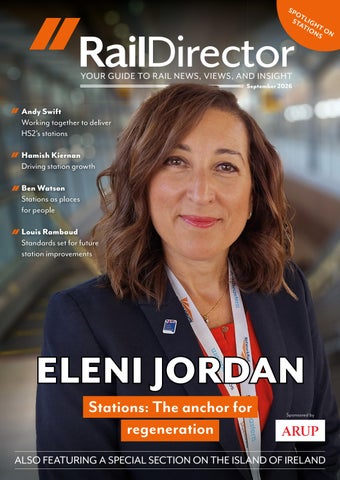
ELENI JORDAN Stations: The anchor for regeneration
Sponsored by
ALSO FEATURING A SPECIAL SECTION ON THE ISLAND OF IRELAND
3
INTRODUCTION
Gateways to communities
W
elcome to the latest edition of Rail Director focused on stations. It feels like full steam ahead for stations in the UK. As I write this the Office of Rail and Road has authorised the new Balgray station, the new eastern entrance at Bristol Temple Meads has opened, Transport for Wales is investing in Help Points at dozens of locations, and the first of six platforms has been completed in the underground station box at Old Oak Common. That’s just a few highlights of the current investment and development taking place right now But what I find particularly exciting is the change of mindset when it comes to building and renovating stations, now not merely points of arrival and departure, but places to relax, shop and even more importantly catalysts for wider economic and social value. With that being the case, this month’s cover feature Eleni Jordan, Commercial and Digital Director at South Eastern Railway, discusses how important it is to get the modelling right. “The regeneration of stations, bringing commercial element, customer element, social value together is a powerful combination,” she says from page 6. “But we need to move beyond this business-as-usual investment that we’re used to. We’ve got to think differently, about how we’re going to attract investment and unlock the opportunities for stations.” One area of progress that is being visibly seen are HS2’s Birmingham Curzon Street and Old Oak Common stations. Station Delivery Director Andy Swift took time to speak with Rail Director discussing milestones and explaining how the ongoing reset hasn’t stopped progress being made. You can read the full conversation from page 28. There are also articles with Ben Watson, Director of 7N Architects, about life since the organisation won the Re-Imagining Railway Stations competition; and GTR’s Chief Customer Officer Louis Rambaud discusses the operator’s Model Stations concept. This month we’ve also taken a look at the opportunities on the island of Ireland. More and more organisations we talk to are setting up foundations across the Irish Sea, and that’s with good reason, with some exciting projects expected down the line. Rail Director was at the latest Rail Link event in Belfast to hear more about the journey ahead, where Mary Considine, Chief Executive Officer of Irish Rail said: “No one organisation, no one supplier, no one operator can deliver this on our own, it needs that integrated approach.” Read more from page 40. There is also the fascinating quarterly column by Daisy Chapman-Chamberlain, a look ahead to the Railway Ball, and a conversation with Inspirational Frontline Woman of the Year at the latest Women in Rail Awards – Jane Fentaman. That’s just a taster of what to expect in the pages ahead. Thanks as always to everyone who has featured and to the Rail Director team for their fantastic efforts as always. Next month the focus turns to freight, and a special preview to the Railway Industry Association’s Annual Conference. All the best,
What I find particularly exciting is the change of mindset when it comes to building and renovating stations
Danny Longhorn Editor
Rail Director magazine and Railbusinessdaily.com are assets owned by the Railway Industry Association. Railbusinessdaily.com delivers more than 70 stories a week to +50,000 rail industry professionals in our daily 7am newsletter. If you have not already subscribed, it’s free and it’s easy to do so at www.railbusinessdaily.com, please also encourage your colleagues to do the same. This is the very best way to keep abreast of what is happening on the UK’s railways. There is a digital copy of Rail Director on our website.
LIFTING
SERVICING
TRAINING
RAIL LIFTING JACKS
MOBILE RAIL LIFTING JACKS
With over 40 years’ experience of high quality, heavy duty vehicle lifting, Totalkare combines world class products with industry leading support to facilitate effective maintenance and repair.
HEAVY DUTY SYNCHRONISED
For more information or to request a site visit:
RELIABLE
September 2026
4
CONTENTS
28
6
Stations: The anchor for regeneration
Eleni Jordan has just joined South Eastern Railway as its Commercial and Digital Director. She discusses the journey ahead and why stations will be central to the next phase of the rail evolution.
10 Driving station growth
Hamish Kiernan, Commercial Property Director at Network Rail, discusses retail in railway stations and the potential for future growth.
14 Stations as places for people
46
Ben Watson, Director at 7N Architects, discusses what has been happening since the organisation won the Re-Imagining Railway Stations competition.
20 Standards set for future station improvements
GTR’s Chief Customer Officer Louis Rambaud discusses the operator’s Model Stations concept and the plans to take the successes of the scheme across its network of 236 stations.
28 Working together to deliver HS2’s stations
HS2’s programme reset hasn’t stopped the progress being made on Birmingham Curzon Street and Old Oak Common stations. Andy Swift, Stations Delivery Director, explains more.
74
38 If we build around stations, we need to invest in them too Dominic Poole, Policy & Public Affairs Manager, and Robert Cook, Policy & Public Affairs Director, Railway Industry Association (RIA), focus on building around stations and the organisation’s Station Investment Zone model.
46 ‘The stars are aligning’
Andrew Doyle, Country Director for Ireland at WSP, and Shaun Doherty, the company’s Rail Growth Lead, discuss the opportunities on the island, and in ensuring the organisation is well placed to help deliver.
September 2026
5
CONTENTS
74 Darlington station: Conserving heritage during a major station upgrade
Following the opening of the revamped Darlington station Dr Gillian Scott, Technical Director, Built Heritage, AECOM, explores how a strong technical foundation, a passenger first approach and a passion for preservation maintained the architectural legacy of the historic station.
78 Investing in the next generation
Jane Fentaman, CrossCountry Train Driver, has been named Inspirational Frontline Woman of the Year at the Women in Rail Awards. She reflects on her career and her passion to inspire others. Image: South Eastern Railway
92 Lights, camera, impact
The Railway Ball returns on Friday 27 November with a ‘Night at the Movies’ theme. A £10 million fundraising milestone is in sight, and a clear invitation to rail: be part of the moment.
96 Looking for a sign
In her latest quarterly column, Daisy Chapman-Chamberlain writes about her research on the safety of women and girls internationally.
102 Why starting the conversation matters
Dave Brown, Head of Rail Programme at Samaritans, stresses that if you see someone who you’re concerned about, trust your judgement and start a conversation.
104 Movers and shakers
Tel: 01132 082620 Sales: 07494 529 803 Editor Danny Longhorn Danny@railbusinessdaily.com Designer and Production Manager Debbie Nolan Writers Rosie Crampton Nigel Wordsworth Advertising Sales Christian Wiles Chrisw@railbusinessdaily.com Marketing Sales Sarah Hopton Sarah@railbusinessdaily.com Production Executive Mia Hargreaves Published by Rail Business Daily 2 Bond Court, Leeds, LS1 2JZ Printed by The Manson Group © 2026 All rights reserved.
Featuring GBR Anglia’s Planning and Performance Director Chris Curtis and RIA’s Technical and Innovation Director Simon Scott.
110 And Finally
Students at Nottingham Trent University have been designing the tram stop of the future. David Russhard, Principal Lecturer in Civil Engineering at Nottingham Trent University, explains more.
September 2026
Reproduction of the contents of this magazine in any manner whatsoever is prohibited without prior consent from the publisher. For subscription enquiries and to make sure you get your copy of Rail Director please ring 01132 082620 or email info@railbusinessdaily.com. The views expressed in the articles reflect the author’s opinions and do not necessarily reflect the views of the publisher and editor. The published material, adverts, editorials and all other content is published in good faith.
6
STATIONS
Stations: The anchor for regeneration Eleni Jordan has just joined South Eastern Railway as its Commercial and Digital Director. She discusses the journey ahead and why stations will be central to the next phase of the rail evolution.
W
alking around Hither Green station fills Eleni Jordan with a huge amount of optimism – 14 months ago, it was the location chosen to launch Britain’s first integrated railway under public ownership. It’s brought teams from Southeastern and Network Rail Kent Route together under a single leadership structure ahead of the establishment of Great British Railways (GBR). The strengthened collaboration across operations, maintenance and investment has already paid dividends with the station being the site of the UK’s largest Access for All project, on track to be completed six months early and under budget. The teams at South Eastern Railway have done an incredible job to deliver this programme of work. “We are the trailblazers for GBR, and this shows it is already working,” said Eleni, who joined the now named South Eastern Railway as its Commercial and Digital Director last month. “The work at Hither Green highlights the benefits of the integration of track and train, with the project delivering improved efficiency and reduced duplication. The teams are harmonising and it is an example of the importance of looking to work differently.” Hither Green is seen as a model example of how an integrated railway can work in practice as a blueprint for GBR. The scheme will provide step-free access to all platforms and significantly improve accessibility for customers. “It’s important we all remember we serve as a bigger purpose,” Eleni said. “We’re not just the railway, there is the whole halo effect on the areas we serve; it really does unlock growth. “Stations are the gateways into the communities, catalysts for local regeneration, but we need to get their modelling right. “Rail-led regeneration and development is fully supported by Government and local authorities. Our role is to find a model that helps remove barriers and drive delivery. “The recent article by the Ministry of Housing, Communities and Local Government, Full steam ahead to fast-track more homes near stations GOV.UK, speaks to this point, setting out how more homes will be built around our railways and other public transport modes, fast-tracking
Images: South Eastern Railway, unless otherwise stated
September 2026
7
STATIONS
homes in well-connected areas. “The regeneration of stations, bringing the commercial element, customer element, social value together is a powerful combination. But we need to move beyond this business-as-usual investment that we’re used to. “We’ve got to think differently, about how we’re going to attract investment and unlock the opportunities for stations.”
Station Investment Zones There are more than 2,500 railway stations in the UK, with the potential for the estate playing a huge role in regenerating the areas they are located in and increasing housing supply. With significant constraints on Government funding and growing demand on stations as accessible inter-modal transport hubs, Eleni emphasises the need to find a new approach to improving existing station areas – a passion that stems back to her previous role as Commercial and Business Strategy Director at c2c/GBR Anglia. “I set up the Strategic Investment Forum, which looked to identify funding mechanisms for investment across the region and brought together colleagues from Network Rail, c2c and Greater Anglia,” she said. “We had several meetings and among the initiatives we looked into was the Railway Industry Association’s Station Investment Zones.” This proposes a new delivery model that is public spending neutral, not requiring new Government funding, but seeking to make use of all the different revenue streams potentially available: commercial and retail income; land value capture (such as through developer contributions and business rates retention); farebox (passenger revenues); and several different public grants across transport, housing and energy. “It also seeks to build on the strategic changes that are happening through devolution, planning, infrastructure and rail reform, which make a new approach possible. “It is one example of looking at railway stations differently, and although it’s still at an early stage, it’s something I’m interested to learn more about,” Eleni added. “What particularly struck me about this Station Investment Zone model is that it looks at generating incentives to support integrated housing, commercial and transport improvements. “It sets a planning approach that is sensitive to each community, so it’s quite innovative, but the good thing is that it’s scalable and in rail we need to find something that we can do differently that is scalable.” Thinking beyond the station Just one example of that wider thinking is the multi-million-pound Guildford Station Transformation project, an initiative by Solum, a joint venture between Network Rail and Kier Property, which alongside station improvements
Class 377 train pulls into Rochester station
includes hundreds of new homes and public realm work. “This is a good example of where a joint venture has been successful in transforming an area, while at the same providing a much better customer experience,” Eleni said. “At GBR Anglia we also worked with ports such as London Gateway, looking at opportunities to work together from an investment perspective.” South Eastern Railway engaged with Innvu to conduct station travel plans (STP) modelling to help identify and capitalise on third-party investment opportunities. The modelling helped the business secure an initial six-figure sum investment over two years with Kent County Council. “Although I’ve only just started working for South Eastern Railway, I can already see a huge opportunity, building on the work at Hither Green and Strood stations in delivering more improvement works quicker and more efficiently,” Eleni added. “In addition to the work with Kent County Council, we will be working with more councils to unlock opportunities that have been made by our station travel plans and hence providing benefits to our customers.” Eleni’s enthusiasm comes from not just the greater collaboration, but also the contractual arrangements operating under Department for Transport Operator (DFTO). “We’ve got multi-year funding mechanisms that unlock opportunities for long-term strategic thinking, instead of short-term, single-year thinking,” she explained. “Projects such as station improvements need to be multi-year programmes because it’s a capital asset that has to pay back over a period of time. “Being part of DFTO and GBR allows more strategic thinking, not only from a delivery perspective, but also from a funding perspective. It opens up opportunities to look beyond traditional methods of gaining funding. “Whereas in the past the Treasury would have been the main funding mechanism, we’re now thinking about how we can attract more thirdparty investment into the railway.”
September 2026
The teams are harmonising and it is an example of the importance of looking to work differently
8
STATIONS
Far left: Artist’s impression of aerial view of Hither Green AfA upgrades. Left: Wider aerial view of Hither Green accessible footbridge being lifted into place. Images: Network Rail
The funding constraints haven’t stopped South Eastern Railway from investing in stations, with the Hither Green work just one example of several projects that have seen improvements to toilets, waiting rooms, shelters, lighting and CCTV across the network. Alongside this, there has also been a refresh to the retail estate, aligning retail investment into the wider station improvements, which has helped not only accelerate the growth strategy in terms of ancillary money, but seen the arrival of bigger chains alongside the local-based community retailers. Eleni stresses that station improvements shouldn’t be underestimated, highlighting how they play an important role in South Eastern Railways’ three key targets: 90 per cent customer satisfaction, 90 per cent Time to Three (the percentage of stops arriving within three minutes of schedule), and less than two per cent cancellations. South Eastern Railway is currently performing very well in delivering against these targets. “There are some great foundations and initiatives at South Eastern Railway, so the plan for me from a stations perspective is to build on that and evolve the funding mechanisms because they need that investment,” she said. “We have some fantastic stations, especially
We’ve got multi-year funding mechanisms that unlock opportunities for long-term strategic thinking, instead of short-term, singleyear thinking
the London terminal stations, but there are some that need more investment. “Once we’ve got the funding mechanism right, it’s about the long-term public and commercial assets delivering better for customers, taxpayers and local communities. “It’s about rail-led development principles and leveraging the transport network and land around them to deliver transport hubs. I’d really like stations to be the central engine going forward, so there’s a more commercial mindset as well. “The commercial delivery of a business doesn’t just sit with the commercial team; it sits with the whole business. There’s a brilliant team at South Eastern Railway, and moving forward it would be good to collectively think more commercially, enabling us to generate income that can be reinvested in our stations.”
Collaboration Partnerships have been important to Eleni throughout her 24 years of working in the railways. In recent years, alongside working at various train operators, she’s also been involved with the GBR Property Design Workstream and Steerco, which look at the synergies across property to join them up much better. “The rail industry is one of the biggest landowners in the UK so it is a huge opportunity, but also a huge responsibility to get it right,” she said. “Both GBR Property Design Workstream and the Steerco is around property priorities, helping the industry think more consistently about how station and property assets can support customers, communities, revenue growth and long-term value.” Eleni believes that collaboration will only be strengthened under DFTO, of which currently eight in 10 passenger rail journeys that Great Britain will ultimately be responsible for are now being delivered by publicly owned operators. The list of operators includes South Eastern Railway. “Being part of a much bigger group means we’re working as one big railway operated by these central integrated units, or integrated regions,” she said. “We’re closest to the decision-making for customers, so we must make sure that the
September 2026
operating model is really effective in order to deliver for the customer and give value for the taxpayer.” Eleni also highlights the opportunities when it comes to data, which could help with private investment opportunities. “We can provide much better data for investors because we have all the retail systems within the remit, digital data, IT, which can identify revenue opportunities and payback periods,” she said. “Data can also help with the customer experience, such as with anti-social behaviour, looking at all these digital tools to support realtime decision-making. “The South Eastern Railway Property Review has looked at optimising accommodation requirements across the integrated business, joining up the data with the station requirement, with the opportunities for funding, and package it all together to then go out to market and really promote that.”
An industry that matters Concluding the interview with Rail Director, Eleni explained that success in the role will be stations being seen as long-term public and commercial assets that deliver better outcomes for customers, taxpayers and local communities. “It is about improving the public realm, making them safer, more inviting, more accessible for customers with additional requirements, and better connected,” she said. “The strategic growth piece is really important as well. “To get the right long-term investment in our stations we need to think differently with innovations, operational efficiency and strong stakeholder engagement and management. “We’re going to need more external investment, working more closely with our partners across the region and building longer-term strategic partnerships. “It’s a challenge we’re more than up for and one I’m looking forward to continuing at South Eastern Railway. It’s an exciting time to be in rail, right at the heart of reform, driving it forward. “We are catalysts for that change, innovators for that change, and we’re leading teams through that change. Stations are a big part of that and getting the model right is central to the next phase of the rail evolution.”
9
ADVERTORIAL
Late payments: A real risk
Advice from Richard Allen, Dip CII NEBOSH Client Director at Jobson James Rail.
W
ith rail investment programmes progressing slower than anticipated and many contractors waiting for projects to move from promise to delivery, businesses across the sector are under increasing pressure to protect cash flow and maintain profitability. Against this backdrop, one of the most significant risks facing rail suppliers is late payment and customer default. Recent research among 440 UK businesses highlights the scale of the problem. More than half of SMEs experience late payments, while almost one in three spend more than six hours every month chasing overdue invoices. More concerningly, 34.5 per cent report cash flow problems as a direct result of delayed payments. For the rail sector, these challenges are compounded by complex supply chains, long project
cycles and extended payment terms. Sustained cash flow is critical to business survival; a lack of liquidity poses a greater immediate risk than a period of losses. Regrettably, in recent years we have seen several contractors cease trading, creating a significant knock-on effect throughout the supply chain. In some cases, unpaid debts have contributed to further insolvencies among suppliers and subcontractors. For rail businesses investing in resources, people and equipment
ready for future opportunities, a single customer failure can have serious consequences. This is where trade credit insurance can provide valuable protection. Often viewed solely as cover against bad debt, trade credit insurance is increasingly being used as a strategic business tool. It protects businesses against nonpayment arising from insolvency, protracted default and other insured events, while providing access to valuable credit and risk intelligence. Before cover is provided, insurers assess the creditworthiness of customers, helping businesses gain a clearer understanding of trading risks within their client portfolio. This market insight can support more informed commercial decisions, strengthen credit management processes and help protect working capital. The benefits extend beyond financial protection. Trade credit
SPECIALIST INSURANCE FOR RAIL INDUSTRY SUPPLY CHAIN COMPANIES Infrastructure
Manufacturers
Rolling stock
Maintenance
Contractors
Consultants
Jobson James Rail
45 Church Street, Birmingham,B3 2RT and London One Creechurch Place, London, United Kingdom, EC3A 5AF. 07816 283949
info@jjrail.co.uk
www.jjrail.co.uk
Jobson James Rail is a trading name of Howden UK Brokers Limited, which is authorised and regulated by the Financial Conduct Authority No. 307663. Registered in England and Wales under company registration number 02831010. Registered Office: One Creechurch Place, London, EC3A 5AF. Calls may be monitored and recorded for quality assurance purposes. HUBL-CC-CS-JJR-005-1024
September 2026
insurance can support debt recovery, reduce pressure on internal resources and provide greater confidence when pursuing growth opportunities. Too many businesses are stuck reacting to late payments. Trade credit insurance changes that, giving businesses the insight to trade with the right customers, the protection when things go wrong and the support to avoid time-consuming debt recovery. Ultimately, it allows SMEs to focus on what matters most, growing their business with confidence. The rail market will recover, but many expect progress to take time. In the meantime, businesses that focus on financial resilience, customer risk management and cash flow protection will be best placed to take advantage of future growth. Call Richard Allen on 07973 963350
10
STATIONS
Driving station growth Hamish Kiernan, Commercial Property Director at Network Rail, discusses retail in railway stations and the potential for future growth.
Images: Network Rail
T
he figures speak for themselves. Network Rail has more than 642,000sq ft of retail space in its 19 stations, consisting of 515 units, 152 different brands, with over £970 million going through the tills in the last financial year. They are statistics Hamish Kiernan, Commercial Property Director, is proud of but keen to build on further. Based on current performance, he predicts sales could exceed £1 billion for this financial year. “That will come, driven by what we offer at stations,” he said about the £1 billion sales mark. “There is so much more potential, and it is realising that potential that gets me up in the morning. And in working to enhance the experiences of customers, we put money back into the running of the railway to lessen the tax burden. “It’s exciting and every day is different, so it is
about evolving and coming up with new ideas to make sure we have the right offer and are giving the customer the best experience when visiting our stations.” Three stations now are taking more than £100 million in retail sales every year, with London Waterloo reaching £116 million, and both London Bridge and Liverpool Street stations taking £110 million. Paddington station isn’t far behind with £95 million in the last financial year. “It hasn’t always been smooth sailing, but overall it has been a really successful few years with the amount of cash going through the tills,” Hamish said. “There’s definitely been a growth through our offer, but of course then there is an inflation point in there as well because of prices, something we’ve seen across retail in general. But if you look at the numbers we’re about 17.5 per cent ahead since COVID so it’s good.”
September 2026
11
STATIONS
When Hamish last spoke to Rail Director two years ago, he highlighted the need to grow the credibility and breadth of the retail offer in stations, and how they were becoming destinations where travellers, non-travellers and the local community can come together to shop, eat, and drink. “I still think there’s work to do because of the change seen across retail and food and beverage sectors,” he explained. “This constant evolution is something we continue to work hard on, having attracted the likes of The Salad Project, Sweaty Betty, Popeyes, Hobbs, and Indi-Go in recent years. “So it’s all to play for looking at the mix, but then we mustn’t forget we’ve got to drive the everyday brands as well. The key for me is making sure we’re giving the customer what they want.” Passenger insights, gathered annually, tap into the passions and preferences of customers, with the in-house experts combining this with their knowledge of trends and station spaces to create the right retail mix. “We talk to customers in our stations to find out about their experiences and what they’d like to see in those stations,” Hamish said. “We do a whole piece on passenger insights to gain a deeper understanding on their needs/ wants and their overall attitudes towards the retail offer. “There are similarities between the stations, but it does also differ between regions, which is
It’s exciting and every day is Partnerships What is particularly interesting is the relationship different, so it is between the retailers and Network Rail. Hamish is quick to describe those occupying about evolving units as partners, and retail leases are based on a minimum guarantee rent with turnover and coming up percentage of sales ensuring both Network Rail and the brands are incentivised to make the with new ideas to business work hard for both. “These relationships are key to attracting make sure we have brands; they know what to expect when they come to work in one of our stations.” Hamish said. the right offer “If we open a food and beverage unit, we work and are giving with them to make sure the offer works around the clock for breakfast, lunch and dinner. the customer the “We ask our retailer partners to look at what they can do, and what they can’t. But we also best experience encourage them to consider the opportunity presented by a million passengers walking past when visiting our their front door each week. “Greggs is a good example, as we were talking stations to them for years before they opened up and that interesting. Overall, these insights are proving to be a great guide to us, helping the retail category team to improve the station experience.”
partnership continues to go from strength to strength. “It really is a partnership – if they succeed, then we succeed. In addition to that, the team has started an initiative called Operation Shine, focused on operational standards, SCAN ME
Keep Railway Stations Moving with Klüber
Reliable lubrication for demanding station enviornments.
Escalator & Passenger Conveyors
Automatic Doors
Gearboxes
Kluberoil C 1-150
Barrierta L 25 DL
Specially developed for the lubrication of escalator drive chains, helping operators maintain reliable performance in outdoor and mixed indoor/ outdoor environments.
Developed for demanding railway and transport door applications. It provides dependable performance in environments exposed to frequent cleaning and washdown conditions.
Klübersynth GH 6 Series Fully synthetic gear oil designed for heavily loaded industrial gearboxes, providing reliable protection, long oil life and reduced maintenance requirements.
Visit our site to learn more. Contact: info.uk@klueber.com
September 2026
12
STATIONS
We’re all looking to the future, to Great British Railways and how that works in the grand scheme of one big railway family
considering what the retail unit looks like – are the shelves full? Is it clean and appealing? “It’s seeing things through the lens of a customer and making sure that it’s the best presentation we can get from that unit. We work closely with shop managers and regional managers and feed back to the head office,” Hamish explained. “If we’re finding things like obstructions on the shop floor or low stocked shelves, this is something we’re picking up with the retailer. The customer has a choice about whether they want to shop in the station, so the unit has to look its best. “If you look at the main managed stations, they’re in areas where you can shop outside before you come in, so we need to have range, and it’s got to be special – and better.” It’s something that must be working because
the void rate across the Network Rail stations is just 2.9 per cent, which is better than it was pre2019. The organisation is maxing out the rentals and, in a bid to use more space, opening up pop-ups and offering short-term lets. “The latter gives retailers the opportunity to come in and dip their toe in the market at a minimal risk and it also brings that variety to our customers travelling through the stations every day,” Hamish said. “Space remains an issue though and we have to be magicians! We’ll make any size of space work for us, with examples including knocking cupboards into bigger units, swapping out ATMs and even putting in units paid side (after the ticket barriers). If we can get more space that’s great, and particularly at concourse level we can show a real return on it.”
September 2026
Sustainability continues to remain a priority, with environmental, social and corporate governance standards at the top of the agenda. An initiative Hamish is particularly pleased with is a partnership with local food-sharing app Olio to combat food waste through the Food Waste Heroes programme. “It’s been a huge success and we’ve saved somewhere in the region of 106,000 kilos of food waste over two years, with that food benefiting local communities to the value of 230,000 meals,” he said. “I’m really proud of everyone who has been involved in this project. It’s a great example of the positive impact the rail industry can have, while at the same time reducing the amount of waste that goes to landfill.”
It’s all to play for Looking ahead to the future and one thing for certain is that Hamish and the team won’t be sitting still and resting on their laurels, especially with the station sales aspiration of £1 billion. Alongside this is the £1 billion transformation of Liverpool Street station, Britain’s busiest station. The plans include a 76 per cent concourse capacity increase, more station retail floor space at upper concourse level, and the repositioning of units so they are more accessible and fit for purpose. “We’re all looking to the future, to Great British Railways and how that works in the grand scheme of one big railway family,” he said. “It’s not Network Rail, or a train operating company, it’s looking at the railway as a whole industry, working with colleagues collectively. “This is about how we can work together to enhance the experience for the customer and have that offer, wherever you travel. Some great things are happening out there so it is about sharing those best practices to make what we offer even better.”
I started as an apprentice. Now I use digital tools to help transform rail in Scotland. Calum, Train Performance Engineer siemens.co.uk/scotland
14
STATIONS
Stations as places for people Ben Watson, Director at 7N Architects, discusses what has been happening since the organisation won the Re-Imagining Railway Stations competition.
S
ix years ago 7N Architects beat off competition from 200 entries from all over the world to be named the winner of the Re-Imagining Railway Stations competition, held by Network Rail and the Royal Institute of British Architects. The aim was to reimagine how small to medium-sized railway stations can improve the travel experience for millions of passengers across the UK with the winning design, termed the ‘Hub Station’, centred on sustainable and communityfocused transport hubs, incorporating renewable energy and local materials. “It was a fantastic brief because it was purely about how we could make these stations better places,” Ben Watson, Director, reflected. “We were developing our response in the middle of the first COVID lockdowns, thinking about these places full of people, and reflecting as
HUB Station, approach to a medium sized station. 7N Architects / Pillar Visuals
a team over Zoom on the stations we’d personally experienced – what worked and what didn’t. “That shaped our response: stations as places for people and civic spaces within the place they serve first and transport infrastructure second, rather than the other way around. “Our proposals focused as much on the station’s setting and its connection to the local community as on the infrastructure and buildings themselves.” 7N’s proposed station frontage includes an eye-catching clock tower, which serves a strong civic purpose as a local landmark and a natural meeting place for social activities. The station environment extends beyond the platform into civic spaces that welcome travellers and give people reason to gather and linger. A ‘welcome mat’ of landscaped public realm defines these spaces, reflecting local character through
September 2026
local materials, craftsmanship and planting. Beyond the station entrance, sweeping platform canopies provide shelter for passengers, with the overall modular station design able to be integrated into a variety of locations that complement the local landscape. The design also cleverly incorporates renewable energy generation with translucent photovoltaic panels, which also provide dappled shade and shelter from rain. “That’s how we approach all of our work at 7N,” Ben said. “A placemaking-first approach: really thinking about the people who are going to use whatever we’re designing, and how it can best serve and represent the place it’s based in. “There’s a reason these spaces often feel utilitarian and pared back: it’s a genuinely challenging environment to deliver projects in. “There’s significant regulation, considerations
15
STATIONS
around safety, a lot of complex engineering that goes into a rail project, and of course funding constraints. “That calls for a lean approach to design to make finite resources go further – delivering the best we can for the people who use the railway, stripping away anything that isn’t necessary, and challenging assumptions from the past.” Ben co-leads the practice as a Director alongside Ewan Anderson and Craig Tait, leading teams and providing strategic direction to projects. He’s an architect with experience across a range of sectors, including large-scale urban regeneration, residential, workplace and transport, and has led some of 7N’s most significant projects such as Western Harbour, Re-Imagining Railway Stations, and New Yards. 7N is an employee-owned design practice with a placemaking-led approach that the team bring to a broad portfolio of work across Scotland and the UK. Key projects include West Town, a 7,000home 20-minute neighbourhood in Edinburgh; New Yards, a significant new office and hotel development at Haymarket; and repurposing of prominent listed buildings with uses ranging from new homes such as at Jordanhill in Glasgow to music studios and community spaces such as at Granton Lighthouse. “The projects we seek out are the most complex briefs and challenging sites, because that’s where we can really flex our creativity to help our clients and have a positive impact,” Ben said.
LIFTING
SERVICING
TRAINING
HUB Station, view along the platform. Image: 7N Architects / Pillar Visuals
Competition-winning concept Since the competition, 7N Architects worked closely with Network Rail project representatives to develop its design into a formal proposal that addresses a prescribed set of technical requirements, including the consideration of construction methodology. “The outcome of the competition was a commission to develop design guidance for Network Rail. Alongside a wider design team that we led including Arup, LUC and Gardiner & Theobald, we produced the ‘Design Manual for Medium to Small Stations’, published in 2022
as part of Network Rail’s design standards,” Ben explained. Around 2,000 of the 2,500 stations in the UK fall into that definition of medium to small categories, from a rural halt to many of the stations in our towns, villages and city suburbs. “The design manual covers everything from the principles and objectives a station project should aspire to, through to the process of actually developing, designing and delivering a station,” Ben said. “It also covers the underlying technical characteristics, from the materials used to
RAIL LIFTING JACKS & PIT EXPERTS Reliable lifting and testing equipment for all rail vehicle maintenance.
MOBILE RAIL LIFTING JACKS
With over 40 years’ experience of high quality, heavy duty vehicle lifting, Totalkare combines world class products with industry leading support to facilitate effective maintenance and repair.
HEAVY DUTY SYNCHRONISED RELIABLE
RAIL INSPECTION PITS INCREASE PRODUCTIVITY SAFE QUALITY LIGHTING
For more information or to request a site visit:
September 2026
16
STATIONS
HUB Station, key elements sketch. Image: 7N Architects
the configuration of canopies and passenger facilities, through to specific considerations like lighting, carbon analysis and cost.” The manual is illustrated with 7N’s Hub Station proposal – the competition-winning concept, developed further into a detailed standard design. This has reached what Network Rail calls ‘approval in principle’ status and sits in its standard design catalogue, so any project team can take it off the shelf and apply it to a live project site. “It’s designed to be adaptable across the majority of those 2,000 stations,” Ben said. “Think of it as a kit of parts that can be used as a whole or in part to suit any particular project, whether that’s upgrading an existing station or creating an entirely new one. “Over the past few years we’ve focused on working with clients to help them make Hub Stations a reality. We’ve been involved in several across the UK, with others in development, ranging from Wickford in Essex to Coleraine in Northern Ireland, and most recently Stranraer in Scotland.” On the latter, 7N completed a feasibility study for Scotland’s Railway to reimagine the station, transforming it from a remote facility into a vibrant gateway that reconnects the town to its unique waterfront identity. Using the Hub Station modular design, the proposal envisions a relocated platform that
celebrates Stranraer’s distinctive setting, framing views across Loch Ryan – creating a memorable arrival experience and improved passenger facilities that can act as a catalyst for waterfront regeneration, community vitality and tourism growth. “This is a good example of where we’ve brought together our wider expertise in masterplanning and urban design with our specialism in rail, and particularly stations,” Ben said. “The study was as much about the siting of the station and how that connects to the town centre as it was about the station itself, for which we already had the template from Hub Station. “Infrastructure projects tend to be long-running processes, so a lot of our role is keeping sight of the bigger picture and the ambition, because there are always challenges along the way and there is a risk the initial aspiration gets gradually watered down. “That’s where we see our role: as an advocate and champion, staying pragmatic but still pushing to deliver the best possible environment for people and place.” It’s a passion driven by Ben’s personal experiences in stations, both at 7N Architects and prior to that when he worked on Watford Junction Station as part of a wider development. “I’m interested in stations for the same reason a lot of our work makes me want to get out of bed in the morning – it’s all about architecture that
New Yards, office elevation view across railway. Image: 7N Architects / Daako
creates places that make people’s everyday lives better,” he said. “If we can make a station easier and more enjoyable for someone, that’s what I find satisfying about the job, that positive impact on people’s lives. “Transport infrastructure is such a key part of that for all of us, and I’m excited about the role we can play in its future. There’s a real opportunity for the rail industry to look outwards and enhance its place in the wider conversation around development – making places that people want to live and work in. “It’s an evolution. The competition win was built on us coming at this as something of an outsider to the rail industry, highlighting that a station is all about the people who use it and the place it serves, rather than the platform and the building. “We’re now at a point where, with that growing expertise, we can take a bigger step and ask: shouldn’t the rail network support the wider places and neighbourhoods we live in? It’s not about the infrastructure; it’s about what that infrastructure can unlock and enable. “There’s huge potential around stations, new and existing, to harness the potential of transport initiatives to unlock placemaking and regeneration and create sustainable, well-connected places – the stations as civic catalysts.”
West Town people focused 20-minute neighbourhood. Image: 7N Architects / Daako
September 2026
The smarter way to build platforms GRP d2 Dura Platform - Up to 71% lighter than traditional materials, for dramatically lower embodied carbon and quicker, safer installs. Fully adjustable to suit ballast, track or train changes - built to perform today and adapt to tomorrow.
Do it once. Do it better. Save carbon.
d2 Dura Platform
18
ADVERTORIAL
Getting more innovation bang for your buck Alan Peters, Rail Director at Connected Places Catapult, reflects on the success of the Station Innovation Zone and considers how the approach can scale.
C
onnected Places Catapult is entering the fifth year of its Innovate UK-funded Station Innovation Zone (SIZ) programme, working with Network Rail to allow SMEs to test new technologies in live station environments. The programme has been a huge success, with 12 trials carried out to date in Bristol Temple Meads station. One of the key elements is a dedicated Network Rail testbed manager, coordinating station access, operational input and safety requirements for SME trials. The programme helps SMEs to develop their products and grow their business. It makes it easier and less risky for rail partners to support innovative new approaches. And, ultimately, it helps improve the passenger experience by bringing new products to market. “Every year SIZ is facilitating multiple trials that demonstrate new solutions for rail clients,” Alan Peters, Rail Director at Connected Places Catapult, said. “We’re also seeing the commercial success this real-world validation drives for the SMEs we support.”
Overcoming barriers SIZ has supported more than 35 SMEs, awarded more than £670,000 of funding, and led to more than 300 engagements between organisations, Network Rail and the wider industry. The programme’s success hasn’t just been vital for the SMEs, but the technology trialled is transforming the experience for the industry and its customers. This includes XRAI and Ampetronic, working together to develop AI-powered multilingual announcement systems to help railway passengers understand real-time platform changes and travel updates through instant translation, captions and accessible ‘Auracast’ audio. WeWALK has been supporting visually impaired passengers to travel independently with WeASSIST, a real-time navigation tool within the WeWALK app. It has been co-designed with the Royal National Institute of Blind People (RNIB) with trained agents guiding users through key station tasks. Createc has developed a LIDAR crowd monitoring system called Situate, which uses AI to alert operators to incidents in real time and warn of concerning activity. A single sensor can cover large distances and be alert to people running or
Every year SIZ is facilitating multiple trials that demonstrate new solutions for rail clients
Image: Connected Places Catapult
standing too close to the platform edge. CrossTech uses automated computer vision inspection software to help people involved in the operation of the station improve efficiency and safety by locating or predicting potential hazards; this includes detecting and alerting passengers approaching stairs with unsuitable luggage. Optimise AI has built a digital twin of Bristol Temple Meads to minimise operational energy use, via a 3D digital twin platform. It’s already shown energy consumption can be reduced by one third, and heating and lighting by 15 per cent in low occupancy periods. Alan said: “These examples highlight possible operational business improvement, including achieving a higher level of station safety, better understanding of passenger flow, and reduced operating costs of running a station.”
Compelling proposition The success so far is just the start, with Alan calling for more testbeds to be set up, saying the SIZ model can be easily replicated in other transport hubs. “Take unstaffed stations as one example, where there are a different set of problems that could benefit from the SIZ programme,” he said. “The method works and there’s a proven track record in trialling technology in a working station. “Now with a playbook in place centred on six phases (working out what the challenge
September 2026
is; understanding the business case; going out to market; the testing; understanding the procurement space; and performance monitoring) this can easily be implemented elsewhere.” And with the foundations in place, he believes the inception of Great British Railways is a good time to expand the programme. “Multiple different trials around different themes are far more efficient than testing one single technology at a station,” Alan said. “It gives you a chance to build the supporting testbed layers, the governance and relationships, all the things that might not be the most exciting, but failure to have any could stop the trial. “You don’t want to have to do it each time, when you can share the load across each innovator cohort. “The SIZ is already proving to give you more innovation bang for your buck, and there’s potential for that impact to be even greater.” https://cp.catapult.org.uk/project/stationinnovation-zone/ The Connected Places Catapult team will be at the InnoTrans event in Berlin in September– together with innovators WeWalk, Createc and Journey Alerts. Visit the Station Innovation Zone stand (560G) within UK Pavilion, see live demonstrations, and discuss if an innovation zone approach could give you similar business improvements.
20
STATIONS
Standards set for future station improvements GTR’s Chief Customer Officer Louis Rambaud discusses the operator’s Model Stations concept and the plans to take the successes of the scheme across its network of 236 stations.
Images: GTR
“W
e want to create a blueprint for stations across the country, one that creates environments that passengers find welcoming, clean and comfortable, safe, secure, digitised, accessible and inclusive with model staff serving their communities and customers.” That’s the message from GTR Chief Customer Officer Louis Rambaud, who has been leading the operator’s Model Stations concept, developed to guide the future improvement and modernisation of stations by setting out clear, customer-focused standards for design, accessibility, safety, staff training and customer service, and overall customer experience. So far GTR has trialled the concept at three stations – Enfield Chase, Gipsy Hill, and Elstree & Borehamwood – one each for three of the four services it operates (Great Northern, Southern and Thameslink), with plans to take the successes
of the scheme across its network of 236 stations. “We can’t transform the UK’s entire network of stations in one go but creating a clear outline of expected outcomes will ensure that future investment is spent wisely and efficiently, delivering the best outcome for taxpayers and passengers alike,” added Louis, who has been in his current role for two years. “The opening of the first three stations this year is the outcome of a long process internally that started almost two years ago to imagine what a great station experience looks like for the customers and to bring that to life. “This was about working smarter and wiser, delivering brilliant basics for the customers, improving their satisfaction, and winning more customers so that they can come onboard and use the railway.” Early indications are good. At Enfield Chase, the first of three to open, customer satisfaction
September 2026
among passengers has risen by 16 percentage points from 77 per cent to 93 per cent. This hasn’t been about huge investments, with significant improvements made at low cost simply by looking at stations through the eyes of customers, with changes including platform art, decluttering, and zoned areas that include planning your journey, buying tickets, and starting your journey with clear, real-time information. It has been a similar story at the second station to be trialled (Gipsy Hill). Customer satisfaction among passengers has shot up there by 11 percentage points from 79 per cent to 90 per cent, with the station closely monitored with a new Customer Quality Management System (a set of standards and processes that GTR uses to consistently deliver the level of customer experience it has promised). All aspects of the station environment have been considered, from lighting to staff training
21
STATIONS
and from accessibility to community engagement. “You don’t often see such a big shift of customer satisfaction for something which in many aspects is quite basic and simple,” Louis said. “They have been massively impactful and great value for money initiatives, maximising the customer satisfaction with minimal investment. “It’s a very exciting achievement, but it’s only the beginning of the story. We’ve spent a lot of time designing these blueprints and now it’s about rolling that out everywhere, applying our standards and processes, while at the same time acknowledging that each station has its own personality. This isn’t about having a one size fits all approach.”
Getting to the Model Station A lot of thought has gone into coming up with the Model Station concept. It is aligned to GTR’s strategic pillars to deliver a reliable and dependable service, drive improvements for passengers and industry, while also maintaining focus on efficiency and providing value for money to the taxpayer. “There were the high-level principles and concepts and then we looked at what they mean in real life at the station and how it will translate into the look and feel of the stations, into how customer service staff should behave, into our processes, and ways of working,” Louis explained. The criteria of a Model Station range from
You don’t often see such a big shift of customer satisfaction for something which in many aspects is quite basic and simple www.ciro.org
Academic Programme
Applications Open Start a journey that could transform your future. Take the next step in your railway career with CIRO’s academic programmes, delivered in partnership with Keele University from 2026. Whether you’re looking to broaden your operational understanding, strengthen your leadership capability or gain an industry-recognised qualification, our programmes are designed to help you see the railway differently.
Certificate of Higher Education in Railway Operations Management
Diploma of Higher Education in Railway Operations Management
Bachelor of Science Degree in Railway Operations Management
New for 2026: Partnership with Keele University From 2026, CIRO’s academic programmes will be delivered in partnership with Keele University, combining railway operations expertise with high-quality academic teaching and support. Together, CIRO and Keele University are developing the next generation of railway professionals through industry-relevant qualifications designed around the evolving needs of the railway.
Apply Today For More Information:
If your organisation is prepared to invest in you, invest in yourself. The support is there at every step, from tutors to peers, and the whole programme is designed to help you succeed and grow.”
www.ciro.org/courses-applications-open/ learning@railwayoperators.co.uk 03333 440523 Ext 1014
Dave Moore Train Service Manager, GWR, CIRO Diploma Student
Shaping the future of rail, together.
September 2026
22
STATIONS
being best in class for customer experience; clean, comfortable, and welcoming with clear signs and excellent staff; being accessible and inclusive; through to being integrated with other transport networks; safe and secure, and minimising environmental impact. “It’s about creating a much clearer, simpler environment, decluttered with a much easier way to navigate through a station, with a great customer service provided by our staff,” Louis added. “Some of our stations are quite old and over time we have cluttered them so much that it’s becoming an awful experience and we want to change that. “Creating zones in stations is helping to deliver that, with an area to plan your journey, get your ticket, and access real-time information. From a staff perspective is it creating the environment to help them to deliver a better customer service with the launch of Great Journey Makers training, which is entirely customer centric. “This is also about our processes. We have redesigned fully all our processes end to end for all of the customer journey from buying the ticket, to having the right information, to managing the cash at ticket vending machines. “All of that is standardised across GTR with clear processes and policies so everyone can work in the same way and, should it be needed, work in different stations.” Louis is passionate that stations don’t just serve the customers but also the local community, evidenced by partnerships being created. He also believes the operator needs to be more vocal in promoting GTR’s products, services and destinations, and ensure stations feature thirdparty services and shops that serve the needs of customers. “On the retail side it can be having the right coffee shop or community shop serving the needs
This was about working smarter and wiser, delivering brilliant basics for the customers, improving their satisfaction, and winning more customers so that they can come onboard and use the railway September 2026
23
STATIONS
The criteria of a GTR Model Station are:
of the community and customers,” he explained. “To anchor into the local community, to win customers, you need to be part of the community. “Far too often in our industry we are driven by processes, policies, and standards that over time have become focused on ourselves and not on the customers. The Model Station principle is here to change this approach, ensuring that we focus on customers first.” As for the future, following the opening of the third trial station (Elstree & Borehamwood) in the summer, Louis is not daunted by the prospect of the remaining 233 stations in the operator’s portfolio, adding that the benefit of Model Stations could go even further. “It’s very exciting because it’s one of the few projects that is super transversal across the whole organisation, involving each and every one, and with a common goal which is very much understood. People are happy to be involved in it because it’s changing the lives of customers,” he said. “It’s changing massively their satisfaction and working all together – the facilities team,
station team, marketing team, people managing ancillary revenue – we have a big impact on customers when we have this common goal and those common ways of working. “This can go beyond GTR. Alex Hynes (Chief Executive Officer at Department for Transport Operator) visited our Model Station at Gipsy Hill and said it exemplified the modern, customer-focused railway we are building for our customers. “With eight in 10 passenger journeys now made on publicly owned operators, he says there is a great opportunity to share successes from this scheme across the country. “Rail reform is all about ensuring a consistent approach across the whole country, which for stations could be a common approach across the 2,500 stations, improving the customer experience with train operating companies sharing best practice. “We have this Model Stations concept that could be part of that, but we are very much also open to welcome other best practices from other train operators.”
Working together to empower a brighter energy future for the railways
September 2026
Be best in class for customer experience: Clean comfortable, welcoming with clear signs and excellent staff. Be accessible and inclusive: With stepfree access as the goal, with facilities for non-visible and visible disabilities, easy to navigate. Be integrated with other transport networks: Seamless handover to and from bus, bike, taxi and other rail. Be safe and secure: Well lit, well patrolled, clearly monitored with a strong sense of reassurance. Proudly market products and services: Showing clearly what’s on offer and why it matters. Offer a modern and seamless retailing experience: Easy, flexible ticketing and purchasing (eg contactless, digital, mobile). Offer diverse third-party services: Such as shops, food, lockers, community services. Be a great partner to local communities: Active presence in the local area and strong, two-way engagement. Minimise environmental impact: Through reduced energy and water use, less waste and more biodiversity. Have standardised processes: Efficient, predictable back-of-house and customerfacing operations.
24
ADVERTORIAL
Unlocking London Liverpool Street station Adam Parkes, Regional Director and Market Sector Lead for Stations in UK and Ireland, shares how AECOM helped secure planning approval for the ambitious and complex transformation of London Liverpool Street station within just 18 months of taking on the project.
T
erminus railway stations, especially those situated within historic and densely populated cities, are some of the most complex infrastructure projects to deliver from an engineering perspective. Schemes involve grappling with stakeholder alignment, funding constraints, political instability and long-term delivery risk, none of which can be solved in isolation. Those issues are exacerbated if the transformation is for Britain’s busiest station, Liverpool Street, in London. Since it was last redeveloped in 1991 when the roof over the main concourse was fully replaced, customer numbers have tripled, with annual passenger numbers forecast to grow by 35 per cent to 158 million by 2041. Earlier this year the Planning Committee of the City of London passed a resolution to grant planning permission for the scheme, which when complete will ensure the station is ready to accommodate more than 200 million people in the decades ahead. It will also help drive long-term economic growth across the region, potentially boosting the economy by up to £4.6 billion per year through increased visitor numbers. “There’s a huge sense of pride in being involved in a project that will transform the station used by more people than any other in the UK, but with that comes the responsibility to make sure it is delivered sensitively and respectfully,” said Adam Parkes, who led the AECOM multi-disciplinary design that delivered the planning consent on behalf of Platform 4, Network Rail and the project architect ACME. “This station has gone through multiple transformations in both its design and use, with entrances evolving to serve everyone from horsedrawn traffic to today’s emphasis on active travel and cycling infrastructure. “This is why AECOM brought together a strong multi-disciplinary team to this project and committed the expertise and resources needed to deliver something truly transformational for Network Rail: a station that not only meets the needs of its users but stands as a destination in its own right.”
Image: Network Rail Property and ACME
Image: Network Rail Property and ACME
Getting it right from the start It’s not been easy to get to this stage. AECOM was brought onboard to help Network Rail revise its original plans following some challenges to delivery, with the update reducing the size of the oversite development and realigning the building to avoid interfering with the site of the Great Eastern Hotel, redesigning station entrances, improving accessibility and respecting the historic Kindertransport statue.
September 2026
To make the engineering design deliverable, AECOM looked at construction phasing from the outset. Working closely with the Tier 1 contractor, the team developed a construction management plan that focused on build sequencing, logistics and maintaining operations throughout the programme. The location of the new station roof’s structural columns and arch segments was determined by overlaying buildability input from the contractor
25
ADVERTORIAL
with a model of the existing London Underground tunnels beneath the station. This approach helped ensure the design could be constructed safely and efficiently within the site’s constraints. AECOM also worked closely with Network Rail’s station team and train operators to minimise disruption during construction. Passenger flow and train timetabling models were used to assess the impact of the phased works, helping develop temporary arrangements for pedestrian routes when entrances are closed and re-opened throughout the programme. “From the start we got all the key players around the table to make sure we were all aligned to that common goal of delivering a buildable station,” said Adam, who’s been at AECOM for 19 years. “The key risks to the project were heritage concerns of the previous application and a solution for taxis and buses to ensure that they could maintain operations during construction. “We worked collaboratively with the likes of London Fire Brigade, City of London Police, Transport for London and Historic England to address their concerns and come up with solutions together. “It hasn’t been easy, and it has certainly helped drawing on AECOM’s diverse inhouse expertise to provide all the disciplines Network Rail needed to support the project architect. “We delivered environment, sustainability, transportation and all the engineering, meaning that there were fewer design interfaces, cutting out a lot of programme contingency, scope gaps and design risk. “The project hasn’t been free of public scrutiny and media attention, but throughout the process everyone involved has shared a clear, common vision of the direction of travel, with stakeholder feedback considered throughout the design development process. “We understand that projects of this scale are going to attract significant attention, but we know that with our technical experience, strong collaboration and the alignment across all parties, they can be delivered successfully. Most importantly, we can all be proud of the benefits it will bring to the public when it’s completed.”
Placemaking of stations When complete, the overall concourse capacity will be increased by 76 per cent, with lower concourse space expanded by 23 per cent to dramatically ease passenger flow and reduce congestion, and it will be a fully inclusive station providing step-free access from street level to all platforms. The 1990s Bishopsgate and Hope Square entrances will be reconfigured, as will part of the modern station roof, which sits above the main concourse area. Adam emphasises that the whole scheme has been carefully designed to safeguard the station’s unique heritage. The Victorian trainshed remains completely untouched and the transformation will add new mezzanines to unlock new views over the Victorian architecture, bringing passengers closer
Adam Parkes. Image: AECOM
to the station’s heritage than ever before, while providing a higher quality retail and hospitality offer for those waiting for trains or meeting people. Office space above station concourses can create opportunities to maximise the value of highly connected locations while supporting wider regeneration and growth ambitions. The new office space above the concourse will be one of the best-connected in the capital, making it a highly sustainable and commercially attractive location for businesses while supporting the city’s growth ambitions. “I’m a big advocate of providing placemaking at stations and improving retail provision because those help drive up revenues for our train operators,” Adam explained. “If people want to spend more time in a station rather than simply pass through it, they are more likely to use its shops, cafes and other amenities. That generates additional income, which then can be used to help maintain stations and support the wider railway. “For Liverpool Street, we grasped the opportunity of being responsible for designing transport, engineering and sustainability into the placemaking vision. The project’s proximity to our London office gave us a unique connection to the area, making it particularly rewarding to help shape its future. “I believe the fixed-price contract structure helped create conditions for successful delivery. It gave AECOM clear responsibility for driving progress, coordinating stakeholders and assembling the multidisciplinary expertise needed to address challenges as they arose. “With a fixed deadline, the focus was on efficient decision-making, proactive collaboration and delivering the best possible outcome for Network Rail.”
Rethinking station design in the UK Adam is determined to see the industry do better when it comes to station design but admits that involves a culture shift. An example he gives is the Wessex Capacity Alliance, a very successful project increasing capacity on the route by 30 per
September 2026
cent, including at London Waterloo. “A great job was done on repurposing the international terminal at the time, but the brief didn’t extend to exploring wider redevelopment opportunity around Waterloo station to bring in private investment to help fund these upgrades,” he said. “A reform of the use it or lose it public spending rules would be an interesting and potentially rewarding policy shift for the taxpayer. Too often, there can be pressure to spend available funding within a prescribed timeframe, which can encourage shorter-term maintenance projects rather than more strategic development opportunities. “If development teams had an extra two or three years to assemble investment and partnerships, they could unlock opportunities such as over-station development, allowing private capital to contribute towards station upgrades, and generating broader economic and placemaking benefits at the same time.”
Lessons from the US Adam wants to see the UK take a similar mindset to the US when transforming stations. The example he gives is AECOM’s ongoing work on Penn station in New York, which will see it transformed into a modern transport hub, improving safety, increasing capacity and enhancing the overall passenger experience within accelerated timeframes. The plans include oversite development in Manhattan, more efficient station layouts, improved accessibility and a more user-friendly environment. “MVP (minimum viable product) is an acronym we use a lot in the industry here in the UK, which is basically saying ‘how can we deliver the scope for the cheapest’,” he said. “In the US the question appears to be ‘how we can make this station as grand as we can to enhance tourism, maximise revenues and be proud of the station’. This approach makes them destinations and looks at the long-term potential. “You will stay in Penn, you will have a coffee, and you will potentially have a meal because it will be so amazing. That’s what we’re trying to achieve with Liverpool Street. That level of ambition won’t be right everywhere, but it should be part of the conversation for our largest stations and transport hubs. “That’s the mindset we need for future stations in the UK. I don’t want everyone rushing through the station because the concourse space is so tight. The intention for Liverpool Street should be lots of food and beverage with people wanting to stay there beyond waiting for trains. “There are some huge opportunities coming up in the industry, so we need to be bold and ambitious like we’ve been at Liverpool Street. We should be creating stations that inspire a sense of pride and excitement, the kind of places that give people goosebumps. “Our stations should be destinations, not simply places where passengers step off a train and move on.”
26
ADVERTORIAL
Practical considerations in enabling station development Jason Hurst, Partner, Grant Thornton, Public Services Advisory, writes about why stations are becoming central to the debate on housing and devolution, and what it actually takes to get development off the ground.
T
he Government’s ambitions for new housing, and its drive to hand Mayoral Strategic Authorities (MSAs) more control over how their areas grow, have put stations firmly back on the agenda. Recent changes to the National Planning Policy Framework (NPPF) have made it easier to build homes close to existing transport links, and stations – long seen simply as places to catch a train – are increasingly viewed as the anchors around which new communities, jobs and investment can be built. This is not just about redeveloping the stations we already have but also exploring the development of new stations, opened on existing
lines to serve growth areas. These can be just as powerful a tool for unlocking housing and creating genuinely connected communities. This matters for three reasons. First, the housing challenge cannot be solved by greenfield sites. Land around stations – existing or planned – is often already serviced, already connected, or can be made so at a fraction of the cost of building the connectivity from scratch, and sits within places people want to live. Additional value can be delivered from the regeneration of areas where there is investment in connectivity. Second, devolution is changing who holds the pen. As MSAs take on greater powers over transport, housing and regeneration, they are also inheriting the opportunity and the responsibility to make the case for development around stations, new and existing, in their areas. Where sponsorship used to sit with Network Rail or Government almost by default, it is increasingly a shared endeavour between the rail industry, local and combined authorities, and the private sector. It provides local communities an active voice in the development of their communities and an increased motivation from local partners to unlock growth.
Images: Grant Thornton
Third, and increasingly central to the Government’s own agenda, station development is a direct lever for economic growth. It creates construction and long-term jobs, raises productivity by improving connectivity to employment and markets, and increases land values in a way that helps fund the wider ambitions of the places it serves. Ever-increasing funding mechanisms can be used to support such ambitions.
September 2026
Why stations matter Stations are more than transport assets – they are place-shaping infrastructure. Good station development improves access and inclusion, creates safer public areas, and reduces car dependency. It also creates economic value: jobs, productivity gains, and higher land values in the surrounding area. It also opens up revenue diversification and asset value creation for the station itself, at a time when funding for the railway is under real pressure. What is less well understood, and deserves more attention as devolution accelerates, is how genuinely difficult station development is delivered and why so many promising schemes stall. The reality check Delivering a station development is inherently complex, spanning political, economic, social, technological, legal and environmental challenges all at once. Multiple sponsors with different priorities and election cycles can pull a scheme in different directions before it has even properly started. Viability gaps, inflation and uncertain funding streams can undermine the business case. Communities need to be brought into the project, not just consulted at the end. Any physical works have to interface with a live, safety-critical railway; and rights and consents, planning constraints and heritage considerations all add time and cost. None of this means development shouldn’t happen but it does mean it needs a disciplined, practical approach to assemble a complete solution and confirmation of the partners’ responsibilities in making a development happen. Getting the steps right Grant Thornton has worked with the Railway Industry Association to set out a practical guide to station delivery built around eight steps that, in our experience, distinguish schemes that get built from those that don’t. It starts with stakeholder mapping – identifying
27
ADVERTORIAL
Commercial in Confidence
A Practical Guide to Station Delivery Successful station delivery begins w ith developing the follow ing 8 key components; Stakeholder Mapping
Strategic Case
Feasibility
Funding & Finance
Delivery Model
Design Principles
Market Testing
Mobilise
01
02
03
04
05
06
07
08
Getting the right stakeholders around the table. Who matters, who decide and who needs to be brought with you
Aligning objectives and demonstrating the case for collaboration through benefits assessment
High-level feasibility, costs, revenues and identification of viability gaps
Assessing funding options aligned to beneficiaries and outcomes
Selecting structures based on funding, risk and desired level of control
Agree Design Principles inline with RIBA stages (Royal Institute of British Architects)
Test proposals with a wider group of public, private and community stakeholders
Establishing the delivery vehicle and procuring partners through competition
Co
C Pu
Pr
Br Pu
Se
Continuous stakeholder engagement
Te
Ne © 2026 Grant Thornton UK Tax and Advisory LLP
early who has influence, who decides, and who needs to be brought along, including landowners, local authorities, train operators and often bodies such as Business Improvement Districts or housing associations. A clear governance structure, with clarity of who is responsible, accountable, consulted and informed at each phase, helps avoid the drift that comes from too many voices and not enough decisions. Identification of the key sponsoring partner is critical to ensure the project has an accountable body to lead delivery. From there, a strategic outline case sets the rationale for the intervention, identifies a shortlist of options, and gives project sponsors a shared narrative to take to stakeholders about the public benefit and long-term value that could be delivered. This feeds into a feasibility study that tests desirability, viability and deliverability together, and mitigates the risk of progressing a scheme that would appear to hold real benefits but is undeliverable on the ground. Funding and finance is often where projects rise or fall. Sources need to be mapped against who benefits from the development – passengers, landowners, councils, developers or the leisure economy – and when in the project lifecycle that funding mechanism can realistically be applied. Initial investment will typically need to be majority-funded by the public sector, with private finance brought in at the right time. Choosing the right delivery model then depends on the public sector’s capacity to lead, the balance of risk and reward being sought, and how much control
A Guide for place making and station development |
needs to be retained over outcomes that affect safety, operations or long-term place-making. More complex, multi-party schemes typically need a structured vehicle, while simpler schemes may sit comfortably with the existing asset owner. Design work, aligned to the RIBA (Royal Institute of British Architects) stages, then needs to run in parallel with funding and governance decisions rather than after them, to achieve alignment. Testing the concept with a wider group of public, private and community stakeholders helps surface risks and misaligned expectations to ensure they don’t become expensive problems, building the confidence needed to mobilise delivery through formal agreements.
What good looks like Running through all this is one underlying truth: station delivery requires a collaborative approach and firm commitment from all stakeholders, who understand that compromise may be needed. Successful schemes share a strategic case that recognises the value each party brings, a balanced mix of public and private finance, and a genuine sharing of risk and reward rather than one party carrying it alone. Viability, too, rarely comes from the station in isolation – it typically depends on development beyond the station itself, whether that is housing, commercial space, and the use of innovative funding mechanisms that helps close the funding gap. For MSAs taking on more responsibility for transport and growth, this is a significant opportunity. Devolved powers mean local decision-makers are better placed to align
September 2026
5
Ambition alone does not build stations, a clear, practical plan does station development with housing targets and community priorities than a centralised model ever could. However, this opportunity comes with the hard work of stakeholder management, funding structuring and delivery discipline as set out above. Ambition alone does not build stations, a clear, practical plan does. Grant Thornton’s Public Services Advisory team has significant experience supporting Government, combined authorities and the rail industry’s supply chain across all aspects of transport, including station and place-based development. We developed our guide to station delivery in association with the Railway Industry Association, drawing on lessons from schemes across the country. In our digital edition, click here to read ‘A Guide for place making and station development’ https://www.grantthornton.co.uk/ jason.m.hurst@uk.gt.com
D
28
STATIONS
Working together to deliver HS2’s stations HS2’s programme reset hasn’t stopped the progress being made on Birmingham Curzon Street and Old Oak Common stations. Andy Swift, Stations Delivery Director, explains more.
Andy Swift. Images: HS2
A
ndy Swift feels honoured to be Stations Delivery Director at HS2 but is under no illusions that its success relies on a team that extends beyond the high-speed project organisation. “HS2 can’t deliver this job on its own, the supply chain can’t deliver it on its own, we have to work together to deliver it,” he said. “That is what we’re doing and I’m super proud of what we’re achieving. “It’s a great programme and it’s going to make a huge difference, releasing capacity on the existing network, and the economic growth that it brings around the stations. That’s why I got into civil engineering, to play my part in making the world a slightly better place for people.” Britain’s new high-speed railway is the most significant addition to the rail network in more than a century. The project is currently going through a reset to improve delivery, reduce costs
and speed-up completion – something happening while the work continues with about 30,000 construction workers and more than 3,500 UK businesses building the railway right now. Visible signs of HS2 coming to life can be seen at the sites of two of the four new stations being built – Old Oak Common and Birmingham Curzon Street – of which Andy is responsible for their safe and efficient delivery. “There’s been a real step change over the last 18 months with a focus on what we’re going to do to reset the programme to make sure we get everything right,” Andy said. “It’s been a tremendous opportunity to have been involved in that leading some of the modules, being a bit of a master of our own destiny. “This has been happening while really good progress has been continuing on the whole line of route, particularly at Old Oak Common and
September 2026
Curzon Street stations. They are both starting to become more visible now, coming out of the ground, especially Curzon Street which is starting to take its place in the cityscape of Birmingham. It’s going to be a fantastic station and a real landmark. “It’s a similar story at Old Oak Common. The big concrete box that the station sits in is done and the platforms will be finished in the next few months. When you go down there you can start to get the scale of the station and see what it is going to look like.” Curzon Street will be covered by a 70-metrewide arched roof inspired by the railway architecture of the Victorian age. Passengers will be able to walk directly into the city centre, Digbeth and Eastside, or continue their journeys via neighbouring Moor Street station, tram (with a new tram stop under the station) or local buses. Old Oak Common, in west London, will
TRUSTED EUROPE-WIDE RAIL FREIGHT PARTNER
DB Cargo UK offers single-source rail logistics across Europe. We deliver door-to-door freight solutions by combining rail and road, providing flexible transport and fully multimodal services for our customers. EUROPEAN NETWORK
END-TO-END SOLUTIONS CUSTOMS-READY SERVICES
• Coverage across 18 European countries with customs-approved inland terminals • Integrated rail, terminal and materials handling services from a single partner • Customs-ready freight support including ICS2 and Destin8 • 24/7 operations with real-time reporting and responsive recovery services Avoid delays at Dover & Calais
SALES@DBCARGOUK.COM
30
STATIONS
have 14 platforms – six for high-speed services and eight for conventional services. There will be connections to Great Western Railway, Elizabeth line and Heathrow Express services. Its design has curved, interlocking roof sections. “At Curzon Street we’ve put a lot of work into ensuring the design is right, and that it is buildable and efficient, with enough of a work bank in front of us from a design perspective to ensure it isn’t stop-start, stop-start,” explained Andy. “Important to that has been getting our supply chain to subcontractors inputting into the design process in the early stages, ensuring it is safe by design, it is built safely and efficiently.” Examples of this in action has been the involvement of MPB Structures working with the Curzon Street design team to get its constructability input into the designs. Andy added: “Equally, for our mechanical, electrical plumbing design, we’ve got our subcontractor already embedded in the design team making sure that the equipment they’re specifying are things that they know they can
HS2 can’t deliver this job on its own, the supply chain can’t deliver it on its own, we have to work together to deliver it
install and is readily available. “On these complex station projects you need to bring all the groups together and get them working together. That is a key focus on HS2, with our supply chain co-located together whether it be Tier 2, Tier 3 or designers. “That is the only way you can get these stations built efficiently and effectively. Working in isolation doesn’t work.” “It still doesn’t mean there haven’t been challenges to overcome, but doing so has involved collaboration, with two examples being the higher than expected water table at Curzon Street and getting the huge precast beams in for the tram corridor. “On the latter we slowed the programme down slightly to give us more time to get the first set of beams in. “Although we were slightly later than planned initially, the learning we’ve got from taking that approach has paid dividends because we’ve already recovered all that time back as we’ve become more efficient by rectifying a few things. “That’s been the story of Curzon Street, one of continuous improvement. We’ve got 400 pile caps to do there and every one we do we’re learning and getting better thanks to everything from tweaks to the design, to bespoke access platforms that we then use again in the future to make the job even more efficient.”
BREEAMing with delight Central to both Old Oak Common and Curzon Street is sustainability. Old Oak Common has been awarded an outstanding rated score under the internationally recognised Building Research Establishment’s Environmental Assessment Method (BREEAM) assessment, while Curzon Street is rated excellent. The west London station has been recognised
September 2026
as it will deliver net zero emissions and require minimal or no grid supplied energy when in use. In addition, low and zero carbon technologies have been intelligently incorporated into the design of the station through a combination of multiple systems providing a station that is carbon negative in terms of regulated energy. Curzon Street has been recognised for its low energy usage, which was achieved by using LED lighting and solar panels, and minimising the building’s impact on the natural environment. There are open spaces and four public areas, including two squares and a promenade. “This feels like the first station project I’ve worked on where sustainability is up there as a top priority, baked in at the very beginning as part of the requirements,” Andy said. “It’s an area we are constantly looking at, whether that is low carbon oils and fuels, to electric plant, to low carbon concrete, to efficiencies in the station, utilising the latest technology.” Sustainability is a passion for Andy, who alongside the role at HS2 is also an Honorary Associate Professor at The Bartlett School of Sustainable Construction UCL. He added: “It’s important to take the thinking from academia and put it into practice and vice versa. HS2 feels like a project which is really at the forefront of doing that from a rail and stations perspective.”
A human endeavour This month Andy marks six years at HS2, a role which started as Euston Area Director, and for the past nine months as Stations Delivery Director – the latter seeing him responsible for an £8 billion portfolio of capital delivery works, including the stations, and the preparatory works on Network Rail infrastructure required for the project.
Transport Benevolent Fund CIO
All about people...
people working in public transport
Help and support for you, your live-in partner and dependent children during times of need
A comprehensive range of health, welfare and financial support for less than 20p per day.
JOIN ONLINE TODAY www.tbf.org.uk
Registered charity: England and Wales 1160901, Scotland SC047016.
32
STATIONS
It’s a prospect that doesn’t daunt him having worked in the industry 36 years, initially in tunnelling and more recently for Transport for London as Programme Manager for the Bank Station Capacity Upgrade Project, a £655 million scheme to relieve congestion and increase capacity at the Bank Monument station complex. “When I was younger I might have fretted about the pressures, but as you get more experienced you just learn to deal with it,” he said. “The challenges you’ve got to deal with today will be different to those of tomorrow, but alongside that it is about having that forward view, not losing sight of where we’re trying to get to. “Overall I really enjoy the technical challenges and problem solving. At Bank this was about completing a complicated project while it was completely operational. “It is completely different in scale to HS2, but there are some principles that are the same such as the collaboration, working with the supply chain, and having a credible plan that you can all get behind and work to. Key to all of those are the people involved. People make these projects.” And it is the team Andy has around him that he is keen to praise in the success of the work to date. “What we’re doing here is a human endeavour so having the right leaders in at the right time, at the right place with the right skill set, is super important,” he said. “You can’t deliver these jobs on your own, clients can’t deliver them on their own and you have to collaborate with the supply chain. “The scale of HS2 is huge and it has to be broken down into smaller parts. Take some of the work at Old Oak Common like the bridge replacements, which are major projects in their own right. Here they’re almost seen as little sub-projects to the station, so it’s important we don’t lose sight of their importance and celebrate the milestones. “As the Stations Delivery Director, it’s making sure I’ve got the foresight to know when we need to start moving and bolstering teams in certain phases of the project and making sure that the leadership remains strong to deliver against our new schedule and deliver to our budget. “But above all of that, across all of my stations, safety is the absolutely number one priority – safe by design, safe what we do out on site, proper planning and methods.” As to the future, Curzon Street work continues to become more visible to people passing the site, as with Old Oak Common, with sections set to be handed over to Network Rail for work on the overhead catenary and tracks going in for where trains will go into the new station, as well as getting the platforms finished. Next year the central part of the roof at Old Oak Common will also start going in. In autumn the tram corridor is expected to be finished finished and handed over to Transport for the West Midlands, as aspect of the overall project that has been brought forward. “That’s a really significant milestone because
The first two beams for Curzon Street station in position alongside the railway into New Street June 2026
Visualisation showing the front of the new Curzon Street station from Moor Street Queensway
it will release the tram network to start and they’ll begin building the rest of the network through the station and into Digbeth,” Andy explained. “We’re working closely with Transport for the West Midlands to enable them to do their work and you can see it physically – as you go past you can see the tram corridor start to form.” Longer term it is about keeping the momentum going on Old Oak Common and Curzon Street. “They’re the two ends of the pipe and you can’t run the railway without the two stations,” Andy said. “It’s a hugely important role that we’ve got to play to make sure that the trains have got stations to come into. “We have to remain laser focused on what day one will look like when the first train goes onto the network and then work backwards to what we need to do to get to that point. “Overall these are going to be two great stations and I’m super excited to see them develop.”
September 2026
What we’re doing here is a human endeavour so having the right leaders in at the right time, at the right place with the right skill set, is super important
ACHIEVING MORE TOGETHER
Integrated Rail, Power, Civils, Plant & Design Solutions - Delivered With Certainty
ECS Group's one seamless delivery model. Unlocking efficiency. Driving performance. • OLE installation, foundations, vegetation management and specialist labour.
• HV/LV and integrated energy solutions that boost efficiency and cut carbon impact.
• Operated plant, Hybrid MEWPs, AC/DC isolations, POS and ALO services.
• ESG driven, sustainable delivery for stronger, future ready infrastructure.
www.ecs-ltd.uk info@ecs-ltd.uk
34
ADVERTORIAL
How GBR Anglia’s stations, people and communities are shaping the railway Across the Anglia route, a more integrated and coordinated railway is emerging as c2c, Greater Anglia and Network Rail Anglia come together under a single unified structure: GBR Anglia. The benefits are already being felt. GBR Anglia Managing Director Jamie Burles and Rail Minister Lord Hendy of Richmond Hill CBE launch the first GBR Anglia-branded trains
Images: c2c
T
he joining together of track and train is already delivering clearer accountability, faster decisionmaking and more joined-up services for customers, laying strong foundations for the region’s transition to Great British Railways (GBR) in 2027. From the first GBR Anglia trains entering service, to industry-leading performance, strengthened community partnerships, major accessibility upgrades and a series of station developments across the route, the benefits of working as one railway are becoming increasingly visible, with teams collaborating and sharing best practice. With colleagues and stations at the heart of Anglia’s railway, we take a closer look at the region’s move towards GBR, and the people, teams and communities helping to shape the future. Here’s a summary of some of the station development works and community initiatives taking place across the Anglia network.
First GBR Anglia trains unveiled at Liverpool Street The first trains to carry the new GBR Anglia identity were recently unveiled at London Liverpool Street, marking a visible milestone in the region’s move towards GBR. Rail Minister Lord Hendy of Richmond Hill CBE joined GBR Anglia’s Managing Director Jamie Burles, along with colleagues from c2c, Greater Anglia and Network Rail Anglia, to see two c2c Class 357 units (357008 and 357020) and two Greater Anglia Class 720 units (720144 and 720501) showcased in the new red, white and blue livery. The identity reflects the three organisations increasingly planning and delivering as one railway, supporting faster decisions, clearer accountability and more coordinated services for customers. Early progress includes approval for Greater Anglia Class 720 trains to operate on the c2c network; closer coordination of maintenance; expanded use of on-train technology to identify infrastructure issues; and improved data sharing
September 2026
and joint marketing to support summer travel plans. The arrival of the first GBR Anglia branded trains on the c2c and Greater Anglia networks marks a milestone in the region’s journey towards GBR, with more station and customer-focused initiatives to follow. Branding will continue to roll out across trains, stations, signage and customer communications over the coming months, with the transition remaining gradual and with no changes to services, tickets or customer arrangements.
Introducing c2c’s new Essex Area Manager, Leah Cable Leah joined c2c in 2014 as a Customer Delivery Assistant. She spent two years at Leigh-on-Sea station before moving to Southend Central, helping customers find the right ticket, supporting colleagues during times of disruption and keeping stations moving. “No two days were ever the same,” she said. “The role gave me a really good understanding of
35
ADVERTORIAL
what matters most to our customers and frontline teams.” Leah was drawn to the rail industry by the variety it offers and over time, the people have become the part she values most. “Every day is different and there’s always something new to learn,” she explained. “From the colleagues I work alongside to the customers we help every day, there’s a real sense of purpose in what we do. We play an important and vital role in many people’s lives.” Recently promoted to Essex Area Manager, Leah now supports station managers and frontline teams right across the c2c route, with a focus on giving teams the confidence and support they need to deliver a safe, reliable and customer-focused service. “It’s a really varied role that combines operational leadership, people management and working closely with colleagues from across the wider business,” she said. “A big part of my role is helping colleagues overcome challenges and creating an environment where they can thrive. “Watching colleagues grow in confidence, learn new skills and achieve things they didn’t think they could do is incredibly rewarding. The railway is a fast-moving environment and priorities can change quickly. “You have to be agile and adaptable and make decisions that balance operational needs with what’s right for our colleagues and customers.” With c2c now part of GBR Anglia and moving towards GBR, Leah is optimistic about what lies ahead. “By working more closely with fellow train operating companies and infrastructure teams, we can remove some of the barriers that have previously existed and deliver a more joined-up experience for customers,” she said. She also sees benefits for colleagues: “It creates opportunities to learn from each other, share best practice and work together towards common goals.”
Cambridge South: A flagship GBR Anglia station The opening of Cambridge South, the first fully GBR-branded station, demonstrates what an integrated railway can deliver for communities across Cambridgeshire. The new £250 million station is already transforming journeys to Europe’s largest biomedical campus, with more than 110,000 journeys made during the first month of operation. Customers have welcomed shorter commutes, easier access to work and a reliable alternative to busy roads and bus queues. The station’s design has also impressed. Cambridge South features four 250-metre platforms, full step-free access, and bright, spacious ticket halls with a curved timber roof and natural light throughout. Sustainability features, including a green roof and rainwater catchment system, have drawn praise from customers who describe the station as “beautifully designed”, “fresh,” and “airy.” Jamie Burles, Managing Director for GBR
c2c’s new Essex Area Manager Leah Cable
AfA works progressing at Chalkwell station
Anglia, said: “Seeing more than 110,000 journeys in the first month alone shows the demand was there, waiting for us to build this new facility. It demonstrates how investment in the railway can transform people’s lives for the better.” Cambridge South is already proving to be a flagship example of GBR Anglia’s joined-up approach, delivering easier journeys, better transport options and a greener, more connected future for Cambridgeshire.
Major roof works at Liverpool Street nearing completion Network Rail has been carrying out a major refurbishment of Liverpool Street station’s Victorian trainshed, focused on replacing ageing roof panels while protecting its Grade II listed heritage. More than 11,000m² of discoloured GRP glazing has been fully replaced, alongside 770 broken Georgian wired glass panels above the concourse. The project has also involved upgrading the Victorian drainage system and restoring the
September 2026
historic timber valance, with 838 individually numbered dagger boards repaired or recrafted and reinstalled. These works have been delivered while minimising disruption to Britain’s busiest station, thanks to innovative sliding crash decks suspended from the roof, removing the need for extensive scaffolding on the platforms. These improvements are already transforming the station experience. Natural light now flows through the station, giving passengers a brighter, cleaner and more welcoming environment, with clearer views of the iconic architecture. The restored valance sharpens the trainshed’s overall appearance, bringing back the character of the original Victorian design. The project has attracted significant positive media coverage, including primetime features on BBC London News, ITV Anglia and Channel 4, all highlighting the scale of the work and the benefits it brings to passengers. The work was delivered by Network Rail’s contractor, Morgan Sindall Infrastructure.
36
ADVERTORIAL
c2c-sponsored Southend United home shirt for the 2026/27 season
Major accessibility upgrades progress at Southend East and Chalkwell Accessibility improvements at Southend East and Chalkwell are moving into key phases as GBR Anglia delivers major Access for All (AfA) upgrades across the c2c route. At Southend East, work has begun to install new underground power supplies and systems ready for the future installation of lifts. At Chalkwell, the project has reached a key milestone with the installation of a temporary footbridge as the original one, along with the staircase, have now been demolished and removed. Throughout both projects, c2c and Network Rail colleagues have been keeping customers and residents informed through regular resident association meetings, ensuring the community remains closely involved as works progress. Local MPs and stakeholders are also closely engaged with the schemes, with David BurtonSampson, MP for Southend West & Leigh, visiting the Chalkwell site at the end of July to meet the teams and see progress first hand. GBR Anglia Infrastructure Director Joe Kennedy said both schemes represent “important enabling stages” that will pave the way for new lifts, improved walking routes and fully step-free access for customers. Stations across Anglia flourish as volunteers create greener, more welcoming spaces Stations across the Anglia route are becoming more biodiverse and welcoming thanks to dedicated volunteer adopters working with GBR Anglia. Melton, Sheringham and Whittlesea have recently achieved Wildlife Friendly Station accreditation, joining Braintree Freeport, Cressing, Halesworth, Kennett, Trimley, White Notley and Wivenhoe as part of a growing network of nature-rich stations. At Melton, volunteers have built on earlier work to create thriving displays of native plants and shrubs. In Sheringham, a secret wildlife garden beside the platform now supports small mammals, pollinators and bats. Whittlesea’s adopters have transformed the station into a bright, biodiverse space filled with flowering plants and varied green space.
Liverpool Street roof - replacing a Georgian wire glass panel above the main concourse
On the c2c route, Shoeburyness station continues to flourish thanks to its garden volunteers, whose work was recently recognised by Bayo Alaba MP during the unveiling of a commemorative plaque celebrating their contribution.
Limehouse station platform works progressing well The first phase of renewal works at Limehouse station were successfully completed in early July, delivering the initial improvements in c2c’s wider programme to upgrade and enhance station infrastructure and customer waiting environments. As part of this investment, the existing timber platforms are being replaced with a modern Glass Reinforced Plastic (GRP) composite decking system to improve durability, resilience and comfort for customers. The second phase of works began on Monday 17 August, with the London-bound Platform 1 closed. c2c shared clear information with customers and the local community about the works, including recommended alternative travel options, and it continues to work closely with partners to minimise disruption while these essential improvements are delivered.
David Burton-Sampson MP at Chalkwell station
September 2026
c2c extends Platinum Partnership with Southend United c2c has confirmed the continuation of its Platinum Partnership with Southend United, with the c2c logo remaining front and centre on the club’s home, away and third shirts for the 2026/27 season. Now entering its third year, the partnership has delivered two Wembley appearances, record-breaking replica shirt sales, award-nominated campaigns and more than 65 million social media impressions. Community impact remains at the heart of the relationship, with more than £20,000 raised for local mental health charities and hundreds of matchday experiences provided for schools, charities and community groups. As part of GBR Anglia, c2c, Greater Anglia and Network Rail Anglia will work even more closely to ensure simple, seamless journeys for fans travelling to Roots Hall this season. Southend United’s Commercial & Marketing Manager Rylee Doe said the partnership “has always been about far more than branding,” highlighting its role in strengthening the connection between the club and supporters across the region. c2c marks one year in public ownership with strong performance and growth In the first year in public ownership under the Department for Transport Operator (DFTO), c2c delivered clear progress across performance, customer service and commercial growth. Between April 2025 and March 2026, c2c was the number one train operator for reliability and punctuality, achieving an industry-leading 91.9 per cent Time to 3 (T3) score. With Greater Anglia also recording strong results, the Anglia route is the most punctual in the country. Passenger numbers, ticket sales and revenue have all risen, with c2c revenue up 10.6 per cent year-on-year. Community impact has also grown, with initiatives such as the Kick4Kindness football tournament and the Essex Ultra Marathon raising more than £30,000 for local charities, alongside continued partnership work with Southend United. These are some of GBR’s Anglia’s achievements to date, with more exciting times ahead of the stand up of GBR.
orld ofworld of opportunity portunity opportunity accessible to all. cessible to all. accessible to all.
37
Goss Consultancy Ltd (GCL) are worki into project management and deliver
GOSS
onsultancyLtd Ltd(GCL) (GCL)are areworking workingacross acrossthe theRail RailIndustry Industrytotohardwire hardwireaccess accessand andinclusion inclusion Goss Consultancy Ltd (GCL) are wo nsultancy oject management and delivery. ject management and delivery. into project management and deliv Goss Consultancy Ltd (GCL) are working across the Rail Industry to hardwire access and inclusion Our services include: into project management and delivery.
Promoting a world of opportunity accessible to all.
Consultancy Ltd
Access and Inclusive Design Appraisals
Goss Consultancy Ltd (GCL) are working across the Rail Industry to hardwire access and Ourinclusion services include: Access and Inclusive Design Training
rvicesinclude: include: vices Consultancy Ltd (GCL) areinto working across the Rail Industry to hardwire access and inclusion project management and delivery.
Goss Consultancy Ltd (GCL)Ltd are working the Rail Industry to hardwire access and inclusion Our services include: Goss Consultancy (GCL) across are working across roject management and delivery. ess and Inclusive Design Appraisals ss and Inclusive Appraisals intoDesign project management and delivery. Access and Inclusive Design Appraisals the Rail Industry to hardwire access and inclusion ess and Inclusive Design Training ss and Inclusive Design Training Our services include: Access and Inclusive Design Training ess and Inclusion Project Management Support ss and Inclusion Project Management Support into project management and delivery. ervices include: Access and Inclusion Project Management Support Access and Inclusive Design Appraisals ess and Inclusion Strategy Reviews Our services include: ss and Inclusion Strategy Reviews
cess and Inclusive Design Appraisals
Our services include: Access and Inclusion Strategy Reviews Inclusive Design Training ess Audits/Reviews Access and InclusiveAccess Designand Appraisals ss Audits/Reviews cess and Inclusive Design Training Access and Inclusion Project Management Support Access Audits/Reviews Access and Inclusive Design Appraisals Access and Inclusive Design Training tal Accessibility Reviews l Accessibility cess and InclusionReviews Project Management Support Access and Inclusion Strategy Access and Inclusion Project Management Support Reviews Digital Accessibility Reviews Access and Inclusive Design Training ersity/Equality Impact Assessment Training and Development cess and Inclusion Strategy Reviews sity/Equality Impact Assessment Training and Development Access Audits/Reviews Access and Inclusion Strategy Reviews Diversity/Equality Impact Assessment Training and Development Access and Inclusion Project Management Support cess Audits/Reviews ality, Diversity and Inclusion Audits/Reviews ity, Diversity and Inclusion Audits/Reviews Digital Accessibility Reviews Access Audits/Reviews
• • • Equality, Diversityand andInclusion Inclusion Audits/Reviews Access Strategy Reviews gital Accessibility •Reviews usive Customer Service TrainingReviews Diversity/Equality Impact Assessment Training and Development Digital Accessibility ive CustomerImpact Service Training versity/Equality Assessment Training and Development Inclusive Customer Service Training Access Audits/Reviews • Diversity/Equality Impact Assessment and Development Equality, DiversityTraining and Inclusion Audits/Reviews cy/Practice Development /Practice Development uality, Diversity and Digital InclusionAccessibility Audits/ReviewsReviews Policy/Practice Development •Service Equality, Diversity and Inclusion Audits/Reviews Inclusive Customer Service Training keholder Engagement lusive Customer Training holder Engagement Diversity/Equality Impact Assessment Stakeholder Engagement • Inclusive Customer Service Training Policy/Practice DevelopmentTraining and Development licy/Practice Development Policy/Practice Development Equality, Diversity and Inclusion Audits/Reviews • Stakeholder Engagement Engagement eakeholder supporting thetransport transport sector future-proof theRail Rail supporting sector toto future-proof the Stakeholder Engagement We are supporting the transport sector to future-proof the Rail Inclusive Customer Service Training • the We are supporting the transport sector to future-proof the Rail ry, for all. supporting transport sector to future-proof the Rail Policy/Practice Development y,e for all. We •the Industry, for all. are supporting the transport sector to future-proof the Rail Engagement for all. try, for all. • StakeholderIndustry, Industry, for all.
AccessAccess and Inclusion Project Management and Inclusive Design Appraisals S AccessAccess and Inclusion Strategy Reviews and Inclusive Design Training
AccessAccess Audits/Reviews and Inclusion Project Managemen Access and Inclusion Strategy Reviews Digital Accessibility Reviews
Access Audits/Reviews Diversity/Equality Impact Assessment Trainin
Digital Accessibility ReviewsAudits/Revie Equality, Diversity and Inclusion
Diversity/Equality Impact Assessment Tra Inclusive Customer Service Training
Equality, Diversity and Inclusion Audits/R
Policy/Practice Development
Inclusive Customer Service Training
Stakeholder Engagement
Policy/Practice Development Stakeholder Engagement
We are supporting the transport sect We are supporting the transport se Industry, for all. Industry, for all.
Our clients
Our clients
We are supporting the transport sector to future-proof ents Our clients nts the Rail Industry, for all. ients Our clients Our clients
Clients include:
Get in touch, email us at: info@gossconsultancy.com or call on: 01442 877117
o Home
Back to Home
Back to Home
Home ome
on: 442 877117 at:
Back to Home
Call us on: Connect with us: Call us on: +44 (0)1442 877117
Call us on: Email us at:
to Home Back toBack Home
Connect with us:
+44 (0)1442Connect 877117 with us:
Call us on:
Cookies Cookies PrivacyConnect policy with us: Privacy policy Accessibility Cookies Accessibility
Connect with u
Call us on: +44 (0)1442 877117 +44 (0)1442 877117 Cookies Privacy policy Accessibility
Connect with us:
Email us at:
Email us info@gossconsultancy.com at: info@gossconsultancy.com
Cookies Privacy policy Cookies ossconsultancy.com Email us +44 (0)1442info@gossconsultancy.com 877117 n: Connect with Connect THE A W AR D -with W I at: Nus: Nus: I N G TO U R S P E C I A L I S T Accessibility Privacy policy WONDERS OF INDONESIA info@gossconsultancy.com Privacy policy 42 877117 877117 Email us at: Accessibility Accessibility Jakarta | Semarang | Yogyakarta | Bromo | Malang | Labuan Bajo | Bali at: info@gossconsultancy.com Embark on an unforgettable journey through the heart of Indonesia, ©Goss Consultancy Limited 2021. All rights reserved. ©Goss Consultancy Limited 2021. All rights reserved. sconsultancy.com onsultancy.com Website design by Junction 9 Design Consultants where everybystop reveals aConsultants new wonder. From the bustling streets Website design Junction 9 Design ©Goss Consultancy Limited 2021. All rights reserved. of Jakarta to the otherworldly landscapes Mount Bromo, plus the Website design by of Junction 9 Design Consultants legendary dragons of Komodo, this immersive tour introduces you to the ©Goss Consultancy Limited 2021. All rights reserved. rich cultural tapestry and breathtaking natural beauty of the archipelago. Website design by Junction 9 Design Consultants
EXPERIENCE THE EXTRAORDINARY
ON A FULLY INCLUSIVE ESCORTED GROUP TOUR
©Goss Consultancy Limited 2021. rights reserved. ©Goss Consultancy Limited 2021. All All rights reserved. Website design Junction 9 Design Consultants Website design by by Junction 9 Design Consultants
JAPAN | CHINA | SOUTHEAST ASIA | INDIA SRI LANK A | AFRICA | CENTRAL ASIA MIDDLE EAST | EUROPE | LATIN AMERICA
EXTRA 5% OFF ANY WENDY WU TOUR Exclusive to Rail Director readers
16 DAY FULLY INCLUSIVE TOUR FROM
£4,170pp
Tour includes return flights, all hotels, most meals, expert guide, all transport in destination, all sightseeing & entrance fees, authentic cultural experiences.
Use code RIA5 to claim your 5% discount at time of booking To book, call Wendy Wu Tours on 0808 239 5017 or email ruth.bruce@wendywutours.co.uk
Explore more at wendywutours.co.uk *Prices are correct as of September 2026. The discount code must be used at time of booking and cannot be added retrospectively. Membership will need to be ratified to ensure membership criteria is met. The discount is applicable to direct bookings only with Wendy Wu Tours. Please note, holidays booked more than 11 months in advance may be subject to supplement when airline fares are published. Wendy Wu Tours reserve the right to withdraw the discount at any time and without prior notice.
1807_Rail Aug Ad-132x185mm_Jul26.indd 1
03/09/2026 10:04
September 2026
38
STATIONS
If we build around stations, we need to invest in them too Dominic Poole, Policy & Public Affairs Manager, and Robert Cook, Policy & Public Affairs Director, Railway Industry Association (RIA), focus on building around stations and the organisation’s Station Investment Zone model.
F
or years, the planning system treated railway stations as places people passed through, not places worth building around. That began to shift last month, when the Government published its revised National Planning Policy Framework (NPPF). Its headline measure is a ‘default yes’ for housing development within walking distance of wellconnected stations, a change that many in the industry have been calling for. The new NPPF sets a presumption in favour of housing and mixed-use schemes near stations
that meet a specific connectivity test: within the top 60 travel to work areas by economic output and served by at least four trains an hour overall, or two an hour in one direction. Densities of up to 50 dwellings per hectare are supported near these stations, including in parts of the green belt – a notable change from a planning system that has historically treated station-adjacent land no differently to anywhere else. Transport Secretary Heidi Alexander linked the change to the Government’s integrated transport strategy published earlier this year, framing
September 2026
densification around stations as a way to deliver homes people can reach without a car. The reforms sit alongside continued emphasis on brownfield-first development and a more permissive approach to ‘grey belt’ land, both of which point developers toward sites already near existing infrastructure rather than greenfield sites that would need it built from scratch. For an industry that has spent years making the case that stations are underused economic assets rather than pass-through infrastructure, this is a significant and largely welcome policy shift. But planning permission on its own doesn’t fund a
STATIONS
For an industry that has spent years making the case that stations are underused economic assets rather than pass-through infrastructure, this is a significant and Dominic Poole. Image: Rob Finney Robert Cook. Image: Rob Finney largely welcome new station entrance, doesn’t upgrade signalling surrounding public realm. policy shift to carry extra passengers, and doesn’t settle who benefits when land values rise on the back of rail investment. That’s the piece the new NPPF doesn’t really address. It sets out where development should be encouraged but says relatively little about how the station itself or the railway serving it copes with what follows, or how any of the value created along the way is shared. A default yes for 50 dwellings per hectare around a station with two trains an hour in one direction assumes there’s headroom in the timetable and on the platform. In some places there will be. In others, particularly smaller stations that have never been designed with growth in mind, there won’t be, at least not without investment in track, platforms or car parking and interchange facilities. Network Rail, train operators and Great British Railways will want to keep a close eye on local plans as they update to reflect the new NPPF, ideally before rather than after housing numbers are agreed, so that capacity questions are raised early rather than discovered once a scheme is already under construction. There’s also the question of who captures the value. Proximity to a well-connected station tends to lift land values noticeably, sometimes by a considerable margin once planning permission is secured. At present, that uplift flows mainly to landowners and developers rather than back into the railway that helped create it in the first place. The station gets busier, and occasionally more strained, without necessarily seeing any of the benefit that its own existence has generated nearby. This is the space RIA’s Station Investment Zones (SIZ) model sits in. SIZs propose a defined zone, broadly within 800 metres of a station, where adapted fiscal and regulatory tools capture some of the land value uplift that follows rail investment, and recycle it into the station and
Rather than treating the station as a fixed asset that development simply happens near, the model treats it as an active partner in the growth taking place around it, with a mechanism for reinvestment built in from the start. The model has had input from expert partners on the mechanics, and has been tested through engagement with members and stakeholders at events including the UK Real Estate Investment and Infrastructure Forum (UKREiiF). Until last month, it was a useful but fairly theoretical proposition. The new NPPF now gives it a concrete hook: there’s now a clear statement of intent for development near stations, and a live, practical question about how the railway engages in this rather than simply absorbing the consequences. There are a few sensible next steps for getting SIZs off the ground. First, translating the model into terms that map onto the new planning system, showing how a SIZ would work alongside the ‘well connected’ station test and density targets the NPPF has introduced. Second, identifying pathfinder sites: a small number of stations that already meet the new connectivity threshold and have credible development interest nearby, where the fiscal mechanism could be tested in practice rather than in theory. Third, engaging the Ministry for Housing, Communities and Local Government and the Department for Transport on whether station and rail capacity can be factored into how local authorities assess these sites, alongside land use, so that the two systems are working from the same picture rather than past each other. The planning case for building around stations has moved on considerably in the space of a month. The next question is how the railway is resourced for the growth it’s now being asked to accommodate, and SIZs offer one practical way to start answering it.
September 2026
39
40
ISLAND OF IRELAND
Working together to transform the railway on the island of Ireland
More than 1,000 people have attended Rail Link Belfast, featuring an expo and curated sessions led by industry practitioners. Rail Director was among the attendees.
Images: Sarah Hopton
“W
e’re only as good as our people and no matter what role you play in the organisation, it’s so important that together we’re delivering for our customers.” That’s the message from Mary Considine, Chief Executive Officer of Iarnród Éireann (Irish Rail). Mary was speaking at Rail Link Belfast 2026, which took place at the ICC in Belfast earlier this month. She highlighted the operator’s success, explaining to attendees how it’s hoped 60 million journeys will be made on Irish Rail this year. “Safety is foremost in our thinking and what we do,” she said. “It’s not just about moving people safely from A to B, we really want to deliver that quality experience. “We need to be reliable, we need to be punctual and we need to make sure that we’re supporting the economic and social growth of our country.” It’s a tough ask, especially on ageing assets, infrastructure and fleet, and maxed out capacities
on parts of the network. But things are changing, backed by 32 recommendations in the All Island Strategic Rail Review. It’s aligned to the organisation’s own strategy called Rail 2050. “I believe we’re going to see a situation where 90 per cent of the passengers who fly into Ireland, into our airports, will be able to link up by rail; twothirds of our freight coming into the country will come into ports that have the ability to actually move those goods by rail,” she said. “We need to have a significantly higher percentage of our population within five kilometres of the railway station so that we use the public transport system. “Our initial plan talks about 700,000 within five kilometres of a railway station, but we know now with the huge potential to unlock land for housing development that figure should be significantly higher by the end of the decade. “We’re also talking about electrifying the core spine of our network so that we become a
September 2026
much more sustainable network going forward and we’re talking about building 600km of new railway track and reopening some disused railway. “There’s huge ambition and huge opportunity and that’s why events like this where we’re talking, where we’re helping each other, where we’re innovating, where we’re looking at how can we do things better will be so important because it’s all of us together. “No one organisation, no one supplier, no one operator can deliver this on its own, it needs that integrated approach.” The changes are already happening. Among the projects set to transform the island of Ireland include the expansion of the Dublin Area Rapid Transit (DART), Cork Area Commuter Rail, the redevelopment of Ceannt Station and projects to increase the capacity between Limerick and Galway. “All of us together are working hard to
41
The rapid, cost effective lower carbon alternative to conventional concrete
Reduce Line Possession. Protect Assets. Register For the Rail Webinar Today.
concretecanvas.com | info@concretecanvas.com | +44 (0) 345 680 1908
Our Next Chapter Built on more than 140 years of railway engineering.
Formerly the Permanent Way Institution, RailEI is a welcoming, professional railway engineering community, bringing people together to share, learn and build rewarding railway careers. Our new name and identity reflect the community we are today, while proudly carrying forward more than 140 years of railway engineering heritage.
www.railei.org Membership Professional Registration Technical Education & Training Knowledge & Events
Engage with us. Learn with us. Grow with us.
September 2026
42
ISLAND OF IRELAND
Left: Mary Considine, Chief Executive Officer of Irish Rail
Right: Gerard Carlin, Group Chief Executive at Translink
deliver a really good experience in what we call today’s railway, while we’re building out tomorrow’s railway,” Mary said. “There is a huge opportunity, a huge pipeline of work. It’s important to give certainty to the market that the work is happening. I think there’s political will, there’s shareholder support, and huge support from the public for greater public transport. “As a country we’re in a fortunate position that we are now able to afford to put this investment into infrastructure and what we need to do now is accelerate how we do that. “Every arm of the state and every arm of our organisation and all our partners, suppliers and delivery people, it’s us collectively working together to see how we can push through barriers. “There will be challenges, there always are, but I think if there’s a will there’s a way and if it’s all of us together we’ll deliver this for the generations to come.” Sharing Mary’s passion when addressing the attendees at Rail Link Belfast was Gerard Carlin, Group Chief Executive at Translink. He said: “Belfast has always been a place of movement, of people and ideas. Today as we look to the future of rail, we are also looking at the
As a country we’re in a fortunate position that we are now able to afford to put this investment into infrastructure and what we need to do now is accelerate how we do that
future of Northern Ireland. How we connect our communities, how we grow our economy and how we meet our climate responsibilities. “For TransLink, rail is not simply a mode of transport. It is part of the social and economic fabric of this place.” Rail passenger journeys have now moved beyond pre-COVID levels, with the transformation of Belfast Grand Central Station an important example of the impact investment in the railway can have on improving journeys, supporting growth and regenerating the city. “It is exactly the kind of ambition that we need here,” he said. “Major events have also demonstrated the strength of our rail and the wider public transport network. Translink has shown that public transport can be a major enabler of tourism, hospitality and the nighttime economy. “When transport is planned early, and when it’s integrated properly into event delivery and when partners work together, we can move large numbers of people safely, efficiently and sustainably. And for me, the opportunity is even greater.” Gerard spoke to attendees about his optimism for the future, with the All Island Strategic Rail Review, better connections between Belfast and the border, stronger regional links, the possibility of reopening strategic routes, improved access to airports and electrification among some of the potential projects on the horizon. But as well as the opportunity, there are also the challenges, particularly when it comes to pressures on funding, inflationary pressures, rising operating costs, severe weather impacts and policy. “We know from experience that investment delivers results,” Gerard said. “When we invest in connected, reliable and attractive public transport, people use it. So the challenge before us is not whether Northern Ireland needs better rail – it does. “The challenge is whether we are prepared to align our funding, policy and delivery models with the scale of ambition that’s needed. Coalition consensus and cooperation will become essential to delivering that ambition, and that will be the focus of my time at Translink. “That means working closely with all stakeholders in the public and private sectors, north, south, east and west. It also means being
September 2026
clear about priorities. First and foremost, we must maintain and renew the railway we already have; safety and reliability and resilience are nonnegotiable. “Second, we must invest for growth, ensuring that capacity, accessibility and journey quality meet future demand and enable that demand. “Third, we must decarbonise, moving towards clear rail technologies and integration with bus, walking, cycling and park and ride. And finally, we must connect communities more effectively across the region, recognising that transport is central to social inclusion and regional balance.” Concluding his speech, Gerard emphasised how a modern railway network requires partnership, public confidence and long-term investment, and a supply chain with the right capability. It also requires thinking beyond the annual budget cycles and towards generational outcomes. “The railway decisions we make now will shape Northern Ireland for decades,” he said. “Standing here in Belfast I’m optimistic, not because the challenges are too small, they aren’t, but because the opportunities are so compelling. “We have growing passenger demand, we have proven capability in delivery, we have a clear economic case and we have a rail industry with the skill, ambition and determination to deliver. “The future of rail in Northern Ireland should be one of confidence. If we get this right, rail can help deliver Northern Ireland as fairer, greener, and more prosperous. That is the opportunity I see before us here today, and it’s one that we should seek to achieve in partnership.”
About: Rail Link is an exhibition platform operating at national scale on the island of Ireland. Participating organisations represent infrastructure authorities, operators and supply chain partners across Ireland, Northern Ireland, England, Scotland, Wales and mainland Europe. Rail Link delivers events annually in Dublin and Belfast, alongside the Rail Link Lookout Awards 2026 hosted in Cork. The Rail Link Lookout Awards will be hosted in Dublin in November 2027, get in touch at info@lookoutawards.com Visit https://raillinknetworking.com/ for more details.
43
Where Service is Alive and Well R A I LW AY • Full workshop test and overhaul facilities available UK wide • Battery charger condition based assessments • Complete site sureys and reporting for charging and ventilation requirements • Manufacuring and design framework capabilities • Stock holding facility for contract support • Nicad replacement and overhaul services • innovative energy storage system assessments for use on railway depots • Offer new and replacement batteries for all classes of vehicle
Whether you require railway batteries repaired, overhauled or replaced, Capitol is trusted and relied upon by wide range of companies within the Rail Industry. We deliver on our promises to provide exacting standards of product, service, ongoing technical support and commitment in all aspects of our business. We are an independent manufacturer with enough strength and flexibility to be able to to support Mainline and Heritage customer equirements through stock availability and technical experience. Capitol is very proud to offer a variety of solutions for the battery industry and applications we service.
"Any train not just any battery!" Denis McLeod, Capitol Batteries
01236 731982
www.capitolbatteries.com
info@capitolbatteries.com
September 2026
44
ADVERTORIAL
The independent wagon manufacturer supporting Irish Rail’s expansion plans As Iarnród Éireann (Irish Rail) invests in its network, one Derbyshire company, WH Davis, is providing expert support. Its Engineering Director, Les Bryant, discusses the project.
Images: Matthew Nichol Photography
I
reland’s 40-year rail freight expansion strategy aims to increase freight services across the network, cutting HGV journeys and reducing CO2 emissions. And when Irish Rail identified a requirement for new freight wagons as part of this ambitious plan, it turned to the UK’s only independent wagon manufacturer, WH Davis. Engineering Director Les Bryant hadn’t expected to tender for a 100 million Euro project. But he and his team soon realised they were ideally placed to support Ireland’s national railway operator. The tender represented a significant opportunity for WH Davis. And winning it has, in some ways, been the making of the Derbyshire company. “From a growth perspective, we realised it was something we needed to be involved in. A major project in a different market,” Les explained. “To tender for and win it, with the backing of our parent company Buckland Rail, was a huge success.” Les spoke to Rail Director just days after two prototype wagons arrived in Limerick, marking the beginning of the project’s test phase. He explained that, if these wagons were accepted, production would begin at WH Davis’ Shirebrook facility in January 2027. “The supply chain are on board, and everything’s lined up for delivery according to plan,” he added. It’s an exciting time for the firm, which was initially contracted to design and manufacture 150 intermodal freight wagons. It will also provide training for Irish Rail’s teams, and ongoing support following delivery.
As Irish Rail’s existing maintenance fleet reached the end of its operational life, a second order for 60 infrastructure maintenance wagons was placed under the same 10-year framework agreement (for up to 400 wagons in total). To ensure it could deliver this substantial order as efficiently as possible, WH Davis invested in both its processes and its people. “We’ve geared up to deliver, improving our own processes and procedures, and taking on new designers, project managers, project planners, and project engineers, so we can deliver efficiently for the client,” said Les. The company has also worked closely with Buckland Rail’s Procurement lead, Jackie Glover, to build a European supply chain that can support this challenging project. Les explained that Irish Rail was benefiting from the input of highly experienced professionals like Jackie, WH Davis MD Andy Houghton (who has decades of freight and infrastructure experience), and Buckland Rail CEO Noel Travers (former MD of XRail Group). “WH Davis isn’t just the UK’s last independent wagon manufacturer,” Les explained. “The depth of experience and knowledge within the Buckland rail senior leadership team is very strong, and they have supported WH Davis throughout the project.” Les (who sits on the Buckland Rail leadership team as Freight Technical Director) also sees clear similarities between the Irish and UK rail industries. He explained that these parallels make WH Davis an ideal partner for Irish Rail. “The UK rail industry and the Irish rail industry are closely related,” he said. “The main difference
September 2026
is the gauge, but operationally, there are clear parallels. We have the benefit of understanding Irish infrastructure in a way European companies might not.” But the project hasn’t been without its challenges, including that difference in rail gauge. “It meant we had to look at the design of the vehicle, and also the components for that additional gauge change,” said Les. “And then we had to consider the TSIs (technical specifications for interoperability), which are European regulations, but vary from country to country, and the NNTRs (Notified National Technical Rules). “The WH Davis team drove this forward, working through the standards to ensure the wagons they designed fit Irish Rail’s NTRs.” Indeed, it’s a project founded on close, collaborative relationships. The WH Davis team have made regular trips to Dublin, and recently hosted the Irish Rail team in Shirebrook. “It’s about keeping the dialogue going, building relationships with individuals,” Les reflected. “The people involved now have been there since the beginning, working together right up to the delivery of the prototypes.” Looking ahead, Les (a proud railwayman, who joined the industry almost 50 years ago) is optimistic. “Ireland has big plans to expand its rail market and infrastructure,” he concluded. “It hopes to open lines that have been closed for decades and develop new freight facilities. And with the UK market being so close to the Irish market, I think we’re in a great position to offer support.” www.whdavis.co.uk info@whdavis.co.uk
3
Serving the rail sector for over 100 years
Engineering the Future
of Wagon Design and Manufacturing As the UK’s only independent rail wagon manufacturer, WH Davis delivers innovative engineering solutions that enhance the capabilities of customers across the rail freight industry. Backed by decades of expertise and a commitment to quality, we design, manufacture and refurbish wagons and transport solutions that meet the evolving demands of modern rail freight.
Our services include:
New Wagon Builds
Wagon Repurposing
New-Build Transport Containers
Leading the way in the
Extending the life of existing
Designing and manufacturing
design and manufacture of
assets by transforming
safe, reliable transport
high-performance wagons
redundant wagons
containers for optimal transport
Let’s Build the Future Together - Get in touch today to discuss how we can help maximise the performance, longevity & value of your rail assets.
Call: 01623 741600
W.H. Davis Ltd, Langwith Road,
Email: info@whdavis.co.uk
Langwith Junction, Mansfield,
Web: www.whdavis.co.uk
Notts, NG20 9SA
Scan QR
46
ISLAND OF IRELAND
‘The stars are aligning’ Andrew Doyle, Country Director for Ireland at WSP, and Shaun Doherty, the company’s Rail Growth Lead, discuss the opportunities on the island, and in ensuring the organisation is well placed to help deliver.
Andrew Doyle. Images: WSP
I
reland is thinking big about its rail infrastructure, from nationally allisland significant programmes to locally delivered projects, with investment at scale to support growth and long-term prosperity. Looking to help to turn that ambition into action, WSP combines international expertise with local understanding, shaping places, networks and systems that are resilient, sustainable and future-ready. “Ireland is at a pivotal point in terms of infrastructure investment, particularly in rail and public transport, and there’s a real opportunity to contribute to projects that will have a lasting impact on how people live and move,” Andrew Doyle, WSP’s Country Director for Ireland, explained. “The stars are aligning with the ambition, investment and the backing of Government. The challenge now is to continue to invest in the people who will deliver it, collaborating with each other across the industry, and ensuring that we
remain focused on that lasting delivery for our communities. It is about building a sustainable delivery ecosystem.” With the All-Island Strategic Rail Review setting out a long-term vision for rail development across Ireland to 2050, and the Rail Project Prioritisation Strategy outlining the sequencing and delivery of projects across Ireland and Northern Ireland, Andrew’s excitement and optimism is shared by the organisation’s Rail Growth Lead in Ireland, Shaun Doherty. “There is definitely an alignment now of Government support, funding streams, more reassurance around the plan ahead, and I think the market and ourselves are suitably equipped to deliver,” Shaun said. “It’s about getting the timeliness of those opportunities to come now for us to act upon.” The organisation, which supports the planning, design and delivery of transport networks, is no stranger to the island, with around 320 staff and bases in Belfast, Limerick and Naas. WSP is part of a multi-disciplinary client
September 2026
Shaun Doherty
partner team for Dublin’s MetroLink programme (Ireland’s first metro railway), and earlier this year was appointed to work with Iarnród Éireann (Irish Rail) to develop the Railway Integration Standard Procedure for the Cork Area Commuter Rail programme. “We have entered one of the most significant periods of infrastructure investment in the history of the state, and not just rail but across all transport modes, water, energy, the built environment and environmental services,” Andrew said. “There is a real opportunity to deliver projects supporting that economic growth, and at WSP we are investing in local capabilities, bringing that global expertise, but bringing it to bear on the Irish market. “We are well positioned with our clients, but we are trying to position ourselves better so that these complex programmes can be delivered successfully. The rail sector is particularly exciting now with the various projects, and the national development across the entire network, so we
47
ISLAND OF IRELAND
want to be front and centre to play a pivotal role in creating a more sustainable and connected rail system.” Shaun, who was most recently delivery manager on MetroLink, said: “Our work on MetroLink demonstrates WSP’s ability to mobilise for these large-scale projects in Ireland, but also highlights the need for locally driven expertise as well. “ There is a need for that global outreach, but to deliver it efficiently the resources in country are key and need to be built up from an organic base. Our growth plans look to facilitate that.”
The journey ahead Following on from the All-Island Strategic Rail Review launched in July 2024, last December the Department of Transport in Ireland and the Department for Infrastructure in Northern Ireland, with support from the European Investment Bank, released the Rail Project Prioritisation Strategy. It provides a framework for sequencing rail projects to optimise benefits for passengers, freight, and regional development, dividing projects into two main strands: early interventions and major projects. Incremental projects designed for completion by 2030 include new track passing loops, additional platforms and minor infrastructure upgrades, while major projects includes intercity electrification and line speed improvements on Dublin-Cork and Dublin-Belfast routes; capacity expansion on the Northern line north of Connolly
station; and new or reinstated lines such as Portadown-Derry-Londonderry and Letterkenny. Andrew said: “The next generation of infrastructure projects cannot be delivered in the traditional sequential model, it’s gone now. We need to work in integrated teams and to do that we have to have that level of digital governance and shared responsibility throughout the project. “Successful delivery isn’t just about expertise; it’s about building capabilities in the country for the long term. MetroLink is going to take a long time to build but I do hope, as someone who will use it on a regular basis, that once it starts it never finishes and we build in the next decades a metro system in Dublin that can be the envy of the rest of Europe.” Andrew’s appointment earlier this year is part of WSP’s growth plans in the island of Ireland. He brings with him more than 30 years’ experience delivering major road and rail programmes across Ireland, joining from Egis. “It’s been an exciting few months in which initially I’ve tried to stay as much as possible within the listening role, listening to our people, clients and partners and understanding where we can add most value,” he said. “We have an exceptional technical ability and an appetite for growth in Ireland. “There is now a clear opportunity to build on WSP’s existing platform in Ireland, strengthening our presence across the country, investing in our people, and ultimately creating a business that
September 2026
We have entered one of the most significant periods of infrastructure investment in the history of the state
48
ISLAND OF IRELAND
Understanding the impact of change, managing it effectively and ensuring our clients are operationally ready have become key enablers of successful project delivery
recognises not just that projects need to be delivered, but the positive impact those projects will have on the Irish public.” His arrival has been backed by Shaun, who added: “Andrew has brought an element of joining the dots. We have various sector leads, and it is about getting those guiding principles to ensure we move forward in this industry together, using our resources right across those workstreams efficiently, and cross-selling resources that bring value to the clients.” Discussing the key to remain at the forefront when it comes to delivery, both emphasise the importance of early strategic client engagement and of people. “The way to win work is to deliver and deliver well,” Shaun said. “Clients don’t deal with companies, they deal with the people. That is really important and we strive to maintain those key relationships right across the client space.” Andrew added: “In Ireland people do business with people. They want that big global reach and past success will earn your credibility, but it’s the continued investment in people and innovation that keeps you at the forefront. “We’ve got some really good rail programmes coming up, including the train protection systems. By investing now in specialist skills, we can help create sustainable career paths within the industry and build the long-term capability needed to support clients over many years. “Ultimately that benefits clients as well because
if we build the expertise here it gives them access to good, experienced stable teams that can help them support those projects over many years.” Elaborating on the innovation, Shaun highlights the organisation’s solutions on systems integration and the approach to minimising the risk associated with that level of complexity. “We aim to align the operators, engineering, the programme throughout the full project lifecycle, which enables the intended outcomes of the project investment that’s been realised,” he said. “That’s one of the key services we provide, not just on the MetroLink project but Cork Area Commuter Rail where we’re ensuring the engineering information that is created through the various phases right across the supply chain is clear, complete and correct. “Understanding the impact of change, managing it effectively and ensuring our clients are operationally ready have become key enablers of successful project delivery. “We’ve seen that approach make a real difference on MetroLink, and we’re now applying the same principles across other programmes, including projects for Irish Rail and the Cork Area Commuter Rail programme.”
Making a difference Wherever the journey takes Andrew, Shaun and the rest of the WSP team, one thing for certain is that whatever work they do in the railways they
September 2026
will do so with an enormous sense of pride. Shaun said: “The degree of collaboration required on projects is really important as are the diversity of the skillsets needed within these client partner arrangements. Working in that environment is challenging, but it comes with a great reward when you see the outcome at the end. “We’re seeing more and more people seek us out because they want to work on these projects. It’s incredibly rewarding to see them grow professionally and build their careers while delivering projects that make a real difference.” Andrew added: “I’ve been involved in rail projects in Ireland for a long time and for me it is incredibly rewarding. These projects have taken years to develop and are going to make a real difference on how people live, work and travel, whether it is improving connectivity, supporting sustainable communities, or creating opportunities for future generations. “I have children, and I want them and future generations to be able to move around Ireland using a rail network that’s modern, reliable and easy to use. It’s not just about delivering infrastructure; it’s about creating opportunities, connecting communities and improving people’s quality of life. I believe WSP is in a fantastic position to help make that happen. “There’s a number of legacies we’re looking to leave behind us – the infrastructure is one, the impact on people it helps is the other.”
RAIL DEPOT & WORKSHOP EQUIPMENT • RAILCAR LIFTING JACKS
• LASER MEASURING
• BOGIE/EQUIPMENT DROPS
• SANDBOX FILLING
• TRAVERSERS
• SHUNTERS
• TURNTABLES
• EXHAUST EXTRACTION
• BOGIE WORKSHOP MACHINES
• UNDER FLOOR WHEEL LATHES
• UNDER CAR EQUIPMENT HANDLING
MECHAN
mechan.co.uk
Davy Industrial Park Prince of Wales Road Sheffield S9 4EX
info@mechan.co.uk +44 (0)114 257 0563
50
ADVERTORIAL
CIM: A leading one-stop shop for the railway industry A look at the evolution of CIM and the important role it has to play in the modernisation of the railway, the optimisation of rolling stock maintenance operations, and the extension of equipment lifecycles.
Images: Mechan
F
ounded in 1976, CIM has built a strong reputation in the international railway industry, particularly for its expertise in the trading of spare parts for rolling stock and the distribution of railway equipment. Its technical knowledge and distribution portfolio has enabled the company to serve railway networks worldwide, with primary focus on Africa, helping operators and maintainers keep their fleets in optimal condition. Over the years, CIM has strategically expanded through acquisitions, aligning itself with key industrial players in the railway sector. In 1993, the company acquired LAF, gaining specialised industrial expertise in automatic couplings for all types of rolling stock. This was followed in 2013 by the integration of SEG (Sogema Engineering), a leader in heavy industrial machinery for the maintenance of railway axle and bogie maintenance. In 2017 MECHAN, a well-known UK manufacturer of lifting and handling equipment for railway maintenance workshops, joined the group.
In 2018, CIM and all its subsidiaries became part of the Belgian industrial group John Cockerill, further strengthening its position as a trusted expert in the rail sector.
A complete railway ecosystem under one roof Today, CIM – a subsidiary of John Cockerill – leads a fully integrated ecosystem combining its own expertise with that of its subsidiaries LAF,
September 2026
SEG and MECHAN. Together, the company offers turnkey solutions for railway operators and maintainers worldwide, addressing their needs for maintenance equipment and services. Its unique strength lies in the synergies between the group entities. By leveraging its complementary expertise in products, services, project management and technical knowledge, CIM provides holistic support to its clients. CIM’s mission is to support railway operators
51
ADVERTORIAL
throughout the lifecycle of their activities, helping them optimise costs and maximise performance. Whether modernising existing systems or adapting to complex configurations, CIM demonstrates a deep understanding of railway systems, past and present.
LAF: Tailor-made freight couplers solutions LAF specialises in meeting a critical need for rolling stock manufacturers and railway operators worldwide, providing tailor-made coupling solutions for national and private railway networks, the mining industry and steel mills. Any type of Willison, knuckle AAR or Lloyd couplers, including a large variety of traction and dampening solutions, LAF excels in adapting each model to specific customer requirements and has earned a reputation of unmatched expertise in the rail industry. Since 1928 LAF has designed more than 20,000 solutions, making the division confident to meet any coupling, traction or energy absorption needs. LAF’s expertise and global knowledge of the different freight couplers in any country or network allows its customers to propose their shunting locomotives, EMU, wagons, even passenger coaches in different countries. With a strong technical team, LAF ensures excellent reactivity to build the best solutions for its customers, including hybrid configurations such as couplers able to connect to Willison SA3 profile and UIC traction system (LAF Unilink couplers). As part of CIM, LAF also proposes a large variety of components and assemblies that are part of the traction and buffing requirements for rolling stock, such as draft gears, shock buffers, brake hoses, rescue couplers, adaptors, and fusible devices.
SEG and MECHAN: Industrial equipment for railway maintenance workshops Leveraging its turnkey project expertise as a designer and integrator of railway maintenance workshops, CIM excels in delivering comprehensive solutions. The company designs and assembles maintenance equipment for railway depots and workshops, enabling operators to optimise fleet uptime while achieving high levels of efficiency and safety. Thanks to its subsidiaries MECHAN (UK) and
SEG (France), CIM offers a wide range of rail maintenance equipment, including underfloor wheel lathes, wheel presses, bogie presses, lifting jacks, and bogie drops. Its main competitive advantages lie in its detailed design and engineering know-how, as well as its ability to provide tailor-made combinations of machines to meet specific client needs. For example, CIM is the only player capable of offering a combination of equipment drops and underfloor wheel lathes. Additionally, CIM provides aftersales and machine refurbishment services to extend the longevity of its clients’ equipment. With its dual presence through MECHAN and SEG, the company holds a leading position on the British and French markets. Through these integrated solutions, CIM drives the modernisation of railway maintenance, enhancing productivity, safety, and operational quality.
Building the future of railway Today, CIM stands as a unique and pivotal player in supporting railway operators, maintainers and infrastructure managers in addressing their challenges. The company’s strength lies in its comprehensive ecosystem, which combines four complementary pillars: Maintenance Workshop Equipment, Automatic Couplers, Spare Parts & Components and Rolling Stock & Equipment, encompassing the supply of new and used locomotives, freight vehicles, and passenger coaches. This holistic approach enables CIM to leverage synergies between its entities. With a presence in more than 90 countries, CIM supports the modernisation of railway, the optimisation of rolling stock maintenance operations, and the extension of equipment lifecycles. Its industrial subsidiaries focus on reliability, safety, and performance, reinforcing CIM’s position as a trusted partner for urban, rail, and freight projects worldwide. This collective expertise has resulted in concrete international achievements, such as the rehabilitation of Henschel EMD locomotives in Iraq for Iraqi Republic Railways (IRR); the technical training of SITARAIL teams in Ivory
September 2026
CIM stands as a unique and pivotal player in supporting railway operators, maintainers and infrastructure managers in addressing their challenges Coast, empowering its teams with skills in locomotive maintenance and diesel engine repairs; and the delivery of 22 TRL passenger coaches in Tanzania, ensuring comfort and safety while supporting local operations with on-site assistance. In Latin America, CIM played a key role in the first modern tramway in Cuenca, Ecuador, addressing technical challenges at high altitude while preserving the city’s UNESCO World Heritage status. The company also participated in the design and construction of Lines 1 and 2 of the Panama Metro, serving more than 500,000 passengers daily and setting new standards for urban mobility. Closer to home, CIM is modernising France’s largest maintenance center in Villeneuve-SaintGeorges, a €30 million project to enhance maintenance efficiency and working conditions. These achievements highlight CIM’s ability to deliver tailored solutions, from rolling stock supply to workshop modernisation. Through this integrated vision, CIM not only responds to today’s railway challenges but also shapes the future of the industry, ensuring networks operate efficiently, safely, and sustainably. www.mechan.co.uk/ www.cimgroupe.com
52
ADVERTORIAL
Just getting started
Ian Fury, Co-Founder and Director at True North Rail, reflects on the company’s involvement in a major re-signalling project in Cork and a hunger for more work on the island of Ireland and beyond.
Image: True North Rail
W
ith so many transformative rail projects in motion across the island of Ireland, the future of transportation and decarbonisation has never looked brighter. Ready to play its part in ensuring projects can be planned quicker and more efficiently, improving on-site safety and making cost savings at every step, is True North Rail. The UK-based organisation uses real-time 3D technology – the same game-engine technology behind modern simulation, cloud-hosted and streamed so it can be viewed on a standard laptop with no specialist hardware – to build exact digital replicas of rail projects, enabling teams to virtually navigate a site without restriction and to simulate real-life project conditions and their impact. “We’re the glue holding the survey data, contemporary design, rail engineering, and the operational eco-system intact for the customers, users and stakeholders to engage better in the process and have their feedback put in,” Ian Fury, Co-Founder and Director at True North Rail, said. True North Rail is no stranger to working in Ireland, with its TrueSight™ platform used to inform and verify the positioning of railway signals. The technology has just been used in a strategic partnership with MPI and North South Rail, as part of the comprehensive signalling upgrade on the Cork commuter rail network. It has enabled the integration of survey and design data to create highly detailed, visually accurate models. This includes supporting the work of the Signal Sighting Committee ensuring
signals are correctly placed with respect to project meterage or chainage, and fully aligned with the track design and signalling scheme. Ireland is just the start for True North Rail’s technology. From September, the company will have a base at Custom House in Belfast to support future work on the island, and the team is also working on a live project in Canada. “Having established ourselves in the UK, we are keen to expand internationally, continuing to evolve our product and service,” Ian said. “Signal sighting has opened the doors for us, with our success on the Cork re-signalling project showcasing we represent a sound investment and are well established and prepared for future large projects.”
Born out of frustration The idea for True North Rail came about when Ian was working with co-founder Jay Furlong on the Liverpool Lime Street remodelling scheme. Both engineers felt dissatisfied with the solution for the visualisation of the scheme and decided to join forces to improve on the signal sighting systems then available. This centred on making better use of 3D rail asset and design data for signal sighting, creating something that went beyond the bespoke specialised systems of the time, where most people on a project couldn’t access the output data, and where licensing costs and specialist hardware put the tools out of reach. “We didn’t really have a long-term plan when we set up True North Rail, but starting with an issue we knew a lot about, we deliberately created something that we knew would have far more
September 2026
scope than just what we were developing it for,” Ian said. “It has a momentum of its own.” The TrueSight Sighting tool was first used on the Rugeley to Colwich re-signalling project, which required the model for the Signal Sighting Committee within a six-week window. It was a challenging route: 59 signals over 42 miles, a 125mph maximum line speed, 44 bridges, 600 overhead line structures, a tunnel, a station and numerous curves. Such was its success that Ian and Jay realised what they had created was so flexible and easily modified that it could be used for other project purposes, such as safety inductions, stakeholder management, and driver familiarisation and training. Previously, these applications would have required separate, unique systems at additional cost. “One of the biggest areas for potential expansion is around the constructability aspect with significant scope in supporting planning from a virtual perspective on construction sequencing and integration site safety planning and other project requirements,” Ian said. “In conjunction there’s the operational requirements, human factors and stakeholder engagement, and a vision where the content we’ve created and used throughout the project is incorporated and utilised in the driver training simulator. “We can provide detail and aspects, for entryinto-service handover, with a use case for the technology throughout the whole lifecycle of a project — right up until the end, and then beyond, really.” www.truenorthrail.com
sion prevention, your orking order complete
53 HOME
NEWS
ABOUT US
PRODUCTS AND SERVICES
rvices include components such as: A leading, independent provider of Train
CONTACT US
Driver Training and Assessment in the UK
PRESSURISED:
COMPONENT SERVICING
Trusted, Qualified and Registered
Air reservoirs Hydrotanks Fuel Tanks
HOME
Water Tanks
NEWS
ABOUT US
PRODUCTS AND SERVICES
CONTACT US
ORR-Registered Train Driver Training We carry out thorough analysis of components before and Assessment Centre providing a full report detailing(TDLCR the necessary repairs. From welding to replacement parts to corrosion prevention, your Compliant)
COMPONENT SERVICING
components will be returned to full working order complete with certi<cates of conformity.
OFQUAL-Approved to deliver End Point Assessments for Train Driver Level 3 Apprenticeships (ST0645)
Our investigation and repair services include components such as:
Experienced team of qualified, licensed driver trainers and assessors from UK We carry out thorough analysis of components before passenger freight sectors providing a full report detailing theand necessary repairs. From welding to replacement parts to corrosion prevention, your
components will be returned to full working order complete with certi<cates of conformity.
PRESSURISED:
NONPRESSURISED: Let’s start a conversation about how we could help you Air reservoirs Hydrotanks
Fuel Tanks Water Tanks
Our investigation and repair services include components such as:
Bogies Traction motors Yaw dampers Header beams Gangways Charge airpipes
enquiries@therailacademy.com
HST lifeguards
07776 825757
www.therailacademy.com
PRESSURISED: Air reservoirs Hydrotanks Fuel Tanks Water Tanks
Built on Partnership More Than a Supplier
NONPRESSURISED: Bogies Traction motors
BOGIE:
Tecforce YawLimited dampers believes the best
At Tecforce Limited, partnership isn’t a
resultsHeader comebeams from strong partnerships.
slogan. It’s how we work.
Gangways
That’s why work collaboratively with Chargewe airpipes
Repair
HST lifeguards operators, maintainers and OEMs across
NDT
PROUD TO WORK WITH...
the rail industry.
Faro Arm Machining Investigation
By understanding technical challenges,
NONconstraints, Tecforce Limited provides support that goes beyond the task in hand. PRESSURISED: Communication is clear, delivery is reliable, operational pressures and programme
What components do you need servicing? Company:*
Bogies
Traction motors Yaw dampers Header beams Gangways Charge airpipes HST lifeguards
and quality is never compromised. This approach has built long-term relationships based on trust and consistency - and it’s why customers return.
Email:*
Contact us +44 (0) 1332 268000 | sales@tecforce.co.uk | tecforce.co.uk BOGIE: Repair NDT
September 2026 Faro Arm Machining
54
ADVERTORIAL
Delivering Ireland’s rail ambitions: From vision to delivery
Peter Adams, Rail Business Lead at Arup in Ireland, discusses why Ireland’s unprecedented rail investment programme presents a unique opportunity to transform connectivity, support sustainable growth and deliver lasting value for communities across the island.
Images: Arup
B
y 2050, the All-Island Strategic Rail Review sets out a vision for a rail network carrying more than 180 million passenger journeys annually and bringing an additional 700,000 people within 5km of a railway station. At the same time, rail is expected to play a critical role in supporting Ireland’s climate commitments, with Iarnród Éireann targeting a 51 per cent reduction in emissions by 2030 alongside significant growth in passenger and freight volumes. Programmes such as DART+, MetroLink, Cork Luas and the wider ambitions established through the Rail Review, which envisages the network expanding from approximately 2,300km to almost 3,000km across the island, demonstrate the scale of investment and transformation now under way. After years of underinvestment, however, the rail sector is advancing multiple major programmes while addressing delivery capacity, resource and procurement challenges. The focus is no longer on defining the ambition for rail but rather on delivering it successfully. Ireland already has the vision for rail. The opportunity now is turning that vision into projects that people can use and benefit from every day. Government has recognised many of these challenges through initiatives aimed at accelerating infrastructure delivery, and the industry is already seeing momentum build. Rail
investment has the potential to unlock housing, support regeneration, strengthen regional economies and improve connectivity between communities across the island. Successful projects depend on understanding how strategic objectives, planning requirements, procurement, construction, operations and longterm asset performance interact throughout the lifecycle of an investment. The All-Island Strategic Rail Review provides a strong example. The project team first considered what the railway needed to achieve for communities, businesses and future generations. Ambition, affordability, sustainability, operational performance, constructability and stakeholder priorities were examined together, creating a blueprint that continues to inform the long-term development of rail across Ireland and Northern Ireland. The same philosophy informed Arup’s work on the FourNorth programme on the DublinBelfast corridor. By looking beyond the immediate infrastructure challenge and considering operational performance, service patterns and wider stakeholder needs, the team identified opportunities to improve network efficiency while making more effective use of existing infrastructure. The result was a broader solution that delivered greater value for the client while supporting the long-term development of one of the island’s most important economic corridors.
September 2026
Working across both jurisdictions and contributing to the development of major rail programmes has provided Arup with a deep understanding of the opportunities and challenges facing the rail network and the communities it serves. This allows international best practice to be tailored to local conditions, priorities and opportunities. Successful rail solutions cannot simply be imported from elsewhere. Understanding Ireland’s unique environmental conditions, development patterns, heritage considerations and community aspirations is essential to creating infrastructure that delivers long-term value. This will become increasingly important as the sector has entered its next phase of growth. With multiple major programmes progressing simultaneously, continued collaboration between clients, consultants, contractors and stakeholders will be critical. Early engagement, informed decision-making and a focus on long-term outcomes will help ensure investment delivers the benefits communities expect and deserve. The future of rail on the island of Ireland is about far more than new lines, stations and services. It is about creating a network that supports sustainable development, strengthens regional connectivity and improves quality of life for generations to come. Arup is proud to be working alongside clients and partners to help deliver it. www.arup.com
FIRST CLASS IN RAIL
A trusted multi-disciplinary team of rail experts, delivering end-to-end construction and maintenance projects, safely and efficiently, in the UK and Ireland.
Rail industry specialists: Electrification
Permanent way
Civil Engineering
Need help delivering your next project? G
TH
E RAIL IN
D
-T R A K
N
VI SER
T RY
POD
US
2007 SINCE
0845 450 4190 enquiries@pod-trak.com Offices in the UK and Ireland:
• Rivermead, Oxford Road, Denham, Uxbridge UB9 4BF • Woodrow Way, Thames Trading Estate, Irlam, Manchester M44 6NN • Apex Business Centre, 1 Watervole Way, Balby, Doncaster DN4 5JP • 38/40 Mount Street Upper, Dublin, D02 XH76 Ireland
Communications
SCAN ME
56
ADVERTORIAL
Stations: Connecting communities and powering economies Caroline Lewis, Amey’s Market Director (Wales & Ireland), discusses the broader role stations play in creating thriving, connected communities, and how that thinking is helping shape transport investment and growth across Ireland.
A
s investment in transport infrastructure gathers pace across Ireland, renewed attention is being given to the role stations play in supporting communities, economic growth and regeneration. No longer viewed solely as points of arrival and departure, stations are increasingly recognised as catalysts for wider economic and social value. Continually evolving to meet the changing needs of passengers and the demands of the transport industry, they have the potential to transform not only journeys but the places around them. This is a mindset that has long shaped Amey’s approach. Working across the full project lifecycle, from stations and rail electrification to digital and data-driven solutions, the organisation helps clients achieve their economic, environmental and social objectives globally and is now bringing that same integrated approach to its growing presence in Ireland. “Stations are gateways connecting people to friends, family and jobs, but they are also destinations in their own right,” Caroline Lewis, Amey’s Market Director (Wales & Ireland), said. “If you look at stations such as St Pancras, Manchester Piccadilly and Birmingham New Street, they have become destinations of experience in themselves. Their commercialisation not only encourages customers to spend more time there but also creates additional revenue opportunities for the owners and operators. “Beyond that, railway stations can act as anchors for regeneration in the surrounding area. However, to unlock their full potential, transport infrastructure, housing, employment, utilities, public services and digital connectivity must be considered together rather than in isolation, as has often been the case in the past.” This place-based approach to infrastructure planning is not new for Amey. It reflects years of work examining how transport, housing, utilities and public services interact to shape communities, including through its Creating Cohesive Communities project. The research initially explored the impact of the COVID-19 pandemic on community infrastructure, with a particular focus on the Cardiff Capital Region. The study captured insights from nearly 70 organisations across various market sectors, identifying key infrastructure challenges in Wales and the priorities needed to support. This was
Images: Amey
followed by further work exploring innovative and technology-driven infrastructure solutions that help to create a more cohesive community, findings which remain relevant today. “You cannot plan transport independently of housing, utilities, public services, the public realm.” Caroline said. “All these factors influence how places function and how transport networks are used. “Getting it right can have a transformational impact. Schemes like the Elizabeth line and the Core Valley Lines Programme in South Wales demonstrate the value of taking a wider placebased approach. “We have got to think about homes, employment, schools and healthcare, alongside transport investment. “The objective is not simply to build homes near transport. It is about creating connected, cohesive communities and understanding what we want those communities to look like, how they will
September 2026
function and the outcomes they need to deliver. Amey has the expertise to make that happen.”
Investment and growth in Ireland With unprecedented investment planned across Ireland’s transport network, the opportunity to use stations and rail infrastructure as catalysts for wider regeneration has never been greater. Like the country’s housing and economic ambitions, Ireland’s transport investment story is being driven by growth, momentum and long-term potential. It is an opportunity Amey is positioning itself to support as it expands its presence across the island, boosted earlier this year by the opening of a new Dublin office. For several years the organisation has been working closely with clients and partners across the Irish transport sector. It is continuing to grow its team and has already secured numerous contracts and acceptance on several high-profile infrastructure frameworks. The expertise and
57
ADVERTORIAL
efforts are being rewarded, with the team at Amey and Keolis securing a contract to operate and maintain Dublin’s iconic Luas light rail system, which successfully mobilised on 1 September. That growth is already being reflected in a diverse portfolio of work, spanning urban transport, highways, rail technology and active travel infrastructure. Recent projects include the safety-led redesign of St Brigid’s Junction on the N61 in County Roscommon; an AI-enabled rail wear analysis and reporting solution for the rail industry; and Moylinn Footbridge Replacement project in Northern Ireland. Building on its early success in Ireland, Caroline believes Amey’s experience of planning and delivering integrated transport and infrastructure programmes positions it well to support the country’s next phase of growth. With major rail investment planned across the island, she sees a significant role for the business in helping clients deliver infrastructure that supports thriving, connected regions. Central to that proposition is Amey’s ability to combine consultancy, delivery and operational expertise throughout the asset lifecycle. “Amey is a both a developer and an operator. We do not just design infrastructure, we understand how it is delivered, operated and maintained throughout its life,” Caroline said. “That means we bring real operational insight to our clients, whether through systems integration, maintenance delivery, asset management or whole-life performance optimisation. “We can lean into those strengths, particularly in areas such as railway electrification, smart infrastructure, asset digital resilience. These are the sectors where our operational expertise and technology capability create the greater value for clients. “There is real excitement around the opportunities across the Republic of Ireland. While there will undoubtedly be challenges with half a dozen major projects coming under construction in Dublin at any one time, alongside significant programmes such as Cork Docklands, Luas expansion, DART+, and developments in Limerick, the scale is unprecedented.” The expertise of a global infrastructure consultancy and operations partner designing, delivering, protecting and maintaining critical assets and systems is matched by a passion for creating thriving places. “We know that when transport is planned and delivered well, it supports more connected, vibrant and prosperous communities. For passengers, our job is to make journeys simpler, more reliable and more attractive, so we work closely with our clients to make that happen,” Caroline added. “We look at innovations, be it digital solutions or partnerships with SMEs that can enhance passenger experience, encourage people to return to rail and ultimately increase patronage for operators. “Whether that creates new leisure markets attracting more visitors or generates additional
Transport infrastructure, housing, employment, utilities, public services and digital connectivity must be considered together rather than in isolation, as has often been the case in the past non-fare revenue alongside fare income, it is exciting to see the wider impact that investment can have. “If you get it right, the long-term social and economic benefits are significant, which is why I believe Ireland will see real value from the investment being made.” Caroline also believes there is much to learn from schemes that have successfully translated infrastructure investment into wider social and economic benefits. One example is the Core Valley Lines (CVL) programme in South Wales, where Transport for Wales commissioned Amey to transform the railway network serving communities across the Valleys. The project involved electrifying 170km of track, upgrading stations and signalling, and building several new stations to create a metro-style rail network. By improving connectivity between people, places and opportunities, it demonstrated how rail investment can support regeneration,
September 2026
strengthen regional economies and unlock longterm growth. “A project like the CVL creates opportunities for people by improving access to employment, housing and essential services,” she said. “It makes it easier for people to get to work, supports economic growth and helps communities thrive. Ultimately, when you get transport right, economies grow and people enjoy a better quality of life. “Property and land values increase where high-quality transport is available. The Bee Network in Greater Manchester and the Elizabeth line in London are excellent examples of the wider benefits that investment in rail and integrated transport can deliver, alongside the increases in passenger numbers these schemes have helped to deliver.” The importance of looking beyond the asset itself is a principle that has shaped Caroline’s approach throughout her career. One example that continues to inspire her comes from her time working in the Middle East, where she was involved in the development and supervision of the construction of the Burj Khalifa in Downtown Dubai, the world’s tallest building. “The Burj Khalifa, like a railway station, does not thrive in isolation. Its success comes from everything that has been created around it,” she said. “What I enjoy most is seeing a vision move from design to construction, and ultimately to the infrastructure, economy and community that thrives around it. “The Burj Khalifa is one of the best examples I have seen of that approach working in practice. It is probably one of the busiest places in the world, combining retail, leisure, tourism and excellent connectivity through the metro network. “At times the journey to deliver these projects can feel challenging, especially for the public who have to live with the disruption, but when the work is complete that end result is so powerful. “Seeing not only the completed development but the wider regeneration, jobs, economic activity, housing and social benefits it creates demonstrates how transformative infrastructure can be. It becomes a catalyst for growth.” And Caroline hopes to use her own experiences and that of the wider Amey team to have a similar impact on the future of Ireland. “I believe the investment in Ireland has the potential to make a significant difference to individuals, communities, and the wider economy if it is planned and delivered in the right way,” she said. “We are listening carefully to our clients and thinking about how we build the right partnerships on the ground to help turn their ambitions into practical deliverable projects and sustainable places to live and work. “I hope in years to come we will be able to look back with pride at the places we have helped shape and the transport networks and stations that have helped those communities prosper.” https://www.amey.com/ie
58
ADVERTORIAL
Ready for the opportunities of Ireland Paul O’Donnell, Chief Executive Officer (CEO) of Pod-Trak Group, discusses investments and ensuring the organisation is ready to support the major rail projects coming up on the island of Ireland.
Images: Pod-Trak Group
“W
e’re in Ireland, we’re established here, with an Irish workforce, and we’re innovative and agile enough to work with the market on the transformative rail projects coming to the island.” That’s the message from Paul O’Donnell, CEO of Pod-Trak Group, who’s passionate about playing an important role in the major rail projects set to transform the island of Ireland in the coming years. For almost 20 years the organisation has delivered complex rail infrastructure across the UK, covering the full project lifecycle from design through to construction for everything from main line rail and Underground systems to depots and stations. In the past six years that combination of civil engineering, rail systems, electrification and communications within one organisation has
been called upon in Ireland. It’s an impact set to grow with Pod-Trak having an office in Dublin, a growing team and continuing to invest in new plant to serve projects on the island. “We’re here to stay,” Paul said. “A recent investment in four new road-rail machines is just one of several we’ve made over the past 18 months in Ireland, alongside new plant and equipment we’ve purchased for our work in the rest of the UK.” Ireland has been a real success story for PodTrak in recent years. It’s had a vital role to play on the Cork Area Re-signalling for Alstom and track protection and signalling work for Iarnród Éireann (Irish Rail), which is upgrading the signalling system across Ireland. Alongside that, the team’s experts have also been working on the Global System for Mobile CommunicationsRailway (GSM-R) project for Irish Rail.
September 2026
“Ireland is a good opportunity and one that looks like it will get even better in a couple of years when the likes of Dart+ gets under way,” Paul said. “Continuing to deliver efficiently and safely will put ourselves in the best position to be a part of some of these big projects coming up. “The resource pool in Ireland isn’t as big, so the fact we employ more than 100 people in Ireland at the minute means we are quite busy.”
Light at the end of the tunnel Although the team are busy in Ireland, Paul says the UK market has been a difficult one for the last 18 months. Despite that, the team has still been involved in several major projects, including working on the Transpennine Route Upgrade, Sizewell C with Balfour Beatty, and HS2 for the Align Joint Venture.
59
ADVERTORIAL
“We are starting to see some light at the end of the tunnel with a bit more tender and pipeline activity,” he said. “One thing we’ve been doing over the last few years to try to manage it is to look at different sectors, especially the power industry, which is already proving a success.”
Honest modest beginnings Next year will mark 20 years since Paul and his wife Brenda set up Pod-Trak from a kitchen table in East London, initially with the aim to be a subcontractor with a small team, working closely with clients to offer something better than was already out there. The company employed 10 people, with Paul working out of a van while his then fiancée was doing the books at the kitchen table. Now the company employs in excess of 500 people in the UK and Ireland, has several office locations, and a proven track record in delivering complex and specialist technical projects successfully, particularly in the railway, airport and civil engineering sectors. “I’m very proud of what we’ve achieved, it’s been an amazing journey from where we started to where we’ve got to now,” Paul said. “We set the company up on very honest, modest beginnings. Honesty is a big part in everything we do, and alongside that we’ve continue to reinvest in the latest technology alongside heavy plant and equipment. “The key to the success has been the people, they are the biggest asset and that is why we recruit well and plough as much as we can into training and development, providing us with an excellent work ethic and commitment to the PodTrak brand.” An important factor in creating the best work environment is the organisation’s PALS initiative (Plan, Attitude, Lead, Share), a behaviouralbased safety campaign launched in 2018. Part of this includes an annual summer roadshow, bringing senior leaders closer to frontline staff, with this year’s week-long event covering 10 different sites and depots, attended by more than 200 employees. “It’s a great way of engaging with the team and to have a chat with senior management, while at the same time getting the team to bond together,” Paul said. “It’s also good for getting ideas from the frontline staff, ideas which we haven’t previously thought of to make their lives easier and the way we do things safer and more efficient.”
Although it can be a risk investing huge amounts of money in new plant and equipment, Paul is of the mindset that to stop investing would be to stand still. That’s evidenced by how, despite the slow market, Pod-Trak has continued to evolve in the past few years. “We invested in new facilities in Uxbridge last year, setting up new workshops and a head office, which has enabled us to grow the business with more space and a more modern set up,” he said. “We’ve also invested in new offices, including one in Dublin and the ones we already had in the UK, to make sure we have the right environment to be the best we can. It all comes down to remaining on top of our game, building on the reputation we already have. “Things have changed over the last 19 years. Now there is even more pressure on customers wanting more for less, so it’s important to look at how we remain competitive, still deliver a great job, and that it still remains profitable. “Those are the key ingredients and if any one of them doesn’t work it’s not a good job. You have to come up with new ways of doing things that are more efficient but don’t put safety at risk, and pass some of those savings on to the customers. “It’s ongoing, but the challenge is one that keeps things exciting for both myself and the rest of the team.” https://pod-trak.com/
Keeping on top of the game As for the journey ahead, Paul says it will involve continuing to reinvest in the business and in its people. “It is about carrying on with what we’ve always done, looking to how we can make ourselves better, develop, and stand out against the competition to be the contractor of choice that people want to work with,” he said. “We are challenging ourselves all of the time.”
September 2026
Continuing to deliver efficiently and safely will put ourselves in the best position to be a part of some of these big projects coming up
60
ADVERTORIAL
Powering Aarvee’s UK growth Chukwuma Odinye has joined Aarvee Associates Limited as its UK Lead Electrical & Power Engineer. With 20 years’ experience in rail and power infrastructure, he shares what drives him and why Aarvee is perfectly placed to shape the UK’s energy future.
T
he UK’s energy landscape is shifting fast. As the nation races to integrate renewables, storage, as well as upgrade and extend the existing transmission and distribution networks, the need for robust, intelligent and future-ready grid infrastructure has never been greater. Aarvee, a global multidisciplinary engineering consultant delivering across the energy, power, rail, water and digital sectors, is stepping up to meet that challenge. With demand for its expertise rising in the UK, the organisation has appointed Chukwuma Odinye as Lead Electrical & Power Engineer, bringing two decades of experience in major rail and power projects, most recently as a Technical Director at Arcadis. “I was attracted to Aarvee’s business model and its unique position,” he said. “It’s agile in the UK but backed by a worldwide network of more than 3,500 engineering professionals. That combination is rare, and powerful. “There’s a huge opportunity to grow the UK market with confidence. Whatever challenges a project faces, someone in the Aarvee team will have the answer, or will work out the best solution.”
Keeping clients happy and projects moving Chukwuma joins Aarvee after leading Arcadis’ offshore E&P design centre, and his first mission is clear: to strengthen and grow Aarvee’s UK presence. He’s building on solid foundations. Despite being relatively new to the UK, Aarvee already has a strong reputation for delivering endto-end consultancy across all areas of rail, from concept development and detailed design to construction supervision, commissioning and asset management. Its power and renewable energy capability is equally broad, covering grid connections, substations, transmission networks, renewable generation, battery storage solutions and resilience planning.
“The first priority is keeping our existing clients happy by making sure their projects succeed,” Chukwuma said. “Sometimes that means advising against what they’re planning, but as design consultants, we must have those conversations when it’s in the best interests of the project. “With a strong client base and great feedback from organisations across the energy sector, especially transmission and distribution, we’re ready to expand.”
Image: Aarvee UK
It’s agile in the UK but backed by a worldwide network of more than 3,500 engineering professionals. That combination is rare, and powerful September 2026
Solving the UK’s resource challenge The UK faces a severe shortage of electrical engineers. Work-based learning provider JTL estimates the workforce could shrink by 32 per cent by 2038, leaving national infrastructure projects struggling for the expertise they need. Chukwuma sees Aarvee’s global model as a major advantage in addressing this shortfall. “I know how hard it can be to get projects moving because of resource shortages,” he said. “But our strategy means you can always call on engineers with every level of expertise. “With a bank of more than 3,500 engineering professionals worldwide, we’re agile, competitive and able to deploy specialist skills quickly. It also means we can embrace new technologies and design approaches that enhance our deliverables and give our clients an edge.” A future full of opportunity For Chukwuma, the UK’s energy transition represents a huge opportunity and Aarvee is ready to play a central role. “The UK energy sector is growing, and much of the infrastructure is ageing,” he said. “Aarvee can help bring it up to modern standards, tapping into our worldwide expertise to ensure the grid meets the demands of modern electrical power distribution.” His ambition is clear: support clients, grow the UK business, and help deliver the resilient, futureproof energy systems the country needs. https://aarvee.com/regions/uk
Powering infrastructure that connects nations, communities, and futures. Choose Aarvee for your next rail project and experience seamless design delivery. Benefit from advanced capabilities in digital engineering, project management, and climate-resilient design to ensure your projects are efficient, safe, and future-ready.
Contact us: Email: aarvee@aarvee.net - Website: www.aarvee.com/regions/uk
62
INNOVATION
Innovate / Accelerate / Deliver The next phase of the cross-railway Unlocking Innovation programme has been unveiled. The Railway Industry Association’s Technical & Innovation Director Simon Scott explains more.
T
he Unlocking Innovation (UI) programme is evolving. It’s now 15 years since it was first established and the next iteration of UI will be challenge-led, focusing on getting from ‘proof of concept’ through to ‘proof of scale’. The Railway Industry Association (RIA), working alongside Network Rail, together with strategic partners UK Rail Research Innovation Network (UKRRIN) and Telent Technology Services, are rolling out the next phase of the UI programme, which now looks to bring together the UK’s railway innovators and clients to tackle some of the biggest challenges facing the railway industry. “The industry has many creative ideas, but they often stall when it comes to proving how they will be used as much as the proof of the technology, building that business case,” Simon Scott, RIA Technical & Innovation Director, said. “The current evolution of UI is looking at how to straddle the gap between proof of concept and rollout; it will focus on proof of scale – proving the capability is there to implement and manage the technology, and the ability to scale sufficiently for deployment. “The proof of scale will deliver a minimum
viable capability rather than the proof of concept’s minimum viable product.” Starting in autumn this year, UI will focus on barriers that need to be addressed in readiness for the establishment of Great British Railways (GBR)
September 2026
next year, connecting challenges with innovative solutions and potential routes to their adoption, as well as funding pathways. The evolution comes under the strapline ‘Innovate | Accelerate | Deliver’, representing rail supply businesses and clients taking good ideas forward collaboratively, and as quickly as possible, from inception through to procurement to deploy on the operational railway. It is hoped this will result in timely improvements in performance, reduced costs, and increased satisfaction for rail’s customers – both passengers and freight. Rather than seeking to address every aspect of the innovation landscape, this phase of the UI programme will focus on a selection of strategically important industry challenges. Crucially, the programme will ensure that promising ideas are aligned with genuine operational needs and confirmed support within the railway’s largest client and national asset manager, Network Rail. “The initial starting problem statement will be opened up to the industry, in collaboration with Network Rail, to be developed to have a clear understanding and scoped to enable innovation,” Simon said.
Asset Management Specialists Delivering innovative solutions for every rail asset management challenge - no matter the scale. www.geoaccess.co.uk
Asset Inspections Access Solutions Bespoke Projects Enabling Works
64
INNOVATION
Those chosen to be taken forward will engage with Network Rail to make sure the proof of scale proposal is achievable
“For instance, let’s say the initial challenge might be ‘we are looking for technology x’, the industry might then say if you put it back to the problem that the technology has solved, it opens up several solutions rather than one. “On the other hand, the initial statement might be so abstract that no one can price against it. So by working more collaboratively initially, it will lead to a clear understanding pitched to the right point to lead to several different solutions able to answer it.” The next series of UI events will take place in autumn and the new year, including at the RIA Innovation Conference in Leeds in March 2027, with the challenges open to the entire supply chain. There will be opportunities to explore client challenge statements, to exhibit innovations and to pitch solutions. If a solution is presented that is viable and chosen, this will then be taken through a supported business case process, with a view to a contract that demonstrates a proof of scalability. This will provide credible evidence for the rollout business case.
The first challenge The specific topic for the first challenge will be revealed in October to be followed by a development session with industry to refine that specific challenge. Organisations will then develop their proposals and go through a selection process. “Those chosen to be taken forward will engage with Network Rail to make sure the proof of scale proposal is achievable,” Simon explained. “To maintain the pace of the UI, future events, including the RIA Innovation Conference in March, will also see the refining of the second challenge problem statement and the revealing
September 2026
of the third challenge area, so while one is being assessed, another will be being defined, and the third will be in the process of being discovered. “This daisy chain approach is shown below, although this may vary depending upon the speed of development of each challenge. Of course, the nature of innovation development is that there is attrition, so for example challenge two below found no viable solution.”
Driven by challenge Having worked in the transport industry for some 35 years developing technology strategies and championing systems thinking across the rail sector, Simon has experienced first-hand the barriers facing those bringing new ideas and products into the industry. He sees the evolution of UI helping to change that. “The advancement here is collaborating with Network Rail and the problem statement,” he said. “My experience of innovation is that spending more time collaboratively on the problem greatly increases the chances of success, and I know this has been RIA’s experience in running the UI programme in recent years too. “It’s also important to build the business case as you go along. Having been on the client side at Network Rail, it quite rightly has governance processes based on value for money but can also be seen as risk averse. “Yet if you do the hard yards as you go through the process, you also can demonstrate how the risk reduces from proof of concept to proof of scale, to rollout. “That means you are spending six months engaging the wider organisation rather than getting to the end of six months and then starting. It is not easy, and this is not a panacea,
65
ASSURANCE & RISK MANAGEMENT EN NT FOR OPERATIONAL RAILWAYS REVOLUTIONISING HAZARD MANAGEMENT T
Built by railway professionals, ARMOR bringss hazard management into one practical platform, form m, specifically for rail. Designed from real railway ay experience to deliver a smarter, simpler approach to hazard management. railwayassurance.com enquiries@railwayassurance.co.uk
ARMOR is part of Railway Assurance's Ltd assurance and risk management services.
Keeping you on track with Elite Precast interlocking blocks, barriers and walling...
Workforce protection barriers with proven ALO, avoiding all line closures and costly programme delays with the adjacent line open
Ensure that rhe rail transport networks can remain operational with embankment retention, using a choice of versatile interlocking blocks
Hoarding & fencing stabilisation, with ballast or counterweights, using above ground/no dig fencing and hoarding systems
Secure your workforce with trackside refuges built with RetainerRock®, Legato®, Duo™ or Vee-Rock™ retaining walls and interlocking blocks
Protect people, services and infrastructure with channels, troughs, cable protection covers, indicator posts and utility protection covers
Protect rail lines and stations from unwanted visitors with our bollards, Jersey-Lite™, Jersey barriers and security block solutions
Creating safer spaces with quality concrete solutions KM 642263 BS EN 1917 & BS 5911-3
KM 658166 BS 5911-6
For more information please call 01952 588 885 email sales@eliteprecast.co.uk or visit www.eliteprecast.co.uk September 2026
66
INNOVATION
Image: Rob Finney
This really is a once-in-a-generation opportunity to play a part in helping the industry and, in time, GBR to thrive, to find the answers the railway needs to innovate, accelerate and deliver
but it certainly creates a more open and collaborative environment to achieve success than a simple, transactional process.” Simon believes the establishment of GBR in the coming years presents a significant and exciting opportunity to take a refreshed look at how innovation is delivered across the railway industry, with the evolved UI programme able to play a key part in that; and he is confident that great ideas already exist. This evolution of UI will actively seek to encourage organisations, particularly those that in the past might have struggled to get their products and ideas to market, to get involved. “We have criteria with a new UI Steering Group that Challenge Statements have at least potential funding options identified from the beginning,” he said. “Alongside that, there is a commitment from Network Rail, with innovation leader Phil Doughty, Network Rail’s Chief Technology Officer, emphasising the importance of getting value out of the investment. “Phil’s logic is that needs to be driven by challenge, and the next iteration of UI fully supports that. We have had lots of technology being experimented with, sometimes with purpose, but often with the approach of ‘that looks good, let’s see if it solves our problem’. This new approach is structured purposefully to solve the live railway’s problems. “We believe that as we develop the UI programme this year and next, we’re setting the right things up with the right intents and the right foundations in place. I hope that this time next
September 2026
year we’ll be seeing proofs of scale with clear routes to implementation and demonstrating value for the industry.”
Get involved The industry programme is being managed on behalf of Network Rail by RIA, with a Steering Group that includes UKRRIN, GBRX, DfT Operator Limited and Network Rail. Programme partners Telent Technology Services will also play a part driving the work of the group, and there are sponsorship opportunities available for other organisations and businesses that would like to come on board and play a vital role in promoting innovation in its widest sense and helping to transform the UK’s railways for the better. “This really is a once-in-a-generation opportunity to play a part in helping the industry and, in time, GBR to thrive, to find the answers the railway needs to innovate, accelerate and deliver,” said Simon. Any organisation or individual wanting to find out more about the UI programme and potentially being a partner with it, or with an interest in getting involved with the challenge programme, can either register interest at www. riagb.org.uk/unlockinginnovation or contact Rob Porter at rob.porter@riagb.org.uk and 020 7201 0777. In next month’s Rail Director Phil Doughty, Chief Technology Officer at Network Rail, will explain more about the first Challenge Statement.
67
0114 257 3500 0114 257 0909
0114 257 3500 0114 257 1414
Template.indd 4
18/02/2026 13:26
Standby Power Solutions
Predict and Prevent Switch & Crossing and other Asset Failures with SWiX
Specialist DC Switch Tripping & Power Assurance for UK Rail
30 Est.
YEARS
PADS-approved solutions meeting Network Rail
SWIX remotely monitors track substructure and critical components to extend asset life, eliminate service affecting failures, reduce downtime and optimise maintenance activities.
requirements, with proven delivery across complex London Underground installations.
+ Proven thyristor-based technology + 20+ year operational lifespans + Battery tripping units for safe operation + Secure substation telecoms & SCADA integration + Managed battery replacement & lifecycle support Call us today: +44 1275 874411
Head Office: Unit 19 Innovation Centre, 320 Cambridge Science Park, Cambridge CB4 0WG T: +44 (0)1223 827160 E: info@smartcomptech.co
Visit: www.pbdesign.co.uk
Send an email: sales@pbdesign.co.uk
www.smartcomptech.com
Engineered for reliability. Delivered for live rail environments
September 2026 Template.indd 4
18/02/2026 13:25
68
STATIONS
The vital role of stations in supporting communities Safer Hull Paragon Hub has recently celebrated three years since opening its doors. Rail Director went to meet those behind its success.
Images: TPE
I
t looks fairly inconspicuous from the outside, nestled between retail units, but don’t be deceived as the Safer Hull Paragon Hub has proved to be a lifeline and even a lifesaving facility at the heart of the city’s railway station. The multi-agency safeguarding hub at Hull Paragon station opened in August 2023 following a £100,000 investment by TransPennine Express (TPE) to convert an empty retail unit into a safe and welcoming space for vulnerable people and those in need of support. Having recently celebrated its third birthday, the hub continues to bring together key partners including British Transport Police (BTP), local charities and support organisations, helping
to make a real difference to passengers and the wider community in Hull. In the past three years there have been around 1,000 recorded safeguarding incidents, which doesn’t take into account the visitors popping in for information. “This isn’t just a transport thing, it has become a bigger project than that, giving people life skills, help and support,” said Stephen O’Callaghan, TPE’s Safeguarding and Crime Prevention Lead. “The number of incidents highlights the necessity of it. I’ve been here when assaults have happened; the victim has been able to use the hub as a safe space to give evidence, while police have arrested the offender. “There have also been cases of missing children who have been brought to the hub rather
September 2026
than a police station because it is a much more welcoming environment for them. I’m really proud of what has been put in place, which has proven to be a blueprint for other hubs across the rail network.” Alongside BTP and Humberside Police, Carlisle Security, The Railway Children, The Samaritans, The Antisocial Behaviour Action Team, Vulnerable Exploited Missing and Trafficked Team (VEMT), Hull 4 Heroes, and Andy’s Man Club have taken regular slots within the hub’s opening hours. Prior to his current role, Stephen was a BTP Liaison Officer at TPE, leading the Safer Hull Paragon Hub initiation with the then station manager Ben Courtney. The unit was
69
Zero compromise on safety.
Delivering beyond expectations
Because safe delivery is the only delivery that matters. Kaymac’s teams operate in high‑risk rail and marine environments with a safety-first mindset. Our accreditations, rigorous procedures, and continuous training ensure excellence without exception. Ĺ Partner with Kaymac for a safety‑first approach.
Partnering for progress. � 01792 301818 | � kaymacmarine.co.uk
10684_Rail_Campaign_Half_Advert.indd 7
16/01/2026 11:42
Your Rail Data Made Better...
An
solution
Combine Data from Multiple Streams View CCTV Footage Live and Review Recorded Footage View and Validate Passenger Count Data Versatile Secure Sharing to Your Stakeholders Apply y Analytics, Support Operations, Understand Demand
...In One Integrated Platform. September 2026
Get in touch today enquiry@adcomms.ltd
ADComms adcomms.ltd
70
STATIONS
This isn’t just a transport thing, it has become a bigger project than that, giving people life skills, help and support
converted into two rooms, featuring a range of information leaflets, games, and a kitchen. “I was a police officer for 20 years prior to the role I’m doing now,” Stephen said. “I’m proud to see the impact of the space which genuinely helps people, an innovative, impactful initiative that is well used. “The initial idea was to provide a place where people could come to get help and support, whether that’s signposting, or getting the help they needed if they were in crisis. “We believe it is the first time this has been done on the rail network, turning a retail unit into an inviting and welcoming space that’s open to charities and other organisations to support customers and the community.” The efforts have been recognised at a national level, with the station named Large Station of the Year at the National Rail Awards 2025. Judges praised its transformation in recent years, describing the multi-agency safeguarding hub as “the cherry on top”, and as a model of how stations can play a vital role in supporting their communities. There are fewer people prouder than Warren White, Safer Hub Coordinator with TPE, who speaks passionately about creating partnerships
with charities and other organisations to ensure the hub can have as big an impact as possible. “I absolutely love working here, there are so many days when I leave work beaming knowing the impact the hub has had,” said Warren, who’s been a coordinator since the start of the year. “It can be challenging at times, particularly when there are safeguarding incidents, but there’s lots of positive interactions as well, working with other organisations operating at the station checking in on each other. “It’s a very supportive, working environment, be it safeguarding or signposting people to information. “It is such a busy interchange but you do see some people again and again. You can have a quick chat, and we have so much positive feedback from people who say they feel much better knowing the hub is here.” Among the organisations to use the space is the Aim Higher charity for neurodiverse children and young adults. Co-Founder Nicola Robinson said recently they helped a woman in the station with bare feet who had walked out of hospital, had no phone and a lot going on in her personal life. “She was with us for several hours where we kept her safe,” Nicola said. “We gave her some
September 2026
sandals, got her a drink, something to eat and freshened her up before the police arrived, taking her home and making sure she was safe.” Another example Nicola mentions is a man in his 60s who visits every week for a drink and a chat with the charity’s volunteers. “It’s that safe space, knowing that he can come here,” she said. “It’s just such a lovely space and people are getting to know it. A member of station staff once made us aware of a lady heading towards the rail lines. We went out with a wheelchair and invited her in for a drink, she was with us for several hours. “Having this space has definitely helped to save lives.” Warren added: “There’s a variety of incidents and interventions. There have been several cases where people have felt suicidal and they’ve come here to the Paragon Hub as a calming, safe place within the busy interchange. “They’ve been able to decompress while all the support networks get put in place. The hub is vital for the support of the community.” Stephen concluded: “You get a real crosssection of society using the rail network. The Safer Hull Paragon Hub highlights the wider role a station can play in people’s lives.”
Safety tailored solutions, designed with your employees and their wellbeing in mind With over three decades of safety-critical expertise, the OPC delivers bespoke solutions that strive to improve people performance, identify talent and nurture a safer culture.
Our expert psychologists help to: Discover top talent through specialised recruitment support and role profiling.
Improve performance using Non-Technical
Skills and safety initiatives.
Develop best practices, stand-out safety
leaders, and deliver post-incident support for a safer culture. Partnering with the OPC means collaborating with a dedicated team focused on safety and people performance. Trust us for tailor-made solutions from pre-selection to employment. We prioritise safety and strive to enhance your processes to go beyond industry standards.
Email us today
to see how we can help enhance your performance
admin@theopc.co.uk
+44 (0)1923 234646 www.theopc.co.uk One Wellstones, Watford, WD17 2AE
72
ADVERTORIAL
How to keep rail projects on track by building a realistic and reliable budget Justin Hopkins, Managing Director at Spencer Rail Engineering, has 20 years’ experience in the rail industry. He writes about the importance of rail contractors and clients working together to create realistic project budgets and ensure they remain on track.
T
he UK’s rail infrastructure is ageing, and renewals and upgrades are needed across the network to ensure services can continue to operate and meet modern passenger needs and demands. This comes at a time when rail travel is more crucial than ever to meet the needs of a growing population and passenger numbers, alleviate pressure on the roads, and cut carbon emissions caused by road vehicles. But infrastructure projects come at a significant price and budgets, particularly those funded by the public purse, are increasingly constrained. That means developing a realistic budget and ensuring it remains on track is more necessary than ever. Spencer Rail Engineering has more than 30 years of experience delivering turnkey projects across all rail environments and has established that reliable budgets are built through early contractor involvement, disciplined scope-setting and continuous stakeholder alignment.
Communication – the key to success One of the most important factors in developing a realistic budget and ensuring it remains on course is clear, consistent communication between the client, contractor and other key stakeholders through every stage of the project, but especially in the early development stages. When expectations are not communicated clearly from the outset projects can be de-scoped, delayed or scrapped altogether due to the proposed budget being unattainable. Failure to maintain strong communication throughout the project can also lead to costs escalating through misunderstanding of requirements, preferential engineering and over specification. Involving contractors from the outset through Early Contractor Involvement (ECI) is a practical way to test assumptions, identify risks early and establish the clear communication needed to build a robust budget. By incorporating an ECI phase, experienced rail contractors can work closely with clients to develop a realistic project scope from the beginning, helping to develop cost-effective
Images: Spencer Rail Engineering
methodologies, realistic deliverables and a buildable design. We’re encouraged to see many rail operators recognising the value of ECI and more frequently incorporating a two-stage approach as standard. Nevertheless, we know contractors like us need to continue building relationships and trust with clients to reinforce the growing confidence across the industry in investing in this approach.
Working together at Waterbeach We’re putting communication front and centre of our work on the new Waterbeach station in Cambridgeshire. The £37 million project to design and build a new station to service the growing community of Waterbeach is jointly funded by the Greater Cambridge Partnership (GCP) and Homes England, with other key stakeholders including
September 2026
Network Rail, WDC, Govia Thameslink, SLC Rail, and local residents. For example, as part of our work to develop a deep and productive working relationship with key partners, we hosted a PRINT® Workshop with GCP, Network Rail and SLC to create a shared understanding of priorities, behaviours and communication preferences before delivery pressures intensify. Led by our Development Director and PRINT® Coach Lee Green, the workshop brought together project teams across all organisations with the aim of exploring how they can work collaboratively on one of the region’s most vital infrastructure programmes. The workshop has supported a deeper understanding of each organisation’s unconscious motivators and behavioural drivers, aligning GCP’s work to achieve sustainable,
73
ADVERTORIAL
Above: PRINT® Workshop hosted at Spencer Rail Engineering HQ. Above right: Spencer Rail Engineering’s Managing Director Justin Hopkins
well-connected growth; Network Rail’s focus on safe and future-ready infrastructure; SLC’s collaborative delivery approach; and our own drive to deliver innovative and practical solutions. We’ve also actively encouraged stakeholders to work with us to develop a Project Charter covering commitments, expectations, decision-making routes and terms of communication – a practical tool that helps prevent ambiguity from becoming a cost and programme risk. These approaches are becoming even more important as rail projects more frequently involve multiple partners and stakeholders, adding further complexity and underlining the need for effective communication.
Continuity of team, from beginning to end Something which Spencer Rail Engineering prides itself on is ensuring continuity of the project team from start to finish, whenever possible. Building trust, establishing clear communication and understanding stakeholder expectations takes time and consistent input from client and contractor, so when team members frequently change it takes extra time to get them up to speed, rebuild relationships and keep the project on the right path. We strive to ensure that key team members who start on a project see it through to completion. As a turnkey contractor, we benefit from being able to provide services from design through to delivery in-house, meaning a dedicated team including project manager, commercial lead, engineering lead and others will take the project from conception to completion. This ensures everyone involved in the project has a clear understanding of the project context, expectations, learnings along the way and, crucially, a deep commitment to delivering on time and within budget. Identifying achievable and safe solutions As contractors we have a responsibility to continually reflect on the standards, regulations and guidance that govern the industry. We
need to seek best outcomes for projects by understanding why standards are in place and if there are more efficient ways to manage projects safely while realising savings for clients, if possible. Strict regulations are, of course, essential to safeguard people working and travelling on the railways, but as technology and best practice continues to evolve, it’s important to continually find innovative ways to ensure projects are delivered in the most economic, practical, safe and effective ways possible. Our experience and expertise enable us to identify the best achievable solutions while maintaining the highest standards of health and safety. That means we’re able to provide clients with the most realistic budgets and timescales for the successful delivery of projects.
Offering deep rail expertise to clients We’re increasingly seeing rail projects brought forward by organisations that are not specialists in the sector. This places a responsibility on contractors like us to act as both delivery partner and expert advisor. There are now 19 Combined Authorities across England, which have significant funding available but also a vast swathe of responsibilities and priorities to deliver, including major transport projects. It’s understandably difficult for organisations like these to make informed decisions on the best solutions for rail projects without in-house rail expertise. That is where specialist rail contractors like Spencer Rail Engineering come in. We offer decades of industry knowledge and expertise to support organisations like Combined Authorities to achieve outcomes that meet their goals, within budget and time constraints. Often we see overly prescriptive remits for projects, requesting pricing for elements that might be nice to have but are sometimes unnecessary. With the help of a specialist contractor from the outset, clients can gain a
September 2026
The projects that stay on budget and on programme invariably benefit from two key factors: an ECI phase and great relationships with key stakeholders better understanding of what is achievable, how disruption to rail users can be minimised, and how to make the most of the budget.
Collaboration to achieve shared success Over my years working in the rail industry, I’ve found the projects that stay on budget and on programme invariably benefit from two key factors: an ECI phase and great relationships with key stakeholders. As an industry, we need to be more openminded in our approach to project budgeting and delivery, embracing ECI, developing deeper relationships that foster true partnership, and adopting innovative solutions to complex delivery challenges in operational environments. By working collaboratively from the outset, clients and contractors can deliver affordable, buildable improvements that provide lasting public value and help the railway network meet the needs of the future, and of course build a few friendships along the way. https://spencerrailengineering.co.uk/
74
STATIONS
Darlington station: Conserving heritage during a major station upgrade Following the opening of the revamped Darlington station Dr Gillian Scott, Technical Director, Built Heritage, AECOM, explores how a strong technical foundation, a passenger first approach and a passion for preservation maintained the architectural legacy of the historic station.
Images: AECOM
2
01 years ago, the world’s first public steam locomotive railway was opened. The Stockton and Darlington Railway ushered in a new era of coal wagons, and subsequently paying passengers, powered by steam across the North East. Fast forward to 2026, and the same core ambition of moving people and goods is at the heart of the £140 million expansion of Darlington station, proudly opened in May. Designing and delivering the two new platforms and a new footbridge is a feat that required not just dedication but also a delicate hand to protect the rich heritage of the Grade II* listed station building and some of the uncovered features within.
This dedication to technical excellence, a passenger first approach and embedding heritage early means the new station not only enhances connectivity for people of the North East but respects the architectural legacy of this historic station. One of the biggest engineering challenges of the redevelopment centres on the striking new footbridge, which links the new platforms with the existing station building. A Grade II* listed building, it is within the top eight per cent of listed buildings in the country, meaning any modern engineering solution must complement and preserve the station’s Victorian architecture. Initially, there was a concern a full section of the barrel-vaulted roof would have to be removed
September 2026
75
Cutting-edge train wash technology proven worldwide Learn more at wilcomatic.co.uk
Predict Problems. Prevent Disruption. Protect People. Supporting safer, smarter critical infrastructure with plug-and-play Intelligent Vision®.
Advanced AI Inspection, Trusted Across the Rail Network
Predictive Vegetation and Asset Inspection at Scale
Real Time Critical Rolling Stock Monitoring
Passenger Safety & Trespass Prevention
Transforming Infrastructure Delivery
Creating a better future through first-class infrastructure delivery worldwide
100%
would recommend
Specialist knowledge
- Responses from Epion coaching participants across a rail-sector organisation
Collaborative working
Epion is a people-first consultancy, enabling business change.
Get in touch
Calluson +44 7738 544703 for an informal discussion about how we can help you meet the challenges of your project.
From frontline adoption support to preparing managers to lead with confidence, we know that people make change. Get in touch and let’s talk.
tenbroekeco.com
hello@epion.co.uk
September 2026
0333 339 4035
76
STATIONS
The result is a solution that brings together different periods of the station, from the decorative ceiling trusses to steel tie rods
and then reinstated, potentially damaging the original design. However, a detailed multidisciplinary approach, in collaboration with BAM UK & Ireland, meant the 50-tonne structure could be cantilevered through a hole in the roof, minimising harm to the building and maximising opportunity for benefit. While the resultant footbridge now provides step-free access between station and platforms, it has also opened previously unseen views of the station’s innovative Victorian roof structure and its historic clocktower through glazed windows at the top of the new internal lifts, steps and escalators. This bridges the old and new parts of the station in more ways than one, supporting a blended, seamless integration of the new bridge into the historic station. Heritage also drove the technical solution within the station architecture itself. The careful removal of the old ticket hall and nearby 1970s retail units has not only removed unsympathetic past alterations, but also exposed elements of the original building not seen for 40 or 50 years. A core challenge preserving heritage at any station is balancing conservation with the practical need of passengers. It’s not simply a case of viewing the antiquated elements behind glass. The modern Darlington station will welcome almost three million passengers a year, whether on national East Coast Main Line routes or local services across the North East. Central to the design is passenger experience and through extensive pedestrian flow analysis, we looked at the increase of passengers over the next decade as a basis for the design. A key heritage goal is to keep buildings in what’s called their ‘optimum viable use’ – for Darlington station this means keeping the building operating effectively as a central part of the railway’s future. The new views of the clock tower and curved architecture of the train sheds and its roof structure provide a new passenger experience, blending artistic elements of the station from throughout the decades. Of course, current passengers were a primary focus too. Keeping the station operational throughout design and construction was essential. Trains continued to run and passengers continued to use the station while the new
September 2026
infrastructure was delivered around them. Alongside protecting its historic character, the upgrade also significantly enhances accessibility and functionality. Amid decorative trusses, the new lifts and escalators provide stepfree access across the station, making it easier for passengers with reduced mobility, luggage or pushchairs to move between platforms and entrances. Sustaining historic assets is not just what planning acts require, it is increasingly what the public desires. Industry collaboration and embedding a heritage ethos and expertise early was central to the success of the scheme at Darlington. While previous restoration works in the 1960s and 1970s may have been less sympathetic to historical beauty, there was a shared ambition between all partners and planning authorities to honour the station’s history. Heritage specialists were integrated into the design teams early on and Historic England was brought on the journey from day one, ensuring it fully understood, contributed to, and endorsed the concept. The result is a solution that brings together different periods of the station, from the decorative ceiling trusses to steel tie rods. When the previous ticket office was demolished and old layers were peeled back, it revealed beautiful, glazed brick and decorative timber panelling on the soffit, blocked windows and doors, and historic brickwork that was cleaned, repaired and restored. This commitment to heritage has brought a new life into the station in a way that its original architects could never have imagined or foreseen. As the years go on, and the revitalised Darlington station connects communities and drives economic growth in the North East, this renovation and reopening will become another milestone in the journey of this historic station. Tastes and travel patterns may change and what is now a brand new, state-of-the-art footbridge or platform may one day be viewed as heritage, and something to be preserved. A lesson for future generations is that a strong technical foundation, a passenger first approach and a passion for preservation will maintain our beautiful stations, for as long as people have places to go.
77
The Voice of Light Rail
From stops and interchanges to the networks they serve Sharing expertise across operations, infrastructure nad passenger experience Helping the sector expand, learn, improve and deliver
Mobile and Virtual Reality y simulators that accelerate learning for front line staff f ff
JO I N T H E O RG A N IS ATION S S HA P IN G T HE F U T U R E OF L IGHT R A IL :
www deno www.denovasolve.com denovasol asolve com com
uktram.org/membership
hello@denovasolve.com hello@ @denovasolve.com
info@uktram.co.uk
WHEN EVERYONE ELSE GOES HOME WE GO TO WORK KEEPING YOUR TRAIN CLEAN AND ON TRACK
Airquick Rail has the following service sectors tailored to the needs of the rail industry: TRAINWASH CET SYSTEMS FUELLING SYSTEMS ADBLUE SYSTEMS OIL & COOLANT SYSTEMS
Smart. Efficient. Reliable.
GET IN TOUCH W : www.airquick.co.uk T : 01636 640480 E : sales@airquick.co.uk
Better fare collection solutions for everyone. www.scheidt-bachmann.com
VIEW OUR VIDEO
September 2026
78
PEOPLE
Investing in the next generation Jane Fentaman, CrossCountry Train Driver, has been named Inspirational Frontline Woman of the Year at the Women in Rail Awards. She reflects on her career and her passion to inspire others.
T
ell Jane Fentaman she can’t do something, and the likelihood is she will prove you wrong despite any challenges she will need to overcome. That has certainly been the case in becoming a train driver, something she has now been doing for eight years – six at Southeastern and the last two at CrossCountry. “A colleague from a previous job said I’d never be able to be a train driver,” she said. “It struck a chord, not in proving a point to my colleague, but more proving to myself that I could do it.” It took 10 years and five attempts to become a main line driver. Throughout her training, which took place during a marriage break-up, she rewrote notes by hand every evening to overcome dyslexia and absorb information. Now having completed that ambition, she is using that same grit and determination to help others achieve their goals and promote the opportunities in the railways. “My journey into rail hasn’t been straightforward, but that’s why I’m so passionate about encouraging others to believe that there’s a place for them in this industry,” she said. “I hope by sharing my story it could be someone’s first step in the industry.” Jane has had to overcome significant adversity, including caring responsibilities and dyslexia to achieve her aim. Now, alongside carrying thousands of passengers on CrossCountry services and raising her three children, she is also finding time to inspire countless young people to pursue rail careers, champion gender balance and diversity, and is even working on designing boots for women.
I hope by sharing my story it could be someone’s first step in the industry
Images: CrossCountry
September 2026
0845 838 7178 www.onebigcircle.co.uk
Critical Infrastructure Monitoring enquiries@onebigcircle.co.uk
AIVR transforms infrastructure monitoring across the UK rail network, delivering cost and time savings, safety improvements, and enhanced efficiency across all disciplines.
Ops, Safety & Performance
Lineside
Signalling
E&P: Conductor Rail
Track
E&P: OLE
Fleet & Rolling Stock
Vegetation Encroachment
Assisted Signal Sighting
Track Inspection Imagery
Rail Head Defects
Rail Defects
Track Components
Rail Profile
Track Geometry
Ballast Conditions
OLE Monitoring
OLE Height & Stagger
Conductor Rail Monitoring
Overheating Assets
OLE Seasonal Preparation
Structures Examinations
Ballast Scanning
Book a Demonstration enquiries@onebigcircle.co.uk
www.onebigcircle.co.uk
80
PEOPLE
My journey into rail hasn’t been straightforward, but that’s why I’m so passionate about encouraging others to believe that there’s a place for them in this industry
“People do seem a little surprised when I say I’m a train driver, impressed and even envious,” she said. “It does feel great that I’m breaking the norm and hopefully encouraging more people to do the same. “Every day I feel privileged and grateful for being in a job that I love, something I’d like to help more people feel.”
Breaking the norm The determination to become a train driver is something Jane has shown throughout her life. Born in Zambia, she lost her father at nine and became a carer for her mother and two sisters, missing out on schooling and later teaching herself cooking, cleaning and computing, all while running a household. She gained her GCSEs by attending night school. In the rail industry, her frontline career spans multiple train operating companies including groundbreaking achievements such as in 2006 becoming the first female shunter driver ever recruited by Southeastern Trains. She has continued to excel, progressing into driving roles through perseverance, self-teaching and relentless dedication. “When I started as a shunter driver I remember sitting in the women’s changing room on my own thinking that in 2005 this isn’t right, there should be more women in these kind of roles,” she said. “Women should be able to do anything a young person dreams of becoming. What I’m hoping to achieve is not just to inspire people to become train drivers, but hopefully be an example to say that you can do what you dream about doing, there are no limitations to what a woman can do.
September 2026
“Becoming a train driver was something I achieved because I believed in myself.” Jane is positive about how the industry is changing to be more inclusive but is under no illusions that there is more work to be done. She is passionate in highlighting the opportunities in the railways, frequently participating in career events, open days, and school and college talks, serving as an ambassador for Leicester’s Lancaster College. She does this entirely in her own time, driven solely by a desire to inspire with a consistent message of “anything is possible if you believe” and emphasising to “always have a positive attitude and gratitude, and count your blessings”. The messaging is on point, with her own journey engaging, motivating and enthusing the next generation of drivers and railway colleagues. “I volunteered at my children’s school and they said there’s never been a rail company at our school fairs, which surprised me,” she said. “CrossCountry has been really supportive in me doing this and now we’re into our third year of going in and talking to the young people. “What I’ve found going into schools is that young people don’t really know about the opportunities the rail industry can offer them and haven’t thought about pursuing a career in the sector. They know of train drivers, but don’t know about apprenticeships for conductors, engineers etc.”
Inspirational frontline worker Jane’s efforts have recently been recognised at the Women in Rail Awards, where she was named Inspirational Frontline Woman of the Year. Judges praised her relentless dedication in breaking
81 A safer alternative to rock salt
Bizlink Tailor Made Cable Where possibilities connect
WORKS BETTER & FASTER FOR LONGER
For all of your cable and cable assembly requirements EMAIL WEB PHONE
Get in Touch With Us
buk-sales@bizlinktech.com www.bizlink-tmc.co.uk 01246 558618
0800 1936466 questions@ecogrit.co.uk ecogrit.co.uk
RIBA Chartered Architects to the UK Rail Industry Supporrng Principal Contractors, Engineering disciplines, Network Rail & TOCs Opron Selecron Reports, ES 4&5 design to ES 6-8 PM or support
+44(0)161 832 5750 office@seedarchitects.co.uk www.seedarchitects.co.uk
September 2026
82
PEOPLE
You hardly ever promoting the industry and inspiring women. being used on the job. “One example is safety boots, of which there “It’s an incredible honour and I’m very grateful see women doing for the recognition, and it’s not something I’m isn’t a huge range for women,” she said. “I am speaking with manufacturers to do something taking for granted,” she said. this job, so I just “It’s always been a passion of mine for getting about it because the shoes make my feet hurt, so women to understand that we belong and as I’m there are still areas we need to work on but we are want to encourage getting older it isn’t just about creating a seat for making good progress. “The railway belongs to everybody, so if we myself but for other people as well.” everyone that Jane is modest about the success. Although can change working practices to make it more proud, it’s evident that she doesn’t do inclusive, that would be to the benefit of the anything is possible incredibly it for the recognition, instead getting satisfaction whole industry. We are part of a community and we have all got different experience and from seeing the people she helps flourish. if you believe That help continues, with her currently working different backgrounds so we all have something traditional stereotypes while tirelessly
more inclusive to all, including the equipment
to make recruitment processes and assessments
to contribute to the overall goals of serving customers and communities.” As for the journey ahead, Jane has started working with another school mentoring a group of young people preparing for mock interviews and helping with CVs. She is also designing a shoe brand, writing a book, and developing a training programme for customer service. “My children are proud to say that their mother is a train driver,” she said. “They like watching their friends’ shocked reactions when they tell them. But these reactions show how it’s still surprising for children, open-minded as they are, to find that women can be train drivers too. “You hardly ever see women doing this job, so I just want to encourage everyone that anything is possible if you believe. “I moved to Leicester for my current job not knowing anybody, but my family has been my colleagues and managers. This is what gives me the confidence in being able to be loud about the railway being a place where anyone can work and flourish.”
September 2026
84
ADVERTORIAL
Opportunities along the rail corridor Subeagh Singh, Director at P5 Projects, discusses how changing planning policy and growing demand for housing are creating opportunities for development alongside the railway.
B
ritain’s railway corridor is becoming one of the country’s most significant regeneration opportunities. The Government has made clear its ambitions around growth, housing delivery and regeneration, with the recently published National Planning Policy Framework introducing a stronger presumption in favour of development around well-connected stations and transport hubs. At the same time, the rail industry is actively looking at how surplus railway land and sites around stations can be brought forward to support new homes, jobs and economic growth. “From my perspective, this represents one of the biggest opportunities I’ve seen in nearly two decades of working across rail and regeneration,” explained Subeagh Singh, Director at P5 Projects. “What excites me most is that the conversation has changed. Historically, many developers have overlooked land next to the railway because it was perceived as too difficult, too constrained or too risky. In reality, some of the most valuable regeneration and placemaking opportunities sit alongside rail infrastructure but unlocking them requires the right expertise. “At P5 Projects, we sit in a unique position because we understand both sides of that equation. “Many organisations specialise in either the railway or development and regeneration. We are a team that genuinely understands both. That’s where P5 is different. This allows us to help clients navigate the railway environment while unlocking the wider regeneration and placemaking opportunities around it.” P5 Projects understands the railway environment, the stakeholders, the approvals and the operational requirements that come with building next to a live railway. Equally, it understands the commercial realities and viability challenges facing developers, investors, local authorities and landowners bringing sites forward. “There’s a huge amount of opportunity around the railway but unlocking it requires an understanding of how both industries operate,” he said. “P5 Projects’ unique ability to speak both languages has proven critical to successfully delivering complex projects at the interface between railway infrastructure and wider regeneration.” The recently published National Planning Policy Framework (NPPF) represents a significant shift for railway-adjacent development. The Government has introduced a stronger policy presumption in favour of housing around well-connected stations, including what has been described as a ‘default yes’ approach to
Image: P5
Image: Canalside South – Wavensmere Homes
Image: Canalside South – Wavensmere Homes
development within reasonable walking distance of transport hubs. For developers, investors and landowners, this sends a clear signal that land around stations is expected to play a major role in meeting the country’s housing and growth ambitions. For developers, it creates a compelling reason to revisit sites that may once have been considered too challenging or complex. However, having a supportive planning environment is only one piece of the puzzle. Developing next to the railway brings unique considerations and we have seen schemes delayed and opportunities missed simply because organisations underestimated the complexity of working alongside the operational railway. The challenges are entirely manageable and bringing specialist expertise into projects early helps clients understand risk, engage effectively with stakeholders and unlock opportunities that might otherwise never progress. That is where organisations benefit from P5 Projects’ specialist support. “Throughout my career I’ve been fortunate to lead projects that demonstrate the impact rail investment can have on communities and places,” Subeagh explained. “Programmes
September 2026
such as Wolverhampton Interchange, Perry Barr Interchange and Kidderminster Station weren’t simply transport schemes; they have become catalysts for wider regeneration, placemaking and investment. “Seeing that transformation first-hand is something I’m incredibly proud of.” One example is the Canalside South development being delivered by Wavensmere Homes adjacent to Wolverhampton Station. This development has unlocked 17.5 acres of brownfield land and will deliver 530 new homes and supplementary commercial uses. It demonstrates the scale of opportunity that exists when railway infrastructure and regeneration are considered together. For Subeagh, that’s the real story. “The railway is no longer just a transport asset,” he said. “It is increasingly becoming a platform for wider economic growth, housing delivery and placemaking. “As the Government continues to pursue its 1.5 million new homes target and as planning policy evolves, I believe we will see greater interest in land around stations and rail corridors than ever before. The opportunity is significant, but so too is the importance of getting schemes right. “At P5 Projects, we are passionate about helping organisations navigate that journey.” Whether you’re a developer assessing a railadjacent site, a local authority bringing forward regeneration ambitions, or a third-party investor looking to work more closely with the rail sector, having the right expertise around you can make all the difference. “Government policy, the rail industry, local authorities and private sector developers all recognise the need for growth and regeneration,” he said. “The challenge is bringing those worlds together. That’s exactly where P5 Projects adds value. We help clients navigate the railway environment, unlock development opportunities, manage risk and turn ambitious regeneration plans into deliverable projects. “For any organisation considering development adjacent to the railway, there has never been a better time to start the conversation. With national policy now actively supporting growth around well-connected stations, developers, investors and landowners have an opportunity to unlock sites that may previously have been overlooked. The opportunity is significant but unlocking them requires a partner that understands both the railway and development environments. That’s where P5 Projects can help.” p5projects.co.uk info@p5projects.co.uk
Specialising in the provision of Overhead electrification and Specialising thethe provision rail services in since company’s of Overhead electrification and formation in 2007. rail services since the company’s Specialising Specialising in in the the Specialising Specialising Specialising provision provision in in inthe the theprovision provision provision We have established ourselves in becoming a trusted supplier for of of Overhead Overhead electrification electrification of of ofOverhead Overhead Overhead and and electrification electrification electrificationand and and formation in 2007. our client base offering flexible and valued working relationships.
rail rail services services since since rail rail rail the the services services services company’s company’s since since sincethe the thecompany’s company’s company’s Krause and Hall aourselves proven record inin the industry and We have established in becoming a trusted supplier for formation formation in inhas 2007. 2007. formation formation formation in in2007. 2007. 2007.
is able to provide experienced and our client base offering flexiblemanagement and valued working relationships. delivery systems ourselves to enable our clients We We have haveestablished established ourselves We We We in have in have have becoming becoming established established established aatrusted trusted ourselves ourselves ourselves supplier supplier ininin becoming becoming for becoming for aatrusted atrusted trusted supplier supplier supplier for fof Krause and Hall has a proven record in the industry and requirements to be met. our ourclient clientbase baseoffering offeringflexible flexible our our our client and client and client valued valued base base base offering working offering working offering flexible relationships. flexible relationships. flexible and and and valued valued valued working working working relationships. relationships relationship is able to provide experienced management and Krause Krause and andsystems Hall Hallhas hasaato proven proven Krause Krause Krause record record and and in and in the Hall the Hall Hall industry has industry has has aaproven aproven proven and and record record record ininin the the the industry industry industry and and and delivery enable our clients isis able ableto toprovide provideto experienced experienced isisis able able management able management to toto provide provide provide and experienced and experienced experienced management management management and and and requirements be met. delivery deliverysystems systemsto toenable enableour delivery our delivery delivery clients clients systems systems systems to toto enable enable enable our our our clients clients clients requirements requirementsto tobe bemet. met. requirements requirements requirements to toto be be be met. met. met.
info@krauseandhall.co.uk
www.krauseandhall.com
info@krauseandhall.co.uk www.krauseandhall.com info@krauseandhall.co.uk info@krauseandhall.co.uk info@krauseandhall.co.uk info@krauseandhall.co.uk info@krauseandhall.co.uk www.krauseandhall.com www.krauseandhall.com www.krauseandhall.com www.krauseandhall.com www.krauseandhall.com
86
ADVERTORIAL
Building Forza Rail from the ground up
Dan Jacobs, Director at Forza Rail, explains more about the launch of a new specialist rail workforce partner, providing managed contingent labour and safety-critical support.
A
fter two decades of working in the rail industry, Dan Jacobs took the brave move earlier this year to establish Forza Rail. The specialist rail workforce partner, providing managed contingent labour and safety-critical support across the South West of England and South Wales, has been shaped by his in-depth understand of the sector. “Throughout my career, I have specialised in the supply of safety-critical personnel and labour, gaining first-hand experience of the challenges faced by both contractors and the workforce,” he said. “That experience has shaped the foundation of Forza Rail and the standards we aim to deliver.” Forza Rail has already achieved more than £1 million in turnover within its first six months of trading, while delivering a 10 per cent net profit margin. “In an industry where margins can be tight and new businesses often take years to establish themselves, I believe this is a strong reflection of the team, the relationships we have built, and the demand for a reliable, quality-focused service,” Dan said. What began as a one-person venture has already grown into a team of four internal staff members who alongside Dan include Alejandra Scott (Operations Manager), Casi Mansfield (Resource Manager) and Stuart Kennedy (Rail Director).
Together, we have focused on building a business that is responsive, dependable, and committed to supporting both clients and operatives
Image: Forza Rail
“Together, we have focused on building a business that is responsive, dependable, and committed to supporting both clients and operatives,” Dan explained. Today, Forza Rail provides labour supply services and small civils subcontract works across the rail sector. While the growth has been rapid, the approach remains straightforward: deliver the right people, maintain high standards, and build long-term partnerships rather than chase shortterm gains. Dan said: “For me, this is only the beginning. Reaching £1 million turnover in the first six months is a milestone I am incredibly proud of, but the real ambition is to continue growing sustainably, create opportunities for good people, and establish Forza Rail as a trusted name within the industry for years to come.”
Earning trust For Dan and the team trust isn’t something that’s assumed, it’s something that’s earned, which is why Forza Rail doesn’t just give 110 per cent
September 2026
on track, but works hard off it to ensure strong foundations are in place. Despite having only been set up this year, it already has achieved a wealth of accreditations, not just certificates for the wall, but independent recognition that the business, processes, and people meet the high standards expected across the rail and construction sectors. This includes RISQS Audited and Verified, several ISO accreditations, and Constructiononline Gold Member. “From health and safety and compliance, to governance and quality management, our accreditations give clients confidence that they’re working with a partner who takes every aspect of project delivery seriously,” said Dan. “They highlight that when you choose Forza Rail, you’re choosing a team that’s committed to doing things the right way – safely, responsibly, and with the highest professional standards, because building trust starts long before work begins on site.” https://forzarail.co.uk/
Network rail approved portable power Instagrid GO RAIL The world’s most advanced 110 V portable power station designed for professionals in the UK’s Rail Industry who need a grid-like supply in remote and off-grid locations. GO RAIL is approved for use on the UK Rail Network (PA05/08057) combining reliable performance with hand portability. Available to hire (via our rental partners) or purchase. To enquire or find out more scan the QR code.
110 V Output voltage
<3h Charging time
2,1 kWh Power your workday
21 kg Hand portable
https://instagrid.co/gb/products/go-rail
88
ADVERTORIAL
Engineering where others can’t
Rhiannon Crees-Moore, Business Development Director, Kaymac Marine & Civil Engineering Ltd, reflects on the organisation’s 50 years of solving the UK’s most challenging infrastructure problems.
R
Images: Kaymac
eaching 50 years in business is a significant milestone for any company. In the construction and infrastructure sector, where markets fluctuate, technologies evolve and client expectations continually rise, it represents far more than longevity. It reflects resilience, adaptability and an unwavering commitment to delivering projects safely and successfully. For Kaymac Marine & Civil Engineering, 2026 marks exactly that milestone. Founded in 1976, Kaymac has grown from a specialist marine contractor into one of the UK’s leading privately owned marine and civil engineering businesses, delivering complex infrastructure projects across the rail, highways, water, ports, flood defence and energy sectors. This anniversary year has also brought national recognition, with Kaymac being named Specialist Contractor of the Year 2026 at the prestigious New Civil Engineer Awards. Judged by some of the industry’s most respected figures, the award recognises technical excellence, innovation and outstanding project delivery, reinforcing the company’s reputation for tackling the projects that others often consider too difficult.
Engineering in the toughest environments Infrastructure rarely fails in convenient locations. Whether it’s a bridge foundation in flood conditions, a collapsed culvert beneath a live railway, scour damage following severe weather or deteriorating marine structures, many of the UK’s most critical assets require intervention in environments where conventional contractors simply cannot operate. That is where Kaymac has built its reputation. Bringing together chartered civil engineers, project managers, HSE commercial diving teams, confined space specialists and experienced site operatives under one roof allows the company to provide fully integrated solutions from investigation and design through to construction and long-term asset maintenance. Rather than relying on multiple subcontractors, clients benefit from a single delivery team capable of managing complex interfaces while maintaining the highest standards of safety, quality and programme certainty.
September 2026
ADVERTORIAL
Supporting the rail industry As the UK rail network continues to age, maintaining resilient infrastructure has become increasingly important. Many structures are located within rivers, estuaries or coastal environments where scour, erosion and water ingress present significant longterm risks. Climate change and more frequent extreme weather events have only increased the need for specialist engineering solutions capable of protecting critical assets. Kaymac has delivered numerous projects involving bridge scour protection, emergency structural stabilisation, culvert repairs, underwater inspections and structural maintenance, working alongside Network Rail and major Tier 1 contractors. The company’s multidisciplinary capability enables teams to work safely within challenging access constraints while developing innovative temporary works and construction methodologies that minimise disruption to the operational railway. Early contractor involvement has also become an increasingly valuable part of project delivery, enabling buildability, temporary works, environmental considerations and programme risks to be addressed long before construction begins.
Kaymac has developed specialist teams capable of responding quickly to emergency situations, providing temporary stabilisation works before progressing to permanent engineering solutions. This ability to react quickly while maintaining rigorous safety and engineering standards has resulted in long-standing relationships with infrastructure owners throughout the UK.
temporary access structures to modular pontoons and marine plant, each solution is designed around the unique challenges of the project rather than forcing projects to fit conventional construction methods. This practical, problem-solving approach enables clients to reduce programme durations, minimise environmental impacts and improve overall project efficiency. Combined with in-house engineering expertise, it allows the business to develop solutions collaboratively with designers and principal contractors from the early contractor involvement stages of project planning.
projects safely, efficiently and sustainably. As engineering challenges become more demanding, collaboration between clients, designers and specialist contractors will be more important than ever. Kaymac is committed to playing its part by continuing to invest in innovation, engineering excellence and the specialist skills that have underpinned the business for five decades. Winning the New Civil Engineer Specialist Contractor of the Year Award provides welcome recognition of the progress made, but for the team at Kaymac it represents far more than a trophy. It reflects the passion, commitment and expertise of the people behind the business, and reinforces the values that have guided the company for the past 50 years. As the business enters its next chapter, those values remain unchanged: delivering engineering solutions where others can’t, building trusted partnerships and helping to protect and enhance some of the UK’s most critical infrastructure. www.kaymacmarine.co.uk
Investing in people Behind every successful engineering project are skilled people. Throughout its 50-year history, Kaymac has invested heavily in developing technical capability across the business, supporting apprentices, graduate engineers and experienced specialists alike. Professional development remains central to the company’s culture, encouraging individuals to achieve chartership, expand specialist competencies and continually improve through training and experience. This investment has helped create multidisciplinary teams capable of solving complex engineering challenges while maintaining the collaborative culture that has defined the business since its formation. Being privately owned also allows decisions to be made with a long-term perspective focusing on sustainable growth, client relationships, and investment in people rather than short-term shareholder returns.
Kaymac is committed to playing its part by continuing to invest in innovation, engineering excellence, and Innovation driven by practical engineering Innovation within engineering is often associated the specialist with new technology. However, some of the most valuable innovations come from improving the skills that have way projects are delivered. Looking ahead Kaymac has continually invested in developing The infrastructure sector faces significant underpinned the specialist temporary works solutions that allow opportunities over the coming decade. Investment construction to take place in environments in rail, flood resilience, water infrastructure business for five previously considered inaccessible. and coastal protection will require contractors From bespoke cofferdam systems and capable of delivering increasingly complex decades
Delivering when it matters most Emergency response remains one of the defining strengths of the business. Infrastructure failures rarely happen during planned possession windows or convenient working hours. When clients require immediate intervention to protect public safety or restore critical infrastructure, rapid mobilisation is essential.
September 2026
89
90
ADVERTORIAL
How smarter station information is transforming customer experience Timely information delivered efficiently and clearly is an essential part of the customer journey – even if it hasn’t always been that way.
T
oday, as customers’ expectations continue to rise, closer collaboration between operators and technology providers is delivering more proactive, resilient and tailored information across the rail network. Worldline’s Mobility & e-Transactional Services (MeTS) division, recently acquired by Magellan, has been at the forefront of that evolution. Working in partnership with train operators across the UK, it has changed forever how customer information is delivered at stations. Customers increasingly judge a station – and operator – by the quality of the information they receive during disruption or their routine commute. Up-to-date, accurate information gives them greater confidence in their journey and builds trust. But to achieve both, behind-the-scenes customer information technology must also enable operators to respond quickly, adapt to changing conditions and provide clear, relevant information when people need it most. Working with a range of operators such as Southeastern, Magellan develops customer information capabilities that are proactive and relevant for a modern world. Out with the generic announcements, in with modern information systems that deliver clearer, targeted messages to help customers understand what is happening now and, crucially, what it means for their journey. By reducing manual processes through automation in the background, operational teams can spend less time on repetitive tasks and more time responding to incidents and supporting customers when resilience is needed. Adam Snodgrass, Customer Information Systems (CIS) Product Owner at Magellan, said: “Magellan has many years of experience across UK rail, including retail and operations. “Our CIS team has extensive knowledge of industry data sources, helping our customers, including Network Rail and train operating companies, to make the best use of the information available. “We work closely with customers and suppliers to design, test and implement improvements to passenger information, both at stations and before customers arrive. Our solutions also take
Image: Magellan
The customer information of the future is evolving far beyond simply displaying departure times into account the different needs of stations, whether they serve commuters, long-distance customers or rural communities.” That can mean something as simple as giving customers better information about an incoming train, or ensuring messages are targeted to the people who actually need to hear them. During disruption, it means helping operators communicate changes earlier and more consistently, giving customers more time to understand their options and decide what to do next. Good station information isn’t measured by the number of announcements made or screens
September 2026
updated. Ultimately, it’s judged on whether customers have the confidence to make informed decisions. That means providing trustworthy and easy-tounderstand information in real time, while giving operational teams the tools to communicate consistently if circumstances change. Close collaboration with operators is central to that approach. Combining their day-to-day operational knowledge with Magellan’s technical expertise allows ideas to be developed and tested around real passenger needs, rather than technology being developed in isolation. The customer information of the future is evolving far beyond simply displaying departure times. An information ecosystem that supports people before they arrive, in the station and throughout their journey, is helping to reduce uncertainty and improve confidence at every stage. About: Magellan partners with rail operators across the UK and internationally to deliver customer information, ticketing and mobility solutions that improve the passenger experience and support more efficient railway operations. https://www.magellangroup.eu/products/ transport-mobility-solutions/
91
Opening development opportunities next to the railway Specialist project support for developments next to the railway
Rail Interface Management Rail Interface Engineers CEM & CRE Services Find out more
September 2026
Construction Management / HSQE
92
EVENTS
Lights, camera, impact The Railway Ball returns on 27 November with a ‘Night at the Movies’ theme. A £10 million fundraising milestone is in sight, with an invitation to rail: be part of the moment.
Images: Railway Ball
T
he curtain is up and the rail industry is already getting into character, with Railway Ball Patrons and senior rail figures Rufus Boyd, Director, The Hub-Transport Advisory; Darren Caplan, CEO, Railway Industry Association (RIA); Alex Hynes, Chief Executive, DfTO; Andy Lord, Commissioner, Transport for London; and Jeremy Westlake, Chief Executive, Network Rail, joining a tongue-in-cheek cast for a promotional video bringing this year’s theatrical theme to life. With film references ranging from Paddington to James Bond, viewers will need to watch to discover who takes on which role. Behind the humour is a serious message: The Railway Ball works because the industry gets behind it.
Rail’s night to be seen supporting On Friday, 27 November, The Railway Ball will return to the InterContinental London – The O2, bringing together senior leaders, operators, suppliers and partners from across UK rail. It is one of the sector’s most established networking and fundraising events, but its strength is its purpose. Every table booked, sponsor confirmed and auction prize donated helps Railway Children support children who are alone, at risk or in urgent need. The 2026 ball carries added significance. Railway Children celebrates 30 years of supporting vulnerable children, while The Railway Ball is working towards taking cumulative fundraising beyond £10 million since launching in 2000. Angie Doll OBE, Chair of The Railway Ball
Committee, said: “The Railway Ball is at its best when the rail industry comes together. “It is a special evening, but its real value is the impact it delivers afterwards. Every table, sponsor and auction prize helps Railway Children reach children who need support quickly and safely.”
Auction spotlight at RIA The online auction will launch at the RIA Annual Conference on 4 November, putting it firmly in front of the industry before the ball. Prizes have always played a major role in fundraising, from rail experiences and memorabilia to travel, hospitality and one-off opportunities. Companies are encouraged to donate prizes, share the auction and build momentum. Explaining the impact the money raised will have, Rob Capener, Group Chief Executive of Railway Children, said: “Over the past year, Railway Children has supported more than 8,000 children thanks to The Railway Ball, including around 5,000 reached directly on the streets and at transport hubs when they were at immediate risk. “In our 30th anniversary year, the continued support of the rail industry is more important than ever.” Sponsors take a leading role The 2026 Ball is already gaining strong sponsor backing, with Magellan as Gold Sponsor, Colas Rail as Silver Sponsor and Serco RTS as Bronze Sponsor. Nigel Thorley, Global Marketing Director at Magellan, said: “The ball brings the rail industry
September 2026
together with a real and collective purpose.” Jean-Pierre Bertrand, CEO of Colas Rail UK, described sponsorship as: “A great way for us to provide visible support and a lasting impact for children who need it most.” Daniel Saxton, Director, Rail Technical Services at Serco RTS, said: “Serco RTS is proud to help the industry support vulnerable children.” Together, their backing sets the tone for 2026 – this is not just a night to attend, but a cause to be part of.
Be part of the final reel With growing support from across the industry, the auction launch approaching and Railway Children marking a major anniversary, the 2026 Railway Ball is gathering momentum. The invitation is simple: attend, sponsor, donate, bid and share. Supporters are helping the rail industry turn its backing into real support for children who need it most. railwayball.co.uk enquiries@railwayball.co.uk 020 8432 4320
Every table, sponsor and auction prize helps Railway Children reach children who need support quickly and safely
Tyseley Depot Enhancements Delivered
£2.5M cost savings 4 months programme reduction
Adding value through
EARLY CONTRACTOR INVOLVEMENT (ECI) For smarter, more efficient rail depot delivery BENEFITS OF ECI Depots designed around real operational constraints
Reduced disruption to live railway environments
Find out more about our ECI, Feasibility and Design capabilities, visit: spencerrailengineering.co.uk or scan the QR Code
Greater cost and programme certainty
Future-proofed facilities for evolving fleets
SPOTLIGHT RAIL AWARDS
WINNER DELIVERING FOR THE CUSTOMER
94
ADVERTORIAL
Transforming training and recruitment
There are exciting times ahead at The Rail Academy. Cath Bellamy, Managing Director, talks about the impact she hopes it will have on the industry.
The system we’re developing will mean employers advertising jobs through us can get fewer but far more suitable applications, which they can manage in a way that saves time and money
T
he question Cath Bellamy has continued to ask for the three decades working in the rail industry is ‘what does success look like?’ Finding that answer is driving major change at The Rail Academy, where she is Managing Director. For the past six years the organisation has been a leading independent provider of rail operations assessment and training in the UK specialising in supporting safety critical operating roles, including train drivers. But Cath is determined to have even more of an impact on an industry that has served her well, driven by the passion to improve the sector and its people, while ensuring it is in safe hands for years to come. “We need to find a solution that helps employers attract, recruit and shortlist candidates much more effectively, conveniently and cheaply, to get a better outcome,” she said. “It’s such an amazing industry, one of the last bastions in which you’re able to have your entire career under one roof. “You can be anything in the railways, but we don’t half make it difficult for people to find it out, understand, and then put their toe in the water to make that route into rail.” The Rail Academy provides trainers and assessors to bolster in-house teams and programmes, designing and delivering bespoke training or delivering training and assessments. It can also undertake end point assessments for train driver apprentices. Primarily people turn to the organisation’s team of qualified trainers for short or medium-term solutions when they’ve got shortages in training capacity, but they also offer specialist assessment services, and apprenticeship assessments. “We’re looking to evolve our offering further bringing together those offering training and assessment services and those looking for them,” Cath said. “The aim is to put our arms around it helping everyone to invest in, find, promote and deliver better quality training in a more convenient way; a service we hope to bring to the market at the end of the year.”
Transforming recruitment and selection Identifying that the whole recruitment and selection process is a big problem for many people
Images: The Rail Academy
The Rail Academy is also evolving Rail Recruiter, a job board it acquired an 80 per cent controlling stake in from Business Daily Group last year. Cath said: “On a national level, the industry doesn’t seem to have the capability or capacity to attract really good candidates; effectively manage talent pools of candidates; nor actually give people who are interested in joining the railway a really good exploration and application experience.” Giving a hint as to what is being developed, Cath has described it as railway people and recruitment specialists working together to ‘revolutionise’ the current offering using platforms and technologies utilised in world-class industries, but not the railways. “Rail Recruiter is a jobs board at the minute but we want to do more to support employers by helping the application process, shortlisting, testing and using technology to vastly improve communications that go to people at every stage
September 2026
of the shortlisting process,” she said. “The system we’re developing will mean employers advertising jobs through us can get fewer but far more suitable applications, which they can manage in a way that saves time and money. “For people looking to come into the industry, they will have somewhere to go where they can find out about the industry, register their interest, get told when applications they’re interested in come up, apply for roles, and find out how they are getting on. “If they’re not successful, they can choose to stay in a talent pool that will offer them opportunities to improve their success rate and develop themselves through suggested training routes.” Cath is looking for organisations to come onboard for a trial for Rail Recruiter. Email enquiries@therailacademy.com for more details.
95
““
WORLDWIDE SALES OF USED & OVERHAULED LOCOMOTIVES & ROLLING STOCK ”Yard to port to final destination, and everything in between” www.romicgroup.com sales@romic.co.uk
September 2026
96
JUST THE TICKET
Looking for a sign In her latest quarterly column, Daisy Chapman-Chamberlain writes about her research on the safety of women and girls internationally.
R
ailways the world over are awash with signage: from safety to operations to promotions, signs are part of the fabric of every network. Many of these signs focus on the behaviour of passengers and the rules of the railway, ranging from ‘please keep feet off seats’ to ‘see it, say it, sorted’. One area which remains high on the priority list for signage is the safety of women and girls. I was fortunate enough to be awarded funding from the Churchill Fellowship to research safety of women and girls on rail internationally and bring lessons back to Britain to inform our initiatives. I travelled to Japan and France, meeting with rail operators, authorities, and women’s rights advocates, producing a soon-to-be-published report covering interventions ranging from design in stations to apps, and women-only carriages to art campaigns. One area that is consistent across Britain, Japan, and France is use of signage to inform, deter and support, but each nation takes a unique approach aligning to national culture and community needs.
Britain Nearly every rail user knows the ubiquitous announcement, but many may be unaware that 61016 was a world first: a national transport system integrated into direct communications with police via text messaging. Other transport text lines did precede 61016, such the Massachusetts Bay Transportation Authority in the USA, which officially introduced their text reporting line in 2012 alongside an app as part of their upgraded ‘See Something, Say Something’ safety campaign. But 61016, launched in 2013, is the first national holistic system of this type for transport. Most safety posters of all types across all campaigns feature the 61016 number somewhere in the design, but the 61016-specific posters are often bold, stylised, and use very simple imagery. These design choices aim to push the number itself to the forefront rather than any images, embedding it into the public consciousness, seeking to boost the likelihood that the number will be remembered when in a potentially stressful situation. Despite 61016, the challenge of underreporting is one that persists within Britain and indeed across many nations, keeping public awareness high on the priority list for campaigns in this area. Some of the reasons incidents go unreported
A snake poster from the UK’s ‘Enough’ campaign. Poster from UK Government and British Transport Police. Images: Daisy Chapman-Chamberlain, unless otherwise stated
often include feeling that an incident is ‘too small’ or ‘part of life’; that no action will be taken following reporting; or indeed embarrassment or fear – challenges that will continue to inform campaigns in the years to come. There’s also enormous value to be gained from linking into campaigns that extend beyond transport into other sectors and communities. Consistent iconography, imagery, and messaging can boost information retention and in turn, boost the impact of campaigns. Rail has linked into the Government’s ‘Enough’ campaign to tap into this value. ‘Enough’ is a multi-year national communications initiative across multiple sectors, aiming to halve violence against women and girls within a decade. In rail, this has included striking imagery of snakes alongside warnings about harassment such as, “Staring at her and making her feel harassed is abuse”. Signage and posters used on rail in Britain tend
September 2026
to focus on strong iconography, humanisation of victims, clear messaging around definitions of and penalties for certain crimes, alongside the near-permanent 61016 reminders.
France The Société Nationale des Chemins de fer Français (SNCF), France’s state-owned rail operator, also has a text number – 31177– that can be used across the French rail network on any train, as the service is routed through the Centre National de Sûreté Ferroviaire (national railway safety centre) and is gradually being expanded to include bus and other modes. The service itself started via platform help points and evolved from there, as explained by Jean-François Coudron, coordinator of the Transilien (commuter services, Île-de-France) security network: “The platform has been around for 20 years. It managed the calls made from the emergency bollards on the platforms.
Your managed service provider of transport data for apps,managed screens and analytics Your service
provider of transport data for apps, screens and analytics Data available
TAPI Bus Information TAPI Bus Performance TAPI Bus Disruption
TAPI Bus Fares TAPI Rail Information TAPI Rail Performance
TAPI Journey Planner TAPI Places
TAPI Bus Fares TAPI Rail Information
TAPI Journey Planner TAPI Places
Data available
TAPI Bus Information TAPI Bus Performance TAPI Bus Disruption
TAPI Rail Performance
We deliver 1bn requests for information every month. Learn more at www.transportapi.com or email info@transportapi.com ta011 full page ad copy.pdf
1
14/07/2025
17:18
98
JUST THE TICKET
A sticker onboard a French train encouraging use of the 3117 call and 31177 reporting text numbers
A mirrored poster at Cergy Préfecture station, France, warning potential perpetrators of sexual assault that they are being monitored and that a consequence of assault can be a prison sentence. Photo by Agnès Grisoglio via LinkedIn
“In 2010, following a rape on the RER D (commuter and rapid transit train), we wanted to create a single telephone number, 3117, that people can use if necessary. “ Travellers then asked for more discreet ways to contact us. Hence the creation of the SMS number 31177.” Signage featuring 31177 can be found across the network, often in simple sticker format, taking a straightforward and uncomplicated communications approach in a similar style to the British 61016 campaigns. In other campaigns, France has taken a different approach. One of the more unique posters to appear on the network was featured as part of a new waiting area at Cergy Préfecture station, spearheaded by the SNCF and Transilien, with a clear objective: to strengthen the feeling of safety in public transport and to tackle sexist and sexual abuse. A key aim of the design for this project was to make potential aggressors and criminals feel observed, reducing the likelihood of offending. This was enabled through use of screens showing
A poster in a Tokyo station promoting the Digi Police app, encouraging use of the app to contact the police as well as bystander intervention during incidents of sexual harassment and violence
live CCTV feeds within the station, conspicuous help points, and even mirrored posters to reflect an individual’s face back at them from ‘behind bars’. The rational choice theory of crime theorises that (some) individuals commit criminal acts after a mental process weighing reward and risk. By elevating the perceived risk of being caught, the risk outweighs the potential reward, theoretically reducing the likelihood of the crime being committed. While this does not apply in all cases, the role of visible surveillance (both socially and in terms of enforcement) in reducing crime is one that is used across many nations as an element of broader action and reaction planning.
Japan Moving away from Europe, signage and interventions in Japan are more app than textbased. The Digi Police app is a free app created by the Tokyo Metropolitan Police to combat groping and harassment, used in the Tokyo Metropolitan area.
September 2026
Other apps apply in different regions and areas, such as the Anmachi/Yasumachi app in Osaka that gives real-time notifications on local crime; an interactive security map of the area; a 110 (Japan’s 999 equivalent) emergency dial button; and a ‘molester repelling and security buzzer’ that flashes your screen and sounds an alarm to ask nearby passengers for help and can also automatically share location information to a designated contact when activated. The signage promoting these apps can be complex, featuring multiple messages and colourful images – a markedly different approach to the British and French designs. In some ways this can be attributed to cultural differences. Many promotional designs in Japan do not feature a ‘less is more’ approach, as many Japanese consumers and service users expect a high level of detail and information density. Use of Kanji characters can help with this as Kanji characters can combine individual word meanings to build complex overall meanings, which readers of Kanji can rapidly parse. There are similarities in safety signage
Transformation starts with people
From apprentices and engineers to digital specialists and leaders, we’re investing in skills that will shape the future of UK rail. New skills. New opportunities. One team.
100
JUST THE TICKET
A poster featuring ‘watching eyes’ in a Tokyo station, which informs perpetrators of nonconsensual photography and assault that they are committing a crime and that they are being watched
The ‘watching eyes’ phenomenon states that eyes or representations of eyes can trigger the human brain’s threat-detection mechanisms, reducing likelihood of crime
design choices across these nations, however. Japan also makes use of the surveillance effect but in a different way, by using striking iconography of watching eyes. The ‘watching eyes’ phenomenon states that eyes or representations of eyes can trigger the human brain’s threat-detection mechanisms, reducing likelihood of crime. A 2019 study into this phenomenon published in the ‘Evolution and Human Behaviour’ academic journal analysed experiments involving 2,035 participants, finding that photographs and/or stylised images of eyes reduced antisocial behaviour by 35 per cent. Another link in design similarity can be found between France and Japan in their use of mirrors. However, while the mirrored poster design in France was intended to make a potential criminal feel observed/boost awareness of consequences of crime (ie potential prison sentencing), the Japanese case is led by national crime specifics. Upskirting (taking photos underneath someone’s clothing, often under their skirt, without their knowledge) is one of Japan’s most common sex offences, and despite efforts to address it police made 9,237 arrests for voyeurism offences nationwide in 2025, the highest national annual total for this crime. This is still likely not reflecting the true scale of the issue due to underreporting and the difficulty The Churchill Fellowship funds UK adult of identifying perpetrators who are committing citizens from all areas of society to develop what is usually a secretive and concealed act. new solutions for UK issues, based on Issues of nonconsensual photography have successful innovations and best practice resulted in all mobile phones sold in Japan having from overseas. Find out more at www. an audible shutter sound permanently switched churchillfellowship.org or feel free to reach out on, a requirement introduced in the early 2000s to Daisy via LinkedIn. by mobile phone carriers and later reinforced by various regional ordinances on voyeurism and About the author: Daisy Chapman-Chamberlain upskirting. Informed by this challenge, use of mirrors in is Rail Services Lead at Rail North Partnership. Japanese rail signage includes ‘upskirting’ mirrors, She focuses on improving transport systems, particularly on walls by escalators, which allow a accessibility, safety and beyond. She is also the person to view the person standing behind them Chairperson of the Oxfordshire Community Rail on the escalator and see if they are attempting to Partnership. Daisy can be reached via LinkedIn.
September 2026
Mirror by an escalator in a Tokyo station, encouraging people to check behind themselves to detect illicit photography when using the escalator
take an upskirting image. While signage design choices vary across nations, one unfortunate constant is the challenge itself. A report by the National Observatory on Violence Against Women (2025) found that 70 per cent of women in the Île-de-France (Paris and surroundings) region have been subjected to some form of sexual harassment and/or violence on public transport. According to UN Women UK (2021), more than 70 per cent of women in the UK say they’ve experienced sexual harassment in public (including on rail and other transport modes), with only four per cent officially reporting these crimes. Underreporting is a major problem across all three nations in this article. Official police statistics report that Japan is almost entirely free of sexual violence, but a 2019 survey of 12,000 people from #WeToo Japan (an evolution of the #MeToo movement) found that 70 per cent of women reported being harassed in public in Japan, and of those who said they had been groped, half said that they ‘put up with it’. The rate of victimisation within these numbers for girls and teenagers wearing school uniforms was nearly 50 per cent, compared to a rate of just under 29 per cent for girls and teenagers wearing casual clothing. This is not a challenge only affecting one or two regions, railway networks, or nations – this is a global challenge that women and girls face on a daily basis around the world. By working together, sharing best practice and data, and collaborating on new initiatives that can be tailored to local preferences and needs, we can ensure we have the best possible opportunities to reduce and eradicate violence and intimidation of women and girls on rail networks globally. If you’re keen to read the full international safety of women and girls on rail report, connect with Daisy on LinkedIn, where the full project will be shared in due course.
101
General Manager Rail Wagon Association (RWA) Shape the future of UK rail freight.
Closin g date 30 Sep : tembe r 2026
The Rail Wagon Association (RWA) is looking for an outstanding General Manager to lead the UK’s representative body for freight wagon owners, lessors, maintainers and operators.
This is a rare opportunity to influence the future of rail freight, representing the sector with government, regulators and industry partners while leading an established and respected membership organisation. Working closely with the Board of Directors, you’ll become the voice of the UK rail wagon sector - driving policy, promoting technical excellence, supporting members and helping shape the industry’s response to decarbonisation, fleet modernisation and regulatory change. The Rail Wagon Association is an equal opportunities employer and welcomes applications from all suitably qualified candidates.
Apply today: Please send your CV and a covering letter (maximum two pages) outlining your suitability for the role to Steve Taylor (steve@railwagon.org) addressed to the Chair of the Board, with the subject line “General Manager Application.” Closing date: Wednesday 30 September 2026.
HÜBNER GANGWAY SYSTEMS:
Custom Retrofit & Refurbishment Services Maximise the lifetime and operational value of your fleet with bespoke retrofit solutions designed to enhance efficiency and sustainability.
DISCOVER MORE ON OUR WEBSITE!
YOU CAN PERSONALLY CONTACT: JOHN BLACKHAM INFO@HUBNER-UK.COM | TEL: + 44 (0) 1332 447800
September 2026
102
SAFETY
Why starting the conversation matters
Dave Brown, Head of Rail Programme at Samaritans, stresses that if you see someone who you’re concerned about, trust your judgement and start a conversation.
A
s the leading suicide prevention charity, we always encourage people to ‘reach out’, tell somebody how they are feeling and ask for help. All of that is important but it assumes that somebody experiencing suicidal thoughts is able to take that first step, and sometimes they simply can’t. Working alongside our lived experience advisory group, they told us that it’s common for campaigns to place too much responsibility on the person who is struggling and not enough on those around them. So for this year’s World Suicide Prevention Day campaign, we wanted the message to be about ‘reaching in’. We surveyed people with lived experience of suicide and the majority told us that their suicidal thoughts have been interrupted by another person. Sometimes this was a friend or family member, but sometimes it was a complete stranger. A bystander who distracted them and broke their train of thought and would likely never know how important it was at the time. That made me think about the way we approach suicide prevention on the railway. We spend a lot of time talking about giving people the confidence to intervene, but perhaps less time talking about why taking the initiative matters. New polling commissioned by Samaritans suggests that actually speaking to a stranger is becoming more challenging. Some 76 per cent of UK adults think society is now more set up to avoid interacting with other people than it was 10 years ago. Two thirds say that more people wearing headphones in public makes it harder to interrupt somebody, even for something straightforward like telling them they have dropped something. Perhaps more importantly, only 61 per cent of people knew that suicidal thoughts can sometimes be disrupted by a timely interaction, conversation or act of support. The railway gives us plenty of evidence of this. In the first three months of 2026/27, there were 557 potentially lifesaving interventions on the railway, an increase of 13 per cent compared with the same period last year. There were a further 163 recorded contacts with vulnerable people. Behind those numbers are hundreds of individual decisions to notice somebody and go over to them. It is something that happens across the network every day, often because a
Image: Samaritans
The training is there to help them spot when somebody may be in distress, approach them safely and know what to do next member of staff has trusted their judgement that something doesn’t seem quite right. Training has an important role in giving people the confidence to make that decision. In Q1 alone, 800 rail colleagues completed our newly refreshed Managing Suicidal Contacts training. Following the course, 95 per cent of delegates surveyed said they knew the steps to intervene safely with somebody in crisis, compared with 31 per cent beforehand. Three months later, 88 per cent said they were looking out for signs that they should intervene.
September 2026
For me, the 88 per cent figure matters most, because training only makes a difference if people are actually willing to use it. We’re not asking railway staff to become mental health professionals. The training is there to help them spot when somebody may be in distress, approach them safely and know what to do next. We know that one of the barriers to approaching a stranger can be the worry that you need specialist knowledge or that you might say the wrong thing. “Do I leave this person alone or go over and see if they are OK?” may seem like an obvious decision but it can be hard to make in the moment. Hundreds of railway staff make that decision every year. World Suicide Prevention Day is a great opportunity to remember that the responsibility for starting a conversation can’t always sit with the person who is struggling. One in four of us experience suicidal thoughts but they can be interrupted. If you see someone who you’re concerned about, trust your judgement and start a conversation. To find out more, visit https://www.samaritans. org/support-us/campaign/world-suicideprevention-day/ and for more information on the Managing Suicidal Contacts course, email railcompanies@samaritans.org
SPSC
SCREW PILE SUPPL SUPPLY AND CONTRACTING EUROPE LTD Providing solutions for underpinning and structural foundations that can be installed quickly, efficiently and with minimum disruption to existing facilities
1 Grove Street, Wilmslow, Cheshire,SK9 1DU United Kingdom
13 Society Street, Ballinasloe Co. Galway, H53 N9X3 Ireland
info@screwpile.eu Tel: +353 (0)90 96 44392
www.screwpile.eu
104
MOVERS AND SHAKERS
Bringing together all the parts of the railway Chris Curtis has been appointed as GBR Anglia’s Planning and Performance Director. He reflects on more than 30 years working in the railways, and explains the journey ahead.
Image: Chris Curtis
You have returned to Anglia, how are you enjoying your role as Planning and Performance Director for the integrated GBR Anglia? I took the job to be at the forefront of joining the railway back up again. It’s been great to see how quickly GBR Anglia is moving on that journey, with everyone pulling together around the same objective: running a better railway for the people of East Anglia. Personally, it also brings me back to the sharp end of the passenger experience. What are your aims and aspirations for this newly integrated role? As a leadership team, we’re focused on outcomes including simpler and better journeys, leading performance, sustainability and improving our financial position. My aim is to deliver my part of that, including growing revenue so we can invest in a better railway. That means enabling trains to run at times we haven’t historically operated, such as the Stansted Express Friday night trial, which we’re looking to make permanent and potentially extend to other days. We’re also reviewing engineering access so we can balance the need to deliver the works more efficiently. Performance is another major focus. Half the trains on our network are not GBR Anglia services, so improvement must include London Overground, Elizabeth line, freight, GTR Great
Northern, East Midlands, CrossCountry and others. On congested networks, small delays can quickly grow, so we’re looking at how we plan maintenance and renewals to better support performance. Another objective is to develop ‘off the shelf’ timetables for severe weather, giving passengers more certainty and reducing the need for shortnotice planning.
What will success look like from your perspective as Planning and Performance Director? Success starts with delivering what passengers and our freight customers want: a railway they can rely on, with performance better than it is now and services that reflect where the demand is and how people actually travel. It also means delivering better value for those who pay for the railway – our passengers, freight users and taxpayers. To do that we will need to implement new and slicker processes. If we do that well, we will have been a success. What made you join the railway originally? And how have you found working in the sector? I studied transport and logistics and did a year in industry with British Rail in 1992-93. I returned to university to finish my final year, then intended to go travelling but I didn’t have any money, so I went
September 2026
Image: Network Rail
back to work for six months and I never left. I’ve worked across disciplines and geography: British Rail; Railtrack freight in Birmingham; project sponsorship; planning in York; project delivery in East Anglia; maintenance and operations in the South East. It has been a wide range of roles, but usually with a focus on performance and planning. I had a principle of never going back to a job or place I had done before, but this role was different. Anglia has changed since I was last here 14 years ago and bringing together planning and performance from the operator side makes it really interesting.
What do you think has been the key to your progression in the railway and your biggest learnings during your career? The key is being able to talk to people across the organisation, at every level, in a way that helps everyone understand each other. I sometimes describe myself as a translator: talking engineering to engineers, operations to operators, planning to planners and maintenance to maintenance teams, then finding common ground so we can do the right thing. My biggest learning is about that old saying that you should always treat people how you like to be treated yourself. And for me, that’s just not true. Always treat people like they want to be treated themselves. That helps to encourage
105
MOVERS AND SHAKERS
The biggest challenge is bringing together What are your proudest moments working in this sector? all the parts of During a major Waterloo incident, I was on the concourse helping passengers get home. Later, I the railway that received an email from our contact team saying one passenger had specifically mentioned me contribute to good because without that help they would not have How excited are you about the journey got home to their child that evening. It was a small ahead and particularly GBR? thing, but I know I made a positive difference to I’m excited by the opportunity to do things in performance. No that person’s journey. a way that benefits the whole railway, rather I’m also proud of playing my part in delivering than individual organisations. Standardising single person or the new East Coast Main Line timetable last year. how we plan services, schedule resources, train team can deliver it I’m really proud of how everyone came together diagramming and measure performance could and delivered a significant improvement in make a real difference. alone capacity and journey times for passengers. Over Probably the most exciting bit is that it’s us that people to go the extra mile, to think differently, and most importantly, so people know that you care about them. Just that alone will get you a long way.
or lower fares. But everything is a trade-off. More trains on a congested network can affect performance, but what’s the acceptable tipping point? The challenge is explaining those choices clearly to funders, stakeholders, fare payers and taxpayers. Everyone involved also needs to know what good looks like and Great British Railways (GBR) is about aligning everyone around the same goal, and that can only be better for customers.
the past 30 years, I like to think I’ve helped make many passengers’ journeys better.
are making that change. I’ve heard lots of people at conferences and meetings talking about ‘when they decide... when they want to do this’. There isn’t a ‘they’ – it’s us. We have to work it out ourselves. With GBR Anglia being one of the first integrated units to make that happen, this is the reason I came over.
What is the biggest challenge in ensuring good performance for customers? The biggest challenge is bringing together all the parts of the railway that contribute to good performance. No single person or team can deliver it alone. Every passenger has their own priorities: quicker journeys, reliability, more trains, comfort
What do you hope GBR will achieve from your perspective? I want GBR to be seen not only as reliable and
55+ years of supplying sharp talent into rail projects across the UK
In rail, there’s no room for delays. From design to delivery, the sector needs skilled people who can keep pace with rising demand, sustainability goals and complex programmes. Morson Edge connects the sharpest rail talent with the missions that matter most. Rail jobs for candidates. Workforce support for clients. www.morson-edge.com
September 2026
good value for money, but as good value for society and the wider economy. I also want it to be a great employer – a place where good people want to work. Greater Anglia and c2c are really good at connecting with their local communities. GBR must not just connect locally but be able to connect to the country and say, this is why we’re here and we’re the lifeblood of the country.
106
MOVERS AND SHAKERS
RIA – strengthening the industry’s technical maturity, accelerating the adoption of innovation Image: RIA
Simon Scott has been appointed the Railway Industry Association’s (RIA) new Technical & Innovation Director. Simon’s career in rail spans some 35 years and includes roles with several of the industry’s most recognised public and private sector railway-related organisations. He outlines the vision and the important role the member organisation has in the creation of Great British Railways. What attracted you to the role? Throughout my 35 years working in the transport industry, I’ve always been a systems-minded person, keen to understand how things interact with each other. For example, my most recent role at Fujitsu was a complete eye-opener to the opportunities that digital technologies and the paradigm change inherent in them could bring to the railways. That opportunity is only increasing as the current rail restructuring and establishment of Great British Railways (GBR) brings track and train together, which also means integrating the whole railway again: people, processes, information and technology. It is important that we look for opportunities together and bring the supply chain’s expertise to bear to help make sure GBR is a success. Being able to join the RIA team and play a part in that was too good an opportunity to miss. There is brilliant expertise in our supply chain that can really help. With GBR, there is an opportunity to look at things differently,
which our members have an equally important role in achieving. RIA will help facilitate that conversation and get the best from our industry, doing so quickly and efficiently while building on what has gone before. We need to keep the good practices throughout the railway, but at the same time there is an opportunity to challenge some of those norms and approaches. That is something I’ve done throughout my career, and with this role at RIA I’m looking to constructively facilitate those challenges.
Having experienced life as a member of RIA in previous roles, what was your perception of the member organisation? RIA’s flagship events have always been first class, attracting the best speakers and providing an opportunity to hear publicly what is going on in the industry, especially now with GBR. There have been some quite feisty conversations at some of these conferences, and that is healthy. I have really appreciated
September 2026
the opportunity to hear and take part in those discussions, particularly when I was working for companies where rail was only part of the overall business. An example was Fujitsu, which had experience in ticketing but was not as well known in the infrastructure space. Having that access to industry discussions was important. In the innovation space, we were working with SMEs, and the opportunity to connect and work with them came from the RIA Innovation Conference. One area I had not been as involved in with RIA, but having now experienced it am keen to keep strengthening, is the member interest groups. Last month, we carried out a survey to understand what really works for members, what more we can do and we used that to improve the value further.
What are your aims and aspirations? We at RIA have three key themes. The first is bringing track and train together. We refer to
107
MOVERS AND SHAKERS
this in the context of GBR, but the question is what it means for us as an industry, and how RIA can facilitate that process and help GBR achieve it. We are seeing positive progress among the managing directors of the integrated business units, who are bringing people together and engaging them. That is the first stage. There are also more fundamental opportunities in the technical space that will emerge, with many people already working hard on those interfaces, having been restricted by the previously fragmented structure. The focus now is on making that work simpler as boundaries are removed, while also considering what more can be done. Secondly, I was part of the Digital Railway programme at Network Rail, where we looked at how to digitalise the railway around 10 years ago. Much of that work is now happening but, having spent the last two years in the IT sector, I believe it remains some way from reaching its full potential. The potential transformation enabled by digitalisation and subsequently by quantum technologies is significant, and it creates substantial challenges for security and safety. One area we are looking to explore at RIA together with the industry is the convergence of information technology and operational technology, and the associated cyber implications. There is a great deal of good work on cybersecurity already taking place, but I think we need to help our members access it, connect with it and contribute to it more effectively. The third area is innovation, although I prefer to describe this as accelerating solutions that solve problems efficiently and effectively, and it’s a key priority. The UK has exceptional creativity, and when a problem needs solving, I am confident that the technology exists somewhere in the market. The challenge is implementing it effectively and ensuring that people can use it in practice. Lastly we all recognise the need for a stronger and sustained work pipeline, and this is something RIA has been consistently championing over recent years. There is a perception that the
We need to keep the good practices throughout the Drawing on your decades of experience railway, but at the developing technology strategies and championing systems, what have been same time there is your biggest learnings? One of the challenges I have observed in the industry over the years is the tendency for an opportunity to certain voices to dominate. Whether that is project management, operations, engineering, challenge some of procurement, commercial and so on, the key those norms and lesson I learned, particularly at East West Rail, is that we need to establish each voice as equal to approaches each other. pipeline is limited at present, and while that maybe a reflection of Network Rail as it moves to GBR, the transport authorities have strong plans and budgets for transport. Progress may be slower. Nonetheless, we need to work with rail clients in all parts of the country to help bring forward pipeline opportunities.
Unlocking this equal voice approach is to have a common and agreed objective. At East West Rail, that objective was the customer experience. When an expert presented a solution, we encouraged others to ask questions referencing the objective. In many cases, the expert would explain their reasoning clearly, and everyone would learn from that. However, on occasion, further questions encouraged the expert to reconsider their position, leading to innovative answers. Creating a more balanced approach to problemsolving using commonly agreed clear outcomes and objectives as the ‘north star’ will be important for GBR. RIA has an important role to play in the industry by bringing together multiple voices. However, we must ensure that those voices are heard equally. When that happens, progress can be made quickly. It may appear that listening carefully will slow the process down but in practice it helps create pace and momentum.
Are you excited about the future? I and all the team at RIA are optimistic about what the future holds. I joined the railways in the early 1990s and I saw the benefits of private investment coming into the industry, but I also saw
the impact as industry became more fragmented. We now have a once-in-a-generation opportunity to bring it back together in an effective way for rail’s customers, both passengers and freight. As RIA’s Technical & Innovation Director, I feel I have a significant opportunity to play a role in that process, and I look forward to working with RIA Chief Executive Darren Caplan, Chair Noel Travers, and the whole RIA team to deliver on this for our members. While GBR will bring substantial change, the supply chain has a crucial role to play in collaborating and working with GBR and the Government. Helping to facilitate that collaboration and lead to a better railway for our customers is personally a huge opportunity.
About: Simon Scott’s career in rail spans 35 years and includes roles with a number of the industry’s most recognised public and private sector railway related organisations, including British Rail, Cubic Transportation Systems, Metronet Rail, Atkins, Ricardo, Amey, Network Rail, PA Consulting, East West Railway, and Fujitsu Servin g infrastr the ucture sector for
REBRAND ANNOUNCEMENT:
50 YEARS
We’re now Still a
Find the full story here
Visit: www.mssi.uk
McGinley Family Company
Email: info@mssi.uk
September 2026
108
RAIL DIRECTORY
Discover organisations that you want to do more business with. Find new rail suppliers, buyers, partners, and investment opportunities
The UK market leader in insurance solutions for railway companies. Jobson James Rail has a rail client base, currently at 1000+, growing month by month.
keven.parker@jjrail.co.uk www.jjrail.co.uk 07816 283949
A people driven consultancy specialising in complex transport and infrastructure programmes. We help reduce risk and deliver safe, efficient, sustainable outcomes across the UK and internationally.
enquiries@m3consult.co.uk www.mercury3consult.com
The Railway Industry Association – Championing a dynamic rail supply sector.
ria@riagb.org.uk www.riagb.org.uk 02072 010777
We are here for all your signal sighting needs. We offer and deliver signal sighting forms, assessments and committee meetings. Working closely with client project teams, we provide clear, accurate and safe sighting decisions.
info@turnkeysignalsighting.com www.turnkeysignalsighting.com 07393 814780
Practical Asset Management for Light Rail and Urban Transit, delivering full lifecycle solutions and improvements.
Lindsay Murphy | LinkedIn LEMurphy@LEMentary.com 07714 277696
We focus on solving real-world industry problems by fusing new technology in the field of Video, IoT, Cloud, and AI.
info@onebigcircle.co.uk www.aivr.video 08458 387178
Smart Component Technologies (SCT) provide remote condition monitoring solutions for safety and performance critical assets in the rail industry.
info@smartcomptech.com www.smartcomptech.com 01223 827169
We solve your energy challenges through innovative solutions, delivery resilience, cost efficiency and sustainability to deliver a bright energy future.
enquiries@ukpowernetworks.co.uk www.ukpowernetworksservices.co.uk/rail 07938 740407 September 2026
Continuous C ontinuous track geometry r & ride quality ry tty in-service monitoring fr om in-serv rv ffrom r ice trains
Track geometry
Ride quality
Bogie instability
Improves efficiency Impr Fits fast, built to last Real-time data R Predictive maintenance info@monirail.co.uk info f @monirail.co.uk fo
MoniRail MoniRa R il Ra
110
AND FINALLY...
Tram stop of the future Students at Nottingham Trent University have been designing the tram stop of the future. David Russhard, Principal Lecturer in Civil Engineering at Nottingham Trent University, explains more.
Images: Nottingham Trent University
T
he tram stop of the future has been unveiled, created by Meng Civil Engineering Design and Construction and Product Design students at Nottingham Trent University’s (NTU) School of Architecture, Design and the Built Environment. Delegates at this year’s UK Light Rail Conference, held by the university, had the opportunity see the students’ work and even see the models and drawing pack. “The project has been wonderfully received, and we are thrilled to receive such positive feedback from industry on the high quality of the work, the innovation of the students and the approach to teaching,” David Russhard, Principal Lecturer in Civil Engineering, who runs the project, explained. “The winning group designed an incredible lattice canopy to cover the structure with greenery to reduce urban heat island effects and aid in drainage.” The collaboration between the university and Nottingham Express Transit (NET) builds on the success of last year, when students designed a stop located between Lace Market and Nottingham station. This year the interdisciplinary project ran throughout term two, focusing on the
Broadmarsh area of Nottingham, specifically around the ghost tram stop on the viaduct close to Nottingham College. This has never been an active tram stop on the network but, due to the developments in the Broadmarsh area, it is likely to become a key gateway into the south side of the city. “NTU has continued its strong partnership with Tramlink Nottingham throughout the project, and its support is invaluable,” David said. “It also represents a key part of NTU’s ongoing commitment to embedding assessed workplace experience within our courses to ensure that graduates leave us with the skills needed to be successful in industry. “We are extremely grateful to everyone at Tramlink for the time and support. Not only in giving talks to the students, but for providing consultation, visits to the NET Wilkinson Street depot, travel passes and myriad other support.” The civil engineering students started off the project by developing the structural design of the tram stop. Significant issues were identified here such as: Accessibility of the stop, being located on a viaduct that would not be convenient for all users.
September 2026
Misuse by drivers entering the tram-only sections of track that could be a security and safety issue. Misuse of the viaduct by pedestrians walking along the tram tracks as a short cut from Nottingham station. Antisocial behaviour in the area. Lack of access to Nottingham College, City of Caves and other local facilities. David said: “The students responded superbly to the brief and really threw themselves at the accessibility and sustainability challenges associated with the area. Not only focusing on the present needs of Nottingham, but looking ahead to 2056 and anticipating the evolving needs of the city to futureproof this infrastructure. “This was enhanced further during the handover from civil engineering to product design, where students took these concepts and expanded them even further.” Explaining the journey ahead, David concluded: “We look to continue our relationship with Tramlink next year, where we envisage some tweaks to the project brief and to open out the scope to second year civil engineering students to use the Broadmarsh tram stop as a catalyst to improve the urban realm in the area.”
Pre-fabricated Rail Pits
Transforming Rolling Stock Maintenance and Inspectio Inspection. MAINTENANCE PITS
• Welded construction to ensure a water tight finish • Quicker installation time compared to precast concrete
WASHDOWN & ASH COLLECTION PITS • High quality finish SAFETY COVERS PIT ACCESSORIES
• All internal service ducts fitted prior to installation • Easy to clean • Rail attachments fitted prior to installation
Premier Pits has led the way in pit manufacturing for o over 35 years, supplying workshops worldwide. From inspection and maintenance to ATF, rail, and wash pits, we don’t just manufacture - our experienced Installations Teams handle the complete fitmen fitment, ensuring your pit is installed safely, efficiently, and with total peace of mind.
www.premierpits.com
+44 (0)1775 821222
info@premierpits.com